Beverley Skeggs, Sara R. Farris, Alberto Toscano & Svenja Bromberg
The SAGE Handbook of Marxism
Which Handbook for What Marxism?
Without Guarantees, Without Apologies: Remaking Marxism for the Twenty-First Century
Part I Reworking the Critique of Political Economy
Later Marxists: The Retreat into Reticence
Reinstating Merchant Capitalism
A broad taxonomy of merchant capitalism
Problems, Conceptual and Practical
Other Modes of Production: From Lineage to Slavery
Feudalism and the Tributary Mode of Production
The Value and Uses of the Concept of ‘Mode of Production'
3. Social Reproduction Feminisms
Margaret Benston on Paid and Unpaid Work
Wages for Housework and the Domestic Labour Debate
Lise Vogel and the Unitary Theory
Social Reproduction Feminist Strategies
From Life-Making to World-Making: SRT and the Climate Crisis
Rent: Historical and Theoretical Considerations
The Distinction between Profit and Rent: Theoretical Elements
The Hypothesis of the Becoming-Rent of Profit in Marx
Profit and Rent from Industrial to Cognitive Capitalism
The Hegemony of Profit over Rent in Fordism
The Capital–Labour Relation in Cognitive Capitalism
The Hegemony of Rent over Profit in Cognitive Capitalism
The Theory of Value and the Transformation Problem
Marx's (and Not Marxist) Theory of Value
Abstract Labour as the Social Substance of Value
Value-form, Money and the Fetish Character of the Commodity
Functions of Money in a Capitalist Economy
Contemporary Empirical Research and Controversies
Financialisation vs rate of profit as cause of stagnation and crisis
Marx's Discovery of Labour, or Conscious Life-Activity, as Humanity's ‘Species-Being'
Controversies Over Marx's Perspective on Human Labour
Introduction: Twenty-First-Century Automation
Marx and the Automatic Factory
Capitalist and Communist Uses of Machinery
The ‘Absolute Law’ of Automation
Automation, Capital Composition, and Crisis
‘Incomplete Subordination of Labor to Capital’ or, the Resistance to Automation
Unproductive Labor and the Crisis Tendency
The Inseparability of Form and Content: Why Marx Wrote Few Reflections on Method
Immanent Critique and Marx's Critical Social Epistemology
The 1857 Introduction to the Grundrisse: Six Key Points
Grasping Social Forms in Their Complexity
Method and Substance in Marx's Critique of Political Economy
Value and its Necessary Form of Expression
Two Sore Points: Commodity Money and the ‘Transformation Problem'
Georg Lukács: Method as Marxist Orthodoxy
Galvano Della Volpe: Against the A Priori
Analytical Marxism: Analysis Without Phenomenology
Horkheimer and Adorno: From ‘Traditional and Critical Theory’ to the ‘Neue Marx Lektüre'
10. The Transformation Problem
Marx between ‘Value’ And ‘Labour'
The Transformation Problem and Exploitation
What Are We Talking About When We Talk About Exploitation?
Part II Forms of Domination, Subjects of Struggle
Historical Explanation and Class
Class, Gender and Heterosexuality
Political Economies of Punishment
Neo-Marxist Criminology and Late Capitalism
Racialized Social Structure and Penal Discipline in the USA
Beyond the Political Economy of Punishment?
Stuart Hall: Articulations of Race and Class
Cedric Robinson: Racial Capitalism and the Black Radical Challenge to Marxism
Angela Y. Davis: Black Feminism, Freedom and the Blues
From Capitalism and Slavery to Slavery and Freedom
Present and Future Explorations
Gender Relations in Marx and Early Marxists
Gender Relations and Class Society: on Friedrich Engels
Gender Relations as Relations of Production
Dual Sex/Gender Systems Analysis
Gender and Sexual Division of Labour Analysis
The Materiality of Gender Subjectivity
Gender and Sexuality as Consumption
Gender Subjectivity as a Classed Moral Formation
Part III Political Perspectives
Pre-Marxist Conceptions of Revolution
Marx and Engels Rediscover the Social Revolution
The Bourgeoisie and the Proletariat as Revolutionary Classes
Permanent Revolution: the Working Class in the Bourgeois Revolution
On the Historical Specificity of Capitalist States
The Conundrum of Separation and Alienation
How to Explain State Functions and Politics
Stages of Capitalism and Stages of Capitalist State Forms
On the Difference between States and State-Like Institutions
On Bourgeois and Non-Bourgeois Capitalist States
The Plurality of Capitalist States
20. Nationalism and the National Question
The National Question: Origins and Debates
The Nation-Form: Capital and the Nation
The Nation after Globalization
Theory, Belief, and Dialectics
Crisis Theory as a Theory of ‘Excess Capital Alongside Surplus Populations'
Narrating the Possibility of Crisis: The Exchange Process and the Law of Value
The ‘Deepest, Most Hidden Cause of Crisis': Political Economy's Unconscious
Narrating the Inevitability of Crisis: The Vicious Cycle of Accumulation
The Suspension of the Capital-Relation: Wealth and Poverty
Lazarus, the Industrial Reserve Army, and Repressive Force
Crisis and State Apparatuses: The Production of Difference
Crisis-as-Transition and the Theory of Imperialism
Imperialism, State Power, and Crisis: Borders and War
Interest-Bearing Capital: Time is Out of Joint!
Introduction: The Many Voices of Communism
Critique and Overcoming of Other Communisms
Communist Individualism, Communist Freedom
Conclusion: Communism and the Matter of Abolition
Part IV Philosophical Dimensions
6. The Crisis of Totality and Theories of Moments
6.3 Domestic Labour and the Subjugation of Gender
6.4 Imperialism and Racial Subjugation
Kant's Rehabilitation of Dialectics
The Young Marx and the Dialectic
Marx Returns to the Science of Logic
Dialectical Method and System in Marx and Engels
Labor Productivity and Time Compression
Space and Radical Political Traditions
Space as a Level of Social Totality
Political Economy and Urban Space
Origins of the Concept of Alienation in Political Economy and Social Contract Theory
Theological Origins of the Concept of Alienation
Alienation in Marx's 1844 Manuscripts: From Entäusserung to Entfremdung and Back
Alienation's Four Moments in the 1844 Manuscripts and beyond
Twentieth-Century Debates about Alienation, Labour, and Freedom
The Problematic Editorial History of the Theses on Feuerbach
Sensuous Activity? Idealism or Materialism?
Practical Alienation (Social Self-Estrangement)
Practice and Revolutionary Practice
Practice, Production and Labour
Some More Problematical Elaborations of ‘Fetishism'
31. Ideology-Critique and Ideology-Theory
Marx and Engels: Beyond a Critique of ‘False Consciousness'
Gramsci's Combination of Ideology-Critique and Theory of Hegemony
Beyond Althusser: Perspectives of a Critical-Structural Theory of Ideology
The Theoretical Formation of ‘Real Abstraction’ (1936–1970)
The Materialist Impetus: Sohn-Rethel's Early Conceptualisation
Intellectual and Manual Labour: Real Abstraction as the Praxis at the Origin of Thought
The Trajectory of Real Abstraction: Helmut Reichelt
Subsumption in Marx's Writings
Historical Reception and Debates
Periodisation and ‘Total’ Subsumption
Subsumption and the Critique of Political Economy
34. Primitive Accumulation, Globalization and Social Reproduction
Introduction: Rethinking Primitive Accumulation
Primitive Accumulation and the Restructuring of Social Reproduction in the Global Economy
Political Recomposition and Social Revolution
Archive and Present Use of the Term
In the Lands of Debt and Consumption
The Feminist reading of Extractivism
Agriculture and the Problem of Natural Limits in Political Economy
Critique of Metabolic Rift in Capital
Economic Crisis and Ecological Crisis
Natural Limit and Production of Nature
Introduction: From Thermodynamics to Marxism
Marx and Engels on Transformations of Energy and Value
A Half-Century Hiatus: Stalin's Ecology Versus Stanchinskii's
The Re-Birth of Energetics in Marxism and Marxism in Energetics: the Relation of Energy to Value
Neoliberalism and Climate Capitalism
Global Political Economy and Climate Change
Conclusion: From Capitalism to Class
Fragments of a(n Impossible) History
Conclusion: Materiality/Abstraction/Concreteness
Manfredo Tafuri and the Venice School
The critique of Ideology and Postmodernism in the 1980s USA
New Marxist Architectural History and Theory
Industries of Architecture Today
Culture and the Crisis of Marxism
The Soviet Theorists: Lukács, Voloshinov, Bakhtin
After Structuralism, beyond Freudo-Marxism
Classical Marxism in the Twenty-First Century
Some Foundations of Contemporary Marxist Approaches to Literature
Pathways in Marxist Literary Criticism
Coda: The Location of Anglophone Marxist literary Criticism
Poetics as a Modality of Political Organisation
Compulsive Communication of Social Media
Fragment, Rupture, and Anonymity in Comité
A Racist and Imperialist Genealogy
Marxists and the Problem of International Relations
International Relations (IR) and the Problem of Marxists
The World Outlook of the Bourgeoisie
Marxism and Legal Thought: An Absent Presence?
Law and the Structure of Capitalism
Debates in the Russian Revolution
Marxism: Official and Unofficial
European Marxism, ‘BritCrit’ and the Revival of Pashukanis
Standardisation, Dependency and Management: The Social Relations of the Factory
The Craft Worker, Dependency and Standardisation: Transforming Knowledge to Enable Valorisation
The Pursuit of Standardisation and the Managed Bureaucratic Organisational Form
Monopoly Capitalism and Management as Legitimate Knowledge
Conclusion: Management, Standardisation and Difference
Lefebvre, Althusser and the End of Philosophy
Marx's Method as Dereification
Marx's Method as Social Abstraction
Relations Constituting the Forces of Production
Scientistic versus Critical Marxism
Critical Marxism Post-1960s: Capitalist Relations Restructuring the Productive Forces
Technoscientific Innovation for Emancipatory Agendas
Technology Intensifying and/or Superseding Capitalism?
Creating Biovalue from Nature and/or Labour?
Marx, Marxism and Eurocentrism
The Cultural Logic of Postcoloniality
Postcolonial Fetishes: Culture, the West and the Rest
The Text and the Context: A Materialist Critique
Capitalism and Universalism as Postcolonial Spectres
Provincializing Chibber, Stretching Marxism
Introduction: The Fragile Alliance of Marxism and Psychoanalysis
The Unconscious Worker: Freud's Labour Theory of the Unconscious
The Capitalist Vicissitude of the Drive: A Return to Marx
Structuralist Freudo-Marxism: A Project in Critical Epistemology
Instead of a Conclusion: Analysis as Cultural Work
Political Economy and Totality
Reification and Homonormativity
55. Sociology and Marxism in the USA
The First 100 Years of Marx and Sociology
The Critical Turn to Marx in Sociology
The University in the Primacy of the Economic
The University in the Histories of Difference
Part VII Inquiries and Debates
Marxism and Intersectionality's History
Marxist Engagements with Intersectionality
Class, Classism, and Capitalism
Causation and Intersectionality
Solidarity, Separatism, and Sectarianism
Conclusion: Intersectionality and/or Marxism?
The Meaning of Self-determination
59. Digitality and Racial Capitalism
Introduction: Racial Capitalism as World Computer
Computational Racial Capitalism
Information as Real Abstraction
Information and Social Difference
Commodification and Digital Culture
‘Human Capital’ and the Derivative Condition
Race, Informatics, and the Violence of Abstraction
60. Race, Imperialism and International Development
Introduction: Re-engaging with Marxism as a Methodology of the Global South
Race and Racism in International Development
Decolonial Approaches to Race and Development
Embracing the State in the Global South
Critiques of Good Governance Discourses
Forms of Struggle Beyond Capital–Labour Relations
Critical Advertising Scholarship and ‘Race'
Advertising Spectacles and the Naturalisation of Capitalist Relations
Selling Neo-Liberal Multiculturalism
The Fetishisation and Mystification of Factory Labour
62. Dependency Theory and Indigenous Politics
A Brief History of Dependency Theory
Useful Analytical Features of Dependency Theory for the Present
Dependency Theory in Indian Country
Revisiting Dependency Theory in Indian Country
Between Evolutionism and Primitive Communism: The Late Marx
Relations of Reproduction: Claude Meillassoux's Economic Anthropology
Conclusion: Dialectics of the Primitive
Production, Reproduction, and Social Reproduction
Mainstream and Marxist Criticisms
Circulation Struggles and Surplus Population
66. Postsecularism and the Critique of Religion
Of Triangles, Turns, and Returns
Conclusion: The Matter of Science
From Utopian Socialism to Marx and Engels
Marxism as Concrete Utopia: Ernst Bloch
Perspectives for an Alternative
Critiques of the Affective Turn
Feminist Criticisms of the Affective Turn
Affect, Resistance and Organising
Conclusion: A Marxist Theory of Affect?
‘…So That the Humble Worker or Peasant Could Understand Marx's Capital'
A Figurative Understanding of Capital
The Opaque Image of Capitalism
Excursus: The Problem of the Localization of Value
The Horrors of Capital and Capital
The Horrors of Primitive Accumulation and Racial Capitalism
The Horrors of Real Estate and Speculation
The Horrors of Feminization and Automation
74. Three Debates in Marxist Feminism
The Debate over Domestic Labor
75. Triple Exploitation, Social Reproduction, and the Agrarian Question in Japan
Uno Kōzō on Japan's Agrarian Question (Nōgyō Mondai)
Suiheisha Women's Articulation of Triple Exploitation
The Formation of the Alliance of the Unemployed in Mie Prefecture
Early-Twentieth-Century Thought: Alexandra Kollontai and Emma Goldman
Prostitution and Pornography: The Women's Movement, 1970s–1980s
The Social Factory and Sexual Work
Prostitution as Sexual Labour and Survival
Prostitution and Pornography: Sexual Domination, Sexual Pleasure
Sex Work Is Work: Contemporary Debates
Un/Freedom, ‘Trafficking', and the Law
Workers, Organisers, and Political Actors
78. Domestic Labour and the Production of Labour-Power
Marx and Engels on Domestic Labour
Mechanisation, Commercialisation, State Contributions and Socialisation
The Persistence of the Gender Division of Labour
The Rise of Business Logistics
Historical Conditions for the Rise of Logistics
Logistics as the Temporalization and Spatialization of the Supply Chain
Spatial Expansion and the Supply Chain
80. Labour Struggles in Logistics
Understanding Logistics Workers’ Power
Logistics Companies and Logistics Workers
Beyond MNCs: Organising Strategies for Last-Mile Delivery and Warehousing
Introduction: Welfare from a Marxist Perspective
Different Marxist Approaches Towards Welfare
Against the ‘Illusion of State Socialism': Form-Analytic Perspectives on Welfare
From Fordist to Post-Fordist Welfare State
A New Era of Segmentation and Exclusion
‘Gendering the Welfare State', the Crisis of Social Reproduction and Community Capitalism
Conclusion: A Conservative Care Regime in Trouble
Analysing Single Aspects of the City, Within General Marxian Frameworks
Bringing the City into the General Apparatus of Marxism
Taking Concepts from Marx into New Places
Cities as Places for Resistance, Activism and Class Conflicts
Knowledge, Language, and Production
Language, Communication, and Finance
Immaterial Labour and Mass Intellectuality
Cognitive Labour and Feminisation
Critiques of the Cognitive Capitalism Hypothesis
The Main Characteristics of Bio-Cognitive Capitalism
Which Kind of Subsumption in Bio-Cognitive Capitalism?
Philosophical Justifications of Intellectual Property
Historical Developments of Intellectual Property
Intellectual Property as a Site of Struggle
Borders, Boundaries, and Globalization
Bordering Devices in Marx's Analysis of So-Called Primitive Accumulation
The World Market and the ‘International’ Division of Labor
Producing and Reproducing Labor Power
Table of Contents
List of Figures
Notes on the Editors and Contributors
Editors’ Introduction
Volume 1
Part I Reworking the critique of political economy
1 Merchant Capitalism
2 Mode of Production
3 Social Reproduction Feminisms
4 Rent
5 Value
6 Money and Finance
7 Labour
8 Automation
9 Methods
10 The Transformation Problem
Part II Forms of domination, subjects of struggle
11 Class
12 Punishment
13 Race
14 Slavery and Capitalism
15 Gender
16 Servants
Part III Political perspectives
17 Politics
18 Revolution
19 State
20 Nationalism and the National Question
21 Crisis
22 Communism
23 Imperialism
Part IV Philosophical dimensions
24 Totality
25 Dialectics
26 Time
27 Space
28 Alienation
29 Praxis
30 Fetishism
31 Ideology-Critique and Ideology-Theory
32 Real Abstraction
33 Subsumption
Volume 2
Part V Land and existence
34 Primitive Accumulation, Globalization and Social Reproduction
35 Commons
36 Extractivism
37 Agriculture
38 Energy and Value
39 Climate Change
Part VI Domains
40 Anthropology
41 Art
42 Architecture
43 Culture
44 Literary Criticism
45 Poetics
46 Communication
47 International Relations
48 Law
49 Management
50 The End of Philosophy
51 Technoscience
52 Postcolonial Studies
53 Psychoanalysis
54 Queer Studies
55 Sociology and Marxism in the USA
56 The University
Volume 3
Part VII Inquiries and debates
57 Intersectionality
58 Black Marxism
59 Digitality and Racial Capitalism
60 Race, Imperialism and International Development
61 Advertising and Race
62 Dependency Theory and Indigenous Politics
63 The Primitive
64 Social Movements
65 Riot
66 Postsecularism and the Critique of Religion
67 Utopia
68 Affect
69 The Body
70 Animals
71 Desire
72 Filming Capital
73 Horror Film
74 Three Debates in Marxist Feminism
75 Triple Exploitation, Social Reproduction, and the Agrarian Question in Japan
76 Prostitution and Sex Work
77 Work
78 Domestic Labour and the Production of Labour-Power
79 Logistics
80 Labour Struggles in Logistics
81 Welfare
82 The Urban
83 Cognitive Capitalism
84 Bio-Cognitive capitalism
85 Intellectual Property
86 Deportation
87 Borders
Index
The SAGE Handbook of Marxism
The SAGE Handbook of Marxism
The SAGE Handbook of Marxism intends to set the agenda for Marxist understandings of the present and for the future. It will provide an in-depth cartography of – and original contribution to – contemporary Marxist theory and research, showcasing the vitality and range of today's Marxisms.
The Handbook sets out from the premise that it is possible to bring together diverse work across the disciplines to demonstrate what is living and lively in Marxist thought, providing a transdisciplinary ‘state of the art’ of Marxism, while inspiring contributions to areas of research that still remain, in some cases, embryonic. The aim is to demonstrate how attention to shifting social and cultural realities has compelled contemporary researchers to revisit and renovate classic Marxian concepts as well as to elaborate – in dialogue with other intellectual traditions – new frameworks for the analysis and critique of contemporary capitalism.
The past decade has witnessed a resurgent interest in Marxism within and without the academy. This renaissance of sorts cannot be framed, however, as a simple return of Marxism. The multiple crises of Marxism since the 1980s – in both political and academic life – have had lasting and in some cases irreversible effects for certain understandings of Marxist theory. Yet it is also true that theoretical approaches that largely defined themselves by contrast with Marxism – from postcolonial theory to deconstruction, from post-Marxism to certain varieties of feminism – have encountered serious limits when it comes to thinking the patterns of change and domination that define capitalism.
The SAGE Handbook of Marxism intends to advance the debate with essays that rigorously map and renew the concepts that have provided the groundwork and main currents for Marxist theory, and to showcase interventions that set the agenda for Marxist research in the twenty-first century.
The SAGE Handbook of Marxism
Edited by
Beverley Skeggs
Sara R. Farris
Alberto Toscano
Svenja Bromberg

Los Angeles
London
New Delhi
Singapore
Washington DC
Melbourne

SAGE Publications Ltd
1 Oliver's Yard
55 City Road
London EC1Y 1SP
SAGE Publications Inc.
2455 Teller Road
Thousand Oaks, California 91320
SAGE Publications India Pvt Ltd
B 1/I 1 Mohan Cooperative Industrial Area
Mathura Road
New Delhi 110 044
SAGE Publications Asia-Pacific Pte Ltd
3 Church Street
#10-04 Samsung Hub
Singapore 049483
Editor: Robert Rojek
Editorial Assistant: Umeeka Raichura
Production Editor: Manmeet Kaur Tura
Copyeditor: Sunrise Setting
Proofreader: Sunrise Setting
Indexer: KnowledgeWorks Global Ltd.
Marketing Manager: Susheel Gokarakonda
Cover Design: Naomi Robinson
Typeset by KnowledgeWorks Global Ltd.
Printed in the UK
At SAGE we take sustainability seriously. Most of our products are printed in the UK using responsibly sourced papers and boards. When we print overseas we ensure sustainable papers are used as measured by the PREPS grading system. We undertake an annual audit to monitor our sustainability.
Introduction & editorial arrangement © Beverley Skeggs, Sara R. Farris, Alberto Toscano, & Svenja Bromberg, 2022
Chapter 1 © Jairus Banaji, 2022
Chapter 2 © John Haldon, 2022
Chapter 3 © Tithi Bhattacharya, Sara R. Farris & Sue Ferguson, 2022
Chapter 4 © Stefano Dughera & Carlo Vercellone, 2022
Chapter 5 © Tommaso Redolfi Riva, 2022
Chapter 6 © Jim Kincaid, 2022
Chapter 7 © Guido Starosta, 2022
Chapter 8 © Jason E. Smith, 2022
Chapter 9 © Patrick Murray, 2022
Chapter 10 © Riccardo Bellofiore & Andrea Coveri, 2022
Chapter 11 © Beverley Skeggs, 2022
Chapter 12 © Alessandro De Giorgi, 2022
Chapter 13 © Brenna Bhandar, 2022
Chapter 14 © Leonardo Marques, 2022
Chapter 15 © Sara R. Farris, 2022
Chapter 16 © Laura Schwartz, 2022
Chapter 17 © Panagiotis Sotiris, 2022
Chapter 18 © Neil Davidson, 2022
Chapter 19 © Heide Gerstenberger, 2022
Chapter 20 © Gavin Walker, 2022
Chapter 21 © Ken C. Kawashima, 2022
Chapter 22 © Alberto Toscano, 2022
Chapter 23 © Salar Mohandesi, 2022
Chapter 24 © Chris O'Kane, 2022
Chapter 25 © Harrison Fluss, 2022
Chapter 26 © Massimiliano Tomba, 2022
Chapter 27 © Kanishka Goonewardena, 2022
Chapter 28 © Amy E. Wendling, 2022
Chapter 29 © Miguel Candioti, 2022
Chapter 30 © Anselm Jappe, 2022
Chapter 31 © Jan Rehmann, 2022
Chapter 32 © Elena Louisa Lange, 2022
Chapter 33 © Andrés Saenz de Sicilia, 2022
Chapter 34 © Silvia Federici, 2022
Chapter 35 © Massimo De Angelis, 2022
Chapter 36 © Verónica Gago, 2022
Chapter 37 © Kohei Saitoa, 2022
Chapter 38 © George Caffentzis, 2022
Chapter 39 © Matt Huber, 2022
Chapter 40 © Erica Lagalisse, 2022
Chapter 41 © Gail Day, Steve Edwards & Marina Vishmidt, 2022
Chapter 42 © Luisa Lorenza Corna, 2022
Chapter 43 © Jeremy Gilbert, 2022
Chapter 44 © Brent Ryan Bellamy, 2022
Chapter 45 © Daniel Hartley, 2022
Chapter 46 © Nicholas Thoburn, 2022
Chapter 47 © Maïa Pal, 2022
Chapter 48 © Robert Knox, 2022
Chapter 49 © Gerard Hanlon, 2022
Chapter 50 © Roberto Mozzachiodi, 2022
Chapter 51 © Les Levidow and Luigi Pellizzoni, 2022
Chapter 52 © Jamila M. H. Mascat, 2022
Chapter 53 © Samo Tomšič, 2022
Chapter 54 © Peter Drucker, 2022
Chapter 55 © David Fasenfest and Graham Cassano, 2022
Chapter 56 © Roderick A. Ferguson, 2022
Chapter 57 © Ashley J. Bohrer, 2022
Chapter 58 © Asad Haider, 2022
Chapter 59 © Jonathan Beller, 2022
Chapter 60 © Kalpana Wilson, 2022
Chapter 61 © Anandi Ramamurthy, 2022
Chapter 62 © Andrew Curley, 2022
Chapter 63 © Miri Davidson, 2022
Chapter 64 © Jeffery R. Webber, 2022
Chapter 65 © Joshua Clover, 2022
Chapter 66 © Gregor McLennan, 2022
Chapter 67 © Chiara Giorgi, 2022
Chapter 68 © Emma Dowling, 2022
Chapter 69 © Søren Mau, 2022
Chapter 70 © Oxana Timofeeva, 2022
Chapter 71 © Hannah Proctor, 2022
Chapter 72 © Pietro Bianchi, 2022
Chapter 73 © Johanna Isaacson & Annie McClanahan, 2022
Chapter 74 © Cinzia Arruzza, 2022
Chapter 75 © Wendy Matsumura, 2022
Chapter 76 © Katie Cruz and Kate Hardy, 2022
Chapter 77 © Jamie Woodcock, 2022
Chapter 78 © Rohini Hensman, 2022
Chapter 79 © Charmaine Chua, 2022
Chapter 80 © Jeremy Anderson, 2022
Chapter 81 © Tine Haubner, 2022
Chapter 82 © Ståle Holgersen, 2022
Chapter 83 © David Harvie & Ben Trott, 2022
Chapter 84 © Andrea Fumagalli, 2022
Chapter 85 © Paul Rekret & Krystian Szadkowski, 2022
Chapter 86 © Nicholas De Genova, 2022
Chapter 87 © Sandro Mezzadra & Brett Neilson, 2022
Apart from any fair dealing for the purposes of research or private study, or criticism or review, as permitted under the Copyright, Designs and Patents Act, 1988, this publication may be reproduced, stored or transmitted in any form, or by any means, only with the prior permission in writing of the publishers, or in the case of reprographic reproduction, in accordance with the terms of licences issued by the Copyright Licensing Agency. Enquiries concerning reproduction outside those terms should be sent to the publishers.
Library of Congress Control Number: 2021949078
British Library Cataloguing in Publication data
A catalogue record for this book is available from the British Library
978-1-4739-7423-4
Contents
List of Figures
Notes on the Editors and Contributors
Editors’ Introduction
Volume 1
Part I Reworking the critique of political economy
1 Merchant Capitalism
2 Mode of Production
3 Social Reproduction Feminisms
4 Rent
5 Value
6 Money and Finance
7 Labour
8 Automation
9 Methods
10 The Transformation Problem
Part II Forms of domination, subjects of struggle
11 Class
12 Punishment
13 Race
14 Slavery and Capitalism
15 Gender
16 Servants
Part III Political perspectives
17 Politics
18 Revolution
19 State
20 Nationalism and the National Question
21 Crisis
22 Communism
23 Imperialism
Part IV Philosophical dimensions
24 Totality
25 Dialectics
26 Time
27 Space
28 Alienation
29 Praxis
30 Fetishism
31 Ideology-Critique and Ideology-Theory
32 Real Abstraction
33 Subsumption
Volume 2
Part V Land and existence
34 Primitive Accumulation, Globalization and Social Reproduction
35 Commons
36 Extractivism
37 Agriculture
38 Energy and Value
39 Climate Change
Part VI Domains
40 Anthropology
41 Art
42 Architecture
43 Culture
44 Literary Criticism
45 Poetics
46 Communication
47 International Relations
48 Law
49 Management
50 The End of Philosophy
51 Technoscience
52 Postcolonial Studies
53 Psychoanalysis
54 Queer Studies
55 Sociology and Marxism in the USA
56 The University
Volume 3
Part VII Inquiries and debates
57 Intersectionality
58 Black Marxism
59 Digitality and Racial Capitalism
60 Race, Imperialism and International Development
61 Advertising and Race
62 Dependency Theory and Indigenous Politics
63 The Primitive
64 Social Movements
65 Riot
66 Postsecularism and the Critique of Religion
67 Utopia
68 Affect
69 The Body
70 Animals
71 Desire
72 Filming Capital
73 Horror Film
74 Three Debates in Marxist Feminism
75 Triple Exploitation, Social Reproduction, and the Agrarian Question in Japan
76 Prostitution and Sex Work
77 Work
78 Domestic Labour and the Production of Labour-Power
79 Logistics
80 Labour Struggles in Logistics
81 Welfare
82 The Urban
83 Cognitive Capitalism
84 Bio-Cognitive capitalism
85 Intellectual Property
86 Deportation
87 Borders
Index
61.1 Cadbury's cocoa advertisement c 1900, courtesy of Cadbury's and MDLZ1135
61.2 Hands (Anandi Ramamurthy 2020)1139
61.3 The smiling worker1143
Notes on the Editors and Contributors
The Editors
Sara R. Farris
is a Reader in the Department of Sociology at Goldsmiths University of London. She has published widely on issues of gender, migration, social reproduction and racism/nationalism as well as social and political theory. She is the author of Max Weber's theory of personality. Individuation, politics and orientalism in the sociology of religion (Brill Academic Publishers 2013) and In the name of women's rights. The rise of Femonationalism (Duke University Press 2017).
Beverley Skeggs
is Professor of Sociology at Lancaster University. She has published The Media; Issues in Sociology; Feminist Cultural Theory; Formations of Class and Gender; Class, Self, Culture Sexuality and the Politics of Violence and Safety (with Les Moran) and Feminism after Bourdieu (with Lisa Adkins), and with Helen Wood, Reacting to Reality TV: Audience, Performance, Value and Reality TV and Class. As an ESRC Professorial Fellow she developed a “sociology of values and value'’ and whilst Director of the Atlantic Fellows Programme, established the ‘Global Economies of Care’ theme at the LSE. She is also the Chief Executive of The Sociological Review Foundation.
Alberto Toscano
is Professor of Critical Theory in the Department of Sociology and Co-Director of the Centre for Philosophy and Critical Theory at Goldsmiths, University of London, and Visiting Professor at the School of Communications at Simon Fraser University. Since 2004 he has been a member of the editorial board for the journal Historical Materialism: Research in Critical Marxist Theory and is series editor of The Italian List for Seagull Books. He is the author of The Theatre of Production (2006), Fanaticism: On the Uses of an Idea (2010; 2017, 2nd edn) and Cartographies of the Absolute (2015, with Jeff Kinkle). A translator of Antonio Negri, Alain Badiou, Franco Fortini, Furio Jesi and others, Toscano has published widely on critical theory, philosophy, politics and aesthetics.
Svenja Bromberg
is a Lecturer in the Department of Sociology at Goldsmiths, University of London. Her research and teaching are in continental philosophy and social theory with a focus on issues of emancipation, radical democracy, and materialist philosophies. She completed her PhD “Thinking ‘Emancipation’ after Marx - A Conceptual Analysis of Emancipation between Citizenship and Revolution in Marx and Balibar” in 2016. Svenja is a co-editor of Eurotrash (published 2016 at Merve Verlag, Berlin together with Birthe Mühlhoff and Danilo Scholz) and a member on the editorial board of the journal Historical Materialism. She recently published ‘Marx, an ‘Antiphilosopher'? Or Badiou's Philosophical Politics of Demarcation’ in: Völker, J. (ed) (2019), Badiou and the German Tradition of Philosophy, London: Bloomsbury Academic.
The Contributors
Jeremy Anderson
is Head of Strategic Research at the International Transport Workers’ Federation (ITF) and previously worked for the Service and Food Workers’ Union of Aotearoa New Zealand. His PhD (Geography, Queen Mary, University of London) analyses transnational union organising campaigns.
Cinzia Arruzza
is Associate Professor of Philosophy at the New School for Social Research. She works on ancient Greek philosophy and Marxist and feminist theory. She is the author of Dangerous Liaisons: The Marriages and Divorces of Marxism and Feminism (2013), Plotinus. Ennead II 5. On What Is Potentially and What Actually (2015), A Wolf in the City: Tyranny and the Tyrant in Plato's Republic (2018) and co-author of Feminism for the 99%. A Manifesto (2019).
Jairus Banaji
studied Classics, Ancient History and Modern Philosophy at Oxford in the late 1960s and eventually returned to India to do Modern History at Jawaharlal Nehru University (JNU), New Delhi soon after that institution was founded. After working with the unions in Bombay for about 10 years, he returned to Oxford to do a DPhil in Roman history. This was later published as Agrarian Change in Late Antiquity: Gold, Labour, and Aristocratic Dominance (2007, 2nd edn). He has been a Research Associate with the Department of Development Studies, SOAS, University of London for a number of years, and is associated with the journals Journal of Agrarian Change and Historical Materialism. His latest books include Exploring the Economy of Late Antiquity: Selected Essays (2016) and A Brief History of Commercial Capitalism (2020).
Brent Ryan Bellamy
is an instructor in the English and Cultural Studies departments at Trent University. He is the author of Remainders of the American Century: Post-Apocalyptic Novels in the Age of US Decline (2021) and co-editor of An Ecotopian Lexicon (2019) and Materialism and the Critique of Energy (2018). He teaches courses in science fiction, graphic fiction, American literature and culture, and critical world building. He currently studies narrative, US literature and culture, science fiction, and the cultures of energy.
Jonathan Beller
is Professor of Humanities and Media Studies and co-founder of the Graduate Program in Media Studies at Pratt Institute. His books include The Cinematic Mode of Production: Attention Economy and the Society of the Spectacle (2006), Acquiring Eyes: Philippine Visuality, Nationalist Struggle, and the World-Media System (2006), The Message is Murder: Substrates of Computational Capital (2017) and The World Computer: Derivative Conditions of Racial Capitalism (2021). He is a member of the Social Text editorial collective.
Riccardo Bellofiore
was Professor of Political Economy at the University of Bergamo, now retired. There he taught macroeconomics, monetary economics, international monetary economics and history of economic thought. His research interests include Marxian theories of value and crisis, the dynamics of the capitalist contemporary economy, macro-monetary and financial approaches and the philosophy of economics.
Brenna Bhandar
is Reader in Law and Critical Theory at SOAS, University of London. She is the author of Colonial Lives of Property: Law, Land and Racial Regimes of Ownership (2018) and co-editor with Rafeef Ziadah of Revolutionary Feminisms: Conversations on Collective Action and Radical Thought (2020) and with Jon Goldberg-Hiller of Plastic Materialities: Politics, Legality and Metamorphosis in the Work of Catherine Malabou (2015). She is a member of the Radical Philosophy editorial collective.
Tithi Bhattacharya
is a Professor of South Asian History at Purdue University. She is the author of The Sentinels of Culture: Class, Education, and the Colonial Intellectual in Bengal (Oxford University Press, 2005) and the editor of the now classic study, Social Reproduction Theory: Remapping Class, Recentering Oppression (Pluto Press, 2017). Her recent coauthored book includes the popular Feminism for the 99%: A Manifesto (Verso, 2019) which has been translated in over 25 languages. She writes extensively on Marxist theory, gender, and the politics of Islamophobia. Her work has been published in the Journal of Asian Studies, South Asia Research, Electronic Intifada, Jacobin, Salon.com, The Nation, and the New Left Review. She is on the editorial board of Studies on Asia and Spectre.
Pietro Bianchi
is Assistant Professor of Critical Theory at the English Department of the University of Florida. He has written Jacques Lacan and Cinema. Imaginary, Gaze, Formalisation (2017) and several articles and essays on Lacanian psychoanalysis, film studies and Marxism in journals such as Crisis&Critique, Angelaki, Filozofski Vestnik, Fata Morgana and S: Journal of the Circle for Lacanian Ideology Critique. He also regularly collaborates as a film critic with Italian media outlets Cineforum, Doppiozero, FilmTv and DinamoPress.
Ashley J. Bohrer
is a scholar-activist based in Chicago. She holds a PhD in Philosophy and is currently Assistant Professor of Gender and Peace Studies at the University of Notre Dame. Her academic work focuses on the relationship between exploitation and oppression under capitalism. She is the author of Marxism and Intersectionality: Race, Gender, Class and Sexuality under Contemporary Capitalism (2019).
George Caffentzis
is a philosophy scholar and activist. He received his PhD in Philosophy from Princeton University in 1977, with a dissertation entitled ‘Does Quantum Mechanics Necessitate a Theoretical Revolution in Logic?'. He has taught logic and philosophy of science in universities in the USA and at the University of Calabar, in Nigeria, and he has lectured in several universities in Europe and Latin America. His scholarly focus since the 1980s has been the philosophy of money and Marxist theory. Caffentzis is now a retired Professor Emeritus of Philosophy at the University of Southern Maine. His published work includes a three-volume study of the ‘British empiricist’ philosophers’ contribution to the development of monetary theory and empire: Clipped Coins, Abused Words and Civil Government: John Locke's Philosophy of Money (1989), Exciting the Industry of Mankind: George Berkeley's Philosophy of Money (2000) and Civilizing Money: David Hume's Philosophy of Money, which is now under contract with Pluto Press. Other works include In Letters of Blood and Fire (2013), recently published in Spanish, No Blood for Oil (2017) and A Thousand Flowers: Social Struggle against Structure Adjustment in African Universities (2000, co-edited with Silvia Federici and Ousseina Alidou).
Miguel Candioti
has a degree in Philosophy (National University of Rosario), a Master's degree in Interculturality (University of Bologna) and a doctorate in Humanities (Pompeu Fabra University). He has studied deeply the development of the concept of praxis in Marx and early Italian theoretical Marxism (from Antonio Labriola to Antonio Gramsci). Among his published articles are ‘The Enigma of the Theses on Feuerbach and the secret thereof’ (2014), ‘Fetishism of use value? Towards a Marxist theory of value and power in general’ (2015), ‘Karl Marx and the practical materialist theory of alienation of the (Collective) Human Subject’ (2016) and ‘The Revolutionary Moral Idealism Inherent in the Practical Materialism of Karl Marx’ (2017). Since 2015 he has been working as a professor and Researcher at the National University of Jujuy, where he leads the chairs of Political Philosophy and Metaphysics.
Graham Cassano
is an Associate Professor of Sociology at Oakland University. His most recent books include A New Kind of Public: Community, Solidarity, and Political Economy in New Deal Cinema, 1935–48, Eleanor Smith's Hull House Songs: The Music of Protest and Hope in Jane Addams's Chicago and the forthcoming Urban Emergency: (Mis)Management and the Crisis of Neoliberalism.
Charmaine Chua
is Assistant Professor of Global Studies at the University of California, Santa Barbara. Her work explores the co-constitution of logistical technologies, global supply chains and racialised dispossession in the context of US empire. Charmaine holds a PhD in Political Science from the University of Minnesota, Twin Cities. She is the reviews and magazine editor for Environment and Planning D: Society and Space and a member of the Abolition Journal and Amazonians United collectives. Her work has been published in Theory and Event, Historical Materialism and Environment and Planning D, among other venues.
Joshua Clover
is the author of seven books, including Roadrunner (2021) as well as Riot.Strike.Riot: the New Era of Uprisings, a political economy of social movements, with recent editions in French, German, Turkish and Swedish. He is currently Professor of English and Comparative Literature at the University of California Davis as well as Affiliated Professor of Literature and Modern Culture at the University of Copenhagen.
Luisa Lorenza Corna
teaches at Middlesex University and at the University of Portsmouth. She is also a Visiting Lecturer at the University of Milan/Bicocca's Master's in Critical Theory. Her main concern is the relationship between politics, art and architectural theory. Since completing her PhD her research has developed along three main lines: Marxism and theories of the city, with a focus on the postwar Italian context; art and architectural historiographies; and the influence of feminist epistemologies on histories and theories of art. She has written for various journals, including Parallax, Historical Materialism, Radical Philosophy, Art Monthly, Texte Zur Kunst and Jacobin. At the moment she is completing, with Jamila Mascat and Matthew Hyland, an anthology of Carla Lonzi's art historical and feminist writings for Seagull Books. She is also working on her first monograph, tentatively titled Fugitive Lives, which examines the theme of leaving the art/architectural world from the point of view of the critic.
Andrea Coveri
holds a PhD in Economics from Marche Polytechnic University. He is currently Postdoctoral Research Fellow in Applied Economics at the University of Urbino, where he taught global political economics and microeconomics. His research interests include Marxian theory of value, global value chains, innovation dynamics and industrial policy.
Katie Cruz
is a Senior Lecturer in Law at the University of Bristol. She researches sex work, trafficking for sexual exploitation and sex tourism through the lens of Marxist feminist legal theory. Katie is currently working on a monograph about sex-worker-rights activists’ social and legal use of rights discourse in the UK. This empirically grounded research investigates the possibilities and limits of rights for sex workers using legal doctrinal methods and Marxist feminist theory. Katie regularly collaborates with sex-worker-rights activists in the UK and has a long-standing history of sex-work and feminist activism. She is Co-Director of the Bristol Centre for Law at Work and an editor of the journal Feminist Legal Studies.
Andrew Curley
(Diné) is an Assistant Professor in the School of Geography, Development and Environment at the University of Arizona. His research focuses on the incorporation of Indigenous nations into colonial economies. His recent publications speak to the role of Diné coal workers and environmentalists in Navajo politics of energy transition. He has also published on Indigenous water law and water rights.
Miri Davidson
is a PhD student at Queen Mary, University of London. She writes about the history of anthropology and the French left.
Neil Davidson.
Born in Aberdeen, Neil Davidson (1957–2020) was an activist and a historical sociologist who wrote on revolution and nationalism. For much of his working life, Davidson was a civil servant in Scotland. In 2008 he began teaching at the University of Strathclyde and in 2013 joined the Sociology Department at Glasgow. Davidson was the author of three monographs: The Origins of Scottish Nationhood (2000), Discovering the Scottish Revolution 1692–1746 (2003), which was awarded both the Isaac and Tamara Deutscher Memorial Prize and the Saltire Society's Andrew Fletcher of Saltoun Award, and the monumental How Revolutionary Were the Bourgeois Revolutions? (2012). He published three collections of essays with Haymarket Press and co-edited Alasdair MacIntyre's Engagement with Marxism (2008), Neoliberal Scotland (2010), The Longue Durée of the Far-Right (2014) and No Problem Here: Understanding Racism in Scotland (2018). At the time of his premature death, Davidson was working on numerous projects, including a book on uneven and combined development; a response to the critics of his work on bourgeois revolutions; a study of neoliberalism; and a book on the ‘actuality’ of revolution. It is hoped that these and other works will be published in the near future.
Gail Day's
Dialectical Passions: Negation in Postwar Art Theory (2011) was shortlisted for the Isaac and Tamara Deutscher Memorial Prize. She is Professor of Art History and Critical Theory, and Director of Research in the School of Fine Art, History of Art and Cultural Studies at the University of Leeds, where she is Co-Founder of the Centre for Critical Materialist Studies. Gail is also part of the research collective Marxism in Culture (at the Institute of Historical Research, London). With Steve Edwards and colleagues from Universidade de São Paulo she initiated the project Aesthetic Form & Uneven Modernities, and she belongs to DESFORMAS (Centro de estudos Desmanche e Formação de Sistemas Simbólicos at USP).
Massimo De Angelis
is an author, teacher and activist who has engaged with the question of post-capitalist transformation for over four decades. He is Emeritus Professor at the University of East London. He is the founding editor of The Commoner, a web journal that began to problematise the role of the commons for radical transformation as early as 2001. He is the author of several publications on crises, governance, value, social revolution and the commons. His last two books, Omnia Sunt Communia (2017) and The Beginning of History (2007), develop a framework and a theory of hope that both recognise the systemic patterns and horrors of capitalist development and the ruptures and emergence of post-capitalist systems based on struggles and the commons.
Nicholas De Genova
is Professor and Chair of the Department of Comparative Cultural Studies at the University of Houston. He previously held teaching appointments in urban and political geography at King's College London, and in anthropology at Stanford, Columbia and Goldsmiths, University of London, as well as visiting professorships or research positions at the Universities of Warwick, Bern and Amsterdam. He is the author of Working the Boundaries: Race, Space, and ‘Illegality’ in Mexican Chicago (2005), co-author of Latino Crossings: Mexicans, Puerto Ricans, and the Politics of Race and Citizenship (2003), editor of Racial Transformations: Latinos and Asians Remaking the United States (2006), co-editor of The Deportation Regime: Sovereignty, Space, and the Freedom of Movement (2010), editor of The Borders of ‘Europe': Autonomy of Migration, Tactics of Bordering (2017) and co-editor of Roma Migrants in the European Union: Un/Free Mobility (2019).
Alessandro De Giorgi
is Professor of Justice Studies at San Jose State University. He received his PhD in Criminology from Keele University in 2005. Before joining SJSU, he was a Research Fellow in Criminology at the University of Bologna and a Visiting Scholar at the Center for the Study of Law and Society, University of California Berkeley. His research interests include critical theories of punishment and social control, urban ethnography and radical political economy. He is the author of the book Rethinking the Political Economy of Punishment: Perspectives on Post-Fordism and Penal Politics (2006) as well as of several articles in journals such as Punishment & Society, Theoretical Criminology, Critical Criminology and Social Justice. His most recent work is ethnographic research on the socioeconomic dimensions of mass incarceration and prisoner re-entry in Oakland, California.
Emma Dowling
is a sociologist and political scientist at the University of Vienna, where she is Assistant Professor of Sociology. Previously, she held academic positions in Germany and the UK. Her research interests include social change, social movements, emotional and affective labour, gender, care and social reproduction, financialisation and feminist political economy. She has published in journals such as Sociology, New Political Economy and Cultural Studies ↔ Critical Methodologies, and she is the author of the monograph The Care Crisis (2021).
Peter Drucker
has been a socialist feminist, anti-imperialist and LGBTIQ activist for over 40 years in New York, San Francisco, Amsterdam and Rotterdam. Trained as a historian (BA, Yale, 1979) and political scientist (PhD, Columbia, 1993), he writes on Marxist and queer theory. From 1993 to 2006 he was Co-Director of the Amsterdam-based International Institute for Research and Education, and he is still an IIRE Fellow and Lecturer. He is the author of Max Shachtman: A Socialist Odyssey through the ‘American Century' (1993) and Warped: Gay Normality and Queer Anti-Capitalism (2015), and the editor of the anthology Different Rainbows (2000). He has written for publications including Gay Community News, Against the Current, International Viewpoint, Grenzeloos, New Left Review, the Journal of European Studies, Development in Practice, Historical Materialism, the Journal of Middle East Women's Studies, Salvage, Rampant and Mediations. He helped initiate the Sexuality and Political Economy Network.
Stefano Dughera,
economist, is Research Fellow (Postdoc) at the University of Turin, Department of Economics and Statistics. His research lies at the intersections of labour and institutional economics. He is co-author with Carlo Vercellone of ‘Metamorphosis of the Theory of Value and Becoming-Rent of Profit', in Cognitive Capitalism, Welfare and Labour: The Commonfare Hypothesis (2019).
Steve Edwards
is Professor of History and Theory of Photography at Birkbeck, University of London. His publications include The Making of English Photography, Allegories (2006), Photography: A Very Short Introduction (2006) and Martha Rosler: The Bowery in Two Inadequate Descriptive Systems (2012). He is a member of the editorial boards for the Oxford Art Journal and the Historical Materialism book series as well as a convenor for the long-running University of London research seminar Marxism in Culture. He is currently working on a book on artist Allan Sekula with Gail Day and completing a major study of early English photography.
David Fasenfest
is an Associate Professor of Sociology and Urban Affairs, College of Liberal Arts and Sciences, Wayne State University, and the editor of Critical Sociology and two book series, Studies in Critical Social Science and New Scholarship in Political Economy, both with Brill. His research focuses on inequality, urban development and Marxism. He is the author of ‘Monsieur Le Capital and Madame La Terre on the Brink’ (2017, with Penelope Ciancanelli, in Towards Just and Sustainable Economies: Comparing Social and Solidarity Economy in the North and South), ‘Marx, Marxism and Human Rights’ (2016, Critical Sociology), ‘Marxist Sociology and Human Rights’ (2013, in the Handbook of Sociology and Human Rights) and Marx Matters (forthcoming, Brill).
Silvia Federici
is a feminist activist, teacher and writer. She was one of the founders of the International Feminist Collective, the organisation that launched the Campaign for Wages for Housework. She is the author of books and essays on political philosophy, feminist theory, cultural studies and education. Her published works include Caliban and the Witch: Women, the Body and Primitive Accumulation (2004), Revolution at Point Zero: Housework, Reproduction and Feminist Struggle (2012) and Re-Enchanting the World: Feminism and the Politics of the Commons (2018). She is Emerita Professor at Hofstra University.
Roderick A. Ferguson
is the William Robertson Coe Professor of Women's, Gender and Sexuality Studies and American Studies at Yale University. He received his BA from Howard University and his PhD from the University of California, San Diego. An interdisciplinary scholar, his work traverses such fields as American studies, gender studies, queer studies, cultural studies, African American Studies, sociology, literature and education. He is the author of One-Dimensional Queer (2019), We Demand: The University and Student Protests (2017), The Reorder of Things: The University and Its Pedagogies of Minority Difference (2012) and Aberrations in Black: Toward a Queer of Color Critique (2004). He is co-editor with Grace Hong of the anthology Strange Affinities: The Gender and Sexual Politics of Comparative Racialization (2011). He is also co-editor with Erica Edwards and Jeffrey Ogbar of Keywords of African American Studies (2018).
Sue Ferguson
is a Marxist-Feminist scholar and activist and Associate Professor Emerita at Wilfrid Laurier University and Adjunct Professor with the Graduate School at Rutgers University. Her published work includes articles on feminist theory, childhood and capitalism, and Canadian political discourse. Her book, Women and Work: Social Reproduction, Feminism and Labour was published in 2020 by Pluto Press and has been translated to Spanish by Sylone/Viento Sur. Ferguson is also a member of Faculty4Palestine and on the editorial board of Midnight Sun.
Harrison Fluss
is a philosophy Professor at Manhattan College in New York City, and a corresponding editor at Historical Materialism. He earned his PhD in philosophy at Stony Brook University in New York, specialising in German Idealism. He is the author of the book Prometheus and Gaia: Technology, Ecology, and Anti-Humanism (2021), and his writings have appeared in Left Voice, Jacobin, Salvage and The New Republic.
Andrea Fumagalli
is an activist and Professor of Economics and History of Economic Thought in the Department of Economics and Management at University of Pavia and at Iuss-Pavia. He also teaches eco-social economics at the Free University of Bolzano. He is a member of the Effimera Network and a founder member of Bin-Italy (Basic Income Network, Italy). His publications include The Crisis of the Global Economy: Financial Markets, Social Struggles and New Political Scenarios (2010, with S. Mezzadra), ‘Life Put to Work: Towards a Theory of Life-Value’ (2011, with C. Morini, Ephemera), ‘Finance, Austerity and Commonfare’ (2015, with S. Lucarelli, Theory, Culture and Society), Economia politica del comune (2017) and Cognitive Capitalism, Welfare and Labour: The Commonfare Hypothesis (2019, with A. Giuliani, S. Lucarelli and C. Vercellone).
Verónica Gago
teaches political science at the Universidad de Buenos Aires and is Professor of Sociology at the Instituto de Altos Estudios, Universidad Nacional de San Martín. She is also Researcher at the National Council of Research (CONICET). She is the author of Neoliberalism from Below: Popular Pragmatics and Baroque Economies (2014, 2017) and International Feminist (2020), and she is co-author of A Feminist Reading of Debt (2020, 2021). She coordinates the working group Popular Economies: Theoretical and Practical Mapping at Consejo Latinamericano Ciencias Sociales (CLACSO). She was part of the militant research experience Colectivo Situaciones, and she is now a member of the feminist collective Ni Una Menos.
Heide Gerstenberger
was Professor for the Theory of State and Society at the University of Bremen. She is now retired. Her research, though covering a wide range of topics, has centred on the development of capitalist states. She was also engaged in the analysis of maritime labour. Her main publications are Die subjektlose Gewalt. Theorie der Entstehung bürgerlicher Staatsgewalt (2007, translated as Impersonal Power. History and Theory of the Bourgeois State). In 2017 she published Markt und Gewalt. Die Funktionsweise des historischen Kapitalismus, which is being translated as Market and Violence: The Historical Functioning of Capitalism.
Jeremy Gilbert
is Professor of Cultural and Political Theory at the University of East London, where he has been based for many years. His most recent publications include Twenty-First-Century Socialism (2020), a translation of Maurizio Lazzarato's Experimental Politics and the book Common Ground: Democracy and Collectivity in an Age of Individualism (2013). Hegemony Now: How Big Tech and Wall Street Won the World will be published by Verso in 2022. He is the current editor of the journal New Formations and has written and spoken widely on politics, music and cultural theory, having given keynotes at numerous international conferences on these topics and on the politics and practice of cultural studies. He writes regularly for the British press (including the Guardian, the New Statesman, open Democracy and Red Pepper) and for think tanks such as IPPR and Compass. He also hosts several popular podcasts.
Chiara Giorgi
is Assistant Professor at Sapienza University of Rome, Department of Philosophy, where she teaches contemporary history. Her main research topics are the welfare state, the healthcare system, history of fascism, Italian colonialism, Italian socialism and Marxism. Her books include A Heterodox Marxist and His Century: Lelio Basso (2020, editor), Storia dello Stato sociale in Italia (forthcoming, with I. Pavan), Rileggere Il Capitale (2018, editor), Costituzione italiana: articolo 3 (2017, with M. Dogliani), Un socialista del Novecento. Uguaglianza, libertà e diritti nel percorso di Lelio Basso (2015), L'Africa come carriera. Funzioni e funzionari del colonialismo italiano (2012), La previdenza del regime. Storia dell'INPS durante il fascismo (2004) and La sinistra alla Costituente. Per una storia del dibattito istituzionale (2001).
Kanishka Goonewardena
was trained as an architect in Sri Lanka and is now Professor, Department of Geography and Planning, University of Toronto. His work has focused mostly on space and ideology, drawing from Marxist and allied critical theories, with publications in journals such as Historical Materialism, Antipode, Society and Space, Planning Theory and the International Journal of Urban and Regional Research. He co-edited Space, Difference, Everyday Life: Reading Henri Lefebvre (2008) and is currently researching the historical geography of the concept of imperialism.
Asad Haider
is the author of Mistaken Identity: Race and Class in the Age of Trump (2018) and an editor of Viewpoint Magazine.
John Haldon
is Shelby Cullom Davis '30 Professor of European History Emeritus at Princeton University. He is currently also Director of the Princeton Climate Change and History Research Initiative and Director of the Program in Medieval Studies Environmental History Lab. His research focuses on the history of the medieval eastern Roman (Byzantine) empire, in particular the period from the seventh to the twelfth centuries; on state systems and structures across the European and Islamic worlds from late ancient to early modern times; on the impact of environmental stress on societal resilience in pre-modern social systems; and on the production, distribution and consumption of resources in the late ancient and medieval world.
Gerard Hanlon
is a Professor of Organizational Sociology at the Centre for Labour and Global Production, Queen Mary University of London. Historically, his interests focused on professional labour and expertise, but more recently his work has concentrated on management theory and neoliberalism, the changing nature of work and subjectivity, the shift from a real to a total subsumption of labour to capital, innovation and entrepreneurship. Much of this more recent work is captured in his most recent book, The Dark Side of Management – A Secret History of Management Theory (2016). He is currently researching the historical relationship between the emergence of the modern military and the rise of capitalist management of the division of labour and organisation in the era of early industrial capitalism.
Kate Hardy
is an Associate Professor in Work and Employment Relations at the University of Leeds, Associate Editor of New Technology, Work and Employment and a feminist activist. Her research interests include paid and unpaid work, gender, agency, Marxist feminism, collective organising, political economy, the body, disability, sex work and social struggles. Her work has been widely published academically and in news media. Kate is committed to developing methodologies which work alongside research participants in order to undertake socially and politically transformative research. To do so, she has worked closely with AMMAR, the sex workers’ union of Argentina, other sex workers’ movements and with Focus E15, a homeless movement in East London led by single mothers. Kate is a founding member of Partisan Collective and Greater Manchester Housing Action, both based in Manchester.
Daniel Hartley
is Assistant Professor in World Literatures in English at Durham University. He is the author of The Politics of Style: Towards a Marxist Poetics (2017) and has published widely on Marxist theory and contemporary literature.
David Harvie
is the author (with The Free Association) of Moments of Excess: Movements, Protest and Everyday Life (2011) and the co-editor of Commoning (2019, with George Caffentzis and Silvia Federici). He was an editor of Turbulence: Ideas for Movement. He has also published on the political economy of education, value theory and struggles, and social finance. He is a member of the Leicester-based Centre for Philosophy and Political Economy and also of Plan C. He sings with Commoners Choir and is part of the Aftermathematics project (Twitter: @ftermathematics).
Tine Haubner
is a Research Assistant at the Chair of Political Sociology at the Sociological Institute of the Friedrich Schiller University in Jena. She researches and teaches on issues such as social reproduction, informal and voluntary work, social inequality and the welfare state. In her work she combines theoretical with qualitative-empirical research. She received her doctorate in 2016 with a thesis on exploitation in the field of informal elder care. In her dissertation, she subjects the German elder-care system to a fundamental critique and develops a feminist-theoretical concept of exploitation for sociology, which is able to think of exploitation beyond industrial profit maximisation. In doing so, she combines social exclusion, social vulnerability and the appropriation of labour in a way that considers both economic and cultural-symbolic factors of exploitation. Her current research interests focus on strategies of social reproduction beyond state, market and family. In this context, she researches voluntary work in the structural change of the welfare state and informal economies in rural poverty areas in Germany.
Rohini Hensman
is a writer and independent scholar who comes from Sri Lanka and is resident in India. She has written extensively on workers’ rights, feminism, minority rights, globalisation and a Marxist approach to struggles for democracy. Her book Workers, Unions, and Global Capitalism: Lessons from India (2011) was based on her PhD thesis for the University of Amsterdam, and her most recent book is Indefensible: Democracy, Counter-Revolution, and the Rhetoric of Anti-Imperialism (2018). She has also written two novels: To Do Something Beautiful, inspired by her work with working-class women and trade unions in Bombay, and Playing Lions and Tigers, which tells the interlocking stories of 14 women, men and children from different parts of Sri Lanka and different ethno-religious and social backgrounds as they confront political authoritarianism and war.
Ståle Holgersen
is Researcher at the Institute for Housing and Urban Research, and Department of Social and Economic Geography, Uppsala University. His research interests include urban policy, housing and class, climate change and economic and ecological crises. He is the author of Staden och Kapitalet (2017) and has published numerous articles in journals such as Antipode, Planning Theory, the International Journal of Urban and Regional Research, Human Geography and Tijdschrift voor Economische en Sociale Geografie. He is currently Principal Investigator for two major research projects: one on the far right and climate denialism (White Skin, Black Fuel) and one on Swedish housing (The Housing Question in Times of Crisis).
Matt Huber
is an Associate Professor of Geography at Syracuse University. He is the author of Lifeblood: Oil, Freedom and the Forces of Capital (2013). He is currently working on a book on class and climate politics for Verso Books.
Johanna Isaacson
is an Instructor of English at Modesto Junior College and a founding editor of Blind Field journal. She is the author of The Ballerina and the Bull: Anarchist Utopias in the Age of Finance (2016) and the forthcoming book Stepford Daughters: Tools for Feminists in Contemporary Horror.
Anselm Jappe
is the author of Guy Debord (1993, 2016), Les Aventures de la marchandise. Pour une critique de la valeur (2003, 2017), L'Avant-garde inacceptable. Réflexions sur Guy Debord (2004), Crédit à mort (2011, translated as The Writing on the Wall, 2016), La Société autophage (2017) and Béton – Arme de construction massive du capitalisme (2020). He has contributed to the German reviews Krisis and Exit !, founded by Robert Kurz, which developed the ‘critique of value'. He currently teaches at the Fine Art Schools of Sassari, Italy, and has been visiting professor in various European and Latin American universities. He also lectured at the Ecole des hautes etudes en sciences socials and at the Collège international de philosophie, Paris.
Ken C. Kawashima
is Associate Professor at the University of Toronto, Department of East Asian Studies, and the author of The Proletarian Gamble: Korean Workers in Interwar Japan (2009), ‘Capital's Dice-Box Shaking’ (2005, Rethinking Marxism) and ‘The Hidden Area between Marx and Foucault’ (2019, positions: asia culture critique); co-editor with Robert Stolz and Fabian Schaeffer of Tosaka Jun: A Critical Reader (2014); and the English translator of Uno Kōzō's Theory of Crisis (forthcoming). He researches and teaches Marxist political economic theory; the histories of capitalism in Japan and colonial Korea; the critique of ideology, everyday life and racism; and theories of the subject. He also composes, sings and records blues music as Sugar Brown.
Jim Kincaid
taught sociology and social policy at the Universities of Aberdeen, Leeds and Bradford before early retirement to spend more time with Marx. He was a member of the editorial board of Historical Materialism, from 2002 to 2006, and has been Corresponding Editor since then. He has published in Historical Materialism and elsewhere on topics which include East Asia, the Hegel–Marx connection, the logic of Marx's Capital, financialisation and the 2008 crisis. He edited, and contributed to, symposia in Historical Materialism on the work of Chris Arthur and of Costas Lapavitsas. A selection of his publications is available on his Researchgate website.
Robert Knox
is a Senior Lecturer in Law at the School of Law and Social Justice, University of Liverpool. He is a member of the editorial boards of Historical Materialism and The London Review of International Law.
Erica Lagalisse
is an anthropologist and writer, a Postdoctoral Fellow at the London School of Economics (LSE), editor and editorial board member at The Sociological Review and Visiting Researcher at the Anarchism Research Group at the University of Loughborough. She is the author of Occult Features of Anarchism – with Attention to the Conspiracy of Kings and the Conspiracy of the Peoples (2019). Her contribution in this volume, ‘Anthropology', is inspired in part by her PhD dissertation, titled ‘“Good Politics”: Property, Intersectionality, and the Making of the Radical Self'. This ethnography explores anarchist networks crossing Québec, the USA and Mexico to examine settler ‘anarchoindigenism', and draws on anthropological, feminist and critical race theory to show how Anglo-American leftists have pre-empted the black feminist challenge of ‘intersectionality’ by recuperating its praxis within the logic of neoliberal property relations.
Elena Louisa Lange
is a philosopher and Japanologist. She is currently Senior Research Fellow and Lecturer at the University of Zurich. Her publications have appeared in Historical Materialism, Science & Society, Crisis and Critique, Consecutium Rerum, The Bloomsbury Companion to Marx, the Sage Handbook of Frankfurt School Critical Theory and others. She is co-editor of two books on Asian philosophy. Her second monograph is Value without Fetish: Uno Kôzô's Theory of Pure Capitalism in Light of Marx's Critique of Political Economy (2021). She is co-editor of the forthcoming collection The Conformist Rebellion: Marxist Responses to the Contemporary Left.
Les Levidow
is a Senior Research Fellow at the Open University, where he has studied agri-environmental-technology issues, especially techno-market fixes, consequent controversy and alternative agendas. A long-running case study was the agri-biotech controversy, focusing on the EU, USA and their trade conflicts. This research resulted in two books: Governing the Transatlantic Conflict over Agricultural Biotechnology: Contending Coalitions, Trade Liberalisation and Standard Setting (2006) and GM Food on Trial: Testing European Democracy (2010). Over the past decade his research themes have broadened to agricultural innovation priorities, the bioeconomy, corporate environmental stewardship, natural capital assessment, alternative agri-food networks and the agroecology-based solidarity economy in South America. As an early entry point into such issues, he participated in the Radical Science Journal Collective in the 1970s and 80s. The RSJ was replaced by a new journal, Science as Culture, on which he has served as co-editor.
Leonardo Marques
is Professor of History of the Colonial Americas at Universidade Federal Fluminense, Niterói. He has worked with themes related to capitalism, slavery and the slave trade in an Atlantic context for the last two decades, having published a large number of essays and two books on these topics. His first book, Por aí e por muito longe: dívidas, migrações e os libertos de 1888 (2009), explores the trajectories of former slaves in the last years of slavery and in the post-emancipation period in the state of Paraná, Brazil. His second book, The United States and the Transatlantic Slave Trade to the Americas, 1776–1867 (2016), explores the different forms of US participation in the transatlantic slave trade and how they changed over time. He is currently working on a global environmental history of mining in Brazil from the colonial period to the present.
Jamila M. H. Mascat
is Assistant Professor in Gender and Postcolonial Studies at the Department of Media and Cultural Studies, Utrecht University. Her research interests focus on Hegel's philosophy and contemporary Hegelianism, Marxism, feminist theories and postcolonial critique. She is the author of Hegel a Jena. La critica dell'astrazione (2011). She has co-edited Femministe a parole (2012); G. W. F. Hegel, Il bisogno di filosofia 1801–1804 (2014); M. Tronti, Il demone della politica. Antologia di scritti: 1958–2015 (2017); Hegel & Sons. Filosofie del riconoscimento (2019); The Object of Comedy: Philosophies and Performances (2019); and A. Kojève, La France et l'avenir de l'Europe (2021).
Wendy Matsumura
teaches modern Japanese history at UC San Diego. She is currently working on a project titled Japanese Grammar: Crisis and Oikonomics after World War I, which examines the relationship between oikonomics, imperialism and anti-capitalist struggle in the Japanese empire through a Marxist feminist perspective. Her first book, The Limits of Okinawa: Japanese Capitalism, Living Labor, and Theorizations of Community (2015), traced the contested emergence of Okinawa as Japan's exotic ‘South’ as part and parcel of the process of the former Ryukyu Kingdom's annexation and transformation into one of the empire's premier sites of sugar production.
Søren Mau
is a postdoctoral researcher interested in value-form theory, Marxist feminism, Marxist ecology and radical philosophy. He is the author of Mute Compulsion: A Marxist Theory of the Economic Power of Capital (2022), which is an attempt to build a theory of how the logic of capital reproduces its grip on social life by means of an abstract, impersonal and anonymous form of power. He is currently working on a research project on Marxism and the body, which will hopefully result in a book. He is a member of the editorial board of the journal Historical Materialism and a member of the board of the Danish Society of Marxist Studies.
Annie McClanahan
is an Associate Professor of English at the University of California, Irvine. She is the author of Dead Pledges: Debt, Crisis, and 21st Century Culture (2016). Her work has appeared in Representations, boundary2, South Atlantic Quarterly, theory & event, the Journal of Cultural Economy and elsewhere, and she is co-editor of the online, open-access journal Post45. She is currently completing a book titled Tipwork, Microwork, Automation: Culture after the Formal Wage.
Gregor McLennan
is Emeritus Professor and Senior Research Fellow in the School of Sociology, Politics and International Studies at the University of Bristol. He is the author of Marxism and the Methodologies of History (1981), Marxism, Pluralism and Beyond (1989), Pluralism (1995), Sociological Cultural Studies (2006) and Story of Sociology (2011); and he is the editor, with extensive commentary, of Stuart Hall, Selected Writings on Marxism (2021). He has also published a range of papers evaluating the contemporary entanglement of postsecularism, the postcolonial and critical sociology.
Sandro Mezzadra
is Professor of Political Theory at the University of Bologna, Department of Arts, and is Adjunct Research Fellow at the Institute for Culture and Society of Western Sydney University. In the last decade his work has centred on the relations between globalisation, migration and political processes, on contemporary capitalism and on postcolonial theory and criticism. He is an active participant in the ‘post-workerist’ debates and one of the founders of the website Euronomade. His books include In the Marxian Workshops: Producing Subjects (2018). With Brett Neilson he is the author of Border as Method, or, the Multiplication of Labor (2013) and of The Politics of Operations: Excavating Contemporary Capitalism (2019).
Salar Mohandesi
is an Assistant Professor of History at Bowdoin College. His research focuses on the transnational history of theory, social movements and political cultures in the wider context of war, revolution and imperialism. His current book project traces the history of anti-Vietnam War activism in France and the USA from the early 1960s to the late 1970s to explain how and why human rights displaced anti-imperialism as the dominant way of imagining internationalism in North America and Western Europe.
Roberto Mozzachiodi
is a doctoral student at Goldsmiths, University of London, a workplace organiser and a translator. He is a Visiting Lecturer at Regent's University. He writes on Francophone Marxist histories and philosophy.
Patrick Murray
is Professor of Philosophy at Creighton University in Omaha, Nebraska. He is the author of The Mismeasure of Wealth: Essays on Marx and Social Form (2016, 2017) and Marx's Theory of Scientific Knowledge (1988), and the editor of Reflections on Commercial Life: An Anthology of Classic Texts from Plato to the Present (1997). For Brill, he is working on Capital's Reach: How Capital Shapes and Subsumes and a reissue of Marx's Theory of Scientific Knowledge. With Jeanne Schuler he has co-authored a book manuscript under review, False Moves: Basic Problems with Factoring Philosophy. His research interests centre on the relationship between capitalism and modern philosophy and include the British empiricists, Kant, Hegel, Marx and the Frankfurt School.
Brett Neilson
is Professor at the Institute for Culture and Society at Western Sydney University. With Sandro Mezzadra he is co-author of Border as Method, or, the Multiplication of Labor (2013) and The Politics of Operations: Excavating Contemporary Capitalism (2019). With Ned Rossiter he has coordinated four large transnational research projects: Transit Labour: Circuits, Regions, Borders (2009–11), Logistical Worlds: Infrastructure, Software, Labour (2013–15), Data Farms: Circuits, Labour, Territory (2016–19) and Packet Politics: Automation, Labour, Data (2020–3). His work empirically studies changing formations of space and time as a means of generating concepts to understand shifting relations among economy and politics.
Chris O'Kane
is Assistant Professor of Political Science at the University of Texas Rio Grande Valley. O'Kane works on social and political thought and political economy, especially Marx and Frankfurt School Critical Theory. O'Kane has published articles on real abstraction, negative totality, Marx, Henri Lefebvre, Theodor W. Adorno, Frankfurt School Critical Theory, critical political economy and heterodox economics. He is a corresponding editor of Historical Materialism. With Beverly Best and Werner Bonefeld he is co-editor of The Sage Handbook of Frankfurt School Critical Theory (2018). With Werner Bonefeld he co-edits Critical Theory and the Critique of Society for Bloomsbury Academic Press.
Maïa Pal
is a Senior Lecturer in International Relations at Oxford Brookes University. Her main research explores early modern European and colonial history in terms of legal and imperial expansion and extraterritoriality. Her research develops Marxist historical sociology in international relations and international law. She has also worked on critical pedagogy and contemporary student protests through the concept of counter-conduct. She has published in Radical Philosophy, Global Society, Salvage, Historical Materialism and International Studies Perspectives. She is a co-editor of The Extraterritoriality of Law: History, Theory, Politics (2019) and the author of Jurisdictional Accumulation: An Early Modern History of Law, Empires, and Capital (2020). Maïa has been an editorial board member for Historical Materialism since 2015 and is a member of the Political Marxism research group at the University of Sussex.
Luigi Pellizzoni
is Professor in Sociology of the Environment and Territory at the Department of Political Sciences, University of Pisa, and coordinator of the research group and discussion community Politics–Ontologies–Ecologies. His theoretical and empirical interests intersect three fields: risk, uncertainty, environmental change and sustainability; social and ecological impacts of techno-science innovation; and contentious politics, new mobilisations and the transformation of governance. He has authored approximately 140 scientific works. His articles have been published in journals such as Theory Culture & Society, the British Journal of Sociology, the European Journal of Social Theory, the Journal of Classical Sociology, Public Understanding of Science, Science as Culture, Environmental Politics and Environmental Values. His most recent book is Ontological Politics in a Disposable World: The New Mastery of Nature (2016).
Hannah Proctor
is a Wellcome Trust Research Fellow at the University of Strathclyde. She was previously a fellow at the ICI Berlin and received her PhD from Birkbeck, University of London. Her first monograph, Psychologies in Revolution: Alexander Luria's ‘Romantic Science’ and Soviet Social History, was published as part of the Palgrave Macmillan series Mental Health in Historical Perspective in 2020. She is currently working on a book for Verso provisionally titled Burnout: On the Psychic Aftermath of Political Struggle. She is a member of the editorial collective of Radical Philosophy, is web and social media editor of History of the Human Sciences and writes a regular column for the ‘Culture’ section of Tribune magazine.
Anandi Ramamurthy
is Professor of Media and Culture at Sheffield Hallam University. Her books include Imperial Persuaders: Images of Africa and Asia in Britain (2003), Visual Culture and Decolonisation in Britain (2006, edited with Simon Faulkner), Black Star: Britain's Asian Youth Movements (2013), Colonial Advertising and Commodity Racism (2013, edited with Wulf Hund and Michael Pickering) and Struggling to Be Seen: The Travails of Palestinian Cinema (2019, with Paul Kelemen).
Jan Rehmann
is Visiting Professor for Critical Theory and Social Analysis at Union Theological Seminary in New York and Director of the PhD programme; Privatdozent at the Free University in Berlin; and co-editor of the Historical-Critical Dictionary of Marxism (HKWM). His books include Deconstructing Postmodern Nietzscheanism: Deleuze and Foucault (forthcoming), Max Weber. Modernisation as Passive Revolution: A Gramscian Analysis (2015), Theories of Ideology: The Powers of Alienation and Subjection (2013), Pedagogy of the Poor (2011, with Willie Baptist) and The Churches in Nazi Germany (1986).
Paul Rekret
teaches political theory at Richmond American International University in London. He is the author of two books: Down with Childhood (2017) and Derrida and Foucault: Philosophy, Politics and Polemics (2018), along with numerous articles on contemporary political and cultural theory in journals including Theory, Culture & Society, South Atlantic Quarterly and Constellations. He is currently working on a new edition of George Caffentzis's sbook Clipped Coins and a monograph on popular music and the refusal of work. He also writes as part of Le Mardi Gras Listening Collective.
Tommaso Redolfi Riva
teaches philosophy and history at Liceo Statale Enrico Fermi in Cecina. He is an independent researcher. He graduated in Philosophy at the University of Pisa and has a PhD in History of Economic Thought from the University of Florence. He has published several articles on Marx, Marxisms and the Neue Marx-Lektüre. He is co-editor with Riccardo Bellofiore of Ricerche sulla critica marxiana dell'economia (2016), an Italian collection of the most important articles by Hans-Georg Backhaus.
Andrés Saenz de Sicilia
is a Postdoctoral Research Fellow in Philosophy at the UNAM, Mexico City and Associate Lecturer at Central Saint Martins, University of the Arts London. He received his PhD from the Centre for Research in Modern European Philosophy at Kingston University and has previously held appointments at University College London, Newcastle Univeristy and the University of Amsterdam. His research interests include post-Kantian philosophy, Marxism and critical theories of capitalism and violence.
Kohei Saito
is Associate Professor of Political Economy at Osaka City University. His book Karl Marx's Ecosocialism (2017) won the 2018 Isaac and Tamara Deutscher Memorial Prize.
Laura Schwartz
is Reader in Modern British History at the University of Warwick. Her most recent monograph is Feminism and the Servant Problem: Class and Domestic Labour in the Women's Suffrage Movement (2019).
Jason E. Smith
writes about contemporary philosophy, art and politics. His book on automation is called Smart Machines and Service Work: Automation in an Age of Stagnation (2019). He teaches in the Graduate Art Department at Art Center College of Design in Pasadena, California.
Panagiotis Sotiris
is a journalist and independent researcher working in Athens. He has taught social and political philosophy at the University of Crete, Panteion University, the University of the Aegean, the University of Athens and the Hellenic Open University. A member of the editorial board of Historical Materialism, he has edited the collective volume Crisis, Movement, Strategy: The Greek Experience (2018) and is the author of A Philosophy for Communism: Rethinking Althusser (2020).
Guido Starosta
is Professor in the History of Economic Thought at the National University of Quilmes and a member of the National Council of Scientific and Technical Research (CONICET). He has previously held teaching and research positions at the universities of Manchester and Warwick. His research interests are in issues of method, value-form theory and subjectivity in the Marxian critique of political economy. He is the author of Marx's Capital, Method and Revolutionary Subjectivity (2015) and co-editor of In Marx's Laboratory (2013). His other publications on these themes have appeared in Capital and Class, Historical Materialism and Science & Society. He also works on the political economy of development (with a regional focus on Latin America), and his work has appeared in Antipode, New Political Economy and Third World Quarterly. He is co-editor of The New International Division of Labour: Global Transformation and Uneven Development (2016).
Krystian Szadkowski
is Assistant Professor at the Faculty of Philosophy, Adam Mickiewicz University Poznań. He is the editor of the Polish Marxist journal Praktyka Teoretyczna, and his interests cover Marxist political economy and transformations of higher education systems in Central Eastern Europe, as well as the issues of the public and the common in higher education. He has worked as a researcher for Education International (Brussels) and as a consultant in policy projects funded by the Polish Ministry of Science and Higher Education. He is currently working on the book Capital in Higher Education: A Critique of the Political Economy of the Sector.
Nicholas Thoburn
is Reader in Sociology at the University of Manchester. He writes on political publishing, critical theory, social movements and architecture. He is the author of Anti-Book: On the Art and Politics of Radical Publishing (2016) and Deleuze, Marx and Politics (2003). He is a member of the editorial board of the culture and politics journal New Formations.
Oxana Timofeeva
is a Professor of the Centre for Practical Philosophy ‘Stasis’ at the European University at St Petersburg, a leading researcher at Tyumen State University, a member of the artistic collective Chto Delat? (What is to be done?), the deputy editor of the journal Stasis and the author of the books History of Animals (2012, 2018), Introduction to the Erotic Philosophy of Georges Bataille (2009) and How to Love a Homeland (2020).
Massimiliano Tomba
obtained his PhD in Political Philosophy at the University of Pisa. He is Professor in the History of Consciousness Department at the University of California, Santa Cruz. Previously, he taught political philosophy at the University of Padova. He has published several books on the political philosophy of Kant, Hegel, the post-Hegelians, Marx and Walter Benjamin, among them Krise und Kritik bei Bruno Bauer. Kategorien des Politischen im nachhegelschen Denken (2005), La vera politica. Kant e Benjamin: la possibilità della giustizia (2006), Marx's Temporalities (2013), Attraverso la piccolo porta. Quattro studi su Walter Benjamin (2017) and Insurgent Universality: An Alternative Legacy of Modernity (2019).
Samo Tomšič
obtained his PhD in philosophy at the University of Ljubljana. He is currently a Research Associate at the Humboldt University Berlin and a Visiting Professor at the University of Fine Arts Hamburg. His research areas comprise contemporary European philosophy, psychoanalysis, structuralism and epistemology. He is the author of two monographs in English, The Capitalist Unconscious: Marx and Lacan (2015) and The Labour of Enjoyment: Toward a Critique of Libidinal Economy (2019).
Ben Trott
is based at the Institute for Philosophy and Art Theory within the Faculty of Humanities and Social Sciences at Leuphana University of Lüneburg. His work has been published in the Cambridge Journal of Economics, South Atlantic Quarterly, Emotion, Space & Society, Global Discourse, ephemera: theory & politics in organisation and the Journal of Labor and Society. He is co-editor with Mike Laufenberg of Queer Studies: Schlüsseltexte, which is forthcoming with Suhrkamp.
Carlo Vercellone,
economist, is Full Professor at University of Paris 8, Department of Culture and Communication. He is also a member of the Centre d'Études sur les Médias et l'Internationalisation (CEMTI) and Associate Researcher at CNRS-Centre d'Economie de la Sorbonne (CES) and Sophiapol (University of Paris 10). His research focuses on the knowledge economy, cognitive capitalism, the welfare state and basic income, political economy of the commons, platform capitalism and digital labour. His latest publications are ‘From New Institutional Economics of the Commons to the Common as a Mode of Production’ (2019, with A. Giuliani, South Atlantic Quarterly), Cognitive Capitalism, Welfare and Labour (2019, with A. Giuliani, S. Dughera, A. Fumagalli and S. Lucarelli), and ‘Les plateformes de la gratuité marchande et la controverse autour du Free Digital Labor : une nouvelle forme d'exploitation ?’ (2020, Revue Ouverte de l'Ingénierie des Systèmes d'Information).
Marina Vishmidt
is a writer and editor. She teaches at Goldsmiths, University of London. Her work has appeared in South Atlantic Quarterly, Ephemera, Afterall, the Journal of Cultural Economy, Australian Feminist Studies and Radical Philosophy, among others, as well as a number of edited volumes. She is co-author of Reproducing Autonomy (2016, with Kerstin Stakemeier) and Speculation as a Mode of Production: Forms of Value Subjectivity in Art and Capital (2018, 2019). She is one of the organisers of the Centre for Philosophy and Critical Thought at Goldsmiths, a member of the Marxism in Culture collective and on the board of the New Perspectives on the Critical Theory of Society series (Bloomsbury Academic).
Gavin Walker
is Associate Professor of History at McGill University in Montreal, Quebec. He is the author of The Sublime Perversion of Capital (2016) and the forthcoming Marx et la politique du dehors. He is the editor of The End of Area: Biopolitics, Geopolitics, History (2019, with Naoki Sakai) and The Red Years: Theory, Politics, and Aesthetics in the Japanese '68 (2020) as well as the editor and translator of Kojin Karatani's Marx: Towards the Centre of Possibility (2020). He is the author of dozens of articles and chapters in critical theory, modern intellectual history and the history of Marxist theory. Among other projects, he is now writing a short book on the national question.
Jeffery R. Webber
is an Associate Professor in the Department of Politics at York University, Toronto. His latest book is The Last Day of Oppression, and the First Day of the Same: The Politics and Economics of the New Latin American Left (2017).
Amy E. Wendling
is Professor of Philosophy and Associate Dean of Humanities and Fine Arts at Creighton University, a Jesuit University in Omaha, Nebraska. She is the author of two books: Karl Marx on Technology and Alienation (2009) and The Ruling Ideas: Bourgeois Political Concepts (2012). She has written many articles about the philosophy of technology, political economy, ethics and the intersections of race and gender with the capitalist social form, among other topics. She is a member of Phi Beta Kappa, the American Philosophical Association, and the Society for Phenomenology and Existentialist Philosophy.
Kalpana Wilson
is a Lecturer in the Geography Department at Birkbeck, University of London. Her research explores questions of race/gender, labour, neoliberalism, imperialism and reproductive rights and justice, with a particular focus on South Asia and its diasporas. She is the author of Race, Racism and Development: Interrogating History, Discourse and Practice (2012) and co-editor of Gender, Agency and Coercion (2013). She has published widely on themes of race, gender, international development, women's agency and rural labour movements in journals including Development and Change, New Formations, Feminist Review and Antipode. She is a founder member of the South Asia Solidarity Group.
Jamie Woodcock
is a Senior Lecturer at the Open University and a researcher based in London. He is the author of The Fight against Platform Capitalism (2021), The Gig Economy (2019), Marx at the Arcade (2019) and Working the Phones (2017). His research is inspired by workers’ inquiry and focuses on labour, work, the gig economy, platforms, resistance, organising and videogames. He is on the editorial board of Notes from Below and Historical Materialism.
Introduction: Mapping the Marxist Multiverse
Svenja Bromberg, Sara Farris, Beverley Skeggs and Alberto Toscano
Which Handbook for What Marxism?
The handbook is not a neutral form in which to try and gather, as we have here, some of the most innovative, expansive and inquisitive critical research in contemporary Marxist theory. Ever since a 25-year-old Karl Marx, penning his critique of Hegel's Philosophy of Right in the Deutsch-Französische Jahrbücher, asserted that ‘theory also becomes a material force as soon as it has gripped the masses', the intellectual traditions that he and Friedrich Engels initiated have been incessantly preoccupied with how to compile, clarify and circulate the arguments, methods and findings of a critical project that has never enjoyed the comforts of self-sufficiency – even when it ascended into the rarefied air of mathematical formalisation or sought shelter in the institutions of higher learning and social reproduction. And so, when in 1878 the Italian anarchist Carlo Cafiero threw himself into the arduous task of compressing the first volume of Das Kapital into a 100-page Compendium, a veritable pocket abridgement, Marx greeted his efforts ‘to make an impression on the public’ with gratitude, while hoping that in the future he would place ‘greater emphasis on [the] materialist basis of Capital'.[1]
In the wake of Marx's death, Marxism came to be consolidated or crystallised into doctrinal forms that were always hotly contested – within and between tendencies, parties or indeed states that in different ways referred back to the authors of The Communist Manifesto and The German Ideology for guidance and legitimation. While each strand and school may have tried to claim correctness and continuity with the ‘classics’ or, in that burdensome formula, the ‘founding fathers', Marxisms have always been partial, polemical totalisations, ever since Karl Kautsky tussled with Eduard Bernstein over the theoretical direction of German social democracy in the 1890s, the very intellectual conjuncture in which the first ‘crisis of Marxism’ was declared. As Marxism came to be framed and over-determined by party and state forms, the tasks of organisation, pedagogy, proselytism and propaganda that accrued to it and the workers’ movement throughout the twentieth century often found a momentary vehicle in the handbook and similar formats.
Sometimes, as in the Third International's manual Armed Insurrection, anonymously co-authored among others by Ho Chi Minh and Mikhail Tukhachevsky,[2] the weapons of criticism could be wholly subordinated to criticism by weapons. Or, as in Emil Burns's 1935 A Handbook of Marxism,[3] the handbook could serve as a kind of authoritative breviary, reducing Marxism – this fractious, mutable, ephemeral science – to the abridged and quotable works of Marx, Engels, Lenin and Stalin, capped by the programme of the Third International. Handbooks or manuals could also be the object of instructive and consequential criticisms internal to the Marxist camp. In his prison notebooks, Antonio Gramsci took Nikolai Bukharin (who had earlier co-authored another important manual, namely the ABC of Communism) to task for distorting, in his Historical Materialism: a Popular Manual of Marxist Sociology, the philosophy of praxis into a sociology. He criticised the Bolshevik theorist and leader for grafting a schematic Marxist sociology onto a metaphysical materialism, while not really addressing the key material for such a handbook, namely popular ‘common sense', with all its sedimentations and contradictions.[4] The handbook could also serve as a way of synthesising and popularising particular theoretical approaches within Marxism, as in Marta Harnecker's best-selling Los conceptos elementales del materialismo histórico (The Elementary Concepts of Historical Materialism), the second edition of which in 1970 was prefaced by her former teacher Louis Althusser.[5]
We write this introduction two decades into a twenty-first century that very much appears as a Gramscian interregnum, now plagued all too literally by ‘morbid symptoms', which in the guise of the Covid-19 pandemic have revealed the myriad ways in which the ‘old’ – the mode of production that has governed our life-worlds for centuries – is not so much dying as killing both human beings and the very possibility of novel and just ways of organising collective life on this finite planet. The handbooks of the 1900s have become largely archaeological artefacts of the short twentieth century, while the nexus between socialism and print has been profoundly transformed.[6] But while many of the forms of struggle and organisation that marked Marxism's determining presence on the historical stage of the ‘age of extremes’ have passed, we are convinced that the idea of a Marxist handbook is more urgent than ever. Often dated to the aftermath of the 2007–8 financial crisis, but seeded by the upsurge in anti-capitalist theorising in the context of the 1999 ‘Battle of Seattle’ and the ‘anti-globalisation’ movement, a renascent interest in, and circulation of, Marxian and Marxist ideas has certainly been in evidence over the past few years. This has occurred not just in grudging recognitions by penitent liberal commentators, but in the context of a mainstreaming of progressive ideological challenges to the neoliberal despotism of TINA (there is no alternative) – from debates around the capitalist origins of the climate crisis and projects for ‘Green New Deals’ to the combative prominence of anti-racist and abolitionist discourses in the wake of the George Floyd Rebellion, from the International Women's Strike to global opposition to a predatory and plundering regime of financialisation.
from Southern Europe to Latin America, and in the political context and conjuncture where this collection was conceived, the UK, leftist advances have largely been repelled, but the intellectual ferment is real. Much of this has been rendered possible by the independent work of journals which, struggling against the frequent hostility of academic institutions or the doctrinal shibboleths of political organisations, have created spaces for the production and reproduction of Marxist thought. Three of the editors have been closely involved with the journal Historical Materialism – whose pages and annual conferences, both in London and internationally, have served as an immensely fecund meeting point with a wide range of scholars, activists and theorists committed to a critical renewal of the Marxist tradition, many of whom we are fortunate to host in this Handbook. But to restrict ourselves to the Anglosphere, without the Monthly Review and Rethinking Marxism, Race & Class and New Left Review, Feminist Review and Midnight Notes, the creation if not of a counter-public sphere or a counter-hegemony but at least an alternative to the myriad ways of not really talking about capitalism or its others, would not have been possible. More recently, publications like Viewpoint, Endnotes, Spectre and Jacobin have reinvented the nexus of politics, text and theory in ways both attuned to a very different media ecology and to the most urgent challenges of the present.
In a poem entitled ‘Thought in the Works of the Classics', from his wonderful compendium of dialectical parables, Me-Ti: Book of Interventions into the Flow of Things, the German playwright and theorist Bertolt Brecht suggests that though Marxist thought ‘appears so commanding / It still shows that it means nothing without an audience / Would neither have come nor know / Where to go or where to stay / If not accepted. Indeed, if not taught / By those ignorant yesterday / It would quickly lose its force and rapidly collapse'.[7] While we brook no illusions that a handbook such as ours will have the reach of Marxist manuals from past revolutionary conjunctures, we know that the chapters in these volumes bear the imprint not just of bygone but of ongoing experiences of activism, militant research and political organisation. The authors of this Handbook's entries have all found ways of teaching themselves Marxism in and by teaching others, and of realising that the ‘classics’ only mean something with an audience – especially that of a generation of students born well after socialism or Marxism appeared as epochal, geopolitical forces, and encountering capitalism in the strikingly unmediated if potentially disabling form of their own educational debt. This Handbook, born out of the editors’ own pedagogical experiences, as well as their research and political commitments, is centrally oriented by the problem of how to make Marxism a living concern, a vital method, in a conjuncture where many political and ideological continuities have been shattered, while capitalism still stands, as Marx suggested in the third volume of Capital, as ‘the religion of everyday life'.
Without Guarantees, Without Apologies: Remaking Marxism for the Twenty-First Century
While Marxist thought might not be subject to the same embargos and anathemas that marginalised it in earlier moments, the current articulation of theory and praxis is extremely lopsided. While critiques of capitalism, even ones that foreground Marxist categories, have gained in circulation and acceptability – prodded not least by the eye-watering acceleration of inequality over the past decades – the ‘indissoluble nexus between scientific theory and revolutionary political praxis'[8] that had long defined the singularity of Marxism appears to have collapsed; indeed, as Lefebvre declared in the midst of the last ‘crisis of Marxism', the abyss between theory and praxis should become the starting point for a contemporary reflection on Marx and Marxism.[9] While perversely flattering to radical egos, the conspiracy theories coursing through a planetary alt-right (and the Tory party) regarding the Caligari-like powers of ‘Cultural Marxism’ (and its kin Critical Race Theory) wildly project the secret victories of Max Horkheimer or Antonio Gramsci where what we have are but relative progressive gains in certain spheres of education and longer-term mutations in social mores. And while one cannot but salute the presence of laudatory articles on Marx in the likes of Teen Vogue – including aperçus sorely missing from many more ‘classical’ Marxists, such as the recognition that ‘[m]any political writers and artists like Angela Davis, Frida Kahlo, Malcolm X, Claudia Jones, Helen Keller, and Walter Rodney integrated Marxist theory into their work decades after his death'[10] – the mere popularisation and diffusion of ideas linked to his work and that of other revolutionary thinkers in his tradition was not quite what the ‘Old Moor’ meant by theory gripping the masses.
That said, this Handbook was not born from a spirit of defeat but one of enthusiasm at finding ourselves part of a motley and international crew of scholars committed not to the beleaguered guardianship of the holy texts against the corruptions of Mammon and Moloch, but to the searching, disputatious, (self-)critical and inescapably collective labour of forging tools with which to carve capitalism at its joints. This is not just a matter, to borrow the felicitous and influential metaphor of Frantz Fanon, of ‘stretching’ Marxism – which might suggest a more unified or settled Marxist canon than we'd be prone to accept – but of reworking it under changed and changing conditions, with and for subjects and contexts of struggle that are not the ones under which its concepts and categories were originally forged.[11] The inescapably material, historical and political nature of concepts, so central to the very notion of a historical materialism, must be applied to Marxism itself – as so many of the authors in this handbook generatively demonstrate.
In a recent interview, Angela Y. Davis – addressing in particular the way in which the notion of racial capitalism has sometimes been seen as of late to require placing a wedge between Marxism and the Black radical tradition – has tackled the issue of reworking Marxism in the present with a spirit of critical generosity that we have tried to make our own in bringing this Handbook together. As she writes:
I think that we are not so much ‘stretching Marxism’ as we are continuing to build upon and critically engage with its insights. Dedicated adherents to a particular way of thinking often assume that to challenge any of the associated ideas is a disavowal. In both his works of philosophy and political economy, Marx always emphasised critique – and, of course, this became the primary approach of the Frankfurt school: critical theory. What I find especially inspiring about the Marxist tradition is its emphasis on interdisciplinarity. Even as Capital is categorised as a work within the discipline of political economy – despite the fact that Marx considered it a critique of political economy – if one reads it, one discovers philosophy, literature, sociology (which was not yet an institutionalised discipline), cultural critique, and so on. What I have always appreciated is the openness of Marx's work, its implicit invitation to push it in new directions.[12]
Davis's qualification also deserves quoting: ‘Unfortunately, reductionist tendencies of some contemporary Marxist literatures create an inhospitable climate for the continuation of the tradition of critique through serious engagement with new theoretical approaches associated with Black and women of colour feminisms'.[13] Our gamble in this Handbook has been to foreground those perspectives within contemporary critical Marxist theory which eschew, or indeed dismantle, such reductionism while remaining committed to the analytical and political potentials of an open Marxist framework. We are thus building upon but also problematising concepts and insights inherited from a polymorphous and contested tradition (so contested and divisive that it might on occasion be more just to speak of traditions, recognising what Lefebvre termed ‘an exploded Marxism'[14]). We have also tried to heed David Roediger's timely meditations on ‘the difficulty of maintaining a comradely tone during periods of social quiescence', phases when the accumulation of defeats for race, class and gender justice ‘structures both our confusion and our bitter certainties'.[15] How to foster agonism without antagonism, contradiction without calumny, has been a preoccupation throughout the envisioning, commissioning and composition of this Handbook.
Almost four decades after Stuart Hall declared the need to move towards a Marxism without guarantees, it seems it is the only Marxism we can or should seek to inhabit. Leaving aside the amused reference to a flourishing Marxist sectarianism, now largely vanished, Hall's comments at an Australian centenary symposium on Marx in 1983 still resonate:
There is no need to insist that there is a single, unified marxism; you have only to come into any public meeting and you can see the 57 varieties. There is no need to insist that his was a dogmatically finished and completed theoretical labour – anybody who dares to end the critical volumen of his major work with a question: ‘What is class, then?’ and dies – is clearly not in the business of wrapping the whole thing up. Indeed the notion that somewhere back there is the Book of Revelations or Old Moore's Almanac – a sort of litany that you look up when you are not feeling good, or to find out whether you should travel on Friday the 13th – a general book by which you guide and shape your life – is contrary to virtually every line that Marx wrote. He was irreligious, deeply secular, highly rationalist, critical theoretical and historical. In my view the crisis of Marxism liberates us for some future kind of marxism work though it disables us from some other kinds.[16]
This Handbook is certainly no almanac of predictions or Book of Revelations, but it very much seeks to map that ‘future kind of Marxism', our own contemporary Marxism, which responds to (and may in a sense have been ‘liberated’ by) the crisis of Marxism that accompanied the upsurge of neoliberalism – which we take to have been above all a political crisis intimately linked to the unmaking of a particular figure of class (paradigmatically white, industrial, male, Western) – and the revolutions in capitalism's forms of exploitation and regimes of accumulation. The generativity and generosity of much contemporary Marxist research – or research which may not identify itself as Marxist but is happy to integrate and rework Marxist concepts and methods without apology or compunction – is also a product of this absence of guarantees, this lived sense that there is no (implicitly fragile, precarious) doctrinal kernel that must be defended against enemy incursions. Expatriated, ‘orphaned’ from any socialist homeland imagined or real, and without nostalgias, such a Marxism can certainly breed disputes, differends, polemics but its relation to other intellectual and political traditions of anti-capitalism, liberation and critique is not modelled on that fortress paradigm which was for so long the (at times forgivable) weakness of Marxisms trying to survive in the deeply inhospitable ecosystems of late capitalism.
We could also suggest, by way of mild provocation, that such a non-defensive practice of Marxism largely undermines the very raison d'être of that rather nebulous entity which is post-Marxism (unless we restrict the latter to the theoretical propositions of Ernesto Laclau, Chantal Mouffe and their followers). Post-Marxism requires the preliminary closure of Marxism, the transformation of a method and a research programme into dogma, of what Hall called Marx's ‘critical and subversive thoughts’ into settled and conservative ones, the turning of the plural, conjunctural and disputatious multiverse of Marxism (to borrow a notion from the great Marxist thinker of utopia, Ernst Bloch[17]) into a closed and repetitious universe, wherefrom to plan one's deconstructive escape.
Instead of positing a monolithic, metaphysical, foundational Marxism, from whose clutches a contemporary thinking of emancipation must extricate itself, it is more fruitful to attend to the multiple ways in which Marxism emerges as a decentred kind of theory, a science that is revolutionary to the very extent that its motor and standpoint – exploited and classed historical subjects in struggle, in their variety and contingency – lives outside of it, and cannot be merely deduced from capital as that theory's object. In a text from 1975 that was only recently published, the French Marxist philosopher Louis Althusser perspicuously observed that Marx's writing shared a singular trait with those of two other unclassifiable theoretical pioneers, Niccolò Machiavelli and Sigmund Freud: ‘The impression of finding ourselves confronted with texts (theoretical and abstract though they may be) whose status does not come under the usual categories: texts that are always to one side of the place they occupy, texts lacking an inner centre, texts which are rigorous, yet seem to be dismembered, texts that designate a space different from their own'.[18] Once again, as in the abovementioned poem by Brecht, the problem is that of the audience, or of what Althusser will call ‘the virtual position of the interlocutor in the topography’ of Marxist theory. This interlocutor, a reader who will come to Marxism with their struggles and their positions, individual and collective, and who will in turn be interpellated by it, dislocates the theoretical apparatus. As Althusser further observes:
The theory's internal dispositive, insofar as it is unbalanced, induces a disposition to practice that continues the theory by other means. This is what lends Marxist theory its strangeness and what is responsible for the fact that it is necessarily unfinished (not like an ordinary science, which is unfinished only in its theoretical order, but in a different way). In other words, Marxist theory is haunted, in its theoretical dispositive itself, by a certain relationship to practice, which is at once an existing practice and a practice to be transformed: politics.[19]
We hope that this Handbook too, in its very diverse components, is ‘unbalanced’ in the sense of giving the reader a detailed and complex sense of how the most exciting contemporary Marxist scholarship across a welter of domains embraces its being haunted, unfinished by practice and politics.
Aims, Structure, Contents
The Handbook is a labour of love that has been in gestation for a long time: We began the project in 2012 at Goldsmiths when we were all teaching together. Since then we have faced many challenges (as have the contributors) including three deaths of close family members, serious illnesses, three children born, employment problems, institutional challenges, plus the regular difficulties of combining writing with everything else. Social reproduction was made apparent in every way. The Handbook became a much larger task than we had imagined, but also a much more exciting one, as we discovered the huge amount of recent scholarship on and with Marxism, scholarship that took many different and unanticipated directions. We hope that the contributions we have assembled will serve as a foundation and direction for contemporary Marxist research and provide new angles and approaches for the analysis and critique of contemporary capitalism in the twenty-first century.
The aims for the Handbook were from the beginning manifold in that we wanted to bring together contributions that revisit and rework classical Marxist concepts; those that bring Marxist ideas and frameworks to bear on concepts and problems that were never or barely the focus of Marx, Engels and other ‘classical Marxist’ figures, thereby reinvigorating the uses to which Marxism can be put; inquiries and interventions into contemporary debates that draw on Marxist ideas and frameworks of analysis; and accounts of the role Marxism and Marxist methods play in different disciplinary, interdisciplinary and transdisciplinary domains and fields. We also strongly wanted to break with the widespread tendency in previous handbooks of Marxism, as well as in some areas of Marxist scholarship, to neglect or marginalise research and authors concerned with race, gender and sexuality in particular. Such a marginalisation and neglect often took the form not so much of excluding these topics, but of relegating women, people of colour or queer authors to topics directly pertaining to racism or sexism, while the bulk of Marxist concepts remained the exclusive domain of white, western male writers. Our attempt to fight these tendencies has not always been entirely successful. We had to confront the problem that the field of Marxist political economy remains predominantly male and white; moreover, a number of women, people of colour and queer authors we tried to commission were unavailable or had to pull out of the collection due to work and life demands. Within the limitations of our knowledge and networks, the goal has always been that of identifying and approaching for each topic those contributors whom we believed could provide an expert and fresh approach that would expand Marxist horizons in transformative dialogue with feminist, racialised and non-Western perspectives.
At the outset of the project, we asked all contributors to give an overview of how they would approach their topic of inquiry, setting out the stakes of past and present scholarly debates, and putting forward their own interpretations and positions on the key issues. As one of our external reviewers noted: ‘A good synthesizing handbook chapter is so hard to write. It needs to be both accessible to new scholars looking for inspiration and appealing to established experts who are ready to be surprised by a fresh take on old topics'. We hope we have achieved this. We are exceedingly grateful to our external reviewers who regularly provided superb constructive criticism. Even though personal reasons and burdensome workloads meant that we lost some contributions along the way, the whole process resulted in three volumes and 87 chapters in total.
The challenge then became how to organise such diverse and numerous contributions in a way that is true to the spirit with which we conceived the Handbook as showcasing an open and anti-dogmatic understanding of Marxism, which does not end up recreating well-trodden hierarchies between foundational work and subordinate or optional applications, between Western and global Marxism, or in which political economy trumps other disciplinary engagements with Marxism. After much debate and experimentation, we structured the Handbook into seven sections:
Part I: Reworking the Critique of Political Economy
Part II: Forms of Domination, Subjects of Struggle
Part III: Political Perspectives
Part IV: Philosophical Dimensions
Part V: Land and Existence
Part VI: Domains
Part VII: Inquiries and Debates
This structure is our map of sorts for navigating the three volumes – needless to say, there are countless other possible paths our readers can take. Not only do our headings – for instance, ‘forms of domination’ – easily apply to entries in some of the other sections, but the entries themselves contain many implicit and explicit cross-references, suggesting articulations, trajectories and interferences which we have done our best to foster. Whatever the worth of the base and superstructure model, we envisaged the Handbook as a living web of concepts, debates and interventions, rather than as a settled edifice of doctrine.
Part I, ‘Reworking the Critique of Political Economy', gathers entries that focus primarily on Marx's and Marxist analyses of the logic and history of the capitalist mode of production. The first chapter, on ‘Merchant Capitalism', by Jairus Banaji, challenges a widespread reading of the history of capitalism as one in which merchants did not play as big a role as large-scale industry, and puts in historical perspective the key role of merchant capitalism for the evolution of the new mode of production. The second chapter, by John Haldon, reconstructs the history and stages of elaboration of the concept of ‘mode of Production’ in Marx. In Haldon's reading, the concept of mode of production is to be understood as an ‘epoch of production’ and not a ‘set of techniques'. Under this analytic lens, the mode of production becomes the conceptual tool to determine the differences between different ways of organising wealth and labour in human history. In ‘Social reproduction feminisms', Sue Ferguson, Tithi Bhattacharya and Sara R. Farris outline some of the main contributions to the debate on the nature and role of social reproduction within capitalism and in relation to women's oppression, particularly as they unfolded in Europe and North America. From the early feminist communists’ articulation of unpaid labour to the Wages for Housework Campaign and Social Reproduction Theory, the authors foreground the centrality of life-making activities for capitalism, but also how such activities have been theoretically and practically undervalued by Marxist and non-Marxist economists alike. Stefano Dughera and Carlo Vercellone's chapter on ‘Rent’ articulates insights from the Grundrisse and the third volume of Capital to outline a neo-workerist theory of what they call the ‘becoming-rent of profit’ in cognitive capitalism. They argue that new modes of regulation and development under contemporary capitalism are based on rent rather than on profit, and this has major implications for the epistemic foundations of capitalism. In the fifth chapter of this section, Tommaso Redolfi Riva focuses on Marx's theory of value as the specific form that labour assumes in a society in which its socialisation is achieved by means of a system of private monetary exchange of commodities and as the impersonal form of social domination in capitalist society. Redolfi Riva reads Marx's theory of value not as the arrival point of the classical labour theory of value, but as a distinct theory that is discontinuous with previous theoretical traditions. In the entry on ‘Money and finance', Jim Kincaid reconstructs Marx's monetary theory along three main axes: 1) money as a measure of the socially necessary labour time required to produce commodities; (2) credit money as the major form of money in capitalist society; and 3) money capital as both the starting point and the end point of the circuit of production and circulation which is central in a capitalist system. This chapter is followed by one on ‘Labour', by Guido Starosta, who provides a comprehensive discussion of the notion of labour in Marxian social theory. Starosta offers a systematic reconstruction of the concept of labour as the ‘unity of its many determinations', which appear scattered in Marx's own writings. Taking the simplest determination of human labour as conscious life-activity, the chapter probes further into the different concrete determinations that comprise the material character of production and its changing historical modes of existence. In the entry on ‘Automation', Jason E. Smith details how Marx saw the automatic factory as a technical and material ‘mode’ of producing posited by the inner tendencies of capital itself. Yet, for Smith, Marx envisioned obstacles to the automation of certain labour processes, due either to the nature of the labour process itself or to the nature of the ‘laws’ governing the development of the capitalist mode of production. In the chapter on ‘Methods', Patrick Murray argues that Marx adopted Hegel's method of immanent critique directed at philosophy and political economy. Ultimately, Murray looks at Horkheimer's interpretation of Marx's method as one that allows us to better understand Marx's conceptual toolbox. The last chapter of this part, ‘The Transformation problem', by Riccardo Bellofiore and Andrea Coveri, argues that if Marx's value theory of labour is reconstructed as a macro-monetary theory of capitalist production, the transformation from values to prices can be proved irrelevant to the validity of the key concept of exploitation. The latter, they contend, has to do with the social form of production, being grounded in the consumption of workers as living bearers of labour-power.
Part II, ‘Forms of Domination, Subjects of Struggle', begins with Bev Skeggs's chapter on ‘Class', which takes its starting point from a critique of the marginalisation of class analysis within Marxism. For Skeggs, centring class means understanding it not just as an analytical category but as a symbolic space in which struggles to extract, defend and protect value are dynamically shaped and lived in the context of the cultural logic of capitalism. Alessandro De Giorgi's entry offers a reconstruction of different neo-Marxist perspectives on ‘Punishment'. From the revisionist histories of punishment of the 1970s, to the critique of penality, to the economic reductionism of some neo-Marxists who have not paid sufficient attention to racialisation and the symbolic and political dimensions of punishment, De Giorgi surveys the field and offers new research directions. In the chapter on ‘Race', Brenna Bhandar offers a view of three major figures in the Black radical tradition: Stuart Hall, Cedric Robinson and Angela Y. Davis, exploring how they engaged with Marxist thought and its limitations as they relate to the articulation of race and capitalism. Here Bhandar shows the ways in which Marxist thought interacted with other critical theories of capitalism to develop theoretical frameworks able to capture the role of race within our social formations. Leonardo Marques's chapter on ‘Slavery and Capitalism’ reconstructs key positions as well as lesser-known contributions concerning the connections between slavery and capitalism within and beyond Marxism. In particular, he focuses on the scholarship that revolves around the New History of Capitalism, which has renewed interest in Marx's and Marxist approaches to slavery. In the chapter on ‘Gender', Sara R. Farris outlines some of the main tenets of the theorisation of ‘gender’ within Marxism. From Marx's early writings to Engels's The Origin of the Family, Private Property and the State, and on to the main contemporary debates among Marxist and socialist feminists on the relationship between gender relations and relations of production, as well as on ideology, race and transness, the chapter foregrounds the category of gender as a central theoretical and practical battlefield for the definition of Marxist and left political strategies. Laura Schwartz's chapter on ‘Servants’ provides a theoretical and historical reconstruction of the figure of the servant within Marx's economic theory as well as within subsequent Marxist perspectives and movements. While Marx considered servants as an unproductive category of workers from a capitalist viewpoint, feminists have challenged some of the main tenets of Marx's views and offered new insights into the role of the servant class for capital accumulation.
Part III, on ‘Political Perspectives', is introduced by Panagiotis Sotiris's chapter on ‘Politics'. Here Sotiris retraces Marx's thinking on politics and political practice and how such questions were answered by various traditions of Marxism. From Lenin, Gramsci and postwar Marxism to the discussions that followed 1968, and on to those that occurred in the context of the new radicalism emerging at the end of the millennium around the ‘Battle of Seattle', the chapter offers an overview of different debates on politics in Marxism that centre on the state and left-wing political strategy. In the chapter on ‘Revolution', the late Neil Davidson focuses on the concept of ‘social revolution’ vis-à-vis that of ‘bourgeois revolution’ as developed by Marx and Engels in particular. The fate of the state, for Davidson, is the key to determining the form taken by any revolution as well as its potential success. Heide Gerstenberger's chapter on the ‘State’ begins with a critique of supra-historical conceptions of state power. For Gerstenberger, capitalist state power is defined by the separation of state and society, not of politics and economics. Such a distinction defines Marxist state theory and its approach to the analysis of state functions and political strategies. Gavin Walker's entry on ‘Nationalism and the National Question’ considers the political history of debates on the nation within socialist practice. He presents a comprehensive theoretical assessment of the limits and possibilities of the analysis of nationalism within contemporary Marxism. Ken Kawashima's chapter on ‘Crisis’ focuses on the concept of capitalist crisis in Marx in four movements: (1) crisis as excess capital and surplus populations, (2) as a phenomenon of capitalist accumulation that is possible and inevitable, (3) as interregnum and political crisis and (4) as transition towards revolution. Alberto Toscano's essay on ‘Communism’ reviews the semantic and political history of communism before Marx, and its ensuing appropriation by Marx (and Engels), particularly after the Paris Commune, whose success and defeat inspired generations of Marxists, from those focused on a critique of social democracy to those attempting to define a non-state state. The chapter also gives an overview of theoretical debates on communism that emerged in the wake of the '68 movement and addresses contemporary discussions on abolitionism as a vital dimension of the problem of communism. In the subsequent chapter on ‘Imperialism', Salar Mohandesi surveys the history of Marxist theories of imperialism, analyses the shared limitations of those theories and concludes by discussing a way forward that incorporates insights from state theory. In particular, Mohandesi interrogates the crisis of the concept of imperialism within contemporary Marxism and argues that instead of abandoning the term, we need to address one of its enduring weaknesses: the under-theorisation of the role of the state.
Part IV gathers texts that focus on the ‘Philosophical Dimensions’ of Marx and Marxist traditions. The first chapter, by Chris O'Kane, reconstructs the concept of ‘Totality’ in Marx and in subsequent theorisations of a number of Marxists. O'Kane identifies a double-faceted conception of totality within most Marxist approaches: on the one hand, a tendency to critique non-Marxist ideologies as unable to grasp society as a whole; on the other, the theorisation of totality as that which can grasp history as a whole from an emancipatory perspective. In the chapter on ‘Dialectics', Harrison Fluss traces the development of dialectics, from its pre-history in Kant's critical philosophy towards its contemporary expressions in today's theoretical conjuncture. Fluss discusses the strengths and limits in Hegel's philosophy as well as debates on the dialectics of nature, the relationship between dialectics and ontology, and the ambiguous status of dialectics in Marx and Engels. In the chapter on ‘Time', Massimiliano Tomba explores the concept of time in Marx in relation to value in order to show how under capitalism time comes to be dominated by socially necessary labour time. The latter not only determines the value of commodities, but also works as the normative temporality that compresses and synchronises many temporalities. Tomba furthermore provides an analysis of time that outlines the parallel temporalisation of space, which produces a field of possibilities in which conflicting temporalities open up room for liberation. In the chapter on ‘Space', Kanishka Goonewardena offers a survey of various invocations of space and geography in Marxism and allied radical political traditions in order to make sense of its significance for left revolutionary politics today. From Marx and Engels's important reflections, to Lefebvre's path-breaking work on space, to the writings of Gramsci, Williams, Massey, Harvey, Neil Smith and others, Goonewardena advocates a holistic conception of space that goes beyond the typical conventions of academic disciplines. The concept of ‘Alienation’ is the focus of Amy Wendling's chapter, which she interprets in light of its Hegelian roots. While alienation is an explicit theme of Marx's early work, the entry also demonstrates that alienation is an enduring theme in his later work. Wendling's essay also reviews the twentieth-century debates that developed around the concept of alienation, arguing that the concept maintains all its salience not as an existential or moral condition, but as a specific condition of capitalist society. In the chapter on ‘Praxis', Miguel Candioti questions the usual understanding of the Marxian concept of praxis as one confined mainly to the Theses on Feuerbach. He argues that this delimitation led to the conception of praxis as an activity of the senses, rather than one evident to them. For Candioti, such an interpretation is at the root of the idealist interpretation of praxis that has traversed different Marxist traditions. The chapter on ‘Fetishism', by Anselm Jappe, examines the Western Marxist debate on the concept as developed particularly by Lukács, Rubin, Korsch and Colletti, among others. It then provides an overview of the revived interest in the concept of fetishism after Postone's ‘critique of value'. Fetishism is understood as the very heart of Marx's conception of capitalism as a society which is not only ‘unjust', but also destructive and self-destructive – an irrational system that is pushing the world towards an epoch-defining economic and ecological crisis. Jan Rehmann's chapter on ‘Ideology-Critique and ideology-theory’ challenges the tendency to place Marx and Engels's concept of ideology in opposition to that developed by Gramsci. On the contrary, Rehmann shows that their particular combination of ideology-Critique and ideology-Theory brings them together to allow for the development of a materialist theory of the ideological, one that gets rid of the idea of ideology as ‘false’ consciousness'. ‘Real abstraction’ is the concept examined in the subsequent chapter, by Elena Louisa Lange, who follows, evaluates and critically comments on the place of real abstraction in the work of the German Marxist economist Alfred Sohn-Rethel (1899–1990). The chapter details the trajectory of the concept of real abstraction from Sohn-Rethel's works of the early 1930s through to those of the late 1970s, and attempts to revise and rehabilitate it in the latest, influential readings of real abstraction in Marxian value theory. In the last chapter of this part, Andrés Saenz de Sicilia provides a critical overview of the main theoretical issues and debates surrounding the Marxist concept of ‘Subsumption'. The chapter explores the significance of the concept in the philosophical tradition that Marx inherits and then the Marx's engagement with it, first in the context of his philosophical writings and then in his critique of political economy. The chapter then moves to explore the use of subsumption in the work of Adorno and Negri, as well as within labour process theory, Marxological debates and Latin American Marxism.
Part V, ‘Land and Existence', begins with Silvia Federici's chapter, ‘Primitive Accumulation, Globalisation and Social Reproduction', where she develops an understanding of globalisation as continuously re-enacted, ‘normalising’ primitive accumulation, and thus producing a systematic devaluation of social reproduction. Federici demands that, instead of invoking some kind of abstract universal subject, we pay attention to the histories of differentially expropriated and oppressed social subjects in order to unmask the immiseration and violence that the capitalist system exerts. Where Federici emphasises capitalism's urge to expropriate and enclose, Massimo de Angelis in his chapter, ‘Commons', turns his attention to an alternative, post-capitalist mode of production and organisation of resources: commoning as a way for commoners to govern their commonwealth or organise their relations to each other and to nature. Such a new system of production, reproduction and social relationality requires not merely a political rupture or event, but a sustained social revolution that starts with providing alternative solutions to problems that the capitalist system cannot solve. In the following chapter, Verónica Gago positions the concept of ‘Extractivism’ as central to our ability to grasp past and present capital accumulation processes – ranging, in its expanded sense, from the extraction of raw materials and people, to women's ‘body-territories', data and financial extraction exercised through debt. For Gago, the extractive logic has become a privileged mode of value production in the current phase of accumulation, and is therefore critical to an updated understanding of exploitation. One salient frontier for contemporary extractivist practices is agribusiness, which is the focus of Kohei Saito's chapter, ‘Agriculture'. He returns to Marx's critique of modern agriculture, specifically soil exhaustion and the problem of the natural limit, which he argues needs to be understood in the general context of Marx's critique of political economy. Marx can thereby be seen to offer us an approach to ecological crisis that focuses on the distortive effect that capital has on the metabolic relation between man and nature, highlighting the thoroughly social character of this crisis. In the next chapter, George Caffentzis turns to ‘Energy and Value’ and the revival of Marxist Energy Studies, whose beginnings he traces back to Marx and Engels's engagements with thermodynamics and the energetic framework that Caffentzis identifies in the value transformations at the heart of Marx's critique of political economy. Caffentzis's interest in the recent revival of Marxist and eco-socialist engagements with energy commodities and energy regimes centres on them as sites of class struggle. This emphasis on a working-class politics of climate is also an important vector in the final contribution to this part, namely Matt Huber's chapter on ‘Climate Change'. While we need to understand the historical and structural role of fossil fuels as constitutive of the shift from the formal to the real subsumption of labour under capital as well as the contemporary manifestations of climate capitalism, it is vital for Huber that we do not fetishise capital and its power at the expense of developing a collective emancipatory politics that strives to socialise and collectivise control over energy systems.
Part VI, ‘Domains', looks at the role of contemporary Marxist approaches and frameworks in multiple disciplines and fields of study. In her chapter on ‘Anthropology', Erica Lagalisse opts for a two fold approach, asking how Marx treated and utilised anthropology for his own project of historicising capitalism and, in turn, how Marxist theory influenced and continues to influence anthropology and ethnographic methods, especially via its concepts of struggle, conflict and class consciousness. In their chapter on ‘Art', Gail Day, Steve Edwards and Marina Vishmidt diagnose and map a revival of Marxist, materialist and system-critical approaches to art and art writing since the new millennium against the background of a longer history of the multifaceted relationship between art and Marxism. They identify key debates in the field around the concepts of commodities and value, labour and the labour process and social reproduction. Luisa Lorenza Corna contributes a chapter on ‘Architecture’ in which she retraces the first, scattered, references to architecture in Marxian and Marxist literature before turning to key moments in the development of a Marxist theory and history of architecture in the second half of the twentieth century, centred around Manfredo Tafuri and Fredric Jameson. For Corna, it is through the foregrounding of concepts such as labour, production, technological advancements and automation that Marxist theory has entered into recent architectural projects and theory. Jeremy Gilbert follows with a chapter on ‘Culture’ – alongside feminism and anti-racism one of the major dimensions missing from traditional Marxism, both in the anthropological sense of ‘making/living’ culture and as an understanding of the significance of the symbolic economy and representations. Gilbert rectifies this by tracing the centrality of a Marxist cultural theory from the works of Marx and Engels to the tradition of Cultural Studies that began in Britain in the early 1960s with the key figures of Raymond Williams and Stuart Hall and has continued to develop into the twenty-first century. Brent Ryan Bellamy's chapter on ‘Literary Criticism’ explores the different discussions of Marxist criticism of literature from the 1970s around concepts such as objective form, absent cause and metacommentary, and then the twenty-first century problematics of financialisation, the subject(s) of capital, world literature and ecology. Siding with Carolyn Lesjak and her imperative of ‘reading dialectically', Bellamy defends a Marxist focus on history and form as existing within complex social relations against the anti-political new formalism that arguably dominates the field today. In the next chapter, on ‘Poetics', Daniel Hartley develops a theory of a Marxist poetics grounded in Marx's contestation of the strict Ancient Greek separation between praxis and poiēsis. This Marxist poetics has three strands: communist poetry, a literary theory that understands literature as an ‘imitation of action’ [mimēsis praxeōs] and, finally, literature as a modality of political organisation. In the chapter on ‘Communication', Nick Thoburn analyses how capitalist accumulation shapes communication and communicative forms such as the book, the manifesto, the journal and social media. He asks what a Marxist counter-politics of textual communication might look like. For Thoburn, this will require answering the Adornian question of which textual and media forms might better articulate the fractured non-identity of class. Maïa Pal, in her chapter on ‘International Relations', portrays the relationship between mainstream ‘international relations’ (IR) and Marxism as a mutually challenging one, in the sense that a Marxist critical perspective is interested in problematising the emergence of nation-states in the wake of the West's imperialism and its mission to universalise capitalism, rather than neutrally forecasting states’ behaviours on the international terrain. At the same time, Marxist theory itself suffers significant shortcomings when it comes to theorising the state, the international and imperialism, which Marxist IR scholars have had to grapple with. ‘Law', as Rob Knox shows in his contribution, suffered a similar lack of systematic theorisation in Marx and Engels's oeuvre, which serves as one explanation why it remained peripheral to the Marxist tradition, even though legal thought and concepts such as property are absolutely central to capitalism and thus to any critique of political economy. Knox concludes by surveying a contemporary commodity-form-theory revival following Pashukanis, while pointing to yet underdeveloped areas of Marxist legal scholarship concerning race, gender, sexuality and other antagonisms not reducible to class. In the next chapter, Gerard Hanlon addresses ‘Management', a topic rarely foregrounded in Marxist critiques of capitalism, even though it is, as Hanlon argues, indispensable to closing the gap between the potential labour that could be achieved by workers and that is actually provided. Through processes of standardisation and differentiation of the workforce along gender, race, class, age and other axes, management instils discipline and thereby plays a central role in making capitalist social relations hegemonic in the workplace. Addressing the relationship between Marxism and philosophy, Roberto Mozzachiodi develops his argument around the problem of ‘The End of Philosophy’ and its continued pertinence in contemporary debates. He identifies the problematic as having been introduced in Marx and Engels's writings and later taken up with renewed fervour, first in the interwar period as a challenge to the so-called Marxist orthodoxy and then again in French Marxist debates during the Cold War, specifically by Henri Lefebvre and Louis Althusser. Les Levidow and Luigi Pellizzoni turn to another contentious topic for Marxism, namely ‘Technoscience', or science and technology. While Marx at times presented ‘science’ as a desirable exit from philosophy, designating it as a critical method for analysing how reification and fetishism naturalise capitalist social relations, prevalent Marxist approaches ended up adopting or imitating positivist science and making claims for scientific objectivity. Levidow and Pellizzoni examine contemporary debates with an interest in a contradictory potential in technology, understood both as an enclosing resource and a knowledge commons, while also considering how it might facilitate communities that can create new commons beyond capitalism. In her chapter on ‘Postcolonial Studies', Jamila M. H. Mascat retraces what she calls ‘the unhappy marriage’ between Marxism and postcolonial studies, from the inception of the latter as an academic field in the 1980s to more recent reiterations of this tension fuelled by Chibber's polemical Postcolonial Theory and the Specter of Capital. Mascat sees a possibility of superseding the long-standing conceptual and theoretical conflicts by stressing how postcolonial theory ‘with its emphasis on differences, its attention to microhistories and singularities, its dedication to discourse, textuality and the symbolic’ can be seen critically to supplement or ‘stretch’ Marxism, which, in turn, pushes Marxism to be attentive to the ‘colonial wounds’ and ‘site-specific experience’ that are essential for building radical political alliances in the postcolonial present. Samo Tomšič's contribution on ‘Psychoanalysis’ examines once again the tension-ridden encounter of Marxism and psychoanalysis from the viewpoint of the nexus between power and enjoyment. Following Lacan, Tomšič develops a structuralist account of the autonomy and causality of the symbolic order that allows him to think through the centrality of unconscious labour in Freud's work and the concept of the drive in Marx. In the chapter on ‘Queer Studies', Peter Drucker shows that Marxist queer studies have their roots as much in the first interactions between socialist movements and homosexual emancipation as articulated by Kollontai or Marcuse as in North American universities in the twenty-first-century, a fact that he sees as a symptom of this field's disproportionate concentration in imperialist countries. The scholars in the field, so Drucker argues, share an aversion to economic reductionism and an interest in – besides the sexual dimensions of several concepts drawn from Marxist political economy – performativity, intersectionality and homonationalism, and transgender, intersex and gender queer lives and struggles. In their contribution, ‘Sociology and Marxism in the USA', David Fasenfest and Graham Cassano map the reception and influence of Marx's theory of social class and historical materialism before and after the 1960s – the historical moment in which they identify a critical turn in US sociology and a reinvigoration of a Marxist sociology, in concert with the rise of the new social movements. In the final chapter of this section of the Handbook, Roderick A. Ferguson takes on ‘The University'. He shows how Marxist frameworks have addressed the university as an institution that is intimately connected to the dynamics of political economy and to social struggles within and outside its walls. Ferguson pays particular attention to the differing approaches to the criticism of the university and the tensions between them – which go back, on the one hand, to differing understandings of whether or not capitalism is primarily constituted along economic lines or shaped by extra- or non-economic social forces, such as race and colonialism, and, on the other, to differing positions within social struggles themselves.
Part VII, ‘Inquiries and Debates', is the longest and most diverse part of the Handbook. It starts off with Ashley Bohrer's chapter on ‘Intersectionality', in which she explores the different stages of the complex and recently intensified relationship between Marxism and intersectionality: their shared history, Marxists’ criticisms of intersectionality on issues such as identity politics, class, etc. and finally rapprochements that have started to value the differences between the two frameworks as productive ‘differences in emphasis'. It is followed by a chapter on ‘Black Marxism’ by Asad Haider. Here, Haider problematises any understanding of ‘Black Marxism’ as Marxism generated by Black people, or a strand of Marxism that enquires specifically into the meaning of race or the relation of ‘race and class'. Instead, by working through Cedric Robinson's concept of ‘racial capitalism’ and the ‘Black Belt Thesis', with its argument for black self-determination in the aftermath of racial slavery, Haider positions Black Marxism as a central component of the international Marxist tradition. In the process, he rejects the validity of efforts within Marxism to abstract the essence of capitalism from racial divisions, which would require conceiving of capitalism apart from its actual history of constitution and development. In ‘Digitality and Racial Capitalism', Jonathan Beller puts forward the proposition that capital – which he grasps, following Robinson and others, in terms of racial capitalism – was always a computer, thereby recasting Marx's theory of commodification as an account of incipient digitisation. Beller argues for a co-evolution of racial abstraction and information, the medium through which racial capitalism imposes its value-generating strategies of social differentiation. In her chapter, ‘Race, Imperialism and ‘International Development', Kalpana Wilson also interrogates the relationship between race and capital – now in the context of the concept of ‘development’ as it is linked to imperialism and concerns the unequal material relationships and processes which structure engagement between the global South and the North. Anandi Ramamurthy turns our attention to ‘Advertising and Race'. Traversing various racialised representations in advertising campaigns throughout the nineteenth and twentieth centuries, Ramamurthy articulates the different ways in which advertising not only acts to structure commodities as the centre of our social worlds, but also reproduces legitimating ideologies of race, gender and class to service the accumulation of capital. In his chapter on ‘Dependency Theory and Indigenous Politics', Andrew Curley situates dependency theory as a way forward in telling the history of Indigenous peoples in the context of the development of global capitalism – an argument which emerges out of his fieldwork in the Navajo Nation and the identification of a need to blend theoretical critique with empirical Marxist scholarship, in and with native communities. Miri Davidson turns to ‘the Primitive’ as a contradictory figure in the Marxist tradition and its intersections with anthropology and ethnology. Her investigation of different moments of the Marxist debate on ‘primitive societies’ raises important questions about the scope and aims of the Marxist project, namely: are Marxist categories commensurable with the radically non- or anti-modern logics represented by the figure of the primitive? And is Marxism to be understood as a critical theory of capitalism or does it have a wider, anti-civilisational remit? Jeff Webber contributes a chapter on Marxist theory within ‘Social Movements’ and social-movement studies. Looking at the difficulties that social-movement studies have with the issue of capitalist totality, Webber argues that an expansive, processual, historical and temporal conception of class struggle needs to be at the centre of any adequate Marxist approach to social movements – a challenge in which we can be guided by recent Marxist-feminist interventions. Joshua Clover investigates one specific form of social contest, namely the ‘Riot', which, he argues, has generally been subordinated to the strike as the primary form of class struggle and, therefore, misrecognised in its nature and the historical specificity of its relation to capitalist accumulation and its limits. With his contribution, Clover locates strike and riot within the larger categories of production and circulation struggles and positions the riot as a form of struggle conditioned both by recompositions of class and reimpositions of racial hierarchies that order exclusion from the wage. In his chapter, ‘Postsecularism and the Critique of Religion', Gregor McLennan revisits Marx's and Marxism's difficult relationship with religion, which has wavered between its outright rejection as ideology and more rarely, an embrace of certain popular religious traditions as holding the potential to transform oppressive social relations. McLennan's postsecularism thesis takes its inspirations from Marx and proposes an exit from such dualistic views, instead conceiving the secular and the religious as historically and conceptually intertwined. Such a position allows Marxists fully to appreciate the social importance and subjective appeal of religion, while allowing them to remain unapologetic in upholding the integrative pluralism of the secular scientific outlook. Chiara Giorgi contributes a chapter on the highly contested and not unproblematic concept of ‘Utopia'. Having surveyed the history of the use of the concept in Marxist literature, including a recent revival, Giorgi concludes that as a tool of conflictual anticipation and investment in concrete struggles, utopian thought remains an important dimension of transformative politics striving to lead beyond capitalism. In her chapter on ‘Affect', Emma Dowling brings Marxism into conversation with affect theory, focusing on three core aspects: affect and ideology, affective labour, and affect and organising. She argues that while there is no distinct Marxist theory of affect, the affective register is pertinent for the contemporary Marxist critique of political economy and the analysis of ideology, subjectivation and alienation, along with the ways in which the capitalist valorisation of labour takes place in the present and the forms of resistance that emerge to contrast it. Søren Mau focuses on ‘The Body', which he argues plays a central role in Marx's writings, from his general conception of nature, society and history, to his critique of the capitalist mode of production and the capital – labour relation. He shows how the logic of capital inserts itself in the processes through which the body reproduces its necessary metabolism, thereby fortifying capital's power over the most fundamental level of social reproduction. In recent decades, Mau argues, the body has again become a central concern for Marxist scholars, in several forms: as a rereading and rediscovery of Marx's analysis, as a continuation and expansion of topics and themes which were underdeveloped in Marx's writings and as the conscious effort to fill out gaps in traditional Marxist theory. Oxana Timofeeva develops a Marxist account of ‘Animals’ and animality, which she centres around the dialectical character of the general relation between human and nonhuman animals and the specific one in Marx's discussion of human essence and species-being, between the human worker and the worker animal. Hannah Proctor starts her chapter on ‘Desire’ by diagnosing a marked absence of this concept from the lexicon of Capital. Moving on to Marxist conceptualisations of desire, Proctor asks whether desire is formed or deformed by history. Can desire transform the world or will it only change when the world does? In ‘Filming Capital', Pietro Bianchi confronts the problem of the appearance and manifestation of capital as a contradictory object. He argues that cinema, as a science of appearances, should not be a way to grasp the secret of value and bring it to visibility, but instead it can be seen to be a mean to reflect on capital's self-effacing form of appearance, where the antagonism of class struggle is erased and transubstantiated in the one-dimensionality of the image. In their chapter, on ‘Horror Film', Johanna Isaacson and Annie McClanahan make the argument for a shift in recent horror films away from the a concern with the violence of productive labour towards what they call a Marxist-feminist criticality attunded to concerns of gender, race and everyday life, and problems of reproductive labour and the reproduction (now in crisis) of the capital – labour relation itself. Cinzia Arruzza outlines ‘Three Debates in Marxist Feminism': 1) how feminists have attempted to rethink Marx's critique of political economy to account for gender oppression; 2) the intersection of gender, class and race; and 3) the relation between capitalist accumulation, commodity consumption and the formation and reification of sexual identities. She highlights feminist contributions and limitations, which she attributes to the lack of an articulated discussion of women's and LGBTQ+ people's political and social subjectivation and the lack of a full integration of race and racism in the structural analysis of social reproduction. Wendy Matsumura's discussion of the Japanese Marxist Uno Kōzō's shortcomings in analysing the agrarian question link in with Arruzza's and other authors’ foregrounding of social reproduction. In her chapter, ‘Triple Exploitation, Social Reproduction and the Agrarian Question in Japan', Matsumura argues that Uno's treatment of the ‘small farm household’ as a stable category of analysis and potential subject of revolutionary action in interwar Japan leaves its patriarchal origins unquestioned (not unlike the function the white, male factory worker fulfils for revolutionary dreams in the Euro-American context) and thereby sidelines the struggles of Buraku women. Matsumura draws two important lessons from her analysis: that the household is always a space of contradiction and that even thinkers like Uno Kōzō, who made such major contributions to the understanding of Japanese capitalism, to countering economistic and Eurocentric historical models and designations of unevenness as backwardness, are not immune to reproducing similar gendered logics in aspects of their work. Katie Cruz and Kate Hardy survey Marxist feminist thought on ‘Prostitution and Sex Work’ primarily from the twentieth and twenty-first centuries, identifying a number of shared beliefs: 1) the historicisation of prostitution and sex work as a product of the social relations of capitalism; 2) an emphasis on sex workers’ agency as workers and as political actors; and 3) an understanding of the state and the law as sites of class struggle. In his chapter, on ‘Work', Jamie Woodcock seeks to move beyond an abstract opposition between strands of Marxist theories that either argue that ‘nothing has really changed’ concerning work under capitalism or that ‘everything has changed'. Woodcock connects the theory of work to ongoing empirical changes and struggles over work – with a special focus on digital labour and new forms of work – always with an eye to search for ways of going beyond work and capitalism in the future, which has been expressed in anti-work theories. In her chapter, ‘Domestic Labour and the Production of Labour-Power', Rohini Hensman focuses on the fact that for workers, labour-power is inseparable from themselves as living human beings, making the relations and conditions under which labour-power is produced – in other words, domestic labour – a much more central element of class struggle than many Marxists, including Marx and Engels, have accounted for. Revisiting key and yet unresolved issues in the domestic-labour debate of the 1970s, Hensman concludes that a vital struggle, which deserves more attention and analysis, is to bring about the conditions that allow for the production of physically and psychologically healthy, anti-authoritarian, egalitarian, loving, caring human beings. Charmaine Chua and Jeremy Anderson both focus on logistics. Chua's chapter, ‘Logistics', examines how logistics functions as a material and social force structuring contemporary capital accumulation through the control and coordination of global systems of circulation, regarding the ‘logistics revolution’ in the 1960s and 70s as a significant turning point. If Chua sees in logistics capital's ‘fantasy of frictionless flow', Anderson's chapter ‘Labour Struggles in Logistics’ focuses on the question of what kind of power lies with those who can reintroduce significant friction into the process, namely logistics workers. Analysing the organising strategy of the International Transport Workers’ Federation over the past two decades, Anderson notes that gains for logistics workers have been incremental rather than transformational for different reasons linked to organising around the corporate form. Anderson concludes that mobilisations have been more successful when they also draw on associational and institutional power, rather than just structural power. Tine Haubner's chapter on ‘Welfare’ starts off by outlining classical Marxist understandings of welfare, specifically the welfare state, as a set of institutions and policies that emerge from the contradictions of capitalist accumulation. Thinking about the changing role of the welfare state and policies after the end of its ‘golden age’ in the mid-1970s, Haubner details how the German welfare state has developed a ‘care reserve army’ to cope with the state crisis in care, one that heavily relies on gender and migration. She calls this ‘community capitalism', as it exposes capital's reliance on this crisis of social reproduction in order to limit the costs of labour by first excluding and then exploiting vulnerable groups. Ståle Holgersen writes on ‘The Urban', arguing that urban theory and Marxism need and benefit from each other – as long as relations and tensions between social relations and spatial forms are carefully negotiated. The city should neither be annihilated by the wider political economy and abstract Marxist frameworks, nor blind us with its bright lights from seeing capitalism and the class conflicts and resistances that ensue in urban spaces. The two chapters that follow focus on cognitive capitalism. In their chapter, on ‘Cognitive Capitalism', David Harvie and Ben Trott confront the cognitive-capitalism thesis, as proposed by Yann Moulier Boutang and others, and explore the relationship between the emergence of cognitive capitalism and other recent shifts in the global political economy, including globalisation, financialisation, increasing precarity, the blurring of life and work time, the increasing hegemony of ‘immaterial’ forms of labour, biopolitical logics and the ‘feminisation’ of labour. Andrea Fumagalli's essay on ‘Bio-Cognitive Capitalism’ focuses on what he defines as essentially the contraction of cognitive capitalism and bio-economy, which means that bio-cognitive capitalism is the term that defines contemporary capitalism, at least as far as Western countries are concerned, if not the planet as a whole. The next chapter, by Paul Rekret and Krystian Szadkowski, focuses on ‘Intellectual Property', understood, within a Marxist framework, as a commodity whose value is constituted not by the quality of the thing itself but as a product of social relations. Their contribution elaborates the role of intellectual property in capitalist production and the division of labour. It also conceives of intellectual property as a site of struggle against the enclosure of information and knowledge of biological and natural processes, as well as in higher education and the academic publishing industry. Part VII comes to a close with two contributions that bring Marxist concepts and frameworks to bear on the field of migration studies and struggles. Nicholas de Genova charts a history of the development of ‘Deportation', which was initially conceived as a technique for the exclusion of particular racially denigrated categories of transnational human mobility. He urges us to understand deportation not just as a negative and necropolitical power of expulsion and disposability, but as a form of ‘productive power’ which capitalism employs to discipline and compel migrant labour. Deportation is a site of unresolved struggle of labour subordination that has become paradigmatic in our era of neoliberal global capitalism. In their chapter, on ‘Borders', Sandro Mezzadra and Brett Neilson take debates surrounding the multiplication of borders in an age of globalisation as their point of departure. From a Marxist point of view, they emphasise the notion of world market and turn to ‘so-called primitive accumulation’ from the angle of the heterogeneous bordering devices that enable and prompt the emergence of capitalism. Mezzadra and Neilson position the fight for freedom of movement at the heart of a new communist internationalism, which they argue needs to be linked to political practices that contest not only territorial borders but also the multiple frontiers, social boundaries and forces of capital that migrants encounter both in their paths of movement and points of origin and arrival, however provisional these may be.
Acknowledgements
We would like to express our profound gratitude to Neil Davidson's partner, Cathy Watkins, for allowing us to draw from an unpublished manuscript of Neil's to compose the entry that he had generously accepted to write for the Handbook but which his illness and death prevented him from completing. We also want to thank Neil's longtime friend Steve Edwards and Duncan Thomas, from Haymarket Books, for making the publication of this essay possible.
Part I Reworking the Critique of Political Economy
1. Merchant Capitalism
Jairus Banaji
‘Merchant's or trading capital', as Marx (1981: 379ff.) refers to it as the start of the sequence of chapters where this is discussed in Capital Volume 3,[20] was largely marginal to Marx's understanding of the capitalist mode of production, which, of course, was embodied in the dynamics (the laws of motion) of industrial capital and personified by the industrial capitalist. In fact, in its leading form, viz. as commercial capital, it was simply a transmuted form of industrial capital itself, a circulation of the commodity capital of the industrialist, ‘for ever penned into [industrial] capital's circulation sphere'. Merchant capitalists do figure in Volume 3 but they do so strictly as agents of industrial capital.
I shall argue that it was perfectly consistent for Marx to argue in this way, since he saw the accumulation of industrial capital as the driving force behind the capitalist mode of production and his interest lay in analysing the accumulation process of a total capital dominated by large-scale industry. However, this conception will not work historically when Marxists have to deal with periods of history where industrial capitalism (the capitalist mode of production in Marx's sense) was largely embryonic or even completely absent. The reason why most Marxists tend not to be troubled by this is that the centuries of early capitalism have on the whole been framed either in terms of a historically nebulous ‘age of primitive accumulation’ (Dobb) or, from the 1950s on, as a prolonged transition from feudalism to (industrial) capitalism with its implied ‘coexistence’ of modes of production. But a major upshot of this conceptual indifference has been the abdication of this whole field of history to historians working largely outside a strictly Marxist tradition, even if at least some of those historians, notably Fernand Braudel, were influenced by Marx.
This chapter will begin with the way Marx understands merchant's capital, underscoring both the methodological nature of his discussion and the conflation it generates when abstracted from its methodological context. It will then turn to the radical divergence within the later Marxist tradition on the issue of merchant capitalism. The remainder of the chapter mobilizes the rich historiography that allows us to reinstate a notion of merchant capitalism as a perfectly valid category consistent with Marx's own ideas about capital. This integration of history into theory is absolutely crucial to any future progress in the way Marxists debate and understand capitalism.
Marx on Merchant's Capital
The two strongest features of Marx's discussion of merchant's capital in Volume 3 relate, first, to the distinction he draws at the very start of Part Four when defining this type of capital (that is, his opening sentence in Chapter 16), and, second, to his repeated reference to the merchant as a capitalist and his frequent references therefore to both ‘merchant capitalists’ and ‘commercial capitalists’ (Marx, 1981: 391, 403, 406, 407, 411, etc.). The second of these features should make it plain that ‘merchant’ in this chapter of the Handbook stands for the more powerful groups of merchants connected with the import/export trades and the money-markets, and not for the mass of traders, which, in most countries even today, consists of the smaller retail businesses and petty traders straddling the middle class and the mass of wage-labourers.
‘Merchant's or trading capital is divided into two forms or sub-species, commercial capital and money-dealing capital', writes Marx at the start of Chapter 16. Under ‘money-dealing capital’ Marx includes money-changing and the bullion trade, and notes that money-dealing in either form ‘first develops out of international trade’ (Marx, 1981: 435, 433). In its most developed form, money-dealing, Marx says, includes the ‘functions of lending and borrowing, and trade on credit', though these are discussed in the chapters on interest-bearing capital (Marx, 1981: 436). Thus, the distinction drawn as Chapter 16 opens is basic and opens the way to a more expansive discussion of the origins of capitalism since finance and the money-markets become integral to our topic. Second, the same chapter describes the merchant as ‘a particular species of capitalist', making it clear that we are dealing here with capitalists (Marx, 1981: 382).
The ‘specific nature’ of commercial capital, Marx claims, relates to its function in facilitating the circulation of industrial capital through the transformation of commodity capital into money. The money capital advanced by the merchant does this ‘through perpetually buying and selling commodities'. ‘This is its exclusive operation', the ‘exclusive function of the money capital with which the merchant operates'. Thus, commercial capital or the money capital advanced by merchants ‘remains for ever penned into capital's circulation sphere’ (Marx, 1981: 386). The buying and selling of the commodities that make up the commodity capital produced by the industrialist are ‘functions peculiar to commercial capital’ (Marx, 1981: 379), although in reality, Marx acknowledges, commercial capital can also be found involved in businesses such as the transport, storage and dispersal of goods. A crucial step in the analysis claims that a ‘theoretical definition’ of commercial capital and thus of merchant's capital as a whole has to abstract from those ‘real functions'. ‘For our purpose, where what matters is to define the specific difference of this special form of capital, we can therefore ignore these functions … We only have [the] pure form once those functions are discarded and removed’ (Marx, 1981: 380, emphasis added). Buying in order to sell is commercial capital's ‘true function’ because the merchant's role is to act as a circulation agent of industrial capital.
To repeat, the ‘theoretical definition’ of commercial capital commits Marx to the view that buying and selling is the sole function of the merchant or of commercial capital. The meaning of ‘sole’ here is strictly contingent on the methodological context in which it occurs. Of course, in reality – that is, viewed historically – things were quite different. The bigger merchants did a great deal besides buying and selling. They transported goods, ‘organized and financed voyages’ (Brenner, 1993: 79), owned or controlled shipping, organized household producers into putting-out networks (co-ordinated production as a whole), financed and managed plantation industries as well as owned plantations, invested in the production of new designs (Poni, 1997; Sewell, 2010), invested in metal and mining enterprises (Morgan, 1993: 102) and so on. And all this in addition to their involvement in the money-market, in royal/government/plantation finance, marine insurance, the financing of trade through bills of exchange (hence merchant banks), investments in tax farming, etc. Thus, Marx's conception of buying and selling as the sole function of commercial capital is a simplifying assumption, as Henryk Grossman (2021) called these methodological abstractions in Capital, an assumption peculiar to the circulation of industrial capital as Marx analyses this in Volume 2. When Marx writes ‘we can therefore ignore these (real) functions', he makes it clear that he is simplifying the description of the role of merchant's capital in its actual or historical existence, reducing it to the sole aspect that matters for him. The abstraction involved here is from ‘the real history of the relations of production’ (Marx, 1973: 460; emphasis added), a history that obviously cannot be written if we simply retain the simplifying assumptions used in Capital as this would generate the sort of circularity that Marx elsewhere calls a ‘forced abstraction’ (Marx, 1968: 437). Not only did Marx see ‘the understanding of the past’ as ‘a work in its own right’ (one which he hoped to undertake but, of course, never did) (Marx, 1973: 461), but because of his awareness of the past he even allowed for the direct control of production by commercial capital (in a passing reference to the Dutch East India Company)[21] and, of course, allowed for the merchant's domination of craft labour in the putting-out system. All the same, the formal definition of merchant's capital as a pure function or agency of industrial capital, which runs through the Grundrisse as well, affected his historical judgements, severely at times,[22] and probably accounts for a major conflation in his work which it is worth describing straightaway.
Marx tends to conflate ‘industrial capital’ and ‘the subordination of production to capital', not allowing for the possibility that the latter is a much wider process where, for example, merchant-controlled enterprises could remain substantially distinct from industrial capital in the strict sense in which he analyses this in Capital. Ironically (given his own ambivalent stand on merchant capitalism), among later Marxists it was Maurice Dobb who stated the distinction most lucidly. About the ‘fairly extensive capitalist-controlled ‘putting-out” system[s]’ of the fourteenth to seventeenth centuries, Dobb wrote: ‘The subordination of production to capital … is to be regarded as the crucial watershed between the old mode of production and the new, even if the technical changes that we associate with the industrial revolution were needed … for the full maturing of the capitalist mode of production’ (Dobb, 1946: 143). Here Dobb disentangles the evolution of the capitalist mode of production from its later development of industrial capitalism, seeing the ‘merchant-manufacturing element’ less as an expression of industrial capital than of the merchant's dominance over domestic industry and manufacturing workshops. For Marx, in contrast, it was true by definition that commercial capital implied the ‘non-subjection of production to capital'. At least he enunciates something close to this tautology in a passage in Capital which tells us: ‘The independent and preponderant development of capital in the form of commercial capital is synonymous with the non-subjection of production to capital’ (Marx, 1981: 445, emphasis added).
Despite statements of this sort, Marx was well aware that trading firms like the Dutch East India Company could ‘dominate production directly’ and also that merchants had established widespread control over putting-out networks – for example, in the cottage industries spread through the Russian countryside, which, he tells us in Volume 2, ‘are already being pressed more and more into the service of capitalist production’ (Marx, 1978: 318–19). Here the capitalist ‘first intrudes in his capacity as merchant'. Two passages are especially interesting in this context. In the first, a passage from the Grundrisse, Marx writes:
The way in which money transforms itself into capital often shows itself quite tangibly in history; e.g. when the merchant induces a number of weavers and spinners … to work for him, making their secondary into their chief occupation; but then has them in his power and has brought them under his command as wage labourers. (Marx, 1973: 510).
About this system he says later in the same text: ‘Here, then, the mode of production is not yet determined by capital, but rather found on hand by it’ (Marx, 1973: 586), meaning by ‘mode of production’ the labour process of the households drawn into these networks by the merchant. The second passage occurs in the famous historical chapter of Volume 3, when Marx turns to a discussion of the possible transitions into capitalism and begins initially with a twofold transition. The producer may become a merchant and capitalist, Marx says, or ‘Alternatively … the merchant may take direct control of production himself’ (Marx, 1981: 452). The second of these possible trajectories was, Marx thought, a less progressive form of the transition to capitalism because, again, it left the ‘mode of production’ – that is, the labour process – unaltered. It is worth citing this passage in full not just because he cites the example of the French silk industry, something I shall come back to later, but because his description of merchant capitalism is less terse than it is in the Grundrisse passage cited above and even more illuminating theoretically:
Alternatively, however, the merchant may take direct control of production himself … Right up to the middle of this century, for example, the manufacturer in the French silk industry, and the English hosiery and lace industries too, was a manufacturer only in name. In reality, he was simply a merchant, who kept the weavers working in their old fragmented manner and exercised only control as a merchant; it was a merchant they were really working for. This method always stands in the way of the genuine capitalist mode of production and disappears with its development. Without revolutionizing the mode of production [labour process, JB], it simply worsens the conditions of the direct producers, transforms them into mere wage-labourers … Somewhat modified, the same relationships are to be found in the manufacture of furniture in London, which is partly carried out on a handicraft basis. This is particularly the case in Tower Hamlets … The merchant is the real capitalist and pockets the greater part of the surplus-value. (Marx, 1981: 452–3, emphases added)
We shall see later that Marx in fact considerably underestimated the degree to which merchants controlled work organization in the silk industry of Lyons. The theoretical issue for historical materialists is how we should characterize the type of capital involved in, for example, putting-out systems of the kind described above. Were these forms of industrial capital, had the merchant become an industrialist, or should we posit a distinct regime of capital accumulation where, as Marx seems to suggest, manufacture was a function of mercantile accumulation? The latter would constitute merchant capitalism, at least one important variety of it. Engels, in the famous ‘Supplement’ that he added to Volume 3 in 1895, shortly before he died, saw the textile putters-out of the later middle ages and early modern period as incarnations of industrial capital and therefore the putting-out system as an early, merchant-dominated form of industrial capitalism (Engels, in Marx, 1981: 1042–3). This characterization seems to be supported, for example, by Mousnier's view that ‘the basis of French mercantilism was industry’ (Lublinskaya, 1968: 35, summarizing Mousnier's argument in Les XVIe et XVIIe siècles), but in fact for Mousnier the various types of manufactories that flourished in France from the seventeenth century were aspects of a powerful and wide-ranging commercial capitalism (Mousnier, 1967: esp. 94–8). In fact, there is a passage in the Grundrisse where Marx proposes a more complex image precisely when discussing mercantilism:
Then came the Mercantile System, an epoch where industrial capital and hence wage labour arose in manufactures … [The Mercantilists] already have faint notions of money as capital, but actually again only in the form of money, of the circulation of mercantile capital … Industrial capital has value for them, even the highest value – as a means, not as wealth itself in its productive process – because it creates mercantile capital and the latter, via circulation, becomes money. (Marx, 1973: 327–8)
So here industrial capital is said to be (for the later Mercantilists) a means of ‘creating mercantile capital', which, again, is tantamount to saying that industry was a function of the accumulation of mercantile capital or a function of merchant capitalism.
Later Marxists: The Retreat into Reticence
Among writers working in a Marxist tradition the inchoate nature of Marx's own thinking about the place of merchant capital in the history of capitalism has generated a division between those like Franz Mehring, Mikhail Pokrovsky and I.I. Rubin who read Marx as saying that capitalism went through an entire period of history characterized by the dominance of merchant capitalism[23] and, on the other side, later Marxists working in an exegetical tradition shaped by the attack on Pokrovsky himself. Dobb was the crucial link between these periods of Marxist thinking, and it was essentially his influence that would shape the reticence or hostility of writers like Perry Anderson and Robert Brenner towards the idea of merchant capitalism. Mehring had espoused the radical view that merchant capital was the ‘revolutionary force of the fourteenth, fifteenth and sixteenth centuries': ‘Revolutionary merchant capital not only created modern absolutism but also transformed the medieval classes of society’ (Mehring, 1975: 1, 3). Broadly speaking, it was this view that passed into the stream of Russian Marxism. Barber writes that ‘No single concept was so identical with Pokrovsky as that of commercial capitalism, and none had such influence during the 1920s on the study of Russian society. The notion of commercial capitalism was certainly grounded in Marxist theory’ (Barber, 1981: 57; emphasis added). Lenin himself referred to Pokrovsky's ‘Marxist assessment’ in Brief History of Russia (Pokrovsky, 1933) and told him he was ‘extremely pleased with your new book’ (Lenin, 1966: 530, letter dated 5 December 1920).
Here, as in so much else, Stalinism proved a major turning-point. The idea that Marxists could fruitfully reason with categories like ‘merchant capitalism’ and ‘commercial capitalism’ was forever banished within the (altogether spurious) tradition of orthodoxy that began to be constructed from the 1930s. Dobb's own ambivalence is brilliantly shown by his stating (in 1946) that ‘we cannot speak of a special period of “Merchant Capitalism”, as many have done’ and then immediately qualifying this with an odd footnote that says:
Some seem, however, to have used the term ‘Merchant Capitalism’ to apply, not to the mere existence of large capitals and specialized merchants in the sphere of trade, but to the early period of Capitalism when production was subordinated to the ‘merchant manufacturer’ under the putting-out system. The strictures in the text do not, of course, refer to this usage of the term. (Dobb, 1946: 17; emphasis added)
Pokrovsky would doubtless have found the distinction suggested here quite meaningless since it was precisely the particular structures of capital accumulation embodied in the putting-out system and large-scale international trade and their widespread prevalence from the later middle ages that buttressed periodizations of the sort that Dobb claimed to find problematic. At any rate, Stalinist orthodoxy had a major influence on post-war Marxism. The earlier sense of a tradition among Marxists that could plausibly read the history and politics of capitalism through a mercantile lens rapidly disintegrated till the gradual revival of this perspective in fresh work from the 1980s. By then, however, it was largely non-Marxist traditions of historical scholarship that had appropriated these ideas and turned them into histories of capitalism that the post-war Marxist tradition continued to lack.
Before turning to those histories, it may be helpful to look quickly at Anderson and Brenner. Diffidence on the Marxist side of the theoretical divide within scholarship would contrast sharply with the way non-Marxists felt free to capture abdicated territory and exploit the historical potential of a perspective that might have yielded a stronger historiography from Marxists themselves. The disproportion was strikingly obvious in France, where a whole generation or more of historians made ‘merchant capitalism’ central to their perspectives on the sixteenth century and, more widely, to the whole period from the later middle ages to the eighteenth century.[24] But this was replicated in Britain both in R. H. Tawney's ability to foreground commercial capitalism when writing about the Reformation and later, of course, in debates about the nature of British capitalism that go back to Anderson's own seminal interventions in the 1960s. Yet both in Lineages of the Absolutist State (1974), where mercantile capitalism appears only once (despite frequent references to ‘mercantile capital') (Anderson, 1974: 138, in the chapter on England), and in ‘Figures of Descent’ (1987) there is a striking refusal to characterize the wider economic system in terms of the particular nature of the capitalism driving it. Anderson would say that ‘the bourgeoisie of London was commercial and financial in character … as opposed to the manufacturing and mining that dominated the North’ (Anderson, 1987: 34), but, unlike other historians of British capitalism (notably Geoffrey Ingham), reason not in terms of merchant or commercial capitalism, but of ‘the peculiar British form of financial and mercantile capital’ (Anderson, 1987: 75), of ‘finance',[25] of ‘English commercial imperialism’ (Anderson, 1987: 72), of ‘the City as a complex of British capital’ (Anderson, 1987: 69) and so on. A similar and in some ways even more striking ambivalence runs through Robert Brenner's Merchants and Revolution, his best single work. He is willing to characterize the ‘new merchants’ (those connected with the colonial trades) as ‘capitalist entrepreneurs in colonial production’ (Brenner, 1993: 685) and even call a section of the book ‘West Indian sugar capitalism’ (Brenner, 1993: 159ff.), but he rigorously abstains from any reference to merchant or commercial capitalism as such, though the whole book is centrally about its evolution and internal conflicts. Brenner refers throughout to an agrarian ‘capitalist aristocracy',[26] a ‘capitalist landlord class’ (Brenner, 1993: 715) and so on, and, of course, repeatedly to ‘agrarian capitalism', but he systematically avoids characterizing the merchant class in overtly capitalist terms. The merchant class was ‘dynamic’ and ‘entrepreneurial'[27] but only once is it described as capitalist (as far as I can see), and the expression ‘commercial capitalism’ is entirely missing.
Reinstating Merchant Capitalism
This retreat of historical materialism from the analysis of merchant capitalism left the field wide open to the more general stream of historiography, the upshot of which was that no coherent Marxist tendency survived or re-emerged. While studies that either deal directly with merchant's capital or describe the structures of merchant capitalism are arguably less common than the numerous works that simply refer to one or other of them in passing,[28] work done by Marxist historians that belongs to the former category is even harder to find. Given the weight of orthodoxy on this issue, they could only have written in quiet defiance of the tradition. Carlo Poni, Peter Kriedte, Bob Shenton and Leo Noordegraaf are among a handful of examples of this,[29] but just listing their names demonstrates the point about the lack of any conscious tendency. The breakthrough represented by Braudel's The Mediterranean and the Mediterranean World in the Age of Philip II would usher in several decades of solid historical work reflective of a deeper modernism in historiography (Mousnier, Dermigny, Carrière), one unconstrained by spurious orthodoxies, the results of which can be seen in the strong body of work done by historians in France and Italy down (more recently) to superlative studies of the Mediterranean sugar industry (Ouerfelli, 2008) and of Florentine silk firms (Tognetti, 2002). In Mediterranean, Braudel clearly saw himself writing a history of capitalism:
Our systems of classification use the term ‘commercial capitalism’ to describe the agile, already modern and indisputably effective form taken by economic life in the sixteenth century. All activity did not necessarily contribute to its advance but much depended on its dynamism and magnetism. The imperatives of large-scale, long-distance commerce, its accumulation of capital, acted as driving forces. It was in the space defined by a commercial economy that industrial activity was kindled at Genoa, Florence, Venice, and Milan, particularly in the new and revolutionary textile industries, cotton and silk. (Braudel, 1973: 319, emphasis added)
About the latter he wrote, ‘there grew up a textile industry on capitalist lines and connected to distant markets’ (Braudel, 1973: 213, emphasis added). ‘Almost everywhere this industry was of a capitalist nature, conforming to the familiar pattern of the Verlagssystem [putting-out system]’ (Braudel, 1973: 431). But if the sixteenth century gave a powerful boost to large-scale capitalist trade, it was finance, not industry, that formed the true pendant of its commercial pole, with the more powerful layers of merchant capital fluctuating between ‘banking’ and trade. ‘The importance of purely financial transactions, with all their sophisticated ramifications, increases the further one goes up the scale of merchants … It was becoming widely known that commercial operations could be settled at the fairs almost miraculously’ (Braudel, 1973: 439). Mediterranean would devote some of its most fascinating pages to the ‘financial’ capitalism of the Genoese (Braudel, 1973: 500–10).
Thus ‘commercial capitalism’ encapsulated capitalist enterprise in both commerce and finance (as it had done for Tawney and, before him, for Marx), and if in England ‘The age of Elizabeth saw a steady growth of capitalism in textiles and mining', along with a great increase of foreign trade and the growth of a money-market, as Tawney (1938: 180) suggested, ‘in industry the rising interest was that of the commercial capitalist’ (Tawney, 1938: 141). Trade, finance and industry were simply moments of the accumulation of mercantile capital, of its ability to flow seamlessly across the most diverse markets and forms of activity.
Terminology
The historical corpus resonates with a rich terminology describing various groups of capitalist merchants and their firms – commercial businesses, banking houses, merchant-bankers, merchant-entrepreneurs, merchant-manufacturers, mercantile bourgeoisie, ‘bourgeoisie of bankers, shipowners and merchants’ (Tawney, 1938: 21) and so on. Of course, at the lower levels of abstraction at which much of this historiography works one would come across silk entrepreneurs (Molà, 2000: 219), Greek trading houses (Harlaftis, 2010: 246), City rubber barons (White, 2004: 131, 137), large milling and exporting firms that controlled Burma's rice trade (Cheng, 1968: 64ff.), etc. But if we sort out this empirically rich and even confusing mass of terms, then beyond purely generic descriptions like ‘merchant capitalists', they fall broadly into four categories: (1) terms like ‘merchant-entrepreneurs', ‘merchant-manufacturers’ and their counterparts in the European languages, mercanti-imprenditori, mercanti-setaioli, etc.; (2) terms like ‘merchant-bankers', ‘financiers', ‘financial aristocracy’ (Braudel, 1973: 343) and so on (mercanti-banchieri, négociants banquiers, etc.); (3) terms like ‘merchant-planters’ (Brenner, 1993: 163, 166) and ‘maritime bourgeoisie’ (James, 1938: 22, 35); and (4) ‘merchant firms’ or ‘trading firms’ or ‘commercial houses’ (firmes commerciales, case di commercio, etc.). Examining these more closely, it becomes apparent that each category corresponds to a major structure or organizational pattern in the history of merchant capitalism and can thus form the basis for a taxonomy that might help to impose a more rational shape on the literature.
A broad taxonomy of merchant capitalism
These forms or structures are as follows:
-
the Verlagssystem, where the merchant capitalist is essentially a putting-out merchant;
-
international money-markets;
-
plantation businesses (‘colonial trades'); and
-
the produce trades.
In the industrial towns of Europe ‘modern industry grew up … with the capitalist forms of the Verlagssystem', Braudel (1973: 323) wrote. Verlag was widespread not just in textiles and metalworking but throughout the leather, wood, jewellery, ceramics and craft-based luxury trades (Holbach, 1991), and could always expand thanks to the ‘mobility of both artisan and merchant classes’ (Braudel, 1973: 433). In France, by the eighteenth century ‘millions of peasants worked for city merchants’ (Lefebvre, 2005: 42). Silk was typically one of those ‘luxury industries’ about which Marx said ‘the merchants import both raw materials and workers from abroad', but although Marx himself seemed to think that in these sectors ‘the merchant becomes an industrialist directly’ (Marx, 1981: 453–4, emphasis added), this cannot be construed to mean that merchant's capital finally became industrial capital. The Italian silk industry in fact embodied a form of merchant capitalism, as Tognetti shows in his fine case-study of the bigger merchant houses of Renaissance Florence. There, the rapid expansion of the industry in the fifteenth century was fuelled by what he calls ‘a new desire on the part of the big merchant-bankers of Florence to invest in the manufacture of silk’ (Tognetti, 2002: 26 (‘[la] nuova propensione dei grandi mercanti-banchieri fiorentini agli investimenti nella manifattura serica')). In the late fifteenth century, with the industry growing by leaps and bounds, ‘the most efficient and modern companies’ in the arte della seta reflected the drive of these mercanti-banchieri to make ‘massive investments’ in the silk business (Tognetti, 2002: 30). An interesting feature of Tognetti's account is the way he highlights the modernity of merchant's capital during the Renaissance. The bigger merchants could dominate the industry thanks to their managerial skills, their scale of resources, operational flexibility and profound knowledge of European markets (Tognetti, 2002: 33–4). A similar perspective runs through Carlo Poni's work on the Lyons silk industry, where differentiation and flexibility were ‘used consciously as an annual market strategy’ (Poni, 1997: 68). ‘The Lyons silk merchants were the first, as far back as the closing years of the seventeenth century, to use annual product differentiation as a strategic weapon to create barriers to entry, to capture important shares of the international market and to outmaneuver firms in competition with them’ (Poni, 1997: 41). Lyons merchant capitalists perfected business strategies that were thoroughly modern in conception, with rapid innovations geared to fashion markets that radiated out of Paris, the training of hundreds of designers who commuted between Paris and Lyons, and speed and perfection in the assembling of looms. But here was a productive system ‘based essentially on putting-out’ (Poni, 1997: 45): ‘the Lyons merchants (and the designers) were the very first to exploit fully and systematically the flexibility offered by the artisan or putting-out organization of production’ (Poni, 1997: 67).
In Lyons’ Grande Fabrique, the network of putting-out firms in silk manufacture, ‘the majority of the weavers … worked on piece rates for the marchands fabricants … from whom they received the designs and the raw material’ (Poni, 1997: 47). Here was an élite of fewer than 100 putters-out pitted against a mass of some 8,000 weavers who were known simply as ouvriers (Poni, 1997: 48). It is worth noting that Poni sees the fabricants essentially as merchants and never calls them industrialists. In any case, through the Verlagssystem merchant capitalists created Europe's first industrial working class, dispersed and therefore not ‘directly subsumed’ by capital, but wage-labourers, in Marx's own description. ‘All contemporary records, both in Flanders and England, point to a large class of wage-earning craftsmen … subservient to the capitalist draper’ (Carus-Wilson, 1952: 382; emphasis added).
Money-Markets
Antwerp emerged as Europe's leading money-market in the second and third quarters of the sixteenth century. An English memorandum written in 1564 claimed that in Antwerp ‘there are thirty or forty great merchants who could lend 300,000 £ without hurt to their other business’ (Ehrenberg, 1928: 263). Vast sums were loaned to the Spanish, French and English monarchies by the ‘great financiers’ of the sixteenth century, who were described in 1530, by the Paris law faculty no less, as ‘those “rich and powerful” merchants who no longer deal in commodities, but in money and exchange’ (Ehrenberg, 1928: 323; emphasis added). In England, too, ‘the great merchants involved themselves in Government finance … Governments relied substantially upon London merchants for loans’ (Beier and Finlay, 1986: 15–16). The term ‘exchange’ in the quote from the Paris lawyers referred, of course, to the circulation of bills of exchange (short-term commercial credits) and to arbitraging between the exchanges (da Silva, 1956), between bills and bullion and so on. Genoese bankers were the dominant force of the sixteenth-century bill markets. The system of asientos[30] underpinning the finances of the Spanish monarchy implicated ‘enormous financial operations’ (by the Genoese especially), but those operations were only possible thanks to the commercial and banking networks that straddled money-markets across western Europe in a fluid integration of trade and finance. Braudel's description of how this worked remains unsurpassed even today (Braudel, 1973: 500–17). A disciple, the Dutch Hispanicist Nicolás Broens, who died at a tragically young age, showed how pivotal mercantile networks were to the Spanish Habsburgs and their financial dealings (Broens, 1989). As the Portuguese marranos who had replaced the Genoese by the second quarter of the seventeenth century told the Inquisition, ‘There was no distinction to be made between the capital used for commercial purposes and that invested in the asientos’ (Broens, 1989: 52). Again, the modernity of this ‘economic structure’ shows how the most advanced sectors of capitalism cared little for the opinion of rivals ‘still half-immersed in the past’ (Braudel, 1973: 509–10, referring to the Venetians). The bill of exchange was the perfect instrument of commercial capitalism (Carrière et al., 1976: 71), widely used in the seventeenth through nineteenth centuries. In Marseilles towards the end of the eighteenth century the volume of maritime trade may well have been upwards of 200 million pounds, whereas the reserves of cash at the disposal of Marseilles’ merchants was estimated at a mere 1.8 million! (Carrière et al., 1976: 180). Antwerp–Amsterdam–London: by the nineteenth century London's accepting and discount houses were the bedrock of the City's dominance as the premier international money-market, with the greater share of global transactions denominated in sterling. British merchant banks were emblematic of a whole structure of commercial capitalism that revolved around ‘acceptances’ and the flotation of foreign loans, and was buttressed by the stupendous expansion of international trade in the middle decades of the nineteenth century. London was, as the City's historian described it, ‘a short-term money market of unrivalled liquidity and security’ (Kynaston, 1994: 331) and, of course, a major source of the invisible earnings that sustained British capitalism more than any real or imagined industrial lead.
Plantations
‘The commercial capitalism of the eighteenth century developed the wealth of Europe by means of slavery and monopoly', Eric Williams wrote in Capitalism and Slavery (Williams, [1944]: 210). If sugar became the main driver of colonial slavery, the sugar colonies themselves were very largely externally financed, as both Adam Smith (Smith, 2006: 139ff.) and Marx knew. The big planters dealt directly with commission agents in England (Dunn, 1973: 208). By 1750 virtually all London sugar merchants traded on commission (Morgan, 1993: 193–5). But, as K. G. Davies noted, ‘One effect of the commission system was the widespread indebtedness of planter to agent’ (Davies, 1974: 154). For example, ‘in 1790 George Hibbert, a leading London sugar merchant, gave evidence that £20 million of debts were due from the West Indies to British creditors’ (Smith, 2006: 173). By then, of course, much of the finance was secured by mortgages, and West-India merchants like the Lascelles (the Earls of Harewood) could foreclose on their loans to emerge as major owners of sugar estates (Smith, 2006: chapter 7).[31] ‘Jamaica', Braudel writes in The Wheels of Commerce, ‘was … a capitalist machine', but he qualifies this by saying ‘The planters made a profit of 8 to 10% at the very most':
In fact the balance of trade for Jamaica, even calculated in colonial pounds, works out at a slight advantage for the island … but at least half of the total for imports and exports made its way invisibly back to England (in freight charges, insurance, commissions, interest on debts, and transfers of money to absentee landlords). All in all, the net benefit for England in the year 1773 was getting on for £1,500,000. In London, as in Bordeaux, the proceeds of colonial trade were transformed into trading-houses, banks and state bonds. (Braudel, 2002: 279; emphasis added)
Laird Bergad's study of the Matanzas sugar economy lays out an even more lucid case of merchant economic control over planters. But in Cuba not only did the Havana merchant houses finance the growth of sugar in the early part of the nineteenth century, ‘Many merchants also invested heavily in sugar production’ (Bergad, 1990: 66; emphasis added). By the late 1850s ‘large-scale merchant establishments … began to establish direct ownership over the largest and most productive sugar mills in the Matanzas region’ (Bergad, 1990: 133–4). And as a more advanced, capital-intensive industry emerged from mid-century, it was big Havana merchants ‘with international connections’ who ‘financed the most important aspects of the Matanzas sugar economy’ (Bergad, 1990: 173). In general, Bergad concludes, ‘It is certain that Cuban sugar production generated substantially more profits for brokers [merchants] than for growers’ (Bergad, 1990: 178; emphasis added).
Produce Trades
Just as capitalism emerged in a purer form in the Dutch and English East India Companies than it ever did in Portugal's ‘monarchical capitalism’ (Dias, 1963)[32] or in Spanish imperialism, with the joint-stock companies incarnating a more advanced type of capitalist enterprise despite being what Dermigny rightly called ‘semi-public corporations’ (Dermigny, 1970: 449), the mercantile capitalism that eventually characterized British economic expansion in the main part of the nineteenth century was no longer encumbered by the legacies of mercantilism once private capital had broken the Company's monopoly. The produce trades were the backbone of this new regime of capital accumulation. Ironically, perhaps, it is Alexander Chayanov's work on the Russian peasantry that best defines the model of this form of capitalist domination. He called it ‘vertical capitalist concentration’ (Chayanov, 1966: 262):
bringing agriculture into the general capitalist system need by no means involve the creation of very large, capitalistically organized production units based on hired labor … agriculture … becomes subject to trading capitalism that sometimes in the form of very large-scale trading undertakings draws masses of scattered peasant farms into its sphere of influence and, having bound these small-scale commodity producers to the market, economically subordinates them to its influence … Through these connections, every small peasant undertaking becomes an organic part of the world economy. (Chayanov, 1966: 257–8; emphasis added)
The ‘trading machine’ (the organizational set-up of mercantile businesses) or ‘trading capitalism’ (Chayanov, 1966: 257, 258) ‘penetrates, with its hundreds or thousands of branches, to the full depths of the peasant farms and, leaving them free as regards production, entirely dominates them economically’ (Chayanov, 1966: 261–2; emphasis added). Of course, where quality was an issue capitalist firms (‘lead firms’ in much of the modern literature on supply chains) could ‘actively interfere in the organization of production, too’ (Chayanov, 1966: 262).
The essential point in all this is that capital deals with household producers whose aggregate (family) labour-power is exploited through price domination. The model was discussed in the 1970s by Michael Cowen, Henry Bernstein and myself (Cowen, 1981; Bernstein, 1977; Banaji, 1977), and has been restated more recently in my paper for the Bernstein Festschrift (Banaji, 2016). Its essential elements are (1) households with some degree of control of their own means of production; (2) a system of advances (usually in cash, otherwise trade goods); and (3) lead-company reliance on middlemen. Marx allowed for the possibility that the advances given by the ‘English government’ to opium growers in parts of North India in the nineteenth century embodied a circulation of capital (Marx, 1980: 201). This is correct and forms the key to the whole system of accumulation at work in all of the produce trades (opium, indigo, jute, sugar, cotton, palm oil, groundnuts, cocoa, rice, etc.). The firms dominating these various circuits of capital were the agency houses and maisons de commerce typical of the nineteenth century, the big merchant firms that came to dominate the West African trade in the early twentieth century and so on. As for the brokers through whom advances were circulated into household commodity production, they became an integral feature of the system because international merchant capitalists were operating in environments where local dealers controlled the trade at lower levels. A major problem posed precisely for the biggest European merchant firms, massive conglomerates like UAC, was that the contractors they relied on were often large and wealthy dealers who ‘were liable to use … commissions to finance their own operations or purchases for other trading firms’ (Fieldhouse, 1994: 443–4, on the Kano contractors). This was an ‘abuse’ of the advance system that UAC simply had to live with (Fieldhouse, 1994: 119–21). It was essential for the foreign trading companies to maintain a big turnover (that is, maximize their buying of export produce) in order to retain their share of purchases against competitors, and the advances given to African middlemen were pivotal to that strategy since they enabled merchants who lacked capital ‘to buy produce on a large scale for the overseas company’ (Fieldhouse, 1994: 113ff., on UAC strategy). International merchants were never fully able to bypass the produce buyers, who, of course, as Shenton says, ‘also appropriated a share of surplus value and profit’ (Shenton, 1986: 15).
Wider Perspectives
By the early twentieth century the dominant French commercial firms were ‘vertically integrated trading and shipping combines’ operating extensively throughout French West Africa (Boone, 2006: 44). The pattern was different in French Indochina, where there was a stronger representation of purely financial groups (‘finance capital’ in a sense closer to Rudolf Hilferding's) and a conglomeration of interests linked to mining, cement, electricity, chemicals and the rubber industry (Morlat, 2008). In Britain UAC itself emerged in 1929 from a fusion of 93 separate companies (!) when A & E merged with the Niger Company, but it was never anything other than a powerful merchant firm (an incarnation of merchant's capital) even when integrated into one of the world's biggest industrial enterprises (Fieldhouse, 1994: 10–11). Bob Shenton's account of Nigeria repeatedly underscores the concentration and centralization of capital that came out of the conflicts between merchants (the Niger Company) and shipowners (Elder Dempster) and between competing commercial capitals.[33] These are all features of an advanced and even sophisticated capitalism and a warning to us not to succumb too readily to the seductive power of clichés such as the persistent characterization of merchant capital as ‘antediluvian', with its distinct implication of an essential backwardness. On the contrary, what the last few pages bring out quite forcefully is the remarkable modernity displayed by the evolution of these forms of capital. The concentration and centralization of capital,[34] combinations (price agreements) and pools (Cheng, 1968: 64ff.), monopolistic market behaviour, vertical integration[35] and the drive for new markets are all features typical of capitalism which are also found, to one degree or another, in the history of large-scale commercial enterprise since the twelfth century. And so, of course, is competition, which raged within most industries controlled by mercantile capital (silk, sugar, ceramics, rice exports, cotton piecegoods, raw cotton, tobacco and so on), between commercial firms or trading companies, between foreign and local merchants and middlemen, between ports in the same maritime region (e.g., Antwerp vs Rotterdam), and, finally, between the major commercial powers themselves – both city-states, like Venice, Genoa and Florence, and the newer maritime nations of Portugal, Spain, Holland and Britain.
David Ormrod has said that Tawney ‘explained British economic development in the sixteenth and seventeenth centuries through the maturing of a specifically commercial form of capitalism’ (Ormrod, 2003: 3, emphasis added). This perspective is at best only implicit in Marx, who, of course, agreed that the sixteenth and seventeenth centuries ‘rapidly advanced the development of commercial capital’ (Marx, 1981: 454), saw manufacture as the ‘predominant form taken by capitalist production’ c. 1550–1770 (Marx, Capital, 1976: 489),[36] and knew, from Adam Smith, that merchants had played the key role in establishing import-substituting luxury manufactures in Europe (Marx, 1973: 858), but never explicitly posited merchant capital's control of production as a form of the capitalist mode of production (of what Marxists call ‘capitalism'). The mercantilist seventeenth century was for him a period when ‘industrial capital and hence wage labour arose in manufactures’ (Marx, 1973: 327; emphasis added).
These hesitations have allowed a quasi-orthodoxy to emerge that confines our concepts of the capitalist mode of production to large-scale industry and industrial capitalism and works in terms of a sharp division between circulation and production, reiterating the notion that commercial capital ‘remains forever penned into capital's circulation sphere'. I've suggested above that this view will not work historically, which is why properly Marxist accounts of early capitalism are so few and far between. In reviewing Dobb's book Tawney had already presciently attacked his ‘preoccupation with the industrial engine’ and asked if the ‘restricted sense’ of capitalism favoured by Dobb had not ‘ceased to be the usage most convenient for the purposes of history’ (Tawney, 1950: 310–11). Indeed, historically merchants straddled industry, money-markets and foreign trade as largely integrated sectors of accumulation. ‘[I]t was a perfectly normal and anticipated practice for commercial entrepreneurs to invest in and manage manufacturing enterprises’ (Supple, 1977: 424). One widespread form of this was the putting-out system.[37] In the transition debate Georges Lefebvre argued that the putting-out system (‘Way No. 2') ‘could lead to capitalism just as easily as Way No. 1', adding ‘I do not believe that Marx was aware of this'. By means of this form of industrial organization, ‘the merchant is transformed into a capitalist, as Marx defines one; it is this development which explains the emergence of urban class struggles in Italy and Flanders in the fourteenth and fifteenth centuries’ (Lefebvre, 1976: 124). And Lefebvre went on to make the wider and deeply significant point that it was precisely ‘the collusion between commerce and the State’ that ‘promoted the development of capitalism’ (Lefebvre, 1976: 125).
Given the kinds of restructuring we've seen under contemporary forms of capitalism (Lichtenstein, 2012), merchant's capital seems much less archaic today than it obviously did to Marx. Production processes were structured to allow for a combination of in-house manufacturing operations and outsourcing, as in Amsterdam's wool industry. Moreover, ‘the putting-out system was, for many purposes, economically superior to a workshop form of organization … It could adapt to fluctuations in demand quickly, and with minimum cost to the businessman’ (Supple, 1977: 426). In northern France, where textile production was widely dispersed through the countryside, the merchants who dominated the industry and produced for international markets had a marked preference for rural workers, knowing that the supply of labour was elastic and wages endemically low (Goubert, 1960: 127–37; Kriedte, 1983: 12ff.). But in large parts of Europe putting-out systems also ‘paved the way for the emergence of factory production’ (Beckert, 2014: 144). The sharp separation between merchant capital and modern industry is untenable at this level as well. In cotton textiles, ‘eventually … merchants nearly everywhere would concentrate production in factories’ (Beckert, 2014: 145). In the Italian silk industry, the diffusion of the Bologna-style hydraulic silk mills in the main part of the seventeenth century was again driven by the ‘great sums of money’ merchants invested in the silk trade. These mills employed hundreds of workers and were the first properly mechanized factories in western Europe (Poni, 1976; Molà, 2000: 241, ‘vast sums'). In Bologna itself they were ‘capable (collectively) of processing a million pounds of raw silk a year’ (Sella, 1997: 46), implying the sort of mass production that Marx already associated with manufacture proper (Marx, 1973: 510–11). And, finally, the sheer ‘diversity and flexibility of forms of production’ that developed under ‘commercially organized capitalism’ (Sewell, 2010: 116) extended to the economic role of the state as well. In Venice, the core of the shipbuilding industry was managed by the state on behalf of private capital through the system of the galere da mercato. The famous Arsenale was a ‘large-scale manufacturing operation’ with up to 2,000 workers and a substantial output of a small repertoire of types of galleys built in labour processes that reflected a ‘factory organization'. Moreover, like the silk entrepreneurs or setaioli and their hydraulic mills, the Venetian state wanted workers who showed ‘docility and willingness to work’ (Davis, 1991).
Marx was wrong to suggest that the ‘preponderant development of capital in the form of commercial capital is synonymous with the non-subjection of production to capital’ (Marx, 1981: 445, emphasis added). I have argued that Marxists have largely abdicated this terrain to others and left much of Marxist economic history in a rut. Britain's industrial expansion has, of course, always been seen as the epitome of industrial capital as this emerged in Marx's day, but it is precisely debates about the nature of British capitalism that underscore the need to abandon those legacies of formalism. In Capitalism Divided? Ingham argued that ‘the City's commercial capitalism gradually became a prop for the [British] economy as a whole’ (Ingham, 1984: 97), citing Rubinstein's finding that ‘the wealthy in Britain have disproportionately earned their fortunes in commerce and finance rather than in manufacturing or industry’ (Rubinstein, 1981, cited by Ingham, 1984: 135–6). Britain's commercial capitalism conglomerated the interests of bill brokers and discount houses, merchant banks, commission merchants, direct importers, brokers and shipbrokers, cargo agents, shipping companies, London plantation companies and, of course, the northern manufacturers who depended on all of the above. Britain had emerged as a major power in the late seventeenth and early eighteenth centuries, her ‘aggrandizement’ ‘impelled by the powerful forces of commercial capitalism’ (Brewer, 1994: xiii–iv). But, as Brewer goes on to say, ‘no amount of commercial skill, merchant shipping or national prosperity could secure the domination of trade routes or the protection of bases and colonies. These required troops and a navy which in turn, required money and proper organization’ (Brewer, 1994: xv). The triumph of European commercial capitalism depended decisively on the powerful backing of the state, a sort of Crown–company partnership (Brenner, 1993: 65) that, in England's case, extends back to the Elizabethan commercial expansion that was bound up, as Brenner showed, with the newer trades to the south and east (that is, the Mediterranean and Asia). The European empires were a legacy of this alliance between state and commercial capital. By the sixteenth and seventeenth centuries naval power and the use of force were systematically integrated into competitive struggles between major blocs of capital.[38]
References
Anderson, P. (1974) Lineages of the Absolutist State. London: NLB.
Anderson, P. (1987) ‘The figures of descent', New Left Review, I, 161, pp. 20–77.
Angeli, S. (1982) Proprietari, commercianti e filandieri a Milano nel primo Ottocento. Il mercato delle sete. Milan: Angeli.
Banaji, J. (1977) ‘Capitalist domination and the small peasantry: Deccan districts in the late nineteenth century', Economic and Political Weekly, 12 (33/34), pp. 1375–1404.
Banaji, J. (2016) ‘Merchant capitalism, peasant households and industrial accumulation: Integration of a model', Journal of Agrarian Change, 16/3, pp. 410–31.
Banaji, J. (2020) A Brief History of Commercial Capitalism. Chicago: Haymarket.
Barber, J. (1981) Soviet Historians in Crisis, 1928–1932. London: Macmillan.
Becker, S. (2002) ‘Multinationalität hat verschiedene Gesichter'. Formen internationaler Unternehmenstätigkeit der Société anonyme des mines et des fonderies de zinc de la Vieille Montagne und der Metallgesellschaft vor 1914. Stuttgart: Franz Steiner.
Beckert, S. (2014) Empire of Cotton: A New History of Global Capitalism. London: Allen Lane.
Beier, A. L. and Finlay, R. (1986) ‘Introduction: the significance of the metropolis', in A. L. Beier and R. Finlay, London, 1500–1700: The Making of the Metropolis. London: Longman.
Bergad, L. W. (1990) Cuban Rural Society in the Nineteenth Century. The Social and Economic History of Monoculture in Matanzas. Princeton: Princeton University Press.
Boone, C. (2006) Merchant Capital and the Roots of State Power in Senegal, 1930–1985. Cambridge: Cambridge University Press.
Braudel, F. (1973) The Mediterranean and the Mediterranean World in the Age of Philip II. (2 vols). Translated by Siân Reynolds. London: Fontana Press.
Braudel, F. (1984) Civilization and Capitalism, 15th–18th Century, Vol. III: The Perspective of the World. Translated by Siân Reynolds. Berkeley and Los Angeles, CA: University of California Press.
Braudel, F. (2002) Civilization and Capitalism, 15th–18th Century, Vol. II: The Wheels of Commerce. Translated by Siân Reynolds. London: Phoenix Press.
Braund, H. E. W. (1975) Calling to Mind: Being Some Account of the First Hundred Years (1870–1970) of Steel Brothers and Company Limited. Oxford: Pergamom.
Brenner, R. (1993) Merchants and Revolution: Commercial Change, Political Conflict, and London's Overseas Traders, 1550–1653. Cambridge: Cambridge University Press.
Brewer, J. (1994) The Sinews of Power: War, Money and the English State, 1688–1783. London: Routledge.
Broens, N. (1989) Monarquía y capital mercantil: Felipe IV y las redes comerciales portuguesas (1627–1635). Madrid: Ediciones de la Universidad Autónoma de Madrid.
Carrière, C. (1973) Négociants marseillais au XVIIIe siècle. Contribution à l'économies maritimes. (2 vols). Marseilles: A. Robert.
Carrière, C., Courdurié, M., Gutsatz, M., and Squarzoni, R. (1976) Banque et capitalisme commercial. La lettre de change au XVIIIe siècle. Marseilles: Institut historique de Provence.
Carus-Wilson, E. (1952) ‘The woollen industry', in M. M. Postan and E. E. Rich (eds), The Cambridge Economic History of Europe Volume II: Trade and Industry in the Middle Ages. Cambridge: Cambridge University Press, pp. 355–428.
Chapman, S. (1992) Merchant Enterprise in Britain from the Industrial Revolution to World War I. Cambridge: Cambridge University Press.
Chayanov, A. V. (1966) The Theory of Peasant Economy. Edited by D. Thorner, B. Kerblay and R. E. F. Smith. Homewood, IL: TheAmerican Economic Association.
Cheng, S.-H. (1968) The Rice Industry of Burma 1852–1940. Kuala Lumpur: University of Malaya Press.
Cowen, M. P. (1981) ‘Commodity production in Kenya's Central Province', in J. Heyer, P. Roberts and G. Williams (eds.), Rural Development in Tropical Africa. London: Macmillan, pp. 121–42.
Cracco, G. (1967) Società e stato nel medioevo Veneziano (secoli XII–XIV. Florence: Leo S. Olschki.
da Silva, J. G. (1956) Stratégie des affaires à Lisbonne entre 1595 et 1607. Lettres marchandes des Rodrigues d'Evora et Veiga. Paris: S.E.V.P.E.N.
Davies, K. G. (1974) The North Atlantic World in the Seventeenth Century. Minneapolis: University of Minnesota Press.
Davis, R. C. (1991) Shipbuilders of the Venetian Arsenal: Workers and Workplace in the Preindustrial City. Baltimore: John Hopkins University Press.
Dermigny, L. (1970) ‘Le fonctionnnement des compagnies des Indes I: L'organisation et le rôle des compagnies', in M. Mollat (ed.), Sociétés et compagnies de commerce en Orient et dans l'Océan indien. Paris: S.E.V.P.E.N., pp. 443–51.
Devine, T. M. (1975) The Tobacco Lords: A Study of the Tobacco Merchants of Glasgow and their Trading Activities c.1740–90. Edinburgh: Edinburgh University Press.
Dias, M. Nunes (1963) O Capitalismo monárquico português, 1415–1549. Contribuição para o estudo das origens do capitalismo moderno. (2 vols). Coimbra: Faculdade de Letras da Universidade de Coimbra.
Dobb, M. (1946). Studies in the Development of Capitalism. London: George Routledge & Sons Ltd.
Ehrenberg, R. (1928) Capital and Finance in the Age of the Renaissance. Translated by H. M. Lucas. New York: Harcourt, Brace & Company.
Fieldhouse, D. K. (1994) Merchant Capital and Economic Decolonization: The United Africa Company 1929–1987. Oxford: The Clarendon Press.
Goubert, P. (1960) Beauvais et le Beauvaisis de 1600 à 1730. Paris: S.E.V.P.E.N.
Grossman, H. (2021] The Law of Accumulation and Breakdown of the Capitalist System, Being Also a Theory of Crises. Translated by Jairus Banaji and Rick Kuhn. (Historical Materialism Book Series 233). Leiden: Brill.
Harlaftis, G. (2010) ‘The “Eastern Invasion”: Greeks in Mediterranean trade and shipping in the eighteenth and nineteenth centuries', in M. Fusaro, C. Heywood and M.-S. Omri (eds), Trade and Cultural Exchange in the Early Modern Mediterranean: Braudel's Maritime Legacy. London and New York: I. B. Tauris, pp. 223–52.
Harriss-White, B. (2008) Rural Commercial Capital: Agricultural Markets in West Bengal. New Delhi: Oxford University Press.
Ho Ping-ti (1954) ‘The salt merchants of Yang-chou: A study of commercial capitalism in eighteenth-century China', Harvard Journal of Asiatic Studies, 17 (1/2), pp. 130–68.
Holbach, R. (1991) ‘Verlag als Organisationsform im Gewerbe des 13. bis 16. Jhs.', in S. Cavaciocchi (ed.), L'impresa. Industria, commercio, banca, secc. XIII–XVIII. Florence: Le Monnier, pp. 451–66.
Ingham, G. (1984) Capitalism Divided? The City and Industry in British Social Development. London: Macmillan.
James, C. L. R. (1938) The Black Jacobins: Toussaint L'Ouverture and the San Domingo Revolution. London: Secker and Warburg.
Kriedte, P. (1983) Peasants, Landlords and Merchant Capitalists: Europe and the World Economy 1500–1800. Cambridge: Cambridge University Press.
Kynaston, D. (1994) The City of London Volume I: A World of its Own 1815–1890. London: Chatto & Windus.
Lefebvre, G. (1976) ‘Some observations', in R. Hilton (ed.), The Transition from Feudalism to Capitalism. London: NLB.
Lefebvre, G. (2005) The Coming of the French Revolution. Translated by R. R. Palmer. Princeton and Oxford: Princeton University Press.
Lenin, V. I. (1966) Collected Works, Volume 36: 1900–1923. Moscow: Progress Publishers.
Lichtenstein, N. (2012) 'The return of merchant capitalism', International Labor and Working-Class History, No.81, pp. 8-27.
Lublinskaya, A. D. (1968) French Absolutism: the Crucial Phase, 1620–1629. Translated by B. Pearce. Cambridge: Cambridge University Press.
Marx, K. (1973) Grundrisse: Foundations of the Critique of Political Economy (Rough Draft). Translated by Martin Nicolaus. Harmondsworth: Penguin.
Marx, K. (1976) Capital: A Critique of Political Economy. Volume One. Translated by Ben Fowkes. Harmondsworth: Penguin.
Marx, K. (1978). Capital: A Critique of Political Economy. Volume Two. Translated by David Fernbach. Harmondsworth: Penguin.
Marx, K. (1980) ‘Zur Kritik der politischen Ökonomie', in K. Marx and F. Engels, Ökonomische Manuskripte und Schriften 1858–1861 (MEGA II/2). Berlin: Dietz Verlag.
Marx, K. (1981) Capital: A Critique of Political Economy. Volume Three. Translated by David Fernbach. Harmondsworth: Penguin.
Mauro, F. (1966) Le XVIe siècle européen. Aspects économiques. Paris: Presses Universitaires de France.
Mehring, F. (1975) Absolutism and Revolution in Germany, 1525–1848. Translated by R. Archer. London: New Park Publications.
Mezzadri, A. (2017) The Sweatshop Regime: Labouring Bodies, Exploitation, and Garments ‘Made in India'. Cambridge: Cambridge University Press.
Molà, L. (2000) The Silk Industry of Renaissance Venice. Baltimore and London: John Hopkins University Press.
Morgan, K. (1993) Bristol and the Atlantic Trades in the Eighteenth Century. Cambridge: Cambridge University Press.
Morlat, P. (2008) ‘Les réseaux patronaux français en Indochine (1918–1928)', in H. Bonin, C. Hodeir and J. F. Klein (eds), L'ésprit économique impérial (1830–1970). Paris: Publications de la SFHOM, pp. 615–32.
Mousnier, R. (1967) Les XVIe et XVIIe siecles. 5th edn Paris: Presses Universitaires de France.
Mueller, R. C. (1997) The Venetian Money Market: Banks, Panics, and the Public Debt, 1200–1500. Baltimore and London: John Hopkins University Press.
Noordegraaf, L. (1997) ‘The new draperies in the Northern Netherlands, 1500–1800', in N. B. Harte (ed.), The New Draperies in the Low Countries and England, 1300–1800. Oxford: Oxford University Press, pp. 173–95.
Ormrod, D. (2003) The Rise of Commercial Empires: England and the Netherlands in the Age of Mercantilism, 1650–1770. Cambridge: Cambridge University Press.
Ouerfelli, M. (2008) Le sucre. Production, commercialisation et usages dans le Méditerranée médiévale. Leiden and Boston: Brill.
Pokrovsky, M. N. (1933) Brief History of Russia. (2 vols). Translated by D. S. Mirsky. London: Martin Lawrence.
Poni, C. (1972) ‘Archéologie de la fabrique: La diffusion des moulins à soie “alla bolognese” dans les États vénitiens du XVIe au XVIIIe siècle', Annales ESC, 27/6, pp. 1475–96.
Poni, C. (1976) ‘All'origine del sistema di fabbrica: tecnologia e organizzazione produttiva dei mulini da seta nell'Italia settentrionale (sec. XVII–XVIII)', Rivista Storica Italiana, 88/3, pp. 444–97.
Poni, C. (1997) ‘Fashion as flexible production: the strategies of the Lyons silk serchants in the eighteenth century', in C. F. Sabel and J. Zeitlin (eds), World of Possibilities: Flexibility and Mass Production in Western Industrialization. Cambridge: Cambridge University Press, pp. 37–74.
Rubinstein, W. D. (1981) Men of Property: The Very Wealthy in Britain since the Industrial Revolution. New Brunswick, NJ: Rutgers University Press.
Sella, D. (1997) Italy in the Seventeenth Century. London and New York: Longman.
Sewell, W. H. (2010) ‘The empire of fashion and the rise of capitalism in eighteenth-century France', Past and Present, 206/1, pp. 81–120.
Shenton, R. W. (1986) The Development of Capitalism in Northern Nigeria. London: James Currey.
Smith, S. D. (2006) Slavery, Family, and Gentry Capitalism in the British Atlantic: The World of the Lascelles, 1648–1834. Cambridge: Cambridge University Press.
Supple, B. (1977), ‘The nature of enterprise', in E. E. Rich and C. H. Wilson (eds), The Cambridge Economic History of Europe, Volume 5: The Economic Organization of Early Modern Europe. Cambridge: Cambridge University Press, pp. 393–461.
Tawney, R. H. (1938) Religion and the Rise of Capitalism. Harmondsworth: Penguin Books.
Tawney, R. H. (1950) ‘A history of capitalism', Economic History Review, 2nd series, 2, pp. 307–16.
Tognetti, S. (2002) Un'industria di lusso al servizio del grande commercio. Florence: Leo S. Olschki.
White, N. J. (2004) British Business in Post-Colonial Malaysia, 1957–1970. London and New York: RoutledgeCurzon.
Williams, E. (1994) [1944] Capitalism and Slavery. Chapel Hill and London: University of North Carolina Press.
Wynn, A. (2008) Three Camels to Smyrna: The Story of the Oriental Carpet Manufacturers Company. London: Hali Publications Limited.
Zahedieh, N. (2010) The Capital and the Colonies: London and the Atlantic Economy, 1660–1700. Cambridge: Cambridge University Press.
2. Mode of Production
John Haldon
Introduction
The concept of ‘mode of production’ has become so entrenched within historical materialist discussion as well as historical and sociological practice that there has often been a tendency to forget why Marx evolved the notion in the first place, with the result that the concepts have more often than not been forced upon the evidence, to the detriment of historical explanation. We should recall that Marx was chiefly interested in understanding the workings and potential of capitalism. Not only were his often vague and very generalised remarks on other ways of organising production relations in other (earlier) societies aimed chiefly at elucidating and highlighting the specific characteristics of capitalist production relations and contrasting them with qualitatively very different earlier systems; but his ideas, and those of Engels, developed over the course of their lives, so that the other ‘modes’ evolved somewhat haphazardly through Marx's writing across many years. As Eric Hobsbawm noted, it was in the end Engels who wrote more, and was more interested in, these other earlier modes of production (Hobsbawm, in Marx, 1964: 41–59). This has unfortunately often meant that historians have lost sight of the complexity of social-cultural systems in attempting to pinpoint a specific ‘prime mover’ for social change or to over-rigidly categorise historical societies into particular types. The vain search for a single version of what Marx is supposed to have said on the subject has also been misleading; in fact his discussions are often vague and allusive, or sometimes just contradictory, as he himself tried to work out the processes concerned.
As already noted, Marx's primary political purpose was to analyse and clarify the nature of capitalist relations of production. His historical materialism evolved through his own writings as a means of understanding the nature of exploitation, class relations, the relationship between different elements of capitalist production, and the relationship between productive forces and social relations – in order, in his view, to change things for the better. It is not, therefore, a neutral, value-free analytical instrument or toolkit. To the contrary, it is a method aimed at revealing the fundamental economic relationships of a given social structure, in order to understand how, and under what conditions, differential and contradictory or conflicting relationships to the means of production of distinct socio-economic groups can generate social change (and, for some, to see how human actions might influence such processes). This brings with it an inevitable focus on ‘the economic’ as the arena of social practice which is in some way or other determinant of other socio-cultural forms and relationships. The danger, of course, is that social being can be reduced all too easily to economics in the crudest sense, and this has been, indeed, the major criticism directed – often with justification – at Marxist thinkers, whether academics, scholars and intellectuals, or political activists (not that these categories are in any way mutually exclusive). Finding a way of avoiding such reductionism has been a central concern of historical materialist intellectuals and scholars since the end of the nineteenth century.
Problems, Conceptual and Practical
Critics of a social historical materialist approach have argued that complexity is such that it is impossible to locate any single determinant for social change; rather, the contingency and the interdependency of a range of factors of variable status should be the basis for explanation. Most recently, and influenced by discussions in the fields of complexity theory and chaos theory, along with criticisms of linear approaches to explanation in the social sciences more widely, some have argued that any explanation that seeks to locate a first cause for any historical event is at the very least completely subjective, if not fundamentally flawed (David, 1985; Rigby, 1995; Byrne, 1998; Lewin, 1999). There have been a number of responses to this sort of critique, but one of the most effective has been the argument that, providing the terms of the discussion are set appropriately, it is entirely possible to pursue a broad (epistemologically) materialist agenda in which ‘the economic', for example, forms the fundamental skeleton around which other factors are articulated, so that a dialectical relationship between all elements can be assumed, while at the same time permitting individual aspects to be studied without losing sight of their position as part of an evolving or emergent whole. This entails appreciating the three-dimensional relationship between agency and structure, contingency and context, and perception/belief and practice (Godelier, 1984; Miller, 1984; Larrain, 1986; Rigby, 1987; Sayer, 1987; McLennan, 1989; Callinicos, 2004; Banaji, 2010a; Da Graca and Zingarelli, 2014).[39] From this perspective, therefore, the value of a concept such as ‘mode of production’ is that it offers general interpretative rules that can serve as a heuristic framework to suggest what questions should be asked of the evidence about a particular set of social and economic relationships, how they evolve and change, and how one can set about understanding the disparate and disjointed historical data as representative of a dynamic social totality.
The problem lies in the fact that ‘mode of production’ has often been understood or employed in different, often mutually exclusive, and certainly confusing ways, on all of which there is a substantial literature (e.g. Hindess and Hirst, 1975; Keyder, 1976; Bailey and Llobera, 1981; Berktay, 1987; Rigby, 1987: 208–250; Callinicos, 2004: 40–54; Banaji, 2010b). Thus we find it applied to historically verifiable instances of the structure of the labour process, examples that are then generalised and universalised to provide a series of ‘types’ of productive organisation: the domestic mode, the peasant mode, the nomadic mode, and so on. In one respect this is legitimate as a descriptive exercise, and is used in this way by Marx himself to describe a system of production, or labour process (as, for example, in his discussion of merchant capital, where both usages occur together (Marx, 1974: III, 323–37)). But this parcellisation of types of labour organisation provides in the end only a description, given that the techniques of production and the nature of the labour process are only one element in the set of relations that make up a mode of production in Marx's broader sense (e.g. Godelier, 1977: 24; Perlin, 1985: 96ff.). Indeed, it is essential to differentiate between the various historical forms of the exploitation of labour, and the relations of production. Neither slavery nor serfdom, as ways of exploiting labour and extracting surplus, for example, along with the systems of property rights with which they may be associated, must necessarily indicate a mode of production, since by themselves they do not describe the totality of the relations of production, appropriation, and distribution of social wealth, nor how the production, accumulation, distribution, and redistribution of surplus wealth is integrated into a process of social reproduction of the society in question as a totality. Neither, of course, can it help to explain political power relations except as a product of random circumstances (Banaji, 2010a).
More problematic, perhaps, is the tendency to confuse the concept ‘mode of production’ (and the specific sets of economic relationships each mode describes) with actual historical social formations. Thus we find accounts of the transformation of mode of production, when in fact what is meant is a shift in the relations of production of a social formation or society from those characteristic of one mode of production to those of another. A frequent corollary of this is the identification of a mode of production on the basis of institutional forms, familiar from a given historical example and generally accepted as belonging to the mode in question. Probably the best example of this fallacy is to be found in the discussion of feudalism, where, according to this view, societies can only be ‘feudal’ if their institutional arrangements approximate to those of western Europe at the appropriate time. Thus modes of production proliferate as descriptive terms applied to specific types of social formation which, according to the organisation of the dominant labour process, do not appear to fit into any of the ‘classical’ modes, so that we read of the ‘African mode', for example, or of the ‘Asiatic mode', which, while never intended by Marx to be employed in this way, tended to be negatively applied to all those social formations that could not be fitted into one of the other established modes (e.g. Mukhia, 1981, 1985).[40]
A third approach is closer to the intentions of Marx, in theorising the mode of production, on the basis of known historical examples, as a model of a set of characteristic economic relationships, consisting of a specific combination of forces and relations of production which, in their interaction, generate certain contradictions specific to that particular combination, contradictions that can lead to the breakdown of the social system through which they are given expression. ‘Forces of production’ refers both to means of production and the technical levels or methods of production (including the labour process); ‘relations of production’ refers to the way in which the means of production (land, tools, livestock, etc.) are effectively controlled, and by whom, and the ways in which the direct producers are associated with those means of production and with their own labour-power (Marx, 1974: III, 791; Callinicos, 2004: 40–54). In reality, these two sets of criteria overlap, but it is the specific manner in which direct producers and means of production are combined which, in Marx's words, ‘distinguishes the different economic epochs of the structure of society from one another’ – that is, to say, which differentiates one mode of production from another (Marx, 1974: II, 36–7).
Thus, while the fundamental elements necessary to differentiate one mode from another are reasonably clear from Marx's analysis of capitalism, his discussion of non-capitalist modes is sketchy and incomplete, chiefly because he was concerned to determine and describe the structural preconditions for the appearance of capitalism rather than the origins of those preconditions. Since he moves from a somewhat technologically determinist position in his earlier writing, where the growth (or not) of the productive forces was the key to change, to a position (for example, in the Grundrisse, in the section discussing ‘pre-capitalist economic formations') where the changes within the social relations of production are the crucial element, this has led to further confusion and ambiguity in the interpretation of his writing on the subject of the transition from feudalism to capitalism (for a summary of the history of this text, see Hobsbawm, in Marx, 1964: 9–11).
Marx and His Modes
Allowing for the constraints imposed on him by the nineteenth-century conceptual language at his disposal, and by contemporary knowledge of the historical societies that he used as the basis for his discussion, Marx characterised particular epochs (primitive communal, ancient, feudal) or particular sets of economic relationships (‘Germanic', ‘Asiatic') as ‘modes of production', but his writings are neither clear nor consequential, with the result that there have been many different attempts to define what he may have ‘really meant'. Additionally, he did not necessarily imply that these different types of economic organisation were successive; rather, they represented alternative forms, analytically distinct stages, of societal evolution. Most would agree that, at the very least, Marx did not intend a mode of production to represent any specific society but, rather, one set of possible social relations of production from a limited number of historically verifiable sets: on this basis, and in view of the almost infinite variety of forms of socio-economic organisation (i.e. culturally determined institutional arrangements), it is possible to generate a relatively small number of models of sets of economic relationships.
Marx wrote in terms of four or five such historical modes of producing, appropriating, and distributing wealth and of combining labour-power with the means of production, each of which has as its corollary certain ecological and organisational conditions necessary to its reproduction.[41] But the notion of understanding human social history through a series of ‘modes of production’ really only becomes dominant during the period of the Second International in the years after 1889, and represents a somewhat economistic, or economically reductionist, appreciation of social evolution, whereby successive modes of production define the epochs of history and are overthrown in revolutionary transformations resulting from the contradictions between forces and relations of production: once forces of production outstrip production relations and fetter them, revolution becomes inevitable. Clearly, there are enormous problems with such an approach, and it has for some time now been abandoned, to be succeeded by an ongoing debate about the nature and heuristic value of the notion of ‘mode of production’ as such. Even the value of thinking about social and economic transformation in terms of ‘modes of production’ (as opposed to the value of employing Marx's materialist method in analysing historical societies) continues to be debated within Marxist historiography, if only because the definition of a mode of production itself remains problematic and contested, most especially in respect of non-capitalist economic relations.[42]
In this connection Marx also had to confront the question of transition from one mode to another. While never a major subject for analysis, it was addressed on an occasional basis in connection with both the transition from a capitalist to a socialist mode of social organisation and with that between pre-capitalist modes or between feudalism and capitalism. No general theory of transition evolved as a result of these considerations, however, although Marx's approach shifted across time – from that outlined in his earlier writings, where a technological determinist view predominates, to one in which the internal dynamics and contradictions particular to each mode of production play the key explanatory role. Thus in respect of the transition from feudalism to capitalism, for example, it is initially the corrosive impact on feudal relationships of merchant activity and commerce, of the expansion of urban centres, and of the growth of a Eurasian and then transatlantic/global market that play the key role. In his later reflections, in contrast, he focuses on property relations and the processes whereby the vast majority of producers become separated from the means of production. Commerce and the growth of markets can stimulate the process of commodification of goods and services, but it is shifts in production relations and property relations, indicated in the processes of class struggle, that are the real cause of transition from feudalism to capitalist social relations of production. The so-called ‘transition debate’ became especially prominent in the decades after World War II, with different arguments picking up on these strands in Marx's various writings on the subject, and it remains today a subject for discussion and controversy (for surveys and summaries of the debates, see Hilton, 1976; Brenner, 1978; Aston and Philpin, 1985; Hilton, 1990; and Epstein, 2000).
So we come to the question: how did Marx want to use the concept ‘mode of production', and what is its heuristic value for empirical historical analysis? As a starting point, Marx's statement about the relationship between owners of the conditions of production and producers themselves is usually taken as fundamental:
The specific economic form, in which unpaid surplus labour is pumped out of direct producers, determines the relationship of rulers and ruled, as it grows directly out of production itself and, in turn, reacts upon it as a determining element. Upon this, however, is founded the entire formation of the economic community which grows up out of the production relations themselves, thereby simultaneously its specific political form. It is always the direct relationship of the owners of the conditions of production to the direct producers – a relation always naturally corresponding to a definite stage in the methods of labour and thereby its social productivity – which reveals the innermost secret, the hidden basis, of the entire social structure…
Marx goes on to note – important for our discussion – that this relationship also elucidates
the political form of the relation of sovereignty and dependence, in short, the corresponding specific form of the state. This does not prevent the same economic base – the same from the standpoint of its main conditions – due to innumerable different empirical circumstances, natural environment, racial relations, external historical influences, etc., from showing infinite variations and gradations in appearance, which can be ascertained only by analysis of the empirically given circumstances. (Marx, 1974: III, 791–2).
This is the approach deployed by Marx in his analysis of capitalist relations of production as a general type, abstracted from his research on nineteenth-century British and European economies, and his elucidation of a series of ‘laws’ which govern the enormous complexity of capitalist production and exchange relations. ‘Capitalism’ was thus, for Marx, a heuristic model of social-economic relations – a mode of production – governed by a set of historically specific laws of motion, while at the same time ‘capitalist’ was a descriptive term that could be applied to a wide range of actually existing social formations, in which the set of production relations and forces of production described by that term were dominant. But in thinking about the development and inner workings of capitalism, Marx also had to consider social-economic relationships which were non-capitalist, and it was in this way that his partial and often relatively uninformed conceptualisations of the ‘primitive communist', ‘ancient', ‘slave', and ‘feudal’ modes came into being (some occasionally described under different terms, such as ‘Germanic’ or ‘Asiatic'). He never devoted as much attention to theorising these in detail as he did to capitalism (Engels devoted a great deal more), so that much discussion and some confusion has reigned in this respect. But he grounded his ideas on feudal relations in his studies of the late ancient and medieval history of western and central Europe, taking the word ‘feudal’ as his descriptive term for the fundamental features of the set of economic relationships that he found because it was the dominant term among historians at the time to describe the medieval societies they dealt with. And feudal relations were the more important to him because it was out of these that capitalism, the main focus of his study, evolved.
Other Modes of Production: From Lineage to Slavery
Kin- and lineage-based modes of surplus appropriation are described by Marx and Engels under the rubric of ‘primitive communal’ or ‘tribal’ social relations – they exhibit only a limited degree of internal economic, but still kin-based, differentiation (Marx, 1964: 71ff.; Hindess and Hirst, 1975: 18f., 79–108; see the useful discussions in Terray, 1972; Bonte, 1977; Godelier, 1977; and Rey, 1979). Their evolution or transformation into social forms based clearly on class exploitation invariably involves the loosening of kinship ties and dissolution of the associated forms of social praxis, although the extent of this ‘loosening’ process depends upon historically local factors, such as the degree to which kinship and lineage structures also serve as production relations. This does not have to mean that localised or regional bonds of kinship and lineage do not continue to play a key role in the regulation of the relations of production and distribution, nor that they do not continue, from the economic perspective, to function as social relations of production. But such ties no longer dominate the mode of surplus appropriation and distribution. The increasing complexity of the division of labour and the domination of the producing population by a social and economic elite promote the rapid evolution of institutional means of maintaining and reproducing this evolving class domination, whatever the culturally determined form these relationships actually assume. The concomitant extension of networks of coercive political and economic power across a much wider social and geographical space than kinship ties can adequately handle then leads in the longer term to the development of state-like structures. This is how Marx envisaged the ‘ancient’ mode of production.
The concept of an ‘ancient mode of production’ is thus a developed variant of the idea of primitive communal exploitation. But whereas in the latter clan- and kinship-relations framed by concepts of lineage and lineage-identities determine access to social wealth and to the exploitation of resources, in the ancient mode the focus of social-political and cultural power becomes the urban centre. Marx had in mind the early city-states of the Mediterranean world, understood as the developed and urban-centric form of this still basically agrarian community, whose state represented the incorporation of the citizen body as a group of landowners with collective rights in public lands.[43] The exploitation of citizens by other citizens and by the state takes place in the first instance through the collective appropriation of surpluses for common ends – warfare, for example. But as slavery comes increasingly into the picture along with other forms of social and economic subordination and stratification among the community's members, so the division of labour becomes more complex, and the appearance of class antagonisms marks a new stage – indeed, a transformative one – in the development of the relations of production. As objective antagonisms between social groups with regard to their different relationships to the means of production evolve, so the state becomes the legislative and executive arm of the ruling class of citizens, which can exploit it thereafter to maintain and promote their own class interests and the extraction of surplus (Marx, 1964: 71–82). The process of state formation, where it is an endogenous development and not imposed by conquest/assimilation, has often been very gradual, and under certain conditions – for example, where democratic political organisations were founded upon a relatively widespread use of slave labour in agricultural production – this can lead to a degree of social and economic equilibrium within the citizen body (de Ste Croix, 1981: 283–300, esp. 286–8).
As soon as a society has attained this stage, it can be said to have transformed its relations of production and, more especially, its mode of appropriation of surplus. No longer does the community, whatever kinship and lineage structures it still exhibits, control the means of production as a community (of clans or families, for example, within which other forms of non-economic subordination existed) with equal, or at least equivalent, rights in their exploitation and distribution. Instead, one group – a class in the economic sense – can now exert control over both the rate of exploitation (that is, the amount of surplus actually demanded) and the mode of surplus appropriation, and by invoking the various instruments of non-economic coercion (the law, customary practice, military force, and so on) can exploit the labour of other groups.
State forms are not, however, necessary to exploitation – to the contrary, it is clear that relations of exploitation can be maintained through lineage structures, too, as a number of anthropologists have tried to show. But the state eventually becomes the legislative and executive organ of a ruling class of citizens, who can henceforth use it to maintain their own position. In the second place, the use of slave labour in an estate-based economy tends to increase dramatically the economic power of the elite, who are best able to profit from this type of labour investment. In the ancient and Hellenistic worlds, this produced the dominance of vast wealth generated through plantation- and factory-based production based on slavery and focused on an extensive commercial market. It was just this sort of exploitation which gave the political-military elite of the Roman Republic and early Principate (i.e. from Augustus into the second century ce) its pre-eminent position, even though slavery by no means dominated agricultural production in the Roman world as a whole in purely numerical terms.
The state was an important element also in what Marx and Engels referred to as the ‘Asiatic mode of production'. This was a catch-all concept that, for them, described the major ‘oriental’ empires of China, India, ancient Mesopotamia, Iran, and so forth (hence, in the broadest sense, ‘Asiatic'), and represented a distinct form of social organisation placed between primitive communal societies and those characterised by the ancient mode. A hallmark of social formations in which the Asiatic mode was dominant was the primacy of the state. This played a dominant role, a result of its monopoly of land ownership, its political and military power, as well as – depending on the geographical context – its control over irrigation systems and public works, secular and religious, in the widest sense. Societies in which the Asiatic mode dominated were seen as the earliest class societies, where a small group – the ruling class – generally a semi-theocratic elite, extracts social surplus through their monopoly of coercion, legitimated through attributions of divinely granted spiritual authority. Marx and Engels, partly inspired by some of Hegel's ideas about oriental society, considered the great Asian nations to have been the first civilisations in the true sense. But they never theorised this mode explicitly – indeed, the occasional references to it were generally vague as to its key features, compared with their comments on feudalism, for example. The term appears for the last time in the Preface to The Critique of Political Economy (1970: 21), first published in 1859, after which Marx and Engels retained just four basic forms of societal evolution: tribal, ancient, feudal, and capitalist. It has proved an especially intractable concept and has generated widespread disagreement. Although some theorists have attempted to formulate a coherent concept with analytically useful characteristics, the notion of an Asiatic mode has been largely abandoned, although it does occasionally raise its head (Thorner, 1966; Krader, 1975; Keyder, 1976; Bailey and Llobera, 1981; Dunn 1982; Currie, 1984; Lubarz, 1984; Marshall, 1998; McFarlane et al., 2005; Zingarelli, 2014).
The much debated ‘slave mode of production’ has likewise generated a good deal of discussion – indeed, Marx himself preferred to speak of slave systems or slave economy within ancient society, which he differentiated from earlier (communal) and later (feudal) social forms. Although undoubtedly very widespread at times, slavery is now generally recognised to have had a relatively limited chronological and geographical dominance in the ancient world in those periods when it did develop, and can be seen on the whole as a comparatively volatile and contingency-bound mode of surplus appropriation. It represented a mode of the exploitation of labour, rather than a set of relations of production, and is hence to be viewed as one aspect of a broader set of production relations that would be characteristic of a mode of production as such. Institutionalised slavery certainly appears to have dominated relations of production at times in the Roman world from the first century bce into the early second century ce – but chiefly in Italy – and in Greece in the fifth and fourth centuries bce (in certain city-states) (see especially Finley, 1973, 1980; Hopkins, 1978; and Carandini, 1979: 128ff., 140ff., 166–79; see also Patterson, 1979; de Ste Croix, 1981: 133ff., 505–9; Wood, 1981: 3–22; Rathbone, 1983; and Wickham, 1988), in the sense that it was through the labour of slaves, whether organised on an intensive plantation basis or not, that the ruling elites of these social formations received the wealth that supported their power and social-cultural dominance (de Ste Croix, 1981: 52–5; Wickham, 1985: 187–9). But contradictions within this type of slave exploitation are such that it seems always to have given way to less unstable forms of exploitation.
Slavery as a mode of production (as opposed to a legally defined status) in the period from the second century bce to the second century ce is thus a somewhat problematic concept, since slavery was both regionalised (representing the source of wealth and power of the Italian ruling class which dominated the Roman state at that time) and closely tied in with market production. That is to say, the evolution of intensive plantation slavery was stimulated by the existence of a market and of the possibility of considerable profits in return for the necessary investment in slaves. While intensive and efficient, like all forms of capital investment it also depended on the market for its raw materials, which, of course, included slaves. Problems of capital outlay and of supply and demand affected this system, therefore, more drastically than they affected the traditional tenant holding or small freeholder; its brittleness meant that it could be a much riskier enterprise. Not all social formations in which slavery played a major role depended on markets, of course. But then warfare and conquest, which both fuel markets and provide direct sources for slave recruits, tend to have only a restricted development before the supplies are exhausted or begin to fluctuate too violently to permit forward economic planning. Since slaves do not, on the whole, reproduce themselves as a workforce, turning them into tenants and providing them with their own means of subsistence and reproduction is one solution to this problem, and this typifies the development of the Roman state from the third century ce at least. But this is no longer plantation slavery and the slave mode of production, although slavery as a condition continued well into the medieval period in the west; until at least the eleventh century a good proportion of the agricultural population seems to have been of servile status, especially on the larger estates of the Church or of private landlords, although mostly as tenants with allotments, providing for their own subsistence, and only rarely entirely alienated from the product of all their labours, subsistence even in servitude being provided by the slaves themselves. And while biological and social reproduction were clearly hedged about with a range of juridical and physical hindrances, alienated plantation labour is not what the forms of medieval slavery seem to represent. In the final analysis, it seems more profitable to see slavery for what it is: a specific, historically determinate form of the exploitation of labour that has existed, in different degrees and with varying quantitative impacts, since antiquity until comparatively recently, in social formations characterised by very different relations of production (Patterson, 1980; Rathbone, 1983).
Current debates have focused on the degree to which it can be argued that slavery in relatively commercialised productive sectors of the pre-modern world, most particularly in the Roman and Islamic worlds, should be understood as a key element in what are in effect proto-capitalist production relations (see esp. Banaji, 2016; Tedesco, 2016; Banaji and Tedesco, 2017). The question of whether or not there was an ancient capitalism has been an issue debated by Marxist and non-Marxist historians since Mommsen and Meyer (Mommsen, 1864; Meyer, 1910). In current debates a distinction between different capitalisms has been drawn, in which for the pre-industrial economy of the highly monetised and commercialised Roman world (from the first century bce onward) the term ‘precocious’ or ‘proto’ capitalism, to indicate the activity of individual capitalists, is preferred to a ‘capitalist mode of production'. This would thus include the huge, industrial-scale monocultures of wine, olive oil, and other consumables as well as a series of commercialised enterprises including shipping, warehousing, quarries, and so forth, invested in and managed by (or on behalf of) members of the Roman elite. There is no suggestion here that ancient society in general was capitalist, nor that the economy of the Roman world more broadly, certainly partly shaped by these enterprises, was in any respect based on industrial capital – a position at times implied in the writings of the great ancient historian Michael I. Rostovtzeff, in some respects implicit also in more recent work by economic historians such as Peter Temin, and argued more explicitly and polemically by a historical sociologist such as Walter Runciman (Rostovtzeff, 1957; Runciman, 1995; Temin, 2012; discussion in Tedesco, 2016). Rather, while capital and wage labour existed in the ancient world, their combination, accompanied by the general expropriation of the producing population, was both highly sectoral and regional. The main exponent of this approach, Jairus Banaji, thus speaks of a predatory and ‘unproductive’ capitalism in the ancient Roman world, a capitalism that characterised the economic activities of individuals or groups of capitalists rather than the wider economy of Roman society, but one in which, where slavery played a significant role, it did so because it formed only one element of a more complex set of production relationships.
Such an approach cannot be separated from discussion focused around slavery in the American south before the 1860s, where unfree labour was the key to the wealth and power of the southern elite. Their plantations and commercial enterprises were fully integrated into an international commercial exchange network dependent on capitalist production relations, and it was primarily on this basis that slavery as a form of exploitation of labour, enmeshed in a wider set of capitalist relations of production, could survive. Marx himself certainly treated these phenomena as examples of a particular form of labour relations within broader sets of social relations of production, as has been pointed out (Marx, 1964: 118–19; Banaji, 2010a: 351–3).[44] Slavery in the southern states of the USA (or in the Caribbean and Brazil) (Engerman and Genovese, 1983) cannot represent a ‘slave mode of production’ as such, but rather an anomalous form of capitalist enterprise based entirely on the generation of absolute surplus value through a monopoly in land and its produce and the maximisation of the exploitation of the workforce through intensive labour practices and the extension of the number of hours that could be worked (Genovese, 1966; Banaji, 2010a: 67–71, 143–4; García Mac Gaw, 2015).
Feudalism and the Tributary Mode of Production
Neither Marx nor Engels set out to generate a theory of feudal social relations, but since they were interested in the origins of capitalism, Marx's initial quest was to identify the system of surplus appropriation and distribution which preceded capitalism in England in particular, and out of which capitalist relations grew. Of course, the established tradition of political economy was quite familiar with the idea of a feudal economy, but for Marx, since whatever could be detected as immediately pre-capitalist must also represent a fundamentally different way of organising the production of wealth and the appropriation of surplus, it must also represent a different mode of production, one that might be universalised, just as capitalist relationships can be universalised, regardless of the particular institutional characteristics differentiating forms of the basic model. From this he generated his ‘feudal mode', and it was on this basis that he also commented on other fundamental modes of production embodied in the societies and cultures of the past, in an attempt to pinpoint key elements which distinguished one epoch from another. Marx's concept of the feudal mode of production was based in his study of western European medieval society. On the one hand, ‘feudalism’ described a historically dynamic and evolving set of juridical and institutional relationships that had gradually come into existence over the period spanning from some time after the end of Roman society in the west to the eleventh century – a perspective present in the existing historiography available to Marx. On the other hand, feudalism was based upon a particular organisation of labour-power and surplus appropriation (dependent peasant tenants of varying degrees of social subordination paying rent in kind, services, or cash to their landlords on the basis, however disguised or mediated by custom, law etc., of physical coercion) within the structure of a particular system of political power relations (the feudal ‘pyramid’ of sub-infeudation and vassalage rooted in mutual military obligation). Marx's concern with feudal relations tended, therefore, to a degree of selectivity according to the issues with which he happened to be dealing in his different writings – in particular, forms of labour and the ways through which the ruling class appropriated the products of labour, and the forms of feudal rent as contrasted with forms of appropriation of surplus value under capitalism. The coercive nature of lord–vassal relationships, of landlord–tenant/peasant relations and the juridical institutions that evolved to protect these, the interface between a ‘natural’ economy of subsistence and the payment of rent in kind or money, and the relationship between these and the impact of urban markets and commerce, along with a range of other factors, all surface in the context of different discussions within Marx's writing. There are broad characterisations of the feudal mode, but there is no obvious ‘theory’ of either feudalism or the precise nature of a feudal mode of production in western Europe (his main focus) except insofar as it is undoubtedly seen as a dynamic and changing process of societal evolution arising out of specific and definable historical circumstances (Wickham, 2008 and esp. 2021).
There has been a good deal of debate about the value of a concept of a ‘feudal mode of production', the extent to which it can be usefully generalised, and the degree to which it is analytically helpful in understanding pre-capitalist societies. Two opposing approaches dominate: some have preferred a restricted use, adhering to what they believed Marx intended – a definition in which serfdom, characterised by labour services on the demesne, and the lords’ direct intervention in the labour process and management of the estate, are the fundamental economic features, and in which production for use was the key feature of economic life. Others have preferred a wider application, whereby ‘feudalism’ (in its non-institutional, economic sense) can be understood as the basic and universal pre-capitalist mode of production in class societies. On this latter argument, the chief characteristics of ‘feudal’ production relations consist in the following key, differentiating propositions: (1) that the extraction of rent, in the political-economy sense of feudal rent, under whatever institutional or organisational guise it appears (whether tax, rent, or tribute), is fundamental; (2) that the extraction of feudal rent as the general form of exploitation depends on non-economic coercion as the basis for appropriation of surplus by a ruling class or its agents; and (3) that the relationship between rulers and ruled is exploitative and contradictory in respect of control over the means of production (in other words, class conflict is inscribed within its basic structure). This model would thus describe all those class-based social formations where these three sets of conditions and production relations dominate. Yet because Marx himself never evolved a single, coherent theory of feudalism, he varied between a descriptive and empirical Eurocentric approach, in which the specific characteristics of European feudal social formations dominate, and a much broader theoretical exposition of the feudal economy, depending on what he was discussing.
One way around this issue is to employ the idea of a ‘tribute paying’ mode, originally conceived to replace the confusing, unpopular, and largely abandoned ‘Asiatic’ mode to which Marx occasionally made reference (Amin, 1976). Here, the feudal mode appears as a ‘borderline’ or ‘peripheral’ example or articulation of the tributary mode, marked out by the specific nature of the degradation of the community in respect of its control over the land, and consequently its means of subsistence and reproduction. In both modes, tributary and feudal, the essential process of surplus appropriation is the same, as is the economic relationship (however defined juridically) between producers and means of production. What varies between the tributary and the feudal mode is simply the degree of control exercised by the ruling class, or the state or state class, over the community. This impacts on the rate of exploitation but does not affect the actual nature of the mode of surplus appropriation. It can be argued that the distinction between ‘feudal’ and ‘tributary’ modes needs to be retained, since while the two modes may be indistinguishable from the point of view of the producers (i.e. surplus labour in the form of tax or rent extracted from a smallholding peasantry), the nature of those who have effective control over the means of production (resting ultimately on coercion, and regardless of legal arrangements and so on) varies (i.e. the state, as opposed to a ruling class of landlords).
Alternatively, we could see feudalism as a historically specific instantiation of the tributary mode. The main objection to this approach is that, traditionally, tax and rent have been taken as two distinct forms of surplus extraction denoting fundamentally different relations of production. But if we argue that this is not in fact the case but, rather, understand them as two different institutional forms of the same mode of surplus extraction, we arrive at what is perhaps a more useful way of conceptualising what was the most widespread form of pre-capitalist class society. The fundamental difference is, therefore, to understand tax and rent as two forms of the same mode of surplus extraction reflecting two different sets of political relations of surplus appropriation and distribution. Adopting the terms ‘tributary mode’ and ‘tributary production relations’ to replace the terminology of a feudal mode would permit limitation of this latter term to a specific social formation (or social formations), based upon tributary relations of production but distinguished by particular historical circumstances and juridical relationships, rather than seeing feudalism as a mode of production in its own right (discussion in Haldon, 1993: 63–109; for a different approach see Wickham, 2021). The debate around the validity of this terminology will no doubt continue for some time.
The Value and Uses of the Concept of ‘Mode of Production'
If we extract from Marx's various writings his comments on ‘mode of production’ and the way he himself set about his analysis of capitalist production relations, we can conclude that a mode of production is a construct grounded in empirical observation, intended to help in locating the causal relationships underlying the political and cultural evolution of a given society or group of societies. It does not predict the historically attested form structures take, but it does provide an analytical and functional framework within which their limiting, constraining, enabling, or dynamic results can be understood – it establishes, at a relatively general level, the range of the possible within such social-economic systems. These are the historically determinate ‘laws', specific to each epoch or mode, established through the process of generating concepts by abstraction from empirical data, to which Marx refers. Only through detailed empirical analysis can the specific causal relationships operating across a specific period in a specific cultural system be understood, and only through such work can the multiplicity of social, economic, and political agencies be causally related within a properly holistic analysis.
In the light of these considerations, it must be apparent that modes of production do not – indeed, cannot – develop. On the contrary, it is social formations – actually existing or attested sets of social relations of production – that change, so that we must look at the shape, and the local and international context, of each social formation (or group of social formations) to see how transformative shifts in the dominance of particular sets of social relations of production are actually brought about (Banaji, 2010a: 22–3). Within the multiplicity of historical configurations of tributary or capitalist social relations of production, or, indeed, any other mode of production, it is the specific contexts generated by specific conjunctures or configurations in time and place – in other words, particular moments at which structural disparities between forces and relations of production are realised in terms of social praxis – which lead to transformations. These are predictable only in the most general sense, delimited by the conditions of existence of given sets of relations of production and by the historically specific forms of their internal contradictions.
Transformation is not, therefore, an inevitable consequence of process in time; but it is always a possibility, under specific sets of conditions. The reasons why capitalism developed out of European feudalism must be sought not in some general theoretical process of inevitability but, rather, in the empirical circumstances of social-economic evolution. ‘Mode of production’ provides an agenda, delineating the essential nature of contradictions within a given set of production relations and the basic economic possibilities or ‘laws of motion', as noted above. But it is in actual historical societies that change in fact occurs, and where these contradictions work themselves out. It is, therefore, at this level that the explanation for change must be sought. The latter is a possibility determined by the historical institutional forms of expression of the underlying economic relationships, which are subject to change or disruption at the level of class struggle and the political relations of power distribution. It is essential to bear in mind that these institutional forms are, after all, the combination of sets of social practices, which local conditions have evolved to express fundamental relations of production and surplus appropriation.
At what level of analysis is the concept ‘mode of production’ useful? This is another point for disagreement and discussion, since it depends, obviously, on how one defines the term, as the discussion so far has shown. It should be remembered that in theorising a mode of production and highlighting the fundamental contradictions within the social relations of production, no more than a basic framework is established within which it is then possible to examine empirically an actual historical society. Marx noted that only by identifying those elements that were not common to all forms of production is it possible to explain different historical outcomes, and that there was no inevitability about the ways in which any given social-economic formation would evolve, even if it is possible to limit the range of evolutionary possibilities (because of the structural properties and limitations of a mode of production through the lens of which the social formation in question is being examined).
‘Mode of production’ thus has value only at a fairly high level of abstraction; it works as a means of distinguishing, at the level of political economy, some very basic differences in the ways in which surplus wealth is generated and appropriated. Trying to formulate laws of motion beyond this level is, as becomes clear from reading Marx's own historical work, pointless. The concept of a given mode of production offers some very basic clues as to the potentials and evolutionary possibilities open to societies in which a particular mode of production is represented, but I do not think that it can be detailed in respect of organisational capacities and arrangements. ‘Mode of production’ in itself does not help, for example, to differentiate between early-nineteenth-century England and twentieth-century Japan, both capitalist social formations yet utterly different in institutional detail and evolutionary trajectory. On the contrary, only by careful empirical analysis of the actual historical cases can the causal relationships leading to change and transformation be identified (Marx, 1973: 85; 1974: III, 791–2).
All social formations include elements of different ways of organising labour, different methods of appropriating surplus, and different ways of organising the distribution of that surplus among those who control the means of production. And by the same token, control of the means of production is usually compromised or inflected by a range of factors, physical (such as distance) as well as institutional or social (the forms in which surplus is taken, the availability of money to facilitate the transfer of values, and so forth). In the same way that many examples of commercial investment can be found across the ancient and medieval worlds in Europe and Asia – the dense network of businesses in thirteenth- and fourteenth-century Italian towns, for example, or the highly profitable ceramics manufacturing activities, as well as the heavily market-orientated olive-oil and wine-producing industries in different parts of the Roman world from the first century bce into the later Roman period – so slave production can be found in societies dominated by tributary/feudal relations of production, and estates managed through forms of serf labour can be found in parts of a world in which capitalism is clearly dominant. Each social formation represents a particular historical exemplification of the ways in which different modes of production – different ways of combining forces and relations of production – are expressed. While modes of production as models of sets of social-economic relationships are derived by comparing historical examples of societies that share similar fundamental characteristics, the consequent advantage of defining a mode of production in respect of its basic tendencies or ‘laws of development’ is that it helps in setting up a framework within which the various types of exploitation of labour and appropriation of surplus can be located in their historical context, in which historical evidence can be situated and interrogated, in which cause and effect can be determined, and through which both short-term as well as longer-term changes and transformations can be understood.
Conclusion
The issues outlined in the foregoing discussion are not the only critically important questions relevant to Marx's construct of mode of production. The question of how to define ‘the economic', for example, its role in determining the fundamental shape of a mode of production, and the problems raised by the use or misuse of terms such as ‘base’ (or ‘economic base') and ‘superstructure’ in Marx's and Marxist writing are also integral aspects of any discussion around the historical materialist approach to the concept of mode of production and to understanding society, whether historical or not. But for the present discussion, we may conclude that Marx's aim in conceptualising ‘mode of production’ – a general model of a set of relations of production derived from his study of specific historical societies – was to create a heuristic framework, intended to serve as a means of asking questions about the basic structures informing the ways in which a given social-economic system worked, and in particular to help elucidate the mechanisms of capitalist production relations and their fundamentally exploitative nature. A mode of production is an abstraction from known historical examples, representing no specific society but, rather, one set of possible social relations of production from a number of such sets (Perlin, 1985: 90–2, 97–101 categorises this approach as ‘macrological'). How many such sets we identify has been the source of much discussion, but across the vast terrain of human social-economic evolution, it is possible to reduce the almost infinite variety of forms of social-economic organisation (i.e. culturally determined institutional arrangements) to a relatively small number of basic social-economic types, modes of producing and extracting surplus. Recent discussions have for the most part focused on four historical modes of producing, appropriating, and distributing wealth and of combining labour-power with the means of production: the primitive/lineage/‘peasant’ mode, the ancient mode (which remains to some degree problematic, along with the associated slave mode, which, as we have seen, is not a viable concept), the tributary/feudal mode, and the capitalist mode.[45] In this writer's view, the tributary mode in fact covers most ancient societies that can no longer be described under the primitive or lineage mode. But, as noted, this remains a point for further discussion.
If a mode of production – a model of a set of social-economic relations – has been adequately theorised (that is to say, if the relations between its constituent elements are coherent), it should serve as a heuristic device that can inform the questions that should be asked of the evidence about a particular set of social and economic relationships, and how one can go about understanding the disparate and disjointed historical data as representative of a dynamic social totality. This was realised in Marx's presentation of exactly this type of analysis for capitalist relations of production as a general type, based on his painstaking researches on nineteenth-century British and European economies, and his elucidation of a series of what he called ‘laws’ (a term which belies the ways in which Marx actually envisaged these processes and which led to a good deal of criticism and especially to accusations of determinism). What Marx termed ‘laws’ might better be described as ‘structurally determined tendencies’ (although this is a rather long-winded formulation) that govern the enormous complexity of capitalist production and exchange relations. Fundamental to the efficacy of his analysis and its social-scientific value was the simple fact that he was able to demonstrate that, however different the various forms of capitalist economy actually were, they all operated on the same fundamental principles. This was, for Marx, the essence of a mode of production: a heuristic model, derived from the study of actually existing social formations in which similar sets of relations of production and similar or comparable forces of production were dominant, and which was intended to elucidate the working of such production relations in many different contexts.
The value of the concept of mode of production, along with all the issues that accompany it, has also been the subject of often detailed and always challenging critiques from a non-Marxist perspective – in particular challenging the reductionism and economism of some Marxist writers, or forcing a reassessment of the relationship between social relations and culture, belief systems, the agency–structure relationship, to name but a few. Members of the Frankfurt School were especially important in respect of a sympathetic but highly critical challenge to the ways in which Marxists integrated individual agency and the power of cultural systems into theories of ‘mode of production’ – for example, Adorno and Horkheimer (1986) and especially Habermas (1971). Marxist thinkers have responded by defending, rearticulating, and elaborating their positions (for example, G. A. Cohen's work on Marx's theory of history) – as well as by reconfiguring or revising their arguments to take these critiques on board (such as Alex Callinicos's work on agency and structure, or most recently Jairus Banaji's work on mode of production) (Cohen, 1978; Callinicos, 2004; Banaji, 2010a). Historical materialist thought and approaches have influenced, directly and indirectly, a great deal of social science and humanities thinking over the last century and more. And while Marxist historiography may often be seen as marginal to mainstream academic culture, if not to public political life (depending on where we look in the world), it is also clear that it continues to play an active, lively, and increasingly (again) influential role in thinking about how human societies have evolved and in particular in articulating how relationships of exploitation and oppression can be revealed, understood, and challenged.
References
Adorno, T. and Horkheimer, M. 1986. Dialectic of enlightenment. Engl. transl. J. Cumming. London: Verso
Amin, S. 1976. Unequal development. New York: Monthly Review Press
Aston, T. H. and Philpin, C. H. E. 1985. The Brenner debate: agrarian class structure and economic development in pre-industrial Europe. Cambridge: Cambridge University Press
Bailey, A. M. and Llobera, J. R. eds. 1981. The Asiatic mode of production: science and politics. London: Routledge and Kegan Paul
Banaji, J. 2016. Exploring the economy of Late Antiquity. Cambridge: Cambridge University Press
Banaji, J. 2010a. Theory as history. Essays on mode of production and exploitation. Leiden and Boston: Brill
Banaji, J. 2010b. ‘Modes of production: a synthesis'. In Banaji, 2010a: 349–60
Banaji, J. and Tedesco, P. 2017. ‘Giuseppe Salvioli's Capitalism in the ancient world', Journal of European Economic History 46/3: 145–56
Berktay, H. 1987. ‘The feudalism debate: the Turkish end – is “tax vs. rent” necessarily the product and sign of a modal difference?', Journal of Peasant Studies 14: 291–333
Bloch, M. 1980. ‘Modes of production and slavery in Madagascar'. In J. L. Watson, ed., Asian and African systems of slavery. Oxford: Basil Blackwell: 100–34
Bonte, P. 1977. ‘Classes et parenté dans les sociétés segmentaires', Dialectiques 21: 103–15
Brenner, R. 1978. ‘Dobb on the transition from feudalism to capitalism', Cambridge Journal of Economics 2: 121–40
Byrne, D. 1998. Complexity theory and the social sciences: an introduction. London: Routledge
Callinicos, A. 2004. Making history. Agency, structure and change in social theory. Leiden and Boston: Brill
Carandini, A. 1979. L'anatomia della scimmia. Turin: Einaudi
Cohen, G. 1978. Karl Marx's theory of history: a defence. Princeton: Princeton University Press
Currie, K. 1984. ‘The Asiatic mode of production: problems of conceptualising state and economy', Dialectical Anthropology 8: 251–68
Da Graca, L. and Zingarelli, A. eds. 2014. Studies on pre-capitalist modes of production. Leiden and Boston: Brill
David, P. A. 1985. ‘Clio and the economics of QWERTY', American Economic Review 75/2: 332–7
de Ste Croix, G. E. M. 1981. The class struggle in the ancient Greek world. London: Duckworth
Dunn, S. P. 1982. The fall and rise of the Asiatic mode of production. London: Routledge and Kegan Paul
Engerman, S. and Genovese, E. 1983. ‘Comments on “Slavery in a non-export economy” III', Hispanic American Historical Review 63/3: 585–90
Epstein, S. R. 2000. Freedom and growth. The rise of states and markets 1300–1750. London: Routledge
Finley, M. I. 1980. Ancient slavery and modern ideology. London: Chatto and Windus
Finley, M. I. 1973. The ancient economy. London: Hogarth Press
García Mac Gaw, C. 2015. ‘The slave Roman economy and the plantation system'. In L. Da Graca and A. Zingarelli, eds, Studies on pre-capitalist modes of production. Leiden and Boston: Brill: 77–111
Genovese, E. 1966. The political economy of slavery. Studies in the economy and society of the slave south. New York: Pantheon
Godelier, M. 1984. ‘Modes of production, kinship and demographic structures'. In M. Bloch, ed., Marxist analyses and social anthropology. London: Tavistock: 3–27
Godelier, M. 1977. Perspectives in Marxist anthropology. Cambridge Studies in Social Anthropology 18. Cambridge: Cambridge University Press
Habermas, J. 1971. Knowledge and human interests. Engl. transl. J. J. Shapiro. Boston: Beacon Press
Haldon, J. F. 1993. The state and the tributary mode of production. London: Verso
Hilton, R. H. 1990. Class conflict and the crisis of feudalism: essays in medieval social history. London: Verso
Hilton, R. H. ed. 1976. The transition from feudalism to capitalism. London: Macmillan
Hindess, B. and Hirst, P. Q. 1975. Pre-capitalist modes of production. London: Verso
Hopkins, K. 1978. Conquerors and slaves. Cambridge: Cambridge University Press
Keyder, C. 1976. ‘The dissolution of the Asiatic mode of production', Economy and Society 5: 178–96
Krader, L. 1975. The Asiatic mode of production: sources, development and critique in the writings of Karl Marx. Assen: Van Gorcum
Larrain, J. 1986. A reconstruction of historical materialism. London: Allen and Unwin
Lewin, R. 1999. Complexity: life at the edge of chaos. New York: Macmillan
Lubarz, H. 1984. ‘Marx's concept of the Asiatic mode of production: a genetic analysis', Economy and Society 13: 456–83
Marshall, G. 1998. ‘Asiatic mode of production'. In G. Marshall, ed., A Dictionary of Sociology. Oxford and New York: Oxford University Press
Marx, K. 1974. Capital. London/Moscow: Progress Publishers
Marx, K. 1973. Grundrisse. Foundations of the critique of political economy (rough draft), Engl. transl. M. Nicolaus. Harmondsworth: Penguin
Marx, K. 1970. A contribution to the critique of political economy, ed. M. Dobb. London/Moscow: Progress Publishers
Marx, K. 1964. Pre-capitalist economic formations, ed. E. Hobsbawm. London: Lawrence and Wishart
McFarlane, B., Cooper, S., and Jaksic, M. 2005. ‘The Asiatic mode of production – a new phoenix (part 2)', Journal of Contemporary Asia 35/4: 499–536
McLennan, G. 1989. Marxism, pluralism and beyond. Cambridge: Polity Press
McLennan, G. 1981. Marxism and the methodologies of history. London: Verso
Meyer, E. 1910. Die wirtschaftliche Entwicklung des Altertums. In Kleine Schriften. Halle: M. Niemeyer: 79–168
Miller, R. 1984. Analyzing Marx: morality, power and history. Princeton: Princeton University Press
Mommsen, T. 1864. Römische Geschichte, I. Berlin: Weidemann
Mukhia, H. 1985. ‘Peasant production in medieval Indian society', Journal of Peasant Studies 12: 228–51
Mukhia, H. 1981. ‘Was there feudalism in Indian history?', Journal of Peasant Studies 8: 273–310
Patterson, O. 1980. On slavery and slave formations. Cambridge, MA: Harvard University Press
Patterson, O. 1979. ‘Slavery in human history', New Left Review I/117: 31–67
Perlin, F. 1985. ‘Concepts of order and comparison, with a diversion on counter ideologies and corporate institutions in late pre-colonial India', Journal of Peasant Studies 12: 87–165
Rathbone, D. 1983. ‘Review of Giardina, A. and Schiavone, A., eds, Società romana e produzione Schiavistica (Rome and Bari: Laterza 1981)', Journal of Roman Studies 73: 160–8
Rey, P.-Ph. 1979. ‘Class contradictions in lineage societies', Critique of Anthropology 13/14: 41–60
Rigby, S. 1995. ‘Historical causation: is one thing more important than another?', History 80: 227–42
Rigby, S. 1987. Marxism and history. A critical introduction. Manchester: Manchester University Press
Rostovtzeff, M. I. 1957. The social and economic history of the Roman Empire, 2nd edn rev. P. M. Fraser. Oxford: Clarendon Press
Runciman, W. 1995. ‘The triumph of capitalism as a topic in the theory of social selection', New Left Review I/210: 33–47
Sayer, D. 1987. The violence of abstraction: the analytic foundations of historical materialism. Oxford: Basil Blackwell
Tedesco, P. 2016. ‘Was there Roman capitalism?', Mediterraneo Antico. Economie, società, culture 19/1–2: 11–22
Temin, P. 2012. The Roman market economy. Princeton: Princeton University Press
Terray, E. 1972. Marxism and primitive societies. New York: Monthly Review Press
Thorner, D. 1966. ‘Marx on India and the Asiatic mode of production', Contributions to Indian Sociology 9: 33–66
Wickham, C. 2021. ‘How did the feudal economy work? The economic logic of medieval societies', Past and Present 251: 3–40
Wickham, C. 2008. ‘Productive forces and the economic logic of the feudal mode of production', Historical Materialism 16: 3–22
Wickham, C. 2005. Framing the early middle ages. Europe and the Mediterranean, 400–800. Oxford: Oxford University Press
Wickham, C. J. 1988. ‘Review of Giardina, A., ed., Società romana e impero tardoantico (Rome: Laterza 1986, vol. 3)', Journal of Roman Studies 78: 188–93
Wickham, C. 1985. ‘The uniqueness of the East', Journal of Peasant Studies 12: 166–96
Wood, E. 1981. ‘Marxism and ancient Greece', History Workshop Journal 11: 3–22
Zingarelli, A. 2014. ‘Asiatic mode of production: considerations on ancient Egypt'. In L. Da Graça, and A. Zingarelli, eds, Studies on pre-capitalist modes of production. Leiden and Boston: Brill: 27–76
3. Social Reproduction Feminisms
Tithi Bhattacharya, Sara R. Farris and Sue Ferguson
Introduction
As the COVID-19 pandemic raged through the planet, devastating lives and livelihoods, capitalist governments worldwide had to make an important shift in their governing strategies.
Overnight, nurses and janitors, agricultural workers and supermarket stockers temporarily assumed greater importance than the stockbroker and the banker. The work of producing commodities for profit suddenly took a backseat while reproductive labour, the work that reproduces our capacity to labour, and ultimately life itself, was put centre stage.
Social Reproduction (SR) feminism is the name given to that set of conceptualizations from different strands of Marxist and socialist feminism trying to explain these processes of life-making, how such processes are part of capitalist accumulation and what this means for how we as individuals and as a society produce and maintain our lives and human capacities. SR feminism is thus a loose but nonetheless broadly coherent school of thought – one that identifies and develops the insight that the social labours involved in producing this and the next generation of workers plays an important role in the capitalist drive to produce and accumulate surplus value. The tradition picks up on, and aims to correct, the naturalization of the gendered division of labour seen in Marx's critique of capitalism and in the socialist tradition more broadly. It does so by developing an insight at the heart of Capital Volume 1, where Marx identifies ‘labour power', or our capacity to labour, as the ‘special commodity’ that the capitalist needs to set the system in motion and keep it running. Our labour power, Marx tells us, has the ‘peculiar property of being a source of value’ (Marx, 1977: 270) because with that labour power, we create commodities and value for capitalism. The appropriation of our surplus labour by capitalists is the source of their dominance. Without our labour power, then, the system would collapse. But Marx is frustratingly silent on the rest of the story. If labour power produces value, how is labour power itself produced?
In the following sections we outline the trajectory of SR feminism, particularly as it unfolded in Europe and North America, by focusing upon the main theoretical contributions.[46] By critically engaging with Marx's critique of political economy, SR feminism extends his analysis to grapple with the ways in which the social reproduction of labour power ground processes of accumulation in relations of social oppression. This unfinished project has, as we show below, a pointed political message: the fight against capitalist exploitation must be, at one and the same time, a fight against social oppression.
Marx and Social Reproduction
Marx discusses the idea of social reproduction in Volume I of Capital. In chapter 23 on ‘Simple Reproduction', he urges us to consider that ‘viewed … as a connected whole, and as flowing on with incessant renewal, every social process of production is, at the same time, a process of reproduction’ (Marx, 1977: 711). More specifically, he tells us, capitalist production reproduces the wage-labourer, the essential condition of further capitalist production. A century later, both Louis Althusser and Pierre Bourdieu begin from this Marxian insight to theorize the ways in which ‘ideological state apparatuses’ (Althusser) and ‘cultural capital’ (Bourdieu) feature in the broader reproduction of capitalism (see Cammack, 2020).
Marxist and socialist feminists, however, introduced an important distinction between the reproduction of capitalist social relations as a whole, or ‘societal’ reproduction, and ‘social reproduction’ which refers more narrowly to the processes, institutions and work necessary to renew labour power and life itself (Arruzza, 2016; Laslett and Brenner, 1989: 383; Luxton, 2006: 28–30). Labour power, and the labour that produces it, thus became the key categories on which SR feminism focused. Marx defines labour, ‘in the physiological sense', as the ‘expenditure of human labour-power’ (Marx, 1977: 137). Labour is the practical and conscious interaction of a subject with the world around them. While its social form varies historically, labour is the precondition of all (pre-capitalist and capitalist) societies. And in the chapter devoted to labour power, Marx presents it not so much as an abstract concept but as a material and even sensuous reality: ‘We mean by labour-power, or labour-capacity, the aggregate of those mental and physical capabilities existing in the physical form (Leiblichkeit), the living personality, of a human being, capabilities which he sets in motion whenever he produces a use-value of any kind’ (Marx, 1977: 270). Shortly after, Marx argues that labour power exists only in the ‘living body (lebendige Leiblichkeit)’ of the worker (Marx, 1977: 272); it ‘exists only as a capacity of the living individual’ (Marx, 1977: 274).
Labour power is also, in capitalist societies, a commodity. In order to survive, its bearers (workers) must sell their labour power to a capitalist in return for a wage.[47] But, according to Marx, labour power is a ‘peculiar commodity'. It is peculiar because it is one ‘whose use-value possesses the peculiar property of being a source of value, whose actual consumption, therefore, is itself an embodiment of labour, and, consequently, a creation of value’ (Marx, 1977: 270). It is this aspect of labour power – its exploitation by capital through relations of waged labour and its role in determining and producing capitalist value – that Marx explores in depth in Capital.[48] And it is this aspect of labour power that has tended to dominate discussions in Marxist theory and revolutionary socialist politics ever since.
For social reproduction theorists, analyses of capitalism that focus solely on value-productive (waged) labour are flat, one-sided and overly abstract. They are capital-centric in that they understand labour and labour power in the same way capital understands them – exclusively as ‘resources’ for making profits rather than also as elements of making life. But, as Tithi Bhattacharya writes in a seminal explanatory essay, ‘what we designated … as two separate spaces – (a) spaces of production of value (point of production) (b) spaces for reproduction of labor power – may be separate in a strictly spatial sense but they are actually united in both the theoretical and operational senses’ (Bhattacharya, 2015).[49] Following this thread of analysis, SR feminists, particularly from the late 1960s onwards, proposed to look at labour more expansively, without losing sight of its concrete features. Labour, in their view, is first and foremost the practical human activity required to produce life in general and to produce workers for capital in particular. While the creation of capitalist value and profit requires labour power be abstracted from those concrete realities, critiques of capitalism can and should begin from the fact that labour power is an embodied capacity that is socially (and hierarchically) organized. The adoption of such an approach reveals just how complicated any process of regeneration of such embodied capacities must necessarily be.
From a social reproduction lens, then, Marx's famous story in Capital Volume 1 about the owner of money and the owner of labour power (Marx, 1977: 280)[50] as the two dramatis personae encapsulating the secret of capitalist accumulation, is not in fact the full story. It requires an addendum. As Nancy Hartsock (1983) put it, if after descending with the capitalist and worker into the realm of waged work we were then to follow the worker home into yet another hidden abode of production, we might observe another change in the dramatis personae:
He who before followed behind as the worker, timid and holding back, with nothing to expect but a hiding, now strides in front, while a third person, not specifically present in Marx's account of the transactions between capitalist and worker (both of whom are male) follows timidly behind, carrying groceries, baby, and diapers. (Hartsock, 1983: 234)
That is, in completing the entire cycle of production (the production of value at the factory followed by the production of labour power at home), we see how economic class relations are grounded in gender hierarchies:
By descending into the even more hidden, even more fiercely privatized space of the household, we see men and women who may be formally equal under the law transformed through the gender division of labor into relatively privileged and penalized subjects. (Weeks, 2011: 25)
SR feminism thus begins from the assumption that the renewal of our labour power – which involves life-making activities from eating, resting and gestating to learning, creating art and playing sports – is socially organized in ways that both correspond to and contradict the priorities of capitalist accumulation. In other words, the biological and cultural processes and institutions of social reproduction are neither natural nor neutral. Referring to a specific strand of SR feminism known as Social Reproduction Theory (SRT), Aaron Jaffe argues that this approach does not simply trace ‘our needs, how we try to satisfy them'. Rather, more significantly, it theorizes ‘how we are limited and constrained when other, better, freer possibilities are available’ (Jaffe, 2020: 4).[51] SR feminism is above all a theory that attempts to explain the link between labour power reproduction and capitalist accumulation, on the one hand, and social oppressions, on the other.
Early social reproduction feminists attended almost exclusively to the gender hierarchy that mediates the relation between life-making and value-making, or the reproduction of labour power in the home. They argued that the activities that renew the labour power and life of workers under capitalism occur prevalently within the family and are performed predominantly by women. One of their most important insights is that capitalism depends upon the regulation of women to perform unwaged and/or low-paying social reproductive labour. That is, capitalism presumes and also helps to shape and perpetuate the subordination and domination of working-class women.
The early focus on theorizing gender relations to the exclusion of other forms of oppression has – in light of criticism – led some social reproduction feminists to develop and complexify their understanding of capitalist social reproduction in ways that account for its imbrication in racist, heterosexist, ableist, colonialist and other social hierarchies. Much of that work has been pursued within the SRT framework that Jaffe discusses – a framework that evolved out of engaging with Lise Vogel's approach in her book, Marxism and Women's Oppression: Toward a Unitary Theory (2013 [1983]). We explain below how Vogel's specific theorization of the relation between social reproductive labour and capitalist processes of accumulation points beyond the limits of more binary (gender/class) conceptualizations of capitalism. And how, seen in this light, SR feminism is as much a theoretical framework as a political project for full-scale social transformation.
Mary Inman's In Woman's Defense
The relation between production and reproduction has been at the centre of Marxist and socialist feminist theorizing and activism from the early twentieth century onwards. Even though they did not refer to it as social reproduction, several feminists influenced by the work of Marx analysed the household and women's labour as a site which entertained a close relationship with the point of capitalist production.
One of the first sophisticated attempts at theorizing the relationship between reproductive labour, women's oppression and capitalist work can be found in Mary Inman's 1940 book, In Woman's Defense. A member of the CPUSA, Inman conceived of her book as a contribution to her party's reflection on ‘the woman question’ (as it was called by socialists and communists at the time). Women's work in the home, she contends, contributes to the production of overall social wealth. Housewives are ‘the pivot of the system’ who provide ‘indispensable social labour'. While its connection to the capitalist system is obscured by its private nature, housework is ‘knit into the productive process’ (Inman, 1940: 34, 133, 136). Inman positions women's unpaid labour as productive work in both the conventional sense of that term, as well as in the more technical, Marxist, sense denoting labour that produces capitalist value. Her argument directly contradicted the dominant view within the Party and broader Left, which designated housework as a form of consumption, not production. Although a great number of women's traditional domestic chores had been commodified (weaving, canning and schooling, for instance), Inman pointed out, a woman still maintains her home and raises children. Housewives produce, she wrote, ‘the most valuable of all commodities … Labor Power’ (Inman, 1940: 149).
Inman specifies that this is the lot of working-class women alone – women who are ‘without property and have been denied the use of the earth except on the terms of those who claim title to it'. The wealthy but dependent woman, she writes, ‘is a sort of glorified servant … [who] does no work'. Similarly, only ‘subject women’ whose labour produces the ‘subject children’ become the workers and soldiers of tomorrow (Inman, 1940: 59, 102, 138).[52] Inman goes on to bemoan the wastefulness of individualized household production. Under the current system, for example, 100 women are employed to feed 100 men, whereas under a collective or cooperative system, she proposes, community kitchens would require far less labour time. She further argues that resources and day nurseries should be made available to diminish the drudgery of housework and allow women to more easily work for a wage.
Inman concludes that the struggle against capital need not be limited to the shop floor. It can and should also take place in communities. Whereas previous socialist feminists, such as Alexandra Kollontai in Russia and Clara Zetkin in Germany, had also supported community struggles, they did not offer any analysis of how such actions might challenge capitalist forms of wealth production. Rather, they argued that working-class support for feminist causes brings workers together into a larger, stronger political force against capital. Inman's originality lies in grasping that while capital has unified the working class across gender lines by involving all forms of labour (men's and women's, waged and unwaged) in the process of accumulation, in depending on the unpaid labour of reproducing workers, capital has also already divided the class along gender lines.
As provocative as Inman was about gender politics, she had little to say about race. She makes passing mention of it in both In Woman's Defense and in her 1964 pamphlet, The Two Forms of Production under Capitalism. The absence of any analysis of racism in Two Forms is all the more surprising considering that this text came out 15 years after the seminal article by Claudia Jones. In ‘An End to the Neglect of the Problems of the Negro Woman!’ (1949), Jones outlined the complex interplay of race, gender and class in the lives of African American women. Its publication coincided with an ascendant Black and Latinx feminist movement drawing attention to the racial, gendered and class-based experiences of the US welfare system. Inman, however, merely notes that ‘Negro women are particularly victimized by the present system', while going on to reinforce racial stereotypes of black women as poor mothers (Inman, 1964: 35n5).
The interplay between gender and racial oppression under capitalism, or the ways in which race and racism necessarily change the terms in which we understand the link between production and social reproduction, were mostly overlooked by early social reproduction feminists. It is only from the 1970s onwards that Black theorists push feminists to integrate race into their reflections. But before we develop this point, we need to briefly discuss the work of Margaret Benston. As we shall see, her 1969 article helped to establish the main terms upon which Marxist feminists will debate (and ultimately develop distinct positions within) SRT.
Margaret Benston on Paid and Unpaid Work
Inman's work was not well received by the CPUSA leaders and did not reach a wide audience. Yet, five years later another Marxist-feminist analysis of the social wealth produced by housewives would help spark a vibrant international debate about the role of domestic labour in capitalism. Margaret Benston's article, ‘The Political Economy of Women's Liberation', published in a 1969 issue of Monthly Review, advanced the idea that women's unpaid work in the home constitutes production (not consumption) essential to the capitalist process of value creation. Unlike Inman, however, Benston stresses that housewives do not engage in capitalistically ‘productive’ labour because, she reasons, they do not produce goods or services for sale on the market: housewives create use values, not exchange values. That is, their ‘products’ are consumed immediately in the privacy of their homes by people with whom they share family ties. Such work, she then suggests, is not capitalist, but pre-capitalist:
The household … constitutes an individual production unit, a pre-industrial entity, in the same way that peasant farmers or cottage weavers constitute pre-industrial production units. The main features are clear with the reduplicative, kin-based, private nature of the work being the most important. (Benston, 1969: 17)[53]
Although not, strictly speaking, capitalist labour, housework, claims Benston, ‘is very profitable to those who own the means of production’ (Benston, 1969: 18). It and women's oppression more generally keep production costs down. To begin, she notes, a single wage covers the cost of two people's ‘socially necessary’ labour and, moreover, the availability of housewives to serve as a reserve army of labour fuels competition among workers, allowing capitalists to pay lower wages. Capitalists also benefit from the fact that a wife and children are dependent upon a man's wages, making wage-earners less likely to strike, change jobs or forego work all together.
Benston's argument is about the structural relationship of women's unpaid work to paid work. This necessary relationship, she insists, is the critical, socio-material lever of oppression. And it is also the critical lever of liberation. Equality in paid work, she agrees, is an important goal. But it will not liberate women: ‘As long as housework and childcare remain a matter of private production and the responsibility of women, wage-earning women will simply carry a double work-load’ (Benston, 1969: 21). She argues for the socialization of such work but cautions that only a socialist system will put human welfare above profit; in capitalist societies, the public provision of care work is likely to dehumanize women, not liberate them. For Benston, then, the promise of women's liberation lies in women asserting control over the conditions in which they perform unpaid work. Like Inman, Benston calls on women to resist their ‘exploitation’ as housewives. Such resistance cuts against capital's reliance on the family for higher profits and social stability. Housewives, she insists, have a role to play in the transition to socialism because of (not despite) their unique position relative to capital.
Wages for Housework and the Domestic Labour Debate
Benston's article anticipates that current within SR feminism that Susan Ferguson has called the ‘Marxian school of social reproduction’ (Ferguson, 2020). This refers to those feminists who accept Marx's ‘value theory as authoritative’ and conceive of unpaid and much paid (public sector) social reproductive labour as necessary to the production of surplus value but not, in itself, productive of surplus value. As we will see, the answer to the question on whether reproductive labour produces exchange or use values will divide social reproduction feminists for decades to come. Meanwhile, Benston's work helped set the grounds upon which the so-called Domestic Labour Debate[54] would subsequently build its main arguments (Hensman, Chapter 78, this Handbook). The contributors to the Domestic Labour Debate aimed to solve above all the riddle of exactly how women's unpaid labour in the home is part of the process of creating surplus value.
This question was also the focus of the international Wages for Housework campaign. In 1972, Mariarosa Dalla Costa, Silvia Federici, Brigitte Galtier and Selma James – representing feminist organizations in Italy, the USA, France and England, respectively – founded the International Feminist Collective, which then launched Wages for Housework (WfH) campaigns in Padua and London. Over the next five years, feminists in multiple North American and European cities, as well as in Trinidad & Tobago, followed suit. They paid particular attention to the significance of patriarchal oppression as an axis of power. As Federici explains in her 1975 pamphlet, Wages Against Housework, capital and men both benefit from women's oppression:
In the same way as God created Eve to give pleasure to Adam, so did capital create the housewife to service the male worker physically, emotionally and sexually, to raise his children, mend his socks, patch up his ego when it is crushed by the work and the social relations … that capital has reserved for him. (Federici, 2012: 17)
In insisting that men too have an interest in sustaining women's oppression, WfH feminists stressed that capitalism is not simply an economic system of ‘free’ waged labour. More accurately, they argued, it is a political system of unfreedom: it relies on extra-economic (gender) oppression to produce the labour power upon which it thrives. The political upshot is that women must organize separately from men, while also making their demand on capital (through the state) for wages. WfH feminists did not, however, advance the wage demand as an end in itself. Rather, wages for housework was ‘only a basis, a perspective, from which to start', explained Dalla Costa and James. Its ‘merit is to link immediately female oppression, subordination and isolation to their material foundation: female exploitation’ (Dalla Costa and James, 1972; see also Weeks, 2011) As such, the demand that housewives be given a wage reveals the power women have to withdraw from housework, to refuse it, in the same way that striking waged workers stand up to capital.
Lise Vogel and the Unitary Theory
Together with Benston's 1969 article, Lise Vogel's book, Marxism and the Oppression of Women: Toward a Unitary Theory (2013 [1983]) is now considered a critical point of reference for the contemporary renaissance of SR feminism, particularly for the ‘Marxian school of social reproduction feminism’ or SRT. Vogel broke with the tendency to search for an explanation of women's oppression within the (unpaid and invisible) nature of housework and the gender relations within the patriarchal household. Instead she examined and elaborated the analysis of what she stressed was a necessary but contradictory relation between social reproductive labour and the processes of capital accumulation. Others before her had noted that this relational dynamic existed. But, preoccupied with trying to explain the ‘cause’ or ‘origin’ of women's oppression, their analyses ultimately pivoted on the oppressive nature of housework itself. Vogel was not interested in identifying causes and origins, readily conceding that patriarchal power relations predated capitalism. Rather, she asked how we can understand the systemic logic that sets the conditions whereby people reproduce themselves, on the one hand, and capital produces value, on the other. She proposed that women's oppression was sustained and shaped in the working through of the dynamics of that relationship.
Therein Vogel identified and unpacked a deep and abiding contradiction. Capitalists do not directly control the (re)production of labour power (the processes of which involve, she insists, capitalistically ‘unproductive’ labour).[55] They do, however, pay the wages and some of the taxes through which workers gain the means of subsistence to reproduce themselves. Because competition compels capitalists to keep wages and taxes as low as possible, the social reproduction of labour presents them with a dilemma: they require human labour power but must constrain the conditions of life that generate it. As Vogel observed, ‘From the point of view of capital, the social reproduction of the workforce is simultaneously indispensable and an obstacle to accumulation’ (Vogel, 2013 [1983]: 156). Capitalism thus exists only by consistently thwarting the flourishing of human life on which it nonetheless depends.
For the bulk of history, ruling classes have resolved this dilemma primarily by off-loading as much responsibility for the reproduction of labour power on private households as possible. Because women are biologically able to give birth and breastfeed, it is necessary for the ruling class to find ways to regulate women's bodies and the caretaking labour that has conventionally fallen to them, while also keeping the costs of so doing as low as possible. To that end, it relies on its state to ensure the privatization and regulation of social reproductive work through policies and policing that tend to reinforce existing gender and sexual hierarchies. Thus, for Vogel, ‘women's oppression in class societies is rooted in their differential position with respect to generational replacement processes’ (Vogel, 2013 [1983]: 129, emphasis in original). It is not sustained and reproduced simply because they take on the bulk of domestic labour, however much that labour can be an expression of their oppression as well as a source of gendered conflict.
Earlier theorists from Inman to Benston to Dalla Costa analysed ways in which the relationship between production and reproduction drew patriarchal relations into the very constitution of capitalist wealth. Vogel's contribution is in highlighting and unpacking the political–economic logic of that co-constitution. In this way, she reveals the ways in which women's oppression is integral to the capitalist relations of production themselves – the way, that is, that capitalist production requires and makes possible the ongoing oppression of women. The specific expressions of that oppression will, she says, vary; they can only be known through historical (not theoretical) investigation.
In this way, Vogel avoids attributing undue determinative weight to unpaid domestic work. Although a common aspect of women's oppression, and the historically dominant means of reproducing labour power at little cost to capital, she contends, gendered labour and the patriarchal household do not explain why capitalism is a sexist system. Rather, that explanation lies in grasping the dynamics of the necessary but contradictory relation of the reproduction of labour power to capitalist accumulation. That is, women's oppression in capitalist society is grounded in a socio-material or structural logic of capitalist reproduction that limits the possibilities for women's freedom and equality.
Vogel's focus on the relation of social reproductive labour to capital needs to be stressed because it allows her to point beyond the household as a site for analysing labour power's reproduction. Vogel mentions, for example, that workers are also reproduced in ‘labor camps, barracks, orphanages, hospitals, prisons, and other such institutions’ (Vogel, 2013 [1983]: 152). And, as others have pointed out, there are many more such sites, not least among them the community-based organizations that Claudia Jones and other anti-racist feminists highlight as the core of much of African American women's activism. Moreover, schools, hospitals and the homes of middle-class White employers of Black and immigrant housekeepers and child-minders, are sites of paid social reproductive work. The labour in these spaces and times is – just like unpaid housework – organized in and through manifold social hierarchies, including gender, race, coloniality and heterosexuality. As some recent studies of social reproduction show, the full scope of labour power's reproduction is governed through local, national and global regimes that draw on various forms of oppression in ways that tend to reinforce them (see, for example, Farris, 2017). In ensuring the social reproduction of certain communities is more precarious and under-resourced than others, they facilitate the reproduction of an unequal, internally divided, global workforce.
From Vogel then, we can grasp that all processes and institutions of social reproduction (including but well beyond individual households) come up against capital's hostility to life-making. Capital sets the terms of life-making precisely because capitalists and the capitalist state own and control the vast majority of the resources essential to reproducing life (the means of subsistence). This has tremendous consequences for anti-capitalist politics because it means that any (anti-racist, feminist, etc.) struggle for expanding and controlling the conditions under which the working class socially reproduces life, is potentially a struggle against capitalism.
Vogel's book, first published in 1983, was an expanded version of an earlier article she wrote in response to Heidi Hartmann's controversial intervention ‘The Unhappy Marriage of Marxism and Feminism: Towards a More Progressive Union’ (Hartmann, 1979). While Hartmann had notoriously advocated for a ‘divorce’ between Marxism and feminism and initiated what would be later called a ‘dual system’ analysis (Farris, Chapter 15, this Handbook), Vogel pointed in a different direction. Rather than abandoning Marxism, she proposed that socialist feminists try to explain women's oppression under capitalism in terms of a unitary, materialist framework, or theory, which takes the daily and generational production and reproduction of labour power as its point of departure. The ‘unitary theory’ that Vogel's project aimed to build thus invited socialist feminists to search for a single, integrated theoretical account of both women's oppression and capitalist accumulation. She proposed this could be accomplished by expanding the conceptual reach of the historical materialist methodology Marx deploys in Capital so as to rigorously explain the roots of women's subordination to men under capitalism. But while her ‘unitary theory’ was above all an attempt at understanding economic (or class) exploitation and gender domination as a unified process, thereby rejecting the dual analyses that conceived of each as springing from different systems, a growing number of scholars today use her work as a basis from which to develop a unitary theory that takes into account the ways in which gender and class interlink with racial and other social oppressions.
The Question of Value
As we briefly mentioned earlier, one of the main divisions between different currents of SR feminism related to the question: does the work that goes into producing labour power create the actual value that capitalists then appropriate when they sell the products of waged labour? Mary Inman, various contributors to the Domestic Labour Debate, and those involved in the international WfH campaign all proposed that it does. Capitalist value is generated, they claimed, not simply through the waged labour that produces commodities for sale (as Marx insists) but also through unpaid domestic labour. That's because, women's unpaid work of cooking, cleaning and caring produces the commodity, human labour power, which they and/or their husbands (and in time their children) sell to capitalists who, in turn, exploit it to generate value and surplus value. The wage and the family obscure the value-making function of domestic labour: wages appear to be paid only for work done during the hours that a worker is ‘at work'; and the family appears to be a private, interpersonal institution outside of the labour/capital relation. Accordingly, capitalists don't only depend upon those whose labour reproduces this and the next generation of workers; they directly exploit them (in the Marxian sense of appropriating the value of their labour).
This perspective informed the WfH campaign strategy, which called on housewives to refuse work.[56] Because ‘every moment of our lives functions for the accumulation of capital', striking against housework and social reproductive labour more broadly conceived has the potential, Federici argued, to obstruct the creation of value (Federici, 2012: 35). Crucially, the campaign linked this strategy to the demand that women be paid a wage for housework. This was not intended as a typical campaign demand insofar as the WfH theorists did not believe it could be won. Indeed, that was their point: the demand for a wage was intended to draw attention to the fact of domestic labour's economic value and the impossibility of its full recompense under a capitalist system. The refusal of housework was also intended as a refusal of its commodification (through the hiring of nannies, for instance) and a demand for it to be organized by the state (through social services). While the campaign's revolutionary goals were regularly misinterpreted by both its critics and adherents, the WfH campaign has remained a highly influential strand within SR feminism, with Federici's work in the twenty-first century reigniting and broadening the current's political conclusions.[57]
Other Marxist feminists – those who have expanded upon Vogel's work and developed a position that has come to be called SRT – have a different take on the question of whether social reproductive labour produces value. Following from Marx, they argue that value is determined in a capitalist economy in the process of producing goods and services for exchange (that is, in commodity production). In other words, value is created only in those circumstances in which the product of labour is sold on the market and where it produces a profit.[58] In the case of (unpaid and much paid, public sector) social reproductive labour, observe SRT feminists, the good or service produced never circulates on the market.[59] The unpaid work of preparing breakfast at home, helping children with homework, comforting someone who is sick, along with the paid work of cleaning bedpans in public hospitals, or teaching students in public schools – these are all examples of social reproductive work that produces ‘products’ whose consumption is not dependent upon their sale. Such work produces material, emotional and/or intellectual goods and services necessary to life, including health, love, attention, discipline, knowledge and much more. Its producers may be waged or unwaged, ‘housewives', paid domestic workers, community activists and public sector workers – anyone whose work is geared, in the first instance, to meeting specific life needs and desires. Such work is not undertaken because its product will realize value through its sale on the capitalist market. True, it contributes to creating a commodity, labour power, which will eventually be sold on the market (as those who subscribe to the WfH position argue).[60] But because the products of that labour are not produced for exchange on a capitalist market, insist SRT feminists, the labour is not, and cannot be, productive of value; neither, then, does it tend to be organized strictly in accordance with the capitalist logic of value creation.
Here, value creation is understood to require both forms of labour, those that are capitalistically ‘productive’ and those that are not. Because capitalism is premised upon dispossessing the working class of their means of subsistence – which then requires people to sell their labour power for a wage – capital still tends to dominate ‘unproductive’ work processes involved in creating life. But it can only do so indirectly. The logic and domination of capitalist value creation can and does affect the time, place, rhythm and pace of social reproductive work in public schools and hospitals, at home and in the community. But it does not subject that work to the calculations of value production in the way that it does, for instance, the labour processes at McDonald's or Amazon.
Labour in general resists total subsumption by capital precisely because there can be no labour without life – without a living human being, whose life needs can and will assert themselves against capital time and again. For both historical and systemic reasons, however, ‘unproductive’ social reproductive labour tends to be less subordinated to capital than ‘productive’ labour. The disagreements over social reproductive labour and value creation inform the way each approach conceptualizes the possibilities for resistance. While the WfH tradition tends to promote the importance of moving beyond or outside capitalist relations, through the creation of alternative spaces to capitalism, the SRT tradition looks instead towards struggles to break the system from within.[61]
Analysing Race and Racism
SR feminists in the 1970s made it possible to conceptualize and explore the logic behind capital's interaction with – and dependence upon – social power relations such as patriarchy. But these analyses also shared a key weakness: they focused too narrowly on unpaid housework and childcare as the key to women's oppression. In so doing, they introduced theoretical oversights and ambiguities. Among other things, they tended to attribute the reproduction of patriarchy to men's power over women, a circular reasoning that easily defaults to an ahistorical biological reductionism. And to the extent that they situated patriarchal power as stemming from men's position as wage-earners, they ended up generalizing what are in fact particular relations within typically White middle-class households. Such a de-historicized and universalizing conception of patriarchal power could not be sustained in the face of empirical evidence and mounting criticism.
The most developed criticisms at the time came from anti-racist feminists, such as those comprising the Combahee River Collective (CRC), who had long noted Black women's ‘triple’ (class/race/gender) oppression (Bhandar, Chapter 13, this Handbook). By the end of the 1970s, many feminists were persuaded by the CRC's call for a radical socialist politics that addressed the multiple ‘interlocking’ oppressions Black women experience within capitalism.[62] And in her 1981 book, Women, Race, and Class, Communist Party USA member and Black Panther supporter Angela Davis directly reproached the tradition for its narrow focus on housework and the call from WfH feminists for a wage. The full-time housewife, Davis points out, has only ever ‘reflected a partial reality … rooted in the social conditions of the bourgeoisie and middle classes'. Not only have poorer, racialized women been excluded from that category, certain capitalist regimes (she cites South African mining capital as an example) actively undermined it for Black families. Moreover, she argued, wages are hardly a solution for immigrant and Black women in the USA who ‘have been receiving wages for housework for untold decades’ as paid domestic servants in White women's homes (Davis, 1981: 229, 237).[63] Picking up on a recurring theme of the 150 years of anti-racist feminism before her, Davis stresses that it is as low waged, low status workers that many Black women experience the harshest forms of oppression.
Davis's critique resonated widely. Michelle Barrett took it up in her 2014 seminal book, Women's Oppression Today, pointing out that the weight attached to the family as a primary site of oppression overlooks and underplays the role of the state. Black feminists have in fact argued that the violence and coercion of a racist state means ‘that it is the state rather than the family that is the oppressor as far as black women are concerned’ (Barrett, 2014: xxxvi). In her response to Heidi Hartmann's famous intervention in the late 1970s, Gloria Joseph makes a similar point and describes racial oppression as the ‘great equalizer'. For these scholars, the family and the unpaid work of women therein do not explain the type of oppression and domination experienced by Black people in general or Black women in particular. Observing that White women have more power than Black men, Joseph writes, ‘Capitalism and patriarchy simply do not offer to share with Black males the seat of power in their regal solidarity’ (Joseph, 1981: 101).
Moreover, as both Claudia Jones and Angela Davis argue, in spite of its power imbalances, the family can be a site of comfort and equality for Black life. That is, for many Black women who endured slavery and who continue to endure its legacy, housework can be the space in which they exercise a measure of control (Davis, 1981: 229, 237; Jones, 1949: 3–4, 9).[64] Although many White socialist and Marxist feminists supported anti-racist struggles, they often failed to grasp the challenge that anti-racist feminists posed to the domestic labour theoretical paradigm. Many continued to position unpaid housework and the family as pivotal and universal categories of their analysis and, in so doing, either wrote Black women out of their feminism or treated racism as a secondary form of oppression, external to the workings of patriarchal capitalism (see Bannerji, 1991). Others abandoned materialist frameworks all together (see Arruzza, 2013). Meanwhile, Black feminists were elaborating upon the CRC's conception of interlocking oppressions, developing what Kimberlé Crenshaw famously labelled ‘intersectionality’ (Crenshaw, 1989). Some of the most compelling insights and commitments of intersectionality feminism have since been critically appropriated in the more recent renewal of SR feminism. This engagement made it possible for SR feminism to grapple with racial and other forms of oppression attending an increasingly globalized neoliberal capitalism and its authoritarian state (see Blank, 2011). For Meg Luxton, for instance, the integration of race into a unitary theory means:
[p]ut[ing] issues of imperialism, racialization and racism at the heart of gender and class analyses. Capitalist development depended on supplies of (reproduced) labour from people who originally lived outside regions where capitalist relations were dominant and on people in and from colonies; the transnational, trans-regional locus of social reproduction and capital's mobility mean that capitalism is foundationally racialized and dependent upon differences and divisions. (Luxton, 2006: 38, cited in Blank, 2011)
Isabella Bakker and Stephen Gill's Power, Production and Social Reproduction, an international political economy account of globalization published in 2003, made important advances in this area. Throughout the book, contributors analysed the impact global capital and neoliberal structures of governance have had on racial hierarchies in various times and places – an impact they assess mainly by examining notions of citizenship and capital's increasing reliance on exploitative regimes of migrant and marginalized labor. SR, they argued, is best conceived not so much as a set of intersecting structures, but as ‘a transformative process that not only entails the constitution and reconstitution of gender, race and class and ideas about gender, race and class … but also how a sense of identity and resistance can be actualized in this new context of intensified globalization’ (Bakker and Gill, 2003: 18).[65]
Such a conception is rooted within a historical materialist approach to understanding social relations – one that is consistent with and builds upon the challenges offered by Himani Bannerji. Bannerji is a Bengali-Canadian anti-racist feminist and Marxist sociologist and philosopher who highlighted the Althusserian influences in critical feminist political economy that had developed SR feminism in a structuralist direction.[66] For Bannerji, such Althusserian influences had been responsible for the tradition's systematic blindness to the experiential – and to experiences of race and racism in particular (Bannerji, 1991).
Bannerji thus argued for the need for anti-racist, socialist feminism to centre the experience, subjectivity and thus political agency of racialized subjects within the capitalist totality in order to avoid de-historicizing their analyses. In the 2000s, Canadian Marxist feminist Susan Ferguson built on Bannerji's critique and used David Harvey's concept of spatialization (Harvey, 2001) to argue that SR feminism must account for racism and racialization if it wants to provide a solid account and political strategy of how the paid and unpaid socially reproductive work of women plays a key role in their oppression across cultures and racial divides. For Ferguson, bodies are racialized not because of some inherent bio-physical attribute (like the biological differentiation that is socially organized into gender differences). Rather, ‘people become racialized insofar as they are associated (by skin color, cultural identity, language or accent) with other socio-geographic spaces’ – spaces that are hierarchically organized between and within national boundaries in ways that tend to conform with capitalist imperatives of dispossession and accumulation. ‘So while people are necessarily “territorialized” by matter of their birth (we are all born and live somewhere)', writes Ferguson, ‘they are only racialized as a function of how their location figures in the broader socio-geo-political ordering of capitalism’ (Ferguson, 2008). And reproducing bodies through these socio-spatial capitalist relations is a significant means of ensuring both the ongoing devaluation of social reproduction and the availability of socially degraded bodies to perform that devalued social reproductive work. Ferguson's overarching point is that social reproductive work is not free-floating, but is anchored in specific bodies and places. And attending to both of these concrete aspects within a capitalist totality is what allows us to analyse social reproductive labour as always racialized as well as gendered.
In many ways, that is precisely what several SR feminists have done by analysing the global care chain – a term introduced by Arlie Hochschild to capture the transnational transfer of care work that ensues when wealthy, often White, women in the global North employ (usually darker skinned) women migrating from poorer countries as nannies and domestic workers (Hochschild, 2000). One of the most striking phenomena of neoliberal capitalism has been the feminization of migration. Since the late 1970s more and more women have been migrating in order to respond to the growing demand for care and cleaning, or social reproductive labour. Sara Farris's book In the Name of Women's Rights: The Rise of Femonationalism (2017), updates and refocuses the Black feminist critique of paid social reproductive work. Farris illustrates the complex ways in which Muslim women's migration to Europe and Britain is grounded in and fuels White supremacist and sexist dynamics reinforced through borders, immigration controls and settlement services. This ‘commodification’ of social reproduction filtered through the structures of nationhood and a naturalized, hegemonic, citizen culture takes us far beyond traditional social reproduction feminism concerns with the unpaid domestic labour of (White) women. It shows, among other things, the degree to which life-making under capitalism takes myriad forms, involving myriad social relations and forms of oppression. Other scholars inspired by these insights are exploring issues of settler colonialism, sexuality, forced labour and more.[67] SRT has indeed become more and more a key site for understanding the intersection between oppression in general and class exploitation.
Social Reproduction Feminist Strategies
Recent developments within SR feminism have been especially concerned with how Marxist and socialist feminists can draw on this theoretical approach to develop feminist, anti-racist and anti-capitalist organizing and political strategies (see Arruzza and Gawell, 2020). Two related but distinct approaches can be identified. On the one hand, there are those who are renewing and elaborating a form of WfH politics. This foregrounds the call for ‘a collective struggle over reproduction’ through refusing to work for capital. Silvia Federici urges instead that workers take control over ‘the material conditions of our reproduction and creat[e] new forms of cooperation around this work outside of the logic of capital and the market’ (Federici, 2012: 111). Collective spaces, she reasons, can thereby be created wherein people learn new, collective ways of living and producing. These include, for example, communal kitchens, farms and land occupations, as well as market-alternative trading systems for healthcare, childcare and other social services. Such ‘commoning’ initiatives, she stresses, can only be transformative if they are consciously revolutionary – that is, if they refuse the logic of capitalism and work towards the creation of a new, just society.
For Kathi Weeks, one step in this direction is the campaign for a Universal Basic Income (UBI). A decent, unconditional guaranteed income, she suggests, would allow people to refuse waged work and force employers to increase wages and ‘pursue opportunities for pleasure and creativity that are outside the economic realm of production', including opportunities to ‘recreate and reinvent relations of sociality, care and intimacy'. In the process, people come to realize how capitalism organizes all work, including through a gendered division of labour that naturalizes the family. Weeks’ call for UBI is, like the WfH campaign before it, intended as a ‘perspective and provocation’ as much if not more than as a demand in its own right (Weeks, 2011: 103, 149).
Both Weeks and Federici are supporters of the ‘social reproductive strike', or the withdrawal of socially reproductive labour as a way to single out its concealed importance under capitalism as well as a tool of political mobilization and organization. Since 2016, through feminist efforts in Poland, Spain, the UK, the Sudan, Iran, Argentina, the USA and beyond, the social reproductive strike has become indeed one of the most visible forms of Marxist and socialist feminist organizing as well as a powerful forum for and inspiration of SRT theorizing. In Feminism for the 99%: A Manifesto, written to explain and advance the political perspective informing the strike, Arruzza et al. (2019) offer the following rationale: ‘By withholding housework, sex, smiles, and other forms of gendered, invisible work, [striking women] are disclosing the indispensable role of social reproductive activities in capitalist society'. The authors argue for a broad conceptualization of the working class, to include unpaid social reproductive workers as well as waged workers, underlining ‘the unity of “workplace” and “social life”'. The strike is a time and place, they insist, in which everyday forces of creativity can take hold, and where ‘the impossible’ can and must be demanded (Arruzza et al., 2019: Thesis 1).
For both political perspectives, then, the social reproductive strike is a powerful weapon in the struggle against capital. The authors of the Manifesto depart from the WfH-informed strategy, however, in emphasizing the possibilities for striking within and against capitalist relations. That is, for Arruzza et al., the strike is not only or even primarily about withdrawing from capitalist relations. However much revolutionary commoning must be supported, in their view, it is even more urgent to support and build anti-capitalist social movements that: (i) make direct demands on the state (without necessarily creating worker production or trading cooperatives) and (ii) build unity across workplace- and community-based protests (for better schools, healthcare, housing, transportation and environmental protections, as well as for higher wages, the end to sexual harassment at work and other workplace demands). While not work refusals in the sense discussed by Federici and Weeks, these social reproductive strikes make important claims for democratic and collective control of the conditions of (re)production. They demand that the resources for social reproduction be expanded and society prioritize meeting human need over making capitalist profit.
Following on the insights of the Manifesto, Tithi Bhattacharya has more recently emphasized the need to understand the role of the state and the differential impact of its withdrawal from social provisioning in the social lives of different sections of the working class. For Bhattacharya, being attentive to social reproduction and especially to the forces that inhibit the development of our capacities, trains our sight on what abolitionist feminist, Ruthie Gilmore has powerfully identified as ‘organized abandonment’ by the state of communities, which has to necessarily pair with ‘organized violence’ by that same state (Gilmore, 2008). In other words, when the state defunds social reproductive institutions such as healthcare and schools in communities of colour neighbourhoods, when they consciously refuse to investigate whether the drinking water supply of a community has been contaminated (Feely, 2018), this organized abandonment of the community must be kept in place by organized violence. Agents of the state such as the police or privately funded security then need to penetrate areas of social life like schools or hospitals, that as life-making institutions should not have anything to do with the death-making institution of law enforcement. Disciplining of poor and racialized communities thus gets woven into the fabric of social life and shapes the future of working-class lives.
It is not just racialized communities, of course, that are organized by violence. Queer people are also disproportionately targeted by the disciplinary arms of the state and suffer high unemployment and poverty levels. In grappling with these realities, some SRT scholars and activists have critically and productively engaged with gender theory to think through what it means to socially reproduce – and challenge – binary gender regimes (Arruzza, 2015; Farris, Chapter 15, this Handbook; Floyd, 2009).[68] Families, policing, schooling, the healthcare system and more all structure (in different ways and to different degrees) the life-making work of gay, trans, intersex, two-spirited and other queer people. At the same time, as Kate Doyle Griffiths suggests, the project of ‘queer social reproduction’ – that is, of organizing personal and collective spaces, practices and institutions that support and expand queer life-making – can and must be central to anti-capitalist resistance (Doyle Griffiths, 2018). Writing specifically of past and current queer healthcare activism, Jules Joanne Gleeson notes: ‘As the material communities supporting trans people continue to strengthen, more and more trans women will be able to assert themselves openly as women’ (Gleeson, 2017).[69]
From Life-Making to World-Making: SRT and the Climate Crisis
Nancy Fraser has argued that crises of capitalism identified by Marxism are not merely the result of contradictions between forces of production, but between such forces and the social reproduction upon which they depend:
[o]n the one hand, social reproduction is a condition of possibility for sustained capital accumulation; on the other, capitalism's orientation to unlimited accumulation tends to destabilize the very processes of social reproduction on which it relies. (Fraser, 2016: 100)
In denuding social reproductive capacities, capitalism has disarticulated our collective life-making, but the harm is no longer limited to the ‘social'. For it is only partially true that capitalism disarticulates the social; what is conjointly true is that it articulates social relations in very specific ways to reliably reproduce itself and its relentless productivist drive. It is this unique drive, peculiar only to capitalism, that has now triggered climate change, threatening all life as we know it. Differently put, the capitalist organizing of the ‘social’ has now ‘unhinged, disrupted, destabilized’ the climate to such an extent that any conversation about reorganizing the social must necessarily be about destabilizing capitalism. Any discussion of SR must then simultaneously be a discussion about forging a political project where the social reproduction of life is no longer subsumed under the social reproduction of the capitalist system. Where our priority is the growth and flourishing of living beings, human and non-human, rather than the growth and flourishing of dead things like the ‘economy’ and ‘commodity production'.
Capitalism as a system is future-blind; it can and will sabotage its own conditions of possibility in its drive to ‘accumulate for accumulation's sake'. Climate change, however, has put a timeline for how long this is possible. The system, and the planet with it, is experiencing time in radically transformed ways, or as Andreas Malm recently put it, ‘defeated time’ is now ‘pouring down from the sky’ (Malm, 2020).
If capitalist production is concerned only with a constant, flattened present time, SR, as theory and practice, directs attention to the future – to the ongoing reproduction of the life of the species and the social world we create in and from the natural world. Capital's reproduction of itself is now threatening that chain of generational reproduction, which is why all politics, we maintain, must become a politics of social reproduction.
Such SR politics in practice should be able to demonstrate that released from the imperatives of capitalist reproduction, we are capable of creating sustainable habitats where human lives be not just maintained but flourish, where food, art and intimacies are pursued, or made, if you will, with the solemnity and playfulness they all deserve.
References
Andrucki, M., Henry, C., Mckeithen, W. and Stinard-Kiel, S. (2020), ‘Introduction to “Beyond Binaries and Boundaries in ‘Social Reproduction'”', Society + Space 38(6), www.societyandspace.org/forums/beyond-binaries-and-boundaries-in-social-reproduction (last accessed 18/03/2021).
Armstrong, P. and Armstrong, H. (1978), Double Ghetto, Toronto: McClelland and Stewart.
Arruzza, C. (2013), Dangerous Liaisons: The Marriages and Divorces of Marxism and Feminism, Pontypool, Wales: Merlin Press.
Arruzza, C. (2015), ‘Gender as Social Temporality: Butler (and Marx)', Historical Materialism 23(1): 28–52.
Arruzza, C. (2016), ‘Functionalist, Determinist, Reductionist: Social Reproduction Feminism and its Critics', Science & Society 80(1): 9–30.
Arruzza, C., Bhattacharya, T. and Fraser, N. (2019), Feminism for the 99%: A Manifesto, London: Verso.
Arruzza, C. and Gawell, K. (2020), ‘The Politics of Social Reproduction. An Introduction', CLCWeb: Comparative Literature and Culture 22(2). http://docs.lib.Purdue.edu/clcweb/vol22/iss2/
Bakker, I. and Gill, S. (2003), Power, Production and Social Reproduction: Human In/security in the Global Political Economy, London: Palgrave Macmillan.
Bakker, I. and Gill, S. (2019), ‘Rethinking Power, Production and Social Reproduction: Toward Variegated Social Reproduction', Capital & Class 43(4): 503–523.
Bannerji, H. (1991), ‘But Who Speaks For Us? Experience and Agency in Conventional Feminist Paradigms', in Thinking Through: Essays on Feminism, Marxism and Anti-racism, Toronto: Women's Press, pp. 67–108.
Barrett, M. (2014), Women's Oppression Today: The Marxist/feminist Encounter, London: Verso.
Benston, M. (1969), ‘The Political Economy of Women's Liberation', Monthly Review 21(4): 13–27.
Bhattacharya, T. (2015), ‘How not to Skip Class: Social Reproduction of Labor and the Global Working Class', Viewpoint Magazine, https://viewpointmag.com/2015/10/31/how-not-to-skip-class-social-reproduction-of-labor-and-the-global-working-class/ (last accessed 18/02/2021).
Bhattacharya, T. (ed.) (2017), Social Reproduction Theory: Remapping Class, Recentering Oppression, London: Pluto Press.
Blank, G. (2011), ‘Gender, Production, and “the Transition to Capitalism”: Assessing the Historical Basis for a Unitary Materialist Theory', New Proposals: Journal of Marxism and Interdisciplinary Inquiry 4(2): 6–28.
Cammack, P. (2020), ‘Marx on Social Reproduction', Historical Materialism 28(2): 76–106.
Crenshaw, K. (1989), ‘Demarginalizing the Intersection of Race and Sex: A Black Feminist Critique of Antidiscrimination Doctrine, Feminist Theory and Antiracist Politics', University of Chicago Legal Forum 1, article 8: 139–167.
Dalla Costa, M. and James, S. (1972), Sex, Race and Class, Bristol: Falling Wall Press, https://uppingtheanti.org/journal/article/01-sex-race-and-class (last accessed 18/02/2021).
Davis, A. (1981), Women, Race and Class, New York: Vintage.
Dimitrakaki, A., Farris, S., Ferguson, S., and LeBaron, G. (eds) (2016), Special Issue on Social Reproduction, Historical Materialism 24(2): np.
Doyle Griffiths, K. (2018), ‘The Only Way Out is Through: A Reply to Melinda Cooper', Verso Blog, 26 March 2018, www.versobooks.com/blogs/3709-the-only-way-out-is-through-a-reply-to-melinda-cooper (last accessed 18/02/2021).
Farris, S. (2017), In the Name of Women's Rights: The Rise of Femonationalism, Durham, NC: Duke University Press.
Federici, S. (2012), Revolution at Point Zero: Housework, Reproduction and Feminist Struggle, Oakland, CA: PM Press.
Feely, D. (2018), ‘The Poisoning of Flint', International Viewpoint, https://internationalviewpoint.org/spip.php?article5855 (last accessed 18/02/2021).
Ferguson, S. (2008), ‘Canadian Contributions to Social Reproduction Feminism, Race and Embodied Labor', Race, Gender & Class 15(1–2): 42–57.
Ferguson, S. (2020), Women and Work: Feminism, Labour and Social Reproduction, London: Pluto.
Floyd, K. (2009), The Reification of Desire: Toward a Queer Marxism, Minneapolis: University of Minnesota Press.
Fortunati, L. (1996), The Arcane of Reproduction: Housework, Prostitution, Labor and Capital, Brooklyn: Autonomedia.
Fraser, N. (2016), ‘Contradictions of Capital and Care', New Left Review 100: 99–117.
Gilmore, R. (2008), ‘Forgotten Places and the Seeds of Grassroots Planning', in Hale, C. R. (ed.), Engaging Contradictions Theory, Politics, and Methods of Activist Scholarship, Berkeley: University of California Press, pp. 31–61.
Gleeson, J. J. (2017), ‘Transition and Abolition: Notes on Marxism and Trans Politics', Viewpoint Magazine, 19 July 2017, https://viewpointmag.com/2017/07/19/transition-and-abolition-notes-on-marxism-and-trans-politics/ (last accessed 18/02/2021).
Hartmann, H. (1979), ‘The Unhappy Marriage of Marxism and Feminism: Towards a More Progressive Union', Capital & Class 3(2): 1–33.
Hartsock, N. (1983), Money, Sex, and Power: Toward a Feminist Historical Materialism, New York: Longman.
Harvey, D. (2001), Spaces of Capital: Towards a Critical Geography, New York: Routledge.
Hennessey, R. (2000), Profit and Pleasure: Sexual Identities in Late Capitalism, New York: Routledge.
Hochschild, A. (2000), ‘Global Care Chains and Emotional Surplus Value', in Hutton, W. and Giddens, A. (eds), On The Edge: Living with Global Capitalism, London: Jonathan Cape, pp. 130–46.
Inman, M. (1940), In Woman's Defense, Los Angeles: The Committee to Organize the Advancement of Women.
Inman, M. (1964), Two Forms of Production Under Capitalism, Long Beach: Mary Inman.
Jaffe, A. (2020), Social Reproduction Theory and the Socialist Horizon: Work, Power and Political Strategy, London: Pluto.
Jones, C. (1949), ‘An End to the Neglect of the Problems of the Negro Woman!', Political Affairs, New York: National Women's Commission, CPUSA.
Joseph, G. (1981), ‘The Incompatible Menage à Trois: Marxism, Feminism, and Racism', in Sargent, L. (ed.), Women and Revolution: A Discussion of the Unhappy Marriage between Marxism and Feminism, Montreal: Black Rose Books, pp. 91–108.
Laslett, B. and Brenner, J. (1989), ‘Gender and Social Reproduction: Historical Perspectives', Annual Review of Sociology 15: 381–404.
Luxton, M. (2006), ‘Feminist Political Economy and Social Reproduction', in Bezanson, K. and Luxton, M. (eds), Social Reproduction: Feminist Political Economy Challenges Neo-Liberalism, Montreal and Kingston: McGill-Queen's University Press.
Malm, A. (2020), Corona, Climate, Chronic Emergency: War Communism in the Twenty-First Century, London: Verso Books.
Maroney, H. J. and Luxton, M. (eds) (1987), Feminism and Political Economy: Women's Work, Women's Struggles, Toronto: Methuen.
Marx, K. (1977), Capital: A Critique of Political Economy, Vol. 1, introduction Mandel, E., trans. Fowkes, B., New York: Vintage Books.
McNally, D. (2010), ‘The Dual Form of Labor in Capitalist Society and the Struggle over Meaning: Comments on Postone', Historical Materialism 12(3): 189–208.
Mitchell, J. and Oakley, A. (eds) (1986), What is Feminism?, New York: Pantheon.
Mohanty, C. T. (2003), ‘“Under Western Eyes” Revisited: Feminist Solidarity and Anticapitalist Struggles', Signs 28(2): 499–535.
Taylor, K.-Y. (ed.) (2017), How We Get Free: Black Feminism and the Combahee River Collective, Chicago: Haymarket Books.
Toupin, L. (2018), Wages for Housework: A History of an International Feminist Movement, 1972–77, trans. Roth, K., Vancouver: UBC Press.
Vogel, L. (2013 [1983]), Marxism and the Oppression of Women: Toward a Unitary Theory, 2nd edition, Chicago: Haymarket.
Weeks, K. (2011), The Problem with Work: Feminism, Marxism, Antiwork Politics, and Postwork Imaginaries, Durham, NC: Duke University Press.
Wright, S. (2002), Storming Heaven: Class Composition and Struggle in Italian Autonomist Marxism, London: Pluto Press.
4. Rent
Stefano Dughera and Carlo Vercellone
Introduction
The capitalist mode of production (hereafter, CMP) has undergone major transformations over the last decades. While the appearance of new forms of rent blurred the classical distinctions between wage, profit and rent, it also stimulated a new wave of both theoretical and political debate addressing the nature and function of factor payments. In particular, a robust consensus has emerged within a certain Marxism of Ricardian inspiration, which understands rent as a pre-capitalist inheritance and, as such, as an impediment to the dynamic of capital accumulation. In this framework, the key function of ground rent is replaced with that of financial rent and a ‘pure’ and ‘efficient’ capitalism is depicted as rent-free. The economic stagnation which affected the advanced economies from the 1980s is therefore related to a presumed conflict between financialization and productive capitalism, whose accumulation-oriented rationale is assumed to foster both full employment and growth.
According to another kind of approach endorsed by the neo-workerist theorists of cognitive capitalism (see, e.g., Vercellone, 2005, 2007; Marazzi, 2009; Hardt and Negri, 2010; Fumagalli and Mezzadra, 2010; Lucarelli and Vercellone, 2014), this line of reasoning – based on the rigid distinction between profit and rent – is flawed, both hermeneutically and theoretically. By understanding rent along with the associated stigma for productive efficiency, as completely external to the process of capital accumulation, it overstates the positive role of profit and thus misconceives some of the key messages in Marx's thought. In addition, it also overlooks the transformations of capitalism which followed the demise of Fordism, thus failing to capture the deeply renewed dynamics of capital accumulation and the correlated changes in the capital/labour relationship. Such transformations determined the exhaustion of the historical system of accumulation of industrial capitalism, whose qualitative features were largely consistent with the theoretical takes of the Marxian–Ricardian approaches. The explanatory power of this readings, however, has been seriously compromised by the transformations of the social structure of accumulation, which increasingly allowed the emergence of what we call the ‘rentier vocation of productive capitalism’ and, relatedly, of the ‘becoming-rent of profit'.[70]
To better understand what we mean by these definitions, we first need to discuss our understanding of rent. In our view, any form of rent is the historical outcome of a process of dispossession, which simultaneously constitutes the antediluvian element of the CMP and a structural component of its reproduction in time and space. As capitalism reproduces itself through a regime of permanent revolution – as already noted by Deleuze and Guattari (1983) – one may argue that:
[a]s a general rule, there is primitive accumulation whenever an apparatus of capture is mounted, with that very particular kind of violence that creates or contributes to the creation of that which it is directed against, and thus presupposes itself … It is a violence that posits itself as preaccomplished, even though it is reactivated every day. (Deleuze and Guattari, 1987: 448–9)
In this framework, the distinction between the so-called ‘ordinary’ mechanisms of enlarged accumulation and the ‘extraordinary’ mechanisms of primitive accumulation loses much of its coherence, just like the profit/rent dichotomy. While this is consistent with many other neo-Marxist approaches, such as Harvey's (2010) conception of ‘accumulation by dispossession’ – two other theoretical takes clarify further the originality of our notion of the becoming-rent of profit.
It is our contention, indeed, that rent not only represents the origin but also the becoming of contemporary capitalism. Within the society of the General Intellect, wherein the law of value/labour time loses much of its consistency (Vercellone, 2010) and the social cooperation of labour is increasingly independent from the managerial functions of capital, the very boundaries between profit and rent blur. Ultimately, in cognitive capitalism profit – just like rent – manifests itself as a relation of distribution ‘pure and simple’ (Marx, 1993a: 1023), completely unlinked – in most cases – to any positive function in the organization of production.
This has major implications for the way in which labour is divided, monitored and organized at the firm-level and, more broadly, for the mode in which control is exercised over society at large. The transition from an industrial capitalism characterized by the hegemony of the logic of profit to a cognitive capitalism characterized by the hegemony of the logic of rent, in fact, is symmetrically mirrored by the transformation of disciplinary societies into societies of control (Deleuze, 1992). Put differently, as production changes, so does the ‘mode of accumulation of men’ (Foucault, 1995: 202). Within the general paradigm in which workers behave as Foucauldian ‘self-entrepreneurs’ and produce value without managerial supervision, rent must be understood as a mere appropriation over surplus value, whose capture discontinuously requires both violent and directorial operations. The new apparatus of command for subsuming the potential of emancipation inscribed in the General Intellect society is thus based on mechanisms which largely operate outside the firm and beyond the traditional constraints of managerial and organizational control.
The remainder of the chapter is organized as follows. In the next section we lay out the theoretical framework and discuss factor payments from a Marxian viewpoint, paying particular attention to the flexible boundaries between profit and rent. Insights from the third volume of Capital – on the becoming-rent of profit – and from the Grundrisse – on the General Intellect – will serve as a fundamental reference. Thereafter we apply the theory and overview the transformations of the capital/labour and profit–rent relation in the transition from industrial to cognitive capitalism. This will allow us to remark upon the re-emergence of rent and upon the blurring between profit and rent, or, more precisely, upon what we call the ‘becoming-rent’ of profit. Finally, we conclude.
Theoretical Framework
A Few Definitions
Wage, profit and rent are the main categories of income distribution stemming from the capitalist relations of production. In Marx's theory, wages less than compensate the production of surplus value and thus constitute the origin of both profit and rent. Surplus value, in turn, does not merely result from the sum of individual surplus labour, but rather from the social cooperation of workers (Marx, 1982: 417–28). This insight will be fundamental to the analysis to follow, as it will allow us to frame the notions of organization and exploitation within our contemporary historical setting, where value-adding cooperation is not confined within the boundaries of the firm – as it used to be in industrial capitalism – but is extended to society as a whole. In this phase, the managerial function of productive capital – that is, to organize and discipline the extraction of labour from labour power[71] – loses much of its consistency, thus blurring the boundaries between profit and rent up to the point that both can be qualified as a pure and simple form of appropriation of surplus value, as neither of the agents who receive these payments play any role in the organization of production. To fully understand the implications of such a theoretical take, we need to analyse further the interrelations between profit and rent in order to highlight the reasons why we believe the former must not be understood as the source of the latter.
Rent: Historical and Theoretical Considerations
Theoretically, the concept of rent is a complex one. Our contention is that it is gravely misunderstood if presented as something extrinsic to capitalism. In what follows, we shall therefore list the reasons behind this take. To start with, it is worth recalling that the institutionalization of ground rent historically coincided with the formation of the first enclosures, which represent the first expropriation of the Common – for a definition, see Hardt and Negri (2010) – and thus constitute the conditio sine qua non for the commodification of both labour and ground. From this perspective, Marx defines absolute rent as a fundamental social relation and criticizes the theoretical shortcomings of Ricardo's (2004) differential rent on two intertwined accounts.
First, Ricardo naturalizes rent in capitalism by overlooking the features that distinguish the latter from other forms of interest income which were typical of the feudal mode of production. Second, the consideration of differential rent alone may suggest that land is, in its own nature, ‘at everyone's free disposal', but this removes ‘a principal element for the formation of capital’ (Marx, 1969: 360), thus making it impossible to answer the question: ‘where are the wage-labourers to come from in this case?’ (Marx, 1969: 552). It is for this reason – as Marx continues – that a key condition for the very existence of the CMP is ‘that land should not be common property, that it should confront the working class as a condition of production, not belonging to it’ (Marx, 1969: 359).
In Marx's understanding hence, far from being a feudal legacy, rent is the opposite of the Common and, as such, it is an organic component of the CMP. Its role – within the general system of political economy – exceeds the specific functions of ground rent at the early dawn of mercantile capitalism, as it continuously creates novel and necessary conditions for labour exploitation. Rent appears in the history of capitalism each and every time the historical transformations of the CMP come to threaten the stability of its structures, since ‘if capitalism is the exterior limit of all societies, this is because capitalism for its part has no exterior limit, but only an interior limit that is capital itself and that it does not encounter, but reproduces by always displacing it’ (Deleuze and Guattari, 1983: 230–31). Contrary to Ricardo, then, in Marx's view it would be illogical to imagine capitalism without rent.
It is for this reason that Marx considers rent as a primary category of distribution of the CMP, rather than identifying profit as the source of its existence. Such a take would indeed deny its structural role of rent in capitalism, which, as previously recalled, has always been to privatize the social conditions of production and commodify the Common. In this view, we can understand the formation of all kinds of enclosures over time – from the early ground rent to the newest privatizations of knowledge and the welfare institutions – as diverse expressions of the same mechanism.
Despite these elements of continuity, however, it is important to remark upon a distinguishing feature of the current process of de-socialization of the economy with respect to other similar phases in the history of capitalism. Expropriation does not rely upon conditions – as it did for land – which belong to a pre-capitalist exterior – in the traditional sense of Rosa Luxemburg (2003), as it is assaulting those elements of the Common built by the social struggles during the most advanced moments of capitalist development. Here, we are referring to those collective productions ‘de l'homme par l'homme’ – as Boyer (2014) calls them – assured by the welfare state, or to the commons of knowledge, or, more broadly, to all those processes which contributed to form the productive forces of what is now commonly called the knowledge-based economy (hereafter KBE). These new economic and institutional conditions may have eventually led – if fostered – towards an economy freed by the logic of the commodity. Such a trend, however, has been continuously countervailed by new waves of privatization which appropriate the General Intellect's social cooperation by artificially creating new conditions for the extraction of rents.
According to Napoleoni (1965, our translation) in fact, rent is ‘the revenue perceived by the owner of some goods as a consequence of the fact that these goods are or are being disposed in limited quantity’ and, as such, is linked to a natural or, more often, artificial scarcity of resources. The rentier who is in the position of limiting the supply of their properties, thus, will always do so as to raise their expected income. In this framework, monopoly power is a necessary condition for the existence of rent, as it creates artificial forms of scarcity which allow the rentier to command high prices which are neither justified by the value of the goods nor by their production cost. These vampire policies must forcedly rely on some kind of institutional mechanism, of which the strengthening of intellectual property rights (hereafter IPR) is a perfect example.
In cognitive capitalism, rent is nothing but a credit instrument, a property right over a material or immaterial resource that allows the owner to appropriate a share of the surplus value without playing any role in the organization of production. As such, it can be understood as a relation of distribution pure and simple, as it plays ‘no function in the production process, at least not in the normal case’ (Marx, 1993a: 1023).
The Distinction between Profit and Rent: Theoretical Elements
According to a definition bequeathed from the classics, rent is what remains after those who contribute to production have been remunerated. The way in which the notions of who contributes to production and to what extent are defined, thus plays a crucial role in shaping the boundaries between wage, profit and rent. Classical economists, for their part, used to understand profit as the remuneration of the capital invested in production. In this view, profit has nothing to do with the retribution of the work of supervision and management – see Smith (1976: 127–141) – and capital owners in capitalism are no different from land-owners in feudalism, so that it becomes impossible to distinguish profit from rent and capitalists from rentiers.
Marx (1993a) was of a sharply different opinion. In several passages of the third volume of Capital he acknowledged the key role played by capitalists in the development of the factory system and remarked upon their function as organizers, coordinators and monitors, roles which concern ‘not the detailed work, but rather the workplace and its activity as a whole’ (Marx, 1993a: 507). In these passages, he introduced the distinction between functioning capital – which he also calls ‘active’ or ‘operative’ – and money-capital and, relatedly, between interest and profit of enterprise. He further based both on the specific functions or non-functions that money and operative-capitalists perform in production. In his words:[72]
[i]nterest is the fruit of capital in itself, of property in capital without reference to the production process, while profit of enterprise is the fruit of capital actually in process, operating in the production process, and hence of the active role that the person who uses capital plays in the reproduction process … interest-bearing capital is capital as property as against capital as function. But if capital does not function, it does not exploit workers and does not come into opposition with labour … the particular functions which the capitalist has to perform as such, and which fall to his part precisely as distinct from the workers and in opposition to them, are presented as simply functions of labour. He obtains surplus-value not because he works as a capitalist but rather because, leaving aside his capacity as a capitalist, he also works. This part of surplus-value is therefore no longer surplus-value at all, but rather its opposite, the equivalent for labour performed … this process of exploitation itself appears as simply a labour process, in which the functioning capitalist simply perform different work from that of the workers. The labour of exploiting and the labour exploited are identical, both being labour. The labour of exploiting is just as much labour as the labour that is exploited. (Marx, 1993a: 497, 503, 506)
In this quotation, he seems to anticipate the separation between entrepreneurs and speculators drawn by Keynes in the General Theory, who invoked ‘the euthanasia of the rentier, and, consequently, the euthanasia of the cumulative oppressive power of the capitalist to exploit the scarcity-value of capital. Interest today rewards no genuine sacrifice, any more than does the rent of land’ (Keynes, 2013: 376). Despite this similarity, the Marxian analysis provides us with more up-to-date insights for the analysis of what we call the ‘becoming-rent’ of profit in cognitive capitalism, as it sketches a theoretical framework with which to analyse the current transformation of the knowledge–power relations between capital and labour, on which basis it becomes possible to understand the contemporary blurring between profit and rent.
Marx already knew that regardless of who actually performs the ‘labour of exploiting labour’ – whether it is the entrepreneur as in early capitalism or the professional manager as in the Fordist–Taylorist era of mass production (Galbraith, 1967; Chandler, 1993) – the fact that functioning capital must exploit labour from within the productive realm requires a process of knowledge polarization based on the separation between labour of conception – performed by functioning capitalists themselves or by their functionaries – and labour of execution (Braverman, 1974). In this view, the relative importance of money-capital in triggering the development of the forces of production in industrial capitalism is complementary – if not subordinate – to the capitalists’ organizational ability. This perspective is well summarized by the radical political economist Marglin (1984: 146–147, 150) in the following quotation:
[i]n many branches of late eighteenth century industry, the barrier to entry posed by capital was quite low … the capitalist's ‘hold’ was in large part the organizing ability he brought to production, a consequence of a vector of personal traits and talents, ranging from extraordinary greed to extraordinary intelligence [this] provides a response to the question of why capitalists are not in general content to act as rentiers, leasing capital goods to workers … the essence of the capitalist's contribution is not capital, but organizing ability.
In a framework of this sort, the parasitic character of Keynes’ rentier – who unproductively consumes all of their income – is opposed to the organizing ability of the functioning capitalist, who not only supervises the labour processes but reinvests a significant share of the profits of enterprise in future production and innovation – see Marx (1993b: 349–79). In industrial capitalism thus, profit, unlike rent, plays a positive – though still oppressive – function in the struggle against scarcity. In this view, rent is a category derived from and limited by profit, and more specifically, by the profit of enterprise.
We do not mean to leave the impression, however, that Marx considered the positive role of both profit and functioning capital as a sort of ‘necessary evil'. Rather, he was well aware that the labour of coordination and supervision performed by the capitalist themselves in the early phases of capitalism ‘inevitably gets the idea into his head … that his profit of enterprise … is rather itself a wage, wages of superintendence of labour’ (Marx, 1993a: 503–504). Hence, Marx understood this historical configuration as providing capitalists with a pretext for ‘presenting profit not as surplus-value, i.e. as unpaid labour, but rather as the wage that the capitalist himself receives for the work he performs’ (Marx, 1993a: 513). However, he correctly understood that such apology was not doomed to endure. In the passages of the third volume of Capital that we have just quoted, he correctly foresaw the separation between ownership and management as the factor which ultimately reveals the purely oppressive character of the capitalist organization of production and thus allowed for a clear distinction between profits – i.e., unpaid labour – and the wage of superintendence. We develop this argument in the following section.
The Hypothesis of the Becoming-Rent of Profit in Marx
The situation described by Marx in which both functioning capital and the profit of enterprise play an active role in the development of the forces of production is – by Marx's own intuition – limited to the early and middle eras of capitalist development. Already in his own time, when capital concentration and the appearance of professional managers was deeply transforming the organization of production, he foresaw the development of credit and joint-stock companies as the key element leading towards the separation between the property and the management of capital (see Galbraith, 1967; Chandler, 1993) and, accordingly, towards the exhaustion of the historical role of profit in stimulating both growth and innovation. By doing so, he anticipated that the role of capital owners in the transition from early to late industrial capitalism – and lately, from industrial to cognitive capitalism – would have followed the same path of land-owners in the transition from feudalism to early industrial capitalism (Marx, 1993a: 935–40). In this phase ‘the landowner, such an important functionary in production in the ancient world and in the Middle Ages, [became] a useless superfetation in the industrial world’ (Marx, 1969: 458). As such, he correctly envisaged what is now happening in the realm of distribution, that is, that shareholders seize significant shares of surplus value without playing any role in the organization of production.
The exhaustion of the positive role of functioning capital in the history of the CMP can be schematically divided in two phases, the first culminating in the ‘golden age’ of Fordism and Taylorism – where real subsumption, mass production and the separation of conception and execution reached their maximum – and the second culminating in the transition from industrial to cognitive capitalism.
In the first phase, the property and management of capital progressively divide, up to the point where ‘there remains only the functionary, and the capitalist vanishes from the production process as someone superfluous’ (Marx, 1993a: 512). Here, profit and rent are still clearly separated, as the organizational and conceptual tasks that used to be performed by the capitalists are now simply delegated to their functionaries. In this period, capitalists could still appear as sharply different from the rentiers from whom they borrowed their monetary and physical inputs, as the managers fulfilling their functions were directly inserted within a relation of production which, in itself, targeted the scarcity of capital and fostered the development of the forces of production. Within this framework, the purely despotic functions of surveillance and discipline which exclusively belong to the capitalist organization of production continued to be confused with ‘the work of supervision and management [which] necessarily arises where the direct production process takes the form of a socially combined process’ (Marx, 1993a: 507). This particular configuration somehow corroborated the organizational role of functioning capital – regardless of who executed the associated tasks – and paradoxically justified the tyranny of the factory system, as the latter seemed to promote the development of the forces of production.
With the exhaustion of the Fordist mode of regulation, however – for a definition see Boyer (1990) – and the development of the KBE, a great reskilling process started to challenge Taylor's division of labour, along with the specific functions that managers and supervisors perform in production. In the Marxian line of reasoning recalled earlier, when the collective worker reappropriates their skills to manage and organize production, managerial supervision becomes both superfluous and purely despotic, and functioning capital ceases to play its necessary role in the development of the productive forces, while it continues to fulfil its despotism through the functions of monitoring and surveillance. This is something of which Marx was well aware, as witnessed by the following quotation from Hodgskin:[73] ‘the wide spread of education among the journeymen mechanics of this country diminishes daily the value of the labour and skill of almost all masters and employers by increasing the number of persons who possess their peculiar knowledge’ (quoted in Marx, 1993a: 513). Within such framework:
[t]he last pretext for confusing profit of enterprise with the wages of management was removed, and profit came to appear in practice as what it undeniably was in theory, mere surplus value, value for which no equivalent was paid, realized unpaid labour. (Marx, 1993a: 514)
Profit thus appears as a mere expropriation of unpaid labour, performed – just like rent – without playing any real function in the production process.
The trend towards the ‘becoming-rent’ of profit, however, is not limited to the reconfiguration of the knowledge–power relations following the development of the KBE, but is further reinforced by a specular transformation in the management of innovation and in the reinforcement of the intellectual property rights regime. Within the KBE, in fact, the labour time of execution becomes far less relevant than the social time of conception and capital, and in order to preserve profits, must forcedly develop institutional mechanisms to limit supply and thus maintain the predominance of exchange-value over use-value. The capture of surplus value, in this way, partially disappears from the locus of its production and reappears downstream of the latter. To recognize the interplay between these two elements – i.e., between the new setup of the capital–labour relations and the reinforcement of the IPRs – a conjoint reading of the volumes of Capital and the Grundrisse is required. In the latter indeed, Marx formulates some preliminary considerations regarding the twofold character of the General Intellect – at the same time, living cognitive labour and dead knowledge incorporated in fixed capital – which have been further acknowledged by several workerist interpretations (Negri, 1979; Virno, 2001; Toscano, 2007; Vercellone, 2007).
The conjoint articulation of such insights shows Marx's tremendous foreseeing ability, which addressed both the objective and the subjective conditions of production. Marx himself could not explicitly formulate such articulation in full, although he was able to identify a trend which could have developed over time. Its full rationalization became possible only when the dialectic development of the KBE and the modalities of its exploitation gave birth to what neo-workerists called cognitive capitalism. For almost 150 years after Marx's death, the main pillars of industrial capitalism have been those recognized by Marx, namely: (i) the implementation of the logic of profit, (ii) the deepening of real subsumption and (iii) the active and – to some extent – necessary role of functioning capital.
Profit and Rent from Industrial to Cognitive Capitalism
The Hegemony of Profit over Rent in Fordism
The Keynesian–Fordist mode of development – for a definition see Boyer (1990) – was based on the relation between labour organization and profit of enterprise, which not only stimulated the development of the force's production but additionally kept the shareholders’ interests in the background of corporate governance. In this framework, the Galbraithian (Galbraith, 1967) technostructure used to play a key role in the organization of both production and innovation and the ‘non-productive’ modes of capital valorization – e.g., those related to finance and the reinforcement of IPRs (Chevalier, 1977) – played a minor role in the accumulation process.
The purely oppressive power of the capitalist to exploit the scarcity-value of capital was further constrained by a cluster of complementary institutional arrangements. The tight regulation of financial markets, the progressive taxation of high incomes and the conduct of expansive monetary policies, for instance, sustained an inflationary process which kept the interest rate at very low or even negative levels. In addition, the national-based regime of IPR protection – whose internationalization in between the 1980s and 1990s gave birth to today's knowledge monopolies – and the clear-cut distinction between radical and incremental innovation contributed to limit the power of money-capital in itself. Finally, the development of the welfare institutions, which partially socialized the conditions of labour reproduction, subtracted a considerable amount of resources to the logic of capitalist valorization. In this framework, the Keynesian project concerning the ‘euthanasia of the rentier’ partially fulfilled, and profit imposed, its hegemony over rent. Such configuration depleted with the latest transformations of the CPM and the development of the KBE, which altogether allowed the emergence of what neo-workerists call cognitive capitalism (see Chapters 83 and 84, this Handbook), along with its neoliberal mode of regulation. We analyse such changes in the following section.
The Capital–Labour Relation in Cognitive Capitalism
The trichotomic articulation between commodification, privatization and corporatization which characterized the emergence and development of cognitive capitalism stimulated forms of capital valorization which may be labelled as ‘unproductive’ or ‘rentier’ (Chevalier, 1977). The historical meaning of the social crisis of Fordism, in fact, did not only consist of the decomposition of industrial capitalism but also the very demise of its mode of development. Such transformation originated from the great season of social struggles initiated in the 1960s, which led to the tremendous boost in the amount of services provided by the welfare state and to the partial redistribution of the highly taxed profits in the form of an increase in the social fraction of the wage. Over the same period, the widespread diffusion of schooling led to a reskilling process which profoundly altered the knowledge–power relations between capital and labour and, simultaneously, to an adjustment of the ratio between the tangible and intangible (R&D, schooling, health) assets owned by the representative firm. Knowledge rather than physical capital thus became the major determinant of competitiveness and growth. To challenge the classical way in which mainstream economics analysed such transformation, we advance the following remarks:
-
The social conditions of existence of a KBE are not laid within the private R&D laboratories, but rather within the collective productions ‘de l'homme par l'homme'.
-
As knowledge diffuses in the society as a whole, its role in the organization of production becomes more prominent, so that the dead knowledge incorporated in fixed capital and in the hierarchical form of a firm's organization increasingly becomes ‘a useless superfetation'.
As knowledge spreads over society as a whole, we begin to observe the emergence of novel patterns or horizontal labour cooperation, as well as new forms of common propriety – e.g., copyleft – which altogether identify a tendency towards a new organizational model which differs both from private and from public organization, from the firm and from the state. The free software experience constitutes the clearest example of such trend, though it only represents the tip of a much wider ‘iceberg of the Common'. The novel forms of horizontal labour cooperation prove more productive – in terms of product quality and innovation – of large corporations. By doing so, they show the contradictions of the hierarchical organization of labour and simultaneously question the social scope of production. The histories of both radical and incremental innovation in the ICTs sector are filled with examples of this sort (Vercellone et al., 2015).
More generally, the combination between the massive diffusion of knowledge and the ICT revolution fulfils – to an extent which Marx himself could not imagine – the hypothesis of the General Intellect and provides it with a rationale to question the law of value/labour time (Vercellone, 2010). In addition, it also allows the critique of the social relation of ownership and exploitation in cognitive capitalism. Since the productive forces of the KBE develop autonomously from the factory system, both processes of capital valorization and accumulation must rely upon processes where capital parasitically subsumes the collective conditions of knowledge production and thus suffocate the potential of emancipation of the General Intellect society.
This trend is further manifested in the financialization of the economy, which – at least in advanced capitalism countries – fetters productive investments up to a point where it becomes possible to speak about a regime without capital accumulation. The very relation between dividends and interests, on the one hand, and profit, on the other, seems somehow reversed, as if the requirements of financial capital were to limit the profit of enterprise. Active profits, in this framework, are nothing but a remainder after passive capital has been paid.
While the history of the CMP cyclically featured the expansion of various forms of unproductive capital valorization (Arrighi, 1994: 416), often a forewarning about an incoming great crisis of both modes of regulation and development, the re-emergence of rent in cognitive capitalism assumes a qualitatively new character. This can be witnessed by the key role played by finance in the stock-exchange evaluation, where the eminently fictitious nature of the so-called immaterial capital – considered by Gorz (2010) as an oxymoron – is fully manifested. Furthermore, as argued by Marazzi (2009), finance is pervasively present in the whole cycle of the extraction–distribution–realization of the surplus value, making it increasingly difficult to distinguish between functioning and money-capital and, thus, between profit and rent. Thus, it would be a mistake to reduce the financialization of the economy as a mere overturning in the power relations between managers and shareholders. In fact, it largely derives from an endogenous change – already initiated at the end of the 1970s (Revelli, 1988) – in the firms’ valorization strategy. The trend towards the becoming-autonomous of labour thus seems to perversely couple with the becoming-autonomous of capital, as the latter assumes the eminently abstract, flexible and mobile form of money-capital.
The Hegemony of Rent over Profit in Cognitive Capitalism
Given the stylized facts recalled earlier, it is now possible to characterize theoretically what we call the becoming-rent of profit. As labour becomes increasingly capable of self-organizing and knowledge production is under-valorized under hierarchical forms of work organization, functioning capital ceases to play any active role within the productive realm and profit. Just like rent, it appears for what it actually is, that is, ‘mere surplus value, value for which no equivalent was paid’ (Marx, 1993a: 514).
Within a cognitive division of labour, in fact, productive efficiency no longer depends upon the decomposition of the labour process into highly routine and repetitive tasks. Rather, it results from the complementarity among the tacit and highly dispersed pieces of knowledge that workers use in production to adapt to the ever-changing condition of the outside economic environment. Given such a historical change, workplace surveillance can no longer be based upon the traditional authority relation where supervisors coerce ordinary workers to exert effort. Conversely, it must rely on a new cluster of managerial practices where the disciplinary power characterizing the scientific organization of labour is replaced by a ‘managinaire'[74] form of command which forces workers to self-control and self-exploit. This is done by compelling employees to internalize the firm's values and objectives, thus aligning their ego ideal with capital's. The ‘discipline and punish’ paradigm of Taylor's organization, where workers are subordinated to the force of the hierarchy and perform their duties submissively, is thus replaced by a control-apparatus of Deleuzian (1992) memory, where the workers’ libido is transformed into an energy which is directly productive (De Gaulejac and Mercier, 2012).
As for the production of value, control over labour shifts before and beyond the productive activity and starts filling the entire spectrum of individual subjectivity. Nowadays, it is the worker who must find the one best way to achieve the goals set by the management of the firm.[75] The purpose is to push workers to exploit their knowledge and reach their goals and, simultaneously, to internalize the guilt of being unable to do so in full. As control becomes self-control, the subordination to an external discipline transforms into subordination to an internal expectation.
Cognitive capitalism does not simply ratify the irreversible decline of the idyllic Weberian entrepreneur who is, at the same time, the owner and the manager of the firm. It additionally entails the demise of the Galbraithian technostructure whose legitimacy was derived from the key role that managers fulfilled in the organization of both production and innovation. This is reflected by the fact the old class of method engineers and managers who were born and raised in the cult of technical competence is now being replaced by a new generation of professionals who trained in the great business schools, where a novel managerial culture completely extraneous to the mechanism of production is taught and diffused (Negri and Vercellone, 2008). The key abilities of this new class of managers are in the field of finance and consist in the creation of value for shareholders, while the organization of production is increasingly delegated to low-level workers empowered with discretion and autonomy. As the managers’ visible hand loses relative importance, functioning and money-capital become one and cease to play any function in the development of the forces of production.
While affecting the intra-firm organization of labour, this trend also has major implications for the way in which firms interact in the outside economic environment, since competitiveness is now increasingly dependent upon network economies among firms rather than upon internal economies within firms – i.e., of scale or scope. As argued by Hardt and Negri (2010), Taylor's division of labour is thus replaced by a social organization based on the network and spillover effects of knowledge production, which have intensified in large cities due to the existence of economies of agglomeration. As capitalists play no role in the formation of these clusters, the part of surplus value they are capable of extracting from these economies of agglomeration is similar in all respects to the higher differential rent that land-owners owning more fertile properties are able to extract. A society's collective knowledge appropriated by capital is nothing but a ‘free gift’ resulting from ‘the general progress of society’ (Marshall, 2013: 365, 353). Even Marshall, one of the founders of modern mainstream economics, would have classified such appropriation as rent.
There are, of course, many other forms for the hollowing out of the capitalist functions in the organization of production, related, for instance, to the high-tech renewal of the putting-out system or to the diffusion of the ‘open innovation’ model. As the great corporations of cognitive capitalism realize the innovative potentials of the commons of knowledge, they either try to imitate or integrate such abilities within their cycle of valorization, for instance by externalizing their R&D to capture society's collective creativity. This is made possible by the non-mercantile character of the Common, as commoners do not derive any financial support from their activities. Within a capitalist economy, in fact, wage labour is the only social form guaranteeing income stability to those who are devoid of alternative revenues. By exploiting this condition, the great corporations of knowledge manage to subsume the commoners, as the increasing dependence of Linux upon the financial support of the great oligopolies of the digital economy clearly exemplifies.
While profit is taken up in its becoming-rent through the mechanisms described hitherto, the conflicting logics of exchange and use-value finally take part and cognitive capitalism expresses, as remarkably argued by Gorz (2010), the crisis of capitalism ‘in its epistemic foundations'. With the crisis of the law of value recalled earlier, in fact, the logic of exchange ceases to trigger the development of the forces of production which, as a by-product, historically acted as a stimulus for the satisfaction of needs. Under the latest developments of algorithmic automatization, we are getting closer to the moment when labour time becomes an ‘indispensable but subordinate moment, compared to general scientific labour’ (Marx, 1993b: 700) and ‘exchange value must cease to be the measure of use value’ (Marx, 1993b: 705). Of course, Marx was well aware that this shift would have prompted capitalists to find strategies to impose the hegemony of exchange-value over use-value. This is mainly reflected in the following stylized facts.
First, it reflects in the cognitive corporations’ attempt to tighten IPR regulation and in the massive increase in patent filings started in the mid 1980s, up to a point where it is now difficult to trace the boundaries between incremental and radical innovation and between basic and applied research. As the appropriation of knowledge becomes a core element of corporate success – both in the new and in the ‘old’ economy – a true ‘tragedy of the commons’ (Hardin, 1968) results, as knowledge remains underutilized because of its fragmentation and privatization related to the enforcement of the new IPR regime (see also Chapter 85, this Handbook).
Second, the high fixed cost of designing, inventing or studying many of the knowledge-intensive goods of today – such as software, cultural goods, meds, etc. – relate to the production of the first unit, while the marginal costs of producing the following units tend to zero. In order to secure profits and maintain the primacy of exchange-value over use-value, capital commands high prices in order to limit supply and create an artificial scarcity of resources. The very principle upon which the founding fathers of political economy used to justify private property as a means to fight the scarcity of resource is thus violated. Nowadays, it is the defence of the hegemony of exchange-value which generates scarcity, while wealth – as Marx himself would have argued – is associated with use-value. As a proof, it may be worth recalling that the tremendous increase of patent filing recalled above did not result in a correlated boost in the pace of innovation or productivity (Vercellone et al., 2015) – as it has always been during the golden age for Fordism.
Finally, the privatization of the welfare institutions seems to follow an affine logic. Health, schooling and public research, in fact, may be easily inserted in the circuit of capital valorization, with the high risk of lowering the social efficiency of such institutions because of the increased inequality which matches any wave of privatization. The final outcome of such processes is to spoil both the quality and quantity of the so-called ‘intangible’ capital, which constitutes the key element for the development of the KBE.
Cognitive capitalism manifests a major contradiction between the social character of production and the private character of appropriation. Its logic – that we have labelled with the name ‘becoming-rent of profit’ – highlights the tight connection between ordinary and primitive accumulation, thus reflecting a situation of increasing conflict between the social relations of production and those of distribution and between the objective and subjective conditions of existence of the KBE, which, in itself, contains the seeds for a potential overcoming of the capitalistic market economy as a whole.
Conclusion
In this chapter, we resumed the neo-workerist hypothesis of what we call the becoming-rent of profit. Further, we presented such hypothesis against the background of the contradiction characterizing the contemporary phase of capitalism, which we call cognitive capitalism. In our view, this is in line with a Marxist understanding of the present, where the capital–labour antagonism expresses the deeper opposition between two conflicting logics about the social organization of production, the former relating to the democracy of the Common and the latter to the logic of rent of cognitive capitalism. As Marx (1993a: 1024) rightfully argued:
The sign that the moment of … a crisis has arrived is that the contradiction an antithesis between, on the one hand, the relations of distribution, hence also the specific historical form of relations of production corresponding to them, and, on the other hand, the productive forces, productivity, and the development of its agents, gains in breadth and depth.
References
Arrighi G. (1994), The Long Twentieth Century: Money, Power, and the Origins of Our Times, London and New York: Verso.
Boyer R. (1990), The Regulation School: A Critical Introduction, New York: Columbia University Press.
Boyer R. (2014), La Croissance, Début de Siècle, Paris: Albin Michel.
Braverman H. (1974), Labor and Monopoly Capital: The Degradation of Work in the Twentieth Century, New York: Monthly Review Press.
Chandler A. D. (1993), The Visible Hand: The Managerial Revolution in American Business, Harvard: Belknap Press.
Chevalier J. M. (1977), L'économie industrielle en question, Paris: Calmann-Levy.
De Gaulejac V., Mercier A. (2012), Manifeste pour sortir du mal-être au travail, Paris: Desclé de Bouvier.
Deleuze G. (1992), ‘Postscript on the Societies of Control', October, 59: 3–7.
Deleuze G., Guattari F. (1983), Anti-Oedipus. Capitalism and Schizophrenia, Minneapolis: University of Minnesota Press.
Deleuze G., Guattari F. (1987), A Thousand Plateaus: Capitalism and Schizophrenia, Minneapolis: University of Minnesota Press.
Foucault M. (1995), Discipline and Punish: The Birth of the Prison, New York: Random House.
Fumagalli A., Mezzadra S. (eds) (2010), Crisis in the Global Economy: Financial Markets, Social Struggles, and New Political Scenarios, New York: Semiotext(e).
Galbraith J. K. (1967), The New Industrial State, Boston: Houghton Mifflin.
Gorz A. (2010), The Immaterial, London and New York: Seagull Books.
Hardin G. (1968), ‘The Tragedy of the Commons', Science, 162: 1243–1248.
Hardt M., Negri A. (2010), CommonWealth, Cambridge, MA: Harvard University Press.
Harvey D. (2010), A Companion to Marx's Capital, London and New York: Verso.
Keynes J. M. (2013), ‘The General Theory of Employment, Interest, and Money', Collected Writings, vol. VI, Cambridge: Cambridge University Press.
Lebert D., Vercellone C. (eds) (2011), ‘Travail, valeur et répartition dans le capitalisme cognitive', European Journal of Economic and Social Systems, 24(1): 7–12.
Lucarelli S., Vercellone C. (2014), ‘The Thesis of Cognitive Capitalism: New Research Perspectives', Knowledge Cultures, 1(14): 15–27.
Luxemburg R. (2003), The Accumulation of Capital, London: Routledge.
Marazzi C. (2009), The Violence of Financial Capitalism, New York: Semiotext(e).
Marglin S. H. (1984), ‘Knowledge and Power' in Stephen F. (ed.), Firms, Organization and Labour Approaches to the Economics of Work Organization, London: Macmillan.
Marshall A. (2013), Principles of Economics, London: Palgrave.
Marx K. (1969), Theories of Surplus Value, Moscow: Progress.
Marx K. (1982), Capital: A Critique of Political Economy, vol. I, London: Penguin.
Marx K. (1993a), Capital: A Critique of Political Economy, vol. III, London: Penguin.
Marx K. (1993b), Grundrisse: Foundations of the Critique of Political Economy, London: Penguin.
Napoleoni C. (1965), Dizionario di Economia Politica, Milan: Edizioni Comunità.
Negri A. (1979), Marx oltre Marx, Milan: Feltrinelli.
Negri A., Vercellone C. (2008), ‘Le rapport capital-travail dans le capitalisme cognitif', Multitudes, 32(1): 39–50.
Revelli M. (1988), ‘La Fabbrica come Partito: La Fiat dagli Anni 70 agli Anni 80', Quaderni del Cric, 3: 101–122.
Ricardo D. (2004), On the Principles of Political Economy and Taxation, New York: Dover Books.
Smith A. (1976), An Inquiry into the Nature and Causes of the Wealth of Nations, Oxford: Clarendon Press.
Toscano A. (2007), ‘From Pin Factories to Gold Farmers: Editorial Introduction to a Research Stream on Cognitive Capitalism', Historical Materialism, 15: 3–11.
Vercellone C. (2005), The Hypothesis of Cognitive Capitalism, Working Paper, presented at Birkbeck College and SOAS, UK.
Vercellone C. (2007), ‘From Formal Subsumption to General Intellect: Elements for a Marxist Reading of the Thesis of Cognitive Capitalism', Historical Materialism, 15(1): 13–36.
Vercellone C. (2008a), The New Articulation of Wages, Rent and Profit in Cognitive Capitalism, http://halshs.archives-ouvertes.fr/halshs-00265584/fr/
Vercellone C. (ed.) (2008b), ‘Capitalisme cognitif: la démocratie contre la rente', Multitudes, 32: 27–38.
Vercellone C. (2010), ‘The Crisis of the Law of Value and the Becoming-Rent of Profit', in Fumagalli A., Mezzadra S. (eds), Crisis in the Global Economy: Financial Markets, Social Struggles, and New Political Scenarios, New York: Semiotext(e), pp. 85–118.
Vercellone C. (ed.), Bria F., Fumagalli A., Gentilucci E., Giuliani A., Vattimo P. (2015), ‘Managing the Commons in the Knowledge Economy', Report D3.2, D-Cent (Decentralized Citizens Engagement Technologies), http://dcentproject.eu/wp-content/uploads/2015/07/D3.2-complete-ENG-v2.pdf
Virno P. (2001), ‘General Intellect', in Zanini and Fadini (eds), Lessico Postfordista, Milan: Feltrinelli, www.generation-online.org/p/fpvirno10.htm, pp. 146–152
5. Value
Tommaso Redolfi Riva
Introduction
The concept of value has obtained different degrees of consideration in the course of the history of economic thought. While classical political economy and the first advocates of marginalist economics considered value as the essential subject of their scientific discourse, modern economic reflection generally rejects the theory of value as a metaphysical residual (Robinson, 1962: 29) or a prescientific normative vision of the economic process (Myrdal, 1953: 57) that can only be used to mark the different epochs of the history of economic analysis. Only few economists today, chiefly interested in the epistemological foundation of their science, consider value and value theory something to address. At the beginning of the 1980s, Robert Heilbroner stated that ‘the questions raised by value are not antiquarian but perennial’ after having noticed that ‘most economists today do not even see the need for a “theory” of value, as distinct from a theory of price, and would in fact be hard pressed to explain the difference between the two’ (Heilbroner, 1983: 253). Philip Mirowski, only seven years later, confessed that ‘the problem with modern economic discourse is that it doesn't take value seriously; it veers increasingly between denying its importance altogether and asserting a complete comprehension of its contours’ (Mirowski, 1990: 691).
Even if the scepticism towards the theory of value can be traced back to what is known among Marxists as the period of the ‘Disintegration of the Ricardian School', and especially to the criticism developed by Samuel Bailey against Ricardo (Bailey, 1825), it was only when the theory of value completely was conflated with the theory of exchange ratios and prices that value lost its place in the field of economic science. In 1923, Gustav Cassel could state that it was possible ‘to do away with the whole of the old theory of value as an independent chapter of economics and build up a science from the beginning on the theory of prices’ (Cassel, 1923: vii). Such a dismissal had its roots in the psychological character assumed by the theory of value after the marginalist revolution and in the problems related to the possibility of the measurement of such psychological states.
The descending parabola of value in the constitution of economic theory represents the progressive mutation of its object of research. In classical political economy, the theory of value aimed to explain both exchange ratios between commodities and the cause of such ratios: exchange and absolute value, to use the words of Ricardo's famous manuscript (Ricardo, 1823). In marginal utility theory, even if it was not possible to talk about an absolute value, the exchange ratios were functions of utility increments. In both theories, the theory of value was the isolation of an independent variable by means of which one could express all the other dependent variables – that is, ground ‘their structure on a quantity which lay outside the system of price-variables, and independent of them’ (Dobb, 1946: 12). It was exactly when economic theory dismissed the issue of the ‘search for processes or structures that impart orderly configurations to empirical world’ (Heilbroner, 1983: 255) that value lost its central place. The suppression of the problem of value is the suppression of the inquiry into the fundamental structures of a society, hence the restriction of the economic science to the boundaries of a system of price equations. It is for this reason that modern economics has to presuppose a peculiar ontological dimension in which things have a price tag and are exchanged according to it. Such an assumption, when discussed, is brought back to human nature, to the relationship between Human Being and Nature, or, as Robbins put it, to ‘the relationship between ends and scarce means which have alternative uses’ (Robbins, 1932: 15). The suppression of value in economic science turns out to be the naturalisation of price and of the (unexamined) social relationships on which it is grounded.
Marx's critique of political economy represents a fundamental moment of discontinuity in the history of economic thought. The concept of value he introduces breaks with classical and neoclassical economic discourse.
His critique is not a simple collection of criticisms of different economic doctrines: it is a critique of the economic science as a whole, and by means of such a critique it is a critique of the society from which political economy develops. From this point of view, the famous description Marx gave of his work as ‘a Critique of Economic Categories or […] a critical presentation [Darstellung] of the system of the bourgeois economy […] a presentation [Darstellung] and, by the same token, a critique of the system’ (Marx, 1858: 270, translation modified) is to be read together with Hegel's claim that political economy is ‘one of the sciences which have arisen out of the conditions of the modern world’ (Hegel, 1821: 187). Political economy represents the science of civil society, both as a science whose object is the economic system and as a science which cannot free itself from the standpoint of the economic system itself. The critique of political economy is therefore the comprehension of the conditions of possibility of such an economic system, the critique of the system itself and, by the same token, the critique of the science of political economy.
The Theory of Value and the Transformation Problem
Marx's theory of value is the cornerstone of his critique. The reception of the critical nature of Marx's theory of value represents the possibility of disclosing the differentia specifica of his work in comparison with economic science as a whole. The reception of Marx's theory of value, both inside and outside Marxism, has often been inadequate and contributed to conflate Marx's scientific discourse with Ricardo's labour theory of value. Moreover, the consistency of Marx's theory of value has been made dependent on the procedure of the transformation of labour-values into prices of production, to the detriment of the complexity of Marx's system.
According to classical presentations of Marx's theory of value, commodities are exchanged on the basis of the quantity of labour expended in their production, and surplus-value comes from the exploitation of the labour-power of the workers, who work a higher number of hours than the number necessary to produce their wages. Surplus-value can be brought back to the surplus-labour of wage-workers. The rate of surplus-value, as the ratio between the mass of surplus-value and variable capital, represents the rate of exploitation of labour-power and shows the actual origin of surplus-value in surplus-labour. Nevertheless, given the competition among particular capitals, surplus-value assumes the form of an average rate of profit issued among different capitals not in proportion to variable capital but in proportion to the whole advanced capital (variable + constant): commodities are not exchanged on the basis of their value but on the basis of their price of production. Here lies what is known as ‘the transformation problem’ (see also Chapter 10, this Handbook). In Capital volume three, Marx explains that the formation of a general average rate of profit and the transformation of commodity values into prices of production did not put into question the link between prices and labour expended, consequently making valid the concept of exploitation. Exploitation shows that the whole mass of profit is equal to the whole mass of surplus-value; even though the commodities are not exchanged according to their values, they are nevertheless linked, by means of the prices of production, to the labour (value) and surplus-labour (surplus-value) expended in production. The link between the single commodities produced and direct labour is replaced by the link between the whole sum of prices of production and the whole labour expended: labour remains the only source of value.
A few years later, Bortkiewicz (1907) revealed a problem in Marx's transformation procedure, a problem already noted by Marx himself.[76] The transformation of values into prices of production presupposes the average rate of profit, and in order to calculate it Marx divided the whole surplus-value produced by the total amount of capital expressed in labour-values. What Marx transforms into prices is only the output, but, since the elements composing capital are commodities, their values should be transformed into prices. Bortkiewicz proposed a simultaneous process of determination by a system of equations: the logical passage from values to prices through the average rate of profit was dismissed, and the aim of the theory was now the simultaneous determination of the prices of production and of the average rate of profit. If the object of Marx's theory could be limited to a system of equations in which it was possible to develop a simultaneous determination of prices of production and average profit, once such a system of equations was possible without any reference to labour-values (as in the system developed by Sraffa (1960) in Production of Commodities by Means of Commodities), it would be possible to reach the conclusion that ‘value magnitudes are at best redundant in the determination of the rate of profit (and prices of production)’ (Steedman, 1977: 202).[77] What characterises this reception of Marx's theory is the presupposition that the theory of value and the theory of prices represent two different systems of determination, which have to be applied to different hypothetical or historical conditions. The conceptual development of Marx's theory is understood as a progression of models with successively less limiting hypotheses and greater correspondance with reality.
The interpretations of Meek (1973) and Sweezy (1942) played an essential role in the reception of Marx's theory of value in the Anglophone world, and they share the idea of values and prices as different models. Building his interpretation on Engels’ ‘Supplement’ to the third volume of Capital (1895), Meek argues that the theory of value has to be referred to a hypothetical simple commodity production. In the words of Meek, simple commodity production, like Adam Smith's ‘early and rude’ society, is not ‘intended to be an accurate representation of historical reality': it is rather a ‘mythodology', a sort of ‘tool’ which has to be distinguished from the ‘results of analysis’ (Meek, 1973: 303–4). While the theory of value is a tool, the theory of prices of production is the result of the analysis. Sweezy explicitly depicts Marx's method in Capital as ‘what modern theorists have called the method of successive approximations’ (Sweezy, 1942: 11). It is a step-by-step development from a hypothetical condition in which different capitals have equal organic composition to a more concrete analysis in which the hypothesis is removed. It is a gradual approximation to the reality of capitalist production which starts from the theory of value and arrives at the theory of prices and which has as a corollary the fact that ‘the results achieved in Volume I have a provisional character’ (Sweezy, 1942: 18).
Marx's (and Not Marxist) Theory of Value
All the above readings of the theory of value assume the connection between labour and value either as a hypothesis that has to be verified by means of the transformation procedure or as a demonstration by Marx in the first two sections of the first chapter of Capital volume one. A classical example of this last interpretative tendency comes from Böhm-Bawerk, who criticises the theory of value, emphasising the merely assertive character of Marx's reasoning relating exchange-value, value and labour as substance. Böhm-Bawerk concentrates his criticism against what he describes ‘a purely logical proof, a dialectic deduction from the very nature of exchange’ (Böhm-Bawerk, 1896: 68). He discusses Marx's identification of the exchange with an equation in which two commodities are put into relation as equal ‘congealed quantities of homogeneous human labour, i.e. of human labour-power expended without regard to the form of its expenditure’ (Marx, 1873: 127). Nevertheless, Marx's problem comes first and regards the condition of possibility of the commensurability of the objects in the exchange, the condition of possibility of a dimension in which the commodities are compared and equated once monetary exchange is the fundamental institution by means of which ‘social metabolism’ is accomplished.
Marx does not proceed according to what Dobb considered one of the fundamental ‘requirements of a theory of value’ – that is, stating the independent variable by means of which all the other variables of the system of exchange equations can be expressed (Dobb, 1946: 5–6) and therefore finding the dimension of commensurability between commodities in the exchange. On the contrary, the starting point of Marx's presentation is the commodity as a ‘concretum’ (Marx, 1880: 538), as unity of use-value and value – that is, of natural and social forms of wealth. Marx's distinction, that at first sight seems to be equal to the classical one between use-value and exchange-value, shows that the starting point of the presentation is not a logical analysis of general concepts, as Böhm-Bawerk stated, but an analysis of historically determined abstractions. The commodity is the specific form assumed by products of labour; it is the ‘elementary form’ assumed by ‘the wealth of societies in which the capitalist mode of production prevails’ (Marx, 1873: 125), where objects of utility become commodities only because they are the products of the labour of the wage-workers employed by capitalists in private and autonomous processes of valorisation. The question is formulated for the first time at the end of Notebook VII of the 1857–8 Manuscripts: ‘how does use value become transformed into commodity?’ (Marx, 1857–8: 881). Marx's analysis comes before the doubling of the product of labour in use-value and value – that is, before the naturalisation of social determinations on which the reflection of political economy is based: Marx's theory has to understand the conditions of possibility of such a doubling.
Abstract Labour as the Social Substance of Value
Marx's argument presupposes a conception of value as the specific form assumed by the product of labour under specific social relationships of production. It is not only the question about the substance of value: on the contrary, from the beginning, what is at stake is the question ‘why do the products of labour assume the form of value?', and it is necessary to address labour and to analyse the specific form it assumes in order to answer it. For Rubin, ‘the point of departure for research is not value but labour, not the transactions of market exchange as such, but the production structure of the commodity society’ (Rubin, 1928: 62). More than a labour theory of value, Marx's theory can be defined, using a suggestion from Elson (1979), a ‘value theory of labour'.
According to Marx, ‘as soon as men start to work for each other in any way, their labour also assumes a social form’ (Marx, 1873: 164). What is the specific form labour assumes in the society where the capitalist mode of production prevails?
For Marx, the capital relationship is grounded on the structural separation of objective and subjective conditions of production: on the one side there are the owners of the means of production, on the other the workers, the owners of labour-power. The process of production is a process of valorisation achieved through the appropriation by capital of the surplus-labour expended by workers. Therefore, under capitalist conditions, the whole production and reproduction of society is determined by means of labours expended by private autonomous and independent processes of valorisation – that is, ‘living labour of the wage workers organized by capitals in competition’ (Bellofiore, 2009: 183).
Labour expended by wage-workers is immediately private and becomes an element of the social total labour [gesellscheftliche Gesamtarbeit] only through the mediation of the exchange of commodities on the market, when products of labour become mere ‘things of value’ [Wertdinge] equated with one another in the exchange, and, consequently, the concrete private labours expended in their production become abstract.
The capitalistic enterprises enter into a relationship by means of the exchange of the commodities produced, and labour privately expended ‘manifests itself as an element of the total labour of society only through the relations which the act of exchange establishes between the products’ (Marx, 1873: 165). The abstraction of labour is not a mental generalisation put forth by an economic or social scientist who abstracts from the concrete acts of production: it is an abstraction practically achieved when the products of labour are exchanged. As Marx states, ‘the reduction of various concrete private acts of labour to this abstraction of equal human labour is only carried out through exchange, which in fact equates products of different acts of labour with each other’ (Marx, 1871–2: 41).
The concept of abstract labour has often been conflated with other concepts of labour, not directly ascribable to Marx. Even if Marx himself is not always coherent in its presentation,[78] it is necessary to acknowledge Marx's awareness of the originality of the concept of abstract labour in respect of the concept of labour developed by classical political economy[79] and recognise with him that since ‘commodities possess an objective character as values only in so far as they are all expressions of an identical social substance, human labour’ and ‘their objective character as values is therefore purely social', ‘not an atom of matter enters into the objectivity of commodities as values’ (Marx, 1873: 138–9).
In order to understand such a pivotal concept of Marx's system, it is necessary to distinguish it from other concepts of labour. Abstract labour is not the concept of labour Marx develops in the section dedicated to ‘the labour process’ in chapter seven of Capital volume one, like Sweezy suggests when he equates abstract labour with labour in general as ‘what is common to all productive human activity’ (Sweezy, 1942: 30). While in chapter seven Marx addresses ‘the general character of the production’ underlining the moments characterising labour in every form of society in which it appears, abstract labour is a historically specific form assumed by labour when the product acquires the form of commodity.
Abstract labour is not de-concretised or deskilled labour as interpreted by Braverman (1974), since abstract labour is not a technical but a social determination of labour depending on the specific form in which socialisation of labour is accomplished. Finally, since abstract labour is a specific form of labour, it is not physiological labour – that is, the expenditure of human bodily energy that can be observed in every form of society regardless of the specific social form of the expenditure of labour.
The concept of abstract labour is linked to the exchange as the specific form of the socialisation of labour. The socialisation of labour by means of private exchanges of commodities is not the exclusive form in which socialisation of labour can be achieved. Under different social conditions, as Marx shows (Marx, 1873: 169–72) – for example, in medieval Europe or in an association of free men in which the means of production are in common – the expenditure of labour is immediately social, and private labour is part of the social total labour already in the production phase. Private labours assume the social character without the process of abstraction put forth by means of the equalisation of commodities in the exchange.
In order to avoid the false dichotomy of value coming from production or being created in the exchange, it is important to turn again to Rubin and his replies to criticisms against his interpretation of abstract labour. Such a dichotomy is possible only if production and circulation are understood as opposite and independent moments. As Rubin notes, ‘exchange is the social form of the production process itself, the form which stamps its mark on the course of the production process itself', and ‘labour only takes the form of abstract labour, and the products of labour the form of values, to the extent that the production process assumes the social form of commodity production, i.e. production based on exchange’ (Rubin, 1927: 123).
The Magnitude of Value
When Marx addresses the question about the magnitude of value of the commodity produced, he introduces the category of ‘socially necessary labour time'. To fully understand the notion of ‘socially necessary labour time’ it is necessary to understand it in its immanent relationship with the concept of abstract labour. If abstract labour is private labour expended in production that becomes social by means of the exchange of the commodity on the market, it is obvious that a technical interpretation of ‘socially necessary labour time’ is inadequate. In the classical reception of Marx's theory of value, the concept of socially necessary labour time has been interpreted as the time necessary to produce a specific commodity under the current average technical methods of production. Such an interpretation takes into consideration the concrete expenditure of labour but not the process of socialisation as the conditio sine qua non of the realisation of abstract labour expended. Marx clearly states that in order to produce a commodity the producer ‘must not only produce use-values, but use-values for others, social use-values […] Finally nothing can be a value without being an object of utility. If the thing is useless, so is the labour contained in it; the labour does not count as labour, and therefore creates no value’ (Marx, 1873: 131).
Abstract labour and value presuppose socialisation. If it is possible to measure directly the concrete labour time expended in the production of the commodity, the same cannot be said of abstract labour, the constitution of which lies in the unity of production and circulation. As Tony Smith convincingly states, since ‘concrete labour is done by private individual units of production […] these units produce with the hope, rather than the assurance, that the labour they perform will turn out to be socially required’ (Smith, 1990: 69). The inclusion of private labour expended in total social labour ‘is only preliminary and tentative’ (Rubin, 1927: 124). Even though capitalists can ideally anticipate the process of socialisation and on that basis impose on workers a specific organisation of the process of production directed towards concrete labour-time saving,[80] the socialisation is realised only in the monetary exchange of the commodities produced.[81]
Value-form, Money and the Fetish Character of the Commodity
We have seen that the process of socialisation of private labours is realised through a system of private exchanges of commodities on the market. With the form of value, Marx wants to analyse the exchange as the fundamental structure of the process of socialisation and understand the form assumed by social relations of production. The section on the form of value has been underrated and misinterpreted for a long time. With the exception of Rubin, only since the end of 1960s has the problem of the form been considered as a fundamental part of the presentation of the theory of value.
In West Germany, the recovery of the problem of the form took place through the efforts of a group of several pupils of Adorno and Horkheimer. Schmidt's essay (1968) and the seminal contributions by Backhaus (1969) and Reichelt (1970) opened new perspectives on the reception of Marx's theory of value, stressing the weight of the problem of the value-form and money as well as the Hegelian heritage of Marx's presentation. At the same time in Italy, on the one side the works of Colletti (1968) and Napoleoni (1973) focused attention on the role of abstract labour and fetishism in the theory of value, and on the other Luporini (1966, 1972) and Calabi (1972) put in question the historicist reading of Marx's Capital, while Rodolfo Banfi (1965) showed that Marx's theory of value should not be understood as the basis of equilibrium prices but rather as a phenomenology of exchange-value, an analysis of the ways in which value expresses itself. In France, the attention to the problem of the form initially came from Rancière's (1965) analysis of fetishism in his contribution to Lire le Capital. Later, and from a different perspective, the question of the form and the immanent link between value and money was proposed by de Brunhoff (1973). In the English-speaking world, the problem of the form assumed a relevant role with the translation in 1973 of Rubin's book and later with the contributions by members of the Conference of Socialist Economists (CSE) collected in the book edited by Elson (1979).
The belated attention interpreters gave to the problem of the form of value does not do justice to the consideration Marx himself gave to the problem, as testified by the number of successive presentations of the subject (Marx, 1859, 1867a, 1871–2, 1873).
Marx begins his presentation with the twofold nature of the commodity. While the use-value of the commodity lies in the bodily concreteness of the commodity itself, value cannot be seen or touched; it is only in the exchange that value assumes a concrete existence: the objects assume a form of value distinguished from their own body.
In his analysis of the value-form, Marx addresses the exchange and focuses attention on the reflexive relationship between natural and social determinations of the commodity. Differently from classical political economy, which recognised in the exchange a symmetrical relationship, Marx shows the polarity of the relationship between the two commodities and highlights the process of reflection of one determination into the other. In the exchange, Marx distinguishes the commodity in the ‘relative form of value’ from the commodity in the ‘equivalent form', showing that the commodity in the relative form of value expresses its value in the body of the commodity in the equivalent form.
Marx begins his analysis with the ‘simple form of value'. The expression
20 yards of linen = 1 coat. (Marx, 1873: 139)
has to be understood not only as the commodities changing places (the owner of linen obtains the coat and vice versa), nor only as the equivalence between two commodities having the same value. In Marx's analysis of the exchange, use-value and value dimensions are understood in their reciprocal relation. The linen can be equated with the coat since as values they are equal quantities of abstract labour, but, at the same time, the coat becomes the form of value of the linen, which can now differentiate its own value from its bodily concreteness. Marx is well aware of the originality of his analysis of the exchange. In the first edition of Capital he writes:
It is relatively easy to distinguish the value of the commodity from its use-value, or the labour which forms the use-value from that same labour insofar as it is merely recognised as the expenditure of human labour-power in the commodity-value. If one considers commodity or labour in the one form, then one fails to consider it in the other, and vice versa. These abstract opposites fall apart on their own, and hence are easy to keep separate. It is different with value-form which exists only in the relationship of commodity to commodity. (Marx, 1867a: 21)
Classical political economy had been able to develop the analysis of the exchange from the point of view of value. Nonetheless, it failed in understanding the process of manifestation of value in the use-value of the commodity in the equivalent form. This failure is the reason why Ricardo establishes, beside money, an accounting system in labour time, a simple juxtaposition of his theory of money beside the theory of value.
In Marx's analysis of the exchange:
The use-value or commodity-body is here playing a new role. It is turning into the form of appearance of commodity-value, thus of its own opposite. Similarly, the concrete, useful labour contained in the use-value turns into its own opposite, to the mere form of realization of abstract human labour. Instead of falling apart, the opposing determinations of the commodity are reflected against one another. (Marx, 1867a: 21, italics mine)
Value now has a concrete existence in the body of the commodity in the equivalent form. The immanent opposition between use-value and value found its expression in the doubling [Verdopplung] of the commodity in the relative form of value and the equivalent form. In such a doubling, ‘the one commodity, whose own value is supposed to be expressed, counts directly only as a use-value, whereas the other commodity, in which that value is to be expressed, counts directly only as exchange-value’ (Marx, 1873: 153). It is important here to recall the three peculiarities characterising the equivalent form: (i) its use-value is the form of manifestation of value, (ii) the concrete labour expended in its production is the form of manifestation of abstract human labour and, finally, (iii) private labour expended for its production takes the form of labour in its directly social form.
In the simple form of value, what is at stake is the relation between two commodities. Labour expended in the production of linen is put into relation with labour expended in the production of coat. But, as seen above, in order to count as abstract labour, concrete labour expended for the production of a commodity has to count as an element of total labour of society. The relative form of value passes in the ‘total or expanded form of value':
20 yards of linen = 1 coat or = 10 lb. tea or = 40 lb. coffee or = 1 quarter of corn or = 2 ounces of gold or = ½ ton of iron or = etc. (Marx, 1873: 155)
Here linen is put into relation with the whole world of commodities. The labour expended in the production of linen is put into relation with all other production processes, but these last are not in relation with one another. Every single commodity expresses its value in all the other commodities, but there is not a common expression of value: ‘the only equivalent forms which exist are limited ones, and each of them excludes all the others’ (Marx, 1873: 157).
The total form of value passes in its own reverse, the ‘universal form of value':
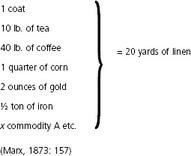
All the commodities express their value in the body of linen that becomes the universal equivalent. Now the commodities relate to one another as values insofar as they are definite as quantities of linen:
Through its equation with linen, the value of every commodity is now not only differentiated from its own use-value, but from all use-values, and is, by that very fact, expressed as that which is common to all commodities. By this form, commodities are, for the first time, really brought into relation with each other as values, or permitted to appear to each other as exchange-values. (Marx, 1873: 159)
The last passage of Marx's presentation of the form of value is the money form, obtained by that specific kind of commodity in the equivalent form that now becomes the money commodity. The analysis of the form of value, as long as it is the development of the expression of the value of a commodity in the body of another commodity, is the deduction of money. It is starting from this perspective that Backhaus characterises Marx's analysis of the form of value as a ‘critique of the pre-monetary theories of value'. According to Backhaus, not only the classical theory of value but the traditional interpretation of Marx's theory of value and the neoclassical theory of value are subject to Marx's critique. All these theories of value share the idea that money is a phenomenon that has to be put aside in order to catch the essence of the exchange. As Backhaus states, they ‘conceive as structurally identical the laws of the “exchange” in pre-monetary and monetary exchange economies: for them the “natural exchange economy” [Naturaltauschwirtschaft] is the “essence” of monetary economy. They want to know what is hidden behind prices mediated by money’ (Backhaus, 1978: 147). What classical, neoclassical and Marxist political economists do not take into consideration is the process that goes from the essence to phenomenal manifestation, from value to money – that is Marx's analysis of the form of value.
Backhaus reconstructs the passage from total to universal form of value as the demonstration of the impossibility of a generalised exchange of commodities without money. Since for Marx the same commodity cannot simultaneously appear in relative and equivalent forms in the same expression of value, Backhaus understands the total form of value as the model of a pre-monetary commodity economy and concludes that such a model ‘cannot be thought, because each commodity should be thought at the same time in both the forms’ (Backhaus, 1979: 285). For Backhaus it is necessary to distinguish between a general and transhistorical concept of exchange from the specific historical forms it assumes as barter or monetary circulation and, finally, recognise the essential monetary character of Marx's theory of value.
It is now clear that from the perspective of Marx's theory of value, money cannot be thought as a technical means, something devised by exchangers in order to facilitate the process of the exchange. On the contrary, money represents for Marx an underlying moment of the relations among commodity owners, the specific material [sachlich] form assumed by the socialisation of labour under capital social relations, specifically its fetish character. For a long time, the section on the fetish character of the commodity has been understood as something separate from Marx's theory of value. It was interpreted more as a philosophical appendix dedicated to expressing the historical nature of capitalistic relationships than an essential part of Marx's presentation. Things have changed since the problem of the form of value has acquired the attention it deserves and the role of money has been considered as a fundamental moment of the theory of value.
As seen above, the relationship between labour expended by private processes of valorisation and total social labour [gesellschaftliche Gesamtarbeit] is not a direct one. In the form in which capitalist society is organised, private expenditure of labour has to count as value in order to be an element of total social labour, and the form of the socialisation of labour is determined through a process of private exchanges between the commodities produced and money. What Marx names as ‘the mysterious character’ of the forms in which the process of socialisation is achieved lies in the fact that ‘the social relation of the producers to the total labour [Gesamtarbeit]’ is reflected to social agents ‘as a social relation between objects, a relation which exists apart and outside the producers [als ein außer ihnen existierendes gesellschaftliches Verhältnis von Gegenständen]’ (Marx, 1873: 164–5). The fetish character assumed by capitalistic social relations is the reason for the fetishism of political economy. Since social relations assume the form of exchanges among objects, the specific characters of capitalist production appear as if they were features of products of labour, the ‘socio-natural properties of these things’ (Marx, 1873: 165).
A social relationship between human beings exists as something outside them: ‘the relation between their own private labour and the social total labour appears [erscheint] to them in exactly this perverted form [verrückten Form]’ (Marx, 1873: 169, translation modified). The displacement of the social relation of the producers in the social relation between objects represents in Marx's words ‘an inversion [Verkehrung] and causes relations between people to appear [erscheinen] as attributes of things and as relations of people to the social attributes of these things’ (Marx, 1861–3: 507). The perversion [Verrücktheit] and the inversion [Verkehrung] of a social relation of people in a relation between objects create the irrational situation according to which objects are the bearers of social attributes. In the sphere of simple circulation, the object, insofar as it is a commodity, ‘changes in a sensuous supersensible thing [in ein sinnlich übersinnliches Ding]’ (Marx, 1873: 163).
The naturalisation of the capitalist mode of production put forth by political economy lies in the ‘objective semblance possessed by the social characteristics of labour’ [den gegenständlichen Schein der gesellschaftlichen Charaktere der Arbeit] (Marx, 1873: 167). Such a semblance is objective insofar as it is an aspect of the reality itself and not simply a subjective misunderstanding of the nature of value; it is objective because the semblance is determined by the objects themselves in the system of exchanges between commodities and money; and, finally, it is objective insofar as the social relation exists ‘apart and outside’ social agents as objects. According to Marx, political economy is trapped in fetishism because it cannot recognise the social constitution of the objects on which it operates. Political economy presupposes the ‘economic objects'; it presupposes a natural dimension in which objects are exchanged with one another and have a price that can be calculated. It is the presupposition of an ontological dimension in which objects, not differently from having length or weight, have value and can be exchanged. Marx can reason that social dimension in which objects have an objectivity of value only because he can recognise the contradiction between the private expenditure of labour and the superindividual process of socialisation determined by means of individual acts of exchange between commodity and money. While private expenditure of labour is something individual, something that can be recognised in the conscious consideration of the producer, the process of socialisation of private expended labour is something achieved in the sphere of circulation. It is a superindividual process. It is something that imposes itself behind the backs of economic agents as an ideal average acting after and independently of private processes of valorisation. It is the law of value as a specific mechanical social relation.
Conclusion
Marx's theory of value is not only an economic theory of value: it is a theory of the social constitution of the objects which economic theory presupposes. Marx's critique of political economy deduces the presupposition and the naturalisation of social relationships put forth by political economy as an aspect of the social reality itself, depending on the fetish character that social relationships assume under capital. Marx's theory is therefore the understanding of the social constitution of political economy as a science and at the same time a critique of the hypostases of that science. Finally, and most importantly, revealing the social constitution of the objects of political economy, Marx's critique shows the specific historical determinacy of capitalistic social relationships hidden under the perversion of ‘material [dinglich] relations between persons and social relations between things’ (Marx, 1873: 166).
References
Backhaus H. G. (1969) ‘On the Dialectics of the Value-Form', Thesis Eleven, 1, 1980, 99–120.
Backhaus H. G. (1978) ‘Materialen zur Rekonstruktion der Marxschen Werttheorie 3', in Backhaus H. G., Dialektik der Wertform: Untersuchungen zur Marxschen Ökonomiekritik, 1997, Freiburg: ça ira, pp. 129–228.
Backhaus H. G. (1979) ‘Materialen zur Rekonstruktion der Marxschen Werttheorie 4', in Backhaus H. G., Dialektik der Wertform: Untersuchungen zur Marxschen Ökonomiekritik, 1997, Freiburg: ça ira, pp. 229–98.
Bailey S. (1825) A Critical Dissertation on the Nature and Causes of Value Chiefly in Reference to the Writings of Mr. Ricardo and his Followers, London: Hunter.
Banfi R. (1965) ‘Uno pseudo-problema: la teoria del valore-lavoro come base dei prezzi di equilibrio', Critica Marxista, 3, 135–58.
Bellofiore R. (1989) ‘A Monetary Labor Theory of Value', Review of Radical Political Economics, 21(1+2), 1–25.
Bellofiore R. (2004) ‘Marx and the Macro-monetary Foundation of Microeconomics', in Bellofiore R., Taylor N. (eds), The Constitution of Capital. Essays on Volume I of Marx's Capital, London: Palgrave, pp. 170–210.
Bellofiore R. (2009) ‘A Ghost Turning into a Vampire: The Concept of Capital and Living Labour', in Bellofiore R., Fineschi R. (eds), Re-reading Marx: New Perspectives after the Critical Edition, London: Palgrave, pp. 178–94.
Böhm-Bawerk E. (1896) ‘Karl Marx and the Close of his System', in Sweezy P. (ed.), Karl Marx and the Close of His System, 1949, New York: Augustus M. Kelly, pp. 1–118.
Bonefeld W. (2010) ‘Abstract Labour: Against Its Nature and on Its Time', Capital & Class, 34(2), 257–76.
Bonefeld W. (2011) ‘Debating Abstract Labour', Capital & Class, 35(3), 475–9.
Bortkiewicz L. (1907) ‘On the Correction of Marx's Fundamental Theoretical Construction in the Third Volume', in Sweezy P. (ed.), Karl Marx and the Close of His System, 1949, New York: Augustus M. Kelly. pp. 197–221.
Braverman H. (1974) Labor and Monopoly Capital. The Degradation of Work in the Twentieth Century,1998, New York: Monthly Review Press.
Calabi L. (1972) ‘In margine al “Problema della trasformazione”. Il metodo logico-storico in Smith e Marx', Critica Marxista, 4, 109–79.
Carchedi G. (2011) ‘A Comment on Bonefeld's “Abstract Labour: Against Its Nature and on Its Time”', Capital & Class, 35(2), 307–9.
Cassel G. (1923) The Theory of Social Economy, New York: Augustus M. Kelly, 1967.
Colletti L. (1968) ‘Bernstein and the Marxism of the Second International', in Colletti L., From Rousseau to Lenin. Studies in Ideology and Society, 1972, New York and London: Monthly Review Press, pp. 45–108.
De Angelis M. (1995) ‘Beyond the Technological and Social Paradigms: A Political Reading of Abstract Labour as the Substance of Value', Capital & Class, 19(3), 107–34.
de Brunhoff S. (1973) Marx on Money, 1976, New York: Urizen Books.
Dobb M. (1946) Political Economy and Capitalism. Some Essays in Economic Tradition, London: Routledge & Sons.
Elson D. (1979) ‘The Value Theory of Labour' in Elson D. (ed.), Value. The Representation of Labour in Capitalism, 2015, London and New York: Verso, pp. 115–80.
Engels F. (1895) ‘Supplement to Capital Volume Three', in Marx K., Engels F., Collected Works, Vol. 37, 2010, Lawrence & Wishart ebook, pp. 872–97.
Fineschi R. (2001) Ripartire da Marx. Processo storico ed economia politica nella teoria del capitale di Marx, Napoli: Città del Sole.
Freeman A., Carchedi G. (1995) Marx and Non-Equilibrium Economics, Aldershot: Edward Elgar.
Hegel G. W. F. (1821) Outlines of the Philosophy of Right, 2008, Oxford: Oxford University Press.
Heilbroner R. L. (1983) ‘The Problem of Value in the Constitution of Economic Thought', Social Research, 50(2), 253–77.
Heinrich M. (2014) Die Wissenschaft vom Wert. Die Marxsche Kritik der politischen Ökonomie zwischen Wissenschaftlicher Revolution und klassischer Tradition, Münster: Westfälisches Dampfboot.
Kicillof A., Starosta G. (2007) ‘On Materiality and Social Form: A Political Critique of Rubin's Value-Form Theory', Historical Materialism, 15, 9–43.
Kicillof A., Starosta G. (2011) ‘On Value and Abstract Labour: A Reply to Werner Bonefeld', Capital & Class, 35(2), 295–305.
Kliman A. (2007) Reclaiming Marx's ‘Capital'. A Refutation of the Myth of Inconsistency, Plymouth: Lexington.
Luporini C. (1966) ‘Realtà e storicità. Economia e dialettica nel marxismo', in Luporini C., Dialettica e materialismo, 1974, Roma: Editori Riuniti, pp. 153–212.
Luporini C. (1972) ‘Marx secondo Marx', in Luporini C., Dialettica e materialismo, 1974, Roma: Editori Riuniti, pp. 213–294.
Marx K. (1857–8) Grundrisse. Foundations of the Critique of Political Economy, Harmondsworth: Penguin, 1973.
Marx K. (1858), ‘Letter to Lassalle, February 22 1858', in Marx K., Engels F., Collected Works, Vol. 40, 2010, Lawrence & Wishart ebook, pp. 268–71.
Marx K. (1859), ‘A Contribution to the Critique of Political Economy', in Marx K., Engels F., Collected Works, Vol. 29, 2010, Lawrence & Wishart ebook, pp. 257–418.
Marx K. (1861–3) Economic Manuscript of 1861–63, in Marx K., Engels F., Collected Works, Vol. 32, 2010, Lawrence & Wishart ebook.
Marx K. (1867a), ‘The Commodity. Chapter One, Volume One of the First Edition of Capital', in Dragstedt A. (ed.), Value: Studies by Karl Marx, 1976, London: New Park Publications, pp. 1–40.
Marx K. (1867b) ‘Letter to Engels, 24 August 1867', in Marx K., Engels F., Collected Works, Vol. 40, 2010, Lawrence & Wishart ebook, pp. 407–8.
Marx K. (1868), ‘Letter to Engels, 8 January 1868', in Marx K., Engels F., Collected Works, Vol. 40, 2010, Lawrence & Wishart ebook, pp. 514–7.
Marx K. (1871–2), ‘Ergänzungen und Veränderungen zum ersten Band des “Kapital”', Marx–Engels Gesamtausgabe, II.6, 1987, Berlin: Dietz, pp. 1–54.
Marx K. (1873) Capital. A Critique of Political Economy, Volume I. 1982, Harmondsworth: Penguin.
Marx K. (1880), ‘Marginal Notes on Adolph Wagner's Lehrbuch der Politischen Oekonomie', in Marx K., Engels F., Collected Works, Vol. 24, 2010, Lawrence & Wishart ebook, pp. 531–559.
Meek R. (1973) Studies in the Labor Theory of Value, New York: Monthly Review Press.
Mirowski P. (1990) ‘Learning the Meaning of a Dollar: Conservation Principles and the Social Theory of Value in Economic Theory', Social Research, 57(3), 689–717.
Murray P. (2000) ‘Marx's “Truly Social” Labour Theory of Value: Part I, Abstract Labour in Marxian Value Theory', Historical Materialism, 6(1), 27–65.
Myrdal G. (1953) The Political Element in the Development of Economic Theory, 1965, Cambridge: Harvard University Press.
Napoleoni C. (1973) Smith Ricardo Marx. Observations on the History of Economic Thought,1975, New York: Wiley & Sons.
Rancière J. (1965) ‘The Concept of Critique and the Critique of Political Economy: From the 1844 Manuscripts to Capital', in Althusser L., Balibar E., Establer R., Macherrey P., Rancière J., Reading Capital. The Complete Edition, 2015, London: Verso, pp. 73–170.
Reichelt H. (1970) Zur logischen Struktur des Kapitalbegriff bei Marx, Frankfurt am Main: Europäische Verlagsanstalt.
Ricardo D. (1823), ‘Absolute value and exchangeable value', in The Works and Correspondance of David Ricardo, Vol. 4, 1951, Cambridge: Cambridge University Press, pp. 357–412.
Robbins L. (1932) An Essay on the Nature and Significance of Economic Science, London: Macmillan.
Robinson J. (1962) Economic Philosophy, 1974, Harmondsworth: Penguin Books.
Rubin I. I. (1927) ‘Abstract Labour and Value in Marx's System', Capital & Class, 2(2), 1978, 107–39.
Rubin I. I. (1928) Essays on Marx's Theory of Value, 1973, Montreal and New York: Black Rose Books.
Schmidt A. (1968) ‘On the Concept of Knowledge in the Criticism of Political Economy', in VV. AA., Karl Marx 1818–1968, Bad Godesberg: Inter Nationes, pp. 92–102.
Smith T. (1990) The Logic of Marx's Capital. Replies to Hegelian Criticisms, Albany: SUNY Press.
Sraffa P.(1960) Production of Commodities by Means of Commodities: Prelude to a Critique of Economic Theory, Cambridge: Cambridge University Press.
Steedman I. (1977) Marx after Sraffa: London: New Left Books.
Sweezy P. (1942) The Theory of Capitalist Development, 1962, London: Dobson Books.
6. Money and Finance
Jim Kincaid
Marx studied and wrote about money and finance at frequent intervals from his arrival in London in 1849 until late in his working life.[82] During his lifetime little of this material reached finished form or publication, apart from a short but important book (Marx, 1987 [1859]) and a brilliant section at the start of Capital Volume 1 on the connection between money and the labour theory of value. In recent decades our understanding of what Marx was trying to achieve in his work on money and finance has been transformed. The many thousands of pages of notes and draft texts in his manuscript archive have been the focus of intensive study. Wider discussion has been made possible by the publication of much of this material in the magnificent 114 volume MEGA2 edition (Marx and Engels, 1975–), including especially Marx's manuscript of 1864–5 (in German, Marx (1992); in English, Marx (2016)). This contains the crucial, but rather disorganised, section on finance, which Engels drastically re-edited and published in 1894 as Section 5 of his edition of Capital Volume 3. The research work which is tracing the evolution of Marx's monetary thought is inevitably marked by controversy. But it is now clear that Marx was painstakingly constructing a coherent and unique theory of the role of money and finance in capitalist development.
Early in Capital Marx lists the functions of money in the many forms of human society which have used money. Notably: as means of exchange, as store of wealth, and as means of payment (i.e. debt settlement). But he argues that, as capitalism emerges, money develops a new and fundamental role – as measure of value. By this he means that there is a strong, though indirect, link between money and the labour which is required to produce commodities.
In the first three chapters of Capital Volume 1, Marx explores the basic categories which he believes are essential for a political economy which aims to analyse a system dominated by the production of commodities for sale. As commodities are exchanged, what is being bought and sold is the labour which went into producing them. The fundamental role which is required of money in a capitalist system is to be the form of expression and the measure of the quantity of abstract labour required to make commodities.
Until the 1970s, most students of Marx considered that his account of money was hopelessly outdated because he generally uses gold as his example when discussing money. Since then, however, his central arguments have been explained and clarified by scholars, following the pioneering work of Suzanne de Brunhoff (1976 [1973]):
-
in capitalism, the fundamental function of money is to act as measure of value, and therefore it is linked to abstract labour;
-
this remains true not just for a commodity form of money like gold, but for the other major forms of money such as paper notes issued by the State, or cheques and other forms of credit money supplied by banks.
By the standards of conventional economic theory these are strange propositions, and what is also unorthodox is the logical method Marx uses to explain and defend them. He asks: what must money be like if a capitalist economy is to function coherently? The reason for this roundabout approach, as Martha Campbell explains, is that:
Money is not transparent; it does not reveal value, which underlies it. Rather the concept of value had to be established independently in order to interpret money correctly. (1997: 97)
Commodities, Marx argues, have two sorts of value: the qualities that make them useful to those who buy them, and the price they will fetch when sold. Capitalism is a decentralised system in which producers are independent and only find out if the labour they put into making commodities is socially valid by the price they get as they sell in competitive markets. But the range of different kinds of labour is infinite. Marx argues that there is only one way in which such a system could work – if there is a single substance which will allow the prices of commodities to be expressed on a uniform general scale, independently of the use value of those commodities. Money converts labour into abstract labour, measured as socially necessary labour-time.
Money as a measure of value is the necessary form of appearance of the measure of value which is immanent in commodities, namely labour-time. (1976: 127)
Early in Volume 1 of Capital Marx patiently spells out the logic by which, in a society where commodity production has become general, money develops its basic function as measure of value. In and through the everyday buying and selling of commodities, the labour of individual producers comes to be assessed as a proportion of the total labour of a given society in a given period:
The value of a commodity expresses that it is a component of the total labour of a society and that it embodies some fraction of the total labour of a society. (1976: 127)
This is Marx's solution to what he calls ‘the riddle of money’ – his explanation of why and how, as commodity exchange becomes generalised in a society, money must emerge with the monopoly power to buy whatever is for sale.[83]
Gold is costly to excavate and to use; protecting it from theft is expensive. Thus gold has been displaced by cheaper forms of money such as bank cheques and currency supplied by central banks. Increasingly these are, in turn, being replaced by forms of money based on electronic recording and transfer. Most money today is no more than strings of digital code, inscribed in computer memories. But this is still a material form of money, and necessarily so, as Marx argued, if it is to act as a stable medium of calibration and calculation. Every dollar has to be kept equal to every other dollar – just as metres and temperature degrees need to be of a uniform length. There is as much strictness today in the recording and tracking of digital money, as there was when gold coins were being added up in the nineteenth-century counting house. Hackers and computer theft are as much of a menace to orderly commerce as were counterfeiters or bank robbers in an earlier period.
Functions of Money in a Capitalist Economy
-
Money as measure of value. As already noted, this, for Marx, is fundamental in a capitalist economy, and from it he reconstructs the other main functions of money. A secondary form, which is directly derived from money as measure of value, is money of account, i.e. when a price is stated but in abstraction from any actual transaction.
-
Money as means of exchange. Money used to buy and sell commodities.
-
Money as store of value. Money can be saved rather than spent. Marx's term for a cash reserve is hoard (Schatzbildung). One of the distinctive elements in Marx's vision is that money is power – not just the power to buy commodities, but more fundamentally, the power to set labour in motion, and therefore the power to secure surplus-value for whoever owns money which can be used as capital. When money is used as a store of value, what is involved is the preservation of the power of money over time, and the ability to transmit that power across geographical space, different currency zones, and through changes of ownership.
-
Money as means of payment (i.e. debt settlement). When credit is given and buyers are allowed time to pay, money acts as a means of settling the debt so created. Here money serves as a medium in which contracts are expressed and discharged. This is the basis for the major form of money in modern societies – credit money. Cheques are IOUs issued by banks, and the central bank supervises the system so that convertibility at par is maintained between bank credit money and the notes and coins issued by the central bank.[84]
-
World money. Marx is unusual in treating money's international role as a separate function. Since the Gold Standard ended, the currencies of the major economic powers, led by the US dollar, have been used internationally to borrow, invest, hold reserves, and pay off debt.
Money becomes capital when used in ways which make more money for its owner. Central in Marx's political economy is the circuit of industrial capital.[85] In this an initial sum of money is used to buy means of production and pay wages. As commodities are produced, workers are paid only for part of their labour-time. The rest – unpaid labour-time – is surplus-value. When commodities are sold their value is converted back into money – and, after costs of production have been met, the remaining surplus-value is retained as profit. Marx notes how credit processes become an element in the circuit of productive capital. People with money to invest can lend it to an industrial capitalist who, in return, will pay over part of the profit to the lender in the form of interest. Marx distinguishes between the rentier who supplies interest-bearing capital and the functioning capitalist who needs capital to expand operations, and who repays borrowed money, with interest, out of profits.
Starting from this deceptively simple foundation Marx constructs an increasingly complex analysis of capitalist finance. His first move is to explain why banks are a necessary development.
Why Banks?
Central to Marx's account of banks and other financial institutions within the capitalist system is the argument that some of the functions they perform allow overall rates of profitability to be greater than they would otherwise have been. He stresses the double role which finance plays in the accumulation process. The disruptive and larcenous power of the financial system is rooted in the equally powerful cost-cutting, profit-enhancing contribution it can make to the circuit of capital reproduction. Thus, for example, Marx's analysis of banks has two dimensions. They are seen as a necessary and inevitable development in capitalist economy because of the positive contribution they make to lowering costs of production and increasing profits. But banks and other firms in the financial system are able to develop the power to siphon off more than their due share of profits, to engage in lucrative swindles, and, on occasion, to expose the productive system to highly damaging crises.
It is important to stress, as Marx does, the difference between capital employed in the business of banking, on the one hand, and interest-bearing capital, on the other. Historically banks developed from what Marx calls money-dealing capital – specialised capital which emerged in centres of early capitalism such as Amsterdam and Hamburg and whose business was to provide financial services for industrial and commercial capitals. These included the holding of working reserves of cash, making and receiving payments, and keeping accounts. The money dealers also developed an important role in the making of international payments and in managing the gold and silver used to settle debts abroad. Thus Marx portrays the category of money-dealing capital (initially a branch of commercial capital in his account) as evolving into the banking system, which is a necessary element in a fully developed capitalism. Banking capital carries out key functions in the phases of exchange which are part of the circuits of production and reproduction of capital. These are, for example, the maintenance of accounts, the making of payments, the safe keeping of deposits, and the international exchange of currencies. Because these functions are indispensable, and because of the large economies of scale which specialised banks can achieve, banking capital shares in the distribution of total surplus-value and is subject to the same processes of equalisation of profit as operate for industrial capital.
The banking system also develops a crucial function in the allocation of capital. Firms build up stocks of idle money at various points in the circuit of capital. For example, they may accumulate cash in order to finance occasional large investment projects. Instead of lying dormant until required, the cash reserves of companies can be passed over to the banks, on-lent by them, and thus converted into active money capital. Capitalism abhors idle capital as much as idle employees, and by centralising the cash reserves of firms, the banking system can reduce to a minimum the proportion of total reserves which individual companies need to keep available in liquid form to meet their working requirements.
Banks also create linkages between the circuit of productive capital and other sectors of the economy. Marx notes that banks make available for investment the temporarily unoccupied money, not just of companies, but of all social classes. He writes (1981: 529) that, ‘small sums which are incapable of functioning as money capital by themselves are combined into great masses and thus form a monetary power'.
Marx repeatedly underscores the centralising function that banks play in relation to the savings and reserves both of capitals and individuals, and the power which this role gives to banks as allocators of capital:
The business of banking consists … in concentrating money capital for loan in large masses in the bank's hands, so that, instead of the individual lender of money, it is the bankers as representatives of all lenders of money who confront the industrial and commercial capitalists. They become the general managers of money capital … they concentrate the borrowers vis-à-vis all the lenders, in so far as they borrow for the entire world of trade. (1981: 528)
The financial system allows industrial capitals to increase their rate of profit by accelerating turnover. A firm need not wait until the commodities it produces are sold to realise the money value of its output.[86] It can borrow from a bank, using as collateral the IOUs supplied by its creditors. These were called bills of exchange in Marx's period and, as he explains, the monetisation of these commercial debts was then a major element in banking profitability. Marx's analysis of bills of exchange can now be seen as a pioneering study of securitisation – the techniques of debt commodification which in recent years have made possible a huge increase in the size and profitability of finance, but have also made the system vulnerable to new and highly damaging forms of crisis, as for example in 2007–12 in the USA and Europe.
Credit can drive an acceleration in the scale of productive operations. Note the summary by Engels of a longer text which Marx added to the French edition of Capital Volume 1 in 1872:
Not only is [the development of the credit system] itself a new and mighty weapon in the battle of competition. By unseen threads it also draws the disposable money, scattered across the surface of society, into the hands of individual or associated capitalists. It is the specific machine for the centralisation of capitals … In its turn centralisation … shortens and quickens the transformation of separate processes of production into processes socially combined and carried out on a large scale … the productivity of labour is made to ripen as in a hothouse. (1976: 778)
Marx saw credit mechanisms as central in the internationalisation of capitalism and in technological development. He writes that:
The English, for example, are forced to lend their capital to other countries in order to create a market for their commodities. Overproduction, the credit system etc., are means whereby capitalist production seeks to break through its own barriers and to produce over and beyond its own limits … Hence crises arise, which simultaneously drive it onward and beyond [its own limits] and force it to put on seven-league boots, in order to reach a development of the productive forces which could be achieved only very slowly within its own limits. (1972: 122)
Fictitious Capital
Marx notes that central to the operation of a financial system is the creation of contractual obligations to be discharged in the future. Such contracts Marx refers to as fictitious capital. There are two major forms. First, shares, which represent a permanent transfer of money capital to a firm to finance its activities. In Marx's period, joint-stock companies were developing, especially for large-scale enterprises in mining, banking, railways, and in international trade, all of which required the tying up of capital for long periods of time. Second, bonds, IOUs given by a borrower to a lender, promising to repay money at some date in the future, and indicating a rate of interest, this being usually fixed rather than floating.
Fictitious capital is created as companies raise capital by issuing shares or by giving bonds in exchange for money borrowed. Shares and bonds are the form of legal entitlement which owners of interest-bearing capital receive as they commit money which they own to finance the operations of companies. Both shares and bonds are legal claims on part of the stream of future income to be generated by a company. Shares are also titles of ownership of part of the productive assets operated by the company, but Marx argues that such titles must still be considered as fictitious, since the owner of a share is not able to realise it directly in the form of any part of the real capital which he or she nominally owns. The owner of shares in a railway company cannot trade them in for a few rails or a wagon. A share is no more than a piece of paper. The money paid over when the share was first issued has long ago been spent. What remains are what Marx calls:
[p]aper duplicates of annihilated capital … the ownership titles to joint-stock companies, railways, mines, etc are genuinely titles to real capital. Yet they give no control over this capital. The capital cannot be withdrawn. They give only a legal claim to the surplus value that this capital is to produce. (1981: 608)
Marx speaks of a paper world consisting of securities in the form of legal contracts entitling their owner to part of future flows of surplus-value in the form of interest or dividends (1981: 622).
He argues that the contribution which the banks make to profitability by reducing the costs of the reproduction of capital are closely associated with the many ways in which the financial system plays a parasitic role in relation to productive capital. For example, the productive system is exposed to damage as speculative movements of finance distort valuations on whose accuracy efficient allocation of capital depends. The many swindles which flourish, especially in a speculative boom, are noted in Capital. Marx comments that the development of the joint-stock company allowed the emergence of:
[a] new financial aristocracy, a new kind of parasite, in the guise of company promoters, speculators and merely nominal directors – an entire system of swindling and cheating with respect to the promotion of companies, issue of shares and share dealings … private production unchecked by private ownership. (1981: 569)
Marx argued that, as money capital accumulates in a society, and the banking system develops by collecting money capital and directing it to capitals in the productive circuit, there are two important consequences. First, as I have noted earlier, a division develops between two sorts of capitalists. Those who own money capital, the rentiers, and those who lend it to the functioning capitalists, namely those who operate businesses in production or commerce. Thus Marx makes a clear distinction between capital as property and capital as function. The money capitalist secures a share in surplus-value in the form of interest or dividends, entitlement to which is based on contract. Marx anticipates later discussion of the managerial revolution, as, ‘the transformation of the actual functioning capitalist into a mere manager, in charge of other people's capital, and of the capital owner into a mere owner, a mere money capitalist’ (1981: 567).
The second consequence of the development of money capital on a large scale, is that certain illusions become widespread. Money is deposited in a bank; a year later the money is still there, it seems, but has grown in the meanwhile by the amount of interest paid by the bank to its owner. It becomes easy to forget what has happened in the interim – that (in the paradigm case) the bank has lent the money to a functioning capitalist, and that the interest paid to the bank on this loan is a share of the profits made by the active use of the money as productive capital. But in the calculations of the rentier who has lent money to the bank, its active use as capital is readily obscured. It becomes easy for the rentier to think of the growth of money capital via interest payments as an automatic process. In interest-bearing capital, Marx writes, the relationship between capital and labour, ‘reaches its most superficial and fetishised form'. Money capital appears as a mysterious and self-creating source of interest and so generates its own increase. It comes to seem, ‘as completely the property of money to create value, to yield interest, as it is the property of a pear tree to bear pears’ (1981: 516):
Interest-bearing capital is the consummate automatic fetish, the self-expanding value, the money-making money, and in this form it no longer bears any trace of its origin. The social relation is consummated as a relation of things (money, commodities) to themselves. (1972: 455)
Marx considered the distinction between fictitious capital and real capital to be vital, and the failure to make that distinction clearly to be a major source of ideological mystification. For the individual who holds it, the government bond represents capital. The right to a flow of interest which it embodies can be sold to someone else and the bond thus realised as money capital. But what is capital for the individual owner, is not capital for the state, which pays the interest out of tax revenue. ‘The capital of the national debt remains purely fictitious’ (1981: 596). The influence on security prices of prevailing interest rates, and of judgements about future interest rate levels, and (in the case of shares) about future flows of dividends, means that the prices of assets on financial markets move independently of the value of the underlying real assets. Marx argues that this fact has strong ideological consequences. ‘The independent movement of the values of these ownership titles – not only those of government bonds, but also of shares – strengthens the illusion that they constitute real capital besides the capital or claim to which they may give title’ (1981: 598). From the point of view of their owners, these paper claims are saleable commodities and can therefore be transformed into capital in the money form. But from a social point of view, claims on surplus-value are not capital, but a deduction from the total of available value. This kind of inversion between appearance and underlying reality is a characteristic product of interest-bearing capital, which is, writes Marx, ‘the mother of every insane form, so that debts, for example, can appear as commodities in the mind of the banker’ (1981: 596).
Marx notes the power which the centralisation of capital allocation in the banking system gives to those who control that system. He carefully studied how the 1844–5 Bank Acts had the consequence that, in the credit shortage of the 1847 crisis, interest rates could be forced up to very high levels. The passage of this legislation reflected the power of the bankers in and around the Bank of England who stood to profit from high interest rates. Marx comments bitterly on the power given to banks and other financial capitals by the centralising mechanisms of credit:
The credit system, which has its focal point in the allegedly national banks and the big money-lenders and usurers that surround them, is one enormous centralisation and gives this class of parasites [dieser Parasitenklasse] a fabulous power not only to decimate the industrial capitalists periodically but also to interfere in the actual production in the most dangerous manner … The Acts of 1844 and 1845 are proof of the growing power of these bandits [dieser Banditen], added to whom are the financiers and stockjobbers. (1981: 678)
Marx also stresses the ways in which the role of the financial system varies through the business cycle, and how finance acts to magnify the oscillations of the cycle. It is here that he identifies a deeper level at which the financial system implements the law of value – in encouraging the build-up of financial fragility, the subsequent bankruptcies of weaker companies, the destruction of less competitive and profitable capitals, and a general devaluation of existing industrial capital. This allows recovery from recession and a renewed upsurge in profits and growth.
Marx sees capitalism as originating in an already internationalised economy, and credit processes as playing a central role in the successive rise of leading economies:
Along with the national debt there arose an international credit system, which often conceals one of the sources of primitive accumulation in this or that people. Thus the villainies of the Venetian system of robbery formed one of the secret foundations of Holland's wealth in capital, for Venice in her years of decadence lent large sums of money to Holland. There is a similar relationship between Holland and England. By the beginning of the eighteenth century, Holland's manufacturers had been far outstripped. It had ceased to be a nation predominant in commerce and industry. One of its main lines of business, therefore, from 1701 to 1776, was the lending out of enormous amounts of capital, especially to its great rival England.[87]
The same thing is going on today between England and the United States. A great deal of capital which appears today in the United States without any birth-certificate, was yesterday, in England, the capitalised blood of children. (1976: 920)
Marx never forgets that, beneath the fetishised surface, the ultimate source of financial wealth and profitability is the exploitation of workers. Sometimes this is made directly explicit – as here, in the reference to child labour.[88]
Contemporary Empirical Research and Controversies
I have space only for a brief review of some of the ways in which Marx's work on money and finance has been developed and debated in the recent literature. The influence of Hilferding's Finance Capital, published in 1910, continues to be pervasive. The organisational structure of capital is generally very different now in comparison with the Central European pattern analysed by Hilferding – a distinctive fusion of financial and industrial companies into conglomerates controlled by the banks. But Hilferding updates Marx's account of financial markets in perceptive ways, and poses questions about the power of finance which are as relevant now as in his period.
François Chesnais makes the term finance capital central to a recent book which can be commended as one of the most comprehensive Marxist studies of finance now available. Banks and industrial firms remain separate enterprises in most countries today and are not merged into single enterprises, but as Chesnais perceptively explains:
Contemporary capitalism confronts us with the simultaneous and combined centralisation/concentration of money capital, industrial capital and merchant or commercial capital … The parasitic traits of interest-bearing capital intuited by Marx and later emphasised by Lenin permeate the operations of all money, commercial and industrial capital alike. (2016: 8)
Defined in this way finance capital refers to the interlinked operations and collaborative power of the largest corporations and banks in the major economies. Chesnais notes, however, that it is the smaller firms which are more exposed to the predatory power of banks and the threat of leveraged buy-out by private equity companies. Hilferding's treatment of power in relation to the organisational configuration of finance and industry continues to have a wide influence in current research.[89]
Financialisation vs rate of profit as cause of stagnation and crisis
This question continues to be a major focus of controversy. The work of Gérard Duménil and Dominique Lévy combines careful statistical research with a broad historical sweep, and focuses mainly on the USA. Their data indicates that four major economic crises have hit the USA since Marx's period. They argue (2011) that the crises of the 1890s and the 1970s were caused by a fall in the rate of profit in the USA as well as other major economies. However, they strongly hold that the Great Depression of the 1930s, and the crisis of 2008, were not caused by profit decline, but rather by a previous rapid over-expansion of the financial sector. In both of these cases, the concentrated power of finance had been used by the owners of capital – the rentier class – to drain money capital out of the productive system. Investment in the productive economy became insufficient to support a vast increase in financial claims of all sorts, and crisis ensued. Like many other researchers, Duménil and Lévy stress shareholder value in the run-up to the 2008 crisis – the ways in which, from the 1980s onwards, the owners of companies developed the organised power to force companies to pay out high dividends and to buy-back shares rather than expand investment and production. Lavish salaries and stock options were used to persuade executives to implement these processes of value extraction from the corporate sector.
As against this type of explanation, a number of influential Marxist researchers hold that all major capitalist crises have a single underlying cause – a decline in the rate of profit. Michael Roberts, for example, writes that:
Each crisis of capitalism has its own characteristics. The trigger in 2008 was the huge expansion of fictitious capital that eventually collapsed when real value expansion could no longer sustain it, as the ratio of house prices to household income reached extremes. But such ‘triggers’ are not causes. Behind them is a general cause of crisis: the law of the tendency of the rate of profit to fall. (2016: 26)[90]
No one questions that the 2008 crisis was financial in an immediate sense. US banks had lent far too much in mortgages to several million home owners who were not in a position to sustain repayments if house prices began to fall – as they did in the USA in 2007. The mortgage-originating banks had created vast numbers of securities based on the future flow of mortgage repayments and these had been widely sold to other banks and investment funds in Europe as well as the USA. As mortgage defaults soared, the value of these securities tanked and the fact that some major banks were facing imminent collapse caused the global banking system to seize up – with a traumatic and immediate impact on trade credit, international trade, and employment. Household finance played a crucial role in the causation of the crisis. Here Atif Mian and Amir Sufi (2014) have provided an outstanding study of the role of mortgage default in the USA as the cause of a crash in house prices and resulting large fall in consumer demand. This, in turn, resulted in an increase in unemployment and a hit to profits. Thus, the implication of their analysis is that falling profits were a consequence, not an underlying cause, of crisis.
Research has also focused on why there was a huge increase in the supply of what Marx called loanable capital flowing into the banks in the pre-2008 period. The size of these inflows – together with central bank easy money policies – resulted in historically low levels of interest rates and huge pressure on the banks to find borrowers. The billions of dollars lent in subprime mortgages in the USA was one result of this pressure. The tide of loanable capital had three main sources: corporate cash reserves as profits stayed high and investment fell; the money capital of the rising numbers of the ultra-wealthy; and the financial flows which were the counterpart to international trade deficits, especially that of the USA. For an exploration of the role of surplus loanable capital as one of the underlying causes of the crisis, see Jim Kincaid (2016).
On the specific logics at work in the financial crisis, Simon Mohun (2016) offers a lucid explanation of how international banks had become highly interdependent via the repo system in which banks borrowed securities from each other on a huge scale. Mohun explains how, as the interbank market began to seize up in 2008, feedback and amplification processes came into play which rapidly deepened the crisis into one of exceptional severity.
But what caused the huge increase in the size and weight of the financial system which underlay the disastrous shock wave of 2008? Here writers such as Michael Roberts (2016) argue that the key driver of financialisation was the inadequacy of profit rates in the productive sector. Firms found they could get a better return by using their capital to speculate in financial markets and these grew explosively. In the run-up to the crisis, shareholder value pressures were of secondary importance. Its underlying and decisive cause was low profitability. The same applied to the Eurozone crisis of 2010–12.[91]
The thesis that the basic cause of financialisation was a low profit rate in industry has been criticised from a number of different directions – and, in my opinion, convincingly. For example, estimates of profitability in the USA are based on National Accounts data which cannot cover tax evasion and thus does not take account of the trillions of profits laundered by companies through tax havens.[92] Current research is tracing the ways in which tax avoidance operations have been central to contemporary financialisation in the global corporate sector. This is an important strand in the powerful account which Cédric Durand has developed in a recent book (2017). Profitability world-wide, he argues, is more than high enough to support much greater investment than present levels. He finds evidence that institutional investors have been using their power of control to compel companies to set very high hurdles for return on prospective investment, and to distribute to shareholders the spare capital released by restricting investment. Durand also argues that financialisation and tax evasion are central to the siphoning off, by companies based in the rich countries, of much of the value created by a doubling, in recent decades, of the global workforce available for surplus-value extraction – an extra 1.5 billion workers, mainly in poor countries, and mostly paid low wages. Here Durand's account takes its place in a large literature in which finance is analysed as a key element in patterns of global domination by the advanced countries, led by the USA.[93]
Costas Lapavitsas has also strongly attacked the low profit explanation for financialisation. He argues that to see the explosive growth of the financial system as only a kind of overspill from the productive sector is to fatally underplay the dynamism of finance, its greed, and its effectiveness at extracting profit from lending to households as well as to industry.[94] Lapavitsas notes that, since the early 1990s, there has been a profound change in the world banking system. Increasingly, the corporations have cut down on borrowing from banks having found it more profitable to raise capital by issuing bonds. Short-term corporate reserves are lent out more lucratively on the money markets, not kept in banks. Yet most big banks have remained amazingly profitable. They have achieved this by tapping into two other sources of revenue: (1) the extraction of cash from businesses through fees, notably via an advisory role in takeovers and other forms of restructuring of ownership of companies; and (2) lending on a vast scale to the household sector. In both of these activities the banks have proved endlessly fertile in developing ingenious swindles.
The explosive growth of bond markets and of derivatives has provoked renewed interest in Marx's analysis of fictitious capital. The two dimensions of Marx's account are given due weight in the literature. On the one hand, financial markets as parasitic – developing according to their own speculative logic and imposing damage on the productive system, jobs, and living standards. On the other, finance as implementing a form of capitalist rationality – a system of regulation imposing Marx's law of value, his term for the competitive pressures on firms to use means of production efficiently and to maximise the extraction of surplus-value. Consider, for example, the debt crises and exchange rate crises of the emerging economies starting with Mexico in 1982, through the East Asian crisis of 1997 to Argentina in 2001. The IMF provided rescue finance, but, in alliance with the banks and financial markets, imposed the agenda known as the Washington Consensus. This forced an abandonment of import-substitution strategies of development, and effected a currency depreciation which cut wages and state welfare. Governments were compelled to open their borders to capital flows and to allow local resources of labour and means of production to be bought up by international firms at bargain-basement prices.
One form of fictitious capital has been crucial as a source of both the profitability and the instability of the modern banking system. Dick Bryan and Michael Rafferty (2006) have produced a path-breaking Marxist analysis of derivatives, suggesting that they have become vital in allowing capital to establish a single dimension of commensurability for a wide range of risks that might affect future operations. The pricing of derivatives acts as a system of capitalist calculation which in turn enables risk to be commodified. The trading of risk via derivatives allows firms to insure against future price changes which would affect their profitability – a change in exchange rates, for example, or in interest rates, or in the prices of raw material inputs. Here Bryan and Rafferty have opened up a large agenda for further research. See, for example, an ambitious book by Sotiropoulos et al. (2013) in which derivatives and risk management are central to the analysis. They use insights from Althusser (on ideology) and Foucault (on governmentality) to develop Marx's thesis of fictitious capital as fetish, and argue that pricing in financial markets acts as a disciplining technology of class power. Two final chapters usefully help to qualify their sometimes exaggerated view of the capitalist rationality of derivatives trading.
Conclusion
I have briefly illustrated some of the wide range of ways in which Marx's theorisation of money and finance is being deployed in the current literature. The many differences of emphasis, and the disagreements, I hopefully believe to be an indicator of the vitality of the research agenda. Among contributors to the literature there is general agreement about some key points. Despite the efforts of governments and central banks to reform and control the financial system, the present situation remains deeply unstable. Debt levels around the world continue to rise. The rate of growth in output, productivity, and investment is insufficient to validate the mounting mass of bonds, equities, and other forms of fictitious capital. Inequalities of wealth and income continue to deepen. Financialisation is not about how the City or Wall Street abuse productive capital. What is at stake is a deeper process in which governments and finance capital combine to transfer the costs of crisis onto labour and the less powerful sections of society – in wage and welfare cuts, increased unemployment, and the destruction of communities.
References
Arrighi, Giovanni 1994, The Long Twentieth Century, London: Verso.
Brenner, Robert 2002, The Boom and the Bubble, London: Verso.
Brenner, Robert 2005, The Economics of Global Turbulence, London: Verso.
Bryan, Dick and Michael Rafferty 2006, Capitalism with Derivatives: A Political Economy of Financial Derivatives, Capital and Class, London: Palgrave Macmillan.
Callinicos, Alex 2014, Deciphering Capital, London: Bookmarks.
Campbell, Martha 1997, Marx's Theory of Money: A Defense, in Moseley and Campbell (eds).
Carchedi, Guglielmo 2011, Behind the Crisis, Leiden: Brill.
Chesnais, Francois 2016, Finance Capital Today, Leiden: Brill.
de Brunhoff, Suzanne 1976 [1973], Marx on Money, New York: Urizen Books.
Desai, Radhika 2013, Geopolitical Economy: After US Hegemony, Globalisation and Empire, London: Pluto.
Duménil, Gérard and Dominique Lévy 2011, The Crisis of Neoliberalism, Cambridge, MA: Harvard University Press.
Durand, Cédric 2017, Fictitious Capital: How Finance is Appropriating Our Future, London: Verso.
Fine, Ben 2010, Locating Financialisation, Historical Materialism, 18, 2: 97–116.
Freeman, Alan 2016, Booms, Depressions and the Rate of Profit: A Pluralist Inductive Guide, in Subasat (ed.).
Guttmann, Robert 2016, Finance-Led Capitalism: Shadow Banking, Re-Regulation and the Future of Global Markets, London: Palgrave Macmillan.
Harvey, David 2003, The New Imperialism, Oxford: Oxford University Press.
Harvey, David 2010, A Companion to Marx's Capital, London: Verso.
Harvey, David 2016, Crisis Theory and the Falling Rate of Profit, in Subasat (ed.).
Hilferding, Rudolf 1981 [1910], Finance Capital, London: Routledge and Kegan Paul.
Itoh, Makoto and Costas Lapavitsas 1999, Political Economy of Money and Finance, London: Macmillan.
Kincaid, Jim 2016, Marx after Minsky: Capital Surplus and the Current Crisis, Historical Materialism, 24, 3: 105–146.
Lapavitsas, Costas (ed.) 2012, Financialisation in Crisis, Leiden: Brill.
Lapavitsas, Costas 2013, Profiting without Producing: How Finance Exploits Us All, London: Verso.
Lapavitsas, Costas 2017, Marxist Monetary Theory: Collected Papers, Leiden: Brill.
Lapavitsas, Costas, Annina Kaltenbrunner and JP Painceira (eds) 2012, Crisis in the Eurozone, London: Verso.
Marois, Thomas 2012, States, Banks and Crisis: Emerging Finance Capitalism in Mexico and Turkey, Cheltenham: Edward Elgar.
Marx, Karl 1972, Theories of Surplus Value, Vol. 3, London: Lawrence and Wishart.
Marx, Karl 1976, Capital, Vol. 1, London: Penguin.
Marx, Karl 1981, Capital, Vol. 3, London: Penguin.
Marx, Karl 1987 [1859], A Contribution to the Critique of Political Economy, in Marx and Engels Collected Works, Vol. 29, London: Lawrence and Wishart.
Marx, Karl 1992, Marx-Engels Gesamtausgabe, II.4.2. Berlin: Dietz Verlag.
Marx, Karl 2016, Economic Manuscript of 1864–5, Trans. Ben Fowkes, Introduction Fred Moseley, Leiden: Brill.
Marx, Karl and Frederick Engels 1975–, Gesamtausgabe [MEGA2], Berlin: Dietz/Academie Verlag.
Mian, Atif and Amir Sufi 2014, House of Debt, Chicago: University of Chicago Press.
Mohun, Simon 2016, Inequality, Money Markets and Crisis, in Subasat (ed.).
Moseley, Fred (ed.) 2005, Marx's Theory of Money: Modern Appraisals, London: Palgrave Macmillan.
Moseley, Fred and Campbell, Martha (eds) 1997, New Investigations of Marx's Method, Atlantic Highlands, NJ: Humanities Press.
Murray, Patrick 1990, Marx's Theory of Scientific Knowledge, Atlantic Highlands, NJ: Humanities Press.
Norfield, Tony 2016, The City: London and the Global Power of Finance, London: Verso.
Panitch, Leo and Sam Gindin, 2012, The Making of Global Capitalism: The Political Economy of American Empire, London: Verso.
Panitch, Leo and Martijn Konings (eds) 2008, American Empire and the Political Economy of Global Finance, London: Palgrave Macmillan.
Roberts, Michael 2016, The Long Depression, Chicago: Haymarket.
Shaikh, Anwar 2016, Capitalism: Competition, Conflict, Crises, Oxford: Oxford University Press.
Smith John 2016, Imperialism in the Twenty-First Century, New York: Monthly Review Press.
Sotiropoulos, Dimitris, John Milios and Spyros Lapatsioras 2013, A Political Economy of Contemporary Capitalism and its Crisis: Demystifying Finance, London: Routledge.
Subasat, Turan (ed.) 2016, The Great Financial Meltdown, Cheltenham: Edward Elgar.
Zucman, Gabriel 2013, The Hidden Wealth of Nations: The Scourge of Tax Havens, Chicago: University of Chicago Press.
Some Useful Blogs:
7. Labour
Guido Starosta
Introduction
The centrality of the notion of ‘labour’ in Marx's critical social theory and in particular its determining character as the key to his materialist perspective on human society and its historical development, seem to be beyond dispute.[95] It is also quite uncontroversial, at least on the basis of textual evidence, that Marx presented the simplest or most general determination of labour as consisting in the conscious and voluntary transformation of external nature by human beings in order to appropriate its potentialities for the satisfaction of human needs. Controversies arise, however, when it comes to establishing if Marx was right, whether in his views on the essential determinations of labour or concerning its defining role in the constitution and development of the forms of existence of human subjectivity.
Against the backdrop of these debates, this chapter will provide a comprehensive discussion of the notion of labour in Marxian social theory, with the aim of providing a systematic reconstruction of the ‘unity of its many determinations', which appear scattered in Marx's own writings. In order to do so, it will address the multiple dimensions and aspects associated with this essential concept, both as they were originally formulated by Marx and in some of the main subsequent debates outside and within Marxism to which the former gave rise. Taking as the point of departure the simplest determination of human labour as conscious life-activity, this chapter will probe further into the different, more concrete determinations which comprise the material character of production and its changing historical modes of existence. Through this close scrutiny of the concept of labour, the chapter will make two fundamental points. In the first, and substantively, it will bring out the centrality of the material determinations of human productive subjectivity for the comprehension of the content and historical trajectory of society. Second, and formally, it will show that it is possible to find an underlying ‘systematic’ unity which articulates those different determinations of the Marxian concept of labour into a ‘concrete whole'.
Marx's Discovery of Labour, or Conscious Life-Activity, as Humanity's ‘Species-Being'
Marx's discovery of the centrality of labour to social life can be traced back to the Paris Manuscripts of 1844 (Marx, 1992a [1844]) and was a direct result of Marx's first attempt at the critical investigation of the specific nature of modern society through the critique of Hegel's Philosophy of Right (1991 [1821]), i.e. through an analysis of bourgeois political forms. As Marx himself tells us in the short intellectual ‘autobiography’ found in the Preface to the Contribution to the Critique of Political Economy (1992b [1859], the main conclusion he reached was that the key to the comprehension of the specific nature of capitalist society was not to be found in the critique of the doctrine of the state. Instead, the critique of modern society had to start with the critique of political economy in order to, then, continue into a critique of the state (1992b [1859]: 425–6). The former was the science that was able to penetrate the ‘internal physiology’ of the modern world to be found in ‘civil society’ and, more precisely, in ‘private property'.
In light of this conclusion, in the 1844 Manuscripts (1992a [1844]) Marx turns his attention to the material reproduction of human life as the key to the understanding of society and its historical development. As Arthur points out, in that early text Marx ‘for the first time … attributes fundamental ontological significance to productive activity. Through material production humanity comes to be what it is … material production is the “mediation” in which the unity of man with nature is established’ (1986: 5). In other words, Marx identifies labour or productive activity as the specific form in which humanity reproduces its existence as part of nature.
This means that although the human life-process undoubtedly possesses its qualitatively differentiated ‘species-character', constituted by ‘the nature of its life activity’ (Marx, 1992a [1844]: 328), it nonetheless remains a concrete form of the natural life-process in general. In this sense, labour realizes in its own peculiar fashion the determinations entailed by any form of life-activity, namely: being a natural process of self-reproduction through the material interchange with ‘inorganic nature', which is ‘life-producing-life’ (Marx, 1992a [1844]: 328).[96] Consequently, in order fully to account for the specificity of labour, Marx also needed to further uncover its immanent more abstract determination as a mode of existence of ‘life activity in general', of ‘species-life’ as such.
Marx's clearest rendition of this immanent natural content in the determination of human productive activity can be found in a passage from the third of the Paris Manuscripts, in the context of his critique of both idealism (Hegel) and (abstract) materialism (Feuerbach) from the viewpoint of what he calls at this stage ‘consistent naturalism or humanism', which is the ‘only [perspective] capable of comprehending the process of world history’ (1992a [1844]: 389):
Man is directly a natural being. As a natural being and as a living natural being he is on the one hand equipped with natural powers, with vital powers, he is an active natural being; these powers exist in him as dispositions and capacities, as drives. On the other hand, as a natural, corporeal, sensuous, objective being he is a suffering, conditioned and limited being, like animals and plants. That is to say, the objects of his drives exist outside him as objects independent of him; but these objects are objects of his need, essential objects, indispensable to the exercise and confirmation of his essential powers. (Marx, 1992a [1844]: 389–90)
As with any living natural being, the relation of the human being to nature consists of a process whereby the individual actualizes its own bodily ‘vital’ powers (i.e. what a few years later Marx and Engels in the German Ideology (1976 [1845]) would term its ‘corporeal organization'), with the purpose of appropriating the objective potentialities immanent in their natural environment. This is the material process that, later in his life, Marx would refer to as the ‘metabolism between man and nature’ (Marx, 1976a [1867]: 133). Moreover, as with every animal life-form, this involves the material expenditure of the living individual's corporeality in order to act upon external nature in a particular fashion corresponding to its species-determination, whose end result is the appropriation and consumption of the ‘essential objects’ that satisfy its needs, thereby reconstituting and transforming the materiality of its bodily existence.
Thus, the defining qualitative attribute of the living individual lies in the material potential to self-reproduce; that is, to posit through their own activity the renewal of the conditions for their continued existence as an ‘objective natural being'. This material potential for self-reproduction is expressed in their cognitive capacity, which is constituted by their vital, living power to recognize the mutual ‘affinity’ between their own material potentialities and those of their objective environment (Iñigo Carrera, 2007: 43–4). Through the exercise of their cognizing activity, the living individual has therefore the power to satisfy their own needs by organizing and regulating the actual unfolding of their bodily action upon external nature. On the basis of all these determinations, the living individual is determined as subject, they are endowed with subjectivity (as opposed to the sheer objectivity of non-living forms of nature).
According to Marx's discussion in the Paris Manuscripts, in its simplest expression the distinctiveness of the human species-being (hence of human subjectivity proper) appears at first sight to involve a merely quantitative difference from animal life-forms, one of degree of universality in the scope of its appropriation of inorganic nature (Marx, 1992a [1844]: 329). However, Marx stresses that underlying this quantitative difference there is a qualitative specificity in human subjectivity, which he finds in the fact that the human being has conscious life-activity (1992a [1844]: 328). Hence, Marx saw the specifically human form of the natural life-process in the fact that human beings regulate the appropriation of the objective powers of the natural environment through the organization of the externalization of their own vital powers by means of thought, conscious cognition or knowledge, that is, by ideally appropriating nature's potentialities as the necessary first step before its real appropriation through the effective unfolding of action. In other words, human beings are not simply bearers of subjectivity, but also know or recognize themselves as subjects in the process of affirming their species-powers, thereby ‘making life activity itself an object of [their] will and consciousness’ (1992a [1844]: 328).
Now, as Marx and Engels clarified some years later in The German Ideology against the backdrop of the Young Hegelians’ ‘empty phrases about consciousness devoid of any material premises’ (1976 [1845]: 37), this conscious subjectivity is but the expression of the fact that human beings ‘can be distinguished from animals by consciousness, by religion or anything else you like', but ‘they themselves distinguish themselves from animals as soon as they begin to produce their means of subsistence’ (1976 [1845]: 31). In other words, in this text Marx and Engels want to throw into relief the immanent material connection between the determination of consciousness as a distinctively human attribute and the fundamentally mediated character of the human being's life-process. Their emphasis on the production of means of subsistence is therefore meant to stress the distinctively transformative mode of the process of metabolic exchange with nature as the simplest content of the human species-being which takes on a more developed mode of existence in the form of their conscious and voluntary being.
As Sayers (2007: 434) aptly emphasizes, the primordial and most general determination of human labour, which qualitatively distinguishes it from the broadly unmediated character of the life-process of non-human animals, is to be ‘form-giving’ life-activity.[97] Thus, in The German Ideology Marx and Engels stress that the conscious and voluntary form taken by the human life-process is not a dogmatic ‘philosophical postulate’ but a determinate, ‘empirically verifiable', objective natural expression of the ‘corporeal (or bodily) organization’ of ‘living human individuals and their consequent relation to the rest of nature’ (Marx and Engels, 1976 [1845]: 31). Although in the latter text Marx and Engels do not ‘go into the actual corporeal nature of man’ (1976 [1845]: 31), it is clear, as Fracchia (2005) remarks, that this ‘corporeal organization’ entails, in the first place, the evolutionary emergence of the human brain as the bodily instrument whose functioning is expressed in the form of consciousness. But, in the second place, Fracchia rightly adds that it is also evident that the development of the specific configuration of the human brain has been in turn the outcome of prior evolutionary changes in the corporeal organization of hominids eventually leading to the Homo Sapiens, all of which made possible the transformative or productive character of its mode of life based on labour: opposable thumbs, bipedalism, binocular vision, etc. (Fracchia, 2008: 39). This emphasis on the ‘corporeal roots’ of human beings and their subjectivity might seem at first sight a self-evident triviality, yet it is not if, as Fracchia (2017) notes, familiarity ends up breeding neglect, as is arguably the case in much contemporary social theory. Thus, the relevance of this reminder about the natural and evolutionary dimensions of human subjectivity can be said to transcend the historical context of Marx and Engels's polemic against the Young Hegelians and has become very contemporaneous.[98]
In this sense, consciousness is the most potent evolutionary development that eventually emerged to regulate the greater cognitive complexity entailed by the growing instrumental, spatial, temporal and personal separation between the initial action that sets into motion the process of human metabolism with nature and its end result, which is achieved with the material reproduction of the corporeality of an individual human being through the consumption of the product of labour (Iñigo Carrera, 2007: 45). In other words, as available paleoanthropological scientific evidence confirms, consciousness evolved as a result of the increasingly mediated character assumed by the forms of practical transformative activity of our hominid predecessors, and which eventually led to the emergence of strictly human (in the sense of the modern Homo Sapiens) modes of life.[99]
In light of the determinations of human labour unfolded so far, we can now proceed to further specify the way human beings distinguish themselves from animals and why they do so. As we have seen, according to Marx the simplest difference consists in the capacity to produce its means of subsistence. This is the specific determination of the human life-process seen, as it were, from a synchronic point of view. However, that simple specificity manifests itself also in a further determination when grasped from a developmental perspective. That is, when seen from the perspective of the way in which human beings expand the potentialities of their process of metabolism in contradistinction to other animal life-forms (Iñigo Carrera, 2007: 44). Due to their more limited ability to modify external nature to make it apt to satisfy their needs, non-human animals can only develop their capacity to appropriate natural forms by means of a genetically induced mutation of their own corporeality, which allows them to adapt to what they confront as given conditions of existence, i.e. by evolving into another species (Fracchia, 2017). Conversely, in having developed the capacity to alter their life conditions through conscious productive practice, human beings have also qualitatively ‘sublated’ the way in which, as living subjects, they expand the powers of their metabolic process with nature. The key to those developmental dynamics of the natural life-process no longer only resides in further biological speciation through the modification of bodily organs. Instead, humans can ‘change their own nature’ (Marx, 1976a [1867]: 283) through the development of the transformative powers of their life-process, i.e. of the productive powers of their own labour. The development of the ‘material forces of production', Marx thus concluded, becomes determined as the most general qualitative content that gives underlying unity to the ‘history of humanity’ (Marx and Engels, 1976 [1845]: 43).
As a result of these specific developmental dynamics, human beings can not only universally expand the areas of nature which become determined as concrete forms of their activity, but they can also complexify the mediations involved before the final appropriation of natural objects as use-values that are immediately apt for the satisfaction of human needs, thereby consuming properly ‘human objects'. In other words, they can extend and deepen the ‘humanization of nature’ (Marx, 1992a [1844]: 329, 352–4; Marx and Engels, 1976 [1845]: 39).
Furthermore, this applies to all kinds of human need, whether they spring from the ‘stomach or the imagination’ (Marx, 1976a [1867]: 125). Thus, the materiality of the satisfaction of human needs involved in the ‘metabolic exchange with external nature’ by means of labour does not only refer to ‘those of the individual … reduced to a natural subject’ (Marx, 1993 [1857–8]: 528), but also to ‘historic needs … created by production itself, social needs’ (Marx, 1993 [1857–8]: 527). Moreover, they are not just of a ‘physical’ nature (Marx, 1976a [1867]: 275, 341) but also include ‘intellectual and social requirements’ whose extent and number ‘is conditioned by the general level of civilization’ (Marx, 1976a [1867]: 341). In a similar vein, the product of labour to be consumed comprises not only ‘goods’ but also so-called ‘services', whose result may not be a ‘useful object’ but still involves a material ‘useful effect’ which also changes the form of external nature (Marx, 1978 [1885]: 135). As Sayers (2007: 444–8) perceptively notes, the same could be said about the ‘symbolic’ and ‘affective’ content of use-values that is so central to contemporary theories of ‘immaterial labour’ (Hardt and Negri, 2005). In all cases, the satisfaction of those needs is the necessary material form for the reproduction and/or expansion of the productive powers of individuals (Marx, 1993 [1857–8]: 717fn), that is, of the ‘aggregate of those mental and physical capabilities existing in the physical form, the living personality, of a human being, capabilities which he sets into motion whenever he produces a use-value of any kind’ (Marx, 1976a [1867]: 270, emphasis added; see also 717). In other words, there is no satisfaction of ‘physical’ and intellectual needs through the consumption of use-values which is not determined as an inner moment of the development of the specific attributes or powers of the human being as an essentially labouring or productive subject, i.e. of the development of the ‘human mastery over the forces of nature, those of so-called nature as well as of humanity's own nature’ (Marx, 1993 [1857–8]: 488).
By virtue of these determinations in their synchronic and diachronic unity, Marx argued in an obvious ‘activist’ twist to Feuerbach's (2008 [1841]) ‘contemplative’ argument in the first chapter of his The Essence of Christianity, the human being does not simply have a determinate species-character but actually is a species-being, ‘a being which treats the species as its own essential being or itself as a species-being’ (Marx, 1992a [1844]: 329).[100]
At this juncture, it might be worth remarking that this early discovery of the specific determination of the human being as a productive subject, or of human individuality as an expression and mode of development of her/his labouring activity, would remain unaltered throughout the rest of Marx's works. The exposition by the ‘mature Marx’ of the general determinations of the labour process in chapter 7 of Capital, Volume I, does not involve any substantive change in comparison with the discussion of the human species-being by the ‘young Marx’ of the Paris Manuscripts (1992a [1844]) or by Marx and Engels in The German Ideology (1976 [1845]). Labour is thus defined as follows:
A process between man and nature by which man, through his own actions, mediates, regulates and controls the metabolism between himself and nature. He confronts the materials of nature as a force of nature. He sets into motion the natural forces which belong to his own body, his arms, legs, head and hands, in order to appropriate the materials of nature in a form adapted to his own needs. (Marx, 1976a [1867]: 283)
Additionally, what gives labour ‘a form in which it is an exclusively human characteristic', transcending those ‘instinctive forms … which remain at the animal level', is the fact that ‘at the end of every labour process a result emerges which had already been conceived by the worker at the beginning, hence already existed ideally’ (Marx, 1976a [1867]: 283–4). This result, Marx continues, emphasizing the form-giving character of the human metabolic process, ‘is a use-value, a piece of natural material adapted to human needs by means of a change in form’ (1976a [1867]: 287), whose transformation is furthermore effected via ‘the use and construction of instruments of labour', which, ‘although present in germ among certain species of animals, is characteristic of the specifically human labour process’ (1976a [1867]: 286). In sum, all the determinations of human labour as conscious, transformative life-activity are maintained by Marx in the most developed version of the critique of political economy unfolded in Capital.[101]
The Immanent Social Character of Labour and Human Productive Subjectivity: ‘Social Being’ and Consciousness
The ‘fashioning of inorganic nature’ (Marx, 1992a [1844]: 328–9) in a form ‘adapted to human needs’ does not exhaust the intrinsically mediated character of human life-activity underpinning the necessity of its conscious form. A further mediation that adds to the complexity of the human process of metabolism lies in the necessary social character of productive activity (Marx, 1993 [1857–8]: 83–4). For, although human productive powers are borne by each particular individual, the development and actualization of these potentialities characterizing the species – i.e. the realization of the transformative powers of the human being – can only affirm themselves through the organic unity of individual lives, through social life. In effect, as Iñigo Carrera points out (2007: 47–8), individually borne human productive powers can only be constituted socially, that is, they can only develop as a result of the productive action of other individuals (who, for instance, have participated in the production of the use-values whose consumption resulted in the productive attributes borne by the former individual's labour-power). Moreover, the individual labourer produces use-values not solely for her/his own consumption, but for others, that is, social use-values. As Marx puts it in the Paris Manuscripts:
We have seen how … man produces man, himself and other men; how the object, which is the direct activity of his individuality, is at the same time his existence for other men, their existence and their existence for him … Activity and consumption … in their content are social activity and social consumption. (1992a [1844]: 349)
Note, however, that this does not simply mean that human productive activity always presupposes a ‘social context’ within which it takes place (e.g. sociologically conceived social ‘institutions’ that ‘structure', ‘condition’ or ‘constrain’ human ‘agency'). Thus posed, the relation between the social and individual character of human productive activity is rendered completely external. This is why a few lines later, through the example of the seemingly isolated activity ‘in the field of science', Marx throws into relief the immanent social character of labour as an individual action, i.e. its determination as a material expenditure of individually borne yet socially constituted corporeal powers to transform external nature, consciously, into a means for human life:
It is above all necessary to avoid once more establishing ‘society’ as an abstraction over against the individual. The individual is the social being. His vital expression – even when it does not appear in the direct form of a communal expression, conceived in association with other men – is therefore an expression and confirmation of social life. Man's individual and species-life are not two distinct things. (1992a [1844]: 350)
Thus, the organization and regulation of the individual process of human metabolism with external nature acquires an additional qualitative and quantitative cognitive complexity. It needs to affirm itself as an organic ‘element of the total labour of society’ (Marx, 1976a [1867]: 165), i.e. to posit its underlying general social unity through its material articulation with the life-processes of other human individuals. To put it differently, the production of life through the expenditure and development of the productive powers or forces of the human individual, i.e. a material or natural relation, takes on necessary concrete shape (and is thereby necessarily mediated) in and through social relations, which are therefore determined as social relations of production:[102]
The production of life, both of one's own in labour and of fresh life in procreation, now appears as a twofold relation: on the one hand as a natural, on the other as a social relation – social in the sense that it denotes the co-operation of several individuals, no matter under what conditions, in what manner and to what end. (Marx and Engels, 1976 [1845]: 43)
The essential most general determination at stake in all social forms of the human life-process is therefore the organization of the unity of the social character of individual labours, that is, the social regulation of the allocation of the total labour of society in its different individual concrete forms in order to reproduce and expand the materiality of the productive powers of human beings. The historically changing character of the social relations of production is given by the specific form in which each society mediates ‘the participation of the individual in general production’ or the positing of ‘the labour of the individual … as social labour’ (Marx, 1993 [1857–8]: 171–2).[103]
On the other hand, this means that in its material condition as the specifically human capacity to organize the life-process, consciousness always entails a twofold determination as much as the labouring activity that it organizes and regulates (Iñigo Carrera, 2007: 43–9). Consciousness thereby does not simply undertake the regulation of the individual appropriation of the potentialities of external nature in order to transform it, but must also mediate the establishment of individual labour's immanent unity with the socially general metabolic process of which it is an organic element. In other words, consciousness needs to articulate the determination of individual productive activity as part of the general social division of labour. As an attribute borne by the individuality and corporeality of each human being, consciousness is thus the personal power or capacity to partake in the establishment of the unity of social labour through individual productive action, i.e. to regulate the social character of individual labour.
In this sense, consciousness, and along with it language (hence, human subjectivity proper), are also ‘evolutionary’ products of the development of the social character of labour:
Language is as old as consciousness, language is practical, real consciousness that exists for other men as well, and only therefore does it also exist for me; language, like consciousness, only arises from the need, the necessity, of intercourse with other men. Where there exists a relationship, it exists for me: the animal does not ‘relate’ itself to anything, it does not ‘relate’ itself at all. For the animal, its relation to others does not exist as a relation. Consciousness is, therefore, from the very beginning a social product, and remains so as long as men exist at all. (Marx and Engels, 1976 [1845]: 44, emphasis added)[104]
The determination of consciousness by the social character of labour not only pertains to its natural genesis. It also underpins its subsequent modes of existence and development, so that, as Marx and Engels stress in their well-known aphoristic statement, ‘consciousness [das Bewusstsein] can never be anything else than conscious being [das bewusste Sein], and the being of men is their actual life-process’ (1976 [1845]: 36). Moreover, insofar as this actual life-process is form-determined in historically changing social modes of existence, so will be the concrete forms of human subjectivity that, in turn, mediate the establishment of the unity of the social relations of production through the conscious and voluntary action of individuals. In other words, all concrete social forms assumed by human conscious and voluntary subjectivity are the way in which individuals see both themselves and the historically determined modes of existence of their social relations, which are two sides of the same coin once the apparent exteriority between society and individual is overcome. Through the different forms of subjectivity, human beings therefore organize the unfolding of their individual actions as organic moments of the material reproduction of the socially mediated unity of their metabolic process with nature, i.e. their consciousness is always determined as ‘consciousness of existing practice’ (Marx and Engels, 1976 [1845]: 45).
It follows that the point of Marx's materialism is not to conceive of social being as a self-subsistent existence that externally ‘causes', ‘conditions’ or ‘functionally moulds', from such exteriority, an equally self-subsisting consciousness. Such severance and consequent external relation of social being and consciousness, with the latter floating in mid-air in an ontologically conceived ‘superstructure’ of society, would certainly be idealist. Analogously to the relationship between productive forces and social relations discussed earlier, the key to overcoming such dualistic representations is to grasp social being or social relations of production as the inner material and social content, which is necessarily realized, and therefore exists, in the form of the determinations of the consciousness of the human individual.[105] As Marx bluntly and succinctly puts it in the 1861–63 Manuscripts, ‘social relations only exist between human beings to the extent that they think’ (1988 [1861–3]: 232). In other words, there are no social relations of production or forms of human productive practice (and, a fortiori, no material productive forces of labour) whose determinations could be conceived of in abstraction from (i.e. not immanently mediated by) consciousness. Productive powers of social labour, social relations of production and forms of consciousness constitute the indissoluble unity between the content and form of the determinations of human productive subjectivity and practice in the process of ‘natural history', that is, of human labour and its historical development.
Controversies Over Marx's Perspective on Human Labour
A first strand of critiques of Marx's notion of labour emerged outside Marxism in the second half of the twentieth century and are of sociological or philosophical origin. Thus, Habermas (1971 [1968], 1987 [1985]) argues that Marx's conception of labour one-sidedly conceives of human practice as ‘monological’ or merely instrumental activity, and fails to throw into relief the constitutive ‘interactional’ or ‘communicative’ dimensions of human action. In other words, Marx is read as unable to grasp the difference between ‘labour’ and ‘interaction’ or, in Habermas’ later formulation, that between ‘instrumental’ and ‘communicative’ action, which allegedly lies at the basis of the social life-process. For her part, and in a similar vein, Arendt (1998 [1958]) considers that Marx confuses or conflates the threefold distinction that constitutes the human being's vita activa, that is, ‘labour’ (as animal-like, merely biological metabolic activity with nature), ‘work’ (as purposeful activity that humanizes nature in a lasting, non-ephemeral way), and even more starkly, ‘action’ (as radically self-initiating, necessarily collective and ‘public', end in itself). In light of the earlier discussion, one could argue that these critiques are predicated on a misreading of Marx's perspective on the determinations of labour (particularly serious in the case of Arendt) (Holman, 2011), insofar as they overlook the irreducible immanent social character of productive activity. Thus, it is these authors who actually, and wrongly, reduce labour to an asocial, purely individual material interchange with nature. As a consequence, they then need to come up with other dimensions of human action, which are therefore rendered ‘autonomous’ from the material reproduction process, in order for social life to attain unity. In other words, in Habermas’ and Arendt's respective approaches, the intrinsic unity between the different determinations of human labour become ‘fossilized’ into extrinsically related ‘dimensions’ of human action or, worse still, into plainly distinct forms of human action.[106]
In the second place, some Marxists themselves have raised certain objections that partly take issue with (the early) Marx's own treatment of labour, insofar as it involves an ‘affirmative’ view of labour as the ‘transhistorical’ essence of human life which would be emancipated with the overcoming of capital. Instead, they put forward a negative critique of the historically specific self-mediating or ontological role of labour in capitalism, which must actually be abolished under communism. Paradigmatically, this is the case of Postone's (1996) more broadly discussed work and of the lesser-known but similar approach by Kurz and the German Wertkritik (Jappe, 2014; Larsen et al., 2014). More concretely in the case of Postone, he argues that whereas in non-capitalist societies ‘the social distribution of labour and its products is effected by … manifest social relations', in ‘commodity-determined society’ (i.e. capitalism) ‘labour itself constitutes a social mediation in lieu of overt social relations’ (Postone, 1996: 149–50). According to Postone (1996: 148), this socially self-mediating role of labour in capitalism in turn derives from the dual character that it acquires, by virtue of which it not only produces use-values for others as intentional activity that transforms nature in a determinate fashion (what Marx terms concrete labour) but also acts as a means of acquisition of the products of others. And since ‘there is no intrinsic relation between the specific nature of the labour expended and the specific nature of the product acquired by means of that labour', that historically determinate function of labour as ‘means of acquisition’ must be done by abstracting ‘from the specificity of … its own concrete form’ and on the basis of its character as labour in general (i.e. as abstract labour) (Postone, 1996: 151–2). Social interdependence in capitalism, Postone concludes, is not achieved by means of overt social relations but specifically by (abstract) labour itself (1996: 151–2). As a further corollary, Postone (1996: 58–68) states that the ‘traditional Marxist’ notion of labour that sees its socially constitutive role as a generic or transhistorical determination leads of necessity to the naturalization of the capitalist form of labour and, a fortiori, of the alienated or objectified forms of social mediation (and concomitant impersonal forms of domination) to which the former gives rise.
Now, there are several and wide-ranging problematic and controversial issues in Postone's undeniably thought-provoking contribution; here I can only mention two which are of immediate relevance to this chapter. In the first place, and at a formal argumentative level, one could say that Postone's rejection of the generic determination of labour as the specific form of action that is socially constitutive of human subjectivity is based on a combination of terminological conflation (between ‘labour’ and ‘abstract labour') and non-sequitur reasoning.[107] Leaving aside other shortcomings in his discussion of the socially mediating function of labour in capitalism,[108] all that he manages to demonstrate is that in this society the social positing of labour is uniquely established on the basis of its abstract or general character. But this does not necessarily mean that labour as such, broadly understood as human transformative activity upon nature, does not play this social function in non-capitalist societies. It might as well mean, as Marx himself argues in Capital, that in those other societies the intrinsic social character of individual labour is established on the basis of its particular, concrete character (Marx, 1976a [1867]: 170–1), which still is an immanent determination of the organization of social labour, and not of other, undetermined forms of social relations lacking in material, productive content, whatever those might be.
This leads us to a second, substantive weakness of Postone's approach. Postone (1996: 56) does not seem to disagree with Marx's view that ‘the entire productive activity of man, through which his metabolic interchange with nature is mediated’ (1991 [1894]: 954) ‘is a condition of human existence which is independent of all forms of society’ (Marx, 1976a [1867]: 133). Moreover, he concedes that ‘labour, of course, has a social character in all social formations’ (Postone, 1996: 150). However, on closer inspection it transpires that for Postone this social character is not immanent in the very materiality of labour. Instead, Postone submits that ‘in noncapitalist societies, laboring activities are social by virtue of the matrix of overt social relations in which they are embedded', the latter being ‘the constituting principle of such societies', so that the ‘various labors are imbued with meaning by the social relations that are their context’ (Postone, 1996: 150). The very choice of terms in Postone's formulations (‘embeddedness', ‘social context') betrays the irreducible externality in the relation that he posits between ‘labouring activities', which are represented as a sheer material process lacking in immanent social content and, on the other side, ‘manifest social relations', whose inner purpose and general unity (i.e. their raison d'être) is never positively spelt out by Postone (they are only negatively defined as not grounded in labour), but which are nonetheless said to impose, from such exteriority, their (self-grounded?) meaning and significance to labour and its products (Postone, 1996: 171–3).
Lastly, the other significant controversy among Marxists which I shall mention in this section concerns the essential developmental dynamic which, according to Marx, underlies and gives unity to the historically evolving modes of existence of human subjectivity, namely the development of the material productive forces of labour. In the view of certain critical commentators, this perspective can only lead to a ‘technologically determinist’ materialist philosophy of history, in which, the ‘exogenous’ development of productive forces (understood as instruments of production or as a particular ‘combination’ of means of production and labour-power required by a certain technique of production, i.e. in both cases as ‘things') acts as the motor that mechanically engenders a linear succession of ‘corresponding modes of production’ in a rigid evolutionary chronological sequence. As a result, these critics conclude, the Marxian ‘materialist conception’ implies an ‘objectivistic’ view which downplays or simply ignores the role of human subjectivity and action in the development of history (Gunn, 1992). As Clarke (1980: 21–2) points out, however, a first problem with this line of thought is that such a crude ‘technological determinism’ is completely alien to Marx's ideas and is more a reflection of its codification into a dogmatic philosophy of history by the orthodox Marxist tradition, in particular that which was consolidated as the state ideology of the former Soviet Union.[109] More specifically, Clarke forcefully shows in his pioneering critique of structuralist Marxism, a crucial shortcoming of the orthodox reading of Marx's thought lies in the very notion of production, which the Marxist orthodoxy represented as an abstractly ‘technical’ process, with social relations brought down to relations of distribution constituted by ownership of means of production, and extrinsically superimposed onto the direct labour process (Clarke, 1980: 21–2).[110]
In contradistinction to this orthodox reading, we have seen that Marx's account of the determinations of the labour process involves the indissoluble and contradictory intrinsic unity between the material relation between human beings and nature and its socially mediated character (hence between productive forces, social relations of production and their actualization in and through the conscious practice of individuals). We have also seen that ‘productive forces’ do not simply belong in a world of objects or ‘things’ (i.e. the instruments of production), abstractly external to human subjectivity, with their mutual relation represented as mechanistic causality or functional/structural correspondence. Or rather, they do comprise the world of things but to the extent that the latter are grasped as ‘products of human industry; natural material transformed into organs of the human will over nature, or of human participation in nature. They are organs of the human brain, created by the human hand; the power of knowledge, objectified’ (Marx, 1993 [1857–8]: 706). Moreover, we have argued earlier that there is no conceivable shape of the productive forces which does not exist in and through the form-determinations of consciousness. The former's historical development is, of necessity, that of the consciousness of human beings, albeit materialistically grasped as essentially productive subjects. In sum, the development of the forces of production is tantamount to the development of the materiality of human productive subjectivity. In this sense, ‘productive forces’ belong in the innermost realm of human individuality and, more precisely, of the specifically human capacities or powers for conscious transformative action. So this view can hardly lead, as implied by the critical commentators referred to earlier, to an ‘objectivistic’ denial of subjectivity and action in the unfolding of history. What it does deny, however, is the rendition of human consciousness and will (hence of human subjectivity and action) as idealistic constructs, which can only thereby be grounded on an abstract natural freedom of the individual, and therefore deprives the very specificity of the conscious human subject that it purports to extol of any material foundation in the movement of its life-activity as a ‘sensuous objective being'. By contrast, Marx's view that the development of the productive forces of labour constitutes the essential content of history uncovers the immanent (as opposed to mechanistic) material determination of human subjectivity and its conscious and voluntary activity in the social life-process.[111]
References
Arendt, H. (1998 [1958]). The Human Condition. Chicago, IL: University of Chicago Press.
Arthur, C. J. (1986). Dialectics of Labour: Marx and His Relation to Hegel. Oxford: Basil Blackwell.
Clarke, S. (1980). Althusserian Marxism. In: Clarke, S., Jeleniewski Seidler, V., Lovell, T. et al. (eds) One-Dimensional Marxism. London and New York: Allison & Busby.
Cohen, G. (2001 [1978]). Karl Marx's Theory of History: A Defence. Princeton, NJ: Princeton University Press.
Colletti, L. (1973 [1969]). Marxism and Hegel. London: New Left Books.
Elbe, I. (2017). Habermas's Critique of the Production Paradigm. In: Ricci, G. (ed.) The Persistence of Critical Theory. London and New York: Routledge.
Feuerbach, L. (2008 [1841]). The Essence of Christianity. Walnut, CA: Mt. San Antonio College.
Foster, J. B. and Burkett, P. (2000). The Dialectic of Organic/Inorganic Relations: Marx and the Hegelian Philosophy of Nature. Organization & Environment, 13(4), pp. 403–25.
Fracchia, J. (2005). Beyond the Human Nature Debate: Human Corporeal Organization as the ‘First Fact’ of Historical Theory. Historical Materialism, 13(1), pp. 33–61.
Fracchia, J. (2008). The Capitalist Labour-Process and the Body in Pain: The Corporeal Depths of Marx's Concept of Immiseration. Historical Materialism, 16(4), pp. 35–66.
Fracchia, J. (2017). Organisms and Objectifications: A Historical-Materialist Inquiry into the ‘Human and Animal'. Monthly Review, 68(10). Available from: https://monthlyreview.org/2017/03/01/organisms-and-objectifications/ (accessed 15 January 2018).
Gunn, R. (1992). Against Historical Materialism: Marxism as a First-Order Discourse. In: Bonefeld, W., Gunn, R. and Psychopedis, K. (eds) Open Marxism, Volume II: Theory and Practice. London: Pluto Press.
Habermas, J. (1971 [1968]). Knowledge and Human Interests. Boston, MA: Beacon Press.
Habermas, J. (1987 [1985]). The Philosophical Discourse of Modernity. Cambridge: Blackwell.
Hardt, M. and Negri, A. (2005). Multitude: War and Democracy in the Age of Empire. London: Hamish.
Hegel, G. W. (1977 [1807]). Phenomenology of Spirit. Oxford: Clarendon Press.
Hegel, G. W. (1991 [1821]). Elements of the Philosophy of Right. Cambridge: Cambridge University Press.
Holman, C. (2011). Dialectics and Distinction: Reconsidering Hannah Arendt's Critique of Marx. Contemporary Political Theory, 10(3), pp. 332–53.
Iñigo Carrera, J. (2007). Conocer el capital hoy: Usar críticamente El Capital. Buenos Aires: Imago Mundi.
Jappe, A. (2014). Kurz: A Journey into Capitalism's Heart of Darkness. Historical Materialism, 22(3–4), pp. 395–407.
Krisis Group (1999). Manifesto against Labour. Available from: www.krisis.org/1999/manifesto-against-labour/ (accessed 15 January 2018).
Larsen, N., Nilges, J., Robinson, M. and Brown, N. (eds) (2014). Marxism and the Critique of Value. Chicago, IL: M-C-M Publishing.
Marx, K. (1976a [1867]). Capital: Volume I. Harmondsworth: Penguin.
Marx, K. (1976b [1867]). Value: Studies by Marx. London: New Park Publications.
Marx, K. (1977 [1847]). Wage Labour and Capital. In: Lopukhina, M. (ed.) Marx and Engels Collected Works. Volume 9. London: Lawrence and Wishart.
Marx, K. (1978 [1885]). Capital: Volume II. Harmondsworth: Penguin.
Marx, K. (1988 [1861–3]). Economic Manuscripts 1861–3, in Marx and Engels Collected Works. Volume 30. London: Lawrence and Wishart.
Marx, K. (1991 [1894]). Capital: Volume III. Harmondsworth: Penguin.
Marx, K. (1992a [1844]). Economic and Philosophical Manuscripts. In: Colletti, L. (ed.) Karl Marx. Early Writings. Harmondsworth: Penguin.
Marx, K. (1992b [1859]). Preface to the Contribution to the Critique of Political Economy. In: Colletti, L. (ed.) Karl Marx: Early Writings. Harmondsworth: Penguin.
Marx, K. (1993 [1857–8]). Grundrisse: Foundations of the Critique of Political Economy. Harmondsworth: Penguin.
Marx, K. (2010 [1868]). Letter to Kugelmann, 11 July 1868. In: Vorotnikova, Y. and Rudenko, N. (eds) Marx and Engels Collected Works. Volume 43. London: Lawrence and Wishart.
Marx, K. and Engels, F. (1976 [1845]). The German Ideology. In: Bagaturia, G. and Ter-Akopyan, N. (eds) Marx and Engels Collected Works. Volume 5. London: Lawrence and Wishart.
McNally, D. (2001). Bodies of Meaning: Studies on Language, Labor, and Liberation. Albany: SUNY Press.
Postone, M. (1996). Time, Labor and Social Domination. Cambridge: Cambridge University Press.
Reichelt, H. (2000). Jürgen Habermas’ Reconstruction of Historical Materialism. In: Bonefeld, W. and Psychopedis, K. (eds) The Politics of Change. Palgrave Macmillan: London.
Sayers, S. (2007). The Concept of Labor: Marx and His Critics. Science & Society, 71(4), pp. 431–54.
Stalin, J. (2013 [1938]). Dialectical and Historical Materialism. New York: Prism Key Press.
Starosta, G. (2016). Marx's Capital, Method and Revolutionary Subjectivity. Leiden: Brill.
Starosta, G. (2017). The Role and Place of Commodity Fetishism in Marx's Systematic-Dialectical Exposition in Capital. Historical Materialism, 25(3), pp. 101–39.
Suchting, W. A. (1962). Marx and Hannah Arendt's The Human Condition. Ethics, 73(1), pp. 47–55.
Wendling, A. (2009). Karl Marx on Technology and Alienation. Basingstoke: Palgrave Macmillan.
8. Automation
Jason E. Smith
Introduction: Twenty-First-Century Automation
During the 2010s, there was a torrent of discussions and debates regarding the possibility and prospective effects of a new wave of automation across the ‘advanced’ capitalist economies of Europe, North America, and East Asia. Invariably, these discussions took as their point of departure an earlier wave of automation that took place in many of these same economies beginning in the 1950s, unfolding unevenly across the globe over the course of three decades or more. That wave largely affected the global manufacturing sector. Industries such as petrochemicals, steel, automobiles and, later, those producing household consumer goods, became increasingly more automated, and therefore more efficient in their use of labor inputs. These labor-saving innovations meant that, over time, these industries shed workers. Some of these workers would eventually be absorbed by an ever-expanding ‘service’ sector, a process that picked up rapidly in the USA beginning around 1970. The service sector was able to absorb some of those workers displaced by automating labor processes in the manufacturing sector while also accommodating the large-scale entry of women into the workplace.[112] Today, workers employed in this sector, such as it is defined by national accounting statistical methods, make up well over 80% of employment in many countries in North America and Europe.
The service sector incorporates vastly different types of concrete labor processes, and enormous divergences exist in skill and wage levels. What many of these jobs have in common are labor processes that can be called labor-intensive, meaning they are carried out without the use of large amounts of complex and expensive machinery, at least relative to the levels of capital-intensity prevailing in the manufacturing sector. During the 2010s, however, there were a number of books and studies, many of which received significant attention in the popular media, that predicted advances in automation would soon make possible the use of machinery to perform a significant number of the tasks carried out by service sector workers in restaurants, retail stores, hospitals, warehouses, and schools.[113] Were this to take place, these studies claimed, many workers currently employed in these industries would find themselves unemployed and, cut off from the wage, unable to survive in a society in which access to a share of the social product requires prior access to money, which most people obtain by working for wages. One particularly well-known study suggested that almost half of current US jobs are ‘vulnerable’ to being automated by the end of this decade (Frey and Osborne, 2013).
Importantly, the 2010s, during which these discussions took place, was also one of unrelenting economic crisis. There was a deep disconnect between projections of a near-future replacement of a significant fraction of the workforce by machines and the actual performance of these economies over the same decade. The period from the onset of the crisis in 2008 forward has been marked by intractable stagnation for most of these high-income countries, whether the indicator is growth in GDP, the rate of business investment, or, most importantly, labor productivity gains. Indeed, the Bank of England recently published a report contending that the crisis decade exhibited the lowest gains in productivity growth since the eighteenth century (Lewis, 2018). Business investment in fixed capital, which we would expect to explode in a decade during which rapid advances in automation are occurring, was reported to be roughly one-tenth of what it was in the 1990s, when the richest economies experienced a modest surge in the computerization of certain retail operations and business services (Steward and Atkinson, 2013). I have elsewhere examined the full extent of this divergence between the rhetoric of automation typical of this crisis decade – a decade marked by the rise of social media, smart phones, and ‘the algorithm’ – and the actual performance of the economies of the USA, the UK, and other high-income nations (Smith, 2020).
In what follows, I will be concerned neither with the performance of the advanced industrial economies during the 2010s, nor with the claims made by automation theorists and promotors regarding the potential effects – on labor productivity, GDP growth, and unemployment – a top-to-bottom mechanization of large sections of the service sector might bring about. Instead, I want to turn to the theorization of automation proposed in Marx's Capital, in particular the first volume. For though the term ‘automation’ itself was only coined in 1946 by Del Harder (a Ford vice president), the principles of automation were clearly formulated by the early nineteenth century. It is no accident, for example, that the Scottish industrialist Andrew Ure could describe and attempt to theorize ‘the automatic factory’ in the 1830s, in the capitalist mode of production's infancy (Ure, 1835). The debates occasioned by the thoroughgoing mechanization of particular industries are as old as capitalism itself; in many ways, contemporary discussions of the phenomena mark either a repetition of, or regression relative to, the debates of the nineteenth century. Marx's Capital represents the culmination of this discourse, insofar as his value-theoretical reflection on the ‘laws of motion’ of the capitalist mode of production can account for the emergence of the ‘contradictions and antagonisms inseparable from the capitalist application of machinery’ which confounded the political economy of his time (Marx, 1992: 568). In particular, Marx's analysis addresses the relationship between the mechanization of particular industries and its effect on labor productivity, unemployment, and wage levels in terms pertinent to any discussion of automation today. Marx also ties capitalism's drive toward the replacement of labor with machinery to the immanent tendency toward systematic crisis. As we shall see, Marx's fundamental argument in Capital is that rising labor productivity in core industries will, for most workers, result not in unemployment, but in displacement toward other, less capital-intensive industries. Many of these jobs (which we today might identify as ‘service sector’ employment) will entail labor processes that resist (‘by their nature', as Marx puts it) automation; many are also activities that produce neither value nor, a fortiori, surplus-value. This concentration of labor in industries that merely circulate value, rather than produce it, will have crippling effects on the accumulation of capital itself.
Marx and the Automatic Factory
Scottish industrialist Andrew Ure first used the expression ‘automatic factory’ (as well as ‘automatic plan’ and ‘the automatic system of machinery') in the mid-1830s to describe the changes in manufacturing labor processes occurring in certain industries – textiles, especially – in England. Marx devoted the longest chapter of Capital to analyzing the nature of this ‘automatic factory', and relied a great deal on the technical descriptions of the factory system by Ure, whom he dubs the ‘Pindar of the automatic factory’ (Marx, 1992: 544).[114] He did so in order to examine, in turn, any number of effects brought about by the introduction of machinery into production processes: on wages and employment, on the division of labor, on the composition of the working class, on the time and intensity of work itself.
The first section of Marx's chapter on machinery and large-scale industry is devoted to what he calls the ‘physical constituents of the factory', the technical and material features that distinguish it from the manufacturing system. A defining feature of the automated factory, he writes, is a power source that is ‘entirely under man's control', a ‘prime mover capable of exerting any amount of force, while retaining perfect control’ (Marx, 1992: 499, 506). Marx's emphasis here is on the notion of control, or power, over nature (the energy source) and also over the labor process itself, and therefore over the labor-power employed by the factory owner. The invention of the double-acting steam engine exemplifies such a prime mover. Not only does it permit ‘perfect control’ over the speed at which production unfolds, its mobility means factories can be concentrated in cities, rather than dispersed across the countryside, in rural and often remote locations near rivers.[115] The application of the ‘automatic principle’ in industry, in turn, implies a radical reformatting of the division of labor within the labor process itself. In the system of manufacture, the increasingly refined division of labor imposed by the capitalist still had its basis in the old ‘hierarchy of specializations’ inherited from the guild system. It could be defined as a ‘combination of specialized workers’ brought together by a business owner, yet who continue to maintain a great deal of control over the labor process itself. Much of the knowledge required to carry out production is still subjective in nature, as Marx puts it, insofar as it is the result of extensive craft training and embodied in the person of the laborer. This modicum of control over the labor process permits such workers a wide range of resistance to capitalist discipline: work slowdowns, the withdrawal of labor, even sabotage.
In the automatic factory, in contrast, the technical division of labor is ‘objective’ insofar as it is no longer founded on a pre-existing system of specializations, but on the application of the principles of ‘mechanics, chemistry and the whole range of the natural sciences’ (Marx, 1992: 590). The division of labor in the automatic factory is now objectified, as it were, in the machinery itself. The articulations of the labor process are now based on the application of scientific principles, rather than on distinct and stratified skill levels. The physical activity of machine operators is made to conform to the precise movements of the machines themselves, ones they no longer command. Under such conditions, the distinction between skills rapidly erodes, with workers performing simplified tasks that are increasingly interchangeable. As work becomes increasingly deprived of ‘content', workers themselves become interchangeable; they can be moved around, from workstation to workstation, from factory to factory, and from one industry to another. Since machine operators no longer require skills obtained over years, traditional barriers preventing women and children from entering the workforce break down as well. Such ‘deskilling’ lowers, in turn, the value of labor-power; so, too, does the lower cost per unit of articles necessary for the reproduction of labor-power, as labor productivity gains are wrung from the increased use of automatic machinery in certain industries (food, clothing, etc.).[116]
Capitalist and Communist Uses of Machinery
What is the relationship between the automatic factory and the capitalist organization of social production? Does the technical and material configuration of the former express, in some way, the social relations prevailing under the latter? In the passages I have cited, Marx's emphasis is on the real subordination of factory laborers to the machinery they serve and operate. The implementation of a division of labor based no longer on the old specializations of the craft system but on the application of scientific knowledge meant that workers ceded significant control over the labor process to a configuration of machines driven by a central power, and whose functioning was largely automatic, ‘self-regulating'. Marx cites Ure's description of this subsumption of human labor activity to the automaton in both Capital and the Grundrisse: ‘a vast automaton, composed of various mechanical and intellectual organs, acting in uninterrupted concept for the production of a common object, all of them being subordinate to a self-regulated moving force’ (Marx, 1992: 544, 1993c: 690). Marx's commentary on this passage underlines the emphasis he has placed, so far, on the way in which the means of production can also be a means of domination and control. Ure's system of machinery is not simply ‘an automaton', he stresses, ‘but an autocrat’ as well. The automaton in Ure's description is characterized by Marx as a ‘dominant subject', commanding a self-regulating process in which workers are reduced to ‘merely conscious organs'. Yet the mere subordination of the combined collective worker to the objective constraints of the labor process does not, for Marx, mean the mode of production embodied in the system of automatic machinery is inherently capitalist in nature. Indeed, at the center of Marx's reflection on the automation factory is his consideration of the specifically capitalist ‘use’ or ‘application’ of machinery.[117]
It is in the Grundrisse, rather than Capital, that Marx offers his most extended account of the relation between the factory ‘in its most developed form’ and what he calls the ‘concept of capital'. In these notebooks, Marx succinctly defines capital as the ‘appropriation of living labor by objectified labor’ (Marx, 1993c: 694); later, in the posthumously published ‘Results of the Immediate Production Process', he will revise this formulation, characterizing the ‘actual function specific to capital’ as ‘the appropriation of unpaid labor in the course of the actual process of production', unpaid labor whose objective form is surplus-value (Marx, 1992: 978). Capital is not content, however, merely to appropriate a given quantity of unpaid labor; it has an inner drive or ‘tendency’ to reduce to an absolute minimum the labor necessary for the reproduction of the worker. This tendency compels capital constantly to increase the productivity of labor through the transformation of the means of production. ‘In the machine', Marx writes, ‘and even more in machinery as an automatic system, the use value, i.e. the material quality of the means of production, is transformed into an existence adequate to fixed capital and to capital as such’ (Marx, 1993c: 692). In its infancy, capital could only take over or ‘adopt [aufnehmen]’ existing labor processes and means of labor, inherited from an earlier mode of production and its social relations. The craft system entailed a relation between the laborer and the means of labor defined by the laborer's mastery over his ‘instrument', who makes it ‘his organ with his skill and strength, and whose handling depends on his virtuosity'. The historical development of capital is marked by the progressive abandonment of this readymade labor process; the inner tendency of capital is to ‘posit’ a material form of production ‘adequate’ to its own concept (‘the most adequate form of capital as such’ (Marx, 1993c: 694)), and therefore capable of ‘actualizing’ its tendency: the automatic factory. The automatic factory is made in the image of capital.
The automatic factory, as the fully developed material form of the means of production posited by capital, brings into being a production process in which the laboring activity of the worker is ‘subsumed’ as a mere moment in an autonomous process, a ‘conscious organ’ of a self-regulating activity it merely ‘supervises and guards against interruption’ (Marx, 1993c: 692). Capital therefore gives itself its adequate form in the material shape of the factory and its large-scale machinery. And yet this use-value, this technical and material configuration, is not ‘identical’ to capital, Marx cautions, no more than money that circulates as capital should be confused with capital: ‘This is no way means this use-value – machinery – is capital, or that its existence as machinery is identical with its existence as capital’ (Marx, 1993c: 699). The automatic factory is the mode of production most capable of serving the needs of capital: the production of surplus-value or, more precisely, an ever higher rate of exploitation (expressed in the ratio of necessary to surplus labor).
Yet Marx, following Robert Owen, equally saw the ‘factory system … to be theoretically the point of departure for the social revolution’ (Marx, 1992: 635n46). Such a ‘revolution’ – this is one of the very few appearances of this term in Capital – would not necessarily break with the material form of the factory, above all not in view of restoring a new version of the handicraft system. The social revolution would mark instead a rupture with the ‘capitalist application of machinery', the capitalist use of its use-value. In his only reference to a communist society in Volume 1 of Capital, Marx insists that ‘the field of application for machinery [that is, the automatic factory, its developed form] would therefore be entirely different in a communist society from what it is in bourgeois society’ (Marx, 1992: 515n33).
In the opening lines of his chapter on the automatic factory, Marx cites an observation made by John Stuart Mill in 1848: the plethora of labor-saving devices deployed in English industry over the past half century, though they brought about enormous increases in the productivity of workers, had not ‘lightened the day's toil of any human being'. Instead, they intensified the labor process for many workers, while extending, rather than reducing, the length of the working day.[118] Why is this? The objective of the ‘capitalist use of machinery', as Marx puts it, is not to reduce the time of work tout court, but to shorten that part of the day during which the worker labors to reproduce his or her own status as a wage-laborer – so-called necessary labor – in order to prolong that part of the working day during which the capitalist is able to appropriate unpaid or surplus labor. This is what Marx calls an immanent ‘tendency’ of capital: ‘the greatest possible negation of necessary labor’ (Marx, 1993c: 693). But the apparent contradiction between the labor-saving capacities of large-scale machinery and the extension of the working day in the first decades of the factory system of production is one among a host of contradictions that Marx identifies as originating with the ‘capitalist use of machinery':
Machinery in itself shortens the hours of labor, but when employed by capital it lengthens them; … in itself it lightens labor, but when employed by capital it heightens its intensity; … in itself it is a victory of man over the forces of nature but in the hands of capital it makes man the slave of those forces; … in itself it increases the wealth of the producers, but in the hands of capital it makes them into paupers. (Marx, 1992: 568–9)
By distinguishing between machinery ‘in itself’ and its capitalist application, Marx has two objectives: to analyze the ‘contradictions and antagonisms', as he puts it, that arise as a result of this peculiar use of machinery, and to hold open the possibility of what we have already identified as another, speculative, ‘communist’ use of machinery. The prospects for this alternative use lie beyond the limits of his critique, but its core objective is clear: raising labor productivity in order to reduce the ‘day's toil', so that the time and intensity of work are lessened. In the Grundrisse, Marx spells out the potential effects of ‘the general reduction of the necessary labor of society to a minimum': the ‘free development of individualities … the artistic, scientific, etc. development of the individuals in the time set free’ (Marx, 1993c: 706).
The ‘Absolute Law’ of Automation
It is only on these few occasions that Marx's analysis of the capitalist mode of production brushes against the speculative possibilities of another, non-capitalist, application of machinery. For the most part, he is content to track down and formalize the ‘contradictions and antagonisms’ that arise from the capitalist use of the automatic system. He emphasizes, as we have seen, the way in which the revolutionized means of production represented by large-scale industry actualizes an inner drive of the capitalist mode of production: it is the ‘form’ of production most adequate to the ‘concept’ of capital. Marx's primary concern in his reflections on the automatic factory, however, is the effect its widespread implementation has on a number of economic and social phenomena: on wages and unemployment, on the division of labor, on control in the workplace, and on the nature of work itself (its duration and intensity).
By definition, the use of labor-saving machinery will produce a given output with fewer workers than a labor process that does not employ such machinery. At the level of the individual corporation, or in some cases an entire industry, labor process innovations do not necessarily entail a reduced demand for labor. Because machine-produced articles are cheaper than those made with less advanced techniques, in many cases the lower costs of these articles will spur demand for them, compelling producers to increase output. If output rises more quickly than labor productivity increases, the effect at the firm or industry level is to ‘attract’ rather than ‘repel’ labor. If we abstract from particular cases (firms, industries) and observe capital as a whole, however, we can formulate an overarching pattern regarding the effect of labor-saving machinery on patterns of employment. It is reasonable to assume, Marx notes, that any diminution of demand for labor in one industry due to the introduction of advanced production techniques will be offset by increases in employment in other, often related, industries. Workers will be displaced, forced to migrate from one line of production to another.
When the textile industry developed ‘automatic’ factories that substituted machine operations for what were once manual actions performed by wage- laborers, the net effect over time – abstracting from the fluctuations of the business cycle – was a reduction in the size of that industry's labor force. But the introduction of such machinery led to increased employment in other, related industries. Because more capital-intensive, efficient factories could produce cheaper articles, their output often rose to meet rising demand. This increased output required, in turn, more raw materials, such as cotton, the production of which required more labor in this industry (in this case, primarily slave labor in the US South). More output also required more coal to run the steam engines that powered the looms; and more steam engines required, in turn, more laborers employed in still other factories that produced these machines etc. Higher output will in turn draw in more workers in the circulation phase of the capital circuit, in transport and warehousing, in telecommunications, and in what today we would call ‘business services’ (accounting, law, etc.).
Whatever might be the offsetting effects of the increased demand for labor in ancillary industries, however, Marx insists that by definition there is no simple compensation mechanism that automatically reallocates the labor replaced in one industry to others where demand for labor is rising. At the level of the entire social process, Marx formulates what he calls an ‘absolute law’ regarding the effect of machinery on employment, ‘if the total quantity of the article produced by machinery is equal to the total quantity of the article previously produced by handicraft or by manufacture, and now made by machinery, then total labour expended is diminished'. As a result, the compensating effect of absorbing labor rendered redundant in one industry or sector ‘must be less than the reduction in labor achieved by the employment of machinery: otherwise the product of the machine would be as dear as, or dearer than, the production of manual labor’ (Marx, 1992: 570). The effect of the introduction of labor-saving machinery in a particular industry will necessarily be a net reduction in the overall demand for labor employed by capital.
The immediate effect of the introduction of labor-saving devices in certain core industries will often be a contradictory one. If the ‘automation’ of production in one industry results in a declining demand for labor, these workers must seek work elsewhere in the economy. This flooding of the labor market with workers desperate for any work, whose skills are often tied to now obsolete production processes, means that employers will in some situations be able to offer wages that fall below the established value of labor-power. When this occurs, employers will be less inclined to introduce machinery that might raise labor productivity and, as Mill puts it, ‘lighten the day's toil'. Such conditions, Marx writes, actually ‘prevent’ the use of machinery in [these] other branches and, from the standpoint of the capitalist, makes the use of machinery superfluous, and often impossible, because his profit comes from a reduction in the labor paid for, not in the labor employed’ (Marx, 1992: 516; my italics)
While Marx understands the increasing mechanization of production to be an invariant, long-term, developmental trend of the capitalist mode of production, he also insists that capitalists do not pursue increases in labor productivity for their own sake, but rather to reduce the costs per unit of the items they produce. If they can do so by decreasing what they spend on labor inputs, rather than on a more efficient use of the labor they employ, they will forego investing in expensive machinery that depreciates over years in favor of a cheap and fungible supply of labor.
Marx offers a poignant image of this phenomenon when he observes that in England, the home of the industrial revolution, wage-laborers are often encountered performing dreadful labors that are elsewhere carried out either by machines, or by beasts of burden. ‘In England', he writes, women:
[a]re still occasionally used instead of horses for hauling barges, because the labour required to produce horses and machines is an accurately known quantity, while that required to maintain the women of the surplus population is beneath all calculation. Hence, we nowhere find a more shameless squandering of human labour-power for despicable purposes than in England, the land of machinery. (Marx, 1992: 517)
This paradoxical condition, in which machines are not employed even when doing so would greatly alleviate the ‘toil’ imposed upon workers employed to carry out onerous, dangerous or otherwise inappropriate activities, is itself an effect of the capitalist application of machines: a sudden surge in technological innovation in one sector will produce, ineluctably if unevenly, technological stagnation in another. This feature has enormous contemporary significance, particularly when considering the fragmentation of global labor markets. One of the immediate effects of relocating manufacturing from high-income nations to low-income countries with ready supplies of cheap labor is that there is less urgency for manufacturing firms to economize on labor inputs by increasing the productivity of that labor. While private companies will always be forced to reduce their costs of production in competitive markets, in many industries the availability of a seemingly endless supply of labor across the globe makes the pursuit of ever cheaper labor costs a more viable option than considerable outlays for fixed capital.
Automation, Capital Composition, and Crisis
Marx's analysis of the role ancillary industries play in absorbing the labor shed by core industries that employ ‘automation’ requires the introduction of a concept that will assume a special importance in the later unfolding of his theory. Marx writes:
How far employment is thereby found for an increased number of workers [in ancillary industries] depends … on the composition of capital, i.e. on the ratio of its constant to its variable component. This ratio, in its turn, varies considerably to the extent by which machinery has already penetrated, or is engaged in penetrating, those trades. (Marx, 1992: 570)
As a general rule, these ancillary industries supplying inputs to core industries will, at least initially, have a lower capital composition than the most advanced sector. Machine production, Marx notes, was originally carried out primarily by specialized craft workers who did not employ large amounts of machinery. But eventually, as demand for such machinery increased, the transformations of the labor process carried out in textile production by the use of machinery was in turn applied to machine production itself: machines making machines.
When Marx speaks of the composition of capital, he has two distinct but inseparable notions in mind. The first is the use-value or ‘technical’ composition of capital. Technical composition refers to the ‘mass of means of production’ a given employee can operate or process in a given labor process (Marx, 1992: 762ff.). Such a ‘mass’ of machinery and raw materials is measured either in individual units, whether the unit is a given machine or, as in the case of raw materials, in units such as yards, square feet, pounds, and so on. To say that a given firm or industry has introduced machinery in order to raise the productivity of its employees is, in turn, to speak in use-value terms: a new combination of machinery and labor will produce more hammers in a given period of time than another, more labor-intensive combination. The technical composition of capital is, however, only half the story. In the capitalist mode of production, use-value is inseparable from exchange-value; so, too, the technical composition of capital is intimately related to what Marx calls the value composition of capital, that is, the relation between the value (rather than the mass) of the means of production to the value of the labor employed. These ratios often, but do not always, move in concert. If workers in the coal industry go on strike, driving up the cost of the fuel necessary to run a factory's steam-powered machinery, the technical composition of capital prevailing in this factory or industry will not change – the same amount of coal, measured in physical units, is used – but the rising costs of energy will change the ‘value’ composition. By the same token, when coal mines introduce new machinery that makes the cost of coal cheaper, the value composition will once again change (the value of the constant capital drops), even if the quantity of coal used in the factory or industry employed remains constant. Marx is therefore compelled to construct another concept, the organic composition of capital, to describe those situations in which changes in the value composition of capital reflect changes in its underlying use-value or technical composition, and vice versa.
The concept of the organic composition of capital provides in turn the foundation for Marx's crisis theory, which he cumbersomely describes as the ‘law of the tendency of the rate of profit to fall’ (Marx, 1993c: chapter 13). The argument, in its simplest form, is this: As businesses compete with one another to cut their costs of production, they will often do so by increasing labor productivity, that is, by increasing their capital composition. By doing so, they increase the amount of capital they invest in the means of production relative to what they invest in labor. At the level of the individual firm, this indeed results in low production costs; but at the level of the economy as a whole, rising organic composition of capital tends to reduce the rate of profit, that is, the surplus-value produced across society as a whole relative to the total capital advanced. Increased labor productivity means that the rate of exploitation, understood as the ratio of necessary to surplus labor, also rises. The net effect of rising labor productivity, however, is a reduction in the mass of labor employed per unit of capital. And because surplus-value is produced only through the exploitation of labor in the production process, the rate of profit – understood as surplus-value divided by total capital advanced – will fall as capital composition rises.
In the manuscript of what was posthumously published as the third volume of Capital (1993b), Marx enumerates a number of tendencies that might counteract the tendency of the rate of profit to fall. Some of these counteracting factors can be seen as extrinsic effects that depend on the actions of capitalists or on ‘temporary’ changes in the labor market brought about by the automation of a particular industry or sector. On the one hand, capitalists can raise the rate of exploitation by simply intensifying the labor process, working their employees harder to generate more output per labor hour, with no change in either technical composition or wages. On the other, as I have already pointed out in the case of the ‘women of the surplus population', the displacement of laborers from a recently automated sector can drive wages below their value in other sectors, as unemployed workers flood the labor market, willing to take jobs at low wages to get by. Here, too, the rate of exploitation is augmented, not by any change in the labor process, but simply by a fall in wages.
Among the factors Marx enumerates, however, one in particular stands out, namely the automation of labor processes. Once these production techniques spread to ancillary industries that supply the means of production – the production of raw materials and machinery itself – they will ‘cheapen the elements of constant capital'. When machines begin to produce machines, the application of labor-saving methods to the production of constant capital means that the value composition of capital will tend to rise more slowly than its technical composition:
[t]he same development that raises the mass of constant capital in comparison with variable reduces the value of its elements, as a result of the higher productivity of labor, and hence prevents the value of the constant capital, even though this grows steadily, from growing in the same degree as its material volume. (Marx, 1993c: 343)
‘Incomplete Subordination of Labor to Capital’ or, the Resistance to Automation
This core countervailing tendency, by which the spread of labor-saving devices across the economy reduces the cost of constant capital, however, is supplemented in Marx's account by another, seemingly less prominent, feature of industrialized economies. Or, rather, two related phenomena that Marx groups under a single heading – ‘the relative surplus population’ – but whose connection he does not fully elaborate. There are ‘many branches of production’ which, ‘by their nature, oppose’ significant resistance ‘to the transformation of manual work into machine production'. What are the reasons for this ‘more or less incomplete subordination of labor to capital’ in these branches?
Marx suggests two primary reasons. The first is a version of the factor I have already discussed: ‘the cheapness and quantity of available or dismissed wage-laborers’ formerly employed by newly mechanized or automated industries. The prevailing ‘cheapness’ of this labor makes it unlikely that business owners will invest in labor-saving machinery that would otherwise be employed if wages were higher. But the ‘resistance’ to automation Marx also points to has a technical or use-value aspect as well. Some labor processes, by their nature, are hard to mechanize to such an extent that the labor process performed is entirely dictated by capitalist methods and imperatives. Marx does not give any examples. He notes, however, that the automation of core industries that produce necessities like food, clothing, and so on leads to the creation of new ‘branches of production … particularly in the field of luxury consumption'. Indeed, these branches of production ‘take this relative surplus population as their basis, a population often made available owing to the preponderance of constant capital in other branches’ (Marx, 1993b: 344). By luxury consumption Marx does not mean, of course, the purchasing of yachts, mansions, and other expensive material goods available to the wealthy. He means instead what we would now call ‘personal services', performed by what he designates elsewhere as ‘domestic servants'. The services provided by this class of employees tend to require person-to-person interactions (cooking and serving meals, care for children and the elderly, cleaning and grooming activities, etc.) that do not produce a discrete material good to be sold on the market. These are the sorts of laboring activities that oppose a ‘greater resistance … to the transformation of manual work into machine production’ than industries such as textile manufacturing, machine production, or, in the twentieth century, the making of automobiles, steel, or consumer electronics. The first key insight that Marx's elliptical formulations suggests here is that these ‘new branches’ of production resist the total subordination of labor to capital and exhibit relatively low capital compositions, such that ‘both the rate and mass of surplus-value in these branches of production are unusually high’ (Marx, 1993b: 337).
There is another implication of Marx's argument here that is only hinted at. When Marx suggests that new branches of production devoted to ‘luxury consumption’ arise with the automation of the manufacturing sector, he is also suggesting that these activities are to be understood as ‘unproductive', that is, they do not produce surplus-value. But he equally suggests by the use of this phrase that these activities are paid for not out of capital but out of the private income of the wealthy. As a result, the unproductive nature of these activities will have no effect on the profit rate, since they do not function as a ‘cost’ to capitalist firms, but only to wealthy individuals and families who consume them. Yet in Volume 2 of Capital, Marx devotes an important set of reflections to another kind of unproductive labor: not luxury consumption paid out of private income, but ‘circulation’ and ‘supervisory’ activities that are necessary for the realization, in the exchange process, of the surplus-value captured in the immediate production process (Marx, 1993b: chapter 6).
Unproductive Labor and the Crisis Tendency
In the Introduction I began by describing a rapidly expanding service sector in contemporary capitalist economies, now making up as much as 80% of employment in the USA and UK. Given the confused nature of the concept of ‘services’ as used by traditional economists, this situation is better described as a shift of a larger and larger share of labor activities toward ‘unproductive’ activities, be they activities of circulation or supervisory and managerial functions that ensure the efficient use of labor, materials, and machinery.[119] In Marx's terms, these activities are unproductive: they do not produce a product, whether good or service, that can be sold for a profit. While a masseuse working for a massage parlor produces massages that produce more value than is required to reproduce his or her labor, and hence generates a profit for his or her employer, a security guard merely ensures that a certain article of property remains private; both his or her labor and the security firm's profits are paid for out of profits generated at the enterprise he or she guards. In the same way, financial and retail activities are unproductive, as are activities that produce goods and services but are not sold on the market, such as household production and government services. From Marx's point of view, ‘productivity’ in capitalism properly refers to the production of value and surplus-value; an increase in supervisory and circulation labor means a decline in the amount of labor consumed productively and so capable of generating profits for business owners.
Marx's approach has the virtue of clarifying that the rising proportion of the labor force working in circulation and supervision represents an increasing cost to the system as a whole. This introduces an added complication to Marx's theory of the tendency for the average profit rate to fall. What if a significant portion of the wage bill includes personnel who perform activities that do not produce value, as is the case with circulation and supervisory labor? Since these workers do not produce surplus-value, and even sufficient value to provide for their own reproduction, their wages must be paid out of surplus-value produced by productive workers elsewhere in the economy, thereby drawing down the total surplus-value available to capitalists for new investments. Since this total surplus value must be shared between productive and unproductive enterprises, the rising ratio of unproductive to productive labor represents an additional downward pressure on the profit rate. The increasing productivity of labor, in Marx's sense of a rising rate of exploitation, must therefore compensate not only for the reduction in the total demand for labor relative to the capital mobilized but also for the increasing costs of circulation and supervision, as more and more labor is allocated to non-productive activity.
But why do the costs of circulation and managerial labor increase? Aren't they just as susceptible to labor-saving innovations as productive activities, such as those in industries like manufacturing, mining, and agriculture? In an important commentary on this question formulated 40 years ago, Paul Mattick underlined the growing ‘disproportion’ between labor allocated to productive activities and to those representing costs of circulation. The increase in these costs is:
[a] consequence of the increasing productivity of labor, for the growing mass of commodities, produced with less and less labor, requires a disproportionate increase of the labor employed in distribution. This disproportionality has its source, on the one hand, in the enlargement and extension of the market and, on the other hand, in the as yet unresolved fact that the increase of productivity in the distribution process proceeds at a slower pace than in the production process … The slower advance in the productivity of the so-called service sector of the economy depresses the rate of profit. (Mattick, 1983: 117)
Mattick's argument here depicts the economy as a whole as divided between two sectors, one subject to ongoing and rapid labor productivity increases, the other defined by a ‘slower advance’ in the deployment of labor-saving technologies. Mattick's argument here tends to identify the (‘so-called') service sector, not simply as a technologically stagnant sector, but one composed in no small part by activities that do not produce value or surplus-value. As capitalist economies produce larger amounts of goods and services, the argument goes, more labor must be consumed by private businesses that do not directly produce value. The two most important types of activity are supervisory and circulation labor. Since these activities are by definition unproductive, they are a cost to capital, rather than a source of new value; they are paid for out of the profits other productive businesses generate, rather than producing profit themselves.
Why do labor productivity increases in the distribution process (or the so-called service sector) proceed at a slower rate than those in the productive segment of capital's circuit? Why wouldn't the antidote to the growing disproportion in the allocation of productive to unproductive labor be found in accelerating the productivity gains of circulation and supervisory labor directly, primarily through automating them? Mattick speaks in this passage of an ‘as yet unresolved fact', as if the disproportion were not a structural feature of capital accumulation but a contingency that might be overcome in the future. But he also suggests – echoing Marx's suggestion that ‘many branches of production … by their nature, oppose’ significant resistance ‘to the transformation of manual work into machine production’ – that the limits to raising the productivity of workers tasked with circulating value in particular reflect a crucial change in the relation between production activities and the distribution process. ‘Whereas the production process becomes increasingly more centralized into fewer and bigger enterprises', he writes, ‘the distribution process is increasingly “decentralized”'. Here, the laws of motion regulating the accumulation of capital are elaborated in terms Marx only left implicit: if productive activities tend to be concentrated and centralized in fewer and larger firms, distribution activities are by necessity dispersed in space and carried out in a large number of, by definition, smaller workplaces, at least relative to those companies focused on productive activities.
Conclusion
This pattern, in which enormous productivity gains captured through economies of scale in certain core sectors of the economy are offset by the expansion of more labor-intensive activities in the circulation process, appears to be a structural feature of global capitalist production. What it suggests is that the central dynamic shaping the crisis tendency of advanced capital economies – those economies whose manufacturing sectors were ‘automated’ to a large extent in the post-war period – is the growing disparity between labor productivity gains in the productive and unproductive segments of the capital circuit. Since circulation labor, to take the primary example among unproductive uses of capital, is a cost to private businesses – necessary to realize surplus-value extracted in the production process yet paid out of profits – the enduring disparity in labor productivity gains between these two ‘sectors’ of the economy will continue to exert downward pressure on the profitability of private businesses across the economy as a whole. This pressure will manifest itself, periodically and with increasing frequency, in the form of systemic crises. The question raised by this highly abstract model of the growing ratio of unproductive to productive labor is whether breakthroughs in automation can close the gap in productivity gains between the productive and unproductive segments, despite what Marx calls the ‘greater resistance’ the labor activities associated with circulation labor pose to automation. Were such a breakthrough possible, it would most likely restore the profit rate, while shedding enormous quantities of labor. This newly redundant labor would either swell the ranks of the unemployed, or be absorbed into the low-wage, low-skill ‘personal services’ sector (including what Marx called ‘domestic servants').
If such a breakthrough is not possible, the only recourse for capital will be to intensify labor processes, while keeping wages as low as possible, at times even below the value of labor-power. The grim future automation theorists and advocates have projected, in which a surge in labor productivity in the vast service sector will force a significant fraction of the workforce onto unemployment rolls, will likely be replaced with another, equally grim, scenario. A modest rise in unemployment is likely enough, even if it goes unreported in official statistics, or is reflected instead in a declining labor participation rate (a trend since the turn of the century). But most workers affected by automation in core industries will find themselves forced to find employment in other lines of work that consist largely of low-paid, low-skill activities. This sector of the economy will continue to expand in the coming decades, but the combination of low wages, and the inherent difficulties these specific labor processes present to attempts to introduce labor-saving machinery, will most likely pose insurmountable obstacles to their automation in the near future. These conditions will drag down aggregate labor productivity gains across the workforce, as more and more labor is allocated to low-productivity employment. As labor productivity gains taper off, the capacity for workers to win higher wages will in turn be closed off, since without such gains any increase in wages would reflect an increase in the labor share of income and therefore a reduction in employer profits. Companies have historically fought such scenarios tooth and nail, in defense of their profit margins. But even as they continue to hold down wages, while increasing productivity through heightened workplace discipline, the tendency for mature capitalist economies to increase the ratio of unproductive to productive labor will exert further pressure on their bottom lines, launching future rounds of wage suppression and the intensification of labor processes. Since the mid-1970s, this is precisely what has happened in the advanced economies of the world. Since 2008, despite the rhetoric of automation that dominated the crisis years, the situation has only deteriorated.
References
Boggs, James (1963): The American Revolution: Pages for a Negro Worker's Notebook. New York: Monthly Review Press.
Braverman, Harry (1974): Labor and Monopoly Capital: The Degradation of Work in the Twentieth Century. New York: Monthly Review Press.
Brynjolfsson, Eric and McAfee, Andrew (2014): The Second Machine Age: Work, Progress, and Prosperity in a Time of Brilliant Technologies, New York: W.W. Norton & Co.
Ford, Martin (2015): The Rise of the Robots: Technology and the Threat of a Jobless Future. New York: Basic Books.
Frey, Carl Benedikt and Osborne, Michael (2013): ‘The Future of Employment: How Susceptible are Jobs to Computerisation?', Oxford Martin School, September. Available at: www.oxfordmartin.ox.ac.uk/downloads/academic/The_Future_of_Employment.pdf (accessed June 16, 2021)
Lewis, John (2018): ‘Bitesize: The Past Decade's Productivity Growth in Historical Context', Bank Underground, April 25. Available at: https://bankunderground.co.uk/2018/04/25/bitesize-the-past-decades-productivity-growth-in-historical-context/ (accessed April 8, 2021).
Malm, Andreas (2016): Fossil Capital: The Rise of Steam-Power and the Roots of Global Warming. London: Verso.
Marx, Karl (1992): Capital: A Critique of Political Economy, Volume One, trans. Ben Fowkes. London: Penguin.
Marx, Karl (1993a): Capital: A Critique of Political Economy, Volume Two, trans. David Fernbach. London: Penguin.
Marx, Karl (1993b): Capital: A Critique of Political Economy, Volume Three, trans. David Fernbach. London: Penguin.
Marx, Karl (1993c): Grundrisse: Foundations of the Critique of Political Economy, trans. Martin Nicolas. London: Penguin.
Mattick, Paul (1983): Marxism: The Last Refuge of the Bourgeoisie? Armonk, NY: M.E. Sharpe.
Panzieri, Raniero (1980): ‘The Capitalist Use of Machinery: Marx versus the “Objectivists”'. In: Slater, Phil (ed.), Outlines of a Critique of Technology, London: Ink Links: 44–68.
Smith, Jason E. (2020): Smart Machines and Service Work: Automation in an Age of Stagnation. London: Reaktion.
Steward, Luke A. and Atkinson, Robert D. (2013): ‘The Greater Stagnation: The Decline in Capital Investment is the Real Threat to U.S. Economic Growth', Information Technology and Innovation Foundation, October. Available at: www2.itif.org/2013-the-greater-stagnation.pdf (accessed April 8, 2021).
Tregenna, Fiona (2018): ‘Sectoral Structure and Change: Insights from Marx', Review of Political Economy 30:3: 1–18.
Ure, Andrew (1835): The Philosophy of Manufactures; Or, An Exposition of the Scientific, Moral, and Commercial Economy of the Factory System of Great Britain. London: Charles Knight.
Walker, Richard (1985): ‘Is There a Service Economy? The Changing Capitalist Division of Labor', Science and Society 49:1: 42–83.
9. Methods
Patrick Murray
Introduction
Karl Marx thought deeply about matters of method throughout his life; nonetheless, he wrote few general reflections on it. He chose not to publish his chief text on method, the Introduction to the Grundrisse. He told Engels that in the first volume of Capital (1867), method would be much more hidden than in the Contribution to the Critique of Political Economy (1970b) [1859]. Marx made enigmatic comments, declaring himself to be Hegel's pupil, then complaining: ‘With him it [the dialectic] is standing on its head. It must be inverted, in order to discover the rational kernel within the mystical shell’ (Marx, 1976b: 103). Years earlier, Marx had written to Engels, ‘If there should ever be time for such work again, I would very greatly like to make accessible … what is rational in the method which Hegel discovered but at the same time enveloped in mysticism’ (Marx, 1955a: 102). That time never came.
Marx claims originality for the method of his critique of political economy and cautions readers as to its difficulty: ‘the method of analysis which I have employed, and which had not previously been applied to economic subjects, makes the reading of the first chapters [of Capital] rather arduous … There is no royal road to science’ (Marx, 1976b: 104). Reflecting on reviews of Capital, he voices disappointment ‘that the method employed in Capital has been little understood as is shown by the various mutually contradictory conceptions that have been formed of it’ (Marx, 1976b: 99). Late in life, Marx wrote ‘Notes on Adolph Wagner’ (Marx, 1975), an important manuscript that criticizes the German economist's understanding of Marx's method in Capital.
James Collins writes of the ‘insistency of the sources’ in interpretive work: ‘There is the research opening toward the sources on the part of the historian. … This effort at understanding is encouraged and sustained by the originative opening from the sources themselves’ (Collins, 1972: 52). Our understanding of Marx's method has been aided by the openings to texts by Marx unpublished in his lifetime. Christopher Arthur observes of the ‘new dialectic’ interpretation of Marx's method: ‘What is involved in the first place is simply a return to sources, making a serious study of what Hegel and Marx really achieved with respect to dialectic’ (Arthur, 2002: 2). Among the important posthumous texts of Marx for a discussion of method are the Critique of Hegel's ‘Philosophy of Right', Economic and Philosophic Manuscripts of 1844, Grundrisse, Urtext (Original Text of ‘A Contribution to the Critique of Political Economy'), ‘Notes on Wagner', ‘Results of the Immediate Production Process', Economic Manuscript of 1861–3 (1988a, 1989a, 1989b, 1991), and Economic Manuscript of 1864–5 (2015). There is much to digest.
The Inseparability of Form and Content: Why Marx Wrote Few Reflections on Method
We can trace why Marx wrote sparsely on method to his encounter with Hegel. As a 19-year-old student, Marx writes to his father that, while trying to compose a Kantian–Fichtean book of jurisprudence, a turbulent reading of Hegel rocked his thinking. In the aftermath, he reflects on his first effort: ‘My mistake was that I believed one could and must develop the one [form] apart from the other [content], with the result that I achieved no genuine form but a desk with a number of drawers I subsequently lettered with sand.’ (Marx, 1967a: 43). We recognize Marx's debt in Hegel's statement:
Form and content are a pair of determinations that are frequently employed by the reflective understanding, and, moreover, mainly in such a way that the content is considered as what is essential and independent, while the form, on the contrary, is inessential and dependent. Against this, however, it must be remarked that in fact both of them are equally essential. (Hegel, 1991: 202)
This demand is the root of dialectic; it opposes a priori thinking. In this sense, Marx is an empiricist. But for Marx, as for Aristotle, experience includes form, notably, social form. From this understanding of form and content, we see (1) there is little to say in general about method, and (2) matters of method and substance are inseparable. Getting Marx right on method and getting the substance of his views right are two aspects of one task.
In the Critique of Hegel's ‘Philosophy of Right' (1843), Marx turns the inseparability of form and content against Hegel. Marx charges Hegel with forcing modern society to fit an a priori logic: ‘However, this comprehension [Begreifen] does not, as Hegel thinks, consist in everywhere recognizing the determinations of the logical concept [des logischen Begriffs], but rather in grasping the proper logic of the proper object’ (Marx, 1970a: 92). To grasp ‘the proper logic of the proper object’ is the soul of Marx's method; this is the key to the present interpretation. A ‘proper logic’ cannot be known a priori; it requires experience-based investigation. Hegel fails to meet his own standard with respect to the inseparability of form and content. As Marx charges, ‘he does not develop his thought out of what is objective [aus dem Gegenstand], but what is objective in accordance with ready-made thought which has its origin in the abstract sphere of logic’ (Marx, 1970a: 14). Years later, Marx would criticize Ferdinand Lasalle's attempt at a Hegelian presentation of political economy: ‘to bring a science by criticism to the point where it can be dialectically presented is an altogether different thing from applying an abstract ready-made system of logic to mere inklings of such a system’ (Marx, 1955b: 102). Marx returns often to this accusation of imposing ‘ready-made thinking'. Christopher Arthur finds this kind of imposition in Soviet Marxist Diamat: ‘This lifeless formalism proceeded by applying abstract schemas adventitiously to contents arbitrarily forced into the required shape’ (Arthur, 2002: 3). This is no way to reach ‘the proper logic of the proper object'.
Because he fails to engage the dialectic of form and content, Hegel falls into both idealism and positivism. Imposing logical forms ‘necessarily has as its result that an empirical existent is taken in an uncritical manner to be the real truth of the Idea’ (Marx, 1970a: 39). Marx finds the source of this two-fold failure in Hegel's Phenomenology of Spirit: ‘there is already latent in the Phenomenology as a germ, a potentiality, a secret, the uncritical positivism and the equally uncritical idealism of Hegel's later works – that philosophic dissolution and restoration of the existing empirical world’ (Marx, 1964: 175–6). In failing to grasp ‘the proper logic of the proper object', idealism has bad empirical and political consequences. Thirty years later, Marx returns to this point. When dialectical thinking misfires, it turns conservative: ‘In its mystified form, the dialectic became the fashion in Germany, because it seemed to transfigure and glorify what exists’ (Marx, 1976b: 103). In ‘interpreting’ the world, failed dialectical thinkers only entrench it.
Assessing Conceptual Horizons
To arrive at his method, Marx first examines existing conceptual horizons. Marx concludes the Economic and Philosophic Manuscripts of 1844 with a ‘Critique of Hegelian Dialectic and Philosophy in General'. He regards that critique ‘to be absolutely necessary, a task not yet performed’ (Marx, 1964: 64). Marx concludes that Hegel lapses into the same Enlightenment dualisms that he sought to overcome. He praises Hegel for grasping ‘labor as the essence of man’ yet protests that ‘the only labor which Hegel knows and recognizes is abstractly mental labor’ (Marx, 1964: 177). With Hegel, ‘the rich, living, sensuous, concrete activity of self-objectification is therefore reduced to its mere abstraction … sheer activity’ (Marx, 1964: 189), just as value is the objectification of abstract labor. Marx then pays Hegel a left-handed compliment:
Hege's positive achievement here, in his speculative logic, is that the definite concepts, the universal fixed thought-forms in their independence vis-á-vis nature and mind are a necessary result of the general estrangement of the human essence and therefore also of human thought. (Marx, 1964: 189)
Because Hegel reduces human consciousness to ‘abstractly mental labor', he necessarily generates ‘fixed thought-forms’ opposite nature and spirit. Anticipating his view that value (congealed abstract labor) necessarily is expressed in money, Marx says of Hegel: ‘Logic is the money of spirit'. Thus, in his Encyclopedia of the Philosophical Sciences, Hegel puts logic ahead of nature and spirit, so that ‘the whole of nature merely repeats the logical abstractions in a sensuous, external form’ (Marx, 1964: 174). Just as commodities are carriers of value, Hegel treats the wealth of nature and society as bearers of logical abstractions.
In The Poverty of Philosophy (1847), Marx engages in a simultaneous critique of philosophy, political economy, and bourgeois socialism: ‘economists express the relations of bourgeois production, the division of labour, credit, money, etc., as fixed, immutable, eternal categories’ (Marx, 1963a: 104). Proudhon waxes Hegelian and is ‘forced to attribute the origin of these thoughts to the movement of pure reason’ (Marx, 1963a: 105). Though he considers Proudhon to be a poor Hegelian, Marx reasserts his critique of Hegel:
It is of this absolute method that Hegel speaks in these terms: ‘Method is the absolute, unique, supreme, infinite force, which no object can resist; it is the tendency of reason to find itself again, to recognize itself in every object’ (Logic, Vol. III). All things being reduced to a logical category, and every movement, every act of production, to method, it follows naturally that every aggregate of products and production, of objects and of movement, can be reduced to a form of applied metaphysics. (Marx, 1963a: 107)[120]
Proudhon, in his turn, wants to derive ready-made economic categories from a ready-made metaphysics.
Beyond the Bourgeois Horizon
In criticizing Proudhon, Marx complains that he ‘does not rise above the bourgeois horizon’ (Marx, 1963b: 190). The bourgeois horizon, which is shared by idealism and materialism, fails to recognize the inseparability of subject and object, form and content. Marx targets that phenomenological failure in the first of the ‘Theses on Feuerbach':
The chief defect of all previous materialism (that of Feuerbach included) is that things [Gegenstand], reality, sensuousness are conceived only in the form of the object, or of contemplation [Anschauung], but not as sensuous human activity, practice [Praxis], not subjectively. Hence, in contradistinction to materialism, the active side was set forth abstractly by idealism – which, of course, does not know real, sensuous activity as such. (Marx, 1976c: 3)
The fault underlying idealism and the ‘previous materialism’ is the split between subject and object, activity and passivity. Practical, sensuous human activity, which repels any split between subject and object or activity and passivity, is Marx's phenomenological corrective to the bifurcations of the bourgeois horizon.[121]
Marx attributes classical political economy's failings to its confinement to the bourgeois horizon: ‘Yet even its best representatives remained more or less trapped in the world of illusion their criticism had dissolved, and nothing else is possible from the bourgeois standpoint’ (Marx, 1981: 969). The bourgeois horizon splits the social provisioning process from the historically changeable social forms and purposes that constitute it – a false phenomenology of the provisioning process. Consequently, generally applicable categories such as wealth, labor, and instrument of production get conflated with socially specific ones, such as the commodity, value-producing labor, and capital. Marx observes:
The whole profundity of those modern economists who demonstrate the eternity and harmoniousness of the existing social relations lies in this forgetting. For example. No production possible without an instrument of production, even if this instrument is only the hand. No production without stored-up, past labour, even if it is only the facility gathered together and concentrated in the hand of the savage by repeated practice. Capital is, among other things, also an instrument of production, also objectified, past labour. Therefore it is a general, eternal relation of nature; that is, if I leave out just the specific quality which alone make ‘instrument of production’ and ‘stored up labour’ into capital. (Marx, 1973: 85–6)
Here we see the apologetic character of the bourgeois horizon: capital is presented as permanent.
Immanent Critique and Marx's Critical Social Epistemology
Marx's critique of the bifurcations of the bourgeois horizon owes much to Hegel's critique of the unreconciled dualisms of the reflective understanding (Verstand). Likewise, Marx's practice of immanent critique is indebted to Hegel, who wrote: ‘the genuine refutation must penetrate the opponent's stronghold and meet him on his own ground’ (Hegel, 1969: 581). In the notes to his doctoral dissertation, Marx directs that thought at Hegel:
If a philosopher has accommodated himself, his disciples have to explain from his inner essential consciousness … his essential form of consciousness is constructed, raised to a particular form and meaning, and at the same time superseded. (Marx, 1967b: 61)
We saw that Marx turns Hegel against himself in the Critique of Hegel's ‘Philosophy of Right' and in the final Paris manuscript: Hegel relapses into bifurcations that he meant to overcome. As Georg Lukács comments, ‘[Marx] measured Hegel's philosophy by the yardstick he had himself discovered and systematically elaborated, and he found it wanting…. Marx's critique of Hegel is the direct continuation and extension of the criticism that Hegel himself levelled at Kant and Fichte’ (Lukács, 1971: 17). Immanent criticism requires the sort of concentrated textual study that Marx undertook throughout his life.
In Capital, Marx returns to his critique of the bourgeois philosophy of right by showing that the principles of liberty, equality, and respect for persons in the marketplace present the cheery face of a mode of production that is based on the exploitation of wage workers and the domination of all by the price system and endless capital accumulation. Marx explains how workers can be paid a wage equal in value to the labor power that they sell to capitalists – meeting the demands of bourgeois justice – and still be exploited. In arguing that the continuous functioning of the market presupposes production on a capitalist basis, he reveals that commodity circulation is driven by capital's drive for profits and that even the apparent justice of the wage contract is a fraud since workers are paid from surplus-value previously extracted. The liberty and equality of the marketplace mask realities that thwart the aims of bourgeois right.
Marx argued that the tendency of the rate of profit to fall was immanent to the capitalist mode of production, though not due to external factors, as David Ricardo thought. Capital's inherent drive to increase the productive power of labor and reap relative surplus-value tends to make production less labor-intensive, but that reduction – abstracting from immanent countertendencies – diminishes the source of profit. Marx observes:
It comes to the surface here in a purely economic way – i.e., from the bourgeois point of view, within the limitations of capitalist understanding, from the standpoint of capitalist production itself – that it has its barrier, that it is relative, that it is not an absolute, but only a historical mode of production corresponding to a definite limited epoch in the development of the material requirements of production. (Marx, 1981: 259)
For Marx, the ultimate immanent critique of bourgeois society is that capital is its own barrier.
Marx's method, rooted in historical materialism, is not only to make immanent critiques of key thinkers but also to grasp their form of consciousness in relation to the mode of production. For Marx, a form of consciousness is not a thing apart; it belongs to a form of social life: ‘consciousness can never be anything other than conscious being, and the being of men is their actual process of life’ (Marx and Engels, 1976: 36). The study of consciousness and its forms, including philosophical and scientific thinking, belongs to historical materialism. The social form of the provisioning process always has implications for consciousness. As Moishe Postone puts it, ‘the form of social relations’ must be treated ‘as an epistemological category’ (Postone, 1993: 176), as a way of understanding ideology. Marx speaks of the bourgeois horizon because he views it as a form of consciousness that fits and reinforces the social relations constitutive of capitalist society. Critical social epistemology falls within the method of historical materialism. It calls for self-reflexivity on the part of the investigator.
The 1857 Introduction to the Grundrisse: Six Key Points
The 1857 Introduction to the Grundrisse is the single most fruitful source on Marx's method; six points may be highlighted with respect to its contribution.
-
Historical materialism is the heart of Marx's method: ‘Individuals producing in society – hence socially determined individual production – is, of course, the point of departure’ (Marx, 1973: 83). Social determination is not an add on; individuals do not pull on sociality on like a sweater. Historical materialism tells you that production is socially determined but not how. It paves no royal road to explanation.
-
Marx distinguishes between general and determinate abstractions. Generally applicable categories have a role to play in Marx's method: ‘There are characteristics which all stages of production have in common, and which are established as general ones by the mind', but ‘no real historical stage of production can be grasped’ with them (Marx, 1973: 88). Determinate categories, such as the ones Marx develops in Capital, are needed for that. Marx is careful to distinguish between a legitimate, though limited, use of general categories and the notion that we can speak of production-in-general: ‘If there is no production in general [production without a definite social form], then there is also no general production. Production is always a particular branch of production’ (Marx, 1973: 86). We talk about widgets to make general points about production, but there are no widget factories.
-
Marx distinguishes two senses of ‘concrete'. One contrasts the actual world from concepts; the other distinguishes among concepts. One concept is more concrete than another if it is conceptually more developed: ‘the concrete … is the concentration of many determinations’ (Marx, 1973: 101). Capital, for example, is a more concrete concept than that of the simple commodity.
-
Marx distinguishes between the method of inquiry [Forschungsweise] and the method of presentation [Darstellungsweise]. The method of inquiry works from the concrete (in the first sense) to categories that are abstract (not conceptually concrete), while the method of presentation, roughly, works from the conceptually abstract to the concrete.[122] Henryk Grossman (1992) introduced the idea of successive approximations to interpret Marx's method of presentation in Capital.[123] Grossman's influential successive approximations interpretation has largely given way to a systematic dialectical interpretation of Marx's method of presentation in Capital.[124] The two interpretations share a conception of Capital as having different stages of analysis moving from higher to lower levels of abstraction, but they differ importantly. First, levels of approximation are taken to exist independently. In systematic dialectics, by contrast, all the stages in the presentation refer to levels of abstraction from the same object of inquiry – not to independently existing stages. Second, in the successive approximations approach, later stages presuppose the earlier ones but not vice versa. If they did, they would not be independent. In systematic dialectics, conceptual levels are mutually presupposing; they belong to a totality. Third, in the successive approximations approach, what is claimed at earlier stages of approximation is shown by later stages of approximation to be false. In a systematic dialectical approach, by contrast, the claims made at the higher levels of abstraction, that is, in the earlier stages of the presentation, are true (though conceptually incomplete) and remain true throughout. Two key examples are the claims that the price of the total heap of commodities – but not of commodities taken individually – is determined by its value and that the total surplus-value (interest plus profit of enterprise plus rent) – but not the profit realized by the sale of individual commodities – is determined by the amount of surplus labor represented in that heap.
-
Marx insists on the phenomenological point that the different aspects of a mode of production are distinguishable but inseparable. They belong to a totality: ‘production, distribution, exchange and consumption … all form the members of a totality, distinctions within a unity’ (Marx, 1973: 99). In chapter 51 ‘Relations of Production and Relations of Distribution’ of volume 3 of Capital, Marx returns to the phenomenological point that production and distribution are inseparable. This important truth has consequences – for example, value cannot be strictly a category of production or distribution.
-
Capital is about capital from start to finish: ‘capital is the all-dominating economic power of bourgeois society. It must form the starting-point as well as the finishing-point’ (Marx, 1973: 107). The determinate categories of Capital ‘express the forms of being, the characteristics of existence, and often only individual sides of this specific society’ (Marx, 1973: 106). Marx adds that this is ‘decisive for the order and sequence of the categories’ (1973: 106), which belies the ‘logico-historical’ interpretation of the ordering of Capital.
Grasping Social Forms in Their Complexity
Marx explains how the method of the political economists alternately collapses complex social forms into simple ones and abstracts altogether from specific social forms:
There are two points here which are characteristic of the method of the bourgeoisie's economic apologists. The first is the identification of the circulation of commodities with the direct exchange of products [barter], achieved simply by abstracting from their differences. The second is the attempt to explain away the contradictions of the capitalist process of production by dissolving the relations between persons engaged in that process of production into the simple relations arising out of the circulation of commodities. (Marx, 1976a: 209–10, n. 24)
Reduce capital's circuit to simple commodity circulation, then reduce circulation to barter: specific social forms vanish. Capitalism is then represented as the residue, the immutable economy-in-general.
Method and Substance in Marx's Critique of Political Economy
Marx is not a political economist but rather a critic of political economy, as the subtitle of Capital tells readers. Marx's critique is at once methodological and substantive. As Guido Starosta comments, ‘a proper grasp of the substantive content of commodity fetishism can only result from a correct understanding of the very form of Marx's process of cognition’ (Starosta, 2017: 104). Attending to specific social forms and purposes is central to the method of Marx's critique of political economy. In Capital, that critique begins with the opening sentence. He identifies the object of his inquiry as capitalist societies, where wealth is produced in the commodity form. Marx calls out Adam Smith, who, in the Wealth of Nations (1979), makes claim to a science of wealth without any social form or purpose – as if wealth existed and was produced in general.
Value and its Necessary Form of Expression
Reasoning from commodities to value, Marx examines not only the substance (congealed abstract labor) and magnitude (labor time) of value but also its necessary form of expression (money) – value's three inseparable aspects. Marx's investigation of the value-form sets his labor theory of value apart from the classical one: ‘Even its best representatives, Adam Smith and Ricardo, treat the form of value as something of indifference, something external to the nature of the commodity itself’ (Marx, 1976a: 174, n. 33). Confined to the bourgeois horizon, the classical political economists neglect matters of form: ‘With all later bourgeois economists, as with Adam Smith, lack of theoretical understanding needed to distinguish the different forms of economic relations remains the rule in their coarse grabbing at and interest in the empirically available material’ (Marx, 1963c: 92). Value is a consequence of the social form of labor.
Adapting Hegel's logic of essence – essence must appear as something other than itself – Marx shows that value necessarily appears as money (price), and he traces that necessity to the peculiarly asocial social form of labor in capitalism. Classical political economists employ a pre-Hegelian notion of essence and appearance; they take value to be the independent variable and price to be the dependent variable. Demonstrating that value (essence) is inseparable from money (appearance) is a way that Marx shows value to be historically specific. Consequently, embodied labor (classical political economy) and utility (neoclassical economics) are the wrong kind of concepts to explain value.
Two Sore Points: Commodity Money and the ‘Transformation Problem'
Two reasons commonly given for rejecting Capital are: (1) Marx claims that money must have intrinsic value; and (2) the theory of value in Capital, volume 1 cannot be reconciled with the prices of production introduced in Capital, volume 3. In other words, the ‘transformation problem’ has no satisfactory solution. Expanding on work by Suzanne de Brunhoff (1976), Martha Campbell (2017) explains the method of Capital to show how Marx argues in the chapter on money in Capital, volume 1 that money need not have intrinsic value, thereby laying the basis for his argument in Capital, volume 3 that money in capitalism is credit-money. Fred Moseley (2016) argues there is no ‘transformation problem’ because there is nothing to transform. In both arguments, how Marx's method is understood is key.
In the first argument, three functions of money are examined in chapter 3 of Capital, volume 1 – measure of value (and standard of price), medium of circulation, and money as money. These are inseparable: each depends on the other. What matters is not money's materiality but that it is socially established as the universal equivalent. Money is hoarded for that reason, not for its intrinsic value. None of money's functions require it to have intrinsic value.
In the second argument, when Marx introduces the circuit of capital, M – C – (M + ΔM), in chapter 4 of Capital, volume 1, he calls ΔM surplus-value. Both the M that begins the circuit and ΔM, which is the goal of the circuit, are sums of money. The M introduced in chapter 4 equals c (constant capital) + v (variable capital). Since in capitalism individual commodities sell not at their individual values but rather at their prices of production, Moseley (2016) reasons, the actual prices at which the elements of constant and variable capital are purchased are prices of production, not individual values. The commodities are not paid for in volume 1 and again in volume 3. So, the prices of the commodities represented by c and v need no transformation. But Marx could not develop the categories needed to say that until Capital, volume 3. Individual commodities and capitals in Capital, volume 1 are aliquot or representative parts of the total heap of commodities and the total social capital. The M and ΔM introduced in chapter 4 are the same quantities that appear at the beginning of Capital, volume 3, where Marx develops the concepts of profit, cost price, and price of production (cost price plus profit as determined by the average rate of profit). Since the price of a commodity always was a portion of the money capital expended, that money capital always purchased commodities at their price of production. So, there is nothing to transform in Capital, volume 3 – no problem to solve. Moseley notes how method and substance align: ‘if Marx's logical method is interpreted in this way, then there is no “transformation problem” in Marx's theory’ (Moseley, 2016: 4). The problem created by the successive approximations interpretation is dissolved.
If correct, these two arguments demonstrate the significance of grasping the inseparability of method and substance in Marx's critique of political economy.
Georg Lukács: Method as Marxist Orthodoxy
In ‘What is Orthodox Marxism?', Georg Lukács (1885–1971) offers this answer: ‘Orthodox Marxism … refers exclusively to method'. That method is historical materialism: ‘Marx's dictum: “The relations of production of every society form a whole” is the methodological point of departure and the key to the historical understanding of social relations’ (Lukács, 1971: 9). Marxist method is materialist, dialectical, and revolutionary. Historical materialism may hold ‘the key to the historical understanding of social relations', but, as a method, it is thin, a ‘point of departure', not a royal road to science.
In separating method from its object, Lukács makes method inviolable, while every individual thesis is disposable. Deflecting criticism of Marx's critique of political economy, this approach distorts Marx's understanding of method. Marx rejects the separation of method from its object. Already in his early manuscripts, Marx develops his understanding of method in step with his ideas on how capital constitutes the modern world. The conceptual build-up of Capital is laced with methodological considerations: we understand Capital's structure better only by examining its method and its theses jointly. Moreover, decoupling method from substantive judgments does not fit Lukács’ own account. He writes of Marx's early critique of Hegel: ‘it is at reality itself that Hegel and Marx part company. Hegel was unable to penetrate to the real driving forces of history. … In consequence he was forced to regard the peoples and their consciousness as the true bearers of historical evolution’ (Lukács, 1971: 17). Lukács’ transition ‘in consequence he was forced to’ ties Hegel's substantive shortcoming to his idealist method. This better matches Marx.
Lukács’ seminal contribution to Marxist method lies in the light he put on form, especially social forms and their dialectic with forms of thought. Lukács learned to appreciate form through his early associations with Max Weber, Georg Simmel, and Emil Lask, and from the two thinkers who most influenced him, Hegel and Marx. Marx begins Capital with the commodity form because, in Lukács’ words, ‘at this stage in the history of mankind there is no problem that does not ultimately lead back to that question [of the commodity form] and there is no solution that could not be found in the solution to the riddle of commodity-structure’ (Lukács, 1971: 83). The ghostly objectivity of value, the commodity's fetish character, ‘stamps its imprint upon the whole consciousness of man’ (Lukács, 1971: 100). Form matters.
Lukács finds the imprint of the commodity form on modern philosophy: ‘Modern critical philosophy springs from the reified structure of consciousness. The specific problems of this philosophy are distinguishable from the problematics of previous philosophies by the fact that they are rooted in this structure’ (Lukács, 1971: 110). The indifference of value toward use-value that comes with the commodity form – value's ghostly objectivity – is the social basis of the antinomies of bourgeois thought. These antinomies result from factoring out from experience an empty subject and an unknowable residue – the thing-in-itself. Lukács renews Marx's rejection of the factoring philosophy of Kant and Fichte: Lukács insists, ‘every object exists as an immediate inseparable complex of form and content’ (Lukács, 1971: 126). Marxist method pushes past the bourgeois horizon.
Lukács turns to Marx's philosophy of praxis to overcome the antinomies of bourgeois thought: ‘the essence of praxis consists in annulling that indifference of form towards content that we found in the problem of the thing-in-itself’ (Lukács, 1971: 126). Lukács identifies the proletariat as the subject of that praxis, ‘the identical subject-object, the subject of action; the “we” of the genesis: namely the proletariat’ (Lukács, 1971: 149). The proletariat, says Lukács, occupies the class position that enables it to overcome the antinomies of bourgeois thought. Lukács looks to the proletariat.
Galvano Della Volpe: Against the A Priori
Galvano Della Volpe (1895–1968), like Marx, was a convert from idealism to materialist dialectics. He writes of the Critique of Hegel's ‘Philosophy of Right', where Marx criticizes Hegel for imposing logical universals on social particulars, ‘it is already clear how the knowledge of that new dialectical materialist method comes into being here’ (Della Volpe, 1979: 166). That ‘method’ is directed at what Marx called ‘the proper logic of the proper object’ (Marx, 1970a: 92). This aim shifts inquiry away from a priori methods. Della Volpe followed this lead. Marx worried that the conceptual development in Capital ‘may appear as … a mere a priori construction’ (Marx, 1976b: 102) – though it is not. Della Volpe's passion was to keep Marxist method free of the a priori. For Della Volpe, there is one scientific method, the experimental method. Marx directs the experimental method at society:
Marx's critique demonstrated a fortiori that apriorism, Hegelian or otherwise, is sterile and illegitimate in philosophy in general, and therefore also in the so-called moral sciences. The prospect of a new science was thereby opened: philosophy as a historical, experimental science of humanity. (Della Volpe, 1980: 124)
What Galileo was to natural science, Marx is to social science.
Della Volpe locates Marxist method in the history of Western philosophy. Plato's theory of forms, which splits the intelligible from the sensible, is seminal for a priori thinking. Aristotle improves on Plato, but Della Volpe regards Aristotle's essences as residuals of Platonic forms. Like the empiricist John Locke, Della Volpe rejects the innate ideas of the rationalists. He praises Immanuel Kant for upholding sensibility as a separate and positive cognitive faculty: ‘Kant strikes a decisive blow against Leibniz's Platonism and affirms modern science's insistence on experience. Against Leibniz, Kant maintains … that “an intuition and a concept are representations wholly distinct in kind”’ (Della Volpe, 1980: 5–6). But Kant disappoints Della Volpe with his ‘formalization, or intellectualization, of transcendental logic'. For Della Volpe, that is ‘fatal, for any attempt to resolve the problem of experience adequately’ (1980: 15). Kant ‘replaces the metaphysics of being … with a metaphysics of knowledge': the soul is replaced with the ‘I think’ (Della Volpe, 1980: 123). Kant lost touch with Aristotle's discursive reasoning, wherein judgments are simultaneously analytic and synthetic.
Della Volpe sees Hegel as regressing from Kant to Plato's purely intelligible forms. Hegel's method, as Marx revealed, is hypostatization and inversion of subject and predicate. Speculation reduces reality to logical ideas, which it then treats as subjects whose predicates are the particulars. The Idea is the subject; family, civil society, and the state are its predicates. Marx plays Aristotle to Hegel's Plato, except that Marx thoroughly eliminates the a priori.
Neither Della Volpe nor Marx is against abstractions; that would be to reject thinking. It is the kind of abstractions that matters. Della Volpe cites Lenin approvingly: ‘Marx … discarded all these arguments about society and progress in general and produced a scientific analysis of one society and of one progress – capitalist’ (quoted in Della Volpe, 1980: 131). Marx sees the futility in attempting to do social science with generic categories. This is the genius of Marx's method:
This specific conception of philosophy as science is synonymous with the ‘determinate’ or ‘precise’ abstraction, the rigorous scientific abstraction, which Marx discovered and employed in the particular ‘moral discipline’ of political economy. He counterposed this determinate abstraction to the ‘speculative', generic, or ‘forced’ abstraction employed by traditional economists, who affirmed that there were ‘natural’ and eternal economic laws. (Della Volpe, 1980: 183–4)
Marx's concepts, for example, the commodity, value, money, capital, and wage labor, are determinate and historical; they hold for capitalist society, not society in general. They are hard won.
Analytical Marxism: Analysis Without Phenomenology
Analytical Marxism, like analytical philosophy, fails to recognize that method requires analysis and phenomenology. Analysis draws distinctions, but phenomenology consults experience to determine when the distinguishable is not separable. The failure reaches back to David Hume, who allows no place for phenomenology. He recognizes only two types of knowledge: relations of ideas and matters of fact or existence. Hume makes phenomenological judgments nevertheless, and his conception of a ‘distinction of reason’ requires them (Hume, 1978: 25). Hume's classification of perceptions into impressions and ideas based on their force and vivacity relies on this phenomenological judgment: perceptions always have some degree of force and vivacity. Because, like Hume, analytical philosophy sees no warrant for phenomenological inquiry, it treats the distinguishable as the separable. In following suit, Analytical Marxism operates within what Marx called the bourgeois horizon.
Marx's theory of value has phenomenological roots. First, labor is inseparable from its specific social form: value is purely social; it arises from the social form of labor in capitalism. Second, value is inseparable from money: price is value's necessary form of expression.[125] Value and price are distinguishable but not separable: value is not the independent and price the dependent variable. Analytical Marxists interpret Marx's theory of value along Ricardian, Sraffian, or neoclassical lines, each of which ignores the social form of the labor that produces value. Consequently, value is either taken to be a transhistorical reality or dismissed, and the necessity for value to be expressed as money cannot be thought.
Analytical Marxism treats the historical materialist concepts that underlie Marx's critique of political economy – forces of production, relations of production, superstructure, and forms of consciousness – as separable, though interacting, elements. For Marx's phenomenology, these distinguishable aspects of social life are not separable. Technological determinism, which treats the forces of production as separate and dominant, is not an option for Marx: forces of production are always constituted by social forms and purposes that make a mode of production a way of life.
The concepts that Marx identifies as constitutive of the capitalist (or any other) mode of production are ethically, socially, and politically charged. They challenge the analytical divide between description and prescription. Capital begins with wealth in the commodity form. Commodity exchanges – buying and selling – are undertaken voluntarily by persons equal before the law. Who counts as a person and what counts as a voluntary exchange are normatively contested judgments. Allen Wood is wrong to claim that Marx's ideas about value are ‘not in any sense normative or “evaluative” ideas’ (Wood, 1981: 225). For the law of value holds only where wealth is generally produced in the commodity form. For Marx, value is bound up with capitalist liberty, equality, property, and egoism – and with capitalist alienation, fetishism, domination, and exploitation. These are all normatively charged. Since to be a productive laborer in capitalism is to be exploited as a source of surplus-value, Marx observes, ‘To be a productive worker is therefore not a piece of luck, but a misfortune’ (Marx, 1976a: 644). Marx's phenomenology of a mode of production repudiates the analytical bifurcation between description and prescription.
Horkheimer and Adorno: From ‘Traditional and Critical Theory’ to the ‘Neue Marx Lektüre'
On the 70th anniversary of the publication of Capital, volume 1, Max Horkheimer (1895–1973) published ‘Traditional and Critical Theory'. The objectivity sought by critical theory, Horkheimer writes, is not indifferent to the plight of humanity: ‘the self-knowledge of present-day man is … a critical theory of society as it is, a theory dominated at every turn by a concern for reasonable conditions of life’ (Horkheimer, 1972: 198–9). Horkheimer is sympathetic to traditional theory's aspiration to objectivity: ‘Mind [Geist] is liberal. It tolerates no external coercion, no revamping of its results to suit the will of one or other power', but mind ‘is not cut loose from the life of society; it does not hang suspended over it’ (Horkheimer, 1972: 223). No theory of society is without political motivations, so objectivity requires self-reflexivity and humane judgment.
Against the naturalizing empiricism of traditional theory, Horkheimer insists on the historical character of theory and its object: ‘The facts which our senses present to us are socially preformed in two ways: through the historical character of the object perceived and through the historical character of the perceiving organ’ (Horkheimer, 1972: 200). Critical theory must be open to historical changes, for example, a shift from liberal capitalism to forms of monopoly or politically steered capitalism.
Referring to Marx, Horkheimer traces the critical theory of society to ‘the dialectical critique of political economy’ (Horkheimer, 1972: 206). We live, Horkheimer laments, in a world that is ‘the world of capital’ (1972: 208). Since the social world ‘in principle should be under human control and, in the future at least, will in fact come under it', Horkheimer observes, ‘these realities lose the character of pure factuality’ (1972: 209). Marx had insisted on the transitory character of the capitalist mode of production. Likewise, Horkheimer's critical theory insists that social relations can be changed. Critical theory is ‘an element in action leading to new social forms’ (Horkheimer, 1972: 216).
Like Lukács, Horkheimer looks to the development of the consciousness of the proletariat; like Lukács, he cautions, ‘even the situation of the proletariat is, in this society, no guarantee of correct knowledge. … Even to the proletariat the world superficially seems quite different than it really is’ (Horkheimer, 1972: 213–14). The critical theorist's function is to create ‘a dynamic unity with the oppressed class', to become ‘a force … to stimulate change'. But the ‘possibility of tension between the theoretician and the class which his thinking is to serve’ is ever present (Horkheimer, 1972: 215).
Critical theory cannot settle, as traditional theory does, for general categories. Horkheimer notes: ‘The primary propositions of traditional theory define universal concepts under which all facts in the field in question are to be subsumed’ (1972: 224). Such general concepts are not scientifically adequate. The determinate categories that critical theory demands belong to a totality: ‘The Marxist categories of class, exploitation, surplus value, profit, pauperization, and breakdown are elements in a conceptual whole’ (Horkheimer, 1972: 218). When Horkheimer moves to articulate the structure of Capital, however, problems arise.
Though Horkheimer criticizes traditional theory's reliance on universal concepts, he asserts that ‘the critical theory of society also begins with abstract determinations; in dealing with the present era it begins with the characterization of an economy based on exchange’ (1972: 225). But the concept of a society based on exchange is not a universal. It is not even ‘relatively universal’ (Horkheimer, 1972: 226). For, Marx argues that a society of generalized exchange of commodities is a capitalist society. That Horkheimer does not see this indicates that he is adopting the discredited logico-historical interpretation of Capital.[126] He goes on to say that it ‘is because of its inner dynamism that the exchange relationship, which the theory outlines, dominates social reality’ (Horkheimer, 1972: 225). But that inner dynamism is capital's, so the conceptual relationship between ‘an economy based on exchange’ and production on a capitalist basis needs to be worked out. Horkheimer has trouble with that.
When Horkheimer speaks of critical theory's principles as ‘established by the special discipline of political economy’ (1972: 226), he confirms Moishe Postone's judgment that ‘in 1937 Horkheimer proceeded from the assumption that “labor” transhistorically constitutes society’ (Postone, 1993: 119). That makes Horkheimer a traditional Marxist in Postone's sense. Postone links traditional Marxism to the Weberian turn to instrumental reason:
Lacking a conception of the specific character of labor in capitalism, Critical Theory ascribed its consequences to labor per se. The frequently described shift of Critical Theory from the analysis of political economy to a critique of instrumental reason does not, then, signify that the theorists of the Frankfurt School simply abandoned the former in favor of the latter. Rather, that shift followed from, and was based upon, a particular analysis of political economy, more specifically, a traditional understanding of Marx's critique of political economy. (Postone, 1993: 119)
In Time, Labor, and Social Domination, Postone does not make a case that Theodor Adorno is a traditional Marxist, as he does for Horkheimer. More recent research finds in Adorno continuity with Marx's focus on the social forms that constitute capitalist society (Braunstein, 2011). Adorno's critique encompasses class antagonism and the precarious historical dynamism of capital's accumulation process. Methodologically insightful reinterpretations of Marx by scholars such as Michael Heinrich, Werner Bonefeld, and Moishe Postone, termed ‘die neue Marx Lektüre’ in Germany, understand him to be a critic of political economy rather than a radical political economist.[127] This promising stream of research represents an underappreciated Frankfurt School tradition descending from Adorno and his students Hans-Georg Backhaus, Helmut Reichelt, and Hans-Jürgen Krahl.[128]
Classical political economy, traditional Marxism, and the critique of instrumental reason share the bourgeois conceptual horizon, which excludes the topic of labor's social form. Marx's methodological brilliance lies in surpassing that horizon.
References
Arthur, C. (2002). The New Dialectic and Marx's ‘Capital'. Leiden: Brill.
Braunstein, D. (2011). Adornos Kritik der politischen Ökonomie. Munich: Taschenbuch.
Campbell, M. (2017). ‘Marx's Transition to Money with no Intrinsic Value in Capital, Chapter 3', Continental Thought & Theory, Vol. 1: 4, pp. 207–30.
Collins, J. (1972). Interpreting Modern Philosophy. Princeton: Princeton University Press.
de Brunhoff, S. (1976). Marx on Money. Translated by M. J. Goldbloom. New York: Urizen Books.
Della Volpe, G. (1979). Rousseau and Marx and Other Writings. Translated by J. Fraser. Atlantic Highlands, NJ: Humanities Press.
Della Volpe, G. (1980). Logic as a Positive Science. Translated by J. Rothschild. London: New Left Books.
Elson, D. (ed.). (1979). Value: The Representation of Labour in Capitalism. Edited by Diane Elson. London: CSE Books.
Grossman, H. (1992). The Law of Accumulation and Breakdown of the Capitalist System: Being Also a Theory of Crises. Translated and abridged by J. Banaji. London: Pluto.
Hegel, G. W. F. (1969). The Science of Logic. Translated by A. V. Miller. Atlantic Highlands: Humanities Press.
Hegel, G. W. F. (1991). The Encyclopedia Logic. Translated by T. F. Geraets, W. A. Suchting, and H. S. Harris. Indianapolis: Hackett Publishing Company, Inc.
Horkheimer, M. (1972). Critical Theory: Selected Essays. Translated by M. J. O'Connell. New York: The Seabury Press.
Hume, D. (1978). A Treatise of Human Nature, second edition. Edited by L. A. Selby-Bigge. Oxford: Clarendon Press.
Lukács, G. (1971). History and Class Consciousness. Translated by R. Livingstone. Cambridge: The MIT Press.
Marx, K. (1955a). ‘Letter to Engels of 14 January 1858'. In Karl Marx and Frederick Engels: Selected Correspondence. Edited by I. Lasker. Translated by S. Ryazanskaya.
Marx, K. (1955b). ‘Letter to Engels, 1 February 1858'. In Karl Marx and Frederick Engels: Selected Correspondence. Edited by I. Lasker. Translated by S. Ryazanskaya.
Marx, K. (1963a). The Poverty of Philosophy. New York: International Publishers.
Marx, K. (1963b). ‘Letter to P. V. Annenkov (28 December 1846)'. In The Poverty of Philosophy. New York: International Publishers.
Marx, K. (1963c). Theories of Surplus-Value, Part I. Edited by S. W. Ryazanskaya. Translated by E. Burns. London: Lawrence & Wishart.
Marx, K. (1964). Economic and Philosophic Manuscripts of 1844. Edited by D. J. Struick. Translated by M. Milligan. New York: International Publishers.
Marx, K. (1967a). ‘Letter to his Father: On a Turning-Point in Life'. In Writings of the Young Marx on Philosophy and Society. Edited and translated by L. Easton and K. Guddat. New York: Anchor Books.
Marx, K. (1967b). ‘Notes to the Doctoral Dissertation'. In Writings of the Young Marx on Philosophy and Society. Edited and translated by L. Easton and K. Guddat. New York: Anchor Books.
Marx, K. (1970a). Critique of Hegel's ‘Philosophy of Right'. Edited by J. O'Malley. Translated by A. J. and J. O'Malley. Cambridge: Cambridge University Press.
Marx, K. (1970b). Contribution to the Critique of Political Economy. Edited by Maurice Dobb. Translated by S. W. Ryazanskaya, New York: International Publishers.
Marx, K. (1973). Grundrisse. Translated by M. Nicolaus. Harmondsworth: Penguin Books.
Marx, K. (1975). ‘Notes (1879–80) on Adolph Wagner'. In Karl Marx: Texts on Method. Edited and translated by T. Carver. Oxford: Basil Blackwell.
Marx, K. (1976a). Capital: Volume One. Translated by B. Fowkes. Harmondsworth: Penguin Books.
Marx, K. (1976b). ‘Postface to the Second Edition'. In Capital: Volume One. Translated by B. Fowkes. Harmondsworth: Penguin Books.
Marx, K. (1976c). ‘Theses on Feuerbach'. In Karl Marx, Frederick Engels: Collected Works, Volume 5: Marx and Engels: 1845–47. New York: International Publishers.
Marx, K. (1981). Capital: Volume Three. Translated by D. Fernbach. Harmondsworth: Penguin Books.
Marx, K. (1988a). Economic Manuscript of 1861–3. Edited by Larisa Miskievich. Translated by Ben Fowkes and Emile Burns. In Karl Marx, Frederick Engels: Collected Works, Volume 30: Marx: 1861–1863. New York: International Publishers.
Marx, K. (1989a). Economic Manuscript of 1861–63 (Continuation). Edited by Salo Ryazanskaya. Translated by Emile Burns, Renate Simpson, and Jack Cohen. In Karl Marx, Frederick Engels: Collected Works, Volume 31: Marx: 1861–1863. New York: International Publishers.
Marx, K. (1989b). Economic Manuscript of 1861–63 (Continuation). Edited by Salo Ryazanskaya, Richard Dixon, and Laura Mieskevich. Translated by Emile Burns, Renate Simpson, and Jack Cohen. In Karl Marx, Frederick Engels: Collected Works, Volume 32: Marx: 1861–1863. New York: International Publishers.
Marx, K. (1991). Economic Manuscript of 1861–63 (Continuation). Edited by Salo Ryazanskaya, Richard Dixon, and Larisa Miskievich. Translated by Emile Burns, Renate Simpson, and Jack Cohen. In Karl Marx, Frederick Engels: Collected Works, Volume 33: Marx: 1861–1863. New York: International Publishers.
Marx, K. (2015). Marx's Economic Manuscript of 1864–5. Edited by Fred Moseley. Translated by Ben Fowkes. Leiden: Brill.
Marx, K. and Engels, F. (1976). The German Ideology. Translated by C. Dutt, W. Lough et al. In Karl Marx, Frederick Engels: Collected Works, Volume 5: Marx and Engels: 1845–47. New York: International Publishers.
Moseley, F. (2016). Money and Totality. Leiden: Brill.
Murray, P. (2016). The Mismeasure of Wealth: Essays on Marx and Social Form. Leiden: Brill.
Ollman, B. (2003). Dance of the Dialectic. Champaign: University of Illinois Press.
Postone, M. (1993). Time, Labor, and Social Domination: A Reinterpretation of Marx's Critical Theory. Cambridge: Cambridge University Press.
Reuten, G. (2018). The Unity of the Capitalist Economy and State: A Systematic-Dialectical Exposition of the Capitalist System. Leiden: Brill.
Rubin, I. I. (1972). Essays on Marx's Theory of Value. Translated by M. Samardzija and F. Perlman. Detroit: Black & Red.
Smith, A. (1979). An Inquiry into the Nature and Causes of the Wealth of Nations. Edited by R. H. Campbell and A. S. Skinner. Oxford: Oxford University Press.
Smith, T. (1990). The Logic of Marx's ‘Capital': Replies to Hegelian Criticisms. Albany: State University of New York Press.
Starosta, G. (2017). ‘The Role and Place of “Commodity Fetishism” in Marx's Systematic-Dialectical Exposition in Capital', Historical Materialism, Vol. 25: 3, pp. 101–39.
Wood, A. W. (1981). Karl Marx. London: Routledge.
10. The Transformation Problem
Riccardo Bellofiore and Andrea Coveri
Marx between ‘Value’ And ‘Labour'
In Capital, Volume 1, Marx breaks with Ricardo's labour theory of value turning it into the foundation of capitalist exploitation. Gross profits are a share of the new value added in the year, which is nothing but the monetary expression of the direct labour which has been spent by the working class. We define as direct (or present) labour the objectification of the living labour extracted by the capitalist class from the human labour power bearers in the hidden abode of production. As we will see, in Marx's theory of value (versus Ricardo's) it is crucial to distinguish conceptually the determinate direct labour resulting after production (a given amount) from the living labour expended within production (a fluid, which is indeterminate until the end of production). It is equally fundamental to clearly have in mind that labour power is ‘attached’ to wage workers as human beings, and that living labour is the ‘use’ of that labour power: it is, therefore, the ‘consumption’ of workers themselves.
For the discussion that follows, it is useful to look at some categories of the Marxian theoretical framework in an analytical form, from a macroeconomic perspective. For this purpose, we start by defining the total direct labour, DL, which is the crystallisation of the living labour, LL, performed by all the workers. The advanced money capital is composed by two parts: (a) variable capital, V, monetarily exhibiting the so-called ‘necessary labour’ (the labour required to generate the commodities needed to reproduce the labour power within the period, NL); (b) constant capital, C, monetarily exhibiting the means of production (for simplicity, we assume only circulating capital). Since V is the means by which capital as a whole makes workers its ‘internal other', the living labour spent by wage workers is the only source of surplus value, SV, monetarily exhibits the surplus labour, SL. SL originates from the prolongation of LL over and above NL. Looking at the crystallised magnitude of labour, DL, we can write:
(1)

with mDL as the exhibition of the money value added in the period, MVA. The rate of surplus value, sv′, is the ratio of SV over V. In this first abstraction, we are assuming that V and SV are proportional to the amount of labour ‘contained’ in the means of subsistence (NL) and in the surplus product (SL). Hence, the rate of surplus value is also equal to the rate of exploitation, e′:
(2)

In Capital I, e′ is expressed in the labour quantities corresponding to SL and NL. It is clear from the above, however, that any discussion about Marx's theory of value as a theory of exploitation cannot avoid dealing with Marx's theory of value as a system of evaluation of commodities in ‘price’ terms.
The Transformation Problem and Exploitation
Since the beginning of the twentieth century the so-called dual system interpretation has been the ‘mainstream’ view of the labour theory of value. Such an approach conceives two distinct evaluation criteria for commodities, one in terms of what were then called ‘labour values’ (sometimes labelled as ‘exchange values') and the other one in terms of ‘production prices'. Marx is built on the possibility of ‘transforming’ the first one into the second one. The metric of values and prices was in labour units, disregarding the monetary dimension, which is instead essential in Marx since he always expressed value and price magnitudes as hours exhibited in some money unit.
Shaikh (1977) defined as ‘direct prices’ the prices proportional to the quantities of labour contained in the commodities exchanged on the market; de Vroey (1981) used the term ‘simple prices'. In the ‘value’ accounting, if the rate of surplus value is equal among industries and the ratio of constant capital over variable capital is not, the rate of profit differs; hence, the need to determine the ‘prices of production’ (i.e., the prices embodying a uniform rate of profit among industries). For the dual system interpretation two fundamental equivalences must hold for the system as a whole: (a) the equality between the gross product evaluated in simple prices and the gross product evaluated in prices of production; (b) the equality between the total surplus value and the total (gross) profits. The latter equality was seen as a confirmation of exploitation.
The dual system approach stumbled upon analytical difficulties questioning its logical consistency. The articles by Ladislaus von Bortkiewicz ([1907] 1952) followed the early contributions by Dmitriev ([1904] 1974) and Tugan-Baranowsky (1905), and turned Marx's transformation from a sequentialist to a simultaneous derivation. Sweezy (1942) claimed that Bortkiewicz's method provided the bridge from the ‘value system’ to the ‘price system'. Further contributions within so-called ‘Traditional Marxism’ – like the ones by Winternitz (1948), Dobb (1955) and Meek (1956) – declared the transformation problem ‘solved'. This conclusion seemed to be confirmed by a ‘conclusive’ article by Seton (1957), who set price determination in fully disaggregated terms; the given data were amounts of labour. However, this solution was rather a dissolution. Very soon it became clear that in the description of the economic system labour played the role of a mere ‘technical’ unit of measurement and could be substituted by other physical kind of units. This negative verdict seemed confirmed by the fact that a few years later, in 1960, Sraffa published Production of Commodities by Means of Commodities, where the given ‘methods of production’ are defined immediately in use value terms: level of output as well as labour and non-labour inputs are taken as known. If the distribution has a degree of freedom, either the wage or the rate of profit must be fixed ‘from outside'. According to Steedman (1977), the results reached in Sraffa's book prove the redundancy of the Marxian labour theory of value, since the values of commodities cannot be considered the essential starting point for the determination of prices of production, and thus cannot be regarded as theoretically prior compared to them: value theory must be jettisoned because Sraffa would have demonstrated the futility of the transformation problem.
The arguments proposed by Michio Morishima (1973) and Anwar Shaikh (1977) were very different. Morishima proposed the Fundamental Marxian Theorem, according to which the positivity of the rate of surplus value is a sufficient and necessary condition for the rate of profit to be positive. The labour theory of value is a tool to reveal exploitation as the hidden reality of the capitalist mode of production. In Shaikh's approach, Marx's theory of value is a theory of relative price determination, where Marx's original transformation ‘is only the first step in an iterative transformation from “direct-prices” to “prices of production”’ (Shaikh, 1997: 109). The iteration must be pursued until the two forms of price converge. The conclusions on exploitation were convergent with Morishima.
Most of the neoclassical interpreters reached conclusions not so different from Steedman. Paul Samuelson (1974) stigmatised the transformation procedure as a useless detour: ‘Contemplate two alternative and discordant systems. Write down one. Now transform by taking an eraser and rubbing it out. Then fill in the other one. Voila! You have completed your transformation algorithm’ (Samuelson, 1971: 400). In fact, the rejoinder by another neoclassical, William Baumol (1974), can be taken as an effective way to demystify all the prior debate on the link between the ‘transformation’ and exploitation that we have already surveyed, as well as most of the future contributions on the same topics by friends and foes of Marx's labour theory of value:
The point of the value theory may then be summed up as follows: goods are indeed produced by labor and natural resources together. But the relevant social source of production is labor, not an inanimate ‘land'. Thus profits, interest, and rent must also be attributed to labor, and their total is equal (tautologically) to the total value produced by labor minus the amount consumed by labor itself. The competitive process, that appears to show that land is the source of rent and capital the source of profits and interest, is merely a distributive phenomenon and conceals the fact that labor is the only socially relevant source of output. This is the significance of the value theory and the transformation analysis to Marx. (Baumol, 1974: 59)
There is no point in seeing in the determination of individual prices a proof or disproof of Marxian theory of exploitation: the error comes, Baumol convincingly argues, to see in Marx the analogue of Ricardo, where the labour theory of value was seen as an (approximate) good model for fixing individual prices.
Two delicate points remain open, however: why labour is the only socially relevant source of output, and why Marx's argument moves from simple prices to prices of production. There needs to be a theoretical justification why commodities are reduced to a labour content in a way that allows us to assess ‘surplus value’ as a monetary exhibition of nothing but surplus labour. A conclusion like this implies the resolution of all the value magnitudes (including the ‘value of labour power') to nothing but objectification of living labour, and this proposition cannot be taken for granted. This problem does not seem to bother the Neo-Ricardian approach, i.e., the followers of Sraffa. According to Garegnani (1984) and his school exploitation is due to the fact that, for institutional reasons, workers do not get back the whole net product. Napoleoni (1963, 1976) provided a radical critique of this position. Assuming a given ‘productive configuration’ as the starting point, like in Production of Commodities (Sraffa, 1960), does not provide an answer on how a surplus is born.
The New Interpretation(s)
From the beginning of the 1980s, Duménil (1980, 1983), followed by Lipietz (1982) and Foley (1982) suggested an alternative interpretation of labour theory of value, known as the New Interpretation (NI).[129] The value of net product of the economy is the monetary expression of the labour time socially necessary to produce it. This value of the net product is postulated to be equal to the price of the total direct labour.
Denote by λ = [λj] the row vector of the labour contained in commodities, while y = [yj] is the column vector of net products in physical terms, p = [pj] is the row vector of commodity prices of production and j is the subscript denoting the n industries of the linear production model.[130] What we have argued implies that λy = DL. Therefore:
(3)

with m = 1/μ.
m is the ‘monetary expression of [socially necessary] labour time’ (MELTsn), i.e., the amount of money produced by a unit of labour time. It is defined by the ratio between the MVA in the period and the DL objectified within production in the same time span. MELTsn would express quantitatively ‘what Marx calls the “price form” of the total value created during the period’ (Duménil and Foley, 2008: 9). It is the inverse of μ, which is what the NI calls the ‘value of money': that is, the amount of labour time ‘exhibited’ in circulation by a unit of money. It is defined as the ratio between DL over MVA.
The NI endorses a ‘generalisation’ of μ beyond the case of ‘money as a commodity',[131] such that it can be employed both for the ‘commodity law of exchange’ (simple prices are proportional to the ratio between the labour contained in the commodities exchanged) and for the ‘capitalist law of exchange’ (for production prices that proportionality does not hold). For NI, Marx's theory of value is compatible with any price determination mechanism. Insofar as the price rule comes to vary, what does change is simply the allocation among commodities of DL. When the proportionality between simple prices and the labour contained ratios applies, each commodity will ‘command’ (i.e., obtain) in circulation an amount of objectified labour just like the one required to produce it. Instead, when prices systemically diverge from the simple prices (like in the case of prices of production), each commodity will ‘command’ (i.e., obtain) in circulation an amount of objectified labour different from the one required to produce it. In other words, this means that – at a microeconomic level – some commodities will ‘command’ an amount of labour greater than the one contained in them, and some commodities will ‘command’ less. The divergences are compensated in the aggregate: equation (3) can be rewritten as (p − mλ)y = 0, showing that the aforementioned ‘distortions’ offset each other.
The problematic point we want to inquire is that the capitalist law of exchange applies to a world where MVA (equal to the national income if all workers are productive) is divided into the wage bill plus gross profits, with these latter magnitudes quantitatively distinct from variable capital and total surplus value. It is not difficult to understand why, but this requires us to pursue another direction than NI. The wage bill goes to workers as a monetary amount. The NI redefines the notion of NL as the labour time commanded (i.e., obtained on the market) by the money wages, and modifies accordingly the notion of the ‘value of labour power’ that we find in Capital I. These changes affect the quantitative determination of V, thereby SV becomes tautologically equal to gross profits: both exhibit in money the SL which is commanded (obtained) on the commodity market by gross profits. Through these terminological classifications the NI reinstates on the one hand the formal equivalence between gross profits (Π) and the surplus value (SVμ), and on the other hand the one between the sum of wages (W) and the value of labour power (Vμ), with SVμ and Vμ referring to surplus value and value of labour power according to the NI definitions. Thus, e′μ is the NI exploitation rate:
(4)
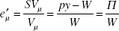
where SVμ = μΠ and Vμ = μW.
The reason for the result is that the difference between Capital I and Capital III is overcome by reading Capital III into Capital I. Conversely, we think that Capital I and Capital III must be articulated moving from Volume I to Volume III, and fully recognising the difference. The NI transformation procedure takes μ as a constant, and to do that NI has to read the value of labour power immediately in terms of prices of production, not giving any special role to simple prices. An unbiased reading shows instead that in Capital I Marx defined the value of labour power as the labour required to produce the subsistence real wage, and took it as a given: more precisely, as it becomes crystal clear in section seven on ‘Reproduction', the ‘given’ is in fact the real wage of the working class. This aspect – which, according to us, is integral to the macroscopic dimension of Marx's value theory – is thrown out without any argument by NI, but also in general by most of the new approaches. The NI admits the possibility that the composition of the wage goods, which workers buy once the money wage has been fixed, may vary, and holds constant the value of money as the numeraire of the prices of production system. That is in fact the reason for the label Unallocated Purchasing Power (UPP) approach as in Duménil and Foley (2008: 8, 9). As a consequence, the rate of surplus value is the same in Capital I and Capital III, regardless of the ruling law of exchange, because the money value added (due to the ‘postulate') and the value of labour power (due to the definition of ‘necessary labour') are unchanged. The rate of exploitation seems fully reclaimed in a Marxian fashion. Looking deeper, however, many theoretical puzzles emerge, the main one being that the value of money, the value of labour power and therefore the exploitation rate can be quantified only ex post. The discourse, wanting to be ‘operational', is entirely predicated within the circulation sphere, except for the assumption (without any theoretical justification) that MVA is the monetary exhibition of labour quantities. The risk is that we are left with a postulate and a series of tautologies, plus a dismissal of Marx's macro view of class reproduction.
Another approach, not too different from the one discussed earlier and which pretends to emphasise the macro-monetary aspects of the Marxian theory of value with the aim to wholly restore the original Marxian ‘conservation value’ equivalences, is the one given by Moseley (2015). Moseley suggests extending the NI re-evaluation of the value of labour power (by means of the value of money) to the value of constant capital, expressing the latter as the labour time equivalent of the monetary value of the means of production used as inputs. Following this procedure, the Marxian framework is confirmed and the rate of profit matches the quantitative definitions in Capital. However, Moseley's pretence that his approach is different from the Sraffian simultaneous approach,[132] since the rate of profit is given before the determination of prices, is based on assuming the value of money as given. This indeed replicates Marx, who assumed money as a commodity, though. Moseley's attempts to escape this conclusion are fragmentary and unconvincing (Moseley, 2005).
A ‘Living Labour’ Alternative
Some contributions to the Italian debate help overcome this impasse. Marcello Messori was probably the first who argued for a normalisation condition based on the invariance of the social net product when it is computed in production prices or in simple prices (proportional to DL, i.e., to the objectification of living labour). In the very last pages of the appendix to his book titled Sraffa e la critica dell'economia dopo Marx [Sraffa and the critique of economic theory after Marx] (Messori, 1978), he argued that:
the dual equivalence between total values [i.e., simple prices] and total prices, and between the overall surplus value and the overall gross profits, must give way to the equivalence among the so-called surpluses (the [sum of] the value of labour-power and surplus labour[133]), measured in terms of labour values [i.e., simple prices] and prices of production.
The basis of this equivalence is that ‘there is, in fact, no argument able to justify a variation in the amount of living labour expended as a consequence of changes in the distribution of surplus value, and then of the level of [money] wages and of the value of constant capital’ (Messori, 1978: 115).
A few years later Augusto Graziani ([1983] 1997) published a long article titled ‘Let's rehabilitate the theory of value'.[134] The crucial point by Graziani is that a truly macroeconomic perspective has to be assumed to grasp the meaning of the Marxian theory of value: we need to look at valorisation ‘not from the point of view of an individual capitalist struggling against his competitors but in a macro perspective that sets the entire class of capitalists against the class of workers’ (Graziani [1983] 1997: 24; translation has been edited). The reason lies in the fact that ‘any advantage that the individual capitalist might eventually derive from the exchange with other capitalists would be offset by an identical loss suffered by his counterpart, and the two items would cancel each other'. It follows that ‘the valorization of capital for capitalists as a class can come only from exchanges that capitalists effect outside their own class, and hence in the only external exchange possible, which is acquisition of labor power’ (Graziani [1983] 1997: 24).[135]
The class perspective is the only one appropriate to catch that logical priority of the value dimension compared to the price dimension. Value theory discloses exploitation as the engine of capitalist valorisation:
[if] the profit of capitalists as a class is born solely from the relation established between capitalists and workers … it can only come into being as a product of the difference between the total sum of labor extracted and the sum of labor that returns to the workers in the form of the real wage. (Graziani [1983] 1997: 24; translation has been edited)
Sraffa's price determination cannot contradict the Marxian theory of value, since ‘the relative prices of commodities are … formed in exchanges among capitalists, governed by the rules of competition, a phenomenon that is relevant exclusively to capitalists in their reciprocal relations’ (Graziani [1983] 1997: 25) and that does not involve their relationship with the working class.
In a number of contributions, Riccardo Bellofiore (1989, 2003 with Realfonzo, 2004) has refined and extended this interpretation of Marx's ‘Monetary Labour Theory of Value'.[136] The cycle of money capital is articulated within a monetary circuit framework borrowed from Graziani (2003), showing how the capitalist process of valorisation is parallel and integral to capital's monetary sequence within the period. This perspective was the ‘hidden Marxian core’ beneath the monetary heresies of Wicksell, Schumpeter, and the Keynes of the Treatise on Money.
The circuit is ‘opened’ by a transaction which takes place within the capitalist class: industrial capitalists (i.e., the firm sector as a whole) have a preferential access to the initial finance provided by financial capitalists (i.e., the banking system) who create money ex nihilo. This money is advanced as capital by the entrepreneurs as a class to include workers as the living labour power bearers within the capitalist labour processes, and thus to get hold of workers’ labour power as potentiality of living labour. The money capital advanced is the ‘initial finance’ allowing the production process to begin – in a true basic macro-monetary outlook (where the economy is ‘closed', the firm sector is vertically integrated and there is no state), initial finance condenses into the money wage bill. In this approach, the capitalist class autonomously decides not only the level but also the composition of output, and then the allocation of the workers employed. This ‘fixes’ the amount of commodities made available to workers as the ‘given’ class real wage. Most of the time Marx assumed that capitalists have to guarantee workers a ‘subsistence’ real wage, whose determination is subjected to a historical and moral element, and stems from class struggle.[137]
Since production prices diverge from simple prices, this ‘subsistence’ real wage for the working class must be accounted for in terms of the former and not of the latter price rule. The money capital advanced (i.e., initial finance as the flow of banking loans to firms, equal to the money wage bill) in Capital III must be re-evaluated so that workers are allowed to buy the same subsistence class real wage which has been fixed in Capital I by class struggle. If we assume, as Marx, that the ex post real wage which is determined on the commodity market at the end of the circuit confirms the real wage expected by workers when they bargain the money wage on the labour market at the opening of the circuit (i.e., if wage earners’ price expectations are fulfilled), then it is possible to precisely calculate the total value of the labour power even before final circulation. Indeed, if we divide the money wage bill for the expected (and, given the assumption, the realised) price of the wage-basket, we have N, the number of workers employed within the period:
(5)

Note that p is the row vector of the production prices of wage goods and b = [bj] is the column vector of the wage goods basket; thus pb = w is the individual money wage thanks to which every worker buys his/her lot of the wage-bundle (if we assume as Marx a given subsistence real wage). It is important to understand, however, that we are not ‘adding up’ the individual wage-bundles to get the class real wage: logically it is the opposite, and we just assume for the sake of simplicity that the ‘given’ class real wage is allocated uniformly among workers.
(Bank credit-)money as initial finance to production, i.e., the money wage bill, translates into a determinate number of workers. These workers all together must secure from capital the class real subsistence wage. Therefore, what at first sight seems to be a valueless advanced money capital hides a labour content corresponding to the labour required to produce the class real subsistence wage. This means that the advanced money capital is not valueless at all. This makes it possible to quantify the total ‘necessary labour', even outside the ‘money as a commodity’ case, as follows:
(6)

Total variable capital (V) exhibits NL in simple prices. This definition of ‘necessary labour’ is not erased when the price rule changes, as long as we still maintain the assumption of a given class real subsistence wage and a macroscopic viewpoint. Marx is crystal clear in the ‘Results of the Immediate Process of Production':
The buyer of labour power is nothing but the personification of objectified labour which cedes a part of itself to the worker in the form of the means of subsistence in order to annex the living labour-power for the benefit of the remaining portion, so as to keep itself intact and even to grow beyond its original size by virtue of this annexation. It is not the worker who buys the means of production and subsistence, but the means of subsistence that buy the worker to incorporate him into the means of production. The means of subsistence are a particular form of material existence in which capital confronts the worker before he acquires them through the sale of his labour-power. (Marx, [1867] 1976: 1003–4; italics are in the text; underlining is ours)[138]
Initial finance acts as the monetary ante-validation of the forthcoming expenditure in the sphere of production of living labour by living bearers of labour power. In other words, it is the monetary imprinting of labour power as potential labour in motion when workers are incorporated in the capitalist labour process through the buying and selling of labour power. Class struggle within the immediate process of valorisation results in an actual extraction of (both concrete and abstract/homogeneous) living labour, which is then crystallised in the objectified direct labour monetarily exhibited through the price tags that capitalist firms append to the output. Marx very often assumes – though it is crucial to the critique of political economy that this cannot be taken for granted – that the ex ante expectations of capitalist entrepreneurs about the extraction of living labour are confirmed ex post. The resulting expected money value added corresponds to a determinate amount of abstract/homogeneous labour turned into actual social labour in final commodity circulation. Marx also assumes – and it is crucial to the critique of political economy that this too cannot be taken for granted – that the ex ante expectations about selling the commodity output are fulfilled ex post. It is then possible to quantify the money value added.
We follow Marx's Capital III in assuming that ‘ordinary demand’ drives production, an assumption which corresponds to Keynes’ hypothesis that firms’ short-term expectations are fulfilled. We are therefore assuming that the new money value expected before the final exchange on the commodity market will (eventually) be validated. The abstraction of labour from the socialisation in immediate production is confirmed by the ex post socialisation on the market. The equality between supply and demand is due to effective demand driving production (like in Luxemburg and Kalecki), not to supply creating its own outlets. It is a kind of principle of effective demand which is present in Marx, not Say's Law.
At the closure of the circuit, industrial capitalists realise the money profits from the sale of commodities on the commodity market and return back the initial finance to the banking sector. At the same time, the employed workers – finding their expectations fulfilled – get a ‘subsistence’ real wage. Since capitalist prices – the prices of wage goods and profit goods as well[139] – are in general not proportional to simple prices, the objectified labour time commanded (obtained) on the market by the money wage bill cannot but be different from the labour contest of the total value of the labour power (i.e., from the labour contained in the means of subsistence) evaluated in simple prices, just like the objectified labour time commanded (obtained) on the market by gross profits cannot but be different from the labour content of the total surplus value (i.e., from the labour contained in the profit goods). Such divergences will be offset by definition because of the posited equality between the money new value evaluated in simple prices and the money new value evaluated in prices of production (or any other kind of prices).
We will try to clarify this point in a formal framework, remembering the analytical categories already introduced and denoting by z = [zj] the column vector of surplus goods. From the moment that the price of the social net product is only the monetary expression of direct labour time, at the macroeconomic level we have:
(7)

which is the same as Equation (3). Accordingly, as long as the ‘law of exchange’ is such that:
(8)

which of course can be rewritten as
(9)

the capitalists as a class in circulation will command an amount of objectified labour (the labour-equivalent of gross profits, given the value of money) greater than the labour contained in surplus goods extorted through exploitation in production. In the final exchanges on the commodity market, workers will correspondingly command an amount of objectified labour value smaller than the labour contained in the means of subsistence:
(10)

which of course can be rewritten as
(11)

Hence, at the aggregate level, it follows that:
(12)

where Π = pz and W = pbN. On the contrary, if the ‘exchange rule’ is such that the following inequalities hold:
(13)

(14)

which of course can be rewritten as
(15)

(16)

we get a macroeconomic situation which is ‘upside down’ compared to the previous one:
(17)

In other words, the surplus value seems redistributed – but it is not! This redistribution is just an illusion – by the ‘law of exchange’ not only between industries, but between the two social classes. The fact that the objectified labour commanded (obtained) on the market by a commodity diverges from the labour contained in it does not affect the macro-class distribution, just the amount of labour allotted to the firms through prices, which is a micro-individual perspective. This is the quantitative reflection of the Marxian ‘logical priority’ of the macro foundation over the micro appearance. The rate of surplus value originates from class struggle on the length of the working day and the intensity of effort, and therefore it is accurately represented by the labour congealed in the surplus goods over the labour congealed in the wage goods: the perspective, here, is that of the macro and class struggle in production. The ratio of the labour-equivalent of gross profits over the labour-equivalent of the money wage bill does depend, on the contrary, on the microeconomic price rule, which – in turn – relies on a multitude of institutional factors and mostly on the form of competition among capitals. As a consequence, the second ratio distorts and dissimulates the exploitation of labour in production. From a class perspective the only adequate measure of class exploitation remains, in Capital III as in Capital I, the rate of surplus value e′ (monetarily exhibiting the labour contained), that at the highest level of abstraction is invariant with respect to the ‘ups and downs’ of the distribution and circulation. The NI rate of exploitation e′μ represents the surface displacement and distortions on e′ resulting from the individual price rule affecting circulation.
We may further clarify this point referring to one of the very few authors who came near to understanding the issue: Eduard Heimann in his History of Economic Doctrines: An Introduction to Economic Theory (Heimann, 1945: 151–2). He wrote that with production prices being different than simple prices, the capitalists employing more labour per unit of capital do not get the full surplus value produced by their workers (relatively to the capitalists of the more mechanised industries, who instead receive more than the surplus value produced by their workers). The ‘transfer’ however is effected in circulation, where capitalists and workers consume different kinds of commodities. If workers are the main consumers of commodities tagged with prices of production lower than simple prices, it may seem that they get a ‘refund’ equal to the labour-equivalent which is lost by gross profits relative to surplus value; and it also may seem that if they are instead the principal consumers of commodities whose ‘prices’ exceeds their ‘values', they are, so to speak, super-exploited.
Unfortunately, Heimann concluded that the labour theory of value is thereby ‘invalidated'. Nothing of the sort, of course, since in our reconstruction the real wage of the working class is given. What is going on is just a redistribution of the value added in the period among capitalist producers, so that total gross money profits may end up being less or more than total surplus value. The paid labour (as we call the ‘[objectified] labour commanded’ by the money wage bill) to wage workers diverges from necessary labour (as we, like Marx, call the contained labour, required to produce the class real wage). The ‘living labour’ alternative view we are putting forward maintains that the total living labour actually extracted from the working class and the total amount of labour required to produce what actually is consumed by workers – the two magnitudes determined by the conflictual/antagonistic ‘capital relation’ in Capital I – do not change. Hence, also the surplus labour contained required to produce the surplus does not change. The price dimension adds to the fetishism of bourgeois society and cancels any trace of exploitation, since the labour exhibited by the money wage bill is ‘displaced’ relative to the (unchanging) labour content of the real wage for the working class. These ‘displacements’ and ‘distortions’ should not be ironed out. They are integral to Marx's analysis of capitalism as governed by what Hans-Georg Backhaus (2011) calls (following, again, Marx himself) the Verrückte Formen so typical of value, money, capital as fetishes.
What Are We Talking About When We Talk About Exploitation?
A proper understanding of Marx's notion of exploitation must distance itself from a merely mathematical terrain of discourse and from the spurious connection with the so-called transformation problem. All the discussions have been tainted by the idea that exploitation has to do, first of all, with the possibility of ‘solving’ surplus value in surplus labour. This point is surely important, and it is maintained also in the perspective we endorse, but it reveals a limited, Ricardian understanding of the specificity of exploitation in Marxian theory. The point may be clarified with a reference to a quote by David Schweickart in polemic with Ian Steedman:
[t]he feature that distinguishes labor power from all other input commodities is that technical conditions do not determine the mass of use-values (days of labor) that the capitalist receives when he purchases a unit of commodity (a worker for the production period). Given a specified technology, when a bushel of corn is purchased as an input for a particular industry, the quantity of other inputs and the quantity of output is determined. When a unit of labor power is purchased (e.g., a worker for the production period), the quantity of other inputs required and the quantity of output remains indeterminate, ‘a circumstance [that] is without doubt, a piece of good luck for the buyer'. (Schweickart, 1989: 295; our italics; the quote in the quote is from Marx, Capital I, chapter 7)
Following this lead, we claim that the notion of exploitation that is appropriate to Marxian theory cannot be reduced to a merely distributive matter, whether that be understood as a physical surplus over and above workers’ consumption or as the surplus labour behind gross money profits. Both these aspects are secondary, in the sense that they derive from a more essential and fundamental factor. The Marxian notion of exploitation is founded on the peculiar feature that, under capitalism, the whole of the living labour extracted from ‘free and equal’ wage workers is a ‘forced’ and ‘abstract-alienated’ performance of labour as activity. It is in this pumping out of living labour of capital as a vampire that we find the most important meaning of Marxian exploitation: the direct compulsion to do labour and surplus labour. Capital must secure for itself labour in actu from potentially ‘recalcitrant’ workers, who somehow can still claim control over their own activities. This ‘Other’ from Capital must be ‘embodied’ – namely, made internal and controlled, as part of the capitalist ‘machine’ – so that value begets (more) value, money brings about (more) money. The new value, even before surplus value itself, springs from nothing but an ‘exploitation’ of workers: exploitation here means the use of their labour power. Exploitation is therefore co-extensive with the whole working day. It is not – we insist – a ‘distributive’ conception, and it does not change much if this distribution is of amounts of use values or of labour time. Exploitation of this kind cannot but inherently affect the same nature of labour as activity, and it cannot be altered by any price rule. Exploitation should be understood as the direct and indirect imposition and control that affects all labour, in its quantity and nature. Abstraction and exploitation become virtually co-extensive especially when the ‘machine and big industry’ stage is reached (i.e., at the stage of the ‘real subsumption of labour to capital').
It is paradoxical that one finds a correct understanding of the meaning of Marxian exploitation where one would least expect it. In the early 1940s Piero Sraffa, on his path to Production of Commodities by Means of Commodities, wrote a note entitled Use of the Notion of Surplus Value (Bellofiore, 2014). Sraffa realised that in explaining the origin of surplus value Marx has to start from a hypothetical situation (which, however, expresses something very real and significant in capitalism) where the living labour extracted from wage workers is equal to the necessary labour needed for the production of the historically given subsistence. Then Marx proceeds, in a second logical moment, to imagine a (or, rather, reveal the actual) lengthening of the working day beyond necessary labour. Exploitation, Sraffa sees very well, is nothing but a prolongation of living labour relative to necessary labour.
The paradox is compounded by the fact that Sraffa's understanding of surplus value is the same as that proposed by one of the most rigorous critics of Neo-Ricardianism (and of its assumption of given productive configuration, which we unfortunately find replicated in contemporary Marxism). Bob Rowthorn wrote:
variable capital is fundamentally the worker himself, or rather his labour-power. It is true that Marx used the term to describe the wage fund, but such a use is derivative and by no means fundamental. Thus, variable capital is labour-power – the living or subjective element in the labour-process … By calling labour-power ‘variable’ capital, Marx established a conceptual connection between the creation of surplus-value and the despotic nature of the capitalist production process. The surplus-value created by workers in this process is not determined simply by the means of consumption needed to sustain them, but also by the amount and intensity of the labour they are compelled to perform. By increasing the amount or intensity of labour his workers perform, the individual capitalist is able to extract additional surplus-labour. If powerful enough, therefore, he can vary the amount of surplus-value his workers create. Thus, the term ‘variable’ draws attention to the fact that the surplus-value actually created varies according to the relative power of combatants within the production process. (1974: 87; author's italics)
The distinction in the notion of ‘labour’ between the three aspects of living labour power, labour power and living labour, on the one hand, and the insistence on the ‘variability’ of the living labour made liquid by capital within the period, on the other, are the fundamental keys to the return to Marx on exploitation: an interpretation which is far away from neoclassicism, Neo-Ricardianism, but also from the old and new Marxist approaches.
References
Backhaus H. G. (2011), Dialektik der Wertform. Untersuchungen zur marxschen Ökonomiekritik. Ça ira, Freiburg.
Baumol W. (1974), ‘The Transformation of Values: What Marx “Really” Meant (An Interpretation)', Journal of Economic Literature, vol. XII, n. 1, pp. 51–62.
Bellofiore R. (1989), ‘A Monetary Labor Theory of Value', Review of Radical Political Economics, vol. XXI, n. 1–2, pp. 1–26.
Bellofiore R., Realfonzo R. (2003), ‘Money as Finance and money as universal equivalent: re-reading Marxian monetary theory', in L. P. Rochon and S. Rossi (eds), Modern Theories of Money: The Nature and Role of Money in Capitalist Economies. Edward Elgar, Cheltenham & Northampton.
Bellofiore R. (2004), ‘Marx and the Macro-monetary Foundation of Microeconomics', in R. Bellofiore and N. Taylor (eds), The Constitution of Capital: Essays on Volume 1 of Marx's Capital. Palgrave Macmillan, Basingstoke.
Bellofiore R. (2014), ‘The Loneliness of the Long Distance Thinker: Sraffa, Marx and the Critique of Economic Theory', in R. Bellofiore and S. Carter (eds), Towards a New Understanding of Sraffa: Insights from Archival Research. Palgrave Macmillan, Basingstoke.
Bortkiewicz V. L. ([1907] 1952), ‘Value and Price in the Marxian System', International Economic Papers, vol. 2, pp. 13–60.
de Vroey M. (1981), ‘Value, Production and Exchange', in I. Steedman (ed.), The Value Controversy. New Left Books, London.
Dmitriev, V. K. ([1904] 1974). ‘The Theory of Value of David Ricardo', in D. M. Nuti (ed.), Economic Essays on Value, Competition and Utility. Cambridge University Press, Cambridge.
Dobb M. (1955), ‘A Note on the Transformation Problem', in On Economic Theory and Socialism: Collected Papers. International Publishers, New York.
Duménil G. (1980), De la valeur aux prix de production. Economica, Paris.
Duménil G. (1983), ‘Beyond the Transformation Riddle: A Labor Theory of Value', Science & Society, vol. 47, n. 4, pp. 427–50.
Duménil G., Foley D. K. (2008), ‘The Marxian Transformation Problem', in S. N. Durlauf and L. Blume (eds), The New Palgrave Dictionary of Economics. Palgrave Macmillan, Basingstoke.
Foley D. K. (1982), ‘The Value of Money, the Value of Labor Power and the Marxian Transformation Problem', Review of Radical Political Economics, vol. 14, n. 2, pp. 37–47.
Freeman A., Carchedi G. (eds) (1996), Marx and Non-Equilibrium Economics. Edward Elgar, Cheltenham.
Garegnani P. (1984), ‘Value and Distribution in the Classical Economists and Marx', Oxford Economic Papers, vol. XXXVI, pp. 291–325.
Graziani A. ([1983] 1997), ‘Let's Rehabilitate the Theory of Value', International Journal of Political Economy, vol. 27, n. 2, pp. 21–5.
Graziani A. (2003), The Monetary Theory of Production. Cambridge University Press, Cambridge.
Heimann E. (1945), History of Economic Doctrines: An Introduction to Economic Theory. Oxford University Press, New York.
Lipietz A. (1982), ‘The So-Called ‘Transformation Problem’ Revisited', Journal of Economic Theory, vol. 26, n. 1, pp. 59–88.
Marx K. ([1867] 1976), Capital, Volume I. Penguin Classics, London.
Meek R. L. (1956), ‘Some Notes on the “Transformation Problem” ', The Economic Journal, vol. 66, n. 261, pp. 94–107.
Messori M. (1978), Sraffa e la critica dell'economia dopo Marx. Franco Angeli, Milan.
Morishima M. (1973), Marx's Economics: A Dual Theory of Value and Growth. Cambridge University Press, New York.
Moseley F. (2005), ‘Money has no Price: Marx's Theory of Money and the Transformation Problem', in F. Moseley (ed.), Marx's Theory of Money. Moderns Appraisals. Palgrave Macmillan, Basingstoke.
Moseley F. (2015), Money and Totality: A Macro-Monetary Interpretation of Marx's Logic in Capital and the end of the ‘Transformation Problem'. Brill, Leiden.
Napoleoni C. (1963), ‘Sfruttamento, alienazione e capitalismo', La Rivista Trimestrale, vol. II, n. 7–8, pp. 400–29.
Napoleoni C. (1976), Valore. Isedi, Milan.
Passarella M. (2009), ‘Marx in the Matrix: L'algebra del lavoro vivo', History of Economic Thought and Policy, vol. XVII, n. 2, pp. 31–48.
Rowthorn R. (1974), ‘Neo-Classicism, Neo-Ricardianism and Marxism', New Left Review, vol. 86, pp. 63–87.
Samuelson P. A. (1971), ‘Understanding the Marxian Notion of Exploitation: A Summary of the So-Called Transformation Problem Between Marxian Values and Competitive Prices', Journal of Economic Literature, vol. IX, n. 2, pp. 399–431.
Samuelson P. A. (1974), ‘Insight and Detour in the Theory of Exploitation: A Reply to Baumol', Journal of Economic Literature, vol. XII, n. 1, pp. 62–70.
Schweickart D. (1989), ‘On the Exploitation of Cotton, Corn and Labor', in R. Ware and K. Nielsen (eds), Analyzing Marxism. University of Calgary Press, Calgary.
Seton F. (1957), ‘The Transformation Problem', The Review of Economic Studies, vol. 24, n. 3, pp. 149–60.
Shaikh A. (1977), ‘Marx's Theory of Value and the “Transformation Problem”', in J. Schwarz (ed.), The Subtle Anatomy of Capitalism. Goodyear, Santa Monica.
Sraffa P. (1960), Production of Commodities by Means of Commodities. Cambridge University Press, Cambridge.
Steedman I. (1977), Marx after Sraffa. New Left Books, London.
Sweezy P. M. (1942), The Theory of Capitalist Development. Oxford University Press, New York.
Tugan-Baranowsky M. I. (1905), Theoretische Grundlagen des Marxismus. Duncker und Humblot, Lipsia.
Winternitz J. (1948), ‘Values and prices: a solution of the so-called transformation problem', The Economic Journal, vol. 58, n. 230, pp. 276–80.
Wolff R. D., Roberts B., Callari A. (1982), ‘Marx's (not Ricardo's) “Transformation Problem”: A Radical Reconceptualization', History of Political Economy, vol. 14, n. 4, pp. 564–82.
Part II Forms of Domination, Subjects of Struggle
11. Class
Beverley Skeggs
Introduction
What is class made to do? How is it put to use, by whom, for what reasons? Marx argued for this assessment: ‘It is a question of what the proletariat is, and what, in accordance with this being it will historically be compelled to do’ (Marx, 1845/1975: 36–7, emphasis added). As we will see, class is made to do a lot of work. In this chapter, I will show how the concept of class takes shape in Marxist debates such as abstraction versus empiricism, structuralism versus humanism, logics versus difference, epochs versus actual history and in disciplinary divides such as the one separating sociology and philosophy. Class also becomes something else entirely through the notion of stratification even when it retains the name class.[140] Class carries simultaneously economic explanations and political forces. It is at once historical, contemporary and shapes different futures, while driving major debates that pit class against, or articulate with, categories like race and/or gender. Class works through state institutions, different discourses and representations, while being saturated with attributions of moral value. As a representation, class has its own symbolic economy, where value is inscribed on bodies as if their classed character were a form of property. Class is also paraded as if it were an identity, when, as I will show, identity is its most significant constitutive limit. And it is lived; class is a sensuous categorisation, embodying powerful affects such as shame and hate, a repository of ‘ugly feelings’ (Ngai, 2005). In all, it is not surprising that class is given a wide berth by many. Class likely fractured under the weight of its explanatory force, as its home – Marxism – was destabilised, ruptured by schisms, and other categories of social classification, such as gender, sexuality and race, fought for political attention. Yet class lingered, carrying the legacies of its earlier formation.
I'll begin with Marx, explore the most significant Western Marxist debates on the making and shaping of class and examine how this has influenced analysis since in the key areas of race and difference, and gender and social reproduction. Capital's state institutions will be examined leading to an argument for understanding class through history and methods of articulation. I'll then draw on two research projects on living class which point to the significance of the symbolic in order to understand abstraction and experience in their historical conjuncture. I'll be treading a thin provincial line, not referencing every debate about class in Marxism (an impossibility), pulling out some illuminating fundamentals in order to argue that class is not a singular categorisation but names a dynamic process that positions people in struggles for value and life.
Marx on Class
The problem with the analytical specificity of class began with Marx. He was never very clear on how to define class, using the concept rhetorically as well as analytically, a problem that has beset any analysis ever since. Marx stressed that it was not himself but French counter-revolutionary historians who originally developed class analysis. In a letter to Joseph Weydeymeyer (1852),[141] he argues that what he did was to prove that the existence of classes is only bound up with particular historical phases in the development of production, namely with the emergence of surplus value, whereby one class benefits from the exploitation of another. Exploitation establishes a conflict between classes: the fundamental antagonism in all class relationships.
In a useful overview, Bertell Ollman[142] compiles and analyses most of Marx's uses of the term ‘class'. Needless to say, Marx is not consistent. Sometimes, in the ‘classic’ case, there are two classes, bourgeoisie and proletariat. Sometimes these are modified with adjectives, the petty bourgeoisie, the lumpen proletariat. Other groups are included, such as landowners, while rural workers are sometimes included in the proletariat, sometimes not. Ollman notes how class is used interchangeably with the terms ‘group', ‘faction’ and/or ‘layer'. And he details how Marx struggles with the representatives of the bourgeoisie, the ideological class, which exist through their relationship to power, promoting political interests rather than wielding social power through their relationship to production. Marx is particularly vitriolic about the lumpen proletariat, considering them to be a dangerous class because of their ability to destroy working-class interests (see below). Ollman concludes: ‘Marx cannot escape the more serious accusation of having a litter of standards for class membership and of changing them without prior warning’ (ud.np).
Nevertheless, Ollman does note some consistency with a tripartite class division across Marx's writings into capitalists, proletarians and landowners, defined through their relationship to forms of revenue: respectively wages, profit and ground rent. The analysis is never finished, and Ollman notes further complications: doctors, for example, provide a definitional challenge as Marx begins to differentiate between ‘rank’ – key to a Weberian analysis of class that has blurred the lines between class analysis and stratification ever since. What is also worth noting is how Marx re-signified the term ‘proletariat'. Developing from the Roman proletarius, historically associated with derogatory connotations, as Nick Thoburn (2002) shows, Marx valorised it into a category of dignity and revolutionary force.
What is significant is that for Marx: (1) class is produced through struggle over the means of revenue either through labour, ownership of capital and/or land; (2) class definitions depend on the groups’ relationship to the means of revenue production, and hence to one other; and (3) classes are locked into a dependent relationship to each other, where one class is always a source of revenue for another, in terms of profit and/or rent. It is always the relationship of exploitation – developed by Marx through his theories of wage labour, labour-power, labour value and surplus value – which defines classes. This is a straightforward and fundamental definition of class, as an exploitative dependent dynamic relationship. This crucial class relationship is social but premised on people's location in a fundamental economic relationship. In his classic quote: ‘Men [sic] make their own history, but they do not make it as they please; they do not make it under self-selected circumstances, but under circumstances existing already, given and transmitted from the past'.[143]
Peter Goodwin (2018) also provides a useful excavation of Marx's use of class. Drawing on the analyses of Löwy (2005) and Draper (1977), he notes how Marx's definitions were informed by his encounters with workers in turbulent times and how as a result class consciousness became fundamental to Marx's definitions. Marx saw workers coming to an awareness of the conditions to which they were subject and organising to change them. As a result, Marx noted how they transitioned from a ‘class in itself’ to a ‘class for itself'. Observation and participation in European workers’ struggles led Marx and Marxists to attribute responsibility to the working class for social transformation of the whole of society and human life. Karl Kautsky (1892) and Rosa Luxemburg (1900) viewed the emancipation of the proletariat as a step towards total social transformation.
Marx's writings over time about class, using a variety of tropes and rhetorical flourishes, depend on how he is putting class to use – as a dynamic force for revolution (the working class and/or the proletariat), the competitive innovators of industrialisation and exploitation (the bourgeoisie), objects of derision and contempt (the lumpen proletariat) or later as the bearers of abstract labour, the personifications of capital in Capital.
Not all classes are considered to have agency; some are simply marked by their position, such as the lumpen proletariat. Subject to all the venom that Marx can muster in his journalistic writings (rather than Capital), his descriptions of the lumpen proletariat echo the contempt expressed for the contemporary working class on British reality TV, but with more flair:
Decayed roués with dubious means of subsistence and of dubious origin, ruined and adventurous offshoots of the bourgeoisie, rubbed shoulders with vagabonds, discharged soldiers, discharged jailbirds, escaped galley slaves, swindlers, mountebanks, lazzaroni, pickpockets, tricksters, gamblers, maquereaux, brothel-keepers, porters, literati, organ-grinders, ragpickers, knife grinders, tinkers, beggars – in short, the whole of the nebulous, disintegrated mass, scattered hither and tither… (Marx, 1978: 73)
But as Thoburn (2002) points out, in the 27 different uses by Marx and Engels of the lumpen proletariat they are not easily identified, taking on various forms – for instance, ‘the financial aristocracy is nothing but the lumpen proletariat reborn at the pinnacle of bourgeois society’ (Marx, 1973: 38–9, emphasis added). However, Marx's descriptions of the lumpen proletariat usually cohere around expressions like ‘social scum', ‘dangerous classes', ‘mob', ‘swell-mob', ‘ragamuffin', ‘ragged-proletariat'. Thoburn sees the lumpen proletariat as, by definition, a non-class. Others have re-signified their relationship to the category into a positive rendition – for example, the Black Panthers (Pulido, 2006).
In the writing of Capital class seems to go missing. Balibar (1994) asks: why is the proletariat – the radical representative of the motor of history – absent from Capital? Because, he answers, Marx focuses instead on the detailed workings and structure of capital. His political analysis continued elsewhere. Capital develops a logic by which classes perform their roles in the theatre of capitalism, carrying specific functions, as value becomes the central actor. Who then becomes the subject of capitalism? Jappe (Chapter 30, this Handbook) proposes that it is not the ruling class, nor the proletariat, but value itself. Value as a logic reduces human actors to the executors or bearers (Träger) of its orders. The subject of capitalism is an abstraction, a process that makes subjectivity itself possible. Jappe notes how Marx expresses this fact in the paradoxical and surprising formula that value is an ‘automatic subject',[144] or, as Marx noted earlier, in the Grundrisse, how value enters as subject.
Where did class go? We might say that these different definitions represent different forms of attention, to economics, to politics. Their difference is significant because they generate very different strands of analysis – especially in the bifurcation between class as a dynamic political force and class an abstraction, which I'll explore below.
Historical Explanation and Class
One of the main schisms in Western Marxist understanding of class was staged in the debate that contrasted a historical explanation of experience with structuralism, pitting E. P. Thompson against Perry Anderson, Tom Nairn and Louis Althusser. The debate began in the 1960s, intensified in the 1970s and was extensive in its reach across disciplines; it has been well documented and continues to haunt, scar and shape debates in class analysis, especially debates about race and gender, as we will see. The debate was vicious, and to experience the British representatives of the debate speak was terrifying.[145] Thompson had published The Making of the English Working Class in 1963, detailing the experience of the formation of class in opposition to Anderson and Nairn's analysis, which used a structuralist Marxism to understand the role of the labour aristocracy and the political quiescence of the English working class. Althusser, Anderson and Nairn were accused by Thompson of being ahistorical, ossified and reliant on obscure theoreticist models that were static and bore no relationship to how class was lived and made. Conversely, Thompson was accused of being atheoretical, not understanding structures, historical logic or capitalism itself. His analysis was faulted for being voluntarist and parochial, failing to understand empire and imperialism and working with categories that had no objective co-ordinates.[146] The debate was political: where to locate change; theoretical: how to conceptualise class; and methodological: Thompson stressed indeterminacy, elasticity and provisional actions that could only be known through observations over time; Anderson and Nairn promoted a version of Marxist history prioritising structural logics over the empiricism of historical research; and Althusser, as a philosopher, stressed structures, logics, contradiction and overdeterminism of capitalist forms, relative autonomy and the significance of abstraction, all elements of a capitalist totality that could be known without reference to the experiences of people who inhabited its structures.
Thompson stressed the making of class and hence the making of capitalist forms ‘from below'. He insisted on the agency of ‘real people’ and ‘real context'. He did not see class as a structure, not even a category, but as ‘something which in fact happens (and can be shown to have happened) in human relationships'; a ‘historical phenomenon, unifying a number of disparate and seemingly unconnected events, both in the raw material of experience and in consciousness’ (Thompson, 1963: 9). Concepts, for Thompson, arise out of empirical engagements; they exist in a dialectical relationship; they are ‘structural actuation'. Later, he argued that concepts are not models but expectations that facilitate the interrogation of evidence (Thompson, 1978a). He maintained that people find themselves within structures, but not ones simply formed through relations of production as Marx, Anderson, Nair and Althusser maintain. It is their experience of exploitation that leads people to become antagonistic towards those who exploit and control them. This generates a struggle through which they develop self-awareness and self-identification as a class. Thompson insists that ‘class is not this or that part of the machine, but the way the machine works once it is set in motion’ (Thompson, 1963: 357).
For Thompson, class is dynamic, relational, is lived and develops through struggles around the conditions made by abstract processes. But what is missing from Thompson's analysis is a model of how capitalism works (over time). Nor can he explain the role of ideology, as explicated in detail by Althusser's analysis of the role of interpellation and misrecognition. There are no Marxist ‘appearances', ‘hieroglyphs', ‘hauntings’ or ‘hidden abode’ in Thompson's account. It is a transparent description of class as it is made and experienced. Class is singular, parochial, observable, yet gender and race are missing as analytical categories. Thompson was also accused of a lack of political complexity, romanticising creativity and failing to understand liberalism.
History from below continues to shape debates today over class through two intersections, of class and race and of class and gender, both of which have also spawned enormous debates to which justice cannot be done but from which key elements will be drawn in what follows.[147]
Race, Class and Difference
For Marx (1967), slavery was a significant dimension of prior modes of production, a form of exploitation that was still residually present in nineteenth-century capitalism, a driver of primitive accumulation and part of different capital formations which enabled colonialism to develop. He was acutely aware of the ‘barbarism', corruption, of the East India Company especially, and the horror of colonialism, by which surplus value production became the sole end and aim of humanity. Yet for Marx these are the brutal pre-conditions to industrial capitalism, ones that took place over a long period of time, from the enclosures in the fifteenth century, developing into the conditions that led to the formation of classes. His methods of abstraction were based on this history, yet he perceived these to be antecedents, precursors to a different beast – industrial capitalism. It is this ‘epochal’ analysis, when added to the debate between attention to historical events and an abstract understanding of the workings of capital, that has dogged the debates on race and class since. Put simply, it is a debate between those who consider empirical historical acts to be foundational and/or constitutive of capitalism, race and class in the present and those who consider that capital has particular logics that are not shaped by lived experience (see the journal Race and Class (Sivanandan, 2018) and the writings of Cedric Robinson (see Bhandar, Chapter 13, and Haider, Chapter 58, this Handbook)).
Lines are drawn among contemporary protagonists in the race and class debates between Adolph Reed Jr and David Roediger, on the side of historical significance, and Ellen Meiksins Wood as the champion of a view of capitalist class-formation that essentially abstracts from race.[148] Roediger (1991) situates race not as incidental to US capitalism, but as a key organising principle. Roediger and Esch (2012) survey the history of race management in US corporations, arguing that the ‘production of difference’ has been absolutely integral to the efficient extraction of surplus value, so that race is not separable from the ‘logic of capital’ – it is integral to it. It is difference that makes capitalism. Likewise, and similar to Thompson, Reed argues that capitalism exists not because of wilful efforts to create a system that conforms to a set of abstract characteristics; rather, it is the product of pragmatic struggles by individuals and groups to pursue concrete material interests and to improvise institutional frameworks that facilitate their pursuits.
Wood counteracts by positing that class is constitutive of capitalism in a way that race is not. She argues that capitalism is conceivable without racial divisions, but not, by definition, without class. For Wood, the question concerns the essential features of capitalism. She maintains that capitalism has no structural tendency towards racial inequality (a point she also maintains about gender inequality) because it does not depend on it for the extraction of surplus value. And unlike a slave mode of production or feudalism, capitalism does not depend on enslavement and domination. She argues that capitalism has a unique ability, via the ideology and institutions of liberalism, to create a form of exploitation that does not depend on direct coercive force. If capitalism depends on turning the capacity to labour (labour-power) into a commodity (through the wage), and turning abstract labour into the substance of value, then slavery is not capitalist, since what is bought at the slave auction is not labour-power but the body and life of the labourer, as property, as ‘chattels'. But this does not take into account how the value made from difference was and continues to be built into many of capital's mechanisms. It is historical systems that illuminate capital's abstractions.
For Himani Bannerji, it is obvious ‘that capital is a social practice, not just a theoretical abstraction’ (Bannerji, 2005: 17) – note the word ‘just'. For the historian of difference, the categorisation of labour into competitive difference has been central to a capitalist logic of depressing and controlling wage claims through establishing competition through divide and rule. Difference has been long mobilised for accumulation, as Balibar (1991) and contemporary studies of the migrant workforces show: hyper-precarity, criminalisation and deportability are often institutionalised features for migrant workforces, increasing their vulnerability by reducing their ability to claim protection and even wages. Convict and indentured labour was a central plank of racial capitalism (see De Giorgi, Chapter 12, and De Genova, Chapter 86, this Handbook).
Ruth Wilson Gilmore argues that racism ‘is a practice of abstraction, a death-dealing displacement of difference into hierarchies that organize relations within and between the planet's sovereign political territories’ (Wilson Gilmore, 2002: 16). She notes how processes of abstraction organise humans in relation to inhuman persons in a hierarchy that produces the totalising category of the ‘human being'. This is a process of abstraction that pre-dates industrial capitalism and exists in every form of capitalism, spectacularly materialising through the sub-prime crisis that generated the 2008 financial crash. It is not epoch-limited; it is a logic.
Likewise, turning to an earlier history, in which the discourse of humanity had yet to be developed, Ian Baucom (2005) shows how the Atlantic slave trade's process of abstract classification was built into capital's institutions of valuation. Not classified as persons but only as bearers of value, slaves were subject to calculation, domination and control. The calculation of their value was adjudicated in law, as in the infamous 1781 Zong case, where the sea captain threw overboard over 130 shackled slaves in order to realise their value through insurance. The issue was loss of value, not a matter of life and humanity (Krikler, 2007).[149] This is abstract exchange, not based on labour but financialisation, of anticipated future value, built into capital's mechanisms.
As Brenna Bhandar and Alberto Toscano (2015) also note, building on the work of Cheryl Harris (1993), it is the commodification of difference as a process of abstraction that enables whiteness to have the status of property in relation to white people as full legal citizens. Harris shows how the creation of whiteness as a form of property that has ‘income-bearing value’ emerges as forms of labour come to be legally differentiated on a racial basis. White supremacy was enshrined in the social contract, for white workers as ‘free’ could not be enslaved, and, significantly, white workers come to identify as ‘white workers’ as a means of differentiating themselves from other workers, producing class as well as race difference (Roediger, 1991). Race is thus constitutive of capital's mechanisms.
Peter Linebaugh and Marcus Rediker (2000) chart two and a half centuries of extreme violence used to coerce people into providing the labour required to make capital. In England in 1606, colonisation was proposed as a solution to the unrest created by the ‘surplus’ population which had been thrown off common land. The Virginia company, of which the Lord Chief Chancellor was a member, legitimated colonisation of the Americas by claiming they were offering a public service by removing the swarms of ‘idle persons’ and setting them to work building the first American slave colonies. In 1899–1902 (the Boer War), Cecil Rhodes deported the destitute, criminalised and troublesome working class to build the imperial project of South Africa. Accumulation through dispossession and discipline through deportation have long legacies.
A significant understanding of how race, class and gender are articulated in capitalism comes from Harold Wolpe (1972), who showed how the historical and geographical specificity of South Africa produced a form of capitalism based on assemblages with pre-capitalist forms of raced and classed relations. Workers could be paid below social reproduction costs because these costs were being met in the parallel subsistence economy. The Apartheid state was used to prevent stability, ensure deportability and keep wages below reproduction costs. Bridging the division between history-making and abstraction, Wolpe further argues that theories which attempt to impose the abstract on the concrete cannot understand the relationship between race and class because classes are ‘constituted concretely through practices, discourse and organisations. One might say that class unity, when it occurs, is a conjunctural phenomenon’ (Wolpe, 1988: 51). He notes that opposition to white supremacy did not necessarily unite all Black classes against the regime.
It was Wolpe's concrete historical analysis of South Africa that enabled Stuart Hall to develop his model of articulation, which combines lived experience, historical specificity and abstraction[150] to argue that racialised practices are not equally necessary to the concrete functioning of all capitalisms. He argues that it does not make sense to extrapolate a universal structure to race and racism: there is no ‘racism in general'; it is always historically and geographically specific (Hall, 1980: 341). Rather, we need to understand how race comes to be inserted historically, in the relations and practices that are active structuring principles of the present organisation of society and the forms of class relations. This is how Hall comes to make his famous point that ‘Race is thus also, the modality in which class is “lived”, the medium through which class relations are experienced’ (Hall, 1980: 341). This is an expanded view of race and racism that makes us sensitive to how it shapes all lives, not just those categorised as raced: ‘For racism is also one of the dominant means of ideological representation through which the white fractions of the class come to “live” their relations to other fractions, and through them to capital itself’ (Hall, 1980: 341). Hall insists upon the mutual articulation of historical movement and theoretical reflection.
Yet, as we have already noted, it is not only race that constitutes and disrupts class relations and formations: gender is also central. Gender is another articulation, a modality through which class and race are lived. Factors such as the continuing role of the mechanisms of primitive accumulation, the functions of the state, colonialism and labour migration are important, but at the heart of the intense debate that also raged throughout the 1960s was the question of social reproduction and the family. It paralleled many of the features of the historical specificity versus abstractions debate we've already considered, in particular asking what sort of value is produced by bio-social reproduction? Does women's labour make a distinctive contribution to surplus value production or is it, as Marx considered, a cost to capital?
Class, Gender and Heterosexuality
Engels (1884/1933) was concerned with the role of women as private property through marriage and the family, just as Marx derides the bourgeois family as built on adultery, treating women as private property. But as Federici (2018) observes, women are never truly portrayed by Marx and Engels as subjects of struggle, as capable of fighting on their own behalf. This, she argues, is because Marx saw the industrial system as offering the possibility for more egalitarian relations. Marx's blindness to the unpaid labour of women stems from his single-minded focus on waged labour, an exclusively productivist view. Therefore, for Marx non-paid women's labour is concrete labour, and unpaid labour does not produce surplus value. It is this singular perspective that enabled Marx to ignore the largest occupational group at the time he was writing – servants (see Schwartz, Chapter 16, this Handbook). He also ignored the significance of sex workers’ labour (see Cruz and Hardy, Chapter 76, this Handbook).
The domestic labour debate (DLD) intended to rectify this omission. It began in the 1960s (Mitchell, 1966), culminating in ‘the unhappy marriage’ of Marxism and feminism in the 1980s (Sargent, 1981), establishing the foundations for the current resurgence of social reproduction analysis[151] (see Arruzza, Chapter 74, Ferguson et al., Chapter 3, Federici, Chapter 34, and Hensman, Chapter 78, this Handbook). The DLD was concerned to examine how unpaid domestic labour was in fact productive of surplus value. This highly theoretical debate took a direct political turn in 1972 through the Italian Wages for Housework campaign, with slogans such as ‘Class struggle and feminism are one and the same’ (see Federici and Austin, 2017). Proponents asked: why do we have a sexual division of labour? And do women operate as a reserve army of labour? (Breugel, 1979). Initially, a ‘dual-systems’ approach was developed to account for gender and class (patriarchy and capitalism), which was then challenged by Lise Vogel (1983), who proposed a ‘unitary theory’ based on social reproduction more generally.
The analysis moved between abstract theory and political campaigning, exemplified by Marxist studies of race and class that identified ‘super-exploitation’ (Boyce Davies, 2008), ‘domestic slavery’ and ‘triple jeopardy’ as central to capitalist reproduction (Davis, 1981). One of the most significant industrial disputes in the UK was led by South Asian women, the Grunwick strike (1976–8), which disrupted the politics and representations of feminism as white and middle-class. The central concept of feminism, ‘woman', was also challenged by anti-racist studies of imperialism (Amos and Parmar, 2005) and slavery (Davis, 1981). Heterosexual privilege was brought into the critique by the Black lesbian Combahee collective,[152] and Gayle Rubin (1975), who detailed how heterosexuality was fundamental to class reproduction. In the UK Marxist feminist understandings of class also turned to the significance of culture (as ideology, hegemony, discourse, as we will see below) and colonial history, via the History Workshop Journal (Skeggs, 2006). Global voices also challenged the spaces and places of value production: Maria Mies (1982) insisted on an understanding of the global constitution of value through the fragmentation and decomposition of work processes worldwide.
Understanding of gendered class divisions came from studies of labour, acknowledging that working-class women were always forced to work to survive; the family-household system and gender ideology (Barrett, 1980); and the state's role in the institutionalisation of violence and family structures (Barrett and McIntosh, 1982). In a critique of Barrett, Johanna Brenner and Maria Ramas (1984) drew attention to how class cut through gender: how working-class heterosexual men and women joined forces to protect their families. They argued that campaigns for a ‘family wage’ (a male breadwinner) came about through struggle not external imposition, as the working class organised their own reproductive protections. Likewise, Hazel Carby (1982) argued that the family can be an important site of solidarity for both Black women and men, a legacy developed from slavery. The scope and variety of the debates was vast, but most positions assumed that capital does benefit from women's unpaid socially reproductive labour and that Marxist theorists would benefit from not considering gender, race and sexuality to be epiphenomena. Debates amplified, expanded into new domains (for example, queer theory: see Drucker, Chapter 54, this Handbook) and intensified. Schisms formed as new struggles vied for political and theoretical attention.
Intersectionality emerged as a challenge to bourgeois white feminism and also tried to connect all these vast and unwieldy differences. Operating as a call-out to complacency, it is an important reminder against singularity. But as a concept it struggles to hold the enormous, diverse and conflicted areas of theoretical analysis, both inter and intra: capitalism, colonialism/post-colonialism, feminism, queer and trans theory, and how they operate very differently in different geo-political domains. By conflating the very different logics that brought the ‘sections’ of the inter together it often obfuscates theoretical differences and political strategies: the logic of class is its abolition, the logic of gender is usually recognition and accommodation, the logic of race (depending where in the world, Marxist or liberal) revolution or rights, the logic of sexuality extinction or recognition. Intersectionality is an important intention and holds people to account, but it can also limit explanatory power and may occlude the power relations built into different classifications (see Lagalisse, Chapter 40, this Handbook). However, this in itself is another enormous debate, brilliantly articulated by Bohrer, 2019 and Chapter 75, this Handbook.
Fortunately, social reproduction theory has been revived and Caliban and the Witch (Federici, 2004) republished. Attention to the familial and domestic has been extended into all activities that are ‘life making', recognising that workers exist beyond the workplace (see Farris, Chapter 15, this Handbook). Bhattacharya (2017) returns to Marx's understanding of social reproduction, which is not about the household but about the state, juridical institutions and the property-form, where for Marx ‘every social process of production is at the same time a process of reproduction’ (Marx, 1967: 711). Likewise, Nancy Fraser (2016) argues that the abstract separation of economic production from social reproduction is constitutive of capitalism itself.
Paul Cammack (2020) also maintains that Marx did provide a powerful framework for social reproduction in his analysis of how all ‘natural’ relations are turned into money relations. In Capital, vol. 1, Marx identified the fundamental contradiction of the individual capitalist who extends workers’ production time by extracting every minute of energy and time, which ultimately shortens the life and use of the worker. Capital left to itself destroys life in its drive to extract value: ‘Capital therefore takes no account of the length and life of the labourer, unless society forces it to do so’ (Marx, 1967: 380). The logic of capital is to search for an inexhaustible supply of surplus-value-producing labour; capital does not care about preserving life. Rather, survival, as Marx notes, relies on the worker's drive for self-preservation and propagation (Marx, 1967: 718). While the working class struggles for protection against exhaustion and death, capital exhausts the unprotected. As Cammack points out, there has always been a ready supply. In a radical move, he argues that capital does not need the family: it can always find plenty of exhaustible unprotected labour.[153]
These important renewals of class analysis are based on global perspectives, beyond the parochialism of Western Marxism, and draw on the relationship between informal and formal labour (Mezzadri, 2017). Pun Ngai and Chris Smith (2007) extend understandings of social reproduction in their studies of indenture through the dormitory labour regime in China, which uses a trapped residential workforce of permanently young, predominantly female workers. Sara Farris (2012) also notes that since the 1970s the number of women migrating has grown so much that half of the current migrant population in the Western world is now women, employed mainly in one branch of the economy: the care and domestic sector, notorious for its informality and lack of labour protections.
If class analysis is to be understood globally, moving beyond a productivist prejudice to consider total social reproduction, including forms of protection, this must include the processes of migration and racialisation that are inseparable from their class and gender dimensions (Ferguson and McNally, 2015). Susan Ferguson (2008) notes how understanding the spatialisation of labour enables us to see how race is inscribed on the labouring body. This means that racism and sexism are not historical aberrations that can somehow be separated from capitalism's ‘real’ or ‘ideal’ functioning; rather, they are integral to capital, actively facilitating processes of capital accumulation. As feminists and anti-racist theorists have shown, the state is a key player in this facilitation, having long institutionalised difference in the interests of capital.
Capital's Institutions?
Capitalism has always required particular ensembles of regulatory institutions, governmental practices and socio-cultural norms in order to facilitate the general process of capital accumulation under specific historical and technological conditions (Jessop and Sum, 2006). It is not just national states, but capital's supra state organisations, such as the International Monetary Fund, the World Bank and the ECB, which through racist and misogynist policies, often termed ‘structural adjustment programmes', not only maintain strict racial boundaries between countries and people but retrench class and national divisions, forcing the poorest states to subsidise the richest (Lapavitsas, 2013).
Let's remember Stuart Hall's concept of articulations so we can understand how race and gender are active structuring principles of class relations: ‘Race [and gender are] the modalities in which class is “lived”, the medium through which class relations are experienced’ (Hall, 1980: 341). The state, even when offering protections against capital's rapaciousness, often reproduces these modalities. Denise Noble (2015) notes how the establishment of the British welfare state (nominally to protect against abject poverty) depended upon British women being allocated to the role of reproducing racism: The Beveridge Report (1942) proposed that mothers have vital work to do in ensuring the adequate continuance of the British race and of British ideals in the world. Robbie Shilliam (2018) details how Beveridge addressed the working class as if they were totally white, with a duty to ‘maintain their breed at its best’ (1942: 150). Eugenicist discourse has a long history and institutionalisation. All British working-class women were forced to attend ‘schools for mothers’ to be trained in how to produce cannon fodder for colonial wars waged by the British in South Africa and blamed when they didn't (Davin, 1978). They were assumed to be deficient and so were taught ‘standards', an imperative that shapes the architecture of most health, welfare and education systems (Duneier, 1992; Shilliam, 2018; Skeggs, 1997).
Living Class
Liberalism is central to state institutionalisation (Meiksins-Wood, 1986; Wilson Gilmore, 2002). Law promotes the liberal myth of ‘freedom’ that Marx identified as an essential illusion of capitalism by establishing an equivalence, a formal equality between the worker and the employer: both are supposedly free to exchange their property, but, unless protected, the working class are forced to exchange their labour in order to survive. What is key to the ideological myth of liberal freedom is how it shapes personhood, telling us who is not exchangeable. Carole Pateman (1988) notes how the social contract was devised on the basis of relationships between those who could not be imagined as property to each other. These are fundamental class and property relations with the working class as the constitutive limit to the possessive individual of the European social contract (Skeggs, 2004). In two different research projects, I have shown how these class relations are lived, through abstractions, in the realm of economic and symbolic value.
In a longitudinal ethnographic study I conducted in the 1980s and 1990s, Formations of Class and Gender: Becoming Respectable (1997) I used Hall's framework to analyse the conjuncture of economic, state/institutional, historical, geographical, political and cultural articulations that shaped the conditions of possibility by which a group of white working-class women lived.[154] The research examined how the subject positions produced by overdetermined structures shaped by capital's history and logic were lived. What became significant to the women's experience of class was how their lives were structured not just by labour and social reproduction but also by symbolic violence. They were ‘always already’ classed within an ideological and state institutionalised system that distributed cultural and moral value, which subsequently determined their access to economic spaces. They were made brutally aware that they were subject to continual classification and symbolic devaluation as ‘working-class', but it was a term from which they dis-identified. The category ‘working-class woman’ was so loaded with symbolic negativity that identification would be tantamount to symbolic suicide.
In defence, they developed their own class-antagonistic moral economy by resisting the pathological value judgements that were made of them in almost every encounter with middle-class people, especially representatives of the state (their teachers and health and social workers), and also through mainstream media. The 1980s began the contemporary demonisation of the working class in the UK, which has now developed into outright scorn, derision and hatred. This has been extensively documented elsewhere, in studies showing how the deregulated TV industry develops to profit from the symbolic denigration of working-class women (Skeggs, 2009; Skeggs and Wood, 2012).
Throughout the research many attempts were made by state representatives to force working-class women – to reform them – into accepting ‘standards’ of bourgeois familial ideology. The ‘caring courses’ they studied were the equivalent of ‘schools for mothers', a remnant of the colonial project, in which working-class culture was institutionalised as deficient. The imposed ‘standards’ were strongly resisted, but this locked the young women into a defensive competition to be a better carer than middle-class women and thus subjected them to continual scrutiny. Being a better carer secured investment in a caring subjectivity and directed them towards ‘voluntarily’ entering caring jobs. Just like Paul Willis's (1977) study of why working-class boys get working-class jobs, the women of ‘Formations’ generated dignity through gendered resistance to class degradation. By defending and claiming value from their own practices of respectability, caring for others became a positive ‘choice', a protection against devaluation. They were located in and lived the abstract positions of capital's logic, shaped by gendered and raced histories, as they struggled not to live with denigration, to ‘keep a floor on their circumstances', to survive with some dignity.
The hinge between the symbolic and economic has a long history: as Linebaugh and Rediker (2000) show, Marx was aware of the symbolic inscriptions that were carved into people's bodies, how in England from 1547 those made destitute were branded with the letter V and enslaved for two years, later to be transported for colonial exploits. In 1596, prisoners were branded on the face with a hot iron and called ‘the King's Labourers'. Classifying and pathologising was central to the imprisonment and transportation policies that enabled the colonial project. The Lord Chief Justice of the King's Bench from 1592 to 1604 developed his ‘theory of monstrosity', listing 30 different types of rogues and beggars and classifying them for transportation into five main groups according to potential labour value. The use of working-class women as symbols of monstrous moral decay has a very long history in England, as Federici (2004) details and which Imogen Tyler (2020) charts through to the present. This symbolic economy mediates other capital and state forces, legitimating power, distributing im/moral values, controlling access to work and welfare, enabling exploitation and appropriation. In which through an accident of birth people are born into structural and subject positions.
In another study, Class, Self, Culture (Skeggs, 2004), I show how the middle class, through culture, become personifications of capital. Using Bourdieu to map the fields of exchange by which cultural capital can be converted into symbolic and economic capital, I detail how the appropriation of culture and exclusion of others from the ability to exchange enable the middle class constantly to accrue cultural value to themselves as a modern ‘possessive individual'. This involves propertising the culture and affects of those who they appropriate. Unlike the working-class women above, the middle class are able, through access to Capital's institutions, to generate authority and convert their culture into economic and symbolic value, legitimating themselves. They shape a personhood from which the working class are excluded. If we see culture as a form of property that can be embodied in dispositions such as entitlement, we can also see how it becomes naturalised in the everyday order of things.
The culture wars that are now being waged have long legacies in liberalism and humanism. Also, as we should remember from Harris and Bhandar above, cultural property relations are not just classed, but always/already articulated with race and gender. As Bhandar (2014) shows, drawing on Bentham, the abstract ownership of property is not just based on physical possession, occupation or even use; it is based on the expectation of being able to use property as one wishes. Remember that the social contract is based on an expectation of not being propertisable, drawing stark divisions between those considered as abstract labour and those with personhood. The working class are unable to convert their symbolic degradation into property, unlike those who can accumulate cultural capital for its conversion. Unless they offer the opportunity for value extraction as labour, the working class in their many modalities regularly appear in front of the state as non-persons (Dayan, 2011), rendered wageless, disposable and superfluous (Denning, 2010). This is a cultural logic of capitalism, not Jameson's (1981) aesthetic postmodern form, but one based on amplifying and consolidating difference as competition over the value of one's culture: as signifier of abjection or as marker of distinction. It is a competition in which each class faces each other in regard to what counts, defensive versus entitled.
Althusser (1971) proposed interpellation and Gramsci (1971) proposed consent as mechanisms by which social reproduction is achieved. I want to add that it is realised through the antagonistic struggles for cultural value, mediated by a symbolic economy that guarantees the historic reproduction of capital through class, race and gender relations: for one group as protected entitlement, expectation and symbolic value propertised in the formation of personhood; for the other, exchangeable (or not) as labour, forced to defend themselves against degradation, a source for appropriation (Skeggs and Wood, 2012). These person formations are experienced daily as moral value struggles and set limits on how class can (not) be an identity for working-class women.[155] Through the violence of the institutionalised symbolic economy lived through encounters with the middle class, they engage in a constant struggle for value, survival rather than accumulation.
Identity
This is why class is not an identity: it is a relation, it is dynamic, it is a movement immanent to capitalist relations that compels a ‘perpetual work of refutation, interpretation, and reformulation’ (Balibar, 1994: 136). When class is located in the discourses of liberalism and humanism – namely in appeals for ‘rights’ or recognition – the working class operates as the constitutive limit, as symbolically pathological. To make a claim for recognition when recognition is always loaded with pathology makes no sense. Class is not the subject of capital; as Jappe noted, that subject is value. Class is an abstraction that is overdetermined in its articulation and only known through an understanding of positions within a system, immanent to it; these positions are lived through mediated symbolic formations. Class is therefore lived concretely as an abstraction, a position in a system of economic and cultural value.
Balibar (1991) develops this further, arguing that while the bourgeoisie remains as an abstract positional personification, the proletariat are concretised in practice because they are forced to sell their labour. This, he maintains, means that the logic of capital ensures that the antagonistic classes never come face to face, because they figure within the capital-relation in different ways. The bourgeoisie operate as a cypher, as the ‘bearers’ of capital. They stand in for functions that the logic of capital performs, above all accumulation. The proletariat, however, have a concrete reality as ‘labour-power'. Balibar calls this a historical drama in which the bourgeoisie stand for economic personification and the proletariat do things as a result. I'd argue they both perform their positions. The occupation of the position of expectant, entitled, ever-accumulating bourgeois personhood is institutionalised in all ideological and state institutions. They encounter the working class through systems of punishment, exclusion and judgement, used to secure their distinction. These encounters make the working class do things, and feel things, as a result: living a life replete with exposure to violence, denigration and contempt, they often fight back. They try to protect themselves. The classed encounter is how the abstract is experienced as antagonism, but also as a value, part of capital's logic which reduces human actors to the executors or bearers (Träger) of its orders. Class is an abstraction of value, a symbolic space in which struggles to extract, defend and protect are dynamically shaped.
Conclusion
Class is made from relations and forces across and within apparent entities; race and gender are active structuring principles of class relations. They are formed in specific historical conjunctures, in articulation, overdetermined: be it by capital, labour migration, racialisation, medicalisation or criminalisation – through symbolic violence, the state and its representatives. These articulations shape all social reproduction; they make up the totality of capitalist relations. They can be understood through abstractions of capital's logic made concrete as they are actualised in structures. As Hall (1980) notes, race is a modality in which class is ‘lived', as are gender and sexuality.
The spurious ‘freedom’ of the liberal social contract has been extended from the exchange of labour in the economy into the exchange of culture, making it appear as if everyone is able to propertise their personhood and develop expectations of ownership and entitlement. For some groups, identity may be the mechanism by which they shape their struggle to make a claim on the state for protection, but as Barbara Fields (2001) showed, this will always lock them into a liberal frame, one built from the exclusions of those identified by difference. Re-signification only exists within the system of symbolic violence by which it is formed. The classifications developed from colonialism take on modern forms, no longer branded but still inscribed on the body. Personhood is still shaped through politically institutionalised forms of property, of entitlement and limit, enacted daily.
Class is no longer understood only through industrial production, but extends beyond labour into social reproduction and other forms of value extraction, where rent and financialisation have become dominant forces (Lapavitsas, 2013), where intellectual property rights (see Rekret and Szadkowski, Chapter 85, this Handbook) and the institutionalisation of corruption are now drivers of value formation. If value is the subject of capital (Jappe, Chapter 30, this Handbook), we can see class as an abstraction of value. Just as class is an abstraction of labour, it now forms a symbolic space in which struggles to exploit, extract, appropriate, defend and protect are dynamically shaped. It is an overdetermined space, within a conjuncture, often contradictory, with the different logics of race and gender, offering vectors for struggle. Class is lived in a cultural logic of capitalism where value is the subject, class its manifestation, a relation and a representation that is lived through struggles over value.
Althusser (1971) noted that it is the apparatus of the state that secures capital's interests, enabling the reproduction of the social relations of production (now extended to value production through different forms). Yet to turn to the state for protection of class interests is a many-edged sword. Consider the state-sponsored genocide currently occurring across the world as governments prioritise profit over people. The necropolitics released as a result of the Covid-19 pandemic represents a policy of malevolent neglect by design where the extremes of social reproduction are made apparent; the unproductive, those subject to structural adjustment and austerity policies, those whose lives have already been subject to slow death and those who fight back are more likely to die quickly. This is the current conjuncture where class is made vividly apparent, as a struggle for value and life, in its many articulations.
References
Althusser, L. 1971 Lenin and Philosophy and Other Essays. London: New Left Books.
Anderson, P. 1980 Arguments within English Marxism, London: Verso.
Balibar, E. 1991 ‘ “Class Racism” and Racism and Class', in I. Wallerstein and E. Balibar (eds), Race, Nation, Class: Ambiguous identities, London: Verso.
Balibar, E. 1994 Masses, Classes, Ideas: Studies on Politics and Philosophy Before and After Marx, London: Routledge.
Balibar, E. and Wallerstein, I. 1991 Race, Nation and Class: Ambiguous Identities, London: Verso.
Bannerji, H. 2005 ‘Building from Marx: Reflections on Class and Race', Social Justice 32(4): 144–160.
Barrett, M. 1980 Women's Oppression Today: The Marxist Encounter, London: Verso.
Barrett, M., and M. McIntosh. 1982 The Anti-Social Family. London: Verso/NLB.
Baucom, I. 2005 Specters of the Atlantic: Finance Capital, Slavery and the Philosophy of History, Durham and London: Duke University Press.
Bhambra, G. K. 2017 ‘Brexit, Trump, and “Methodological Whiteness”: on the Misrecognition of Race and Class', The British Journal of Sociology 68(S1): S214–S232.
Bhandar, B. 2014 ‘Property, Law and Race: Modes of Abstraction', UC Irvine Law Review 4(1): 206–219.
Bhandar, B. and Toscano, A. 2015 ‘Race, Real Estate and Real Abstraction', Radical Philosophy 194 (Nov/Dec 2015).
Bhattacharya, T. (ed.) 2017 Social Reproduction Theory: Remapping Class, Recentering Oppression, London: Pluto Press.
Bohrer, A. J. 2019. Marxism and Intersectionality: Race, Gender, Class and Sexuality under Contemporary Capitalism, New York: Columbia University Press.
Brenner, J. and Ramas, M. 1984 ‘Rethinking Women's Oppression', New Left Review 144: 33–72.
Breugel, I. 1979 ‘Women as a Reserve Army of Labour.’ Feminist Review 3: 12–23.
Cammack, P. 2020 ‘Marx on Social Reproduction', Historical Materialism 28(2): 76.
Carby, H. 1982 ‘White Woman Listen! Black Feminism and the Boundaries of Sisterhood', in CCCS (ed.), The Empire Strikes Back: Race and Racism in 70s Britain, London: Hutchinson.
CCCS 1982 The Empire Strikes Back, London: Hutchinson.
Cohen, G. A. 1980 Karl Marx's Theory of History: A Defence, Princeton, NJ: Princeton University Press.
Davin, A. 1978 ‘Imperialism and Motherhood', History Workshop Journal 5(1): 9–66.
Dayan, C. 2011 The Law is a White Dog: How Legal Rituals Make and Unmake Persons, Princeton and Oxford: Princeton University Press.
Deleuze, J. and Guattari, F. 1986 Kafka: Towards a Minor Literature, London: Minnesota University Press.
Denning, M. 2010 'Wageless Life', New Left Review 66: 79–97.
Draper, H. 1977 Karl Marx's Theory of Revolution: Volume 2: The Politics of Social Classes, New York and London: Monthly Review Press.
Duneier, M. 1992 Slim's Table: Race, Respectability and Masculinity, Chicago: University of Chicago Press.
Engels, F. 1884/1933 The Origin of the Family, Private Property and the State, New York: International Publishers.
Farris, S. R. 2012 ‘Femonationalism and the “Regular” Army of Labor Called Migrant Women', History of the Present 2(2): 184–199.
Federici, S. 2004 Caliban and the Witch: Womand, the Body and Primitive Accumulation. Brooklyn, NY: Autonomedia.
Federici, S. 2018 ‘Marx and Feminism', tripleC 16(2): 468–475.
Federici, S. and Austin, A. (eds) 2017 Wages for Housework: The New York Committee 1972–1977 History, Theory, Documents, Brooklyn, NY: Autonomedia.
Ferguson, S. 2008 ‘Canadian Contributions to Social Reproduction Feminism, Race and Embodied Labour.” Race, Gender and Class 15 (1–2): 42–57.
Ferguson, S. and McNally, D. 2015 ‘Precarious Migrants: Gender, Race and the Social Reproduction of a Global Working Class', in Special Issue of Socialist Register, L. Panitch and G. Albo (eds), Transforming Classes, London: The Merlin Press.
Fields, B. J. 2001 ‘Whiteness, Racism, and Identity', International Labor and Working-Class History 60: 48–56.
Fraser, N. 2016 ‘Contradictions of Capital and Care', New Left Review 100: 99–117.
Goodwin, P. 2018 ‘Where's the Working Class?', tripleC: communication, capitalism & critique 16(2): 535–545.
Gramsci, A. 1971 Selections from Prison Notebooks of Antonio Gramsci, London: Lawrence and Wishart.
Gunn, R. 1987 ‘Notes on “Class”', Common Sense 2: 1–11.
Hall, S. 1980 ‘Race, Articulation, and Societies Structured in Dominance.’ Sociological Theories: Race and Colonialism. Paris: UNESCO.
Harris, C. I. 1993 ‘Whiteness as Property', Harvard Law Review 106(8): 1707–1791.
Hart, G. 2007 ‘Changing Concepts of Articulation: Political Stakes in South Africa Today', Review of African Political Economy 34(111): 85–101.
Jameson, F. 1981 Postmodernism, or, The Cultural Logic of Late Capitalism, London: Verso.
Jessop, B. and Sum, N.-L. 2006 Beyond the regulation approach: putting capitalist economies in their place, Cheltenham: Edward Elgar.
Kautsky, K. 1892 The Class Struggle, New York: W. W. Norton & Co.
Krikler, J. 2007 ‘The Zong and the Lord Chief Justice', History Workshop Journal 64: 29–47.
Lapavitsas, C. 2013 Profiting Without Producing: How Finance Exploits Us All, London: Verso.
Linebaugh, P. and Rediker, M. 2000 The Many-Headed Hydra: The Hidden History of the Revolutionary Atlantic: Sailors, Slaves, Commoners, Boston: Beacon Press.
Löwy, M. 2005 The Theory of Revolution in the Young Marx, Chicago: IL: Haymarket Books.
Luxemburg, R. 1900 ‘Reform or Revolution', in Mary-Alice Waters (ed.), Rosa Luxemburg Speaks, New York: Pathfinder Press.
Marx, K. 1845/1975 The Holy Family, or Critique of Critical Criticism: against Bruno Bauer and Company. Collected Works, vol 4, Chapter 4. London: Lawrence and Wishart.
Marx, K. 1845/1888/1970 The Thesis on Feuerbach, Moscow: Progress Publishers.
Marx, K. 1967 Capital, New York: International Publishers.
Marx, K. and Engels, F. 1848/1968 Manifesto of the Communist Party, London: Lawrence and Wishart.
Marx, K. (1978). Capital: A Critique of Political Economy. Volume Two. Translated by David Fernbach. Harmondsworth: Penguin.
McNally, D. 1993 ‘E. P. Thompson: Class Struggle and HIstorical Materialism', International Socialism 2(61). (from www.marxists.org/history/etol/newspape/isj2/1993/isj2-061/mcnally.htm. accessed 09.12.18)
Meiksins-Wood, E. 1986 The Retreat from Class; A New ‘True’ Socialism, London: Verso.
Meiksins-Wood, E. 1995 Democracy Against Capitalism: Renewing Historical Materialism, Cambridge: Cambridge University Press.
Mezzadri, A. 2017 The Sweatshop Regime: Labouring Bodies, Exploitation and Garments Made in India, Cambridge: Cambridge University Press.
Mies, M. 1982 The Lace Makers of Narsapur: Indian Housewives Produce for the World Market, London: Zed.
Mitchell, J. 1966 ‘Women: the Longest Revolution.’ New Left Review 1/40, Nov/Dec: 11–37.
Ngai, P. and Smith, C. 2007 ‘Putting Transnational Labour Process in its Place: The Dormitory Labour Regime in Post-Socialist China', Work, Employment and Society 21(1): 27–45.
Ngai, S. 2005 Ugly Feelings, Cambridge, MA and London: Harvard University Press.
Noble, D. 2015 ‘Decolonizing Britain and Domesticating Women: Race, Gender, and Women's Work in Post-1945 British Decolonial and Metropolitan Liberal Reform Discourses', Meridians: Feminism, Race, Transnationalism 13(1): 53–77.
Pateman, C. 1988 The Sexual Contract, Cambridge: Polity Press.
Pulido, L. 2006 Black, Brown, Yellow and Left: Radical Activism in Los Angeles. Oakland, Cal.: University of California Press.
Roediger, D. 1991 The Wages of Whiteness, London: Verso.
Roediger, D. and Esch, E. 2012 The Production of Difference: Race and the Management of Labor in US History, Oxford: Oxford University Press.
Sargent, L. 1981 Women and Revolution; A Discussion of the Unhappy Marriage of Marxism and Feminism, Boston: South End Press.
Shilliam, R. 2018 Race and the Undeserving Poor: From Abolition to Brexit, Newcastle upon Tyne: Agenda Publishing.
Sivanandan, A. 2018 ‘The heart is where the battle is: an interview with A. Sivanandan. Race & Class 59 (4): 3–14.
Skeggs, B. 1997 Formations of Class and Gender: Becoming Respectable, London: Sage.
Skeggs, B. 2004 Class, Self, Culture, London: Routledge.
Skeggs, B. 2006 ‘A Dirty History: Feminism, Marxism and Cultural Studies in the UK', Pompidou Centre: https://webtv.bpi.fr/fr/doc/4414/+Les+Cultural+Studies+a+l%E2%80%99epreuve+des+feminismes: Cultural Studies et critique marxiste: dialogues, tensions, confrontations (Journée 2).
Skeggs, B. 2009 ‘The Moral Economy of Person Production: The Class Relations of Self-Performance on “Reality” Television', Sociolocical Review 57(4): 626–644.
Skeggs, B. 2015 ‘Introduction: Stratification or Exploitation, Domination, Dispossession and Devaluation?', The Sociological Review 63(2): 205–222.
Skeggs, B. and Wood, H. 2012 Reacting to Reality Television: Performance, Audience, Value, London: Routledge.
Therborn, G. 2012 ‘Class in the 21st Century', New Left Review 78: 5–29.
Therborn, G. 2020 ‘Dreams and Nightmares of the World's Middle Classes', New Left Review 124: 63–87.
Thoburn, N. 2002 ‘Difference in Marx: The Lumpenproletariat and the Proletarian Unameable', Economy and Society 31(3): 434–460.
Thompson, E. P. 1963/2002 The Making of the English Working Class, London: Penguin Books Limited.
Thompson, E. P. 1978a ‘Eighteenth-century English Society: Class Struggle Without Class', Social History 3: 133–165.
Thompson, E. P. 1978b The Poverty of Theory: An Orrery of Errors, London: Merlin Press.
Toscano, A. and Woodcock, J. 2015 ‘Spectres of Marxism: A Comment on Mike Savage's Market Model of Class Difference', The Sociological Review 63(2): 512–523.
Tyler, I. 2020 Stigma: The Machinery of Inequality, London: Zed Press.
Vogel, L. 1983 Marxism and the Oppression of Women: A Unitary Theory, Boston: Brill.
Willis, P. 1977 Learning to Labour: How Working Class Kids Get Working Class Jobs, Farnborough, Hants.: Saxon House.
Wilson Gilmore, R. 2002 ‘Fatal Couplings of Power and Difference: Notes on Racism and Geography', Professional Geographer 54(1): 15–24.
Wolpe, H. 1988 Race, Class and the Apartheid State, Oxford: James Currey.
Wright, E.-O. 1985 Classes, London: Verso.
12. Punishment
Alessandro De Giorgi
Introduction
Since the early 1980s, global processes of capitalist transformation across Western societies have revolutionized both the field of production and the complex of governmental institutions, practices, and technologies that, in the aftermath of World War II, had consolidated into the Keynesian welfare state (Jessop, 1996, 2016; Mishra, 2014). The neoliberal paradigm of governance that has come to dominate Western societies through the last quarter of the twentieth century has resulted in a drastic redistribution of social wealth toward the top of the racial and class hierarchy, a vertical increase in economic inequalities, an acute precarization of work within increasingly segmented labor markets, a massive attack on workers’ rights, and a systematic dismantling of the social safety net that had been instituted in the wake of the Keynesian compromise between capital and labor (Bonefeld, 2017; Harvey, 2005; Schram, 2015). In this sense, the neoliberal revolution has involved an organized assault against the economic relevance and political centrality of industrial labor – and, specifically in the USA, against the radical struggles for racial justice that had emerged from the civil rights movement (Camp, 2016; Flamm, 2005; Parenti, 1999: 3–44).
These transformations, legitimized through the neoliberal dogmas of absolute flexibility, ruthless competition, and rugged individualism, have significantly reshaped the field of social and penal control in much of the Western world. Indeed, the same decades that witnessed a reconfiguration of the industrial paradigm of capitalist production were also characterized by the unfolding of a ‘global lockdown’ (Sudbury, 2005) resulting – although with different degrees of intensity between the USA and Europe – in a steady expansion of penal powers across late-capitalist societies (Garland, 2001; Pratt et al., 2005; Wacquant, 2009a, 2014).
The increasing centrality of punitive practices in the governing of contemporary societies signals a decisive deviation from the trend toward penal moderation that had characterized the second half of the twentieth century – particularly in the USA, where by the early 1970s incarceration rates had reached historical lows and the rehabilitative ideal had become the dominant philosophy, at least within the nation's more progressive correctional systems (Allen, 1981; Simon, 2014; Tonry, 2004).[156] In addition to the increased prominence of carceral institutions in the governance of racialized social marginality, neoliberal societies have also witnessed the simultaneous proliferation of different technologies of social control, often operating outside the formal boundaries of the penal field: practices of extra-penal detention and surveillance targeting specific categories of people and largely immune even to the residual constitutional protections in place within the criminal justice system. One obvious example is the administrative detention of migrants from the global South within the large archipelago of camps and detention centers surrounding the heavily militarized borders of Europe, Australia, and the USA: dystopic non-places governed through a permanent state of exception and functioning as engines for the processing of the racialized human surplus generated by the new international division of labor (De Genova, 2016; Mezzadra and Neilson, 2013).
As these global processes precipitate locally in the form of cyclical urban crises within the postindustrial metropolis, late-capitalist societies have also witnessed the multiplication of technologies of control specifically aimed at the punitive governance of segregated urban spaces. One could think here of the endemic diffusion of electronic surveillance – from the omnipresent CCTV cameras to the deployment of drones by police departments across major US cities – but also of the fracturing of the urban landscape along heavily policed boundaries of race and class that mirror the functioning of national borders within the current global division of labor (Davis, 2006; De Genova, 2005, 2013; Hill-Maher, 2003). The dynamics of capitalist accumulation characterizing the neoliberal city – such as the rampant gentrification of former inner cities and the ensuing displacement of entire poor communities of color, or the proliferation of securitized gated communities that effectively obliterate any notion of the city as a public space – offer clear examples of a neoliberal paradigm of social regulation that unfolds simultaneously at the urban and the global level, geared in both cases toward the neutralization of disposable surplus populations created by the predatory dynamics of capitalist accumulation (Blakely and Snyder, 1997; Herbert and Brown, 2006; Smith, 1996).
The neo-Marxist criminological tradition known as the political economy of punishment provides a critical framework to dissect the developments just described and a lens to observe the evolving relationships between racial capitalism (Robinson, 1983) and the rise of punitive strategies for the governing of social marginality (for a review of this literature, see De Giorgi, 2006: 1–40, 2012). In what follows, I will attempt to reconstruct the trajectory of the political economy of punishment as it has unfolded since the publication of Georg Rusche and Otto Kirchheimer's seminal work Punishment and Social Structure (2003 [1939]). First, I will offer a brief materialist narrative of the origins of modern punishment and of the prison as its central institution, outlining the politico-economic conditions that prompted the transition from the bloody corporal punishments prevalent in pre-capitalist social formations to the disciplinary institutions of penal confinement that would become hegemonic across Europe and the USA at the dawn of industrial capitalism (Foucault, 2015; Spierenburg, 1984). Second, I will use the theoretical tools forged by the political economy of punishment to offer a critique of contemporary penal practices in relation to the neoliberal restructuring outlined earlier. Finally, along the path laid out by some recent critiques of the carceral state that have productively integrated the classic materialist analysis with an emphasis on the racialized dynamics of capitalist accumulation, I will suggest some possible new directions for a structural critique of punishment that might avert the economic reductionism of traditional Marxist criminology.
Political Economies of Punishment
The political economy of punishment focuses on the relationships between penal transformations and the evolution of the capitalist system of production. Although materialist analyses of crime and punishment inspired by the writings of Marx and Engels had already appeared since the early twentieth century (see Bonger, 1916), the foundational moment in neo-Marxist criminology is represented by the 1969 publication of the second edition of Georg Rusche and Otto Kirchheimer's classic Punishment and Social Structure, followed within a few years by a wave of critical ‘revisionist histories’ of punishment, including Michel Foucault's Discipline and Punish (1977 [1975]), Dario Melossi and Massimo Pavarini's The Prison and the Factory (1981 [1977]), and Michael Ignatieff's A Just Measure of Pain (1978).[157] According to these revisionist histories, penal practices perform a very different task than protecting society from crime. The latent functions of punishment can only be grasped by situating institutions of penal control within the broader economic dynamics and structural contradictions intrinsic to capitalist societies. From a materialist standpoint, penal change is always connected to historically specific relations of production and hegemonic forms of racial and class power. In the classic definition of Rusche and Kirchheimer (2003 [1939]: 5):
Every system of production tends to discover punishments which correspond to its productive relationships. It is thus necessary to investigate the origin and fate of penal systems, the use or avoidance of specific punishments, and the intensity of penal practices as they are determined by social forces, above all by economic and then fiscal forces.[158]
The epistemological objective of the political economy of punishment is thus to overcome the dominant theoretical paradigm of criminology as a science of criminality and as a state-sponsored form of power/knowledge over the causes of crime and to replace it with a historically and economically grounded critique of the formation and evolution of different systems of penal control. Penal historiography thus becomes a social and economic history of the repressive apparatuses that have contingently emerged to regulate and reproduce existing relations of racial and class power. It becomes, again in Rusche's own words, ‘more than a history of the alleged independent development of legal “institutions”'. It is the history of the relations of the ‘two nations', as Disraeli called them, that constitute a people – ‘the rich and the poor’ (Rusche, 2014 [1933]: 258).
In outlining the main theoretical elements of the materialist critique of punishment, Rusche advances two main hypotheses. The first descends from utilitarian penal theories: any penal system is ultimately governed by a logic of deterrence – that is, by the objective of discouraging potential lawbreakers from violating the law. Second, the contingent manifestations of this logic of deterrence evolve in relation to existing relations of power, as shaped in particular by the development of capitalist labor markets:
Experience teaches us now that most crimes are committed by members of those strata who are burdened by strong social pressures and who are relatively disadvantaged in satisfying their needs when compared to other classes. Therefore, a penal sanction, if it is not to be counterproductive, must be constituted in such a way that the classes that are most criminally inclined prefer to abstain from the forbidden acts than become victims of criminal punishment. (Rusche, 2014 [1933]: 254)
Therefore, different articulations of penal power will emerge on the basis of the material conditions faced by the most marginalized social classes. In order to be effective, penal practices and institutions will need to impose upon those who violate the existing social order worse conditions of life than those available to those who – despite their subordinate position in society – nonetheless accept to conform to its norms. This means that the living conditions of the most marginal sectors of the proletariat will define the coordinates of penal policy and the regime of ‘legal suffering’ to be endured by those who are punished. The average standards of living at the bottom of the racial and class structure will thus determine the upper limit beyond which no penal reform can go without undermining the deterrent role of punishment. Borrowing again from Rusche, ‘All efforts to reform the punishment of criminals are inevitably limited by the situation of the lowest socially significant proletarian class that society wants to deter from criminal acts. All reform efforts, however humanitarian and well meaning, which attempt to go beyond this restriction, are condemned to utopianism’ (Rusche, 2014 [1933]: 255–6). In this sense, penal evolution is clearly not the outcome of humanitarian penal reforms. Instead, the structural limit to any process of reform and civilization of punishment is represented by the principle of less eligibility, just described, to which any penal system must ultimately conform (see also Sieh, 1989).
In pre-capitalist economic formations – as well as in capitalist economies characterized by the persistence of slave labor, such as the USA until the end of the civil war – living conditions for the proletarian classes were largely the result of extra-economic factors derived from feudal sociopolitical arrangements or existing regimes of labor enslavement. With the consolidation of capitalist relations of production, and the partial abolition of slavery with the Amendment to the US Constitution, the living standards of the proletariat become a direct consequence of capitalist processes of division and organization of labor. The invisible dynamics of the market now assign workers a ‘fair price’ for their labor on the basis of preeminently economic standards: the larger the supply of labor, the lower its cost, and the worse the material conditions endured by those who own nothing but their labor-power. As a consequence, historical periods characterized by a large surplus of labor will also witness a toughening of penal practices targeting society's poorest classes:
Unemployed masses, who tend to commit crimes of desperation because of hunger and deprivation, will only be stopped from doing so through cruel penalties. The most effective penal policy seems to be severe corporal punishment, if not mass extermination … In a society in which workers are scarce, penal sanctions have a completely different function. They do not have to stop hungry masses from satisfying elementary needs. If everybody who wants to work can find work, if the lowest social class consists of unskilled workers and not of wretched unemployed workers, then punishment is required to make the unwilling work, and to teach other criminals that they have to content themselves with the income of an honest worker. (Rusche, 2014 [1933]: 257–8)
Across Europe, the birth of the prison is inscribed within the historical transition from a penal regime based on the destruction of the body of the condemned through the staging of torturous ‘spectacles of suffering’ (Foucault, 1977 [1975]; Garland, 1990: 213–247; Spierenburg, 1984) meant to display the absolute power of the monarch, to a system that spares the body of the criminal, so that through its productivity can shine the economic power of the capitalist. A new conception of time as a measure of labor (Thompson, 1967), together with the generalization of the principle of exchanges of equivalents, explains the parallel consolidation of the legal contract as a stipulation of worktime and of the criminal sentence as a determination of prison time (Pashukanis, 1978).
At first across northern Europe, and later in the USA – but in the latter with the significant exception of slave labor in the South, where discipline was largely imposed by the slave-owning class through state-tolerated racial violence, vigilantism, and lynchings (Berg, 2011) – this new philosophy would inspire the construction of the early disciplinary institutions for the poor: workhouses, poorhouses, houses of correction, bridewells, and later penitentiaries. Confinement thus started to become the dominant practice for the control of marginal classes – paupers, vagrants, beggars, prostitutes, alcoholics, lunatics, criminals, etc. The body of the punished was now treated as a productive entity and as a potential source of value: the new systems of control would increasingly focus on correcting the attitudes, reshaping the morality, and disciplining the souls of those punished. Detention would gradually emerge as the hegemonic form of correctional intervention on any kind of social deviance, thus inaugurating what Michel Foucault would define as the age of ‘great confinement’ (Foucault, 1988 [1961]: 38–64).
Ultimately, Rusche and Kirchheimer's analysis builds upon the notion of primitive accumulation elaborated in the first volume of Capital, where Marx (1976 [1887]) describes the historical moment in which a nascent capitalist system needs to create the conditions for its own development – that is, it must subsume preexisting relations of production and forcibly transform free labor into wage labor (Marx, 1976 [1887]: chapters 26–28). The constitutive contradiction of this process is that on the one hand, capital freed labor from the feudal ties of personal servitude that had entangled it until then, while on the other, it immediately recaptured this productive potential through a more abstract form of subordination. The ‘liberation’ of work thus unfolded through an expropriation of producers, which ultimately consigned them to a higher level of subjugation. In England, masses of destitute peasants expelled from the countryside following the enclosure of common lands that had effectively deprived them of the subsistence economy on which they had survived under the feudal system, were now forced to migrate toward the industrializing cities of northern Europe, where they would fill the ranks of the new urban poor. Dispossessed of its means of subsistence and brutally separated from its land, this proletarian workforce in the making would initially appear unable to adapt to the new conditions of production and reluctant to subject itself to the new organization of labor in the emerging factories. In the last pages of Capital, Marx reconstructs the violent fate awaiting this proto-proletariat: ‘The fathers of the present working class were chastised for their enforced transformation into vagabonds and paupers. Legislation treated them as “voluntary” criminals, and assumed that it depended on their own goodwill to go on working under the old conditions that no longer existed’ (Marx, 1976 [1887]: 896).
A comparable historical trajectory of subjugation through emancipation would characterize the fate of former slaves after the partial abolition of slavery in the USA. Indeed, if on the one hand the XIIIth Amendment abolished ‘slavery and involuntary servitude', on the other it created the conditions for the perpetuation of slavery by constitutionalizing it ‘as a punishment for crime whereof the party shall have been duly convicted'. This new form of enslavement would materialize across the Southern states through the enactment of ‘Black Codes’ which criminalized vagrancy, unauthorized assemblies, lack of a known address, and miscegenation, among other behaviors, and then sanctioned them with penal (re)enslavement in the form of convict leasing, forced labor, and even the auctioning of ‘black criminals’ (Childs, 2015: 57–92). As the bloody history of capitalism would illustrate again and again, similar dynamics of violent penal discipline would cyclically reemerge whenever the engine of capital valorization would again set in motion masses of impoverished populations deprived of their means of subsistence by capital's ongoing movement of ‘accumulation by dispossession’ (Harvey, 2004).
Neo-Marxist Criminology and Late Capitalism
Toward the second half of the 1970s, radical criminologists extended the materialist framework of the political economy of punishment to the critique of penal systems in contemporary capitalist societies, particularly the USA. The effects of the 1973 oil crisis had started to materialize across the main industrial centers of the US ‘steel belt’ in the form of a significant increase in unemployment rates – especially among the African American working class, which in the wake of the Great Migration from the South had filled the ranks of the industrial workforce during the previous four decades (Wacquant, 2008: 13–132; Wilson, 1987, 1997). This labor force, rendered superfluous by processes of technological innovation, industrial downsizing, and productive relocation, emerged as the postindustrial rendition of the Marxian reserve army of labor: a mass of low-skilled, modestly educated workers consigned to economic redundancy by the restructuring of the productive cycle, and yet highly exploitable as a lever for the control of labor struggles over working conditions and wage demands by the active workforce. Famously defined by Wiliam J. Wilson (1987) as ‘the truly disadvantaged', this racialized human surplus now found itself at the bottom of the US labor market, where it would embody once again the ‘lowest socially significant proletarian class’ described by Georg Rusche (2014 [1933]: 255).
In the wake of these profound socioeconomic dislocations, incarceration rates, which had been relatively stable between the late 1920s and the end of the 1960s, started to grow steadily around the mid 1970s, initiating an upward trend that would continue unabated for the next 40 years (see National Research Council, 2014). Faced with these developments, some radical criminologists in the USA formulated the hypothesis that the simultaneous increase in unemployment and incarceration rates signaled a broader restructuring in the governing of social marginality. In the words of Richard Quinney:
Criminal justice, as the euphemism for controlling class struggle and administering legal repression, becomes a major type of social policy in the advanced stages of capitalism. Emerging within the political economy of late capitalism is a political economy of criminal justice. (1980: 107–108)
The first systematic attempt to elaborate an empirically grounded materialist critique of the US penal system was developed by Ivan Jankovic (1977) in an early article published in Crime and Social Justice. Jankovic's starting hypothesis was twofold: the first, which he called the ‘severity hypothesis', was that the worsening of economic conditions at the bottom of society's class structure – as signaled by growing unemployment rates – would prompt a toughening of penal sanctions and a significant increase in incarceration rates. The second hypothesis was that higher incarceration rates would also perform the indirect economic role of regulating the size of the labor surplus, thus becoming a tool in the reproduction of the Marxian reserve army of labor. After examining the case of the USA between 1926 and 1974, Jankovic came up with ambivalent findings. On the one hand, the severity hypothesis was broadly confirmed by his statistical analyses, which showed that unemployment and imprisonment rates followed parallel trajectories. On the other, however, he could not find evidence of any impact of incarceration rates on the labor market: although a significant fraction of the prison population was (and indeed had been since the invention of the penitentiary) constituted by unemployed and underemployed people, the overall size of the prison population was not large enough to exert a significant impact on the size of the industrial reserve army of labor.
Between the late 1970s and the early 1990s, other neo-Marxist scholars would attempt to test Rusche and Kirchheimer's hypotheses by analyzing the relationship between unemployment and incarceration. Again, while the severity hypothesis was repeatedly confirmed, the utility hypothesis was not (for comprehensive reviews of this literature, see Chiricos and Delone, 1992; De Giorgi, 2006). The fact was that during the historical conjuncture in which these analyses were elaborated, the penal system had not yet become the current ‘black hole into which the detritus of contemporary capitalism is deposited', to borrow from Angela Y. Davis (2003: 16). Indeed, at that time the restructuring of the industrial economy and the demise of the Keynesian welfare state had not yet produced the dramatic social dislocations that would fully materialize, particularly at the heart of the racially segregated US inner cities, during the 1990s. The neoliberal assault on the welfare state was only at its inception – respectively under the Reagan and Thatcher regimes on each side of the Atlantic – and it had not yet wrought its havoc on the most marginalized fractions of the racialized poor. In this context, both the welfare state and what Loïc Wacquant would later call the ‘penal state’ (Wacquant, 2009b: 111–191) still complemented each other in the governing of social marginality, along the lines of a rough division of labor between social and penal policies. A sizeable fraction of the surplus population was still managed through the welfare system – although in increasingly punitive ways throughout the 1980s and 1990s, as attested by the toughening of conditions for access to social assistance, the shrinking of welfare benefits, the imposition of demanding conditions on welfare beneficiaries, and the introduction of stigmatizing sanctions for recipients who could not satisfy them (Katz, 2013; Soss et al., 2011). The boundary along which such division of labor operated was mostly a gender-based one, with penal strategies focusing specifically on racialized poor male residents of the inner city, and an increasingly disciplinary welfare system regulating racialized poor women and their children.
Along similar lines, Marxist criminologist Steven Spitzer argued that the surplus population emerging from capitalist restructuring could be subdivided into two relatively separate components, which he respectively defined as social junk and social dynamite. The first term identifies those sectors of the sub-proletariat that represent a disposable social detritus, harmless to power elites and to the dynamics of racialized capital accumulation, and thus manageable through welfare measures. The second term connotes instead the potentially riotous fractions of the surplus population, which represent a looming threat to the existing structures of capital accumulation and must therefore be governed by penal means: marginalized youth of color, young unemployed residents from the inner cities, ghetto hustlers, drug dealers, etc. (Spitzer, 1975).
The difficulty to demonstrate any measurable impact of incarceration rates on the US labor market, particularly in view of Spitzer's theorization of a structural division of labor between welfare and punishment in the governing of the poor, seemed to disprove the more orthodox hypothesis, initially elaborated by Rusche and Kirchheimer, of a direct role of penal politics in the management of the industrial reserve army of labor (see also Chiricos and Bales, 1991; Wallace, 1981). Yet, this would later prove to be a premature conclusion: during the next 30 years, incarceration rates in the USA would increase to reach historical records, leading the country to become the world's most punitive democracy. At the same time, the ongoing neoliberal assault on the welfare state – effectively symbolized by Clinton's campaign to ‘end welfare as we know it’ – would drastically reshape the configuration of the social and penal arms of the state, prompting the metamorphosis of the US welfare state into a hypertrophic penal state (Wacquant, 2009b).
In the wake of these later developments, at the end of the 1990s Bruce Western and Katherine Beckett (1999) would again attempt to test the hypothesis of a direct role of penal policies in the regulation of US unemployment rates. According to their analysis, the relatively low official rates of unemployment observed in the USA – compared to European countries – between the 1980s and 1990s were not the result of high levels of flexibility and labor market deregulation (as argued by the apologists of neoliberalism on both sides of the Atlantic), but rather a consequence of the vertical increase in incarceration rates, which effectively rendered a sizeable fraction of the surplus population invisible to official statistics. Observing the intersection of race and class in the composition of the US prison population, Western and Beckett showed that if official statistics were to include the incarcerated population, overall US unemployment rates would automatically increase by an astonishing 7.5% among African Americans, whose average rates of joblessness had ‘remained around 40% through recessions and economic recoveries’ (Western and Beckett, 1999: 1044). On the other hand, the study also shows that in the longer run mass incarceration tends to raise unemployment rates by crippling the employment prospects of former prisoners upon their release. In the end, continued penal expansion becomes the condition to maintain lower unemployment rates, thus generating a downward spiral of punitive regulation that signals the complete transition of the governance of racialized social marginality from the Keynesian state's penal-welfare hybrid to the neoliberal state's carceral archipelago.
Racialized Social Structure and Penal Discipline in the USA
The recent literature in the sociology of punishment has focused on the punitive turn that has affected the USA during the last quarter of the twentieth century – a penal experiment that has resulted in draconian penal policies, historically unprecedented imprisonment rates, and a widespread emphasis on the penal incapacitation of the new ‘dangerous classes’ (see Garland, 2001; Simon, 2007; Tonry, 2004). In this direction, Loïc Wacquant has described the transition of US society toward a post-Keynesian paradigm of social regulation as the shift from a social state charged with mitigating the effects of economic inequality among marginalized populations to a penal state in charge of enforcing the neoliberal economic order through the punitive regulation of racialized urban poverty:
Thus the ‘invisible hand’ of the unskilled labor market, strengthened by the shift from welfare to workfare, finds its ideological extension and institutional complement in the ‘iron fist’ of the penal state … The regulation of the working classes through what Pierre Bourdieu calls the ‘Left hand’ of the state, that which protects and expands life chances, represented by labor law, education, health, social assistance, and public housing, is supplanted (in the United States) or supplemented (in the European Union) by regulation through its ‘Right hand', that of the police, justice, and correctional administrations, increasingly active and intrusive in the subaltern zones of social and urban space. (Wacquant, 2009b: 6)
As a result of these shifts, and despite some modest decreases in the aftermath of the Great Recession of 2008, at the time of this writing the incarcerated population in the USA hovers around 2.2 million individuals, distributed across a penal network of 1,719 state prisons, 102 federal penitentiaries, 901 juvenile correctional facilities, 3,163 local jails, and 76 Indian Country jails. With close to 3% of the population living under some form of correctional supervision, the current ‘productivity’ of the US penal system is historically unprecedented and unequalled by any other country in the world (see Kaeble and Glaze, 2016; Wagner and Rabuy, 2017).
Against the dominant law and order rhetoric unleashed by US politicians to justify penal expansion, often in the wake of media-generated racialized moral panics about crime, anti-prison scholar activists have developed the notion of the ‘prison industrial complex’ in an attempt to unveil the structural sources of carceral buildup (1995; Davis, 2003: 84–104; Parenti, 1999: 211–244; Schlosser, 1998).[159] According to this perspective, prison expansion in the USA has been driven not by an attempt to curb crime, but rather by a mixture of structural racism and corporate profit-seeking. Particularly since the late 1980s, the skyrocketing costs of the expanding US prison system have worked as a magnet for private actors involved in the business of private detention and related prison services, such as health care, phone services, transportation, food catering, and so on. Multinational corporations like Corrections Corporations of America (founded in 1983) and GEO Group (founded in 1984) have consistently lobbied federal and state legislators to gain access to the alluring business of incarceration-for-profit. Although not always successful in these efforts, these companies have managed to establish and control a profitable market in correctional services, particularly at the federal level and in corporate-friendly states like Florida, Texas, New Mexico, Georgia, and California (Galik and Gilroy, 2015: 4). As the cost of mass incarceration began to be felt by taxpayers in the form of massive reallocations of funds from welfare, health care, education, and other public services toward criminal justice and incarceration (see Beckett and Western, 2001), the private prison business gained increasing traction with the promise of reducing costs while improving efficiency – a dynamic compounded by the anti-tax sentiments of the 1980s and 1990s. Thus, between 2000 and 2013, the number of federal prisoners incarcerated in private facilities grew by 165%, with the share of federal prisoners privately detained rising from 10% to 19%; over the same time span, the number of state prisoners held in private prisons grew by 33.8% (Galik and Gilroy, 2015: 1). As of 2012, after several years of continuous expansion, CCA could count on 91,000 beds across 20 states and the District of Columbia, whereas GEO Group had 65,700 beds available in domestic correctional facilities – a total number of private prison beds in the USA higher than the combined prison populations of Germany and France (Lee, 2012).
It is important to note here that despite this significant increase, the fraction of US prisoners detained within private penal facilities is still limited: as of 2013, more than 90% of the country's prison population was held in government-run institutions, and although an increasing share of prisoners do time in for-profit prisons, the profit motive – and prison privatization more generally – cannot be considered as the main cause of mass incarceration in the USA. Instead, as Marie Gottschalk has suggested, ‘mass incarceration helped transform the private prison sector into a powerful and nimble political player that today poses a major obstacle to dismantling the carceral state’ (Gottschalk, 2015: 65). The profit-generating motive is only one of the three types of surplus that, according to Ruth Wilson Gilmore (2007: 58–86), who writes specifically about California, have prompted the emergence of the penal state as a major tool for the punitive governance of racialized poverty: (1) a surplus of agricultural land linked to water shortages and to the centralization of agribusiness in the 1960s and 1970s, (2) a surplus of capital linked to financial speculation and regressive fiscal policies in the 1980s, and (3) a surplus of state-bureaucratic capacities linked to the demise of the Keynesian state in the 1990s. In such conjuncture, according to Gilmore, mass incarceration provides ‘partial geographical solutions to political economic crises, organized by the state, which is itself in crisis’ (Gilmore, 2007: 26).
In any case, whether delivered through public or privatized penal institutions, the impact of hyper-incarceration has been felt disproportionately by poor and racialized communities residing in the most segregated urban areas of the USA. Among the African American population, one in every three males aged 20 to 29 lives under some form of correctional supervision; an astonishing 3.1% of Black men in the nation reside in a state or federal prison (compared to 0.5% for Whites and 1.3% for Latinos), and 7.3% of Black men aged 30 to 34 are currently serving a prison sentence of more than one year. At current rates, an African American man born in 2001 has a 32% chance of ending up in prison during his lifetime – a probability that goes down to 17% for Latino males in the same age group, and to 6% for Whites (Mauer, 2006: 137). As Bruce Western (2006) has argued in his work on punishment and inequality in the USA, incarceration has been so intensely concentrated among poor urban communities of color, that imprisonment has become a modal life event for disadvantaged African American men.
Ultimately, the construction of the contemporary penal state is the result of what Jordan T. Camp (2016: 41) has defined as a ‘carceral counterinsurgency’ unleashed by US power elites against the social struggles of the 1960s. This politico-economic backlash provided a ‘revanchist solution’ to the crisis of hegemony prompted by the civil rights movement, and was aimed at buttressing the racial and class hierarchies that had been threatened by the radicalization of social movements against racism, capitalism, and imperialism. This broad project of political restauration through penal discipline was initially invoked by Barry Goldwater in the 1964 presidential campaign, later launched by Richard Nixon in the early 1970s, and finally carried out during the last quarter of the twentieth century by several presidential administrations under a bipartisan commitment to the neoliberal doctrine of privatization, deregulation, and precarization in the field of economic policy and to mass-criminalization, militarized policing, and punitive discipline in the field of social regulation. Emerging as a new governmental rationality in an age of capitalist restructuring, the US punitive turn has thus unfolded through the creation of a vast carceral net in charge of neutralizing a racialized ‘underclass’ whose ranks were expanded by the crumbling of the industrial economy and the neoliberal assault on the Keynesian welfare state. This shift toward an exclusionary model of regulation of the poor put an abrupt end to the reformist era defined by David Garland (2003) as ‘penal modernism', during which the USA exhibited prison populations comparable to (and in some states even smaller than) those of most other Western democracies.
In particular, the rise of a racialized penal populism demonizing young African American men as dangerous and irredeemable ‘superpredators’ lent new legitimacy to a whole array of draconian penal practices: life imprisonment for youth of color routinely tried as adults; Three Strikes and You're Out legislation mandating life in prison for repeat offenders; and sex offender laws imposing lifelong bans from entire cities on individuals convicted of sex crimes. During the 1990s, this punitive shift would prompt the resurgence of chain gangs, prolonged solitary confinement, ‘supermax’ prisons, chemical castration, and other extreme punishments which the reformist ethos of the 1960s seemed to have consigned to the past. In the same years, Clinton's infamous Personal Responsibility and Work Opportunity Reconciliation Act (1996) imposed lifetime bans on food stamps, educational grants, and unemployment benefits for broad categories of mostly Black drug offenders. Meanwhile, draconian One Strike and You're Out provisions implemented across urban areas during the 1990s by the US Department of Housing and Urban Development required public housing authorities to evict entire families and ban them for three years from federally subsidized housing for a single drug offense – even if just one member of the household was involved, the tenant was unaware of the illicit activity, or the incident happened off-site (Ewert, 2016).
The process of social excommunication of the ‘truly disadvantaged’ (Wilson, 1987) has not been limited to civil and social rights, but has extended to political rights as well. As of 2017, 14 states have imposed a temporary voting ban on individuals convicted of a felony (even after the sentence has been fully served), whereas eight states have imposed a lifetime ban. Forty years after the civil rights revolution (and less than 60 years after the beginning of desegregation), 13% of African American males are disenfranchised as a consequence of these voting bans. According to the Sentencing Project, as of 2016, an estimated 6.1 million people (2.5% of the total US voting-age population) could not vote as a result of a felony conviction – a 400% increase since 1976. Among African Americans alone, 7.4% of the population is affected by felony disenfranchisement (Manza and Uggen, 2008; The Sentencing Project, 2016).
It is worth emphasizing that the punitive turn described so far does not reflect actual changes in criminal activity. Trends in crime and in punishment have grown increasingly disconnected since the early 1990s: even as crime rates have declined steadily in this period, the number of people arrested, convicted, and incarcerated has continued to grow. The rhetoric of penal severity took roots even in the absence of any connection to the crime problem, and public discourses on social problems traditionally framed in the language of social policy and welfare were now translated into the language of crime and punishment. This paradigmatic shift emerged as a broadly successful attempt by US power elites to ‘police the crisis’ (Hall et al., 1978) of legitimacy created by the widespread social struggles of the 1960s and 1970s, and to build a new paradigm for the punitive governance of racialized poverty in a neoliberal society.
Beyond the Political Economy of Punishment?
This chapter has attempted to illustrate how a paradigmatic shift in the capitalist regime of accumulation has prompted significant changes in punitive practices across late-capitalist social formations. In societies such as the USA, which have traditionally leaned toward a laissez-faire model of capitalist development based on deregulated markets and minimal public interventions in the economy, the dismantling of the Fordist–Keynesian paradigm has unfolded in an untamed neoliberal variant characterized by extreme labor market flexibility, a vertical decline in labor unionization, a drastic curtailment of welfare provisions, and soaring levels of race and class inequality (Piketty, 2014; Shipler, 2004). In European societies, stronger welfare states and a more established tradition of unionization have somewhat shielded the national workforce from the heaviest consequences of the capitalist restructuring of the 1970s and 1980s, which have instead concentrated on the migrant labor force set in motion by the new international division of labor (see Calavita, 2005; De Giorgi, 2010; Melossi, 2003).
In both cases, the transition to a new regime of accumulation has taken the form of a transnational capitalist offensive against the working classes, in a successful attempt to reestablish suitable conditions for capitalist profits in a globalized economy: stricter work discipline, higher levels of labor flexibility, more insecure working conditions, lower social protections, and increased competition for low-wage work among the racialized global poor (Schram, 2015). This process of capitalist restructuring has been successful in producing a dramatic shift in the balance of power from labor to capital, at the same time as it effectively reconfigured longstanding structures of race and class inequality. It is in the context of this larger realignment of power that a materialist analysis of contemporary penal change must situate its critique. Such critique must be able to tackle not only the quantitative shifts in the labor market – the main focus of the political economy of punishment between the 1970s and the 1990s – but also the political, institutional, and cultural transformations that have contributed to shape and solidify the neoliberal regime of capitalist accumulation (Lacey, 2008, 2012).
In order to grasp the theoretical implications of this paradigmatic shift, we may return once again to Rusche's original formulation of the concept of less eligibility as the logic governing the relation between punishment and social structure. As was mentioned earlier, in his original 1933 article Rusche argued that ‘all efforts to reform the punishment of criminals are inevitably limited by the situation of the lowest socially significant proletarian class which society wants to deter from criminal acts’ (Rusche, 2014 [1933]: 255, my emphasis). I would like to suggest here that Rusche's concept of ‘situation’ lends itself to a much broader theorization than the economistic reduction to unemployment rates privileged by the quantitative political economy of punishment. If the relative power of the workforce in a capitalist economy is ultimately determined by the price of its labor, the overall situation of that workforce – its position within existing hierarchies of social power – is not simply the outcome of labor market dynamics. Instead, it is shaped by a range of non-economic factors that contribute to define the overall social value of the labor force and of the racialized social groups that fill its ranks. In this respect, the social value of labor is a function of the interaction between economic structures (e.g. relations of production, models of economic growth, labor market dynamics, wealth concentration or redistribution), governmental technologies of social regulation (e.g. welfare/workfare systems, policies of state intervention in the economy, penal politics, immigration control regimes), and discursive strategies of cultural reproduction (e.g. hierarchies of social worth, public discourses on social deservingness or un-deservingness, dominant representations of crime and punishment, social constructions of racial difference). In other words, the overall situation of marginalized social classes is determined by their place in the economic structure as much as by their position within the ‘moral economy’ of capitalist social formations (see also Sayer, 2001).
Following this perspective, a non-reductionist political economy of the fin de siècle punitive turn should analyze the changing situation of marginal classes against the background of the economic and extra-economic processes that have repositioned the postindustrial proletariat within the structure of late-capitalist societies. Since the early 1980s, structural processes of capitalist transformation (deindustrialization, downsizing, outsourcing, etc.) have significantly reduced the economic value of wage labor and consolidated a tendency toward rising work insecurity, declining wages, longer working hours, and an overall increase in the socially acceptable levels of exploitability of the labor force (Ehrenreich, 2001; Ehrenreich and Hochschild, 2002; Harris, 1997; Schor, 1992). At the same time, a broad reconfiguration of governmental strategies of social regulation – such as the transition from welfare to workfare, the adoption of punitive immigration laws, the increasing commitment to privatization and market deregulation, and the consolidation of neoliberal governance in traditionally public areas like health care, housing, education, etc. – has dismantled the Fordist–Keynesian compromise, deepening social fractures along lines of class, race, ethnicity, and national origin. Finally, in the field of cultural signification the neoconservative hold on public debates about socioeconomic inequality, reinforced by racialized moral panics about street crime, immigration, drugs, welfare, etc., has legitimized dominant representations of the postindustrial poor – personified in particular by urban minorities in the USA and by migrants from the global South in Europe – as an undeserving and dangerous class (Gans, 1995; Handler and Hasenfeld, 2007; Quadagno, 1994; Standing, 2011).
A non-reductionist neo-Marxist framework informed by cultural studies and critical race theory, along the path originally laid out by Stuart Hall and his colleagues (Hall et al., 1978), and further developed more recently by interdisciplinary critical scholars like Jordan T. Camp (2016), Jodi Melamed (2011), Nikhil Pal Singh (2017), and Sarah Haley (2016), among others – allows the political economy of punishment to overcome its traditional emphasis on the instrumental side of penal powers. The materialist critique of punishment should of course still emphasize the instrumental outcomes of recent penal practices, illustrating their role in ‘imposing the discipline of desocialized wage work … by raising the cost of strategies of escape or resistance that drive young men from the lower class into the illegal sectors of the street economy’ (Wacquant, 2009b: xvii). It should also analyze the widespread governmental effects of penal technologies, particularly in conjunction with other tools of social regulation such as immigration control and welfare policies, and it should continue to work toward a structural critique of the symbolic dimensions of contemporary penality, emphasizing how hegemonic representations of deserving/undeserving and laborious/dangerous classes resonate with – and provide ideological legitimation to – a regime of racialized capital accumulation grounded in the systematic devaluation of the poor and their labor.
References
Adamson, C. (1983) ‘Punishment after Slavery: Southern State Penal Systems, 1865–1890'. Social Problems 30(5): 555–569.
Allen, F. A. (1981) The Decline of the Rehabilitative Ideal: Penal Policy and Social Purpose. New Haven, CT: Yale University Press.
Althusser, L. (1967) ‘Contradiction and Over-Determination'. New Left Review 41: 15–35.
Baptist, E. (2014) The Half Has Never Been Told: Slavery and the Making of American Capitalism. New York: Basic Books.
Beckett, K. and Western, B. (2001) ‘Governing Social Marginality: Welfare, Incarceration, and the Transformation of State Policy'. Punishment & Society 3(1): 43–59.
Berg, M. (2011) Popular Justice: A History of Lynching in America. Lanham, MD: Rowman & Littlefield.
Blakely, E. J. and Snyder, M. G. (1997) Fortress America: Gated Communities in the United States. Washington, DC: Brookings Institution Press.
Bonefeld, W. (2017) The Strong State and the Free Economy. London: Rowman & Littlefield.
Bonger, W. A. (1916) Criminality and Economic Conditions. Boston, MA: Little, Brown & Co.
Calavita, K. (2005) Immigrants at the Margins: Law, Race, and Exclusion in Southern Europe. Cambridge: Cambridge University Press.
Camp, J. T. (2016) Incarcerating the Crisis: Freedom Struggles and the Rise of the Neoliberal State. Oakland, CA: University of California Press.
Childs, D. (2015) Slaves of the State: Black Incarceration from the Chain Gang to the Penitentiary. Minneapolis, MN: University of Minnesota Press.
Chiricos, T. G. and Bales, W. D. (1991) ‘Unemployment and Punishment: An Empirical Assessment'. Criminology 29(4): 701–724.
Chiricos, T. G. and Delone, M. A. (1992) ‘Labor Surplus and Punishment: A Review and Assessment of Theory and Evidence'. Social Problems 39(4): 421–446.
Cohen, S. (1985) Visions of Social Control: Crime, Punishment, and Classification. Cambridge: Polity Press.
Davis, A. Y. (2003) Are Prisons Obsolete? New York: Seven Stories Press.
Davis. M. (1995) ‘Hell Factories in the Field: A Prison-Industrial Complex'. The Nation, 20 February: 229–234.
Davis, M. (2006) City of Quartz: Excavating the Future in Los Angeles. London: Verso.
De Genova, N. (2005) Working the Boundaries: Race, Space, and ‘Illegality’ in Mexican Chicago. Durham, NC: Duke University Press.
De Genova, N. (2013) ‘Spectacles of Migrant “Illegality”: The Scene of Exclusion, the Obscene of Inclusion'. Ethnic and Racial Studies 36(7): 1180–1198.
De Genova, N. (2016) ‘Detention, Deportation, and Waiting: Toward a Theory of Migrant Detainability'. Working Paper 18. Geneva: Global Detention Project.
De Giorgi, A. (2006) Re-thinking the Political Economy of Punishment: Perspectives on Post-Fordism and Penal Politics. Aldershot, UK: Ashgate Publishing.
De Giorgi, A. (2010) ‘Immigration Control, Post-Fordism, and Less Eligibility: A Materialist Critique of the Criminalization of Immigration Across Europe'. Punishment & Society 12(2): 147–167.
De Giorgi, A. (2012) ‘Punishment and Political Economy'. In Simon, J. and Sparks, R. (eds) The SAGE Handbook of Punishment and Society. London: Sage, pp. 40–59.
Ehrenreich, B. (2001) Nickel and Dimed: On (Not) Getting by in America. New York: Henry Holt & Co.
Ehrenreich, B. and Hochschild, A. R. (eds) (2002) Global Woman: Nannies, Maids, and Sex Workers in the New Economy. New York: Henry Hold & Co.
Ewert, M. Y. (2016) ‘One Strike and You're Out of Public Housing: How the Intersection of the War on Drugs and Federal Housing Policy Violates Due Process and Fair Housing Principles'. Harvard Journal on Racial and Ethnic Justice 32: 57–102.
Flamm, M. W. (2005) Law and Order: Street Crime, Civil Unrest, and the Crisis of Liberalism in the 1960s. New York: Columbia University Press.
Foucault, M. (1977 [1975]) Discipline and Punish: The Birth of the Prison. London: Penguin.
Foucault, M. (1988 [1961]) Madness and Civilization: A History of Insanity in the Age of Reason. New York: Random House.
Foucault, M. (2015) The Punitive Society: Lectures at the College de France 1972–1973. London: Palgrave MacMillan.
Galik, L. and Gilroy, L. (2015) Annual Privatization Report 2015: Criminal Justice and Corrections. Los Angeles, CA: The Reason Foundation.
Gans, H. J. (1995) The War Against the Poor: The Underclass and Antipoverty Policy. New York: Basic Books.
Garland, D. (1990) Punishment and Modern Society: A Study in Social Theory. Oxford: Oxford University Press.
Garland, D. (2001) The Culture of Control: Crime and Social Order in Contemporary Society. Oxford: Oxford University Press.
Garland, D. (2003) ‘Penal Modernism and Postmodernism'. In Blomberg, T. G. and Cohen, S. (eds) Punishment and Social Control. New York: Aldine de Gruyter, pp. 45–73.
Gilmore, R. W. (2007) Golden Gulag: Prisons, Surplus, Crisis, and Opposition in Globalizing California. Berkeley, CA: University of California Press.
Gottschalk, M. (2015) Caught: The Prison State and the Lockdown of American Politics. Princeton, NJ: Princeton University Press.
Haley, S. (2016) No Mercy Here: Gender, Punishment, and the Making of Jim Crow Modernity. Chapel Hill, NC: The University of North Carolina Press.
Hall, S., Clarke, J., Critcher, C., Jefferson, T. and Roberts, B. (1978) Policing the Crisis: Mugging, Law and Order and the State. London: Macmillan.
Handler, J. F. and Hasenfeld, Y. H. (2007) Blame Welfare, Ignore Poverty and Inequality. Cambridge: Cambridge University Press.
Harris, N. (1997) The New Untouchables: Immigration and the New World Worker. London: Penguin.
Harvey, D. (2004) ‘The “New Imperialism”: Accumulation by Dispossession'. Actuel Marx 1: 71–90.
Harvey, D. (2005) A Brief History of Neoliberalism. Oxford: Oxford University Press.
Herbert, S. and Brown, E. (2006) ‘Conceptions of Space and Crime in the Punitive Neoliberal City'. Antipode 38(4): 755–777.
Hill-Maher, K. (2003) ‘Workers and Strangers: The Household Service Economy and the Landscape of Suburban Fear'. Urban Affairs Review 38(6): 751–786.
Hirsch, A. J. (1992) The Rise of the Penitentiary: Prisons and Punishment in Early America. New Haven, CT: Yale University Press.
Ignatieff, M. (1978) A Just Measure of Pain: The Penitentiary in the Industrial Revolution, 1750–1850. London: Macmillan.
Jankovic, I. (1977) ‘Labor Market and Imprisonment'. Crime and Social Justice 8: 17–31.
Jessop, B. (1996) ‘Post-Fordism and the State'. In Greve, B. (ed.) Comparative Welfare Systems. London: Macmillan, pp. 165–183.
Jessop, B. (2016) ‘State Theory'. In Ansell, C. and Torfing, J. (eds) Handbook on Theories of Governance. Cheltenham, UK: Edward Elgar Publishing, pp. 71–85.
Kaeble, D. and Glaze, L. (2016) Correctional Populations in the United States, 2015. Washington, DC: Bureau of Justice Statistics.
Katz, M. B. (2013) The Undeserving Poor: America's Enduring Confrontation with Poverty. Oxford: Oxford University Press.
Lacey, N. (2008) The Prisoners’ Dilemma: Political Economy and Punishment in Contemporary Democracies. Cambridge: Cambridge University Press.
Lacey, N. (2012) ‘Punishment, (Neo)Liberalism and Social Democracy'. In Simon, J. and Sparks, R. (eds) The SAGE Handbook of Punishment and Society. London: Sage, pp. 260–280.
Lee, S. (2012) ‘By the Numbers: The U.S.'s Growing For-Profit Detention Industry'. ProPublica. 20 June 2012. At: www.propublica.org/article/by-the-numbers-the-u.s.s-growing-for-profit-detention-industry.
Lichtenstein, A. (1996) Twice the Work of Free Labor: The Political Economy of Convict Labor in the New South. London: Verso.
Lynch, M. (2009) Sunbelt Justice: Arizona and the Transformation of American Punishment. Stanford, CA: Stanford University Press.
Mancini, M. (1996) One Dies, Get Another: Convict Leasing in the American South: 1866–1928. Columbia, SC: South Carolina University Press.
Manza, J. and Uggen, C. (2008) Locked Out: Felon Disenfranchisement and American Democracy. Oxford: Oxford University Press.
Marx, K. (1976 [1887]) Capital. Volume I. London: Penguin.
Marx, K. and Engels, F. (1969) Selected Works, Vol. 3. Moscow: Progress Publishers.
Mauer, M. (2006) Race to Incarcerate. New York: The New Press.
Melamed, J. (2011) Represent and Destroy: Rationalizing Violence in the New Racial Capitalism. Minneapolis, MN: University of Minnesota Press.
Melossi, D. (2003) ‘In a Peaceful Life: Migration and the Crime of Modernity in Europe/Italy'. Punishment & Society 5(4): 371–397.
Melossi, D. and Pavarini, M. (1981 [1977]) The Prison and the Factory: Origins of the Penitentiary System. London: Macmillan.
Mezzadra, S. and Neilson, B. (2013) Border as Method, or, the Multiplication of Labor. Durham, NC: Duke University Press.
Mishra, R. (2014) Welfare State in Capitalist Society. London: Routledge.
National Research Council (2014) The Growth of Incarceration in the United States: Exploring Causes and Consequences. Washington, DC: The National Academies Press.
Pal Singh, N. (2017) Race and America's Long War. Oakland, CA: University of California Press.
Parenti, C. (1999) Lockdown America: Police and Prisons in the Age of Crisis. London: Verso.
Pashukanis, E. (1978) Law and Marxism: A General Theory. London: Pluto Press.
Piketty, T. (2014) Capital in the Twenty-First Century. Cambridge, MA: Harvard University Press.
Pratt, J., Brown, D., Brown, M., Wallsworth, S. and Morrison, W. (eds) (2005) The New Punitiveness: Trends, Theories, Perspectives. Portland, OR: Willan Publishing.
Quadagno, J. (1994) The Color of Welfare: How Racism Undermined the War on Poverty. Oxford: Oxford University Press.
Quinney, R. (1980) Class, State, & Crime. New York: Longman.
Robinson, C. J. (1983) Black Marxism: The Making of the Black Radical Tradition. Chapel Hill, NC: University of North Carolina Press.
Rusche, G. (2014 [1933]) ‘Labor Market and Penal Sanction: Thoughts on the Sociology of Punishment'. Social Justice 40(1–2): 252–264.
Rusche, G. and Kirchheimer, O. (1969) Punishment and Social Structure, 2nd edn. New Brunswick, NJ: Transaction Publishers.
Rusche, G. and Kirchheimer, O. (2003 [1939]) Punishment and Social Structure. New Brunswick, NJ: Transaction Publishers.
Sayer, A. (2001) ‘For a Critical Cultural Political Economy'. Antipode 33(4): 687–708.
Schlosser, E. (1998) ‘The Prison-Industrial Complex'. The Atlantic Monthly December: 51–77.
Schor, J. (1992) The Overworked American: The Unexpected Decline of Leisure. New York: Basic Books.
Schram, S. F. (2015) The Return of Ordinary Capitalism: Neoliberalism, Precarity, Occupy. Oxford: Oxford University Press.
Shipler, D. K. (2004) The Working Poor: Invisible in America. New York: Vintage.
Sieh, E. W. (1989) ‘Less Eligibility: The Upper Limits of Penal Policy'. Criminal Justice Policy Review 3(2): 159–183.
Simon, J. (2007) Governing Through Crime: How the War on Crime Transformed American Democracy and Created a Culture of Fear. Oxford: Oxford University Press.
Simon, J. (2014) Mass Incarceration on Trial: A Remarkable Court Decision and the Future of Prisons in America. New York: New Press.
Smith, N. (1996) The New Urban Frontier: Gentrification and the Revanchist City. London: Routledge.
Soss, J., Fording, R. C. and Schram, S. F. (2011) Disciplining the Poor: Neoliberal Paternalism and the Persistent Power of Race. Chicago: University of Chicago Press.
Spierenburg, P. C. (1984) The Spectacle of Suffering: Executions and the Evolution of Repression – From a Preindustrial Metropolis to the European Experience. Cambridge: Cambridge University Press.
Spitzer, S. (1975) ‘Toward a Marxian Theory of Deviance'. Social Problems 22(5): 638–651.
Standing, G. (2011) The Precariat: The New Dangerous Class. London: Bloomsbury.
Sudbury, J. (ed.) (2005) The Global Lockdown: Race, Gender, and the Prison-Industrial Complex. New York: Routledge.
The Sentencing Project (2016) 6 Million Lost Voters: State-Level Estimates of Felon Disenfranchisement, 2016. At: www.sentencingproject.org/publications/6-million-lost-voters-state-level-estimates-felony-disenfranchisement-2016/
Thompson, E. P. (1967) ‘Time, Work-Discipline, and Industrial Capitalism'. Past & Present 38: 56–97.
Tonry, M. (2004) Thinking About Crime: Sense and Sensibility in American Penal Culture. Oxford: Oxford University Press.
Wacquant, L. (2008) Urban Outcasts: A Comparative Sociology of Advanced Marginality. Cambridge: Polity.
Wacquant, L. (2009a) Prisons of Poverty. Minneapolis, MN: University of Minnesota Press.
Wacquant, L. (2009b) Punishing the Poor: The Neoliberal Government of Social Insecurity. Durham, NC: Duke University Press.
Wacquant, L. (2014) ‘The Global Firestorm of Law and Order: On Punishment and Neoliberalism'. Thesis eleven 122(1): 72–88.
Wagner, P. and Rabuy, B. (2017) Mass Incarceration: The Whole Pie 2017. Northampton, MA: Prison Policy Initiative.
Wallace, D. (1981) ‘The Political Economy of Incarceration Trends in Late US Capitalism: 1971–1977'. Insurgent Sociologist 11(1): 59–65.
Western, B. (2006) Punishment and Inequality in America. New York: Russell Sage Foundation.
Western, B. and Beckett, K. (1999) ‘How Unregulated is the US Labor Market? The Penal System as a Labor Market Institution'. American Journal of Sociology 104(4): 1030–1060.
Wilson, W. J. (1987) The Truly Disadvantaged: The Inner City, the Underclass, and Public Policy. Chicago, IL: University of Chicago Press.
Wilson, W. J. (1997) When Work Disappears: The World of the New Urban Poor. New York: Vintage.
13. Race
Brenna Bhandar
Introduction
I want to suggest a different metaphor for theoretical work: the metaphor of struggle, of wrestling with the angels. The only theory worth having is that which you have to fight off, not that which you speak with profound fluency… [M]y own experience of theory – and Marxism is certainly a case in point – is of wrestling with the angels, a metaphor you can take as literally as you like. (Hall, 2019a [1992]: 75)
The place of ‘race’ in Marxism might be best understood through the struggles of various intellectuals to articulate the centrality of racism and racialisation to capitalism. The struggle lies in apprehending the complexity of the thing itself – the mutability of ‘race’ as a concept and its consistent presence in the multifarious modes of dispossession and accumulation that characterise the variegated forms of capitalism that emerged in the crucible of slavery and colonisation. But it also emerges in efforts to write against traditions of Eurocentric Marxist thought that failed to grasp that complexity. Rather than characterise these struggles as being situated ‘within and against’ Marxist traditions of thought, it may be more useful to consider the frameworks of analysis that scholars writing from non-Eurocentric vantage points have developed – to see them as driven by an urgency to grapple with the complex and unstable histories of race and capital as necessary to understanding the present, rather than as intellectual engagements confined to academic debates about the generative causes and effects of capitalist modes of production.
Another important aspect of how ‘struggle’ informs the field of scholarly work that has illuminated the relationship between race, racial formations and capitalism is that field’s connection to political histories and social movements – in a twofold sense. The long histories of rebellion and revolt by enslaved and colonised peoples globally inform scholarly reflections on race and capitalism. But the struggle against the resistance of anti-capitalist, left social movements and their intellectual touchstones in Europe and North America to incorporate an anti-racist politics into their organising and thinking has also informed the work of many militant scholars writing in black radical and anti-racist left traditions. This long-standing struggle has gained increasing poignancy in the current moment, when long-standing economic inequalities that have materialised in and through forms of racial subordination have rendered many black, brown and Indigenous communities particularly vulnerable to the ravages of the global Covid-19 pandemic (Nuorgam, 2020; Taylor, 2020; Younge, 2020).
The breadth of critical traditions of thought and activism that have sought to grapple with Marxism’s blind spots as to how colonialism, enslavement and imperialism have been central to the development of capitalism is truly expansive; and, in different ways, many of these critical traditions are cognisant to greater or lesser degrees of the place of race in these entanglements (James, 1989 [1938]; Spivak, 1999; Roediger, 2019). We can distinguish within these broad swathes of intellectual and political work scholars who have focused their attention on race in all its complexities, as part of their engagements with Marxism, or as central to their Marxian analyses of spatial configurations of capitalism (Wilson Gilmore, 2007); struggles for freedom from capitalism (Kelley, 2003); and capitalist state violence (Sivanandan, 1982), to name but a few examples.
In this chapter, I have chosen to explore the theoretical interventions of three very different scholars: Stuart Hall, Cedric Robinson and Angela Y. Davis. Hall’s early approach to questions of race and class engaged a trenchant re-working of Gramscian and Althusserian concepts in order to develop a conjunctural analysis of race and the manifold ways in which it is expressed through class. He re-oriented Marxist analyses of class composition and class consciousness to produce a comprehensive reconsideration of how politics, policing, labour relations, law and criminal justice and, eventually, media and cultural forms were fabricated with and through colonially inscribed histories of race and racism in the UK, the Caribbean and elsewhere. Cedric Robinson’s work, unlike Hall’s, presents a wholesale critique of Marx’s work; he developed the view that Marxism generally reflects an overly reductive understanding of the ways in which race is fabricated in conjunction with capitalist modes of appropriation and exploitation. He also challenged, at a foundational level, the Eurocentrism of Marx’s work and argued that by disregarding the many autonomous and pre-capitalist socialist movements, Marx and Marxist scholarship have unnecessarily narrowed the horizon of liberation to a schema overly determined by bourgeois epistemology. Finally, I turn to the work of Angela Y. Davis, whose very conceptualisation of race as inherently gendered opened an entirely different space of engagement with Marxism and communist traditions of revolutionary change. We have, then, three towering intellectual figures who engaged, transformed, built upon or broke with Marxist theory in ways that deepened our understandings of the manifold ways in which capitalism is always racial, yet, at the same time, contradictory and uneven, replete with resistance and vulnerable or weak points in its formation. In the case of Hall, we encounter a re-working of Marxist concepts and methods to account for the ways in which race is expressed through class, albeit in a manner that is contingent on the particular conjuncture of economic, political and cultural forces at work. In Robinson, we have a theorist whose path-breaking work on racial capitalism situated him in the position of resolute critic of Marx. Finally, Angela Y. Davis is a committed communist intellectual who shows that, while for the purposes of analytical reflection ‘race’ is often hived off from ‘gender’ and even ‘sexuality’, in practice these axes of subject-making and subordination cannot be separated – thus the challenge for Marxian engagements with race is to understand how race, as a concept that is inherently gendered, moves through the fabric of social relations in capitalist societies.
Stuart Hall: Articulations of Race and Class
Through his engagement with the work of Althusser and Gramsci, and as part of a larger and more sustained interrogation of Marx’s oeuvre (Hall, 1974, 1983), Stuart Hall reconceived two concepts in particular that form the basis for his theorisation of the relationship between race and class. These two interrelated concepts – articulation and correspondence – are re-worked to embed an analysis of race and histories of colonisation and apartheid into the very way we understand social formations in a Marxian sense. Hall joins critics of an overly economistic understanding of how class, specifically, takes shape and what it represents; but he goes much further in reinvigorating Marx’s conception of what it means for social formations to be ‘determined’ by capitalist modes of production, by showing how race and racism can act as both destabilising and stabilising vectors – which are both contingent and necessary in some sense – to the formation of class relations.
How are different social formations articulated, and how does a pervasive economistic reductionism in the way that ‘class’ is conceived of, for instance, oversimplify and flatten their complexity? In critiquing an economic reductivism whereby all social formations are reduced down to expressions of an economic base, Hall wrote:
[T]his simplifies the structure of social formations, reducing their complexity of articulation, vertical and horizontal, to a single line of determination. It simplifies the very concept of ‘determination’ (which in Marx is a very complex idea) to that of a mechanical function. It flattens all the mediations between the different levels of a society. It presents social formations – in Althusser’s words – as a ‘simple expressive totality,’ in which every level of articulation corresponds to every other, and which is from end to end, structurally transparent… this represents a gigantic crudification and simplification of Marx’s work – the kind of simplification and reductionism which once led him, in despair, to say that ‘if that is Marxism, then I am not a Marxist.’ (Hall, 2019b [1986]: 28–9)
‘Conjunctural analysis’ as developed by Hall drew on Marxist lineages of the term (Gramsci and Althusser in particular), while also remaking it into one of the signature methodological concepts of the Centre for Cultural Studies at Birmingham. The articulation of a social formation occurs at different levels of abstraction, and the conjunctural analysis developed by Hall and others presents a means of focusing on a particular level of abstraction, thereby avoiding the tendency of some theoreticians to confuse terms and concepts operating on a (high) level of abstraction with more grounded, place- and time-specific registers of peoples’ lived realities. This is absolutely crucial to grasp, particularly in this moment where specific histories of racial oppression are often taken to levels of generality and abstraction that enable them to be misread as transhistorical and devoid of social and cultural differences, in ways that obscure their particularities and impede political lucidity. As Hall wrote:
We expose ourselves to serious error when we attempt to ‘read off’ concepts which were designed to operate at a high level of abstraction as if they automatically produced the same theoretical effects when translated to another, more concrete, ‘lower’ level of operation. (1983: 24)
We might query how such misreadings reflect a refusal or resistance to pay attention to class differences within a particular racial group, or to deal with political fractiousness or contradictions that inhere in any social movement, or to represent any particular history of subordination.
And indeed, choosing which level of abstraction from which to engage a conjunctural analysis involves ‘a strategic political choice’ (Grossberg, 2019: 42). Thus social formations are articulated through the political landscape of a given moment, its political economy and labour conditions, issues of poverty and unemployment, forms of cultural production and media representation; the conjunctural analysis adequate to grasping this complexity is inevitably partial, unfinished and contingent (Grossberg, 2019). The ‘articulation’ of social formations using a conjunctural analysis aims for maximal specificity of the ways in which race and racial subjectivities have been intercalated with class politics in a particular location and at a particular point of time, but always in relation to the longue durée framework of global colonial capitalism, and of modernity itself.
How do these different levels of abstraction relate to one another, how do we understand the specificities of a given moment and place them in the larger epochal scheme of things without making lazy connections between the two, and thereby falling into the perilous theoretical trap outlined above? Hall thought through the nature of the correspondence between different levels of abstraction in analysing social formations. Drawing on the work of Althusser, he noted that there is no ‘necessary correspondence between one level of a social formation and another’ (Hall, 1985: 92). Race and racism may be the primary means through which class is expressed in a particular labour market, for instance, but this is not necessarily always or inevitably the case. Hall notes that ‘there are no guarantees’ that a given social group will respond to economic conditions in a particular way. As Hall put it, arguing against Paul Hirst (but also pushing against Laclau and Mouffe’s post-Marxism), ‘there is no necessary correspondence’ but also ‘no necessary non-correspondence’ (Hall, 1985: 92) between different levels of a social formation. Social relations of race, racism and class oppression do not (necessarily) adhere to a specific form across space and time.
Hall’s essay ‘Race, Articulation and Societies Structured in Dominance’, published in 1980, is a particularly clear expression of how a conjunctural analysis operates to identify the (non-) correspondences and articulations between different levels of abstraction; in this case, the specific racial and economic structures of South Africa are examined in order to ‘stretch’ and re-make both the ‘economic’ approaches to race that rely too readily on an economic determinism in their explanation of how race and racism operate under apartheid and, also, the ‘sociological’ approaches which, in using the economic approaches as their primary referent point, emphasise the non-reductive nature of racial oppression in South Africa. What is at stake in the contours of this debate, which Hall claims has characterised the larger field of social science in general? Hall emphasises that ‘[d]ifferences of theoretical analysis and approach have real effects for the strategies of political transformation in such societies’. Thus, an economistic approach leaves the racial dimension of apartheid reduced down to a question of ‘deeper, economic contradictions’ whereas the sociological position that race is autonomous from economic relations means that a change in the latter will not necessarily affect a political change in the former (Hall, 2019c [1980]: 174–5). The importance of political struggle was thus one of the key motivations for seeking to better theorise how racial domination and economic processes are connected to one another.
Political motivations also lay behind Hall’s creative appropriation of Althusserian interventions into the history of capital, stretching them in the direction of an analysis of race and racialisation that was largely not on their radar. As he observed:
The emergent theory of the ‘articulation of different modes of production’ [particularly in relation to the history of transatlantic slavery] begins to deliver certain pertinent theoretical effects for an analysis of racism at the social, political, and ideological levels. It begins to deliver such effects – and this is the crucial point – not by deserting the level of analysis of economics relations (i.e. modes of production) but by posing it in its correct, necessarily complex, form. (2019c [1980]: 193)
Hall’s argument about the more nuanced articulations of slavery as mode of production debates is not just relevant for the way it marks one of the key moments at which advances were made in understanding the intercalation of race and capital as it pertains to unfree and free labour. It is of lasting relevance in terms of how Hall takes these developments and, in the conclusion of his essay on race and articulation, offers us a series of insights into the kind of complex methodology that remains of the utmost relevance to understanding race and capitalism today. In documenting
the emergence of a new theoretical paradigm, which takes its fundamental orientation from the problematic of Marx, but which seeks, by various theoretical means, to overcome certain of the limitations – economism, reductionism, ‘a priorism’ [and] a lack of historical specificity. (2019c [1980]: 210)
He proceeds to argue that race cannot be properly theorised in the absence of a complex, if partial, attempt to grasp each level of the social formation through ‘its own independent “means of representation”’ (2019c [1980]: 215). In other words, ‘class-structured modes of production’ appear and are rendered effective in distinct if interlocking economic, political and ideological registers (2019c [1980]: 215). Race is operative at each of these levels, and thus Hall concludes that ‘race is thus, also, the modality through which class is “lived”, the medium through which class relations are experienced, the form in which it is appropriated and “fought through”’ (2019c [1980]: 216) – an insight which was also at the core of his contribution to Policing the Crisis (Hall et al., 1978: 394). A collective effort, Policing the Crisis: Mugging, the State and Law and Order, was a series of essays that analysed how the criminalisation of predominantly black youth was at the centre of conservative efforts in the UK to create a moral panic, which then in turn was used to justify racist policing practices and carceral forms of governance.
By grappling with the most pressing debates within the Marxism of his own conjuncture, Hall argues that a newly emergent paradigm that builds on Marx’s own account of the complexity of articulation gives us a better chance of understanding how race operates in relation to class. But leaving the struggles with Marxist theory to the side for the moment, he also presents a view of race and racism as something that is mutable, changing and contingent on a wide range of other social forces. Race and racism cannot be understood separately or ‘in abstraction, from other social relations’ (Hall, 2019c [1980]: 212). In relation to transatlantic slavery in particular, he writes:
Racism within plantation slave societies in the mercantilist phase of world capitalist development has a place and function, means and mechanisms of its specific effectivity, which are only superficially explained by translating it out from these specific historical contexts into totally different ones. (2019c [1980]: 212; see also Marques, Chapter 14, this Handbook)
One might wonder what Hall would have made of the discourse of ‘global anti-blackness’ or other such terms that have the propensity to obfuscate the specific and differentiated forms that racism has assumed at different moments, and are thus predisposed to bolstering what he termed elsewhere as a ‘gestural’ politics (Hall, 2019b [1986]: 48). Racism has been and continues to be constituted differently through distinct constellations of class domination, from the racisms of mercantilist theory and of chattel slavery; of conquest and colonialism; of trade and ‘high imperialism; of popular imperialism and of so-called post-imperialism’. Racism, in each of these cases, was ‘thoroughly re-worked’, taking forms specific to that mode of extraction, appropriation and domination (Hall, 2019c [1980]: 217).
Margaret Thatcher’s resounding electoral victory in 1979, followed a decade later by the fall of the Soviet Union, had a massive impact on the British left (Avtar Brah, in Bhandar and Ziadah, 2020: 36; Hall and Jacques, 1983; Hall, 1988). The oft-criticised turn by Marxism Today – the Communist Party of Great Britain’s theoretical journal, for which Hall wrote numerous pieces – embodied in the title ‘New Times’ was part of a now forgotten period of intellectual ferment as the seeds of New Labour took root and socialist ideals apparently went into hibernation.[160] However, one may argue that as Hall’s work turned more firmly towards media, culture and questions of representation, the conjunctural analysis he developed through his earlier engagement with Marxism retained an imprint on his thinking, as he continued to emphasise the complex structural and conjunctural nature of racism (Hall, 1992). The non-inevitable or contingent nature of race and racism as part of a larger social field was masked by its apparent rigidity and seeming historical continuity; ultimately, it is attention to what Raymond Williams termed the ‘structure of feeling’ – ‘the attitudes, beliefs and conceptions that are always refusing to be so neatly stabilized and fixed’ (Hall, 1992: 16) – which undermines the notion that race and racisms are trans or even ahistorical formations.
Cedric Robinson: Racial Capitalism and the Black Radical Challenge to Marxism
The instability and mutability of race and racisms in the history of the emergence of capitalism is perhaps the main contact point between the work of Stuart Hall and Cedric Robinson. Both, albeit in very different ways, sought to explain how the contingent yet non-arbitrary character of race and racism revealed instabilities that could be utilised, exploited even, for political transformation. Cedric Robinson’s conception of racial regimes as ‘unstable truth systems’ points to the contradictory (and, as discussed below, dialectical) nature of their formation (Robinson, 2007). Not unlike the conjunctural analysis elucidated by Hall, the idea of racial regimes frames the examination of the political-economic, cultural and juridical relations that give rise to particular instantiations of race and racial difference. Before elaborating on Robinson’s materialist theory of racial regimes of power, a brief look at his critique of Marxism and its failures not only to adequately theorise race as fundamental to capitalist development, but also to transcend a partial narrative of European history is instructive.
Black Marxism: The Making of the Black Radical Tradition – a book whose arguably misleading title has led many commentators astray believing it to be Marxist! – sets forth the argument that race precedes the emergence of modern capitalism and that attention to the modalities of its operation in feudal Europe reveal the continuation of feudal social relations into the long emergence of capitalism. The critique of the absence of an understanding of how racialisation and forms of unfree, enslaved labour persisted throughout Europe from the Middle Ages onwards is enmeshed with the broader critique of the way in which European history is understood by Marx and his epigones. The import of this critique is manifold. Robinson sets out a critical alternative history of forms of free and unfree labour and racialisation in Europe, which draws on a wide range of historiography, as well as on the signal contribution of Oliver Cromwell Cox to a non-Marxian theory of the nexus of race and capitalism (Robinson, 2019a [1991]: 75–86). In doing so, he challenges the very basis of Marx’s theory of revolution, which remains affixed to the proletarian subject, the ‘working classes’, a concept that remains insufficiently differentiated in Robinson’s view. As Avery F. Gordon puts it, this ‘costly reductionism’ reveals how an ‘intellectual, moral and libidinal investment bound the development of Marxian socialism to nationalism, racism, and bourgeois epistemology in such a way as to create a blind field at the very center of the socialist vision’ (Gordon, 2019 [2001]: xvii). Robinson opens up a terrain for thinking about a Black radical tradition that is not grounded in reference (solely) to Marxist traditions of revolution. This sets the stage for his later engagement in An Anthropology of Marxism with a sustained critique of Marx and Marxism’s failure to adequately contend with pre-capitalist and non-proletarian socialisms in Europe itself.
Robinson argues that the ‘racialisation’ of different populations, including those of enslaved and indentured labourers, thoroughly imbued pre-capitalist social relations. These antecedents to, and ingredients of, contemporary forms of race and racism are transformed by a globalised ‘economy of difference’ (Robinson, 2007: 29) that sees already existing processes of racialisation change with the advent of a global colonial capitalism. Robinson, unlike others, is not of the view that race and racism emerge, ex nihilo as it were, with transatlantic slavery or European colonialism, but that their precursors can be found in pre-capitalist European social and political formations. In the opening pages of Black Marxism, Robinson marshals the history of enslavement within Europe that precedes transatlantic slavery to support his argument.
The Negro – whose precedents could be found in the racial fabrications concealing the Slavs (the slaves), the Irish and others – substantially eradicated in Western historical consciousness the necessity of remembering the significance of Nuba for Egypt’s formation, of Egypt in the development of Greek civilization, of Africa for imperial Rome, and more pointedly of Islam’s influence on Europe’s economic, political and intellectual history. (Robinson, 1983: 4; also Robinson, 2007: 5–6)
Contemporary forms of racialisation and racism may be understood as the inheritance of 500 years of colonial capitalism, but modes of racialising people and populations – in conjunction with status, different forms of labour and ways of living – has a history that exceeds this period. Moreover, and relatedly, the omission of the deep intra-European histories of racial capitalism in Marxist lineages of thought obscures the profound entanglement of what comes to be called ‘Europe’ in modern political imaginaries with Islamic and African polities and states that were not merely acted upon by European imperial powers but were active agents in the making of modern history. This has, for Robinson, highly significant implications for how we understand the history of Black radicalism, and revolution more broadly:
Black radicalism, consequently, cannot be understood within the particular context of its genesis. It is not a variant of Western radicalism whose proponents happen to be Black. Rather, it is a specifically African response to an oppression emergent from the immediate determinants of European development in the modern era and framed by orders of human exploitation woven into the interstices of European social life from the inception of Western civilization. (1983: 97)
Robinson elucidates what is specific and particular about a Black radical tradition that has a global presence, but does so by wrenching the very meaning of ‘radical’ out of an unnecessarily narrow and parochial, Eurocentric and liberal-bourgeois formation, and by imbuing the idea of ‘Blackness’ with concrete historical meaning. Robinson thus challenges both conventional and Marxian understandings of the formation of race, racism and racial difference, while also ‘provincialising’ Marx and Marxist understandings of European and world history.
In Black Marxism – building on his critical studies of C. L. R. James, Richard Wright and especially W. E. B. Du Bois, whose 1935 Black Reconstruction in America is arguably the most significant single work on the nexus of race and class – Robinson critiques the notion of the proletariat as the true revolutionary subject but also dismantles the idea that there was in fact a British working class that was sufficiently united by class consciousness potentially to provide a solid basis for international class solidarity. He points to the existence of an ideology of English nationalism from the mid 19th century onwards which hampered the ‘development of a united working class’, with the racialisation of the Irish during this period, including by Engels himself, as a primary example of the racial divisions among workers (1983: 44). The formation of a labour aristocracy by the mid 19th century (1983: 50) emerges in the context of a British colonialism that saw the destruction of the livelihoods of workers throughout the empire in the service of British manufacturing and industry. It is arguable that the heterogeneity of the British working classes, both in terms of what Robinson calls the ‘mistaken fixation on industrial and manufacturing centres of capitalism’ (1983: 4) but also as regards those classes’ racial composition, is a problem that continues to plague left views of the labouring classes, particularly evident in the discourse surrounding the Brexit referendum (Virdee and McGeever, 2018).
Yet another aspect of ‘European’ history that is often ignored in understanding both its development and the place of what Robinson calls ‘racialism’ within it is the ‘almost entirely exogenous phenomenon of Islamic domination of the Mediterranean’ (1983: 83). Muslim rule throughout Europe, and the reconquista that saw the unleashing of virulent anti-Semitic and anti-Muslim violence, ‘leave tell-tale marks on Western consciousness’ including the ‘demonization of Islam’ (1983: 83). It is in this historical context that a ‘native racialism’ proves its value, argues Robinson, ‘by its transformation into an instrument of collective resistance and a negation of an unacceptable past’ (1983: 125); European ‘whiteness’ is shored up in order to diminish the significance of centuries of Muslim rule over vast parts of what would become ‘Europe’. These insights have more than a passing relevance for the resurgence of contemporary forms of xenophobia and Islamophobia, a pervasive if not unifying political ideology across much of Europe.
Robinson’s critique of Marx and Marxism is further and, in some ways, more systematically elaborated in An Anthropology of Marxism. Robinson goes beyond what has become a widely recognised critique of the concept of primitive accumulation, for instance, and deconstructs the very epistemological bases of Marx’s historicism and his reliance on a certain empiricism. Taking the three fundaments of Marx and Engels’ philosophical writings – political economy, German idealism and socialism – each in their turn, Robinson points to the ways in which each of these pillars of their theorisations were unnecessarily narrowed by ‘the presumption that a field of knowledge, a science, could be an expression of a particular national culture’ (Robinson, 2019b [2001]: 5). Marxism bears the hallmarks of modern European thought – empiricism, positivism and historicism – hardwired into its basic premises, with the result that ‘Marxism crafted a historical pedestal for itself by transmuting all previous and alternative socialisms into poorly detailed blueprints or dead-end protoforms of itself’ (2019b [2001]: 17).
As one of the most astute and original critics of Marx and Engels, and indeed, of the Marxist tradition of scholarship and vision of socialism that their work gave birth to, Robinson developed a very different concept of the dialectic, one that did not fall prey to precisely the kind of reductionism that he discerned in the work of Marx and in later Marxist scholarship. In particular, he rejected the idea that contemporary racism could be understood as originating in one moment or set of processes, such as the commodification of African bodies during the slave trade; rather, he was intent on elaborating how racial regimes are complex, sometimes contradictory, and contingent, even as they operate as clear forms of domination. Moreover, Robinson was intent on tracing the specific histories of how race is produced, in order to reveal their complexity. This complexity involved foregrounding how forms of resistance and the refusal of racism’s violence were and remain an integral part of racial regimes (Robinson, 1997).
Robinson was preoccupied with understanding how the ‘coincidences of different relations of power’ might collide, interfere with or ‘generate resistance’ (Robinson, 2007: xi). He urged us to be attuned to contingencies, ‘the intentional and unintended’, the fractured and fragmented means by which relations of power and cultural forms coalesce in racial regimes. To that end, particularly in his last book, Forgeries of Memory and Meaning (2007), he reads across domains of technology, capital investment, infrastructure, cultural practices, political economy and science to uncover the formation of a new racial regime that emerges at the tail end of the 19th century. Taking the development of film and the motion picture industry in the USA as the object of study, Robinson also looks to the use of exhibitions and fairs to fetishise the cultural production of racist commodity caricatures, as well as to the economic and infrastructural developments that provided the scaffolding for this racial regime; in this way film – and emblematically D. W. Griffith’s The Birth of a Nation – could become a site for the newly consolidated figure of the ‘Negro’ (Robinson, 2007: 82–126).
Robinson ultimately creates a materialist framework of analysis that fuses sociological, philosophical and political-economic trajectories of inquiry into the long history of the making of race and capital; in doing so, he systematically provincialises Marx and Engels’ epistemological assumptions, revealing the costs of a reductionism rooted in an attachment to a fundamentally Eurocentric vision of labour, revolt and resistance. Robinson’s dialectical thought stretches the concept of negation to account for the neglect and deterioration of different forms of power and resistance; it is a dialectical form of analysis that is influenced by a thorough deconstruction of Marxism and thus in no way confined by it. It is thoroughly materialist in its composition, but not bound to a historicism that emerged with the signature baggage of modernity; namely an attachment to empiricism, positivism and rigidified conceptions of what constitutes political subjectivity. Whether one is fully persuaded or not, Robinson breathes new meaning into the idea of a ‘black radical tradition’ while also forging a way of thinking about capitalism as inherently bound to race and racialism that remains unparalleled and continues to inspire new thought and research (Johnson and Lubin, 2017).
Angela Y. Davis: Black Feminism, Freedom and the Blues
Robinson’s focus on the medium of film in Forgeries of Memory and Meaning sits within a larger body of contemporary radical Black thought that identifies art and artistic and cultural production as a key site through which to explore histories of resistance and ways of being that exceed conventional understandings of history, agency and politics. Music, film, literature, photography and popular culture are the central foci of Black radical theory that has identified the aesthetic dimension of life as a fundamental site of both racially inflected ontological regulation and subordination, and also refusal and resistance. Writing a review of Fred Moten’s (2017) trilogy consent not to be a single being, whose complexity and brilliance resist easy recapitulation, David Lloyd writes that, for Moten,
the black radical tradition is (above all) an aesthetic tradition…Moten’s claim is not that the black radical tradition has its accompanying musical forms, but that black music – by extension, black aesthetic practice in general – is and cannot be separated from black radicalism, even by so slight a difference as resemblance entails. (Lloyd, 2020: 79)
This body of work, along with those of Robin D. G. Kelley, Saidiya Hartman and others, has elaborated the aesthetic dimension of Black histories and Black life in ways that build upon and critically engage the work of Davis, Hall and Robinson, among others.
In the introduction to her path-breaking study of blues music and black working-class feminist consciousness, Blues Legacies and Black Feminism (1998), Angela Y. Davis quotes Stuart Hall, on black popular culture:
In its expressivity, its musicality, its orality, in its rich, deep, and varied attention to speech, in its inflections toward the vernacular and the local, in its rich production of counternarratives, and above all, in its metaphorical use of the musical vocabulary, black popular culture has enabled the surfacing, inside the mixed and contradictory modes even of some mainstream popular culture, of elements of a discourse that is different – other forms of life, other traditions of representation. (Davis, 1998: xix–xx)
Davis’ remarkable study, which includes her own transcriptions of the entire bodies of Gertrude ‘Ma’ Rainey and Bessie Smith’s available lyrics, presenting the reader with a rich archive of material, uncovers a different mode of listening to the first recordings of blues music and also of interpreting the history of black working-class women in the 1920s, 1930s and 1940s.
The mode of analysis that Davis develops in this work is one facet of decades-long work that has sought to interrogate how critical histories of slavery, work, resistance and struggle cannot be adequately grasped without accounting for the central role and agency of black women in these social, economic and political configurations. In a recently published interview, she points out that while the term ‘racial capitalism’
as first used by Cedric Robinson was originally proposed as a critique of the Marxist tradition grounded in what he called the Black radical tradition, it can also be a generative concept for new ways of holding these two overlapping intellectual and activist traditions in productive tension. If we set out to examine the many ways in which capitalism and racism have been intertwined, from the eras of colonialism and slavery to the present… I think that we are not so much ‘stretching Marxism’ as we are continuing to build upon and critically engage with the insights. (Davis in Bhandar and Ziadah, 2020: 205)
Davis’ engagement with critical theory has more in common with Hall than Robinson in several ways (Davis, 2005). Yet her style of thought stands out owing to a feminist consciousness that sets it apart from her contemporaries. Davis’ earlier work showed the limitations of socialist and Marxist feminisms that failed to account for the racialised and gendered nature of work and the labour of women of colour, specifically black women in the USA. For instance, Davis argued that the Wages for Housework campaign that emerged in the 1970s (primarily in the USA, Italy and the UK), in conjunction with critical theoretical work on the place of social reproduction in Marx’s labour theory of value, could not account for the history of black women’s paid and unpaid labour in the domestic sphere. This was because that perspective on women and social reproduction assumed a particular concept of gender, wherein the category or identity of ‘woman’ was defined through ultimately bourgeois, heteronormative family relations. Davis therefore challenged the idea that recognising and giving economic value to women’s reproductive labour would lead to the eventual emancipation of women from the strictures of capitalist heteropatriarchy. From the history of black women’s reproductive labour under slavery (and, crucially, its contemporary legacies) to the continued prevalence of black women domestic workers whose paid labour was sorely undervalued and exploited in the post-slavery era, Davis questioned fundamental assumptions of Marxism and Marxist feminist theory and associated political campaigns (Davis, 1972).
In Women, Race and Class (1983), taking the destruction of black family life under apartheid South Africa as her example, Davis showed how racial capitalism renders futile the argument that women ought to be paid wages for housework in keeping with capitalism’s internal logic. In other words, the extreme exploitation of black male workers and the ‘characterization of African women as “superfluous appendages”’ (Davis, 1983: 235) that saw their banishment from urban and industrial centres under laws of segregation showed that Black domestic life itself was deemed totally disposable or superfluous to the operation of capitalism under apartheid. Davis’ method of analysis was to take Black working-class women and to centre their realities and histories in unpacking the social, economic and political structures, processes and events produced in and through racial capitalism.
Relatedly, in her writing on Black women blues singers, Davis challenges conventional writing and scholarship on the blues which, with an implicitly sexist bias, has underplayed women’s contributions. She creates a framework for understanding the political nature of music that on its surface does not fall into conventional understandings of protest music; at the same time, it eschews what would be a reductive and rather boring exercise of ‘proving’ that the blues music of these women contained political content. Through her analysis of the lyrics and lives of three of the most important blues singers of the first half of the 20th century, she challenges the binary between the ‘personal’ and ‘political’ itself, revealing a much more complex and at times contradictory relationship between women, the communities they came from, and issues ‘emanating from racism and economic injustice – crime, incarceration, alcoholism, homelessness, and the seemingly insurmountable impoverishment of the black community’ (1998: 92). As she puts it:
Art may encourage a critical attitude and urge its audience to challenge social conditions, but it cannot establish the terrain of protest by itself. In the absence of a popular mass movement, it can only encourage a critical attitude. Then the blues ‘name’ the problems the community wants to overcome, they help create the emotional conditions for protest, but do not and could not, of themselves, constitute social protest. (1998: 113)
In the course of this work, Davis challenges existing scholarship on the blues and its gender bias, emphasising that ‘women’s blues provided a cultural space for community – building among working-class black women, and that it was a space in which the coercions of bourgeois notions of sexual purity and “true womanhood” were absent’ (1998: 42). Sexuality and travel (1998: 67), the freedom of mobility and of asserting autonomy over one’s intimate relationships, were two hallmarks of the freedom grasped by Black working-class women in the decades after the end of slavery. For Davis, the proliferation of blues music that focused on the themes of love and sexuality reflect the ways in which ‘sexual love’ in the decades following the end of slavery ‘was experienced as physical and spiritual evidence … of freedom’ (1998: 45). Blues music was the expression of this newly found and cultivated sense of autonomy.
Of course, this was not without complication and Davis does not shy away from analysing the sexist stereotypes that pervade some of the music she examines. The competition between women, and the representation of feelings of jealousy that sometimes dramatically reaches a violent pitch in its lyrical portrayal, was also accompanied by ‘advice songs’ that bound together women in an imagined community rooted in real and widespread experiences (1998: 46–56). These were different dimensions of a newly found freedom expressed through sexuality. As Davis notes:
Sexuality is not privatised in the blues. Rather, it is represented as shared experience that is socially produced. This intermingling of the private and public, the personal and political, is present in the many thousands of blue songs about abandonment, disloyalty, and cruelty, as well as those that give expression to sexual desire and love’s hopefulness. (1998: 91)
Women blues singers challenged norms about black women’s behaviour inherited from the era of enslavement, as well as from middle-class black women’s aspirations towards norms of respectability and propriety. Sexuality and mobility were two domains where working-class women asserted their independence and ‘fundamental humanity’ (1998: 44).
Ultimately, and drawing on the later work of Marcuse, and especially his notion of the ‘aesthetic dimension’ (Marcuse, 1978), Davis ‘propose[s] a conceptualisation of “aesthetic dimension” that fundamentally historicises and collectivizes it. Rather than a unique product of the solitary artist creating an “individual” aesthetic subversion’, she argues that ‘the “aesthetic dimension” of Billie Holiday’s work represents a symbiosis, drawing from and contributing to an African-American social and musical history in which women’s political agency is nurtured by, and in turn nurtures, aesthetic agency’ (1998: 164). This aesthetic dimension is also present in the ambivalent relation of spirituals and religious belief to blues music, which did not adhere to a strict bifurcation in the lived realities of many black women.
Davis’ work on Rainey, Smith and Holiday is a profound intervention into the very meaning of what constitutes ‘political’ work, Black feminist consciousness and the conditions for its emergence, the relationship between freedom and aesthetics, and why both Marxist and Black radical ways of seeing are necessarily reductive when they overemphasise race or class at the expense of gender and sexuality. Taking social relations as a complex whole, rather than a set of deracinated vectors of race, class and gender, she challenges the very categories of analysis many radical scholars are habituated to relying upon. Ultimately, in turning our minds to contemporary movements for abolition, Davis’ work holds invaluable lessons for how to see radical practices of freedom-making that might be otherwise hiding in plain sight.
Conclusion
The writings of Hall, Robinson and Davis are exemplary of the heterogeneity of the Black radical tradition and its engagements with Marxian and Marxist thought. Their bodies of work, so foundational for scholars engaged with thinking through histories and contemporary manifestations of racial capitalism and racial subordination, provide intellectual trajectories that simultaneously critique and exceed the limits of Marxist thought in these fields of study, while, in Hall and Davis especially, creatively appropriating Marxist concepts and methods. In this moment of rising fascisms in many parts of the world, enabled by the inequities wrought by decades of neoliberal austerity and the transformation of state apparatuses into conduits for the privatisation and marketisation of public goods, frameworks of analysis that enable us to map how race and racisms are encoded in the very fabric of liberal, capitalist democracies have never been so necessary.
References
Bhandar, Brenna and Rafeef Ziadah (eds) (2020) Revolutionary Feminisms: Conversations on Collective Action and Radical Thought. London: Verso.
Davis, Angela (1972) ‘Reflections on the Black Woman’s Role in the Community of Slaves’. The Massachusetts Review, 13(1/2): 81–100.
Davis, Angela Y. (1983) Women, Race & Class. New York: Vintage Books.
Davis, Angela Y. (1998) Blues Legacies and Black Feminism: Gertrude ‘Ma’ Rainey, Bessie Smith, and Billie Holiday. New York: Pantheon Books.
Davis, Angela Y. (2005) ‘Preface: Marcuse’s Legacy’. In Herbert Marcuse: The New Left and the 1960s, ed. Douglas Kellner. London and New York: Routledge. vii–xiv.
Gordon, Avery F. (2019 [2001]) ‘Preface’. In Cedric J, Robinson. An Anthropology of Marxism. Chapel Hill: University of North Carolina Press. xii–xxix.
Grossberg, Lawrence (2019) ‘Cultural Studies in Search of a Method, or Looking for Conjunctural Analysis’. new formations: a journal of culture/theory/politics, 96–97: 38–68.
Hall, Stuart (1974) ‘Marx’s Notes on Method: A “Reading” of the “1857 Introduction”’. Working Papers in Cultural Studies, 6: 132–71.
Hall, Stuart (1983) ‘The Problem of Ideology: Marxism Without Guarantees’. In Marx 100 Years On, ed. Betty Matthews. London: Lawrence and Wishart, pp. 57–86.
Hall, Stuart (1985) ‘Signification, Representation, Ideology: Althusser and the Post-Structuralist Debates’. Critical Studies in Mass Communication, 2(2): 91–114.
Hall, Stuart (1988) The Hard Road to Renewal: Thatcherism and the Crisis of the Left. London: Verso.
Hall, Stuart (1992) ‘Race, Culture and Communications: Looking Backward and Forward at Cultural Studies’. Rethinking Marxism, 5(1): 10–18.
Hall, Stuart (2019a [1992]) ‘Cultural Studies and Its Theoretical Legacies’. In Essential Essays, Vol. I: Foundations of Cultural Studies, ed. David Morley. Durham, NC: Duke University Press. 71–110.
Hall, Stuart (2019b [1986]) ‘Gramsci’s Relevance for the Study of Race and Ethnicity’. In Essential Essays, Vol. II: Identity and Diaspora, ed. David Morley. Durham, NC: Duke University Press. 21–62.
Hall, Stuart (2019c [1980]) ‘Race, Articulation and Societies Structured in Dominance’. In Essential Essays, Vol. I: Foundations of Cultural Studies, ed. David Morley. Durham, NC: Duke University Press. 172–221.
Hall, Stuart, Chas Critcher, Tony Jefferson, John N. Clarke, and Brian Roberts (1978) Policing the Crisis: Mugging, the State, and Law and Order. London: Macmillan.
Hall, Stuart and Martin Jacques (eds) (1983) The Politics of Thatcherism. London: Lawrence and Wishart.
James, C. L. R. (1989 [1938]) Black Jacobins: Toussaint L’Ouverture and the San Domingo Revolution. London: Vintage.
Johnson, Gaye Theresa and Alex Lubin (eds) (2017) Futures of Black Radicalism. London: Verso.
Kelley, Robin (2003) Freedom Dreams: the Black Radical magination. Boston: Beacon Press.
Lloyd, David (2020) ‘The Social Life of Black Things: Fred Moten’s consent not to be a single being’. Radical Philosophy, 2.07. https://www.radicalphilosophy.com/article/the-social-life-of-black-things Accessed September 27th, 2021.
Marcuse, Herbert (1978) The Aesthetic Dimension: Toward a Critique of Marxist Aesthetics. Boston: Beacon Press.
Nuorgam, Anne (2020) ‘Statement by the Chair of the United Nations Permanent Forum on Indigenous Issues (UNPFII)’, www.un.org/development/desa/indigenous-peoples-es/wp-content/uploads/sites/34/2020/04/UNPFII-Chair-statement_COVID19.pdf
Robinson, Cedric J. (1983) Black Marxism: The Making of the Black Radical Tradition. London: Zed.
Robinson, Cedric J. (1997) Black Movements in America. London: Routledge.
Robinson, Cedric J. (2007) Forgeries of Memory and Meaning: Blacks and the Regimes of Race in American Theater and Film before World War II. Chapel Hill: University of North Carolina Press.
Robinson, Cedric J. (2019a [1991]) ‘Oliver Cromwell Cox and the Historiography of the West’. In On Racial Capitalism, Black Internationalism and Cultures of Resistance, ed. H. L. T. Quan. London: Pluto.
Robinson, Cedric J. (2019b [2001]) An Anthropology of Marxism, rev. edn. London: Pluto.
Roediger, David R. (2019) Class, Race & Marxism. London: Verso.
Sivanandan, Ambalavaner (1982) A Different Hunger: Writings on Black Resistance. London: Pluto.
Sivanandan, Ambalavaner (1990) ‘All That Melts into Air Is Solid: The Hokum of New Times’. In Communities of Resistance: Writings on Black Struggles for Socialism. London: Verso. 19–60.
Spivak, Gayatri Chakravorty (1999) A Critique of Postcolonial Reason: Toward a History of the Vanishing Present. Cambridge, MA: Harvard University Press.
Taylor, Keeanga-Yamahtta (2020) ‘The Black Plague’. The New Yorker, 16 April, www.newyorker.com/news/our-columnists/the-black-plague Accessed September 27th, 2021.
Virdee, Satnam and Brendan McGeever (2018) ‘Racism, Crisis, Brexit’. Ethnic and Racial Studies, 41(10): 1802–19.
Wilson Gilmore, Ruth (2007) The Golden Gulag: Prisons, Surplus, Crisis and Opposition in Globalizing California. Berkeley: University of California Press.
Younge, Gary (2020) ‘We Can’t Breathe’. The New Statesman, 3 June, www.newstatesman.com/politics/uk/2020/06/we-cant-breathe Accessed September 27th, 2021.
14. Slavery and Capitalism
Leonardo Marques
Marx is unarguably one of our best guides for the understanding of capitalism. He also had a few things to say about slavery, and these can be extremely useful precisely because of his analysis of capital. His considerations on the relationship between capitalism and slavery, however, were made in different contexts and with different analytical goals, paving the way for diverse and frequently conflicting interpretations that continue to shape debates to this day. Frequently, his discussions of slavery appeared as a counterpoint to capitalism, in a strategy to highlight what he saw as the key dynamics of the system. At the same time, as Pepijn Brandon (2018) has recently argued, slavery at times was used by Marx as a way to distinguish his interpretation of ‘free’ labour from that of classical political economy. This could be seen as a variation of the first strategy, but instead of emphasizing differences, his discussion blurred the lines between the two categories. He also referred to the connections between slavery and capitalism in more systemic fashion, outlining mutual conditionings and influences, as in the famous section on so-called primitive accumulation at the end of Capital. In his description of the creation of the industrial capitalist, Marx (1990: 915) included the famous passage on the ‘idyllic proceedings’ of primitive accumulation, which were based on the extraction of riches from overseas territories with the coerced labour of native Americans, Africans, and Asians. Marx also did not have any problems in occasionally referring to US slaveholders in the antebellum South as capitalists, indicating the possibility of looking at specific slave enterprises or societies as capitalist. This position, however, came with important qualifications: in plantations,
where commercial speculations figure from the start and production is intended for the world market, the capitalist mode of production exists, although only in a formal sense, since the slavery of Negroes precludes free wage labour, which is the basis of capitalist production. But the business in which slaves are used is conducted by capitalists. The method of production which they introduce has not arisen out of slavery but is grafted on to it. (Marx, 1963: 302–3)
As Foster et al. (2020) have recently pointed out, a more developed political economy of slavery can be found in his late works, with environmental degradation playing a key role both in the expansion and eventual political crisis of the institution in the USA. At times, Marx (1990: 925) combined these different analytical strategies, as in his famous argument that ‘the veiled slavery of the wage-labourers in Europe needed the unqualified slavery of the New World as its pedestal'. The connection between wage labour and slavery is presented in a language that also blurs (but does not abandon) the distinction between the two categories.
It was left for twentieth-century scholars to reconstruct the world history of slavery based on those and other insights in different ways, also expanding on subjects that were not fully explored by Marx, such as abolition in the Americas or the role of race and gender in capitalist slavery (Davis, 1972; Robinson, 1983). At its best, this scholarship further explored and combined the different Marxian analytical strategies in creative ways; at its worst (leaving aside those who simply reject Marxism as a Eurocentric framework), it elected one of them as the legitimate Marxist take on the subject, creating orthodoxies that pervaded a large proportion of the scholarship. In any case, a vast scholarship of Marxian inspiration shaped most debates on the history of slavery at different times and places (Patterson, 1977). In what follows, I focus on Marxist and Marxist-inspired traditions that explored the history of slavery in the Americas between the sixteenth and the nineteenth centuries as part of the larger debate on the relations between capitalism and slavery. For reasons of space and time, this overview has to necessarily be schematic and selective. I have also chosen to put a slightly greater emphasis on authors who are less known in Anglo-American academia. I expect to show some of the most creative uses of the different insights offered by Marx in the study of slavery and capitalism, which have been further explored and combined by scholars in comparative, connected, and integrated ways.
First Explorations
In his 1903 Der Moderne Kapitalismus, Werner Sombart (1919) emphasized the central role of slavery in the New World for the development of capitalism, with a discussion of the profits of the African slave trade and slavery in the Americas accompanied by observations on the human and environmental costs of those enterprises (noting, for example, how sugar production led to the destruction of vast swaths of forests in the Caribbean). In European historiography, however, the issue of slavery and capitalism remained largely restricted to a few specific chapters and footnotes. In his classic Studies in the Development of Capitalism, Maurice Dobb (1947) had a chapter on mercantilism and the primitive accumulation of capital, with a few references to slavery in the New World. Hobsbawm in turn, in his classic essay on the general crisis of the seventeenth century, argued that ‘developed’ areas were few and scattered in the aftermath of the crisis, with entrepreneurs needing a ‘forced draught’ in order to really revolutionize their production and ultimately produce an industrial revolution. Among other factors, ‘a new colonial system, based mainly on the slave-plantation economy, produced a special forced draught of its own, which was probably decisive for the British cotton industry, the real industrial pioneer’ (Hobsbawm, 1954: 56).
Not surprisingly, it was in the former slave societies of the Americas that the largest body of work on the issue of capitalism and slavery appeared. In the USA, W. E. B. Du Bois was the first to effectively explore the theme. Although initially not using the concept of capitalism, he argued in his 1896 book on the slave trade that the compromise with slavery in the aftermath of US independence led to ‘the abnormal and fatal rise of a slave-labor large-farming system, which, before it was realized, had so intertwined itself with and braced itself upon the economic forces of an industrial age, that a vast and terrible civil war was necessary to displace it'. By the early decades of the nineteenth century slavery in the US South had become an ‘industrial system’ (Du Bois, 1954: 107). A few decades later the argument had become larger: ‘black labor became the foundation stone not only of the Southern social structure, but of Northern manufacture and commerce, of the English factory system, of European commerce, of buying and selling on a world-wide scale’ (Du Bois, 1956: 3). Not only did slavery in the antebellum South manifest many characteristics of industrial capitalism, it was one of the foundations of the global expansion of the system as a whole. Other works also pointed to the relationship between capitalism and slavery during that period, such as Philip Foner's Business & Slavery (1941), which showed the very strong connections between New York merchants and slavery in the South all the way up to the outbreak of the US Civil War and beyond.
Around the same time, Caribbean historians C. L. R. James and, especially, Eric Williams also put the connections between slavery and capitalism at the centre of their studies. In Black Jacobins (1938), whose main focus is in fact on Toussaint Louverture and his leading role in the Haitian Revolution, James not only argued that slavery in Saint Domingue was key to the development of various French industries and the enrichment of the French bourgeoisie, but also interpreted the British abolitionist attack against the slave trade as a strategy to beat French competition (which was made possible by the expansion of the British into India). Expanding on this argument, Williams took a step further and transformed the history of British capitalism into the history of slavery. In his famous argument, ‘the commercial capitalism of the eighteenth century developed the wealth of Europe by means of slavery and monopoly. But in so doing it helped to create the industrial capitalism of the nineteenth century, which turned round and destroyed the power of commercial capitalism, slavery, and all its works’ (Williams, 1944: 210). From contributions to the shipbuilding industry, the development of British port cities, and the uses of various manufactured products in the slave trade to the connections between specific bankers, industrialists, and merchants to the transatlantic slave trade, Williams created a research agenda that marked the entire historiography of slavery. His discussion of the broader transformations that led to abolition in turn included not only soil exhaustion in old British Caribbean colonies and the competition of French colonial rivals, but also the political and economic consequences of the American Revolution and the new phase of British imperial expansion into Asia, reconfigurations that helped understand the expansion of free trade ideology in the Atlantic. Williams opened his book emphasizing that it was ‘not a study of the institution of slavery but of the contribution of slavery to the development of British capitalism', but James criticized him for ignoring the capitalistic elements of modern slavery. ‘The great commerce built up on the slave trade and slavery', James argued, ‘had its foundation in a very highly advanced and essentially capitalistic mode of production, although this was in the colonies’ (James, 1996: 119).
In Latin America, a colonial past that produced brutal forms of coerced labour and land concentration was interpreted by a large number of scholars during the first half of the twentieth century as a feudal or feudal-like legacy that explained problems of their time. Very early on, however, dissenters such as Caio Prado Jr, Jan Bazant, and Sérgio Bagú, among others, emphasized in one way or another the modern nature of the colonial experience and its connection to a forming capitalist world market (Stern, 1988: 833). Despite differences in conceptualization and definition, all these US, Caribbean, and Latin American scholars sought to understand the history of their own former colonial societies within the broader context of modern capitalism, thus offering some crucial insights for understanding the history of slavery and coerced labour as part of the modern world.
Trente Glorieuses
The three decades after World War II were marked by the development of a much larger body of work on the history of slavery and its connections to capitalism, building on the insights of the earlier generations. In Cuba, starting in the late 1940s, Manuel Moreno Fraginals produced one of the largest and most authoritative body of studies of slavery in the New World, observing the radical social and spatial transformations produced by the expansion of sugar production in the Spanish colony in the context of an expanding capitalist world economy. According to Moreno Fraginals, the nature of slavery itself was transformed by this articulation, becoming less patriarchal and more exploitative over the nineteenth century, an argument that was also similarly made by Marx for the US South (Moreno Fraginals, 1988: 47–8). Unlike Marx, however, the Cuban historian ultimately saw a contradiction between the modernization brought by industrial capitalism and the predominance of an enslaved labour force, producing tensions that ultimately led to the abolition of the institution. In a later article, Moreno Fraginals outlined an interpretation that was closer to Marx's take on US slavery, arguing that slaveholders could be described as bourgeois since two key factors of capitalism – production and circulation of commodities – could be found in Cuba, but on the whole he continued to conceive of slavery and capitalism as two radically different things (Tomich, 2003: 92; Piqueras, 2016: 213–4).
The treatment of capitalism and slavery as contradictory poles became a hallmark of many Marxist studies of slavery in the Americas over the 1960s and 1970s. Attributed not only to Marx, but also to Williams, such a view depends on a very partial and incomplete reading of both authors (Neptune, 2019; Foster et al., 2020). In the USA, the main Marxist works on slavery during this period came from Eugene Genovese, even though more than one author has pointed out that one should look elsewhere for proper Marxist studies of US slavery (Patterson, 1977: 426; Ransom and Sutch, 1988: 134; Clegg, 2020: 75). The opposition between slavery and capitalism was initially put in even more rigid terms by Genovese (1967), who later softened his views on the issue but never really abandoned some of the ‘orthodoxies’ that depended on very partial readings of Marx.
In Brazil, a powerful interdisciplinary tradition inspired by the work of Marx emerged within the University of São Paulo, with different groups and individuals pushing the discussion in multiple directions. Marx was the starting point, but the capitalism and slavery debate soon became one of the main themes explored within this tradition. This was an obvious choice if we remember that Brazil was the largest importer of enslaved Africans in history (approximately 5,800,000 individuals between the sixteenth and the nineteenth centuries) and the last country to abolish slavery in the Americas, in 1888. Florestan Fernandes (1976), Octávio Ianni (1962), Fernando Henrique Cardoso (2003), Paula Beiguelman (1967), Emília Viotti da Costa (1966), Roberto Schwarz (1992), Maria Sylvia de Carvalho Franco (1997), and Fernando Novais (1979), among others, all published seminal works exploring in different ways the relationship between capitalism and slavery. As Roberto Schwarz (2017) argues, observers in the capitalist periphery are more prone to conceptual invention when exploring European intellectual traditions, including Marxism, to understand their own reality. This element of innovation appears, for example, when Paula Beiguelman writes that ‘while theoretically the capitalist system might be defined with regard to free labor, empirically or historically colonial slavery must be considered a constituent part of it'. She then continues: ‘From this it follows that a process of progressive purification is not what happens, since slavery does not represent a noncapitalist component (as do, for example, feudal relations, which were eliminated with the advance of capitalism) but, on the contrary, constitutes a capitalist creation’ (1978: 77).
The serious consideration of the history of slavery and capitalism depended, therefore, on a very open and rich reading of the work of Marx. Still, the idea that capitalism and slavery were separate and contradictory units did inform some of these works, such as Fernando Henrique Cardoso's Capitalismo e escravidão no Brasil meridional (Capitalism and Slavery in Southern Brazil) and Octavio Ianni's As metamorfoses do escravo (The Metamorphoses of the Slave). Even though writing of a ‘slave capitalism’ in a later preface to his book, Cardoso (2003: 21) considered that slavery nonetheless imposed a structural limit to the full development of a proper capitalism (capitalismo pleno). While it helps to reveal some of the contradictions of ‘slave capitalism', the idea of capitalism proper does insert a certain teleology into the discussion and reduces the scale of analysis to the regional or national scale, reproducing the same duality that can be found in the work of Moreno Fraginals, Genovese, and others.
A more radical and less ambiguous break within the whole capitalism and slavery debate came with the contributions of Maria Sylvia de Carvalho Franco. Recognizing the difficulties of thinking about capitalism as part of the ‘colonial system', Franco used the concept of capitalism not only to explore the connections of the colonies to ‘commercial capitalism', but especially to emphasize the novelty of the forms of production established by the Portuguese in colonial America (Franco, 1997: 15). Her discomfort with the concept of commercial capitalism came from the teleological nature of many uses of the concept, which at times reproduced the idea that merchant capital merely parasitized old forms of production. For others it was synonymous with primitive accumulation, a process that helped create capitalism but was not capitalism proper (in this case understood as industrialization). As she would later argue (Franco, 2011), the work of Eric Williams complicated the traditional opposition between capitalism as a modern, civilizing force and backward slave societies such as Brazil. In her view, a number of Brazilian scholars employed concepts such as ‘commercial capitalism’ or ‘primitive accumulation’ to safely maintain the idea that slavery – like many other ‘backward’ characteristics of the country – was not part of capitalism.
In the following years Franco continued to reject the methodological duality that increasingly marked the Marxist historiography of slavery, calling instead for an integrated analysis that incorporated it in modern capitalism. In a later article, she argued that
the resurgence of slavery, the development of free labour, the making of the bourgeoisie, the constitution of the colonial entrepreneur are categories unitarily determined: in modern times one does not exist without the other. In other words, the same essential determination appears in all of them: in each of them one can find the unification of the various and contradictory elements of the whole. (Franco, 1979: 34)
She conceived her objects of analysis as contradictory totalities whose parts conditioned each other in multiple ways.
Around that same time, Brazilian economist Antônio Barros de Castro also made a number of brilliant contributions to the capitalism and slavery debate. Castro explored in very creative ways the different Marxian analytical strategies outlined at the outset of this chapter and, in the process, criticized many of the orthodoxies that continued to inform much of the debate. One of his first targets was the idea that free labour was more productive than its slave counterpart because of the use of incentives in the former. According to Castro, like slaves, modern proletarians have very little interest in their work, largely determined as they are by the rhythm and compulsion of machines (thus, like Marx, blurring the boundaries between the two forms of labour). The key difference between wage and slave labour was to be found in the fact that while modern proletarians to some extent endorse their own exploitation by selling the only commodity they own, slaves are introduced into and maintained within the system by force (Castro, 1980: 77–8). While this distinction has been explored by a number of Marxist scholars in terms of the simplistic opposition between capitalism and slavery as respectively based on economic and extra-economic forms of labour exploitation (for an overview, see Rioux, 2013), Castro goes in a different direction. In a comparison between ancient and modern slavery, he argues that one of the key features of the latter is that sugar mill owners were not exactly in control of their properties. In fact, once formed, the ‘mill anthropomorphizes itself and starts to determine the actions of the owner’ (Castro, 1980: 87). This happens not only as a result of the articulation of this production to a capitalist world market, but also because the mass production of sugar in the New World led to the establishment of a complex productive apparatus that needed to be reproduced over time, creating compulsions that were greater than the will of its owners. Labour in a sixteenth-century sugar plantation in turn bore more similarities to that performed in nineteenth-century British factories than to the European manufacturing units of the sixteenth and seventeenth centuries. ‘One does not need to show the “external” connections', Castro argues, ‘to demonstrate the strong similarities between modern slavery and capitalism – a proximity that is reinforced by the fact that this organization [of slave plantations] appears associated to the birth of capitalism, growing and expanding in articulation to it’ (Castro, 1980: 92–3). The differentia specifica of modern slavery according to Castro is that, unlike their counterparts of the Ancient world, modern slaveholders were subject to a broader economic compulsion.
The impersonal compulsion described by Castro stopped at the masters themselves, leaving brute coercion to the enslaved labourers. In capitalism, the owner of the means of production and the proletarian are personifications of capital and wage labour, thus making the history of the working class part of the history of capital. The slave cannot be the personification of an economic category since direct coercion continues to be a central part of labour relations. There is still something of the dualistic approach criticized by Franco here, but Castro makes this distinction to actually argue that slave agency had important political implications for the system as a whole (a point that would later be developed by James Oakes in the US context) (Oakes, 1986). Unlike the free labourer who participates in the system as a seller of his own labour, direct coercion is a key component of slavery (along with other strategies such as the concession of incentives, but ultimately with the threat of force behind them), thus leading to potential political tensions that are also larger than the plantations themselves. His conclusion turns upside-down many of the comparisons between slavery and capitalism: ‘the slaves, who continue to be described as “things” by a juridically inspired tradition, make the reification of social relations impossible’ (Castro, 1980: 94). In this way Castro also offered a powerful critique of the earlier Marxist historiography that spoke of a ‘thingification’ of slaves, usually relegating them to a passive role in history. He then proceeds to give a few examples of how the actions of slaves interfered in broader developments. The classic transition from a more patriarchal to a more brutal, industrial slavery, which as we have seen Marx and Moreno Fraginals described with reference to the USA and Cuba in the second half of the nineteenth century, is usually explained by the expansion of the world economy. According to Castro, however, in addition to world economic developments, the actions of slaves themselves helped explain that transition: namely the fears produced by the combination of an expanding slave trade (with the tensions produced by the arrival of a growing number of Africans) and the Haitian Revolution. It was for this reason that stronger control mechanisms emerged and, in the case of Cuba, political independence was postponed (an argument that could be similarly made for the British Caribbean during the American Revolution) (Castro, 1980: 102–3). Unlike Franco, Castro offered more of a comparative than an integrated analysis. But following in the footsteps of Marx, he moved between those different strategies of analysis, at times blurring the differences between slavery and capitalism, at other moments emphasizing their differences, always without ignoring the clear connections between the two. Despite the differences between wage and slave labour, there is no hint of a contradiction between slavery and capitalism here.
From Capitalism and Slavery to Slavery and Freedom
With the rise of dependency theory (to which many of the scholars above contributed), especially the work of Andre Gunder Frank in the 1960s, a new round of Marxist debates on the relationship between capitalism and slavery also appeared in the 1970s. According to Frank, Latin America had been capitalist since its early days in the sixteenth century as part of what he called the ‘development of underdevelopment'. Frank made for an easy target: his grasp of Marxism was poor and his depiction of colonial history extremely simplistic (Stephens, 2018). After an initial critique from Ernesto Laclau (1971: 37–8), who argued that Frank had confused ‘capitalist mode of production and participation in a world capitalist economic system', a number of other scholars expanded the debate. Largely inspired by the work of French structuralist Marxism (Althusser, Balibar, Godelier), they explored the idea of an articulation of modes of production within a larger social formation in which capitalism may be the dominant mode. Some took these suggestions too far, with extremely abstract models that completely annihilated history, leading to a decline of interest in the perspective almost as fast as its emergence (Corrigan and Sayer, 1978). Still, the goal of overcoming the linear, stagist interpretations of orthodox Marxism, as well as the simplification and homogenization put forward by Frank, was an important one, leading to some important work. In Brazil, historians Ciro Flamarion Cardoso and Jacob Gorender produced a significant body of work based on the concept of a colonial slave mode of production (unfortunately conflating relations of production and forms of exploitation, as many others did in this tradition) (Banaji, 1972; Cardoso, 1975; Gorender, 1978). The duality that separated slavery from capitalism was made more rigid by assigning them to different modes of production.
In the following years, three additional developments would completely reshape the historiography of slavery. First, the idea that colonization could have been significant to European development received a sustained attack from scholars of different theoretical persuasions in Anglo-American academia. A large number of British and US historians, many of them inspired by the methods of the New Economic History, attempted to show that gains from the slave trade and slavery in the Americas contributed very little if at all to European development. ‘In the absence of West Indian slavery', Joel Mokyr (1999: 75) argues, ‘Britain would have had to drink bitter tea, but it still would have had an Industrial Revolution, if perhaps at a marginally slower pace'.
Second, a widespread reduction in the scale of analysis accompanied the development of new methods in social and economic history that depended on intensive work in local and regional archives. A large number of works showed the differences of slavery over time and space. Such a move was reinforced by the critique of more systemic scholars such as Williams and Wallerstein. By the 1980s, Ciro Cardoso, for example, had incorporated many of the critiques of New Economic Historians on peripheral contributions to European development, considering Capitalism and Slavery a completely discredited book (Cardoso, 1987: 15–16). With the connection to European capitalism now appearing to have been irrelevant, Brazilian scholars of slavery could focus on the dynamics of the institution within the country. A large number of works explored the dynamics of internal markets in opposition to what Maria Yedda Linhares (1996) described as a ‘plantationist model', by which she meant the excessive focus of an earlier historiography on the export sector of the Brazilian economy. Eventually some of the works produced in this trend simply opposed colonial Brazil to a capitalist Europe, showing how the logic of slaveholders was aristocratic and social relations were eminently non-capitalist (Fragoso, 1998). In the USA, a somewhat similar shift took place with the development of New Economic History, which simultaneously discarded the kind of systemic approach offered by Williams and affirmed the capitalist nature of New World slavery by outlining elements such as the profitability of plantations and the rationality of slaveholders in the US South. As more than one observer has noted, this was very similar to the analysis of the political economy of slavery developed by Marx in his late work (Ransom and Sutch, 1988; Clegg, 2020). But it largely came without the more systemic considerations that transcended the nation state as the unit of analysis. Much of the debate on capitalism and slavery became a discussion on the logic of slaveholders, opposing paternalist practices to a capitalist rationality – with opposite conclusions in Brazil and the USA.
Finally, the reduction in the scale of analysis also led to a move towards the everyday lives of slaves and a number of other aspects of the institution such as gender that had been largely neglected by previous studies, with important Marxist contributions here as well (Rawick, 1972; Davis, 1983). This was part of a broader shift in labour studies as a whole, with a growing attention to the experience of workers in various settings, their subtle forms of resistance and multiple strategies of survival, and in this no other Marxist scholar played a larger role than E. P. Thompson. The main goal of a large number of historians of slavery then became to show how slaves pursued various strategies of survival, having freedom as their ultimate goal, and proving their humanity against a dehumanizing system in the process (Genovese, 1974; Johnson, 2003). This research strategy largely came from a simplified reception of Thompson, but part of the problem could already be found in his own formulations, such as in his excessive emphasis of ‘men and women as subjects of their own history’ (Thompson, 1978). In this regard, Perry Anderson was right to point to problems in the ways ‘agency’ was used by Thompson, who freely moved between (and ultimately conflated) various scales of analysis (Anderson, 1980: 21). Ultimately, The Making of the Working Class opened with the observation that this process ‘owes as much to agency as to conditioning', but delivered mainly the first half of the equation. ‘The advent of industrial capitalism in England', Anderson argues, ‘is a dreadful backcloth to the book rather than a direct object of analysis in its own right’ (Anderson, 1980: 33). A few years later William Sewell Jr made a somewhat similar point: ‘by suppressing but unconsciously retaining economic determinism, Thompson cleared a vast narrative space that could be filled almost exclusively by specific accounts of working-class experience, agency, and consciousness, untroubled by, yet globally shaped by, the underlying rhythm of a classical Marxist movement from class-in-itself to class-for-itself'. It was this ‘vast narrative space’ that was appropriated by scholars of labour across the world, including scholars of slavery (Sewell Jr, 1986: 10). While the richness of this research agenda is undeniable, it did not favour explorations of the various levels that can be found in a totality. A more radical approach to this focus on labourers appeared in a few works (Linebaugh and Rediker, 2000), but the general trend was towards ignoring the more systemic approach of earlier generations. Antônio Barros de Castro, as we have seen, and many others before him, explored the issue of slave agency within the wider structures of which it was part (Aptheker, 1943; Moura, 1959).
A few Marxist scholars nonetheless continued to produce studies of slavery in more systemic fashion, exploring comparisons and connections based on the modes of production approach or variations of it (Ashworth, 1995; Post, 2011). Perhaps the potential and limits of such an approach for the study of slavery is nowhere better seen than in the work of Robin Blackburn. Like Ashworth, Blackburn puts class struggle and slave agency at the centre of his interpretation of abolition in the Americas. He also places wage labour at the centre of his interpretation of capitalism. Unlike Brenner and a few others, however, Blackburn does have some room for discussing so-called primitive accumulation. In his view, capital has produced ‘regimes of extended primitive accumulation’ for its own reproduction, with New World slavery as ‘the first and least-camouflaged expression of this capitalist logic’ (Blackburn, 1997: 554). When looking at the plantations themselves, Blackburn emphasizes their modernity in Jamesian fashion. Slave plantations in the New World were ‘not animated by a pure capitalist logic but closer to it than European serfdom and slavery would have been, or were'. At the same time, he remains attached to the idea that ‘ultimately merchant capital, with its reliance on tied labour, was conservative and rigid, and the slave plantations it sponsored raise output mainly by multiplying units of production, not by raising labour productivity’ (Blackburn, 1997: 24). Blackburn is using a subtle form of the articulation of modes of production, as becomes clear in his comparison of the Ancient world (where ‘the slave mode of production may be regarded as dominant') with New World slavery (which paradoxically had more slaves ‘even though it was now only a subordinate mode of production') (1997: 377). While he is sensitive to mutual influences, there is a certain tension in Blackburn's description of the modernity of slave plantations and his view that merchant capital is ultimately conservative.
This also reflects on how Blackburn conceives the origins and development of capitalism. The capitalist mode of production starts as an English phenomenon: it appears in the English countryside (he incorporates Brenner and Wood in his explanation) and later receives a contribution from the slave colonies, which ‘acted as a “forced draught” fanning the flames of metropolitan accumulation’ (Blackburn, 1997: 232–3). Brenner's account of this story (1977), which is embraced by Blackburn, if somewhat less rigidly, is based on a very selective reading of the chapter on the so-called primitive accumulation, which ignores Marx's own observation (Marx, 1990: 876) that his focus on England is because this is where the process has taken the ‘classic form', followed by a footnote that singles out Italy as the place where ‘capitalist production developed earliest'. England in this reading becomes not the classic, but the first form. It is based on this selective reading that many of the comparisons between England and Spain appear in a number of Marxist works, usually to take the latter as a non-capitalist counterpoint to the former (Fox-Genovese and Genovese, 1983; Wood, 2002). This formal comparison establishes these two units as autonomous and coherent entities. The consequence is that slavery in the Iberian empires completely disappears from view once the North Atlantic becomes the key dynamic pole of the world economy. Marxist scholars who accept the disjunction between Britain and Spain tend to neglect the fundamental role played by coerced labour in the plantations, mines, and rivers of colonial Latin America not only for the establishment of structures that would later be explored by Northwestern European powers, but also in its persisting importance within the bundle of global relations that made possible the development of historical capitalism over the long eighteenth century. Precious metals, for example, continued to be fundamental for the system as a whole, with the main known deposits largely located in the Iberian Americas during that period and coerced labour playing a central role in their extraction. From the maintenance of European trade in Asia to the creation of a stable financial and commercial environment in Northwest Europe (fundamental elements for the construction of a fiscal-military state and investments in various enterprises on both sides of the Atlantic), coerced labour in colonial Latin America continued to be a critical component within the history of capitalism. Blackburn refers to the importance of Brazilian gold for the healthy financial environment of Britain and the continuance of Asian trade, but completely ignores it when exploring the process of primitive accumulation in the British empire (and in this reproducing a problem that can also be found in Williams’ Anglocentrism) (Marques and Marquese, 2020).
The tradition that explored the connections between capitalism and slavery in less orthodox ways was kept alive after the 1970s mainly by the group of scholars within and around the Fernand Braudel Center, as a quick look at the many editions of the Center's journal Review shows. In its second volume, the journal already included a section on the issue of slavery and capitalism with two different articles: a translation of a section of Paula Beiguelman's (1978) article cited above and Sidney Mintz's ‘Was the Plantation Slave a Proletarian?’ (1978), a critical engagement with the work of Wallerstein. Mintz answered the problem announced in the title in ways that strongly resembled the arguments offered by Franco only a few years earlier. After discussing the formal comparisons between slavery and capitalism that pervaded the modes of production literature, Mintz concluded that ‘it is not analytically most useful to define either “proletarian” or “slave” in isolation, since these two vast categories of toiler were actually linked intimately by the world economy that had, as it were, given birth to them both, in their modern form’ (Mintz, 1978: 97) – an obvious variant of Marx's quote on the interdependence between veiled and unqualified slavery.
Mintz would further develop this perspective in Sweetness and Power (1986). Here we see the results of the formulation that had already appeared in the 1970s: wage and slave labour as mutually constitutive forms linked through the world economy. One of the key aspects of Mintz's work was showing, in the footsteps of James, the precocious modernity of the slave Caribbean, where enslaved populations were carried from Africa to work under industrial rhythms in sugar production, an approach that resembled the earlier one developed by Barros de Castro for colonial Brazil. There wasn't anything remotely close to the New World slave plantations anywhere else in the early modern period. In Europe, as Braudel showed so extensively, the transformation of the structures of everyday life proceeded at a much slower and contradictory pace. In the New World, especially in the Greater Antilles, where the Indigenous populations were largely annihilated in a short period of time, capital investments allowed for the creation of enterprises from scratch, with the transference of a vast labour force from the outside. The modernity of the Caribbean plantation was intimately connected to the transformations of everyday life on the other side of the Atlantic, with the expansion of consumption in Europe and a redefinition of what Marx called a ‘system of needs’ (Fracchia, 2004). In his famous conclusion, Mintz argues that ‘the first sweetened cup of hot tea to be drunk by an English worker was a significant historical event, because it prefigured the transformation of an entire society, a total remaking of its economic and social basis’ (Mintz, 1986: 214). Mintz still suffers from a certain Anglocentrism, which leads him to understate earlier transformations. The taste for sugar, for example, increased in the North Atlantic as a result of the expansion of sugar production in Brazil, which was distributed from Antwerp to various parts of the continent in the sixteenth century (Ebert, 2008). His methodological approach, as that of others outlined here, however, allows us to explore the longer history of capitalism from its beginnings in the Mediterranean (Godinho, 1968: 271–2; Arrighi, 1998: 126–8; Moore, 2009).
Over the 1980s, other scholars engaging in these debates produced equally vital contributions within the journal and beyond. Michel-Rolph Trouillot (1982) brilliantly showed the role of former slaves and their descendants in the expansion of coffee production in Saint Domingue, with local and global implications during the years leading to the Haitian Revolution. The methodological spirit of earlier Brazilian Marxists such as Franco and Castro, however, appears nowhere as clearly as in the work of Dale Tomich. As he argues in the introduction to his Slavery in the Circuit of Sugar, neither production nor exchange should be treated in isolation, but must be conceived as parts of a contradictory whole. Similarly, ‘instead of approaching world, national, and local dimensions as discrete empirical entities, it [this approach] treats them as mutually formative parts of a larger whole’ (Tomich, 2016b: 7). By the late 1980s, based on his studies of nineteenth-century Cuba, Tomich (2003: 58) also put forward the idea of ‘second slavery’ as a way of approaching and understanding the history of the new slave systems that were created in the context of the Industrial Revolution, a clear sign of the ‘unevenness of capitalist development'. The shifts in historical capitalism that left international trade in British hands (thus giving Britain access to cheap primary products), combined with the expansion of an internationalist anti-slavery movement, ensured that slavery would emerge in previously peripheral areas, namely the western lands of Cuba, the Paraíba Valley in Brazil, and the southern states of the USA. The recreation of slavery in this context carried a series of new characteristics: new rhythms, new technologies, new forms of labour organization. At the other end of this world were the expanding working classes of the North Atlantic.
Present and Future Explorations
Despite the rich historiography on the relationship between capitalism and slavery outlined above, capitalism as a concept largely disappeared not only from the historiography of slavery, but from the discipline as a whole in the last decades of the twentieth century. Atlantic History in the USA, for example, a field that had figures such as Sidney Mintz as one of its founding fathers, has no room for Eric Williams or the whole capitalism and slavery debate in its latest incarnations (Bailyn, 2005; Greene and Morgan, 2009). Global History, especially the work of Kenneth Pomeranz (2000), has revived aspects of the Williams thesis, but is basically concerned with industrialization, not capitalism. In fact, many global historians over the last three decades seem to agree that capitalism as traditionally used by scholars is a Eurocentric construction that misrepresents the distribution of power in the early modern era, either projecting the concept back into the Ancient world to include all of the Old World or abandoning it altogether (Pomeranz, 2009). One consequence of this move has been the appearance of a growing number of global studies of slavery that pay very little attention to the issue of time (Marquese, 2019).
Nonetheless, a renewal of capitalism and slavery debates has appeared in the twenty-first century in different parts of the world. In this concluding section I want to briefly point to three different groups that have made important contributions to this renewal of the debate. The first and best known is the so-called New History of Capitalism, whose main works have generated an incredible amount of responses and critiques. In fact, we might have reached the point where there are more articles about the New History of Capitalism than from the New Historians of Capitalism themselves. Nonetheless, works such as Walter Johnson's River of Dark Dreams (2013), Edward Baptist's The Half Has Never Been Told (2014), and Sven Beckert's Empire of Cotton (2014), among others, have renewed debates on the relationship between slavery and capitalism, even if largely focused on the nineteenth-century USA (for a critical overview of this scholarship, see Burnard and Riello, 2020).
A second productive trend of the last two decades has been the so-called ‘Global History of Labour', which has in Amsterdam's International Institute of Social History one of its main centres. In a number of individual and collective projects, scholars associated with this group have explored various aspects of the agenda originally put forward by world system scholars and Marxist feminist scholars of the 1970s and 1980s, for instance with regard to the combination of different forms of labour, the limits of proletarianization, and the importance of household labour. The relationship to Marx is not always clear since, as van der Linden has put in a recent definition of the field, ‘different theories can be constructed and tested, whether inspired by Karl Marx, Max Weber, John Commons, or other thinkers'. For some scholars within the group, the concept of capitalism does not have much use (Lucassen, 2019). There has nonetheless been a great effort involving many of these scholars to discuss theoretical and methodological aspects of the capitalism and slavery debates. What are the strengths and weaknesses of the concept of capitalism? How were multiple forms of labour combined in specific settings? What were the parallels and connections between empire and labour in the Atlantic and Indian oceans (Kocka and van der Linden, 2016; van der Linden and Rodriguez Garcia, 2016; Brandon et al., 2019: 7)?
A third group of scholars has explored the possibilities of Dale Tomich's concept of the second slavery. By taking forward the methodological aspects outlined earlier, that is, by looking at the three main slave societies of the nineteenth century as formed by and formative of the wider relations of historical capitalism, scholars have explored not only the connections of these societies to an industrializing North Atlantic, but also the mutual conditionings produced between Cuba, Brazil, and the USA themselves. From the circulation of technologies and knowledge to the political articulations and tensions produced by slavery and the transatlantic slave trade, the fruitfulness of such an approach has appeared in a number of books (Marques, 2016; Tomich, 2016a; Rood, 2017). The concept of the second slavery has been embraced by Brazilian historians more than any other group, perhaps because of the historiographical genealogy outlined earlier. These historians have explored not only the economic aspects of the expansion of slavery in the industrial era, but also its connections to politics, geopolitics, press, legal, urban, and cultural developments within this broader context of the second slavery (Marquese, 2004; Salles, 2008; Santos, 2012; Parron, 2015; Silva Jr, 2015; Ferraro, 2019; Youssef, 2019). The methodology behind the concept of the second slavery has also been employed to explore earlier periods (Tomich, 2004; Marquese et al., 2016; Marques, 2020). Directly related to the second slavery network has been the development of a specific research group on the Paraíba Valley, in Brazil, the largest coffee production region in the world in the first half of the nineteenth century. The region works as a kind of laboratory for extremely rich theoretical discussions and exhaustive archival work (Muaze and Salles, 2015, 2020).
Future scholarship on slavery and its relationship to capitalism will certainly be enriched by the ongoing dialogue between these different recent trends. While historians of the second slavery may help push the scholarship of slavery to incorporate in more effective ways the Iberian world in current debates, the ‘black radical tradition’ and the recent New History of Capitalism (Robinson, 1983; Johnson, 2017) can push scholars of colonial Latin America to better understand the role of race in the history of slavery in those societies. A better grasp of past Marxist traditions may also contribute to this since they dealt with many of the same issues that have been reappearing in the contemporary debates on slavery and capitalism. Here one can take inspiration from the theoretical flexibility shown by Marx himself, who made fruitful comparisons between capitalism and slavery in various ways (approximating and differentiating them), noted the connections between the two, and offered integrated interpretations of slavery as part of a wider capitalist world. The most fruitful contributions outlined above largely followed in these footsteps.
Finally, developments in Marxist theories of value, reification, and abstraction over the last half century have barely been explored by historians in general, including those studying slavery. At the same time, many of these works, especially the more theoretically inclined, have very little to say about the role of slavery in the history of capitalism, usually only referring to its previous incarnations as a counterpoint to capitalist dynamics, thus reproducing only the first of Marx's strategies outlined at the beginning of this article. But the time of capital has historically been plural and contradictory. Bringing the history of slavery to the forefront can operate as a constant reminder of the unevenness of the capitalist past and present, pushing scholars to explore the multiple temporalities of the system in its historical trajectory (Tomba, 2013; Harootunian, 2015; Marquese and Silva Jr, 2018). This key aspect disappears when scholars conflate the theoretical description of the system offered by Marx in Capital – its ideal average – and its historical manifestations (Heinrich, 2012: 31–2). In this sense, neither a crude historical application of Marx's Capital (thus ultimately annihilating history) nor the total abandonment of his theoretical analysis of the system will do. One must make a constant movement between the two levels, in open and innovative ways, in order to fully grasp the place of slavery within the history of capitalism.
References
Anderson, Perry. (1980). Arguments Within English Marxism. London: NLB.
Aptheker, Herbert. (1943). American Negro Slave Revolts. New York: Columbia University Press.
Arrighi, Giovanni. (1998). Capitalism and the Modern World-System: Rethinking the Nondebates of the 1970's. Review (Fernand Braudel Center), 21(1), 113–129.
Ashworth, John. (1995). Slavery, Capitalism, and Politics in the Antebellum Republic. Cambridge: Cambridge University Press.
Bailyn, Bernard. (2005). Atlantic History: Concept and Contours. Cambridge, MA: Harvard University Press.
Banaji, Jairus. (1972). For a Theory of Colonial Modes of Production. Economic and Political Weekly, 7(52), 2498–2502.
Baptist, Edward E. (2014). The Half Has Never Been Told: Slavery and the Making of American Capitalism. New York: Basic Books.
Beckert, Sven. (2014). Empire of Cotton: A Global History, 1st edn. New York: Knopf.
Beiguelman, Paula. (1967). A destruição do escravismo capitalista. Revista de História, 34(69), 149–160.
Beiguelman, Paula. (1978). The Destruction of Modern Slavery: A Theoretical Issue. Review (Fernand Braudel Center), 2(1), 71–80.
Blackburn, Robin. (1997). The Making of New World Slavery: From the Baroque to the Modern, 1482–1800. London: Verso.
Brandon, Pepijn. (2018). ‘With the Name Changed, the Story Applies to You!': Connections Between Slavery and ‘Free’ Labor in the Writings of Marx. In U. Bosma & K. Hofmeester (Eds), The Lifework of a Labor Historian: Essays in Honor of Marcel van der Linden. Leiden: Brill, 47–70.
Brandon, Pepijn, Frykman, Niklas, & Røge, Pernille. (2019). Free and Unfree Labor in Atlantic and Indian Ocean Port Cities (Seventeenth–Nineteenth Centuries). International Review of Social History, 64(S27), 1–18.
Brenner, Robert. (1977). The Origins of Capitalist Development: A Critique of Neo-Smithian Marxism. New Left Review, 104, 25–92.
Burnard, Trevor, & Riello, Giorgio. (2020). Slavery and the New History of Capitalism. Journal of Global History, 15(2), 225–244.
Cardoso, Ciro F. S. (1975). O modo de produção escravista colonial na América. In T. A. Santiago (Ed.), América Colonial. Rio de Janeiro: Pallas, 85–183.
Cardoso, Ciro F. S. (1987). Escravo ou camponês? O protocampesinato negro nas americas. São Paulo: Brasiliense.
Cardoso, Fernando H. (2003). Capitalismo e escravidão no Brasil meridional: O negro na sociedade escravocrata do Rio Grande do Sul, 5th rev edn. Rio de Janeiro: Civilização Brasileira.
de Castro, Antônio Barros. (1980). A economia política, o capitalismo e a escravidão. In J. R. do A. Lapa (Ed.), Modos de produção e realidade brasileira. Petrópolis: Vozes, 67–107.
Clegg, John. (2020). A Theory of Capitalist Slavery. Journal of Historical Sociology, 33(1), 74–98.
Corrigan, Philip, & Sayer, Derek. (1978). Hindess and Hirst: A Critical Review. Socialist Register, 15, 194–214.
Costa, Emília Viotti da. (1966). Da senzala à colônia. São Paulo: Difusão Européia do Livro.
Davis, Angela. (1972). Reflections on the Black Woman's Role in the Community of Slaves. The Massachusetts Review, 13(1/2), 81–100.
Davis, Angela Y. (1983). Women, Race & Class. New York: Vintage Books.
Dobb, Maurice. (1947). Studies in the Development of Capitalism. New York: International Publishers.
Du Bois, W. E. B. (1954). The Suppression of the African Slave-Trade to the United States of America, 1638–1870. London: Longmans, Green and Co.
Du Bois, W. E. B. (1956). Black Reconstruction: An Essay Toward a History of the Part Which Black Folk Played in the Attempt to Reconstruct Democracy in America, 1860–1880. New York: S. A. Russell.
Ebert, Christopher. (2008). Between Empires: Brazilian Sugar in the Early Atlantic Economy, 1550–1630. Leiden: Brill.
Fernandes, Florestan. (1976). Circuito fechado: Quatro ensaios sobre o ‘poder institucional'. São Paulo: Hucitec.
Ferraro, Marcelo R. (2019). Capitalism, Slavery and the Making of the Brazilian Slaveholding Class: A Theoretical Debate on World-System Perspective. Almanack, 23, 151–175.
Foner, Philip. S. (1941). Business and Slavery: The New York Merchants and the Irrepressible Conflict. Chapel Hill: The University of North Carolina Press.
Foster, John Bellamy, Holleman, Hannah, & Clark, Brett. (2020). Marx and Slavery. Monthly Review (New York, 1949), 96–117.
Fox-Genovese, Elizabeth, & Genovese, Eugene D. (1983). Fruits of Merchant Capital: Slavery and Bourgeois Property in the Rise and Expansion of Capitalism. Oxford: Oxford University Press.
Fracchia, Joseph. (2004). On Transhistorical Abstractions and the Intersection of Historical Theory and Social Critique. Historical Materialism, 12(3), 125–146.
Fragoso, João L. (1998). Homens De Grossa Aventura: Acumulação E Hierarquia Na Praça Mercantil Do Rio De Janeiro, 1790–1830, 2nd edn. Rio de Janeiro: Civilização Brasileira.
Franco, Maria Sylvia de Carvalho. (1979). Organização Social Do Trabalho No Período Colonial. Discurso, 8, 1–45.
Franco, Maria Sylvia de Carvalho. (1997). Homens livres na ordem escravocrata, 4th edn. São Paulo: Fundaçäo Editora da UNESP.
Franco, Maria Sylvia de Carvalho. (2011). Trans/Form/Ação, 34(SPE), 167–177.
Genovese, Eugene D. (1967). The Political Economy of Slavery: Studies in the Economy and Society of the Slave South. New York: Vintage Books.
Genovese, Eugene D. (1974). Roll, Jordan, Roll: The World the Slaves Made. New York: Pantheon Books.
Godinho, Vitorino Magalhães. (1968). Ensaios. Lisboa: Livraria Sá da Costa Editôra.
Gorender, Jacob. (1978). O escravismo colonial, 2nd edn. São Paulo: Atica.
Greene, Jack P., & Morgan, Philip D. (Eds). (2009). Atlantic History: A Critical Appraisal. Oxford: Oxford University Press.
Harootunian, Harry D. (2015). Marx after Marx: History and Time in the Expansion of Capitalism. New York: Columbia University Press.
Heinrich, Michael. (2012). An Introduction to the Three Volumes of Karl Marx's Capital. New York: Monthly Review Press.
Hobsbawm, Eric J. (1954). The General Crisis of the European Economy in the 17th Century. Past and Present, 5(1), 44–65.
Ianni, Octávio. (1962). As metamorfoses do escravo: Apogeu e crise da escravatura no Brasil Meriodional. São Paulo: Difusão Européia do Livro.
James, C. L. R. (1938). The Black Jacobins; Toussaint Louverture and the San Domingo Revolution. New York: The Dial Press.
James, C. L. R. (1996). C.L.R. James on the ‘Negro Question', ed. Scott McLemee. Jackson: University Press of Mississippi.
Johnson, Walter. (2003). On Agency. Journal of Social History, 37(1), 113–124.
Johnson, Walter. (2013). River of Dark Dreams: Slavery and Empire in the Cotton Kingdom. Cambridge, MA: Belknap Press of Harvard University Press.
Johnson, Walter. (2017). To Remake the World: Slavery, Racial Capitalism, and Justice. Boston Review, 1, 13–31.
Kocka, Jurgen, & Linden, Marcel van der (Eds). (2016). Capitalism: The Reemergence of a Historical Concept. London: Bloomsbury.
Laclau, Ernesto. (1971). Feudalism and Capitalism in Latin America. New Left Review, 67, 19–38.
Linden, Marcel van der, & Rodriguez Garcia, M. (2016). On Coerced Labor: Work and Compulsion after Chattel Slavery. Leiden: Brill.
Linebaugh, Peter, & Rediker, Marcus. (2000). The Many-Headed Hydra: Sailors, Slaves, Commoners, and the Hidden History of the Revolutionary Atlantic. Boston: Beacon Press.
Linhares, Maria Yedda. (1996). Pecuária, alimentos e sistemas agrários no Brasil (séculos XVII e XVIII). Tempo, 1(2), 132–150.
Lucassen, Jan. (2019). Workers: New Developments in Labor History since the 1980s. In U. Bosma & K. Hofmeester (Eds), The Lifework of a Labor Historian: Essays in Honor of Marcel van der Linden (Vol. 35). Leiden: Brill, 22–46.
Marques, Leonardo. (2016). The United States and the Transatlantic Slave Trade to the Americas, 1776–1867. New Haven: Yale University Press.
Marques, Leonardo. (2020). New World Slavery in the Capitalist World Economy. In K. Yazdani & D. Menon (Eds), Capitalisms: Towards a Global History. Oxford: Oxford University Press.
Marques, Leonardo, & Marquese, Rafael de B. (2020). Ouro, café e escravos: O Brasil e a ‘assim chamada acumulação primitiva'. In R. de B. Marquese (Ed.), Os tempos plurais da escravidão no Brasil: Ensaios de história e historiografia. São Paulo: Intermeios, 105–132.
Marquese, Rafael de Bivar. (2004). Feitores do corpo, missionários da mente: senhores, letrados e o controle dos escravos nas Américas, 1660–1860. São Paulo: Companhia das Letras.
Marquese, R. de B. (2019). A história global da escravidão atlântica: Balanço e perspectivas. Esboços: histórias em contextos globais, 26(41), 14–41.
Marquese, Rafael, Parron, Tâmis, & Berbel, Márcia. (2016). Slavery and Politics: Brazil and Cuba, 1790–1850, trans. L. Marques. Albuquerque: University of New Mexico Press.
Marquese, Rafael de B., & Silva Jr, Waldomiro L. da. (2018). Tempos históricos plurais: Braudel, Koselleck e o problema da escravidão negra nas Américas. História da Historiografia: International Journal of Theory and History of Historiography, 11(28), 44–81.
Marx, Karl. (1963). Theories of Surplus-Value. Moscow: Progress Publishers.
Marx, Karl. (1990). Capital: A Critique of Political Economy, Vol. 1. London: Penguin Books.
Mintz, Sidney W. (1978). Was the Plantation Slave a Proletarian? Review (Fernand Braudel Center), 2(1), 81–98.
Mintz, Sidney W. (1986). Sweetness and Power: The Place of Sugar in Modern History. London: Penguin Books.
Mokyr, Joel. (1999). The British Industrial Revolution: An Economic Perspective, 2nd edn. Boulder: Westview Press.
Moore, Jason W. (2009). Madeira, Sugar, and the Conquest of Nature in the ‘First’ Sixteenth Century: Part I: From ‘Island of Timber’ to Sugar Revolution, 1420–1506. Review (Fernand Braudel Center), 32(4), 345–390.
Moreno Fraginals, Manuel. (1988). O engenho: Complexo sócio-econômico açucareiro cubano, Vol. 1. São Paulo: Hucitec.
Moura, Clóvis (1959). Rebeliões da senzala: quilombos, insurreições, guerrilhas. Edicões Zumbi.
Muaze, Mariana, & Salles, Ricardo (Eds). (2015). O Vale do Paraíba e o Império do Brasil nos quadros da segunda escravidão. 7Letras: FAPERJ.
Muaze, Mariana, & Salles, Ricardo (Eds). (2020). A segunda escravidão e o império do Brasil em perspectiva histórica. São Leopoldo: Casa Leiria.
Neptune, Harvey Reuben. (2019). Throwin’ Scholarly Shade: Eric Williams in the New Histories of Capitalism and Slavery. Journal of the Early Republic, 39(2), 299–326.
Novais, Fernando A. (1979). Portugal e Brasil na crise do antigo sistema colonial (1777–1808). São Paulo: Hucitec.
Oakes, James. (1986). The Political Significance of Slave Resistance. History Workshop, 22, 89–107.
Parron, Tâmis. (2015). A política da escravidão na era da liberdade: Estados Unidos, Brasil e Cuba, 1787–1846. São Paulo: Universidade de São Paulo.
Patterson, Orlando. (1977). Slavery. Annual Review of Sociology, 3(1), 407–447.
Piqueras, José Antonio. (2016). Escravidão histórica e capitalismo na historiografia cubana. In R. Salles & R. B. Marquese (Eds), Escravidão e Capitalismo Histórico no Século XIX: Cuba, Brasil e Estados Unidos (Edição: 1a). Rio de Janeiro: Civilização Brasileira, 163–260.
Pomeranz, Kenneth. (2000). The Great Divergence: Europe, China, and the Making of the Modern World Economy. Princeton: Princeton University Press.
Pomeranz, Kenneth. (2009). Putting Modernity in Its Place(s): Reflections on Jack Goody's The Theft of History. Theory, Culture & Society, 26(7–8), 32–51.
Post, Charles. (2011). The American Road to Capitalism Studies in Class-Structure, Economic Development, and Political Conflict, 1620–1877. Leiden: Brill.
Ransom, Roger, & Sutch, Richard. (1988). Capitalists Without Capital: The Burden of Slavery and the Impact of Emancipation. Agricultural History, 62(3), 133–160.
Rawick, G. P. (1972). From Sundown to Sunup: The Making of the Black Community. Santa Barbara: Greenwood.
Rioux, Sébastien. (2013). The Fiction of Economic Coercion: Political Marxism and the Separation of Theory and History. Historical Materialism, 21(4), 92–128.
Robinson, Cedric J. (1983). Black Marxism: The Making of the Black Radical Tradition. London and Totowa, NJ: Zed; Biblio Distribution Center.
Rood, Daniel. (2017). The Reinvention of Atlantic Slavery: Technology, Labor, Race, and Capitalism in the Greater Caribbean. Oxford: Oxford University Press.
Salles, Ricardo. (2008). E o vale era o escravo: Vassouras, século XIX: senhores e escravos no coração do império. Rio de Janeiro: Civilização Brasileira.
Santos, Ynaê L. dos. (2012). Irmãs do Atlântico. Escravidão e espaço urbano no Rio de Janeiro e Havana (1763–1844). São Paulo: Universidade de São Paulo.
Schwarz, Roberto. (1992). Misplaced Ideas. In J. Gledson (Ed.), Misplaced Ideas: Essays on Brazilian Culture. London: Verso, 19–32.
Schwarz, Roberto. (2017). Sobre a leitura de Marx no Brasil. In E. Sader, J. A. Giannotti, R. Schwarz, & J. Q. de Moraes (Eds), Nós que amávamos tanto O Capital: Leituras de Marx no Brasil. São Paulo: Boitempo.
Sewell Jr, William H. (1986). How Classes are Made: Critical Reflections on E. P. Thompson's Theory of Working-class Formation. Centre for Research on Social Organization, available at: https://deepblue.lib.umich.edu/handle/2027.42/51104
Silva Jr., Waldomiro L. (2015). Entre a escrita e a prática: Direito e escravidão no Brasil e em Cuba, c.1760–1871. São Paulo: Universidade de São Paulo.
Sombart, Werner. (1919). Der moderne kapitalismus: Historisch-systematische darstellung des gesamteuropäischen wirtschaftslebens von seinen anfängen bis zur gegenwart, 3rd edn. Berlin: Duncker & Humblot.
Stephens, Cody. (2018). The Accidental Marxist: Andre Gunder Frank and the ‘Neo-Marxist’ Theory of Underdevelopment. Modern Intellectual History, 15(2), 411–442.
Stern, Steve J. (1988). Feudalism, Capitalism, and the World-System in the Perspective of Latin America and the Caribbean. The American Historical Review, 93(4), 829–872.
Thompson, Edward Palmer. (1978). The Poverty of Theory & Other Essays. New York: Monthly Review Press.
Tomba, Massimiliano. (2013). Marx's Temporalities. Leiden: Brill.
Tomich, Dale W. (2003). Through the Prism of Slavery: Labor, Capital, and World Economy. Lanham: Rowman & Littlefield.
Tomich, Dale. (2004). Atlantic History and World Economy: Concepts and Constructions. ProtoSociology, 20, 102–124.
Tomich, Dale W. (Ed.). (2016a). The Politics of the Second Slavery. Albany: SUNY Press.
Tomich, Dale W. (2016b). Slavery in the Circuit of Sugar: Martinique and the World-Economy, 1830–1848, 2nd edn. Albany: SUNY Press.
Trouillot, Michel-Rolph. (1982). Motion in the System: Coffee, Color, and Slavery in Eighteenth-Century Saint Domingue. Review (A Journal of the Fernand Braudel Center for the Study of Economies, Historical Systems and Civilizations), 5, 331–388.
Williams, Eric E. (1944). Capitalism & Slavery. Chapel Hill: University of North Carolina Press.
Wood, Ellen M. (2002). The Origin of Capitalism: A Longer View, new edn. London: Verso.
Youssef, Alain E. (2019). O Império do Brasil na segunda era da abolição, 1861–1880. PhD thesis, Universidade de São Paulo.
15. Gender
Sara R. Farris
Introduction
I find the task of writing an entry on gender for a Handbook of Marxism particularly daunting. In one of the rare entries on this concept, which had been originally planned for the Historisch-Kritisches Wörterbuch des Marxismus (HKWM), Donna Haraway (2001) writes that what began as a five-pages long ‘keyword’ text ended up taking many more pages and six years of work. That was not encouraging.
For Haraway, one of the difficulties of writing about gender within a Marxist framework was due to its fundamental acceptance of the nature/culture binary which, she argues, prevented traditional Marxists from developing gender into a political category.
I slowly realised that what I found so baffling in the process of working on this chapter was not only due to some of the epistemic difficulties that Haraway identified, or to the paucity of examples on which I could draw, but also to the widespread conflation within much Marxist and socialist feminist writing of the concept of gender with that of women's oppression. Of course, these concepts have in many ways the same history, at least to a point, but more recent developments in both feminist and Marxist theory, as well as in capitalist social relations, have increasingly shown the need to disentangle them, not least because of the pathbreaking analyses of queer and transgender Marxists who have pushed for a more consistent disambiguation of gender and (female) sex.
The modern meaning of gender, if not immediately the term, dates back to one of the foundational texts of second-wave feminism, The Second Sex, and particularly to Simone de Beauvoir's idea therein that one is not born, but rather becomes, a woman. After the publication of de Beauvoir's tome, the notion of gender as a social construct not dictated by biological/sex constraints was widely accepted and somehow uncritically employed by Marxist and socialist feminists. Gender was de-naturalised while sex remained in the realm of nature, whether implicitly or explicitly. The question became then not so much what gender (and sex) is, but in what ways the social construction of femininity is based on, and reproduces, relations of domination and oppression. It was not until the work of Monique Wittig in France in the 1960s and 1970s (Wittig, 1992) and of Judith Butler in the USA in the 1990s (Butler, 1990) that the category of sex itself, alongside that of gender, was subjected to full political scrutiny.
What follows is an attempt, inevitably selective, to reconstruct some of the main tenets of this complicated history and to find organising criteria to comprehend the different articulations in which the concept of gender has been discussed by western, and especially anglophone, Marxist and socialist feminists in particular.
Gender Relations in Marx and Early Marxists
Donna Haraway is correct when she maintains that the modern feminist concept of gender is not found in the writings of Marx (Haraway, 2001: 52). Yet comments on women's role, relations between the sexes, and the nature of femininity are scattered throughout his work, albeit not in a systematic form and often in ambivalent ways. At times, Marx showed a progressive view for his times on women's role in society; at others, he disclosed rather traditional and male-centred ideas. In this section I will provide a brief reconstruction of the main tenets of Marx's view on women's role and relations between men and women (the closest approximation we can find to the modern concept of gender) by looking particularly at his early works (The 1844 Manuscripts and The German Ideology) and Capital Volume I.
Early Writings
One of Marx's most relevant statements on gender relations can be found in the text ‘Private Property and Communism’ in the 1844 Manuscripts, in which he argues that the relationship between men and women is the benchmark to understand the level of development of a society. As he put it:
The immediate, natural and necessary relation of human being to human being is also the relation of man [Mann] to woman [Weib]. In this natural species relationship humans’ [Mensch] relation to nature is directly their relation to man [Mensch], and his relation to the human [Mensch] is directly their relation to nature, to their own natural function. Thus, in this relation is sensuously revealed, reduced to an observable fact, the extent to which human nature has become nature for him. From this relationship man's [Mensch] whole level of development can be assessed. It follows from the character of this relationship how far human [Mensch] has become, and has understood himself as, a species-being, a human being. The relation of man [Mann] to woman [Weib] is the most natural relation of human being to human being. It indicates, therefore, how far man's [Mensch] natural behavior has become human, and how far his human essence has become a natural essence for him, how far his human nature has become nature for him. It also shows how far humans’ [Mensch] needs have become human needs, and consequently how far the other person [Mensch], as a person, has become one of his needs, and to what extent he is in his individual existence at the same time a social being. (Marx, 2004 [1844]: 103)
This passage has been interpreted differently by several feminists. Simone de Beauvoir and Judith Grant, for instance, understood it to show Marx's principled commitment to the equality between men and women. For de Beauvoir: ‘To gain the supreme victory, it is necessary for one thing, that by and through their natural differentiation men and women unequivocally affirm their brotherhood’ (de Beauvoir, 1989 [1949]: 732). For Grant, this passage testifies that Marx's perspective on gender relations was mediated by his idea of what it means to be human (Grant, 2006). Grant argues that Marx had a fundamentally dialectical understanding of the relationship between humanity and nature. Human beings are natural beings, but their world is in constant transformation in relation to the natural. Alienation, thus, refers to human beings’ incapability to understand themselves as species-beings, that is, as beings who can achieve their true creative potential by means of their unique capacity at transforming nature for their own needs. It is precisely this dialectical feature of Marx's humanism that, according to Grant, makes his position relevant on gender relations as he maintains human nature to be ‘self-transformational', thereby showing a nonessentialist understanding of nature.[161]
Juliet Mitchell and Donna Haraway, on the other hand, understood this passage to be a testament to Marx's understanding of the female as the expression of the realm of nature. Mitchell takes Marx to argue that the index of civilisation lies fundamentally in ‘the progress of the human over the animal, the cultural over the natural’ (Mitchell, 1971: 77). For Mitchell, thus, as Marx seems to associate women with nature, he is replicating the nineteenth-century naturalisation of gender roles, with women being identified with the non-rational. Similarly, for Donna Haraway, ‘the relation of feminist gender theories to Marxism is tied to the fate of the concepts of nature and labour in the Marxist canon’ (Haraway, 2001: 53). Thus, Haraway maintains that traditional Marxist approaches did not lead to a political concept of gender because women ‘existed unstably at the boundary of the natural and social (…) such that their efforts to account for the subordinate position of women were undercut by the category of the natural sexual division of labour, with its ground in an unexaminable natural heterosexuality’ (2001: 53).
In The German Ideology and other essays published in the Neue Rheinische Zeitung in the 1840s, Marx and Engels present some reflections on the family as an institution, which has deleterious effects on women. For Marx and Engels, the ‘natural’ division of labour between men and women within the family – whereby ‘natural’ seems to refer to ‘biological', or what is dictated by different anatomical configurations between the sexes – leads to an unequal distribution and thus to the subordination of women and children to men as the heads of the household. As they put it:
the division of labour, which was originally nothing but the division of labour in the sexual act, then the division of labour which develops spontaneously or ‘naturally’ by virtue of natural predisposition (e.g., physical strength), needs, accidents, etc., etc. Division of labour only becomes truly such from the moment when a division of material and mental labour appears. (Marx and Engels, 1998 [1846]: 50)
Maria Mies criticised Marx and Engels for arguing that the true division of labour appears only with the distinction between manual and mental labour. In particular, Mies claims that ‘by separating the production of new life from the production of the daily requirements through labour, by elevating the latter to the realm of history and humanity and by calling the first “natural”, the second “social” they have involuntarily contributed to the biological determinism which we still suffer today’ (Mies, 1998 [1986]: 52). Conversely, according to Heather Brown, while Mies’ point is well placed, Marx's views on the division of labour did not amount to a glorification of the social over the natural (or sexual) division of labour. For Brown, Marx considered the division between manual and mental labour not as a superior one, but as an exploitative and alienating process (Brown, 2012: 41).
In his early writings, thus, Marx's ideas on the relations between women and men are mainly informed by his reflections on the binary natural/social. Here Marx (and Engels) seem to maintain that women's seeming ‘proximity’ to nature disadvantages them in the realm of the social, when the division of labour becomes more complex and rewards those who are able to take distance from, and ‘dominate', nature. Haraway contends that Marx's inability to historicise – rather than naturalise – women's labour and the division of labour in the family was rooted in his failure to historicise sex itself, which Marx seemed to conceive as a ‘raw material’ (Haraway, 2001: 53).
Capital
Besides his discussion of ‘simple reproduction', or reproductive labour (which are extensively discussed in this volume), in Capital Volume I in particular Marx's references to ‘gender’ relate both to his assessment of the impact of factory work on women and the family, and on femininity. For Marx, the introduction of machinery in the labour process, and the subsequent inclusion of women and children in factory work, fundamentally changed gender relations within the family. As he put it,
the labour of women and children was (…) the first thing sought for by capitalists who used machinery. That mighty substitute for labour and labourers was forthwith changed into a means for increasing the number of wage-labourers by enrolling, under the direct sway of capital, every member of the workman's family, without distinction of age or sex. Compulsory work for the capitalist usurped the place, not only of the children's play, but also of free labour at home within moderate limits for the support of the family. (Marx, 1976 [1867–1875]: 517)
Women and young girls in particular, Marx noted, were employed for the dirtiest and worst-paid jobs. In the footnotes Marx quotes long excerpts from factory inspectors’ reports arguing that factory work for women led to the ‘deterioration of their character'. These inspectors’ reports implied that the subtraction of women from their more ‘natural’ roles at home had negative implications on their morality. While Marx's own opinion on these reports is unclear – as he often failed to comment on them – there are passages in Capital Volume I in which he seems to suggest that, in challenging traditional female roles, factory work could have a deleterious effect on women's morality and gender relations more generally. For instance, Marx referred to gang workers as images of ‘coarse freedom', ‘noisy jollity’ and ‘obscene impertinence', with high rates of teen girls’ pregnancy and a general atmosphere of ‘Sodoms and Gomorrah’ dominating the villages supplying gang workers.
As noted by Heather Brown, in these passages Marx appears to be struggling to reconcile ‘his own overall theoretical views on the transitory nature of all kinds of “morality” with some remnants of Victorian ideology’ (Brown, 2012: 88). But while Marx's position on female morality and factory work is quite ambiguous, what is clear is that for Marx capitalist social relations had profoundly transformed family and gender relations. On the one hand, ‘in overturning the economic foundation of the old family system and the family labour corresponding to it, [large-scale industry] had also dissolved the old family relationships', as Marx writes in the chapter on the working day. On the other hand, he analysed how women were used as a cheap and docile labour force to threaten male labourers’ bargaining power as well as their role as heads of the family. By employing all members of the family into labour units, machinery, for Marx, ‘spreads the value of the man's labour-power over his whole family. It thus depreciates it’ (Marx, 1976 [1867–1875]: 518). However, Marx regards it as a highly contradictory process with potentially positive effects on gender relations and women's role in particular. As he states:
however terrible and disgusting the dissolution of old family ties within the capitalist system may appear, large scale industry, by assigning an important part in socially organized processes of production, outside the sphere of the domestic economy, to women, young persons and children of both sexes, does nevertheless create a new economic foundation for a higher form of the family and of relations between the sexes. (Marx, 1976 [1867–1875]: 620)
Marx, thus, seems to suggest that in shaking patriarchal authority within the working-class family, capitalist social relations could have, at least potentially, an emancipatory role on gender relations as old roles were challenged and new ones could take shape. Albeit not discussing these issues in detail and often not presenting his own position in clear or unambivalent terms, Marx's understanding of capitalist social relations and gender relations as dialectically tied one to the other indicate a method for analysing gender roles in more complex ways. As we shall see in the next section, Engels’ work on gender relations attempted to apply the historical materialist method by linking the origin of the family and class society to changes occurring in the mode of production and gender roles. However, as several feminists pointed out, in doing so Engels ended up separating relations of production and gender relations (or social reproduction) as two separate spheres, thereby contributing to the many splits that will characterise subsequent analyses among Marxist thinkers in the twentieth century.
Gender Relations and Class Society: on Friedrich Engels
Friedrich Engels’ The Origin of the Family, Private Property and the State was seen for decades as the most systematic Marxist account on gender relations and women's oppression. As Michèle Barrett put it, ‘scarcely a Marxist-feminist text is produced that does not refer somewhere to Engels's argument, and if one had to identify one major contribution to feminism from Marxism it would have to be this text’ (1983: 214). The Origin of the Family was written after Karl Marx's death in 1883, but it was largely based on notes that both Engels and Marx had taken on the research of anthropologist Lewis Henry Morgan, who had published Ancient Society in 1877. Morgan was of great interest to Marx and Engels as he was one of the first ethnologists to apply a materialist analysis to the history of human social organisation.
By observing the Iroquois in New York State, Morgan thought he could reconstruct the ways in which primeval humans had organised. He took the Iroquois to exemplify primitive human life and organisation and inferred from those observations that kinship relationships and family life must have been totally different in the past when compared with family life in nineteenth-century Britain. Morgan was particularly struck by the level of gender equality and women's prominent roles within Iroquois society, which made him conclude that a subsequent process of civilisation had spoilt that primitive egalitarianism.
In The Origin of the Family, Private Property and the State, Engels used Morgan's ideas to argue that the family form as it was known in Britain (and Europe) in the nineteenth century was not a ‘natural’ institution, but had been the result of the rise of class society. According to Engels, in pre-class societies gender relations had been much more advanced than in Victorian Britain, women and men had more sexual freedom and the family was not conceived as the repository and guardian of private property. Engels thus concluded that the monogamous family had been the result of a change in the social and economic formation. Famously, he argued that the transition from a prevalently hunter-gatherer society to an agricultural society led to a distinct gendered division of labour, which disadvantaged women. As agricultural societies led to the creation of a surplus and the rise of private property, for Engels men came to control the sphere of production, while women were relegated increasingly to the sphere of reproduction and the family became the means through which property could be passed down from generation to generation. The advent of class society, according to Engels, turned the household into the realm of the private sphere to which women were segregated as the head servants.
Since its publication, Engels’ The Origin has become the reference point of Marxist discussions on gender for decades and, as such, it has been subjected to praise, but also severe criticisms. While anthropologist Eleanor Burke Leacock and other feminists generally praised Engels’ reconstruction of gender relations in primitive societies and the method he used to analyse them (Dee, 2010; Delmar, 1977; Gimenez, 2005; Orr, 2015; Vogel, 1983), others analysed the Eurocentric underpinnings of his inferences (Anderson, 2010) and the many historical and logical shortfalls of his arguments (Barrett, 1983; Mitchell, 1974), not least his establishment of a dual analysis in which gender relations are subordinated to economic relations (Carver, 1985; Haug, 2005).
In this latter respect, according to Carver, Engels’ fundamental flaw was to establish ‘two autonomous lines of explanation for the social order: economic relations and family relations, the class war and the sex war’ (Carver, 1985: 449). Similarly, according to Frigga Haug, Engels had ‘strengthened a mode of reading that, to a certain extent, comprehended gender relations as an addition to, and outside of, the relations of production’ (Haug, 2005: 287). By relegating the production of the means of subsistence to the realm of labour and economic production, and the production of life to the realm of kinship, Engels, according to Haug, failed to write ‘the history of gender relations as a dimension of the relations of production’ (Haug, 2005: 287). Haug's criticism of Engels is at the core of her entry on ‘gender relations’ (Geschlecterverhältnisse) that she wrote for the Historical-Critical Dictionary of Feminism (Historisch-Kritisches Wörterbuch des Feminismus). Given its importance in the context of this discussion and this entry, the next section is devoted to providing a succinct summary and commentary of Haug's arguments.
Gender Relations as Relations of Production
In the attempt to conceptualise what it would mean to understand gender from a Marxist viewpoint, German Marxist feminist Frigga Haug argued that the greatest obstacle to such an endeavour had been the tendency within Marx's and Engels’ work to think of gender relations ‘as relationships between men and women’ (Haug, 2005: 288). For Haug, different historical modes of production must be investigated ‘as gender relations’ because neither of them can be comprehended without answering the question of how ‘the production of life in the totality of the relations of production is regulated and their relation to the production of the means of life, in short, how they determine the reproduction of the whole society’ (Haug, 2005: 288). That includes, as Haug maintains, the differential ‘shaping of genders themselves, the particular constructions of femininity and masculinity, just as much as the development of the productive forces, the division of labour, domination and forms of ideological legitimation’ (2005: 288).
For Haug, the history of socialist and Marxist feminism shows that gender relations always emerged as the women's question with no attempt at linking them with the relations of production. One of the most promising paths to understand gender relations as relations of production, in her view, comes from feminist ethnology. By looking at the work of Eleanor Leacock (1981) and her historical reconstruction of different modes of production and especially domestic economies, of Ilse Lenz (1995) and her rethinking of the concept of power and domination in relation to production, and of Maxine Molyneux's (1977) centrality of the concept of gendered division of labour, Haug argues that these works were contesting precisely Engels’ dualism of production and reproduction, which ended up essentialising the former. While most Marxists according to Haug continued making this mistake, thereby treating the study of gender relations as a field almost separate from the study of production and value creation, Antonio Gramsci in her view constituted an exception. His work on Fordism in particular, she maintains, provides an exemplary illustration of how a materialist analysis of gender relations should be carried out. By investigating the changes in the mode of production introduced by Fordism, not only at the level of productive forces and technologies, but also at the level of family norms and gendered subject formation, Gramsci allowed us to see ‘the disposition of the genders and thus essential aspects of their construction, along with political regulations’ (Haug, 2005: 288).
Ultimately for Haug, ‘research into gender relations as relations of production requires a differential combination of historically comparative studies, attentive to moments of transition, with social-theoretical and subjective analysis’ (Haug, 2005: 299). Commenting upon Haug's theoretical proposal to recombine the analysis of gender relations and production relations, Johanna Brenner endeavours to spell out how the latter must be understood. For Brenner, to comprehend women and men's positioning within specific modes of production, we must look at ‘social reproduction’ (see Ferguson et al., Chapter 3, this Handbook), which she defines as ‘that part of the process of social labor which focuses on meeting individual needs for sustenance and on birthing and rearing the next generation’ (Brenner, n.d.: 6). By encapsulating what Haug calls gender relations within the concept of social reproduction vis-à-vis production, Brenner claims, we are not separating the two spheres, but rather attempting to capture a fundamental dynamic of the capitalist mode of production.
Similarly commenting on Haug's concept of gender relations as relations of production, Rosemary Hennessy points at Haug's promising, but equally unclear and contradictory, project. For Hennessy, while Haug identified ‘a longstanding theoretical knot’ within historical materialism's treatment of gender relations, and offered an important starting point for thinking the materiality of gender, that is, the standpoint of the reproduction of society, ultimately she offers ‘no clear view of how the production of life and of the means of life are related nor of how gender relations feature in both under capitalism’ (Hennessy, n.d.: 39).
Hennessy finds that several important debates and fruitful paths forward are missing from Haug's discussion. For instance, can gender be thought as an ideological formation? How are gender relations shaped by colonial histories and the ways in which they fashioned knowledge production itself? What is the relationship between gender and race? The emphasis upon feminist ethnology, for Hennessy, is also a problematic sign that Haug takes into account the history of capitalism in Europe as universal history, thereby naturalising kinship relations as trans-contextual. As we shall see in a later section, much of contemporary Marxist feminist discussions on gender have been attempts to answer these questions. But before I delve into these discussions, the next section provides a brief reconstruction of ‘dual system analyses’ developed by Marxist and socialist feminists particularly in the 1970s and early 1980s. Their richness, as well as shortfalls, as I will attempt to show, will mark subsequent attempts to theorise gender as ideology as well as to interrogate the ‘whiteness’ and ‘westocentrism’ of much Marxist feminist theorising up to the present.
Dual Sex/Gender Systems Analysis
Haug's identification of the limits of Marx's and especially Engels’ theorising on gender in their distinction of production as the realm of the economy and reproduction as the realm of sex and kinship clearly hit the target. Such a distinction was rooted in a fundamentally un-dialectical understanding of social relations, particularly in Engels, which had important reverberations on Marxists’ theory and practice. The most evident one was the tendency many communist and socialist organisations had in the first half of the twentieth century (and beyond…) to consider gender (or the woman question to be more precise) as a secondary contradiction, and women's liberation as subordinated to the abolition of class society. Taking stock of the condescending attitude, if not open hostility that many ‘comrades’ expressed towards feminism, in the 1970s in particular, several Marxist and socialist feminists decided to officialise in theory the split they experienced in practice. The result of such a theoretical split goes under the name of ‘dual system theories, or analyses'. In spite of their variety and differences, all dual system approaches identify capitalism and patriarchy as two different ‘systems', which need different theoretical tools to be analysed.
In France, in 1970, Christine Delphy was one of the first to theorise an influential version of the dual system analysis in her article ‘The Main Enemy’ (2001). Here Delphy identifies unpaid housework undertaken mostly by women as a form of servitude that marked their submission to men. She thus theorises the existence of a ‘patriarchal mode of production of domestic services', which she conceives as a mode of production different but parallel to the capitalist one. Within the patriarchal mode of production, women are to men what the proletariat is to the bourgeoisie: the class of the oppressed. The main enemies of women, thus, are men and their inherent desire to subjugate female freedom. Delphy's work, alongside that of Monique Wittig, Colette Guillamin and others, developed so-called ‘materialist feminism', to signal the continuity with Marx's method in their attempt at thinking the economic basis of women's oppression within domestic work, but also their rupture with what they perceived as Marxists’ failure to recognise women as a class.
In the USA, Gayle Rubin in 1975 published one of the most important sources of inspirations for the dual system analyses within anglophone feminism. In her article ‘The Traffic in Women: Notes on the “Political Economy” of Sex', Rubin used Marx's concept of exchange and commodity to analyse what she called ‘the domestication of women'. For Rubin, females had historically been the raw material for the production of woman which occurred through the exchange system of kinship controlled by men. Appropriating Marx and Engels, alongside Freud, Lacan and Levi-Strauss, Rubin defined the sex/gender system as ‘the set of arrangements by which a society transforms biological sexuality into products of human activity, and in which these transformed sexual needs are satisfied’ (Rubin, 2011 [1975]: 29).
Rubin's work was particularly influential on Heidi Hartmann, the author of the most representative text of dual system analyses, that is, ‘The Unhappy Marriage of Marxism and Feminism'. Published in 1979, Hartmann's article represented a predictable shockwave for Marxist and socialist feminists and Marxist conceptualisations of gender. Besides being in dialogue with Rubin, in this text Hartmann meant also to respond to Shulamith Firestone's book published almost a decade earlier, The Dialectic of Sex, which had attracted a great deal of attention and greatly influenced a whole generation of feminists.
In a nutshell, in The Dialectic of Sex, Firestone rejected Marx's and Engels’ substantial argument that the roots of unequal gender relations had to be found in the division of labour and changes in the mode of production. For Firestone, Marx and Engels’ work was fundamentally a form of economic reductionism, not allowing to see that ‘there is a level of reality that does not stem directly from economics’ (Firestone, 1970: 5). However, Firestone aimed to employ Marx's and Engels’ method in order to develop ‘a materialist view of history based on sex itself’ (Firestone, 1970: 5). Such a view was based on the identification of women as the underclass that needs to take control of the means of reproduction and to seize control of human fertility (Firestone, 1970: 10–11). Firestone thus advocated for the abolition of sexual classes and sexual difference through the liberation of women from childbirth.
While treating women as the ‘oppressed class’ in Marxian terms, Firestone's work, according to Hartmann, was ‘the most complete statement of the radical feminist position’ (Hartmann, 1979: 9), but her insistence that women's oppression was the fundamental contradiction in society set her apart from Marxist feminism. Hartmann, on the contrary, wanted to provide a new ‘feminist Marxist’ conceptual framework by theorising patriarchy as a separate system with a material base. Contra Firestone, the task for Hartmann was not to overcome oppression by getting rid of sex difference, but to understand ‘how sex (a biological fact) becomes gender (a social phenomenon)’ (Hartmann, 1979: 9). It was Rubin's sex/gender system that, for Hartmann, would allow feminist Marxists to understand patriarchy as that ‘set of social relations between men, which have a material base, and which, though hierarchical, establish or create interdependence and solidarity among men that enable them to dominate women’ (Hartmann, 1979: 14). Though Hartmann sees patriarchy as hierarchical, which entails that men of different classes, races, or ethnic groups have different places therein, men are still unified in their ‘shared relationship of dominance over their women; they are dependent on each other to maintain that domination’ (1979: 11).
The material base of women's oppression for Hartmann thus lies in men's control over women's labour power, which operates by excluding them from certain economic sectors and jobs and by luring them into monogamous heterosexual relations and controlling their sexuality. One of the main problems with Hartmann's argument was that, while claiming to provide a materialist analysis of women's oppression as one rooted in men's interest in controlling women's labour, she did not explain where this ‘interest’ came from. If men are differentiated by class interests and racial oppression, what do they gain by uniting under the banner of women's subordination? Is such an interest, or desire, rooted in anthropology, or psychology?
In the end, one of the fundamental pitfalls of dual system analyses, from Delphy to Hartmann, was their assumption that categories such as men, or women, could be thought of as leading to internally coherent ‘classes’ linked by common interests. Such an assumption in the end was premised (albeit unwittingly) upon whiteness, which disavowed the possibility for these feminists to understand the fundamental differences implied by race.
Gender and Sexual Division of Labour Analysis
Dual system analyses were strongly criticised by a number of Marxist and socialist feminists from early on – from those advocating for a ‘unitary theory’ foregrounding social reproduction analysis, as in the case of Lise Vogel, to those suggesting an integrative approach that would explain the workings of gender oppression without invoking separate systems.[162] Iris Marion Young was the proponent of the latter approach. The challenge for Young was to develop ‘an analytical framework which regards the material social relations of a particular historical social formation as one system in which gender differentiation is a core attribute’ (Young, 1981: 50). The point, thus, was not to marry or divorce Marxism, but to take it over and transform it into a theory that foregrounds gender as a core element.
By locating patriarchal relationships within the family as opposed to the economy, Hartmann, according to Young, had only sanctioned the original split proposed by Engels and criticised by Frigga Haug. This ‘model of separate spheres’ (Young, 1981: 48) thus tended to hypostasise the division between family and economy specific to capitalism into a universal form, thereby accepting that traditional Marxist theory is gender-blind and simply adding a system of patriarchy to the list. The way forward, instead, for Young was to develop a theory of gender division of labour that supplements the concept of class within Marxism.
Young maintained that while the category of class at the core of traditional Marxism is gender-blind, the way to remain ‘within the materialist framework’ was to ‘elevate the category of division of labour to a position as, if not more fundamental than, that of class’ (1981: 50). The advantages of foregrounding the category division of labour for centring gender within Marxism were testified, first, by the fact that such a category was central to Marx's work itself. Second, the category of division of labour was broader than that of class, but also more specific. ‘The specific place of individuals in the division of labour – she maintained – explains their consciousness and behavior, as well as the specific relations of cooperation and conflict in which different persons stand’ (1981: 51). Third, gender division of labour analysis brings gender relations to the centre of historical materialist analysis as it provides ‘a way of regarding gender relations as not merely a central aspect of relations of production, but as fundamental to their structure’ (1981: 53). Furthermore, gender division of labour analysis for Young could also explain the ‘origins and maintenance of women's subordination in social structural terms. Neither a biological account nor a psychological account’ can (1981: 54).
All in all, gender division of labour analysis had the benefit of allowing feminists ‘to do material analysis of the social relations of labour in gender specific terms without assuming that all women in general or all women in a particular society have a common and unified situation’ (Young, 1981: 55). Young thus challenged Hartmann's assumption – which she shared with many Marxists – that capitalism's inherent tendency was to homogenise the workforce, ‘reducing the significance of ascribed statuses based on sex, race, ethnic origin and so on’ (Young, 1981: 57).
A gender division of labour analysis of capitalism which asks how the system itself is structured along gender lines can give an account of the situation of women under capitalism as a function of the structure and dynamic of capitalism itself. ‘My thesis is that the marginalization of women and thereby our functioning as a secondary labour force is an essential and fundamental characteristic of capitalism’ (Young, 1981: 58).
The fact that patriarchy existed before capitalism in Young's view did not prove that it is an independent system, just as the existence of class societies before capitalism did not mean that all class societies have some ‘common structure independent of the system of capitalism’ (1981: 58). Class societies, and so gender relations too, undergo historical transformations.
Departing from similar premises, Nancy Hartsock in those same years (Hartsock, 1983a, 1983b) focused on the division of labour between men and women as key to understanding women's oppression. Yet, unlike Young, Hartsock rejected the terminology of gender and talked instead of the sexual division of labour to highlight the bodily dimensions of women's work. For Hartsock, the differential bodily experience of men and women vis-à-vis nature, mediated as it was by their different activities, had given rise to entirely different life-worlds. This differential experience, for Hartsock, should become the basis for a ‘feminist materialist standpoint'.
The Materiality of Gender Subjectivity
While many Marxist and socialist feminists up until the early 1980s tried to understand the ways in which gender, as a set of roles and social relations of oppression and domination, is directly, albeit complexly, tied up with capitalist relations of production, we also see attempts at understanding gender in terms of subjectivity and identity. How do people identify as female or male? Can processes of gender identification be explained through the Marxian method of historical materialism?
Three main approaches addressed these questions: the first includes authors like Juliet Mitchell and Michèle Barrett, who in different and sometimes even conflicting ways, understood gender in psychological and ideological terms. The second approach includes Marxist scholars such as Kevin Floyd, Rosemary Hennessy and Jordanna Matlon, who instead analysed gender identification as a form of reification (Floyd), and consumption (Hennessy, Matlon). The third approach can be found in the work of Beverley Skeggs, who analysed gender formation as moral class struggle.
Gender as Ideology
In 1974 Juliet Mitchell published Psychoanalysis and Feminism, which set to foreground the Freudian theoretical framework to understand gender formations in ways that were still compatible with Marxism. Even though Mitchell was focusing upon psychoanalysis, ideology appears in her account as the organising principle of the chief gender formation, that is, patriarchy. For Mitchell, ‘ideology and a given mode of production are interdependent'; however, ‘one cannot be reduced to the other nor can the same laws be found to govern one as govern the other […] we are (as elsewhere) dealing with two autonomous areas: the economic mode of capitalism and the ideological mode of patriarchy’ (Mitchell, 1974: 412). The particular expression of patriarchal ideology for Mitchell depends upon the way in which it interconnects with a specific mode of production. However, capitalism and patriarchy respond to different logics. While the former regulates the economy and class formation, the latter, which is expressed particularly in the nuclear family, is responsible for women's oppression and gender roles. In Mitchell's understanding, ideology is what mediates the unconscious, which enables the interiorisation of gender roles and thus the reproduction of the patriarchal law. ‘The unconscious that Freud analysed’ – writes Mitchell – ‘could thus be described as the domain of the reproduction of culture or ideology’ (1974: 413). Ultimately, Mitchell, just like Hartmann, supported a dual systems analysis which saw patriarchy and capitalism as separate systems governed by independent laws. For this reason, for Mitchell, the overthrow of the capitalist economy would not in itself mean the end of patriarchy, for ‘the ideological sphere has a certain autonomy’ (1974: 414). That is why, for Mitchell, we need a cultural revolution headed by women as the chief victims of patriarchal laws and thus the main subjects of transformation.
In her 1980 book Women's Oppression Today, Michèle Barrett criticised psychoanalytic approaches to the understanding of gender as fundamentally ahistorical. Building on Italian Marxist philosopher Sebastiano Timpanaro, Barrett argued that psychoanalysis eternalises situations that are historically specific and remains suspended in a limbo between the biological and the social without choosing either, thereby remaining elusive. A Marxist feminist approach instead, for Barrett, needs to understand sexuality and gender at any given period and not in isolation from the economic. Mitchell's fundamental mistake, for Barrett, lied in separating the ideological and the economic in such a way that not only fails to understand the ideological nature of developments such as the division of labour, but also leads to divisive and ineffective political strategies that separate class struggle from cultural struggles.
This notwithstanding, Barrett herself conceived of gender as an ideological construct too. Gender identity, she maintained, is created ‘in an ideology of family life’ and is ‘continually recreated and endorsed, modified or even altered substantially, through a process of ideological representation’ (Barrett, 1980: 206). By resorting to an Althusserian frame that conceived of ideology as interpellation, Barrett proposed to analyse the category of gender as ideology. Contra Mitchell, however, who had also framed gender as the result of an ideological system (i.e., patriarchy) with relative autonomy, Barrett defined ideology as ‘a generic term for the processes by which meaning is produced, challenged, reproduced, transformed’ (1980: 97). For Barrett, such ideological processes have an integral connection with ‘the relations of production', as becomes clear in the case of the capitalist division of labour and the reproduction of labour power. As she put it: ‘A sexual division of labour, and accompanying ideologies of the appropriate meaning of labour for men and women, have been embedded in the capitalist division of labour from its beginnings’ (1980: 98). For Barrett, however, the point is not to understand the ideology of gender and women's oppression as simply a function of capitalist relations of production, but as a set of ideas and representations of femininity and masculinity that pre-dated capitalism, but that have been well embedded within capitalist social relations (1980: 165).
At the time of its publication, Barrett's book represented one of the most sophisticated and systematic attempts to analyse gender relations without either treating them as simple reflections of economic relations, or as autonomous from them. However, as Johanna Brenner and Maria Ramas pointed out in a rather engaged critique of Barrett, the book ultimately gave ideology too much ground and tended to treat ‘the appropriation of gender ideology as the relatively passive internalization of an already defined set of ideas about men and women that exists at the level of “culture“‘ (Brenner and Ramas, 1984: 35). By analysing the ways in which Barrett discusses familial ideology as at odds with the structure of the working-class household, which depends also on women's income, while portraying women as unproductive and mainly carers, Brenner and Ramas conclude that Barrett ultimately conceived of ideology ‘as a mysterious, powerful, unchanging phenomenon – one that imposes itself upon individuals who accept it passively and for reasons that are really not very clear’ (Brenner and Ramas, 1984: 35).
Gender and Sexuality as Consumption
A new sustained Marxist feminist engagement with the concept of gender, and in particular with the idea of gender as ideology, was represented in the early 2000s by Rosemary Hennessy's Profit and Pleasure: Sexual Identities in Late Capitalism. Here Hennessy attempted to understand gender as an ideology, or a set of ideologies, that ‘naturalize and reproduce the asymmetrical social divisions that help to sustain, manage, and maximize the appropriation of surplus labour through a variety of complex arrangements’ (Hennessy, 2000: 25). For Hennessy, patriarchy is an historical formation, thereby subject to change and continual reorganisation. Ideology, in Hennessy's view, is what naturalises patriarchal gender hierarchies by maintaining that mainstream ideas of femininity and masculinity are the way things are and should be. Hennessy thus links gender ideologies to the sexual formations that are compatible with capitalism at any given moment. As she put it:
Bourgeois patriarchy depends on a hetero-gendered social matrix that includes imaginary identifications with opposite and asymmetrical masculine or feminine positions (naturalized as expressive attributes of males and females) as well as hierarchical gendered and racialized divisions of labour. By presenting hetero-gendered differences as fixed and natural opposites, patriarchal ideology makes invisible the precariousness of these imaginary identifications and the social order they help guarantee as well as the multiplicity of possible other engenderings of desire. As supplementary ‘other,’ homosexual identity is a product of this discourse even as it threatens to belie the naturalness of the heterogender system. (Hennessy, 2000: 25)
While the dominance of hetero-gendered ideology for Hennessy characterised especially early capitalism and Fordism, she maintains that late capitalism has produced a shift in the realm of sexuality and gender identifications. While the latter were naturalised and taken for granted under the early capitalist hetero-normative order, under late capitalism we witness a move to ‘free choice'. Sexuality, desire and the forms of gender identity that ensue from them are no longer a given, but rather are presented as a range of options from which the late-capitalist consumer can freely select.
The emergence of a new subject of sexual desire was conditioned by the gradual disruption of gender distinctions taking place through changes in the division of labor, property, and consent law. This was a subject that was not defined so much in terms of species needs for reproduction as in terms of individual consumer preferences or the objects he or she desires. (Hennessy, 2000: 101)
According to Hennessy, while the move has certainly been liberating for many, it has not meant the end of patriarchal hetero-normative ideologies. The shift to an understanding of gender as synonymous with sexual identity and the articulation of the concept of gender as object-oriented (i.e., towards an object of desire) for Hennessy did not really threaten patriarchy, but rather assimilated to it.
Hennessy's work in many ways initiated the Marxist reflection on gender as consumption that would be subsequently taken on and developed by Kevin Floyd. In The Reification of Desire, Floyd set to historicise Judith Butler's account of gender as performance. Like Hennessy, Floyd foregrounded the ways in which specific stages of capitalism and their predominant modes of production and consumption produce ideals of masculinity, femininity and gender roles more generally. For Floyd the changes in the division of labour and the deskilling of the workforce that have occurred under capitalism changed also how the gendered body and sexual desire have been understood.
Against this background, Butler's concept of gender as performativity becomes intelligible as the capitalist demand to develop new performances, or skills, including sexual skills. Floyd linked the development of gender and sexual skills with changes in the organisation of labour that occurred between the end of the nineteenth and the first half of the twentieth century. Like Hennessy, Floyd analysed the shift in the conceptualisations of desire (see Proctor, Chapter 71, this Handbook) and male bodies (see Mau, Chapter 69, this Handbook) that occur particularly under Taylorism and Fordism. In such contexts, desire, Floyd argues, becomes ‘an isolated, autonomous epistemological object; it is dissociated from, made independent of and irreducible to, any particular subject’ (Floyd, 2009: 62). As desire becomes external to the desiring subject, it is ‘reified'. But such ‘reification of desire’ can be understood only in connection with the reconceptualisation of male and female bodies that occurs towards the turn of the nineteenth century. Here Floyd analyses how the deskilling of male labour that characterised the advanced stage of capitalism in the early 1900s is accompanied by a crucial shift in gender roles – from manhood to masculinity. While ‘the opposite of manhood’ in the nineteenth century was childhood, the distinction pivotal to twentieth-century masculinity is the dissociation from femininity. Men are now required to abide by a hetero-normative gender regime of performance in different ways. These requirements for masculine men are strictly linked to the deskilling of labour. While manhood was the reflection of an economic period in which industrial manufacture still demanded skilled male labour, masculinity instead is the product of the deskilling of labour that occurs under Taylorism and Fordism. Deskilled labour at work is matched by the requirements of consumption at home. And consumption patterns are now entirely geared towards masculine males and feminine females – the drill for DIY enables suburban white men to perform the illusion of skilled labour at home, while their wives take pleasure in the kitchen mixer enabling them to perfect their caring tasks. The performative ‘character of masculinity in the US within the Fordist regime of capitalist accumulation is the outcome of a series of prescribed behaviours and patterns of consumption within a leisure time rigidly regulated by the commodity form’ (Arruzza, 2015: 48).
The historical materialist method applied by Hennessy and Floyd to foreground the concept of gender enables us to analyse how capitalism transforms gender and shapes and re-shapes gender hierarchies. While Floyd in particular specifically treats the sexual and gender identity formations he studied as rooted in white, American Taylorist and Fordist settings, the discussion of how changes in capitalist regimes differentially impact different populations did not receive sustained attention from Marxists. One partial exception is the work of Jordanna Matlon, who employs the racial capitalism framework and Gramscian concept of hegemony to understand the shifts that have invested Black masculinity in Africa under neoliberalism. Matlon analyses in particular the masculine gender roles available to African urban men in the context of neoliberal crisis and mass un- and under-employment. For Matlon, capitalism is that system that mediates gender relations. In the context of racial capitalism in Africa, this has meant, on the one hand, that ideals of male breadwinner-provider have been increasingly unavailable for most marginalised Black men. On the other hand, successful Black masculinity has become the new ideal which is performed by Black African men through over-consumption. The identification with a masculine, capital-owner male ideal which is unattainable has led to what Matlon calls ‘complicit masculinity'. As she put it:
Complicit masculinity underscores the reality of differential aspirational models in the context of severe un- and underemployment and the failure of the classic breadwinner model for black men globally (…) I return to the Gramscian origins of hegemony to suggest that complicit masculinity is a gendered analogue to consent, and consider masculine identities and practices in the context of ‘the common sense about breadwinning and manhood'. (…) Complicit masculinity represents ideologies that foster consent, ideologies through which structurally dislocated men reinforce hegemonic norms. In short, complicit masculinity affirms that masculine agency is located within capitalism. (Matlon, 2016: 1017)
Gender Subjectivity as a Classed Moral Formation
In Formations of Class and Gender (1997), Beverley Skeggs partly builds on Marx's insight in Capital Volume I that working-class femininity and moral codes had been singularly produced and shaped by capitalist social relations. For Skeggs, gender subjectivity is an empty abstraction if detached from class. But to understand gender as a ‘classed formation', we need to foreground the ways in which ideals of femininity (and masculinity) from the nineteenth century onwards were both circulated as moral codes for respectable behaviour, and built upon classed bodies. For Skeggs, gender-classed formations are sensuous constellations in which the body itself (its shape, smell, clothing, gesturing) functions as a proxy for class, thereby foregrounding class subjectivity as the result (and process) of internationalisation of class morality.
In the nineteenth century, gendered notions of sexual propriety (Nead, 1988; Pollock, 1989) were incapsulated in the ideal of the middle-class lady, the embodiment of middle-class femininity. As Skeggs put it: ‘Femininity was seen to be the property of middle-class women who could prove themselves to be respectable through their appearance and conduct’ (Skeggs, 1997: 99), a gendered version of the possessive individual. White middle-class femininity was coded as frail, soft, passive, while working-class women – both White and Black – were coded as hardy and robust. But while these codes have changed over time, it was the relation to sexuality that signalled the most important distinction between different classed genders. At the same time as being represented as strong and hardy in the realm of labour, ‘working-class women – both Black and White – were coded as the sexual and deviant other against which femininity was defined’ (Skeggs, 1997: 99).
Relations to work and the sexual have continued to define gender as a classed and raced formation, albeit in different ways and depending upon specific contexts. Skeggs offers a longitudinal ethnographic account of living gender through class with and against a moral symbolic economy. Focusing on white working-class bodies in the neoliberal UK, Skeggs highlights how working-class women's bodies are always represented as in excess and pathological. They are associated with the ‘lower unruly order of bodily functions’ which is then linked with moral codes of vulgarity and lack of taste. The body signals class through moral euphemisms which are not named directly but work through ideological associations. This leads to everyday moral class battles between middle-class representatives of state institutions (welfare, education, law) who repeatedly pathologise working-class women. The working-class women produce a strong defence by developing their own standards of care by which they reverse the moral-classed judgement, naming middle-class women's care as of poor quality and claiming ‘real’ respectability. But only one group has the backing of symbolic and institutional power and the working-class women's investment in care locks them into a specific position in the division of labour, ripe for exploitation across work, family and community. It is a study of the inseparability of class and gender, where struggles lived through gender generate investment in exploitative relations (for a further discussion of the relationship between gender and class see Skeggs, Chapter 11, this Handbook).
Gender and Race
Most Marxist and socialist feminist analyses on gender I have reconstructed so far did, wittingly or unwittingly, presuppose and focus on white women's life experiences, practices and institutions in western contexts. Yet, with a few exceptions, they tended to pose themselves as universal. Black Marxist and socialist feminists, particularly in the USA, strongly challenged this assumption of universality.
In 1981 Angela Davis published one of the most profound and detailed analyses of the intermingling of class, gender and race in the US context and one of the best examples of ‘intersectional’ analysis from a Marxist feminist viewpoint (see Bohrer, Chapter 57, this Handbook). Davis is of great relevance in the context of a discussion of Marxist approaches to gender and race because she devoted a great deal of attention to the formations of femininity and masculinity among Black people under slavery. In many ways, according to Davis, slavery had been characterised by the absence of distinct gender formations, to the extent that women and men were ‘gender-less'. As she put it:
The slave system defined Black people as chattel. Since women, no less than men, were viewed as profitable labor-units, they might as well have been genderless as far as the slaveholders were concerned. In the words of one scholar, ‘the slave woman was first a full-time worker for her owner, and only incidentally a wife, mother and homemaker.’ Judged by the evolving nineteenth-century ideology of femininity, which emphasized women's roles as nurturing mothers and gentle companions and housekeepers for their husbands, Black women were practically anomalies. (Davis, 1981: 75)
The conceptualisations of gender relations and formations I discussed in previous sections were largely based upon analyses of gendered division of labour and ideals of femininity and masculinity rooted in their different roles as male breadwinners and female carers. Such conceptualisations could not apply to Black women who had always worked outside their homes and had often been the sole breadwinners in their households. For Davis, the place occupied by work in Black women's lives followed a pattern established during slavery. For slaves, men and women alike, work overshadowed everything else; there was neither time nor room for considerations of sex. In such a context, ‘the oppression of women was identical to the oppression of men’ (Davis, 1981: 76). But Black women, Davis reminds us, also suffered in different ways as victims of sexual abuse and torturous punishments. Work exploitation made them genderless, while oppression and violence was inflicted on them in their ‘exclusively female roles’ (Davis, 1981: 76).
Ultimately, the ideology of bourgeois femininity that associated women with domesticity and caring, and that impacted women in working-class households as well, was completely alien to Black women. Such an ideology allocated women to the essential, but inferior, world of motherhood and housewifery, which holds true for working-class women too at certain stages of capitalist accumulation. However, the economic arrangements of slavery first, and work later, contradicted the hierarchical sexual roles incorporated in such a feminine ideology. ‘Male-female relations within the slave community could not, therefore, conform to the dominant ideological pattern’ (Davis, 1981: 16). For Davis, the only exception to the representation and reality of Black women primarily as workers occurred after the abolition of the international slave trade, when slaveholders found it harder to import slaves from Africa and began incentivising enslaved women to reproduce in order to sustain the demand for a labour force. Black women were increasingly appraised for their fertility, but that did not translate into an exaltation of motherhood. They were not to enjoy their condition of mothers, for they were treated as breeders, and their children sold as soon as they were old enough to work. Davis’ careful analysis of Black female roles here offers a lucid and powerful reminder of another key difference between white and black gender formations related to the realm of reproduction. As Françoise Vergès discusses in The Wombs of Women (2020), reproductive injunctions for non-white women are not so much a matter of ideological persuasion and interpellation, but of sheer violence.
Davis’ powerful analysis of the inapplicability of gender categories rooted in white life experiences to the lives of Black women had an enormous influence on subsequent Black Marxist and socialist feminists. These feminists knew they could not rely on Marxist frameworks to understand their condition; they had to analyse it on their own. Responding to Heidi Hartmann's provocative article on the unhappy marriage between Marxism and feminism, Gloria Joseph talked of an incomplete ménage à trois, where the third partner was race. For Joseph, while Hartmann had rightly acknowledged that Marxist categories were gender-blind, she had not highlighted how they were race-blind as well. But so were Marxist feminist categories too. Like Davis and others beforehand, Joseph foregrounds the differences in work and life experiences and, thus, the different roots of inequality that impact Black women. Importantly, the main cause of Black women's oppression was not (Black) men, as Hartmann had posited, but rather white men and women and the racial capitalist system they had established. In this sense, Black women and men shared a history of brutalisation and de-humanisation that brought them together, rather than dividing them. As she put it: ‘Capitalism and patriarchy simply do not offer to share with Black males the seat of power in their regal solidarity. […] here is more solidarity between white males and females than between white males and Black males’ (Joseph, 1981: 101).
If Black women did not share with white women the gender of their oppressor, for white women, just as much as men, could be Black women's enemies, they did not share the place of their oppression either. Whereas most Marxist and socialist feminist analysis, from Engels to Hartmann and Barrett, had identified the family as the quintessential receptacle and reproducer of an oppressive gender ideology that locked women into their inferior roles, Black women did not experience the same. Under slavery, the family for Black women and men was the place where they could ‘exercise a modicum of autonomy’ (Joseph, 1981: 95).
As Hazel Carby effectively put it, the three concepts which were ‘central to feminist theory become problematic in their application to black women's lives: “the family”, “patriarchy” and “reproduction”. When used they are placed in a context of the herstory of white (frequently middle-class) women and become contradictory when applied to the lives and experiences of black women’ (Carby, 1982: 213). Bhavnani and Coulson (2005) address another issue which has framed Marxist and socialist feminist analyses, even those that have been more attentive to the issue of race. As I will discuss in more detail in the next section, Marxists have often treated the categories of gender and race as fundamentally rooted in capitalist social relations at best, or as secondary contradictions at worst. But in both cases, they tended to overlap the two. Instead, Bhavnani and Coulson argue, while racism and sexism can look like similar processes, for they both rely on ideas of ‘natural’ and ‘biological’ differences, gender and race are fundamentally different experiences. As they continue, such experiences are organised through different institutions and need different forms of analysis to be understood. In the words of Carby:
The experience of black women does not enter the parameters of parallelism. The fact that black women are subject to the simultaneous oppression of patriarchy, class and ‘race’ is the prime reason for not employing parallels that render their position and experience not only marginal but also invisible. (Carby, 1982: 2012)
The question of how racism shapes gender identity, how gender is experienced through racism and how class is shaped by gender and ‘race’ remain the fundamental questions that interrogate Marxist feminists today (see Bhandar, Chapter 13, this Handbook).
Gender and Capitalism
As I mentioned above, several Marxists maintained for a long time that Marx's categories to describe the inner laws and functioning of capitalist exploitation are fundamentally gender- and race-blind (Eagleton, 1996; Harvey, 2014). For them, capitalism is a system that inherits and exploits gendered and racial oppression, but not one that gives rise to them specifically or that is in particular need of them at its core. This position is perhaps best expressed with the words of the late Ellen Meiksins Wood, who maintained that: ‘If capital derives advantages from racism or sexism, it is not because of any structural tendency in capitalism toward racial inequality or gender oppression, but on the contrary because they disguise the structural realities of the capitalist system and because they divide the working class’ (Meiksins Wood, 1988: 6).
Meiksins Wood, like others, did not intend to underestimate the importance of gendered and racial oppression for capitalism, for she well recognised that the history of capitalism is replete with racism and sexism. What she was trying to say, rather, is that what makes the capitalist mode of production absolutely novel and unprecedented in the history of modes of production is exploitation as a specific economic and juridical formula that allows certain individuals to own the means of production and to purchase the labour power of ‘formally free’ workers in order to use this legally purchased labour power to produce commodities and sell them on the market, with the aim of deriving a perfectly legal profit from this sale. In other words, Meiksins Wood, like Harvey and others, operates with an ‘ideal type’ of capitalism as an abstract ‘marketplace’ in which the race and gender of the people involved – whether buyers or sellers – do not really matter for the capitalist machine to work. According to them, then, we could think of capitalism as ‘indifferent’ to gender (and race), but we could not really imagine it without class exploitation.
The ‘indifferent capitalism’ thesis – as Arruzza (2014) called it – is entirely specular to the dual systems analysis proposed by Hartmann and others, for they both agree that Marx's categories are gender-blind and thus unable to address the specificities of gender under capitalism. The new wave of Marxist feminist theorising that has witnessed a renaissance in the last decade has begun to strongly contest these two positions. One such attempt is the publication by Cinzia Arruzza of ‘Remarks on Gender’ (2014). Here Arruzza's attempt is to contribute towards reopening a debate about how ‘we should conceptualize the structural relationship between gender oppression and capitalism'. Departing from a critical reconstruction of dual system analyses and an engagement with what she names Meiksins Wood's ‘indifferent capitalism’ theory, Arruzza sets out to understand what the role of gender and women's oppression is within capitalism. For Arruzza, gender and racial oppression have become ‘an integral part of capitalist society through a long historical process that has dissolved preceding forms of social life'. Theoretically, she insists that we have to understand capitalism not merely as an economic system or a distinct mode of production, but as a complex and articulated social order that essentially consists of relations of exploitation, domination and alienation. Such an enlarged conception of capitalism allows us to recognise the irreplaceable role of social reproduction in it – the daily and intergenerational maintenance and reproduction of social life. From such a theoretical perspective, patriarchal gender relations appear intrinsic, rather than merely contingent or instrumental for the way that social reproduction is organised in capitalist societies.
Arruzza's remarks gave rise to an engaged dialogue which included Marxist feminists from different approaches including Johanna Oksala (2015), F. T. Manning (2015) and myself (Farris, 2015). Even though in all these interventions we were more concerned with attempting to theorise the place of gender within capitalism than with a systematic discussion or definition of the concept of gender itself (which we all took to stand for women's oppression), there are several aspects of this debate that are of particular interest in the context of this entry.
In spite of the important differences between them, all authors agree – contra Meiksins Wood – that gender oppression has been pivotal to capitalism and that its relegation to secondary contradiction has led to the downgrading of feminism by many Marxists. All authors, furthermore, agree that gender oppression is an historical configuration that assumes different forms according to the different phases and places of capital accumulation. Finally, all authors seem to refuse the dual systems analyses that characterised Marxist feminist debates in the 1970s and 1980s and aim at an integrated analysis of gender, class and race, even though they propose different ways of thinking through such an integration.
In a separate, but related attempt at thinking through the relationship between gender, class and race, Maya Gonzalez and Jeanne Neton propose to bridge the subjective and economic levels of analysis by advancing an analogy between gender and the fetishism of the commodity. For them, gender is the process of anchoring individuals to certain activities which results in the production and reproduction of two genders – masculine and feminine. While they follow Judith Butler in maintaining that both sex and gender are social constructions, and that the binary gender/sex de-naturalises gender while naturalising sex, they apply Marx's concept of commodity fetishism to unravel the relationship between the two terms of the binary. That is, they conceive of gender and sex as two sides of the same coin in which gender (exchange-value) attaches itself to sex (use-value), as if the value (i.e., meaning) of the former originated in the latter as some sort of inner substance. Gonzalez and Neton thus see gender as an external constraint imposed on naturalised sexed bodies that capitalism simultaneously de-naturalises – through a process of care commodification that appears to detach gender from biological concerns – and re-naturalises through the re-allocation of (certain) women to the abject role of reproducers, with the abject being ‘what no one else is willing to do’ (Gonzalez and Neton, 2013).
Transgender Marxism
Marxist transgender theorists have produced some of the most compelling and challenging conceptualisations of gender, recently brought together in a collective volume (Gleeson and O'Rourke, 2021). For some of these authors, Judith Butler's theory of performativity and her de-naturalisation of sex is the necessary point of departure for an epistemic shift within Marxist understandings of gender. Rosa Lee, for instance, writes that
the categories Marx presents in Capital – commodity, capital, money – are performatives […] What was thought to be an abiding substance, value, is in fact the result of contingent social practices. Rather than being natural or reliable, value is revealed to be processual and relational. And rather than appearing obviously, value's origins mean it will always remain unstable and subject to continual change and transformation. (Lee, 2021: 14)
For Lee, then, Marx's critique of political economy as one that unravels the contingent and historical variability of value and our mode of production is ‘uniquely useful’ for transgender theory, for it highlights gender's temporal dynamics.
For the authors of Transgender Marxism, ‘the regulation of gender and sexuality must be understood as integral to capitalism as it survives across time’ (p. 26). As the capitalist state constantly tries to domesticate gender roles and sexuality, transgender politics allows for an analysis of how the state and capital turn ascriptive distinctions into a material force.
According to their analysis, gender then is not merely ‘a site of expressive potential – of self-realisation and self-fashioning – but also, and equally, a site bounded by property relations’ (p. 26). Through patterns of ownership and entitlement, property seems to be naturalised even though it is in fact deeply gendered and racialised. That is how transgenderism represents a threat for capitalism, for it breaks with the ascribed roles and continuities on which capitalism relies. ‘To transition', the authors argue, ‘is to renege on agreements that were previously assumed, albeit never actually signed for’ (p. 26).
In the same volume's afterward, Rosenberg outlines a materialist understanding of gender as the mediating link between the sexed body and nature, through the concept of metabolism. By stressing the troubled history of the term Stoffwechsel (metabolism) and its translation into English in Capital Volume I, Rosenberg aims to show how Marx's own rumination on this concept unwittingly ‘overcodes the sexual division of labor, the abstraction of metabolics, and the question of social reproduction alike’ (Rosenberg, 2021: 288). Transness, or transgenderism, in this light becomes the locus par excellence in which the metabolic process that mediates the social and the natural, the body and its significations, sex and gender, takes place most clearly.
Conclusion
The outright rejection of dual system analyses and the de-naturalisation of sex seem to me to represent some of the most prominent features of recent theorisations of gender within the Marxist field. On the one hand, dual system analyses do not appeal any longer to a generation of Marxist scholars who have grown under the aegis of neoliberal and globalised capitalism. In a way, the universalisation of the law of profit across the planet has been accompanied by the de-universalisation of gender, previously conceived as the analytic descriptor of white, middle-class femininity. In other words, the more the lives of the world population are brought together under the common denominator of capitalism, the more we see the multifarious ways in which gender is experienced and coopted, colonised and re-appropriated, but hardly ever reducible to an established binary pattern. On the other hand, queer and transgender scholars have pushed Marxists to question the often implicit assumption that gender operates as a kind of super-structure above somewhat stable sexed bases.
Several factors, in my view, have led to these developments in the contemporary Marxist theorisations of gender.
First, albeit running the risk of proposing a triple systems analysis in some versions of it, intersectionality theory has represented a fundamental challenge for Marxist feminists as it has forced them to look at economic exploitation and gender oppression as ‘interlocked’ and equally important expressions of capitalism (abandoning both the hierarchies of primary and secondary contradiction and the divisions of the dual systems analysis). Second, the changes undergone by the family form since the 1970s in many western countries and the increasing participation of women in paid labour have pushed feminists writing from a Marxist viewpoint to revisit an historical materialist understanding of gender oppression as one that manifests itself mainly through the relegation of women to domestic, unpaid labour. This shift has fundamentally undermined dual system attempts to theorise a domestic mode of production as opposed to a capitalist one. Third, and connected to the point above, the commodification of socially reproductive labour that has intensified in the last 30 years, and which has shown the importance of care chains and the racialisation of care labour (through the employment of migrant women from the Global South in particular), is showing the various articulations of gender not only in time – from Fordism to post-Fordism, for instance – but also in space. The penetration of capitalism in the Global South and the growth and feminisation of international migratory movements are all phenomena that have complexified our understanding of gender oppression in multiple directions. The simultaneous mass commodification and racialisation of social reproduction are processes deeply invested in the doing and un-doing of gender. While the employment of racialised women in socially reproductive activities continues to do gender, as it is women who are still required to undertake caring and traditionally feminine jobs, these same racialised women enable their female employers (often middle-class, but also working-class women) to un-do gender by allowing them to undertake other non-feminised activities outside the household (Farris, 2017).
Finally, the growing scientific evidence that the instability and plasticity of sex is not an anomaly (as it used to be understood in the past by clinicians and scientists) is profoundly changing our understanding of gender too. According to Jordy Rosenberg (2021), the history of the medicalisation of transness could shed a different light on gender itself. For Rosenberg, who builds on Jules Gill Peterson, in the process of reassigning a sex to intersex infants, medical transition became a way ‘to align the plasticity of sex with the intractability of gender’ (p. 286). It is gender, thus, that comes to be understood as ‘a kind of characterological predisposition that – unlike the plasticity of sex – is immovable’ (p. 286). Gender, in other words, is the social construct that is fixed as binary in order to stabilise the instability of sex.
All in all, I believe these will be the main terrains on which Marxist theorisations of gender will develop in the future. As capitalist social relations continue to deepen social divides centred on sexuality and reproduction, the category of gender will inevitably be one of the central theoretical and practical battlefields on which we will be defining our political strategies.
References
Anderson, Kevin B. (2010), Marx at the Margins. On Nationalism, Ethnicity and Non-Western Societies, Chicago: University of Chicago Press.
Arruzza, Cinzia (2014), ‘Remarks on Gender', https://viewpointmag.com/2014/09/02/remarks-on-gender/ (Last accessed 2nd September 2021).
Arruzza, Cinzia (2015), ‘Gender as Social Temporality: Butler (and Marx)', Historical Materialism 23 (1): 28–52.
Barrett, Michèle (1980), Women's Oppression Today: Problems in Marxist Feminist Analysis, London: Verso.
Barrett, Michèle (1983), ‘Marxist Feminism and the Work of Karl Marx', in Marx: 100 Years On, edited by Betty Matthews, London: Lawrence & Wishart.
Bhavnani, Kum-Kum and Margaret Coulson (2005), ‘Transforming Socialist-Feminism: The Challenge of Racism', Feminist Review 80: 87–97.
Brenner, Johanna (n.d.), ‘Comment on Frigga Haug's Article, Gender Relations Debate', www.friggahaug.inkrit.de/Gender%20Relations%20Debate.pdf (Last accessed 12 April 2020)
Brenner, Johanna and Maria Ramas (1984), ‘Rethinking Women's Oppression', New Left Review I/146: 33–71.
Brown, Heather (2012), Marx on Gender and the Family, Leiden: Brill.
Butler, Judith (1990), Gender Trouble, London and New York: Routledge.
Carby, Hazel V. (1982), ‘White Woman Listen! Black Feminism and the Boundaries of Sisterhood', pp.211–234, in The Empire Strikes Back. Race and Racism in 70s Britain, London and New York: Routledge.
Carver, Terrell (1985), ‘Engels's Feminism', History of Political Thought 6 (3): 479–489.
Davis, Angela (1981), Women, Class and Race, New York: Vintage Books.
de Beauvoir, Simone (1989) [1949], The Second Sex, New York: Vintage Books.
Dee, Hannah (2010), The Red in the Rainbow: Sexuality, Socialism and LGBT Liberation, London: Bookmarks.
Delmar, Rosalind (1977), ‘Looking Again at Engels's “Origins of the Family, Private Property and the State”', pp. 271–287, in The Rights and Wrongs of Women, edited by Juliet Mitchell and Ann Oakley, Harmondsworth: Penguin.
Delphy, Christine (2001 [1970]), Penser le genre. L'ennemi principal. Tome 2. Collection, Nouvelles Questions Féministes, Paris: Éditions Syllepse.
Eagleton, Terry (1996), The Illusions of Postmodernism, London: Wiley-Blackwell.
Farris, Sara R. (2015), ‘The Intersectional Conundrum and the Nation State', https://viewpointmag.com/2015/05/04/the-intersectional-conundrum-and-the-nation-state/ (Last accessed 1st September 2021).
Farris, Sara R. (2017), In the Name of Women's Rights: The Rise of Femonationalism, Durham: Duke University Press.
Firestone, Shulamith (1970), The Dialectic of Sex: the Case for Feminist Revolution, New York: Quill.
Floyd, Kevin (2009), The Reification of Desire: Toward a Queer Marxism, Minneapolis and London: University of Minnesota Press.
Gimenez, Martha (2005), ‘Capitalism and the Oppression of Women: Marx Revisited', Science and Society 69 (1): 1–32.
Gleeson, Jules Joanne and Elle O'Rourke (2021), Transgender Marxism, London: Pluto Press.
Gonzalez, Maya and Jeanne Neton (2013), ‘The Logic of Gender', Endnotes, Vol. 3. pp. 56–91.
Grant, Judith (2006), ‘Gender and Marx's Radical Humanism in the Economic and Philosophic Manuscripts of 1844', Rethinking Marxism 17 (1): 59–77.
Haraway, Donna J. (1991), ‘“Gender” for a Marxist Dictionary: The Sexual Politics of a Word', pp. 49–75, in Women, Gender, Religion: A Reader, edited by Elizabeth A. Castelli, New York: Palgrave.
Hartmann, Heidi (1979), ‘The Unhappy Marriage of Marxism and Feminism: Towards a more Progressive Union,’ Capital & Class 3 (2): 1–33.
Hartsock, Nancy (1983a), Money, Sex, and Power, New York: Longman.
Hartsock, Nancy (1983b), ‘The Feminist Standpoint: Developing a Ground for a Specifically Feminist Historical Materialism', pp. 283–309, in Discovering Reality: Feminist Perspectives on Epistemology, Metaphysics, Methodology, and Philosophy of Science, edited by Sandra Harding and Merill Hintikka, Dordrecht: Reidel.
Harvey, David (2014), Seventeen Contradictions and the End of Capitalism, London: Profile Books.
Haug, Frigga (2005), ‘Gender Relations', Historical Materialism, 13(2): 279–302.
Hennessy, Rosemary (2000), Profit and Pleasure. Sexual Identities in Late Capitalism, New York and London: Routledge.
Hennessy, Rosemary (n.d.), ‘On Frigga Haug's “Gender Relations” in The Historical Critical Dictionary of Marxism, Gender Relations Debate', www.friggahaug.inkrit.de/Gender%20Relations%20Debate.pdf (last accessed 12 March 2019).
Holmstrom, Nancy (1984), ‘A Marxist Theory of Women's Nature', Ethics 94 (3): 456–473.
Joseph, Gloria (1981), ‘The Incompatible Ménage à Trois: Marxism, Feminism, and Racism', pp. 91–108, in Women and Revolution: A Discussion of the Unhappy Marriage of Marxism and Feminism, edited by Lydia Sargent, Boston: South End Press.
Leacock, Eleanor (1981), Myths of Male Dominance, New York: Monthly Review Press.
Lee, Rosa (2021), ‘Judith Butler's Scientific Revolution: Foundations for a Transsexual Marxism', pp. 62–69. in Transgender Marxism, edited by Jules Joanne Gleeson and Elle O'Rourke, London: Pluto.
Lenz, Ilse (1995), ‘Geschlechtssymmetrische Gesellschaften. Neue Ansätze nach der Matriarchatsdebatte', pp. 280–304, in Frauenmacht ohne Herrschaft: Geschlechterverhältnisse in nichtpatriarchalen Gesellschaften, edited by Ute Luig, Frankfurt/M: Fischer Verlag.
Manning, F. T. C. (2015), ‘Closing the Conceptual Gap: A Response to Cinzia Arruzza's Remarks on Gender', https://viewpointmag.com/2015/05/04/closing-the-conceptual-gap-a-response-to-cinzia-arruzzas-remarks-on-gender/
Marx, Karl (1976 [1867–1875]), Capital, Volume 1, New York: Penguin Books.
Marx, Karl (2004 [1844]), The Economic and Philosophic Manuscripts of 1844, in Marx's Concept of Man, edited by Erich Fromm, New York: Continuum.
Marx, Karl and Friedrich Engels (1998) [1846], The German Ideology, Amherst: Prometheus Books.
Matlon, Jordanna (2016), ‘Racial Capitalism and the Crisis of Black Masculinity', American Sociological Review 81 (5): 1014–1038.
Meiksins Wood, Ellen (1988), ‘Capitalism and Human Emancipation', New Left Review I/167: 3–20.
Mies, Maria (1998 [1986]), Patriarchy and Accumulation on a World Scale: Women in the International Division of Labour, London and Atlantic Heights: Zed Books.
Mitchell, Juliet (1971), Women's Estate, New York: Pantheon Books.
Mitchell, Juliet (1974), Psychoanalysis and Feminism: A Radical Reassessment of Freudian Psychoanalysis, New York: Basic Books.
Molyneux, Maxine (1977), ‘Androcentrism in Marxist Anthropology', Critique of Anthropology 3 (9/10): 49–58.
Nead, Lynda (1988), Myths of Sexuality: Representations of Women in Victorian Britain, Oxford: Blackwell.
Oksala, Johanna (2015), ‘Capitalism and Gender Oppression: Remarks on Cinzia Arruzza's Remarks on Gender', https://viewpointmag.com/2015/05/04/capitalism-and-gender-oppression-remarks-on-cinzia-arruzzas-remarks-on-gender/ (Last accessed 1st October 2020).
Orr, Judith (2015), Marxism and Women's Liberation, London: Bookmark.
Pollock, Griselda (1989), Vision and Difference: Femininity, Feminism and the Histories of Art, London: Routledge.
Rosenberg, Jordy (2021), ‘One Utopia, One Dystopia', pp. 259–295, Afterward to Transgender Marxism, edited by Jules Joanne Gleeson and Elle O'Rourke, London: Pluto.
Rubin, Gayle (2011 [1975]), ‘The Traffic in Women: Notes on the “Political Economy” of Sex', pp. 33–65, in Deviations. A Gayle Rubin Reader, Durham: Duke University Press.
Scott, Joan W. (1986), ‘Gender: A Useful Category of Historical Analysis', The American Historical Review, 91(5): 1053–1075.
Skeggs, Beverley (1997), Formations of Class and Gender, London: Sage.
Vergès, Françoise (2020), The Wombs of Women: Race, Capital, Feminism, Durham: Duke University Press.
Vogel, Lise (1983), Marxism and the Oppression of Women: Toward a Unitary Theory, New Brunswick: Rutgers University Press.
Wittig, Monique (1992), The Straight Mind and Other Essays, Boston: Beacon Press.
Young, Marion Iris (1981), ‘Beyond the Happy Marriage: A Critique of the Dual Systems Theory', in Women and Revolution: A Discussion of the Unhappy Marriage of Marxism and Feminism, edited by Lydia Sargent, Boston: South End Press.
16. Servants
Laura Schwartz
Karl Marx's interest in servants extended only so far as to explain what they were not. They were not part of the working class; they were not producers of surplus value; and they had no place within the logic of capitalist modernity except as its by-product parasitic luxury. The Grundrisse (1857–61) asserted an ‘[e]ssential difference between th[e] servant class and the working class'.[163] While a worker's labour produced exchange value (a commodity whose value could be circulated to generate profit within a wider marketplace), a servant's labour produced only use value (a personal service for their employer that would be consumed, and therefore its value entirely dissipated, in that single exchange) (Marx, 1993: 401, 465–6). Marx's understanding of labour power as an abstract entity, a potential capacity to labour that does not realise its value until it becomes congealed into a commodity, wed him to an understanding of ‘productive’ labour as only that which produced ‘vendible objects’ (Steedman, 2009: 42–3). Servants’ labour therefore failed to produce surplus value even when the servant class exhibited superficial characteristics akin to those of the industrial proletariat, e.g. when it was made up of free labourers, rather than enslaved or indentured, and paid in money rather than in kind. Thus, according to Marx, even those servants living and working in the modern capitalist societies of nineteenth-century Western Europe continued to embody pre-capitalist social relations (Marx, 1993: 465–8). In chapter 15 of Capital volume 1 (1867) ‘Machinery and Large-Scale Industry', he found humour in the paradox of the supposedly modernising forces of industrial capitalism in fact increasing the number of working people employed in the manner of ‘ancient domestic slaves'. Mechanisation enabled an accelerated production of commodities embodying surplus value and thus an ever larger capitalist class:
Their growing wealth, and the relative diminished number of workers required to produce the means of subsistence, begets both new luxury requirements and the means of satisfying them… permits a larger and larger part of the working class to be employed unproductively. Hence it is possible to reproduce the ancient domestic slaves, on a constantly extending scale, under the name of the servant class, including men-servants, women-servants, lackeys etc. (Marx, 1990: 573–4)
This description of servants as ‘unproductive’ workers echoed similar sentiments already expressed in the Grundrisse, which noted how:
the creation of surplus labour on the one side corresponds to the creation of minus-labour, relative idleness (or not-productive labour at best), on the other. This goes without saying as regards capital itself; but holds then also for the classes with which it shares; hence of the paupers, flunkies, lickspittles etc living from the surplus product, in short, the whole train of retainers; the part of the servant class which lives not from capital but from revenue. (Marx, 1993: 401)
In both these works, Marx elided his discussion of a general ‘servant class’ (‘the entire class of so-called services from the boot black up to the king', including many of the professions) with a critique of domestic servants in particular (Marx, 1993: 465). He understood domestic servants’ labour as the performance of their employers’ social status, which reduced them to baubles of luxury rather than contributors to a ‘social product'. This was in spite of the fact that the vast majority of nineteenth-century domestic servants were not flunkies or retainers in the homes of the wealthy, but general servants employed to do hard manual domestic labour in lower-middle-class households. Marx briefly noted this demographic fact in a footnote (Marx, 1990: 574), but did not bring it to bear upon his general point that not only were servants excluded from the working class, they were not really workers of any kind but luxury items in and of themselves. From this perspective, servants could not even be understood as (re)producing the capitalist class in their daily lives, but were rather the ‘dependents’ or by-products of the ‘surplus product'. Although from a purely theoretical perspective Marx's distinction between productive and unproductive labour was an analytical category rather than a value judgement, a more historicised reading highlights the politically charged nature of this formulation. Marx's rhetorical flourishes implied some kind of alliance or shared interest between the capitalist class and the servant class. Servants within modern capitalism were not located in opposition or antagonism to the bourgeoisie but were its parasites, its cringing ‘lickspittles'.
This had important political implications. Marx firmly declared that servants were of no interest to those seeking to mobilise the working class as a revolutionary force and agent of history. Capital volume 1 asserted that ‘types of work that are consumed as services and not products separable from the worker… are of microscopic significance when compared with the mass of capitalist production’ and may therefore ‘be entirely neglected’ (Marx, 1990: 1044–5). Yet, in the nineteenth and early twentieth century, to exclude servants from this political project was to exclude the most numerous of all waged workers. Marx acknowledged that the 1861 census of England and Wales recorded 1,208,648 domestic servants out of a potential workforce of about eight million, outnumbering all the various forms of industrial worker put together. To neglect servants was also to ignore the vast majority of the female workforce since, as Marx remarked in a footnote, more than 91% of this huge population of servants were women (Marx, 1990: 573–5). This remained the case in Britain into the 1930s, when servants made up between one-quarter and one-third of all women in paid employment (Horn, 1990: 171–2). Across Europe domestic servants remained one of the most numerous types of waged worker into the twentieth century, declining after the First World War but only definitively disappearing as a central component of the labour market after the Second World War (Fauve-Chamoux, 2004) – a development that, as I argue below, might now only be viewed as temporary. Servants also constituted an important element of the labour market across the territories colonised and settled by European imperial powers, and colonial families tended to employ far more domestic servants (both indigenous and European, men and women) than their counterparts in the metropole (Haskins and Lowrie, 2015). Nevertheless, Marx's contemporaries and successors in male-dominated socialist and labour movements tended to neglect the domestic workforce. Some even made explicit what remained implicit in Marx's work, suggesting that servants were not merely outside of the working class but were in fact a counter-revolutionary force. It was argued that the conditions under which most servants laboured – working in private homes, often alongside their female employers in tiny workforces of ones or twos, with little free time to attend political meetings or socialise with other workers – presented insurmountable difficulties to successful union organising and even the development of class consciousness (Delap, 2011: 91–2; Schwartz, 2019: 164–5).
Some domestic servants defied such expectations and in the early decades of the twentieth century they formed unions in many countries, including Australia, Britain, Denmark, Finland, Germany, New Zealand, Sweden and the USA. The German Domestic Servants’ Union (est. 1906) was one of the strongest, and was initiated by Marxists and Socialists in the Social Democratic Party such as Clara Zetkin and Helene Grunberg. The union demanded an end to the semi-feudal regulations which still determined servants’ working conditions, a cause that was taken up once again in 1917 by the Central Union of Domestic Employees and continued into the Weimar Republic. Membership peaked in 1919 at 31,000 out of a total of 1,300,000 domestic servants. In 1921 and again in 1927 it spearheaded attempts to pass legislation regulating household service and limiting the working day, although these ultimately failed (Quataert, 1979; Bridenthal, 1983). The Domestic Workers’ Union of Great Britain and Ireland (est. 1909–10) was far smaller – a maximum of 2,000 members at any one time – but was led from the grass roots by domestic servants Kathlyn Oliver and Grace Neal, as well as Jessie Stephen of the Scottish Federation of Domestic Workers (est. 1911), which merged with the national union in 1913. They proudly declared their union to be an organisation ‘by servants for servants’ and refused to apologise to critics who complained that the union was ‘organised along class war lines'. They rejected sentimentalised views of the mistress–servant relationship as anything other than an employment contract, and insisted that domestic labour could be regulated and legislated for like any other job (Schwartz, 2014, 2015, 2019). Around the same time, but on the other side of the globe, class consciousness, pride in one's work and claims to professional status were also asserted by migrant Chinese amahs (skilled domestic servants, household managers and governesses) in Southeast Asia, who formed networks, provided accommodation for fellow servants during periods of unemployment and assumed their own professional dress (Gin, 2013; Hoerder, 2015: 98). These unions were inspired by a general upsurge in working-class and feminist militancy in this period, yet rarely received large-scale or active support from either movement. As a result, they tended to be sporadic, short-lived and disrupted by the First World War. Domestic worker organising in the inter-war period was both galvanised and ultimately limited by the economic crisis of the 1930s and coercive state welfare systems that forced many former domestic servants (who had briefly enjoyed far higher wages as factory workers during the war) back into service (Bridenthal, 1983; Delap, 2011; May, 2011; Horn, 2014). Nevertheless, the real, if uneven, improvement in domestic servants’ pay and conditions that occurred in the twentieth century must in part be attributed to both formal and informal organising efforts by the workers themselves.
Most nineteenth- and early-twentieth-century Marxists and socialists, however, did not look to the organisation and/or revolutionary activity of domestic workers as the solution to their low pay and poor working conditions. Instead they argued that domestic service would wither away under socialism through the mechanisation and collectivisation of housework. The German Marxist August Bebel's Woman and Socialism (1879), widely translated, reprinted and read by socialists across Europe, argued that housework must be modernised in line with other forms of industry:
The preparation of food must be conducted as scientifically as any other function… The private kitchen disappears… All the former troubles of keeping ranges, lamps etc. in working order removed by the central heating and electric apparatuses for lighting. Warm and cold water supplies places bathing within reach of all… The central laundries assume the washing, drying, etc. of clothes and the central cleaning establishment see to the dusting et cetera of clothing and carpets… Domestic life being thus radically transformed, the servant, this ‘slave of all the whims of the mistress,’ is no more… (Bebel, 1904: 338–41)
Jane Clapperton, Clementina Black and Sylvia Pankhurst in Britain and Charlotte Perkins Gilman in the USA also proposed blueprints for collective living and/or the collectivisation of cooking, cleaning and childcare (Clapperton, 1894, 1904; Gilman, 1912; Black, 1918; Pankhurst, 1920). While all of them worked within a broadly socialist tradition, only Sylvia Pankhurst advocated a Marxist-influenced revolutionary politics. Ideas of ‘cooperative housekeeping’ gained a much wider audience within the varied political currents of the women's movement, and also drew upon visions of cooperation put forward by the British Owenites and the French Fourierists in the early nineteenth century – those whom Marx and Engels had labelled ‘utopian socialists’ in the 1848 Communist Manifesto (Taylor, 1983; Thomson, 1988, Marx and Engels, 2012).
The early years of the 1917 Russian Revolution also generated a great deal of enthusiasm for the collectivisation of housework as part of an even more radical project for the eradication of the bourgeois nuclear family. The Bolsheviks argued that under socialism household labour would be transferred to the public sphere, and during the Civil War (1918–21) public dining halls, laundries, creches and free food for children were introduced. Vladimir Lenin described housework as ‘the most unproductive, the most savage, and the most arduous work a woman can do', reiterating Marx's belief that it was ‘barbarous’ and ‘unproductive’ (Lenin, 1934: 63, 69). Alexandra Kollontai maintained that sewing, cleaning and washing would become indistinguishable from mining and machine production, condemning the institution of the family for its inefficient use of labour, food and fuel. Housewives, rather than domestic servants, were the subject of this professed desire to emancipate women from housework, although in Russia too the vast majority (80%) of waged women workers at this time were either servants or landless agricultural labourers (Goldman, 1993: 3–5). In their desire to create a society without household servitude, early revolutionaries ignored paid domestic labour and thus excluded servants from their definitions of the proletariat. After 1921, however, when the New Economic Policy conceded that some form of domestic service would continue, servants were encouraged to develop proletarian consciousness and join the state-run trade union of Workers of Public Catering and Dormitory Workers. In 1926 ground-breaking labour legislation was introduced, intended to meet the particular needs of servants who were not adequately covered by the existing Labour Code designed with factory workers in mind. Recognising the flexibility of the domestic labour process, the new legislation did not specify a working day but rather a monthly limit of 192 hours and guaranteed paid holidays. Although it was difficult to ensure that this was implemented in private homes, it did give servants a formal legal basis upon which to assert their rights as workers. Steps towards including domestic servants within the Soviet proletariat were limited by the fact that service was viewed as exclusively women's work, with men still expected to undertake higher status ‘productive’ work outside the home. Such value judgements also informed the push towards industrialisation from 1929, when women were called upon to leave service for ‘real’ work in the factories. By the end of the first five-year plan in 1933 the number of servants had fallen from 527,000 women to 241,000 (Goldman, 2002: 6, 9, 19, 90–1; Klots, 2018: 85–86, 90–92).
By the end of the Second World War, European domestic life ceased to be structured around the assumed existence of a permanent ‘live-in’ servant. In its Western social democratic nations, improvements in housing and the mass production of household appliances lightened the burden of housework; some of this work (notably elder care and care for the sick) was brought under the aegis of the welfare state rather than the private home. The growing political power of the working classes made domestic service appear even less appealing when compared to jobs in the expanding sectors of retail and light manufacturing. The post-war valorisation of domesticity propelled many middle- and working-class women into the role of unwaged housewife, or at least combining this full-time responsibility with part-time waged work. In 1973 the left-wing North American sociologist Lewis A. Coser declared uncontroversially that the forces of modernisation had made domestic service an almost entirely obsolete occupational role (Sarti, 2015: 39). Servants were apparently consigned to history, yet they did not feature in the Marxist and Marxisant social histories that flourished during this high point of social democracy. E. P. Thompson's heterodox Marxism, which famously shunned the scientific socialism of Stalinism in favour of a more humanistic vision of class as a ‘relationship’ rather than a ‘thing', stopped short at incorporating domestic servants into a history of The Making of the English Working Class (1963). Although Thompson acknowledged that, next to agricultural workers, servants were ‘the largest single group of working people’ during the whole period of the Industrial Revolution', he did not examine their place in class struggle (Thompson, 1966: 9–10, 211). The discipline of history was itself greatly influenced by the teleology of Marx's historical materialism, so that historians of class, work and social change followed a plot line that had no room for servants (Steedman, 2009; Clark, 2013; Todd, 2013).
In the 1970s and 1980s, with the rise of the Women's Liberation Movement, Marxist and socialist feminists began to critique and reconfigure Marx's and Marxists’ conceptualisation of domestic labour as unproductive. All feminists asserted the value of the unwaged work they performed in the home and argued that men should take an equal share in it. Socialist feminists of many hues emphasised how ‘capitalism also depends on domestic labour', arguing that the factory system relied upon a healthy and disciplined mainly male workforce, which was enabled by wives at home cooking, cleaning and caring for their husbands and raising the next generation of workers. A particular current associated with the Wages for Housework Movement in Britain, Italy and the USA engaged most closely with re-writing Marxist theory, arguing that the category of the proletariat needed to be expanded to include unwaged housewives and that the home was as much a site of struggle as the factory:
In the name of ‘class struggle’ and ‘the unified interest of the working class’ the Left has always selected certain sectors of the working class as revolutionary subjects and condemned others to a merely supportive role in the struggles these sectors were waging. The Left has thus reproduced in its organisational and strategic objectives the same divisions of the class that characterise the capitalist division of labour. (Federici and Cox, 2012: 28–9; see also Dalla Costa and Federici, 1975)
Far more controversial was the Wages for Housework argument that domestic labour produced surplus value as well as use value and thus directly contributed to profit – an idea that provoked a great deal of debate and was by no means accepted by all Marxist-feminists (Harrison, 1973; Seccombe, 1974, 1975; Coulson et al., 1975; Gardiner, 1975, 1976; Gardiner et al., 1975; Himmelweit and Mohun, 1977; Federici and Cox, 2012).
These debates initially focused upon the unwaged housewife, rather than the waged domestic worker. This in part reflected the nature of the labour market in the historical moment and geographical location in which these ‘second wave’ Western feminists were writing. In the global south the demand for domestic servants did not decline in the decades following the Second World War. Struggles for independence and ensuing decolonisation certainly saw the end of the old colonial servant-employing class, but new postcolonial elites continued to employ servants, while the sudden withdrawal of capital by former colonisers created havoc and unemployment, increasing the numbers of people resorting to domestic work (Van Nederveen Meerkerk et al., 2015). Critical feminist approaches to Marxist theory have also been used to illuminate these contexts in which large numbers of women continue to be employed in domestic work and where employing full-time servants remains the norm for middle-and upper-class families. Raka Ray and Seemin Qayum's study of ‘servitude’ in India engaged ‘with precisely the “microscopic” relations that Marx dismissed… and posit[ed] that the macroscopic relations of exploitation that interested Marx are rooted in the dialectics of the day-to-day and the intimacies of power’ that characterise domestic service (2009: 5–6, 20, 188–9). These Marxist-feminist interventions must be understood alongside parallel and intersecting moves within critical race theory and anti-racist and postcolonial politics to critique and expand more orthodox Marxist understandings of the proletariat. Looking beyond the Western, white, male factory worker has shifted attention not just to domestic workers but also peasants, slum-dwellers and a range of ‘subaltern’ subjects. These developments owe as much to thinkers and activists who position themselves against the grain of Marxism, as to those working within a broadly Marxist remit to rethink some of its categories.
In the last few decades, analysis of domestic work has also been informed by Marxisant theories of immaterial, emotional and affective labour. Such scholarly developments occurred as the number of domestic workers globally grew by almost 20 million between 1995 and 2010 (Van Nederveen Meerkerk et al., 2015: 12–15). Since the 1980s, paid domestic labour has rapidly expanded to become a central feature of neo-liberalism and globalisation. As welfare states have been attacked and the majority of women in the global north are now employed outside the home (over 70% in Britain), some reproductive labour such as convenience food and private childcare has been outsourced to the commercial sphere, and more and more middle-class families have once again begun to employ domestic workers in their own homes.[164] In the UK around 448,400 people worked as cleaners across the industry in 2010, employed by as many as one in 10 British households, and 37% of those in England were migrant workers (Institute for Employment Research, 2010; McDowell, 2009: 38, 81; Todd, 2009: 181). Global inequality has thus been key to delivering cheap labour back into British homes, and many migrant domestic workers are enmeshed in a global chain of care that requires them to outsource the care of their own homes and families in their countries of origin (Anderson, 2000; Cox, 2006). The importance of migration to the twenty-first-century domestic service industry has also led to a rise in the number of male domestic workers in the West. In Italy, where this phenomenon is most pronounced, men have made up as much as 17% of declared domestic workers in 1996, fluctuating at around 10 to 11% in the first decade of the twenty-first century. The vast majority are migrants from East Asia and Latin America (Sarti and Scrinzi, 2010: 7; Scrinzi, 2010: 47). Immigration controls and fear of deportation among undocumented workers and those whose visa is sponsored by their employers, in addition to a more general hostile environment affecting all migrant workers, make it difficult to assert even the limited employment rights currently in place (Delap, 2012). Yet many migrants have become involved in, and indeed spearheaded, a resurgence in domestic workers’ unions and pressure groups demanding governmental and international legislative intervention. These organising efforts began in the global south in the 1980s and were brought to the global north in the early twenty-first century, primarily by migrating Caribbean, Latin American and Asian domestic workers (Van Nederveen Meerkerk et al., 2015: 15–17). In Britain, some of the most significant gains made by cleaners in the last decade or so have been won by small grassroots migrant workers’ unions such as the Cleaners and Allied Independent Workers Union, the Independent Workers of Great Britain and United Voices of the World, although these have tended to focus on workers in offices and public institutions rather than private homes (Rogers, 2017). On a global scale, trade unions have begun to give greater recognition to domestic workers and in 2011 the International Labour Organization passed Convention 189 Concerning Decent Work for Domestic Workers (Mather, 2013; Boris and Fish, 2015). At the time of writing, this Convention is now in force in 32 nations, but has not been ratified in Britain, where cleaners on average earn around £9.44 per hour, less than the national living wage (McDowell, 2009: 85; International Labour Organisation, 2021; PayScale, 2021).[165]
Over these last few decades the domestic servants of the past have begun to be written back into the history of capitalism, imperialism and class formation. Leonore Davidoff's pioneering work traced how the British industrial revolution, that laboratory of early industrial capitalism attended to so closely by Marx and Engels, generated both the material and ideological separation of home and work. This was accompanied by a gendered division of labour that relegated women's economic activity to the private sphere and rendered it non-work. In showing how domestic labour came to be devalued and defined as unproductive, Davidoff also revealed the historical conditions under which Marx's own thinking on servants was shaped. Instead, Davidoff maintained that industrial capitalism was founded upon the unwaged and low paid labour of housewives and domestic servants in the family home. She also highlighted domestic servants’ importance in defining and affirming middle-class identity, offering a different perspective on the lickspittles and flunkies so derided by Marx. In Davidoff's view such servants were not unproductive but, on the contrary, performed the crucial ideological and material labour of class formation (Davidoff, 1974, 1995; Davidoff and Hall, 1987; Davidoff et al., 1999). Whereas Davidoff's emphasis was on the metropole, Anne McClintock examined the central role of domesticity, domestic labour and domestic servants in the formation of the British Empire, drawing an affinity between the ‘denial of the value of women's domestic work in the industrial metropolis and the devaluing of colonised labour in the cultures coming under violent imperial rule’ (McClintock, 1995: 138).
More recently, historians have begun to bring domestic servants into labour history, to tell a different story about ‘the making of the working class'. Carolyn Steedman has done this for eighteenth- and early-nineteenth-century England, disrupting the ‘plot’ of Thompsonian social history by placing servants at the centre of accounts of modern labour and property law. Writing about a period before the stigmatisation of domestic labour that Davidoff recounted, Steedman insisted upon treating eighteenth-century servants not as ‘dirty disgusting… social others’ but as workers who, ‘with the means available to them in a profoundly inequitable society', were aware of and asserted their legal rights (Steedman, 2009: 17, 26–8; see also Steedman, 2007). Selina Todd's history of ‘the rise and fall of the [British] working class’ has argued that, far from being marginal to this story, servants should be understood as barometers of social change and the fortunes of the wider working class (Todd, 2014). Todd has also called for historians not just to attend to the personalised aspects of the mistress–maid relationship, but also to take a labour-history approach to understanding how wages and conditions shaped experiences of service (Todd, 2009). A 2015 special issue of the journal International Labor and Working-Class History, ‘Historicizing Domestic Workers’ Resistance and Organizing', edited by Eileen Boris and Premilla Nadasen, reveals the extent to which such a project is now being undertaken from a global perspective. Premilla Nadasen's history of African-American domestic workers, who organised collectively in the 1950s–70s, highlighted the persistence of domestic service in the USA even after the Second World War, whereby in 1960 one-third of all employed African-American women were household workers. This bucking of the Western European trend towards decline serves as a reminder of the importance of race and the legacies of slavery in structuring the domestic labour market and cutting across the gains made by a (white male) labour movement (Nadasen, 2015; see also May, 2011). Histories of domestic servants’ efforts to transform the conditions under which they labour point towards possibilities and offer lessons for future workplace activism in economies that no longer conform to orthodox Marxist visions of the industrial proletariat. The shift in terminology from ‘servants’ to ‘domestic workers’ is significant – an indication that it is no longer possible to refuse to recognise them as agents of their own history.
References
Anderson B (2000) Doing the Dirty Work? The Global Politics of Domestic Labour. London and New York: Zed Books.
Bebel A (1904) Woman Under Socialism. New York: New York Labor News Company. Translated from the original German of the 33rd edition by Daniel De Leon.
Black C (1918) A New Way of Housekeeping. London: W. Collins Sons and Co. Ltd.
Boris E and Fish J (2015) Decent Work for Domestics: Feminist Organising, Worker Empowerment and the ILO. In: Hoerder D, Van Nederveen Meerkerk E and Neunsinger S (eds) Towards a Global History of Domestic and Caregiving Workers. Leiden and Boston: Brill, pp.530–552.
Bridenthal R (1983) Class Struggle Around the Hearth: Women and Domestic Service in the Weimar Republic. In: Dobkowski M N and Wallimann I (eds) Towards the Holocaust: The Social and Economic Collapse of the Weimar Republic. Westport, CT: Greenwood Press, pp.243–264.
Clapperton J (1894) Margaret Dunmore: Or, a Socialist Home. London: Swan Sonnenschein and Co.
Clapperton J (1904) A Vision of the Future Based on the Application of Ethical Principles. London: Swan Sonnenschein and Co.
Clark A (2013) E. P. Thompson and Domestic Service. Labor: Studies in Working-Class History of the Americas 10: 41–44.
Coulson M, Magas B and Wainwright H (1975) The Housewife and Her Labour Under Capitalism – a Critique. New Left Review 1(89): 59–71.
Cox R (2006) The Servant Problem: Paid Domestic Work in a Global Economy. London: I.B. Tauris.
Dalla Costa M and Federici S (1975) The Power of Women and the Subversion of the Community. Bristol: Falling Wall Press.
Davidoff L (1974) ‘Mastered for Life': Servant and Wife in Victorian and Edwardian England. Journal of Social History 7: 406–428.
Davidoff L (1995) Worlds Between: Historical Perspectives on Gender and Class. Cambridge: Polity Press.
Davidoff L, Doolittle M, Fink J and Holden K (1999) The Family Story: Blood, Contract and Intimacy, 1830–1960. Harlow: Longman.
Davidoff L and Hall C (1987) Family Fortunes: Men and Women of the English Middle-Class, 1780–1850. London: Hutchinson.
Delap L (2011) Knowing their Place: Domestic Service in Twentieth-Century Britain. Oxford: Oxford University Press.
Delap L (2012) ‘Yes Ma'am': Domestic Workers and Employment Rights. Available at: www.historyandpolicy.org/policy-papers/papers/yes-maam-domestic-workers-and-employment-rights (accessed 2 April 2020).
Fauve-Chamoux A (ed.) (2004) Domestic Service and the Formation of European Identity: Understanding the Globalisation of Domestic Work, 16th–21st Centuries. Bern, Berlin, Brussels, Frankfurt, New York, Oxford, Wien: Peter Lang.
Federici S (2012) Wages Against Housework. In: Federici S (ed.) Revolution at Point Zero: House Work, Reproduction and Feminist Struggle. Oakland, CA: PM Press, pp.15–22.
Federici S and Cox N (2012) Counter Planning from the Kitchen. In: Federici S (ed.) Revolution at Point Zero: House Work, Reproduction and Feminist Struggle. Oakland, CA: PM Press, pp.28–40.
Gardiner J (1975) Women's Domestic Labour. New Left Review 1(89): 47–58.
Gardiner J (1976) The Political Economy of Domestic Labour in Capitalist Society. In: Barker D L and Allen S (eds) Dependence and Exploitation in Work and Marriage. London: Longman, pp.109–120.
Gardiner J, Himmelweit S and Mackintosh M (1975) Women's Domestic Labour. Bulletin of the Conference of Socialist Economists 4(2): 1–11.
Gilman C P (1903) The Home, Its Work and Influence. New York: Charlton.
Gilman C P (1912) What Diantha Did. A Novel. London: T. Fisher Unwin.
Gin O K (2013) From Amah-chieh to Indonesian Maids: A Comparative Study in the Context of Malaysia circa 1930s–1990s. In: Hoerder D and Kaur A (eds) Proletarian and Gendered Mass Migrations: A Global Perspective on Continuities and Discontinuities from the 19th to the 21st Centuries. Leiden and Boston: Brill, pp.405–425.
Goldman W (1993) Women, the State, and Revolution: Soviet Family Policy and Social Life, 1917–1936. Cambridge: Cambridge University Press.
Goldman W (2002) Women at the Gates: Gender and Industry in Stalin's Russia. Cambridge: Cambridge University Press.
Harrison J (1973) Political Economy of Housework. Bulletin of the Conference of Socialist Economists 2(3): 35–51.
Haskins V K and Lowrie C (eds) (2015) Colonisation and Domestic Service: Historical and Contemporary Perspectives. Abingdon: Routledge.
Himmelweit S and Mohun S (1977) Domestic Labour and Capital. Cambridge Journal of Economics 1: 15–31.
Hoerder D (2015) Historical Perspectives on Domestic and Caregiving Workers’ Migration: A Global Approach. In: Hoerder D, Van Nederveen Meerkerk E and Neunsinger S (eds) Towards a Global History of Domestic and Caregiving Workers. Leiden and Boston: Brill, pp.61–109.
Horn P (1990) The Rise and Fall of the Victorian Servant. Stroud: Alan Sutton Publishing.
Horn P (2014) Life Below Stairs: The Real Lives of Servants, 1939 to the Present. Stroud: Amberley.
Institute for Employment Research (2010) Labour Market Information Future Trends: Cleaning Industry. Available at: https://warwick.ac.uk/fac/soc/ier/ngrf/lmifuturetrends/sectorscovered/propertyandfacilities/sectorinfo/subsectors/#cleaning (accessed 6 April 2020).
International Labour Organization (2011) Ratifications of C189 – Domestic Workers Convention. Available at: www.ilo.org/dyn/normlex/en/f?p=NORMLEXPUB:11300:0::NO::P11300_INSTRUMENT_ID:2551460 (accessed 11 June 2021).
Klots A (2018) The Kitchen Maid as Revolutionary Symbol: Paid Domestic Labour and the Emancipation of Soviet Women, 1917–1941. In: Ilic M (ed.) The Palgrave Handbook of Women and Gender in 20th Century Russia and the Soviet Union. Basingstoke: Palgrave Macmillan, pp.83–100.
Lenin V I (1934) The Emancipation of Women. New York: International Publishers.
Marx K (1990) Capital: A Critique of Political Economy. London: Penguin Books.
Marx K (1993) Grundrisse. London: Penguin Books.
Marx K and Engels F (2012) The Communist Manifesto. London: Verso.
Mather C (2013) ‘Yes We Did It!' How the World's Domestic Workers Won International Rights and Recognition. Cambridge, MA: WIEGO.
May V H (2011) Unprotected Labor: Household Workers, Politics, and Middle-Class Reform in New York, 1870–1940. Chapel Hill: University of North Carolina Press.
McClintock A (1995) Imperial Leather: Race, Gender, and Sexuality in the Colonial Contest. London: Routledge.
McDowell L (2009) Working Bodies: Interactive Service Employment and Workplace Identities. Oxford: Wiley-Blackwell.
Nadasen P (2015) Household Workers Unite: The Untold Story of African American Women Who Built a Movement. Boston: Beacon Press.
Pankhurst S (1920) Cooperative Housekeeping. Workers’ Dreadnought, 21 Aug, 5, 28 Aug 1920, 1.
PayScale (2020) Cleaner Salary. Available at: www.payscale.com/research/UK/Job=Maid_or_Housekeeping_Cleaner/Hourly_Rate (accessed 11 June 2021).
Quataert J H (1979) Reluctant Feminists in German Social Democracy, 1885–1917. Princeton: Princeton University Press.
Ray R and Qayum S (2009) Cultures of Servitude: Modernity, Domesticity and Class in India. Stanford: Stanford University Press.
Rogers K (2017) Precarious and Migrant Workers in Struggle: Are New Forms of Trade Unionism Necessary in Post Brexit Britain? Capital and Class 41(2): 336–343.
Sarti R (2015) Historians, Social Scientists, Servants and Domestic Workers: 50 Years of Research on Domestic and Care Work. In: Hoerder D, Van Nederveen Meerkerk E and Neunsinger S (eds) Towards a Global History of Domestic and Caregiving Workers. Leiden and Boston: Brill, pp.25–60.
Sarti R and Scrinzi F (2010) Introduction to the Special Issue: Men in a Woman's Job, Male Domestic Workers, International Migration and the Globalization of Care. Men and Masculinities 13(1): 4–15.
Schwartz L (2014) ‘What We Think Is Needed Is a Union of Domestics Such as the Miners Have': The Domestic Workers’ Union of Great Britain and Ireland, 1908–1914. Twentieth-Century British History 25: 173–198.
Schwartz L (2015) ‘A Job Like Any Other?’ Feminist Responses and Challenges to Domestic Worker Organising in Edwardian Britain. International Labor and Working Class History 88: 30–48.
Schwartz L (2019) Feminism and the Servant Problem: Class and Domestic Labour in the Women's Suffrage Movement. Cambridge: Cambridge University Press.
Scrinzi F (2010) Masculinities and the International Division of Care: Migrant Male Domestic Workers in France and Italy. Men and Masculinities 13(1): 44–64.
Seccombe W (1974) The Housewife and Her Labour Under Capitalism. New Left Review 1(83): 3–24.
Seccombe W (1975) Domestic Labour – Reply to Critics. New Left Review 1(94): 85–96.
Steedman C (2007) Master and Servant: Love and Labour in the English Industrial Age. Cambridge: Cambridge University Press.
Steedman C (2009) Labours Lost: Domestic Service and the Making of Modern England. Cambridge: Cambridge University Press.
Taylor B (1983) Eve and the New Jerusalem: Socialism and Feminism in the Nineteenth Century. London: Virago.
Thompson, E P (1966) The Making of the English Working Class. New York: Vintage Books.
Thomson A (1988) ‘Domestic Drudgery Will Be a Thing of the Past': Co-Operative Women and the Reform of Housework. In: Yeo S (ed.) New Views of Co-operation. London: Routledge, 108–127.
Todd S (2009) Domestic Service and Class Relations in Britain 1900–1950. Past and Present 203: 181–204.
Todd S (2013) People Matter. History Workshop Journal 76(1): 259–265.
Todd S (2014) The People: The Rise and Fall of the Working-Class, 1910–2010. London: John Murray.
Van Nederveen Meerkerk E, Neunsinger S and Hoerder D (2015) Domestic Workers of the World: Histories of Domestic Workers as Global Labor History. In: Hoerder D, Van Nederveen Meerkerk E and Neunsinger S (eds) Towards a Global History of Domestic and Caregiving Workers. Leiden and Boston: Brill, pp.1–24.
Part III Political Perspectives
17. Politics
Panagiotis Sotiris
The question of a theory of politics in Marx has been an open one in the history of Marxism. Marx was a thinker immersed in politics even from his very first theoretical steps, as part of the ‘Left Hegelian’ circles in Germany, and later by his commitment to various organizational efforts of the German and then International labour movement, in particular through his involvement in the International Workingmen's Association and the formative process of the German Social-Democratic party. His theoretical conceptualization of politics went through different phases and the open questions of this theoretical trajectory had a profound effect on the later history of Marxist Theory.
Marx's work began as a critique of politics. Already in the Critique of Hegel's Philosophy of Right we find Marx's critique against the inversion of the relation between the State and civil society.
The idea is made the subject and the actual relation of family and civil society to the state is conceived as its internal imaginary activity. Family and civil society are the premises of the state; they are the genuinely active elements, but in speculative philosophy things are inverted. When the idea is made the subject, however, the real subjects, namely, civil society, family, circumstances, caprice, etc. become unreal objective elements of the idea with a changed significance. (Marx and Engels, 1975–2004, Vol. 3: 8)
This inverted relation between the State and actual social practice is combined with an idealization of the State which leads to the legitimization of actual State practices, presenting them as the realization of an idea:
The inevitable outcome of this is that an empirical existent is uncritically accepted as the actual truth of the idea; for it is not a question of bringing empirical existence to its truth, but of bringing truth to an empirical existent, and so what lies to hand is expounded as a real element of the idea. (Marx and Engels, 1975–2004, Vol. 3: 39)
For Marx the emergence of the autonomous political sphere of modernity, in its particular relation to the State, separates the citizen of the political state and the member of civil society. Marx rejects Hegel's answer to this separation, which was the return to the corporatist version of the Estates system, and suggested a radical democratic enlargement of political participation, in the form of ‘the extension and greatest possible generalisation of election, both of the right to vote and the right to be elected’ (Marx and Engels, 1975–2004, Vol. 3: 120):
Civil society is actual political society. In this case, it is nonsense to raise a demand which has arisen only from the notion of the political state as a phenomenon separated from civil society, which has arisen only from the theological notion of the political state. In this situation the significance of the legislative power as a representative power completely disappears. The legislative power is representation here in the sense in which every function is representative – in the sense in which, e.g., the shoemaker, insofar as he satisfies a social need, is my representative, in which every particular social activity as a species-activity merely represents the species, i.e., an attribute of my own nature, and in which every person is the representative of every other. He is here representative not because of something else which he represents but because of what he is and does. (Marx and Engels, 1975–2004, Vol. 3: 119)
The next step in Marx's critique of politics took the form of a critique of the separation between civil society and the State as a form of alienation. Alienation had been a crucial concept in the evolution of Hegel's philosophy. Separation was part of the dialectical process leading to Aufhebung. However, in Feuerbach's critique of religion alienation had taken a negative tone as the separation of human beings from their essence through its projection into deity. Marx in a similar conceptual strategy defined the development of an autonomous sphere of politics, based upon an abstract conception of law and rights, where citizenship is defined as abstraction from real social conditions, as a form of alienation. If religion is the alienated reified projection of human essence as human capacity towards wisdom, love and happiness, by means of the inversion and projection of these elements to deity (the core of the Feuerbachian critique), Marx instead opts to see the autonomous sphere of bourgeois politics as an alienated and inversed form of real human sociality with its forms of inequality, exploitation and oppression:
Where the political state has attained its true development, man – not only in thought, in consciousness, but in reality, in life – leads a twofold life, a heavenly and an earthly life: life in the political community, in which he considers himself a communal being, and life in civil society, in which he acts as a private individual, regards other men as a means, degrades himself into a means, and becomes the plaything of alien powers. The relation of the political state to civil society is just as spiritual as the relation of heaven to earth … In his most immediate reality, in civil society, man is a secular being. Here, where he regards himself as a real individual, and is so regarded by others, he is a fictitious phenomenon. In the state, on the other hand, where man is regarded as a species-being, he is the imaginary member of an illusory sovereignty, is deprived of his real individual life and endowed with an unreal universality. (Marx and Engels, 1975–2004, Vol. 3: 154)
Marx's early critique of politics is a call for the socialization of politics and the politicization of the social in order to reverse this process of alienation. It includes a radical critique of law and legal rights as inefficient forms that reflect this alienation: ‘the right of man to liberty is based not on the association of man with man, but on the separation of man from man’ (Marx and Engels, 1975–2004, Vol. 3: 162). Marx moves beyond the limits of the democratic political revolution as defined by the French Revolution, since such a political emancipation also led to the full liberation of the dynamics of capitalist economic forms:
The political revolution thereby abolished the political character of civil society … It set free the political spirit, which had been, as it were, split up, partitioned and dispersed in the various blind alleys of feudal society … Throwing off the political yoke meant at the same time throwing off the bonds which restrained the egoistic spirit of civil society. (Marx and Engels, 1975–2004, Vol. 3: 166)
Marx suggests a new conception of the revolution as a process that could revolutionize all aspects of social life. In contrast, ‘political revolution resolves civil life into its component parts, without revolutionising these components themselves or subjecting them to criticism’ (Marx and Engels, 1975–2004, Vol. 3: 167). This is what motivated Marx's turn towards communism as the ‘general human emancipation’ as opposed to the partial ‘merely political revolution’ (Marx and Engels, 1975–2004, Vol. 3: 184) and towards the proletariat as the social class that can accomplish this task, a:
[c]lass with radical chains, a class of civil society which is not a class of civil society, an estate which is the dissolution of all estates, a sphere which has a universal character by its universal suffering and claims no particular right because no particular wrong but wrong generally is perpetrated against it; which can no longer invoke a historical but only a human title; which does not stand in any one-sided antithesis to the consequences but in an all-round antithesis to the premises of the German state; a sphere, finally, which cannot emancipate itself without emancipating itself from all other spheres of society and thereby emancipating all other spheres of society, which, in a word, is the complete loss of man and hence can win itself only through the complete rewinning of man. This dissolution of society as a particular estate is the proletariat. (Marx and Engels, 1975–2004, Vol. 3: 186)
In contrast to classical political philosophy, which in its entire trajectory up to German Idealism considered the State as the guarantor of rationality and emancipation, Marx sets the rupture with the State and the emancipation of civil society, as the condition of human emancipation. Marx's conception of alienation as the substance of exploitation and of emancipation as overcoming of self-estrangement finds its fullest expression in the Economic and Philosophical Manuscripts of 1844:
Communism as the positive transcendence of private property as human self-estrangement, and therefore as the real appropriation of the human essence by and for man; communism therefore as the complete return of man to himself as a social (i.e., human) being – a return accomplished consciously and embracing the entire wealth of previous development. This communism, as fully developed naturalism, equals humanism, and as fully developed humanism equals naturalism; it is the genuine resolution of the conflict between man and nature and between man and man – the true resolution of the strife between existence and essence, between objectification and self-confirmation, between freedom and necessity, between the individual and the species. Communism is the riddle of history solved, and it knows itself to be this solution. (Marx and Engels, 1975–2004, Vol. 3, 296–7)
However, the question of the particular political practice that could bring forward this form of radical emancipation remained unclear.
After 1844 we can see an important conceptual displacement in the way Marx (and Engels) theorize the State and political power, a displacement that has repercussions on the question of politics. However schematic and to a certain extent inexact Althusser's conceptualization of an epistemological break in the evolution of the thinking of Karl Marx (Althusser, 1969; Althusser et al., 2016), there is beyond any doubt an important conceptual and theoretical shift in the texts after 1845. From the conceptualization of the political sphere as alienated projection of real human sociality, we move to a theorization of the materiality of politics in relation to political power. Already in the German Ideology we find the basic elements of this conception: social power is grounded in the production process, the State is a material expression of this class domination and exploitation, and the projection of an ‘illusory form of common interests’ (Marx and Engels, 1975–2004, Vol. 5: 47) is a result of the ideological functioning of the State. Consequently:
Communism is for us not a state of affairs which is to be established, an ideal to which reality [will] have to adjust itself. We call communism the real movement which abolishes the present state of things. (Marx and Engels, 1975–2004, Vol. 5: 49)
In the Theses on Feuerbach, written in early 1845, Marx defined revolutionäre praxis as the combined activity of changing the circumstances and self-change: ‘The coincidence of the changing of circumstances and of human activity or self-change can be conceived and rationally understood only as revolutionary practice’ (Marx and Engels, 1975–2004, Vol. 5: 4). Yet the exact form of this practice was to be defined.
According to Marx's historical materialist conception, political power is the expression, in terms of command, authority and coercion, of the dominant position of a class in the ensemble of exploitative social relations, which is materialized in the State apparatuses through which it is exercised. The dominant class has the dominant position within the dominant exploitative mode of production, but its dominance requires political power and control of the State apparatuses. Politics becomes the antagonistic material terrain where social relations of force are condensed and played out and where the dominant class ensures the reproduction of exploitative social relations of production. A revolution aiming at communism must begin by attempting to seize political power (and the power of State) in order to initiate a process of revolutionizing all aspects of social life:
The proletariat will use its political supremacy to wrest, by degrees, all capital from the bourgeoisie, to centralise all instruments of production in the hands of the State, i.e., of the proletariat organised as the ruling class; and to increase the total of productive forces as rapidly as possible.
Of course, in the beginning, this cannot be effected except by means of despotic inroads on the rights of property, and on the conditions of bourgeois production; by means of measures, therefore, which appear economically insufficient and untenable, but which, in the course of the movement, outstrip themselves, necessitate further inroads upon the old social order, and are unavoidable as a means of entirely revolutionising the mode of production. (Marx and Engels, 1975–2004, Vol. 6: 504)
The struggle of the proletariat is defined as a political struggle for emancipation that intervenes in democratic upheavals and insurrections in order to transform them into social revolutions. The defeat of the proletarian current in the 1848 revolutions led to a conception of socialism as the full explosion of the revolutionary dynamic that the bourgeoisie tried to impede was expressed in the formula of ‘revolution in permanence'. It is a politics of class autonomy, exemplified in the demand for an autonomous working-class organization, an ‘independent party':
But they themselves must do the utmost for their final victory by making it clear to themselves what their class interests are, by taking up their position as an independent party as soon as possible and by not allowing themselves to be misled for a single moment by the hypocritical phrases of the democratic petty bourgeois into refraining from the independent organisation of the party of the proletariat. Their battle cry must be: The Revolution in Permanence. (Marx and Engels, 1975–2004, Vol. 10: 127)
To the call for an autonomous proletarian organization (‘the emancipation of the working classes must be conquered by the working classes themselves’ (Marx and Engels, 1975–2004, Vol. 20: 14)) is added the conceptualization of the dictatorship of the proletariat as not just a political option but as a necessary theoretical conclusion:
My own contribution was 1. to show that the existence of classes is merely bound up with certain historical phases in the development of production; 2. that the class struggle necessarily leads to the dictatorship of the proletariat; 3. that this dictatorship itself constitutes no more than a transition to the abolition of all classes and to a classless society. (Marx and Engels, 1975–2004, Vol. 39: 64–5)
However, this conception of politics had to confront itself with two opposing tendencies in the working-class movement of the Marx and Engels era, the anarchist conception of politics, associated with the figure of Bakunin and the statist socialism exemplified by Lassalle. Etienne Balibar presented this double limit in the following manner:
Let us mention only one example: the triangle formed by Marx, Lassalle, and Bakunin. In my opinion, one does not wonder enough about the fact that such indefatigable polemicists such as Marx and his faithful assistant Engels turned out to be incapable of writing an ‘Anti-Lassalle’ or an ‘Anti-Bakunin’ which would have been practically much more important than an Anti-Dühring or even than the reissue of an Anti-Proudhon. No personal and no tactical reason in the world will ever be able to explain such a lapse, a lapse which moreover was, as we know, heavy with political consequences. They did not write it because they could not write it. (Balibar, 1994: 134)
Only after the experience of the Commune did we begin to see a new thinking on the question of politics, by means of the ‘rectification’ of the Communist Manifesto, and in fact the call for a new practice of politics. For Balibar (1974) this ‘rectification’ is evident in the 1872 preface to the German edition of the Communist Manifesto:
However much the state of things may have altered during the last twenty-five years, the general principles laid down in this Manifesto are, on the whole, as correct today as ever. Here and there some detail might be improved. The practical application of the principles will depend, as the Manifesto itself states, everywhere and at all times, on the obtaining historical conditions, and, for that reason, no special stress is laid on the revolutionary measures proposed at the end of Section II. That passage would, in many respects, be very differently worded today. In view of the gigantic strides of Modern Industry in the last twenty-five years, and of the accompanying improved and extended party organisation of the working class, in view of the practical experience gained, first in the February Revolution, and then, still more, in the Paris Commune, where the proletariat for the first time held political power for two whole months, this programme has in some details become antiquated. One thing especially was proved by the Commune, viz., that ‘the working class cannot simply lay hold of the ready-made State machinery, and wield it for its own purposes'. (See The Civil War in France. Address of the General Council of the International Working Men's Association, German edition, p. 19, where this point is further developed.) (Marx and Engels, 1975–2004, Vol. 23: 174–5)
Balibar insisted this conception implied that proletarian action leads not to another politics but to a ‘new practice of politics’ (Balibar, 1974: 99), in an explicit analogy to Althusser's insistence in Lenin and Philosophy to a ‘new practice of philosophy’ (Althusser, 1971), based upon the existence of autonomous mass organizations of workers and upon the ‘penetration of political practice into the sphere of “work”, of production’ (Balibar, 1974: 96).
However, there is also another parallel line in Marx, having to do with the entire theoretical operation of a critique of political economy. Although unfinished, the elaboration of the theory of value-form represented the emergence of a new theoretical paradigm and the possibility not just of a radicalization of classical political economy but of a highly original theory of the capitalist mode of production. Capital and in general Marx's writings on the critique of political economy are not ‘economic’ texts, there is no purely economic relation of exploitation:
[t]he direct relationship of the owners of the conditions of production to the direct producers – a relation always naturally corresponding to a definite stage in the development of the methods of labour and thereby its social productivity – which reveals the innermost secret, the hidden basis of the entire social structure, and with it the political form of the relation of sovereignty and dependence, in short, the corresponding specific form of the state. (Marx and Engels, 1975–2004, Vol. 37: 778)
As Balibar has suggested this implies that ‘the labour relation (as a relation of exploitation) is immediately economic and political; the form of the “economic community” and that of the state “grow” simultaneously out of this “basis”’ (Balibar, 1994: 138). Capital offers a novel conception of a theory of exploitation that stresses not only the economic aspects but also the political and the ideological. From the reference to the violence of primitive accumulation to the entire discussion of the legislation regarding the duration of the working day and to the entire conceptual framework of fetishism (not only commodity fetishism but also fetishism of value and capital) politics and ideology are present in Capital. Consequently, we might follow Balibar in insisting that in Capital we are not dealing with an ‘economic theory’ but with:
[t]he short circuit established by Marx's analyses between two ‘realities’ that the whole movement of bourgeois thought, ever since the beginnings of the ‘transitional phase’ in the sixteenth and seventeenth centuries, tended on the contrary to separate from one another as much as possible not only in theoretical discourses but above all by a multiplication of material institutions the labor process and the state. (Balibar, 1994: 136)
However, there is unevenness between the theorization of the capitalist mode of production and the theorization of politics and political practice. The critique of political economy is not combined with a critique of politics. Instead, as Balibar (1994) has observed, we have a tension between the notion of the proletariat, in the sense defined in the works preceding Capital, and the notion of labour in Capital, which can also be seen as the tension between mass and class. Consequently, although Capital points to the direction of an invasion of politics in the workplace, the question of the particular new practice of politics remains open.
To this we should add another theoretical problem originating in some of Marx and Engels’ formulations, namely the idea that communism is the end of politics. Engels’ ‘Saint-Simonian’ reference in Socialism Utopian and Scientific that in communism ‘the government of persons is replaced by the administration of things, and by the conduct of processes of production’ (Marx and Engels, 1975–2004, Vol. 24: 321) exemplifies this contradiction.
The period of the Second International will leave a legacy of a strongly economistic and reductionist conception of the relation between base and superstructures leading to a certain quasi-metaphysical theorization of politics as the simple reflection of economics. Despite the invocation of a revolutionary overthrow of capitalism, the combination between the defeat of the Paris Commune and the organizational and electoral successes of the German Social-Democracy were perceived as a possibility to abandon the ‘insurrectionary’ practice of politics towards a more parliamentary approach. Even Engels, in his 1895 ‘Introduction to Karl Marx's Class Struggles in France', suggested that the era of street fighting, barricades and revolution as insurrection is past and ‘legal’ methods enable bigger advances from the proletariat:
With its successful utilisation of universal suffrage, however, an entirely new method of proletarian struggle came into operation and this new method quickly took on a more tangible form. It was found that the state institutions in which the rule of the bourgeoisie is organised, offer the working class still further levers to fight these very state institutions. The workers took part in elections to particular diets, to municipal councils and to trades courts; they contested with the bourgeoisie every post in the occupation of which a sufficient part of the proletariat had a say. And so it happened that the bourgeoisie and the government came to be much more afraid of the legal than of the illegal action of the workers’ party, of the results of elections than of those of rebellion. (Marx and Engels, 1975–2004, Vol. 27: 516)
In the evolution of the working-class movement one could see the tension between a gradualist conception of politics as simply gathering strength, in organizational and electoral forms, which was a belief shared in Social-Democracy by both ‘orthodox’ Marxists and ‘revisionists’ like Bernstein, especially since German Social-Democracy managed to create a party machine without precedent; and a more radical, even if sectarian in certain cases approach, especially from the part of anarchist and revolutionary syndicalist tendencies that proposed abstention from elections. There was also the recurring tension between a politics based on the State and the formation of counter-institutions from below such as workers’ councils or strong revolutionary trade unions. The question was whether the main vector for a proletarian political practice was the party or the autonomous forms of proletarian self-organization, an opposition which also led to a negation of the need for parties.
Lenin was to a certain extent the exception to this discussion. Although it has been suggested that his ideas were mainly based upon a projection of the conception of the political party developed by the German Social-Democracy (Lih, 2008), in texts by Lenin such as What is to Be Done? a gnoseology of politics emerges, with revolutionary politics depending upon the formation of a revolutionary consciousness, therefore linking the question of political practice to that of political intellectuality:
The fundamental error committed by the ‘new trend’ in Russian Social-Democracy is its bowing to spontaneity and its failure to understand that the spontaneity of the masses demands a high degree of consciousness from us Social-Democrats. The greater the spontaneous upsurge of the masses and the more widespread the movement, the more rapid, incomparably so, the demand for greater consciousness in the theoretical, political and organisational work of Social-Democracy. (Lenin, 1977, Vol. 5: 396)
However, Lenin did not restrict his intervention to the question of political organization and to the centrality of political struggle as opposed to simple trade union activity. He also insisted that communist political practice proper is one that aims at revolution. To this end Lenin added two crucial aspects to the theorization of a potential revolutionary political practice. First, he attempted to rethink revolutionary political intervention as decisive intervention at a moment of condensation of contradictions at all levels of social reality, what Althusser would later try to define as over-determination. Then, he conceived of dual power as an antagonism of contrasting practices of politics, on the basis of autonomous organizations such as the Soviets:
What is this dual power? Alongside the Provisional Government, the government of the bourgeoisie, another government has arisen, so far weak and incipient; but undoubtedly a government that actually exists and is growing – the Soviets of Workers’ and Soldiers’ Deputies.
What is the class composition of this other government? It consists of the proletariat and the peasants (in soldiers’ uniforms). What is the political nature of this government? It is a revolutionary dictatorship, i.e., a power directly based on revolutionary seizure, on the direct initiative of the people from below, and not on a law enacted by a centralised state power. (Lenin, 1977, Vol. 24: 38)
Dual power was the basis for a new form of revolutionary power that could initiate a process of the withering away of the State. Although dual power was presented mainly as a description of a certain conjuncture where there is a catastrophic equilibrium between two opposing blocs, it also pointed to the duality of two antagonistic forms and practices of politics. The entire period of transition could be described as permanent dual power.
Lenin insisted that the revolutionary political practice should also be a process of learning and experimentation: ‘As if one can set out to make a great revolution and know beforehand how it is to be completed! Such knowledge cannot be derived from books and our decision could spring only from the experience of the masses’ (Lenin, 1977, Vol. 29: 155), a point similar to Marx's observation in the Critique of the Gotha Program that the question of the transition to communism ‘can only be answered scientifically’ (Marx and Engels, 1975–2004, Vol. 24: 95), therefore experimentally.
The defeat of the revolution in the West and the inadequacy of the conceptualization of revolutionary political practice as well prepared insurrectionary acts (the ‘Teilaktionen’ of the German Communist Party) along with the rise of Fascism led to a renewed thinking of revolutionary politics and strategy, by both Lenin and Trotsky, in the form of the United Front, which was combined with the question of the possibility of a ‘workers’ government’ (Riddel, 2012). Lenin's ‘last battle’ (Lewin, 1968) centred upon the question of cultural revolution as a renewed emphasis on mass political intellectuality as a condition for the difficult conditions of the transition period. Lukács’ work in the 1920s (Lukács, 1971) also represented an attempt to answer the open questions of a revolutionary political practice and of a revolutionary form of intellectuality, exemplified in his assertion that the ‘the question of organization reveals itself to be an intellectual (geistig) question’ (Lukács, 2014: 116).
Gramsci, writing in prison, attempted to rethink these questions. Based upon an enlarged conception of the integral state (Thomas, 2009) as ‘the entire complex of practical and theoretical activities with which the ruling class not only justifies and maintains its dominance, but manages to win the active consent of those over whom it rules’ (Gramsci, 1971: 244), he attempted to answer both the question of the political form of the United Front (the ‘modern Prince') and the question of mass political intellectuality. He combined all these in his conception of hegemony as the modality and stake of political practice that combines politics and ideology, coercion, direction and consent, aiming at the formation of a new historical bloc. Based upon his conception of the passive revolution as the political practice of the dominant classes in advanced capitalist formations, he suggested the war of position as the political practice of the subaltern classes, in the sense of a struggle for hegemony, a war of position which is ‘a strategy of anti-passive revolution’ (Buci-Glucksmann, 1979: 232)
The evolution of the Soviet Union, the identification of the State with the Party and the annulment of any form of initiative from below, led to a conception of politics as command from above, reinforced by the emergence of the ‘popular democracies'. In the West this was combined with the transition towards a parliamentary conception of politics combined with a reformist conception of union activity (Claudin, 1975).
However, various forms of communist heterodoxy persisted in the 1940s and 1950s. Coming from different traditions, such as council communism, heterodox trotskyism, bordigism, libertarian communism, they shared the rejection of parliamentarism, of incorporation in national politics and of trade union bureaucracy. Despite their relatively small numbers they reproduced a conception of revolutionary politics as a combination of theory, a forming of international networks, a combination of politics and aesthetics, and attempts to get in contact with the new forms of working-class radicalism, preparing in a way the eruption of radical political practices after May 1968 (Mattik, 1978; Bourrinet, 2017).
The new wave of radicalism in the 1960s, what we tend to define as ‘1968', even though in fact it was a much longer and complex process than simply the events of 1968 (Viale, 1978; Harman, 1988), also opened up the question of a new practice of politics. Although, initially it was, especially in the USA but also Continental Europe, influenced by the renewed interest in the Frankfurt School (Marcuse, 1966, 1991), in the end it included an entire range of Marxist and communist political references. It led to a renewed emphasis on political praxis, a challenge against traditional reformist electoral politics and a transgression of the barriers between the political and the personal, the social and the political. ‘Everything was political’ led to a new insistence on the socialization of politics and the politicization of the social. From the new forms of factory radicalism and the refusal of the capitalist division of labour, to radical feminism and the politics of sex, gender and the body and the entire range of ‘new social movements', one could witness this quest for a new transformative practice of politics that could affect all aspects of social life.
The Chinese Cultural Revolution also seemed to offer an alternative in the sense of mass mobilization, an unleashing of political potential from the part of the masses and an attempt towards a revolution inside the revolution, suggesting a return to a conception of permanent dual power, with movements from below becoming the central point (Bettelheim, 1974; Jiang, 2014). Despite the open theoretical questions regarding the Cultural Revolution itself and the limits of Western Maoism, it offered a point of reference for a radicalization of political practices.
Partially abandoned as a terrain of social contestation in the 1950s as part especially of Western European communist parties’ turn towards national politics, the factory again became the site of intense conflicts in the entire trajectory of the 1960s and 1970s, with struggles that did not limit themselves to questions of wages but also challenged the capitalist division of labour. This was especially evident in Italy where the tendency that came to be known as operaismo attempted to redefine communist politics based on the centrality of the figure of the worker, attempting both new forms of co-research, reviving Marx's initial suggestion of a workers’ enquiry, and new forms of politics and contestation based on the factory as the epicentre of an insurrectionary sequence (the attempt to bring ‘Lenin to England') and on the hypothesis that the motor force of the development of capitalism is the constant resistance of workers in the workplace in a reversal of traditional communist economism (Quaderni Rossi, 1968; Wright, 2002; Tronti, 2013). On the basis of such struggles and other similar experiences, such as the French practice of the établissment, namely the practice of militants going to work as factory workers (Linhart, 1978), a broader re-politicization of the workplace emerged along with a critique of the capitalist division of labour and of the neutrality of science and technology (Coriat, 1973; Gorz, 1973; Braverman, 1974).
Operaismo went through an initial ‘neoleninist’ insurrectionary phase (Negri, 2005, 2014) insisting on the possibility of rebuilding the party of insurrection based on the new radicalized factory workers’ strata. Later it turned into ‘organized autonomy’ before the bifurcation between the more ‘creative’ dynamics of the 1977 movement and the dead-ends of armed struggle (Lotringer and Marazzi, 1980; Balestrini and Moroni, 2003). The sequence was over-determined by the choice of the Italian Communist Party to answer the profound hegemonic crisis of Italian society not with a renewal of revolutionary strategy but with ‘Historical Compromise'. Both the inability of the large organizations of the revolutionary Left (Lotta Continua, Manifesto, Avanguardia Operaia, Potere Operaio) to actually offer an alternative hegemonic strategy and the inability of armed struggle organizations to initiate an insurrectionary sequence, represented the limits of a certain conception of communist political practice that faced the very complexity of the mechanisms of bourgeois power and hegemony even at a moment of acute crisis.
Regarding Marxist theory, Louis Althusser's initial project referred not only to the possibility of a theoretical correction to the political problems of the communist movement but also to an attempt by means of the conceptual framework of over-determination to rethink political practice as intervention in the uneven dynamics and contradictions of singular conjunctures, rejecting the metaphysics of both economism and voluntarism (Althusser, 1969). The Marxist debates on the State of the 1970s were also, in a certain sense, debates on the question of political practice, exemplified in the Poulantzas / Miliband debate (Poulantzas, 1969, 1976; Miliband, 1970, 1973). The question whether the class determination of State was more ‘structural’ or simply reflected the empirical presence of representatives of the bourgeoisie in the higher echelons of State apparatuses, also had significant consequences regarding the politics versus the State. It was the question whether the State was to be revolutionized and transformed (or even withered away) or if it was to be basically taken over by antagonistic social forces.
During the broad debate about the possibility of left governments in the 1970s in Western Europe, associated with what came to be defined as Eurocommunism, two distinct answers came forward regarding political practice. On the one hand, the conception of a democratic road to socialism as a parliamentary road to socialism, led to a more classical conception of institutional politics not only at the parliamentary level but also at the level of local government and trade unions. On the other, proponents of ‘left-wing Eurocommunism', which was based upon a more complex non-instrumentalist conception of the State, suggested the need to combine the strategy for parliamentary majority with grass-roots movements and practices of self-management. Christine Buci-Glucksmann defined it as a strategy for a ‘dual power of longue durée’ (Buci-Glucksmann, 1977: 153). Poulantzas offered the most advanced version of this in his 1978 State, Power, Socialism (Poulantzas, 2000). Based upon a relational conception of the State as the material condensation of a class relation of forces, he rejected what he defined as the dual-power frontal attack on the State and suggested a ‘democratic road to socialism’ that would combine forms of representative democracy, with profound transformations of the State and ‘the development of new forms of direct, rank-and-file democracy, and the flowering of self-management networks and centres’ (Poulantzas, 2000: 261–2). However, the changing political conjuncture of the late 1970s and late 1980s made this debate gradually irrelevant, as a result of both the ascendance of neoliberalism and the new wave of Social-Democratic governments. After 1989, the collapse of ‘actually existing socialism’ coincided with the open crisis of communist politics in the West.
The conjuncture after May 1968 called for a philosophy of the event. Alain Badiou's trajectory exemplifies this, beginning with his rethinking of his radical Maoism in the second half of the 1970s (Badiou, 2009) and then to the non-ontology of the (im)possibility of the event in Being and Event (Badiou, 2006), which led to a post-Leninist conception of politics insisting that ‘a real politics holds itself at a distance from the State and constructs this distance’ (Badiou, 2005: 119). In various instances this suggested a hostility to electoral or trade union politics and an insistence on either topical struggles (such as solidarity with sans-papiers) along with continuous fidelity to what Badiou defined as the communist hypothesis (Badiou, 2010; Bosteels, 2011).
Louis Althusser attempted in the 1970s a critique of both the ‘instrumentalist’ conception of the State and the Poulantzian version of a relational approach to the State, suggesting instead a communist politics exterior to the State, insisting upon the potential for popular struggles from below and the ‘traces of communism’ (Althusser, 2014) as ‘virtual forms of communism’ in the ‘interstices of capitalist society’ (Althusser, 1998: 285). Having abandoned from the second half of the 1960s any conception of latent structures, Althusser gradually developed a highly original conception of an anti-historicist and anti-teleological historical materialism, based upon the notion of the encounter (Althusser, 2006). The elaboration of the conceptual apparatus of the materialism of the encounter was not made public during Althusser's lifetime and became known gradually by means of the posthumous publication of various manuscripts written by Althusser. It coincided with the attempt on the part of Althusser to articulate a left-wing critique to the right-wing turn of the communist movement. Althusser saw the strategic crisis of the communist movement and the particular forms of Marxism associated with it, as a potentially liberating and emancipatory moment, especially since there was the possibility of mass movements to emerge in their autonomous dynamic, hence the need to restore the voice to the people (Althusser, 1977). However, in the end he did not manage to formulate a politics based on this new theoretical framework.
The wave of new radicalism after 1999 and the mobilization of Seattle opened up the space for a rethinking of politics. Antonio Negri and Michael Hardt attempted to offer a theorization of this new form of radical politics by means of a rethinking of the collective subject as a biopolitical multitude in confrontation with the Empire, the globalized ensemble of power relations, which in their turn represented the expropriated collective potential of the Multitude (Hardt and Negri, 2000). This theoretical conception, which resonated well with the post-Seattle anti-global radicalism, did not offer a specific conception of politics except for a celebration of the existing repertoire of activist practices and a conception of the programme as a list of basic democratic demands (Hardt and Negri, 2004). Even the invocation of the ‘becoming Prince of the Multitude’ in Commonwealth (Hardt and Negri, 2009) fell short of a more concrete proposal regarding the practice of politics.
The new movements that emerged in the 1990s, such as the Zapatistas in Mexico (but also the continuous importance of the MST in Brazil), seemed to offer an alternative egalitarian and participative model. John Holloway attempted to see in such movements the possibility of ‘changing the world without taking power', in the sense of a politics that would bring together the demands for radical change from the part of living labour but not by means aimed at State power:
If the state paradigm was the vehicle of hope for much of the century, it became more and more the assassin of hope as the century progressed. The apparent impossibility of revolution at the beginning of the twenty-first century reflects in reality the historical failure of a particular concept of revolution, the concept that identified revolution with control of the state. (Holloway, 2005: 12)
In contrast, the evolution of the experiments of left-wing governance in Latin America opened up the debate again on the possibility of combining governmental power with strong popular movements from below, in what has been described as the emphasis on the ‘protagonism’ of the popular classes, their active participation in the process of political decision and social transformation (Harnecker, 2007). Despite, the limited transformation of social relations and the persistence of capitalist forms and even neoliberal practices (Sponk and Webber, 2015), these forms of popular power and participation have been treated as a contemporary form of dual power (Ciccariello-Maher, 2013, 2016).
Recent attempts to theorize emerging new political formations and the possibility of left-wing governance in Europe tend to see it more in terms of a politics centred upon a political electoral campaign that would give expression to the conflict of the people with the political system (Iglesias, 2015), a direction strongly influenced by Laclau's redefinition of populism (Laclau, 2005). However, the capitulation of the leadership of SYRIZA in Greece and the acceptance of the politics of austerity, despite the impressive dynamics of protest and contestation that actually brought the Left into power, can be seen as a manifestation of the limits of any traditional conception of parliamentary left politics without a strategy and process of rupture (Sotiris, 2016).
The new wave of mass protests after the end of the 2000s (beginning with the December 2008 revolt by the Greek youth) and in particular after 2011, led to a renewed emphasis on the possibility of alternative politics and, at the same time, on new contradictions and apprehensions of limits to each approach. The new emphasis on direct democracy, equal voicing and reclaiming of public space (Graeber, 2013) indeed seemed to offer an alternative and antagonistic political practice, but which in the end fell short of creating the necessary political force that could indeed represent the dynamic of communism emerging in such struggles, making necessary a return to the question of organization (Dean, 2016). At the same time, we also saw an increased interest in the possibility of a renewed version of an insurrectionary and in a certain sense neo-Blanquist conception of politics as an attempt to block the technical networks of power (Invisible Committee, 2009, 2015).
Conclusion
The possibility of social transformation requires not just another politics but a new practice of politics, a profound redefinition of the very notion of politics. It points towards not just struggle and class confrontation but also the liberation of the potential inherent in the collective practices of the subaltern classes. In this sense it includes both destruction and creation. At the same time, the realization that communism is neither a destiny nor a pre-inscribed material tendency, but rather the contingent outcome of a series of encounters (with the possibility of non-encounters), requires a politics that is not conceived as simply representing some form of historical teleology, In this sense, we can perhaps think of this new practice of politics as the art of ‘organizing good encounters’ (Deleuze, 1988: 119), in order to conceive political programmes, strategies and hegemonic projects not as ‘designs for the future', but rather as processes of collective experimentation.
Consequently, the question of hegemony re-emerges as the stakes in such a conception of politics. Althusser, in his attempt to think over-determination and the singularity of the conjuncture as a way to actually conceptualize the possibility of revolutionary politics, insists ‘Who has really attempted to follow up the explorations of Marx and Engels? I can only think of Gramsci', adding a footnote that also insists: ‘hegemony: a remarkable example of a theoretical solution in outline to the problems of the interpenetration of the economic and the political’ (Althusser, 1969: 114).
This politics of struggle, experimentation, transformation and hegemony requires a rethinking of organization as ‘laboratory', as the terrain for the production of new forms of mass critical intellectuality and as the ‘crucibles where the unification of theory and practice, understood as a real historical process, takes place’ (Gramsci, 1971: 335).
The question of political practice has remained essentially open in the history of Marxism. The return of new forms of mass politics inspired by some variety of Marxism, the strength (but also the defeat) of important movements and the parallel new wave of theory inspired by Marxism in the twenty-first century offer the possibility of exactly that terrain of experimentation with such a new practice of politics.
References
Althusser, L. 1969, For Marx, tr. B. Brewster, London: Allen Lane, The Penguin Press.
Althusser, L. 1971, Lenin and Philosophy and Other Essays, tr. B. Brewster, New York: Monthly Review Press.
Althusser, L. 1977, ‘On the Twenty-Second Congress of the French Communist Party', New Left Review 1/104, 3–22.
Althusser, L. 1998, Solitude de Machiavel, ed. Y. Sintomer, Paris: PUF.
Althusser, L. 2006, Philosophy of the Encounter. Later Writings 1978–1987, tr. G. M. Goshgarian, London: Verso.
Althusser, L. 2014, ‘Conférence sur la dictature de prolétariat à Barcelone. Un texte inédit de Louis Althusser', Période, http://revueperiode.net/un-texte-inedit-de-louis-althusser-conference-sur-la-dictature-du-proletariat-a-barcelone/
Althusser, L., Balibar, E., Establet, R., Macherey, P. and Rancière, J. 2016, Reading Capital, tr. B. Brewster and D. Fernbach, London: Verso.
Badiou, A. 2005, Metapolitics, tr. J. Barker, London: Verso.
Badiou, A, 2006, Being and Event, tr. O. Feltham, London: Continuum.
Badiou, A. 2009, Theory of the Subject, tr. B. Bosteels, London: Verso.
Badiou, A. 2010, The Communist Hypothesis, tr. D. Macey and St. Corcoran, London: Verso.
Balestrini, N. and Moroni, P. 2003, L'orda d'oro 1968–1977, Rome: Feltrinelli.
Balibar, E. 1974, Cinque études du matérialisme historique, Paris: Maspero.
Balibar, E. 1994, Masses, Classes, Ideas. Studies on Politics and Philosophy Before and After Marx, tr. J. Swenson, London and New York: Routledge.
Bettelheim, C. 1974, Cultural Revolution and Industrial Organization in China. Changes in Management and the Division of Labor, New York: Monthly Review Press.
Bosteels, B. 2011, Badiou and Politics, Durham, NC: Duke University Press.
Bourrinet, P. 2017, The Dutch and German Communist Left (1900–68), Leiden: Brill.
Braverman, H. 1974, Labour and Monopoly Capitalism, New York: Monthly Review Press.
Buci-Glucksmann, C. 1977, ‘Eurocommunisme et problèmes d'Etat', Dialectiques 18–19, 137–53.
Buci-Glucksmann, C. 1979, ‘State, Transition and Passive Revolution', in C. Mouffe (ed.), Gramsci and Marxist Theory, London: Routledge.
Ciccariello-Maher, G. 2013, We Created Chávez: A People's History of the Venezuelan Revolution, Durham, NC: Duke University Press.
Ciccariello-Maher, G. 2016, Building the Commune: Radical Democracy in Venezuela, London: Verso.
Claudin, F. 1975, The Communist Movement: From Comintern to Cominform, tr. B. Pearce and F. McDonagh, London: Penguin.
Coriat, B. 1973, Science, Technique, Capital, Paris: Seuil.
Dean, J. 2016, Crowds and Party, London and New York: Verso.
Deleuze, G. 1988, Spinoza: Practical Philosophy, tr. R. Hurley, San Francisco: City Lights.
Gorz, A. (ed.) 1973, Critique de la division de travail, Paris: Seuil.
Graeber, D. 2013, The Democracy Project: A History, a Crisis, a Movement, New York: Spiegel & Grau.
Gramsci, A. 1971, Selections from Prison Writings, ed. and tr. Q. Hoare and G. Nowell Smith, London: Lawrence and Wishart.
Hardt, M. and Negri, A. 2000, Empire, Cambridge, MA: Harvard University Press.
Hardt, M. and Negri, A. 2004, Multitude. War and Democracy in the Age of Empire, New York: The Penguin Press.
Hardt, M. and Negri, A. 2009, Commonwealth, Cambridge, MA: The Belknap Press of Harvard University Press.
Harman, C. 1988, The Fire Last Time: 1968 and After, London: Bookmarks.
Harnecker, M. 2007, Rebuilding the Left, tr. J. Duckworth, London and New York: Zed Books.
Holloway, J. 2005, Change the World Without Taking Power (New Edition), London: Pluto Press.
Iglesias, P. 2015, Politics in a Time of Crisis: Podemos and the Future of European Democracy, tr. L. Scott Fox, London: Verso.
Invisible Committee. 2009, The Coming Insurrection, Los Angeles: Semiotext(e).
Invisible Committee. 2015, To Our Friends, Los Angeles: Semiotext(e).
Jiang, H. 2014, La Commune de Shanghai et la Commune de Paris, tr. E. Hazan, Paris: La fabrique.
Laclau, E. 2005, On Populist Reason, London: Verso.
Lenin, V. I. 1977, Collected Works, Moscow: Progress Publishers.
Lewin, M. 1968, Lenin's Last Struggle, tr. A. M. Sherindan-Smith, New York: Monthly Review Press.
Lih, L. T. 2008, Lenin Rediscovered: ‘What Is To Be Done?’ in Context, Chicago: Haymarket.
Linhart, R. 1978, L'établi, Paris: Seuil.
Lotringer, S. and Marazzi, C. (eds) 1980, Autonomia: Post-Political Politics, New York: Semiotext(e).
Lukács, G. 1971, History and Class Consciousness: Studies in Marxist Dialectics, tr. R. Livingstone, Cambridge, MA: MIT Press.
Lukács, G. 2014, Tactics and Ethics 1919–1929, London: Verso.
Marcuse, H. 1966, Eros and Civilization: A Philosophical Inquiry into Freud, Boston: Beacon Press.
Marcuse, H. 1991, One-Dimensional Man: Studies in the Ideology of Advanced Industrial Society, London: Routledge.
Marx, K. and Engels, F. 1975–2004, Collected Works, Vols 1–50, London: Lawrence and Wishart.
Mattik, P. 1978, Anti-Bolshevik Communism, London: Merlin Press.
Miliband, R. 1970, ‘The Capitalist State: Reply to Nicos Poulantzas', New Left Review I/59, 53–60.
Miliband, R. 1973, ‘Poulantzas and the Capitalist State', New Left Review I/82, 83–92.
Negri, A. 2005, Books for Burning, London: Verso.
Negri, A. 2014, Factory of Strategy. 33 Lessons on Lenin, tr. by A. Bové, New York: Columbia University Press.
Poulantzas, N. 1969, ‘The Problem of the Capitalist State', New Left Review 1/58, 67–78.
Poulantzas, N. 1976, ‘The Capitalist State: A Reply to Miliband and Laclau', New Left Review 1/95, 63–83.
Poulantzas, N. 2000, State, Power, Socialism, tr. P. Camiller, London: Verso.
Quaderni Rossi. 1968, Luttes ouvrières et capitalisme d'aujourd'hui, Paris: Maspero.
Riddel, J. (ed.) 2012, Toward the United Front: Proceedings of the Fourth Congress of the Communist International, 1922, Chicago: Haymarket.
Sotiris, P. 2016, ‘The Realism of Audacity: Rethinking Revolutionary Strategy Today', Salvage 4.
Sponk, S. J. and Webber, J. R. (eds) 2015, Crisis and Contradiction: Marxist Perspectives on Latin America in the Global Political Economy, Leiden: Brill.
Thomas, P. 2009, The Gramscian Moment: Philosophy, Hegemony and Marxism, Leiden: Brill.
Tronti, M. 2013, Operai e Capitale, Rome: Derive Approndi.
Viale, G. 1978, Il sessantotto fra rivoluzione e restaurazione, Milan: Mazzotta.
Wright, S. 2002, Storming Heaven: Class Composition and Struggle in Italian Autonomist Marxism, London: Pluto.
18. Revolution
Neil Davidson
Editor's note: Neil Davidson (1957–2020), arguably the preeminent Marxist scholar of revolutions of his generation, was tragically unable to complete his entry. We are very fortunate that among his papers was a finished draft of the sections of his chapter concerned with pre-Marxist conceptions of revolution and with the development of Marx and Engels’ own understanding of revolution, with particular emphasis on the questions of bourgeois revolution and permanent revolution; we publish it here, with minimal editing. Though Neil had made significant headway with the part of his entry dealing with developments in the Marxist theory of revolution after 1917, lacunae still remained and we did not think it appropriate to present this work in its unfinished form. In his abstract, he described that part as follows: ‘The chapter will then look at how three subsequent Marxists have extended these positions – in Gramsci's concept of “passive revolution”, Lenin's identification of workers’ councils as an alternative to bourgeois state power, and Trotsky's version of permanent revolution – but also contributed their own innovations to revolutionary theory and practice, in Trotsky's law of uneven and combined development and Lenin's interventionist model of the revolutionary party'. Though fragmentary, we have decided to include by way of conclusion some of Neil's suggestive remarks on the impasses of proletarian revolution in the present. Readers wanting to explore further Neil's path-breaking work on revolutions should turn to his classic How Revolutionary Were the Bourgeois Revolutions? (Chicago: Haymarket, 2015; abridged edition, 2017) as well as We Cannot Escape History: States and Revolutions (Chicago: Haymarket, 2015) and forthcoming volumes from Haymarket Books.
Introduction
György Lukács opened his 1924 book on Lenin with the words: ‘Historical materialism is the theory of the proletarian revolution’ (Lukács, 1970a: 9). Lukács later regretted the ‘single-dimensionality’ of this definition (Lukács, 1970b: 90), but his focus on proletarian revolution does nevertheless capture the way in which, unlike most other intellectual traditions, Marxism involves both a social interpretation of the historical past and a political practice intended to produce a particular outcome in the future. The former is a theory which holds that the expansion of the productive forces under capitalism produces both the material resources to make the transcendence of class society a possibility and a working class with the potential, through revolution, of turning that possibility into a reality; the latter is a strategy for intervening in the revolutionary process which can make the victory of socialism more likely.
Given the centrality of revolution as theory and strategy to Marxist thought, it is obviously impossible to survey every aspect of what Marxists have written or done in relation to the subject in a single chapter. In what follows, I briefly survey the conceptions of revolution which prevailed before Marx and Engels, before reviewing their innovations with respect to both the bourgeois and socialist revolutions. I then assess the extent to which the Russian Revolution both confirmed and qualified the Marxist theory of socialist revolution, and ask whether Classical Marxism contains an explanation for their non-occurrence since October 1917, other than as brief episodes, which does not involve concluding that its own central thesis about the revolutionary capacity of the working class is false.
Pre-Marxist Conceptions of Revolution
The Marxist conception of revolution is distinct in several ways from those which preceded it. The actual term ‘revolution’ had been used since the Middle Ages to indicate the cyclical movement of celestial bodies around the Earth and, from the work of Copernicus and Galileo onward, that of the Earth's orbit around the sun. It was in this sense of returning to a starting point that the term began to incorporate the notion of a ‘cycle of constitutions’ inherited from the ancient world, which held that society remained essentially immobile beneath surface political changes. Possible regimes or constitutions, which either followed each other in cyclical succession or were simply available as alternatives, were few in number – in most versions only three, each of which had two aspects reflecting whether they were operated justly or unjustly: monarchy and tyranny, aristocracy and oligarchy, democracy and anarchy (Aristotle, 1988; Polybius, 1979). But whether these types of regime were seen as either endlessly recurring or as a set of options, at no point did the ancients see the possibility of one emerging on the basis of reconstituting their societies: changes were purely political and always revocable. The later Christian tradition opposed the cyclical theory of the classical world, but in other respects was equally incapable of comprehending the possibility of fundamental social change.
For a modern concept of revolution to emerge there had to be the possibility of irreversible transition to a new type of society. A proto-theory of social revolution had sporadically emerged and re-emerged between the English and French revolutions, all variants of which argued that there was a link between revolution and prior changes in socio-economic relations, specifically the emergence of a class based on new forms of property and new ways of organizing production. The connection was first identified after the English Civil War by James Harrington, only to be consciously or unconsciously repressed during the Restoration by the theoreticians of the newly triumphant bourgeoisie, above all John Locke, in favour of the traditional conception of political revolution restoring a pre-existing constitution (compare Harrington, 1977 and Locke, 1988). Perhaps the most developed version, however, was formulated by the French revolutionary intellectual Antoine Barnave in the early 1790s, although he retreated in practice from what was politically necessary for the safety and security of the revolution he had helped initiate. He feared the forces it was unleashing from below – entirely justifiably, since his attempts to contain the Revolution ultimately cost him his life (Barnave, 1971). Indeed, an earlier conception of social revolution, in the 1760s, by the Scottish political economist (and former Jacobite counter-revolutionary), Sir James Steuart, envisaged revolution from above precisely as a means of forestalling a more destructive revolution from below (Steuart, 1966).
By the post-Restoration period, after 1815, one can speak of the consolidation of a bourgeois view of the social revolution, which saw it stretching from the Dutch Revolt through the English Civil War before climaxing in the French Revolution (see, for example, Guizot, 1846; Saint-Simon and Thierry, 1952; and Staël, 1818). But this was relatively short-lived as a dominant strand within ruling class thought. The ideological problem was that any assertion of the idea that class-based revolutions had been required for social transformation in the past was increasingly seen as giving dangerous encouragement to the idea that they were also necessary in the present. As this suggests, the bourgeoisie was becoming expert in covering its tracks, diverting attention on to false trails – at least where capitalism was already dominant – and rewriting the history of their own revolutionary rise to power so that each individual moment appeared to be a political rather than social revolution, a position which tended to be accompanied by the claim that capitalism had essentially always existed. Bourgeois thought therefore began to reinterpret the great revolutions in terms that gave greater emphasis to ‘liberty', or the achievement of constitutional government, than to ‘property', or the unshackling of a new economic order (for British examples from the latter half of the nineteenth century, see Acton, 1906 and Spencer, 1969).
Perhaps because of these bourgeois associations, socialists and other radicals in the emergent working-class movement were resistant to the notion that social revolutions had ever taken place. They no longer accepted that revolution could only involve a cyclical process, but nevertheless still regarded all previous revolutions as having been primarily political in nature. In the 1790s, Thomas Paine had hailed the French Revolution as an entirely new type of event in human history, fundamentally different from all earlier revolutions – including those which most resembled it, like the Dutch Revolt and the English Civil War – by virtue of not merely replacing one set of rulers with another, but establishing a new type of democratic politics (Paine, 1969: part 1). Yet Paine was exceptional in holding this view and from the 1830s at least, working-class radicals tended to follow instead the position of Gracchus Babeuf and were consequently inclined to argue that even the French Revolution did not represent a qualitatively different type of event from earlier revolutions. ‘The French Revolution is but the precursor of another revolution, far greater, far more solemn, which will be the last', Babeuf had written in 1796: ‘We aim at something more sublime and more just, the common good or the community of goods!’ (Babeuf, 1920: 54, 55). The Irish Chartist leader Bronterre O'Brien certainly agreed with this view, but so too did such different figures as the Italian nationalist leader Giuseppe Mazzini and the Russian socialist Alexander Herzen: for them, whatever the level of popular involvement, previous revolutions were merely political, because they involved the replacement of one ruling class by another rather than instituting rule by the people. Only a revolution that resulted in the latter could be described as genuinely social in character: the only genuinely social revolution would be socialist (Herzen, 1956; Mazzini, 1912; O'Brien, 1948).
Marx and Engels Rediscover the Social Revolution
Marx and Engels do not seem to have been aware of the pre-history of bourgeois theory of social revolution. Although they frequently referred to English materialists such as Hobbes, they never referred to Harrington – indeed, Bernstein seems to have been the first Marxist to take him seriously, as late as the 1890s (Bernstein, 1980). Similarly, although they were obviously aware of Barnave as a historical actor in the drama of the French Revolution, his ‘Introduction to the French Revolution’ was only published in 1843 and there is no evidence that either man read it. They certainly read and admired Steuart, but for his insights into what they would later call ‘primitive accumulation', not his views on revolution (Marx, 1963; Marx, 1987). Nor did they derive their views from the French historians of the Restoration, of whom – Guizot above all – they were deeply suspicious for entirely justified political reasons. References to Tocqueville are few and exclusively concerned with his political role in 1848, by which time they had developed their own theory (see, for example, Marx, 1973d: 219–20). In fact, during the earliest part of their literary and political careers, Marx and Engels shared the widespread radical view that social revolution still lay in the future.
Engels, for example, recognized the opposed interests of the bourgeoisie and the proletariat: but did the bourgeoisie not also have ‘interests’ in the English Civil War of the 1640s? Was it consequently not also a social revolution? Apparently not: so long as political life was dominated by the state and economic life was characterized by private property – which was certainly the case after both 1660 and 1815 – no social revolution could be said to have occurred. What Engels did not allow for at this time was the existence of different types of state and different forms of private property. He did not regard the revolutions of 1640 and 1789 as being irrelevant, of course, but they were significant only to the extent that they made the forthcoming social revolution possible (Engels, 1975: 419).
Marx started from a similar position to Engels in relation to political and social revolutions. However, in his initial critique of Hegel, which was still largely conducted using the language and concepts of German idealist philosophy, he attempted to distinguish between different types of political revolution, which he terms ‘legislative’ (the French) and ‘executive’ (all the others) (Marx, 1975a). At this point in his development, ‘revolution’ does not have a particularly positive connotation for Marx, since – in its executive aspect at least – it can include coups d'état or even counter-revolutions. This was soon to change.
In ‘On the Jewish Question', Marx highlighted the inadequacy of merely political revolutions, but now also attempted to define them in relation to how far they contributed to what he called ‘political emancipation'. This, he argued, ‘may not be the last form of general human emancipation, but it is the last form of general human emancipation within the prevailing scheme of things’ (Marx, 1975b: 221). In other words, the achievement of ‘political emancipation’ does involve progress, not merely superficial political changes. Furthermore, his discussion shows a far greater sensitivity to the changing nature of the state than can be found in the work of Engels during this period, where it tends to remain an unchanging, undifferentiated source of oppression. For Marx, the key achievement of political revolution, the basis for ‘political emancipation', involved breaking the former unity of state (‘politics') and civil society that had characterized feudalism: ‘Political emancipation was at the same time the emancipation of civil society from politics, from even the appearance of a universal content’ (Marx, 1975b: 232). Even in the still very abstract formulations typical of Marx's writings at this time, it is clear that he recognized feudalism as a distinct form of society. Like Engels, however, he did not regard its supersession as a social revolution, since private property survived and consequently human liberation remained unachieved, even where this had been the intention of revolutionaries.
Germany had not yet attained the level of France and, in 1843 and 1844 at least, Marx was sceptical about the capacity of the local bourgeoisie to achieve even this much, leading him to pronounce, in one of his earliest dialectical paradoxes: ‘It is not the radical revolution or universal human emancipation which is a utopian for Germany; it is the partial, merely political revolution, the revolution which leaves the pillars of the building standing'. This led him to argue in more detail what the role of the French bourgeoisie had been in their revolution – a revolution that Marx still describes as political:
If the revolution of a people and the emancipation of a particular class of civil society are to coincide, if one class is to stand for the whole of society, then all the deficiencies of society must be concentrated in another class, one particular class must be the class which gives universal offence, the embodiment of a general limitation; one particular sphere of society must appear as the notorious crime of the whole society, so that the liberation of this sphere appears as universal self-liberation. (Marx, 1975c: 253–4)
But the embodiment of the general interest was illusionary in the case of the bourgeoisie, or at least real only to the extent that the pseudo-universal class was able to achieve formal equality before the law (although not yet democracy), leaving economic inequality untouched. Some other social force was therefore necessary in order to move beyond the mere bourgeois right established in France, but still to be established throughout most of Europe, a genuinely universal class. For Marx and Engels, this was the working class: ‘A class with radical chains’ (Marx, 1975c: 256).
What lay beyond bourgeois right was communism, a desirable and potentially achievable state of affairs familiar to young radicals like Marx and Engels through the projections of Utopian Socialists like Etienne Cabet or through the philosophical positions of Left Hegelians like Moses Hess. But for Marx at any rate, the proletariat still appears as a solution to the philosophical problem of agency: the proletariat is a universal class on the basis of its poverty and suffering, its lack of private property, but the proletarian ‘heart’ remains on equal footing with the philosophical ‘head': ‘Philosophy cannot realize itself without the transcendence [Aufhebung] of the proletariat, and the proletariat cannot transcend itself without the realization [Verwirklichung] of philosophy’ (Marx, 1975c: 256). Marx is, so to speak, still looking down the wrong end of the telescope and would only change his perspective as the result of his increasing knowledge of the working-class movement (the activities of the Chartists in Britain and, closer to home, the revolt of the Silesian weavers in June 1844) and cumulative encounters with actual workers (the secret societies and the League of the Just while in Paris during 1843–4). But this is illustrative of the relationship between social developments and their theorization which lies at the core of historical materialism: ‘The existence of revolutionary ideas in a particular period presupposes the existence of a revolutionary class', as he and Engels were shortly to write (Marx and Engels, 1975: 63).
The new conception of the working class that emerged was stated fully for the first time by both Marx and Engels in their first jointly written work, The Holy Family (1844), and developed in the collection of unfinished notes eventually published under the title of The German Ideology (1845–6), both of which emphasize its structural situation, as in this passage from the former:
It is not a question of what this or that proletarian, or even the whole proletariat, at the moment regards as his aim. It is a question of what the proletariat is, and what, in accordance with this being, it will historically be compelled to do. Its aim and historical action is visibly and irrevocably foreshadowed in its own life situation as well as the whole organisation of bourgeois society today. There is no need to explain here that a large part of the English and French proletariat is already conscious of its historic task and is constantly working to develop that consciousness into complete clarity. (Marx and Engels, 1975: 36–7)
However, in order to appreciate the claims which Marx and Engels were making about the revolutionary capabilities of the working class we need to compare them with those of its bourgeois adversary.
The Bourgeoisie and the Proletariat as Revolutionary Classes
One might have expected the discovery of the proletariat as a revolutionary class, and the identification of the various ways in which it was distinct from the bourgeoisie, to merely strengthen Marx and Engels in their existing conviction that only the forthcoming proletarian revolution could be regarded as genuinely social. In fact, it is precisely at this moment that they extend the concept backwards in history to identify the bourgeois revolution. Discovering the capacities of the working class as a revolutionary agent in relation to capitalism led Marx and Engels to perform the same investigation for the bourgeoisie and feudalism, but they did so at the very moment when the bourgeoisie was retreating into what Marx would later refer to as ‘the bad conscience and the evil intent of apologetic’ (Marx, 1976c: 97). Essentially, Marx and Engels exchanged positions with their bourgeois contemporaries: where the latter increasingly denied that the revolutions against feudalism were social revolutions and, like Locke before them, now defined them in political terms, Marx and Engels affirmed the opposite, but without accepting that these were the only such revolutions that had ever happened or would ever happen. Revolutions had occurred earlier in history and would happen again in the form of the socialist revolution, which, by ending the existence of antagonistic social classes, would genuinely be the last social revolution. As Lukács later pointed out:
One of Marx's greatest theoretical achievements was to distinguish clearly between bourgeois and proletarian revolution. This distinction was of the utmost practical and tactical importance in view of the immature self-delusions of his contemporaries, for it offered the only methodological instrument for recognizing the genuinely proletarian revolutionary elements within the general revolutionary movements of the time. (Lukács, 1970a: 47–8)
If Marx and Engels were aware in practice of the difference between the two types of social revolution, their main theoretical discussion – by Marx in ‘The Class Struggles in France’ – was brief, highly impressionistic, and concerned more with style than substance – not least because they had no examples of proletarian revolution on which to draw, other than the defeated French uprising of June 1848 (Marx, 1973d). It is possible, however, to draw out the main distinctions from elsewhere in their work. For the purposes of this discussion, I will focus on the different forms of class agency involved.
The earliest successful examples of bourgeois revolution, in the United Provinces and England, involved leadership by mercantile, agrarian, and – in the case of the latter country – even industrial capitalists, although these tended to be based in the countryside and the colonies rather than the metropolitan centres. There was a difference between the French Revolution and these earlier examples of bourgeois revolution from below: as a consequence of the relative success of the absolutist regime in retarding the development of capitalism, France was internally less developed in 1789 than England had been in 1640. But even those capitalists who had emerged in France were more inclined to reform than their predecessors, not least because of the risk that revolution posed to their property, which tended to be more industrial than agrarian or mercantile. From 1789 on, therefore, the nature of leadership in the bourgeois revolutions became increasingly removed from capitalists in the class structure: Robespierre was a lawyer, Danton a journalist, Roux a priest; only a very few of the leading French revolutionaries, of whom Pierre Louis Roederer was the most important, could seriously be described as capitalists. Nevertheless, figures of this sort were integral to the bourgeoisie as a whole, as is well conveyed by Gramsci's later discussion of ‘organic intellectuals’ (Gramsci, 1971: 5–6, Q12§3).
The connection between the non-capitalist and capitalist sections of the bourgeoisie is that both derive their income, directly or indirectly, from the extraction of surplus value from the proletariat, but the former were central to forming revolutionary leaderships for three reasons. First, precisely because they were not subject to competitive economic divisions within their class, these groups were often more able to express the common interests of the bourgeoisie as a whole than capitalists. Second, and conversely, they were prepared to temporarily violate capitalist property rights in order to better permanently enshrine them. The leadership of the French Revolution was forced to suppress bourgeois private property (Marx, 1975b). Third, because these revolutionaries still belonged to a minority exploiting class, albeit one broader than their feudal predecessor, they needed to involve other social forces, particularly the petty bourgeoisie, which, until 1848 at least, invariably provided the foot soldiers for the struggle with feudal absolutism.
The capacity of the non-capitalist bourgeoisie to represent a collective bourgeois interest, to abandon when necessary the immediate economic manifestations of that interest, and to unite classes outside the bourgeoisie was only possible because they tended to act from motives that were not strictly economic in nature. These motives varied over time but tended to be more concerned with religious or constitutional liberties than with removing absolutist impediments to the exploitation of wage labour. In no bourgeois revolution did the revolutionaries ever seek to rally popular forces by proclaiming their intention to establish a new form of exploitative society – a goal that peasants, small commodity producers, and workers might have been understandably reluctant to support – but did so instead by variously raising demands for religious freedom, representative democracy, national independence, and, ultimately, socialist reconstruction, although, as we shall see, with the last of these the dissociation between being and consciousness, between reality and representation, had become almost total. This should not surprise us, for as Marx noted:
A distinction is made in private life between what a man thinks and says of himself and what he really is and does. In historical struggles one must make a still sharper distinction between the phrases and fantasies of the parties and their real organization and real interests, between their conception of themselves and what they really are. (Marx, 1973d: 173–4; see also Marx, 1975d: 426)
In fact, of all the successive, if overlapping, ideologies under which the bourgeois revolutions were waged, only that of the Enlightenment can be genuinely described as originating within the bourgeoisie, rather than being adopted and adapted for bourgeois purposes. And of all the victorious bourgeois revolutions, only the French can be said to have been inspired by Enlightenment thought, which is only one of several reasons why this greatest of all examples is also the most exceptional.
Until 1848, however, revolutionary leadership did at least come from an actual section of the bourgeoisie, albeit one distant from the immediate process of production. Perhaps the most startling difference between bourgeois and proletarian revolutions is that the former could be carried out by classes quite distinct from any section of the bourgeoisie – including by fractions of the feudal nobility, such as those led by Bismarck in Prussia and Cavour in Piedmont. Until the early 1850s, the possibility of ‘bourgeois revolution from above’ was still a subordinate aspect of Marx and Engels’ thinking compared to their overwhelming stress on French-style ‘revolution from below', a position that expressed the historical experience up to 1848. In so far as they did consider ‘revolution from above', they saw the process as largely being one conducted ‘from outside’ by Napoleon's armies across Europe. Post-1848, it appeared that such revolutions might also be possible ‘from within'.
In the decades that followed, the non-capitalist sections of the bourgeoisie, which had previously provided revolutionary leadership, who had been less paralysed by fear of plebeian radicalism and more prepared to face down peasant reaction, were increasingly integrated into a society in which their former frustrations and humiliations were rapidly becoming things of the past. While all bourgeois revolutions involve a ‘passive’ element in the sense that they involve larger or smaller minorities taking power in the state, after 1849 the top-down aspect became more dominant as the result of two related factors, both products of the growth and dynamism of the capitalist system. The first was the emergence of the working class as a social force, compelling a formerly revolutionary bourgeoisie to seek accommodation with the existing regimes rather than risk igniting a conflagration that might engulf them. The second factor was the availability of agencies that could provide capitalist leadership in the place of this increasingly cautious bourgeoisie.
Among later Marxists, Gramsci had perhaps the greatest insight into the process of bourgeois revolution from above, or what he called (in this context) ‘passive revolution’ (Gramsci, 1971: 115, Q10II§61 and 182, Q13§17). Gramsci identifies three main characteristics of passive revolution in Italian history, although these are more generally applicable. The first was a favourable geopolitical context: the very conflicts and rivalries which the emergent capitalist system engendered provided a space and opportunity for new participants to emerge (Gramsci, 1978). The second was the key role of a dynamic territorial area as the active core within the process of state formation – Piedmont in the case of Italy – operating over the head of the local bourgeoisie (Gramsci, 1971: 105). The third was the establishment of a new leading group involving elements of the old, and the consequent ‘formation of an ever more extensive ruling class’ (Gramsci, 1971).
Finally, once the bourgeois revolution had established a state capable of acting as a territorial centre of capital accumulation, what relationship did it have to the actual bourgeoisie, particularly the economic core of that class? Here, too, there was no need for them to be directly involved. Marx and Engels famously wrote in the ‘Manifesto of the Communist Party': ‘The executive of the modern state is but a committee for managing the common affairs of the whole bourgeoisie’ (Marx and Engels, 1973: 69); but this did not mean that the ‘executive’ consisted of members of the bourgeoisie. As Engels noted 20 years later:
It is a peculiarity of the bourgeoisie, in contrast to all former ruling classes, that there is a turning point in its development after which every further expansion of its agencies of power, hence primarily of its capital, only tends to make more and more unfit for political rule. (Engels, 1987: 97)
Under all pre-capitalist modes of production, exploitation took place visibly through the extraction of a literal surplus from the direct producers by the threat or reality of violence: economics and politics were ‘fused’ in the power of the feudal lord or the tributary state. Under the capitalist mode of production, exploitation takes place invisibly in the process of production itself through the creation of surplus value over and above that required in reproducing the labour force. This is the basis of the famous ‘separation of the political and the economic’ which makes capitalism unique among class societies.
Marx and Engels therefore acknowledged that bourgeois revolutions could be the work of a number of different social forces; in their view, socialist revolutions, however, could not, since they would be constituted by the process of working-class self-liberation. This emphasis on the working class as agency should not obscure the fact that Marx and Engels saw it as being the core of a much wider revolutionary agency. The socialist revolution would require ‘the social movement', a term widespread throughout socialist and communist circles at the time (Marx and Engels, 1976: 486). By the mid 1840s, Marx and Engels had identified the proletariat as the only force capable of achieving the social revolution, but they did not regard it as acting entirely alone – the minority position of the working class on a global scale, even at the time of Engels’ death, in 1895, precluded that. Their position seems rather to have been that workers would act as both the political leadership and the organizational core of the social movement as a whole. Indeed, towards the end of his life Marx claimed that in some situations, above all that of British rule in Ireland, it might be the colonial peoples who would initiate the process of social revolution; this was why, he wrote in a letter to Engels at the end of 1869, ‘the Irish question is so important for the social movement in general’ (Marx, 1988: 396).
Nevertheless, the working class plays a unique historical role, in three respects. The first, which is really a concretization of Marx's description of the working class as possessing ‘radical chains', is that it alone has the potential to become a universal class. One reason for this is that it has no property. Marx and Engels wrote of capital: ‘In order to become an “unendurable” power, i.e., a power against which men make a revolution, it must necessarily have rendered the great mass of humanity “propertyless”, and moreover in contradiction to an existing world of wealth and culture’ (Marx and Engels, 1976: 48). The process that characterized the origins of the system was the reduction of peasant farmers and urban artisans from people who had previously owned or controlled their means of production, and hence were able to provide for their own subsistence, to people who had nothing but their ability to labour and were therefore compelled to sell it in order to survive. Being propertyless does not, of course, mean that workers have no personal possessions, but these are simply commodities, not the means of accumulating capital.
The second respect is that the working class is forced to behave collectively. Factories, mines, and offices cannot be divided between their workers in the way that, for example, a landed estate can be divided up by peasants. As this suggests, it is not the case that the simple existence of the working class as an economic formation gives it the structural capacity for revolution. Wage labour is more than necessary to capital: along with competitive accumulation, it is constitutive of the system, but wage labourers have not necessarily been capable of challenging for power at every stage in the development of capitalism. Rural labourers and domestic servants comprised the majority of workers in the eighteenth and nineteenth centuries respectively, but neither was in a position to overthrow the system. It is therefore not only the creation of a working class that we owe to capitalism, but the particular way in which capitalism concentrates workers together into collective situations. The very fact of gathering workers together has a perverse if unavoidable outcome for employers: it creates the possibility of the exercise of their collective strength in addition to the actuality of their collective exploitation.
The third respect is that it is the first exploited (as opposed to oppressed) class in history which is capable of making a revolution on its own behalf. Unlike the peasantry, it is structured collectively and is therefore the basis of a new form of social organization in a way that the former can never be. Unlike the bourgeoisie, it has the numeric size and structural capacity to rebuild society without using another class as an instrument to destroy the existing system: the working class is not an alternative exploiting class to the bourgeoisie and it will not be transformed into one by victory. Consequently, the ‘everyday’ class struggles between exploiters and exploited and the ‘transformative’ struggles for social revolution are linked by the fact that the same classes are involved: the former always contains the possibility of the latter. Nevertheless, it is only through the transformative process of taking power that workers can throw off the legacy of years of enforced servility or misdirected anger that capitalism inculcates:
Both for the production on a mass scale of this consciousness, and for the success of the cause itself, the alteration of men on a mass scale is necessary, an alteration that can only take place in a practical movement, a revolution; the revolution is necessary, therefore, not only because the ruling class cannot be overthrown in any other way, but also because the class overthrowing it can only in a revolution succeed in ridding itself anew of all the muck of ages and become fitted to found society anew. (Marx and Engels, 1976: 52–3)
Yet the form taken by that revolution underwent several changes in Marx and Engels’ writings, not least because – as noted earlier – they had no successful examples on which to draw. The key problem was the attitude of the working class towards the state.
The bourgeois revolutions involved the establishment of capitalist nation-state forms capable of acting as territorial centres of accumulation; but as accumulation grew and with it the working class, the question of the latter's democratic rights became ever more sharply posed. The ruling classes assumed that if the working classes had the vote, they would surely use it to deprive them, their masters, of their property. Marx and Engels initially thought so too – that is the meaning of the ‘battle for democracy’ referred to in the ‘Manifesto of the Communist Party'. Here, Marx and Engels argue for the proletariat to take control of the existing state and
‘wrest, by degrees, all capital from the bourgeoisie … centralize all production in the hands of the state, i.e. of the proletariat organised as a ruling class’ and only in the future (‘in the course of development') after a period in which, having ‘swept away the conditions for the existence of class antagonisms and of classes generally', will we have ‘an association, in which the free development of each is the condition of the free development of all’ (Marx and Engels, 1973: 86–7).
Marx's writings of the early 1850s, particularly in relation to France, show a shift from this position, no doubt as a result of the experience of the revolutions of 1848–9. In particular, the process of taking over the state is no longer a gradual process, but a violent act of seizure leading to what he now called ‘the dictatorship of the proletariat’ (Marx, 1973c: 123). But while this conception, like its predecessor, certainly envisages the abolition of social classes, it still involves utilizing the existing state apparatus, until there is no longer any need for it. As both men wrote in a relatively obscure book review from 1850: ‘The abolition of the state has meaning for Communists, only as the necessary consequence of the abolition of classes, with which the need for the organised might of one class to keep the others down automatically disappears’ (Marx and Engels, 1978: 333). There is no suggestion at this point that the working class will have to destroy the existing state and replace it with another, and that it is this latter form which will dissolve with the transition to full communism.
In 1852, Marx noted of the French state under Louis Bonaparte: ‘All political upheavals perfected this machine instead of smashing it’ (Marx, 1973d: 238); yet he does not then go on to argue that this state should be smashed rather than taken over. It took nearly 20 years for Marx and Engels to arrive at the former conclusion, and, as was typical of their approach, it was only after absorbing the theoretical implications of a new development in the class struggle: the Paris Commune of 1871. The change in attitude to the state, from conquest to destruction, is decisive here. In ‘The Civil War in France', Marx expressed his new-found discovery that ‘the working class cannot simply lay hold of the ready-made state machinery, and wield it for its own purposes’ (Marx, 1974: 206):
The multiplicity of interpretations to which the Commune has been subjected, and the multiplicity of interests which construed it in their favour, show that it was a thoroughly expansive political form, while all the previous forms of government had been emphatically repressive. Its true secret was this. It was essentially a working-class government, the product of the struggle of the producing against the appropriating class, the political form at last discovered under which to work out the economical emancipation of labour. (Marx, 1974: 210, 212; emphasis added).
The process of transition therefore begins with the destruction of capitalist states and the substitution of transitional forms of highly democratic public authority (‘states that are not states'), but only as the prelude to their ultimate self-dissolution, as capitalist (and in some cases residual pre-capitalist) productive relations are replaced by socialist ones. In that sense, the transition to socialism involves the withering away of both the market and the state.
Permanent Revolution: the Working Class in the Bourgeois Revolution
What level of capitalist development was necessary for socialism? At one point in The German Ideology, Marx and Engels seem to suggest that the forces of production would need to exist at a globally even level of development before socialism was possible (Marx and Engels, 1976: 49, 51). During the later 1840s, their attention became focused on Europe and its colonial-settler extensions in North America, which they saw as decisive and where the situation was relatively straightforward. Capitalism was the dominant mode of production only in parts of Western Europe and the eastern seaboard of the USA, and industrialization was still more narrowly focused. Elsewhere the bourgeoisie were still politically and socially subordinate to the Old Regime. The task for communists was therefore to encourage the bourgeois revolutions which would overthrow the feudal-absolutist states, remove the structural obstacles to capitalist development, and thus create the material basis for the international working class that would make socialism a possibility. The working class had an interest in overthrowing absolutism, and their methods were required to do so, methods from which the bourgeoisie themselves shrank:
Therefore, where they stood in opposition to the bourgeoisie, as for example in 1793 and 1794 in France, [the plebeians] were fighting for the implementation of the interests of the bourgeoisie, although not in the manner of the bourgeoisie. The whole of the French terror was nothing other than a plebeian manner of dealing with the enemies of the bourgeoisie, with absolutism, feudalism and parochialism. (Marx, 1973a: 192)
This raises two questions. The first concerns the revolutionary capacity of the bourgeoisie even at its most radical. The issue here was not simply the lack of social weight possessed by the bourgeoisie and its consequent need for allies; it was that the majority of its members would not in any case have demanded the necessary action without being pushed from below (Marx, 1976b: 319). Marx's contrast between economic readiness and political vacillation suggest that the self-restraint of the bourgeoisie as a revolutionary class and the consequent need for representatives of another social class to substitute for it in the realm of political action did not begin in Germany in 1848, but had a longer lineage dating even further back in time than the French Revolution. From the Dutch Revolt onwards, popular forces had been necessary to ensure victory over the absolutist regime but had also threatened to take the revolutions in a more radical direction than the bourgeoisie themselves were prepared to contemplate, above all in relation to democracy. The French Revolution showed this process in the most developed form; its most committed opponents, like Burke, and members of its extreme left, like Babeuf, understood the logic of escalation as a threat, in the case of the former, or as a promise, in the case of the latter (Burke, 1968; Babeuf, 1920). In reality, however, both men misunderstood what the outcome could have been. For even in France between 1789 and 1794, the social forces involved were incapable of sustaining the new society of equality, with the result that it fell back into what was historically possible at the time – in other words, a bourgeois regime.
The second question facing Marx and Engels as 1848 drew near was therefore whether this was still the only viable result that could be expected from the incipient German Revolution. Marx warned in 1847 that central though the plebeians would be to victory over the Old Regime, they would not hold on to power (Marx, 1976a). In 1847, Marx believed that the material conditions did not exist for the proletariat to overthrow bourgeois rule; by 1850, he argued that if not already existent, they could be established in a very short time: this change of position was the basis of the new strategy of ‘permanent revolution'.
Marx and Engels may have been among the first people to refer to ‘permanent revolution’ in print, in 1843 and 1844 (Marx, 1975b: 222; Marx and Engels, 1975: 123). It was not, however, a concept exclusive to them but one common to members of ‘the Democracy', the alliance of the petty bourgeoisie, peasantry, and working class to the left of the bourgeois liberals. Their goal was the Social Republic – not socialism, but a regime modelled on the Jacobin state at its most radical; in other words, one that went beyond the limits of bourgeois acceptability. During the course of the German Revolution of 1848, Marx and Engels held three versions of permanent revolution, each successively more radical as the unwillingness of the bourgeoisie to confront the absolutist regime grew more apparent. In the first, the bourgeoisie would ally with the Democracy to overthrow the existing regime, after which the Democracy would remove the bourgeoisie to establish the Social Republic. The second, formulated when it became apparent that the bourgeoisie were more concerned with a potential threat to their property than with absolutism, involved the Democracy striking out on its own for the Social Republic – still remaining within the boundaries of capitalism, but intent on opening up the way for rapid capitalist development while a new revolution was being prepared. The third, formulated when it also became apparent that the leaderships of the non-working-class elements of the Democracy were no more willing to take the revolution forward than the bourgeoisie proper, involved the proletarian revolution as the only alternative to counter-revolution, but on the basis of an international movement led by the more advanced working classes, most importantly in France and Britain. Here, finally, is the idea that the escalation characteristic of the French Revolution would, in the new conditions of more advanced capitalist development, lead to the victory of the proletariat (Draper, 1978).
It is the third and final version of permanent revolution that is incorporated in the most radical text written by Marx or Engels during this period: the ‘Address to the Central Committee of the Communist League’ of March 1850. Two themes emerge from the main body of this work: first, that the liberal bourgeoisie and the social-reformist Democracy would be the most dangerous enemies of the working class when in power; second, and consequently, the working class needed to retain absolute organizational and political independence (Marx, 1973b). The reference to ‘make the revolution permanent’ in the address and the concluding sentence (‘their battle-cry must be: The Permanent Revolution') might lead to the conclusion that Marx anachronistically saw socialism as being immediately realizable. In fact, apart from this climactic rhetorical flourish, Marx argues for a more realistic agenda throughout (Marx, 1973b). German workers must maintain their organizational and political independence from the petty bourgeoisie to push the latter class beyond the satisfaction of its own demands and to continue pressing their own class interests even after the feudal-absolutist state has been decisively overthrown. Marx confirmed this position later in the same year in The Class Struggles in France:
Given this general prosperity, wherein the productive forces of bourgeois society are developing as luxuriantly as it is possible for them to do within bourgeois relationships, a real revolution is out of the question. Such a revolution is possible only in periods when both of these factors – the modern forces of production and the bourgeois forms of production – come into opposition with each other. … A new revolution is only a consequence of a new crisis. The one, however, is as sure to come as the other. (Marx, 1973c: 131)
For Marx and Engels, workers not only could not retain power, they should not seek to do so. ‘We are devoted to a party which, most fortunately for it, cannot yet come to power', said Marx at a meeting of the Central Authority of the Communist League late in 1850: ‘If the proletariat were to come to power the measures it would introduce would be petty-bourgeois and not directly proletarian. Our party can only come to power when the conditions allow it to put its own views into practice’ (Marx, 1978: 628). Marx's contrast between economic readiness and political vacillation suggest that the self-restraint of the bourgeoisie as a revolutionary class and the consequent need for representatives of another social class to substitute for it in the realm of political action did not begin in Germany in 1848 but had a longer lineage dating even further back in time than the French Revolution. The corollary is that the actors who do carry through the revolution on behalf of the bourgeoisie are likely to find their own goals impossible to attain, as was pointed out in a classic passage by Engels from 1850, on the role of Thomas Münzer in the German Peasant War of 1525. While Münzer represented the communist aspirations of the peasantry, these were unrealizable at the time since the only social force actually capable of achieving them, the working class, did not yet exist in sufficient numbers to act as an agency; as a result, all that Münzer could have hoped to achieve were the goals of the bourgeoisie, ‘the class for whom conditions are ripe for domination', even though they had signally failed to enter the field on their own behalf (Engels, 1978: 469–70).
Part of the case Engels wanted to convey is that the German bourgeoisie has always been vacillating and untrustworthy, in 1525 as in 1848. In fact, it is questionable whether the German lands were even ready for domination by capitalism at this period. The essential point had been made by Marx in relation to contemporary Germany during 1847:
If therefore the proletariat overthrows the political rule of the bourgeoisie, its victory will only be temporary, only an element in the service of the bourgeois revolution itself, as in the year 1794, as long as in the course of history, in its ‘movement', the material conditions have not yet been created which make necessary the abolition of the bourgeois mode of production and therefore also the definitive overthrow of the political rule of the bourgeoisie. (Marx, 1976b: 319)
Towards the end of his life, Engels concluded that he and Marx had been over-optimistic: ‘History had proved us, and all who thought like us, wrong. It has made clear that the state of economic development on the Continent at that time was not, by a long way, ripe for the elimination of capitalist production’ (Engels, 1990: 513). In fact, the appearance of a working class large and militant enough to overthrow capitalism occurred some decades after 1848, following the consolidation of bourgeois states in Central and Southern Europe, North America, and Japan during the 1860s – at some point between the Paris Commune of 1871 and the Russian Revolution of 1905. If a symbolic date is required, then we might settle on 1889, the year during which the Second International was launched. Confirmation might also be found in the literature of the time. William Morris’ News from Nowhere, first published in 1890, a year after the International was reborn, is perhaps the first novel to imagine a socialist future not as a miraculous or unexplained event, but as the result of a revolutionary process which became possible at the time the book was written (Morris, 1920).
Conclusion
Revolutionary change is more desperately urgent than ever but we do not know any more what revolution means. (Holloway, 2002: 215)
In a lecture of 1887 entitled ‘The Policy of Abstention', William Morris identified the two ‘courses’ which could be followed by the bourgeois as ‘fraud and force, and doubtless in a commercial country like this the resources of fraud would be exhausted before the ruling class betook itself to open force’ (Morris, quoted in Thompson, 1976: 457). Exploiting classes have always displayed a far greater awareness of their position than the majority of those whom they exploit – indeed, this is a precondition of their continuing to exploit them. Exploited classes, on the other hand, have shown far less awareness, but it would be wrong to say that any worker who is not committed to the revolutionary overthrow of capitalism is not class-conscious. On the contrary, the levels of consciousness between failing to even recognize oneself as a member of the working class and recognition of the revolutionary role of the working class are occupied by the particular form of class consciousness produced by the tension between accepting the system as an unchanging feature of human society and rejecting the way in which specific aspects of it negatively impact on the lives of working-class people. For most workers, most of the time, it is the norm, not the exception. In this sense, Lenin was absolutely right to argue that:
there could not have been Social-Democratic consciousness among the workers. It would have to be brought to them from without. The history of all countries shows that the working class, exclusively by its own effort, is able to develop only trade union consciousness, i.e., the conviction that it is necessary to combine in unions, fight the employers, and strive to compel the government to pass necessary labour legislation, etc. (Lenin, 1961: 375)
The notion of ‘trade union consciousness’ is not, however, a particularly helpful one, since the type of reformist consciousness Lenin describes can and does exist outside of trade unions, whose members have always tended to be a minority of the world working class.
It is not true that socialism will arise automatically from the daily struggle of the working class. Socialism will be the consequence of (1) the growing contradictions of capitalist economy and (2) the comprehension by the working class of the unavoidability of the suppression of these contradictions through a social transformation. (Luxemburg, 1970: 59)
The ascent to revolutionary class consciousness occurs when workers see that the negative aspects of their lives are neither accidental nor incidental, but direct effects of how the system operates, and that it is possible to replace that system in its totality. If the working class has not successfully acted as a revolutionary class in the way Marxist theory holds that it should, this is not because of a structural incapacity, but rather the continued operation of bourgeois hegemony, which can be successfully challenged, but only if contemporary revolutionaries can combine appropriate organizational forms with an effective strategic orientation.
References
Acton, Lord (Dalberg-Acton, John E. E.) 1906 (1899–1901), Lectures in Modern History, edited by John Neville Figgis and Reginald Vere Lawrence, London: Macmillan.
Aristotle 1988 (c. 335–23 bce), The Politics, edited by Stephen Everson, Cambridge: Cambridge University Press.
Babeuf, Gracchus 1920 (1796), ‘Manifesto of the Equals', in Revolution from 1789 to 1906, edited by Raymond Postgate, 54–6. London: Grant Richards.
Barnave, Antoine-Pierre-Joseph-Marie 1971 (1792–3), ‘Introduction to the French Revolution', in Power, Property and History: Barnave's ‘Introduction to the French Revolution’ and Other Writings, edited by Emanuel Chill, 75–131, New York: Harper Torchbooks.
Bernstein, Eduard 1980 (1893), Cromwell and Communism: Socialism and Democracy in the Great English Revolution, Nottingham: Spokesman Books.
Burke, Edmund 1968 (1790), Reflections on the Revolution in France and on the Proceedings in Certain Societies in London Relative to that Event, edited by Conor Cruise O'Brien, Harmondsworth: Penguin Books.
Draper, Hal 1978, Karl Marx's Theory of Revolution, Vol. II, The Politics of Social Classes, New York: Monthly Review.
Engels, Frederick 1975 (1843), ‘Outlines of a Critique of Political Economy', in Collected Works, vol. 3, 418–43, London: Lawrence and Wishart.
Engels, Frederick 1978 (1850), The Peasant War in Germany, in Collected Works, vol. 10, 397–482, London: Lawrence and Wishart.
Engels, Frederick 1987 (1876–8), Anti-Dühring: Herr Eugen Dühring's Revolution in Science, in Collected Works, vol. 25, 5–309, London: Lawrence and Wishart.
Engels, Frederick 1990 (1891), ‘Introduction (to Karl Marx's The Civil War in France)', in Collected Works, vol. 27, 506–24, London: Lawrence and Wishart.
Gramsci, Antonio 1971 (1927–34), Selections from the Prison Notebooks, edited by Quintin Hoare and Geoffrey Nowell-Smith, London: Lawrence and Wishart.
Gramsci, Antonio 1978 (1922), ‘Origins of the Mussolini Cabinet', in Selections from the Political Writings (1921–1926), translated and edited by Quintin Hoare, London: Lawrence and Wishart.
Guizot, François P. G. 1846, ‘Preface', in History of Charles the First and the English Revolution from the Accession of Charles the First to His Execution, ix–xxii, London: David Bogue.
Harrington, James 1977 (1656), ‘The Commonwealth of Oceana', in The Political Works of James Harrington, edited by J. G. A. Pocock, 155–359. Cambridge: Cambridge University Press.
Herzen, Alexander 1956 (1864), ‘To an Opponent: Letter 1', in Selected Philosophical Works, 546–50, Moscow: Foreign Languages Publishing House.
Holloway, John 2002, Change the World without Taking Power, London: Pluto Press.
Lenin, Vladimir I. 1961 (1899), ‘What Is to be Done? Burning Questions of Our Movement', in Collected Works, vol. 5, May 1901–February 1902, 347–529, Moscow: Foreign Languages Publishing House.
Locke, John 1988 (1679–83, 1689), ‘An Essay Concerning the True Original, Extent, and End of Civil Government', in Two Treatises of Civil Government, edited by Peter Laslett, 265–428, Cambridge: Cambridge University Press.
Lukács, György 1970a (1924), Lenin: A Study in the Unity of his Thought, London: New Left Books.
Lukács, György 1970b (1967), ‘Postscript 1967', in Lenin: A Study in the Unity of his Thought, 89–101, London: New Left Books.
Luxemburg, Rosa 1970 (1898/9), ‘Reform or Revolution', in Rosa Luxemburg Speaks, edited by Mary-Alice Waters, 33–90, New York: Pathfinder Press.
Marx, Karl 1963 (1862–3), Theories of Surplus Value, part 1, edited by S. Ryazanskaya, Moscow: Progress Publishers.
Marx, Karl 1973a (1848), ‘The Bourgeoisie and the Counter-Revolution', in The Revolutions of 1848, vol. 1 of Political Writings, edited by David Fernbach, 186–212, Harmondsworth: Penguin/New Left Review.
Marx, Karl 1973b (1850), ‘Address of the Central Committee to the Communist League (March 1850)', in The Revolutions of 1848, vol. 1 of Political Writings, edited by David Fernbach, 319–30, Harmondsworth: Penguin/New Left Review.
Marx, Karl 1973c (1850), ‘The Class Struggles in France: 1848 to 1850', in Surveys from Exile, vol. 2 of Political Writings, edited by David Fernbach, 35–142, Harmondsworth: Penguin/New Left Review.
Marx, Karl 1973d (1852), ‘The Eighteenth Brumaire of Louis Bonaparte', in Surveys from Exile, vol. 2 of Political Writings, edited by David Fernbach, 143–249, Harmondsworth: Penguin/New Left Review.
Marx, Karl 1974 (1871), ‘The Civil War in France: Address of the General Council', in The First International and After, vol. 3 of Political Writings, edited by David Fernbach, 187–234, Harmondsworth: Penguin/New Left Review.
Marx, Karl 1975a (1843), ‘Critique of Hegel's Doctrine of the State', in Early Writings, 58–198, Harmondsworth: Penguin Books.
Marx, Karl 1975b (1843), ‘On the Jewish Question', in Early Writings, 212–41, Harmondsworth: Penguin Books.
Marx, Karl 1975c (1843–4), ‘Critique of Hegel's Philosophy of Right: Introduction', in Early Writings, 233–57, Harmondsworth: Penguin Books.
Marx, Karl 1975d (1859), ‘Preface to A Contribution to the Critique of Political Economy', in Early Writings, 424–8, Harmondsworth: Penguin Books.
Marx, Karl 1976a (1847), The Poverty of Philosophy: Answer to the ‘Philosophy of Poverty’ by M. Proudhon, in Collected Works, vol. 6, 105–212, London: Lawrence and Wishart.
Marx, Karl 1976b (1847), ‘Moralizing Criticism and Critical Morality: A Contribution to German Cultural History Contra Karl Heinzen', in Collected Works, vol. 6, 312–40, London: Lawrence and Wishart.
Marx, Karl 1976c (1867), Capital: A Critique of Political Economy, vol. 1, Harmondsworth: Penguin Books.
Marx, Karl 1978 (1850), ‘Meeting of the Central Authority, September 15, 1850', in Collected Works, vol. 10, 628–9, London: Lawrence and Wishart.
Marx, Karl 1987 (1859), A Contribution to the Critique of Political Economy, in Collected Works, vol. 29, 257–40, London: Lawrence and Wishart.
Marx, Karl 1988, ‘Marx to Engels, 10 December 1869', in Collected Works, vol. 43, 396–9, London: Lawrence and Wishart.
Marx, Karl and Frederick Engels 1973 (1848), ‘Manifesto of the Communist Party', in The Revolutions of 1848, vol. 1 of Political Writings, edited by David Fernbach, 67–98, Harmondsworth: Penguin/New Left Review.
Marx, Karl and Frederick Engels 1975 (1844), The Holy Family or Critique of Critical Criticism: Against Bruno Bauer and Company, in Collected Works, vol. 4, 5–212, London: Lawrence and Wishart.
Marx, Karl and Frederick Engels 1976 (1845–6), The German Ideology: Critique of Modern German Philosophy According to Its Representatives Feuerbach, B. Bauer and Stirner, and of German Socialism According to Its Various Prophets, in Collected Works, vol. 5, 19–539, London: Lawrence and Wishart.
Marx, Karl and Frederick Engels 1978 (1850), ‘Reviews from the Neue Rheinische Zeitung. Politisch-okonomische Revue No. 4: III. Le Socialisme et l'Impot, par Émile de Girardin', in Collected Works, vol. 10, 326–37, London: Lawrence and Wishart.
Mazzini, Giuseppe 1912 (1835), ‘Thoughts on the French Revolution of 1789', in The Duty of Man and Other Essays by Joseph Mazzini, 251–80, New York: Dutton.
Morris, William 1920 (1890), News from Nowhere: Or, an Epoch of Rest, Being Some Chapters from a Utopian Romance, London: Longman, Green and Co.
O'Brien, Bronterre 1948 (1837), ‘A View of Social Development', in From Cobbett to the Chartists: Nineteenth Century, vol. 1, 1815–1848, edited by Max Morris, 161–6, London: Lawrence and Wishart.
Paine, Thomas 1969 (1791–2), Rights of Man: Being an Answer to Mister Burke's Attack on the French Revolution, edited by Henry Collins, Harmondsworth: Penguin.
Polybius 1979 (c. 167–46 bce), The Rise of the Roman Empire, Harmondsworth: Penguin Books.
Saint-Simon, Henri and Jacques N. Augustin Thierry 1952 (1814), ‘The Reorganization of the European Community or the Necessity and the Means of Uniting the Peoples of Europe in a Single Body Politic while Preserving for Each their National Independence', in Henri Compte de Saint-Simon, 1760–1825: Selected Writings, edited by F. M. H. Markham, 28–68, London: Hyperion Press.
Spencer, Herbert 1969 (1884), The Man versus the State: With Four Essays on Politics and Society, edited by Donald MacRae, 195–233, Harmondsworth: Penguin Books.
Staël, Anne Louise Germaine de 1818, Considerations on the Principal Events of the French Revolution, edited by Achille L. V. Broglie and Auguste L. Holstein-Stael, New York: James Eastburn.
Steuart, James 1966 (1767), An Inquiry into the Principles of Political Economy: Being an Essay on the Science of Domestic Policy in Free Nations in Which Are Particularly Considered, Population, Agriculture, Trade, Industry, Money, Coin, Interest, Circulation, Banks, Exchange, Public Credit, and Taxes, vol. 1, edited by Andrew. S. Skinner, Edinburgh: Oliver and Boyd for the Scottish Economic Society.
Thompson, Edward P. 1976 (1955), William Morris: Romantic to Revolutionary, 2nd edn, New York: Pantheon Books.
19. State
Heide Gerstenberger
Marx had planned to complement his analysis of capital with an analysis of the state in order to develop a comprehensive critical understanding of bourgeois society. Since he was not able to put this into practice and never completed the intended volume on the state, we have to rely on the bits and pieces which are to be found in his other writings. As far as the state is concerned, the most well-known of these is the ‘Preface’ (1971 [1859]) to ‘A Contribution to the Critique of Political Economy'. Here Marx introduced the concept of a ‘superstructure’ arising on the foundation of the ‘economic structure of society’ or the ‘mode of production of the material life'. Identifying the state and political and legal relations more generally as part of the superstructure serves Marx as a means to counter concepts of history which assume it is the so-called general development of the human mind that determines history. Unfortunately, this Preface, time and again, has not been understood as a preliminary outline of a concept intended for further analysis but as the summary of already achieved results. It was thereby wrongly turned into one of the cornerstones of orthodox Marxism.[166]
There are many explanations in Marx's writings which should have prohibited this orthodox reading. But his conception of the history of mankind as an inevitable sequence of progressive stages didn't just inspire political activists, it also invited the dogmatization of his concepts. This philosophy of history was already spelt out in the political ‘Manifesto’ which Marx and Engels prepared for the Congress of the Communist League in 1848. The way they explained that the transition from capitalism to communism would inevitably occur was to argue that in the history of mankind the development of the productive forces was accompanied by certain social and political relations such as property relations, which would ‘burst asunder’ whenever they became fetters to the further development of the productive forces. This philosophy of history is also present in the chapter on the ‘so called primitive accumulation’ in Volume I of Capital. While most of the analysis in Capital is focused on the basic structures of capitalism, this chapter outlines the prehistory of capitalism and its future. Marx explains that at a certain stage of development capitalism will bring forth ‘the material agencies for its own dissolution'. The old social organism ‘must be annihilated. It is annihilated’ (1974 [1887]: 714). Since history has not confirmed the philosophy of progress, which is present in these explanations, it cannot be considered a promising starting point for a Marxist theory of ‘the state'.
On the Historical Specificity of Capitalist States
Against the Hegelian conception of the state as ‘the reality of the ethical idea', Friedrich Engels insisted that the state is the product of society itself. His explanation focuses first on the institution of certain functions for society as a whole and second on the image of the state as a third power which becomes necessary once society is characterized by an ‘irreconcilable [class] antagonism’ (1962 [1884]:135).[167] Since society is ‘powerless to dispel’ this antagonism, policies and regulations are necessary to stabilize the existing society. As part of these explanations Engels transfers concepts which Marx developed for the analysis of the bourgeois capitalist state to historical epochs that preceded bourgeois society. Against this method we have to insist that pre-capitalist forms of domination were instruments for the appropriation practices of those in power. And if anything like the image of a power which stood aloof from social and political conflict did indeed exist, it consisted in the symbolic practices employed as part of the responsibility of kings to safeguard the benevolence of the Almighty vis-à-vis their subjects. The ideological mediation of pre-capitalist forms of domination (Konings, 2005: 98) has never gone so far as to disguise their instrumentality for the appropriation practices of those in power.
Referring to Engels’ explanations as expressions of the fundamental concepts of Marxism, W. I. Lenin also advances the idea of a double function of states. For him they are organizations which further the development of the productive forces and ‘organs’ of class domination. While Engels had assumed a whole range of possible state functions, for Lenin states were above all a ‘specific power of repression'. Even though this is historically more adequate than Engels’ concept of a ‘third power', Lenin uses this conception for the integration of state theory into the Bolshevik theory of revolution: once revolution will have been set in motion, the state (i.e. the institution of repression) will not wither away, but will become the instrument of the proletariat for the final victory over the expropriators (1993 [1918]).
Apart from these versions of the supra-historical characteristics of states, supra-historicity as such has long been present in Marxist writings. This already started with Marx himself who – in the context of Vol. I of Capital – did not differentiate between the practices of the owners of personal power in pre-capitalist societies (who furthered the exploitation of faraway people and aided practices of dispossession against people nearer to home), and the bourgeois capitalist state (which decreed the English factory acts, thereby helping to safeguard preconditions for the continuing exploitation of wage laborers but also furthering their possibility to stay alive).
Another example of this sort of reasoning is contained in Immanuel Wallerstein's hypothesis that from the sixteenth century onwards world trade constituted the beginning of capitalism and thereby furthered the development of strong states in the core areas of the European world (1974: 134). In this context he evidently had to conceive of the states in question as early versions of their later forms. These supra-historical concepts of state are very close to the mainstream explanation of the history of the state as an expansion and refinement of its institutional elements.[168]
The Conundrum of Separation and Alienation
It was against the focus on trade as the determining precondition for capitalism that Robert Brenner explained and insisted that, in England, capitalism began with the violently pursued transformation of agrarian production into market production. By focusing on the very specific English development, Robert Brenner and those Marxists who rallied under the label of ‘Political Marxism’ declared complete market dependency of laborers to be the defining characteristic of capitalism. This not only placed the separation of the economy from the state center stage but it also led to the assumption that the English road to capitalism could be taken as a general pattern. The theoretical exclusion of extra-economic forms of exploitation favored analytical deviations from concrete historical analysis.[169] That it also narrowed down the theoretical conception of capitalist states is evident in Ellen Meiksins Wood's (2002a [1999]: 169) theory of the capitalist state. It is based on the structural separation of two distinct processes with their own logics. Her analysis of the French state at the beginning of the nineteenth century is telling. In Wood's opinion (2003: 120–121), it should not yet be considered a capitalist state because state offices continued to be a dominant form of property, and the holders of these offices lived on the taxes which had to be paid by peasants. But when the French Revolution dispossessed the owners of legal rights of domination, it thereby also transformed state offices into occupational positions. Even if they offered the possibility to become rich, competences of state were no longer forms of private property. The explanation of the separation of the state from society as the origin of the capitalist state, which is dominant among scholars who have accepted to be called ‘Political Marxists', is not in accordance with Marx's conception of the separation of the state from civil society.[170]
This was first spelled out in Marx's (1843: 277, trans. 1970: 22) discussion of Hegel's Philosophy of Right. He started out by confirming Hegel's statement, that the specificity of the modern state, as distinguished from organizations of power in pre-capitalist societies, is its separation from the ‘materialism of civil society'. In his discussion of Bruno Bauer's Zur Judenfrage (1844: 343–377, trans. 2008/09: 9) Marx then explained that the state abolishes distinctions of birth, social rank, education and occupation when ‘it proclaims, without regard to these distinctions, that every member of the nation is an equal participant in national sovereignty’ (1844: 354, trans. 2008/9: 8).[171] But outside of the state all of these distinctions continue to exist, because the state allows private property to determine transactions in civil society. Citizens, therefore, lead a twofold life: as communal beings in the political community and as private individuals in civil society. When Marx declared the relation of the political state to civil society as being ‘just as spiritual as the relation of heaven to earth’ (1844: 355), he designated the modern state as the expression of the communion of citizens, albeit in an alienated form.[172]
‘Political Marxism’ is just one of the many examples of Marxist approaches to the analysis of the capitalist state which are void of any concept of alienation. But it is this theoretical concept which more than anything else differentiates Marxist state analysis from mainstream conceptions of the state (see also Reitter, 2011: chapter 13). That its outline is to be found in writings of Marx which preceded his analysis of capitalist production, but is not referred to in Capital, can be taken as an example of the difficulties one has to deal with when endeavoring to make use of this concept of separation and alienation for concrete analyses. The first and foremost precondition for any such analysis is the acceptance of the historical specificity of bourgeois capitalist states.
Historically, the constitution of the state as a public realm was arrived at through struggles against privileges, i.e. the lawful usage of means of power for private appropriation (Gerstenberger, 2009 [2007] [1990]: part III). Together with the advent of the concept of corruption as the illegal usage of state power for private ends (which, indeed, marked the goal of separating the spheres of politics and economy), the legal definitions of citizenship proclaimed that the state is separated from the inequalities which reign in society, thereby constituting national states as the (alienated) expression of the communality of citizens. Even if, in the historical process of its constitution, this separation has, sometimes more, sometimes less, also taken on the form of a separation between the political and the economical, this separation of functional spheres is not the essence of bourgeois/liberal capitalist states.[173] Therefore, if states intervene in the economy or transform private property into the property of the state, they thereby change the relation of the sphere of politics into the sphere of the economy without changing the essential character of the bourgeois/liberal state as the alienated expression of communality. The same holds true for the creation of private–public partnerships, and private bodies which enact government functions. It could be discussed, however, that the use of private military forces as well as of private prisons infringes on the state monopoly of legal uses of violence and thereby on the state as representing the unity of society.
Contrary to the historical explanation of the constitution of states as alienated forms of the communality of citizens, the so-called derivation school of Marxist state theory derived separation and alienation by way of logical reasoning from the basic structures of the political economy of capitalism as explained in Capital. Adherents to this theoretical approach upheld that just like highly developed capitalism needed the legal form of the labor contract, it also needed the representation of communality which is the state. Since these necessities follow logically from the basic structures of capitalism, the empirical reality of capitalist states must necessarily result in their adjustment to this principle. Proponents of this concept took their theoretical starting point from a question which Eugen Paschukanis asked (1970 [1929]: 119) when he inquired why, under capitalism, the apparatus of coercion was no longer directly organized as a private apparatus of the dominant class, but had, instead, taken on the form of an impersonal public power which was separated from society. His answer focused on the fact that in capitalist societies, laborers as well as capitalists are owners of commodities. Their communality, therefore, exists in the interest of having their property safeguarded by law, i.e. by an institution which is formally separated from class conflict. Notwithstanding the objections which can be formulated against Paschukanis’ theory,[174] the so-called ‘Paschukanis Question’ should be retained as an attempt to explain the structural limits of reforms. By sanctioning private property regardless of the fundamental differences between the property of one's labor power, the small private property of consumers, and the property in means of production, the state sanctions the social preconditions of capitalism. Therefore, the transformation to socialism would necessitate the violation of law, hence the destruction of the state. In other words, the class character of the bourgeois/liberal state is not defined by politics, but is already inherent in its basic form. It is the state's capacity to safeguard private property.
The derivation debate achieved a theoretical conception of the limits to any reformist strategy and thereby also of the theoretical limitation of any state analysis, which is focused on state functions and political strategies. It developed in the 1970s, hence at a time when political conditions in European capitalist societies seemed to confirm the assumption that developed capitalist societies need to institute equality of law in the face of their inherent social inequalities. The derivation debate, however, was no exception to the rule that whenever concepts of historical necessity come to reign Marxist analysis, the relevance of history is reduced to the illustration of preconceived knowledge. To rely on logical derivation and thereby dispense with the necessity to analyze specific historical conditions which lead to the constitution of bourgeois/capitalist states not only prevented the proponents of this approach from being able to analyze the later developments of these states. It also stopped them from theoretically grasping the specificities of capitalist states which differ from the bourgeois capitalist form. If the political forms which resulted from bourgeois revolutions have become functional for the stabilization of social relations in highly developed capitalist societies, this has been brought about by political struggles and should, therefore, not be mistaken as the logical consequence of the basic structures of capitalism which have been spelled out in Capital.[175]
While I, for one, insist on the fundamental insight that is to be gained from the theoretical focus on the form of the state, its applicability to the analysis of concrete historical developments is limited. This became evident when the specific social and political situations which had developed after World War II came to an end. The focus on structural limits of reform all but disappeared. Instead, Marxists, once again, rather endeavored to explain politics.
How to Explain State Functions and Politics
Since the early attempts to grasp the specificities of imperialism, the endeavor to explain politics has been an ongoing preoccupation of Marxist scholars. Notwithstanding their continuous membership in communist parties (until they were expelled), more and more of them left the theoretical confines of ‘Marxism–Leninism'. While scholars in the Soviet Union and the German Democratic Republic modernized the concept of ‘base and superstructure’ into the concept of states as instruments for the interests of monopoly capital, Marxist state theoreticians in the West attempted to grasp the complexity of the causes of politics. While some took Louis Althusser's suggestion of many different state apparatuses as a starting point, it was the turn to Antonio Gramsci's concept of the integral state which decidedly marked the growing theoretical distance between these scholars and the Marxist orthodoxy.
The ‘integral state’ is explained as comprising all ideological and practical activities of the state, among them the organization of the consent of subaltern social groups (Becker et al., 2013: 70). Peter D. Thomas (2009: 68–9) convincingly argues that Gramsci neither conceived of the political and the social as two separate terrains nor conceptualized them as fused.[176] Instead, Gramsci understood civil society as well as political society as ideological forms which form part of the superstructure. This concept went beyond the traditional definition of the state as consisting of its bureaucratic and repressive apparatuses plus parliament. According to Gramsci, ideology is an objective reality which should neither be conceived of as a simple reflection of social reality nor as an illusion. Instead, it is an important terrain for the acting out of social struggles, i.e. of struggles to determine hegemony.[177] The term ‘historical block’ was used in this context to describe historically specific political alliances. But as much as these concepts helped to further historical analysis of political strategies because they no longer simply assumed that states were the instruments of dominant classes, they nevertheless limited the theory of the capitalist state to the condensed expression of private interests.
Gramsci's prison notebooks set off the trend to dissociate theoretical conceptions of the capitalist state from its legal form. The most radical version of this tendency has been advanced by Ernesto Laclau and Chantal Mouffe. In their conception of a discursive theory of the political, the state apparatus is no longer accorded any relevance. Its separation from society is theoretically abolished. The state is dissolved into ‘the political', the latter to be understood as the field of struggles for hegemony qua articulatory or ‘discursive’ practices. A social formation is thought to be shaped by constantly changing ‘nodal points’ (Laclau and Mouffe, 1991 [1985]: 241).
According to Nicos Poulantzas, it was the theoretical shortcomings of the Second and the Third International that determined the absence of a theory of the state. This led to the Comintern's disastrous analysis of fascism. Poulantzas sharpened his own conception of the state by criticizing Ralph Miliband's assumption that the class character of the state is based on personal relations between the ruling class and the personnel of the state (2009 [1969]). Against Miliband, Poulantzas insisted that the state personnel actualizes the class character of the state through its objective function in the state apparatus (1969, reprinted in Martin, 2008).[178] Following the example of Gramsci, Poulantzas suggested that the conception of the state should no longer be restricted to the ‘classical Marxist sense of the term', i.e. the apparatus of repression, but include the economic and ideological apparatuses (2013 [1978]: 97). If the repressive apparatus always remains in place, it is the greater autonomy of the ideological apparatuses which enhances their possibility to maintain the cohesion of a social formation (1969, reprinted in Martin, 2008: 183–4). In other words, the relation of politics to the economy is not determined but dependent on the results of class struggle. Different from Gramsci (and especially from Laclau and Mouffe) Poulantzas distinguishes between state power and state apparatus, i.e. the material existence of the state. Though it is clear that this implies the state is neither to be conceived of as the instrument of the ruling class(es) nor as the direct reflection of the changes in the power relation between classes, Poulantzas’ formulation that the state is ‘the condensation of power relations’ (‘condensation d'un rapport des forces') (2013 [1978]: 183–232) remains vague.
Poulantzas’ theoretical concepts evolved over time and some of his concepts, especially his explanation of the relative autonomy of the state, have provoked widespread criticism.[179] That they continue to be present in debates about Marxist approaches to state theory is proof of the fact that Poulantzas struggled with theoretical problems which, as of yet, have not been convincingly resolved.
Stages of Capitalism and Stages of Capitalist State Forms
Not only Lenin's concept of imperialism, but also its modernized version ‘Monopoly Capitalism’ focused on the forms of market competition as decisive preconditions for state actions and hence also for the development of revolutionary movements. While ‘Monopoly Capitalism’ more or less disappeared from international debates after the end of the Soviet Union, the concept of stages of capitalism and hence of stages of capitalist states remains on the agenda of Marxist debates.[180] In 1980, Nicos Poulantzas remarked that, until that point, he had assumed one cannot speak of a third stage after industrial capitalism and monopoly capitalism and that, therefore, he had thought ‘authoritarian statism’ should not be considered a distinct stage. But now he realized that the problems were ‘much more complicated’ and that ‘authoritarian statism’ should in fact be considered the political expression of the structural crisis of the capitalist state (1979 reprinted in Martin, 2008: 399). If his theoretical conclusions remained tentative, his remarks on the growing economic functions of the state ‘which are plainly to be seen in the vastly increased state interventions in all spheres of social life’ were soon to become general knowledge (1980, reprinted in Martin, 2008: 409).
In the 1970s French scholars proposed to conceive of historically specific stages of capitalism as being determined by the correlation between technological and social forms of production, on the one hand, and strategies of regulation, on the other. Taken together these factors are said to shape historically specific regimes of accumulation which are constituted as a result of crises. This analytical approach has come to be known as ‘théorie de la régulation'. Early versions of the concept of regulation had been restricted to practices of setting wages and prices. But then Joachim Hirsch as well as Robert Jessop, while adopting its basic assumptions, criticized the absence of an analysis of the state. Jessop broadened the theoretical concept of regulation to incorporate an analysis of those institutional elements of states in advanced capitalist societies, which developed after World War II. Because, according to him, this development necessitates analyses which focus on economic and social policy, it is acceptable to analytically ignore the repressive functions of states (2005 [2002]: 1–3). He has since come to explain that states are constituted by historically specific strategic relations between state and society (Jessop, 2016). If this allows for historical contingencies and hence many variations of states in capitalist societies, he still retains a strong focus on institutional structures and even advances the notion of ‘normal’ and ‘exceptional’ versions of statehood in capitalist societies. By explaining that liberal bourgeois democracy is the ‘adequate’ form of state in societies where market-mediated accumulation is dominant (Jessop, 2016: 211),[181] he, once again, gives structural conception preference over historical analysis.
Joachim Hirsch's introduction of regulation theory into Marxist state theory resulted in him suggesting the term ‘Fordism'. According to Hirsch the Fordist stage of capitalism was marked by new technological and social forms of production (of which the assembly line in the Ford factories was taken to be the symbol), and these forms of production not only correlated with new forms of (mass) consumption but also with the development of the interventionist state. Dominant political strategies were oriented towards social policy, thereby furthering class compromise. Endeavoring to integrate form analysis into the analysis of historical specificities, Hirsch stated that while processes of globalization provoked the advent of national competitive states, the national state remained the fetishized expression of society (1995: 118–119). But during the era of ‘Fordist statehood', policies of the ‘national competitive state’ are no longer oriented towards domestic structures. Instead, governments now endeavor to unite wage-earners and capital owners in the goal to successfully compete on the world market (Hirsch, 1998: 75). Since these policies discriminate against interests which are different from those of globally competing capital owners, they endanger social stability (1998: 120). Strengthening national security capacities has, therefore, become one of the characteristics of national policies in the era of globalization. Hirsch's terminological suggestions have been widely accepted. In the meantime, discussions about ‘post-Fordism’ or ‘neo-liberalism’ have even been followed up by discussions about post-neo-liberalism.[182] Alex Demirović argues that notwithstanding the many changes in political strategies which have been provoked by the crisis of neo-liberalism, ‘the substance of politics has not changed’ (2009: 55). We should be very clear: the focus of these discussions is on politics. That this, more often than not, excludes the question of the historical specificity of capitalist statehood as such, is evident in the discussion about the nature of international institutions.
On the Difference between States and State-Like Institutions
Governments of capitalist states have long endeavored to establish internationally valid rules for economic activities as well as for decisions over war and peace. In the course of the twentieth century, and especially after World War II, the heretofore dominant practice of using international conferences for this goal was superseded by the establishment of a plethora of international organizations. The range of their areas of deliberation and decision-making, as well as the set-up of administrative structures, provoked discussions about the new possibility to make use of different political ‘scales',[183] but also about the ‘nature’ of these international organizations. Those, who, like David Harvey, suggest that they should be considered state-like institutions, argue that they decide international regulations and usually assume that these regulations are actually adhered to. According to William I. Robinson, state apparatuses are the instruments through which dominant classes enforce and reproduce class relations. And these apparatuses do not have to be national states (2002: 214f.). Those who object to this interpretation usually focus on the fact that supra-state institutions are not able ‘to perform the administrative and coercive functions that sustain the system of property and provide the kind of day-to-day regularity, predictability, and legal order that capitalism needs more than any other form’ (Wood, 2003: 141).[184] If international institutions are set up to reduce the range of policies that fall into the remit of national governments, their actual relevance is, nevertheless, limited by the sovereignty of nation states, hence dependent on changes in relative economic power and national policies. In any case, even if governments would decide to transfer many more competences to such institutions, these would not become the alienated expression of the communality of citizens, but remain international organizations.
On Bourgeois and Non-Bourgeois Capitalist States
For a very long time Marxists used the term ‘bourgeois state’ as a synonym for ‘capitalist state'. But the term ‘bourgeois state’ came into use in Europe in order to differentiate the new political apparatus from its aristocratic predecessor. This mainstream historical use of the term is more precise than the traditional Marxist one, because – contrary to the assumptions in long-time dominant Marxist explanations – the legal constitution of the bourgeois state form did not necessarily coincide with capitalist forms of production becoming dominant in the respective states. Therefore, the term ‘bourgeois state’ should only be applied to those states which resulted from bourgeois revolutions and only for those periods in which laws expressly privileged the political influence of members of the bourgeoisie (Gerstenberger, 2009 [2007] [1990]: 679–80).
Post-colonial states are capitalist states, they are not bourgeois states. Their historical predecessors tried to prevent the development of a public in which individuals could strive to voice and pursue their interests. Colonial states were agencies for the exploitation of the dominated people and the natural resources of the lands they inhabited. When these apparatuses were transformed into post-colonial states, their history was not, at the same time, eradicated. Notwithstanding the fact that the constitutional forms which characterized the bourgeois state form have been adopted by many post-colonial states as well as by many post-socialist states, these have not thereby become bourgeois capitalist states. And if political oppositions in these states strive to make use of their constitutional rights in order to further their interests, they are not only confronted with opposing interests in the national context but also with the economic and political forces of present-day imperialism.
The sovereign competences of the first capitalist states were based on their acceptance by other states, but this, in turn, was based on the effectiveness of their power. If diplomacy has sometimes[185] led to the creation of sovereign states which did not fulfill this requirement, this phenomenon only became widespread after the United Nations decided to ‘grant’ independence to colonial countries and people in 1960. Because coercion can now be cloaked over with contracts between formally equal sovereign states (Chemillier-Gendreau, 1995: 281–93, 321), international law has become a means for strategies of appropriation. The range of such strategies has been further enlarged by recent developments in the sphere of international law (Picciotto, 2011a). While international political debate focuses on the practices of corruption in many a post-colonial state, the most important basis for these practices is their integration into the world market, hence the relation to transnational capital.
Many of these relations are either illegal or dependent on those informal juries which decide conflicts between states and transnational capital. Their most important form, however, is the partial commodification of sovereignty through the constitution of fictitious states. More and more often the competence of governments to enact laws which are to be observed in the political space of the respective nation is being used to create ‘offshore’ spheres of law. The term alludes to the fact that legal conditions for foreign investors are constituted ‘outside’ of the (legal) mainland. Offshore spheres of law exist in the form of offshore financial markets (Picciotto, 2011), ‘flags of convenience’ (Alderton and Winchester, 2011 [2002]) and ‘export processing zones’ (Gerstenberger, 2018 [2017]: 485–503). Their creation of especially advantageous conditions for investment transforms sovereign rights into a commodity that is offered on the world market. In all of these legal spaces capitalism reigns more or less unrestricted by national governments.
The Plurality of Capitalist States
Within Marxism there is hardly a tradition of theoretically taking into account the plurality of states (Teschke, 2005). This became evident when the breakdown of the world monetary system in the 1970s did not just set off an accelerated development of financial markets, but also provoked governments to concentrate on competing for capital by establishing legal and economic conditions which would prevent capital owners from investing outside of the national realm while drawing foreign investors into the respective national economy.[186] Discussions about the changing relation between ‘the state’ and the international market abounded at the time. At the beginning of these processes, some Marxists, just like mainstream state theoreticians, tended to interpret the political focus on conditions of international economic competition as marking a fundamental reduction in, if not even the end of, national sovereignty.[187] Robinson (2002) suggested that the new world order was brought about by a global ruling class. Michael Hardt and Toni Negri concluded that the ‘new capitalist project’ brings together economic power and political power. In their opinion it ‘tends to project a single supra-national figure of political power’ (2000: 9).
Yet, over time, the enduring relevance of the nation state was asserted. Sol Picciotto (2011b) showed how capitalist states changed in order to assist transnational capital. John Holloway remarked that capitalist states reshaped themselves by differentiating between citizens and non-citizens. Making use of national anthems and other symbols of national unity, they reproduced the fetish of the state as the representation of a nation (Holloway, 2002: 115–118). While Hirsch and Kannankulam (2011) also noted the potential to mobilize nationalism, they stressed the fact that the particularization of statehood makes it possible to achieve class compromises in order to enhance the competitive strength of national capital on the world market. Ellen Meiksins Wood (2002b: 30) concluded that it is ‘the very nature of capitalism to intensify the contradiction between its expansionist imperatives and the territorial divisions of its original political (and economic) form'. It was only Claudia von Braunmühl (1978 [1974]) who pointed out that Marxist theoreticians had always interpreted imperialism as a sort of ‘spill-over’ from basically national economies, which is why they failed to recognize that the world market has a consistency of its own. While Colin Barker's (1978: 118–126) insistence that the capitalist state only exists in the plural is, of course, present in Marxist analyses of international relations and in endeavors to analyze the extraterritoriality of law;[188] it has not yet sufficiently been integrated into dominant Marxist debates.
This failure may go back to the virtual absence of this topic in the work of Marx and Engels. Both of them followed international conflicts and commented on them in numerous articles. Friedrich Engels was a thoroughly knowledgeable specialist of the social, technological and political elements of military organizations. He wrote about different national organizations of the military, analyzed ongoing military conflicts and – at the end of his life – debated possibilities of international disarmament. That his ‘theory of force’ (which is developed in ‘Anti-Dühring') did not amount to a materialist theory of war[189] is explained by the fact that this would have required a theory of the international which amounted to more than a conception of the world market. The assumption that the development of capitalism would not only develop the world market but also lead to an increasing uniformity in the mode of production and in the conditions of life, had already been put forward by Marx and Engels in the ‘Manifesto'. They assumed that this development would provoke the globalization of class conflict. Benno Teschke (2019: 6) concludes that the mediating impact of the inter-state system on the expansion and reproduction of capitalism had to remain a non-problem for Marx because he arrived at his conception of globalization by extrapolating ‘directly from the national to the universal, eliding inter-state relations as the decisive instance'.
This notwithstanding, there have been attempts at a Marxist theory of the international. If Immanuel Wallerstein only conceived of ‘the international’ as being constituted by markets, his approach did further discussions about long lasting structural inequalities in the international sphere. Justin Rosenberg (1994) insisted on the ‘corollary’ between capitalism and the international political system, but he did not explain how this had come about. It was Benno Teschke who was able to illuminate their link when he showed that basic structures of the modern international system preceded the development of capitalism. Analyzing the results of the peace deliberations which were held in Münster in the year 1648, he argued that the princes who were represented at these deliberations ended the war by deciding to henceforth recognize the sovereignty of each other. In other words, the political system which was founded in 1648 was not a system of sovereign nation states but a system of ‘proprietary dynasticism’ (Teschke, 2003: 238). The capitalist successor of this overwhelmingly dynastic system only came into being with the rise of capitalism in post-revolutionary England. Thus, capitalism emerged in a territorially pre-figured states system (Teschke, 2003: 265),[190] and the political organization of the modern world system is not a function of capitalism.
When David Harvey explained that ‘the geographical patterning of capital accumulation’ is not only brought about by the logic of capital but also by a territorial logic of power (2003: 103f.), he accepted the requirement for a Marxist theory of geopolitics. Unfortunately, his suggestion comes with the assumption of a perennial nature of the state and without any concept of the specificity of capitalist statehood.
A starting point for the development of a Marxist concept of inter-state analysis may be the recognition that in spite of the fact that many individuals profited from geopolitical strategies, colonialism and classical imperialism were economic failures as far as national economies were concerned. Instead, long-term political strategies played a decisive role in the development of international capitalism. A new situation was reached, when former colonies became sovereign states and capitalists could enter into contracts with their governments, thereby insinuating the equality of partners. China Miéville (2005: 319) concludes that since international law has become the political form of imperialism, it cannot be successfully made use of for struggles against imperialism.
The State?
No capitalist state is the institution of a separation from the sphere of the capitalist economy. Instead, there is a separation of coercion. While all capitalist states claim the monopoly of ‘legitimate use of force', coercion in the private sphere is based on ‘the rights of property'.[191]
International law defines states as the representatives of nations in the international realm. The extent to which this definition can conceal the class conflicts inherent in capitalist societies depends on political constitutions and ongoing political struggles. There undoubtedly exists more than one form of capitalist statehood.
References
Alderton, Toni and Winchester, Nick (2011 [2002]) Regulation, Representation and the Flag Market, Journal for Maritime Research, Vol. 4, No. 1, pp. 89–105.
Anderson, Perry (1976) The Antinomies of Antonio Gramsci, New Left Review, Vol. I, No. 100, pp. 5–78.
Barker, Colin (1978) A Note on the Theory of Capitalist States, Capital & Class, Vol. 4, pp. 118–126.
Barker, Colin (1997) Some Reflections on Two Books By Ellen Wood, Historical Materialism, Vol. 1, pp. 22–65.
Becker, Florian, Candeias, Mario, Niggemann, Janek and Steckner, Anne, Eds (2013) Gramsci lessen. Einstiege in die Gefängnishefte (Argument) Hamburg.
Brand, Ulrich and Sekler, Nikola (2009) Postneoliberalism: Catch-All Word or Valuable Analytical and Political Concept? Aims of a Beginning Debate, Development Dialogue, Vol. 51 (Dag Hammarskjöld Foundation), Uppsala, pp. 5–13.
Braunmühl, Claudia von (1978 [1974]) On the Analysis of the Bourgeois Nation State within the World Market Context, in: John Holloway and Sol Picciotto, Eds State and Capital: A Marxist Debate (Edward Arnold) London, pp. 160–177.
Brink, Tobias ten (2008) Geopolitik: Geschichte und Gegenwart kapitalistischer Staatenkonkurrenz (Westfälisches Dampfboot) Munster.
Buttigieg, Joseph A. (2011) The Prison Notebooks: Antonio Gramsci's Work in Progress, in: Marcus E. Green, Ed. Rethinking Gramsci (Routledge) Abingdon, pp. 300–305.
Chemillier-Gendreau, Monique (1995) Humanités et Souverainetés: Essay sur la fonction du droit international (La découverte) Paris.
Clarke, Simon, Ed. (1991) The State Debate (Macmillan) Basingstoke.
Demirović, Alex (2007) Nicos Poulantzas – Aktualität und Probleme materialistischer Staatstheorie (Westfälisches Dampfboot) Münster.
Demirović, Alex (2009) Post-Neoliberalism and Post-Fordism: Is There a New Period in the Capitalist Mode of Production?, in: Development Dialog (Dag Hammarskjöld Foundation) Uppsala, No. 51, pp. 45–57.
Engels, Friedrich (1890) Brief an Joseph Bloch, MEW 37, Letter to Joseph Bloch, 21 Sept. 1890, https://marxist.org/archive/marx/works/1890/letters/90_09_21.htm
Engels, Friedrich (1962 [1884]) Der Ursprung der Familie, des Privateigentums und des Staats, in: Marx Engels Werke (MEW) Vol. 21; The Origin of the Family, Private Property and the State (translated by Alick West and Mark Harris), www.marxists.org/archive/marx/works/1884/origin-family/index.htm
Engels, Friedrich (2020 [1878]) Herrn Eugen Dührings Umwälzung der Wissenschaft, Neue Studienausgabe, edited by Rolf Hecker and Ingo Stützle (Dietz) Berlin; Herr Eugen Dühring's Revolution in Science (translated from the 1884 edition by Emile Burns), www.marxists.org/archive/marx/works/1877/anti-duhring/index.htm
Gerstenberger, Heide (2009 [2007] [1990]) Impersonal Power: History and Theory of the Bourgeois State (Haymarket Books) New York.
Gerstenberger, Heide (2009) Über Staatsgewalt in der Sub-Sahara und das Elend der Kategorien, in: Hans-Jürgen Burchardt, Ed. Nord-Süd-Beziehungen im Umbruch (Campus) Frankfurt am Main, pp. 103–136.
Gerstenberger, Heide (2018 [2017]) Markt und Gewalt: Die historische Funktionsweise des Kapitalismus (Westfälisches Dampfboot) Münster.
Hardt, Michael and Negri, Toni (2000) Empire (Harvard University Press) Cambridge, MA.
Harvey, David (2003) The New Imperialism (Oxford University Press) Oxford.
Haug, Wolfgang Fritz (2011) From Marx to Gramsci, from Gramsci to Marx: Historical Materialism and the Philosophy of Praxis, in: Marcus E. Green, Ed. Rethinking Gramsci (Routledge) Abingdon, pp. 205–216.
Hirsch, Joachim (1995) Der nationale Wettbewerbsstaat (Edition ID-Archiv) Berlin and Amsterdam.
Hirsch, Joachim (1998) Vom Sicherheitsstaat zum nationalen Wettbewerbsstaat (ID Verlag) Berlin.
Hirsch, Joachim (2005) Materialistische Staatstheorie. Transformationsprozesse des kapitalistischen Staatensystems (VSA-Verlag) Hamburg.
Hirsch, Joachim and Kannankulam, John (2011) The Spaces of Capital: The Political Form of Capitalism and the Internationalization of the State, Antipode, Vol. 43, No. 1, pp. 12–37.
Holloway, John (2002) Die Welt verändern ohne die Macht zu übernehmen (Westfälisches Dampfboot) Munster.
Holloway, John and Picciotto, Sol, Eds (1978) The State and Capital: A Marxist Debate (Edward Arnold) London.
Jessop, Bob (1985) Nicos Poulantzas: Marxist theory and political strategy (Macmillan) Basingstoke.
Jessop, Bob (2005 [2002]) The Future of the Capitalist State (Polity) Cambridge.
Jessop, Bob (2009) Der strategisch-rationale Ansatz der Staatstheorie in der Südperspektive, in: Hans-Jürgen Burchardt, Ed. Nord-Süd-Beziehungen im Umbruch (Campus) Frankfurt am Main, pp. 69–102.
Jessop, Bob (2010 [2007]) State Power: A Strategic Relational Approach (Polity) Cambridge.
Jessop, Bob (2016) The State: Past, Present, Future (Polity) Cambridge.
Jessop, Bob and Overbeek, Henk, Eds (2019) Transnational Capital and Class Fractions: The Amsterdam School Perspective Reconsidered (Routledge) New York.
Knafo, Samuel and Teschke, Benno (2017) The Rules of Reproduction of Capitalism: A Historicist Critique, www.sussex.ac.uk/cgpe
Konings, Martijn (2005) Political Institutions and Economic Imperatives: Bringing Agency Back In, Research in Political Economy, Vol. 22, pp. 85–130.
Laclau, Ernesto and Mouffe, Chantal (1991 [1985]) Hegemonie und radikale Demokratie: Zur Dekonstruktion des Marxismus (Passagen Verlag) Vienna.
Lenin, Wladimir Iljitsch (1993 [1918]) State and Revolution, in: Collected Works, Vol. 25: 381–492, www.marxists.org/archive/lenin/works/1917/staterev
Mann, Michael (1986 and 1993) The Sources of Social Power. Vol I: A History of Power from the Beginning to AD 1760; Vol. II: The Rise of Classes and Nation-States (Cambridge University Press) Cambridge.
Margolies, Daniel S., Özsu, Umut, Pal, Maīa and Tzouvala, Ntina, Eds (2019) The Extraterritoriality of Law: History, Theory, Politics (Routledge) Abingdon.
Martin, James, Ed. (2008) The Poulantzas Reader: Marxism, Law and the State (Verso) London.
Marx, Karl (1843) Zur Kritik der Hegelschen Rechtsphilosophie: Kritik des Hegelschen Staatsrechts, in: Marx Engels Werke, Vol. 1 (MEW I); (1970 [1843]) Critique of Hegel's Philosophy of Right (Cambridge University Press) Cambridge, www.marxists.org/archive/marx/works/1843/critique-hpr
Marx, Karl (1844) Zur Judenfrage, in: Marx Engels Werke Vol. 1 (MEW I); (2008/9) On the Jewish Question, www.marxists.org/archive/marx/works/1844/jewish-question/
Marx, Karl (1971 [1859]) Vorwort zur Kritik der Politischen Ökonomie, MEW 13, (Dietz Verlag) Berlin, pp. 7–11, (1977) Preface. A Contribution to the Critique of Political Economy (Progress Publishers) Moscow.
Marx, Karl (1972 [1890] [1864]) Das Kapital: Kritik der politischen Ökonomie; Vol. 1 in: Marx Engel Werke, Vol. 23 (Dietz Verlag) Berlin; (1974 [1887]) Capital: A Critical Analysis of Capitalist Production, Vol. 1 (Lawrence and Wishart) London.
Marx, Karl and Engels, Friedrich (1974 [1848]) Manifest der Kommunistischen Partei, MEW 4, (Dietz-Verlag) Berlin, pp. 459–493; (1969) Manifesto of the Communist Party. Selected Works, Vol.1 (Progress Publishers) Moscow, pp. 98–137.
Miéville, China (2005) Between Equal Rights: A Marxist Theory of International Law (Brill) Leiden.
Miliband, Ralph (2009 [1969]) The State in Capitalist Society (Quartet) London.
Ollman, Bertell (1971) Alienation: Marx's Conception of Man in Capitalist Society (Cambridge University Press) Cambridge.
Pal, Maīa (2021) Jurisdictional Accumulation: An Early Modern History of Law, Empires and Capital (Cambridge University Press) Cambridge.
Paschukanis, Eugen (1970 [1929]) Allgemeine Rechtslehre und Marxismus. Archiv sozialistischer Literatur, Nr: 3 (Verlag Neue Kritik) Frankfurt-am-Main.
Picciotto, Sol (2011a) International Transformation of the Capitalist State, Antipode, Vol. 43, No. 1, pp. 87–107.
Picciotto, Sol (2011b) Regulating Global Corporate Capitalism (Cambridge University Press) Cambridge.
Poulantzas, Nicos (1969) The Problem of the Capitalist State, New Left Review,58, November–December, reprinted in Martin (2008).
Poulantzas, Nicos (1979) Interview with Marxism Today, pp. 198–205, reprinted in: Martin (2008), pp. 387–402.
Poulantzas, Nicos (1980) Research Note on the State and Society, International Social Science Journal, Vol. 32, No 4, pp. 600–608, reprinted in: Martin (2008), pp. 403–411.
Poulantzas, Nicos (2013 [1978]) L'État, le pouvoir, le socialism (Les Prairies Ordinaires) Paris.
Reitter, Karl (2011) Prozesse der Befreiung: Marx, Spinoza und die Bedingungen eines freien Gemeinwesens (Westfälisches Dampfboot) Munster.
Robinson, William I. (2002) Capitalist Globalization and the Transnationalization of the State, in: Mark Rupert and Hazel Smith Eds Historical Materialism and Globalization (Routledge) Abingdon, pp. 210–229.
Rosenberg, Justin (1994) The Empire of Civil Society: A Critique of the Realist Theory of International Relations (Verso) London.
Stark, Johanna (2019) Law for Sale: A Philosophical Critique of Regulatory Competition (Oxford University Press) Oxford.
Teschke, Benno (2003) The Myth of 1648: Class, Geopolitics, and the Making of Modern International Relations (Verso) London.
Teschke, Benno (2005) Bourgeois Revolution, State-Formation and the Absence of the International, Historical Materialism, Vol. 13, No. 2, pp. 3–26.
Teschke, Benno (2019) War and International Relations, in: Marcello Musto, Ed. The Marx Revival (Cambridge University Press) Cambridge.
Thomas, Peter D. (2009) The Gramscian Moment: Philosophy, Hegemony and Marxism (Brill) Leiden.
Wallerstein, Immanuel (1974) The Modern World System: Capitalist Agriculture and the Origins of the European World Economy in the Sixteenth Century (Academic Press, Inc.) New York.
Westra, Richard (2019) Periodizing Capitalism and Capitalist Extinction (Palgrave Macmillan) Cham.
Wissen, Markus, Röttger, Bernd and Heeg, Susanne (2008) Politics of Scale: Räume der Globalisierung und Perspektiven emanzipatorischer Politik (Westfälisches Dampfboot) Munster.
Wood, Ellen Meiksins (2002a [1999]) The Origin of Capitalism: A Longer View (Verso) London.
Wood, Ellen Meiksins (2002b) Global Capital, National States, in: Mark Rupert and Hazel Smith, Eds Historical Materialism and Globalization (Routledge) Abingdon, pp. 17–39.
Wood, Ellen Meiksins (2003) Empire of Capital (Verso) London.
20. Nationalism and the National Question
Gavin Walker
The Irish question is therefore not simply a question of nationality, but a question of land and existence.
Marx – On the Irish Question (1867; in Marx and Engels, 1985: 317)
‘If you see us as comrades, we can find common interests. If you see us as competitors, the suffering will continue.'
‘But this is what I was saying,’ Okoi intervened. ‘That a nationalistic emphasis prevents this.'
Akande smiled.
‘Nationalism', he said, precisely, ‘is in this sense like class. To have it, and to feel it, is the only way to end it. If you fail to claim it, or give it up too soon, you will be merely cheated, by other classes and other nations.'
Raymond Williams – Second Generation (1964)
Nationalism is the pathology of modern developmental history, as inescapable as ‘neurosis’ in the individual, with much the same essential ambiguity attaching to it, a similar built-in capacity for descent into dementia, rooted in the dilemmas of helplessness thrust upon most of the world (the equivalent of infantilism for societies) and largely incurable.
Tom Nairn – The Break-up of Britain (1977: 359)
For Marxist theory and historiography – and for socialist political practice – the nation has always constituted a key problem. In theoretical terms, posing ‘the national question’ has meant considering where to place the nation within the schema of the critique of capitalist production: is it an entity that serves ideologically to ground the labour market? Is it merely an apparatus to regulate and segment the ‘bearers’ and ‘guardians’ of labour power, and guide them to the sphere of exchange? Is it a real reflection of division among peoples? Is it an ancient entity, on par with the state, which persists into the modern era? And what should be the clarification of how the nation functions within the cycle of reproduction, in which capitalism must interact with elements exterior to its own cyclical movement in order to guarantee its social basis and persistence?
On the other hand, in historical terms, Marxist thought has always had to contend with elements of the nation whose clarification is essential to formulating ‘lines of march’ and plans of action in concrete socialist political practice. The colonial question, the globally divergent functions of race, ethnicity, and language, the fractures of federated states containing multiple national entities, the imperialist subordination of some nations to others, the relation of class and nation, questions of culture, and above all, the complexity of the distinction between oppressor and oppressed nations, have all constituted key points of contestation in the history of socialist movements. Separate from debates over the relation to the state, the electoral sphere, state institutions, and so on, the question of how to relate a socialist political practice to the terrain of the national – the regime of culture, national sentiment, linguistic and territorial imagination, and so on – has remained fundamentally unresolved, despite exhaustive attempts to settle it as a problem. How should socialists act as citizens of imperialist or oppressed nations? How should they relate to their counterparts? How can resistant nationalisms vis-à-vis the imperialist exterior relate to national minorities within the nation-state? How to combat ‘great nation chauvinism’ in the larger federated states of the world? How to orient Marxist theory around the possibilities or limitations of the project of the national independence of small nation-states? Can national independence serve as a lever for a socialist political transformation, or is the terrain of the national itself something permanently warped by the ethno-territorial cultural project of rightist reaction?
Although these two aspects – one theoretical and the other historical or political – have often been treated in isolation from one another, an overall grasp of nationalism and the national question within the history of Marxist thought must place them into dialogue, both because of their interconnected historical development and also in order to exploit the gap that opens between them. The national question has often been a catch-all term for Marxism, as a conceptual umbrella under which a vast array of analyses of ‘backwardness', ‘late development', ‘specificity', or ‘particularity’ has taken place.
Politically speaking, debates over the national question in the history of the socialist movement often resolved into a debate over the theory of the ‘two-stage’ revolution: the notion that an anti-colonial or anti-feudal ‘national democratic’ revolution must necessarily precede socialist demands. This logic of the ‘double revolution’ was first articulated by the early Comintern in the 1920s in relation to the national question in East Asia. It subsequently became developed in a variety of situations: in the Indian subcontinent (persisting in the theory of ‘semi-feudal, semi-colonialism'), in the South African theory of ‘colonialism of a special type', in the USA in relation to the African American national-colonial question (both on the left in the form of the Black Belt nation thesis, and on the right in the form of Browderism and its inheritances), in the UK by means of the ‘British road to socialism', in diverse Latin American situations, and many others. All of these examples express a common revolutionary imaginary of the relation between global capital and local circumstances that itself informed this ‘double structure', founded also on the theory of ‘dual economy’ (an ostensibly partially feudal, partially capitalist structure) in the world periphery.
Tom Nairn's famous text on the nation as ‘The Modern Janus', one visage facing ‘backwards towards the past’ while the other squarely faces ‘modernity’ (Nairn, 1975), provides one frame for understanding the double function of the nation, but we might also look here to Georges Dumézil's famous conception of the duality of sovereignty in the split gods Mitra-Varuna, combining a mythic, narrative aspect (the magician/sovereign) and a law-forming, institutionally defensive aspect (the jurist or priest) (Dumézil, 1988). After all, the nation is not only a mythic, ideological construct that will simply collapse when exposed to its historicity; it is also a remarkably central, forceful, and persistent institutional figure of the materiality of the juridical-political order of our world. In other words, the nation cannot be thought through only one of these two aspects. Neither can we develop any kind of serious critical grasp of the function of nationalism within the Marxist camp unless we recognize both the ideational and material character of the nation – not material in the sense of something possessing physical properties, but in the sense of something that, while imaginary in a strict sense, nevertheless crystallizes within itself and subsequently organizes real social relations.
In taking in not only the long history of theorizations of the national question in the general orbit of Marxist thought, but also the political history of debates on the nation within socialist practice, this chapter will attempt to present not an exhaustive history of specific debates on the nation (far too numerous to encompass in this short space), but rather a holistic theoretical assessment of the limits and possibilities for the analysis of the national question in contemporary Marxist thought.
The National Question: Origins and Debates
Marx and Engels began their theoretical work at a time of remarkable change for the status of the nation in central Europe – the middle of the nineteenth century, a period when their ‘own’ national formation was in tremendous flux. The Holy Roman Empire had been dissolved in favour of the German Confederation, whose existence paralleled the Kingdom of Prussia in encompassing German-speaking central Europe (with the notable exceptions of Alsace and German-speaking Switzerland). Virtually all of Western Europe, with the sole exception of Britain, perhaps, had only a tenuous relation to the notion of stable – to say nothing of ‘eternal’ – borders. The status of national minorities, based on linguistic groupings, remained complex and unresolved, while the very notion of territorially bounded and inherently ‘appropriate’ national states, even for long-standing regions of settled cultural character, constantly changed.
From the outset, what distinguished the perspective that Marx and Engels took vis-à-vis the nation was not their focus on single national units, but their emphasis on the primacy of relation, seeing national entities always in a parallax with the network of relations in which they emerged and existed.[192] In other words, they did not begin from the presupposition of the nation's legitimacy or retrojection into the distant past, but from the actuality of its relational position in the present. Encapsulated in Engels's statement in the pivotal year of 1848 that ‘Germany will liberate herself to the extent to which she sets free neighboring nations’ (Engels, 1848), Marx and Engels fundamentally treated – implicitly, at the start, and later explicitly – nations as either oppressed or oppressors. When it came to oppressor nations, Marx and Engels never made any concession to ‘great nation chauvinism', even if their earlier works inherited certain formulas from the Hegelian philosophy of history's less fruitful moments (‘historical’ and ‘non-historical’ nations, nations with the capacity for development, and others consigned to the ‘dustbin of history', and so forth). By the 1880s, as the second wave of great Marxist thinkers (such as Kautsky) emerged, Engels could write, summing up the experience of the mid nineteenth century, ‘It is historically impossible for a great people even to discuss internal problems of any kind seriously, as long as it lacks national independence'[193] – establishing the national question as an essential lever of socialism itself, in some sense its precondition. This implied temporality – first, the national question and, second, socialism – would later become an object of momentous Marxist polemics. Marx and Engels's conception of the national question, which would furnish the basis for the developments of early twentieth-century Marxism stemmed in particular from their engagement with two specific national situations. Both situations involved the evaluation of the colonial question, or more broadly, of the project of national independence: Poland and Ireland.
Throughout the nineteenth century, rule over Poland was divided between Austria, Prussia, and Russia, and the long history of Polish non-rule over lands inhabited by Poles constituted one of the principal national contradictions in Central-Eastern Europe. Reflecting on this period, and specifically on the Polish situation, Engels emphasized to Kautsky that, contrary to certain tendencies in the international landscape of socialist movements, ‘an international movement of the proletariat is possible only among independent nations'. He continues:
Only historical events could teach them – and several others also – and still must teach them daily that international cooperation is possible only among equals, and even a primus inter pares can exist at best for immediate action.
Every Polish peasant or worker who wakes up from the general gloom and participates in the common interest, encounters first the fact of national subjugation. This fact is in his way everywhere as the first barrier. To remove it is the basic condition of every healthy and free development. Polish socialists who do not place the liberation of their country at the head of their programme, appear to me as would German socialists who do not demand first and foremost repeal of the socialist law, freedom of the press, association and assembly. In order to be able to fight one needs first a soil to stand on, air, light and space. Otherwise all is idle chatter.[194]
Engels here synthesizes the perspectives on the national question that he and Marx had developed over their long working relationship by making two crucial theoretical moves. First, Engels notes, there is no possibility of simply bypassing the national question, either by considering it as already sorted out or by simply placing the point of emphasis on the social question, and treating the national element as something that will be automatically resolved through the pathway of revolution. Rather, there is an order of priority here: if you do not deal with the national question as such (the ‘first barrier'), it will disable the very possibility of social revolution by placing it from the outset on an ‘unfree’ and ‘unhealthy’ basis. Second, while emphasizing the dialectical unity of national freedom and social struggle, Engels notes that the goal of national liberation is not to enjoy one's own nationalism and eternalize it, but rather to create the proper conditions for international socialist revolution, a process which itself would entail a dramatic transformation of relations of force around the world, and which would break the structure of national dominations (empire and colony, oppressor and oppressed nations). Engels thus sums up a position he certainly held – as did Marx – by the time of their mature work:
Thus I hold the view that there are two nations in Europe which do not only have the right but the duty to be nationalistic before they become internationalists: the Irish and the Poles. They are internationalists of the best kind if they are very nationalistic. The Poles have understood this in all crises and have proved it on the battlefields of all revolutions. Take away their expectation to re-establish Poland; or persuade them that the new Poland will soon fall into their laps by itself, and they are finished with their interest in the European Revolution.[195]
If Marx and Engels posed the question of the nation in starkly materialist and especially political terms, this was not always the case in the years following their active engagement.
The current of thought known generally as ‘Austro-Marxism', and associated principally with Otto Bauer (along with others such as Karl Renner, Victor Adler, Rudolph Hilferding, and more), emerged at the turn of the twentieth century, developing a specific socialist culture of political thought in Austro-Hungary and later the Austrian Republic. But the crucial question that Bauer in particular dealt with was a revision or innovation in the Marxist theory of the national question. Not content with Marx and Engels’ scattered remarks on nationalism, nationality, and the form of the nation, Bauer's 1907 The Question of Nationalities and Social Democracy attempted to theorize the nation in a form that would take account of the status of ‘national minorities’ in the larger imperial or federal states of Europe, proposing that rather than a territorial-political unit, the principal element of the nation was ‘the totality of human beings bound together through a common destiny into a community of character’ (Bauer, 1907; see also Czerwińska-Schupp, 2016; Munck, 1985). A definition meant to consider how multiple nationalities could exist in a single nation-state while nevertheless being granted a certain principle of ‘personal autonomy', this conception of the nation would become the target of intense and vitriolic polemics. Bauer's formulation is a definition of the nation that risks everything on the category of ‘national character', a concept that, needless to say, cannot be grounded in anything material, but is rather a collection of prejudices, situational observations, customs, and other discrete pieces of information bound together by an attribution of these observations to an apparently eternal or supra-historical form. In its furthest extension, this concept of the nation can easily give rise to an essentialist theory of race, ethnicity, and cultural belonging, rendering the nation into something self-evident rather than a modern political production. The Bolsheviks were, en bloc, essentially hostile to the Austro-Marxist theory of the nation, not only because of its ahistorical and immaterial character but especially because in the guise of ‘self-determination’ it could even be the catalyst for a form of ethnic separatism, imagining the socialist political project as one of the separation of human beings on the basis of cultural-racial character.
Stalin's (1942 [1913]) Marxism and the National Question more or less remains the central text around which has developed the modern conception of the nation within Marxist thought and socialist practice. It is a text devoted principally to the critique of Austro-Marxism and Bauer's reintroduction of the discourse of ‘spirit', ‘character', in other words, some concept of the national essence. In contrast, Stalin's definition, formed through his famous list of attributes of nations, emphasized that nationality is formed through the historical constitution of a territorial, linguistic, psychological, and economic commonality whose bonds are cultural (Stalin, 1942 [1913]). In refusing, however, the theory of ‘national autonomy’ so beloved of Bauer and his co-thinkers, Stalin re-emphasized the categories of history and politics that are so crucial to the development of the nation, which followed on from Lenin's work, in which the nation is principally posed as the form taken by community to constitute a labour market.
When attempting to define Leninism as a specific current, Stalin produced the influential formulation that ‘Leninism is Marxism, in the era of imperialism and the proletarian revolution’ (Stalin, 1965), forever linking Marxism to a specific anti-imperialist orientation and a concomitant stance on the national question, focused on the liberation of the colonial and oppressed peoples, along with the sanctified status of ‘the right of the self-determination of nations'. But there is a further specification. Stalin's famous formulation continues as follows: ‘To be more exact, Leninism is the theory and tactics of the proletarian revolution in general, the theory and tactics of the dictatorship of the proletariat in particular'. Without sidestepping into the concept of the ‘dictatorship of the proletariat’ (Balibar, 1977), this point nevertheless marks an important transformation in the nature of the national question for the history of Marxism. If the work of Marx and Engels constituted a theoretical archive of concepts, clues, and formulations, some incomplete, for thinking the national question in relation to the critique of political economy, Leninism as a doctrine of twentieth-century revolutions provided something different. In contrast to its bourgeois equation with totalitarianism, ‘dictatorship of the proletariat’ is a modulation of the term democracy: the kratos (rule) of the demos (the people, the masses, the citizenry). In this sense, Leninism is a doctrine of ‘victorious subjectivity', in Badiou's terms (1985), a Marxism of the victory of struggle and the new post-revolutionary project to conceive of a mode of ruling. Once we enter into the question of rule rather than resting content with preliminary theoretical considerations, we are dealing not with how to conceive the national question but how to implement policy related to the form and contradictions of the nation. In this sense, beginning with Lenin, the national question would cease to be a theoretical projection, in a speculative mode, about communist society and become part of a body of concepts in power, influenced thereafter by the concrete policy choices of the construction of socialism. This latter development through the twentieth century, and into the present, has had major consequences for the theory of the national question, not least because we have a concrete history of national policy within socialist political practice to examine.
The early twentieth century was a time of extraordinary upheavals concerning the form of the nation. From new nations carved out of existing ones to national-revival projects, the assertion of new linguistic sovereignties and newly discovered national borders, it appears at first glance a historical moment at extraordinary odds with the post-1991 conjuncture, in which we were all told of a new ‘post-national’ world characterized by free movement, an end to national sovereignty, and the promise of a globalization that would have done with the limits of national consciousness.
The Nation-Form: Capital and the Nation
‘The history of nations, beginning with our own, is always already presented to us in the form of a narrative which attributes to these entities the continuity of a subject’ (Balibar and Wallerstein, 1991: 86).[196] So begins Étienne Balibar's now-famous inquiry into the ‘nation-form', the term he gives to the aggregate of ‘apparatuses’ and ‘practices’ that institute the individual as ‘homo nationalis from cradle to grave’ (1991: 93). Balibar's remark on the history of nations introduces us to an entire network of concepts and issues that orbit around a theoretical question that is not only historical but profoundly actual: the relation between the inner logic of capital, the fundamental expression of modern social relations, and the form of the nation-state, the quintessential ‘entity’ within which the modern form of belonging is cartographically, politically, and conceptually organized. In turn, this excavation of homo nationalis is inseparable from a set of questions posed in another famous text, where Balibar introduces us to a very specific problematic characterizing our modern world order: the volatile articulation or process of referral between the citizen and the subject. Here, he emphasizes something that is central for the present inquiry when he states: ‘The citizen is the subject, the citizen is always a supposed subject (legal subject, psychological subject, transcendental subject). I will call this new development the citizen's becoming-a-subject (devenir-sujet)’ (Balibar, 1991: 46). As we attempt to think the relation between the nation-form and the citizen-subject, we will need to examine the problem of supposition and presupposition. This conceptual sequence of Hegelian derivation – the entire discursive economy of Setzung and Voraussetzung in Marx – will allow us productively to complicate the ways in which homo nationalis remains not merely a corollary or peripheral question to the broad concerns of capitalist development, but rather a profoundly historical field of force located at the very core of the logic of capital, in which the abstract individual who is the presumed subject of exchange is always presupposed not merely as a subject, but as a national subject.
When we imagine ‘the national question', we generally think of a field of problems that presumes or presupposes the givenness of the nation-form. That is, we often presuppose that the national question involves simply the excavation and categorization of the putatively ‘national’ factors of development, the relative stage of a given national capital in relation to various other national capitals, the dynamics internal to a particular national formation's reproduction, and so forth. In other words, the national question is typically posed as if the national itself is not a question, but rather an answer: the notion of specificity or particularity is frequently treated here as if it were something that explains, rather than something to be explained.
It is common to conceive of the nation as a form in which belonging is organized and to which the state responds. In this view, the nation must precede the state, because it legitimates and justifies the state, providing the latter with a solidity that would otherwise be lacking. But this sequence cannot be logically sustained for a number of reasons. First and foremost, if the nation were to precede the state, it would imply that a concept of boundary or border (Mezzadra and Nielson, Chapter 87, this Handbook) could be rigorously drawn between one nation and another prior to the advent of the modern political community. It would imply, for instance, that national language or custom could be strictly delimited or demarcated within boundaries that corresponded to concrete differences at the level of the concept. This in turn would imply that prior to such nations, there would exist a natural stratum of difference, in which difference could be understood as already organized. In this sense, it would imply that each national community was simply a historical concretization of a set of differences that existed not only in antiquity, but eternally, in an infinite regress, but always corresponding to some natural hierarchy that would be inscribed in the earth itself.
Needless to say, we know, and have known for centuries, that such a conception of an inherent systematic ordering of difference never existed. Nations rise and fall, they are constituted and dispersed, the borders of languages fluctuate and mutate in historically complex waves, groupings emerge, accidentally aggregated groups become ‘peoples', migrate, resettle, colonize, are colonized, are eradicated, or flourish. None of the communities that emerges from or submerges into the historical body of the earth has ever corresponded to a prior systematic ordering of difference, in which their divergences and continuities could be simply ‘proven’ by reference to a given ‘natural’ stratum. This leads us, therefore, to assert the precise opposite of the commonly held wisdom. In other words, it is that the state – a social form always associated with an intensive concentration of systems and institutions that in turn are made to correspond to an extensive territoriality and formation of borders – must always precede the nation. This would lead us quickly to another means of understanding why the nation-form is so critical to modernity in general, but also to two of its fundamental characteristics: its determination by the irreversible historical fact of imperialism and colonialism, and the fundamental basis of modern social relations in that form we call ‘capital'.
If we provisionally accept the view of the nation-state as a building-block or unit of analysis through which the modern international state system was formed and maintained, it remains to be clarified why this form of the nation should be necessarily produced. In thinking this problematic, we may be reminded of the famous line from Alfred Jarry's Ubu roi, later borrowed by Lacan: ‘Long live Poland, for without Poland there would be no Poles!’ (Copjec, 2002). At first glance, there is something uncanny about how this declaration upends our expectations about the relation between the nation-form and the national subject. It strikes us as humorous precisely because it apparently implies its inverse – ‘There must be Poles first, so that they can constitute a Poland’ – as a matter of course. But in fact, we should read quite faithfully: the national people, as an extension of the presupposed national subject, is a production of the nation-form, itself a technology of belonging that is subsequent to the form of the state, not the reverse. The supposedly ‘concrete', ‘obvious', and ‘real’ national subject is always a derivation from the most abstract schema of modern life.[197]
But behind this problem of the temporality or ordering of the genesis of the nation-form lies a more basic problem regarding the national question. Because the national question is essentially concerned with the specificity or particularity of a ‘given’ national scenario, it is always linked to a specific field of historical concerns. That is, it is always linked to the question of the transition. The various debates on the transition to capitalism on a world-scale have long been at the centre of the problem of the nation-form. Why and for what concrete material reasons should a certain national situation develop a particular trajectory of capital accumulation, particular expressions of social relations, particular ‘cultural’ features, customs, linguistic specificities, and so on?
This type of question was typically answered with reference to the specific mixture of local social factors that preceded a given transition to capitalism. Was there a strong feudal social stratum, as in Western Europe, with its broadly developed seigneurial system and burgeoning urban centres? Was there a type of ‘absolutist’ social system with an inverted form of overpopulation in the rural village rather than the city, as in the Russian or Japanese countryside? Was there a strong legal character to the transition, as in the English Enclosures Act and ‘Poor Laws', both throwing the peasantry off the land and simultaneously criminalizing movement through the category of ‘vagabondage', or as in the eastern German Bauernlegen, stripping land tenancy protections from small farmers and subordinating them to a vast estate system? And what about the profoundly colonial character of the transition to a world capitalist system throughout Africa, South and East Asia, and Latin America, wherein the growing global character of markets was from the very outset tied to the experience of slavery and imperial plunder of natural resources?
What we see in all these cases is that the transition to capitalism has always been tightly linked to the history of the formation and global ordering of putatively national communities. In this sense, the historical background of the transition to world capitalism, situated just behind the formation of the global and systematic arrangement of the world on the basis of the form of the nation-state, is always linked to the production of national subjectivity. That is, the nature and character of the national question, when investigated historically and theoretically, always reveals itself to be first and foremost a question of how this peculiar and generalized arrangement, in which territory, human beings, and social systems are articulated together into national units, came into existence in the first place.
The question of why this particular arrangement should obtain is indissociable from that of the production of individuals who would furnish, in their forms of citizenship and of subjectivity, the ‘raw materials’ through which the nation-form could emerge, in the guise of that homo nationalis which the social apparatuses of our modern world system essentially presuppose. Marx makes the decisive point in his devastating polemics against Bakunin, when he emphasizes that ‘economic conditions … create conditions and differences among peoples independent of the “State”’ (Marx, 1989: 507). The capacity to segment or hierarchize the population is not the exclusive purview of the state: typically, we are familiar with the state as the principal actor of this kind under capitalism, subjecting the undifferentiated mass of the population to its regime of calculation and measure – via censuses, tax surveys, and the wide array of ‘statistical’ work. But what is the nation in this sense? Or more specifically, what is the economic functioning of the nation as an apparatus?
In his unpublished writings of the 1970s, Althusser reflected at length on this question, pointing out that fundamentally, ‘behind the dialectic of labour exalted by Hegel, Marx points to a silent, invisible process that controls the former: the reproduction of the conditions of production’ (Althusser, 2018: 272). The latter is a relayed process linking the relations of production to the specific character of a social formation that enables such a general reproduction to take place. Althusser seizes upon the status of the national in the context of the broad reproduction of society in general, linking the nation-form to a general investigation of the specific forms of different social formations, and emphasizing that it is the form of the nation that is specific to capitalist society and to it alone, leading him to the remarkable conclusion that under a communist mode of production, the specific form of society would absolutely not be the nation as such. He asks:
Why do capitalist social formations ‘exist’ under the nation-form? Because, in the final instance … the nation-form is imposed by the existence of the market, the geographic area of existence and of development of capitalist commodity production: not just the market for manufactured goods (commodities), but also the market for means of production and also the market for labour power. This is the obligatory starting point, and not only the starting point, but also the obligatory material basis, inscribed in geographic space, of every capitalist social formation. (Althusser, 2018: 235)
In essence, this is not significantly different than the perspective of the early Lenin, for whom the nation constituted first and foremost the social form of the labour market. But Althusser adds an important twist when he emphasizes that the internationalization of trade and the imperialist expansion of markets does not constitute an abolition of the nation-form, but rather requires its presence. This latter point of Althusser's resonates with Poulantzas’ important work from the late 1970s, which stressed that:
Capital is a relationship between capital and labour; and it is because it moves in the international spatial matrix of the labour and exploitation process that capital can reproduce itself only through transnationalization – however deterritorialized and a-national its various forms appear to be. (Poulantzas, 1978: 106)
In other words, capital, by its very drive for the exploitation and utilization of all sorts of differentials, maintains and nurtures the nation as a form. This is not to suggest that the nation is simply a product of capital; it is not. It is a product of an entire series of forms and relations key to the modern state – the invention of tradition to ground the state as an apparatus in the local situation, the need to distinguish on a ‘cultural’ basis an exterior and interior of belonging, and so forth. But capital and the nation are co-extensive as forms of relation. Deleuze and Guattari once argued as follows:
The constituents of the nation are a land and a people: the ‘natal', which is not necessarily innate and the ‘popular’ which is not necessarily pregiven. The natal or the land, as we have seen elsewhere, implies a certain deterritorialization of the territories (community land, imperial provinces, seigneurial domains, etc) and the people, a decoding of the population. The nation is constituted on the basis of these flows and is inseparable from the modern State that gives consistency to the corresponding land and people. (Deleuze and Guattari, 1987: 504)
Nationality, or the sentiment of nationality, covers over this paradox by means of the putative unity of the citizen: the citizen must testify to the inheritance or continuity of the presumed national subject. And yet, since the advent of this modern concept of the citizen, those who cannot be located in this continuity and are placed in a separate position of difference in one way or another must also be encompassed within the concept of the citizen. But strictly speaking, those placed in this position cannot be assumed to have inherited the nation in the expected manner (Balibar, 1991). The position of difference or minority (understood in a very broad manner, referring to any socially expressed divisions) is the quintessential position of the modern system of nation-states, because it expresses the irresolvable tension that difference or minority must exist within the regime of citizenship, and yet simultaneously be excluded from its most basic presupposition.
There are two historical arguments regarding the tendency for the nation to incarnate itself in the nation-state: (1) a conservative or traditionalist one that simply argues that the nation-state is the ‘realized’ form of the nation, that nations without corresponding states remain frozen in a form of infancy; (2) the typically Marxist argument that the tendency towards the articulation between the nation and the state is an effect of the development of capitalism, in which individual labour markets tend towards centralization and concentration, alongside a political trend towards a hierarchical arrangement of unevenly distributed modes of development (the specific economic stage of imperialism). This latter argument was developed by Lenin, Gramsci, and others to emphasize the necessity in political strategy for independent nation-states. In this view, only independent nation-states, corresponding to their respective labour markets, would allow for relations of solidarity between working-class movements from different national formations. Without this national anchoring, the working-class movement would merely mirror in its internal organization the global hierarchies installed by capital as an abstract and overarching figure of social relations. If there is a strategic space for ‘nationalism’ here it is not in terms of the inevitability of the nation-state. Rather, it emphasizes that the nation-state, while utilized by capital to form the field of the supply of labour, also serves as a device or arena for moving beyond the nation-form.
The Nation after Globalization
Once we emphasize the nation's pivotal place within the cycle of capitalist reproduction, we are faced with a crucial task – to deal not just with the logical place of the nation within the functioning of capitalism, but with the historical and actually existing nation as a form of social organization, whose dynamics do not completely correspond to those of capital.
Chantal Mouffe, for instance, argues as follows:
A left populist strategy cannot ignore the strong libidinal investment at work in national – or regional – forms of identification and it would be very risky to abandon this terrain to right-wing populism. This does not mean following its example in promoting closed and defensive forms of nationalism, but instead offering another outlet for those affects, mobilizing them around a patriotic identification with the best and most egalitarian aspects of the national tradition. (Mouffe, 2018)
For Mouffe, a left-populist investment in the nation must occur through the construction of a people formed by the drawing and enforcement of new boundaries and borders. But this confuses two aspects of the national question: the tactical stance vis-à-vis the nation as an existing entity, and a strategic vision that must grapple with the nation's futurity, as well as with its tendency to conjure up forms of the archaic. This tendency towards archaism is perhaps the most foundational dimension of the nation-state. Archaism is the nation's mode of self-legitimation, of ‘proving', so to speak, that the national-political community was a necessary development from what was there before, that everything that pre-existed the nation was itself merely ‘pre-national'.
Today, archaism is everywhere. It is the driving force behind the resurgence of ‘white nationalism', a cheap rebranding of early twentieth-century revanchist, racist ethnocentrism. But it is not just the driving force of the nationalisms of the right. Archaism – the displacement of questions of the present into the infinite regression of a putative originary past – is perhaps the political tactic par excellence. Today, we are always ‘restoring’ rather than newly creating. We are making something ‘great again', attempting to live up to an image of the past whose primary function is to exert an effect on the present, to eliminate contemporary contestations by conjuring up political forms of sentiment in order to enact forms of hegemony over ‘common sense'. Common sense – that fundamental category that Gramsci reintroduced to a Marxist political vocabulary – is the most crucial medium here, not least because its inner dynamics tend to privilege precisely the ancient, the inherited, that which can be posed as the cultural ground. What is the next step for the political analysis of archaism and its ‘return'?
Marx, in his late ‘Russian texts’ (the multiple drafts of the letter to Vera Zasulich, the letter to the editorial board of Otechesvenniye zapiski, the introduction to the Russian edition of the Manifesto), gives us only a very brief and impressionistic sense of this problem, when he argues that the rural commune could be a point of departure for the new rather than simply the burdensome spectre of the old (Shanin, 1983; Walker, 2016). But what are we to do within Marxism with the residues that politically surround us and buttress our present? If we attack them as signs of the ‘backwardness’ of the supposedly ‘progressive’ order, we run the risk also of abandoning the category of the mythic, the legendary, the ‘grand narratives', to the right.
Stalin's presentation of the national question has remained foundational, if disavowed, for Marxism since its publication over 100 years ago: so much so, in fact, that even entirely oppositional trends, for instance Trotskyism broadly conceived, the left-communist tradition, and even Maoism, have more or less upheld its arguments. Stalin was surely correct in emphasizing the materiality of nationality in contrast to the Austro-Marxist deviation towards ‘spirit', ‘national character', and other such mystifications, but Stalin's text equally installed certain key prejudices into the core of Marxist ‘common sense': the iron-clad belief in the superiority of large, multinational federated states (a belief that tended to become a form of ‘great nation chauvinism'); the formal presentation of the national question, producing a ‘model’ that could be applied anywhere and anytime; a tendency to distrust any expression of ‘national culture’ as a slippery slope towards ‘bourgeois nationalism'. As Blaut, for instance, has argued:
First, Stalin in 1913, and most Marxists at that time, believed that nations emerge only in the period of early, rising capitalism, and die or dissolve with the socialist revolution. But nations have been born since 1913 under all manners of circumstances, socialist as well as capitalist, and more crucially, nations can also be destroyed under capitalism itself. (Blaut, 1987: 71)
But Lenin also innovated significantly after the emergence of Stalin's famous essay. Between 1914 and his death in 1924, Lenin began to rethink the national question in relation to imperialism. That is, he began to argue that imperialism did not connote an epoch in which the national question would wither away, but rather that imperialism would pose the national question in an even more intense form. In his last years (1921–24), Lenin moved further to the left in his position on the national question, and began to seriously criticize Stalin's formulations and their implication, despite the fact that Lenin himself (and virtually the entire leadership of the CPSU(b)) had been in a firm agreement with the (1942 [1913]) text on the national question. Why did Lenin change his mind? First and foremost, Lenin began to see the policy effects of a formal theory of the national question that did not take its historical, contextual, and contingent variation into account. He also began to sense the problem behind the dyadic structure of the nationalism of the large, federated state vis-à-vis the nationalism of small, oppressed nations. We must emphasize once again that this late position of Lenin has not been the dominant position in the history of the world communist movement – quite the contrary. As mentioned earlier, no matter what the position taken on ‘the Russian questions’ (i.e., the inner-party struggle for the leadership and hegemony within the CPSU(b)), virtually every Marxist tendency (and their successors) wittingly or unwittingly adopted the positions first elaborated in Stalin's Marxism and the National Question. Among other effects of this was an intense suspicion, throughout the history of Marxism, that struggles for national independence, or the self-determination of nations, was merely a thin veneer behind which lurked the spectre of a particularistic, closed, integralist retreat into the ethnos or national essence. In many ways, this prejudice continues to play an outsized role within Marxism – suspicions of ‘racial separatism', ‘bourgeois nationalism', ‘communitarianism', etc. persist in our current moment. What makes the late Lenin so interesting in this respect was his intensely dialectical, even paradoxical, mode of argumentation on the question, in effect emphasizing that what appears as the closure of national or even racial struggles for self-assertion can also be read as openings to the world, the condition of possibility for another point of departure for a truly global socialism:
Nothing holds up the development and strengthening of proletarian class solidarity so much as national injustice; ‘offended’ nationals are not sensitive to anything so much as to the feeling of inequality and the violation of this equality, if only through negligence or jest – to the violation of that equality by their proletarian comrades… That is why the fundamental interest of proletarian solidarity, and consequently of the proletarian class struggle, requires that we never adopt a formal attitude to the national question. (Lenin, 2002: 190)
In other words, Lenin points out quite correctly that a truly ‘formal’ (or ‘normative') presentation of the national question will only result in an evacuation of the political evaluations required seriously to deal with the degree of sentiment or imagination that subtends the nation-form. It is impossible universally to uphold an independentist orientation, for instance, in a world where nations rise and fall with the passage of history, where the forms of one nation's oppression by another constitute historically formed relations, which in turn work on the capacity to determine political strategy. For example, while we can point to the historically, politically, and socially progressive character of national independence in many situations (Ireland, Québec, Kashmir, Okinawa, and many more), this determination can never be carried out ‘formally'. For instance, today, the Israeli state has transformed the very character of its own legal conception of nationality with the passage of the 2018 ‘Nation-State Law', in which the right of ‘self-determination’ solely accrues to ‘the Jewish people', Hebrew is established as the dominant ‘official language’ of the territory, and the expansion of the national state's territorial scope is justified so long as it is ‘Jewish settlement', something given a recognized ‘national value'. In such a situation, the self-assertion and self-determination of the Palestinian nation is only possible on the basis of a pluri-national federated state of Palestine, where Jewish nationality would be recognized as a foundational component. That is, it is not just independence that can lead to a resolution of the national question in all circumstances; the determination of the political tasks related to the nation-form must always be based on the historical, social, and political investigation of the specific situation.
Samir Amin, concisely expressing the innovations of world-systems theory in general historiographical terms, argues that:
The national question, which in the nineteenth century was primarily that of oppressed European nations, was transferred in the twentieth century to Asia and Africa, where it became the colonial question. This was not only a geographical transfer. As a correlate of the formation of the imperialist system, it implied a change in the very nature of the national question. The old national question, that of European nationalities oppressed by the absolutist feudal regimes, was part of the incomplete bourgeois revolution … The principal axis of the new national question is defined by its anti-imperialist character. (Amin, 1980: 173)
Amin's understanding is essential for a grasp of how the national question in Marxist theory transformed from the situation of the Second International to the world-situation of the mid twentieth century. Today, another development of the national question is essential, and it involves the problem of how to account for the persistence of the nation-form under conditions of capitalist integration on a world-scale. This new stage of the national question, then, is also concerned with rethinking its content – in conditions of global capitalist integration that intensify year by year, we do not see the ‘falling away’ of national conditions of oppression or exploitation. Instead, we see a new strengthening of the nation-form as a mode of global organization. The post-1945 international world is gradually disappearing and a new configuration is taking shape. China's role is becoming a profoundly complex issue. The Atlantic order will likely never return to the imperial and colonial hegemony it enjoyed for 450 years. The current crisis is rapidly becoming a generalized crisis of large, federated states, and it is possible that the era of federalism as such, as a mode of post-empire political organization, may be over. In such a context, the future of the nation-state will become an important site of interrogation.
Conclusion
In concluding this chapter, which can only serve as a brief overview of an extraordinarily complex, historically dense, and politically volatile question, I want to return to my three epigraphs. In three divergent circumstances and moments, from very different political and theoretical angles, they all disrupt in productive directions, the ‘common sense’ that we hold with regard to the nation-form, something ubiquitous and foundational for our modern life.
In 1867, in a short speech to the International Workingmen's Association on the Irish question, Marx emphasized, after a detailed discussion of the political-economic background to the circumstances of Ireland under British colonial rule, the following striking formulation: ‘The Irish question', he states, ‘is therefore not simply a question of nationality, but a question of land and existence’ (Marx and Engels, 1985: 317).
In other words, what is at stake in the national question is not merely the self-assertion of the nation, or its recovery from the yoke of colonial rule. The national question concerns two truly fundamental categories of the social: land, the dimension of property, governance, and hegemony, in other words everything that belongs to the state; and existence, in other words, the cultural, social, linguistic, and political forms proper to peoples and the inscription of community onto the earth. The national question is not merely the self-assertion of the nation-form, something that is essentially impossible in and of itself. The nation is not an institution, neither is it a practice. It cannot be grasped solely in its materiality, despite its material effects and material consequences. This is why Marx's point, that the national question concerns everything related to land and existence, is so important. The national question in such an optic is not merely related to a political nationalism, that is, to one political choice among others; it is related to the totality of human territorial, institutional, and cultural life in a given location and situation.
Almost 100 years after this address to the International Workingmen's Association, Raymond Williams, in his 1964 novel Second Generation, provides us with a crucial vignette, written against the backdrop of the wave of decolonization and national liberation struggles across the former colonial world. In response to the rather general dismissal of nationalism by a student, Akande, foreign minister of an unnamed African state in the grips of the revolutionary process replies: ‘Nationalism is in this sense like class. To have it, and to feel it, is the only way to end it. If you fail to claim it, or give it up too soon, you will merely be cheated by other classes and other nations'. Already, we have a difference with Marx – the object of Williams’ point is not nationality or the national question, but nationalism, and his point concerns not the broader import of the nation-form, as does Marx's point, but rather the stratum of sentiment, of passion. What is it to feel part of a nation? What is it in turn to feel your nationality denied? What is it to inherit, in the colonial context, an empty nationality, subsumed under another? And is it possible to alter such relations without an affirmation of nationality that would take the modern form of nationalism? What about those who belong to the oppressor nation? What should be their comportment vis-à-vis their ‘own’ nation? In a sense, Williams’ argument is a precursor to the current debates around left populism, but with an important corrective: here, Williams speaks of claiming nationalism as one's own, not in order simply to achieve governmental hegemony, or successfully rule for a time, but rather paradoxically, as a necessary step in order to end nationalism, or even to end the nation-form as a constraint. Yet, the point acknowledges that the national constraint between peoples cannot be simply wished away or hastily abandoned – doing so simply eternalizes the nationalism of the oppressor nations. In this sense, Williams is faithful to the Leninist orientation, for which the right of self-determination of nations is not an end in itself, but a form of creating comradely relations among peoples. To give up on the nation too quickly, to say that it is merely an enclosure, risks delivering it over, lock, stock and barrel, to the side of reaction. Mouffe's recent work begins at this point, but also ends there. The late Lenin instead taught us that to fight for national independence, the self-assertion of nations under the yoke of others is itself a worthy cause, but in the final analysis it is one whose tactical value is linked to the overall strategic orientation of a new political point of departure for the entire earth.
The third of these overarching statements is from Tom Nairn, in his now-classic The Break-up of Britain (Nairn, 1977). Nairn here famously diagnoses the character of nationalism in psychoanalytic terms, giving a more or less ‘normative’ definition that has perhaps served, in the ensuing 50 years, as a kind of unspoken ‘common sense’ on the left:
Nationalism is the pathology of modern developmental history, as inescapable as ‘neurosis’ in the individual, with much the same essential ambiguity attaching to it, a similar built-in capacity for descent into dementia, rooted in the dilemmas of helplessness thrust upon most of the world (the equivalent of infantilism for societies) and largely incurable. (Nairn, 1977: 359)
Just as the neurotic can no more ‘know’ his or her own condition, in the sense of comprehending it from an external standpoint, Nairn argues that in our modern capitalist world, formed from an order of nation-states, we can never be outside the bounds of nationalism. In this sense, he is right. But this point has a twofold implication. On the one hand, it alerts us to the fact that nationalism and its tendencies exist within societies as pathological formations, structures within which political and social forms arise but that can be no more dispensed with than the psychological structures within which we think. On the other, it emphasizes that there is no fundamental way out of the bind of nationalism without another mode of human social and political organization that is not simply our capitalist ‘modern developmental history'. In that sense, Nairn signals the volatile fusion of capital and nation, a combination that can never be disaggregated.
For us today, on the national question, as for so much else, we would do well to remember, as Althusser once wrote, that:
[t]he basic task of Marxist theory, its strategic task, has Marxist theory itself for its object. I mean, to be quite precise, that Marxist theory has to know exactly what it is as a theory, and to know exactly what point it has reached in its development, in order to know what kind of theoretical work it must and can accomplish. (Althusser, 2003: 10)
In any case, in contrast to a frequent tendency to relegate this problem to the past, we must accept that the national question is a real and actual question, not only in the long-standing sites of independence struggles but on a global scale. There can be no resolution or settlement of the national question without a valorization of this question as a question: the nation is not an answer to anything, but a volatile, powerful form of human relations, and one that can be developed in a reactionary or emancipatory direction. The nation in this sense is a grammar of common sense, a repository of commonalities and divergences, one that exerts a decisive force over the social field, and into which, therefore, we have no choice but to intervene.[198] The nation as a form of common sense must be fought for, it must be a terrain of combat for hegemony over the forces it organizes. In Marx's own terms:
Collisions proceeding from the very conditions of bourgeois society must be overcome by fighting, they cannot be reasoned out of existence. The best form of polity is that in which the social contradictions are not blurred, not arbitrarily – that is, merely artificially, and therefore only seemingly – kept down. The best form of polity is that in which these contradictions reach a stage of open struggle in the course of which they are resolved. (Marx, 1848)
Is there a pathway through these divergent modes of analysis towards a future – a new and unanticipated future – for the national question in Marxist theory? If there is, it must reckon with the haste and superficiality with which the nation as a form has often been treated, as if it were a mere prehistorical vestige bound to wither away with the passage of time and the development of the productive forces. If anything, this argument today appears almost incoherent, as we fully enter into a ‘post-globalization’ era in which the prospects of global governance, global markets, and global culture recede into mere nostalgia for the 1990s ‘Third Way’ and its passing reign in the advanced industrial countries. Today, the nation has fully returned to the stage of history, both for the right and for the left, as much in the global North as in the global South. If there is to be another thinking of the nation for Marxism – and there must be – we must put into question all the inherited prejudices of the history of socialist movements and produce a new point of departure for the analysis of this remarkably persistent form of human social organization.
In particular, I would single out the near-total twentieth-century consensus within Marxist thought in support of the form of the large pluri-national federated state-form, and in some ways, the hostility to the project of small, independent national states (here, it should again be stated that nearly every socialist political tendency adhered to this position, largely indistinguishable from Stalin's 1913 text). There is no theoretically coherent position that can demonstrate the superiority of ‘great nation’ nationalism over ‘small nation’ nationalism; we would do well to take a set of clues from the late Lenin instead, who taught us that:
[i]nternationalism on the part of oppressors or ‘great’ nations, as they are called (though they are great only in their violence, only great as bullies), must consist not only in the observance of the formal equality of nations but even in an inequality of the oppressor nation, the great nation, that must make up for the inequality which obtains in actual practice. Anybody who does not understand this has not grasped the real proletarian attitude to the national question, he is still essentially petty bourgeois in his point of view and is, therefore, sure to descend to the bourgeois point of view. (Lenin, 2002)
In re-emphasizing today the burning need for this self-reflexive and rigorous internationalism of the late Lenin, the theorization of the national question in the history of Marxist theory teaches us that perhaps it is a world constituted from the independence of the small nation that will be the closest transitional form to a global superseding of the nation-form itself, and in turn the capitalist system that sustains the current geopolitical order.
All translations from languages other than English are mine unless otherwise indicated.
References
Althusser, Louis (2003) ‘The Philosophical Conjuncture and Marxist Theoretical Research'. In The Humanist Controversy and Other Writings, ed. François Matheron, trans. G. M. Goshgarian. London: Verso.
Althusser, Louis (2018) Écrits sur l'histoire. Paris: PUF.
Amin, Samir (1980) Class and Nation, Historically and in the Current Crisis. New York: Monthly Review Press.
Badiou, Alain (1985) Peut-on penser la politique? Paris: Seuil.
Balibar, Étienne (1977) On The Dictatorship of the Proletariat. London: New Left Books.
Balibar, Étienne (1991) ‘Citizen Subject'. In Who Comes after the Subject?, eds Eduardo Cadava, Peter Connor and Jean-Luc Nancy. New York: Routledge, pp. 33–57.
Balibar, Étienne (2010) ‘Communisme et citoyenneté. Sur Nicos Poulantzas'. In La proposition de l'égaliberté. Paris: PUF, pp. 179–200.
Balibar, Étienne and Immanuel Wallerstein (1991) Race, Nation, Class: Ambiguous Identities. New York: Verso.
Bauer, Otto (1907) Die Nationalitätenfrage und die Sozialdemokratie. Vienna: Verlag der Wiener Volksbuchhandlung.
Blaut, James M. (1987) The National Question: Decolonizing the Theory of Nationalism. London: Zed Books.
Chopra, Suneet (1984) ‘Marxism and the National Question: An Overview'. Social Scientist, Vol. 12, No. 1, pp. 3–13.
Copjec, Joan (2002) Imagine There's No Woman: Ethics and Sublimation. Cambridge, MA: MIT Press.
Czerwińska-Schupp, Ewa (2016) Otto Bauer (1881–1938): Thinker and Politician. Leiden: Brill.
Davidson, Neil (2002) ‘”Stalinism”, “Nation Theory”, and Scottish History: A reply to John Foster'. Historical Materialism, Vol. 10, No. 3, pp. 195–222.
Davidson, Neil (2016) Nation-States: Consciousness and Competition. Chicago: Haymarket.
Deleuze, Gilles and Félix Guattari (1987) A Thousand Plateaus, trans. Brian Massumi. Minneapolis: University of Minnesota Press.
Dumézil, Georges (1988) Mitra-Varuna, trans. Derek Coltman. New York: Zone Books.
Engels, Friedrich (1848) ‘German Foreign Policy and the Latest Events in Prague', Neue Rheinische Zeitung 42, 12 July 1848. In Karl Marx and Friedrich Engels, Marx and Engels Collected Works, Vol. 7. New York: International Publishers, pp. 212–215.
Foster, John (2004) ‘Marxists, Weberians and Nationality: A Response to Neil Davidson'. Historical Materialism, Vol. 12, No. 1, pp. 155–179.
Haupt, Georges, Michael Löwy and Claudie Weill (1997) Les marxistes et la question nationale, 1848–1914. Paris: L'Harmattan.
Kautsky, Karl (1935) Aus der Fruhzeit des Marxismus: Engels briefwechsel mit Kautsky. Prague: Orbis Verlag.
Lenin, V. I. (2002) ‘The Question of Nationalities or “Autonomisation”' (1922). In Marxism & Nationalism. Chippendale: Resistance Books.
Löwy, Michael (1976) ‘Marxists and the National Question'. New Left Review, Vol. 96, pp. 81–100.
Martin, Eric (2017) Un pays en commun: Socialisme et indépendance au Québec. Montreal: Écosociété.
Marx, Karl (1848) ‘The June Revolution', Neue Rheinische Zeitung, June 1848. In Karl Marx and Friedrich Engels, Marx and Engels Collected Works, Vol. 7. New York: International Publishers, pp. 144–149.
Marx, Karl (1989) ‘Preparatory Materials: Notes on Bakunin's Book Statehood and Anarchy'. In Karl Marx and Friedrich Engels, Marx and Engels Collected Works, Vol. 24. London: Lawrence and Wishart.
Marx, Karl and Friedrich Engels (1933) Briefe an A Bebel, W Liebknecht, K Kautsky und andere. Moscow: Marx-Engels-Lenin-Institut.
Marx, Karl and Friedrich Engels (1985) Marx and Engels Collected Works, Vol. 21. London: Lawrence and Wishart.
Mouffe, Chantal (2018) For a Left Populism. London: Verso.
Munck, Ronnie (1985) ‘Otto Bauer: Towards a Marxist Theory of Nationalism'. Capital & Class, Vol. 25, pp. 84–97.
Nairn, Tom (1975) ‘The Modern Janus', New Left Review, Vol. 94, pp. 3–29.
Nairn, Tom (1977) The Break-Up of Britain. London: New Left Books.
Petrus, Joseph A. (1971) ‘Marx and Engels on the National Question'. The Journal of Politics, Vol. 33, No. 3, pp. 797–824.
Poulantzas, Nicos (1978) State, Power, Socialism. London: Verso.
Shanin, Teodor (ed.) (1983) Late Marx and the Russian Road. New York: Monthly Review Press.
Stalin, Joseph (1942) [1913] Marxism and the National Question. New York: International Publishers.
Stalin, Joseph (1965) Foundations of Leninism. Beijing: Peking Press.
Walker, Gavin (2013) ‘Citizen-Subject and the National Question: On the Logic of Capital in Balibar'. Postmodern Culture, Vol. 22, No. 3, Special Issue.
Walker, Gavin (2016) The Sublime Perversion of Capital. Durham, NC: Duke University Press.
Williams, Raymond (1964) Second Generation. London: Chatto & Windus.
21. Crisis
Ken C. Kawashima
Theory, Belief, and Dialectics
Why… have science at all?… Once interconnection is grasped, all theoretical belief in the permanent necessity of existing conditions collapses before their collapse in practice. Here, therefore, it is absolutely in the interest of the ruling classes to perpetuate a senseless confusion. (Marx and Engels, 1955: 197)
The eclectic is … too timid to dare to revolt. (Lenin, 1899b)
The crisis is the spectacle: Where is the Real? (Badiou, 2010)
The Marxist theory of crisis gives us a logic and a revolutionary common sense to construct strategies and programmes to advance working-class struggles from the analysis of capitalist crisis to the analysis of the necessity of revolution and the planning of a transitional epoch from capitalism to socialism and communism (Althusser and Balibar, 2015: 350–5, 441–80; Bettleheim, 1975; Mandel, 1952; Marx, 1978; Uno, 1974). The theory of crisis is revolutionary, however, because of its fidelity to Marx's ‘power of abstraction’ (Marx, 1990a: 90), his immense theoretical revolution in Capital (Althusser and Balibar, 2015: 337). This revolution in theory is inseparable from Marx's theoretical exposition (or ‘narrative') of the inner-interconnections of the ‘capitalist mode of production, its relations of production and forms of intercourse [exchange] that correspond to it’ (Marx, 1990a: 90).
What is the effect of this exposition? Marx writes, ‘Once interconnection is grasped, all theoretical belief in the permanent necessity of existing conditions collapses before their collapse in practice’ (Marx and Engels, 1955: 250–3). This double sense of collapse is fundamental to Marx's method in Capital, and it provides us with a basic reason to renew the theory of crisis today, as a critique of capitalist and neo-reformist forms of consciousness that are ‘too timid to dare to revolt', too enthralled by capitalist crisis itself, beholding it as a spectacle of horror or fascination, and perpetuating eclectic explanations over the cause of capitalist crisis, interminable analyses of their sudden appearance, and speculative prognostications over their future recurrence. The Marxist theory of crisis cuts through this nonsense and explains how capitalist crises are inevitable and signs of the impermanence of existing conditions of capitalism. Thus, it shows how irrational it is to believe in the permanent necessity of these conditions.
In the place of irrational belief, the theory of crisis gives us a logic based on dialectical materialism, which guides us to the Real. In his notebooks on Hegel's Logic, Lenin summed up the essence of dialectics: ‘The splitting of a single whole and the cognition of its contradictory parts … is the essence … of dialectics'. He then lists examples of dialectics at work in the natural and social sciences:
In mathematics: + and – Differential and integral
In mechanics: action and reaction
In physics: positive and negative electricity
In chemistry: the combination and dissociation of atoms
In social science: class struggle. (Lenin, 1972: 359)
To this list, we add the Marxist theory of crisis, which dialectically grasps the phenomenon of capitalist crisis as something that is split into two contradictory parts, what Marx called ‘excess capital alongside surplus populations’ (Marx, 1991: 359–68)
Crisis Theory as a Theory of ‘Excess Capital Alongside Surplus Populations'
As Badiou says, ‘It is safer and more important to say that the existing world is not necessary than it is to say … that a different world is possible’ (2010: 64). From the perspective of the theory of crisis, what is most unnecessary about the capitalist mode of production is its own, periodic and inevitable crisis (‘the necessity of crisis'), expressed most egregiously in ‘excess (or surplus) capital alongside surplus populations'. Similar to the late nineteenth century, we face again the necessity to bring about an end to the artificial scarcity capitalism produces through sheer waste, hoarding, and privatization (Ross, 2016: 127).
On one side, we are dominated not only by capital, but by capital in the form of an excess: a ‘plethora of capital’ that exists as an ‘immense collection of commodities’ that cannot be sold. So long as capital remains in this state it is doomed to periodically repeat a process of forcible devaluations, degradation, and decomposition, much like the value of a putrefying mass of harvested vegetables in an unplugged refrigerator. One thinks: unbelievable, what an immense waste, how stupid and unnecessary!
This plethora of capital, however, is born of the same causes that produce surplus populations: ‘The so-called plethora of capital … arises from the same causes that produce a relative surplus population that complements the latter, even though the two things stand at opposite poles – unoccupied capital on the one hand and an unemployed working population on the other’ (Grossman, 1929; Marx, 1991:359).
Surplus populations represent the great human masses whose everyday lives are defined and interrupted by the world of capital – and the state – and held or detained indefinitely in the precarious position of never knowing whether they will live to realize the value of their potential to create and work, their labour power. As Marx writes, ‘The uncertainty and irregularity of employment … are all symptoms of a relative surplus population’ (Marx, 1990: 866). Under the domination of capitalism – especially in its imperialist stage – if we cannot sell our labour power as a commodity and realize its value, we cannot labour as an activity and obtain money in the form of wages; if we cannot obtain wages, we cannot purchase our daily necessities (i.e. other commodities), with money; if we cannot consume our daily necessities, we get sick unto death. With every passing day of unsold and unemployed labour power, the bodies and minds of surplus populations cannot avoid becoming devalued and degraded on a mass, decomposing scale. Again, one thinks: unbelievable, what an immense waste, how stupid and unnecessary!
Blind-Spots in Crisis Theories: Labour Power and the ‘Law of Populations Peculiar to Capitalist Society'
In analysing the phenomenon of capitalist crisis as one that is split between excess capital and surplus populations, one of our theoretical intentions is to delineate our approach alongside two, especially dominant theories of crisis in Marxist discourse: first, theories of the falling rate of profit, and second, theories of over-production and under-consumption.
Where do these theories locate the epicentre of crisis, and how do these theories grasp the ‘cause’ of crisis? Broadly speaking, in theories of the falling rate of profit, the epicentre of crisis is found in the sphere of production, and revolves around the exploitation of surplus labour time, the changing values of the organic composition of capital, and the question of wages. Specifically, the cause of crisis is found in the tendency of the profit rate to fall in the face of rising wages (Shaikh, 1978; Weeks, 1977). On the other hand, theories of over-production and under-consumption locate the epicentre of crisis in the sphere of circulation and the process of accumulation, where the cause of crisis is seen in the disproportion between Department I and II (the production of means of production and the production of articles of consumption), and ultimately in an inability to realize surplus value and sell products of labour to workers (Grossman, 1929; Lenin, 1899a; Luxemburg, 1951; Mattick, 1974).
The former approach emphasizes the immediate conditions of exploitation, while the latter emphasizes the conditions for the realization of that exploitation. As Marx says, these conditions are not identical. ‘Not only are they separate in time and space, they are also separate in theory’ (Marx, 1991: 352). Theories of crisis that fall onto one side or the other, however, only ‘see’ the cause of crisis in an ‘immediate’ sense within their respective spheres, and cannot simultaneously see a deeper, more hidden, cause of these causes themselves, one that mediates their very appearance. Like a Luden's Vase, they see the contours of two, opposing faces, or the contours of a vase, but never both at the same time. This is the problem of a ‘parallax view’ (Karatani, 2005; Zizek, 2006).
The parallax view has specific theoretical effects, akin to a blind-spot. For example, theories of the falling profit rate, which have led to important tactics and strategies for organizing workers who are currently employed and exploited, often lose sight of how the very possibility of employment (and capitalist exploitation itself) is necessarily interconnected with – and dependent on – the formation of a vast ocean of the unemployed, struggling to survive in various forms of the surplus populations (Jameson, 2014: Shaikh, 1978). This leads us to consider a cause of crisis that is not reducible to falling profit rates only, but also to the contradictory movement from employment to unemployment, and ‘vice versa'. As Marx says:
The condemnation of one part of the working class to enforced idleness by the over-work of the other part, and vice versa, becomes a means of enriching the individual capitalists, and accelerates at the same time the production of the industrial reserve army on a scale corresponding with the progress of social accumulation. (Marx, 1990: 790)
The secret of this condemnation is found in the notion of vice versa, and in Marx's analysis of the law of populations peculiar to the capitalist mode of production: ‘The working population … produces both the accumulation of capital and the means by which it is itself made relatively superfluous … This is a law of population peculiar to the capitalist mode of production’ (Marx, 1990: 784).
For workers, this law represents ‘the secret of why it happens that the more they work, the more alien wealth they produce, and that the more the productivity of their labour increases, the more does their very function as a means for the valorization of capital become precarious’ (Marx, 1990: 793). This precariousness throws the notion of ‘the progress of social accumulation’ into question, and places the commodification and social reproduction of labour power at the centre of analysis (Althusser, 2014: 49; Fortunati, 1995; Tronti, 2019: 152; Uno, 1974).
In theories of over-production and under-consumption, on the other hand, a blind-spot is found in the theoretical reliance on Marx's reproduction schemes of Capital, Volume 2, which even offer algebraic equations to demonstrate the inevitable and cyclical instability between capitalism's two departments (Marx, 1992: 468–74). But what is the proper object of analysis of the reproduction schemes? In addition to the turnover time of capital, which remains a crucial problem for understanding capitalism's (and imperialism's) cyclical temporality, they examine the totality of the products of labour, i.e. ‘an immense collection of commodities’ that have been produced and that now must be bought and sold, in a market, to realize surplus value. In short, the reproduction schemes only see commodities in the form of products of labour and never ask the all-important question: how is labour power ‘itself’ transformed into a given commodity, without which no other product of labour could even come into existence, as a commodity, to be bought and sold on a market in the first place? For a theory of crisis, this is carried out by the ‘law of populations peculiar to the capitalist mode of production', which mediates the laws of value and profit in a theoretically interconnected totality.
Grasping the law of populations is crucial because it reveals one of the most oppressive conditions of the working class overall, which is that the process of the commodification of labour power can never be assumed to be one that is always already complete, a fait accompli. It is never merely an accomplished fact, only a fact to be accomplished – or not (Althusser, 2006: 198). What is, empirically, an accomplished fact is that of excess capital co-existing alongside surplus populations.
Narrating the Possibility of Crisis: The Exchange Process and the Law of Value
The leap taken by value from the body of the commodity into the body of the gold is the commodity's salto mortale. (Marx, 1990: 200)
With the narration of the possibility of crisis, we rely on Marx's theoretical exposition of the law of value and the process of exchange in the opening chapters of Capital, i.e. the abstract analysis of the commodity-form, commodity fetishism, and the metamorphosis of the forms of value that the commodity undergoes in the process of exchange. As Marx writes, ‘The commodity appears at first sight an extremely obvious, trivial thing. But its analysis brings out that it is a very strange thing, abounding in metaphysical subtleties and theological niceties’ (Marx, 1990: 163).
The abstract and formal possibility of crisis is found in ‘simple circulation', and in the division of the commodity-form into two contradictory parts, use-value and exchange-value. Crisis is formally a possibility because a commodity's use-value will always remain latent, virtual, and unrealized unless the qualitative, sensuous use-value of a given commodity is quantitatively abstracted in the body of another, equivalent commodity.
In the most abstract and formal sense, the commodity-form discloses two, formally asymmetrical social positions representing two forms of value: the ‘relative form of value’ (20 yards of linen), which can be called the position of selling; and the ‘equivalent form of value’ (1 coat), or the position of buying (Marx, 1990: 163). Crisis is always possible because the very form of the commodity implies two asymmetrical and contradictory social positions, separated in time and space from each other, the positions of selling and buying (Karatani, 1995: 164).
For this reason, when Marx writes of simple circulation and the ‘first metamorphosis’ of the commodity into money, or C-M, he begins his analysis from the perspective of the position of selling, and not from the position of buying (M-C). C-M represents a position that cannot avoid what Marx calls a risky leap of faith, a salto mortale. This risk is never experienced by the position of buying. He writes, ‘C-M. First metamorphosis of the commodity, or sale. The leap taken by value from the body of the commodity into the body of the gold is the commodity's salto mortale … If the leap falls short, it is not the commodity which is defrauded but rather its owner’ (Marx, 1990: 200; see also Karatani, 1995: 117).
The centre of possibility of crisis is thus found in the salto mortale, which expresses the risk of selling that inheres in the very form of the commodity. The salto mortale is always a gamble, a speculation, an uncertain relation to the Other. As Marx says, if the commodity is not sold, ‘their use value and their exchange value go to the devil’ (Marx, 1968: 496). In the capitalist epoch, the act of selling is equivalent to an act of praying. The position of selling is driven by faith and speculation, an irrational belief.
Marx theoretically overcomes the salto mortale in simple circulation to show how the commodity-form transforms into the form of money (the ‘general equivalent'). While the form of money is derived from the contradiction of the use-value and exchange-value of the commodity-form, money now appears in circulation as if it were independent of the commodity-form. With the ‘general formula of capital', now expressed as M-C-M’ (or merchant's capital), capital's ‘monotheistic’ structure is revealed:
Value suddenly presents itself as a self-moving substance which passes through a process of its own … It differentiates itself as original value from itself as surplus, just as God the Father differentiates himself from himself as God the Son, although both are of the same age and form, in fact one single person; for only by the surplus-value of £10 does the £100 originally advanced become capital, and as soon as this has happened, as soon as the son has been created and, through the son, the father, their difference vanishes again, and both become one, £110. (Marx, 1990: 256)
With M-C-M', sellers of commodities cannot avoid always having to sell particular commodities to owners of the universal equivalent of money. In selling, the salto mortale of the position of selling is endemic to the process of exchange; it is structural and therefore cannot be eliminated, only deferred by credit. As Karatani writes, ‘The essence of credit lies in its avoidance of the crisis inherent in the selling position – the postponement of the present crisis to some future date’ (Karatani, 1995: 179; see also DeBrunhoff, 1976).
The possibility of crisis, whose overcoming from C-M to M-C discloses capital's fundamentally speculative structure, only offers a formal framework for thinking of the necessity and inevitability of crisis. As Marx writes, ‘the factors which turn this possibility of crisis into (an actual) crisis are not contained in this form itself, it only implies that the framework for a crisis exists’ (Marx, 1968: 509).
The ‘Deepest, Most Hidden Cause of Crisis': Political Economy's Unconscious
The fact that bourgeois production is compelled by its own immanent laws, on the one hand, to develop the productive forces as if production did not take place on a narrow restricted social foundation, while, on the other hand, it can develop these forces only within these narrow limits, is the deepest and most hidden cause of crisis, of the crying contradictions within which bourgeois production is carried on and which, even at a cursory glance, reveal it as only a transitional, historical form. (Marx, 1968: 88)
In Capital, the notion of the cause of crisis is split into two interrelated levels of causation. One level perceives a range of immediate or direct causes of crisis, which are all too visible, even spectacular. On another level, it perceives a deeper cause of the outwardly visible causes, but it is hidden, disavowed, or repressed by the very perception of the outwardly visible causes themselves. As Althusser writes, ‘The invisible is not therefore simply what is outside the visible … but … inside the visible itself’ (Althusser, 1990: 26). In exposing the limits of what political economy sees as the cause of crisis, Marx makes visible, for the first time, the deepest cause of crisis, hidden beneath the superficial circuits of money-capital, and co-extensive with the narrow, restricted social foundation of capitalist production.
Why is this social foundation of capitalist production necessarily narrow and restricted? First, it points to how the social passage to the world of ‘employment’ (i.e. the commodification of labour power) is necessarily narrow and restricted. As Marx says, above the door to capitalist production hangs the sign: ‘No admittance except on business’ (Marx, 1990: 280). In other words, the ‘narrow and restricted social foundation of capitalist production’ is inseparable from the sale and purchase of labour power (Marx, 1990: 270), which tells us that, in thinking of the inevitability of crisis in the capitalist epoch, it is never about a generic (i.e. mercantile) commodity economy in which mere products of labour are exchanged (M-C-M'). Rather, it is about a specifically capitalist commodity economy of wage-labour, one that is based on the transformation of labour power into the form of a commodity. As Marx writes:
Capital … announces from the outset a new epoch in the process of social production … The capitalist epoch is therefore characterized by the fact that labour-power, in the eyes of the worker himself (sic), takes on the form of a commodity which is his property; his labour consequently takes on the form of wage-labour. (Marx, 1990: 274; see also Kawashima, 2005; Walker, 2016)
Second, the narrow and restricted social foundation refers to the social reproduction of labour power itself, which is closely tied to what Marx called the ‘power of consumption’ and the:
[a]ntagonistic conditions of distribution, which reduce the consumption of the vast majority of society to a minimum level, only capable of varying within more or less narrow limits … The more productivity develops, the more it comes into conflict with the narrow basis on which the relations of consumption rest. (Marx, 1991: 352–3, italics added)
The ‘antagonistic conditions of distribution’ – which are themselves determined by the antagonistic conditions of exploitation in production – are ultimately based on the sale and purchase of labour power, and to what Marx called, ‘The ultimate reason for all real crises', which ‘always remains the poverty and restricted consumption of the masses, in the face of the drive of capitalist production to develop the productive forces as if only the absolute consumption capacity of society set a limit to them’ (Marx, 1991: 615, italics added).
Finally, by foregrounding the ‘deepest and most hidden cause of crisis’ and the ‘narrow restricted social foundation of capitalist production', Marx's analysis critically exposes the unconscious of ‘political economy', which is sustained by nervous and anxious forms of disavowal and apologetics over capitalism's excesses, encapsulated in the innocuous phrase, ‘as if’ (als ob). Disavowal allows the ruling classes and the state to think and act as if capitalist production is not based on a narrow and restricted social foundation; as if there is no hidden or deep cause of crisis, only superficial and visible ones to manipulate; as if the consumption of the masses was not restricted by capitalist productivity itself; and as if everyone was absolutely free to consume. These are symptoms of a generalized disavowal which recognizes and denies, simultaneously, the difference between commodity and money; labour power and labour; value and surplus value; employment and unemployment; and wealth and poverty. Various expressions of disavowal go on and on, interminably. What does Marx especially hear in the capitalist choir of disavowal? Of course, David Ricardo's ‘Absurd denial of the over-production of commodities accompanied by a recognition of the over-abundance of capital’ (Marx, 1968: 496).
Disavowal quickly leads to the ever-recurring tendency of apologetics. As Marx says, ‘The theory of the impossibility of general over-production is essentially apologetic in tendency’ (Marx, 1968: 527). In the face of capitalist crisis, disavowal and apologetics expose the nervous breakdown of the capitalist class and its sycophant, ‘political economy'.
Narrating the Inevitability of Crisis: The Vicious Cycle of Accumulation
The theoretical exposition of the inevitability of crisis begins by grasping the social foundations of the capitalist mode of production and the specific circuit of industrial capital. The form of industrial capital is: M-C … P {lp/mp}… C'-M', which forms a ‘loop’ or cycle from M to M', and from M’ back to M. Industrial capital differs from merchant's capital, M-C-M', insofar as it differentiates the commodity ‘inputs’ of labour power (lp) and means of production (mp) into the process of production (P).
In Capital, however, capitalist production is inseparable from its reproduction, for without the reproduction of the relations and means of production, capital would be unable to accumulate and expand production. Capitalist accumulation, however, abides by a cyclical movement, one that alternates between phases of prosperity and phases of depression. Mediating this cycle is the phase of crisis itself (Itoh, 1988: 290; Uno, 1974). Let us look at this vicious cycle more closely.
The accumulation phase of prosperity
In the accumulation phase of prosperity, the production process ‘absorbs’ surplus populations (formed in the previous phase of depression) through the sale and purchase of labour power, and on this basis, production expands and widens. Expansion is based on the presence of unemployed workers, but also on generous extensions of credit from banks, the use of available idle funds and hoards, which sets low interest rates for industrialists and commercial capitalists (DeBrunhoff, 1973: 86; Marx, 1991: 435). These conditions allow industrial capitalists to reinvest a portion of their profits back into the production process, and to focus on exploiting as much surplus labour time within the production process as possible, without having to worry about final sales to consumers. Commercial capital – the ‘modern’ form of merchant's capital – assumes this function of sales to final consumers, which allows the industrialist to focus on ‘production for production's sake’ (Marx, 1991: 379).
In the phase of prosperity, this drive for production increases the organic composition of capital by investing proportionally more into constant capital than variable capital. With widened production, prices of raw materials become inflated while larger and larger masses of surplus populations are absorbed into production as a class of wage-labour. This absorption, based on the commodification of labour power, raises wage-levels and pulls down profit rates over time. The resulting tendency of the profit rate to fall, however, is itself phenomenally concealed by exuberant speculations by creditors, who gamble on the prices of increasingly overstocked commodities, which continue to be produced without any care for sales to final consumers (Marx, 1990a: chapter 25; 1991: parts 3–5).
With credit and loan capital mediating finance, industry, and commerce, the conditions for the transformation of the possibility of crisis into an inevitable necessity are actualized at the zenith of prosperity, when the forecasted and speculated prices of commodities cannot be actualized in a sale, cannot realize surplus value in the sphere of circulation, which leads to the appearance of excess capital in the form of unsold means of production and means of subsistence (Marx, 1991: chapter 15, section 3). Phenomenally speaking, it now appears as if the root of crisis is found in the fact that, while commodities have been produced, they cannot be sold (Uno, 1974).
Since credit always implies a time limit for the borrower, when the latter cannot pay back the interest on these loans (let alone the principal), a chain of defaulted payments spreads between industry, commerce, and finance, paralysing the circulation of capital. Spatially, everything goes from ‘meuble’ to ‘immeuble’ (Marx, 1990: 227). Industrial and commercial capitalists now scramble desperately for money as a means of payment (DeBrunhoff, 1973: 44–5; Marx, 1990: 232). Bankers react by cutting back on lines of credit while increasing interest rates, a last-ditch attempt to compensate for rampant defaulting. Rising interest rates then collide with falling profit rates, now fully exposed, resulting in the inability of the capitalist to reinvest a portion of their profits back into production and maintain production. Simply put, M’ cannot return to M, cannot complete the cycle of its circuit (Marx, 1990a: chapters 23–24; 1991: parts 5 and 7).
The accumulation phase of crisis
In the accumulation phase of crisis, the chain of payments is ‘broken in a hundred places', interrupted indefinitely, bringing production to a halt, and bringing about ‘sudden forcible devaluations’ and ‘an actual decline in reproduction’ (Marx, 1991: 363).
In ‘crisis itself … capital already invested is in fact massively unemployed, since the reproduction process is stagnant. Factories stand idle, raw materials pile up, finished products flood the market as commodities’ (Marx, 1991: 614). Moreover, workers, once indispensable for production in the prosperity phase, now begin to turn into the opposite, becoming disposable and falling into unemployment and precarity. Here, a ‘surplus of productive capital’ (Marx, 1991: 614) comes into being alongside ‘a growing surplus population’ (Marx, 1991: 353).
The formation of the surplus populations is the result of capital's devaluation of the existing organic composition of capital in the phrase of depression, and discloses the law of populations peculiar to capitalist society. The formation of the relative surplus population – a capitalist prosthesis of the originally absent labour power commodity – allows the capitalist to now think that labour power is a pre-given commodity, indistinguishable, in form, from any other (Kawashima and Walker, 2018).
The accumulation phase of depression
Finally, in the phase of depression, the phenomenon of excess capital, in the form of unsold means of production and means of consumption, exists alongside a growing mass of the surplus population. These two parts are held in suspense as capital devalues itself (‘the destruction of capital'), as well as the value of labour power, until the historical point can be reached when labour power can be commodified (again) so that surplus value can be produced (again). This is done by reforming the organic composition of capital (especially through the replacement of fixed capital) and reorganizing the relations of production, thereby establishing the necessary social conditions for a new phase of prosperity, and theoretically completing the narration of capital's vicious cycle of accumulation (Marx, 1991: chapter 6, section 2).
In sum, narrating the inevitability and necessity of crisis follows the circuit of industrial capital in the process of accumulation from: (a) the sphere of circulation (the sale and purchase of labour power and means of production); into (b) the sphere of production (where surplus value is produced); (c) back out into the sphere of circulation (where commodities must be sold to realize surplus value); and (d) back again to production (to replace and replenish the component parts of production, now on an expanded scale). Theoretically, it is in the movement from (c) to (d) that we see the outbreak of crisis, expressed and visible in the phenomenon of ‘excess capital co-existing alongside surplus populations'. The sense of this cycle is that it constantly gives the presentiment of inevitable crisis, even during the most prosperous of times.
The Suspension of the Capital-Relation: Wealth and Poverty
From day to day it thus becomes clearer that the relations of production in which the bourgeoisie moves do not have a simple, uniform character but rather a dual one: that in the same relations in which wealth is produced, poverty is produced also; that in the same relations in which there is a development of the forces of production, there is also the development of a repressive force. (Marx, 1995: 134)
Some people are so poor, all they have is money! (Bob Marley)
The contradictory splitting into two parts of excess (capital) and surplus (populations) viciously repeats a dead-zone – a void, a place ‘up for grabs’ – between the spheres of production and circulation. Here, reproduction is fundamentally interrupted. This signals the capitalist interregnum (Gramsci, 1989: 276), an indefinite suspension and interruption of the capital-relation and class contradiction between capitalists and workers. Now, capitalist contradictions appear within the masses; class contradictions from the factory have extended into mass contradictions of society, as well as into contradictions of the ‘planner state’ (Negri, 1988). In this suspension of the capital-relation, the ‘old is dying and the new cannot be born; in this interregnum a great variety of morbid symptoms appear’ (Gramsci, 1989: 275–6). A prevailing symptom of the interregnum is a loss of the sense and sensibility of class contradictions, for in crisis, the capital-relation itself is suspended and interrupted. However, where this contradiction collapses, a new one emerges, ideologically and discursively, to replace it: wealth and poverty.
In Marx's Capital, wealth is inseparable from the possession of use-values and money, from a power to purchase labour power and to command wage-labour, and thus from a right to exploit surplus labour time and alienate workers from their own work (Oki, 2019). Moreover, wealth is inseparable from a passion to accumulate capital, a passion that is in Faustian conflict with the desire for private enjoyment (Marx, 1990: 741). From the specific perspective of a theory of crisis, however, wealth is inseparable from excess capital in a process of devaluation, which unleashes ‘anxious calculation’ and the ‘passion of avarice’ in the present (Marx, 1990: 741). Most importantly, because wealth is inseparable from excess capital, it is fundamentally impermanent and thus something that is periodically and inevitably lost.
Wealth never exists in isolation but is always born alongside poverty. For Marx, poverty is not an accidental condition that one falls into. Rather, it is an unavoidable effect of how ‘the higher the productivity of labour … the more precarious therefore becomes the condition for their existence, namely the sale of their own labour-power’ (Marx, 1990: 798). Poverty is an omnipresent and formal possibility, endemic to the position of selling labour power, which ‘constantly affect[s] precarious and transitory forms of existence’ (Ranciere, 1989: 31). In this sense, Marx speaks of the ‘virtual pauper’ (Marx, 1973: 604).
Here, however, we emphasize the question of poverty in relation to ‘a given framework of antagonistic conditions of distribution’ and the ‘power of consumption’ (Marx, 1991: 352–3). For Marx, this is connected to the ‘absolute general law of accumulation', the ‘Lazarus-layers of the working class', ‘the industrial reserve army', and ‘official pauperism'. As Marx writes:
The more extensive, finally, the Lazarus layers of the working class, and the industrial reserve army, the greater is official pauperism. This is the absolute general law of capitalist accumulation. Like all other laws it is modified in its working by many circumstances, the analysis of which does not concern us. (Marx, 1990: 798)
For a theory of crisis today, however, the analysis of this ‘modification’ is of utmost concern.
Lazarus, the Industrial Reserve Army, and Repressive Force
If the analysis of the possibility of crisis revealed a theological and monotheistic fetishism of money in circulation, then Marx's analysis of the inevitability or necessity of crisis leads to an opposite pole, represented in Capital by the biblical figure of Lazarus, the poor beggar denied food by the king, and the entombed, dead brother of Mary, resurrected by Jesus four days after his death, another example of the theological niceties of the world of capital.
By introducing the figure of Lazarus into Marx's analysis, the stratifications, segmentarity, and forms of existence of the industrial reserve army (the floating, latent, and stagnant forms of the surplus populations) all become extremely important for Marx's notion of the absolute general law of accumulation. The Lazarus-layers are entombed beneath these strata, far below the employed strata of the proletariat, and condemned to the lumpenproletariat (Marx, 1990: 794–8).
Crisis marks the impossibility of Lazarus's resurrection, shattering any illusions of being saved by money-capital. Instead, crisis raises from the grave the spectre of insurrection. For this reason, however, when Marx discusses the problem of official pauperism and poverty (not to mention capitalist productivity), he raises the problem of a repressive force. This is closely tied to the suspension of the capital-relation, the interregnum, in which class contradictions are in disarray and where the ruling class has lost its consensus. As Gramsci writes:
If the ruling class has lost its consensus, i.e. is no longer ‘leading’ but only ‘dominant', exercising coercive force alone, this means precisely that the great masses have become detached from their traditional ideologies, and no longer believe what they used to believe previously. (Gramsci, 1989: 276)
On the one hand, this returns us to the problem of belief and its collapse. On the other, the analysis of this force needs to be developed in relation to the narrow and restricted social foundation of capitalist production, the absolute general law of accumulation, the antagonistic conditions of distribution, the power of consumption, and the social reproduction and commodification of labour power. These are problems of the limits of the capitalist mode of production, its relations of production, and the forms of exchange corresponding to it. These limits mark the place where the analysis of crisis necessarily opens onto problems of state power, state apparatuses, and state policy (Althusser, 2014; DeBrunhoff, 1978; Poulantzas, 1978).
Crisis and State Apparatuses: The Production of Difference
In the suspension of the capital-relation in crisis, state power appears in a crisis of its own, precisely in managing, policing, and repressing capitalism's excesses and its suspended class contradiction. Here we ask two key questions: by what institutional mediations and concrete apparatuses is a class of owners of labour power necessarily transformed into a mass of surplus populations – and vice versa? Second, how is this mass of surplus populations distributed into an ‘industrial reserve army’ and its many forms of existence, and into a ‘part that has no part’ (Ranciere, 1999).
These are questions pertaining to what Marx called the capitalist ‘mode of distribution’ (Marx, 1990: 192), which is also a vast ‘distribution of the sensible’ that is endemic to ‘policing the crisis’ (Hall et al., 2013; Ranciere, 1999). Not only is this a distribution of income, which is often senseless (‘the 1%'); it is also a distribution of the sense and meaning (sens) of labour power itself, precisely as a surplus population.
Ideological and repressive apparatuses of the state differentiate and individuate surplus populations, thereby bestowing upon them a particular sense and meaning, a statistical legibility and legality. It does so by ‘liberally’ representing and distributing populations on an individual, case by case and biopolitical basis, typically according to particularizing discourses of nationality, race, gender, and sexuality, but never of class (Foucault, 2004). In this sense, state apparatuses modify and represent the ‘absolute general law of accumulation’ as a problem of the ‘antagonistic conditions of distribution'. The apparatuses (re)produce dominant sensibilities of distribution as antagonistic effects, and maintains a most impoverished strata of the surplus population, entombed like Lazarus.
Ideological state apparatuses practise interpellation, or the process of calling and identifying individuals as Subjects, which represents an ‘imaginary relationship of individuals to their real conditions of existence’ (Althusser, 1971: 262). This imaginary relationship is central to the commodification of labour power and the reproduction of relations of production (Althusser, 1971: 262), but also to the ‘imagined community’ of the Nation (Anderson, 1991), which the state conjures up through state-led education, universities, the mass media, and the orchestration of public opinion, i.e. the training and cultivation of the mind, the colonization of language, the imperial guidance of the ‘voice in one's head', and the normalization of monolingualism (Balibar and Wallerstein, 1991; Derrida, 1996; Dolar, 2006). Through citizenship, the state is invested in maintaining a ‘part that has no part’ within a nationally ‘purified’ surplus population, and in modifying representations of (post)colonial populations, immigrants, ‘illegals', ‘refugees', and ‘the undeserving’ (Balibar, 1972, 2015; Fraser, 1989; Kawashima, 2009). Ideological state apparatuses seek to control the mind of labour power and surplus populations through the power of language and the voice, and constantly modify the division between intellectual and manual labour (Sohn-Rethal, 1978) through a massive production of difference.
By contrast, the repressive state apparatuses – the military and the police – control, colonize, incriminate, incarcerate, and capture the body of labour power and bodies of surplus populations. This is done through vicious cycles of race-racialization-racism, which only see the skin colour of faces and bodies. As a vicious cycle of its own, this triplet represents three discursive processes and diverse institutional ‘apparatuses of capture', such as the prison, the state's archetypical, repressive enclosure (Davis, 2003; Deleuze and Guattari, 1987; Foucault, 1979, 2003: 255; Hall et al., 2013; West, 1993). Race-racialization-racism disavows capital's vicious cycle and its suspended capital-relation, fetishizing instead – or condemning one to – particular forms of racial belonging. Moreover, it enforces a division between the proletariat and the lumpenproletariat by unleashing brute force against a particular race, condemning it to the Lazarus-layers of the industrial reserve army (Allen, 1997; Cleaver, 1972; Thoburn, 2002).
State racism is a mode of organizing surplus populations in the face of the suspended class contradiction, most visible in prolonged periods of depression. It modifies the antagonistic conditions of distribution as an ‘absolute’ ground of capitalist accumulation, and directly impacts the power of consumption of the masses in extremely unequal ways, while constantly maintaining a racialized ‘part that has no part', a ‘Lazarus'. Moreover, state racism unleashes populist and nationalist discourses of essentialism, nativism and archaism (Harootunian, 2000), and a fascist ‘jargon of authenticity’ (Adorno, 2002), such as ‘being-toward-death', ‘whiteness', ‘male-supremacy', ‘Blood and Soil', ‘Yamato-race', ‘Chinese characteristics', ‘Homeland Security', etc., which are accompanied by a general disavowal of inequality. Disavowal and official apologetics rear their ugly heads again, sustaining inequality, sexism, segregation, discrimination, racism, homophobia, and senseless violence, especially at the groping hands of the police and thugs. This is necessarily challenged by popular movements for equality and social justice, but also for revenge.
The struggles for equality against the disavowal of inequality often produce a vicious and vengeful cycle of their own, one in which a sense and sensibility of class contradictions does not exist (Haider, 2018). In this cycle, it is as if the capitalist interregnum, which suspends the capital-relation, is a permanent condition and not, in fact, a transitional one. The transitional nature of capitalist crisis is further clarified in the theory of imperialism.
Crisis-as-Transition and the Theory of Imperialism
In Imperialism, the Highest Stage of Capitalism, written in 1916 in the midst of the first world war, Lenin brackets out Marx's abstract-logical analysis of crisis and approaches crisis as a fundamentally historical factor in the transition from capitalism in its liberal stage to the highest and most contemporary stage of imperialism (Lenin, 1975: 213). In terms of the form of capital, crisis marks the relative decline of industrial capital and the ascent of finance capital and monopoly capital after the 1870s (Baran and Sweezy, 1966; Braverman, 1974; Hilferding, 1985; Lenin; 1975). At the same time, in imperialism, the form of capitalist crisis itself changes (Uno, 1974: 24–35).
For a theory of crisis, what is the significance of finance capital? Fundamentally, it is related to joint stock companies, bank monopolies, the credit system, and the specific forms of loan capital, interest-bearing capital, and money-lending capital, or M … M'. Finance capital funds operations of industrial and commercial capital through loan capital (based on idle funds organized by banks), subsuming them within the mobile circuits of interest-bearing capital. Interest-bearing capital, of course, has mercantile origins in medieval and baroque times, and goes back to the old form of money-lending capital and usury-capital (LeGoff, 1990; Marx, 1991: chapter 36). But with capitalism in the stage of imperialism after 1870, finance capital preserved interest-bearing and money-lending capital, only now it is used to subsume industrial capital. In the stage of imperialism, the formula of industrial capital is hidden, as it were, in the ellipsis between M … M'.
The significance of this hidden relation is that, with the dominance of finance capital, monopolistic investments in increasingly larger and larger forms of fixed capital raise the organic composition of capital to an unprecedented scale. This is because the dominant commodities of this era (i.e. after 1870) are iron and commodities in the extractive, heavy, and chemical industries (Uno, 2016: 173). In the wake of crisis, however, the upswing towards the phase of prosperity is dragged out, and phases of depression become extended over longer and longer periods of time. This is due to the difficulties in selling off such large quantities of fixed capital, the capitalists’ salto mortale. The spatial fix of excess capital alongside surplus populations becomes a chronic phenomenon over time. As Kozo Uno writes:
After the 1870s … the periodicity of crisis not only changed from what it was before; gradually, the mode of the cyclical process itself – of boom, crisis, and depression – changed … More and more, the tendency to move steadily towards so-called chronic depression became common. (Uno, 1974: 30–1)
With chronic unemployment in the imperialist home country, the state's justification for foreign conquest, colonial domination, and war becomes a discursive norm. Lenin quotes Cecil Rhodes, ‘millionaire, a king of finance, the man who was mainly responsible for the Anglo-Boer War':
I was in the East End of London yesterday and attended a meeting of the unemployed … I pondered over the scene and I became more than ever convinced of the importance of imperialism … My cherished idea is a solution for the social problem, i.e., in order to save the 40,000,000 inhabitants of the United Kingdom from a bloody civil war, we colonial statesmen must acquire new lands to settle the surplus population in the factories and mines … If you want to avoid civil war, you must become imperialists. (Lenin, 1975: 236)
In the stage of imperialism, the cyclical form of capitalist crisis morphs into chronic depression and chronic unemployment, which creates justifications and apologies for war and imperialist expansion in the global South. As Marx says, ‘The internal contradiction seeks resolution by extending the external field of production’ (Marx, 1991: 353). Crucially, excess capital is now at the centre of the export of capital. As Lenin writes:
[s]urplus capital will be utilized not for the purpose of raising the standard of living of the masses in a given country … but for the purpose of increasing profits by exporting capital abroad to the backward countries. In these backward countries profits are usually high, for capital is scarce, the price of land is relatively low, wages are low, raw materials are cheap. (Lenin, 1975: 226)
The export of excess capital to the global South is accompanied by a repetition and reinvention of so-called primitive accumulation, led by the state, which creates a surplus population out of whole cloth (Federici, 2004; Kawashima, 2009; Marx, 1990: 873; Walker, 2016). This lays the foundations for thinking – now in relation to imperialism – of Marx's analysis of ground rent, the formal subsumption of labour, and a third form of extracting surplus value, one that is not reducible to the production of absolute or relative surplus value, and that extracts ‘super-profits’ by raising productivity through new inventions and by pressing wage-levels, through social forms of domination, below the value of labour power, i.e. through ‘super-exploitation'. This is visible, for example, in the gold mines of South Africa during the Anglo-Boer War (Higginbottom, 2011, 2012, 2014; Marx, 1991: 780; Smith, 2016). The necessity and inevitability of crisis is now transplanted to the global South, extending and reproducing conditions for capitalist crisis around the world, enforcing a world-wide division between intellectual and manual labour, and creating stratifications and boundaries of the industrial reserve army on a world-wide scale, a ‘global’ Lazarus.
Imperialism, State Power, and Crisis: Borders and War
In imperialism, the relation of state power – and its violence – to capitalist crisis is altered fundamentally, for the state governs not only national or domestic crises but also foreign, colonial crises, themselves the effects of capitalist contradictions in the home country. On the one hand, state power mediates so-called native workers as active workers and the most pauperized sections of the surplus populations within the national economy, often coded as immigrants; on the other, it mediates a labour aristocracy of workers and colonized workers in the peripheries and domestic households of the capitalist world-system (Dalla Costa and James, 1972; Lenin, 1975; Meillassoux, 1981).
The state can only manage this precarious balancing act through an immense production of difference and borders, led by the work of the ideological and repressive state apparatuses (Balibar, 2002; Messadra and Neilson, 2013). Bordering processes, combined with an immense, discursive production of difference, work to ensure that the unique, proletarian risk of the commodification of labour power is never eliminated, only deferred here and there for some, but never for all.
Finally, chronic depression in the stage of imperialism becomes the crucible in which the inevitability of crisis morphs into inevitable war. As Kozo Uno writes in the case of Japanese imperialism prior to the Second World War, ‘Excess facilities of fixed capital were now seen alongside a chronic surplus of labour power, and it is here that the unproductive military industry discloses its peculiar meaning’ (Uno, 1974: 33). War becomes a doctrine of state policy to extricate national economies from chronic depression. In war, however, the industrial reserve army is now absorbed into the state's standing army. Unemployed workers, who formerly toiled as ‘appendages’ to machines in capitalist production, now become appendages to unproductively circulating military machines and weapons, as in drone warfare. When wars end, the state throws discharged soldiers back into various reserves, but especially into the industrial reserve army and lumpenproletariat (Marx, 1990b: 75).
Interest-Bearing Capital: Time is Out of Joint!
The abiding lesson of Marx's analysis of crisis in Capital, first published in 1867, is that it is based on the specific form of industrial capital. Today, well after the collapse of the Soviet Union and amid the periodic (even decennial-like) crises of capitalism since 1973 to the present – in short, with the emergence and decline of neoliberalism – the world-historical relevance of Marx's analysis of industrial capital continues to endure alongside Lenin's analysis of finance capital and imperialism.
As we mentioned earlier, finance capital is based on the modern credit system, interest-bearing capital, and money-lending capital, or M … M', which subsume industrial capital. At the same time, interest-bearing capital has origins in a much earlier, medieval or pre-modern form of capital, namely money-lending and usury-capital. How are we to grasp this duplicity?
Money-lending capital, in fact, reveals a peculiar relation to industrial capital and to capitalist crisis, specifically. If the basic formula of industrial capital, upon which Marx's demonstration of the inevitability and cyclicality of crisis is based, is: M-C … P {lp/mop} … C'-M', then the inevitability of crisis points to the circular movement in which the final term, M', cannot automatically return back to the first term, M, in order to reproduce the capital-relation. The inevitability of crisis can therefore be grasped as M’ … M. This is the inverted form of M … M', the formula of money-lending capital. As Kozo Uno writes:
M … M’ … takes the form of money-lender's capital. Money lenders, who intercept part of merchants’ profits as interest on loans, do not even directly deal with commodities in order to reap a surplus. Their method rather is to dispossess others, sometimes with the ruthlessness characteristic of so-called usurer capital, which seizes the property of the insolvent. (Uno, 1980: 15)
In this sense, capitalist crisis creates a ‘time out of joint', an inversion or a short-circuit, between present-day capitalism and its distant, medieval past, resurrecting the ethos and sensibilities of the pre-modern creditor and producer of debt, the usurer, ‘that old-fashioned but ever-renewed specimen of the capitalist’ (Marx, 1990: 740). The usurer shows, ‘how the love of power is an element in the desire to get richer’ (Marx, 1990: 740). His method of enrichment dispossesses others, seizes the property of the insolvent, and does not alter the mode of production. Rather, it ‘clings on to it like a parasite and impoverishes it … sucks it dry, emasculates it and forces reproduction to proceed under ever more pitiable conditions’ (Marx, 1990: 731).
Today, in our trumped-up, disoriented, and digitally distracted era, when we often don't even realize how deeply we are caught in vicious cycles; when usurious and dispossessive practices are ever renewed by various parasitic specimens of the capitalist (e.g. real estate brokers and financial agents of the sub-prime mortgage crisis of 2007–8); and when capitalism in its highest and most contemporary form can (still) only repeat the backward, historical dawn of usurious money-lending capital and its medieval and authoritarian passions of avarice – the Marxist theory of crisis gives us a logic and a revolutionary common sense to construct new strategies and programmes to break capitalism's vicious cycle, once and for all. It enables us to critique eclecticism and overcome the timidity to dare to revolt, and to plan for the transitional epoch from capitalism to socialism, and ultimately to a communist society based on the eternal decommodification of labour power, the abolition of wage-labour and unemployment, and the collective ownership of the means of production by freely associating, direct and singular producers. ‘All theoretical belief in the permanent necessity of existing conditions collapses, even before the collapse takes place in practice’ (Marx and Engels, 1955).
Acknowledgements
The author would like to thank Kanishka Goonewardena, Gavin Walker, Alberto Toscano, Harry Harootunian, Svenja Bromberg and the editors of the Handbook, and an anonymous reader for their thoughts and comments on previous drafts of this chapter.
References
Adorno, Theodore. The Jargon of Authenticity, London: Routledge, 2002.
Allen, Theodore W. The Invention of the White Race, Vol. 2, The Origin of Racial Oppression in Anglo-America, London: Verso, 1997.
Althusser, Louis. Lenin and Philosophy and Other Essays, translated by Ben Brewster, New York: Monthly Review Press, 1971.
Althusser, Louis. For Marx, London: Verso, 1990.
Althusser, Louis. Philosophy of the Encounter: Later Writings, 1978–1987, London: Verso, 2006.
Althusser, Louis. On Reproduction, London: Verso, 2014.
Althusser, Louis and Etienne Balibar. Reading Capital, London: Verso, 2015.
Anderson, Benedict. Imagined Communities: Reflections on the Origins and Spread of Nationalism, London: Verso, 1991.
Badiou, Alain. The Communist Hypothesis, London: Verso, 2010.
Balibar, Etienne. ‘Lenin, Communists, and Immigration', (1972), republished in Viewpoint Magazine, www.viewpointmag.com/2019/01/14/lenin-communists-and-immigration-1973/
Balibar, Etienne. Politics and the Other Scene, London: Verso, 2002.
Balibar, Etienne. Citizenship, Cambridge: Polity Press, 2015.
Balibar, Etienne and Immanuel Wallerstein. Race, Nation, Class: Ambiguous Identities, London: Verso Press, 1991.
Baran, Paul A. and Paul Sweezy. Monopoly Capital, New York: Monthly Review Press, 1966.
Bettleheim, Charles. The Transition to Socialist Economy, Hemel Hempstead: Harvester Press, 1975.
Braverman, Harry. Labor and Monopoly Capital: The Degradation of Work in the Twentieth Century, New York: Monthly Review Press, 1974.
Cleaver, Eldridge. ‘On Lumpen Ideology', The Black Scholar, Vol. 4, No. 3, 1972, pp. 2–10.
Dalla Costa, Mariarosa and Selma James. The Power of Women and the Subversion of the Community, Bristol: Falling Wall Press, 1972.
Davis, Angela. Are Prisons Obsolete?, New York: Seven Stories Press, 2003.
DeBrunhoff, Suzanne. Marx on Money, translated by Maurice J. Goldboom, New York: Urizen Books, 1973.
DeBrunhoff, Suzanne. The State, Capital, and Economic Policy, London: Pluto Press, 1978.
Deleuze, Gilles and Felix Guattari. A Thousand Plateaus: Capitalsm and Schizophrenia, Minneapolis: University of Minnesota Press, 1987.
Derrida, Jacques. Monolingualism of the Other, or, The Prosthesis of Origin, Stanford: Stanford University Press, 1996.
Dolar, Mladen. A Voice and Nothing More, Cambridge, MA: MIT, 2006.
Fanon, Frantz. The Wretched of the Earth, New York: Grove Press, 1963.
Federici, Silvia. Caliban and the Witch: Women, the Body, and Primitive Accumulation, New York: Autonomedia, 2004.
Fortunati, Leopoldina. The Arcane of Reproduction: Housework, Prostitution, Labor and Capital, New York: Autonomedia, 1995.
Foucault, Michel. Discipline and Punish: The Birth of the Prison, New York: Vintage Books, 1979.
Foucault, Michel. ‘Society must be Defended': Lectures at the College de France, 1975–1976, New York: Picador Press, 2003.
Foucault, Michel. The Birth of Biopolitics: Lectures at the College de France, 1978–1979, New York: Picador Press, 2004.
Fraser, Nancy. Unruly Practices: Power, Discourse, and Gender in Contemporary Social Theory, Minneapolis: University of Minnesota Press, 1989.
Gramsci, Antonio. Selections from the Prison Notebooks, New York: International Publishers, 1989.
Grossman, Henryk. The Law of Accumulation and Breakdown of the Capitalist System (1929),translated by Jarius Banaji, www.marxists.org/archive/grossman/1929/breakdown/
Haider, Asad. Mistaken Identity: Race and Class in the Age of Trump, London: Verso, 2018.
Hall, Stuart et al., Policing the Crisis: Mugging, the state and law & order, New York: Palgrave Press, 2013.
Harootunian, Harry. Overcome by Modernity: History, Culture, and Community in Interwar Japan, New York: Columbia University Press, 2000.
Higginbottom, A. ‘Gold Mining in South Africa Reconsidered: New Mode of Exploitation, Theories of Imperialism and Capital', Économies et Sociétés, Vol. 45, No. 2, 2011, pp. 261–288.
Higginbottom, A. ‘Structure and Essence in Capital I: Extra Surplus-Value and the Stages of capitalism', Journal of Australian Political Economy, Vol. 70, 2012, pp. 251–270.
Higginbottom, A. ‘‘‘Imperialist Rent” in Practice and Theory', Globalizations, Vol. 11, No. 1, 2014, pp. 23–33.
Hilferding, Rudolf. Finance Capital: A Study of the Latest Phase of Capitaist Development, London: Routledge & Kegan Paul, 1985.
Itoh, Makoto. The Basic Theory of Capitalism: The Forms and Substance of the Capitalist Economy, New York: Barnes and Noble Books, 1988.
Jameson, Frederic. Representing Capital: A Commentary on Volume 1, London: Verso Press, 2014.
Karatani, Kojin. Architecture as Metaphor: Language, Number, Money, Cambridge, MA: MIT Press, 1995.
Karatani, Kojin. Transcritique: On Kant and Marx, Cambridge, MA; MIT Press, 2005.
Kawashima, Ken C. ‘Capital's Dice-Box Shaking: The Contingent Commodifications of Labour Power', Rethinking Marxism, Vol. 17, No. 4, 2005, pp. 609–626.
Kawashima, Ken C. The Proletarian Gamble: Korean Workers in Interwar Japan, Durham, NC: Duke University Press, 2009.
Kawashima, Ken and Gavin Walker. ‘Surplus alongside Excess: Uno Kozo, Imperialism, and the Theory of Crisis', Viewpoint Magazine, Issue 6 (2018), Imperialism, www.viewpointmag.com/2018/02/01/issue-6-imperialism/
LeGoff, Jacques. Your Money or Your Life: Usury in Medieval Times, Brooklyn: Zone Books, 1990.
Lenin, V. I. ‘Once Again on the Theory of Realisation', Lenin Collected Works, Volume 4, Moscow: Progress Publishers, 1964 [1899a].
Lenin, V. I. ‘Book Review. Karl Kautsky', Berstein und das sozialdemokratische Programm: Eine Antikritik, Lenin Collected Works, Volume 4, Moscow: Progress Publishers, 1964 [1899b].
Lenin, V. I. ‘On the Question of Dialectics', Lenin, Collected Works, vol. 38, ‘Philosophical Notebooks', Moscow: Progress Publishers, 1972.
Lenin, V. I. Imperialism, the Highest Stage of Capitalism, in The Lenin Anthology, ed. Robert Tucker, New York: W.W. Norton & Company, 1975.
Luxemburg, Rosa. The Accumulation of Capital, New York: Monthly Review Press, 1951.
Mandel, Ernest. ‘Economic Problems of Transition Epoch', 1952, www.marxists.org/archive/mandel/1952/11/stalin.htm
Marx, Karl. Theories of Surplus Value, Part II, Moscow: Progress Publishers, 1968.
Marx, Karl. Grundrisse, London: Penguin Classics, 1973.
Marx, Karl. Critique of the Gotha Programme, in The Marx-Engels Reader, ed. Robert Tucker, New York: Norton Publishers, 1978.
Marx, Karl. Capital, volume 1, London: Penguin Classics, 1990a.
Marx, Karl. The 18th Brumaire of Louis Bonaparte, New York: International Publishers, 1990b.
Marx, Karl. Capital, volume 3, London: Penguin Classics, 1991.
Marx, Karl. Capital, volume 2, London: Penguin Classics, 1992.
Marx, Karl. The Poverty of Philosophy, Amherst: Prometheus Books, 1995.
Marx, Karl and Friedrich Engels. Selected Correspondence, Moscow: Progress Publishers, 1955.
Mattick, Paul. Economic Crisis and Crisis Theory (1974), www.marxists.org/archive/mattick-paul/1974/crisis/index.htm
Meillassoux, Claude. Maidens, Meal and Money: Capitalism and the Domestic Community, Cambridge: Cambridge University Press, 1981.
Messadra, Sandra and Brett Neilson. Border as Method, or, The Multiplication of Labour, Durham, NC: Duke University Press, 2013.
Negri, Antonio. Revolution Retrieved: Writings on Marx, Keynes, Capitalist Crisis and New Social Subjects, 1967–1983, London: Red Notes, 1988.
Oki, Kosuke. Tomi naki jidai no shihonshugi: Shihonron wo yominasu [Capitalism in the Age of No Wealth: Re-reading Capital], Tokyo: Gendai Shokan, 2019.
Poulantzas, Nicos. Classes in Contemporary Capitalism, London: Verso, 1978.
Ranciere, Jacques. The Nights of Labour: The Workers’ Dream in the Nineteenth Century France, translated by John Drury, Philadelphia: Temple University Press, 1989.
Ranciere, Jacques. Disagreement: Politics and Philosophy, Minneapolis: University of Minnesota Press, 1999.
Ross, Kristin. Communal Luxury: The Political Imaginary of the Paris Commune, London: Verso: 2016.
Shaikh, Anwar. ‘Political Economy and Capitalism: Notes on Dobb's Theory of Crisis', Cambridge Journal of Economics, Vol. 2, No. 3, 1978, pp. 233–251.
Smith, John. Imperialism in the Twenty-First Century: Globalization, Super-Explotation, and Capitalism's Final Crisis, New York: Monthly Review Press, 2016.
Sohn-Rethal, Alfred. Intellectual and Manual Labour: A Critique of Epistemology, Trenton: Humanities Press, 1978.
Thoburn, Nicholas. ‘Difference in Marx: The Lumpenproletariat and the Proletarian Unnamable', Economy and Society, Vol. 31, No. 3, 2002, pp. 434–460.
Tronti, Mario. Workers and Capital, London: Verso, 2019.
Uno, Kozo. Kyokoron (Theory of Crisis), Uno Kozo Chosakushu, Vol. 9, Tokyo: Iwanami Shoten, 1974.
Uno, Kozo. Principles of Political Economy: Theory of a Purely Capitalist Society, translated by Thomas Sekine, Sussex: Harvester Press, 1980.
Uno, Kozo. The Types of Economic Policies under Capitalism, Chicago: Haymarket Books, 2016.
Walker, Gavin. The Sublime Perversion of Capital: Marxist Theory and the Politics of History in Modern Japan, Durham, NC: Duke University Press, 2016.
Weeks, John. ‘The Sphere of Production and the Analysis of Crisis in Capitalism', Science & Society, Vol. XII, No. 3, 1977, pp. 281–302
West, Cornell. Race Matters, Boston: Beacon Press, 1993.
Zizek, Slavoj. The Parallax View, Cambridge, MA: MIT Press, 2006.
22. Communism
Alberto Toscano
Introduction: The Many Voices of Communism
Stripped of a reference to communism, of a communist standpoint or perspective, Marxism loses its singular (and for many chimerical) status as a revolutionary science, to take its disciplinary place as another sociology, political economy or methodology. This subtraction of communism from Marxism is the premise for the periodic mainstream plaudits to Marx as an analyst of capitalism and crisis, now finally freed of the burdensome legacy of ‘historical communism'. Contrariwise, the first two decades of the twenty-first century have also witnessed a wide-ranging theoretical effort to reassert the vitality of communism as the idea of a thoroughgoing alternative to capitalism, what Marx once called our ‘religion of everyday life’ (Douzinas and Žižek, 2010; Badiou and Žižek, 2013; Žižek, 2013; Bosteels and Dean, 2014).
In what may appear a curious inversion of the 11th thesis on Feuerbach, this assertion of the necessity of a communist perspective in the wake of the collapse, defeat, suicide or capitalist transfiguration of historical communisms, has emphasised the need for a philosophical affirmation of communism as a prelude to a recovery or reinvention of a communist politics. Among its most prominent advocates, the return of communism as an idea or ‘hypothesis’ has been justified in terms of a historical context that bears far more analogies to the 1840s (as a time of revolutionary setbacks and unbridled capitalism) than it does to the titanic struggles against capitalism and imperialism that marked the ‘short twentieth century’ (Badiou, 2010: 66–7). Sympathetic critics of this philosophical return of communism have stressed the strategic deficit that marks this debate, the loss of the perspective of transition, of the determinate and politically oriented negation of the capitalist social order that distinguished Marx's proposal from the other communisms of his age (Garo, 2019). Others have underscored the need to supplement and displace Marxian and philosophical conceptions of communism by foregrounding the common, not as an objective production of capital to be expropriated and appropriated by the proletariat, but as the outcome of anti-capitalist practices of associationism – in a qualified return to Proudhon, as well as to a whole history of workers’ self-management and self-organisation (Dardot and Laval, 2019).
These efforts partially overlap with an attention to practices and discourses of the commons that glimpse a living post-capitalist potential in a wide variety of collective practices that oppose the framework of possessive individualism and private property – whether in terms of the continued vitality of Indigenous and subaltern lifeways or in view of the production of the commons at the cooperative cutting-edge of cognitive capitalism (Hardt and Negri, 2011; Linebaugh, 2014). Some of this literature has found succour in the increasing recognition of the late Marx's concern with communal forms, namely the Russian peasant community (obshchina), but also the political institutions of the Iroquois (Haudenosaunee), viewed as potential vehicles for an abolition of capitalist relations that could circumvent the need to replicate the ideal-typical stages of Western bourgeois development (Shanin, 1983; Rosemont, 1989; Basso, 2015).
The more classically political counterpart to this emphasis on practices of communing, understood as instances of a communist praxis alternative to the historical horizon of state communism, has been a renewed interest in the commune as a political form (Bosteels, 2017), as well as in the possibility of experiences of dual power (Jameson, 2016), which would see islands of communism coexist, temporarily, with capitalist social and political relations. Efforts to draw on practices and ideas of the common(s) and the commune – with their attendant need to confront Marx and Marxism's complex relations to the very idea of community as both a brake upon and a horizon of revolution – aim, among other things, at shaking off the fetters on political praxis and imagination imposed by the historical record of state (and party) communisms. They also endeavour to draw precious sustenance for contemporary communisms from subterranean or heretical traditions.
An analogous remark can be made regarding the contemporary prominence of the notion of communisation. Updating a whole arsenal of insurrectionary Marxisms and ultra-left theories historically marginalised by Stalinist and Eurocommunist perspectives (from Amedeo Bordiga to strands of 1970s autonomism, passing through groups like Socialisme ou Barbarie or the Situationist International), theorists of communisation generally display a steadfast fidelity to Marxian value-theory in their drive to jettison the very notion of transition as defining the strategic horizon of communism. This repudiation of transition, and especially of any notion of a transitional programme (and of programmes tout court), is often based in the passage from an industrial antagonism grounded in the collective identification of workers waging strikes to the contemporary struggles of increasingly wageless populations in the realm of circulation that coalesce in riots (Clover, Chapter 65, this Handbook). As outlined by the group most responsible for honing the notion of communisation:
In the course of revolutionary struggle, the abolition of the state, of exchange, of the division of labour, of all forms of property, the extension of the situation where everything is freely available as the unification of human activity – in a word, the abolition of classes – are ‘measures’ that abolish capital, imposed by the very necessities of struggle against the capitalist class. The revolution is communization; it does not have communism as a project and result, but as its very content. (Théorie Communiste, 2012: 41; Toscano, 2012)
This chapter will strive to articulate an understanding of communism that maintains an emphasis on the strategic and political problem of transition, which, as the concluding section will propose, requires reflection on the very meaning of abolition in Marx and Marxism, as well as on the latter's relation to broader traditions of abolitionism (including but not exhausted by the abolition of feudal and patriarchal privileges, of racial slavery, of the death penalty and prisons). To delineate communism in terms of the contemporary question of the transition from and abolition of capitalism, I will begin by providing a brief sketch of communism's pre-Marxian history. I will then explore some of the different articulations of communism in Marx's own work, move to a reflection on the transvaluation of transition that took place in the ‘long ‘68', and finally address the thorny issue of abolition itself.
Before undertaking this investigation, however, it might be both pertinent and useful to acknowledge the polyvalence and equivocity of communism (Balibar, 2015: 12), the fact that it is rarely if ever spoken of with ‘one voice'. It is not simply a matter of differences in political practice or orientation; what is at stake is the very location of communism in the conceptual networks of Marxism and affine discourses. Communism may define a form of government (the Commune, the dictatorship of the proletariat, the post-revolutionary state); a mode of production (in the radically different meanings of primitive communism (Davidson, Chapter 63, this Handbook) and that of a post-capitalist communism); a social formation; a distinct form of social relations (Balibar, 2015: 14); ‘the end of the economy as a separate and privileged domain on which everything else depends’ (Dauvé and Martin, 2015: 52); or even ‘a life plan for the species’ (Basso in Bordiga, 2020: 88), as well as the party or movement oriented towards the achievement of the foregoing principles or visions.
Movement can in turn take the more restricted, if potentially planetary, characteristics of the workers’ movement or, in a more abstract dialectical vein, as in Marx's arguably most celebrated (but also profoundly under-determined) definition of communism, ‘the real movement which abolishes the present state of things'. The scope of communism has also been considerably extended beyond the various levels at which Marx (and Marxists) articulated the abolition of capitalism. Communism has been defined from a radical anthropological standpoint as a ‘principle immanent in everyday life’ (Graeber, 2014: 68); it has been delineated as an ontological and ‘technical’ condition in excess of politics, ‘the imbrication of everything and everyone’ (Nancy, 2011: 44–5); it has been articulated as a ‘communism of thought', a movement intrinsic to thinking and human needs over and above any determinate social or political formation (Mascolo, 2018 [1953]; May, 2018: 60–93); it has even been captured as a ‘community of the possible’ in which human individuals can fully actualise an opening to sociality and collectivity grounded in their very biological makeup, and especially their linguistic capacities (Cimatti, 2011: 139–169).
Moreover, there are a welter of communisms whose relation to the Marxian variant is historically, geographically and conceptually remote, from the aristocratic anti-property utopia of ‘Platonic communism’ (Garnsey, 2007: 6–58) – itself an echo of ‘Spartan communism’ (Della Volpe, 2018 [1946]: 11) – to the recovery of a sui generis ‘Incan communism’ as an Indigenous resource for revolutionary politics by the Peruvian thinker José Carlos Mariátegui (Löwy, 1998); from the adoption by insurgent Mediaeval peasants of the biblical dictum omnia sunt communia (everything in common) to the 1970s slogan of uprisings in the Italian ‘social factory', Vogliamo Tutto (we want everything). The language of communism has also consistently posed a scandal in the face of the supposed sophistications of elite political discourse. As the Guyanese Marxist historian and revolutionary Walter Rodney observed in his lectures on the Russian Revolution in Dar es Salaam: ‘Marxist writers have inevitably had to find new terms to describe society in the way it is seen by the members of oppressed classes. The language lacks the urbanity and refinement that the bourgeoisie developed as an expression of its own disassociation from sweat and cow dung’ (Rodney, 2018: 14).
Communism before Marx
Though a powerful claim can be made for the existence of ‘communist invariants’ (Badiou and Balmès, 1976) that long predated the consolidation of a world market, the modern acceptation of communism emerged around the time of the French Revolution. Jacques Grandjonc's lexicographic inquiries attest to an extended if lacunary history in Europe, beginning around the twelfth century, for a number of terms contiguous with communism, rooted in the realities of mediaeval communal life and punctuating the written record in the wake of the revolts of peasants and commoners. In the history of French usage, as detailed by eighteenth-century dictionaries, communiste would appear to emerge in the Middle Ages as an equivalent for communalis or comunarius – an officer of the commune. Alternatively, it could designate the members of a community of goods, more specifically a communauté de main morte – the kind of tacit community (communauté taisible) that villagers subjected to the rights of feudal lords over their property would establish in order to retain possession of their lands and goods across generations (Grandjonc, 1983: 144).
This understanding of ‘communists’ as members or partisans of a community of goods is registered in Latin, Polish and Dutch in the sixteenth and seventeenth centuries, in terms like communelli and communicantes and with reference to the communal doctrines of radical Protestant sects like the Anabaptists, Hutterites and Waldesians, as well as to the peasant and communal insurgencies against feudal mastery that punctuate this phase of European history. It is in this context that the term communista appears in a Polish manuscript from 1569, alongside the neologism oeconomista (Grandjonc, 1983: 145). In the eighteenth century, the term is used to refer to the inhabitants of rural communes or those with rights of communal usufruct over shared goods – a testament to the affinity between the commons, community and communism that many contemporary authors continue to mine.
It is to the end of the eighteenth century that we must turn to see the tentative emergence of communism and communist as terms referring to political movements or ideologies oriented towards the abolition of private property and the establishment of communal ownership. The libertine novelist, thinker and pornographer Restif de la Bretonne (1734–1806) first uses the French term communiste in 1785, and in his book Monsieur Nicolas (1797) coins the modern term communisme, under the influence of Gracchus (François-Noël) Babeuf's Conspiracy of Equals (Conjuration des Égaux) of 1796 against the Thermidorian Directory (Grandjonc, 1983). Especially after Philippe Buonarrotti's 1828 retelling, in his Histoire de la Conspiration pour l'Égalité dite de Babeuf, of its defeated efforts to uphold the radical promise of the French Revolution against the Thermidorean revenge of the propertied classes, Babeuf's ‘conspiracy’ became a touchstone for the mid-nineteenth-century crystallisation of a communist workers’ movement (Mazauric, 2006). The political and intellectual revolutions of the late eighteenth century appropriated the deep-seated languages of the common, the commune and the community, refunctioning them into wholesale challenges to class rule, state power, clerical authority and multiple forms of domination. A (disputed) fragment from the German poet Friedrich Hölderlin, penned in 1790, at the time of his close friendship with Hegel, is entitled the ‘communism of spirits’ (Communismus der Geister) (D'Hondt, 1989; Lacoue-Labarthe, 2004: 15). In 1794, the first attested use in German of Kommunismus is inscribed in the interrogation transcripts of an Austrian Jacobin (Grandjonc, 1989: 19).
The repression of the radical, egalitarian wings of the French Revolution and its European avatars meant that the ruptural meaning of communism (as well as of some of its less successful French cognates: communautiste, communismal, communionisme, communaliste (Grandjonc, 1989: 21)) inaugurated in the 1780s and 1790s was forced underground, only to re-emerge decades later as neo-Babouvist activists and intellectuals mixed with a surging workers’ movement. Before the ‘spectre’ (or ‘hobgoblin', in Helen Macfarlane's translation of the Manifesto) would rear its head in the late 1830s and 1840s, the utopian and egalitarian challenge to the status quo would be channelled by different discourses and terminologies, ones that Marx and Engels would later term ‘critical-utopian socialisms'. In the writings of Fourier, Saint-Simon, Owen and others, neologisms like ‘societal', ‘industrialism', ‘mutual', ‘mutualism', ‘cooperation’ were coined. ‘Socialism’ itself is first recorded in the 1830s, and shortly thereafter comes to be juxtaposed to communism – in a terminological division within the ‘anti-capitalist’ camp that would repeat itself in the wake of the Russian Revolution (Williams, 1985: 73– 5). Then, as Grandjonc recounts, we witness the appearance of
[c]ommunist, refound or recreated by the anonymous neo-Babouvists of the secret association of Egalitarian Workers in Paris or in Lyon at the end of 1830, and communism, which starts to circulate after the public debates of July 1840 on the theory of these communists, and which will only really gain momentum, and in an immediately international fashion, during the same year. (Grandjonc, 1983: 143)
Both politically and discursively, 1840 is thus a watershed. On 1 July, in the Parisian neighbourhood of Belville, a ‘communist banquet’ was held in the context of mass strikes supported by the expatriate workers and intellectuals of the Bund der Gerechten, the League of the Just, inheritor of the League of Outlaws (Bund der Geächteten) and later to morph into the Communist League for which Marx and Engels would draft their Manifesto. Labour migration thus played a critical role in this communist fermentation; in particular, the ‘small collectivity’ of German emigré workers and artisans ‘radically redefined the concept of private property’ (Herres, 2015: 18). The year 1840 was ‘the key year for the distribution of the word communisme in the modern sense of common ownership of the means of production and the socialization of production; 1840 saw the foundation of the “communist party”; and 1840 saw the flourishing of the press of the various communist currents’ (Meyer, 1993: 89). In 1842, the neo-Babouvist activist Théodore Dézamy (1808–1850) would publish his Code de la Communauté, viewed by some as the most advanced theoretical document of the French communism of this period (Mazauric, 2006).
By 1842, communisme was a common term in French for ‘all programs that espoused egalitarianism through the abolition of private property’ (Herres, 2015: 17). In this same moment, the German labour leader Karl Schapper provided a limpid summary of this vision of communism, with its emphasis on the material presupposition for a radical democratic republicanism: ‘Collective property is the first and most essential requirement of a free democratic republic, and, without it, this is neither thinkable nor possible. With an unequal division of property we remain completely and absolutely dependent on the wealthy’ (Herres, 2015: 18). By June 1843, responding to the polemics of conservative Christian journalists against the ‘artisan communism’ of Wilhelm Weitling (whose authoritarian dimensions he nevertheless rejected), the young Mikhail Bakunin could write that ‘communism has now become a global question and it is no longer possible for a statesman to ignore it, and even less can he repress it through force alone’ (Bakunin, 2007: 151). We are, he continued, ‘on the eve of a great world-historical transmutation’ (2007: 158).
Marx's Communism
Critique and Overcoming of Other Communisms
In 1843, Marx – who that year had launched into a critical survey of literature on the theme, including Lorenz von Stein's Socialism and Communism in France Today (1842) – still considered the communism advanced by the likes of Weitling or Étienne Cabet a ‘dogmatic abstraction'. As he remarked to Arnold Ruge, in correspondence published in the Deutsche-Französische Jahrbücher:
[t]he advantage of the new movement [is] that we do not anticipate the world with our dogmas but instead attempt to discover the new world through the critique of the old. Hitherto philosophers have left the keys to all riddles lying in their desks, and the stupid, uninitiated world had only to wait around for the roasted pigeons of absolute science to fly into its open mouth. (Marx, 1992: 207)
Some years later, Blanqui would echo in his own pungent rhetoric this opposition to a static, apolitical image of communism as a confected utopian edifice, when he wrote that communism was ultimately ‘a general result [résultante], and not an egg that can be laid and then hatched in a corner of the world by a two-legged bird without feathers or wings’ (Blanqui, 2018: 257).
Marx's adoption (and transformation) of the language of communism was largely mediated by his friend, comrade and intellectual accomplice Friedrich Engels, whose conversion to communism came from conversations with Moses Hess, himself deeply impressed by the ‘communist manifesto’ of Baron de Colins – which spoke of a ‘rational people's community (a commune as understood by committed communists)’ (Herres, 2015: 20). Marx's communism, like the bulk of his concepts and arguments, was forged through critique. From 1844 to the end of his life, Marx, along with Engels, would repeatedly subject the communisms and socialisms of his day to exacting and often coruscating polemical evaluations. While his principal demarcation was from the wide gamut of socialisms – in the Manifesto subdivided into reactionary socialisms (feudal, petty-bourgeois and ‘true’ or ‘German’ socialisms), conservative/bourgeois and critical-utopian (Leopold, 2015) – self-described communisms (those of the ‘Icarian’ utopian Étienne Cabet, or of the artisan-philosopher Weitling) would be repeatedly castigated by Marx for their penchant for asceticism and crude egalitarianism or for a mere generalisation of private property that failed to make the transition to social property, to a communism of productive abundance and the liberation of needs rather than to a ‘barracks’ communism based on economic levelling and political regimentation.
Marx's ‘insight’ into the ways that capitalism bodied forth its own negation and overcoming in communism – critical to breaking with communism as an abstract dogma – would have to wait for his mature critique of political economy (especially the Grundrisse), but his philosophical ‘vision’ of communism, articulating a critique of political liberalism together with an anthropology of labour, would already find consummate expression in the Economic-Philosophical Manuscripts (or Paris Manuscripts) of 1844 (Berki, 1983). The widely accepted understanding of communism, hinged on the passage from private to collective property, was articulated with unprecedented depth by Marx in notes that drew on his critical readings of Hegel and Feuerbach, as well as, more distantly, his exposure to historical regimes of property in his earlier legal studies. The ‘vision’ of communism elaborated in 1844 was capacious indeed, its overcoming of private property heralding a transmutation in consciousness, politics and the very relationship of humanity to nature:
Communism is the positive supersession of private property as human self-estrangement, and hence the true appropriation of the human essence through and for man; it is the complete restoration of man to himself as a social, i.e. human, being, a restoration which has become conscious and which takes place within the entire wealth of previous periods of development. This communism, as fully developed naturalism, equals humanism, and as fully developed humanism equals naturalism; it is the genuine resolution of the conflict between man and nature, and between man and man, the true resolution of the conflict between existence and being, between objectification and self-affirmation, between freedom and necessity, between individual and species. It is the solution of the riddle of history and knows itself to be the solution. (Marx, 1992: 348)
At this juncture, Marx had not yet thoroughly rethought the juridical and economic category of private property as capital, with all of its profound repercussions on the very concept of communism (but also on the conception of man's relation to nature, which he would later address with the notion of metabolism). But the notion that the ‘resolution’ of humanity's contradictory, alienated condition is to traverse history rather than dogmatically to negate it, already defines Marx's demarcation from those competing communisms which he found guilty of peddling ‘pocket editions of the new Jerusalem’ or drafting recipe-books for the cookshops of the future:
The entire movement of history is therefore both the actual act of creation of communism – the birth of its empirical existence – and, for its thinking consciousness, the comprehended and known movement of its becoming; whereas the other communism, which is not yet fully developed, seeks in isolated historical forms opposed to private property a historical proof for itself, a proof drawn from what already exists, by wrenching isolated moments from their proper places in the process of development (a hobby horse Cabet, Villegardelle, etc., particularly like to ride) and advancing them as proofs of its historical pedigree. (Marx, 1992: 348)
Here we can also see how the communist (workers') movement, but also the tendencies to communism inhering in capitalism, are first crystallised in the early Marx in terms of a movement in historical ontology itself. After the recovery and publication of the Manuscripts in the 1930s, their historical-philosophical and anthropological vision of communism became a crucial source for the renewal of Marxist thought. From Henri Lefebvre to Georg Lukács, Amedeo Bordiga to Raya Dunayevskaya, twentieth-century revisionings of communism drew amply on Marx's economic and philosophical notebooks. As with so many aspects of the Marxist corpus, philology and militancy were never far apart – the first partial translation in English of the Manuscripts, for instance, was produced by the Johnson–Forest Tendency (led by Dunayevskaya and C. L. R. James) in a translation by Grace Lee Boggs (under the nom de plume Ria Stone) (Marx, 1947).
Communist Individualism, Communist Freedom
I want to pause briefly on two interpretations of the legacy of the Manuscripts, by Herbert Marcuse and Galvano Della Volpe, respectively. Commenting on the passage that delineates the positive overcoming of private property, quoted above, Marcuse – writing in the early 1940s from his US exile – saw this as a warrant to draw from Marx's text the idea of a communist individualism. As he argued:
It is, then, the free individuals, and not a new system of production, that exemplify the fact that the particular and the common interest have been merged. The individual is the goal. This ‘individualistic’ trend is fundamental as an interest of the Marxian theory … Communism, with its ‘positive abolition of private property', is thus of its very nature a new form of individualism, and not only a new and different economic system, but a different system of life. (Marcuse, 2000 [1970/1941]: 283–6)
This argument relied in turn on Marcuse's earlier investigations (partially inflected by Heidegger's teaching) into the Marxian anthropology of labour (Toscano, 2009).
Marx's conception of labour in the Manuscripts allowed one to overcome liberal individualism as well as one-sided materialism, by grasping the social and sensuous character of individuality. In keeping with the Marx of the 1844 Manuscripts, Marcuse depicts labour as self-creation and man (sic) as an objectifying animal. Production is appropriation, transformation, revelation and, indeed, objectification. The question for Marcuse is not to have done with objectification, but with reification (Wendling, Chapter 28, this Handbook), the obstacle in the way of the sensuous assumption of man's capacity for free and social production. Note that the link between sensuousness, production and objectification in the early Marx, as identified by Marcuse, also involves an element of passivity – such that it is not merely a matter of possessing objects but also of being an object (this too is part of the definition of man as a social individual), of seeing man as an ‘affixed, passive and suffering being’ – even a being that finds a certain enjoyment in such suffering. As Marx wrote:
To be sensuous, i.e. to be real, is to be an object of sense, a sensuous object, and thus to have sensuous objects outside oneself, objects of one's sense-perception. To be sensuous is to suffer (to be subjected to the actions of another). Man as an object of sensuous being is therefore a suffering being, and because he feels his suffering [Leiden], he is a passionate [leidenschaftliches] being. Passion is man's essential power vigorously striving to attain its object. (Marx, 1992: 390)
The effort to find in the early Marx a resource to critique and surpass liberal (or social-liberal) individualism would be given a political steer in Galvano Della Volpe's contemporaneous work. In 1946, Della Volpe drew from Marx's early writings a ‘critique of the person’ that would provide the prelude and groundwork for a conception of ‘communist freedom'. The Italian philosopher also stressed how the idea of a positive suppression of private property required moving beyond the mere negation of the bourgeois order and towards a socialisation of nature (Della Volpe, 2018 [1946]: 54), grounded in a conception of labour as inherently collective and mediated by technics. For Della Volpe, the ‘total man, in the communist sense, is at the same time extremely individual, differentiated'. But he (sic) cannot be substantialised. ‘The person-substance, the hypostatic individual … which is the self-conscious man, this metaphysical receptacle of all moral inertia, privileges and abstract egoisms, is the dogma that hinders the understanding of how the individuality of man springs from that spiritual concentration that is technicity, the synonym of sociality, free or communist technics’ (Della Volpe, 2018 [1946]: 111–112).
Drawing on the German Ideology, Della Volpe argues that hitherto personal freedom has been a mere ‘enjoyment of contingency’ (Genuss der Züfalligkeit). Classist freedom, or traditional bourgeois freedom, is the freedom of contingency (libertà del caso) – by contrast with communist freedom, which is the individual ethical moment in the context of a normative community grounded in socialised labour. Notwithstanding its suggestiveness, this juxtaposition of a communist libertas maior with a liberal libertas minor – this ‘direct contact and contrast between the problem of freedom and the perspective of communism’ (Tronti, 2000: 53) polemically oriented against post-war social-liberalism and social-democracies – also bears the stamp of its time, not least in Della Volpe's use of the Soviet hero of labour Stakhanov as an emblem of this new freedom.
Here, by way of correction, we could turn to an impressive recent effort to recover the centrality of associational freedom (rather than communal equality) in a reading of Capital from which Marx emerges as ‘a radical republican and an (admittedly heterodox) Owenite communist’ (Roberts, 2017: 231). Rather than seeking communist freedom in a socio-technical anthropology of labour, we have here ‘republicanism in the realm of production', the anticipation of ‘a communist economy managed by deliberation and debate’ (2017: 251), in ‘a global system of interdependent cooperatives managing all production by nested communal deliberation’ (2017: 255).
Beyond Equality and Value
After the Manuscripts, the more speculative or philosophical dimensions of communism would lose some salience in Marx's work, first as urgent political struggles took precedence, then as the critique of political economy both absorbed and transformed the earlier formulation of the ‘riddle of history'. The discursive setting in which Marx and Engels wrote the Manifesto was one where communism had ‘already come to indicate not only a scheme of social reform more ambitious than socialism … in that its institutional aims included some public control of productive resources (and consequently the transformation of private, or “bourgeois” property) – but also a political orientation towards the working class’ (Leopold, 2015: 35). The articulation of this proletarian standpoint was already evident in the December 1847 programme of the Communist League: ‘the overthrow of the bourgeoisie, the rule of the proletariat, the abolition of the old bourgeois society based on class distinction and the establishment of a new society without class and without private property’ (quoted in Herres, 2015: 22), as well as in Engels's 1847 pre-Manifesto sketches, the ‘Draft of a Communist Confession of Faith’ and ‘Principles of Communism’ (Marx and Engels, 1976: 96–103 and 341–7).
Marx's political re-articulations of communism cleaved closely to the struggles of his time – no more so than in the moment of the Paris Commune, as recorded in his The Civil War in France (Marx, 1969), where the reality of workers’ self-emancipation and self-government, and the challenge of breaking the bourgeois state machine, made themselves intensely and tragically present (Lefebvre, 1972; Toscano, 2021). Yet it was perhaps in the more prosaic ideological struggles within the social-democratic political wing of the German workers’ movement that Marx made what was arguably his most enduring contribution to posing the problem of communism. For it was in the 1870s that Marx most clearly defined the problem of communism not just as a critique of the person, but as a critique of equality, one closely linked to the economic, juridical and political problematic of the transition from capitalism.
The parliamentary-capitalist or liberal saturation of the concept of equality is so powerful as to pose an enormous danger of capture and neutralisation to any emancipatory politics. This risk is perhaps the central theme in Marx's critique of the social-democratic followers of Ferdinand Lassalle. It is also a critical concern for Engels who, in the same year as the ‘Critique of the Gotha Programme’ (1875) (Marx and Engels, 1989), and after having himself proposed the substitution of the false idea of a ‘free people's state’ with Gemeinwesen or commune, tells his correspondent August Bebel:
The concept of a socialist society as a realm of equality is a one-sided French concept deriving from the old ‘liberty, equality, fraternity', a concept which was justified in that, in its own time and place, it signified a phase of development, but which, like all the one-sided ideas of earlier socialist schools, ought now to be superseded, since they produce nothing but mental confusion, and more accurate ways of presenting the matter have been discovered. (Marx and Engels, 1991: 64)
The fundamental thesis that can be gleaned from the ‘Critique of the Gotha Programme’ is that the equality waved like a banner by the social-democrats subsumes the image of communism to a conception of work which is in the final analysis immanent not just to the ideology of bourgeois society, but to the functioning and material reproduction of capital, a reproduction itself sustained by a juridical ideology. In this perspective, every ‘equality’ – including the one imagined in the social-democrats’ programme as the equitable distribution of the product of labour – remains prisoner both to a neglect of the difference between labour and labour-power and to an image of justice that ignores that profound solidarity between the inegalitarian laws of capitalist exploitation and the egalitarian ideology of right. The equality of ‘equal rights’ to which social-democracy refers is an equality in measurement, in quantifiable standards and norms. As Marx notes in the 1875 ‘Critique', ‘the equality consists in the fact that measurement is made with an equal standard, labour’ (Marx and Engels, 1989: 86). Consequently, ‘this equal right is an unequal right for unequal labour'. ‘It is, therefore, a right of inequality, in its content, like every right', since right ‘by its nature can exist only as the application of an equal standard’ (Marx and Engels, 1989: 86). And so:
[i]f the concept of equality is based on the same principle as the exchange of commodities, and if the commodity is the fundamental cell-form of capitalism, then the abolition of capitalism necessarily entails an end to the ideal of equality, as a right that is always at odds with reality. But if that is the case, then the concept of a socialist society that emerges in Marx's critique of the law (which is embedded in his critical theory of capitalism) is a paradoxical one; it is that of a classless society without equal rights, a classless society in which the law of equality is not realized, but, rather, is no longer applied. Like [Walter] Benjamin, therefore, Marx identifies the end of class society not with the establishment of a more just legal order, but rather with a liberation from law, together with its insuperable legal antinomies. (Nguyen, 2015: 114; see also Knox, Chapter 48, this Handbook)
The knot that binds together right, equality, measurement and labour means that every hope that one could ground a non-capitalist measurement directly in right, equality or labour stands revealed in its falsity, fatally haunted by its immanence to the capitalist mode of production. This is why Marx, and Lenin after him in his 1917 State and Revolution (Lenin, 2014), were compelled to mark their difference from the social-democratic mainstream and to think of communism not as the liberation of a fundamental equality but as the invention of a non-dominating way of experiencing and composing inequalities. Beyond measurement, outside of the homogeneous standard of an ‘equal right', these inequalities will perhaps turn out to be no more, and no less, than differences – thereby giving a political inflection to the idea of a ‘differentiated’ individual already glimpsed by Della Volpe in the Manuscripts.
If every equality is an equality of measurement – a measurement originating in labour, money, the juridical status of the person or right and law in general – perhaps we will need to cease imagining communism as a politics of equality. This was the view of Althusser, for instance, who, in his posthumously published self-interview, The Black Cows (Les vaches noires), warns that the ‘demand for egalitarianism is historically an impasse and a trap', and who suggests, with reference both to Marx's marginal notes (Randglossen) on the Gotha programme and Lenin's gloss on the same, that ‘for unequal rights to cease, right itself must cease, and the real inequality of individuals among themselves must emerge’ (Althusser, 2016: 306, 308) – a real inequality, or difference, we might add, that we struggle to think or practise enmeshed as we are in the ideological and material apparatuses that secure capital's reproduction, and which will only surface in that singular process that Althusser himself calls the formal subsumption of capitalism by communism.
Transition after ‘68
To gauge the vitality of the problem of communism for contemporary Marxist theory it is worth thinking of the resurgent interest in the communist idea as itself inheriting the political and theoretical transformations crystallised by what shorthand dictates we call ‘1968', but which could go under the Italian monikers of decennio rosso (red decade) or Maggio strisciante (creeping May), the French les années rouges (the red years), or the ‘world sixties'. This tumultuous context made possible the widespread recovery of that strand of Marx that identified ‘the anti-capitalist revolutionary process both with a democratization (where necessary, a democratization of democracy itself, in the restricted forms it has hitherto assumed) and with a destruction of the class structure and its juridical, political and economic conditions of existence’ (Balibar, 2017a: 159).
Contributing in 1970 to the programme Per il comunismo (For Communism) of the independent group Il manifesto, Lucio Magri declared the maturity of communism, as signalled by the social development of needs that could be realised immediately if only capitalist social relations were swept aside. ‘1968’ had revealed the new forms of the classical Marxian logic of contradiction, making communism in its radical sense – a communism of the multi-dimensional development of social individuals through the collective appropriation of wealth in a transmuted relation to nature – a possible political programme ‘for the first time in history’ (Magri, 2012: 172). Prolonging the Marxian ‘insight’ into the immanence of communism in capitalism first truly crystallised in the Grundrisse (Berki, 1983), Magri and his comrades in Il manifesto argued that capitalism had rendered possible a reversal or upturning of history. Accordingly, communism:
[i]s not a new political economy but the end of political economy, not a just State but the end of the state; not a hierarchy reflecting different natural worths, but the end of hierarchy and the full development of all; it is not the reduction of work but the end of work as an activity which is extrinsic to man, a pure instrument. (Magri, 2012: 176)
This did not mean that attaining the realm of freedom was in any sense a foregone necessity: ‘The maturity of communism is only one face, the positive one, of a gigantic historical contradiction, whose other face is catastrophe’ (Magri, 2012: 176).
Seven years later, after a series of ebbs and defeats, Magri would dissent from ‘autonomist’ claims about the presence of communism in contemporary social relations, and suggest that the very changes in class composition that from the 1960s onwards had made the growth in wealth and needs possible had also undermined the very idea of capital spawning its own negation in the guise of a united, combative proletariat (Magri, 2012: 224); capital, Magri declared, has broken ‘the relation between the maturity of the revolution and the maturity of the subject supposed to carry it out. It produces its own putrefaction and that of the social body, but not its own gravedigger or the equipment required for the burial’ (Magri, 2012: 236).
By contrast with Magri's realist reckoning with the paradoxical nature of this communist ‘maturity', objectively rich but subjectively disoriented, Negri would instead stress the autonomy and ‘self-valorisation’ of the motley proletariat of the metropolis and social factory (Negri, 1980), developing the tendency to communism in its own midst against an increasingly despotic and parasitic capitalist state. Retrieving Marx's own vision of communism embodied in the forms-of-life and association of workers themselves, rather than in any abstract political programme (Birnbaum, 2011) – and, perhaps inadvertently, Georges Sorel's conception of the autonomy of proletarian morality – Negri would declare that ‘Communism is normativity; it is the normalisation of a creative subjectivity’ (Negri, 1982: 125). This kind of normativity must be defined from below as ‘command over what one is’ (1982: 135). Accordingly:
One may speak of a revolutionary communist norm only when the latter is grounded in the immediacy of use value and involves a reorganisation of social cooperation, over the arc of the social working day, tending – with a strong degree of acceleration – towards the abolition of the relation between surplus value and necessary labour. (Negri, 1982: 144)
The sense of maturity or imminence felt in the wake of ‘68 among ample sectors of Marxist and communist theory and practice often meant emphasising communism as an immanent tendency within capitalism. It also involved challenging a Third-Internationalist (or Stalinist) orthodoxy wedded to a mechanical stageism, and reviving the polemics against ‘socialism’ (or social-democracy) of the 1840s, 1870s or 1920s. This was most forthright perhaps in Althusser's contention that there is no such thing as a socialist mode of production (Althusser, 2020: 84). In keeping with Althusser's asseverations against ‘expressive totalities', his thinking about the virtuality of communism in capitalism is not grounded in a global tendency (of the kind limned by Negri), as much as in attention to the traces of communism in the present, and to their contingent recombination into a full-blown challenge or alternative to capitalist domination (Sotiris, 2020). As Althusser remarked:
The forms in which communist elements appear in capitalist society itself are countless. Marx himself names a whole series of them, from forms of children's education combining work and schooling to the new relations reigning in proletarian organizations, the proletarian family, the proletarian community of life and struggle, joint-stock companies, workers’ co-operatives and so on, to say nothing of the ‘socialization of production', which poses all sorts of problems, yet should also be noted. (Althusser, 2020: 64)
Althusser also mentioned ‘proletarian inventions in the class struggle’ (2020: 64), including the 1973 occupation at the LIP watch factory, concluding that ‘they are not all communist elements. They are elements for communism. Communism will adopt them, combine them, perfect them and develop their potentiality, integrating them into the revolution in the relations of production which commands everything and is still absent from our world’ (2020: 65). But this tendency is not ‘in things themselves', it requires both the Leninist capture of the Kairos, the ‘right moment', and the long march of transition to reassemble these ‘elements of communism'. This is a communism not of totality, as much as of ‘assemblage’ (Berki, 1983: 5).
Althusser suggestively analogises the contemporary detection and political coordination of traces, interstices or islands of communism to Marx's Epicurean metaphor, whereby capitalism was not born at the core of the feudal world, but in its intermundia. Building on his rejection of the idea of a socialist mode of production and the chimeric idea of socialised (state) property, Althusser suggests that what matters for the prospect of communism is not relations of property as much as relations of production, where what is at stake is ‘possession’ (Besitz, détention) (of the means of production) not property (Eigentum, propriété). A communist mode of production will be defined by relations of production (and social forms) characterised by the possession of productive forces by workers themselves and ‘this communal [communautaire] possession [détention] will have to do without any commodity relations at all’ (2020: 84).
Distinguishing between a mode of production and a multiplicity of social formations, Althusser does acknowledge that this communism-to-come will not necessarily be homogeneous; there will be ‘different forms of organization of the communal or communist relation of production in classless social formations’ (2020: 83). Attention to the conditions of existence and inexistence of a communist mode of production requires Althusser to reflect on the possibility that certain forms taken by particular social formations hinder the existence of a mode of production, leading to the theoretical and political question:
in which forms (not just the nation-form) a socialist social formation has to exist so that the communist mode of production, which exists in it (Lenin) in an antagonistic relation to the capitalist mode of production (Lenin), may have real chances of existing, that is, of prevailing over the subsisting elements of the capitalist mode of production, while also preparing the forms of existence of this communist mode of production. No? (Althusser, 2020: 131–132)
If Marxism is not to morph into a philosophy of history and disavow political contingency – if it is to be what Althusser called a ‘finite’ theory, open to the aleatory rather than closed into a system – little can be theoretically anticipated about the forms of transition and the nature of a non-bourgeois practice of politics (and even less about the social forms and relations of communism ‘itself'). More reason why a critique of our images of communism, including Marx's own, remains vital, since, as Althusser noted:
[e]xperience shows that even the vague representation of communism that men [sic] make for themselves, communists especially, is not extrinsic to their way of conceiving contemporary society and their immediate and imminent struggles. The image of communism is not innocent: it can nurture messianic illusions that guarantee the forms and future of present action, deviate them from the practical materialism of the ‘concrete analysis of concrete situations', nourish the empty idea of ‘universality’ which we find in some ambiguous ersatz variants. (Althusser, 1978: 18)
Conclusion: Communism and the Matter of Abolition
How is capitalism to be undone? And what is the character of this undoing? Following a leitmotif in Marx's writings, itself echoing a broader communist discourse he did not create ex nihilo, the major name for this undoing is arguably abolition (this could also be thought of as the content of that form, or forms, we call transition). Trying to define what he would elsewhere call the ‘immutable tables’ of the communism forged by Marx and Engels, Amedeo Bordiga, for instance, would assert – by contrast with the communist individualism mentioned above – that ‘the original content of the Communist programme is the abolition of the individual as economic subject, holder of rights and actor of human history’ (Bordiga in Camatte, 1974: 73–114). He did this while also warning that abolition could not be conceived as an act of will, something that would of course fly in the face of his demand for a ‘reduction to zero of the individual factor in history’ (Bordiga in Camatte, 1974: 98). Against any ‘Carlylean spectre’ of historical heroism, for Bordiga what is called for is a finally impersonal party for an anonymous revolution.
This trenchant fidelity to Marxian abolition is of course predicated on demarcating it from any Hegelian ‘sublation’ or ‘overcoming’ – terms that translate into English one of Marx's words for abolition, Aufhebung. It is in the latter that some, like Lucien Sève (2018), have seen fit to identify a communist dynamic that carries a large quotient of conservation, and is never reducible to wholesale destruction. Building on his rejection of Sève's arguments – which he deems insupportably reformist and philologically ungrounded – Patrick Theuret (2016, 2019) has provided an imposing audit of the Marxian language of abolition, helpfully itemising the targets of abolition. Among those which are the object of Aufhebung we find, in the Manifesto alone: class antagonism; the spatial scattering of means of production; bourgeois individuality, independence and freedom; the family and the exploitation of children by parents; the role of women as mere instruments of production; prostitution, exploitation (of man by man, of one nation by another); the town–country distinction, etc. Objects of Abschaffung (the term used for the abolition of slavery in German) are, inter alia: feudal property, personal property, nationality, eternal truths, religion, inheritance and bourgeois relations of production. These negations are summed up and crystallised, of course, by the abolition of private property – or, in Marx's mature lexicon, of the capital-relation.
Against Sève's insistence that Aufhebung is far more of a supersession, a conserving negation or even extension, a dépassement, than a destructive movement, Theuret (2016, 2019) points out that in French translations approved by Marx, Aufhebung was rendered most frequently as suppression, abrogation or abolition, while in the English ones checked by Engels it is rendered by abolish, do away, destroy. And there is of course an ampler galaxy of terms that Marx (and Marxists) drew upon, including dissolution, Auflösung – with its prosaic resonances with Lösung, solution, and its ‘messianic’ ones with Erlösung, redemption (Balibar, 2017b).
But the language of abolition was of course deeply entangled with that of slavery. Though the use of the slave analogy in Marxism has been the object of Black radical critique (Johnson, 2004; Shilliam, 2015), it is also worth noting not just Marx's passionate investment in US abolitionist politics, but also how an unorthodox Marxist politics was interwoven, already in the nineteenth century, with the ‘slave's cause':
After the [US Civil] war, an abolitionist–labor alliance found organizational expression briefly under Marxist auspices. Former abolitionists, Chartists, Owenites, utopian socialists, followers of Proudhon, labor, and ‘free love’ advocates like Andrews and Victoria Woodhull joined the First International, begun with Marx's formation of the IWA in 1864 in London. Despite Marx's criticism of utopian socialism in contrast to his own brand of allegedly scientific socialism, many of these reformers were the first converts to Marxism. Abolitionists such as Richard Hinton, a follower of John Brown who led a black regiment during the Civil War, and William West, who had brought up the plight of wage slaves in the pages of the Liberator before the war, were prominent in the First International, which earned the support of Sumner and Phillips. Andrews translated and Woodhull published Marx's Communist Manifesto (1848) in the United States for the first time in her newspaper, Woodhull and Claflin's Weekly … After the suppression of the [Paris] commune, the IWA, now headquartered in New York, held a huge demonstration in sympathy that included an all-black Skidmore guard named after Thomas Skidmore. (Sinha, 2016: 370)
The nexus of anti-slavery abolitionism and the international workers’ movement, of the abolition of racial domination and the abolition of capital, has made itself felt at various junctures, often involving a creative appropriation of ‘mainstream’ communist discourse and dogma for Black peoples’ liberation projects (Du Bois, 1951; Baldwin, 2002; Boyce Davies, 2007; Olsavsky, 2018). In 1930s Alabama, African American sharecroppers could mobilise the Communist Party as a vehicle for self-organisation. This even included a militant translation of its otherwise worst moment, that of Third Period sectarianism, appropriating the Stalinist rhetoric of a ‘new world’ through Black traditions that ‘emphasized both a struggle for survival and the transcendent hope of deliverance’ (Roediger, 1994: 57; reviewing Kelley, 1990). In the domain of culture, the spiritual ‘Give Me That Old Time Religion', was adapted, ending ‘It was good enough for Lenin, and it's good enough for me’ (Roediger, 1994: 58). As Aimé Césaire wrote in his 1956 letter to Maurice Thorez, bidding farewell to the French Communist Party: ‘what I want is that Marxism and communism be placed in the service of black peoples, and not black peoples in the service of Marxism and communism’ (Césaire, 2010 [1956]: 150) – a sentiment that could well be echoed by other subjects, in other domains.
As anti-racist protests against police murders and mass incarceration take root in our own day, abolitionist imaginaries have come to the fore, articulated especially around the horizon of prison abolition, and more recently the abolition of the very institution of the police. There is no straight line or mutual reduction between these contiguous but distinct senses of abolition – a certain abolition of capital may see the persistence of the prison and punishment, a certain kind of decarceration could be compatible with the reproduction of the capital-relation. And yet there is much to be gained from creating, or better recovering, lines of communication between contemporary theories of abolitionism and the ‘many-headed’ communist lineage I've sought to track here – not least in terms of thinking the relation between the negation of the contemporary forms of domination and the conjunction of the ‘traces’ or ‘elements’ of liberated collective life. As Ruth Wilson Gilmore enjoined in an interview in the wake of the mass insurgencies in response to the murders of George Floyd, Breonna Taylor and many many others:
abolition has to be ‘green'. It has to take seriously the problem of environmental harm, environmental racism, and environmental degradation. To be ‘green’ it has to be ‘red'. It has to figure out ways to generalize the resources needed for well-being for the most vulnerable people in our community, which then will extend to all people. And to do that, to be ‘green’ and ‘red', it has to be international. It has to stretch across borders so that we can consolidate our strength, our experience, and our vision for a better world. (Gilmore, 2020)
Such a red and green abolitionism, which is also to say a communism for an age of disaster capitalism, will perforce also confront the vexed issue of what is to be done with the vast socio-technical and energetic ensembles that have long made capital into a climactic, ecological and geological agent. If communism may also be understood, in Jacques Camatte's evocative formulation, as ‘the resurrection of dead labour’ (Camatte, 1988: 126; Camatte, 1976), how much of that dead labour will need to be ‘left in the ground’ or disactivated, along with all the supervisory and political functions that permit its reproduction and amortisation? How can we prise apart the communist use-values of ‘machinery’ integral to and form-determined by capital (see Saenz de Sicilia, Chapter 33, this Handbook and Smith, Chapter 8, this Handbook) – machinery now encompassing algorithms, logistical and communication systems, and the whole material framework of our social relations – from the place of that machinery in the valorisation process? Whether we are evaluating the potentials for reconfiguring or refunctioning capitalist infrastructures in a communist horizon (Bernes, 2013; Toscano, 2014; Dyer-Witheford et al., 2019), or delineating the urgency of an ‘ecological war communism’ in a warming, pandemic world (Malm, 2020), these are practical and theoretical questions that any real move to abolish the present state of things cannot avoid.
References
Althusser, Louis (1978) ‘Il marxismo come teoria “finita”'. In L. Althusser et al., Discutere lo stato: Posizioni a confronto su una tesi di Louis Althusser. Bari: De Donato.
Althusser, Louis (2016) Les vaches noires: Interview imaginaire (le malaise du XXIIe Congrès) – Ce qui ne va pas, camarades!, ed. G. M. Goshgarian. Paris: PUF.
Althusser, Louis (2020) ‘Book on Imperialism (1973) (extracts)'. In History and Imperialism: Writings, 1963–1986, ed. and trans. G. M. Goshgarian. Cambridge: Polity, pp. 48–143.
Badiou, Alain (2010) The Communist Hypothesis, trans. David Macey and Steve Corcoran. London: Verso.
Badiou, Alain and Balmès, François (1976) De l'Idéologie. Paris: Maspero.
Badiou, Alain and Žižek, Slavoj (2013) L'Idée du communisme, 2: Conférence de Berlin, 2010. Paris: Lignes.
Bakunin, Mikhail (2007) ‘Le communisme', trans. J.-C. Angaut. In J.-C. Angaut, Bakounine jeune hégélien: La philosophie et son dehors. Lyon: ENS Éditions, pp. 149–159.
Baldwin, Kate A. (2002) Beyond the Color Line and the Iron Curtain: Reading Encounters between Black and Red, 1922–1963. Durham, NC: Duke University Press.
Balibar, Étienne (2015) ‘Althusser et “le communisme”', La Pensée, 382, 9–20.
Balibar, Étienne (2017a) ‘The End of Politics or Politics without End? Marx and the Aporia of “Communist Politics”'. In The Philosophy of Marx, new and updated edn, trans. Chris Turner and Gregory Elliott. London: Verso, pp. 159–179.
Balibar, Étienne (2017b) ‘The Messianic Moment in Marx'. In Citizen Subject: Foundations for a Philosophical Anthropology, trans. Steven Miller. New York: Fordham University Press.
Basso, Luca (2015) Marx and the Common: From Capital to the Late Writings. Leiden: Brill.
Berki, R. N. (1983) Insight and Vision: The Problem of Communism in Marx's Thought. London and Melbourne: J. M. Dent & Sons.
Bernes, Jasper (2013) ‘Logistics, Counterlogistics and the Communist Prospect', Endnotes 3, https://endnotes.org.uk/issues/3/en/jasper-bernes-logisticscounterlogistics-and-the-communist-prospect
Birnbaum, Antonia (2011) ‘Between Sharing and Antagonism: The Invention of Communism in the Early Marx', Radical Philosophy, 166, 21–28.
Blanqui, Louis Auguste (2018) ‘Communism, the Future of Society' (1869). In The Blanqui Reader: Political Writings, 1830–1880, ed. Philippe Le Goff and Peter Hallward. London: Verso.
Bordiga, Amedeo (2020) The Science and Passion of Communism, ed. Pietro Basso, trans. Giacomo Donis and Patrick Camiller. Leiden and Boston: Brill.
Bosteels, Bruno (2017) ‘State or Commune: Viewing the October Revolution from the Land of Zapata', Constellations, 24, 570–579.
Bosteels, Bruno and Dean, Jodi (eds) (2014) Communist Currents – special issue of South Atlantic Quarterly, 113, 4, 659–670.
Boyce Davies, Carole (2007) Left of Karl Marx: The Political Life of Black Communist Claudia Jones. Durham, NC: Duke University Press.
Camatte, Jacques (ed.) (1974) Bordiga et la passion du communisme. Paris: Spartacus.
Camatte, Jacques (1976) Capital et Gemeinwesen. Paris: Spartacus.
Camatte, Jacques (1988) Capital and Community: The Results of the Immediate Process of Production and the Economic Work of Marx, trans. David Brown. London: Unpopular Books. www.marxists.org/archive/camatte/capcom/camatte-capcom.pdf
Césaire, Aimé (2010 [1956]) ‘Letter to Maurice Thorez', trans. Chike Jeffers, Social Text, 28, 2 (103), 145–152.
Cimatti, Felice (2011) Naturalmente comunisti: Politica, linguaggio ed economia. Milan: Bruno Mondadori.
Dardot, Pierre and Laval, Christian (2019) Common: On Revolution in the 21st Century. London: Bloomsbury Academic.
Dauvé, Gilles and Martin, François (2015) Eclipse and Re-Emergence of the Communist Movement. Oakland: PM Press.
Della Volpe, Galvano (2018 [1946]), La libertà comunista, ed. Michele Prospero. Rome: Bordeaux.
D'Hondt, Jacques (1989) ‘Le meurtre de l'histoire'. In Hölderlin, ed. Jean-François Courtine. Paris: L'Herne, pp. 219–238.
Douzinas, Costas and Žižek, Slavoj (eds) (2010) The Idea of Communism. London: Verso.
Du Bois, W. E. B. (1951) ‘Abolition and Communism, ca. 1951', W.E.B. Du Bois Papers, UMass Amherst, https://credo.library.umass.edu/view/full/mums312-b214-i033
Dyer-Witheford, Nick, Kjøsen, Atle Mikkola and Steinhoff, James (2019) Inhuman Power: Artificial Intelligence and the Future of Capitalism. London: Pluto.
Garnsey, Peter (2007) Thinking About Property: From Antiquity to the Age of Revolution. Cambridge: Cambridge University Press.
Garo, Isabelle (2019) Communisme et stratégie. Paris: Éditions Amsterdam.
Gilmore, Ruth Wilson (2020) ‘Ruth Wilson Gilmore Makes the Case for Abolition', The Intercept, 10 June, https://theintercept.com/2020/06/10/ruth-wilson-gilmore-makes-the-case-for-abolition/
Graeber, David (2014) ‘On the moral grounds of economic relations: A Maussian approach', Journal of Classical Sociology, 141, 65–77.
Grandjonc, Jacques (1983) ‘Quelques dates à propos des termes communiste et communisme', Mots, 7, 143–148.
Grandjonc, Jacques (1989) Communisme/Kommunismus/Communism: Origine et développement international de la terminologie communautaire pré-marxiste des utopistes aux néo-babouvistes 1785–1842, Tome 1: Historique. Tome 2: Pièces justificatives. Trier: Karl-Marx-Haus.
Hardt, Michael and Negri, Antonio (2011) Commonwealth. Cambridge, MA: Harvard University Press.
Herres, Jürgen (2015) ‘Rhineland Radicals and the ‘48ers'. In The Cambridge Companion to The Communist Manifesto, ed. Terrell Carver and James Farr. Cambridge: Cambridge University Press, pp. 17–31.
Jameson, Fredric (2016) American Utopia: Dual Power and the Universal Army, ed. Slavoj Žižek. London: Verso.
Johnson, Walter (2004) ‘The Pedestal and the Veil: Rethinking the Capitalism/Slavery Question', Journal of the Early Republic, 24, 2, 299–308.
Kelley, Robin D. G. (1990) Hammer and Hoe: Alabama Communists During the Great Depression. Chapel Hill, NC: University of North Carolina Press.
Lacoue-Labarthe, Philippe (2004) ‘Présentation'. In Martin Heidegger et al., La pauvreté: Die Armut, trans. Philippe Lacoue-Labarthe and Ana Samardzija. Strasbourg: Presses Universitaires de Strasbourg.
Lefebvre, Henri (1972) ‘L'avis du sociologue: état ou non-état'. In Colloque universitaire pour la commémoration du centenaire de la Commune de 1871, Paris: Editions Ouvrières, pp. 173–190.
Lenin, V. I. (2014) State and Revolution, ed. Todd Chretien. Chicago: Haymarket.
Leopold, David (2015) ‘Marx, Engels and Other Socialisms'. In The Cambridge Companion to The Communist Manifesto, ed. Terrell Carver and James Farr. Cambridge: Cambridge University Press, pp. 32–49.
Linebaugh, Peter (2014) Stop, Thief! The Commons, Enclosures and Resistance. Oakland, CA: PM Press.
Löwy, Michael (1998) ‘Marxism and Romanticism in the Work of José Carlos Mariátegui', Latin American Perspectives, 25, 4, 76–88.
Magri, Lucio (2012) Alla ricerca di un altro comunismo: Saggi sulla sinistra italiana, ed. Luciana Castellina, Famiano Crucianelli, Aldo Garzia. Milan: Il Saggiatore.
Malm, Andreas (2020) Corona, Climate, Chronic Emergency: War Communism in the Twenty-First Century. London: Verso.
Marcuse, Herbert (2000 [1970/1941]) Reason and Revolution: Hegel and the Rise of Social Theory, 2nd edn. London: Routledge.
Mascolo, Dionys (2018 [1953]) Le Communisme: Révolution et communication ou la dialectique des valeurs et des besoins. Paris: Lignes.
Marx, Karl (1947) Three Essays by Karl Marx: Selected from the Economic-Philosophical Manuscripts, trans. Ria Stone (Grace Lee Boggs), introd. J. R. Johnson (C. L. R. James), F. Forest (R. Dunayevskaya), and Ria Stone. New York: Socialist Workers Party.
Marx, Karl (1969) Civil War in France: The Paris Commune. New York: International Publishers Co., Inc.
Marx, Karl (1992) Early Writings, trans. Rodney Livingstone and Gregor Benton, introd. Lucio Colletti. London: Penguin.
Marx, Karl and Engels, Friedrich (1976) Collected Works, Vol. 6. London: Lawrence & Wishart.
Marx, Karl and Engels, Friedrich (1989) Collected Works, Vol. 24. London: Lawrence & Wishart.
Marx, Karl and Engels, Friedrich (1991) Collected Works, Vol. 45. London: Lawrence & Wishart.
May, Adrian (2018) From Bataille to Badiou: Lignes – The Preservation of Radical French Thought, 1987–2017. Liverpool: Liverpool University Press.
Mazauric, Claude (2006) ‘Une terre d'implantation et d'essaimage', Nouvelles fondations, 3, 3/4, 77–83.
Meyer, Alhrlich (1993) ‘Review of Grandjonc, Communisme/Kommunismus/Communism', International Review of Social History, 38, 1, 87–91.
Nancy, Jean-Luc (2011) Politique et au-delà: Entretien avec Philip Armstrong et Jason E. Smith. Paris: Galilée.
Negri, Antonio (1980) Il comunismo e la guerra. Milan: Feltrinelli.
Negri, Antonio (1982) Macchina tempo: Rompicapi liberazione costituzione. Milan: Feltrinelli.
Nguyen, Duy Lap (2015) ‘On the Suspension of Law and the Total Transformation of Labour', Thesis Eleven, 13, 1, 96–116.
Olsavsky, Jesse (2018) ‘The Abolitionist Tradition in the Making of W. E. B. Du Bois's Marxism and Anti-Imperialism', Socialism and Democracy, 32, 3, 14–35.
Roberts, William Clare (2017) Marx's Inferno: The Political Theory of Capital. Princeton: Princeton University Press.
Rodney, Walter (2018) The Russian Revolution: A View from the Third World, ed. Robin D. G. Kelley and Jessie Benjamin. London: Verso.
Roediger, David (1994) ‘Where Communism was Black'. In Towards the Abolition of Whiteness. London: Verso, pp. 55–59.
Rosemont, Franklin (1989) ‘Karl Marx and the Iroquois', Arsenal/Surrealist Subversion, 4, 201–13.
Sève, Lucien (2018) ‘Traduire Aufhebung chez Marx: Fausse querelle et vrais enjeux', Actuel Marx, 64, 112–127.
Shanin, Teodor (ed.) (1983) Late Marx and the Russian Road. New York: Monthly Review Press.
Shilliam, Robbie (2015) ‘Decolonizing the Manifesto: Communism and the Slave Analogy'. In The Cambridge Companion to The Communist Manifesto, ed. Terrell Carver and James Farr. Cambridge: Cambridge University Press, pp. 195–213.
Sinha, Manisha (2016) The Slave's Cause: A History of Abolition. New Haven: Yale University Press.
Sotiris, Panagiotis (2020) A Philosophy for Communism: Rethinking Althusser. Leiden: Brill.
Théorie Communiste (2012) ‘Communization in the Present Tense'. In Communization and its Discontents, ed. Benjamin Noys. New York: Autonomedia, pp. 41–58.
Theuret, Patrick (2016) L'ésprit de la révolution. Aufhebung: Marx, Hegel et l'abolition. Montreuil: Le Temps des Cerises.
Theuret, Patrick (2019) ‘“Aufhebung”, Karl Marx et la revolution', Faire Vivre le PCF!, 8 May, https://lepcf.fr/Aufhebung-Karl-Marx-et-la-revolution
Toscano, Alberto (2009) ‘Liberation Technology: Marcuse's Communist Individualism', Situations, 3, 1, 5–22.
Toscano, Alberto (2012) ‘Now and Never'. In Communization and its Discontents, ed. Benjamin Noys. New York: Autonomedia, pp. 85–101.
Toscano, Alberto (2014) ‘Lineaments of the Logistical State', Viewpoint Magazine, www.viewpointmag.com/2014/09/28/lineaments-of-the-logistical-state
Toscano, Alberto (2021) ‘The Tragic Festival', Nineteenth-Century French Studies, 49, 3–4, 658–682.
Tronti, Mario (2000) ‘Rileggendo “La libertà comunista”'. In Galvano Della Volpe: Un altro marxismo, ed. Guido Liguori. Rome: Fahrenheit 451.
Williams, Raymond (1985) ‘Communism'. In Keywords. New York: Oxford University Press, pp. 73–75.
Žižek, Slavoj (2013) The Idea of Communism 2: The New York Conference. London: Verso.
23. Imperialism
Salar Mohandesi
‘Our every action is a battle cry against imperialism', thundered Che Guevara in his final political statement (Guevara, 2003: 362). Later that year, he lay dead, murdered by Bolivian soldiers advised by the CIA. But his political project did not die with him. Quite the contrary. The global struggle against imperialism was about to reach entirely new heights. In the 1960s and 1970s, ‘imperialism’ became the most central term in the radical vocabulary, even more so than ‘capitalism'. Hundreds of radical movements on every habitable continent identified imperialism as their enemy. Anti-imperialism mobilized millions, united diverse struggles, and theorized not only the possibility, but the necessity, of revolution on a world scale. It was the guiding idea of the most serious global revolutionary upsurge in human history.
But in many places today the very notion of imperialism has entered into crisis. Some deny imperialism exists at all. Others say the term is politically suspect, arguing that the struggle against imperialism has justified some of the most monstrous regimes in history, like that of the Khmer Rouge in Cambodia. For many others, especially the newly radicalized, the term has no specific meaning at all, except to signify something bad that must be opposed. While there are many reasons for this stunning reversal, notably the defeat of anti-imperialist movements since the 1970s, a central reason is that Marxist theories of imperialism have run into major limits. Faced with this impasse, quite a few theorists have recently expressed scepticism about the concept, claiming that reality has become far too complicated for inherited models of imperialism. David Harvey, author of The New Imperialism, has gone so far as to assert that imperialism has become a kind of ‘straitjacket’ preventing us from understanding new historical developments (Harvey, 2017).
These limits are not new. From the start, most Marxist theories of imperialism struggled to offer an accurate account of history. For a time, these limitations were overlooked, not only because the theories did seem to explain some important features of the late nineteenth and twentieth centuries, but because ‘imperialism’ doubled as a rallying cry that could galvanize millions. But developments in the late 1970s and 1980s forced many thorny questions – some old, others new – onto the table. Why was it that in many cases colonialism preceded capitalism? How do we explain the fact that colonial expansion in the late nineteenth century was not always motivated by the search for greater profits? How come many empires fought to retain their colonies even though the extreme violence they imposed on subjugated peoples did not really generate anticipated profits for the metropole? How was it that some peripheral countries supposedly doomed to perpetual ‘backwardness’ came to develop highly advanced capitalist sectors? Why did newly independent countries themselves start to exhibit imperialist behaviours?
As dire as these challenges may be, the solution is not to jettison the concept of imperialism, but to rethink it. That means breaking with some of the core assumptions of older Marxist theories, the most fundamental of which is the tendency to reduce imperialism to capitalism. The primary weakness of most Marxist theories, this reductionism has generally taken three forms: imperialism is a policy directly caused by capitalism; imperialism is a stage of capitalism; or imperialism simply is capital export, capitalism, or the capitalist world system as such. In recent years, some theorists have tried to move beyond this problem by foregrounding the state, arguably the most under-theorized aspect of classical theories of imperialism (Milios and Sotiropoulos, 2009). Incorporating insights from a more robust theory of the state promises to recover the specificity of imperialism, explain why imperialist policy is so often over-determined, and better theorize the relationship between imperialism as a policy and imperialism as a larger system that organizes such policy. This entry will therefore survey some key Marxist theories of imperialism, reflect on their limits, and suggest avenues for further research. Since theories of imperialism are some of the most over-politicized aspects of Marxism, with the theory sometimes simply justifying already-decided-upon political positions, I will conclude with a brief discussion of anti-imperialism.
Marx
Karl Marx rarely used the term ‘imperialism'. When he did, it described the regime Louis Bonaparte forged during the Second Empire. Born of crisis, Marx argued in The Civil War in France, the Second Empire was ‘the only form of government possible at a time when the bourgeoisie had already lost, and the working class had not yet acquired, the faculty of ruling the nation’ (Marx, 1986). This ‘imperialism', then, was a form of government that united competing social forces by promising something to everyone, including the restoration of national glory, often through foreign conquest. While this has little to do with contemporary definitions, Marx did write extensively about a range of topics that one would now associate with the concept of imperialism, such as the world market, international relations, and above all colonialism.
Marx tended to take an ambivalent view of colonialism. On the one hand, he roundly denounced its destructiveness; but on the other, he noted its historically progressive effects, both in Europe and in the colonies. At home, in Europe, colonialism served as a crucial precondition for the development of the capitalist mode of production, destroying the old world while making possible the new. Abroad, in the colonies, it had a similar ‘double mission’ – annihilating ‘old Asiatic society', while building the positive foundations for ‘Western society', the basis for future emancipation (Marx, 2007). Some critics have argued that this view was couched in Eurocentric stagism, pointing to Marx's claim that ‘the country that is more developed industrially only shows, to the less developed, the image of its own future’ (Marx, 1990). Colonialism, however calamitous it may be for the colonized, could push this process along.
But as others have pointed out, Marx was more nuanced, and later distanced himself from these assumptions (Ahmad, 1992). Whereas his earlier writings on India saw destruction and development as unfolding in tandem, his subsequent work on Ireland suggested that colonialism actually hinders, and even prevents, the development of the capitalist mode of production in the colonies (Anderson, 2016). At the same time, Marx reconceptualized the role of anticolonial struggle. In contrast to his earlier writings, which suggested that India could be liberated only when the English proletariat overthrew its ruling class at home, Marx now claimed the opposite, arguing for example that the ‘decisive blow against the English ruling classes (and it will be decisive for the workers’ movement all over the world) cannot be delivered in England, but only in Ireland’ (Marx, 1975). In this way, although he never developed a concept of imperialism, Marx did implicitly raise some of the questions that would dominate debates in the twentieth century: why do states pursue imperialism? How does imperialism relate to capitalism? What is anti-imperialism?
Hobson
Marx died just a year before the famous 1884 Berlin Conference, which heralded a new era of colonialism. Between 1870 and 1900, the largest colonial powers came close to doubling the size of their territories. By the turn of the twentieth century, a handful of great powers controlled nearly 90% of the entire globe. Hoping to make sense of this development, commentators from across the political spectrum revived the word ‘imperialism', which took on a range of new meanings. But the term's popularity often led to frustrating vagueness. What, exactly, was this imperialism that everyone kept talking about?
In this context, a liberal British journalist named John A. Hobson published one of the first detailed studies of imperialism in 1902. According to Hobson, the rapid growth of monopolies in the major capitalist countries had led to a contraction of workers’ disposable income. This in turn had triggered a fall in consumption, which foreshadowed economic catastrophe. In response to this crisis of underconsumption, he claimed, capitalists searched for other investment opportunities, ultimately deciding to export their surplus capital to the rest of the world, with European states acting as the pliable instruments of these ravenous monopolies. It was precisely this insatiable search for profits that drove European powers to carve up the globe (Hobson, 2011). For Hobson, then, ‘imperialism’ referred to a specific policy – aggressive actions by one state against another. But it was, he thought, a bad policy because it would heighten rivalries between imperial powers in a way that could lead to world war. He hoped his book could convince British statesmen to pursue a different path (Arrighi, 1983).
Although not the first to do so, Hobson made a strong case for linking imperialism to capitalism. In this way, he set forth an important line of inquiry that Marxists embraced enthusiastically.[199] In 1910, for example, Rudolf Hilferding theorized that bank capital and industrial capital had begun to fuse into ‘finance capital', which he claimed would lead national monopolies to close off large territories to foreign competition (Hilferding, 1981). In 1913, Rosa Luxemburg argued that chronically insufficient effective demand in the capitalist countries meant that capitalism had to seek out markets in the non-capitalist world. Without these new consumers, excess surplus value would not be realized, and capitalism would collapse (Luxemburg, 2015).
Although most Marxists thought imperialism was fundamentally based in capitalism, they disagreed about their precise relationship. Since all Marxists believed that theorizing imperialism was a precondition for action, how they defined imperialism informed what they thought should be done about it. Nowhere was this clearer than in the controversy surrounding Karl Kautsky. One of the most respected thinkers in the international socialist movement, Kautsky suggested that while capitalism led states to take aggressive actions, world war was avoidable. Since a non-imperialist capitalism was possible, and would in fact be better for capitalists, social democratic parties should work with progressive elements of the bourgeoisie to organize peace campaigns. Capitalists could reform their ways, curb their belligerent foreign policies, and create a kind of ‘ultra-imperialism’ without war. In the longer term, he wrote in a 1914 article, competing ruling blocs might even come together in a ‘holy alliance’ to peacefully rule the globe (Kautsky, 2012).
Lenin
Furious, radicals like V. I. Lenin accused Kautsky of promoting class collaboration. In fact, just a few weeks after his article appeared, war erupted between the empires, and the Second International effectively collapsed as its leading parties supported their governments instead of uniting against war. Lenin argued that proposing the possibility of ‘ultra-imperialism’ made this betrayal possible: instead of fighting for world revolution to overthrow imperialism, socialists were encouraged to participate in government to reform capitalism in a more peaceful direction. As Lenin fumed, Kautsky's theory
is a most reactionary method of consoling the masses with hopes of permanent peace being possible under capitalism, by distracting their attention from the sharp antagonisms and acute problems of the present times, and directing it towards illusory prospects of an imaginary ‘ultra-imperialism’ of the future. Deception of the masses – that is all there is in Kautsky's ‘Marxist’ theory. (Lenin, 1974b: 294)
To refute Kautsky's reformism, Lenin attempted to demonstrate that imperialism was not just one policy among many, but rather the inevitable consequence of capitalist development as such. In his pamphlet Imperialism: The Highest Stage of Capitalism, he drew on both Hobson and Hilferding to argue that capitalism had entered a distinctly new stage since the 1870s, defined by the following features:
(1) the concentration of production and capital has developed to such a high stage that it has created monopolies which play a decisive role in economic life; (2) the merging of bank capital with industrial capital, and the creation, on the basis of this ‘finance capital,’ of a financial oligarchy; (3) the export of capital as distinguished from the export of commodities acquires exceptional importance; (4) the formation of international monopolist capitalist associations which share the world among themselves; and (5) the territorial division of the whole world among the biggest capitalist powers is completed. (Lenin, 1974b: 266)
The concentration of capital, the compulsion to export capital, and the pressures that monopolies now exerted on the state, Lenin argued, compelled individual countries to pursue a reckless imperialist policy that would inevitably lead to world war. Imperialism, then, was the necessary product of this stage of capitalism, and therefore one that could only be overcome by destroying capitalism as such. The only way out was revolution.
Although Lenin's theory did play an important polemical function, it was not free from errors. Lenin overestimated the importance of monopolies, exaggerated the role of capital export as the main driver of imperialism, and, by his own admission, downplayed other crucial non-economic aspects of imperialism. Moreover, while it is true that the phrase ‘highest stage’ was a translation error, the theory was also thoroughly stagist, treating capitalist history as a sequence of bounded periods. Lastly, although Lenin placed much greater emphasis on the state than other classical theorists, he treated it as the instrument of capitalist monopolies. In explaining the actions of states, and therefore imperialist policy, by looking to the purported needs of capitalism, Lenin ended up in a kind of functionalist economic reductionism (Brewer, 1990: 116–23).
Significantly, Lenin's pamphlet shifted the meaning of the term ‘imperialism’ from a specific policy to a capitalist stage that made such policy necessary. ‘Imperialism', he declared, ‘is the monopoly stage of capitalism’ (Lenin, 1974b: 266). Although this move was designed to enrich the theory, defining imperialism in this way caused more confusion: what about other factors? Why did imperialist policies differ from country to country? When would this stage of capitalism end? Would countries enter this stage at different times, independently of one another?
Lenin's little pamphlet was hastily written, primarily designed to intervene in a political debate, and rooted in a very specific historical conjuncture. It was meant, as its subtitle made clear, to serve as a mere ‘popular outline', rather than an exhaustive theory of imperialism. But Lenin's enormous stature after the Bolshevik Revolution, coupled with the fact that his prediction about growing inter-imperialist rivalry seemed to be coming true, ensured that this text would be codified as not only a general theory of imperialism, necessarily applicable in all contexts, but the orthodox theory of imperialism for the international communist movement for decades to come. The consequences were enormous: not only were the weaknesses of his model amplified on a grand scale, but subsequent theorists felt constrained to work within its terms, even if historical changes seemed to point beyond them.
Dependency
The Second World War generated a new conjuncture marked by decolonization, the Cold War, and the relative decline of inter-imperialist conflict. This in turn sparked a new round of theorizing in the 1950s and 1960s that tried to update some of the classical theories in light of such sweeping changes. One of the assumptions that came in for re-examination was the belief that ‘backwards’ countries subjected to imperialism were at earlier stages of development, and that they would progressively move through all the intermediate stages to capitalism. As Marx had once predicted, they could come to resemble the dominant social formations of North America and Western Europe.
By the 1950s and 1960s, such a view was untenable. Most countries in the Global South had clearly taken a different path from those in North America and Western Europe. Even formal political independence, which most Latin American countries had won in the nineteenth century, had not ushered in the kind of economic development most had expected. A new cohort, beginning with figures like Raúl Prebisch and Celso Furtado, and followed by theorists such as Andre Gunder Frank, Immanuel Wallerstein, Terence Hopkins, and Samir Amin, sought to not only explain why this had happened, but to find solutions to the problem of development.
Their efforts would culminate in what came to be known as ‘dependency theory', whose most famous early representative was Frank. The development of the wealthy capitalist countries, Frank explained, was not unrelated to the poverty of the poorer countries. The latter, in fact, was a consequence of the former. Backward countries were not ‘undeveloped', that is, languishing in a kind of retarded state, their normal path to capitalist development blocked. Rather, they were actively ‘underdeveloped’ by the developed capitalist countries. The development of the ‘core’ and the underdevelopment of the ‘periphery’ were part of the same global capitalist process (Frank, 1966). Frank saw a single capitalist world system characterized by an international division of labour between the core and the periphery. In this system, the former forcibly extracted surpluses from the latter, driving the periphery into a state of dependency. Since this was a zero-sum game, in which the ‘metropoles tend to develop’ and the ‘satellites to underdevelop', the only way forward was for states to ‘delink’ from the capitalist world system.
Dependency theory inaugurated a fundamental shift in perspective. Although earlier theorists always adopted a global view, they were primarily concerned with rivalries between the European powers. By contrast, dependency theorists argued that the primary axis of international conflict now ran between the capitalist powers and the rest of the globe. In the context of decolonization, anti-imperialist internationalism, and postcolonial development, this approach became immensely popular. It allowed many theorists to update Lenin's classical theory for changed conditions. It played an enormous role in anti-imperialist social movements in the Global South. And it shaped the thinking of many postcolonial governments, even informing major international projects such as the New International Economic Order of the mid 1970s.
But dependency theory soon came under fire (Leys, 1977). Some argued that it was based on an idiosyncratic definition of capitalism that had little to do with Marx's critique of political economy. In a scathing assessment, Robert Brenner argued that Frank and Wallerstein effectively reduced capitalism to ‘a trade-based division of labour’ that took for granted capitalism's in-built tendency towards endless accumulation instead of explaining its historical emergence (Brenner, 1977: 38). Others observed a lack of clarity about the relationship between imperialism and capitalism, exacerbated by Frank's generally vague terminology (Noonan, 2017). In some of his work, for example, Frank combined the two terms as ‘capitalism/imperialism', which he defined as the economic exploitation of the ‘underdeveloped periphery to the benefit of the developed metropole’ (Frank, 1982: 72). Not only did this definition do little to distinguish it from Frank's concept of capitalism, it failed to distinguish between different kinds of imperialism. US imperialism became another instantiation of the same centuries-old relationship: ‘This imperialism is an expression of the entire capitalist system today. Though differing in technical detail from its forerunners, it remains, especially for the underdeveloped world, essentially the same as all previous forms of capitalism-colonialism-imperialism: the source and systemization of exploitation and underdevelopment’ (Frank, 1982: 56).
Beyond its theoretical limits, one of the many reasons for the decline of dependency theory in the late 1970s and 1980s had to do with changing historical circumstances. Given centuries of dependency, many theorists argued that it would be extremely difficult for capitalist development of the kind seen in the metropoles to take hold in the Global South, with Frank himself initially claiming it was simply impossible in the current world system. But already in the 1970s, several countries in the Global South, such as Taiwan, Singapore, South Korea, or Brazil, were developing quite spectacularly. In the twenty-first century, they would be joined by a whole host of capitalist countries outside the conventional metropolitan core, such as India, China, Turkey, or Thailand, to name only a few. Changed conditions increasingly suggested the need for a changed theory.[200]
New Theories of Imperialism
The defeat of the anti-imperialist revolutions of the 1960s and 1970s gave way to an era defined by revived American power, debt crises in the Global South, the collapse of communism, and the triumph of neoliberalism. In addition, the 1990s and 2000s saw a host of wars, including devastating US invasions of Afghanistan and Iraq. All this prompted renewed interest in the idea of imperialism, as writers took the opportunity to not only explain the ‘new imperialism', but to rethink some of the earlier theories (Harvey, 2007: 58–9).
This third wave saw a number of influential books by Antonio Negri and Michael Hardt, Ellen Meiksins Wood, and Alex Callinicos, among others (Hardt and Negri, 2001; Wood, 2005; Callinicos, 2009). One of the most prominent accounts was David Harvey's The New Imperialism, published in 2003, just as the Iraq war was breaking out. Drawing on his earlier work, he argued that capitalism necessarily suffers from crises of over-accumulation (Harvey, 1982). One solution is to find areas ‘outside’ of capitalism to make available to surplus capital. This includes distant geographical regions, but it can also mean re-opening areas that have been closed off. The ‘outside', in other words, can be created in the heart of capitalism. Harvey calls this process ‘accumulation by dispossession', which refers just as much to privatizing industries in the Global North as to prying open new markets in the Global South. This, for him, is the meaning of contemporary imperialism: a solution to the crisis of the 1970s in which states use massive violence to force open areas for surplus capital (Harvey, 2005).
Although ‘accumulation by dispossession’ sheds light on what is commonly called ‘neoliberalism', critics like Robert Brenner argue that Harvey tends to overburden the concept (Brenner, 2006). For Harvey, it includes everything from dispossessing peasants in Nigeria to foreclosing on the homes of Americans who could not meet their mortgage payments. What, one might ask, is not ‘accumulation by dispossession?’ The problem is not only that it is so expansive, but that it includes processes that are in fact quite normal to capitalism. While Harvey is correct to argue that capital is limited in its ability to create the necessary conditions for its reproduction, and so must at times rely on state power, it is also true that in many cases capitalists can create those conditions on their own. Including these processes within the same concept of ‘accumulation by dispossession’ undermines its usefulness. As Brenner argues in his review of The New Imperialism:
The beating out by agribusinesses of family farms … is an all-too-familiar aspect of capitalist competition. It is hard to fathom why Harvey would want to assimilate this to accumulation by dispossession any more than he would the destruction of family businesses (small or large) by giant corporations; likewise for the loss by Enron workers of their pensions along with their jobs when the firm went out of business. It deprives accumulation by dispossession of its substance to treat as the same sort of thing as workers’ loss of employment through their firm's bankruptcy, which is a standard result of a well-established process of capital accumulation, and the expropriation of peasants from their land – in the English enclosures of the eighteenth century or through the destruction of the ejidos in contemporary Mexico – which is about creating the conditions for capital accumulation. (Brenner, 2006: 101)
In so doing, Harvey ends up making imperialism virtually indistinguishable from capitalism.
Like many before him, Harvey's account risks reducing imperialism to crisis theory, which is striking since Harvey begins his book by attempting to escape economic reductionism. Drawing on Giovanni Arrighi, he argues at the outset that there exist two logics of power: the ‘territorial’ logic of state expansion and the ‘capitalist’ logic of accumulation. Leaving aside the problem of ascribing to the state a single logic, as if it were a monolithic entity with one invariable interest, Harvey never explains the relationship between the two logics, and in the end, the capitalist logic largely instrumentalizes the state logic: in response to a crisis of over-accumulation at home, capitalism, now in the form of accumulation as dispossession, needs state force to pry open new space of accumulation. As in the classical accounts, the state becomes a kind of tool wielded by capitalists to further their singular interest of capital accumulation.
Limits of Existing Theories
Despite their diversity, most Marxist theories of imperialism share the same general weakness: a tendency towards economic reductionism. This generally takes three forms.
First, imperialism is sometimes simply equated with capitalism. For some, imperialism is nothing other than foreign investment. For others, any expansion of capital beyond national borders is automatically classified as imperialism. For still others, imperialism is basically the same as the capitalist world system. But if this were true, why even use the word imperialism? After all, the concept of capital already implies its global expansion in search of self-valorization. Capital, in other words, always tries to move wherever it can to find a higher rate of profit. Businesses might move to other countries for the same reason that a firm might move some of its operations from one town to another in the same country. Calling normal processes of capitalism ‘imperialist’ is not only redundant, it effaces the specificity of imperialism.
Second, imperialism is reduced to a ‘stage’ of capitalism. Setting aside the general problem with all stagism, that is, the tendency to homogenize entire periods into expressive totalities, effectively foreclosing any real analysis of unevenness, the major drawback of this approach is that it cannot explain the history of imperialism. Since the Second World War, the old empires have collapsed, formal colonial rule has largely come to an end, the nation-state has become hegemonic, the Cold War came and went, major capitalist powers continue to cooperate with one another, transnational corporations stretch across the globe, new financial institutions exercise great power, and capitalism itself has been restructured. Although imperialism as a stage beginning in the late nineteenth century is over, imperialism as a policy continues to exist, albeit in very different forms. The fateful coupling of the two has therefore made it very difficult to explain how and why imperialism has changed over the last century and a half.
Third, while some theorists distinguish imperialism from capitalism, they see the former as immediately caused by the latter. State intervention abroad, for example, is said to happen at the behest of capital. While some states certainly pursued imperialist actions out of economic imperatives, they also did so for other reasons, such as winning national glory, securing military outposts, diverting internal social discontent, spreading a civilizing mission, or preventing colonies from falling into the hands of rivals. For example, in the late nineteenth century Otto von Bismarck intended to use colonies as bargaining chips in future negotiations over European affairs. At the same time, the renewed emphasis on empire in France was driven not simply by economic motivations, but also by France's humiliating defeat in the Franco–Prussian War. And while the British terrorized the globe for resources, markets, and investment opportunities, they also sought to control certain territories not for their intrinsic economic value, but because they helped to strategically secure the route to India, their prize colony. The problem with reductionist theories that claim imperialism exists to realize capitalist interests is that they not only fail to take into account the many other factors propelling imperialist policy, they cannot explain why these competing factors sometimes undermine the interests of capital. Historical examples of the non-correspondence between imperialism and capitalism have been far too common to be explained away as mere anomalies but need to be directly addressed.
A Way Forward
A number of contemporary theorists, such as Leo Panitch and Sam Gindin, John Milios and Dimitris P. Sotiropoulos, and Spyros Sakellaropoulos and Panagiotis Sotiris, suggest that one way to move beyond this impasse is to re-theorize the least-developed aspect of theories of imperialism: the state (Milios and Sotiropoulos, 2009; Gindin and Panitch, 2012; Sakellaropoulos and Sotiris, 2015). State theory can nuance theories of imperialism in at least three ways.
First, centring the state restores the specificity of imperialism. Instead of conflating it with capitalism, imperialism should be seen as an extension of state power. For something to be called imperialism, the state has to be involved. When a European firm invests in a West African country, that is not imperialism, but simply capitalism. But if that country tries to block this foreign investment, prompting the foreign state to intervene, that is imperialism. Imperialism, then, is an act of aggression by one state against another, which can include sanctions, adjusting monetary policy, orchestrating coups, military invasion, and outright annexation.
This approach can also help account for the diversity of imperialisms. Most people generally define imperialism as existing between North American and Western European countries and the Global South, an association so pronounced that imperialism is often rendered synonymous with ‘Western’ imperialism, or even just US imperialism. Although there are obvious reasons to foreground these relations, limiting imperialism exclusively to ‘Western’ domination has the unintended effect of obscuring other kinds of asymmetrical relations. The unpalatable truth is that history is rife with imperialist conflicts between countries that were themselves subjected to imperialist domination. The most famous case is Japan, a country once forced open by US gunboats, which then went on to deal a devastating blow to French, British, Dutch, and American imperialisms during the Second World War, but then imposed its own set of imperialist relations on conquered Asian territories under the guise of anti-imperialism. But Japan is far from alone; with the proliferation of nation-states since 1945, imperialist relationships within the Global South have become widespread. Contrary to most assumptions, imperialism, as a policy, is not only an attribute of powerful ‘Western’ states, but of all states.
Second, a more robust theory of the state can better explain the varied, and often contradictory, reasons driving imperialist policy. Most classical Marxist theorists of imperialism tended to treat the state as either a thing to be used by classes that stand outside of it or as an independent subject with its own logic perched above the struggles raging below. By contrast, some state theorists have argued that the state is a relationship. Nicos Poulantzas, for example, famously defined the state as the ‘material condensation of a relationship of forces’ (Poulantzas, 1978: 128). That is to say, the state is not only an ensemble of apparatuses, but that ensemble is traversed by struggles between different social forces. Antagonistic classes pursue their own interests, different state institutions compete with one another, and different branches within the same apparatus work at cross-purposes, all of which leads states to behave in erratic ways. As Poulantzas summarized, ‘The establishment of the State's policy must be seen as the result of the class contradictions inscribed in the very structure of the State (the State as a relationship)’ (Poulantzas, 1978: 132).
Since the state is traversed by struggles, different social forces operating within different state institutions will fight over different ideas about imperialism. This is the key to explaining why imperialist policy is so over-determined, why imperialism often takes such contradictory forms, and why states sometimes act in ways that undermine the interests of capital. Certainly, some figures may be interested in using state power to aid those corporations with which they are affiliated to make profits. But others may wish to reshape the globe according to their worldview, which may cut profits for some industries. Still others may simply take actions to appease their constituents, or shore up allies, even if they know that doing so will harm specific capitalist interests. Even when representatives of the dominant classes seem to be in complete control, and share the same general objective of expanding capitalism, they often represent competing industries, promote different strategies, and operate in different state apparatuses with distinct capacities. The result can be inconsistent, incoherent, even unpredictable imperialist policy.
Lastly, state theory can help us think about imperialism as something beyond just a collection of actions. Defining imperialism as an antagonistic policy illuminates how powerful states continue to dominate others even if they do not make recourse to overtly violent operations. While this certainly highlights the subtle ways that imperialism works today, the problem with such a definition is that it is too expansive. If any form of aggression between one state and another is imperialism, then what isn't imperialism?
For that reason, it is important to build a definition that connects these individual acts of aggression to some larger system. Here again, state theory, especially the work of those who see the state as a relationship, offers insights. In a recent interview, Bob Jessop clarified the importance of seeing the state not simply as a relationship of social forces, but as the institutional condensation of those relationships:
It is not just a changing balance of forces that is at stake because this is conditioned by the prevailing institutional matrix or ensemble. That is why social forces struggle over institutions, why there are struggles for state power. If institutions did not matter, there would just be struggles for power tout court. In sum, institutions are important because they influence the balance of forces, and changes in the latter can rearrange the institutions in a sort of never-ending cycle. (Jessop, 2016: 309)
The same can be said about imperialism; there is a kind of institutional materiality that needs to be taken into account. Following the lead of state theorists, we can say that if the state is the material condensation of a relationship between social forces, then imperialism is the material condensation of the international relations of force between states. Imperialism, then, is not simply definable in terms of individual actions by one state against another, but rather constitutes the terrain on which such acts are made possible. In other words, imperialism must be understood as comprising both acts of aggression, or ‘imperialist policy’ and the material condensation of international relations, or what we can call the ‘imperialist chain', following the efforts of some thinkers to breathe new life into Lenin's old metaphor (Milios and Sotiropoulos, 2014; Sakellaropoulos and Sotiris, 2015).
The concept of the ‘imperialist chain’ refers to a hierarchically ordered network of individual states – the ‘links’ – that are bound together not only through direct relations with one another, but through numerous regional, international, and global bodies. The totality of these overlapping, competing, and contradictory connections is precisely what comprises the ‘institutional materiality’ of the chain. Spreading out in all directions, uneven and tangled, this chain is a constantly shifting field of competition. Strong links emerge as hegemonic leaders, poles of attraction that draw together other states, creating dense knots in the chain. ‘Rogue states’ contest this leadership, sometimes developing rival clusters in other corners of the chain. But at the end of the day, all states, even those with different modes of production, belong to this same chain, which is why it is not possible to characterize the chain as a priori capitalist. In fact, the imperialist chain is often the ground on which the struggle between different developmental models has played out.
Consider the history of the Cold War, which was not a simple rivalry between superpowers, but a bloody competition between different visions of the future for the chain as a whole (Westad, 2007). After the Second World War temporarily ruptured the imperialist chain, the USA not only assumed responsibility for the reproduction of capitalism on a global scale, but sought to reshape the chain in its own image. The Soviet Union, a highly contradictory formation claiming to make the transition to communism, proposed a different model of development for the chain. As the old empires gave way to independent states, both sides competed for the allegiance of the new links in this dramatically enlarged chain.
With the Cold War now over, a certain kind of capitalism has come to dominate the entire chain, which is now more tightly bound than ever before. And yet, since the 2000s, this same chain has paradoxically grown more politically fractured. The USA's ability to exert its vision is faltering, regional rivalries continue to heighten, and new competitors challenge the USA. With the Russian annexation of Crimea, regional conflicts in the Middle East, trade war between China and the USA, and crisis in the EU, we may be witnessing the return of inter-imperialist rivalry. These new imperialist policies are restructuring the chain.
In this way, both terms, imperialist policy and the imperialist chain, are needed. Without a concept of the imperialist chain, we will be lost in a sea of endless aggressive state actions, with no real theory explaining why they take the form that they do: the imperialist chain is the terrain on which states act, and its configuration at a given conjuncture establishes the parameters of those actions, setting limits on what can and cannot be done. But without a concept of imperialist policy, we will have only a vague system, with no theory of how imperialism actually operates: it is precisely through the individual actions of its constituent links that the imperialist chain not only comes alive, but reproduces itself, changing over time. ‘Imperialism’ is the relationship between both these terms, the imperialist chain and the acts of imperialist aggression in a given conjuncture.
Against Imperialism
While nearly all Marxist thinkers believed that theories of imperialism are not academic exercises but guides for action, they disagreed over how to engage with imperialism. In the early twentieth century, some, like Eduard Bernstein, supported imperialism because they believed it uplifted colonized peoples. Others, like Kautsky, condemned imperialism but discouraged revolts in favour of self-rule. Still others, like Lenin and Luxemburg, called for the immediate overthrow of imperialism.
But even these fervent anti-imperialists disagreed about the best way to stop imperialism (Löwy, 1976). Lenin, for example, argued that the core of anti-imperialism was the struggle for the right of nations to self-determination, which he believed was the precondition for true international unity (Lenin, 1974a). Others, like Luxemburg, disagreed, countering that national liberation would only paper over irreconcilable internal class antagonisms, that nation-states were inherently reactionary, and that capitalist development would inevitably dissolve national particularities anyway (Luxemburg, 1976). In her view, self-determination had nothing to do with socialist internationalism.
Whatever the merits of each side, Lenin's positions on the national question achieved a kind of hegemony after the Bolshevik Revolution. At the Second Congress of the Communist International in 1920, which decided the communist movement's official stance on imperialism, Lenin set the terms of the debate, arguing that the revolution in the colonies would have to pass through two stages: first, national liberation, which would be based in an alliance with progressive bourgeois elements; then, after the fundamental tasks of the bourgeois democratic revolution had been completed, the struggle for socialism proper would commence.
At the Congress, M. N. Roy objected to Lenin's call to ally with the national bourgeoisie, forcing the Comintern to nuance its approach to alliances. In addition, Roy pressured Lenin to consider the possibility that revolutions in these ‘backwards’ countries might bypass capitalism on the way to socialism. As Lenin explained in his report to the Comintern, ‘the Communist International should advance the proposition, with the appropriate theoretical grounding, that the backwards countries, aided by the proletariat of the advanced countries, can go over to the Soviet system and, through certain stages of development, to communism, without having to pass through the capitalist stage’ (Riddell, 1991: 212–13). Significantly, both Lenin and Roy assumed this path would only be possible if the communist revolution met imminent success in the West. Barring that outcome, the revolution in the colonies and semi-colonies would likely still have to pass through two stages, with Roy himself stating that the ‘revolution in the colonies will not be a communist revolution in its first stages’ (Riddell, 1991: 221).
Although subsequent thinkers, especially Leon Trotsky and Mao Zedong, would introduce important changes to this strategy, the Leninist problematic fusing anti-imperialism with the right of nations to self-determination remained hegemonic among most Marxists. The assumption was that nations exist, they oppress one another, oppressed nations have the right to define their political future, and it is the duty of all anti-imperialists, especially those living in imperialist countries, to do whatever possible to lend a hand. After the Second World War, with the old empires collapsing one after the other, the right to self-determination came to mean primarily the struggle to win independent nation-states: oppressed nations would overthrow imperial rule, establish strong nation-states to construct socialism at home, and collaborate internationally to build world socialism. What this meant concretely was an internationalism of nation-states.
To be sure, some Marxists dissented from this view. Some argued that national liberation was not a genuine movement of the working class, but of the peasants led by a tiny petty bourgeoisie. Others observed that the leadership of many of these movements paid little attention to democracy, which almost guaranteed that the states created by anti-imperialist struggle would become dictatorships of one kind or another. Still others were unsure how these movements would possibly create socialism given their relative underdevelopment. While some of these criticisms had merit, those who issued them were generally either uninvolved in anti-imperialist organizing, or found themselves on the margins, which meant their positions were often ignored.
But in the 1970s and early 1980s, the limits of this Leninist problematic became clear for all to see. Some newly independent states became dictatorships. Others failed to achieve economic independence, finding themselves crushed by debt crises. Still others went so far as to align with the USA, as when China, once considered a leader of global anti-imperialist struggle, supported US foreign policy, backed the coup in Chile, and undermined national liberation movements in Africa. Most painfully, despite paeans to unity, many of these states constantly fought with each other, their disagreements at times erupting in violent conflict. In many cases, they behaved in ways that would be difficult not to characterize as imperialist. This meltdown of internationalism was most poignantly captured by the Third Indochina War, in which Vietnam, Cambodia, and China – all three nominally socialist, all three once united in the struggle against the USA, all three important reference points for movements elsewhere – went to war with one another (Anderson, 2006; Westad and Quinn-Judge, 2006). Taken together, these developments undermined the idea of national liberation, and because the right of nations to self-determination had been made on the basis of the struggle against imperialism, anti-imperialism as such entered into terminal crisis in the 1980s (Mohandesi, 2017). Although struggles continue to rage across the globe, anti-imperialism has not yet fully recovered.
Despite some important advances in theories of imperialism in the last few decades, there has been comparatively less new work on strategies of anti-imperialism, which is notable since the whole point of most Marxist theories of imperialism was to better organize struggles against it. The way forward remains uncertain, and can only be resolved through struggles themselves, but new research highlighting the role of the state in imperialism, and the relationship between imperialist policy and the imperialist chain, may help. This approach foregrounds the need to build unity among social forces in different links of the chain. It refocuses the target of anti-imperialism to the entire chain without abandoning the need to counter individual acts of imperialism, since this is how that chain is reproduced in the first place. And it casts doubt on the state as an emancipatory vehicle, nuancing the old strategy of defending one link against another.
This last point must be emphasized, since there is still a tendency among many on the left today to defend whatever regime opposes the USA. The underlying concerns animating this response are often very real, but this kind of anti-imperialism runs the risk of substituting antagonistic relations between the social forces comprising a state with the antagonistic relations between nation-states. With classes homogenized, and internal struggle downplayed, or even erased, the subject of liberation becomes the nation-state itself. At its extreme, this kind of thinking can lead to supporting authoritarian states that destroy the domestic left and repress workers’ self-activity because they are said to be embarking on an autonomous, anti-imperialist path of development in the face of ‘Western’ imperialist depredations. There are enormous differences between, say, US and Iranian imperialism, but for those who call themselves Marxists, the objective would have to be the abolition of both, not the defence of one against the other.
While anti-imperialism cannot be reduced to selectively countering the actions of one especially despised state while remaining silent about the other states comprising the chain, one should be careful not to bend the stick too far the other way. On the other side, some sit back with arms crossed, refusing to assist any struggle in the Global South because they fail to meet unattainable criteria abstractly established in North America or Western Europe. Here, too, the underlying concerns are real. After watching so many movements morph into oppressive states that have nothing to do with socialism, some are rightfully leery. While such circumspection is welcome, this approach, which overlooks the fundamental unevenness of the imperialist chain, risks devolving into either quietism, that is, simply waiting for the chain to collapse on its own, or into a kind of Eurocentrism in which anti-imperialist work is limited to the imperialist metropole in which one lives. Though important, it's not enough to organize in one's own country; that work has to be coordinated with movements in other links of the chain. This is the real meaning of internationalism. Anti-imperialism, then, means organizing sustained opposition to all acts of imperialism in a way that makes possible the internationalist struggle to overthrow the imperialist chain of states as such.
References
Ahmad, Ajaz. 1992. In Theory: Nations, Classes, Literatures. London: Verso.
Anderson, Benedict. 2006. Imagined Communities: Reflections on the Origin and Spread of Nationalism. London: Verso.
Anderson, Kevin. 2016. Marx on the Margins: On Nationalism, Ethnicity, and Non-Western Societies. Chicago: University of Chicago Press.
Arrighi, Giovanni. 1983. The Geometry of Imperialism: The Limits of Hobson's Paradigm. London: Verso.
Brenner, Robert. 1977. ‘The Origins of Capitalist Development: A Critique of Neo-Smithian Marxism'. New Left Review 104: 25–92.
Brenner, Robert. 2006. ‘What Is, and What Is Not, Imperialism?'. Historical Materialism 15, no. 4: 79–105.
Brewer, Anthony. 1990. Marxist Theories of Imperialism: A Critical Survey, 2nd edn. London: Routledge.
Callinicos, Alex. 2009. Imperialism and Global Political Economy. London: Polity.
Frank, Andre Gunder. 1966. ‘The Development of Underdevelopment'. Monthly Review 18, no. 4: 17–31.
Frank, Andre Gunder. 1982 [1975]. On Capitalist Underdevelopment. Bombay: Oxford University Press.
Gindin, Sam and Leo Panitch. 2012. The Making of Global Capitalism: The Political Economy of American Empire. London: Verso.
Guevara, Che. 2003 [1967]. ‘Message to the Tricontinental'. Che Guevara Reader: Writings on Politics and Revolution, edited by David Deutschmann. Melbourne: Ocean Press: 350–62.
Hardt, Michael and Tony Negri. 2001. Empire. Cambridge: Harvard University Press.
Harvey, David. 1982. Limits to Capital. Chicago: University of Chicago Press.
Harvey, David. 2005. The New Imperialism. Oxford: Oxford University Press.
Harvey, David. 2007. ‘In What Ways Is “The New Imperialism” Really New?'. Historical Materialism 15, no. 3: 57–70.
Harvey, David. 2017. ‘Imperialism: Is It Still a Relevant Concept?', 1 May, University Center, New School. www.youtube.com/watch?v=nRvcGP1ALvI. Accessed 20 January, 2019.
Hilferding, Rudolf. 1981 [1910]. Finance Capital: A Study of the Latest Phase of Capitalism. London: Routledge.
Hobson, John Atkinson. 2011 [1902]. Imperialism: A Study. Cambridge: Cambridge University Press.
Jessop, Bob. 2016. ‘Reading the Conjuncture: State, Austerity, and Social Movements, an interview with Bob Jessop'. Rethinking Marxism 28, no. 2: 306–21.
Kautsky, Karl. 2012 [1914]. ‘Ultra-imperialism'. Discovering Imperialism: Social Democracy to World War I, edited by Richard B. Day and Daniel F. Gaido. Chicago: Haymarket Books: 757–74.
Lenin, Vladimir Ilyich. 1974a [1914]. ‘The Right of Nations to Self-Determination'. V. I. Lenin Collected Works vol. 20. Moscow: Progress Publishers: 393–454.
Lenin, Vladimir Ilyich. 1974b [1916]. ‘Imperialism, The Highest Stage of Capitalism'. V. I. Lenin Collected Works vol. 22. Moscow: Progress Publishers: 185–304.
Leys, Colin. 1977. ‘Underdevelopment and Dependency: Critical Notes'. Journal of Contemporary Asia 7, no. 1: 92–107.
Löwy, Michael. 1976. ‘Marxists and the National Questions'. New Left Review 96: 81–100.
Luxemburg, Rosa. 1976 [1908–1909]. ‘The National Question and Autonomy'. The National Question: Selected Writings by Rosa Luxemburg, edited by Horace B. Davis. New York: Monthly Review Press: 101–288.
Luxemburg, Rosa. 2015 [1913]. The Accumulation of Capital. London: Routledge.
Marx, Karl. 1975 [1870]. ‘Letter to Sigfrid Meyer and August Vogt'. Selected Correspondence. Moscow: Progress Publishers: 220–24.
Marx, Karl. 1986. [1871]. ‘The Civil War in France'. Marx and Engels Collected Works, vol. 22. New York: International Publishers: 307–59.
Marx, Karl. 1990 [1867]. ‘Preface to the First Edition', Capital, vol. 1. London: Penguin.
Marx, Karl. 2007 [1853]. ‘The Future Results of British Rule in India'. Dispatches for the New York Tribune: Selected Journalism of Karl Marx. London: Penguin: 219–24.
Milios, John and Dimitris P. Sotiropoulos. 2009. Rethinking Imperialism: A Study of Capitalist Rule. New York: Palgrave MacMillan.
Milios, John and Dimitris P. Sotiropoulos. 2014. ‘Revisiting the Classical Theories of Imperialism: From “Underconsumption” in “Global Capitalism” to the “Imperialist Chain”'. Spectrum: Journal of Global Studies 6, no. 1: 1–16.
Mohandesi, Salar. 2017. ‘From Anti-Imperialism to Human Rights: The Vietnam War and Radical Internationalism in the 1960s and 1970s'. PhD Dissertation, University of Pennsylvania.
Mommsen, Wolfgang J. 1980. Theories of Imperialism, trans. P. S. Falla. New York: Random House.
Noonan, Murray. 2017. Marxist Theories of Imperialism: A History. London: I. B. Tauris.
Poulantzas, Nicos. 1978. State, Power, Socialism. London: New Left Books.
Riddell, John, ed. 1991. Workers of the World and Oppressed Peoples, Unite! Proceedings and Documents of the Second Congress, 1920, vol. 1. New York: Pathfinder.
Sakellaropoulos, Spyros and Panagiotis Sotiris. 2015. ‘From Territorial to Nonterritorial Capitalist Imperialism: Lenin and the Possibility of a Marxist Theory of Imperialism'. Rethinking Marxism 27, no. 1: 85–106.
Warren, Bill. 1980. Imperialism: Pioneer of Capitalism. London: Verso.
Westad, Odd Arne. 2007. The Global Cold War. Cambridge: Cambridge University Press.
Westad, Odd Arne and Sophie Quinn-Judge, eds. 2006. The Third Indochina War: Conflict between China, Vietnam and Cambodia, 1972–79. New York: Routledge.
Wood, Ellen Meiksins. 2005. Empire of Capital. London: Verso.
Part IV Philosophical Dimensions
24. Totality[201]
Chris O'Kane
Despite the ambiguous and incomplete status of Marx's conception of totality, a theory of totality has been central to a number of approaches to Marxism. These Marxist approaches share a double-faceted conception of totality as (1) a critique of the insufficiency of approaches – such as liberalism, political economy, idealism or positivism, but also certain variants of Marxism – that fail to grasp history and/or society as an interconnected whole; (2) a theory that grasps history and/or capitalist society as an interconnected whole from an emancipatory perspective. Yet these approaches diverge in their interpretations of Marx and in their ensuing conceptions of totality. Moreover, although the ‘crisis of Marxism’ in the academy coincided with criticisms of totality and a retreat from theories of the whole, there has been a return to the theories of totality in recent years. This chapter outlines the development of Marxist conceptions of totality from Marx to the contemporary revival of totality.
Part 1 provides a brief outline of Marx's relationship with Hegel, his ambiguous conception of totality in the critique of political economy and the gaps that remained in his work. Part 2 turns to the development of the classical Marxist conception of totality by Engels and its elaboration by Karl Kautsky, Eduard Bernstein, V. I. Lenin, Rosa Luxemburg and Anton Pannekoek. Part 3 turns to the Western Hegelian-Marxist conception of totality. Here it is shown that, in contrast to the scientific historical determinism and economism of classical Marxism, Western Hegelian-Marxism developed a conception of historical and capitalist totality premised on the dominating and mystifying properties of alienated human praxis viewed from the perspective of its emancipatory overcoming. Part 4 moves to Althusserian Marxism. This section focuses on Althusser's critique of the Marxist humanist notion of totality. It then assays Althusser's notion of totality as a decentred ‘structure in dominance'. Part 5 provides an overview of the critical Marxist critique of traditional Marxism and its conception of negative totality by focusing on the work of Benjamin, Adorno and Horkheimer. Part 6 provides an overview of the criticism and retreat from totality following the crisis of the workers’ movement and the crisis of Marxism in the academe. Here it is shown that such a retreat also led to the development of systematic accounts of moments of the totality of capitalist society – value, the state, domestic labour and gendered subjugation, imperialism and racial subjugation, and nature – that had been neglected or excluded in the classical Marxist, Western Hegelian-Marxist, Althusserian, and critical Marxist conceptions of totality. Part 7 outlines the return to theories of totality that draws on these systematic accounts in recent theories by Jason W. Moore, John Milios, Nancy Fraser and Werner Bonefeld that likewise attempt to grasp the multifaceted problems of today from an emancipatory perspective. The conclusion summarizes and points to the further development of the Marxist conceptions of totality.
1. Marx and Totality
Eugen von Böhm-Bawerk famously characterized the critique of political economy as a ‘torso’ (Böhm-Bawerk, 1941: 3). For the purpose of this chapter it is more apt to think of Marx's extant work as a heart or, to invert Deleuze and Guattari, an organ without a body. This is because in Marxist approaches to totality, the critique of political economy is essential (if not sufficient) to understanding what powers the historical and social body. Moreover, as we shall see below, the changing focus and ambiguities in Marx's work and the times in which they were published are likewise essential to the different Marxist approaches to totality. For these reasons, this section eschews a reconstruction of Marx's work, focusing on these issues as they relate to the concept of totality in the critique of political economy.
Marx undertook the critique of political economy at the end of the 1850s. He famously characterized this project in a letter to Ferdinand Lasalle at this time as the ‘critical expose of the system of the bourgeois economy. It is at once an expose and, by the same token, a critique of the system’ (Marx and Engels, 1983: 270). Yet in the decades that Marx worked on the project, the double-faceted exposé and critique that he had envisioned went through a number of different plans and drafts. A Contribution to the Critique of Political Economy was published in 1859 (Marx, 1977). Yet the first volume of Capital was not published until 1867 (Marx, 1992). Volumes 2 and 3 were never published during Marx's lifetime, let alone his numerous preparatory manuscripts.
As we now know from the publications of Marx's manuscripts and correspondence, one of the reasons Marx revised and reformulated the plan of the critique of political economy was the difficulty Marx encountered in establishing the relationship between his research and his method of presentation. We know that Marx found re-reading Hegel's Logic to be helpful when working out the method of presentation of his critique and exposé of the system of bourgeois economy. Yet Marx's cryptic remarks that the ‘dialectical method’ he used in Capital was ‘exactly opposite to’ Hegel's does little to illuminate how he conceived of Hegel's dialectic, totality or system, nor how Marx was using them in Capital (Marx, 1992: 102–3).
The matter is not cleared up by examining how Hegel defined these linked concepts. As Lars Heitmann notes, ‘totality is a frequently used concept in Hegelian philosophy'. The concept can be found in Hegel's work on numerous topics including logic, but also religion, anthropology, history, epistemology and social and political philosophy. In these writings,
‘Totality’ … refers to a whole that is more than the sum of its individual parts that stand external to each other; this whole, therefore, does not exist on its own as such, but rather subsists in the parts. Each moment can thus only be thought in its ‘mediation’ with all other moments of the ‘totality'. At the same time, each individual moment is always already determined as self-contradictory: it is always itself and not itself, both immediate and mediated at the same time. (Heitmann, 2018: 590)
Yet, crucially, for Hegel, the totalities mentioned in these writings are not discrete. Hegel's comprehensive ‘dialectical system of science’ unites nature, society, consciousness and history into a totality. Indeed, Hegel's
‘system’ is conceived as the conceptual reconstruction of the self-actualization of ‘absolute spirit’ through various forms … In so doing, Hegel unfolds the objects from each other (or ‘derives’ them) by always showing how simple forms have contradictions that lead to higher forms. (Heitmann, 2018: 591)
Hegel's system thus purports to grasp the unified historical development of nature, society and consciousness as a totality. In such a process of development, humanity comes to see itself as the self-consciousness development of spirit and embodies spirit in the institutions of society, uniting subject and object, and realizing freedom. Hence referring to Hegel's system or his conception of totality does not clarify Marx's remarks, nor the matter in which Marx used these concepts.
Finally, the issue is not cleared up if we read Marx's letters, notebooks or even the published volumes from the critique of political economy he oversaw (Heinrich, 2009). For they evidence a shifting method of presentation – most notably the presentation of the value-form – and an unresolved ambivalence between Marx's neo-Ricardian and value-theoretical definitions of abstract labour and value.
Consequently, the method of presentation provided in Capital and the totality presented therein were interpreted in two very distinct manners. The logico-historical interpretation reads Volume 1 as the development of the totality of economic history from simple commodity production to capitalism's breakdown and revolutionary overthrow. The logical-systematic interpretation reads Volume 1 as the systematic development of the capitalist mode of production comprising the historically specific totality of production and circulation from the most abstract historically specific form of capitalist wealth to its most complex. These different interpretations are given support by different aspects of Capital Volume 1. For instance, the logico-historical interpretation is lent credence in chapter 32 of Volume 1 on the historical tendency of capitalist accumulation, while the historically specific interpretation is corroborated by the first sentence of Volume 1, referring to wealth in the capitalist mode of production.
Finally, the unfinished status of Capital does not include an array of phenomena central to a critique of the system of bourgeois economy – such as class and the state. As a result, rather than Marx providing a definitive conception of totality, these different facets and meanings of the double-character of Marx's notion of totality would be drawn on and developed by the interpretations of totality in different Marxist traditions.
2. Classical Marxist Totality
Classical Marxism developed the first interpretation, elaboration and systematization of Marx's thought as a theory of totality. Friedrich Engels – Marx's comrade, patron and co-author – made the foremost contribution to the creation of this conception of totality. Engels edited Marx's manuscripts of 1867–8 and 1877–81 for publication in Volume 2 of Capital and Marx's manuscripts of 1864–5 for the publication of Volume 3. Engels also authored influential interpretations of A Contribution to the Critique of Political Economy and Volume 3 of Capital. Finally, he wrote a number of works that complemented and systematized Marx's work into a science that purportedly grasped historical development of nature and society as a totality, in particular Anti-Dühring (which featured a small contribution from Marx), Ludwig Feuerbach and The Origin of Private Property and the Family. They showed how the natural law of the negation of the negation was realized in the progressive contradictory development of modes of production. This process of development would culminate in classless society, in which nature was consciously subordinated, realizing freedom.
Engels’ classical Marxist conception of totality was so influential in the Marxism of the Second and Third Internationals that the ambiguities in his own efforts at supplementation and systematization – especially over the relationship between the state and revolutionary tactics – served as the respective bases for the reformist and revolutionary strands of classical Marxism. Engels’ account of historical development also served as a basis for the theories of finance capitalism, imperialism, state-monopoly capitalism and late capitalism that broke with but extended his progressive account of historical development. For this reason, in a somewhat qualified manner classical Marxism has been referred to as ‘Engelsism’ (Elbe, 2012).
Yet Engels and the classical Marxists who followed him saw themselves as Marxists and referred to their approach to totality as the ‘materialist conception of history', ‘historical materialism’ or ‘scientific socialism', which they held had been developed by Marx. In Engels’ interpretation, later formalized by Kautsky and popularized by Lenin:
Marx was the genius who continued and consummated the three main ideological currents of the 19th century, as represented by the three most advanced countries of mankind: classical German philosophy, classical English political economy, and French socialism combined with French revolutionary doctrines in general. (Lenin, 1977)
Marx was said to have built on German philosophy by turning Hegel's idealist system of the historical development of social and natural totality ‘on its head', rendering it materialist. Marx's ‘revelation of the secret of capitalist production through surplus value’ was also said to have ‘consummated’ English political economy providing a scientific explanation for the exploitation of the proletariat by the capitalist class. Finally, ‘[w]ith these discoveries socialism became a science', consummating French socialism (Engels, 1987: 27). Consequently, in Lenin's later popular formalization, such a ‘totality’ of ‘Marx's views’ were said to ‘constitute modern materialism and modern scientific socialism’ (Lenin, 1977: 21).
However, just as Engels had developed this classical Marxist conception of the ‘totality’ of ‘Marx's views', it was Engels who developed these views into a systematic totality. In what is probably the most influential work in classical Marxism, Anti-Dühring, Engels synthesized his interpretation of the critique of political economy with an account of nature, society and consciousness to create the classical Marxist account of the materialist conception of history as a science of the historical development of totality.
In Engels’ account, dialectics is ‘the science of the general laws of motion and development of nature, human society and thought’ (Engels, 1987: 132). The core law of development is ‘[t]he law of negation of the negation, which is unconsciously operative in nature and history and until it has been recognised, also in our heads’ (Engels, 1987: 132). Accordingly, historical materialism was held to grasp the inner law of the progressive development of the natural and social world as a totality.
According to Engels, Marx ‘briefly outlined’ the ‘principal features’ of such an account of totality in the preface to the A Contribution to the Critique of Political Economy, resulting in the (in)famous classical Marxist stagist conception of natural laws of historical development (Engels, 1859: 469). In this conception of totality, the material economic base consisted in the forces and relations of production, which determined the superstructure (ideas, laws, culture). A mode of production delineated the configuration of the base and the superstructure (Haldon, Chapter 2, this Handbook). Yet these modes of production were not discrete. Rather, the evolutionary ‘general laws of motion’ of the negation of the negation were expressed in the contradictory development of the productive forces and the relations of production, which proceeded from lower to higher stages of modes of production. Hence although history as a whole was characterized by the development of the productive forces, ‘[a]t a certain stage of development’ in each mode of production:
the material productive forces of society come into conflict with the existing relations of production or – this merely expresses the same thing in legal terms – with the property relations within the framework of which they have operated hitherto. From forms of development of the productive forces these relations turn into their fetters. Then begins an era of social revolution. The changes in the economic foundation lead sooner or later to the transformation of the whole immense superstructure. (Marx, 1977, quoted in Engels, 1859)
According to Engels’ influential interpretation, Capital provided a systematic account of the contradictory evolution of the base in terms of the development of the socialization of production in the context of class appropriation. In Engels’ view, Marx's method of presentation in Volume 1 thus proceeded from the early primitive stages of simple commodity production, through the rise of capitalism, to its ‘inevitable’ revolutionary succession by socialism.
Marx himself had shown why such a revolution was inevitable in chapter 32 of Volume 1. The contradiction between socialized production in the factory and private appropriation by the capitalist class would develop to the point where capitalist appropriation became a fetter on planned and socialized production. The productive forces would be developed to the point where they could produce a society of generalized abundance. Yet the majority of the population would be immiserated. Hence the negation of the negation of the capitalist mode of production would be realized in the expropriation of the expropriators and the unleashing of the productive forces under socialism.
Yet Marx himself had not provided guidance on how this process of expropriation would happen in regard to political power and political strategy nor what such a socialist society would look like. Engels himself addressed these lacunae. In his historical account of the development of private property, the family and the state, Engels offered an influential transhistorical definition of the latter. In all modes of production, the state was a semi-autonomous but neutral power manifesting class contradictions but nonetheless above society – and could thus be used by any class to achieve its own political objectives. Hence socialism necessitated taking state power. For Engels, it was only on this basis that the anarchy of production as the expression of blind historical development could be replaced by the conscious planning of society as a whole. Consequently, humanity would for the ‘first time becomes the real, conscious lord of nature', realizing freedom and with it the development of historical totality (Engels, 1987: 270).
The paramount questions for classical Marxism were thus: how should the state be used to advance the development of socialism? And what sort of tactics and party should enact this development? Engels himself advanced two strategies. He argued that the state would ‘wither away’ following the revolutionary seizure of power and the dictatorship of the proletariat. But he also argued that he and Marx had been wrong to think that the revolution was imminent or that it would be the work of a small minority party, when it should be led by a broad party that strives to establish socialism through state reforms. These two strands of Engels’ thought were taken up in the debate over reform and revolution.[202]
Karl Kautsky, ‘the socialist pope', close associate of Engels and lead theoretician of the largest workers’ party in the world (the Social Democratic Party of Germany (SPD), argued that the demise of capitalism was not imminent and so the conditions for revolution were not yet ‘ripe'. Since the state was a neutral instrument, the SPD – as a big-tent workers’ party – should participate in the electoral process to enact progressive reforms until conditions were indeed ripe. Eduard Bernstein, another leading theoretician of the SPD, made a more controversial case for reformism. Bernstein argued that Marx's theory of immiseration had been disproved as non-scientific: capitalism had not collapsed, and the living standards of the working class had improved. Using Engels’ comments in favour of reformism as justification, Bernstein argued that reformism – and more specifically electoralism and even government by coalition – was the only road to socialism.
Left opponents of the dominant social-democratic position, including V. I. Lenin, Rosa Luxemburg and Anton Pannekoek, argued for revolution, drawing on and developing non-reformist classical Marxist accounts of historical evolution and Engels’ comments on the revolutionary seizure of state power. Lenin advocated for a small revolutionary model of the party and for a revolutionary seizure of state power along the lines Engels had sketched in The Origin of the Family, Private Property, and the State. Lenin's Imperialism, the Highest Stage of Capitalism (Lenin, 1963) argued that capitalism's final crisis had been staved off by Western countries engaging in imperialism, at the behest of monopoly and finance capital, sustaining profit rates on the basis of new sources of super-exploitation, raw materials and markets. Nonetheless, this period of imperialist expansion had culminated in the First World War between imperial powers, and would culminate in revolution, spreading from the immiserated workers of the undeveloped countries to those in the developed world. Luxemburg's The Accumulation of Capital (2016) had previously provided a theory of imperialism on the basis of her ‘under-consumptionist’ reading of Capital. Luxemburg argued that non-capitalist markets were a necessary component of capitalist profits. This was because exploitation entailed that proletarian workers were not paid enough to ensure a profitable demand for commodities. Imperialist expansion to non-capitalist markets ensured such a demand. However, this process of expansion also transformed non-capitalist markets into capitalist markets, setting the seeds for the breakdown of capitalism. Luxemburg supported the tactic of the mass strike and, following Lenin's seizure of power, advocated for a return of power to the Soviets. Pannekoek was a persistent believer in spontaneity, workers councils and the inevitability of the final crisis.
Yet these newer stages of capitalism did not lead to its revolutionary collapse. Following the failure of the German revolution, the death of Luxemburg and Lenin, the failure of world revolution and the rise of Fascism and Stalinism, classical Marxists developed new theories of state-monopoly capitalism and then late capitalism, which diagnosed how the productive forces had continued to develop even while the state and imperialism counteracted capitalism's collapse. These theories point to the modified persistence of the classical Marxist notion of totality, which we will return to below. In the meantime, such a historical trajectory and the legacy of reformism also help contextualize the emergence of the Western Hegelian-Marxist notion of totality.
3. Western Hegelian-Marxism
Western Hegelian-Marxism is an imprecise term that draws on two imprecise and anachronistic categories that are nonetheless central to the reception of Marxism: Western Marxism and Hegelian-Marxism. Despite the overlap between Eastern and Western Marxism, the persistence of Eastern Marxists in the West and important differences between thinkers in this tradition, the term Western Marxism was popularized by Merleau-Ponty (1973) and then taken up by an array of thinkers and historians as a way of designating an approach to Marx distinct from the classical Marxism of the Eastern bloc (Anderson, 1979; Jay, 1986). Despite the interpretations of Hegel and totality that were central to classical Marxism, the term Hegelian-Marxism also developed into a popular way of designating a Hegelian interpretation of Marx that centres on the concepts of alienation and totality, in contrast to the economic and historical determinism of classical Marxism. Despite the problems with these terms, and some important differences between those who employ them, I draw them together and use Western Hegelian-Marxism to designate one strand of Western Marxism as well as a particular framing of totality.
Like classical Marxism, Western Hegelian-Marxism promulgated its own interpretation of Marx's double-faceted critique of methodological approaches that fail both to grasp reality as an interconnected whole and to critique that whole. Yet unlike classical Marxism's doctrine of the unity of the three sources, the interpretation of Marx that was central to the Western Hegelian-Marxist concept of totality focused on Marx's relationship with Hegel. Moreover, in distinction to classical Marxism, the Western Hegelian-Marxist interpretation of Hegel and Marx distinguished between the realms of society and nature. Western Hegelian-Marxism was accordingly critical of classical Marxism's scientific understanding of nature, history and society, particularly its reformist interpretations. For Western Hegelian-Marxism, totality did not include nature, nor the natural laws of historical development. Moreover, the dynamic of capitalism's emergence and overcoming was not conceived in terms of the contradictory development of the productive forces and the relations of production, nor the economic determinism of base and superstructure. Rather, in the Western Hegelian-Marxist theory of totality, history and capitalist society were grasped as an interconnected whole in terms of the historical development of the alienated separation of subject and object. Capitalist society was seen as a totality insofar as the spheres of the economy, state, bureaucracy, culture and everyday life were separated from the subjects that created them, dominating them and mystifying this process, thereby leading to alienated subjectivity. Emancipation was conceived as the overcoming of the separation of subject and objective via proletarian seizure and rule of these objects, overcoming alienation.
Karl Korsch's 1922 Marxism and Philosophy (Korsch, 2013) and Georg Lukács’ 1923 essay collection History and Class Consciousness (Lukács, 1972) provided the seminal Western Hegelian-Marxist formulations of totality. In the first place, Korsch and Lukács criticized the foremost reformist thinkers of the Second International interpretation of classical Marxism – such as Kautsky, Bernstein and Hilferding – for embracing a natural and social-scientific understanding of historical development that imitated bourgeois science and failed to grasp history and society as a totality created by human praxis. In contrast, Korsch and Lukács argued that ‘Orthodox Marxism refers exclusively to method’ and that such a method amounted to conceiving of history and capitalist society as a reified totality crated by human praxis (Lukács, 1972: 1).
Lukács’ theory of reification elaborated the repercussions such a notion of totality held for capitalist society and revolutionary praxis, providing an analysis of capitalist society as reified totality from the perspective of its overcoming. Lukács conceived of such a totality in terms of the separation of subject and object creating a mystified second nature. Part one of the central essay in History and Class Consciousness, ‘Reification and the Consciousness of the Proletariat', shows how such a process of separation and mystification leads to individuals passively following capitalism's socio-natural laws in the factory, bureaucracy and a number of other areas of capitalist society (including marriage and journalism). Part two provides an overview of the development of philosophy culminating in Hegelian philosophy, which in spite of its dialectical method cannot grasp historical development due to its idealism. Part three focuses on how the proletariat as the creators of totality, and the subject/object of history, can come to consciousness, grasp totality as their creation and seize it, thus reuniting subject and object, overcoming reification.
In the years following the publication of History and Class Consciousness, Lukács made a number of concessions to the official Soviet line in philosophy, leading to his self-criticism of the theory of reification. Korsch would go on to write an influential interpretation of Marx and introduction to Capital (Korsch, 1970, 2017). Following the publication of Marx's Economic and Philosophical Manuscripts of 1844 in 1932, other thinkers would develop related and more sustained interpretations of this Western Hegelian-Marxist conception of totality, based on the young Marx's idea of alienation. More elaborate accounts of the relationship between Hegelian and Marxist notions of alienation were developed by notable Western Hegelian-Marxists such as Herbert Marcuse, Raya Dunayevskaya and Erich Fromm, who likewise developed social theories based on these interpretations (Marcuse, 1941; Dunayevskaya, 2002; Fromm, 1961). But perhaps the most sustained theorist of the Western Hegelian-Marxist conception of totality was Henri Lefebvre.
Lefebvre was not only the first translator of Marx's 1844 Economic and Philosophical Manuscripts into French, but his (1936) Mystified Consciousness (co-authored with Norbert Guterman) was the first work to place alienation at the heart of a Marxist conception of historical development and capitalist society. And in 1939, Dialectical Materialism (Lefebvre and Guterman, 2009) provided the seminal Western Hegelian-Marxist articulation of the relationship between Hegel and Marx, with Marx providing a materialist interpretation of dialectics, totality and alienation, and of historical development and capitalist society as alienated praxis. The multiple volumes of Critique of Everyday Life (collected in Lefebvre, 2014) represent a decades-long attempt to grasp how the alienated totality pervaded quotidian existence, while Lefebvre's work on space (Lefebvre, 1991) attempted to grasp how it was shaped by alienation. Lefebvre's four-volume work on the state and his writings on autogestion (self-management) (excerpted in Lefebvre, 2009) likewise thematized alienation and emancipation in multiple registers. While these works responded to criticisms of totality's reductionism by developing the notion of levels of totality and the interpenetration of the economy, state and space by neo-capitalism, Lefebvre's analysis of all these phenomena was firmly rooted in conceiving them as instances of alienation bolstering oppressive and mystifying realms of capitalist society that were nonetheless resisted by qualitative humane activities. His notions of revolution and autogestion pointed to the overcoming of this alienated reality, reuniting subject and object.
4. Althusserian Marxism
Louis Althusser (1969, 1970, 2003) developed a ‘structuralist’ conception of totality opposed to the Western Hegelian-Marxist (or what he termed the ‘Marxist humanist') position.[203] Althusser's theory of totality took up motifs from classical Marxism, synthesizing them with Spinoza and an array of ‘structuralist’ contemporary approaches to the human and social sciences.
Mirroring the classical Marxist interpretation of Marx's double-faceted critique of political economy, Althusser distinguished between ideology and science. Althusser referred to an array of approaches to understanding history and society as ideological because they were unable to grasp reality as a complex and evolving whole. Marxist humanism was exemplary of such a fall into ideology. Marxist humanism's essentialist notion of human nature and alienation formed the basis of its notion of expressive totality. Such an essentialist standpoint failed to grasp the creation of subjectivity by a historically contingent process of interpellation. Rather than a theory that grasped the creation of a complex whole, Marxist humanism thus possessed a monocausal essentialist theory. Finally, Marxist humanism failed to grasp the epistemological break that occurred between the early humanist and the late scientific Marx.
In contrast to the Western Hegelian-Marxism of Marxist humanism, Althusser developed a ‘scientific’ interpretation of Capital premised on a Spinozist notion of ‘structural causality'. For Althusser, ‘social formations are “structures of structures” integrated or articulated into a meaningful whole, yet each individual structure has a distinct existence in its own right’ (Resch, 1992: 35). Consequently, by contrast with expressive totality: ‘Social structures within a social formation are inscribed within a hierarchy of determinations that assigns them a place and a function, yet each possesses its own relative autonomy and mode of determination nonetheless’ (Althusser quoted in Resch, 1992: 35). Nonetheless, such a ‘totality of instances’ is ‘articulated on the basis of a determinate mode of production’ (Althusser et al., 1970: 207). It is within this context that Althusser recast the classical Marxist notion of base and superstructure. Rather than the economistic notion of the base determining the superstructure, Althusser's notion of structural causality holds that the superstructure possesses ‘relative autonomy', but it is determined by the base in the last instance, although this last instance may never come. In a sophisticated rethinking of classical Marxism, the contradiction between the forces and relations of production, as animated by the class struggle, remains the motor of history.
5. Marxist Critical Theory
The foremost thinkers who developed the conception of negative totality are usually grouped within Western (Hegelian) Marxism. In the most influential accounts of Western Marxism, by Perry Anderson (1979) and Martin Jay (1986), Adorno and Horkheimer are used to mark the totalizing dead end of this tradition in order to advocate for a less totalizing approach. Such a categorization makes for a neat developmental narrative that reflects the context in which Jay and Anderson's books were written. However, it fails to recognize the distinct critical Marxist approach to totality that takes issue with classical and Western Hegelian-Marxism and offers its own account of historical development and capitalist society as a negative totality.
This critique of classical and Western Hegelian-Marxism is modelled on the critical theoretical interpretation of Marx's double-faceted critique of political economy. Classical and Western Hegelian-Marxism are said to share presuppositions akin to those of classical political economy, German idealism and positivism. Like these other approaches, classical and Western Hegelian-Marxism fail to grasp the mutual mediation of the parts and the whole, leading to a foreshortened understanding of totality that does not grasp its negativity. As a result, the classical and Western Hegelian-Marxist approaches to totality cannot account for the regressive trajectory of historical development, nor for the perpetuation of capitalist society.
Walter Benjamin's ‘Theses on the Concept of History’ (Benjamin, 1969) and Horkheimer and Adorno's 1944 Dialectic of Enlightenment (Horkheimer and Adorno, 2007) exemplify the conception of historical development as a negative totality. Both criticize the Engelsian notion of the natural laws of historical development culminating in the coming to consciousness of the proletariat, the seizure of the state, the unfettering of the productive forces and the domination of nature. Adorno's later work criticized Lukács’ theory of reification and the notion of alienation along similar lines: these epiphenomenal theories could not account for the maiming of subjectivity, and their notion of emancipation via subject–object unity would perpetuate the domination of nature (Adorno, 1973). By contrast, Benjamin, Adorno and Horkheimer argued that universal history should be construed as a permanent catastrophe premised on the domination of external and internal nature that Adorno in particular, contra Engels, argued characterized human civilization up to the present.
For Adorno (as well as other contemporary theorists that can be grouped in this tradition, like Guy Debord and Jacques Camatte), then, mid-twentieth-century Western social democracy did not represent working-class gains, the Keynesian compromise or the golden age. Adorno noted that Keynesian fiscal and monetary policies had counteracted capitalism's crisis tendencies and raised standards of living. However, this had not led to the progressive realization of freedom. Late capitalism had not overcome social domination, class antagonism or misery, all of which continued to persist. Rather, Keynesianism had led to total integration and to the subsumption of the state, household, and subjectivity to the reproduction of capital by virtue of the internal relation between these spheres and their forms of negative universality. Such a negative totality represented an inversion of classical Marxism's predictions about the development of the productive forces under socialist planning, in which ‘[m]aterial production, distribution, consumption are administered in common. Their borders, which once separated from inside the total process of externally separated spheres, and thereby respected that which was qualitatively different, are melting away. Everything is one. The totality of the process of mediation, in truth [is] that of the exchange-principle’ (Adorno, 2001), which ‘confronts’ individuals within class relations as a kind of ‘doom’ – cultivating forms of thought identical to the exchange principle, crippling autonomy and rendering individuals, as character-masks and personifications of economic categories, reliant on their own unfreedom.
In this tradition, emancipation would thus not consist in the seizure of totality via the revolutionary seizure of the state, the centralized planning of production and the conscious domination of nature, nor in subject–object unity. Instead, emancipation would entail the abolition of capitalist totality and the non-dominative relation between outer and inner nature.
6. The Crisis of Totality and Theories of Moments
From the late 1960s through to the 1980s, the concept of totality became the object of criticism. The New Social Movements, alongside emerging poststructuralist, postmodern and system theories, called into question and criticized the classical and Western Hegelian-Marxist models of totality premised on an essentialist humanism or on the perceived conflation of oppression with the exploitation of white male industrial workers. Those working in the tradition of Adorno and Horkheimer, such as Jay and Habermas, likewise portrayed the approach to negative totality advanced by the authors of the Dialectic of Enlightenment as a social and political dead end. These criticisms were part of the ‘crisis of Marxism’ in the academy. While this crisis led to a retreat from theories of totality, the period also witnessed the systematic development of moments of totality, often inspired by the New Social Movements, that had been minimized or excluded by the aforementioned theories of totality.
6.1 Marx's Theory of Value
The Marxist approaches to totality we have discussed were not greatly concerned with detailed scholastic investigations of Marx's theory of value. Certainly, the neo-Ricardian interpretation of Marx's labour theory of value popularized by Engels was central to classical Marxism's account of historical development. Western Hegelian-Marxism and critical Marxism also drew on the theory of fetishism as a theory of alienation, reification or social domination. Yet the development of these theories of totality had not been influenced by any of the pioneering scholastic studies of Marx's theory of value, and indeed these studies had been marginal to the development of Marxism.
Starting in the 1960s, scholarly investigations and debates over Marx's theory of value began to proliferate: first between neo-Ricardian and Sraffian economists over the validity of the neo-Ricardian interpretation of Marx's labour theory of value as an economic theory of price determination, then over the question as to whether or not Marx's theory was neo-Ricardian or even a labour theory of value (See Redolfi Riva, Chapter 5, Bellofiore and Coveri, Chapter 10 of this Volume).
The neo-Ricardian interpretations essentially defended, formalized and further developed the classical Marxist interpretation of the labour theory of value (often by drawing on Althusser). In this interpretation, Marx's theory of value was a substantialist theory that had improved on Ricardo's embodied theory of value by developing the category surplus value, thus providing a scientific explanation of exploitation and class struggle. Value was created in production, wages paid to workers were less than the value they created and capitalists appropriated the remaining surplus value as profit. Contra Sraffian economists, the transformation problem could be solved, and such a labour theory of value could explain price formation. Ultimately, Marx provided a substantialist account of abstract labour, which held that value was created in the sphere of production.
The neo-Ricardian position, especially its substantialist interpretation of abstract labour, was criticized by a new approach, often termed ‘value-form theory', that emerged in a number of countries in the 1960s and 1970s, partly on the basis of a rediscovery or initial translation of preparatory materials from the critique of political economy. The approach to value-form theory in West Germany (also known as the Neue Marx-Lektüre, the new reading of Marx) was pioneered by a number of Adorno's students – Alfred Schmidt (1968, 1981), Hans-Georg Backhaus (1980) and Helmut Reichelt (1970) – whose study of Marx had been motivated by what they saw as Horkheimer and Adorno's insightful but unsystematic comments on Marx's theory of value. Schmidt, Backhaus and Reichelt's pioneering work argued for a reconstruction of Marx's monetary theory of value. Such a theory of value was presented dialectically in a manner homologous with Hegel's logic. In distinction to Ricardo, Marx's theory did not hold that value was a substance embodied in commodities by labour, but a theory of social validity. Value was necessarily expressed in money and the value of commodities produced for the market depended on whether or not they were purchased. On this basis, capital was conceived of as negative totality, comprising production and circulation, with value mirroring the Hegelian subject, mediating individuals within the class antagonism as personifications of economic categories to reproduce capitalist society via the process of accumulation. Value-form theory was later developed by Moishe Postone (1993) into a critique of the historically specific form of labour.[204]
6.2 Marxist State Theory
Theories of the state were certainly important to the approaches to totality discussed above. Yet much like the theory of value, these unsystematic approaches to the state explicitly or implicitly relied on Engels’ instrumentalist view. Such an instrumentalist state theory had been essential to the classical Marxist explanations of the new stages of capitalism that had emerged as states engaged in imperialist projects or fiscal and monetary policies that temporarily staved off capitalism's immiserating tendencies. Engelsian state theory had also been incorporated into the Western Hegelian notion of totality by conceiving of the state as an alienated instrument that could nevertheless be used to overcome alienation before dissolving itself, and into the Althusserian notion of totality, which conceived of the state as a semi-autonomous instrument. Finally, although critical Marxism's critique of negative totality conceived of the state as immanent to capitalist totality, it did not do so in a systematic manner. Yet Marx's own comments on the state in the critique of political economy went against any instrumentalist interpretation. So too did the political-economic reality of the late 1960s and 1970s, in which states were unable to counteract anti-imperialist independence movements and crisis tendencies. Such a background informed waves of state theories and state debates.
The Poulantzas–Miliband debate is probably the best known of these debates in the Anglophone world.[205] Miliband (1969) is often portrayed as a proponent of the instrumentalist view of the state. However, it is more accurate to say that he developed a more sophisticated classical Marxist theory that conceived of the state as a neutral institution within the context of a broader theory of the monopolization of the institutions of capitalist political economy by the ruling class. Rather than simply wielding the state as an instrument, the ruling class had ‘direct and indirect control over the state apparatus as well as over the economy and over the means of legitimating its rule’ (Clarke, 1991a: 19). On this basis, Miliband turned to documenting how capital exercised control over the state, thus limiting the extent of social-democratic reforms. Drawing on and developing the Althusserian interpretation of Marx, Poulantzas argues that the capitalist state is a semi-autonomous entity by virtue of the structural role it plays in reproducing capitalist society. According to Poulantzas, the capitalist state does this within particular historical conjunctures by securing the reproduction of capitalism through ideological (as well as repressive) means that represent the interests of the capitalist class as a whole in opposition to those of particular capitalists, while simultaneously fragmenting the working class (Poulantzas, 2008).
The West German ‘state-derivation debate’ proceeded from value-form-theoretical premises.[206] This debate was occasioned by the economic crisis that put an end to the Wirtschaftswunder (economic miracle) of the 1970s and Jürgen Habermas and Claus Offe's state theories. As the term indicates, the conceptual framework of this debate was influenced by the New German Reading of Marx and the later rediscovery of Soviet legal scholar Evgeny Pashukanis. Pashukanis’ theory had differentiated itself from Marxist theories of the content of the state and come to focus on why the dominance of the capitalist class takes on the form of official state domination; it had done so by deriving the form of capitalist law and the capitalist state from commodity exchange (Knox, Chapter 48, this Handbook). Contributions to the state-derivation debate focused on explaining the necessary functions of the capitalist state and its limits, by deriving the form of the state from the dynamic of capital accumulation. The ensuing ‘world-market debate', which featured many of the same participants, revolved around the issue of grounding a form-analytic conception of the state in the concrete context of the world market.[207]
The CSE (Conference of Socialist Economists) state debate integrated insights from the Poulantzas–Miliband debate, the state-derivation debate and the world-market debate in an effort to answer the question of how to conceive the capitalist state within the context of the crisis of Keynesianism and the rise of monetarism in the UK. At the same time, participants in this debate sought to address the shortcomings of earlier debates in two ways: by developing a theory of capital and the state as forms of class struggle (Clarke, 1991b; Holloway and Picciotto, 1991) or by refining and integrating this theory into a Poulantzasian framework (Hirsch, 1991). Following the electoral victories of the New Right, participants in the CSE developed accounts of the restructuring and recomposition of the British state in the context of post-Fordism that built on their contributions to the original CSE state debate.[208]
6.3 Domestic Labour and the Subjugation of Gender
Engels, Kollontai and a number of other classical Marxists had written about women and the family. However, these theories treated women and the family as part of the superstructure, determined by the historical development of the class struggle and the productive forces. And despite Hegel's focus on the family, Western Hegelian-Marxists had almost entirely neglected these topics. Althusser conceived of the family as a site of reproduction and interpellation. Horkheimer and Adorno critiqued the family as a site of socialization integral to the negative totality of capitalist society. Yet it was not until the rise of the feminist movement in the 1960s that Marxist feminists began to develop systematic theories of household production, domestic labour and the oppression of women (See Ferguson, Bhattacharya and Farris, Chapter 3, Farris, Chapter 15, Aruzza Chapter 74, Hensmen Chapter 78 of This Handbook).
Participants in the domestic-labour debate took up these issues by developing accounts of the role that domestic labour played in capital accumulation and reproduction. Some of the participants argued that domestic labour was productive labour and created surplus value. Others argued that domestic labour was non-productive but nevertheless essential to understanding capitalist accumulation and reproduction. While the former position was popularized by the work of Dalla Costa and James (1975), the latter was systematized by Vogel (2013). Drawing on Marx's comments in Capital, Vogel argued that non-productive labour that contributed to the maintenance of current and future generations of labour-power was reproductive labour. Vogel then proceeded to provide an account of how reproductive labour contributed to the reproduction of class and capitalist society. She developed a concept of domestic labour specific to capitalism without fixed gender assignment.
Later work by Roswitha Scholz (2014) went against Vogel, providing historical and value-theoretical accounts of the creation and subjugation of gender, the family and the gendered private sphere. Where Federici (2004) argued that these identities and institutions were created as part of the process of primitive accumulation, Scholz's ‘value dissociation theory’ posited that feminized identity, domestic labour and the private sphere were created through a process of dissociation and mutual mediation with value. Hence the gendered identity of women and household production took on the opposite qualities of masculine labour in the productive sphere. As moments in the negative totality of capitalist society, gender, domestic production and the private sphere must accordingly be abolished alongside productive labour and value.
6.4 Imperialism and Racial Subjugation
The national liberation and civil rights movements that preceded and were sometimes continuous with the New Social Movements likewise animated new Marxist theories of imperialism and racial formation. Since these issues had essentially been neglected by Western Hegelian-Marxism, Althusserian Marxism and critical Marxism (with the partial exception of the study of anti-Semitism), the development of systematic theories of these moments of totality harkened back to classical Marxist theories of imperialism, super-exploitation and racial formation, developed by Lenin and others (See Bhandar, Chapter 13 and Mohandesi, Chapter 12, Haider Chapter 58, Wilson Chapter 60 of this Handbook).[209]
The proponents of dependency theory – such as Paul Baran, Paul Sweezy, Andre Gunder Frank and Walter Rodney – argued that the prosperity of the capitalist economies in the global North was premised on the colonization and underdevelopment of economies in the global South, which provided the developed economies in the global North with cheap labour and cheap raw materials that were the key to prosperity in these countries. World systems theorists – such as Immanuel Wallerstein, Samir Amin, Giovanni Arrighi and Beverly Silver – took up this core–periphery relation and analysed it in terms of the hegemonic rule of core countries over world systems characterized by global value chains realized as profits in the core.
The formation of race and racism was analysed within this context of capitalist and imperialist subjugation on an international and national level on the basis of dependency theory and world systems theory. Taking up and developing earlier theories of racial formation, which conceived of race in terms of imperialist subjugation or the internal fragmentation of the working class, Balibar and Wallerstein (2011) argued that racial identities were created by the subordinate position of groups in the global capitalist division of labour.
In contrast to these approaches, critical Marxist thinkers such as Postone (2006) argued that the core–periphery and imperialist relations were elements of the totality of the capitalist world market. Anti-imperialism and national liberation were not anti-capitalist movements. Racism was a pernicious type of identity formation premised on abjecting subjugated identities, while anti-Semitism presupposed the personalization of capitalist exploitation. Both of these types of racism scapegoated oppressed minorities and failed to grasp totality. Along with anti-imperialism and national liberation, they contributed to the reproduction of capitalism.
6.5 Nature and Ecology
Finally, the environmental movement and environmental devastation wrought by capitalism was mirrored in the proliferation of Marxist theories of nature. While nature had essentially been neglected by Western Hegelian-Marxism, Adorno and Horkheimer's idea of nature was essential to their critique of negative totality. However, the wave of theories that developed in this period returned to and sought to develop a Marxist concept of nature on the basis of Marx's comments on nature in his critique of political economy, with especial focus on its ecological dimension (Huber, Chapter 39, and Saito, Chapter 37, this Handbook).
This philological approach was pioneered by Schmidt (1971), who also first drew attention to Marx's concept of metabolism. However, in distinction to the ecological approaches to Marx's conception of nature, Schmidt was interested in providing a more thorough grounding for Adorno and Horkheimer's idea of nature in a Marxist conception of nature that distinguished itself from classical Marxism. In contrast to Engels, Schmidt argued that Marx's idea of the metabolism with nature held that ‘the whole of nature is socially mediated and, inversely, society is mediated through nature as a component of total reality’ (Schmidt, 1971: 79). This is because Marx states that ‘by acting on the external world and changing it', humanity ‘at the same time changes his own nature'. Consequently, contra Engels and classical Marxism, ‘In a wrongly organized society, the control of nature, however highly developed, remains at the same time an utter subjection to nature’ (Schmidt, 1971: 42).
The ensuing work on Marx's theory of nature followed Schmidt's method from an ecological perspective. James O'Connor (1991) developed an ecological-crisis theory on the basis of what he termed the ‘second contradiction of capital'. Mirroring some of the arguments in the domestic-labour debate, and drawing on Capital, O'Connor argued that capitalist production treats nature as a free gift, realized in profits, but also in the destruction and crises of nature. Foster (2000) drew together Marx's theory of alienation and the notion of metabolic rift to develop his influential approach to eco-Marxism. He argued that capitalism separates humanity from nature, while accumulation leads to ecological depletion and crisis.
7. The Return to Totality
The revival of Marxism that followed the 2007–8 crisis has led to a return to theories of totality. These new theories of totality draw on and incorporate different approaches to the systematic development of the moments that the earlier approaches to totality had neglected, and they try to overcome the criticisms of economism, essentialism and one-dimensionality levelled at earlier approaches to totality. Nonetheless, these new approaches draw on and share premises with the theories of totality discussed above.
The approach Jason W. Moore has developed incorporates the classical Marxist notion of capitalism as a historical totality into his account of the historical emergence and impending decline of capitalism as a world ecological system. Moore (2015) draws together and extends the classical Marxist neo-Ricardian notion of exploitation to conceive of capitalism as a way of managing nature premised on ‘four cheaps': labour, food, energy and raw materials that are realized in profit. Patel and Moore (2018) add three more ‘cheaps’ to this theory: money, care and lives. In conjunction with world systems theory's neo-classical Marxist theory of imperialism, Moore argues that capitalism has developed as a historical totality driven by strategies of cheapness. The impending decline of capitalism is due to a crisis of cheapness, stemming from the fact that this process of expansion has reached its limits. To move beyond capitalism, Moore calls for ecological reparations, the overcoming of cheapness and the creation of an ecological democracy.
John Milios and a number of co-authors (Milios et al., 2002; Milios and Sotiropoulos, 2009) have developed a neo-Althusserian theory of totality that articulates value-form theory and imperialism. Following the Althusserian conception of the ‘primacy of class struggle', Milios contends that the capitalist mode of production (CMP) is constituted by two contradictions. The ‘principal contradiction’ is the ‘contradiction’ of the relations of production, which ‘divides society into two fundamental (and unequal) classes: the capitalist and working classes’ (Milios and Sotiropoulos, 2009: 131). Yet in the CMP, these ‘agents of production embody other secondary power relations (contradictions)’ because ‘certain relations of production presuppose the existence of specific legal-political and ideological relations: the so-called superstructure’ (Milios and Sotiropoulos, 2009: 132). Therefore, while these ‘secondary contradictions are not the pure expressions of the principal contradiction', they ‘actually constitute its condition of existence, just as the principal contradiction constitutes their condition of existence’ (Milios and Sotiropoulos, 2009: 132). Thus, rather than a one-way determinism, for Milios, the relationship between these contradictions is reciprocal; for, while in the ‘last instance’ the relations of production ultimately ‘determine the general form of the superstructure', these secondary determinations also possesses ‘relative autonomy’ and act on the base (Milios and Sotiropoulos, 2009: 132). Consequently, the CMP ‘is not exclusively an economic relation. It applies at all levels of society (social instances). It also includes the core of (capitalist) political and ideological relations of power, that is the particular structure of the capitalist state’ (Milios and Sotiropoulos, 2009: 105). Adapting Lenin, the CMP also manifests itself in a global imperialist chain. Multiple capitals and states vie for accumulation and expansion, encapsulating a complex internally contradictory global class struggle. Overcoming capitalism thus consists in breaking the chain via the conquest of state power.
Nancy Fraser's systematic ‘crisis-critique of capitalism as an institutionalized social order’ sets out to overcome the economism of classical Marxism and the essentialism of Western Hegelian-Marxism (Fraser and Jaeggi, 2018). Drawing on Vogel, Federici, Habermas, Offe, O'Connor, Bellamy-Foster, Moore and world systems theory, Fraser develops a conception of capitalism as a crisis-prone totality premised on the contradictory relationship between the ‘foreground’ of the economy and the ‘background’ of social reproduction, nature and the state.[210] In a manner akin to Moore's extension of the classical Marxist notion of exploitation, Fraser argues that these foreground–background conditions are contradictory and crisis-prone because the capitalist economy treats the background conditions as free gifts that are realized in profit. This consequently undermines social reproduction, nature and/or the state, leading to crises. Fraser advocates for a new idea of socialism in which the foreground–background relationship of these domains constitutive of capitalism is overcome and, mirroring Hegel and Western Hegelian-Marxism, in which the norms in these domains take on a relationship of equality that is expressed in a democratic market socialist state.
In contrast to the economism of classical Marxism and the woolly humanism of Western Hegelian-Marxism, Bonefeld (2014) draws on the work of Horkheimer, Adorno, Backhaus, Reichelt, Postone, Johannes Agnoli, Simon Clarke and others to develop a critique of negative totality as a critique of economic and social objectivity. Bonefeld conceives of such a historically specific totality as dependent on primitive accumulation. The ensuing class dynamic of antagonistic reproduction that issues from these conditions thus constitutes and reproduces the ‘perverted’ and autonomous social whole in which the supersensible real abstractions of value subsist through the sensuous practice of class struggle. The capitalist state, which is separate from yet integral to the economy, perpetuates class relations by ‘facilitating the (free) economy as a politically ordered freedom'. My own recent work (O'Kane, 2021a, 2021b) has sought further to develop this notion of negative totality, drawing on Schmidt and Adorno's notion of domination of nature, Horkheimer and Adorno's account of maimed subjectivity and Kirstin Munro's (2019) critique of reproductive labour to provide an account of how these moments of society are mediated by and mediate accumulation and reproduction, thus incorporating early critical theory and the new reading of Marx into a new interpretation of the negative totality of capitalist society. In this approach, in contrast to the anti-imperialist, nationalist and state-centric approaches of the other new theories, emancipation is conceived as the abolition of negative totality.
Conclusion
Rather than providing a definitive Marxist approach to totality, this chapter has shown how a variety of approaches to totality have sought to extend and complete Marx's critique of political economy as a double-faceted critique of (1) approaches that fail to grasp history and society as a totality and (2) the system of bourgeois society as a whole from the perspective of its emancipatory overcoming. Following the crisis of Marxism and of theories of totality, I have also outlined the return to theories of totality in the wake of the 2007–8 crisis that have drawn on systematic theories of the moments of totality – value, the state, domestic labour and the subjugation of women, imperialism and racial subjugation, nature and ecology – that were neglected or under-systemized in earlier approaches. Barring the emancipatory transformation of capitalist totality, we can expect that the development of Marxist theories that seek to grasp capitalism as totality from the perspective of its emancipatory transformation will continue to flourish.
References
Adorno, Theodor W. 1973. Negative Dialectics. London: Routledge.
Adorno, Theodor W. 2001. Late Capitalism or Industrial Society? Available at: www.marxists.org/reference/archive/adorno/1968/late-capitalism.htm. Last accessed 21 June 2021.
Althusser Louis. 1969 [1965]. For Marx. London: Verso
Althusser, Louis. 2003 [1966–67]. The Humanist Controversy and Other Writings. London: Verso.
Althusser, Louis, Etienne Balibar, Roger Establet, Pierre Macherey and Jacques Rancière 1970 [1965]. Reading Capital. London: Verso.
Anderson, Perry. 1979. Considerations on Western Marxism. London: Verso.
Backhaus, Hans-Georg. 1980 [1969]. ‘On the Dialectics of the Value-Form'. Thesis Eleven 1(1): 99–120.
Balibar, Etienne and Immanuel Wallerstein. 2011. Race, Nation, Class: Ambiguous Identities. London: Verso.
Barrow, Clyde W. 1993. Critical Theories of the State: Marxist, Neomarxist, Postmarxist. Madison: University of Wisconsin Press.
Benjamin, Walter. 1969. Illuminations: Essays and Reflections. New York: Schocken.
Böhm-Bawerk, Eugen von. 1941. Karl Marx and the Close of His System, ed. Paul M. Sweezy. New York: Augustus M. Kelley.
Bonefeld, Werner. 2014. Critical Theory and the Critique of Political Economy: On Subversion and Negative Reason. London: Bloomsbury Academic.
Bonefeld, Werner and John Holloway (eds). 1991. Post-Fordism and Social Form: A Marxist Debate on the Post-Fordist State. Basingstoke: Palgrave Macmillan.
Clarke, Simon (ed.). 1991a. The State Debate. Basingstoke: Palgrave Macmillan.
Clarke, Simon. 1991b. ‘Marxism, Sociology and Poulantzas's Theory of the State', in Simon Clarke (ed.), The State Debate. Basingstoke: Palgrave Macmillan, pp. 70–108.
Dalla Costa, Mariarosa and Selma James. 1975. The Power of Women and the Subversion of the Community. Bristol: Falling Wall Press.
Dunayevskaya, Raya. 2002. The Power of Negativity: Selected Writings on the Dialectic in Hegel and Marx. London: Lexington Books.
Elbe, Ingo. 2012. ‘Between Marx, Marxism, and Marxisms: Ways of Reading Marx's Theory'. Viewpoint Magazine. Available at: www.viewpointmag.com/2013/10/21/between-marx-marxism-and-marxisms-ways-of-reading-marxs-theory/. Last accessed 21 June 2021.
Engels, Friedrich. 1859. ‘Karl Marx: Critique of Political Economy Review by Friedrich Engels'. Das Volk 14 and 16. Available at: www.marxists.org/archive/marx/works/1859/critique-pol-economy/appx2.htm. Last accessed 21 June 2021.
Engels, Friedrich. 1987 [1877]. Anti-Dühring, in Karl Marx and Friedrich Engels, Marx and Engels Collected Works, Volume 25. London: Lawrence and Wishart.
Federici, Silvia. 2004. Caliban and the Witch: Women, the Body and Primitive Accumulation. New York: Autonomedia.
Foster, John Bellamy. 2000. Marx's Ecology: Materialism and Nature. New York: Monthly Review Press.
Fraser, Nancy and Rahel Jaeggi. 2018. Capitalism: A Conversation in Critical Theory. Medford: Polity.
Fromm, Erich. 1961. Marx's Concept of Man. New York: Frederick Ungar Publishing.
Heinrich, Michael. 2009. ‘Reconstruction or Deconstruction? Methodological Controversies about Value and Capital, and New Insights from the Critical Edition', in Riccardo Bellofiore and Roberto Fineschi (eds), Re-Reading Marx. New Perspectives after the Critical Edition. London: Palgrave Macmillan.
Heitmann, Lars. 2018. ‘Society as “Totality”: On the Negative-Dialectical Presentation of Capitalist Socialization', in Beverley Best, Werner Bonefeld and Chris O'Kane (eds), The SAGE Handbook of Frankfurt School Critical Theory. London: Sage, pp. 589–606.
Hirsch, Joachim. 1991. ‘The Fordist Security State and New Social Movements', in Simon Clarke (ed.), The State Debate. Basingstoke: Palgrave Macmillan, pp. 142–56.
Hoff, Jan. 2016. Marx Worldwide. Leiden: Brill.
Holloway, John and Sol Picciotto. 1978. State and Capital: A Marxist Debate. London: Edward Arnold.
Holloway, John and Sol Picciotto. 1991. ‘Capital, Crisis and the State', in Simon Clarke (ed.), The State Debate. Basingstoke: Palgrave Macmillan, pp. 109–41.
Horkheimer, Max and Theodor W. Adorno. 2007. Dialectic of Enlightenment. Stanford: Stanford University Press.
Jay, Martin. 1986. Marxism and Totality: The Adventures of a Concept from Lukács to Habermas. Berkeley: University of California Press.
Korsch, Karl. 1970 [1932]. ‘Introduction to Capital'. Available at: www.marxists.org/archive/korsch/19xx/introduction-capital.htm. Last accessed 21 June 2021.
Korsch, Karl. 2013. Marxism and Philosophy. London: Verso.
Korsch, Karl. 2017. Karl Marx. Chicago: Haymarket.
Lefebvre, Henri. 1991. The Production of Space. Oxford: Basil Blackwell.
Lefebvre, Henri. 2009. State, Space, World: Selected Essays. ed. Neil Brenner and Stuart Elden. Minneapolis: University of Minnesota Press.
Lefebvre, Henri 2014. The Critique of Everyday Life: The Three Volume Text. London: Verso.
Lefebvre, Henri and Norbert Guterman. 1936. La Conscience Mystifée. Paris: Gallimard.
Lefebvre, Henri and Norbert Guterman. 2009 [1939]. Dialectical Materialism. Minneapolis: University of Minnesota Press.
Lenin, Vladimir. 1963 [1916]. ‘Imperialism, the Highest Stage of Capitalism', in Lenin's Selected Works, Volume 1. Moscow: Progress Publishers, pp. 667–766.
Lenin, Vladimir. 1977 [1913]. ‘The Three Sources and Three Component Parts of Marxism', in Lenin's Collected Works. Moscow: Progress Publishers, pp. 21–8.
Lukács, Georg. 1972. History and Class Consciousness: Studies in Marxist Dialectics. Cambridge, MA: The MIT Press.
Luxemburg, Rosa. 2016 [1913]. ‘The Accumulation of Capital' in Peter Hudis (ed.), The Complete Works of Rosa Luxemburg, Volume II. London: Verso
Marcuse, Herbert. 1941. Reason and Revolution: Hegel and the Rise of Social Theory. Oxford: Oxford University Press.
Marx, Karl. 1977 [1859]. A Contribution to the Critique of Political Economy. Moscow: Progress Publishers.
Marx, Karl. 1992 [1867]. Capital: Volume 1: A Critique of Political Economy. London: Penguin.
Marx, Karl and Friedrich Engels. 1983. Marx and Engels Collected Works: Volume 40. Moscow: Progress Publishers.
Merleau-Ponty, Maurice. 1973. Adventures of the Dialectic. Evanston: Northwestern University Press.
Miliband, Ralph. 1969. The State in Capitalist Society. London: Weidenfeld & Nicolson.
Milios, John and Dimitris Sotiropoulos. 2009. Rethinking Imperialism: A Study of Capitalist Rule. Basingstoke: Palgrave Macmillan.
Milios, John, Dimitri Dimoulis and George Economakis. 2002. Karl Marx and the Classics: An Essay on Value Crises and the Capitalist Mode of Production. London: Ashgate.
Moore, Jason W. 2015. Capitalism in the Web of Life: Ecology and the Accumulation of Capital. New York: Verso.
Munro, Kirstin. 2019. ‘Social Reproduction Theory: Social Reproduction and Household Production'. Science & Society 83(4): 451–68.
O'Connor, James 1991. ‘On the Two Contradictions of Capitalism'. Capital, Nature, Socialism, 2(3): 107–109.
O'Kane, Chris. 2021a. ‘Reification and the Critical Theory of Contemporary Society'. Critical Historical Studies 8(1): 57–86.
O'Kane, Chris. 2021b. ‘Critical Theory and the Critique of Captalism: An Immanent Critique of Nancy Fraser's Crisis-Critique of Capitalism as an Institutionalized Social Order'. Science & Society 85(2): 207–35.
Patel, Raj and Jason W. Moore. 2018. A History of the World in Seven Cheap Things: A Guide to Capitalism, Nature, and the Future of the Planet. Berkeley: University of California Press.
Postone, Moishe. 1993. Time, Labor and Social Domination. New York: Cambridge University Press.
Postone, Moishe. 2006. ‘History and Helplessness: Mass Mobilization and Contemporary Forms of Anti-Capitalism'. Public Culture. 18(1): 93–110.
Poulantzas, Nicos. 2008. The Poulantzas Reader: Marxism, Law and the State. London: Verso.
Reichelt, Helmut. 1970. Zur Logischen Struktur des Kapitalbegriffs bei Karl Marx. Freiburg: çaira.
Resch, Robert Paul. 1992. Althusser and the Renewal of Marxist Social Theory. Berkeley and Los Angeles: University of California Press.
Schmidt, Alfred. 1968. ‘Zum Erkenntnisbegriff der Kritik der politischen Ökonomie', in Walter Euchner and Alfred Schmidt (eds), Kritik der politischen Ökonomie heute: 100 Jahre Kapital. Frankfurt am Main: Suhrkamp, pp. 93–102.
Schmidt, Alfred. 1971. The Concept of Nature in Marx. London: New Left Books.
Schmidt, Alfred. 1981 [1971]. History and Structure: An Essay on Hegelian-Marxist and Structuralist Theories of History. Cambridge, MA: MIT Press.
Scholz, Roswitha. 2014. ‘Patriarchy and Commodity Society: Gender without the Body'. in Neil Larsen, Mathias Nilges, Josh Robinson and Nicholas Brown (eds), Marxism and the Critique of Value. Chicago: MCM Prime, pp. 123–143.
ten Brink, Tobias and Oliver Nachtwey. 2008. ‘Lost in Transition: the German World-Market Debate in the 1970s'. Historical Materialism 16(1): 37–70.
Vogel, Lise. 2013 [1983]. Marxism and the Oppression of Women: Toward a Unitary Theory. Leiden: Brill.
25. Dialectics
Harrison Fluss
Introduction
As the logic of contradiction, dialectics has a long pre-history before Marx, one as long as the history of philosophy itself. But the adventure of the dialectic, as Maurice Merleau-Ponty put it (1973), did not start again until the late modern period, when Immanuel Kant rediscovered the problem of the dialectic in The Critique of Pure Reason. This rediscovery had massive implications for the rest of the history of philosophy and constitutes the essential pre-history of Marxist dialectics. Kant's rediscovery also shapes the contemporary reception of Marx's dialectic, since the debate between Kant and Hegel on the limits and scope of dialectical reason has never ended. In appropriating Hegel's dialectic for the critique of political economy, the status of dialectics in Marxism has been ambiguous, oscillating between efforts to circumscribe dialectics to a particular field of knowledge production and affirmations of dialectics as a universal science of being and thinking. What one might call the main tension between Kant and Hegel, or the tension between critique or system, runs throughout the conceptual history of Marxist dialectics.
Kant's Rehabilitation of Dialectics
In his 1763 work, ‘An Essay to Introduce the Concept of Negative Magnitudes into Philosophy', Kant argues that nature exhibits real oppositions that go beyond the formal ones that only exist in thought. Real oppositions are a ‘law of reality’ that Newtonian physics accepts in the mathematical concept of negative magnitudes. As Kant states, anticipating Hegel's discussion of magnitude in the Science of Logic, ‘negative magnitudes are not negations of magnitudes … but something truly positive in themselves, only opposed to the other’ (Kant, 1992: 215; Marcuse, 2014: 139). But Kant's discussion of real opposition was limited to natural science and did not rise to the level of general thought-determinations for reality itself. In other words, the dialectic for Kant could not be a universal science of being, or any kind of ontology.
In his critical period, Kant elaborates what he means by dialectical thinking in the discussion of the ‘transcendental dialectic’ in The Critique of Pure Reason. Here, dialectical thinking is at once necessary for human reason, and yet illusory. The illusion of dialectical thinking arises when concepts go beyond the limits of possible experience, and hence thinking arrives at what Kant refers to as the antinomies: that the universe can be understood as infinite or finite, or that human freedom can be thought of as determined or as irreducible to the laws of nature. These positions have equal weight, because they are not bounded by empirical intuitions; for instance, concepts such as totality can only be grasped as something postulated, i.e. as a regulative ideal. It is important to stress that for Kant, this transcendental dialectic is part of our thinking, even if it produces illusions. We cannot give up dialectics or metaphysical speculation, any more than one may give up breathing (Kant, 2002: 156).
As Kant famously sought to limit knowledge to make room for faith, he likewise limited the scope of dialectics, denying its ontological claims. In contrast to Spinoza, Kant abjures the idea of intellectual intuition of the infinite. Instead, for Kant, we can only think the infinite without ever hoping to know it. Against medieval and Leibnizian metaphysics, traditional concepts like God and freedom were reconstituted as assumptions for practical reason, as regulative ideas to strive for, but not as knowable things of theoretical reason.
Fichte and Schelling
It is Johann Gottlieb Fichte who resurrected the idea of intellectual intuition against Kant. But in contrast to Spinoza, intellectual intuition is not an intuition of the infinite as a substantial reality, but an intuition of the activity of the Ego. The Fichtean Ego, or ‘I', attempts in its activity to overcome what is other than itself, i.e. it strives to overcome the ‘non-ego’ as an act of practical reason. Put differently, Fichte posits a never-ending process of the Ego trying to overcome empirical intuition, without any moment of reconciliation. The truth for Fichte must be proved through activity, or through the movement of the concept overcoming (i.e. sublating) what is external to itself. The immediacy of experience is thus negated and overcome in favor of a mediating process. For Fichte, however, it is not a question of positing the mere givenness of certain conceptual categories, as Kant had done, but of showing how concepts overturn and develop into one another. This development and overturning of concepts is possible through the attempt of the ‘I’ to be free of external matter, and Fichte classifies philosophers as ‘dogmatic realists’ (such as Spinoza and the French materialists) or as critical ‘idealists’ like Kant and himself. Either one understands the ideality of the world as a structure of subjectivity with Kant, or one dogmatically asserts the objectivity of the world by forgetting one's own freedom (Fichte, 1992: 92).
Friedrich Schelling went on to challenge his mentor Fichte, accusing him of privileging subjective concepts over objective intuitions. Put otherwise, this meant Schelling challenged the Fichtean Ego's domination over nature. In their correspondence, Fichte accused Schelling (and, by extension, Schelling's intellectual partner from the Tübingen seminary, Hegel) of returning to a dogmatic realism against a proper idealism. By giving equal weight to a philosophy of nature, Schelling was breaking from Fichte's subjectivism, and hence returning to ‘Spinozism'. Fichte initially wished to paper over these differences with Schelling, declaring to the latter: ‘I do not want to make you [and Hegel], but solely Spinoza, into my opponent’ ((Fichte and Schelling, 2012: 73). But Schelling made it clear that the differences between them were too real to ignore. ‘Your view that you have annihilated nature with your system is not unintelligible, though for the greater part of it, on the contrary, you do not get beyond nature’ ((Fichte and Schelling, 2012: 64). For Schelling, it made no difference to grasp the absolute from the side of the idea or the side of nature, or what Spinoza previously had discovered as the parallel attributes of mind and extension. Relative to these two, the absolute was a ‘point of indifference', with the subjective and the objective sides functioning like negative and positive poles of a magnet. In one of his final letters to his old mentor, Schelling located Fichte's main problem as follows: ‘You believe you have fulfilled the whole demand of speculation through the latter [viz. taking the path of the finite ego]; and here is one chief point on which we differ’ (Fichte, 1992: 241–85).
Hegel's Dialectic
According to Hegel, insofar as Schelling accepted the rigid distinction between the understanding (i.e. the faculty comprising those formal categories that grasp finite objects) and reason proper (i.e. the faculty that can grasp the infinite), he remained within the confines of Kant and Fichte's critical philosophies. Schelling had inherited from Fichte the dialectical overcoming of conceptual moments into larger wholes, but he also inherited Fichte's inability to resolve the contradiction between thinking and reality. Further, when it came to the absolute itself, Schelling did not see it as resulting from a dialectical process of thinking, but as something intuited in an undialectical leap from the finite into the infinite. The standpoint of reason in Schelling annihilates the position of the understanding, as the absolute cannot be understood via proofs or other mediating principles. Instead, reason for Schelling is entirely free of proofs. To know reality, then, is not a question of discursive reason, and art replaces philosophy as the real organon for intuiting the absolute. The dialectical reason of the philosopher is incapable of knowing the absolute, unlike the savant or artistic genius who knows through immediate intuition (Lukács, 1980: 144).
The meaning of negation in Hegel has a different meaning than a simple break from what is finite. Dialectical negativity now means a movement of negation, preservation, and elevation towards a higher determinate whole. What Hegel means by the German phrase Aufhebung, or sublation, is not to simply to ‘cancel’ something, but to overcome what is merely contingent about a thing in favor of what is necessary and essential. Put differently, to sublate something does not just mean to erase, but to deepen. The main programmatic thesis of Hegel's Jena Phenomenology, that the truth is the whole, grasps totality not as something immediate or abstract – as in Schelling's ‘intellectual intuition’ – but as the result of a process of human cognition and history. This human activity, or the structures of consciousness, history, and culture that humans traverse to know the absolute, is what Hegel calls ‘spirit', or ‘mind’ (Geist). The labor of spirit, or what Hegel refers to in the Phenomenology as ‘the tremendous power of the negative', replaces the aristocratic intuition of the absolute with what the late Schelling will call a ‘plebeian’ form of philosophizing: that knowledge of the absolute is inseparable from the mundane activities of human beings laboring, struggling, and thinking (Hegel, 1977: 19; Schelling, 2007: 145).
This contrast to Schelling helps shed more light on the nature of the Hegelian dialectic in the Phenomenology. It also helps to illuminate famous, but equally obscure, passages. For instance, when Hegel argues that it is not enough to comprehend truth as substance but that it must be grasped as subject as well, he is not simply negating Schellingean substance in favor of a Fichtean subject. He is arguing that the absolute in Schelling's system is undifferentiated and barren, precisely because it is assumed ‘like a shot from a pistol’ instead of something that is proven in a system. Schelling's romantic Spinozism thus degenerates into a kind of Parmenideanism, where the absolute is ‘the metaphysical night’ where all difference is obliterated and ‘all cows are black’ (Hegel, 1977: 7). If the absolute lacks a systematic structure, if we do not appreciate this motor of negation and development as inherent to the whole itself, then the whole can only be dogmatically assumed, but not grasped scientifically. The absolute is a syllogism, and the ‘autobiography of God’ that Hegel can be seen to write is an extended proof of his existence (Hegel, 2008: 192).
Philosophy as described in Plato's Symposium is a love of wisdom but is not itself knowledge of wisdom. If this is what philosophy means in its strict sense, then Hegel cannot be strictly speaking a philosopher. In Hegel's system, the absolute is cognized as the essential moment in a system of knowledge. Wisdom is not only possible, but something already achieved. We thus transition from philosophy to science (in the expansive sense connoted by the German Wissenschaft), i.e. from the love of wisdom to actual wisdom (Hegel, 1977: 3). In Reason and Revolution, Marcuse makes the point that ‘The Preface to the Phenomenology is one of the greatest philosophical undertakings of all times, constituting no less an attempt than to reinstate philosophy [not merely as the love of wisdom, but] as the highest form of human knowledge, as “the Science”’ (Marcuse, 2000: 97).
Within the context of Hegel's metaphysical logic, he defines the dialectic as ‘the immanent self-activity of the object of thought going beyond itself, but this activity remains within the scope of the original determination itself’ (Hegel, 2008: 73). The dialectic of the Science of Logic shows how the absolute Idea differentiates and realizes itself as a concrete reality, through what Hegel calls ‘the tremendous power of the negative’ (Hegel, 1977: 19). These negations of the Idea from more abstract expressions to more concrete ones follow the Idea through three distinct phases. The first phase grasps the Idea in its pure immediacy in the doctrine of Being; the second phase grasps the Idea as a negative unity of opposites in the doctrine of Essence; and finally, the third phase grasps the Idea as a positive unity of itself with what is other in the doctrine of the Concept. Throughout these conceptual transitions, the movement the dialectic traces are the movements of the same Idea. For Hegel, progress in knowledge is a return to what was always already at the beginning, and so real progress is achieved when we recognize the circular nature of the infinite (Hegel, 1991: 39).
At the end of the Science of Logic, the Idea recognizes itself as complete, or as able to integrate within itself all the essential moments and categories of thinking. The Idea does not undergo any more mediation or negation at the very end of its development, but instead ‘releases’ (or ‘freely discharges') itself into Nature, i.e. the totality of finite matter in motion (Hegel, 2010: 753). Or, as the Lectures on Logic puts it, ‘[t]he difference between God and the world exists only for the consciousness which makes such a distinction’ (Hegel, 2008: 227). Since there is no absolute or real difference between the Idea and the world in Hegel, we can also say that the Idea at the end of the Logic reveals itself to be Nature. This is what Lenin called the tendency of absolute idealism to transform itself into dialectical materialism, since, as he puts it, the Idea ‘stretches its hand’ towards nature (Anderson, 1995: 244).
The Young Hegelians
It is a misnomer to call Bruno Bauer or Ludwig Feuerbach Hegelians in the strict sense of the word. They were stamped with the birthmarks of the Hegelian system, but their break from Hegel incorporated older Kantian and Fichtean themes into their respective theoretical positions. Bauer characterized Hegel as a philosopher who tried to synthesize the opposite poles of Fichtean self-consciousness and Spinozian substance, ultimately building a house that was divided against itself (Moggach, 2003: 108). Bauer called for a more activist conception of dialectics that went beyond the perceived stolid edifice of the Hegelian system; he inaugurated an entire trend of left-criticism of Hegel that tried to – in Georg Lukács’ turn of phrase – ‘out-Hegel Hegel’ (Lukács, 1971: xxiii). However, in this attempt to go beyond Hegel, Bauer merely returned to Fichte, and specifically back to Fichte's criticisms of the Spinozistic (i.e. materialist) elements in Schelling and Hegel. This opposition of self-consciousness as opposed to substance is also reproduced in Bauer's distinction between the progressiveness of Hegel's method as opposed to the perceived static nature of the system. This opposition between method and system that we find in Marx and Engels originates in Bauer's own theory of critique, along with their shared rejection of the absolute Idea as the lynchpin of Hegel's conservative system.
Another important source of young Hegelian criticism is not so obvious at first, but scholars like Manfred Frank have made this connection clearer. The late Schelling's critique of Hegel, even if couched in a new philosophy of mythology and revelation, had a profound if indirect influence on the young Hegelians, including Feuerbach (Frank, 1989). As liberals, republicans, and radical democrats, the young Hegelians denounced the conservative Schelling as a lackey of throne and altar. But Schelling's criticisms of Hegel's alleged weaknesses did not go unnoticed, and in construing Hegel's philosophy as essentially ‘negative', i.e. formal and abstract, Schelling emphasized ‘positive’ existence over the concept. Schelling's claim that Hegel's identity of subject and object was a conceptual farrago helped influence the evolution of Feuerbach to completely abandon the absolute in favor of the finite and philosophical anthropology (Breckman, 2001: 102).
The Young Marx and the Dialectic
In collaborating against the Bauer brothers in The Holy Family (1845), Marx and Engels took up Feuerbach's humanist criticism of metaphysics and Hegelianism. Specifically, they accepted that the metaphysics of Descartes, Spinoza, and Leibniz had already been ‘overthrown’ in the criticisms of Pierre Bayle, and they subjected the dialectic of Bauer's ‘critical criticism’ to hilarious parody. It is hard to demarcate where their criticism of Bauer begins and where the criticism of Hegel ends, but Marx and Engels make clear that the empiricism of Feuerbach's anthropology and the philosophical legacy of French materialism provide the main philosophical orientation of the communist proletariat. John Locke's empiricism, as refined by Helvetius, in turn contributes the logical basis for Babeuf's conspiracy, from which modern socialism is born (Marx and Engels, 1975a: 131).
Marx and Engels also elaborated upon Feuerbach's critique of dialectics’ ‘magical’ transformation and inversion of abstract concepts into things. In contrast to the position of materialism, Hegel was an idealist, and the Bauer brothers vulgar idealists, since all of them reified abstractions (such as the absolute Idea or self-consciousness) into concrete entities. Substituting the idea for the real leads to the liquidation of experience, putting the conceptual cart before the material horse (Marx and Engels, 1975b: 58). In the German Ideology (1845), Marx and Engels go further in accusing Feuerbach of liquidating real history in favor of the conceptual abstractions of humanism (Marx and Engels, 1998); Marx will repeat many of the same charges about the formalism of Hegel's ‘absolute method’ in his polemic against Proudhon, The Poverty of Philosophy (1847). While Marx pillories Proudhon for misunderstanding certain nuances of Hegel, he also repeats what Marx calls Hegel's ‘sacramental formula’ of ‘thesis, antithesis, synthesis', or ‘affirmation, negation, negation of negation’ (Marx and Engels, 1975c: 163).
The German Ideology announced that the absolute Idea was not only dead, but rotting, obscuring the real misery and backwardness of German class society. In contrast to the formal abstractions of the German Idealists, which leave the status quo intact, material analysis and social critique had to be resolutely empirical and historical, constituting what Marx and Engels called the materialistic conception of history. There was only one science and that was the science of history. But in radicalizing Feuerbach's critique of Hegel and historicizing it, at this early stage Marx and Engels lost the Hegelian process of abstraction and the emphasis on logical forms needed to grasp history. This tarrying with concepts, or what Marx will call the determinate abstractions of economic categories in Capital, is missing, and instead we are offered in the German Ideology a historical empiricism with faint Hegelian overtones (Morris, 2016). Further, this historical empiricism assumes not only the Kantian dualism between intuitions and concepts, but also the Fichtean dualism between human activity and nature. We see this Fichtean dualism emerge explicitly in Marx's first thesis on Feuerbach, when Marx contrasts active praxis with the sensuous object (Rose, 1981: 215).
Nonetheless, the early Marx did go further in his appreciation of Hegelian dialectics than Feuerbach, and we find elements of this appreciation in the 1844 Paris Manuscripts. Marx argues in Hegelian terms that communism represents ‘the negation of the negation’ of social contradictions. It is the solution to the riddle of history (Marx, 1959: 43). The contradictions of essence and appearance, freedom and necessity, will have found resolution under communism, and man as a universal being of nature – a ‘species-being’ that reproduces the whole of nature through its activity – will flourish. Further, however much Marx criticizes the Phenomenology of Spirit as a mystical story of alienated self-consciousness (which reminds one more of Bauer than of Hegel), Marx understands the esoteric side of the Phenomenology as a story about alienated human labor in history (Marx, 1959: 67). Hegel's idea of absolute negativity and the negation of the negation, categories that Feuerbach outright rejected as idealist, Marx assimilates as the essential logic of history, of human beings negating their immediate experience through appropriating and humanizing their environment. This negativity, or the externalization and objectification of human powers in science, art, technology, and industry, is itself alienated under capitalism, and requires the second negation enacted by communism (Marx, 1959: 43).
Marx Returns to the Science of Logic
If the young Marx appropriated certain categories and styles of thinking from the Phenomenology of Spirit, the later Marx appropriated from Hegel a second time in 1857–8. In the Grundrisse, Marx is arguably much more Hegelian at the level of methodology than he ever was (Dunayevskaya, 2003: 61). But this time, it was mostly from Hegel's Science of Logic that Marx gained inspiration. He wrote to Engels in January of 1858 how their friend Freiligrath ‘found and made a present of several volumes of Hegel, originally the property of Bakunin'. Marx explains the tremendous effect re-reading Hegel had on him: ‘I have thrown over the whole doctrine of profit as it existed up to now. In the method of treatment the fact that by mere accident I have again glanced through Hegel's Logic has been of great service to me’ (Marx and Engels, 1942: 102).
In his correspondence with Lassalle, Marx had admitted that the Hegelian dialectic was the ‘last word’ in philosophy: ‘This [Hegelian] dialectic is, to be sure, the ultimate word in philosophy and hence there is all the more need to divest it of the mystical aura given it by Hegel’ (Marx and Engels, 1983: 316). Marx confided to Engels his rather low opinion of Lassalle's own felicity with Hegelian dialectics. Writing about Lassalle's Heraclitus study, Marx told Engels that Lassalle ‘will learn to his cost that to bring a science by criticism to the point where it can be dialectically presented is an altogether different thing from applying an abstract ready-made system of logic to mere inklings of such a system’ (Marx and Engels, 1942: 123). Here, Marx argues that one cannot apply the dialectic as a formal method of categories to a ready-made object. Rather, it is imperative to show how the object of science itself develops dialectically. In another letter, Marx returns to Lassalle's formalistic handling of the dialectic: ‘The ideologising [of Lassalle] pervades everything and the dialectical method is falsely applied. Hegel never called dialectics the subsumption of a mass of “cases” under a general principle’ (Marx and Engels, 1942: 129).
In these statements, we see how far Marx had come from the Feuerbachian criticism that the Hegelian dialectic is a pan-logical system of abstract reifications. The conceptual categories used to understand an object are not separate from that object's own development, and hence we return to Hegel's point that the conceptual method is one with its content. Marx's re-acquaintance with the Science of Logic also goaded him to criticize Feuerbach, but from a Hegelian position, as we see in another letter to Engels: ‘The gentlemen in Germany (all except the theological reactionaries) think Hegel's dialectic is a “dead horse.” Feuerbach has much to answer for in this respect’ (Marx and Engels, 1942: 233).
Marx goes beyond the Kantian dualism of concept and intuition, or thinking and matter, when he invokes Hegelian dialectics as the organon for understanding matter. In a letter to Kugelmann from 1870, he writes about Friedrich Albert Lange's empiricist reaction to his economic writings: ‘Lange is naïve enough to say that I “move with rare freedom” in empirical matter. He has not the slightest idea that this “free movement in matter” is nothing but a paraphrase for the method of dealing with matter – that is, the dialectical method’ (Marx and Engels, 1942: 201).
For Marx, the Hegelian dialectic is the essential method for understanding the laws of thinking and material motion. Further, the method was not only limited to the critique of political economy, as we shall see below. In letters to Joseph Dietzgen, Engels, and others, Marx on a few occasions expressed his wish to write an independent treatise on dialectics. He told Dietzgen that ‘once my work on economics is finished, I shall write a Dialectics. The laws of Dialectics have been formulated by Hegel, though in mystical form. What we have to do has to strip it of that form’ (Dietzgen, 1917: 180). Thus, it was Marx's intention to materialistically reconstruct Hegel's dialectic (something he will mention again in the afterword to the second German edition of Capital), and it should be noted that this was no idle wish. Marx projected ‘2–3 sheets’ (around 80 pages) on the ‘rational aspect’ of Hegel's dialectic, and we see the elements of such a long essay in a notebook of Marx's from 1860–1, which ‘includes the beginnings of a summary of Hegel's Logic; the summary [specifically] includes Hegel's doctrine of “Being”, and it breaks off after a few lines on the doctrine on “Essence”’ (O'Malley, 1977: 30).
Dialectical Method and System in Marx and Engels
In his writings, Engels distinguished scientific socialism and dialectics from ‘metaphysics'. If Hegel's absolute Idea was outmoded, then the dialectical method remained essential to understanding natural and social phenomena. But however insightful and brilliant Engels’ explanations of dialectics against Eugen Dühring were, there remained a fundamental flaw in Engels’ presentation. Since he repeated the young Hegelians’ separation of method and system, Engels also repeated their dualisms (Engels, 1954: 39). The forms of thought essential to dialectics are not deduced from a concept of reality (as they are in Hegel's movement of categories from being to the absolute Idea) but are posited and assumed as products of empirical investigation and natural science. The problem is that the necessity of these dialectical laws cannot be demonstrated through sense-perception; it cannot be seen with the naked eye. They are verifiable as essential concepts of reality and thought but cannot be treated like inductive generalizations to be falsified by further experimentation. Thus, the necessity of Engels’ three dialectical laws – the law of the unity and conflict of opposites, the law of the passage of quantitative changes into qualitative changes, and the law of the negation of the negation – are more postulated than actually proven (Engels, 1954: 165–79).
Marx was also inspired by Eugen Dühring's attacks to write a new afterword for the second German edition of Capital. There, he explicates what he means by dialectical method, quoting favorably from a review of Capital written by I. I. Kaufmann. As Kaufmann put it:
The one thing which is important for Marx is to find the law of the phenomena … Of still greater importance to him is the law … of their development, i.e., of their transition from one form into another … Marx treats the social movement as a process of natural history governed by laws. (Marx, 1982: 102)
Marx found this formulation absolutely congenial to his scientific approach: ‘Here the reviewer pictures what he takes to be my own actual method, in a striking and, as far as concerns my own application of it, generous way. But what else is he depicting but the dialectical method?’ (Marx, 1982: 102). The movement from the abstract to the concrete, the conceptual determinations and transitions of the commodity-form, as an ‘economic germ cell’ that Marx traces to grasp value in its ‘pure form', echoes, as Engels knew, the movement of categories we see in Hegel's Science of Logic, particularly in the transition from Being to Essence (Marx and Engels, 1942: 495).
According to Marx, one needs the force of abstraction to break through appearances, and such a critical moment of negation is necessary to break up the blur that reality initially presents itself as to us (Marx, 1982: 90). We do this by elucidating the conceptual form of the object, and thereby unlock its essence. In terms of the critique of political economy, the logic of the value-form must be resolved and comprehended before we can understand the empirical history of capitalism. Indeed, Marx does not start with the pure contingent fact of capitalism divorced from its conceptual logic; he does not start with the pure fact, but sees, like Hegel, how the empirical is a universal (or, as Lenin expresses it in his notebooks on Hegel, ‘the sensuous is a universal’ (Lenin, 1976: 277)). According to Engels, value for Marx is not a conceptual fiction, or a Kantian postulate, but an essential determination of capitalism as a historical system (Marx and Engels, 1942: 527). It is part of its definition.
In various passages in Capital, Marx affirms what Engels will later codify in Anti-Dühring as the three ‘dialectical laws'. From describing the proletariat's ‘expropriation of the expropriators [the bourgeoisie]’ as a negation of the negation (Marx, 1982: 929), to accepting in another passage the dialectics of quantitative changes turning into qualitative ones (Marx, 1982: 423), Marx repeats what he told his correspondents: that dialectics is a science for understanding the laws of nature and society. In Capital, Marx states that the essence of the Hegelian dialectic is its understanding of ‘contradiction’ (Marx, 1982: 744), and this dialectic is just as applicable to the seeming paradoxes of elliptical motion as to the economic law of the motion of capital (Marx, 1982: 198). Further, in the third volume of Capital, Marx repeats the old categories of German Idealism to comprehend the transition from a realm of necessity to a realm of freedom under communism. As categories, freedom and necessity are not treated formally, but as the real conceptual determinations of human beings in society and in nature (Marx, 1991: 958–9). They have ontological, and not merely formal, import.
What Marx, alongside Engels, retains is a Feuerbachian interpretation of Hegel's Idea as a kind of Platonic demiurge. This understanding of Hegel's absolute as a formal and negative abstraction stems ultimately from Feuerbach's empiricist style of critique, with all its late Schellingian overtones. Such a contrast with Hegel's idealism enables Marx to cast his method as materialist, while Hegel's idealism can only mystify and distort the ‘critical and revolutionary’ nature of his own dialectics. For Marx, who declares himself a pupil of Hegel, we should not treat Hegel like a ‘dead dog’ à la Dühring but acknowledge that idealism has turned Hegel upside down. The point is not to reject or to refute Hegel as much as to put him back on his head, so that the absolute Idea is rejected in favor of an idea that reflects ‘material reality', or the objective material world (Marx, 1982: 103).
This inversion of Hegel that Marx shares with Engels contains its own Hegelian quality. What is Hegelian is the movement from the absolute Idea to material reality, which parallels the ‘inversion’ at the end of Hegel's Science of Logic, when the Idea reveals itself to be nature. Since Marx does not accept Feuerbach's rejection of Hegel's categories, or his extra-logical rejection of them in favor of something irreducibly finite and empirical, he assumes that matter and society must come with conceptual determinations that only dialectical logic can grasp. Marx and Engels do have a dialectical and Hegelian understanding of the material world, but they lack a dialectical argument for the necessity of the material world itself. Their dialectic ironically suffers from its own dialectical deficit.
Engels seems to remedy such a deficit in the Dialectics of Nature. He rehabilitates more elements from Hegel's philosophy of nature, and even argues for human cognition of the infinite (Engels, 1946: 326). He also emphasizes the primacy of theoretical philosophy in understanding the empirical world, and how the current fads of seances and psychics do not suffer from a lack of empiricism but from a lack of conceptual and theoretical coherence about the nature of reality (Engels, 1946: 309). However, as much as Engels makes progress, he falls back on positivistic arguments, and argues that we know things wholly through experimental ‘practice’ (Engels, 1946: 171). This is true in the sense that experimental practice is a necessary moment in our knowledge of the finite world, but it is not sufficient for knowing the conceptual form of an object, much less the essential characteristic of reality as a unified material thing. Engels still lacks a conceptual argument for the necessity of materialism.
It is ironic that such an argument for materialism can be found in what Lenin paradoxically called the most ‘materialist and idealist’ section of Hegel's Science of Logic: the section on the Absolute. In the externalization of the Idea as nature, we have the conceptual movement of the infinite Idea revealing itself as Nature. Lenin noticed what Hegel's old romantic critics Schelling and Franz von Baader said before, that Hegel's dialectics of the Absolute is a ‘sophisticated Spinozism’ and a materialism (Fluss, 2016). Lenin understood how the most idealistic section in Hegel was also the most materialistic, that this was a ‘contradictory’ fact (Lenin, 1976: 233).
Dialectics after Engels
After the death of Engels and before the First World War, dialectics suffered neglect or rejection among the dominant center and right-wing political elements in European socialism. Karl Kautsky, the acknowledged theoretician of German social democracy, took up an agnostic attitude regarding Marxism's philosophical foundations, remaining largely indifferent to philosophical questions. Eduard Bernstein on the other hand openly repudiated Hegel in favor of neo-Kantianism, or, as he made clear, not so much a return to Kant, but to the anti-materialism of Friedrich Lange (Bernstein, 2004: 210). Bernstein rejected materialism and dialectics for a descriptive sociology, dualistically separating what we can describe from formal ethical ideals. Georgi Plekhanov and Rosa Luxemburg militantly fought against Bernstein's revisionism, with Plekhanov taking up the task of defending ‘dialectical materialism’ against neo-Kantian trends in social democracy (Marcuse, 2000: 400).
Lenin returned to Hegel in 1914 after the guns of August fired, specifically to Hegel's Science of Logic. Building on the work of C. L. R. James and Raya Dunayevskaya, Kevin Anderson has demonstrated how Lenin's return to Hegel's Logic philosophically equipped him to avoid the limits of the mechanical positivism of the Second International, while stimulating Lenin to advance new conceptions of revolution, the state, and anti-colonial struggle (Anderson, 1995). Lenin was not the only Bolshevik leader who felt the need to seriously engage Hegel; Leon Trotsky's notebooks from exile and Nikolai Bukharin's prison notebooks (Pomper, 1998; Bukharin, 2005) are noteworthy efforts at examining the relationship between Marxism and Hegelian dialectics.
Russell Jacoby makes a distinction between Soviet dialectics and the dialectics of the first generation of Western Marxists. While Soviet philosophers such as Abram Deborin emphasized Hegel's Logic with its objective categories of being, the young Lukács and members of the Frankfurt School focused on the subjective dialectic of consciousness (Jacoby, 2002). This debate between a dialectic of being and a dialectic of consciousness reached its first expression in the controversy surrounding Lukács’ History and Class Consciousness, with Deborin accusing Lukács of not only evacuating Marxism of the dialectics of nature, but of putting Marxism on ‘neo-Hegelian’ and idealist foundations. Lukács responded to Deborin's criticisms in ‘Tailism and the Dialectic,’ where he affirmed the dialectics of nature (Rees, 2002).
Theodor Adorno and Max Horkheimer's critical theory made more explicit what was implicit in History and Class Consciousness, separating a dialectic of society from what was considered mechanical and shallow about Engels’ laws of dialectics. But unlike Lucio Colletti and Louis Althusser, who shared in some respects the early Frankfurt School's rejection of Engels’ Marxism, the Frankfurt School did not entirely reject Hegel. Instead, it sought to limit the claims of Hegel's absolute reason for the sake of a critical theory capable of overcoming a reified present. Hence Adorno's dictum ‘the whole is false', which clearly contrasts with Hegelian monism (Adorno, 1973: 50). This critique of the absolute was something shared by Adorno, Horkheimer, Marcuse, and the second generation of Frankfurt School criticism represented by Jurgen Habermas (Adorno, 1973; Jay, 1984).
While the early Frankfurt School repeated many of Marx and Engels’ criticisms of the Hegelian dialectic, they went further in the direction of separating method not just from system, but also from ontology. Adorno affirmed this in his lectures on dialectics: that we must remain skeptical of metaphysical ontology if we are to maintain a critical dialectics (Adorno, 2017: 108). Horkheimer went furthest in rejecting Hegelian dialectics itself in his Dawn and Decline aphorisms from the 1960s, as a metaphysical atavism pervading idealistic systems (Horkheimer, 1978: 124). Unlike the Frankfurt School or the later Marxism of Jean-Paul Sartre, Lucio Colletti and Louis Althusser sought to overcome a dialectic of consciousness with Hegelian overtones. If Althusser was trying to overcome the legacy of French Hegelianism in phenomenology and existentialism, then Colletti continued Galvano Della Volpe's overcoming of Italian Hegelianism in the guise of historicism. But what Colletti appreciated about Marx's critique of Hegel was not the same as what Althusser had emphasized (Anderson, 1976: 70). Indeed, the difference can be located in the distance between Colletti's Kantianism and Althusser's theoretical anti-humanism, as even Althusser was willing to accept the category of contradiction that so irked Colletti and the Della Volpean school (Althusser, 1976: 141). Althusser was not so vehement as to outrightly dismiss the dialectics of nature but rejected Hegel's metaphysics of the subject in favor of viewing history as a process without a subject. As for Colletti, he attacked the Hegelian absolute and its alleged obliteration of finite positive knowledge (Colletti, 1979). In later writings, Althusser rejected Engels’ idea of dialectical laws for provisional ‘dialectical theses’ (Althusser, 2017: 188), while the later Colletti abandoned Marxism as hopelessly Hegelian (Jay, 1984: 461).
The status of dialectics in contemporary Marxism can be roughly schematized according to Fredric Jameson's ‘three names of the dialectic’ (Jameson, 2009: 3–70). Those who subscribe to ‘the Dialectic’ with a capital D tend to remain stuck for Jameson in Hegel's metaphysics, and those who use ‘dialectics’ to denote a set of specific logical operations may find themselves locked into a similar rigidity. But treating dialectics as naming an effect – declaring something to be ‘dialectical’ – keeps dialectics open in terms of describing new phenomena that cannot be locked into a system or philosophical monism. Jameson does not say we can totally do without the first two names, but he humbles them, reactivating post-structuralist criticism of Hegel for a pluralistic kind of dialectics. This kind of dialectics, what Jameson calls (following Saussure) ‘difference without positive terms', and without the absolute, dominates much of the current theoretical conjuncture (Jameson, 2009: 17).
Contra Jameson, Slavoj Žižek and Alain Badiou want to return to some notion of absolute truth, but with echoes of Heidegger as a dialectics of the ‘event'. For Žižek, Hegel's absolute is an empty placeholder that reveals reality itself to be a gap that allows for the totally new to appear. Rather than the absolute being a metaphysical substrate of the universe, it is reconceptualized as a void, or a crack within Being (Žižek, 2004: 45). Like Žižek, Badiou wants to think the new as an event, i.e. as something that ruptures from Being. Unlike Žižek, Badiou is not committed to Hegel; Hegel, like Spinoza for Badiou, is a philosopher of the monistic ‘one’ that cannot think chance and the production of new truths. Whether Badiou is offering an anti-dialectics or a new dialectics has been a subject of controversy between Peter Hallward and Bruno Bosteels (Hallward, 2003: 50; Bosteels, 2011: 8).
The question of dialectics and colonialism is directly addressed in the work of George Ciccariello-Maher, who builds on the work of Frantz Fanon. From the perspective of decolonial theory, Ciccariello-Maher criticizes the Eurocentrism of Hegel and Marx as linked to their understanding of universal dialectics. The universalizing tendency of dialectics tends to efface the concrete struggles of the colonized in favor of abstract notions of progress, which often mask the interests of European chauvinism (Ciccariello-Maher, 2017). Timothy Brennan has a different reading of the Hegelian dialectic as implicitly anti-colonial and defends the slogans of modernization invoked in anti-imperialist revolts of the twentieth century. The dialectics of anti-colonialism thus are not to be confused with the perspective of a decolonial theory fundamentally suspicious of modernity (Brennan, 2014). Domenico Losurdo likewise traces the anti-colonial dimension of universalist dialectics in his studies in Hegel and class struggle (Losurdo, 2016).
We will end our discussion of contemporary Marxist dialectics with the debate between those who endorse what Tony Smith and Chris Arthur call a ‘new dialectics’ of formal systematization over and against those Marxists who want to return to Hegel's absolute. Its terms were clearly expressed in Kevin Anderson's debate with Chris Arthur. First, Arthur agrees with Anderson that Marx took over Hegel's logical schema for his mature critique of capital but disagrees that Marx also adopted Hegel's other philosophical commitments by doing so (Arthur, 2006). Anderson's critique of Arthur stems from the tradition of Raya Dunayevskaya's Marxist-Humanism, which was unique in urging Marxists to return to what Dunayevskaya called ‘Hegel's Absolutes'. Dunayevskaya distinguished herself from C. L. R. James (Anderson, 1995: 205) and Herbert Marcuse (2000: 86) in rehabilitating not only the importance of Hegelian dialectics in Marx, but the absolute Idea as well. Dunayevskaya anticipated Gillian Rose's own return to Hegel's absolute in her study Hegel Contra Sociology (Rose, 1981). The efforts of these two thinkers have yet to be systematically compared.
However, the Marxist-Humanist tradition seems hostile to Engels’ dialectics of nature or the dialectics of an ontological system, opting for a more historicized and pluralistic dialectic. As Dunayevskaya put it, they are not returning to Hegel's absolute as much as his ‘absolutes'. Even Rose's conception of the absolute in Hegel has an Adornian inflection, since the absolute is thought of as part of a phenomenological process that reveals the non-identical (Latz, 2018: 112). The absolute for these thinkers is not the always already present logic of the objective universe, but a concrete result of human activity. Such a historicist and phenomenological approach renders the structure of being something indeterminate, where reality itself is renewed through social forces. This approach to dialectics again separates a societal dialectic from an ontological one, repeating the theoretical problematic of the young Lukács.
The separation of a historical dialectic from a dialectic of nature repeats at a deeper level not only the theoretical problematic of the first generation of Western Marxists, but the separation of method from system we witnessed under the Young Hegelians. These separations are what govern the adventures of the dialectic in the twentieth century, but they are adventures that retrace and repeat the same conceptual maneuvers (and arguably mistakes) inherited from the nineteenth century. In overcoming this separation between method and system, the Kantian wedge that rests on Kant's own separation between concepts and intuitions, we can start a new adventure for a dialectic unafraid to make ontological claims on the world. This would be a non-formal and rational dialectic, closer to Hegel's original project, without any self-imposed limits from positivism or neo-Kantianism. As Hegel showed, a dialectic without ontology will lead to skepticism, while an ontology without dialectics leads to dogmatism. We must steer clear of these dangers, if the adventure of the dialectic is to continue.
References
Adorno, Theodor W. 1973. Negative Dialectics. London: Continuum.
Adorno, Theodor W. 2017. An Introduction to Dialectics. Cambridge: Polity.
Althusser, Louis. 1976. Essays in Self-Criticism. London: New Left Books.
Althusser, Louis. 2017. Philosophy for Non-Philosophers. London: Bloomsbury.
Anderson, Kevin B. 1995. Lenin, Hegel, and Western Marxism: A Critical Study. Chicago, IL: University of Illinois.
Anderson, Perry. 1976. Considerations on Western Marxism. London: Verso.
Arthur, Chris. 2006. ‘Dunayevskaya's Power of Negativity: A Critique'. News & Letters 51 (1), February–March 2006.
Bernstein, Eduard. 2004. The Preconditions of Socialism, ed. Henry Tudor. Cambridge: Cambridge University Press.
Bosteels, Bruno. 2011. Badiou and Politics. Durham, NC: Duke University Press.
Breckman, Warren. 2001. Marx, the Young Hegelians, and the Origins of Radical Social Theory. Cambridge: Cambridge University Press.
Brennan, Timothy. 2014. Borrowed Light: Vico, Hegel, and the Colonies. Stanford, CA: Stanford University Press.
Bukharin, Nikolai. 2005. Philosophical Arabesques, ed. Helena Sheehan. New York: Monthly Review Press.
Ciccariello-Maher, George. 2017. Decolonizing Dialectics. Durham, NC: Duke University Press.
Colletti, Lucio. 1979. Hegel and Marxism. London: Verso.
Dietzgen, Joseph. 1917. Philosophical Essays. Chicago: Kerr.
Dunayevskaya, Raya. 2003. Philosophy and Revolution: From Hegel to Sartre, and from Marx to Mao. Lanham, MD: Lexington Books.
Engels, Friedrich. 1946. Dialectics of Nature. London: Lawrence & Wishart.
Engels, Friedrich. 1954. Anti-Dühring: Herr Eugen Dühring's Revolution in Science. Moscow: Foreign Language Publishing House.
Fichte, Johann Gottlieb. 1992. Foundations of Transcendental Philosophy, trans. Daniel Breazeale. Ithaca, NY: Cornell University Press.
Fichte, Johann Gottlieb and F. W. J. Schelling. 2012. The Philosophical Rupture between Fichte and Schelling: Selected Texts and Correspondence (1800–1802). Albany, NY: SUNY Press.
Fluss, Harrison. 2016. ‘The Specter of Spinoza: The Legacy of the Pantheism Controversy in Hegel's Thought'. PhD dissertation. State University of New York at Stony Brook, ProQuest Dissertations Publishing.
Frank, Manfred. 1989. ‘Schelling's Critique of Hegel and the Beginnings of Marxian Dialectics'. Idealistic Studies 19 (3), pp. 251–68.
Hallward, Peter. 2003. Badiou: A Subject to Truth. Minneapolis, MN: Minnesota University Press.
Hegel, G. W. F. 1977. The Phenomenology of Spirit, trans. A. V. Miller. Oxford: Oxford University Press.
Hegel, G. W. F. 1991. The Encyclopedia Logic: Part I of the Encyclopedia of the Philosophical Sciences with the Zusatze, trans. T. F. Geraets, W. A. Suchting, and H. S. Harris. Indianapolis, IN: Hackett.
Hegel, G. W. F. 2008. Lectures on Logic, trans. Clark Butler. Bloomington, IN: Indiana University Press.
Hegel, G. W. F. 2010. The Science of Logic, ed. and trans. George di Giovanni. Cambridge: Cambridge University Press.
Horkheimer, Max. 1978. Dawn and Decline: Notes 1926–1931 and 1950–1969. New York: Continuum.
Jacoby, Russell. 2002. Dialectic of Defeat: Contours of Western Marxism. Cambridge: Cambridge University Press.
Jameson, Fredric. 2009. Valences of the Dialectic. London: Verso.
Jay, Martin. 1984. Marxism and Totality: The Adventures of a Concept from Lukács to Habermas. Berkeley, CA: University of California Press.
Kant, Immanuel. 1992. Theoretical Philosophy, 1755–1770, ed. David Walford. Cambridge: Cambridge University Press.
Kant, Immanuel. 2002. Theoretical Philosophy after 1781, ed. Henry Allison and Peter Heath. Cambridge: Cambridge University Press.
Latz, Andrew Brower. 2018. The Social Philosophy of Gillian Rose. Eugene, OR: Cascade Books.
Lenin, Vladimir Ilyich. 1976. Collected Works, Volume 38, 4th edn. Moscow: Foreign Languages Publishing House.
Losurdo, Domenico. 2016. Class Struggle: A Political and Philosophical History, ed. Gregory Elliott. New York: Palgrave.
Lukács, Georg. 1971. History and Class Consciousness. Cambridge, MA: MIT Press.
Lukács, Georg. 1980. The Destruction of Reason. Atlantic Highlands, NJ: Humanities Press.
Marcuse, Herbert. 2000. Reason and Revolution: Hegel and the Rise of Social Theory. London: Routledge.
Marcuse, Herbert. 2014. ‘History of Dialectics'. In Marxism, Revolution, and Utopia: The Collected Papers of Herbert Marcuse, vol. 6, ed. Douglas Kellner and Clayton Pierce. London: Routledge.
Marx, Karl. 1959. Economic and Philosophical Manuscripts. Moscow: Progress Publishers.
Marx, Karl. 1982. Capital: A Critique of Political Economy, vol. 1. London: Penguin.
Marx, Karl. 1991. Capital: A Critique of Political Economy, vol. 3. London: Penguin.
Marx, Karl and Friedrich Engels. 1942. Selected Correspondence, 1846–1895. New York: International Publishers.
Marx, Karl and Friedrich Engels. 1975a. Collected Works, vol. 1. New York: International Publishers.
Marx, Karl and Friedrich Engels. 1975b. Collected Works, vol. 4. New York: International Publishers.
Marx, Karl and Friedrich Engels. 1975c. Collected Works, vol. 6. New York: International Publishers.
Marx, Karl and Friedrich Engels. 1983. Collected Works, vol. 40. New York: International Publishers.
Marx, Karl and Friedrich Engels. 1998. The German Ideology. New York: Prometheus Books.
Merleau-Ponty, Maurice. 1973. Adventures of the Dialectic. Evanston, IL: Northwestern University Press.
Moggach, Douglass. 2003. The Philosophy and Politics of Bruno Bauer. Cambridge: Cambridge University Press.
Morris, Michael. 2016. ‘The German Ideology and the Sublation of Idealism: On the Salutary Persistence of Hegelian Metaphysics'. In Hegel and Metaphysics: On Logic and Ontology in the System, ed. Allegra de Laurentiis. Berlin: De Gruyter.
O'Malley, Joseph J. 1977. ‘Marx, Marxism and Method'. In Varieties of Marxism, ed. Shlomo Avineri. The Hague: Martinus Nijhoff.
Pomper, Phillip. 1998. Trotsky's Notebooks, 1933–1935: Writings of Lenin, Dialectics and Evolutionism. New York: Columbia University Press.
Rees, John. 2002. ‘Introduction'. In A Defence of History and Class Consciousness. London: Verso.
Rose, Gillian. 1981. Hegel Contra Sociology. London: Athlone Press.
Rosen, Zvi. 1977. Bruno Bauer and Karl Marx: The Influence of Bruno Bauer on Marx's Thought. The Hague: Martinus Nijhoff.
Schelling, F. W. J. 2007. Grounding of Positive Philosophy: The Berlin Lectures. Albany, NY: SUNY.
Schmidt, Alfred. 2014. The Concept of Nature in Marx. London: Verso.
Wilson, Edmund. 1972. To the Finland Station: A Study in the Acting and Writing of History. New York: Farrar, Straus & Giroux.
Yovel, Yirmiyahu. 1989. Spinoza and Other Heretics: The Adventures of Immanence. Princeton, NJ: Princeton University Press.
Žižek, Slavoj. 2004. Organs without Bodies: On Deleuze and Consequences. London: Routledge.
26. Time
Massimiliano Tomba
The Value of Time
The capitalist mode of production not only develops in space and time but changes space and time. If Kant elevated these two categories to pure, metahistorical and universal forms, Marx showed their historically determined nature. By doing so, Marx took time and space out of the paradise of the pure forms in which Kant had confined them and brought them into the hell of capitalist production processes. Time and space do not cease to function as categories that organize knowledge and human practice, rather they become categories of capital and, as such, organize human life and social relationships well beyond the intent and will of individual people. Kant had placed the transcendental subject at the center of the universe and called this shift in perspective the ‘Copernican Revolution'. Marx made a second Copernican revolution by decentralizing the self-important modern subject and showing it as a function of supra-personal processes: ‘by an exchange, we equate as values our different products, by that very act, we also equate, as human labour, the different kinds of labour expended upon them. We are not aware of this, nevertheless we do it’ (Marx, 1996: 85–6).
Before looking at the implications of the Marxian concept of value on the concept of time, it is useful to pursue the shift in perspective of Capital. In the preface to the first German edition (1867), Marx wrote that ‘individuals are dealt with only in so far as they are the personifications of economic categories’ (Marx, 1996: 10). This means that the capitalist is not considered a moral subject to whom the cruelty of exploitation can be attributed. Rather, exploitation is intrinsic to the capitalist mode of production, in which the individual subject is a personified economic category. For the analysis of the time we will do here, this means that the pace of work is not simply dictated by the individual capitalist's greed for profit, but by the economic laws governing capitalism and competition between capitals.
In The Poverty of Philosophy (1976 [1847]), Marx showed, for the first time, how time had become a central category of the capitalist mode of production: ‘Time is everything, man is nothing; he is, at the most, time's carcass. Quality no longer matters. Quantity alone decides everything; hour for hour, day for day; but this equalizing of labor … is purely and simply a fact of modern industry’ (Marx, 1976 [1847]: 127). This reduction of quality for quantity would be analyzed in Capital in terms of abstract labor and time. Specifically, Marx investigates the concrete time of human life reduced to the abstract time of work from a dual perspective: from the points of view of circulation and production. The point of contact between these two spheres is work, or rather the workers that have become the ‘carcass’ of their force of labor, which is measured in terms of abstract labor. In Marx's analysis, there are different implications for the notion of time in play depending on whether the circulation of goods or their production is favored.
If, with Marx, the starting point for developing a criticism of the capitalist mode of production is the commodity and its dual nature – value and use value – this same incipit must also be the starting point for an analysis of capitalist temporality. Schematically, we can say that use value expresses the quality of concrete labor supplied in view of the production of objects suitable for human needs. Instead, value corresponds to abstract labor, labor without a specific quality, if nothing other than to be supplied in view of valorizing value. In other words, these are commodities that are produced in order to be sold so as to make a profit that will allow the production process to begin again in an extended fashion. This is the cyclical-expansive temporality of capital: M-C-M'. You invest money (M) to produce commodities (C) which, given their increased value of a surplus value, provide a greater amount of money (M') to resume the cycle. One can already see that production and circulation are not separate spheres, but involve each other.
What characterizes the capitalist mode of production and constitutes its uniqueness from a historical point of view is neither the value nor the use value as such, but their relationship, which modifies their essence. Indeed, in the capitalist mode of production, unlike other modes of production, production and exchange do not occur in view of satisfying human needs and their qualitative differences. What is exchanged are definite quantities of congealed labor time. With the capitalist mode of production, an enormous inversion takes place: the exchange value of the commodity becomes the true engine and the aim of production, while the use value, the specific quality of the commodities, becomes the mere bearer of value. Starting from this inversion, and therefore this relative indifference of use value with respect to value, objectified time in commodities also undergoes a transformation: it is not considered as the specifically qualitative time of the manufacturer's skill, but as abstract time. Hence the emergence of clock-time in the hegemonic position in the hierarchy of various temporalities (Martineau, 2015). What needs to be determined is what measures the clock-time when it becomes a universal category of the capitalist mode of production.
Indeed, from the Marxian point of view, the question is not that time is also beat and measured in non-capitalist social forms, or that the hourglass was invented well before the birth of the capitalist mode of production. The question is how the concept of time changes and what it measures when it is reconfigured in a social form dominated by the capitalist mode of production. What Marx has to demonstrate, and what lies at the heart of his notion of value, is that if a producer takes five hours to produce a given commodity while another producer only takes two hours to produce the same commodity, that commodity contains the same amount of abstract labor time and is exchanged at the same value, which does not correspond to the individually delivered and objectified labor time put into the commodity but to the socially necessary labor time. This is a crucial step in dealing with the question of time in Marx. Time, measured in relation to socially necessary labor time, can be expanded or compressed. A workday whose productivity is more substantial than that of a socially necessary workday, takes substantially more time and therefore can be greater than the 24 hours marking a calendar day.
The confusion in the distinction between value and exchange value, abstract labor and socially necessary labor, together with the lack of distinction between capital in general and competition between many capitals, has led to all kinds of misunderstandings. Marx only managed to clarify those differences for himself in the 1860s. It is no coincidence that the Grundrisse still lacks a chapter devoted to the analysis of value and that Marx repeatedly re-elaborated the chapter on it in Capital, even after the first edition was printed. The Grundrisse, while containing extremely original theoretical and political ideas, operates at a very abstract level, favoring the point of view of capital in general, and not yet addressing the issue of competition among capitals, which was key in the 1860s.
Depending on whether one looks at capital in general or at production in a context of competition among capitals, different theoretical and political perspectives emerge. Schematically it is possible to trace these differences back to two different conceptions of temporality. On the one hand, the inversion between use value and value, and thus between concrete labor and abstract labor, places the temporality of the latter as dominant. Qualitative differences are canceled in the abstraction of exchange between equivalents. Quality is subsumed in quantity. The abstract nature of labor is derived from the exchange of equivalents. And since capital, starting from the commodification of human labor, tends to commodify every kind of relationship, in this perspective it becomes possible to understand abstract time as a totalizing concept, which not only tends to subsume any other concrete temporality but also becomes the temporalizing principle of time as clock-time. This is an analysis that can be entirely carried out from the point of view of circulation – as the Frankfurt school has done.
On the other hand, if we look at the spheres of production and socially necessary labor time, various types of temporal conflicts arise: conflicts and friction between the different temporalities of the forms of exploitation in the world market. And conflicts between the normative temporality of capitalist production and the resistance of bodies and forms of life of laborers in the spheres of production and reproduction.
Before analyzing these two perspectives at work, I need to clarify the difference between time and temporality. The former is the normative time of the socially necessary labor which imposes a specific pace and rhythm on diverse pre-existing social and economic configurations. The result is a conflict of temporalities expressing different forms of life. I use the term temporality to denote the collective experience of time through traditional, social, political and economic practices. A historical example can help to clarify this distinction. With the affirmation of the capitalist modernity, the old time of the Church, organized around prayer and work on the field, was replaced by abstract time measured by clocks and merchants (Le Goff, 1980: 29ff.). Workers’ lives got marked by the ‘despotic bell', at the command of which they had to wake up, eat, drink, work and sleep (Engels, 1975 [1844]: 467–8). This was the new capitalist temporality, whose affirmation, however, has been challenged and syncopated by the counter-temporalities of workers’ uprisings that aimed to silence the Werkglocke (Le Goff, 1980: 29). What is at stake is not the choice between the dominant temporality of socially necessary labor or the nation-state and local temporalities anchored in traditional relationships. Rather, it is about considering the tension between those different temporalities as a field of possibility open to different political outcomes. Late Marx, as we will see, worked on these alternatives.
Labor Productivity and Time Compression
In several famous pages of the Grundrisse, which were widely reviewed in analyses during the twentieth century, Marx sought to predict the implications of an increase in labor productivity through the use of machines: ‘the creation of real wealth becomes less dependent upon labour time and the quantity of labour employed than upon the power of the agents set in motion during labour time’ (Marx, 1987: 90–1). As is well known, according to the law of value, it is human labor objectified in a commodity that represents its value. For this reason, considering an increase in labor productivity through machines and the replacement of living labor with machines, the value objectified in the products should decrease. It results that ‘capital works to dissolve itself’ (Marx, 1987: 86). Marx dismisses the contradiction between value and real wealth in a teleological philosophy of history. This reading is fascinating because of the tendential nature of Marx's analysis, especially in view of an apparent marginalization of industrial labor in more developed countries. Whoever harks back to these pages of the Grundrisse finds themselves sharing, consciously or not, a Eurocentric vision that sees in technological development the tendency on which to consider progress and backwardness of production modes.
In Time, Labor and Social Domination, Moishe Postone (1993) analyzes capital as a process of self-valorization governed by abstract labor, which assumes the totalizing nature of universal mediation. Postone's analysis essentially takes up what Hans-Georg Backhaus (1997) and Roman Rosdolsky (1977) have already written. The latter focused on capital in general, the former on the form of value as a form of universal mediation that was unique to the capitalist mode of production. In Postone's analysis, abstract labor as a social form of mediation assumes the nature of what he calls ‘social domination’ (Postone, 1993: 30, 125, 158, 295, 300). In essence, in reading Postone, the abstract time of capital acts as totalizing time, universal measure and the principle of temporalization of historical time. The latter is characterized by the tendency toward a general increase in productivity through machinery and technological innovation. Postone distinguishes between the abstract time of value and the historical temporality, in which the dialectical and contradictory relationship between value and wealth is historically configured. Recalling the Marxian analysis of the Grundrisse, Postone (2008) highlights a dialectic between total product value, which would remain constant or tend to decrease with the diminished number of workers employed in automated production, and wealth produced, which instead would tend to increase as a result of increased productivity. From this, Postone reaches the conclusion that the value and the industrial production process would acquire an ‘increasingly anachronistic character’ (2008: 126). This contradiction between increasing wealth and diminishing value is the basis of temporalization of the historical time of capital, articulating its various phases: from Fordism to post-Fordism to neo-liberalism. The point of view of the Grundrisse allowed Postone to indicate a tendency of the historical temporality of capital, which would lead to an ever-increasing development of automation, thereby making the industrial proletariat an increasingly marginal category. It is a vision that looks at a geographical fragment of capitalist production as it is presented in some countries without taking into account the combination of forms of exploitation and their different temporalities at a global level.
Texts inspired by the Grundrisse generally take up the idea of an increase in material wealth and a decrease in value because of less labor time used in production following the use of machinery. This conception, however, is built on the absolutization of one historical temporality that is elevated to a normative tendency for the whole planet, as if there were only one overall, abstract, single capital at stake. It is a Eurocentric vision that assumes the marginalization of industrial labor and the production of absolute surplus value as general and normative tendencies without considering the reciprocal implication of capitals with different organic compositions. It should not be surprising that in the Grundrisse, Marx spoke of a ‘propagandistic (civilising) tendency’ of capital (Marx, 1986: 466) and justified colonialism in India assigning England a double mission: ‘one destructive, the other regenerating – the annihilation of old Asiatic society, and the laying of the material foundations of Western society in Asia’ (Marx, 1979: 217–8). This vision comes from a way of considering history from the centrality of a single historical temporality: the normative one of the modern West. It is, unfortunately, the basis of many Marxist concepts of the twentieth century.
If, instead, we look at the competition of capitals straining under the tension of the dominant temporality of socially necessary labor time, the scenario changes significantly. There are multiple intracapitalistic temporalities and counter-temporalities that complicate, hinder and reorient that tendency. For this reason, Marx himself, in the 1860s, analyzing the competition between many capitals, abandoned the implications outlined in the Grundrisse beginning from a growing automation of production.
Only in Capital does Marx analyze the establishment of total social capital at the three levels of the immediate process of production, the process of circulation and the whole process as a unit of production and circulation. Tombazos is credited (2015) with focusing attention on the different temporal levels at stake in these three levels. In fact, the categories of the three books of Capital fall differently in time: the first book obeys a linear and abstract temporality that is homogeneous and measurable – the time of production; the resolutions of the second book fall under a cyclical temporality, that of the time of circulation; the third book deals with the organic time of capital, the unit of production time and circulation. Time, in its various articulations, is the central category of the capitalist mode of production:
We have seen that the movement of capital through the sphere of production and the two phases of the sphere of circulation takes place in a series of periods of time (Zeitliche Reihenfolge) … The total time (Gesamtzeit) during which it describes its circuit (Kreislauf) is therefore equal to the sum of its time of production and its time of circulation (Umlaufszeit). (Marx, 1997: 125)
The movement of capital takes place over time: it will therefore seek to prolong and condense the time of valorization and to diminish the negative times of interruptions.
However, this temporality of capital conflicts with other temporalities, first that of the bodies and the lives of laborers, which pose a limit to exploitation. Indeed, the history of capital, as Bensaïd observes, is always subject to the discontinuous times of the relationships of exchange, exploitation and dominion, showing itself to be ‘a process of rhythmical determination', constantly inventing new harmonies and disharmonies. Irregular sequences, aperiodic forms, unpredictable recurrences, fractal motifs, magnificent shapes of determinate complexity, a marvelous galaxy of ‘topologies, choreographies and genealogies’ – these herald an ‘authentically multidimensional and dynamic new logic’ (Bensaïd, 2009: 270).
As William H. Sewell has shown (2008), the different temporalities of capital are expansive but without direction: they are loaded with novelty, on the one hand, but essentially repetitive and circular, on the other. The abstract logic of capital would give rise to a temporality that Sewell defines ‘stillness-in-motion’ (Sewell, 2008: 526). In other words, there is constant movement around the M-C-M’ sequence, but the movement is, in fact, consistently repetitive. From a historiographic point of view, however, Sewell tells us that despite the time of capital appearing to be perpetually repetitive, this mode of production has emerged in a historically contingent way, from the political, social and economic struggles between the fifteenth century and the end of the eighteenth century. Capitalism, as a result of history packed with events, has to be investigated in its various historical temporalities in order to figure out how its logic can or will be overcome. Therefore, capitalist time has to be considered from the perspective of its historical temporalities and their friction, both among themselves and with other temporalities.
As an abstract, time takes on concreteness in the temporal tensions, in the friction that always arises between the immeasurable nature of the process of the valorization of value, and the finiteness and limit imposed by the corporeality and life of laborers. Peter Osborne (2008) tried to introduce the dimension of finitude by having Marx interact with Heidegger and reclaiming from Heidegger the idea of finitude grounded in mortality. That way, Osborne places time in the context of a complex ontology of the human. But in doing so, Osborne opens up an autonomous way of thinking about historical time and its temporalization that moves away from the manner in which Marx put the question. That is, beginning from production. In Marx, using Heideggerian terminology, time is temporalized in multiple layers: abstract time and its discipline on the life of workers; the time of socially necessary labor, which dictates the pace of the world market; and the time of associated labor (assozierte Arbeit), that is, the collective dimension of laborers who exercise their freedom by controlling value in use of production and products. Not their control over value, which would be just another way of staying in the market by accepting its normative measure, but control over use value, quality of work and social relationships.
If capital is the dominion of dead labor over living labor, it is in the tension between these two elements that a temporal tension loaded with implications opens up. To capture this tension one must always look at production. If in fact, from the sphere of circulation, we move toward the sphere of production, to which three-quarters of Capital is dedicated, the temporality of abstract labor is far from abstract. Here workers are disciplined body and soul to the normativeness of capitalist time, which confiscates every atom of freedom of the worker and imposes the rhythm to which human arts must be synchronized through factory discipline. Historically, as shown by E. P. Thompson (1967), it was a long and violent process of disciplining the laborers and interiorizing working-time-discipline. Thompson wrote that ‘without time-discipline we could not have the insistent energy of the industrial man; and whether this discipline comes in the form of Methodism, or of Stalinism, or of nationalism, it will come to the developing world’ (1967: 93). This observation is important. It is the process of disciplining not the free will of a master, but the universal category of socially necessary labor. But what is important in Thompson's observation is that different political forms, from Stalinism to nationalism, use the same process of synchronization to a normative time of capital. And it is here that a differentiation between the concept of abstract labor time and socially necessary labor time must be carried out. It is this differentiation that allows the pluralization of the times of capital.
Pluralizing Historical Times
In Reading Capital, Althusser aims to build ‘the Marxist concept of historical time on the basis of the Marxist conception of the social totality’ (Althusser and Balibar, 2009: 108). To this end, they question both the homogeneous continuity of time and its contemporaneity, meant in the Hegelian sense that all elements of the present coexist as moments of a single historical present. Althusser calls this vision ‘essential section', that is, the intellectual operation through which one makes a vertical slice in the present, so that all of its elements can be found in their immediate relationship. According to Althusser, this kind of totality never exists, because the whole structure is articulated hierarchically and subjected to the order of a dominant structure. Interpreting social totality in this way, Althusser speaks of a ‘determination “in the last instance” of the non-economic structures by the economic structure’ (Althusser and Balibar, 2009: 110). On the one hand, he prolifically manages to pluralize historical times: in a given historical time there are various temporal levels, which not only can be differentiated, but to which a relatively independent time must also be assigned. Therefore, several temporal levels, such as art, philosophy, politics, economics, etc., would coexist, each at its own pace, but structured in hierarchical terms. These times lead back ‘in the last instance’ to the time of economic production, which is defined by Althusse as ‘a time of times', a ‘complex and non-linear time'. On the other hand, the internal structure of his conception of plural times within the economic production lacks a synchronizing principle. In other words, if, on the one hand, Althusser gathers the presence of multiple levels within a single level, on the other, he fails to identify the organizational, or synchronizing, principle of the different temporalities of production. It is here that the analysis must proceed toward the socially necessary labor time.
In the 1860s, when making allowance for the competition of capitals in the world market, Marx considers ‘every individual capital … as a part of the total capital, and every capitalist actually as a shareholder in the total social enterprise, each sharing in the total profit pro rata to the magnitude of his share of capital’ (Marx, 1998: 207). From Marx's point of view, since it is the socially necessary labor time that is objectified in the value of the commodity, not the labor individually carried out by a single capital, the extraordinary surplus value that can be produced through the introduction of machinery depends on the difference between the increased productivity yielded by the capitalist who uses an automated production system, and the average productivity of socially necessary labor. The latter can be kept low by creating obstacles against the general use of technological innovation. Indeed, when technological innovation becomes widespread, the growing productivity of labor obtained through its employment becomes socially dominant:
As machinery comes into general use in a particular branch of production, the social value of the machine's product sinks down to its individual value, and the following law asserts itself: surplus-value does not arise from the labour-power that has been replaced by the machinery, but from the labour-power actually employed in working with the machinery. (Marx, 1989: 530)
The capitalist can no longer gain social surplus value through the use of the increased productive force provided by the machine (Tomba, 2013).
Capital needs to create geographical areas or productive sectors where it can produce an enormous quantity of absolute surplus value to support the production of extraordinary surplus value, relative surplus value produced through mechanical innovations. Indeed, the capitalist that cannot use the new machinery, can only ruthlessly prolong the working day. The extraction of relative surplus value requires differentials in the productive labor-force. Therefore, through different processes of accumulation, capital generates a great mass of absolute exploitation in those parts of the world where workers’ resistance is lower or authoritarian government can repress their rebelliousness. The introduction of machinery in one branch of industry not only ‘prolong[s] the labour-time of those workers who continue to work with the old, imperfect means of production’ (Marx, 1988: 327–8), it is also ‘the most powerful means for increasing the productiveness of labour … for lengthening the working day beyond all bounds set by human nature’ (Marx, 1996: 406). In this scenario Marx begins to rethink the categorial context of his analysis. He begins to conceive capital not according to the linear scheme genesis, development, crisis, but in the combination of these moments and their temporalities (Bensaïd, 2009; Tomba, 2013; Tombazos, 2015). He abandons the scheme of the progressive epochs of economic development in favor of a historiography of originary accumulation, which he will work on and reshape in the diverse editions of Capital.
The different conception of time, or rather of interweaving times, allows Marx to think of history differently. Marx stated that the capitalist mode of production encounters pre-existing forms ‘as antecedents, but not as antecedents established by itself, not as forms of its own life process’ (Marx, 2000: 468). The result of this encounter gives rise, as Harry Harootunian pointed out, to a ‘heterogeneous mix rather than the destruction of one made by another’ (Harootunian, 2015: 206). In the ‘heterogeneous mix’ of temporalities ‘archaic’ forms coexist and overlap with new forms. This encounter gives rise to conflicts whose outcomes are not predetermined. In order to think about these possible outcomes, later-day Marx, in dialogue with the Russian Populists, abandoned his previous philosophy of history and depicted history through the geological image of historical layers. This later-day Marx's view on temporalities was developed by the heterodox stream of Marxism, by thinkers such as Walter Benjamin and Ernst Bloch.
In the encounter of different temporal trajectories, capital subsumes and reconfigures pre-existing forms of production in a new framework, and the result is a ‘heterogeneous mix’ of temporalities and forms of life and production. From this perspective, formal subsumption does not constitute a historical stage that precedes real subsumption, but it denotes how the capitalist mode of production encounters and subsumes existing forms without creating a homogeneous world. Formal subsumption, that is the subsumption as form, does not belong to a specific historical stage but, more generally, it characterizes the encounter/collision between the temporality of the capitalist mode of production and different temporalities (Tomba, 2013; Harootunian, 2015). Indeed, the capitalist mode of production requires and utilizes hierarchies and differences, which it configures in terms of temporalities. The expansion of capital and its constant attempt to subsume different forms of production into the global market generates a multiplicity of temporal frictions, asynchronies and anachronisms that, on the one hand, capital uses to its own advantage, and, on the other, give rise to a multiplicity of conflicting elements and possibilities for the reorientation of the trajectories of modernity.
The combination of different modes of production is investigated starting from concrete historical situations such as Italy through the lens of Antonio Gramsci (2011), Latin America with José Carlos Mariàtegui (2011) and Japan with Uno Kozo (2018). The latter observed that the failure of capitalism to develop from the dissolution of feudalism meant that Japan did not have to go through the catastrophic phase of so-called primitive accumulation the way it had taken place in England 300 years earlier. In other words, the combination of different forms and ways of production allowed and allows for different trajectories compared to that taken by England.
From this perspective, not only does the stage-theory of modes of production have to be abandoned, but one also has to reconsider the concepts of time and history that lie at its foundation. In general terms, one has to abandon the (Eurocentric) idea of a necessary historical trajectory that, through the necessary stage of primitive accumulation of capital, goes from feudalism to capitalism and, finally, to … socialism. Questioning this unilinear vision of historical time means thinking about how different modes of production can be combined, without making judgments, typical of the philosophy of history, on the supposed residual nature or backwardness of non-capitalist forms of production.
Making history in a global age requires both a different temporal and historiographical paradigm. It is from this standpoint that one can re-read Marx from his late works. If until the 1860s Marx was inclined to think about the trajectory of each country in terms of universal history, and therefore to see the transition to the capitalist mode of production as a necessary stage in the progress toward socialism, in his dialogue with the Russian Populists he began to reconsider his own positions. His reply to a letter from Vera Zasulich is famous. In 1881 she wrote to Marx:
Nowadays, we often hear it said that the rural commune is an archaic form condemned to perish by history, scientific socialism and, in short, everything above debate. Those who preach such a view call themselves your disciples par excellence: ‘Marxists’ … So you will understand, Citizen, how interested we are in Your opinion. You would be doing us a very great favor if you were to set forth Your ideas on the possible fate of our rural commune, and on the theory that it is historically necessary for every country in the world to pass through all the phases of capitalist production. (Shanin, 1983: 98–9)
Marx hesitated before answering. In his final letter to Zasulich, Marx wrote that the analysis of Capital ‘provides no reasons either for or against the vitality of the Russian commune. But the special study I have made of it … has convinced me that the commune is the fulcrum for social regeneration in Russia’ (Shanin, 1983: 124). In the first draft of the letter, Marx wrote that Russia is not constrained to pass through the ‘the fatal dissolution of the Russian peasants’ commune’ (Shanin, 1983: 121), which could instead become ‘an element of collective production on a nationwide scale’ (Shanin, 1983: 121). With this, Marx showed himself to be much closer to the Russian Populists than to the Marxists.
For us today, it is not about taking a position in favor of the Populists or the Marxists. It is about re-reading that debate and that political confrontation in light of today's problems, of the expansion of capitalism and the encounter/collision with pre-existing economic forms. Following Plekhanov, Lenin was convinced of the inevitable progress of capitalism in Russia. In his critique of the Populists, Lenin made fun of the Populist idea of ‘different paths for the fatherland’ (Lenin, 1977a [1894]: 330–1). He maintained that ‘the path has already been chosen’ and it was the capitalist path already trod by England. It was only a matter of developing large-scale capitalism and its antagonisms, whereas ‘to dream of different paths means to be a naive romanticist’ (Lenin, 1977a [1894]: 361–79). A few years later, in The Development of Capitalism in Russia (1977b [1899]), making a very selective use of statistics, read and interpreted in the light of an inevitable historical trend, Lenin wrote that capitalism had already created ‘large-scale agricultural production’ in Russia and praised the progressive ‘destructive work’ of agricultural capitalism, which was destroying all the ‘obsolete institutions’ that provoked a ‘tremendous delay in social development as a whole’ (Lenin, 1977b [1899]: 314–25). Lenin's belief was based on the unilinear conception of historical time, according to which the collision between different temporal layers did not lead to any alternative road other than that of capitalist avenue. The question that arises instead is how to read the co-presence of different temporalities.
For historicist Marxism, the Russian commune, like any other ‘archaic’ form of production, constitutes a ‘tremendous delay in social development', an obstacle to brush away. For this conception, historical time runs along the predetermined tracks of universal history. It is as if we were waiting in a subway station, and on hearing the announcement of a delay in our train, we imagine how many stations away our train is.
But later-day Marx had realized that perhaps the train was not late, but in meeting with the ‘archaic', it could be rerouted in another direction. For this reason, Marx noted, ‘we should not, then, be too frightened by the word “archaic”’ (Shanin, 1983: 107). In order to elucidate the simultaneous presence of several layers of time, Marx recurred to a geological metaphor, according to which a series of layers from various ages are superimposed on each other. The encounter of the capitalist mode of production with pre-existing forms gives rise to a heterogeneous mix of forms of production, which are reconfigured and subsumed in a new framework, but they also provoke frictions among different layers. From these frictions, different outcomes can arise. ‘For archaism', writes Harootunian, ‘when self-consciously yoked to capitalism, as in Germany, Italy, and Japan during the 1930s, played a role reversal to become the “frightful” foundation for fascist cultural ideology, as both Ernst Bloch and Tosaka Jun observed’ (Harootunian, 2015: 55). In a brilliant piece of writing on the rise to power of National Socialism, Ernst Bloch blended together analyses of social classes and social strata that, while living in the same historical present, do not share the same time: ‘Not all people exist in the same Now’ (Bloch, 1977 [1932]: 22). Nazism is interpreted by Bloch as the result of a conflict between asynchronous temporalities, which the Communists, branding it simply as romantic or reactionary, failed to organize in an emancipatory way. The energy generated by the friction between those temporalities was thus left in the hands of the Nazis. Similarly, in the same years, Walter Benjamin, in his theses On the Concept of History, reconsidered historical materialism and its tradition beyond the concept of progress and the unilinear conception of homogeneous and empty time (Benjamin, 2006).
The collision between different temporalities is not solved by taking a stand for the tendency of the dominant temporality of capitalist expansion or for the romantic archaic one. The latter perspective is often played by fascist regimes. The issue lies in the tension between temporalities, where anachronisms can disturb the homogenous linear time of capitalism and the nation-state, and can orient the trajectory of political modernity in a different direction. Going back to the train metaphor, the anachronisms constitute possibilities for derailing the train in another direction. However, this possibility is always the matter of a political intervention, never a guarantee. The opening up of these alternative possibilities requires a historiographic approach that abandons the unilinear vision of historical time in favor of what Ernst Bloch called ‘a broad, flexible and thoroughly dynamic “multiverse”: the voices of history joined in perpetual and often intricate counterpoint’ (Bloch, 1970 [1955]: 143). Indeed, stated Bloch, a ‘unilinear model must be found obsolete if justice is to be done to the considerable amount of non-European material’ (Bloch, 1970 [1955]: 143).
In the vision of time that Benjamin called ‘empty and homogenous’ (Benjamin, 2006: 402), when other temporalities and trajectories are compared with the dominant modernity, qualitative differences are transformed into quantitative differences and delays. One can experience this whenever a non-European culture is likened to ‘medieval Europe’ or is defined as ‘primitive'. In fact, only based on the normative and absolute time of European modernity, some cultures may have ‘wasted time’ and are therefore considered late (economically, politically, socially). But there is no such thing as having wasted time or used it poorly. Time is used in a different way, and this qualitative difference impresses upon time a temporality.
Space–Time
To conclude, and rewind the tape of this discourse, it is possible to return to the Grundrisse to seize on a different starting point, especially if integrated with the analysis of Capital. It is in the Grundrisse that Marx defines capital as the process of ‘the annihilation of space by time’ (Marx, 1986: 448). David Harvey develops this Marxian concept in terms of a ‘Time–Space Compression’ (Harvey, 1989). Indeed, the process of valorization takes place in time and space: time has to be compressed and intensified in order to become as productive as possible; space has to be shaped according to the needs of circulation and reproduction. David Harvey is credited with having called attention to this interweaving of space and time and to the ‘necessary creation of a geographical landscape to facilitate accumulation through production and circulation’ (Harvey, 2001: 266). Commodities, including the force of labor, must be transported and space constitutes an obstacle that capital overcomes through infrastructures, railways, airplanes. Not only do commodities have to be moved in order to be sold, but also the specific commodity ‘labor-force’ has to reach the abode of production as quickly as possible. In Harvey's analysis, which focuses more on space in order to compensate for what he thinks was an excessive emphasis on the Marxian concept of time, ‘spatial organization is necessary to overcome space. The task of spatial theory in the context of capitalism is to construct dynamic representations of how that contradiction is expressed through historical-geographical transformations’ (Harvey, 2001: 328). Capital constantly carries out a spatial-temporal fix to maximize the production of surplus value through not just spatial differentials but also temporal differentials.
Harvey's analysis is supplemented by Bob Jessop (Jessop, 2002, 2009), according to whom the economy of time shapes the spatial-temporal dynamics of capitalist accumulation. The result is that the current phase of globalization creates not only spatial contradictions but also temporal contradictions, which coexist in the current world market. All of this poses threats to the sovereignty of the nation-state, as we came to know it during the Fordist period.
Capital ‘uses’ space and time in all its processes. The process of accumulation requires a new spatial organization of society and a new temporal discipline. Surplus value, after being produced, must be realized and therefore the circulation process needs functional infrastructures: the transportation and communication systems modify space to compress time in a functional way for the circulation of commodities. Likewise, the process of social reproduction molds space and organizes time into times of reproduction of the labor-force, entertainment, health care, etc. These spatial-temporal differentiations are hierarchically articulated both in terms of wages and in terms of racial, ethnic and gender divisions of labor. The valorization of capital integrates waged as well as unwaged labor, where the latter is mainly composed of the labor involved in social reproduction (Dalla Costa and James, 1972). The articulation between production and social reproduction occurs not only through public and private categories but also by turning a profit from pre-existing and new divisions. Categories such as sex, race and nationality produce hierarchical and conflicting differentials between waged and non-waged laborers, employed and unemployed workers, all of which are functional in the process of valorization (Vogel, 2014).
Capital, structured for the competition between capitals around wage differentials and productivity, needs asymmetries both inside and outside of the nation-state borders. Capital takes them as it finds them, or meets them as moments of its own articulation and development. Time has to be compressed and intensified in order to become as productive as possible; space has to be shaped according to the needs of circulation and reproduction. Capital aims to prolong the time of labor and, when that is not possible, to render the distinction between labor time and free time extremely vague. When production time cannot be further compressed, capital compresses reproduction time by bringing dormitories into the factory – as in the case with Foxconn, huge factories located mostly in China, which produce hardware for the information technology company. Times of production and reproduction must be considered together, especially in an era that tends to increasingly blur the lines between free time and working time.
In Value, Price and Profit, which is the text of a conference held by Marx in 1865 at the General Council of the International Workingmen's Association, Marx asserted:
Time is the room of human development. A man who has no free time to dispose of, whose whole lifetime, apart from the mere physical interruptions by sleep, meals, and so forth, is absorbed by his labour for the capitalist, is less than a beast of burden. He is a mere machine for producing Foreign Wealth, broken in body and brutalized in mind. (Marx, 1985: 142)
A further question arises. It concerns the conflict between the temporality of capital and that of the ‘living corporeality (lebendige Leiblichkeit)’ of workers, who sell and make available their own labor-power (Marx, 1996: 179). Indeed, capitalists are interested in a ‘special commodity (spezifische Ware)’ (Marx, 1996: 177), that is the labor-power, which they find in the market. But – and this is what really makes it special and distinguishes it from other commodities – the labor-power is attached to a body whose temporality not only differs but also conflicts with that of capital. The tension between the special use value of the labor-power and the valorization process represents the political peak of the tension between value and use value, which is how Capital begins. This tension is mainly a tension between temporalities, the abstract and limitless temporality of capital, and the concrete and limited temporality of the worker living body. This tension configures the capitalist mode of production as the process of destruction of ‘the original sources of all wealth – the soil and the labourer’ (Marx, 1996: 508).
Setting a limit on the unlimited tendency of capital to subsume all time into the time of valorization is necessary but not sufficient. The interruption of capitalist labor time should not simply correspond to hours of free time for eating and reproducing the labor-force but should be ‘the room of human development'. That is, it should be a qualitatively different time in which associated workers experience new institutional forms of togetherness. A time in which art and labor can be reunited and recombined, as it was during the Paris Commune (Ross, 2015) and in many insurgencies which have experimented with the interruption of time and its transformation in the insurrectional dimension of everyday life (Lefebvre, 1978; Jesi, 2014: 46–8, 2013).
References
Althusser, Louis and Etienne Balibar (2009), Reading Capital, London: Verso.
Backhaus, Hans-Georg (1997), Dialektik der Wertform. Untersuchungen zur Marxschen Ökonomiekritik, Freiburg i.Br.: Ça ira.
Benjamin, Walter (2006), On the Concept of History, in Selected Writings, Vol. 4, Cambridge, MA: Harvard University Press.
Bensaïd, Daniel (2009), Marx for our Times. Adventures and Misadventures of a Critique, London: Verso.
Bloch, Ernst (1970 (ed.) [1955]), ‘Differentiations in the Concept of Progress', in A Philosophy of the Future, New York: Herder and Herder.
Bloch, Ernst (1977 [1932]), ‘Nonsynchronism and the Obligation to Its Dialectics', New German Critique, 11: 22–38.
Dalla Costa, Mariarosa and Selma James (eds) (1972), The Power of Women and the Subversion of the Community, Bristol: Falling Wall Press.
Engels, Friedrich (1975 [1844]), The Condition of the Working Class in England, in Marx and Engels Collected Works, Vol. 4, London: Lawrence & Wishart.
Gramsci, Antonio (2011), Prison Notebooks (Volumes 1, 2 & 3), New York: Columbia University Press.
Harootunian, Harry (2015), Marx after Marx. History and Time in the Expansion of Capitalism, New York: Columbia University Press.
Harvey, David (1989), The Condition of Postmodernity, Oxford: Basil Blackwell.
Harvey, David (2001), Spaces of Capital: Towards a Critical Geography, New York: Routledge.
Jesi, Furio (2013), Il tempo della festa, Rome: Nottetempo.
Jesi, Furio (2014), Spartakus. The Symbology of Revolt, London: Seagull Books.
Jessop, Bob (2002), ‘Time and Space in the Globalization of Capital and their Implications for State Power', Rethinking Marxism, 14 (1): 97–116.
Jessop, Bob (2009), ‘The Spatiotemporal Dynamics of Capital and its Globalization and Their Impact on State Power and Democracy', in H. Rosa and W. E. Scheuerman (eds), High-Speed Society: Social Acceleration, Power, and Modernity, University Park: Penn State University Press, 135–58.
Le Goff, Jacques (1980), Time, Work & Culture in the Middle Ages, Chicago: University of Chicago Press.
Lefebvre, Henri (1978), La Commune: dernière fěte populaire, in James A. Leith (ed.), Images of the Commune, Montreal: Queen's University Press: 33–45.
Lenin, Vladimir (1977a [1894]), ‘What the “Friends of the People” Are and How They Fight the Social-Democrats', Collected Works, Vol. 1, Moscow: Progress Publishers.
Lenin, Vladimir (1977b [1899]), The Development of Capitalism in Russia, in Collected Works, Vol. 3, Moscow: Progress Publishers.
Mariátegui, José Carlos (2011), An Anthology, New York: Monthly Review Press.
Martineau, Jonathan (2015), Time, Capitalism and Alienation: A Socio-Historical Inquiry into the Making of Modern Time, Leiden: Brill.
Marx, Karl (1976 [1847]), Poverty of Philosophy, in Marx and Engels Collected Works, Vol. 6, London: Lawrence & Wishart.
Marx, Karl (1979), The Future Results of British Rule in India (1853), in Marx and Engels Collected Works, Vol. 12, London: Lawrence & Wishart.
Marx, Karl (1985), Value, Price and Profit, in Marx and Engels Collected Works, Vol. 20, London: Lawrence & Wishart.
Marx, Karl (1986), Economic Manuscripts of 1857–58, in Marx and Engels Collected Works, Vol. 28, London: Lawrence & Wishart.
Marx, Karl (1987), Economic Manuscripts of 1857–58, in Marx and Engels Collected Works, Vol. 29, London: Lawrence & Wishart.
Marx, Karl (1988), Economic Manuscripts of 1861–63, in Marx and Engels Collected Works, Vol. 30, London: Lawrence & Wishart.
Marx, Karl (1989), Theories of Surplus Value, in Marx and Engels Collected Works, Vol. 32, London: Lawrence & Wishart.
Marx, Karl (1996), Capital. Volume I, in Marx and Engels Collected Works, Vol. 35, London: Lawrence & Wishart.
Marx, Karl (1997), Capital. Volume II, in Marx and Engels Collected Works, Vol. 36, London: Lawrence & Wishart.
Marx, Karl (1998), Capital. Volume III, in Marx and Engels Collected Works, Vol. 37, London: Lawrence & Wishart.
Marx, Karl (2000), Theories of Surplus Value, Amherst: Prometheus.
Osborne, Peter (2008), ‘Marx and the Philosophy of Time', Radical Philosophy, 147: 15–22.
Postone, Moishe (1993), Time, Labor, and Social Domination: A Reinterpretation of Marx's Critical Theory, Cambridge: Cambridge University Press.
Postone, Moishe (2008), ‘Rethinking Capital in Light of the Grundrisse', in M. Musto (ed.), Karl Marx's Grundrisse: Foundations of the Critique of Political Economy 150 Years Later, London and New York: Routledge.
Rosdolsky, Roman (1977), The Making of Marx's Capital, London: Pluto Press.
Ross, Kristin (2015), Communal Luxury: The Political Imaginary of the Paris Commune, London: Verso.
Sewell, William H. (2008), ‘The Temporalities of Capitalism', Socio-Economic Review, 6 (3): 517–37.
Shanin, Teodor (1983), Late Marxism and the Russian Road: Marx and ‘the Peripheries of Capitalism', New York: Monthly Review Press.
Thompson, E. P. (1967), ‘Time, Work, Discipline and Industrial Capitalism', Past and Present, 38: 56–97.
Tomba, Massimiliano (2013), Marx's Temporalities, Chicago: Haymarket Books.
Tombazos, Stavros (2015), Time in Marx. The Categories of Time in Marx's Capital, Chicago: Haymarket Books.
Uno, Kozo (2018), The Types of Economic Policies Under Capitalism, Chicago: Haymarket Books.
Vogel, Lise (2014), Marxism and the Oppression of Women: Towards a Unitary Theory, Chicago: Haymarket Books.
27. Space
Kanishka Goonewardena
The ‘Spatial Turn'
Space as a keyword is ubiquitous in critical-theoretical discourse today. But this term was symptomatically missing from the last edition of A Dictionary of Marxist Thought edited by Tom Bottomore (1991), which coincided with Fredric Jameson's now classic work of Marxist cultural theory, Postmodernism, or, The Cultural Logic of Late Capitalism (1991), and two crucial essays by geographer Doreen Massey, ‘A Global Sense of Place’ (1991a) and ‘Flexible Sexism’ (1991b). The latter of these essays is now a well-known response to Marxist geographer David Harvey's celebrated work on postmodern time–space, The Condition of Postmodernity (1989). These pioneering texts, and the debates they elicited, have since come to mark the so-called ‘spatial turn’ in Marxist thought and even critical theory more broadly. The curious and contemporaneous absence of ‘space’ from the said Dictionary – a very useful guide for the most part – suggests that Marxist theory itself obeys a law that is at work in the capitalist real world it seeks to interpret and change: uneven development.
Just as capitalism as a new mode of production emerged in particular places of the world and sectors of society and then developed intensively (socially) and extensively (spatially) in an uneven and combined manner, so conceptions of space appeared in Marxism with reference to specific conceptions of capitalism and particular strategies of socialist politics. The well-advertised ‘spatial turn’ of the 1980s, most emphatically announced in Ed Soja's Postmodern Geographies in 1989, coincided above all with questions concerning postmodernism, globalization and urbanization, although the still growing influence of spatial considerations in left theory and practice is now evident in virtually every inquiry into what the Marxist philosophical tradition calls totality.
Space and Radical Political Traditions
It would be an error of historical perspective, however, to suggest that Marxist preoccupations with space only originated with this postmodern ‘spatial turn', the handiwork mostly of some geographers and cultural theorists. Space as such was not among the most prominent concepts singled out for critique by Marx, such as the economy, state or ideology; so the word does not typically feature in otherwise wide-ranging surveys such as the Dictionary. But that does not mean the founders of historical materialism were by any means inattentive to space and specifically spatial problems of politics – as can be seen in their radical reflections on ‘town and country’ and ‘the housing question’ (Holgersen, Chapter 82, this Handbook). The same must be said about Marxism after Marx, especially with reference to the revolutionary political generation of Lenin, Trotsky, Luxemburg and Gramsci, who contributed vigorously to the spatial sensibility of Marxism and related radical political traditions with a series of original concepts including imperialism, colonialism, hegemony, the subaltern and, of course, uneven and combined development.
Given that imperialism and colonialism in particular are inherently spatial phenomena, one also thinks here of the signal interventions into Marxist engagements with space by kindred if critical political-theoretical efforts in the revolutionary anti-colonial tradition, from C. L. R. James to Aimé Césaire, from Frantz Fanon to Walter Rodney – especially on the centrality of colonialism and slavery to the historical development of capitalism, as forcefully argued by Cedric Robinson in Black Marxism (1983), an indispensable reference for ongoing discussions of ‘racial capitalism’ involving historians such as Robin D. G. Kelley and geographers such as Ruth Wilson Gilmore (Bhandar, Chapter 13, and Haider, Chapter 58, this Handbook).
Complementary to these writings were the attempts to historicize and update the classical theories of imperialism of Lenin's conjuncture for the post-war era of US hegemony by ‘dependency’ and ‘world-systems theorists’ – including Andre Gunder Frank, Samir Amin, Immanuel Wallerstein and Giovanni Arrighi, who introduced into our lexicon such phrases as ‘development of underdevelopment', ‘unequal exchange’ and ‘core and periphery'. Not far from these works lay a series of socialist-feminist theorizations of socio-historical totality, including Maria Mies’ landmark work of 2014 [1986], Patriarchy and Accumulation on a World Scale, which focuses our attention on the constitutive relation between colonization and the domestic servitude of women (‘housewifization') within an unequal global division of labour; or Silvia Federici's more recent Caliban and the Witch (2004), which introduces an entirely new scale and gender perspective to the problem of ‘so-called original accumulation’ of capitalism, by way of the female body.
What is Space?
Those are some of the main itineraries of the concept of space before the ‘spatial turn’ in Marxism and allied political currents. But what can be said of it in contemporary theory and practice? One difficulty with this question lies in the sheer multiplicity of meanings attached to the term ‘space’ in critical discourse today, which includes the classical problems of imperialism, colonialism and urbanization, but also exceeds and even departs from them in a bewildering variety of directions.
Consider, for example, the call for ‘safe space’ issued in some activist milieus. The ostensible purpose of this demand is to safeguard marginalized bodies, relationships, homes, workplaces, habitats, discourses and imaginaries from dominant social forces, although this largely Anglo-American formulation of ‘safe space’ has also been criticized in the same venues for its tendency to avoid productive conflict and achieve only a false sense of security. Even in this particular and contested usage, to be sure, the word ‘space’ assumes many meanings: physical space (body, bedroom, classroom, street, square, neighbourhood, nation-state, etc.), social space (domestic space, private space, workspace, public space, national space, etc.) and discursive space (what can and cannot be safely said, even imagined).
Likewise, the path-breaking feminist conceptual distinction between ‘public’ and ‘private’ space stretches across various spatial scales from the body to the city, the nation and beyond, while the public–private divide itself cuts across the dimensions of physical space, symbolic space and all manner of spatial practices essential to social life. But just as the rampant polysemy of space surely enhances the current popularity of the term, this surplus of signification also risks trivializing it as a theoretical concept, as we see in the banal assertion that somehow ‘everything is spatial'. How, then, to raise space above the level of a free-floating signifier, to that of a concept with some analytical purchase and political purpose?
Lefebvre's Lessons
To make sense of space in a holistic and radical way, we can do worse than to turn to Henri Lefebvre, the greatest Marxist theoretician of space in the twentieth century. Space poses for him, among other things, an organizational problem, similar to the one confronted by Fernand Braudel in his magisterial history of capitalism, i.e. finding a form to fit the content of his research, that immense accumulation of data gathered from around the world, spanning several centuries. His legendary solution to this problem, as succinctly explained in Afterthoughts on Material Civilization and Capitalism (1977), consisted in delineating the great narrative of capitalism into three related yet distinct levels of social reality characterized by their own temporalities: material life or the everyday at the ground level; infrastructures of commerce or market exchange at the intermediate level; and the combined operations of state and capitalism at the most global and abstracted level, which he provocatively called the ‘world’ and described as the ‘counter-market'. These three levels correspond directly to the tripartite division of Braudel's (1981–1984) magnum opus Civilisation matérielle, économie et capitalisme, xve–xviiie siècle: 1. Les Structures du quotidien; 2. Les Jeux de l'échange; 3. Le Temps du monde.
Lefebvre's Marxist perspective on the world – more precisely, his conception of totality – reveals a remarkably similar form involving three dialectically articulated levels of social reality: ‘everyday life', ‘the urban’ and the ‘global'. While these levels of social reality correspond closely to three of Lefebvre's most striking contributions to an ‘open Marxism’ – three volumes of Critique of Everyday Life (2014) and other writings on the everyday from 1947 to 1988; a truly original intervention on the social production of space ranging from his studies of rural sociology such as La Vallée de Campan: Étude de sociologie rurale (1963) through La proclamation de la commune (1965) and La droit à la ville (1968) to The Production of Space (1991 [1974]); and four tomes of De l'État (1976–1978) that critically surveyed Marxist theories of the state, imperialism and colonialism by way of such conceptions as mode de production étatique (state mode of production) and its political antidote autogestion (self-management) – the manner of their mediated articulation is most succinctly laid out in his 1970 classic, The Urban Revolution.
Space as a Level of Social Totality
The Urban Revolution (2003 [1970]) turns on at least three of Lefebvre's most influential ideas on space: first, the significance of the production of space for the survival of capitalism, especially in the post-war, late-capitalist era; second, the notion of the right to the city, or the centrality of the struggle over the production of space for socialist political strategy, aimed at building a different city for a different society; and, third, the aforementioned theoretical perspective on levels of totality, which posits urbanization, the decisive mode of production of capitalist space, as the key intermediate or mixed level of social reality, positioned between the global and the everyday. ‘Between [people] and nature, between their home … and the world, lies the urban reality', which for Lefebvre (2003 [1970]: 12) is ‘an essential mediating factor'. That is to say, the production of space for him constitutes the crucial mediating level that projects the global logics of state and capital through to the level of everyday life, while also transmitting, in the opposite direction, forms of opposition to those logics originating in the struggles between the routines and aspirations of the everyday back towards the global level, with the potential radically to transform it according to communist principles. What's called the production of space in this sense lies at the contested crossroads of the global and everyday levels, occupying a decisive central location in the social totality.
The Urban Revolution (Lefebvre, 2003 [1970]) charts the historical emergence of this politically pivotal level of the social, by advancing the seemingly audacious (hypo)thesis that urbanization has now superseded industrialization as the socio-spatial process in charge of late capitalism. It is not only that land and nature have been relentlessly commodified in advanced capitalism to manage crises of accumulation and reproduce the regnant mode of production, but also that the production of space, both natural (raw material, energy) and social (habitat of human life), has become increasingly synonymous with sustaining the unsustainable conditions of possibility of commodification. In this sense, space is no longer the mere container or residuum of social relations, but dialectically productive of them. With what Lefebvre announced here as the ‘complete urbanization of society', a truism of radical geographers thus assumes unprecedented salience: space is a social product; society is spatially constituted. Or, as Lefebvre's one-time collaborator Guy Debord theorized as the social division of labour and the formation of classes (i.e. ‘separation') underlying commodification in The Society of the Spectacle (Debord, 1967: §171): ‘While all the technical forces of capitalism contribute towards various forms of separation, urbanism provides the material foundation for those forces and prepares the ground for their deployment. It is the technology of separation'. Hence ‘no’ is the answer to Lefebvre's (1991 [1974]: 11) often-quoted and rather rhetorical question: ‘Is it conceivable that the exercise of hegemony might leave space untouched?'
The Urban Revolution
Lefebvre's notion of ‘the urban revolution', however, has two related meanings. The first pertains to the historical trajectory of urbanization – through predominantly political, mercantile and industrial forms of the city to the worldwide ‘implosion’ and ‘explosion’ of urban society – culminating in the now planetary scope of ‘the urban phenomenon', a condition deemed essential for the survival of capitalism today. The second meaning, derived from his La droit à la ville (1968), a work originally meant to be a contribution to the 100th anniversary of the first volume of Marx's Capital, points to the necessity of revolutionizing space in order to revolutionize society. ‘The Right to the City’ was a slogan and concept coined by Lefebvre in the ferment of May ‘68 in Paris, while he was a professor at the University of Nanterre. As Kristin Ross aptly observes of this moment:
The functionalist campus at Nanterre, inaugurated in 1964 and built on the site of the worst immigrant slums outside Paris, provided students with a direct ‘lived’ lesson in uneven development – a daily experience that Henri Lefebvre, for one, never tired of remarking was the foremost ‘cause’ of May ‘68. Nanterre students … acted as a catalyst for distinctly new forms of expression, representation, and mobilization of immigrant workers; by 1970, rent strikes, hunger strikes, squatting, and other collective struggles unseen before May ‘68 began to bring immigrants into direct confrontation with the state apparatus. (Ross, 2002: 95–6)
While being profoundly struck by the revolutionary potential of such (sub)urban ‘irruptions’ as May ‘68, Lefebvre also registered the fact that the city is no longer what it used to be. Between La droit à la ville and The Urban Revolution – 1968 and 1970 – a certain shift of emphasis appears in his writings: one that moves from the city to ‘the urban phenomenon', although the two are not so neatly separated like water and oil. ‘The urban phenomenon’ appears on a planetary scale due to the ‘implosion–explosion’ of classical forms of the city under the impact of capitalist industry and its imperative of expanded accumulation; in brief, says Lefebvre (2003 [1970]: 127–128): ‘The merchant bourgeoisie, the intellectuals, and politicians modeled the city. The industrialists demolished it'.
As Brazilian architect and political economist Roberto Luís Monte-Mór (2014) clarifies, Lefebvre theorizes here an important distinction between ‘the city’ and ‘the urban'; this much misunderstood latter term (‘the urban phenomenon’ and ‘urban society’ are its equivalents) refers to the socio-spatial reality that emerges from advanced capitalism's state-led sublation of the classical contradiction between city and country that Marx and Engels wrote about in The German Ideology (1998 [1845]) and singled out as something to be resolved in communism in the Communist Manifesto (1848). Thus ‘the urban’ is neither city nor country understood as distinct if hierarchically related types of human settlements: it is rather their Hegelian Aufhebung, resulting from the progressive domination of the country by the city alongside the ‘implosion’ and ‘explosion’ of the latter, i.e. a new worldwide space of state, capital and struggles of everyday life.
Following Lefebvre, Neil Brenner and Christian Schmid (2015) have theorized this space – which now includes city-centres, suburbs, exurbs, small towns, rural areas, residences, schools, malls, farms, feedlots, sweatshops, factories, highways, airports, ports, shipping lanes, warehouses, mines, oil fields, military bases, waterfalls, rivers, energy grids, communication networks, infrastructure projects of various scales and other such entities within the reach of commodity form and state power – as one of ‘planetary urbanization', with special attention to its ‘concentrated', ‘extended’ and ‘differential’ moments. Yet the formal features of what used to be called the city – centrality, difference and intercourse (Verkehr à la Marx) – persist into the now ‘planetary’ phenomenon of ‘the urban', as possibilities to be actualized, and remain essential for the urban revolution that Lefebvre sees as integral to the socialist revolution:
What does the city create? Nothing. It centralized creation. And yet it creates everything. Nothing exists without exchange, without union, without proximity, that is, without relationships. The city creates a situation, the urban situation, where different things occur one after the other and do not exist separately but according to their differences. The urban, which is indifferent to each difference it contains, often seems to be as indifferent as nature, but with a cruelty all its own. However, the urban is not indifferent to all differences, precisely because it unites them. In this sense, the city constructs, identifies and delivers the essence of social relationships: the reciprocal existence and manifestation of differences arising from or resulting in conflicts. Isn't this the rational delirium known as the city, the urban? (Lefebvre, 2003 [1970]: 117–118)
Everyday Life and State
Lefebvre's oeuvre on space is best approached by recalling the abiding political question animating his enquiries into levels of totality: how has capitalism, in spite of its contradictions and crises, managed to survive for so long? Especially since the end of the Second World War, Lefebvre felt keenly the need for Marxists to broaden their strategic horizons beyond a party-political focus on the factory floor of the exploitative labour–capital relation, and venture into hitherto sidelined domains of social life. And he came to regard these as ever more central sites of political struggle, rather like how feminist critics have identified the centrality of the sphere of social reproduction for the survival of capitalism. A prime case in point is Lefebvre's most durable thematic preoccupation lasting over four decades: everyday life.
He theorized it as a terrain of the social torn between radical aspirations and alienated routines of late-capitalist subjects; a chosen site for post-war regimes of accumulation to entrench and expand their operations, as Kristin Ross demonstrates from a feminist and anti-colonial standpoint in Fast Cars, Clean Bodies (1995), a superb study of French modernization in the aftermath of decolonization that draws insightfully from Lefebvre and Fanon. But for Lefebvre everyday life still harbours vital if diminishing reservoirs of revolutionary-utopian energy opposed to state and capital. Echoing the contemporaneous if more pessimistic diagnosis of a ‘culture industry’ by Theodor Adorno and Max Horkheimer, he coined the phrase ‘bureaucratic society of controlled consumption’ in Everyday Life in the Modern World (1971 [1968]) to highlight the burgeoning preponderance of capital and state logics in the everyday – in the face of its promising moments of disalienation, spontaneously expressed as ‘love', ‘comradeship', ‘play’ and so on. In contrast to these ingredients of communism, the alienating moments of capital and state (‘neo-liberalism’ and ‘neo-dirigisme') are concentrated and rooted in what Lefebvre called the global level, characterized by its tendencies of abstraction and universalization.
The four volumes of De l'État (1976–1978) present Lefebvre's most sustained engagement with this level of the social order, offering a critical review of Marxist writings on this subject from Marx to Lenin to Mao with special attention to Rosa Luxemburg's (2015 [1913]) geographical account of expanded reproduction of capital. And they culminate in a new perspective on the state as the territorial organizer of hierarchical social relations. Yet in so doing ‘the State engenders social relations in space’ according to a self-aggrandizing logic of its own, i.e. the mode de production étatique, which for Lefebvre (2009 [1978]: 225) is the antithesis of the Marxist and Leninist (Lenin, 1976 [1917]) project of the ‘withering away of the state', i.e. the goal of autogestion.
History of Space
In both The Production of Space (1991 [1974]) and De l'État, Lefebvre (2009 [1978]: 234) speaks of a ‘history of space’ – a diachrony of ‘analogical, cosmological, symbolic, and logic[al] or logistical’ space – arguing that ‘each mode of production has had its space', a dominant space that did not exclude residual and emergent spaces. ‘Analogic space’ in Lefebvre's (2009 [1978]: 230–1) historical perspective corresponds to the ‘primitive community', where the ‘village and its organization is supposed to represent, or rather reproduce, a divine body, itself a projection of the human body'. Likewise, the ‘Asiatic’ or ‘ancient mode of production (city, slaves) is linked to a cosmological space', such that ‘the town is an “imago mundi”', a veritable cognitive map of the cosmos. The medieval town of feudalism in this narrative exemplifies ‘symbolic space', with Gothic cathedrals figuring ‘the emergence of the city above the earth and the momentum of a whole society toward a clarity which is … conceived as that of Logos, i.e. the Word, Christ'; and unlike ‘cryptic space', where ‘truth remains hidden in the tomb', this space tends towards ‘decryption, an ascent toward the light'. While warning against reductive readings of space–society relations, Lefebvre notes that ‘this is also the moment of the great class struggle’ of ‘the urban bourgeoisie against the landed gentry', which is the substance of ‘a double-sided symbolism: religious and political'. Meanwhile, ‘perspectival space’ dating from the Renaissance corresponds to the ‘ascent of cities (Florence, Siena, Lucca and Pisa) on the basis of merchant capital and banking capital':
These bankers, like the Medici family, build stately homes in the countryside, and around these homes, smallholdings. The roads that link their homes to others are planted with cypress trees, and the countryside takes on a depth and magnitude that it did not have before. The lines towards the horizon are marked out by avenues of cypress, symbols of both property and longevity; and from this moment perspective appears … derived from the reciprocal influence of towns on the countryside. (Lefebvre, 2009 [1978]: 231–2)
This ‘perspectival space’ also ‘takes over nature in measuring it and subordinating it to the requirements of society, under the domination of the eye and no longer of the entire body'. Moreover, it is ‘an entire space that is organized, governing the whole of the arts (painting, sculpture, architecture, and town planning), a space that is common to all; the inhabitants situated themselves in this space; the architects and political authorities know how to control it’ (2009 [1978]: 232). Subsequent ‘capitalist space', however, destroys ‘perspectival space', as evidenced for example by ‘Picasso's analytic cubism and the paintings of Kandinsky’ (2009 [1978]: 233):
This destruction of perspectival space is characterized by the fact that a monument, a work of architecture, any object, is situated in a homogeneous space and no longer in a qualified (qualitative) space … Picasso, Klee and members of the Bauhaus simultaneously discovered that one can represent objects in space such that they no longer have a privileged side or façade … They are in an indifferent space and are themselves indifferent to this space tending towards complete quantification. The tower block for which Mies van der Rohe designed the prototype is located in a space of the type we can pivot around; it is an object with neither face nor façade … Perspectival space is thus replaced by an entirely new space. An ambiguity follows from what Le Corbusier and the members of the Bauhaus believed to constitute a revolution. We took them for Bolsheviks when actually they inaugurated capitalist space. (Lefebvre, 2009 [1978]: 233)
Space, State, Capital
Is it even possible to define capitalism without reference to space? Not for the radical geographer David Harvey (2018a [1982]), who in tune with Lefebvre recommends that we replace the term ‘historical materialism’ with ‘historical-geographical materialism'. To be sure, conventional political–economic exegeses of Marx's critique of capitalism tend to rely heavily on core categories such as the relations and forces of production, and the commodification of labour power and the consequent reformatting of production processes, leading from formal to real subsumption. This yields analyses of the production of surplus value and the problem of ‘how surplus value is realized (trade patterns) and how it is allocated (investment patterns)’ (Lefebvre, 2009 [1978]: 241); as well as conceptions of crises of overproduction, underconsumption and accumulation.
Yet, for Lefebvre, ‘this is not all', because a holistic perspective on the capitalist mode of production must also address ‘the production of social and political relations’ that are spatially constituted. So it is also defined by the ‘production of a spatial support', i.e. ‘a foundation for the relations of production and for their renewal or reproduction’ (2009 [1978]: 241). It would seem that Lefebvre here replaces the ‘base’ of the traditional Marxist base-superstructure model with ‘space', by using the terms ‘foundation’ and ‘support’ in a palpably literal sense, with no prejudice at all against enquiries into the ideological and symbolic significance of space. It is clear too that this spatial ‘support’ and ‘foundation’ of capitalism is itself a social product: ‘it is shaped out of pre-existing space', which capitalism both destroys and appropriates according to its own purposes, and made by ‘definite agents – developers, bankers, urbanists, architects, landowners, political authorities … and sometime by “users”’ (2009 [1978]: 241). Such space is social as well ‘in the sense that it is not a thing among things, but the system of links, connections, networks and circuits’ that makes all things capitalist possible and real. In short: ‘The capitalist mode of production produces its own space; in so doing, it is transformed’ (2009 [1978]: 241).
In The Production of Space (1991 [1974]), Lefebvre characterizes this space as abstract space, locating it in a historical arc stretching from pre-capitalist forms of ‘absolute space’ to the post-capitalist possibility of ‘differential space', i.e. a space of autogestion, which it is the indispensable task of socialism to produce as its own space. The abstract space of capitalism is at once homogenous, fragmented and hierarchical – and therefore contradictory. It is homogeneous because it is subject to the commodity form privileging exchange value over use value, identity over difference, rendering it ‘equivalent, exchangeable, interchangeable’ (1991 [1974]: 233). Yet ‘on the other hand, this space is fractured because it is processed in the form of lots and parcels, and sold on this basis’ within a juridical-political regime of private property: ‘it is thus fragmented’ (1991 [1974]: 233). In addition, abstract space, which Lefebvre revealingly compared to Marx's conception of abstract labour, becomes hierarchical, as inequalities result from exchange and ‘places are arranged unequally in relation to centres, which are themselves unequal’ (1991 [1974]: 243). Relations of centre and periphery, dominant and dominated space, thus develop as social struggles and spatial forms are dialectically mediated. This state of affairs however does not amount to any automatically self-reproducing totality; it is riven by crises of accumulation, social reproduction and spatial production, which threaten its demise:
The moment at which space becomes predominant, i.e. when a dominant (political) space is constituted, is also the moment when production no longer spontaneously and blindly guarantees the reproduction of social relations. Although necessary, reproduction inside the corporation (investments and amortizations) and beyond (reproduction of the labour force in and by the working-class family) is no longer sufficient. The primary role of the modern State is to prevent the collapse of the edifice that extends from the labour force to the political caste – to maintain a hierarchized system of places, functions and institutions. (1991 [1974]: 242)
Political Economy and Urban Space
In The Urban Revolution, Lefebvre (2003 [1970]: 159–160) mentions in passing ‘real estate (speculation, construction) in neocapitalist society', which ‘functions as a second sector, a circuit that runs parallel to that of industrial production', the primary circuit of commodity production, ‘which serves the nondurable assets market, or at least those that are less durable than buildings'. Urbanism, he says, ‘is situated at the intersection of these two sectors (the production of movable goods and the production of real estate)', but in a way that ‘conceals that intersection'. Crucially, in the face of crises of accumulation:
[t]his second sector serves as a buffer. It is where capital flows in the event of a depression, although enormous profits soon slow to a trickle. In this sector, there are few ‘multipliers', spin-offs. Capital is tied up in real estate. Although the overall economy (so-called domestic economy) soon begins to suffer, the role and function of this sector continue to grow. As the principal circuit – current industrial production and the movable property that results – begins to slow down, capital shifts to the second sector, real estate. It can even happen that real-estate speculation becomes the principal source for the formation of capital, that is, the realization of surplus value. (Lefebvre, 2003 [1970]: 159–160)
Not an insignificant portion of Harvey's legendary contribution to radical geography and Marxist political economy lies in his detailed elaboration of this prescient point made by Lefebvre. As readers of Limits to Capital (Harvey, 2018a [1982]) would attest, it is in this path-breaking book that Harvey fully fleshes out his highly influential theorization of the ‘spatial fix’ as a contribution to crisis theory, in the midst of a powerful exegesis, reconstruction and extension of Marx's Capital. One measure of the versatility of this concept is its explanatory force well beyond the scale and temporality to which it initially referred, as demonstrated by Giovanni Arrighi's (2004) adoption of the notion of ‘spatio-temporal fix’ in conjunction with a couple of Harvey's related conceptual contributions, ‘switching circuits’ and ‘accumulation by dispossession', to account for political–economic–military struggles over the shifting hegemonies of historical capitalism. If Harvey himself switched scales from the urban to the world-historical in The New Imperialism (2003) while reviving Marx's concept of ‘so-called original accumulation', then in more recent works from Rebel Cities (2012) to Marx, Capital and the Madness of Economic Reason (2018b), a dialectical bridging of the urban and the global scales is more apparent, for example, in his writings on the ‘urban roots of the financial crisis’ of 2007 and on the contemporary relevance of Lefebvre's notion of the ‘right to the city'.
A similar range of spatial scales figures in the work of Harvey's ground-breaking student Neil Smith, whose Uneven Development: Nature, Capital and the Production of Space (2008 [1984]) is possibly the most original Marxist theoretical work to emerge from the academic discipline of geography. The concept of uneven development, first elaborated by Lenin and Trotsky in the context of debates about the possibility of a socialist revolution in Russia, is extended by Smith with impressive imagination, to address a broad range of questions operating at different spatial scales, from the dynamics of gentrification in ‘revanchist cities’ to the dialectics of nature–society relations. By radically revisiting Marx's concepts of nature and capital in relation to society and space, Smith anticipates a subsequent generation of critical political-ecological writers such as John Bellamy Foster, Jason Moore and Andreas Malm.
The Housing Question
In Marxist Thought and the City (2016 [1972]), Lefebvre suggests that although Marx and Engels seriously engaged the politics of space in their conception of historical materialism, they presented their thoughts on this subject in a scattered rather than systematic way. Yet some of their works on space are well known and still inspire both scholars and activists. Perhaps the most significant among these is their first, Engels’ (1958 [1845]) The Condition of the Working Class in England in 1844, which Mike Davis credits as the prime inspiration for his ground-breaking trilogy on Los Angeles – City of Quartz (1990), Ecology of Fear (1998) and Magical Urbanism (2000), now benchmarks of radical urban studies. Engels’ old classic still remains instructive for historical materialists, as it vividly illustrates how he ‘discovers Marxism’ in and by means of the city and its relationship to the countryside, even before properly beginning his life-long collaboration with Marx. It also helped Marx to become a historical materialist, if not a Marxist.
Upon encountering a novel socio-spatial reality triangulated by emergent bourgeois social relations, industrial technology and rapid urbanization, Engels possessed the good sense in that situation to not make a contrived distinction between urban struggle (living conditions) and class struggle (working conditions) en route to socialism. This organic unity between urban and class struggles was later seen most paradigmatically by Marx and Engels in the Paris Commune, which both Lefebvre and Debord understood as an urban revolution as much as a social(ist) revolution. Yet some of this socio-spatial common sense has been lost in the mainstreams of both socialism and urbanism, as proletarian parties tended to focus on the factory floor and experts of space took over matters of city and country into their own economic-corporate hands. Engels’ post-Commune tract The Housing Question (1872/1873) could be read as a prophetic response to this kind of separation of the social from the spatial, i.e. the divorce of critical spatial struggles from radical socialist movements, to the detriment of both. For here he warned: ‘it is not that the solution of the housing question simultaneously solves the social question, but that only by the solution of the social question, that is, by the abolition of the capitalist mode of production, is the solution of the housing question made possible'; the bourgeoisie cannot therefore solve the housing question, but can only move it around.
The point is pertinent even today for urban activists confronting issues of gentrification, affordable housing and their ‘right to the city', as David Madden and Peter Marcuse argue in In Defense of Housing:
We take from Engels the idea that the housing question is embedded within the structures of class society. Posing the housing question today means uncovering the connections between societal power and the residential experience. It means asking who and what housing is for, who controls it, who it empowers, who it oppresses. It means questioning the function of housing within globalized neoliberal capitalism. (2017: 6)
The socio-spatial dialectic of The Housing Question has become ever more relevant, as ‘housing and urban development today are not secondary phenomena', but rank among ‘the main processes driving contemporary capitalism’ (2017: 8). Following Engels, who registered with unparalleled force the nefarious consequences of ‘the commodification of housing', Madden and Marcuse add that the latter no longer serves as a mere ‘infrastructure for living', but functions also as ‘an instrument for financial accumulation’ (2017: 26). Yet in their view ‘no other modern commodity is as important for organizing citizenship, work, identities, solidarities and politics’ (2017: 12); moreover, ‘in all social settings, dwelling space structures power relations', so that ‘it can be used to maintain the social order, or to support challenges to it'. To the latter end, the most potent reading of the ‘housing question’ has come in effect from socialist feminists such as Lise Vogel (2013 [1983]), Tithi Bhattacharya (2017) and Sue Ferguson (2019), who have clarified its umbilical connection to what was once called the ‘woman question', with reference to the sexual division of labour traversing the relation between working and living conditions detected by Engels. Due attention to problems concerning ‘social reproduction’ has led not only to inquiries into the fundamentally gendered nature of the restructuring of late-capitalist social space and everyday life, as exemplified in Massey's trail-blazing work Space, Place and Gender (1994), but also to a spatial question essential for socialism famously raised by Dolores Hayden (1980): ‘What Would a Non-Sexist City Look Like?'.
Space and Revolution
These insights on the dialectically mediated relation between the social and the spatial also shed useful light on a series of iconoclastic attempts to revolutionize the world by a range of radical architects and urban planners, often mislabelled modernist and almost universally derided in the ‘postmodern’ academic discourses of architecture and urban planning for their alleged sin of totalizing and totalitarianism. What actually happened with such attempts to change the world is better approached by way of the words of the protagonists themselves. In Towards a New Architecture (1986 [1923]), Le Corbusier reflected on the epochal crisis of interwar Europe – discerned by him above all in the problems of actually existing urban space, which had not kept up with the emancipatory potential offered by the technologies of the Second Industrial Revolution and the sense of possibility of political revolution that was in the air – with a poignant question: ‘Architecture or Revolution?'. And he responded provocatively to his own question in the famous last words of this classic of modern architecture: ‘Revolution can be avoided’ (1986 [1923]: 289). The message, in case anyone missed it, was that architecture and urban planning could resolve the urgent problems of Europe, without having to bother with revolution. This formulation of Le Corbusier advances the antithesis of Engels’ inescapable conclusion in The Housing Question (1872/1873) and it is still typical of so many experts who fetishize space, abstract spatial form from social form and bypass radical politics – by means of not modernism but modernization.
In that interwar historical conjuncture, modernism – as Perry Anderson (1984) argues in a review of Marshall Berman's influential book on modernity All That Is Solid Melts Into Air (1982) – consisted of radical innovations in three related domains: art (futurism, constructivism, cubism, surrealism), technology (automobile, airplane, telephone) and politics (communism, anarchism, fascism). It is the explosive fusion of this triad in Germany, Italy, France and especially the nascent Soviet Union that defined the moment of modernism in Europe, as vividly recounted in Town and Revolution (1970 [1967]) and Changer la vie, changer la ville (1975) by Anatole Kopp – who inspired Lefebvre to intervene critically in numerous debates and projects on architecture and urbanism, as Lukasz Stanek (2011) has impressively documented. Surveyed by Kopp, who understood that ‘modernism is not a style but a project', and by other kindred spirits such as Owen Hatherley in Militant Modernism (2009), are more than a handful of architects and planners who aligned – under the auspices of a radical conjunction of art, technology and politics – their vocation with that of revolution. Their thinking found expression not in a question but a slogan: ‘Architecture and Revolution!'. But how did their attempts to change the world – both space and society – miscarry?
The answer lies in the withering away of the revolution rather than the state or capital, which robbed radical modernism of its essential political dimension, leaving art and technology in a state that made them liable to rapid cooptation by capital and the ‘state mode of production', upon the Stalinization of the Soviet bloc and the consolidation of what Gramsci called ‘Americanism and Fordism’ in the overdeveloped capitalist world. The result of that was modernization, not modernism. Varieties of the modernist project of changing both spatial and social relations persisted, however, in the interstices of post-war capitalist hegemony – from the urban activism of the Situationist International through the alliances of workerist and autonomist tendencies in Italy with radical architects such as Aldo Rossi and Manfredo Tafuri documented in Pier Vittorio Aureli's The Project of Autonomy: Politics and Architecture Within and Against Capitalism (2008) to the Occupy Movement, even if the capacity of these mobilizations to approximate anything like the Universal Republic – a ‘confederation of free peoples’ (Ross, 2015: 35) – envisaged by the Communards remains in dispute.
Country, City, Communism
The socio-spatial dialectic of Marx and Engels, while predating its reincarnation in Soja's 1989 Postmodern Geographies by more than a century and half, also addressed in some detail the historical geography of emergent capitalism. ‘The division of labour inside a nation', they wrote in The German Ideology, ‘leads at first to the separation of industrial and commercial from agricultural labour, and hence to the separation of town and country and to the conflict of their interests’ (Marx and Engels, 1998 [1845]: 38). In this text, the authors linked the social division of labour of successive modes of production to the evolving spatial forms of town and country and the political–economic–military relations between them. Even ‘the most important division of material and mental labour’ correlates in their view with ‘the separation of town and country', which ‘begins with the transition from barbarism to civilisation … and runs through the whole history of civilization to the present day'. In the course of the latter, as capitalism becomes the dominant mode of production, ‘the separation of town and country can also be understood as the separation of capital and landed property’ (Marx and Engels, 1998 [1845]: 72). Concomitantly, ‘universal competition’ in the ‘modern world market':
[p]roduced world history for the first time, insofar as it made all civilised nations and every individual member of them dependent for the satisfaction of their wants on the whole world, thus destroying the former natural exclusiveness of separate nations. It … took from the division of labour the last semblance of its natural character … and resolved all natural relations into money relations. In the place of naturally grown towns it created modern, large industrial cities which have sprung up overnight … It completed the victory of the town over the country. (Marx and Engels, 1998 [1845]: 81–2)
In their survey of ‘the contradiction between town and country', Marx and Engels maintain that it ‘can only exist within the framework of private property', while insisting that ‘the abolition of the contradiction between town and country is one of the first conditions of communal life’ (Marx and Engels, 1998 [1845]: 72), i.e. communism. Readers of The Manifesto of the Communist Party (Marx and Engels, 1848) will recognize the same point in a famous – if controversial, given its apparent Eurocentric and metropolitan bias – passage:
The bourgeoisie has subjected the country to the rule of the towns. It has created enormous cities, has greatly increased the urban population as compared with the rural, and has thus rescued a considerable part of the population from the idiocy of rural life. Just as it has made the country dependent on the towns, so it has made barbarian and semi-barbarian countries dependent on the civilized ones, nations of peasants on nations of bourgeois, the East on the West. (Marx and Engels, 1848)
While The German Ideology (1998 [1845]) conceived of the passage from ‘barbarism to civilization’ as a socio-spatial process involving the contradictory city–country relation, the broader historical-geographical sketch of the Manifesto (Marx and Engels, 1848) adds a telling scalar perspective to it. Now the basic spatial structure of capitalism stretches across several scales, from the more close-to-home country–city separation through the borders between unequal nations to a worldwide East–West divide – suggesting a multi-scalar extension of the centre–periphery form that territorializes capitalism as a mode of imperialism and colonization. The seeds of a theory of combined and uneven development are also present in the Manifesto, as is the recognition that communism must produce its own space, in anti-colonial and anti-imperialist opposition to the bourgeoisie that runs amok around the world to remake it ‘in its own image'. Hence the ninth item in the ten-point programme briskly laid out in the Manifesto, demanding the ‘gradual abolition of the distinctions between town and country'.
Space, Culture, Hegemony
Few have studied the town–country relation more fruitfully than Raymond Williams in The Country and the City (1973). This magnificent book, British Marxism's pre-eminent work on space, begs to be read alongside Lefebvre's writings. For it addresses nothing less than the role played by the production, representation and experience of space in the exemplary – and contentious – development of capitalism in England. Williams extracts here the historical–cultural–political–economic geography of the latter, in a peerless exercise of imaginative interpretation, from two of the most loaded words in the English language: country and city. The essence of the ‘underlying social, economic and historical’ analysis of this work is best summed up in its author's own words: ‘My central case in The Country and the City was that these two apparently opposite and separate projections – country and city – were in fact indissolubly linked, within the general and crisis-ridden development of a capitalist economy which has itself produced this division in its modern forms’ (Williams, 1989: 227).
In his narrative of the latter, Williams's awareness of what happened in his own country – like Marx and Engels in the Manifesto – is refreshingly global. And it is palpable even or especially in his treatment of that most iconic concentration of social and symbolic power in the English landscape: as Robin Blackburn (1989: xi) observes, Williams unearths in no uncertain terms ‘the process of capitalist despoliation at home and colonial slavery abroad behind the culture of the English “country house” and the conventions of a pastoral mode that conjured them away’ (see also Williams, 1989). Indeed, ‘much of the real history of city and country, within England itself, is from an early date a history of the extension of a dominant model of capitalist development to include other regions of the world’ (Williams, 1973: 279). Thus the much admired ‘country-houses which were the apex of a local system of exploitation’ in fact ‘had many connections to distant lands', being if not becoming ‘country-houses of capital rather than land’ (1973: 280, 282).
Though his focus is on English literature, Williams’ perspective therefore does not spare the radical socio-spatial transformations witnessed in the colonies themselves, as relations between them and the colonizing countries shifted from a predominantly mercantile mode of metropolitan profiteering to one premised on what Marx called ‘so-called original accumulation', typically coupled with the ‘development of underdevelopment’ (Frank, 1978) and ‘core–periphery’ relations characteristic of the ‘modern world system’ (Wallerstein, 2004). Williams refers in this regard to ‘the slave trade from Africa', ‘the new rural economy of the tropical plantations’ and other forms of colonial dispossession recorded in the novels of R. K. Narayan, Mulk Raj Anand, James Ngugi, Elechi Amadi, Chinua Achebe and Wilson Harris, urging English readers to read these authors in order to ‘get a different and necessary perspective’ on their own country that they will not find in Kipling, Forster or Orwell (Williams, 1973: 282, 285).
As to what this relationship between England and ‘distant lands’ has to do with Williams’ key terms of analysis, he is abundantly clear: ‘one of the last models of “city and country” is the system we now know as imperialism’ (1973: 279). This recalls a striking formulation by Lefebvre (1976–1978: 174) in De l'État: ‘Wherever a dominated space is generated and mastered by a dominant space – where there is periphery and centre – there is colonization'. Williams’ ‘cultural materialist’ approach to the English experience of capitalism also suggests a methodological and thematic kinship with Antonio Gramsci, whose acute spatial sensibilities are generally submerged in the secondary literature – Stefan Kipfer (2013, 2017) being an excellent exception. The city–country relation was a longstanding strategic preoccupation for the Sardinian Marxist too, as his influential essay Some Aspects of the Southern Question (Gramsci, 2005 [1926]) reveals with regard to the problem of hegemony, i.e. the need for an alliance of urban workers and rural peasants to combat fascism with communism. Kipfer's (2017) sharp view of Gramsci's experience of that Italian conjuncture is not without contemporary relevance in much of the world:
Given his biography and his political trajectory from Sardegna to the Piemonte, the Southern Question had to impose itself upon Gramsci one way or the other. But it is of course true that he elevated this question, which is itself criss-crossed in complex ways by the city–country question, to the highest strategic importance … Southern Question (1926) was a response to the reality of Mussolini's fascism … Mussolini's hordes managed to impose themselves not the least due to the defeat of the Factory Council movement of 1919–1920 and the latter's relative isolation from other subaltern spaces in Italy. The rise and temporary consolidation of Italian fascism illustrated to Gramsci how uneven development in Italy was not only a structural limit on bourgeois rule but also a problem with deadly consequences for socialist and communist politics and the capacity of the proletariat to exercise leadership.
Whither Space?
The essential insight for historical materialism to draw from Lefebvre, Williams, Gramsci and kindred spirits is simple: as Kipfer (2017) puts it, the point is to ‘discuss space dialectically, as a product of history and an active historical force'. The tendencies to avoid, consequently, should be equally clear: either to neglect or to fetishize space. Massey's (1994: 269) words are therefore apt: ‘the spatial is integral to the production of history, and thus to the possibility of politics, just as the temporal is to geography'. In relation to these propositions, three lessons on space from Lefebvre are especially worth remembering. First, it is unwise and in any case erroneous to think of Marxism's approach to space as merely ‘political economic', not least because in advanced capitalism space is not just one commodity among others, but the necessary basis of commodification itself; and because the production of space is essential for the reproduction of labour power and social relations, as well as for the appropriation of ‘nature'. Second, the production of space is a decisive mediation of totality, the level of social reality at which the rubber of state and capital hits the road of everyday life, which also opens up the possibility of the former being mortally punctured and deflated by the latter, ideally in line with the communist project of ‘the withering of the state’ and generalized autogestion. Third, space is physical, social and mental, all at once. Indeed, the signal methodological achievement of The Production of Space (Lefebvre, 1991 [1974]) is the radically holistic perspective it brings to the study of space, seamlessly integrating into a single inquiry the historical varieties of ‘lived', ‘perceived’ and ‘conceived’ space, to speak in Lefebvre's celebrated terms. In other words, the subject of space disobeys the boundaries between academic disciplines, revealing their provincialisms. The political corollary and implication of this undisciplined nature of space is more promising. Not only does the consideration of space usefully broaden our conception of the terrain of radical political struggle, from the factory to the prison to the kitchen to the city to the nation to the body to ‘nature', not to speak of the powers of logistics and infrastructures connecting and separating them, as Deborah Cowen (2014) and Laleh Khalili (2020) have shown us; but the focus on space also establishes productive links between otherwise disparate sites, issues and activists, strengthening the grounds of radical political solidarity, but with close attention to Massey's (1994) conceptualization of ‘power geometry', which explains how the capitalist reformatting of time–space works to the advantage of some at the expense of others. But the political point of all this is clear enough: the multitude of struggles over space today is integral to the choice between the actually existing and other possible worlds. The stakes of adequately registering space as a decisive mediation of totality – with new implications for the politics of time as well – are aptly captured in a rhetorical flourish by Fredric Jameson (2015: 130–131) on the ‘preponderance of space over time in late capitalism':
The political conclusion to draw from this development is plain: namely, that in our time all politics is about real estate; and this from the loftiest statecraft to the most petty manoeuvring around local advantage. Postmodern politics is essentially a matter of land grabs, on a local as well as global scale. Whether you think of the issue of Palestine or of gentrification and zoning in American small towns, it is that peculiar and imaginary thing called private property in land which is at stake. The land is not only an object of struggle between the classes, between rich and poor; it defines their very existence and the separation between them. Capitalism began with enclosure and with the occupation of the Aztec and Inca empires; and is ending with foreclosure and dispossession, with homelessness on the individual as well as the collective level, and with the unemployment dictated by austerity and outsourcing, the abandonment of factories and rustbelts. Whether you think of the dispossession of peasants to make way for industrial parks, or of ecology and the destruction of rain forests; whether you think of the abstract legalities of federalism, citizenship and immigration, or the politics of urban renewal and the growth of bidonvilles, favelas and townships, not to speak of the great movements of the landless or of Occupy – today everything is about land.
References
Anderson, P. 1984. ‘Modernity and Revolution', New Left Review I/144, 96–113.
Arrighi, G. 2004. ‘Spatial and Other “Fixes” of Historical Capitalism', Journal of World-Systems Research 10.2, 527–539.
Aureli, P. V. 2008. The Project of Autonomy: Politics and Architecture Within and Against Capitalism. New York: Princeton Architectural Press.
Berman, M. 1982. All That Is Solid Melts Into Air: The Experience of Modernity. London: Verso.
Bhattacharya, T., ed. 2017. Social Reproduction Theory. London: Pluto.
Blackburn, R. 1989. ‘Introduction’ in R. Williams, Resources of Hope. London: Verso, ix–xxiii.
Bottomore, T., ed. 1991. A Dictionary of Marxist Thought, 2nd edn. Oxford: Blackwell.
Braudel, F. 1977. Afterthoughts on Material Civilization and Capitalism, trans. P. Ranum. Baltimore, MD: Johns Hopkins University Press.
Braudel, F. 1981–1984. Capitalism and Civilization: 15th–18th Century, 3 vols., trans. Sîan Reynolds. New York: Harper & Row.
Brenner, N. and C. Schmid. 2015. ‘Towards a New Epistemology of the Urban?', City 19.2&3, 151–182.
Cowen, D. 2014. The Deadly Life of Logistics: Mapping the Violence of Global Trade. Minneapolis: University of Minnesota Press.
Davis, M. 1990. City of Quartz: Excavating the Future in Los Angeles. London: Verso.
Davis, N. 1998. Ecology of Fear: Los Angeles and the Imagination of Disaster. New York: Metropolitan Books.
Davis, M. 2000. Magical Urbanism: Latinos Reinvent the US City. London: Verso.
Debord, G. 1967. The Society of the Spectacle, trans. Black and Red. Available at: www.marxists.org (accessed 01.10.2017).
Debord, G., Kotányi, A. and R. Vaneigem. 1962. Theses on the Paris Commune [Internationale situationniste #12. 1969]. Available at: www.bopsecrets.org/SI/Pariscommune.htm (accessed 01.10.2017).
Engels, F. 1958 [1845]. The Condition of the Working Class in England, trans. W. O. Henderson and W. H. Chaloner. Stanford: Stanford University Press.
Engels, F. 1872/1873. The Housing Question. Available at: www.marxists.org (accessed 01.10.2017).
Federici, S. 2004. Caliban and the Witch: Women, the Body and Primitive Accumulation. New York: Autonomedia.
Ferguson, S. 2019. Women and Work: Feminism, Labour and Social Reproduction. London: Pluto.
Frank, A. G. 1978. World Accumulation, 1492–1789. New York: Monthly Review Press.
Gramsci, A. 2005 [1926]. The Southern Question, trans. P. Verdicchio. Toronto: Guernica Editions.
Harvey, D. 1989. The Condition of Postmodernity: An Enquiry into the Origins of Cultural Change. Oxford: Blackwell.
Harvey, D. 2003. The New Imperialism. Oxford: Oxford University Press.
Harvey, D. 2012. Rebel Cities: From the Right to City to the Urban Revolution. London: Verso.
Harvey, D. 2018a [1982]. Limits to Capital. London: Verso.
Harvey, D. 2018b. Marx, Capital and the Madness of Economic Reason. Oxford: Oxford University Press.
Hatherley, O. 2009. Militant Modernism. Winchester: Zero Books.
Hayden, D. 1980. ‘What Would a Non-Sexist City Look Like?', Signs 5.3, S170–S187.
Jameson, F. 1991. Postmodernism, or, The Cultural Logic of Late Capitalism. Durham, NC: Duke University Press.
Jameson, F. 2015. ‘The Aesthetics of Singularity', New Left Review 92, 101–132.
Khalili, L. 2020. Sinews of War and Trade: Shipping and Capitalism in the Arabian. London: Verso.
Kipfer, S. 2013. ‘City, Country, Hegemony' in Gramsci: Space, Nature, Politics, eds M. Ekers, G. Hart, S. Kipfer and A. Loftus. Chichester: Wiley-Blackwell, 83–103.
Kipfer, S. 2017. ‘Gramsci géographe: entretien avec Stefan Kipfer', Période, October issue. Available at: http://revueperiode.net/gramsci-geographe-entretien-avec-stefan-kipfer (accessed 01.10.2017).
Kopp, A. 1970 [1967]. Town and Revolution: Soviet Architecture and City Planning, 1917–1935, trans. T. E. Burton. New York: George Braziller.
Kopp, A. 1975. Changer la vie, changer la ville: de la vie nouvelle aux problèmes urbains, U.R.S.S. 1917–1932. Paris: Union générale d'éditions.
Le Corbusier. 1986 [1923]. Towards a New Architecture, trans. F. Etchells. New York: Dover.
Lefebvre, H. 1963. La vallée de Campan: Étude de sociologie rurale. Paris: PUF.
Lefebvre, H. 1965. La proclamation de la commune. Paris: Gallimard.
Lefebvre, H. 1968. La droit à la ville. Paris: Anthropos.
Lefebvre, H. 1971 [1968]. Everyday Life in the Modern World, trans. S. Rabonovitch. Harmondsworth: Allen Lane.
Lefebvre, H. 1976–1978, De l'État, 4 vols. Paris: UGE.
Lefebvre, H. 1991 [1974]. The Production of Space, trans. D. Nicholson-Smith. Oxford: Blackwell.
Lefebvre, H. 2003 [1970]. The Urban Revolution, trans. R. Bononno. Minneapolis: University of Minnesota Press.
Lefebvre, H. 2009 [1978]. ‘Space and the State' in State, Space, World, eds N. Brenner and S. Elden. Minneapolis: University of Minnesota Press, 223–253.
Lefebvre, H. 2014. Critique of Everyday Life, 3 vols., trans. J. Moore and, G. Elliott. London: Verso.
Lefebvre, H. 2016 [1972]. Marxist Thought and the City, trans. R. Bononno. Minneapolis: University of Minnesota Press.
Lenin, V. I. 1976 [1917]. The State and Revolution. Peking: Foreign Languages Press.
Luxemburg, R. 2015 [1913]. The Accumulation of Capital, trans. A. Schwarzschild. Mansfield Centre, CT: Martino Publishing.
Madden, D. and P. Marcuse. 2017. In Defense of Housing. London: Verso.
Marx, K. and F. Engels. 1848. The Manifesto of the Communist Party. Available at: www.marxists.org (accessed 01.10.2017).
Marx, K. and F. Engels. 1998 [1845]. The German Ideology. New York: Prometheus Books.
Massey, D. 1991a. ‘A Global Sense of Place', Marxism Today 38, 24–29.
Massey, D. 1991b. ‘Flexible Sexism', Environment and Planning D: Society and Space 9, 31–57.
Massey, D. 1994. Space, Place, and Gender. Minneapolis: University of Minnesota Press.
Mies, M. 2014 [1986]. Patriarchy and Accumulation on a World Scale: Women in the International Division of Labour. London: Zed Books.
Monte-Mór, R. L. 2014. ‘What is the Urban in the Contemporary World?' in Implosions/Explosions: Towards a Theory of Planetary Urbanization, ed. N. Brenner. Berlin: Jovis, 260–267.
Robinson, C. 1983. Black Marxism: The Making of the Black Radical Tradition. London: Zed.
Ross, K. 1995. Fast Cars, Clean Bodies: Decolonization and the Reordering of French Culture. Cambridge, MA: The MIT Press.
Ross, K. 2002. May ‘68 and its Afterlives. Chicago: University of Chicago Press.
Ross, K. 2015. Communal Luxury: The Political Imaginary of the Paris Commune. London: Verso.
Smith, N. 2008 [1984]. Uneven Development: Nature, Capital and the Production of Space, 3rd edn. Atlanta: University of Georgia Press.
Soja, E. 1989. Postmodern Geographies: The Reassertion of Space in Critical Social Theory. London: Verso.
Stanek, L. 2011. Henri Lefebvre on Space: Architecture, Urban Research, and the Production of Theory. Minneapolis: University of Minnesota Press.
Vogel, L. 2013 [1983]. Marxism and the Oppression of Women: Toward a Unitary Theory. Chicago: Haymarket Books.
Wallerstein, E. 2004. World-Systems Analysis: An Introduction. Durham: Duke University Press.
Williams, R. 1973. The Country and the City. Oxford: Oxford University Press.
Williams, R. 1989. Resources of Hope: Culture, Democracy, Socialism. London: Verso.
28. Alienation
Amy E. Wendling
Origins of the Concept of Alienation in Political Economy and Social Contract Theory
The concept of alienation has two distinct origins. The first is eighteenth-century political economy and social contract theory. The second is theological. Following Hegel, Marx powerfully synthesizes these origins into a concept of enduring reach, gravity, and explanatory power.
The German term Entäusserung is the decisive beginning for the development of the concept of alienation in Hegel and Marx. Lukács writes that, in Hegel, Entäusserung translates an eighteenth-century English word into German (1975: 538). Sean Sayers follows him in this, emphasizing especially the definition of alienation as, on the one hand, the sale or transfer of a commodity and, on the other, the relinquishment of a right or freedom into the social contract structure (2011: ix). In both English and French, where it is a cognate, the concept of alienation translated by Hegel includes both the transfer of concrete goods, like chattels, and the transfer of abstract goods, like rights. Because of this capacity, the concept of alienation links two exemplary eighteenth-century discourses: political economy and the social contract. The capaciousness of the concept ripens it for the additional transformations it will undergo in Hegel's usage.
The Oxford English Dictionary's entries for alien, alienable, alienate, alienating, and, finally, alienation can help us to map the terrain of the concept. In all cases, usage begins in the fourteenth century, and so in early modernity. The concept binds together two distinct, though related, ideas. The first of these is the idea of emotional estrangement: especially, though not exclusively, with regard to a political body. The second idea is explicitly about the transfer of property, best understood against the backdrop of the first idea. The notion of being estranged or withdrawn in feeling and affection is elaborated in the seventeenth and eighteenth centuries with examples taken from political discourse. In Clarendon's 1674 usage, ‘the hearts of the King's subjects were not “alien'd” from their duty to the King’ (Oxford English Dictionary, 1989: 315), but by 1770, Edmund Burke worries that discontents ‘grow every day into alienation from this country’ (Oxford English Dictionary, 1989: 316). But the usage is not limited to political discourse. As early as the fifteenth century, alienation of the mind is a synonym for madness.
In the eighteenth century, Rousseau's social contract theory requires ‘the total alienation [alienation] to the whole community of each associate with all of his rights’ (2002: 163; 1822: 17). Conversely, Thomas Jefferson's version of Locke's natural law theory, which speaks of ‘unalienable’ rights, limits alienation into a sovereign power (1776). Locke himself does not actually use the concept of alienation in the Second Treatise to describe the transfer of rights to the social body (Simmons, 1983: 185). He prefers instead a vocabulary of ‘quitting’ and ‘resignation’ of natural powers (1960: 324), and then only after his discussion of property. Locke does, however, use the concept of alienation in the First Treatise, where he writes, ‘a Father cannot alien the Power he has over his Child, he may perhaps to some degrees forfeit it, but he cannot transfer it’ (1960: 214; quoted in Simmons, 1983: 186). In this usage of the term, ‘to alien’ – and later, ‘to alienate’ – is ‘to transfer the property or ownership of anything; to make over to another owner’ (Oxford English Dictionary, 1989: 315).
As we have seen, the concept of alienation can govern both concrete and abstract property claims, and still more abstract entities, like the rights that are increasingly determinate for modern selves. The sentiment behind the earliest usage, in 1413, where ‘a servant may make no testament … to alyene any goods out of his lord's hands’ (Oxford English Dictionary, 1989: 315), captures all of these dimensions. In this case, the good may be a chattel, but the testament is the right to say what becomes of it. The usage is repeated by Adam Smith in 1776: ‘the vassal could not alienate without the consent of his superior’ (Oxford English Dictionary, 1989: 315). In this case, a consent structure makes it possible to deputize the right to alienate. Whether a concrete or abstract good is subject to the alienating act is unclear: both are possible. Various other entries make it clear that it is possible to transfer money, titles, lands, and offices, elucidating some of the conditions of legitimacy and illegitimacy that qualify these transfers. Finally, it is possible to transfer persons. Hobbes writes, in 1651, that ‘The Lord may sell his Servant, or alienate him by Testament’ (Oxford English Dictionary, 1989: 315).
Many of these examples suggest that the transfers they describe might somehow be improperly conducted or suspect. This is already very clear in the discussions of how one should feel about king and country, and in Rousseau's demand that alienation should be total. But notice that the examples from the domain of property law also carry this suspicion. Who can alienate what to whom, and under what conditions, is a staple feature of these discussions of alienation. Significantly, the contrast between master and servant also emerges in many of the examples. Discussions of rights, their transfer, and the conditions of the transfer's legitimacy have a relationship to status. The move from the act of alienation, which deploys a verbal form of the concept, to an alienated state, which deploys a substantivized, nominal form, marks an important transition. Such a form is already at work as early as the mid fifteenth-century, as evidenced by the earliest example in the ‘alienation’ entry, from 1430. A king slain in his bed has his title extorted, and a false succession ensues, enabled by this ‘alyenacyon’ (Oxford English Dictionary, 1989: 316). In the substantivized nominal form, alienation harbours a suspicion about the transfer of power: the example is regicide, and so could not possibly be more extreme.
Thus the idea that Hegel translates has significant conceptual content, even prior to his development of the term. Alienation is an emotional estrangement to which political transactions make one especially vulnerable. It is also transfer – but when it is transfer, it is potentially suspect. We see this very evidently in the way Hegel – and, following him in this, Marx – deploys a concept of alienation that firmly binds all of these senses of the concept together. Indeed, Hegel identifies emotional imbalances that are a result of changes to the modern work process. These imbalances impact the transfer of rights, both within the work process itself and within social relations more broadly. Hegel understands that abstract rights are nearly always tied to the concrete human practices that make humans rights-bearing in the first place: especially to property and contract and, beneath this, to the material forms of work and labour. In this limited way, he resembles Locke. In order to describe Hegel's account of labour, Sayers draws our attention to a set of passages from Hegel's Aesthetics which are rarely attended to but which do indeed contain some of his richest accounts of labour and its accomplishments (2011: 26–9). Here Hegel imagines both alienated and unalienated ways of relating to the work process. Importantly, Hegel explicitly recognizes that alienation is possible both for the poor and the wealthy in the modern world (1975: 260).
The passage Sayers draws on most extensively comes from a section focused on the nature of externality and external expressions of ideals (1975: 244–8). The idea of externality being explicated, unsurprisingly, is Äusserlichkeit in the original German (1842: 306), and so shares a key root with Entäusserung. The more straightforward translation for the basic English term ‘alien', ‘fremd', is also in the passage as a descriptor of what modern citizens must rely upon for their needs (1842: 327). Here Knox misses an opportunity to underscore this by opting for ‘foreign’ over ‘alien'. Hegel writes:
the individual is not at home even in his immediate environment, because it does not appear as his own work. What he surrounds himself with here has not been brought about by himself; it has been taken from the supply of what was already available, produced by others, and acquired by him only through a long chain of efforts and needs foreign [frem] to himself. (1975: 260)
Drawing on a set of passages from the Jena manuscripts, Lukács draws our attention to the ways in which Hegel realizes the effects of introducing machinery to the work process. If you had to guess the author of the following passage, it would be tempting, though incorrect, to guess Marx: ‘For the more he profits from the machine … the more degraded he himself becomes … the abstraction of labour … dulls his mind and his senses’ (Hegel in Lukács, 1975: 330–1). Ultimately, Hegel criticizes the notion of a social contract altogether. This comes out very clearly in the Philosophy of Right, where he considers, and then rejects, the possibility of the alienation [Entäusserung] of the personality and substantive being that Rousseau embraces (1991: 96; 1911: 67–8). Hegel argues that the kinds of rights captured in the social contract are inalienable [unveräusserlich]; responsible beings may be able to contemplate their capacity for rights and their ethical and religious rights in a practical context, but they cannot permanently alienate such fundamental aspects of their being (1991: 96; 1911: 67–8).
The concept of alienation that Marx will develop, albeit with a much more acute understanding of the complex development of capitalist modernity, begins here. In the loss of self-recognition that accompanies modern labour processes, workers and capitalists alike become estranged or withdrawn emotionally, both in relationship to the political body and to their own bodies – a state of being that, as we shall see, is still usefully associated with madness. Marx also imports the suspicion about potential unfairness in transfers of right, especially in contract. Even though the labour contract is prima facie neutral and thus fair, by giving up his or her working day to the capitalist for the pittance of a wage, the worker relinquishes too much. As for the social contract, Marx will argue that it only advances bourgeois property interests and then feeds these limited interests back to us as if they were universally normative. Thus Lukács and Sayers are correct to situate the origins of the concept of alienation in an eighteenth-century term that is translated into German by Hegel as Entäusserung. As we have seen, however, even prior to Hegel this term is already very rich, binding together the discourse of political economy with that of the social contract – and with a hint that something improper may be afoot.
Theological Origins of the Concept of Alienation
To translate is never simply to translate. In the move to German, the concept of alienation becomes enriched by a resonance that is not present in English or French. As Robert Pippin reminds us, Entäusserung was Luther's translation of the Ancient Greek term kenosis (2018). The relevant passage from the New Testament, Paul's letter to the Philippians, is as follows:
Let the same mind be in you that was in Christ Jesus, who, though he was in the form of God, did not regard equality with God as something to be exploited, but emptied himself [κένωσεν], taking the form of a slave [μορϕή δολον λαβών], being born in human likeness. And being found in human form, he humbled himself and became obedient even to the point of death – even death on a cross. (Philippians 2: 5–11; Coogan, 2010: 2064; Ancient Greek from the Nestle-Aland, 1986: 517)
The concept of kenosis elaborates an emptying of the high into the low. Indeed, the high and the low are bound together here, since it is only by a passage through the low that the high will become exalted. Marx's account of alienation will retain the structure of passing through the low in order to reach the high. As Sayers puts it:
[Marx] does not regard alienation and the disharmony of modern society as a merely negative condition. Rather its impact is contradictory. Although it results in the division and fragmentation of people, at the same time it is also the means by which individuality, subjectivity, and freedom develop. (2011: 13)
In the passage from Philippians, two concepts define the act of incarnation: first slavery, and then death. The slavery reference is very important, as it is here that the concept of kenosis will be open to an assimilation to that of labour. Both slavery and death are used to explain what it means to take human form. They are the exemplary markers of the human. Indeed, the passage already prescribes the two great modern ontologies of the human that will emerge in German idealism, one based on labour and the other on being-towards-death.
Here is Luther's German translation:
Seid so unter euch gesinnt, wie es auch der Gemeinschaft in Christus Jesus entspricht: Er, der in göttlicher Gestalt war, hielt es nicht für einen Raub, Gott gleich zu sein, sondern entäußerte sich selbst [κένωσεν] und nahm Knechtsgestalt an [μορϕή δολον λαβών], ward den Menschen gleich und der Erscheinung nach als Mensch erkannt. Er erniedrigte sich selbst und ward gehorsam bis zum Tode, ja zume Tode am Kreuz. (1999: 227)
We see kenosis being translated by Luther as Entäusserung, here with a reflexive construction. We see the Ancient Greek word for slave translated as Knecht. Only here can Hegel's famed dialectic from the Phenomenology resonate with its fullest range, as Herrschaft und Knechtschaft. This textual lineage also supports a point that Paolo Diego Bubbio makes conceptually when he elaborates the correlation between kenosis and all of the major themes of Kantian and post-Kantian idealism (2014). As Chris Arthur writes,
Entäusserung is a rather unusual German word … the root ‘äusserung’ means manifestation (from äusser – ‘outer') and the prefix ‘Ent’ indicates establishment of or entry into a new state or relinquishment of an old state; thus, in combination, the sense is that something is manifested in such a way as to change its state. (1986: Appendix)
Here remembering the kenotic resonance of the term is essential to understanding its functioning.
As with Aufhebung – to which it related – Entäusserung will be enormously important to Hegel. As Lukács writes, ‘In the Phenomenology the term Entäusserung is deployed at a very high level of philosophical generality. It has flown far above its original use in economics and social theory’ (1975: 538). It is precisely the kenotic basis for Entäusserung that causes it to transcend its original usage. In English translation, however, this usage is not particularly easy to track. The term Entäusserung is variously rendered as externalization, alienation, and even as relinquishment (Arthur, 1986: appendix). Interestingly, Miller's translation inserts ‘kenosis’ as an explanatory term for Entäusserung in the final paragraph of Hegel's Phenomenology. The German ‘diese Entäusserung, ist ebenso die Entäusserung ihrer selbst’ (1970: 590) is rendered as ‘this externalization, this kenosis, is equally an externalization of itself’ (1977: 492). Miller inserts the Greek term in order to capture the sense the German term carries with it in Hegel's usage.
Lukács (1975: 537–67) and Arthur (1986: chapter 5) both draw our attention to this very same final paragraph of the Phenomenology. Here Entäusserung is deployed in its full richness and in its deepest connection with other concepts. Transformation occurs in cycles of self-externalization and contemplative re-internalization. In both Hegel and Marx, this becomes the model for labour. Indeed, some of the problems of capitalist labour emerge because work acquires a divided and abstract form that renders its contemplative re-internalization impossible. Labour under capitalism can never know itself in all of its fullness; it knows itself only partially and through abstraction. Accordingly, it can never achieve the fulfilment of perfectly knowing its substance. It goes out without ever coming back.
In Hegel, kenotic self-transformation occurs both in a context of repetition and in one of progressive development. Spirit feels that it has to begin anew each time, but it does so on the basis of what came before, even when it cannot or does not recognize this. We are already not very far from Marx's idea, from the German Ideology, that humans produce their lives based on what they find in existence and have to reproduce these lives as a condition of transforming them (1978b: 150). In the final paragraph of the Phenomenology, Hegel uses the concept of Aufhebung as a name for the raising up that follows Entäusserung, understood as kenosis. He also reflects on temporality, conceived as the duration that necessarily accompanies kenotic transformation. Lastly, he specifically invokes Christ. Any given historical political realm [Reich] expresses the reign of God on earth only incompletely. This is Hegel's political interpretation of kenosis, of what it means for God to be poured out into the world. Hegel takes up the same issue, albeit with a different goal, in his account of nature. At the very end of the passage Hegel also addresses the question of why God would need to undergo kenosis: without kenosis God would be lifeless, alone, and finite. On Hegel's account, God achieves infinity precisely by entering human finitude.
Feuerbach's very interesting claims about the anthropomorphic essence of Christianity must also be read with kenosis in mind (1957). For while Feuerbach definitively reverses the direction of who is emptied into what, the structure of emptying is the same. From this perspective, who is emptied into what first may matter less than Feuerbach seems to think. Already in the Christian anthropology, God somehow self-actualizes in a human form. The kenotic element occurs because the two points, the high and low, mutually define one another. In light of this, the low defines and exemplifies the high long before Feuerbach decides to point this out.
A theme of Marx's work throughout his life is the issue of how one thing can be transformed into another – especially when its properties are hidden, obscured, or contradicted in some way by the transformation. The transformation theme goes beyond an analysis of appearance versus reality, since in transformation reality itself changes shape. The theme will run through numerous issues surrounding how labour functions in Marx's early work. It will still be one of the main theoretical mechanisms at stake when Marx diagnoses the commodity fetish in his later work. In light of this history, the most accurate characterization of Hegel and Marx's enduring achievement with the concept of kenosis/Entäusserung is their enormous synthesis of a range of modern discourses. They have put together the concept of kenosis/Entäusserung, as it was derived from Luther's theology, with the already very rich eighteenth-century concept of alienation, as it was derived from political economy and social contract theory. Alienation is thus an English and French concept that moved into German philosophy, and then returned home enriched by this contact, in tandem with Marx's own migrations. In the return home, the concept imports Hegel and Marx's synthesis of the German interpretation of kenosis as Entäusserung – originally in Luther, and later in German idealism more broadly – with the eighteenth-century idea of alienation that sets the transfer of rights, capacities, and goods alongside an imbalanced existential state.
Marx's transformation of the concept of alienation occurs most powerfully in his 1844 Manuscripts: the definitive account of alienation in Marx, and one that will remain relevant throughout all of Marx's mature works. In the 1844 Manuscripts, human beings as labouring beings will externalize their very substance in the labour process – indeed, we have no other substance beyond the capacity to develop in this process. However, in capitalist labour the cycle of re-internalization and self-contemplation will be blocked. Because labour builds not only objects but also a world, the blockage is existential and political in addition to material and epistemological. Marx will do the historical work to connect this blockage to well-researched details about eighteenth- and nineteenth-century industrial and commercial life. In light of that research, Marx will name the state in which all capitalist subjects dwell alienation.
Alienation in Marx's 1844 Manuscripts: From Entäusserung to Entfremdung and Back
In the 1844 Manuscripts, the concept of alienation develops, primarily, as a modifier for the concept of labour. This is because the concept of labour powerfully binds together the theological discourse with the discourses of political economy and social contract. The idea of labour attempts a purification of the slavery concept, such that the status of the person performing the labour is no longer an issue. Bourgeois theories of right and its transfer cannot be explained without the concept of labour. Already in Hegel, the Entäusserung is used to describe labouring acts. In this context, it is set alongside several important companion concepts, especially Entfremdung (Arthur, 1986). This is also true in Marx. However, Marx will ultimately develop a distinction between Entäusserung and Entfremdung, albeit one that is subtle and can be difficult to see.
The title of the famous section on alienated labour from the 1844 Manuscripts is ‘Die entfremdete Arbeit’ (2000: 510). Here Marx uses the less abstract, more normative, term in order to capture the type of labour particular to the discourse of political economy and, more broadly, to capture the forms of work process increasingly characteristic of nineteenth-century life. In many passages, Marx will seem to use the Entäusserung and Entfremdung concepts synonymously or interchangeably. For example, he writes, ‘Labour's realization is its objectification. In the conditions dealt with by political economy this realization of labour appears as loss of reality for the workers; objectification as loss of the object and object-bondage [Verlust und Knechtschaft des Gegenstandes], appropriation as estrangement [Entfremdung], as alienation [Entäusserung]’ (2000: 512; 1978a: 71–2).
Though the terms thus appear to be interchangeable, this is imprecise. We have been told explicitly that we are viewing things from the perspective of political economy, that we have accepted its language and its laws (2000: 510; 1978a: 80). The terms are interchangeable only from this perspective. In fact, with Entfremdung, Marx seeks to highlight the important blockages capitalism creates in the Entäusserung process. As we learned from Hegel, on its own Entäusserung could be neutral or even positive, so long as it is accompanied by a suitable Erinnerung [recollection]. But when the form of labour is such that Erinnerung is impossible, Entäusserung only ever appears as Entfremdung. Even in the passage above that appears to take the terms interchangeably, the concept of alienation as Entfremdung precedes the concept of alienation as Entäusserung. The second concept does not explicate the first one so much as it is defined by it.
The use of the two terms and their derivatives in the 1844 Manuscripts supports this reading. When the two terms occur together, Entfremdung precedes Entäusserung every single time. In addition, Marx very often qualifies Entäusserung as ‘die Entäusserung der Arbeit', and so as the alienation of workers undertaking a particular historical form of the work process. Marx calls work that is fremd, or alien, feindlich, or hostile (2000: 512, 519; 1978a: 72, 78). Such hostility is an extremely negative term that is thrice associated with the Entfremdung concept but never with the Entäusserung concept. Marx uses the Entfremdung concept about twice as frequently as he uses the Entäusserung concept. Finally, the Entäusserung concept returns at telling times, and especially when Marx is trying to measure how much damage alienation has done to how human beings are defined. For this reason, the term returns with some frequency when Marx is describing alienation's second moment, the alienation from activity, and in the conclusion of the text when he returns to his critique of the key concepts of political economy. Marx's usage of the two terms thus backs up Sayers’ thesis that for Marx, alienation is not a general existential or moral condition but a condition specific to capitalist social forms: one that is both an indictment of this society and a call for its overcoming (2011).
The point can be made with a greater degree of specificity. Alienated existential and moral conditions have been produced by capitalist society. Capitalist social forms also hide their own operations by imposing naturalizing definitions of human persons and social life. In its most complete form, capitalist alienation effectively portrays alienation as a general existential and moral condition, an ontology of the human. Similarly, it portrays alienated, abstract labour as an ontology of the human, abetted here by Christianity's associations between taking human form and the sufferings of labour and death. Once such a set of ontologies is in place, neither an indictment of society nor a call for its overcoming will have any place. And yet it is exactly such a call that Marx is issuing, and very strongly at this period of his thinking.
Alienation's Four Moments in the 1844 Manuscripts and beyond
Because of their foundational importance for the concept of alienation, each of the four moments of alienated labour that Marx highlights in the 1844 Manuscripts must be understood with some specificity.
The first moment of alienated labour is the alienation from the object of labour, and, relatedly, from the things one needs to survive. Marx makes the point poignantly, and jarringly, when he invokes the prospect of working hard while starving to death (1978a: 72). Labourers also no longer have the objects that they need to work: this will develop, in Marx's later work, into the discussion of who owns the means of production, such as tools and machinery. In addition, labour itself is hard to come by: the worker can get hold of it ‘only with the greatest of effort and with the most regular interruptions’ (1978a: 72). The worker's life substance becomes external to him or her, and the worker is given over to what Marx is already calling ‘capital’ alongside ‘object-bondage’ (1978a: 72). Marx develops the first moment analogously with the religious inversion from Feuerbach: just as we humans have put too much into God, not realizing it is only a projection of our own properties, so the worker ‘puts his life into the object; but now his life no longer belongs to him but to the object’ (1978a: 72). The religious analogies will continue throughout each of alienation's remaining aspects.
The point about object-bondage will ultimately reach full development in Marx's concept of the commodity, and in his discussion of the commodity fetish and its functioning in Capital. There he writes, ‘the mutual relations of the producers, within which the social character of their labour affirms itself, take the form of a social relation between the products’ (1990: 62). In the following paragraph and rather more elegantly, Marx writes, ‘There it is a definite social relation between men, that assumes, in their eyes, the fantastic form of a relation between things’ (1990: 63). The issue of wage labour, or labour recompensed in the monetary form, is also relevant to the first moment of alienation. In the section from the 1844 Manuscripts on alienated labour, the wage-labour concept appears, at the end of the text, as private property's counterpart from the perspective of the worker. Marx writes that ‘the wage is but a necessary consequence of labour's estrangement [Entfremdung], for after all in the wage of labour, labour does not appear as an end in itself but as the servant of the wage’ (1978a: 79). Money then mediates all relationships to the object of labour. I no longer use what I make, and I relate to the things I do use only via the intermediary of the money form. I have poured myself out, but I have returned only in a very partial, fractured, reduced, and abbreviated way. The consequence is alienation qua Entfremdung. Marx's observations on the functioning of money – and later, of its abstract form, value – will be important themes in all of his later work.
The second moment of alienated labour is the alienation from the activity of production itself. Here the Entäusserung vocabulary returns profoundly. It does so because Marx's description of this moment follows the kenosis structure, and explicitly: in the alienation of activity, the worker no longer belongs to his or her own essence [nicht zu seinem Wesen gehört] (2000: 514). For Marx, human essence is activity, praxis: the active shaping of the world in which we find our places. We have alienation when this activity becomes, first, boring, and so an insult to the spirit; second, physically damaging, and so an insult to the body; and, third, when the activity belongs not to myself but to someone else (1978a: 74). Marx then charts a consequence of this: I feel free only when I am not working, and so only in practice that Marx identifies with the lower-order functioning of animal being. In Capital, Marx will develop the notion of alienation from activity via the idea of work with machinery and the divisions of labour that such work both exemplifies and advances. The machines capitalism selectively develops hasten labour's deskilling and increase the physical damages of injury (1990: 344–73). Marx will develop the idea of the ownership of labour in his discussion of surplus-value: an excess of what is withdrawn over what is paid for (1990: 153–323). In the Grundrisse, Marx's historically unprecedented discussions of free time develop the idea of freedom as freedom from work (1973: 708). Here he envisions free time along with the capacity to use it well, especially in aesthetic and scientific practice.
Marx presents the third moment of alienation as an abstract consequence of the first two moments. In alienation, humans are prevented from participating in the universal construction of what it is to be a human being. This is not only the active shaping of the world in which we find our places, but the active, conscious, and free shaping of the concept of the human itself. When this participation is reduced to merely staying alive (1978a: 76), then humans produce only under the pressures of immediate physical need (1978a: 76). The claim that humans must be forced to work is a result, a result that can be compared usefully with some of the dogmas of political economy. This result obscures a different concept of the human, one which defines the human as producing freely. Marx writes, ‘man produces only when he is free from physical need and only truly produces in freedom therefrom … man also forms things in accordance with the laws of beauty’ (1978a: 76). In this case, humans are able ‘to contemplate themselves in a world that [they] have created’ (1978a: 76) – and not one that they have created under compulsion but freely, and with attention and design.
Alienated humans are thus separated from creating and re-creating the essence of the human being, what Aristotle called our second nature. Marx terms this aspect of alienation the alienation from human species-being. As Simon Skempton points out, the term ‘species', present in both German and English, is rather unfortunate (2010: 101). Because the term has the overtones of biological determinism, it is easy to confuse what Marx is trying to capture here with its opposite. Marx is not arguing that there are set features of the human species that capitalist life erodes. He is claiming instead that the very idea of such set features is itself a product of alienation: capitalist life encloses the human species in a set of limiting definitions, especially those determinative of homo economicus.
In Marx's later work, the third moment of alienation is taken over by two concepts: false consciousness and real subsumption. Marx explains the aetiology of false consciousness very succinctly in the German Ideology: ‘as individuals express their life, so they are’ (1978b: 150). If humans express their life only in the forms of alienated labour, then they are alienated. Marx develops the real subsumption idea in his manuscript work between the Grundrisse and Capital. Marx's Results of the Direct Production Process, originally written in 1864, dates from this period (1994). It is one of the very few later texts in which Marx explicitly invokes the concept of alienation, and he does so multiple times in connection with the idea of real subsumption.
The real subsumption of labour by capital is a consequence of an earlier stage of capitalist development that Marx calls ‘formal subsumption'. In formal subsumption, capitalism imposes its forms on existing economic arrangements without yet altering the concepts by which those living in them operate: imposing especially money, including the wage form that conditions wage labour; machinery; the compulsion to overwork; and abstract domination. In such a configuration, Marx writes, ‘capital exists in particular subordinate functions, but not yet in its ruling functions’ (1994: 471). Over time, this produces pressures that advance and coordinate capitalism's ideological functioning, and so its abilities to rule. In ‘real subsumption', capital rules as an idea, and colonizes all of the relevant concepts, and especially the labour concept, with the norms it imposes. Homo economicus is taken as a natural given, and the market concept substitutes for the nature concept. The fantasy of labour becomes degraded and subordinate to the fantasy of instant, limitless monetary wealth.
Marx presents the fourth moment of alienation, the alienation of humans from other humans, as a consequence of alienation's third moment. Alienated humans do not live well in community with one another. Marx states the cause for this succinctly when he writes that ‘within the relationship of estranged labour, each man views the other in accordance with the standard and the position in which he finds himself as worker’ (1978a: 77). Working is, at once, the most degrading act in capitalism's reality and the most elevated one in capitalism's theory. These dual aspects of work are split and then projected across the fault lines of social class. This explains, on the one hand, ideas of hostility and degradation that are projected onto working persons. But, on the other hand, it also explains the esteem and elevation in which capitalists are held. In fact, workers loudly defend capitalists as if they had worked for their wealth: after all, why shouldn't the gods be winged, just as they are (Feuerbach, 1957: 9)?
The division of humans into workers and non-workers is thus one aspect of how humans are alienated from other humans. The worker him or herself ‘begets the dominion of the one who does not produce over production and over the product. Just as [the worker] estranges himself from his own activity, so he confers to the stranger activity which is not his own’ (1978a: 78–9). Marx is already calling this figure the capitalist, using this new name for the master of labour, or Arbeitsherr (2000: 520). Marx's discussions about political conflicts between workers and owners in The Communist Manifesto, Wage Labour and Capital, and The Class Struggles in France develop ideas begun here. They are also the basis for Marx's discussion of the characteristics of the bourgeoisie. Before it breaks off, the section on alienated labour from the 1844 Manuscripts makes a promise that it does not fulfil (2000: 518, 522; 1978a: 79, 81; Sayers, 2011: 28). Marx writes that non-working persons are also alienated. All social classes are subject to alienation, albeit in different ways. The path of self-actualization that Entäusserung could describe is also blocked for non-workers; they too receive the world of real subsumption as though it were a static fact; they too suffer from capitalist social forms.
Interesting work on the contemporary medical diagnosis of addiction, a privileged diagnosis of the twentieth and twenty-first centuries, shows that addiction plagues persons of all social classes (Svolos, 2017: 113–44). In his reading of Marx, Jacques Lacan ties addiction to what he calls ‘the discourse of the capitalist’ (1978): a repetitive search for satisfactions based on the commodity form. Addiction, literally, is to be spoken for in one's essential being by something outside of oneself, and so to be alienated. It is experienced as a profound unfreedom, and by workers and non-workers alike.
Twentieth-Century Debates about Alienation, Labour, and Freedom
As we have seen, we get one kind of interpretation, not wrong but probably incomplete, when we think of Marx's thought as originating in France, in the long shadow of the French Revolution. We get another interpretation entirely, not wrong either, but also incomplete, when we think of it as taking its origins in Germany. This nineteenth-century pattern is repeated in the twentieth century, in two iterations. The first iteration crystallizes around the work of Henri Lefebvre, the second in that of Louis Althusser.
In the wake of the 1917 Russian Revolution, there was again enormous optimism around the idea of revolution. But, as William Lewis points out, the concept of alienation played a complex role in this optimism (2005). Insofar as alienation becomes a watchword carrying with it an association of German idealism, sub-scientific mysticism, intellectualism, and unwillingness to engage in concrete political action or invest a revolutionary vanguard, it would need to be banned from the official vocabulary of the Comintern. However, the opportunities created in the wake of the 1929 global stock-market crash and in the wake of the threat from Nazi Germany allowed the German idealists back into the Marxist fold, and with them the concept of alienation. Henri Lefebvre's long and complex history with the French Communist Party and at least two waves of German idealism in France – first Schelling and then Hegel, each subsequently suppressed – illustrates the point (Lewis, 2005: 83–115).
As William Lewis also points out, these are the debates into which Louis Althusser intervenes. Althusser's best idea about Marx is that we ought to turn to Marx's texts for an interpretation of Marx, and however incompletely Althusser himself accomplished this goal, he is to be commended for setting it before us in his political moment. Althusser's best ideas about interpreting Marx are likely those of overdetermination and hysteresis. However, the idea for which Althusser is famous is the postulation of a break between Marx's early humanist texts and late scientific texts. The idea of a break has slender textual basis, and was rejected immediately in the rich accounts of Marx's theory of alienation given in the 1970s by István Mészáros (1970), Bertell Ollman (1971: xiii), and E. P. Thompson (1978). Even Althusser himself came to reject his influential idea (Lewis, 2005: 189). However, as Lewis also points out, the thesis of the break attempts to solve the problem of the politicization of interpretation. This politicization had, on the one hand, produced some philosophically thin and dogmatic party interpretations. On the other – and in response, argued Althusser – it had produced a humanist Marxism identified with the concepts of alienation and freedom, one that tended to avoid engagement with Marx's later work, especially Capital (Lewis, 2005: 155–87).
It is easy enough to attack dogmatic interpretations of a rich figure like Marx. It is perhaps harder to understand, in light of the account given here, what the problems might be with a humanist Marx. However, there is a peril to the theological resonance of the alienation concept. The theological concept, always an anthropology of the human, risks portraying alienation as a kind of ontological, metaphysical, or psychological state that typifies human beings, and without regard to the mode of production in which they are immersed. The worst offenders, at least in France, were the existentialists – and this in spite of their avowed atheism. Another merit of Althusser's contested thesis is that it attempts to claim the power of scientific status for Marx's later work. Marx himself claimed this for Capital in the nineteenth century. But what Marx does not mean by science is thin, empirical, or positivistic science, as he is also careful to explain – though this latter point is really best understood by turning to his texts as a whole, and probably also to Hegel's.
Today, the endless adjudication of the Marx–Hegel relationship has reached the limits of both its theoretical and its political usefulness. But the alienation concept has not. The view of alienation that you take depends on the concept of labour that you start with. Much of Marx's later work can be seen as a development, modification, and specification of the labour concept in light of the critiques of alienated labour begun in the 1844 Manuscripts. There is labour and wage labour; division of labour and labour theories of value; living and dead labour; concrete and abstract labour; and, finally, labour power. Already in the 1844 Manuscripts, Marx prefers terms other than ‘labour’ to describe non-alienated being: most prominently, ‘activity’ and ‘creation'. As the labour concept comes under increasing pressure from real subsumption, it can no longer be used in the way Hegel uses it, as a kind of Entäusserung that consciously founds a world, a self, and a community that is subsequently enjoyed. Instead, the concept of labour functions in Marx's work exactly as Moishe Postone tells us it does: ‘as a critique of labor in capitalism’ and not ‘as a critique of capitalism from the standpoint of labor’ (1993: 5).
Once labour has been transformed, in real subsumption, once every Entäusserung is, necessarily, Entfremdung, alienation will only appear as a negative descriptor: it loses its positive sense. In fact, alienation is one of a set of English concepts that cannot be thought in the same way after Marx as it was thought before Marx. Initially positive or neutral, and meaning something like use, the idea of exploitation undergoes a similar transformation of meaning in Marx's hands. In addition, Marx has influenced the concepts of technology, social class, and domination as we have received them. Finally, Marx is the first to offer a comprehensive theory and name for the economic mode of production that, no matter our political orientation, we all call capital.
Already in the 1844 Manuscripts, Marx highlights the ways the alienation he describes is an offence to human freedom: the word ‘freedom’ and its variants appear more than ten times just in the short text on alienated labour (1978a: 70–81) – and then always as the thing that alienation, in its various forms, cancels. William Roberts’ recent work on Marx's republicanism focuses on Capital and highlights Marx's enduring interest in human freedom (2016). George Comninel's Alienation and Emancipation in the Work of Karl Marx ties the freedom and alienation concepts together, in light of a new interpretation of the significance of the French Revolution (2019).
A puzzle remains. The freedom that Marx advances is hardly the freedom of political economy, and yet it would be so very easy to confuse it with exactly that freedom. In fact, we have inherited the freedoms celebrated in current public discourse unchanged from eighteenth-century political economy, especially the freedom to sell one's labour and to buy what one wants. While Marx's concept of alienation has shown us that these are no true freedoms at all, he has also done a masterful job of showing just how comprehensive capitalist conceptual norms have become. Marx thereby poses the political challenge of how we might emerge from the alienation and unfreedoms of capitalist life in order for Entäusserung to reveal its foreclosed promises of return, self-actualization, self-creation, freedom, individuality, and human community.
References
Arthur, C. J. (1986) Dialectics of Labour: Marx and His Relation to Hegel. Hoboken: Blackwell.
Bubbio, Paolo Diego. (2014) Sacrifice in the Post-Kantian Tradition: Perspectivism, Intersubjectivity, and Recognition. Albany: SUNY.
Comninel, George. (2019) Alienation and Emancipation in the Work of Karl Marx. New York: Palgrave MacMillan.
Coogan, Michael D., ed. (2010) The New Oxford Annotated Bible. Oxford: Oxford University Press.
Feuerbach, Ludwig. (1957 [1841]) The Essence of Christianity. Trans. George Eliot. New York: Harper.
Hegel, Georg Wilhelm Friedrich. (1842) Vorlesungen über die Äesthetik: Erster Theil. Berlin: Dunder und Humblot. Google books: https://books.google.com/books?id=oPc9AQAAMAAJ&qpg=PA193&dq=Vorlesungen+Aesthetik+hegel&hl=en&sa=X&ved=0ahUKEwjWqXG2vLeAhXs44MKHfwBA3MQ6AEIOjAC#v=onepage&q=Vorlesungen%20Aesthetik%20hegel&f=false (accessed 26 November 2018).
Hegel, Georg Wilhelm Friedrich. (1911 [1821]) Grundlinien der Philosophie des Rechts. Leipzig: Felix Meiner.
Hegel, Georg Wilhelm Friedrich. (1970 [1807]) Werke 3: Phänomenologie des Geistes. Vol. 3, Theorie Werkausgabe. Ed. Eva Moldenhauer and Karl Markus Michel. Frankfurt am Main: Suhrkamp.
Hegel, Georg Wilhelm Friedrich. (1975) Aesthetics: Lectures on Fine Art. Trans. T. M. Knox. Oxford: Clarendon Press.
Hegel, Georg Wilhelm Friedrich. (1977 [1807]) Phenomenology of Spirit. Trans. Arnold V. Miller. Ed. J. N. Findlay. Oxford: Clarendon Press.
Hegel, Georg Wilhelm Friedrich. (1991 [1820]) Elements of the Philosophy of Right. Cambridge Texts in the History of Political Thought. Ed. Allen W. Wood and Hugh Barr Nisbet. Cambridge: Cambridge University Press.
Jefferson, Thomas. (1776) Declaration of Independence. www.archives.gov/founding-docs/declaration-transcript (accessed 15 November 2018).
Lacan, Jacques. (1978) ‘Du discours psychanalytique: Discours de Jacques Lacan à l'Université de Milan, le 12 mai 1972'. In Lacan in Italia, 1952–1978. Milan: La Salamandra. 32–55.
Lewis, William. (2005) Louis Althusser and the Traditions of French Marxism. Lanham: Lexington.
Locke, John. (1960) Two Treatises of Government. Ed. Peter Laslett. Cambridge: Cambridge University Press.
Lukàcs, Georg. (1975) The Young Hegel: Studies in the Relations between Dialectics and Economics. Trans. Rodney Livingstone. Cambridge, MA: MIT Press.
Luther, Martin. (1999) Die Bible nach der Übersetzung Martin Luthers. Stuttgart: Deutsche Bibelgesellschaft.
Marx, Karl. (1973 [1857–8]) The Grundrisse: Foundations of the Critique of Political Economy (rough draft). Trans. Martin Nicolaus. London: Penguin.
Marx, Karl. (1978a [1844]) Economic and Philosophical Manuscripts of 1844. In The Marx–Engels Reader. Ed. Robert C. Tucker. New York and London: W. W. Norton. 66–125.
Marx, Karl. (1978b [1845–6]) The German Ideology, Pt. I. In The Marx–Engels Reader. Ed. Robert C. Tucker. New York and London: W. W. Norton. 146–202.
Marx, Karl. (1990 [1887]) Capital: A Critical Analysis of Capitalist Production London 1887. Karl Marx Friedrich Engels Gesamtausgabe (MEGA), Zweite Abteilung, Band 9. Berlin: Dietz.
Marx, Karl. (1994 [1861–4]) ‘Results of the Direct Production Process'. In Marx Engels Collected Works Volume 4: Economic Works of Karl Marx 1861–1864. Trans. Ben Fowkes. London: Lawrence & Wishart.
Marx, Karl. (1997 [1872]) Das Kapital: Kritik der politischen Ökonomie Erster Band Hamburg 1872. Karl Marx Friedrich Engels Gesamtausgabe (MEGA), Zweite Abteilung, Band 6. Berlin: Dietz.
Marx, Karl. (2000 [1844]) ‘Ökonomisch-philosophiche Manuskripte aus dem Jahre 1844'. In Marx Engels Werke, Ergänzungsband, 1 Teil. 465–588.
Mészáros, István. (1970) Marx's Theory of Alienation. London: Merlin.
Nestle-Aland. (1986) Novum Testamentum Graece. Stuttgart: Deutsche Bibelstiftung.
Ollman, Bertell. (1971) Alienation: Marx's Conception of Man in Capitalist Society. Cambridge: Cambridge University Press.
Oxford English Dictionary. (1989) ‘Alien-Alienation'. Oxford: Clarendon. 314–16.
Pippin, Robert. (2018) ‘Idealism and Anti-Idealism in Modern European Philosophy'. Plenary Session, Society for Phenomenology and Existential Philosophy, 18 October.
Postone, Moishe. (1993) Time, Labor, and Social Domination: A Reinterpretation of Marx's Critical Theory. Cambridge: Cambridge University Press.
Roberts, William Clare. (2016) Marx's Inferno: The Political Theory of Capital. Princeton: Princeton University Press.
Rousseau, Jean-Jacques. (1822 [1762]) Du Contrat Social. Paris: Delarue.
Rousseau, Jean-Jacques. (2002 [1762]) The Social Contract and the First and Second Discourses. Ed. Susan Dunn. Binghamton: Yale University Press.
Sayers, Sean. (2011) Marx and Alienation: Essays on Hegelian Themes. Houndmills and New York: Palgrave MacMillan.
Simmons, A. John. (1983) ‘Inalienable Rights and Locke's Treatises', Philosophy and Public Affairs, 12.3, 175–204.
Skempton, Simon. (2010) Alienation after Derrida. London: Continuum.
Svolos, Thomas. (2017) Twenty-First Century Psychoanalysis. London and New York: Routledge.
Thompson, E. P. (1978) The Poverty of Theory and Other Essays. London: Merlin.
29. Praxis
Miguel Candioti
The term praxis has a sufficiently complex history within Marxism itself to make it worth studying with care, especially with regard to its beginnings. This chapter will not look back to the distant genesis of the contrast between theôria and praxis, and neither will it consider the distinction between praxis and poiêsis signalled by Aristotle (2014: 101 [1140a]) but in fact ultimately unrelated to the views of Marx and his followers (Petrović, 2001; Balibar, 2007 [1993]). I will take as my starting point the Marxian concept of praxis which reached maturity in the so-called Theses on Feuerbach (TF). Praxis is a Greek word (πρξις) that the German language incorporated into its ordinary vocabulary. This means that while for the speakers of other languages the use of the original Greek term constitutes a cultism or a technical philosophical term, in modern German, by contrast, Praxis is used as naturally as practice in English. It is therefore meaningless to attempt to establish a rigorous distinction between praxis and practice based on the German word and both terms should be accepted as equivalent. There undoubtedly exists a specifically Marxian use of this word, but it must be emphasized that for many years there was a misreading of TF, where certain Marxists seemed to have found a definition of praxis as something different from practice. In this way, the various uses of this concept by the Marxist tradition have depended fundamentally on the varied ways of interpreting the equivocal TF.
The Problematic Editorial History of the Theses on Feuerbach
In 1888, Engels published his Ludwig Feuerbach adding 11 short unpublished notes by Marx as an appendix that later became famous as TF. In fact, although Engels did not say so, he had revised these notes himself. The original version had been written by Marx in Brussels in the spring of 1845, shortly before jointly writing with Engels himself the draft of what later would be called The German Ideology (GI). However, the publication of the latter, a much more detailed and extensive manuscript, was not possible at that time and was later discarded by its authors (Marx, 1987a [1859]: 264). Another 40 years would have to pass before both the original version of TF and the part of GI that deals with Feuerbach, which was also written by Marx, would be published.[211] This means that for 80 years it was impossible to properly consider two twin texts, in which Marx sought to ‘settle accounts’ (Marx, 1987a [1859]: 264) with Feuerbach's philosophy. And it also meant that for almost four decades the only version of TF available for study was that published by Engels,[212] which resulted in some confusion. Marx's friend was not mistaken when he asserted that the theses are ‘the first document in which is deposited the brilliant germ of the new world outlook', but also when he warned that ‘these are notes hurriedly scribbled down for later elaboration, absolutely not intended for publication’ (Engels, 1990 [1888]: 520). Precisely for this reason it is regrettable that he could not foresee the misunderstandings such notes would generate as long as they could not be compared with the GI section on Feuerbach, written at the same time.[213]
The most serious of these misunderstandings was produced around the definition of ‘practice’ (praxis) as ‘human sensuous activity’ (menschliche sinnliche Tätigkeit), in Engels’ version of the first thesis[214] and as ‘human-sensuous activity’ (menschlich-sinnliche Tätigkeit) in both versions of the fifth. Marx later adds that this sensuous activity is, as such, the ‘real’ activity (die wirkliche, sinnliche Tätigkeit) of human beings, an ‘objective activity’ (gegenständliche Tätigkeit) that, at the same time, must be captured as ‘subjective’ (subjektiv) (Marx, 1975c [1888], 1975d [1845], cf. 1978a [1888], 1978b [1845]). What does all this mean? In what sense should practice be understood as a ‘sensuous human activity'? As an activity which can be perceived by the senses or as activity of the senses? To which other human activity can it be opposed as the ‘real’ activity? Is practice an ‘objective’ activity in gnoseological or ontological terms? And finally, how can it be claimed at the same time that it is ‘subjective'?
No one who has read Marx's other writings from the same period – especially the part of GI dedicated to Feuerbach – should doubt that by describing practice as human ‘sensuous activity', that is as such ‘real’ and simultaneously ‘objective’ and ‘subjective', he was not referring to any cognitive or interior activity, which is what, as will later be seen, many have thought, but rather to social practice that tangibly transforms the ‘sensuous external world’ (sinnliche Außenwelt) to which it belongs (1975b: 273, cf. 1968: 512). Far from attempting to emphasize a particular form of the activity of consciousness (that is, cognitive, intellectual, theoretical, spiritual, etc.), what Marx does in TF is place the tangible human activity that makes consciousness possible, conditioning it from the outset before any act of knowing. The following passage from GI should settle all doubts in this regard:
Feuerbach speaks in particular of the perception of natural science … but where would natural science be without industry and commerce? Even this ‘pure’ natural science is provided with an aim, as with its material, only through trade and industry, through the sensuous activity [sinnliche Tätigkeit] of men. So much is this activity, this unceasing sensuous [sinnliche] labour and creation, this production, the foundation of the whole sensuous world [sinnlichen Welt] as it now exists that, were it interrupted only for a year, Feuerbach would not only find an enormous change in the natural world, but would very soon find that the whole world of men and his own perceptive faculty, nay his own existence, were missing. (Marx and Engels, 1975c [1845–46]: 40, cf. 1978 [1845–46]: 44; see also Marx, 1996 [1867]: 375–6)[215]
The profound theoretical renewal initiated by Marx consists precisely in the recognition that, contrary to what had previously been thought, human intellectual activity is always preceded, exceeded and conditioned by practical activity, that is, what the social human being has done and does in material reality, no matter what knowledge has accompanied and sought to guide that preceding material activity. Indeed, for Marx consciousness is always bounded by material, objective, practical, real doing, which does not mean that knowledge cannot, in turn, partially direct that action that takes place outside its cognitive interiority. It would be foolish to deny the existence of this moment of influence of intellectual activity on the material, but the lesson of Marx is that it is not at all the initial or fundamental moment, as had been believed until him. Traditional thought had considered practice as subordinate to theory, as a mere application or realization of it. This theoreticism prevented sensuous-material action from being recognized as different from and prior to knowledge. However, Marx in no way proposes that there is a de facto separation between the spiritual-theoretical life and the material-practical life, between internal and external doing, since these constitute the two sides of total human activity, and are closely linked to each other. What he demonstrates is rather the importance of distinguishing them analytically by recognizing their specificity. Neither does the Marxian approach in any way suppose a dualism between ‘body’ and ‘soul', or between ‘matter’ and ‘spirit', but rather the affirmation of a single natural and historical reality within which human beings carry out one activity that has two moments in permanent interaction: a practical one, which takes place outside the mind, and a cognitive one (theoretical, intellectual, spiritual, etc.) that only happens within it. The totality of human activity is therefore not reduced to practice (external to consciousness, although not necessarily unconscious) or to knowledge (interior to mind): it is the dialectical unity of both moments, which accompany each other and interact without losing their difference, but always under the primacy of practice, that is, of the sensuous, real, material, external, objective and, at the same time, subjective human activity.
Sensuous Activity? Idealism or Materialism?
The German word sinnlich has been translated into English as ‘sensuous', which does not resolve its ambiguity. It appears seven times in the short TF (eight in Engels’ version) and adopts various forms. It can be understood in two different ways. The first is as ‘sense-perceptible', that is, that which can be captured by the senses. The other is ‘sensory', that is, that which is of the senses themselves and their cognitive activity. In the same way the noun form Sinnlichkeit (‘sensuousness') can mean the capacity to perceive and those things perceptible in themselves (Althusser, 1960: 6, 8). And although this second meaning may appear unusual, Feuerbach and Marx use Sinnlichkeit above all to allude to the ‘sensuous world’ (sinnliche Welt) as opposed to an imagined ‘suprasensuous’ reality (übersinnlich) of theology or idealism in general.
The distinction between the two meanings – more precisely between the activity of the senses themselves and the activity they capture – can only be negligible from a subjectivist and idealist perspective. Instead, what characterizes the materialist point of view is the recognition that the reality known through the senses is not a mere cognitive production of the latter, but rather exceeds them:
I completely and unconditionally reject absolute, immaterial, self-complacent speculation –that speculation which generates its material out of itself. I am worlds apart from those philosophers who pluck out their eyes to be able to see better; I, for my part, need the senses, above all the eyes, to think; I base my thoughts on materials that are given to us only through the activity of the senses [Sinnentätigkeit]; I do not produce the object [Gegenstand] out of the thought but, rather, the thought out of the object, for that alone is an object that exists apart from the brain. (Feuerbach, 1972 [1841–43]: 252–3, cf. 1956 [1841]: 14–15)
Even if it highlights the activity of the senses – something that Marx does not do in the TF – all materialism denies by definition that knowledge and reality are the same thing, as idealism claims. There are two different sides involved in sensuous knowledge: an inner side and an outer one. The relationship between them is certainly a unitary and indivisible experience, but it cannot be reduced to a mere identity between what perceives and what is perceived, as Marx himself has emphasized.[216] It is not, therefore, about it being possible to distinguish fully between what our senses provide to our experience and that which external reality provides for them, but simply of keeping in mind that the content of that complex sensuous experience is always a real relation between the inner world and outer world. To ignore this relationship would be to absolutize one side by denying the other, thus falling into objectivism or subjectivism. In TF Marx does not criticize materialism for establishing a rigid separation between subject and object on the plane of knowledge, something that Feuerbach certainly does not do (1881 [1841]: 4–6, 12–13). Marx criticizes previous materialism – that of Feuerbach included – for keeping on considering that the fundamental activity of human being is knowledge, theory, contemplation, just like Hegel and the whole preceding philosophical tradition. In contrast, the new materialism recognizes the primordial character of praxis, that ‘sensuous activity’ which is not an ‘activity of the senses', a cognitive act, but precisely the human activity that ‘exists apart from the brain', the ‘objective activity’ (first thesis), the ‘material life-process, which is empirically verifiable and bound to material premises’ (Marx and Engels, 1975c [1845–46]: 36). Indeed, for Marx, practice is the social human activity (subjective–objective) – not of the senses (sensory) but rather patent to them – a movement with immense transforming power that Feuerbach certainly did not capture in his perception of the material objectivity (first thesis):
He does not see that the sensuous world [sinnliche Welt] around him is not a thing given direct from all eternity, remaining ever the same, but the product of industry and of the state of society; and, indeed [a product] in the sense that it is an historical product, the result of the activity of a whole succession of generations, each standing on the shoulders of the preceding one, developing its industry and its intercourse, and modifying its social system according to the changed needs. (Marx and Engels, 1975c [1845–46]: 39, cf. 1978 [1845–46]: 43)
This new materialist conception of practice as the objective human doing that traverses and configures reality, thus conditioning all forms of knowledge, represents perhaps the greatest contribution of Marx to critical thinking. And it entails denouncing the state of practical (or material) alienation in which society is torn apart by private ownership of the means of production, dominated by money and controlled by the modern state apparatus.
Practical Alienation (Social Self-Estrangement)
The materialist Feuerbach, therefore, fails to understand practice in a materialist way, unless we give this adjective its most banal significance: the moral one. According to The Essence of Christianity, practice is equivalent to individual action driven by selfish interests, and in that sense it is ‘subjective', as distinct from authentic theory, which for Feuerbach is always ‘disinterested’ and, therefore, ‘objective’ (1881 [1841]: 112–120, 185–197). Moses Hess, for his part, extended Feuerbach's thought to the social plane and introduced the notion of a ‘practical alienation’ (praktische Entäußerung) conditioned by a ‘theoretical alienation’ (theoretische Entäußerung) arising from the Judeo-Christian religion (Hess, 1961: 334–9). And Marx himself, who at that time was also performing his own social translation of the Feuerbachian critiques,[217] adopted this practical version of the concept of alienation coined by Hess, but gave it a distinct, decidedly materialistic meaning. Thus, for Marx, it is rather the forms of ‘theoretical alienation’ which are conditioned by ‘practical alienation', and not the other way round:
The basis of irreligious criticism is: Man makes religion, religion does not make man. Religion is the self-consciousness and self-esteem of man who has either not yet found himself or has already lost himself again. But man is no abstract being encamped outside the world. Man is the world of man, the state, society. This state, this society, produce religion, an inverted world-consciousness, because they are an inverted world … The immediate task of philosophy, which is at the service of history, once the holy form of human self-estrangement has been unmasked, is to unmask self-estrangement in its unholy forms. Thus the criticism of heaven turns into the criticism of the earth, the criticism of religion into the criticism of law and the criticism of theology into the criticism of politics [and of political economy]. (Marx, 1975a [1843–44]: 175–176)
Clearly, these ‘unholy forms’ do not constitute the self-estrangement of any type of spiritual objectification – as in Hegel and Feuerbach – but rather of the practice itself understood as material practice, real objectification, which precedes and exceeds the field of mere conscience. This social and historical material activity – one which Hegel notes only in a mystified (spiritualized) way and Feuerbach flatly ignores (cf. Marx, 1975b: 341, 1975d [1845]: 3) – is therefore a type of objectification that overcomes the mere knowledge sphere. Through praxis, beyond their consciousness (which is not to say unconsciously), human beings shape the actual objectivity that they inhabit and which constitutes them. Both traditional idealism and materialism still remain trapped in a cognitive alienation from practice, that is, in a theoreticism or mysticism of pure theory: ‘All social life is essentially practical. All mysteries which lead theory to mysticism find their rational solution in human practice and in the comprehension of this practice’ (Marx, 1975d [1845]: 5). Indeed, practice is the genuine essence of ‘human society, or social humanity’ precisely because ‘in its reality it is the ensemble of the social relations’ (Marx, 1975d [1845]: 4, 5), of the real (material) interactions of individuals with each other and with nature. It is, therefore, an unusual essence which is material and historical, permanently changing, and as such remains elusive of all essentialist fixity.
It is in the framework of this new materialist conception of practice – or practical materialism[218] – that the Marxian notion of alienation attains its profound meaning. All forms of the alienation of consciousness are based on society's ways of material-practical alienation: the State, money and, above all, private ownership of the means of production. Thus, shortly after referring to these phenomena as ‘the unholy form of human self-estrangement', and having already specifically approached a critique of the State as an alienation of society (cf. Marx and Engels, 1975b: 3–129, 146–174), Marx starts his critique of political economy and writes passages like the following:
Religious estrangement as such occurs only in the realm of consciousness, of man's inner life, but economic estrangement is that of real life; its transcendence therefore embraces both aspects.
The estrangement of self-consciousness is not regarded [by Hegel, but neither by Feuerbach] as an expression – reflected in the realm of knowledge and thought – of the real estrangement of the human being.
In order to abolish the idea of private property, the idea of communism is quite sufficient. It takes actual communist action to abolish actual private property. (Marx, 1975b: 297, 334, 313)
And a few weeks after that, he makes explicit reference in The Holy Family to the practical and material character of the social self-alienation he denounces:
The enemies of progress outside the mass are precisely those products of self-debasement, self-rejection and self-alienation of the mass which have been endowed with independent being and a life of their own … But as those practical self-alienations of the mass exist in the real world in an outward way, the mass must fight them in an outward way. It must by no means hold these products of its self-alienation for mere ideal fantasies, mere alienations of self-consciousness, and must not wish to abolish material estrangement by purely inward spiritual action. (Marx and Engels, 1975d [1845]: 82, cf. 1962 [1845]: 86–7; see also Marx, 1987b: 209–10)
Marx is obviously referring here to that which happens outside or inside in relation to consciousness, not practice, precisely because the latter is part of this same materiality – or sensuous, external, objective reality – which expands beyond cognitive interiority. The idea is to emphasize that the practical alienation – and hence, dis-alienation – of society and its products is not a phenomenon merely interior to knowledge but rather the other way around: knowledge is immersed in the practical alienation of society, which certainly precedes and exceeds it. This is the core of Marx's practical materialism; it pervades all his work, even before his explicit split with Feuerbach:
Feuerbach starts out from the fact of religious self-estrangement, of the duplication of the world into a religious world and a secular one. His work consists in resolving the religious world into its secular basis. But that the secular basis lifts off from itself and establishes itself as an independent realm in the clouds can only be explained by the inner strife and intrinsic contradictoriness of this secular basis. The latter must, therefore, itself be both understood in its contradiction and revolutionised in practice. Thus, for instance, once the earthly family is discovered to be the secret of the holy family, the former must then itself be destroyed in theory and in practice. (Marx, 1975d [1845]: 4, cf. 1978b [1845]: 6)
The theoretical-critical revealing of a problem which is not only theoretical is insufficient as are scientific discoveries regarding the objective alienation of society:[219] ‘in reality and for the practical materialist, i.e., the communist, it is a question of revolutionising the existing world, of practically coming to grips with and changing the things found in existence’ (Marx and Engels, 1975c [1845–46]: 38; see also Candioti, 2017a).[220]
Practice and Revolutionary Practice
What are these ‘things found in existence', that ‘existing world’ that must be changed through revolutionary practice? We already know the answer: they are precisely the alienated forms of practice itself, that is, of the material interactions of individuals with each other and with nature, and in particular of ‘industry and commerce', of ‘this unceasing sensuous labour and creation, this production, the foundation of the whole sensuous world as it now exists’ (Marx and Engels, 1975c [1845–46]: 40). It is precisely this practical-material basis of the existing world that contains oppressive elements that must be transformed, in turn, through a special form of practice: revolutionary practice, ‘“practical-critical” activity’ (Marx, 1975d [1845]: 3).
This idea of the fundamental materiality of social practice as the ultimate nucleus of alienation, which can only be changed through revolutionary practice, had become manifest long before Marx's open rupture with Feuerbach in TF [1845]. In the Introduction of 1843–44 several passages highlight the impotence of mere criticism when the problems it faces are material, that is to say, when they go beyond the theoretical or intellectual level. In these cases, it is essential that criticism be oriented ‘not towards itself, but towards problems which can only be solved by one means – practice’ (Marx, 1975a [1843–44]: 181, cf. 1975b: 302, 1975d [1845]: 3 [second thesis]). Obviously, the practice to which Marx refers here – although he does not use the adjective – is revolutionary practice: that which consciously and radically attacks the existing social world; not practice understood as the normal material production and exchange that daily moves reality. What is required, therefore, is a specific form of practice which consists not in the mere alteration of the natural environment, but in a wilful transformation – in an emancipatory sense – of the existing social order. A conscious overcoming of situations of material-practical alienation that pure critical theory can only warn about and reject, but not resolve. For ‘material force must be overthrown by material force', a task which falls to practice and not only to theory. However, Marx immediately adds: ‘but theory also becomes a material force as soon as it has gripped the masses’ (Marx, 1975a [1843–44]: 182), that is, when it manages to become assimilated by the masses and guides their powerful joint material activity, when it stops being just the critical knowledge of the few and translates itself into real revolutionary practice. This reasoning appears again with clarity in The Holy Family (1975d [1845]): ‘Ideas can never lead beyond an old world order but only beyond the ideas of the old world order. Ideas cannot carry out anything at all. In order to carry out ideas men are needed who can exert practical force’ (Marx and Engels, 1975d [1845]: 119).
Practical materialism is therefore a theory of material-practical alienation and, consequently and at the same time, the guide for a revolutionary practice aimed at overcoming this alienation, and on this basis also alienation in its ideological forms. Real dis-alienation, collective emancipation, communal appropriation of all social-human power, can therefore only be achieved through a ‘criticism’ that becomes practical-material that is, revolutionary, ‘practical-critical’ activity:
Communism as the positive transcendence of private property as human self-estrangement, and therefore as the real appropriation of the human [social] essence by and for man; communism therefore as the complete return of man to himself as a social (i.e., human) being – a return accomplished consciously and embracing the entire wealth of previous development. This communism … is the genuine resolution of the conflict between man and nature and between man and man … between the individual and the species … Material, immediately perceptible [sinnliche] private property is the material perceptible expression of estranged [social] human life … Religion, family, state, law, morality, science, art, etc., are only particular modes of production, and fall under its general law. The positive transcendence of private property, as the appropriation of [social] human life, is therefore the positive transcendence of all estrangement – that is to say, the return of man from religion, family, state, etc., to his human, i.e., social, existence. (Marx, 1975b: 296–7, cf. 1996 [1867]: 90, 1968: 536–7)
Practice, Production and Labour
Balibar correctly points out that while the TF develop the concept of praxis, GI ‘is entirely organized around the notion of production, taken here in a general sense to refer to any human activity of formation and transformation of nature’ (2007 [1993]: 35). However, it should be noted that this is not production in general, but material production, that is, the same ‘objective activity’ or ‘sensuous human activity’ that in the TF was called ‘practice’ (praxis). But then, are praxis and labour also the same? Not necessarily. At least in the case of Marx, both concepts, although partly overlapping, also overflow each other as they presuppose different approaches to human activity.
For Marx, as we have seen, practice is the activity of the human-social subjectivity from an objective standpoint, material and tangible, exterior to the mind, and it is equivalent to material production in a broad sense, that is to say, ‘sensuous human activity', a ‘material life-process, which is empirically verifiable':
In direct contrast to German philosophy which descends from heaven to earth, here it is a matter of ascending from earth to heaven. That is to say, not of setting out from what men say, imagine, conceive, nor from men as narrated, thought of, imagined, conceived, in order to arrive at men in the flesh; but setting out from real, active men, and on the basis of their real life-process demonstrating the development of the ideological reflexes and echoes of this life-process. (Marx and Engels, 1975c [1845–46]: 36)
The Marxian category of ‘practice', therefore, does not refer to consciousness and its cognitive or volitional processes, but to the material activity of human beings, which profoundly conditions their intellectual activity. The concept of ‘labour', by contrast, encompasses all human activity that involves a conscious effort to produce a desired result. In fact, unlike the idea of ‘practice', which emphasizes the material nature of subjective activity – and makes an abstraction of the consumption of human energy that it requires and of the rational will to guide it – the Marxian notion of ‘labour’ always presupposes the consideration of a certain intellectual activity and a certain expenditure of human force. That is why labour can be solely theoretical (intellectual, cognitive), without ceasing to be labour. Therefore, in addition to effort in general, conscious activity is always inherent to the consideration of human labour as such (cf. Marx, 1996 [1867]: 188), whether the predominant activity is intellectual (interior, non-material), or practical (exterior, material), always coordinated with the former. In contrast, the Marxian categories of ‘praxis’ and ‘material production’ simply make abstraction from the conscious level and approach human activity only from its outer, objective, material, empirical side.
The terms ‘labour’ and ‘practice’ thus express distinct categories, different aspects of human activity. The practical-material-exterior is analytically distinguished – even if it cannot be really separated – from the theoretical-intellectual-interior. Labour, on the other hand, is defined only in opposition to leisure – that is, the time of no labour or ‘free’ time – and, like labour itself, may include a purely spiritual or also a practical activity. When the work is predominantly or exclusively a mental activity it is called ‘intellectual', ‘cognitive’ or ‘theoretical’ labour. On the other hand, if what stands out is the material activity it is usually spoken of as ‘manual', ‘physical’ or ‘practical’ labour, although no labour is pure practice. There is no doubt that Marx's main interest in the social-material transformation of the world leads him to prioritize practical labour over theoretical labour, to the point of omitting the adjective. This certainly helps to approximate the categories of ‘practice’ and ‘labour', but does not make them synonymous.
That said, it should be noted that the concept of ‘revolutionary practice', as well as that of ‘labour', always involves the consideration of a consciously directed effort. Indeed, unlike the generic idea of practice, in the specific case of the revolutionary practice it is impossible to ignore the intellectual commitment that accompanies it, whose peculiarity is that of being a critical will directed against the given social order. Therefore, we can say that revolutionary practice, precisely because of that theoretical-critical impulse that is inherent to it, also constitutes an exceptional revolutionary labour which strives to produce a new society by transforming the existing one.
Philosophies of Praxis
Up to this point, we have observed that praxis and knowledge are for Marx the two great modalities of human activity, its two sides: external and internal, in relation to the mind. It is not possible to really separate them, but it is convenient to distinguish their peculiarities analytically. For ignorance of human activity as a dialectical unit of different elements leads to reductionist positions: from practice to knowledge, or vice versa. Now, there is a considerable variety of interpretations of the Marxian concept of Praxis, based above all on different ways of reading the TF, which is the text where that category acquires its greatest centrality in Marx. Antonio Labriola was the first to give the name ‘philosophy of practice’ (filosofia della praxis) to what he considered to be ‘the pith of historical materialism’ (1912 [1897]: 60, cf. 1973: 702). But what does Labriola understand by praxis? At first sight, the same as Marx did: real human action, social activity transforming the objective reality of which it is part, that is, the world which subsists beyond our consciousness and different ways of knowing and interpreting it. But a closer look at the explicit mentions of ‘praxis’ by Labriola reveals that actually this author considers the concepts of praxis and labour as synonyms: ‘In the process of praxis there is the nature, which is to say the historical evolution of man. And in speaking of praxis under this aspect of totality, one aims to eliminate the vulgar opposition between practice and theory; because, in other words, history is the history of labour’ (1973: 689, cf. 1912 [1897]: 43). There is an interesting change of emphasis here. While Marx, reacting against the whole tradition, stressed the primacy of practice (material activity) over theory (cognitive activity), Labriola now emphasizes, under the name of ‘praxis’ or ‘labour', the unity of theory and practice: ‘in labour thus integrally understood is included the respectively proportioned and proportional development of mental and physical aptitudes’ (1973: 689, cf. 1912 [1897]: 43). This unity and proportionality pointed out by Labriola thus restores a certain balance in the consideration of total human activity (theoretical and practical). But the danger of this unitary approach is the return to the old idealist conception that makes practice a mere moment or prolongation of cognitive activity (as evident in Vico, Fichte, Hegel, Cieszkowski, Hess, etc.). To illustrate what this reduction of practice to knowledge consists of, we will take the paradigmatic case of the first Italian translation of the TF, produced by the neo-idealist philosopher Giovanni Gentile in his 1899 essay La filosofia della prassi (cf. 1974 [1899]: 59–165). This author interprets menschliche sinnliche Tätigkeit as ‘human sensory activity', which amounts to taking praxis – or prassi, as he prefers to call it – to be an activity of the senses, that is, a synonym of sensory knowledge. He also translates Gegenstand as ‘the term of thought', and wirkliche, sinnliche Tätigkeit as ‘real, sensory activity'. Then he properly renders gegenständliche Tätigkeit into ‘objective activity', but he adds a footnote which explains that by this phrase must be understood an ‘activity that makes, puts, creates the sensuous object’ (1974 [1899]: 68–9). This peculiar praxis of the senses would be the one that creates the entire so-called ‘material’ world, including ‘economic facts, which are products of human sensory activity’ (1974 [1899]: 156). Everything is thus ultimately reduced to the active sensation of human needs and interests. In short, according to Gentile, what Marx holds in the TF is ‘the productive nature of the sensory activity, forming the whole reality’ (1974 [1899]: 81), an activity which he also called ‘praxis'. This leads Gentile to conclude that Marx is an unconscious idealist and an incoherent materialist (1974 [1899]: 164–165), thus turning Marxian philosophy into a sensist subjectivism, that is, into a subjective idealism that asserts the primacy of the senses over the concepts: ‘Reality, therefore, according to [Marx], is a subjective production of man; but a production of sensory activity (sinnliche Tätigkeit) and not thought, as Hegel and other idealists believed’ (1974 [1899]: 78; cf. Candioti, 2015).
This interpretation of praxis had several followers. It appears again, with different nuances, in Italian authors such as Arturo Labriola (1908), Rodolfo Mondolfo (1968 [1909]), and Antonio Gramsci (1975 [1929–35]). It is not possible here to fully set out their peculiar subjectivist versions of the philosophy of praxis, which they also called ‘real humanism’ or ‘historicist humanism', sometimes attributing it to Feuerbach himself, but always rejecting – in line with Gentile (1974 [1899]) and Croce (1973 [1900]), in the midst of the crisis of positivism and economicist Marxism – all ‘materialism’ as synonymous with metaphysics, objectivism, determinism, mechanicism, fatalism, passivity, etc. Given the current ecological crisis, this anti-materialistic Marxism appears today more evidently problematic than 80 years ago. Nevertheless, it was able to develop some of the deepest objections to economicist and dogmatic Marxism. Indeed, the permanent focus on the primacy of human praxis enabled it to reject any easy attempt to subordinate praxis to the contemplation of rigid ‘objective laws', and led it to develop, especially in Gramsci, a highly complex political conception of praxis. To put it in a schematic way, for Gramsci, praxis is the historical process of social relations understood as an interaction between dominant and subaltern groups, whose axis is the struggle to conquer the ‘hegemony’ or ‘intellectual and moral direction’ of the whole of society in order to impose a certain ‘collective will’ or ‘ideology'. Praxis always constitutes, therefore, a unitary ‘historical bloc’ comprising history, politics and philosophy, where ‘intellectuals’ play a key role (cf. Gramsci, 1975 [1929–35]; Thomas, 2009; Frosini, 2010; Fernández Buey, 2014 [2001]; Candioti, 2014b, 2017b). The subjectivist understanding of praxis also developed in other countries. In fact, it is a phenomenon so widespread that it would be impossible to undertake a complete enumeration of those who at some point subscribed to that interpretation, even without being predominantly idealistic (in an ontological-gnoseological sense). We will merely provide a few names: Shlomo Avineri (1968), György Lukács (1971 [1923]), Michel Henry (1976), Adolfo Sánchez Vázquez (1980), Ernst Bloch (1986 [1954–59]), Georges Labica (1987) and Michael Löwy (2005 [1970]).
Let us now briefly consider the reduction of knowledge to practice, especially in a 1963 Althusser writing entitled ‘On the Materialist Dialectic’ (1969 [1963]), in which he introduces the category of ‘theoretical practice'. If, for Antonio Labriola, ‘praxis’ and ‘labour’ were equivalent and referred to the unity of theory and practice, for Althusser the synonymy is between ‘practice’ (not ‘praxis', at least not explicitly) and ‘labour'. In fact, he indiscriminately uses the terms ‘theoretical labour’ (or ‘theoretical work') and ‘theoretical practice'. And in his definition of ‘practice’ he offers an imitation of the way in which Marx (1996 [1867]: 187–196) describes the ‘labour process’ (cf. Althusser, 1969 [1963]: 166–167). Moreover, Althusser introduces a new element: the plural form ‘practices':
This general definition of practice covers the possibility of particularity: there are different practices which are really distinct, even though they belong organically to the same complex totality. Thus, ‘social practice', the complex unity of the practices existing in a determinate society, contains a large number of distinct practices. (1969 [1963]: 167; cf. Althusser and Balibar, 1979 [1965]: 136)
The main difference that Althusser points out is that which exists between ‘theoretical practice’ (1969 [1963]: 167) and ‘non-theoretical practices’ (Althusser and Balibar, 1979 [1965]: 59). We can then wonder if it is not much simpler to speak directly, like Marx, of different manifestations of theory (or intellectual activity) and practice (or material activity).
It is impossible to survey all Marxist readings of praxis here. I have had to limit myself to considering those that are most relevant by reason of their differences. But I believe that pointing out these specific contrasts is like drawing a relatively exhaustive map covering the main variants of interpretations of this category, since all Marxists subscribe to one of these versions, with greater or fewer nuances. In authors as diverse as Engels, Lenin, Mao Zedong, Trotsky or Karl Korsch, for example, we find interpretations of ‘praxis’ or ‘practice’ very close to that of Marx himself.
It is hoped that in the future a more precise and less eclectic use of the concept of praxis will be developed. An interesting way to do so would be to recover Marx's ‘practical materialism’ and its articulation with the Gramscian version of the ‘philosophy of praxis'. The former would allow us to recognize the extra-mental conditioning of knowledge and human productive forces – in deep compatibility with ecological consciousness – and at the same time to push criticism towards the practical-material overcome of any limit that becomes arbitrary or socially unnecessary. Gramscian ‘philosophy of praxis', for its part, stresses the fundamental importance of the intellectual and practical political battle in the field of culture, mass communication and organization of social normativity, since revolutionary praxis does not spring from the mere quantitative development of productive forces, but rather from the active – and at the same time patient – construction of an emancipatory hegemony.
References
Althusser, L. (1960) ‘Note du traducteur', in Feuerbach, L., Manifestes philosophiques: textes choisis (1839–1845). Paris: Presses Universitaires de France, pp. 1–9.
Althusser, L. (1969 [1963]) ‘On the Materialist Dialectic', in For Marx. London: The Penguin Press, pp. 161–218.
Althusser, L. and Balibar, E. (1979 [1965]) Reading Capital. London: Verso.
Aristotle (2014) Nicomachean Ethics. Indianapolis: Hackett Publishing.
Avineri, S. (1968) The Social and Political Thought of Karl Marx. Cambridge: Cambridge University Press.
Balibar, E. (2007 [1993]) The Philosophy of Marx. London: Verso.
Bloch, E. (1986 [1954–59]) The Principle of Hope. Cambridge, MA: The MIT Press.
Bortolotti, A. (1976) Marx e il materialismo: dalla Sacra famiglia alle Tesi su Feuerbach. Palermo: Palumbo.
Candioti, M. (2014a) ‘El carácter enigmático de las Tesis sobre Feuerbach y su secreto', Isegoría, 50 (January/June): 45–70.
Candioti, M. (2014b) ‘Gramsci y la praxis como “actividad sensible”', in Pala, G., Firenze, A., and Mir García, J. (eds), Gramsci y la sociedad intercultural. Barcelona: Montesinos, pp. 241–251.
Candioti, M. (2015) ‘El Marx de Gentile: Retroceso de la filosofía de la praxis a la vieja “praxis” de la filosofía', Políticas de la memoria, 16: 169–178.
Candioti, M. (2017a) ‘Karl Marx y la teoría materialista-práctica de la enajenación del sujeto humano colectivo: Una propuesta para su reconstrucción', Izquierdas, 32 (March): 107–131.
Candioti, M. (2017b) ‘Mondolfo y la inversión de la praxis', Políticas de la memoria, 17: 150–166.
Carver, T. (2010) ‘“The German Ideology” Never Took Place', History of Political Thought 31(1): 107–127.
Carver, T. and Blank, D. (2014a) A Political History of the Editions of Marx and Engels's ‘German Ideology’ Manuscripts. New York: Palgrave Macmillan.
Carver, T. and Blank, D. (2014b) Marx and Engels's ‘German Ideology’ Manuscripts. Presentation and Analysis of the ‘Feuerbach Chapter'. New York: Palgrave Macmillan.
Croce, B. (1973 [1900] Materialismo storico ed economia marxistica. Rome and Bari: Laterza.
Engels, F. (1990 [1888]) ‘Preface to the Pamphlet “Ludwig Feuerbach and the End of Classical German Philosophy”', in Marx, K. and Engels, F., Collected Works, London: Lawrence & Wishart, vol. 26, pp. 519–520.
Fernández Buey, F. (2014 [2001]) Reading Gramsci. Leiden: Brill.
Feuerbach, L. (1881 [1841]) The Essence of Christianity. London: Trübner.
Feuerbach, L. (1956 [1841]) Das Wesen des Christentums. Berlin: Akademie-Verlag.
Feuerbach, L. (1972 [1841–43]) The Fiery Brook: Selected Writings of Ludwig Feuerbach. Garden City, NY: Anchor Books.
Frosini, F. (2010) La religione dell'uomo moderno. Politica e verità nei ‘Quaderni del carcere’ di Antonio Gramsci. Rome: Carocci.
Gentile, G. (1974 [1899]) La filosofia di Marx: Studi critici. Florence: Sansoni.
Gramsci, A. (1975 [1929–35]) Quaderni del carcere. Turin: Einaudi.
Henry, M. (1976) Marx: Une philosophie de la réalité. Paris: Gallimard.
Hess, M. (1961) Philosophische und sozialistische Schriften 1837–1850: eine Auswahl. Berlin: Akademie-Verlag.
Labica, G. (1987) Karl Marx: Les Thèses sur Feuerbach. Paris: Presses Universitaires de France.
Labriola, A. (1908) Marx nell'economia e come teorico del socialismo. Lugano: Edizioni di PagineLibere.
Labriola, A. (1912 [1897]) Socialism and Philosophy. Chicago: Charles H. Kerr & Co.
Labriola, A. (1973) Scritti filosofici e politici. Turin: Einaudi.
Löwy, M. (2005 [1970]) The Theory of Revolution in the Young Marx. Chicago: Haymarket Books.
Lukács, G. (1971 [1923]) History and Class Consciousness. Cambridge, MA: The MIT Press.
Macherey, P. (2008) Marx 1845: Les ‘Thèses’ sur Feuerbach. Paris: Éditions Amsterdam.
Marx, K. (1932a [1844]) ‘Nationalökonomie und Philosophie', in Landshut, S. and Mayer, J. P. (eds), Der historische Materialismus: Die Frühschriften. Leipzig: Alfred Kröner Verlag, pp. 283–375.
Marx, K. (1932b) ‘Ökonomisch-philosophische Manuskripte aus dem Jahre 1844', in Marx-Engels-Gesamtausgabe [MEGA1]. Berlin: Marx-Engels-Verlag, I/3, pp. 29–172.
Marx, K. (1968) ‘Ökonomisch-philosophische Manuskripte aus dem Jahre 1844', in Marx-Engels-Werke. Berlin: Dietz, vol. 40, pp. 465–588.
Marx, K. (1975a [1843–44]) ‘Contribution to the Critique of Hegel's Philosophy of Right: Introduction', in Marx, K. and Engels, F., Collected Works. London: Lawrence & Wishart, vol. 3, pp. 175–187.
Marx, K. (1975b) ‘Economic and Philosophic Manuscripts of 1844', in Marx, K. and Engels, F., Collected Works. London: Lawrence & Wishart, vol. 3, pp. 229–346.
Marx, K. (1975c [1888]) ‘Theses on Feuerbach [Edited by Engels]', in Marx, K. and Engels, F., Collected Works. London: Lawrence & Wishart, vol. 5, pp. 6–8.
Marx, K. (1975d [1845]) ‘Theses on Feuerbach [Original version]', in Marx, K. and Engels, F., Collected Works. London: Lawrence & Wishart, vol. 5, pp. 3–5.
Marx, K. (1978a [1888]) ‘Thesen über Feuerbach [Engels’ version]', in Marx-Engels-Werke. Berlin: Dietz, vol. 3, pp. 533–535.
Marx, K. (1978b [1845]) ‘Thesen über Feuerbach [Marx's version]', in Marx-Engels-Werke. Berlin: Dietz, vol. 3, pp. 5–7.
Marx, K. (1987a [1859]) ‘A Contribution to the Critique of Political Economy', in Marx, K. and Engels, F., Collected Works. London: Lawrence & Wishart, vol. 29, pp. 257–417.
Marx, K. (1987b) ‘Economic Manuscripts of 1857–58', in Marx, K. and Engels, F., Collected Works. London: Lawrence & Wishart, vol. 29, pp. 3–255.
Marx, K. (1996 [1867]) ‘Capital. Volume I', in Marx, K. and Engels, F., Collected Works. London: Lawrence & Wishart, vol. 35.
Marx, K. and Engels, F. (1962 [1845]) ‘Die heilige Familie oder Kritik der kritischen Kritik', in Marx-Engels-Werke. Berlin: Dietz, vol. 2, pp. 3–223.
Marx, K. and Engels, F. (1975a) Collected Works. London: Lawrence & Wishart, vol. 1.
Marx, K. and Engels, F. (1975b) Collected Works. London: Lawrence & Wishart, vol. 3.
Marx, K. and Engels, F. (1975c [1845–46]) ‘The German Ideology', in Collected Works. London: Lawrence & Wishart, vol. 5, pp. 15–539.
Marx, K. and Engels, F. (1975d [1845]) ‘The Holy Family', in Collected Works. London: Lawrence & Wishart, vol. 4, pp. 5–211.
Marx, K. and Engels, F. (1978 [1845–46]) ‘Die deutsche Ideologie', in Marx-Engels-Werke. Berlin: Dietz, vol. 3, pp. 9–543.
Mondolfo, R. (1968 [1909]) Umanismo di Marx: Studifilosofici 1908–1966. Turin: Einaudi.
Petrović, G. (2001) ‘Praxis', in Bottomore, T. (ed.), A Dictionary of Marxist Thought. Oxford: Blackwell, pp. 435–440.
Sánchez Vázquez, A. (1980) Filosofía de la Praxis. Mexico: Siglo XXI.
Thomas, P. D. (2009) The Gramscian Moment: Philosophy, Hegemony and Marxism. Leiden: Brill.
30. Fetishism
Anselm Jappe
Introduction
‘Commodity fetishism’ was considered for a long time to be quite an ‘esoteric’ concept. Today, however, it is often considered to be one of Marx's contributions that can still help us to understand the contemporary world. This is particularly the case where capitalism is thought of not only in terms of class domination, but also as an automatic and irrational system that is pushing the world towards an epoch-defining economic and ecological crisis.
‘Commodity fetishism’ is one of the most difficult of Marx's concepts to understand. Marx himself called it a ‘mystery', and, quantitatively speaking, it only makes up a very small part of his critique of political economy. The first generation of Marxists attributed almost no importance to it. From the 1920s, however, György Lukács and Isaak Rubin began an exploration; in Lukács’ case, via the concept of ‘reification'. In the post-war period, the concept of ‘alienation’ became central to Marxist debate. Certain authors claimed that there was a great deal of continuity between the use of fetishism in the work of the young Marx and in his later works. Fetishism was nearly always understood as a kind of ‘mystification', as a ‘veil', that hid the reality of capitalist exploitation. From the 1970s onwards, a new interpretation began to develop that linked fetishism to the concepts of value and abstract labour. It considered fetishism to be a real inversion of social life, not simply a matter of consciousness, and argued that the concept is central to how we can use Marx today. Nevertheless, there are many different ways of employing the term ‘fetishism’ currently in circulation, even outside of the field of Marxism, that generally refer, often in a rather loose manner, to the world of imagination associated with objects of consumption: fetishism as the excessive adoration of commodities. Another approach is to analyse the potential continuity between commodity fetishism and older – religious – forms of fetishism, though such approaches run the risk of losing the historical specificity of modern fetishism from view.
Given the great variety of possible interpretations of fetishism in Marx's work, it is necessary to first let Marx speak for himself. It is not a matter of ‘explaining’ this concept, as one could explain the concept of surplus value, because no explanation would be agreed upon by all of those who have attempted to interpret his work. The history of the concept of fetishism had led to more divergent interpretations than nearly any other of Marx's concepts. The second part will briefly examine debates about fetishism in Marxism before moving on to deal in greater length with the ‘critique of value’ (Moishe Postone, Robert Kurz, Krisis), which has placed more importance on the concept than any other Marx-based approach. The analysis will conclude with a survey of the, often confused, way in which the term is currently used.
Marx on Fetishism
It is quite remarkable that Marx used the concept of fetishism even in his earliest writings. In his 1842 article ‘Debates on the Law on Thefts of Wood', Marx condemns the attempts of the Prussian legislature to ban the poor from collecting wood and hunting hares in the forests. He ends with the words:
The savages of Cuba regarded gold as a fetish of the Spaniards. They celebrated a feast in its honour, sang in a circle around it and then threw it into the sea. If the Cuban savages had been present at the sitting of the Rhine Province Assembly, would they not have regarded wood as the Rhinelanders’ fetish? But a subsequent sitting would have taught them that the worship of animals is connected with this fetishism, and they would have thrown the hares into the sea in order to save the human beings. (Marx, 1842: 262–3)
This ironic statement demonstrates that the ethnological concept of fetishism, and its application to the critique of modern society, was already present from the very start of Marx's critical project.
The word ‘fetishism', deriving originally from the Portuguese and which carried the connotation of something that is ‘artificial’ or ‘fabricated', first appeared in the seventeenth century. European colonisers used the term to describe, what seemed to them to be, the worship of wooden idols by African ‘savages'. It was the French writer Charles de Brosses, in his work Du Culte des dieux fétiches [The Cult of God Fetishes] (1760), who introduced the term ‘fetishism’ to describe a supposedly primitive stage in the historical development of religion.
There is a profound link between commodity fetishism and religious fetishism: not only does Marx refer to it from his very first articles onwards, but his mature theory of commodity fetishism is a continuation of his earlier concept of ‘alienation’ and, therefore, of his view of religion as an exile of human powers into heaven. Marx compared commodity fetishism explicitly to religious fetishism, in which men worship fetishes that they themselves have created and in which they attribute supernatural powers to material objects. Thus, Marx speaks in Capital of
a mode of production in which the worker exists to satisfy the need of the existing values for valorization, as opposed to the inverse situation, in which objective wealth is there to satisfy the worker's own need for development. Just as man is governed, in religion, by the products of his own brain, so, in capitalist production, he is governed by the products of his own hand. (Marx, 1867: 772)
Twenty-five years after the article on the theft of wood, Marx once again used the term fetishism, in a much more consequential manner, at the end of the first chapter of Capital (1867). After a somewhat austere architectural structure and meticulous logical deductions in which he develops the value form in a highly abstract manner (and without ever referring to social classes or other human actors), Marx concludes with a subsection, ‘The Fetishism of the Commodity and its Secret', that is no more than 15 pages long. Its style is very different from the preceding pages: ironical and witty, full of metaphors and historical references that intermingle with literary allusions. It could pass for a simple literary digression that the reader could leave out without losing anything important. Moreover, as the very title of the chapter states, it is a ‘secret', and the contents of that secret seem at first glance hardly intelligible. In its first four pages, Marx uses the expressions ‘metaphysical subtleties', ‘theological niceties', ‘mysterious', ‘mystical', ‘enigmatic', ‘misty realm', ‘hieroglyphic'. No wonder then that this digression has for so long attracted little attention from readers of Capital, even more so given that the concept of ‘fetishism’ does not reappear again until the end of the first book.
Marx terms commodities ‘sensuous things which are at the same time suprasensible or social', in which relationships between men appear as things, and things as creatures endowed with their own will (Marx, 1867: 165):
The mysterious character of the commodity-form consists therefore simply in the fact that the commodity reflects the social characteristics of men's [sic] own labour as the objective characteristics of the products of labour themselves, as the socio-natural properties of these things. Hence it also reflects the social relation of the producers to the sum total of labour as a social relation between objects, a relation which exists apart from and outside the producers. Through this substitution, the products of labour become commodities, sensuous things which are at the same time suprasensible or social. […] It is nothing but the definite social relation between men themselves which assumes here, for them, the fantastic form of a relation between things. In order, therefore, to find an analogy we must take flight into the misty realm of religion. There the products of the human brain appear as autonomous figures endowed with a life of their own, which enter into relations both with each other and with the human race. So it is in the world of commodities with the products of men's hands. I call this the fetishism which attaches itself to the products of labour as soon as they are produced as commodities, and is therefore inseparable from the production of commodities. […] To the producers, therefore, the social relations between their private labours appear as what they are, i.e. they do not appear as direct social relations between persons in their work, but rather as material [dinglich] relations between persons and social relations between things. (Marx,1867: 164–6)
As a result, in commodity production, ‘the process of production has the mastery over man, instead of the opposite’ (Marx, 1867: 175), and for the producers, ‘their own movement within society has for them the form of a movement made by things, and these things, far from being under their control, in fact control them’ (Marx, 1867: 167–8). The fetishism is already present in the very fact that social activity takes the form of the commodity, value and money, the ‘semblance of objectivity possessed by the social characteristics of labour’ (Marx, 1867: 167). People are, however, not conscious of this appearance. They produce it without knowing it through acts of exchange in which, like a natural law, socially necessary labour time imposes itself as a regulatory element. It is the money form that makes the real relationship between commodities disappear behind a thing-like appearance: the visible fact that a shirt is ‘worth’ 10 euros is only a ‘thing-like’ expression of the relationship between quantities of abstract time. Thus, productive activity is reduced to a simple ‘productive expenditure of human brains, nerves, muscles’ (Marx, 1867: 134). People do not bring their private labours into relation directly, but only in a (pseudo-)objective form, with the appearance of a thing, namely, equal human labour expressed in a use value. Nevertheless, they do not do so in a conscious manner. They attribute the movement of their own products to the natural qualities of these products.
However, ‘the whole mystery of commodities, all the magic and necromancy that surrounds the products of labour on the basis of commodity production’ applies to commodity society alone (Marx, 1867: 169). Marx shows that in autarkic, or self-sufficient, production (he uses the example of Robinson Crusoe), such as one finds in medieval society or, on the contrary, in a ‘free association of producers', there is no fetishism and social relationships are not ‘disguised as social relations between things, between the products of labour’ (Marx, 1867: 170). On the contrary, ‘for a society of commodity producers […] general social relation[s] of production [consist] in the fact they treat their products as commodities, hence as values, and in this material [sachlich] form bring their individual, private labours, into relation with each other as homogenous human labour’ (Marx, 1867: 172). Marx continues to evoke fetishism in the following chapter, ‘The Process of Exchange', which concludes:
Men are henceforth related to each other in their social process of production in a purely atomistic way. Their own relations of production therefore assume a material shape which is independent of their control and their conscious individual action. This situation is manifested first by the fact that the products of men's labour universally take on the form of commodities. The riddle of the money fetish is therefore the riddle of the commodity fetish, now become visible and dazzling to our eyes. (Marx, 1867: 187)
However, it is the first lines of the second chapter of Capital that provide the best definition of the essence of fetishism, even if the word itself does not appear: ‘Commodities cannot themselves go to market and perform exchanges in their own right. We must, therefore, have recourse to their guardians, who are the possessors of commodities’ (Marx, 1867: 178). It is the commodities themselves which are the real actors – the ‘subject’ – in a commodity society. Human beings only enter onto the stage as the servants of these objects, as a necessary evil for the sake of production and circulation.
The concept of fetishism returns at the end of volume three of Capital, ‘The Revenues and their Sources', in a chapter entitled, in yet another reference to religion, ‘The Trinity Formula'. When Friedrich Engels composed the third volume with the manuscripts left by Marx, he put together three fragments to form chapter 48, one of the last ones, but we cannot know with certainty where Marx himself had intended to place them.
In this chapter, Marx analyses the fact that the three principal factors of production – capital, land and labour – appear, in the eyes of economic actors, as factors that contribute to wealth creation, which would justify the pretentions of capitalists and property owners to receive a part of the surplus value realised as ‘just’ compensation for the production factor that they contributed. ‘Vulgar’ political economy sought to give a theoretical foundation to this sharing out that does indeed dominate in capitalist society. Thus, Marx writes:
Capital – profit (profit of enterprise plus interest), land – ground-rent, labour – wages, this is the trinity formula which comprises all the secrets of the social production process. […] Capital, land, labour! But, capital is not a thing, it is a definite social relation of production pertaining to a particular historical social formation, which simply takes the form of a thing and gives this thing a specific social character. […] It is not only the workers’ products which are transformed into independent powers, the products as masters and buyers of their producers, but the social powers and interconnecting form of this labour also confront them as properties of their product. Here we therefore have one factor of a historically produced social production process in a definite social form, and at first sight a very mysterious form. (Marx, 1894: 953–4)
At a material level, these three factors are obviously necessary for production. However, the false appearance that dominates the consciousness of subjects in capitalist society – and a little later Marx speaks indeed of a ‘religion of everyday life’ – identifies the material and technical factors of production with their social form and attributes to the different material factors of labour the capacity to produce the value of the commodity:
We have already shown in connection with the most simple categories of the capitalist mode of production and commodity production in general, in connection with commodities and money, the mystifying character that transforms the social relations for which the material elements of wealth serve as bearers in the course of production into properties of these things themselves (commodities), still more explicitly transforming the relation of production itself into a thing (money). All forms of society are subject to this distortion, in so far as they involve commodity production, however, where capital is the dominant category and forms the specific relation of production, this bewitched and distorted world develops much further. (Marx, 1894: 965–6)
Thus, fetishistic inversion exists in all commodity production, but reaches its apogee in developed capitalist society, and even more so in the form of monetary interest, where capital seems to be endowed with the ability to grow without having to go through the exploitation of labour.
Capital-profit (or better still capital-interest), land-ground-rent, labour-wages, this economic trinity as the connection between the components of value and wealth in general and its sources, completes the mystification of the capitalist mode of production, the reification of social relations, and the immediate coalescence of the material relations of production with their historical and social specificity: the bewitched, distorted, and upside-down world haunted by Monsieur le Capital and Madame la Terre, who are at the same time social characters and mere things. (Marx, 1894: 968–9)
In this argument, Marx does not use the word ‘fetishism', but it is understood that this inversion between things and social relationships is the same as that of which he spoke at the start of Capital. This is equally true for the following remark:
What is also implied already in the commodity, and still more so in the commodity as the product of capital, is the reification of the social determinations of production and the subjectification [Versubjektivierung] of the material bases of production which characterize the entire capitalist mode of production. (Marx, 1894: 1020)
The core of Marx's argument would therefore be the refutation of bourgeois economic theory when it affirms that the worker, when receiving their salary, receives everything to which they have a right, because the remuneration of other social classes corresponds to the multiplicity of factors of production. The denial that labour is the only source of value (and therefore of surplus value) is essential for the apologists of capitalism because they hope to show that there is no ‘injustice’ in the way that workers are paid. Bourgeois political economy, and the spontaneous representations of the ruling classes that it systematises, therefore operates a ‘mystification’ of consciousnesses by confusing things – the material agents of production – with social relationships.
Fetishism in Marxism
During the first few decades of the dissemination of Marx's theory, that is, the period of the Second International up to the start of the First World War, which was dominated by social democrats, the concept of fetishism, along with the concept of abstract labour, was practically never discussed. Even today, for many traditional Marxists – who primarily understand Marx as having provided a theory of social justice that was meant to aid the working classes – the concept of fetishism can be summarised in a single word: ‘mystification'. They see fetishism as an epiphenomenon, and above all as a con, as a veil that is, more or less consciously, thrown over the truth: that surplus value originates in the unpaid labour of the worker. From this perspective, fetishism is not a real phenomenon, but concerns only the relationship between reality and its representation. The response to fetishism would therefore be to provide the correct information about the origins of value.
The first serious reprisal of the theme of fetishism, as well as that of value and abstract labour, appears in György Lukács’ (1923) History and Class Consciousness. The term ‘fetishism’ appears there from time to time, but it is the concept of ‘reification', the touchstone of the book, that encompasses the theme of fetishism: the transformation of social processes into things (res). Lukács recalls the fact that both A Contribution to the Critique of Political Economy and Capital begin ‘with an analysis of commodities’ and states: ‘For at this stage in the history of mankind there is no problem that does not ultimately lead back to that question and there is no solution that could not be found in the solution to the riddle of commodity-structure'. Consequently, he wishes to analyse the ‘problems growing out of the fetish character of commodities, both as an objective form and also as a subjective stance corresponding to it […] Commodity fetishism is a specific problem of our age, the age of modern capitalism'. When he writes, ‘only by understanding this can we obtain a clear insight into the ideological problems of capitalism and its downfall’ (Lukács, 1923: 83–4), he ties fetishism to ideology, but he does not reduce it to an ideology. In contrast to nearly all other Marxists of his time, Lukács gives fetishism a central role:
It has often been claimed – and not without a certain justification – that the famous chapter in Hegel's Logic treating of Being, Non-Being and Becoming contains the whole of his philosophy. It might be claimed with perhaps equal justification that the chapter dealing with the fetish character of the commodity contains within itself the whole of historical materialism and the whole self-knowledge of the proletariat seen as the knowledge of capitalist society (and of the societies that preceded it). (Lukács, 1923: 170)
Lukács notes that, for Marx, every commodity is fetishistic. Capitalism cannot therefore be overcome simply by workers appropriating the world of commodities themselves. However, just as he conflates the Marxian concept of ‘abstract labour’ with the Weberian concept of the rationalisation and mechanisation of the division of labour, Lukács is still caught between a concept of fetishism as a real inversion and an inverted vision of reality.
Isaak Rubin's Essays on Marx's Theory of Value appeared in the Soviet Union at around the same time. This book, in contrast to Lukács', had almost no impact on contemporary debates (at least not in the West). The author was persecuted after 1930 as a ‘Menshevik’ and was executed in 1937. It was only with the publication of an English translation of his book in 1969 that its value was recognised.
The first chapter of his book is titled ‘Marx's Theory of Commodity Fetishism’ and begins with the phrase, ‘Marx's theory of commodity fetishism has not occupied the place which is proper to it in the Marxist economic system’ (Rubin, 1924: 5). He insists on the need to distinguish between the technical and socio-economic aspects of production, and also argues that the confusion of these two is typical of the kind of fetishism that characterises bourgeois economics and everyday life:
The theory of commodity fetishism, which could more accurately be called a general theory of production relations of the commodity capitalist economy [is] per se, the basis of Marx's entire economic system, and in particular of his theory of value. […] Marx did not only show that human relations were veiled by relations between things, but rather that, in the commodity economy, social production relations inevitably took the form of things and could not be expressed except through things. (Rubin, 1924: 5–6)
Rubin underlines that ‘the circulation of things – to the extent that they acquire the specific social properties of value and money – does not only express production among men, but it creates them’ (Rubin, 1924: 10–11). He was also aware of the originality of Marx's theory of fetishism and noted that, although Marx quotes antecedents to his theory of value, he practically never does so for his theory of fetishism. Rubin states his case clearly:
The absence of direct regulation of the social process of production necessarily leads to the indirect regulation of the production process through the market, through the products of labor, through things. Here the subject is the ‘materialization’ of production relations and not only ‘mystification’ or illusion. This is one of the characteristics of the economic structure of contemporary society […] Fetishism is not only a phenomenon of social consciousness, but of social being. (Rubin, 1924: 59)
Rubin had a much clearer idea of the nature of value as a social relationship than nearly all of his contemporaries:
Thus what is revealed is an inseparable connection between Marx's theory of value and its general, methodological bases formulated in his theory of commodity fetishism. […]One can only wonder why Marx's critics did not notice this inseparable connection between his labor theory of value and his theory of the reification or fetishization of the production relations among people. They understood Marx's theory of value in a mechanical-naturalistic, not in a sociological, sense. (Rubin, 1924: 72)
Karl Korsch was, alongside Lukács, the other great source of ‘Western Marxism’ with his Marxism and Philosophy (1923). However, commodity fetishism is only mentioned once in this book. In his Karl Marx (1938), he notes that the paragraph about fetishism is ‘important for the stand taken by Marx against all bourgeois economics'. He continues:
[B]y depending in their conscious actions upon such imaginary concepts, the members of modern ‘civilized’ society are really, like the savage by his fetish, controlled by the work of their hands. Commodities and, in a still more conspicuous form, the particular kind of commodity which serves as a general medium of exchange, namely, money, and all further forms of capitalistic commodity production derived from those basic forms, such as capital, wage-labour, etc., are examples of that fetish form assumed by the social production-relations of the present epoch. (Korsch, 1938: 131)
However, Korsch actually somehow limits the concept of fetishism by presenting it purely in opposition to bourgeois economical science, which is entirely taken in by the fetishistic appearance of economic life. Korsch also stresses another important aspect: fetishism presents social conditions as ‘natural’ and ‘eternal’ when they are in fact historically specific to capitalist society: ‘the ‘fetishistic’ device of bourgeois economics had been shifted from the realm of human action to the so-called immutable, nature-ordained relations between things’ (Korsch, 1938: 137).
The concept of fetishism appears sporadically in works of Critical Theory, of the Frankfurt School as it is commonly known, notably in the writing of Theodor W. Adorno. He always criticised the concept of alienation as ‘idealist’ and as an expression of an aversion to that which is ‘foreign’ (alienus). He would refer to the concept of ‘fetishism’ as a more ‘objective’ alternative, but always thought of it, essentially, as a form of false consciousness. This approach can be seen in his debates with Walter Benjamin in the 1930s (see below) and in his essay ‘On the Fetish-Character in Music and the Regression of Listening’ (1938), where he refers to the commodification of musical experience as a kind of ‘fetishism', which, for Adorno, means venerating things for their exchange value (their price in monetary terms). This understanding of fetishism was partially influenced by Thorstein Veblen's theories of ‘ostentatious consumption’ – indeed, the conceptions of fetishism and ‘exchange value’ that circulated in the 1960s and 1970s, particularly in terms of a ‘critique of consumption', often bare traces of a more or less unconscious adaptation of Veblen.
Equally, the term ‘fetishism’ in Adorno can also have a positive meaning: by singling out an object, notably luxury goods or works of art, fetishisation potentially posits them beyond the sphere of ‘exchange', which levels everything and violates each object's individual identity. Fetishisation therefore defends quality against quantity and even preserves the idea of happiness (Adorno, 1951: § 77). Indeed, Adorno's conception of capitalism turns upon ‘exchange’ and on the ‘abstraction’ that exchange produces. Despite his attempts to appropriate the categories of the Marxian critique of political economy, at least in his later works, Adorno essentially remained fixated upon the sphere of the circulation of value. He particularly insisted on the similarities between the philosophical categories of ‘identity', which he criticised for its repression of ‘difference', and ‘exchange', in the sense of exchange value, which also effaced any individuality. It was therefore the epistemological dimension of fetishism that mostly interested Adorno.
Between the 1950s and the 1970s, the theme of ‘alienation’ became the object of lively debates that frequently referred to the ‘young Marx'. Fetishism was often understood as a reprisal of the same concept in the ‘mature Marx', who was considered to be less concerned with consciousness and more interested in ‘economic’ factors. However, it was above all the turmoil of 1968 and the development of a non-orthodox Marxism that led to a return to the concept of fetishism. Albeit, not everywhere, of course. In the preface to an edition of Capital published in French in 1969, Louis Althusser recommended new readers skip the first chapter, which he saw as a nefarious Hegelian metaphysical hangover, and declared that the theme of fetishism would lead only to confusion.
The reprisal of fetishism at this time owed a great deal to the pioneering work of a Galician exile in the USA, Roman Rosdolsky, whose important study on The Making of Marx's Capital, a detailed and profound commentary on the Grundrisse, was published posthumously in 1968. The rediscovery of fetishism in the 1960s went hand-in-hand with the rediscovery of the importance of the Hegelian roots of Marx's work, and not only his early works. Rosdolsky begins his book by saying: ‘Of all the problems in Marx's economic theory the most neglected has been that of his method, both in general and, specifically, in its relation to Hegel', in particular to his Logic (Rosdolsky, 1968: xi–xii). Rosdolsky analyses the role of money as a fetishistic medium and notes that Marx's concept of ‘commodity fetishism’ was ‘already in evidence in his earliest economic works', as in his notes on Mill from 1844 (Rosdolsky, 1968: 126).
At the same time, and also in the USA, Fredy Perlman translated and published the first Western edition of Rubin's Essays and added an important preface where he writes: ‘Later, when Marx refined his ideas of ‘reified’ or ‘congealed’ labor, the theory of commodity fetishism provided a focus, a unifying framework for his analysis’ (Perlman, 1972: xii). Perlman demonstrates the continuity between the concept of alienation found in the young Marx (which was not known in Rubin's time) and fetishism, via the concept of reification. Referring to the debates of his own time, Perlman writes:
Consequently, the reification of social relations and the fetishism of commodities are not ‘chains of illusion’ which can be ‘broken’ within the context of capitalist society, because they do not arise from ‘stereotyped alternatives of thinking’ (Erich Fromm). The capitalist form of social production ‘necessarily leads’ to the reification of social relations; reification is not only a ‘consequence’ of capitalism; it is an inseparable aspect of capitalism. (Perlman, 1972: xxiii)
The concepts of ‘alienation', of ‘estrangement', of ‘reification’ and of ‘fetishism’ tend to coincide. Some authors, such as Guy Debord (1967), in whose work the word ‘fetishism’ is almost absent are, in effect, talking about it when they evoke ‘alienation'. Debord uses the term ‘fetishism’ explicitly only in thesis 36 of The Society of the Spectacle:
The fetishism of the commodity – the domination of society by ‘intangible as well as tangible things’ – attains its ultimate fulfilment in the spectacle, where the real world is replaced by a selection of images which are projected above it, yet which at the same time succeed in making themselves regarded as the epitome of reality. (Debord, 1967: 16)
When he writes in thesis 67, ‘like the old religious fetishism, with its convulsionary raptures and miraculous cures, the fetishism of commodities generates its own moments of fervent exaltation’ (Debord, 1967: 33), he is instead referring to fetishism as the projection of desires onto objects and their adulation.
In Germany, some students of Adorno deepened the concept further. For Hans-Jürgen Krahl, the critique of fetishism was a continuation of the Kantian critique of pure reason: just as the latter sought to reinstate the autonomy of the transcendental subject by demonstrating that what the subject attributed to things actually belonged to itself, the critique of fetishism points to the fact that the autonomous relationships of production appear as the natural qualities of products (Krahl, 1971: 49).
In Italy, it was Lucio Colletti who, from the end of the 1960s, took up the concepts of value, abstract labour, fetishism and their interconnectedness. While condemning the Hegelian side of Marx, and rejecting Marx himself from 1974 onwards, Colletti was one of the first to see that for Marx fetishism was a real inversion – even if this was, for Colletti, another reason to condemn Marx in the name of logical empiricism and Kantianism. According to Colletti, the processes of hypostatisation and substantiation of the abstract, the inversion of subject and predicate are not, for Marx, only defective aspects of the logic of Hegel, but rather are effectively to be found in the actual structure of capitalist society. The scientific Marx, according to Colletti, analysed the ‘natural laws’ of the economy; Marx as the critic of political economy examined a fetishistic world turned upside down. The theory of fetishism and the theory of the dialectical contradiction as a real phenomenon are therefore only different ways of formulating the same observation. As Colletti (1974) argues in Marxism and Dialectic it is not only the representation of reality that is turned upside down, but reality itself. Indeed, he makes the point as early as 1969 in an article on ‘Bernstein and the Marxism of the Second International': ‘Marx's theory of value is identical to his theory of fetishism and that it is precisely by virtue of this element (in which the crucial importance of the relation with Hegel is intuitively evident) that Marx's theory differs in principle from the whole of classical political economy’ (Colletti, 1969: 77).
When the ‘crisis of work’ became visible from the 1970s onwards, a reading of Marx that was centred on the concept of abstract labour and its ties to commodity fetishism emerged. It was above all Moishe Postone (1993) in his work Time, Labour and Social Domination and the German reviews Krisis and Exit!, with their main author Robert Kurz, who developed from the end of the 1980s a new approach under the name the ‘critique of value'. Putting aside the differences between these authors, we can summarise their approach as follows: fetishism means that things govern society in place of human beings because these things contain their social relationships within them. This is a real inversion, an inversion between abstract and concrete, where, in a socially unconscious manner, concrete labour and use value serve only as the ‘bearers', or ‘supports', of the underlying, invisible substance, which is the value produced by the abstract side of labour. In a fetishistic society, the true subjects are not the humans, but value and its tautological accumulation. Fetishism is therefore not an epiphenomenon but represents the very heart of Marx's conception of capitalism as a society which is not only unjust, but also, in its basic categories, destructive and self-destructive. Fetishism cannot be overcome without overcoming abstract labour and value.
The three ‘characteristics’ that Marx describes in his analysis of the value form are inversions between concrete and abstract. Use value becomes the phenomenal form of its opposite: exchange value. Concrete labour becomes the phenomenal form of its opposite: abstract labour. Private labour becomes its opposite form: immediately social labour. That which should come first, the concrete, becomes a derivative of that which should come second, the abstract. In philosophical terms, we might speak of an inversion between substance and accident. The description of alienation that Marx gives in the Economic and Philosophical Manuscripts (1844) does not therefore appear as a fundamentally different approach to his later conceptualisation of fetishism, but as a first approximation which already, implicitly, stated the essential: the dispossession of people through abstract labour has become the principal of social synthesis.
Fetishism is not only an inverted representation of reality, but an inversion of reality itself. In this sense, the theory of fetishism is central to the totality of criticisms that Marx aims at the foundations of capitalism. Well beyond the explicit use of the word ‘fetishism', the concept of fetishism as inversion exists throughout Marx's critique of political economy and was anticipated by the ‘philosophical’ works of his youth. The ‘fetishistic’ character of capitalist society is not only a secondary aspect but belongs to its ‘cell-form’ itself: the commodity. Far from being a ‘superstructure’ belonging to the mental or symbolic sphere of social life, fetishism resides in the very bases of capitalist society and permeates all of its aspects. Marx's theory of value and his theory of fetishism are therefore essentially identical.
According to Postone, the young Marx understood alienation as the alienation of a presupposed subject that exists independently of capitalism and is constituted by labour – understood as a transhistorical category – and that has to take back control of its own objectifications, which have become independent of it. The mature Marx had instead arrived at the conclusion that in capitalism both the subject and the object developed from the very beginning as alienated forms. There is no original essence to reconquer or to raise to victory. Likewise, and above all, there is no essence that is constituted by some kind of transhistorical human labour. The real moment of ‘rupture’ in the evolution of Marx's ideas was rather the moment when he recognised alienation was inherent to abstract labour itself, and not only to the exploitation of living labour.
Traditional Marxism, according to the critique of value, preferred empiricist ‘common sense’ to Marx's dialectic when it affirmed that ‘behind’ value the ‘real’ essence of capitalism was hidden, that is to say, the exploitation of one class by another. At first sight, Marx's passage on the ‘trinity formula’ does provide some justification for the ‘classical’ Marxist position. The fetishism that Marx analyses in the third volume of Capital is not, however, the fetishism analysed in the first. It is rather a matter of two different levels of analysis that do not necessarily contradict one another. The path followed in Capital moves from essence to appearance, from categorical critique to an analysis of the empirical surface, from pure categories to the concrete forms that these categories assumed in Marx's time. The paradigmatic case is the movement that takes ‘value’ – a non-empirical category – through a number of intermediary steps to its ‘market price', which is the only level immediately perceptible to economic actors, and which constitutes the almost exclusive object of bourgeois economic science. Marx's two major developments of fetishism correspond therefore, respectively, to its essence and its phenomenological form.
To conceive of fetishism as a category of reality implies that the agents of capitalist production are instead acted upon by the logic of value rather than being themselves the actors. The real subject of capitalist production is not the ruling class, nor the proletariat, but value itself, which reduces human actors to the executors of its orders. Marx expresses this fact in the paradoxical and surprising formula that value is an ‘automatic subject’ (the phrase appears in Capital, vol. 1, in chapter 4, ‘The General Formula for Capital', but is not translated properly in most English translations). Earlier in the Grundrisse, Marx already said that ‘value enters as subject’ (Marx, 1939: 311).
Of course, it is not, as fetishistic appearances suggest, things that are really in charge. They reign only to the extent that social relationships have become objectified within them. In the value form, something which exists only in the mind, a form, as the expression of social relationships, regulates material life. Marx explains that
[t]hese objective dependency relations also appear, in antithesis to those of personal dependence (the objective dependency relation is nothing more than social relations which have become independent and now enter into opposition to the seemingly independent individuals; i.e. the reciprocal relations of production separated from and autonomous of individuals) in such a way that individuals are now ruled by abstractions, whereas earlier they depended on one another. The abstraction, or idea, however, is nothing more than the theoretical expression of those material relations which are their lord and master. (Marx, 1939: 164)
Fetishism is precisely a universality that is not the sum of particularities. It is the unwanted result of the particular conscious actions (that do indeed exist) of subjects. From this point of view, capitalism could be seen as the continuation of a series of preceding forms of unconscious society, based, in turn, on totemism, kinship, land or religion. History would therefore be a ‘history of fetishism’ rather than a history of class struggle, and the Marxian idea of an ‘end of prehistory’ was interpreted by the critique of value, at least in its early stages, as the construction of a society which would be, for the first time in history, truly conscious of what it does. This vision, no doubt, is very far from ‘historical materialism’ and its schema of an economic base and superstructure.
In a society where abstract labour – the abstract side of labour – and the value that it produces forms the social ties between people and designates their place in society, individuals meet only as separated producers that must reduce their products to a common measure – which removes their intrinsic qualities – in order to exchange and be able to form a society. Abstract human labour, ‘universally human’ labour (that is, non-specific, non-social, the pure expenditure of energy without regard for content or consequences) has the upper hand over use value and concrete labour. This also means that the members of society lose all control over what will become of their products: it is not their beauty, not their usefulness, not the conditions of their production, nor their environmental impact that counts, but only their capacity to represent in their ‘commodity-body', in their use value, a certain quantity of value and surplus value. This is why Marx calls commodities ‘sensible-suprasensible': behind their sensible appearance a ‘suprasensible’ aspect is hidden, the fact that they are only the ‘bearers’ of an ‘ungraspable’ and incomprehensible essence, the value created by the abstract side of labour. There is no ‘balance’ between the abstract and concrete sides of the commodity: the abstract side necessarily wins out. People find themselves powerless in the face of this logic that they have themselves produced and attempt to appease the gods of their own creation: exactly like in religion. Commodity fetishism is even worse than traditional religion: heaven and earth are not separated, because each commodity contains within it a metaphysical quality as it obeys an invisible and abstract logic, one that does not refer to the needs of people and that no one has chosen. Commodity fetishism is ‘mysterious’ and seems ‘metaphysical’ because it exists beyond the traditional ontological distinction between being and thinking.
One of the defining traits of fetishistic capitalist society is that it has a ‘conceptual’ nature: abstraction, incarnated in money, does not derive from the concrete, but dominates it. The form makes itself independent of its content and attempts to disencumber itself of it completely. When, for example, food is thrown into the sea in order to raise its price, despite the fact that people are dying of hunger, the concrete side of this commodity, its use value, its ‘reality', serves only to ‘incarnate’ the phantasmagorical value that it is supposed to possess as a simple expenditure of the human energy that in the past was necessary to produce this commodity. This is indeed a real inversion.
Value, like other historical forms of fetishism, is an ‘a priori’ in the Kantian sense; it is a schema of which its subjects are not conscious, because it presents itself as ‘natural’ and not as historically determined. Everything that the subjects of value can think, imagine, want or do is expressed already in the categories of the commodity, money, value and labour. Nevertheless, it could be objected that the Marxian critique of value also wants to unveil the self-movement of things as a false appearance. Indeed, human beings are the creators of their own products. People are, at the material level, ‘behind’ the objectivised fetishistic form of the commodity. However, it is not people as conscious subjects, nor people in control of their own sociality, but rather fetishistic individuals. The creator of fetishism is an individual who is only a subject in relation to nature, but not with regards to their own society.
Some More Problematical Elaborations of ‘Fetishism'
Marx is not the only person to have introduced the term ‘fetishism’ into a larger theoretical framework. Two other authors notably took up the notion in the years after the death of Marx, but without drawing upon him. Emile Durkheim argued, in The Elementary Forms of the Religious Life (1912), that fetishism and totemism are characteristic forms of relationship to the sacred that are found in all religions and that are based upon the projection of a ‘collective consciousness'. Sigmund Freud, in one of his later works, the short essay on ‘Fetishism’ (1927), links sexual fetishism – the transference of desire onto a substitute object – to castration anxiety. Although these two uses of the fetishism concept have no direct relationship to the Marxian concept, it was inevitable that the enlargement of the semantic scope of the term would produce, in later decades, a confluence of its different meanings that has led to it being employed in a manner that is very broad and often purely associative: today, one can ‘fetishise’ anything.
A sort of precursor to this attitude can already be found in the work of Walter Benjamin in the 1930s. Benjamin's writing, however, would not circulate widely until the 1970s and it therefore contributed primarily to the genesis of ‘post-modern’ theory and its understanding of fetishism. Benjamin mostly took up the concept of commodity fetishism in describing (in part through a prolific correspondence with Adorno) the transformations that took place in nineteenth-century France but interpreted it for the most part in the sense of a visual ‘phantasmagoria'. He therefore evokes projection, myth, dream, illusion, adulation, chimera and ideology, all of which linked back to the ‘disenchantment of the world’ evoked by Max Weber. The bourgeoisie constructed an imaginary and seductive world in order to hide the ‘impoverishment of experience’ that capitalism had brought about. Although it is very interesting in its own right, Benjamin's understanding of fetishism does not have a great deal of basis in the Marxian concept and, in the long run, contributed to promoting a certain conceptual and semantic confusion. For Marx, every commodity – as a bearer of a portion of value – is fetishistic, without regard for its contents or its relationship to the needs and desires of consumers. This implies that no commodity can be more or less fetishistic than another one. Moreover, it does not become fetishistic through its sale or circulation on the market because its fetishistic character derives already from its conditions of production: the production of a use value serves only the creation of value and surplus value.
From the 1970s onwards, the term ‘commodity fetishism’ appeared to many authors to be a perfect summary of, and handy phrase for, the core characteristics of post-modern capitalism, which is imagined to turn upon consumption, advertising and the manipulation of desire. The word has become popularly used as a term to describe the excessive love of commodities and an adhesion to the values that they represent (speed, beauty, success, etc.). Fetishism is therefore widely understood less from the perspective of producers and of abstract labour, and more from that of the consumer and the psychological motivations that drive him to purchase commodities, as well as the social consensus that consumption creates. It should be said, however, that this level of analysis has very little to do with Marx's approach. The fetishisation of objects and the commercialisation of desires are obviously very really facts. However, they are the result of the capitalist search for profit under conditions of total competition – and, therefore, also a result, in the final analysis, of abstract labour and fetishism – but this is a consequence that occurs at the phenomenological level. This level, which can indeed be described by psychology and sociology, is not at all identical to the deep structure that Marx called fetishism. Some authors, such as Guy Debord and perhaps the earlier writing of Jean Baudrillard (The System of Objects, The Consumer Society, For a Critique of the Political Economy of the Sign, The Mirror of Production, Symbolic Exchange and Death, published between 1968 and 1976), attempted to bring together both levels in their use of the term.
The debate about the importance of fetishism has continued in recent years in anthropological studies of the sacred sphere that partially look back to the works of Marcel Mauss, Georges Bataille and Claude Lévi-Strauss. It could be asked (and Baudrillard goes in this direction): is commodity fetishism no more than a sub-category of fetishism in general, that is, as a universal phenomenon? On the one hand, such an approach contributes, in a positive way, to ‘demythifying’ modern culture and its claims to be radically different – and superior – to other cultures: capitalist society is, as such, ruled, like all of the ‘savages’ that it despises, by a sacred logic that totally contradicts its pretentions to be rational and secular. On the other hand, however, such a perspective ends up losing the historical specificity of modern fetishism, of commodity fetishism – which is based on the two-fold nature of labour in capitalism – in a sea of other historical fetishisms. It therefore becomes difficult to grasp that which radically distinguishes capitalism from preceding societies. Fetishism risks being considered only as a part of the eternal human condition and being confused with the category of ‘mediation’ or ‘symbolic structure’ as such. Yet mediation is not the same as fetishism; just as objectification is not the same as alienation. The critique of fetishism is not a critique of mediation or of symbolism in the name of some imaginary immediacy, but rather a critique of fallacious mediations. Modern fetishism is not just another form of an eternal human unconscious; it is the historical consequence of the domination of social life by abstract labour, which ‘embodies’ itself in concrete human activity.
References
Theodor W. Adorno, trans. J. M. Bernstein, ‘On the Fetish-Character in Music and the Regression of Listening' [1938], in The Culture Industry (London: Routledge, 1981), pp. 35–67
Theodor W. Adorno, trans. E. Jephcott, Minima Moralia [1951] (London: Verso, 2005)
Lucio Colletti, trans. John Merrington and Judith White, ‘Bernstein and the Marxism of the Second International' [1969], in From Rousseau to Lenin: Studies in Ideology and Society (New York: New Left Books, 1972), pp. 45–108
Lucio Colletti, ‘Marxismo e dialettica', in Intervista politico-filosofica [1974] (Rome and Bari: Laterza, 1974), pp. 65–113
Guy Debord, trans. Ken Knabb, The Society of the Spectacle [1967] (London: Rebel Press, 2004)
Emile Durkheim, trans. Carol Cosman, The Elementary Forms of the Religious Life [1912] (Oxford: Oxford World's Classics, 2008)
Sigmund Freud, trans. James Strachey, ‘Fetishism' [1927], in The Standard Edition of the Complete Psychological Works of Sigmund Freud, vol. XXI, pp. 152–159. London: Hogarth and the Institute of Psychoanalysis.
Karl Korsch, trans. Fred Halliday, Marxism and Philosophy [1923] (New York: Monthly Review Press 1970)
Karl Korsch, Karl Marx [1938] (New York: Russell and Russell, 1963)
Hans-Jürgen Krahl, Konstitution und Klassenkampf (Frankfurt: Verlag Neue Kritik, 1971)
György Lukács, trans. Rodney Livingstone, History and Class Consciousness [1923] (London: Merlin Press, 1983)
Karl Marx, ‘Debates on the Law on Thefts of Wood' [1842], in Marx and Engels Collected Works
Karl Marx, Economic and Philosophical Manuscripts [1844], in Early Writings. Translated by Livingstone, Rodney; Benton, Gregory. London: Penguin Classics. pp. 279–400
Karl Marx, trans. Ben Fowkes, Capital: A Critique of Political Economy [1867], vol. 1 (London: Penguin, 1976)
Karl Marx, trans. David Fernbach, Capital, vol. 3 [posthumous, 1894] (London: Penguin, 1991)
Karl Marx, trans. Martin Nicolaus, Grundrisse [posthumous, 1939] (London: Penguin, 1993)
Fredy Perlman, ‘Introduction: Commodity Fetishism', in Isaak Rubin, Essays on Marx's Theory of Value [1924] (Detroit: Black and Red, 1972), pp. ix–xxxviii
Moishe Postone, Time, Labour and Social Domination. A Reinterpretation of Marx's Critical Theory, (Cambridge: Cambridge University Press, 1993)
Roman Rosdolsky, trans. Pete Burgess, The Making of Marx's Capital [1968] (London: Pluto Press, 1977)
Isaak Rubin, trans. Milos Samardzija and Fredy Perlman, Essays on Marx's Theory of Value [1924] (Detroit: Black and Red, 1972)
31. Ideology-Critique and Ideology-Theory
Jan Rehmann
‘Ideology-theory’ emerged in the 1970s and 1980s, first in connection with Louis Althusser in his school in France, then Stuart Hall and the ‘cultural studies’ in the UK and the Berlin Projekt Ideologietheorie (PIT) founded by Wolfgang Fritz Haug in Germany. Claiming a re-foundation of Marxist research into ideology, it marked a double distinction: first, from a widespread ‘economism', which reduced ideology to a mere epiphenomenon of class interests and thus missed the relative autonomy of the ideological; second, from a traditional ideology-critique, which understood the ideological merely as a ‘false’ and ‘inverted’ consciousness. The objections to the criticism of ‘false consciousness’ can be summed up as follows: it overlooked the ‘materiality’ of the ideological, i.e. its reality as an arrangement of ‘ideological state apparatuses’ (Althusser), intellectuals, rituals, and praxis-forms. By its fixation on consciousness, it also missed the unconscious functioning of ideologies, their capacity to engender subjectivities and ‘subjects', their anchorage in bodily dispositions and attitudes of ‘habitus’ (Bourdieu). And it drew attention away from the main task, which is to grasp their efficacy in subjecting minds, bodies, and ‘hearts'. According to Stuart Hall, the most important question regarding an ‘organic’ connective ideology is ‘not what is false about it but what about it is true', i.e. not in terms of a universal truth, but rather of what ‘makes good sense’ (1988: 46).
Since the history of theories often moves through pendulum swings, the traditions of ideology-critique and of ideology-theory have developed separately and often against each other. Having participated myself in one of the ideology-theoretical ‘schools', the PIT, I would like to take a step back and reconsider this bifurcation. In my view, the ideology-theoretical claim to overcome the traditional fixation on a critique of ‘false’ consciousness was productive and is still valid. But the demarcations between the two are not as clear as it seems. At a closer look, most of the approaches usually described as ‘ideology-critical’ (from Lukács to Horkheimer, Adorno, and Marcuse) also try to explain the conditions of emergence and efficacy of ideologies, for example by taking up Marx's analysis of ‘fetishism’ and ‘reification’ or by the concept of a ‘culture industry'. On the other hand, ideology-theories also contain a component of ideology-critique, which however shifts from a traditional true–false dichotomy to the distinction between domination and an emancipatory capacity to act (in the sense of Spinoza's potentia agendi). In this vein, the PIT proposes to differentiate between an ideological ‘socialization from above’ and dimensions of ‘horizontal’ socialization, which takes place whenever the common is re-claimed and re-appropriated from below. It will be shown with the example of Althusser that an ideology-theory proclaiming to do without an ideology-critical perspective runs the risk of being transformed back into a functionalist theory of legitimacy.
Taking up two allegedly opposite examples, namely Marx and Engels’ critical concept of ideology and Gramsci's theory of hegemony, I will deconstruct the widespread dichotomy between ideology-critique and ideology-theory. My assumption is that this dichotomy is counterproductive and needs to be overcome by the renewal of an ideology-critique, which operates with a theory of the ideological as ‘conceptual hinterland’ (Haug, 1993: 21).
Marx and Engels: Beyond a Critique of ‘False Consciousness'
There are indeed quite a few passages in which Marx and Engels (for example, in relation to religion) spoke of a ‘false’ or ‘inverted’ consciousness, an ‘independent kingdom in the clouds', a ‘distorted conception', a ‘standing on its head', and so forth.[221] The German Ideology summarized the different descriptions of ‘distortion’ and ‘inversion’ in the image of a camera obscura: ‘If in all ideology men and their circumstances appear upside-down as in a camera obscura, this phenomenon arises just as much from their historical life-process as the inversion of objects on the retina does from their physical life-process’ (Marx and Engels Collected Works 5: 36). In order to disprove the idealistic inversions of ‘German philosophy', which ‘descends from heaven to earth', they claimed to set out ‘from real, active men, and on the basis of their real life-process’ and to demonstrate ‘the development of the ideological reflexes and echoes of this life-process. […] It is not consciousness that determines life, but life that determines consciousness’ (MECW 5: 36ff.).
These formulations became the target of the ideology-theoretical turn. Althusser argued that The German Ideology understood ideology as mere ‘form of consciousness’ (forme-conscience), ‘in a plainly positivist context […] as a pure illusion, a pure dream, i.e. as nothingness […], empty and vain’ (Althusser, 1994: 496, 2001: 108). Stuart Hall criticized an ‘empiricist relation of the subject to knowledge', according to which ‘the real world indelibly imprints its meanings and interests directly into our consciousness’ (Hall, 1988: 44). For Raymond Williams, it was an ‘objectivist fantasy’ to believe that ‘real’ life conditions could be known ‘independently of language’ and that there was ‘first material social life and then, at some temporal or spatial distance, consciousness and “its” products', which were, in reality, ‘always […] parts of the material social process itself’ (Williams, 1977: 60–1). Terry Eagleton accused Marx and Engels of a ‘naive sensuous empiricism which fails to grasp that there is no “real life-process” without interpretation'. In reality, humans move in a world of meanings, which are ‘constitutive’ of their activities, not secondary to them. The camera obscura metaphor was therefore unable to grasp the dynamic nature of human consciousness and instead reduced it to a device ‘passively recording objects in the external world’ (Eagleton, 1991: 73–6).
Here we should pause a moment and ask whether or to what extent these criticisms actually hit the mark of Marx and Engels’ approach. Around the same time that The German Ideology was written (1845–6), Marx wrote his Theses on Feuerbach (1845, published 1888), whose first thesis criticized that ‘all previous materialism’ had conceived of reality and of sensuousness ‘only in the form of the object, or of contemplation, but not as sensuous human activity, practice, not subjectively’ (MECW 5: 3). The tenth thesis proclaimed to overcome an ‘old materialism', which is tied to bourgeois society (bürgerliche Gesellschaft), by a ‘new’ one, whose standpoint is ‘human society, or social humanity’ (MECW 5: 5). This ‘new materialism’ became the starting point of what Antonio Labriola and Antonio Gramsci later called a ‘philosophy of praxis’ (cf. Rehmann, 2013: 62, 118ff.). Could it really be the case that Marx and Engels in The German Ideology assumed a ‘passive’ reflection of the exterior world by consciousness, thus falling back to the position Marx just denounced?
Let us take up a key passage, in which The German Ideology tried to counter the philosophy of conscience by developing five aspects of social activity. Opposite to the evolutionist interpretation put forward by Williams and Eagleton (first ‘real life', then meaning), Marx and Engels emphasized that these aspects ‘are not of course to be taken as […] different stages, but just as […] “moments”, which have existed simultaneously since the dawn of history’ (MECW 5: 43). Human beings must first produce the means to satisfy their basic needs, for example, eating, drinking, housing, clothing; they second create new needs; and third, while daily re-creating their own life, they also ‘propagate their kind’ and create relations between man and woman, parents and children (MECW 5: 41–3); these three ‘moments’ so far are then fourth summarized by a surprisingly comprehensive concept of ‘production', namely, the ‘production of life, both of one's own in labour and of fresh life in procreation', which are in turn connected to different modes of co-operation (MECW 5: 43); fifth, people also have ‘consciousness', which however does not manifest itself in the ‘pure’ form the idealistic philosophers imagined: it was
from the outset afflicted with the curse of being ‘burdened’ with matter, which here makes its appearance in the form of agitated layers of air, sounds, in short, of language. Language … is practical, real consciousness that exists for other men as well … and …. arises from the need, the necessity of intercourse with other men. … Consciousness is, therefore, from the very beginning a social product, and remains so as long as men exist. (MECW 5: 43–4)
This analysis of five ‘moments’ has obviously nothing to do with what Williams described as an ‘objectivist fantasy’ of human life devoid of meaning and language. Nor is it a demonstration that language and consciousness have only a ‘secondary’ status. Instead of asserting that consciousness does not belong to the real practice of life, they argue that it could only be understood as an integral part of life practices, and therefore as a composite of social relations. Therefore, they criticize the philosophy of consciousness not from the perspective of an underlying dichotomy between (primary) ‘life’ and (secondary) consciousness, but rather because it severed consciousness from the practical contexts of life in order to demonstrate its nature as a primary force. Where the critics of The German Ideology bring out their heaviest guns, the result is ambiguous at best. Their criticism catches Marx and Engels red-handed as they fight a hand-to-hand scuffle with their opponents, and thereby move within their opponents’ discursive materials, taking up their idealistic discourses of a philosophy of consciousness and polemically turning it against them – for example, when they assume that ‘life determines consciousness’ (MECW 5: 37), or when they famously assert that it is ‘not the consciousness of men that determines their existence, but their social existence that determines their consciousness’ (MECW 29: 263). Descriptions of ideology as ‘false’ or ‘inverted consciousness’ suggest – similarly to the terms ‘echo’ and ‘reflex’ – a concept of ideology as a volatile epiphenomenon without any materiality and efficacy of its own.
But the criticism overlooks the anti-objectivist and praxis-philosophical thrust of the overall argument in both the Theses on Feuerbach and The German Ideology. It misses in particular that Marx and Engels were not primarily interested in debunking particular forms of consciousness but rather in explaining them from their societal foundation: the ‘inversion’ of ideology, its ‘standing on its head’ was for them an effect of the social division of material and mental labour, which they saw in turn intimately connected with the formation of private property, class and gender antagonisms and the state. It is only because of this underlying social division that ‘consciousness can really flatter itself that it is something other than consciousness of existing practice, that it really represents something without representing something real'. Only by means of this division is ‘consciousness […] in a position to emancipate itself from the world and to proceed to the formation of “pure” theory, theology, philosophy, morality', which are practised by specific intellectual groups ‘as a profession, that is, as a business’ (MECW 5: 45, 379). What produces and maintains this reversal of consciousness is the real detachment of intellectual activities from social production, their growing independence and their predominant position in relation to production. This applies also to the emergence of religion, which is to be distinguished from the magic and natural mysticism of pre-state societies by the formation of a specialized priesthood, which is set free from manual labour. ‘The first form of ideologists, priests', Marx wrote in a marginal note that in turn illustrated a passage written by Engels: ‘Division of labour only becomes truly such from the moment when a division of material and mental labour appears’ (MECW 5: 44–5).
The camera obscura is therefore to be understood not just as a metaphor for ‘false consciousness', but rather for the ‘idealistic superstructure’ of class societies (MECW 5: 89). The combination of a philosophical term (‘idealistic') and a category for a material and institutional reality (‘superstructure') is symptomatic of the move from a traditional discourse of consciousness to a historical-materialist ideology-theory.[222] The metaphor camera obscura thus stands for the material arrangement and the socially unconscious that undergirds the forms of consciousness. As Wolfgang Fritz Haug argued, the detachment of consciousness ‘is framed and constituted by the material “dispositive” [in a Foucauldian sense] of social domination’ (Haug, 1984: 24). A similar view was held by Pierre Bourdieu, who took The German Ideology's considerations on the divisions of manual and mental labour as a starting point from which to develop his concept of social ‘field’ in the domain of religion (Bourdieu, 1991: 6, 9). As soon as one takes the underlying social arrangement of the division of labour, of class formation, gender antagonism and the emergence of the state into consideration, one can see that Marx and Engels made a decisive shift towards an ideology-theory that conceived of the ideological as a material arrangement in society.
A similar method can be observed in the second application of ideology-critique. When Marx analyses in Capital the fetishism of the commodity, of money and of capital, he is not solely concerned with the mystifications in the brain, but rather with the objective inversions in capitalism, by which exchange value rules over use value, abstract labour over concrete labour, and private capitalist profit rules over people's lives. It is these objective inversions that engender ‘socially valid, and therefore […] objective thought forms', by which people spontaneously perceive their conditions (MECW 35: 87, 542; cf. Marx, 1976: 169, 682). As an ‘objective thought form', which (again) combines a term describing consciousness (thought form) and a term referring to ‘reality’ (objective), fetishism operates both as a fixed praxis-form in bourgeois society and a corresponding form of consciousness, which in turn is both a socially necessary miscognition and a pragmatically ‘correct’ account of phenomena ‘of the way things “are there”, without it being possible to change them at will’ (Balibar, 2017: 66). Marx's critique thus targets the very normality of bourgeois reality and the normalization of its subjects.[223] This capitalist ‘religion of everyday life’ is so deeply anchored in socio-economic reality that it cannot be unhinged by a critique of ‘false consciousness': even when scientifically disproved, its everyday validity and efficacy remain unbroken: ‘the actual agents of production themselves feel completely at home in these estranged and irrational forms of capital-interest, land-rent, labor-wages, for these are precisely the configurations of appearance in which they move, and with which they are daily involved’ (Marx, 1981: 969).
In a third main usage, the later Engels anchored the concept of ideology in a critical theory of the state. He defined the state as ‘the first ideological power over man', followed by the law and the ‘higher’ ideological powers like religion and philosophy (MECW 26: 392–3). As a ‘power, having arisen out of society but placing itself above it, and alienating itself more and more from it', the state reveals ‘the admission that this society has become entangled in an insoluble contradiction with itself, that it has split into irreconcilable opposites which it is powerless to dispel’ (MECW 26: 269). According to the PIT, Marx and Engels’ reflections on ideology can be ‘summarized’ by the late Engels concept of ideological powers: ‘Marx and Engels’ analyses are focused on the connections between state and ideology, their ideology-critique is oriented towards […] the withering away of the state’ (PIT, 1979: 19).
What is common to the different usages of ideology by Marx and Engels are therefore two characteristics: one, they were actually dealing with structurally anchored societal arrangements, even though this focus was at times hidden beneath the predominant discourse of consciousness of the time;[224] two, they used ideology as a critical concept, which means that not every world-view, mode of perception, thinking or feeling is by definition ideological. The concept of ideology referred to specific powers and forms, which are part of the reproduction of class societies. It was therefore a problematic development that both the ‘official Marxism’ of the Second International and the ‘Marxism–Leninism’ of the Third International carried out a ‘neutralization’ of the concept of ideology, namely as an ideational form of expression of class interests in general, which all but eliminated Marx and Engels’ ideology-critique in its different varieties. At the founding conference of the Second International in 1889, the young Russian delegate Georgi Plekhanov invoked ‘our revolutionary ideologues’ (quoted in Jena, 1989: 67). Kautsky too employed a ‘neutral’ concept when he used ‘intellectual’ (geistig) and ‘ideological’ interchangeably (1906: 128f.). It was however mainly Lenin who influenced the development of a concept of ideology as a medium for antagonistic class interests (cf. Rehmann, 2013: 61ff.).
There were only a few theorists after Marx's death who took up aspects of Marx and Engels’ critical concept of ideology. Georgy Lukács considered the commodity fetishism analysed by Marx to be the cornerstone of an encompassing ‘reification'. Whereas Marx had used the concept to describe specific economic thought forms, Lukács generalized (and arguably totalized) its meaning so that it meant a ‘universal category of society as a whole', seamlessly penetrating all levels of social consciousness (Lukács, 1971: 86, 93). This ideology-critical paradigm was taken up and modified by Theodor W. Adorno and by Max Horkheimer.[225] Another exception is represented by Antonio Labriola who, in 1896, described what he called ‘critical communism’ as being critical of any ‘ideology', including a communist one. According to him, Marxist theory is opposed to the ‘ideologies of every sort'; it is ‘the clear and definite negation of all ideology’ (Labriola, 1966: 73–4, 98, 123). It is in particular Labriola who leads us to an ideology-critical dimension in Gramsci's approach, which has been overlooked for quite some time.
Gramsci's Combination of Ideology-Critique and Theory of Hegemony
It has become commonplace in scholarly interpretation that Gramsci had left behind Marx and Engels’ ideology-critique and replaced it with a ‘neutral’ concept of ideology. Stuart Hall summarized Gramsci's concept of ideology as ‘the mental frameworks – the languages, the concepts, categories, imagery of thought, and the systems of representation – which different classes and social groups deploy’ (Hall, 1996: 26). Similarly, Peter Thomas came to the conclusion that in Gramsci's ‘most significant formulation of this concept …, ideology is conceived in a neutral sense, as the form in which humans know a world wracked by the “real” contradictions of class struggle’ (Thomas, 2009: 281). But thought forms ‘wracked’ by class contradictions are not a good example of a ‘neutral’ concept of ideology, since Marx and Engels saw class antagonisms (and their ideological representations) as a transitory necessity, which is to be overcome in a classless society.[226]
The relationship between Gramsci's theory of hegemony and Marx and Engels’ ideology-critique therefore needs to be disentangled more carefully. This is no easy task. Whereas Gramsci's opposition to the treatment of ideology as a mere appearance of the economy was pervasive, his use of the term itself oscillated between different and partly opposite meanings. It is clear for Gramsci that Marx's term ‘ideological forms’ (MECW 29: 263) is not to be understood as mere forms of consciousness, but rather as an ideological ‘terrain’ (Gramsci, 1975: 2359), in which the contradictions of class societies are being fought out. Ideologies are therefore ‘anything but illusions and appearance', but rather an ‘objective and effective reality', the terrain of the ‘superstructures'.[227] Far from being a ‘marché de dupes’ (fool's bargain), a game of illusions and tricks, ideology is to be understood as the ‘entire ensemble of superstructures’ (1975: 164). Gramsci thus focuses on what Althusser and other ideology-theorists later described as the ‘materiality’ of the ideological, on its ‘trenches’ in civil society, ‘hegemonic apparatuses', ‘organic’ or ‘traditional’ intellectuals, complex and multiple power relations etc.
On some occasions Gramsci used the concept of ideology positively, predominantly in cases when a philosophy went beyond the limited bounds of the intellectuals and was diffused into the great masses, where it created new forms of mass intellectuality. In this positive usage ideology signified the ‘mass element of any philosophical conception', its conforming ‘moral will’ and ‘norm of conduct'.[228] The terminology became somewhat blurred by the fact that Gramsci described the same connection between world-view and conforming ‘norm of conduct’ with Croce's wide notion of ‘religion', as well as with terms like ‘faith', ‘politics', ‘culture', ‘ethics’ or ‘intellectual and moral reform'. When philosophies become ‘ideologies', they assume the ‘fanatical granite compactness’ of the ‘beliefs of the people', which take on the same energy as ‘material forces’ (Gramsci, 1971: 404) – a formulation that refers of course to the famous quote by the young Marx that theory becomes a ‘material power as soon as it has gripped the masses’ (MECW 3: 182–3). Gramsci explicitly addressed a polysemy of the concept of ideology, which could be applied to both ‘arbitrary elucubrations of particular individuals’ and the ‘necessary superstructure of a particular structure'. Consequently, one must distinguish between ‘historically organic ideologies, which … are necessary to a given structure, and ideologies that are arbitrary, rationalistic, or “willed”'. Whereas the latter only created individual ‘movements’ and polemics, the former ‘“organise” human masses and create the terrain on which men move, acquire consciousness of their position, struggle’ (1971: 376–7).
But Gramsci's terminology in regard to ideology is heterogeneous and contains both positive and critical usages. The latter were mostly due to the influence of Antonio Labriola, from whom Gramsci also adopted the term ‘philosophy of praxis'. It is therefore no coincidence that his critical concept of ideology was particularly clear when he used it in the context of his concept of the philosophy of praxis, which ‘freed itself (or is trying to free itself) from every one-sided and fanatical ideological element’ (Gramsci, 1975: 1487). Like Labriola, who anticipated the danger that the philosophy of praxis would again become a ‘new inverted ideology', in particular when people ‘unfamiliar with the difficulties of historic research’ transform it into ‘a new philosophy of systematic history', i.e. ‘history conceived as schemes or tendencies or designs’ (Labriola, 1966: 126–7), Gramsci pointed out that Marxism was not exempt from slipping back into an ‘ideology in the worst sense of the word, that is to say a dogmatic system of eternal and absolute truths’ (Gramsci, 1971: 406–7). Such a relapse into ideology did not only occur in an elaborate philosophical form, but also on the level of popular common sense: it was the ‘subaltern’ character of certain social strata which necessarily created a ‘direct ideological “aroma” emanating from the philosophy of praxis', namely in the form of ‘mechanical determinism': ‘I have been defeated for the moment, but the tide of history is working for me in the long term'. Such a determinism had the historical merit of becoming ‘a tremendous force of moral resistance, of cohesion and of patient and obstinate perseverance', but at the same time it functioned as a ‘substitute for the Predestination or Providence of confessional religions', which meant that the ‘activity of the will’ was present ‘only implicitly, and in a veiled and, as it were, shamefaced manner', lacking ‘critical unity'. Such fatalism was the ‘clothing worn by real and active will when in a weak position'. Determinism had intrinsic strength as a ‘naive philosophy of the mass’ and ‘religion of the subaltern', but as soon as it was elevated by intellectuals to a thought-out philosophy, it became a cause of passivity and ‘idiotic self-sufficiency’ (Gramsci, 1971: 336–7).
Against the backdrop of this relapse into ideological attitudes, Gramsci emphasized the ideology-critical perspective of the philosophy of praxis: whereas other ideologies aim at ‘reconciling opposing and contradictory interests', the philosophy of praxis is the ‘very theory of these contradictions'. Instead of functioning as an ‘instrument of government of the dominant groups in order to gain the consent of and exercise hegemony, it is the expression of these subaltern classes who want to educate themselves in the art of government and who have an interest in knowing all truths, even the unpleasant ones'. For this they needed to dismantle not only the deceptions of the upper class, but also ‘and – even more – their own’ (Gramsci, 1995: 395–6). Not only does the philosophy of praxis ‘claim to explain … the entire past, but also to explain … itself historically'. Gramsci called this a ‘maximum “historicism”, the total liberation from any abstract “ideologism”, the beginning of a new civilization’ (Gramsci, 1975: 1864).
The widespread assessment of Gramsci's ‘neutral’ understanding of ideology flattens out his contradictory usage of the concept. It represses his employment of a critical concept of ideology and overlooks that his dealings with ‘common sense', ‘passive revolution', ‘religion', ‘Fordism’ etc. are examples of a vigorous and differentiated ideology-critique. Let us take as a case in point his distinction between ‘common sense’ and ‘good sense’ and their different relationships to ideology and philosophy: ‘Philosophy is criticism and the superseding of religion and “common sense” [senso comune]. In this sense it coincides with “good sense” [buon senso], which is opposed to “common sense”’ (Gramsci, 1971: 326; cf. Gramsci, 1975: 1378).
Whereas Althusser's theory of ‘ideology in general’ presents a homogeneous top-down model of eternal submission, Gramsci thematizes a heterogeneous ensemble of four dimensions: (1) a senso comune, incoherent and disjointed, ‘strangely composite’ of different historical layers and opposite social perspectives; (2) the weight of ideologies (here religion) upon and within common sense; (3) on the other hand the dimension of a buon senso, which he defines as a ‘healthy nucleus’ of common sense, characterized by a sense of ‘experimentalism’ and open to new experiences;[229] and finally (4) a philosophy of praxis that has the task of ‘coinciding’ with buon senso, taking it as a stronghold from which it works to render common sense more coherent.[230]
Gramsci's critique of common sense is thus an ideology-critique that tries to push back the overwhelming impact of ideologies on common sense and to strengthen the inherent potentials of realistic experiences and capacities to act. Contrary to Horkheimer and Adorno, who treat common sense as if it were merely a passive effect of a manipulative ‘culture industry', Gramsci's critique is not a frontal attack, but rather manifests itself as a ‘criticism of “common sense”, basing itself …, however, on common sense in order to demonstrate that “everyone” is a philosopher and that it is … a question of … renovating and making “critical” an already existing activity’ (Gramsci, 1971: 330–1). The apparently paradoxical notion of a critique of common sense based on common sense and its inherent, ‘already existing’ intellectual activity marks a significant paradigm shift from a totalizing ideology-critique to a dialectical and differentiated one. Gramsci defines ideology-critique in a way that breaks with the paradigm of a mere critique of ‘consciousness': in the framework of a philosophy of praxis, the critique of ideologies ‘involves the ensemble of the superstructures’ in order to induce a ‘process of distinction and change in the relative weight’ of the ideologies so that the ‘old collective will disaggregates into its contradictory elements’ (Gramsci, 1971: 195). This approach coincides with Ernst Bloch's argument in Heritage of Our Times (1932) that the left needs to counteract German fascism by developing a ‘multi-layered dialectic’ in order to ‘release’ the elements of non-contemporaneous contradictions which are ‘hostile to capitalism, homeless in it’ and to ‘remount them for functioning in a different connection’ (Bloch, 1990: 113). These approaches were later elaborated in terms of discourse theory as ‘disarticulation’ and ‘re-articulation’ of ideological formations, by means of which ideology-critique needs to operate as an ‘interruptive discourse’ that intervenes in the ideological block of the opponent in order to decompose it, to reshape it and build effective elements into a new order (cf. Hall, 1988: 56; PIT, 2007: 57–8).
What is remarkable is therefore that Gramsci did not follow the general trend of contemporary Marxism–Leninism and altogether abandon the critical concept of ideology of Marx and Engels, but combined elements of it – via Labriola – with his new concept of hegemony. ‘Ideological’ for him are those mechanisms that keep the popular classes in submission to ‘foreign hegemonies’ (Gramsci, 1975: 713), a submission which impedes the passage from ‘subalternity’ to an ethico-political level. If one resists the temptation to rashly homogenize Gramsci's contradictory usages of ideology and instead maintains the dialectical tension between them, one can see that they constitute a particular theoretical strength. Gramsci tries to do both – on the one hand understand, long before Althusser, the materiality of the ideological, its existence in apparatuses and practices, its efficacy, and on the other hand maintain that a philosophy of praxis has to operate as a permanent ideology-critique, not least in relation to one's own tendencies to relapse into ideology. Marxist analysis and politics has to deal with the contradiction that (1) it must intervene into the ideological forms of the existing class society and is thereby necessarily co-determined by them, forced to develop (and in part ‘become') a popular ‘ideology’ of its own, and therefore (2) needs a strong ideology-critical philosophy of praxis that helps to think through what it is doing and to historicize its own ideological involvements. To obscure or to neglect a theoretical understanding of this contradiction only leads to a passive dialectics that produces endless splits and defeats.
Beyond Althusser: Perspectives of a Critical-Structural Theory of Ideology
Instead of placing Marx/Engels’ and Gramsci's concepts of ideology on opposite poles (‘ideology-critique’ vs ‘hegemony theory'), both approaches can be characterized by their particular combination of a critical concept and a structural concept of ideology, which focuses on the underlying societal arrangements of thought forms. The separation of the two strands of critical theory is to a large part due to the influence of Althusser, who conceptualizes ideology-theory in a way that it has lost its connection with the tradition of ideology-critique.[231]
Let us first try to identify where Althusser's ideology-theory intersects with and departs from Gramsci's hegemony theory. As Althusser himself indicated, his distinction between repressive and ideological state apparatuses (ISAs) is formed following the model of Gramsci's differentiation of ‘political society’ and ‘civil society', coercion and hegemony (Althusser, 2001: 95 fn. 7). The treatment of the ideological apparatuses as state apparatuses would not be comprehensible without Gramsci's broadening of a traditional narrow concept of the state to the wider concept of the ‘integral state'. Both Gramsci's ‘integral state’ and Althusser's ISAs include those institutions and associations that are usually considered to be ‘private'. But whereas Gramsci was primarily interested in the possibilities of how subaltern classes develop the hegemonic capacities to occupy the different levels of the superstructures, Althusser's main attention was directed to the ways the ideological subjection under the bourgeois state is accomplished by the ISAs. The two perspectives are of course not mutually exclusive, but could complement each other in a productive way. New in comparison to Gramsci are above all the concepts of the ‘subject’ and of the voluntary subjection (assujettissement) that Althusser developed on the basis of the psychoanalysis of Jacques Lacan. This enabled him to understand the ideological as an unconscious, ‘lived’ relationship and to illustrate the dynamic and active character of ideological subjugation. At the same time, the integration of Lacanian psychoanalysis exposed Althusserian ideology-theory to the tension between the historically specific ISA concept and an unhistorically conceived ‘ideology in general’ – a contradiction, which led to divided receptions and finally contributed to the disintegration of the Althusser School.
I will not dive into the many productive insights of Althusser's ideology-theory,[232] but focus on what I think is a fundamental loss: due to his understanding of Marxism as a ‘theoretical antihumanism', Althusser rejected the notions of alienation and fetishism. He mistakenly identified Marx and Engels’ critical concept of ideology with the paradigm of ‘false consciousness', and thus abandoned their ideology-critical perspective altogether. ‘Ideology in general’ became for him an ‘organic part of every social totality'; it was ‘eternal, exactly like the unconscious', i.e. ‘omnipresent, trans-historical and therefore immutable in form', so that the human being was conceived of as an ‘ideological animal by nature'.[233] In this sense, Althusser moved within the ‘neutral’ concept of ideology of Marxism–Leninism, even though it was now legitimated by a psychoanalytic point of view. Based on Lacan's concept of the ‘imaginary', the ‘misrecognitions', which Marx had located in the alienated structures of class societies, were once again relocated into the individual. Instead of developing the ‘celestialised forms’ of the ideological out of the ‘actual relations of life', which Marx called the ‘only materialist and therefore scientific method’ (cf. Marx, 1976: 494, fn. 4; transl. modified), Althusser handed over all human practice and thought forms to a timeless structure of alienation and misconception that is based on the premise of a primary ‘un-societal foundational structure’ of the individual.[234] Concrete analysis of the respective conditions of action was thus replaced with a reductionist procedure: ‘in the night of the subject-effect all practices turn grey’ (PIT, 1979: 126).
Like his predecessors of the Second and Third International, Althusser thus eliminated again the ideology-critical perspective of Marx and Engels. By doing so, he contributed to what Juha Koivisto and Veikko Pietilä described as the main ‘dilemma’ of the research on ideology, namely a polarization between ideology-critical approaches fixated on the critique of consciousness, and ideology-theories that break with the critique of consciousness but instead re-introduce a ‘neutral’ concept of ideology (Koivisto and Pietilä, 1993: 238). The former focused on the critique of inverted and reified forms of social consciousness (Lukács) or of ‘instrumental reason’ and ‘identitarian thought’ (Horkheimer/Adorno), but had major difficulties taking into account the discursive struggles in the hegemonic apparatuses of civil society; the latter distanced themselves from the totalizing tendencies of the Lukács-paradigm, but – by their re-introduction of a ‘neutral’ concept of ideology – lost the ideology-critical dimension of Marx and Engels and thereby the analytical sharpness of the concept altogether. What was missing in this arrangement was a ‘critical-structural conception of ideology’ that accounted for both the material and alienated existence of ideology and was able to connect the two strands in an organic way (Koivisto and Pietilä, 1993: 243).
Such a critical-structural conception of ideology was however developed by the Berlin Projekt Ideologietheorie (PIT). Following Engels’ concept of ‘ideological powers', the PIT distinguishes between particular ideologies and the ‘ideological’ as an institutional framework determining human practices, thought forms and attitudes. The ideological is connected with a specific organizational form of class societies reproduced by the state and thus designates the functioning and efficacy of an ‘alienated socialisation from above’ (cf. Haug, 1987: 60–2, 68; Rehmann, 2013: 241–8). But the structural ideology-theory is also ideology-critical, because it deals with the functioning of ideological powers, practices and discourses from the heuristic perspective of their ‘withering away’ in a society without class, state and patriarchal domination. Compared to Althusser's ‘ideology in general', this concept of the ideological is more specific and allows it to be distinguished it from other dimensions of socialization, for example ‘horizontal’ forms, by which people try to organize their lives; utopian impulses, which exceed the ideological form; or dimensions of the cultural, in which individuals and groups arrange their activities in an enjoyable way and ‘practise what appears to them to be worth living'. It is important to bear in mind that these are analytical distinctions, which in empirical reality intersect and permeate each other. As Boltanski and Chiapello have shown with the example of France, many of the counter-cultural articulations of the ‘68 movement were successfully co-opted by a neoliberal management-ideology and marketed as a new lifestyle (2005: 197f., 326, 461, 498). And conversely, certain community-oriented functions which are represented and preserved in ideologies can be re-claimed by oppositional social movements and redirected towards their own capacity to act.
Althusser's model of interpellation conceptualized the construction of ideological subjects and subjectivities too monolithically from the top down: the small subjects interpellated by the big Subject just ‘turn around', recognize themselves (and each other) in the call and affirm it with their ‘yes’ (Althusser, 2001: 121). Judith Butler criticized this model for disregarding different forms of disobedience. The law might not only be refused, but it might also ‘be ruptured, forced into a rearticulation', so that there is always a ‘slippage’ between the discursive command and the effects, a ‘constitutive failure of the performative', which might open possibilities for resignifying the terms (Butler, 1993: 122, 124). Stuart Hall contrasted Althusser's model with a more flexible and dialectical one, which differentiates between the coding of an ideological message and its active decoding by the interpellated subject. With this he can distinguish between three different types of responses: a ‘dominant-hegemonic’ model, according to which the decoding takes place within the dominant code; a ‘negotiated code', in which the dominant position is accepted only on a general level and redefined independently with regard to the local conditions; and finally an ‘oppositional code', by which the addressees interpret the message in a ‘globally contrary way’ (Hall, 1993: 517). Althusser's model of interpellation only covers Hall's first variety, and even in this case, we have to presume that the interpellated subjects would only subjugate themselves ‘voluntarily’ if they recognized something ‘of their own’ in the interpellation.
This ‘of their own’ is, according to the interpretation of the PIT, a dimension of the ‘common’ (Gemeinwesen) that is represented in ideologies, however displaced and alienated.[235] The ideological itself is not a homogenous block but rather contains a dialectic, according to which each ideology that appeals to the broader masses must also contain ‘recognizable’ elements of the common; for example, plebeian and counter-cultural motifs. This is by no means a peculiarity of ‘progressive’ tendencies, but also applies, for instance, to right-wing populist and fascist ideologies, whose success, as Ernst Bloch had already shown in the 1930s, can be explained, among other things, by their ‘thefts from the commune’ (Bloch, 1990: 64).
The PIT has conceptualized this inner contradictoriness with the concept of an ‘antagonistic reclamation of the common (Gemeinwesen)', by which the same ideological instances and values are interpreted and claimed in an opposite perspective (cf. Rehmann, 2013: 254–61). Different classes, genders and generations interpret very differently what God's Will is, what justice means, what morality proclaims and what aesthetics and taste define to be ‘beautiful’ or ‘ugly'. Correspondingly, there are antagonistic interpellations, including ‘horizontal’ and emancipatory ones, and respective collective and individual subjectivities. Against this backdrop, the notion of ideology-critique changes its meaning: it has to pick up the ‘horizontal’ functions of the common represented in the ideological, to claim them and to fetch them back for the development of a capacity to act in solidarity. This means, for example, that a critique of religion informed by ideology-theory should not try to prove again and again that religion as such is an ‘inverted consciousness’ or ‘opiate of the people'. Its analytical task is rather to decipher the social antagonisms and struggles in the field of religion and to set free its emancipatory impulses (cf. Rehmann, 2011: 151–2).
A critical-ideology theory has of course to be continuously fine-tuned to the concrete transformations and conjunctures of neoliberal high-tech capitalism. Obviously, the honeymoon of neoliberal ideology is long over. Its earlier capacity, based on the new computer technologies, to capture the imagination of large parts of the young generation who fancied getting creative jobs in the dot.com economy, has been replaced with disenchantment and bleak pessimism. Ideological interpellations need a sufficient economic substratum to be effective in the long run. As this substratum is shrinking in the growing debt crises, the capacity to engender mass consent is eroding and the authoritarian, disciplinary and panoptic tendencies grow in significance.[236] To the extent that there is still a consensus, it is for the most part a passive consensus, a consensus by default, which reflects primarily the perceived absence of an appealing vision that ‘another world is possible'. We cannot determine beforehand for how long the elites, their neoliberal ideologues and their right-wing populist counterparts will succeed in shifting the blame to competing nation-states, to trade unions, immigrants, feminists and other enemy-images, or at what point the fundamental contradiction between capitalism and democracy becomes visible and opens the way to new anti-capitalist movements and alliances. One of the most urgent questions is if and how the left is able to respond to neoliberalism's hegemonic crisis by developing an appealing democratic-socialist alternative to high-tech capitalism.
References
Abromeit, John (2011) Max Horkheimer and the Foundation of the Frankfurt School, Cambridge: Cambridge University Press
Althusser, Louis (1979) For Marx, transl. by Ben Brewster, London: Verso
Althusser, Louis (1994) Écrits philosophiques et politiques, Tome I, ed. by F. Matheron, Paris: Stock/IMEC
Althusser, Louis (2001) Ideology and Ideological State Apparatuses. Notes towards an Investigation, in Lenin and Philosophy and other Essays, transl. by Ben Brewster, New York, NY: Monthly Review Press, 85–126
Bakker, Isabella and Stephen Gill (2003) Power and Resistance in the New World Order, London: Palgrave Macmillan
Balibar, Étienne (1974) Cinq Études du Matérialisme Historique, Paris: François Maspero
Balibar, Étienne (2017) The Philosophy of Marx. New and updated edn, transl. by Chris Turner and Gregory Elliott, London and New York, NY: Verso
Bloch, Ernst (1990) Heritage of Our Times, transl. by Neville and Stephen Plaice, Berkeley and Los Angeles, CA: University of California Press
Boltanski, Luc and Eve Chiapello (2005) The New Spirit of Capitalism, transl. by Gregory Elliott, London and New York, NY: Verso
Bourdieu, Pierre (1991) Genesis and Structure of the Religious Field, in Comparative Social Research, Vol. 13, Issue 1, 1–44
Butler, Judith (1993) Bodies that Matter, New York, NY: Routledge
Eagleton, Terry (1991) Ideology: An Introduction, London: Verso
Gramsci, Antonio (1971) Selections from the Prison Notebooks of Antonio Gramsci, ed. and transl. by Quintin Hoare and Geoffrey Nowell Smith, New York, NY: International Publishers
Gramsci, Antonio (1975) Quaderni del carcere, Four volumes, critical edn of the Gramsci Institute, ed. by V. Gerratana, Torino: Einaudi
Gramsci, Antonio (1995) Further Selections from the Prison Notebooks, ed. and transl. by Derek Boothman, London: Lawrence & Wishart
Hall, Stuart (1988) The Toad in the Garden. Thatcherism among the Theorists, in Marxism and the Interpretation of Culture, ed. by C. Nelson and L. Grossberg, London: University of Illinois Press, 35–57
Hall, Stuart (1993) Encoding, Decoding, in The Cultural Studies Reader, ed. by S. During, London: Routledge, 507–17
Hall, Stuart (1996) Critical Dialogues in Cultural Studies, ed. by D. Morley and Kuan-Hsing Chen, London: Routledge
Hardt, Michael and Antonio Negri (2009) Commonwealth, Cambridge, MA: Harvard University Press
Haug, Wolfgang Fritz (1984) Die Camera obscura des Bewusstseins. Zur Kritik der Subjekt/Objekt-Artikulation im Marxismus, in PIT (1984), 9–95
Haug, Wolfgang Fritz (1987) Commodity Aesthetics, Ideology & Culture, New York, NY and Bagnolet (France): International General
Haug, Wolfgang Fritz (1993) Elemente einer Theorie des Ideologischen, Hamburg: Argument-Verlag
Jameson, Fredric (1981) The Political Unconscious. Narrative as a Socially Symbolic Act, Ithaca, NY: Cornell University Press
Jena, Detlef (1989) G. W. Plechanow. Historisch-politische Biographie, Berlin/GDR: Deutscher Verlag der Wissenschaften
Kautsky, Karl (1906) Ethik und materialistische Geschichtsauffassung. Ein Versuch, Stuttgart: Dietz Verlag
Koivisto, Juha and Veikko Pietilä (1993) Der umstrittene Ideologiebegriff. W. F. Haugs Theorie des Ideologischen im Vergleich, in Haug (1993), 233–46
Labriola, Antonio (1966) Essays on the Materialist Conception of History [1896], transl. by C. H. Kerr, New York and London: Monthly Review Press
Lukács, György (1971) History and Class Consciousness, transl. by Rodney Livingstone, Cambridge, MA: MIT Press
Marx, Karl (1969–71 [1–3]) Theories of Surplus-Value, Part I–III, transl. by E. Burns and ed. by S. W. Ryazanskaya, Moscow: Progress Publishers
Marx, Karl (1976) Capital. A Critique of Political Economy, Volume I, transl. by Ben Fowkes, London: Penguin Books
Marx, Karl (1981) Capital. A Critique of Political Economy, Volume III, transl. by David Fernbach, London: Penguin Books
Marx, Karl und Friedrich Engels (1975–2005) Marx and Engels Collected Works (MECW), London: Lawrence & Wishart
Projekt Ideologietheorie (PIT) (1979) Theorien über Ideologie, Berlin/W: Argument-Verlag
Projekt Ideologietheorie (PIT) (1984) Die Camera obscura der Ideologie. Philosophie, Ökonomie, Wissenschaft, drei Bereichsstudien von S. Hall, W. F. Haug und V. Pietilä, Berlin/W: Argument-Verlag
Projekt Ideologietheorie (PIT) (2007) Faschismus und Ideologie [1980], new edn by Klaus Weber, Hamburg: Argument-Verlag
Rehmann, Jan (2011) Can Marx's Critique of Religion Be Freed from Its Fetters?, in Rethinking Marxism, Vol. 23, Issue 1, 144–53
Rehmann, Jan (2013) Theories of Ideology. The Powers of Alienation and Subjection, Leiden and Boston: Brill
Rehmann, Jan (2014) Philosophy of Praxis, Ideology-Critique, and the Relevance of a ‘Luxemburg–Gramsci Line', in Historical Materialism, Vol. 22, Issue 2, 99–116
Rehmann, Jan (2016) Die Ideologiekritik der Kritischen Theorie, in Handbuch Kritische Theorie, ed. by Uwe Bittlingmayer, Alex Demirovic and Tatjana Freytag, Berlin: Springer VS, 663–700
Thomas, Peter D. (2009) The Gramscian Moment. Philosophy, Hegemony and Marxism, Leiden and Boston: Brill
Williams, Raymond (1977) Marxism and Literature, Oxford and New York, NY: Oxford University Press
32. Real Abstraction
Elena Louisa Lange
Introduction
The German Marxist economist and philosopher Alfred Sohn-Rethel (1899–1990) presented the term ‘real abstraction’ as the heuristic framework towards the solution to the problem of the systematic cleft between the historical-materialist (Marxian) and the natural-scientific methods of cognition. Sohn-Rethel attempted to overcome this divide by tracing back the transhistorical validity of the concepts of the intellect to their material genesis in the social praxis of the exchange of commodities. For him, the latter constitutes the social nexus of value which, in the form of money, presents the synthesis of capitalist social relations. Commodity exchange, or the ‘exchange abstraction’ (and with it, value and money), therefore originates not from an abstraction in thought, but from abstraction in practice, and hence, from a real abstraction. Conceptual abstraction and the abstractions of the natural sciences are therefore to be derived from the social praxis of value constitution in exchange. Thus, through the process of commodity exchange, real abstraction enables a process in which people at the same time actively generate and obfuscate the material and social origins of their intellectual faculties, and yet remain unaware of it. The concepts of ‘cognition’ (Erkenntnis) therefore can be historically and materialistically deduced from the process of real abstraction as the constitution of social praxis. With this rationale, theory and practice, whose unsolved relation hitherto presented a major fetter to both the justification and the implementation of Marxist thought, no longer present an opposition, but can be both grounded in the history of social praxis itself.
Although Marx, in A Contribution to the Critique of Political Economy (1859), had already used the term ‘real abstraction’ (reelle Abstraktion) to point to the ‘conversion’ of all commodities to labour time (Marx and Engels, 1987: 272), the general point of reference in the context of Marxist philosophy today originates from Alfred Sohn-Rethel's conceptualisation in his main work, Geistige und körperliche Arbeit (Sohn-Rethel, 1970) (Intellectual and Manual Labour (Sohn-Rethel, change to: 1978)), of which earlier drafts and versions have existed since the 1930s.[237] At the time of its introduction into theoretical Marxist debates in 1960s Germany, the intellectual environment was dominated, on the one hand, by debates on the heuristic and methodological importance of value-form analysis in volume one of Capital (Euchner and Schmidt, 1968) and, on the other, by the theoretical authority of the teachings of the Frankfurt School, especially Theodor W. Adorno and his interest in the possibilities of a material basis for a dialectical unity of epistemological and social critique. Only recently, however, has Sohn-Rethel's work begun to gain significance beyond the interests of a small number of German Marxist academics.[238]
The main part of this article focuses on Sohn-Rethel's theoretical formation of the concept of ‘real abstraction’ throughout his writings from 1936 to 1970, the year in which Geistige und körperliche Arbeit was first published in German. A second part reviews critical interventions that problematise the foundation of ‘real abstraction’ in Sohn-Rethel's reading of Marx's theory of value.[239]
Because Alfred Sohn-Rethel takes the conceptualisation of real abstraction from a particular reading of Marx's theory of value in Capital, the second part focuses on a selection of contributions that have attempted directly to develop this theory for an epistemological approach to the problem of value. In part because translations from Sohn-Rethel have been slow, incomplete or still wanting, the more pertinent debates have taken place in the German context, where we can witness not only what we consider the most far-reaching elaboration with regard to the epistemology of value, namely in the work of Helmut Reichelt and his notion of ‘validity', but also the most sustained critique of Sohn-Rethel's concept, as well as Reichelt's theoretical elaboration, in the works of, e.g. Frank Engster, Tobias Reichardt, and Ingo Elbe. By drawing attention to recent research that thematises problems of real abstraction (e.g. its logical inconsistencies, or its implicit methodological individualism and neo-idealism), we hope to show not only where Sohn-Rethel's concept of real abstraction and Marx's concept of value diverge, but also to problematise a ‘reading’ of value which we consider to be detrimental to understanding capitalist sociation and its ultimate abolition, goals that arguably also informed Sohn-Rethel's particular intervention.
The Theoretical Formation of ‘Real Abstraction’ (1936–1970)
The Materialist Impetus: Sohn-Rethel's Early Conceptualisation
To understand the context in which the term ‘real abstraction’ is first conceptualised, though not used verbatim, it is useful to look at the implications of Sohn-Rethel's early materialist epistemology in the works of 1936 and 1937.
In the earlier In Place of an Introduction: An Exposé on the Theory of ‘Functional Socialisation'. A Letter to Theodor W. Adorno, ‘two basic insights’ (Sohn-Rethel, 1936/1971: 7) structure Sohn-Rethel's early conceptualisation of such an epistemology.[240] The first is articulated in Sohn-Rethel's understanding of Marxist ideology critique: its task would be to trace back the problems of theory and cognition (Erkenntnis) to problems of human social praxis. This would entail scrutinising the indebtedness of the ‘validity character’ (Geltungscharakter) of theory to the praxis of the human being. For Sohn-Rethel, only as the critique of ‘truth', proclaimed by theory as its unquestionable basis, does Marxist thought secure its own ground as a science distinct from bourgeois philosophy and ideology. The task of critique therefore requires a genealogical determination of the obfuscated origins of cognition's ‘truth character’ in human social praxis. In that sense, the methodological claim of tracing back the categories of cognition to human social practice genealogically, namely with regard to the history of their development, should be the decisive criterion for the coherence of Marxist critique itself, since, with the accomplishment of that task, the concepts ascribed to the realm of theory would lose their ahistorical, asocial character. This method would allow one to embed the categories of cognition in the ‘complete deductive nexus’ (lückenloser Ableitungszusammenhang) (1936/1971: 9) of a materialistically grounded history of human praxis, ‘so that … the concepts of subjectivity, identity, being (Dasein), objecthood (Dinglichkeit), objectivity and the logic of the forms of judgment can be unequivocally and without interruption traced back to moments of the commodity form of commodities, along with their genesis and dialectic’ (1936/1971: 12).
The second ‘insight’ relates to the importance of what Sohn-Rethel calls ‘functional socialisation'. For the character of the social praxis that is determined as the material basis for the forms of thought is identified with the ‘history of the human relations of exploitation’ (1936/1971: 12). The idealist thought forms must then be conceived as ‘forms of alienation’ (Entfremdungsformen) which in fact serve, and have historically always served, to mystify the practical–social relation between humans called exploitation. ‘Functional socialisation’ hence describes a society which unconsciously derives its own legitimacy from the obfuscation of the exploitation of humans by humans in the social praxis of labour. An adequate genesis of exploitation would then have to take the historical formations of Old Egypt, the Ancient world, and ‘recent European commodity production’ into perspective (1936/1971: 20).[241] Here, the paradox of a legitimation strategy that is simultaneously unconscious and ‘tacit’ to its agents is something Sohn-Rethel is particular eager to explore. In this context, we can find one of the first conceptualisations of what is later to be termed ‘real abstraction':
What therefore gives identity to the commodities or forms of appropriation, is the role which they play as a member of the social nexus, between the exploiter and the exploited. Although an object has a completely different meaning to each of them, it is between them, in action, in which it changes hands from one to the other, the very same thing, it has an existence valid, and yet independent of both of them, it has an objective being; and it does not fall apart in this action, but remains as a unit and is one thing. Only long after these form characters have begun to play their indispensable and tacit role for functional socialisation, intellectual reflection picks them up and declares them as concepts. (1936/1971: 17)
With this development, the real origins of the forms of thought and the forms of practice become inverted, for in the course of human history, the properties of the object now appear as properties of the intellect or cognition. This early definition of real abstraction, without explicitly making use of the later concept, not only already implies the structurally unconscious motive of the emergence of thought from praxis, but over and above relates the praxis of commodity exchange to the already obfuscated nexus of exploitation in which the form of commodity as an identical thing facilitates the consolidation of the semblance of equivalent exchange.
The 1937 essay On the Critical Liquidation of Apriorism: A Materialist Study is probably even more ambitious in finding a thoroughgoing materialist deduction to Kantian transcendental idealism and its cognitive apparatus. Again, without explicitly making use of the term ‘real abstraction', Sohn-Rethel here presents a study in the constitutive role of commodity exchange (the ‘act’ of exchange) for the emergence of thought-determinations. The main proposition of the essay is that the key to the mystification of the origins of human discursive thought lies in explaining the transcendental synthesis, i.e. subjectivity, through money, or in comprehending money as social synthesis. The deduction of this subjectivity, or the ‘transcendental synthesis', from money is the foremost task in the unfolding of the deductive nexus. In order to accomplish this task, Sohn-Rethel goes on to explore what he thinks is the most basic praxis of a commodity society, one that also accounts for the constitutive concept of ‘identity’ (1937/1971: 66). For him, it is the exchange of commodities. Only in commodity exchange, Sohn-Rethel argues, are ‘things’ identical insofar as they are the ‘objects of activity and the centre of attention’ (1937/1971: 44). ‘The identical, thing-like (dingliche) existence of commodities in equivalence is the active positing of the act of exchange’ (1937/1971: 44). However, exchange does not so much mediate the acts of production and consumption as ‘institutionalise’ the separation between production and consumption, so that the production of a social surplus by the producers (slaves, labourers) and its appropriation by the consumers (the dominant class, i.e. the pharaonic rulers, capitalists) becomes mystified in the activity of equivalent exchange: ‘the exchange of commodities itself already is, precisely by virtue of the equivalence that designates it, the form of obfuscation of its real historical content’ (1937/1971: 45). In other words, commodity exchange must be understood from the historical process of the emergence of an exploited and an exploiting class (1937/1971: 47). Sohn-Rethel's theoretical interest in establishing the concept of commodity exchange and the categories deriving from it (money, identity, being, etc.) as the mode in which exploitation becomes obfuscated, here still clearly informs his early epistemology.
His thesis of money as the social origin of transcendental synthesis is that, in actuality, ‘the theoretical subject is the money owner'. This idea is developed from the ‘steps of reflection of the original relation of exploitation’ (1937/1971: 73) and is historically bound to the first forms of commodity exchange between the ‘old Pharaohs’ and other ‘regions of exploitation’ (1937/1971: 73). From these ‘steps of reflection', Sohn-Rethel draws the following conclusion:
Money is the form of reflection of appropriation, and for this reason, it requires the identification of its owner with it … in the ancient world, money is the functional instrument of exploitation, the means of appropriation of slaves. Our contention is that the identification of the money owner with the function of money … becomes the original act of theoretical subjectivity. (1937/1971: 76)
For Sohn-Rethel, the identification of the money owner with the function of money as a means of appropriation is not only constitutive of the very categories of ‘subjectivity', but more broadly gives rise to the system of what we call ‘logic’ (1937/1971: 80).
Since Sohn-Rethel's theoretical interest primarily lies in exposing the social origins of conceptual thought through the history of human praxis, we have to note that in his early works we find an equivocation at work in the determination of praxis in the emergence of ‘thought': first, the praxis of exploitation and, second, the praxis of commodity exchange. As we can see, with the 1936 and 1937 works, Sohn-Rethel has not yet developed a general term for the praxis at the origin of thought, as he will later with the concept of real abstraction. Accordingly, to overcome this overdetermination, one of Sohn-Rethel's conceptualisations of social praxis is discarded: namely the praxis of exploitation, and with it, the social nexus of production. This is the decisive theoretical departure from his early conceptualisation of a materialist epistemology. Starting from the 1961 essay Commodity Form and Form of Thought, the heuristic framework thus becomes limited to the praxis of commodity exchange.
In Commodity Form and Form of Thought: An Essay on the Social Origin of the ‘Pure Intellect' (1961), with the concept of ‘exchange abstraction’ as vantage point, Sohn-Rethel attempts to conceptualise a general term for the praxis that has historically generated what is commonly assumed to be the transhistorical validity of conceptual or logical thought. Here, the focus of the early works on the historical content obfuscated in the categories of thought has been completely substituted for a focus on two new, more radically elaborated aspects: the separation of intellectual and manual labour and the centrality of Marx's analysis of the commodity form. It is in these two new respects that Sohn-Rethel attempts to rethink the material basis of intellectual thought, or the form of thought (Denkform). His focus is completely relocated to the act of exchange as the social nexus in which a commodity economy mediates its own totality. Also, the concept of ‘abstraction', insignificant in his previous works, now gains significance with respect to ‘tracing back’ the categories of pure intellect to their social constituents. Accordingly, Sohn-Rethel establishes a taxonomy of the terms ‘abstraction'/'abstractness’ (Abstraktheit) in Marx's ‘commodity analysis’ (1961/1971: 107). However, the commodity form itself cannot by virtue of its ontological constituent of abstractness alone induce conceptual thinking. Sohn-Rethel's focus on social praxis demands that human action must come into play: ‘there is no other way to prove our assumption, but to autonomously account for the roots of the pure categories of thought in commodity exchange’ (1961/1971: 109).
As to how exactly the abstractness of the commodity form imposes itself on to the exchange process which then somehow ‘activates’ conceptual thought, albeit unconsciously, we are still left in the dark. Sohn-Rethel himself hinted at this problem (1961/1971: 114). By way of a solution, it is crucial for him to understand the specificity of exchange abstraction as distinct from an abstraction in thought. Thus, Sohn-Rethel has to resort to emphasising, with regard to the specific kind of abstraction we find here, that ‘the abstraction taking place in exchange emerges from the exchange relation itself’ (1961/1971: 114). Hence, for Sohn-Rethel, the emergence of abstract time and abstract space results from the process of exchange, not from the production process – an argument that will become eminent in Intellectual and Manual Labour.
Sohn-Rethel's second theoretical novelty, the emphasis on the separation between intellectual and manual labour as the origin of conceptual thought, also has to be located in the (historical) emergence of commodity exchange. As soon as a given society begins to produce a surplus for exchange, intellectual labour becomes a mode of reproducing society's own self presentation, as is most obvious in the natural sciences.[242] Sohn-Rethel here argues that the ‘scientific’ view of nature is itself mediated through the forms of ‘market relations’ (Marktverkehr) (1961/1971: 110). Especially in capitalist relations, the cognition of nature (Naturerkenntnis) itself becomes, by ‘social necessity', subsumed under the directive of ‘production itself’ (1961/1971: 131).
However, rather than demonstrating ‘by way of which causality’ (1961/1971: 114) commodity abstraction affects human thought, Sohn-Rethel resorts to a methodological observation to demarcate his own method from that of traditional metaphysics. Because of the impasse of having to already make use of the concepts of ‘pure intellect’ in order to explain the ‘causality’ [sic] between conceptual thought and social praxis, in Commodity Form and Thought-Form Sohn-Rethel has to make do with a methodological reassurance demarcating his own approach from that of traditional epistemology and science. This impasse will be countered in Intellectual and Manual Labour by a clearer ‘phenomenological’ analysis of the exchange or real abstraction.
Intellectual and Manual Labour: Real Abstraction as the Praxis at the Origin of Thought
In Intellectual and Manual Labour (1970), Sohn-Rethel endeavours to finally prove what had merely been a postulate in his works since the 1930s, namely that ‘the forms of abstraction which constitute the socially synthetic function of money can be separately accounted for, and that they … will prove to be the ultimate organisational principles of the cognitive functions of thought in commodity producing societies, i.e. societies mediated by money’ (1970: 17). He locates these ‘forms of abstraction’ in the praxis of commodity exchange, a praxis that induces a kind of abstraction not originating in thought, but in human activity itself, and is likewise obscured from the conscious and intentional activity of the participants of the exchange process, namely real abstraction. More perspicuously than in previous works, however, Sohn-Rethel draws attention to what is at stake in the question of a materialist epistemology. For this, he stresses the interdependency between real abstraction, the separation of intellectual and manual labour, and the necessity of the constitution of socialism:
The creation of socialism demands that society is successful in making the modern developments of science and technology subservient to its needs. If, on the other hand, the scientific forms of thought and the technological aspect of the forces of production elude essentially historical-materialist understanding, this subservience becomes impossible. Mankind might go, not the way of socialism, but that of technocracy; society would not rule over technology, but technology over society. If Marxism fails to invalidate the plausibility of the timeless claims to truth in the dominating scientific doctrines, the abdication of Marxism as an intellectual standpoint only becomes a question of time. (1970: 14)[243]
The overcoming of the separation of intellectual and manual labour hence becomes the sine qua non for the creation of a socialist (classless) society in which the ‘timeless’ objects of traditional epistemology are ‘formally deducible from the same level to which manual labour also belongs, the level of social existence’ (1970: 38). On a theoretical level, however, this gap can only be closed if one can account for the social praxis that actively obfuscates – or, rather, justifies – it, namely commodity exchange giving rise to the exchange abstraction.
For Sohn-Rethel, who rejects the localisation of abstraction in the labour process,[244] the abstraction taking place in the act of commodity exchange is initiated by the unconscious and yet actively performed abstraction from the commodities’ use value: ‘The exchange of commodities is abstract, because it is not only different from their use, but also temporally separated from it’ (1970: 39). Taking up the earlier argument, Sohn-Rethel contends that the value abstraction is thus primarily an abstraction from both the temporal and the spatial aspects of the commodity related to its use, and merely effects a social change with regard to the change of its owner. The exchange abstraction hence can be said to be an ‘abstracting’ act par excellence: it is not the consciousness of the agents of exchange that is abstract, but their act. This also explains the unawareness of the agents involved in the process. Merely the actual ‘non-event, the absence of acts of use … at the given place and time’ (1970: 42) is what lends abstractness to the act of exchange. Guided by the form of the Kantian inquiry – ‘How is social synthesis possible through the exchange of commodities?’ (1970: 42) – Sohn-Rethel conducts the ‘phenomenological analysis’ of exchange along the lines of explanatory criteria for the abstractive character of exchange itself, as an abstraction ‘from’ its other (i.e. qualities related to use value). These are predominantly the ‘practical solipsism’ that each commodity-owner exchange effects as an abstraction from ‘the other person’ (1970: 51); the ‘abstract quantity’ exchange effects as an abstraction from the commodity's quality (1970: 56); the ‘abstract movement’ exchange effects as an abstraction from concrete temporal and spatial change (1970: 62); and ‘strict causality', an organising principle of changes not dominated by nature, but by the authority of the market (1970: 65). These properties of the exchange abstraction are held together by the principle of formalism. This formalism, according to Sohn-Rethel, is ‘a formalism of a “pure” character of abstraction, but nevertheless of spatio-temporal reality’ (1970: 54). Because of its pure formalism, abstracting from all objective content, the exchange abstraction unconsciously imposes itself on to the ‘private’ minds of the agents in the process. This becomes eminent in the phenomenological manifestation of abstraction-as-such – money. Money, by virtue of its abstractive power as the universal equivalent, the negation of use value per se, becomes the direct manifestation of a society that cannot but express itself through abstraction as the predominant mode of social intercourse. Hence it represents the social synthesis of commodity-producing societies. Yet if the synthesis of commodity-producing societies is generated by money, the phenomenally manifest form of value emerging from the (historical) praxis of exchange, then Kant's ‘transcendental synthesis', understood as the epistemological subject, is no longer bound up with its atemporally valid character: then the historically materialist ‘truth’ of the ‘transcendental subject’ is nothing other than money itself (1970: 56). Drastically, we might add, the condition of possibility of ‘synthetic judgments a priori’ – or rather, thinking itself, has its material basis in money.
By relating the emergence of thought abstraction to real abstraction – ‘an abstraction existing nowhere but in the human mind, but not emerging from it’ (1970: 35) – and ‘proving’ its historical origin in the origin of money, dating back to the seventh century bce in ancient Ionia with the minting of the first coins,[245] Sohn-Rethel has accomplished the task he set himself: both tracing back the atemporal ‘truth character’ of the intellectual categories to their material constituents in social praxis and accounting for the process by which this nexus is obscured from the consciousness of the social agents. However, in light of Marx's value theory, which Sohn-Rethel himself contrasts with his own, we can ask: are Sohn-Rethel's theoretical premises with regard to the pivotal role of exchange as the ‘locus’ of real abstraction convincing? For, even after he has determined exchange as the locus of abstraction, Sohn-Rethel still grapples with the problem of what it is that makes products of labour relate to one another as commodities at all – in Sohn-Rethel's words: ‘how, then, is exchange itself possible?’ (1970: 50). But has he not already proven the possibility of exchange – by exchange itself? It is not far-fetched to locate the tautological character of Sohn-Rethel's argument in his ignorance of Marx's specific intervention against classical political economy, namely tracing back the naturalisations of categories such as money, capital, and profit to the social nexus of abstract labour of which the exchange process is always already the fetishistic expression, the level of the ‘surface'.[246] Sohn-Rethel's incentive to ‘locate’ the origin of conceptual thought at the surface of the ‘change of form’ (Formwechsel) of commodity and money lacks insight into the totality of production which already evades the problem horizon of capitalist self-perception. For Marx, exchange, giving itself the semblance of equality, while being based on the fundamental contradiction, i.e. unequal exchange between capital and labour, poses a problem which can only be solved by looking at the specificity of ‘the hidden abode of production’ (Marx, 1976: 279) under the dictate of capital. It is here, in production, that the social synthesis is constituted: exchange is only production's inverted and mystified appearance as the ‘very Eden of the innate rights of man’ (Marx, 1976: 280). Sohn-Rethel therefore fails to explain how exchange, rather than the totality of the conditions of production, empowers a ‘social synthesis’ that gives rise to real abstraction. Is the fact that labour time becomes the common denominator for all different use values not already a ‘real abstraction’ in the most accurate sense? The problem of Sohn-Rethel's conscious disavowal of the role of production and abstract labour,[247] the ‘deeply real mode of organisation of labour in the framework of the capitalist mode of production',[248] has to give the incentive to a predominant strand in the reception of Sohn-Rethel's theory that we shall briefly turn to now.
Critical Engagements
Against the Exchange Fetish
According to Frank Engster, Sohn-Rethel did not simply pursue conscious objections to Marx's value theory through a deliberate (but methodologically impermissible) separation of form (exchange) and substance (labour), but was also inhibited by an unconscious motive: his misrecognition of the theoretical status of value-form analysis. The decisive deviation from Marx's method, then, consists in Sohn-Rethel's reading of Marx's ‘systematic-categorial analysis of the value-form of the commodity as an empirical-historical event (Geschehen)’ (Engster, 2009: 19).[249] Engster's conclusions are unequivocal:
By misconceiving the significance of the non-empirical status of value-form analysis, Sohn-Rethel is unaware that Marx … in no way develops a logic of commodity exchange … [nor] an exchange between ‘commodity owners', but the necessity of money from the purely logical-categorial analysis of the value form of the commodity. (Engster, 2009: 20)[250]
Because Sohn-Rethel misses the point that not real abstraction, but money puts labour and exchange, substance and form itself, into an ‘identical social relation’ (Engster, 2009: 20), he is blind to the fact that ‘[t]he value constitution from exchange and circulation is a necessary semblance [notwendiger Schein]’ (Engster, 2009: 20). He overlooks the critical crux of Marx's critique, namely that the ‘exchange relation between commodities and their owners’ is the mere appearance of the ‘valorisation of labour and capital, living and dead labour', mediated by money (Engster, 2009: 20). For Engster, Sohn-Rethel's misrecognition of the status and task of value-form analysis thus yields an inversion of Marx's critique. Against Marx, who shows that exchange appears as the locus of synthesis precisely because in money's function as ‘means of circulation', its relation to abstract labour is eclipsed (Engster, 2014: 544), Sohn-Rethel hypostatises real abstraction as ‘constitutive for the semblance [Schein] of abstract labour as the substance of value, against which the events of exchange and circulation are postulated as autonomous spheres of logical priority and historical power [geschichtsmächtige Kraft]’ (Engster, 2014: 544). Exchange, like ‘labour’ in Marxism–Leninism, thus becomes in Sohn-Rethel a ‘quasi-anthropological constant’ (Engster, 2014: 546).
Tobias Reichardt more strongly argues that Sohn-Rethel's theoretical intervention is situated around a whole cluster of logical aporias (Reichardt, 2008: 244–5, 257), two of which are specifically devastating to Sohn-Rethel's conceptualisation of real abstraction originating from commodity exchange: one is that value abstraction is ‘essentially an abstraction in thought', while at the same time it must be located in social reality, which ‘requires its separation from thought’ (Reichardt, 2008: 247).[251] The other is Sohn-Rethel's endeavour to ‘deduce the forms of cognition sociologically, namely by depriving them of any autonomy with regard to their social conditions, without impairing the validity and truth of cognition itself’ (Reichardt, 2008: 256), which requires precisely the autonomy of logical thought that Sohn-Rethel otherwise disavows. Let us first look at the aporia of the status of thought and social reality in Sohn-Rethel.
According to Sohn-Rethel, real abstraction predominantly results from the abstraction from use value/actions of use in commodity exchange. Reichardt critically argues that this abstraction, even if we admit its plausibility, does not automatically generate a ‘value abstraction', but, if anything, an ‘abstract use value’ (Reichardt, 2008: 248). This assumption, however, forms the template for Sohn-Rethel's claim to the ‘equality’ and ‘identity’ of commodities in exchange – a mere social ‘postulate’ (Reichardt, 2008: 249).[252] Against this, Reichardt argues with Marx that commodities are not ‘made equal’ through exchange: they are posited as equals (Reichardt, 2008: 250). The positing of equality in exchange presupposes a specific character of labour that makes its products relate to one another as commodities, and therefore as values, in the first place – and that is abstract labour. Hence,
[Just] as little as the scientist creates the atoms and molecules he discovers as elements of the objects with the help of his instruments, the abstracting social theorist creates value or its forms [in thought] … Value is a social relation existing independently of whether people think it or not. Moreover, value does not exist in the consciousness of the subjects of exchange. It is the result of a social process ‘that goes on behind the backs of the producers', based on the ‘lack of awareness of the people who undergo it'. (Reichardt, 2008: 251–2)[253]
According to Reichardt, Sohn-Rethel's conceptualisation of real abstraction as ‘an abstraction existing nowhere but in the human mind, but not emerging from it’ represents a ‘big confusion’ (Reichardt, 2008: 253) regarding the status of value as a social objectivity.[254] More to the point, there is an aporia in the contention that the status of the validity and truth character of the logical (i.e. Kantian) scientific concepts remains unaffected by their deduction from social praxis. Because ‘logical thinking adheres to commodity exchange or a particular society, one should think of it as historically contingent. It should disappear with its social foundations’ (Reichardt, 2008: 256). Instead, in Sohn-Rethel's dictum, the content of the concepts of logic are valid transhistorical entities, which the ravages of (historical) time do not affect. Because of this aporia of the dependence and simultaneous autonomy of the categories of cognition, Sohn-Rethel oscillates between a conceptual essentialism and a deductive materialism he is unable to solve with the means of his own approach. However, the problem of validity has become pertinent for the further trajectory of real abstraction in the context of the problem of value. We now turn to Helmut Reichelt to investigate its explanatory power.
The Trajectory of Real Abstraction: Helmut Reichelt
Reichelt's contribution presents less a direct engagement with Sohn-Rethel than a ‘reconstruction attempt’ (Rekonstruktionsversuch) of Marx's theory in the context of the Neue Marx-Lektüre since the late 1960s and its broader interest in the epistemological dimension of value and real abstraction. Because of its relative impact on the German, but also international reception of Marx, we will also consider, by way of conclusion, the incisive critique of this framework by Ingo Elbe.[255]
A former student of Adorno, Reichelt seeks to ‘bring to an end’ what his teacher's research programme merely postulated, namely how the ‘logical unconscious’ (Reichelt, 2007: 16) operating in the exchange or real abstraction can be accounted for in the category of value itself. In his 2001 essay ‘Marx's Critique of Economic Categories: Reflections on the Problem of Validity in the Dialectical Method of Presentation in Capital', he problematises the concept of value as what Marx calls an ‘objective form of thought’ (Marx, 1976: 169),[256] a ‘contradictio in adiecto', generating a tension between being a mere ‘abstraction in thought’ and a simultaneously really existing entity. Reichelt identifies Marx's conceptualisation of value in the passage from the first edition of Capital that ‘equivalent only means similarity of magnitude, after both objects have first been reduced tacitly in our head to the abstraction of value’ (Marx, 1978: 138).[257] Because value, on the other hand, is defined as ‘objectively measurable’ in socially necessary labour time, Reichelt concludes that ‘the connection between value-abstraction and labour as the substance of value is virtually incomprehensible’ (Reichelt, 2007: 9). According to Reichelt, Marx, unable to close the gap between the two, was therefore unable to provide a methodologically satisfactory development of the money-form. The heuristic tool for closing the gap, according to Reichelt, is to be found in the concept of validity. Reichelt sees it already at work in Capital, predominantly the first but also the later editions, albeit evading Marx's own explicit attention. Taking Marx's remarks on the character of ‘external reflection’ as a starting point,[258] Reichelt draws a parallel with regard to the constitution of value in exchange:
The form of equal validity … is, therefore, the object as value-objectivity, but this is not in our intentional consciousness … As an external reflection, consciousness takes over categories of the object … and treats them as categories of objectivity. (Reichelt, 2007: 24)
However, ‘the so-called real abstraction’ is not ‘inter-subjective’ validity, but a validity constituted through the mode of (external) reflection which then gains an ‘objective being', namely as the ‘unity of validity and being’ (Reichelt, 2007: 26).[259] Because Marx resorts to an understanding of value as ‘materialised [objectified] universal labour time’ rather than ‘validity’ as the product of unconsciously performed thought abstractions, Reichelt argues that the derivation of money becomes ‘more opaque, since the linking of this concept of value with the constitutive abstraction carried out by agents engaged in exchange can no longer be mediated’ (Reichelt, 2007: 46).[260] Capitalist society as a ‘real unity', according to Reichelt, must rather be understood on the basis of the dynamics of an ‘objective conceptuality’ (Reichelt, 2007: 49). This should also account for the originally Adornian problematic of the ‘objectivity of the conceptual moment’ that implements itself through the minds of the agents of exchange as real abstraction, ‘irrespective of whether people reflect on this or not’ (Backhaus, 1997: 503).
Elbe has diagnosed Reichelt's conceptualisation of validity as a ‘neoidealistic reinterpretation of the theorem of real abstraction as an objective concept’ (Elbe, 2006: 1), leading to damaging consequences. According to Elbe, Reichelt has ‘confounded the Marxian levels of abstraction in value-form analysis and in the exchange process', and outright misrepresented Marx's claim to value abstraction taking place ‘in our head': ‘The context of the proposition in the development of the presentation of Capital shows that Marx here speaks of the analytic determination of value in scientific consciousness’ (Elbe, 2006: 2), and is thus completely unrelated to the minds of the agents of exchange. Reichelt therefore misjudges the level of investigation Marx undertakes in value-form analysis, which is the scientific presentation of the process, not a ‘really existing’ process in everyday life. The latter only begins with the second chapter, illuminatingly titled ‘The Exchange Process'. Hence, propositions about the ‘merely theoretical presentability of value … in no way contains a thesis about the alleged production of it in people's minds’ (Elbe, 2006: 2). Moreover, Reichelt distorts the meaning of ‘form’ in Marx's theory, which is inevitably linked to the fetishised real forms that value takes, and thus remains a problematic and critical concept, which had to remain unreflected in classical political economy. Instead, Reichelt misrepresents ‘value’ to mean ‘a constitutive abstraction’ carried out by the agents of exchange which denotes an idealist distortion nowhere to be found – and, indeed, quite contrary to – Marx's critical presentation.
The idealist hyperbole of Sohn-Rethel's concept of real abstraction presented in Reichelt, resulting in a nominalist reduction of value to a ‘social fiction’ (see, e.g. Jappe, 2013: 12) without social objectivity, has gained significance in theories of value and the value-form in recent years.[261] However, as Elbe argues, ‘[the] real abstraction of value, as well as the form of representation, money, are objective relations of validity', understood as having a ‘historically specific social function’ (Elbe, 2008: 206). Belittling the reality of real abstraction to the status of a mere ‘conceptuality’ not only shows the theoretical limits of recent interventions in value theory, but is symptomatic of an attitude of complacency that harbours the danger of capitulating to the ‘law of autonomisation’ (Adorno) it once tried to demystify. Works that have recently stressed the reality of ‘real abstraction’ as an ‘open secret’ specific to capitalism,[262] on the other hand, are probably less inclined to succumb to the temptation of the conceptual realism, and, by engaging the concept in problems relating to new forms of the labour-commodity in ‘cognitive capitalism', remain closer to Marx's critical understanding.
References
Backhaus, Hans-Georg 1997, Dialektik der Wertform. Untersuchungen zur Marxschen Ökonomiekritik (Freiburg: ça ira).
Bonefeld, Werner 2014, Critical Theory and the Critique of Political Economy. On Subversion and Negative Reason (London: Bloomsbury).
Charnock, Greig 2014, ‘Lost in Space? Lefebvre, Harvey, and the Spatiality of Negation', The South Atlantic Quarterly 113:2, 313–25.
Elbe, Ingo 2006, ‘Helmut Reichelts Geltungstheorie. Ein Beitrag zur rationalen Rekonstruktion des “Verhängnisses”?', www.conne-island.de/nf/128/20.html (last consulted 5 July 2017).
Elbe, Ingo 2008, ‘Marxismus-Mystizismus – oder: die Verwandlung der Marxschen Theorie in deutsche Ideologie', in Ingo Elbe, Tobias Reichardt, and Dieter Wolf (eds), Gesellschaftliche Praxis und ihre wissenschaftliche Darstellung (Berlin: Argument), 187–209.
Engster, Frank 2009, ‘Sohn-Rethel und das Problem einer Einheit von Gesellschafts- und Erkenntniskritik', Philosophische Gespräche Heft 15 (Berlin: Rosa-Luxemburg-Stiftung).
Engster, Frank 2014, Das Geld als Maß, Mittel und Methode. Das Rechnen mit der Identität der Zeit (Berlin: Neofelis-Verlag).
Engster, Frank and Oliver Schlaudt 2018, ‘Alfred Sohn-Rethel: Real Abstraction and the Unity of Commodity-Form and Thought Form', in Beverley Best, Werner Bonefeld, and Chris O'Kane (eds), The SAGE Handbook of Frankfurt School Critical Theory (London: Sage).
Euchner, W. and Alfred Schmidt 1968, Kritik der politischen Ökonomie heute. 100 Jahre Kapital (Frankfurt am Main: Europäische Verlagsanstalt).
Finelli, Roberto 2007, ‘Abstraction versus Contradiction: Observations on Chris Arthur's The New Dialectic and Marx's Capital', Historical Materialism 15, 61–74.
Jappe, Anselm 2013, ‘Sohn-Rethel and the Origin of “Real Abstraction”: A Critique of Production or a Critique of Circulation?', Historical Materialism 21:1, 3–14.
Kocyba, Hermann n.d., ‘Abstraktion and Herrschaft: Dialektik als Darstellung und Kritik', Digger Journal 4, www.digger-journal.net/digger-4/abstraktion-und-herrschaft-dialektik-als-darstellung-und-kritik/ (last consulted 30 June 2017).
Laclau, Ernesto 2000, ‘Identity and Hegemony: The Role of Universality in the Constitution of Formal Logics', in Judith Butler, Ernesto Laclau, and Slavoj Žižek (eds), Contingency, Hegemony, Universality: Contemporary Dialogues on the Left (London: Verso), 44–89.
Lefebvre, Henri 1991, The Production of Space (Oxford: Blackwell).
Loftus, Alex 2015, ‘Violent Geographical Abstractions', Environment and Planning D. Society and Space 33:2, 366–81.
Lotz, Christian 2014, The Capitalist Schema. Time, Money, and the Culture of Abstraction (Lanham: Lexington Books).
Marx, Karl 1953, Grundrisse der Kritik der politischen Ökonomie (Rohentwurf) 1857–1858 (Berlin: Dietz).
Marx, Karl 1976, Capital. A Critique of Political Economy. Vol. 1. Translated by B. Fowkes (London: Penguin).
Marx, Karl 1978, ‘The Value Form (Appendix to the 1st edn of Capital vol. 1)'. Translated by M. Roth and W. Suchting, Capital and Class 4, 130–50.
Marx, Karl and Friedrich Engels 1987, Collected Works, vol. 29 (London: Lawrence and Wishart).
O'Kane, Chris 2018, ‘The Critique of Real Abstraction: From the Critical Theory of Society to the Critique of Political Economy and Back Again', www.jjay.cuny.edu/working-paper-series (last consulted 25 October 2019).
Osborne, Peter 2004, ‘The Reproach of Abstraction', Radical Philosophy 127, 21–8.
Postone, Moishe 1993, Time, Labour, and Social Domination (Cambridge: Cambridge University Press).
Reichardt, Tobias 2008, ‘Aporias in the Sociological Epistemology of Alfred Sohn-Rethel', in Ingo Elbe, Tobias Reichardt, and Dieter Wolf (eds), Gesellschaftliche Praxis und ihre wissenschaftliche Darstellung (Berlin: Argument), 241–65.
Reichelt, Helmut 2007, ‘Marx's Critique of Economic Categories: Reflections on the Problem of Validity in the Dialectical Method of Presentation in Capital', Historical Materialism 15, 3–52 (originally published in German in 2001).
Reichelt, Helmut 2013, Neue Marx-Lektüre. Zur Kritik sozialwissenschaftlicher Logik (Freiburg: ça ira).
Rekret, Paul and Simon Choat 2016, ‘From Political Topographies to Political Logics: Post-Marxism and Historicity', Constellations 23:2, 281–91.
Simmel, Georg 1900, Die Philosophie des Geldes (Leipzig: Duncker und Humblot).
Smith, Neil 1984, Uneven Development. Nature, Capital, and the Production of Space (Athens and London: University of Georgia Press).
Sohn-Rethel, Alfred 1936/1971, ‘Statt einer Einleitung: Exposé zur Theorie der funktionalen Vergesellschaftung. Ein Brief an Theodor W. Adorno', in Warenform und Denkform (Frankfurt am Main: Europäische Verlagsanstalt), 7–27.
Sohn-Rethel, Alfred 1937/1971, ‘Zur kritischen Liquidierung des Apriorismus. Eine materialistische Untersuchung (mit Randbemerkungen von Walter Benjamin)', in Warenform und Denkform (Frankfurt am Main: Europäische Verlagsanstalt), 27–87.
Sohn-Rethel, Alfred 1961/1971, ‘Warenform und Denkform. Versuch über den gesellschaftlichen Ursprung des “reinen Verstands”', in Warenform und Denkform (Frankfurt am Main: Europäische Verlagsanstalt), 101–133.
Sohn-Rethel, Alfred 1970, Geistige und körperliche Arbeit. Zur Theorie der gesellschaftlichen Synthesis (Frankfurt am Main: Suhrkamp).
Sohn-Rethel, Alfred 1978, Intellectual and Manual Labour. A Critique of Epistemology (London: Macmillan).
Sohn-Rethel, Alfred 1985 [1936], Soziologische Theorie der Erkenntnis (‘Luzerner Exposé') (Frankfurt am Main: Suhrkamp).
Sohn-Rethel, Alfred 1990, Das Geld, die bare Münze des Apriori (Berlin: Klaus Wagenbach).
Toscano, Alberto 2008, ‘The Open Secret of Real Abstraction', Rethinking Marxism 20, 273–87.
Toscano, Alberto 2014, ‘Materialism without Matter: Abstraction, Absence and Social Form', Textual Practice 28:7, 1221–40.
Toscano, Alberto and Brenna Bhandar 2015, ‘Race, Real Estate, and Real Abstraction', Radical Philosophy 194, 8–17.
Wilson, Japhy 2014, ‘The Violence of Abstract Space. Contested Regional Developments in Southern Mexico', International Journal of Urban and Regional Research 38:2, 516–38.
Wolf, Dieter 2004, ‘Kritische Theorie und Kritik der politischen Ökonomie', Wissenschaftliche Mitteilungen Heft 3: Zur Konfusion des Wertbegriffs (Berlin: Argument), 9–190.
33. Subsumption
Andrés Saenz de Sicilia
Introduction
Subsumption counts amongst those concepts of philosophical provenance that are taken up by Marx and recoded as critical social concepts. Originating as a logical category, subsumption nonetheless describes for Marx something fundamental about both the basic structure and the developmental tendencies of capitalist societies. Subsumption is, in a sense, the crucial logical figure of capitalist relations, insofar as these relations are founded on the systematically perpetuated subordination of labour to capital. Without this subsumption there can be no exploitation of surplus-value, and so no accumulation and expanded reproduction of capital. The concept of subsumption, however, has a somewhat ambiguous status within Marx's thought. The term appears repeatedly from Marx's early to late writings, yet nowhere is it subject by Marx to a rigorous treatment, and so no explicit ‘theory’ of subsumption is presented in his writings. What the reader of Marx appears to be confronted with is little more than scattered fragments and indications, allusions to a more substantial position that never appears, or that, in Capital, is structurally repressed by the systematising impulse that governs the movement of Marx's discourse. The ambiguities and apparent ambivalence expressed in Marx's use of the term has been the cause of wide-ranging debates over the uses and misuses of the concept and its relevance for a critical engagement with contemporary reality, spanning assertions of its irrelevance (or even theoretical counterproductivity) to readings that elevate it as the primary concept characterising the configuration of contemporary (or ‘late') capitalism.
In this chapter, I consider three aspects of subsumption as a Marxist concept: its philosophical pre-history, especially in the work of Kant and Hegel (an appreciation of which, I argue, is crucial to grasping the depth of its significance within Marxist theory); Marx's conceptualisation of subsumption (both at a ‘general’ level, in relation to his materialist methodology, and as capitalist subsumption, in his critique of political economy); and, finally, key interpretations and debates pertaining to subsumption within the Marxist tradition.
Conceptual Background
Whether named as such or not, subsumption has been a figure of thought employed since antiquity, describing both a relation and an act. In its classical conception, subsumption denotes a hierarchical relation of classification in which one element is designated as a particular, subordinate of a more general category that encompasses it (e.g. ‘the human’ subsumed under the genus of ‘animal'). Equally, subsumption refers to the act of judgement that produces (or at least describes) this relation, that of subsuming a particular under a universal or, in a legal/medical context, the case under a rule. In this way, subsumption is basic to the construction of any systematically ordered body of knowledge or scientific discourse. Yet in modern philosophy, subsumption begins to take on a new significance, referring not simply to the hierarchical arrangement of ideas, or even things, but to the process by which objective entities come to be constituted as such. It is this shift from subsumption as logical organisation to subsumption as form-determination (or from recognition to production) that prepares the way for Marx's use of the term.
Kant
It was Immanuel Kant who first broke with the received understanding of subsumption as a purely logical or formal relation, by according it a central role in his critical philosophy. For Kant, our experience of the external world is not a direct sensible apprehension of things ‘in themselves’ (as naïve empiricism would have it), neither is it the effect of a purely mental activity of construction (as dogmatic rationalism asserts), but rather results from a cognitive ‘synthesis’ of sensible and conceptual elements. For experience of objects to be possible, Kant argues, the ‘matter’ of sensation must be given a conceptually ordered ‘form’ by being subsumed under the ‘pure concepts of the understanding’ (Kant, 1998). The pure concepts supply rules for the organisation of experience, such that what is grasped spontaneously and arbitrarily by the senses can be re-organised in a systematically ordered, stable and communicable form, enabling this ‘matter’ to be known (rather than simply ‘felt'); that is, appropriated cognitively by a rational consciousness.
Unlike the classical notion of subsumption, where specific concepts are categorised under more general concepts (a relation of concept to concept), this cognitive synthesis involves the articulation of heterogeneous elements: discursive concepts and sensible intuitions. The radicality of Kant's proposition was that concepts (of a certain fundamental or ‘pure’ type) did not simply map relations between empirical objects, but actively intervened in the process of their formation. The Kantian project of developing a ‘transcendental logic’ along with the ‘transcendental synthesis’ that is its core, thus involved recoding cognitive relations and procedures that were previously understood to have validity only in relation to thought objects, rendering them essential aspects of the process by which the form of empirical objects (the objects of concrete experience) is determined.
Subsumption, from the time of Kant's philosophy onwards, thus takes on the character of an object-forming, rather than simply taxonomising act. It does not only imply the ordering or relating of given objects but is a basic precondition of their constitution as objects, a moment of their ‘production'. Importantly, the productivity of subsumption within Kantian philosophy is not limited to the objects of experience alone but also reciprocally enables the actualisation of subjectivity, as the medium, or compositional totality within which the representation of each and every object is unified (a conscious continuum consisting in a multiplicity of distinguished and related objects). In binding together the various moments of sensation in a conceptually coherent manner, transcendental subjectivity also binds each moment to itself, as the totality within which all objects are composed. This effects a reciprocal movement whereby the form-determination of objects by consciousness also turns out to be the precise activity by which consciousness actualises itself as self-consciousness, in the ‘transcendental unity of apperception'. This reciprocity is crucial, because it signifies that the existence of a totalising structure is not independent of or indifferent to those entities that it determines and totalises, but rather both the total structure and individual objects equally depend on the active processes of determination by which they are related to one another (this will be important for Marx, insofar as the production of a certain type of objectivity, e.g. commodities, reciprocally actualises and sustains the existence of the compositional totality that necessitates this production: capitalism).
Hegel
Subsumption does not play a central role in Hegel's philosophy and appears only infrequently in his writings. Nevertheless, there is an important thread of continuity relating the core aspects of the Kantian discourse of subsumption with Hegel's thought, as well as the development of novel features of subsumption crucial for Marx's adoption of the concept. The importance of Hegel's treatment of subsumption is twofold. Hegel recognised the centrality of subsumptive form-determination to the constitution of objectivity whilst at the same time decoupling such acts of determination from their source in the ahistorical structure of the individual ego on which Kant's ‘transcendental logic’ was based. This enabled Hegel to formulate a dynamic and developmental account of the reciprocity between discrete forms and the compositional totality that encompassed them. Rather than reflexively reinforcing one another in a closed loop that would always return to the same point of departure (the Kantian unity of apperception), for Hegel the movement of determination and comprehension, or externalisation and appropriation, traced what Marx described as ‘a spiral, an expanding curve, not a simple circle’ (Marx, 1993: 266). On this account, acts of subsumption form objects, which in turn transform the system or structure of determination itself, compelling it in turn to generate new forms for new objects, thereby unleashing a restless developmental dynamic.
The reflexive closure operative in Kantian philosophy is thus transformed by Hegel into a processual account of development that passes through successive, interlinked stages, where each stage emerges as a result of the previous stage. This implies a new conception of how acts of relational determination (such as subsumption) interact with the structures of unity, or compositional totalities, in which their basic elements are situated. The subsumption of the particular under the universal is no longer an infinitely self-same act realised within an unchanging totality, but rather takes on a fundamentally different character depending on the stage of development of the totality, whilst at the same time driving that development onwards. Therefore, whilst retaining its Kantian characterisation as an object constituting process, Hegel relativises and multiplies the nature of subsumptive form-determination, specifying its nature and effects according to the stage or moment of development in which it is operative. This opens the path to conceptualising subsumption as both a social and historical process.
In the Phenomenology of Spirit, this processual concept of development leads to the ‘sublation’ (Aufhebung) of the finite standpoint of an isolated consciousness and the development of a social concept of subjectivity that emerges with the transition from subject–object relations through subject–subject, and then subject–substance relations in the various forms of ethical life (Hegel, 1977). In the first place, Hegel's exposition attempts to demonstrate that interpersonal relations are an implicit condition for the existence of the individual self-consciousness that characterises the standpoint of Kant's philosophy. The subsumption of intuitions under concepts thus comes to be associated with a partial form of knowledge belonging to a limited stage in the developmental series, opening the path to further, diverse processes of subsumption of an intersubjective nature (the subsumption of one subject by another and the emergence of hierarchical relations, as in the section on ‘lordship and bondage'). Subsequently, Hegel traces the development of social relations into enduring objective structures, rather than contingent and unstable relations between isolated individuals. Here, with the emergence of what he terms ‘spirit', subsumptive relations obtain between particular individuals and the universality of the social form they exist within and are constituted by (as opposed to simply the domination of one self-consciousness by another). This is a vital precursor to Marx's use of subsumption, as it lays the foundation for an analysis of processes through which individuals are subsumed under objective structures of sociality. Hegel's intervention into the discourse of subsumptive form-determination thus clearly takes him far beyond the analysis of synthetic judgement acts proper to an individual consciousness and onto the theorisation of relational forms that determine the identity and practical action of individuals in a collective context.
Hegel's analysis of the development through successive configurations of an all-encompassing social totality also establishes the basis for conceptualising subsumption in historical terms, although how exactly to characterise the historical dimension of Hegel's philosophy has been contested since its earliest reception. More important than any putative correspondence between the successive ‘shapes’ of spirit described by Hegel and real historical epochs or events is Hegel's commitment to the idea that different social and ethical orders give rise to different kinds of individuals, practices and institutions (as well as, by implication, different forms of unfreedom and domination). Yet the controversial aspect of this insight was the philosophy of history underpinning Hegel's account, which equated the development through successive social stages as the necessary progression towards ever more rational and ethically perfected orders, culminating in an ‘absolute’ moment that both completed the developmental movement and unified all the preceding stages (thus totalising the multiple configurations of totality). On a certain reading of this view, history is driven by a rational necessity towards the realisation of universal freedom and unity between individuals, nature and the divine that would effectively complete the historical process, given that no ‘higher’ order could subsequently be realised. This gave rise not only to the problem of how to identify and validate the historical moment at which such a state of completion had or will have been attained but also of whether history could indeed end in this way.
Despite its apparent abstractness, Hegel's most sustained explicit engagement with the concept of subsumption, in his Science of Logic (1999), bears directly on these problems. Here, Hegel criticises the logical form of subsumption as such (that is, independently of any concrete moment of subsumption) as a limited and contradictory relation that cannot produce genuine unity between the elements it relates. Hegel's critique centres on the assertion that subsumptive form-determination always involves a kind of imposition or violence, as a particular ‘content’ is determined by a ‘form’ that remains in some sense abstract or indifferent to its specific qualities and so violates its singular identity. Insofar as it is constrained by the abstractness of the form, the content cannot fully actualise or ‘be’ itself in its particularity and thus remains unfree. It is the guiding motive of the Hegelian dialectic to overcome all such abstractness and indifference in the relation between form and content, or universal and particular, in order to attain true freedom. The absolute and final unity that is the horizon of Hegel's system and the point of completion for the schema of historical development it entails therefore demands an overcoming of the limitations of subsumptive relations.
In spite of all the shortcomings that Marx identified in Hegel's thought, the motif of overcoming the imposition of alien and dominating forms indifferent to the qualitative singularity of the living content they shape figures as a powerful influence on his critique of capitalist societies. The logical and abstract character of subsumption, as highlighted by Hegel, is a perfectly apt figure for the oppressive character of capital, as an alienating and one-sided form of social relatedness.
On the basis of a reading of the structural function played by subsumption within the philosophy of Kant and Hegel, it becomes clear that the transformations it undergoes in their respective systems are crucial for the development of Marx's deployment of subsumption as a critical social concept. Far from simply indicating a hierarchical relation, as in its classical sense, subsumption in this tradition becomes inexorably bound to the problems of form-determination and systemic development. With Kant, we see that all objectivity must be produced (rather than simply apprehended) and that synthetic acts of form-determining subsumption are central to this production. With Hegel, we see that the production of objectivity takes place according not to a fixed but rather a developing ‘historical’ totality whose transformations alter the nature and effects of that production (and so too the nature and effects of the subsumptive relations operative within it). At the same time, Hegel recognises in subsumption an inherently alienating or oppressive character, insisting that, by definition, subsumption implies the unfreedom or constraint of whatever is subsumed. These interventions are significant for the development of Marx's thought and the critical tradition it birthed in three principal senses: first, the ‘productivity’ of subsumption informs the Marxist notion of labour and the labour process, as the ontological locus of object-formation with corresponding subject-forming effects; second, the abstract character of subsumptive relations informs the discourse of alienation, reification, ideology and ‘real abstraction’ (Wendling, Chapter 28, Rehmann, Chapter 31, and Lange, Chapter 32, this Handbook); third, the situation of subsumption within a developing compositional totality that enables its comprehension as a historical process (both in the sense of being determined by historical conditions and determining of historical change). In establishing these new problematics and giving rise to new conceptual resources, this philosophical history of subsumption is an essential precondition for the invention of a Marxist theory of subsumption.
Subsumption in Marx's Writings
Materialism and the Critique of Philosophy: Marx's Reaction to the Philosophical Discourse of Subsumption
In his early writings, Marx identifies the limitations of previous accounts of subsumption, and of philosophy more generally, in the way they conceive of the relation between thought and reality. For Marx, idealist philosophy subscribes to an upside-down account of actuality in which the causal relation between thinking and being is inverted, such that ideas and the logical relations between ideas have primacy over real individuals and material relations. Nowhere, for Marx, is this inversion more evident than in Hegel's philosophy and theory of modern society, where ‘he simply holds fast to the one category and contents himself with searching for something corresponding to it in actual existence’ (Marx, 1975: 109). Marx charges Hegel with providing ‘his logic with a political body; he does not provide us with the logic of the body politic’ (1975: 109). Despite its claim to begin from the most immediate and presuppositionless point of departure, Hegel's thought, simply by virtue of being philosophy, already presupposes the priority of conceptuality over material being.
Recognising this congenital dogmatism of the ideal, Marx turns philosophy's own methods – in particular Hegel's dialectic – against itself, disarticulating the practice of critique from the context and problematics in which it originates in order to redeploy it in the service of a new project of materialist social criticism. For Marx, critique of given social reality – with its constitutive relations, practices, forms and institutions – is synonymous with the construction of an adequate systematic exposition of that reality: providing the ‘logic of the body politic'. Such a ‘logic’ can only be the eventual (and continuously revised) result, rather than the dogmatic starting point, of critical social research that aims to retrace real existence in thought with a view to the transformation of that existence.
Grasping and criticising the logics of social and historical existence in this way becomes the central objective of Marx's project, driving him to invent a constellation of new categories and a singular theoretical methodology that defies traditional (yet still enduring) disciplinary boundaries. This movement of invention engendered a radical reconsideration of the status of conceptual relations, both within theoretical discourse as well as in the social reality it describes and seeks to undo. If the concept of subsumption is taken over from philosophy by Marx, it is not in order to subject it to critique in abstraction from any concrete social context in which subsumptive relations obtain. It is, rather, because it adequately expresses a ‘determinate function’ within a historically specific configuration of human relations and practices (modern, bourgeois society). From this materialist perspective, subsumption serves as the theoretical expression, or logical figure, of some real (i.e. material, practical) subordination of individuals or objects to a dominant social form or function. The ‘categories’ under which individuals and objects are subsumed in Marx's discourse are not therefore reducible to thought-determinations (although they may still retain a conceptual dimension) but are more broadly conceived as categories of historical being or social forms of existence that determine and are constituted through the collective practice of social individuals.
Subsumption in Marx's evolving critical vocabulary thus comes to imply subsumption under historical forms of existence, or more specifically, as Marx says in the Grundrisse, ‘subsumption of … individuals under specific relations of production’ (1993: 96). Such specific relations of production, unified in various configurations as ‘modes of production’ (Haldon, Chapter 2, this Handbook), come to act as the determining forms of action and identity under which individuals are subsumed and thereby constituted in their historical peculiarity (the ‘universal’ under which various ‘particulars’ are subsumed, in logical terms). If Hegel had already identified the inherently constraining and abstractive dimension of subsumption, where the unfreedom of the individual is presupposed in its subsumption as such, Marx appropriates and qualifies this contention by filling it with historical colour and content. Rejecting all but the most basic transhistorical determinations of production and reproduction as a metabolic process (Marx, 1976: 290), Marx demands an attentiveness to the specific ensembles of social relations and forms in which concrete subsumptive relations obtain. It follows that if indeed subsumptive relations are concomitant with unfreedom, such unfreedom has to be grasped in its historical particularity, in distinction from forms of unfreedom proper to other epochs (for example, feudalism or ancient slave-owning societies).
Capitalist Subsumption
Having developed a general theorisation of social form-determination as subsumption under relations of production, Marx's account of capitalist subsumption can be grasped as a historically specific configuration of this process of form-determination. In the context of the critique of political economy – Marx's exposé of the system of bourgeois categories (itself the idealised expression of bourgeois reality) – subsumption is used to describe the relation that obtains between capital and labour, such that labour can be said to be subsumed under capital insofar as it is form-determined as a particular instance of capital. This ‘subsumption of labour under capital’ has a dual significance, referring both to the above-mentioned notion of determination, where labour is constituted as a moment of capital both economically and materially, as well as simultaneously designating the unfreedom which this form-determination implies, as the repression of alternative modes of representation and action for labour.
This use of subsumption in Marx's writings is guided by the critical conception of subsumption set out by Kant, indicating a problem concerning not simply the hierarchical arrangement of preformed elements (as in the ‘classical’ concept of subsumption) but the deeper problem of how particulars are formed or constituted in accordance with the universal that subsumes them. For Marx, there is no natural or eternal relation of belonging between labour and capital; their articulation is instead the effect of a particular conjunction of historical conditions and forces that determine productive activity as wage labour through the formation of a ‘working’ class (that is, a class of individuals with no other means of survival other than the sale of their labour capacity). This particularity is precisely what is at stake in Marx's discussion of capitalist subsumption: the historically specific mechanisms by which labour is form-determined (as an exploitable commodity) and dominated by capital. Marx analyses several different forms of subsumption under capital (formal, real, hybrid) each corresponding to a specific modality of command and coercion employed to extract surplus-value from the production process. Not only are these forms diverse, involving both social and material aspects, they also express capital's tendency progressively to deepen its control of production in order to remove all barriers to exploitation and accumulation. Subsumption is thus key, not only in specifying the historical particularity of capitalist social relations but also in conceptualising the internal dynamism and developmental tendencies those relations exhibit.
For Marx, the subsumptive relation between capital and labour is mediated through the unity of two processes: the valorisation process and the labour process. In this unity, ‘the labour process is as it were incorporated in [the valorisation process], subsumed under it’ (Marx and Engels, 1988: 67). At a general level, the essence of the subsumption of labour lies in the ways in which capital takes hold of the labour process and makes it also function as a valorisation process, an engine for the production of surplus-value. This happens, in its most basic form, through the conjunction of two different acts.
First, capital and labour take the form of commodities in the process of circulation: money wages and labour-power. The owner of labour-power and the owner of wages meet on the market and exchange their goods, which are commensurated as sums of value, that is, expressions of abstract human labour. In doing so, the owner of wages, the capitalist, buys the right to command a certain amount of labour time. The generalised commodification of labour-power, underpinned by the processes of ‘so-called original accumulation’ which gives rise to a proletarian class, is the first moment of labour's ‘particularisation’ under capital. From the perspective of circulation, Marx calls this a simple sale and purchase ‘like any other', in the sense that both parties are formally free, and enter willingly into the exchange (even though this situation is conditioned for the proletarian by another sense of freedom: that of the freedom from owning any property). Nonetheless, at the same time, this quantitively ‘equal’ exchange is ‘coloured’ by its peculiar content:
With his money, the money owner has … bought disposition over labour capacity so that he can use up, consume, this labour capacity as such, i.e. have it operate as actual labour, in short, so that he can have the worker really work. (Marx and Engels, 1988: 64)
This actual using up of the labour-power commodity, Marx goes on to say, ‘is a process qualitatively distinct from the exchange. It is an essentially different category’ (1988: 54).
Second, in the analysis of production, Marx demonstrates that with this command over the labour process, the capitalist is able to compel the worker to perform surplus labour, to produce an excess of value over and above what they receive in the form of wages in order to reproduce themselves. In this way:
[a] relation of domination and subordination enters the relation of production itself; this derives from capital's ownership of the labour it has incorporated and from the nature of the labour process itself. (Marx and Engels, 1994: 102)
These two moments – exchange and production, the formal and material aspects of capitalist economic life – together determine the labour process as a valorisation process, and so establish the basis for capitalist subsumption; neither is sufficient without the other. The exchange relationship is necessary for labour to take the form of value, to fall under the ownership and command of the capitalist and thus become variable capital (that is, a formal instantiation of the universality of capital). Equally, the process of production is necessary for the value-creating capacity of labour to be exploited, so that the original capital generates a surplus and has expanded. It is only in this way that labour has acted as a moment of capital, subsumed under it.
Crucially, however, there is no inherent connection between these two processes; Marx says that ‘the labour process as such has nothing to do with the act of purchasing the labour capacity on the part of the capitalist’ (Marx and Engels, 1988: 65–6) whilst ‘on the other hand, the concept of the commodity in and for itself excludes labour as process’ (Marx and Engels, 1994: 71). Yet the two movements presuppose one another and come to appear as linked ‘naturally’ in their capitalist articulation. Their relationship must be constantly renewed in order to sustain the reciprocal movement between circulation and production that is the basis for the accumulation of capital. It is therefore the unity of these two acts – exchange and production – that constitutes the distinctive synthesis of the capitalist social form or ‘mode of production': the mode by which labour is form-determined practically as ‘for capital'. In expressing the logic of this basic conjunction (as the articulation of a particular concrete content with an abstract social form of universality) it is ‘subsumption’ above all other concepts in Marx's work that describes most directly what the specificity of capitalist domination consists in. In other words, it points to what is most essential in the capitalist power relation so as to distinguish it, both in its end and means, from hitherto existing forms of social domination.
Forms of Subsumption
Marx distinguishes between several forms of subsumption under capital, elaborating different modalities in which capital exercises its command over the labour process. Yet Marx insists that these form-determinations and processes of command function as transformations of existing configurations of production and cannot be comprehended in abstraction from the concrete historical conditions in which they emerge and develop. What is indicated by the distinction between formal, real and hybrid subsumption are different mechanisms of transforming production on a capitalist basis, which in turn have transformative repercussions throughout the whole of society.
Formal Subsumption
With the ‘formal subsumption’ of labour under capital, Marx explains that capitalists take over existing production processes without altering the ‘specific technological character’ of the labour process in any way (Marx and Engels, 1988: 92). The means and methods of labour, as much as the final product, remain identical to the form they took when production was carried out in its pre-capitalist configuration. What does change is that now the worker works for a wage, under the command and supervision of a capitalist, using materials provided by the capitalist, and leaves the production process without ownership of any of the products they have toiled to realise. The worker's labour has thus been subsumed under capital, appropriated and exploited to generate surplus-value, but only ‘formally', that is, at the level of the economic relationship of exchange between the worker and capitalist. The worker's actual activity is carried out exactly as it was before the capitalist commanded it and so is ‘materially’ untouched by the introduction of this new manner of exploitation. Insofar as formal subsumption functions as a mechanism of domination, it is thus purely at the level of the interpersonal power relationship by which the worker, dependant on their wage to survive, is compelled to cede command over their productive capacities to the capitalist who can profit from them. Given the purely formal character of this domination, when capitalists seek to increase their exploitation of formally subsumed labour (as they by definition must) the only means at their disposal involve the imposition of a longer working day or an intensified rhythm of labour, both of which run up against natural limits and social barriers.
Real Subsumption
Marx goes on to describe a deeper form of subsumption which builds upon the economic mode of control operative with formal subsumption. The ‘real subsumption’ of labour under capital involves not only the formal command over the worker enjoyed by the wage-owning capitalist, but also a further, material form of command resulting from the fact that the capitalist also owns and configures the means of production involved in the labour process. Dependant on these means to realise the labour activity they sold to the capitalist, workers must adapt to the means along with the methods of labour they technologically presuppose. If the capitalist alters the technical configuration of the labour process, so too will the worker's labour be altered. The capitalist thus discovers another method through which to increase the exploitation of labour, because if the production process can be made more efficient (that is, generate more use-values with an equal or diminished amount of labour-power, producing ‘relative’ surplus-value), or enable a greater power of coercion over the worker's activity, then the capitalist stands to gain, even without having ‘formally’ forced the labourer to work longer or harder. This is the ‘real subsumption’ of labour, which Marx's considers corresponds with the ‘properly capitalist mode of production’ (1975: 1019 ff.).
Marx subdivides real subsumption into three distinct moments: (1) co-operation, (2) division of labour and manufacture, and (3) machinery and large-scale industry:
-
Co-operation is the simple re-organisation of production by capitalists to enable the ‘direct collective labour’ of multiple workers. In effect, this merely means gathering workers in one location without changing the nature of their working process, so the difference it introduces with respect to formal subsumption (where workers may be employed by the same capitalist but carry out their work in different locations) is ‘purely quantitative'. The capitalist gains here by a concentration that enables the sharing of resources and co-ordination of individual powers, as well as a heightened capacity for surveillance and supervision.
-
Division of labour and manufacture involves much greater interference by capitalists into the labour process, which is broken down into discrete moments that then become the specialised task of individual workers. The collective labour is ‘divided’ between these tasks; rather than one worker assembling an entire commodity from start to finish, each worker repeatedly performs a single moment of the overall process. Labour thus becomes increasingly specialised and perfected with respect to these ‘partial operations', with each individual worker's input representing just a fragment of the final product. In terms of the experience of work, Marx argues that this gives rise to monotony of labour, with the incessant repetition of minute tasks, and a dissociation from the final product, which the worker may never see, understand or enjoy. Significant here for the theorisation of subsumption as the mechanism of capitalist domination is that the labour process is now designed and unified by the capitalist, not the worker, who, as a result, finds their activity inserted into a process alien to them.
-
The tendency towards inverting the worker's control over the labour process and placing it on the side of the capitalist is consummated with large-scale industry based on the use of machinery. Here, it is not just the division and specialisation of tasks that guarantees the efficiency of exploitation, but the development of machinery as the objective apparatus through which the labour process is realised:
The increase of the productive force of labour and the greatest possible negation of necessary labour is the necessary tendency of capital, as we have seen. The transformation of the means of labour into machinery is the realization of this tendency. (Marx, 1993: 693)
Unlike tools, machinery is not constrained by the limits of the individual human body (or even multiple bodies acting in concert) and so enables a huge increase in the productivity of the labour process. Large-scale industry turns the workshop into a factory, an ‘articulated system’ of processes and machines whose ‘regulating principle’ is an ever-perfected continuity of production, aiming to minimise all interruptions to the labour process (Marx, 1993: 693). Rather than cultivating specialist technical skill in the worker as manufacture does, industry inculcates the labourer into a ‘specialisation in passivity', reducing their activity to the simple operation of technically complex machinery overseeing its operation as ‘watchman and regulator’ rather than ‘chief actor’ (1993: 693). The activity of the workforce thus becomes ‘determined and regulated on all sides by the movement of the machinery, and not the opposite’ (1993: 693). In this way, capitalist command comes to be objectively posited in the material composition of the labour process, so that the worker confronts the necessity of their exploitation not just in the personal authority of the capitalist employer or in the bureaucratic organisation of tasks, but as a ‘technological fact’ built into the concrete reality of the means of production.
Hybrid Subsumption
Alongside the discussions of formal and real subsumption Marx also mentions the existence of various ‘hybrid forms’ (Zwitterformen) through which surplus-value is ‘extorted’ by capitalists without the labour process being formally subsumed (Marx, 1976: 645; cf. also Banaji, 2011: 63; Das, 2012; Murray, 2004: 265; Skillman, 2012). Like formal and real subsumption, an economic relationship underpins such exploitation, but without the mediation of a direct wage and without the ownership and control of the labour process by the capitalist (Marx, 1976: 645). Instead, either by monopolising the market for the purchase of the producer's goods, or through advances of money, materials or land needed for production, the capitalist is effectively able to extract a surplus from the producer without purchasing and commanding their labour-power. Jairus Banaji has thus described the economic relationship implied by hybrid subsumption as effectively constituting a ‘concealed wage’ (Banaji, 2011: 98). The capitalist here functions formally as ‘middleman, as merchant’ (Marx and Engels, 1988: 270), or alternatively, as a usurer, feeding ‘on [the producer] like a parasite’ (Marx, 1976: 645), though ultimately the result is the same as with other modes of subsumption: exploitation and accumulation (Marx and Engels, 1994: 118–119).
Hybrid subsumption presupposes that formally independent producers are willing to enter into exploitative relationships, even in the absence of ‘political restraints’ obliging them to do so, in order to gain access to the money or means of production needed to secure their means of subsistence. The existence of such ‘hybrid forms’ must therefore be associated with, on the one hand, processes of ‘accumulation by dispossession’ (Harvey, 2003) and the concentration of wealth and means of production by a capitalist class alongside, and on the other, the propagation of money-mediated market relations.
Marx refers to hybrid subsumption in two primary senses (although a vast diversity of concrete scenarios, both historical and contemporary, is covered by the concept). Hybrid forms can be ‘transitional’ (Übergangsformen), serving as the basis for the historical emergence of formal subsumption at the dawn of capitalist production. But they also endure or emerge anew as ‘accompanying forms’ (Nebenformen) alongside properly capitalist production relations based on formal or real subsumption. In this sense, hybrid forms are not restricted to residual or anachronistic forms of exploitation, but rather constitute a permanently present strategy of exclusion and outsourcing which capitalists can employ as a strategic response to both competitive pressures and the resistance of workers (Das, 2012).
Historical Reception and Debates
Periodisation and ‘Total’ Subsumption
Within the Marxist canon, the concept of subsumption remains a relatively undertheorised term, having received far less scholarly and political engagement than concepts such as alienation, exploitation, reification or abstraction. This neglect derives at least in part from its limited textual presence in Marx's writings and an apparent ambivalence on Marx's behalf with regard to its theoretical status (Murray, 2009: 173; Saenz de Sicilia, forthcoming; Skillman, 2013). The most sustained accounts of capitalist subsumption are developed by Marx in early drafts of his critique of political economy – The Results of the Immediate Production Process and the 1861–63 Manuscripts – yet the term ‘subsumption’ was almost entirely omitted from the published volumes of Capital, with the earlier drafts in question becoming available relatively late on in the formation of both the ‘orthodox’ and ‘critical’ Marxist traditions. Nonetheless, amongst the various attempts to revitalise and reinvent the critique of capitalist society in the wake of the failures of historical communisms of various stripes, a number of significant contributions invoke subsumption as a central critical category. In particular, the writings of Theodor W. Adorno, Jacques Camatte and Antonio Negri all draw on subsumption as a category with which to theorise the developmental dynamics of capitalist power. Despite their emergence against the backdrop of diverse political and cultural contexts, common to these approaches is an understanding of subsumption as a category concerned primarily with the historical transformation of capitalist relations, either through the periodisation of distinct phases of capitalism mapped to the formal/real subsumption distinction and corresponding to differing modes of exploitation and resistance (as with Negri), or in the progressive extension and expansion of capitalist relations such that they begin to encompass all hitherto non-commodified realms of life such as culture and leisure (what Adorno and Horkheimer identified as ‘the development toward total integration’ (2002: xii)).
The work of Adorno established the first serious attempt, after Marx, to deploy the concept of subsumption in the tradition of Marxian social criticism. However, rather than building upon Marx's analysis of different forms of subsumption, Adorno's use of the category is more directly grounded in its prior philosophical conceptualisations and critique, particularly Kantian epistemology and its Hegelian metacritique.
In the first place, this philosophical legacy provided Adorno with a model for the fate of social individuals in modern societies, based on the formative schematising processes specified by German idealism in which the particular is adequated to the universal in a manner that abstracts away any excessive individuality (Adorno and Horkheimer, 2002: 65). This template of ‘identifying judgement’ is manifested concretely for Adorno in the reduction of ‘the overwhelming mass of the population … to mere objects of administration’ (2002: 30) which forms them as passive and powerless (‘nullified') individuals via, in the most extreme case, the ‘complete abstraction of subsumed human beings under arbitrary concepts’ to which they are made to fit (Adorno, 1973: 236). As Adorno's correspondent Alfred Sohn-Rethel emphasised, the connection with subsumption here is not mere analogy given the practical (rather than merely theoretical) character of the abstraction involved in commodity exchange (Sohn-Rethel, 1978). In relating commodities quantitatively on the basis of their exchange-value whilst bracketing the qualitative heterogeneity of their specific properties, individuals do not just think abstractly but ‘actualize a real conceptual operation socially’ (Adorno, 2018: 155), concretising subsumption under the forms of capitalist value as a ‘real abstraction’ (Lange, Chapter 32, this Handbook) – with real effects at the level of the social form-determination of both objects and subjects.
In the second place, for Adorno, this procedure of social schematisation demonstrates a developmental tendency towards extensive and intensive absolutisation. Advancing along the twin vectors of ‘industrialisation’ in production and ‘mass culture’ in consumption, the dynamic of subsumption under exchange-value displays a movement towards the ‘total administration’ of social subjects. Individuals in capitalism find themselves dominated both in work and leisure, subject to a form of control that not only regulates their outward action and relation to others but comes to ‘preform’ their innermost identity, desires and personality in a manner that dissolves any real autonomy (Adorno and Horkheimer, 2002: 30). However, Adorno is conspicuously vague about the precise mechanisms by which this tendential colonisation of the inner and outer lifeworld is driven, and it is here that the limits of his account are evident. By giving primacy to commodity relations and the exchange abstraction in his account of the functioning of capitalist power, Adorno elides the key mechanism identified in Marx's critique of political economy through which capital progressively transforms the world in its own image whilst deepening its domination of human societies: the real subsumption of the labour process, enacted by virtue of capitalist control over production. Constrained by his ‘circulationist’ standpoint (grounding the exchange abstraction in the metanarrative of ‘enlightenment’ and instrumental reason rather than a theory of accumulation), Adorno can only allude to the processes of material domination that flow with apparent automaticity from the commodification of labour and capitalist ownership of the production process. Adorno's critique of capitalist society thus remains ‘formal', unable to extend its analytic framework in a manner that would also encompass the concrete dynamics of control, coercion and technical transformation that are crucial to the ‘expanded reproduction’ of capitalist social relations. The effect of this formalism is that, ironically, for all Adorno's Kantianism, he fails to incorporate the key innovation introduced by Kant into the thought of subsumption: the problem of the specific mechanisms of form-determination that must be operative if universal and particular are to attain, and maintain, identity. The residual idealism of this epistemologically inflected approach leads Adorno to a reductive and one-sided theory of capitalist subsumption that can offer no substantial account of how and why capitalist power advances as it does.
By contrast, the writings of Antonio Negri developed from the 1980s onwards draw directly on Marx's concept of subsumption in order to map and differentiate distinct material configurations of capital's command over labour, extending and intensifying the implications of the transition from formal to real subsumption in the context of a historical periodisation of capitalism. Whilst Negri's approach (along with the tradition of operaismo from which it stems) departs from a Marxian analysis of production, exploitation and resistance, much like Adorno he identifies a progressive historical deepening of this relation of command that comes to exceed the boundaries of the traditional sites of production, eventually encompassing and internalising every sphere of human activity within the matrix of capitalist power. Transposing Marx's analysis of subsumption from the individual labour process to the social whole, Negri refers to this historical completion as the ‘real and total subsumption of labour’ and ‘world society’ under capital (Negri, 1991: 121, 1988: 95). For Negri this totalisation of subsumption marks the point at which capitalist socialisation ceases to be mediated by commodification and value-relations and there is no longer any ‘outside’ to capitalist authority because ‘the mechanism of the production and reproduction of labour power is wholly internal to capital’ (Negri, 1988: 126). Instead of capitalist power being regulated by the law of value as it is for Marx, once there is no external domain left from which to extract the differential determination of measure (and with it the possibility of a ‘surplus-value') that power metamorphoses into a generalised logic of pure command akin to the military-style discipline of the factory regime. To whatever extent capitalist social relations may continue to take the appearance of economic relations, the dynamic of subsumption transforms their essence towards a purely political logic of antagonism: ‘society is configured in a disciplinary way through the development of the capitalist system’ (Negri, 2003: 105).
In Negri's theorisation, total capitalist subsumption is ‘the situation in which we have found ourselves since the middle of the twentieth century’ (2003: 105), rendering Marx's account of commodification (and its corresponding value-theoretical analysis of exploitation and fetishism) an anachronistic framework that no longer has traction on social life and its conflicts. In place, Negri constructs an ontological framework in which the creative plenitude of labour is directly subsumed under a capitalist command which absorbs and appropriates its capacities without the mediation of competitive measure. Yet Negri's theoretical dissolution of value as the regulating principle of capitalist power gives rise to a series of theoretical contradictions and aporias (Noys, 2010; Toscano, 2009). Most importantly, Negri's absolutisation of subsumption effectively suspends the conflictual character of the subsumptive relation itself, for once subsumption has been achieved there is no longer any tension between the universal and particular – that is, between capital and labour – as they are bound together by an analytically perfect identity. If conflict is thus to appear within Negri's account of subsumption, it can only be in the transmuted form of the immanent ontological opposition of ‘full’ and ‘empty’ time, represented respectively by the creativity of labour and the abstract totalisation of capital. Here, however, a robust account of the concrete mechanisms of subsumption and the social forms taken by the antagonism between capital and labour is lacking, leading Negri, like Adorno, to a one-sided development of Marx's initial theorisation of the concept.
The coherence of a Marxist theory of subsumption depends on the integration of the formal dimension of exchange and commodification with the material configuration of production and the tendential transformations of the labour process. Without both of these aspects, capitalist domination cannot be comprehended in the historical specificity of its operation and developmental dynamics. Whereas Adorno tends to treat subsumption as if it were an automatic effect of exchange relations (an epistemological conception concerned primarily with formal determination), Negri inverts this and understands subsumption only through the material logic of capitalist control over generalised productive activity (an ontologised conception of subsumption grounded in the idea of an original vital and creative plenitude possessed by labour which capital ‘confiscates'). Neither approach, however, thinks the two sides of capitalist domination as equally essential to its functioning: the distinctive synthesis underpinning capitalist power.
Subsumption and the Critique of Political Economy
If the exaggerations and distortions of these ‘periodising’ approaches run into theoretical and empirical problems that ultimately render them untenable, they nonetheless open up important questions regarding the basic structure and development of capitalist societies: is the dynamic of subsumption driven by the ‘economic’ logic of accumulation or by the ‘political’ logic of class antagonism? Or some combination of the two (in which case, how is their combination to be conceptualised)? Is the transition from formal to real subsumption an automatic, or even necessary, implication of capitalist control of production or just one of its possible modalities? How do processes of subsumption in different areas of the economy and regions of the planet interact and affect one another? Is it coherent or plausible to speak of a ‘total’ subsumption of society and the individuals composing it?
Some aspects of these questions were addressed directly by the so-called ‘labour process’ debates of the 1970–80s (Braverman, 1974; Burawoy, 1978; Gorz, 1976; Thompson, 2010). The common thread linking this variegated literature was the combination of a general theorisation of capitalist production and its immanent laws together with an attempt to grasp the shifting composition of capitalist production through a focus on strategies of capitalist control within the labour process. Importantly, significant early contributions to these debates, such as from the Brighton Labour Process Group, rejected any simple correspondence or transposition of the dynamics of subsumption between the level of the individual labour process and the configuration of the social whole, insisting that ‘the relation between capital and labour, at a general social level, cannot be derived from, or reduced to, the capital–labour relation within production', whilst ‘the actual structure of the [labour] process is not historically determined by the abstract logic of capital accumulation, since capitalist production relations can only be reproduced as a totality of social relations’ (Brighton Labour Process Group, 1977: 23–4). This signalled the urgency of developing a research programme that would interrogate the evolving articulation of production and reproduction (understood as the totality of the social process and therefore the wider material context within which the specific struggles over subsumption in production play out). Posing the problem of the economic and political dimensions of capitalist power in other terms, these authors also examined whether the driving force of transformations in the labour process were grounded primarily in the competitive pressure to increase the efficiency of production or in the drive to consolidate control over labour (cf. Gorz, 1976). Recent contributions such as from Das (2012; see also Skillman, 2012) have continued this orientation through empirically informed analysis of patterns of transformation in contemporary capitalism's labour processes.
Sharing some of these concerns, albeit at a higher level of theoretical abstraction, strands of Marxological scholarship referred to variously as ‘capital-logic', ‘value-form theory’ and ‘systematic dialectics’ have sought to make important clarifications regarding the relationship between Marx's account of subsumption and the framework of his critique of political economy. Building on Hegelian-inspired reconstructions of Capital which seek to consolidate the systematic coherence of its central categories, the work of Chris Arthur and Patrick Murray links the dynamic of subsumption to a dialectical exposition of the value-forms, the critique of fetishistic appearances and the distinction between absolute and relative surplus-value production. Emphasising the inner logical necessity (of accumulation) driving capitalist production and reproduction, Arthur's account depicts capital as a ‘self-moving system of abstract forms’ that ‘must’ shape the material content it subsumes in accordance with this goal (Arthur, 2009: 155). Yet the focus on the systematic completeness of capital here tends towards an objectivism that reduces the antagonistic characteristic of capitalist class relations to a theoretical afterthought (in contrast to Negri, for whom struggle is primary at the expense of structural mediations, see Saenz de Sicilia, forthcoming). Subsumption is thus treated as a category located internally to the quasi-autonomous ‘systematic dialectic’ of capital rather than a category articulating capital with its external foundations: nature and labour. Instead of subsumption naming the relation in which social conflicts over the exploitation of labour are concentrated, in these capital-centric accounts it becomes one further moment in the consolidation of capital's systematic dominance. Whichever way the political stakes of capitalist subsumption are balanced within the ambit of these approaches, an exclusive focus on developing a ‘pure’ logic of capitalist accumulation elides the question of capitalism as real history and the central role played by subsumption (and its concomitant conflicts) in determining the trajectory of that history.
Finally, a significant and innovative set of engagements with Marx's account of subsumption emerged within Latin American Marxism from the 1970s onwards. Developing a critical rereading of Marx in parallel with (and to some degree influenced by) their European contemporaries, authors such as Bolívar Echeverría, Armando Bartra and Enrique Dussel highlighted important neglected concepts and ‘esoteric’ structural aspects of Marx's discourse in order to address the shortcomings of both orthodox Marxism and mainstream bourgeois social theory (in its incipient ‘postmodern’ inflection as much as in its traditional empiricist variants). Of these, Echeverría's contributions are without doubt the most profound, in many respects surpassing any other attempt to situate a theory of subsumption coherently and systematically within the context of Marx's critique of capitalist society (Saenz de Sicilia, 2018; Saenz de Sicilia and Brito Rojas, 2018). Working closely with Marx's newly available drafts and notebooks whilst responding inventively to the lacunae in Marx's project (for example, around the concept of use-value, cf. Echeverría, 2014), Echeverría made the case that subsumption, along with the analysis of value, fetishism and social reproduction, should be situated at the centre of Marx's thought:
The concept of subsumption has a special importance with respect to the core of Marx's critical discourse – that is to say, the theory of the contradiction between the socio-natural process of production/consumption and the socio-capitalist process of the valorization of value. It is the most advanced attempt made by Marx to show in general theoretical terms the way in which those two contradictory processes are articulated. (Echeverría, 1983: 2)
For Echeverría, the contradictory character of capitalist society – expressed from the most basic levels of value/use-value and abstract/concrete labour right through to the complexity of expanded capitalist reproduction/social reproduction – was in each instance articulated as a relation of subsumption, of use-value under value, concrete under abstract labour, and so on. Subsumption did not therefore figure as a discrete moment in Marx's conceptual construction, but rather traversed the entirety of his exposition in Capital with increasing concreteness. Echeverría's insights went on to be consolidated and extended systematically by Jorge Veraza (2008) in relation to the implications of real subsumption for transformations in the sphere of consumption, where the capitalist development of science and technology leads to an inversion of means of production into means of destruction; that is, from means of securing the reproduction of human life to the means of its negation.
Enrique Dussel also places subsumption at the centre of his reinterpretation of Marx's critique of political economy (1985, 1990, 2001). Drawing on the background of subsumption in German idealism (though focused on Schelling rather than Kant and Hegel) along with Marxist liberation theology, Dussel's argument takes Marx's critique to rest on a dialectic of exteriority and totality in which living labour originally stands outside of the closed totality of capital but is then incorporated within it through its subsumption under value. Capital thus makes labour a moment of its own development, neutralising its independence and ‘negating its exteriority'. For Dussel this transition, effected by the exchange of labour for a wage, is the key moment in which the being of capital, its social reality, is grounded. In this way he develops a broadly ontological framework for conceptualising subsumption (with some affinities to Negri) which draws on Marx's description in the Grundrisse of labour as a pure denuded subjectivity, as absolute poverty, or ‘non-being’ in contrast to the being of capital (Marx, 1993: 454). Dussel emphasises this negativity, or nothingness, of living labour, which is reduced to a pure potential until it is subsumed and actualised in production, serving as capital's mediation with itself. The subsumptive moment is therefore central to Dussel's entire conception of how capital forms a closed ontological totality (somewhat akin to Arthur's ‘systematic dialectic') as well as to his insistence on the excessive character and resistant capacity of labour, which despite figuring (from the standpoint of that totality) as a non-being, can never fully or finally be internalised (given that it is the true, but denied, ontological foundation of capital). Much like Negri, the politics of this argument is mapped onto a Manichean ontological schema with the result that, rather than being able to give an account of capital's other, that which is subsumed, in concrete terms – say, in an account of the current composition of a global working class and the labour processes that function as the site of exploitation – Dussel constructs his critical discourse from the intangible standpoint of a theological negativity, a source that by definition cannot appear positively within his discourse, rather than a force grasped as already present, actively resistant and practically embedded in the material totality of social life.
Conclusion
Following its ‘critical’ reframing in German idealist philosophy, the category of subsumption acquires a distinctive theoretical status. It simultaneously designates the specificity of a relation (of analytic identity between particular and universal) whilst demanding an account of how that relation is produced and evolves (through processes of form-determination), transforming its own conditions of possibility as a result. This reframing establishes both the productivity and difficulty of subsumption for Marxist theory. Subsumption both captures the uniquely conceptual and ‘actually abstract’ quality of capitalist domination whilst also (in its multiple modalities) designating the diverse social and material processes through which the control and exploitation of labour as well as the reshaping of production occurs. Yet Marx's general schema of formal, real and hybrid subsumption only enumerates the most basic contours of the concrete processes of capitalist form-determination. The true effectivity of a theory of subsumption lies in its capacity to provide a framework for further research, both of a more focused and empirically informed nature (grasping the particularities of how the subsumption of labour and nature is configured in diverse scenarios) as well as of a synthetic, generalising nature (tracing the global articulations between production and reproduction). Pursuing these two trajectories of analysis enables Marxist theory to continually reactivate itself in response to the present, binding a basic account of accumulation (with its concomitant notions of class, value, fetishism, ideology, etc.) to the novel social forms expressive of capitalism's capacity to adapt and evolve. Yet across all these levels of enquiry subsumption remains the crucial category of mediation and antagonism, marking the point of articulation and conflict between the abstract system of capitalist forms and the material foundations which it forms and appropriates. The tendency towards absolutisation, ontologisation or historicisation of subsumption weakens this effectivity by idealistically sundering the basic schema of subordination under capital from the real conditions and struggles in which it has its actuality (and potential overcoming). Subsumption cannot provide an answer or resolution to the problems of Marxist theory, only a framework for addressing those problems in a responsive and non-dogmatic manner.
References
Adorno, T. W. (1973) Negative Dialectics, London: Routledge.
Adorno, T. W. (2018) ‘Theodor W. Adorno on “Marx and the Basic Concepts of Sociological Theory”: From a Seminar Transcript in the Summer Semester of 1962', Historical Materialism 26 (1), pp. 154–164.
Adorno, T. W. and Horkheimer, M. (2002) Dialectic of Enlightenment, Stanford: Stanford University Press.
Arthur, C. J. (2009) ‘The Possessive Spirit of Capital: Subsumption/Inversion/Contradiction', in Re-reading Marx: New Perspectives after the Critical Edition, ed. R. Bellofiore and R. Fineschi, New York: Palgrave Macmillan, pp. 148–162.
Banaji, J. (2011) Theory as History: Essays on Modes of Production and Exploitation, Leiden: Brill.
Braverman, H. (1974) Labor and Monopoly Capital, New York: Monthly Review Press.
Brighton Labour Process Group (1977) ‘The Labour Process', Capital & Class 1, pp. 3–26.
Burawoy, M. (1978) ‘Towards a Marxist Theory of the Labour Process', Politics and Society, 8 (3–4), pp. 247–312.
Das, R. (2012) ‘Reconceptualizing Capitalism: Forms of Subsumption of Labor, Class Struggle, and Uneven Development', Review of Radical Political Economics 44 (2), pp. 178–200.
Dussel, E. (1985) La producción teórica de Marx Un comentario a los GRUNDRISSE, Mexico City and Buenos Aires: Siglo XXI.
Dussel, E. (1990) El último Marx (1863–1882) y la liberación latinoamericana, Mexico City and Buenos Aires: Siglo XXI.
Dussel, E. (2001) Towards an Unknown Marx: A Commentary on the Manuscripts of 1861–63, London and New York: Routledge.
Echeverría, B. (1983) ‘En Este Número', Cuadernos Politicos 37, pp. 2–3.
Echeverría, B. (2014) ‘Use-value: Ontology and Semiotics', Radical Philosophy 188, pp. 24–38.
Gorz, A. (1976) The Division of Labour: The Labour Process and Class Struggles in Modern Capitalism, Brighton: Harvester Press.
Harvey, D. (2003) The New Imperialism, Oxford: Oxford University Press.
Hegel, G. W. F. (1977) The Phenomenology of Spirit, Oxford: Oxford University Press.
Hegel, G. W. F. (1995) Lectures on the History of Philosophy vol. 3: Medieval and Modern Philosophy, Lincoln: University of Nebraska Press.
Hegel, G. W. F. (1999) Science of Logic, New York: Humanity Books.
Kant, I. (1998) Critique of Pure Reason, Cambridge: Cambridge University Press.
Marx, K. (1975) Early Writings [1843–44], London and New York: Penguin.
Marx, K. (1976) Capital: A Critique of Political Economy, Vol. 1 – The Process of Production of Capital, London and New York: Penguin.
Marx, K. (1993) Grundrisse: Foundations of the Critique of Political Economy (rough draft), London and New York: Penguin.
Marx, K. and Engels, F. (1983) Collected Works Vol. 40, London: Lawrence & Wishart.
Marx, K. and Engels, F. (1988) Collected Works Vol. 30, London: Lawrence & Wishart.
Marx, K. and Engels, F. (1994) Collected Works Vol. 34, London: Lawrence & Wishart.
Murray, P. (2004) ‘The Social and Material Transformation of Production by Capital: Formal and Real Subsumption in Capital, Volume I', in The Constitution of Capital Essays on Volume I of Marx's Capital, ed. Riccardo Bellofiore and Nicola Taylor, Basingstoke and New York: Palgrave Macmillan, pp. 243–273.
Murray, P. (2009) ‘The Place of “The Results of the Immediate Production Process” in Capital', in Re-reading Marx: New Perspectives after the Critical Edition, ed. R. Bellofiore and R. Fineschi, New York: Palgrave Macmillan, pp. 163–177.
Negri, A. (1988) ‘Crisis of the Crisis-State', in Revolution Retrieved: Selected Writings on Marx, Keynes, Capitalist Crisis and New Social Subjects 1967–1983, London: Red Notes.
Negri, A. (1991) Marx Beyond Marx: Lessons on the Grundrisse, London: Autonomedia/Pluto.
Negri, A. (2003) ‘N for Negri: Antonio Negri in Conversation with Carles Guerra', Grey Room 11 (Spring), pp. 86–109.
Noys, B. (2010) The Persistence of the Negative: A Critique of Contemporary Continental Theory, Edinburgh: Edinburgh University Press.
Saenz de Sicilia, A. (2018) ‘Bolívar Echeverría', in Handbook of Frankfurt School Critical Theory, Vol. 1: Key Texts and Contributions to a Critical Theory of Society, London: Sage.
Saenz de Sicilia, A. (forthcoming) Logics of Composition: Subsumption in Kant, Hegel and Marx, Leiden: Brill.
Saenz de Sicilia, A. and Brito Rojas, S. (2018) ‘Production=Signification: Towards a Semiotic Materialism', Language Sciences 70, pp. 131–142.
Skillman, G. L. (2012) ‘Production Relations in Agrarian Capitalist Development: A Comment on Das', Review of Radical Political Economics, http://rrp.sagepub.com/content/early/2015/11/25/0486613415616212.full.pdf+html
Skillman, G. L. (2013) ‘The Puzzle of Marx's Missing “Results”: A Tale of Two Theories', History of Political Economy 45 (3), pp. 475–504.
Sohn-Rethel, A. (1978) Intellectual and Manual Labor: A Critique of Epistemology, London and Basingstoke: Macmillan.
Thompson, P. (2010) ‘The Capitalist Labour Process: Concepts and Connections', Capital & Class 34 (1), pp. 7–14.
Toscano, A. (2009) ‘Chronicles of Insurrection: Tronti, Negri and the Subject of Antagonism', Cosmos and History 5 (1), pp. 76–91.
Veraza, J. (2008) Subsunción Real del Consumo al Capital, Mexico City: Itaca.
Part V Land and Existence
34. Primitive Accumulation, Globalization and Social Reproduction
Silvia Federici
Introduction: Rethinking Primitive Accumulation
Starting with the 1990 issue of Midnight Notes on the ‘New Enclosures’ (Midnight Notes Collective, 1990), followed by David Harvey's theory of ‘accumulation by dispossession’ (Harvey, 2003) and by the many essays on primitive accumulation that have been published in The Commoner (2001) over the last decade, an extensive body of literature has explored the political meaning of this concept and tested its explanatory power with regard to the contemporary forms of capitalist development and ‘globalization'. Artists have contributed to this process. An outstanding example is the 2010 Potosí Principle exhibit organized by German, Bolivian and Spanish artists and curators (Creischer et al., 2010) who have worked to demonstrate the continuity between the imagery found in several sixteenth-century colonial paintings, produced in the Andean region at the peak of primitive accumulation in the ‘New World', and the imagery coming from the ‘new enclosures'[263] that has been central to the globalization program. Primitive accumulation has also been at the center of post-colonial theory debates, with social theorists like Partha Chatterjee (2008) and Kalyan Sanyal (2014) arguing that, in India at least, the separation of the producers from the means of production and the extensive process of land grabbing, by which millions have been displaced, is leading to the creation of a ‘surplus population', never to be absorbed by capitalist production; that is, they are leading to the creation of a sphere of life ‘outside’ capitalism, rather than to the development of a totalizing capitalist system and wage relations. Feminists too have been rethinking the conditions of the existence of capital accumulation. Particularly important have been the works of Maria Mies (1986), Mariarosa Dalla Costa (1995), and Claudia von Werlhof (2000), who, anticipating themes that I have developed in my own work, have recognized that modern political economy has been and continues to be built upon slavery, colonization and ‘women's permanent worldwide expropriation and deprivation of power’ (Werlhof, 2000).
Thanks to these studies and artistic contributions, we now acknowledge that primitive accumulation is not a one-time historical event confined to the origins of capitalism, as the point of departure of ‘accumulation proper'. It is a phenomenon constitutive of capitalist relations at all times, eternally recurrent, ‘part of the continuous process of capitalist accumulation’ (von Werlhof, 2000: 733) and ‘always contemporaneous with its expansion’ as an ‘ever-renewed actuality’ (Lazzarato, 2012: 44). This does not mean that primitive accumulation can be ‘normalized’ or that we should underplay the importance of those moments in history – the times of clearances, wars, imperial drives, ‘when great masses of men are suddenly and forcibly torn from their means of subsistence, and hurled onto the labor market as free, unprotected and right-less proletarians’ (Marx, 1976: volume 1, 876). It means, however, that we should conceive the ‘separation of the producer from the means of production’ – for Marx, the essence of primitive accumulation – as something that has to be continuously re-enacted, especially in times of capitalist crisis, when class relations are challenged and require new foundations.
Contrary to Marx's assertion that with the development of capitalism a working class comes into existence who ‘by education, tradition and habit looks upon the requirements of [the capitalist mode of production] as self-evident natural laws', so that ‘direct extra-economic force’ is only used ‘in exceptional cases’ (Marx: volume 1, 899; De Angelis, 2007: 134), violence remains necessary to maintain the proper rate of profit and exploitation. Not surprisingly, in response to the culmination of an unprecedented cycle of struggles – anti-colonial, blue-collar, feminist – in the 1960s and 1970s, primitive accumulation has become a global and seemingly permanent process, with economic crises, wars and massive expropriations now appearing in every part of the planet as the preconditions for the organization of production and accumulation on a world scale. It is a merit of the studies and political debates that I have mentioned that we can now better understand the ‘nature of the enclosing force that we are facing', the logic by which it is driven and its consequences for us. To think of the world political economy through the prism of primitive accumulation is to realize that the immiseration presently suffered by the majority of the population is a structural element of capitalist development and immediately place ourselves in a battlefield.
However, to fully comprehend the political implications of this development we must expand the concept of primitive accumulation beyond Marx's description in more than one way. We must first acknowledge that the history of primitive accumulation cannot be understood from the viewpoint of an abstract universal subject, for an essential aspect of the capitalist project, throughout its history, has been the disarticulation of the social body, through the imposition of different disciplinary regimes, producing an accumulation of ‘differences’ and hierarchies that have profoundly affected how capitalist relations are experienced. In other words, we have different histories of primitive accumulation, each providing a particular perspective on capitalist relations necessary to reconstruct their totality and unmask the mechanisms by which capitalism has maintained its power. This means that the history of primitive accumulation, past and present, cannot be fully comprehended until it is written not only from the viewpoint of the future or former waged workers, but from the viewpoint of the enslaved, the colonized, the indigenous people whose lands continue to be the main targets of the enclosures, and the viewpoint of the many social subjects whose place in the history of capitalist accumulation cannot be assimilated into the history of the waged worker.
According to this methodology, I have analysed, in Caliban and the Witch (Federici, 2004), primitive accumulation from the viewpoint of its effects on women, the body, and the production of labor-power, arguing that this approach gives us a much broader understanding of the historical processes that have shaped the rise of capitalism than we gain from Marx's work, where the discussion of primitive accumulation centers on the preconditions for the formation of the waged industrial proletariat. Two processes in particular, both ignored by Marx, have in my account been essential for the creation of the conditions for capitalist development. First is the separation of production and reproduction and the constitution of reproductive work – that is, the work of reproducing individuals and labor-power – as ‘women's labor’ and as a separate social sphere, seemingly located outside the circuit of capitalist economic relations, a development coeval with the separation of the peasantry from the land and the formation of a commodity market. By this reorganization of social reproduction, the capitalist class has devalued the largest sphere of work on the planet, thereby saving an immense monetary wealth at the expense of women. Added to the devaluation of reproductive labor is the institutionalization of the state's control and regulation of women's sexuality and reproductive capacity, through the criminalization of abortion and the introduction of a system of surveillance and punishment that literally has expropriated women from their bodies (Federici, 2004: chapters 2 and 4).
Both these developments, which have accompanied the extension of capitalist relations in every historical period, have had crucial social consequences. The exclusion of reproductive work from the institutionally recognized sphere of economic relations and its deceptive relegation to the sphere of the ‘private', the ‘personal', the ‘outside’ of capital accumulation has made it invisible as work and naturalized its exploitation. It has also been the basis for the institution of a new sexual division of work and family organization, subordinating women to men and further differentiating them socially and psychologically. The state's appropriation of women's bodies and their reproductive capacity, which was realized in its cruelest form with the construction of a ‘breeding industry’ in the American slave plantations, has also inaugurated a new bio-political regime, directly tying procreation to the accumulation of capital insofar as this is essentially the multiplication of the proletariat (Marx, 1976: volume 1, 764).
As I have shown (Federici, 2004), the witch-hunts that took place in many countries of Europe and the Andean regions in the sixteenth and seventeenth centuries, leading to the execution of hundreds of thousands of women, were fundamental to this process. None of the historic changes in the organization of reproductive work that I have outlined would have been possible without a major attack on the social power of women, in the same way that capitalist development would not have succeeded without the slave trade or the conquest of the Americas – that is, without a relentless imperial drive, continuing to this day, and the construction of a web of racial hierarchies that have effectively divided the world proletariat.
Primitive Accumulation and the Restructuring of Social Reproduction in the Global Economy
It is with these assumptions and this theoretical framework in mind that in this chapter I analyze ‘globalization’ as a process of primitive accumulation, this time imposed on a global scale. This view is at odds with the neoliberal theory that celebrates the expansion of capitalist relations as evidence of a ‘democratization’ of social life. But it is also in contrast to the Marxist autonomists’ view of the restructuring of the global economy, which, focusing on the computer and information revolution and the rise of ‘cognitive capitalism', describes this phase of capitalist development as a step towards the autonomy of labor.[264] I propose, in fact, that the pillar of this restructuring has been a concerted attack on our most basic means of reproduction, the land, the house and the wage, aiming to expand the global workforce and drastically reduce the cost of labor. Structural adjustment, the dismantling of the welfare state, the financialization of reproduction and, not least, war have been the main strategies deployed to activate the new accumulation drive. In each case the consequence has been the destruction of our ‘common wealth', and it has made no difference that, over time, its architects have multiplied, with the arrival of China and other emerging capitalist powers joining the World Bank, the International Monetary Fund and the governments that support these institutions as competitors at the feast. Behind the nationalist appearances and particularities there is one logic, one objective driving the new forms of primitive accumulation: to form a labor-force reduced to pure labor-power, with no guarantees, no protections, ready to be moved from place to place and job to job, employed mostly on short-term contracts and at the lowest possible wage.
What is the political meaning of this development? Even if we accept that primitive accumulation is an endemic part of life and work in capitalism (as Massimo De Angelis (2007: 136–41), among others, has insisted upon), how can we account for the fact that, after five hundred years of relentless exploitation of workers across the planet, the capitalist class, in its different embodiments, still needs to pauperize multitudes of people worldwide?
There is no obvious answer to this question, which has reopened old debates concerning capital's ‘falling rate of profit’ and the counter-measures needed to reverse this tendency. However, if we consider how ‘globalization’ is changing the organization of social reproduction, we can reach some preliminary conclusions. We can see that capitalism can only provide pockets of prosperity to limited populations of workers and for limited amounts of time, ready to destroy them (as it has done during the last thirty years through the globalization process) as soon as our desires exceed the limits which the quest for profitability imposes. We can see in particular that the limited prosperity that waged workers in industrial countries were able to achieve in the post-World War II period was never to be generalized, clearly being the product of a specific set of circumstances and productivity deals[265] that the struggles of the 1960s and the collapse of communism brought to an end. As proletarian revolts spread in the 1960s from the colonial plantations of Africa and Asia to the black ghettos, the factories, the schools, the kitchens and even the war front, undermining both the Fordist exchange between higher wages and higher productivity and the use of the colonies (external and internal) as reservoirs of cheap and unpaid labor, the capitalist class resorted to the strategy that it has always used to confront its crises: violence, expropriation and the expansion of the world labor market.
A Marx would be needed to describe the destructive social forces that have been mobilized for this task. Never have so many people been attacked and on so many fronts at once. And we must return to the slave trade and the heyday of imperialism to find forms of exploitation and impoverishment as brutal as those that globalization has generated in many parts of the world. Not only is slavery reappearing in many forms, but famines have returned, and new cannibalistic forms of exploitation have emerged, like the sale of blood and organs and the traffic in body parts, unimaginable in the 1960s and 1970s. In some countries, even the sale of hair, reminiscent of nineteenth-century novels, has been revived.[266] More commonly, in the more than 80 countries affected, globalization has been a story of untreated illnesses, malnourished children, lost lives and desperation. Impoverishment in much of the world has reached a magnitude never seen before, affecting up to 70% of the population. In sub-Saharan Africa alone the number of those living in poverty had reached 239 million by 2010, while across the continent immense amounts of money were obscenely siphoned off to the banks of London, Paris and New York.
As in the first phase of capitalist development, those most directly affected by these policies have been women, especially low-income women and women of color, who, in many communities, today lack the means to reproduce themselves and their families or can do so only by submitting to the most intense forms of exploitation, working in maquila factories or reproducing families and children other than their own. Many give their children up for adoption, work as surrogate mothers or, in a more recent development, sell their eggs to medical labs for stem-cell research. They also have fewer children, as the need to secure some income has a sterilizing effect. Everywhere their capacity to control their own reproduction is under attack. In the USA, just being pregnant places poor women in constant danger of arrest, so much so that one can now speak of the ‘criminalization of pregnancy'.[267]
Women are also targeted because of their subsistence activities, especially subsistence farming, which stands in the way of the World Bank's attempt to create land markets and place all natural resources in the hands of commercial enterprises. As I have written elsewhere (Federici, 2008), the World Bank had adopted the creed that only money is productive, while land is sterile and a cause of poverty if used only for subsistence. Not only has the World Bank campaigned against subsistence farming, through land law reforms, individual titling and the abolition of customary land tenure, it has also spared no effort to bring women under the control of monetary relations through the promotion of micro-finance, a policy that has turned millions into indentured servants to the banks and the NGOs that manage the loans (Federici, 2014; Karim, 2011). Thus, after years promoting population-control programs through massive sales of contraceptives, often imposed on governments as a condition for loans, the World Bank now obtains the same results by preventing women from eking out a living by means of subsistence farming, which, contrary to the World Bank's claims, is for millions the difference between life and death. It is important to add that institutional violence against women and the devaluation of the activities around which their lives have been constructed have, as their counterpart, a documented increase in violence against them by the men of their communities. For in the face of diminishing wages and access to land, many look at women's labor and bodies as the bridge to the world commodity market, as is the case with trafficking and dowry murders.
Examples could be multiplied of the ways in which the globalization process recapitulates older forms of primitive accumulation. My immediate concern, however, is not to describe the specific forms which this return of primitive accumulation has taken, but to understand what it reveals about the nature of the capitalist system and what it projects for the future.
Certainly, capitalist accumulation continues to be the accumulation of labor and, as such, it continues to require the production of misery and scarcity on a global scale. It continues to require the degradation of human life and the construction of social hierarchies on the basis of gender, race and age. Most important, by persisting after 500 years of capitalist development, these ‘original sins’ prove to be structural aspects of the capitalist system precluding any possibility of reform. Indeed, the economic and social programs that international capital has put into place to defeat the liberation movements of the 1960s and 1970s by themselves guarantee that dispossession of land and acquired rights, precarity of access to monetary income and employment, lives lived in uncertainty and insecurity and the deepening of racial and sexual divisions will be the conditions of production for many generations to come, unless strong social movements can subvert these trends. It is evident, for instance, that by undermining the self-sufficiency of every region and creating a total interdependence, even between distant countries, globalization generates not only recurrent food crises but the need for an unlimited exploitation of labor and the natural environment.
As in the past, the foundation of this process is the enclosure of land. This presently is so extensive that even areas of agricultural life that in the past had remained untouched, enabling peasant communities to reproduce themselves, have now been privatized, taken over by governments and companies for mineral extraction and other commercial schemes. As ‘extractivism’ triumphs in many regions, compounded by land grabbing for biofuel, communal land ownership is legally terminated and dispossession is so widespread that we are fast approaching the stage described by Marx where:
One section of society … demands a tribute from the other for the very right to live on the earth, just as landed property in general involves the right of the proprietors to exploit the earth's surface, the bowels of the earth, the air and thereby the maintenance and development of life. (Marx, 1976: volume 3, 888–9, 901–2)
In Africa in particular it is calculated that if the present trends continue, by the middle of the century 50% of the population will live outside the continent. This, however, may not be an exceptional situation. Everywhere, because of the impoverishment and displacement globalization has produced, the figure of the worker has become that of the immigrant, the itinerant, the refugee. The speed at which capital can travel, destroying in its wake local economies and struggles, and the relentless drive to squeeze out every drop of oil and every mineral that the earth holds in its bowels accelerate this process.
In ‘developed countries’ as well, the withdrawal of state's investment in the reproduction of the work-force and the consequent ‘financialization of everyday life'[268] are signaling the end of an era and the return of older forms of enslavement. Already in Marx's time, ‘one of the most powerful levers of primitive accumulation’ (Marx, 1976: volume 1, 919) ws the public debt, now compounded by a financialization system that, as Saskia Sassen has shown, has found ways of turning even goods not yet produced and small household mortgages and loans into a source of speculation and huge profit (Sassen, 2012).
As millions have to resort to credit cards, student loans or risky mortgage deals to satisfy their most basic needs, from food to schooling to healthcare, lifelong debt and indenture to the banks become general features of proletarian life, while every moment of reproduction becomes a moment of capital accumulation. It is not surprising, then, that even in ‘affluent countries’ like Germany and the USA life expectancy for the working class is declining, with the ‘poor’ expected to live several years less than their parents for the first time since World War II.[269] Meanwhile, in some ‘Third World regions’ we are approximating a situation similar to that which prevailed between the sixteenth and the eighteenth centuries, that of a working class hardly capable of reproducing itself, living from hand to mouth, barely reaching middle age. Indeed, Marx's argument in the Communist Manifesto that capitalist development produces the absolute impoverishment of the working class is now empirically verified. Witness the incessant migration from the ‘South’ to the ‘North', since the late 1980s, mostly motivated by economic need and the many wars that the corporate lust for mineral resources is generating. We are told, moreover, that there is no remedy for this immiseration. Plausibly assured by virtue of its military arsenals that, like it or not, the ‘99%’ have no alternatives other than life in capitalism, and confident that its global reach will provide large markets and ample supplies of labor, the capitalist class now makes no pretense of progress, declaring crises and catastrophes inevitable aspects of economic life, while rushing to remove all the guarantees that more than a century of workers’ struggles had obtained.
I would argue, however, that this confidence is misplaced. Without indulging in any optimism which would be irresponsible given the unspeakable devastation unfolding before our eyes, I would affirm that worldwide a consciousness is taking shape that capitalism is ‘unsustainable', and creating a different social economic system is the most urgent task for most of the world population. Any system that is unable to reproduce its workforce, and that has nothing to offer it except repeated crises, is doomed. If after exploiting for centuries every part of the planet, capitalism cannot provide even the minimal conditions of reproduction to all, and must continually plunge millions into miserable living conditions, then the system is bankrupt and has to be replaced. No political system can sustain itself in the long term purely by force. Yet it is clear that force is all that the capitalist system has left at its disposal, and without its policemen, its armies, its jails and torture chambers now girdling the earth it would have long ago collapsed. It can prevail for the time being only because of the violence it mobilizes against its opponents.
References
Caffentzis, George and Silvia Federici (2009). ‘Notes on the Edu-factory and Cognitive Capitalism'. In Toward a Global Autonomous University, ed. Edu-factory Collective. Brooklyn (NY): Autonomedia: 125–31.
Chatterjee, Partha (2008). ‘Democracy and Economic Transformation in India', Economic & Political Weekly, 43 (16): 53–62. www.jstor.org/stable/40277640.
The Commoner ed. (2001), 2. ‘Enclosures, the Mirror Image of Alternatives'. Available at https://thecommoner.org/back-issues/issue-02-september-2001/. Accessed January 5, 2021.
Creischer, Alice, Max J. Hinderer, Andreas Siekmann eds. (2010). The Potosí Principle. Colonial Image Production in the Global Economy. Cologne: Verlag der Buchhandlung Walther König.
Dalla Costa, Mariarosa (1995). ‘Capitalism and Reproduction'. In Open Marxism, Vol. 3, ‘Emancipating Marx', eds. Werner Bonefeld, Richard Gunn, John Holloway and Kosmas Psychopedis. London: Pluto Press: 7–16.
De Angelis, Massimo (2007). The Beginning of History. Value Struggles and Global Capitalism. London: Pluto Press.
Federici, Silvia (2014). ‘From Commoning to Debt: Financialization, Microcredit, and the Changing Architecture of Capitalist Accumulation', The South Atlantic Quarterly, 113 (2): 231–44.
Federici, Silvia (2011). ‘On Affective Labor'. In Cognitive Capitalism, Education and Digital Labor, eds. Michael A. Peters and Ergin Bulut. New York: Peter Lang: 57–74.
Federici, Silvia (2008). ‘Witch-Hunting, Globalization and Feminist Solidarity in Africa Today', Journal of International Women's Studies, 10 (1): 21–35.
Federici, Silvia (2004). Caliban and the Witch. Women, the Body and Primitive Accumulation. Brooklyn (NY): Autonomedia.
Griswold, Deirdre (2012). ‘Racism, Schooling Gap Cuts Years from Life', Workers World (September 27).
Hardt, Michael and Antonio Negri (2000). Empire. Cambridge (MA): Harvard University Press.
Harvey, David (2003). The New Imperialism. Oxford: Oxford University Press.
Hostetler, Sharon et al. eds. (1995). ‘Extractivism': A Heavy Price to Pay. Washington (DC): Witness for Peace.
Karim, Lamia (2011). Microfinance and its Discontents: Women in Debt in Bangladesh. Minneapolis (MN): University of Minnesota Press.
Lazzarato, Maurizio (2012). The Making of the Indebted Man. An Essay on the Neoliberal Condition. Transl. from French by Joshua David Jordan. Los Angeles (CA): semiotext(e).
Martin, Randy (2002). Financialization of Daily Life. Philadelphia (PA): Temple University Press.
Marx, Karl (1976). Capital, Vols. 1, 2, 3. London: Penguin.
Midnight Notes Collective (1990). ‘New Enclosures', Midnight Notes, 10, Jamaica Plain (MA).
Mies, Maria (1986, 2014). Patriarchy and Accumulation on a World Scale: Women in the International Division of Labour. London: Zed Books.
Sanyal, Kalyan (2014). Rethinking Capitalist Development. Primitive Accumulation, Governmentality & Post-Colonial Capitalism. Foreword by Partha Chatterjee. New York: Routledge.
Sassen, Saskia (2012). ‘The Return of Primitive Accumulation'. In The Global 1989: Continuity and Change in World Politics, eds. George Lawson, Chris Armbruster and Michael Cox. Cambridge: Cambridge University Press: 51–75.
von Werlhof, Claudia (2000). ‘“Globalization” and the “Permanent” Process of “Primitive Accumulation”: The Example of MAI, the Multilateral Agreement on Investment', Journal of World-Systems Research, 6 (3): 728–47.
35. Commons
Massimo De Angelis
Introduction
Commons are social systems formed by three interconnected elements: (1) a commonwealth, that is a set of resources held in common and governed by (2) a community of commoners who also (3) engage in the praxis of commoning to reproduce their lives and their commonwealth, social labour and correspondent forms of social cooperation.
To evolve and adapt in their multi-systems’ environments (which crucially also include capital and the state), commons systems seek to develop new organisational forms that balance individual subjects’ freedom with integrative forces that keep subjectivities together. Commons systems seek to do this through the acting together of commoner subjectivities, or commoning – the generative immaterial and material activity through which commoners govern their commonwealth, define the value and meaning of their actions, the quality and porosity of the boundaries of the commons, their relations to non-human nature or the ecosystems of which they are part, and the relations with their own environment, namely the state, other commons and corporate capital, as well as the multitudes at large. The two structural elements that all commons are based on – namely resources pooled by any means and a plurality of subjects – are reconfigured through both iterated and evolving practices of commoning which in time reconstitute the pool of resources as commonwealth, and the plurality of subjects into commoner communities and the rules that define their self-government. The iterative/evolving nature of commoning puts into motion the commons circuit. In other words, it continuously transforms the commonwealth and associated commoners necessary at the beginning of any process of commoning into new (transformed) commonwealth and new (re)produced subjectivities, while also enacting strategies of adaptation to the stimuli of the environment. On the other hand, strong enough changes in the operations, structure, subjectivities and density of commons within a territory influence the systems in the commons environment, which will have to adapt in their turn. Commoning is the force-field generated by the praxis of the ‘we', which reproduces and modifies social systems, channels behaviour towards certain value practices, and thereby transforms individual subjectivities in particular contexts. Reverberations of this are felt outside the commons, generating new memes, inspiring new linkages and new formations, defining new cultures.
This systemic, relational and dynamic definition of the commons (De Angelis, 2017) is more comprehensive than the conventional Neo-Institutional one developed by Elinor Ostrom and her associates, which sees the commons simply as resources shared by a set of individuals, or common goods. As I will develop below, the derivation of this more comprehensive understanding of the commons is obtained once Marx's own understanding of capital as a mode of production and his less complete understanding of social revolution and of an alternative mode of production is taken into consideration. This definition can be linked to debates developed especially in France around the notion of the Common (singular) which can be articulated principally as a political principle (Dardot and Laval, 2019) or as a mode of production (Giuliani and Vercellone, 2019; Hardt and Negri, 2009). As we will see in the third section of the chapter, the issues raised in these debates are crucial to frame the problematic of post-capitalist social transformation, the deepening of democracy and the transformation of the law.
Etymologically the words common, commons, commoner, community, commoning and communism are all fundamentally related. They all have roots in the Latin expression cum-, together, and munus, obligation, duty, gift. This points to the expectations of reciprocal obligation of care and aid – munus (Esposito, 2009) – and a shared understanding that there are things that belong to all of us, cum. As Dardot and Laval put it:
What we find in the term's etymological meaning is thus the Janus-face of the debt and the gift, of obligation and recognition … the articulation of cum and munus (cum-munus) … not only designates that which is pooled or ‘shared in common’ (mise en commun) but also, and perhaps especially, designates those subjects who have ‘duties in common'. (Dardot and Laval, 2019: 32–3)
Historian Peter Linebaugh (2008) sees the origin of the concept of commoning in the practice, bearing this name, of Mediaeval peasant efforts to collectivise the King's land. With the advance of capitalism and successive waves of enclosure, the term became less frequently used, while political/theoretical language started to use other terminology to refer to alter-capitalist practice. Movements of the 1960s and 1970s forced communitarianism, solidarity and ‘sharing’ back onto the agenda. In the midst of this era, a modern critique of commons emerged with ecologist Garrett Hardin's 1968 paper in Science, ‘The Tragedy of the Commons'. This seminal article claimed that sharing land or any resource among a group of farmers always results in resource depletion. To demonstrate this, Hardin relies on the first premise of methodological individualism, assuming that each farmer aims only to maximise their own individual utility. This is achieved by keeping their cows longer on the meadow or by bringing in more cows. Obviously, with increasing competition among farmers in a fixed resource pool, the latter will deplete; hence the tragedy of the commons. Hardin's solution was twofold: either privatisation of the commons under different property rights or monitoring and enforcement of rules by the state.
Nobel prize laureate in economics (2009) and political scientist Elinor Ostrom (1990) produced an effective and simple critique of Hardin's thesis. After studying numerous cases of existing commons around the world, some of which had lasted hundreds of years, Ostrom argued that Hardin was really talking about the tragedy of free access. Hardin's blind spot is the fact that commons are governed by commoners, who together decide on the rules of access and continuously monitor them. Commoners are not only self-interested but make sure that their collective interaction with shared resources is sustainable, otherwise they would all lose the resources they depend on. Ostrom thus makes a clear connection between commonwealth (or wealth held in commons), and the community of commoners, with its governance system.
However, Ostrom's original definition of the commons suffers from two important limitations. In the first place, commons are theorised as resource systems that can live beside both state and capital, thus disregarding enclosing and co-opting tendencies of capital and state, both historical and continuous, as well as the aspirations and practices pushing for the constitution of alternative socio-economic systems (De Angelis, 2004, 2007; Harvey, 2003) Second, in her approach commons appear as resources that are rival or subtractable, and access to which is difficult to hinder. This implies that only natural resource systems are commons – say a fishing ground, an irrigation channel, a groundwater basin or a grazing area – while not the resource units derived from those systems such as ‘the tons of fish harvested from a fishing ground, the acre-feet or cubic meters of water withdrawn from a groundwater basin or an irrigation canal, the tons of fodder consumed by animals from grazing area’ (Ostrom, 1990: 31).
This latter distinction, however, runs counter to both historical experience and the complexity of contemporary forms of commons, as these come to be reclaimed by plural social movements around the world (Caffentzis, 2004; Cox and Federici, 1976; Federici, 2012). Both historically and in current experience, there are indeed myriad examples in which communities pool excludable resource units into a ‘common pot'. They will then establish rules or customs for their individual appropriation: from toy libraries, communal kitchens, factories reclaimed by workers, social centres or indigenous communal practices. In the second place, in recent decades there has been growing interest in non-rival common goods such as knowledge, music or software codes. These latter resources are such that it is difficult to prevent people enjoying them. Also, the ‘stock’ of the resource is not reduced when one uses it. A boundary is constructed by these resources when capital and the state impose their privatisation, making them artificially scarce. Today, the open access movement is founded on the refusal to privatise non-rivalrous goods such as information and knowledge. In academia and cyberspace, this social movement is dedicated to principles of information sharing, open source, copyleft, creative commons and anti-privatised knowledge commons (Benkler, 2003).
In all these cases, commons names not just a type of resource shared but social systems comprising three elements (De Angelis, 2017): (1) a commonwealth, (2) a community of commoners and their social relations, and (3) a praxis of commoning, of doing in common, including the self-organising act of governing the relation to the commonwealth and nature, as well as the relationships between commoners. This means that it is not the intrinsic characteristics of the common goods that determine the possibility of the commons, but that it is ‘the capacity of labour cooperation to organize itself in an alternative way compared to the private and public logics which determines in the last resort the propensity of a series of goods or resources to be managed according to the principles of Common’ (Vercellone et al., 2015: 26). Recent decades have witnessed indigenous communities and new commons systems becoming more visible and innovative – from the streets of Cochabamba, to New York, Naples, Johannesburg, Athens and Mumbai. Commoners can be found subtracting resources from the capital system, and inserting them into processes of collective production and cultures based on value practices, which in context-specific ways are participatory and deeply democratic, and whose horizon is the welfare of the commoners, social utility and environmental sustainability.
This emergence of contemporary collective action around the commons has occurred in two interconnected ways. First, as a survival response to the enclosures and multiple crises of neoliberalism, as well as a refusal to submit to exploitative technologies and practices. Second, they also emerge as a striving for novel social organisations that favour empowerment of coproducers, non-alienated cooperation, social utility and ecological transformation. The commons function in both spheres of social reproduction and production. In the former, they involve new forms of social organisation in the production of food, housing, energy, health care, education, arts and culture, or even the ‘global commons’ of the biosphere, at least at the aspirational level. Commons have also developed within and led to the transformation of businesses, as shown in several cases in manufacturing and services discussed by Laloux (2014). The commons movement involves participatory exploration of new technologies and forms of cyber cooperation – open source software production, peer-to-peer cooperations such as Wikipedia, and open-source machines. These multisided spaces of cooperation are potentially transformative, offering an alternative model of production to capitalism and authoritarian state systems. Although there is the danger that the latter systems co-opt the commons and shift costs of social reproduction onto them, the commons, and the related notion of the common, remain the kernel around which a broad project of radical emancipation, deep democratisation and ecological transformation can be constituted. Commons and social movements are therefore faced with the task of rebuilding the fabric of social reproduction, redressing the qualitative and quantitative aspects of social metabolism and setting a limit on capital's drive for endless accumulation.
In his major oeuvre, Marx appears to mention the word ‘commons’ only with reference to their enclosures, or original (‘so-called primitive') accumulation, about which there is an important literature concerning its significance in contemporary capitalism (De Angelis, 2001, 2004; Harvey, 2003; Midnight Notes, 1992). On the other hand, we can turn to Marx's defence of customary rights and entitlements for the poor to collect wood in his early articles in the Rheinische Zeitung from 1842 (see Linebaugh, 1976). Moreover, in his Ethnological Notebooks and his famous letter to Vera Zasulich on the Russian commune, Marx seems open to reflect on the commons as a form that is relevant to post-capitalist social emancipation. In the limited space of this chapter, I will discuss some aspects of these emancipatory potentials of the commons through three different routes.
A first theme begins with a paraphrase of the very first section of Das Kapital in which Marx begins his analysis of capital starting from its elementary form of wealth, the commodity. The rationale of this paraphrase is to reproduce the logic of Marx's argument while at the same time substituting the commodity with the elementary form of post-capitalist wealth, common goods. Thus, I begin to read those early pages on the commodity as if they were written for the elementary form of post-capitalist wealth, and instead of the commodity we were talking about, common goods. As I turn Marx on his head from an analysis of capital to an analysis of its antipode, postcapitalism and the commons, I develop the narrative from a paraphrase of those early pages of Capital into the discovery of the Commons as social systems. Just as in the analysis of the commodity Marx uncovers a capitalist system and its alienating and exploitative features, so in the analysis of common goods, we uncover the commons systems and their emancipatory potentials.
A second theme is an exploration of the possible connection between the commons and the question of radical transformation of the current social formation which sees the dominance of state and capital. I turn here to Marx's conceptualisation of social revolution as different from political revolution (Davidson, Chapter 18, this Handbook), and to the key importance of the development of alternative modes of production (which I interpret in terms of the commons) within the fabric of the old, without which any political revolution would be, in Marx's view, ‘quixotic'.
A third theme, which builds from the second, interrogates the interrelation of the Anglo-Saxon usage of the commons (plural) and the continental European usage of the term common (comune, commun) (singular). Here I highlight the importance to maintain both usages in a virtuous systemic relation.
All these themes point to a Marxian-inspired framework for the commons understood as social systems (De Angelis, 2017). Let me start with a game, a paraphrase of Marx's beginning of capital on the commodity, read and translated in terms of common goods.
The Outside of the Commodity
The wealth of post-capitalist society, as it peeps over the horizon of the many heterogeneous practices of communities, associations, peer-to-peer networks and social movements, appears in the first instance as a collection of common goods, a commonwealth. We need therefore to enquire after this elementary form of post-capitalist wealth.
Common goods have a twofold character, revealed in the first place by their own name which combines a noun (good) with an adjective (common). They are ‘goods', in the sense of being social objects of value, use-values, objects (whether tangible or not) that satisfy given socially determined needs, desires and aspirations. They are common goods, in the sense that they are use-values to a plurality.
However, this is not sufficient to define common goods in the post-capitalist sense. An airport lounge is a use-value to a plurality, as is a public space, a city, a train, a park, a school or a street. Also, any mass-produced commodity is a use-value to a plurality, in the sense that it serves the necessary or acquired needs of a subset of a population, although this cup, this computer, this car is a use-value to me. What is common to all these cases is that the plurality is largely silent; it is only a passive user or consumer of these goods. To make it a common good, the plurality needs to come alive as a plurality of commoners, by claiming post-capitalist ownership of that good. To claim ownership is not simply a question of defining property rights in the legal sense. To ‘own’ here refers not to legal possession, but to the plurality having the power to govern that good, and with it to govern the relation within the plurality. A plurality that claims ownership to one or more use-values is one that, in different forms, situations and contexts, not only employs or accesses that use-value but also governs its production and reproduction, its sustainability and development, as well as the relationships between the co-producers themselves, the ecosystem and other social systems. In so doing, the plurality shapes a relationship to that good and to the environment within which it is (re)produced, while the subjects of that plurality govern their relations with one another. This plurality therefore also creates other values besides the use-value of the common goods. It creates relational values by measuring, assessing and giving particular senses to the modes of social relations of (re)production through which the common goods are (re)produced and their use-value distributed among the commoners. Therefore, and to the extent the plurality sustains that claim of ownership, the common good is turned into an element of a common system or, briefly, a commons: this built space is an element of the self-organised social centre in Milan; these pipes are an element of the water associations in Cochabamba, Bolivia; this knowledge and know-how are elements of peer-to-peer networks in cyberspace.
The twofold character of a common good is therefore the following: on the one hand, it is a use-value for a plurality; on the other, it requires a plurality claiming and sustaining ownership of the common good – this can be done only through the creation of relational values, namely values that select the ‘goods and bads’ of social action while at the same time sustaining and (re)producing one another, social relations, social practice and the ecology in which social practice is embedded. Thus, our initial formulation can now be corrected. The wealth of post-capitalist society also includes this normative and relational wealth.
Since today the commons are produced in larger contexts of capitalist domination, this implies that they coincide with a force-field that will often be oriented by goals and practices that run opposite to capitalist production. Indeed, the twofold character of common goods is quite distinctive from the twofold character of the commodity in a social system dominated by capital, as discussed by Marx (1976) in the first chapter of Capital. The commodity is a use-value and an exchange-value. But the latter is not the result of a plurality taking ownership of the good produced in common (in a factory, an office, through a diffused network of producers held together through competitive markets, etc.), but the result of an individualised plurality divided into wage and wealth hierarchies and set to compete for livelihood against one another. For this plurality, their common condition of production is a matter of insignificance, an un-problematised given, a fact of life you do not even try to question or govern in some way, and therefore an alien force. In capitalist commodity production, value presents itself as exchange-value, neither good nor bad, a mere ratio: pounds per carton of milk; euros per smartphone; dollars per hamburger. Value here induces social forces only through a systemic integration with other capitalist producers, who take these ratios as a benchmark to meet or beat so as they can reach their own profit goals, namely through the incessant process of the formation of capitalist ‘socially necessary labour time’ (De Angelis, 2007). The values of conviviality, social justice, ecological balance, as well as the goals of livelihood, get squeezed out by this incessant competitive struggle which instead shows what such a systemic integration really values: accumulation for accumulation's sake. This value, this induction into a social force-field occurs within capital-systemic loops that impose measures, assessments and sense productions that are heteronomous to (outside) the producers themselves thus giving rise to exploitation, widening power hierarchies, environmental catastrophe and subjection. This is possible to the extent that social conflict over the ‘measure of things’ of (re)production (the how, the what, the why and the how much) has insufficient direction and force to constitute a feedback mechanism that would have enough counter-power not only to contrast capital's own measures but also to constitute social systems that are able to reorient, in a self-organised and therefore deep democratic way, a different sense of the ‘measure of things’ related to social (re)production. The twofold character of common goods is at the basis of our understanding of commons as specific social systems of production and reproduction, quite different from capital, and which, if developed into strong enough social forces, can contrast and replace capitalist production. The twofold character of the common good contains two basic elements – one objective (the ‘common goods’ themselves) and one subjective (an ownership-claiming plurality of subjects) – that give us an entry-point to understand commons as social systems. The potential dynamism and movement of these commons’ social systems emerges from two interconnected processes.
One is internal to the commons itself, and defines the modes in which a plurality of subjects establishes their ownership to the common goods and the forms of the social relations they set in place, negotiate or even contest. For example, in Zapatista-held areas in Chiapas, indigenous communities hold territories and land as commons; but within that movement and those communities women have constituted social movements to question their subordinate position and emancipate from patriarchal practices. Here commons are also centred on social conflict, but a conflict reconciled with itself, in the sense that it is not concealed, marginalised and brushed aside as ‘deviance', but acknowledged as the key expression of democratic vigour.
The other element that gives commons dynamism and movement is external to them, and stems from the way the commons in question are articulated or structurally coupled to other commons or to capitalist circuits, the degree to which they are exposed to destructive waves of enclosures, the limits of their ‘deals’ with capital and the state, and the extent to which they are open to co-optation. The nature and effective transformational force of these endogenous and exogenous processes is key to understanding and problematising the development of commons systems as transformative social forces. Hence it is not possible to understand the commons without understanding capital. Even when we deal with the commons in very general and abstract terms to highlight their properties, the commons we deal with are never romantic outsides, but situated outsides, social systems that must negotiate their way in an environment in which predator capitalist systems are ready to enclose or subordinate them. For this reason, a Marxist standpoint on the commons must always be attentive to the relation between commons and capital systems, a relation that has always been crucial, but particularly so in moments of crisis such as today. This is acknowledged in the very definition of commons as social systems, which also include in their environment other systems such as capital systems, state systems, other commons and ecological processes.
Political Recomposition and Social Revolution
The numerous commons systems initiated and (re)produced by the relational, affective and goal-oriented praxis of commoning give rise to commons circuits in which the values produced are not subordinated to capital's bottom line of profit, but produce myriad other social values. However, from a perspective of social transformation, the development and diffusion of commons’ systems is a necessary but insufficient condition for overcoming the capitalist/state hegemony both as a mode of production and in terms of dominant technologies of ordering, selecting and measuring social relations and social practice. They are necessary, in that the production of new systems of (re)production requires the development of social systems like commons which, by positing their different measures, values and senses of things in praxis, engage in the construction of another common sense and another material life, experimenting with and establishing new sustainable, socially just practices in a convivial and participatory atmosphere. This conception finds a home in Marx's idea that social rather than political revolutions are a primary condition for overcoming the capitalist mode of production and its state apparatus.
In the first place, a political recomposition could not generate and sustain, through any sort of political representation, a radical change in social relations and systems of social reproduction. My conviction is that political recompositions are certainly necessary to create momentum for change by initiating chain reactions of sociality and channelling social energies into particular objectives and directions with efficient thrust. In this sense, phases of political recomposition and the correspondent forms of political representation are important for opening up opportunities for the radical development of new social relations and systems, for shifting constraints imposed by higher layers of the social hierarchy. However, in themselves they do not radically change social systems like capital into something else: they can only perturb them. Capital reacts and adapts to these perturbations by developing new forms, absorbing, enclosing, channelling, re-dividing within the wage hierarchy, co-opting and repressing – and the mix of these strategies will depend on the cost–benefit calculus in a given situation. Keynesianism and the welfare state, as developed in the post-WWII period, are a case in point (De Angelis, 2000).
This implies a conception of radical change, of ‘revolution’ that is aligned with Marx's conception of social revolution (rather than of Lenin's political revolution). In the first place, a social revolution is not the ‘seizure of power’ engineered and led by a political elite (whether through reformist or political revolutionary means) (Holloway, 2002), but the actual production of another form of power, which therefore corresponds to the ‘dissolution’ of the old society and of the old ‘condition of existence’ (Marx, 2012: 59), or a change in the ‘economic structure of society’ constituted by ‘the totality of the [social] relations of production’ (Marx, 1977). Secondly, precisely because it is constitutive of new social relations reproducing life (and dissolving old relations), social revolution cannot be reduced to a momentary event, a ‘victory'; rather, it is epochal and configured by a series of ‘victories’ and ‘defeats'. Marx thus speaks of the ‘beginning’ of the ‘epoch of social revolution’ (Marx, 1977), but how long this epoch is, none can say (although climate change and the massive crisis of social reproduction are putting some urgency on the horizon). This distinction between social and political revolution does not imply that social revolution is not itself ‘political'. Social revolution is political in the sense that it acts as a crucial perturbation of established dominant systems and poses the socio-economic basis for a new polity, for new forms of governing the networks of social cooperation.
This priority of social (rather than political) revolution also implies that in order to replace the current system (model), we do not need an already worked-out system to be ready to take its place before dreaming or wishing its demise. Alternative systems can certainly be imagined and problematised, but it is not through their ‘implementation’ that the development and history of modes of production occurs. Systems are not implemented; their dominance can only be an emergent property of the dynamic of social formations comprising struggles for hegemony among different modes of production. Their emergence occurs through the related processes of social and political revolution, with the former creating the source from which the latter draws its power to perturb capital while at the same time developing its autonomy. This is how, for example, the dominance of capital developed from the phase of commercial capital, to industrial capital and, today, financial capital hegemony, an evolution in form and structure that was unimaginable at the time of the mercantilists or of Adam Smith's writings.
The process of social revolution today is ultimately a process of finding solutions to the problems capital systems cannot solve. This implies the establishment of multi-scalar systems of social action that reproduce life in modes, systemic processes, social relations and value practices that seek alternatives to the dominant model and that are able to reproduce at greater scale through networking, coordination and the creation of new institutions of the common. What has become increasingly clear from various movements in the last few decades is that commons, understood as systemic interactions of commoners, commonwealth and environment through deeply democratic and convivial commoning, are today the material basis of any process of social revolution.
The relationship between social and political revolution is thus the relationship between the social systems that underpin them, namely commons and movements. We should heed Marx's warning about radical transformation beyond capitalism, when he says in the Grundrisse that ‘if we did not find concealed in society as it is the material conditions of production and the corresponding relations prerequisite for a classless society, then all attempts to explode it would be quixotic’ (Marx, 1973: 158).
Commons are these concealed modes of production in which a classless society can be given form vis-à-vis capital. In fact, commons are latent within society and channel all the support and resources through which we reproduce our lives and knowledge. We are generally born into one, even if it only consists of interactions with our parents or carers, and siblings or friends. As soon as the process of socialisation begins, we reproduce our subjectivities in bodies and spirit through engagement in networks of social cooperation that confront us with the need to develop values, practices and measures that are truly alternative to the subordination of life to profit, or that push us to learn to adapt to it while keeping a distinct identity. As soon as these networks of social cooperation develop into systematic patterns, we find all the elements of commons to varying degrees: pooling of resources, communities and commoning. Given the development of communication and information technologies and the cognitive labour that mobilises them, these commons-based forms of social cooperation have the potential to further expand and destabilise their boundaries, renew their social compositions and develop multi-cultures of horizontality based on a new mode of production, the Common.
However, this advancement of commons sooner or later implies a collision with other social systems governing, constraining, or coopting them, such as state and capital, and thus commoners must face the question of pushing back capitalist forms of measurement and give value to their social action, especially if capital's development depends on enclosures, seizing the human and natural resources mobilised by these alternatives. It is also clear that the force alternative systems can sustain in this collision course with dominant social systems (their resilience, so to speak) is proportional to the degree of the multiple social powers they are able to mobilise. By a social system's resilience I mean the ability of a social system to retain function and a sufficient degree of prosperity, reproducibility and social cohesion in the face of the perturbation caused by the shocks and crises of outside systems, like ecological, state and capital systems. Thus, for instance, since capital and commons are to a large extent structurally coupled social systems, these shocks and crises (such as the loss of income due to unemployment and economic crisis, or state victimisation criminalising particular struggles) put to the test the commons’ resilience, forcing them to adapt and evolve. The path of this adaptation however is open, and it can lead to a greater domestication of the commons within capital's loops (such as, for example, the patriarchal nuclear family in the post-WWII period) or, on the contrary, the development of autonomy and resilience of the commons in spite of capital's circuits (like, for instance, the experience of occupied social centres in Italy or the universe of grassroots voluntary associations socialising different aspects of reproduction).
My underlying thesis is thus that a social force like the commons only emerges, expands and creates effective transformative powers vis-à-vis other social forces such as capital and the state as a manifestation of its own powers, to the extent this is necessary for its preservation and reproduction (and the preservation and physical/cultural/emotional reproduction of the commoners comprising it). Therefore, in order to problematise social change we need to problematise social forces. Doing so implies understanding social systems, in particular commons and the social movements they are able to give rise to. It is in this sense that the old revolutionary philosophy can shed light on the present:
Communism is for us not a state of affairs which is to be established, an ideal to which reality [will] have to adjust itself. We call communism the real movement which abolishes the present state of things. The conditions of this movement result from the premises now in existence. (Marx and Engels, 2000: 11)
The premises now in existence are the actually existing commons and the forms of their cooperation that create the Common, the paths of social transformation they are able to generate vis-à-vis capital and the state.
The Commons and the Common
Let us explore further the connection between these terms, Commons and the Common, by looking at the debate over the Common in the singular that has developed, especially in France. From this debate, the Common can be principally articulated as a mode of production or a political principle. Both approaches see the neo-institutionalists focus on natural common goods as limited, and both seek to interpret the debate over the common(s) in political terms. The terms of the debate on the Common as a mode of production were set with the publication of Hardt and Negri's Empire, Multitude and especially Commonwealth (Hardt and Negri, 2000, 2004, 2009), as well as their latest book, Assembly (Hardt and Negri, 2017). The notion of the Common as Mode of Production (CaMOP) along these terms was then also developed by others, especially Giuliani and Vercellone (2019) and Vercellone et al. (2015). The approach to the Common as a Political Principle (CaPP) was mainly put forwards by Dardot and Laval in their book on the Common originally published in French in 2014 (Dardot and Laval, 2019). In the space available here, I can only try to synthesise the kernel of each approach and outline some key critical points emerging from the debate. I will then draw some conclusions in light of my own work on commons as social systems.
With some degree of simplification, the CaMOP approach can be encapsulated as follows. The diffused wave of struggles of the 1960s and 1970s pushed upwards the social wage (including the monetary wage and the conditions of social reproduction tied to welfare) above and beyond the capacity for the regulation of Fordism – the regime of regulation of class relations that emerged after the crisis of the 1930s and that was based on the figure of the mass worker. With the emergence of post-Fordism there was a shift in the conditions of production and class composition, with increased reliance on mass intellectuality, ‘immaterial labour’ and the precarisation of labour, to the point that a new type of capitalism can be said to have emerged, namely cognitive capitalism (see, for example, Moulier Boutang, 2011; Fumagalli, Chapter 84, this Handbook). Perhaps the central aspect of cognitive capitalism is that, on the basis of the accumulation of past struggles and the expansion of Welfare, and in spite of the neoliberal reaction, there took place a mutation in the class composition and organisation of social labour which increasingly rested on cognitive labour (understood as the living labour of production of, for instance in IT&C, education, health, down to the very basic ‘essence’ of social networking). In terms of its organisational capability and the actual content of work and organisation of labour process, this cognitive labour is largely autonomous from capital, in the sense that capital no longer organises how this labour constructs its social cooperation, and
[t]he content of what is produced – including ideas, images, and affects – is easily reproduced and thus tends toward being common, strongly resisting all legal and economic efforts to privatize it or bring it under public control. (Hardt and Negri, 2009: x)
What capital does instead is return to certain conditions of formal subsumption of labour under capital (Negri and Vercellone, 2008), in which one of the most important consequences is the ‘becoming rent of profit'. This marks, according to the CaMOP approach, a key aspect of cognitive capitalism, which also corresponds in this period to the hegemony of finance as a dominant mechanism of rent extraction.
There are of course some key contradictions in this phase. For example, the possibility for cognitive capitalism to rely on rent extraction from the Common depends on its capacity (vis-à-vis the counterforce from the common) to impose artificial scarcity on many products of the common, for instance, through patenting and intellectual property rights (Rekret and Szadkowski, Chapter 85, this Handbook). These forms of enclosure are thus forms of theft and calling them thus is not an abandonment of Marx in favour of Proudhon, but simply a recognition of the ‘re-composition of rent as tool of exploitation and new figure of profit’ (Negri, 2014).
In this approach, the possibility of emancipation is inherent in the mode of production adopted by cognitive labour, and thus ‘the transition is already in process: contemporary capitalist production by addressing its own needs is opening up the possibility of and creating the bases for a social and economic order grounded in the common’ (Hardt and Negri, 2009: x). What emerges clearly from this perspective is the focus on the need for struggles to reverse the hierarchy between state/capital/common (Brancaccio and Vercellone, 2019), and attempt to create the Common as the hegemonic force. In order to do this, the CaMOP approach focuses on the need to turn welfare into commonfare (Vercellone et al., 2015). In particular, this would imply the key strategy of pursuing a social basic income to give more power to cognitive workers to refuse conditions of precarity and low wages, while liberating time for the common and fighting the ‘anti-common’ policies of cognitive capitalism, especially in the knowledge common. This would also entail the creation of new institutions and the deep transformation of the welfare/workfare state into a commonfare state. Accordingly, the
[p]ossible supremacy of the logic of common would not mean that the institutions and guarantees of the welfare state would vanish, but the transformation of their way of management through the development of mechanisms of direct democracy and coproduction which would permit transition from a model of state-control to a model of the commonfare state. (Vercellone et al., 2015: 27)
Clearly, the vantage point of the CaMOP approach seems to be located within a particular class composition of the ‘developed’ centres of global capitalism, although the importance of cognitive labour can be seen as increasing around the world. Yet it is worth mentioning at this stage the fact that cognitive capitalism, like Fordism and post-Fordism before it, is only a very general characterisation of what may be new or specific to our particular era, not an understanding of the totality of what capitalism is or how it operates in this particular historical phase. Just as industrial capitalism during the industrial revolution presupposed slavery for its mass provision of the cotton raw material adapted to the new technologies of the nascent capitalist factories (Russell, 2011), or just as Fordism – the massification of work in assembly line – presupposed the reinforcement of patriarchal domination in the households and neo-colonial relations vis-à-vis the ‘third-world', likewise for cognitive capitalism, which is also predicated on wage and labour hierarchies and thus remains an important but nevertheless limited subset of contemporary capitalism.
For example, the cognitive labour I am doing through my computer right now is also predicated on the rare earth materials extracted by some enslaved child's hands somewhere in East Congo, a form of labour that is not comparable to what the CaMOP approach understands as cognitive labour. My cognitive labour is also predicated on the data servers that contain the files of my bibliography, which require massive energy expenditure and production of waste to carry out this service, among others. Cognitive labour itself also generates waste, and not only through what it consumes to reproducing its body. The great challenge, therefore, is that cognitive labour, however and wherever it is exercised, if it really wishes to cognise its embeddedness in this world as a common, ought to see itself as only a part of the world, a part related to other parts of the same world. Collective reflection on these relations, how they're constructed through different value practices, and their often clashing ‘measure of things', is one of the key contributions that cognitive labour – understood more generally as the cognising praxis of the human species across the wage hierarchy (including the unwaged) – can offer in the institution of the Common. But it can do so only if it develops a political principle of the Common to be alerted to and contrast the mechanisms of capital subjectification inherent in its systems. The CaPP approach of Dardot and Laval (2019) seeks to focus on this political principle of the Common, though to my mind they seem to be throwing away the baby with the bathwater.
The CaPP approach of Dardot and Laval (2019) does not accept the narrative on the Common as mode of production. For example, they see the spheres of cognitive capitalism discussed by CaMOP as dominated by the imposition of capital's measure, not the creation of the common. Much of this critique is, I think, well taken, but only if we acknowledge that capital's measure is not the only measure in town in the creation of the common, and there are forms of alternative or counter-measuring and ordering more vernacular to cognitive labour. Taken this way, I don't think the CaPP invalidates the gist of the CaMOP approach.
Also, as with the CaMOP approach, the CaPP perspective does not see the Common as a form of possession or a type of object. The CaPP approach instead regards the common as creating ‘a space in which use prevails over ownership'. In this sense, the Common is ‘not a resource in itself – even when it is related to one’ (Dardot, 2018: 22). The Common is thus that collective activity ‘of those who take charge of it, preserve it, maintain it and take care of it', and the ‘active links’ it establishes with ‘an object, a place, a natural resource (for example, a waterfall or a forest), or something artificial (for example, a theatre or a square)’ (Dardot, 2018). The ongoing cooperative activity that links a plurality of material and immaterial elements of social production, that governs the production and the sharing of things in common and regulate the social relations among co-producers and co-users, is what myself and others have called commoning (De Angelis, 2017; Linebaugh, 2008), and what Dardot and Laval call the common. In this sense of commoning, Dardot and Laval acknowledge the key driving elements of the commons understood as systems, just as the CaMOP approach sees commoning in the cognitive labour that produces the common.
In Dardot and Laval, the emergence of the common today is manifest in the activity inherent in the many waves of struggles that have been developing from the alter-globalisation movement onwards. As they write:
The emergence of the ‘common’ as a political rallying cry initially grew out of dispersed social and cultural struggles against the capitalist order and the entrepreneurial state. As the central term used to denote an alternative to neoliberalism, the common became the effective principle for struggles and movements that, over the past two decades, have resisted the dynamics of capital and given rise to original forms of activism and discourse. In other words, the common is far from a purely conceptual invention: the common is rather the concrete product of social movements and various schools of thought dedicated to opposing the dominant tendency of our era, namely the extension of private appropriation into every sphere of our societies, our cultures, and our very lives. In this sense, the term ‘common’ does not so much refer to the resurgence of the eternal Communist Ideal, but rather designates the emergence of a new way of challenging capitalism and imagining its transcendence. In other words, it is a term that helps us turn our back on the strategy of state communism once and for all. By appropriating and operating the means of production in its entirety, the communist state methodically destroyed the prospects for real socialism, which ‘has always been conceived of as a deepening – not a rejection – of political democracy'. For those dissatisfied with the neoliberal version of ‘freedom', the common is thus a means of opening up a new path. It is precisely this context that explains the thematic emergence of the common in the 1990s. It was a shared political demand that could be found in the most local and concrete struggles, as well as within the largest national and international political mobilizations. (Dardot and Laval, 2019: 4–5)
Through such plural and articulated activity, Dardot and Laval see a re-elaboration for today of the political principle of the Common, a political principle that they uncover through an extensive archaeology ranging from Aristotle through Proudhon, from Marx to Mauss, Hannah Arendt, Cornelius Castoriadis and Félix Guattari. As they discuss in an earlier work (Dardot and Laval, 2017), for them the Common is a form of rationality that contrasts the neoliberal rationality that constructs its ordering of interconnected states and markets around the principle of competition with the consequent shaping of subjectivities. The comprehensive rationality of neoliberalism finds its counterforce in the political principle of the Common. This rationality is not only a critique of neoliberalism but also an alternative. The CaPP approach sees the derivation of this principle in the recognition that a
[‘c]ommons’ is first and foremost an institutional affair and, more specifically, an institutional space defined by collectively developed practical rules. What is most important is the dimension of instituting the activity, and not the technical characteristics of things and goods. Here lies the essential difference between common goods and the common(s). (Dardot, 2018: 22)
Any commons, therefore, in so far
[i]t is instituted as such, is a good in an ethical and political sense. By contrast, any good that is capable of being purchased and sold, is not in itself a commons. This means that a commons is a good only under the condition that it is not a possession or an acquisition. In other words, once it is instituted, a commons is inalienable and inappropriable. (Dardot, 2018: 22)
Democracy is also clearly part of this principle, since:
[a] common, regardless of its specific designation, requires self-government or democratic government. The very act of establishing a common is in and of itself a democratic act. The act of governing a common is nothing more than the continuation of the democratic act; it is thus a sort of continuation of the institution. It consists of reviving this institution by critically assessing its collective rules, whenever the situation demands it. As such, the governance of the common can only proceed from the principle of democracy – the non-democratic governance of a common would threaten, in the short-term, the very existence of this common. I call this the principle of the common, this time in the singular form. (Dardot, 2018: 22)
What do we make of these two perspectives? I think they both contribute to the question of social transformation in current conditions. The CaPP critique of the idea of cognitive labour as a space in which the common develops autonomously from capital, makes sense, in that capitalist discipline/subjectification, appropriation and exclusion also seek incessantly to enter the spheres of production of knowledge (De Angelis and Harvie, 2009). On the other hand, the CaPP critique of CaMOP overshoots the mark in that it seems to posit absolute domination by capital in these areas, while in fact cognitive capital is traversed, like any other sphere, by struggles. It is for this reason that within the CaMOP approach there is an appeal to identify the common produced by cognitive labour as a tendency. A tendency is nothing other than the pattern resulting from a clash of forces, when one of these forces (or group thereof) is pervasive and dominant. Hence in the CaMOP approach we may well understand the Common as traversed by class struggle while remaining dominant. As we saw, this is just the opposite of the basis for the CaPP critique of CaMOP. Now, whether capital or the common is the dominant force governing the tendency will differ relative to the many situated contexts and scales of the social. For this reason, rather than focusing on the dominance of capital versus the common as the signature of the ‘tendency', we should move our gaze to the struggle between the two, to what I have called the frontline of value practices (De Angelis, 2007), which gives rise to particular clashes among modes of production and opposing political principles. At that situated junction, then, the common as a political principle becomes key, not just in negating but in establishing and promoting the common as a mode of production with lesser entanglement to capital – or actually subordinating the state and capital to the common, including through modes of self-government and self-organisation, deep democracy and non-exclusion.
The two approaches, therefore, notwithstanding their obvious differences, could be articulated in a virtuous dialogue. The Common as a mode of production becomes the basic social condition out of which the common as political principle can spring up. On the other hand, at the frontline of value struggles vis-à-vis capital, the common as political principle can help to elicit, promote, expand, orient and support the common as mode of production. Virtuously linked in this sense, the CaPP loses any hints of idealism, which have been pointed out by the CaMOP approach (Negri, 2014; Vercellone et al., 2015), as the emergence of the political principle comes to be located in the challenges of sustaining, expanding and adapting the Common as mode of production (which also includes the political struggles of social movements to challenge the capital/state constraints preventing the development of the Common). On the other hand, the CaMOP approach would become less open to those critiques, advanced by the CaPP approach, that see it disregarding the capitalist/state strategies to measure (and therefore subjectify) cognitive labour. This would allow the CaMOP to problematise the value struggle inside cognitive labour, not only in terms of the struggles against rent (and profit) extraction (Dughera and Vercellone, Chapter 4, this Handbook) but also in terms of asking what type of cognitive labour, for which production, for what ends, and under what working rhythms.
Conclusion
By way of conclusion, we can put forward three observations. First, we can understand commons as systems by subverting the logic embedded in the commodity. These commons are elements of the Common understood as a mode of production, as a common system of commons, a common of commons. The role of cognitive labour distributed and in cooperation across the wage hierarchy is to cognise the ‘measure of things’ embedded in practices that (re)produce the common, problematise its political relation to capital and the state as well as its strategies and forms of struggles. Second, the development of the common through the praxis of commoning (whether in (re)production or struggle) is at the basis of a process that Marx calls social revolution, which is necessary to establish ‘the material conditions of production and the corresponding relations prerequisite for a classless society’ inside a social formation. Third, the development of the Common also brings with it the continuous need to forge an adequate political principle of the common that is able to mobilise and orient struggles, envisage common-based solutions to social and ecological problems, and expand the common as a mode of (re)production. Cognitive labour, distributed and cooperating across the wage hierarchy in both production and reproduction spheres, gives rise to this political principle, while the latter in turn informs new practices and struggles, with the result of contributing to the development of the Common vis-à-vis capital. These iterative but creative processes are ongoing, scaled and situated, their content circulating across networks to contaminate different contexts.
References
Benkler, Y. (2003) The Political Economy of Commons. Upgrade: The European Journal for the Informatics Professional IV(3): 6–9.
Brancaccio, F. and Vercellone, C. (2019) Birth, Death, and Resurrection of the Issue of the Common: A Historical and Theoretical Perspective. South Atlantic Quarterly 118(4): 699–709.
Caffentzis, G. (2004) A Tale of Two Conferences: Globalization, the Crisis of Neoliberalism and Question of the Commons. San Miguel de Allende, Mexico. Retrieved from www.commoner.org.uk/?p=96 (accessed).
Cox, N. and Federici, S. (1976) Counter-Planning from the Kitchen: Wages for Housework – A Perspective on Capital and the Left. New York: New York Wages for Housework Committee.
Dardot, P. (2018) What Democracy for the Global Commons? In The Commons and a New Global Governance, eds S. Cogolati and J. Wouters. Cheltenham, UK and Northampton, MA: Edward Elgar Publishing: 20–36.
Dardot, P. and Laval, C. (2017) The New Way of the World: On Neoliberal Society. London: Verso.
Dardot, P. and Laval, C. (2019) Common: On Revolution in the 21st Century. London: Bloomsbury.
De Angelis, M. (2000) Keynesianism, Social Conflict and Political Economy. London: Macmillan.
De Angelis, M. (2001) Marx and Primitive Accumulation: The Continuous Character of Capital's ‘Enclosures'. In The Commoner, 2. Retrieved from https://thecommoner.org/wp-content/uploads/2019/10/Marx-and-primitive-accumulation-deAngelis.pdf (accessed).
De Angelis, M. (2004) Separating the Doing and the Deed: Capital and the Continuous Character of Enclosures. Historical Materialism 12(2): 57–87.
De Angelis, M. (2007) The Beginning of History: Value Struggles and Global Capital. London: Pluto Press.
De Angelis, M. (2017) Omnia Sunt Communia: On the Commons and the Transformation to Post-Capitalism. London: Zed Books.
De Angelis, M. and Harvie, D. (2009) ‘Cognitive Capitalism’ and the Rat Race: How Capital Measures Immaterial Labour in British Universities. Historical Materialism 17(3): 3–30.
Esposito, R. (2009) Communitas: The Origin and Destiny of Community. Stanford, CA: Stanford University Press.
Federici, S. (2012) Revolution at Point Zero: Housework, Reproduction, and Feminist Struggle. New York: PM Press.
Giuliani, A. and Vercellone, C. (2019) From New Institutional Economics of the Commons to the Common as a Mode of Production. South Atlantic Quarterly 118(4): 767–787.
Hardin, G. (1968) The Tragedy of the Commons. Science 162(3859): 1243–1248.
Hardt, M. and Negri, A. (2000) Empire. Cambridge, MA: Harvard University Press.
Hardt, M. and Negri, A. (2004) Multitude: War and Democracy in the Age of Empire. New York: Penguin Press.
Hardt, M. and Negri, A. (2009) Commonwealth. Cambridge, MA: Harvard University Press.
Hardt, M. and Negri, A. (2017) Assembly. Oxford: Oxford University Press.
Harvey, D. (2003) The New Imperialism. Oxford: Oxford University Press.
Holloway, J. (2002) Change the World Without Taking Power: The Meaning of Revolution Today. London: Pluto Press.
Laloux, F. (2014) Reinventing Organisations: A Guide to Creating Organisations Inspired by the Next Stage of Human Consciousness. Brussels: Nelson Parker.
Linebaugh, P. (1976) Karl Marx, The Theft of Wood and Working Class Composition: A Contribution to the Current Debate. Crime and Social Justice 6: 5–16.
Linebaugh, P. (2008) The Magna Carta Manifesto: Liberties and Commons for All. Berkeley, CA: University of California Press.
Marx, K. (1973) Grundrisse. London: Pelican.
Marx, K. (1976) Capital: A Critique of Political Economy, Vol. 1. New York: Penguin Books.
Marx, K. (1977) A Contribution to the Critique of Political Economy. Moscow: Progress Publishers.
Marx, K. and Engels, F. (2012) The Communist Manifesto: A Modern Edition. London: Verso.
Marx, K. and Engels, F. (2000) The German Ideology. Retrieved from www.marxists.org/archive/marx/works/1845/german-ideology/ (accessed).
Moulier Boutang, Y. (2011) Cognitive Capitalism. Cambridge: Polity.
Midnight Notes Collective (1992) New Enclosures. In Midnight Notes, reproduced in The Commoner 2, September 2001. Retrieved from www.commoner.org.uk/02midnight.pdf (accessed).
Negri, A. (2014) La Metafisica del Comune. 6 May, EuroNomade. Retrieved from www.euronomade.info/?p=2233&fbclid=IwAR1lMYZlGoVE9sQ3KG4kIVvOVqbNiK6jjDX2EnV49J-KZNgfhVFDHatELao (accessed 30 September 2020).
Negri, A. and Vercellone, C. (2008) Le rapport capital / travail dans le capitalisme cognitive. Multitudes 32(1): 39–50.
Ostrom, E. (1990) Governing the Commons: The Evolution of Institutions for Collective Action. Cambridge: Cambridge University Press.
Russell, E. (2011) Evolutionary History: Uniting History and Biology to Understand Life on Earth. Cambridge: Cambridge University Press.
UNHR (2013) Unpaid Work, Poverty and Women's Human Rights. Retrieved from www.ohchr.org/EN/Issues/Poverty/Pages/UnpaidWork.aspx (accessed ).
Vercellone, C., Bria, F., Fumagalli, A., Gentilucci, E., Giuliani A., Griziotti, G. and Vattimo, P. (2015) Managing the Commons in the Knowledge Economy. FP7 - CAPS Project no. 610349 D-CENT, Decentralised Citizens ENgagement Technologies, 30 April 2015. Retrieved from https://dcentproject.eu/wp-content/uploads/2015/07/D3.2-complete-ENG-v2.pdf (accessed 30 September 2020).
36. Extractivism
Verónica Gago
Recently, the concept of extractivism has enjoyed wide diffusion in Latin America in order to renew a critique of developmentalism and, at the same time, come to grips with the region's insertion into the global commodities market. Many authors (e.g. Escobar, 2012, preface; Gudynas, 2016; Lander, 2016; Svampa, 2015) use the concept to denounce forms of dependence, which update logics of plunder and looting, linking this debate to dynamics of ‘accumulation by dispossession’ (Harvey, 2003).
The entry will start by reviewing the literature associated with those debates. Then, the concept will be broadened along three lines of investigation: (1) the neoextractivist form of contemporary economies in Latin America and its organic relationship to consumption and finance; (2) the need to expand the concept of extractivism beyond its sectorial limitation to the extraction of raw materials; and (3) the relation between this expansion and the expansion of the margins of valorization, to understand the crucial roles played by popular economies and territories in the urban peripheries in this new moment of accumulation.
Additionally, I will explore the relationships between extraction and sovereignty. The dominant form of extraction of value is neoextractive insofar as it configures the relationship between territory and the global market. The internal circulation of goods and products depends on the success of that insertion. The capacity of state mediation (I will focus on rent extraction to fund social programs and subsidize production) is therefore inserted into a broader set of institutional assemblages. In this sense, I will describe ‘financial extractivism', as exercised through debt, especially targeted at feminized popular economies (Cavallero and Gago, 2020). Financial extractivism extracts value from the plane of social reproduction, of non-waged labor, where different feminist thinkers have located the specific forms of exploitation of women and feminized bodies in capitalist society (Federici, 2004, 2012). The Marxist notions of value and exploitation will be discussed in this context.
Archive and Present Use of the Term
The question of extractivism has become increasingly important in critical debate recently, largely driven by conflicts that gave the issue political urgency (see Acosta and Brand, 2017; Junka-Aikio and Cortes-Severino, 2017). Around the world, the consolidation and intensification of extractive activities has led to the emergence of new conflicts and conceptualizations. In Latin America, it has been an interpretative key to the recent web of struggles that has been decisive in the debate over how to characterize the associated regional cycle: the emergence of the so-called ‘progressive governments’ that profited from high commodity prices (Escobar, 2012, preface; Gago and Mezzadra, 2017; Gudynas, 2016; Lander, 2016; Ospina Peralta, 2016; Svampa, 2015). More recently, conflicts persist and are rekindled: the struggle against the highway crossing the Tipnis territory in Bolivia, protests against the progression of petroleum extraction in the Yasuní national park in Ecuador, the launching of the Orinoco Mining Arc in Venezuela, and the indigenous mobilizations against the Dakota Access Pipeline are all emblematic examples.
While these dynamics spread and gain momentum through technologies that have a greater impact (especially fracking, as well as package technology that enables the constant expansion of the agricultural frontier), the struggles that resist and confront them sabotage and precede that violence and velocity. The attack on communal land ownership, forced displacement of populations, looting of resources that support diverse types of economic autonomy, and the multiple forms of violence that function as a productive force inseparable from processes of capital accumulation have been understood by the notion of ‘accumulation by dispossession’ (Harvey, 2003).
In many cases, extractive dynamics are deployed in indigenous territories, reproducing and renewing a colonial dimension that combines the interests of transnational corporations and states through the discourse of (neo)developmentalism. In many of these conflicts, women's defense of the ‘body-territory', as it has been conceptualized recently, is fundamental, allowing for understanding territory as the extensive body of the community as well as the body of women as territory. The concept also enables analysis of how both body and territory are currently subjected to a logic of conquest by webs of violence that are combined in a moment of the revival of capital accumulation (Federici, 2004; Gago, 2020; Segato, 2016).
This colonial dimension reminds us that what we call (neo)extractivism cannot be considered completely new, given that, particularly in the conquest of Latin America, extractive initiatives have been fundamental since the beginning. The extractive question on this continent goes back to the process of capitalist colonization and continues in the later structure of the creole elites due to its rentier character. Therefore, it is inherent in the colonial attribute that is transferred onto the new republican states. This rentier character has been associated with a modernization project that constantly obscures the predatory and archaic character of those elites associated with the metropolitan elites of global capital. Thus, there is a global archive of the sequence of the extraction of raw materials going back five centuries in Latin America connecting the form of accumulation, extraction, and political regime and, for that reason, today it must be understood as a novelty.
The best-known image of this situation was popularized by the title of Eduardo Galeano's 1971 book: The Open Veins of Latin America. A striking medical metaphor for the drawing of blood which became a favorite with dependency theorists, the text synthesizes that historical invariant for the mass public. When the former Venezuelan president Hugo Chávez gave Barack Obama a copy during the Summit of the Americas in 2009, the book's sales peaked again to show the accuracy of the diagnosis. However, this obscures the differences that characterize the current extractive moment, and, in turn, it becomes a powerful image of the ‘independentist’ discourse that the region's progressive governments used to represent themselves at the height of neoextractivism.
Extractivism simultaneously functions as a logic of valorization, not only an economic but rather a political mechanism for the constitution of capitalist relations in constant mutation. Thus, the extractive logic serves as a lens for the analysis of how variable scales, intensities, and temporalities are connected to the modes of valorization of the present, in their material, subjective, geographic, and virtual implications. This necessarily broadens the notion of extractivism. The hypothesis is that the extractive logic has turned into a privileged mode of value production in the current phase of accumulation, in which finance plays an exemplary role (as a prototype and as a code), and that it is this logic that allows for updating the very notion of exploitation.
The work of two researchers on the mining question in Latin America has led to the timely opening up of a little-known anti-colonial archive: the Argentine historian Enrique Tandeter (1993) and the Bolivian sociologist René Zavaleta Mercado (1986). Tandeter in Coercion and Market: Silver Mining in Colonial Potosí 1692–1826[270] analyzed the mining business of Potosí as a foundation of first the Viceroyalty of Peru and later the Viceroyalty of Río de la Plata, by linking its cycles and productivity to forced labor. As Achille Mbembe argues, this connection is so insightful that it allows for understanding the slave trade in extractive terms. Mbembe writes of a process by which ‘African peoples are transformed into living minerals from which metal is extracted', giving rise to a transition from ‘homme-minerai to homme-métal and from homme-métal to homme-monnaie’ (2013: 67–8). On the other hand, Zavaleta Mercado investigated small-scale mining production and worker organization in order to think about the ‘strata’ that shape the mottling of a society such as the Bolivian, where the waged labor model was not hegemonic. This is seen in a more synthetic way in his posthumous work The National-Popular in Bolivia (1986). Both perspectives intimately connect mining extraction with the question of labor, providing a fundamental reading that is often lost in more recent interpretations of the extractive phenomenon. Thus, indigenous labor coercion is inseparable, as a mechanism of labor-power, from the mining business in Tandeter's case, while, in Zavaleta Mercado's case, the relation to the depths of extraction functions as a metaphorical basin for Latin American political constitution. As Silvia Rivera Cusicanqui (2010a) reminds us, the image of the motley proposed by Zavaleta Mercado for thinking about the coexistence of diverse societal organizing principles and temporalities, which cannot fit into the modern state synthesis, originates from Oruro's technical description of the mine's veins.[271] Today these lines of thought can be interwoven with the most interesting and acute criticisms of the extractive dimension in order to update the anti-colonial critique. Silvia Rivera Cusicanqui develops this perspective in her work Principio Potosí Reverso (2010b) and continues in other texts about the recent conjuncture such as ‘Myth and development in Bolivia: The colonial turn of the MAS government’ (2015), as does Luis Tapia (2011) in his analyses about the transformation ‘of agrarian population into extractivist population’ through land reforms driven by Evo Morales’ government.
Literal Extractivism
In the last 15 years, an inflection point has been reached in the debate about neoextractivism. This was particularly important and influential in Latin America because it provided a critical perspective on the ‘progressive’ governments that arose in several countries following neoliberalism's crisis of political legitimacy at the beginning of the new century, in connection with multiple struggles and conflicts.
A group of investigators has conducted detailed research on the intensive mode of extraction of large volumes of ‘natural’ resources following demand for raw materials for export. These resources require little to no processing, disproving the idea that they serve to create intermediate industries in their origin countries. In general, they involve megaprojects, with investments by transnational corporations following an agreement with the state on tax benefits. Since this modality is applied to the mining, agrarian, petroleum, forestry, and fishing sectors, Eduardo Gudynas (2016) calls for speaking of ‘extractivisms'.
One new element of this period is the main destination for the exports. China's emergence as a ‘central country’ in terms of demand has led to an intense political debate, displacing, for some authors, the imperialist map associated with extractivism in other historical moments of intensive primitive accumulation. This is closely linked to the argument used to legitimize the region's progressive governments by arguing that their taking advantage of the historic increase in commodity prices (the ‘commodity boom') was geopolitically inscribed in a shift of US hegemony.
A second key argument in terms of constructing legitimacy and newness is that the extraordinary rent maintained as income for more than a decade is what allowed state ‘intervention’ to play a specific role. First, because it has been the ‘material’ base that sustains the funding of social benefits programs that were a key part of interventionist policies, relaunching the discourse of recovered national sovereignty, even if clearly leaving out public infrastructure. Second, because this mode of ‘intervention’ (thus financed and focused) is what has supported the governments’ rhetoric that they are the opposite of the hegemony of finance, which characterized the region from the military dictatorships through the processes of democratic transition and eventually led to the crises at the beginning of the century.
There are three dimensions that are crucial for characterizing the state today: the combination between a mode of dependent and subordinate insertion into the global market and forms of intervention on the terrain of social reproduction which, in turn, express a capacity for landing in urban and suburban de-waged territories through the social policies won by social movements, and a relaunching of the forms of valorization through finance that include so-called ‘excluded’ sectors. In this register, the ‘progressive’ governments opened up the discussion about possible models of ‘nationalization’ and social organizations themselves tested, with differing luck, their capacities to control and manage resources. The social repercussion of terms such as Buen Vivir or Vivir Bien, which were quickly associated with the constitutionalization of forms of the social, solidarity, and popular economy, embodied in the constitutions of Ecuador, Bolivia, and Venezuela, should also be understood in this complex intersection.
Expanded Extractivism
Today, extractive activities have been expanded beyond the extraction of minerals, gases, and hydrocarbons, to particularly characterize new frontiers of agribusiness (soy being the most notable example; others, such as palm oil, are also important).
However, the extractive frontier expands to other social, political, and economic dynamics that do not only have the land as their privileged space. These include the extractive dimension of contexts ranging from urban real estate (including informal speculation) to the virtual territories of data mining and algorithms, and, in a more fundamental way, popular economies whose vitality is extracted through apparatuses of debt. We refer to this displacement of the frontiers of ‘extractive’ zones as expanded extractivism.
This notion accounts for a two-part movement. On the one hand, there is a multiplication of references to extractive language for defining technologies and procedures that convert elements into ‘raw materials’ which become strategic for the privileged operation of capital. On the other hand, it demonstrates the need to conceptualize extractivism beyond the connotation of ‘specific technical procedure’ linked to raw materials in order to understand it as a logic of valorization.
At the same time, by highlighting the role of finance, this formulation opens up a novel perspective on finance and production. The hegemony of finance is no longer considered a symptom of the end of production, as when it is compared to the industrial regime, but rather this argument emphasizes the specifically productive dimension of finance (Hardt and Negri, 2017). The spatiality of extraction is not limited to the multiplication of ‘enclaves’ (Ferguson, 2006), but marked by connectivity among heterogeneous spaces. In this sense, when we speak of expansion we are referring to an expansion of the frontiers of valorization that find their common operator in finance.
We can summarize the features of this expansion as follows (cf. Gago and Mezzadra, 2017):
a) Firstly, extraction cannot be reduced to operations linked to raw materials that become commodities on the global scale. First, because digital and financial elements play a fundamental role in extracting raw materials, organizing the logistics of their circulation, and determining price shifts in international stock markets. This complicates the position of Latin America in the so-called ‘international division of labor'. Secondly, because extraction cannot be confined to inert materials. It is also connected to the extraction of labor power, expanding and complementing the concept of exploitation itself. This raises the question of how capital itself is related to what, in traditional terms, could be called labor, though it increasingly takes the form of a complex and highly heterogeneous social cooperation.
b) From this point of view, the concept of extraction supposes a certain exteriority of capital to living labor and social cooperation. The extractive relation thus differs from the relation of exploitation in a factory based on the stipulation of a contract for waged labor. While the contract introduces the worker to a space that is directly organized by capital, in cases as different as popular finance (via consumer credit) and Facebook (through a company that extracts value from data interactions), we face capitalist actors who do not directly organize the social cooperation that they exploit. Thus, we can speak of a certain exteriority. However, the idea of exteriority must be complicated in at least two ways. On the one hand, even if these capitalist actors do not directly organize subjects’ cooperation, this cooperation is far from free: in the case of Facebook, it is permeated by operations of the algorithm; in the case of popular finance, it is developed under the sign of debt. On the other hand, other capitalist actors operate in this cooperation, including even the most traditional industrial businesspeople. It is this complex coordination between outside and inside that opens up a battlefield of disputes over appropriations, codifications, and possibilities for liberation.
c) Thirdly, extractivism cannot be solely associated with the rural or non-urban landscape. Since it does not only involve raw materials, and because we are not faced with a complete exteriority, it is necessary to highlight the circuits in which extractive operations take their shape and speed, undoing the city–countryside binary. However, this link is often noted to criticize populism as a political moment that is attached to an extractive-type economy. This division depoliticizes other extractive forms in which value is extracted from a popular vitality that is increasingly indebted but never completely submissive. This city, formatted by the urban dynamism of the peripheries, is also different from the gentrified city to which extractive rent is linked when speaking of ‘urban extractivism'. In this sense, extractive logics bring together the government of poverty, producing violence and becoming imbricated with the same logics and rhetorics of inclusion proposed by the discourse of citizenship. This perspective enables a reading of new social conflicts that allows for mapping the web of agribusiness, finance, illegal economies, and state subsidies according to both complementary and competing logics. At the same time, it is these logics that allow for avoiding the victimizing image that the narrative of dispossession tends to underscore.
Those three points compose a theoretical perspective whose general features are shared by several authors, who emphasize, each in a different way, the extractive character of finance as well as other contemporary operations of capital that utilize and exploit social cooperation (Gago, 2015, 2017; Gago and Mezzadra, 2017; Hardt and Negri, 2017; Mezzadra and Neilson, 2015; Sassen, 2014).
The concept of expansion differs from explanations that argue that extractivism is an economic mode exclusively comprised of dispossession, which, in the case of ‘progressive governments’ in Latin America, has the political effect of co-opting popular movements through the provision of subsidies, making those governments ‘populist’ (Svampa, 2015). But also it is a critique from those perspectives which analyzes an ‘extractivist theology’ in terms of a ‘blind belief’ (Gudynas, 2016) in the promise of development. We must be careful not to divide a financial extractivism in the ‘First World’ from an extractivism of raw materials in the ‘Third World’ or so-called Global South. To the contrary, the concept of expanded extractivism challenges the binary that reproduces a naturalism of certain regions and a sophisticated abstraction of others. This articulation, based on the financial dynamic, is more complex because it is capable of connecting social inclusion, consumption, and debt in sectors that are usually characterized as marginal, excluded, or surplus populations.
Extractivism and Finance
The nexus between extractivism and finance is key for three reasons: (1) it shows that the extraction of raw materials must be analyzed in relation to financial valorization; (2) it allows for expanding financial valorization and capture beyond raw materials; and (3) it enables thinking about the multiplication of ‘extractive’ forms that are made viable by the expansion of the financial norm. The extractive character has to do with: (1) exploiting a social cooperation that finance neither produces nor organizes, but which it commands externally as an apparatus of capture and valorization; and (2) forcing us to reexamine what constitute the multiple ‘outsides’ of capital today (that from one point of view implies debating the notion of formal subsumption).
Finance thus functions as: (1) the prototype of the extractive operation; (2) the common code that reunites and abstracts heterogeneous modalities of labor; (3) the internal driver of accumulation by the type of connection between money and the obligation to future exploitation; and (4) the political form itself of extraction for how it defies the confines of territories’ sovereignty.
The Latin American sequence shows how finance operates from below, and, therefore, unravels its properly extractive operations. In the regional sequence it is necessary to disentangle the articulation between neodevelopmentalism and neoliberalism and to analyze their relationship with the popular protests that marked the beginning of the century in the region. This unmasks the political demand underlying the subsidies to popular sectors beyond the frameworks of assistencialism and co-optation used to characterize them as passive. The popular revolts on the continent rendered visible and challenged the privatization of public resources as part of the neoliberal logic outlined in the Washington Consensus (the water and gas wars in Bolivia are two of the most important examples). Later, the so-called progressive governments take up certain challenges to the neoliberal schema emerging from the plebeian revolts and codify them under categories of political economy. As they proclaimed the end of the Washington Consensus, those governments promoted forms of financialization of everyday life, allowing for finance to become the privileged translator of a popular desire for social inclusion.
Finance can be understood as an opportunistic system of reading those productive exchanges from below. What finance reads and attempts to capture is the dynamic of subjects linked to the structuring of new forms of labor, entrepreneurship, and self-management that arise in the popular sectors in parallel to their condemnation as excess or surplus populations. Finance descends. If the proliferation of neoliberalism from below is strengthened with a monetary flow that organizes an entire system of popular finances, we must also recognize certain distinctions within these flows. On the one hand, finance that circulates from below and feeds a money system capable of settling certain initiatives, and, on the other, financialization driven from above through certain state, banking, and non-banking financial institutions. It is precisely in the conflictive logic of assemblage where the question of the production of subjectivity emerges, as a terrain of disputes, where capital attempts to impose itself as a social relation. Thus, the articulation between progressive governments, plebeian revolts, and the financialization of popular life shapes a new landscape where the production of rights and social inclusion is carried out via financial mediation. The favored apparatus of that mediation is mass indebtedness, which is driven by the same social subsidies that the government hands out to so-called ‘vulnerable sectors’ (Gago, 2015).
Thus finance ‘lands’ in the popular economies (Gago, 2018; Giraldo, 2017; Roig, 2014; Tassi et al., 2015; on its urban dimension: Simone, 2004), those economies that arose in moments of crisis, feeding off of the modes of self-management and work without a boss, and exploiting the forms through which subaltern fabrics reproduce life in a way that cannot be simply reduced to ‘survival'. The political dimension of popular economies has to do with the politicization of reproduction and rejection of the miserabilist management of its activities. It is this politicization that finance reads and translates as power [potencia] to be exploited. Thus, a multiplicity of efforts, savings, and economies ‘are put to work’ for finance. This means that finance becomes a code that manages to homogenize that plurality of activities, income sources, expectations, and temporalities.
Finance has been skillful and swift at detecting this popular vitality and establishing an extraction of value that operates directly on labor power as living labor. It is ‘extractive’ because it organizes a mode of financial exploitation in which the wage does not mediate the exploitation of labor power (Gago and Mezzadra, 2017; Gago and Roig, 2016). What finance exploits in this mode of value extraction is an availability to future labor that no longer takes the dynamic of the waged measure. As Marx (1973: 367) indicated in the Grundrisse: ‘but now, it is money which in itself is already capital; and, as such, it is a claim on future (new) labor’ (cf. Negri, 1991).
If, in this text, Marx was referring to capital's command over ‘future labor’ as the substance of ‘exchange’ between capital and labor, in the third volume of Capital he emphasizes the same temporality – in an expanded, multiplied, and accelerated way – in his analysis of ‘interest bearing capital', in other words, financial capital. Highlighting its accumulation of ‘claims or titles’ to ‘future production’ (Marx, 1981: 599, 641), Marx allows us to discover, behind the financial dynamics, the expanded reproduction of command over future labor (what is meant by the labor necessary to produce ‘future wealth').
Today this demand for future labor is translated into the compulsion to all types of labor, even without the form of a stable or guaranteed job. This compulsion without the context of the wage redefines the obligation to the future in debt. Therefore, this modifies how debt has been understood up until now: debt within the horizon of the wage reinforces the obligation and the commitment to work and the conditions of successive precarization that it could impose; becoming indebted without having work is something else because it structures another relationship between money and the future. The suppression of wage mediation in debt highlights the apparatus of financial capture rooted in a vital force that, as pure living labor, is pure power [potencia]. Étienne Balibar (2013) argues that what sociologically is called precarization actually drives a debt economy, generating a new historical wave of proletarianization.
This drives the compulsion to all sorts of labor, which invigorates the versatility and opportunism that popular economies utilize in combination with illegal economies, in an analogy with finance's versatility in reading and capturing that plebeian energy beyond the wage. This form of compulsion is, in turn, also codified by the consumption encouraged by debt.
Therefore, the concept of expanded extractivism is fundamental. First, because it forces us not to decouple the extractive question from the reconfiguration of the labor issue in its contemporary mutations and metamorphosis (this methodological clue also comes from the anti-colonial archive). Extraction in popular economies is carried out over the labor force whose horizon is not strictly that of waged inclusion. In this sense two terms that frequently remain separated are connected: extraction and exploitation (the terms are divided when ‘accumulation by dispossession’ is understood as the opposite of ‘accumulation by exploitation'). Highlighting the articulation of finance with popular economies, debt and consumption, and state subsidies funded by extraordinary commodity rents, draws a map that connects exploitation of a working class that is no longer exclusively waged with an extractive modality that does not only apply to so-called natural resources and that redefines the very notions of ‘territory’ and ‘frontier’ of value extraction.
Thus extraction becomes an operative mode of capital in which expanding the margins of valorization requires the colonization of new areas, sectors, and forms of production that exceed the productive forms coordinated by the command of capital. This portrays finance in its productive in as much as in its extractive character. In other words, it is not a fictitious speculation or a non-real economy, as it tends to be characterized by the industrialist discourse for accounting for a dynamic that does not include the labor force in waged terms. In this sense, extraction is produced directly over forms of social cooperation, where finance lands, takes root, and is inserted in order to unfold over a multiform vitality that it exploits. It does so in axiomatic terms: that is, making its command code immanent. Finance thus ‘weaves’ together the relations between ‘literal’ extractivism (defined by financialization's constitutive relation with mining, hydroelectric, and petroleum projects and the manipulation of commodity prices) and extractivism in the expanded sense. Therefore, it directly exhibits the extractive logic as a dynamic that produces value that articulates the tendency of constant abstraction (the dimension that underscores the idea of the fictitious as capital's utopia) with the violence of multiple types of dispossession (the dimension that emphasizes accumulation by dispossession and privatization in general) and the generation of value (the obligation to a future of exploitation) without the exclusive standard of the wage.
The sequence of exploitation and extraction must be analyzed simultaneously. In this respect, it is worth noting that for Marx exploitation also has a mineral origin. As Mezzadra and Neilson (2018) indicate: ‘In the opening sentence of his entry on Ausbeutung (“exploitation”) for the Historisch-Kritisches Wörterbuch des Marxismus Johannes Berger (1994: 736) notes that ‘originally the word was meant to designate the extraction of mineral resources in ore, coal mines etc.’ It is important to keep in mind this etymological link between the concept of exploitation and the world of extraction. One can find several traces of this link in Marx's Capital, particularly where the ‘production of surplus value’ is equated with the ‘extraction of surplus labor’ (Marx, 1977: 411). It is not only a semantic coincidence, but also the violence that accompanies both processes.
Therefore, the second fundamental point in this notion of expanded extractivism is the specific violence of this neoextractive sequence. In the words of Silvia Federici (2004): we are in the presence of a moment of accumulation where violence becomes a ‘productive force’ of the first order, precisely because of the expansion of the frontiers of valorization. An expansion that, in neocolonial terms, always involves looting, dispossession, and relaunching exploitation. Rita Segato (2016) speaks of a new era, no longer characterized by the ‘coloniality of power', but rather by ‘lordship’ (the concentration in a small group of owners) of the land. These statements must be connected with the question of the expansion of consumption, as a dynamic that challenges the democratizing wager of these forms of constructing governability over the popular agenda.
In the Lands of Debt and Consumption
David Harvey's (2003) formula of ‘accumulation by dispossession’ has been frequently taken up in the debate over extractivism. One of Harvey's fundamental references is Rosa Luxemburg's reflection on imperialism and the expansive dynamic of capitalism. Emphasizing the necessity of multiple ‘outsides’ to enable that dynamic, Luxemburg is, of the classical Marxists, the theorist who can contribute the most to understanding the issue of extractivism. Once her notion of outside is detached from its exclusively geographic-territorial reference, it becomes productive for thinking about the current moment. Her theory of imperialism enables us to think about the dynamic of accumulation on a global scale, and, in particular, current ‘extractive operations’ of capital (Mezzadra and Neilson, 2017).
The imperialist question – as Kaushik Sunder Rajan (2017) argues – allows for a reterritorialization of the theory of value. From this point of view, the joint analysis of the constitution of labor markets (or forms of exploitation), the extraction of ‘raw materials’ (and the debate about their very content), and financialization (in terms of abstract and concrete abstractions) becomes essential. The latter (which Lenin also addresses in terms of imperialism) expresses an extension of the logic of capital accumulation where its inherent contradiction is found. To return to Luxemburg: the spatial and temporal gap between the production of surplus value and its conversion into capital in the first place.
The joint analysis of labor markets, raw materials, and finance provides an effective perspective for thinking about the different forms of extraction that are remapping its broader sense today. It is helpful here to look at the theme of consumption in Rosa Luxemburg's (2003) work, since it plays a fundamental, although rarely recognized, role in the debate. Consumption drives the social deepening of extractivism as a fundamental vector of its effective expansion. In other words, finance extracts value from consumption. Therefore, consumption becomes a strategic terrain of struggle because it is there that finance ‘recuperates’ monetary flows for the realization of commodities and because the obligation ‘to the future’ becomes ‘present’ there.
In The Accumulation of Capital, explaining Marx's ideal schema of the production and realization of surplus value among the figures of the ‘capitalists’ and the ‘workers', Luxemburg proposes broadening the figures in a non-formal way, creating space for the pluralization that seems to be revealed as inherent in consumption: ‘The decisive fact is that the surplus value cannot be realized by sale either to workers or to capitalists, but only if it is sold to such social organizations or strata whose own mode of production is not capitalistic’ (2003: 332). She gives the example of the English cotton textile industry, which, during two-thirds of the nineteenth century, supplied India, America, and Africa, as well as providing for European peasants and petty bourgeoisie. She concludes: ‘The enormous expansion of the English cotton industry was thus founded on consumption by non-capitalist strata and countries’ (2003: 332).
The elasticity of the accumulation process involves the contradiction pointed to previously. The ‘revolutionary’ effect of capital operates in those displacements, capable of resolving the discontinuity of the social process of accumulation for brief moments. Luxemburg adds the necessity of the non-capitalist to capital's ‘magic art': ‘but only on the pre-capitalist soil of more primitive social conditions can it develop the ascendancy necessary to achieve such miracles’ (2003: 339). The violence of that appropriation on the part of European capital requires a complementary political power that is only identified with non-European conditions: that is, in American, Asian, and African ‘colonies'. Here Luxemburg cites the exploitation of indigenous populations by the Peruvian Amazon Co. Ltd that provided rubber from the Amazon to London to demonstrate how this managed to produce a situation ‘bordering on slavery'. ‘International trade’ as a ‘prime necessity for the historical existence of capitalism’ then appears as ‘an exchange between capitalistic and non-capitalist modes of production’ (2003: 340). But what emerges when the process of accumulation is considered from the point of view of variable capital, that is, from living labor (and not only from surplus value and constant capital)?
The ‘natural’ and ‘social’ limits to the increase in exploitation of the labor force makes it so that accumulation, Rosa Luxemburg says, should expand the number of workers employed. The quotation from Marx about how capitalist production has concerned itself with ‘converting the working class into a class dependent on wages’ (Capital, vol. I: 594, cited in Luxemburg, 2003: 340) leads to the question of the ‘natural propagation of the working class', which, however, does not follow the rhythms and movements of capital. But, Rosa Luxemburg argues, the ‘formation of the industrial reserve army’ cannot depend on it [simple reproduction] to resolve the problem of expanded accumulation. Labor for this army is recruited from social reservoirs outside the dominion of capital – it is drawn into the wage proletariat only if need arises. Only the existence of non-capitalist groups and countries can guarantee such a supply of additional labour power for capitalist production’ (2003: 342).
Luxemburg adds the question of race to the sources of the composition of the industrial reserve army indicated by Marx (and an analysis like that of Paolo Virno's (2003) enables us to think about it in its expanded current state as a virtual and transversal condition of all workers): thus, as capital needs to have access to all of the ‘territories and climes', neither ‘can it manage with white labor alone … It must be able to mobilize world labor power without restriction in order to utilize all productive forces of the globe – up to the limits imposed by a system of producing surplus value’ (Luxemburg, 2003: 343). The point is that these workers of the non-white races ‘must first be “set free” in order to be enrolled in the active army of capital’ (362). Recruitment, from this point of view, continues the liberating orientation that is attributed to the proletariat understood as the ‘free’ subject (Luxemburg cites as an example the South African diamond mines). The ‘labor-problem’ in the colonies thus combines worker situations that go from the wage to other less ‘pure’ modalities (in the sense that the wage is taken as the norm). Luxemburg highlights how capitalism depends on the ‘side by side’ coexistence of ‘non-capitalist strata’ as a crucial element for its expansion. This is the starting point for re-evaluating the problem of the internal and external market, which she emphasizes are not only concepts of political geography, but of social economy. The conversion of surplus value into capital, exposed in this map of global dependency, is revealed at the same time as ‘ever more urgent and precarious’ (2003: 347).
Capital can by force, Luxemburg says, appropriate the means of production and also force workers to become the object of capitalist exploitation. What it cannot do by violence is ‘force them to buy its commodities': that is, it cannot force them ‘to realize its surplus value’ (2003: 366). In other words, it cannot force them to become consumers.
Here we can extend her line of reasoning in the current conditions, adding another element: the way of becoming consumers in vast sectors of the planet is materialized through massive indebtedness. Debt becomes a particular way of producing the necessary ‘obligation’ for commodities to be realized. This introduces a sheer financial violence into the realization of commodities. There is another novelty: contemporary indebtedness does not rely on waged workers to be successful. In the case of Argentina, for example, the way in which state benefits programs (which recognize informal economies as a reserve of self-managed employment) have connected with compulsory and individualizing bankarization has been the key condition for the financial exploitation of the assisted population (Gago and Roig, 2016).
Finance recognizes and exploits a non-waged productive fabric, within which the forms of contracting are varied and include informal wages and state benefits. The state is key in the construction of an architecture of institutional obligation: imposing compulsory bankarization, marketing it as ‘financial inclusion', and, finally, functioning as a guarantee for massive indebtedness in the hands of banks and other financial organizations that they create to deal with the popular sectors. An entire sector of the population that is characterized by being migrant, informal, productive, and decapitalized becomes the target of debt that, in turn, functions as the driver of the expansion of the capacity for consumption. The relation between inclusion, money, and peripheral neighborhoods promotes a rhetoric that is the opposite of austerity and that manages to unify inclusion and exploitation under financial apparatuses. What is clear is that these economies, which were previously visualized as insignificant and merely subsidiary, are converted into dynamic territories attractive to capital, expanding the frontiers of valorization and creating new consumers, beyond the wage.
This extractive modality, additionally, is built on a previous dispossession: the de-investment in infrastructure by the state, since the consumption of popular sectors based on access to credit implies the displacement of the state's obligation in regards to the provision of public services in favor of debt and, on the other hand, the classist difference that is renewed by their conversion into creditors who are always at a disadvantage in respect to other segments of the population. Indebtedness occurs for the consumption of non-durable goods (household appliances and clothing) and to fund services that were de-funded by the state (health care and transportation, for example) at especially high interest rates. The interest rate reintroduces the class differential onto the homogenizing apparatus of debt, a segmented differential in financial exploitation that especially falls on the popular sectors. In this way, the interest rate is not subsidiary to debt, but rather the way in which a differential in terms of the abstract form of exploitation is singularized (cf. Chena and Roig, 2017).
Therefore, in contrast to Luxemburg's analysis, we could say that one of the characteristics of contemporary extractivism is that there is much less of a chance for investment in infrastructure to be made in the ‘triumphant march of commodity economy’ (Luxemburg, 2003: 366), which speeds up the process of dispossession and exploitation. Luxemburg analyzes the crucial articulation between international credit, infrastructure, and placement of goods in detail in several passages: the struggle against all the ‘formations of the natural economy’ and particularly the plundering of lands to end the self-sufficiency of peasant economies, underscoring mortgage debts on US ranchers and the Dutch and British imperialist policy in South Africa against black and indigenous populations as concrete forms of political violence, tax pressure, and the introduction of cheap goods.
Debt puts the focus on the problem of the temporal and spatial gap between the realization and capitalization of surplus value. Luxemburg dedicates some emblematic paragraphs about this operation of debt to the relationship between England and the Republic of Argentina, where loans, English exports of manufactured goods, and the construction of railways rose to astronomical figures in only a decade and a half. South American states, South African colonies, and other ‘exotic countries’ (such as Turkey and Greece) equally attract flows of capital in cycles mediated by bankruptcy and later restarted: ‘Realized surplus value, which cannot be capitalized and lies idle in England or Germany, is invested in railway construction, water works, etc. in the Argentine, Australia, the Cape Colony or Mesopotamia’ (2003: 407).
The (temporal and spatial) dislocation in reference to where and when surplus value can be capitalized allows for the dilemma of accumulation to act as a machine of abstraction that, however, depends on the concrete circumstances that time and time again attempt to be homogenized: ‘British capital which finds an outlet in Argentine railway construction in the past might well have been realized in China in the form of Indian opium’ (2003: 408).
Abroad, however, a ‘new demand’ must be made to emerge or be ‘violently created': what is transferred, Luxemburg says, is the ‘enjoyment’ of the products. But how are the conditions produced so that that enjoyment takes place? ‘What matters to capital is the very fact that its products are “used” by others. The new consumers must indeed realize the products, pay for their use, and for this they need money’ (2003: 407). Today, the massification of indebtedness crowns the fabrication of that enjoyment. That enjoyment is the translation of a desire that produces an outside. Obviously it is not an outside in the strictly literal or territorial sense.
If, in Luxemburg's argument, what announces the crisis is the catastrophic moment of the end of the non-capitalist world (with its appropriation by imperialist expansion), in the current permanent displacement of those limits (and the constant management of the crisis), we should also take note of the creation of non-capitalist worlds (space-times of desire), which capital jumps onto with increasing voracity, speed, and intensity. At the same time, we need to detect what type of extractive operations relaunch the imperial question, already beyond national limits.
This highlights not only the axiomatic dynamic of capital (Deleuze and Guattari, 1987), capable of always incorporating new segments and displaying an apparent multiform and infinite annexation, but also underscores a previous moment: the production of worlds where collective desire produces an outside over which surplus value is regenerated through consumption and debt, linking new modalities of exploitation and value extraction.
If Marx says that machinery expanded exploited human material, to the extent that child and feminine labor is the first catchphrase of machinism (Marx, 1887: 271), we can think about the expanded concept of extractivism as the expansion of the exploited human and non-human material based precisely on the dynamic of finance.
This underlines a double movement: how these operations are reordered from the point of view of labor, taking their migrant, popular, and feminized composition as a key element of analysis, beyond the waged canon. We can also project Marx's methodological premise that it was the limits imposed by labor that led to the rise of machines: this moment of the so-called hegemony of finance has also been reached because of the limits imposed by labor. Limit and expansion thus mark a dynamic that is not symmetrical, but rather a rhythm marked by conflict. The reading of an ‘outside’ becomes the manner of detecting how resistance (in its historical difference) is what produces that limit, over which capital later seeks to expand its frontier. This has to do with a non-pure ‘outside’ where the conflictivity that constitutes it takes on multiple and diffuse forms. Diverse financial apparatuses today (from consumer credit to derivatives, from mortgages to future bonds) transversalize capture across different sectors and activities, seeking to directly conquer future value, instead of labor realized in the past. The difference between rent from extraction and the wage goes through that temporal difference and is a radical change in the measure of exploitation.
Consumption must be understood in register key as well. First, because there is a radicalization of its role in the current moment of capitalism. Second, because there is a cost to consumption that is already realized beyond the limits of the wage that recognizes a rejection of austerity and is not simply a passive financial mediation (Federici, 2012).
In this sense, popular economies operate as spaces of elaboration and dispute of those outsides, as instances where extractivism is expanded in a more conflictive way. Identifying popular economies with forms of proletarian micro-economy emphasizes that there is a dispute over social cooperation occurring there. Additionally, it challenges the commonly repeated idea in Latin America (and the Global South more generally) that evokes the ghost of the lumpenproletariat: that class that does manage to bring together the characteristics of the proletariat. However, that idea fits well with the ‘naturalization’ of wealth in the region, primordially identified as a continent of natural resources and raw materials. An analysis of what Nancy Fraser (2014) calls ‘struggles for the limits’ for which capital seeks to permanently extract value from what she calls ‘informal gray zones’ can be situated in those proletarian micro-economies. Fraser highlights the link between massive semi-proletarianization and neoliberalism as a strategy of accumulation that is organized based on the expulsion of millions of people from the formal economy toward those gray zones of informality. However, it is important to link what appears as separate in her argument: expropriation becomes a mechanism of ‘non-official’ accumulation, while exploitation seems to remain the ‘official’ mechanism. Instead, we must emphasize the simultaneity of exploitation and dispossession and their imbrication under the conditions of the extractive form as the way of valorization.
Saskia Sassen (2014) argues that the capitalism that is categorized as extractive embodies a new geography of world power, composed of ‘frontier zones’ with that lead to making decisions that operate as much on the transnational level as on the national and local level, revealing their interdependence. She argues that a new international division of labor is at stake in this unfolding of national sovereignty over globally defined rules. Sassen explains:
[I]t is becoming evident that state sovereignty articulates both its own and external conditions and norms. Sovereignty remains a systemic property but its institutional insertion and its capacity to legitimate and absorb all legitimating power, to be the source of the law, have become unstable. The politics of contemporary sovereignties are far more complex than notions of mutually exclusive territorialities can capture. (Sassen, 2006: 415)
Expanded extractivism thus refers to a modality that functions over distinct ‘territories’ (virtual, genetic, natural, social, urban, rural, of production, and of consumption) and finance concentrates its operation in that heterogeneity, redefining the very notion of territory as a sovereign unit. It is in this sense that finance raises the question of its functioning as ‘command': that is, its capacity for centralizing and homogenizing the distinct dynamics of valorization. Deleuze, commenting on Foucault, argues that the formation of sovereignty has two characteristics: realizing ‘operations of extraction’ and ‘deciding over death'. He later summarizes: ‘The economy of sovereignty is the economy of extractions’ (2014: 365).
The concern for the political form of extractivism in the sense developed here leaves open the question about command and its territorial landing, about the reformulation of the state's role, and, even more so, about how to understand the relationship between extractivism and violence.
A feminist analysis follows in a twofold attempt to raise the issue of the simultaneity of those planes of social conflict today. Firstly, toward a better understanding of how extraction operates over (as capture and exploitation) and against (as hierarchization and privatization) the social composition or cooperation, with intense levels of violence. Secondly, in order to create a map of the contemporary heterogeneity of living labor for all of those who persist against dispossession and exploitation, a cartography that provides the foundations for thinking through cooperation beyond the hierarchized binaries: remunerated labor and non-remunerated labor, production and reproduction, production and consumption, home and labor market.
The Feminist reading of Extractivism
Maria Mies, along with Veronika Bennholdt-Thomsen and Claudia von Werlhof (1988), reflected on women as ‘colonies': that is, as territories to be looted, from which wealth is extracted with violent force. Based on an analogy between the female body and the colony, they connected what capital exploits as ‘free resources’ from domestic labor, peasant labor, and the labor of the inhabitants of cities’ slums, and explained that that exploitation is simultaneously colonial and heteropatriarchal. The hypothesis that emerges is that domestication and colonization are inseparable, since they constitute a specific relation both as a way of exploiting the labor force and of subordinating territories. Through the subjugation of women, feminized bodies, nature, and the colonies, under the guiding motto of ‘civilization', capitalist accumulation is founded based on the sexual and colonial division of labor.
In this line, the importance of domestic labor's functioning as compulsory and free has been systematized by Silvia Federici (2004) in her book Caliban and the Witch. In capitalism, the domestic is produced as a space of ‘enclosure': women are confined to the home, they are limited to this sphere baptized as the ‘private'. What we learn from Federici, whose theorization returns to the political experience of the Wages for Housework campaign in the 1970s, is the specific mode of exploitation that capitalism organizes for women, which requires first of all for them to be socially discredited and their reproductive work be seen a natural resource. Only in this way is their enclosure and privatization justified. Later, they are forced to work for free and their tasks are rendered politically invisible.
One of the tasks of feminist economics is to discuss how social reproduction be organized in non-extractivist and non-exploitative terms, which implies fighting against its naturalization. This goes beyond opposing reproduction and production (as if they were antithetical terms), to instead think about reorganizing their relation. Several feminists have read Marx in this register to carry out a two-part movement with a two-part objective. On the one hand, taking Marx to the hidden places of his work, and, simultaneously, radicalizing Marx's method of investigation of looking to the ‘hidden abode’ of how capitalist reality is produced (see Brown, 2006; Federici, 2018; Fraser, 2014). In this sense, the feminist reading exhibits its own constituent character: it not only illuminates what is left invisible by Marx (replicating and expanding his method of looking to the hidden abode of what occurs), but also explains the historical, political, and economic function of that invisibilization.
In this sense, the form of financial exploitation, as a concrete apparatus of the extraction of value in feminized popular economies (and that is articulated with other extractive forms), reveals a mode of capturing social vitality beyond the limits of the wage, which is strongly rooted in the tasks of reproduction in a broad sense. Above all, it is a dispute over the temporality of exploitation: finance implicates obedience in the future and, therefore, functions as an ‘invisible’ and homogenizing ‘boss’ of the multiple tasks capable of producing value. Today we see how finance has constituted a capillary network capable of, on the one hand, providing private and very expensive financing to resolve problems of everyday life, resulting from austerity and inflation; and, on the other hand, structuring the temporality of an obedience to the future, blaming and individualizing responsibility for the dispossession that has emptied the territories of infrastructure (from health care to water, including food provision).
Saying that extractivism is not only an economic mode, but also a political regime, makes an articulation visible: sexual violence as political violence in a machinery of looting, dispossession, and conquest. But, by the same token, it enables us to think about other dynamics of looting, dispossession, and conquest connected to other territories such as debt and consumption where financial apparatuses expand their frontiers of valorization, which is a fundamental part of the expanded conceptualization of the extractive operation. By linking both dynamics – literal extractivism of raw materials and the extractivism of finance carried out over populations that are ‘excluded’ – we can connect the forms of exploitation that are renewed through a mapping of the heterogeneity of labor in a feminist register.
Indigenous and community feminisms, by proposing the notion of the body-territory, place a demand on all forms of feminism: decolonization as a practical dimension that is inseparable from de-patriarchalization. An entire series of investigations deploying a feminist perspective critique of extractivism are nourishing these debates. To name only a few: Mina Navarro (2013) speaks of ‘multiple dispossessions’ in Mexico and the struggles for the common that confront them. In Chile, several analyses present women's resistance to being treated, in terms of body-territory, as ‘sacrificial zones', for example, in the regions of Puchuncaví and Quintero (Bolados and Sánchez, 2017). In Peru, extractivism as a ‘biopolitical project’ is presented from the coupling, in mining activity, between ‘patriarchies, sexism, and discrimination based on gender’ (Silva Santisteban, 2017). In Ecuador, perspectives such as that of Cristina Cielo and Cristina Vega (2015) have been developing how the devalorization and intensification of reproductive tasks are the ‘silent complement of Ecuador's productive matrix based on exporting raw materials'. In Colombia, mapping the relationship between illegal networks and criminal groups associated with mining extractivism demonstrates that ‘processes of violence that specifically affect Indigenous, afro-descendant, and campesina women have increased’ (Ulloa, 2016). Lorena Cabnal (2013), based on the conceptualization of communitarian feminism in Guatemala, has long raised the issue of the relationship between mining and sexual violence. And, above all, there has been an enormous collective production of manifestos and declarations of encounters that systematize different situations in the region and update conflicts.
References
Acosta, Alberto and Ulrich Brand. 2017. Salidas del laberinto capitalista. Decrecimiento y post-extractivismo. Buenos Aires: Tinta Limón y Fundación Rosa Luxemburgo.
Balibar, Étienne. 2013. ‘Politics of the Debt'. Postmodern Culture 23(3). doi:10.1353/pmc.2013.0049.
Berger, Johannes. 1994. ‘Ausbeutung'. In Historisch-Kritisches Wörterbuch des Marxismus, Bd.1, eds Wolfgang Fritz Haug, Frigga Haug, Peter Jehle and Wolfgang Küttler, 735–743. Hamburg: Berliner Institut fur kritische Theorie.
Bolados, Paola and Alejandra Sánchez. 2017. ‘Una ecología política feminista en construcción: El caso de las mujeres de zonas de sacrificio en resistencia, Región de Valparaíso, Chile'. Psicoperspectivas 16(2): 1–13.
Brown, Wendy. 2006. ‘Feminist Theory and the Frankfurt School: Introduction'. differences. A Journal of Feminist Cultural Studies 17(1): 1–5.
Cabnal, Lorena. 2013. ‘Defender un territorio de la minería sin defender a las mujeres de la violencia sexual es una incoherencia'. Periódico Diagonal, 23 de mayo. www.diagonalperiodico.net/global/defender-territorio-la-mineria-sin-defender-cuerpos-mujeres-la-violencia-sexual-es
Cavallero, Lucí and Verónica Gago. 2020. A Feminist Reading of Debt. We Want Ourselves Free, Alive and Without Debt! London: Pluto Press.
Chena, Pablo and Alexandre Roig. 2017. ‘L'exploitation financière des secteurs populaires argentins', Revue de la régulation [En ligne], 22 | 2nd semestre / Autumn 2017, mis en ligne le 26 janvier 2018.
Cielo, Cristina and Cristina Vega. 2015. ‘Reproducción, mujeres y comunes. Leer a Silvia Federici desde el Ecuador actual'. Revista Nueva Sociedad 256.
Deleuze, Gilles. 2014. El poder. Curso sobre Foucault. Buenos Aires: Cactus.
Deleuze, Gilles and Félix Guattari. 1987. A Thousand Plateaus: Capitalism and Schizophrenia, trans. Brian Massumi. London: Athlone Press.
Escobar, Arturo. 2012. Encountering Development. The Making and Unmaking of the Third World. Princeton, NJ: Princeton University Press (new edition).
Federici, Silvia. 2004. Caliban and the Witch. New York, NY: Autonomedia.
Federici, Silvia. 2012. Revolution at Point Zero. Housework, Reproduction, and Feminist Struggle. San Francisco, CA: PM Press.
Federici, Silvia. 2018. El patriarcado del salario. Buenos Aires: Tinta Limón.
Ferguson, James. 2006. Global Shadows: Africa in the Neoliberal World Order. Durham, NC: Duke University Press.
Fraser, Nancy. 2014. ‘Behind Marx's Hidden Abode'. New Left Review 86: 55–72.
Gago, Verónica. 2015. ‘Financialization of Popular Life and the Extractive Operations of Capital: A Perspective from Argentina'. South Atlantic Quarterly 114(1): 11–28.
Gago, Verónica. 2020. Feminist International. New York and London: Verso.
Gago, Verónica. 2017. Neoliberalism from Below. Popular Pragmatics and Baroque Economies. Durham, NC: Duke University Press.
Gago, Verónica. 2018. ‘What are popular economies? Some reflections from Argentina', in Radical Philosophy, 2.02 (June).
Gago, Verónica and Mezzadra, Sandro. 2017. ‘A Critique of the Extractive Operations of Capital: Toward an Expanded Concept of Extractivism', Rethinking Marxism, 29(4): 574–591. doi: 10.1080/08935696.2017.1417087.
Gago, Verónica and Alexandre Roig. 2016. ‘The Popular Economies and the “Real”'. Paper presented at the workshop ‘Real Economy. Ethnographic Inquiries into the Reality and the Realization of Economic Life', Rio de Janeiro, June 16–18.
Galeano, Eduardo. [1971] 2009. Open Veins of Latin America. Five Centuries of the Pillage of a Continent. New York, NY: Monthly Review Press.
Giraldo, César, ed. 2017. Economía popular desde abajo. Bogotá: Ediciones Desde Abajo.
Gudynas, Eduardo. 2016. ‘Beyond Varieties of Development. Disputes and Alternatives'. Third World Quarterly 37(4): 721–732.
Hardt, Michael and Toni Negri. 2017. Assembly. Cambridge: Cambridge University Press.
Harvey, David. 2003. The New Imperialism. Oxford: Oxford University Press.
Junka-Aikio, Laura and Catalina Cortes-Severino. 2017. ‘Cultural Studies of Extraction'. Cultural Studies 31(2–3): 175–184.
Lander, Edgardo. 2016. ‘La implosión de la Venezuela rentista'. Revista de Sociología 26. Lima: Universidad de San Marcos. https://doi.org/10.15381/rsoc.v0i26.18983
Luxemburg, Rosa. 2003 [1913]. The Accumulation of Capital, trans. Agnes Schwarzschild. New York, NY: Routledge.
Marx, Karl. 1973. Grundrisse: Foundations of the Critique of Political Economy, trans. Martin Nicolaus. Harmondsworth: Penguin.
Marx, Karl. 1977. Capital, vol. 1, trans. Ben Fowkes. New York, NY: Vintage Books.
Marx, Karl. 1981. Capital, vol. 3, trans. David Fernbach. London: Penguin.
Marx, Karl. 1887. The Proximate Effects of Machinery on the Workman. Moscow: Progress Publishers.
Mbembe, Achille. 2013. Critique de la raison nègre. Paris: La Découverte.
Mezzadra, Sandro and Brett Neilson. 2015. ‘Operations of Capital'. South Atlantic Quarterly 114(1): 1–9.
Mezzadra, Sandro and Brett Neilson. 2017. ‘On the Multiple Frontiers of Extraction: Excavating Contemporary Capitalism'. Cultural Studies 31(2–3): 185–204.
Mezzadra, Sandro and Brett Neilson. 2018. The Politics of Operations: Excavating Contemporary Capitalism. Durham, NC: Duke University Press.
Mies, Maria, Veronika Bennholdt-Thomsen and Claudia von Werlhof. 1988. Women: The Last Colony. London: Zed Books.
Navarro, Mina. 2013. ‘Luchas por lo común contra el renovado cercamiento de bienes naturales en México'. Bajo el Volcán 13(21): 161–169.
Negri, Toni. 1991. Marx beyond Marx. Lessons on the Grundrisse. Brooklyn, NY: Autonomedia.
Ospina Peralta, Pablo. 2016. ‘¿Por quién doblan las campanas?', Análisis de coyuntura para el Centro Ecuménico de Proyectos. Accessed November 30, 2016. www.cepecuador.org/images/PDFs/coyuntura_ecuador_marzo_2016.pdf
Rivera Cusicanqui, Silvia. 2010a. Ch'ixinakax Utxiwa. Una reflexión sobre prácticas y discursos descolonizadores. Buenos Aires: Tinta Limón.
Rivera Cusicanqui, Silvia. 2010b. Principio Potosí reverso. Madrid: Museo Nacional Reina Sofía.
Rivera Cusicanqui, Silvia. 2015. Mito y desarrollo en Bolivia: el giro colonial del gobierno del MAS. La Paz: Piedra Rota.
Rivera Cusicanqui, Silvia. 2018. Un mundo ch'ixi es posible. Ensayos desde un presente en crisis. Buenos Aires: Tinta Limón.
Roig, Alexandre. 2014. ‘Financierización y derechos de los trabajadores de la economía popular', documento de trabajo del Programa de ‘Desigualdad y Democracia', con apoyo de la Fundación Heinrich Böll.
Sassen, Saskia. 2006. Territory, Authority, Rights. From Medieval to Global Assemblages. Princeton, NJ: Princeton University Press.
Sassen, Saskia. 2014. Expulsions: Brutality and Complexity in the Global Economy. Cambridge, MA: Harvard University Press.
Segato, Rita. 2016. ‘Patriarchy from Margin to Center: Discipline, Territoriality, and Cruelty in the Apocalyptic Phase of Capital'. South Atlantic Quarterly 115(3): 615–624.
Silva Santisteban, Rocío. 2017. Mujeres y conflictos ecoterritoriales. Impactos, estrategias, resistencias. Lima: AECI.
Simone, Abdou Maliq. 2004. ‘People as Infrastructure: Intersecting Fragments in Johannesburg'. Public Culture 16(3): 407–429.
Sunder Rajan, Kaushik. 2017. Pharmocracy. Value, Politics, and Knowledge in Global Biomedicine. Durham, NC: Duke University Press.
Svampa, Maristella. 2015. ‘Commodities Consensus: Neoextractivism and Enclosure of the Commons in Latin America'. South Atlantic Quarterly 114(1): 65–82.
Tandeter, Enrique. 1993. Coercion and Market: Silver Mining in Colonial Potosí, 1692–1826. Albuquerque, NM: New Mexico University Press.
Tapia, Luís. 2011. ‘El tiempo histórico del desarrollo'. In El Desarrollo en Cuestión: reflexiones desde América Latina, ed. Fernanda Wanderley, 19–36. La Paz: CIDES/UMSA.
Tassi, Nico, Alfonso Hinojosa and Richard Canaviri. 2015. La economía popular en Bolivia: tres miradas. La Paz: CIS-Fondo Editorial de la Vicepresidencia.
Ulloa, Astrid. 2016. ‘Feminismos territoriales en América Latina: defensas de la vida frente a los extractivismos', Revista Nómadas 45: 123–139. Bogotá: Universidad Central de Colombia.
Virno, Paolo. 2003. A Grammar of the Multitude: For An Analysis of Contemporary Forms of Life, trans. Isabella Bertoletti, James Cascaito and Andrea Casson. Cambridge: Semiotext(e).
Zavaleta Mercado, René. 1986. Lo nacional popular en Bolivia. México: Siglo XXI.
37. Agriculture
Kohei Saito
Introduction
With the deepening of the global ecological crisis, as manifested in climate change, desertification, extinction of species and ocean acidification, the desire for critical political ecology is rapidly growing. Although Marxism has been criticized for quite a long time due to its ‘Prometheanism’ (Giddens, 1981: 60), which supposedly aims at the absolute domination over nature without recognition of ‘natural limit’ (Benton, 1989) and is thus incompatible with environmentalism, there has been a recent ‘rediscovery’ of Marx's ecology.[272]
It is particularly in this context that Marx's analysis of agriculture has gained more attention. His discussions of agriculture are a valuable source of inspiration not only for revealing contradictions of large agribusiness – the ‘coincidence of hungry mouths with overflowing grain silos’ (Magdoff et al., 2000: 9) – but also for understanding the current degradations of the material conditions of production (O'Connor, 1998; Foster, 2000). Agriculture is a key topic for Marx's ecology not only because it brings the metabolic interaction between humans and nature much more into the foreground than does industry, but also because during Marx's lifetime the problem of soil exhaustion was a major socio-ecological issue in Europe and the USA. It is therefore not a coincidence that there are new eco-Marxist currents emerging out of Marx's critique of modern agriculture.
Marx developed his critique of modern agriculture while preparing his theory of ground rent. Ground rent is a topic through which other classical political economists also dealt with the problem of ‘natural limit’ and the antagonistic relationship between the ‘town’ and the ‘country'. Thus, Marx's critique of modern agriculture needs to be understood in the general context of his critique of political economy. Contrary to his precursors, who tended to ascribe the problem of diminishing natural forces and resources to an ahistorical and static ‘natural limit', Marx eagerly studied natural sciences in order to comprehend the uniquely capitalist dynamics of the social and the natural, and to reveal the combined problem of environmental crisis as a main contradiction of capitalistically constituted social relations.
Correspondingly, the problem of a natural limit unique to biologically based industries has been analyzed in the eco-Marxist tradition in various ways (Foster et al., 2011; Klein, 2014; Holleman, 2018). In recent years, however, some ‘postmodern’ Marxists have tended to neglect the fruits of previous discussions, straying into another fetishized belief that natural limits are social constructions (Harvey, 1996; Vogel, 1996; Castree, 2013). It is more fruitful here to go back to Marx in defense of the concept of ‘metabolic rift', which allows us to recognize the uniqueness of the biological systems affected by agriculture and extractive industries.
Agriculture and Industry
The relationship between industry and agriculture under capitalist production posed classical Marxism a great challenge in the guise of the ‘agrarian question’ (Kautsky, 1899; Lenin, 1961 [1901]). The problem was not just about the evaluation of the revolutionary (or reactionary) character of peasants, but also about the future possibilities of capitalist development in agriculture. Agriculture was not modernized and mechanized as fast as industry, and small peasants persisted for a long time without the concentration of capital in the hands of the few. Furthermore, there seemed to exist various natural obstacles to the improvement of agrarian productivity, which could not be overcome even with the aid of modern technologies and natural sciences. This apparently insurmountable difference between agriculture and industry was often formulated as the ‘antithesis’ between town and country.
There are, roughly, two approaches that Marx's texts offer in terms of the transcendence of this antithesis of industry and agriculture. In The German Ideology and the Communist Manifesto, Marx and Engels maintained that capitalism would penetrate agriculture and over time bring to it the fruits of capitalist industry. In this view, there seems to be no essential difference between agriculture and industry, and the industrialization of agriculture based on capitalist development would prepare a material foundation for large-scale socialist agriculture. This is a productivist view (Saito, 2014).
However, Marx also offered another explanation, according to which agriculture is ‘the most fundamental’ of all production processes and cannot be simply reduced to the same mechanism of industry (Marx, 1973: 640). Thus, Marx recognized a particular dimension of agriculture that needs to be taken into account to understand the agrarian question. It is this aspect, albeit by way of a critique of Marx, that Eduard David, a German reformist social democrat, highlighted in his second edition of Socialism and Agriculture. He claimed that ‘organic production’ in agriculture is essentially different from ‘mechanic production’ in industry. According to David (1922: 42), industrial terminology such as ‘means of production’ and ‘raw materials’ cannot adequately explain the functioning of soil, seeds and other natural forces in agriculture. In agriculture, argued David, ‘living nature’ plays the primary and human labor only the secondary role, and this is something that the industrial development cannot simply overcome (cf. Tamanoi, 1978).
Following Lenin's (1961 [1901]) criticism of David's view for its retreat to small-scale agriculture, the traditional Marxist interpretation argued for transcending the antithesis between town and countryside in a productivist manner. This culminated in Joseph Stalin's Economic Problems of Socialism in the U.S.S.R. Stalin conceived the antithesis between town and country under capitalism as an ‘antagonism of [workers’ and peasant's] interests’ (Stalin, 1972 [1952]: 24) – i.e. not as the material and natural differences in biologically based production – so that this antagonism would be overcome through ‘immense assistance rendered by the socialist town, by our working class, to our peasantry’ as well as ‘systematic supply of first-class tractors and other machines’ (Stalin, 1972 [1952]: 25). Apparently, this transformation was a merely technical and productivist one.
In this vein, Stalin (1972 [1952]: 25) even argued against Engels's view, expressed in Anti-Dühring, that ‘the great towns will perish’ (Engels, 1987: 283): ‘This, of course, does not mean that the effect of the abolition of the antithesis between town and country will be that “the great towns will perish”. Not only will the great towns not perish, but new great towns will appear as centres of the maximum development of culture'. Stalin was obviously aware that his own productivist reading diverged from Marx and Engels. What did Stalin actually suppress in favor of his Soviet ‘Marxist’ doctrine?
Marx and Agriculture
Marx's critique of political economy treated ‘agriculture’ in various ways: agriculture in pre-capitalist/non-Western society, in capitalism and in socialism. However, looking over an enormous mass of the Marxist literature, the main focus was for a long time on the historical question of pre-capitalist agriculture in the transition to capitalism (Dobb, 1946; Sweezy et al., 1976; Brenner, 1985; Wood, 1999).
Theoretically, the precondition for the emergence of capitalism is the dispossession of means of production and the dissolution of the petty mode of production, whether conducted by the state violence or by the expanding market force of competition accompanied by merchant capital and usury. Marx's analysis of capitalism's historical presupposition in the chapter on ‘so-called primitive accumulation’ in Volume I of Capital describes the cruel process of enclosure in England conducted by the state violence in opposition to Adam Smith's peaceful formation of capitalism by industrious individuals. On the other hand, in Volume III of Capital Marx also offers an explanation of how rent was gradually transformed from natural to monetary rent, so that the relationship between landlords and peasants founded on direct personal and political domination was transmuted into a pure monetary relationship between ‘free’ and ‘equal’ individuals.
However, while Marx's treatment of pre-capitalist agriculture gained attention in the transition debate, Marx's critique of the capitalist development of agriculture tended to be marginalized. This is unfortunate because Marx's critique of capitalist agriculture consequently remained unnoticed, and his labor theory of value was often blamed as a proof for the neglect of any ‘natural limits'. Socialism is, according to many critics, envisaged as the full realization and emancipation of the productive forces in a Stalinist manner. In such an anthropocentric and Promethean view, there would be no space for a serious ecological discussion of the scarcity of natural resources and the destruction of nature by the development of productive forces.
Ted Benton (1989: 77), for example, tried to combine Marx's ‘red’ critique of political economy with ‘green’ environmental thought. He did so by admitting that Marx fled from recognizing the limit of nature because he was afraid that any recognition of natural limit would make him fall into Malthusianism. Thus, Benton maintained that Marxists need to correct their false belief in the possibility of the absolute mastery over nature and learn to integrate natural limits – especially in agriculture and other eco-regulatory labor-processes – into their theoretical analysis. Benton's critical evaluation of Marx's productivism became quite influential among so-called ‘first-stage ecosocialists’ (Foster, 2014), such as Alain Lipietz (1995) and André Gorz (1994).
However, their criticism turns out to be quite one-sided. Strangely enough, Benton, Lipietz and Gorz all do not pay any attention to Marx's theory of ground rent in Capital, Volume III. This is odd, considering that Marx directly dealt with the relationship between humans and nature under capitalism in those chapters. Moreover, this problematic approach was already generally rejected in the wake of the rediscovery of ‘Marx's ecology', mainly owing to Paul Burkett (1999) and John Bellamy Foster (2000), who belong to the current of ‘second-stage ecosocialists’ (Foster, 2014). Through a careful analysis of Marx's and Engels's texts, Foster and Burkett convincingly showed that Marx developed a critique of the modern robbery system of unsustainable agriculture and envisioned the transcendence of the distorted relationship between town and countryside under capitalism (see Foster and Burkett, 2016). To understand the originality of Marx's theoretical contribution to environmentalism, a detour through the history of economic thought is helpful.
Agriculture and the Problem of Natural Limits in Political Economy
Hans Immler (1985), in his pioneering work of political ecology, following the general evaluation by the first-stage ecosocialists, criticized Marx's labor theory of value because it excluded nature's productive contribution by treating abstract human labor as the single source of value.[273] Nonetheless, Immler differed from other critics of Marx in that he paid careful attention to the issue of agriculture in the history of political economy.
Immler believed it necessary for any political ecology to recognize nature's essential contribution to production by regarding nature as productive of value. This view is incompatible with Smith, Ricardo and Marx, who all advocated a labor theory of value. Immler thus made recourse to the tradition of physiocracy, especially to the work of François Quesnay. According to Immler, physiocrats recognized the essential contribution of nature to production by ascribing the sole value-producing function to agriculture. Nature is something that humans cannot arbitrarily alter. On the contrary, humans are fundamentally dependent upon it because they cannot produce anything without nature. Not just in agriculture, but also in industry, natural power is vital. It is this point that physiocrats indicated when they calculated nature's work towards value production. However, Immler did not explain how Quesnay's view of the unproductive character of labor can be built into a consistent value-system under industrialized capitalism.
Moreover, it is questionable whether the only way to recognize the natural limits and nature's indispensable contribution in the production process inevitably requires treating nature as productive of value. This is especially so because classical political economists also analyzed the difference between industry and agriculture, paying attention to nature's productive contribution. For example, Smith highlighted this difference in the following manner: ‘In agriculture, too, Nature labours along with man…. In [manufactures] nature does nothing; man does all’ (Smith, 1982: 363). Furthermore, Smith distinguished ‘value’ and ‘wealth’ and highlighted the fundamental character of agriculture for the ‘wealth’ of a nation. Indeed, when he listed wealth in the order of ‘food, clothing and lodging', he seemed to emphasize the primary importance of ‘food'. In fact, he claimed that ‘subsistence is, in the nature of things, prior to conveniency and luxury’ (Smith, 1982: 377).[274]
In Ricardo's system of political economy, Smith's emphasis on the peculiarity of agriculture came to be criticized as reminiscent of physiocracy and as a confusion of ‘value’ with ‘wealth'. Ricardo thus rejected Smith's distinction of agriculture and industry with regard to nature's (non-)work, but his book On the Principles of Political Economy also argued for the uniqueness of agriculture in his treatment of the theory of ground rent, pointing to the diminishing returns of agricultural production as manifestation of a limit of nature. According to his model, at the beginning of civilization when labor is scarce and land abundant, capital and labor are invested in the most fertile lands. As the population increases, the demand for food increases correspondingly, so that more capital and labor must be invested in less fertile lands because the availability of rich soil is limited in a way that humans cannot alter in any arbitrary way. Since the producer on the better soil can continue to produce with the same productivity, he can still produce more cheaply than others while selling his products at the price of products produced under the ‘most unfavourable’ condition (Ricardo, 1951: 73).Ricardo argued that this price difference of agrarian products becomes the source of so-called ‘differential rent'. Furthermore, the cultivation of less fertile soils increases the price of corn and wheat, so that the reproduction cost of laborers also goes up. This increase in turn reduces capitalist profit. This is why Ricardo argued for the abolition of the Corn Laws to import cheap corn and wheat from abroad.
Robert Malthus shared the same theoretical hypothesis with regard to diminishing agrarian productivity, though he reached a different conclusion than Ricardo. Malthus pointed to the difference between the ‘geometrical’ increase of the population and the ‘arithmetical’ increase of agricultural products. In other words, population increase accelerates at a much faster rate than agricultural productivity, which only increases at a declining rate. Due to this natural limit in agriculture, there exists an inevitable tendency to ‘absolute surplus population', whose further increase must be checked by another sort of natural limit, such as poverty and a related increase in mortality rates. For Malthus, this is an inevitable consequence, imposed by the law of nature. Furthermore, he defended the Corn Laws in favor of the landlords because their unproductive consumption is essential for economic growth.
Despite the policy differences between Ricardo and Malthus, they both recognized the same kind of ‘natural limit’ unique to agriculture, which humans cannot arbitrarily modify, emphasizing the diminishing return of agricultural productivity. Hence the antagonistic relationship between town and country.[275] Their abstract model was removed from concrete agricultural practice, as well as from diverse natural conditions for maintaining or even improving soil fertility. After all, Ricardo's ‘economic’ explanation of agriculture reduces the problem of the natural limit to the problem of capital's costs and returns, reflecting his basic approach as founded on the value-system of market and industry (Tamanoi, 1978: 87).
Benton (1989) argued that this law of diminishing returns in agriculture is exactly what Marx feared, because admitting natural limits would be equivalent to accepting the conservatism of the Malthusian argument. Benton believes that Marx thus dropped the distinction between agriculture and industry as though the modern application of technology would eradicate natural restrictions in agriculture. In contrast, Benton (1989: 67) himself emphasizes the uniqueness of agriculture as an ‘eco-regulatory’ process differing from industrial production.[276]
However, looking at the formation of Marx's theory of ground rent in the 1860s, one soon realizes that Marx dealt with the problem of natural limit in agriculture in various ways. Although neglected by critics, Marx's Manuscripts of 1861–1863 developed a concept of ‘absolute ground rent', a category that is missing in Ricardo. Absolute ground rent can be obtained by the landowners because in agriculture there is much less flexibility of capital mobilization, so that the ‘production price’ with the average rate of profit is not realized in agriculture, by contrast to industry. Since the organic composition of capital is lower in agriculture than in industry – i.e. agriculture is more labor intensive than industry –, the rate of profit remains higher in agriculture than the average rate of profit, but capital cannot move from industry to agriculture due to lack of available lands. This surplus of profit compared to the average can thus be appropriated by the landowner as absolute ground rent. It is noteworthy that Marx's theory of absolute ground rent is founded on a natural limit imposed upon the mobility of capital. The limited availability of land and the difficulty of mechanization hinder free competition of capital in agriculture as well as the higher organic composition of capital. Thus, Marx formulated his critique of Ricardo's theory of ground rent by explaining how the average rate of profit does not penetrate agriculture. Here Marx was already aware of the natural limit and consciously chose to integrate this aspect in his critique of political economy.
Critique of Metabolic Rift in Capital
Of course, one can argue that this type of recognition of a natural limit is insufficient to serve as the foundation of an ecological critique of capitalism. However, there are further ecological discussions in Capital. Namely, Marx explicitly denounced the destructive character of modern agriculture driven by the ‘productive force of capital':
[Capitalist production] disturbs the metabolic interaction between man and the earth, i.e. it prevents the return to the soil of its constituent elements consumed by man in the form of food and clothing; hence it hinders the operation of the eternal natural condition for the lasting fertility of the soil. Thus it destroys at the same time the physical health of the urban worker, and the intellectual life of the rural worker. (Marx, 1976: 637)
Justus von Liebig, a German chemist, played a central role in this critique of modern agriculture (Foster, 2000: 155). In the seventh edition of Agricultural Chemistry, Liebig (1862) added a new introduction, about 100 pages in length, where he harshly criticizes the robbery system of agriculture. According to Liebig, modern capitalist agriculture is characterized by the short-sighted interest of the farmers in extracting as many plant nutrients from the soil as possible to generate a maximum of crops without taking enough care of the soil afterwards. Farmers sell not only crops but also straws as commodities, even though they could be used to maintain the soil fertility. Consequently, soil fertility is quickly exhausted because inorganic substances indispensable for plant growth diminish without a careful constant replenishment through manure, which, in Liebig's view would ultimately lead to the collapse of European civilization due to a general shortage of food.
In this vein, Marx pointed to the ‘irreparable rift’ of social and natural metabolism on a global scale in the manuscript for Capital, Volume III:
On the other hand, large landed property reduces the agricultural population to an ever decreasing minimum and confronts it with an ever growing industrial population crammed together in large towns; in this way it produces conditions that provoke an irreparable rift in the interdependent process between social metabolism and natural metabolism prescribed by the natural laws of the soil. The result of this is a squandering of the vitality of the soil, and trade carries this devastation far beyond the bounds of a single country. (Marx, 1992: 752–3)
These are key passages for the ‘metabolic rift’ approach (Foster et al., 2011). Its theoretical contribution is of considerable significance, especially considering its development by a number of second-stage ecosocialists (Clark and York, 2005; Clausen, 2007; Saito, 2017a) as well as third-stage ecosocialists in other spheres beyond agriculture such as global warming, fishery, stock farming and disruption of the nitrogen cycle, confirming the methodological merit of employing Marx's approach to analyze the ecological crisis in today's world (Mancus, 2007; Klein, 2014; Weston, 2014; Longo et al., 2015). In other words, the theoretical significance of Marx's critique of modern agriculture is not limited to the robbery of the soil's nutrients under capitalism. Its general framework shows how the reified power of capital distorts the human metabolic interrelation with nature, so that it can be applied to various environmental issues whenever the closing cycle of nature is disrupted by extractivism of natural gas, oil, and rare metals.
Speaking of ‘metabolism [Stoffwechsel]', Marx defined labor as the mediation of metabolism between humans and nature (Marx, 1976: 283). There is a transhistorical necessity for human beings to labor and form a certain relationship with their environment in order to live on this planet. There are universal biophysical processes and cycles within nature with which humans must interact. Nonetheless, the way humans interact with nature largely differs depending on the social organization of labor. Marx emphasized that under commodity-production the metabolism between humans and nature is primarily mediated by value, i.e. the objectification of abstract human labor. This mediation inevitably remains quite one-sided, abstracting from the complex process of the universal metabolism of nature and the concrete aspects of useful labor. In this vein, Marx maintained that as capital becomes the automated subject of social production, the entire realm of society and nature is radically reorganized for a more effective valorization of capital. This constitutes the subordination of the material aspects of metabolism between humans and nature to the logic of capital. Consequently, both human labor power and natural power get expropriated and exhausted. In Capital, Volume I, Marx intensively studied various parliamentary reports to investigate the degradation of working conditions, which caused the physical and mental exhaustion of workers. Similarly, Marx continued to study the exhaustion of natural forces, claiming that Liebig's demonstration of the ‘negative, i.e. destructive side of modern agriculture’ contains ‘flashes of insight’ (Marx, 1976: 638; Saito, 2017a).
In the same section Marx described the capitalist development of agriculture as follows:
In agriculture, as in manufacture, the capitalist transformation of the process of production also appears as a martyrology for the producer; the instrument of labour appears as a means of enslaving, exploiting and impoverishing the worker; the social combination of labour: processes appears as an organized suppression of his individual vitality, freedom and autonomy. The dispersal of the rural workers over large areas breaks their power of resistance, while concentration increases that of the urban workers. In modern agriculture, as in urban industry, the increase in the productivity and the mobility of labour is purchased at the cost of laying waste and debilitating labour-power itself. Moreover, all progress in capitalist agriculture is a progress in the art, not only of robbing the worker, but of robbing the soil; all progress in increasing the fertility of the soil for a given time is a progress towards ruining the more long lasting sources of that fertility. The more a country proceeds from large-scale industry as the background of its development, as in the case of the United States, the more rapid is this process of destruction; Capitalist production, therefore, only develops the techniques and the degree of combination of the social process of production by simultaneously undermining the original sources of all wealth: the soil and the worker. (Marx, 1976: 638)
Marx critically analyzed the destructive consequences of development of productive forces, instead of simply praising its positive effects brought about under capitalism, which only seeks to exploit the labor force through a more extensive and intensive working day, having squeezed out the free gift of natural power (Marx, 1981: 879). The logic of capital as the principle of social organization is fundamentally different from the logic of nature. Capital as the endless process of value cannot take the material conditions for the sustainable maintenance of natural power into account. The discrepancy between the logic of capital and the logic of nature increases with the development of capitalism, ultimately causing the disruption of metabolic interaction between humans and nature.
There are two important points in Marx's discussion. Firstly, Marx's reception of Liebig clearly shows that he recognized natural limits, denouncing the unsustainability of capitalist production especially in agriculture and extractive industries. This recognition of a natural limit does not mean a retreat to Ricardo's law of diminishing returns. Rather, Marx followed his own method of critique of political economy and investigated why political economists’ supposition regarding declining agrarian productivity appears valid. Marx showed this by carefully investigating how social relations under capitalist production undermine the natural conditions for the sustainable cultivation of the soil. In this vein, he demonstrated that modern technology destroys the fundamental condition for the sustainable free development of humans in the long run.[277]
This leads us to our second point. Since capital is an abstract process of valorization, the price mechanism of ground rent is unable to reflect the necessary material conditions for sustainable production. Rent as well as commodity prices in capitalist economies are very incomplete in terms of the ecological information required for any sustainable production. Capital's emphasis on maximum short-term profit and market valuation degrades nature to the status of ‘condition of production’ (Altvater, 1993). As long as the actual process of valorization requires its material bearers, capital cannot produce completely free from various natural restrictions. Nevertheless, it also cannot recognize any absolute limits (Mészáros, 1995). It constantly tries to overcome them only to deepen the metabolic rift on a global scale.
Here Marx saw both the necessity and possibility of a radical social change: ‘But by destroying the circumstances surrounding that metabolism, which originated in a merely natural and spontaneous fashion, [capitalist production] compels its systematic restoration as a regulative law of social production, and in a form adequate to the full development of the human race’ (Marx, 1976: 637–8). With the same spirit he argues in the manuscript for Capital, Volume III that in a communist society the metabolism between humans and nature must be consciously organized: ‘Freedom, in this sphere, can consist only in this, that socialized man, the associated producers, govern the human metabolism with nature in a rational way, bringing it under their collective control instead of being dominated by it as a blind power’ (Marx, 1981: 959).
As we have argued, capital cannot simply accept the hindrances imposed by nature. Capital constantly attempts to transform a ‘limit’ [Grenze] to a ‘barrier’ [Schrank].[278] It invents new technologies, develops means of transportation and discovers new use-values and markets, while crystallizing itself as the ‘system of general utility’ (Marx, 1973: 409). In other words, a biological system of nature is not a mere obstacle or barriers for capital. It is noteworthy that nature can also be employed as a ‘vehicle for accumulation’ (Kloppenburg, 1988). In this context, Boyd et al. (2001) applied Marx's concept of ‘formal’ and ‘real subsumption’ to nature. While formal subsumption of nature is a simple exploitation of natural processes for the sake of commodity production and valorization in nature-based industries, real subsumption aims at manipulating biological productivity so that nature is ‘(re)made to work harder, faster, and better’ (Boyd et al., 2001: 564) for capital accumulation. The latter includes growth hormones, synthetic fertilizers and pesticides, as well as new biotechnologies, genetically modified organisms (GMOs) and biomedical implants.[279]
Nevertheless, capital can never control nature without confronting any obstacles, uncertainties or risks. For example, Liebig's warning on the collapse of European civilization due to soil exhaustion did not come true thanks to the invention of the Haber–Bosch process enabling the mass industrial production of ammonia. However, this invention did not fully repair the metabolic rift. The dependence on chemical fertilizer remains as long as the disruption of the soil-nutrient cycle continues to exist, causing new environmental issues unique to big agrobusiness such as contamination of soil and water, soil erosion, loss of biodiversity. This is what Clark and York (2008) call ‘metabolic shift'. Capital shifts metabolic rifts to somewhere else, which is foundational to the ‘imperial mode of living’ in the Global North (Brand and Wissen, 2017). Correspondingly, as Vandana Shiva (2015: 173) points out, the robbery character of agriculture has not changed since Liebig's time: ‘Contemporary societies across the world stand on the verge of collapse as soils are eroded, degraded, poisoned, buried under concrete and deprived of life'. After all, metabolic rift cannot be fully repaired unless the universal metabolism of nature is mediated by freely associated producers in a more conscious and social way. This is the basic insight of Marx's ecosocialism.
Economic Crisis and Ecological Crisis
The metamorphosis of capital in the process of its valorization requires its material bearers in nature. However, the logic of capital and the logic of nature are wholly different, even if nature is elastic to some extent. Nature cannot always catch up with revolutionary changes of production process and rapid increase of productivity under capitalist production (Lebowitz, 2005: 138). Unsustainable production leading to exhaustion could suddenly raise the price of raw materials or the shortage of raw materials could even stop certain production processes entirely. Thus, there are structural constraints and obstacles to the untrammeled appropriation of natural resources through the industrialization of agriculture and extractive industries.
In this regard, this natural constraint can lead to the instability of the capitalist mode of production. James O'Connor (1998) formulated this instability as the ‘second contradiction of capitalism'. He argued that increasing production costs due to the deterioration of the material conditions of production would slow down capital accumulation, lowering the profit rate. O'Connor's theory of capitalist crisis focused on the ‘underproduction of nature'. This view has recently been revived in Jason W. Moore's Capitalism in the Web of Life (2015), in which he argues that the ‘ecological surplus’ made possible by the abundance of cheap raw materials and labor was key for the development of capitalism. Thus, the ‘end of Cheap Nature’ – consisting of food, energy, raw materials, and labor power – would make the capital accumulation much more difficult. The economic crisis of capital, according to this type of interpretation, initiates an ‘epochal shift'.
On the other hand, the metabolic rift approach does not fully accept this view, shifting its focus instead to ecological crisis as the primary contradiction of capitalism (Foster and Burkett, 2016). It is true that economic crisis may one day in the future lead to rising production costs due to the exhaustion of natural resources. However, it is also probable that capital will repeatedly find new ways of expanding business under the pressure of the growing disasters of capitalism. For example, capital can continue to profit from climate change by inventing new business opportunities such as geo-engineering, new GMO commodities, carbon trade, and insurance for drought and flood: ‘To put it bluntly, capital can in principle continue to accumulate under any natural conditions, however degraded, so long as there is not a complete extinction of human life’ (Burkett, 1999: 196). In other words, the ‘real subsumption of nature’ extends and intensifies with the deepening of ecological crisis, and people's lives become more dependent on commodities provided by capital. It is then unlikely that natural limits can lead to the collapse of capitalist system due to the ‘End of Cheap Nature'. Capitalism can keep going even beyond those limits, but the current level of civilization cannot exist beyond a certain limit. Thus, it may be too late for humans and non-humans to wait for the second contradiction of capital to make the existence of capitalism impossible. In sum, the real crisis for the metabolic rift approach is not for capital accumulation, but for ‘free human development’ (Burkett, 2005). Foster and Burkett are ‘anthropocentric'. O'Connor and Moore are, in contrast, ‘capitalocentric’ (Malm, 2018: 195, emphasis in original).
Natural Limit and Production of Nature
In this context, Moore argues that the concept of metabolic rift presupposes the dualistic Cartesian division between Society and Nature or capitalism and ‘the environment'. In such a Cartesian framework, Society works upon Nature, while Nature remains a passive medium. These two entities are not constitutive of each other and remain fully separated. As a result, there is, according to Moore's criticism of the metabolic rift theory (2015: 80), only ‘static’ and ‘ahistorical’ treatment of nature bounded by the fetishization of natural limits. Foster's conception of the metabolic rift only points to ‘Society plus Nature equals Crisis’ without being able to grasp the historical dynamics of the ‘world-ecology'. Moore, in contrast, attempts to transcend this division by a post-Cartesian monistic understanding of ‘oikeios’ (Moore, 2010: 392), in which society and nature are ‘co-produced’ through the web of life. Accordingly, he suggests replacing an ‘and’ with an ‘in', namely ‘society and nature’ with ‘society in nature'. Capitalism develops through nature.
Behind this terminological shift, there is a clear affinity with the idea of the ‘production of nature’ developed by Neil Smith (2008) and Noel Castree (2000), who also argued for a monist understanding of the nature/society relation. They believe that there is no longer a ‘nature as such’ as a result of the capitalist subsumption of nature in its entirety, so that society and nature are constantly mixed and ‘hybridized': nature is always already socially delimited. Notably, Smith (2006: 27) also talks about ‘real subsumption of nature', but here, unlike Boyd, Smith does not intend to highlight the unique obstacles and challenges posed by biologically based industry but rather to underscore the reduction of nature to ‘second nature': ‘With the production of nature at a world scale, nature is progressively produced from within and as part of the so-called second nature’ (Smith, 2008: 54). As the nature/society distinction is eroded and undermined, the materialist monism of Smith and Castree reduces nature to social construction, or even ‘fiction’ (Castree, 2013: 6).
The idea of the production of nature undermines the existence of ‘natural limits', as everything has become ‘second nature'. This point becomes clear when David Harvey (1998: 19–20) criticizes Foster and argues that ‘the invocation of “limits” and “ecoscarcity” as a means to focus our attention upon environmental issues makes me as politically nervous as it makes me theoretically suspicious'. Harvey agrees with Smith, who criticized ‘left apocalypticism’ (Smith, 2008: 247) for its recognition of natural limits: ‘But the Malthusian scenario has never as yet really grabbed hold’ (Harvey, 2011: 94).[280] He highlights capital's ability to convert any ‘limits’ to mere ‘barriers’ (Harvey, 2011: 90). It is no surprise that Moore (2014: 13) also pointed to the ‘apocalypse’ of the metabolic rift approach.
However, it should be clear that the recognition of a natural limit in a Marxian sense has nothing to do with ‘the Malthusian scenario'. The monist critique of the metabolic rift approach is attacking a straw man, because no one really assumes the absolute separation of Society and Nature. In contrast, the concept of ‘metabolism’ signifies nothing but a unity and incessant interaction between humans and nature. This unity, however, does not eliminate the existence of natural limits. They exist independently of humans. There are, for example, ‘planetary boundaries’ with regard to land use, the nitrogen cycle and fresh water, beyond whose tipping point an irreversible and unexpected change may occur.
In reply to Castree and Moore, Foster (2016) claims that today it is all the more important to analytically distinguish society and nature. As Stefano B. Longo, Rebecca Clausen and Brett Clark (2015: x) point out in The Tragedy of the Commodity, this distinction is necessary because ‘ecological concerns are not problems derived internally, originating from ecosystems themselves, but are produced externally, by social drivers. For example, the oceans are not polluting themselves; humans are doing it'. Andreas Malm (2018: 85) also agrees with Foster that there are social causes of ecological crises based on human ‘agency', which must be strictly distinguished from causal chains in nature. The ‘analytical distinction’ of the social and the natural is ‘the indispensable premise for any solution to such a combined problem’ (Malm, 2018: 61). In fact, Marx's theory of metabolism first investigates pure social economic categories to reveal the general tendency of transformation and reorganization of the metabolic interaction between humans and nature under capitalism (Saito, 2017b). Only by carefully investigating the social aspects of the global ecological crisis is it possible to envision how to fix them in the future society. There is actually nothing ‘apocalyptic’ about recognizing planetary boundaries. They are not constructions of consciousness and epistemology. There are objective limits of nature, and it is possible to establish a sustainable and flourishing society only within these limits.
Conclusion
Long-standing discussions regarding the particularities of agricultural production in Marxism, which can be seen to create both obstacles and opportunities for capital accumulation, serve not only to deepen understanding of the uniqueness of biologically based production but also to illuminate the degradation of natural conditions of this production under capitalist production. However, the formal and real subsumption of nature under capital has become so extensive and intensive that even some Marxists tend to fall into a fetishized view that nature has become a pure social construction without any ‘limits’ (to capital). This appearance increases with the rapid development of biotechnology, which pushes further commodification of agricultural production and proletarianization of farmers (Magdoff et al., 2000: 106).
However, it is necessary strictly to distinguish limits to capital and limits to nature. The degradation of natural conditions will not pose ultimate limits to capital accumulation, but this does not mean the real subsumption of nature will not pose threats to the universal metabolism of nature. The opposite is actually the case. In this context, the capitalocentric position of a certain postmodern Marxism falls into a kind of quietism and functions as an ideology that hinders the urgent actions required to stop the ecological crisis. Only by investigating the social character of the current ecological crisis is it possible to determine what countermeasures are required for coexistence and coevolution of humanity and nature in post-capitalist society.
Funding Statement
This work was supported by JSPS Kakenhi Grant Number JP20K13466 as well as by the Ministry of Education of the Republic of Korea and the National Research Foundation of Korea (NRF-2018S1A3A2075204).
References
Altvater, Elmar (1993), The Future of the Market: An Essay on the Regulation of Money and Nature After the Collapse of ‘Actually Existing Socialism', London: Verso.
Benton, Ted (1989), ‘Marxism and Natural Limits: An Ecological Critique and Reconstruction', New Left Review 178, 51–86.
Boyd, William, W. Scott Prudham, and Rachel A. Schurman (2001), ‘Industrial Dynamics and the Problem of Nature', Society and Natural Resources 14(7), 555–570.
Brand, Ulrich, and Markus Wissen (2017), Imperiale Lebensweise: Zur Ausbeutung von Mensch und Natur im globalen Kapitalismus, Munich: oekom.
Brenner, Robert (1985), ‘The Agrarian Roots of European Capitalism', in T. H. Aston and C. H. E. Philpin (eds), The Brenner Debate, Cambridge: Cambridge University Press, 213–328.
Burkett, Paul (1999), Marx and Nature: A Red and Green Perspective, New York: Palgrave.
Burkett, Paul (2005), ‘Marx's Vision of Sustainable Human Development', Monthly Review 57 (5), 34–62.
Castree, Noel (2000), ‘Marxism and the Production of Nature', Capital and Class 24 (3), 5–36.
Castree, Noel (2013), Making Sense of Nature, London: Routledge.
Clark, Brett, and John Bellamy Foster (2009), ‘Ecological Imperialism and the Global Metabolic Rift: Unequal Exchange and the Guano/Nitrates Trade', International Journal of Comparative Sociology 50 (3–4), 311–334.
Clark, Brett, and Richard York (2005), ‘Carbon Metabolism: Global Capitalism, Climate Change, and the Biospheric Rift', Theory and Society 34 (4), 391–428.
Clark, Brett, and Richard York (2008), ‘Rifts and Shifts', Monthly Review 60 (6), 13–24.
Clausen, Rebecca (2007), ‘Healing the Rift', Monthly Review 59 (1), 40–52.
Commoner, Barry (1971), The Closing Circle: Nature, Man and Technology, New York: Bantam.
David, Eduard (1922), Sozialismus und Landwirtschaft, zweite umgearbeitete und vervöllständigte Auflage, Leipzig: Verlag von Quelle & Meyer.
Dobb, Maurice (1946), Studies in the Development of Capitalism, London: George Routledge & Sons, Ltd.
Engels, Frederick (1985), Anti-Dühring, in Marx Engels Collected Works vol. 25, New York: Lawrence & Wishart, 5–309.
Foster, John Bellamy (2000), Marx's Ecology: Materialism and Nature, New York: Monthly Review Press.
Foster, John Bellamy (2014), ‘Paul Burkett's Marx and Nature Fifteen Years After', Monthly Review 66 (7), 56–62.
Foster, John Bellamy (2016), ‘Marxism in the Anthropocene: Dialectical Rifts on the Left', International Critical Thought 6 (3), 393–421.
Foster, John Bellamy, and Paul Burkett (2016), Marx and the Earth: An Anti-Critique, Leiden: Brill.
Foster, John Bellamy, Brett Clark, and Richard York (2011), The Ecological Rift: Capitalism's War on the Earth, New York: Monthly Review Press.
Giddens, Anthony (1981), A Contemporary Critique of Historical Materialism, vol. 1: Power, Property and the State, Berkeley: University of California Press.
Gorz, André (1994), Capitalism, Socialism, Ecology, London: Verso.
Harvey, David (1996), Justice, Nature and the Geography of Difference, Oxford: Blackwell.
Harvey, David (1998), ‘Marxism, Metaphors, and Ecological Politics', Monthly Review 49 (11), 17–31.
Harvey, David (2011), ‘The Enigma of Capital and the Crisis This Time', in C. Calhoun and G. Derluguian (eds), Business as Usual: The Roots of the Global Financial Meltdown, New York: New York University Press, 89–112.
Holleman, Hannah (2018), Dust Bowls of Empire: Imperialism, Environmental Politics, and the Injustice of ‘Green’ Capitalism, New Haven: Yale University Press.
Immler, Hans (1985), Natur in der ökonomischen Theorie, Opladen: Westdeutscher Verlag.
Kautsky, Karl (1899), Die Agrarfrage: Eine Uebersicht über die Tendenzen der modernen Landwirthschaft und die Agrarpolitik der Sozialdemokratie, Stuttgart: Verlag von J. H. W. Dietz Nachf.
Klein, Naomi (2014), This Changes Everything: Capitalism vs. The Climate, New York: Simon & Schuster.
Kloppenburg, Jack R., Jr. (1988), First the Seed: The Political Economy of Plant Biotechnology, 1492–2000, Cambridge: Cambridge University Press.
Lebowitz, Michael A. (2005), Following Marx: Method, Critique and Crisis, Leiden: Brill.
Lenin, Vladimir (1961 [1901]), ‘The Agrarian Question and the “Critics of Marx”', Lenin Collected Works vol. 5, Moscow: Foreign Language Publishing House, 103–222.
Liebig, Justus (1862), Einleitung in die Naturgesetze des Feldbaues, Braunschweig: Vieweg & Sohn.
Lipietz, Alain (1995), Green Hopes: The Future of Political Ecology, Cambridge: Polity.
Longo, Stefano B., Rebecca Clausen, and Brett Clark (2015), The Tragedy of the Commodity: Oceans, Fisheries, and Aquaculture, New Brunswick: Rutgers University Press.
Magdoff, Fred, John Bellamy Foster, and Frederick H. Buttel (eds) (2000), Hungry for Profit: The Agribusiness Threat to Farmers, Food, and the Environment, New York: Monthly Review Press.
Malm, Andreas (2016), Fossil Capital, London: Verso.
Malm, Andreas (2018), The Progress of This Storm: On Society and Nature in a Warming World, London: Verso.
Mancus, Philip (2007), ‘Nitrogen Fertilizer Dependency and Its Contradiction', Rural Sociology 72 (2): 269–288.
Marcuse, Herbert (1972), Counter-Revolution and Revolt, Boston: Beacon Press.
Marx, Karl (1973), Grundrisse, London: Penguin.
Marx, Karl (1976), Capital, Vol. 1, London: Penguin.
Marx, Karl (1981), Capital, Vol. 3, London: Penguin.
Marx, Karl (1992), Das Kapital (Ökonomische Manuskript 1863–1865). Drittes Buch, in Marx Engels Gesamtausgabe, vol. II/4.2, Berlin: Dietz.
Mészáros, István (1995), Beyond Capital, New York: Monthly Review Press.
Moore, Jason W. (2010), ‘The End of the Road? Agricultural Revolutions in the Capitalist World-Ecology, 1450–2010', Journal of Agrarian Change 10 (3), 389–413.
Moore, Jason W. (2014), ‘Toward a Singular Metabolism: Epistemic Rifts and Environment-Making in the Capitalist World-Ecology', New Geographies 6, 10–19.
Moore, Jason W. (2015), Capitalism in the Web of Life, London: Verso.
O'Connor, James (1998), Natural Causes: Essays in Ecological Marxism, New York: The Guilford Press.
Ricardo, David (1951 [1817]), On the Principles of Political Economy and Taxation, Cambridge: Cambridge University Press.
Saito, Kohei (2014), ‘The Emergence of Marx's Critique of Modern Agriculture', Monthly Review 66 (5), 25–46.
Saito, Kohei (2017a), Karl Marx's Ecosocialism: Capital, Nature and the Unfinished Critique of Political Economy, New York: Monthly Review Press.
Saito, Kohei (2017b), ‘Marx in the Anthropocene: Value, Metabolic Rift, and the Non-Cartesian Dualism', Zeitschrift für kritische Sozialtheorie und Philosophie 4 (1/2), 276–295.
Shiva, Vandana (2015), ‘We Are Soil', in B. Richardson (ed), Dirt: A Love Story, Lebanon: University Press of New England, 173–7.
Smith, Adam (1982 [1776]), An Inquiry into the Nature and Causes of the Wealth of Nations, Indianapolis: Liberty Press.
Smith, Neil (2006), ‘Nature as Accumulation Strategy', in L. Panitch and C. Leys (eds), Socialist Register 2007: Coming to Terms With Nature, London: Merlin Press, 16–36.
Smith, Neil (2008), Uneven Development: Nature, Capital and the Production of Space, Athens: University of Georgia Press.
Stalin, Joseph (1972 [1952]), Economic Problems of Socialism in the U.S.S.R., Beijing: Foreign Language Press.
Sweezy, Paul, Maurice Dobb, H. K. Takahashi, Rodney Hilton, and Christopher Hill (1976), The Transition from Feudalism to Capitalism, London: Verso.
Tamanoi, Yoshiro (1978), Economy and Ecology, Tokyo: Misuzu Shobo [in Japanese].
Vogel, Steven (1996), Against Nature: The Concept of Nature in Critical Theory, Albany: SUNY Press.
Weston, Del (2014), The Political Economy of Global Warming: The Terminal Crisis, London: Routledge.
Wood, Ellen Meiksins (1999), The Origin of Capitalism, New York: Monthly Review Press.
38. Energy and Value
George Caffentzis
Introduction: From Thermodynamics to Marxism
Marx and Engels were bricoleurs extraordinaire, ready to use any tool that was at hand to solve a problem. Marx famously coquetted with Hegel's dialectical categories, but he also flirted, less famously, with thermodynamics, the science of energy of his day. In this chapter, I will first deal with this flirtatious affair (joined in or even inspired by Engels) to show that it is as important as their coquettish trysts with the dialectic. Then I will sketch the vicissitudes of the concept of energy in Marxist research to this day.
‘Energy transformations’ were at the centre of the vision of mid-19th-century thermodynamics. The key words of the physics of the day were, besides ‘energy’ itself, ‘transformation', ‘conservation', and ‘equivalence'. It was exciting to discover that electricity, mechanical motion, heat, and so many other forces can be transformed into each other equivalently to conserve an abstract but beguiling entity: energy. Engels defines it rather abstractly in the following way:
When motion is transmitted from one body to another, it may be regarded as active and as the cause of motion in so far as it transmits itself, in so far as it is transmitted. We call this active motion energy, and the passive, the manifestation of energy. (Engels, 1976: 74 [Engels’ italics])
It is in this energetic framework that I locate Marx's vision of capitalism. Not only did the steam engine transform heat into power, but capitalism itself was a gigantic engine transforming labour-power into surplus-value. There is a relation between value and energy, of course, but they are not identical, for labour and the power to labour in Marx and Engels’ theory must be a special sort of energy qualified as general human labour. Moreover, this relation of value to energy is not just that of a special kind of energy, but one that has a structural similarity to energy as understood by thermodynamics.
Indeed, Marx's vision of capitalism is of a system of transformations that has as its basis a common pool of surplus-value from which each capitalist claims his/her own profit according to his/her (variable and/or constant) capital invested. One way of seeing the relation of energy to value is to glance at the tables of contents of Capital's three volumes. They are dominated by terms like ‘metamorphosis', ‘transition', ‘transferring', ‘conversion', ‘circuit', ‘reproduction', ‘formation', and, most important for my argument, ‘transformation'.
These value transformations happen ‘behind the backs’ of most capitalists and workers. Indeed, they appear at first to be falsified by empirical reality, the way the Copernican hypothesis appeared to 16th-century critics who pointed out that they could not feel the earth rotating around its axis at almost a thousand miles per hour and at 18.5 miles per second in orbit around the sun nor could they detect a stellar parallax, even with their most sophisticated instruments (Kuhn, 1962). The stellar parallax was first measured in 1838, roughly 300 years after the publication of Copernicus’ On the Revolutions of the Heavenly Spheres.
The second part of this chapter describes the impact of the notion of energy on Marxism after Marx's death and after a hiatus of debate and discussion that lasted almost half a century. I will review the Marxist theory of energy from the recent introduction of ecological themes by James O'Connor, John Bellamy Foster, Andreas Malm, Jason W. Moore, Timothy Mitchell, and especially Saral Sarkar. Not all these writers could be classified as Marxists – for example, Sarkar is openly an ardent eco-socialist, but he is a vehement critic of Marx and Marxism (Sarkar, 1999: 57–92). These writers, however, have had a profound impact on contemporary Marxism as well as being profoundly influenced by Marxism, both old and new.
Marx and Engels on Transformations of Energy and Value
What does Marx mean by ‘transformation'? Is it a technical term or just an occasional, ad hoc usage? As we will see, for transformation to take place, there must be a ‘definite process’ that accomplishes every transformation of X into Y; the result of every transformation of X is never ‘just’ Y, it is always both ampliative and supplemental, as well as the source of illusion. Let us examine a number of examples.
In the case of the transformation of money into capital, the process is the circuit M-C-M′ and the supplement is the confusion of money with capital (hence the confusion of the capitalist with the greedy miser). For the goal of capitalist accumulation is not just money per se, but capital, i.e. money that ‘makes’ money.
In the case of the transformation of the value of labour-power into wages, the process is one that begins from the hidden substratum, ‘the essential relation manifested … in the value and price of labour-power', and appears in the phenomenal form as ‘value and price of labour’ (Marx, 1990: 682). The transformation, in this case, goes from a coherent truth – what actually is bought in the transaction between workers and capital is labour-power not labour – to a confused appearance: one's wages are payment for labour performed during a particular period of time.
This notion of transformation (as a process from hidden ‘truth’ to apparent ‘illusion') becomes standard usage in Capital, Volume 3. Consider a more complex example, where Marx writes of the relation between two transformations:
It is the transformation of surplus-value into profit that is derived from the transformation of the rate of surplus-value into the profit rate, not the other way round. In actual fact, the rate of profit is the historical starting point. Surplus-value and the rate of surplus-value are, relative to this, the invisible essence to be investigated, whereas the rate of profit and hence the form of surplus-value as profit are visible surface phenomena. (Marx, 1981: 134)
Or again, on the relation between profit and surplus-value:
Thus even if the rate of profit is numerically different from the rate of surplus-value, while surplus-value and profit are in fact the same and even numerically identical, profit is still for all that a transformed form of surplus-value, a form in which its origin and secret of its existence are veiled and obliterated. … It appears to consciousness as if capital creates this new value in the course of its movement through the production and circulation processes. But how this happens is now mystified, and appears to derive from hidden qualities that are inherent in capital itself. The further we trace out the valorization process of capital, the more is the capital relationship mystified and the less are the secrets of its internal organization laid bare. (Marx, 1981: 139)
In other words, the process of valorization is what brings about the transformation from surplus-value to profit, just as the process of competition is the transformation mechanism that brings about the transformation of profit into average profit. But here too the process of transformation creates illusions and reversals of explanatory power:
In competition, therefore, everything appears upside down. The finished configuration of economic relations, as these are visible on the surface, in their actual existence, and therefore also in the notions with which the bearers and agents of these relations seek to gain an understanding of them, is very different from the configuration of their inner core, which is essential but concealed, and the concept corresponding to it. It is in fact the very reverse and antithesis of this. (Marx, 1981: 311 [Marx's italics])
Thus, there is a hidden reality that is transformed into a visible appearance which, once established, becomes self-explanatory. For example, once capitalists have a sense of what the average rate of profit is for their moment, it becomes regulatory and the basis of compensation (without, of course, explaining why it is what it is).
Indeed, Marx's vision of capitalism is of a system of transformations that has as its basis a common pool of surplus-value from which each capitalist claims his/her own profit according to his/her capital invested. To illustrate this case Marx devises a ‘thought experiment', that of the ‘zero-worker’ capitalist:
[A] capitalist who employed no variable capital at all in his sphere of production, hence not a single worker (in fact an exaggerated assumption), would have just as much an interest in the exploitation of the working class by capital and would just as much derive his profit from unpaid surplus labour as would a capitalist who employed only variable capital and therefore laid out his entire capital on wages. (Marx, 1981: 299)
This allegiance to the common pool of surplus-value is the objective bond of the capitalist class. Indeed, it makes capitalists into a class (with members on the inside and non-members on the outside) whose members self-reflexively place themselves inside the magic circle, i.e. membership is not merely a fact about them, it is them. The competition that is taken by many as the definition of capitalism (or, as in our era of euphemism puts it, ‘the market') is simply a mechanism that sorts out what is always already created in the production process (surplus-value). Hence, what divides capitalists is always subordinate to their unity: the common lust for surplus-value and the common fear of this lust's revelation. In contemporary jargon, Marx's analysis is similar to a system theory approach to the vicissitudes of value after the moment of its creation.
It should be clear that the illusions created by these transformations are not merely ideological projections, i.e. they are not detachable from the productive base, the way legal and cultural constructions are detachable. These constructions can be changed without putting the survival of capitalism in question. For example, the law was used to justify the use of ‘slave catchers’ by using the commercial maxim that one's property rights over a possession are still in force in ‘free states'. Later, this ruling was rejected under readings of the US Constitution that put human beings outside of the class of possible objects of slavery (‘except as a punishment for crime whereof the party shall have been duly convicted', to quote the 13th Amendment). This change of ideology did not end capitalism (as the slaveocrats often threatened it would). But if the transformations involving the value and price of production, the value and the price of labour-power or similar ones are blocked, capitalism would be threatened with collapse since these transformations are functional to the very operation and reproduction of the system. For if there were no difference between the value and price of production of a commodity, there would be no investment in high ‘organic-composition’ industries (since they would tend to have only a small number of workers to exploit) and if there were no difference between the value of labour and the value of labour-power, the theft of the value creativity of workers would become so obvious that the wage contract would tend to be rejected by one of its parties: the worker.
Moreover, Marx argued that the major revenues of the capitalist ruling class (profit, interest, and rent) are transformations out of this pool of surplus-value created by the system of exploitation of labour as a whole. The endless busyness of the horizontal surface of capitalist society (with its long and intertwined organic-chemistry-like molecular circuits built from blocks of M-C-M′) is matched by an equally active vertical dimension connecting the surface with the hidden ‘essence’ or ‘core'. There are more than enough secrets, deceptions, and illusions in this world of business to satisfy any deconstructionist philosopher or postmodern literary critic. An exquisite problem arises from this world of mirrors. The distortions are infinitely multiplied, the confusions are stirred into greater confusion, and the illusions become even further sources of illusion. Thus, the origin of an individual capitalist's profit in a common pool of surplus-value is hidden to him/her, but the very lack of explanation of its source creates the plausible impression that it is sui generis. Hence there arises the ‘magic’ of compound interest and all the other fairy tales capital tells itself in its moments of boosterism.
Marx's vision of the structure of capitalism was similar to the view of nature in the last half of the 19th century proposed by ‘energeticists', i.e. those physicists who intended to replace matter in motion as the primary focus of physics with the flow of energy. This connection is not arbitrary. First, etymologically, ‘energy’ is a compound word: ν (in) + ργον (work), and as the 11th edition of the Encyclopaedia Britannica points out, ‘[it is] a term which may be defined as accumulated mechanical work, which, however, may be only partially available for use'. Therefore, energy is rooted in the ontology of work as is Marx's notion of value (of course, the notion of work is different – though related – in each case). Energy is simultaneously the most abstract of concepts and the most crucial from the point of view of a society built on work.
Most important was the place of conservation laws for both thermodynamics and for Marx's theory of capitalism. The conservation of energy ‘law’ is an essential ingredient of the explanatory heuristic in the energetic framework. But the surface of phenomena continually seems to violate the law of the conservation of energy. It is hard to trace in an obvious way the movement of energy from one phenomenal form to another. A pendulum in a closed energy system is pushed, it swings, and soon slows to a stop. Why doesn't the pendulum swing forever? Because it swings in an invisible medium that resists its movement, and this resistance creates turbulence and heat with every swing. The pivot of the pendulum is also the source of friction. The energy ‘lost’ due to friction and drag on the first swing is E1 and that lost on the nth swing is En while the initial energy arising from the fall of the pendulum's weight is E. At the end of the first swing the total energy is E–E1, and at the end of the second swing the energy is (E–E1)–E2. Eventually on the mth swing, the loss of energy will be equal to the original energy E, i.e. E–(E1+E2+…+Em) = 0. It is only based on the conviction that a conservation law is operative that one would be inclined to launch a research programme to determine the dimensions of Ei of the kind we see with James Joule's obsessive efforts to eliminate the non-frictional factors caused by the fall of the weights on the water in his device's calorimeter.
Marx was similarly concerned about this division of value (especially surplus-value) throughout the capitalist system. To trace out the ‘loss’ (or actually diversion) of value in the system, to correct the misattribution of value to fictional categories (e.g. the identification of wages with the value of labour creates, or the equation of rent on a piece of land with that land's ‘productivity') and similar efforts are crucial to understanding capitalism and form the basis of the Marxist analysis of capitalism. These efforts become more detailed as one moves from the first to the third volume of Capital. In the first volume, the capitalist system is viewed literally extra-terrestrially, similar to the view of the earth as a thermodynamic system. For it is very easy to determine the amount of energy input E during, say, one year, since this energy is almost exclusively the sun's light and heat energy impacting on the earth's surface. It is a bit more difficult to determine the energy ‘loss’ of the earth, EL, due to the reflection of solar light and the radiation of heat into space, shifting cloud cover, changing chemical composition of the atmosphere, absorption of energy by the oceans, the leaking of heat energy from the molten core of the earth through volcanoes (both on land and below the seas), etc. But what is truly difficult to determine is the fate of EN=E–EL, the net energy. How much goes into photosynthesis? How much is transformed into stored energy? The debates around both global warming, climate change and the ‘Gaia Hypothesis’ illustrate the claim that, though the outlines of both macro-hypotheses are easy to establish, the fine points of both are hard to empirically establish.
Marx certainly required his own conservation principles to carry on his more micro-analytic inquiries. It was easy enough to treat the system as a whole and divide its functioning into a number of macro-variables, T, V, C, and S, but it is not easy to see how, for example, T, the total value created by the totality of labour in a year (which plays the role of the sun in this system), is distributed across industrial branches. The guide to this assessment must be based on some conservation principles, for example, the totality of profits, interest payments, rents, and taxes should equal S, the total of wages should equal V, and the total investment in productive capital should equal C. Such a value-accounting of the capitalist system is achievable, just as the energy account of the earth is, but there is no Marxian ‘model’ which has actually accomplished such a feat. It is not clear that there is any such project to investigate the social universe on the agenda at the moment, although an energy account of the earth is the Holy Grail of many ecologists and climate scientists. But in either project, the conservation laws are crucial, since they provide a heuristic for hunting down the sources of existing explanatory lacuna.
A Half-Century Hiatus: Stalin's Ecology Versus Stanchinskii's
The question concerning the relation between matter and energy was central to the philosophy of science at the end of the 19th and the early 20th century in Europe. Physicists like Ernest Mach and Albert Einstein were engaged in testing the critique of mechanistic materialism and its proposed substitute, the energetics paradigm, which claimed that all change in the physical world can be explained as the product of energy transformations. The supporters of energetics took the position that the ‘billiard-ball'-like atomistic model of physical systems that became hegemonic in the sciences in the 18th century was facing a superior, more flexible explanatory model.
The wide-ranging debate between energetics and materialists expressed itself in the social sciences and the arts as well, but most importantly for Handbook readers, in Marxism. Central figures in Marxist theory and practice like V. I. Lenin and Alexander Bogdanov participated in a debate whose literature included Lenin's Materialism and Empirio-criticism and Bogdanov's science fiction novel, Red Star (Lenin, 1909 [1962]; Bogdanov, 1908 [1984]; Wark, 2015: 3–60). Lenin saw in the energetics movement a ‘science-based’ reactionary philosophy that was de-materializing and idealizing physics, while Bogdanov's protagonist in his novel is transported to Mars where a form of socialism is in power, but instead of a utopia, he encounters a dystopia reminiscent of the ones depicted in apocalyptic ecological films like Soylent Green produced during this last half century. With remarkable foresight, Bogdanov describes a world where:
[i]ndustries have become so dangerously polluting that many have to be relocated underground. The population is growing so rapidly that food shortages and even famines are predicted within several decades. Natural resources, including radioactive matter that is the main source of energy, are being exhausted. Forests are being destroyed. (Gare, 1996: 116–17)
Along with the conceptual clashes with dogmatic materialists, however, ecologists like Vladimir Vladimirovich Stanchinskii used energetics to lay the foundations of a new method of analysis of biological systems:
Biological communities had previously been defined by their floristic composition, by certain structural features, or by certain visual homogeneity. Stanchinskii investigated food webs to identify the boundaries of communities within nature, tracing the transformation of solar energy by vegetation and other autotrophes through myriad biotic pathways until all the accumulated energy potential had been exhausted. (Gare, 1996: 122)
This approach had a profound effect on those who were attempting to apply the first law of thermodynamics (or the energy conservation principle) into the biological realm, and not only in the Soviet Union (Weiner, 1984: 684–96). The beautiful thermodynamic qua ecological studies of limnology in the 1940s perfectly illustrated the influence of an energeticist approach to ecology in the USA (Lindeman, 1942: 399–417).
Though it gained increased scientific attention and respectability in the late 1920s, the energetics approach to ecology also had to face the growing hostility to its conservation tendencies in the highest power circles in the Soviet Union – including Stalin himself, who was anxious to go ahead with an industrialization programme, insisting that the survival of the Revolution depended on it. This was Stalin's ecology. He would brook no resistance to this drive from any quarter, including ecological energeticists like Stanchinskii, who ‘opposed the damming of rivers without due care for the ecological effects; the collectivization and uniform mechanization of agriculture; the efforts to acclimatize exotic fauna; and interference in the life-styles of traditional societies occupying ecologically fragile environments’ (Gare, 1996: 124).
Stanchinskii and other like-minded intellectuals directly faced Stalin's wrath for openly questioning the industrialization project. Stanchinskii, in particular, was fired from his job, his research station was closed, and he was arrested in 1934, after the typesetting of one of his books, which was about to be published, was destroyed. This campaign led to a hiatus in the conceptual development of ecological energetics in Communist Russia for decades, during which a similar hiatus prevailed in the post-WWII USA, where a growth-oriented ideology prevailed until the 1970s.
The Re-Birth of Energetics in Marxism and Marxism in Energetics: the Relation of Energy to Value
The period 1988–9 can be taken as the end of the hiatus in the development of ecological energetics discourse in the Marxist orbit. There were many reasons and causes for this change. Surely the lifting of the harsh repression of ecological energetics mentioned above was important in freeing the collective tongues of the Russian scientific intelligentsia. After all, the dismantling of the Communist Party's hegemony in the Soviet Union and Eastern Europe made it possible to liberate Marxism from its role as a rigid state ideology. Indeed, the tearing down of the Berlin Wall saw the creation of many new forms of Marxism that offered a variety of ways to understand the relation between energy and value, even to the limit-point of denying the centrality of value for understanding capitalism (Sarkar, 1999; Caffentzis, 2018).
The clearest harbinger of this change in Marxism was James O'Connor's essay ‘The Second Contradiction of Capitalism’ (O'Connor, 1988), and its application to energy commodities (i.e. oil, natural gas, coal, radioactive ores). O'Connor somewhat abstractly defines the ‘first contradiction’ in the following way: ‘[it] is the contradiction between capitalist productive forces and production relations’ (O'Connor, 1996: 200). This is the class struggle as traditionally defined: workers against capital. He then defined ‘the point of departure of an “ecological Marxist” theory of economic crisis and transition to socialism is the contradiction between capitalist production relations (and productive forces) and the conditions of capitalist production, or “capitalist relations and forces of social reproduction”’ (O'Connor, 1996: 200).
O'Connor emphasized the tendency of capitalism to destroy its own conditions of production, for example, the family, labour-power, and natural resources. They are sources of crisis for capitalism ‘because conditions of production are not produced as commodities’ (1996: 206–7). Indeed, he finds the answer to the question ‘Why does capital impair its own conditions of existence?’ by pointing out that the conditions of production like labour-power are ‘site-specific’ (including the individual body as a unique ‘site') (1996: 207).
Energy commodities, especially those that are fossil-fuel-based, have led to many examples of this ‘second contradiction'. After all, fossil-fuel commodities are ‘site-specific’ (i.e. you cannot drill for oil just anywhere) as well as not having been produced as commodities. The vegetation millions of years dead that constituted an oil field did not dream that it would be burned to power internal combustion engines in the 21st century. Hence, their owners, according to the rule of capital, are legitimate recipients of rents as well as profits.
As Foster (2008) notes, the oil industry displays a concrete historical example of two second contradictions clashing to create an antinomy. For, on the one side, ‘peak oil’ theory predicts a catastrophic scarcity and ever-increasing prices for the most vital energetic fluid of our period; on the other, there is climate change due to the generations of greenhouse gases generated by the combustion of these energy commodities. Separately, peak oil and climate change create a permanent crisis for capitalism but together they result in a higher contradiction: energy imperialism. Foster concludes his article by connecting peak oil, climate change, and imperialism:
The supreme irony of the peak oil crisis of course is that the world is rapidly proceeding down the path of climate change from the burning of fossil fuels, threatening within a matter of decades human civilization and life on the planet. (Foster, 2008: 28)
Similar points could be made about atomic energy, the failed energy regime alternative of 20th-century capitalism.
Increasingly there are more Marxist or Marxist-influenced studies of the transition of energy regimes, the impact of energy on the class struggle, and vice versa. Two prime examples are Timothy Mitchell's Carbon Democracy (2011) and Andreas Malm's Fossil Capital (2015). The first gives a powerful account of the transition from coal to petroleum while the second analyses the transition from non-carbon sources of energy to coal. But both Mitchell and Malm provide perspectives that move explanations of energy regime transitions from the realms of technocratic reasons to the terrain of class struggle.
Mitchell rejects accounts that emphasized the so-called efficiency brought about by the liquefied character of the fuel. He points out that the superior explanation for the transition was the ever-increasing organizational capacity of workers in the coal industry world-wide not only to demand (and win) increased wages and improved working conditions for themselves, but also to support a programme of ‘democratic’ material rights that would be available to the whole working class. This was possible because of the strategic place of the coal industry in the entire functioning of the capitalist mode of production. When the coal miners went on strike, they precipitated the equivalent of a general strike, since coal had increasingly become essential for all branches of industry, especially in the USA and the UK. This situation threatened the foundation of the coal-based mode of capitalist production. As the power of the miners and other workers in the coal industry increased, so did the power of the working class as a whole.
Something had to change for the capitalist class: there needed to be a material de-leveraging of the position of the working class (and especially the coal miners) if capitalism was to survive. Neither an ideological nor a policy account would be enough to describe the collective power of the miners. Capital's strategy to escape workers’ power was the shift to petroleum, which required fewer workers, which made it easier to bribe and/or terrorize them.
Malm's Fossil Capital follows a line of explanation for energy regime transition similar to Mitchell's. In Malm's case the energy regime transition in question is from ‘non-carbon’ energy sources (especially natural falls of water), which were the dominant forms of energy up until the 19th century when they were replaced by coal fuelling the steam engine (aka, ‘the industrial revolution'). The problem with the ‘non-carbon'-based energy sources was twofold. First, non-carbon-based energy imposed a definite tactical disadvantage to capitalists, since the factories and workplaces could not easily be moved in response to workers’ struggle. You cannot simply move waterfalls at will. Second, the rise of steam power made it possible for capitalists to escape the ‘tyranny’ of the skilled and so ‘unruly’ cottage weavers via technological means. The coal-fuelled steam engine, unlike a waterfall, was site-specific. It could operate separately from its fuel source in the newly created industrial towns in middle England and southern Scotland. So the production of energy commodities could be de-localized and separated from the production of commodities.
Most recently there is a return to grand theoretical syntheses influenced by Marxism (for instance, in Jason Moore's Capitalism in the Web of Life (2015) and Brent Ryan Bellamy and Jeff Diamanti's edited volume Materialism and the Critique of Energy (2018)) as well as the proliferation of detailed studies of energy's role in the class struggle. The future holds frightening prospects, but the revival of Marxist energy studies which are developing new concepts like the capitalocene, fossil capital, and work/energy is a portent of a new class politics that will allow us to articulate what really ails us.
References
Bellamy, Brent Ryan and Jeff Diamanti (eds) 2018. Materialism and the Critique of Energy. Chicago: M-C-M'.
Benton, Ted (ed.) 1996. The Greening of Marxism. New York: The Guilford Press.
Bogdanov, Alexander 1984. Red Star: The First Bolshevik Utopia. Bloomington: Indiana University Press.
Caffentzis, George 2018. ‘Work or Energy or Work/Energy'. In Bellamy and Diamanti 2018, Materialism and the Critique of Energy, pp. 95–119. Chicago: M-C-M'.
Engels, Frederick 1976. Anti-Dühring (Herr Eugen Dühring's Revolution in Science). Peking: Foreign Languages Press.
Foster, John Bellamy 2008. ‘Peak Oil and Energy Imperialism'. Monthly Review, 60 (3): 12–33.
Gare, Arran 1996. ‘Soviet Environmentalism: The Path Not Taken'. In Benton 1996, The Greening of Marxism, pp. 111–128. New York: The Guilford Press.
Kuhn, Thomas 1962. The Copernican Revolution: Planetary Astronomy and the Development of Western Thought. Cambridge, MA: Harvard University Press.
Lenin, Vladimir Ilyich 1962. Materialism and Empirio-criticism: Critical Comments on a Reactionary Philosophy. Moscow: Progress Publishers.
Lindeman, Raymond L. 1942. ‘The Trophic-Dynamic Aspect of Ecology'. Ecology, 23 (4): 399–417.
Malm, Andreas 2015. Fossil Capital: The Rise of Steam Power and the Roots of Global Warming. London: Verso.
Marx, Karl 1981. Capital, Vol. 3, trans. David Fernbach. London: Penguin.
Marx, Karl 1990. Capital, Vol. 1, trans. Ben Fowkes. London: Penguin.
Mitchell, Timothy 2011. Carbon Democracy: Political Power in the Age of Oil. London: Verso.
Moore, Jason W. 2015. Capitalism in the Web of Life: Ecology and the Accumulation of Capital. London: Verso.
O'Connor, James 1988. ‘Capitalism, Nature, Socialism: A Theoretical Introduction'. Capitalism Nature Socialism, 1 (1): 11–38. doi: 10.1080/10455758809358356.
O'Connor, James 1996. ‘The Second Contradiction of Capitalism'. In Benton 1996, The Greening of Marxism, pp. 197–221. New York: The Guilford Press.
Sarkar, Saral 1999. Eco-Socialism or Eco-Capitalism? A Critical Analysis of Humanity's Fundamental Choices. London: Zed Books.
Stokes, Kenneth M. 1994. Man and the Biosphere: Toward a Coevolutionary Political Economy. Armonk, NY: M.E. Sharpe.
Wark, McKenzie 2015. Molecular Red: Theory for the Anthropocene. London: Verso.
Weiner, Douglas R. 1984. ‘Community Ecology in Stalinist Russia: “Socialist” and “Bourgeois” Science'. Isis, 75 (4): 684–96.
39. Climate Change
Matt Huber
Introduction
The year 2016 was the hottest on record. It beat the previous record of 2015, which beat the previous record of 2014. The largest sources of marine biodiversity – the coral reef systems – are witnessing a massive die-off. The Arctic looks to be ice free during summer by 2040. Projections suggest parts of the Middle East will become uninhabitable due to excessive heat by 2100. These are only a handful of headlines I've seen recently. This is a planetary crisis that requires a massive political response. Yet, to understand how to respond to such a crisis, it is also necessary to offer clear explanations of its causes. Many environmentalist accounts tend to locate climate change as a crisis of ‘humanity’ in the era of the Anthropocene. Their solution is to reject an industrialised humanity, decarbonise, and ‘transition’ to local agricultural livelihoods more attuned with nature. Others see it as a problem of technology – a bug in the fossil fuel–machinery–electricity nexus that can be tweaked through engineering solutions. Still others view it as a ‘market failure’ – carbon emissions are unmonetised externalities that if properly priced through fees, taxes, or emission trading schemes, can be corrected by the market.
In this chapter, I consider different Marxist explanations of and solutions to the climate crisis. First, climate change is ultimately a historical product of the relationship between capitalist social relations, on the one hand, and industrial machinery and fossil fuels, on the other. Drawing from Marx's work on machinery, we can understand the shift to fossil fuels as constitutive of the shift from the formal to the real subsumption of labour under capital. As fossil fuel powered machinery extended beyond the ‘hidden abodes’ of production (e.g. steam powered factories), a Marxist approach must also explain the increasing centrality of fossil fuels to the reproduction of labour power (e.g. oil, electricity, and suburbanisation). This perspective reveals climate change as a crisis rooted in ‘contradictions’ between the relations and forces of production. Second, various approaches examine the contemporary manifestations of what many call ‘climate capitalism’ in an age of neoliberalism, or the various ways in which climate solutions have been channelled into markets and profit. Third, Marxist global political economy examines power relations between states in shaping international climate negotiations. Social movements for climate justice call attention to how the global South bears the disproportionate share of negative consequences from climate change, while the global North shares the historic responsibility for emissions. Fourth, I argue Marxists need to move from a framework that blames a fetishised ‘thing’ called ‘capitalism’ and towards a classical focus on class as defined as control and ownership of the ‘means of production'.
The Rise of Fossil Capitalism
Climate change is mainly caused by one thing: the burning of fossil fuels. Thus, if Marxism is a historical–materialist framework, it is critical to understand the historical transition to fossil fuel energy in social terms. First, I will briefly lay out the epochal material transformations made possible by the shift to fossil fuels. Then I will explain the social dynamics of these material relations.
There are two critical material elements of the historical shift to fossil fuels. First, it transformed the relationship with human labour. The shift to fossil fuels is at its core a transformation of the productive forces of society from muscle power to automatic machinery. In material terms, this not only expanded the capacities of production but also created fuel needs for those machines. Although waterwheels played a pivotal role in early industrial capitalism, coal powered steam engines provided geographical versatility allowing production to be concentrated in urban industrial districts (not scattered throughout the countryside along rivers; Malm (2016)). Prior to the industrial revolution, Cipolla (1978: 45) estimates that 80–85% of all mechanical energy came from animal and human muscle power; the balance coming from wind and water. Johnson (2014: xxi) suggests the average American today harnesses the energy equivalent of ‘eighty-nine human bodies working for us day and night'. Nikiforuk (2014) labels fossil fuels ‘energy slaves’ in the sense that societies that once relied on the muscle power of actual slaves now harness the power of what I call ‘dead ecologies’ or buried legacies of plant-life (Huber, 2013: 12).
Second, it transformed the relationship to land. Coal was not only central to mechanical energy like the steam engine but also necessary for heat energy. On the surface, society's heat needs are simply for the household – heat and warmth – but there is also the massive industrial metabolism of the ‘heat-process industries’ like iron-smelting, glass, beer, bricks, etc. Prior to the use of subterranean coal, these heat needs could only be fulfilled through land-intensive reliance upon forests (often transformed into charcoal). Coal allowed Britain to relieve land constraints by tapping into what Sieferle (2001 [1982]) calls ‘the subterranean forest'. As Sieferle says, ‘Fossil energy liberated humans from their ties to area size … the territorial solar energy principle was broken’ (Sieferle, 2001 [1982]: 121). Wrigley (1988: 80) estimates that ‘10,000 tons of iron involved the felling of 100,000 acres of woodland'. Thus, it is impossible to imagine the modern built environment of concrete, steel, and a host of other materials, without an energy source requiring vast acreage of forests. Sieferle (2001 [1982]: 104) estimates that by the 1820s, British coal use would have required the entire territory of the United Kingdom to produce the equivalent amount of wood energy.
Marx was aware of this shift and its political implications. In Capital's discussion of relative surplus value – or increases in labour productivity – Marx isolates a key transition between productivity increases based on more complex divisions of labour (what is referred to as the era of ‘manufacture') and increases based on machinery (the era of ‘large-scale industry'). In the former, even if the capital relation exists – capitalists hiring wage workers – the labour process is ultimately driven by the ‘hands’ (and muscles) of the workers themselves. In the latter, since the labour process is driven by capitalist-owned machines, capital can wrestle total autocratic control over the labour process. With machinery capital is ‘not only [an] automaton, but an autocrat’ (Marx, 1976 [1867]: 545). This constitutes what Marx calls the ‘real subsumption of labour’ wherein ‘machinery is the real master of living labour’ (Marx 1976 [1867]: 953). Automatic machinery not only allows capital to set the pace of work but also replace workers when they struggle for better conditions. Marx (1976 [1867]: 563) explains:
According to Gaskell, the steam-engine was from the very first an antagonist of ‘human power', an antagonist that enabled the capitalists to tread underfoot the growing demands of the workers, which threatened to drive the infant factory system into crisis. It would be possible to write a whole history of the inventions made since 1830 for the sole purpose of providing capital with weapons against working-class revolt.
As Malm (2016) has recently shown, it is not incidental that fossilised coal was a necessary part of this process. Machinery could be driven by water (which is provided by nature for free). Yet coal as a mobile commodity allowed capital independence and control over their fuel sources, and, more importantly, allowed location in the towns where a surplus of exploitable labourers existed (water power is necessarily scattered throughout the countryside in river systems).
This shift consolidated the power of capital over living labour, but it also reshaped power relations in a larger sense. In what Wrigley calls the ‘organic economy’ powered by sunshine and muscles, social power was achieved through control over two factors – land and bodies/muscles. In particular, landed property was at the centre of economic systems of power. Sieferle (2001 [1982]: 95) explains:
Energy was collected on the surface of land, land was the source of the landlords’ revenues, its ownership conferred political power and wealth and wealth was always wealth in land. The surest way to increase wealth consisted in increasing the area under possession.
In the industrial system, power was increasingly consolidated into the hands of capitalists that controlled machines and other technologies. As Marx understood, landlords increasingly played a parasitical role in capital accumulation, renting out productive land to capitalists and extracting rents from surplus value.
It is important from a Marxist perspective to centre this process in production and the extraction of surplus value. As Hampton (2015) has shown, since the industrial revolution, the extraction of relative surplus value is completely tied to fossil fuels and ever increasing automation. Nevertheless, fossil fuels became increasingly important outside the realm of production. Massive productivity gains required global markets. Thus, fossilised production also required fossilising the means of circulation initially in the form of steamships and railways. More importantly, the steam engine itself was highly inefficient and inflexible. In the late nineteenth century, the ‘second industrial revolution’ included the electrification of production and the shift towards petroleum in the transportation sector (Mokyr, 1998).
Overall, as Malm (2016) shows, the fossilisation of production also entailed the spatial centralisation of production in the industrial cities. As Marx predicted, this also provoked large-scale labour organisation and struggle against the despotic power of capital. As capitalism went into crisis in the late 1920s, workers rose in revolt to demand more rights for trade unions and a wider commitment by states to social welfare and security (Huber, 2013: 27–60). This is obviously a drawn out and complicated process, but it is worth emphasising here that as a result of these struggles fossil fuel became central to the reproduction of labour power for some segments of the working class – the most obvious example being the suburban factory worker with an electrified house and private oil-fired automobile. This clearly increased emissions dramatically – leading to what some have called the ‘Great Acceleration’ of anthropogenic effects on the planet after 1945 (McNeill and Engelke, 2016) – but, as I have argued elsewhere, there are more important political implications (Huber, 2013). This process energised the realm of social reproduction in ways that extended the power of automatic machinery to (some) workers. This process in the realm of production represents the real subsumption of labour under capital; in the realm of social reproduction, I call it the real subsumption of life under capital[281]; where life itself appears as capital (risk, investments, work ethic, entrepreneurial tenacity, etc.). Energising the working classes through privatised housing and suburbanisation led to immense atomisation and fragmentation of class solidarity and culture. As Naomi Klein (2014) points out, this profound privatisation (made possible by fossil fuel) led to a profoundly anti-collective/public political culture precisely at the moment when climate change demanded collective action.
Of course, giving workers power (and energy) was not tolerable to capital. Fossil fuel also makes capital more mobile and able to relocate when worker demands become too strong. In the USA, for example, capital almost immediately fled to the South and Southwest where unions were weaker and taxes were lower. Eventually capital found needed surpluses of super-exploitable labour in the global South and other developing areas. Malm (2016: 327–366) examines how China has become the ‘chimney of the world’ because of fossil capital's need to seek out cheap labour to attach to heavy fixed capital investments in machinery.
In the wake of this comingled history of fossil fuels and capitalism, by the late 1980s scientists and society as a whole began to discover something was terribly wrong. From a Marxist perspective, it is clear there are significant contradictions between the relations and forces of production, on the one hand, and the stability of the global climate system, on the other. Clark and York's (2005) ‘biospheric rift’ explains how capital accumulation necessarily produces emissions the atmosphere cannot absorb. James O'Connor's (1998) ‘second contradiction of capitalism’ explains how private capital tends to undermine/destroy the ‘conditions of production'. Certainly, the climate system represents one of the most important conditions for all life on earth. It is important, however, to be precise on the social relations of fossil fuel and capital-labour relations. For capital, fossil fuel and machinery represent the key to relative surplus value (i.e. the primary goal of production). For labour, fossil fuels have become central to daily life and social reproduction for some sectors of the working class. Thus, fossil fuels have become central to the social reproduction of capitalists and (some) wage workers. This obdurate centrality represents a major contradiction with the climate system as a whole. Put simply, this contradiction is between life and death; it means that the substance of fossil fuels is at once viewed as essential to ‘life’ while it ensures increasing levels of death for human and nonhuman life all over the planet.
Neoliberalism and Climate Capitalism
Any contemporary Marxist analysis must proceed from the context of a nearly five-decade assault by capital on the working class. This assault has been remarkably successful – profits were revived by the 1980s and working-class power has been significantly weakened through deunionisation, globalisation and ever increasing (fossilised) automation (McNally, 2011). It is in this context that we can understand the fledgling and mostly ineffective attempts at solving the climate crisis. We label this era ‘neoliberalism', but Harvey (2005: 31) more descriptively calls it an era marked by ‘the restoration of class power'.
Several scholars have attempted to understand the relationship between market-based climate policies and capitalism as a whole (e.g. Newell and Paterson, 2010). First, neoliberal (capitalist class) ideology constructed government intervention and regulation as bureaucratic ‘top down’ or ‘command and control’ burdens on freedom, including much of the legacy of environmental regulation that emerged in the early 1970s (Faber, 2008; Layzer, 2012). Thus, it became ‘common sense’ among even the most liberal policy technocrats (academics, policy think tanks, environmental non-profits) that the right policies would channel the price mechanism, private choices, and the profit motive to ‘solve’ pollution-related problems like climate change (for a paradigmatic example, see Hawken, 1993). Again, as Naomi Klein (2014) points out, it is a serious case of ‘bad timing’ when climate solutions require full-scale regulation and control of fossil fuel capital and public investment, yet the political climate only imagines austerity and according the utmost freedom and flexibility to private enterprise.
A particularly pernicious stance rooted in the ‘social cost’ theory of Arthur Pigou (1920) claimed that pollution-like carbon emissions were costs ‘externalised’ onto society by private actors (individuals and corporations). Thus, policymakers could design tools to ‘internalise’ these costs or ‘externalities’ into the price mechanism so that private actors could adjust accordingly. From this perspective, climate change was simply one big ‘market failure’ that could be corrected by getting the prices right. Al Gore (1993: 348) explained this logic at perhaps the peak of neoliberal hegemony (the mid-90s):
[We should find] ways to put a price on the environmental consequences of our choices, a price that would be reflected in the marketplace. For example, if we were to tax the pollution dumped by factories into the air and water, we would get less of it. And we might well notice a sudden increase in the amount of interest companies show in improving the efficiency of their processes in order to reduce the pollution they cause.
The obvious solution is to tax carbon, but neoliberals found an even more convoluted (but eminently ‘flexible') system of emissions trading or ‘cap and trade'. From a working-class perspective, these proposals are perplexing. At a time of increasing inequality and economic insecurity, they ultimately focus on raising the cost of energy (in the hopes such price increases will change behaviour). Of course, most of the advocates of these kinds of policies come from a professional class of academics, policy wonks, and others whose politics and outlook focuses on their own concerns with middle-class ‘overconsumption’ and ‘excess'. It is no surprise that the right wing is able to construct such policies as an attack against the interests of poor and working-class people. The CEO of Chevron put it bluntly, ‘I've never had a customer come to me and ask to pay a higher price for oil, gas, or other products’ (Reed, 2015). Even the fossil fuel magnate Charles Koch offers a critique of climate policy supposedly on behalf of the poor: ‘I'm very concerned because the poorest Americans use three times the energy as the percentage of their income as the average American does. This is going to disproportionately hurt the poor’ (quoted in Gold, 2015). Unfortunately, the right can frame these climate solutions as a government conspiracy to ‘tax’ hard working and already economically insecure populations. As I will explain below, a Marxist approach to climate politics and class would offer radically different solutions to the crisis.
The neoliberal policy consensus that climate change could be solved via market mechanisms led to the creation of actual markets for carbon. This not only led to financial speculation on the price of carbon (e.g. the European Union Emissions Trading Scheme (EU ETS) and the UN Clean Development Mechanism) (Frunza, 2013) but also a complicated politics around ‘offsets’ where money can be made from projects that claimed to reduce carbon in the atmosphere. These offset programmes include everything from forest plantations, wind farms, and even heavy industrial manufacturing – notoriously manufacturers of harmful fluorochemical cooling gases produced more of the destructive coolant gas in order to claim more ‘waste’ gas emissions were ‘destroyed’ (Rosenthal and Lehren, 2012). Unsurprisingly the buyers of these carbon offsets often come from the rich global North (including heavy industrial emitters themselves) and the ‘producers’ often exist in the global South. Reproducing what some call ‘carbon colonialism’ (Bumpus and Liverman, 2011), there are numerous terrible examples of violent dispossession of local peasant or indigenous communities to make way for offset projects. Despite the fact these carbon market programmes produce dubious progress in actually lowering emissions, policy enthusiasm for them continues unbated. In the USA, the state of California has embarked on an ambitious cap and trade scheme (Bang et al., 2017) and, the world's largest emitter, China, plans to launch its own cap and trade system within the next few years (Buckley, 2017).
How do Marxists make sense of these policies? Many argue carbon markets represent the commodification of previously uncommodified biophysical systems – the atmosphere itself, and the carbon-sequestering properties of trees and other ecosystems (Lohmann, 2012). Felli (2014), in perhaps the most rigorous analysis, argues these ‘markets’ are not commodities at all – if we take a Marxist approach to commodities being produced by value-creating labour – but ‘rents’ made possible by state-created policies that make such ‘payments’ for carbon possible. Other critics also point out how private capital is making immense profits on both climate mitigation and adaptation schemes (see Bumpus and Liverman, 2008; Funk, 2014).
Neoliberalism is not just a matter of policy frameworks. It also shapes deeply entrenched political ideologies; most importantly the ideology that social change is most likely through the market via the choices of individual consumers. This represents what environmental historian Ted Steinberg (2010: 7) calls ‘green liberalism'. Consumers believe they are solving climate change by buying hybrid cars, efficient light bulbs, or even individual carbon offsets from private sellers like ‘Carbon Fund'. Meanwhile, the bulk of emissions come from the ‘hidden abodes’ of private production in sectors like steel, cement, chemical, and other facilities out of sight from consumer actions (Huber, 2017). Indeed, the entire narrative of ‘carbon footprints’ reproduces a highly neoliberal ideology of ‘individual responsibility': individual consumers are not only responsible for the emission coming out of their tailpipes and chimneys but also ‘embodied’ in the products they purchase. In other words, consumers are responsible for driving production (where the capitalist producers passively respond to consumer demands). If I drive a car are the emissions my responsibility? Or the auto and oil (and other) corporations who sold me the commodities for profit? In reality, any given ‘emission’ is not owned by any individual; it is the product of a web of social relations that can be traced back to profit and accumulation.
Overall, neoliberal ideology creates a highly constricted vision of what is possible in view of addressing climate change. The only admissible changes are within the market construed as a decentralised field of atomised buyers and sellers. As Marx (1976: 280) pointed out in relation to his analysis of surplus value, direct controls or changes to the ‘hidden abode’ of production remain out of bounds when discussing climate policy. Yet, the relations and forces of production are not only at the centre of Marxist class analysis but also most determining when it comes to emissions. However, before we get to class, it is important to tackle another thorny issue in global climate politics: its international nature.
Global Political Economy and Climate Change
The atmosphere and the climate system represent a global commons. Every species on earth shares in its global stability, and even if all greenhouse gases were coming from a single local spot on the planet, the entire global population would have to face the consequences. While emissions take place (usually) within nation states, the climate system absorbs them regardless of borders. Therefore, as many commentators have pointed out (Gupta, 2014; Thompson, 2006), global climate change is a ‘collective action’ problem where sovereign nation states need to cooperate on solutions.
Marxists of various stripes have attempted to analyse international climate negotiations from a radical perspective. Roberts and Parks (2006) explain how the inequalities of power shaping climate negotiations mirror global political and economic inequality – contributing to a wider anti-capitalist politics centred around ‘climate justice’ (Angus, 2009). Ciplet et al. (2015) take a Gramscian approach to analyse how fossil fuel capital and hegemonic nations construct common sense forms of inaction through legalistic foot dragging and other forms of obstruction. The USA, the world's worst emitter historically speaking, is notorious for its longstanding refusal to cooperate with international treaties – dropping out of Kyoto in 2001 and Paris in 2017. Political and social movements emanating from the global South argue that the industrialised countries owe poor countries a ‘climate debt’ for their two centuries of rampant fossil fuel burning (Bond, 2010). It is a terrible irony that the countries least responsible for causing climate change are currently bearing the worst of its consequences – from the flooding islands in the South Pacific to a rapid drought and desertification throughout Africa.
As Felli (2014) cogently argues, any Marxist analysis of international climate negotiations must be rooted in Marxist theories of the state and imperialism. As Christian Parenti (2013) puts it, the relative autonomy of the state makes it perhaps the only institution with the coercive power to ‘euthanise’ fossil capital. On the other hand, both the state's capture by fossil capital and its main concern with maintaining the conditions for accumulation make it especially ill-suited to solve the crisis (Mann and Wainwright, 2018). International negotiations, however, basically rely on state policies to reign in emissions and the power of fossil capital. While imperialism in the era of Lenin and Luxemburg was shaped by a struggle over territory and resources, climate imperialism is a struggle over an atmospheric space that imperialist countries have virtually colonised in its entirety.
One particularly neglected approach to the climate crisis that aligns strongly with Marxist politics is a focus on the need for international solidarity. Likewise, global climate change creates a need for a kind of global solidarity. Indeed, such a coalitional politics is already present including (for a time)[282] in global South governments like those in Bolivia and the Maldives. Apart from states, a vast network of indigenous peoples, peasant organisations and mainstream environmental groups have organised to demand action on climate change (Angus, 2009). The role of what we might still call the working class in this global struggle is unclear at best, and counterproductive at worst. Clearly in contexts like the USA, trade unions have actively organised against action on climate that might lead to fewer jobs in coal mines or constructing pipelines (Aronoff, 2016). However, Hampton (2015) shows trade unions in the wind sector can combine working-class concerns for security with a green energy transition. Whether or not a global solution on climate change is possible without the organised power of the working class behind it is an open question, but Marxists should be sceptical. A more important question might be what would a class analysis of climate change look like?
Class and the Climate
When explaining the causes of climate change, radical approaches tend to focus on the ‘system’ of capitalism. The critique largely focuses on capitalism as a ‘system of accumulation’ (Foster et al., 2010: 203) or a system based on a ‘constant drive for endless economic growth’ (Klein, 2014: 81). Moore (2015: 2) also situates capitalism as ‘a way of organizing nature'. The political critique is always focused on the system of capitalism and its inherent drive for environmental destruction (including emissions). Yet in much of this radical literature the language slips into a fetishism of capitalism as a thing with its own agency.
To be clear, a systemic (or better, structural) critique of capitalism is necessary to avoid individual moralistic or voluntarist understandings of politics. However, the relentless focus in radical climate politics on a thing-as-system called ‘capitalism’ – its most iconic slogan is ‘system change not climate change’ – presents some political difficulties. It is not entirely clear who the struggle is against. A Marxist framework of radical climate politics must not only be against ‘capitalism', it must be based in an antagonistic conception of struggle between classes (see, Hampton, 2015). As Foster et al. (2010: 157) point out, but scarcely examine in detail, the ‘incessant drive’ for growth under capitalism is not general or abstract – it is not ‘growth’ for society as a whole – it is growth based on ‘class based profits and accumulation'. Accumulation is the private appropriation of wealth and profits for the capitalist class. Thus, we must not only focus our critiques on ‘capitalism’ but also on the capitalist class. What would an antagonistic climate politics focused on class struggle look like?
In Capital Volume I (1976 [1867]), Marx faces the problem of explaining where the extra value comes from in the formula for capital, M-C-M'. After exploring a variety of possibilities in the realm of market exchange, Marx concludes that the equivalence assumed by exchange bars an adequate explanation of surplus value. For the secret to where this ‘extra’ value comes from, Marx instructs, ‘Let us … leave this noisy sphere, where everything takes place on the surface and in full view of everyone, and follow them into the hidden abode of production’ (Marx, 1976 [1867]: 280). From this point forward, Marx analyses the mechanisms of surplus value extraction in production. The exploitation of labour becomes the key to Marx's theory of capital as self-expanding value.
In the twenty-first century, various kinds of hydrocarbons are exposed to oxygen and heat (i.e. combustion) to create carbon dioxide and other greenhouse gas emissions (e.g. M-CH4 … P … M + CO2). Similar to the classical political economists of Marx's day, most political attention to the problem of climate change focuses on the ‘noisy sphere’ of market exchange. If we are emitting too much carbon, it is because there is no price for it. To lower emissions, we must focus on individual consumer choices. Yet, in order to understand the material basis of our carbon-based society, it is necessary to leave this ‘noisy sphere’ of exchange and venture into the hidden abodes of production (see also, Gould et al., 2008). It is not only that industrial production – from fossil fuel extraction to steel, chemicals, and cement – has the largest carbon footprint, it is also that we need a politics of climate change that focuses its struggles on who controls and profits from material production. Those concerned with climate change are rightly focused on those capitalists in control of energy extraction and profits (the fossil fuel companies), but it is necessary to extend our class critique to all those capitalists who control and profit from the means of production and their associated emissions.
Of course, many consumers ‘control’ their carbon footprints at the point of emissions – driving cars, heating homes. However, there is a critical class-based distinction between emissions for social reproduction (represented by the formula C-M-C) and emissions linked to accumulation (M-C-M). From this perspective, the class politics are clear for even the wealthy SUV driver – they only consume gasoline for their own reproduction. Yet, it is capital that owns and controls the means of oil extraction, refining, pipelines, and distribution that enter the consumer's tank. Politically we need to link emissions back to the guiding logics of capital – profit and accumulation. Rather than obsessing over consumption habits, it would be preferable to question what this wealthy consumer did in their workplace to become so wealthy.
Climate politics could use a return to a somewhat orthodox Marxist conception of class to understand both the causes of and solutions to climate change (see, Hampton, 2015). This approach would concentrate on who owns and controls the means of production – and would aim to reignite debates over class structure that were perhaps more prominent in the 1970s and 1980s (cf. Poulantzas, 1975; Wood, 1986; Wright, 2015). The core focus is capital–labour relations in the realm of production, but a full class perspective must also take into account other key classes. For example, Marx's ([1894] 1981) theories of the landlord class (and rent theory) are highly relevant to understanding property relations in the extractive sector – and in the case of fossil fuel reserves these are often ‘landlord states’ (Coronil, 1997; see also, Felli, 2014).
In another vein, the class at the ideological centre of the climate movement is the professional–managerial class (Ehrenreich and Ehrenreich, 1979).[283] This class includes the scientists, academics, journalists, public sector, and other knowledge workers. This class lacks a materialist politics and mainly focuses on individual beliefs and actions concerning the scientific knowledge of climate change (belief/denial), market-based solutions (carbon tax or fee), and a psychology of carbon guilt (we consume too much). Thus far the professional class has rightly sought coalitions with those class formations seen as most marginalised from the global capitalist economy – and thus most likely to bear the brunt of the worst of climate change. This focus on marginalised populations includes what Ariel Salleh (2000: 30) calls the ‘meta-industrial class … such as women domestic workers, subsistence farmers, and indigenous peoples, [who] are both inside and outside of the dominant hegemony'. Yet, the problem with the professional class and these marginalised social formations is that they represent small proportions of the population in the most heavily industrialised emitting zones of the global capitalist economy. In a neoliberal era in which an estimated 2 billion people have been added to the global proletariat, how can climate politics reach the working class?
Of course, the key questions (as suggested above) are: who is the working class today? Can the working class still be seen as an ‘agent’ or ‘historical subject’ of revolution? Broadly, the working class could include everyone who relies on wages for survival. A more orthodox perspective might focus on only those ‘productive’ labourers – not in the normative sense, but in terms of the workers who directly produce surplus value for capital. Regardless, it is clear the vast majority of society lacks control over the means of production – in particular, the working class lacks basic control over the energy systems causing climate change. Even if we take the classes reviewed above – professionals or those in the informal economy – they share one basic objective requirement: they must work to survive. Many political projects today talk about ‘energy democracy’ or ‘community control’ over energy, but it is unclear what role workers themselves should have in shaping a green energy transition. It is clear that any attempt to forge a true ‘energy democracy’ would have to take into account the needs of the vast majority of the population – the working class. Entrenched systems of power only bend under tremendous political pressure from below. One need not be teleological to assert that if there is going to be a democratic solution to climate change it will need to incorporate vast swathes of the working class to succeed.
To understand the working-class role in climate politics we should also revisit the maligned question of workers’ objective interests (cf. Laclau and Mouffe, 1985). As Chibber (2017) and others argue, a return to class analysis will involve wrestling with this issue. Ironically, as mentioned earlier, it is the right that argues climate policies will go against the interests of poor and low-income people by raising energy costs and costing jobs. How can a working-class politics counter these narratives? Obviously, workers and all of humanity have an ‘interest’ in a liveable planet. Yet, understanding this interest is ‘abstract’ and requires a working knowledge of complex biogeochemical cycles (it is this ‘knowledge’ and ‘science’ that the professional–managerial class insists must be central to a climate politics). There are of course many on the ‘frontlines’ of climate changes – indigenous peoples, peasants, and coastal communities – whose own direct material interests in survival are at stake. Yet, while the climate justice movement has consistently pointed this out, it's not clear these marginalised ‘frontline’ communities form the kind of political base necessary to confront the fossil fuel industry.
What about a broader working-class interest in climate? I think workers’ interests are more directly tied to the material capacities of renewable energy to provide free and inexhaustible energy. While most left thinking on climate change suggests a politics of ‘less’ and ‘degrowth’ (Latouche, 2009), a working-class interest in climate politics must emphasise the abundance and emancipatory potential of this energy transition. From a reformist perspective, left climate politics should fight for public ownership and investment in renewable energy systems to provide cheap or free energy to the masses. From a revolutionary perspective, renewable energy can provide the material basis for what Marx ([1894]1981: 958) called the ‘realm of freedom'. Marx's vision was always based on workers seizing the means of automated production to allow society the time and energy for free creative and humanistic development. The twenty-first century reveals this vision is not compatible with fossil fuel based machinery and abundance. Renewable energy is a more ecological form of automation: it not only requires very little labour (Hughes, 2017) but also, as a ‘flow’ resource, it provides energy without combustion, emissions, and the depletion of a stock (Malm, 2016). After all, it was Lenin (1920) who famously said, ‘Communism is Soviet power plus the electrification of the whole country'. It is true that the revolution will be electrified; but unlike the Soviet Union, it must be electrified with renewables (see also, Schwartzman, 2013). This working-class interest in energy and freedom can shape the struggle against those private forms of capital seeking to privatise and profit from renewable energy abundance (e.g. Elon Musk's Tesla).
Almost all viable pathways to decarbonisation involve an approach described by many as ‘electrify everything’ (Roberts, 2017) – transport, industry, and residential/commercial heating. It is unfathomable that this scale of a transformation could happen without a mass-movement against the private interests currently in control of the fossil fuel extraction industries and well as private-for-profit electric utility industry. These private interests would need to be taken over by more socially oriented institutions. Some Marxists would hope the working class itself might expropriate private fossil capital themselves; others might see a more viable path via a social-democratic transfer of energy to the public sector – what Pollin (2018), in a formula that has recently gained traction in the US political mainstream, calls a ‘Green New Deal'. Neither scenario is conceivable without a well-organised majoritarian movement from below – that is a movement which at its core includes vast swathes of the working class.
Conclusion: From Capitalism to Class
In this chapter, I've outlined a Marxist approach to climate change in four steps. First, we need a historical–materialist understanding of the development of relations between fossil fuels and capitalist social relations. Second, I argued for an approach that understands the historical specificity of neoliberal hegemony to understand climate policies like carbon taxes, and cap and trade. Third, Marxists also require a global approach to state power and imperialism to understand the nature of international climate negotiations. Finally, and most importantly from a political perspective, a class approach to climate politics would lay out more clearly who is responsible for climate change (e.g. industrial capital, landlord states), and the working-class interests in a green energy transition.
The climate movement is frankly stuck in a mire of ineffectiveness. It is wedded to an ideologically powerful, but small-in-number and petty-bourgeois professional class fixated on a politics of ‘less’ consumption and growth. While radical climate activists are clear the problem is a ‘system’ called capitalism, they are less clear on the class struggle required to create such a ‘system change'. A class struggle against the entrenched power of fossil and industrial capital can only succeed with the organised power and masses of the working class behind it. If climate politics is going to energise the masses it must shift to a politics they can get behind; a politics that promises direct material betterment through the solutions to climate change. A materialist view can see the seeds of that betterment directly in the very technologies of renewable energy itself. Private green or clean tech capital will not relinquish their control over these technologies without a fight.
References
Andreucci, D. (2018). Populism, Hegemony, and the Politics of Natural Resource Extraction in Evo Morales's Bolivia. Antipode 50(4), pp. 825–845.
Angus, I., ed., (2009). The Global Fight for Climate Justice: Anticapitalist Responses to Global Warming and Environmental Destruction. Vancouver, BC: Fernwood Publishing.
Aronoff, K. (2016). LIUNA's Rank-and-File is Challenging Union Leadership on Standing Rock – and beyond. In These Times, 7 November. Available online: http://inthesetimes.com/working/entry/19605/liunas_rank_and_file_is_challenging_union_leadership_on_standing_rockand_be
Bang, G., D. G. Victor, and S. Andresen. (2017). California's Cap-and-Trade System: Diffusion and Lessons. Global Environmental Politics 17(3), pp. 12–30
Bond, P. (2010). Climate Debt Owed To Africa: What to Demand and How to Collect? African Journal of Science, Technology, Innovation and Development 2(1), pp. 83–113.
Buckley, C. (2017). Xi Jinping Is Set for a Big Gamble With China's Carbon Trading Market. New York Times, 23 June, p. A4.
Bumpus, A. and D. Liverman. (2008). Accumulation by Decarbonization and the Governance of Carbon Offsets. Economic Geography 84(2), pp. 127–155.
Bumpus, A. and D. Liverman. (2011). Carbon Colonialism? Offsets, Greenhouse Gas Reductions, and Sustainability. In, Global Political Ecology, R. Peet, P. Robbins, and M. Watts, eds. London: Routledge, pp. 203–224.
Chibber, V. (2017). Rescuing Class from the Cultural Turn. Catalyst 1(1). Available online: http://catalyst-journal.com/27/11/cultural-turn-vivek-chibber
Ciplet, D., J. Timmons Roberts, and M. Rahman Khan. (2015). Power in a Warming World: The New Global Politics of Climate Change and the Remaking of Environmental Inequality. Cambridge, MA: MIT Press.
Cipolla, C. (1978). An Economic History of World Population. Baltimore, MD: Penguin.
Clark, B. and R. York. (2005). Carbon Metabolism: Global Capitalism, Climate Change, and the Biospheric Rift. Theory and Society 34(4), pp. 391–428.
Coronil, F. (1997). The Magical State: Nature, Money, and Modernity in Venezuela. Chicago: University of Chicago Press.
Currid-Halkett, E. (2017). The Sum of Small Things: A Theory of the Aspirational Class. Princeton, NJ: Princeton University Press.
Ehrenreich, B. and J. Ehrenreich. (1979). The Professional-Managerial Class. In, Between Labor and Capital, P. Walker, ed. Boston: South End Press, pp. 5–45.
Faber, D. (2008). Capitalizing on Environmental Injustice: The Polluter-Industrial Complex in the Age of Globalization. Lanham, MD: Rowman & Littlefield Publishers.
Felli, R. (2014). On Climate Rent. Historical Materialism 22(3–4), pp. 251–280.
Florida, R. (2014). The Rise of the Creative Class: Revisited. New York: Basic Books.
Foster, J.B., B. Clark, and R. York. (2010). The Ecological Rift: Capitalism's War on the Earth. New York: Monthly Review Press.
Frank, T. (2016). Listen, Liberal: Or, What Ever Happened to the Party of the People? London: Picador.
Frunza, M-C. (2013). Fraud and Carbon Markets: The Carbon Connection. London: Routledge.
Funk, M. (2014). Windfall: The Booming Business of Global Warming. London: Penguin.
Gold, M. (2015). Charles Koch on the 2016 Race, Climate Change and Whether He Has Too Much Power. The Washington Post, 4 August. Available online: www.washingtonpost.com/news/post-politics/wp/2015/08/04/charles-koch-on-the-2016-race-climate-change-and-whether-he-has-too-much-power
Gore, A. (1993). Earth in the Balance: Ecology and the Human Spirit. New York: Plume.
Gould, K., D. Pellow, and A. Schnaiberg. (2008). Treadmill of Production: Injustice and Unsustainability in the Global Economy. London: Routledge.
Gupta, J. (2014). The History of Global Climate Governance. Cambridge: Cambridge University Press.
Hampton, P. (2015). Workers and Trade Unions for Climate Solidarity: Tackling Climate Change in a Neoliberal World. London: Routledge.
Harvey, D. (2005). A Brief History of Neoliberalism. Oxford: Oxford University Press.
Hawken, P. (1993). The Ecology of Commerce: A Declaration of Sustainability. New York: HarperCollins.
Huber, M. (2013). Lifeblood: Oil, Freedom, and the Forces of Capital. Minneapolis, MN: University of Minnesota Press.
Huber, M. (2017). Hidden Abodes: Industrializing Political Ecology. Annals of the American Association of Geographers 107(1), pp. 151–166.
Hughes, D. (2017). A Jobless Utopia? Boston Review. Available online: http://bostonreview.net/class-inequality/david-mcdermott-hughes-jobless-utopia
Johnson, B. (2014). Carbon Nation: Fossil Fuels in the Making of American Culture. Lawrence, KS: University of Kansas Press.
Klein, N. (2014). This Changes Everything: Capitalism vs. the Climate. New York: Simon & Schuster.
Laclau, E. and C. Mouffe. (1985). Hegemony and Socialist Strategy: Toward a Radical Democratic Politics. London: Verso.
Latouche, S. (2009). Farewell to Growth. Cambridge: Polity Press.
Layzer, J. (2012). Open for Business: Conservatives’ Opposition to Environmental Regulation. Cambridge, MA: MIT Press.
Lenin, V. (1920). Our Foreign and Domestic Position and Party Tasks, Speech Delivered To The Moscow Gubernia Conference of the R.C.P.(B.) 21 November 1920. Available online: www.marxists.org/archive/lenin/works/1920/nov/21.htm
Lohmann, L. (2012). Financialization, Commodification and Carbon: The Contradictions Of Neoliberal Climate Policy. In, The Crisis and the Left, L. Panitch, G. Albo, and V. Chibber, eds. New York: Monthly Review Press, pp. 85–107.
Malm, A. (2016). Fossil Capital: The Rise of Steam Power and the Roots of Global Warming. London: Verso.
Mann, G. and J. Wainwright. (2018). Climate Leviathan: A Political Theory of Our Planetary Future. London: Verso.
Marx, K. (1976 [1867]). Capital, Vol. 1. London: Penguin.
Marx, K. (1981 [1894]). Capital, Vol. 3. London: Penguin.
McNally, D. (2011). Global Slump: The Economics and Politics of Crisis and Resistance. Oakland, CA: PM Press.
McNeill, J.R. and P. Engelke. (2016). The Great Acceleration: An Environmental History of the Anthropocene Since 1945. Cambridge, MA: Harvard University Press.
Mokyr, J. (1998). The Second Industrial Revolution, 1870–1914. In Storia dell'economia Mondiale, V. Castronovo, ed. Rome: Laterza Publishing, pp. 219–245.
Moore, J. (2015). Capitalism in the Web of Life: Ecology and the Accumulation of Capital. London: Verso.
Newell, P. and M. Paterson. (2010). Climate Capitalism: Global Warming and the Transformation of the Global Economy. Harvard, MA: Cambridge University Press.
Nikiforuk, A. (2014). The Energy of Slaves : Oil and the New Servitude. Vancouver, BC: Greystone Books.
O'Connor, J. (1998). Natural Causes: Essays on Ecological Marxism. London: Guilford Press.
Parenti, C. (2013). A Radical Approach to Climate Politics. Dissent. Available online: www.dissentmagazine.org/article/a-radical-approach-to-the-climate-crisis
Pigou, A. (1920). The Economics of Welfare. London: Macmillan & Co.
Pollin, R. (2018). De-Growth vs. A Green New Deal. New Left Review 112(July-August), pp. 5–25.
Poulantzas, N. (1975). Classes in Contemporary Capitalism. London: NLB.
Read, J. (2003). The Micro-Politics of Capital: Marx and the Prehistory of the Present. Albany, NY: State University of New York Press.
Reed, S. (2015). Oil and Gas Companies Make Statement in Support of U.N. Climate Goals. New York Times, 16 October, p. B3.
Roberts, D. (2017). The Key to Tackling Climate Change: Electrify Everything. Vox, 27 October. Available online: www.vox.com/2016/9/19/12938086/electrify-everything
Roberts, J.T. and B.C. Parks. (2006). A Climate of Injustice: Global Inequality, North-South Politics, and Climate Policy. Cambridge, MA: MIT Press.
Rosenthal, E. and A. Lehren. (2012). Profits on Carbon Credits Drive Output of a Harmful Gas. New York Times, 8 August, p. A1.
Salleh, A. (2000). The Meta-Industrial Class and Why We Need It. Democracy & Nature 6(1), pp. 27–36.
Schwartzman, D. (2013). The Great Bifurcation and Prospects for Solar Communism in the 21st Century. International Critical Thought 3(4), pp. 480–495.
Sieferle, R.P. (2001 [1982]). The Subterranean Forest: Energy Systems and The Industrial Revolution. Cambridge: White Horse Press.
Steinberg, T. (2010). Can Capitalism Save the Planet? On the Origins of Green Liberalism. Radical History Review 107, pp. 7–24.
Thompson, A. (2006). Management Under Anarchy: The International Politics of Climate Change. Climate Change 78(1), pp. 7–29.
Wood, E.M. (1986). The Retreat from Class: A New ‘True’ Socialism. London: Verso.
Wrigley, E.A. (1988). Continuity, Chance and Change: The Character of the Industrial Revolution in England. New York: Cambridge University Press.
Wright, E.O. (2015). Understanding Class. London: Verso.
Part VI Domains
40. Anthropology
Erica Lagalisse
Marx relied on anthropology in his logical and historical exposition, and anthropology has long existed in dialectic with Marxism. To study anthropology with Marxist categories or subject Marxism to ethnographic scrutiny, it makes sense to proceed chronologically – the importance of history is something anthropologists and Marxists now often agree on. In the process, we consider how philosophical idealism continues to interfere in efforts to build grounded ethnographic theory, yet how ethnography remains a uniquely useful tool to unsettle idealist abstractions that limit Marxist debate itself.
With attention to how ideas about ideology themselves exist in relation to particular material and historical circumstances, I begin by discussing Marx's treatment of anthropology in his project to historicize capitalism, then how Marxist theory influenced anthropology: by the middle of the twentieth century, the anthropological notion of society was no longer the integrated whole imagined within functionalism, but rather a field characterized by conflict and struggle. Following experiments in material and ecological determinisms, it was feminist and postcolonial revisionings of the ‘class consciousness’ concept that sparked an epistemological debate that informs the politics of ethnography to the present day – insights of the poststructuralist turn may transcend those of Marx, but they also contain them.
The same feminist and postcolonial interventions also influenced broader social science debates around ‘intersectionality', and ultimately the everyday attributions of ‘good politics’ among the anarchist activists who were the focus of my own ethnographic research (Lagalisse, 2016). I present this research to suggest the utility of anthropology to resolve certain impasses in Marxist theory and practice. In my study of the ethnographic category ‘good politics', it becomes clear that people concerned about oppressed identities are not necessarily looking for recognition (as opposed to engaging in ‘class struggle') as some have claimed, yet insofar as identities are mobilized as property, no amount of intersectionality talk makes things better for the working class. The same research also exemplifies how cross-cultural analysis may continue to be useful to historicize and denaturalize the logic of capitalism. My ethnographic inspiration to explore the semiotic and legal senses of ‘property’ across culture helped elucidate how identity functions as property in the activities of anarchist activists, and among contemporary scholars. Transcendence is valued over immanence within the game of ‘good politics', because successful identity-appropriation follows from successful self-appropriation.
The late twentieth-century deconstruction of truth, totality and structuralism within the discipline of anthropology was partly in response to feminist and postcolonial critiques, yet this very deconstruction has often been recuperated to interfere in feminist and postcolonial projects. My exposition may help us understand why. Beyond questions of history or justice, ones of property and propriety also lead anthropologists to ignore ‘class’ in preference for ‘race'. Now, insofar as disciplinary priorities involve putting aside ‘discourse’ to consider ‘ontology’ once more, the intellectual tools of Marxism may help explain why anthropologists tend to avoid citing the ‘material’ at the same time. Insofar as this chapter is staged as an intervention, it is to remind twenty-first-century anthropologists of the material importance of knowing their (disciplinary) history, and to challenge the Marxist who still considers identity politics a conundrum to consider applying the materialist method of ethnography.
Sciences of Social Change
Karl Marx and Friedrich Engels sought to historicize the logic of private property – if capitalism is the product of particular historical circumstances, then it can be overturned. The study of pre-capitalist societies was therefore important. In The German Ideology (Marx, 1978 [1932]) and The Communist Manifesto (Marx and Engels, 1978 [1848]), Marx and Engels’ historical interest concerned feudalism, the period in European history immediately before capitalism. By 1858, however, they had begun discussing ‘tribal society'. In Marx's early drafts of Capital (1990 [1867]), material later published as The Grundrisse (1993 [1858]) or in Pre-Capitalist Economic Formations (1964 [1858]), we see his first elaborations on ‘tribal', ‘classical’ and ‘oriental’ societies, a discussion further developed after 1880 when Marx and Engels discovered the work of anthropologist Lewis Henry Morgan (1818–81).
Anthropology developed largely as an evolutionary science of human society, directly inspired by Darwin's work on biological evolution (see also Bloch, 1983: 4–6). Henry Morgan's work Ancient Society (1877) also proposed an evolutionary scheme, yet Morgan's work differed from that of his contemporaries in that he demonstrated more sympathy for ‘primitives’ than his peers, and beyond defining ‘stages’ of social evolution, he concerned himself with why one ‘stage’ should change to another. He proposed that a society passes from one stage to another when various subsystems stop working in complement and therefore come into conflict. Morgan's model of history, wherein evolution leads to the destruction of its own stages, resonates with the Hegelian one that Marx inherited and was working to reinvent (see e.g. Marx, 1978 [1932]) – the Hegelian dialectic is characterized by theses and antitheses that invite syntheses. While figures such as Herbert Spencer (1820–1903) presumed the same laws apply to biological evolution and human societies, Marx and Morgan did not consider human historical processes the same as those of natural selection, and worked to figure them out.
Morgan's work informs Engels’ approach in The Origin of the Family, Private Property and the State (2010 [1893]), which proposes that matrilineality is overthrown because a developing system of animal domestication (which leads to material surplus) becomes incompatible with the existing system of inheritance. It was no coincidence that Marx and Engels followed Morgan here and generally concentrated their attentions on the ‘family'. Following Hegel, however willingly or unwittingly, the society without private property was to be antithetical to their own and therefore without exploitation. Marx arranged ‘kinship relations’ and relations in the labour market as semantic opposites – kinship relations are egalitarian and do not involve one group living off the other. For Marx, the gender division of labour is ‘based on a purely physiological foundation’ and/or capitalism levels the difference (Marx, 1990 [1867]: 471). Marx and Engels therefore reproduce categories of bourgeois ideology as well as Hegelian ones. The concept of a political public sphere, characterized by conflict and unnatural power, vs. a domestic private sphere, characterized by non-exploitative and natural cooperation, is enshrined in The Origin (2010 [1893]), the first Marxist book written with significant anthropological ambition, to then be carried forward in Marxist debate.[284]
A Matter of Perspective
By positing primitive societies as ‘classless', Engels denied subsequent Marxists the use of certain sociological tools developed within Marx's work. Debates that disputed the revolutionary role of peasants (as ‘primitives') vis-à-vis the proletariat during the Russian Revolution, for example, did not accord with the nuances of Marx's theory of ideology, wherein it is understood that either ‘class consciousness’ or ‘false consciousness’ will prevail among a subjugated group contingent on diverse questions of history – the ‘ideas of the ruling class are in every epoch the ruling ideas’ (Marx, 1978 [1932]: 172), yet also ‘the bourgeoisie produces its own gravediggers’ (Marx and Engels, 1978 [1848]: 480). In a society characterized by power, one's own ideas are influenced by the interests of dominant groups, yet insofar as primitives were idealized as classless, their ideas could be held to reflect reality.
Figures such as Paul Lefargue (1842–1911), Karl Kautsky (1854–1938) and Georgi Plekhanov (1856–1918) thus proceeded to treat pre-capitalist human history as an extension of biology, wherein society (including ideology) is a function of technological adaptation (see Bloch, 1983: chapter 4), even though Marx had rejected utilitarian explanations that directly adapted Darwin (1964 [1859]). During this same period, Marx's notion of the material and the ideal being indissoluble also becomes simplified into a two-stage model in which there is first material social life (‘base') and then consciousness and its products (‘superstructure’ or ideology) – a mechanical materialist reversal of idealist dualism.[285] It is in this context that Gramsci's (1971) later qualification that cultural elements that have no ‘necessary class-belonging', necessitating a ‘war of position’ (for hegemony), becomes relevant. Yet other problems followed: the fact that ‘class consciousness’ erupts unevenly was addressed by the French Structural school, following Althusser (2005 [1965]), by debating the ‘relative autonomy’ of superstructures, whereas the British Historical school, following Thompson (1963), resolved the problem of determinism with the mitigating category of ‘experience’ (see e.g. Williams, 1980: 59–61).
These mid-century debates about conflict and perspective did not occur within the field of anthropology at the time. Georgi Plekhanov and Franz Boas (1858–1942), widely referred to as the ‘father of American anthropology', had shared mentors, and Boas’ own rejection of culture as ‘adaptation’ was key within the development of anthropological ‘cultural relativism’ (see Bloch, 1983: 105–8), yet during this period there remained strong parallels between the romanticized primitives of early twentieth-century anthropology and contemporary Marxism. Whether we speak of Boas’ students in the USA, such as Ruth Benedict (1887–1948) or Margaret Mead (1901–78) who developed the ‘culture and personality’ school, or Alfred Kroeber (1876–1960) who is now associated with ‘symbolic anthropology', or the ‘functionalist’ or ‘structural functionalist’ approaches in British anthropology that followed A. R. Radcliffe-Brown (1881–1966) and Bronisław Malinowski (1881–1942), anthropologists tended to view society as a cohesive system in equilibrium: cultural institutions exist because they meet the physical and psychological needs of a given people. The Manchester school (e.g. Gluckman, 1955; Turner, 1957) integrated a Marxist lens for conflict, yet much mid-century anthropology also carried forward the fancies of culture-as-adaptation: in the work of Leslie White (e.g. 2007 [1959]) and Julian Steward (e.g. 1955), structural Marxism constitutes a form of ecological determinism. The genealogy of anthropology and Marxism in French literature is largely bracketed here, yet we may note that the structuralism of Claude Lévi-Strauss, for example, is also in dialogue with Marx (see e.g. Lévi-Strauss, 1963: 333–7).
Outside the academy, meanwhile, debates within Marxism and social movements continued and began to affect the discipline of anthropology in a new way. Controversy about the imputed revolutionary consciousness of the peasantry gave way to feminist and postcolonial theorists’ own interventions with respect to the categories of ‘class struggle’ and ‘class consciousness’ – Marxist theorists produce their own gravediggers as well.
Feminist movements of the 1960s in Europe and North America likewise worked to challenge male domination by debating its historicity – just as private property needs not be an eternal truth, neither does the patriarchy. The feminist concern with historicity was partly in parallel with the Marxist method, and partly a result of adopting a then-established Marxist analytical framework, albeit applied to a different sort of class. Feminist debates also entered and changed anthropology, given their interest in the diversity of human societies across time and space. In some feminist anthropology, patriarchy emerges with agriculture (and economic surplus, à l'Engels), or with Western colonization (e.g. Etienne and Leacock, 1980); for others, ‘domestic’ vs. ‘public’ spheres are posited as universal across cultures (Rosaldo and Lamphere, 1974; cf. Rapp, 1975), yet patriarchy is nonetheless due for an overthrow (for an overview see Fraser and Nicholson, 1990; Moore, 1988). Either way, the social difference between men and women is not natural (a function of biological adaptation) and is characterized by complex forms of ideology.
As feminist anthropology circulated within social movements and other academic disciplines, renovated Marxist concepts such as social (re)production and emotional labour provided new vocabularies to articulate gendered power (e.g. Federici, 2012; Ferguson and Folbre, 1981). The implications of Marxist ‘class consciousness’ pertaining to women as a category also facilitated the development of feminist standpoint theory, which adapts Marx's (1978 [1932]) notion of ‘partial perspective', specifically ‘class consciousness’ as elaborated by Lukács (1971), in relation to gender: ‘the experiences arising from the activities assigned to women’ provide ‘less distorted knowledge claims than do men's experiences’ (Harding, 1990: 95). This notion is later mobilized and qualified in feminist theorizations of ‘intersectionality', which highlight (epistemological) difference among women (see e.g. Collins, 2019; Haraway, 1990).
Notably, in standpoint theory, the analytical emphasis is on the privileged perspective (versus potential ‘false consciousness') of the subjugated class. This is also the case in postcolonial theory developed during the same period, wherein contemporary anticolonial and nationalist resistance movements inspired arguments about the revolutionary role of the ‘peasantry’ once more. The subaltern studies school that focused on South Asian resistance (e.g. Prakash, 2000; Spivak, 1988), the literature on ‘new social movements’ (e.g. Álvarez and Escobar, 1992) and ‘decoloniality’ (e.g. Cusicanqui, 2006; Quijano and Ennis, 2000) from Latin America, and all those concerned with Orientalism (Said, 1978) suggested that racialized colonial subjects be granted specific epistemic privilege: capitalism has regularly found its ‘sternest negation’ from ‘peoples organized according to a number of principles at once, including antiracism’ (Gilmore, 2008: 39).
The Game of ‘Good Politics'
Many celebrated the feminist and anticolonial interventions in their regard to multiple forms of ‘difference'. Their moves worked to ‘proliferate histories, cultures and identities arrested by previous essentializations’ (Prakash, 2000: 185). In Chandra Mohanty's words, ‘the particular standpoint of poor and indigenous Third World/South women provides the most inclusive viewing of systemic power’ (2003: 232). If revolutionary ‘class consciousness’ has not yet enthusiastically erupted on a global scale, it is partially because Marxist theories of class do not comprehend the multiplicity of structures of oppression that capitalism relies on and exacerbates, such as those of gender or race. These are now familiar critiques.
Others have voiced concern that capitalism can easily manage ‘multiple and competing claimants on the social surplus that it governs’ instead of equality in ‘the dimension of economic goods’ (Ahmad, 1997: 63). There is a danger in accepting ‘all the fetishisms of locality, place, or social grouping’ while denying theory that can ‘grasp the political economic processes (money flows, international divisions of labour, financial markets, and the like) that are becoming ever more universalizing in their depth, intensity, reach and power over daily life’ (Harvey, 1989: 116–17). These are now familiar responses.
Trying my own hand in this long-standing controversy, I suggest the conceptual impasse is partially related to a tendency to begin with abstract categories instead of material social relations, a disciplinary mistake for Marxists and anthropologists both:
While anti-racist and anti-sexist struggle are guided by the striving for the full recognition of the other, the class struggle aims at overcoming and subduing, annihilating even, the other – even if not a direct physical annihilation, it aims at wiping out the other's socio-political role and function. In other words, while it is logical to say that anti-racism wants all races to be allowed to freely assert and deploy their cultural, political and economic strivings, it is obviously meaningless to say that the aim of the proletarian class struggle is to allow the bourgeoisie to fully assert its identity and goals. (Žižek, 2012: 33–4)
In Žižek's formulation, for example, the subject of action is anti-racism (or anti-sexism): ‘Anti-racism wants…'. Yet words are not subjects of action. ‘Anti-racism’ does not want anything. Sometimes the person who talks about ‘anti-racism’ is seeking more evenly distributed recognition within the system, but sometimes they are organized in combative autonomist Zapatista or Black Power movements that are not about rights or recognition at all. This being said, Žižek's confusion is perhaps understandable, as the word ‘identity’ is currently used to connote tacit affinities, explicit affiliations, processes of differentiation, self-identification and identification by others (see Brubaker and Cooper, 2000) – the Marxist distinction between class-in-itself and class-for-itself is neglected. By starting with ethnographic research as opposed to the abstracted category, however, we may avoid this confusion by apprehending how it happens.
My own research of collaborating anarchist activists throughout Mexico, the USA and Canada (2005–15), which attended to the ‘friction’ of their encounter (Tsing, 2005), highlighted both a transnational ‘anarchist culture’ and the place-based ‘cultures’ that also inevitably inform local anarchist praxes (Lagalisse, 2016). In the process, the particular idiosyncrasies of the English-speaking North American left are thrown into relief, including their specific manoeuvres of self. These plays of self became clear as I studied intersecting structures of power inflecting anarchist movements, such as those of race, class, gender, before studying North American English-speaking anarchists’ own particular operationalizations of ‘intersectionality', a concept they themselves mobilize to address ‘marginalization’ in social movement spaces and the broader society. The ways in which activists cite intersectionality in meeting protocols, everyday life and formal trainings such as anti-oppression workshops, all invite certain relationships to, and (self)representations of, one's self and those of others.
Part of the reason the ethnographic method is productive to parse the ‘class’ vs. ‘identity’ debate is precisely because it requires approaching ‘class’ and ‘identity’ as emic categories: how: are ‘class’ and ‘identity’ cited in everyday life by activists themselves? Further research questions are then to follow from answers to the first: why are persons (emically) understood as ‘working class’ cited as oppressive more often than others? Why are the activists who are university students the ones talking about their identities? Activists want to learn about ‘classism’ so they can ‘respect working class identity’ but cannot find working class facilitators to teach them the etiquette they desire – what is going on? I studied the body language in activist organizing meetings, analysed the games that quantify participants’ pain in ‘anti-oppression workshops', took note of which self-identities were successfully cited to silence others, counted how many people left the assembly, wrote down who felt ‘unsafe', and wondered how they felt safe enough to say so.
I explore the story of Damian, for example, an activist from Mexico living in Montreal who is a person of colour as well as a refugee, yet was not, as a consequence, able to valorize himself as epistemologically privileged within his collective. Carlo, on the other hand, another Mexican refugee more acculturated within the Montreal anarchist scene, was able to mobilize both identity and the value of self-containment (manners) against Damian in one and the same gesture. ‘That's why I was so mad about Carlo complaining about me yelling in that meeting – when you know the game and have the tools you can work it (manejarlo) as a way to get power'. I likewise present the experience of some Balkan anarchists in Toronto who attended a dance party fundraiser organized by No One is Illegal activists. When the DJ played Balkan music they started bouncing around, at which point they were interrupted by some women who asked if they were cops: they weren't dancing the way everyone else was. The men explained that this is how Balkan people dance to Balkan music but the activists were not impressed. The men's dancing was ‘aggressive’ and making queer women at the party ‘feel unsafe in the space’ – they had to leave.
I also invite readers to consider scenarios such as the following: an Egyptian refugee, two Canadian anarchists of colour and one queer white Canadian anarchist are chatting in the hallway of a community organization. The Egyptian says that ‘Native Americans were primitives when they were colonized’ whereas ‘Egypt was a highly advanced civilization'. The Canadian people of colour laugh, exchange glances. (As no indigenous person is present they may laugh, but make sure to roll their eyes to indicate to each other and anyone watching that they did, in fact, recognize the presence of ‘bad politics'.) The queer white person maintains a neutral expression until the two people of colour smile at her as well, then smiles back. (The queer white person follows their lead, because if she laughs and the people of colour decide not to, they may call both her and the Egyptian racist. Neither does the queer white person take initiative in challenging the Egyptian, because the people of colour may say that she is racist because she condescends to Egyptian refugees.)
The game of ‘good politics’ gradually begins to develop contours. We realize that the person with ‘good politics’ embodies restraint and deliberation, suppressing emotional and physical display, thus performing an overt display of objectivity and reflexivity. The person with ‘good politics’ sees the self as something to be constructed, stylized and performed, and is a serious, self-contained, self-conscious person – one who represents the self in a ‘choiceful’ manner. Successful seekers of ‘good politics’ cannot allow conditions for someone to call them oppressive, which means keeping in mind who might draw on an oppressed identity to authorize themselves or others, and maintaining a careful, tentative stance, phrasing one's speech in such a way as to be able to reverse course if necessary depending on subtle cues. All of the bourgeois cultural traits of careful self-presentation and affective restraint characterize and are further encouraged by those seeking ‘good politics'. Meanwhile, it also becomes ethnographically evident that identity as ‘working class’ cannot be mobilized to valorize the self of ‘good politics’ the way other politicized ‘identities’ can. Why should all of this be?
Analytical attention to activists’ good manners and their logic of self-identity suggested their connection via the logic of property. The proximity of the words propriety and property was also a clue, yet it was attention to activists’ everyday practice and to the body, as well as their self-reported abstract categories, that invited perception of a common morphology among activists’ tendency to privilege words over action, their subcultural sanction against emotional expression (and its relation to ‘safe space') and their abstraction of experience into fixed and bounded identity-categories: the form of one's utterance being valued over its content, and the abstraction of material oppression itself to neatly visible signifiers of the same, is homologous. In each instance, performance of transcendence is valued over a necessarily imperfect dialogic orientation, as is the abstract self over the relational body, which itself must be bounded and self-contained as much as possible. The reasons why Damian did not have the self-orientation to propertize himself with pain whereas Carlo did, the reasons why the violence suffered by the ‘white’ Balkan refugees could not be registered, and the reasons why middle class women were able to successfully mobilize both legible identity and the virtues of bodily containment to forbid their exuberance, are one and the same.
As my attention was gradually brought to consider the relevance of property in activist dynamics around ‘identity', I proceeded to explore the cross-cultural relation between semiotic and legal property. I reproduce this discussion in part as well, as the material may suggest how cross-cultural analysis, however fraught, remains relevant to Marxist thought.
Property in Perspective
Across diverse cultures, words referencing ‘property’ often bundle three meanings. Property (1) can mean something that one controls and/or legally represents, but not necessarily exclusively, such as slaves or women whose activity may fall under the power of one or more people. Property (2) can also connote exclusion, i.e. the exclusion of others from the property or the exclusion of oneself from it. Excluding others from one's property is familiar, intrinsic to Western private property rights where something is held ‘against all the world'. Excluding oneself may not be as intuitive for us but is clarified by considering property in the semiotic mode (3), which makes something what it is, i.e. ‘heat is the property of fire'. It is an extension of this usage when we refer to ‘my’ boss who I do not own in the way I do ‘my’ car. This third meaning is likewise in operation when aristocratic clans on the Lau Islands of Fiji are said to ‘own’ the species of animals, fish and trees that are associated with them, and which they do not control. Exclusion of oneself here interplays with property in the semiotic mode insofar as these species are tabu: the clan is forbidden to touch the things they are said to ‘own'.
Here I follow Graeber (2007), who suggests these logics of property inhere within all social hierarchy insofar as the greater the purview of (political, legal) representatives, the more they themselves are set apart, considered a more ‘exclusive’ sort of person, and are spoken of in a way that makes them more abstract – they are not called by their individual name but rather by a kin term or title of the group they are seen to represent. This is true in Fiji as well as regarding the transcendental property of being the ‘Queen of England'. The lack of respect involved by calling the Queen by her first name, touching her, or making reference to bodily functions in her presence are all connected insofar as a relation of avoidance and her constitution as ‘property', in the dual sense of abstract and enclosed, are one and the same. Whether we speak of lineages, clans and tribes, or mayors, governors and presidents, in each case representatives are seen fit to engage in dialogue with others who share the same property as them, whereas those who they represent or ‘include', those who constitute their property, must stand in a relation of avoidance.
Graeber (2007) highlights how the sanction against initiating physical contact with ‘my’ boss lines up with the logic of avoidance as found in the anthropological literature on ‘joking’ vs. ‘avoidance’ relations (e.g. Radcliffe-Brown, 1940), as well as Bakhtin's (1984) discussion of the carnivalesque – Bakhtin's ‘classical body’ (vs. the ‘grotesque') suggests hierarchy and avoidance insofar as the superior party is constructed as self-contained, discrete and shut off rather than continuous with the material world around them (transcendent as opposed to immanent). Graeber (2007) emphasizes these connections to suggest that social hierarchy necessarily involves constructing superiors as abstract (transcendental) property/properties vs. the relative materiality (immanence) of others. Whether or not this phenomenon is entirely universal, Graeber's classical comparative method suggests that social hierarchy generally involves a combination of linear and taxonomic hierarchy, which is what Lévi-Strauss referred to as ‘universalization’ and ‘particularization’ (1966: 161), and what Dumont (1970) elaborated as higher categorical ranks ‘encompassing’ those beneath.[286] Graeber's (2007) qualification is that hierarchies always involve exclusion as well as inclusion (‘encompassment') wherein the higher rank is set apart from a residual category composed of all the others at the same time as it ‘includes’ them.
If the modern West is not to be positioned outside of human history – contra Dumont (1970) – then is it possible, I wondered, that Macpherson's ‘possessive individualism’ (1962) references the dynamic of exclusion and encompassment within liberal democracy? After all, modern subjective rights are modelled on property rights. Whereas rights had been reciprocal (with one person's specific right connoting another's specific obligation), with the rise of modern liberalism rights were reconceived as something identified with, and owned by, the person – a property of the person in both the semiotic and legal sense (see Tuck, 1981). Macpherson (1962) traces this ‘possessive individual’ of modern rights to the capitalist reorganization of social life in seventeenth-century Britain. The relation of ownership, having increasingly become the critically important relation determining one's freedom of activity, was read back onto the individual who was considered to be free insofar as they were proprietor of their own person and capacities. Women, slaves, servants and workers were thus denied legal personhood on the conceptual basis of being ‘dependent on the wills of others’ (Macpherson, 1962: 15), that is, unable to transcend their material entanglements to make ‘rational’ decisions.
Stallybrass and White (1986) study the same time period that concerns Macpherson (1962) to find that the bourgeois subject defines itself through the exclusion of the ‘low', wherein the ‘low’ is the racialized other, the female and the dirty masses all at once. These are constructed as polluted by mutual association and by the metonymic association of each with filth, the lower stratum of the body and materiality simply put – the bourgeois deny their carnality by projecting their immanence onto the ‘hedonistic’ masses. Stallybrass and White's (1986) historical particularist and psychoanalytical method is in certain tension with Graeber's comparative one, yet their studies dovetail insofar as a logic of encompassment/exclusion may be observed at work in the attribution of ‘immanence’ (vs. ‘transcendence') to the women, slaves, servants and workers who cannot be property-holders on account of their materially entangled nature (significantly, neither could they represent themselves – being relegated to class-in-itself). That the patriarchs of the proletariat managed to distinguish themselves as ‘individuals’ first is no coincidence; their elevation was one and the same with ‘owning’ and representing their women, and servants or slaves if they had any. And, to the extent that women did propertize themselves, it was at the expense of servant, slave and proletariat women who were made to do the dirtiest work. When the white underclass propertized itself in turn, it was in contradistinction to racialized others, hence ‘whiteness as property’ (Harris, 1993). This material is now fairly familiar, yet what has not been sufficiently contemplated is how identity-based rights involve the same combination of encompassment and exclusion as the original franchise.
Property, Identity, Class
Beverley Skeggs (2004) also asks: how does propriety become property? and discovers by another method, a study of contemporary class in Britain, that claiming selfhood not only brings ‘into effect entitlements denied to others, it is reliant on others being made available both as a resource and constitutive limit’ (Skeggs, 2004: 152). In so doing, she intervenes in Bourdieu's (1984) theorization of class ‘distinction', attending to the co-constitution of race, class and gender throughout her work. She points to the advent of liberal multiculturalism as a particular historical moment when new forms of property (and its exchange) were created, yet only for those with prior forms of entitlement who could mobilize the culture (of themselves or others) as a resource (property) in self-formation (see also Davies, 1994; Strathern, 1999). At this moment, historical exclusion from property becomes rights-bearing property in itself, yet a residual underclass is nonetheless created, a constitutive limit being nonetheless required.
The anarchists in my own research are against the state and its politics of representation, yet the logic and subjectivity of legal rights have become culturally mobile in activists’ concern about diverse persons being ‘excluded’ versus ‘represented’ in social movement spaces. Skeggs’ (2004) insights are also relevant in this milieu: the degree to which a person enjoys material wealth and power, is master of their own activities, and may relate to the self as does the ‘possessive individual', determines the extent to which a person may access forums to speak their pain in search of compensation, be recognized as worthy of having that pain, or be willing and able to identify with pain (make it their defining property) in the first place (Skeggs, 2004: 57–60). Beyond the question of material resources necessary to mobilize ‘identity’ in one's favour, people who do not experience suffering as exceptional do not have the subjectivity necessary to propertize themselves via experience of pain. As a consequence, identity-claimants who enjoy substantial material resources, and thus successfully activate identity-related rights, effectively encompass and exclude materially disadvantaged would-be claimants from identity-related rights in the process (e.g. working class women, queers, trans people and people of colour).
Here, the double movement of exclusion and encompassment is generally obfuscated by a slip of statistics and reality invited by (top-down) state governance, compounded by the presumption that one's subjective identification as ‘oppressed’ will correspond in a linear fashion with one's objective circumstances. For example, both the fact that ‘women’ experience psychological and physical violence that is specific to women (e.g. misogynist rape) and also on average earn less money than men are mobilized to claim specific rights for ‘women'. Since wealthy women who experience relatively less material violence inevitably benefit more from these rights than less well-off ones, because they enjoy the institutional resources and subjectivity required to activate such rights, they thus appropriate the suffering, pain and exclusion of women-on-average when garnering compensation for it, at the expense of working class women. The same thing happens when ‘racism’ comes to stand in not only for violence that is ontologically racial, like being murdered by police on the specific (however unacknowledged) basis of being black, but also for the experience of poverty that is experienced by people of colour on average.
Thinkers such as Wendy Brown (1995) and Lauren Leve (2011) have already explored how the mutual constitution of identities is often imagined away as a relationship between an individual and their history and pain, just as material property is a social relation confused with the relationship between an owner and an object. My qualification is that not only is identity-as-property a social relationship vis-à-vis ‘all the world’ excluded from that identity yet confused with a relationship to one's individual history (as property), it is also a social relationship with all those encompassed by the identity, which is confused with a relationship to a collective history that is constructed as shared via compounded confusions of reality and statistics.[287] In the process, materially impoverished subjects who do not identify with pain themselves, yet who arguably experience relatively greater quantities of pain and material suffering, are effectively encompassed to constitute the semiotic and legal property (entitlement) of identity-claimants.
It is here we come to the long-controversial proposition of the ‘particularity of class'. Levelling race, class and gender as of the same order is not a problem because class struggle is ‘objective’ (and seeks to destroy an antagonist) whereas identity formation is ‘subjective’ (and necessarily concerned with seeking recognition), but rather because most other politicized oppression categories besides class are semantically organized around a body feature or practice that is not inherently painful (having black skin does not sting one's face), yet which translates into painful experience and treatment by others in the current social order. ‘Class’ oppression, on the other hand, does not refer to an immutable (semiotic) property, but simply refers to material exploitation, lack and pain.
‘Races’ will not actually survive the demise of ‘racism’ (contra Žižek), yet people's bodies will still include different colour skin and diverse genitals, facial hair, and other previously charged markers after the fall of white supremacy and patriarchy. Feminists and anti-racists do not want these attributes (properties) to cease to exist, but simply for them to stop organizing the way others treat them, i.e., they want them to be meaningless, or to take on new positive meanings. The question may be of marked practices instead of marked body parts, yet the logic still holds: queer and trans people do not want their marked practices to stop happening either. When it comes to class the equivalent is not true. People do not want to continue working long hours for low pay yet have this take on a positive or neutral connotation. The notion of ‘classism', an imagined equivalent to racism or sexism, involves the notion that the working class should be able to fully assert its identity and goals in a way parallel to how ‘women’ or ‘people of colour’ can or should, even though if they did, they wouldn't be working class anymore. If class is particular it is not because the ‘working class’ uniquely seeks to annihilate its other, but rather that it alone seeks to annihilate it-self, and this, we might note, is not particularly conducive to the performances of self-valorization and containment that ‘good politics’ requires.
There do remain features – marked practices – of ‘working-class-ness’ that working class people value, and imagine taking with them when building a post-capitalist society, such as ‘sincerity', ‘solidarity’ and ‘sharing’ (see also Skeggs, 2011). Crucially, these are collective value practices rather than values that can be imagined as embodied by one individual. Also crucially, these use-values, which have no exchange-value in the bourgeois arena, may also be found within indigenous, black or other racialized groups, or within networks of reciprocity among neighbourhood women. As collective value practices within these groups, they cannot cross the threshold into exchange value in the bourgeois sphere either. The fact that the immutable properties that come to stand in for ‘woman’ or ‘person of colour’ can, however, mean that within relevant fields of exchange, these properties can be recuperated to stand in for the practices themselves in order to valorize the self. The (processual) practice of sincerity cannot have exchange value, but a (reified) symbol for it can, which is what we see happening in the game of ‘good politics’ wherein (legibility as) ‘woman’ comes to stand in for ‘superior communication style', or (legibility as) ‘indigenous’ comes to stand in for ‘superior relationship to the land'. To use the activist lingo, oppressed groups may indeed be characterized by ‘cultures of resistance', yet the potentially subversive content of these ‘cultures’ (the sincerity or sharing itself) is necessarily liquidated at one and the same time as group members adopt ‘sharing’ or ‘sincerity’ as a property of their individual persons. This is especially true if they then proceed to valorize themselves vis-à-vis one another by similarly reifying as many other use-values as possible, which is what the epistemological regime cum logic of exchange in their anti-oppression workshops encourages them to do.
Anthropology and Property
By now, valuable aspects of historical materialist analysis have been integrated within the discipline of anthropology to the extent that these are taken for granted – anthropologists refer only to trimmings of the beard if identifying as ‘post-Marxist', as many do. It is therefore important to understand slips of semiotic and legal property for more reasons than one: beyond ordering the activities of anarchist militants, the dynamics of identity as property arguably influence the activities of anthropologists. This will be my final provocation.
As feminist and postcolonial revisionings of ‘class consciousness’ politicized the positionality of the ethnographer, those engaged in the debate around ‘writing culture’ suggested we now learn by shifting back and forth between different lenses provided by differently positioned researchers and theoretical analyses, in lieu of seeking a singular method (Marxism included) for uncovering a static and accessible objective truth (see Behar and Gordon, 1995; Clifford and Marcus, 1986; Mascia-Lees et al., 1989). My own method in this piece is partially inspired by this directive. Grappling with this new epistemology, new challenges presented themselves: both anthropologists and the (often) indigenous activists they sought to support cited ‘identity’ as both end and means, wherein other anthropologists such as Leve (2011) began calling on disciplinary peers to question their involvement in a neoliberal ‘identity machine'. Many anthropologists continue to feel a strong responsibility to respect the ‘self-identity’ of research participants and researchers both, however. Others construct an epistemological space where plural ‘ontologies’ serve to resolve the problem(s) of truth and perspective (consider e.g. Graeber, 2015; Todd, 2016). Still others mobilize ‘affect’ as a category to reintroduce the material (see e.g. Gregg and Seigworth, 2007) – yet the new materialism struggles to avoid the word.
In other words, most anthropologists now rightly reject deterministic forms of Marxism, yet at the same time may entertain some of Marxism's most ‘vulgar’ formulations insofar as they advance the notion that the only valid representation is the self-representation of insiders – an especially pernicious notion in an economy where possessive individual selves have privileged access to identity as property. Marx's strong theory of ideology, wherein ideas exist in complex relation to the competing interests of power blocs, is thus foregone for the simplicity of utilitarian explanations previously reserved for ‘primitives', wherein one's ideas are imagined to directly reflect reality. Indeed, the very fact that Marx's concept of revolutionary class consciousness vs. false consciousness is carried forward to pertain to oppressed identities should be the subject of further study – and I suggest this study be ethnographic.
Ethnography was my process, but it is not the only road to Rome. Jacqui Alexander's (2005: 6) argument that the ‘will to divide and separate’ resides in the ‘archeologies of dominance’ resonates with my own, as does Holloway (2005) in his critique of Marx's own fetish (the ‘working class'): we ‘overflow the bounds of any concept’ (Holloway, 2005: 151). Even Foucault, known for a different sensibility, suggests that the challenge today ‘is not to discover what we are, but to refuse what we are’ (Foucault, 1983: 216). Much of what I point to is not new, yet broad interdisciplinary oversight with respect to the important role of property in the interdisciplinary ‘class’ vs. ‘identity’ debate is arguably due to the failure of diverse theoreticians to enter into conversation with one another and recognize where they connect – another threatening dialogical engagement. Perhaps it is only by sacrificing the property that is mobilized by each theorist to speak for and above the others according to the logic of academic knowledge production (e.g. ‘sociology', ‘anthropology', ‘class', ‘race', ‘intersectionality') that may we hope to move through (not transcend) the ‘class vs. identity’ impasse.
Whether or not anthropologists participate in the ‘identity machine', valorizing themselves and others with identity as property much like the activists involved in my study, they are nonetheless caught up with their own exclusive disciplinary property. The holistic and dynamic rendering of ‘class’ within anthropology continues to function as an important corrective to other, more reductive approaches, yet it is possible that anthropologists also have other, less noble reasons to de-prioritize (economic) ‘class’ as an analytical category. After all, anthropology's own double-movement of exclusion and encompassment – its pretensions to transcend all other disciplines and subsume them as lesser beings at once – encourages us to look down on ‘class’ (and the sociologists that study it). Culture is higher up the taxonomic hierarchy than class: we anthropologists have a more transcendent view and are interested in more overarching questions. Culture – now often euphemized as ‘subjectivity’ – is our property, in all three senses of the word: culture is what makes us what we are, what authorizes us to speak and represent truth just as it subsumes other categories, and our trading in these representations (as property) is what makes us a living. Culture is also arguably a thinly veiled reiteration of ‘race', which became ‘ethnicity', which became ‘identity’ – a performance of (and in contradistinction to) ‘class’ all the way down. Touching this is, of course, taboo.
Dedication
In memory of David Graeber (1961–2020). This one is for you (and the ‘grand tradition') David, may we argue for years to come.
References
Ahmad, Aijaz. 1997. ‘Culture, Nationalism, and the Role of Intellectuals'. In In Defense of History: Marxism and the Postmodern Agenda, eds. Ellen Meiksins Wood and John Bellamy Foster, 51–64. New York: Monthly Review Press.
Alexander, M. Jacqui. 2005. Pedagogies of Crossing: Meditations on Feminism, Sexual Politics, Memory, and the Sacred. Durham, NC: Duke University Press.
Althusser, Louis. 2005 [1965]. For Marx. New York: Verso.
Álvarez, Sonia and Arturo Escobar, eds. 1992. The Making of Social Movements in Latin America – Identity, Strategy and Democracy. Boulder: Westview Press.
Bakhtin, M. M. 1984. Rabelais and His World. Bloomington: Indiana University Press.
Behar, Ruth and Deborah A. Gordon. 1995. Women Writing Culture. Berkeley: University of California Press.
Bloch, Maurice. 1983. Marxism and Anthropology. Oxford: Oxford University Press.
Bourdieu, Pierre. 1984. Distinction: A Social Critique of the Judgement of Taste. New York: Routledge.
Brown, Wendy. 1995. States of Injury: Power and Freedom in Late Modernity. Princeton: Princeton University Press.
Brubaker, Rogers and Frederick Cooper. 2000. ‘Beyond “Identity”'. Theory and Society 29(1): 1–47.
Clifford, James and George Marcus, eds. 1986. Writing Culture: The Poetics and Politics of Ethnography. Berkeley: University of California Press.
Collins, Patricia Hill. 2019. Intersectionality as Critical Social Theory. Durham, NC: Duke University Press.
Cusicanqui, Silvia Rivera. 2006. ‘Ch'ixinakax utxiwa: Una reflexión sobre prácticas y discursos descolonizadores'. In Modernidad y pensamiento descolonizador: memoria del Seminario Internacional, edited by Mario Yapu. La Paz: Universidad para la Investigación Estratégica en Bolivia (U-PIEB).
Darwin, Charles. 1964 [1859]. On the Origin of Species. Cambridge, MA: Harvard University Press.
Davies, Margaret. 1994. ‘Feminist Appropriations: Law, Property and Personality'. Social and Legal Studies 3: 365–391.
Douglas, Mary. 1966. Purity and Danger: An Analysis of Concepts of Pollution and Taboo. London: Routledge.
Dumont, Louis. 1970. Homo Hierarchicus. Chicago: University of Chicago Press.
Engels, Friedrich. 2010 [1893]. The Origin of the Family, Private Property and the State. New York: Penguin.
Etienne, Mona and Eleanor Leacock, eds. 1980. Women and Colonization: Anthropological Perspectives. New York: Praeger.
Federici, Sylvia. 2012. Revolution at Point Zero: Housework, Reproduction, and Feminist Struggle. Oakland: PM Press.
Ferguson, Ann and Nancy Folbre. 1981. ‘The Unhappy Marriage of Patriarchy and Capitalism'. In Women and Revolution, ed. Lydia Sargent, 313–338. Boston: South End Press.
Foucault, Michel. 1983. ‘The Subject and Power'. In Michel Foucault: Beyond Structuralism and Hermeneutics, Hubert L. Dreyfus and Paul Rabinow, 208–228. Chicago: Chicago University Press.
Fraser, Nancy and Linda Nicholson. 1990. ‘Social Criticism without Philosophy: An Encounter Between Feminism and Postmodernism'. In Feminism/Postmodernism, ed. Linda Nicholson, 19–38. New York: Routledge.
Gilmore, Ruth Wilson. 2008. ‘Forgotten Places and the Seeds of Grassroots Planning'. In Engaging Contradictions: Theory, Politics and Methods of Activist Scholarship, ed. Charles R. Hale, 31–61. Berkeley: University of California Press.
Gluckman, Max. 1955. Custom and Conflict in Africa. Oxford: Blackwell.
Graeber, David. 2007. ‘Manners, Deference, and Private Property: Or, Elements for a General Theory of Hierarchy'. In Possibilities: Essays on Hierarchy, Rebellion, and Desire, 13–57. Oakland: AK Press.
Graeber, David. 2015. ‘Radical Alterity Is Just Another Way of Saying “Reality”': A Reply to Eduardo Viveiros de Castro'. Hau – Journal of Ethnographic Theory 5(2): 1–41.
Gramsci, Antonio. 1971. Selections from the Prison Notebooks of Antonio Gramsci. New York: International Publishers.
Gregg, Melissa and Gregory Seigworth, eds. 2007. The Affect Theory Reader. Durham, NC: Duke University Press.
Haraway, Donna. 1990. ‘A Manifesto for Cyborgs: Science, Technology and Socialist Feminism in the 1980s'. In Feminism/Postmodernism, ed. Linda Nicholson, 190–233. New York: Routledge.
Harding, Sandra. 1990. ‘Feminism, Science and the Anti-Enlightenment Critiques'. In Feminism/Postmodernism, ed. Linda Nicholson, 83–106. New York: Routledge.
Harris, Cheryl I. 1993. ‘Whiteness as Property'. Harvard Law Review 106(8): 1701–1791.
Harvey, David. 1989. The Condition of Postmodernity. Oxford: Wiley Blackwell.
Holloway, John. 2005. Change the World Without Taking Power. London: Pluto Press.
Lagalisse, Erica. 2016. ‘Good Politics': Property, Intersectionality, and the Making of the Anarchist Self. PhD dissertation, McGill University, Montreal.
Leve, Lauren. 2011. ‘Identity'. Current Anthropology 52(4): 513–535.
Lévi-Strauss, Claude. 1963. Structural Anthropology. New York: Basic Books.
Lévi-Strauss, Claude. 1966. The Savage Mind. Chicago: University of Chicago Press.
Lukács, Georg. 1971. History and Class Consciousness: Studies in Marxist Dialectics. Cambridge: MIT Press.
Macpherson, C.B. 1962. The Political Theory of Possessive Individualism: Hobbes to Locke. Oxford: Oxford University Press.
Marx, Karl. 1964 [1858]. Pre-Capitalist Economic Formations. New York: International Publishers.
Marx, Karl. 1972 [1859]. ‘Preface to A Contribution to the Critique of Political Economy'. In The Structuralists: From Marx to Lévi-Strauss, eds. Richard and Fernande DeGeorge, 1–6. New York: Anchor.
Marx, Karl. 1978 [1852]. The Eighteenth Brumaire of Louis Bonaparte. New York: International Publishers.
Marx, Karl. 1978 [1932]. ‘The German Ideology'. In The Marx-Engels Reader, ed. Robert Tucker, 146–200. New York: Norton & Company.
Marx, Karl. 1990 [1867]. Capital Vol. 1. London: Penguin.
Marx, Karl. 1993 [1858]. The Grundrisse. New York: Penguin.
Marx, Karl and Friedrich Engels. 1978 [1848]. ‘The Manifesto of the Communist Party'. In The Marx-Engels Reader, ed. Robert Tucker, 469–500. New York: Norton & Company.
Mascia-Lees, Frances, Patricia Sharpe and Colleen Ballerino Cohen. 1989. ‘The Post-Modernist Turn in Anthropology: Cautions from a Feminist Perspective'. Signs – Journal of Women in Society 15(1): 7–33.
Mohanty, Chandra. 2003. Feminism Without Borders: Decolonizing Theory, Practicing Solidarity. Durham, NC: Duke University Press.
Moore, Henrietta. 1988. Feminism and Anthropology. Oxford: Polity Press.
Morgan, Lewis H. 1877. Ancient Society: Or, Researches in the Line of Human Progress from Savagery through Barbarism to Civilization. Chicago: C. H. Kerr.
Prakash, Gyan. 2000. ‘Writing Post-Orientalist Histories of the Third World: Perspectives from Indian Historiography'. In Mapping Subaltern Studies and the Postcolonial, ed. Vinayak Chaturvedi, 163–190. London: Verso.
Quijano, Anibal and Michael Ennis. 2000. ‘Coloniality of Power, Eurocentrism, and Latin America'. Nepantla: Views from South 1(3): 533–580.
Radcliffe-Brown, A. R. 1940. ‘On Joking Relationships'. Africa: Journal of the International African Institute 13(3): 195–210.
Rapp, Rayna. 1975. Toward an Anthropology of Women. New York: Monthly Review Press.
Rosaldo, Michelle Zimbalist and Louise Lamphere, eds. 1974. Women, Culture and Society. Stanford: Stanford University Press.
Said, Edward. 1978. Orientalism. New York: Vintage.
Skeggs, Beverley. 2004. Class, Self, Culture. Transformations series. London: Routledge.
Skeggs, Beverley. 2011. ‘Imagining Personhood Differently: Person Value and Autonomist Working-Class Value Practices'. The Sociological Review 59(3): 496–513.
Spivak, Gayatri. 1988. ‘Can the Subaltern Speak?' In Marxism and the Interpretation of Culture, eds. Cary Nelson and Lawrence Grossberg. London: Macmillan.
Stallybrass, Peter and Allon White. 1986. The Politics and Poetics of Transgression. New York: Cornell University Press.
Steward, Julian H. 1955. Theory of Culture Change: The Methodology of Multilinear Evolution. Urbana: University of Illinois Press.
Strathern, Marilyn. 1999. Property, Substance and Effect: Anthropological Essays on Persons and Things. London: Athlone Press.
Thompson, E.P. 1963. The Making of the English Working Class. New York: Vintage.
Todd, Zoe. 2016. ‘An Indigenous Feminist's Take On The Ontological Turn: “Ontology” Is Just Another Word For Colonialism'. Journal of Historical Sociology 29(1): 4–22.
Tsing, Anna. 2005. Friction: An Ethnography of Global Connection. Princeton: Princeton University Press.
Tuck, Richard. 1981. Natural Rights Theories: Their Origin and Development. Cambridge: Cambridge University Press.
Turner, Victor. 1957. Schism and Continuity in African Society: A Study of Ndembu Village Life. Manchester: Manchester University Press.
White, Leslie. 2007 [1959]. The Evolution of Culture: The Development of Civilization to the Fall of Rome. London: Routledge.
Williams, Raymond. 1977. Marxism and Literature. New York: Oxford University Press.
Williams, Raymond. 1980. Culture and Materialism. New York: Verso.
Žižek, Slavoj. 2012. The Year of Dreaming Dangerously. London: Verso.
41. Art
Gail Day, Steve Edwards and Marina Vishmidt
There has recently been a noticeable revival of interest in the field of art for left-wing politics and expanded versions of Marxism. This is in stark contrast to the anti-Marxist wilderness that characterised the decades at the end of the twentieth century, which accompanied the collapse of the spirit of '68, the repression of emancipatory and labour movements, the end of the cycle of anti-colonial struggles, and the rapid consolidation of the neoliberal project following the 1973 oil crisis. With the new millennium, exhibitions have included artworks offering illustrations for Capital, re-inscribing Marx's words, or involving Capital reading groups. The centrepiece of the Venice Biennale in 2015 was a programme of public readings by actors, alternating English and Italian, working word-by-word through all three volumes of Marx's major opus. This new ‘structure of feeling’ – to use Raymond Williams’ term (Williams, 1979, 1986) – became increasingly evident from the mid 1990s. The shift indexes the rise of anti-capitalist and anti-neoliberal sentiments, as well as the return of a broadly materialist and system-critical approach to issues of equity in race, gender, sexuality or coloniality that were formerly couched in terms of discursive identity. Similar concerns have erupted in art writing. The changes have been summarised by Angela Dimitrakaki and Kirsten Lloyd as ‘a prioritisation of materiality over textuality, action (and often activism) over discourse, relationships over fragmentation, observed reality over appropriation, biopolitics over micropolitics’ (Dimitrakaki and Lloyd, 2015: 1).
These same developments in art have also been widely criticised from broadly left and liberal perspectives. They have been seen as shallow gestures; as decorative ‘art-washing’ of corporate sponsorship by oil, arms and finance; or as neoliberal ‘soft’ power. Critical gestures in art have been viewed as instrumentally feeding governmental agendas for increasing public participation in art, for proving art's social impacts, or – as was the case with the Istanbul Biennial before the crisis – for securing access to international trade blocs by presenting the prevailing order with a more ‘liberal’ face. These criticisms point forcefully to the complexity and ambiguity of art's various institutional lives. However, politico-philosophical assessments of the art itself (or the curation) can be harder to call. Paradoxically (or dialectically), art's leftward drift could be understood, as some have argued, as indicative not of the left's revival, but of its very opposite: its marginalisation from social and political influence (Bürger, 1984), Alternatively – and following observations made both by Williams and Lucien Goldmann on the interrelation of artistic and social transformations (respectively, in the early twentieth century and the 1960s) – the mood in art might be a barometer of as-yet-to-fully-emerge social currents (Williams, 1989a; Goldmann, 1970 [1966]).
‘Art’ (referring to the domain once known as the ‘visual’ or ‘plastic’ arts) has itself undergone fundamental transformations in practice and theory in the period since the 1950s. As Theodor Adorno said in opening his Aesthetic Theory: ‘It is self-evident that nothing concerning art is self-evident anymore’ (Adorno, 2007 [1969]). In the West and beyond, art practice was fundamentally transformed, no longer limited to the craft traditions of painting and sculpture, while the optical bias of visual experience was qualified. More recently, there has been growing interest in the archive and documentary, in lens- and time-based art; in performative, participatory, and relational practices; in collectivist and activist approaches. Art can now be post-object, post-medium, post-studio, post-digital, post-conceptual, post-human and post-relational. Today, the high-modernist formalism of the 1960s appears very much of the past, and the questions posed by Aesthetic Theory require answers rooted in quite altered terms of the relation between autonomy and heteronomy for art (Day, 2009).
Overlooked radical practices have also been recovered. Some current approaches seek to reinvent earlier moments of ‘revolutionary’ or proto-revolutionary art, such as those which sought to question the separation of art from life (early Soviet Productivism) or to pursue the ‘Brechtian’ or ‘Boalian’ impetus to overcome the distance between performer and audience. (As an example, the 2009 Istanbul Biennial was organised by a collective which identified as Marxist-feminist, and drew its title, What Keeps Mankind Alive?, from The Three-Penny Opera, by Brecht, Elizabeth Hauptmann and Kurt Weill.) The increased presence of photographic practices in the field of art has fortified the re-emergence of forms of ‘realism'. While some thinkers still closely identify realism with naturalism, others understand it as a ‘critical', ‘relational’ or ‘epistemological’ project (again, Brecht is important), and refuse to see it in terms of a stand-off with ‘modernist’ techniques (Jameson, 1977).
Nevertheless, despite all this, art and art writing have generally remained somewhat aslant from – or in parallax with – Marxism per se. There remains something of an absent object for ‘Marxism and art’ – or, if not exactly absent, then certainly elusive and contested. This is because we are confronted with problems that are political and methodological at once. To what extent is an entry on ‘Art’ to be a discussion of art as a practice, art history, art theory, or aesthetics? While they overlap, each field pulls in different directions, and each constitutes its ‘objects’ and concerns distinctly.[288] It used to be said that the problem of the conjunctions ‘art and society’ or ‘art and history’ was in ‘the and'. The problem ‘Marxism and art’ not only embraces these conjunctions, but the heuristic focus also becomes entwined with charged historical judgements and with practical political problems. The waters are further muddied because communist and socialist activists have sometimes treated art as irrelevant to the cause of social transformation, and the pursuit of aesthetic questions by Marxist intellectuals has been diagnosed as compensatory activity for political disillusionment.
Does a Marxist approach mean identifying Marxist artists? And, how far can ‘Marxism’ (even if understood in heterodox terms) be stretched before it ceases to be ‘Marxist'? Do artists who are Marxists make Marxist art? Clearly, things can't be reduced to such crass identifications. Indeed, Marx and Engels suggested that there could be a disjunction between an artist's ostensible politics and that artist's ability to generate important insights into the social relations of capital (the touchstone was Balzac's La comédie humaine). But, equally, it would be absurd to treat their observation as itself an unchangeable recipe, thereby dismissing the insightful work of politically thoughtful artists simply because they are committed to social transformation. The collapse of rigid orthodoxies and ‘productivist’ male-centric perspectives, which took root during the Second and Third Internationals, has brought many advantages, but it has always been difficult to determine where the lines are marked between fossilising, losing, continuing and reviving Marxist thought.
Fragments of a(n Impossible) History
Writing an entry on art is an impossible task, because as we have indicated it is difficult to know where to draw the boundaries. From William Morris through the historic avant-garde, minimalists, Conceptual artists and many contemporary artists, the ideas of Marx and Marxism have played a crucial role in modern art practice. As Perry Anderson argued, the tradition of Western Marxism has been partly shaped by an engagement with art and aesthetics with philosophers such as Lukács and the Frankfurt School thinkers, Della Volpe, Sartre and Althusser all making important contributions (Anderson, 1976). In this entry we focus on art theory, rather than art practice, which would require its own review. We survey a broad field, before focusing on just three issues prominent in current debate: economic subjects and labour; commodity and value; and social reproduction.
Artists and writers on art, from historians and critics to publicists and propagandists, can be found participating in almost every organisational form and internal split of the international workers’ movements. Famously, Marx himself wrote little on art, although he intended to do so, and the Grundrisse contains his famous comments on ancient Greek art (Marx, 1973). More generally, his work is replete with artistic allusions and plays with aesthetic modes, evident in Margaret A. Rose's attempt to reconstruct Marx's approach to art in her famous study (Rose, 1988). Pierre Macherey noted that Marx and Engels ‘showed a constant interest in the subject, without ever dealing with it in its own terms', by which he meant that they did not deal with art systematically and methodologically (Macherey, 1978). In contrast, O. K. Werckmeister argued for a consistent account of the relation between art and ideology in the work of Marx (Werckmeister, 1973).
In the period of the Second International, Georgi Plekhanov (1974) and William Morris (2014) wrote on art (while Franz Mehring's contributions on literature, particularly his Lessing Legend (1938), also shaped debates) and painters and sculptors across Europe responded to the condition of labour. Art was significant for this generation of revolutionaries, exemplified by Rosa Luxemburg's (2013) polymathic interests, while Trotsky made time, during war communism and the New Economic Plan, to intervene in art debates (Trotsky, 1991) and Gramsci (1985) attended to Futurism. Lenin himself reputedly remarked ‘What a fascinating subject art history is and how much there is in it for a Marxist’ (Hadjinicolaou, 1973), while for Georg Lukács, the art historians Alois Riegl and Max Dvorak counted as ‘the greatest historians of the nineteenth century’ (Lukács, 1971 [1923]). Dadaists, Constructivists, Surrealists, Mexican mural painters and assorted members of the neo-avant-garde all proclaimed allegiance to Marxism. But little of this alters Macherey's central observation.
Dedicated Marxist studies of art took off in the 1930s, an inauspicious moment given the formalisation of the doctrine of ‘socialist realism’ at the Soviet Writers’ Congress in 1934. Figures such as Max Raphael (1968, 1979), Friedrich Antal (1948, 1966), Arnold Hauser, Francis Klingender (1947) and Millicent Rose (1946) wrote detailed studies on the relation of art to society, employing a base-superstructure model (which was not always as crude and reductive as later generations imagined). Some communist historians reconstructed a history of art based on the national-popular, focusing on what they saw as proto-‘realist’ artists, such as popular printmakers, Goya, Hogarth, and Courbet. Hauser's The Social History of Art (1951) countered the formalist presumptions of the discipline, pointing to an opposing realist dynamic running through art's history. From the late 1930s and 1940s, ‘Trotskyist'-influenced writing by critics and historians also emerged. These writers, including Clement Greenberg (1986), Meyer Schapiro (1979) and Harold Rosenberg (1960) in the USA, and Mário Pedrosa (2015) in Brazil, became among the very first Marxists seriously to address modern art and the art of their own time. The Manifesto: Towards a Free Revolutionary Art (Rivera et al., 1970 [1938]) that Trotsky authored with André Breton and Diego Rivera, and a letter he published in Partisan Review the same year (Trotsky, 1970), were key, but it was Trotsky's sustained internationalism that particularly attracted these thinkers.[289] Released from the constraints of socialist realism, for them modern art was valued as internationalist and for its non-instrumentality – its freedom from both propagandistic and market-driven ends. The approach that had emerged within the official communist parties might roughly be characterised as a humanism committed to recovering the progressive aspects of bourgeois art (aka ‘realism'); the horizon of socialism, it was believed, would overcome alienation and liberate human creativity. In the post-war period (especially in the 1960s to 1970s), many core assumptions of communist humanism were challenged. Critiques focused immediately on the then-prominent Existential variants, and were often conducted alongside challenges to the ‘liberal humanist’ values championed by the USA during the Cold War. John Berger might be seen as something of a transitional figure, between the earlier humanist approach (he was close to Antal) and the reanimation of Marxist art theory during the 1970s (Berger, 1965, 1972a, 1972b).
In 1973, Nicos Hadjinicolaou remarked: ‘Today art history is one of the last outposts of reactionary thought', pointing to the connoisseurial antiquarianism and formalism that still dominated the discipline (Hadjinicolaou, 1973: 4). Its founding concepts – ‘history of style, artistic biography, and the tradition of imagery (or iconography)’ – typically treated art as independent from society and ‘history as mere garnish’ (Forster, 1972: 459, 461). Marxism turned out to be centrally important in reshaping the situation, particularly in Germany, France and the Anglophone world. It intersected with the resurgence of liberation politics, decolonisation and anti-war movements; reverberated with debates in literature and film, with poststructuralism and psychoanalysis, and with history from below; and was fuelled by the waves of cross-national translations and retranslations. A new ‘social history of art’ recovered, reconstructed and extended earlier Marxist studies.[290] Gramsci, the Frankfurt School, Benjamin, Vološinov, as well as Althusser and other contemporary Marxist thinkers were important for this project. Feminist scholars made major interventions into these debates (Duncan, 1993; Parker and Pollock, 1981; Pollock, 1982: 2–21). Scholars rediscovered critical and revolutionary moments in art, but also considered the theoretical relation of art to history, ideology and representation. As with all serious intellectual formations, there was a great deal of variation in approach. Some tended to practise a type of ideology critique that treated art as a specious variant of bourgeois beliefs or interests; others tried to understand artworks as social ‘condensers’ (via Freudian condensation), which could provide access to historical values and which could cut against predominant ideologies. In this regard T. J. Clark noted, in debate with O. K. Werckmeister, that works of art weren't just bearers of pre-existing ideologies; they could also work actively with, on or through existing values (Clark, 1976a). During the 1980s and early 1990s, Marxists wrote major historical studies on art and the French Revolutions of 1789, 1830 and 1848 (Clark, 1976b). There were extensive debates on British landscape painting and agrarian capitalism; and the question of French urban modernity was addressed, wherein Baudelaire's ‘The Painter of Modern Life’ (1964) was spliced with Schapiro on Impressionism (1979) and Benjamin's account of bourgeois consumption (Benjamin, 1976),[291] while Molly Nesbit's Atget's Seven Albums (1993) shifted the focus from the grand boulevards to the workers’ city. While individuals continue to produce such studies, in recent times there have been no sustained debates of this earlier type.
Work influenced by the Frankfurt School criticised the commodity status of art, while simultaneously insisting that autonomous art might serve as a placeholder for critical value. More prominent in the German academy, in the Anglophone context work in this vein came increasingly to the fore in the 1990s. Theoretically (rather than historically) focused, it was especially associated with critical writing on current art (Martin, 2000, 2007; Osborne, 2001, 2013, 2018). Meanwhile, Pierre Bourdieu's writings – his considerations of art's role as a marker of social distinction and his notion of ‘symbolic capital’ – became important for those engaged in studies of art's institution (Bourdieu, 1984). In the early twenty-first century, as we will see later, writers from the Italian workerist and autonomist lines of thought have become influential.
There are some notable features to the current conjuncture. To refer to ‘the economy’ was once to invite the charge of being a vulgarian; now, few seem afraid of saying: ‘It's the Political Economy, Stupid'.[292] The acknowledgement of the 2008 crisis only confirmed some longer-running developments, from the impact of the New Economic Criticism's return to the classic texts of economic thought, through to Allan Sekula's artistic attention to the ‘dismal science’ (Carlyle's moniker for political economy) (Sekula, 1995). The form–content dyad that underpinned the ‘realism versus formalism’ debates of the early to mid twentieth century has been supplanted by Adorno's conception of form as sedimented content (Adorno, 2007 [1969]). Where earlier efforts to broach the relation of Marxism and art typically focused on struggle or oppression, emphasis turned to examining art's commodity status, and has paralleled a reorientation away from a focus on social agents and actors towards capital's more abstract, structural and systemic aspects. Many pressing questions associated with the New Left generation have also been displaced. For example, discussions of the interpretive problem of ‘mediation’ (how precisely to understand the relationship between an artwork and its social context) have ceded to the principle of ‘immanence’ (Spinoza via Deleuze). Meanwhile, closely related debates over the base-superstructure relation have given way to the detecting of cultural homologies with capital's value form.[293] Likewise, commodity form, social reproduction, ‘primitive accumulation', or real and formal subsumption have again become live issues in discussions of contemporary art. It should however be noted that a number of the debates that have re-politicised the art field have been introduced via ‘post-Marxist’ writers, such as Chantal Mouffe or Jacques Rancière.
Arguably, the differences of opinion involved often rest on the wider displacement of historical research by theoretical concerns. The questions asked by a social history of art differ from those posed by a social theory of art, even where they are, respectively, theoretically and historically informed. The relative decline in Marxist historical studies of art (currently, Marxist attention focuses largely on recent art) contrasts with the rising importance of historical subjects for artists. In certain ways, we can observe how, for the past several decades, Marxist art history performed the role of vanishing mediator for a loose Foucaldian historicism.[294]
In the following, we will highlight some key debates/themes in the field charted so far: commodity/value, economic subjects/labour and social reproduction.
Commodity/Value
Drawing on Adorno's social ontology (2007 [1969]), Peter Bürger's theory of the avant-garde and the writings of Guy Debord, a broad critical consensus developed that saw art as incorporated into the entertainment industry of spectacular late capitalism (Debord, 1994). The postwar ‘neo-avant-gardes’ were seen as depoliticised echoes of the earlier ‘historical avant-gardes’ (Bürger, 1984; Foster, 1996; Buchloh, 2001; Davis, 2013). Others have modified this outlook by identifying emancipatory strands in postwar art, seeing how critically acute practices reflexively internalise and thematise their commodified status or context (Foster, 1996; Buchloh, 2001). It has then been argued that critical practice was in turn fatally compromised by the institutionalisation of institutional critique. The suspicion of recent critical art sui generis pervades much writing. Certainly, there are important developments to be accounted for, such as art's roles in investment, urban gentrification, and the siphoning of public resources into private hands (Shaked, 2015). However, taken in isolation, such accounts can paint a dystopian picture in ways that ignore the unpredictable and active pressures involved in social processes. This interplay between emphasising the commodity and pointing to resistive exceptions continues.
An approach influenced by value-form and communisation theories has also emerged, drawing on Isaac Ilyich Rubin, Alfred Sohn-Rethel and Moishe Postone. Perhaps the strongest has been offered by Daniel Spaulding, who employs a Capital-centric lexicon to retell the history of the avant-garde from the mid nineteenth century to the 1970s as an activity ‘continually defying its relapse into identity with the value-form’ (Spaulding, 2014). However, because the cycle of class struggle that had shaped art's negations ended in the 1970s, art once again risks becoming fully subsumed under capital. Yet, as a dialectical thinker, Spaulding sees the shadow of the radical avant-garde persisting impossibly in the present as an ever-recurring image of hope.[295] Marina Vishmidt looks at the form of value as a production of subjectivity which culminates with the normalisation of the ‘speculative subject’ of art and of finance as the precarious ‘subject’ negotiating capitalist extraction. The imbrication of autonomy and heteronomy signalled by Adorno shifts to a new stage. Vishmidt's approach, following Marx, emphasises the form of value as a social relation, or as a heuristic of social relation (Stakemeier and Vishmidt, 2016; Vishmidt, 2018).
For some readers of Marx, there are problems in the accounts inspired by the Frankfurt School and the Situationist International. The argument of art's commodification widely deploys the concept of use-value as a historically receding entity, overtaken by exchange-value. Gail Day argues that Marx's account of the commodity's dual nature is considerably more nuanced, and that the theory of the commodity itself falls apart without the understanding of the interplay of use- and exchange-value (Day, 2011). Indeed, in certain critically important instances (for example, for understanding the distinctive commodity character of labour power), use-value retains heightened importance. There is no commodity form without the use-value of labour power. Additionally, political struggles against capital's frontiers are fought in defence of the use against its reduction to value; to ‘de-commodify’ is to challenge the rule of value over social life. Debates around these questions turn on the dialectical weighting given to the commodity's two aspects, or on whether to emphasise capital intensification or to focus on its limits.
Dave Beech likewise asks probing questions about the commodification thesis and gives a rigorous technical account of what kind of economic phenomenon art might actually be (Beech, 2015). Reading Marx and mainstream economics, Beech demonstrates that throughout economic literature art appears as an exceptional case. In strictly Marxist terms, he argues, it makes little sense to describe art as ‘commodified'. For Beech, effective analysis of an artwork's economic status would have to proceed on a case-by-case basis. As Nizan Shaked notes, Beech addresses ‘the double ontological condition of art as both an object of collective symbolic value and a hoard of monetary value, since the two operate in mutually exclusive spheres, yet function to constitute one another’ (Wikstrom, 2015; Lütticken, 2016; Shaked, 2018). Even in those instances where art is produced directly for the market it fails to conform to the laws of value. Bernes and Spaulding, in a largely appreciative review, argue that Beech mistakenly treats all commodities as capitalist in form and that he confuses commodification and subsumption (Bernes and Spaulding, 2016). Meanwhile, Vishmidt proposes that while art may fall outside the laws of value at the level of production, and may not always be produced as a commodity, it becomes one in the market, and that the question of exceptionality can be read symptomatically in order to connect art to other, economically ‘anomalous’ social forms (Vishmidt, 2018).
As these discussions have developed in more Marxist terms, they have largely focused on how to employ Marx's categories. Comprehensive historical studies of art under capitalism, which could inform and complement these debates, remain largely absent. Many compelling critiques, for example those of art as immaterial labour, remain at a level of abstraction that disputes technical categories but has less to say about the actual character of contemporary work (Chukrov, 2010; Roberts, 2015).
Economic Subjects/Labour
Although ‘the retreat from class’ that characterised the late twentieth century is still in evidence, the question of labour has nonetheless returned to the fore. Artists, critics and curators have attended to migrant labour, to gendered and unpaid reproductive labour, and to super-exploited and racialised labour. Large exhibitions have often attended to capitalist globalisation, achieving their effects through juxtaposition and assemblage of multiple specific locales, with the work of curators such as Hou Hanru or the late Okwui Enwezor typifying this approach. The standard criticisms of biennials notwithstanding, these occasions summon new subjects, dramatise the violence that runs through the system, and at times point to other possible forms of life. At its best, the ‘montage mode’ helps emphasise conjunctures and tensions, or provokes viewers to intuit interconnections. Still, while social and geopolitical unevenness is often well highlighted (both by curatorial projects and by particular artworks), articulations of capitalism's systemic combined character has proved much more elusive (Day and Edwards, 2019).
A focus on artistic labour as such has also been prominent. This is, in certain ways, a reiteration of Walter Benjamin's argument in ‘The Author as Producer’ (Benjamin, 1999); the difference is a move away from the productive, proletarian subject to economic subjects who are not reducible to the capital-wage labour nexus. Centrally, the approach has focused on post-Fordist subjectivity, characterised as affective or immaterial labour, drawing on Maurizio Lazzarato, who suggested from the 1970s modern economies shifted from material and productive factory work to ‘immaterial', ‘intellectual’ or ‘aesthetic’ activity (Lazzarato, 1996). The central claim is that late-capitalist artworks model new forms of subjectivity for these new labour regimes. Process-oriented relational practices are seen to parallel the move from production of commodities to services, requiring a ‘flexible personality’ whose initiative and subjective engagement is valued (Holmes, 2002). While Lazzarato later qualified this perspective, alert to its potential for simplification, artists and art-theorists have been drawn to this account of their experience. It has been argued that cultural workers are at the cutting edge of work casualisation and precarity, making cultural work a privileged zone for resistance. Subjectivity is said to be its key resource as affect is mobilised in the ‘knowledge economy'. Influential here has been the ‘post-workerist’ ontology of Michael Hardt and Antonio Negri, with its emphasis on the creative co-operation of the ‘multitude’ as already prefiguring communism, while subject to the depredations of a purely parasitic force of capital. The category of ‘immaterial labour’ used to connect artistic work, intellectual work and caring labour alike, became particularly ubiquitous in these debates in the first decade of the twenty-first century, adopted as a ready-made if superficial means of politicisation for artistic activity.[296] Some writers emphasised the creativity, flexibility and problem-solving abilities of the ‘cognitariat’ or the ‘virtual class'.[297] Important here was also the work of Paolo Virno among the post-operaist current, for his neo-Arendtian intervention in the discourse of ‘multitude’ around ‘virtuosity’ and the politics of production in public, without an object, that linked the political dimension of all ‘symbolic’ labour (insofar as it became hegemonic for the capitalist workplace tout court) and the space of contemporary ‘post-object’ art.[298] However, Hito Steyerl dramatised this situation less affirmatively as ‘the nouveaux poor, trying their luck as jpeg virtuosos and conceptual imposters, as gallerinas and overdrive content providers’ as the ‘shock workers’ of the new economy (Steyerl, 2011).[299]
It is a major contribution of the new forms of political thought (and art) that they counter the limited ‘productivist focus’ of older orthodox Marxisms, whose emphasis sometimes ran close to an industrial sublime and heroicised male worker. Yet while the considerations of new forms of labour around the globe are important, accounts can also be one-sided, ignoring large sections of the contemporary workforce, whether in more traditional forms of waged work or the newer, but tedious, labour of data-entry.[300] New technologies are refashioning work, speeding up flows, lengthening the working day and intensifying exploitation – but these dimensions are less frequently addressed in art. Perhaps this is because artists are universalising from their own largely precarious positions. In any case, changes to the make-up of work in the Global North are not independent from the production forms employed in the majority world. The discussions in art have tended to evade the international division of labour, subtracting contemporary ‘immaterial’ labour (artistic or otherwise) from the web of social relations in which they exist both in ‘national economies’ and on a world scale. For these reasons, as well as a shift to more ‘identity’ and ecology-focused approaches to labour and subjectivity in contemporary art and its discourses, the category of ‘immaterial labour’ as a watchword for the politics of cultural work has to some degree been eclipsed in recent years.
Despite this new concern with work, attention to the artistic labour process has been less prominent. William Morris (2014), Boris Arvatov (2017 [1926]), Walter Benjamin (1999), Lu Märten ([1929] forthcoming) and Giulio Carlo Argan pioneered research into art and technique. For example, Argan addressed the division between mental and manual labour in the Renaissance and Baroque (Argan, 1946, 1989). In 1983, Allan Sekula's major study of ‘the emergent picture language of industrial capitalism’ took on the subject (Sekula, 1983). Since then, in The Intangibilities of Form, John Roberts has argued that the dialectic of skill and deskilling has been central to the practice of the avant-garde. Roberts elaborates a ‘labour theory of culture’ with Marcel Duchamp at its core (Roberts, 2008). Luiz Renato Martins draws on Argan to explore how the artist's perceptual sensations and working method translate capitalist violence into surface matter (Martins, 2017).[301] Nevertheless, labour has been more often represented in art than art has been understood as a labour process.
Social Reproduction
Another related dimension of the return to Marx and Marxian categories is the reference to social reproduction, which has become the main way that Marxist feminist themes have been taken up in contemporary art. In many instances, this has provided a new lexicon for the re-reading of histories of feminist art and of practice, such as the works of Mary Kelly, Martha Rosler, or Jo Spence, to name just a few well-known Anglo-American figures. This shift in focus was likewise involved in the renewed attention to the ‘economic subject’ cited earlier, a subject that is pre-eminently feminised (and, latterly, queered and racialised). This has prompted a revaluation of practices that feminist theoretical trends since the 1990s had positioned largely as discursive or ideological interventions in the normatively male institution of art as material instead.[302] Hence, the social reproduction perspective was also generative for new feminist analyses that shifted the lens from a symbolic and discursive reading of gender to a systemic one where it appeared as a form of (uncompensated) labour essential for the reproduction of capitalism.
Picking up from the orientation to the categories of immaterial and affective labour which have been circulating in politicised art circles since the turn of the century in the appropriation of post-workerist discourses, ‘social reproduction’ has become an emblem of intersectional feminism as it crosses over with the field's recent attention to and identification with both the theories and politics of labour. Often invoked is Silvia Federici, and her decades of work as activist and theorist of the ‘politics of reproduction’ – starting from the 1970s emergence of the international Wages for Housework movement – which held that unwaged domestic labour is productive labour inasmuch as it reproduces the commodity of labour power, and should be waged accordingly (a tactical demand that was often misread as an endorsement of the gender division of labour and the capitalist discipline of the wage alike). More recently, the highly systematic and Althusser-influenced approach to social reproduction developed by, among others, Lise Vogel and Martha Gimenez, has regained visibility, with the re-issue of their classic analyses by the Historical Materialism book series (Vogel, 2013; Gimenez, 2018).[303] The art field's interest in these histories seemed to lie chiefly in their capacity to open up the category of labour to invisible, unmeasured and affective activities and states (such as domestic work), as we saw with the notion of ‘immaterial labour'. Of course, art likes nothing more than to ‘open things up’ and imagine some vague proximity to the political, which often operates through developing another perspective on the status quo rather than doing anything to change it. Since the activity of art is socially distinct from the activity of (wage) labour, many in that field have come to understand that the easiest way to achieve this alignment with expanded ideas of labour is to re-assess the field's conditions (Vishmidt, 2017). Given the relative exhaustion of the institutional critique paradigm, and the fondness for the Bourdieuan closures displayed by its more rigorous adherents, the ostensibly more ‘utopian’ Marxist or quasi-Marxist categories such as social reproduction have been enthusiastically embraced.[304] As with cognitive, immaterial and affective labour, there has been a tendency to see this as the fast way to politicising a field, that (not uniquely – see also academia) regards its conditions of labour as privileged even though (or because they are) precarious. Likewise, competitive individualism generates structural conservatism, even when the rhetoric of the field often tends to left radicalism. Here, the basis of social reproduction of and within the field of art can be identified as global wealth inequality, as a number of artists and critics have been affirming since the financial crisis (Fraser, 2011).
The relationship between production and reproduction has been a core issue for feminist art practices – though one not consistently attended to by feminist art history.[305] The 1970s saw a number of feminist art strategies which operated to de-naturalise both art and work from the standpoint of gender politics, emptying feminised domestic tasks of natural content to fill them with social content in a way that also interrogated the normative aesthetic and institutional claims of art. The depiction of working women or women's work, in and out of the market, constitutes a strong strand in the image politics of feminist art and film. A consistent strand is the serious comedy of domestic labour; during the 1970s and 1980s artists such as Mierle Laderman Ukeles, Margaret Raspé or Letícia Parente have allegorised the entropic qualities of reproductive labour. More recently, we can see practices that take the more Althusserian (or Foucauldian, since the biopolitical is never far away) stance of using the field of art to stake out embodied, affective and formal critiques of reproductive institutions, such as the carceral complex, racialised urban decline and the infrastructural violence of physical and mental normativity. Here it is the absence of any working-class identified subject that indirectly reveals both its marginality or the ‘surplus population’ of de-industrialised and stigmatised locales.[306]
Social reproduction as a politics of marginalised labour and social reproduction as the production of subjects and structures that reproduce the relations of production can both be discerned at work here. A reproductive focus implicates the art institution as a paradoxical ‘state apparatus’ which both normalises and de-functionalises, in Claire Fontaine's (2013) terms, allowing other potentials to emerge as material hypothesis. However, like all institutions whose economic significance is displaced or relatively indirect, art can also act to legitimise existing social arrangements by providing a space of indeterminacy and experimentation. The question of what traction the de-functionalisation of subjectivities and objectivities can have, just like who does the work, cannot be deflected for long.
Ultimately, the critical force of ideas around social reproduction in contemporary art lies in their capacity to displace categories of (economic and political) value, to question the commodity as rule and violence/appropriation as the exception (Gerstenberger, 2014; Moore, 2015). Its weakness, on the other hand, is the uncritical embrace of labour as the ontological and political vector that has autonomous value, that can ameliorate the exclusions of capital, rather than being its internal negativity. In this sense, it runs the risk of repeating earlier pitfalls of ‘productivism’ or work/er fetishism, this time through a feminist lens. It also risks re-naturalising (under the aegis of ‘re-materialising') the association of gendered, queer and racialised subjectivities with forms of reproductive work.
Curiously, a focus on ‘social reproduction’ can also be seen as transitional to certain forms of backlash against Marxism in art. This can happen when the Marxist feminism-inspired category of social reproduction is flipped over into the more individualistic and affect-based categories of representation, and these traditionally tend to do better across the discursive and commercial wings of contemporary art. The phenomenon can be observed in the way the recent preoccupation with labour, reproductive and otherwise, among politicised artists and art professionals has ebbed in favour of an engagement with vulnerability (Butler, 2015; Pollock, 2018). The shift to a ‘politics of vulnerability’ as the most adequate idiom of collectivity and resistance in a precarious world risks repeating the ontologisation of social relations that the focus on class as a category of struggle in Marxist art and aesthetics was meant to displace.
Conclusion: Materiality/Abstraction/Concreteness
For this chapter on ‘art’ we have surveyed some of the historical developments in Marxist thinking and focused on three recent debates. This is far from an exhaustive discussion and we could easily have also considered current thinking on abstraction and materialism, which have also been receiving attention. For instance discussions of the New Materialism, which have a significant presence in discussions of art and design, have underpinned a reassertion of materials, objects and things – typically signalling turns away from Critical Theory and poststructuralist thought (aka ‘textuality'). Marxist debates allow for a more nuanced perspective – in short, one that is neither ‘narrowly textual’ nor ‘narrowly material'. Marx's thinking developed in critical dialogue with both idealism and existing materialisms. The result was not just a blunt assertion of materiality taken in its everyday sense. Social materiality – non-empirically detectable – is crucial for understanding Marx's account of value in Capital. The abstract category can be closer to actuality, and an apparently concrete one can remain abstract (Grundrisse). Marxists, then, need to step carefully through these recent developments in art and distinguish their accounts from these rather different claims on ‘materiality'. While some Marxists might welcome the move away from the textual, others see traps in the privileging of things/bodies/nature, etc. There is an important politics to making visible, but simply showing, say, working conditions or social reproduction will not guarantee a Marxian-materialist approach – for that we need a serious labour of theory and history.
References
Theodor Adorno, Aesthetic Theory, London: Continuum, 2007 [1969].
Perry Anderson, Considerations on Western Marxism, London: New Left Books, 1976.
Frederick Antal, Florentine Painting and Its Social Background, London: Routledge & Kegan Paul, 1948.
Frederick Antal, Classicism and Romanticism: With Other Studies in Art History, New York: Harper & Row, 1966.
Giulio Carlo Argan and Nesca A. Robb, ‘The Architecture of Brunelleschi and the Origins of Perspective Theory in the Fifteenth Century', Journal of the Warburg and Courtauld Institutes, Vol. 9, 1946, 96–121.
Giulio Carlo Argan, Renaissance City, New York: George Braziller Inc, 1983.
Giulio Carlo Argan, The Baroque Age, Rome: Rizzoli, 1989.
Cinzia Arruzza, Dangerous Liaisons: The Marriages and Divorces of Marxism and Feminism, London: Merlin Press, 2013.
Cinzia Arruzza, ‘Remarks on Gender', Viewpoint Magazine, 2 September, 2014: www.viewpointmag.com/2014/09/02/remarks-on-gender/ (Accessed on 23.7.2017).
Boris Arvatov, Art and Production, John Roberts and Alexei Penzin eds., London: Pluto Press, 2017 [1926].
Charles Baudelaire, ‘The Painter of Modern Life ‘, Jonathon Mayne ed., The Painter of Modern Life and Other Essays, New York: De Capo Press, 1964, 1–40.
Dave Beech, Art and Value: Art's Economic Exceptionalism in Classical, Neoclassical and Marxist Economics, Leiden: Brill, 2015.
Dave Beech, Art and Labour: On the Hostility to Handicraft, Aesthetic Labour and the Politics of Work in Art, Leiden: Brill, 2020.
Walter Benjamin, ‘A Small History of Photography', One-Way Street and Other Writings, London: New Left Books, 1979 [1931].
Walter Benjamin, Charles Baudelaire: A Lyric Poet in the Era of High Capitalism, London: Verso, 1976.
Walter Benjamin, ‘Author as Producer', Walter Benjamin: Selected Writings, Vol. 2, 1927–1934, Cambridge, MA: Belknap Press, 1999, pp. 768–782.
Franco ‘Bifo', Berardi Precarious Rhapsody: Semiocapitalism and the Pathologies of the Post-Alpha Generation, London: Autonomedia, 2009.
John Berger, Success and Failure of Picasso, London: Vintage, 1965.
John Berger, Ways of Seeing, Harmondsworth: Penguin, 1972a.
John Berger, Selected Essays and Articles: The Look of Things, Harmondsworth: Penguin, 1972b.
Jasper Bernes and Daniel Spaulding, ‘Truly Extraordinary', Radical Philosophy, Vol. 195, 2016, 51–54.
Tithi Bhattacharya ed., Social Reproduction Theory: Remapping Class, Recentering Oppression, London: Pluto Press, 2017.
Jon Bird et al. eds., The Block Reader in Visual Culture, London: Routledge, 1996, xi–xiv.
Luc Boltanski and Ève Chiapello, The New Spirit of Capitalism, London: Verso, 2005.
Pierre Bourdieu, Distinction: A Social Critique of the Judgement of Taste, London: Routledge & Kegan Paul, 1984.
Benjamin H. D. Buchloh, Neo-Avantgarde and Culture Industry: Essays on European and American Art from 1955–1975, Boston: MIT Press, 2001.
Peter Bürger, Theory of the Avant-Garde, Minneapolis: University of Minnesota Press, 1984.
Judith Butler, Notes Toward a Performative Theory of Assembly, Cambridge, MA: Harvard University Press, 2015.
Keti Chukhrov, ‘Towards the Space of the General: On Labor Beyond Materiality and Immateriality', e-flux, 2010: www.e-flux.com/journal/20/67638/towards-the-space-of-the-general-on-labor-beyond-materiality-and-immateriality/ (Accessed on 20.8.2021).
T. J. Clark, ‘Preliminary Argument: Work of Art and Ideology', the Marxist Caucus of the College Art Association: Chicago, January 1976a (unpublished).
T. J. Clark, Image of the People: Gustave Courbet and the 1848 Revolution, London: Thames & Hudson, 1976b.
T. J. Clark, The Painting of Modern Life: Paris in the Art of Manet and His Followers, London: Thames & Hudson, 1985.
Ben Davis, 9.5 Theses on Art and Class, Chicago: Haymarket Books, 2013.
Gail Day, ‘The Fear of Heteronomy', Third Text, Vol. 23, No. 4, pp. 393–406, 2009.
Gail Day, Dialectical Passions: Negation in Postwar Art Theory, New York: Columbia University Press, 2011.
Gail Day and Steve Edwards, ‘Differential Time and Aesthetic Form: Uneven and Combined Capitalism in the Work of Allan Sekula', James Christie and Nesrin Degirmencioglu eds, Cultures of Uneven and Combined Development, Leiden: Brill, 2019, pp. 253–288.
Guy Debord, The Society of the Spectacle, London: Zone Books, 1994
Angela Dimitrakaki, Gender, ArtWork and the Global Imperative, Manchester: Manchester University Press, 2013.
Angela Dimitrakaki and Kirsten Lloyd eds, Economy: Art, Production and the Subject in the 21st Century, Liverpool: Liverpool University Press, 2015.
Angela Dimitrakaki, ‘Feminism, Art, Contradictions', e-flux journal, No. 92, June 2018: https://www.e-flux.com/journal/92/205536/feminism-art-contradictions/ (Accessed on 20.8.2021).
Carol Duncan, Aesthetics and Power: Essays in Critical Art History, Cambridge: Cambridge University Press, 1993.
Susan Ferguson and David McNally, ‘Capital, Labour-Power, and Gender-Relations: Introduction to the Historical Materialism Edition of Marxism and the Oppression of Women', Lise Vogel, Marxism and the Oppression of Women: Toward a United Theory (1983), Leiden: Brill, 2013, xvii–xl.
Claire Fontaine, Human Strike Has Already Begun and Other Writings, Lüneburg: Mute and Post-Media Lab Books, 2013.
Kurt W. Forster, ‘Critical History of Art, or Transfiguration of Values?', New Literary History, Vol. 3, No. 3, 1972, 459–470.
Hal Foster, The Return of the Real: The Avant-Garde at the End of the Century, Boston: MIT Press, 1996.
Andrea Fraser, ‘Le 1%, c'est moi', Texte zur Kunst, No. 83, September, 2011, pp. 114–127, 110–27.
Heide Gerstenberger, ‘The Political Economy of Capitalist Labor', Viewpoint, 2 September 2014: www.viewpointmag.com/2014/09/02/the-political-economy-of-capitalist-labor/ (Accessed on 20.8.2021).
Pascal Gielen, The Murmuring of the Artistic Multitude: Global Art, Politics and Post-Fordism, Amsterdam: Valiz, 2009.
Pascal Gielen and Paul de Bruyne, Being an Artist in Post-Fordist Times, Rotterdam: NAI Publishers, 2009.
Sonja Lavaert and Pascal Gielen, ‘The Dismeasure of Art: An Interview with Paolo Virno', Open 17, A Precarious Existence, SKOR (Foundation Art and Public Space), Amsterdam, 1 November, 2009, https://chtodelat.org/wp-content/uploads/2009/10/Virno_Dismeasure.pdf
Marta E. Gimenez, Marx, Women, and Capitalist Social Reproduction, Leiden: Brill, 2018.
Lucien Goldmann, ‘Le théâtre de Genet: Essai d'étude sociologique’ (1966), in Structures mentales et création culturelle, Paris: Anthropos, 1970: pp. 267–302.
Antonio Gramsci, Selections from Cultural Writings, London: Lawrence & Wishart, 1985.
Clement Greenberg, O'Brian, John ed., Clement Greenberg: The Collected Essays and Criticism Vol. 1: Perceptions and Writings, 1939–1944, Chicago: University of Chicago Press, 1986.
Nicos Hadjinicolaou, Art History and Class Struggle, London: Pluto Press, 1973.
Michael Hardt and Antonio Negri, The Savage Anomaly: The Power of Spinoza's Metaphysics and Politics, Minneapolis: University of Minnesota Press, 2008 [1991].
Michael Hardt and Antonio Negri, Commonwealth, Cambridge, MA: Harvard University Press, 2009.
Michael Hardt and Antonio Negri, Multitude: War and Democracy in the Age of Empire, New York: Penguin Books, 2014.
Michael Hardt and Antonio Negri, Assembly, New York: Oxford University Press, 2019.
Arnold Hauser, The Social History of Art (4 Vols), London: Routledge & Kegan Paul, 1951.
Andrew Hemingway ed., Marxism and the History of Art: From William Morris to the New Left, London: Pluto Press, 2006.
Brian Holmes, ‘The Flexible Personality: For a New Cultural Critique', 2002: https://transversal.at/transversal/1106/holmes/en (Accessed on 10.9.2021). (Accessed on 20.8.2021).
Brian Holmes, Unleashing the Collective Phantoms: Essays in Reverse Imagineering, New York: Autonomedia, 2008.
Ursula Huws, Labor in the Global Digital Economy: The Cybertariat Comes of Age, New York: Monthly Review Press, 2014.
Fredric Jameson, ‘Reflections in Conclusion', Aesthetics and Politics, London: Verso, 1977, 196–215.
Fredric Jameson, Postmodernism: Or, The Cultural Logic of Late Capitalism, London: Verso, 1992.
Francis D. Klingender, Art & the Industrial Revolution, London: Noel Carrington, 1947.
Maurizio Lazzarato, ‘Immaterial Labor', Paolo Virno and Michael Hardt eds, Radical Thought in Italy: A Potential Politics, Minneapolis: University of Minnesota Press, 1996.
Georg Lukács, History and Class Consciousness (1923), London: Merlin Press, 1971.
Sven Lütticken, ‘The Coming Exception: Art and the Crisis of Value', New Left Review, No. 99 May–June, 2016, 111–136.
Rosa, Luxemburg, The Letters of Rosa Luxemburg, eds Georg Adler, Peter Hudis and Annelies Laschitza, London: Verso, 2013.
Pierre Macherey, A Theory of Literary Production, London: Routledge & Kegan Paul, 1978.
Lu Märten, ‘Historical Materialism and New Forms', January 1929 in Ben Fowkes, Communism and the Avant-Garde in Weimar Germany, Leiden: Brill, forthcoming.
Stewart Martin, ‘Autonomy and Anti-Art: Adorno's Theory of Avant-Garde Art', Constellations, Vol. 7, No. 2, 2000, 197–207.
Stewart Martin, ‘The Absolute Artwork Meets The Absolute Commodity', Radical Philosophy, No. 146, 2007, pp. 15–25.
Luiz Renato Martins, Edwards, Steve ed., The Conspiracy of Modern Art, Leiden: Brill, 2017.
Karl Marx, Grundrisse: Foundations for a Critique of Political Economy (Rough Draft), Harmondsworth: Penguin, 1973.
Karl Marx, Capital: A Critique of Political Economy, Vol. 1, Harmondsworth: Penguin, 1977.
Franz Mehring, The Lessing Legend (abridged), New York: Critics Group Press, 1938.
Helen Molesworth, Work Ethic, University Park, PA: Pennsylvania State University Press, 2003.
Kim Moody, On New Terrain: How Capital Is Reshaping the Battleground of Class War, Chicago: Haymarket Books, 2017.
Kim Moody, ‘High Tech, Low Growth: Robots and the Future of Work', Historical Materialism, Vol. 26, No. 4, 2018, 3–34.
Jason W. Moore, Capitalism in the Web of Life: Ecology and the Accumulation of Capital, London: Verso, 2015.
William Morris, Collected Works, Vol. 22: Hopes and Fears for Art. Lectures on Art & Industry, London: Longmans Green and Co, 1914; this edition [author to advise publisher], 2014.
Antonio Negri, The Porcelain Workshop: For a New Grammar of Politics, New York: semiotext(e), 2008.
Molly Nesbit, Atget's Seven Albums, New Haven, CT and London: Yale University Press, 1993.
Benjamin Noys and Ramin Alaei, ‘“The Proletariat Is Missing”: Representations of the Proletariat in Cinema', 2016: www.academia.edu/28620075/_The_Proletariat_is_Missing_Representations_of_the_Proletariat_in_Cinema_Interview_with_Ramin_Alaei_of_farhangemrooz_Iran (Accessed on 23.7.2017).
Fred Orton and Griselda Pollock, ‘Memories Still to Come… An Introduction', in Avant-Gardes and Partisans Reviewed, Manchester: Manchester University Press, 1996, i–xxii.
Peter Osborne, From an Aesthetic Point of View: Philosophy, Art & the Senses, London: Serpent's Tail, 2001.
Peter Osborne, Anywhere or Not at All: The Philosophy of Contemporary Art, London: Verso, 2013.
Peter Osborne, The Postconceptual Condition: Critical Essays, London: Verso, 2018.
Marion von Osten, ‘Irene ist Viele! Or What We Call “Productive” Forces', e-flux journal, Are You Working Too Much, Post-Fordism, Precarity, and the Labor of Art, Berlin: Sternberg Press, 2011.
Rozsika Parker and Griselda Pollock, Old Mistresses: Women, Art and Ideology, London: Routledge & Kegan Paul, 1981.
Mário Pedrosa, Ferreira, Gloria and Paulo Herkenhoff eds, Mário Pedrosa: Primary Documents, New York: Museum of Modern Art, 2015.
G.V. Plekhanov, Art & Social Life, London: Lawrence and Wishart, 1974.
Griselda Pollock, ‘Vision, Voice and Power: Feminist Art History and Marxism', Block, No. 6, 1982, 2–21.
Griselda Pollock, ‘Action, Activism, and Art and/as Thought: A Dialogue with the Artworking of Sonia Khurana and Sutapa Biswas and the Political Theory of Hannah Arendt', e-flux journal, No. 92, June 2018: www.e-flux.com/journal/92/204726/action-activism-and-art-and-as-thought-a-dialogue-with-the-artworking-of-sonia-khurana-and-sutapa-biswas-and-the-political-theory-of-hannah-arendt/ (Accessed on 20.8.2021).
Max Raphael, The Demands of Art, Princeton, NJ: Princeton University Press, 1968.
Max Raphael, Proudhon, Marx, Picasso, London: Lawrence and Wishart, 1979.
Diego Rivera, André Breton and Leon Trotsky, ‘Manifesto: Towards a Free Revolutionary Art', Leon Trotsky, On Literature and Art, New York: Pathfinder, 1970 [1938], 115–121.
John Roberts ed., Art Has No History!: The Making and Unmaking of Modern Art, London: Verso, 1994.
John Roberts, The Intangibilities of Form, Skill and Deskilling In Art After the Readymade, London: Verso, 2008.
John Roberts, Revolutionary Time and the Avant-Garde, London: Verso, 2015.
John Roberts, ‘Art and the Problem of Immaterial Labour: Reflections on Its Recent History', Dimitrakaki & Lloyd eds, Economy, 2015, pp. 49–66.
Margaret A. Rose, Marx's Lost Aesthetic: Karl Marx and the Visual Arts, Cambridge: Cambridge University Press, 1988.
Millicent Rose, Gustave Doré, London: Pleiades Books, 1946.
Harold Rosenberg, The Tradition of the New, New York: New Horizon, 1960.
Meyer Schapiro, Modern Art: 19th and 20th Centuries: Selected Papers, New York: George Braziller, 1979.
Allan Sekula, ‘Photography Between Labour and Capital', Mining Photographs and Other Pictures, 1948–1968: A Selection from the Negative Archives of Shedden Studio, Glace Bay, Cape Breton, Halifax, Nova Scotia: NSCAD Press, 1983.
Allan Sekula, Photography against the Grain: Essays and Photo Works, 1973–1983, Halifax, Nova Scotia: NSCAD Press, 1984.
Allan Sekula, Fish Story, Rotterdam: Witte de With, 1995.
Nizan Shaked, ‘In the Name of the Public: Museums, and Art's Value Form', Historical Materialism, London 2015, unpublished.
Nizan Shaked, ‘Art & Value Reviewed': www.historicalmaterialism.org/book-review/art-and-value-reviewed-nizan-shaked, 2018 (Accessed on 20.8.2021).
Nizan Shaked, ‘Historical Materialism, London 2015, In the Name of the Public: Museums, and Art's Value Form': https://www.academia.edu/18657870/Historical_Materialism_London_2015_In_the_Name_of_the_Public_Museums_and_Art_s_Value_Form, 2015.
Daniel Spaulding, ‘Value-Form and Avant-Garde', Metamute: www.metamute,org/editorial/articles/value-form-and-avant-garde, 2014 (Accessed on 20.8.2021).
Kirstin Stakemeier and Marina Vishmidt, Reproducing Autonomy: Work, Money, Crisis and Contemporary Art, London: Mute, 2016.
Hito Steyerl, ‘Politics of Art: Contemporary Art and the Transition to Post-Democracy', e-flux journal, Are You Working Too Much, Post-Fordism, Precarity, and the Labour of Art, Berlin: Sternberg: Press, 2011.
Leon Trotsky, ‘Art and Politics in Our Epoch', On Literature and Art, New York: Pathfinder, 1970, 104–114.
Leon Trotsky, Literature & Revolution (1925), London: RedWords, 1991.
Paolo Virno, ‘The Ambiguity of Disenchantment' (1996), Radical Thought in Italy: A Potential Politics, Paolo Virno and Michael Hardt eds, Minneapolis: University of Minnesota Press, 2010a.
Paolo Virno, A Grammar of the Multitude: For an Analysis of Contemorary Forms of Life, New York: semiotext(e), 2010b.
Marina Vishmidt, ‘The Two Reproductions in (Feminist) Art and Theory Since the 1970s', Third Text, Vol. 31, No.1, 2017, 40–66.
Marina Vishmidt, Speculation as a Mode of Production: Forms of Value Subjectivity in Art and Capital, Leiden: Brill, 2018.
Lise Vogel, Marxism and the Oppression of Women: Toward a United Theory (1983), Leiden: Brill, 2013.
O. K. Werckmeister, ‘Marx on Ideology and Art', New Literary History, Vol. 4, No. 3, Ideology and Literature, Spring 1973, pp. 501–519.
Josefine Wikström, ‘Immaterial Collapse: A Report on the Symposium “Untitled (Labour)”', Afterall, 10 May 2012.
Josefine Wikström, ‘Art's Economic Exceptionalism', Mute, 12 November 2015: www.metamute.org/editorial/articles/art's-economic-exceptionalism (Accessed on 20.8.2021).
Raymond Williams, Culture and Society 1780–1950, Harmondsworth: Penguin, 1979.
Raymond Williams, Culture, London: Fontana, 1986.
Raymond Williams, The Politics of Modernism: Against the New Conformists, London: Verso, 1989a.
Raymond Williams, Gable, Robin ed., ‘Culture is Ordinary' (1958), Resources of Hope: Culture, Democracy, Socialism, London: Verso, 1989b, 3–14.
Siona Wilson, Art Labor, Sex Politics and Feminist Effects in 1970s British Art and Performance, Minneapolis: University of Minnesota Press, 2015.
42. Architecture
Luisa Lorenza Corna
General Remarks
Marx wrote very little on art and literature, and almost nothing on architecture. While he never addressed the field as a discrete object of enquiry, in Capital Volume I he briefly invoked the figure of the architect as a means through which to explain the peculiar nature of human labour. Here, the planned, aesthetically driven labour of the architect is distinguished from the instinctual action of bees, as an activity merging beauty and functionality.[307] Consequently, the labour of the architect served to define one of the key categories of the Marxian project by appearing as a metaphor for human labour par excellence (Marx, 1990 [1867]).
If we expand the scope of our analysis to include the work of Engels, we find multiple references to housing in The Condition of the Working Class in England.[308] Written by Engels in 1845, during his stay in Manchester and Salford, the book offers a unique insight into the changes brought about by capitalist development on housing conditions and the configuration of cities. Engels is a meticulous observer, capturing the disarray of the emerging industrial towns in several evocative passages. Manchester is described alternately as an ‘outgrowth of accident', an ‘irregular cramming together of dwellings’ and a ‘planless, knotted chaos of houses’ (Engels, 1987 [1845]: 87, 88, 90). The text also considers the newly built quarters for workers, denouncing their cheap construction and poor maintenance. In a few places, Engels ventures into a more formal analysis of particular structures, and with the help of diagrammatic drawings reveals the economic drive underpinning certain construction methods. The Condition of the Working Class is important in explaining the connections between the material structure of cities and capitalism's planned obsolescence. Yet the part of the book dedicated to these themes remains a cursory analysis within a broader research project whose main focus is the emergence of the industrial proletariat.
Thirty years later, in the essays that made up The Housing Question, Engels would return to the same topics in light of the critique of political economy developed by Karl Marx (Engels, 1872). Engels’ interventions are part of a broader debate that unfolded in Germany during the 1870s, which saw him engaging in fierce polemics against the bourgeoisie's responses to the shortage of dwellings for workers, and Proudhon's tendency to conceive the housing problem as subordinate to a broader ‘social question'. The Condition of the Working Class already alluded to lower-class districts being removed from the sight of the bourgeoisie, but in the 1872 debate the same phenomenon is inspected more directly and linked to land speculation. The pamphlet provides a succinct examination of capitalism's tendency to shift without ever solving the problem of housing scarcity, through continuous cycles of destruction and dislocation. It is a work of crucial importance for twentieth-century Marxist geography, less so for the development of a Marxist history of architecture.
We have to look beyond the Marxian opus and venture into the writings of socialist and Marxist thinkers like William Morris, Walter Benjamin and Siegfried Kracauer to find the first attempts at applying a historical materialist framework to the reading of the built world. William Morris’ commitment to architecture is known.[309] He worked in an architectural office for a few years, made trips to Italy and France to study continental Gothic and was the founder of the Society for the Protection of Ancient Buildings. The insights gained through his surveys and professional practice materialized in a few scattered texts and interventions, which confirm his well-known penchant for craft. The ‘real’ target of Morris’ criticism, however, was not technology per se, but its fragmentation of the labour process, a development that impoverished the worker's performance and ultimately the aesthetics of buildings. Unexpectedly, in response to the division of labour of the upcoming ‘architectural industry', Morris doesn't propose a return to the figure of the genius architect, but the acknowledgement of the cooperative nature of design. The term cooperation is intended both synchronically and diachronically; as a collaborative practice amongst the actors involved in the design and fabrication of a building in the present, as well as a dialogue between contemporary and past generations of makers (Morris, 1884). In several places Morris goes as far as to praise the beauty of architecture without architects, implicitly suggesting that the latter are just another redundant professional group resulting from the division of labour (Morris, 1891).
In the writings of Siegfried Kracauer and Walter Benjamin, the built environment is a privileged ambit in which to observe the changes brought by modernity. In exploring the crisis of experience, for example, Benjamin praises the distracted and collective perception of buildings, and sets it against the contemplative reception of other forms of art.(Benjamin, 2008 [1935]). In the material later gathered in The Arcades Project, architectural artefacts figure as markers of a new capitalist physiognomy (Benjamin, 2012 [1927–1940]). The specific structure of Parisian arcades, for example, allows for the emerging of a new display culture that will pave the way for the commodification of urban experience as a whole. Benjamin pays particular attention to the style and materials of nineteenth-century architecture, interpreting their ‘mismatching’ – the use of a contemporary material like iron to cast older forms – as an embodiment of the specific dialectic at the core of modernity. The fetish of newness proper to the modern commodity exists alongside the tropes of the past; new technologies initially assume the form of the ones they are destined to replace. Neither the mere outcome of a designer's choices, nor the plain reflection of a new economic order, the aesthetics of architecture are for Benjamin both the cause and the effect of a commodified metropolitan life.
Kracauer trained as an architect before turning to journalism, and through the 1920s and early 1930s wrote reviews of architecture and urbanism for the Frankfurter Zeitung.[310] In his critical analysis of the work of Ernst May and Mies van der Rohe, he calls into question the presumed radicalism of modernism, asking whether its purist forms would not come too close to the abstract logic of emerging capitalism. Against the emphasis on function and structure prevailing amongst his contemporaries, Kracauer reaffirms the importance of ornament (Kracauer, 1995 [1963]). His proposal is more forward-looking than nostalgic, and introduces a methodological shift predating postmodern theory by almost 50 years. Kracauer was one of the first Marxists to offer a comprehensive materialistic reading of human artefacts, which recognized the importance of skin. His texts give equal attention to applied ornaments and structure, ephemeral objects and high culture, without the former ever replacing the latter (as often occurs in postmodern theories). The acknowledgement of surface called for by Kracauer is a preliminary stage to its negation; a necessary step in the journey towards a form of ‘true’ reason, as opposed to capitalist ratio. Kracauer's Marxist lesson for architects consists in a broadened understanding of form that derives from the involvement with its most alienated and apparently trivial aspects, while retaining a transformative ambition.
Morris', Benjamin's and Kracauer's works certainly lay the ground for a reconceptualization of architecture in materialist terms, but they remain episodic and fragmentary contributions. We will have to wait until the second half of the twentieth century to witness the birth of systematic Marxist theories and histories of architecture. Around that time, concomitant to workers’ and students’ protests, politically engaged architects, philosophers and sociologists coalesced around magazine projects that acted as springboards for the development of Marxist debates on architecture and urban planning. In France in 1968, a group of students and academics gravitating around the École nationale supérieure des beaux-arts (ENSBA), including Jean Baudrillard and Henri Lefebvre, founded Utopie. Two years later, Lefebvre and the architect Anatole Kopp started Espaces et Sociétés. At the same time in Italy, former militants of the workerist movement founded the Marxist journal Contropiano, which would subsequently host contributions by architects Manfredo Tafuri and Francesco Dal Co.
The appearance of Utopie and Espaces et Sociétés intersected with the explosion of the student protests, the reform of architectural education, and De Gaulle's expansion of Paris. These events significantly contributed to centre the magazine's editorial line around the critique of the technological optimism of urban planners and public administrators. The ostensible rationality of the French government's urban plans was recast as ‘scientific destruction’ of the concreteness of territory, which served to cover up the social contradictions exploded under post-war neocapitalism (Lourau, 2011 [1968]: 30). In response to the government's sanitizing approach, both Utopie and Espaces et Sociétés drew attention to the radical potential of spontaneous modes of inhabiting the new urban condition. Central to both magazines was the concept of the everyday, alongside an idea of the city as the unpredictable outcome of urban practices (Tonka, 2011 [1968]). No longer a demiurge, the architect was recast as a mediatory figure that operated in ‘the near order’ of things, and contributed to the arising of utopias in the present (Lefebvre, 2014).
In the same years, in Italy, another journal project contributed to the emerging of a Marxist architectural debate. In 1968 militants associated with operaismo, a heterodox Marxist strand emerging in response to workers’ struggle in the mid 1950s, gathered around Contropiano.[311] Student unrest exploded in the very same year, but the magazine decided to focus on workers’ struggles, exploring the complicated relationship between unions and the party. While Utopie and Espaces et Sociétés turned to the space of the city and consumption, Contropiano held on to factory and production. It is important to stress that the launch of the magazine coincided with a declining phase of workers’ unrest, and served more as platform for theoretical analysis than as a ‘militant’ tool to inform contemporary struggles. This specific political position can also be observed in the architectural articles penned by Tafuri and Dal Co. Their long, theoretically loaded contributions epitomize a type of ideology critique of architecture that would come to define the Istituto di Storia dell'Architettura (IUAV), a research group directed by Tafuri at the University of Venice, from the late 1960s until his death in 1994.
The rise of a self-conscious Marxist current within architectural discipline owes as much to the political events of the 1960s and 1970s as it does to avant-gardist experiments that emerged in the aftermath of the Russian revolution. Soviet architecture was a popular subject amongst Marxist historians in the post-war period, but it was also and above all an event that prompted a comprehensive rethinking of the discipline.[312] The projects and the writings of exponents of the Russian avant-garde allowed Western practitioners and theoreticians to think beyond the historically established boundaries of architecture, and to call into question the politico-economic framework on which it rested. Political knowledge began to be brought to bear upon disciplinary knowledge, and the historical analysis of architecture and cities became an opportunity to interrogate broader thought systems. The case of Soviet architecture also shed a new light on Western modernism, recasting its ambitious transformative mission as an amelioration of the capitalist way of life. In a 1930 letter to Le Corbusier, Moisei Ginzburg defined the father-figure of architectural modernism as ‘the best surgeon of the contemporary city', suggesting that his incredible talent could only be deployed within the limits imposed by his ‘therapeutic’ role (Ginzburg, 1973 [1930]: 273).[313] Curing the metropolitan malaise, even with the best surgical methods available, meant restoring the full capacity of the city's capitalist body. Pilotis made this approach apparent, for they lifted the buildings (and metaphorically the problems) above the surface of the city, allowing cars to circulate more freely without reducing the intensity of traffic. In the same year, Bauhaus director Hannes Meyer was expelled by the school for his ill-concealed leftist sympathies, and travelled to Moscow at the invitation of the Soviet government. In a short text announcing his decision, he defined the experience of working under a capitalist economy as ‘meaningless', marking a distance between the projects completed in the West, and the ones he hoped to realize in the Soviet Union (Meyer, 1973 [1930]: 281). It was in the Soviet context that the link between Marxism and architecture materialized, for this latter became, as Anatole Kopp succinctly puts it, both a reflection and a matrix of a new society (Kopp, 1970 [1967]). Physical, discrete spaces were turned into laboratories for experimenting with new forms of living that could subsequently propagate in the surrounding urban fabric. Buildings were renamed ‘social condensers'.
Despite being mainly associated with architectural artefacts, the Soviet avantgarde comprises a large body of written works which reflect on contemporary architectural achievements and set forward proposals for a socialist society to come.[314] In the context of this chapter, however, we will not pursue this path, but focus instead on the establishment of Marxist architectural theories and historiographies in the second half of the twentieth century, when the immediate horizon of socialist construction had largely disappeared from sight. My aim is to chart the development of Marxist research that remained independent of design practice and sought to establish a critical discourse on architectural forms and theories. Even when analysing contemporaneous architectural forms, the relevant authors refrained from adopting a programmatic approach, remaining implicitly loyal to the Tafurian credo according to which under capitalism only a Marxist ideological critique of architecture is possible (Tafuri, 1969). A further aspect shared by the authors and schools under consideration is a conceptual focus on the Marxist categories of ideology and labour. The first ‘episode’ of the intellectual itinerary I am going to retrace will be the research into the mechanisms of ideological formation in architectural culture conducted by the associates of the Istituto Universitario of Venice, under the guidance of Tafuri in the 1960s and 1970s. I am aware that the theme of ideology also informs the writings of the French intellectuals gathered around Utopie, but their critique predominantly targets urbanism, and unlike the Venice school, didn't extend into a consideration of how ideology seeped into all aspects of the architectural discipline. Additionally, their seminal interventions were never expanded into a more systematic analysis in the following years.
After probing into the Venice School, I will look at Tafuri's reception in the USA in the 1980s, and I will show how his research stirred a critical debate on postmodern architecture in the American academic context. I will then expand on Fredric Jameson's use of architecture in the frame of his analysis of postmodernity, and on his rethinking of the concept of ideology vis-à-vis Tafuri. In the fourth part of the chapter, I will explore a wave of Marxist historical research that emerged in the aftermath of the 2008 financial crisis, in the context of the PhD programme ‘The City as Project’ at the Berlage Institute and TU Delft in the Netherlands. Drawing on Marxist theory, the researchers affiliated to ‘The City as Project’ sought to write and rewrite episodes in the history of architecture with a focus on the categories of labour and production. In the fifth and final part, I will consider certain debates on the contemporary architecture industry in light of the changes brought about by technological development and automation in the UK, USA and Italy.
The chapter focuses on North American and European examples. Far from being a statement regarding the absence of Marxist architectural research in other parts of the world, the limited scope of the survey is the outcome of expertise gained within European and British institutions, whose curriculum remains predominantly centred on Western literature. It is my hope that a new wave of research and translations – for instance on Brazilian architect Sergio Ferro – will open up new lines of enquiry on the relationship between architecture and Marxism(s) in the following years.[315]
Manfredo Tafuri and the Venice School
In the late 1960s, a group of intellectuals involved in the political struggles of the preceding years gathered around the Istituto di Storia dell'Architettura at the University of Venice. The Istituto was not a conventional architectural department, but a place where researchers coming from other fields were regularly invited to contribute to conferences and seminars, and eventually became members of staff.[316] The meaning accorded to interdisciplinarity in this context had little to do with the one it has acquired in more recent decades within contemporary neoliberal education. Disciplines like philosophy, sociology or political science were not instrumentalized to justify architectural projects or theories, but to call into question their own ideological implications. Between the late 1960s and the mid 1970s the Istituto initiated three main research projects addressing art and architecture in the USSR from 1917 to 1937, the emergence of the American city after the Civil War, and architecture in Weimar Germany. The first two resulted in collective publications, and were introduced by a prefatory text which explicitly stated the political objectives underpinning the project.[317] In the frame of this essay we will not focus on the content of the books, but treat them as exemplary case studies of how Marxist analysis was employed to study the history and the present of architecture by the members of the Istituto and by Tafuri in particular. It should be made clear from the outset that the group's turn to history was not conceived as withdrawal from contemporary affairs, but as a specific way of engaging in the present. Asked to recall the early years in Venice during an interview with historian Luisa Passerini, Tafuri highlights the paradox which will come to define the group's methodology: ‘we started to mount projects based on historical problems that were heavily involved with the present; we were doing real history, and the present was our task’ (Passerini and Tafuri, 2000 [1992]: 44). The choice to study the history of Soviet Communism, for example, served to cast doubt over a series of misbeliefs inherited by the ranks of the Italian Communist Party, and that conditioned their political plans for the present (Leach, 2006).
Tafuri and his colleagues’ first research project pivots on the period of the New Economic Policy (NEP) and its ideological entanglements. In Tafuri's reading, the NEP coincides with the exaltation of the plan as the socialist form of organization par excellence, and the replacement of the concreteness of the category of class with the mythical notion of proletariat. Tafuri does not oppose Lenin's partial reintroduction of the free market but calls into question the Bolsheviks’ misunderstanding of the dialectic inherent to the NEP: an expression that designates the working class’ paradoxical status as simultaneously constitutive and inimical to capital (Tafuri, 1971). Whether embracing this dialectic would have given rise to an affirmation of the working class as an independent class-for-itself or not, the Bolshevik decision to dismiss it had no other outcome than the passive integration of the class into the NEP. Tafuri and his colleagues’ argument is largely indebted to workerist (operaisti) militants Mario Tronti and Rita di Leo, but their originality lay in the attempt to transpose their diagnoses onto the artistic and architectural realms. Workerist analysis served as a corrective to the thesis that associated the demise of the avant-garde's initial goals with the curtailment of freedom under Stalin's regime, a line of argument pursued by the majority of historical accounts. The reading advanced by Tafuri and his colleagues eschews a view of cultural phenomena as reflections of politico-economical shifts, and at the same time casts doubt upon the divide between an experimental and a ‘degenerated’ artistic phase. Setting out from this premise, their research sought to expose how ideology had been materialized in specific architectural and artistic forms long before Stalin came to power.
Tafuri's contribution to the volume attends to the elusive ‘figure’ of the plan and dwells on the ambivalent meaning of the term – as both a drawing of the division of space within a building and a proposal for organized action (Tafuri, 1971). Stepping away from orthodox Marxism's idea of the plan as the accomplishment of socialist organization, Tafuri recasts it as a dispositif to appease workers and capital. In his reading, the feeling of cohesion and rationality evoked by the figure of the ‘plan’ served to conceal the exploitative mechanisms still at work in a phase of economic transition.[318] Finally, echoing Boris Kushner, Tafuri shows how the emphasis on planning arose with the NEP as the marker of a shift between a phase of technological fetishization to a new one characterized by the myth of organization.
Sustaining the multidisciplinary approach that distinguished the Istituto, some of the contributors to the volume extended their analysis to the artistic avant-garde. Tafuri, in particular, attended to the shift from formalism to productivism and interpreted it as further evidence of the predominance of Stakhanovist ethics (Tafuri, 1971). His analysis started out from the implicit premise that every artistic or architectural movement originating in a context where capitalist elements are still present already contains within it the possibility of its future collapse. In the face of this reality, the historian needs to understand how this ideological complicity, tacitly present at the level of both content and form, develops over time, and in what relationship it stands with contemporaneous historical and political shifts. In the case of the early Russian avant-garde, for example, Tafuri discerns a latent desire to recuperate the ‘lost meaning’ of the sign within these very same currents that had declared its annihilation. Such a move is explained, implicitly, in psychoanalytical terms through a process akin to Freudian negation. In a word, formalist artists’ decision to sever themselves from the ‘real’ world would have stirred a sense of guilt which ultimately prompted a return to production. Along the lines of architects and urban planners, artists failed to acknowledge what Tafuri called the ‘dialectics of the NEP’ and adhered to the ideology of work.
The book Socialismo, città, architettura (Tafuri, 1971b), and Tafuri's contribution in particular (1971a), represents a paradigmatic case study of how the members of the Istituto deployed Marxist conceptual tools to rethink crucial moments in the history of architecture. Marx's The German Ideology, alongside the texts of the Italian workerists Mario Tronti, Massimo Cacciari and Antonio Negri, acted as a key reference. This explains the priority Tafuri and his colleagues assigned to the category of ‘work’ over ‘capital', and the attention they devoted to examining the position of artists and architects within the capitalist division of labour. The genealogy of this approach can be traced back to the articles for Contropiano later gathered in the famous book Architecture and Utopia (Tafuri, 1976 [1973]). Architecture and Utopia offers an unusual reading of the developments of art and architecture in the twentieth century, with a focus on the mechanisms that caused their gradual subsumption into the capitalist logic. Tafuri's analysis relies on a contribution by Negri to Contropiano which re-examines John Maynard Keynes’ economic theory from the standpoint of politics (Negri, 1968). For Negri, Keynesianism coincided with the acknowledgement of the working class as an autonomous instance within capital and with the elaboration of ‘integration strategies’ for containing its threat. Taking its lead from this thesis, Tafuri observes a similar dynamic playing out in the cultural realm (Tafuri, 1969). With regards to architecture, he illustrates how the visionary, ideological drive of the avant-garde was gradually replaced by a pragmatic approach, which he names the ‘reality of the plan’ (Tafuri, 1969: 24). In order to lend concreteness to this definition, Tafuri examines Ludwig Hilberseimer's design, stressing the interplay between the elementary units of housing and the planimetric structure of the city. Hilberseimer's design would reveal the disappearance of the single dwelling space as an identifiable, discrete object, and its conversion into an anonymous unit of a production line coinciding with the totality of the metropolitan space.
In a 1970 text never translated into English, which further explores the transformations undergone by architectural practice, Tafuri would go on to depict a dystopian scenario in which the ‘plan’ has become an autonomous force, to the point of dominating the labour of designers (Tafuri, 1970). Implicitly drawing on Karl Marx's ‘Fragment on Machines', a text of pivotal importance to workerist thought, Tafuri posits a parallel between architects and factory workers after the massive introduction of machinery.[319] Just as workers’ labour in the factory was for Marx ‘determined and regulated on all sides by the movement of the machinery’ and reduced ‘to a mere abstraction of activity', the labour of architects in the emerging neo-capitalist, technocratic epoch is destined to fall under the remit of the plan (Marx, 1973 [1857/1858]: 693). Echoing Cacciari's Heideggerian-inflected research on ‘negative thought', Tafuri envisions a scenario where designers’ human agency will dissolve into the ‘subject of development’ (Tafuri, 1970: 255).
Beside contributing to the study of ideology, Tafuri deserves credit for enquiring into the position of architecture within the capitalist division of labour. ‘Architecture’ – he writes in 1975 – is a ‘peculiar form of intellectual labour […] that places particular emphasis on a range of directly productive activities'. Building upon this assumption, Tafuri recasts the history of the discipline as a dialectical relation between abstract and concrete labour (Tafuri, 1975: 276), and grasps in the linguistic turn of the 1970s the seeds of the process of real subsumption which will transform architectural labour in the years to come (Mometti, 2012).
The critique of Ideology and Postmodernism in the 1980s USA
In the mid 1970s Tafuri's work appeared in Oppositions, a prestigious architectural magazine directed by Peter Eisenman, Kenneth Frampton and Mario Gandelsonas. The publication of Tafuri's writings stirred a debate about the relationship between architecture and politics, a topic that had previously received very little attention in American architectural discourse. In 1982, a group of established architects including Joan Ockman, Alan Colquhoun and Bernard Tschumi organized the symposium ‘Architecture and Ideology', later developed into a publication (Ockman, 1985). The aim of the initiative, we read in the introduction, was ‘to examine approaches in criticism and practice that consider architecture as a system of beliefs and values and that explore the relationship between architecture and the existing material processes of society’ (McLeod, 1985: 7). All the interventions by the keynote speakers – Tomas Llorens, Fredric Jameson and Demetri Porphyrios – directly responded or referred to Tafuri's position.
It may be worth recalling the political and cultural moment out of which this debate emerged. In the early 1980s postmodernist discourse had reached its peak, and the architects attending the aforementioned conference were looking for references that could inspire a critical response. The research carried out by Tafuri and his colleagues at the Istituto served this purpose, even though the theories of architectural ideology elaborated in that context differed significantly from the sources. Fredric Jameson's text best epitomizes this difference.
Jameson's contribution for Architecture, Criticism, Ideology engages in a debate with Tafuri's historiographical method. This latter is recast as a type of content, in the wake of Althusser's notion of the task of the historian as that of producing the concept of history. In Jameson's view, like Theodor Adorno and Roland Barthes, Tafuri performs a type of ‘dialectical history', a term that designates an approach aimed at undermining the ‘constitutive presuppositions […] of the specialized disciplines', by means of discursive operations that unexpectedly reveal ‘the existence […] of an Other of the discipline’ (Jameson, 1985: 61). Jameson accords to dialectical history the ability to expose the intricacies of ideological thinking, but he simultaneously steps aside from the sense of ‘necessary failure’ it may engender (Jameson, 1985: 58). Tafuri's writings best embody this prospect, for the efforts of architects are always situated within a wider capitalist frame that lays bare their futility. Jameson isn't indulgent towards Tafuri's position, and accuses him of holding to a ‘classical notion of Marx', according to which a socialist society will be achieved only after ‘capitalism has become a worldwide and global fact’ (Jameson, 1985: 68).[320] In response, he rehabilitates the concept of ideology, bending it towards radical ends.
If on the one hand Jameson distances himself from Tafuri's pessimism, on the other he uses it to throw doubt on the cynicism of postmodern discourse. After establishing a proximity between the latter and Tafuri's distrust towards a transformation of the present, he stresses their different political responses. Whereas Tafuri opts for a ‘self-conscious stoicism', says Jameson, ‘the practitioners and ideologues of postmodernism enjoy the post-critical present and relax within it (Jameson, 1985: 87). It is in the realm of architecture that such relaxed, self-indulgent attitudes are most apparent.
Architecture represents a privileged point of observation in Jameson's study of postmodern aesthetics. It is both the ‘art’ that condenses the key formal features associated with this historical moment, and the context in which human beings can most vividly experience the confusion induced by ‘the cultural logic of late capitalism’ (Jameson, 1984). Architecture's ability to reveal the present depends on the specific position it occupies with respect to economics, for, as Jameson contends: ‘[o]f all the arts … [it is] the closest constitutively to the economic', and ‘the extraordinary flowering of the new postmodern architecture grounded in the patronage of multinational business’ is just the logical consequence of this proximity (Jameson, 1984: 56–7). Yet, in spite of the emphasis he places on architecture's complicity with economics, Jameson never establishes a direct relation between these two ambits, holding on to a theory of mediation, and to an idea of the aesthetic realm as semi-autonomous.[321]
In addition to offering a vantage point from which to observe the postmodern phase, architecture inspires the American critic to devise a ‘political’ response. To this end, Jameson draws from Kevin Lynch's study of the use of mental maps to navigate urban landscape. Extending Lynch's discourse to larger national and global spaces, Jameson advocates for the need to create maps which could help us ‘organize … [our] immediate surroundings perceptually', and identify our position within them (Jameson, 1984: 83). It is in this framework that Jameson rehabilitates ideology, irremediably distancing himself from Tafuri. Building on the assumption that the totality of capitalism remains unknowable to human beings, and simultaneously drawing on Althusser's understanding of ideology, Jameson recasts the latter as a necessary mediation between a narrow individual experience and an unattainable scientific knowledge. Finally, he assigns cognitive mapping a similar function,[322] showing how this latter enables ‘a situational representation’ of the unrepresentable totality of social space (Jameson, 1984: 90).
Jameson must be praised for dislodging architecture from its disciplinary isolation and relating the built form to a new sensorial and cognitive condition induced by late capitalism. This aspect shows a clear departure from the Venice School, which had little interest in exploring how the ideological relationships between human beings and the built environment could be altered by the lived experience of space. Unlike Tafuri and his collaborators, however, Jameson largely overlooks the material conditions of the production of architecture. Aspects such as changes in the organization of architectural labour, the increasingly global dimension of studios, and the introduction of new technologies in the 1980s are not accounted for as determining factors in the aesthetic shift associated with postmodern design.
New Marxist Architectural History and Theory
Following the 2008 financial crisis and the introduction of economic austerity in Europe, there has been a noticeable revival of interest in Marxian and Marxist theory across the arts. In the architectural realm, academics have also returned to look at the history of the discipline through Marxian lenses, following a longstanding infatuation with the philosophies of Deleuze, Guattari and Derrida.[323] In this (re)turn to historical materialism, the PhD research group ‘City as a Project’ played a decisive role. Founded by Pier Vittorio Aureli at the Berlage Institute and TU Delft in 2010, the centre gathered a group of young researchers who shared an interest in the relationship between architecture and politics.[324] In the period from 2010 to 2014 the affiliates regularly posted a vast array of materials online, ranging from excerpts of unfinished PhD theses to reports on seminars and book presentations. This specific mode of dissemination denoted a desire to create a collaborative forum for discussion which would eschew the constraints of traditional academic projects.[325]
Another distinguishing feature of the group is the application of workerist theories to architectural analysis. Aureli's and Francesco Marullo's research, for example, takes its lead from Mario Tronti's thesis of the priority of class struggle in the transformations of capitalism, to show that the rise of new techniques and architectural forms often meet the need to mitigate conflicts over labour conditions (Aureli, 2008; Aureli and Marullo, 2013). Aureli elucidates this point with regard to Le Corbusier's Maison Dom-Ino, arguing that the form of the building responded to economic-political necessities as much as it did to the imperatives of modernist aesthetics. He does so by revealing how the architect's decision to leave the finishing up of the building to future inhabitants was meant to stir a desire for ownership across the working class. What may have appeared as an attempt to include and empower the unprivileged is thus recast as a strategy to keep class conflict at bay (Aureli, 2013).
Francesco Marullo adopts a similar approach to examining industrial architecture in the early-twentieth-century USA. His research seeks to establish a correlation between the introduction of new production methods and the changes in the spatial configuration of factories, such as they appear in plans. The plan is considered, at one and the same time, as a representation of the division of the factory's internal space, and as an indicator of the type of labour performed. Seen from this double optic, therefore, the generic and simplified forms of some of the drawings would allude to the indistinct mass of workers acting simultaneously inside the factory, and, at a deeper level, to the appropriation of concerted labour by capital (Marullo, 2013).
More recently, in conjunction with the growing interest in the question of social reproduction within contemporary Marxist debates, Maria Shéhérazade Giudici and Aureli have turned their attention to the relation between the development of house interiors and the changes in society and family structure. By adopting a longue durée approach, their research reveals that the concealment of reproduction and the maintenance of biological life from public visibility long predated the rise of capitalism. This thesis is made apparent in their analysis of houses built in the ninth millennium bce, where areas for rituals and hospitality appear already more capacious and central than those devoted to cooking and nurturing. From there, Giudici and Aureli's account proceeds chronologically, always relating the form of the domestic to broader societal changes. For example, the presence of ‘small vestibules, cubicula, and triclina’ in Roman houses is read as an indicator of a loosening of gendered spatial divisions, and connected to the emergence of a new type of family based on law and property rather than on habits, which paradoxically granted a relative freedom of movement within the house to all the members belonging to it by law, including the slaves. The survey terminates with a comparison between domestic and working spaces in contemporary architecture. Expanding on the thesis about the invisibility of reproductive labour advocated by Marxist feminism, Aureli and Giudici note how the blending of domestic and working aesthetics concurs to dissolve the border between life and labour, ultimately serving the goal to conceal everyone's labour (Aureli and Giudici, 2016).
In addition to advancing historical analyses, the researchers affiliated with ‘The City as a Project’ put forward propositions for the present. Aureli, in particular, seeks to reaffirm architecture's political potential by mobilizing the categories of ‘autonomy’ and ‘absolute’ (Aureli, 2011). His line of argument starts out from a severe critique of the dominance of urbanization over the city, which he recasts in terms of a triumph of the ‘economic logic of social management’ over a ‘political dimension of coexistence’ (Aureli, 2011: 10). Urbanization is deemed to have destroyed the ‘limit’ of individual buildings, together with the possibility of conflict between the city's constituent parts. For this latter are replaced by an infinite expanse of built space, where ‘differences are absorbed within a process of growth that is no longer dialectical but incremental’ (Aureli, 2011: 16). Faced with this scenario, Aureli tries to restore architecture's autonomy, turning, once again, to Tronti's thought. Similar to the ways in which Tronti recognized the priority of workers’ struggles over capital, Aureli ascribes autonomy to the single architectural work with regard to urban planning. In this frame, the term autonomy is severed from agency, and lodged in the very form of buildings, such as Mies van der Rohe's plinths, or the austere, mute structures of Aldo Rossi.
Industries of Architecture Today
In the last decade, a new strand of research has started to explore the reorganization of labour within the architectural and building professions in the wake of the spread of new technologies and financialization processes. As concerns new technologies, one of the first comprehensive works to respond to this trend in architectural discussion is Peggy Deamer and Philip G. Bernstein's Building (in) the Future (Deamer and Bernstein, 2010). The contributions offer different viewpoints on the introduction of parametric design and digital fabrication, but they share a focus on their impact on the labour of architects and on the organization of the building industry. As we will see in a moment, a group of British academics have recently addressed these same topics from a more openly materialist perspective, calling into question some of the assumptions of Deamer and Bernstein's pioneering book.
Less focused on technology, but more broadly on the changes brought about by neoliberalism on architectural education and labour, is the 2016 book Backstage by the Milan-based Gizmo collective (Andreola et al., 2016).[326] The texts gathered in the publication are for the most part short reports, but taken together they offer a comprehensive portrayal of the contemporary professional landscape, with a focus on Italy. Of particular interest is the text by Riccardo M. Villa, the only one that takes a longue durée historical approach. Recalling Aureli's work, Villa recounts the history of architectural labour from the emergence of capitalism to today, but methodologically he proceeds in the opposite direction, from the analysis of labour to the built form. He looks, for example, at the way international studios are run, and he underlines how the continuous replacement of the labour force, alongside increasing automation, contributes to homogenizing design processes and forms.
While Gizmo's publication remains confined to an analysis of the designer's work, the research of Katie Lloyd Thomas, Tilo Amhoff and Nick Beech has addressed the architectural industry in its entirety, paying attention to its multiple sites of production and their interrelations. In the preface to the publication released after the ‘Industries of Architecture’ conference they organized in 2014, they describe the initiative as an attempt to contribute to the definition of ‘the position and relation of the profession of the architect to other elements in the division of labour’ (Lloyd Thomas et al., 2016: 8). Their work seeks to integrate what Howard Davis calls ‘building culture’ into the field of architecture, by acknowledging physical traces and documents, like drawings, sketches or building specifications, which are produced by all the figures partaking in the realization of architectural projects. Their approach combines a Marxist focus on labour with an interest in subjects and materials left out by architectural history, which resonates with the tradition of ‘history from below'.
The 2014 conference was an important forum for discussing pressing aspects of the industry of architecture, ranging from the production of materials and the relation between building regulations and the economy to the division of labour within the construction site and more ‘immaterial’ issues such the use of film to represent the hidden labour that goes into the production of an edifice. The conference also included a visit to a building site near the venue, a report upon which was lately included in the publication.[327]
In the frame of this section, it is important to expand on the findings of the building-site visit, since they offer a counterpoint to Peggy Deamer and Howard W. Ashcraft's claims regarding the impact of building information modelling (BIM) on the architect's labour (Deamer and Bernstein, 2010). Now standard in the architectural industry, BIM is software for drawing, scheduling and logistical analysis which can be used simultaneously by each of the parties involved in a project. In its defence, Howard Ashcraft argues that the direct interaction between professions through the BIM has prompted a ‘shift [of] […] focus from individual processes [,] to project workflows and seamless interactions', which in turn has ‘reduce[d] … costs, increase[d] quality, and, in some instances, [allowed architects to] achieve designs that would be impossible otherwise’ (Ashcraft, 2010: 146–7). Drawing from a body of evidence gathered during the building visit, the report included in the Industries of Architecture publication seems to come to a slightly different conclusion regarding the efficacy of this technology. The presence of multilingual ‘handwriting across walls, floors, and formwork’ of buildings prompts them to propose that ‘contemporary advances in information technology and the new structures of prefabrication and site contracting [still] rely’ – and in crisis situations depend – ‘upon the traditional skills and communication of the building operatives’ (Beech et al., 2016: 307). All this casts doubt on the possibility of a direct relationship between digital design and building activity in the immediate future and suggests a more cautious and empirical approach to the analysis of the technology. The ‘image of a large team of discrete professionals … wearing Google glasses and working … on the virtual model', warns the report, must be altered to reflect ‘what BIMing actually allows the designer to do, know or even perceive’ (Beech et al., 2016: 307).
Deamer is aligned with Ashcraft, but her argumentation in defence of BIM hinges on its impact upon the architect's labour. The BIM has placed architects at the centre of the building industry, she claims, granting them a decisive function in the management of the architectural project. From this optic, the designers’ adoption of ‘managerial’ roles represents a challenge to a traditional idea of the profession and the notion of authorship. At first sight, her words seem to reprise Tafuri's call to give up the idea of the architect as the lone artist-author of buildings, but a closer analysis reveals a significant difference. While for Tafuri the refusal of an idealistic image of the architect came along with the acceptance of their ‘proletarization', and could open up political alliances with other workers involved in the construction of buildings, for Deamer the dematerialization of designers’ work is an opportunity for the upgrading of their profession, which could be considered in the same way as that of ‘dotcommers, scientists, gamers or the experts of creative finance’ (Deamer, 2016: 56). Deamer's argument unintentionally reaffirms a hierarchy between intellectual and manual labour, revealing an excessively optimistic reading of processes of dematerialization, confusing them with forms of liberation.
Alongside speculative research attending to the industry of architecture, we should mention the work done by Architectural Lobby to organize designers politically. Architectural Lobby is an American non-profit organization which has tried to encourage architects to get rid of the golden patina attached to their professional figure and to consider themselves as mere workers. ‘[A]rchitectural employers and employees alike’ – they state in an interview – ‘have bought into the myth of the artiste working outside of the labor discourse. You almost never hear the terms “labor” and “architecture” together'.[328] On the homepage of their website, we find a list of guidelines that should regulate the architect's profession, ranging from the enforcement of laws for prohibiting unpaid internships, to the replacement of fees based on percentage of construction or hourly fees with ones calculated based on the money saved or gained from clients. In one of their seminal events, a conference entitled ‘Who Builds Your Architecture', they extended their analysis to the construction industry more broadly, shedding light on architects’ lack of power over drawing up labour contracts. In 2016, the group launched a survey to chart the labour of architectural historians and theorists and its relationship with other dimensions of architectural practice. The answers to the survey, collected in a publication downloadable from their website, constitute a key source for understanding the precarization of various forms of intellectual labour related to architecture, including teaching, curating and writing (Cayer et al., 2016).
References
Aitchison, M. (ed.) (2014) The Architecture of Industry: Changing Paradigms in Industrial Building and Planning. Farnham: Ashgate.
Andreola, F., Sullam, M., Villa, R. M. (2016) Backstage. L'architettura come lavoro concreto. Milano: FrancoAngeli.
Ashcraft, H. W. (2010) ‘Furthering Collaboration'. In Deamer, P., Bernstein, P. G. (eds) Building (in) the Future. Recasting Labor in Architecture. New York: Princeton Architectural Press:145–158.
Aureli, P. V. (2008) The Project of Autonomy: Politics and Architecture Within and Against Capitalism. New York: Forum Project Publications.
Aureli. P. V. (2011) The Possibility of an Absolute Architecture. Cambridge, MA: MIT Press.
Aureli. P. V. (ed.) (2013) The City as a Project. Berlin: Ruby Press.
Aureli, P. V., Giudici, M. S. (2016) ‘Familiar Horror: Toward a Critique of Domestic Space'. Log, 38: 105–129.
Aureli. P. V., Tattara, M., Mastrigli, G. (eds) (2010) Rome the Centre(s) Elsewhere. Milan: Skira.
Beech, N., Clarke, L., Wall, C. and Fitzgerald, I. (2016) ‘On Site'. In Lloyd Thomas, K., Amhoff, T., Beech, N. (eds) Industries of Architecture. Abingdon: Routledge: 305–309.
Bellofiore, R., Tomba, M. (2013) ‘The “Fragment on Machines” and the Grundrisse: The Workerist Reading in Question'. In Linden, M. van der, Roth, K. H. (eds) Beyond Marx, Theorising the Global Labour Relations of the Twenty-First Century. Leiden: Brill: 345–367.
Benjamin, W. (2008 [1935]) The Work of Art in the Age of Mechanical Reproduction. London: Penguin.
Benjamin, W. (2012 [1927–1940]) The Arcades Project. Cambridge, MA: Belknap Press.
Cayer, A., Deamer, P., Korsh, S., Peterson, E., Shvartzberg, M. (2016) Asymmetric Labors: The Economy of Architecture in Theory and Practice (Brooklyn: The Architectural Lobby), available at: www.aaroncayer.com/asymmetric-labors (accessed 14 June 2021).
Corna, L. L. (2016) Thinking Through Antinomies: An Enquiry into Manfredo Tafuri's Historical Method. Unpublished PhD dissertation, University of Leeds.
Day, G. (2012) ‘Manfredo Tafuri, Fredric Jameson and the Contestations of Political Memory', Historical Materialism, 20 (1): 31–77.
Deamer, P. (ed.) (2015) The Architect as Worker: Immaterial Labor, the Creative Class and the Politics of Design. London: Bloomsbury Academic.
Deamer, P. (2016) ‘BIM e lavoro contemporaneo'. In Andreola, F., Sullam, M., Villa, R. M. Backstage. L'architettura come lavoro concreto. Milano: FrancoAngeli.
Deamer, P., Bernstein, P. G. (eds) (2010) Building (in) the Future. Recasting Labor in Architecture. New York: Princeton Architectural Press.
El Lissitzky (1970 [1930]) Russia: An Architecture for World Revolution. Cambridge, MA; London: MIT Press.
Engels, F. (1987 [1845]) The Condition of the Working Class in England. London: Penguin Classics.
Ginzburg, M. (1973 [1930]) ‘Le Corbusier-Ginzburg Correspondence'. In Kopp, A. (1987) Città e Rivoluzione. Architettura e urbanistica sovietiche degli anni Venti. Milano: Feltrinelli: 272–275.
Ginzburg. M. (1982 [1924]) Style and Epoch. London; Cambridge, MA: MIT Press.
Jameson, F. (1981) The Political Unconscious: Narrative as a Socially Symbolic Act. London: Methuen.
Jameson, F. (1984) ‘Postmodernism, or The Cultural Logic of Late Capitalism'. New Left Review, 146: 53–92.
Jameson, F. (1985) ‘Architecture and the Critique of Ideology'. In Ockman, J. (ed.) Architecture, Criticism, Ideology. Princeton, NJ: Princeton Architectural Press: 51–87.
Kopp, A. (1982 [1966]) Città e rivoluzione. Architettura e urbanistica sovietiche degli anni Venti. Milano: Feltrinelli.
Kracauer, S. (1995 [1963]) The Mass Ornament: Weimar Essays. Cambridge, MA: Harvard University Press.
Leach, A. (2006) Choosing History: A Study of Manfredo Tafuri's Theorisation of Architectural History and Architectural History Research. Unpublished PhD dissertation, Ghent University.
Lefebvre, H. (2014) Toward an Architecture of Enjoyment. Stanek, Ł. (ed.). Minnesota: University of Minnesota Press.
Lefebvre, H. (2016 [1972]) Marxist Thought and the City. Minneapolis: University of Minnesota Press.
Lloyd Thomas, K., Amhoff, T., Beech, N. (eds) (2016) Industries of Architecture. Abingdon: Routledge.
Lourau, R. (1968) ‘Outline of Urbanism as a Critical System of Thought'. In Buckley, C., Violeau, J. L. (eds) (2011) Utopie. Texts and Projects, 1967–1978. New York: Semiotext(e): 29–46.
Marx, K. (1973 [1857/1858]) Grundrisse, Foundations of the Critique of Political Economy. London: Penguin.
Marx, M. (1990 [1867]) Capital: A Critique of Political Economy, Vol.1. Harmondsworth: Penguin.
Marullo, F. (2013) ‘Architecture and Revolution. The Typical Plan as Index of Generic'. In Aureli. P. V. (ed.) The City as a Project. Berlin: Ruby Press: 216–260.
McLeod, M. (1985) ‘Introduction'. In Ockman, J. (ed.) Architecture, Criticism, Ideology. Princeton, NJ: Princeton Architectural Press: 7–11.
Meyer, H. (1973 [1930]) ‘Il Bauhaus a Mosca'. In Kopp, A. (1987) Città e Rivoluzione. Architettura e urbanistica sovietiche degli anni Venti. Milano: Feltrinelli: 281.
Miele, C. (1996) William Morris on Architecture. Sheffield: Sheffield Academic Press.
Mometti, F. (2012) ‘Ideologia come architettura. Manfredo Tafuri e la storia critica'. Scienza & Politica 24 (47): 107–133.
Morris, W. (1884) ‘Architecture and History'. In Miele, C. (1996) William Morris on Architecture. Sheffield: Sheffield Academic Press.
Morris, W. (1891) ‘The Influence of Building Materials on Architecture'. In Miele, C. (1996) William Morris on Architecture. Sheffield: Sheffield Academic Press: 99–121.
Negri, A. (1968) ‘La teoria capitalistica nel ‘29: John M. Keynes'. Contropiano, 1: 3–41.
Ockman, J. (ed.) (1985) Architecture, Criticism, Ideology. Princeton, NJ: Princeton Architectural Press.
Ockman, J. (2003) ‘Between Ornament and Monument: Siegfried Kracauer and the Architectural Implications of the Mass Ornament'. Thesis, Wissenschaftliche Zeitschrift der Bauhaus-Universität Weimar, Heft 3: 74–91.
Passerini, P., Tafuri, M. (2000) ‘History as Project: An Interview with Manfredo Tafuri'. Any: Architecture New York, 25–26: 10–70.
Quilici, V. (1965) Architettura sovietica contemporanea. Bologna: Cappelli.
Quilici, V. (1969) L'architettura del costruttivismo. Bari: Laterza.
Stevanović, T. (2016) ‘Tools for Conviviality: Architects and the Limits of Flexibility for Housing Design in New Belgrade'. In Lloyd Thomas, K., Amhoff, T., Beech, N. (eds) Industries of Architecture. Abingdon: Routledge: 160–170.
Tafuri, M. (1969) ‘Toward a Critique of Architectural Ideology'. In Hays, M. (ed) (1998) Architecture Theory since 1968. Cambridge, MA: MIT Press: 6–35.
Tafuri, M. (1970) ‘Lavoro intellettuale e sviluppo capitalistico'. Contropiano, 2: 241–81.
Tafuri, M. (1971a) ‘Il socialismo realizzato e la crisi della avanguardie'. In Socialismo, città, architettura URSS 1917–1937. Il contributo degli architetti europei. Rome: Officina, 1971: 41–87.
Tafuri, M. (ed.) (1971b) Socialismo, città, architettura URSS 1917–1937: Il contributo degli architetti europei. Rome: Officina.
Tafuri, M. (1975) ‘Architettura e storiografia: una proposta di metodo'. Arte Veneta, XXIX: 276–82.
Tafuri, M. (1976 [1973]) Architecture and Utopia: Design and Capitalist Development. Cambridge, MA; London: MIT Press.
Tafuri, M., Ciucci, G., Dal Co, F., Manieri-Elia, M. (eds) (1973) La città americana dalla guerra civile al New Deal. Roma: Laterza.
Tonka, H. (2011 [1968]) ‘Critique of Urban Ideology'. In Buckley, C., Violeau, J-L. (eds) (2011) Utopie: Texts and Projects, 1967–1978. New York: Semiotext(e): 155–177.
43. Culture
Jeremy Gilbert
This chapter will consider the history of Marxian thought on culture, but with specific reference to those developments that have most directly influenced recent research and current debates in the Anglophone world. The word ‘culture’ (or any German equivalent) does not appear frequently, if at all, in Marx's major works. As Raymond Williams wrote in 1958: ‘Marx himself outlined, but never fully developed a cultural theory’ (Williams, 1958: 265). Nonetheless, keeping in mind the always fuzzy nature of the concept, we can identify some key themes that bear upon the conceptualisation of culture from very early on in his (and Engels') writings.
The entire philosophy of historical materialism proceeds from the understanding that human beings cannot survive without forms of organised cooperation (Marx, 1845) and the explicit transmission of information between individuals and across generations (Leroi-Gourhan, 1943). In this sense, culture as such is necessary for basic bodily survival. In fact, we could go so far as to say that this is the founding observation of historical materialism as such. ‘Materialism’ in this sense simply implies the rejection of any supernatural explanation for human existence, human consciousness, natural phenomena or cultural and social change, as well as the assumption that there is no non-material component of the human being (such as a soul or spirit) upon which organic life or consciousness depend. ‘Historical’ simply implies that the forms of social relations that emerge to fulfil the needs of biological survival change over time, and that these changes will have significant implications for the way of life – the ‘culture', including politics, science, the arts, etc. – of the humans engaged in them. To the extent that power relations are at work in any set of social relationships, it can be assumed that the relationships involved in the production and reproduction of the necessities for corporeal life (the ‘relations of production') will be characterised by significant imbalances of power, at least some of the time (Marx, 1852). Where they are, these imbalances will have implications for power relations in multiple domains of social activity, including those which pertain to the field of ‘culture’ (however broadly or narrowly defined) (Max, 1848).
Base and Superstructure
In theoretical discussion of the status of ‘culture’ in Marxist thought, special precedence has often been given to the correct understanding of the relationship between ‘base’ and ‘superstructure’ (Williams, 1973). This terminology is deployed occasionally by Marx and Engels when trying to explain their materialist understanding of history. According to the implied architectural metaphor, an overall social formation can be visualised as a building, the foundations of which are made up of ‘material’ (i.e. economic) relations, while domains such as formal politics, the media, religion, the arts, etc. all belong to the ‘superstructure’ that is built on that foundation. For example, the medieval chivalric romances do not merely evolve organically out of the heroic epics and sagas of previous ages. They express and celebrate a world-view and a set of values that are specifically those of the feudal warrior aristocracy that had recently come to dominate the societies of early medieval Western Europe, as do the political and legal institutions that also emerged in those places at that time.
The ‘base/superstructure’ metaphor has occasionally been interpreted, by both advocates and opponents of Marxism, as implying that nothing taking place in the ‘superstructure’ is of historical importance, being only a reflection or expression of changes occurring in the ‘base'. However, the ‘base/superstructure’ metaphor was never intended to be taken so literally. In particular, it was never supposed to imply that activity in the fields of politics and culture could not itself have direct or indirect repercussions on the domain of economic relations. Engels made this point explicitly in a famous letter to Joseph Bloch (Engels, 1890), pointing out that the base/superstructure metaphor was only ever intended as a rhetorical and polemical trope with which to refute the romantic assumptions of early nineteenth-century idealists. Despite this, a great deal of time and energy was taken up in the 1960s and 1970s by theorists such as Louis Althusser and Raymond Williams attempting to determine precisely how much autonomy from the ‘base’ various aspects of the ‘superstructure’ can be assumed to have from a properly Marxist perspective. Williams eventually concluded that ‘base/superstructure’ had simply never been a useful metaphor, implying as it does a level of determinism that Marx and Engels had never intended. He was right; and we will not dwell further on this topic.
Culture and the Crisis of Marxism
The development of Marxist cultural theory is inseparable from the development of Marxist political theory. Both respond to more or less the same set of problems and conditions, and the same set of issues arising from the thought of Marx and Engels, who had predicted a particular set of outcomes from the development of industrial capitalism, based on their understanding of the processes that had given rise to it and to the global dominance of the European bourgeoisie.
It is always salutary to recall that when Marx and Engels began their collaboration in the 1840s, many of these predictions would have seemed outlandish and improbable to many readers. The expectation that the industrial working class would organise itself politically and successfully – to the point of forming its own parties and being able to demand historically unprecedented social reforms, full-scale political representation and the full legalisation of trade unions – was hardly universally shared. Over the course of his life, Marx was disappointed by, for example, the cultural conservatism and xenophobia of English workers (Anderson, 2010). Nonetheless, his general prescription for the development of a politically self-conscious working class had largely been fulfilled by the 1910s, by which time mass trade-union movements allied to mass socialist parties could be found to be active and militant from Ireland to Australia, posing a clear challenge to the authority and power of the bourgeoisie in all of those places. Up to a point.
However, by that time, the limitations of that process of politicisation were also becoming widely evident. The first two decades of the twentieth century offered few examples of a significant level of revolutionary consciousness being widely achieved. There were two main reasons for this. On the one hand, since the late nineteenth century, large numbers of workers had enjoyed modest but significant improvements in pay, political representation and standards of living. Pressure from radical movements, the growing weight and success of reformist strands of socialism and the growing commitment to modest social reform within even the liberal and conservative traditions all contributed to these outcomes, as did the enormous profits being generated by capital during the era of industrial monopoly and fully mature imperialism. The gradual advent of mass suffrage reduced the appeal and the apparent necessity of violent revolution, outside of autocracies such as Czarist Russia. Under these circumstances, many workers seemed content to accept gradual and piecemeal reform, rather than pursuing the full abolition of capitalism. On the other hand, the popularity and effectiveness of various types of nationalist and imperialist ideology, their ability to secure the loyalty of workers to their national ruling classes, was proving far more enduring than Marxist theory had generally presumed that they would.
The outbreak of World War One dealt a body blow to the socialist ideal of a united, international, class-conscious proletariat taking power through mass action and largely democratic means (Sassoon, 1996). The willingness of the European proletariats to follow their respective officer classes into the trenches came as a shock to many, who had assumed that the threat of conscription into a bloody war would instead give them the final necessary push into revolutionary consciousness. And if the war marked the final crisis of European imperialism, what came in its wake in many places was not a rejection of nationalism and concomitant upsurge of class consciousness, but a morbid intensification of the former in the unexpectedly awful form of modern fascism. In those zones of the capitalist world where fascism remained weak, from the 1920s onwards a rich and seductive commercial culture began to emerge that could offer many working-class people a level of comfort and personal amusement that it had been assumed only socialism could deliver, further eroding the assumed basis upon which class solidarity could be built and socialism finally achieved.
It is in the context of this political crisis that the major developments in Marxist political and cultural theory of the early to mid twentieth century must be understood. Marxists had largely assumed that the steady growth of the labour movement would result directly and relatively unproblematically in ever higher levels of class consciousness, as a shared proletarian culture of scientific socialism continued to grow in scope, inclusivity and influence (Sassoon, 1996). The failure of this process to manifest itself uniformly – or, arguably, anywhere – after 1910 constituted a crisis for Marxist theory to which most subsequent developments in Marxism and post-Marxism must be understood as a complex ongoing response.
The Soviet Theorists: Lukács, Voloshinov, Bakhtin
The exceptions to this characterisation are those great Marxist cultural theorists who actually lived and worked in the Soviet bloc: Lukács, Bakhtin and Voloshinov. They did not find themselves in a cultural universe dominated by nationalism or liberal capitalism, and were to some extent free to explore more widely the implications of a Marxist theory of culture. Today these thinkers tend to be read for quite different reasons. Voloshinov, author of Marxism and the Philosophy of Language (1929), is largely remembered as a predecessor to later, post-structuralist theorists of meaning, and the way that the semantic implications of texts, utterances and statements are forever shifting as context and social relations change. For Voloshinov, language itself is a site of class struggle, where the socially accepted meanings of statements are a product of social relations and power imbalances.
Lukács, whose most famous book is History and Class Consciousness (1920), remains a key point of reference for cultural analysts like Frederic Jameson and Perry Anderson (1998), who aspire to understand the ‘totality’ of contemporary social relations and the place of culture within it: understanding modern capitalist societies not as a collection of experiential fragments, but as informed by an underlying social logic. At the same time, Lukács is a key point of reference for theorists and critics hoping to see through the mystificatory ‘reification’ of social relations: the tendency to misperceive institutions, commodities and other social phenomena as autonomous objects, independent of social relations, rather than as complex and related processes. Reification is a key feature of the ‘false consciousness’ that bourgeois ideology promotes (Bewes, 2004).
Like Lukács, Mikhail Bakhtin's most obvious contribution to critical and historical thought is a distinctive theory of the novel (1968, 1973, 1982). Both theorists emphasise the importance of the novel's capacity to offer a complex and holistic representation of an entire social formation, and the significance of the novelist's ability to ‘speak’ in a multiplicity of voices. But where Lukács tends to emphasise the importance of ‘the totality’ as the object of knowledge and representation, and realism as the desirable artistic objective, Bakhtin stresses the plurality, complexity and indeterminacy of the social relations being depicted as the quality that sets apart the greatest examples of prose fiction (from Rabelais to Dostoyevsky). Bakhtin is at pains to emphasise the ‘dialogic', co-constructed and pluralistic nature of human culture, and to valorise forms of aesthetic and representational practice that can express that quality. His most often cited idea celebrates the ‘carnivalesque’ quality of cultural forms that disrupt social hierarchies while celebrating the corporeal, sensual and irreducibly material character of existence. He is therefore a common point of reference for writers who want to celebrate the possibility of cultural forms – from the music festival to the TV comedy – that seem to embody the possibility of a visceral, radically democratic culture (Stallybrass and White, 1986; McKay, 1996; Hirschkop and Shepherd, 2001).
Antonio Gramsci
Voloshinov's emphasis on discourse as a site of struggle is echoed in the work of the great Italian Marxist thinker Antonio Gramsci (1971). The most prominent leader of the Italian communist party, most of Gramsci's writings were written during his 11-year imprisonment at the hands of Mussolini's regime. While they cover a vast range of topics, from Italian history to phenomenology, all of Gramsci's thought is animated by the need to understand the conditions necessary for successful revolutionary struggle in a society very different from those described by Lenin and Marx.
For Gramsci, class struggle in a modern, complex society is characterised as a ‘war of position': a kind of metaphorical trench warfare, wherein all of the components of civil society – the mass media, educational and religious institutions, the institutions of government and political parties, etc. – are sites of contestation, to be won and occupied by progressive forces wherever possible. One of the key aims of the war of position is to affect the content of widely held ‘common sense'. ‘Common sense’ in this usage is a term designating something like ‘conventional wisdom': the general set of shared assumptions about the nature of the social world that members of a social group hold in common (Thomas, 2011). Common sense is not assumed to amount to a coherent and clearly defined world-view, but is always a complex patchwork of traditional knowledges, contemporary propaganda, outright superstition and accurate social insight. Most common sense is not to be registered in the form of explicitly held and expressed opinions, but in the form of those tacit assumptions that inform everyday interactions, political discourse, religious and ethical ideas, popular culture, assumptions about history and economics, etc. Ruling elites use their power to influence the content of popular journalism, of educational syllabi, even of religious training. A contemporary example would be the tendency of popular media to blame immigrants rather than bankers for the effects of the 2008 financial crisis, encouraging this assumption as part of the common sense of contemporary culture (Hall and O'Shea, 2013).
This idea still remains central to Marxist cultural criticism. Perhaps the most celebrated work of that genre of the early twenty-first century, Mark Fisher's Capitalist Realism (2011), is to all intents and purposes an investigation of the institutional and mediated propagation of capitalist common sense in the epoch of advanced neoliberalism. Gramsci was not a direct source for Fisher, who was more directly influenced by figures such as Jameson and Žižek. But both of them stand in a tradition of ‘Western Marxist’ (Anderson, 1976) ideology-critique that begins with Gramsci.
Gramsci produced insightful analysis of emergent social forms that would come to be influential decades after his death. In his classic notes on ‘Americanism and Fordism’ (Gramsci, 1971), he argued that what Henry Ford had been pioneering in his Detroit factory since the 1910s was not just a new system of assembly-line manufacturing, but a new type of capitalist society, and ‘a new type of man'. Gramsci's analysis of the effects on the worker of highly routinised assembly-line labour anticipated Michel Foucault's studies of ‘disciplinary society’ by several decades, and foresaw the culture of the post-war capitalist liberal democracies with uncanny prescience.
The monumental importance of this analysis would only become fully apparent at the end of the 1970s, when it became obvious to many observers that the ‘Fordist’ social settlement was crumbling. In the 1980s, commentators such as Robin Murray (Hall and Jacques, 1989) and David Harvey (1989) would make direct reference to Gramsci in their analyses of the emerging ‘postmodern’ world. For theorists like Jean Baudrillard, the new, fragmented and fast-moving culture produced by advanced electronic capitalist culture could only be described in apocalyptic terms, as marking some kind of terminal implosion of Western civilisation. Those who had understood Gramsci were able to make a more sober analysis, understanding that the Fordist ‘regime of accumulation’ was giving way to the enforced pluralism and accelerated diversity of ‘post-Fordism', with its new world of niche markets, subcultures and micropolitical conflicts.
Having provided an explanatory framework that remained so robust for so long, it is little wonder that today Gramsci still remains the paradigmatic starting point for any Marxian consideration of the politics of culture, or the culture of politics. In recent years, analysts seeking to make sense of the emergence of a new cycle of capital accumulation, the impact of new technologies on broader social power relations or the emergence of new coalitions of resistance have made continuous reference to Gramsci and his central ideas (Gilbert, 2016; Srnicek and Williams, 2016). They look likely to continue doing so for some time to come.
Mid-Century Pessimism
The middle decades of the twentieth century saw a number of Marxist critics respond with understandable dismay to the victory first of fascism, and then of American consumerism. In the 1930s and 1940s, the key figures of the ‘Frankfurt School’ – located at the Institute for Social Research at Frankfurt University – were Theodor Adorno and Max Horkheimer. The founders of ‘Critical Theory', Adorno and Horkheimer developed (separately and together) an account of modern capitalist societies that was deeply marked by their unique experience of Nazism, and exile in the capitalist dreamworld of Southern California, especially in their 1947 classic, The Dialectic of Enlightenment (1947). Theirs was an account that would share many features with that of Guy Debord, whose 1967 book, The Society of the Spectacle, offers a near-apocalyptic diagnosis of a society in which everyday life has been totally subsumed and reified by capitalist social relations.
Since the 1980s, in an era that has seen American capitalism reach new heights of global power and ubiquity, many writers and analysts have looked to these critics and theorists for diagnoses of our present cultural conditions. Adorno has been widely criticised for his pessimism, and for some appallingly parochial critical judgements (his dismissive remarks on jazz remain notorious and indefensible). But his diagnosis of ‘the culture industry’ – as a capitalist project to instrumentalise and commodify all forms of culture – could not have been more prescient. Since the end of the 1980s, we have entered an era in which public arts policy and political decision-making over the funding of the humanities has been entirely subsumed by the idea of the ‘creative industries’ and the need to serve them. Marxist students of culture and media since the 1950s have been looking for more nuanced, less fatalistic perspectives to enable them to engage with a world in which the vast majority of the culture consumed, produced and experienced by ordinary people is the direct product of capitalist endeavours. But Adorno remains a crucial point of reference for critical media-studies scholars (Couldry, 2000; Hesmondhalgh, 2002), as for critics and aestheticians seeking to defend an avant-garde ideal of radical art as a mode of critique (Watson, 1995; Hammer, 2015). This is because, despite the limitations of their analysis, his and Horkheimer's general descriptions of a culture almost totally subsumed by processes of capital accumulation remain accurate. Their harsh judgements on modern vernacular culture may seem crass and elitist when applied to the innovative sonic experiments emerging from the small (commercial, but non-capitalist) record labels of the mid-century jazz world, or their contemporary equivalents. But when applied to the output of those record labels, movie studios and publishers actually committed to full-scale capital accumulation, their description of capitalist culture as almost uniformly soulless, conservative, affectless and alienating in 1947, remain startlingly accurate today (Taylor, 2015).
Utopian Alternatives
An associate member of the Frankfurt School, Walter Benjamin wrote across a huge range of historical, literary and philosophical topics, during a career that was tragically cut short by the rise of fascism. A critic, historian and speculative theorist rather than a political organiser and strategist, he shared Gramsci's fascination with nineteenth-century and early-modern cultural history, understanding that the first object of historical materialist analysis must always be to understand the genealogy of the present. His unfinished study of Parisian culture during the industrial revolution – the Arcades Project (2002) – remains a monument to this view, and has fascinated students of urban history, consumer culture and modern aesthetics since finally being published at the turn of the twenty-first century. Benjamin's best known work to Anglophone students of culture and media is the essay ‘The Work of Art in the Age of Mechanical Reproduction’ (Benjamin, 1970). The questions he raised in it have only become more relevant in the age of TV and digital reproducibility, as many contemporary scholars have noted (Pusca, 2010).
Influenced by Kabbalist mysticism, bohemian modernism and the legacy of German romanticism, Benjamin's outlook on contemporary culture was never simply pessimistic, and his influence has only increased every year since his writing began to be available in English in the 1970s. From the aesthetics of animation (Leslie, 2004), to the experience of the modern city (Berman, 1982; Wilson, 1991), to the history of intoxication (Boothroyd, 2007), to non-linear theories of temporality (Derrida, 1994; Osborne, 1995), Benjamin seemingly has something for everybody. Adorno and Horkheimer worried that he wasn't a committed Marxist; but in many ways his restless intellectual promiscuity, and his love of a modern world whose limitations he always hoped to transcend, expressed the very best spirit of historical materialism. And with perhaps his most famous remark – ‘there is no document of civilisation which is not at the same time a document of barbarism’ (Benjamin, 1970) – he anticipated the major concerns of late-twentieth-century feminist, anti-colonial and Marxist cultural criticism and historiography in a single pithy sentence.
Other German thinkers of the period shared Benjamin's utopian imagination. In the 1950s, Ernst Bloch made a unique contribution with his three-volume study The Principle of Hope (1954), investigating the history and nature of utopianism in a vast range of domains: from literature to architecture to religion to politics, always seeing a certain revolutionary potential in the attempt to imagine a world better than the present one. Like Bloch, former Frankfurt School member Herbert Marcuse would become a hero to the American New Left after settling in the USA after the war. His complex synthesis of Marxism and psychoanalysis in Eros and Civilisation (1955), and his critique of the limited forms of freedom offered by advanced consumer societies in One Dimensional Man (1964), made him a popular figure with bohemians and cultural revolutionaries. But unlike the pre-war surrealists, Marcuse did not simply preach the liberation of the unconscious; he argued that the specific forms of personal liberation offered by modern consumer culture actually had a repressive and oppressive function. His complex articulation of Freud and Marx remains a powerful critical resource.
More directly influenced by the surrealists was the main French contemporary of the Frankfurt School: Henri Lefebvre. A champion of anti-Stalinist, heterodox Marxism from the 1930s onwards, Lefebvre's extraordinary oeuvre anticipated many of the interdisciplinary concerns of cultural studies, social anthropology, cultural geography and urban studies in the late twentieth century. His three-volume Critique of Everyday Life (1947) opened up ordinary social existence as an object of critical inquiry and potential political intervention, directly inspiring the utopian avant-gardism of the situationists and others. Lefebvre's 1968 argument that ‘the right to the city’ (1968) (the right to organise, inhabit and create in the urban spaces which are so central to modern experience) should be a key radical political demand anticipated the concerns of several generations of activists, artists and cultural innovators. It is an idea that is as relevant as ever in an era when sky-high rents and rampant gentrification afflict urban populations across the globe. Lefebvre is another example of a thinker whose influence on English-language radical scholarship has grown in recent decades. He has been a key inspiration for David Harvey (2012), the radical geographer and one of the most influential expositors of Marxism in our time (e.g. Harvey, 1989), while ‘everyday life studies’ has become almost an entire sub-discipline of contemporary sociology and cultural studies (Highmore, 2001).
The Structuralist Moment
The 1960s saw the emergence of structuralism as a distinct French intellectual tendency – in anthropology, psychology, literary studies and social science – that both drew on elements of Marxism and influenced the way that certain Marxist thinkers sought to codify their positions. The experimental psychoanalyst Jacques Lacan proposed that the linguistic theories of Ferdinand de Saussure (1916) had supplied the general theory of signification that Freudian psychology needed, famously declaring that ‘the unconscious is structured like a language’ (Lacan, 2006: 223, 737). More consistently Marxian in his approach was the ‘semiologist’ Roland Barthes, who pioneered the extension of Saussure's ‘structuralist’ method into the analysis of various communicative practices, from fashion to advertising, and the role that they play in normalising bourgeois ideology. More directly inspired by Lacan, the Marxist philosopher Louis Althusser (one of Lacan's own analysands) sought a systematic reformulation of Marxist theory, understanding class relations and the capitalist mode of production in terms of a complex set of nested social structures, within which the institutions responsible for the propagation and reproduction of culture play a central role.
Were this a straightforward narrative about the key figures in the history of Marxist cultural theory, we would spend much more time elaborating the ideas of Barthes and Althusser. Both were crucial to the evolution of left thought into the late twentieth century and the development of Marxist cultural studies. But while Althusserian Marxism remains a powerful intellectual current in its own right, in recent times it has tended to be more preoccupied with philosophical matters than with cultural analysis or commentary, while Barthes is now often relegated to historical accounts of the rise and fall of structuralism. Both deserve to be read far more widely than they are currently, but neither plays a very significant role in recent debates in the field. The same, incidentally, might be said of various non-structuralist thinkers of the mid twentieth century. Jean-Paul Sartre (Sartre, 1960/2004), the surrealist leader André Breton, the humanist Marxist Lucien Goldmann: all deserve historical attention, but they are only occasional reference points within contemporary Marxist cultural theory.
After Structuralism, beyond Freudo-Marxism
The political and cultural upheavals of the late 1960s were a turning point for Marxian thinking about culture, as for so much else. The failure of the student revolt of May 1968 to mature into a full-blown revolution divided the French left and its intellectual allies. The Parti Communiste Français (of which Althusser, for example, was a loyal member) had extended only limited support to the students, judging that the time was not right for revolution in France, while making excuses for the Soviet military suppression of the Prague Spring.
The response of some thinkers was to reject Marxism altogether, or to move away from its traditional concerns to engage with the more existential and phenomenological questions typical of post-structuralism. The key theorists to emerge from this moment while retaining a clearly Marxist frame of reference were the unlikely philosophical duo of Gilles Deleuze and Félix Guattari. Deleuze was an academic philosopher who had been developing an idiosyncratic materialist and libertarian position based on readings of a distinctive canon of ‘minor’ philosophers: Spinoza, Leibniz, Hume, Nietzsche, Bergson, etc. Guattari was a political activist, instrumental in the events leading up to May 1968, and a psychoanalyst who had studied with Lacan.
What they attempted together in their two-volume work Capitalism and Schizophrenia – written over the decade following 1968 – was something extraordinary (Deleuze and Guattari, 1972, 1980). This was to be the most ambitious synthesis of Marxism and psychoanalysis to date, and one that would seek to radicalise both bodies of thought in the process. What emerged was a complex body of work that offered a unique set of intellectual tools for the analysis of power relationships at every conceivable scale. Musical forms, literary movements, political institutions, scientific innovations: all could be understood as complex mechanisms with variable potentials to restrict or enhance the creative capacities of those groups (workers, students, women, migrants, artists, philosophers, etc.) that revolutionary politics sought to emancipate.
Fifty years on from the publication of their first book, the influence of Deleuze and Guattari continues to grow, because, like Gramsci, they set out a theoretical framework that still seems able to accommodate the complex dynamics of contemporary capitalism and various forms of opposition to it. Its difficulty certainly presents an obstacle to their ideas ever achieving widespread dissemination. But this is understandable, and forgivable, in a body of work that amounts to the most ambitious attempt to date to furnish historical materialism with a fully developed theory of the psycho-social.
Today, Deleuze and Guattari are a key point of reference for critics and analysts trying to get to grips with the complex ways in which capitalist culture both liberates and oppresses at the same time. They have been a central influence on the work of Maurizio Lazzarato, Michael Hardt and Antonio Negri: arguably the most significant innovators in Marxist theory of the past two decades (Hardt and Negri, 2000, 2009; Lazzarato 2011/2018). They have been taken up as key sources by cultural analysts studying music culture, literature, digital technologies, cinema and a vast range of other contemporary topics (Buchanan and Swiboda, 2004; Parisi, 2004; Puar, 2007; etc.). Although they were very far from being ‘orthodox’ Marxists, their work arguably represents one of the most important contributions to historical materialism of the twentieth century.
The Reversal of Perspective
Just as in France, Italian activists and theorists of the same period broke with the perceived theoretical and political conservatism of the Communist Party. In the 1960s and 70s, the operaista (workerist) and autonomist movements stressed the importance of understanding the agency of workers in the historical dynamics of capitalist development. The ‘reversal of perspective’ (Thoburn, 2003) proposed by Mario Tronti and other workerist thinkers argued that workers were not simply reactive and defensive in the face of capitalist exploitation, but that in fact many of the changes to production and organisational methods introduced by capitalists since the industrial revolution had been themselves defensive reactions to the innovative resistance of workers (Tronti, 1966; Moulier, 1989: 19). This conceptual stress on the agency of workers was allied with a political orientation towards shop-floor resistance and grassroots activism.
Over the course of the 1970s, activists and thinkers inspired by such ideas allied themselves with tendencies such as the movement to build ‘social centres': autonomous (often squatted) community spaces for cultural production, performance, education and co-habitation; and with radical experiments in politicised community radio and publishing. This experience would inform the thinking of figures like Maurizio Lazzarato and Antonio Negri, a body of work that would remain relatively obscure in the English-speaking world until the 2000s, when Negri's collaboration with the American philosopher Michael Hardt brought it to an international audience. Since that time, this tendency has probably been one of the influential forces shaping new ways of thinking about culture in the historical materialist tradition (Gilbert, 2008). In all of this work, a stress on the creative, collective agency of workers, and an understanding of capital as largely uncreative, reactive and parasitic upon their ingenuity, has proved a consistent theme, running through Hardt and Negri's series of collaborative works, in particular their most celebrated: Empire (2000). Their thought, and that of Lazzarato (2011, 2012, 2014), has been widely influential on attempts to understand the changing status of creative labour in the post-Fordist (and post-post-Fordist: see Murray, 2015) economies, even where Anglophone theorists have not always agreed with their assumptions (e.g. McRobbie, 2015).
Cultural Studies
Tronti's ‘reversal of perspective’ had analogies in the English-speaking world. In the UK, the Marxist historian E. P. Thompson published his classic The Making of the English Working Class in 1963. The book made a powerful case for understanding the emergence of the industrial proletariat as a political agent in the nineteenth century as the outcome of bottom-up working-class struggle, and not merely as an inevitable reaction to the development of capitalism's ‘productive forces'. Thompson's approach would prove to be a significant influence (among many others) on the emergence of the field that would define anglophone radical thought for the next two generations: cultural studies.
The tradition of cultural studies that began in the UK in the early 1960s has both transformed the Anglophone humanities and social sciences, and, in the UK at least, been arguably the single most important conduit for Marxist ideas into public life and political discourse over that period. Its key founding figure – the Welsh critic, theorist and historian of ideas Raymond Williams – crowned his career by developing a coherent and explicitly Marxist theory of culture in his landmark work Marxism and Literature (1977). The terminology that Williams refined for cultural analysis is still indispensable today, and is to be found liberally deployed across the humanities and social sciences.
For Williams, the key task when considering any particular cultural context is to differentiate between the ‘dominant’ forces and those that are either ‘residual’ or ‘emergent'. For example, in the UK of the 1970s, the culture of the bourgeois elite was clearly dominant, an institution such as the Church of England could be considered ‘residual’ (influential, but in perpetual decline), while punk culture could be considered ‘emergent': an early manifestation of the new wave of ‘independent’ production that would define the landscapes of music culture as well as film and TV production in the 1980s. Perhaps Williams’ most original and perennial concept was ‘structure of feeling': a way of trying to name those clusters of ideas, assumptions, ideologies and affects that constitute recognisable cultural formations. Williams’ work and his philosophy of ‘cultural materialism’ remain key reference points for scholars of cultural studies, media studies and literature.
In the 1970s, Birmingham University's Centre for Contemporary Cultural Studies (CCCS) – under the leadership of Stuart Hall – developed a distinctive theoretical toolkit derived from Althusser, Gramsci and Barthes, as well as Williams and other sources in the social sciences and humanities. CCS members used this approach to undertake ambitious and wide-ranging analyses of the politics of cultural change in modern Britain, as well as historical researches. Their ideas and interdisciplinary methods would be carried into the US academy by a cohort of American scholars such as former CCCS student Lawrence Grossberg, whose synthesis of Gramscian ‘conjunctural analysis’ with Deleuze and Guattari's ‘schizoanalysis’ would inform an ongoing project to map the contours of neoliberal American culture, new forms of conservative reaction and new sites of potential emancipation, as the USA passed through the various phases of Reaganism, Clintonism and beyond (Grossberg, 1992, 2005, 2010). All of this work, in the UK and the USA, was motivated by the desire to understand ideology, how it was that the political right and pro-capitalist forces had seized, and maintained, the political initiative after the social progress of the post-war years, and the democratic upsurge of the 1960s and 70s.
In the 1980s and 90s, the influence of post-structuralism, post-Marxism and various strands of liberal identity politics weakened the influence of classical Marxism within cultural studies. For many scholars and students, the emerging discipline became the intellectual space wherein a kind of post-Marxist historical materialism was worked out. Under the influence of Michel Foucault and of feminist and anti-racist ideas, ‘Marxism’ came to be associated with economic determinism, or with an exclusive focus on class relations as the only significant power relationships, while self-identified Marxists sneered at the conceptual promiscuity and suspect political commitment of ‘cult studs'. The attempts by some cultural studies scholars to investigate the ways in which consumers could become agents of cultural change in an advanced capitalist economy (e.g. Nava, 1992) led to understandable, if arguably unfair, charges of complicity with emergent neoliberal capitalism (McGuigan, 1992). In media studies, Marxist scholars doing important work on the political economy of media institutions resented the attention that cultural studies received for addressing potentially superficial issues, such as the ways in which particular social groups were represented on TV; in response, cultural studies scholars accused political economists of a naive economic determinism, oblivious to the war of position going on in contemporary culture.
These debates were often arguments over caricatures. Few cultural studies researchers or teachers ever actually rejected the basic Marxian analysis of class, capital and commodification. Those who distanced themselves from the apparent determinism or fatalism of a Lukács, Adorno or Debord often did so in terms no different from a Benjamin, Bakhtin or Negri. By the same token, the clichéd image of the austere scientific Marxist, claiming epistemological access to the totality of social relations, bore little resemblance to the way that Althusser or Lukács – never mind Marx – actually thought about the world. Few researchers ever actually thought that it didn't matter who owned media institutions, or that the content of media output was a matter of political indifference. The real challenge of cultural studies has always been to integrate such concerns fully, in the search for a comprehensive materialist analysis of cultural and political ‘conjunctures’ (Grossberg, 2010).
Class, Race and Gender
Perhaps the most crucial contribution to emerge from the CCCS was its determination to conceptualise class, race and gender not as entirely distinct and separate types of power relationship, but as always imbricated in complex and unpredictable ways (Hall et. al., 1978; Gilroy, 1987). Of course, CCCS was not the only place where these issues were under consideration. The historical experience of civil rights, black power and anti-colonial struggles, and the writings of anti-colonial thinkers such as Frantz Fanon, C. L. R. James and Angela Davies had persuaded thinkers and activists in many fields of the need to understand racial oppression as having specific characteristics that could not be reduced to class relations. This anti-imperialist tradition has powerful echoes in contemporary Marxist cultural criticism. In literary studies, for example, scholars such as Benita Parry have argued forcefully that ‘postcolonial’ culture cannot be understood without reference to the material history of imperialism and the racism that it produced (Parry, 2004; see also Mascat, Chapter 52, this Handbook). Perhaps most importantly, the work of figures such as Cedric J. Robinson in the USA demonstrated the ongoing importance of a specific tradition of ‘Black Marxism’ (1983), allied to a wider history of anti-racist and anti-colonial struggle, which continues to be written (Gopal, 2019) and to shape how we understand the constitutive role of black radicalism in contemporary culture (Moten, 2003).
Always in dialogue with such work, the CCCS approach was particularly notable for its integrative and open-ended approach to the relationships between ‘race’ and class. In the USA, the ‘black studies’ movement, although never politically or theoretically homogenous, always risked separating off questions of ‘race’ from issues of class, gender and sexuality. By contrast, the distinctive approach of CCCS was to refuse both class reductionism and the politics of black nationalism. Long before the term ‘intersectionality’ was coined, writers like Gilroy – among many other black scholars and particularly feminist scholars (see Bohrer, Chapter 57, this Handbook) – developed an approach that insisted on understanding class relations and experiences of ethnicity as always mutually constitutive, and always interacting with experiences of gender and the power relations that constituted them. At the same time, key CCCS members such as Angela McRobbie (1990) began to focus more explicitly on questions of gender, and how, for example, the culture and experience of working-class girls might differ from those of the boys who had been the subject of a number of CCCS ethnographies.
The conceptual problems posed by the attempt to think through the nature of gender, without collapsing into either essentialism or idealism, are considerable (see Skeggs, Chapter 11; Farris, Chapter 15; Federici, Chapter 34; and Hensman, Chapter 78, this Handbook). Attempts to synthesise Marxism with feminism have taken many forms since the end of the 1960s. The women's liberation movement that emerged at that time as well as the gay liberation movements inspired by it (and later campaigns to free transgender people from the specific oppressions that they face) have inspired a wave of ongoing efforts to conceptualise gender as a product of historical and cultural forces, and have shaped a great deal of contemporary thought and culture.
Marxist feminism has been a key tendency in cultural criticism and cultural history throughout this period. Writers such as Sheila Rowbotham (1976), Selma James (2012), Cora Kaplan (1986) and many others have challenged readers to consider the history and present state of global culture through the lens of a close attention to both class and gendered social relations, often making creative use of psychoanalytic concepts to explore the subjective and unconscious dimensions of social experience. Within the Marxist tradition, but outside the domain of cultural criticism, writers such as Silvia Federici and Mariarosa Dalla Costa – associates of the autonomist movement – would take a more strictly Marxist approach to questions of gender, examining the ways in which contemporary gender relations remain imbricated with processes of domestic labour and ‘social reproduction', inspired by their involvement with the ‘wages for housework’ movement (Toupin, 2018). Their ideas about the importance of social reproduction have been hugely influential on recent developments in feminist cultural and political theory (e.g. Hester, 2018; see also Ferguson et al., Chapter 3, this Handbook). More than any others, it was those theorists who focused on the nature of gender as such who would challenge historical materialism to expand and revise the way it thought about culture.
The most revolutionary feature of the women's liberation movement was its demand for the transformation of social relations far older and apparently fixed than those that define capitalism. This produced a strand of radical feminist theory that challenged received ideas about culture (and nature) in the most fundamental way imaginable. How much of this work can be considered Marxist is an open question. For example, the French radical feminist Monique Wittig was highly critical of many aspects of Marxism as she understood it: its inability to theorise subjectivity, its tendency to think in terms of binary logics, etc. But she did not dispute the Marxist critique of capitalism, and regarded her own theory of gender and sexuality as resolutely materialist. She also drew, as did many others, on Engels’ The Origins of the Family, Private Property and the State (1884), which posited a narrative of the pre-history of human culture according to which a communistic and partially matriarchal hunter–gatherer society was replaced by a patriarchal, agricultural state founded on private property and the division of labour. Wittig's ideas would prove highly influential on theorists such as Judith Butler (1990, 1993), arguably the key figure of feminist cultural theory in the early twenty-first century, who would explore still further the question of how far even the apparent materiality of sexed and gendered bodies can be considered a historically contingent effect of culture. Butler is normally regarded as a ‘post-Marxist’ thinker, but, again, it would be hard to find any claim she has ever made that Marx and Engels would definitely have disagreed with.
In fact, the same could be said of the founding text of modern feminist theory: Simone de Beauvoir's The Second Sex (1949). It treats historical materialism – like psychoanalysis and phenomenology – as an important set of intellectual resources on which to draw in its overall project of understanding the condition of women in patriarchal societies and contributing to the goal of their emancipation. None of its arguments are incompatible with the basic presuppositions of historical materialism, even while they pertain to an arguably more fundamental set of issues: the nature of sexual difference and its social and cultural implications. As such, there is not only a good case for including The Second Sex in any account of the history of Marxist thought on culture: we could reasonably claim that the book constitutes the greatest contribution to that tradition, and the one that still most clearly anticipates contemporary concerns. The work of contemporary giants like Judith Butler clearly follows on from that of de Beauvoir almost directly.
Nonetheless, debates between ‘Marxists’ and their critics – similar to the arguments of the late 1980s and early 90s – have re-emerged in recent years, partly inspired by the interest in political notions of identity that Butler and other feminist theorists have inspired. Old caricatures have also re-emerged in this new moment, especially in the para-academic world of blogs, social media and polemical conference papers. These disagreements are often framed in terms of a conflict between ‘Marxists', who believe in pursing ‘class politics', and those who believe in ‘identity politics’ or ‘intersectionality': the latter terms more or less designating an emphasis on issues specifically affecting non-white, female, queer or trans people.
In fact, it would be difficult to find a contemporary Marxist theorist who would deny the specific salience of anti-racism and feminism to understanding contemporary power relations, or try to argue that racism and patriarchy can be explained exclusively as effects of the capitalist mode of production. Recently, the most compelling commentary on these issues has come from writers drawing directly on the black revolutionary tradition to argue against any dichotomy being drawn between anti-racism and class struggle (Taylor, 2016; Haider, 2018, Chapter 58, this Handbook). At the same time, increasing theoretical and historical attention is being given to the constitutive role of colonialism in the formation of capitalism itself (e.g. Venn, 2018). None of this work accepts classical Marxism uncritically; but none of it seeks to repudiate any of its essential features.
Classical Marxism in the Twenty-First Century
Along with Judith Butler, the most famous cultural theorist of modern times is undoubtedly the Slovenian philosopher and critic Slavoj Žižek. Like Butler, his work has often been in a dialogue with the ‘post-Marxism’ of Ernesto Laclau and Chantal Mouffe. But unlike them he has declared his commitment to Marxism and the communist tradition, even provocatively adopting the Stalinist label of ‘dialectical materialism’ (Žižek, 2013).
Despite these rhetorical claims, Žižek's maitre a penser is not Marx, but Lacan. His mature philosophy is a synthesis of Lacanian psychoanalysis with Leninist political theory and the thought of the French Maoist philosopher Alain Badiou. At times, Žižek has undertaken a genuine synthesis of such sources with a recognisably historical materialist approach (e.g. Žižek, 2009). But Žižek's pronouncements on contemporary culture often amount to a scattergun set of loosely connected observations (e.g. Žižek, 2018). One moment he is showing how mainstream liberal multiculturalism expresses the ideological viewpoint of a global capitalist elite: a perfectly valid example of contemporary Marxist ideology-critique. The next minute he is arguing that a scene from a popular film illustrates a Lacanian truth about the permanently unsatisfiable nature of desire: an ahistorical claim that many of the thinkers discussed in this chapter would regard as incompatible with historical materialism. The appeal of Žižek's analyses is precisely that of all earlier forms of Freudo-Marxism: they seem to offer plausible psychological explanations for the persistence of both authoritarian conservatism and the ubiquitous narcissism of capitalist consumer culture. The problem with those analyses is the same as with those of their predecessors: they rarely seem to generate plausible strategies with which to challenge bourgeois hegemony.
Žižek's enormously popular books and media appearances have probably introduced more people to the idea of a Marxian cultural criticism than the work of any other single figure in history, apart from Marx himself. They have also proven inspirational to some of the most important Marxist cultural critics of recent time: most notably, the American political theorist Jodi Dean, whose analyses of the emergent culture of digital capitalism have shed considerable light on the persistence of capitalist norms and patterns of experience in an age of apparently free information (Dean, 2009).
Žižek's tendency to make ahistorical philosophical claims stands in marked contrast to the final figure we will name in this roll-call of Marxist cultural theorists. The US literary scholar Frederic Jameson has done as much as any living figure to preserve the classical tradition of historical materialism. Famous for his great analytical injunction – ‘always historicize’ (1981) – Jameson has made analyses of historical literary form, of the totality of contemporary culture and of numerous individual topics, always deploying a method that is consistent with all of the classical assumptions of historical materialism. Jameson's work is probably more fully engaged with the entire tradition described in this chapter than that of any other scholar of the late twentieth or early twenty-first centuries, writing in any language.
Jameson is probably best known for his writing on postmodernism in the 1980s (Jameson, 1991). Although less influenced by Gramsci, his analysis essentially paralleled that of figures like David Harvey, Stuart Hall and Robin Murray, emphasising the ways in which the shift to a culture of apparently extreme relativism and pluralism was being driven by advances in capitalism and an intensification of the general logic of commodification. Jameson's analysis of postmodernism as ‘the cultural logic of late capitalism’ (1991) was enormously influential, directly impacting on the research of figures like Perry Anderson and Zygmunt Bauman, defining a general field of research that has never been effectively superseded. But this is only one strand of an enormous body of work that has sought to develop and extend the historical materialist analysis of culture in many different ways since the 1960s. His most recent work has sought to develop both a general theory and history of the relationship between aesthetic and social forms (a preoccupation of Jameson's throughout his career) (2015), and a fully developed account of the role of dialectics in Marxist critical thought (2010).
Jameson's career has spanned more than half a century, during which innumerable intellectual fads and philosophical movements have come and gone. At the beginning of that period, Marxism was still a thoroughly marginal force in the academic humanities and social sciences, outside of the Communist countries. Its influence within the university has been stronger at times than it is now: in the Anglophone countries, its golden age was the probably the early 1980s, at the moment when the student radicals of 1968 were beginning to take over academic departments, while the neoliberal assault on the universities had not yet made its effects felt. And yet, despite countless obituary notices being written for it, Marxist cultural theory and cultural criticism has survived and persisted, and today can confidently be said to be in certain ways stronger and more widely influential than ever before. Marxist critics from Adorno to Žižek remain a key resource for those seeking to diagnose the ills of contemporary culture. Thinkers such as Bakhtin, Bloch, de Beauvoir and Deleuze and Guattari who use Marxism remain indispensable for trying to think about what kind of lives we need. Lazzarato's work – most of it only recently available in English – is fast emerging as a key reference point for radical critiques of contemporary media and culture.
In the early twenty-first century, blog culture, podcasting and a new wave of radical publishing has expanded the market for radical cultural criticism beyond the old audience for erudite print-media criticism or purely academic literature. In all of these domains, it is a form of Marxist critique informed by the tradition described here that supplies the critical lingua franca for a new generation of popular intellectual production, such as Fisher's Capitalist Realism (2011). At the same time, scholarly projects such as the journal Historical Materialism have given new life to Marxism as a potent, global intellectual force. The end of capitalism may still be very far away. But Marxism's contribution to world culture, and to that culture's understanding of itself, remains undeniable.
References
Adorno, T. W. and M. Horkheimer (1947/1979) Dialectic of Enlightenment. London: Verso.
Althusser, L. (1971) Lenin and Philosophy, trans. B. Brewster. New York: Monthly Review Press.
Anderson, K. B. (2010) Marx at the Margins: On Nationalism, Ethnicity and Non-Western Societies. Chicago, IL: University of Chicago Press.
Anderson, P. (1976) Considerations on Western Marxism. London: Verso.
Anderson, P. (1998) The Origins of Postmodernity. London: Verso.
Bakhtin, M. M. (1968). Rabelais and His World. Cambridge, MA: MIT Press.
Bakhtin, M. M. (1973). Problems of Dostoevsky's Poetics. Ann Arbor, MI: Ardis.
Bakhtin, M. M. (1982) The Dialogic Imagination. Austin, TX: University of Texas Press.
Barthes, R. (1957/1972) Mythologies, trans. A. Lavers. London: Jonathan Cape.
Benjamin, W. (1970) Illuminations. London: Jonathan Cape.
Benjamin, W. (2002) The Arcades Project. Cambridge, MA: Harvard University Press.
Beauvoir, S. de (1949/1997) The Second Sex. London: Vintage.
Berman, M. (1982) All That Is Solid Melts into Air. London: Verso.
Bewes, T. (1997) Cynicism and Postmodernity. London: Verso.
Bloch, E. (1954/1986) The Principle of Hope. Cambridge, MA: MIT Press.
Boothroyd, D. (2007) Culture on Drugs: Narco-Cultural Studies of High Modernity. Manchester: Manchester University Press.
Buchanan, I. and M. Swiboda (eds) (2004) Deleuze and Music. Edinburgh: Edinburgh University Press.
Butler, J. (1990) Gender Trouble. London: Routledge.
Butler, J. (1993) Bodies That Matter. New York: Routledge.
Couldry, N. (2000) Inside Culture. London: Sage.
Cunningham, D. (2010) ‘Capitalist Epics: Abstraction, Totality and the Theory of the Novel'. Radical Philosophy 163. London: Radical Philosophy Collective.
Cunningham, D. (2013) ‘Here Comes the New: Deadwood and the Historiography of Capitalism'. Radical Philosophy 180. London: Radical Philosophy Collective.
Dean, J. (2009) Democracy and Other Neoliberal Fantasies: Communicative Capitalism and Left Politics. Durham, NC: Duke University Press.
Debord, G. (1967/1977) The Society of the Spectacle. London: Red and Black.
Deleuze, G. and F. Guattari (1972/1983) Anti-Oedipus: Capitalism and Schizophrenia, Minneapolis, MN: University of Minnesota Press.
Deleuze, G. and F. Guattari (1980/1988) A Thousand Plateaus, trans. B. Massumi. London: Athlone.
Derrida, J. (1994) Specters of Marx, trans. P. Kamuf. London: Routledge.
Engels, F. (1884/2010) The Origin of the Family, Private Property and the State. London: Penguin Classics.
Engels, F. (1890/1990) Letter to Joseph Bloch. www.marxists.org/archive/marx/works/1890/letters/90_09_21.htm
Fisher, M. (2011) Capitalist Realism: Is There No Alternative? Winchester, UK; Washington: Zero Books.
Gilbert, J. (2008) Anticapitalism and Culture: Radical Theory and Popular Politics. Oxford: Berg.
Gilbert, J. (ed.) (2016) Neoliberal Culture. London: Lawrence & Wishart.
Gilroy, P. (1987) There Ain't No Black in the Union Jack. London: Routledge.
Gopal, P. (2019) Insurgent Empire: Anticolonial Resistance and British Dissent. London, New York: Verso.
Gramsci, A. (1971) Selections from the Prison Notebooks of Antonio Gramsci. London: Lawrence & Wishart.
Grossberg, L. (1992) We Gotta Get Out of this Place: Popular Conservatism and Popular Culture. New York: Routledge.
Grossberg, L. (2005) Caught in the Crossfire: Kids, Politics, and America's Future. Boulder, CO: Paradigm Press.
Grossberg, L. (2010) Cultural Studies in the Future Tense. Durham, NC: Duke University Press.
Haider, A. (2018) Mistaken Identity: Race and Class in the Age of Trump. London: Verso.
Hall, S. and M. E. Jacques (1989) New Times: The Changing Face of Politics in the 1990s. London: Lawrence & Wishart.
Hall, S. and A. O'Shea (2013) ‘Common-Sense Neoliberalism'. Soundings: A Journal of Politics and Culture 55: 8–24. London: Lawrence & Wishart.
Hall, S., B. Roberts, J. Clarke, T. Jefferson and C. Critcher (1978) Policing the Crisis. London: Macmillan.
Hammer, E. (2015) Adorno's Modernism: Art, Experience and Catastrophe. Cambridge: Cambridge University Press.
Hardt, M. and A. Negri (2000) Empire. Cambridge, MA: Harvard University Press.
Hardt, M. and A. Negri (2009) Commonwealth. Cambridge, MA: Belknap Press of Harvard University Press.
Harvey, D. (1989) The Condition of Postmodernity: An Enquiry into the Origins of Cultural Change. Oxford and Cambridge, MA: Blackwell.
Harvey, D. (2012) Rebel Cities: From the Right to the City to the Urban Revolution. London: Verso.
Hesmondhalgh, D. (2002) The Cultural Industries. London: Sage.
Hester, H. (2018) Xenofeminism. Cambridge: Polity.
Highmore, B. (2001) Everyday Life and Cultural Theory: An Introduction. London: Routledge.
Hirschkop, K. and D. Shepherd (eds) (2001) Bakhtin and Cultural Theory. Manchester: Manchester University Press.
James, S. (2012) Sex, Race and Class. Oakland, CA: PM Press.
Jameson, F. (1981) The Political Unconscious: Narrative as a Socially Symbolic Act. London: Routledge.
Jameson, F. (1991) Postmodernism or, The Cultural Logic of Late Capitalism. London: Verso.
Jameson, F. (2010) Valences of the Dialectic. London: Verso.
Jameson, F. (2015) The Ancients and the Postmoderns: On the Historicity of Forms. London: Verso.
Kaplan, C. (1986) Sea Changes: Culture and Feminism. London: Verso.
Lacan, É. J. (2006). Écrits, trans. Bruce Fink. New York: W.W. Norton.
Lazzarato, M. (2011/2018) Experimental Politics: Work, Welfare and Creativity in the Neoliberal Age. Cambridge, MA: MIT Press.
Lazzarato, M. (2012) The Making of Indebted Man. Los Angeles: Semiotext(e).
Lazzarato, M. (2014) Signs and Machines. Los Angeles: Semiotext(e).
Lefebvre, H. (1947/2014) The Critique of Everyday Life. London: Verso.
Lefebvre, H. (1968) Le droit à la ville. Paris: Anthropos.
Leroi-Gourhan, A. (1943) L'homme et la matière. Paris: Albin Michel.
Leslie, E. (2004) Hollywood Flatlands: Animation, Critical Theory and the Avant-Garde. London: Verso.
Lukács, G. (1920/1971) History and Class Consciousness: Studies in Marxist Dialectics. London: Merlin Press.
Marcuse, H. (1955) Eros and Civilisation: A Philosophical Inquiry into Freud. Boston, MA: Beacon Press.
Marcuse, H. (1964) One-Dimensional Man. Boston, MA: Beacon Press.
Marx, K. (1852) The Eighteenth Brumaire of Louis Bonaparte. www.marxists.org/archive/marx/works/1852/18th-brumaire/index.htm
Marx, K. and F. Engels (1845/1970) The German Ideology. London: Lawrence & Wishart.
Marx, K. and F. Engels et al. (1998) The Communist Manifesto: A Modern Edition. London: New York: Verso.
McGuigan, J. (1992) Cultural Populism. London: Routledge.
McKay, G. (1996) Senseless Acts of Beauty: Cultures of Resistance Since the Sixties. London: Verso.
McRobbie, A. (1990) Feminism and Youth Culture: From Jackie to Just Seventeen. Basingstoke: Macmillan.
McRobbie, A. (2015) Be Creative: Making a Living in the New Culture Industries. Cambridge: Polity.
Moten, F. (2003) In the Break: The Aesthetics of the Black Radical Tradition. Minneapolis, MN: University of Minnesota Press.
Moulier. Y. (1989). ‘Introduction to Negri', in Antonio Negri (ed.), The Politics of Subversion: A Manifesto for the Twenty-First Century. Cambridge, UK; Malden, MA: Polity Press
Murray, R. (2015) ‘Post-Post-Fordism in the Era of Platforms'. New Formations 84/5: 184–208. London: Lawrence & Wishart.
Nava, M. (1992) Changing Cultures: Feminism, Youth and Consumerism. London: Sage.
Parisi, L. (2004) Abstract Sex: Philosophy, Biotechnology and the Mutations of Desire. London: Continuum.
Parry, B. (2004) Postcolonial Studies: A Materialist Critique. London: Routledge.
Puar, J. (2007) Terrorist Assemblages: Homonationalism in Queer Times. Durham, NC: Duke University Press.
Pusca, A. (2010) (ed.) Walter Benjamin and the Aesthetics of Change. London: Palgrave Macmillan.
Osborne, P. (1995) The Politics of Time: Modernity and Avant-Garde. London: Verso.
Robinson C. J. (1983) Black Marxism: The Making of the Black Radical Tradition. Chapel Hill, NC: University of North Carolina Press.
Rowbotham, S. (1976) Hidden from History: Rediscovering Women in History from the 17th Century to the Present. London: Vintage.
Sartre, J-P. (1960/2004) Critique of Dialectical Reason. London: Verso.
Sassoon, D. (1996). One Hundred Years of Socialism: The West European Left in the Twentieth Century. London: I.B. Tauris.
Saussure, F. de (1916/1983) Course in General Linguistics, trans. R. Harris. London: Duckworth.
Srnicek, N. and A. Williams (2016) Inventing the Future. London: Verso.
Stallybrass, P. and A. White (1986) The Politics and Poetics of Transgression. London: Routledge.
Taylor, K-Y. (2016) From #BlackLivesMatter to Black Liberation. Chicago, IL: Haymarket Books.
Taylor, T. D. (2015) Music and Capitalism. Chicago, IL: University of Chicago Press.
Thoburn, N. (2003) Deleuze, Marx, and Politics. London: Routledge.
Thomas, P. D. (2011) The Gramscian Moment. Chicago, IL: Haymarket Books.
Thompson, E. P. (1963). The Making of the English Working Class. London: Victor Gollancz.
Toupin, L. (2018) Wages for Housework: A History of an International Feminist Movement. London: Pluto Press.
Tronti, M. (1966/2019) Workers and Capital. London: Verso.
Venn, C. (2018) After Capital. London: Sage.
Voloshinov, V. N. (1929/1986) Marxism and the Philosophy of Language. Cambridge, MA: Harvard University Press.
Watson, B. (1995) Frank Zappa: The Negative Dialectics of Poodle Play. London: Quartet Books.
Williams, R. (1958) Culture and Society, 1780–1950. London: Chatto & Windus.
Williams, R. (1973) ‘Base and Superstructure in Marxist Cultural Theory'. New Left Review Nov/Dec 1973. London: Verso.
Williams, R. (1977). Marxism and Literature. Oxford: Oxford University Press.
Williams, R. (1985). Keywords: A Vocabulary of Culture and Society. New York: Oxford University Press.
Wilson, E. (1991) The Sphinx in the City: Urban Life, the Control of Disorder, and Women. Berkeley, CA: University of California Press.
Wittig, M. (1991) ‘The Straight Mind’ and Other Essays. Boston, MA: Beacon Press.
Žižek, S. (2009) The Ticklish Subject: The Absent Centre of Political Ontology. London: Verso.
Žižek, S. (2013) Less than Nothing: Hegel and the Shadow of Dialectical Materialism. London: Verso.
Žižek, S. (2018) The Courage of Hopelessness: Chronicles of a Year of Acting Dangerously. London: Penguin.
44. Literary Criticism[329]
Brent Ryan Bellamy
At the turn of the twenty-first century, the magnetic pole of literary criticism reversed, inverting the importance of historical context and aesthetic features in textual analysis. A newly ascendant new formalism claims that such analysis ought to describe the forms and surfaces of literary texts rather than interpreting such texts’ historical embeddedness, ideological freightage, and political implications. This development aims at overturning literary criticism associated with the Marxist- and the Foucauldian-inspired New Historicism of the 1980s and 1990s, which sought to identify literary texts’ political complicity with the hegemonic structures under which they were produced. Unlike the New Historicism, the argument made in the 2000s for the primacy of surface over depth denied the critical act of interpretation could mediate the conjunctures of power and capital.[330] In some quarters, objects gained currency as their historical embeddedness faded from importance.
There has never been a single object for Marxist literary criticism. If one could claim that there has been one way to approach literature for Marxists, it would be to follow Marx's example in Capital: to understand how disciplines, fields, practitioners or schools understand literary objects, to identify the contradictions among those methods, and posit an interpretation that supersedes the others by relying on their observations. Literary critic Carolyn Lesjak's ‘Reading Dialectically’ argues that the post-critical position misinterprets precisely what was unique about Marxist literary criticism (as distinct from the New Historicism). Lesjak provides a strong example of such a mode of reading. For Lesjak, the value of Marxist interpretation lies in its dual focus on history and form as existing in a complex dialectical relationship that avoids mutual reduction.
Focusing on the new formalism, Lesjak describes such formations as decidedly anti-political, and, in her words, one might imagine their rallying cry to be: ‘“Give us back our literature and our socially unencumbered aesthetic!”’ (Lesjak, 2014: 410). In a time of sharpened political stakes – new fascisms, the rolling back of women's rights, the rise of populism, state-funded police brutality that disproportionately targets black and Indigenous people, mass evictions and the loss of tenants’ rights, and the intensifying of immiseration – some, it seems, would prefer not to consider the emancipatory and egalitarian way out of such binds. The connections among immiseration, authoritarian politics, and literary formalism go deeper, too. Anti-political approaches thrive in cash-strapped departments that cannot afford the luxury of critique. They also valorize the literary as a destabilized object, which some academics understand as a bulwark to resist further threats against their autonomy and livelihoods.[331]
Lesjak compares the formalist avoidance of critique to the New Historicism's abstinence from the political. Rather than advocating a return to previous methods of Marxist analysis, she argues that reading ought to be conducted dialectically. She posits that the critic might read by moving from the literary object to history and back. The critic, for Lesjak, ought to strive to connect the text to the hegemonic structures under which it was produced, and which shape its production and capacity for representation. At the same time, the dialectical reader would seek to locate the text's utopian horizon, asking how the text reaches beyond its historical moment and why it calls out for critical re-examination now. Thus, dialectical reading stands apart from both the New Historicism and new formalism, while drawing on the literary basis of both approaches. Rather than prohibiting the mediations of history, dialectical reading seeks their evidence in the text, asking how the text's meaning intercedes between the moment of its creation and the present tense of its interpreter.[332]
Marxism's engagement with literature must maintain a fidelity to dialectical reading over other axioms of analysis, such as aesthetics or historical context above all else, because it puts the critic in a position of radical curiosity, especially about the critic's own position and assumptions. Dialectical reading allows critics to apprehend capitalist social relations. The following section aims to situate late-twentieth-century developments in literary analysis. Following the discussion below, I have selected three distinct areas of twenty-first-century development in Anglophone Marxist literary criticism that could also be described as vectors of interest for drawing thinkers towards a Marxist position: financialization, the subject(s) of capital, and world literature and ecology. Finally, I return to the scene of such work in university departments to bring the chapter to a close.
Some Foundations of Contemporary Marxist Approaches to Literature
By the late 1970s, intellectual engagement with both Marxism and literature had completed a cycle of germination begun in the 1960s.[333] Pierre Macherey, literary philosopher and student-collaborator of Louis Althusser, published A Theory of Literary Production (1966), which attends to the problematic of the not-said and to absence within a given literary work as central to detecting the workings of ideology and of capital.[334] Critics might discover such conceptual knots within a particular field of knowledge as it produces ‘the defined excluded’ (a turn of phrase that produces tension in a similar manner to the concept of the absent cause or the vanishing mediator), which Althusser glosses as ‘excluded from the field of visibility and defined as excluded by the peculiar structure of the field of the problematic’ (Althusser and Balibar, 2009: 27). In detecting that unnamed problematic, a critic could identify the work achieved by the text. This detection involved a doubled procedure: in evaluating how a text formed around a problematic, the critic could assess the conceptual procedure that made the problematic retrospectively legible. Such problematics were never accessible directly, but only through the effects they had produced in writing: their critical reconstruction was thus conceptual. As Althusser put it, problematics were ‘the unstable index of the possible production of a new … critical character’ (Althusser and Balibar, 2009: 25). Although Althusser explicitly identified this project as a break with dialectics, the Marxist critic Fredric Jameson sought to reconnect the Althusserian emphasis on the unsaid – which explicitly related to the Freudian unconscious as reconceived by psychoanalyst Jacques Lacan – with the dialectical criticism of philosopher Jean-Paul Sartre and the Frankfurt School.
Jameson published an early work of critical synthesis in a 1971 PMLA article titled ‘Metacommentary'. Among the audience for this intervention were literary critics emerging from the New Criticism of the post-World War II period who valued the text itself above all else. Jameson defines the work of metacommentary as ‘tracing the logic of the censorship itself and of the situation from which it springs: a language that hides what it displays beneath its own reality as language, a glance that designates, through the very process of avoiding, the object forbidden’ (Jameson, 1971: 17). In Jameson's case, the work of mediation involved a consideration of how the past shapes the literary work as well as a strong sense of how the present conjuncture shapes the critic's interpretive procedures. This intervention can also be traced to Sartre's insistence that philosophy and literature, indeed cultural production tout court, on the one hand, and capitalism, on the other, are densely interconnected and do not unfold in isolation.[335] Jameson emphasized criticism's own ideological commitments to ideology, the state, and capital. The claim in short was that there is no outside to capitalism, that in order to locate oneself within the shifting totality of capitalist production one must begin to trace the mediations of capital's workings. Jameson would later describe such work as transcoding: ‘as the invention of a set of terms, the strategic choice of a particular code or language, such that the same terminology can be used to analyze and articulate two quite distinct types of objects or “texts” or two very different structural levels of reality’ (Jameson, 1981: 40). Producing metacommentary, then, would involve mediation and transcoding, indeed would require dialectical reading in order to proceed.
Within the 1970s, 1977 marked a moment when many other critics reckoned with the outcomes and legacies of early-twentieth-century Western Marxism. This is the year when a set of critical and polemical essays by Theodor W. Adorno, Walter Benjamin, Ernst Bloch, Bertolt Brecht, and Georg Lukács were collected and released by New Left Books as Aesthetics and Politics, with an afterword from Jameson. In the same year, intellectual historian Susan Buck-Morss's book The Origin of Negative Dialectics would intervene in the Frankfurt School debates, provocatively arguing that Benjamin's thought profoundly influenced and directed the development of Adorno's negative dialectics. A forerunner, intellectual historian Martin Jay's account of the Frankfurt School, The Dialectical Imagination, had been published in 1973. As with literature, literary criticism as a domain has an unstable yet persistent connection to the capitalist mode of production. From the 1970s moment of reckoning with French and German schools of Marxist thought, other affine studies followed: Michael Löwy's Georg Lukács (1981); Kristin Ross's The Emergence of Social Space (1988) on the poet Rimbaud and the Paris Commune; and Roberto Schwarz's A Master on the Periphery of Capitalism (1990), on the simultaneous advanced and retrograde character of Brazil in the world-system through an engaged reading of Machado de Assis's The Posthumous Memoirs of Brás Cubas (1881).[336]
Following these examples, dialectical reading might be said to constitute an attempt to locate an affective imprint of History within the study of a text. The concept of objective form is central to discussions of the literary from Adorno to Schwarz, and it names such an impression. Dialectical thinker Maria Elisa Cevasco identifies objective form as a uniquely aesthetic-historical element and traces it from fellow literary critic Antonio Candido to Schwarz (as well as attributing its independent discovery to the work of Adorno). Cevasco elaborates Schwarz's treatment of objective form as the ‘aesthetic formalization of social conditions’ in the literary that reveals the ‘structural role played by historical reality’ in such a text's production (Cevasco, 2014: 160).[337] This, then, is the cognitive power of literary work. The argument, rehearsed and repeated by many Marxist literary critics, is this: literary texts provide imaginary resolutions to real contradictions, whether as wish-fulfillment or radical program.[338] The observation of objective form or a text's socially symbolic act (to borrow Jameson's formulation from The Political Unconscious) does not mean that such texts cut of their own accord to the heart of capital's unevenness, but rather that it is the work of the critic to elaborate the mediations of literature in order to understand and oppose the workings of capital.
Pathways in Marxist Literary Criticism
The Anglophone Marxist literary criticism of the first two decades of the twenty-first century was shaped as much by events that transformed the life-worlds of young researchers as it was by the historicity of its objects of analysis. Supreme among these events was perhaps the 2007–8 financial crisis and the unevenness of how its effects were felt. The crisis brought critical attention to how the circulation of financial capital reverberates through cultural imaginaries and material reality. Though Marxism has often been mischaracterized as solely focusing on the exploitation of the working class at the site of production, Marxist literary criticism today shows that this assessment is by no means a limit to what Marxist theory and criticism can address. The legibility of the crisis's unevenness sparked renewed interest in the place of the unwaged within the economic totality. The loci of this discussion are gender and race: critics interpret the mediatory objects of literary and cultural analysis to show how capital genders and racializes subjects by excluding them from the wage economy and reshaping itself in the image of such dependencies – an issue especially pressing in periods of economic crisis, downturn, and growing unemployment. Alongside this renewed focus on gender and race in Marxist literary criticism, comes a renewed focus on the global character of capitalism. Critics address uneven global structures through world literatures as theoretical discourse and literary criticism manifest an increasing engagement with looming ecological crises and climate change. Each of these problematics has provided an entry point to Marxist criticism for those seeking answers to the issues of capital in the twenty-first century.
Financialization
The widespread economic freefall of the financial system raised questions that liberal economics could not answer. The 2007–8 global financial crisis presented a signal moment for the resurgence of engagement with Marx's writing and Marxism writ large.
Literary critics approach financialization and literature from at least two critical directions. Poet and critic Joshua Clover, for instance, treats literary works as making apprehensible political paths, on the one hand, and uses literature heuristically to process complex problems, on the other. First, in ‘Autumn of the System’ (Clover, 2011), Clover reads Thomas Pynchon's Against the Day (2006) and Kevin Davies’ The Golden Age of Paraphernalia (2009) to illustrate the tension between spatial and temporal accounts of capital's development. On Clover's account, Davies’ poetics, and poetry qua form, are better suited to understanding the financial machinations of capital than narrative. Here, Clover extends the spirit of the arguments between twentieth-century critics about the most suitable form for assessing and opposing capitalism. The debate is not about whether cultural forms can do this sort of work, but about which do it best.
Second, in ‘Retcon’ (Clover, 2014), Clover triangulates financial instruments, literary theory, and the poetry of Clark Coolidge's Flag Flutter & U.S. Electric (1966). He turns specially to 1973 and the introduction of the Black–Scholes equation, which allowed for simultaneous trading across different markets and forms, namely derivatives. On Clover's account, this move from trying to make a profit from a security's price change (futures) to buying and selling simultaneously across markets (arbitrage) aligns all too closely with the emergence of postmodern architecture, aesthetics, and economics. The apparent free play of finance, seemingly uprooted from the necessities of production, becomes an ‘epistemological seduction for literary studies', which are compelled by the separation between an object (signifier) and its concept (signified) (Clover, 2014: 12). Here, a narrative term, retroactive continuity (‘retcon'), gainfully describes a change in backstory to rescue the coherence of the present; the possibility of crisis arises when retcon's capacity slips, when ‘the relations of value and price reaches its limit', at which point the ‘line is broken, and the sentence. Things can no longer be smoothed’ (Clover, 2014: 25). In this case, the objective form of poetry mediates capital's (in)capacity to make sense of the present through financial instruments.
The shockwaves of the 2007–8 financial crisis prompted critics to investigate the relation of literary production to moments of economic turbulence. Leigh Claire La Berge's Scandals and Abstractions (2015) turns to the financial crisis of the 1980s, examining it through the literary production of the same moment. La Berge argues that finance is intensely representational: literary form offers a vital entry into the labyrinth of terminology, logic, and data that make up financial operations. Alison Shonkwiler's The Financial Imaginary (2017) tracks the way literary writers of the 1990s transcode the challenging problematic associated with the financialization of the economy into fictional-narrative terms.[339] Abstraction is the mediating term here, as it is able to conceal both the social origins of wealth and the constructed-ness of narrative in novel form. Annie McClanahan's Dead Pledges (2016) argues that the best way to come to understand the economy is through its representation. Tracking consumer debt (hence the title, which translates mortgage), McClanahan traces the indebtedness of everyday life to ‘the systemic totality of the credit economy’ (McClanahan, 2016: 4). Dead Pledges works through the relationship of the subject to processes such as credit scoring and the dynamics of finance, while exploring how representation gets bound up in property itself.[340]
The Subject(s) of Capital
Recent criticism that emphasizes circulation, reproduction, and the world economy produces new standpoints from which to understand history and totality. Alden Sajor Marte-Wood provides a clarifying account of Philippine ‘reproductive fiction', arguing that an absence of ‘positive agency’ (2019: n.p., emphasis in original) does not signal a lack in the literary imagination. He concludes that:
Instead, Philippine reproductive fictions figure this agential absence as a critique leveled at the failure of the political imagination in the era of global capital's flexible accumulation and its dependence on overseas reproductive labor. The temporariness of autonomy in Philippine reproductive fiction reaffirms imaginary refusals precisely as imaginary, suggesting that permanent autonomy for Philippine reproductive workers can only become possible through the real refusal of capitalist social relations and nationalist mythos. (2019: n.p., emphasis in original)
Marxism and literature are both explanatory frames that counterbalance one another. Dialectical reading insists that one's standpoint be inflected by one's encounter with the real, and, as Marte-Wood reminds us, such revelations in the imaginary realm are only the start, and need to be met with decisive action in the real world.[341]
Running in tandem with such critique, Marxist thinker Kevin Floyd's The Reification of Desire (2009) and performance studies scholar José Esteban Muñoz's Cruising Utopia (2009) nurture a queer Marxism invested in a critique of political economy and of normative genders and sexualities through their respective engagements with literary objects of analysis.[342] For example, Floyd reads Hemingway's The Sun Also Rises to argue that masculinity is a form of reification by looking at the strikingly ‘unnatural’ way the character Jake Barnes arranges fish ‘with the meticulous attention of a retailer taking inventory, with a fetishistic attention to their surface and sensation’ (Floyd, 2009: 106). Floyd weaves Judith Butler's arguments about gender performativity with Lukács’ critique of second nature as a historical category that is presumed natural. Meanwhile, Muñoz reads poet and playwright Amiri Baraka's play The Toilet against political queer theorist Lee Edelman's No Future. He unpacks the complex interlacing of childhood, queerness, black nationalism, and the desire for better future, concluding: ‘The here and now is simply not enough’ (Muñoz, 2009: 96).[343] Floyd's work spurs Marxists to engage with queer theory, and Muñoz's encourages queer theorists to take on Marxism (Drucker, Chapter 54, this Handbook).
While gender and sexuality form two vectors of analysis, writing about relations of race and capital have been central to some of the most important literary production and criticism in the Anglosphere.[344] Some approaches draw on the critical legacy of C. L. R. James.[345] Critical of Marxism, Sylvia Wynter provides a concise claim for the importance of black representation as class struggle when she writes in ‘Black Metamorphosis’ (an unpublished manuscript) that ‘The task of Black scholarship for the Eighties will be to continue the theoretical delegitimation of the cultural universe of the bourgeoisie, of its representation of reality, of its control of the way we view reality’ (Wynter n.d.: 917, emphasis in original; quoted in Eudell, 2016: 47). Demetrius L. Eudell, a scholar of the history and culture of slavery, abolition, and emancipation in the Americas, situates and explains the impact of Wynter's intervention here: ‘Wynter proposes a theory that reinterprets the history and contemporary social reality of the Americas and, by extension, the Western epistemological locus', adding ‘She does so not only by incorporating and synthesizing the insights of the then-competing liberal, Marxist, and Black Cultural Nationalist paradigms but also by attempting to move beyond what these modes of analysis remained unable to elucidate’ (Eudell, 2016: 48).[346]
These reconsiderations of the subject of history (or of that subject's marked absence) reorient critical assumptions about canons and formations.[347] What Marxist criticism might offer is a way to connect insurrection to representation through theorizations of racialization. Take, for instance, Sean O'Brien's recent conclusions in a reading of Ralph Ellison's Invisible Man:
Ellison anticipates the exhaustion of industrial expansion in the postwar period, which registers in the novel as a crisis both of narrative form and of an affirmative antiracist politics. The novel thus suggests that the history of literary forms and political possibilities are similarly tied to cycles of profitability and that in the long American century some forms of invisibility are as socially necessary to capital as labor time. (O'Brien, 2019: 99)
Marxist literary criticism's capacity to mediate complex relations from multiple standpoints offers such opportunities to transcode the problematics of capitalism alongside anti-blackness, financialization, and white supremacy.[348] In such astute moments, Marxist criticism offers a chance to focus on elaborating the particular and the historical as a mode of recognizing the deep inequalities of the present and refuse to look away from such injustices.
World Literature and Ecology
A third way into the realm of Marxist thought for so many of late has been the scientific naming of the latest geological epoch as the Anthropocene. In seeking to parse such a generalizing and universalizing concept for critical thinking, many have argued that thinking on such a scale limits political capacity as much as it dulls our collective sense of the climate crisis (Huber, Chapter 39, this Handbook). Marxism's forays into energy humanities and environmental humanities provide an entry point for theorizing a Marxist literary criticism that thinks ecologically, yet postcolonial critique has made these moves already and offers its own entry point for Marxist criticism.[349]
The legacy of postcolonial critiques such as Edward Said's and Gayatri Spivak's have been formalized in emergent twenty-first-century Marxist scholarship (Mascat, Chapter 52, this Handbook).[350] In many ways, the stresses generated by Marxist criticism's coming to terms with the vantage offered by the critique of imperialism in post-colonial writing and criticism have deepened the possibility for the convergence of these assessments of global immiseration and struggle. The work of groups such as the Warwick Research Collective (WReC) brings together Marxist criticism, postcolonial theory, and world-systems analysis.[351] In 2015, WReC produced Combined and Uneven Development: Towards a New Theory of World-Literature.[352] They draw a helpful distinction between world and global literatures in terms of disciplinary reorientation: both rely on ‘the thought-figure of “globalisation”’ as fundamental, yet
where ‘global literature’ might be understood as in the first instance an extension of postcolonial studies – as postcolonial studies under the sign of ‘globalisation theory', in fact – ‘world literature’ is in the first instance an extension of comparative literature, and might be understood as the remaking of comparative literature after the multicultural debates and the disciplinary critique of Eurocentrism. (WReC, 2015: 4)[353]
WReC move past the debate surrounding the publication of Jameson's ‘Third-World Literature in the Era of Multinational Capitalism’ (1986) to advance claims about how newly liberated post-colonies generate ‘generic discontinuities’ as part of their enfolding into capitalism.[354] As such, WReC present a theory of world-systems analysis and world literature grounded in readings of literature.
The ecological has also emerged as a vector for world-systems analysis. World-systems analysis overcomes some of the issues arising out of regionalism and a focus on the local, without compromising attention to the unique forms of expression capital takes in different geographies. For instance, Treasa De Loughry interprets Karen Tei Yamashita's Through the Arc of the Rainforest (1990) through ‘the search for new energy frontiers’ that structured ‘the socio-economic and ecological reorganizations of mid- and late 20th-century Brazil’ (De Loughry, 2017: 330) in order to argue that the novel represents:
Compound ecological crises … at a moment of peak financial overheating and ecological extraction as nature bites back in waves of epidemics that not only invade the sterile Matacão theme park, but ruin the socio-ecological bases upon which the novel's export capital is premised … Through the Arc concludes by imagining the exhaustion of the text's magical account of commodity booms due to ecological violence and the corresponding collapse of capital accumulation. (De Loughry, 2017: 339)
Such ecologically inflected literary scholarship layers considerations about the extraction, refinement, and transportation of resources and the cultures surrounding them, laminating work on the world-system with the commodity chains, class standpoint, and environmental impacts of resource development.[355] From this vantage, the literary is marked not only by class relations by also by environmental relations and ecological tipping points.
Coda: The Location of Anglophone Marxist literary Criticism
Compiling the references for this chapter has led me to recognize the astounding output of emerging thinkers. In Marxist parlance, the production of scholarship has accelerated relatively and absolutely – today, there are more scholars publishing more work more of the time. Despite the packed schedules and lack of remuneration, part-time, casual, adjunct, and sessional instructors (not to mention graduate students) are publishing steadily. In the current context, full-time and tenure track jobs cannot exist for each of them (indeed they never could). The housing of Marxist scholarship in the institution of higher education allows for the consistent if contradictory development of knowledge, while tying the fate of emerging critics to the limited possibilities of contemporary academia. This impasse of knowledge production and lack of secure employment characterizes the bind of institutionally conditioned Marxist literary criticisms today. Such a situation is made all the more painful for PhD candidates and early-career researchers with the training to know precisely the capital-driven competition that overshadows their future chances of employment. For Marxist literary critics and those otherwise entrenched in the university system, this means knowing full well that this year's batch of job applicants will be forced to look elsewhere for subsistence, not to mention the labor of those who write for a living or teach to write.[356] The reserve army of intellectual labor is enormously capable of producing an immense collection of critical and theoretical work, yet in the manner in which it is shared and distributed it lacks the very cohesion and coherence of individual and collective purpose experienced by those atomized by the labor market.
In an interview with the US poet Amy King, poet Anne Boyer argues that ‘literature is against us', following that provocatively clear statement with further explanation: ‘And when I say “literature”, I mean something with historical specificity, seen with all of its brutality intact, with our own intact too, not as we might define it from its exceptions, despite how these exceptions are honorable and instructive and how much we might ground our work in them’ (King, 2015: n.p., emphasis in original). Literary criticism may be against us as well, but dialectical reading remains crucial in coming to know the conditions of the present such that the critic might be able to interpret their standpoint and articulate the conditions for their emancipation.
References
Adorno, Theodor W., Walter Benjamin, Ernst Bloch, Bertolt Brecht, Fredric Jameson, and Georg Lukács. (1977, 2020) Aesthetics and Politics. London, Verso.
Ahmad, Aijaz. (1987) Jameson's Rhetoric of Otherness and the ‘National Allegory'. Social Text. 17, 3–25.
Althusser, Louis. (2001) Ideology and Ideological State Apparatuses. In Lenin and Philosophy and Other Essays. Translated by Ben Brewster. New York, Monthly Review Press, pp. 121–76.
Althusser, Louis, and Étienne Balibar. (2009) Reading Capital. London, Verso.
Baker, W. Oliver. (2016) ‘Words Are Things': The Settler Colonial Politics of Post-Humanist Materialism in Cormac McCarthy's Blood Meridian. Mediations: Journal of the Marxist Literary Group. 30 (1), 1–24.
Beckman, Ericka. (2012) Capital Fictions. Minneapolis, University of Minnesota Press.
Bellamy, Brent Ryan. (2021) Remaindered Books. In Remainders of the American Century: Post-Apocalyptic Novels in the Age of US Decline. Middletown, Wesleyan University Press, pp. 74–99.
Bellamy, Brent Ryan, Michael O'Driscoll, and Mark Simpson. (2016) Introduction: Toward a Theory of Resource Aesthetics. Postmodern Culture. 26 (2), n.p.
Benjamin, Bret. (2007) Invested Interests: Capital, Culture, and the World Bank. Minneapolis, University of Minnesota Press.
Bosteels, Bruno. (2011) Critique of Planned Obsolescence: Marx and Freud in Latin America. Revista Hispánica Moderna. 64 (1), 23–37.
Brennan, Timothy. (2013) Edward Said as a Lukácsian Critic: Modernism and Empire. College Literature. 40 (4), 14–32.
Buchanan, Ian. (2003) National Allegory Today: A Return to Jameson. New Formations. 51, 66–79.
Buchanan, Ian. (2002) Reading Jameson Dogmatically. Historical Materialism. 10 (3), 223–43.
Buck-Morss, Susan. (1977) The Origin of Negative Dialectics: Theodor W. Adorno, Walter Benjamin and the Frankfurt Institute. New York: Free Press.
Burnham, Clint. (1995) The Jamesonian Unconscious: The Aesthetics of Marxist Theory. Durham, Duke University Press.
Campbell, Chris. (2016) Glancing Backwards: George Lamming, John Cowper Powys and Vexed Visions of Labour in the Capitalist World-Ecology. Green Letters. 20 (2), 170–82.
Cevasco, Maria Elisa. (2014) ‘Two Girls’ and Other Essays. Historical Materialism. 22 (1), 148–65.
Cevasco, Maria Elisa. (2012) Imagining a Space that is Outside: An Interview with Fredric Jameson. Minnesota Review. 78 (1), 83–94.
Chen, Chris, and Endnotes. (2013) The Limit Point of Capitalist Equality: Notes toward an Abolitionist Antiracism. Endnotes. 3. Available from: https://endnotes.org.uk/issues/3/en/chris-chen-the-limit-point-of-capitalist-equality [accessed 23 September 2020].
Clover, Joshua. (2014) Retcon: Value and Temporality in Poetics. Representations. 126 (1), 9–30.
Clover, Joshua. (2011) Autumn of the System: Poetry and Financial Capital. Journal of Narrative Theory. 41 (1), 34–52.
Crosby, Christina, Lisa Duggan, Roderick Ferguson, Kevin Floyd, Miranda Joseph, Heather Love, Robert McRuer, et al. (2012) Queer Studies, Materialism, and Crisis: A Roundtable Discussion. GLQ: A Journal of Lesbian and Gay Studies. 18 (1), 127–47.
Damrosch, David, and Gayatri Chakravorty Spivak. (2011) Comparative Literature/World Literature: A Discussion with Gayatri Chakravorty Spivak and David Damrosch. Comparative Literature Studies. 48 (4), 455–85.
Dawahare, Anthony. (2007) Nationalism, Marxism, and African American Literature between the Wars: A New Pandora's Box. Jackson, University Press of Mississippi.
Day, Iyko. (2016) Alien Capital: Asian Racialization and the Logic of Settler Colonial Capitalism. Durham, Duke University Press.
De Loughry, Treasa. (2017) Petromodernity, Petro-Finance and Plastic in Karen Tei Yamashita's Through the Arc of the Rainforest. Journal of Postcolonial Writing. 53 (3), 329–41.
De'Ath, Amy. (2016) L(a)Ying Down in the Banlieue. Mute. Available from: www.metamute.org/editorial/articles/laying-down-banlieue [accessed 23 September 2020].
De'Ath, Amy. (2015) Decolonize or Destroy: New Feminist Poetry in the United States and Canada. Women: A Cultural Review. 26 (3), 285–305.
Deckard, Sharae and Stephen Shapiro (eds). (2019) World Literature, Neoliberalism, and the Culture of Discontent. New York, Palgrave Macmillan.
Deckard, Sharae, and Rashmi Varma (eds). (2018) Marxism, Postcolonial Theory and the Future of Critique: Critical Engagements with Benita Parry. New York, Routledge.
Durão, Fabio Akcelrud. (2018) Inheriting the Frankfurt School on the Periphery: The Case of Roberto Schwarz. Modern Language Notes.133 (3), 546–61.
Eagleton, Terry, Fredric Jameson, and Edward Said. (1990) Nationalism, Colonialism, and Literature: Introduction by Seamus Deane. Minneapolis, University of Minnesota Press.
Eagleton, Terry. (1976) Marxism and Literary Criticism. Berkeley: University of California Press.
Eudell, Demetrius L. (2016) From Mode of Production to Mode of Auto-Institution: Sylvia Wynter's Black Metamorphosis of the Labor Question. Small Axe. 20 (1), 47–61.
Felski, Rita. (2015) The Limits of Critique. Chicago, University of Chicago Press.
Floyd, Kevin. (2009) The Reification of Desire: Toward a Queer Marxism. Minneapolis, University of Minnesota Press.
Foley, Barbara. (2019) Marxism and Literary Criticism Today. London, Pluto Press.
Godden, Richard, and Michael Szalay. (2014) The Bodies in the Bubble: David Foster Wallace's The Pale King. Textual Practice. 28 (7), 1273–1322.
Hartley, Daniel. (2016) The Politics of Style: Towards a Marxist Poetics. London, Brill.
Holcomb, Gary Edward. (2007) Claude McKay, Code Name Sasha: Queer Black Marxism and the Harlem Renaissance. Gainesville, University Press of Florida.
Hull, Gloria T. (2017) Notes on a Marxist Interpretation of Black American Literature. African American Review. 50 (4), 591–96.
Irr, Caren, and Ian Buchanan (eds). (2005) On Jameson: From Postmodernism to Globalization. New York, SUNY Press.
Jameson, Fredric. (1986) Third-World Literature in the Era of Multinational Capitalism. Social Text. 15, 65–88.
Jameson, Fredric. (1981) The Political Unconscious: Narrative as a Socially Symbolic Act. Ithaca, Cornell University Press.
Jameson, Fredric. (1974) Marxism and Form. Princeton: Princeton University Press.
Jameson, Fredric. (1972) The Prison-House of Language: A Critical Account of Structuralism and Russian Formalism. Princeton: Princeton University Press.
Jameson, Fredric. (1971) ‘Metacommentary'. PMLA. 86 (1), 9–18.
Jay, Martin. (1973) The Dialectical Imagination: A History of the Frankfurt School and the Institute of Social Research, 1923–1950. Berkeley: University of California Press.
Kaisary, Philip. (2014) The Haitian Revolution in the Literary Imagination: Radical Horizons, Conservative Constraints. Charlottesville, University of Virginia Press.
King, Amy. (2015) ‘Literature Is against Us': In Conversation with Anne Boyer. Poetry Foundation. Available at: www.poetryfoundation.org/harriet/2015/08/literature-is-against-us-in-conversation-with-anne-boyer [accessed 23 September 2020].
La Berge, Leigh Claire. (2015) Scandals and Abstraction: Financial Fiction of the Long 1980s. Oxford: Oxford University Press.
Laughlin, Thomas. (2018) Anthropocene Marxism. Mediations: Journal of the Marxist Literary Group. 31 (2), 149–56.
Lazarus, Neil. (2011) The Postcolonial Unconscious. Cambridge, Cambridge University Press.
Lazarus, Neil. (2004) ‘Fredric Jameson on “Third-World Literature”: A Qualified Defence'. In Fredric Jameson: A Critical Reader. Douglas Kellner and Sean Homer (eds). Basingstoke, Palgrave, pp. 42–61.
Lesjak, Carolyn. (2014) Reading Dialectically. In Contemporary Marxist Theory. Andrew Pendakis, Jeff Diamanti, Nicholas Brown, Josh Robinson, and Imre Szeman (eds). London, Bloomsbury Academic, pp. 407–40.
Lévi-Strauss, Claude. (1955) The Structural Study of Myth. The Journal of American Folklore. 68 (270), 428–44.
Liu, Petrus. (2015) Queer Marxism in Two Chinas. Durham, Duke University Press.
López, Silvia. (2011) Dialectical Criticism in the Provinces of the ‘World Republic of Letters': The Primacy of the Object in the Work of Roberto Schwarz. Contracorriente: A Journal of Social History and Literature in Latin America. 9 (1), 69–88.
Löwy, Michael. (1981) Georg Lukács: From Romanticism to Bolshevism. New York: Verso.
Lye, Colleen. (2008) Racial Form. Representations. 104 (1), 92–101.
Ma, Shaoling. (2017) To Compare Otherwise: Immanence, Totality, and the Crisis of Capital. Mediations: Journal of the Marxist Literary Group. 31 (1), 27–47.
Macherey, Pierre. (1966, 2015) A Theory of Literary Production. New York, Routledge.
Majumder, Auritro. (2017) The Case for Peripheral Aesthetics: Fredric Jameson, the World-System, and Cultures of Emancipation. Interventions. 19 (6), 781–96.
Makalani, Minkah. (2018) The Politically Unimaginable in Black Marxist Thought. Small Axe. 22 (2), 18–34.
Marte-Wood, Alden Sajor. (2019) Philippine Reproductive Fiction and Crises of Social Reproduction. Post45. Available at: http://post45.org/2019/01/philippine-reproductive-fiction-and-crises-of-social-reproduction/ [accessed 24 September 2020].
McCarthy, Conor. (2013) Said, Lukács, and Gramsci: Beginnings, Geography, and Insurrection. College Literature. 40 (4), 74–104.
McClanahan, Annie. (2016) Dead Pledges: Debt, Crisis, and Twenty-First-Century Culture. Stanford: Stanford University Press.
McGonegal, Julie. (2005) Postcolonial Metacritique: Jameson, Allegory and the Always-Already-Read Third World Text. Interventions. 7 (2), 251–65.
McGurl, Mark. (2016) Everything and Less: Fiction in the Age of Amazon. Modern Language Quarterly. 77 (3), 447–71.
Mills, Nathaniel. (2017) Ragged Revolutionaries: The Lumpenproletariat and African American Marxism in Depression-Era Literature. Amherst, University of Massachusetts Press.
Moore, Jason W. (2015) Capitalism in the Web of Life: Ecology and the Accumulation of Capital. New York: Verso.
Mulhern, Francis. (2018) Critical Revolutions. New Left Review. 110, 39–54.
Muñoz, José Esteban. (2009) Cruising Utopia: The Then and There of Queer Futurity. New York, New York University Press.
Niblett, Michael. (2017) Commodity Frontiers, Caribbean Natures, and the Aesthetics of Ecological Revolution in Trinidadian Literature. A Global History of Literature and the Environment. John Parham and Louise Westling (eds). Cambridge, Cambridge University Press, pp. 348–62.
North, Joseph. (2019) Two Paragraphs in Raymond Williams. New Left Review. 116/117, 161–87.
North, Joseph. (2017) Literary Criticism: A Concise Political History. Cambridge: Harvard University Press.
O'Brien, Sean. (2019) Blacking Out: Ralph Ellison's Invisible Man and the Historicity of Antiblackness. Cultural Critique. 105, 80–105.
Oloff, Kerstin. (2019) From the Novela de La Caña to Junot Díaz's ‘Cake-Eater': World-Literature, the World-Food-System and the Dominican Republic. Atlantic Studies. 16 (1), 90–107.
Osborne, Vanessa. (2016) The Pregnant Body and Utopian Social Organization in Meridel Le Sueur's The Girl. Tulsa Studies in Women's Literature. 35 (2), 395–411.
Parry, Benita. (2013) Edward Said and Third-World Marxism. College Literature. 40 (4), 105–26.
Paye, Michael. (2018) From Fishery Limits to Limits to Capital: Gendered Appropriation and Spectres of North Atlantic Fishery Collapse in The Silver Darlings and Sylvanus Now. Atlantic Studies. 15 (4), 523–38.
Riddle, Amy. (2018) Petrofiction and Political Economy in the Age of Late Fossil Capital. Mediations: Journal of the Marxist Literary Group. 31 (2), 55–74.
Robbins, Bruce. (2017) Not So Well Attached. PMLA. 132 (2), 371–76.
Rosenberg, Jordy, and Britt Rusert. (2014) Framing Finance: Rebellion, Dispossession, and the Geopolitics of Enclosure in Samuel Delany's Nevèrÿon Series. Radical History Review. 118, 64–91.
Ross, Kristin. ([1988] 2008) The Emergence of Social Space: Rimbaud and the Paris Commune. New York: Verso.
Rushton, Amy. (2017) No Place Like Home: The Anxiety of Return in Taiye Selasi's Ghana Must Go and Yvonne Adhiambo Owuor's Dust. Etudes Anglaises: Revue Du Monde Anglophone. 70 (1), 45–62.
Schwarz, Roberto. ([1990] 2001) A Master on the Periphery of Capitalism: Machado de Assis. Translated by John Gledson. Durham: Duke University Press.
Seaton, Lola. (2019) The Ends of Criticism. New Left Review. 119, 105–32.
Sedgwick, Eve Kosofsky. (2002) Paranoid Reading and Reparative Reading, or, You're So Paranoid, You Probably Think This Essay Is About You. Touching Feeling. Michèle Aina Barale, Jonathan Goldberg, and Michael Moon (eds). Durham, Duke University Press, pp. 123–52.
Shonkwiler, Alison. (2017) The Financial Imaginary: Economic Mystification and the Limits of Realist Fiction. Minneapolis: University of Minnesota Press.
Sinykin, Dan N. (2017) The Conglomerate Era: Publishing, Authorship, and Literary Form, 1965–2007. Contemporary Literature. 58 (4), 462–91.
Spencer, Robert, and Bashir Abu-Manneh. (2019) Political Economy and the Iraq War: Said and Arrighi. In After Said: Postcolonial Literary Studies in the Twenty-First Century. Bashir Abu-Manneh (ed.). Cambridge: Cambridge University Press, pp. 190–207.
Stasi, Paul (ed.). (2021) Raymond Williams at 100. Lanham, Rowman & Littlefield Publishers.
Szeman, Imre (2001) Who's Afraid of National Allegory? Jameson, Literary Criticism, Globalization. South Atlantic Quarterly. 100 (3), 803–27.
Tally, Robert Jr. (2014) Fredric Jameson: The Project of Dialectical Criticism. London, Pluto Press.
Taylor, Christopher. (2014) The Refusal of Work: From the Postemancipation Caribbean to Post-Fordist Empire. Small Axe. 18 (2), 1–17.
Tucker-Abramson, Myka. (2018) Novel Shocks: Urban Renewal and the Origins of Neoliberalism. New York, Fordham University Press.
Warwick Research Collective (WReC). (2015) Combined and Uneven Development: Towards a New Theory of World-Literature. Liverpool, Liverpool University Press.
Wegner, Phil. (2014) Periodizing Jameson: Dialectics, the University, and the Desire for Narrative. Evanston, Northwestern University Press.
Westall, Claire. (2017) World-Literary Resources and Energetic Materialism. Journal of Postcolonial Writing. 53 (3), 265–76.
Williams, Raymond. (1977) Marxism and Literature. Oxford: Oxford University Press.
Williams, Raymond. (1976) Keywords: A Vocabulary of Culture and Society. Oxford University Press: New York.
Williams, Raymond. (1958, 1983) Culture and Society: 1780–1950. New York: Columbia University Press.
Wilson, Sheena, Adam Carlson, and Imre Szeman (eds). (2017) Petrocultures: Oil, Politics, Culture. Montreal and Kingston, McGill-Queen's University Press.
Wynter, Sylvia. (n.d.) Black Metamorphosis: New Natives in a New World. Unpublished manuscript.
45. Poetics
Daniel Hartley
‘Poetics’ comes from the Greek word poiēsis, meaning ‘making’ or ‘producing', itself derived from the infinitive verb poiein, ‘to make'.[357] In classical Greek thought poiēsis was distinguished from praxis and theoria, which, together, formed the three structuring categories of Aristotelian philosophy. Theoria was perceived as the most noble of human activities, involving contemplation of that which is eternal and unchanging. Praxis was ‘free’ activity in the realm of the contingent, in which man realises and transforms only himself, seeking to attain his own perfection; this activity was autotelic – its end was immanent to the action itself (Balibar, 2007: 40–1). Poiēsis, by contrast, was ‘necessary’ action or production that has an end other than itself (it produces objects for use), and which the Greeks considered fundamentally servile: it was associated with the constraints of nature, mechanical rationality and material conditions. The valence of the distinction between praxis and poiēsis was thus overdetermined by the class composition of the Greek polis.
Historically, the Marxist tradition has tended to focus on the relation between the first two terms: theory and practice. This has given rise to a rich history of debates on the actualisation of philosophy through political praxis, the relation of intellectuals and workers, and the theory of ideology. More recent work on Marxist thought, however, has made newly visible – and extended – a subterranean current within the Marxist tradition that is premised upon the relation between praxis and poiēsis. Étienne Balibar formulated the guiding insight of this current when he explained that Marx ‘removed one of philosophy's most ancient taboos: the radical distinction between praxis and poiēsis’ (2007: 40). Where classical philosophy had maintained a strict separation of noble ‘practice’ from ignoble ‘production', Marx upheld
the revolutionary thesis that praxis constantly passes over into poiēsis and vice versa. There is never any effective freedom which is not also a material transformation, which is not registered historically in exteriority. But nor is there any work which is not a transformation of self, as though human beings could change their conditions of existence while maintaining an invariant ‘essence'. (Balibar, 2007: 41; emphasis in original)
For this line of thought, praxis and poiēsis are a mutually mediating unity.
The present article aims to develop Balibar's claim in order to delineate three interrelated strands of ‘Marxist poetics'. First, Marxist poetics concerns the practice and theory of poetry, with an emphasis on communist poetry. Second, Marxist poetics names the project of Marxist literary theory. This is a theoretical discourse which, broadly speaking, understands literature – as Aristotle understood tragedy – as an ‘imitation of action’ [mimēsis praxeōs] (2000: 1449b; translation modified). It consciously extends the domain of ‘poetics’ to embrace narrative as such.[358] Finally, at the broadest level, the term denotes a modality of political organisation. For example, there is a clear analogy between plot (muthos) as what Aristotle called the ‘organisation of the events', and the form and strategic rationality of the political party, whose goal is to condense the sheer empiricism of sociological givens into an organised, effective totality.
Poetics as Poetry
For centuries poetry has harboured prefigurations of communism in the form of popular ballads, broadsides and drinking songs that denounce the nascent privatisation of the commons (Jennison and Murphet, 2019: 1–4). In modernity, the poetry of Romanticism combined residual pre-modern ideals with emergent communist impulses to pose an early challenge to the incipient violence of industrial capitalism.[359] In his youth Marx himself was an active poet and direct inheritor of these traditions. He drew extensively on German Romanticism, but gradually came to sense its literary and historical inadequacy as a mode of writing and thinking (Prawer, 2011: 1–22). Like Heinrich Heine, his poetic output became characterised by an ironic parody of Romantic sentiment and a lively anti-bourgeois, anti-philistine satire that would remain characteristic of his writing throughout his life. In a remarkable letter to his father in 1837, Marx explains his conversion from poetry to Hegelian philosophy. He notes that the first three volumes of his poetic output had been characterised by idealism: ‘diffuse and inchoate expressions of feeling', an art based in ‘a world beyond’ in which ‘Everything real became hazy’ and ‘rhetorical reflections’ replaced ‘poetic thoughts’ (Marx and Engels, 1975a: 11). Implicit in Marx's letter is a literary ideal: good writing adheres closely to the real and actual, is concentrated and compressed, and is enlivened by objectivity (Prawer, 2011: 19). The letter stages a Hegelian logic of sublation that hints at the role this now abandoned poetry will play in Marx's later work, summarised here by Keston Sutherland:
The poetry that is actually abandoned in this progress survives in negated form as the power of expression that contrary to its concept cannot by itself make abstract relations vivid, or bring what is dead back to life. Poetry is intensification pressed to the point of absolute impotence against the real limit of capitalist social reality, where abstract relations reveal their abhorrent imperviousness to poetry in ‘brutal’ detail. This is a revolutionary account of the power of poetry. (Sutherland, 2015: 12)
The concept of poetry involves the ‘intensification’ of objects by an act of will; it persisted in non-poetic form in Hegel's intensification of abstract thought. If the early Marx lived out the sublation of poetry in Hegelian philosophy, Sutherland locates the subsequent break with Hegel in the recognition of the impotence of poetic intensification in the face of systemic, capitalist abstraction. The density, compression and vivacity of Marx's early poetic ideal remain, but now inform a polemical mode of writing that dramatises precisely the brutality of capitalist abstraction and its imperviousness to (idealist) poetic intensification. This process reaches its apogee in Capital, where the violent urgency of Marx's poetics – its exhausting catalogue of human suffering (frequently figured by gothic imagery) combined with its acute sensitivity to emergent revolutionary horizons – is fundamental to its project of critique.[360] It is a poetics that draws majestically upon the entire Western literary tradition yet stages the ultimate impotence of poetry in the face of capital. It is a call for its own sublation in revolutionary praxis.
The precise nature of this sublation remains a vexed question, not least since poetry (in non-sublated form) lived on within the revolutionary praxis of the Paris Commune and Russian Revolution.[361] Indeed, the twentieth century witnessed a profound symbiosis of poetry and communism. From Bertolt Brecht to Pablo Neruda, César Vallejo to Lorine Niedecker, Langston Hughes to Nâzim Hikmet, Yannis Ritsos to Mahmoud Darwish: many of the century's great poets were communist, and even those who were not (e.g., Ezra Pound, Wallace Stevens, W. C. Williams) drew directly from the explosive fusion of revolution and poetry in their own work.[362] Alain Badiou has argued that
the great poets of the twentieth century recognized in the grandiose revolutionary project of communism something that was familiar to them – namely that, as the poem gives its inventions to language and as language is given to all, the material world and the world of thought must be given integrally to all, becoming no longer the property of a few but the common good of humanity as a whole. (Badiou, 2014: 94)
He identifies certain recurrent tropes in the work of Vallejo, Neruda, Éluard and Brecht: visions of a world that has returned to what it truly is (beyond the alienating abstractions of the money form); new modes of fraternity that revive trust in one's fellows but also in the earth itself; a treasuring of humble, ordinary life that deserves to be celebrated and defended; and, most powerfully, a ‘nostalgia for the future’ – a ‘kind of poetic regret for what we imagine the world will have been when communism has come’ (Badiou, 2014: 99–105).
Yet there also existed a more direct – and deeply fraught – relationship between communist poetry and the construction of the Soviet state. The various contradictions and permutations of this relationship were embodied most dramatically in Mayakovsky, whom Alberto Toscano has pithily described as a ‘futurist enfant terrible posthumously anointed by Stalin, exploding utilitarian language only to put it at the service of socialist construction’ (Toscano, 2019: 111).[363] ‘Mayakovsky’ names the moment in the history of Marxist poetics at which the overdetermined relationship between poiēsis (as poetry and production) and praxis (as revolutionary transformation) reached a point of critical intensity. On behalf of the communist future he was trying to summon into existence, Mayakovsky railed against byt, a Russian word defined by Roman Jakobson as ‘the stabilizing force of an immutable present, overlaid … by a stagnating slime, which stifles life in its tight, hard mold’ (Jakobson, 1987: 277). It was this force of inertia that Mayakovsky sought to bulldoze, determined to repurpose poetry into an intrinsic means of reconstructing everyday life. His project entailed an extremely delicate – perhaps ultimately impossible – balance between an expansion of the very meaning of poetry to embrace ‘meetings, speeches, front-line limericks, one-day agitprop playlets, the living radio-voice and the slogan flashing by on the trams’ (cited in Toscano, 2019: 115), and a continued emphasis upon judgements of poetic form (Toscano, 2019: 115ff). Poetry for Mayakovsky was thus a type of work, which he readily (if often ironically) compared to a manic Stakhanovite production, but it was also an individual craft and modality of collective agitation; in other words, the very conception of poetry was internally fractured by the overdetermined temporality of revolution, bridging the old world (craft) and the new (Soviet construction).[364] Poetry was thus a highly volatile and multifarious practice, embedded in an often chaotic revolutionary context, whose ultimate aim was to break with byt and construct a fundamentally new, communist everyday life.
The relationship between poetry and revolution remains fraught today but for very different reasons. To grasp it entails periodisation. Indeed, one of the overwhelming tendencies of contemporary Marxist poetics is a nigh-on neurotic obsession with periodisation, as if the only way to navigate the doldrums of historical defeat for world revolution is to construct so many conceptual calipers and compasses that will map our precise historical coordinates and set us back on course for Utopia. Thus, the burning issues of Marxist poetics in the early twentieth century are said to have arisen in a historical period triangulated by three coordinates:
an economy and society still only semi-industrial, in which the ruling order still remained to a significant extent agrarian or aristocratic; a technology of dramatic inventions whose impact was still fresh or incipient; and an open political horizon, in which revolutionary upheavals of one kind or another against the prevailing order were widely expected or feared. (Anderson, 1998: 81)
This was the force field of modernism. Postmodernism, meanwhile, is said to have emerged from the disappearance of these historical preconditions: ‘a déclassé ruling order, a mediatized technology and a monochrome politics’ (Anderson, 1998: 92). Adapting Anderson's tripartite schema, Ruth Jennison and Julian Murphet have recently suggested we have since entered a further new period characterised by: (1) the disjunctive proximity of either revolution or the complete capitalist destruction of the entire planetary lifeworld; (2) the phenomenological disappearance of the global working class from the capitalist core combined with a global consolidation of the working class beyond the core, ‘contoured by death, precarity, and surplus populations'; and (3) the relative predominance of ‘the struggle to transform or hive out absolute space into differential space’ (via practices such as occupations) over traditional struggles against absolute and relative surplus extraction (Jennison and Murphet, 2019: 12–13). They make the compelling case that such conditions explain the ‘signature strategy’ of contemporary communist poetry: parataxis (as in the works of Sean Bonney and Fred Moten). Where Mayakovsky and the Futurists were part of a complex but total social process of revolutionary transformation, contemporary communist poets of the capitalist core channel and bear witness to the spirit of exceptional insurrections, attempt to map the disjunctive axes of the contemporary world-system and metabolise the time–space of anti-capitalist occupations.
In line with these developments, one of the notable shifts in Marxist poetics in recent years has been away from a post-Lukácsian, Jamesonian emphasis on the unique relationship between narrative and revolutionary praxis (on which, more below) towards a sense that poetry is the more appropriate mode of representation for the current historical conjuncture. Joshua Clover's poetic and theoretical work embodies many of these concerns. Drawing on Fernand Braudel's claim that the reign of finance in the cycle of capital accumulation is always a ‘sign of Autumn', Clover (2011) has argued that the period from the 1970s to the economic crisis of 2007–8 should be understood as the ‘Autumn of the system'. During periods characterised by Marx's ‘general formula of capital’ – M-C-M′ – ‘one sees narrative's most primitive relation on [sic] the logic of capitalism': ‘Narrative requires motion and change, not simple replenishment; motion and change are exactly what constitutes the general formula’ (2011: 36). The mystery, then, is why one of the distinguishing features of literary production from the 1970s to 2008 was the relative effacement of narrative temporality. Clover's explanation turns upon the shift from M-C-M′ to M-M′ during autumnal, end-of-cycle periods of financialisation: ‘The apparent M-M′ situation of financialization and rise in organic composition of capital, wherein the massified labor of industrial capital seems to have waned like Jameson's affect, is thus characterized by the subtraction of time (appearing most evidently as productivity increases)’ (2011: 42; emphasis in original). In other words, where ‘C’ – the commodity – disappears, so do the workers who produce them and the fundamentally temporal processes of production. Hence Clover's fundamental thesis: ‘that an organizing trope of Autumnal literature is the conversion of the temporal to the spatial’ (p. 43; emphasis in original). It is this conversion that non-narrative forms such as poetry are better able to grasp and figure forth. Yet, this is not to suggest that narrative simply disappears. On the contrary, just as credit presupposes the making present of future labour (and hence value – M-M′ is actually M-M′[-C]), so narrative is always ‘preserved as an absence’ (2011: 45), haunting the very poetry that ‘pre-vents’ it.
In The Matter of Capital (2011) Christopher Nealon emphasises the ubiquity and variety of thematic, formal and intertextual poetic reflections upon capitalism across poetry of the ‘American century'. He shows that poets as diverse as Ezra Pound, W. H. Auden, John Ashbery, Jack Spicer, the Language poets, Claudia Rankine and Kevin Davies ‘have at the center of their literary projects an attempt to understand the relationship between poetry and capitalism, most often worked out as an attempt to understand the relationship of texts to historical crisis’ (2011: 30). Ruth Jennison, meanwhile, has produced a devastating attack on the ‘lamenting liberalism’ whose ‘essentially conservative ontology’ (2012: 3) reads the formal fragmentation of modernist texts as indicative of the regrettable disintegration of the (high-imperial) Western subject. The book's very title, The Zukofsky Era, a clear riposte to Hugh Kenner's The Pound Era (1971), signals one of its key claims: ‘the Objectivists of the Zukofsky Era inherit the first generation's experimentalist break with prior systems of representation, and … strive to adequate this break to a futurally pointed content of revolutionary politics’ (Jennison, 2012: 9). Jennison argues that the uneven geographies and radical ambience of Depression-era America were congenial to an extraordinary imbrication of Marxism and avant-garde poetry in the work of Louis Zukofsky, George Oppen and Lorine Niedecker. Meanwhile, Amy De'Ath (2018) has warned against any too simplistic inheritance of the Objectivist problematic in the present. Noting the continued presence of Oppen's methodology and formal concerns in the poetry of Jeff Derksen, Rob Halpern and Rachel Blau DuPlessis, she detects in Oppen's ruminations on subject–object relations a residual Enlightenment ideology whose racist exclusions are incapable of negotiating ‘the ontological preclusion of subjecthood within a global history of antiblack structural violence’ (2018: 115). She turns to Claudia Rankine's Citizen (2014) as an example of a ‘Fanonian poetics’ better able to formalise the socio-historical reduction of blackness to objecthood in capitalist modernity (De'Ath, 2018: 127). In doing so, she stresses the importance for Marxist poetics of a far broader and richer poetic terrain, including such contemporary poets as Dawn Lundy Martin, Fred Moten and M. NourbeSe Philip.
Among many possible examples of contemporary communist poetry, one of the stand-out formations has been Commune Editions, publishing such works as Juliana Spahr's That Winter the Wolf Came (2015), Jasper Bernes’ We Are Nothing and So Can You (2015), and Wendy Trevino's Cruel Fiction (2018). It originated in the coincidence of three popular uprisings: the occupations in resistance to University of California tuition hikes in 2009–11; the anti-police uprisings after the shooting of Oscar Grant that continued with the deaths of Mike Brown and Eric Garner; and the local Californian version of Occupy, referred to as the Oakland Commune. In dialogue with a range of communist ideas, from communisation theory (associated with the Endnotes, Théorie Communiste and Tiqqun collectives), Marxist feminism, anarchism and abolitionism, the collective aims to publish poetry that is both anti-state and anti-capitalist. They have also proposed a novel conception of the relationship between poetry and political struggle:
Poems are no replacement for concrete forms of political action. But poetry can be a companion to these activities, as the ‘Riot Dog’ of Athens was a companion in [the] streets. A dog, too, might start barking when the cops are about to kick down your door. Perhaps that's it, for now, what we're doing, what is to be done, with poetry. (Commune Editions, n.d.)
In the UK, meanwhile, the highly variable work of J. H. Prynne, Denise Riley, Wendy Mulford, Keston Sutherland, Andrea Brady (who founded Barque Press with Sutherland), the late Sean Bonney, Drew Milne and John Wilkinson, as well as younger poets including Caitlín Doherty, Joe Luna, Amy De'Ath and Danny Hayward, continues to forge new directions for poetic anti-capitalist critique.
Poetics as Literary Theory
The second, broader meaning of ‘Marxist poetics’ pertains to Marxist literary theory. In the classical Greek technical handbooks, the task of poetics was to describe or delineate that which was rational within the process and product of poiēsis. Poetics in contemporary literary criticism, meanwhile, is usually understood in the limited sense of the ‘implicit principles’ informing a text or oeuvre, or as a ‘theory of literary discourse’ (Miner, 1993). The methods and modes of exposition of a Marxist poetics, by contrast, have much in common with the operations of mimēsis praxeōs [imitation of action] and muthos [emplotment] which Aristotle makes central to tragedy. They can be analytically divided into two interrelated moments: a theory of literary production and a theory of ‘cognitive mapping'. Broadly speaking (since there evidently exists a great variety of Marxist approaches), Marxist poetics in the first sense can be said to ‘translate’ literary practices and their products into – or ‘reconstruct’ them as – ‘imitations of praxis’ [mimēsis praxeōs]. ‘Mimesis', which has a very complex history (Halliwell, 1998: 109–37), is understood here as the operation of imitation and conversion of the raw material of social experience, itself informed by human activity and social relations (embodied at the broadest level in the mode of production), into literary works – even where those works themselves deny all mimetic relation to social reality or are non-narrative in form. Marxist critics attempt to retrace the logic of this imitation and conversion via a method that employs what Aristotle calls muthos: the operation of organising events into a system or synthesis – i.e., emplotment. This is the process whereby the critic reconstructs the precise coordinates of the historical situation in which the work arose and to which it was a response, seeking that elusive point at which the ‘inner’ necessity of the work coincides with the ‘external’ necessity of the historical situation. Marxist literary theory thus aims to ‘emplot’ the relations between literary and social processes; these relations are not, however, limited to a reductive logic of ‘reflection’ but may assume the modality of negation, denial, mediation, symbolic resolution or Utopian supersession.[365]
Such a theory of literary production is often accompanied in practice by a theory of ‘cognitive mapping', a term made famous in the 1980s by Fredric Jameson, who fused Kevin Lynch's study of urban alienation with Louis Althusser's theory of ideology to articulate the process by which individuals mentally map their place within the totality of class relations on a global scale (Jameson, 1988). For Jameson, under the extraordinarily complex spatial conditions of postmodernity, an aesthetic project of cognitive mapping has now become a necessary part of any socialist political project. The precise relation of praxis and poiēsis here is double: literary and cultural works produce cognitive maps of the capitalist world-system, which then become potential pedagogical components of practical political projects. Inversely, an ‘achieved cognitive mapping’ (which Jameson believes does not yet exist, but which he thinks will concern the form rather than the content) may have as one of its preconditions ‘some prior political opening, which its task would then be to enlarge culturally’ (1988: 356): in other words, a fully developed cognitive mapping of the world-system may require an initial practical revolutionary intervention. The point here is not only that cognitive mapping provides a further variation on Marx's initial dialecticisation of the relation of praxis and poiēsis, but that Marxist poetics harnesses the productivity and pedagogical potential of ‘poietic’ production.
Jameson has recently expanded his understanding of cognitive mapping by deepening its rapport with Aristotle's Poetics. Arguing that history shares a narrative structure with fiction (Jameson, 2009: 565), he transcodes the Aristotelian narrative categories of peripeteia, anagnorisis and pathos into concepts within an expanded dialectical poetics whose aim is to make history appear. Peripeteia, a reversal or turning point, is now aligned with the dialectic of success and failure, the unity of opposites in which historical ‘winners’ through time become ‘losers’ and vice versa: ‘The point of view must be an elevated and a distant, even a glacial one, in order for these all-too-human categories of success and failure to become indifferent in their own opposition’ (2009: 554) Anagnorisis, meaning ‘recognition', now becomes a specific operation of ‘discovery’ of collective political subjects who have previously been overlooked as such: ‘the coming into view of those multitudinous others suppressed from the official story and field of vision’ (2009: 565). Just as Subaltern Studies made newly visible the Indian peasantry as a political force in its own right, so anagnorisis is ‘an act of theoretical production, in which new characters are produced for our collective and political discovery and recognition’ (2009: 582). Finally, pathos, usually understood as ‘suffering', now becomes the ‘Absolute’ – the momentary irruption of the Real during an event-like occurrence which makes visible and experiential the total unification of the social system. Together, these are the narrative categories Jameson takes to be necessary to make history appear.
Franco Moretti is also concerned with the practico-poetic categories of modernity. His work on the Bildungsroman foregrounded the way in which the symbolic form of ‘youth’ mediated the contradictions of modernity and effected the transition from the heroic subjectivities of the Age of Revolution to the mundane and unheroic normality of everyday bourgeois life (Moretti, 1987). His study of the ‘modern epic', meanwhile, focused on such texts as Goethe's Faust, Melville's Moby Dick and Gabriel García Márquez's One Hundred Years of Solitude, arguing that they are ‘world texts, whose geographical frame of reference is no longer the nation-state, but a broader entity – a continent, or the world-system as a whole’ (Moretti, 1996: 50). In a move that has proved influential for materialist theories of ‘world literature’ (including his own), Moretti employs the categories of Immanuel Wallerstein's world-systems analysis to suggest that such ‘world texts’ or ‘modern epics', while ‘unknown to the relatively homogeneous states of the core', are ‘typical of the semi-periphery where, by contrast, combined development prevails’ (1996: 50).[366] ‘World texts’ poetically mediate and ‘imitate’ the practical situation of combined and uneven social and cultural forms that is prevalent at the world-systemic semi-periphery.
Moretti further developed this ‘geography of literary forms’ (1996: 50) in the now canonical essay ‘Conjectures on World Literature’ (2000). Inspired by Goethe and Marx's remarks on Weltliteratur, ‘Conjectures’ holds that world literature is ‘One, and unequal: one literature … or perhaps, better, one world literary system (of inter-related literatures); but a system which is different from what Goethe and Marx had hoped for, because it's profoundly unequal’ (Moretti, 2013a: 46). Drawing on Roberto Schwarz's (1992) work on stylistic discontinuity in the history of the Brazilian novel, Moretti explains that ‘in cultures that belong to the periphery of the literary system … the modern novel first arises not as an autonomous development but as a compromise between a western formal influence (usually French or English) and local materials’ (2013a: 50). This produces a compromise between ‘foreign plot; local characters; and then, local narrative voice: and it's precisely in this third dimension that these novels seem to be most unstable’ (2013a: 57–8; emphasis in original). Moretti's theory of ‘world literature’ is thus nothing less than a poetics of the modern world-system – ‘a study of the struggle for symbolic hegemony across the world’ (2013a: 56). More controversially, Moretti couples this poetics with a new mode of reading: distant reading. Since ‘world literature is not an object, it's a problem’ (2013a: 46; emphasis in original), it is not a question of simply reading more texts from across the world; rather, ‘world literature’ requires a method of ‘distant reading', whereby the critic effectively becomes a meta-critic, condensing and correlating the findings of first-order critics from across the world-system ‘without a single direct textual reading’ (2013a: 48; emphasis in original).[367] At the same time, Moretti has paradoxically continued the tradition of close reading in perhaps his most important work of recent times: The Bourgeois: Between History and Literature (2013b), a socio-literary study of the figure of the bourgeois, and an ingenious account of the rise of modern prose.
One of Moretti's most significant inheritors is the Warwick Research Collective (WReC), whose book Combined and Uneven Development: Towards a New Theory of World-Literature (2015) aims to ‘resituate the problem of “world literature,” considered as a revived category of theoretical enquiry, by pursuing the literary-cultural implications of the theory of combined and uneven development’ (WReC, 2015: 6). Fusing Fredric Jameson's (2002) ‘singular modernity’ thesis with a Moretti-inflected world-systems analysis and Trotsky's theory of combined and uneven development, WReC defines world-literature (with a hyphen to show its fidelity to Wallersteinian world-systems analysis) as ‘the literature of the world-system’ (WReC, 2015: 8; emphasis in original). World-literature is that literature which ‘registers’ in form and content the modern capitalist world-system (2015: 20). Just as capitalism does not develop in a homogenous unilinear manner, but, rather, actively produces underdevelopment and development side by side, so world-literature is also combined and uneven, yoking together – by force of circumstance or self-conscious project – residual, dominant and emergent forms and styles so as to represent the ‘simultaneous non-simultaneity’ of the world-system itself.
The book is also an intervention into debates on the definition of modernism. WReC proposes a tripartite model: if modernisation is understood as the ‘imposition’ of capitalist social relations on ‘cultures and societies hitherto un- or only sectorally capitalised’ (WReC, 2015: 10), and modernity names ‘the way in which capitalist social relations are “lived”’ (2015: 12), then modernism is that literature which ‘encodes’ (2015: 18) the lived experience of the ‘capitalisation of the world’ produced by modernisation. This has temporal and geographical repercussions: temporally, ‘modernism’ can no longer be situated in the early twentieth century but must be pushed back to incorporate ‘the great wave of writing from the mid-nineteenth century onwards’ (2015: 18) and forwards to incorporate such writers as Lorine Niedecker and Roberto Bolaño (2015: 19); geographically, modernism must be extended beyond Western Europe to any location in the world-system undergoing the shock and violence of capitalist modernisation processes. As a consequence, the great realism–modernism debate (Adorno et al., 2007) is essentially obviated, since ‘realism’ is shown to be equally as ‘modern’ as modernism, in that it too responds to capitalisation processes, and modernism is just as ‘realistic’ as realism, since ‘irreality’ is a realistic response to situations of combined and uneven development.
The Warwick Research Collective is not the only proponent of a critical approach that takes as its operative scale the modern world-system. Nicholas Brown's Utopian Generations argues for ‘establishing the interpretive horizon of twentieth-century literature at capitalism's internal limit’ (Brown, 2005: 1). Brown reconstellates modernism and African literature of the decolonisation era in such a way as to make them both comprehensible within a single framework of global capitalism within which neither now looks the same. Likewise, Carolyn Lesjak (2013) has defended what she calls ‘dialectical reading’ against the current vogue of ‘surface reading’ and the ‘new formalism'. She draws explicitly on Jameson's Valences of the Dialectic to uphold the contemporary urgency of a ‘spatial dialectic’ which attempts to unify (in the manner of Jamesonian pathos or the Absolute) the violently intersecting scales of lived experience and the systemic drives of the capitalist world-system. Finally, Hrvoje Tutek (2016) has suggested that one of the challenges of the contemporary novel of resistance, which he calls ‘anti-bourgeois realism, or the realism of anti-capitalism’ has been to try and find a principle of formal unification for the ‘sporadic anti-systemic dissent’ that characterises movements such as Occupy. In order to overcome the logic of fragmentation that obscures the systemic dynamics of the world-system, Tutek argues that these works (e.g., Q by the Italian collective Luther Blissett and From A to X by John Berger) try – but necessarily and productively fail – ‘to create a way of perceiving a historically consequential whole, an operative totality – as historically consequential as the nation used to be – at a global level’ (Tutek, 2016: 262). He ends by suggesting (to adopt the terms of the present article) that the poietic shortcomings of the novels could only be overcome in political practice, thus continuing Jameson's line of reasoning that an ‘achieved cognitive mapping’ requires an initial revolutionary impetus.
Poetics as a Modality of Political Organisation
Finally, in its broadest – and perhaps most unorthodox – sense, Marxist poetics names a modality of political organisation. It is a dynamic, formative process (Else, 1957: 9) that has a privileged relation to narrative. Aristotle, in the Poetics, defines tragedy as an ‘imitation of action’ [mimēsis praxeōs] whose ‘soul’ is ‘plot’ [muthos] (Aristotle, 2000: 1449b, 1450a; translation modified). Plot is itself defined as ‘the organisation of the events’ [è tōn pragmatōn sustasis], or what Paul Ricoeur (1984: 66) has called ‘the synthesis of the heterogeneous'. Plot is thus a dynamic, shaping force and principle of organisation: it unifies and unites multiple events or actions into a single overarching narrative. It is this dynamic principle of organisation that connects praxis and poiēsis, the strategic rationality of the political party and the art of narrative composition. It is also this principle that makes poetry for Aristotle more philosophical than history; history is the pure empirical fact of what has happened, with no internal organisation, whereas poetry speaks of what might happen, and orders events according to strict causal chains of necessity, dealing in universals rather than particulars.
Yet plot as a principle of organisation has undergone several historical and literary crises. Jacques Rancière (2013) has identified the paradox whereby with the emergence of the modern revolutionary tradition the principles of organisation inherent to the Aristotelian ideal entered into crisis. This is because the classical ideal presupposed the unequal class relations of the Greek polis. When Aristotle defines tragedy as an ‘imitation of action that is serious’ (2000: 1449b), the adjective ‘serious', or spoudaias, clearly refers to a member of the nobility who pursues virtue through the free activity of praxis. It is impossible for an ordinary member of the demos to be represented ‘seriously’ within the genre of tragedy. Likewise, as Rancière states, the ‘superiority of the poem which links actions together over history which merely recounts the succession of facts was homologous to the superiority of men who participate in the world of action over those confined to the world of life, that is to the pure reproduction of existence’ (2007: 18). It was precisely this socially regulated distribution of artistic genres, or what philologists such as Erich Auerbach (2003) have called the Stiltrennung (the ‘separation of styles'), that the revolutions of modernity gradually broke down. The paradox is thus that with the emergence of the revolutionary tradition, which has given rise to fierce debates over appropriate forms of political organisation, the artistic regime on which these debates implicitly draw – i.e., poetics – underwent the erosion of its social preconditions. At the level of form, modernity might be seen as a constant toing and froing between what Rancière calls the ‘poetic’ or ‘representational’ regime of art (with Aristotelian emplotment at its core) and the ‘aesthetic’ regime of art.
What Rancière calls the aesthetic regime of art spells the end of the hierarchy of high and low subjects and genres, of the Aristotelian superiority of action over life, and of the traditional schema of rationality in terms of ends and means, causes and effects (Rancière, 2008: 14). It instigates, in other words, equality in the realm of the sensible. This equality assumes the form of indifference: of subject, style and addressee. Literally anything or anyone can now be the subject of art or literature: the intricate patterns made by dust motes thrown up by passing wagons, the miniscule play of light and shade as rays of sunlight shimmer over a landscape, the feeling of warmth on a summer afternoon. The organised hierarchy of plot gives way to the sheer sequentiality of micro-events of the senses (an argument reiterated in Fredric Jameson's Antinomies of Realism (2013)).[368] The aesthetic regime also produces the indifference of differences: activity collapses into passivity (as in Schiller's definition of play, or Spiel), movement into stillness, sound into silence. Thus, the aesthetic regime historically instigates the an-archic distribution of the sensible which embodies an emergent democracy.
The larger question is what this apparently ‘literary’ debate means for political organisation. Of what use is the equality of disorganised atoms in bringing about actual social equality? This is a question that has returned with a vengeance in the context of the Occupy movement and its emphasis on a type of ‘horizontal’ organisation that refuses, on principle, the hierarchising and centralising principles of emplotment inherent to the political party. Critics such as Jodi Dean (2016) have observed that the price paid for the organisational equivalent of the ‘equality of the sensible’ is a loss of political strategy. Rancière, for his part, has observed that, far from being able to oppose Marxism to the anarchic, atomic equality of the aesthetic, we must understand that Marxism itself has, from the beginning, been riven by the contradiction between the representative regime (that of Aristotle's Poetics) and the aesthetic regime. Two examples will suffice. In The German Ideology Marx and Engels famously wrote that communism is ‘the real movement which abolishes the present state of things’ (1975b: 49); but this invites the question: if communism is the real movement, then is there, strictly speaking, a need for a communist party or other political organisation to guide or accelerate this movement? Second, whereas a common-sense understanding of the general strike would perceive it as an example of practical, centralising political organisation, Rancière describes it as ‘an exemplary equivalence of strategic action and inaction’ (2013: xvi). Like modernity itself, then, the Marxist tradition is riven by two tendencies: the centralising, organisational principle of the party form and the ‘aesthetic’ equality of democracy.
Conclusion
All three permutations of Marxist poetics are interconnected and directly concerned with the relationship between poiēsis and praxis. For contemporary communist poets, the central problem is the extent to which – and the ways in which – poetry can ‘accompany’ the political struggles of the present, give form to the multiple modalities of exploitation and oppression suffered by the global proletariat and bear witness to (and formally connect) the current sequence of global uprisings: from Occupy and the Arab Spring to Black Lives Matter. For Marxist literary theory more broadly, the emphasis is firmly upon reconstructing (or ‘cognitively mapping') the operative social totalities that assume narrative form (or resist it) in a range of modern and contemporary literature. Its implicit premise is that cognitive mapping is a pedagogical precondition for contemporary class consciousness and, by extension, social revolution: ‘poietic’ maps plot the uneven terrain of possible praxis. Marxist poetics at the broadest level, then, raises questions about the optimal organisational form of such ‘practical’ interventions: from the centralised party to a more dispersed, horizontal collective.
Ultimately, though, the internal tensions of Mayakovsky's project might alert us to a more variegated way of conceiving the relationship between poetics and revolution. It has been observed that Mayakovsky was caught in the competing temporalities that characterise all revolutionary transitions. The battle with byt (everyday life) divided every level: from the clash of residual and emergent social relations embodied in specific verse and word forms to the fraught attempt to maintain yet reinvent standards of poetic judgement; from the competing materialities of the ‘poetic’ (pre-modern craft vying with futurist construction) to the ambiguous role of the poet (and poetic formation) within the nascent communist state. The overdetermined nature of Mayakovsky's work arises precisely from the fact that these competing temporalities of socio-poetic transformation can never be fully synchronised. Marxist poetics hovers ever on the border of sublation and non-sublation: the precise relation between poiēsis and praxis is internally discontinuous and, ultimately, can perhaps only be grasped conjuncturally. Periodisation and cognitive mapping offer clues as to the optimal – or minimally viable – symbioses for a given situation, but truly to inherit the violent urgency of Marx's own poetics they must remain rooted, like Capital, in the deathly disjunctions of capitalism: mutilated bodies and minds, earthly destruction and the uneven horizon of revolution.
References
Adorno, T., Benjamin, W., Bloch, E., Brecht, B. and Lukács, G. (2007) [1977]. Aesthetics and Politics (Anya Bostock, Stuart Hood, Rodney Livingstone, Francis McDonagh and Harry Zohn, trans.). London: Verso.
Allington, D., Brouillette, S. and Golumbia, D. (2016). Neoliberal Tools (and Archives): A Political History of Digital Humanities. Los Angeles Review of Books. https://lareviewofbooks.org/article/neoliberal-tools-archives-political-history-digital-humanities/ [last accessed June 2017].
Anderson, P. (1998). The Origins of Postmodernity. London: Verso.
Aristotle (2000). Poetics. In T. S. Dorsch and P. Murray (eds), Classical Literary Criticism. London: Penguin: 31–75.
Auerbach, E. (2003) [1946]. Mimesis: The Representation of Reality in Western Literature (Willard R. Trask, trans.). 50th anniversary edition. Princeton: Princeton University Press.
Badiou, A. (2014). The Age of Poets (B. Bosteels, trans.). London: Verso.
Balibar, É. (2007) [1995]. The Philosophy of Marx (C. Turner, trans.). London: Verso.
Brown, N. (2005). Utopian Generations: The Political Horizon of Twentieth-Century Literature. Princeton: Princeton University Press.
Clover, J. (2011). Autumn of the System: Poetry and Financial Capital. JNT: Journal of Narrative Theory, 41(1): 34–52.
Commune Editions. (n.d.). ‘About'. https://communeeditions.com/who-we-are/ [last accessed: 10 August 2020].
Dean, J. (2016). Crowds and Party. London: Verso.
De'Ath, A. (2018). Against Objectivism: Claudia Rankine's Citizen. In W. S. Howard and B. Rossell (eds), Poetics and Praxis ‘After’ Objectivism. Iowa City: University of Iowa Press, pp. 114–31.
Eatough, M. (2015a). The Literary History of World-Systems, I: Marxist Lineages. Literature Compass, 12(11): 591–602.
Eatough, M. (2015b). The Literary History of World-Systems, II: World Literature and Deep Time. Literature Compass, 12(11): 603–14.
Else, G. (1957). Aristotle's Poetics: The Argument. Cambridge, MA: Harvard University Press.
Halliwell, S. (1998) [1986]. Aristotle's Poetics. Chicago: University of Chicago Press.
Hartley, D. (2017). The Politics of Style: Towards a Marxist Poetics. Leiden: Brill.
Hartley, D. (2021). The Voices of Capital: Poetics of Critique Beyond Sentiment and Cynicism. In Steven, M. (ed.), Understanding Marx, Understanding Modernism. London: Bloomsbury Academic, pp. 74–85.
Jakobson, R. (1987). On a Generation that Squandered Its Poets, In Jakobson, Language in Literature (Edward J. Brown, trans.), K. Pomorska and S. Rudy (eds). Cambridge, MA and London: The Belknap Press of Harvard University Press, pp. 273–300.
Jameson, F. (1988). Cognitive Mapping. In C. Nelson and L. Grossberg (eds), Marxism and the Interpretation of Culture. Urbana and Chicago: University of Illinois Press.
Jameson, F. (2002). A Singular Modernity: Essay on the Ontology of the Present. London: Verso.
Jameson. F. (2009). Valences of the Dialectic. London: Verso.
Jameson, F. (2013). The Antinomies of Realism. London: Verso.
Jennison, R. (2012). The Zukofsky Era: Modernity, Margins and the Avant-Garde. Baltimore: Johns Hopkins University Press.
Jennison, R. and Murphet, J. (2019). Introduction. In R. Jennison and J. Murphet (eds), Communism and Poetry: Writing Against Capital. Geneva: Palgrave Macmillan, pp. 1–20.
Kornbluh, A. (2014). Realizing Capital: Financial and Psychic Economies in Victorian Form. New York: Fordham University Press.
Lawton, A. (2004). Introduction. In A. Lawton and H. Eagle (eds), Words in Revolution: Russian Futurist Manifestoes 1912–1928. Washington, DC: New Academia Publishing, pp. 1–48.
Lesjak, C. (2013). Reading Dialectically. In Mathias Nilges and Emilio Sauri (eds), Literary Materialisms. Basingstoke: Palgrave Macmillan.
Löwy, M. and Sayre, R. (2001). Romanticism against the Tide of Modernity (C. Porter, trans.). London; Durham, NC: Duke University Press.
Marx, K. and Engels, F. (1975a) [1835–43]. Marx and Engels Collected Works. Volume 1. London: Lawrence and Wishart.
Marx, K. and Engels, F. (1975b) [1845–6]. The German Ideology. Marx and Engels Collected Works. Volume 5. London: Lawrence and Wishart.
Miner, E. (1993). Poetics. In A. Preminger and T. V. F. Brogan (eds), The New Princeton Encyclopedia of Poetry and Poetics. Princeton: Princeton University Press, pp. 929–38.
Moretti, F. (1987). The Way of the World: The Bildungsroman in European Culture (A. Sbragia, trans.). London: Verso.
Moretti, F. (1996). Modern Epic: The World-System from Goethe to García Márquez (Quintin Hoare, trans.). London: Verso.
Moretti, F. (2013a). Distant Reading. London: Verso.
Moretti, F. (2013b). The Bourgeois: Between History and Literature. London: Verso.
Nealon, C. (2011). The Matter of Capital: Poetry and Crisis in the American Century. Cambridge, MA: Harvard University Press.
Nickels, J. (2012). Poetry of the Possible: Spontaneity, Modernism, and the Multitude. Minneapolis: University of Minneapolis Press.
Prawer, S. S. (2011) [1976]. Karl Marx and World Literature. London: Verso.
Ram, H. (2012). Futurist Geographies: Uneven Modernities and the Struggle for Aesthetic Autonomy: Paris, Italy, Russia, 1909–1914. In M. Wollaeger and M. Eatough (eds), The Oxford Handbook of Global Modernisms. Oxford: Oxford University Press, pp. 313–40.
Rancière, J. (2007). Politique de la littérature. Paris: Éditions Galilée.
Rancière, J. (2008) [2005]. From Politics to Aesthetics? Paragraph, 28(1): 13–25.
Rancière, J. (2013) [2011]. Aisthesis: Scenes from the Aesthetic Regime of Art (Z. Paul, trans.). London: Verso.
Ricoeur, P. (1984). Time and Narrative (K. McLaughlin and D. Pellauer, trans.). Volume 1. Chicago: University of Chicago Press.
Ross, K. (1988). The Emergence of Social Space: Rimbaud and the Paris Commune. Minneapolis: University of Minnesota Press.
Sartre, J-P. (2001) [1948]. What is Literature? (B. Frechtman, trans.). London: Routledge.
Schwarz, R. (1992). Misplaced Ideas: Essays on Brazilian Culture (J. Gledson, trans.). London: Verso.
Steven, M. (2017). Red Modernism: American Poetry and the Spirit of Communism. Baltimore: Johns Hopkins University Press.
Sutherland, K. (2008). Marx in Jargon. world picture, 1: 1–25.
Sutherland, K. (2015). Marx's Defence of Poetry. world picture, 10: 1–15.
Sutherland, K. (2019). The Poetics of Capital. In P. Osborne, E. Alliez and E.-J. Russell (eds), Capitalism: Concept, Idea, Image. Aspects of Marx's Capital Today. London: CRMEP Books, pp. 203–18.
Toscano, A. (2017). The Broken Music of the Revolution: Trotsky and Blok. Crisis and Critique, 4(2): 405–26.
Toscano, A. (2019). Mayakovsky at Mirafori: Operaismo and the Negation of Poetry. In R. Jennison and J. Murphet (eds), Communism and Poetry. Geneva: Palgrave Macmillan, pp. 109–29.
Tutek, H. (2016). The Form of Resistance: Literary Narration and Contemporary Radical Political Experience. In J. Habjan and F. Imlinger (eds), Globalizing Literary Genres: Literature, History, Modernity. New York: Routledge, pp. 254–68.
Williams, R. (1958). Culture and Society: 1780–1950. London: The Hogarth Press.
WReC (Warwick Research Collective) (2015). Combined and Uneven Development: Towards a New Theory of World-Literature. Liverpool: Liverpool University Press.
46. Communication
Nicholas Thoburn
Introduction
Not only does ‘communication’ have an integral place in the conduct of subjectivity and social life, it is incited and enshrined by a plethora of normative values, like free speech, transparency, and communicability. Adorno's exhortation against communication hence comes as quite a jolt to our sensitivities. Communication, he argues, has been thoroughly shaped by the needs and norms of capitalist accumulation, as seen in managed public opinion, direct command, clichéd patterns of meaning, and the identity-confirming flow of familiar speech – the ‘word coined by commerce’ (Adorno, 2005: 101).
In response, Adorno (2005: 101) proposes a suitably enigmatic formulation, that critical writing should create a ‘vacuum’ in communication. In part, this is a defence of rigour and style, clearly a necessity for Marxism in grasping objective realities against the readily consumable mystifications of capitalist common sense. But Adorno's concomitant refusal of communicability is not the strongest ground for a Marxist politics of communication – ‘those who would escape', he concludes, ‘must recognize the advocates of communicability as traitors to what they communicate’ (Adorno, 2005: 101). Adorno's vacuum in communication also takes shape, however, as a reflexive politics of communicative form – an approach with more promise, and that opens to the theme of this chapter. It is apparent in the form of the book where these observations are made, Minima Moralia. The title a playful inversion of Aristotle's Magna Moralia, or Great Ethics, Adorno's book adopts the bourgeois form of ‘advice literature', then a booming market in post-war Germany, but with a confounding twist. While his book does indeed communicate much advice, it works within formal conventions in order to undo this form's liberal ground of the self-determining subject, Adorno ‘pack[ing] a social-theoretical diagnosis into a generic form that is undermined by this very diagnosis’ (Norberg, 2011: 401).
From these observations on Adorno I take a broad lesson. As much as Marxist writers seek to formulate and communicate critical ideas, we should at the same time be critical of communication itself – critical of its place and nature in capitalist society, its subject-fashioning modalities, and its media forms, in their variety and material complexity. Adorno serves here also to indicate that this reflexive critique can sometimes address Marxism's own communicative forms. Therein is the problem space of this chapter.
I will start with the communicative form of social media, the corporate infrastructure of compulsive communication, where it is apparent that the capitalist dimensions of communication have developed considerably since Adorno's time, and which is so era-defining that Jodi Dean (2014) identifies our contemporary as one of ‘communicative capitalism'. Social media is not, for all this, the only form of communication, so I aim here to consider Marxist criticism of a broader range of mediums, as well as place emphasis on how this develops also as critical attention to Marxism's own particular communicative forms – a neglected aspect of Marxist approaches to communication that I have explored in Anti-Book and elsewhere (Thoburn, 2016, 2020). That said, the term ‘communication’ encompasses a wealth of expressive forms – oral, visual, textual, olfactory, kinesthetic, tactile – that far exceed the reach of one chapter. I focus here on textual communication, and then on only a limited number of textual forms and mediums: social media, the book, the manifesto, and the journal. Discussion of the latter two is developed in relation to the crisis of the Marxist subject of labour and the problem of fashioning communicative forms that are adequate to the non-identity of communism. Through an appraisal of the communist journals Comité (1968) and Endnotes (2008–), here I touch on themes of fragmentary text, anonymous authorship, and anti-dogmatic writing at the limits of struggles.
In the late twentieth century, when the ascendance of visual communication drew the lion's share of critical attention, my focus here on textual media might have looked outmoded. But today's digital and networked media is infused with written language, from the alphanumeric code orchestrating digital interfaces to the colossal volume of user-generated writing upon which social media platforms depend. We can hence speculate, with Nick Thurston (2016: 91), that ‘rather than being over-written by the visual, the contemporary world has become more fundamentally textualized than any period before it'. This is not to say that text is in any fundamental sense separate from visual communication, or from our sensory capacities in the round, a point I register by including in the discussion of journal publishing some attention to physical and visual design.
It is evident already that I take a different approach to the question of communication than might be expected, given established perspectives in Marxist cultural and media studies initiated by writers like Roland Barthes and Stuart Hall and centred on issues of ideology critique and the encoding and decoding of media messages (see also Gilbert, Chapter 43 and Ramamurthy, Chapter 61, this Handbook). My focus on media form is closer in orientation to Raymond Williams (1974) and the ‘Communication and Class Struggle’ project of Armand Mattelart and Seth Siegelaub (1983) – though, now that their horizon of the workers’ movement has passed, this chapter develops through quite different problems. As for the geo-social scope of the chapter, it is largely limited to the global North. How the combined and uneven development of global capitalism is manifest and challenged within communicative forms in the South, in their situated variety, intermixture, and disjunction, is an important question that I here leave hanging.
Compulsive Communication of Social Media
The multiform variety of digital tools, networked platforms, and communicative protocols impress upon users a simple but often neglected fact: there is no medium-neutral communication, no communication in and of itself. With the media forms of email, blogs, Facebook, Twitter, Tumblr, and so forth, made continuous and fully mobile by the smartphone, textual communication has not only become interlaced with social practice in myriad and mutable ways, but features of mediality persistently push into the frame of communicative content – we are not ‘writing', so much as tweeting, messaging, commenting. This makes a felt appreciation of the qualities and capacities of any medium a necessary feature of its competent handling, unsettling the distinction between textual content and media form. Think, for example, of how the structural function of the Twitter hashtag – ‘inline metadata’ that aggregates and organizes the multiplicity of Tweets in the expression of trend patterns and ‘ambient affiliations’ – is an immanent feature of the text that participants construct and consume, and is consciously manipulated as such (Zappavigna, 2011).
Such attention to the media forms of digital communication compels simultaneous inquiry into the social and subjective relations that they carry. To focus on social media, in Blog Theory and elsewhere, Dean (2010) diagnoses a preconscious compulsion encoded in its sociotechnical infrastructures. A real time immediacy of attention, connection, and user production is inscribed in each platform's mundane operation, front-loaded as they are with ‘status’ and ‘timeline’ functions that incite users’ interaction to the same degree that they impede enduring critical deliberation and contemplative absorption. In the ever additive pursuit of links, likes, comments, followers, friends, shares, page views, and so on, the act and quantitative volume of communication come to displace what is communicated, a kind of general equivalence of indiscriminate communication: ‘unlike a message, which needs to be understood, a contribution is just an addition', ‘a fundamental communicative equivalence’ where ‘each message is communicatively equal to any other’ (Dean, 2014: 6). And this comes with its own neurochemical and affective binds, as users are captured in compulsive repetition, fuelled by ‘tiny affective nuggets', ‘a smidgen of attention’ from each communicative act, momentarily relieving the ambient anxiety that is part and parcel of curating a successful personal profile, in a field of mimetic replication characterized by copying, comparison, envy, and rivalry (Dean, 2010: 95).
Meaning doesn't entirely vanish of course. It tends to be capricious and ephemeral. But meaning can also take an intense and declarative form, characterized by affective dispositions that are stimulated and moulded by the algorithmic processing of our online preferences, where a relationship to verifiable realities cedes to group-think and identity replication – ‘post-truth', as it is known. Biographical narrative also remains, is even intensified – key to the self-disclosure intrinsic to Facebook, for example – but it is incited and thoroughly shaped by social media's infrastructural imperative of quantitative expansion, the demand for marketable data (Skeggs and Yuill, 2016).
These subjective forms are reciprocally constituted with a particular business model, one integral to social media's technical infrastructure. As Robert Gehl (2014) and others have shown, users produce, supply, and rank online media content for free, generating at once the content that attracts user attention and granular marketing data about the tastes, preferences, desires, values, anxieties, and hostilities associated with that attention, to be mined and sold as differentiated audience to advertisers for near any conceivable product, service, or organization, in real time. Hence, on one side of the interface, social media compels compulsive individuation and self-disclosure, while on the other, it generates revenue by ‘simultaneously “dividuating” that data into multiple aggregate representations to be monetized as targeted ad space', as Bev Skeggs and Simon Yuill (2016: 5) put it. And, to take the case of Facebook, this economic model is integrated with financialization through stock trading based on Intellectual Property control of its data, tax avoidance, and diversification and expansion well beyond the firm's original structure, including into mobile communications infrastructure, financial services, and drone technology. Social media, then, is ‘class media', as Dean stymies the cozy associations of this collective noun (2014, emphasis added).
Granted, one might respond with good reason that social media nonetheless offers ample possibility for political use by those with emancipatory values, namely, that it enables greater and broader access to the production, dissemination, and consumption of critical news and ideas; speedy and networked modes of organization at local and transnational scales; rerouting around corporate news agendas; and rapid circulation and intensification of political passions. These points are illustrated by recent examples of Black Lives Matter, the so-called Arab Spring, the French yellow vests movement, and by the use of social media in reporting the Israeli state's maiming and murder of Palestinians in bombing assaults on Gaza, a partial outmanoeuvring of the formidable Israeli propaganda machine. Such capacities will clearly be fundamental to the future of effective political communication. Yet too often in celebrating activist and political use of social media, analysis fails to attend to the way that it can leave untroubled, or indeed extend, social media's incapacitating subjective and economic forms, and the broader corporate dominance and inequalities of wealth and access that social media bears (Dencik and Leistert, 2015; Fenton, 2016).
Social media can also prove disquieting in the new kinds of political media practice it fashions. Due to its often capricious and ephemeral relation to meaning and conscious critical activity, the archetypical expressions of online political commitment become petition signing and the easy and gullible solidarity of the type ‘#JeSuisCharlie', where, following the Islamist murders at the French satirical and racist weekly, Charlie Hebdo, an online affective swell played neatly into the nationalism and racialized emergency measures of the state's response. We might view this as a careless encouragement of right-wing effects (hardly less damaging for being partially unwitting), but among those decided in this direction, the communicative forms of social media are integral to the self-construction of the ‘alt-right'. Ethno-nationalist fantasies of racial purity and rebirth, racism, misogyny, and homophobia are born of social and psychic relations in the round, but the specific forms they have taken online make one tempted to see the alt-right as social media's authentic political product. The scapegoating and rejection of complexity that are structural to the far right's foreshortened critique of capitalism here take shape in the swell-effects of social media to unleash streams of performative words and memes that belittle, bully, and humiliate – to the same degree that they consolidate and amplify the identities and practices of those whose sentiments and values accord with the invective (Seymour, 2016). At the same time, the alt-right leverages social media's capricious cognitive and affective structure to hedge its deadly serious commitments behind the claim that it's all for jokes. A more traditional structure of communication is also used for the same consequence, as the alt-right too often succeed in denying and camouflaging the material impact of racist discourse with the liberal trope of ‘free speech', where communication is abstracted from its power relations and performative effects and fetishized as a realm of free and equal debate, a putative value in and of itself.
The ensuing question, ‘can the left meme?', feels understandably urgent. The answer in part is, yes, of course it can – witness the proliferation of memes in support of the recent US and UK electoral campaigns of Bernie Sanders and Jeremy Corbyn, the best of which were fashioned outside of party political channels. And shifting from social democracy to Marxism, there is no inherent reason that the concentrated meaning and affect of a memetic GIF, for example, can't work in concert with Marxism's more complex architectures of social critique. But in this, the identity-replicating tendencies of memes must also be critically handled, if they are not to construct left versions of the foreshortened critique of capital or rely for their effects on the identity forms of localism or nationalism.
Book Commodity
While critical reflexivity is hence necessary in the use of social media, it might also be achieved in the choice of different communicative mediums. For Dean, the media form of the book offers one such possibility, which she comes to while marking the apparent perversity of using a book, with its slow writing and publishing schedules, to develop a critique of social media, with its rapid technological transformations and revelry in the ever new. But herein lies its political value, she argues. The very slowness of the medium of the book enacts a ‘cut’ in the circuits of compulsive communication that enables thought to emerge, a medial intervention that Dean (2010: 1, 3) enticingly associates with the ‘slow-down', from the classical repertoire of workplace struggle: ‘As an object whose form installs delays in sampling and syndication and whose content demands postponed gratification, the book mobilizes the gap of mediacy so as to stimulate thought'. There are echoes here of Adorno's ‘vacuum', and now with a provisional link between intervention in communicative form and class politics. But for Adorno, books do not readily serve this aim. Fashioned by the imperatives of market circulation, he argues, the book ‘sidles up to the reader', existing not ‘in itself’ in expressive autonomy but ‘for something other', a generic unit of exchange ‘ready to serve the customer’ (Adorno, 1992: 21). Intellectual engagement, which requires ‘detachment, concentration, continuity', is undone by the commodity transformation of books ‘into momentary presentations of stimuli’ (Adorno, 1992: 21). And this is not the all of it, for the commodity form of books goes all the way down.
Dean isn't alone in passing over the capitalist structure of books, for there is a strong tendency in the popular imaginary to see the book as a form that escapes the realms of capital; this, Ted Striphas (2006: 9) suggests, is ‘one of the most entrenched myths of contemporary book culture'. It is in part a function of the tendency of capitalist societies to accord works of ‘culture’ a transcendent value beyond that of economic utility (a value that in reality is far from extra-economic, being interlaced with class distinction and functioning as rationale and resource in any number of state and corporate schemes of governance, plunder, and profit). Of this tendency, books are perhaps the privileged instance, so much identified as repository and receptacle of culture – of the intellectual, moral, and aesthetic good and true – that they become indistinct from it. This transcendence of books does not happen all by itself, of course; it is a discourse that has played a central part in institutions of the book and learning, not least the publishing business. As Trish Travis (1999) argues, publishing has couched its advanced industry in a discourse that presents books as objects immune to commodification, ‘goods which pretend not to be goods at all'.
Yet print existed from its earliest days as an industry, ‘governed by the same rules as any other industry', where the book was first and foremost ‘a piece of merchandise’ (Febvre and Martin, 1997: 109). And in this, books have by no means been reluctant players. Books have not only kept up the pace, as any good commodity, but have often been quite the innovators across numerous fields. Indeed, the printed book was the first uniform and repeatable mass industrial commodity – not comprising measured quantities of indeterminate volumes, as Benedict Anderson (2006) clarifies the point with regard to other early industrial commodities such as textiles or sugar, but a volume in its own right, a distinct and self-identical object. In combining moveable alphabetic type (a repurposing of metal-processing techniques employed since antiquity for minting coins) with a mechanical press (as adapted from that used in pressing wine), the Gutenberg letterpress shifted the manufacture of books from the self-directed movements of the scribe to mechanical process, so marking ‘the line of division between medieval and modern technology’ (Abbott Payson Usher, cited in McLuhan, 1962: 124). It is some three centuries before mechanization proper, but the productivity achievement is astonishing. The first 50 years after Gutenberg's Bible saw more books printed than in the preceding 1,000 years combined (Houston, 2016), as work tasks increasingly took on the quality of the assembly line, subdivided according to roles and parts in the production chain, and subject to the dictates of productivity that the conjunction of mechanism and time enforced. The principle was so established by the 1830s that it was the copperplate engraving of the printing trade (and not, say, the textile mill) to which Charles Babbage turned to illustrate the logic of modern industrial production, in his theories of mechanical process and the division of labour that informed Marx's analysis of the same in the Grundrisse (Makdisi, 2003).
Moving from the production of books to the complementary pole, we find, as part of the nexus of capitalist social relations of which the mechanical press was both product and bearer, that the mass production of print is contiguous with the first signs of mass consumption. Indeed, the rise of the bourgeois class, with its expanding demand for technical and literary text, was a significant social push for the invention of the Gutenberg press, the latter a technical solution to a social problem that was taxing inventive minds all across Europe (Febvre and Martin, 1997). Once established, early print media was associated with a host of mechanisms for the maintenance and cultivation of reading publics, from the simultaneous production of different books so as to avoid heavy losses if one failed, to concentration on bestsellers, of which Martin Luther's texts were perhaps the first, binding the nascent print industry with Protestantism (Anderson, 2006). The printed book was closely associated also with the development of copyright, for which the author-function, with its associated bourgeois values of individual ‘creativity’ and ‘originality', emerges as product and guarantor.
Innovation on this front continues throughout the lifespan of the book industry. In the development of consumer credit, for instance, books pioneered debt-driven purchasing, where their esteemed cultural value eased consumers to overcome the negative moral connotations of debt (Striphas, 2006). More recently, books have had a pronounced presence in just-in-time, warehouse-based online retail, for it was the rationalized capitalist structure of books and the book industry, exemplified by the sophisticated logistical mechanism of the International Standard Book Number (ISBN), that encouraged Jeff Bezos to found Amazon.com on the sale of books and not another commodity (Striphas, 2006). And in the realm of the e-book, the book industry is currently at the forefront of technical and legal developments in rent and control, where systems of digital rights management restrict the reproducibility of digital text by locking ownership to individual consumers and time-limited contracts. Even where e-books seem to indicate flight from such mechanisms of capture, our free access on pirate sites is conditional on their transformation into aggregate data whose function is to attract advertising clicks for the multi-billion dollar industry of ad tech (Kirschenbaum, 2017).
Not all developments in the disaggregation of the book into data streams are agents of ad tech, however. File-share shadow libraries like AAAAARG, Memory of the World, Monoskop, and Sci-Hub are a tremendously valuable and critically reflexive resource for routing around the corporate constraints of the publishing industry. And developments in the ‘unbound book’ – ‘open to being continually and collaboratively written, edited, annotated, critiqued, updated, shared, supplemented, revised, reordered, reiterated and reimagined', as Gary Hall (2013: 497) describes it – present challenging critical possibilities, grounded as they are in open-source infrastructures and opposition to the capitalist paradigms carried by the book form.
We should inquire further about the ‘people of the book', the book and its subject. I have noted already the reciprocal relation between mass-produced books and bourgeois audiences in the emergence of the modern book commodity. Looking more closely at that class of readers, it is apparent that the culture of books and of reading has been intimately associated with and patterned by a complex of cultural values that designate and solicit distinctions of class and gender. George Steiner grasps a number of the dimensions of this complex. After noting that the book, in its ‘classic phase', is a ‘privately owned object', he writes:
A man sitting alone in his personal library reading is at once the product and begetter of a particular social and moral order. It is a bourgeois order founded on certain hierarchies of literacy, of purchasing power, of leisure, and of caste … The classic act of reading … is the focus of a number of implicit power relations between the educated and the menial, between the leisured and the exhausted, between space and crowding, between silence and noise, between the sexes and the generations. (Steiner, 1980: 188–9)
This appreciation of the class and gendered distinctions of book culture invites consideration of its other stratifications, not least of which concerns the role of the medium of the book in colonialism. Relativizing our notion of the book, Walter Mignolo assesses its place in the history of colonial conquest in Latin America, arguing that the integration of religious authority with the book was less a particular manifestation of this media form than an integral feature of its historical emergence, the book as stand-in for God:
One could surmise that ‘the idea of the book’ may have entered into the system of representation of graphic semiotic interaction at the point when ‘writing’ gained its autonomy from orality and the ‘book’ replaced the ‘person’ as a receptacle and a source of knowledge. It is quite comprehensible that when the word was detached from its oral source (the body), it became attached to the invisible body and to the silent voice of God, which cannot be heard but can be read in the Holy Book. (Mignolo, 1994: 233)
Once established in this form, and no doubt derived from these features of autonomy and spiritual truth, the book was subsequently projected as a universal standard across time and space. Mignolo shows how, starting in the European Renaissance, books became entwined with an evolutionary model of thought that understood the codex to be an achieved form that had existed in potentia since the inception of writing, and hence the standard against which other forms of writing and technologies of inscription should be assessed. A series of equivalences was drawn, whereby ‘true writing’ is alphabetic writing, writing is indistinguishable from the idea of ‘the book', and this identified with the medieval and Renaissance codex. As with time, so with space: this is the model that accompanied the colonial and missionary encounter with non-Europeans, whose writing systems and signifying practices were viewed through the European lens to be inadequate ‘books’ and thus to be burned as works of the devil and/or substituted with the material and ideological forms of the Western codex. As Mignolo insists, then, it is not in the content per se but rather in the form of the book that colonial power was manifest, a form that paradoxically downplayed the significance of its material instantiation in favour of a fixation on the spiritual transcendence of its content.
A more recent instance of the colonial impact of the form of the book is provided by its place in the delegitimization and destruction of the distributed textuality of Australian Aboriginal peoples. Like Mignolo, D. F. McKenzie (1999: 41) invites us to appreciate the ‘nonbook’ textual forms of non-European cultures, in this case where landscape is dotted with organic and geological features that are embedded in narrative structures and symbolic forms. Here the ‘real absurdity’ lies not in finding signifying properties in rocks but in the importation into such symbolic systems ‘of a single-minded obsession with book-forms'.
After the Manifesto
Marxism has its renowned books, of course, but it has been constituted through a weave of diverse and numerous textual mediums and forms (Debray, 2007; Mattelart and Siegelaub, 1983). Most iconic of these is the form of Marx's most famous text, the ‘manifesto'. It is a peculiar textual form, discussion of which leads me, for the remainder of this chapter, to specifically communist constructions of textual media, and to problematize these in our contemporary context of the crisis of the political subject of labour.
In its revolutionary mode, the manifesto is a purloined textual form, appropriated from the institutions of state and church where it served as a means to disseminate injunctions backed by force. As with its form in such institutions, the revolutionary manifesto articulates authority, and yet this authority is of a peculiar kind, for it is wholly fabricated, having no basis in existent institutional power. This feature is patently clear in Marx and Engels’ (1973) Manifesto of the Communist Party, arguably the founding text of this modern genre of radical writing. One need simply to juxtapose its claims to meet the ‘nursery tale of the Spectre of Communism with a Manifesto of the party itself', a manifesto that proclaims no less than the inevitable triumph of world communist revolution, with the actuality of its birth, initial impact, and institutional setting, as a work commissioned by a few dozen émigré radicals in the back room of a London pub and which, after some influence in the 1848 German revolutions, went largely unnoticed for some 20 years. This gap between claim and reality must be overcome if the manifesto's proclamations are to hold any plausibility, and it is this overcoming that is key to the manifesto's specific textual procedures, hitched, as Martin Puchner (2006) argues, to a particular subjective form.
The modern manifesto works by constructing a political subject through the diagnosis and presentation of the subject's historical emergence and future actualization. In turn, in a performative loop, this projected future flourishing lends authority to the text in the present where the subject is only nascent. The manifesto works, in other words, in the future perfect, as Puchner describes; its claim to authority in the present will have been sanctioned by the actualization of its subject in the future. It is a performance for which a certain theatricality, the staging of the authority that it lacks, is at once necessary and, if its theatre is to be taken as reality, necessarily ever excised.
Yet in this subjective structure, the manifesto is revealed to be a decidedly twentieth-century textual form, one rendered outmoded not so much by the waning of its performative power caused by over-repetition, but by the historical loss of any referent that might plausibly serve as its subject. How so?
The manifesto calls forth its subject on the condition that history is on its side. It was an approach that seemed tenable during the emergence of the industrial working class and through Fordism–Keynesianism. Here the working class was socially determined to recognize itself as a positive and expanding identity, amassed and concentrated in factories and industrial cities, and affirmed as such first through its independent institutions, by which it gained organizational power and social respectability, and later through its political and legal recognition within the social-democratic state. But even then there were significant problems. Its considerable gains notwithstanding, this was an incorporated antagonism, the workers’ movement a pole internal to the expansion of capital, its self-perception and social value based in its labouring capacity and hitched to its increasing productivity. The workers’ movement hence affirmed rather than negated the subject of labour, while bearing that subject's gendered and racialized partitions and exclusions. Since the global capitalist restructuring of the post-1970s, however, the class dynamic through which this model of history unfurled went into terminal crisis. The global dispersal, fragmentation, and decline of industrial labour attendant on industrial over-capacity and deteriorating rates of growth; the long-term decline in real wages; the move to the heart of the wage relation of flexibility, precarity, and under-employment; the extension of super-exploitation and informal work attendant on the tendential rise in ‘surplus populations’ – from all this comes ‘the impossibility of the proletariat to relate to itself positively against capital: the impossibility of proletarian autonomy’ (Endnotes, 2008: 214). In other words, the working class – the precarious condition of needing to sell one's labour, whether achieved or not, and of being dependent on those whose labour power is enabled by one's unpaid work of social reproduction – is evacuated of positive identity and becomes increasingly experienced as crisis and imposed constraint, not to be affirmed in its futural expansion but abolished in its present. To this, the narrative form of the manifesto does not pertain.
The question arises, then, as to what textual and media forms might better articulate the fractured, non-identity of class? I will take this up through consideration of two communist journals, Comité and Endnotes, one published in France as the political horizon of the Fordist working class began to falter, the other, an ongoing anglophone venture, born of the class conditions of the present moment. I attend to the ways that the non-identity of class is here understood as ‘rupture’ or ‘rift', and – the significant point for this chapter – how this emerges through a range of features of these journals’ communicative forms.
Fragment, Rupture, and Anonymity in Comité
Befitting its understanding of social rupture, the first issue of Comité, published in October 1968, proved to be its last. It was the journal of the Student-Writer Action Committee, the May 1968 coalition of Maurice Blanchot, Marguerite Duras, Dionys Mascolo, and some 20 others. Among its short, conjunctural, and philosophically intense texts is ‘Communism without Heirs', wherein one finds an exquisite definition of communism. Communism is no longer an emerging subject over time, but an operation against identity in the present, the wrenching exposure of any particularity to its outside: ‘Communism is what excludes (and excludes itself from) every already constituted community’ (Blanchot, 2003: 93). This is not an arbitrary feature of communism, but arises from the non-identity of class, as set out in the text's subsequent sentence: ‘The proletarian class, community without any common denominator other than penury, dissatisfaction and lack in every sense of the term'.
And yet, if the working class is without identity, ever pulled out of shape by the social relations that course through it, identity remains available as an ill-fitting and misguided temporary respite. Hence communism, it is underscored, is against everything that ‘roots men (sic) in a time, in a history, and in a language', against ‘the principle of alienation constituting man as privileged in his particularity … imprisoning him in a contentment with his own reality, and leading him to propose it as an example or to impose it as a conquering affirmation’ (Blanchot, 2003: 92). Patriotism is the specific target here, or its espousal by so-called communist parties. But the text can also be read against tendencies to identity afflicting the May movement on its wane, tendencies towards prolonging its characteristic tactics, organizational structures, theoretical frames, and phraseology into a sanctified tradition, ‘an immobile movement in which everything is repeated without being renewed’ (Blanchot, 2003: 109).
In this tendency to identity, a particular role is played by communicative form. As dozens of books about the May movement followed inevitably in its wake, the Comité text ‘Tracts, Posters, Bulletins’ argued that the form of the book was a means to the movement's closure:
everything that disturbs, calls, threatens, and finally questions without expecting an answer, without resting in certainty, never will we enclose it in a book, which, even when open, tends toward closure, a refined form of oppression … No more books, never again a book, so long as we maintain our relation with the upheaval of the rupture. (Blanchot, 2003: 95)
To prolong the ‘the arrest of history’ that was May '68 requires instead writing in ‘fragments', in mural writing, tracts, posters, bulletins, and journals, the media form of Comité itself intended, then, to extend the rupture:
[T]he texts [in Comité] will be fragmentary: precisely to make plurality possible (a non-unitary plurality), to open a place for it and at the same time never to arrest the process itself – always already ruptured and as if destined to be ruptured, in order to find their meaning not in themselves but in their conjunction-disjunction, their being placed together and in common [mise en commun], their relations of difference. (Blanchot, 2003: 85)
Certainly, fragments are not the only means of communist textual communication. The Comité text ‘Reading Marx’ draws out three modes of Marx's writing – pertaining to his subversive pursuit of philosophy, politics, and science. Only one of these is fragmentary, while all have salience: ‘Communist speech is always at the same time tacit and violent, political and scientific, direct, indirect, total and fragmentary, lengthy, and almost instantaneous’ (Blanchot, 2003: 105). These modes of writing do not ‘live comfortably’ in Marx, they interplay and come apart, an ‘example [that] helps us to understand that the speech of writing, the speech of incessant contestation, must constantly develop and break away from itself in multiple forms’ (Blanchot, 2003: 105). Fragmentary forms, then, ‘do not say everything'. But in that is their particular quality and effect: ‘on the contrary, they ruin everything; they are outside of everything. They act and reflect fragmentarily’ (Blanchot, 2003: 95). ‘Effective or not, they belong to the decision of the instant … Like words on the wall, they are written in insecurity, received under threat; they carry the danger themselves and then pass with the passerby who transmits, loses, or forgets them’ (Blanchot, 2003: 95).
If Comité's communist communication favoured textual fragments over books, it proceeded also as a practical critique of the author-function, that ‘creator of scarcity', as Jeffrey Nealon (2008: 76) puts it, ‘an interior space introduced into an exterior field of discourse to create privileged nodes of value'. We know from Mascolo that Blanchot penned ‘Communism with Heirs', but the writings in Comité were published anonymously, a not incidental move. Here the un-working of the identity of communism was to be necessarily also an un-working of the identity of the author, as was broached in an editorial piece titled ‘The Possible Characteristics'. It is a striking departure from the ‘what we stand for’ statements that usually accompany collective political publishing. These are too often catalysts for the passage to identity in political groups – totemic sets of principles through which groups seek to ‘project an impressive image on the social screen', in Jacques Camatte's (1995: 20) phrasing, a self-delimitation that perpetuates capitalist patterns of group identity and self-marketing. By contrast, this piece concentrates not on Comité's political ideas and principles but on its communicative form, as it conjoins the ‘rupture’ of communism to ‘breaking with the traditional habits and privileges of writing'. Fragmented publications are one of these breaks, as we have seen. Another is authorial anonymity, in order to ‘remove the author's right of possession over what he writes', ‘to make him impersonal by freeing him from himself (his history, his person, the suspicion attached to his particularity)', in order ‘to constitute collective or plural speech: a communism of writing’ (Blanchot, 2003: 85).
Publishing Rifts in Endnotes
In this time of 4chan, hacker movements like Anonymous, and cyber-warfare, the problem space of anonymity has expanded way beyond that of the author, and, closer to my interests here, the multiplication of digital platforms has greatly increased the volume of creative text to which the author-function does not pertain. Nonetheless, in our intensely individualized and self-entrepreneurial societies, anonymous authorship remains a publishing practice of significance. It has a place in Endnotes, and for related reasons to its adoption by Comité, but it is other features of this journal's communicative form that I will consider here, as its immanent and critical relation to its outside, to rupture, shapes up as an anti-dogmatic approach to discussion and writing, and a pared-down visual design.
Another single-issue journal is a useful way in – the Deutsch-Französische Jahrbücher (‘German-French Annals', published in February 1844). Co-edited by Marx and Arnold Ruge, the journal includes the full epistolary exchange in which the two had hammered out its aims, a quotation from which is carried as an epigraph on the back of the founding issue of Endnotes. Among other things, Marx here opposes idealist models of abstract thought, where ideas are introduced from one particularity but claim universality, and forwards instead an immanent and ruptural quality to communist writing:
Hitherto philosophers have had the solution of all riddles lying in their writing-desks, and the stupid, exoteric world had only to open its mouth for the roast pigeons of absolute knowledge to fly into it. Now philosophy has become mundane, and the most striking proof of this is that philosophical consciousness itself has been drawn into the torment of the struggle, not only externally but also internally. But, if constructing the future and settling everything for all times are not our affair, it is all the more clear what we have to accomplish at present: I am referring to ruthless criticism of all that exists, ruthless both in the sense of not being afraid of the results it arrives at and in the sense of being just as little afraid of conflict with the powers that be. (Marx, 1975: 142)
In this construction, ‘mundane’ communist thought does not impose itself on struggles – does ‘not confront the world in a doctrinaire way with a new principle: Here is the truth, kneel down before it!’ – rather, it emerges from struggles, from critical relationship to their torment, and with such torment it must remain ever articulated. The role of communist writing is thus diminished; it does not offer the communist equivalent of the Word of salvation but merely adds shape, reflection, and synthesis to knowledge that ‘already abounds in the world', as Jasper Bernes (2013: 173) characterizes the anti-didactic role of theory in this letter. Yet in this diminishing, writing becomes all the more salient and vital, because it no longer basks in the certainty of its own particularity, but seeks as best it can to grasp in thought the moving antagonistic ground of capitalist social relations, of which it is itself a part.
So, idealist models of thought are shaken by uncertainty, whereas communist thought takes uncertainty as an internal principle, a condition of its non-identity, its critical immanence to social relations and ruptures. And yet Marxism has found uncertainty hard to bear, succumbing to dogma at least as readily as any other school of thought. It makes the attempt to fashion Endnotes through an anti-dogmatic mode of thought and conversation an enticing feature of this project, as I will sketch, starting with the place therein of limits and rifts.
The back-cover epigraph from Marx's letters to Ruge that adorns the first issue of Endnotes plays a somewhat paradoxical role. Here a text some 175 years old, written and published to explain the rationale of a nineteenth-century journal, is enlisted to demarcate and confirm a publishing project that actively seeks to sever itself from the past, from communism understood as an emergent historical subject, and orient instead to the mutating horizon of capitalist social relations in the present. If, as I argued earlier, the political ground of workers’ identity is now passed, communism turns instead on encounters with the limits to identity – the structural impasses, complicities, and exclusions that condition sectoral identities, social movements, and racialized and gendered groups – and on the attendant rifts with these identities such encounters might produce. Communism, then, ‘is attentive to the possibilities of a real revolutionary rupture opening up because of, rather than in spite of, those limits’ (Endnotes, 2011: 29).
This has effects on the practice of journal publishing, if we turn from the critical orientations of the journal to its communicative form, the pertinent point for this chapter. In editorial introductions to Endnotes, the group explains their project as a commitment to rigorous, ‘ruthlessly honest, open-ended internal debate', ‘a place for the careful working out of ideas', ‘in which no topics would be off-limits', and to which the journal itself is adjacent, ‘conceived specifically as a by-product’ (Endnotes, n.d., 2013: 1). If this ‘impolite conversation’ is to take place at its limits, against rather than within the identities of the group and the struggles of our time, then it must hold at a distance ‘political position-taking or other matters in which the Ego – collective or individual – would necessarily take centre-stage’ (Endnotes, n.d.). Writing at the limit of identity impacts too on the specific content and temporal rhythm of the journal. The editorial to Endnotes 3 explains that the more abstract theoretical content of the first two issues was in part a result of the then low ebb in global class struggle, but also ‘because we didn't know what we wanted to say about the struggles that were on-going, and we thought it best not to pretend otherwise’ (Endnotes, 2013: 1). Such a sensibility inclines the journal to avoid ‘rush[ing] to conclusions for the sake of being topical’ and for ‘concerns about publishing', which I take to mean the latent compulsion of this medium to periodicity (a publishing mainstay that subsumes the complex temporalities of the social world into ‘the steady onward clocking of homogenous, empty time', as Anderson (2006: 33) writes of the daily newspaper).
We see, then, how an immanent, anti-dogmatic communism of limits and rifts is here articulated through modes of conversation, thought, writing, and temporality, wherein the specific critical form of this journal takes shape. On shifting attention to the physical and visual form of Endnotes, however, success on this front becomes less clear-cut. Circumspection towards the demands of periodicity was also a feature of Comité, but here it played in tandem with a concern to ward off the constraints of regular physical and textual form, for the list of Comité's possible characteristics informs that the journal was intended to be an ‘essentially irregular publication, bound to a temporal irregularity, just as much as an irregularity of format and formulation’ (Blanchot, 2003: 86). That is not so for Endnotes, which has a high degree of uniformity across issues, comprising a pared-down and rigorously ordered page layout, a sans-serif typeface of the kind favoured by the modernist International Typographic Style, and an austere, image-less cover design. Variation comes only in the cover colour, issue title, back cover epigraph, and boxed-in sketch of a part-concealed lurking urban monster that accompanies the postal address on the back flap. That said, Endnotes 4 gains a wraparound cover image, in the form a dust jacket. As with the journal's other visual features, it is an image of constraint: a greyscale aerial photograph of the massive Pruitt-Igoe housing projects in St Louis, Missouri, figuring here the order, spatial containment, and domination of modern capitalist urbanism. However, in the minds of many, the image is haunted by the well-known photograph of the scheme's dynamiting in the 1970s, such that this scene of order bears also the concatenating crisis that is today's collapse of that socio-urban form.
This dust jacket notwithstanding, in these pared-down visual and design features, the temptation is strong to conclude with the anonymous writer of the blog insipidities (2013) that the unruly and unforeseen qualities of communist communication are missing – that Endnotes’ ‘socialist-minimalism’ operates in ‘sublated life registers'. Touching on some of these visual features, and returning to the journal's mode of writing with a more critical eye, insipidities presents a decidedly experimental book review of Endnotes 3. What can be gained by reviewing the journal without reading it, bypassing the ‘business of serious reading and analysing and writing’ and instead perceiving it as an experience of immediate encounter – ‘the vital instant, the throb, the flesh, the register of immediacy … precisely the stuff with which endnotes is structurally constrained from recording'? What are the effects of imagining Endnotes ‘without the corrections, say in its first draft. What is writing with the mess left in?’ What is it that ‘carefulness, as illustrated in the group editing of collective thinking, does to the outcome of that thinking, I mean politically[?]’ What is closed off in our conceptualization of the social and affective qualities of communism – its worlds, densities, speeds, hues, and textures – when the word ‘struggle’ is used 41 times in a journal's introduction alone? Such are the fecund or ‘maximalist’ questions to ask of this journal's form, as affective encounter and an opening to error and complexity come forward as significant features of communist communication.
And yet there is still an expansive communism articulated in this journal's visual form. We have seen how the dust jacket to Endnotes 4 bears crisis within an image of urban order, but that is only part of it. The visual design of Endnotes can be viewed as an expression of its theory of communism, where communism is so stripped down to the thin horizon of class abolition – without subject, tradition, teleology, dogma, or guarantee – that its published articulation looks like printed alienation, and may necessarily be just that, given the impossibility of positive class identity within capitalist society. But this is not a surrender of aesthetic qualities, for I suggest that Endnotes holds non-identity in its tight-laced visual style. The journal's preference for austere design is a rigorous non-preference for any identifiable leftist, communist, or counter-cultural design, or indeed for any particular design at all – a stripping out of design identity which would otherwise bind it to the past rather than open it to the rifts of the present. Minimalism, then, is a condition of maximum, unforeseen potential. It lends the journal, almost despite itself, a decided aesthetic allure.
Is it a clue that Endnotes makes such an intervention at the level of its visual form, or a lapse in the regimen of non-identity, or overkill, that, hiding in plain sight, its third issue contains a flipbook? In an article titled ‘The Holding Pattern’ on the 2011–13 cycle of struggles that spread from the Tunisian uprising to Occupy, the page numbers on the recto side have been substituted with a solitary black square that spins a quarter movement as one flips through the pages. It is a modelling of the abiding weakness of this ‘movement of the squares'. These movements had the not inconsiderable power of concentrated collectivity, and visibility as such. But in the very form that their collectivity took, as spaces of public congregation and protestation, they were disembedded from the concrete relations of work and everyday life wherein they might otherwise have developed enduring emancipatory effects, leaving them spinning around without traction. And yet a spinning square can spin out of control. Perhaps this flipbook gestures also to the provisional quality of the analysis, its openness to the unforeseen future of this cycle of struggles, which as it transpires is far from contained.
Conclusion
‘Words work', the Situationist International (2006: 114) succinctly put it, ‘on behalf of the dominant organization of life'. Some of the ways that words work – the ways that communication bears and extends the economies and subjectivities of capital – has been the focus of this chapter. I placed emphasis on the forms of communication, in particular social media and the book, since communication is never medium-neutral. As Adorno exemplified, such attention to communicative form should also be raised within Marxism, a problem internal to its own publishing practice. The manifesto form stands as an influential example of such form-reflexive publishing, but I have suggested that it is considerably limited by the collapse of its referent, the subject of labour.
Looking elsewhere for critical engagement with Marxism's own communicative forms, the chapter explored two communist journals, which were understood to produce a more immanent mode of communication. Here the ruptural quality of communism develops through an anti-dogmatic orientation to the identitarian limits of struggles, while drawing in appreciation for fragmentary text, moves against the author-function, rigorous and impolite thought and conversation, and publishing's visual styles. Of course, there is nothing to privilege in the journal form; in so far as ‘we live within language as within polluted air’ (Situationist International, 2006: 114), all of communication warrants critical and experimental intervention. The question of how such intervention takes shape through the variety, intermixture, and disjunction of different media, in particular locations and struggles, and in relay with diverse and emergent political problems presents a promising agenda for research and practice.
References
Adorno, T. W. (1992) ‘Bibliographical Musings', Notes to Literature, Volume 2, New York: Columbia University Press.
Adorno, T. W. (2005) Minima Moralia: Reflections from Damaged Life, translated by E. F. N. Jephcott, London and New York: Verso.
Anderson, B. (2006) Imagined Communities: Reflections on the Origin and Spread of Nationalism, revised edition, New York: Verso.
Bernes, J. (2013) ‘Logistics, Counterlogistics and the Communist Prospect', Endnotes 3: 172–201.
Blanchot, M. (2003) Political Writings, 1953–1993, trans. Zakir Paul, Bronx: Fordham University Press.
Camatte, J. (1995) This World We Must Leave and Other Essays, ed. A. Trotter, New York: Autonomedia.
Dean, J. (2010) Blog Theory: Feedback and Capture in the Circuits of Drive, Cambridge: Polity Press.
Dean, J. (2014) ‘Communicative Capitalism and Class Struggle', Spheres 1: 6.
Debray, R. (2007) ‘Socialism: A Life-Cycle', New Left Review 46: 5–28.
Dencik, L. and Leistert, O. eds. (2015) Critical Perspectives on Social Media Protest: Between Control and Emancipation, London: Rowman & Littlefield.
Endnotes (2008) ‘Afterword', Endnotes 1: 208–216.
Endnotes (2011) ‘What Are We to Do?', ed. B. Noys, Communization and Its Discontents, Wivenhoe: Minor Compositions.
Endnotes (2013) ‘Editorial', Endnotes 3: 1–10.
Endnotes (n.d.) ‘About Endnotes', http://endnotes.org.uk/about
Febvre, L. and Martin, H-J. (1997) The Coming of the Book, trans. D. Gerard, London: Verso.
Fenton, N. (2016) Digital, Political, Radical, Cambridge: Polity Press.
Gehl, R. W. (2014) Reverse Engineering Social Media: Software, Culture, and Political Economy in New Media Capitalism, Philadelphia: Temple University Press.
Hall, G. (2013) ‘The Unbound Book: Academic Publishing in the Age of the Infinite Archive', Journal of Visual Culture 12(3): 490–507.
Houston, K. (2016) The Book: A Cover-to-Cover Exploration of the Most Powerful Object of Our Time, New York and London: W. W. Norton and Co.
Kirschenbaum, M. (2017) ‘Books after the Death of the Book', Public Books, https://www.publicbooks.org/books-after-the-death-of-the-book/
insipidities (2013) ‘Have a Care: Endnotes 3 and the Resplendent Quetzal', http://insipidities.blogspot.co.uk/2013/11/have-care-will-endnotes-3-ever-become.html
Makdisi, S. (2003) William Blake and the Impossible History of the 1790s, Chicago: University of Chicago Press.
Marx, K. (1975) ‘Letter to Arnold Ruge', September 1843, K. Marx and F. Engels, Collected Works, Volume 3, London: Lawrence and Wishart.
Marx, K. and Engels, F. (1973) Manifesto of the Communist Party, Beijing: Foreign Languages Press.
Mattelart, A. and Siegelaub, S. eds. (1983) Communication and Class Struggle 2: Liberation, Socialism, New York: International General.
McKenzie, D. F. (1999) Bibliography and the Sociology of Texts, Cambridge: Cambridge University Press.
McLuhan, M. (1962) The Gutenberg Galaxy: The Making of Typographic Man, Toronto: University of Toronto Press.
Mignolo, W. (1994) ‘Signs and Their Transmission: The Question of the Book in the New World', eds. E. H. Boone and W. D. Mignolo, Writing without Words: Alternative Literacies in Mesoamerica and the Andes, Durham: Duke University Press.
Nealon, J. T. (2008) Foucault beyond Foucault: Power and Its Intensifications since 1984, Stanford: Stanford University Press.
Norberg, J. (2011) ‘Adorno's Advice: Minima Moralia and the Critique of Liberalism', PMLA-Publications of the Modern Languages Association of America 126(2): 398–410.
Puchner, M. (2006) Poetry of the Revolution: Marx, Manifestos, and the Avant-Gardes, Princeton: Princeton University Press.
Seymour, R. (2016) ‘Schadenfreude with Bite', London Review of Books 38(24): 11–14.
Situationist International (2006) ‘All the King's Men', ed. and trans. K. Knabb, Situationist International Anthology, Berkeley: Bureau of Public Secrets.
Skeggs, B. and Yuill, S. (2016) ‘Capital Experimentation with Person/a Formation: How Facebook's Monetization Refigures the Relationship between Property, Personhood and Protest', Information, Communication and Society 19(3): 1–17.
Steiner, G. (1980) ‘After the Book?' On Difficulty and Other Essays, Oxford: Oxford University Press.
Striphas, S. (2006) The Late Age of Print: Everyday Book Culture From Consumerism to Control, New York: Columbia University Press.
Thoburn, N. (2016) Anti-Book: On the Art and Politics of Radical Publishing, Minneapolis: University of Minnesota Press.
Thoburn, N. (2020) ‘Twitter, Book, Riot: Post-Digital Publishing against Race', Theory, Culture and Society 37(3): 97–121.
Thurston, N. (2016) ‘The Mediatization of Contemporary Writing', ed. A. Gilbert, Publishing as Artistic Practice, Berlin: Sternberg Press.
Travis, T. (1999) ‘Ideas and Commodities: The Image of the Book', MIT Communications Forum, web.mit.edu/comm-forum/legacy/papers/travis.html
Williams, R. (1974) Television: Technology and Cultural Form, Glasgow: Fontana/Collins.
Zappavigna, M. (2011) ‘Ambient Affiliation: A Linguistic Perspective on Twitter', New Media and Society 13(5): 788–806.
47. International Relations
Maïa Pal
International relations conventionally refers, in the academic context, to events and institutions organised between states and certain non-state actors, such as international and supra-national organisations, non-governmental organisations, multilateral and bilateral trade agreements, civil society, and large-scale social movements. More generally, it refers to people's common sense of the world as a space mapped by various institutions and organisations that provide either more, or less, opportunities for interacting with other individuals. The more privileged inhabitants of this world see themselves living in an increasingly homogeneous, open, and connected space encapsulated by the phenomenon of so-called globalisation. If Marxists have widely criticised the concept of globalisation (Gill, 1995; Rosenberg, 2000), their work on international relations has nevertheless been largely concerned with its effects on the state and other governing institutions, i.e. the increased economic and political interaction between certain individuals and organisations often to the detriment of the larger and poorer population. Thus, the primary contribution Marxists make to the academic discipline of International Relations (IR), as well as to its more common-sense notions, is to contest the ways in which capitalism is erased from analyses of globalisation and clarify how capitalism can better describe and explain its inevitably unequal dimensions.[369]
To this end, this chapter problematises the idea of ‘international relations'. It engages with Marxism's contribution to IR scholarship and to people's understanding and perceptions of worldwide class and power dynamics. As currents of thinking which evolved concurrently but independently, IR and Marxism have known various encounters and tensions. The chapter will discuss some of the key issues stemming from this relationship – mostly from within an Anglophone and Western-centric context – rather than providing an exhaustive genealogy and list of Marxist scholarship in and on IR.[370] In addition, it will argue that one of the most pressing ways forward for Marxist international theory is to (re)engage with the state debate in terms of the materiality of legal bodies and borders, rather than with regard to the formal relations between capital and state.
The first section unfolds a genealogy of IR marked by racism and imperialism.[371] It emphasises the obstacles confronting fixed and universalist definitions of IR as a domain, insisting on the multiplicity of vantage points and the politics and unequal power relations involved in their formulations. The next section explores what questions Marxists in general have asked about the domain of international relations, tracing some of the major debates between Marxists regarding the distinction between international and domestic realms. The final section explores what questions – and types of Marxism – have emerged from inside the IR discipline, discussing the state debate and the extent to which Marxism challenges the main tenets of the discipline of IR.
A Racist and Imperialist Genealogy
Defining the domain of international relations presents potentially insurmountable spatial and temporal obstacles. Referring to fixed and specific dates, places, and events of origins is not only a necessarily arbitrary strategy, it is also a political one, and one that has not been sufficiently reflected upon in the literature. Instead of the conventional narrative tracing the origins of the discipline in classical ancient and early modern philosophers, from Thucydides to Kant, recent work by Vitalis (2005, 2015) has explored the discipline's institutional beginnings in Anglophone (mainly US) universities in the early twentieth century, showing that race and biology were the political and psychological determinants behind the characterisation and fixation of the world as exclusively composed of territorial states.
Although the arguments developed by early IR scholars were explicitly about formulating the transition from a world organised into empires to one constituted by states, their implicit goal was to disguise imperialism's biological erasures and hierarchies behind the apparent orderliness and sanitisation of an anarchic world of states, either newly self-determined or reformed from old empires. For Vitalis, if one has to mark the discipline's birth, 1910 is a better date than 1914 – the beginning of World War One – or 1919 – the creation of the first Chair in IR at the then University College of Wales, Aberystwyth. The year 1910 saw the founding of the Journal of Race Development, later re-baptised as Foreign Affairs, which remains one of the discipline's leading references. ‘Race development’ according to a white European qua American standard was treated as a natural given. And this remains embedded in the ethos of the discipline, as to ‘be a professional IR scholar in the US today means adopting a disciplinary identity constructed in the 1950s and '60s that rests on a certain willful forgetting’ vis-à-vis the violence of its racialised, imperialist, and biological origins (Vitalis, 2005: 160). Moreover, the reception and reference to ancient and early modern classics – in the leading Realist and Liberal traditions shaping the discipline since the early twentieth century – has also been revealed as deeply embedded in assumptions of racial, imperial, and civilizational superiority, often distorting the context and meaning of those classics (Jahn, 2000; Vergerio, 2019).
In other words, the ‘willful forgetting’ and narrow recuperation of the past is a trademark of the discipline of IR. Its name itself is an act of erasure that makes a universalist and ahistorical claim about the world, implying that nation-states are the main actors of world politics and that the way they behave has not changed for thousands of years. This is a fallacy, since empires are by very far the most present and permanent form of political organisation. Yet the state remains one of the bases of Realist theory in IR, which – alongside International Liberalism – dominated the field for most of the twentieth century. Instead of the term ‘international', the terms ‘inter-societal', ‘trans-national’ or ‘trans-societal’ relations have been proposed so as to avoid the misplaced focus on states. Whichever term is used, definitional and geneaological issues are at the forefront of any critical understanding of the discipline. In other words, there is a need to clarify the level of abstraction on which an approach is based. Thus, from a Marxist or critical perspective, the point of the discipline of IR is to alert us to the level of abstraction with which certain individuals and groups of individuals – and specifically classes – act and understand their interactions. Attempts to strictly define levels of analysis in the traditional and policy-oriented approaches are necessarily political – in spite of often claiming to be objective and scientific – because they tend to obscure how the differentiated experiences and theories of what is and is not ‘international’ were often imposed on others through colonialism and other forms of tribal, imperial, or sovereign rule. These render the subjectivity of these experiences mediated by unequal and unjust power relations.
In other words, the study of international relations is not a type of social science with a clear object of analysis, such as exploring the geographical or anthropological encounters between different societies. Studying international relations implies – especially for Marxists – that these encounters have been shaped by social processes of domination and exploitation. These processes must be visible and incorporated into the main agents and structures used to understand international relations. Acknowledging the complexity, multiplicity, and diversity of analytical starting points enables us to be cautious about any attempt to define international relations from a geographically limited, fixed, and ahistorical standpoint, and calls for us to search for the political justifications and assumptions behind such attempts. Marxism can be a sophisticated and elaborate conceptual matrix that provides a plethora of interdependent concepts – a dialectic – weaving historical and theoretical challenges to conventional narratives. In response to this imperative, attempts to ‘decolonise’ the discipline and to theorise it beyond its Eurocentrism by incorporating Marxist, postcolonial, and critical race theories have flourished in the last few years (Hobson, 2012; Anievas et al., 2014; Ling, 2014). Thankfully, the debate on appropriate benchmarks to retrace the history of international relations is also currently taking place beyond Marxist and critical circles (Buzan and Lawson, 2014).
Before going deeper into what Marxism can specifically bring to this challenge, it is important to recall the conventional narrative. Since the nineteenth century when the term ‘international’ first came into use – notably by the philosopher Jeremy Bentham (1748–1832) and later, following the professionalisation and institutionalisation of other disciplines such as sociology, ethnology, and international law – conceptualisations of international relations have been overwhelmingly European, Western, and/or Northern-centric, even in Marxist scholarship. It is therefore primordial to acknowledge the political and economic consequences of this narrow yet dominant definition of the world – and of international relations. The central claim of this definition is the emergence of the modern world as a European – qua international – order of nation-states, a supposedly increasingly homogeneous whole constituted of independent, equal, and territorially fixed entities whose main activity has been recorded as a series of military conflicts and alliances between European ruling classes, at home and abroad. This led Realists in IR to understand the sovereign state as driven by self-interest, survival, and security, while Liberals focused on opportunities for these states to cooperate and organise based on values of freedom, economic liberalism, and peace.
Questioning and critically analysing the modern origins of the expression ‘international relations’ implies (re)tracing who is assumed to have first understood and functioned with this narrow interpretation, in which the world becomes an observable ‘playground’ or, as is the often quoted image, a billiard-ball table. In this scenario, the role of IR scholars is to analyse, strategise, and (very often wrongly) predict the behaviour of states – as if their behaviour was reducible to, and as predictable as, that of billiard balls. This scenario has been widely adopted since the mid to late twentieth century, and specifically since the work of Neorealist scholars in IR such as Kenneth Waltz (1979). Reducing state behaviour and rationality to a parsimonious equilibrium presents obvious advantages for making IR into a simpler, more policy-alluring political science.[372] But one of the crucial dangers of this approach is its implicit historicisation of the emergence of these states as unchallenged harbingers of progress and political rationality, whose methods for achieving such unprecedented universal ‘acceptance’ and ‘adoption’ by non-European societies were either justified – as the West's ‘civilising mission’ – or could be swept aside as a dark but unavoidable part of European history, a barbarism from which liberalism has saved modernity.
For most of the nineteenth and twentieth centuries, the West ignored, exploited, and eradicated non-Western societies’ ideas and practices, and the world(s) these societies lived in and traversed. Of course, the categories of ‘Western’ and ‘non-Western’ are reductive and problematic, but they are a shorthand to mark out the small group of states and individuals who created the legal categories and borders in late-nineteenth-century conferences and institutes that set up the sovereign hierarchies at the core of our contemporary order. The West considered these ‘un'- or ‘semi'-civilised societies – official categories used by international lawyers (Koskenniemi, 2001; Tzouvala, 2020) – as unable to participate in the institutional construction of international relations. These hierarchies and unequal power relations between different types of states and political entities must always be the starting point to any discussion of the domain of international relations, even those only concerned with relations between modern sovereign states (Zarakol, 2017). It was only through that exploitation, eradication, and downgrading of others – those not part of the nineteenth-century select club of Great Powers – i.e. France, Britain, Germany, Russia, and the USA – that the modern sovereign state could emerge as a ‘standard of civilisation'.
To understand the relationship between Marxism and international relations, it makes sense to refer to the worldwide universalisation of capitalism from the late nineteenth century as the central benchmark to define the domain of international relations.[373] Moreover, it is useful to point to how this universalisation rose in parallel to the development of an inherently internationalist Marxism since the late nineteenth and early twentieth centuries. If 1919's first Chair in IR marks, for most textbooks, the beginning of the discipline as a unique, isolated, institutional event, this chapter contrasts and rejects this ontological singuralism. Instead, it understands this date as marking the early days of what Hobsbawm (1994) has called the ‘Age of Extremes', of a world waking up to the Russian Revolution, and of the beginning of an age of both dreams coming true and shattering like a castle of cards for Marxists and revolutionaries worldwide. Hobsbawm ends this age, pregnant with hope yet suffering from labour pains and sickness, in 1991, providing a new terrain both for new ‘global’ and ‘neoliberal’ catchphrases and umbrella concepts of world order, and demanding that Marxists carve themselves an identity out of the dilemmas and fears of the Stalinist Soviet era.
In effect, it is no surprise that Marxist scholars, communists, and revolutionary activists came so late to a discipline that remains predominantly Anglo-American (Hoffmann, 1977), with leading scholars such as Henry Kissinger defining its contours while also actively occupying the corridors of power. The discipline was concerned for most of the twentieth century with matters of war, foreign policy, national interest, gun-boat diplomacy, fear and security, i.e. the so-called ‘high’ politics which left ‘low'-level political issues such as the economy and the environment to other departments and disciplines. And for the same reason, it is equally obvious why scholars in this government-led discipline had no interest – except that of seeking to destroy and eradicate them – in the fundamentally internationalist work and ideas of Marxist thinkers and political actors. We therefore need to acknowledge the fundamental antagonisms between, on the one hand, Marxism as thought and praxis and, on the other, how IR emerged and evolved academically for most of the twentieth century. This began to change post-1970s as the discipline opened to a more complex and interdependent set of approaches to understand the world, such as Feminism, Constructivism, Postcolonialism, and Poststructuralism. Marxist scholarship also started to target IR's concepts and areas of study more directly. Finally, post-USSR, it became more possible and useful for Marxists to be involved in IR debates on the state, political economy, international institutions, and other non-state actors. The two following sections will now look more closely at the encounters and tensions between Marxist thought and IR.
Marxists and the Problem of International Relations
Kubàlkovà and Cruickshank wrote in the first book-length Marxist introduction to IR (1989) that ‘Western and Third World Marxists, from the Frankfurt School onwards, have tended to play down international relations regardless of the fact that, as Bernstein predicted, international relations has become “the supreme and central issue of the age”'. This of course does not mean that post-1960s Marxists did not have an internationalist conception of politics, of capitalism, or of revolutions. However, it does remind us that the conceptualisation of ‘international relations’ as a separate or independent realm of social analysis has been problematic. Moreover, Marxists, like many intellectuals emerging out of the horrors of the early and mid twentieth century, also suffered from inheriting an understanding of the world that wilfully assumed a narrow conception of states and of international relations as derivative of those states. This can to some extent explain the rejection of this domain of study by Marxists as a way of resisting bourgeois political economy, liberal internationalism, and assumptions regarding the political and economic, international and domestic, as separate domains of analysis.
The conceptual distinction between what is international and what is not is undoubtedly highly problematic for the Marxist tradition, but it is also at the heart of its main contribution noted above, i.e. explaining globalisation and the states system as capitalist processes, whether distinct or simultaneous. Marx and Engels provided an original and ground-breaking perspective – through the broad vision of their entire corpus and the potential of the method of historical materialism – to why the international/domestic distinction reduces our abilities to understand and explain the expansion of capitalism and other modes of production. Although they wrote extensively about specific national questions, they also did so from an internationalist standpoint. However, there are important distinctions between internationalism as a standpoint and taking the international as an analytical starting point. The former is more political and strategic in terms of, for example, advancing a working-class world revolution, whereas the latter is more academic and theoretical. Thus, certain parts of Capital – the often used, and abused, final chapters of volume I part VIII on ‘So-Called Primitive Accumulation’ (Marx, 1976) – as well as classic texts such as The Eighteenth Brumaire of Louis Bonaparte (Marx, 1968) or The Communist Manifesto (Marx and Engels, 1968) are obvious benchmarks for understanding Marx and Engels’ internationalist standpoint. However, they are also crucial texts to critically build on for the purpose of developing analytical starting points as a complement to their internationalist standpoint, rather than a mere amalgamation with it.[374]
As a whole, by elaborating a new conceptual framework based on the critique of classical political economy, Marx and Engels’ work provides space to analyse inter-societal relations beyond the various types of political borders that emerge alongside relations of production. In contrast, bourgeois or liberal political theory assumed these political borders as natural and given to any progressive or modern system. However, as mentioned above, the international/domestic binary did become a more persistent problem for various Marxist scholars and schools. The binary remains in various academic disciplines and everyday discourse and continues to reproduce false assumptions about – inter alia – the rise of the modern international order, state formation, mobility and citizenship, the role and legitimacy of institutions and organisations, and comparative methods in historical sociology. Politically, it also remains a continuing stumbling block for solidarity movements, as working classes remain tied to national political systems that can stoke the fires of racism and xenophobia by maintaining the illusion that states can control and shape economic conditions of labour. This predicament persists even though transnational corporations operate within a legal space where national boundaries have little or no leverage or authority, and where regulations for tax and labour rights often remain beyond the democratic reach of citizens.
The work of Rosa Luxemburg has known a certain revival in Marxist IR circles (Bieler et al., 2014), and more generally, after being unduly ignored for a large part of the twentieth century. An engagement with her writings is useful to showcase some of the debates and obstacles that the international/domestic binary created for early and later Marxists. Luxemburg was not content with Marx's analysis of the expansion of capitalism, and The Accumulation of Capital (1913/1951) is her attempt to provide a new theory for understanding capitalism's dependence on external markets, i.e. those provided by colonialism and imperialism. More abstractly, Luxemburg grapples with the relationships between ‘individual capital’ and ‘aggregate capital', and what distinguishes capital accumulation from other forms of reproduction. Her central argument is that, contra Marx, the conditions for the universalisation of capitalism are different to those for the accumulation of individual capital. In other words, her astute understanding and knowledge of world events in the late nineteenth and early twentieth centuries provided her with material to separate the analysis of capitalism at the individual or local level, from the analysis of capitalism at the worldwide level. This is obviously a gross generalisation and simplification of her complex economic theory, but it helps to set the scene for how Marxists became increasingly troubled by how to square this relationship from the specific to the general. However, on the whole, the use of national borders became a lazy – though admittedly in some cases necessary – marker for dividing and isolating analytical loci for understanding social relations, and these early theories of imperialism remained embedded in fixed territorial notions of the state and capital.
If the various theories of capital accumulation are a fundamental manifestation of how Marxists have integrated and conceptualised the international/domestic distinction, there are a number of other theories that need at least mentioning here, even if it will not be possible to elaborate on their various forms and scholars.[375] After the period of classical theories of imperialism spearheaded by Lenin ([1917] 1973), Hilferding ([1910] 1981), Luxemburg ([1913] 1951), Kautsky (1892), and Bukharin (1929), it is important to recall a number of events shaping Marxist thought and praxis: the Russian, Chinese, and Latin American revolutions, two world wars, decolonisation movements followed by the Tricontinental (1966) and Bandung (1977) conferences, independence wars in Africa and Asia, the rise of international organisations, Western European reconstruction, Black power struggles, the 1960s student movements, the Cold War and nuclear proliferation, the fall of the Soviet Union, rapid Asian economic transitions, to name but the most salient. In trying to make sense of and participate in these struggles, Marxists and revolutionaries worldwide were either overstretched in liberation and counter-hegemonic politics, in exile, prison, or just barely trying to survive.
Dependency theory in the 1960s – developed by authors such as Andre Gunder Frank – influenced International Political Economy scholars to reverse the dominant theories of economic development between North and South. Dependency theorists provided empirically driven economic analyses to show how the advanced development of the Western or Northern capitalist states was dependent on those of the South and East, which were required to be kept in stages of under-development in order to continue providing – after the so-called end of colonialism – cheap labour, services, and raw materials. Wallerstein's (1974) world systems theory (WST) also developed a very influential variation of these relations of dependency, by developing a more radical systemisation of regions of the world (core, periphery, and semi-periphery) and grounding this theory in a long-scale history of the world. The other important Marxist influence grounding the later shift towards a more explicitly international theory of historical materialism and social relations is the work of Antonio Gramsci (1998). Gramsci's concept of hegemony – alongside analyses of civil society, subaltern actors, wars of movement, and wars of position – was a fundamental innovation that eventually led to perhaps the most influential group of IR Marxists, the neo-Gramscians (Cox, 1981; Van der Pijl, 1984; Cutler, 2001).
Critical geography is also an important influence perhaps less often and not sufficiently critically discussed in assessments of Marxism and IR. The critical geographer David Harvey has become a reference point for Marxists worldwide, notably thanks to his pedagogical efforts known as the ‘Project Marx’ to make the classic texts more accessible and thus go back to Marx's method rather than its often problematic application by Marxists. Harvey's work cannot be fully accounted for here, but his emphasis on capital accumulation as ‘accumulation by dispossession’ and attempts to theorise imperialism and hegemony in relation to value-based circuits of capital in many ways return to some of Luxemburg's themes and aims, namely to retrieve the implicit internationalisation in the theory of historical materialism as originally proposed by Marx and Engels (Harvey, 2003). His focus on ‘spatial fixes’ and on capitalist expansion as not dependent on local and historical specificities of state formation has been seen as a way for some IR scholars to avoid the pitfalls of mainstream IR – notably for those interested in developing the spatial dimensions of neo-Gramscian concepts such as transnational hegemony and passive revolution (Bieler et al., 2010; Hesketh, 2017). Moreover, this has opened some avenues to integrate more discussion and conceptualisation of the environment, nature, and the Anthropocene, and these concepts are now being developed by a rich set of scholars outside narrow IR disciplinary circles (Moore, 2015; Malm, 2016).
Finally, it is essential to recall the work of Marxist scholars working from post-colonial and Third World contexts and perspectives as having a particular influence on not only providing alternative definitions of (and often rejecting) the international/domestic binary, but also going beyond the narrow relationship between states and empires found in Western Marxism (for example, see work by James, 1938; Williams, 1944; Wolf, 1982; Wilson, 1989; Banaji, 2010; Achcar, 2013; Amin 2014; Prashad, 2014). Although debates between postcolonial theory and Marxism have not always been productive and Marxists have pointed to crucial flaws in postcolonial approaches to the international (Chibber, 2013; Matin, 2013), these approaches are necessarily intertwined by their shared normative and emancipatory goals. Nurturing their encounters should remain a priority for IR scholars, as Rao (2016) forcefully reminds us by returning to the work of Frantz Fanon (1961/1967, 1952/1986), black and Third World feminists (Mohanty, 1988; Crenshaw, 1991) and Black Marxism more generally. There is also a surge of work from a decolonial and postcolonial ethics and epistemology, which has influenced political economy and Marxist approaches emerging out of the Global South, with authors such as Aníbal Quijano, Enrique Dussel, and Walter Mignolo (Quijano and Wallerstein, 1992), as well as Constructivist attempts to build theories of ‘Global IR’ (Acharya, 2014). These have largely contributed to broadening the empirical and material bases of the discipline, and to creating more space for definitions of the international and of the central issues that should concern scholars – knowledge production, the environment, imperialism, and different configurations of polities, capital, and labour from regional contexts otherwise assumed to follow the Western model of development.
International Relations (IR) and the Problem of Marxists
In one of the earliest Marxist journal articles from inside the IR discipline, Fred Halliday engaged in an exercise of conceptual-empirical comparison between world events and three main ideas of international relations dominating those events, i.e. three types of internationalisms: Liberal, Hegemonic, and Revolutionary (1988). Halliday focused on the idea of international relations, on the evolution of assumptions and expectations regarding internationalism and how it is perceived differently according to the increasingly unequal worldwide distribution of power and resources. This implies, as a crucial basis to Marxist thought, bridging ‘the analytical – how the world does work – and the normative – how the world should work’ (Halliday, 1988: 187). This exemplifies the way in which IR Marxists have sought to retrieve elements from both Realism and Liberal Internationalism in IR theory, and posit themselves as a fundamental alternative to these two pillars.
There are a number of critiques made against Marxism in IR. Although these aspects are less defining than in the mid twentieth century, Marxist scholarship is still considered overly structuralist, teleological, and economically determinist. It is also still associated by the general public with Stalinist Soviet policy and other authoritarian attempts to contest the liberal order through so-called communist parties. Thus, disentangling the political engagement and critical basis essential to Marxist thought from the blind application of specific orthodoxies, events, and experiments remains a primary task for any Marxist scholar.
If Marxism officially entered the discipline of IR relatively late in the 1970s and 1980s, doing so resulted in an explosion of various strands that overlap as much as they disagree with each other. The richness of IR today and its attractiveness to Marxism is also its very much enlarged research agenda, and how it speaks more and more to everyday concerns, rather than merely to those of diplomats, foreign policy analysts, military strategists, and other government hacks. However, if, as Rosenberg (2016) argues, IR remains trapped in the narrow positivist agenda and vocabulary of Anglo-American Political Science, can Marxists identifying with this discipline salvage their work and help others break out from a Euro- and state-centric cage (Anievas and Nişancio˘glu, 2014)? The following will discuss the problem of the state debate, how it has shaped Marxist scholars evolving in the IR discipline, and how it may be taken forward. It argues that more focus on the legal dimensions of the state would enrich the debate, before concluding on how Marxism presents fundamental challenges to the discipline of IR, on ontological, epistemological, and methodological grounds, each requiring further collaborative work.
Despite efforts such as Hobson's (2000) to neatly summarise the surge of Marxist IR literature into, on the one hand, neo-Marxism, and on the other, the classical Marxism of the early and mid twentieth century, the post-1970s era is marked by a dazzling encounter between: dependency theorists, structural Marxists, neo-Gramscians, Open Marxists, Political Marxists, World Systems Theorists, derivation school theorists, Critical Theorists, the Frankfurt School, scholarship developing Trotsky's theory of Uneven and Combined Development (U&CD), Post-Colonial Marxists, and, though more rarely, sadly, Marxist Feminists. To some extent, these distinctions have slowly been eroded in the last decade, and many scholars in IR more loosely fit under the umbrella term of the Historical Sociology of International Relations. Generally, Marxists in IR are either (1) recycling the state debate into one on transhistorical levels of abstraction or analysis, in other words the problem of ‘the international'; (2) focused on specific problems and aspects of International Political Economy and Development Studies (financialisation, labour struggles, regional or area studies); or (3) exploring new subjects, problems, and interdisciplinary alliances (through concepts of race, gender, migration, Eurocentrism, international law, etc.). As Keucheyan (2014: 94) remarks, we can see broadly how theories of imperialism have shifted over the course of the twentieth century from being mostly influenced by economic analysis to the consideration of other explanatory factors, such as the political and cultural dimensions of international relations.
Ultimately, these questions and positions all concern at some point or other the state's agential power. As proposed below, this should alert IR scholarship to turn to more concrete manifestations of this power. Firstly, scholarship should focus on the bodies of second- and third-class citizens, as well as stateless people, i.e. all those considered ‘disposable’ (Odysseos and Pal, 2018) or of less value to the general body politic through reduced rights, opportunities, and abilities – women, migrants, minorities, prisoners, people with disabilities, precarious workers, etc. Secondly, scholarship should focus on material structures such as those used to maintain borders, offshore territories, and other extraterritorial legal spaces that provide the material means for the illusion of state sovereignty to function. These allow the state and other ruling non-state actors to evade duties and responsibilities and entrench existing and new class divisions, weakening opportunities for resistance and social movements (Mezzadra and Neilson, 2013; Mooers, 2014; see also Mezzadra and Neilson's Chapter 87 in this Handbook).
However, traditional issues from the state debate remain a central object of concern. The intractable relationship between state and capital – whether conceived as mutually constitutive or separate – and the separation between international and domestic realms remain mystified by the state form, its sovereignty principle, and by the state system derived from the state's legal form. Yet twenty-first-century struggles are – and will probably continue to be – as much against transnational capital as against authoritarian states. The seemingly universal state form produces a sense of inevitable standard that has swept all other forms of political organisation away into the dustbin of history. Because of this standard, the exploitation, inequalities, and crises of capitalism seem as natural and unavoidable as the political system that allows these to occur. Crucially, the state form is self-perpetuating, since it reproduces the idea that progress and social justice can only be achieved through its legal mechanisms, rejecting the legitimacy of any other system or means of contestation.
Marx's theory of the state remains one of the most underdeveloped aspects of his work. Two problems have been identified from isolated readings of his early texts. One is that there is a world bourgeois state form against which the proletariat should struggle against and capture, and another is that the state is a product and property of capitalism (Barker, [1978] 2019). In some recent reflections on the state and Marxist theory, McNally (2019) highlights the distinction made by Marx and Engels in The German Ideology (1970) between an internal definition of the state, which we could see as based on possession (sovereignty as private property of the territorial limits of the state) and an external definition of the state, alternatively based on identity (representing a nationality distinct from other nation-states). Both dimensions require the use of force, meaning that militarism and war are indeed ‘inherent elements of modern power’ (McNally, 2019). However, one could add that both internal and external dimensions are used and justified distinctly depending on the internal or external projection of the state to various internal and external actors. In other words, this ‘internal/external’ distinction is only useful if we make sure to use it from various vantage points and map a more complex set of social relations and representations. This means, for example, mapping how the state justifies and avoids accountability and responsibility for its actions – or for the actions of those it should be responsible for, such as corporations – rather than merely explaining war and militarism as ‘inherent elements’ linked to each state's development. This requires us to focus on the agents acting on behalf of the state or who contribute to the construction of the state and who should thus be responsible for its behaviour and development. Moreover, legal dimensions of states’ agentic behaviour are crucial to showing the interdependencies and complexities of the relations between states and those they represent and are accountable to, as well as to those they may fear.
These arguments can help us to think more distinctly about the state in terms of legal borders and property. This critical reflection on the early Marx's understanding of the state also introduces a link between Marx's thought and Marxist theories on law and international law that have been most concerned with the contradictions between the internal and external forms and manifestations of the state.[376] The issue of the structure of international law and its relation to the history of capitalism remains the subject of debate. Those building on the work of Soviet legal theorist Evgeny Pashukanis understand the anarchic structure of the international system, i.e. the lack of world sovereign, as a necessary outcome of capitalism, which enables an important critique of the liberal state and of the liberal legal system as unable to fulfil its promises and remain inherently driven by ruling-class interests (Miéville, 2005; Knox, 2016; Baars, 2019). However, others are critical of the formalism and ahistorical construction of Pashukanis’ legal commodity form theory (Marks, 2007; Bowring, 2008; Pal, 2020). For example, state formation in the early modern period varies greatly, in Europe (Wood, 1992) as well as outside Europe, leading to contending state systems and legal mechanisms shaping social relations at both internal and external levels, i.e. in local regions and in overseas colonies being forcefully integrated into the state's territorial boundaries.
In other words, the view taken here is that a structural analysis of international law might erase various agentic mechanisms of domination and struggle necessary to better understand the history of capitalism. However, one must be extremely cautious when using ‘internal’ and ‘external’ as heuristic devices, since these have also produced some of the most problematic assumptions in IR on the distinction between the international and domestic realms, which can then end up being theorised in isolation, thereby justifying imperialism and militarism as inevitable and necessary dimensions of international relations. Moreover, as Barker notes, in Marxist theory the ‘“external” concerns of states tend to be tagged on as an afterthought, not taken into the general analysis of the form and functions of the capitalist state', emphasising the problems the notion has created even for Marxists (Barker, [1978] 2019). In response, a more pluralist understanding of both capitals and states appears as a helpful way forward (Barker, [1978] 2019; Davidson, 2010). Moreover, in spite of their conception of capitalism, and by extension the territorial state, as a necessary stage towards socialism and communism, Marx and Engels maintained the abolition of the state as the ultimate goal of revolution (Jessop, 1978). In an age of increasingly lethal state borders and state mechanisms of exclusion, this could not be a more important goal for Marxists to engage with.
Thus, echoing previous points by Barker, Teschke (2008: 166) argues that Marx and Engels provided ‘very perceptive but primarily ad hoc interventions’ for theorising the state and crucially the states system. What they lacked was ‘a sustained reflection on geopolitical and trans-societal relations for the general course of history’ (Teschke, 2008: 166). This has been the burden of IR Marxists, to which a plethora of efforts have contributed influential analyses. Yet Marxism's status within the discipline of IR has decreased since the 1980s. This can be most simply explained by the turn to behavioural and quantitative ‘hypothesis-testing’ approaches to the discipline, especially in the North American context that continues to dominate the discipline, though increasingly less in terms of theoretical diversity and innovation. For Rosenberg (2016), this narrowing of the discipline – and its distancing from contributing to other disciplines – goes deeper than trends and can be explained by its relationship to Political Science, in which IR remains, in his words, imprisoned. Therefore, the only way to contribute to the discipline of IR as Marxists is by acknowledging and clarifying the ontological, epistemological, and methodological challenges that the Marxist framework entails. In other words, IR Marxists have to put forward more discussion of what, why, and how they can contribute to the discipline and not be constrained by the conventional Anglo-American answers to these questions.
Debates between proponents of U&CD and those associated with Political Marxism – the later school having been informally founded by historians Ellen Meiksins Wood and Robert Brenner – have gone some way into pushing the debates on ontological and epistemological grounds by discussing what constitutes, if anything, the international.[377] More extreme proponents of U&CD such as Rosenberg and Matin tend to elevate the concept as an a priori condition not only for explaining capitalism and modernity, but also for developing a generic theory for understanding all inter-societal relations (Anievas and Matin, 2016). However, U&CD has also been developed as a rich concept to focus on otherwise ignored aspects of capitalist and modern expansion (Davidson, 2012; see also Neil Davidson's Chapter 18 in this handbook). These developments in IR theory are also taken up by other IR scholars, notably in the English School tradition (Buzan and Lawson, 2015). In contrast, Political Marxism has focused on developing a position of ‘radical historicism’ and agency (Knafo and Teschke, 2017), rejecting the theoretical nomenclature of an ‘international’ analytical starting point. However, many questions remain concerning the methodological implications of this historical work, as well as how it may transform the concepts and methods developed for understanding contemporary phenomena. Moreover, it remains to some extent contained in the limits set up by the tradition of Historical Sociology, which has known various waves and scholarly interventions, many from a positivist and comparativist angle antithetical to the Marxist tradition. Historical Sociology, in its 1970s Weberian era, and in its recent iterations influenced by the English School, remains tied to concepts of Western political development and linear temporality that work from the existing world order of states and international organisations.
Conclusion
In sum, the main ways in which IR Marxists have contributed analytically and normatively to the praxis of international relations is by (1) reinserting capitalism as an explanatory factor – whether as social property relations, imperialism, hegemony, WST, or U&CD; (2) challenging historically how Marxism has been falsely driven by or associated with economic determinism or a simplistic teleology of world revolution at all costs; and (3) challenging how Marxism is assumed to conflate or reduce the analysis of international transitions, state formations, revolutions, and systemic orders to problems of base and superstructure.
Generously aided by the 2008 subprime credit crisis, this work, and that of intellectuals on the left more broadly, has contributed to giving ‘capitalism’ a bad name, shifting the general discourse about the legitimacy of capitalism as a natural, progressive, and inevitable economic system. This shift has been made possible by ongoing and relentless contributions by intellectuals across the world to dispute the natural, progressive, and inevitable assumptions regarding the interlinked development of states and capitalism. However, the opening of new socialisms has also left the door open to new forms of racist and fascist ideologies, which Marxist IR must also find ways to theoretically integrate and condemn.
Thus, if current Marxist debates over the international/domestic distinction could do much more still to enrich and transform the discipline, recent moves have strengthened a third wave of historical sociology through questions of Eurocentrism, global history, decoloniality, and how to conceptualise and historicise revolutions, for example. To further the political and pedagogic impact of this scholarship, however, it remains essential to understand and shape the institutions that make or break ideological and material borders. Crucially, Marxists would tend to emphasise how these borders determine who has access to certain resources and therefore what mechanisms should be defended or rejected to ensure a better distribution of those resources. Whether IR scholars and Marxists operating in this domain will be able to develop theories that do not impose a position but keep open ‘reparative possibilities’ (Rao, 2016: 2) between various strands of Marxism and other critical theories remains to be seen. For now, we hope to have brought some light to where IR Marxists have contributed – and how they could continue doing so – to avoid falling into the traps of endless analytical debates often disconnected from the everyday concerns of people.
References
Acharya, Amitav ‘Global IR and Regional Worlds: A New Agenda for International Studies', International Studies Quarterly, 58(4), 2014, 647–659
Achcar, Gilbert Marxism, Orientalism, Cosmopolitanism, London: Saqi Books, 2013
Amin, Samir Capitalism in the Age of Globalization: The Management of Contemporary Society, London: Zed Books, 2014
Anievas, Alex (ed.) Marxism and World Politics: Contesting Global Capitalism, London: Routledge, 2010
Anievas, Alexander and Matin, Kamran (eds) Historical Sociology and World History: Uneven and Combined Development over the Longue Durée, London: Rowman & Littlefield International, 2016
Anievas, Alex and Nişancio˘glu, Kerem How the West Came to Rule: The Geopolitical Origins of Capitalism, London: Pluto Press, 2014
Anievas, Alexander, Manchanda, Nivi and Shilliam, Robbie (eds) Race and Racism in International Relations: Confronting the Global Colour Line, Abingdon: Routledge, 2014
Baars, Grietje The Corporation, Law and Capitalism, Leiden: Brill, 2019
Banaji, Jairus Theory as History: Essays on Modes of Production and Exploitation, Leiden: Brill, 2010
Barker, Colin ‘The State as Capital', International Socialism 2:1, Summer 1978, 16–42; rs21 2019 (www.rs21.org.uk/2019/01/25/revolutionary-reflections-notes-on-capital-and-the-state-part-1/)
Bieler, Andreas and Morton, Adam David Global Capitalism, Global War, Global Crisis, Cambridge: Cambridge University Press, 2018
Bieler, Andreas, Bruff, Ian and Morton, Adam David ‘Acorns and Fruit: From Totalization to Periodization in the Critique of Capitalism', Capital & Class, 34(1), 2010, 25–37
Bieler, Andreas, Bozkurt, Sümercan, Crook, Max, Cruttenden, Peter S, Erol, Ertan, Morton, Adam David, Tansel, Cemal Burak and Uzgören, Elif ‘The Enduring Relevance of Rosa Luxemburg's The Accumulation of Capital', Journal of International Relations and Development, 19(3), 2014, 1–28
Bowring, Bill The Degradation of the International Legal Order? The Rehabilitation of Law and the Possibility of Politics, London: Routledge, 2008
Bukharin, Nikolai Imperialism and World Economy, New York: International Publishers, 1929
Buzan, Barry and Lawson, George ‘Rethinking Benchmark Dates in International Relations', European Journal of International Relations, 20(2), 2014, 437–462
Buzan, Barry and Lawson, George The Global Transformation: History, Modernity and the Making of International Relations, Cambridge: Cambridge University Press, 2015
Chibber, Vivek Postcolonial Theory and the Specter of Capital, London: Verso, 2013
Cox, Robert W. ‘Social Forces, States and World Orders: Beyond IR Theory', Millennium: Journal of International Studies, 10(2), 1981, 126–155
Crenshaw K ‘Mapping the Margins: Intersectionality, Identity Politics, and Violence Against Women of Color', Stanford Law Review, 43(6), 1991, 1241–1299
Cutler, A. Claire ‘Critical Reflections on the Westphalian Assumptions of International Law and Organizations: A Crisis of Legitimacy', Review of International Studies, 27, 2001, 133–150
Davidson, Neil ‘Many Capitals, Many States: Logic, Contingency or Mediation?' In: Alexander Anievas (ed.) Marxism and World Politics: Contesting Global Capitalism, London: Routledge, 2010, 77–93
Davidson, Neil How Revolutionary Were the Bourgeois Revolutions? Chicago: Haymarket Books, 2012
Fanon, Frantz The Wretched of the Earth, London: Penguin, 1967 [1961]
Fanon, Frantz Black Skin, White Masks, London: Pluto Press, 1986 [1952]
Gill, Stephen ‘Globalisation, Market Civilisation, and Disciplinary Neoliberalism', Millennium: Journal of International Studies, 24(3), 1995, 399–423
Gramsci, Antonio Selections from the Prison Notebooks, London: Lawrence and Wishart, 1998
Halliday, Fred ‘Three Concepts of Internationalism', International Affairs, 64(2), 1988, 187–198
Harvey, David The New Imperialism, Oxford: Oxford University Press, 2003
Hesketh, Chris ‘Passive Revolution: A Universal Concept with Geographical Seats', Review of International Studies, 43(3), 2017, 389–408
Hilferding, Rudolf Finance Capital: A Study of the Latest Phase of Capitalist Development, London: Routledge and Kegan Paul, 1981 [1910]
Historical Materialism Symposium on How the West Came to Rule by A. Anievas & K. Nişancio˘glu, 26(3), 2018
Hobsbawm, Eric The Age of Extremes: The Short Twentieth Century, 1914–1991, London: Penguin, 1994
Hobson, John M. The State and International Relations, Cambridge: Cambridge University Press, 2000
Hobson, John M. The Eurocentric Conception of World Politics: Western International Theory, 1760–2010, Cambridge: Cambridge University Press, 2012
Hoffmann, Stanley ‘An American Social Science: International Relations', Daedalus, 106(3), Summer 1977, 41–60
Jahn, Beate The Cultural Construction of International Relations, Basingstoke: Palgrave, 2000
James, Cyril Lionel Robert, The Black Jacobins, London: Secker & Warburg, 1938
Jessop, Bob ‘Marx and Engels on the State' In: Sally Hibbin (ed.) Politics, Ideology, and the State, London: Lawrence and Wishart, 1978, 40–68
Kautsky, Karl Das Erfurter Programm in seinem grundsätzlichen Teil erläutert (1892) (www.marxists.org/deutsch/archiv/kautsky/1892/erfurter/index.htm)
Keucheyan, Razmig The Left Hemisphere: Mapping Critical Theory Today, London: Verso, 2014
Knafo, Sam and Teschke, Benno ‘The Rules of Reproduction of Capitalism: A Historicist Critique', Working Paper No. 12, January 2017, Centre for Global Political Economy, University of Sussex
Knox, Rob J. ‘Marxist Theories of International Law' In: Anne Orford and Florian Hoffmann (eds) The Oxford Handbook of the Theory of International Law, Oxford: Oxford University Press, 2016, 306–326
Koskenniemi, Martti The Gentle Civilizer of Nations: The Rise and Fall of International Law 1870–1960, Cambridge: Cambridge University Press, 2001
Kubàlkovà, Vendulka and Cruickshank, Albert A. Marxism and International Relations, Oxford: Oxford University Press, 1989
Lenin, Vladimir I. Imperialism: The Highest Stage of Capitalism: A Popular Outline, Peking: Foreign Languages Press, 1973 [1917]
Ling, L M H ‘Decolonizing the International: Towards Multiple Emotional Worlds', International Theory, 6(3), 2014, 579–583
Linklater A ‘Marx and Marxism' In: Scott Burchill, Andrew Linklater, Richard Devetak, Jack Donnelly, Terry Nardin, Matthew Paterson, Christian Reus-Smit and Jacqui True Theories of International Relations. 5th edn, Basingstoke: Palgrave, 2013, 113–130
Luxemburg, Rosa The Accumulation of Capital, London: Routledge and Kegan Paul, 1951 [1913]
Malm, Andreas Fossil Capital: The Rise of Steam Power and the Roots of Global Warming, London: Verso, 2016
Marks, Susan ‘International Judicial Activism and the Commodity-Form Theory of International Law', The European Journal of International Law, 18(1), 2007, 199–211
Marx, Karl The Eighteenth Brumaire of Louis Bonaparte In: Selected Works, London: Lawrence & Wishart, 1968, 93–171
Marx, Karl Capital: A Critique of Political Economy Volume One, London: Penguin Books, 1976
Marx, Karl and Engels, Friedrich The Communist Manifesto In Selected Works, London: Lawrence & Wishart, 1968, 35–62
Marx, Karl and Engels, Friedrich The German Ideology, New York: International Publishers Company, 1970
Matin, Kamran ‘Redeeming the Universal: Postcolonialism and the Inner Life of Eurocentrism', European Journal of International Relations, 19(2), 2013, 353–377
McNally, David ‘Thoughts on Marxism and the State, Part 1', Progress in Political Economy (PPE) blog, 19 March 2019, http://ppesydney.net/thoughts-on-marxism-and-the-state-part-1/ (accessed on 15 June 2021)
Mezzadra, Sandra and Neilson, Brett Border as Method, or, the Multiplication of Labor, Durham: Duke University Press, 2013
Miéville, China Between Equal Rights: A Marxist Theory of International Law, Leiden: Brill, 2005
Mohanty Chandra ‘Under Western Eyes: Feminist Scholarship and Colonial Discourses', Feminist Review, 30, 1988, 61–88
Mooers, Colin Imperial Subjects: Citizenship in an Age of Crisis and Empire, New York: Bloomsbury, 2014
Moore, Jason Capitalism in the Web of Life: Ecology and the Accumulation of Capital, London: Verso, 2015
Odysseos, Louiza and Pal, Maïa ‘Towards Critical Pedagogies of the International? Student Resistance, Self-Formation and Other-Regardedness in the Neoliberal University', International Studies Perspectives, 19(1), 2018, 1–26
Pal, Maïa, ‘On the methodological limits of the commodity form theory of law in The Corporation, Law and Capitalism', London Review of International Law, 8 (1), 2020, 191–199.
Pal, Maïa ‘Marxism' In: Stephen McGlinchey, Rosie Walters and Christian Scheinpflug (eds) International Relations Theory, Bristol: E-International Relations Publishing, 2017
Prashad, Vijay The Poorer Nations: A Possible History of the Global South, London: Verso, 2014
Quijano, Aníbal and Wallerstein, Immanuel ‘Americanity as a Concept; or, the Americas in the Modern World-System', International Social Science Journal, 44(4), 1992, 549–557
Rao, Rahul ‘Recovering Reparative Readings of Postcolonialism and Marxism', Critical Sociology, 2016, 1–12, Online View
Rosenberg, Justin The Empire of Civil Society: A Critique of the Realist Theory of International Relations, London: Verso, 1994
Rosenberg, Justin The Follies of Globalisation Theory: Polemical Essays, London: Verso, 2000
Rosenberg, Justin ‘International Relations in the Prison of Political Science', International Relations, 30(2), 2016, 127–153
Rutar, Tibor ‘The Transition Debate Today', Historical Materialism, 26(3), 2018, 197–209
Sakellaropoulos, Spyros and Sotiris, Panagiotis ‘From Territorial to Nonterritorial Capitalist Imperialism: Lenin and the Possibility of a Marxist Theory of Imperialism', Rethinking Marxism, 27(1), 2015, 85–106
Teschke, Benno ‘Marxism and International Relations' In: Christian Reus-Smit and Duncan Snidal (eds) The Oxford Handbook of International Relations, Oxford: Oxford University Press, 2008, 163–187
Tzouvala, Ntina Capitalism As Civilisation: a History of International Law, Cambridge: Cambridge University Press, 2020
Van der Pijl, Kees The Making of an Atlantic Ruling Class, London: Verso, 1984
Vergerio, Claire ‘Context, Reception, and the Study of Great Thinkers in International Relations', International Theory, 11(1), 2019, 110–137
Vitalis, Robert ‘Birth of a Discipline' In: David Long and Brian C Schmidt (eds) Imperialism and Internationalism in the Discipline of International Relations, Albany: SUNY Press, 2005, 159–181
Vitalis, Robert White World Order, Black Power Politics, Ithaca: Cornell University Press, 2015
Wallerstein, Immanuel The Modern World-System I: Capitalist Agriculture and the Origins of the European World-Economy in the Sixteenth Century, New York: Academic Press, 1974
Waltz, Kenneth Theory of International Politics, Reading, MA: Addison Wesley, 1979
Williams, Eric Capitalism and Slavery, Chapel Hill: The University of North Carolina Press, 1944
Wilson, Amrit US Foreign Policy and Revolution: The Creation of Tanzania, London: Pluto Press, 1989
Wolf, Eric Europe and the People Without History, Berkeley, CA: University of California Press, 1982
Wood, Ellen Meiksins The Pristine Culture of Capitalism, London: Verso, 1992
Zarakol, Ayşe (ed.) Hierarchies in World Politics (Cambridge Studies in International Relations), Cambridge: Cambridge University Press, 2017
48. Law
Robert Knox
The World Outlook of the Bourgeoisie
In an 1887 article entitled ‘Lawyers’ Socialism', Friedrich Engels reflected on the relationship between legal thought and the rise of the bourgeoisie. According to Engels, ‘[t]he medieval world view was essentially theological', with the unity of European feudalism established through opposition to the external Saracen foe. In Western Europe, he continued, ‘the Church was the actual link between the different countries, and the Church's feudal organisation gave a religious blessing to the secular feudal system of government’ (Engels, 1990: 597).
However, as the bourgeoisie developed within European feudalism, it found its needs could not be contained within this theological prison. Instead, with the great triumphs of the seventeenth and eighteenth centuries, ‘the new world view that was to become the classical one of the bourgeoisie emerged undisguised in France: the legal world view’ (Engels, 1990: 598). For Engels, in an analysis prefiguring Carl Schmitt's Political Theology, this was a ‘secularisation of the theological world view’ (1990: 598). In this outlook ‘[d]ogma, divine law, was supplanted by human law, the Church by the State’ (Engels, 1990: 598). This new legal outlook was perfectly fitted to bourgeois hegemony:
Because the exchange of commodities on the level of society and in its fully developed form, i.e. based on the granting of advances and credit, results in complex contractual relations and thus requires universally valid regulations, which can only be provided by the community – legal norms laid down by the State – people imagined that these legal norms did not arise from the economic facts of life but from their formal stipulation by the State. And because competition, the basic form of intercourse between free commodity producers, is the greatest equaliser, equality before the law became the bourgeoisie's main battlecry. (Engels, 1990: 598)
For Engels, therefore, law and legal thought were a key element of the worldview of the capitalist class. Sixty years later, the Bolshevik legal theorist Evgeny Pashukanis went so far as to note that in ‘bourgeois society jurisprudence has always held a special privileged place', serving as ‘first among the other social sciences’ (Pashukanis, 1978: 33).
Typically, Marxists have attributed bourgeois political economy such a role; indeed, Marx himself likened political economy to theology (Marx, 1977: 115). In practice, however, a brief glance at the works of the classical political economists reveals that any attempt to separate the legal and political-economic world outlooks is a mistake. The classical political economists were all steeped in legal thought. They wrote their own legal treatises, and – perhaps more importantly – their political-economic works were themselves undergirded by legal notions of property and contract.
Marxism and Legal Thought: An Absent Presence?
Given the above, it is perhaps surprising that legal questions have been quite peripheral to the Marxist tradition. Although law appeared in their historical work, Marx and Engels never completed a systematic analysis of law. This has been reflected in Marxist theory more generally. Whilst there have been attempts to think through a Marxist approach to law, there have been notably fewer of these attempts than studies of that other great worldview of the bourgeoisie, political economy. Perhaps the most obvious reason for this absence is that law has tended to be theorised primarily by lawyers. The socialist movement has tended to look rather unfavourably upon legal professionals (Lenin, 1962: 68). As Engels wrote, ‘[a]s soon as the new division of labour which creates professional lawyers becomes necessary, another new and independent sphere is opened up’ (Engels, 2001: 60). As a profession, it is difficult to understand law as anything other than – at best – petit bourgeois. This is especially true of the highest aspects of the legal profession, particularly the judiciary, who have historically been hostile to the labour movement (Griffith, 1977).
Another, perhaps less obvious, issue is that Marxists have tended to subsume discussions about law in two other ‘conversations'. Firstly, Marxists have tended to collapse discussions on the nature of law into discussions about the nature of the state. Implicit – and sometimes explicit – here is an assumption that law depends upon the state for its existence, and that law is essentially the actualised ‘will’ of the state. Secondly, law also plays a key role in discussions of revolutionary strategy; in particular the polemics on ‘reform and revolution’ have also implicitly been discussions about the relationship between law, capitalism and socialism.
The result is that when Marxists have engaged with law it has tended to be without an attempt to thoroughly understand the law itself. Much Marxist analysis of the law has naturalised it, taking the existence of law for granted and treating it as an unspecific ‘background’ to social relations. However, despite these obstacles there have been a number of Marxist attempts to understand the role of law. This chapter will attempt to locate some of the broad themes characterising the trajectory of Marxist theorising about law.
Marx and Engels on Law
The young Marx wrestled with questions of law and jurisprudence. First at Bonn, and then Berlin, Marx studied law but found this to be unsatisfying, feeling ‘above all … the urge to wrestle with philosophy’ since they ‘were so closely linked’ (Marx, 1975a: 11). Accordingly, Marx sought to ‘elaborate a philosophy of law covering the whole field of law’ (1975a: 12).
Working through this idealist schema Marx eventually began to come up against its limits. This was particularly evident in Marx's first forays into political journalism, namely his reflections on the debates around the ‘Law on the Thefts of Wood’ (Marx, 1975b: 224–63). When Friedrich Wilhelm IV of Prussia came to power in 1840, he convened a number of provincial assemblies. One issue that concerned the assemblies was the gathering of fallen wood. Historically, peasants had a customary right to gather such wood. The assembly, however, ruled that this would amount to theft, with the cutting down of trees an aggravating circumstance.
Marx argued that these legal proposals were wrong. For Marx, ‘[i]n the case of fallen wood … nothing has been separated from property', since the fallen wood had already been separated from the tree (which was owned) (1975b: 227). Accordingly, the law was an attempt to make ‘us believe that there is a crime where there is no crime’ (1975b: 228). Alongside this arguably idealistic analysis, Marx also displayed the beginnings of a more concrete, class-based account of the law. Marx remarked that in making cutting down trees an aggravating circumstance, the law acknowledged a difference between gathering and theft proper, but only ‘recognises this difference when it is a question of the interests of the forest owners’ (1975b: 228).
Marx combined these two positions, arguing that the ‘customary rights of the aristocracy conflict by their content with the form of universal law’ (1975b: 231). This was because as a particular feudal right it could not be available to all. By contrast, ‘a customary right by its very nature can only be a right of this lowest, propertyless and elemental mass’ (1975b: 230). Marx's solution to this contradiction was a liberal one; he argued that, since both owners and infringers were citizens, both deserved ‘the same right to protection by the state’ (1975b: 240).
Although couched in liberal terms, in these debates we see the seeds of much of Marx's later radical analysis. It is here that Marx first found himself ‘in the embarrassing position of having to discuss what is known as material interests’ (Marx, 1987: 261–2). He later realised that ‘neither legal relations nor political forms could be comprehended whether by themselves or on the basis of a so-called general development of the human mind’ but rather in ‘the material conditions of life', the anatomy of which ‘is to be sought in political economy’ (1987: 262).
In this way, law was a key element in Marx's early attempts to articulate the ‘base-superstructure’ metaphor. There were essentially three – distinct but interrelated – registers in which Marx and Engels wrote about the law (Cain and Hunt, 1979), all of which were to some degree anticipated in the debates around the theft of wood. The first register was in their study of how the struggle between classes was ‘expressed’ through the law. The second was their conceptualisation of law as an ideological form. The third and final register was of law as a structural product of capitalist social relations.
Law and Class Relations
In his 1859 Preface, Marx characterised law as one of the forms in which the classes of a given mode of production become conscious of class conflict and ‘fight it out’ (Marx, 1987: 263). This was reflective more broadly of the role that Marx and Engels ascribed to the law in articulating class relations and conflicts.
In The German Ideology, Marx and Engels linked the rise of ‘civil law’ with that of private property. They argued that Ancient Rome – with its developed commercial society – provided a basic model that later societies could draw on. In particular, ‘[a]s soon as industry and trade developed private property further … the highly developed Roman civil law was immediately adopted again and raised to authority’ (Marx and Engels, 1976: 91). This was consolidated and spread by the bourgeoisie as they broke with the feudal order.
If The German Ideology described the role that law played in the class struggles around the birth of capitalism, in the three volumes of Capital Marx demonstrated the role that law plays throughout processes of capital accumulation. This is true on a number of fronts. Firstly, Marx described the crucial role that law played in primitive accumulation – both domestically through the Enclosure Acts and internationally through colonial treaties enabling plunder (Marx, 1990a: 873–904). Secondly, in his descriptions of the legal regulation of the working day, Marx charted how the working class had leveraged law in order to limit some of capital's exploitative power, but simultaneously pushed capital to develop more efficient methods of exploitation (1990a: 340–416). Thirdly, Marx traced the ways in which specific legal forms were needed to articulate changing forms of capital accumulation. This was particularly true of Marx's explorations of the importance of the joint stock company (Marx, 1993: 567–90).
Thus, in this register, law mediated the social relations and contradictions of class society. However, law figured as something of a passive vessel: there was no sense in which it might impose limits upon or structure our understanding of social relations; that is to say there was no sense of law as ideology.
Law as Ideology
Ideology was one of the prime ways in which Marx and Engels attempted to understand law. In the ‘Preface’ to The German Ideology, Marx characterised law as an ‘ideological’ form. Marx linked the development of modern civil law to the development of ‘private property out of the disintegration of the natural community’ (Marx and Engels, 1976: 90). Yet despite the material basis for the rise of law it appeared ‘that law is based on the will, and indeed on the will divorced from its real basis’ (1976: 90). Law serves as one of the prime ideological functions because it recasts private property from a social relation into one based on ‘will'. On the level of community, it presents the existence of private property in general as ‘the result of the general will’ (1976: 91); simultaneously, at the level of individual property relations it creates ‘the illusion that private property itself is based solely on the private will’ (1976: 91).
Reading The German Ideology in light of Marx's later work, we might say that law is ideological because it takes relationships of power and exploitation – that is to say, class relationships – and presents them as relationships ‘entered into or not at will', the content of which ‘rests purely on the individual [free] will of the contracting parties’ (1976: 92).
Law and the Structure of Capitalism
In a sense, then, Marx's reflections on the ideological role of law centred on its abstracting and individualising character. This raises the broader question of why law had such an effect, and what broader relation law bears to capitalist social relations. These questions were attended to in another strand of Marx's work, most famously embodied in his ‘On the Jewish Question'.
In ‘On the Jewish Question’ Marx gave an account of the relationship between law, liberalism and private property. He argued, following Hegel, that modern societies were marked by a bifurcation between ‘political community', in which individuals act communally, and ‘civil society', in which people related as ‘private individuals’ (Marx, 1976: 154). This situation was different from pre-capitalist social formations, the character of which ‘was directly political’ since ‘the elements of civil life, for example, property, or the family, or the mode of labour, were raised to the level of elements of political life in the form of seigniory, estates, and corporations’ (1976: 165).
The crucial element driving the separation between ‘political community’ and ‘civil society’ was the market. Insofar as production was to be carried out for private profit, the two realms needed to remain formally separate. Production could not be mediated through the castes, guilds and other non-capitalist hierarches. It was in this context that law took on a particularly salient role. In a society in which the ‘private’ and the ‘public’ were fused, human relations could be mediated through privilege and status, but with the wholesale parcelling off of civil society as a relationship between private individuals, something else had to take its place.
For Marx, it was here that the ‘so-called rights of man’ stepped in: a form of inter-relation between ‘egoistic man, of man separated from other men and from the community’ (1976: 162). Thus, with the birth of capitalism – and its creation of ‘civil society’ – law came to be the predominant mode of regulating social behaviour. In this way, Marx structurally tied the rights of man to the rise of capitalism, rooting their individualistic and abstract nature to the ‘egoistic’ nature of ‘civil society'.
Bourgeois Law?
Despite rarely dealing with law directly, Marx and Engels left a rich, but conflicting, legacy. Over the course of the late nineteenth and early twentieth centuries, these questions acquired a more practical urgency. With the growing strength of socialist and communist movements, the question of how to confront and deal with state power and the law grew in importance. These debates crucially crystallised around the question of ‘reform’ or ‘revolution'.
Marx had dealt with such questions at various points but had done so most systematically in his ‘Critique of the Gotha Programme'. In that text Marx homed in on the claim that, in a communist society, ‘the proceeds of labor belong undiminished with equal right to all members of society’ (Marx, 1990b: 81). For Marx, this doctrine of ‘equal right’ could not be communist since ‘the same principle prevails as that which regulates the exchange of commodities, as far as this is exchange of equal values’ (1990b: 86). As such, the idea of ‘equal right’ is ‘bourgeois right’ and ‘bourgeois limitation'; this was because
[t]his equal right is an unequal right for unequal labor … it tacitly recognizes unequal individual endowment, and thus productive capacity, as a natural privilege. It is, therefore, a right of inequality, in its content, like every right. Right, by its very nature, can consist only in the application of an equal standard; but unequal individuals … are measurable only by an equal standard insofar as they are brought under an equal point of view, are taken from one definite side only. (1990b: 86)
In the ‘higher phase’ of a communist society, Marx argued, there would be no ‘right', since distribution would be governed instead by the principle of from each according to their abilities to each according to their needs (1990b: 87; Toscano, Chapter 22, this Handbook). In line with his comments in ‘On the Jewish Question’ he suggested that equal right was an intrinsically bourgeois category, which would ultimately need to be broken with.
Marx neatly summarised several distinct but inter-related problems that confronted Marxists in the nineteenth century. Firstly, there were practical questions – what role could law play in the transition to socialism? Would it be possible to legislate socialism into existence after winning governmental power? These questions were bound up in another, wider question, namely whether or not a violent break with the existing order was necessary to achieve socialism, or whether existing institutions – particularly legal ones – might be used. This raised the question of the institutional and political make-up of a socialist society – would it be governed by law? And if so, what would that law look like? These questions were themselves intrinsically linked to broader ‘jurisprudential’ questions about the nature of law and its relation to capitalism.
Reform …
The 1891 Erfurt Programme of the German Social Democratic Party (SPD) restated many of the themes of the Gotha Programme, framing socialism in terms of ‘equal rights'. This opened up the idea that socialism could be legislated into existence. Such a position was most famously expressed by Eduard Bernstein in his pamphlet Evolutionary Socialism, where he defended the idea that ‘where the rights of the propertied minority have ceased to be a serious obstacle to social progress … the appeal to a revolution by force becomes a meaningless phrase’ (Bernstein, 1973: 218). Against this, Bernstein argued for the ‘legislative way’ as a road to socialism (1973: 217–19).
Bernstein's work signalled a more general drift in the orientation of the SPD; whilst his approach was not adopted wholesale, even ‘orthodox Marxists’ like Kautsky declared that the term ‘revolution’ encompassed both physical force and ‘means of economic, legislative and moral pressure', with the latter likely to predominate (Kautsky, 1909: 50). Underlying these conceptions was the sense that law was a neutral vessel, through which different politics – up to and including revolutionary ones – could be expressed. This conception was most systematically and explicitly formulated by the Austro-Marxist Karl Renner in his 1904 work The Institutions of Private Law and Their Social Functions.
Renner's starting point was that the interaction between law and economic forms was never unidirectional, with law serving as both the product and producer of particular economic regimes (Renner, 2009: 56). He argued specific economic processes under capitalism are served through ‘[a] number of distinct legal institutions', such that laws serve an economic function (2009: 57). In the case of capitalist private property, Renner believed that the economic development of capitalism had outstripped property law, divorcing economic function from individual ownership (2009: 290–1). In this way ‘property in the capitalist epoch fulfils functions … different from those which it fulfilled in the era of simply commodity production’ (2009: 293). The transformation of capitalism had led property to ‘automatically change’ its function to one of regulating ‘the hierarchy of power and labour’ (2009: 293). For Renner, private law had ceased to be ‘private', being now divorced from individual ownership, and supplemented by a system of public law regulation. As such, ‘[e]lements of a new order have been developed within the framework of a new society', making it possible to ‘simply deduce the law of the future from the data supplied by our experience of today’ (2009: 298). In Renner's model no sharp break with the legal order of capitalist society was required, and the existence of law itself was fully compatible with a socialist society.
… or Revolution?
The reformists of the SPD did not go unchallenged. In her pamphlet Reform or Revolution, Rosa Luxemburg argued that what ‘distinguishes bourgeois society from other class societies’ lay in the fact that ‘class domination’ is not founded on juridical forms, but rather on ‘real economic relations’ (Luxemburg, 2007: 90). The relationship between worker and capitalist in legal terms is presented as one of formal equals contracting: relations of domination and exploitation are not created, or registered, by legal relations. As such, for Luxemburg law ‘is not a threat to capitalist exploitation'; at best it is ‘simply the regulation of exploitation’ (2007: 61). Accordingly, ‘legislative reform’ and ‘social revolution’ were not two roads to the same goal, but rather aimed at different goals, with the former ‘not the realisation of socialism, but the reform of capitalism (2007: 90). This did not mean, for Luxemburg, that law – and the struggle for reforms – had no place in the revolutionary movement. Rather, the ‘struggle for reforms’ was the means through which the social-democratic movement gains the support and confidence of the working class.
At the time, Luxemburg's argument won out over that of Bernstein, with ‘orthodox’ Marxists – including Kautsky – backing her position. Yet the growing power of more conservative trade unions within Germany, and a turn to ‘defence of the Fatherland’ nationalism, pulled the SPD as a whole to the right and in a significantly more reformist direction (Schorske, 1955). It was such a direction that Lenin was to criticise in a number of interventions during the period leading up to the First World War, most famously in State and Revolution (Lenin, 1970).
Debates in the Russian Revolution
Law and Revolution
The Russian Revolution was of decisive importance for Marxist engagements with the law. Here, the question of the relationship between law and capitalism had immediate practical ramifications. Heated debates took hold within the Soviet governing strata, and amongst the legal intelligentsia (Beirne, 1990; Bowring, 2013; Head, 2007). Perhaps the key legal controversy with the Soviet debates was whether or not a ‘proletarian’ or ‘socialist’ law was conceivable. The official position of the Communist movement was that socialism would have to go beyond the ‘formal’ juridical freedom and equality of capitalist society. But would this entail creating some new ‘type’ of law or leaving law behind altogether? The newly emerged workers’ state's own legal proclamations were at stake, especially in the context of the New Economic Policy, when the USSR was forced to restore more traditional juridical forms (Beirne and Sharlet, in Pashukanis, 1980: 12–15).
Soviet jurists tended to take one of the various approaches outlined by Marx above, and juggle them with the practical imperatives of the revolutionary process, namely in relation to their own political stances and factions. M. A. Reisner, for instance, turned to Marx's concept of ideology to argue that in class societies ‘[l]aw develops into the separate ideological systems of class groups’ (Reisner, 1951: 95), with different legal orders belonging to different classes. In this way, law was the ‘ideological apparel’ in which class struggle made itself known (1951: 105). A similar although more materialist take was provided by Stuchka, who argued that the ‘determining element’ in law as ‘a system or an order of social relationships … is the interest of the ruling class', and that ‘in law we distinguish its content (social relationships) and the form of its regulation and protection (the state power, statutes, etc.)’ (Stuchka, 1967: 91). Although the bourgeoisie set out ‘a law embracing all mankind', it was ‘merely the class law of the citizen: a code of the bourgeoisie’ (Stuchka, 1951: 17). For both Reisner and Stuchka, in a classless communist society law would, like the state, necessarily wither away. At the same time, in the transition to communism, there would exist a distinctly ‘proletarian law'.
Enter Pashukanis
It was in the context of these debates that, in 1924, Evgeny Pashukanis entered onto the scene with his pivotal text General Theory of Law and Marxism. Pashukanis’ theory came to serve as a key reference point for debates in subsequent years, and for all future Marxist accounts of law. His starting point was to differentiate his position from those who, like Stuchka (later a critic) (Beirne and Sharlet, in Pashukanis, 1980: 23), located law in class interest. For Pashukanis, simply introducing ‘the element of class struggle’ in this way only yielded ‘a history of economic forms with a more or less weak legal colouring, or a history of institutions, but by no means a general theory of law’ (Pashukanis, 1980: 42). Such an approach could not provide an account of what was distinct about law and legal regulation.
Against this Pashukanis sought to analyse legal categories in the same way in which Marx understood the categories of political economy. This meant putting forth an ‘analysis of the legal form in its most abstract and simple aspect, moving gradually by way of complexity to the historically concrete’ (1980: 53). He began with the idea that law's role is to regulate social relationships; however, since law is itself a social relation, it might appear that ‘social relationships therefore regulate themselves’ (1980: 57). Drawing on Marx's characterisation of capitalism, Pashukanis argued that law is a social relationship ‘capable to a greater or a lesser extent, of colouring or giving its form to other social relationships’ (1980: 58). The key was to understand law as ‘a mystified form of some specific social relationship’ (1980: 58). Situating this historically, Pashukanis argued that a general theory of law must start with the idea that ‘under certain conditions the regulation of social relationships assumes a legal character’ (1980: 58). The task of a Marxist theory of law was to delimit the conditions under which this legal character – or legal form – emerged.
Pashukanis noted that legal relations are always between legal subjects and so any understanding of the legal form must examine how these subjects are produced. Marx himself had explained the ‘material premises of legal relationships, or the relationships of legal subjects’ in Capital (Pashukanis, 1980: 74). Capitalist society presented itself as a society of commodity owners in which ‘the social relationships of people assume an objectified form in the products of labour and are related to each other as values’ (1980: 75). Yet commodities are unable to take themselves to market and exchange themselves; hence they must be owned. This ownership necessarily implies a set of legal rights. For Pashukanis, this was the key moment: ‘simultaneously with the product of labour assuming the quality of a commodity and becoming the bearer of value, man assumes the quality of a legal subject and becomes the bearer of a legal right’ (1980: 76).
Crucially, in the act of commodity exchange, each party must recognise the other's equal and abstract capacity to own a particular commodity and to exchange it. As such, the commodity calls forth a sense of abstract formal equality. When these parties engage in dispute or have conflicts of interest, there must be a way of regulating and resolving the disputes between these abstract, formally equal individuals – this is law and the legal superstructure (Pashukanis, 1980: 67).
Under capitalism, with the generalisation of wage labour, everyone gains the capacity to engage in exchange, and so gains legal subjectivity. But the spread of the legal form is not mechanically tied to increased commodity exchange. Rather, Pashukanis argued that, with ‘increasing division of labour, the expanding social relationships and the development of exchange', exchange value becomes the ‘embodiment of social production relationships which stand above the individual’ (1980: 77). As value separates from specific acts of exchange and becomes the embodiment of capitalist totality, the legal form itself is universalised. Legal subjectivity becomes abstracted from particular rights and the ‘legal subject receives his alter ego in the form of a representative while he himself assumes the significance of a mathematical point, a centre in which a certain sum of rights is concentrated’ (1980: 78).
Thus, for Pashukanis, there was a material and structural link between capitalist social relations and the form of law. Law did, of course, predate capitalism, but so did commodity exchange. Yet it was only under capitalism that law assumed its predominant role. Prior to capitalism law existed only in a scattered, unsystematic way: either in specific mercantile enclaves, or intermingled with other forms of social regulation. The logical consequence of Pashukanis’ theory was to deny the possibility of ‘proletarian’ or ‘socialist’ law. Law was by its very nature bourgeois – even when utilised by the dictatorship of the proletariat.
Arise Socialist Legality
Pashukanis’ theory was at first widely praised, and he quickly attained pre-eminence in the Soviet legal academy. By the late 1920s, Pashukanis had essentially reshaped the Communist Academy's approach to match his own theoretical vision. Yet from 1927 onward he began to receive significant criticisms that his commodity-form theory had overextended an analysis of private law; that he did not take class struggle seriously; and – most crucially – that his position militated against the idea of a distinctly Soviet form of law (Beirne and Sharlet, in Pashukanis, 1980: 27).
This latter point became important with the consolidation of Stalin's hegemony. Pashukanis’ commitment to the withering away of the law put him on a collision course with the centralisation and stabilisation that would be occasioned by the five-year plans. By 1935, he had essentially abandoned the commodity-form theory (Pashukanis, 1980: 346–61). As Stalin's line made an increased turn towards ‘legality’ – culminating in the 1936 Constitution – the entire post-revolutionary legal experience was redefined as an example of the superiority of ‘Soviet legality'. Theoretically, this line was embodied by Andrei Vyshinsky, who became Procurator General in 1935 and oversaw the juridical elements of the Great Purge. Pashukanis himself disappeared in January 1937, charged with ‘criminal intent to overthrow the Soviet regime’ (Hazard, 1957: 386).
Whilst later political developments would distance the Soviet Union from the Stalin period – and indeed rehabilitate Pashukanis and those around him – Vyshinsky's template essentially became the legal orthodoxy in the Soviet Union. There may have been a formal commitment to the eventual ‘withering away’ of the law, but the Soviet Union was understood as having a distinct, and superior, ‘socialist legality': a domestic legal order, with the capacity to project onto the international legal sphere.
Marxism: Official and Unofficial
After the onset of the Cold War there was a significant disarticulation between Marxist thinking about law and the ‘practical’ tasks of building a new social order. The major, if partial, exception to this was in the anti-colonial movement. Figures from within national liberation movements engaged with Marxist thinking about both law and imperialism, to criticise the limits of self-determination as recognised under international law. Mohamed Bedjaoui, for example, argued that international law had ‘permitted colonization, the exploitation of man by man, and racial discrimination’ and ‘facilitated and legalized the enrichment of the affluent countries’ (Bedjaoui, 1979: 63), thereby expressing imperialist social relations. A truly anti-imperialist international law would have to be anti-capitalist as well. However, figures like Bedjaoui were the exception rather than the norm, and although the Soviet Union did instigate far-reaching changes to the international legal order (Quigley, 2007), the task of theorising and understanding the law had migrated, to some degree, to the more academically minded Marxists in the European world.
Law, Ideology, History
As is well known, the 1960s and 1970s saw a flourishing of independent Marxist thinking. And yet this moment, and these debates, only involved law ‘accidentally'. Where law was invoked it was very much under the larger rubric of the questions of ideology, the state, or law's role in historical change. Althusser, for instance, in his account of the Marxist notion of a totality, argued that the superstructure ‘contains two “levels” or “instances”: the politico-legal (law and the State) and ideology (the different ideologies, religious, ethical, legal, political, etc.)’ (Althusser, 1971: 134). Law served as both a repressive state apparatus – directing the deployment of physical coercion – and as an ideological state apparatus (1971: 143). Althusser argued that law played a crucial role in the latter case, since ‘ideology has the function … of “constituting” concrete individuals as subjects’ (1971: 171). It was the rise of ‘bourgeois legal ideology’ that played the central role in this rise of ‘the subject’ (1971: 170). More generally, law plays a key role in interpreting individuals as subjects, ‘subjecting’ them to a higher authority and enabling their mutual ‘recognition’ (1971: 181).
Famously, this usage of law in this context was hotly contested by E. P. Thompson. In his 1978 Poverty of Theory, Thompson took Althusser to task for his idea of the totality structured in dominance, noting that in his historical studies he had
found that law did not keep politely to a ‘level’ but was at every bloody level; it was imbricated within the mode of production and productive relations themselves (as property-rights, definitions of agrarian practice) and it was simultaneously present in the philosophy of Locke; it intruded brusquely within alien categories, reappearing bewigged and gowned in the guise of ideology; it danced a cotillon with religion, moralising over the theatre of Tyburn; it was an arm of politics and politics was one of its arms; it was an academic discipline, subjected to the rigour of its own autonomous logic; it contributed to the definition of the self-identity both of rulers and of ruled; above all, it afforded an arena for class struggle, within which alternative notions of law were fought out. (Thompson, 1978: 130)
Thompson was building theoretically on his 1975 Whigs and Hunters, in which he studied the effect of the ‘Black Acts’ upon class formation and struggle in England. Thompson had argued that ‘one must resist any slide into structural reductionism’ when it came to the law (Thompson, 1975: 264). For Thompson, the law here played a ‘complex and contradictory’ role. It had both mediated ‘existent class relations to the advantage of the rulers’ and allowed them to impose ‘new definitions of property to their even greater advantage’ (1975: 264). Yet these legal forms also ‘imposed … inhibitions upon the actions of the rulers’ (1975: 264). Since the rulers themselves ‘believed enough in these rules, and in their accompanying ideological rhetoric', law served as a ‘genuine forum within which certain kinds of class conflict were fought out’ (1975: 265). As such, law was a social form deserving of social study in its own right and one had to acknowledge ‘a difference between arbitrary power and the rule of law’ (1975: 266). Infamously, Thompson concluded with the idea that ‘the notion of the rule of law is itself an unqualified good’ (1975: 267).
Thompson's meditations upon the specific nature of the rule of law also point us towards the Marxist state theory debates. Poulantzas, one of the key figures in these debates, completed his doctoral work in legal theory. In his early (pre-1968) works, partly influenced by Jean-Paul Sartre, he criticised both Vyshinsky's view of law as a system of norms and Pashukanis’ view of law as an order of social relations. The former was unable to understand that law and class struggle were not ‘already structured objects’ brought into ‘a direct, external relationship', but rather were mutually structuring (Poulantzas, 2008: 27). It was impossible to understand how a legal regime crystallised on the basis of particular and specific class struggles (2008: 28). By contrast, Poulantzas argued that Pashukanis had dissolved superstructure into base, and so was unable to grasp law's internal coherence and thus relative autonomy (2008: 28).
Against these approaches, Poulantzas proposed an account influenced by Weberian Marxism whereby the specific nature of contemporary law derived from the need for rational calculability required by mature capitalism (2008: 35–7). As a result ‘legislation and administration must take the form of predictable acts, judgements and decisions, and thus be calculable in advance’ for the sake of large monopoly capital (2008: 35). Poulantzas, drawing on Althusser, understood law as ideology that ‘sets up agents of production at the juridico- political level, as political and juridical “individuals-subjects”, deprived of their economic determination and, consequently, of their class membership’ (Poulantzas, 1978: 128). This ‘juridico-political ideology holds a dominant place in the dominant ideology’ of capitalism (1978: 128). Law served the role of ‘cementing together the social formation under the aegis of the dominant class', providing an ‘ideological mechanism of imaginative representation’ for ‘social agents … atomized and severed from their natural means of labour’ (Poulantzas, 2000: 88).
Where Poulantzas sought to contest Pashukanis’ contribution, others put his insights to use. The ‘state-derivationist’ school, most particularly represented by John Holloway and Sol Picciotto (Holloway and Picciotto, 1977), sought to respond to Pashukanis’ question of ‘why is the apparatus of state coercion created not as a private apparatus of the ruling class, but distinct from the latter in the form of an impersonal apparatus of public power distinct from society?’ (Pashukanis, 1980: 94). Following Pashukanis, they thus ‘derived’ the form of the state from commodity exchange.
European Marxism, ‘BritCrit’ and the Revival of Pashukanis
These wider debates about the nature of the state fed directly into Marxist legal theory in Britain. Many of the participants in the debate had been members of the Conference of Socialist Economists (CSE) State and Law group. This group worked closely with the National Deviancy Conference (NDC), an organisation of left-wing criminologists who had been active since 1968. At the same time, the translations of Althusser and Poulantzas influenced a number of legal scholars, particularly those associated with the Eurocommunist Marxism Today wing of the Communist Party of Great Britain, such as Stuart Hall and Alan Hunt. During the mid to late 1970s, therefore, Britain developed a distinctly Marxist current in legal thinking.
One crucial moment in the consolidation of a Marxist current in British critical legal studies (sometimes called ‘BritCrit') was the publication of a new translation of Pashukanis in 1978 (Pashukanis, 1978). This was followed by several books outlining Marx and Engels’ own approach to law and its contemporary relevance (Cain and Hunt, 1979; Phillips, 1980). The Pashukanis ‘revival’ generated a great deal of debate (Chris Arthur, ‘Introduction’ in Pashukanis, 1980; Redhead, 1978; Warrington, 1980). In the USA, Isaac Balbus advanced a position extremely similar to Pashukanis’ own (Balbus, 1977), while in France Bernard Edelman used Pashukanis’ position to stake out a theory of intellectual property (Edelman, 1979). In Britain, the CSE and NDC sought to situate law within the structures of capitalist social relations (Fine et al., 1979). Perhaps most important in this context was Bob Fine's work, especially Democracy and the Rule of Law. Fine followed much of Pashukanis’ analysis, but also argued that he had overly abstracted exchange relations from relations of production, thus portraying class struggle as external to the law (Fine, 2002: 161). Fine argued that in fact the law directly mediated these contradictions, which could be boiled down to the contradiction ‘between the juridic form of the individual as property owner and the natural form of the individual as producer, consumer and social being with real individual needs’ (2002: 145–6).
In an early 1976 text, Hunt wrote, echoing Althusser, that ‘[l]aw plays an important role in sustaining the domination of the ruling class because it operates both as a form of coercive domination and of ideological domination’ (Hunt, 1976: 180). For Hunt, law was ideological since
it conveys or transmits a complex set of attitudes, values and theories about aspects of society. Its ideological content forms part of the dominant ideology because these attitudes, values, etc. are ones which reinforce and legitimise the existing social order. (Hunt, 1976: 182)
Law is thus one of the primary forms of appearance of capitalist social relations. Yet this form of appearance abstracts from the substance of relation of production, presenting them as ‘social relations to a system of exchanges’ (Hunt, 1976: 183). At the same time, law serves a depoliticising function, since ‘bourgeois legal ideology’ posits law as responding to universal interests (1976: 185–6). In his later, influential, work Hunt explicitly argued that ideology ‘provides an instructive point of differentiation between Marxist analyses of law and mainstream sociology of law’ (Hunt, 1985: 12). Around the same time, Paul Hirst argued against the idea of a particular ‘legal form’ imbued with bourgeois content. Examining how property forms shaped capitalist accumulation in the context of company law, he noted that ‘company law and organisation does vary, that its forms do matter to the working people and that the Marxist left has immobilised itself by its own indifference and silence’ (Hirst, 1979: 144).
Over the course of the 1980s, with the growing influence of poststructuralism and post-Marxism, the emphasis shifted decisively away from any necessary ideological content of law (Hunt, 1985: 25). Hunt himself came to argue that certain values have ‘an elective affinity’ to the legal form, with these values ‘such as individualism, equality, and private property [becoming] universal and preponderant values under capitalism and [coming] to function as if they were the form of law itself’ (1985: 25). Hunt's theorising of ideology dovetailed with his belonging to the Eurocommunist wing of the Communist Party of Great Britain, and his commitment to abandoning the strategy of a rupture with capitalism, for the sake of building a broader front, mobilising various oppressed groups within capitalist society. Insofar as words and concepts have no ‘necessary class content or implication', they could be struggled over and appropriated by the left. Of course, as evidenced by Laclau and Mouffe, it was a short step from this position to one of post-Marxism, in which there was no necessary content to the social order tout court (Knox, 2019a; Laclau and Mouffe, 2001). This was ultimately the fate of the British Critical Legal Studies movement, with its Marxist currents eventually being defeated.
Marxism and Anti-Oppression
One of the key challenges to the Marxist tradition during the 1970s and 1980s was the rise of the ‘new social movements’ organised around racial, gender and sexual oppressions. The sustained challenges these groups posed to the existing order forced a number of Marxists to rethink how they conceptualised class and capitalism and necessitated fundamental transformations in the wider labour movement. Many Marxists failed to rise to these challenges, and so these movements turned to other intellectual and political resources.
This was a marked feature of Marxist legal theory. In the context of US Critical Legal Studies, whilst there were inevitable attempts to grapple with the issues of slavery and law (Tushnet, 1981), the Marxist-oriented wing did not systematically analyse race and racialisation. It was Critical Race Theory (CRT) that dealt with these issues, often in a manner antagonistic to ‘white’ Marxism and other critical theoretical positions (Williams, 1991). With the exception of MacKinnon, there was equally no Marxist feminist legal theory to be found in the USA. In the European – and particularly UK – context, there were some attempts, by Marxist theorists of state and law, to think through the relationship between race and law (Hall et al., 2013), but these were not widespread, and the same is true of feminist theory. Thus, whilst there were broader attempts by Marxists to explain ‘non-class’ antagonisms, this was not followed through in Marxist legal accounts, with legal scholars of these issues instead turning towards other intellectual traditions.
Marxist Legal Theory Today
As with many other disciplines, the end of the Soviet Union did not bring about a renaissance of Marxist legal theory. Many of the works that followed were mea culpas for the Soviet period. A common refrain was that Marxist theory had not taken ‘human rights’ (Bartholomew, 1990) or the ‘rule of law’ (Sypnowich, 1990) seriously enough. By the mid 1990s even this had largely died out.
One exception was in the field of international law, perhaps because of the continued currency of Marxist theories of imperialism, and the geopolitical competition and uneven development that remained unavoidable in the 1990s. In 1993, B. S. Chimni published International Law and World Order, outlining a theory of international law according to which its form and function changed in relation to transformations in the modes of capitalist accumulation (Chimni, 1993). Similarly, Susan Marks drew on Marxist accounts of ideology to explain the role of ‘democracy’ and ‘democracy promotion’ in international law (Marks, 2003a).
One of the most important developments in this regard was the publication of Hardt and Negri's Empire (Hardt and Negri, 2001). They charted out a vision of international law as a smooth juridical space, and older international legal forms were becoming obsolete. Hardt and Negri's positions were very much a product of the ‘globalisation’ of capital and the ‘unipolar moment’ and as such were problematised significantly by the US response to 9/11 and the 2003 invasion of Iraq – as evidenced also by their sequel, Multitude.
The 2003 invasion, and the wider War on Terror, also galvanised the left in the anti-war movement. Given George W. Bush's open contempt for international law in the 2003 invasion, and the relatively unified legal opinions against it, many in the anti-war movement sought to leverage international law. It was in this context that a number of Marxist interventions on international law emerged (Bartholomew, 2006; Bowring, 2008; Marks, 2003b), most importantly China Miéville's Between Equal Rights.
Miéville reintroduced Pashukanis’ commodity-form theory to the English-speaking world. He used the latter's insights to demonstrate that, even in the absence of an overarching state authority, international law remains law, bearing as it does the character of the legal form (Miéville, 2005: 75–153). Miéville combined this with a theory of indeterminacy, taken from Martti Koskenniemi, in which international law constantly oscillates between arguments from ‘sovereignty’ and ‘world order’ (2005: 45–75). Given the structural connection between capitalist imperialism and international law, Miéville argued that legal disputes are resolved through the power relations of imperialism itself (2005: 293) – generating substantial debate in his wake (Bowring, 2008; Knox, 2009; Marks, 2007).
The international legal field has also seen a number of Poulantzian-inspired accounts emerge. These accounts have situated changing legal configurations in wider class international formations and their attendant relationship to the global capitalist state (Chimni, 2017; Rasulov, 2008), At the same time, such accounts have done vital work on the role of the judiciary in consolidating neoliberalism (Tzouvala, 2017).
The Commodity-Form Theory
Particularly in the international law context, commodity-form theory remains hugely important. The theory has elicited two recurring and significant criticisms: the first is that it cannot explain pre-capitalist law, and has an unduly static picture of the ‘legal form', which also refuses non-European legal systems the title of ‘law'; the second is that it is unduly focused on relations of circulation within capitalism, and so cannot understand the role of relations of production or class struggle.
This debate runs the risk of becoming purely semantic. Commodity-form theory would remain largely unchanged if it used the term ‘bourgeois’ or ‘liberal’ law but to do so would make it more difficult to track the historical development of the legal form, and its rupture with other modes of normative ordering. Pashukanis himself recognised other forms of normative social ordering anterior, contemporaneous and beyond capitalism. Yet he argued that to group all of these under the heading of ‘law’ was to engage in legal fetishism – projecting the present backwards and forwards. Pashukanis sought to understand how a particular social relationship of normative ordering seemed to become dominant in a relatively uniform but differentiated way, under the banner of ‘law'. Inasmuch as this represents a ‘Eurocentric’ approach, it is in the sense that these legal relations are the result of a capitalist project of global homogenisation that began in Europe (Amin, 2009).
The second criticism, that commodity-form theory unduly focuses on relations of circulation, arguably misreads Pashukanis’ work. On a basic level, as Miéville points out ‘capitalist production is dependent on circulation like no other mode of production in history … all production for exchange … [and] the producers only avail themselves of production by exchange’ (Miéville, 2005: 94). More importantly, Pashukanis understood that class domination under capitalism is not manifested directly through pure, unequal domination, ‘rather bourgeois exploitation … inheres in economic relations that do not achieve formal legal expression’ (Arthur in Pashukanis, 1980: 30). The focus on ‘circulation’ explained why this was the case. This does not mean, of course, that law exists unaffected by class and other struggles. Rather, those struggles are refracted through a legal form that is abstract in character. This abstraction will limit the possibilities for such struggles (Knox, 2010: 193–229).
Engaging with these criticisms has been central to the contemporary commodity-form theory revival. It has meant that scholars have been able to explore diverse legal regimes such as corporate law (Baars, 2016, 2019), labour law (Knox, 2016a), human rights law (Knox, 2019b), property law (Bhandar, 2018), the law regulating human reproduction (Fletcher, 2003), the legal frameworks of imperialism (Knox, 2016b; Tzouvala, 2020) and broader issues in international law (Krever, 2015; Miéville, 2008; Parfitt, 2019). In such approaches the legal form is not an all-pervasive static frame that prevents the understanding of the development of specific legal issues, but rather helps to shape how this content is articulated.
The Road Ahead
Contemporary Marxist legal scholarship remains somewhat underdeveloped. Whilst there have been some significant intellectual advances made, limits and absences remain. It is striking that, in an interesting inversion from previous periods, international law has been at the foreground of recent work. However, any serious Marxist legal research programme will need to devote more time to thinking about ‘domestic’ legal systems and regimes. It is also clear that when Marxists have turned to domestic law, it has been primarily in the areas of public law. Yet capitalism's ‘deepest’ functions are tied up with mundane private legal issues of property, contract and various forms of civil liability. Attending to these areas, and mapping how these tedious and seemingly apolitical legal fields mediate and condition class struggles, is a crucial task.
Beyond mere subject matter, however, is a steeper challenge. One of the key reasons that the Marxist ‘wings’ of critical legal studies lost their relevance was their inability to grapple with questions of race, gender, sexuality and other antagonisms not traditionally dealt with by Marxists. This has meant that those traditions which do grapple with these issues – Critical Race Theory, Third World Approaches to International Law, feminist legal theory, Queer theories of law – have been (rightly) sceptical of insights from Marxist legal work. This absence has carried over into contemporary Marxist theorising about law, despite the fact that Marxists from other disciplines have begun to engage systematically with these issues and traditions.
This has certainly been recognised by some contemporary figures. Chimni has called for an ‘Integrated Materialist Approach to International Law’ which combines ‘Marxism, socialist feminism and postcolonial theory’ in order to understand ‘the “logic of capital”, the “logic of territory”, the “logic of nature”, the “logic of culture” and the “logic of law”', which make up the world today (Chimni, 2017: 440). Chimni's call here is surely the correct one, but it is important not to simply graft other theoretical approaches onto Marxist ones. Instead the task must be to locate the phenomena of race, gender, sexuality within a social totality of which law is an integral part.
This task is particularly crucial because the basic building blocks of law – and Marxist analysis, legal or otherwise – are enmeshed in racialised, gendered relations, presupposing particular forms of sexuality and ability. The institutions of property and contract cannot be understood apart from the colonial and imperial contexts in which they emerged, and from the people whose domination and exclusion lay at their genesis – women, indigenous peoples and slaves in particular. At the same time, capitalism depends on forms of gendered reproductive labour, which support and underlie processes of capitalist accumulation (Fletcher, 2013).
In the case of race and racism, this work has already begun (Knox, 2014, 2016b; Tzouvala, 2020). A central text in this respect is Brenna Bhandar's Colonial Lives of Property, which elucidates how property law is intimately interconnected with racialised forms, and relies on a logic of racial exclusion (Bhandar, 2018; see also Bhandar, 2014, 2015). With the exception of Ruth Fletcher's important work integrating the insights of the commodity-form theory with feminist understandings of capitalist social relations and Katie Cruz's reflections on the relationship between law, labour and sex work (Cruz, 2018; Fletcher, 2003, 2013), there have been no systematic Marxist legal engagements with issues of gender or sex, and nothing on sexuality. Remedying this situation will be crucial both to reaffirming the relevance of Marxist attempts to understand the law, and in understanding law's relationship to the social totality.
Conclusion
Law has been an important element of theoretical and practical debates within the Marxist tradition. Seemingly abstract debates about the nature of law continue to have important consequences on radical movements – both ‘here and now’ and in any post-capitalist future. The more law and capitalism are understood as structurally inter-related, the more cautious one must be about law's emancipatory potential. This is the great utility of the commodity-form theory. In specifying the relationship between law and capitalism, it provides an account of the limits of legal action, aligning in this way with the revolutionary tradition exemplified by Luxemburg. Such a position does not betoken a complete abandonment of the legal struggle, but it does illustrate the abstracting and depoliticising effects that law is likely to have on political action (Knox, 2010). Approaches more focused on class struggle and ideology have often stressed the contingency of legal content, and its ability to articulate different struggles. Whilst this point is well-taken, absent a ‘jurisprudential’ theory of the law, we are left unable to know the limits of those struggles, and how their specifically juridical nature impacts upon them. The danger here is that one might – as with Karl Renner – imagine that law can express almost any content, and so could smoothly bring a socialist society into existence. It will only be by addressing these questions head on, and fully interrogating how law produces, mediates and reflects relations of exploitation, domination and oppression, that Marxist legal theory can play its most important role.
References
Althusser, Louis. 1971. ‘Ideology and Ideological State Apparatuses (Notes Towards an Investigation)', in Lenin and Philosophy and Other Essays, 127–88. New York: New Left Books.
Amin, Samir. 2009. Eurocentrism: Modernity, Religion, and Democracy: A Critique of Eurocentrism and Culturalism, 2nd edn. New York: Monthly Review Press.
Baars, Grietje. 2016. ‘“It's Not Me, It's the Corporation”: The Value of Corporate Accountability in the Global Political Economy', London Review of International Law 4(1): 127–63.
Baars, Grietje. 2019. The Corporation, Law and Capitalism: A Radical Perspective on the Role of Law in the Global Political Economy. Leiden: Brill.
Balbus, Isaac D. 1977. ‘Commodity Form and Legal Form: An Essay on the “Relative Autonomy” of the Law', Law and Society Review 11(3): 571–88.
Bartholomew, Amy, 1990. ‘Should a Marxist Believe in Marx on Rights?', Socialist Register 26: 244–64.
Bartholomew, Amy. 2006. Empire's Law: The American Imperial Project and the ‘War to Remake the World'. London: Pluto Press.
Bedjaoui, Mohammed. 1979. Towards A New International Economic Order. Paris: UNESCO.
Beirne, Piers. 1990. Revolution in Law: Contributions to the Development of Soviet Legal Theory, 1917–1938. Armonk, NY: M. E. Sharpe.
Bernstein, Eduard. 1973. Evolutionary Socialism: A Criticism and Affirmation. New York: Schocken Books.
Bhandar, Brenna. 2014. ‘Property, Law, and Race: Modes of Abstraction', UC Irvine Law Review 4: 203–18.
Bhandar, Brenna. 2015. ‘Title by Registration: Instituting Modern Property Law and Creating Racial Value in the Settler Colony', Journal of Law and Society 42(2): 253–82.
Bhandar, Brenna. 2018. Colonial Lives of Property: Law, Land, and Racial Regimes of Ownership. Durham: Duke University Press Books.
Bowring, Bill. 2008. The Degradation of the International Legal Order?: The Rehabilitation of Law and the Possibility of Politics. Oxford: Routledge-Cavendish.
Bowring, Bill. 2013. Law, Rights and Ideology in Russia: Landmarks in the Destiny of a Great Power. London: Routledge.
Cain, Maureen Elizabeth and Alan Hunt (eds). 1979. Marx and Engels on Law. Waltham: Academic Press.
Chimni, Bhupinder S. 1993. International Law and World Order: A Critique of Contemporary Approaches. New Delhi: Sage.
Chimni, Bhupinder S. 2017. International Law and World Order: A Critique of Contemporary Approaches, 2nd edn. Cambridge: Cambridge University Press.
Cruz, Katie. 2018. ‘Beyond Liberalism: Marxist Feminism, Migrant Sex Work, and Labour Unfreedom', Feminist Legal Studies 26(1): 65–92.
Edelman, Bernard. 1979. Ownership of the Image: Elements for a Marxist Theory of Law. London: Routledge & Kegan Paul.
Engels, Friedrich. 1990. ‘Lawyers’ Socialism', in Marx and Engels: Collected Works, vol. 26, 597–616. London: Lawrence and Wishart.
Engels, Friedrich. 2001. ‘Engels to Schmidt, 27 October 1890', in Marx and Engels: Collected Works, vol. 49, 57–64. London: Lawrence & Wishart.
Fine, Bob, Richard Kinsey, John Lea, Sol Picciotto and Jack Young (eds). 1979. Capitalism and the Rule of Law: From Deviancy Theory to Marxism. London: Hutchinson.
Fine, Bob. 2002. Democracy and the Rule of Law: Marx's Critique of the Legal Form. Caldwell, NJ: Blackburn Press.
Fletcher, Ruth. 2003. ‘Legal Forms and Reproductive Norms', Social & Legal Studies 12(2): 217–41.
Fletcher, Ruth. 2013. ‘Legal Form, Commodities and Reproduction: Reading Pashukanis', in Feminist Encounters with Legal Philosophy, ed. Maria Drakopoulou, 138–57. London: Routledge.
Griffith, John A.G. 1977. The Politics of the Judiciary. Manchester: Manchester University Press.
Hall, Stuart, Chas Critcher, Tony Jefferson, John Clarke, Brian Roberts (eds) 2013. Policing the Crisis: Mugging, the State and Law and Order. Basingstoke: Palgrave Macmillan.
Hardt, Michael and Antonio Negri. 2001. Empire. Cambridge, MA: Harvard University Press.
Hazard, John N. 1957. ‘Pashukanis Is No Traitor', The American Journal of International Law 51(2): 385–8.
Head, Michael. 2007. Evgeny Pashukanis: A Critical Reappraisal. Oxford: Routledge-Cavendish.
Hirst, Paul H. 1979. On Law and Ideology. London: Macmillan.
Holloway, John and Sol Picciotto. 1977. ‘Capital, Crisis and the State', Capital & Class 1(2): 76–101.
Hunt, Alan. 1976. ‘Problems of the State: Law, State and Class Struggle', Marxism Today, June: 178–87.
Hunt, Alan. 1985. ‘The Ideology of Law: Advances and Problems in Recent Applications of the Concept of Ideology to the Analysis of Law', Law & Society Review 19(1): 11–38.
Kautsky, Karl. 1909. The Road to Power, trans. Algie Martin Simons. Chicago: Samuel A. Bloch.
Knox, Robert. 2009. ‘Marxism, International Law, and Political Strategy', Leiden Journal of International Law 22(3): 413–36.
Knox, Robert. 2010. ‘Strategy and Tactics', Finnish Yearbook of International Law 21: 193–229.
Knox, Robert. 2014. ‘Race, Racialisation and Rivalry in the International Legal Order', in Race and Racism in International Relations: Confronting the Global Colour Line, eds Alexander Anievas, Nivi Manchanda, and Robbie Shilliam, 175–91. London: Routledge.
Knox, Robert. 2016a. ‘Law, Neoliberalism and the Constitution of Political Subjectivity: The Case of Organised Labour', in Neoliberal Legality: Understanding the Role of Law in the Neoliberal Project, ed. Honor Brabazon, 92–118. Abingdon: Routledge.
Knox, Robert. 2016b. ‘Valuing Race? Stretched Marxism and the Logic of Imperialism', London Review of International Law 4(1): 81–126.
Knox, Robert. 2019a. ‘Hegemony', in Concepts for International Law: Contributions to Disciplinary Thought, eds Jean D'Aspremont and Sahib Singh, 328–60. Cheltenham: Edward Elgar.
Knox, Robert. 2019b. ‘A Marxist Approach to RMT v the United Kingdom', in Research Methods for International Human Rights Law: Beyond the Traditional Paradigm, eds Damian Gonzalez-Salzberg and Loveday Hodson, 13–41. Abingdon: Routledge.
Krever, Tor. 2015. ‘Ending Impunity? Eliding Political Economy in International Criminal Law', in Research Handbook on Political Economy and Law, eds Ugo Mattei and John D. Haskell, 298–314. Cheltenham: Edward Elgar.
Laclau, Ernesto and Chantal Mouffe. 2001. Hegemony and Socialist Strategy: Towards a Radical Democratic Politics. London: Verso.
Lenin, Vladimir I. 1962. ‘A Letter to Y.D. Stasova and to the Other Comrades in Prison in Moscow', in Lenin Collected Works, vol. 8, 66–70. Moscow: Progress Publishers.
Lenin, Vladimir I. 1970. The State and Revolution: The Marxist Teaching on the State and the Tasks of the Proletariat in the Revolution. Peking: Foreign Languages Press.
Luxemburg, Rosa. 2007. The Essential Rosa Luxemburg: Reform or Revolution and the Mass Strike. Chicago: Haymarket Books.
Marks, Susan. 2003a. The Riddle of All Constitutions: International Law, Democracy, and the Critique of Ideology. Oxford: Oxford University Press.
Marks, Susan. 2003b. ‘Empire's Law', Indiana Journal of Global Legal Studies 10(1): 449–65.
Marks, Susan. 2007. ‘International Judicial Activism and the Commodity-Form Theory of International Law', European Journal of International Law 18(1): 199–211.
Marx, Karl. 1975a. ‘Letter from Marx to His Father in Trier', in Marx and Engels: Collected Works, vol. 1, 10–21. London: Lawrence and Wishart.
Marx, Karl. 1975b. ‘Debates on the Law on Thefts of Wood', in Marx and Engels: Collected Works, vol. 1, 224–63. London: Lawrence and Wishart.
Marx, Karl. 1976. ‘On the Jewish Question', in Marx and Engels: Collected Works, vol. 3, 146–74. London: Lawrence and Wishart.
Marx, Karl. 1977. The Poverty of Philosophy. Peking: Foreign Languages Press.
Marx, Karl. 1987. ‘Preface to A Contribution to the Critique of Political Economy', in Marx and Engels: Collected Works, vol. 29, 261–65. London: Lawrence and Wishart.
Marx, Karl. 1990a. Capital: A Critique of Political Economy. London: Penguin.
Marx, Karl. 1990b. ‘The Critique of the Gotha Programme', in Marx and Engels: Collected Works, vol. 24, 75–99. London: Lawrence and Wishart.
Marx, Karl. 1993. Capital: A Critique of Political Economy, Volume 3, trans. David Fernbach. New York: Penguin Classics.
Marx, Karl and Friedrich Engels. 1976. ‘The German Ideology', in Marx and Engels: Collected Works, vol. 5, 19–539. London: Lawrence and Wishart.
Miéville, China. 2005. Between Equal Rights: A Marxist Theory of International Law. Leiden: Brill.
Miéville, China. 2008. ‘Multilateralism as Terror: International Law, Haiti and Imperialism', Finnish Yearbook of International Law 19: 63–92.
Parfitt, Rose. 2019. The Process of International Legal Reproduction: Inequality, Historiography, Resistance. Cambridge: Cambridge University Press.
Pashukanis, Evgeny Bronislavovich. 1978. Law and Marxism: A General Theory. London: Ink Links.
Pashukanis, Evgeny Bronislavovich. 1980. Selected Writings on Marxism and Law, eds Piers Beirne and Robert Sharlet. London: Academic Press.
Phillips, Paul. 1980. Marx and Engels on Law and Laws. Oxford: M. Robertson.
Poulantzas, Nicos. 1978. Political Power and Social Classes. London: Verso.
Poulantzas, Nicos. 2000. State, Power, Socialism. London: Verso.
Poulantzas, Nicos. 2008. ‘Marxist Examination of the Contemporary State and Law and the Question of the “Alternative”', in The Poulantzas Reader: Marxism, Law and the State, ed. James Martin, 25–46. London: Verso.
Quigley, John B. 2007. Soviet Legal Innovation and the Law of the Western World. Cambridge: Cambridge University Press.
Rasulov, Akbar. 2008. ‘“The Nameless Rapture of the Struggle”: Towards a Marxist Class-Theoretic Approach to International Law', Finnish Yearbook of International Law 19: 243–94.
Redhead, Steve. 1978. ‘The Discrete Charm of Bourgeois Law: A Note on Pashukanis', Critique 9(1): 113–20.
Reisner, Mikhail A. 1951. ‘The Theory of Petrazhitskii: Marxism and Social Ideology', in Soviet Legal Philosophy, ed. John Hazard, 71–82. Cambridge: Harvard University Press.
Renner, Karl. 2009. The Institutions of Private Law and Their Social Functions. Piscataway, NJ: Transaction Publishers.
Schorske, Carl E. 1955. German Social Democracy, 1905–1917: The Development of the Great Schism, Reprint edition. Cambridge, MA: Harvard University Press.
Stuchka, Pyotr. 1951. ‘The Revolutionary Part Played by Law and the State: A General Doctrine of Law', in Soviet Legal Philosophy, ed. John Hazard, 17–69. Cambridge: Harvard University Press.
Stuchka, Pyotr. 1967. ‘The Marxist Class Theory of Law', in Soviet Political Thought: An Anthology, ed. Michael Jaworskyj, 87–92. Baltimore: Johns Hopkins University Press.
Sypnowich, Christine. 1990. The Concept of Socialist Law. Oxford: Oxford University Press.
Thompson, Edward P. 1975. Whigs and Hunters: The Origin of the Black Act. London: Allen Lane.
Thompson, Edward P. 1978. The Poverty of Theory: Or an Orrery of Errors. London: The Merlin Press.
Tushnet, Mark. 1981. The American Law of Slavery 1810–1860: Considerations of Humanity and Interest. Princeton: Princeton University Press.
Tzouvala, Ntina. 2017. ‘Neoliberalism as Legalism: International Economic Law and the Rise of the Judiciary', in The Politics of Legality in a Neoliberal Age, eds Ben Golder and Daniel McLoughlin, 116–34. Abingdon: Routledge.
Tzouvala, Ntina. 2020. Capitalism as Civilization: A History of International Law. Cambridge: Cambridge University Press.
Warrington, Ronnie. 1980. ‘Standing Pashukanis on His Head', Capital & Class 4(3): 102–6.
Williams, Patricia J. 1991. The Alchemy of Race and Rights. Cambridge, MA: Harvard University Press.
49. Management
Gerard Hanlon
Introduction[378]
Within Marxism, management is not an area written about in the same way as labour or capital. This makes sense because modern management emerges after these Marxist categories. And yet management is central to capitalism (see Woodcock, Chapter 77, this Handbook). Modern management emerged because being managed (or increasingly self-managing) acts as a bridge between potential labour expended and actual labour delivered (Marx, 1976: 291–2). This is important because the capitalist production process was founded on a very distinct relationship to labour (and its management which itself is an output of this relationship – Braverman, 1974: 82): a relationship which must ensure capital increases as capital. This unique pursuit of valorisation created the capitalist imperative to continuously improve labour productivity and hence led to the emergence of modern management (Meiksins Wood, 2002: 55–6).
Management of the capitalist work process is foundational to capitalism because capitalist work and organisation require ‘discipline’ (Weber, 1948: 229) and this is instilled through the division of labour and its emergent management systems. This process means tasks are sub-divided and deskilled whilst, simultaneously, capitalism generates new skills better suited to its requirements – skills that ‘are henceforth distributed on a strict “need to know” basis’ (Braverman, 1974: 82) as knowledge becomes subsumed to capital. Critically, what we come to see as ‘knowledge’ emerged from this capitalist division of labour and the social formations of the capitalist mode of production (Althusser, 2014). One key form this ‘knowledge’ takes is management. As such, management is deeply implicated in creating new fault lines of authority and hierarchy – something Adam Smith (1981: 758–88) noted in his calls for public education (albeit in ‘prudently homeopathic doses', Marx, 1976: 484). We can see the contours of much of this in Marx's chapter on cooperation in Capital. I will extrapolate from this chapter to argue that Marx enables us to see the manner in which contemporary management operates (Althusser, 2014: 33–6). The coming argument suggests management operates to achieve two things – one, it pursues routinisation and standardisation and, two, it seeks out difference – it seeks out difference to divide workers and also it needs difference to see its own future e.g. renewable industries are a response to green resistance, the health and education sectors of the developed economies are a response to workers resistance and the different futures people demanded, etc. (this form of difference is not developed here, but see Hanlon, 2008). In connected ways, both standardisation and difference pivot around the concept of cooperation and, related to this, knowledge.
Cooperation and Work
How does cooperation take place within capitalism? This chapter argues it increasingly takes place as management-led cooperation and, within this, capital and its management systems appear to workers as the organising force of production. Workers’ separation from the means of production ensures they are dependent on wages and hence ‘belong to capital’ before they ever meet any individual capitalist (Marx, 1976: 723–4). Despite the seeming freedom of labour markets, compulsion and exploitation are central to labour-capitalist relations (Althusser, 2014: 29–30). These features make antagonism key to production and centralise the gap between the actual labour-power exerted and workers’ potential labour-power. This implies that labour-power is already in existence and being sold in the market (Tronti, 2019: 152–9). But having been sold in the market labour-power needs to be managed in the workplace. It is the gap between labour potential and actual labour which forces capitalism to discipline labour and thus makes management necessary.
Viewed in this light, cooperation becomes located in management's capacity for force (itself necessarily backed up by the state). Importantly, force is not simply authority. For example, when analysing craft-like non-monopoly capitalist cooperation, Marx acknowledges the need for authority of some sort e.g. skill or age might lead some to exert authority over others. However, unlike other social systems, because capitalism must valorise capital, authority must increasingly be deployed for this purpose (Meiskins Wood, 2002). Likewise, because capital necessarily expands as capital, expansion means the number of workers in production grows and the necessity of cooperation and hence authority increases. As such, management seeps into more areas of society. Furthermore, because capital valorises, it reshapes knowledge and science so that ‘valuable’ knowledge is housed within particular groups (managers, and accompanying this, the knowledge of other groups (workers, carers, etc.) is increasingly consigned to subordinate positions and/or embedded in technology, routines, systems, etc. (Althusser, 2014: 38–9; Braverman, 1974; Sohn-Rethel, 1978). In this sense, management and its knowledge base is an element of the class struggle embedded within the division of labour. Here management, knowledge, science, capital, etc. confront labour as the property of another, so that authority and cooperation are exploitative and something organised somewhere else. Marx (1976: 449–50) describes it thus:
These things are not their [workers] own act, but the act of capital that brings them together and maintains them in that situation. Hence the interconnection between their various labours confronts them, in the realm of ideas, as a plan drawn up by the capitalist, and in practice as his authority, as the powerful will of a being outside of them, who subjects their activity to his purpose.
In such an environment, management emerges as the source of planning, authority and discipline which transforms dependent potential into actual work (Federici, 2004: 133). Importantly, however, this disciplining (of ever larger numbers) of workers also expands labour's capacity through cooperation – Marx (1976: 447) suggests the worker ‘strips off the fetters of his individuality’ and hence productivity grows as managed cooperation increases. Here, the worker is transported from being a single worker working for themselves or another into a production process entirely dependent on worker cooperation e.g. the assembly line. Society moves from production by the single worker or small groups to a homogenous production process built on the ‘social worker'. Through cooperation, the social worker generates greater surplus than if they were working independently and this excess of cooperation is captured by capital (Tronti, 2019: 132–3). Thus planned cooperation, or management, is central to capitalism and exists even in the era of competitive capitalism described by Marx. But later, especially with the advent of machines, the social worker increases rapidly to generate profit, concentrate capital and socialise labour still further throughout society (Panzieri, 1976). Once work becomes standardised or homogenous, what Marx determined as ‘abstract human labour’ (the labour any able bodied person could do e.g. work in a textile mill, work on an assembly line, cleaning dishes in a restaurant), it has no determined end until it is put to work and then given a determination by someone other than the worker. As such, management planning increasingly grows as the number of workers expands (Panzieri, 1976). In this seemingly chaotic social division of labour, the point of production, or the technical division of labour, is evermore standardised, managed and ‘despotic’ (Panzieri, 1976: 7).
Within this, management power is real i.e. things get done according to plans, but it is also incomplete and fragile e.g. it is built upon many other (lesser) forms of cooperation or knowledge which come as ‘free gifts'. These free gifts emerge in the ‘general intellect’ (Smith, 2013), the ‘gift of caring’ (importantly provided by ‘diverse’ groups e.g. often by women; Skeggs, 2011, 2014), the authority of craft and other forms of skill reproduced through ‘knowledge of acquaintance’ (see the early management theorist Elton Mayo, 1949: 14–18), and so on. These gifts are often developed outside of paid work in the ‘social factory’ and yet they are central to capitalism's reproduction (Dalla Costa and James, 1972: 11). All of this presents management with its central problem – how does it harness all of this potential cooperation and knowledge, inside and outside the factory, for capitalist valorisation? How does it ensure that when labour arrives at the individual workplace, it not only ‘belongs to capital’ but willingly belongs as a subject to be managed? And how does capital extract labour's full potential and value at work? Management's response to these problems is twofold: one, a search for standardisation in the technical division of labour to create workers as homogenised abstract labour to better control them and, two, in a seemingly contradictory movement, to look for difference in a continual pursuit of new terrains for primitive accumulation in the sense of ‘an accumulation of differences and divisions within the working class whereby hierarchies built upon gender, race, sexuality, and age become constitutive of class rule and the formation of the modern proletariat’ (Federici, 2004: 63–4, italics in original). Management needs to tame cooperation, find new sources of cooperation and (re)produce it as a fertile garden for capitalist valorisation. These tensions form the core of management.
Standardisation, Dependency and Management: The Social Relations of the Factory
Management has historically been closely associated with standardisation – Scientific Management is perhaps the apogee of this approach (Taylor, 1903, 1919). In this volume, Woodcock succinctly outlines Taylor's standardising of the labour process. Taylor and Scientific Management represent the culmination of a prolonged push towards standardisation and the expropriation of labour's knowledge to better control workers. Standardisation is not simply capitalist e.g. Aufhauser (1973) highlights its overlaps with slave plantations and Sohn-Rethel (1978) locates it in the long pursuit of interchangeability and measure. Nevertheless, within early capitalism, Pollard (1965: 265) outlines the extreme standardised division of labour in John Taylor's Birmingham button factory as early as 1775 (Smith published the Wealth of Nations in 1776) – in the button factory work was divided into 70 separate repetitive tasks performed by 70 different individuals. The businessman Matthew Boulton sought to mass produce clock parts in the 1760s and he, and his partner James Watt, later sought to methodise engine making so as to improve productivity. Management of the division of labour allowed capitalists to standardise tasks to thereby eliminate ‘sauntering’ and intensify production, increase the dexterity of labour, and eventually replace labour with technology in the name of capitalist valorisation (Smith, 1981: 13–24). This growth in management reflects capitalism's relations of production in which dividing the labour process becomes a central management function because it enables greater control of workers across time and space to thereby raise productivity (Althusser, 2014; Meiskins Wood, 2002). This raising of productivity is a management task.
Braverman (1974: 58–69) too ties management's rise to the need for greater control of the labour process. He suggests it comes with the transition from earlier modes of production like ‘putting out'. The putting-out system was a mercantile capitalist system characterised by the formal subsumption of labour (Marx, 1976: 1023–9). The formal subsumption of labour leaves the management of production in the hands of labour. Modern management emerges as an attack on this organising role for labour. In both the UK and the USA, the original factory was the workhouse (Pollard, 1965: 160–74; Perrow, 2002: 50). The workhouse emerged out of the pursuit of capitalist valorisation – often accompanied by a political agenda located in undermining the ‘idleness’ of labour and its disdain for valorisation. In the UK and the USA, labour sought to avoid the workhouse. Unlike the earlier production systems of the putting-out system, out-work or home-work, ‘assembling workers within the factory enabled employers to control quality, reduce pilfering, and, above all, steady production. Employees dared not take time off for private economic activities such as wood gathering, fishing, and hunting, gardening and raising stock’ (Perrow, 2002: 49–50). If people had access to these other (commons based) resources they avoided the workhouse and the factory (Linebaugh, 2006; Sellers, 1991: 10). Thus wherever working people had independence, they shunned the workhouse or factory. In light of this, it was dependent workers – particularly working class women and children – that developed the factory and management (Gutman, 1972; Hanlon, 2016; Perrow, 2002; Pollard, 1965).
One example of the role of (in)dependence can be found at the Whitin Machine Works. As part of its increasing management of workers, Whitin sought to impose clock time and literally enclose the factory within walls and gates. Older skilled workers responded to this by asserting their independence and walking off the job (Roland, 1897a). As this example suggests, where choice was available people rejected the social relations of the factory. Pollard (1965: 162, emphasis in original) comments ‘This resolution [against factory work], it should be stressed, and many others like it passed in Yorkshire represents not the harking back to a mythical golden age, but the defence of existing social relationships'. In the USA, the feelings of ordinary people were similar. Echoing Pollard, Sellers (1991: 123) points out: ‘But now, as working people began to see, an expansive capitalism threatened the traditional moral economy, that promised them a decent competence, ultimate independence, and the civic equality and respect of republican citizenship'. Such views reflect a number of issues, but perhaps most especially they reflect the fear working people had that they would be subjected to the insecurity of the competitive market (Meiskins Wood, 2002; Polanyi, 1957). One obvious depiction of this rejection of competitive market forces was the US push west and the colonising of ‘free’ land to avoid the compulsion of capitalist labour relations.
In light of this, only the most vulnerable workers entered the factory. For example, Perrow (2002: 54) suggests that in the 1840s America's first industry – textiles (he disputes Chandler's claim it was the railways) – the workforce was made up of between two-thirds and three-quarters wage dependent poor women and children who worked 12 to 13 hours a day 6 days a week. As part of its promulgation of dividing difference, capitalist work separated workforces by class, race, gender and indeed age – wherein ‘blondes’ managed those who were progressively more and more ‘non-blonde’ and labour was categorised across variables such as (1) Colour, (2) Form, (3) Size, (4) Structure, (5) Texture, (6) Consistency, (7) Proportion, (8) Expression, and (9) Condition (Blackford and Newcomb, 1915: 117; see also Roediger and Esch, 2012 on race management and Robinson, 1983 on racial capitalism). Thus the management of the factory was not simply focused on craft deskilling. Rather, modern management emerged in the already standardising factory – often through the authority and cooperation of (some) master craft workers who managed production of other, more vulnerable, groups (Clawson, 1980; Wilentz, 2004: 23–61) – indeed, master craft workers had also participated in the earlier appropriation of female knowledge and value (Federici, 2004: 98). As an example of this, the famous US Lowell Textile Mills were owned by Boston financiers e.g. the Cabot family, but were managed by (non-financier) skilled male workers who initially recruited local female labour and maintained gendered hierarchies within the factories. Then, when it became available, these managers recruited unskilled poverty stricken, immigrant labour and created new divisions based on skill, gender and now, ethnicity, to deliver higher rates of exploitation. What this process reflects is that with the emergence of abstract labour, workers are already disciplined and hence ‘ready’ for management planning (O'Neill, 1986; Tronti, 2019: 153). Nevertheless, this ‘readiness’ is always partial and has to be further worked on in the workplace so that workers produce to a maximum, stay at work, etc. – Ford's $5 day is an example of the management work still needing to be done – one way to do this is to exploit difference. As suggested, this moment starts not primarily with craft, but with other more vulnerable groups e.g. females, children, different racial and ethnic groups, and immigrants. Importantly, this difference is never permanent or natural. In the struggles between labour and capital, new subjectivities emerge e.g. the social worker creates the political figure of the mass worker.
Vulnerability located in class, gender and race are thus central to modern management. In particular, (male) employers and managers saw women as more vulnerable, compliant, better suited to the factory, and easier to mould to capitalist rhythms. For example, the Slater Mills system of the early 1800s could only get women and children into the newly emerging factory provided they granted males of households outside work because men refused the discipline of factory life (Gumus-Dawes, 2001: 28–9). Or, in its first ‘benign’ phase, the Lowell Textile Mills employed ‘Yankee farm girls’ who stayed for a few years to accumulate cash for use for weddings or a brothers’ education or to supplement the family wage in hard times (Sellers, 1991: 280–5). In contrast, during the more exploitative ‘second phase’ (Gitelman, 1967; Gumus-Dawes, 2000; Perrow, 2002: 70–5) wage labour was increasingly based on mass immigration brought on by the Great Famine in Ireland and, a little later, by French Canadians fleeing poverty. Here, wage dependency was near total (as it also was in the immigrant fuelled mines, large infrastructural projects, and increasingly in the cities; Gutman, 1973; Roediger and Esch, 2012). Immigrants arrived as a proletarian labour-power needing and hoping for a wage and, as such, they arrived not so much as individual workers, but as a working class socialised for capitalist exploitation.
Importantly in this second Lowell phase, management science and knowledge were developed to technologically innovate and plan so that the Mills were able to make more use of children. Management used children to reduce adult wages by up to 50–90% on particular jobs. In this environment, management stretched the social bonds of caring so much that families were forced to send children to work in factories because they could not survive on adult wages alone. By 1865, children made up just under half of the total Lowell workforce.[379] Similarly, as work in the ammunition industries was deskilled and ripened for technology, employers shifted from skilled male to unskilled female labour and the industry became dominated by female (often immigrant) workers (Fitch, 1883). In short, as knowledge was increasingly located in planned systems of management, exploitation of the vulnerable increased. Thus management knowledge and planning flourishes in the ‘free’ choice of vulnerable poor women, migrants, non-whites (an important question not addressed here is how was whiteness defined) and children. Here families and immigrant communities would (unwillingly) stress certain potentialities in their children, friends and relatives and hence soften or prepare them for the drudgery and discipline of factory life and the insecurity of the competitive market in ways Marx was witness to – a free gift to capital. In this environment, the next generation inherits the production system and its accompanying knowledge system (including being managed), which helps determine its future (Althusser, 2014: 23). Vulnerability, expendability and compulsion within the division of labour created modern management in its dominant US heartland. Even in craft dominated industries (e.g. armaments), before skilled white men eventually lost power, women often made up 25% of the workforce and were employed and located in the most managed activities (Williamson, 1952). The dispossessed, the woman, the immigrant, the runaway, the child, are the proletariat.
Cities too created reservoirs of the vulnerable. For example, immigrants poured into New York City, which grew by 750% during 1800–50. Half the city was made up of immigrants and 80% of those were wage dependent Irish and Germans. Wilentz (2004: 107–44) describes the New York degradation of labour in the ‘sweated trades’ – the term ‘sweated’ originates in New York at this point. He demonstrates how during 1825–50 New York came to dominate the US ready-made clothing market because of its capacity to innovate production processes and lines of credit. Retailers ‘metamorphosed New York tailoring at every level of production’ (Wilentz, 2004: 121) – a large portion of this trade was in cheap, poorly made clothing for the slave population of the South. This metamorphosis entailed the sub-contracting of various fields of clothing manufacturing to more and more vulnerable labour groups in ways that remind one of the contemporary ‘cascade effect’ unleashed on globalised supply chains by dominant firms such as Apple or Walmart (see Nolan, 2012). The influx of vulnerable immigrants meant ‘all pretension of craft vanished in the outwork system – with the availability of so much cheap labour, formal apprenticeship and a price book disappeared by 1845’ (Wilentz, 2004: 123). Yet again, workers’ difference and vulnerability were put to work to enable management to coordinate across organisational and spatial boundaries through sub-contracting, sub-division, minute surveillance and other systems. In short, homogenous abstract human labour is made to sweat as it competes with its difference e.g. ethnic conflict in New Haven labour relations at the Sargent Hardware Company. At Sargent Hardware ethnic differences existed and were exploited so that much of the workforce, many of whom were Italian in origin, feared that during the strikes of 1902, it was being sold out by an Irish dominated union (Gillette, 1988). Or between Armenians and Turkish workers in the Within Machine Works where Armenians demanded (but failed to achieve) the removal of Turkish workers (Roland, 1897a). As with a history of bombing, which starts in the colonies and moves closer and closer to the metropolis to eventually almost consume it (Lindqvist, 2000), management starts with the weakest social groups before moving closer and closer to core groups (or as Aimé Césaire's colonialism de-civilising the coloniser). Indeed, it is important to highlight that colonialism and race were central to management theory and practice. Elton Mayo – founder of the human relations school – took the British colonial administrator as the pinnacle of what management should be and the foreperson's empire, scientific management and race management, were all systematically deployed (Hanlon, 2016). Truly, Du Bois was right to argue the problem of the twentieth century – the century of management's rise – was the problem of the colour-line.
In contemporary society we still see this tendency as social groups historically protected from the market are increasingly subjected to more and more competitive market forces e.g. fears concerning the automation of middle class jobs (Brynjolfsson and McAfee, 2016), the capturing of free labour in fields such as graduate level design and fashion through legally, bureaucratically and technologically managed systems (Lorey, 2015; McRobbie, 2016), skilled video-gaming employees (Josefsson, 2018), computing and IT (Barley and Kunda, 2004), and the increasing use of information technology as a source of organisational polarisation wherein the disappearance of middle ranking occupations is accompanied by ever widening management and control within the workplace (Leavitt and Whisler, 1958). All these present elements of fear that ‘protected’ groups will be subject to the practices traditionally reserved for ‘others'. Historically, a central group to be undermined in this rise of management was the citizen-craft workers of the ‘Artisan Republic’ (Wilentz, 2004). As with the emergence of agrarian capitalism which forced competitive market led tenant farmers onto tenants who had customary rights (Meiskins Wood, 2002: 95–123), the influx of property-less labour and the rise of management undermined the customary rights of craft.
The Craft Worker, Dependency and Standardisation: Transforming Knowledge to Enable Valorisation
The story of the craft worker is long told (Woodcock, Chapter 77, this Handbook; Braverman, 1974; Clawson, 1980; Edwards, 1979). Fundamental to that story are standardisation and routine. As we will see, this is because contingency and craft become increasingly problematic for capitalism (Veblen, 2013: 11). Central to the demise of craft is the managed deployment of standardisation. Standardisation is planned and increases because, as well as breaking down skilled tasks, producers also need standardisation for internal production, administrative and supplier systems and they themselves, as suppliers, producers and administrators must use standards. Thus through capitalist science, management, technology and planning in the technical division of labour, standardisation penetrates the whole economy (Panzieri, 1976). In short, ‘useful’ knowledge is developed. This exacerbates the real subsumption of labour to capital (Marx, 1976: 975–1060). Standardisation forces production to emerge as a ‘concatenation of industrial processes’ within a uniform process (Veblen, 2013: 14).
Standardisation itself was the holy grail of the eighteenth-century French army. The French sought to standardise munitions through the use of inter-changeable parts. This would allow arms to be repaired or restored quickly and cheaply. These ideas spread to the USA (Hounshell, 1984) where, more so than cost savings, the military sought repair efficiencies on battlefields (Ferguson, 1981: 3). But a crucial outcome of this was that standardisation came to represent a conflict over knowledge and the potential of knowledge between craft workers and capitalists (Hanlon, 2016; Montgomery, 1987). A central issue here is what is ‘useful’ knowledge? Should the knowledge of the craft division of labour (itself hierarchical) have autonomy from, or supersede, the knowledge of capitalism's valorising division of labour? In an economy of abstract human labour, the prioritising of craft knowledge is impossible. The struggle over who manages knowledge and the division of labour was thus a key battleground in nineteenth-century social restructuring.
Chandler (1981) argued craft work could not produce mass production and this was the reason for the implementation of deskilling through standardisation, routines and new knowledge. However, the sewing machine company Singer retained craft labour and annually mass produced 500,000 machines into the 1880s (Hounshell, 1984: 89). When Singer did standardise, it did so because it wanted to make its factory goods inter-changeable and regularised within the same organisation and network of suppliers. It developed standardised overseas factories along its US lines not necessarily because of labour costs (Scottish wages were cheaper than US wages), but because interchangeability made production both more efficient and helped to develop markets (Hounshell, 1984: 97). Efficient control in the factory enables markets to be further developed which then goes on to allow standardisation to penetrate ever greater spheres of the organisation. As such, interchangeability became hegemonic because to maintain any one non-interchangeable section of production created systematic weakness (Veblen, 2013: 14). In light of this, as it globalised, Singer managed or planned at an ever higher level. This appeared inevitable. However, it was not inevitable because its development emerged through conflict with a core social group – craft workers (Hardt and Negri, 1994: 25.5). This craft conflict was necessary because although craft workers were favourable to markets, they were not necessarily favourable to standardisation or profit maximisation and, unlike many factory workers, they had the production know-how to self-organise work (Hanlon, 2016).
This conflict is evident in struggles around the Inside Contract (Roland, 1897b). The Inside Contract system was the production regime which generated US proto-mass industrial production (Chandler, 1981; Clawson, 1980; Ferguson, 1981; Hounshell, 1984). It was a compromise regime based on the tension between capitalist owners who had finance and/or marketing skills, but no or limited knowledge of the management of production, and a group we might think of as the first knowledge workers – craft workers (indeed, Negri, 1996: 154 refers to craft labourers as ‘professional workers’ because of their knowledge and capacity to organise the whole production process). The Inside Contract system existed in the USA's leading and most innovative industries e.g. steel, copper, tobacco, arms manufacture (Chandler, 1981) and, as a system, it facilitated bringing craft workers into the factory.[380] It did so because rising costs separated craft workers from the means of production and forced them into the competitive labour market – to edge them towards the status of labour-power. Within the system itself craft workers selected and hired employees, decided on the production process and its duration, disciplined and managed staff, and importantly, innovated production processes to shave costs and hide these savings and innovations from capitalists so as to better preserve their negotiating position in the annual discussions around profit (Buttrick, 1952; Chandler, 1981; Roland, 1897b). Craft knowledge empowered contractors against owners who ‘represent a new breed of entrepreneur in the firearms industry’ (Williamson, 1952: 21) – a breed with capital and marketing knowledge (Buttrick, 1952), but without the technical knowledge to manage production and hence little capacity to benchmark labour productivity. That is, technical craft knowledge was embodied in labour and could not (yet) be distilled into abstract management systems to thereby render craft labour as labour-power. Mental and manual labour were still conjoined, which enabled craft, not management, to plan cooperative production. But within capitalism, such a system has to be undermined.
The Inside Contract system created conflict over how much product was produced and the distribution of rewards between owners and those who were directly connected to knowledge of production and, as such, it potentially threatened the valorisation of capital (distribution itself is always a matter of class forces, Marx, 1976: 659). These tensions were often expressed as class antagonisms. For example, Williamson (1952: 136) speaks of contractors wearing ‘frock coats, and sporting diamond stickpins, spats, and gloves'; Arnold (1896a: 885) refers to the ‘haughty machinist'; and Roland (1897b: 995) discusses how the contractor was ‘a power which must obviously be treated as an equal, although actually occupying the anomalous position of a belligerent inferior'. Being unable to control craft workers, Taylor (1903, 1919) characterised them as lazy and untrustworthy, and Arnold (1896a) called for their replacement by technology, redesigning their attitudes and subjectivities, deskilling, and rejecting the idea that their skill was an ‘art’ in favour of viewing their labour as mere ‘selling’ and hence to be used to maximise profit (see also Arnold, 1896b: 1094). Labour's knowledge and management of the division of labour had to be weakened, so authority and value could be shifted away from craft knowledge towards management knowledge and, in so doing, reduce craft labour and knowledge to labour-power awaiting direction. This weakening necessitated the destruction of the non-market customary rights of craft workers in the ‘Artisan Republic’ (Wilentz, 2004). A core social group had to be bombed.
In short, craft workers were a core population that needed to be managed and altered (Hanlon, 2016). One way to do this was to systematically undermine skill, non-valorising knowledge (Brody, 1965; Montgomery, 1987; Stone, 1973), and to reorganise work by ‘exerting pressures for change that would benefit management’ (Ferguson, 1981: 10). Thus the shift away from the organisational form of production located in the Inside Contract, was found in changes within the division of labour and the desire of capital to redistribute value away from production, intensify production processes, standardise, benchmark, measure and valorise. Alongside the workhouse and the standardising factory, this class struggle facilitated the rise of management and replaced craft as a source of managed work organisation. What informed this push was labour's knowledge, power, refusal of capitalist development and capacity to manage value so it could be guided towards producers not capital. Management knowledge was driven by these wider social forces. In this reading, the struggle to standardise lay the foundation for conflicts around modern management.
The Pursuit of Standardisation and the Managed Bureaucratic Organisational Form
Bureaucratic management is central to this process of standardisation and deskilling (Clawson, 1980). The creation of gauges, tolerances, machines and systems so precise as to repeatedly produce the same cut, joint or product requires bureaucratic forms:
The goal of inter-changeability, still very elusive, Lee believed, became an exacting exercise that imposed a bureaucratic system upon the armoury [in 1820] in its attempt to prevent any deviation from the standard pattern. (Hounshell, 1984: 35)
Anticipating the assembly line, superintendent Roswell Lee's pursuit of aligned machines to facilitate sequential production created a flow which virtually eliminated hand labour at Springfield Armory (as we will see, flow production is important to management's development). Standardisation thus brought with it a disciplined bureaucratic management order and deskilling. Most obviously, one saw this link between management order and deskilling at US Steel almost three-quarters of a century after the efforts of the Springfield Armory. US Steel emerged post the infamous 1892 Homestead strike which reshaped the industry in favour of capital. This strike, and its reshaping of relations, occurred just as the industry standardised production which had ‘so simplified steel making that untrained men could successfully replace the strikers. That key fact, evident to both sides, determined the course of the Homestead strike’ (Brody, 1965: 18).
Stone (1973) describes how the nature of organisation changed as a result of management developments post 1890.[381] She argues modern bureaucratic management partly grew out of craft labour struggles at the end of the nineteenth century. So dominant was this model to become, Chandler (1981: 161) suggested that since 1910 the ‘basic organizational structure and the basic techniques of coordinating and controlling their operation have changed little'. At its heart was a changing division of labour, the demise of the craft or ‘professional’ worker, and the transferring of knowledge from workers to management. This transformed knowledge further separated the intellectual from the manual to undermine craft labour and accelerate the ever growing importance of measurement, benchmarking, comparability, the emergence of semi-skilled workers, the development of internal labour markets, the increased deployment of technology, the individualising of the work place and the increased use of formal education to hire management cadres. The struggle over steel between 1890 and 1920 encapsulated the emergence of the modern managed corporation. Post-Homestead, the industry was radically transformed through a minute division of labour which generated three changes – one, new technology was generated to alter production and job structures; two, as a result of the creation of these job structures, new problems and solutions emerged for motivating and disciplining a labour force that was no longer capable of self-organising production; and three, embedding lasting control over the entire labour process (Stone, 1973). In short, important pieces of the modern management template, which had already been deployed amongst other groups, were applied to the USA's leading workforce in its leading industries. The steel industry accepted new costs, new problems, new management layers, and it restructured work to destroy worker self-organisation and control of knowledge. What emerged was what we know as the bureaucratic organisational form (Clawson, 1980; Edwards, 1979; Mills, 1951). Modern management knowledge also emerged in its wake e.g. motivation theory, technology studies, the deployment of industrial psychology, fatigue studies, etc. Central to this was its transforming of concrete worker knowledge into abstract rules, systems, norms, ‘simple labour’ and management science. This reorganised the mental–manual split in work and created a new organisational intelligentsia (itself based on a pseudo-science of hierarchically created standards e.g. time and motion studies) (Sohn-Rethel, 1978: 153–8). It also further developed workers as inter-changeable labour-power and stripped them of any protection from competitive market forces. Unions would later attempt to insert protections for core labour groups – peripheral labour groups e.g. women, non-white populations were largely denied these protections. Management theorists would theorise this protection-seeking as an ‘instinct of acquisitiveness’ which manifested itself as ‘property rights in jobs’ (rather than the now unrealistic search for property rights in ownership of the means of production). Combined with an ‘instinct for submissiveness', which made workers herd-like (and directly links to the neo-liberal elitism of management thought – see Hanlon, 2018), these instincts could be harnessed by management for the good of the emerging monopoly capital form (Montgomery, 1987: 411–2).
Within the managed transformation of steel, the composition of the labour force also changed and became more differentiated and yet standardised. During 1890–1910 the total US Steel labour force grew by 129%. However, native born skilled white workers only grew by 55% and immigrants from Germany and the British Isles (where overseas skilled workers generally originated) declined by 18%. In contrast, African Americans grew by 165% and, most remarkably, Southern and Eastern Europeans grew by 227%; so whereas in 1890 they made up less than 10% of the workforce, by 1910 they were nearly half of it (Montgomery, 1987: 42). The difference of labour was exploited within an ever homogenising production process (on this historically, see Roediger and Esch, 2012; in today's global economy, see Baldwin, 2016; Tsing, 2009). Following steel, industry generally shifted from skilled and unskilled to semi-skilled labour creating the mass industrial working class (Negri, 1996). In a seeming contradiction, despite workers’ difference, the deskilling of tasks meant they became increasingly homogenised and hence more likely to experience struggle and collective grievances and see themselves as a class rather than as, for example, members of a craft (Stedman-Jones, 1974; Wilentz, 2004), or ethnic group (however, on the resilience of ethnic and other ties, see Bodnar, 1980). As Taylor (1903: 1440) – who advocated simultaneously standardising and individualising workers – put it:
When employers herd their men together in classes, pay all of each class the same wages, and offer none of them any inducements to work harder or do better than the average, the only remedy for the men lies in combination; and frequently the only possible answer to encroachments on the part of their employers is a strike.
Like Taylor, to avoid the herding of ‘men into classes’ management deployed calculative, norm inducing, piece rates to individualise pay thereby pitting worker against worker (Marx, 1976: 692–701). This created an internal labour market with elongated promotion ladders designed to stoke desire, develop certain potentialities whilst inhibiting others and entrench a world of competitive individualism (see Taylor, 1903: 1415 who discusses something like an emergent internal labour market). These tactics were designed to convince workers they were competing with one another and that their individual interest and that of the company were the same – even as workers themselves became standardised, inter-changeable and measurable deliverers of surplus value. Management sought to generate discipline and individualisation to thereby exploit a managed hierarchical diversity within standardisation. Management was trying to create Weber's (1978: 1148–57) disciplined organisation now workers had finally been stripped of knowledge and independent access to the means of production and confronted by the (monopoly) capitalist (Sohn-Rethel, 1978). At the heart of this was the idea – key to Smith's pin factory – that workers could be made dependent on the competitive market, deskilled, compared, measured and, ideally, eradicated (Arnold, 1896a, 1896b) i.e. a proletariat exists (Tronti, 2019: 184–98).
In so doing, management created a form of ‘automatism’ which was not primarily technological (yet it was this), but was rather a power inherent within the relations of production because the planning or creative role of the producer fell to someone who did not produce – the manager – as intellectual and manual labour were prised further apart (Sohn-Rethel, 1978: 117–13; see Ford, 1926 who suggested it was management that was now the creative and productive force). Because craft workers acted as a stop-gap on this automatism they had to be eradicated. This was not simply about costs – as we saw with Singer – but about hegemony and controlling labour to subjugate it (where possible) to the vicissitudes of the competitive market. This is why, despite his many technological and scientific advances, Taylor claimed his most important was the management and controlling of workers through competitive inter-changeability (Sohn-Rethel, 1978: 149–53). The deployment of capitalist science – and management as a capitalist science – was central to this (Althusser, 2014). Scientific management (which has no real science) produces ‘coercive time’ by replacing producer time, the workers’ own empirical knowledge (Sohn-Rethel, 1978), with an abstraction of what management determines is the time of a task. Central to these developments was the university. Technology was often developed in the factory, whilst science was increasingly created in universities and R&D labs. Both were used to build and deploy machinery and standardisation. This deployment intensified the labour process and created the ‘maximum exploitation of labour-power and the maximum submission of the worker to the capitalist’ (Panzieri, 1976: 11). Such developments dovetail with the expansion of the university (and its elite and middle class attendants) as the new source of science, planning and management. Indeed, Frederick Taylor and Elton Mayo (two founding fathers of management theory) taught at Wharton and Harvard Business Schools and, from the 1920s onwards, the Dean of Harvard Business School, W. B. Donham (1922, 1927a, 1927b, 1933, 1936), argued that universities were essential to training business leaders who would lead not just business, but society.
This expansion of planning intensified the separation of mental and manual labour and corralled the manual class in ever increasing numbers into the regimented workplace – the intellectual/manual divide emerged as a key Marxist problem (Panzieri, 1976; Sohn-Rethel, 1978). If unchecked, management would allow capital to measure, benchmark, ‘ensure competitive rates of surplus value’ (Bryan et al., 2009: 467) and search for difference within the labour market to exploit groups that are less protected and more dependent on wages in a form of primitive accumulation e.g. globalisation (Federici, 2004; Tsing, 2009). In so doing, these days it also allows capital to undermine core social groups with any protection from the competitive market e.g. the contemporary Western graduate creative class who now innovate for major corporations, often at their own expense, in the hope of being ‘recognised’ (Jofesson, 2018; Lorey, 2015; McRobbie, 2015).
Monopoly Capitalism and Management as Legitimate Knowledge
The ending of craft is important, but it is only one feature in the rise of management. The creation of wage dependency amongst weaker social groups – that is the creation of dispossessed labour power – occurred before the end of craft. Thus by the early 1900s the stereotypical industrial worker in the USA was a young female who was the daughter of German immigrants. Within this factory she would have been managed by systems, procedures, standards and often white male managers/foremen (Montgomery, 1987: 112–13). Furthermore, as a way of earning a living, managed unskilled physical labour continued to grow. However, the ending of craft and the emergence of the large corporation was significant because it further enabled management to become the source of legitimate production knowledge. One example of this was the transition from the idea of craft or skill being enacted on a sensuous entity that was capable of being transformed to one where the object, or nature itself, was passive and something to be manipulated by abstract standards and formula. Central to this was the use of standards, maths, abstraction and the rejection of worker experience and approximation (Sohn-Rethel, 1978: 111–16). Indeed, over the nineteenth century so thorough was this transition that the ownership of much craft knowledge, skill and innovation was shifted from the embodied worker and became the intellectual property rights of the corporation (Fisk, 2009). Here, intellectual labour became divorced from the physical so that management (and other sciences) became the bearers of useful capitalist knowledge.
These developments meant it was a short step to the automation of work and the replacement of labour with machines. This pushed capital towards ever greater scale and demanded the continuous flow of work and continuity of production. In turn, this required investment in fixed capital and the emergence of the quasi-monopoly firm that was less responsive to markets and further embedded in management and planning (Panzieri, 1976; Sohn-Rethel, 1978: 140–5). In this movement labour became problematic because it was unpredictable and hence needed to be controlled. Sohn-Rethel (1978: 148–58) argues this was how we should read scientific management. Its obsession was the speed at which labour could be turned into capital and this became its central problem because increasingly capital needed to be fixed capital. This made the domestication and control of labour essential because it had to be made to behave capitalistically (loss of this control e.g. through the sit down strike, heralded the Fordist compromise which itself ensured higher profitability; Hanlon, 2016). Taylor was absolutely embedded in technology, fixed capital, the organic composition of capital and the real subsumption of labour to capital. As such, Taylor's emphasis on high wages and high productivity under management, rather than its actual delivery of these, envisaged Fordism. These processes (again) reorganised the manual–mental split in the organisation (and society) so that management, as part of the intellectual class (even if pseudo-scientific), confronted the worker as a foundational feature of the class divide. Despite mass production and standardisation being a possibility in the nineteenth century, it was only through the exploitation of difference, labour conflict and increasing wage dependency that capital could turn knowledge into capitalist knowledge and create monopoly capitalism which then enabled management to appear in its modern form – as a science that confronts the worker as the organising force of production, as a legitimate source of value and as a class tool.
In a contemporary setting we should view globalisation as an extension of this process of standardisation and exploitation of difference. Hymer (1970: 446) discussed the spread of the Western corporation as a ‘new imperial system’ which used monopoly power, and planning to tap into diverse populations as a source of cheap exploitable labour-power – as a form of primitive accumulation. As the largely white male Western working class used its power, partly built on flow production, to protect itself from the competitive market, capital sought out labour's difference amongst groups that could be proletarianised and subjugated to the competitive market (Fröbel et al., 1978). Using standardisation as a means of globalising production, corporations such as Apple have been able to insert themselves into a global economy as ‘systems integrators’ that can squeeze value from a range of diverse groups via a ‘cascade effect’ – such that Chinese workers receive less than 2% of the value of an Apple iPhone. Increasing standardisation allows capital to further and further manage global human difference by playing one group against another (Tsing, 2009).
But lest we think this is simply a global South problem, relatedly this also allows capital to undermine working conditions and welfare states in its heartlands and to reimpose the competitive market on those core labour groups that had won some protection from it so as to make them vulnerable anew. Generation rent, the precariat, the gig economy and indebted man/woman are all evidence of this. The rise of graduate and youth insecurity are important here. For example, central features of the modern monopoly corporation are its exploitation of free labour through strategies built on the entrepreneurial employee; human capital theory wherein an individual's body and knowledge become the means of production that is always subservient to the valorisation of capital; open innovation wherein companies access social knowledge for free; the capture of public resources, etc. These strategies are only possible with the subjugation of old and new groups to the competitive market. Management is always exploiting, creating and seeking out forms of vulnerability and difference. In short, management is an essential mechanism for embedding ‘the relations of production … within the productive forces, and [that] these are “moulded” by capital’ (Panzieri, 1976: 12, emphasis in original).
Conclusion: Management, Standardisation and Difference
Modern management is the product of, and a direct tool in, the class struggle between capital and labour. It operates in a pincer movement of standardising processes to undermine old groups and locating new groups of the vulnerable in a moment of primitive accumulation. In so doing, it entirely subjugates knowledge to the valorisation of capital. As such, all forms of knowledge work (and worker) are temporary because such empowering knowledge leaves open the potential to reject capitalist valorisation in favour of something else. Importantly, this includes management itself – we may think here of the principal–agency problem in corporate governance or the hollowing out of middle management since the early 1980s. Thus within work, the role of management is to foist the competitive market on social groups and (ideally) open them up to its unbridled forces. Polanyi (1957) argued people reject such forces because they are socially destructive. In his analysis of cooperation, the presentation to capital of the free gift of sociality, capital's ability to return this gift to labour as management's capacity to plan the production process and act as the authority figure within the organisation, the market and society, Marx highlighted the contours of management's expanding class role.
References
Althusser, L. (2014) On the Reproduction of Capitalism: Ideology and Ideological State Apparatuses, London, Verso.
Arnold, H. L. (1896a) ‘Modern Machine-Shop Economics: The Newer Types of Metal Cutting Machines', The Engineering Magazine, XI, April–September: 883–904.
Arnold, H. L. (1896b) ‘Modern Machine-Shop Economics: The First Principles in the Management of Men', The Engineering Magazine, XI, April–September: 1089–1096.
Aufhauser, R. K. (1973) ‘Slavery and Scientific Management', The Journal of Economic History, 33(4): 811–824.
Baldwin, R. (2016) The Great Convergence: Information Technology and the New Globalization, London, Belknap Press.
Baptist, E. E. (2014) The Half Has Never Been Told: Slavery and the Making of American Capitalism, New York, Basic Books.
Barley, S. and Kunda, G. (2004) Gurus, Hired Hands, and Warm Bodies: Itinerant Experts in a Knowledge Economy, Princeton, Princeton University Press.
Blackford, K. M. H. and Newcomb, A. (1915) The Job, The Man, The Boss, New York, Doubleday, Page and Company.
Bodnar, J. (1980) ‘Immigration, Kinship, and the Rise of Working-Class Realism in Industrial America', Journal of Social History, 14(1): 45–65.
Braverman, H. (1974) Labor and Monopoly Capital: The Degradation of Work in the Twentieth Century, New York, Monthly Review Press.
Brody, D. (1965) Labor in Crisis: The Steel Strike of 1919, Chicago, University of Illinois Press.
Bryan, D., Martin, R. and Rafferty, M. (2009) ‘Financialization and Marx: Giving Labor and Capital a Financial Makeover', Review of Radical Political Economics, 41(4): 458–472.
Brynjolfsson, E. and McAfee, A. (2016) The Second Machine Age: Work, Progress, and Prospects in a Time of Brilliant Technologies, London, W.W. Norton & Co.
Buttrick, J. (1952) ‘The Inside Contract System', Journal of Economic History, 12(3): 205–221.
Césaire, A. (2000) Discourse on Colonialism, New York, Monthly Review Press.
Chandler, A. D. (1981) ‘The American System and Modern Management', in Mayr, O. and Post, R. C. (eds) Yankee Enterprise: The Rise of the American System of Manufactures, Washington, DC, Smithsonian Institution Press, 153–170.
Clawson, D. (1980) Bureaucracy and the Labor Process: The Transformation of US Industry, 1860–1920, New York, Monthly Review Press.
Cooke, B. (2003) ‘The Denial of Slavery in Management Studies', Journal of Management Studies, 40(8): 1895–1918.
Dalla Costa, M. and James, S. (1972) The Power of Women and the Subversion of the Community, Bristol, Falling Wall Press Ltd.
Donham, W. B. (1922) ‘Essential Groundwork for a Broad Executive Theory', Harvard Business Review, 1(1): 1–10.
Donham, W. B. (1927a) ‘The Emerging Profession of Business', Harvard Business Review, 5(4): 401–405.
Donham, W. B. (1927b) ‘The Social Significance of Business', Harvard Business Review, 5(4): 406–419.
Donham, W. B. (1933) ‘The Failure of Business Leadership and The Responsibility of the Universities', Harvard Business Review, 11(4): 418–435.
Donham, W. B. (1936) ‘Training for Leadership in a Democracy', Harvard Business Review, 14(3): 261–271.
Edwards, R. (1979) Contested Terrain: The Transformation of the Workplace in the Twentieth Century, New York, Basic Books.
Federici, S. (2004) Caliban and the Witch, New York, Autonomedia.
Ferguson, E. S. (1981) ‘History and Historiography' in Mayr, O. and Post, R. C. (eds) Yankee Enterprise: The Rise of the American System of Manufactures, Washington DC, Smithsonian Institution Press, 1–23.
Fisk, C. (2009) Working Knowledge: Employee Innovation and the Rise of Corporate Intellectual Property, 1890–1930, Chapel Hill, University of North Carolina Press.
Fitch, C. (1883) The 10th Census of the United States (1880) Manufactures: Report on the Manufactures of Interchangeable Mechanism, Washington DC, US Government.
Ford, H. (1926) ‘Mass Production', in Encyclopaedia Britannica: A Directory of Arts, Sciences, Literature and General Information, 30: 821–823.
Fröbel F., Heinrichs J. and Kreye O. (1978) “‘The new international division of labour”', Social Science Information, 17(1): 123–142.
Gillette, J. H. (1988) ‘Inside Contracting at the Sargent Hardware Company: A Case Study of a Factory in Transition at the Turn of the Century', Theory and Society, 17(2): 159–177.
Gitelman, H. M. (1967) ‘The Waltham System and the Coming of the Irish', Labor History, 8(3): 227–253.
Gumus-Dawes, Z. (2001) Forsaken Paths: The Organization of the American Textile Industry in the Nineteenth Century, PhD. Dissertation. Yale University.
Gutman, H. G. (1973) ‘Work, Culture, and Society in Industrializing America, 1815–1919', The American Historical Review, 78(3): 531–588.
Hanlon, G. (2008) ‘Rethinking Corporate Social Responsibility and the Role of the Firm: On the Denial of Politics', in Crane, A., Matten, D., McWilliams, A., Moon, J. and Siegel D. S. (eds) Oxford Handbook of Corporate Social Responsibility, Oxford, Oxford University Press.
Hanlon, G. (2016) The Dark Side of Management: A Secret History of Management Theory, London, Routledge.
Hanlon, G. (2018) ‘The First Neo-liberal Science: Management and Neo-liberalism', Sociology, 52(2): 298–315.
Hardt, M. and Negri, A. (eds) (1994) Labor of Dionysus: A Critique of the State-Form, Minneapolis, University of Minnesota Press, 23–52.
Hounshell, D. A. (1984) From the American System to Mass Production 1800–1932: The Development of Manufacturing Technology in the United States, Baltimore, Johns Hopkins University Press.
Hymer, S. (1970) ‘The Efficiency (Contradictions) of Multinational Corporations', American Economic Review, 60(2): 441–448.
Josefsson, I. (2018) Navigating Creative Work: Work, Self, and Emotions in the Creative Organisation. PhD Thesis, School of Management, University of Bath.
Kelley, R. G. (2000) ‘A Poetics of Anticolonialism', Introduction to A. Césaire Discourse on Colonialism, New York, Monthly Review Press.
Leavitt, H. J. and Whisler, T. L. (1958) ‘Management in the 1980s', Harvard Business Review, November-December: 41–48.
Lindqvist, S. (2000) A History of Bombing, London, Granta Books.
Linebaugh, P. (2006) The London Hanged: Crime and Civil Society in the Eighteenth Century, London, Verso.
Lorey, I. (2015) State of Insecurity: Government of the Precarious, London, Verso.
Marx, K. (1976) Capital: A Critique of Political Economy Vol. One, Harmondsworth, Penguin.
Mayo, E. (1949) The Social Problems of an Industrial Civilization, London, Routledge.
McRobbie, A. (2016) Be Creative: Making a Living in the New Cultural Industries, London, Polity Press.
Meiksins Wood, E. (2002) The Origin of Capitalism: A Longer View, London, Verso.
Mills, C. W. (1951) White Collar: The American Middle Classes, New York, Oxford University Press.
Montgomery, D. (1987) The Fall of the House of Labor, New York, Cambridge University Press.
Negri, A. (1996) ‘Twenty Theses on Marx: Interpretation of the Class Situation Today', in Makdisi, S., Casarino, C. and Karl, R. E. (eds) Marxism Beyond Marxism, Routledge, London, 149–180.
Nelson, D. (1995) Managers and Workers, Madison, University of Wisconsin Press.
Nolan, P. (2012) Is China Buying the World?, London, Polity Press.
O'Neill, J. (1986) ‘The Disciplinary Society', The British Journal of Sociology, 37(1): 42–60.
Panzieri, R. (1976) ‘Surplus Value and Planning: Notes on the Reading of Capital', CSE Pamphlet No. 1, 4–26, Conference of Socialist Economists, London.
Perrow, C. (2002) Organizing America: Wealth, Power, and the Origins of Corporate Capitalism, Princeton, Princeton University Press.
Polanyi, K. (1957) The Great Transformation: The Political and Economic Origins of Our Time, Boston, Beacon Press.
Pollard, S. (1965) The Genesis of Modern Management: A Study of the Industrial Revolution in Great Britain, Vermont, Gregg Revivals.
Robinson, C. (1983) Black Marxism: The Making of the Black Radical Tradition, Durham, NC, University of North Carolina Press.
Roediger, D. and Esch, E. (2012) The Production of Difference: Race and the Management of Labor in U.S. History, Oxford, Oxford University Press.
Roland, H. (1897a) ‘Six Examples of Successful Shop Management', The Engineering Magazine, XII: 69–85.
Roland, H. (1897b) ‘Six Examples of Successful Shop Management V', The Engineering Magazine, XII: 994–1000.
Sellers, C. (1991) The Market Revolution: Jacksonian America, 1815–1846, Oxford, Oxford University Press.
Skeggs, B. (2011) ‘Imagining Personhood Differently: Person Value and Autonomist Working-Class Value Practices', Sociological Review, 59(3): 496–513.
Skeggs, B. (2014) ‘Values Beyond Value? Is Anything Beyond the Logic of Capital?', The British Journal of Sociology, 65(1): 1–20.
Smith, A. (1981) An Inquiry Into the Nature and Causes of the Wealth of Nations, 2 vols, Indianapolis, Liberty Fund.
Smith, T. (2013) ‘The “General Intellect” in the Grundrisse and Beyond', in Thomas, P., Starosta, G. and Bellsfiore, R. (eds) In Marx's Laboratory, Amsterdam, Brill.
Sohn-Rethel, A. (1978) Intellectual and Manual Labour: A Critique of Epistemology, London, Macmillan Press.
Stedman-Jones, G. (1974) ‘Working Class Culture and Working-Class Politics in London, 1870–1900: Notes on the Remaking of a Working Class', Journal of Social History, 7(4): 460–508.
Stone, K. (1973) ‘The Origin of Job Structures in the Steel Industry', Radical America, 7(6): 19–66.
Taylor, F. W. (1903) ‘Shop Management', ASME Transactions, 24: 1337–1480.
Taylor, F. W. (1919) The Principles of Scientific Management, New York, Harper and Brothers Publishers.
Tronti, M. (2019) Workers and Capital, London, Verso.
Tsing, A. (2009) ‘Supply Chains and the Human Condition', Rethinking Marxism: A Journal of Economics, Culture and Society, 21(2): 148–176.
Veblen, T. (2013) The Theory of the Business Enterprise, Eastford, CT, Martino Publishing.
Weber, M. (1948) From Max Weber, edited by H. H. Gerth and C. Wright Mills, London, Routledge and Kegan Paul.
Weber, M. (1978) Economy and Society, Vol 2, London, University of California Press.
Wilentz, S. (2004) Chants Democratic: New York City & the Rise of the American Working Class, 1788–1850, 20th anniversary edition, New York, Oxford University Press.
Williamson, H. F. (1952) Winchester: The Gun That Won The West, New York, A. S. Barnes and Company Ltd.
50. The End of Philosophy
Roberto Mozzachiodi
It is often assumed that Marx's thought can be conceptualised around a ‘break’ that divides his corpus into the early philosophical writing and the mature non-philosophical work of the 1850s and 1860s. This periodisation is generally understood to be synonymous with the intellectual enterprise of Louis Althusser. As such, it is often considered a peculiarly French theoretical preoccupation – not least as the problem itself has come to be associated with a distinctly French conceptual idiom (i.e. the ‘problematic', ‘the epistemological break’ (Althusser, 2005: 32).[382] However, the problem of the end of philosophy in Marx, which formed the basis of Althusser's rigid compartmentalisation of Marx and Engels’ body of work, pre-dates this formulation, and indeed does not originate in the postwar French context. The ‘end of philosophy’ problematic connects the more provincial dimensions of the intellectual debates that took place inside and outside of the French Communist Party (PCF) during the 1950s and 60s to a longer and more international theoretical trajectory that encompasses the broader sweep of philosophical debates that took place within the Second and Third Internationals. In particular it links them to a set of dissenting philosophical voices that were raised during the early years of the Third International. The dissenting voices of the young György Lukács and Karl Korsch emerged at a moment when there existed a genuinely explorative and experimental research culture attached to the gradual uncovering of Marx and Engels’ collected works. In this context, philosophers active within the Third International such as Lukács and Korsch reintroduced the spectre of philosophy into Marx to criticise a latent theoretical alliance that had formed across the political and analytic splits of the Second and Third International around a superficial grasp of Marx and Engels’ claim to have broken from classical German philosophy.
The interrogations that were pursued during this brief opening, when the question of Hegel's relation to the Marxist tradition was yet to be settled, brought to the surface a problem that would cast a looming shadow over all subsequent theoretical trajectories taking Marx as a starting point: namely, how to put an end to philosophy, as Marx variously proposes, without by that token taking up a philosophical position to do so. This would lead to a potentially infinite regress: by means of what philosophical position does a Marxist judge the end of philosophy to be accomplished? What linked the anti-anti-philosophical gestures of Korsch and young Lukács was a dissatisfaction with the philosophical preconceptions that underpinned most authoritative interpretations of the end of philosophy motif in Marx. The consistent factor in these interpretations was a philosophically naïve, or simply unsubstantiated, justification for the rejection of philosophy as such or its dethroning by an insurmountable theoretical substitute such as positive science.
In what follows, I will summarily trace the development of the end of philosophy motif as it appears in the writings of Marx and Engels. I will periodise the formation of the end of philosophy problematic, as it becomes a prism for understanding Marx and criticising the ensuing legacy of authoritative treatments of Marx. I will then conclude by tracing the displacement of this problem into the French context. In particular, I want to trace the pre-history of Althusser's summation of the various failed attempts to respond to the end of philosophy conceit in Marx, which constituted the departure point for his own response in For Marx. This pre-history primarily revolves around the PCF's journal La Nouvelle Critique (NC: 1948–80), which was the intellectual forum in which Althusser would publish many of the era-defining texts that would be included in For Marx and The Humanist Controversy during the 1960s. Prior to Althusser's interventions in the journal, NC was also the arena in and around which the question of Marx's relation to philosophy and its end re-entered the fray of Marxist intellectual discussions in the mid 1950s. György Lukács and Karl Korsch's questions concerning the end of philosophy in Marx, which had been pitched against the orthodoxy in the interwar years, took on a new relevance in the Cold War context, especially in NC, which, in the first 10 years of its existence, was thoroughly in thrall to Soviet cultural policy.
A central persona in these debates was Henri Lefebvre, who between 1948 and 1957 was on the editorial board of NC. Though underrepresented in the growing corpus of English-language translations of his work, the period of 1954–6 was among the most productive of Lefebvre's career. During these years, Lefebvre was pulled into a number of debates that sharpened his own interpretation of the end of philosophy in Marx. The continuity of this problem within postwar French Marxist theory across the different historical conjunctures represented by Lefebvre and Althusser can be explained by the different eras the two represented in NC and the changing intellectual culture of the PCF more broadly. But it can also be explained by the persistent appeal that the question of philosophy in Marx has had, to this very day, over militant philosophers who remain unconvinced by the prevailing denials of philosophy both in the name of Marxism and anti-Marxism.
The End of Philosophy in Marx
Marx ascribed to the domain of philosophy as such, and of German Idealism specifically, a number of functions and meanings. Indeed, the contexts in which he engaged with philosophy, either within its discursive register or as an object of inquiry, spanned a range of problematics. These engagements corresponded to a specific set of intellectual, political and methodological ambitions and comprised distinct sets of disciplinary reference points at given moments in his scholarly and political career. No less discontinuous and shaped by the problematics in which he was writing was the motif of the end of philosophy that appeared at various moments in his writing. In order, then, to acknowledge the divergent intentions that Marx had with his different philosophical ends, it is necessary briefly to outline at least four distinct formulations of the end of philosophy that appear in Marx and Engels’ writings and that will form the textual reference for the hermeneutic legacy I will be dealing with in this chapter.
The first appears in A Contribution to the Critique of Hegel's Philosophy of Right (1843–44) and is later reformulated in a slightly different context in the Paris Manuscripts, also known as the Economic and Philosophical Manuscripts (1844).[383] In Marx's Critique the German proletariat is presented as the force negating the bourgeois world. On the basis of its universal suffering and social power, the proletariat is granted the desire and means to overthrow the present state of things. It is to do this as the material fulfilment of history's intrinsic dialectical movement, as laid down, albeit only speculatively, by Hegelian philosophy. To that effect, Marx concludes:
As philosophy finds its material weapon in the proletariat, so the proletariat finds its spiritual weapon in philosophy. And once the lightning of thought has squarely struck this ingenuous soil of the people, the emancipation of the Germans into human beings will be accomplished … The emancipation of the German is the emancipation of the human being. The head of this emancipation is philosophy, its heart the proletariat. Philosophy cannot realize itself without the transcendence of the proletariat, and the proletariat cannot transcend itself without the realization of philosophy. (Marx and Engels, 1975: 187)
In other contexts, this end of philosophy has been labelled the ‘realisation’ thesis (Feenberg, 2014). The idea here is that the aspirations of Hegelian philosophy to deliver consciousness from estrangement – to dis-alienate man by ascending dialectically to a rational thought that aligns with the essence of reality – is an end that can be realised only as and by a real force in the world. Only a material force such as the one embodied by the desire for social change intrinsic to the historical condition of the proletariat would alleviate the real conditions of estrangement that precede the estrangement of consciousness.[384] Such a material force would thereby transcend the limits of Hegelian philosophy, which is only able to conceive of this dis-alienation in the form of advancing and increasing conceptual adequacy and not according to a transformation of the material conditions that generate alienation as such. Yet, in the so-called realisation thesis, Marx does not suggest abandoning philosophy as a reference point for thinking about emancipation from alienation. Rather, he alludes to the coincidence of philosophy's ambition to construct a non-normative concept which is adequate to what is, on the one hand, and the realisation of the destiny of the proletariat, on the other. The encounter is given in the form ‘of the mutual “abolition” of the two protagonists’ (Kouvelakis, 2018: 332). Marx therefore welds the enterprise of philosophy to the fate of the proletariat by conferring upon the latter a set of properties that draw their significance from the former.
It is in this sense that Marx also argues that the ‘weapon of criticism’ (Marx and Engels, 1975: 182) plays a supplementary role to that material force necessary to realise philosophy. Marx here insists that philosophy is in fact a material force – a sentiment that goes back to an article published a year before in which he claimed: ‘Philosophy does not exist outside the world, any more than the brain exists outside man because it is not situated in the stomach. But philosophy, of course, exists in the world through the brain before it stands with its feet on the ground’ (Marx and Engels, 1975: 184).[385] Even if philosophy professes an understanding of the world that ascribes to thought a transcendental status, it nevertheless occupies minds that exist in the real world. And, insofar as it retains a real existence alongside its ideal existence, it does not disappear by a simple refusal or by ‘muttering a few trite and angry phrases about it’ (Marx and Engels, 1975: 180).[386] In that sense, philosophy cannot be abolished without making that abolishment a reality. Accordingly, the supersession pursued within philosophy is necessary to, even if ultimately dependent upon, the proletariat.
The second end of philosophy is the one we encounter in the 11th of Marx's Theses on Feuerbach: ‘The philosophers have only interpreted the world in various ways; the point is to change it’ (Marx and Engels, 1969: 15).[387] The aphoristic sentences that make up the Theses were composed in the spring of 1845 and later published by Engels in 1888 in his Ludwig Feuerbach and the End of Classical German Philosophy, where the text was first given its title, prior to its inclusion in the German Ideology, which was first published in 1932. Given this peculiar publication history[388] and the aphoristic quality of all 11 theses it is harder to extract a single meaning from thesis 11, either from the text alone or the context. The common understanding of the 11th thesis is that it simply advances an imperative to change the world in actions over mere discursive interpretation. Moreover, the association it makes between the limitations of interpretation and what philosophers have so far achieved, and the presentation of change as a corrective to those limitations, has often led to the conclusion that Marx is advancing a claim about his own position vis-à-vis what philosophers have accomplished hitherto – that is, an implicit assertion that his position has exceeded the limits of philosophy as such. Read as a continuation of the thrust of the realisation thesis, the 11th thesis can appear as an injunction to political revolution – one with which Marx affiliated his own position – over a revolution in philosophy alone.
Later, however, the Theses would be invested with a somewhat different semantic charge by a number of periodisations appearing in Marx and Engels’ later prefatory remarks. In the preface to A Contribution to the Critique of Political Economy (1859), Marx would say of his and Engels’ intention ‘in the spring of 1845', when the theses were written, that it was ‘to set forth together our conception as opposed to the ideological one of German philosophy, in fact to settle accounts with our former philosophical conscience'. This is one of the few definitive periodising markers that Marx provides of his relation to philosophy following the manuscripts from which the German Ideology would be culled. It is one that retroactively ties the position beyond the ‘mere interpretation’ expressed in the 11th thesis to the content of his mature critique of political economy. It therefore implicitly marks a discontinuity with the so-called realisation thesis. In the same text, the status of the 1845 manuscripts, including the Theses, is inflected somewhat differently again. He says: ‘We abandoned the manuscript to the gnawing criticism of the mice all the more willingly since we had achieved our main purpose – self-clarification’ (Marx and Engels, 1969: 505).[389] In other words, the texts themselves did not record a definitive settling of accounts with post-Hegelian philosophy but had the merit of allowing Marx and Engels to work out how to move beyond philosophy – even if the results of this clarification would be expressed elsewhere.
Some 40 years after the Theses were drafted, Engels would consecrate the legacy of the 11th thesis for a generation of Marxist commentators to follow in his foreword to Ludwig Feuerbach and the End of Classical German Philosophy (1888). There, echoing Marx's statements in the 1859 preface, Engels explained the purpose of his text: it was precisely to carry out the work that had been left unfinished in the German Ideology – that is, to produce ‘a short, coherent account of our relation to the Hegelian philosophy, of how we proceeded, as well as of how we separated, from it'. Reflecting on the status of the 1845 manuscripts in the light of this ambition he says:
I have once again ferreted out and looked over the old manuscript of 1845–46 [The German Ideology] …in an old notebook of Marx's I have found the 11 Theses on Feuerbach, printed here as an appendix. These are notes hurriedly scribbled down for later elaboration, absolutely not intended for publication, but invaluable as the first document in which is deposited the brilliant germ of the new world outlook. (Engels, 2009: 1)
The philological significance that Engels attached to the Theses on Feuerbach not only reinforced the idea that the Theses recorded a significant threshold as regards the division between Marx and Engels’ earlier philosophical conscience and the new world outlook of a materialist conception of history but also framed the significance of this new world outlook in terms of an ‘end of classical German philosophy'.
At the end of the text, Engels claimed that Marx's ‘conception [of history] puts an end to philosophy in the realm of history, just as the dialectical conception of nature makes all natural philosophy both unnecessary and impossible’ (Engels, 2009: 60–1). The implication was that Marx's conception of historical development, based upon a scientific investigation of the laws shaping material processes and individual motives, had rendered obsolete a philosophical conception of history. In that sense, Engels revised somewhat the realisation thesis. The ‘German working-class movement’ remained the ‘the inheritor of German classical philosophy'. Now, however, this encounter would be composed of the will of the working class to act upon history and a scientific theory that aimed to produce an objective account of the interconnected material processes that comprise the movement of history.
This reading represents yet another inflection of the 11th thesis. According to the framework of the opposition between ruminative philosophical interpretation and practical change, Engels posits a necessary theoretical component to the revolutionary impulse of the proletariat. Unlike the reading of the 11th thesis that takes at face value the injunction for political struggle over discursive interpretation, Engels’ reading confers on scientific theory a supplementary but necessary role in this dynamic. But where the weapon of criticism had been the theoretical arm of the proletariat in Marx's realisation thesis, for Engels it was the progressive development of scientific discourse that was yoked together with the proletariat in its revolutionary course.
Engels’ revision brings together arguments that Marx put forward about the epistemological superiority of a dialectical and materialist conception of history over philosophy with earlier arguments about the role of the proletariat as the bearer of philosophy's destiny. Echoes of the former can be traced back to the German Ideology, where Marx refers to the inadequacies of philosophy on specifically epistemological grounds:
Where speculation ends, where real life starts, there consequently begins real, positive science, the expounding of the practical activity, of the practical process of development of men. Empty phrases about consciousness end, and real knowledge has to take their place. When the reality is described, a self-sufficient philosophy [die selbständige Philosophie] loses its medium of existence. At the best its place can only be taken by a summing-up of the most general results, abstractions which are derived from the observation of the historical development of men. These abstractions in themselves, divorced from real history, have no value whatsoever. (Marx and Engels, 2010a: 37)
Here the end of philosophy results from the revelation of philosophy's erroneous departure point (the mind as primary) on the basis of a new departure point (matter as primary). In this formulation, Marx argues that the chief defect of (Hegelian) philosophy is its assumption that the criteria of objectivity are accessible by way of an application of a dialectical method to speculative propositions. In this sense philosophy comes to an end, not according to its own theoretical criteria, but because a sounder theoretical enterprise has proven the limitations of its epistemological aspirations from the outside. But in Engels’ elucidation of this theoretical advancement, the proletariat, whose historical destiny continues to derive from and correspond to the realisation of philosophy, is assisted in its mission by a theoretical enterprise that has in fact outstripped philosophy.
The last formulation of the end of philosophy that is of relevance to our argument is one in which Engels appears to assign philosophy a posthumous vocation. In On Dialectics (1878) and Dialectics of Nature (1883), Engels describes philosophy as returning to life for the sole purpose of ‘posthumously’ exacting revenge over the natural sciences for the ‘latter having deserted it'. In On Dialectics, Engels registers that the desertion of Hegel in favour of positivistic natural science reflected the epistemological exigencies of a socio-economic reality more than a genuine theoretical development. As such, ‘dialectics too was thrown overboard … and so there was a helpless relapse into the old metaphysics’ (Engels, 1959: 456)[390] in scientific discourses. With this turn, long-refuted philosophical reflexes and abstractions returned in new theoretical guises – especially as regards the conceptual ordering of results furnished by empirical science. Engels would make the point most vividly in Dialectics of Nature:
Natural scientists believe that they free themselves from philosophy by ignoring it or abusing it. They cannot, however, make any headway without thought, and for thought they need thought determinations. But they take these categories unreflectingly … from uncritical and unsystematic reading of philosophical writings of all kinds. Hence they are no less in bondage to philosophy but unfortunately in most cases to the worst philosophy, and those who abuse philosophy most are slaves to precisely the worst vulgarized relics of the worst philosophies … they are still under the domination of philosophy. It is only a question whether they want to be dominated by a bad, fashionable philosophy or by a form of theoretical thought which rests on acquaintance with the history of thought and its achievements. (Engels, 1934: 210)
For Engels, the only way of countering such philosophical impulses from diminishing the genuine achievements of positive knowledge was to ‘return, in one form or another, from metaphysical to dialectical thinking’ (Engels, 1959: 457). This, Engels claimed, was the objective of Capital, wherein Marx applied the dialectical method ‘to the facts of an empirical science, political economy’ (Engels, 1959: 460). From this perspective, dialectical philosophy must not come to an end, precisely because old metaphysical philosophy survives its own supersession by implanting one-sided thought determinations into the theoretical discourse that takes its place.
For Engels, therefore, all that survived of dialectical philosophy's previous incarnation was its unique capacity to assist the conceptual arrangement and development of scientific understanding. According to Engels’ Anti-Dühring (1877), what remained of philosophy in Marx was a ‘science of thought and its laws – formal logic and dialectics’ (Engels, 1959: 40). Marx echoed this sentiment in his Postface to the Second Edition (1873) of Capital, where, against his contemporaries who treated Hegel as a ‘dead dog', he avowed his direct inheritance from his dialectical method. In Capital, Marx admitted, one finds a rational application of the dialectical method in the presentation of scientific material. The dialectic, Marx added, ‘does not let itself be impressed by anything, being in its very essence critical and revolutionary’ (Marx, 1982: 102) and for that reason served the purpose of lifting conclusions made within bourgeois science out of their state of abstraction.[391] In this light, the afterlife of Hegelian philosophy appeared in the persistence of the negative as a critical heuristic in Marx's treatment of one-sided thought determinations in bourgeois political economy. But the precise nature of the relationship between Marx and Hegel's dialectical method was never explicitly dealt with by Marx. Even while he acknowledged taking cues from Hegel's Logic while drafting the Grundrisse (1857–88) and engaged directly, if very briefly, with the question of his method in the notes that make up the 1857 Introduction to A Contribution to a Critique of Political Economy (Marx, 1973: 81–109), Marx never managed to write those ‘2 or 3 sheets’ that were intended to make ‘accessible to the common reader the rational aspect of the method which Hegel not only discovered but also mystified’ (Marx and Engels, 2010b: 249).[392] As such, the writings of Engels dealing with this question in a more sustained manner would become an influential stand-in for interpreters of the following generation. Yet, as we will see, the late Engelsian inspiration, which shifted the register from the political to the epistemological, would play an important role in postwar elaborations of the end of philosophy problematic in the French context (Althusser and Balibar, 2009; Lecourt, 1975).
Against the Orthodoxy
The end of philosophy became an explicitly acknowledged interpretative problem in readings of Marx, especially for those committed to a critique of the legacy of ‘official’ interpretations, following the decline of the Second International and in the midst of the consolidation of the Third International. It emerged when a number of European philosophers who had studied Hegelian philosophy, either through sustained direct engagement or through the work of interpretative mediators, found their way toward Marx and the Communist parties of their own countries. Arriving at Marx and the Communist movement in this way, they came with an awareness of the motifs of the end that ran through Hegel's body of work: the end of religion, the end of ethical life, the end of art and the end of philosophy itself in absolute knowledge and its realisation in the state (Rose, 1995). Of this grouping of dissident Marxist communists, the most prominent figures were Henri Lefebvre, Karl Korsch, Antonio Gramsci and György Lukács.
In each case these thinkers would reintegrate the full scope of the philosophical perspectives and ambitions of the Hegelian project into their readings of Marx to get to the root of what distinguished his philosophical intervention and in particular the nature of his injunction to end or realise philosophy. In this sense they brought interpretative perspectives to the Marxian corpus that had formed around the discontinuity of the motif of the end of philosophy in Marx's writing. Their inquiry was pitched against unreflective understandings of Marx which papered over these ambiguities, and, in that regard, the way philosophy had been ‘shoved unceremoniously aside'.[393]
These figures of the so-called Western Marxist[394] camp explicitly contested the orthodoxy according to the framework of the end of philosophy problematic. Karl Korsch, in his 1923 Marxism and Philosophy (Korsch, 2013), was among the first Marxist thinkers to launch a polemic against the philosophical incoherence of the orthodoxy according to the conceptual framework of the end of philosophy. There and in his addendum to the text, ‘The Present State of the Problem of ‘Marxism and Philosophy’ (1930), Korsch described the interpretative norms that had hardened around the question of philosophy in Marxism within and outside the Second International. These norms, which had distinct theoretical constituencies – mainly of the neo-Kantian and neo-Hegelian variety (Sheehan, 2017) – corresponded to a front that had formed around the question of the specificity of Marx's philosophy, resulting in the end, as in the terminus point, of philosophical development. He counselled against the pervasive philosophical eclecticism then characterising the Second International:
Any thorough elucidation of the relationship between ‘Marxism and philosophy’ must start from the unambiguous statements of Marx and Engels themselves that a necessary result of their dialectical-materialist standpoint was the supersession, not only of bourgeois idealist philosophy, but simultaneously of all philosophy as such. (Korsch, 2013: 49)
In Korsch's view, the lack of attention paid to these statements reflected the continued hold of bourgeois conceptions of philosophy over the intended practical purchase of Marx's philosophical intervention. Such conceptions obscured from view the central problems for Marxist philosophy:
The problem is … how we should understand the abolition of philosophy of which Marx and Engels spoke – mainly in the 1840s, but on many later occasions as well. How should this process be accomplished, or has it already been accomplished … Should this abolition of philosophy be regarded as accomplished so to speak once and for all by a single intellectual deed of Marx and Engels? Should it be regarded as accomplished only for Marxists, or for the whole proletariat, or for the whole of humanity … what is the relationship of Marxism to philosophy so long as this arduous process has not yet attained its final goal, the abolition of philosophy? (Korsch, 2013: 51–2)
In Korsch's view, the philosophical inertia that had led to a revival of pre-Marxist philosophical positions to supplement a Marxist position in politics was a reflection and a reinforcement of the limits reached in the course of the concrete historical development of bourgeois society. He argued that most of the major thinkers associated with the Second International resolved that philosophical questions were unimportant in view of the new historical reality facing the Second International – a situation that had both theoretical and political dimensions. Theoretically, the philosophical problematic had been overtaken by natural science. Politically, parties affiliated with Marxist theory were gaining mass support within the working classes, and a new International purified of its non-Marxist elements was on the horizon. In Korsch's view, when the orthodoxy did not uphold this tolerant indifference to philosophical questions, it either accepted that Marxism was a coherent scientific system that surpassed the explanatory power of philosophy as such, that it consisted of a fully fledged philosophical doctrine embracing all philosophical questions or that it was a theoretical discourse that required philosophical supplementation from other metaphysical systems. All these cases represented a general philosophical blockage that had its counterpart in the forestalling of a truly revolutionary social practice.
Following the Marx of the Critique of Hegel's Philosophy of Right, Korsch insisted on the necessity of grasping ‘philosophies and other ideological systems in theory as realities, and to treat them in practice as such’ (Korsch, 2013: 72). This meant neither rejecting ideological systems in favour of pure science or political praxis shorn of theoretical principle, nor reverting to prior bourgeois philosophy systems. Instead, it meant linking philosophical inquiry to the requisites of revolutionary practice, mindful of the fact that practice is itself encumbered by the reality of ideological systems including philosophy. Korsch, therefore, stressed the dialectical relationship between intellectual activity, social consciousness and social practice as part of the total movement of revolutionary practice. From that perspective, Korsch viewed Marx's critique of political economy as a continuation of his critique of ideological realities in the system of bourgeois economics. It was thus aimed at demystifying the specific forms of social consciousness corresponding to bourgeois economics in order to usher in the practical disintegration of its ideological hold over reality.
At roughly the same moment, Lukács had begun to problematise and re-instantiate Marx's realisation thesis in what would become his History and Class Consciousness.[395] His book raised deeper questions concerning Marx's relationship with the philosophical tradition, probing the connection between the proletariat, philosophy and its realisation (Feenberg, 2014: 91–121). The result offers a profoundly revised account of the end of philosophy in Marx by linking together insights from Marx's Critique of Hegel, the Hegelian conception of totality, contemporaneous theories of reification (namely Weber and Simmel) and an elucidation of the material and social abstractions described in Capital. In Lukács’ version of the end of philosophy, the discrete reified practices constitutive of the totality of capitalist social relations, and by extension the antinomies of bourgeois philosophy (i.e. the gulf between subject and object, freedom and necessity, value and fact, etc.), were to be overcome in the coincidence of a knowledge of that totality and the praxis of the proletarian class-subject.
These efforts to reckon with the end of philosophy problematic in Marx in the first quarter of the twentieth century would serve as the intellectual sources for some of the most significant strands of Marxist theory in the following decades. It is well known that Korsch's and Lukács’ formulations of the end of philosophy in Marx were central to the diverse theoretical developments that grew out of the Frankfurt School. Lukács’ reconfiguration of the realisation thesis was the starting point for Theodor W. Adorno's Negative Dialectics (1966),[396] while Korsch's challenge to the evolutionist proclivities of the orthodoxy would inform Walter Benjamin's conceptualisation of a non-linear historical materialism (Löwy, 1995).
Lefebvre, Althusser and the End of Philosophy
In the formation of this intellectual heritage around the question of the end of philosophy in Marx, the place of French Communist intellectual culture of the interwar period tends to be overlooked in favour of the better-known trajectory of the Frankfurt School. Yet, curiously, the French course has played a considerable role in determining the development of the problem in later debates. Here I will focus specifically on the course that develops out of Lefebvre's role in this theoretical genealogy. I take his part in establishing the problem of the end of philosophy in Marx within the PCF during the Stalin years as foundational to a conceptual lineage that takes on distinct expressions in debates of the 1960s in France. Lefebvre and his collaborator Norbert Guterman played a key role in introducing French readers to many of Marx's early writings and to markedly philosophical versions of Engels and Lenin. In the late 1920s, those revolving around the Revue Marxiste (1928–9) received from David Riazanov, the director of the Marx and Engels Institute in Moscow, untranslated versions of the 1844 Manuscripts, the Critique of Hegel's Philosophy of Right, Engels’ On Dialectics and Lenin's Philosophical Notebooks and On the Significance of Militant Materialism. From the year of the journal's existence up to the establishment of the Vichy government and the institution of the ‘Otto List', which blacklisted a number of Guterman and Lefebvre's books,[397] they translated these texts and provided introductory commentaries deeply informed by their pre-Marxist philosophical interrogations. Lefebvre's interwar intellectual concerns primarily revolved around the idealist philosophy of Schelling and Hegel. He was among the earliest French intellectuals to use German Idealism to challenge the vitalist philosophy of Henri Bergson, which held a dominant position in French academia during the interwar years (Burkhard, 1994). His trajectory toward Marxism out of such philosophical predilections was formed in a context of mounting political sympathy for fascism and nationalism across Europe (Elden, 2004: 67–9). Thus, by the postwar period his interpretation of Marx would substantially part ways from both the Stalinist orthodoxy and the new wave of existentialist Marxism (Poster, 1975). Lefebvre was part of that initial generation of dissident Marxist philosophers who were contemporaneous with the immediate aftermath of the Russian Revolution and witnessed the growth of fascism across Europe. Like Lukács and Korsch, he played a role in shedding light over unknown dimensions of the Marxian and Marxist corpus and followed Marx's own trajectory through German Idealism before reaching the end of philosophy in Marxism and political militancy. The reality of political activism within the Stalinist party would, however, profoundly alter Lefebvre's understanding of the end of philosophy motif in Marx (Lefebvre, 1959: 33–7).
I will not dwell on the philological significance of Lefebvre's formative engagements with Marx and Hegel from the interwar years. Rather, I want to explore another overlooked period of Lefebvre's intellectual trajectory – a moment when the legacy of the end of philosophy motif had acquired renewed relevance in the French context. It is at this juncture, in the 1950s, that the question of the relationship of philosophy to Marx would be significantly inflected by the prevailing conditions of both Marxist intellectual culture and academic philosophical debate in France.
The field of French Marxist debate saw two important publications in 1955. The first of these was Maurice Merleau-Ponty's Adventures of the Dialectic. This book brought attention to the interpretative centrality of the end of philosophy motif in reading Marx. Merleau-Ponty cast the legacies of Korsch and Lukács, which had been repressed in the Stalinist years, as the prelude to his own effort to definitively establish the philosophical status of Marxism against the anti-philosophical bent of the PCF and the existential Marxism and ‘ultra-Bolshevism’ of Jean-Paul Sartre. Following Andrei Zhdanov's cultural policy in the Soviet context, the PCF's spokesman on intellectuals Laurent Casanova developed a campaign in the late 1940s to minimise the initiative of intellectuals and their independence in relation to the party and its theoretical orientations (Caute, 1964). The emergence of the party journal La Nouvelle Critique (NC) in 1948 coincided with the PCF's embrace of Zhdanovist cultural policy. For the first seven years of its existence, the journal was the most dogmatic adherent to Soviet theoretical prescriptions among the party reviews. The writers of NC took up the gauntlet thrown down by Zhdanov to form a ‘philosophical front’ (Zhdanov, 1950: 103). On the release of Adventures of the Dialectic, the PCF held a conference in which a number of NC's most prominent intellectuals, including Lefebvre, issued ideological rebukes against the text. The publication of the transcript of the conference included a letter written by Lukács in which he distanced himself from History and Class Consciousness (HaCC) and by extension the aims of Merleau-Ponty in reinstating the urgency of its inquiries (Garaudy et al., 1956).
The second important publication was Lenin's Philosophical Notebooks, published in full by the PCF's publishing house, Éditions Sociales (Lenin, 1955). This was the first French translation of all the notebooks after Lefebvre and Guterman's publication of the notebooks on Hegel (Lenin, 1938). A lot was at stake for the PCF in maintaining the image of a particular type of philosophical Lenin in the 1950s, especially one untainted by Hegelian residues. The reception of Lenin's Philosophical Notebooks was very much shaped by this historical context.
Within this context, Lefebvre took up a position that skirted the various debates and fronts that were forming around the publication of Lenin's notebooks and Merleau-Ponty's Adventures. Lefebvre's somewhat tendentious manoeuvre in these debates was both to contest Merleau-Ponty's effort to re-establish Marxism as a philosophy, and to avoid rehearsing Lenin's reflection theory as was the common recourse of PCF intellectuals in their dealing with counter-theorisations of subjectivity. Lefebvre did this by advancing Lenin's commentary on Hegel. In a lecture entitled ‘The Philosopher and His Time', delivered at the Hungarian Institute in Paris in June 1955 to mark Lukács’ 70th birthday, Lefebvre dwelt upon the attention the Hungarian philosopher's 1922 book had gained in contemporaneous French debates (Lefebvre and Tort, 1985). He argued that a philosophical alliance had formed across the ideological fronts represented respectively by ‘the team of young Marxists’ of NC and by Merleau-Ponty, precisely around their shared adherence to the young Lukács’ interpretation of the realisation thesis in Marx. Merleau-Ponty praised the way HaCC enriched the philosophical dimensions of Marxism but lamented the fact that Lukács had been subsequently forced to accept ‘the lessons of philosophical Leninism’ (Merleau-Ponty, 1974: 68), which had become a philosophy of conformity. The unity between these two antagonists, one defending Marxism as a philosophy in its explicit fidelity to the young Lukács and the other representing Marxism as a political ideology in its explicit rejection of young Lukács, was forged in what Lefebvre saw as their shared understanding of the nexus between consciousness, the proletariat and the realisation of philosophy. For Lefebvre, the assumption in HaCC that the consciousness of the proletariat had a privileged historical character, grounded in its identity with an absolute knowledge of the historical process, ultimately aligned with the notion of a proletarian science which had been adopted by the writers of NC. The idea of a proletarian science had its basis in the assumption that because scientific knowledge was the product of a society divided into classes, science itself, at the level of the concept, carried a class character. Only a science based on the universal subject could challenge its ideological instrumentalisation by a dominant class and move scientific knowledge toward objectivity (Lecourt, 1977). This, as far as Lefebvre was concerned, was the argument from HaCC heralded by Merleau-Ponty against the Stalinist orthodoxy. The ideological fault lines dividing the two fronts obscured the philosophical consonance that had been reached in their conflation of the consciousness of the proletariat and an absolute (or objective scientific) knowledge of the historical processes. For Lefebvre, if the proletariat had already become the bearer of the destiny of philosophy by dint of the general form that consciousness takes in the process of proletarianisation, then the coincidence of the subject and the object of the revolution must necessarily have already taken place.
In the same year, Lefebvre restaged this critique in a debate with Roger Garaudy (Garaudy and Lefebvre, 1955), who had condemned Lefebvre's dalliances with the ‘bourgeois’ sociologist Georges Gurvitch, who himself had explicitly criticised HaCC on the basis that it dealt ‘with a philosophy and even more precisely with a metaphysics of the proletarian class’ (Lefebvre and Tort, 1985: 29).[398] The outcome of this debate was Lefebvre's insistence that theoretical research must remain autonomous from the ideological priorities of the party, citing Lenin of the Philosophical Notebooks in his defence. For Lefebvre, it was necessary to push beyond rigid conceptual abstractions that had been gleaned from Marx and that the party had uncritically consecrated, especially class and proletariat. The responsibility of the intellectual was not, as Garaudy had suggested, to lean uncritically on Marxian categories and presume a systematic understanding of a capitalist mode of production that would reveal a logic of the proletariat. Rather, it was incumbent upon Marxist intellectuals to historicise critically such eternalised categories – to disclose the historically specific hierarchy of relations that constituted the totality of class domination and in doing so come to an enriched understanding of the conditions for revolutionary alliances and actions.
In the following year, Lefebvre would draft his definitive statement on Lenin's philosophy, Pour Connaître la Pensée de Lénine (1957) – a text that would crystallise his own effort to establish a philosophical Lenin against the orthodoxy but also lay the foundations of his own re-interpretation of the end of philosophy in Marx. In the text, Lefebvre made the case that all of Lenin's economic writings from the late 1890s onward were based on a consistent methodological principle. The common thread of Lenin's empirical research was that he treated his own socio-economic formation as a concrete living whole not reducible to a pre-existing formal model. This made Lenin's analyses open-ended so as to be able to critically disclose the conjunctural specificity of Marxian categories. Crucially, such examinations were sensitive to those intermediary vestiges of pre-capitalist modes of production that ostensibly fell outside the capitalist mode of production understood as a self-contained and totalising system. But it was from Lenin's philosophical writings, namely his writings on Hegel's Logic in his Philosophical Notebooks (1914–16), that Lefebvre extracted a philosophical elucidation of the theory of knowledge that underpinned Lenin's methodology. There, in his ‘materialist’ commentary on Hegel, Lenin laid out the ‘methodology and logic that Marx did not have time to elaborate’ (Lefebvre, 1957: 186) but which appeared in embryonic form in the 1857 Introduction to the Grundrisse. Lefebvre gleaned from Lenin's scattered notes a formulation of Marx's theory of knowledge that represented the fundamental gesture in the latter's prolonged struggle to overcome classical German philosophy: the imperative for an ongoing radical critique of the absolute knowledge claims of philosophy in all its variants. In his own context, Marx carried out this radical critique within the domain of political economy. For Lefebvre, therefore, the end of philosophy for Marx neither involved building a new philosophy to take the place of all that had gone before, nor denying philosophy as such in the presupposition of the constitution and inclination of the proletariat. Rather, it entailed an unending critical exposure of philosophical conceptions to their non-philosophical outside, confronting a systematic and absolutising thought with those elements that were in excess of its formal logic. It was according to this theoretical principle that Lenin had ‘de-systematised’ Marx's formal account of capitalism in Capital in his economic analyses of Russia at the turn of the century.
In same year that Lefebvre published his Lenin book, he was excluded from NC along with three other members of the editorial board. The fallout of this upheaval was that in the space of two years (1958–59), the editorial board of the journal was almost completely overhauled. It was in this context that Althusser rose to prominence within the party and beyond. With a series of articles published in NC and the party's other major intellectual journal, La Pensée : revue du rationalisme moderne (1939), Althusser would radically alter traditions of understanding that had been brought to bear upon the question of philosophy in Marx. Principally, he would depart from those who had been too much prejudiced by Stalin's profanation of Marxist philosophy to take up the task of constructing a philosophy in the name of Marx. In Althusser's view, anti-systematic reflexes such as Lefebvre's were understandable in view of Stalin's use of Marxist philosophy to justify state repression. But the ideological struggle internal to the intellectual arm of the PCF had set in motion a litany of theoretical paradigms that, though critical of Stalinism, would ultimately muddy the distinction between Marxist philosophy and the philosophy of his predecessors. In the early 1960s, this theoretical inheritance showed itself most vividly, in Althusser's view, in the wave of Marxists content to bury Marx within a problematic that he had broken from more than a century before: philosophical humanism.
Althusser's 1965 introduction to For Marx would explicitly clarify that the articles included in the text had been concertedly aimed at radically transforming the prism through which the Marxian injunction to put an end to philosophy had previously been understood. Indeed, in the introduction Althusser would trace the roots of his own theoretical interventions to the various failed attempts in the French context to carry out the abolition of philosophy in Marx's name. In this sense, Althusser's intellectual ambitions of the mid 1960s had been directly shaped by the theoretical preoccupations of his immediate predecessors within the intellectual arm of the party. Lefebvre's radical critique was acknowledged among the various interpretations that Althusser condemned as part of a necessary phase of anti-dogmatism. It was an interpretation that assumed the death of philosophy in the form of the ‘evanescent’ life of philosophical negation (Althusser, 2005: 29).
In a pivotal passage in his introduction, Althusser claimed that his own bid to substantiate Marxist philosophy had been occasioned by the withering of the constrictive conditions that had so severely muffled the question of philosophy within the party for so many years – here the reference was explicitly to the dogmatism of proletarian science. Pitched against this impetus, Althusser linked the theoretical demand he was aiming to address with the previously repressed legacies of the young Lukács and Korsch. By then their names had lost their role as markers of ideological partisanships:[399]
The end of dogmatism puts us face to face with this reality: that Marxist philosophy … has still largely to be constituted … that the theoretical difficulties we debated in the dogmatist night were not completely artificial – rather they were largely the result of a meagrely elaborated Marxist philosophy; or better, that in the rigid caricatural forms we suffered or maintained, including the theoretical monstrosity of the two sciences, something of an unsettled problem was really present in grotesque and blind forms – the writings of theoretical Leftism (the young Lukács and Korsch) which have recently been re-published are a sufficient witness to this; and finally, that our lot and our duty today is quite simply to pose and confront these problems in the light of day, if Marxist philosophy is to acquire some real existence or achieve a little theoretical consistency. (Althusser, 2005: 30–1)
Contrary to those intellectual histories that would counterpose Althusser's enterprise to a generic legacy of Marxist humanism (Poster, 1975), the legacy of the end of philosophy in Marx binds Althusser's contributions to another lineage of Marxist theory. This intellectual genealogy is one that comes together around an insistent concern for the question of the relation of philosophy and revolutionary politics in Marx. In this light, Althusser's self-described ‘theoreticist deviations’ (Althusser, 1976: 105) of the mid 1960s can be seen less as the apologia for party bureaucracy and Marxist-Leninist orthodoxy that they would come to be regarded as (Rancière, 2011). Rather, they can be understood as an effort to recharge the stakes of a repressed legacy specifically around the question concerning the end of philosophy in Marx.
A Thousand Marxisms
Among the ‘thousand Marxisms’ (Tosel, 2009: 82) that would flourish following the decline of orthodox Althusserianism and actually existing socialism, many thinkers influenced by his problematic would continue to pursue the question of philosophy in Marx (Labica, 1980; Sève, 1980; Garo, 2000; Derrida, 2006; Badiou, 2009; Bensaïd, 2009; Balibar, 2014). But where the exigency motivating Althusser's new response to the end of philosophy in Marx was the decline of Stalinism, contemporary efforts to formulate a response have been forced to reckon with a new reality: the withdrawal of the organisational structures that had previously guaranteed the efficacy of Marx's philosophy. What becomes an ‘improbable philosophy’ for Etienne Balibar, precisely because it must ‘be out of step with any institution’ (Balibar, 2014: 118), becomes for Alain Badiou ‘the third era’ of the existence of the Idea of communism distinguished above all by the fact that the ‘party-form, like that of the socialist State, is no longer suitable for providing real support’ (Douzinas and Žižek, 2010: 13), while for Jacques Derrida the continued interpellative address of the end of philosophy injunction in Marx after the putative ‘death of Marxism’ brings into relief the undialectisable anachronism of a truly self-negating philosophy (Derrida, 2006).
Responses to this impasse have varied. Derrida insists on a necessary negotiation with the political-philosophical nexus in Marx's thought. This would begin, he argues, with a reconfiguration of the structure determining the relation between politics and philosophy in order once again to respond to the end of philosophy injunction in Marx (Derrida, 2006). Others, like Judith Balso, advocate abandoning the Althusserian-Leninist legacy altogether, urging the complete dis-articulation of philosophy from politics. The aspiration here is to give back theoretical autonomy to particularised political struggles against the universal reach of philosophical thought (Douzinas and Žižek, 2010: 15–32). Badiou, on the other hand, proposes a response to the end of philosophy that substitutes the end for ‘the watchword: “one more step”. Or that of Beckett's Unnameable: “you must go on”’ (Badiou, 2011: 67). Or, again, ‘the end of this End’ (Badiou, 1999: 121; Toscano, 2000) of philosophy. Yet, in view of what Bensaïd calls his ‘axiomatics of resistance’ (Hallward, 2004: 105), Badiou's neo-Pascalian wager on the aleatory event – a well-subscribed current attributable to posthumous excavations of late Althusser (Althusser, 2006) – converts the injunction in Marx into a militant attentisme beyond all calculation. The other face of this distance-taking from institutionality is the ‘new revisionism’ that emerged out of yet another periodisation associated with Althusser – the post-revolutionary ‘crisis of Marxism’ (Althusser, 1979) – that would bear the name Post-Marxism (Kouvelakis, 2021: 5). Chantal Mouffe and Ernesto Laclau's rehabilitation of liberal democracy as the ultimate horizon for universal emancipation (Laclau and Mouffe, 1985) becomes, in Stathis Kouvelakis’ estimation, an expression of ‘a substantial part of the “objective Spirit”, to quote Hegel's term, of the historical moment marked by the defeat of the revolutions of the 20th century’ (Kouvelakis, 2021: 11). On that basis, and in response to what Perry Anderson had already diagnosed as a ‘poverty of strategy’ (Anderson, 1983: 28) in the hasty capitulations of late Western Marxism, and what Bensaïd detected as ‘the eclipse of strategic reason’ (Bensaïd, 2007: 44) in the Marxisant renewals that followed, Isabelle Garo opts for a return to the strategic in her re-reading of Marx. This conjunctural rebuttal to both Post-Marxist revisionism and post-Althusserian attentisme aims to re-establish the organic link between theory and practice around the priority of inventing concrete means of conquering power and the conceptual mediations necessary to avoid the reversal of those means into ends (Garo, 2019).
With the critique, disgrace and forgetting of Althusser, and the more recent reconstruction of a subterranean Althusser against an orthodox Althusserianism, the longer trajectory of the end of philosophy problematic has receded into the distance. The value of recounting this pre-history today is to show that Marxist thought and practice has always had a deeply uneasy relationship with the project of philosophical self-clarification and an even more unstable relationship with its intended philosophical self-negation. Yet the motif of the end of philosophy in the Marxian corpus has consistently served as a pivotal site for radicalising interpretations of the status of philosophy in Marx and revolutionary practice. It thus remains an important place for us to return in our efforts to understand the relationship between Marx, Marxism and philosophy.
References
Adorno, T. W. ([1966] 1973) Negative Dialectics. London: Routledge.
Althusser, L. (1976) Essays in Self-Criticism. London: NLB.
Althusser, L. (1979) ‘The Crisis of Marxism' in Power and Opposition in Post-Revolutionary Societies, 225–48. London: Ink Links.
Althusser, L. (2005) For Marx. London: Verso.
Althusser, L. (2006) Philosophy of the Encounter: Later Writings, 1978–1987. London: Verso.
Althusser, L. and Balibar, E. (2009) Reading Capital. London: Verso.
Anderson, P. (1983) In the Tracks of Historical Materialism. London: New Left Books.
Arthur, C. (2002) The New Dialectic and Marx's Capital. Leiden: Brill.
Badiou, A. (1999) Manifesto for Philosophy. New York: State University of New York Press.
Badiou, A. (2009) Theory of the Subject. London: Bloomsbury Continuum.
Badiou, A. (2011) Second Manifesto for Philosophy. London: Polity.
Balibar, E. (2014) The Philosophy of Marx. London: Verso.
Bensaïd, D. (2007) Éloge de la politique profane. Paris: Albin Michel.
Bensaïd, D. (2009) Marx for Our Times: Adventures and Misadventures of a Critique. London: Verso.
Blakesley, J. S. D. (2019) A Sociological Approach to Poetry Translation: Modern European Poet-Translators. New York: Routledge.
Burkhard, B. (1994) ‘The ‘Revue marxiste’ Affair: French Marxism and Communism in Transition between the Wars', Historical Reflections/Réflexions Historiques, Vol. 20, No. 1: 141–64.
Carver, T. and Blank, D. (2014) A Political History of the Editions of Marx and Engels's ‘German Ideology Manuscripts'. New York: Palgrave Macmillan.
Caute, D. (1964) Communism and the Intellectuals 1914–1960. London: Andre Deutsch.
Derrida, J. (2006) Specters of Marx. London: Routledge.
Douzinas, C. and Žižek, S. eds (2010) The Idea of Communism. London: Verso.
Elden, S. (2004) Understanding Henri Lefebvre: Theory and the Possible. London: Continuum.
Engels, F. (1934) Dialectics of Nature. Moscow: Progress Publishers.
Engels, F. (1959) Anti-Dühring: Herr Eugen Dühring's Revolution in Science. London: Lawrence and Wishart.
Engels, F. (2009) Ludwig Feuerbach and the End of Classical Philosophy. London: Union Books.
Feenberg, A. (2014) The Philosophy of Praxis: Marx, Lukács and the Frankfurt School. London: Verso.
Garaudy, R. and Lefebvre, H. (1955) ‘Une lettre de Henri Lefebvre et la réponse de Roger Garaudy sur les fondements l'idéologique du Parti et le problèmes de l'unité', Cahiers du Communisme Revue Théorique et Politique Mensuelle Du Comité Du Parti Communiste Français, July–August.
Garaudy, R. et al. (1956) Mésaventures de l'anti-Marxisme : les malheurs de M. Merleau-Ponty avec une Lettre de Georg Lukács. Paris: Éditions Sociales. [Transcription of a PCF conference that took place in 1955.]
Garo, I. (2000) Marx, une critique de la philosophie. Paris: Seuil.
Garo, I. (2019) Communisme et stratégie. Paris: Éditions Amsterdam.
Gurvitch, G. (1954) Le concept des classes sociales de Marx à nos jours. Paris: Centre de documentation universitaire.
Hallward, P. ed. (2004) Think Again: Alain Badiou and the Future of Philosophy. London: Continuum.
Korsch, K. (1964) Marxisme et philosophie. Traduit de l'allemand par Claude Orsoni; présenté par Kostas Axelos. Paris: Les Éditions de Minuit.
Korsch, K. (2013) Marxism and Philosophy. London: Verso.
Kouvelakis, S. (2018) Philosophy and Revolution from Kant to Marx. London: Verso.
Kouvelakis, S. (2021) ‘Beyond Marxism? The “Crisis of Marxism” and the Post-Marxist Moment' in Callinicos, A., Kouvelakis, S. and Pradella, L. eds. Routledge Handbook of Marxism and Post-Marxism. London: Routledge. Page numbers refer to online version: www.academia.edu/40828732/Beyond_Marxism_The_Crisis_of_Marxism_and_the_Post_Marxist_Moment [accessed on 21 August 2020].
Labica, G. (1980) Marxism and the Status of Philosophy. Atlantic Highlands, NJ: Humanities Press
Laclau, E. and Mouffe, C. (1985) Hegemony and Socialist Strategy. London: Verso.
Lecourt, D. (1975) Marxism and Epistemology: Bachelard, Canguilhem, Foucault. London: Verso.
Lecourt, D. (1977) Proletarian Science? The Case of Lysenko. London: NLB.
Lefebvre, H. (1957) Pour Connaître la Pensée de Lénine. Paris: Bordas.
Lefebvre, H. (1959) La Somme et le reste. Paris: La Nef de Paris Editions.
Lefebvre, H. and Tort, P. (1985) Lukács 1955/Être marxiste aujourd'hui. Paris: Aubier.
Lénine. V. I. (1938) Cahiers de Lénine sur la dialectique du Hegel. Translated by Henri Lefebvre and Norbert Guterman. Paris: Gallimard.
Lénine. V. I. (1955) Cahiers Philosophiques. Paris: Éditions Sociales.
Löwy, M. (1995) ‘Walter Benjamin and Marxism', Monthly Review, Vol. 46, No. 9: 11–9.
Lukács, G. (1960) Histoire et conscience de classe: Essais de dialectique marxiste. Traduit de l'allemand par Kostas Alexos et Jacqueline Bois. Préface de Kostas Axelos. Paris: Les Éditions de Minuit.
Lukács, G. (1990) History and Class Consciousness Studies in Marxist Dialectics. London: Merlin Press.
Marx, K. (1973) Grundrisse: Foundations of the Critique of Political Economy. London: Penguin.
Marx, K. (1982) Capital Critique of Political Economy Volume 1. London: Penguin Books.
Marx, K. and Engels, F. (1969) Selected Works in Three Volumes, Volume 1. Moscow: Progress Publishers.
Marx, K. and Engels, F. (1975) Marx & Engels Collected Works. Volume 3: Karl Marx March 1843–August 1844. London: Lawrence & Wishart.
Marx, K. and Engels, F. (2010a) Marx and Engels Collected Works. Volume 5: Marx and Engels 1945–47. London: Lawrence & Wishart.
Marx, K. and Engels, F. (2010b) Marx and Engels Collected Works. Volume 40: Letters 1856–59. London: Lawrence & Wishart.
Merleau-Ponty, M. (1974) Adventures of the Dialectic. London: Heinemann.
Ollman, B. and Smith, T. eds (2008) Dialectics for the New Century. London: Palgrave Macmillan.
Poster, M. (1975) Existential Marxism in Postwar France: From Sartre to Althusser. Princeton: Princeton University Press.
Rancière, J. (2011) Althusser's Lesson. London: Bloomsbury.
Rose, G. (1995) Hegel Contra Sociology. London: Athlone Press.
Sève, L. (1980) Une Introduction a la Philosophie Marxiste. Paris: Éditions Sociales.
Sheehan, H. (2017) Marxism and the Philosophy of Science: A Critical History. London: Verso.
Toscano, A. (2000) ‘To Have Done with the End of Philosophy', Pli, Vol. 9: 220–38
Tosel, A. (2009) Le marxisme du 20e siècle. Paris: Éditions Syllepse.
Zhdanov, A. (1950) ‘On Philosophy Speech at a Conference of Soviet Philosophical Workers, 1947' in On Literature, Music and Philosophy. London: Lawrence & Wishart, pp. 83–103.
51. Technoscience
Les Levidow and Luigi Pellizzoni
Introduction
Science and technology have been contentious topics for Marxism. Since at least the early twentieth century the dominant approach has sought authority through positivist claims for objective scientific knowledge. It has also seen science and technology as progressive ‘forces of production’ which must be freed from capitalist social relations in order to build socialism. Such perspectives spanned the political divide between the Second and Third Internationals. Dissent came from other Marxists, whose critiques were further extended and deepened from the 1960s onwards.
This chapter explores, first, how Marxist method relates to positivist science, whose claims for scientific objectivity imply or presume a knower separable from its object of study; and, second, how it understands the forces and relations of production, their interlinkages, historical changes and their potential forms beyond capitalism. To highlight relationships between science and technology, this chapter uses the term ‘technoscience', which had a long history before becoming prominent in the academic field of science and technology studies. In the superficial sense, technoscience can mean reliance on science for solving technical problems and, conversely, reliance on techniques to answer scientific questions. More profoundly, ‘technoscience’ identifies how problems are framed through a mutual shaping process. Scientific knowledge always depends on a technological-institutional infrastructure. Conversely, technology denotes an apparatus structuring human labour and extending its powers by drawing on specific cognitive perspectives.
Given the divergent Marxist perspectives, no overview could be politically neutral. Ours emphasises alternatives to scientistic forms of Marxism. In general the epithet ‘scientism’ identifies agendas for extending the methods of biophysical science beyond their appropriate remit to socio-political issues. More fundamentally, the concept helps to identify tacit socio-political assumptions within science, contrary to its pretensions of objectivity.
Along those lines, the first section introduces Marx's critical method. Subsequent sections compare divergent Marxist approaches to technoscience in the twentieth century. The penultimate section surveys more recent perspectives and their various relationships with Marxist approaches. The conclusion identifies trans-historical overlaps and recapitulations, some of them perhaps unwitting. Given the limitations of space and the authors’ knowledge, the survey includes perspectives from just a few countries (the Soviet Union, the USA, the UK and Italy). An analogous survey is needed for the global South, especially in terms of foregrounding decolonial perspectives (e.g. Harding, 2016).
Marx's Method as Dereification
For both the issues outlined above, Marx's method dereifies those capitalist categories that otherwise naturalise historically specific relations of production. His method contested stereotypical binaries – between humans and nature, knowledge and materiality, appearance and essence, etc. – by identifying their inner links.
Marx's Method as Social Abstraction
Marx understood science in several different senses – as a historically progressive force against superstition, as well as in terms of his own critique of an opaque capitalist reality: ‘All science would be superfluous if the outward appearance of things and the essence of things directly coincided’ (Marx, 1966: 817). But he warned: ‘There is no royal road to science, and only those who do not dread the fatiguing climb of its steep paths have a chance of gaining its luminous summits’ (Marx, 1976 [1867]: 104). At the metaphorical summit, abstractions are understood as historically specific: ‘even the most abstract categories … are the product of historic relations, and possess their full validity only for and within these relations’ (Marx, 1973 [1861]: 105, emphasis added).
Marx's method was later theorised as ‘social abstraction'. By abstracting from diverse social processes, it identifies pervasive features of capitalism, e.g. the value form, the commodity, labour power as a contradictory commodity, etc. For Marx, ‘the natural laws of capitalist production’ were always contingent on forms of class struggle, in turn generating counter-tendencies (Kellner, 1983: 42). Such a critical science contests the positivist methods of the natural sciences. The latter have objectified biophysical materiality, facilitating capitalism's appropriation of Nature, portrayed as external to social relations (Moore, 2015). According to Marx's concept of ‘historical nature', the ‘“unity of man with nature” has always existed in industry and has existed in varying forms in every epoch’ (Marx and Engels, 1978: 62–63). Through social abstraction, Marx identified inner links between appearance and essence, rather than presuming their separation. In order to analyse the commodity as a specifically capitalist form, Marx noted, ‘neither microscopes nor chemical reagents are of assistance; the power of abstraction must replace both’ (Marx, 1976 [1867]: 89).
For a key example of Marx's critical science, we can turn to the ‘The Fetishism of Commodities and Its Secret’ as elaborated in the first volume of Capital. What was the secret? Commodity fetishism has been widely understood as misrepresenting or misperceiving reality (e.g. Wikipedia, 2016, as a high-profile example). By distinguishing a false appearance from its essence, this binary supposedly exemplifies how Marx's science exposes capitalist ideology. On the contrary:
[t]he commodity reflects the social characteristics of men's own labour as objective characteristics of the products of labour themselves, as the socio-natural properties of these things … I call this the fetishism which attaches itself to the products of labour as soon as they are produced as commodities. (Marx, 1976 [1867]: 166)
In other words, those human characteristics really do take the form of material properties. Likewise relations between people are reified as relations between things:
To the producers, therefore, the social relations between their private labours appear as what they are, i.e. they do not appear as direct social relations between persons in their work, but rather as material relations between persons and social relations between things. (Marx, 1976 [1867]: 164–66, emphasis in original)
The basic secret is that fetishism and reification express real social relations.
By analogy with commodity fetishism, Darwin's new theory fetishised capitalist social relations as natural properties:
Darwin recognises among beasts and plants his English society with its division of labour, competition, opening up of new markets … Darwin did not know what a bitter satire he wrote on mankind, and especially on his countrymen, when he showed that free competition, the struggle for existence, which the economists celebrate as the highest historical achievement, is the normal state of the animal kingdom. (Marx, 1862: 156–7)
As this illustrates, Marx's method dereified apparently natural categories, in this instance those generated by a historically conditioned anthropomorphic projection.
Relations Constituting the Forces of Production
Fetishised and reified capitalist relations depend on subordinating human labour to wage-labour discipline as the basis of capital accumulation. Fixed capital structures the process, in ways dependent on a collective social intelligence:
The development of fixed capital indicates to what degree general social knowledge has become a direct force of production, and to what degree, hence, the conditions of the process of social life itself have come under the control of the general intellect and been transformed in accordance with it. (Marx, 1973 [1861]: 706)
According to Marx's definition of machines, they displace and/or discipline labour: ‘The machine … is a mechanism that, after being set in motion, performs with its tools the same operations as the worker formerly did with similar tools’ (Marx, 1976 [1867]: 495). As fixed capital, machines ‘confront the individual workers as alien, objective, ready-made’ (Marx, 1969 [1863]). Through capitalist machinery, the forces of nature and science ‘become separated from the skill and knowledge of the individual worker'. Labour is capitalised: ‘the social characteristics of their labour come to confront the workers, so to speak, in a capitalised form; thus machinery is an instance of the way in which the visible products of labour take on the appearance of its masters’ (Marx, 1976 [1867]: 1055, emphasis in original). Again, as with commodity fetishism, the ‘appearance’ is no illusion or misperception but is rather constituted by human powers fetishised in practice as properties of fixed capital.
Early on, Marx identified tensions between the forces and relations of production:
At a certain stage of development, the material productive forces of society come into conflict with the existing relations of production or – this merely expresses the same thing in legal terms – with the property relations within the framework of which they have operated hitherto. From forms of development of the productive forces these relations turn into their fetters. (Marx, 1977 [1859])
As a prevalent interpretation, the productive forces therefore must be freed from external fetters of capitalist property relations. As a different interpretation, those forces have been internally constituted in exploitative ways by capitalist property relations. As Marx observed in Capital:
It would be possible to write a whole history of the inventions made since 1830 for the sole purpose of providing capital with weapons against working-class revolt. We would mention, above all, the self-acting mule, because it opened up a new epoch in the automatic system. (Marx, 1976 [1867]: 563)
In that sense, Marx's critical science identified inner links between the relations and forces of production, likewise between reality and appearance, as a means to dereify them. In the following section let us explore tensions between divergent approaches in twentieth-century Marxism.
Scientistic versus Critical Marxism
Marx understood bourgeois science as fetishising human powers and reifying social relations, yet its positivist methods were later adopted as a basis for official Marxism. This enduring legacy features a tension between scientific versus critical Marxism (Gouldner, 1980). In the early twentieth century the former was often called ‘orthodox Marxism', a misnomer encompassing diverse approaches. Since the 1970s, many critics have cited this legacy as ‘scientistic Marxism', i.e. as imitating the methods of the natural sciences. In particular, the ‘laws of the dialectic’ were given an ontological status as the most general laws of nature, in turn the basis for a socialist society (Engels, 1973 [1883], 1959 [1878]). Science now encompassed history and culture; this scientism united Plekhanov and Kautsky, prominent figures of the Second International (Arato, 1973). In Britain the founders of Fabianism likewise elaborated versions of evolutionary scientism (Lichtheim, 1961).
The Third International's Marxism initially diverged from those evolutionary models. The Soviet government sought to appropriate science and technology for a post-capitalist planned society. For a country that was only 5% electrified, Lenin popularised large-scale industrialisation with the slogan, ‘Communism equals Soviet power plus electrification'. Rather than fetishise technology as a social agent, this agenda sought to modernise the territory under Soviet control, while also transferring political bargaining-power to the engineers in the GOELRO electrification project (Coopersmith, 1992). The Soviet government established a new body in charge of education and research, named the Kommissariat Prosveshcheniya, the Commissariat of Enlightenment. As its chief, Anatoly Lunacharsky sought to devise a secular belief system to undermine the Russian Orthodox Church (Fitzpatrick, 1970). In these various ways, technoscience was strategically linked with a new power base for post-capitalist social relations.
While Engels had briefly referred to ‘the materialist dialectic', the new concept ‘dialectical materialism’ was given prominence by later Marxists (e.g. Lenin, 1972 [1908]). According to Lukács (1971 [1923]), this concept meant ‘the class consciousness of the proletariat', rather than science, which in his early work he associated with the commodification and technical control of the world. Yet Stalin (1938) and his acolytes formalised a scientistic version that became known as diamat for short. According to Stalin's book on Leninism, the Bolsheviks must become technical specialists because during the reconstruction period ‘technique decides everything’ (cited in Werskey, 1978: 182).
In Britain science was accorded a special role by a prominent scientist and Communist Party member, J. D. Bernal. As he acknowledged, science and technology had played oppressive roles, but their potentially beneficial application was being limited by the social relations of production, i.e. private-property forms. So, knowledge must be freed from those constraints, namely by following the scientific method:
Already we have in the practice of science the prototype for all human common action. The task which the scientists have undertaken – the understanding and control of nature and of man himself – is merely the conscious expression of the task of human society. The methods by which this task is attempted, however imperfectly they are realized, are the methods by which humanity is most likely to secure its own future. In its endeavour, science is communism. (Bernal, 1939: 414)
Amid a general Marxist shift towards scientism, Bernal's version was unusually idealist. Why? By contrast with other major countries, Britain had a relatively quiescent working class after the defeat of the 1926 General Strike, so some Marxists sought a substitute force. There science became reified as ‘a quasi-human activity endowed with extraordinary capacities’ (Werskey, 1978: 187). This ultra-idealist version of diamat was popularised by the Communist Party of Great Britain and more widely. Those scientistic approaches provoked dissent from prominent Communists.
Writing in euphemisms, from Mussolini's prisons, Gramsci lamented that the ‘so-called exact or physical sciences’ had ‘come to acquire, within the philosophy of praxis [Marxism] a position of near-fetishism, in which indeed they are regarded as the only true philosophy or knowledge of the world'. Contrary to such fetishism, ‘it is not atomic theory that explains human history but the other way around'; in other words, ‘all scientific hypotheses are superstructures’ (Gramsci, 1971 [1930]: 442, 468; cf. ‘even the most abstract categories', Marx, 1973 [1861] : 105, emphasis added). In the same period, Gramsci critically analysed ‘Americanism and Fordism'. Mass-production of low-cost motorcars was being planned as a new socio-industrial model, whereby workers’ everyday habits were regulated to ensure high productivity and thus justify their high wages. Ambivalently analysing Fordism as a ‘rational organisation of production', he posed questions about why this model first arose in the USA, as well as how it might be generalised beyond the motorcar sector and that country (Gramsci, 1971 [1930]: 558ff). As he recognised, an assembly-line system could be designed for different relations of production.
A Communist member of the Reichstag, Karl Korsch, criticised the Third International leadership for vulgarising Marxism. His book Marxism and Philosophy (Korsch, 1971 [1923]) was condemned by Karl Kautsky and Grigory Zinoviev, among others. He emphasised that Marx had treated all categories in the specific connection ‘in which they appear in modern bourgeois society; he does not treat them as eternal categories’ (Korsch, 1938: 29). Unlike Marx, dominant theorists used methods of positivist science to identify evolutionary change, thus weakening Communists’ revolutionary capacities (Korsch, 1971 [1923]).
Critiques of diamat also came from the Frankfurt School, the Institut für Sozialforschung (Institute for Social Research), established in Frankfurt in 1923. This circle drew on critiques from György Lukács: ‘it is altogether incorrect and unmarxist to separate technique from the other ideological forms and to propose for it a self-sufficiency from the economic structure of society’ (Lukács, 1966 [1925]: 29; see also Feenberg, 2014). The Frankfurt School diagnosed the failure of working-class revolution in Western Europe after the Great War. Through what became known as Critical Theory, they analysed how bourgeois society promotes ruling ideas legitimising capitalist domination. Such analysis could not imitate the positivist approaches of the natural sciences, they argued. Some analysed how technological rationality depoliticised the productive forces: ‘rational, “value-free” technology is the separation of man from the means of production and his subordination to technical efficiency and necessity’ (Marcuse, 1978: 222 [1965]). By explaining more subtle modes of domination, critical theory seeks ‘the emancipation of human beings from the circumstances that enslave them’ (Horkheimer, 1976: 219).
Critical Theory re-evaluated the Enlightenment's rationality as a basis for mastering fellow humans and nature. Rationality has always entailed a practical tendency towards self-destruction and irrational behaviour. As a specific focus of analysis, new technology facilitates an everyday incorporation into capitalism, blurring the distinction between leisure and work: ‘the technology of the culture industry confines itself to standardization and mass production and sacrifices what once distinguished the logic of work from that of society’ (Horkheimer and Adorno, 1972: 96). This opened up the question of how a different technological design could facilitate an emancipatory anti-capitalist culture.
Critical Marxism Post-1960s: Capitalist Relations Restructuring the Productive Forces
From the 1960s onwards, Marxist writers rediscovered and extended the earlier critiques of diamat. Its model linking the productive forces and relations was inverted: not simply an external constraint, capitalist social relations constitute and drive the productive forces in historically specific ways. From the aphorism, ‘Class struggle is the motor of history', this insight was extended to technoscientific innovation. Although the latter generated new instruments to re-impose wage-labour discipline, these offered opportunities to subvert such control and create alternatives.
Such critical perspectives gained impetus from the 1960s Italian operaista (workerist) movement, especially in a context where new factories in northern Italy attracted migrant labour from Southern Italy. The Italian Communist Party celebrated the industrial agenda as ‘the planned development of the productive forces', welcoming technological-managerial innovations that ultimately subordinated the working class to wage-labour discipline. By contrast, other Marxists carried out workers’ inquiries about capitalist domination in workplaces and everyday life. The journal Quaderni Rossi elaborated a critique that provided a theoretical basis for political interventions. In particular, the extra-parliamentary group Potere Operaio (Workers’ Power) developed a perspective on the ‘refusal of work', in opposition to factory discipline and the ‘social factory’ reproducing labour power for capital (Tronti, 1972). Technological-managerial innovation was analysed as a strategic response to class struggle. Capital accumulation cannot entirely overcome its dependence on labour exploitation as the basis for surplus value. So capitalist strategies disrupt or decompose previous forms of working-class organisation through new organisations, technologies, and techniques. These open up new spaces for struggle whereby the workers’ movement can recompose itself and thus regain the initiative (Wright, 2002; Berardi, 2007). According to the operaisti (workerists), those dynamics have been driven by the labour-capital relation, linked with capitalism's long waves of innovation.
Along related lines, albeit in the context of a different (Trotskyist) tradition of Marxism, Ernest Mandel analysed epochal shifts in capitalist work-organisation. As he noted, ‘each of these revolutions in labor organization, made possible through successive technological revolutions, grew out of conscious attempts by employers to break down the resistance of the working class to further increase the rate of exploitation'. This pattern is illustrated by three examples: the shift to machinofacture, as documented by Marx; the rise of Taylorist scientific management; and the Fordist reorganisation of production (Mandel, 1995: 35). Marx had analysed machinofacture as crucial for turning the formal subsumption of labour into its real subsumption. Now Marxists extended his analysis to technical workers, as the socialisation of labour was subordinating R&D itself to Taylorist norms of production.
In the 1960s and 1970s numerous revolts by technical staff stimulated political debate on their routine capitalist role and revolutionary potential. Some critics identified the division of labour as central to capitalist exploitation, whereby technical workers are both instruments and targets of capitalist work-discipline (Gorz, 1973, 1976). Technoscientific expertise had become indispensable to the task of class domination as much as to the process of valorising wage-labour. In the 1970s, multiple strategic interpretations vied for primacy: technicians had no distinctive attributes, or else they had their own specific struggles to fight against capital (Wright, 2002: 103–4). Given those pervasive class antagonisms, technological rationality was theorised as capitalist domination. Here ‘the capitalist social relationship is concealed within the technical demands of machinery', and the division of labour appears as simply inherent in the nature of labour (Panzieri, 1976, 1980). ‘Specific purposes and interests … enter the very construction of the technical apparatus’ (Marcuse, 1968: 223). Hence ‘technical efficiency’ at once enforces and naturalises class subordination.
The physico-natural sciences likewise were understood as naturalising capitalist social relations, especially through anthropomorphic projections onto nature. Science inherently depends on such metaphors. Through specific knowledge-forms, relations between people take the form of relations between things, by analogy with commodity exchange and its fetishised form. As a dynamic social category, moreover, ‘nature’ has been historically remade along with new techniques linking scientific investigation and capitalist exploitation (RSJ Collective, 1981). Capitalist social relations are reified and depoliticised as merely technical forces of production. As a counter-strategy, ‘It is no longer a question of how to liberate fixed capital from the capitalist social relations which contain and restrict them, but rather of how to liberate the working class’ own forces of production from the destructive direction of fixed capital’ (RSJ Collective, 1981). Such perspectives undermined claims for scientific objectivity by both the natural sciences and its Marxist imitators.
These anti-scientistic perspectives gained force from wider revolts against technoscience-based political agendas. From the 1970s, such revolts were reported and stimulated by the US organisation Scientists and Engineers for Social and Political Action (SESPA), which led to the magazine Science for the People, elaborating an increasingly Marxist perspective. In the same period the British Society for Social Responsibility in Science (BBSRS) linked elite scientists with the New Left (Werskey, 2007; King and Levidow, 2016). They campaigned against the corporate and military agendas directing technological development. Some activists sought to promote class solidarity based on a common experience, e.g. ‘by attempting to increase the identification of scientists with other members of the working class through the encouragement of unionisation and an understanding of the elitism of science and its increasing proletarianisation’ (BSSRS, 1975).
Nuclear power was opposed as a strategy for class domination. As a pamphlet argued, ‘the nuclear technical fix’ was aiming to achieve political stability against threats of working-class solidarity around other energy sources, especially coal (BSSRS, 1981: 12). More generally, dominant expert knowledge was analysed as ‘capitalist science'. This arose from a labour process constituted by capitalist social relations, e.g. a hierarchical division of labour, wage-labour discipline, proprietary knowledge, etc. (RSJ Collective, 1981; Werskey, 2007: 438–9). Marx's critique was extended to another century-and-a-half of inventions, analysed as capitalist strategies for the labour process.
Technologies were being designed to reduce managerial dependence upon living labour, especially by displacing and/or disciplining labour. Through new technologies, deskilling undermined the position of workers whose competences facilitate their relatively high wages or ability to resist capitalist work discipline. But these changes also created the need for new competences on which managers depended (Braverman, 1976). In automating machine tools, there were two main options: record-playback and computer-numeric control. Through the latter option, management gained greater control over the labour process (Noble, 1977, 1979). IT systems were being designed to overcome universities’ dependence on skilled academic labour, while also degrading educational quality through the rise of digital diploma mills (Noble, 1998). In such ways, capitalist design codifies, embodies and appropriates specialist skills – not only of shop-floor workers but also those of professional staff and middle managers (e.g. Noble, 1977, 1984; Robins and Webster, 1979).
During the 1970s and 1980s, capitalist restructuring was targeting the spaces with the greatest ‘porosity of labour', where workers could control the pace and quality of work. European social democracy was trying to reconcile greater global competitiveness with class harmony at home, thus undermining its own legitimacy. As described earlier, critical Marxist perspectives helped to identify means to contest and transform capitalist social relations in the labour process (Levidow and Young, 1985: 4; also Levidow and Young, 1981: 5).
Extending labour process studies, feminist perspectives analysed the interplay between class and gender relations in technological change (Wajcman, 2004). For example, when UK male typesetting workers faced deskilling through new technology, their trade union sought to maintain control over the new equipment, thus excluding unskilled women (Cockburn, 1983). As this illustrates, technology is often gendered by its design and/or by workers’ responses, in ways linking class exploitation with changes in skills. Marxist-feminist perspectives looked retrospectively at the seventeenth-century European witch-hunts as means to impose capitalist social relations through scientific rationality. In this period, the human body was being reconceptualised through mechanical metaphors; conversely, ‘the machine was becoming the model of social behaviour', in a crucial basis of capitalist work discipline. Knowledge-systems sought a general rationalisation of space and time, especially through rational calculation of probable outcomes as the basis for decision-making. A major obstacle was people's widespread reliance on prophecy and magic; the great witch-hunt associated such practices with demon-women as a rationale for persecuting and slaughtering them (Federici, 2004).
In the agricultural labour process, farmers have been separated from the means of production through greater dependence on external inputs, alongside proprietary control over seeds. From the late 1930 onwards, US farmers shifted to hybrid corn seeds on the promise of higher yields, which did materialise. These benefits were more plausibly due to other changes such as better selective breeding, crop rotation, chemical inputs, etc. Yet the higher yields were fetishised as properties of the seeds’ hybridity, which pre-empted biological reproducibility. Thus, agricultural technology turned seeds into a commodity, making farmers more dependent on external inputs (Berlan and Lewontin, 1986). In agriculture more generally, capital accumulation has been pursued at three levels: commodification of inputs as ‘technology packages’ (e.g. hybrid or transgenic seeds, agrichemicals, machinery, etc); capitalist division of breeding labour, and the world economy of germplasm transfer, especially from the South to the North. While hybrid seeds had been designed to eliminate biological reproducibility under farmers’ control, from the 1990s GM seeds were deploying patents to further restrict access; and patent-holders were buying up seed companies, thus pre-empting alternatives. The farmer was reduced to a ‘propertied under-labourer': cultivation methods were subordinated to input suppliers and commodity traders, by analogy with the mechanisation of craft work (Kloppenburg, 1988). Led by peasants’ organisations, global protests against GM crops sought to reclaim and reconstruct a resource commons based on farmers’ collective knowledge. This helped to undermine the capitalist social relations designed into agri-input packages.
Technoscientific Innovation for Emancipatory Agendas
In the twenty-first century, Marxist debates have again discerned a contradictory potential in technology – as enclosing resource and knowledge commons, while also facilitating communities that can create new commons beyond capitalism. To relate such diverse approaches, we bring some of them together below around two broad issues – how a redesign of productive forces might supersede capitalism, and how both together recast nature for biovalue as a source of capital accumulation.
Technology Intensifying and/or Superseding Capitalism?
For a long time, Marxism has been ambivalent towards ‘labour-saving devices', most recently since the 1970s towards automation. Saving labour for whom? Of what kind? For whose benefit? The putative common benefits have been belied by technoscientific designs for better exploiting labour, as in the examples above. Capital investment seeks to subsume labour by disciplining or replacing it with machinery, yet workers’ creativity readily overflows such attempts. A different technological design holds the potential to liberate humanity from alienated labour and from dependence on waged-labour (Sclove, 1995).
Since the 1980s the operaista legacy has been elaborated by ‘Autonomist’ Marxism in the changing landscape of post-Fordist capitalism. Its various perspectives have sought to identify the contradictory character of capitalist technoscientific development and its labour process. Capital accumulation depends on continuously integrating numerous social sites and activities, from public health and maternity to natural resource allocation and the geographical reorganisation of labour power, far beyond the workplace. New means of communication vital for the smooth flow of capital also permit connections between disparate points of resistance that would be otherwise isolated, beyond waged-labourers alone. Thus new sites can become focal points of subversion (Dyer-Witheford, 1999). In post-Fordist capitalism, value is increasingly extracted from immaterial assets, especially the exploitation of workers’ relational, affective and cognitive faculties. Formal subsumption of labour is extended to such faculties. In this ‘cognitive capitalism', surplus value increasingly depends on intellectual-cognitive labour whose capacities (of learning, cooperation and creation) are formed before and beyond their inclusion in production processes (Gorz, 2003; Moulier Boutang, 2007; Vercellone, 2007).
In neoliberal agendas for a knowledge-based economy, ‘knowledge’ is likewise constituted and subsumed by the drive for capital accumulation. Cultural political economy has analysed ‘economic imaginaries’ – how they are constituted by symbolic-discursive elements, e.g. ideas, values, assumptions, expectations. By promoting specific economic policies and innovation agendas, these imaginaries drive investment and asset values (Jessop, 2009), especially through proprietary knowledge (Tyfield, 2012). The term ‘cognitive’ emphasises new characteristics of the capital–labour conflict and of the property forms on which capital accumulation rests. ‘Cognitive capitalism’ develops ‘an economy founded on the driving role of knowledge and the figure of the collective worker of the general intellect'. Yet the capital accumulation process cannot fully harness human creativity; this limitation places the ‘creative class’ of intellectual workers at the forefront of resistance and social change, argues Vercellone (2007; Virno, 2008). Indeed, capitalist control over immaterial labour faces limits; new forms of sharing and cooperation through ICTs, from open source to crowdsourcing or digital money, may challenge market relations. Yet those new forms also offer opportunities for new business models for capital accumulation (Brabham, 2013). Moreover, the creative class operates in a context dominated by the increasing precarisation of work, as well as by prescriptive cultural-organisational models of fulfilment, achievement and reward, including performance criteria and client demands (Dardot and Laval, 2014).
In such debates, ‘acceleration’ has denoted a greater organic composition of capital, i.e. a higher ratio of dead/living labour, alongside greater resource burdens. The Great Acceleration was epitomised by the motorcar industry, whose vulnerable dependence on living labour inadvertently facilitated more effective revolt against capitalist machine-discipline. This opened up the prospect of collectively applying technoscientific expertise for emancipatory futures (Nelson and Braun, 2017). In the name of superseding those conflicts, there have been proposals to push automation somehow beyond capitalism. Given the potentially cooperative use of ICTs, a prominent agenda seeks to accelerate automation in order to supersede drudgery and capitalist domination alike. This agenda would accelerate the advances of capitalism towards overcoming ‘its value system, governance structures, and mass pathologies', which dramatically limit ‘the true transformative potentials of much of our technological and scientific research’ (Williams and Srnicek, 2013: §3.6).
As these proponents acknowledge, ‘power relationships are embedded within technologies, which cannot therefore be infinitely bent towards purposes that oppose their very functioning’ (Srnicek and Williams, 2015: 151). Nevertheless, they expect that accelerating automation would somehow ‘unleash latent productive forces', alongside a shorter working week and universal basic income (Srnicek and Williams, 2015: 151). This potential future has been called a post-capitalist, ‘post-work world’ (Srnicek and Williams, 2015; popularised by Mason, 2015, 2019).
Among several lacunae, the accelerationist agenda evades ‘the problem of how technological capacities (forces of production) can be reproduced without reproducing the class relation (relations of production)', argues Brown (2016: 168, emphasis in original). Beyond any specific technological design or reform, there remains a fundamental challenge for post-capitalism:
[t]he immaterial process of valorisation requisite for the reproduction of the technological process of production … is inextricable from the way we make things. Advocating social democratic legislation predicated upon the valorisation process (taxes on the rich) or automation subsidies for individual firms merely dodges the real conceptual and historical problem to be grappled with. (Brown, 2016: 169)
Indeed, that everyday valorisation process reproduces capitalist social relations within the productive forces, as well as in the social reproduction of labour for its exploitation. The accelerationist agenda has no answer to the question of ‘how social reproduction is possible after the end of capitalism’ (Brown, 2016: 168). Or put strategically, how an anti-capitalist movement can shift everyday social reproduction towards such a different future.
Accelerationist agendas echo century-old ones for ‘advancing the productive forces', understood narrowly as technology, in order to turn its capacities against capitalism. Such an agenda is implicit in neo-Marxist notions of law or tendency, whereby capitalism is undermined by its own contradictions. Collective struggle becomes marginal or dispensable: ‘In place of the just society generated through struggle, it is acceleration that becomes the vehicle of disenchanted redemption', as acerbically noted in the book Malign Velocities (Noys, 2014: 9). Indeed, inverting Marx's critique, accelerationists have fetishised emancipatory powers as properties of more efficient productive forces.
Today's accelerationist agendas resonate with post-humanist, decentred standpoints, especially by advocating human–machine integration, e.g. new prosthetics or brain-computer interfaces. Under what conditions can such human–machine integration be emancipatory? This prospect is often equated with maximum individual access to technologies, e.g. via markets or state intervention. Yet individual ‘free choice’ assumes and promotes an entrepreneurial, competitive subjectivity (Pellizzoni, 2016a: 39–40); this also pervades non-economic spheres, for example in child–parent relations. While natural genetic variation limits freedom, the rising prospect of ‘genetic projects’ offers parents (and their expert advisers) a capacity to intentionally pre-orient their offspring's lives, thus affecting the latter's autonomy and equality (Habermas, 2003). Perhaps taking literally the claims for technoscientific control, post-humanist literature hypostatises technology as a limitless power to transform the human body and the surrounding world. Some espouse anti-capitalist aims (e.g. Braidotti, 2013), yet without any criteria for distinguishing between hubristic, (self-)exploitative versus humble, (self-)respectful developments. Technology uses for emancipatory prospects are ultimately reduced to personal lifestyle choices, which are easily translated into consumer–market differentiation (Pellizzoni, 2016b).
Neo-Marxist agendas that suppose liberation to originate in the acceleration of capital-intensive production or the mechanisation of the body ultimately blur any distinction between overcoming versus perpetuating capitalism. In so doing, they resonate with broader ‘ecomodernist’ agendas. In particular a neoliberal think-tank, the Breakthrough Institute, advocates a technology-enabled ever-intensifying resource/value extraction, dubbed as society's decoupling from natural biophysical systems (Asafu-Adjaye et al., 2015). Although espousing divergent politics, these agendas share the assumption that technoscientific advance can somehow supersede societal conflicts. According to Walter Benjamin (2003), Italian Futurism idealised capitalist ‘velocities', expecting that different forces of production could themselves engender a revolutionary rupture. Benjamin counterposed revolution as interruption – an emergency brake applied to the derailing train of history. This warrants ‘intervention that not only stops acceleration, but also rethinks production and the very notion of “productive forces”’ (Noys, 2014: 92). In this vein, the anti-scientistic Marxist legacy has highlighted technological design incorporating and renewing capitalist relations of production, thus shifting contradictions to a new terrain rather than overcoming them. These contradictions should inform intervention strategies.
Creating Biovalue from Nature and/or Labour?
Since the 1970s technoscientific knowledge has been restructured and enclosed as a potential financial asset. State support was withdrawn from public research universities, which thereby became more dependent on corporate funding (Slaughter and Rhoades, 1997). Universities’ mission was shifted away from education towards providing human capital and competitive global service industries, consequently expanding insecure non-tenured and post-doctoral positions. This agenda aggressively promotes and protects intellectual property (Lave et al., 2010). Theorised as neoliberal globalisation (Moore et al., 2011), it was soon extended more widely for a ‘new economy’ or ‘knowledge-based economy’ which projects capitalist social relations into productive forces themselves.
From the late 1970s onwards, capital accumulation took a new trajectory through proprietary knowledge constituting the new Life Sciences, ICTs and their combination in the biotech industry (Thacker, 2005). Starting from Marx's distinction between the formal and real subsumption of labour, some critics extended this by analogy to the domain of nature. Nature can be formally subsumed when capital exploits natural resources by adjusting to their own features, e.g. via mineral, oil or coal extraction. By contrast, real subsumption occurs in biological industries when nature is ‘(re)made to work harder, faster and better’ in order to enhance capital accumulation (Boyd et al., 2001: 564). Real subsumption may happen when organisms are redesigned through and for capitalist relations. For example, AquAdvantage salmon is genetically modified to grow faster; the OncoMouse has greater susceptibility to cancer, hence is more useful for cancer research. Human bodies are also increasingly integrated as ‘clinical labour’ into the production of exchange value, whereby biological material is donated for medical and pharmaceutical purposes. Waged forms of such labour, e.g. from drug experimentation to sperm and oocyte markets, typically entail unequal terms of exchange between poor vendors and wealthy purchasers (Mitchell and Waldby, 2010; Cooper and Waldby, 2014).
However, there is no precise correspondence between the binaries of formal/real subsumption and inorganic/organic natural realms, for at least four reasons. First, the distinction between the two realms is increasingly challenged by technoscientific advances, e.g. in neural networks or epigenetics (Keller, 2011). Second, such a distinction is increasingly blurred by industrial practices, e.g. the use of microorganisms in new mining techniques (Labban, 2014). Third,
[t]oday's real subsumption of nature, while crucially biological, is not entirely so. The real subsumption of nature is also orchestrated through the explosion of intellectual property rights … ecological credits, mitigation markets and environmental derivatives. (Smith, 2007: 16)
In such examples, formally subsuming nature into capital depends on human cooperative capacities, based on cognitive reasoning and symbolic production. Fourth, the real/formal distinction remains flexible (even ambiguous) in the expanding interest in ‘ecosystem services', i.e. the benefits that biophysical systems provide to economic activity. This interest shows the growing relevance for capitalism of ‘self-organizing dynamics and regenerative social-ecological capacities outside of the direct production processes’ (Nelson, 2014: 462), hence expanding a formal subsumption of organic nature. Transnational corporations increasingly regard ecosystem services as integrated ‘green infrastructures', or as based on ‘natural capital', both warranting investment as cost-effective assets to accommodate economic and environmental turbulence (Nature Conservancy, 2013; analysed by Nelson, 2014).
In debates on bioeconomy qua biocapitalism, there are disagreements about how nature is capitalised. Some perspectives attribute special economic value or powers to biophysical processes. For example, biological activity is equated with economic categories such as exchange value, capital, financial speculation, surplus value, etc. (Rajan, 2006; Cooper, 2008). However, this focus on nature fetishises human-like qualities as properties of biological material. Critics highlight ‘the knowledge labour that is both turned into an asset through IPRs and is necessary to turn biological matter into commercial and profitable products’ (Birch and Tyfield, 2013: 324). Their critique dereifies biovalue as collective knowledge and capitalist social relations constituting a financial asset. The latter critiques draw upon cultural political economy, thus enriching Marx's critique of political economy. Together the above perspectives help to identify how nature subsumption remains contingent on human capacities, technoscience and capital accumulation strategies.
Conclusion
As this chapter shows, Marxist concepts of technoscience have attracted divergent interpretations and appropriations. Marx elaborated ‘science’ as a critical method for analysing how reification and fetishism naturalise capitalist social relations, especially through stereotypical binaries such as subject/object, appearance/essence, nature/society or productive forces/relations. His method dereified these through social abstraction, identifying inner links between apparent binaries, as in his concept of ‘historical nature’ (Marx and Engels, 1978: 62–63). Nevertheless prevalent Marxist approaches have adopted or imitated positivist science, presuming a knower separable from its object of study. Marx understood the productive forces as collective knowledge, capacities and artefacts, together shaped by capitalist social relations. Yet such forces were later reduced to technoscientific advance, whose greater efficiency could somehow supersede capitalist relations. Since the 1970s, Marxist debates have replicated earlier tensions between positivist, techno-determinist perspectives versus anti-scientistic critiques. Some prevalent neo-Marxist perspectives today likewise extend fetishism and reification rather than critically analyse them. Post-humanist standpoints, despite contesting subject/object distinctions, naturalise human–machine integration. Similarly, accelerationism fetishises post-capitalist social relations as properties of technological change.
Profound changes in both capitalism and technoscience have been dramatically intensifying the exploitation of humans and the biophysical world. Despite the ‘Third Industrial Revolution’ of ICTs and biotech, capitalism has been unable to address its basic problems: a prolonged stagnation, a massive reduction in real wages and social expenditure, and the spiralling expansion of finance and debt (Balakrishnan, 2012). Prevalent neo-Marxist approaches lack the means to address how such problems might open opportunities for revolutionary ‘interruptions’ (Benjamin, 2003). Our historical retrospect helps us evaluate how ‘new’ perspectives may enrich, reproduce, contradict or obscure earlier ones – either consciously or unwittingly. Any emancipatory agenda must recognise the capitalist social relations which have always constituted ‘general social knowledge’ as a productive force (Marx, 1973 [1861]: 706). Such knowledge warrants dereification and transformation, alongside any technoscientific redesign. How to reshape the productive forces beyond the exploitative social relations and Nature subsumption of capitalism? This difficult question remains a challenge for Marxist approaches.
Acknowledgements
For helpful suggestions we would like to thank Sandra Harding, Simon Pirani and Johan Söderberg, as well as the anonymous reviewers of this Handbook.
References
Note: Where two dates are shown, the latter corresponds to the English-language publication.
Arato, A. (1973) The Second International: A Re-Examination, Telos 18: 2–52.
Asafu-Adjaye, J., Blomqvist, L., Brand, S., et al. (2015) An Ecomodernist Manifesto. Oakland, CA: Breakthrough Institute. www.ecomodernism.org/manifesto (accessed 30 March 2016).
Balakrishnan, G. (2012) Speculations on the Stationary State, Occasion: Interdisciplinary Studies in the Humanities 3: 1–13. https://arcade.stanford.edu/sites/default/files/article_pdfs/OCCASION_v03_Balakrishnan_031512_0.pdf (accessed 28 August 2018).
Benjamin, W. (2003) On the Concept of History, in Selected Writings, Volume 4: 1938–1940, edited by H. Eiland and M. W. Jennings, pp. 389–411. Cambridge, MA: Harvard University Press.
Berardi, F. (2007) Anatomy of Autonomy, in Autonomia: Post-Political Politics, edited by S. Lotringer and C. Marazzi, pp. 148–171. Los Angeles: Semiotext(e).
Berlan, J-P. and Lewontin, R. C. (1986) Technology, Research, and the Penetration of Capital: The Case of U.S. Agriculture, Monthly Review 38(3) July–August: 35–47.
Bernal, J. D. (1939) The Social Function of Science, London: Routledge and Kegan Paul; reissued by MIT Press, 1967.
Birch, K. and Tyfield, D. (2013) Theorizing the Bioeconomy: Biovalue, Biocapital, Bioeconomics or What?, Science, Technology, & Human Values 38(3): 299–327.
Boyd, W., Prudham. W. and Schurman, R. (2001) Industrial Dynamics and the Problem of Nature, Society and Natural Resources 14(7): 555–570.
Brabham, D. (2013) Crowdsourcing. Cambridge, MA: MIT Press.
Braidotti, R. (2013) The Posthuman. Cambridge: Polity.
Braverman, H. (1976) Labour and Monopoly Capital. New York: Monthly Review Press.
Brown, N. (2016) Avoiding Communism, Parrhesia 25: 155–171.
BSSRS (1975) Editorial, Bulletin no. 1, www.bssrs.org
BSSRS Politics of Energy Group (1981) Nuclear Power: The Rigged Debate, www.bssrs.org/energy
Cockburn, C. (1983) Brothers: Male Dominance and Technological Change. London: Pluto Press.
Cooper, M. (2008) Life as Surplus. Seattle: University of Washington Press.
Cooper, M. and Waldby, C. (2014) Clinical Labor. Durham, NC: Duke University Press.
Coopersmith, J. (1992) The Electrification of Russia, 1880–1926. Ithaca: Cornell University Press.
Dardot, P. and Laval, C. (2014) The New Way of the World: On Neoliberal Society. London: Verso.
Dyer-Witheford, N. (1999) Cyber-Marx: Cycles and Circuits of Struggle in High Technology Capitalism. Chicago: University of Illinois Press.
Engels, F. (1959 [1878]) Anti-Duhring. Moscow: Foreign Languages Publishing House.
Engels, F. (1973 [1883]) Dialectics of Nature: Explanation about Dialectical Materialism. CreateSpace.
Federici, S. (2004) Caliban and the Witch. New York: Autonomedia.
Feenberg, A. (2014) The Philosophy of Praxis. London: Verso.
Fitzpatrick, S. (1970) The Commissariat of Enlightenment: Soviet Organization of Education and the Arts under Lunacharsky. Cambridge: Cambridge University Press.
Gouldner, A. (1980) The Two Marxisms: Contradictions and Anomalies in the Development of Theory. San Francisco: Seabury Press.
Gorz, A. (ed.) (1973) The Division of Labour: The Labour Process and Class Struggle in Modern Capitalism. Hassocks, UK: Harvester Press, also 1976.
Gorz, A. (1976) On the Class Character of Science and Scientists, in H. Rose and S. Rose (eds.), The Political Economy of Science, pp. 59–71. London: Macmillan.
Gorz, A. (2003) L'immatériel : connaissance, valeur et capital. Paris: Galilée.
Gramsci, A. (1971 [1930]) Selections from the Prison Notebooks. London: Lawrence and Wishart.
Habermas, J. (2003) The Future of Human Nature. Cambridge: Polity.
Harding, S. (2016) Latin American Decolonial Social Studies of Scientific Knowledge: Alliances and Tensions, Science, Technology, & Human Values 41(6): 1063– 1087.
Horkheimer, M. (1976) Traditional and Critical Theory, in P. Connerton (ed.), Critical Sociology: Selected Readings, pp. 206–24. Harmondsworth: Penguin.
Horkheimer, M. and Adorno, T. W. (1972) Dialectic of Enlightenment: Philosophical Fragments. Reissued by Stanford University Press, 2002.
Jessop, B. (2009) Cultural Political Economy and Critical Policy Studies, Critical Policy Studies 3(3): 336–356.
Keller, E. F. (2011) Towards a Science of Informed Matter, Studies in History and Philosophy of Biological and Biomedical Sciences 42(2): 174–179.
Kellner, D. (1983) Science and Method in Marx's Capital, Radical Science Journal 13: 39–54.
Kellner, D. (1989) Critical Theory, Marxism, and Modernity. Baltimore: Johns Hopkins University Press.
King, D. and Levidow, L. (eds.) (2016) Forum on Contested Technology, Science as Culture 25(3): 367–446.
Kloppenburg, J. (1988) First the Seed: The Political Economy of Plant Biotechnology, 1492–2000. New York: Cambridge University Press.
Korsch, K. (1938) Karl Marx. London: Chapman & Hall / New York: John Wiley & Sons. Reissued in 1963.
Korsch, K. (1971 [1923]) Marxism and Philosophy. New York: Monthly Review Press.
Labban, M. (2014) Deterritorializing Extraction: Bioaccumulation and the Planetary Mine, Annals of the Association of American Geographers 104(3): 560–576.
Lave, R., Mirowski, P. and Randalls, P. (2010) Introduction: STS and Neoliberal Science, Social Studies of Science 40(5): 659–675.
Lenin, V. I. (1972 [1908]) Materialism and Empiriocriticism. Beijing: Foreign Language Press.
Levidow, L. and Young, R. M. (eds.) (1981) Science, Technology and the Labour Process: Marxist Studies, vol. 1, London: CSE Books/Atlantic Highlands: Humanities Press; reissued by Free Association Books, 1983.
Levidow, L. and Young, R. M. (eds.) (1985) Science, Technology and the Labour Process: Marxist Studies, vol. 2. London: Free Association Books.
Lichtheim, G. (1961) Marxism: An Historical and Critical Study. London: Routledge and Kegan Paul.
Lukács, G. (1971 [1923]) History and Class Consciousness: Studies in Marxist Dialectics. London: Merlin Press.
Lukács, G. (1966 [1925]) Technology and Social Relations, New Left Review 39: 27–34.
Mac Kenzie, D. (1984) Marx and the Machine, Technology and Culture 25(3): 473–502.
Mandel, E. (1995) Long Waves of Capitalist Development: A Marxist Interpretation. London: Verso.
Marcuse, H. (1965) Industrialization and Capitalism in the Work of Max Weber, New Left Review I(30), March-April, https://newleftreview.org/I/30/herbert-marcuse-industrialization-and-capitalism; reprinted in Negations: Essays in Critical Theory, pp. 201–226, 1978. Boston: Beacon Press; Reissued, London: Free Association Books, 1988.
Marcuse, H. (1968) Negations: Essays in Critical Theory. Boston: Beacon Press.
Marx, K. (1862) Letter to Engels, 18 June, in K. Marx and F. Engels, Selected Correspondence. Moscow: Foreign Languages Publishing House, http://hiaw.org/defcon6/works/1862/letters/62_06_18.html
Marx, K. (1966 [1894]) Capital: A Critical Analysis of Capitalist Production, Vol. 3. Moscow: Progress Publishers.
Marx, K. (1969 [1863]) Productive and Unproductive Labour, in S. Ryazanskaya (eds.), Theories of Surplus Value. Moscow: Progress.
Marx, K. (1973 [1861]) Grundrisse: Foundations of the Critique of Political Economy. Harmondsworth, Penguin.
Marx, K. (1976 [1867]) Capital: A Critical Analysis of Capitalist Production, Vol. 1. Harmondsworth: Penguin.
Marx, K. (1977 [1859]) A Contribution to the Critique of Political Economy. Moscow: Progress Publishers.
Marx, K and Engels, F. (2004 [1970]). The German Ideology. London: Lawrence & Wishart, 1970; New York: International Publishers, 2004.
Mason, P. (2015) Postcapitalism: A Guide to Our Future. Harmondsworth: Penguin.
Mason, P. (2019) Clear Bright Future: A Radical Defence of the Human Being. London: Allen Lane.
Mitchell, R. and Waldby, C. (2010) National Biobanks: Clinical Labor, Risk Production, and the Creation of Biovalue, Science, Technology, & Human Values 35(3): 330–355.
Moore, J. (2015) Nature in the limits to capital (and vice versa): why limits thinking has been so flawed and how to start fixing it, Radical Philosophy 193: 9–19.
Moore, K., Kleinman, D. L., Hess, D. and Frickel, S. (2011) Science and Neoliberal Globalization: A Political Sociological Approach, Theory and Society 40(5): 505–532.
Moulier Boutang, Y. (2007) Le capitalisme cognitif: comprendre la nouvelle grande transformation et ses enjeux. Paris: Editions Amsterdam.
Nature Conservancy (2013) The Case for Green Infrastructure. Joint-Industry White Paper with Dow Chemical, Swiss Re, Shell and Unilever. Arlington, VI: The Nature Conservancy. www.nature.org/about-us/the-case-for-green-infrastructure.pdf (accessed 19 November 2016).
Nelson, S. (2014) Beyond the Limits to Growth: Ecology and the Neoliberal Counterrevolution, Antipode 47(2): 461–480.
Nelson, S. and Braun, B. (2017) Autonomia in the Anthropocene: New Challenges to Radical Politics, South Atlantic Quarterly 116(2): 223–235.
Noble, D. F. (1977) America by Design: Science, Technology, and the Rise of Corporate Capitalism. New York: Alfred Knopf.
Noble, D. F. (1979) Social Choice in Machine Design, in A. Zimbalist (ed.), Case Studies on the Labor Process, pp. 18–50. New York: Monthly Review Press.
Noble, D. F. (1984) Forces of Production: A Social History of Industrial Automation. New York: Alfred Knopf.
Noble, D. F. (1998) Digital Diploma Mills: The Automation of Higher Education, Monthly Review 49(9): 38–52; also in Science as Culture 7(3): 355–368; other material available at http://thecity.sfsu.edu/~eisman/digital.diplomas.html and www.communication.ucsd.edu\dl\ddm2.html
Noys, B. (2014) Malign Velocities: Accelerationism and Capitalism. Winchester: Zero Books.
Panzieri, R. (1976) Lotte operaie nello sviluppo capitalistico. Turin: Einaudi.
Panzieri, R. (1980) The Capitalist Use of Machinery: Marx Versus the ‘Objectivists', in Phil Slater (ed.), Outline of a Critique of Technology, pp. 44–68. London: Ink Links.
Pellizzoni, L. (2016a) Ontological Politics in a Disposable World: The New Mastery of Nature. London: Routledge.
Pellizzoni, L. (2016b) Catching Up With Things? Environmental Sociology and the Material Turn in Social Theory, Environmental Sociology 2(4): 312–321.
Rajan, K. S. (2006) Biocapital. Durham, NC: Duke University Press.
Robins, K. and Webster, F. (1979) Mass Communications and Information Technology, in Miliband, R. and Saville, J. (eds.), Socialist Register 16, pp. 285–316. London: Merlin Press.
RSJ Collective (1981) Science, Technology, Medicine and the Socialist Movement, Radical Science Journal 11: 3–70.
Sclove, R. (1995) Democracy and Technology. New York: Guilford Press.
Slaughter, S. and Rhoades, G. (1997) Academic Capitalism and the New Economy : Markets, State, and Higher Education. Baltimore: Johns Hopkins University Press.
Smith, N. (2007) Nature as an Accumulation Strategy, in Miliband, R. and Saville, J. (eds.), Socialist Register 43: 16–36. London: Merlin Press.
Srnicek, N. and Williams, A. (2015) Inventing the Future: Postcapitalism and a World Without Work. London: Verso.
Stalin, J. (1938) Dialectical and Historical Materialism. Moscow: Foreign Languages Publishing.
Thacker, E. (2005) The Global Genome: Biotechnology, Politics, and Culture. Cambridge, MA: MIT Press.
Tronti, M. (1972) Workers and Capital, Telos 14: 25–62.
Tyfield, D. (2012) A Cultural Political Economy of Research and Innovation in an Age of Crisis, Minerva 50(2): 149–167.
Vercellone, C. (2007) From Formal Subsumption to General Intellect: Elements for a Marxist Reading of the Thesis of Cognitive Capitalism, Historical Materialism 15(1): 13–36 London: Merlin Press.
Virno, P. (2008) Multitude: Between Innovation and Negation. Los Angeles: Semiotext(e).
Wajcman, J. (2004) TechnoFeminism. Cambridge: Polity Press.
Wendling, A. E. (2009) Karl Marx on Technology and Alienation. London: Palgrave Macmillan.
Werskey, G. (1978) The Visible College: Scientists and Socialists in the 1930s. London: Allen Lane.
Werskey, G. (2007) The Marxist Critique of Capitalist Science: A History in Three Movements, Science as Culture 16(4): 397–461.
Wikipedia (2016) Commodity Fetishism, https://en.wikipedia.org/wiki/Commodity_fetishism
Wright, S. (2002) Storming Heaven: Class Composition and Struggle in Italian Autonomist Marxism. London: Pluto Press.
Srnicek, N. and Williams, A. (2013) Accelerate: Manifesto for an Accelerationist Politics, Critical Legal Thinking: Law and the Political, 14 May, http://criticallegalthinking.com/2013/05/14/accelerate-manifesto-for-an-accelerationist-politics/
52. Postcolonial Studies
Jamila M. H. Mascat
Marx remains an immigrant chez nous, a glorious, sacred, accursed but still a clandestine immigrant as he was all his life. He belongs to a time of disjunction, to that ‘time out of joint’ in which is inaugurated, laboriously, painfully, tragically, a new thinking of borders, a new experience of the house, the home, and the economy. Between earth and sky. One should not rush to make of the clandestine immigrant an illegal alien or, what always risks coming down to the same thing, to domesticate him. To neutralise him through naturalisation. To assimilate him so as to stop frightening oneself (making oneself fear) with him.
Jacques Derrida, Specters of Marx, 1994: 174
The sun rises at different times upon the globe today.
Gayatri C. Spivak, ‘Postcolonial Theory and the Specter of Capital', 2014: 195
Do Marxism and postcolonial studies ‘have something to say to each other', or do the two fields of scholarship necessarily remain caught in irresolvable divergences and contradictions (Bartolovich and Lazarus, 2002: 1)? It is almost impossible consistently to approach such a macroscopic issue without first acknowledging that the wide variety of Marxist trends and postcolonial strands makes it very hard to address it univocally. Yet one can try to answer the question by examining the historical unfolding of the dialogue between the two camps.
This chapter aims to retrace and reflect upon the salient moments of what could be termed, paraphrasing the title of Heidi Hartmann's 1979 famous article, the ‘unhappy marriage’ between Marxism and postcolonial studies (Hartmann, 1979). After briefly recalling the long-standing debate on Marx, Marxism and Eurocentrism in the first section, the chapter will then focus on the intense exchanges that accompanied the early inception and later expansion of the postcolonial field in the 1980s and 1990s (Moore-Gilbert, 1997; Gandhi, 1998; Loomba, 1998; Young, 2004; Boehmer, 2005). This ‘first round’ of the debate was characterized by strong anti-postmodern criticisms formulated by Marxist/materialist scholars (such as Aijaz Ahmad, Arif Dirlik, Neil Lazarus, Benita Parry, Epifanio San Juan Jr.) against the post-structuralist/textualist approaches embraced by leading figures of the postcolonial turn (namely Edward Said, Gayatri C. Spivak and Homi Bhabha). The following section will engage with the more recent discussions triggered by the publication of Vivek Chibber's polemic volume Postcolonial Theory and the Specter of Capital (2013a, hereafter PTSC). Such discussions essentially revolve around two of the main theses that Chibber pits against the postcolonial emphasis on ‘cultural difference’ in an attempt to undermine the theoretical foundations of the whole field: on the one hand, the historical argument he elaborates to prove the global universalizing drive of capitalism; on the other, his claim for universal human invariants to be found in mankind's need for well-being and interest in fighting for it (Chibber, 2013a). Both theses are meant to reveal the alleged weaknesses of subaltern studies historiography, whose main representatives – Ranajit Guha, Partha Chatterjee and Dipesh Chakrabarty – are the actual subjects of Chibber's analysis, more so than postcolonial authors proper. After giving an account of this ‘second round’ of the debate generated by PTSC (Warren, 2016), the concluding section of the chapter will aim to ‘provincialize Chibber’ by advocating, with Frantz Fanon, a productive ‘stretching’ of Marxism to embrace postcolonial issues (Fanon, 1963).
Marx, Marxism and Eurocentrism
In her introduction to Marxism, Modernity and Postcolonial Studies, Crystal Bartolovich stresses the traditional hostility mutually cultivated by Marxism and postcolonial theory (Bartolovich and Lazarus, 2002: 1–17). Rightly, she points out that ‘[t]he neglect (even ignorance) of Marxism in postcolonial studies has often been countered by the reflexive dismissal of the entire field of postcolonial studies by Marxist writers’ (2002: 1). She also highlights that, since the academic breakthrough of postcolonial theory, the (mostly fruitless) exchange between the two camps has been shaped by ‘a good deal of oversimplification, caricature, and trivialization’ (2002: 1). Those attitudes have deeply affected the way in which the vexed question of Marx's (and Marxism's) alleged Eurocentrism has been debated within postcolonial studies.
Eurocentrism is the major charge directed against Marxist theorists by postcolonial scholars, particularly regarding their approach to non-European social formations (Said, 1978; Young, 2004; Castro Varela and Dhawan, 2015). But what does the accusation of Eurocentrism as applied to Marx and Marxists precisely consist of? In his 1989 essay, Samir Amin provided a historical definition of Eurocentrism as a ‘vision’ – not having the status of a ‘theory’ – that can be traced back to the Renaissance but only prospered in the 19th century, and epitomizes the ‘culture of capitalism’ that accompanied the age of modern bourgeois expansion. An expression of European ethnocentrism in spite of its all-encompassing claims, for Amin Eurocentrism merely amounts to a ‘truncated universalism’ that reflects but, at the same time, masks the actual asymmetric configuration of capitalism worldwide (2009: 103). Reflecting on Said's definition of Orientalism – ‘the corporate institution for dealing with the Orient – dealing with it by making statements about it, authorizing views of it, by describing it, by teaching it, settling it, ruling over it: in short, Orientalism as a Western style for dominating, restructuring, and having authority over the Orient’ (Said, 1978: 3), Amin takes issue with him for having produced a transhistorical discursive framework, which does not specifically anchor Orientalism to the origins of the capitalist mode of production (2009: 175–6). For Amin, the North/South and East/West polarization is first and foremost a consequence of global capitalism engendering unbridgeable gaps between the centre and its peripheries. Therefore, in his view, Eurocentrism should be understood as part of the dominant capitalist ideology that affirms the material and spiritual superiority of the West over the ‘fatal lethargy’ of the rest and makes it ‘impossible to contemplate any other future for the world than its progressive Europeanization’ (2009: 180).
For Amin, the thesis that
the European West is not only the world of material wealth and power, including military might; it is also the site of the triumph of the scientific spirit, rationality, and practical efficiency, just as it is the world of tolerance, diversity of opinions, respect for human rights and democracy, concern for equality – at least the equality of rights and opportunities – and social justice (2009: 180)
does not of itself necessarily entail Eurocentrism as a corollary. To speak of Eurocentrism, the legend of the ‘European miracle’ – the exceptionality of European history – must be accepted so as to become the premise that would justify the imperial political project of ‘homogenization through imitation and catching up with the West’ for the entire world (2009: 183). The historical reconstruction offered by Amin, while not reducing Eurocentrism to a minor side effect of the development of modern capitalism, aims to avoid the danger of turning a ‘mythic construct’ that emerged with and sustained the global expansion of capital into the core ground of colonial domination (2009: 103).
Kolja Lindner proposes to take into consideration four main ideological ingredients of what is classically thought of as Eurocentrism in order to estimate the extent to which Marxism (and Marx himself) can be legitimately accused of being ‘Eurocentric’ (Lindner 2010; Harootunian, 2010; Achcar 2013). The four aspects are: Ethnocentrism (or the affirmation of the superiority of Western civilizations that may also rely on racial claims); Orientalism (the production of an homogeneous, essentialist and simplistic vision of the Eastern world); Universalism (the generalization of Western standards, values and habits and their consequent imposition on every people and society); and the effacement of non-Western history and its influence on European history.
In recent years, several Marxist scholars (Nimtz, 2002; Anderson, 2010; Lindner, 2010; Jani, 2014; Pradella, 2017) who have engaged with Marx's oeuvre with the aim of investigating its much contested Eurocentrism have demonstrated the theoretical relevance that non-Western formations and colonial matters progressively gained in Marx's own writings and stressed his commitment to anticolonial and anti-imperialist struggles. Indeed, Marx's Eurocentrism deserves to be assessed on the basis of a comprehensive overview of his entire production and his sources (Lindner, 2010). On these grounds, most scholars agree on recognizing the ambivalences that emerge in Marx's analysis of property relations in Asia, for example, or in his early understanding of colonialism as exposed in his 1853 article published in the New York Daily Tribune “The British Rule in India” – ‘whatever may have been the crimes of England, she was the unconscious tool of history in bringing about that revolution’ (Marx, 2007: 219) – while at the same time highlighting the evolution of Marx's thought on such a fundamental matter for his global theory of capital as the colonial phenomenon. If Lucia Pradella (2017) draws on the previously unpublished London Notebooks (1850–53) to argue that Marx unfolds his labour theory of value on an international scale by challenging the methodological nationalism of classical political economy and François Bernier's theory of Oriental despotism, Lindner states that it was in the 1860s, while looking at the situation of Ireland, that ‘Marx (and Engels) had developed an awareness of the underdevelopment due to colonialism or the overall colonial context’ (2010). On the other hand, Pranav Jani (2002) considers Marx's study of the 1857–59 revolt in British India already crucial to his overcoming of Eurocentrism, while Kevin Anderson (2010) focuses on his late notebooks (1879–82) on non-Western societies such as China, India, Indonesia, Algeria and Russia –– to show evidence of his interest in deciphering and comprehending the peripheries of capitalism. Providing an extensive account of Marx's framework from the ‘implicit unilinearism’ of The Communist Manifesto (1848) and the articles he had written for the New-York Daily Tribune in the 1850s to the ‘multilinear theory of history’ as outlined in the Grundrisse (1857–58) and the French edition of Capital (1872–75), and finally to the complex multilinearity of the late notebooks on non-Western societies (1879–82), Anderson's Marx at the Margins provides the most exhaustive attempt thoroughly to engage with the Marxian corpus on these questions (2010: 3). The author presents Marx as a global theorist seriously committed to understanding the future development of the capitalist world outside of Europe, and for whom the ‘proletariat was not only white and European, but also encompassed Black labor in America, as well as the Irish, not considered “white” at the time’ (2010: 3). Also, for Anderson, Marx's interest in the actual evolution of non-Western societies and his defence of oppressed minorities all over the globe ‘were not incidental to […his] theorization of capitalism, but part of a complex analysis of the global social order of his time’ (2010: 3).
To what extent, then, can Marx and Marxism be accused of Eurocentrism? And, more generally, to what extent does the concept of Eurocentrism still retain its validity to designate the hegemony of the West as the locus enunciationis par excellence for contemporary theory? It is indeed hard to deny, for example, that Western philosophy – usually simply termed as ‘philosophy’ – has been historically ‘Eurocentred’ and continues to be so, often preventing the very possibility of speaking of philosophy outside of this canon. The actual geopolitics of knowledge (Mignolo, 2002) thus makes a serious case for the postcolonial denunciation of Eurocentrism affecting the human and social sciences alike and urges a critical reflection on for whom and from where global knowledge is produced in the last instance. Nevertheless, it would be wrong to think that the label of ‘Eurocentric’ applies – inevitably and inescapably – to all that is conceived or generated in the West, or equally to claim that scholarship produced outside the Western world is necessarily non-Eurocentric. If, on the one hand, the problem of Eurocentrism in Western thought, and in Marxism in particular, cannot be minimized as a non-existent or irrelevant issue, on the other hand, it requires painstaking critique to avoid all-too-easy simplifications. In this respect, Chibber's acknowledgement that ‘all the Western theories we know of up to the late nineteenth century overwhelmingly drew their evidence and their data from Europe [and] [i]n this sense, they were Eurocentric’ cannot simply lead to the conclusion that ‘this kind of Eurocentrism is natural, though it's going to come with all sorts of problems, but it can't really be indicted’ (Chibber, 2013b, emphasis added). Being nothing but a historical phenomenon, Eurocentrism cannot be considered either ‘natural’ or ‘unnatural’ and, most importantly, it deserves to be scrutinized genealogically as a quintessential component of modernity, rejecting both the apologetic and the dismissive approach to the legacy of Western civilization. This is in fact the very task of postcolonial critique that Spivak incisively summed up as ‘neither accusing nor excusing’ (1999: 4, 345).
The endeavour to decolonize Marxism is thus no blasphemy, insofar as the history of Marxism (and even more so, the history of communism, socialism and social-democracy) has not been immune from the conditioning of imperialist drives or from complicity with colonial prejudice and domination (Young, 2004: 34). Thus, as Bartolovich acknowledges,
it would be foolish to pretend that some concepts – even many – generated in the history of Marxist thought (including by Marx himself) are not guilty as charged here, as it would be foolish to pretend that some – even many, including some of the most decisive – Marxist theorists (especially those with no experience of and no regard for non-European conditions) have not construed their own narrowly conceived horizons universalistically. (Bartolovich and Lazarus, 2002: 11)[400]
To this extent postcolonial theory can be credited, as Lazarus highlights, with ‘the salutary demonstration that such historically resonant “master narratives” as enlightenment, modernity, progress, and reason – narratives that have almost always been phrased in universalistic terms – have often been mobilized in defence of practices both ethnocentric and intolerant of difference (sometimes murderously so)’ (2002: 43). At the same time, it can be convincingly argued that Marxists have also significantly contributed to the understanding, critique and denunciation of colonial systems and imperialism, of racism and racial hierarchies. Ultimately, as Bartolovich once again has been rightly recalling, ‘[t]he very fact that many of the most brilliant, prominent, and effective anticolonial activists have insistently pronounced themselves Marxists should give pause to postcolonialists who stand poised to dismiss Marxism as a “European” philosophy’ (2002: 11).
The Cultural Logic of Postcoloniality
The emergence of postcolonial studies in the literature departments of Anglo-American academia – the publication of Said's Orientalism in 1978 has been retrospectively considered as the date of birth of the new field ante litteram[401] – was surrounded from the outset by a vigorously polemic debate about the ideological positioning of postcolonialism with regards to Marxism (Ahmad, 1992; Dirlik, 1997; Lazarus, 1999; Parry, 2004). While the early work of subaltern studies social historians in India in the 1980s – a scholarship that mostly gained influence abroad through the growing international consecration of postcolonial studies in the 1990s – was unanimously perceived as an expansion and a continuation of the Marxist tradition, the theoretical and political relation of the postcolonial with Marxism has been at the centre of intense contention (Kaiwar, 2014; Sinha and Varma, 2017).
Indeed, the label ‘postcolonial’ has been deeply and widely questioned even as it began to gain currency, with particular scrutiny as to the very meaning of the prefix ‘post’ in conjunction with ‘the colonial', and in resonance with other examples of its use, as in ‘postmodernism’ (Appiah, 1991; McClintock, 1992; Shohat, 1992; Dirlik, 1994; Ahmad, 1995; Parry, 1997; Lazarus, 2011b). In her ‘Notes on the “Post-Colonial”, Ella Shohat first stressed the ‘theoretical and political ambiguities’ of the term while noticing its absence from discourses opposing and taking issues with the 1990–91 Gulf War, discourses where other words such as ‘imperialism', ‘neo-colonialism', ‘neo-imperialism’ were instead widely mobilized. ‘Was this absence sheer coincidence', she asked, ‘or is there something about the term “post-colonial” that does not lend itself to a geopolitical critique?’ (Shohat, 1992: 99). Reflecting on the ‘politics of location’ of postcoloniality, which had not in her view been critically investigated by scholars in the field, Shohat provided a meditation on the ‘depoliticizing implications’ of the postcolonial, inaugurating a long series of essays that shared similar concerns (1992: 99). For most of the detractors of postcolonialism, its inception resulted from the eclipse of the older Third Worldism that had nourished liberationist ideologies and boosted anticolonial struggles against European imperialism (Lazarus, 1999; San Juan Jr., 2000; Parry, 2004). Since postcolonial theory emerged in the 1980s as a response to the global defeat of Third World liberation projects by imperialist counter-revolutions and the weakening of class struggle in First World societies (Dirlik, 1997; Parry, 2002; San Juan Jr., 2002; Kaiwar, 2014), the postcolonial paradigm has been almost unanimously interpreted as imbued with disillusionment – ‘a convenient doctrine for those who dislike what the system does while doubting that they will ever be strong enough to bring it down’ (Eagleton, 2005: 175) – and defeatism – as an allegory for ‘the depressing absence of a collective subject of postcolonial liberation’ (Taylor, 2018: 244) – and eventually as a weak ideology destined to fill the ‘redoubled vacuum’ left by the abandonment of both socialism and nationalism as anti-imperialist strategies (Ahmad, 1992: 34). Among the partisans of postcolonial theory, Young emphasizes a certain continuity between its stances and those of Third Worldism, by claiming that ‘postcolonialism as a theoretical discourse can operate as a kind of popular front for a whole range of different inter-related political movements […] a new tricontinentalism or socialism of the South’ (Young, 2004: 30). Conversely, most of its critics tend to stress discontinuity between the revolutionary spirit of cultural Third World nationalism and the postcolonial celebration of difference and hybridity. Benita Parry, for example, highlights the ‘meager reception’ that liberation theories encountered in postcolonial studies as well as the disowning of ‘all forms of anticolonialist rhetoric and organization', and advocates an urgent reassessment within the field of the ‘socialist goals and internationalism of Marxist-inspired movements’ (Parry, 2002: 125, 143).
At the same time, both champions and opponents seem to agree in acknowledging postcolonial theory's manifest aim to replace Third World liberation's Marxism with a new critique of imperialism (Young, 2004). Interestingly, Vasant Kaiwar recognizes the capacity of postcolonial studies to subsume the legacy of previous political projects of the kind of Third Worldism, Maoism, Liberation Theology and Pan-Africanism, but argues that ‘by and large, the postcolonial also seems to signify a de-radicalized reading of what many of the social movements stood for’ (Kaiwar, 2014: 5). For Kaiwar, instead, the postcolonial stands for a series of detrimental replacements – of a history from below with a history of the margins, of a history of class struggle with a pseudo-history of civilization, of internationalism with localism, of ungrounded Western Orientalism with an artificial Postcolonial Orient – aiming at repudiating Marxism in order to absorb new, grand postmodern narratives. Such a massive repudiation of Marxism resulted in ‘shallow forms of retrogressive indigenism’ and inevitably led postcolonial theory to unreservedly embrace the culturalist turn, endorsing a post-structuralist emphasis on discourse and textuality (Sarkar, 1997: 106). As Stuart Hall admitted, since ‘the postcolonial and the analysis of the new developments in global capitalism have indeed largely proceeded in relative isolation from one another', the outcome of the postcolonial rejection of economism merely plunged the whole field into a ‘massive, gigantic and eloquent disavowal’ of political economy tout court (Hall, 1996: 257–8).
Furthermore, some Marxist critics have strongly pointed out that the flip side of class-blindness in theory translates in practice into a postcolonial ‘legitimation of contemporary forms of power’ (Dirlik, 1999a: 286) and the complicit affiliation of the discipline with the interests of postcolonial national bourgeoisies, with the latter mirroring themselves in the new ideology circulated by intellectual elites of the Global South in the institutions of metropolitan academia (Dirlik, 1994). Associated with the debacle of anticolonial liberation struggles to which it could offer no more than ‘cultural compassion’ (San Juan Jr., 2006), aligned with the postmodern spirit of the time (and in fact one of its most prominent manifestations in the academic field of the humanities), postcolonial theory roused generalized hostility in the Marxist milieu for allegedly lacking both the aims and the tools to elaborate a radical critique capable of challenging the capitalist status quo and rejecting it as the only existing order.
Postcolonial Fetishes: Culture, the West and the Rest
Hall's regretful remark concerning the postcolonial abandonment of economic analysis resonates with several accusations that have been levelled at postcolonial theory by Marxist scholars, whether from within or outside the field, during the 1990s. Criticism arising at that time during the ‘first round’ of exchanges between Marxists and postcolonial theorists mostly targeted the affiliation of postcolonial studies to postmodernism in its post-structuralist and deconstructionist variants. Such criticism amounted in some cases to outright rejection – as from Ahmad (1992), whose stern critique of Orientalism in his In Theory: Nations, Classes, Literatures provoked a ‘seismic shock’ (Moore-Gilbert, 2001: 9), or from Dirlik (1997) and San Juan Jr. (2000) – and in others, such as for Parry and Lazarus, to more constructive confrontation (Parry, 2004; Lazarus, 2011a).
‘Is There History after Eurocentrism?’ asks Arif Dirlik in a provocative essay published in 1999, suggesting that as a consequence of the postcolonial penchant for ‘reductionist culturalist understanding of Eurocentrism', another major ‘disavowal’ had occurred in the domain of postcolonial theory: that of history (Dirlik, 1999b: 1). Echoing Terry Eagleton's analogous verdict about post-structuralism's ‘hedonist withdrawal from history’ (Eagleton, 1983: 150) – a verdict that resonates in turn with Perry Anderson's warning against the dangerous ‘randomization of history’ resulting from the abandonment of historical materialism in the name of radical textualism (Anderson, 1983: 48) – Dirlik's admonition seems to contradict postcolonial scholars’ disseminated interest in investigating modernity and the colonial past. Yet the paradox is only apparent, since, according to its detractors, postcolonial investigation of colonial modernity approaches its subject matter as a ‘cultural affair', leaving aside in most cases the task of comprehending processes of capitalist expansion and the co-implication of capitalism and colonialism (Eagleton, 2005: 161). Hence, for sympathetic Marxist critics such as Lazarus, ‘a credible historical materialist alternative to the idealist and dehistoricizing scholarship currently predominant in that field in general’ is urgently needed to counter postcolonial theorists’ tendency to avoid ‘any focus on capital and class in favor of a thoroughly culturalist definition of the neocolonial world order’ (Lazarus, 1999: 1, 2002: 52).
Thus, the recovery of both Marxism and nationalism, as proposed by Lazarus in Nationalism and Cultural Practice, in support of a project he terms ‘nationalitarian socialism', should work as a remedy against postcolonial theory's ‘category error’ (Lazarus, 1999; 2011b). Such error consists firstly in offering a purely civilizational framework for the critique of the world we live in – a framework that the author aims to deconstruct in his influential essay ‘The Fetish of “the West” in Postcolonial Studies’ (Lazarus, 2002) – and secondly in replacing ‘a concrete ideological specification (“bourgeois”, “capitalist”) with a pseudo-geographical one (“Europe”, “the West”)’ as is manifestly the case, for example, in Dipesh Chakrabarty's Provincializing Europe (Bartolovich and Lazarus, 2002: 63). Unlike Ahmad, Lazarus praises Said's critical work on Orientalism for unveiling the ideological construction of colonial discourses about the East. At the same time, Lazarus draws on Fernando Coronil's analysis of the uses of the West in postcolonial theory, holding such ‘an imperial fetish’ – ‘the imagined home of history's victors, the embodiment of their power’ (Coronil, 1996: 78) – accountable for the transvaluation of a complex entanglement of historico-geographical relations into ‘the material, thinglike, tangible form of geographical entities’ (1996: 77).
Lazarus remarks that
[i]n such texts as Said's magisterial Orientalism and Chandra Talpade Mohanty's widely read and frequently anthologized essay, ‘Under Western Eyes: Feminist Scholarship and Colonial Discourses', for instance, the category of ‘the West’ comes to stand for imperialist power. But since what is thus named is preeminently a civilizational value rather than a mode of production or a social formation, this alibi of ‘the West’ serves to dematerialize what it tacitly references. (Lazarus, 2002: 54)
In fact, the mobilization of the concept of the West in postcolonial theory appears highly problematic from a Marxist viewpoint in at least two senses: on the one hand, it is synonymous with postcolonial studies’ cultural reductionism and its antimaterialist methods; on the other hand, by promoting the primacy of a reified global geography against history and by fostering a crude hypostatization of cultures, peoples, nations and ethnicities, it ends up rendering the rise and reproduction of capital worldwide ultimately unintelligible.
The Text and the Context: A Materialist Critique
According to Marxist critics, the ahistoric fetish of the West in postcolonial theories has gone hand in hand with the fetish of textuality. While dismissing or even occluding the path for a materialist analysis of culture, postcolonial studies have resolutely shifted towards semiotic approaches that earned the field accusations of ‘textual Idealism’ (Parry, 2004: 3–4). Alex Callinicos, for instance, has pinpointed the fundamental ‘idealist reduction of the social to the semiotic’ that is at play in Homi Bhabha's work (Callinicos, 1995: 111, see Bhabha, 1994); Epifanio San Juan Jr. has denounced the dangers of a postcolonial ‘metaphysics of textualism', lamenting ‘the cult of linguistic and psychological ambivalence’ (San Juan Jr., 2000: 22); Benita Parry, in her invective against the ‘exorbitation of discourse’ in the writings of Spivak and Bhabha, indicted the textualist drift unabashedly embraced by both authors as the cause of the impoverishment of their conceptual setting (Parry, 2004: 26).
Drawing on Said's own disappointment with the ‘astonishing sense of weightlessness with regard to the gravity of history’ that spread across the humanities as a consequence of the linguistic turn, Parry regrets the exacerbation of a certain post-structuralist sensibility in postcolonial theories (Said, 1993: 366–7, also quoted in Parry, 2004: 4), which results in textual practices that are indifferent to understanding both social formations and social praxis. In her Postcolonial Studies: A Materialist Critique, the author develops a detailed assessment of the field, singling out limits and inconsistencies of the critical strategies responsible for drowning the social into the symbolic and the material into the textual. On the one hand, according to Parry, postcolonial theory normally privileges a one-sided comprehension of the (post)colonial experience which is almost exclusively centred on its epistemic import and reduces power to a textual function while dismissing political categories of analysis (Parry, 2004: 10, 26). On the other hand, postcolonial theory's discursive inflation has created a brand-new jargon that eliminates from its conceptual landscape crucial notions and references belonging to the classical tradition of anticolonial thought (2004: 83). For Parry, recovering and rehabilitating those ‘missing terms’ (2004: 192) is quintessential to preserving the antagonistic dimension that permeated colonial relations and anticolonial struggles. Indeed, postcolonial studies abandoned the oppositional semantics of antagonism for a ‘postulate of hybridity’ that translates the binary structure of colonial encounters into transactional negotiations of cultural differences and processes of transculturation (2004: 25). As Epifanio San Juan Jr. recalls, ‘the focus on contrapuntal flux, hybrid positionalities, and directionless or aleatory ambivalence […] can only serve as a vehicle for soothing the anguish of the oppressed’ without offering political alternatives or critical tools (San Juan Jr., 2007: 110). Furthermore, in Parry's view, the postcolonial perspective, being premised on the absolutely disruptive power of imperialism's epistemic violence, actively contributes to the foreclosure of subaltern agency it denounces. For Parry, this is precisely the case in Spivak's work, whose task should consist, in the author's own words, of inspecting ‘soberly the absence of a text that can “answer one back” after the planned epistemic violence of the imperialist project’ (Spivak, 1985: 251, in Parry, 2004: 19).
Finally, one could sum up the many criticisms raised by Marxist proponents against the postcolonial paradigm by paraphrasing Nancy Fraser's famous 1985 article entitled ‘What Is Critical about Critical Theory?': what is actually critical about postcolonial critique? Indeed, if global gaps and inequalities cannot be reduced theoretically by deconstructing the colonial symbolic order (Dussel, 1997), and if the theoretical weapons offered by the postcolonial framework are unsuited to a conceptualization of ‘neo-colonial imbalances in the contemporary world order’ (Loomba, 1998: 256–7), then postcolonial theory severed from Marxism ultimately seems destined to stand as little more than an innocuous, harmless approach.
Capitalism and Universalism as Postcolonial Spectres
Variously described as ‘a bomb’ (Hung, 2016: 123), ‘a burst of fresh air dispelling the stale aroma of pseudo-radical academic establishment’ (Zizek's blurb, PTSC, 2013), a critical intervention ‘shak[ing] up our intellectual and political landscape’ (Brenner's blurb, PTSC, 2013), or a ‘work of scholarly necromancy’ merely resurrecting dead debates (Taylor, 2018: 234), Chibber's PTSC had the merit of polemically re-staging the long-standing antagonism between Marxism and postcolonial scholarship (Lazarus, 2016; Sinha and Varma, 2017). Furthermore, although not as its main purpose, the book implicitly revisits ‘the long-drawn debate between the Marxists and post-structuralists, or the modernists and postmodernists’ (Hung, 2016: 123), revealing also the manifest ‘internal bifurcation of humanist and social-scientific interpretations of Marxism’ (Brennan, 2016: 198).
Curiously enough, a book that purports to engage with postcolonial theory at large, as the title promises, in fact engages solely with (a sampling of) subaltern studies, erroneously considering them ‘the most illustrious representative of postcolonial theory in the scholarship on the Global South’ (Chibber, 2013a: 5). In doing so, the volume dismisses the most representative authors in the postcolonial field as such (like Spivak and Bhabha, entre autres) and ends up portraying postcolonial theory as a much less contentious field than it always has been (Jani, 2014; Brennan, 2016; Lazarus, 2016; Parry, 2017).
Premised on what has been named as Robert Brenner's and Ellen Meiksins Wood's ‘political Marxism', Chibber's analysis develops a materialist critique of the works of three significant subalternist scholars whose research focused on the social history of colonial India: Ranajit Guha, Partha Chatterjee and Dipesh Chakrabarty. Openly clashing with postcolonial theory, Chibber accuses the entire field of fostering Orientalism and ‘relentlessly promot[ing] Eurocentrism [by portraying] the West as the site of reason, rationality, secularism, democratic culture, and the like, and the East as an unchanging miasma of tradition, unreason, religiosity, and so on’ (Chibber, 2013a: 291). A first thread of Chibber's critique, concerning the appraisal of the nature of bourgeois power in both metropolitan and colonial contexts, engages with the differential assessment of the historical roles played by European and Indian bourgeoisies in Ranajit Guha's major work Dominance without Hegemony (1997). The goal is to disprove Guha's diagnosis of the structural weakness of bourgeois elites in colonial regimes and of their inability to entrain modernization and implement liberal reforms. A second critical element that Chibber singles out in the works of subalternist scholars regards the history of capitalist modernity. Chibber highlights the primacy of the universalizing function of capitalism – defined as ‘market dependence’ (Chibber, 2013a: 100) – against the alleged praise of ‘locality’ and essentialization of ‘differences’ at stake in postcolonial theory. In particular, he takes issue with Dipesh Chakrabarty's effort in Provincializing Europe (2000) to conceive of multiple histories of modernity, namely targeting his notion of ‘History 2', that is meant to express ‘a politics of human belonging and diversity’ and to incarnate an obstacle to the unlimited expansivity of History 1, the history of capital as outlined in classical Marxism (Chakrabarty, 2000: 67; Tomba, 2013).
Firstly, Chibber aims to show that Guha's reconstruction of the bourgeois revolutions in Europe and his assumption of the hegemonic status of Western bourgeoisies as capable of carrying forward and integrating the interests of subaltern classes in their revolutionary programmes are ‘deeply flawed’ (Chibber, 2013a: 87). This, Chibber continues, leads Guha to achieve a distorted apprehension of the limited margins for manoeuvre of the Indian bourgeoisie, seen as a pale caricature of its British counterpart. Secondly, while subscribing to the idea that capitalism undoubtedly acquired distinct shapes in different colonial contexts, Chibber rejects the thesis by which a universalist account of the history of capital would be doomed to teleology, determinism or historicism, and brings in support of his argument several theoretical experiments from within the Marxist tradition – Lenin's theory of imperialism, Kautsky's work on agrarian society, Trotsky's theory of combined and uneven development, and world-systems theories among others – that examined ‘social reproduction in parts of the world where capital was not working in exactly the way Marx described it in Capital’ (Chibber, 2013a: 292). Finally, a third element of criticism concerns what Chibber improperly terms ‘subaltern psychology', namely the analytical portrait of subaltern agency as it appears in particular in the works of Partha Chatterjee and Dipesh Chakrabarty regarding, respectively, the peasant movement in Bengal and the experience of jute mill workers in Calcutta (Chatterjee, 1986; Chakrabarty, 1989). Along the lines followed in his analysis of the driving forces of capitalist expansion, Chibber advances an argument in favour of universalism in order to question the validity of postcolonial approaches that see peasant consciousness in colonial India as incommensurably different from the consciousness of the oppressed in Western societies. The dominated subjects, Chibber states, share the same human nature and some universal human features. Ironically, Chibber's conception of universalism appears quite peculiar for being reduced, as has been noticed, to ‘capital's drive to universalize itself and the attempts of the poor to defend their well-being', while gender and race are by no means comprised as historically universal or universalizable traits (Robbins, 2016: 113).
In fact, Chibber's theses, in his own words, amount to arguing that
[t]here are some needs that exist and endure independently of culture, and chief among these is the need to attend to one's physical well-being. Second, that people are typically cognizant of this need and it therefore generates interests that influence political and social interaction. And third, that it is the universality of this need that explains the universality of resistance to exploitation – since the latter typically undermines the former. (Chibber, 2013a: 262)
In sum, the book's most substantial claim consists of maintaining that capitalism ‘does not have to obliterate social difference in order to universalize itself’ and that differences between colonial and European societies do not entail incommensurability (Chibber, 2013a: 150). Yet, as Bruce Robbins has sharply remarked, even if ‘[o]ne can agree with Chibber, still the role played by difference should be analysed especially in view of strategic composition of subalterns’ struggles', while the author ‘does not even try to account for the Great Divergence between capitalism in the style of IKEA and capitalism in the style of Rana Plaza’ (Robbins, 2016: 112). In a similar vein, Sandro Mezzadra has also highlighted that Chibber's theory of the universalization of capital does not help to understand how such a universalizing tendency influences or simply interacts with the subjective experiences of the exploited and their struggles in distinct locations of the globe (Mezzadra, 2014).
Besides being accused of acritically rehabilitating Enlightenment concepts and values as univocally progressive, Chibber's book has also incurred the charge of fabricating a Marxist version of liberal political theory (Workman, 2016). This points to his equally acritical endorsement of rational choice theory as the best device to explain individual agency on the basis of universal principles such as basic needs and self-interest (Chatterjee, 2016; Parry, 2017). In this regard, it has been rightly noticed that Chibber's argument collapses into tautology inasmuch as it does not give any account of what it is meant to explain: namely, how alleged universal needs and interests are shaped empirically – how individuals become aware of their needs, how their interests determine their actions – and, one could add, how universal needs translate into interests that people are willing to fight for or, eventually, into political struggles (Eriksen, 2016).
Even accepting Chibber's assumption that ‘[a] concern for certain basic needs – for food, shelter, safety, etc. – is part of the normative repertoire of agents across localities and time', the most significant question about how such concern is collectively expressed and articulated remains unanswered (Chibber, 2014: 74). It is actually far too simplistic to define the striving of individuals for well-being as a ‘central fount for resistance […] that drives workers into the arms of capitalists [and] also motivates them to resist the terms of their exploitation'; similarly, it is far too inaccurate to argue that ‘the same slogans can be found in Cairo, Buenos Aires, Madison and London’ because some universal interests are expressed in them (2014: 75, 67). Indeed, quite the opposite is true: not only do the struggles of the exploited not necessarily share the same slogans or the same political orientation, but the very needs and interests of the oppressed do not historically translate into the same claims or the desire for the same things, let alone the same strategic options.
In the end, Chibber's universalism does too little – and much less than it promises – as it seems to remain indifferent to the particularities it should account for, showing that the author ‘is less interested in the dialectical, temporalized, and temporalizing interpenetration of the universal and the particular, the abstract, and the concrete’ (Taylor, 2018: 242). As Spivak aptly remarks:
The moment you go from body to mind, from physical well-being to fighting for physical well-being, there is language, history and ‘permissible narratives’ (Said, 1984: 27–48). For example, the mother thinks honour, the daughter thinks reproductive rights […] If physical well-being were a race-free, class-free, gender-free grand narrative, there would be no point in having any theories of justice, politics, human rights and gender compromise. (Spivak, 2014: 189)
Thus the explanation offered by Chibber remains insufficient for at least one good reason, which has been summarized as follows:
[W]hile the need for physical well-being may well stand outside of culture, it is ‘culture’ that enables a consciousness of this interest as something to which one is entitled rather than as a privilege that must be earned not to mention a cognizance of how one might attain this interest acting individually or in concert with others. (Rao, 2017: 595)
In this regard, Bruce Robbins’ (2016) commentary highlights the lack of any theory of culture in Chibber's perspective. In fact, Chibber believes that cultural differences are irrelevant to the development of capitalism, just like culture is irrelevant to his Marxist materialist analysis. Nevertheless, as has been suggested, only a Marxism ‘more infused with cultural sensitivities’ would be capable of accounting for the specificity and the historicity of colonialism and of the postcolonial condition we live in (Sewell, 2016: 281)
Provincializing Chibber, Stretching Marxism
After briefly revisiting the confrontational exchanges between Marxist and postcolonial proponents, Moore-Gilbert's optimistic reconciliatory view that Marxism and postcolonial theory ‘may move by different routes, but their objectives lie in the same direction’ sounds hard to credit (Moore-Gilbert, 2001: 24). Yet, without necessarily aiming to harmonize existing tensions between the two camps, it is possible to look at the way in which Marxist and postcolonial scholars – namely Marxists who engaged with postcolonialism and postcolonial theorists who embraced a Marxist perspective – have been arguing for a fruitful rapprochement of the two paradigms (Bartolovich and Lazarus, 2002; Parry, 2004; Lazarus, 2011a; Mezzadra, 2012; Brennan, 2014; Nilsen, 2017; Rao, 2017; Samaddar, 2018).
How can postcolonial theory be valued from a Marxist perspective? Among the detractors of the postcolonial, two very different approaches can be distinguished (Jani, 2014): some (such as Ahmad, Dirlik, San Juan Jr.) have adopted a purely hostile attitude towards postcolonial theory in defence of Marxism, while some others (Brennan, Lazarus, Parry, to name a few) have operated as a counter-force in the field and worked to ‘create a space for Marxist scholarship within postcolonial studies, combating and constructing alternatives to its postmodernist elements’ (Jani, 2014). Among those who adopted a more conciliatory stance, a good number – including Lindner, Moore-Gilbert, Jani, Rao, Nilsen – have made relevant theoretical efforts at bridging gaps by mobilizing the resources elaborated by both postcolonial and Marxist scholarships, arguing that Marxists should not merely oppose postcolonial theory; while others – like Young in his White Mythologies (2004) – proposed a consecutive reading of the two paradigms by making of postcolonial theory, so to speak, the ‘continuation of Marxism by other means'. Lastly, Spivak's claim that Marxism, feminism and deconstruction should critically interrupt each other stands as a significant attempt by one of the most illustrious postcolonial representatives to conceive, against the paradigm of mere complementarity, the conflicting supplementarity of the different traditions (Spivak, 1990: 110; Mascat, 2016).
The task of thinking the ‘substantial obstacles to an accommodation between postcolonialism and Marxism as modes of cultural analysis’ may raise concerns about the nature of the divergences that emerge between the two fields (Moore-Gilbert, 2001: 16): are these unbridgeable differences? In very general terms, one can argue that a manifest conceptual irreconcilability already surfaces at the semantic level, with the deployment of the notions of totality, universalism, causal determination and class antagonism that are part and parcel of the Marxist lexicon, on the one side, and the mobilization of the concepts of particularity, incommensurability, ambivalence and hybridity that weave the texture of the post-structuralist idiom, on the other (Sinha and Varma, 2017: 546). In the effort to move forward from the long-standing polemic harshly reignited by the publication of Chibber's PTSC, three main aspects seem deserving of careful analysis in order to assess the possibility of superseding the existing ‘conflict of interest’ between Marxism and postcolonial theory. Capitalism appears as the first matter of major divergence between the two fields, since the Marxist perspective grants a central role to the existing mode of production in accounting for the divides existing in modern and contemporary societies, and often perceives postcolonialism as a radical diversion from such framework. A crucial issue, then, is the alleged inefficacy of postcolonial theory in the critique of capitalism, taken for granted as a historical background whose co-constitutive relation with colonial domination remains often overlooked (Sinha and Varma, 2017). As a consequence, on a conceptual level, what is lost to postcolonial theory's predilection for singularity and fragmentation is precisely the capacity to attain the ‘standpoint of the totality’ when reading colonial history and interpreting contemporary neocolonial dynamics, of which capitalism and its abstracting and universalizing tendency constitute a structural pivot. To borrow Vasant Kaiwar's words: ‘What is missing […] in postcolonial studies, besides the “imperative to historicize”, is the equally critical imperative to totalize’ (Kaiwar, 2014: 18). Last but not least, insofar as Marxism cannot but advocate for the rehabilitation of the lost standpoint of the totality, from a Marxist perspective the very notion of incommensurability that results from the strenuous postcolonial emphasis on differences – as in Chakrabarty's distinction between History 1 and 2 qua incommensurable histories – should be resolutely rejected.
A different assessment of the centrality of capitalist relations and of the notions of universalism and totality so crucial for grasping the abstract logic of the unfolding of capitalism seems to represent the major conceptual obstacle to the sharing of common theoretical and political views between Marxism and postcolonial theory (Lazarus, 1999). Would pleading for a postcolonial reprise of the language and concepts of political economy, historical materialism and political universalism (a plea that has in fact already been raised in many theoretical efforts conducted by several Marxist scholars from within the field of postcolonial studies) necessarily and ultimately amount to advocating a critical incorporation of postcolonial theory within Marxism? A similar suggestion has been explicitly formulated by Vaisant Kaiwar in his 2014 volume The Postcolonial Orient, which although adopting a very different (and far more accurate) critical strategy than Chibber, shares a similar goal. After indicting postcolonial theory for its anti-Marxist and, indeed, reformist-revisionist political stances, Kaiwar concludes that ‘[t]o the extent that postcolonial studies has the ability or ambition to enrich Marxism, it must perforce become an aspect of Marxism’ (Kaiwar, 2014: xviii, emphasis added). In this respect, the aim to incorporate postcolonial theory in Marxist critique may appear as a ruthless delegitimization of the postcolonial as such, and an unreasonably dismissive assessment of the impact of its significant intervention in the broad field of the humanities. However, while reaffirming the primacy of Marxism as the ‘unforgoable’ horizon of critique for the present times (Bartolovich and Lazarus, 2002: 10), the proposal outlined by Kaiwar somehow resonates with Fanon's suggestion in The Wretched of the Earth of ‘stretching Marxism’ in order to expand its capacity to engage with colonial matters. If indeed ‘Marxism is not a theory of everything', but can expand, as Chibber himself admits (Chibber, 2013a), postcolonial theory can incarnate such an enriching expansion of the Marxist domain, of its tasks and tools, of its conceptual heritage and political genealogy.
Two slippery misunderstandings should nevertheless be cleared up if the much hoped for stretching of Marxism towards postcolonial theories is not to be read simplistically. Firstly, we should bear in mind that Marxism as a living philosophy does not constitute a purely Western heritage – or, in other words, that ‘Marx and Marxism belong (and have always belonged) to the whole world, not merely to Europe, or still less, to that mythical entity “the West”', and one only has to look at the many historical circumstances in which Marxism has inspired struggles for liberation in non-Western countries to see this point proved (Bartolovich and Lazarus, 2002: 10). Secondly, the actual richness of the Marxist corpus and its many resources for thinking both the expansion of capitalism and the revolution outside of Europe – from Marx to Lenin and Trotsky via Bloch, Kautsky, Cabral, James, Mandel, etc. – should not be evoked as a theoretical shield to secure the field from postcolonial incursions into the debate. In other words, the fact that there is significant Marxist accumulation on issues of colonial modernity and postcolonial societies clearly does not mean that there is nothing to add. Quite the opposite is true, if the aim is to accomplish what Chibber's book does not (and does not even try to, because of its intentionally limited remit): namely, explaining how capitalism, moved as it is by its expansionist and universalizing drives, manages to integrate for its own purposes local particularities into its abstract functioning, proving itself not merely indifferent but rather fully instrumentalizing in its relation to concrete local differences. Thus, the task of understanding the concrete adaptive mechanisms of capitalism requires first and foremost a reflection on the complicated and conflicted relationship between unity and heterogeneity, between particular experiences and generalizable standpoints. Or, to put it in more manifestly political terms: how can international class solidarity of the exploited and the oppressed across the globe be fostered for revolutionary anticapitalist purposes, without assuming that abstract universal human invariants would do the trick – a trick that is in fact to be conjuncturally effected through a global recomposition of labour (Mezzadra and Neilson, 2013)? What, then, could be the specific supplement provided by postcolonial theory to the Marxist analytical framework? And how could postcolonial theory help us produce ‘“better” Marxist histories’ (Chakrabarty, 1993: 1094)?
Paradoxically, it seems as if its most fruitful and promising contribution to Marxism could come from what postcolonial theory has been mostly blamed for by its Marxist detractors: its emphasis on differences, its attention to microhistories and singularities, its dedication to discourse, textuality and the symbolic. This is not to say that Marxist criticism has failed to develop appropriate tools for cultural analysis weaving together text and context; rather, it is a way of valuing the work accomplished by postcolonial theorists to discover, discuss and impose new knowledge, i.e. approaches, readings and sources that were absent in Marxist scholarship as in the field of Western humanities. Postcolonial theory can thus critically supplement Marxism with its fruitful efforts to decolonize the canon and reshape that ‘geopolitics of knowledge’ that mirrors the current divisions of global capitalism. The tasks also amount to recreating the colonial archive, exposing postcolonial counter-narratives of the world we live in, fostering a plural politics of translation against linguistic and literary imperialism and relocating the margins at the centre of contemporary critical theory. A postcolonial enterprise, vitally ‘supplementary’ to Marxism, would also enable a sharp reconsideration of the way cultural and socio-historical differences mediate and articulate the uneven expansion of capital across the globe as well as of the role that cultural specificities play on the possibility for the dominated to forge shared views and common strategies for struggle – thus, entre autres, pointing to a way out of the theoretical and political impasse to which Chibber's Marxism would ultimately consign us towards a reconceptualization of ‘postcolonial capitalism’ (Mezzadra, 2012).
To claim for postcolonial theory a critical engagement with (post)colonial difference as its most proper field of intervention does not imply assigning postcolonial critics to the custody of the particular as opposed to the care of the universal that would instead be attributed to Marxist theorists. Therefore, the option of ‘stretching Marxism’ in order to accommodate the contribution of postcolonial theory within it does not entail any rigid division of labour. Rather, it envisions a Marxist galaxy where postcolonial constellations may fruitfully proliferate. However, such an option remains inevitably selective and only applies to those postcolonial critics who believe that Marxism still is, as Jean-Paul Sartre famously suggested, ‘the philosophy of our time'. Once relocated in this perspective, far from merely cultivating a narcissistic fetish of particularity, postcolonial theory may embody a powerful and permanent warning for Marxism, by reminding it that facile socio-historical generalizations risk overlooking the legacy of the colonial wounds cut into our postcolonial present and the import of “situated knowledge” for radical politics. This is how postcolonial theory fulfils its highest critical function, incarnating precisely that ‘persistent critique’ of what ‘we cannot not (wish to) inhabit', including – first and foremost – Marxism (Spivak, 1993: 284).
References
Achcar, Gilbert (2013), Marxism, Orientalism, Cosmopolitanism. Chicago: Haymarket Books.
Ahmad, Aijaz (1992) In Theory: Classes, Nations, Literatures. London: Verso.
Ahmad, Aijaz (1995) ‘Post-Colonialism: What's in a Name ?', in Late Imperial Culture, eds Roman De La Campa, E. Ann Kaplan and Michael Sprinker. London: Verso, pp. 11–32.
Amin, Samir (2009) Eurocentrism. Modernity, Religion, and Democracy: A Critique of Eurocentrism and Culturalism. New York: Monthly Review Press.
Anderson, Kevin (2010) Marx at the Margins. On Nationalism, Ethnicity and Non-Western Societies. Chicago: University of Chicago Press.
Anderson, Perry (1983) In the Tracks of Historical Materialism. London: Verso.
Appiah, Kwame Anthony (1991) ‘Is the Post- in Postmodernism the Post- in Postcolonial?', Critical Inquiry, 17 (2): 336–57.
Bartolovich, Crystal and Neil Lazarus (eds) (2002) Marxism, Modernity and Postcolonial Studies. Cambridge: Cambridge University Press.
Bhabha, Homi (1994) The Location of Culture. London: Routledge.
Boehmer, Elleke (2005) Colonial and Postcolonial Literature: Migrant Metaphors. Oxford: Oxford University Press.
Brennan, Timothy (2014) Borrowed Light: Vico, Hegel and the Colonies. Stanford: Stanford University Press.
Brennan, Timothy (2016) ‘Subaltern Stakes', in The Debate on Postcolonial Theory and the Specter of Capital, ed. Rosie Warren. London: Verso, pp. 183–202.
Callinicos, Alex (1995) ‘Wonders Taken for Signs: Homi Bhabha's Postcolonialism', in Post-Ality: Marxism and Postmodernism, eds Mas'ud Zavarzadeh, Teresa Ebert and Donald Morton. Washington, DC: Maisonneuve Press, pp. 65–78.
Castro Varela, María do Mar and Nikita Dhawan (2015) Postkoloniale Theorie. Eine kritische Einführung. Bielefeld: transcript Verlag.
Chakrabarty, Dipesh (1989) Rethinking Working-Class History: Bengal 1890–1940. Princeton: Princeton University Press.
Chakrabarty, Dipesh (1993) ‘Marx after Marxism: A Subaltern Historian's Perspective', Economic and Political Weekly, 28 (22): 1094–6.
Chakrabarty, Dipesh (2000) Provincializing Europe: Postcolonial Thought and Historical Difference. Princeton: Princeton University Press.
Chatterjee, Partha (1986) Nationalist Thought and the Colonial World. London: Zed Books.
Chatterjee, Partha (2016) ‘Subaltern Studies and Capital', in The Debate on Postcolonial Theory and the Specter of Capital, ed. Rosie Warren. London: Verso, pp. 31–47.
Chibber, Vivek (2013a) Postcolonial Theory and the Specter of Capital. London: Verso.
Chibber, Vivek (2013b) ‘How Does the Subaltern Speak?' (Interview by J. Birch), Jacobin, www.jacobinmag.com/2013/04/how-does-the-subaltern-speak/ (last accessed on 23.06.2021).
Chibber, Vivek (2014) ‘Capital, Class and Universalism. Escaping the Cul-de-sac of Postcolonial Theory', Socialist Register 2014: Registering Class, pp. 64–79.
Coronil, Fernando (1996) ‘Beyond Occidentalism: Toward Nonimperial Geohistorical Categories', Cultural Anthropology, 11 (1): 51–87.
Derrida, Jacques (1994) Specters of Marx: The State of the Debt, the Work of Mourning and the New International. New York/London: Routledge.
Dirlik, Arif (1994) ‘The Postcolonial Aura: Third World Criticism in the Age of Global Capitalism', Critical Inquiry, 20 (2): 328–56.
Dirlik, Arif (1997) The Postcolonial Aura: Third World Criticism in the Age of Global Capitalism. Boulder, CO: Westview Press.
Dirlik, Arif (1999a) ‘Response to the Responses: Thoughts on the Postcolonial', Interventions. International Journal of Postcolonial Studies, 1 (2): 286–90.
Dirlik, Arif (1999b) ‘Is There History after Eurocentrism?', Cultural Critique, 42: 1–34.
Dussel, Enrique (1997) ‘The Architectonic of the Ethics of Liberation', Philosophy and Social Criticism, 23 (3): 1–35.
Eagleton, Terry (1983) Literary Theory: An Introduction. Oxford: Blackwell.
Eagleton, Terry (2005) Figures of Dissent: Critical Essays on Fish, Spivak, Žižek and Others. London: Verso.
Eriksen, Stein Sundstøl (2016) ‘Postcolonial Theory and the Specter of Capital, Review Essay', in The Debate on Postcolonial Theory and the Specter of Capital, ed. Rosie Warren. London: Verso, pp. 203–14.
Fanon, Frantz (1963) The Wretched of the Earth. New York: Grove Press.
Fraser, Nancy (1985) ‘What is Critical about Critical Theory? The Case of Habermas and Gender', New German Critique, 35: 97–131.
Gandhi, Leela (1998) Postcolonial Theory. A Critical Introduction. New York: Columbia University Press.
Guha, Ranajit (1997) Dominance Without Hegemony: History and Power in Colonial India. Cambridge, MA: Harvard University Press.
Guha, Ranajit and Gayatri C. Spivak (eds) (1988) Selected Subaltern Studies. Oxford: Oxford University Press.
Hall, Stuart (1996) ‘When was the “Post-Colonial”? Thinking at the Limit', in The Post-Colonial Question: Common Skies, Divided Horizons, eds Iain Chambers and Lidia Curti. London: Routledge, pp, 242–60.
Harootunian, Harry (2010) ‘Who Needs Postcoloniality? A Reply to Lindner', Radical Philosophy, 164: 38–44.
Hartmann, Heidi (1979) ‘The Unhappy Marriage of Marxism and Feminism: Towards a More Progressive Union', Capital & Class, 3 (2): 1–33.
Hung, Ho-fung (2016) ‘Review Symposium on Vivek Chibber's Postcolonial Theory and the Specter of Capital', in The Debate on Postcolonial Theory and the Specter of Capital, ed. Rosie Warren. London: Verso, pp. 123–4.
Jani, Pranav (2002) ‘Karl Marx, Eurocentrism, and the 1857 Revolt in British India', in Marxism, Modernity and Postcolonial Studies, eds Crystal Bartolovich and Neil Lazarus. Cambridge: Cambridge University Press, pp. 81–97.
Jani, Pranav (2014) ‘Marxism and the Future of Postcolonial Theory', International Socialist Review, 92: 105–21.
Kaiwar, Vasant (2014) The Postcolonial Orient: The Politics of Difference and the Project of Provincializing Europe. Leiden: Brill.
Lazarus, Neil (1999) Nationalism and Cultural Practice in the Postcolonial World. Cambridge: Cambridge University Press.
Lazarus, Neil (2002) ‘The Fetish of “the West” in Postcolonial Studies', in Marxism, Modernity, and Postcolonial Studies, eds Crystal Bartolovich and Neil Lazarus. Cambridge: Cambridge University Press, pp. 43–64.
Lazarus, Neil (2011a) The Postcolonial Unconscious. Cambridge: Cambridge University Press.
Lazarus, Neil (2011b) ‘What Postcolonial Theory Doesn't Say', Race & Class, 53 (1): 3–27.
Lazarus, Neil (2016) ‘Vivek Chibber and the Spectre of Postcolonial Theory', Race & Class, 57 (3): 88–106.
Lindner, Kolja (2010) ‘Marx's Eurocentrism: Postcolonial Studies and Marx Scholarship', Radical Philosophy, 161: 27–41.
Loomba, Ania (1998) Colonialism/Postcolonialism. London: Routledge.
Marx, Karl (2007) ‘The British Rule in India', in Dispatches for the New York Tribune, ed. James Ledbetter. London: Penguin, pp. 212–19.
Mascat, Jamila M. H. (2016) ‘Le matérialisme esthéthique de G. C. Spivak', in Matérialismes, Culture et Communication, vol. 2, eds Maxime Cervulle, Nelly Quemener, Florian Voros. Paris: Presses des Mines, pp. 333–49.
McClintock, Anne (1992) ‘The Angel of Progress: Pitfalls of the Term “Post-Colonialism”', Social Text, 31/32: 84–98.
Mezzadra, Sandro (2012) ‘How Many Histories of Labor? Towards a Theory of Postcolonial Capitalism', Transversal Text, 1, https://transversal.at/transversal/0112/mezzadra/en
Mezzadra, Sandro (2014) ‘Review Essay: Vivek Chibber, Postcolonial Theory and the Specter of Capital', Interventions. International Journal of Postcolonial Studies, 16 (6): 916–25.
Mezzadra, Sandro and Brett Neilson (2013) Border as Method, or, the Multiplication of Labor. Durham, NC: Duke University Press.
Mignolo, Walter D. (2002) ‘The Geopolitics of Knowledge and the Colonial Difference', South Atlantic Quarterly, 101 (1): 57–96.
Moore-Gilbert, Bart (1997) Postcolonial Theory: Contexts, Practices, Politics. London: Verso.
Moore-Gilbert, Bart (2001) ‘Marxism and Postcolonialism Reconsidered', Hungarian Journal of English and American Studies, 7 (2): 9–27.
Nilsen, Alf Gunvald (2017) ‘Passages from Marxism to Postcolonialism: A Comment on Vivek Chibber's Postcolonial Theory and the Specter of Capital', Critical Sociology, 43 (4–5): 559–71.
Parry, Benita (1997) ‘The Postcolonial: Conceptual Category or Chimera?', The Yearbook of English Studies, 27: 3–21.
Parry, Benita (2002) ‘Liberation Theory: Variations on Themes of Marxism and Modernity', in Marxism, Modernity and Postcolonial Studies, eds Crystal Bartolovich and Neil Lazarus. Cambridge: Cambridge University Press, pp. 125–49.
Parry, Benita (2004) Postcolonial Studies: A Materialist Critique. London: Routledge.
Parry, Benita (2017) ‘The Constraints of Chibber's Criticism. A Review of Postcolonial Theory and the Specter of Capital by Vivek Chibber', Historical Materialism, 25 (1): 185–206.
Pradella, Lucia (2017) ‘Postcolonial Theory and the Making of the World Working Class', Critical Sociology, 43 (4–5): 573–86.
PTSC (2013) https://www.versobooks.com/blogs/1635-postcolonial-theory-and-the-specter-of-capital-awarded-pews-book-award
Rao, Rahul (2017) ‘Recovering Reparative Readings of Postcolonialism and Marxism', Critical Sociology, 43 (4–5): 587–98.
Robbins, Bruce (2016), ‘Subaltern Speak', in The Debate on Postcolonial Theory and the Specter of Capital, ed. Rosie Warren. London: Verso, pp. 103–14.
Said, Edward (1978) Orientalism. New York: Vintage Books.
Said, Edward (1984) ‘Permission to Narrate', Journal of Palestine Studies, 13 (3): 27–48.
Said, Edward (1993) Culture and Imperialism. New York: Vintage Books.
Samaddar, Ranabir (2018) Karl Marx and the Postcolonial Age. Basingstoke: Palgrave Macmillan.
San Juan Jr., Epifanio (2000) Beyond Postcolonial Theory. Basingstoke: Palgrave Macmillan.
San Juan Jr., Epifanio (2002) ‘Postcolonialism and the Problematic of Uneven Development', in Marxism, Modernity and Postcolonial Studies, eds Crystal Bartolovich and Neil Lazarus. Cambridge: Cambridge University Press, pp. 221–39.
San Juan Jr., Epifanio (2006) ‘Edward Said's Affiliations: Secular Humanism and Marxism', Atlantic Studies, 3 (1): 43–61.
San Juan Jr., Epifanio (2007) ‘Postcolonial Dialogics: Between Edward Said and Antonio Gramsci', in Postcolonialism and Political Theory, ed. Nalini Persram. Lanham, MD: Lexington Books, pp. 99–120.
Sarkar, Sumit (1997) Writing Social History. Delhi: Oxford University Press.
Sewell, William H. Jr. (2016) ‘On Vivek Chibber's Postcolonial Theory and the Specter of Capital', in The Debate on Postcolonial Theory and the Specter of Capital, ed. Rosie Warren. London: Verso, pp. 125–30.
Shohat, Ella (1992) ‘Notes on the “Post-Colonial”', Social Text, 31–32: 99–113.
Sinha, Subir and Rashmi Varma (2017), ‘Marxism and Postcolonial Theory: What's Left of the Debate?', Critical Sociology, 43 (4–5): 545–58.
Spivak, Gayatri C. (1985) ‘The Rani of Sirmur: An Essay in Reading the Archives', History and Theory, 24 (3): 247–72.
Spivak, Gayatri C. (1990) The Postcolonial Critic: Interviews, Strategies, Dialogues, ed. Sarah Harasim. London: Routledge.
Spivak, Gayatri C. (1993) Outside in the Teaching Machine. London: Routledge.
Spivak, Gayatri C. (1999) A Critique of Postcolonial Reason. Cambridge, MA: Harvard University Press.
Spivak, Gayatri C. (2014) ‘Book Review: Postcolonial Theory and the Specter of Capital', Cambridge Review of International Affairs, 27 (1): 184–203.
Taylor, Chris (2018) ‘Postcolonial Studies and the Specter of Misplaced Polemics against Postcolonial Theory: A Review of the Chibber Debate', Cambridge Journal of Postcolonial Literary Inquiry, 5 (2): 234–49.
Tomba, Massimiliano (2013) Marx's Temporalities. Leiden: Brill.
Warren, Rosie (ed.) (2016) The Debate on Postcolonial Theory and the Specter of Capital. London: Verso.
Workman, Travis (2016) ‘The Perils of Comparison in Subaltern Studies and Its Critique', Cultural Critique, 94: 156–72.
Young, Robert (2004) White Mythologies. London: Routledge.
53. Psychoanalysis
Samo Tomšič
Introduction: The Fragile Alliance of Marxism and Psychoanalysis
In the past decade, the crisis-driven developments of capitalism triggered a renewed interest in theoretical and political intersections between Marxism and psychoanalysis. The political value of psychoanalysis continues to be tied to the fact that Freud significantly reframed the problematic of alienation with his theory of the unconscious, elaborated a complex denaturalised conception of sexuality and provided wide-reaching insights into the intertwining of power and enjoyment. The common thread of various historical and contemporary attempts in allying Marxism and psychoanalysis thus departs from the recognition that critique of political economy always already calls for a critique of libidinal economy, and vice versa. Nevertheless, the interaction between Marxism and psychoanalysis has always been marked by mutual mistrust, criticism and distance. Of course, working on their alliance does not imply that Freud's therapeutic method, its conceptual frameworks and clinical goals are entirely in tune with the outlooks of emancipatory politics. Still, there are important lessons to be drawn from the unconscious and other fundamental Freudian concepts, which question or criticise modern conceptions of subjectivity in terms of consciousness, autonomy, intentionality and freedom. Another political perspective follows from Freud's focus on the sociogenesis of ‘mental illnesses', his exposure of the traumatic impact of social imperatives, structures and processes. In his writings on culture Freud openly recognised in exploitation, war and crisis three essential features of capitalism that a traumatic aetiology of neurosis must take into account. Again, this recognition alone does not make of Freud a thinker of emancipation, but his name and work is the site of a philosophical, epistemological and political conflict, a terrain that the Left should strive to reclaim, instead of dismissing Freud as an obsolete or reactionary thinker. The paradigm of emancipatory appropriation of Freud remains the work of Juliet Mitchell (2000). A broader discussion of the place of psychoanalysis in the history of feminism can be found in Campbell (2016: 233–52).
Freud's analytic method has been repeatedly suspected of being a class-therapy and his theories a reflection of the bourgeois ideology (according to this clichéd criticism, the Oedipus complex describes the pathology of bourgeois family, the central role of the father expresses Freud's patriarchal leanings, etc.). Freud's occasional rejection of Marxism, as well as his insistence that psychoanalysis neither promoted nor amounted to a political worldview, seemed caught in its own clichés and superficialities. His polemic targeted the politicisation of psychoanalysis in the works of early Freudo-Marxists such as Wilhelm Reich, Otto Fenichel and Otto Gross, who opted for an alliance between psychoanalysis and dialectical materialism.[402] Beyond the question of political worldviews, Freudo-Marxism bypassed an important ambiguity in the way Freud conceived the link between libidinal forces (drives) and social structures (culture). For Freud the drive was ultimately a limit phenomenon, neither ‘psychological’ (cultural) nor ‘physiological’ (natural). This implied that the drive was distinct from instinct,[403] a presumable natural force, on which culture would impose restrictive vicissitudes (Triebschicksale) – destinies, in which the drive could only reach mediated, partial or substitute satisfaction. In their conviction that human libidinal forces must be liberated, the early Freudo-Marxists narrowed down Freud's views. Most importantly, for Freud there is no uncorrupted natural drive outside its cultural destinies; the drive is a force demanding mediated satisfaction. Because human libidinal forces know no uncorrupted, natural state, the clinical task of psychoanalysis cannot consist in their liberation, but rather in the transformation of the drive's problematic destiny. Here, Freud most overtly parts ways with Freudo-Marxism.
The Freudo-Marxist renewal of the opposition between drives and culture lead its representatives to a misconception of repression (Verdrängung). This mental mechanism in Freud designates the most common destiny of the drive, its satisfaction through detours and deviations, while in thinkers like Reich it obtained the exclusive meaning of oppression.[404] Further, in the Freudian scenario the drive stands for a conservative force, which is supposed to explain the compulsive subjective and social resistance against change in the existing mode of enjoyment.[405] From the Freudian perspective, enjoyment therefore cannot be a subversive political factor; more than anything it is as an essential form of labour for the system.
In contrast to the ‘Marxist wing’ of the early psychoanalytic community, the Frankfurt School's take on the political implications of psychoanalysis appears more committed to the letter of classical Freudianism and its speculative developments, such as the death-drive. Theodor W. Adorno famously wrote: ‘In psycho-analysis nothing is true except the exaggerations’ (Adorno, 2005: 29). Indeed, it was by amplifying the signification of apparently minor and insignificant short-circuits, errors and disturbances in conscious thought that Freud ended up unfolding an unprecedented theory of human subjectivity and of the cultural condition. Herbert Marcuse was arguably the one who brought the engagement of critical theory with Freudian psychoanalysis the furthest. At first, his attempt to combine Freud with Marxism may resemble what Michel Foucault (1976) criticised under the term ‘repressive hypothesis', the already mentioned conviction that cultural mechanisms in general and capitalism in particular deprive libidinal forces of direct satisfaction. A closer look at Marcuse's take on the relations between libido and social structures nevertheless shows that his position is more ambiguous. At the core of his critique is the link between enjoyment and exploitation, which he examines through the shift from the ancien régime of repression to the specificity of advanced industrial capitalism and its ‘one-dimensional’ consumerist society, the libidinal economy organised around the mechanism of ‘repressive desublimation’ (Marcuse, 1991: 56–83).[406] From the psychoanalytic perspective capitalism indeed appears as a culture of imposed enjoyment, and Marcuse's developments already point toward the link between compulsive enjoyment and extraction of surplus-value, or toward the conversion of enjoyment into surplus-value. The latter would then stand for the quantified, systemic enjoyment specific to the capitalist organisation of social and libidinal economy. This is also where the Lacanian contribution to the renewal of Freudo-Marxism enters the picture.
If Freud was at the core of the twentieth-century Freudo-Marxist debates, contemporary discussions of political significance of psychoanalysis focus extensively on Lacan, whose later work combined Marx and Freud through an epistemologically and philosophically oriented homological reading, pointing out the shared structural problematic that traverses critique of political economy and psychoanalysis.[407] Just as for Marx ‘individuals are … personifications of economic categories, the bearers of particular class-relations and interests’ (Marx, 1990: 92), for Lacan they are personifications of symbolic categories and discursive relations; their suffering bodies are the terrain, where the autonomy and the causality of symbolic order, including the economic one, manifest as disturbance and compulsive action.
The Unconscious Worker: Freud's Labour Theory of the Unconscious
Paraphrasing Foucault's notion of ‘power-knowledge', one could say that psychoanalysis from the very outset circulated around the nexus of power-enjoyment; and although Freud's early commentaries on the cultural condition still unfold on the background of the opposition between nature and culture, he soon came to the insight that relations of power and libidinal bonds form a continuum.[408] As Lacan occasionally remarked, ‘the only discourse there is … is the discourse of enjoyment’ (Lacan, 2006b: 78). In other words, production of enjoyment cannot be eliminated from any symbolic system, speech act or social link. Abolishing this problematic surplus would ultimately require dissolving language altogether. For this reason, too, psychoanalysis cannot subscribe to political ideals such as ‘liberation of sexuality’ or ‘abolition of alienation', which are often associated with the popularised versions of Freudo-Marxism (justifiably with Reich, less so with Marcuse). Capitalism itself seems to have introduced its own version of such liberation through universal commodification, which, to repeat Marcuse's and Lacan's framing of the problem, gave rise to the regime of repressive desublimation and imposed enjoyment. No need to recall that this development had anything but dealienating or liberating consequences for the subject; it may in turn have demonstrated the incompatibility of enjoyment and emancipation.
Freud's aetiology of neuroses comes with a reminder that socioeconomic orders play a significant role in the genesis of ‘mental illnesses'. In writings such as Beyond the Pleasure Principle (1920) and Civilisation and its Discontent (1930) Freud most openly insists that the proliferation of traumatic neuroses is an inevitable collateral damage of capitalism. On the one hand, there is the evident aetiological link between traumatic neurosis and two crucial aspects of capitalism, war and crisis; on the other hand, there is another aspect, which concerns the problematic capitalist organisation of labour and enjoyment around the insatiable systemic imperative of production of surplus-value and around the superego injunction to enjoy.[409] Seen in this light, traumatised or damaged subjectivity indeed stands for a ‘social symptom'.[410] Of course, it would be wrong to envisage in traumatic neurosis an invention of capitalism (Freud does not draw this conclusion), but its technological and economic development seems to enforce rather than reduce cultural traumatism. Recall the grotesque figure of ‘prosthetic God’ that Freud introduces in his discussion of the modern cultural malaise.[411] In contrast to homo oeconomicus, this strong, greedy and self-loving subject propagated by economic liberalism and neoliberalism, psychoanalysis accentuates the weakness of the human subject, whose artificial organs barely camouflage its incomplete and alienated nature. Lacan went further in this critical direction, recalling that the ultimate point of alienation remains anchored in the abstract and virtually endless character of labour: ‘It is true, then, that work (in dreams, among others) gets rid of thinking, calculating and even judging. It knows what it must do. This is its definition: it presupposes a “subject” that is Der Arbeiter’ (Lacan, 2001: 551). Lacan evokes here the controversial German conservative Ernst Jünger and his 1932 volume The Worker, but he equally targets ‘the ideal worker, the one Marx made the flower of capitalist economy’ (Lacan, 1990: 14). Psychoanalysis thus comes across the problematic of abstract labour, an economic category that Lacan explicitly associates with Freud's description of the unconscious work in The Interpretation of Dreams (1900). As structural being – that is, as personification of an economic abstraction – the worker does not think, judge or calculate: in other words, abstract labour overlaps with unconscious thought. Although the ‘ideal worker’ does not exist, it explains the problematic mode of existence of the proletarian, a labouring body consumed by economic abstractions and systemic imperatives: ‘There is only one social symptom – each individual is really a proletarian’ (Lacan, 2011: 18). The proletarian overlaps with the subject of the unconscious, or, to be more precise, with the subject of the capitalist unconscious, since Freud and Lacan do not postulate the existence of a transhistoric or transcultural unconscious (in contrast to Carl Gustav Jung). From Lacan's point of view, Marx's figure of the proletariat and Freud's figure of the neurotic thus seem to share a common fate, insofar as they are compulsively working, both physically and mentally, for an exploitative symbolic system, which consumes their entire existence.
According to Marx, the capitalist organisation of social labour around ‘production for the sake of production’ (Marx, 1990: 742) and its imperative of constant increase of value confront the labouring subject with a virtually infinite task and with an actually insatiable demand. The mutual conditioning of production for the sake of production and of abstract labour – one could say, labour for the sake of labour – imposes on to the labouring subject a most problematic compulsive action, which pushes him or her to the point of exhaustion. In his analysis of production Marx indeed came across a ‘parasitism of the infinite on the finite’ (Milner, 1995: 67).[412] In Freud a homological problematic is at stake, but in order to evaluate the scope of this homology, it is necessary to give full weight to the notion of Arbeit (work, labour). The latter is indeed an underestimated concept in Freud, overshadowed by more evident fundamental concepts such as unconscious, drive or pleasure. However, by adopting the notion of labour Freud amounts to a double philosophical thesis, which resonates well with Marx. First, the equation of thought and labour: in The Interpretation of Dreams and other founding works intellectual operations such as condensation and displacement or visualisation of thought material are described as productive labour. The aim of these processes consists in producing pleasure for the sake of pleasure. This implies that at a certain level thinking no longer pursues the intellectual ideals formulated by philosophy throughout history (cognition, production of knowledge, unveiling of truth etc.). Thinking involves an activity, which serves no purpose:
Our mental activities pursue either a useful aim or a direct gain in pleasure. In the former case what we are dealing with are intellectual judgments, preparations for action or the conveyance of information to other people. In the latter case we describe these activities as play or phantasy. What is useful is itself (as is well known) only a circuitous path to pleasurable satisfaction. (Freud, 2001: 127)[413]
The psychoanalytic aim is not to delimit useful intellectual activities from useless fantasy but to show the wide-reaching consequences of their intertwining or indistinction, the mobilisation of thought – that is, of mental work – and more generally of discourse for producing surplus-enjoyment. This production is immanent to every thought-process, or, as Lacan eventually put it, thought is enjoyment. Both aspects of thought that Freud mentions in the above quote are as inseparable and at the same time as distinct as the use-value and exchange-value of commodities. The main critical contribution of psychoanalysis to the critique of political economy can thus be brought down to the recognition of the link between thought, enjoyment and labour, underpinned by the recognition of their compulsive character.
A more general question emerges here: what to make of the fact that Freud repeatedly used economic metaphors and vocabulary in order to explain the unconscious and sexuality – to the extent that the features of libidinal economy become hard to distinguish from the features of capitalist economy? Freud discovered in the production of surplus-enjoyment a crucial problem, which is directly linked with what is in German called Verausgabung, consumption in the economic sense and exhaustion in the psychological sense. The more the mental activities are channelled through the drive's demand of surplus-enjoyment, the more the subject's mental apparatus needs to sustain the laborious process that is thought as such. The centrality of labour in Freud's theoretical and clinical work draws attention to something like libidinal exploitation, which manifests as exhaustion-consumption of subjectivity. Put differently, Freud directly links production of surplus-enjoyment and exploitation of labour. If we recognise in Freud's economic vocabulary more than mere rhetoric or metaphoric, it makes sense to conclude that his work proposes a labour theory of enjoyment. Both Freudo-Marxism and Lacan depart from the assumption that the proliferation of economic terms in Freud's work is not coincidental and that Freud's economic vocabulary must be interpreted by means of Marx.
The thesis that unconscious labour and enjoyment form two sides of the same productive process in mental life goes against the ‘homeostatic’ conception of pleasure that predominated in the history of European philosophy since Aristotle. In Nicomachean Ethics,[414] Aristotle famously equated pleasure with the state of rest, in which presumably no bodily or mental excitation takes place – hence a state of homeostasis, conceived as an ideal, to which human beings must aspire and conduct their actions accordingly. Aristotle depicts the divine immovable mover as the ultimate example of such a pleasurable state without any need that would imply a lack and require satisfaction. Human pleasure too presumably tends toward this ideal homeostasis, when humans act in accordance with the right measure. In Aristotle's ethical scenario, pleasure is understood as an affect accompanying the satisfaction of needs and signals the renewal of homeostasis, the decrease of tension caused by the manifestation of a physiological need or a symbolic demand. The problematic of surplus-enjoyment and the compulsive character of unconscious labour clearly have no place in this scenario. Freud focused on two tendencies in the mental apparatus, desire and drive, which directly contradict the Aristotelian assumption of right measure and which explain constant tension in the mental apparatus, the uninterrupted process of unconscious labour and the striving of mental activities toward production – not simply of pleasure, but of increase of pleasure. The movement of desire is sustained by the metonymy of lack; here every object comes as disappointment and failure and cannot live up to the task of fulfilling desire. The movement of the drive, on the other hand, is sustained by the metaphor of surplus; here an object-fixation is at stake, the object of satisfaction has been found and the drive cannot get enough of it, always demanding more, but in an entirely different way from desire. For desire every object comes with a lack, which directs desire to another object, whereas for the drive there is only one surplus-object, which stands for the ultimate materialisation of enjoyment. Desire and drive each demonstrates in its own way the impossibility and the fictitious status of ideal homeostasis; and, moreover, in contrast to the Aristotelian right measure, each outlines two scenarios, which demonstrate the unmeasure of pleasure.
The Capitalist Vicissitude of the Drive: A Return to Marx
In contrast to a supposedly natural instinct such as hunger, the satisfaction of which is rhythmic rather than constant, and whose demand appears and vanishes, the drive never ceases to demand pleasurable satisfaction. An instinct comes as one-time impulse, while the drive is a ‘constant force’ (Freud, 2001, vol. 14: 118). The former pursues goals that can be described in terms of self-preservation of individual or organism, and therefore assumes the appearance of an entirely natural force. The drive, on the other hand, can be satisfied only by constant repetition of pleasurable satisfaction, since its object is pleasure as such. The perspective is therefore inverted: satisfaction of the drive generates an increase of tension and points toward a constitutive imbalance and disequilibrium rather than homeostasis. Its object of satisfaction, pleasure, is not a more or less accidental affection accompanying the act of satisfaction, but rather the object of demand. Lacan occasionally remarked that enjoyment is characterised by the fact that it ‘serves no purpose’ (Lacan, 1999: 3); in relation to this formula we can repeat that the drive demands production of pleasure for the sake of pleasure, which is in itself a useless production. This brings us again to Marx's formula ‘production for the sake of production', which ultimately describes capitalism as organisation of social production around the imperative of uselessness and as a useless mode of production. The ultimate expression of this uselessness is fictitious capital or financial economy. At this point Freud's theory of the drive and his non-homeostatic conception of pleasure seem to intersect most overtly with Marx's theory of surplus-value and his description of capital as drive (Trieb). If we take this terminological feature seriously, it places Marx and Freud in another shared conceptual history.
At the core of this history stands a depsychologisation and denaturalisation of the drive, which results from the recognition of the drive's constant character. Marx saw that the demand of capital, understood as a specific force of capitalist economic structures and relations, is immanently redoubled on the demand of surplus-value and the demand of surplus-labour. This redoubling appears in several crucial passages of Capital, where the economic category of capital is brought down to the drive of self-valorisation (Selbstverwertungstrieb). Further, the drive comes in the guise of a more common and seemingly transhistoric drive of enrichment (Bereicherungstrieb), which builds the bridge from the premodern miser to the modern capitalist:
Except as capital personified, the capitalist has no historical value … But, in so far as he is capital personified, his driving motive is not use-value and enjoyment, but exchange-value and its augmentation [Vermehrung]. He is fanatically intent on the valorization of value; consequently he ruthlessly forces the human race to produce for the sake of production … Only as a personification of capital is the capitalist respectable. As such, he shares with the miser an absolute drive of self-enrichment. But what appears in the miser as an individual mania is in the capitalist the effect of a social mechanism in which he is merely a cog [Triebrad] (Marx, 1990: 739, emphases added, translation modified).
Marx is nevertheless aware that the drive undergoes historical metamorphoses instead of being an invariable and transhistoric force, which obtains its full actualisation under capitalist socioeconomic conditions. To follow Freud again, there is no drive that precedes its destinies (repression, sublimation, self-aggression, etc.), no drive-nature before drive-culture. If Marx's and Freud's takes on the problematic should indeed be brought together, then the logic of capital implies a specifically modern vicissitude of drive, a modern form of repression, which grounds the socioeconomic relations on a particular renunciation of enjoyment, associated with the transformation of labour. Ultimately, the modern vicissitude of the drive is conditioned by two central abstractions specific to capitalism: surplus-value, the quantified form of surplus-enjoyment, and abstract labour, or labour-force, the quantified form of mental and bodily processes and activities.
The last excerpt from Marx deserves a closer reading. At first sight the miser and the capitalist seem to be motivated by the same drive of enrichment, which is conditioned by the same ‘spectral materiality’ of money, the embodiment of value-abstraction: ‘The hoarding drive is boundless [maßlos[415]] in its nature. Qualitatively or formally considered, money is limitless, that is, it is the universal representative of material wealth because it is directly translatable into any commodity’ (Marx, 1990: 230–1). But Marx exposes a fundamental difference in both logics of the drive, even though they depend on the same monetary abstraction:
This absolute drive of enrichment, this passionate chase after value, is common to the capitalist and the miser; but while the miser is merely a mad capitalist, the capitalist is a rational miser. The restless augmentation [Vermehrung] of value, which the miser seeks to attain by saving money from circulation, is achieved by the more acute capitalist by means of throwing money again and again into circulation. (Marx, 1990: 254–5, translation modified)
From the modern, capitalist perspective avarice appears as madness, while in the premodern, non-capitalist modes of production it follows an economic rationality. In the ‘closed world’ of pre-capitalist modes of production, which knows no surplus-value, the ‘restless augmentation of value’ can economically only be achieved by means of evacuating money from circulation. In this way value is purified first and foremost of its embedding in the social link, of its social character, and transformed into an asocial fetish-object, the miser's treasure. In the ‘infinite universe’ of capitalism, in contrast, the question is no longer how to liberate money but how to set free its creative potentials.[416] Hence, Marx's talk of Vermehrung, procreation, in relation to money: once transformed into capital, money finally obtains its procreative force, Zeugungskraft.
The image of self-engendering value, the appearance of value as an automatic subject, is what finally characterises the three stages of economic fetishism: commodity fetish, money fetish and capital fetish. The task of their critique, on the other hand, consists in showing that the liberation of creative potentials of money can only take place through overinvestment, speculation and indebting – three economic practices that are not only completely foreign to the miser, but that also directly contradict his tendency to liberate money from circulation. The miser can therefore never become a capitalist and his treasure can never transform into capital no matter how much wealth he accumulates. The drive (of enrichment) is here internalised, restricted to the body and the mind of the miser, and therefore appears as purely psychological force (‘individual mania'). The virtual infinity of the drive is restricted by finitude also in the sense that the miser is driven by a concrete object-fixation: money may be an abstraction, but in avarice it still anchors the drive in some kind of empiricism, which motivates the miser to evacuate money and valuable metals from circulation, to save them from bad exchange. Again, the infinity is finalised, restricted to the miserable finitude of miser. The latter may be a hostage of his treasure and subjected to the fanaticism of ‘his’ drive of enrichment, but one could equally say that the treasure and the drive of enrichment are hostages of the miser's finitude. A double parasitism is at work, that of infinity on finitude and of finitude on infinity.
The capitalist, on the other hand, stands entirely on the side of speculation. Value is here finally freed from its empirical anchoring and appears to become an automatic subject, which can generate more value without the mediation of social labour or other forms of organised exploitation. The capitalist's drive is no longer fixated exclusively on money and other objects of value, but rather takes value, more precisely the surplus (mehr) of value in all its abstraction, as the exclusive object of its insatiable demand. The economic sphere is no longer destabilised through withdrawal of money, as in the case of the miser, but through the imperative of overproduction, the ultimate expression of which is again financial economy. Production for the sake of production or overproduction is the main modern economic invention; there is no capitalism without this immeasurable and useless production and, consequently, without the transformation of treasure into capital and the accompanying metamorphosis of the drive of enrichment into the drive of self-valorisation.[417]
This is where the drive as ‘demand for work',[418] and, more fundamentally, the historical transformation of all concrete forms of labour into abstract labour enters the picture. This transformation goes hand in hand with the above-mentioned metamorphosis of the drive from the drive of enrichment into the drive of self-valorisation. In the miser's case no universal ‘demand for work’ could ever be articulated; the only person who must labour without interruption for satisfying the drive of enrichment is the miser himself, namely labour in the sense that he has to renounce private consumption in order to make the treasure grow. Enjoyment is externalised in the sensuous materiality of treasure. The capitalist drive of self-valorisation, in contrast, comes in the guise of the universal imperative to renounce enjoyment, or, in Marx's phrasing, in the guise of the capitalist's tendency to extend the length of the workday (or worklife), motivated by the economic fantasy of total subsumption of life-day under workday and life-force under labour-force. Because the drive's ‘demand for work’ is now universal, every subject ultimately becomes a hostage of the system:
The capitalist has bought the labour-force at its daily value. The use-value of the labour-force belongs to him throughout one working day. He has thus acquired the right to make the worker work for him during one day. But what is a working day? At all events, it is less than a natural day. How much less? The capitalist has his own views of this point of no return, the necessary limit of the working day. As a capitalist, he is only capital personified. His soul is the soul of capital. But capital has one sole life-drive [Lebenstrieb], the drive to valorize itself, to create surplus-value, to make its constant part, the means of production, absorb the greatest possible mass of surplus labour. (Marx, 1990: 341–2, translation modified)
The capitalist cannot be considered a subject, because the latter is defined by the fact that, by entering the economic act of exchange – that is, by selling his labour-force – he is transformed into an object, the capitalist's private property: ‘If the worker consumes his disposable time for himself, he robs the capitalist’ (Marx, 1990: 342). The selling of labour-force follows a compulsive law, which places every subject in the position of debtor toward the capitalist system as a whole. By selling their labour-force the labourers owe their existence to capital. Behind the ideological quadrivium of ‘Freedom, Equality, Property and Bentham’ (Marx, 1990: 280) Marx reveals a radical asymmetry, which ultimately blurs the difference between commodity exchange and exploitation. Moreover, when Marx compares capital with the life-drive, one cannot but think of Freud's Eros, or the drive of self-preservation, which in Marx's framework openly assumes the destructive features of Thanatos, or the death-drive. The survival of capital as drive of self-preservation inevitably implies the death of the subject, its consumption-exhaustion. As subject of the capitalist mode of production – that is, as labourer – one must sacrifice one's own life; this is the ultimate renunciation of enjoyment associated with the drive in both Marx and Freud.
Structuralist Freudo-Marxism: A Project in Critical Epistemology
Beyond concrete conceptual continuities or translations a renewed interest in the alliance between psychoanalysis and critique of political economy readdresses the more general question of whether Marx's critique and Freud's clinic have a shared epistemological framework. Lacan's response to this question was affirmative. His thesis on the homology of surplus-value and surplus-enjoyment questions the usual ‘division of labour’ between psychoanalysis and critique of political economy in accordance with dichotomies such as ‘individual–society', ‘mental–social’ and ‘personal–political'. Lacan's epistemological take envisages beyond these oppositions a structural problematic that the psychoanalytic ‘hermeneutic’ of social phenomena or the Marxist ‘hermeneutic’ of mental phenomena failed to address. Lacan is interested less in the manifold of analogies, similarities and parallels, as well as the differences, between individual and society than in the structural continuum, which precedes and sustains the two registers in question. Hence, for instance, the double meaning of the term ‘discourse’ in Lacan, which designates both the structure of speech (parole) and the formal matrix of social links.[419] By focusing on the structural grey zone in-between the individual and the social, the homological reading pursues a depsychologisation of the individual and at the same time avoids the psychologisation of society.
The shared epistemological horizon of Marxism and psychoanalysis was also highlighted by Louis Althusser, who argued that Marx and Freud invented two ‘conflictual sciences’ (Althusser, 1993: 226), whose critical conception of scientificity contradicts the one propagated by the logical-positivist and empiricist epistemologies. With regard to this epistemological quarrel, psychoanalysis and historical materialism are conflictual not only in relation to other sciences, but also in relation to themselves: they are ‘scissional sciences’ (Althusser, 1993: 226), subject to internal struggles, splits and revisions, which are directly related to their critical stance toward the capitalist mobilisation of scientific knowledge. Althusser's observations resonate with the overall tendency of twentieth-century structuralism, and particularly with Lacan's structural psychoanalysis, to repeat the foundational gesture of modern natural sciences in the field of ‘human objects', such as language, labour and thinking. As Koyré (1971: 87–98) argued, premodern science was dominated by the Aristotelian view, according to which there can only be a mathematised science of being and not of becoming. Modern science, in contrast, abolished the divide on the superlunary sphere of eternal and immovable being, where Aristotle believed to have found the ultimate ontological homeostasis, and the sublunary sphere of transient and unstable being. The immediate consequence of this abolition was the exposure of the gap between subjective experience and scientific experimentation. Modern science no longer ‘saves the phenomena’ (describes, in the natural language of sense and meaning, the way the real appears to the conscious human observer), but rather mobilises, by means of mathematisation and experimentation, a real that remains irreducible to appearance and foreign to subjective experience. For Koyré, this was the main epistemic conflictuality introduced by modern science, so that in this respect the entire modern regime of knowledge would correspond to Althusser's notion of ‘conflictual science'.[420]
In their focus on discursive autonomy, Marx's critique of political economy and Freud's psychoanalysis uncovered the same gap between the appearance and the real in the realm of human objects. But according to Lacan, it was structural linguistics that finally turned this gap into the main object of a scientific inquiry:
With Saussure and the Prague Circle, linguistics was grounded on a cut, which is the bar posed between the signifier and the signified, so that the difference from which the signifier is constituted prevails absolutely, but also orders itself with an autonomy that has nothing to envy in the effects of the crystal. (Lacan, 2001: 403–4)
Lacan exemplifies the structuralist appropriation of the epistemic foundations of modern science on the Saussurean bar, which stands for the arbitrary and unstable relation between signifier and signified. The bar implies that language is irreducible to mere communication, representation and reference, hence to the way it appears to its human users. Marx's science of value too operates with a bar, which distinguishes in a commodity its use-value, which relates to a psychological need, from exchange-value, which relates to another exchange-value and therefore constitutes an autonomous sphere or symbolic system. The universe of commodities, then, appears homologous to the structure of language;[421] it is internally doubled, and the actual autonomy of the logic of exchange, its compulsive character and its determination of human thought and action, can only be revealed once Marx's dialectical method moves beyond the way the universe of commodities appears to its subjects. Political economy was restricted to appearance, examining the way the ‘immense collection of commodities’ (Marx, 1990: 125) appears to the conscious economic subject. From Marx's perspective, political economy is no ‘science of value', because it remains stuck with the appearance of commodities, without questioning their problematic, unstable and inconsistent character. It considers commodities either pragmatically, as mere use-values, or fetishistically, as value incarnated, which is from Marx's critical view equally wrong: utilitarianism explains too little (it overlooks the problem of fetishist appearance, against which its pragmatism is not immunised) and fetishism explains too much (it turns value into a self-engendering subject, instead of conceiving it as social relation). In this respect political economy remains anchored in the premodern, Aristotelian epistemological paradigm: it ‘saves the appearances', meaning that it does not analyse them – in the etymological meaning of analysis as decomposition, dissolution or deconstruction – in order to reach the abstract level of structural relations sustaining the world of appearances.
Psychoanalysis and historical materialism reveal a structural conflictuality that cultural institutions and instances strive to repress (Freud) or mystify (Marx). Their privileged object is structure grounded in an underlying conflict, tension or contradiction. Lacan himself brought this conflictuality to the point in the following manner:
There are, insofar as the unconscious is implicated, two sides presented by the structure, by language. The side of meaning, the side we would identify as that of analysis, which pours out a flood of meaning to float the sexual boat. It is striking that this meaning reduces to non-sense: the non-sense of sexual relation. (Lacan, 1990: 8)
The side of meaning is not what primarily interests psychoanalysis, even if Freud occasionally claims that production of sense out of non-sense is the main achievement of unconscious work. Persisting on the side of sense would still entail an error, which would consist in attributing sexual meaning to everything. Following the stereotype, the technique of psychoanalysis consists in uncovering the repressed, camouflaged or repressed sexual meaning behind every senseless parapraxis, random dream or banal joke. Freud was not immune to overemphasising the sexual meaning. Nonetheless, he recognised a side of linguistic structure that follows a different mechanism from the logic of sense and meaning: compulsive repetition. Lacan addressed this crucial aspect of psychoanalysis by contrasting sense and sign: ‘Whence the unconscious, namely the insistence through which desire manifests itself, in other words the repetition of the demand working through it … reminds us that [to] the side of sense that fascinates us in speech … the study of language opposes the side of the sign’ (Lacan, 1990: 8, translation modified). By decomposing the sign, structural linguistics isolated its differential element, the signifier, which is at the same time the opposite and the support of sense. In the signifier we encounter senseless repetition, which drives production of enjoyment, something that immanently distorts the pragmatic function of language and its univocal relation both to the signified and to reality outside language. As already mentioned, the speaking subject experiences this repetition as compulsion, which brings the dimension of the unconscious and the force of the drive into the picture, two bodily actualisations of the autonomy of the symbolic order. Freud himself already intuited the dependency of the unconscious on the abovementioned double-sidedness of language, when he wrote the following lines:
The dream-wish belongs to a different unconscious – to the one which we have already recognized as being of infantile origin and equipped with peculiar mechanisms. It would be highly opportune to distinguish these two kinds of unconscious by different names. But we would prefer to wait till we have become familiar with the field of phenomena of the neuroses. People consider a single unconscious as something fantastic. What will they say when we confess that we cannot make shift without two of them? (Freud, 2001, vol. 15: 227)
The true novelty of Freud's discoveries consisted in this redoubling of the unconscious. One cannot deny that the unconscious of unclear representations, repressed and camouflaged meanings, was familiar to his predecessors.[422] Freud initially departed from this notion of the unconscious, but the true discovery could only be made in the displacement from sense to repetition, which revealed the persistence of an insatiable unconscious demand for enjoyment in the mental apparatus, a demand which addresses the subject, so to speak, from outside, as a foreign force. In the same way, Marx differs from classical political economy in his demonstration that in order to understand production of surplus-value and the crisis-driven reality of capitalism, one ultimately needs to distinguish between two capitalisms, or, rather, between the appearance and the logic of capital. As already discussed, the point of departure for this differentiation is the gap between use-value and value, which stands at the very beginning of the first volume of Capital and which shows that Marx indeed grounded his critique on a structural problematic that would become omnipresent in the twentieth-century humanities. In addition, Marx's mobilisation of the problematic of the drive is the ultimate expression of this distinction between two inseparable yet entirely distinct faces of capitalism. To return to Adorno's comment on psychoanalysis, in Marx, too, nothing is true except the exaggerations.
Instead of a Conclusion: Analysis as Cultural Work
In his later years Freud extensively focused on the theoretical and clinical deadlocks of psychoanalysis. One could say that the most charged political moments of psychoanalysis are tied to two fundamental deadlocks, which obtained their expression in Freud's metapsychological notion of death-drive and in the clinical dilemmas concerning the end of an analysis and the overall problem of resistance to psychoanalysis. In a famous passage, Freud spelled out the clinical task of psychoanalysis in the following manner: ‘Where id was, there the ego shall be [Wo Es war soll Ich werden]. It is cultural work – not unlike the draining of the Zuider Zee’ (Freud, 2001, vol. 22: 80, translation modified).[423] Freud's comparison of psychoanalysis with the Dutch reclamation of land is only partially successful, for what is at stake in analysis is not a taming of natural instincts or cultivation of some aggressive libidinal nature, but a transformation within culture. The analytic work first and foremost transforms the psychic conflict that forced a person to undergo analysis into a new conflict, which consists in the effort of analysis to work on the resistance to change of established libidinal structures and modes of enjoyment. One could argue that what takes place during the analytic process is indeed organisation, an ongoing effort in mobilising the analysand's mental work, hitherto consumed to sustain an exploitative libidinal economy, the mechanism of repression and the ‘consumption of being’ that this logic of enjoyment inevitably entails. According to Freud and Lacan, psychoanalysis as clinical practice must orientate the analysand to work on structure – and in this respect its goals indeed stand in conflict with the various popularised psychotherapies, such as cognitive behavioural therapy, which begins with a thorough ‘privatisation of symptoms’ without addressing their broader socioeconomic conditioning. In its theoretical aspects, Freudo-Lacanian psychoanalysis can be understood and mobilised as a crucial chapter in the broader history of critical thought, since it openly confronts culture with its immanent deadlocks. In this respect psychoanalysis can participate in establishing the conditions of emancipatory ‘cultural work'.
Psychoanalysis addresses the analysand with its own ‘demand for work'. Freud named this work-imperative ‘working-through’ (Durcharbeiten), understood as work on resistance to the progress of the cure (which, again, ultimately manifests as resistance to change).[424] In this framework the crucial psychoanalytic problem concerns the fact that resistance is not simply psychological, localised in the analysand, but also constitutive of social structures and institutions. In a way, Freud understands culture as organised resistance, and what psychoanalysis ultimately confronts in its clinical practice is resistance, or primary resistance, which precedes every counterforce and which manifests as structural inertia and as libidinal fixation of the drive. As ‘cultural work', hence as organised mental work on structures that condition the analysand's illness and whose character is always already social, analysis must become more than mere opposition to resistance against the exploitative libidinal economy imposed by capitalism, hence more than resistance to resistance. The imperative of working-through makes analysis an ‘impossible profession', an open-ended (Freud even writes unendlich, infinite) task, which must continue in different form and without the analysand's dependence on the analyst even after the actual termination of the cure.[425] To return again to Freud's clinical imperative, the task of analytic work consists in triggering a process of becoming, which will move the analysand away from ‘where id was', destabilising her embedding in an exploitative libidinal economy or consuming-exhausting mode of existence. Rather than proposing a ready-made therapeutic solution, psychoanalysis contaminates the analysand's life with a new conflict: where the existing psychic conflict consumed the entirety of the analysand's mental work, the analysand ‘shall become’ the subject of a labour process, aiming to transform the compulsive mode of enjoyment imposed by the capitalist organisation of life and thinking. Here psychoanalysis can intersect with the imperatives of emancipatory politics – another example of cultural labour striving to organise subjectivity, this time in a collective process of becoming, and a politics of working-through confronting the structural resistance of capitalism to every significant socioeconomic change.[426]
Lacan was aware that working toward a ‘way out of the capitalist discourse’ (the capitalist mode of production and its corresponding mode of enjoyment) is a task from which psychoanalysis is not exempt; but he was also conscious of the fact that such an exit ‘will not constitute progress, if it happens only for some’ (Lacan, 1990: 16). Since there are many ways leading out of capitalism, some significantly worse than others, psychoanalysis cannot avoid the decision of what kind of social transformation it wants to participate in. The psychoanalytic clinic may be structurally and empirically restricted to particular cases, but it nevertheless comes with a universalistic outlook (not ‘only for some') that psychoanalysts often forget in their reflections on the political significance of their theory and practice.[427] Despite the fact that Freud and Lacan were critical of Marxism, their work remains open for emancipatory appropriation. But whether the ‘cultural work’ of psychoanalysts will unfold in the same direction as other emancipatory social movements ultimately remains a political decision of analysts themselves.
References
Adorno, T. W. (2003). Freudian Theory and the Pattern of Fascist Propaganda. In: Soziologische Schriften I, Frankfurt am Main: Suhrkamp Verlag, pp. 408–33.
Adorno, T. W. (2005). Minima Moralia, London: Verso.
Althusser, L. (1993). Écrits sur la psychoanalyse, Paris: STOC/IMEC.
Aristotle (1995). The Complete Works of Aristotle, vol. 2, ed. by J. Barnes, Princeton: Princeton University Press.
Campbell, K. (2016). Feminism and Lacanian Psychoanalysis. In: S. Tomšič and A. Zevnik, eds, Jacques Lacan between Psychoanalysis and Politics, New York: Routledge, pp. 233–52.
Comay, R. (2015). Resistance and Repetition: Freud and Hegel. Research in Phenomenology, 45(2), pp. 237–66.
Copjec, J. (2014). The Inheritance of Potentiality. An Interview with Joan Copjec. E-rea, 12 (1). Available at: http://journals.openedition.org/erea/4102 [accessed 31 October 2018].
Dolar, M. (2008). Freud and the Political. Unbound, 4 (15), pp. 15–29.
Dolar, M. (2017). On Drives and Culture. Problemi International, 1 (1), pp. 55–79.
Fenichel, O. (1985). Zur Kritik des Todestriebes. In: Aufsätze, vol. 1, Frankfurt am Main/Berlin: Ullstein Verlag, pp. 361–71.
Freud, S. (2001). The Standard Edition of the Complete Psychological Works of Sigmund Freud, 24 vols, ed. by J. Strachey, London: Vintage.
Foucault, M. (1976). La volonté de savoir, Paris: Gallimard.
Hamacher, H. (2002). Arbeiten Durcharbeiten. In: D. Baecker, ed., Archäologie der Arbeit, Berlin: Kulturverlag Kadmos, pp. 155–200.
Johnston, A. (2017). From Closed Need to Infinite Greed: Marx's Drive Theory. Continental Thought & Theory, 1 (4), pp. 270–346.
Khatib, S. (2017). ‘Sensuous Supra-Sensuous': The Aesthetics of Real Abstraction. In: S. Gandesha and J. Hartle, eds, Aesthetic Marx, London: Bloomsbury, pp. 49–72.
Kofman, S. (1983). Un metier impossible, Paris: Galilée.
Koyré, A. (1957). From the Closed World to the Infinite Universe, Baltimore: Johns Hopkins University Press.
Koyré, A. (1971). Études d'histoire de la pensée scientifique, Paris: Gallimard.
Lacan, J. (1990). Television, New York: Norton.
Lacan, J. (1999). Seminar, Book XX, Encore, New York: Norton.
Lacan, J. (2001). Autres écrits, Paris: Seuil.
Lacan, J. (2006a). Écrits, New York: Norton.
Lacan, J. (2006b). Seminar, Book XVII, The Other Side of Psychoanalysis, New York: Norton.
Lacan, J. (2006c). Le Séminaire, livre XVI, D'un Autre à l'autre, Paris: Seuil.
Lacan, J. (2011). La troisième. La Cause freudienne, 79, pp. 11–33.
Lewis, G. (1950). Le problème de l'inconscient et le cartésianisme, Paris: P.U.F.
Marcuse, H. (1991). One-Dimensional Man, Boston: Beacon Press.
Marx, K. (1990). Capital, vol. 1, London: Penguin.
McGowan, T. (2016). Capitalism and Desire: The Psychic Cost of Free Markets, New York: Columbia University Press.
Milner, J-C. (1995). L'oeuvre claire. Lacan, la science, la philosophie, Paris: Seuil.
Mitchell, J. (2000). Psychoanalysis and Feminism, New York: Basic Books.
Pavón Cuéllar, D. (2017). Marxism and Psychoanalysis: In or against Psychology? New York: Routledge.
Reich, W. (1932). Der masochistische Charakter. Eine sexualökonomische Widerlegung des Todestriebs und des Wiederholungszwangs. Internationale Zeitschrift für Psychoanalyse, 18(3), pp. 303–51.
Schuster, A. (2016). The Trouble with Pleasure, Cambridge, MA: The MIT Press.
Šumič, J. (2016). Politics and Psychoanalysis in the Times of the Inexistent Other. In: S. Tomšič and A. Zevnik, eds, Jacques Lacan between Psychoanalysis and Politics, New York: Routledge, pp. 28–42.
Tomšič, S. (2015). The Capitalist Unconscious: Marx and Lacan, London: Verso.
Žižek, S. (1989). The Sublime Object of Ideology, London: Verso.
Žižek, S. (2017). Incontinence of the Void, Cambridge, MA: MIT Press.
Zupančič, A. (2017). What Is Sex? Cambridge, MA: MIT Press.
54. Queer Studies
Peter Drucker
Introduction
Marxists working in queer studies, while addressing theoretical and political differences among themselves, have gradually been building a body of theory during the first decades of the twenty-first century. They have been synthesizing core Marxist concepts, like class, totality, reification, social reproduction and combined and uneven development, with concepts from other paradigms, such as social construction, performativity, homonationalism and intersectionality. Their efforts have both engaged with and challenged the poststructuralist approaches that have been largely dominant in contemporary queer theory.
To begin with, Marxists working in queer studies were able to draw on earlier connections between sex reform movements and the Second and Third Internationals, and between lesbian/gay liberation and the New Left. But over the past quarter-century they have to a great extent engaged in academic debates with contemporary queer theory, while looking as well to queer-identified radical activism since the emergence of ACT UP and Queer Nation in the late 1980s and early 1990s. The influence of their largely academic milieu is reflected in their attention to philosophy, literature and the arts, as well as the more core concerns of historical materialism. They generally share a broad social constructionist approach to sexuality and an aversion to economic reductionism. While the USA, UK and Canada have been the main centres of academic queer Marxism, it has been expanding recently in East Asia, and has a perceptible presence in the Arab region and Latin America.
Marxist approaches within queer studies have been heavily indebted to Marxist feminist theorizing, notably about social reproduction and the gendered division of labour. Marxists in both queer and feminist studies have been centrally concerned with lesbian feminism, with intersectional analysis, and with providing a historical and materialist underpinning to a performative understanding of gender. Queer Marxist understandings of gender have been increasingly inflected by a focus on transgender, intersex and gender-queer lives and struggles. Marxists working in queer studies have also engaged critically with radical queer people of colour critique, and in efforts to craft a global, non-Eurocentric understanding of sexuality.
At the same time many Marxists in the field (though not all) have stressed the importance of class, developed concepts linked to political economy such as ‘outlawed needs’ and ‘moral deregulation', and explored connections between successive long waves of capitalist accumulation and different sexual regimes. Differences over the centrality of class and production have in fact constituted a key dividing line among self-identified historical materialists working in queer studies. The category of totality has been important to Marxists in the field of queer studies, all of whom are seeking a global, non-reductionist vision, though different Marxists vary in the way they interpret the concept. The concept of reification, too, has been both key to Marxist approaches to queer studies and a fruitful source of divergences, as has the originally non-Marxist concept of homonormativity. These theoretical divergences can be linked to different approaches to political issues like same-sex marriage.
Precursors
The roots of Marxist queer studies go back to the first interactions between Marxist theorists linked to socialist labour movements, on the one hand, and successive waves of homosexual emancipation and lesbian/gay liberation, on the other. Initially passing in silence over Marx and Engels’ homophobic remarks in their writings and letters, German Marxist Eduard Bernstein responded to the 1895 trial of Oscar Wilde with a critique in Die Neue Zeit of sexually repressive legislation (see Lauritsen and Thorstad, 1995). German Social Democracy's support for the Scientific-Humanitarian Committee (linked to Magnus Hirschfeld's Institute for Sex Research) was reflected in the Russian Bolsheviks’ post-revolutionary decriminalization of homosexuality and support for research in sexology. In the absence of an autonomous homosexual movement Russian Marxists devoted little sustained theoretical attention to homosexuality, but the pioneering theorist of sexuality Alexandra Kollontai largely set the tone for international Marxism in the 1920s with her rejection of anti-homosexual repression and prejudice (see Healey, 2001, for the definitive history of policy and research on homosexuality in the early Soviet Union.)
The Stalinized Communist movement made a sharp turn towards anti-homosexual attitudes in the 1930s. Nevertheless, the sexual attitudes of pre-Stalinist Marxism were sustained and further theorized after the Second World War, notably with Herbert Marcuse's defence of the ‘perversions’ in his Eros and Civilization (1966). By far the outstanding work produced by the Freudian left, this book coined the concepts of ‘the performance principle’ (a specifically capitalist form of Freud's ‘reality principle'), ‘surplus’ as opposed to ‘socially necessary’ repression, and ‘repressive desublimation'. It not only was an inspiring text for lesbian/gay liberation during the period of the New Left, but has also continued to influence some of the Marxists working in queer studies today.
The near-simultaneous rise of New Left Marxism and of lesbian/gay liberation in the 1960s and 1970s resulted in a new flowering of lesbian/gay Marxist theory. This was as notable in Latin America, where Marxism had a strong presence and lesbian/gay liberation took off in several countries, as in imperialist countries. Round-ups of gender and sexual dissidents in Cuba's UMAP camps and other forms of discrimination provoked soul-searching among lesbian/gay Marxists (see Lumsden, 1996), but lesbian/gay interactions with the Nicaraguan Sandinista Liberation Front (FSLN), the Brazilian Workers Party (PT) and the much smaller but disproportionately influential Mexican Revolutionary Workers Party (PRT) (see Lumsden, 1991) were more positive. These led to significant theoretical results, often published in English by North Americans campaigning in solidarity with Latin American struggles. In Nicaragua, for example, activists challenged the FSLN's early intolerance both internationally and from within, with a significant measure of success (see Randall, 2000). In Brazil, the anti-lesbian/gay attitudes of Guevarist guerrilla groups in the 1970s gave way to more positive approaches in the PT (Green, 2000, 2012). These experiences fostered further Marxist theorizing on sexuality in both the Americas and Western Europe.
However, greater resources and less severe repression gave an advantage to lesbian/gay Marxists in imperialist countries, such as Third World Gay Revolution in New York and Chicago. The London Gay Liberation Front (GLF) and the journal Gay Left were particularly stimulating for theorizing: in the 1980s they yielded such work as David Fernbach's (1981) account of the uniqueness of lesbian/gay identity under capitalism (notable for its linkage of sexuality to gender and the family), which laid out a Maoist-influenced ‘national front’ strategy for social, sexual and ecological transformation. Italian Mario Mieli produced a pioneering and idiosyncratic book (1980), remarkable for its championing of transvestism and its psychoanalytically inspired defence of schizophrenia, which drew both on the strength and theoretical originality at the time of the Italian far left and on Mieli's activism in the London GLF. Later, Jamie Gough and Mike Macnair's (1985) central focus on sexual fetishism anticipated twenty-first-century queer Marxist work.
In the USA, John D'Emilio's seminal essay ‘Capitalism and Gay Identity’ (1983), linking ‘free’ labour under capitalism to identity formation, was widely and lastingly influential. D'Emilio's article dovetailed with the work of other historians in showing that modern gay identity, as opposed to other forms of same-sex desire and practices, originated only in the nineteenth century. It used this argument to challenge the strategies of the emerging lesbian/gay rights mainstream and to link lesbian/gay liberation to anti-capitalism. David Evans (1993), while recognizing the importance of D'Emilio's focus on the labour market, emphasized the role of commodities in the material construction of sexuality through consumerism, and the especially objectifying character of masculine sexualities.
As the field of lesbian/gay history began to establish a solid infrastructure in the course of the 1980s, explicitly historical materialist contributions had a respected place within it (e.g. Padgug, 1989). The still significant influence of Marxism was also manifest in several studies of the sociology of class within lesbian/gay communities. Jeffrey Escoffier (1997) gave a perceptive account of how the expansion of gay commercial scenes had segmented LGBTIQ communities by class, race and gender, while Steve Valocchi (1999) showed how the emergence of gay identity and the rise of lesbian/gay movements were inflected along class lines.
The transnational turn in LGBTQ studies towards the end of the twentieth century prompted Marxists to move beyond the focus on imperialist countries that had characterized much of their work in the 1970s and 1980s. My own introduction and conclusion (Drucker, 2000) to the anthology Different Rainbows, for example, provided an early exposition of the combined and uneven social construction of sexuality and of an anti-Eurocentrist, anti-imperialist sexual politics.
As queer theory spread and became increasingly hegemonic in lesbian/gay studies in the course of the 1990s, some Marxists responded with scepticism or outright hostility. Teresa Ebert (1996) and Donald Morton (1996), for example, were scathing in their dismissal of queer theory's contributions; their articles had a keen eye for its idealist failings and for its roots in the changing political economy of neoliberal capitalism. A later Marxist work like Wolf (2009), too, made a stern critique of queer theory as well as of queer-identified activism. By the early years of the new century, however, dismissal increasingly gave way among Marxists to efforts to forge a new queer Marxism, engaging more deeply with queer theory while trying to avoid its idealist and postmodernist pitfalls. Marxists working in queer studies cannot escape the reality that historical materialism became an embattled minority paradigm in the field. Many felt compelled to engage and dialogue with queer theory that is rooted in more poststructuralist approaches, even as they dissent from its poststructuralist assumptions.
Queer Marxism
Marxist queer studies, strictly speaking, is a twenty-first-century phenomenon. It is not a product of the strength of Marxism in politics or social movements; Marxist theorists in the field are in fact strongly critical of the current course and leadership of the largest LGBTI organizations, almost without exception. Rather, the ‘Marxist renaissance’ in queer studies (Colpani, 2017) has largely been a by-product of the continuing rapid growth of queer studies generally, particularly in North American universities. Marxist approaches, at first marginalized, gained some credence for a time after 2007, as several years of intense capitalist crisis provoked a rethinking of Marxism's possible contributions.
The academic setting of most Marxist queer studies has resulted in focuses ranging beyond core concerns of historical materialism – political economy, social struggles and transformations, and political power – to the more common concentration in queer studies on philosophy, literature, film and other arts. Such major works of queer Marxist theory as Floyd (2009), Liu (2015) and Alderson (2016) have combined economic, social and political theory with philosophical and cultural critique. Other works have focused entirely on cultural criticism, introducing Marxist concepts more or less in passing and among others. Matthew Tinkcom (2002), for example, has used Marxist concepts to analyse camp films as a mode of intellectual production that allowed gay men to design their own relationship to labour. Elissa Glick (2009) has used Marxism to explore queer dandyism from Oscar Wilde to Andy Warhol. José Muñoz (2009) has drawn on the work of Ernst Bloch and Herbert Marcuse to illuminate poetry, performance, film, the world of queer and punk bars, and Warhol's musings on the essential democracy of Coke. He explained his interest in Marxism as a search for ‘new thought images for queer critique, different paths to queerness’ (2009:15).
The academic foundations of Marxist queer studies may also help explain its geographical concentration in the USA and other English-speaking imperialist countries, despite queer Marxists’ solidarity and dialogues with activists in other parts of the world. Canadian historian Gary Kinsman's work (e.g. 1987) pioneered a specifically queer historical materialism that drew on Antonio Gramsci for the concept of ‘heterosexual hegemony’ (a focus taken up again more recently in Colpani, 2017). Rosemary Hennessy's Profit and Pleasure (2000) was (without adopting the term) a key early text of queer Marxism, though somewhat atypical because of its particularly strong critique of the queer theory of the 1990s. Later in the twenty-first century, Alan Sears, Kevin Floyd, Holly Lewis, David Alderson and I produced significant queer Marxist works.
Although all these writers are of US, UK, or Canadian origin (I am based in the Netherlands), there has nonetheless been a striking emergence of Marxist queer studies in other regions, particularly in Asia. The Taiwanese queer Marxists Ding Naifei of the Gender/Sexuality Rights Association Taiwan (G/SRAT) and Petrus Liu (2015) are distinguished by their conflicted but still significant relationship to the official ‘Marxism’ of the People's Republic of China. This has evoked harsh criticism from more independent-minded Taiwanese queer Marxists (see Hioe, 2015). An implicit queer Marxist perspective has also been perceptible in critiques of Joseph Massad's work (2007) by embattled anti-imperialist LGBTIQ activists in the Arab region (notably in Makarem, 2009). In both Lebanon and Palestine, activists have struggled to find ways of defining and expressing their sexualities in ways that are fully integrated into their peoples’ anti-imperialist and anti-Zionist combats.
In Latin America, there is less explicit engagement with Marxism in queer debates today than there was in the 1970s and 1980s. Yet Marxist-related issues continue to be raised, particularly in English-language publications in the USA that discuss Latin American movements. Lionel Cantú (2009) has argued for a ‘queer political economy of migration'. Rosemary Hennessy's work (2013) on sexual dimensions of labour and community organizing in and around Mexican maquiladoras, while relying more on Michael Hardt and Antonio Negri than on the more Marxist references of her Profit and Pleasure (2000), has deepened her earlier close attention to processes of production (for example of jeans) and to unmet needs under neoliberalism. Gregory Mitchell (2015) has mapped the impact of class, race and global hierarchies on sex tourism and sex work in Brazil. Despite the Afro-centric focus of Mitchell's work on Brazil, however, Marxist influences have so far been less prominent in the growing body of queer scholarship on sub-Saharan Africa and the Afro-Caribbean region.
Despite differences among Marxist writers in queer studies, they share several central preoccupations and commitments. In the broadest sense, they share the understanding of sexuality as socially constructed that has usually predominated in the field (though some of them view ‘social constructionism’ narrowly defined as an idealist approach in conflict with Marxism). Wolf (2009) in particular has cogently dissected essentialist accounts of a ‘gay brain’ or gay gene’ that have gained currency in the media and culture at large.
Marxists working in queer studies share a strong aversion to economic reductionism, which has traditionally contributed to Marxists’ neglect of sexuality. Hennessy (2000, a more Marxist work than her earlier or later publications) has drawn on both E. P. Thompson and on Louis Althusser's concept of overdetermination – evidence of a broad openness to different Marxist schools characteristic of other Marxists in the field – in exploring the ways in which sexuality permeates and is in constant interaction with a complex and contradictory social totality. Some Marxists in queer studies, conceiving of sexuality as part of culture and ideology, have questioned Marxism's traditional consignment of culture and ideology to the superstructure. My work (Drucker, 2015), by contrast, has drawn on Michel Foucault's argument that the very concept of sexuality is a historically recent and unique amalgam of biological reproduction, social reproduction, kinship, eroticism and romance, contending that some of these elements are integral components of social relations of production and reproduction.
Gender
Marxists in queer studies all (to a greater or lesser extent) acknowledge their indebtedness to Marxist feminist theorists who since the 1970s have been emphasizing the conjoined centrality of class and gender. Attention to Marxist feminism in queer studies has been reciprocated by Marxists’ growing interest in queer approaches within feminist studies. Cinzia Arruzza (2013), for example, is one recent exploration of Marxism and feminism that pays particular critical attention to the contributions of queer theory.
Hennessy (2000) has provided a far-reaching synthesis of lesbian feminism with Marxism, following in the path Charlotte Bunch sketched out when she called in a speech to a 1975 socialist feminist conference for a commitment to class struggle. In keeping with Gayle Rubin's classic Marxist-influenced essay ‘The Traffic in Women’ (1975/2011), Hennessy highlighted lesbians’ special stake in resisting rape, sexual harassment, and male trafficking in women in the broadest sense. Drawing on Miranda Joseph's (2002) discussion of the performative as a dimension of production and consumption, Floyd (2009) showed how Judith Butler's concept of performative gender should be historicized, as a form of gender that emerged due to changes in early-twentieth-century capitalism. Shifting from the earlier, nineteenth-century emphasis on ‘manhood’ and ‘womanhood', performative constructions of gender have been defined more by patterns of consumption, dress and everyday behaviour, linked to ‘engineered production and engineered desire-inducement'.
Different Marxists in queer studies rely on different feminist founding mothers, however. I (Drucker, 2015), for example, have relied more on Iris Young (1981) and Johanna Brenner's (2000) emphasis on the gendered division of labour. I have argued that the gendered division of labour has combined with the growing emphasis since the late nineteenth century on desire and romance to lay the foundation of the pervasive heteronormativity now central to the capitalist order. The ‘gay normality’ that has grown up since the 1970s, I have contended, has integrated a layer of gay men and lesbians into the heteronormative order while at the same time reinforcing their structural subordination within it. Holly Lewis (2016) has built more on Lise Vogel's (2013) work on social reproduction theory. Lewis’ ‘queer, trans-inclusive reading’ of social reproduction helps in particular to explain many men's rage at lesbians and trans people: open lesbians, together with trans people who transition away from their originally assigned female gender, are the people who most flagrantly rebel against women's assigned task of caring for men.
Marxists in queer studies have generally welcomed the rise of the intersectional analysis pioneered by African-American feminists Kimberlé Crenshaw (1993) and Patricia Collins (1998). Marxists have however been more enthusiastic about intersectionality in some cases (e.g. Drucker, 2015) than in others. While interested in delving into complex and multiple identities, Lewis (2016) has criticized intersectionality as a metaphor that can facilitate a ‘vector theory of oppressions', reifying and ossifying the very structures that it tries to complicate. Marxists have in any case pressed for greater inclusion of intersections with class and sexuality, alongside the more usual focus on gender and race.
Marxists have also focused in queer studies on trans and intersex struggles as cutting-edge battles with far-reaching implications for the meaning of gender. This reflects Judith Butler's (1999) path-breaking insistence that not only gender but also sex itself is in large part socially constructed (explored from a Marxist point of view in Girard, 2009). I (Drucker, 2015) have argued that transgender underlies the cross-culturally, transhistorically most prevalent forms of same-sex sexuality. Marxists’ attention to trans, intersex and particularly self-defined gender-queer lives has often expressed a sense that they can be profoundly subversive of the neoliberal gender and sexual order, unlike the more mainstream lesbian/gay identities that have been more successfully integrated into neoliberal societies, particularly in imperialist countries. Leslie Feinberg's work as a self-identified trans Marxist made a significant early contribution to this analysis. Although much of Feinberg's work (e.g. 1998) did not make Feinberg's Marxism explicit, these founding texts of trans liberation anticipated many later queer Marxist positions. Lewis (2016) has made particular contributions to exploring the significance of social reproduction theory for trans struggles. She has however pointed out the growing role of transnormativity in throwing up class divides between trans people, giving wealthy trans people access to gender-affirming surgeries while marginalizing impoverished and non-binary trans people.
Racism and Imperialism
Racism and imperialism are central preoccupations for a number of Marxists in queer studies. They have drawn on Cathy Cohen's analysis (e.g. 1997) of the promise and above all the pitfalls of queer theory and activism for a radical, anti-racist, class-aware politics. This makes sense if, as I (Drucker, 2015) have argued, the very existence of queer studies is due to the space originally opened up in universities by the battles for Black Studies and Latino/Chicano Studies in the 1960s and 1970s.
Herzog (2011) has insisted that racism ‘has necessarily always been also about sex'. More generally, Marxists in queer studies have been engaging critically with the school of radical queer of colour critique. Aaron Lecklider (2012) has written that radical queer of colour critique ‘has been at the vanguard of [the] return to Marxist categories’ (p. 184), although this current has been selective about the Marxist categories it has focused on; class is not often central to its approach. Colpani (2017) has embraced the critique of Marxism in the work of Roderick Ferguson (2004), which concluded that Marxism, like liberalism, ‘conceal[s] the materiality of race, gender, and sexuality’ (p. 5). Colpani has also hailed Gloria Wekker's Afro-centric explorations of ‘the politics of passion’ (e.g. 2006) for keeping ‘intersectional antiracist theorizing alive’ (p. 155). More concretely, in exploring the origins of the Afro-Surinamese same-sex ‘mati work’ that Wekker described, I (Drucker, 2015) have highlighted Wekker's insistence on early-twentieth-century Suriname's place ‘squarely in the [world] system's foundation’ (p. 135), notably through bauxite mining. Marxist feminist insights have also been visible in Mitchell's (2015) exploration of the role of racism in interactions between African-American and Afro-Brazilian men.
My work has highlighted the relevance of the Marxist theory of the reserve army of labour to an understanding of racism. I have also celebrated radical queer organizing against anti-Muslim racism, engaging critically with the work of Houria Bouteldja of the French Party of Natives of the Republic and defending her comments on same-sex marriage from charges of homophobia.
Linkages between imperialism and sexuality have been salient in Hennessy's and my work in particular. Hennessy (2000) has stressed the need to map the links between empire and the emergence of homosexual identities, as well as the ‘interpenetration [today] of … local arrangements with capital's global structures'. Her attention to imperialism has continued and been made more concrete in her more recent work on the political economy of Mexican maquiladoras (2013). I (Drucker, 2000, 2015) have drawn on the theory of combined and uneven development to propose an approach I call combined and uneven social construction, which illuminates how ‘different indigenous starting points, different relationships to the world economy, and different cultural and political contexts can combine to produce very different results’ (Drucker, 2000:15; 2015: 63). I have specifically linked the emergence of European classic imperialism in the nineteenth century to the social invention of homosexual persons. I have described Lenin's analysis of imperialism and national oppression as in some ways a useful template for a Marxist understanding of other non-class oppressions.
In recent years, Marxists working in queer studies have tended to draw especially on Jasbir Puar's concept of homonationalism to expose the instrumentalization of LGBT rights in the service of imperialism and Islamophobia. I (Drucker, 2015) have emphasized that the contemporary stigmatization of Muslims and Africans as sexually backward serves much the same ideological purposes today that these same groups’ stigmatization as perverted did from the sixteenth to the early twentieth centuries. Coining the parallel concept of ‘heteronationalism’ (the deployment of anti-LGBTI prejudice in defence of national identities perceived as threatened), I have more recently (Drucker, 2016) argued for a queer internationalist response to the escalating vicious circle of ‘pro-’ and anti-LGBTI nationalisms.
Political Economy and Totality
A number of Marxists working in queer studies criticize mainstream queer theory's aversion to economics, stress the importance of class, and explore the sexual dimensions of different concepts of Marxist political economy. Hennessy (2000) has insisted on the need to imagine ‘collective class agency that does not reify “the proletariat”, foreclose sexuality, or relegate it to a secondary status’ (p. 231). She has identified a realm of outlawed needs, ‘the monstrous outside to capitalism that haunts it’ (p. 389). Sears (2005) has paralleled an account of neoliberal economic deregulation with an exploration of what he calls moral deregulation, which facilitates capital accumulation from sexual niche markets. I (Drucker, 2015) have drawn on Ernest Mandel's theory of capitalist long waves for a periodization of different same-sex regimes over the past century and a half, while insisting on a broad conception of relations of production and reproduction and stressing the relative autonomy and asynchronous tempos of different levels of social formations.
Wolf (2009) and I (Drucker, 2015) have drawn attention to political economy, in conjunction with a defence of independent working-class sexual politics. Both books are attempts at primers of radical sexual politics. I have advocated both bringing a working-class, feminist, anti-racist perspective to sexual issues and queering class-based and other mass social movements, not only trade unions but also campaigns for housing and healthcare, as well as the political left.
People who identify as Marxists are of course strongly critical of capitalism and neoliberalism. Strikingly, however, a Marxist frame of reference appeals to some people in queer studies who shy away from an emphasis on production and reproduction. Instead they insist on the primacy of culture and ideology in the study of sexuality (see Colpani's (2017) critiques of Hennessy, Floyd and my work). Matthew Tinkcom (2002) has probably gone the furthest in this direction, by insisting that his book ‘is not a Marxist treatment of camp’ (p. 3), since for him Marxism and camp are simply ‘two philosophical practices of modernity’ (p. 2). Other Marxists are suspicious of what they see as an overemphasis on structural explanations, preferring to showcase the role of human agency. Kinsman (2017) for example has criticized my periodization of same-sex regimes as ultimately succumbing to economic determinism. Even in GLQ's special issue on the crisis, a high point of recent queer theory's attempts to engage with Marxism (see especially Rosenberg and Villarejo, 2012, and Crosby et al., 2012), many contributors seemed to shrink from a full theoretical embrace of totality or a political commitment to a project of global transformation.
To avoid any narrow economic determinism, Marxists in queer studies have deployed György Lukács’ category of totality to explore how sexuality is embedded in broader social power dynamics. Floyd (2009) in particular made a vital contribution to showing the relevance of the category to the study of sexuality. However, different Marxists have used different concepts of totality, perhaps reflecting the general suspicion of, or even hostility towards, the concept that Glick (2009) notes in contemporary theory. Hennessy (2000) and I (Drucker, 2015) have insisted on a vision of gendered capitalism as a coherent if deeply contradictory mode of production and reproduction. Floyd tended to warn particularly against the dangers of a conception of totality that would relegate sexuality to the superstructure. In some of his more recent statements (e.g. in Crosby et al., 2012), Floyd shrank from choosing between ‘characterizing global capitalism as either heterogeneous or unified’ (p. 138), thus opting for a contrast between heterogeneity and unity rather than a more dialectical formulation of unity in contradiction.
Reification and Homonormativity
Floyd (2009) also strikingly developed the sexual dimensions of the concept of reification (particularly as analysed by Lukács). Drawing on historical analyses of the late-nineteenth-century invention of heterosexual and homosexual persons, he has pointed out the particular reification of gender manifest in these supposedly scientific sexual categories. Today, Marxists note, male and female bodies are reduced to things to be obtained, like so many other fetishized commodities.
Yet Marxists in queer studies have drawn out different implications from the concept of reification. Hennessy (2000) has deployed the Marxist theory of reification to critique queer theory, arguing that queer theory often reifies sexual identities by removing them from the material social relations in which they are grounded. She described these reified identities as increasingly functional to capital in an era of growing market segmentation. She called for a critical examination of all sexual identities, including the ‘unlearning’ of our own identities. I have defended (against Floyd's critique) Marcuse's vision of sexual liberation as ultimately transcending identities, linking this vision with the general queer suspicion of fixed sexual and gender moulds.
Floyd (2009) initially dwelled on Lukács’ late self-criticism for failing to distinguish adequately between (humanly inevitable) objectification and (specifically capitalist) reification. Yet in his desire to emphasize the political importance of ‘the use of the body as a pleasurable means’ (p. 68), Floyd ended up emphasizing reification's positive role in opening ‘certain conjunctural, historically specific conditions of possibility for liberation'(p. 153). Alderson (2016) too has argued that capitalism is ‘progressive for queers’ inasmuch as it ‘renders sex profane’ (p. 145), even if it is characterized under the conditions of the neoliberal ‘diversified dominant’ (pp. 160) by (in a Foucauldian twist on Marcuse) ‘repressive incitement’ (p. 31). Like Floyd, Alderson is attuned to what he considers the upside of reification.
Marxists in queer studies seem united in embracing the queer critique of heteronormativity, homonationalism, cisnormativity and transnormativity. I (Drucker, 2015) have treated Lisa Duggan's (2003) critique of homonormativity (linked specifically to neoliberalism) as a logical correlate of these other critiques, while insisting that an anti-homonormative politics should not judge people's personal choices. I have portrayed queer-identified lives as often implicitly if not explicitly in opposition to homonormativity. Citing New York Queers for Economic Justice as one example, I have suggested that queer radical activism is increasingly in opposition to the neoliberal order that underpins homonormativity. Lewis (2016) has disagreed, tending to see Duggan's concept as providing a theoretical rationale for a moralistic, petty-bourgeois queer normativity, politically useless and in no way intrinsically superior to the homonormativity it critiques. She has criticized queer milieus and groups whose organizational forms and tactics cut them off from masses of potentially anti-neoliberal working-class and poor LGBTI people.
Different attitudes towards the concept of homonormativity are often linked to different political stances towards same-sex marriage. While critical of neoliberal arguments for marriage equality used (for example) by the US Human Rights Campaign, Marxists in queer studies in general support marriage equality as long as the institution of marriage exists, and do not advocate abstaining from the political fight for the right to same-sex marriage. As Floyd (2009) argued, same-sex marriage is not ‘inherently conservative or assimilationalist'. However, Marxists in the field vary significantly in the degree of criticism that informs their support.
Laura Kipnis (1998) has even drawn on Marx's analysis of the working day to portray adultery as a rebellion against the ‘routinized, unfulfilling, dead’ (p. 294) reality of marriage-as-work and against the ‘toxic levels of everyday unhappiness or grinding boredom’ (p. 319) in working-class lives under neoliberalism. I too (Drucker, 2015) have been strongly critical of marriage, highlighting pressures on same-sex couples to comply with norms for household stability, self-sufficiency and respectability in the interests of neoliberal austerity. I have argued for a transitional approach to the issue that combines advocacy of equality with demands pointing towards the abolition of marriage. Lewis (2016), by contrast, has argued for an analysis of the different functions of marriage among different classes, specifically opposing the notion that queer sex is inherently radical and anti-capitalist while working-class same-sex marriages are somehow counterrevolutionary. Wolf (2009) has been especially positive about same-sex marriage overall, stating that its legalization ‘creates an obvious confrontation with the very idea that there is anything natural about the heterosexual nuclear family’ (p. 36). Linkages between the critique of marriage and Marxist and feminist theoretical approaches to the state largely remain to be explored, since even the more critical Marxist discussions of marriage within queer studies rarely stress the ways that marriage as an institution is embedded in the state.
Marxists will doubtless continue in the coming years to share key concerns of queer theorists and of others working in queer studies. They will be in harmony with other radicals in queer studies in rejecting the neoliberal present as, in José Muñoz's words (2009), ‘impoverished and toxic for queers’ (p. 27). In particular, Marxists’ engagement with anti-racist and anti-imperialist theory will doubtless continue, dovetailing with a widespread concern in queer studies. This reflects the growing urgency of anti-racist struggles as the far right continues to rise, as confrontations between imperialist powers and political forces claiming Islamic or populist inspiration continue to multiply, and as white LGBTIQ people continue to often occupy difficult or problematic positions in these conflicts.
Marxists will face more of a challenge in addressing intersections between sexuality and gender, on the one hand, and class and political economy, on the other. Queer studies more generally has so far been only variably and intermittently open to these central Marxist preoccupations. While the outbreak of the crisis in 2007–8 ushered in a decade in which the field seemed to be opening up to historical materialism to some extent, the suspicion of class- and totality-based approaches typical of queer theory since the 1990s may have been regaining ground more recently. In response, some self-identified Marxists seem to be tailoring their approaches more to the queer studies mainstream, while others are more concerned with reaching out to a new generation of socialists that is battling the threatened ascendancy of a new reactionary right. It is by persistently engaging with class and political economy as well as racism, imperialism and culture that Marxists can make particularly distinctive contributions to queer studies.
Acknowledgements
Thanks to Kevin Floyd (whose recent death is a tragedy for queer Marxist scholarship), Rosemary Hennessy, Holly Lewis and Alan Sears for their comments and suggestions, and to Alan Wald for his help.
References
Alderson, David 2016, Sex, Needs and Queer Culture: From Liberation to the Post-Gay, London: Zed.
Arruzza, Cinzia 2013, Dangerous Liaisons: The Marriages and Divorces of Marxism and Feminism, London/Amsterdam/Pontypool: Resistance Books/IIRE/Merlin Press.
Brenner, Johanna 2000, Women and the Politics of Class, New York: Monthly Review Press.
Butler, Judith 1999, Gender Trouble: Feminism and the Subversion of Identity, New York: Routledge.
Cantú, Lionel, Jr. 2009, The Sexuality of Migration: Border Crossings and Mexican Immigrant Men, edited by Nancy Naples and Sálvador Vidal-Ortiz, New York: New York University Press.
Cohen, Cathy J. 1997, ‘Punks, Bulldaggers, and Welfare Queens: The Radical Potential of Queer Politics?', GLQ 3(4): 437–65.
Collins, Patricia Hill 1998, ‘The Tie that Binds: Race, Gender and US Violence', Ethnic and Racial Studies 21(5): 917–38.
Colpani, Gianmaria 2017, Queer Hegemonies: Politics and Ideology in Contemporary Queer Debates, Utrecht [unpublished PhD dissertation].
Crenshaw, Kimberlé 1993, ‘Mapping the Margins: Intersectionality, Identity Politics, and Violence against Women of Color', Stanford Law Review, 43(6): 1241–99.
Crosby, Christina, Lisa Duggan, Roderick Ferguson, Kevin Floyd, Miranda Joseph, Heather Love, Robert McRuer, Fred Moten, Tavia Nyong'o, Lisa Rofel, Jordana Rosenberg, Gayle Salamon, Dean Spade and Amy Villarejo 2012, ‘Queer Studies, Materialism, and Crisis', GLQ, 18(1): 127–47.
D'Emilio, John 1983, ‘Capitalism and Gay Identity', in Ann Snitow, Christine Stansell and Sharon Thompson (eds), Powers of Desire: The Politics of Sexuality (pp. 100–113), New York: Monthly Review Press.
Drucker, Peter 2000, ‘Introduction: Remapping Sexualities', and ‘Reinventing Liberation: Strategic Challenges for Lesbian/Gay Movements', in Peter Drucker (ed.), Different Rainbows (pp. 9–41), (pp. 207–20), London: Millivres/Gay Men's Press.
Drucker, Peter 2015, Warped: Gay Normality and Queer Anti-Capitalism, Leiden/Chicago: Brill/Haymarket.
Drucker, Peter 2016, ‘Homonationalism, Heteronationalism, and LGBTI Rights in the EU', Public Seminar, www.publicseminar.org/2016/08/homonationalism-heteronationalism-and-lgbti-rights-in-the-eu/#.WSl47IWuW3c (Accessed on May 30, 2021).
Duggan, Lisa 2003, The Twilight of Equality? Neoliberalism, Cultural Politics, and the Attack on Democracy, Boston: Beacon Press.
Ebert, Teresa 1996, ‘The Matter of Materialism', in Donald Morton (ed.), The Material Queer: A LesBiGay Cultural Studies Reader (pp. 352–361), Boulder: Westview Press.
Escoffier, Jeffrey 1997, ‘The Political Economy of the Closet: Notes Towards an Economic History of Gay and Lesbian Life before Stonewall', in Amy Gluckman and Betsy Reed, Homo Economics: Capitalism, Community and Lesbian and Gay Life (pp. 123–134), London: Routledge.
Evans, David 1993, Sexual Citizenship: The Material Construction of Sexualities, London: Routledge.
Feinberg, Leslie 1998, Trans Liberation: Beyond Pink or Blue, Boston: Beacon Press.
Ferguson, Roderick 2004, Aberrations in Black: Toward a Queer of Color Critique, Minneapolis: University of Minnesota Press.
Fernbach, David 1981, The Spiral Path: A Gay Contribution to Human Survival, Boston/London: Alyson/Gay Men's Press.
Floyd, Kevin 2009, The Reification of Desire: Toward a Queer Marxism, Minneapolis: University of Minnesota Press.
Girard, Gabriel 2009, ‘Théories et militantismes queer : réflexion à partir de l'exemple français', www.europe-solidaire.org/spip.php?article14760 (Accessed May 30, 2021).
Glick, Elissa 2009, Materializing Queer Desire: Oscar Wilde to Andy Warhol, Albany: State University of New York Press.
Gough, Jamie and Mike Macnair 1985, Gay Liberation in the Eighties, London: Pluto Press.
Green, James N. 2000, ‘Desire and Militancy: Lesbians, Gays, and the Brazilian Workers Party', in Peter Drucker (ed.), Different Rainbows (pp. 57–70), London: Millivres/Gay Men's Press.
Green, James N. 2012, ‘“Who Is the Macho Who Wants to Kill Me?” Male Homosexuality, Revolutionary Masculinity, and the Brazilian Armed Struggle of the 1960s and 1970s', Hispanic American Historical Review, 92(3): 437–69.
Healey, Dan 2001, Homosexual Desire in Revolutionary Russia: The Regulation of Sexual and Gender Dissent, Chicago: University of Chicago Press.
Hennessy, Rosemary 2000, Profit and Pleasure: Sexual Identities in Late Capitalism, New York: Routledge.
Hennessy, Rosemary 2013, Fires on the Border: The Passionate Politics of Labor Organizing on the Mexican Frontera, Minneapolis: University of Minnesota Press.
Herzog, Dagmar 2011, Sexuality in Europe: A Twentieth-Century History, Cambridge: Cambridge University Press.
Hioe, Brian 2015, ‘When the Pro-Unification Left Tries to Proselytize Abroad: Petrus Liu's “Queer Marxism in Two Chinas”', http://newbloommag.net/2015/12/10/queer-marxism-two-chinas/ (Accessed May 30, 2021).
Joseph, Miranda 2002, Against the Romance of Community, Minneapolis: University of Minnesota Press.
Kinsman, Gary 1987, The Regulation of Desire: Sexuality in Canada, Montreal: Black Rose Books.
Kinsman, Gary 2017, ‘Queered Marxism and the Making of the Neo-Liberal', http://radicalnoise.ca/2017/04/22/queered-marxism-and-the-making-of-the-neo-liberal-queer-reviews-1/ (Accessed May 30, 2021).
Kipnis, Laura 1998, ‘Adultery', Critical Inquiry, 24(2): 289–327.
Lauritsen, John and David Thorstad 1995, The Early Homosexual Rights Movement (1864–1935), New York: Times Change.
Lecklider, Aaron 2012, ‘Coming to Terms: Homosexuality and the Left in American Culture', GLQ, 18(1): 179–95.
Lewis, Holly 2016, The Politics of Everybody: Feminism, Queer Theory and Marxism at the Intersection, London: Zed Books.
Liu, Petrus 2015, Queer Marxism in Two Chinas, Durham: Duke University Press.
Lumsden, Ian 1991, Homosexuality, Society and the State in Mexico, Toronto: Canadian Gay Archives.
Lumsden, Ian 1996, Machos, Maricones and Gays: Cuba and Homosexuality, Philadelphia: Temple University Press.
Makarem, Ghassan 2009, ‘We Are Not Agents of the West', ResetDOC, www.resetdoc.org/story/00000001542 (Accessed June 11, 2021).
Marcuse, Herbert 1966, Eros and Civilization: A Philosophical Inquiry into Freud, Boston: Beacon Press.
Massad, Joseph 2007, Desiring Arabs, Chicago: University of Chicago Press.
Mieli, Mario 1980, Homosexuality and Liberation: Elements of a Gay Critique, London: Gay Men's Press.
Mitchell, Gregory 2015, Tourist Attractions: Performing Race and Masculinity in Brazil's Sexual Economy, Chicago: University of Chicago Press.
Morton, Donald 1996, ‘Changing the Terms: (Virtual) Desire and (Actual) Reality', in Donald Morton (ed.), The Material Queer: A LesBiGay Cultural Studies Reader (pp. 1–33), Boulder: Westview Press.
Muñoz, José Esteban 2009, Cruising Utopia: The Then and There of Queer Futurity, New York: New York University Press.
Padgug, Robert 1989, ‘Sexual Matters: Rethinking Sexuality in History', in Martin Duberman, Martha Vicinus and George Chauncey, Jr. (eds), Hidden from History: Reclaiming the Gay and Lesbian Past (pp. 54–64), New York: Penguin.
Randall, Margaret 2000, ‘To Change Our Own Reality and the World: A Conversation with Lesbians in Nicaragua', in Peter Drucker (ed.), Different Rainbows (pp. 91–109), London: Millivres/Gay Men's Press.
Rosenberg, Jordana and Amy Villarejo 2012, ‘Introduction: Queerness, Norms, Utopia', GLQ, 18(1): 1–18.
Rubin, Gayle 1975/2011, ‘The Traffic in Women: Notes on the “Political Economy” of Sex', in Gayle S. Rubin (ed.), Deviations (pp. 33–65), Durham: Duke University Press.
Sears, Alan 2005, ‘Queer Anti-Capitalism: What's Left of Lesbian and Gay Liberation?' Science and Society, 69(1): 92–112.
Tinkcom, Matthew 2002, Working like a Homosexual: Camp, Capital, Cinema, Durham, Duke University Press.
Valocchi, Steve 1999, ‘The Class-Inflected Nature of Gay Identity', Social Problems, 46(2): 207–24.
Vogel, Lise 2013, Marxism and the Oppression of Women: Toward a Unitary Theory, Chicago: Haymarket Books.
Wekker, Gloria 2006, The Politics of Passion: Women's Sexual Culture in the Afro-Surinamese Diaspora, New York: Columbia University Press.
Wolf, Sherry 2009, Sexuality and Socialism: History, Politics and Theory of LGBT Liberation, Chicago: Haymarket Books.
Young, Iris 1981, ‘Beyond the Unhappy Marriage: A Critique of the Dual Systems Theory', in Lydia Sargent (ed.), Women and Revolution: A Discussion of the Unhappy Marriage of Marxism and Feminism (pp. 43–70), Boston: South End Press.
55. Sociology and Marxism in the USA
David Fasenfest and Graham Cassano
The relationship of Sociology to Karl Marx is an ambivalent one; every US Sociology program begins with a foundations course in which Marx, Durkheim and Weber are presented as the theoretical underpinning of contemporary sociology. And yet, as a rule, there are few if any Sociology departments in the USA that promote programs of study which delve more fully into the works and implications of the writings of Karl Marx. Rather, most sociologists find themselves informed by the work of Emile Durkheim or Max Weber, and those sociologists who follow them. Marx's work challenged some basic premises that informed early sociological thinking. As we demonstrate below, the influence of Marx on emerging US sociology reflected contributions of European scholars, like Max Weber and Georg Simmel, whose work engaged with Marx. However, the destruction of the Second World War, post-war US economic and political hegemony, and the Cold War brought with it significant changes in the USA; social scientists (and especially sociologists) ‘followed in the footsteps of the new world order’ (Gottfried, 2013: 188), leading to a very different impact of the work of Karl Marx on sociology in the USA. Anti-communism coupled with a focus on empire and nation building bred a different kind of sociology, one invested in US exceptionalism is not present in sociological thinking in Europe (particularly France, Germany and the UK), one invested in ignoring the contributions of Karl Marx until the late 1960s.
Marx argued that social class dictated one's social life in a process that relied on a material concept of history. First, he rejected the notion that all individuals share a common self-interest, arguing rather that within capitalism individuals were placed in conflicting positions vis-à-vis the forces of production, positions that put those without control over those forces in opposition to those with control. Second, his focus on the specificity of human history and the importance of examining how historically specific material conditions effectively rejected the idea, promoted by followers of Auguste Comte, that there were some essential laws of society. Marx's search for an understanding of the workings of the capitalist system, its origins and potential future developments led him to conclude that (a) society is based on antagonistic social classes, and those classes reflect the material conditions extant during any epoch (defined by the dominant mode of production); and (b) the only way to understand limits implicit in and potentials for change of any society is by applying a theory of history rooted in existing social relations and practices. Human development was a history of how people engaged with nature, how and why those relationships changed, and what constraints are placed on the direction of any society going forward.
Karl Marx influenced the emergence of several threads in sociology, some explicitly Marxist in tone and theory, others highly influenced by the questions raised and methods developed in his work. Among them are (a) political sociology, the origins of elites and the concern for state-making; (b) the nature and form of social classes and the struggles that ensue as a result; (c) historical sociology as a way to explore the way material conditions provide a purchase on social change and development; (d) labor process focusing on both accommodation and resistance to the organization of work; (e) class analysis to understand the systemic outcomes and non-class factors like race, gender, religion, ethnicity and new forms that fall under the rubric of ‘identity politics'; and (f) colonialism, globalization, world systems, the forces of so-called modernization that examine both internal and international forces and relations of production. These will be discussed in some detail below. But first it is worth exploring how Marx influenced early sociological scholarship, and how it was sidelined in American sociology until the 1960s, when the social, political and intellectual upheaval challenged mainstream sociological inquiries.
The First 100 Years of Marx and Sociology
Unlike other intellectual traditions, Marxism maintained its vitality throughout the nineteenth and twentieth centuries by cultivating a distinct existence outside the academic marketplace and the ‘knowledge factories’ that Marx himself disdained. Nonetheless, in addition to its existence as a political discourse utilized by partisans in their fight against capitalism, Marxism also exercised a profound influence over the first generation of sociologists. Some, like Max Weber, constructed their sociological accounts in direct opposition to historical materialism; or Emile Durkheim, who did not mention Marx in his writings on society. Others, like Georg Simmel, W. E. B. DuBois and Thorstein Veblen, attempted to supplement or expand Marxian discourse. Still others, like Florence Kelley, attempted to put Marxism directly to work in the attempt to analyze, and solve, contemporary urban, social problems.
Max Weber was Marx's most influential early critic in sociology. Taking issue with the materialist conception of history set out in Capital and The Communist Manifesto, a good part of Weber's life work was devoted to challenging the idea that economic forces determine historical outcomes. In particular, The Protestant Ethic and the Spirit of Capitalism sets out to demonstrate that capitalism emerged as the product of symbols/ideals, and through material processes. As Weber saw social development, it was ‘a contribution to the understanding of the manner in which ideas become effective forces in history’ (Weber, 1958: 90). However, by underscoring the role of ideas in history, and thereby critiquing Marx's materialism, Weber attempted to steer clear of philosophical idealism as well. Ideas were no more determinative than material forces. Rather, Weber attempted to outline an interaction in which ideal forces become ‘switchmen’ who merely determine ‘the tracks along which action has been pushed by the dynamic of interest’ (Weber, 1946: 280). In a sense, Weber's project can be seen as a corrective to certain interpretations of Marx's work, rather than an outright rejection of Marxism itself. As can Weber's revision of the Marxian notion of economic class as determinative. Weber takes direct aim at the Marxian idea that classes have common, scientifically determinable ‘interests'. Instead, he argues that such interests are shaped by social and communal relations, and by status processes, that are relatively independent from economic processes:
According to our terminology, the factor that creates ‘class’ is unambiguously economic interest, and indeed, only those interests involved in the existence of the ‘market.’ Nevertheless, the concept of ‘class-interest’ is an ambiguous one: even as an empirical concept it is ambiguous as soon as one understands by it something other than the factual direction of interests following with a certain probability from the class situation for a certain ‘average’ of those people subjected to the class situation. (Weber, 1946: 183)
Anticipating the work of later Marxist labor historians, like E. P. Thompson, Weber argues that ‘class interests’ depend upon the prior existence of a class community. In other words, the notion of ‘interests’ depends upon social processes of solidarity, not just economic processes of exploitation. Class action is communal action and ‘[c]ommunal action…is oriented to the feeling of the actors that they belong together’ (Weber, 1946: 183).
Like Weber, Georg Simmel's reception of Marx had a profound impact upon early sociology, and like Weber, Simmel's revision of Marx's work influenced later generations of Marxists. However, while Weber attempts to leap over Marx's historical perspective, Simmel attempts ‘to construct a new story beneath historical materialism’ (Simmel, 1978: 56). Further, while Weber concentrates upon Marx's analysis of history and class action, Simmel's masterwork, The Philosophy of Money, represents an extended examination of the unexplored cultural implications of Marx's value theory. More accurately, Simmel takes one aspect of that value theory, money as universal equivalence, and extends its implications into a relativist epistemology that encompasses everything from the phenomenology of perception to the new subjectivity produced by urban experience. Recall Marx's general formula for capital M-C-M', ‘where M'= M + delta M = the original sum advanced plus an increment…I call “surplus value”’ (Marx, 1977: 251). Simmel rejects Marx's notion that the increment, surplus value, emerges from the exploitation of wage labor. But he holds on to Marx's fascination with the ‘metaphysical subtleties’ (Marx, 1977: 163) of the commodity in exchange, and with the power of money to transmute one substance into another through universal equivalence. Thus, Simmel's later sociology depends upon Marx's idea of ‘reification’ (Marx, 1977: 163–77), that the objects (and ideas) human subjects produce become objectified forces shaping and conditioning later social reproduction:
Objects and people have become separated from one another. Thought, work effort and skill, through their growing embodiment in objective forms, books and commodities, are able to move independently; recent progress in the means of transportation is only the realization or expression of this. By their independent, impersonal mobility, objects complete the final stage of their separation from people. The slot machine is the ultimate example of the mechanical character of the modern economy, since by means of the vending machine the human relationship is completely eliminated even in the retail trade where, for so long, the exchange of commodities was carried out between one person and another. (Simmel, 1978: 460–1)
While Simmel shared Marx's perception of the alienation that necessarily arises as the consequence of capitalist commodity exchange through money, he did not share Marx's perspective on the possibility of revolutionary change. For Simmel, the increasing objectivity of social life was as inevitable as bureaucratization was for Weber, but Simmel offered no possibility of charismatic revolution.
Despite the fact that both rejected fundamental axioms within Marxist thought, Simmel and Weber had an important impact on the future of Marxian theory, and, thus, Marxian sociology. In particular, the first major attempt to synthesize Simmel, Weber and Marx emerged from the hand of their student, Georg Lukács. In History and Class Consciousness (1968), Lukács returns to Marx via Hegel, but his dialectics are decisively shaped by Simmel's relativistic sociology, and by Weber's historical sociology. In part because of Lukács, Simmel and Weber influenced nearly the entire Frankfurt School, with Simmel's hand most evident in the work of Walter Benjamin, and Weber's in the work of Theodor Adorno, Herbert Marcuse and Erich Fromm. Lukács, Benjamin and the Frankfurt School rejected the simplistic economic determinism of early Marxist thought, and replaced it with a nuanced sociology that attempted to account for the relative autonomy of ideas in the development of historical forces.
As Weber and Simmel confronted the implications of Marxian theory in Germany, Florence Kelley was instrumental in bringing Marxian political economy into American sociology. She believed that a strong state has important uses for the implementation of progressive social, economic and public policy. Because of her gender, she found educational opportunities in the USA limited, and thus studied the social sciences in Europe, discovering socialism through the work of Marx and Engels, leading her to translate Engels’ The Condition of the Working Class in England for an American audience.
During her years as a resident at Hull House (1892–1899), Kelley was an intellectual force and the political force leading the struggle in Chicago and in Illinois for new factory and wage legislation; she became a factory inspector and during the Illinois Pullman strike she visited Eugene Debs in prison and, perhaps, helped convert him to socialism (Sklar, 1995: 171–315). In one of her earliest public articulations of her Marxian views, ‘The Need of Theoretical Preparation for Philanthropic Work’ (originally published in 1887), Kelley argues that those who undertake what will later be called ‘social work’ require theoretical training in political economy. Kelley stated:
Another of the indispensable books is The Condition of the Working Class in England by Friedrick Engels, which is especially valuable for American readers because the conditions described in it…. are reproduced upon a large scale in America now… It is the best introduction to the study of modern scientific political economy and the fundamental work par excellence thereof, Capital, by Karl Marx. (Kelley, 1986: 102)
Kelley argued that Capital is the fundamental work of modern scientific political economy and found it to be the key to unlocking the mystifications that protect capitalist exploitation. Her description of the conditions of manufacturing echoes Marx's argument in Capital, but with a new inflexion. She argues that under conditions of mass immigration, worker organizations and trade unions do not necessarily have the capacity to organize, which further undercuts the power of trade unions. Thus, as Sklar points out, Kelley held onto her Marxian theory of exploitation, even as she distanced herself from Engels’ ‘belief in trade unions as the mainstay of socialism’ (Sklar, 1995: 215–16). Kelley never rejected trade unions or working-class self-organization, seeing opposition to the systemic exploitation of capitalism as a cause that transcended class differences.
For Kelley, the implication of Marx and Engels’ work was the necessity for a strong legal and regulatory framework to protect the exploited from the systemic imperatives capitalist accumulation imposed on all actors within the system. Her contemporary, Thorstein Veblen, also took Marx seriously, but rejected many of the theoretical foundations of Marxism. Nonetheless, Veblen, unlike Kelley, was a revolutionary socialist who supported armed struggle as a method for the re-appropriation of social wealth from the hands of the ‘vested interests'. In two essays, from 1906 and 1907, Veblen offers carefully considered comment on Marx, and Marx's followers. His discussion of Marx, in particular, merits some attention. Like Weber, but with more sympathy, Veblen takes Marx's contribution seriously, and begins by challenging the premises of the misreading of Marx (for and against) that were proliferating in the late nineteenth and early twentieth centuries. According to Veblen, the source of these misunderstandings is the fact that too many readers fail to recognize ‘the radical character of [Marx's] departure', the fact that his work signifies a kind of epistemological break with earlier economic theories. ‘It differs characteristically from all systems of theory that had preceded it, both in its premises and in its aims’ (Veblen, 2003: 409). Nonetheless, Veblen argues that Marx's work is limited, in particular, by its Hegelian dialectics.
While Veblen questions particular elements of Marx's theory – his materialist conception of history, his emphasis upon the necessity of class consciousness for social change, his theory of surplus value – all of this is incidental to Veblen's real objection. According to Veblen, Hegelianism, including Marx's Hegelianism, unlike Darwinism, depends upon two fallacious principles: (1) that the unfolding of the spirit is imminent in the subject itself, without regard to contingent events; and (2) this unfolding has a single, teleological direction. For Marx, history has a progression, from primitive production, to medieval guilds, to contemporary capitalism, and then socialism, and this progression unfolds through the imminent necessities of class struggle. Against this position, Veblen posits what he thinks of as a Darwinian world of opaque cause and effect, ‘the unteleological Darwian conception of natural selection'. From Veblen's Darwinian point of view, history is
a cumulative sequence of causation, opaque and unteleological, …[which] could not, without an infusion of pious fancy by the speculator, be asserted to involve progress as distinct from retrogression or to tend to a ‘realisation’ or ‘self-realisation’ of the human spirit or anything else. (Veblen, 2003: 416)
Despite his criticisms, Veblen's sophisticated discussion of the meaning of ‘value’ in Marx and the importance of ‘surplus value’ show his affinity for Marx's work. Like Marx, Veblen argued that ‘capital’ is created by ‘an unearned increment’ of wealth drawn from the life of producers (Veblen, 2003: 425). But for Veblen, this unearned income was not necessarily the result of the surplus product of labor. Rather it was the result of monopolistic and vested interests institutionalizing an unjust distribution of income at the expense of the entire community (Veblen, 1919).
In sum, Veblen appreciates (and is influenced by) many of the particulars in Marx's analysis of capitalism. But he rejects the optimism built into Marx's dialectics:
This goal or end, which controls the process of human development, is the complete realization of life in all its fullness, and the realization is to be reached by a process analagous to the three-phase dialectic … into which scheme the capitalist system, with its overflowing measure of misery and degradation, fits as the last and most dreadful phase of antithesis. Marx … is necessarily an optimist, and the evil … in life is to him a logically necessary evil (2003: 430)
Against this vision of capitalism as a necessary step toward a more humane economic and social world, Veblen posits his own Manichean, apocalyptic, possibility: that ‘the capitalist system is the mortal agony of the [human] race’ (Veblen, 2003: 430). Veblen was a radical anti-capitalist, a supporter of the Industrial Workers of the World, and the Bolshevik revolution. Whether he was a neo-Marxist, or whether he was attempting to build a socialist discourse based upon pragmatism and Darwinism, rather than Hegelian foundations, remains an open question. But he took Marx seriously, and influenced subsequent attempts by American sociologists (most notably, C. Wright Mills) to understand and utilize Marx.
For much of his early career, W. E. B. Du Bois showed in works like The Philadelphia Negro and The Souls of Black Folk serious, non-Marxist, attempts to understand and explain both the political economy and the social psychology of a racialized society. But Du Bois lived longer than other first-generation American sociologists, and throughout his lifetime remained engaged in activist, as well as scholarly, networks. Thus, during the Great Depression, Du Bois began to utilize the tools of Marxian political economy. The resulting work, Black Reconstruction (1935/1992), synthesized Du Bois’ early social psychological insights with a new emphasis upon class struggle and capitalist imperatives. With a method that seems to have influenced later historians (most notably, E.P. Thompson), Du Bois carefully examines the class conditions that defined the North and the South, before, during and after the war. He demonstrates that Northern victory in the Civil War depended, at least in part, on the General Strike of the Slaves, as Black workers withdrew their labor by running away, or by simply slowing down production. DuBois further takes note of the ways in which the struggles of the war undermined the absolute dominance of white supremacy and made possible a brief moment of interracial unity. Perhaps most importantly, Du Bois also explains the resurgence of white supremacy after Reconstruction, and the emergence of a newly born white identity based upon the social-psychological wages of whiteness. With this symbolic theory of political identity, Du Bois certainly reaches beyond the bounds of traditional Marxism, but his methods of research, and his theoretical emphases, clearly betray the influence of Marxism on this late work.
A decade after the publication of Black Reconstruction, the re-emergence of virulent anti-communism in the USA coincided with the synthesis of ‘grand theory’ offered by Talcott Parsons and his collaborators. While Marxism continued to survive among German émigré sociologists like Marcuse and Fromm, Parsonian adherents attempted to stigmatize Marxian discourse in sociology. During this period, C. Wright Mills was one of the leaders of the anti-Parsonian left. His work contested Parsonian functionalism and offered complex portraits of an American society divided by multiple contradictions and at war with itself. Yet Mills’ influences were Weber and Veblen, and he consciously distanced himself from Marx and ‘the marxists'. Mills’ attitude toward Marx did much to define the New Left in US Sociology. While Mills’ critique of Marx and Marxism appears in various of his central texts, near the end of his life he wrote a full-length polemic, The Marxists. While he finds some value in Marx and his later followers, Mills rejects most of Marx's central tenets. Mills critiques Marx based upon the prior critiques by Max Weber and Thorstein Veblen. For instance, like Weber, Mills is dissatisfied with Marx's emphasis upon class and consequent blindness to the significance of status. ‘Marx's model stripped away all status remnants, defining the position of men within capitalist society solely in terms of their relation to the means of production … As a method, it is a fruitful simplification only if “class” is then used as one dimension of stratification’ (Mills, 1962: 106). Like Veblen, Mills rejects Marx's dialectical view of history, as well as the idea that class struggle and material relations of production determine social relations and ideologies. Most importantly, Mills rejects the ‘labor metaphysic’ (1962: 129) at the heart of Marx and Marxism – the twin propositions that class struggles determine social relations, and that the proletariat is the agent of historical and social transformation. While Mills finds value in Marx's ‘method', as a ‘signal and lasting contribution to the best sociological ways of reflection and inquiry available’ (1962: 129), he finds Marx's ‘model of society…inadequate’ (1962: 130). From Mills’ perspective, in terms of his model of society, Marx is an important nineteenth-century precursor to science, but authentic, scientific sociology begins ‘somewhere “beyond Marx”’ (1962: 130).
The first 100 years of American sociology with respect to Marx must close with Alvin Gouldner (1970), and his ultimate rejection of Marx. In his The Coming Crisis of Western Sociology, Gouldner notes that a version of an Academic Sociology like that in the USA has emerged in the Soviet Union. He concludes:
This development has been intellectually troublesome to those radicals who, out of a rote Marxism, have concluded that American Academic Sociology is an instrument of American corporate capitalism. For clearly the conservative character of American sociology cannot be attributed to its subservience to corporate capitalism if an essentially similar sociology has emerged where, as in the Soviet Union, there is no corporate capitalism. (1970: 9)
Where were academic Marxists? He points out that
Marxism was borne by unattached intelligentsia, by political groups and parties oriented to lower strata groups who were in rebellion against an emerging bourgeois society that excluded them. Academic Sociology was developed in the United States by university academicians who were oriented to the established middle class, and who sought pragmatically to reform rather than systematically to rebel against the status quo. (Gouldner, 1970: 20)
Throughout, Gouldner speaks of Academic Sociology and Marxism as if they are distinct forms of scholarship, in which the latter has no real place in the former. In the spirit of the Cold War, American Sociology is ‘for all practical purposes, the model of Academic Sociology throughout the world’ (Gouldner, 1970: 23), while Marxism is the product of the Soviet Union. Anticipating his conclusions later, Gouldner (1980) states that
world sociology underwent a binary fission; one ‘half’ of it became Academic Sociology, in which the Functionalist tradition finally became the dominant theoretical synthesis, while the other ‘half’ of world sociology became Marxist. (Gouldner, 1980: 447)
In the end, Gouldner (1980) envisioned two Marxisms, Critical and Scientific, the first represented by the Frankfurt School with a potential for understanding society able to avoid the pitfall of the second, a devolution to what he considered to be Soviet socialism. He argued that the ideological commitment to Marxism, juxtaposed to the so-called objective sociology, avoided confronting the two nightmares of Marxism:
What, then, are Marxism's nightmares? There are at least two. Implicit in its repression of idealism and utopianism, as well as in its sublimation of millenarianism into scientism, there is the lurking fear that it is not a truly ‘scientific socialism,’ not a theory about society or of the objective conditions that will change it, but only another disguise of the political will, an old utopian project masquerading as new science. In other words, one nightmare of Marxism is that it is another religion of the oppressed – a revolutionary messianism, as Georg Lukács once described his own Marxism. This nightmare broke into the theorizing of Critical Marxism, which is nucleated with utopianism, and, at the political level, emerged openly in Maoism…Yet there is another Marxist nightmare, an even deeper dragon of the mind that stirs fitfully within it. It is, most basically, this: Marxism emerged in a society whose middle classes had proudly insisted that private property and those having it were the foundation of civilization itself… (Gouldner, 1980: 381)
At the end of the day, however, Gouldner served an important role in the development of a more critical sociology. His analysis of sociology to that point, with its reliance on a Parsonian structural functionalism, had come to an end and opened the doors to a more critical assault on mainstream sociology in America. ‘Alvin Gouldner who correctly diagnosed the coming crisis of Western sociology had prefigured the Marxist assault’ (Burawoy, 2003: 196).
The Critical Turn to Marx in Sociology
The social radicalism of the 1960s gave voice to opposition scholarship. As Burawoy notes, ‘(r)eversing the prevailing wisdom, we tried to demonstrate that Marxism was the true science while sociology was but ideology’ (2005: 314). The political movements of the era – civil rights, women's movements, anti-Vietnam War movements, anti-colonial struggles, student movements, farm worker movements – energized young academics who rejected conventional wisdom as exemplified by academic sociology (represented by the American Sociological Association) and sought ways to understand the world in order to transform rather than apologize for its institutions and processes. These movements put conventional and consensus sociology in a position to have to defend its illusionary and somewhat fabricated views of society. Burawoy points out that
[s]ociology, after all, was still in the hands of a messianic professoriate, who, when the ghettos were in flames and the napalm bombs were falling, were celebrating the undying virtues of ‘America’ – its liberal democracy, its openness, its economic dynamism, its affluence, exalting its model as ‘the first new nation'. (2005: 315)
During the 1969 meeting of the American Sociological Association a ‘Sociology Liberation Movement’ emerged to challenge the discipline by organizing a schedule of radical activities to coincide with the convention in San Francisco[428] preceded that year by the Berkeley Conference of Radical Sociologists June 21–23. Organizing themselves into several collectives, they began publishing the journal Insurgent Sociologist, later becoming Critical Sociology.
What followed was a reinvigoration of a Marxist sociology, one that was predicated on understanding how capitalism developed, explored the contradictory nature of capitalist reproduction, and plotted the emergence of an emancipatory alternative to a capitalist society. In detailing what a Marxist sociology looks like, Burawoy and Wright (2006) identify three fundamental theses, derived from an understanding of causal mechanisms at work, informing Marxist theory: non-sustainability of capitalism; intensification of anti-capitalist class struggle; and the natural transition to socialism. They argue what is central to sociological Marxism is the concept of class as exploitation and what followed are several threads which have shaped Marxist sociological inquiries. In no particular order, they are class analysis, labor process, world-systems theory, Marxist feminism, and racial formations. What follows is a brief examination of each.
Perhaps the quintessential work in American Marxism is the inquiry into class analysis, a central focus of Marx. How does the structure of society change in response to changing forces and relations of production? Central to this question are aspects of exploitation, legitimation, the potential for and failure of meaningful social change, and in general the class structure in advanced capitalism. Rejecting Marx, Weber (1978) rejected the general thesis of class struggle and class contradictions in society and history. Weber's distinction between class and strata has produced a rich literature on social stratification, for example. The result was a tradition of research in US sociology that at best ignored and at worst dismissed class conflict by focusing on consumption-based models of status attainment.
In his work on class, Wright brought Marxism back to sociology, first in his outline of Marxism as a scientific method of inquiry and the importance of analyzing class to understand the transformative struggles in the social movements of the time (Wright, 1979), and later, as he expounded on the results of empirical studies on the nature of class structure (Wright, 1985). Wright's work posited on the nature of class structure in contemporary capitalism (comparing Sweden and the USA, for example), related class structure and class consciousness, and offered an advance on Marxian class analysis in the form of his contradictory class locations to explain why class struggle took on new forms. Even as he began to speculate on how capitalism might be transformed (Wright, 2010), his work set the stage for sociological work informed by Marx and his theories, and never lost the focus on trying to understand the mechanisms and consequences of class exploitation.
The nature of work under capitalism was a core focus of Marxist research. The seminal work by Harry Braverman at the start of the 1970s (1974/1998) brought into sharp relief the distinction in Marx between labor and labor power, how the division of labor mattered, and the nature and role of management under capitalism. Braverman turned scientific management and the use of technology on its head by detailing how the organization of work promoted the immiseration of the working class. This was closely followed by Burawoy's (1982) qualitative investigation of how workers accommodated and resisted capitalism in manufacturing plants. He outlined how to bring Marxism to sociology through a criticism of industrial sociology by building a theory of the capitalist labor processes. As his title anticipates, Burawoy argued for the relative autonomy of the labor process to explain both accommodation (consent) and struggle in the manufacturing plant. As the form of capitalist production changed, so too did the contours of class consciousness and class struggle.
Marx stated that colonial expansion was the underpinning of capitalist development. Farming and food production in the colonies served to replace decreased agricultural production as a result of the enclosures in England. The colonies also served as a way to dispose of the population made surplus to the needs of production. Without the cotton grown in India, Egypt and the US South replacing wool, textile manufacturing in the UK and Northern Europe could not develop. The pioneering work of Wallerstein (1974) and Frank (1978) introduced world systems and dependency research to push sociological inquiry, informed by Marx's notions of class structure and the state, beyond the normal confines of the nineteenth and twentieth centuries.
The four-volume work by Immanuel Wallerstein (1974) charted a course that showed capitalism was not simply the product of late-nineteenth-century Europe but rather a system that encompassed the entire world economy originating in the sixteenth century. Wallerstein focuses on the emerging division of labor starting in 1450, the rise of the nation state and the growth of empire, and the creation of a colonial periphery serving the needs of modern capitalist development. He outlines the importance of mercantile expansion and competition among the economies within the European core. This work was taken up by scholars like Chase-Dunn (1998), Arrighi and Silver (1999) and Arrighi (2003), who used world-system theories to explain current changes in Western capitalism, how capitalist competition created hegemonic powers, and the nature of governance and the reproduction of the core-periphery hierarchy. Arrighi (2003) uses this framework to place the newly emerging global dominance of Asia into an historical, world-system context.
Frank's (1978) work explored the relationship of advanced capitalism to the underdevelopment of the rest of the world, providing an analysis of international exploitation that called upon Marx. Countries that at the time were labeled ‘less developed’ (or LDCs) were struggling precisely because of the nature of international economic relationships rooted in the working of capitalism. The upshot was the development of underdevelopment. Others, like Evans (1979), expanded on these ideas to explore the nature of national elites and their association with national and international capital. Through the influence of Marx, US sociology increasingly questioned the role of American society in the rest of the world, and this research provided insights into the decades of national liberation struggles against capitalist political and economic control.
The social unrest of the 1960s included a feminist challenge to patriarchy, and the effort to theorize gender and class. As Gottfried (1998) points out, many feminists called for the rethinking of what patriarchy is and how it operates. Hartmann (1979) initiates this focus in her reflections on both the importance and inadequacies of Marxism to understand patriarchy. Calling it an ‘unhappy marriage', Hartmann seeks to find the material conditions which might explain gender relations yet rejects a class essentialist analysis. This prompted a wider discussion on the limitations of Marxism for understanding patriarchy (Sargent, 1981). Seeking to apply notions of gender to the organization of work, Acker (1989, 1990) posits that gender is implicit in social organization and patriarchy is reproduced alongside rather than as a product of capitalist social relations. Marx is generally silent with regard to gender, and Marxist feminist sociologists have worked to fill that gap. Giménez (2000: 18) seeks to re-center feminist analysis on Marxism, arguing that the women's movement produced four main currents: liberal (for economic and political equality), radical (with patriarchy as the main cause of oppression), socialist (critical of both capitalism and Marxism) and Marxist (developing ‘the potential of Marxist theory to understand the capitalist sources of the oppression of women').
In the end, Giménez (2019) brings the focus of feminist analysis back to Marxism by stressing the connection between capitalism, on one hand, and the oppression of women, on the other. For her the key is to understand the role gender and capitalism play in framing and ensuring social reproduction – whether relying on the unpaid labor of women in the household or the ability to devalue the care work performed by women. This connection between capitalism and gender is further explored by Brewer (2003), who analyses Black feminist interventions, especially Black revolutionary nationalism of the 1960s and 1970s. She seeks to articulate a class/gender/race analysis. The early inquiry by feminists often ignored race, and Brewer sought to connect capitalism and class analysis within a complex relationship that intersected race, gender, and sexuality as correlates of class oppression. To Brewer, the development of class antagonism under capitalism emerges together with, rather than results in, racism and patriarchy. In this way, Brewer (2010) also rejects a class essentialist orientation as she unpacks the role race, gender and sexuality play alongside class conflict in political moments central to emancipatory efforts.
As noted above, Dubois (1935/1992) turned to a Marxist analysis of work in the post-Civil War period, explaining the differences in how the white worker and Black worker experienced the period of reconstruction. Merging a Marxist class analysis with the importance of race outside of the capitalist frame, Dubois set the stage for what followed. For instance, Marable (1983) rejected the Weberian frame of race-based poverty, one that argued the problem was the failure of Black America to create a middle class to lead the economic ascendance of the urban poor and rejected the social-psychological and sociological tropes of a ‘culture of poverty’ (Potts, 2010) that condemned the Black community from one generation to the next. It was not the failure to succeed under capitalism that was to blame, Marable argued, but rather that capitalism actively perpetuates the second-class status of Black Americans. Implicitly borrowing from the world-systems language of core-periphery, he outlined how the Black majority represented a domestic periphery while the small Black elite occupied the core. Marable was informed by a Marxist analysis of class exploitation and the growing literature on patriarchy, enabling him to expound on the exploitation of Black women at home and in the workplace. Black poverty was the by-product of capitalism with an overlay of racism; in short, as the title of his 1983 book, How Capitalism Underdeveloped Black America, proclaims.
To escape the biological and physical anthropological explanations of different racial outcomes, Omi and Winant (1986) developed a racial-formation theory which took sociology in a new direction, one which focused on the lived experience of the Black community. The theory posits that race cannot be defined with any clarity or consistency; rather, it is fluid depending on who is under discussion and when those discussions take place. Because there are differences in what is meant by race, social policy and programs are inconsistent and at times ineffective. The disparity of racial constructions is reflected institutionally, interpersonally and globally. To tackle the problem, Omi and Winant explored how concepts of race changed over time to create different forms of racial stratification. Theirs is a socio-historical examination to explore how society's racial categories are created, transformed and in some cases destroyed. Ultimately, they situate racial representation within social structures and, echoing Marx's understanding of social forces, identify race as a process connected to how society is organized and ruled.
These projects informed by the work of Marx also inform each other. World-systems development of core-periphery makes its way into discussions of racism and capitalism in the USA. Class analysis enters into efforts to understand how capitalism intersects with patriarchy as systems for the oppression of women. Labor process informs research on the conditions of work in early developments of the global economy. The overlap of race, gender, migration and class is reflected in Glenn (2010), who sees social reproduction as dependent upon the labor activities essential for maintaining individuals, families and communities. She focuses on the work of racial(ized) ethnic women performing domestic service in the homes of White women (Glenn, 1992: 3), implicitly a resource that enables White women to engage in gender politics. Both Glenn and Romero (1992) demonstrate how women migrating from the Global South (Wallerstein's periphery) perform low-paid care work for rich White women in the Global North (core). The Marxism of Giménez and Hartmann resonates with the expropriation of the labor of ethnic migrants needed to ensure social reproduction.
The importance of Marx to US sociology despite Giddens’ (1971) dismissal of renewed efforts by sociologists to engage with Marx, especially during the second half of the twentieth century, is two-fold. First, by returning to Marx sociologists challenged the hegemonic view of society informed by the work of Durkheim (social psychology, norms, social Darwinism) and Weber (social stratification, bureaucracy, rationalization) and disrupted the narrow (and, as some argued, apologetic) describing American society. The discipline was forced to respond, as witnessed by the emergence of a range of sections within the American Sociological Association: Marxist Sociology; Labor and Labor Movements; Racial and Ethnic Minorities; Political Economy of the World-System; Race, Gender and Class; Sociology of Sexualities, to name the most obvious. Clearly, the range of concerns introduced or supported by the work of Marx led to a profound reorientation within the discipline. As Burawoy points out,
stratification gave way to class analysis and later more broadly to the study of inequality, conditions of liberal democracy gave way to studies of states and revolution, social psychological adaptation to work gave way to theories of alienation and the transformation of work, sex roles gave way to gender domination, value consensus turned into the diffusion of ruling ideologies through school and media, irrational collective behavior became the politics of social movements. (2005: 316)
Second, the changes continue. As Burawoy notes, all of these different uses of Marx were efforts at transforming a closed institution, the academy, and so, as he puts it, this reflected a narrow agenda seeking to replace mainstream sociology with Marxism. He now advocates a turn to public sociology, one that works to change society and not the discipline. Anticipating Wright's work (2010), he strives for ‘a real utopia, that is a utopia based on the existing world’ (Burawoy, 2005: 325).
References
Acker, Joan (1989) The Problem with Patriarchy, Sociology, 23:2:235–240
Acker, Joan (1990) Hierarchies, Jobs, Bodies: A Theory of Gendered Organizations, Gender & Society, 4:2:139–158
Arrighi, Giovanni (2003) The Resurgence of East Asia: 500, 150 and 50 Year Perspectives, London: Routledge
Arrighi, Giovanni and Beverly J. Silver (1999) Chaos and Governance in the Modern World System, Minneapolis: University of Minnesota Press
Braverman, Harry (1998/1974) Labor and Monopoly Capital: The Degradation of Work in the Twentieth Century, New York: Monthly Review Press.
Brewer, Rose M. (2010) The Social Forum Process and the Praxis of Race, Class, Gender and Sexualities, pp. 57–72 in Richard A. Dello Buono and David Fasenfest (eds), Social Change, Resistance and Social Practices, Leiden: Brill
Brewer, Rose M. (2003) Black Radical Theory and Practice: Gender, Race, and Class, Socialism and Democracy, 17:1:109-122
Burawoy, Michael (1982) Manufacturing Consent: Changes in the Labor Process Under Monopoly Capitalism, Chicago: University of Chicago Press
Burawoy, Michael (2003) For a Sociological Marxism: The Complementary Convergence of Antonio Gramsci and Karl Polanyi, Politics & Society, 31:2:193–261
Burawoy, Michael (2005) The Critical Turn to Public Sociology, Critical Sociology, 31:3:313–326
Burawoy Michael and Erik Olin Wright (2006) Sociological Marxism, pp. 459–486 in Jonathan H. Turner (ed.), Handbook of Sociological Theory, New York: Springer
Chase-Dunn, Christopher (1998) Global Formation: Structures of the World-Economy, Lanham: Rowman & Littlefield Publishers
DuBois, W. E. B. (1992/1935) Black Reconstruction in America, 1860–1880, New York: The Free Press
Evans, Peter (1979) Dependent Development: The Alliance of Multinational State and Local Capital in Brazil, Princeton: Princeton University Press
Frank, Andre Gunder (1978) Dependent Accumulation and Underdevelopment, London: Macmillan
Giddens, Anthony (1971) Capitalism and Modern Social Theory: An Analysis of the Writings of Marx, Durkheim and Max Weber, Cambridge: Cambridge University Press
Giménez, Martha E. (2019) Marx, Women, and Capitalist Social Reproduction, Leiden: Brill
Giménez, Martha E. (2000) What's Material about Materialist Feminism? A Feminist Critique, Radical Philosophy, 101 (May/June):18–28
Glenn, Evelyn Nakano (1992) From Servitude to Service Work: Historical Continuities in the Racial Division of Paid Reproductive Labor, Signs: Journal of Women in Culture and Society, 18:1:1–43
Glenn, Evelyn Nakano (2010) Forced to Care: Coercion and Caregiving in America, Cambridge: Harvard University Press
Gottfried, Heidi (1998) Beyond Patriarchy? Theorising Gender and Class, Sociology, 32:3:451–468
Gottfried, Heidi (2013) Gender, Work, and Economy: Unpacking the Global Economy, Cambridge: Polity Press
Gouldner, Alvin (1970) The Coming Crisis in Western Sociology, London: Heinemann
Gouldner, Alvin (1980) The Two Marxisms: Contradictions and Anomalies in the Development of Theory, London: Macmillan
Hartmann, Heidi (1979) The Unhappy Marriage of Marxism and Feminism: Towards a More Progressive Union, Capital & Class, 3:2:1–33
Kelley, Florence (1986) The Need for Theoretical Preparation for Philanthropic Work. In Florence Kelly and Kathryn Kish Sklar, The Autobiography of Florence Kelley, Chicago: Charles H Kerr Publishing Co
Lukács, Georg (1968) History and Class Consciousness: Studies in Marxist Dialectics, Cambridge: MIT Press
Marable, Manning (1983) How Capitalism Underdeveloped Black America: Problems in Race, Political Economy, and Society, Boston: South End Press
Marx, Karl (1977) Capital, Volume One, New York: Vintage Books
Mills, C. Wright (1962) The Marxists, New York: Dell Publishing
Omi Michael and Howard Winant (1986) Racial Formation in the United States: From the 1960s to the 1990s, London: Routledge
Potts, Monica (2010) The Culture of Poverty, American Prospect, October 18, https://prospect.org/article/culture-poverty./
Romero, Mary (1992) Maid in the U.S.A., London: Routledge
Sargent, Lydia (ed.) (1981) Women and Revolution: A Discussion of the Unhappy Marriage of Marxism and Feminism: A Debate on Class and Patriarchy, London: Pluto Press
Simmel, Georg (1978) The Philosophy of Money, London and New York: Routledge
Sklar, Kathryn Kish (1995) Florence Kelley and the Nation's Work: The Rise of Women's Political Culture, 1830–1900, New Haven: Yale University Press
Veblen, Thorstein (1919) The Vested Interests and the Common Man: The Modern Point of View and the New Order, New York: B. W. Huebsch, Inc.
Veblen, Thorstein (2003) The Place of Science in Modern Civilization, New Brunswick: Transaction Publ
Wallerstein, Immanuel (1974) The Modern World-System I: Capitalist Agriculture and the Origins of the European World-System in the Sixteenth Century, New York: Academic Press
Wallerstein, Immanuel (1980/1974) The Modern World-System II: Mercantilism and the Consolidation of the European World-Economy, 1600–1750, New York: Academic Press
Wallerstein, Immanuel (2011/1974) The Modern World-System III: The Second Era of Great Expansion of the Capitalist World-Economy , 1730–1840s, Berkeley: University of California Press
Wallerstein, Immanuel (2011/1974) The Modern World-System IV: Centrist Liberalism Triumphant, 1789–1914, Berkeley: University of California Press
Weber, Max (1946) From Max Weber: Essays in Sociology, H. H. Gerth and C. Wright Mills (trans. and eds), New York: Oxford University Press
Weber, Max (1958) The Protestant Ethic and the Spirit of Capitalism, New York: Charles Scribner's Sons
Weber, Max (1978) Economy and Society: An Outline of Interpretive Sociology, Günther Roth and Claus Wittich (eds), Berkeley: University of California Press
Wright, Erik Olin (1979) Class, Crisis and the State, London: Verso
Wright, Erik Olin (1985) Classes, London: Verso
Wright, Erik Olin (2010) Envisioning Real Utopias, London: Verso
56. The University
Roderick A. Ferguson
Introduction
In the introduction to their 2000 anthology A Thousand Flowers: Social Struggles Against Structural Adjustment in African Universities, Silvia Federici, George Caffentzis, and Ousseina Alidou argue, ‘We believe that despite its present limits, the “right to study” is still one of the most important commons we have. It is certainly one that many generations have fought for, as demonstrated by the struggles of students and teachers in Africa today’ (2000: xv). We might use the authors’ remarks to frame the history of Marxist engagements with the university as a field of study and as an institution situated within and responding to the larger political-economic environment. Federici et al.'s assertion provides an appropriate opening for examining the various ways in which the university has been approached as a site of social struggle that implicates state and capital. In doing so, this entry attempts to show how the terms of social struggles for the academy as well as the definition of political economy have been contested matters, especially among critics of the university and its role in society.
In general, Marxist frameworks have addressed the university as an institution not disconnected from but intimately connected to the dynamics of political economy and to social struggles within and outside its walls. Those frameworks have differed in terms of how the nature of political economy has been conceptualized – that is, whether or not capitalism is primarily constituted along economic lines or shaped by extra- or non-economic social forces such as race and colonialism. In addition, frameworks have also differed according to the social struggles that impact the university and its relationship to capitalism – that is, whether those insurgent movements are squarely focused on economic issues or whether they articulate social exigencies that include but are not limited to the economic.
The first section of the chapter examines some of the literature that situates analyses of the university as a political-economic entity within conventionally Marxist framings that emphasize explicitly or implicitly the primacy of economic relations. The next section then looks at analyses that understand the university as part of a political economy constituted by capital's engagement with histories of race, colonialism, imperialism, and migration. The work in this section promotes a rethinking of the ‘publics’ that lay claim to the university and the social struggles that engage it. In doing so, this entry attempts to show that the university has been the site of divisions that have come to constitute Marxist hermeneutics, divisions concerning the primary or relational nature of the economic and the identity of ‘the public'.
The University in the Primacy of the Economic
The dominant Marxist mode for analyzing the university presumes the primacy of economic relations in explaining changes to universities as institutions. Hence, this section addresses those analyses that attempt to situate higher education within the political and economic transformations that affect universities and the nations that house them. Any survey of the literature must begin here since this mode of analysis provides a platform for invoking and reconsidering Marxist preoccupations around the potential of capitalist economic formations to overtake cultural institutions like the university.
In The University in Ruins, Bill Readings (1999) argues, for instance, that the global economy was changing the character of the modern Western university itself. Readings understood globalization to be a kind of Americanization – that is, a social condition characterized by ‘the generalized imposition of the rule of the cash-nexus in place of the notion of national identity as determinant of all aspects of investment in social life. “Americanization”, that is, implies the end of national culture’ (1999: 3). Rather than defining Americanization as the imposition of American national culture on the rest of the world, Readings uses the category to argue that the ideologies of contemporary global capital were displacing the authority of national culture in those institutions that were designed to promote the authority of national culture – universities. Americanization hailed the primacy of the economic as a mode of valuation over the national as the generator of social coherency.
For Readings, Americanization spells the end of the university as the ideological location for producing national culture. For many scholars, such as Dominick LaCapra, Readings’ emphasis on capital's power to disembed the Western university from its national moorings was a sign of the book's indebtedness to what LaCapra addresses as a certain version of Marxism. LaCapra argued, for instance, ‘One may of course … see a more openly “dialectical” Marx in the idea of dereferentialization, like capitalism that destroys older relations, simultaneously opens up new spaces’ (LaCapra, 1998: 37). Invoking a narrative of the destruction of the old, Readings argues, ‘The current shift in the role of the University is, above all, determined by the decline of the national cultural mission that has up to now provided its raison d'être’ (1999: 3). This shift, he contends, caused a fundamental change in the mission and character of Western universities: ‘In short, the University is becoming a different kind of institution, one that is no longer linked to the destiny of the nation-state by virtue of its role as producer, protector, and inculcator of an idea of national culture’ (1999: 3). As an institution that breaks with the project of producing and extending national culture, the university joins the global corporation as an institution that severs ideological ties with the nation-state. In doing so, it becomes a purely administrative apparatus, unencumbered by any ideological responsibility to the nation-state or its people:
The University thus shifts from being an ideological apparatus of the nation-state to being a relatively independent bureaucratic system … The University is thus analogous to a number of other institutions – such as national airline carriers – that face massive reductions in foreseeable funding from increasingly weakened states, which are no longer the privileged sites of investment of popular will. (Readings, 1999: 14)
For Readings that disconnection can be observed in the emerging ‘watchword’ of the new university – ‘excellence'. Discussing the term, Readings argues, ‘The notion of excellence, functioning less to permit visual observation than to permit exhaustive accounting, works to tie the University into a similar net of bureaucratic institutions. “Excellence”, that is, functions to allow the University to understand itself solely in terms of the structure of corporate administration’ (Readings, 1999: 29). Excellence, Readings suggested, empties social practices of all ideological substance, reducing institutional life within the university to pure bureaucracy. As an empty ideal, it could be used as a criterion for assessing faculty proposals for research support[429] just as much as it could be dispatched to judge the efficiency of a parking structure (Readings, 1999: 24). As Readings put it:
Its very lack of reference allows excellence to function as a principle of translatability between radically different idioms: parking services and research grants can each be excellent, and their excellence is not dependent on any specific qualities or effects that they share. (1999: 24)
In Academic Capitalism: Politics, Policies, and the Entrepreneurial University, Sheila Slaughter and Larry L. Leslie (1999) assess the ways that capital and universities were articulated in relation to one another. Like Readings, they argue that global capitalism in the late twentieth century destabilized patterns and assumptions about the nature of university research, education, and study that were put in place during the nineteenth century's industrial period. Incorporating an analysis of the policy transformations that affected universities in the USA, Canada, and Australia, they contend that the destabilization of university practices can be seen through changes to public support for universities, university research and training, and the socialization of university faculty. With regard to public support, they assert that globalization impacted universities by putting an end to the block grant as a source of governmental support. The result of the move meant that universities had to rely more on external funds for support. Administrators and faculty would be encouraged to find support from external corporate and private entities.
In terms of research, this move from state to external support would place value on market-based versus curiosity-based research. Within these changes, professors have been compelled to court external donors for funding. In doing so, academics have been pressured to become part of ‘an environment in which faculty and professional staff expend their human capital stocks increasingly in competitive situations’ (Slaughter and Leslie, 1999: 9). In doing so, university research and training has increasingly conformed to the needs of the market rather than the needs and interests of professors or the communities outside universities. This causes a seismic change in the historic raison d'être of university research. As Slaughter and Leslie put it:
The freedom of professors to pursue curiosity-driven research was curtailed by withdrawal of more or less automatic funding to support this activity and by the increased targeting of R&D [Research and Development] funds for commercial research. (1999: 211)
The shift from curiosity-based research to market-driven projects has demanded an ideological transformation in the way that academics conceive of themselves. As Slaughter and Leslie state, ‘In these situations, university employees are simultaneously employed by the public sector and increasingly autonomous from the public, corporate body. They are academics who act as capitalists from within the public sector; they are state-subsidized entrepreneurs’ (1999: 9). This produces a situation in which faculty autonomy is degraded and faculty are encouraged to reduce their self-conceptions to market imperatives even as faculty members are ostensibly working within public institutions.
In their article ‘“Cognitive Capitalism” and the Rat Race: How Capital Measures Immaterial Labour in British Universities’ (2009), Massimo De Angelis and David Harvie point to the ways that capital has attempted ‘to measure immaterial labour and thus (re)impose value and the law of value', a move that impacts British universities by attempting to align academic labor with market values. Drawing on Michael Hardt and Antonio Negri's Empire, De Angelis and Harvie go on to argue, ‘In Britain, all new policy is designed to “push through” the Empire of neoliberal markets in ways that simultaneously attempt to bypass and silence a left opposition that lacks any alternative project'. Describing this phenomenon, they write:
In higher education, this ‘pushing through’ takes a number of forms, including: artificial scarcity of resources; greater competition across HE workers (including students); changes in syllabi towards an ‘education’ subordinated to the needs of business; transformation of the nature and modalities of academic work; and the imposition of constraints that limit the forms of social cooperation. (De Angelis and Harvie, 2009: 7)
As the article demonstrates, shaping the public university into an institution beholden to market forces turns it into a site of profound contradictions between the espousal of public ideals and the pursuit of market values.
Like Slaughter and Leslie, the activist scholar Andrew Ross (2009) notes the ways in which universities have been reshaped by the global economy, especially as private US universities respond to the ‘rough justice of the market’ by erecting campuses in China, Singapore, and Abu Dhabi, phenomena that produce the conditions of precarity for workers in those countries. As Ross argues:
Few examples illustrate this better than the rush, in recent years, to establish overseas programs and branch campuses. Since 9/11, the pace of offshoring has surged and is being pursued across the entire spectrum of higher-education institutions – from the ballooning for-profit sectors and online diploma mills to land-grant universities and the most elite, ivied colleges. (Ross, 2009: 189)
For Ross, this is a moment in which both economy and academy are changing rather than an instance in which the economy is completely determining the character of the academy.
Turning his attention to how the state is reshaped in the moment of the state's declension and capital's augmentation, the Marxist geographer David Harvey has addressed this erosion of state interests in education as a contemporary contradiction for capitalism. As he argues:
[Capital] needs certain infrastructures. It needs physical infrastructures, which, are long lasting – highways, roads, ports, things of that kind, which take long-term capital investment. By the same token, it also needs long-term capital investment in education, because the qualities of the labor force become an increasingly significant problem for capital over time, far more so than in Marx's time. You want a well-trained, educated labor force. And also you need it from the standpoint of the renewal of bourgeois society, that there be a great deal of innovation, and research universities became centers of innovation, (Harvey, 2017)
As the state withdraws from creating a bourgeois class and the economic innovations that have historically come with it, the state also presents a fundamental problem for capital. Harvey argues:
Of course one of the crazy things I think of now is that there's a lot of cutting back funding of higher education, when actually tremendous investment in higher education in the 1960s created an environment which to this day, provides a good deal of background to why the United States still remains so strong in the global economy. (Harvey, 2017)
Withdrawing from education, produces a ‘structure of education, which is undermining what capital really needs’ (Harvey, 2017).
In Stanley Aronowitz's (2005) The Knowledge Factory: Dismantling the Corporate University and Creating True Higher Learning, Aronowitiz also takes up the subject of the US university at the point where it evacuates its historic ideological mission. For Aronowitz, this can be seen in the university's abandonment of learning. As he says, ‘It is becoming harder to find a place where learning, as opposed to “education” and “training”, is the main goal’ (Aronowitz, 2005: 1). Distinguishing between training and education, on the one hand, and learning, on the other, he writes, ‘Training prepares the student in the knowledges that constitute an occupation or a particular set of skills. Education prepares the student to take her place in a society in a manner consistent with its values and beliefs’ (2005: 1). Here the university becomes the place that socializes students into profession and specialization. This socialization into profession and socialization is also a way of socializing students into the reigning societal norms. As he puts it, ‘Whatever content the school delivers, the point is to help the student adapt to the prevailing order, not assimilate its values in terms of her own priorities and interests. Education is successful when the student identifies with social and cultural authorities’ (2005: 1). In doing so the university decreases the opportunities whereby students engage in learning, that is, critically confronting institutional and societal norms.
For Aronowitz, it is not simply students who are interpellated into the social order. The faculty is pressed to conform as well. As he argues in relation to professors in the social and natural sciences, ‘The social sciences have increasingly veered toward the natural sciences in their self-conscious subordination to the prevailing order. Their preoccupation with questions of research methods by which to measure public opinion have made them part of the barometric orientation of American politics’ (2005: 4). I'm interested in this notion of the ‘barometric orientation of American politics'. What does it imply? It implies that the role of the academic is simply to gauge the atmospheric pressure of the social order and thereby figure out how to adjust to that pressure. In this institutional ethos, academic fields produce tools for reproducing rather than confronting the status quo.
The university's degraded status as an entity tasked with producing critical reflection and alternative knowledges is produced by and makes way for its involution with the market. Noting the ways in which this involvement changes the character of universities, Aronowitz states: ‘Far from the image of an ivory tower where, monk-like, scholars ponder the stars and other distant things, the universities tend to mirror the rest of society’ (2005: 11). As agents of social reproduction, universities have increasingly become entities to reproduce the practices of capitalist institutions. As he puts it,
Some have become big businesses, employing thousands and collecting millions in tuition fees, receiving grants from government and private sources, and, for a select few, raising billions in huge endowments. In some cities and towns, the resident private university or college is the area's largest landlord, housing students and faculty and, in some instances, collecting rents for ordinary or slum dwellings. (2005: 11)
Similar to Aronowitz, in his 2008 book How the University Works: Higher Education and the Low Wage Nation, Marc Bousquet demonstrates how the university's attempts to correspond to corporate management has had catastrophic effects. As he argues, ‘Campus administrations have steadily diverged from the ideals of faculty governance, collegiality, and professional self-determination. Instead they have embraced the values and practices of corporate management’ (Bousquet, 2008: 1). Embracing corporate management has resulted in the hyper-exploitation of contingent academic labor, making the degradation of ideals and practices of faculty governance, collegiality, and professional self-determination the condition for the universities corresponding with corporate management. This correspondence has produced conditions of unprecedented precariousness for contingent academic labor. As Bousquet states, ‘Like Walmart employees, the majority female contingent academic workforce relies on a patchwork of other sources of income, including such forms of public assistance as food stamps and unemployment compensation’ (2008: 3). In terms of students, the academy's convergence with corporations produces a situation in which the costs of education in terms of tuition dollars continues to rise, ‘despite the tens of billions saved on faculty wages by substituting a throwaway workforce’ (2008: 3).
According to Harvey (2017), the rising cost of higher education – coupled with the withdrawal of state support – produces the conditions for rising student debt as well as an emerging profile of capital in relation to education. As he argues:
The general problem of the circulation of capital is that the circulation of debt has become more and more the crux of what's going on within the capitalist economy … And so you've now got the indebtedness of a student population. (Harvey, 2017)
Indebtedness also becomes a way of managing possible insurgencies. As Harvey (2017) states, ‘And this forecloses on the future. And in a way, it's a form of social control in the same way about housing debt that it was said in the 1930s that debt encumbered homeowners don't go on strike. So debt encumbered students don't rock the boat'.
Periodizing the US university's relationship to the managerial cultures differently, Christopher Newfield (2004), in Ivy and Industry: Business and the Making of the American University, 1880–1980, argues that the managerial ethos took up residence in US universities long before the advent of contemporary globalization. Newfield shows how the corporation and the university came of age together in the late nineteenth century with the rise of the ‘multidivisional corporation, the factory labor system, and large-scale bureaucratic management’ (Newfield, 2004: 3). As such, the US university was not on the sidelines while business developed and matured. As he puts it, ‘the research university has played a central role in establishing corporate capitalism and two of its major pillars, commercial technology and organizational management’ (2004: 3).
Because of the US university's ideals of truth and academic freedom, its participation in corporate capitalism engendered certain contradictions. On the one hand, the university helped to inform the character of industrial capital and, on the other, it defined itself as independent from industry, an independence that it managed to practice with some degree of distinction. As Newfield states, even with the university's participation in the development of corporate capitalism, it has ‘also remained a major, if partial, outsider to this business system, having sought to support free enquiry and the pursuit of truth independently of what the market will buy’ (2004: 3).
This contradiction between a humanistic current and a corporate one would shape the identity of the US middle class, a middle class formed out of what Newfield calls an aesthetic relationship to labor and a corporate focus on management. Defining this relationship, he states:
[Humanism] expresses central aspects of American middle-class identity, one proper to what later came to be called the professional managerial class (PMC). As such, humanism came to express this middle-class's sense of its difference from – and its superiority to – other classes: the university types were not labor, and they were not masters either, not those great capitalists and other sovereigns who followed their financial self-interest rather than science and truth. (2004: 46)
The university's investments in both aesthetic and corporate cultures, Newfield suggests, helped the US middle class to define itself against workers and managers, thereby shaping class subjectivities and antagonisms.
In his 2008 Unmaking the Public University: The Forty Year Assault on the Middle Class, Newfield continued his interest in class formations, turning his attention to the ideological changes that the US university went through in the late twentieth century, transformations that would help to roll back the gains made by an ethnically and racially heterogeneous middle class. Defining that middle class, he emphasizes the racial, ethnic, and class heterogeneity of that class, which is made up of ‘Chicano hunger strikers, the children of blue collar and service workers, of low-income shopkeepers – the full range of socioeconomic positions and family incomes who have had contact with higher education because of the public university system that was built throughout the twentieth century’ (Newfield, 2008: 2). Newfield's book investigates the political and institutional changes that devastated a democratic vision for the middle class and curtailed social opportunities within the USA. Newfield uses the figure of the middle class
[t]o refer to the numerical majority of the population whose contact with college was interwoven with the mainstream and politically powerful idea that this majority was to have interesting work, economic security, and the ability to lead satisfying and insightful lives in which personal and collective social development advanced side by side. (2008: 3)
In Unmaking the Public University (2008), Newfield applies the argument about the middle-class's humanism in Ivy and Industry (2004) to a socially diverse US middle class that would be the culmination of the university's humanistic ideals. The withdrawal of local and federal support from college's universities necessarily devastates, Newfield argues, the vitality of those ideals and the socially diverse middle class that embodied that vitality.
Turning the tide against public support for colleges and universities and consequently against the US middle class was not produced by economic means alone. Indeed, in the US context, it required an ideological assault in the form of the US culture wars. As Newfield states, ‘the culture wars have coincided with the majority's economic decline for the simple reason that these wars propelled the decline by reducing the public importance and economic claims of the American university and its graduates’ (2008: 6). Refuting those arguments, Newfield argued that the ‘culture wars were economic wars’ (2008: 6) and that imagining them as separate obscured the changed nature of the US middle class. In addition, separating the cultural from the economic had dire effects on a revived middle class that had come of age through diversities of race, gender, and sexuality. As he states, ‘The culture-war strategy was a kind of intellectual neutron-bomb, eroding the social and cultural foundations of a growing, politically powerful, economically entitled, and racially diversifying middle class, while leaving its technical capacities intact’ (2008: 6). The culture wars were therefore efforts to both discredit intellectual engagements with race, colonialism, feminism, sexuality, etc. and invalidate the class formations that those engagements helped usher into visibility.
We might see Newfield's argument here as an engagement with and extension of Gramscian engagements with culture. Just as Gramsci would argue that culture articulates with political and social struggle, Newfield would argue that the articulations of culture in the US setting would articulate with efforts to enable a change in the social and ideological character of the US middle class. Alternatively, the culture wars would be part of a larger offensive involving economic retrenchment to diminish the position of a newly constituted middle class.
The works discussed in this section address the ways in which changes to the western university have attempted to use the university's relationship to capital as a means of assessing the changes to academic life, corporate capitalism, and national culture. The relationship between these entities has typically been framed in purely economic terms, and save for Newfield, the texts discussed in this section presume a social body differentiated primarily by class and profession. In the next section we will consider texts that represent an epistemological shift of sorts where matters of the university and the social world are concerned.
The University in the Histories of Difference
Newfield's Unmaking the Public University (2008) provides a bridge to the works discussed in this section because of its assumptions about the interactions between universities and minoritized populations and what those interactions mean for how we approach the university as an object of inquiry. Whereas the previous section's work primarily presumed a student body, faculty, and social world differentiated only by class and occupation, the works in this section apprehend academic institutions and the societies that house them as social formations differentiated by race, class, gender, and sexuality. Apprehended as such, the works place academic institutions and their constituencies within histories of racial segregation, empire, slavery, colonialism, and neocolonialism. Indeed, as Gurminder Bhambra, Dalia Gebrial, and Kerem Nişancio˘glu argue in their introduction to Decolonising the University (2018): ‘Taking colonialism as a global project as the starting point, it becomes difficult to turn away from the Western university as a key site through which colonialism – and colonial knowledge in particular – is produced, consecrated, institutionalised and naturalised’ (Bhambra et al., 2018: 5). Pointing to the specific forms of knowledge produced within universities, they go on to state, ‘It was in the university that colonial intellectuals developed theories of racism, popularised discourses that bolstered support for colonial endeavours and provided ethical and intellectual grounds for the dispossession, oppression and domination of colonised subjects’ (2018: 5). In the spirit of likeminded arguments, the works reviewed in this section promote the idea that thinking the university means accounting for its articulation through various modes and histories of difference.
An early model of this could be seen in A Thousand Flowers (2000) by Federici, Caffentzis and Alidou. The volume analyzes how African universities were impacted by structural adjustment policies of the World Bank.[430] The book's introduction, for example, argues:
By the mid-1980s … as country after country adopted the structural adjustment programs (SAP) imposed by the World Bank and the International Monetary Fund (IMF), presumably to stimulate economic recovery, the African educational system entered an historic crisis. All funds to public education were cut; many teachers and other academic staff were retrenched, and wages were frozen. (2000: xi)
By focusing on the World Bank's policies and their relationship to African universities, the editors show that supranational policies that were ostensibly supposed to promote the autonomy and wellbeing of African universities and societies actually ended up devastating them. Moreover, the policies also rolled back the gains of the anticolonial era. As the authors state, ‘As a result [of SAPs], in a few years, the existence of what had been one of the main conquests of the anticolonial struggle – the development of an African educational system – was seriously undermined’ (2000: ix).
Federici et al. published the book while members of the Committee for Academic Freedom in Africa (CAFA). This is significant and in many ways representative as it emphasizes how social struggles by minoritized populations that both capture and go beyond class struggle have characterized work that presumes the embeddedness of the university within histories of social difference. As for its own history, CAFA was formed by academics in North America and Africa to call attention to the repression of students and faculty in African universities and to expose how African governments and international institutions such as the World Bank and the IMF promoted that repression. The group's main objectives were:
to provide a support structure capable of responding promptly to emergency situations on African campuses;
to mobilize teachers’ unions and other academic organizations in North America on behalf of African colleagues and students;
to reframe the terms of the debate surrounding the crisis of education in Africa. (2000: xii)
CAFA and the many student struggles on African campuses from the mid 1980s to the late 1990s reframed the terms of the debate by drawing attention to how the World Bank and the IMF were compromising the autonomy of African universities. Much of that reframing meant displacing the narrative that blamed the failure of African universities on dysfunction and corruption carried out by various African governments. As they argued:
Although the state is the immediate perpetrator, the ultimate responsibility for many violations of academic rights on the African campuses is born by international financial institutions and, more specifically, by the policy of ‘adjustment’ adopted by Washington and the European Union in the 1980s, that calls for the virtual recolonization of Africa's educational systems. (2000: xiii)
In turning their attention to international financial institutions, they rebutted arguments that reduce the problems of African universities to the stranglehold that African nations have on academic freedom, a notion that assumes that western entities are the purveyors rather than the inhibitors of academic freedom in Africa. In addition, they implicitly rejected a racist argument birthed in the colonial era that African nations are by dint of culture unfit for governance. Also, by focusing on international financial institutions, the authors show how colonization has a second life after so-called independence, finding new vitality through the monetary policies of western financial institutions.
The editors also used their critique as a way of tying the neoimperial practices of the World Bank and the IMF to the labor question in Africa. As they said, ‘The attack on the universities is part of a broader attack on the place of Africa in the international division of labor, on the value of African workers, and on the capacity of Africans to achieve self-determination, the still unrealized goal of the anti-colonial struggle’ (2000: xiii). Their assessment revises the conventional Marxist category of labor, a convention that presents labor as ‘labour pure and simple, abstract labour; absolutely indifferent to its particular specificity’ (Marx, 1977: 296). The authors revise that notion by considering the specificities of African labor and its relationship to African universities. For instance, describing the circumstances of African faculty members in the 1980s and 1990s because of the ways that SAP had deteriorated working conditions in universities, Federici wrote:
Exemplary of this situation are the material conditions presently in effect at the University of Dar es Salaam, where the average academic wage now provides at best for three days of subsistence and even the most minimal material conditions of intellectual production (pens, paper, books) are beyond the reach of the majority of faculty and students. (Federici, 2000b: 19–20)
Those circumstances produce the particularities of African intellectual labor. Noting the particular response to the devastations wrought by IMF and World Bank policies, Federici argued, ‘As a result thousands of African teachers have been forced to either migrate to America or Europe, [or] abandon their jobs in search of alternatives to “academic starvation”’ (2000b: 20). The alternatives to migrating were for faculty to rely on low-wage labor in the region such as bartering and marketing. Rather than the circumstances of African intellectual labor resembling that of all other intellectual labor, it was shaped by the particular economies and exigencies that shaped life on the continent.
The specificity of those urgencies also arose from the histories of colonization on the continent. As Federici notes, the introduction of SAP's produced the conditions for the recolonization of Africa, one achieved through the ‘demonetarization of the continent’ (2000b: 19) and the ‘defunding of African academic institutions. This is instrumental to their takeover by international agencies, who can thus organize and reshape Africa's academic life for their own purposes’ (2000b: 20). According to Ousseina Alidou, this defunding – at least in the context of the Republic of Niger – is a strategy of neoliberal globalization that promotes ‘practical training’ and the suppression of arts and sciences. This has produced a hierarchy of knowledge formations in that country, one in which students in medicine and agronomy have received financial support while students from disciplines deemed ‘less practical’ by the World Bank and the IMF have been left by the wayside (Alidou, 2000).
Students and faculty did not simply stand by in the face of the SAP's adopted by their governments and academic institutions, but consistently mounted protests against the efforts to recolonize the continent and its educational systems. These protests were consistently met with violence by university administrations and national governments. As Federici and George Caffentzis state:
In country after country, demonstration after demonstration, in its slogans, flyers and position papers the African student movement has shown a remarkable homogeneity of demands. ‘NO to starving and studying', ‘NO to tuition fees', ‘NO to cuts in books and stationary', ‘NO to the elimination of grants and allowances', ‘NO to Structural Adjustment, to corrupt leaders, and the recolonization of Africa'. (2000: 115–16)
The protests demonstrated the ways in which knowledge formations on the continent were caught up in the economic agendas of the IMF and the World Bank. Moreover, the protests revealed the ways that student movements pointed to the links between those economic agendas and their effects on academic life. In her assessment of the importance of student movements to struggles against SAPs, Federici wrote, ‘while still a numerical minority, African students have undergone a process of proletarianization, in the wake of Structural Adjustment, that places their concerns and struggles on a continuum with those of other workers’ (Federici, 2000a: 89). Federici would also note the central role that student struggles were playing in challenging the recolonization of the continent, arguing ‘African student struggles against SAP are an essential part of the resistance to the World Bank's takeover of African resources and decision making’ (2000a: 89). Federici pointed to the international significance of African student movements for the accessibility of university education globally, writing, ‘African student struggles are also an integral part of the international movement against the escalating cost of education, that is putting schooling, almost at any level, out of reach for the majority of the people worldwide’ (2000a: 89).
In my 2012, The Reorder of Things: The University and Its Pedagogies of Minority Difference, I attempted to draw on the history of US student movements to retheorize the university's relationship to state and capital. I did this by challenging the notion that the university was simply the hostage of state processes or the reproduction of capitalist ones. Instead, I argued that US colleges and universities provided state and capital with models de-radicalizing and incorporating forms of minority difference, forms that were worked out through student struggles on US campuses in the 1960s and 1970s. In this way, institutions of higher education provided state and capital with models for managing student protest and oppositional articulations of minority difference. These models would then be used in marketing strategies by corporations and in civil rights laws that were denuded of their original radical intentions. The Reorder of Things argued that this configuration in which student struggles were incorporated into the assertions of state and capital produced a mode of power that would use the affirmation of minority difference as proof of state, capital, and academy's benevolence and its ability to incorporate and satisfy the terms of radical social change. Rather than read power's incorporation of minority difference as the only way to articulate minority difference, the book suggested that minority difference must be articulated in ways that disrupt power's grip, an articulation that would have to be the objective of critical engagements within and outside the academy.
The text The Imperial University: Academic Repression and Scholarly Dissent (Chatterjee and Maira, 2014a) also took up the issue of the management of critical intellectual production around issues of race and empire by university systems, state, and capital as well. In their introduction, Piya Chatterjee and Sunaina Maira (2014b) connect issues of privatization to state violence and the suppression of oppositional knowledge on and off campuses by arguing:
[t]he growing privatization of the public university … has demonstrated the ways in which the gates of access to public higher education are increasingly closed and the more subtle ways in which dissident scholarly and pedagogical work (and their institutional locations) is delegitimized and – in particular instances – censored at both public and private institutions. (Chatterjee and Maira, 2014b: 6)
Focusing their analysis on the ways in which the 9/11 attacks affected US colleges and universities, they go on to write that the response to those attacks exacerbated the contradictions that have constituted US academic institutions: ‘The 9/11 attacks and the crises of late capitalism in the global North have intensified the crisis of repression in the United States and also the ongoing restructuring of the academy – as well as resistance to that process – here as well as in the global south’ (2014b: 6).
In the context of the 9/11 attacks, the authors write that struggles over culture are part of contentions over the continuing authority of the nation-state. Locating that authority within the university's status as a liberal institution, Chatterjee and Maira aim to excavate ‘the ways in which the academy's role in supporting state policies is crucial even – and especially – as a presumably liberal institution’ (2014b: 7). For them, the university's liberal veneer is connected to the hegemony that the US nation-state enjoys. As they argue, ‘Indeed, it is precisely the support of the liberal class that is always critical for the maintenance of “benevolent empire”’ (2014b: 7). Liberal ideology – produced and promoted within the US academy – becomes a key component of the US military complex: ‘As US military and overseas interventions are increasingly framed as humanitarian wars – to save oppressed others and rescue victimized women – it is liberal ideologies of gender, sexuality, religion, pluralism, and democracy that are key to uphold’ (2014b: 7). The volume thus uses the university to demonstrate that the struggle over culture is a struggle over how the state is represented. As Chatterjee and Maira contend, ‘The university is a key battleground in these culture wars and in producing as well as contesting knowledges about the state of the nation’ (2014b: 7).
The work in this section engages the university as a means of observing academic labor as a socially and geographically heterogeneous formation and to observe the university as an institution shaped by histories of colonialism, slavery, and migration as well as discourses of race, sexuality, and gender. The research discussed attempts to assess how constituencies differentiated by race, ethnicity, religion, migration, gender, sexuality, disability, and so on encounter and produce knowledge in ways that do not conform to models that presume a universal or abstract encounter. As such, the ideas that arise out of such formations presume analyses very different from those that assume that the university, state, and capital are only differentiated along axes of class. In addition, the work in this section engages social movements as ways to evaluate challenges to the university's relationship with capitalist economic formations and with state violence.
Class struggle is not the only mechanism for calling power into question. Relatedly, to understand the university we need to assess the itineraries of power not only in terms of economy but also in terms of knowledge formations. As such, the analysis of the university becomes a means to assess the status of knowledge, dominant and oppositional. The materialist inquiry into the university is currently the location for a contention over abstract and universalist framings of the university, and for advancing theorizations of the university as an institution shaped by socially diverse struggles over the relationships between state, capital, and academy.
References
Alidou, Ousseina. 2000. ‘Globalization and the Struggle for Education in the Niger Republic'. In A Thousand Flowers: Social Struggles Against Structural Adjustment in African Universities, eds. Sylvia Federici, George Caffentzis and Ousseina Alidou, 151–158. Trenton: Africa World Press.
Aronowitz, Stanley. 2005. The Knowledge Factory: Dismantling the Corporate University and Creating True Higher Learning. Boston: Beacon Press.
Bhambra, Gurminder K., Dalia Gebrial and Kerem Nişancio˘glu (eds). 2018. Decolonising the University. London: Pluto Press.
Bousquet, Marc. 2008. How the University Works: Higher Education and the Low Wage Nation. New York: New York University Press.
Chatterjee, Piya and Sunaina Maira. eds. 2014a. The Imperial University: Academic Repression and Scholarly Dissent. Minneapolis: University of Minnesota Press.
Chatterjee, Piya and Sunaina Maira. 2014b. ‘Introduction: The Imperial University: Race, War and the Nation-State'. In The Imperial University: Academic Repression and Scholarly Dissent, eds. Piya Chatterjee and Sunaina Maira, 1–50. Minneapolis: University of Minnesota Press.
De Angelis, Massimo and David Harvie. 2009. ‘“Cognitive Capitalism” and the Rat-Race: How Capital Measures Immaterial Labour in British Universities'. Historical Materialism, Vol. 17, No. 3: 3–30.
Federici, Sylvia. 2000a. ‘The New African Student Movement'. In A Thousand Flowers: Social Struggles Against Structural Adjustment in African Universities, eds. Sylvia Federici, George Caffentzis and Ousseina Alidou, 87–112. Trenton: Africa World Press.
Federici, Sylvia. 2000b. ‘The Recolonization of African Education'. In A Thousand Flowers: Social Struggles Against Structural Adjustment in African Universities, eds. Sylvia Federici, George Caffentzis and Ousseina Alidou, 19–23. Trenton: Africa World Press.
Federici, Sylvia and George Caffentzis. 2000. ‘Chronology of African University Students’ Struggles, 1985–1998'. In A Thousand Flowers: Social Struggles Against Structural Adjustment in African Universities, eds. Sylvia Federici, George Caffentzis and Ousseina Alidou. Trenton: Africa World Press.
Federici, Sylvia, George Caffentzis and Alidou Ousseina. 2000. ‘Introduction'. In A Thousand Flowers: Social Struggles Against Structural Adjustment in African Universities, eds. Sylvia Federici, George Caffentzis and Alidou Ousseina, xi–xv. Trenton: Africa World Press.
Ferguson, Roderick A. 2012. The Reorder of Things: The University and Its Pedagogies of Minority Difference. Minneapolis: University of Minnesota Press.
Harvey, David. 2017. FreshED with Will Brehm. 18 December. www.freshedpodcast.com/davidharvey/ Accessed 14 May 2020.
LaCapra, Dominick. 1998. ‘The University in Ruins?' Critical Inquiry, Vol. 25, No. 1: 32–55.
Mamdani, Mahmood. 2018. ‘The African University'. London Review of Books, Vol. 40, No. 14, 19 July.
Marx, Karl. 1977. Grundrisse: Foundations of the Critique of Political Economy (Rough Draft). Translated by Martin Nicolaus. Hammondsworth: Penguin.
Newfield, Christopher. 2004. Ivy and Industry: Business and the Making of the American University, 1880–1980. Durham, NC: Duke University Press.
Newfield, Christopher. 2008. Unmaking the Public University: The Forty Year Assault on the Middle Class. Cambridge, MA: Harvard University Press.
Readings, Bill. 1999. The University in Ruins. Cambridge, MA: Harvard University Press.
Ross, Andrew. 2009. Nice Work If You Can Get It: Life and Labor in Precarious Times. New York: New York University Press.
Slaughter, Sheila and Larry Leslie. 1999. Academic Capitalism: Politics, Policies, and the Entrepreneurial University. Baltimore: Johns Hopkins University Press.
Part VII Inquiries and Debates
57. Intersectionality
Ashley J. Bohrer
What is Intersectionality?
Intersectionality is a term that brings together a variety of positions on the relationships between modes of oppression and identity in the contemporary world. Primarily developed by black women and women of color who found a variety of anti-racist, feminist, and anti-capitalist theories and activist organizations insufficient to explain or respond to their oppression, intersectionality as a theory is based in the analyses, experiences, activism, and identities of women of color.
As such, intersectionality is itself an internally varied set of engagements. Intersectionality has been called a ‘buzzword’ (Davis, 2008), has been portrayed as holding theoretical hegemony (Mann, 2012: 60), and has been described as the ‘most important theoretical contribution that women's studies has made’ (McCall, 2005: 1771). But for all its ubiquity, intersectionality seems to be little understood, or understood only in the vaguest and broadest sense. All of the major book-length projects on the history and theory of intersectionality remark that for all of the widespread familiarity with intersectionality, its central arguments, debates, and conceptual innovations remain misrepresented and misunderstood, when they are not completely ignored (Carastathis, 2016; Collins and Bilge, 2016; Hancock, 2016; May, 2015). In the words of Cho et al., the bulk of ‘what circulates as critical debate about what intersectionality is or does reflects a lack of engagement with both originating and contemporary literatures on intersectionality’ (2013: 788).
It is thus important not to conflate widespread awareness of the term with an adequate conceptualization of its meaning. In order to understand ‘intersectionality’ it is particularly important to take stock of the central debates and disagreements that inform it. As a vast and varied field, and a term put to a variety of uses, understanding the central debates in intersectionality is crucial to parsing its uses, abuses, and analytic power, as well as to framing potential critiques on firm and generous ground.
There is some debate about what exactly intersectionality is: some argue that it is a full-blown theory of oppression (Cho, 2013), that it is a theory of representation (Geerts and van der Tuin, 2013; Severs et al., 2016), that it is a critique of representation (Carastathis, 2016: 117–20), that it is a field of study (Cho et al., 2013), that it is a methodology (Cho, 2013: 385; McCall, 2005), that it is an ‘analytical and political orientation’ (May, 2015: 3), ‘a provisional concept’ (Carastathis, 2016; Crenshaw, 1991: 1244–5n9), an ‘analytical framework’ (Jordan-Zachary, 2007: 255), that it is both an ‘ontology’ and an ‘epistemology’ (Hancock, 2016). Sometimes, over the course of even a particular author's work, multiple definitions might be used, and it should be noted that some conceive of these different registers of intersectionality as complementary rather than mutually exclusive.
The history of intersectionality is one that is also debated and contested. While there is broad consensus that the term ‘intersectionality’ was first used by critical legal scholar Kimberlé Crenshaw, the metaphor of ‘intersections’ to describe the operation and experiences of multiple modalities of oppression had been circulating in US women of color feminisms for at least a decade prior to Crenshaw's articulation. Crenshaw herself first used it in a presentation at the Chicago Legal Symposium in 1988; her talk was published in 1989. It was used by Gloría Anzaldua and Cherrie Moraga in 1980, when they sent the following interview question to Barbara and Beverly Smith: ‘How do race and class intersect in the women's movement?’ (quoted in Hancock, 2016: 97). Bonnie Thornton Dill used the phrase ‘intersecting structures of race, gender, and class’ in her 1979 dissertation and in an article in 1983 (Dill, 1983). Patricia Hill Collins (1990) is widely credited with having developed a theory of what would later be called intersectionality in her landmark text Black Feminist Thought even though Collins uses the term ‘matrix of domination’ rather than ‘intersections’ to name her conceptualization of the interaction between race, gender, class, and sexuality; the revised 2000 edition of the same text includes ‘intersections’ and ‘intersectionality’ frequently and throughout.
Because intersectionality is a heterogenous term, the discussion that follows seeks to elucidate some broad principles of alignment about what constitutes intersectionality, recognizing that these principles of alignment are neither universal nor exhaustive. In order to generate this list, I have drawn on a number of leading intersectionality scholars’ understandings of what the term refers to, keeping in mind that these definitions are contested.
In the first place, intersectionality emphasizes the inseparability of oppressions and critique accounts that embrace ‘single-axis’ thinking. One of the key components of intersectionality is of the mutually constructed character of oppressions. In the words of Ange-Marie Hancock, one of the key contentions of intersectionality is ‘the idea that analytical categories like “race”, “gender”, “class” and the hegemonic practices associated with them (racism, sexism, classism, to which imperialism and homophobia certainly could be added) are mutually constitutive, not conceptually distinct’ (2016: 71). In the 10th anniversary edition of Black Feminist Thought, Patricia Hill Collins explains that intersectionality is an ‘analysis claiming that systems of race, social class, gender, sexuality, ethnicity, and age form mutually constructing features of social organization which shape Black women's experiences and in turn are shaped by Black women’ (2008: 299). According to Alison Bailey, ‘Race and gender should be conceptualized not as “race+gender”, instead they should be thought of in terms of “gendered racism” or “how gender is racialized”. It makes sense to talk about capitalist patriarchies rather than capitalism and patriarchy’ (2009: 17). Vivian May argues that ‘Intersectionality also is not a cumulative or arithmetical identity formula (race + gender + class + sexuality + disability + citizenship status, and so on, as if these were sequential, separate factors)’ (2015: 22). According to Nira Yuval-Davis, from an intersectional perspective, ‘social divisions [are] constituted by each other in concrete ways, enmeshed in each other, although they … are also irreducible to each other’ (Guidroz and Berger, 2009: 65). Crenshaw explains that ‘by tracing… categories to their intersections, I hope to suggest a methodology that will ultimately disrupt the tendency to see race and gender as exclusive or separable’ (1991: 1244n9). This means that intersectionality is distinct from a ‘triple’ or ‘multiple jeopardy’ approach. While the discourses of double, triple, and multiple jeopardy were important precursor conceptualizations of oppression that deeply affected the genesis of intersectionality, the latter's conceptualization of oppressions and categories of identity as mutually constructed constitutes a significant difference between it and the jeopardy approaches. Indeed, as we will see, many Marxist criticisms of intersectionality have wrongly conflated intersectionality with an additive ‘multiple jeopardy’ approach.
Second, another key component of intersectionality is the claim that oppressions cannot be ranked. Audre Lorde (1982) famously called this approach the ‘hierarchy of oppressions’ and Elizabeth Martínez (1983) famously named it ‘Oppression Olympics'. In this sense, intersectionality rejects theories of oppression and identity that situation one (or more) axes of oppression or categories of experience as primary. The rejection of primacy entails two claims: no one oppression is more important (ontologically, experientially, politically) than the others, and no one oppression unilaterally causes the others. While oppressions are conceived as interlocking and mutually constituting, none are conceived as epiphenomenal of the others. This claim means politically, for both theory and activism, that ‘solving’ the problems of oppression, exploitation, marginalization, or exclusion in one axis will not magically solve the others, and moreover, combined with the non-additive conceptualization described above, means specifically that no particular kind of oppression can be solved without solving all of the others. This claim is predicated on two additional claims: a) that oppressions are experienced as compounding and inseparable and b) that oppressions are ontologically constructed in relation to one another.
Third, in many of the accounts above, intersectionality requires thinking about multiple registers of oppression simultaneously and in conjunction with one another. While intersectionality is often portrayed as an analysis located exclusively or primarily at the level of individual identity, theorists of intersectionality argue that it is important to conceptualize oppression not only at the individual level, but also at the structural, representational, and discursive levels as well. It is interesting that Crenshaw specifically argues that intersectionality is not ‘some new, totalizing theory of identity’ (1991: 1244). Highlighting this aspect of intersectionality scholarship, Hancock explains intersectionality thus: intersectionality ‘identifies the hegemonic (ideas, cultures, and ideologies), structural (social institutions), disciplinary (bureaucratic hierarchies and administrative practices), and interpersonal (routinized interactions among individuals) playing fields upon which race, gender, class, and other categories or traditions of difference interact to produce society’ (2007: 74). In particular, intersectionality is interested in thinking intersections not only in each of these domains, but in thinking about the ways in which these levels or domains themselves influence, constitute, and interact with one another in producing the social field.
Fourth, intersectionality takes identity as an important aspect in political organizing and theorizing. While many have caricatured identity politics, intersectionality theorists conceive of identity as multi-pronged, group-based, historically constituted, and heterogeneous. Nikol Alexander-Floyd explains that, in intersectionality, ‘identity politics [is] centered on complex, negotiated understandings of group interests’ rather than on individual identities (2012: 11). These ‘negotiated’ conceptions of group-based identity politics signify the shifting, historically situated nature of oppressions, precisely the opposite of the ahistoricism and naturalization of identity of which intersectionality theorists are accused. As Vivian May argues, this gross misreading of intersectionality is itself embroiled in a politics of knowledge production, one that ignores the theoretical sensitivity and nuance that these theories elaborate:
Pitting context versus identity ignores how intersectionality posits identity as located within, navigating across, and shaped by social structures. A more thorough reading of the literature, in any period of intersectionality's genealogy, substantiates that a ‘both/and’ approach to (multiple) identities contextualized within myriad social structures and cognizant of relational power dynamics within and between groups is a basic premise of intersectionality. (May, 2014: 103)
An important corollary of this argument rejects a simplified, ‘pure’ notion of identity politics (Hancock, 2016: 140–6). Theorists of intersectionality were particularly concerned with understanding identity and oppression in ways that accounted for the multiplicity of social locations one inhabits and accounting for heterogeneity within groups. For example, Patricia Hills Collins’ Black Feminist Thought was specifically concerned with understanding and highlighting the multiplicity of responses, theories, and experiences of Black women. Many other such examples of the anti-categorial approach to intersectionality specifically argue that because of the complexity of social life, there are neither ‘pure victims’ nor ‘pure oppressors', but rather a ‘permeability of the binary between oppressed and oppressor’ (Hancock, 2016: 114). May thus argues that a politics of coalition is integral to the definition of intersectionality, which she defines as encompassing ‘a radical political orientation grounded in solidarity, rather than sameness’ (2015: 12). It is in this sense that Crenshaw and Carastathis argue that identities should themselves be conceived as coalitions (Carastathis, 2016; Crenshaw, 1991).
Fifth, intersectionality is indeed a theoretical orientation, but it is indexed to thinking about power within social movements and activist spaces. Intersectionality developed not only as a theory in academic spaces, but also in and through activism and organizing. Many of the texts that formed the intellectual inheritance of intersectionality were first composed and circulated through newsletters, zines, and conferences that were associated with national, regional, and local activist organizations like the Third World Women's Alliance, the National Black Women's Organization, the National Domestic Workers Alliance, the Black Women's Alliance, the National Black Feminist Organization, the National Alliance of Black Feminists, and feminist groups within other organizations, like the Student Nonviolent Coordinating Committee. Moreover, many of the writers of these texts who were themselves academics worked out the theories through conversations, questions, and problems they encountered in their organizing. Crenshaw specifically notes that her understanding of intersectionality came out of her activist work. Many intersectionality theorists were themselves in a variety of struggles, including but not limited to those about ‘sterilization abuse, abortion rights, battered women, rape, and health care’ (Combahee River Collective, 1979: 371).
Sixth, intersectionality is both an account of power and a critique of power. This is the sense in which intersectionality is an ontology: it explains how power operates in the contemporary world. It is in this sense that intersectionality illuminates ‘the workings of power, which is understood as both pervasive and oppressive… at all levels of social relations’ (Dill and Zambrana, 2009: 11). But it is not a neutral, disinterested account of that power; rather, it is also a critique of the way that power operates. It is, in this sense, both descriptive and normative, offering an account of the world and a critique of the world as it exists. In this sense, intersectionality is both descriptive and normative.
While there is some criticism that intersectionality focuses primarily on race, gender, and class as the paradigmatic oppressions to be investigated, many scholars of intersectionality have called for and developed theories that focus specifically on ability (Erevelles and Minear, 2010), national origin, particularly in respect to colonialism and imperialism (Lugones, 2003), incarceration status (Golash-Boza, 2016; Ocen, 2013), immigration status (Grosfoguel et al., 2015; Romero, 2008), religion (Singh, 2015; Wadsworth, 2008), and others. Indeed, Crenshaw herself, who focused specifically on race and gender, noted that her focus on those factors is not meant to suggest that they are the only relevant ones; rather, ‘factors [she] address[es] only in part or not at all, such as class or sexuality, are often as critical’ to intersectional analyses. Her ‘focus on race and gender only highlights the need to account for multiple grounds of identity when considering how the social world is constructed’ (Crenshaw, 1991: 1244–5). While in certain accounts of intersectionality, sexuality has dropped out of many analyses as a primary node of consideration (Nash, 2011), sexuality was an important aspect of early intersectionality theory (Combahee River Collective, 1979; Lugones, 1990; Smith and Smith, 1983) Some have levied a similar charge against intersectionality's understandings of class, but many of the foundational texts of intersectionality took class as a primary mode of oppression. A fuller discussion of the relationship of intersectionality to class and capitalism will be explored in the second section.
Marxism and Intersectionality's History
It is useful to remember Crenshaw introduced the term ‘intersectionality’ specifically to speak about a labor issue: in Crenshaw's article, ‘intersectionality’ refers to ‘the various way[s] in which race and gender interact to shape the multiple dimensions of Black women's employment experiences’ (1989: 139). While Crenshaw herself does not explicitly speak about capitalism, recognizing the labor roots of intersectionality might help Marxists ground and orient an analysis of it.
Many of the intellectual precursors of intersectionality were committed Marxists and/or socialists. The initial publication of the Combahee River Collective's ‘A Black Feminist Statement’ appeared in a volume collected by Marxist–feminist Zillah Eisenstein (Combahee River Collective, 1979). Carastathis notes that ‘Black Communist feminists are its [intersectionality's] unacknowledged historical precursors', while also noting that many Marxists’ attempts to integrate intersectionality into Marxism have ‘problematically minimized or rejected the central claim that oppressions cannot be hierarchized’ (2016: 56).
In particular, both Katheryn Gines and Eric S. McDuffie recuperate the history of black women communists as founding the often unacknowledged intellectual precursors of intersectionality and include Claudia Jones, Louise Thompson Patterson, Beulah Richards, Ida B. Wells, and others in this genealogy (Gines, 2014; McDuffie, 2011).
Hancock notes that attention to capitalism and its intertwining with both slavery and colonialism formed central aspects of intersectionality's analysis of how oppression, inequality, exploitation, and injustice were organized in the contemporary world; she notes that ‘While more recent intersectionality scholarship has been criticized for neglecting class, the more complicated history of intersectionality suggests that it has instead fallen out of the discussion of intersectionality among the interpretive community, a different dilemma worth wrangling with on its own terms’ (Hancock, 2016: 44).
Though intersectionality is a theory that is substantially different from the additive conception of oppressions given in a double, triple, or multiple jeopardy analysis, the latter was nonetheless an important influence on and intellectual precursor to intersectionality (Carastathis, 2016; Collins and Bilge, 2016; Grzanka, 2014; Hancock, 2016; May 2015). Francis Beal, the author of the influential ‘Double Jeopardy’ (1970), specifically attributes the intensity and specificity of Black women's oppression to the ‘superexploitation’ of the ‘capitalist system'. Beal was a member of the Third World Women's Alliance (TWWA), a women of color activist organization specifically aimed at eliminating the intertwined systems of capitalism, imperialism, and the oppression of women of color. The newspaper of the TWWA was called Triple Jeopardy to reflect these concerns and this anti-capitalist orientation. Deborah King's article on multiple jeopardy also argued that capitalism and class-based exploitation were primary nodes in the construction of oppression (King, 1988).
In addition to these texts, which form a significant basis of intersectional thinking, many theorists of intersectionality are specifically concerned with capitalism as a substantive system that causes, structures, and forms the matrix of domination that intersectionality seeks to critique. In order to illustrate this, what follows in the rest of this section is a brief survey of intersectional engagements with class and capitalism.
Perhaps the most famous and often cited example of anti-capitalist intersectionality is the Combahee River Collective's ‘A Black Feminist Statement'. They write:
The most general statement of our politics at the present time would be that we are actively committed to struggling against racial, sexual, heterosexual, and class oppression and see as our particular task the development of integrated analysis and practice based upon the fact that the major systems of oppression are interlocking. The synthesis of these oppressions creates the conditions of our lives. (Combahee River Collective, 1979: 362)
They specifically articulate an analysis of oppression that understands the ways that race, gender, class, and sexuality can neither be separated in experience nor in structure, arguing that there is ‘racial-sexual oppression which is neither solely racial nor solely sexual’ (Combahee River Collective, 1979: 365). In order to combat this matrix of domination, the Combahee River Collective specifically embraces a form of socialism that takes not only class, but race, gender, and sexuality as structuring aspects of exploitation and oppression:
We realize that the liberation of all oppressed peoples necessitates the destruction of the political-economic systems of capitalism and imperialism as well as patriarchy. We are socialists because we believe that work must be organized for the collective benefit of those who do the work and create the products, and not for the profit of the bosses. Material resources must be equally distributed among those who create these resources. We are not convinced, however, that a socialist revolution that is not also a feminist and anti-racist revolution will guarantee our liberation. We have arrived at the necessity for developing an understanding of class relationships that takes into account the specific class position of Black women who are generally marginal in the labor force, while at this particular time some of us are temporarily viewed as doubly desirable tokens at white-collar and professional levels. We need to articulate the real class situation of persons who are not merely raceless, sexless workers, but for whom racial and sexual oppression are significant determinants in their working/economic lives. Although we are in essential agreement with Marx's theory as it applied to the very specific economic relationships he analyzed, we know that his analysis must be extended further in order for us to understand our specific economic situation as Black women. (Combahee River Collective, 1979: 366)
In this articulation, the Combahee River Collective explains that traditional Marxist analyses that have ignored, marginalized, or misunderstood the central importance of race, gender, and sexuality to the system of capitalism are insufficient, but they conceive of socialism as a project that can be ‘extended’ in order to adequately conceptualize them. In particular, race, gender, and sexuality cannot be simply ‘added’ to class in this extension as mere epiphenomena of class relations that will be magically solved through thinking about class. Collective member and one of the authors of the ‘Black Feminist Statement', Beverly Smith specifically argued against a Marxism that conceives of class as ontologically primary in this sense, critiquing ‘Marxists who say “Well, when class oppression and racism end, definitely the oppression of women and lesbians will end”’ (Smith and Smith, 1983: 122–3). What is needed, then, is not just a mere conservation of already existing Marxism with the additions of other forces of oppression, but a full extension of the foundational concepts of Marxism to think about the ways in which race, gender, and sexuality permeate all moments of capitalist exploitation. In this sense, the Combahee River Collective's statement should be read both as a contribution to Marxism and as a critique of many dominant trends of Marxism.
While Patricia Hill Collins’ focus has not exclusively been on capitalism or class, it is important to remember that her analysis is completely suffused with an analysis of both. In Black Feminist Thought, Collins continually refers to ‘economic exploitation’ and black women's status as ‘economically exploited workers’ as essential to the ‘creation and perpetuation of capitalist class relations’ (2008: 51). While the object of her analysis is not only capitalism, Black Feminist Thought is so suffused with a structural critique of capitalism at every turn that it should be rightly read as an anti-capitalist text in its own right.
Angela Davis, author of over a dozen books and countless articles, is another thinker who is foundational to both Marxism and intersectionality. While much of Davis’ early work does not use the term ‘intersectionality', she has more recently explained that she views her own work as being intersectional, and as contributing to the tradition of intersectionality (Davis and West, 2016: 38). She specifically highlights the TWWA and its newspaper Triple Jeopardy as one of the theoretical anchors in her conceptualization of intersectionality and of her own work. In speaking about the history of her own work, Davis comments, ‘I think that the whole notion of intersectionality that has characterized the kind of feminisms we're talking about, that we cannot simply look at gender in isolation from race, from class, from sexuality, from nationality, from ability, from a whole range of other issues’ (2016: 65–6). While many of Davis’ seminal texts – like Women, Race and Class (1983), Are Prisons Obsolete? (2003), and Blues Legacies and Black Feminism (1999) – do not use the term intersectionality, and thus have been often left out of many genealogies of intersectionality, Davis’ comments here and her constant attention to the interwoven dynamics of race, gender, class, and sexuality reveal her work to be touchstones of both intersectional and Marxist traditions.
bell hooks, another foundationally important intersectionality theorist, explicitly names the matrix of domination ‘white supremacist capitalist patriarchy’ throughout her work (1999, 2004: 17; 2014). hooks (n.d) argues that a gender analysis is crucial to ending capitalism, just as an anti-capitalist orientation is central to ending gender oppression: ‘I think that what we see globally is that there have been incredible struggles to combat capitalism that haven't resulted in an end to patriarchy at all'. In responding to a question about whether a specifically Marxist critique of capitalism was central to her work, hooks replies, ‘Absolutely. I think Marxist thought…is very crucial to educating ourselves for political consciousness… A class rooted analysis is where I begin in all my work’ (hooks, n.d.).
Audre Lorde, in her seminal article ‘Age, Race, Class, and Sex: Women Redefining Difference', specifically draws attention to the ‘white male heterosexual capitalist’ structure of the world (Lorde, n.d.). She explains that part of the way in which age, race, and sex are connected to capitalism is by using the language of surplus population – a term that Marx used and many contemporary Marxists have used in order to describe how race and gender organize and are organized by capitalism on a structural level: ‘In a society where the good is defined in terms of profit rather than in terms of human need, there must always be some group of people who, through systematized oppression, can be made to feel surplus, to occupy the place of the dehumanized inferior’ (Lorde, n.d.: 114). She continues, ‘Institutionalized rejection of difference is an absolute necessity in a profit economy which needs outsiders as surplus people’ (Lorde, n.d.: 115). She once described herself as a ‘Black lesbian feminist socialist mother warrior poet'. Some have argued that it makes the most sense to describe Lorde's project as a ‘Queer Black Marxism’ (Holcomb, 2014).
What this brief and partial survey demonstrates is that, far from intersectionality theorists conceiving of themselves as universally opposed to Marxism, many of the key thinkers of intersectionality have themselves identified as Marxists, socialists, and anti-capitalists, arguing for the centrality of class and capitalism in intersectionality.
Marxist Engagements with Intersectionality
Despite the shared genealogy of Marxism and intersectionality, much of the scholarship of both traditions has positioned these bodies of work as opposed to one another, rather than as sharing vital commitments, textual bases, and critical analyses. This section focuses on a series of frequent criticisms of intersectionality in Marxist circles: that intersectionality is postmodern, that it is essentially reformist and/or liberal, that it misunderstands the fundamental nature of class, that it lacks a causal explanation of oppression, and that it fundamentally impedes political attempts at solidarity. I turn to intersectionality's responses to each criticism.
Identity Politics
In a widely read and distributed pamphlet, Eve Mitchell alleges that the focus of intersectionality on identity politics constitutes a reinforcement of specifically capitalist ideas of individuality. Responding specifically to bell hooks’ iteration of the critique of the homogeneity of experience so frequent in non-intersectional analyses, Mitchell writes:
hooks is correct to say that basing an entire politics on one particular experience, or a set of particular differences, under capitalism is problematic. However, intersectionality theory replicates this problem by simply adding particular moments, or determinant points; hooks goes on to argue for race and class inclusion in a feminist analysis. Similarly, theories of an ‘interlocking matrix of oppressions,’ simply create a list of naturalized identities, abstracted from their material and historical context. This methodology is just as ahistorical and antisocial as Betty Friedan's. (Mitchell, 2014)
This selection highlights two related but slightly different criticisms. In the first place, Mitchell's critique is representative of a frequent criticism of what we might call ‘mathematical’ intersectionality theory;[431] these are the theories that conceive of the multiple axes of oppression as additive or multiplicative, using concepts like ‘triple jeopardy’ to explain the position of working-class women of color who experience class, gender, and race-based oppressions. While there are certainly some intersectional theorists who deploy this framework, many intersectional theorists themselves have argued against additive and multiplicative models for their failure to highlight the mutual constitution of the structures of domination. In one example of an intersectional critique of this language, Deborah King (1988) decries what she terms the ‘pop-bead approach’ where oppressions are considered separate and then added together, arguing that by considering these systems as wholly distinct, these frameworks revive the tendency to hierarchize oppressions. As this same intervention is made by many other intersectionality theorists, Mitchell's (and others') identification of intersectionality with these mathematical models constitutes a straw-man argument, one that refuses to seriously engage with the vast intersectional literature critiquing the very position Mitchell attributes to this framework.
The second but related criticism Mitchell levies concerns the nature of identity as it is discussed by intersectionality. Mitchell worries that identities are conceived as ‘natural', ‘ahistorical', and later in this essay, ‘idealistic’ and ‘bourgeois'. Mitchell's worry about identity politics is rooted in a long history of Marxist criticism. Marxism, as a perspective grounded in historical materialism, generally views identities as effects of structural, material, and historical processes. Hence, accounts of identity that are only descriptive and do not speak about the structures enframing, creating, policing, and maintaining these identities lack, from a Marxist perspective, the crucial and necessary explanatory element of theory that would be grounded in a historical perspective of the power of structures and institutions. Politics of identity that stay only at the level of claiming a social location are seen as overly self-congratulatory and in some ways reaffirm the social cleavages created by dominating structures without necessarily giving an account of the genesis, logic, organization, history, or power of those structures. In this way, certain iterations of identity politics ground themselves in purely individual terms and reduce politics solely to an issue of claiming a position within a social totality. Critics of identity politics, especially those who are engaged not only in theory but also in movement-based activist work, also worry that grounding a politics in identity can have the effect of limiting the possibilities for cross-group coalition building and solidarity.[432]
While the Marxist critiques offered above do critique certain strands of identity politics, it seems not to be the notion of identity politics embraced by intersectionality theorists. The Combahee River Collective explains identity politics in this way: ‘this focusing upon our own oppression is embodied in the concept of identity politics. We believe that the most profound and potentially most radical politics come directly out of our own identity, as opposed to working to end someone else's oppression’ (1979). The Combahee River Collective, and many other intersectionality theorists, mobilize their experiences of the simultaneity of oppressions rather as a starting place – not the end goal – of theory and praxis, as a window into the structures of domination from which to speak, interrogate, analyze, and explain.
In fact, intersectionality theorists precisely critique notions of identity politics that signify an endless, congratulatory string of individual identifications, disconnected from structures and histories. In her article on the relationship between intersectionality and postmodernism, Susan Archer Mann (2013) specifically foregrounds the ways in which this model of identity politics – the one Mitchell critiques – is also the one intersectionality critiques. Mobilizing the work of intersectionality scholars like Patricia Hill Collins, Mann argues that the notion of individual identity politics belongs to the tradition of post-structuralism rather than intersectionality, even though the two are often conflated. In the next subsection, we will see the ways in which intersectionality is often conflated with postmodernism and/or post-structuralism.
Postmodernism
One of the most common critiques of intersectionality from a Marxist position alleges that intersectionality is primarily a postmodern theory. While often in these critiques ‘postmodern’ is neither defined nor is it precisely articulated why postmodernism is an inherently flawed position, many intersectionality theorists specifically differentiate intersectionality from postmodernism. Cho (2013) in particular argues that postmodern understandings of intersectionality significantly distort its key principles. The sharp differentiation between postmodernism and intersectionality is widely shared among scholars of intersectionality (Collins, 2015; Hancock, 2016; May, 2014, 2015; Mann, 2012). Hancock argues that the conflation of intersectionality with postmodernism (e.g. Lykke, 2010) serves a particularly nefarious purpose: by subsuming intersectionality under the aegis of (largely) white Euro-American postmodern theorists, women of color and the content of their writings are effectively de-centered from intersectionality scholarship, a practice Sirma Bilge has called the ‘whitening of intersectionality’ (Bilge, 2014; Hancock, 2016: 2; Lykke, 2010). The genealogy (even as a contested one) of intersectionality derives much more from women of color feminisms than from the theories of Foucault, Butler, or other post-structuralist theories.[433]
In particular, the charge of postmodernism seems levied at intersectionality's supposed focus only on the individual and experiential elements of oppression and its alleged neglect of structures and institutions. While it is true that many intersectional theorists have critiqued a singular focus on structures and a complete neglect of individual identities and lived realities, the key texts of intersectionality seek to intervene in discussions of oppression by thinking about the multiplicity of ways in which oppression functions at both the personal and the structural levels, as we saw above.
Reformist/Liberalism
One trenchant critique of intersectionality is the ways in which it has been mobilized in service of a reformist project of inclusion under the aegis of multicultural liberalism. In particular Jasbir Puar has been an outspoken critic of intersectionality as merely ‘a way to manage difference in ways that reinforce “liberal multiculturalism”’ (2012: 53). While it is certainly true that intersectionality has been used as a tool of reforming institutions rather than subverting them, it is important to note that intersectionality theorists both insist on the radical, revolutionary potential of intersectionality and critique its (mis)use and (mis)appropriation when it is not aimed at a total reordering of society. In 1989, Crenshaw clearly argued that ‘problems of exclusion cannot be solved simply by including Black women within an already established analytical structure’ precisely because the structures and institutions of modern life are precisely predicated on the exclusion and oppression of Black women in particular and women of color in general (1989: 140). As Vivian May argues, ‘Some have used or understood intersectionality in ways that align with liberal multiculturalism, reinforce and rationalize state surveillance, further settler colonial logics, or ignore the coloniality of gender', but ‘doing so undermines its antisubordination impetus and ignores its long-standing focus on the (settler) state's founding brutalities and ongoing abuses’ (2015: 231). In this sense, it may be important to critique liberal, multicultural appropriations of intersectionality, but this misuse should not be construed to faithfully represent the theoretical aims or political orientation of intersectionality itself.
Class, Classism, and Capitalism
Another enduring criticism of intersectionality is the persistence of the term ‘classism’ in intersectionality, which is used in some intersectional work in place of capitalism or exploitation. Theorists like Martha Gimenez take the persistence of the term ‘classism’ to denote a variant of class-based elitism that, for them, does not fully grasp the systematic nature of class relations as a fundamental, material cleavage organizing society. She writes, ‘Class is not simply another ideology legitimating oppression; it denotes exploitative relations between people mediated by their relations to the means of production’ (Gimenez, 2001: 24). It is from this perspective that Gimenez and others argue against equating class with other forms of oppression like those of race, gender, or sexuality. From this perspective class is fundamentally organized in a different way than the others. A variant of this perspective maintains that oppression and exploitation are themselves different structures and require different analyses. Martha Gimenez continues, ‘To argue, then, that class is fundamental is not to “reduce” gender or racial oppression to class, but to acknowledge that the underlying basic and “nameless” power at the root of what happens in social interactions grounded in “intersectionality” is class power’ (2001).
In response to this, intersectionality scholars have argued that these accounts replay the very formations and theoretical commitments that intersectionality was invented to critique. Irene Gedalof explains the problem with class-first understandings of power, inequality, and oppression as having two different, but related problems:
[T]his hierarchizing of entitlement claims effectively pits class against the ‘equality strands', in two related ways. It defines class as something we all have, while gender, race, ethnicity and sexuality are reduced to ‘the politics of identity', a kind of special pleading. And it undoes the possibility of any kind of intersectional understanding of these categories of difference, by de-linking the socio-economic from the gendered, sexualized and racialized ways in which socio-economic positioning is lived, and situating it solely in the undifferentiated space of ‘class'. Class then becomes a way of stabilizing sameness. (Gedalof, 2013: 129)
In this way, Gedalof argues that actually understanding the contemporary and historical operations of class requires an intersectional approach that can understand intra-class distinctions, hierarchies, and inequalities.
Linda Martín Alcoff argues that there are never ‘pure’ class issues that do not intersect with race, gender, and sexuality. She explains:
[T]here are demands of skilled or unskilled workers, of the trades or the service professions, of migrant workers, of women workers, of immigrant workers, and so on. Sometimes these groups can make common cause, but the very project of doing so will require a clear understanding of how identities mediate class relations to produce specific workplace hierarchies and conflicts of interest. Class reductionists argue here that conflicts will dissolve if we can only wean ourselves from our identity attachments. It is in just this way that the left colludes with the right in portraying ethnic group politics today as special interest agendas with opportunistic leaders who never take into account the common good. (Alcoff, 2011: 74)
In this sense, part of intersectionality's argument is that, in order to be doing good, careful, deep-class analysis, an intersectional frame is required.
Causation and Intersectionality
One of the frequent critiques of intersectionality argues that intersectionality provides a fine descriptive account of the world, but that it flounders at providing a causal one.
Broadly, this is the critique most often offered by Marxists who conceive of Marxism and intersectionality to be complementary approaches.
Sharon Smith argues that because intersectionality (supposedly) has no account of exploitation or the genesis of oppression, it ‘needs’ Marxism';[434] it is inadequate on its own to ground this account of how and why oppression and exploitation happen.[435] A similar criticism is levied by Martha Gimenez, who argues that intersectionality has ‘taken for granted categories of analysis whose meaning apparently remains invariant in all theoretical frameworks and contexts’ rather than providing a causal, structural, or historical account of these categories (2001: 21). McNally and Ferguson (2015) expand this critique, arguing that intersectionality lacks ‘any coherent explanation of how and why’ intersections are organized in some ways rather than others. It would take us too far afield here to reconstruct in detail all of the various intersectional histories and histories of intersectional oppression that have been written. However, it is important to note that intersectionality is not merely a theory of the contemporary, but is also a perspective that has produced its own historical scholarship, looking to answer precisely the question of how intersectional oppression has been produced (Lugones, 2007; McClintock, 1995; McWhorter, 2009). It is important to note that, in many of these accounts, capitalism plays an important, structural role, even if it does not play a unilateral or universal role, as colonization, Christian supremacy, pre-existing gender and sexual ideologies, organized resistances, diseases, technologies, and non-European ideas, histories, religions, and customs also exert causal force in these histories.
Solidarity, Separatism, and Sectarianism
Yet another set of criticisms revolve around the idea that because of intersectionality's focus on differences, it cannot ground broad movements of solidarity. This kind of criticism is exemplified by Kevin Anderson, who writes the following:
It was often said we should avoid any kind of class reductionism or essentialism in which gender and race are subsumed under the category of class. At most, it was said, movements around race, gender, sexuality, or class can intersect with each other, but cannot easily coalesce into a single movement against the power structure and the capitalist system that, according to Marxists, stands behind it. Thus, the actual intersectionality of these social movements – as opposed to their separateness – was usually seen as rather limited, both as reality and as possibility. Saying otherwise ran the danger of falling into the abyss of reductionism or essentialism. (Anderson, n.d.)
Anderson's critique is a common one of intersectionality and, indeed, of many theories of social justice grounded in experiences or theories that critique universalization as the ground of political struggle. From the perspective of intersectionality, however, contesting universalizing narratives seems not to mean a rejection of working across differences; working in coalition is an explicit and central part of intersectionality's commitment to social justice organizing. In these arguments, often critiques of reductionism (which takes aim at those who want to fold multiple movements together under the banner of one issue's superiority) and essentialism (which takes aim at the severability of categories of identity and systems of oppression) are conflated with an injunction against coalition building. While many intersectionality theorists have analyzed the dangers of coalition building across power differentials, according to those theorists, these critiques are meant to strengthen the possibility of coalition building, not reject it (Lugones, 2003; Sandoval, 2000). On this issue, it is helpful to turn to the long history of intersectionality theorizing that is specifically about coalition, solidarity, and inter-issue connections that was explored above as a central tenet of intersectionality. Combahee River Collective member Barbara Smith has responded to criticisms like this one by saying:
I have often wished I could spread the word that a movement committed to fighting sexual, racial economic and heterosexist oppression, not to mention one which opposes imperialism, anti-Semitism, the oppressions visited upon the physically disabled, the old and the young, at the same time that it challenges militarism and imminent nuclear destruction is the very opposite of narrow. (Smith, 2001: 150)
In order to build broad coalitions across differences, Audre Lorde argues that it is important to reconceptualize how coalitions and organizing are often assumed to rest upon finding a solid base of sameness from which to organize:
Being women together was not enough. We were different. Being gay-girls together was not enough. We were different… Being Black dykes together was not enough. We were different…. It was a while before we came to realize that our place was the very house of difference rather than any one particular difference. (Lorde, 1982: 226)
From Lorde's perspective, and from many intersectional theorists’ perspectives, coalition is indeed difficult and potentially impossible if coalitions are imagined as the ‘lowest common denominator’ between groups; intersectionality's work on coalition building thinks of coalition building not from sameness, but from solidarity, foregrounding as centrally important the ways in which systems of oppression and exploitation work precisely by working differentially, that is, by not impacting all groups in the same way. In this sense, coalitions are necessary and important by intersectional standards in order to organize against the various, differential ways in which oppression and exploitation are organized, rather than denying that those differences exist. From an intersectional perspective, understanding the differential operations and organizations of oppression is the foundation of all effective coalitions and effective activism rather than the condition of their impossibility.
Conclusion: Intersectionality and/or Marxism?
The debate between Marxism and intersectionality has intensified in recent years. The sheer range of positions on this conjunction were recently highlighted by a Special Issue of the Marxist journal Historical Materialism (Kumar et al., 2018). This is far from the only context in which the question of what Marxism's relationship to intersectionality is and should be.
As should be clear from some of the foregoing discussion, some (e.g. Belkhir, Gimenez) argue that intersectionality is such a flawed theory that it has nothing to offer a robust Marxism.
But others advance a more nuanced or conciliatory position that allows for some kind of rapprochement between these approaches. As noted above, there are those, like Sharon Smith, who argue that intersectionality holds promising insights, but only when folded into a Marxist account of capitalism. In another version of this argument, intersectionality may indeed hold important insights, but fundamentally, certain trends in Marxist theory are potentially better positioned to generate these insights autonomously, casting intersectionality as redundant to the work on race, gender, and sexuality already being accomplished in certain trends within Marxist theory, like social reproduction. McNally and Ferguson conclude,
While intersectionality theory has raised important questions, and generated important insights, it tends to flounder at explaining why these multiple oppressions exist and are reproduced throughout late capitalism, and at accounting for the how of their interaction. Because its approach is holistic and unitary, social reproduction theory is, we think, potentially better equipped in these areas. (McNally and Ferguson, 2015)
In both cases, and in many similar claims, intersectionality and Marxism are only integrateable in a single direction – if intersectional insights are incorporated into Marxism (rather than vice versa).
But there are other scholars who see a different path forward, one in which Marxism and intersectionality can come together in deep and complicated ways to inform and push each other forward, outside of the imperative to subordinate one theory to the other. In what I have elsewhere called the ‘equi-primordiality’ of Marxism and intersectionality as theories for explaining and changing the world (Bohrer, 2019), this is the path of intersectional Marxism or Marxist intersectionality. This approach recognizes the differences of the two theories as a difference of emphasis rather than as a fundamental incompatibility. Rather, this approach identifies and locates how both oppression and exploitation remain fundamental to capitalism's reproduction, materially and ideologically, pulling from both traditions to give deep and nuanced critiques that might bring to bear a new world from the ashes of the old.
References
Alcoff, Linda Martín. 2011. ‘An Epistemology for the Next Revolution'. Transmodernity 1 (2): 67–78.
Alexander-Floyd, Nikol. 2012. ‘Disappearing Acts: Reclaiming Intersectionality in the Social Sciences in a Post-Black Feminist Era'. Feminist Formations 24 (1): 1–25.
Anderson, Kevin B. n.d. ‘Karl Marx and Intersectionality'. Logos: A Journal of Modern Culture and Society 15 (2–3). Accessed January 10, 2017. http://logosjournal.com/2015/anderson-marx/.
Bailey, Alison. 2009. ‘On Intersectionality, Empathy, and Feminist Solidarity: A Reply to Naomi Zack'. Journal of Peace and Justice Studies 18 (2): 14–37.
Beal, Frances. 1970. ‘Double Jeopardy: To Be Black and Female'. In Black Woman's Manifesto, 19–34. New York: Third World Woman's Alliance.
Bilge, Sirma. 2014. ‘Whitening Intersectionality: Evanescence of Race in Intersectionality Scholarship'. In Racism and Sociology: Racism Analysis Yearbook 5-2014, edited by Wulf D. Hund and Alana Lentin, 175–205. Berlin: Lit Verlag/Routledge. www.academia.edu/11805835/Whitening_Intersectionality._Evanescence_of_Race_in_Intersectionality_Scholarship.
Bohrer, Ashley J. 2019. Marxism and Intersectionality: Race, Class Gender, and Sexuality under Contemporary Capitalism. Berlin: Transcript Verlag.
Carastathis, Anna. 2016. Intersectionality: Origins, Contestations, Horizons. Lincoln, NE: University of Nebraska Press.
Cho, Sumi K. 2013. ‘Post-Intersectionality: The Curious Reception of Intersectionality in Legal Scholarship'. Du Bois Review 10 (2): 385–404.
Cho, Sumi K., Kimberlé Crenshaw, and Leslie McCall. 2013. ‘Toward a Field of Intersectionality Studies: Theory, Applications, and Praxis'. Signs: Journal of Women in Culture & Society 38 (4): 785–803.
Collins, Patricia Hill. 2008. Black Feminist Thought: Knowledge, Consciousness, and the Politics of Empowerment. 1 edn. New York: Routledge.
Collins, Patricia Hill. 2015. ‘Intersectionality's Definitional Dilemmas'. Annual Review of Sociology 41: 1–20.
Collins, Patricia Hill, and Sirma Bilge. 2016. Intersectionality. 1 edn. Cambridge, UK; Malden, MA: Polity.
Combahee River Collective. 1979. ‘A Black Feminist Statement'. In Capitalist Patriarchy and the Case for Socialist Feminism, edited by Zillah Eisenstein, 362–72. New York and London: Monthly Review Press.
Crenshaw, Kimberlé. 1989. ‘Demarginalizing the Intersection of Race and Sex: A Black Feminist Critique of Antidiscrimination Doctrine, Feminist Theory, and Antiracist Politics'. University of Chicago Legal Forum 140: 139–67.
Crenshaw, Kimberlé. 1991. ‘Mapping the Margins: Intersectionality, Identity Politics, and Violence Against Women of Color'. Stanford Law Review 43 (6): 1241–99.
Davis, Angela Y. 1983. Women, Race, & Class. 1st Vintage Books edn. New York: Vintage.
Davis, Angela Y. 1999. Blues Legacies and Black Feminism: Gertrude ‘Ma’ Rainey, Bessie Smith, and Billie Holiday. 1st Vintage Books edn. New York: Vintage.
Davis, Angela Y. 2003. Are Prisons Obsolete? New York: Seven Stories Press.
Davis, Angela Y., and Cornel West. 2016. Freedom Is a Constant Struggle: Ferguson, Palestine, and the Foundations of a Movement. Edited by Frank Barat. Chicago: Haymarket Books.
Davis, Kathy. 2008. ‘Intersectionality as Buzzword'. Feminist Theory 9 (1): 67–85.
Dill, Bonnie Thornton. 1983. ‘Race, Class, and Gender: Prospects for an All-Inclusive Sisterhood'. Feminist Studies 9 (1): 130–50.
Dill, Professor Bonnie Thornton, and Professor Ruth Enid Zambrana, eds. 2009. Emerging Intersections: Race, Class, and Gender in Theory, Policy, and Practice. New Brunswick, NJ: Rutgers University Press.
Erevelles, Nirmala, and Andrea Minear. 2010. ‘Unspeakable Offenses: Untangling Race and Disability in Discourses of Intersectionality'. Journal of Literary & Cultural Disability Studies 4 (2): 127–45.
Gedalof, Irene. 2013. ‘Sameness and Difference in Government Equality Talk'. Ethnic and Racial Studies 36 (1): 117–35.
Geerts, Evelien, and Iris van der Tuin. 2013. ‘From Intersectionality to Interference: Feminist Onto-Epistemological Reflections on the Politics of Representation'. Women's Studies International Forum 41 (3): 171–78.
Gimenez, Martha. 2001. ‘Marxism and Class, Gender and Race: Rethinking the Trilogy'. Race, Gender and Class 8 (2): 22–33.
Gines, Kathryn T. 2014. ‘Race Women, Race Men, and Early Expressions of Proto-Intersectionality'. In Why Race and Gender Still Matter: An Intersectional Approach, edited by Namita Goswami, Maeve O'Donovan, and Lisa Yount, 13–26. London: Pickering & Chatto.
Golash-Boza, Tanya. 2016. ‘The Parallels between Mass Incarceration and Mass Deportation: An Intersectional Analysis of State Repression'. Journal of World-Systems Research 22 (2): 484–509.
Grosfoguel, Ramón, Laura Oso, and Anastasia Christou. 2015. ‘“Racism”, Intersectionality and Migration Studies: Framing Some Theoretical Reflections'. Identities 22 (6): 635–52.
Grzanka, Patrick R. 2014. Intersectionality: A Foundations and Frontiers Reader. 1 edn. Boulder, CO: Westview Press.
Guidroz, Kathleen, and Michele Tracy Berger, eds. 2009. ‘A Conversation with Founding Scholars of Intersectionality: Kimberlé Crenshaw, Nira Yuval-Davis, and Michelle Fine'. In The Intersectional Approach: Transforming the Academy through Race, Class, and Gender, 61–78. Chapel Hill, NC: University of North Carolina Press.
Hancock, Ange-Marie. 2007. ‘When Multiplication Doesn't Equal Quick Addition: Examining Intersectionality as a Research Paradigm'. Perspectives on Politics 5 (1): 63–79.
Hancock, Ange-Marie. 2016. Intersectionality: An Intellectual History. 1 edn. New York: Oxford University Press.
Holcomb, Gary. 2014. ‘A New Spelling of Her Name: Audre Lorde's Queer Black Marxism'. In Washington, DC.
hooks, bell. 1999. Ain't I a Woman: Black Women and Feminism. Boston, MA: South End Press.
hooks, bell. 2004. The Will to Change: Men, Masculinity, and Love. New York: Atria Books.
hooks, bell. 2014. Feminist Theory: From Margin to Center. New York: Routledge.
hooks, bell. n.d. Challenging Capitalism & Patriarchy: An Interview By Third World Viewpoint. Accessed August 1, 2017. https://espressostalinist.com/2013/07/15/challenging-capitalism-and-patriarchy-an-interview-with-bell-hooks/
Jordan-Zachary, Julia S. 2007. ‘Am I a Black Woman or a Woman Who Is Black? A Few Thoughts on the Meaning of Intersectionality'. Politics & Gender 3 (2): 254–63.
King, Deborah K. 1988. ‘Multiple Jeopardy, Multiple Consciousness: The Context of a Black Feminist Ideology'. Signs 14 (1): 42–72.
Kumar, Ashok, Dalia Gebrial, Adam Elliott-Cooper, and Shruti Iyer, eds. 2018. ‘Special Issue on Identity Politics'. Historical Materialism 26 (2).
Lorde, Audre. 1982. Zami: A New Spelling of My Name – A Biomythography. 1 edn. Berkeley, CA: The Crossing Press.
Lorde, Audre. 1984. ‘Age, Race, Class, and Sex: Women Redefining Difference'. In Sister/Outsider. Berkeley, CA: Crossing.
Lugones, María. 1990. ‘Hispaneando y Lesbiando: On Sarah Hoagland's “Lesbian Ethics”'. Hypatia 5 (3): 138–46.
Lugones, María. 2003. Pilgrimages = Peregrinajes: Theorizing Coalition against Multiple Oppressions. Lanham, MD: Rowman & Littlefield.
Lugones, María. 2007. ‘Heterosexualism and the Colonial / Modern Gender System'. Hypatia 22 (1): 186–209.
Lykke, Nina. 2010. Feminist Studies: A Guide to Intersectional Theory, Methodology, and Writing. New York: Routledge.
Mann, Susan Archer. 2012. Doing Feminist Theory: From Modernity to Postmodernity. 1 edn. Oxford; New York: Oxford University Press.
Mann, Susan Archer. 2013. ‘Third Wave Feminism's Unhappy Marriage of Poststructuralism and Intersectionality Theory'. Journal of Feminist Scholarship 4: 54–73.
Martínez, Elizabeth. 1993. ‘Beyond Black/White: The Racisms of Our Time'. Social Justice 20: 22–34.
May, Vivian. 2014. ‘“Speaking into the Void?”: Intersectionality Critiques and Epistemic Backlash'. Hypatia 28 (1): 94–112.
May, Vivian. 2015. Pursuing Intersectionality, Unsettling Dominant Imaginaries. New York: Routledge.
McCall, Leslie. 2005. ‘The Complexity of Intersectionality'. Signs: Journal of Women in Culture & Society 30 (3): 1771–1800.
McClintock, Anne. 1995. Imperial Leather: Race, Gender, and Sexuality in the Colonial Contest. 1 edn. New York: Routledge.
McDuffie, Erik S. 2011. Sojourning for Freedom: Black Women, American Communism, and the Making of Black Left Feminism. Durham, NC: Duke University Press.
McNally, David, and Sue Ferguson. 2015. ‘Social Reproduction Beyond Intersectionality: An Interview'. Viewpoint Magazine. www.viewpointmag.com/2015/10/31/social-reproduction-beyond-intersectionality-an-interview-with-sue-ferguson-and-david-mcnally/.
McWhorter, Ladelle. 2009. Racism and Sexual Oppression in Anglo-America: A Genealogy. Bloomington, IN: Indiana University Press.
Mitchell, Eve. 2014. ‘I Am a Women and a Human: A Marxist Feminist Critique of Intersectionality Theory'. Libcom.Com. https://libcom.org/library/i-am-woman-human-marxist-feminist-critique-intersectionality-theory-eve-mitchell.
Nash, Jennifer. 2011. ‘Home Truths on Intersectionality'. Yale Journal of Law and Feminism 23 (2): 445–70.
Ocen, Priscilla A. 2013. ‘Unshackling Intersectionality'. Du Bois Review 10 (2): 471–83.
Puar, Jasbir. 2012. ‘I Would Rather Be a Cyborg Than a Goddess: Becoming-Intersectional in Assemblage Theory'. Philosophia 2 (1): 49–66.
Romero, Mary. 2008. ‘The Inclusion of Citizenship Status in Intersectionality: What Immigration Raids Tell Us about Mixed-Status Families, the State, and Assimilation'. International Journal of Sociology of the Family 34 (2): 131–52.
Sandoval, Chela. 2000. Methodology of the Oppressed. Minneapolis, MN: University of Minnesota Press.
Severs, Eline, Karen Celis, and Silvia Erzeel. 2016. ‘Power, Privilege, and Disadvantage: Intersectionality Theory and Political Representation'. Politics 36 (4): 346–54.
Singh, Jakeet. 2015. ‘Religious Agency and the Limits of Intersectionality'. Hypatia 30 (4): 657–74.
Smith, Barbara. 2001. ‘Introduction to Home Girls: A Black Feminist Anthology'. In Identity Politics in the Women's Movement, edited by Barbara Ryan, 146–62. New York & London: New York University Press.
Smith, Barbara, and Beverly Smith. 1983. ‘Across the Kitchen Table: A Sister-to-Sister Dialogue'. In This Bridge Called My Back: Writings by Radical Women of Color, edited by Cherrie Moraga and Gloria Anzaldúa, 2 edn, 113–27. New York: Kitchen Table Press.
Wadsworth, Nancy. 2008. ‘Fractured Believers: Race and Religion as Intersectional Aspects of United States Political Development'. In Race and U.S. Political Development, edited by Joseph Lowndes, Julie Novkov, and Dorian Warren, 312–36. New York: Routledge.
58. Black Marxism
Asad Haider
It is rare to find the word ‘Marxism’ modified by a term that designates racial or ethnic categories. When it is modified by a national designation (as in, for example, ‘Italian Marxism'), this is meant to situate it geographically, and not to propose that it provides a theory of national particularity (say, ‘Italian Marxism’ as the theory of ‘Italian-ness').
What, then, do we refer to when we say ‘Black Marxism'? It is difficult to be comfortable with the kind of common-sense proposition that Black Marxism is Marxism generated by Black people. Given that we do not generally refer to the historic figures of the European socialist tradition as ‘White Marxists', inserting the modifier ‘Black’ as an indication of the identity of a given Marxist would be at best eccentric and at worst the indication of a racist double standard.
Yet it would appear to be moving too quickly to dismiss the term as such, since simply in attempting to define it we have already encountered major analytic questions which are central for Marxism of any variation. We may sum these questions up in the difficult relationship between the categories of ‘race’ and ‘nation'. Often the figures who are cited as examples of ‘Black Marxism’ are situated geographically in the USA, and their work is generally invoked in order to inquire into the meaning of race, or perhaps the relation between ‘race’ and ‘class'. But both of these criteria beg the question. Even though we have already used the term ‘Black’ to indicate a variant of Marxism, we have not explained how it came to function socially as a ‘racial’ category, and we have not explained how this racial category is connected to particular national origins.
This is significant because there is a serious weakness in many Marxist attempts to provide a theory of the relation between race and capitalism. Ellen Meiksins Wood, for example, has written: ‘Capitalism is conceivable without racial divisions, but not, by definition, without class’ (2002: 276). This is a remarkable claim. It proposes that we can conceive of a capitalism which is entirely separate from its actual history, and formulate a definition against which reality can be measured. For Wood, since the essence of capitalism is obscured by the sheer multiplicity of cases in which it appears, it becomes necessary to carve away all the contingent historical excess and construct an ideal model in the mind. According to this epistemological procedure, the relation of capitalism to race is to be determined at the level of the model, and at this level it turns out that race is of secondary importance to class.
The Black Radical Tradition
Faced with this simultaneously idealist and economistic discourse, it is clear that it is vitally necessary to recover a ‘Black Marxism'. Given the difficulties of definition, Cedric Robinson's book Black Marxism (2000) is an indispensable point of reference. But Robinson's book poses new challenges, because it does not actually present us with ‘Black Marxism'. In fact, it could even be read as proposing the impossibility of such a category, in favor of what Robinson calls the ‘Black Radical Tradition'.
In order to define the Black Radical Tradition, Robinson has to trace an astonishing sweep of world history. He proposes that the Black Radical Tradition has its roots in the collective resistance of New World slaves, a resistance which, according to Robinson, was based on an epistemology that ‘granted supremacy to metaphysics not the material'. This epistemology is central to the Black Radical Tradition, because it ‘was a revolutionary consciousness that proceeded from the whole historical experience of Black people and not merely from the social formations of capitalist slavery or the relations of production of colonialism’ (Robinson, 2000: 169). Therefore the starting point of the investigation has to be the forms of thought through which a self-consciousness of this historical experience could be constituted. This logical structure is one also described by Hegel, in which the standpoint of investigation appears as the result, ‘in which it reaches its beginning again and returns into itself'. The beginning is only a beginning for the subject who thinks, while thinking is ‘a circle that goes back into itself’ (Hegel, 1991a: 41). In other words, world history has to be interpreted on the basis of the epistemology of the Black Radical Tradition, but it is also the self-consciousness of this history which generates that epistemology.
This is possible because the Black Radical Tradition is also a philosophy of history. It has a telos towards which, Robinson argues, it still tends: ‘the continuing development of a collective consciousness informed by the historical struggles for liberation and motivated by the shared sense of obligation to preserve the collective being, the ontological totality’ (Robinson, 2000: 171). History matters because it is the ‘shared past’ of a people and thus ‘the basis of consciousness, of knowing, of being'. The collective consciousness belongs specifically to a people, a particular people with a particular history. It emerges, Robinson writes, from the struggle of Black people, and consists of ‘the collective wisdom which is a synthesis of culture and the experience of that struggle’ (Robinson, 2000: xxv).
Defining Racial Capitalism
According to the epistemology of the Black Radical Tradition, the force against which it struggles can be identified as ‘racial capitalism'. Black resistance was based, Robinson writes, on ‘the Africanity of our consciousness – some epistemological measure culturally embedded in our minds that deemed that the racial capitalism we have been witness to was an unacceptable standard of human conduct’ (2000: 308).
‘Racial capitalism’ is one of Robinson's most frequently invoked formulations. It appears to better describe the history of capitalist development, which, as Marx himself vividly described, was characterized by the plunder of the colonies and the brutality of slavery.
However, we have to read closely, because Robinson has not merely modified a Marxian account of capitalism with an indication that racial oppression was one of its developmental determinants. His argument is far more original. Racial capitalism is a category that is specifically advanced within the epistemology of the Black Radical Tradition. From this vantage point, one which privileges the cultural and metaphysical, the confrontation of an African consciousness with racial capitalism is a kind of clash of civilizations, since racial capitalism expresses the character of Western civilization itself.
What, then, characterizes Western civilization, and how can its expression as racial capitalism be explained by cultural and metaphysical causes rather than material ones? Robinson explains this in terms of a system of ‘racialism’ which precedes capitalism and categorizes the diverse populations of Europe, distinguished by regional, cultural, and linguistic differences. The nation is an illusory category; it confuses the structure of the bureaucratic state with the real history of particular identities and social structures that constituted European society. With the emergence of capitalism, Robinson argues, there is a deepening of racialism: ‘The tendency of European civilization through capitalism was thus not to homogenize but to differentiate – to exaggerate regional, subcultural, and dialectical differences into “racial” ones’ (2000: 26). Thus, as capitalism developed:
racialism and its permutations persisted, rooted not in a particular era but in the civilization itself… As an enduring principle of European social order, the effects of racialism were bound to appear in the social expression of every strata of every European society no matter the structures upon which they were formed. (Robinson, 2000: 28)
There is a continuity of racialism across particular historical epochs. Racialism fundamentally affects social, political, and economic forms specific to a given historical period. It cannot be said to have been determined by them. Against the reduction of historical explanation to material factors, Robinson argues:
Racialism insinuated not only medieval, feudal, and capitalist social structures, forms of property, and modes of production, but as well the very values and traditions of consciousness through which the peoples of these ages came to understand their worlds and their experiences. Western culture, constituting the structure from which European consciousness was appropriated, the structure in which social identities and perceptions were grounded in the past, transmitted a racialism that adapted to the political and material exigencies of the moment. (Robinson, 2000: 66)
Capitalism is then only one moment in the development of European racialism, which starts at ‘the very beginnings of European civilization’ – according to Robinson, ‘literally the reappearance of urban life at the end of the first Christian millennium’ (Robinson, 2000: 66). Given the importance Robinson attaches to the cultural and the metaphysical, we are faced with a fundamental question: does the category of ‘racialism’ provide a cultural and metaphysical explanation for the origin of capitalism itself?
The most conservative interpretation of Robinson's theory would be that he argues for two parallel processes: a continuous transformation of feudalism towards capitalism, with the seeds of capitalism growing within feudal society, and the continuous development of racialism, which stretches back to the existence of discrete groupings of European barbarians. Thus, as capitalism ascends as a full-fledged world system within an environment permeated by racialism, it is fundamentally shaped by it. This interpretation implies distinct, neighboring dynamics of racialism and capitalism. Its purview is to describe the continuity of each of these dynamics over transitional periods, and the effect of one upon the other, rather than determining either a historical totality or the specificity of particular instances.
The more radical interpretation of Robinson's theory would be not only that racial division precedes and shapes capitalism, but that in fact racialism is the autonomous and primary cause for what emerges as ‘racial capitalism'. That is, the tendency to divide people into hierarchically organized groups is manifested in the hierarchies of capitalism, which always have a specifically racial character. This interpretation is as logically consistent as the first, but appears to be more aligned with the radicalism of Robinson's argument, because it does not posit a capitalism which is independent from racialism and yet affected by it; rather, it demonstrates the foundational character of racialism. Once again we have the continuity of causal factors across history, but instead of two separate and internally consistent factors we now have one overarching factor which is the final cause.[436]
Racialism and its Discontents
From the outset, Robinson argues, European society is based on an internal racial ordering which extends into the medieval and feudal periods, and develops an external ordering with the Mediterranean encounter with Islam. This tendency forms the basis of a capitalist world system when it incorporates African, Asian, and indigenous people into the world market, and culminates with ‘the dialectic of colonialism, plantocratic slavery, and resistance from the sixteenth century forward, and the formations of industrial labor and labor reserves’ (Robinson, 2000: 67).
But Robinson also insists on a non-dialectical logic of contradiction. Despite offering us an epistemology that can be used to understand Western civilization, the Black Radical Tradition cannot be seen as that civilization's self-understanding. Robinson writes:
Black radicalism is a negation of Western civilization, but not in the direct sense of a simple dialectical negation… it is a specifically African response to an oppression emergent from the immediate determinants of European development in the modern era and framed by orders of human exploitation woven into the interstices of European social life from the inception of Western civilization. (Robinson, 2000: 72–3)
In other words, history for Robinson is not the externalization and alienation of a single originary spiritual principle, but rather the clash of opposing principles, and their antagonistic development on the basis of their self-contained origins.
Hegel explains world history as the succession of particular national spirits, the spirit of a people as it is built up objectively in the state, and which depends on the cultural formation of its self-consciousness:
It is the concrete spirit of a people which we have distinctly to recognise, and since it is Spirit it can only be comprehended spiritually, that is, by thought… But for spirit, the highest attainment is self-knowledge… This it must and is also destined to accomplish; but the accomplishment is at the same time its dissolution, and the rise of another spirit, another world-historical people, another epoch of Universal History. (Hegel, 1991b: 71)
So, while for Hegel the particularity of a culture and its national expression join the development of a Universal History, Robinson's philosophy of history provides a relative comparison of the different spiritual principles of different peoples, whose relations to one another are not progressive.[437] Capitalism is the product of European civilization: the expression of the unified spiritual principle of the plurality of European races. Paradoxically, this unitary spiritual principle is itself racial differentiation, and racial capitalism is its manifestation.
Robinson shows us the racial character of Hegel's Absolute Spirit, which is ultimately the constitution of the history of Europe as a spiritual unity. However, Robinson seeks not to correct Hegel's false universalism with a ‘real’ universalism, but rather to oppose the White Absolute Spirit with a unitary Black Radical Tradition, which aspires not to Universal History but to the internal consistency of its own community. What has not been determined is how separate spiritual principles emerge – what distinguishes the peoples who embody incompatible principles, if it is not race. Region, culture, and language may be decisive, but we have not yet resolved the question by asserting that European civilization exaggerates them while the Black Radical Tradition does not.
Metaphysics and Materialism
The Black Radical Tradition is the non-dialectical negation of racial capitalism. Its origin is the spiritual principle of African civilization. Racial capitalism provokes a clash of civilizations, and the Black Radical Tradition is produced by the clash. This constitutes a non-dialectical negation because the negation of Western civilization is not immanent to that civilization itself; it is the expression of the African spirit which is external to it and precedes it.
In this sense with the title Black Marxism Robinson seeks to present us with an irresolvable tension, because while Black people throughout history have often represented their political struggles within the language of Marxism, there is no commensurability between Marxism itself and the Black Radical Tradition. While the Black Radical Tradition was constituted as the negation of Western civilization by African consciousness, Marxism remains locked within the civilizational logic which generated it: ‘at its epistemological substratum, Marxism is a Western construction – a conceptualization of human affairs and historical development that is emergent from the historical experiences of European peoples mediated, in turn, through their civilization, their social orders, and their cultures’ (Robinson, 2000: 2).
However, this poses an important question about the civilizational character of a spiritualist theory. Any spiritualist theory will have a profound affinity with pre-Marxist European thought, as we have seen with reference to Hegel. However, Robinson's salutary efforts in superseding a mechanical materialism – precisely what Hegel did with the philosophy of the European Enlightenment – have left to the side Marx's materialism, which was not simply a return from Hegel's idealism to the materialism of the eighteenth century, but an original proposal. Based on a critique of idealism, Marx launched a research program which remains incomplete, and thus remains available for adaptation and translation.[438]
So, as we try to define Black Marxism, we will have to identify a specific epistemological and conceptual basis – a materialist method which can address the questions Robinson posed so powerfully with the notion of racial capitalism. Black Marxism will have to be defined in terms which are not racial and which are also not the expression of a spiritual character. It will function as a theory insofar as it can produce concepts that are able to grasp the historical phenomena that Robinson describes in considerable detail, including the incorporation of African slave labor into global capitalist development, the formation of racial categories from this differentiated labor market, and the ongoing resistance of the racialized population to oppression.
While the term ‘racial capitalism’ identifies profoundly important characteristics of the historical development of the world market and its recomposition of the global population, it raises questions about the consequences of the adjectival supplement. Does the term imply the existence of a non-racial capitalism – that is, a capitalism which did not emerge and develop within a world market that incorporated racial slavery? This cannot be possible, because there is no such capitalism, except as a fictitious a posteriori construct; it would mean conceiving of an idealist model along the lines of Wood.
If we proceed further along these lines we encounter a historiographical dilemma. By explaining capitalism as the expression of an underlying civilizational logic, we have now obscured the contingent origins of capitalist social relations. Our explanation of capitalism will end up being a teleological one – precisely the kind of teleology implied by the vulgar Marxist narrative of a progressive history determined by the development of the forces of production. But, as Stuart Hall has argued, ‘the study of racially-structured social formations’ (1980: 305) requires a richer conception of causality:
In particular social formations, especially in periods of ‘transition,’ social formations themselves may be an ‘articulated combination’ of different modes with specified, shifting terms of hierarchical ordering between them… The scientific analysis of any specific social formation depends on the correct grasping of its principle of articulation: the ‘fits’ between different instances, different periods and epochs, indeed different periodicities, e.g., times, histories. (Hall, 1980: 326)
Hall goes on to warn against ‘extrapolating a common and universal structure to racism, which remains essentially the same, outside of its specific historical location'. Instead, a theory of race must ‘begin from a rigorous application of… the premise of historical specificity', dealing not with ‘a general feature of human societies, but with historically-specific racisms'. It is a method which begins ‘with an assumption of difference, of specificity rather than of a unitary, transhistorical or universal “structure”'. The existence of racism in ‘pre-capitalist social formations', rather than leading to a transhistorical theory, requires us ‘to show how thoroughly racism is reorganized and rearticulated with the relations of new modes of production’ (Hall, 1980: 336–7).
‘Black Marxists'
Black Marxism, then, will have to provide a materialist account of the cultural forms of resistance that Robinson underlines with the notion of the Black Radical Tradition. This will certainly not mean reducing any cultural activity to an economic base. Rather, it will mean grasping the articulation of different determining factors, taking into account the structuring factor in particular instances without reducing the entire historical process to the unitary development of a single factor, whether it is cultural or economic.
When it comes to the study of culture, this means attentiveness to points of differentiation and discontinuity. Cornel West argued in a 1988 review that while ‘Robinson is right to accentuate the non-European sources of Black resistance', he ‘fails to give historically specific and socially pertinent accounts of the precise nature of those sources'. Robinson's
allusions to the cosmological and moral dimensions of African cultures are fine, yet they prove insufficient if we are to grasp the complex relations between communities, resistance, and commitment in the intersections between Black and White peoples… The ultimate danger here is to fall prey to a romantic, idealized conception of a monolithic and homogeneous African past free of social contradictions, cultural blindnesses, and economic injustices. (West, 1988: 53–4)
These tensions are visible in Robinson's account of Black radical intellectuals in Black Marxism: W. E. B. Du Bois, C. L. R. James, and Richard Wright. In his review West identified these readings as the ‘most controversial’ aspect of the book, arguing that the work of these writers was not easily assimilable into the Black Radical Tradition as Robinson understood it, and was thus in fact ‘highly ambiguous and equivocal in relation to Robinson's project’ (1988: 54).
Robinson sets out to establish with his close readings how these figures reoriented themselves from within Marxism towards the Black Radical Tradition. In the case of Du Bois and James, this makes the crucial point that over the course of their lives, they drew fundamental lessons from Black mass movements. However, they also grew more and more resolute in their commitment to Marxism, in alignment with other Marxists on an international level who also sought to assert the primacy of mass movements. Wright, given his fraught relationship to Communism, is a different case, but like the others, he displays a complex relation to both Marxism and the Black Radical Tradition. As Paul Gilroy put it in The Black Atlantic, Wright ‘was neither an affiliate of western metaphysics who just happened to be Black nor an ethnic African-American whose essential African identity asserted itself to animate his comprehensive critique of western radicalism’ (1993: 186).[439] Indeed, part of what fundamentally characterizes these figures is their hybrid association with European culture. Robinson makes note of this hybridity, but what remains underdetermined is the extent to which Black radical intellectuals – like radical intellectuals in Asia and Latin America – refracted Marxism through local conditions and constitutively transformed it on a global scale (2000: 182–3).
In order to locate Black Marxism, we have to shift our concepts and reopen the archives, beginning with specific cases rather than general philosophies of history. Here we will focus on a highly specific phenomenon which results from the encounter between the communist revolutionary project and the aftermath of racial slavery. What we can discern in this specific phenomenon is not a general opposition between a cohesive European Marxism and an equally cohesive Black Radical Tradition, each representing an alternate mode of politics. What we see is rather the taking up of the global revolutionary project against capitalism by Black revolutionaries, who adapted and innovated a theory which, like all materialist theories, did not reveal the essence of a totality but produced concepts that could grasp discrete phenomena.
A comprehensive account of ‘Black Marxism’ might focus on the figures Robinson studies, though limiting ourselves to these cases would be somewhat arbitrary. But any study will have to be somewhat restrictive, given the sheer volume of cases. We will instead try to identify the protocols of a productive rereading by narrowing in on a particular case, whose local specificity is also the site of its global significance, rather than accounting for the totality of world history. Our case will be a theory almost universally condemned – falsely – as a Euro-Marxist imposition on Black Americans.[440]
The Black Belt Thesis
The ‘Black Belt thesis', canonized by the Communist International in 1928, proposed that the soil stretching from East Texas to Virginia, with its heartland in the prairies of Alabama and Mississippi, constituted a Black nation. The argument that Black people had the right to self-determination in the Black Belt underpinned a major initiative by the Communist Party USA (CPUSA) to attack white supremacy.[441] Claudia Jones, Trinidadian immigrant and member of the National Committee of the CPUSA, argued in 1946 that the Communist Party had been an ‘initiator and vanguard’ of struggles against racism precisely because of its ‘understanding of the Negro question as a national question, that is, as the question of a nation oppressed by American imperialism’ (Jones, 2011: 62).
However, this theoretical argument is frequently viewed as unfortunate Marxist baggage, if not a foreign imposition by Russian agents. A prevailing view holds that the Black Belt thesis should simply be discarded, while we reframe the Communist Party's actual practice as an anticipation of contemporary multiculturalism. My argument here is quite simply that those who advanced and defended the Black Belt thesis should be understood as theorists of Black Marxism. Their significance was not only in representing Black membership in the Communist Party, but also in contributing to the political and social theory of Marxism – specifically, in theorizing the formation of nation-states and the global working class within the process of uneven capitalist development.[442]
The Black Belt thesis was formulated by Harry Haywood, the son of emancipated slaves, who by lineage and personal history would appear to be an ideal candidate for Robinson's ‘Black Radical Tradition'.[443] Haywood joined the Communist Party through the mediation of the African Blood Brotherhood, one of the first organizations to advance a socialist conception of Black nationalism. The white-dominated labor movement, along with the Socialist Party, either excluded Black workers outright or refused to acknowledge that lynching and segregation constituted unique conditions of struggle. The Communist Party, nourished by the anti-colonial internationalism of the Bolshevik Revolution, provided a space for Black members to advance a new kind of analysis. But this was not easily achieved. Haywood recalls in his autobiography Black Bolshevik the challenge he faced in attempting to recruit Black friends to the Party (1978: 136–8). Their reflexive suspicion of ‘white’ organizations was impossible to dismiss, and it meant steep competition with the two dominant political tendencies of the Black movement: on the one hand, the democratic reform movements represented by the National Association for the Advancement of Colored People (NAACP), led by a ‘Talented Tenth’ that would demand recognition as citizens within the existing framework of American society; and on the other, the nationalism of Marcus Garvey, which called for the uplift of the race through separation from white people and a return to an African homeland:
Haywood travelled to Moscow in the 1920s to study at the Communist University of the Toilers of the East and the Lenin School, where in collaboration with a Soviet expert in African studies named Nikolai Nasanov he drafted the 1928 Comintern Resolution on the Negro Question, which would be reinforced by a second resolution in 1930. The radical move of these resolutions was to bring the problem of racism out of a provincial American framework towards a global conception of the national question provoked by the struggles of minority groups in Europe and beyond. As Haywood wrote in 1933:
In the present epoch of imperialism and proletarian revolution the Negro question in the United States must be considered as part of the national colonial problem, or, in other words, it is part of the general world-wide problem of freedom of the oppressed and dependent peoples from the shackles of imperialism. (Haywood, 1933: 889)
The Bolshevik analysis of the national question understood the struggle for self-determination as an attack on the foundations of imperialism, rather than the abstract right of an organic community. Nations were understood as historically constituted phenomena, which composed a given community rather than naming a pre-existing one. The subjugation of minorities in the form of national oppression gave rise to the demand to be able to speak their own language, to learn their own history in school, to move freely through their native lands. But the justice of these demands could not be used to rationalize an essentialist and separatist politics, which would cut off each national community from the struggle against the common imperialist enemy. The demand for self-determination had to be taken up by a multi-national organization (Haywood, 1975: 17–25).
By ‘importing’ this analysis to the US context, the Black Belt thesis performed a theoretical and political intervention into the dominant tendencies of the Black movement, showing that its demands could not be met within the existing social structure, since racism was continually reproduced by the location of the American nation-state in the global imperialist chain.
The Shadow of the Plantation
The Black Belt thesis argued that the history of racism and the struggle against it was territorially grounded in the American South. A certain optimistic and Eurocentric analysis of capitalism centers it on the category of free wage labor – the juridically free and mobile worker who enters into a voluntary contract with the owner of the means of production on the marketplace. Marx showed that even this exemplary figure of liberalism concealed relations of force and exploitation.
But, as Heide Gerstenberger (2014) puts it, ‘the actual history of capitalism does not support the assumption that the full legal and political autonomy of laborers is a fundamental requirement for capitalist forms of exploitation'. The Black Belt thesis set out from the recognition that, during the period of capitalism's emergence and initial rapid growth, free wage labor only encompassed a marginal portion of the populations incorporated into the capitalist world market. Various forms of forced labor were widespread throughout the colonial world, meeting the demand for cotton, coffee, and sugar in Industrial Revolution England.
In the American economy of the early nineteenth century, the slave plantation was the core of the economic dynamism of the South. The American plantation, Haywood wrote in his book Negro Liberation, was:
a hybrid of two systems, classic slave economy and modern capitalism, combining the worst features of both. It was sired by a capitalist commodity-producing society, developed under its wing and subjected to its market relationships. Then, as now, the nature of the planter's crop, its price and his returns were determined by the capitalist market. (Haywood, 1948: 49–60)
The so-called ‘race’ problem, Haywood argued, was the result of ‘the social strictures imposed upon the Negro under the economic survivals of slavery, with the extra-economic element of racial coercion’ (1948: 44). Its continued existence was manifested in the ‘curious anomaly of a virtual serfdom in the very heart of the most highly industrialized country in the world’ (Haywood, 1948: 11). That is, Black sharecropping was a ‘hybrid form, combining the most primitive features of capitalism with survivals of chattel slavery in the exploitation of the soil cultivator'. The ‘capitalist features’ of this form were ‘expressed in the “contract” between tenant and the landowner in which they confront one another ostensibly as legal equals'. But, ultimately, ‘what determines the real character of the relation between the sharecropper and the planter… is the fact that these relations rest upon an elaborate system of Negro subjugation already inherent in the historical origin of the sharecropping form’ (Haywood, 1948: 35–6). Jim Crow, lynching, Klan terror, sharecropping, and debt peonage allowed ‘the former slaveholders to maintain the old slave relations under the new conditions of legal emancipation’ (Haywood, 1948: 37).
The Great Migration, which tipped the balance of the Black population towards cities and the North, was a form of resistance to these survivals of slavery, a line of flight which deprived capital of an artificially cheapened labor force. Haywood wrote:Let us not forget that outmigrations from the Deep South area of historic Negro concentration have been a result of the sharpest forms of oppression which dominate this area. The great outmigrations coincide with periods of industrial boom, and register the ‘flight’ of those elements of the population who are able to break away from a backward, depressed agricultural area in response to the needs of capitalist-industrialist expansion, and were drawn into urban centers of industry. (Haywood, 1975: 24)[444]
The conditions of the agricultural areas resulted from ‘the presence in abundance of cheap and unfree labor in the plantation regions', which tended ‘to make mechanization unprofitable’ (Haywood, 1948: 114). But it was precisely the presence of contemporary capitalist forms, which were capable of capturing and reactivating the seemingly residual forms of slavery, that accounted for the articulation of instances of the social formation in an uneven temporality:
[I]t must not be forgotten that in the South, mechanization proceeds within the framework of a semi-feudal agrarian set-up, controlled by finance capital which, along with capitalistic forms, tends to promote and perpetuate the old and out-moded relics of slavery in the exploitation of the mass of the basic soil tillers. (Haywood, 1948: 113–4).
However, as its ability to use extra-economic coercion to increase productivity declined, capital had no choice but to turn to the mechanization of agriculture, which in its turn dispossessed Black sharecroppers, driving even greater populations to Northern cities where they were followed by what Haywood called ‘the shadow of the plantation’ (1948: 70). In the North, Black wage labor encountered the same dynamics on the factory floor and in the city streets. One is reminded of the famous line of Malcolm X: ‘As long as you're South of the Canadian border, you're South'. A single Black industrial worker would be compelled by racist management to do the work of several white workers, in increasingly unsafe conditions. Factory automation usually meant Black unemployment, leading to the close connection of class struggle in the factories to the urban rebellions.[445] These ongoing struggles showed that the juridical freedom of wage labor is not the product of a guaranteed historical evolution; it only appears when the working class resists the force and coercion imposed upon it.
Race and Nation
The territorial constitution of wage labor and the shadow of the plantation explain why the displacement and flight of the Black population did not lead to assimilation, but instead to the growth of organized, militant nationalism in the Northern cities. But it also shifts the historical basis of this nationalism away from an essentialized notion of race. By locating the Black nation in the southern territory, the Black Belt thesis demonstrated the basis of racial oppression in the slave mode of production. The progressive potential of Black nationalism was based on resistance to the regime of forced labor that originated in the American South – not on the plenitude of a racial community, as Garvey's return to Africa implied.
For Haywood, the Garvey movement represented a grassroots alternative to reformist integrationism; it resonated with the nationalist undercurrent of the Black masses, which, according to Haywood, arose ‘from the soil of Black super-exploitation and oppression in the United States’ (1978: 230). Because Garveyism opened the way to a rejection of white society as it existed, rather than inclusion within it, it attracted a rank and file from the ‘submerged Black peasantry’ that had recently migrated (Haywood, 1978: 103).[446] But it also attracted the businessmen of the ghetto, looking to protect their ‘meager markets’ from the ‘encroachments of predatory white corporate interests'. Because this mass movement included ‘various classes and social groupings with conflicting interests, tendencies and motives, all gathered under the unifying banner of national liberation', it had a fundamentally contradictory character. While the rank and file saw the Black nationalist state as ‘the fulfillment of their yearnings for land and freedom', the elite leadership sought to establish a ‘Black controlled economy’ within which they could ‘exploit their own masses free from the overwhelming competition of dominant white capital’ (Haywood, 1978: 109–10).[447]
Garveyism attempted to resolve these class contradictions with an ideology of race, and this ideology represented an organizational practice of separatism. The utopian projection of exodus to Africa gave separatism a basis in an imagined organic community that preceded American history. In this way Black separatism inverted the ideology of race that had accompanied white domination. The concept of national oppression was an attempt to break out of the quagmire: race could not be taken as a pre-given category, a real, substantial attribute which then became the object of racial prejudice. A theory of racial oppression had to explain the constitution of the very phenomenon of race, rather than assuming its existence.
In a 1930 attempt to formulate such a theory, Haywood wrote: ‘Race, as a social question, exist[s] only for the ideologists of the bourgeoisie and in the minds of those deluded by them'. The basic move of this ideology was to imbue ‘differences within the human species, such as color of skin, texture of hair, etc.’ with ‘a social meaning', and on this basis claim ‘the existence in nature of master and slave races'. This did not mean, however, that race was simply an illusion. Race theories arose to provide a moral justification for colonial policies, and thereby took on real political forms which perpetuated the underlying relation of exploitation. By cultivating hatred and resentment between the populations of the oppressed and oppressor nations, the ideology of race prevented the emergence of a unified global challenge to imperialism (Haywood, 1930: 695–6).
This ideology took a specific form in the history of the USA, due to two demographic factors. The first was migration. Recently arrived immigrants were subjected to special exploitation, while native-born American workers enjoyed greater privileges and were organized in exclusionary, chauvinist craft unions. But this differentiation tended to disappear as European immigrants were integrated over the course of generations. The second factor was African slavery, which made it possible to root labor market differentiation in visible physical difference. As Haywood wrote:
The peculiar historical development of American capitalism bound up as it was with the development of cotton production and the necessary utilization of Negro slave labor, contributed to the early rise of racial theories. The moral sanctioning of the brutal system of slavery necessitated the exclusion of the Negro slave from the human category. (Haywood, 1930: 698)
Since Black people and white people lived side by side in the USA, without the more rigid geographical, cultural, and linguistic divisions that characterized the relations of European colonialism, the race factor became a central pillar of the dominant ideology. The American nation came to be defined in terms of whiteness, with physical difference in skin color transcending intra-European hierarchies among immigrants, carried by oppressed nationalities from Ireland, Southern Italy, and the Russian Empire. It was no surprise, then, that the Black nationalist response would also root itself in racial ideology. Even reformist integrationism was susceptible to this trap. By viewing the problem of racism as a matter of prejudice, due to instinctive hatred on the part of whites, it reduced the entire economic and social structure of racism to its ideological representation. The liberal reformist theory was thus unable to recognize the political antagonism between Black self-determination and the shadow of the plantation – it could only see the elimination of prejudice, through education and philanthropy.
With its critique of racial ideology, the Black Belt thesis affirmed the need for autonomous Black organization while still steering clear of separatism. Black autonomy was a response to specific political conjuncture, not a necessary outgrowth of the organic unity of an essentialized Blackness. Crucially, this meant that Black autonomy did not exempt white workers from taking up the struggle against white chauvinism.
The Meaning of Self-determination
According to the Black Belt thesis, the ultimate trajectory of the nationalist impulse is not separatism, but a unified struggle of the whole working class against a common enemy. This implied a unique programmatic diversity: it meant, first of all, demanding Black self-determination and Black party leadership; and second, revolutionizing white attitudes and compelling whites to take up the struggle against white chauvinism. But it also meant attacking the exploitation of white workers, farmers, sharecroppers, and migrants that was underpinned and reproduced by the survivals of slavery. In fact, by framing the problem in terms of national oppression rather than race, it became possible to show that the effects of white supremacy also consisted in the exploitation of the white poor. As Claudia Jones wrote: ‘The community in which the Negro people are a majority is neither racial nor tribal; it is composed of a significant minority of whites as well’ (2011: 63). A section called ‘Degradation of Whites’ in Negro Liberation spells this out in detail: ‘It is not accidental', Haywood wrote, ‘that where the Negroes are most oppressed, the position of the whites is also most degraded'. He went on to describe ‘the staggering price of “white supremacy” in terms of health, living and cultural standards of the great masses of southern whites'. Indeed, ‘white supremacy’ was ‘synonymous with the most outrageous poverty and misery of the southern white people’ (Haywood, 1948: 66–7).
It followed that the demand for Black self-government was not the special interest of a racial group. As Haywood wrote, it ‘represents the basic interests of the impoverished white minority of the region whose backwardness and distress are anchored in the oppression of the Negro masses, since they can be freed only through uncompromising support for the full rights of the Negro people’ (1948: 166). Jones argued that the theory of the ‘Negro question’ as a national question made it possible to teach ‘white workers to fight for Negro rights in their own self-interest, to understand that to fight against white chauvinism is to fight against imperialist ideologies and practices of America's ruling class’ (2011: 62).
We should pause for a moment to appreciate the complexity and subtlety of this argument. It rejects the notion that there is a cohesive and unitary interest of an organic Black community, because that notion is itself based on an inversion of the white supremacist ideology of race, and because it obscures the objective conflict between the majority of Black people and the Black elite. Yet it is just as vehement in rejecting the economistic and social-democratic view that by advancing the interests of white workers, the problem of Black oppression will automatically be solved. In fact, not even the economic interests of white workers can be represented outside of a struggle for Black liberation. As Haywood put it, ‘The slogan of self-determination is a slogan of unity. Its overriding purpose was and still is to unite the white and Black exploited masses, working and oppressed people of all nationalities’ (1978: 279).
Conclusion
The Black Belt thesis anticipated that a mass struggle by Black labor would explode in the South, and that this struggle would demand the juridical freedom denied by the shadow of the plantation. The struggle would proceed to rediscover the demand for self-determination – the slogan of Black Power, which surged forth in the long march between Memphis and Jackson and echoed in the uprisings of Newark and Detroit. These movements would once again encounter the ideology of race and its material correlates: organizational separatism and the class interests of the reformist Black bourgeoisie.[448]
These are the dilemmas we inherit today. The Black Belt thesis does not represent a solution to our contemporary problems; but in our search for ‘Black Marxism', it represents an indispensable moment of theoretical and practical innovation. The project of universal emancipation that the Black Belt thesis sought to ground is not yet complete – and completing it today requires us to identify and defend Black Marxism.
References
Georgakas, D. and Surkin, M. (1998). Detroit, I Do Mind Dying, 2nd edn. Cambridge: South End Press.
Gerstenberger, H. (2014). The Political Economy of Capitalist Labor. Viewpoint Magazine [online], 4. Available at: https://viewpointmag.com/2014/09/02/the-political-economy-of-capitalist-labor/ [Accessed 26 Aug. 2018].
Gilroy, P. (1993). The Black Atlantic. New York: Verso.
Hall, S. (1980). Race, Articulation and Societies Structured in Dominance. In: Sociological Theories: Race and Colonialism, ed. United Nations Educational Scientific and Cultural Organisation, Paris: UNESCO: 305–345.
Haywood, H. (1930). Against Bourgeois-Liberal Distortions of Leninism on the Negro Question in the United States. The Communist, 9(8): 694–712.
Haywood, H. (1933). The Struggle for the Leninist Position on the Negro Question in the United States. The Communist, 12(9): 888–901.
Haywood, H. (1948). Negro Liberation. New York: International Publishers.
Haywood, H. (1975). For a Revolutionary Position on the Negro Question. Bell Gardens, CA: October League.
Haywood, H. (1978). Black Bolshevik. Chicago: Liberator Press.
Hegel, G. W. F. (1991a). The Encyclopedia Logic. Translated by T. F. Geraets, W. A. Suchting, and H. S. Harris. Indianapolis: Hackett.
Hegel, G. W. F. (1991b). The Philosophy of History. Translated by J. Sibree. Amherst, New York: Prometheus Press.
Jones, C. (2011). On the Right to Self-Determination for the Negro People in the Black Belt. In: C. Davies, ed., Beyond Containment, 1st edn. Banbury, Oxfordshire: Ayebia Clarke Publishing Limited: 60–70.
Kelley, R. (1994). ‘Afric's Sons with Banner Red': African-American Communists and the Politics of Culture, 1919–1934. In: S. Lemelle and R. D. G. Kelley, eds, Imagining Home: Class, Culture, and Nationalism in the African Diaspora, 1st edn. New York: Verso: 35–54.
Kelley, R. (2000). Foreword. In: C. Robinson, ed., Black Marxism, 2nd edn. Chapel Hill: The University of North Carolina Press: xi–xxvi.
Kelley, R. (2002). Freedom Dreams. Boston: Beacon Press.
Kelley, R. (2015). Hammer and Hoe: Alabama Communists During the Great Depression, 2nd edn. Chapel Hill: University of North Carolina Press.
Peery, N. (1975). The Negro-National-Colonial Question, 2nd edn. Chicago: Workers Press.
Robinson, C. (2000). Black Marxism: The Making of the Black Radical Tradition, 2nd edn. Chapel Hill: University of North Carolina Press.
Robinson, C. (2001). The Anthropology of Marxism. Burlington, VT: Ashgate Publishing Company.
Robinson, C. (2007). Forgeries of Memory and Meaning. Chapel Hill: University of North Carolina Press.
Rolinson, M. (2007). Grassroots Garveyism: The United Negro Improvement Association in the Rural South, 1920–1927. Chapel Hill: University of North Carolina Press.
West, C. (1988). Black Radicalism and the Marxist Tradition. Monthly Review, 40(4): 51–56.
Wood, E. (2002). Class, Race, and Capitalism. Political Power and Social Theory, 15: 275–284.
59. Digitality and Racial Capitalism
Jonathan Beller
Introduction: Racial Capitalism as World Computer
Taking the notion that capital was always a computer as a starting point, I understand the history of the commodification of life as an inexorably brutal process of encrypting the world's myriad qualities as quantities (Beller, 2021). Formal and informal techniques, from racialization and double-entry bookkeeping to the rise of information technologies and discrete state machines, further imposed and extended the tyranny of racial capital's relentless calculus of profit. By means of the violent colonization of almost all social spaces, categories, and representations – where today language, image, music, and communication all pass through a computational substrate that is an outgrowth of fixed capital – all or nearly all expressivity has been captured in the dialectic of massive capital accumulation, on the one side, and radical dispossession, on the other. Currently the money-likeness of expression – visible as ‘likes’ and in other attention metrics that treat attention and affect as currency – is symptomatic of the financialization of daily life (Martin, 2015).
We observe that nearly all expression, no matter what its valence, is conscripted by algorithms of profit that intensify inequality by being put in the service of racial capitalism. Consequently, we are experiencing a near-apocalyptic, world-scale failure to be able to address global crises including migration for reparations, mass incarceration, genocide, militarism, climate racism, pandemic, anti-Blackness, extinction, and other geopolitical and psycho-somatic ills. The colonization of semiotics by racial capital has rendered all ‘democratic’ modes of governance outmoded save those organized for the violent purpose of extracting profits for the enfranchised. Culturally, democratized extraction takes the form of a kind of fractal fascism. An understanding that informationalized semiotic practices function analogously to financial derivatives may allow for a reimagining of the relationship between language, visuality, and that other economic medium, namely money, in an attempt to reprogram economy and therefore the creation and distribution of value – and thus, also, the aforementioned politics and potentials of representation. In what would amount to an end to postmodernism understood as the cultural logic of late capitalism, our revolutionary politics require, as did the communisms of the early twentieth century, a new type of economic program. In the age of computation, putting political economy back on the table implies a reprogramming of our cultural logics as economic media for the radical redress of the ills of exploitation and for the democratization of the distribution of the world social product. Sustainable communism requires the decolonization of abstraction and the remaking of the protocols of social practice that give rise to real abstraction.
Below we will more narrowly address the issues of money, race, and information as ‘real abstraction', and their role in computational racial capitalism. First we note the overarching argument for what is necessarily a larger study:
-
Commodification inaugurates the global transformation of qualities into quantities and gives rise to the world computer.
-
‘Information’ is not a naturally occurring reality but emerges in the footprint of price and is always a means to posit the price of a possible or actual product.
-
The general formula for capital, M-C-M’ (where M is money, C is commodity, and M’ is more money) can be re-written M-I-M', where I is information.
-
‘Labor', attention, cognition, metabolism, and life converge as ‘informatic labor’ whose purpose, with respect to capital, is to create state changes in the virtual universal Turing machine that is the world computer – racial capital's relentless, granular, and planetary computation of its accounts.
-
Semiotics, representation, and categories of social difference function as financial derivatives – as wagers on the volatile economic value of their underliers and as means of structuring risk for capital.
-
Only a direct engagement with the computational colonization of the lifeworld through a reprogramming (remaking) of the material processes of abstraction that constitute real abstraction can secure victory for the progressive movements of our times – in the form of a definitive step out of and away from racial capitalism. Such a definitive movement requires an occupation and decolonization of information, and therefore of computation, and therefore of money. Only through a remaking of social relations at the molecular level of their calculus, informed by struggle against oppression, can the beauty of living and the fugitive legacies of creativity, community, and care prevail.
Computational Racial Capitalism
The mode of comprehension, analysis, and transformation proposed here will require an expanded notion of racial capitalism. It interrogates the existence of deep continuities and long-term emergences – what one could correctly call algorithms of extractive violence – in the history of capitalism. These algorithms of violence include the reading and writing of code(s) on bodies, their surveillance and overcoding by informatic abstraction. Such algorithms are executed on the flesh (Spillers, 1987); and they are executed by means of codification processes that violently impose both a metaphysical and physical reformatting of bodies. Executable code is imposed through social categories of race, gender, religion, and property, and in the form of ideologies, psychologies, communication theories, game theories, cultural practices, and quantities of money – these abstractions work their ways into, and are indeed imposed by, the machines of calculation. It is a continuous process of unmaking and remaking using all means available; it is violently inscribed on bodies. Sylvia Wynter, in her post-Rodney King piece ‘No Humans Involved: An Open Letter to My Colleagues', writes:
Both W. E. B. Du Bois and Elsa Goveia have emphasized the way in which the code of ‘Race’ or the Color Line, functions to systemically predetermine the sharply unequal re-distribution of the collectively produced global resources; and, therefore, the correlation of the racial ranking rule with the Rich/Poor rule. Goveia pointed out that all American societies are integrated on the basis of a central cultural belief in which all share. This belief, that of the genetic-racial inferiority of Black people to all others, functions to enable our social hierarchies, including those of rich and poor determined directly by the economic system, to be perceived as having been as pre-determined by ‘that great crap game called life,’ as have also ostensibly been the invariant hierarchy between White and Black. Consequently in the Caribbean and Latin America, within the terms of this socio-symbolic calculus, to be ‘rich’ was also to be ‘White,’ to be poor was also to be ‘Black'. (Wynter, 1994: 52)
‘To be “rich” was also to be “White,” to be poor was to be “Black”'. The real abstraction imposed by executable code – the ‘code of “Race”’ that ‘functions to systematically predetermine the structurally unequal redistribution of global resources’ is beholden to mediating capitalist exchange while embarking on a radical reformatting of ontology. This reformatting, the supposed result of ‘that great crap game called life', brutally correlates ‘race’ and value, but not as a metaphor and not entirely by chance, while racial capitalism embarks on imposing this calculus globally. Racial abstraction is endemic to what we will further explore as ‘real abstraction'; the evacuation of quality by abstract categories is, as we shall see in more detail, a ‘necessary’ correlate to a world overrun by the calculus of money. Such algorithms of violence encode social difference, and although they may begin as heuristics (‘rules of thumb'), they are none the less crucial to the calculated and calculating expansion of racial capital. Its processes and processing structures the meanings that can be ascribed to – and, as importantly, what can be done to – those of us whose data profiles constitute us as ‘illegal', ‘Mexican', ‘Black', ‘Gypsy', ‘Jew', and a lexicon of thousands of other actionable signs.
This codification process draws from the histories of slavery, colonialism, state formation, genocide, gender oppression, religious pogroms, and normativity, as well as from the militarization and policing and the apparatuses of calculation that have developed within states and parastates in their own biometric pursuit of capital-power – their violent destruction and remaking of the world in accord with its protocol. The internalization of these codes, including the struggles with them and the ways in which they license and/or foreclose various actions, exists in a recursive relationship to their perilous refinement. Their analysis, a code-breaking of sorts, will therefore demand some drastic modifications in many of the various anticapitalist, antistate warrior-stances practiced to date, particularly in a large number of their European and US incarnations that until very recently remained blind to their own imperial violence and are too often complicit with hegemonic codes of masculine, unraced agency, imperialist nationalism, and default liberal assumptions in relation to questions of race, gender, sexuality, coloniality, and other forms of historically institutionalized oppression.
The analytic – computational racial capital – would identify the field of operations that emerges around the embryonic form of the commodity and co-articulates with racial abstraction to formalize its code, code that serves as an operating system for the virtual machine here hypostasized as ‘the world computer', by inscribing itself on bodies and everything else. The commodity, the analysis of which famously begins volume 1 of Marx's Capital, expressed the dual being and indeed dual registration of the humanly informed object as both quality of matter and quantity of exchange-value, along with the global generalization of this form: ‘The wealth of societies in which the capitalist mode of production prevails appears as an immense collection of commodities’ (Marx, 1990: 125). Commodities were (and still are, with some modifications to terms in the definition to be discussed below) ‘humanly’ informed materials with a use-value and an exchange-value – ‘humanly’ informed material qualities indexed by abstract quantities. As a heuristic device, ‘computational racial capital’ analyzes the convergence between what, on the one side, often appeared as universal – the economic, abstract, and machinic operating systems of global production and reproduction endemic to the commodity-form and its calculus – and what, on another side, sometimes appeared as particular or even incidental – racism, colonialism, slavery, imperialism, gender (engendering), and racialization.
The concept ‘computational racial capital’ organizes this dramaturgy of analytically reunifying elements that were never materially separate in light of the study that the late Cedric Robinson conducted and recorded as Black Marxism. For Robinson, as:
[t]he development, organization and expansion of capitalist society pursued essentially racial directions, so too did social ideology. As a material force, then, it could be expected that racialism would inevitably permeate the social structures emergent from capitalism. I have used the term ‘racial capitalism’ to refer to the development and to the subsequent structure as an historical agency. (Robinson, 1983: 2–3)
Here we take what Robinson saw as ‘civilizational racism', and its central role in the development of capital, as axiomatic, and argue that this role extends to and deeply into capitalist calculation and machinery during the entire period in which the world economic system seems to have moved from the paradigm of the commodity to a paradigm of information.
‘Computational racial capitalism’ would thus understand the generalization of computation as an extension of capital logics and practices that include and indeed require the economic calculus of the dialectics of social difference. These differences, both economic and semiotic, would include those plied by slavery, anti-Blackness, and other forms of racism during the past centuries. Computation therefore must be recognized not as a mere technical emergence but as the practical result of an ongoing and bloody struggle between the would-have-it-alls and the to-be-dispossessed. Developed both consciously and unconsciously, computational racial capitalism is, when seen in the light of ongoing racialization and value extraction, ‘the subsequent structure as an historical agency'. The racial logic of computation must be pursued when considering finance, surveillance, population management, policing, social systems, social media, or any of the vast suite of computational protocols plying difference for capital. The local instance of computation, a specific 1 or 0, may seem value neutral, a matter as indifferent as lead for a bullet or uranium for a bomb. But we are looking at computation as the modality of a world-system.
Computation emerges as the result of struggles that informed ‘class struggle’ in all its forms, recognized or not by the often spotty tradition(s) of Marxism, including those struggles specific to the antagonisms of colonialism, slavery, imperialism, and white supremacist heteropatriarchal capitalism more generally. It is the result of struggles indexed by race, gender, sexuality, nationality, and ethnicity, along with additional terms indexing social differentiation too numerous to incant here but that together form a lexicon and a grammar of extractive oppression – and, as we have said and as must always be remembered, also of struggle. The lexicon includes compressions that result in many of history's abstractions including a perhaps singularly pointed abstraction: ‘a history whose shorthand is race’ (Spillers, 1987: 142; Bhandar, Chapter 13, this Handbook). The grammar for that lexicon depends upon the deployment and execution of forms of differentiating abstraction that are lived – lived processes of abstraction and lived abstraction organized by the increasingly complex and variegated calculus of profit and thus of domination.
Information as Real Abstraction
‘Real abstraction', then, emerges not just as money in Alfred Sohn-Rethel's sense, but as the codification of race, gender, sexuality, geography, credit, and time – and gives rise to a ‘grammar', in Hortense Spillers’ (1987) use of the term, that not only structures meaning and redounds to the deepest crevices of being smelted by social practices, but also, and not incidentally, price differentials indexed to social difference. ‘Real abstraction', as Sohn-Rethel spent his life deciphering, takes place ‘behind our backs’ as the practical and historical working out of the exchange of equivalents within the process of the exchange of goods. For him, the development of the money-form, of the real abstraction that is money, is Exhibit A of the abstraction process mediating object exchange. This capacity for abstraction, realized first in ‘the money commodity’ and then as money, provided the template for further abstraction, not least in the conceptual formations of Western philosophy itself (Sohn-Rethel, 1978; Lange, Chapter 32, this Handbook). Sohn-Rethel develops this argument that practices of exchange precede the abstraction of value in Intellectual and Manual Labor, where he provides the full quotation of the crucial passage from Marx:
Men do not therefore bring the product of their labour into relation with each other as value because they see these objects merely as the material integuments of homogeneous human labour. The reverse is true: by equating their different products to each other in exchange as values, they equate their different kinds of labour as human labour. They do this without being aware of it. (Marx, 1990: 166, in Sohn-Rethel, 1978: 32)
Here is Sohn-Rethel's commentary:
People become aware of the exchange abstraction only when they come face to face with the result which their own actions have engendered ‘behind their backs’ as Marx says. In money the exchange abstraction achieves concentrated representation, but a mere functional one – embodied in a coin. It is not recognizable in its true identity as abstract form, but disguised as a thing one carries about in one's pocket, hands out to others, or receives from them. Marx says explicitly that the value abstraction never assumes a representation as such, since the only expression it ever finds is the equation of one commodity with the use-value of another. The gold or silver or other matter which lends to money its palpable and visible body is merely a metaphor of the value abstraction it embodies, not this abstraction itself. (Sohn-Rethel, 1978: 33–4)
Exchange-value is ‘in our heads’ but is not the creation of any individual. Alongside use-value it is the other, abstract component of the ‘double being’ of the commodity-form. Like Norbert Wiener's (1989) definition of information but, strictly speaking, emerging long before the idea of information proper, real abstraction is ‘neither matter nor energy'. There is not an atom of matter in exchange-value, or, as Marx puts it, ‘Not an atom of matter enters into the objectivity of commodities as values; in this it is the direct opposite of the coarsely sensuous objectivity of commodities as physical objects’ (1990: 138). And a bit further on, ‘So far no chemist has ever discovered exchange-value in a pearl or diamond’ (1990: 177).
But unlike in Wiener's naturalist definition of information, exchange-value is an index of a social relation, an historical outcome. Indeed, exchange-value is ‘something purely social’ (1990: 149). It indexes ‘abstract universal labor time', a third term that forms – first in practice and then as money – the basis of comparison between two ostensibly incomparable and therefore incommensurable commodities, and, because common to both, renders them quantitatively commensurable. This distinction between the social basis of exchange-value and the ostensibly universal character of information should give us pause. As we shall have occasion to observe, information, as it is today (mis)understood, is thought to be a naturally occurring additional property of things – neither matter nor energy – rather than a domain of expression constituted by means of a technological and economic repression of its social dimension. Notably, Sohn-Rethel ‘set[s] out to argue that the abstractness operating in exchange and reflected in value does nevertheless find an identical expression, namely the abstract intellect, or the so- called “pure understanding” – the cognitive source of scientific knowledge’ (1978: 34). For him, it gives rise to the abstract capacities of the subject of philosophy as well as the quantitative capacities of the subject of science and mathematics, which in the twentieth century move toward a paradigm of information. Echoing Sohn-Rethel, we could say then that information is in our machines but not the creation of any individual machine. Not an atom of matter enters into information, though, like value, it is platformed on matter and requires energy for creation. This thesis will take on particular importance as we consider social differences whose descriptors, it turns out, are executable in a computational sense, at least from the point of view of financial calculus, but platformed on matter, and indeed, on living matter, on life.
Beyond the intention of any individual, abstraction as ‘exchange-value’ in ‘money’ occurs in and as the process and processing of exchange in accord with an emerging standard. This standard, which economists call ‘exchange-value', is based in Marx on abstract universal labor time (the historically variable, socially necessary average time required to produce a commodity); it persists alongside and within the specific qualities of the commodity (its use-value) and creates the commodity's dual being. Though without chemical or material basis, this standard, exchange-value, is a social relation – a social relation as an abstraction – that inheres in the commodity-form itself and is formalized with the rise of the money commodity. The money commodity, in becoming a general equivalent, standardizes and thus renders fully quantifiable the exchange-value of commodities – exchange-values denominated in quantities of money.
The quantification of value in a measure of money is an abstraction enabled by money itself which, as we have seen, is a real abstraction. It is a calculation that has occurred behind our backs, and indeed produces what Hayek (1945) identifies as the price signal. When we recognize the differences in wages among people who are raced, gendered, nationed, and classed by various matrices of valuation, we also recognize that the calculus performed by and as real abstraction includes racial abstraction and gender abstraction. It is part of the calculus of capital that provides it with an account of and discounts on the rate of exchange with the labor power of marked people(s) – by discounting people(s) (Beller, 2017; see also Bhandar and Toscano, 2015: 8–17). Racial abstraction provides capital with an index that measures a deviation from the average value of human life (itself historically driven down by the falling rate of profit). In this, computational racial capitalism is not merely a heuristic or a metaphor for the processes of a virtual machine; it is an historical-material condition.
Information and Social Difference
As we shall see, and as is obvious at least in the general case to anyone who has thought seriously about it, whiteness (and the fascist masculinity endemic to it) is today not only operating where one finds ‘race': it is operating everywhere in the imperium where it can be imagined (by some) that race is not a factor – in medicine, in science, in statistics, in computation, in information. As I wrote – resituating Bateson's (1972) definition of information – in The Message Is Murder (Beller, 2017), information is not merely ‘a difference that makes a difference'; it is a difference that makes a social difference. This slight difference in expression situates information historically. While in keeping with some of Bateson's far-reaching ideas regarding an ecology of mind (‘If I am right, the whole thinking about what we are and what other people are has got to be restructured’ (Bateson, 1972: 468)) – ideas that problematize any distinction between inside and outside while making him dubious of any thought that presupposes sovereign subjectivity – my interpolation of ‘social’ in his formulation ‘a difference that makes a social difference’ shifts the emphasis somewhat by insisting on the always already socio-historicity of any possible knowledge. Bateson believed that his understanding of information and systems ecology promised a new mode of thinking that he himself (as a bourgeois, twentieth-century white man) did not feel capable of really embodying. Thus our interpolation, in keeping with Bateson but made compatible with Marx, is designed to ‘transform… the problem of knowledge into one of social theory’ (Postone, 2003: 216). Such a transformation situates knowledge and now also information in the socio-historical milieu, the ‘ecology’ of racial capitalism, and therein finds its historical conditions of possibility.
Here we advance that argument for the ultimately determining instance of social difference (and up the ante for the bet against whiteness) by proposing that information is itself the elaboration of real abstraction, of abstraction that results from collective practices of economic exchange and therefore from the general management of value as a social relation. I argue that, set out in logical sequence, information is posited by, then posits, and then presupposes the human processes of exchange that Sohn-Rethel, following Marx, argues are the practices that first give rise to the money-form and to real abstraction. For Sohn-Rethel, the result of the activities of comparison, adequation, and trading of specific things that have qualities – which as noted are, strictly speaking, incomparable – resulted over time in a process of finding a relation of equivalence and then general equivalence indexed to abstract labor time, what was in effect socially average human labor time. Exchange-value was a quantitative measure of that abstract time – the average socially necessary time to create commodity X denominated in money. This real abstraction was no one's invention but was the practical result of exchange – of people's activity – and thus emerged as a non-conscious result that nonetheless interceded on conscious process. Consequently, real abstraction was for Sohn-Rethel also the precursor to conceptual abstraction, including philosophy, science, and mathematics. He writes:
The essence of commodity abstraction, however, is that it is not thought-induced; it does not originate in men's minds but in their actions. And yet this does not give ‘abstraction’ a merely metaphorical meaning. It is abstraction in its precise, literal sense. The economic concept of value resulting from it is characterized by a complete absence of quality, a differentiation purely by quantity and by applicability to every kind of commodity and service which can occur on the market. These qualities of the economic value abstraction indeed display a striking similarity with fundamental categories of quantifying natural science without, admittedly, the slightest inner relationship between these heterogeneous spheres being as yet recognizable. While the concepts of natural science are thought abstractions, the economic concept of value is a real one. It exists nowhere other than in the human mind but it does not spring from it. Rather it is purely social in character, arising in the spatio-temporal sphere of human interrelations. It is not people who originate these abstractions but their actions. ‘They do this without being aware of it'. (Sohn-Rethel, 1978: 20, quoting Marx, 1990: 166; at the end, italics mine)
The practical rise of a form of abstraction indifferent to particular qualities is key here and is to be understood as a precursor to the content-indifferent abstractions of a variety of types including information and racial abstraction. As Simmel notes in The Philosophy of Money, law, intellectuality, and money ‘have the power to lay down forms and directions to which they are content indifferent’ (1986: 441–2). Without doubt, such abstractions informed the racial categories of the humanism of Ernest Renan, Roger Caillois, and others so brilliantly excoriated by Aimé Césaire (1972) in his Discourse on Colonialism. We add here the hypothesis that the rise of information as the content-indifferent assignation of numerical index to any social relation whatever is a development of the abstraction necessary for economic exchange to persist under the intensive ‘developmental’ pressure of global racial capitalism. Information is derived from the increasingly complex things that people do through and as exchange, and as such is both precursor of and corollary to financialization – the social conditions that sustain what is fetishistically apprehended as ‘finance capital’ and its seeming capacity to derive wealth from pure speculation and risk management in ways that (incorrectly) appear fully detached from labor and labor time.
In this light, information reveals itself as neither naturally occurring nor the creation of anyone in particular but, in keeping with Sohn-Rethel's Marxian formulation of real abstraction, is invented ‘behind our backs’ as a result of ‘man's’ practical activity. Information enables a complexification and further generalization of what will turn out to be monetary media, media that would be adequate to, and indeed are adequate (from the perspective of capital) to contemporary forms of exchange and global differentiation – what people do when they interact with one another in what is now the social factory. In brief, information is the extension of a monetary calculus adequate to the increasingly abstract character of social relations and social exigencies. It is an interstitial, materially platformed calculative fabric that through its coordinated capillary actions orchestrates social practice and provides interface for the uptake of value production. Once this idea is fully grasped, it becomes pointless to look for any other origin to the information age.
Just as for Marx there is not a single atom of matter in exchange-value (1990: 138), we say that there is not a single atom of matter in information. ‘All the phenomena of the universe, whether produced by the hand of man or indeed by the universal laws of physics, are not to be conceived as acts of creation but solely as a reordering of matter’ (Pietro Verri, 1771, cited in Marx, 1990: 133; note 13). Value is the socially valid informing of matter; so too is information. Economy then is society's matter compiler and – in rough simultaneity with the advent of ‘man', ‘history', and ‘the world market’ – ‘exchange-value’ emerges as a quantitative measure of the social value of material state changes indexed to human labor posited as ‘abstract universal labor time'. Marx's famous example of the simple wooden table in chapter 1 of Capital, Volume 1, which ‘transcends sensuousness’ when leaving the clear-cut framework of use-value and becoming a commodity and thus an exchange-value, registers as ‘fetishism', the ‘metaphysical subtleties', ‘theological niceties', and ‘grotesque ideas’ (1990: 163), endemic in the table's computability as value. In brief, just as discrete states of matter embodying value as a network of commodities mediated by markets and tied to labor give rise historically to the discrete state machine, otherwise known as the computer, exchange-value gives rise to computable information and then to computation itself, becoming interoperable with it.
Even before the rise of information proper, exchange-value operates as information (and thus necessarily information processing) – and then, as synthetic finance and contemporary forms of computer-mediated accounting and production readily testify, by means of it. Computation is the extension, development, and formalization of the calculus of exchange-value – the ramification of its fetish character – and becomes, in spirit and in practice, a command control layer for the management of the profitable calculus of value. Platformed on states of matter, information – which is not matter but rather difference between and among states of matter – extends, grammatizes, and granularizes the calculus of value. Commodities and computation thus run the same basic operating system – state changes in matter driven by human practices – the value of which in any given state is expressed in the context of an informatic network and indexed to labor time. As such, information is the processing power of money itself and is inexorably beholden to abstract labor time and thus to racial capitalism. It is, in brief, an outgrowth of the money-form. The cost of computation, the arrival at a discrete state, is a derivative operation, indicating an investment, that is explicitly a risk on the future value of an underlier, that is, on value itself.
This argument for understanding the social as the ultimate referent and ground for any and all information is not content to serve as a mere heuristic for cultural theorists to express a modicum of suspicion with respect to truth claims backed by statistics and information. It is a thoroughgoing indictment of information as a technique of value extraction, racialization, and instrumental social differentiation. As a first approximation, actually existing information, like actually existing money, can indeed be said to be the root of all evil – in as much as the fact of its existence is a symptom of a far more complex historical process. The fatal problem, of course, is that your metabolism (and mine) can no longer easily extend into the future without access to both. I develop this idea here to say that everywhere computation operates, so too does racial capitalism – at least until proven otherwise. The repressive apparatus of capital clearly assumes this role for information, even if it does so at a level that most often exceeds ordinary default ‘human’ (white) understanding: the net systemic result to date of the number crunch of ‘the world computer’ is a hierarchy of valuations inseparable from the violence of racialization and its attendant dispossession, and inseparable again from what Ruth Wilson Gilmore in her classic and statistically attuned definition of racism calls ‘the state-sanctioned or extralegal production and exploitation of group-differentiated vulnerability to premature death’ (2007:28). Today, we argue, no calculation, networked as it is with the world computer, is fully separable from informatics and its basis in racial capitalism, the results of which include climate racism, the planet of slums and so many other structural failures. We will argue for this logical and also horrific history of abstraction in more detail below as we explore the interoperability of digital systems and their colonization of the semiotic, corporeal, and material domains. The global learning curve of revolutionary praxis must attend to this modal innovation of systemic oppression, an oppression which is at once beyond all calculation and one with it.
Commodification and Digital Culture
The fundamental premise of this discussion is that what we today call digitization began more than seven centuries ago with commodification, that is, with wage labor and the rise of private property along with money of account. Private property was not the cause but the result of alienated labor (though later the relationship became reciprocal). In Marx's words: ‘[P]rivate property appears to be the source, the cause of alienated labour, it is really its consequence, just as the gods in the beginning are not the cause but the effect of man's intellectual confusion. Later this relationship becomes reciprocal’ (Marx and Engels, 1978: 79). The alienation of labor and the accumulation of value as private property are of a piece: private property, for Marx, is no more natural than avarice. Some seven centuries ago, the commodity-form, which allowed for the denomination of use-values in terms of exchange-value, and wage labor, which denominated human creativity in terms of the same exchange-value quantified by means of the money commodity (e.g. gold), inaugurated the universalizing conversion of all qualities into quantities. This emergence, indexing quantities of money to amounts of abstract universal labor time, like that of private property itself, was a result of man's ‘practical activity’ (Marx and Engels, 1978: 76).
We might call this emerging domination of production, exchange, and social life by the money commodity and its capacity to mediate a quantifiable yet content-indifferent value-form present in all other commodities Digital Culture 1.0 (DC1). As materials and persons recursively passed through the expanding production cycles of capital and were increasingly caught in the warp of private accumulation enabled by the institution of capital's unequal exchange with labor by means of the wage (itself an abstraction machine, a calculus), and of private property's systems of accounts, so began an incipient digitization of the life world through the generalized inscription of all existing use-values and of all imaginable use-values in terms of quantities of exchange-value. Money's operating system permeated the world. Under capitalist expansion and its highly varied methods of accounting, qualities were increasingly treated quantitatively, and therefore become supplemental to and subjugated by the calculus of profit. The rest is world history. It is also the history of the intensive development of real abstraction – the rise from social exchange of money-denominated numbers indexing social activity and social relations attained increasingly complex forms.
Without doubt, capital was not and is not the only organizational force that gives form and systematicity to inequality – racism is ‘civilizational', as Cedric Robinson argues, and forms of gender oppression clearly predate capitalism – but capital expansion depended upon utilizing existing inequalities, developing new ones, and legitimating that development. Legitimation of difference is a means to monetization. This is not to say that racism was not and is not often its own motivation. However, to abstract here from Robinson's vastly understudied work, capitalism was not only always racial capitalism, it was also always a social difference engine. It operated by means of differentiation, abstraction, and exploitative extraction: the imposition of fungible units and forms, as well as the excision, stifling, and oppression of counterclaims to the law of value.
As Marxist feminism and Black Marxism have shown, and as white Marxism has resisted, the value-form always was and yet remains raced and gendered. Indeed, it depends upon the fungibility of these abstracting categories and their disbursements of rights and claims. Capital offers recognition through remuneration to some types of labor while depending upon other forms of coerced (enslaved, feminized, or otherwise discounted) socially mandated labor (domestic labor, indentured servitude, disposable) and upon a large, often deadly, gray area stretching along social differentiation ranging from full citizenship to second- and third-class citizenship to social death to murder for its expansion and generalization. Put another way, money – as vanishing mediator of exchange by means of value abstraction – was also a system of representation. The money commodity, in being able to represent value, was also an instrument for the enforcing of systemic bias. Its very circulation and pricing mechanisms legitimated hierarchies of social differentiations as it utilized them and their capacity to format the social. This systemic bias of the ‘content-indifferent’ money-form became increasingly true with sovereign monies.
Monetary systems of representation, invisible, pure, or natural as they may seem thanks to their ability to deracinate quantities for all ‘practical’ purposes, are nonetheless always platformed in an instance of the social order. This platform, for example, can be the sovereign state, the interstate system, an institutionally and ideologically upheld regime of truth, or distributed computation. These platforms have their advantages in that by assuming and naturalizing their institutionality and thus their sovereignty, they can compress heterogeneous values into information. Price, as Hayek theorized at the dawn of the computer age, condensed social complexity into a single number and rendered other considerations external and/or redundant. All social signals were collapsed into the ‘telecommunications’ of the price signal that, like Shannon's mathematical theory of communication (fundamental to the transcoding of language to number and precursor to computer-mediated communication), was ‘content-indifferent’ (Hayek, 1945: 519–30; Shannon, 1948). The argument here is that such content indifference depends not just on monetary abstraction but on a matrix of abstraction – including commodity abstraction, racial abstraction, and gender abstraction. Moreover, these forms of abstraction impose lived abstraction on social relations that have themselves become abstract (in time that itself has become abstract (Postone, 2003: 186–225)), while naturalizing or otherwise normalizing, and thus enforcing, their platform sovereignty. The media of content indifference have cutting edges. Such cuts are everywhere felt; here we must assemble them and interrogate their digitality to decode their deeper logic and their grounding in violence.
We observe that within the economy of DC1, and certainly within that of contemporary digital culture – or Digital Culture 2.0 (DC2), in which the digital computer or discrete state machine becomes the primary medium of social exchange – the quantification process, like everything else that might matter in economics, always passes through ‘monetization'. That is, everything else that will matter will pass through monetization if its capillary processes in science, engineering, mathematics, informatics, war, housekeeping, cottage industry, demography, and every other domain are to be valorized and thus assured both continuing relevance and, thereby, an existence fully conferred. Some platform somewhere will find interest in extracting your information, and you must ‘consent’ to survive. Quantified processes as well as the quantification process itself must provide an ROI (return on investment) to databanks, computers, and cloud computers. Such a rationale is rigorously applied both to human processes and to human–machine processes in an intensive development of metrics and systems of account. This development of vertical and horizontal cybernetic and informatic integration around the requisites of the value-form must be clearly understood as ‘the computational mode of production'. It options and optimizes value extraction and, in what may be a surprising result, has rendered social processes themselves as investible derivatives – financial positions that structure risk in relation to the volatility of valuation. This generalization of a direct relation of cybersocial processes to finance is accomplished vis-à-vis computation and results in derivative conditions, or what, following Randy Martin's (2015) understanding of both the financialization of daily life and the social derivative, I sometimes refer to as ‘the derivative condition'.
‘Human Capital’ and the Derivative Condition
Nowhere perhaps is this general and thoroughgoing recasting of the character and calculus of interactive nodes by capital more clearly stated – at least early on – than in Foucault's analysis of ‘human capital', in his lectures on neoliberalism, The Birth of Biopolitics (2008). There, recapitulating Irving Fisher, Foucault asks, ‘What is a wage?’ – and replies, ‘It is an income'. He continues: ‘How can we define an income? An income is quite simply the product or return on a capital. Conversely we will call “capital” everything that in one way or another can be a source of future income’ (2008: 224). From this brilliant and (for the humanist) devastating treatment of the wage, which becomes merely, that is, generically, ‘an earnings stream’ (2008: 224), Foucault remarks upon the shift of economics from an analysis of ‘process’ to the analysis of ‘activity': ‘Economics should not consist in the study of these mechanisms [production, exchange, or consumption data], but in the nature and consequences of what they [economists] call substitutable choices’ (2008: 224). And, quoting Lionel Robbins: ‘Economics is the science of human behavior as a relationship between ends and scarce means which have mutually exclusive uses’ (2008: 224). Thus, the worker becomes an entrepreneur of the self who manages his human capital, ‘being for himself his own capital, being for himself his own producer, being for himself the source of earnings’ (2008: 226). The wage becomes an income stream derived from the risk taken with one's own human capital. As a structured form of risk management, the wage becomes a derivative position on the activity of a network:
So we arrive at the idea that the wage is nothing other than the remuneration, the income allocated to a certain capital in as much as the ability-machine of which the income cannot be separated from the human individual who is the bearer. How is this capital made up? It is at this point that the reintroduction of labor or work into the field of economic analysis will make it possible, through a sort of acceleration or extension, to move on to the economic analysis of elements which had previously totally escaped it. (Foucault, 2008: 226)
This ‘reintroduction of labor or work’ allows Foucault to take the formerly social elements – education, healthcare, parenting, genetic make-up – as variables in the composability of human capital that can then be submitted to cost–benefit analysis. ‘What type of stimuli, form of life, and relationship with parents, adults, and others can be crystallized into human capital? … Migration is an investment; the migrant is an investor. He is an entrepreneur of himself who incurs expense by investing to obtain some kind of improvement’ (2008: 230). Foucault thus identifies in the rise of neoliberalism and the shift to the analysis of human capital ‘the internal rationality, the strategic programming of individual's activities’ (2008: 230). Here we may observe the generalization of a computational economic calculus to the neoliberal subject – an ‘internal rationality', a ‘strategic programming’ bent on ROI. This optimization strategy is of course not the sole province of the individual and is, even in Foucault's analysis, transposed from an understanding of the corporation and the firm. Indeed, just as with corporate or investment bank management, social and now digital composability allows for multiple strategic programs to compete for the processing power of the ‘ability machine’ under the worker's charge, making the worker the entrepreneur of the self, a portfolio manager engaging in relationships that are always posited as contractual or informal forms of risk. For reasons that will become apparent later on, we could say that the worker manages a portfolio of derivatives and is themself a derivative in as much as they derive an income stream from a composable financial architecture designed for the timely management of contingent claims.
Here we glimpse an element of the social processes that will be formalized as a credit system acutely attuned to social difference, aspects of which are rigorously explored in Ivan Ascher's Portfolio Society (2018), and also as forms of derivative finance that allow for exposure to the volatility of underliers by means of structured obligation and the off-loading of risk rather than traditional forms of ownership. We understand these ramifications of the price system and its emerging complexity in and as synthetic finance in terms of the further development of a banking, credit, and financial system by informatics which seeks the capability of representing anything whatever (that is, anything that counts for or can be counted by capital) and of assessing risk on the modes of accounting in the form of credit scores, interest rates, liquidity premiums, or other predictors of ROI. These informatic and computational assessments indexed to race, gender, area code, age, and a million other data points formalize contracts referring to such risk indices in the content-indifferent systems language not only of digital computation but of money. As we shall see, in these terms at least, any representation as information is a capital investment, and information is a form of money, indeed a development of money. Its operations by means of quantification, shot through sociality and through what we understand as computation (ubiquitous computing), continue to ramify every and all appreciable appearance with ever greater resolution and granularity to this day.
Foucault casts the neoliberal insight as a response to both Marx and classical economics which, because of their theoretical standpoints, only perceive labor as abstract rather than in ‘its specification, its qualitative modulations and the economic effects of these modulations’ (2008: 222). With this corrective to what, for him, is Marxism's coarse optic, Foucault seems to embrace neoliberal rationality (and the individualization of agency) as the price of rendering his analysis, and of describing the economic approach elevated to the high level of discernment involved in and necessary to making ‘substitutable choices'. It is as if ‘the scribe of power', as Edward Said once called Foucault, did not register contradiction, ontology, or a teleology in neoliberalization, and was agnostic at best on metaphysics, ethics, and the revolutionary goals of social movements. His mode of analysis – his sublime comprehension, which looks at the world synchronically and lucidly tells it like it is – demurs and indeed refuses the production of an outside, of a space of appeal, of an alternative to history, and registers only what can be represented in the representational terms that an ‘episteme', here that of neoliberalism, provides. This is the great power but also the political failing of Foucault, the writer, who will not deign to work in the name of anything but, in telling it like it is, would rather put on the mantel of an episteme and be the master of names. In this, Foucault seems tacitly but fully to accept the subjugation of competing traditions, alternate analytic strategies, and discrepant futures by the dominant discourses he so astutely mimes.
Race, Informatics, and the Violence of Abstraction
By contrast to Foucault's mimesis of neoliberalism we wish to stress here the historically contested processes of social differentiation. The sublime of the cultural dominant cannot be allowed to stand nor can criticism embrace the antiseptic aesthetics of fascism. We understand real abstraction as a result of the practical and practiced computation of social difference begun in the exchange of distinct objects possessing incommensurable qualities (objects that would, over time, become commodities) and developing over time into money, finance, mathematics, statistics, communication, and computation. In other words, we understand that the status quo, elaborated by this abstraction process, everywhere testifies to the dominion of the avatars of capital's AI – the alienated processing power of what has been called our species. But, in understanding the development of real abstraction as a monetary and informatic calculus, that not only indexed value to ‘human’ labor but also created gradients expressed in currencies and wages (and much else) that discounted the ‘humanity’ of many workers, we will take our inspiration from the struggles of the global oppressed and endeavor to understand how our efforts might provide a currently existing, antiracist, anti-heteropatriarchal, anticapitalist, decolonial emergence with insight and opportunity in its refusal of objectivity, fungibility, and racial capitalist abstraction – its refusal of what in an earlier time might have been considered the realism imposed by capitalist domination, but today would have to be called the hegemony of the deconstructive state.
In this view, the calculative process itself, as an abstraction feeding on and creating abstractions, is limited in discernment, collapsing as it does difference into the executed computation performed as exchange. Difference is lost in differentiation; information provides an instrumental approach to life by collapsing its dimensions. Life becomes more abstract when a computation resulting in exchange is taken as a sign and then as a reference for future exchange. In this programmatic abstraction, computation as monetization and monetization as computation have totalizing and universalizing tendencies. But the entire process and processing is nonetheless materially tied to the qualitative, concrete specificity being processed – and it is here, in its radical exclusion of a diverse remainder from its methods of account, that we may discern the violence of abstraction. The scaling of real abstraction in capitalism, its formalization in material process that will include institutions and computational machines, never exhausts difference or annihilates conflict even as it shears off noise, reduces variance, and renders objects, money, commodities, and people fungible. Such contradictions are endemic, unresolved, and – under racial capitalism – irresolvable. ‘Private property', Marx taught us, is ‘not the cause but the effect’ of alienated labor (Marx and Engels, 1978: 79), and, as with private property, so too with ‘digitality', ‘race', and ‘information'.
Of course, the properties of private property, as well as the ways in which matter is informed by what was called labor, are in a process of transformation. Consider the expansion of alienated labor to processes of generating information that utilize attention, cognition, perception, and metabolism. The collapse of the product of all such alienated activities into information, information's ‘monoculture’ (Steuer, 2019), is the general elaboration of real (monetary) abstraction and wages, and as such implies the shift in the mode of production that we call computational. Understanding information not as a discovery but as an invention, a technique, reveals that its capacity for conversion accomplishes the injection of a socio-historically mediated system of valuation into any domain whatever. As an invisible hand with infinite digits, what information is announces the universal generalization of ever more granular accounting. In this, it is – in itself and in what it enables – the development of the logistical dynamism of the money-form, its calculus of all things differentiable: skin color, nose size, carbon emissions, property.
Because of the generalization of socio-cybernetics, a calculus of risk and reward now accompanies all knowing. And all unknowing. All appearing, and all disappearing. Information serves as an instrumental proposal for the universality of accounting and for rendering accountable; it serves as the medium of computational racial capital – the means to generate an income stream through a cybernetic interface with any phenomenon whatever. The rest is technology, which is to say, social relations, or, more precisely, the abstraction and reification of social relations and their sedimentation and automation in machinery that is fixed capital. Despite the acknowledgment that information is ‘neither matter nor energy', as Norbert Wiener (1989) wrote, it has nonetheless been assumed – incorrectly – to be an effect of things’ mere or sheer existence, an ontological component of things. Here we argue that information is a real abstraction, in short, a consequence of what people have done and do when they produce and exchange their goods, when, historically, they compile matter to combat the falling rate of profit and thereby ‘innovate’ to arbitrage the cost of labor. Information is not, as has been long held, a natural property of things. Information is precisely an extension of the logic of property, a social result, a capitalizing way of doing and knowing, that is now intelligible as a derivative instrument indexed to an underlier – a generalized means for the pricing of investible risk in a field of contingencies that has its local meaning in the marketplace and an overall consequence that is beyond all price.
Syed Mustafa Ali's scholarship further demonstrates the consilience of white supremacy and informatics. In a significant essay, ‘Race: The Difference That Makes a Difference’ (2013), Ali wagers that ‘cybernetics and informatics should be considered racial formations and the allegedly “abstract” and impartial/neutral stance associated with them should be understood as masking the operation of racism or white supremacy’ (2013: 102). Turning to the work of Charles Mills (1997) on the systemic and contractual aspects of racism allows Ali to consider both the conscious and non- or unconscious aspect of the racism endemic to the function of information:
While sympathetic to cognitive accounts of racism, Mills insists that racism can – and does – exist in a purely structural (or pattern-based) capacity, that is, in terms of differentially-embedded power relations that are at least not explicitly intentional, that is, dependent on consciousness for their continued existence. … On Mills's view, racism – more precisely, global white supremacy – is a political system, a particular power structure of formal or informal rule, socioeconomic privilege, and norms for the differential distribution of material wealth and opportunities, benefits and burdens, rights and duties. Crucially, Mills maintains that white supremacy can be theorized as a ‘contract’ between whites – a Racial Contract – which he proceeds to define as follows: ‘The Racial Contract is that set of formal or informal agreements or meta-agreements (higher-level contracts about contracts, which set the limits of the contract's validity) between the members of one subset of humans, henceforth designated by (shifting) “racial” (phenotypical/genealogical/cultural) criteria C1, C2, C3… as “white”, and coextensive (making due allowance for gender differentiation) with the class of full persons, to categorize the remaining subset of humans as “nonwhite” and of a different and inferior moral status, subpersons, so that they have a subordinate civil standing in the white or white-ruled polities the whites either already inhabit or establish or in transactions as aliens with these polities, and the moral and juridical rules normally regulating the behavior of whites in their dealing with one another either do not apply at all in dealings with nonwhites or apply only in a qualified form (depending in part on changing historical circumstances and what particular variety of nonwhite is involved), but in any case the general purpose of the Contract is always the differential privileging of the whites as a group with respect to the nonwhites as a group, the exploitation of their bodies, land, and resources, and the denial of equal socioeconomic opportunities to them. All whites are beneficiaries of the Contract, though some whites are not signatories'. (Mills, 1997: 11, cited in Ali, 2013: 99–100)
Ali concludes:
To the extent that information is concerned with differences that make a difference (Bateson 1972) and involves a process of informing – that is, transmission of meaning (von Bayer 2003) – which can turn out to be a process of mis/disinforming, it might be argued that the ‘signing’ (establishment) and subsequent ‘re-signing’ (maintenance, expansion and refinement) of the Racial Contract of white supremacy constitute informational processes. (Ali, 2013: 100)
We have argued this here and something more. The global institutionalization and formalization of white supremacist programming in racial capitalism, wherein ‘the Racial Contract of white supremacy’ is written, signed, and re-signed, is not an incidental outcome of informatics; rather, it constitutes the material history of the rise of information and its foundation in social difference and in profitable social differentiation. Ali's ‘critical information theory’ of race deepens our exploration of the co-evolution of racial abstraction and information. Indeed, the consilience of information and race as real abstractions can be even more powerfully observed when racialization, the ‘signing’ and ‘re-signing’ of the racial contract inherent in the ongoing development of code, is considered in the context of both labor and financialization.
As the emergence of codes and contracts that can be formally and informally applied in the profitable organization of dissymmetrical exchange between labor and capital, ‘the Racial Contract of white supremacy’ generates data and management requisites that become formalized as what Safiya Umoja Noble calls ‘algorithms of oppression’ (Noble, 2018) and Ruha Benjamin calls ‘the new Jim Code’ (Benjamin, 2019). Computation is invested in and vested by racial capitalism and the resultant fractal fascism of computational racial capitalism is in our faces every day. Its development occurs in lockstep with oppression. These algorithms, formal and informal, are not incidental emergences in a general system of computing that can also be used to run the economy. They are rather foundational and decisive strategies of emergence and control – evolving codes that would include, for example, the southern ‘black codes’ prevalent in the USA post-1865 – that seemingly automate and render autonomous so many types of binding contracts.
These ‘contracts', vertically and horizontally integrated planet-wide, are a fundamental part of the still developing extractive paradigms of computational racial capitalism and its profitable management of value extraction and dispossession through strategies of social differentiation that allow for the creation of tranches that must be inhabited and if possible survived. Additionally, information processing has become the paradigmatic uptake for what elsewhere I have called informatic labor and the programmable image, in which denizens of racial capitalism provide additional information to platforms for capital accumulation in exchange for currencies that allow us to survive. This computational colonization of the semiotic domain further renders semiosis productive for capital, while demanding the resigning of its code: minimally, a utilization of and participation in the logistical capacities of racial capitalism. These contracts, and all the others expressed as information and platformed on the virtual machine of the world computer, function through the build out of real abstractions by means of informationalization, turning money into finance, value into risk, and bodies into races and genders to the point where, in the bloodless halls of Google, everything appears (and disappears) in a content-indifferent common denominator: information. A result toward which we, who inhabit the bloodied world, cannot remain indifferent.
References
Ali, Syed Mustafa. 2013. ‘Race: The Difference That Makes a Difference'. tripleC, vol. 11, no. 1: 93–106.
Ascher, Ivan. 2018. Portfolio Society: On the Capitalist Mode of Prediction. Cambridge, MA: MIT Press.
Bateson, Gregory. 1972. Steps to an Ecology of Mind. New York: Ballantine Books.
Beller, Jonathan. 2017. The Message Is Murder: Substrates of Computational Capital. London: Pluto Press.
Beller, Jonathan. 2021. The Word Computer: Derivative Conditions of Racial Capitalism. Durham: Duke University Press.
Benjamin, Ruha. 2019. Race After Technology. London: Polity.
Bhandar, Brenna, and Alberto Toscano. 2015. ‘Race, Real Estate, Real Abstraction'. Radical Philosophy, vol. 194, (Nov/Dec): 8–17.
Césaire, Aimé. 1972. Discourse on Colonialism. New York: Monthly Review Press.
Foucault, Michel. 2008. The Birth of Biopolitics: Lectures at the Collège de France, 1978–1979. Edited by Michel Senellart, trans. Graham Burchell. New York: Palgrave Macmillan.
Gilmore, Ruth Wilson. 2007. Golden Gulag. Berkeley and Los Angeles: University of California Press.
Hayek, Friedrich August von. 1945. ‘The Use of Knowledge in Society'. American Economic Review, vol. 35, no. 4 (September): 519–30.
Martin, Randy. 2015. Knowledge Limited: Towards a Social Logic of the Derivative. Philadelphia: Temple University Press.
Marx, Karl. 1990. Capital: A Critique of Political Economy, Volume I, trans. Ben Fowkes. New York: Penguin.
Marx, Karl and Engels, Friedrich. 1978. The Marx-Engels Reader. 2nd edn. Edited by Robert C. Tucker. New York: Norton.
Mills, Charles. 1997. The Racial Contract. Ithaca: Cornell University Press.
Noble, Safiya Umoja. 2018. Algorithms of Oppression: How Search Engines Reinforce Racism. New York: New York University Press.
Postone, Moishe. 2003. Time, Labor, and Social Domination. Cambridge: Cambridge University Press.
Robinson, Cedric J. 1983. Black Marxism: The Making of the Black Radical Tradition. London: Zed Press.
Shannon, Claude. 1948. ‘A Mathematical Theory of Communication'. The Bell System Technical Journal, vol. 27, nos. 3–4: 379–423, 623–56.
Simmel, Georg. 1986. The Philosophy of Money, trans. David Frisby. London: Routledge.
Sohn-Rethel, Alfred. 1978. Intellectual and Manual Labor: A Critique of Epistemology, trans. Martin Sohn-Rethel. London: Macmillan.
Spillers, Hortense. 1987. ‘Mama's Baby, Papa's Maybe: An American Grammar Book'. Diacritics, vol. 17, no. 2 (Summer): 64–81.
Steuer, Daniel. 2019. ‘Prolegomena to Any Future Attempt at Understanding Our Emerging World of War', in War and Algorithm; edited by Max Liljefors, Gregor Noll and Daniel Steuer. Pp. 9–51. London: Rowman and Littlefield.
Wiener, Norbert. 1989. The Human Use of Human Beings: Cybernetics and Society. London: Free Association Books.
Wynter, Sylvia. 1994. ‘No Humans Involved: An Open Letter to My Colleagues'. Forum N.H.I.: Knowledge for the 21st Century, vol. 1, no. 1 (Fall), pp. 42–71. South San Francisco: Giant Horse.
60. Race, Imperialism and International Development
Kalpana Wilson
Introduction: Re-engaging with Marxism as a Methodology of the Global South
Imperialism…the root cause of racialism. It is the ideology which upholds colonial rule and exploitation. It preaches the ‘superiority’ of the white race whose ‘destiny’ it is to rule over those with coloured skins, and to treat them with contempt. It is the ideology which breeds Fascism… (Claudia Jones, 1958, cited in Boyce Davis, 2008: 87)
Many of those engaged in the debate present the debate as though Marxism is a European phenomenon and black people who are responding to it must of necessity be alienated because the alienation of race must enter into the discussion. They seem not to take into account that already that methodology and ideology have been utilised, internalised, domesticated, in large parts of the world that are not European. (Walter Rodney, 1975)
This chapter addresses the concept of international development, understood broadly as incorporating the whole complex of unequal material relationships and processes which structure engagement between the global South and the global North, as well as providing the primary discursive framework within which these relationships have been constructed for more than 60 years. ‘Development’ is inextricable from the rapidly shifting and mutating operations of global capital, and should be understood in relation to concepts of imperialism, rather than, as in dominant development discourses, as an alternative which renders these concepts invisible (Wilson, 2012). In contrast to the tendency within an influential section of Western Marxist thinking to view racism as epiphenomenal to capitalism (Tilley and Shilliam, 2018), a contemporary Marxist engagement with development and imperialism, I suggest, must engage with the inextricable relationship between race and capital. Further, it must consider the materiality of race – which is always already gendered – in a global context. In order to do this, I argue, the starting point must be an engagement with Marxism as a theory and practice which has primarily been developed outside Europe and North America and is deeply rooted in the conditions and contradictions of lived experiences in Africa, Asia, Latin America and the Caribbean.
Race and Racism in International Development
Despite its affirmation by increasing numbers of writers (see, for example, Kothari, 2006; Wilson, 2012; Rivas, 2018; Pailey, 2020; Patel, 2020; Pierre, 2020), talking about racism in development is still a matter of breaking ‘a determining silence, which both masks and marks its centrality to the development project’ (White, 2002). One reason for this is the overwhelming whiteness of development institutions and organizations (see, for example, Heron, 2007; De Jong, 2017; Rivas, 2018; Pailey, 2020). Another is the sustained failure to understand racism as global (Wilson, 2012; Pierre, 2013). Thus even those development scholars who recognize the centrality of race to social formations such as the USA, the UK, South Africa or Brazil are often unable to comprehend it as operating globally and structuring the global inequalities and patterns of exploitation and accumulation within which development is embedded. As a result, discussion of racism in development, whether within academic or ‘practitioner’ fora, is afflicted with a perpetual sense of novelty. This is despite the fact that almost a century has passed since W. E. B. Du Bois wrote about the global ‘color-line’ (1925) and almost 50 years have passed since Guyanese Marxist scholar and activist Walter Rodney wrote How Europe Underdeveloped Africa (1972), which brilliantly explains how the whole edifice of European capitalism was built upon the profits of Atlantic slavery and colonialism, and how this was inextricable from processes of extraction and impoverishment, and the destruction of diverse livelihoods and thriving cities and industries across Africa.
The year 2020 saw Black Lives Matter protestors once again making these connections in practice. The targeting of statues of slave traders like Edward Colston and colonial white supremacists like Rhodes and Churchill in Britain reflects the fact that this movement is linking murderous police racism in North America, the UK and Europe with how the violence of race and white supremacy has been historically, and remains today embedded in global structures of capital accumulation.
As this indicates, any analysis of how racism shapes development must go beyond the exposure of colonial legacies, important though those are, and recognize contemporary material processes and structures. Development interventions operate to continue the transfer of resources to the global North on a massive scale. For example, the current moment is seeing a new wave of colonialism with corporate landgrab and extraction of people's labour and resources from Africa. Central to this are global development initiatives like the New Alliance for Food Security and Nutrition, and the Alliance for Green Revolution in Africa (Global Justice Now, 2014). In the name of fighting hunger and promoting ‘climate-smart agriculture’ these initiatives are forcibly transferring land to corporates for export crops like palm oil and biofuels, using racist colonial myths of the land as empty. They are compelling changes to seed laws which mean that indigenous agricultural knowledge is both criminalized and appropriated, while requiring the use of chemical fertilizers and pesticides which cause harms amounting to slow death (Shaw and Wilson, 2019). At the same time, the people being targeted for this plunder of their land, labour and knowledge continue to be represented through colonial racialized tropes as the perpetual recipients of aid from Britain and the West (Johnson, 2020).
It has also been striking that the UK Black Lives Matter protests, in particular, have had a particular focus on the violence of racialized imperial borders. Among those whose murders were remembered and grieved by the protestors were Joy Gardner, who was bound and suffocated to death by police and immigration officials in front of her five-year-old son in 1993; Jimmy Mubenga, who was killed by G4S employees aboard a plane while being deported to Angola in 2010; and the many who have died as a result of the Windrush ‘scandal'. In the era of the Sustainable Development Goals, development is geared towards containment, and the shoring up of these deadly borders, preventing migration while continuing the unhindered flow of resources and profits to the global North. More generally, ‘Sustainable Development’ implies the sustaining of massive racialized global inequalities, most explicitly through population policies (Wilson, 2017a). Reflecting the wider embedding in development of Malthusian and eugenicist ideologies which shift responsibility for the effects of capitalist accumulation onto racialized populations, population growth in the global South is now constructed within development discourses as the cause of climate change, conflict, migration and terrorism (Hendrixson, 2004; Sasser, 2018). Despite the preoccupation with numbers in population discourses, the ‘migrants and refugees’ in these constructions are clearly far from disembodied statistics, but rather are racialized and gendered bodies who are by definition excludable: both through the policing of national borders, and by extension through the policing of the borders of the category ‘human’ itself (Wynter, 2003), to which these discourses contribute.
In a field dominated by ‘philanthrocapitalists’ like the Bill and Melinda Gates Foundation (Birn, 2014; McGoey, 2015), racialized women and adolescent girls are understood as dangerous reproductive bodies marked by ‘excessive’ fertility which needs to be managed and controlled. Currently, through development initiatives like FP2020/30 (Family Planning 2020/30) which are promoted in the name of reproductive rights, women in low-income households in Africa and Asia are pushed to adopt long-acting hormonal contraceptives in conditions where they have no access to the medical follow-up required (Bendix et al., 2019; Baker-Medard and Sasser, 2020), and in some contexts also face coercive mass sterilization (Wilson, 2018).
These are just some of many forms of often fatal embodied racialized violence in development, which are always also gendered and in which states and dominant classes in the global South frequently collude. In October 2020 Black Lives Matter protestors were on the streets of London again, this time in solidarity with the wave of mass protests in Nigeria against the brutality of the Special Anti-Robbery Squad (SARS), a notorious unit of the Nigerian police. As the scope of protests in Nigeria widened beyond #EndSARS, protestors in the UK too, many of them young British members of the Nigerian diaspora, highlighted the oppressive structures and class character of the postcolonial Nigerian state, linking the violence of the Nigerian state to its history of British colonialism (and ongoing British police and military training) and to its contemporary interdependence with Shell, Chevron and other oil companies and their continuing imperialist plunder.
Decolonial Approaches to Race and Development
With a shift from postcolonial critiques of development to interventions influenced by decolonial thinking, which locates coloniality not only in discursive legacies, but in a material and ontological present (Lugones, 2007; Mignolo, 2011; Rivera Cusicanqui, 2012;[449] Tuck and Yang, 2012; Rutazibwa, 2020), some aspects of these contemporary material processes are now being recognized in recent discussions of race and international development.
Yet much of this work is framed in opposition to a Marxism equated with a reductionist strand in Western Marxist thinking in which race and class are viewed as competing and mutually exclusive frameworks for understanding the world, and the capitalist workplace represented as the only locus of revolutionary struggle. This leads to its characterization as a Eurocentric ideology which must be rejected by a decolonial project. I argue that, ironically, this is based on a neglect of the preeminent location of the development of Marxism as both theory and practice in the global South, and an overwhelming preoccupation with the US experience as global. Marxist scholars and activists in the global South who engaged in their own debates rather than primarily with North American and European academia (where much postcolonial and decolonial theory has emerged) are therefore ignored even as non-Western epistemologies are ostensibly valorized. More broadly, it reflects the failure to recognize Marxism as a methodology which, in Rodney's words, has been ‘utilised, internalised, domesticated, in large parts of the world that are not European’ (1975: n.p.).
Without engagement with this, the critical decolonial discussion of race and global capitalism, imperialism and development has tended to take two, apparently divergent but in practice sometimes overlapping, directions.
Reworking Postdevelopment
One of these directions involves a reworking of earlier postdevelopment approaches, in attempting to identify and isolate indigenous epistemologies and worldviews. This approach inevitably risks many of the pitfalls of racialized idealization and essentialization, which are themselves deeply embedded in colonialism. Once again this approach raises the spectre of ‘authenticity', and, like its colonial predecessors, claims for itself the power to identify who and what is ‘authentic'. This possibility was in fact indicated by Escobar in his seminal postdevelopment text Encountering Development (1995). Escobar warns against the romanticization of knowledges and practices constructed as ‘local’ and ‘traditional’ and the elision of the inequalities, histories and power relations which shape them, arguing that ‘one must be careful not to naturalise “traditional” worlds, that is, valorize as innocent and “natural” an order produced by history….These orders can also be interpreted in terms of specific effects of power and meaning. The “local” moreover, is neither unconnected nor unconstructed, as is thought at times’ (1995: 170; see also Ziai's distinction between ‘sceptical’ and ‘conservative’ postdevelopment thinking (2004, 2015)). It also tends to reproduce postdevelopment's failure to engage with demands for development, conceived in multiple ways, articulated by poor and marginalized groups, as well as the neglect within postdevelopment scholarship of the transition from developmentalism to neoliberalism as the dominant development approach and its material and discursive implications (Wilson, 2017b).
The concept of ‘decolonizing’ is currently in certain contexts being delinked from agendas of social justice and incorporated into right-wing neoliberal discourses.
This is the case for India's upper-caste Hindu supremacist project, which is not only itself colonial in origin, but today is inseparable from the corporate-driven predatory neoliberal version of ‘development’ pursued by the Narendra Modi government and (as I discuss later in this chapter) the strengthening of imperialist accumulation processes.
In the Indian context, conservative forces have long mobilized notions of ‘inauthenticity’ in attempts to discredit transformative politics such as those of Marxism and feminism as ‘alien’ (Narayan, 1994); in recent years we have seen right-wing Hindu nationalist ideologues explicitly weaponizing the ideas of postdevelopment theorists like Ashis Nandy (Juluri, 2013; Shah, 2015). Most recently the core Hindu supremacist organization, the Rashtriya Swayamsevak Sangh (RSS) (a paramilitary organization formed in the 1920s which was modelled on European fascist parties and seeks to create a Hindu state in which Muslims, Christians and other minorities are reduced to second-class citizenship), has begun invoking ‘decolonization’ in reference to their promotion of Hindu supremacist, exclusivist nationalist ideas, as in a recent RSS conference titled ‘Decolonisation of Indian Mind’ (Sharma, 2017).
A significant aspect of South Asia's history has been the colonial engagement with the caste system, and the incorporation of dominant Brahmin understandings of caste into rigid colonial systems of enumeration and racialized categorization (Guha, 1998). Yet as Hindutva ideas gain prominence it has become increasingly important to explicitly distinguish this understanding from that in which caste itself is claimed to be an ‘Orientalist’ construction, rather than a material lived pre-colonial, colonial and postcolonial reality. This ‘revisionist’ history is increasingly mobilized in order to deny caste oppression and delegitimize the struggles of those who challenge caste. As Shalini Sharma writes, according to the scholars of the Hindu right
ideas of the caste system, and its barbarity and unfairness, were the products of proselytizing Christianity, missionaries and their colonial counterparts whose main intention was, and still is…to Christianise or ‘break up’ India.…What is most challenging about the writings and sayings of the Hindutva revisionist scholars is the way in which they root their findings and claims in post-colonial scholarship…often in unacknowledged ways. But whenever they reference the ‘colonial construction of knowledge’ you can be sure that [they] are nodding and winking at the consensus existing in the conventional literature, in which we are all steeped, about the impact of the west on the legal and social customs of the imagined ‘East'. (Sharma, 2017)
Further, it must be recognized that understandings of modernity as potentially liberating have been central to Ambedkarite thought, which inspires ongoing Dalit movements against caste (Teltumbde and Yengde, 2018). More broadly, this underlines one of the key challenges we need to negotiate in adopting decolonial approaches to development – that of the danger of potentially delegitimizing the demands of people's movements for equality – and indeed for development, albeit conceived and understood in multiple ways.
Embracing the State in the Global South
The other direction – which is prevalent especially in work developed in a critical relationship with the discipline of international relations – is arguably less critical of notions of modernity, as it involves an embrace of the state in the global South, with little or no recognition of its class character and how this relates to and works to sustain imperialism, a relationship which has been a major preoccupation of Third World Marxists located in the global South.
This celebratory approach to postcolonial states and leaderships often involves either eliding the presence of Marxist thinkers at the centre of anti-colonial struggles, and therefore inevitably failing to engage with their ideas, or retrospectively minimizing the differences between the politics of national liberation and that of postcolonial nationalism and non-alignment. The latter can mean selectively excluding the actual ideas of Marxists. For example, in the case of Walter Rodney, a recent article in this vein (Klug, 2020) barely acknowledges Rodney's Marxism and significantly plays down the sharp contradictions between his vision for national liberation and social transformation and that of leaders like Jamaica's Michael Manley and Tanzania's Julius Nyerere who espoused the New International Economic Order (NIEO), arguing that ‘In retrospect… the distance between the NIEO and its Marxist critics narrows in comparison to the gulf that separates these visions from the dominant strands in international economic debate today’ (Klug, 2020: n.p.)
Yet these differences were not only, as suggested here, a matter of ‘silence on class inequalities within the states of the decolonizing world’ (Klug, 2020: n.p.) among advocates of the former, but represented a significantly different understanding of imperialism (see, for example, Wilson, 2013; Okoth, 2019, 2020).
Critiques of Good Governance Discourses
Scholars with a critical focus on inter-state relations have powerfully delineated the racialized disavowal of African sovereignty in international relations (Grovogui, 2001). This has paved the way, for example, for significant critiques of the turn to ‘good governance’ by the dominant development institutions which emerged in the 1990s. ‘Good governance’ was understood to be constructed in opposition to a racialized trope of ‘corruption’ assumed to be essentially and exceptionally African, which is reproduced and embedded in the discourses of the World Bank and other development institutions (Gruffydd Jones, 2015), in turn legitimizing ongoing resource extraction and appropriation (Pierre, 2020). But this focus also inevitably neglects several key aspects of this conjuncture whose analysis has been undertaken primarily by African Marxists – in particular, the specific class character of states, the extent of popular resistance to policies benefitting global capital, and the shift from developmentalism to extractive neoliberalism as the dominant mode of development intervention.
The turn to the good governance discourse in the 1990s was simultaneously a response to resistance to capital and racialized imperialism – in the form of widespread popular opposition to the structural adjustment policies of the 1980s – and a strategy to extend and deepen processes of capital accumulation.
During the Cold War period from the 1950s to 1980s, systematic corruption and large-scale expropriation of resources by unelected rulers in states in Africa, as elsewhere in the global South, was inseparable from the extensive military assistance and aid provided by Western donor governments to those regimes seen as strategic allies, and from the reproduction of colonial structures of extraction and accumulation.
It was African left and anti-imperialist thinkers and movements confronting these regimes who articulated cogent critiques of this corruption, which they placed in the context of a much wider Marxist analysis of the role of the dominant classes and their patterns of accumulation in supporting and furthering the interests of imperialism in the post-independence era. In these analyses, corruption was an inevitable by-product of the failure to transform structurally dependent, primary export-based colonial economies (Babu, 1981, 1982; Iyayi, 1986; Rodney, 1972; Zack-Williams, 2018). Corruption was also theorized as a form of ‘primitive accumulation’ in the context of the absence of structural transformation of the economy (see, for example, Iyayi, 1986 on Nigeria[450]) and this was invariably understood as inseparable from ongoing imperialist plunder.
A. M. Babu argued that
[t]he politicians and bureaucrats in underdeveloped countries who supervise this exploitation and plunder are not themselves underdeveloped. They enjoy as high a standard of living as their counterparts in the developed capitalist countries; and through bribery and corruption, some enjoy even higher standards. They have therefore developed a vested interest in the system which they are reluctant to change, whatever they say to the contrary. There is also emerging a new group of local millionaires who benefit from this exploitation and plunder of their people by their foreign masters; they also take advantage of the economic chaos which the system has brought about. Both groups are developing material bases for reproducing themselves as a class whose vested interest is inextricably bound to neo-colonialism. (Babu, 2002[1982]: 268)
These analyses form part of extensive Marxist work seeking to theorize the nature of the state and the ruling classes in postcolonial African contexts, which are rarely referenced in Northern-based critical engagements with development. For example, the Dar es Salaam debates of the late 1970s (see Tandon, 1982) explored questions of class formation, the state and contemporary imperialism. Sharp (2019) provides a recent discussion of the emergence in the late 1960s and 1970s of the University of Dar es Salaam as an intellectual and political hub which drew Marxists from across Africa and beyond (including Walter Rodney), although this account, framed in terms of ‘subaltern geographies', once again tends to downplay the contradictions between the class analysis of Marxist scholar activists and the ‘African Socialist’ approach of Nyerere (see Babu, 1981).
The corruption of neocolonial elites was also frequently satirized – one example being Ousmane Sembene's classic film ‘Xala’ (1975), a scathing critique of the post-independence rulers in Senegal in which the methods adopted by imperialist capital to maintain their dominance via this new class are the paradigmatic example of bribery.
Development institutions and donor governments continued to support notoriously corrupt leaders like Kenya's Moi and Zaire's Mobutu during the 1980s. The notion of ‘good governance’ in fact makes its first appearance in the World Bank's highly influential 1989 report ‘Sub-Saharan Africa: From Crisis to Sustainable Growth’ (Abrahamsen, 2000). The report was produced in the context of both the end of the Cold War and incontrovertible evidence of growing poverty, unemployment, worsening levels of child nutrition and overall economic crisis across the continent after a decade of IMF-dictated economic reforms and structural adjustment policies, as well as growing popular protests against neoliberal policies in many African countries. Manji and O'Coill point out that
[b]etween 1976 and 1992 there were 146 protests against IMF supported austerity measures in 39 countries around the world. These took the form of political demonstrations, strikes and riots. They took place almost exclusively in cities and they reached a peak in the mid 1980s. In many cases, the immediate response of governments was brute force. Demonstrations were violently suppressed, strikes declared illegal, universities were closed, and trade unions, student organisations, popular organisations, and political parties also became the target of repressive legislation or actions. (Manji and O'Coill, 2002: 10)
By the 1990s these protests were taking the form of demands for democratic change: ‘the decisive pressure…came from within Africa and this was very much precipitated by the economic crisis…the collapsing infrastructure, the deteriorating economic situations, the falling standard of living and the absence of political space to express some of these concerns’ (Zack-Williams, 2001: 217).
The World Bank report was thus a strategic intervention which aimed to shift responsibility for the crisis to internal factors through a new dual focus on problems of governance and of population growth, and in the process reiterated a commitment to the core principles of neoliberalism and globalized capital accumulation.
As Mkandawire and Soludo noted
Championed largely by Africanists based in North American universities and immediately embraced by the World Bank as it developed its political-economic analysis of African policy-making, this view takes as its starting point the claim that the postcolonial African state, by its very nature and definition, is at the heart of the economic and governance crises pervading the continent. (Mkandawire and Soludo, 1998: 24)
These ideas quickly became part of a donor consensus and gained a new prominence in the repertoire of racialized representations of ‘Africa', shot through with deep-rooted racialized colonial constructions of Africans and African rulers in particular as innately lazy, greedy, cruel and given to excess of all kinds, and African people as in need of the protection of benevolent and civilized external trusteeship. The resurgence of this trope also reflected and reinforced the silencing of analysis of the specific class alignments and international affiliations of these regimes, in favour of racialized narratives of African exceptionalism.
James Thuo Gathii highlights the proliferation of epithets used to describe the essentialized ‘African state’ which emerged in this period: ‘“kleptocratic” state; “vassal” state; “vampire” state; “receiver” state, “prostrate” state, “fictitious” state, “collapsed” state, “predatory” state, “parasitic” state, “neo-patrimonial” state, “lame leviathan” and so on’ (1999: 68). Corrupt, self-seeking African leaders were contrasted in this discourse with incorruptible, accountable and compassionate Western institutions; chaos and conflict with order and stability; despotism with democracy. As Gabay argues, this racialized binary persists in recent ‘optimistic’ neoliberal narratives of ‘Africa rising’ in which, he suggests, Africans too are now represented as capable of acquiring whiteness in the form of ‘individualism, materialism, rationalized bureaucracy and deregulated entrepreneurialism’ (2018: 242).
This racialized discourse also served to obscure the evidence that corruption is not only intrinsic to capitalism, but, under some conditions, may allow it to operate and develop more effectively. Earlier, this observation had been strategically mobilized to legitimize US support for corrupt dictatorships, but subsequently it became the preserve of more critical commentators on neoliberal globalization. The key question for domestic capitalist development, some have argued, is not the presence or absence of corruption, but rather whether the capital accumulated through corruption was reinvested in the national economy, or siphoned out to bank accounts in Europe (Moore, 1999: 79; Grovogui, 2002; Chang, 2007: 164), thus strengthening processes of imperialist capital accumulation. This then returns us to the questions about the nature of postcolonial ruling classes and their insertion into global processes of imperialism which were addressed by African Marxist commentators earlier.
Much has been written about the extent to which colonialism in sub-Saharan Africa has shaped contemporary political structures and practices (see, for example, Rodney, 1972; Mamdani, 1996; Mbembe, 2001; Grovogui, 2002). In particular, the role of indirect rule through native authorities in institutionalizing what Mamdani (1996) has termed ‘decentralized despotism’ and in inscribing violence and coercion, ethnic essentialism and forms of plunder within the post-independence polity has been extensively analysed. Under indirect rule, chiefs were expected to retain some part of the taxes extracted from the people on behalf of the colonial state, and to conspicuously consume the wealth they thus accumulated: both extortion and embezzlement were thus institutionalized (Mamdani, 1996). Further, late colonial manoeuvres secured ongoing outflows of resources including tax-theft: in the case of Malawi, for example, as Chelwa (2016) explains, the country
has a 60 year old colonial-era Tax Treaty with the U.K. that makes it easy for U.K. companies to limit their tax obligations in Malawi. The treaty was ‘negotiated’ in 1955 when Malawi was not even Malawi yet. Malawi (or Nyasaland, as it was known then) was represented in the negotiations, not by a Malawian, but by Geoffrey Francis Taylor Colby, a U.K. appointed Governor of Nyasaland. (Chelwa, 2016)
As a number of scholars have noted, these historically contextualized accounts were rejected within good governance discourses, which drew instead on racialized characterizations of ‘African politics’ which either evoked an ahistorical notion of ‘African’ culture or, increasingly as the governance agenda gained ground, went further in pathologizing African politics as innately venal. As Grovogui argues, ‘these scholarly works and chronopolitical narratives …naturalize as culture all forms of politics, including the regional manifestations of global processes and local responses to such historical processes’ (2001: 442).
The flip side of this ‘Africanization’ of corruption in development discourse was that ‘developed’ states (and IFIs) – as well as corporate capital and international NGOs – were free from any scrutiny of their governance practices, and assumed to be the model to which African governance must aspire[451].
Wengraf (2017) notes that a United Nations report from 2016 on governance and corruption in Africa acknowledges that
anti-corruption projects and initiatives all focus on cleaning up corruption in the public sector, which is often regarded as incompetent, inefficient and corrupt, while the private sector is portrayed as efficient, reliable and less corrupt. This view has been influenced by neo-liberal economic perspectives, which argue that the private sector is the main engine of economic growth and perceive Governments as being obtrusive. (Wengraf, 2017)
She suggests that
this narrative shift is likely a response to the staggeringly high levels of corruption and criminality by Western and other non-African firms. In a high-profile example, the oil-services company Halliburton was convicted by a Nigerian court for corruption carried out while none other than former U.S. vice president Dick Cheney was at the helm. In a report on ‘cross-border corruption in Africa’ between 1995 and 2014, virtually all cases (99.5 percent) involved non-African firms. (Wengraf, 2017)
The externalization and racialization of the financial practices defined as ‘corrupt’ has a long colonial history. Its genealogy can be traced to the early years of the East India Company. In 1787 the British House of Commons impeached Warren Hastings on charges of having engaged in corruption and bribery on a massive scale during his tenure as the Governor-General of Bengal from 1772–85. Eight years later, in 1795, the British House of Lords acquitted Warren Hastings of all charges. Hastings’ defence centred upon the assumption that ‘arbitrary power', corruption and despotism were part of the ‘constitution of Asia’ and therefore as Governor-General he had been obliged to conform to these forms of governance. Edmund Burke, who led the prosecution, condemned this as the rule of ‘geographical morality’ (Robins, 2006: 134), but it was Hastings’ view of ‘Asiatic’ morality which informed subsequent moves undertaken by the new Governor-General Lord Cornwallis to curb corruption. In an early step towards the explicitly racialized hierarchies and racial segregation which were to increasingly characterize British colonial rule during the nineteenth century, these involved embarking on the ‘Europeanization of the (civil) services in India’ and purging the administration of Indians, who were considered incapable of honesty. Cornwallis notoriously remarked: ‘every native of India, I verily believe, is corrupt’ (Robins, 2006: 137).
As this suggests, the very practices that facilitated the plunder that laid the foundations of the European Industrial Revolution, and that have remained central to capitalist forms of accumulation, were externalized and projected onto the non-European other. This process was of course inseparable from the construction of notions of ‘justice’ and ‘fair play’ as uniquely British which was consolidated during the course of the nineteenth century and is now being invoked as part of the ‘legacy’ of empire. Even more broadly, the racialization of corruption coincided with the consolidation of the central trope of capitalism: that of capitalist markets as free, fair, impersonal and objective, and the accompanying assumption that injustice can only arise through interference in the operation of such markets.
Hastings’ principle of ‘geographical morality’ was re-invoked by ideologues of US capital throughout the Cold War period, who argued that different ‘cultural practices’ in relation to business justified kickbacks and other forms of bribery and extortion engaged in by Western corporations in their dealings with Third World governments (see Ala'i, 2000 for a discussion of this). With the consolidation of neoliberalism, however, its core assumptions of a racialized hierarchy of affinity with liberal morality were incorporated into the good governance model.
This discourse facilitated an unprecedented degree of involvement – by donor governments as well as international financial institutions, directly and via NGO networks – in the day-to-day decision making of ostensibly sovereign states. As Graham Harrison argues, ‘rather than conceptualizing donor power as a strong external force on the state, it would be more useful to conceive of donors as part of the state itself’ (2001: 669, emphasis in original; see also Owusu, 2003). The governance architecture, which was underpinned by the World Bank's Heavily Indebted Poor Countries (HIPC) scheme introduced in 1996, ‘enabled the expansion of neoliberal social practice and facilitated increasingly ambitious discourses of social engineering – away from macroeconomic recalibrating “shocks”…and towards deeper social transitions’ (Harrison, 2010: 42–3).
The World Bank's evident preoccupation with producing elites with a worldview and a transformative agenda compatible with the demands of globalized metropolitan capital – what the Bank's 1997 report described as ‘competent and reputable technocrats’ such as ‘Chile's group of high-level advisers – the Chicago boys – and Indonesia's Berkeley mafia and Thailand's gang of four', who would be rewarded with large salaries, ‘recognition, appreciation, prestige and awards’ as they implemented structural reform (World Bank, 1997) – reflects obvious continuities with modernization models, as well as with the earlier colonial strategies from which they emerged. One is reminded irresistibly of Macaulay's view of the purpose of colonial education in India, ‘to form a class who may be interpreters between us and the millions whom we govern, a class of persons Indian in blood and colour, but English in tastes, in opinions, in morals and in intellect’ (Macaulay, 1835).
At the same time, and apparently contradictorily, by constructing the state and existing forms of social provision as an alien imposition, and capitalism as consonant with ‘indigenous African values’ (Abrahamsen, 2000: 49–51), the World Bank's governance discourse attempts to distance itself from the ‘Westernizing’ project of developmentalism and claims to be reinstating and nurturing authentic ‘African’ traditions. Where the European colonial powers selectively valorized the authoritarian and coercive aspects of social power within the multiplicity of social formations they encountered in Africa in order to consolidate Indirect Rule (Mamdani, 1996), the World Bank seized upon elements of ‘indigenous’ entrepreneurship and petty capitalism to both legitimize and extend the contemporary imperialist extractivist project. The 1989 World Bank report cited instances of ‘Africa's market tradition’ at some length (World Bank, 1989); this was further elaborated in the 1997 report, which referred to ‘traditions’ of entrepreneurship and self-help as those characteristics of ‘African’ societies which a good governance approach would promote.
Postdevelopment and postcolonial critiques have long highlighted the Eurocentrism of a monolithic developmentalism based on planning and characterized by ‘the construction of roads, hydroelectric projects, schools, hospitals and factories’ (White, 2006: 56). But this does little to address the decisive shift from the ‘developmental state’ to the unmediated capital accumulation of neoliberal ‘development’ models which, by contrast, have involved the destruction of such public services and infrastructure, and entail unplanned and untrammelled incursions by footloose corporate capital seeking to extract and export resources. It is the latter which is sought to be repackaged as consonant with ‘indigenous’ values, selectively chosen and reconstructed for their compatibility with neoliberal models.
This is one example of the capacity for neoliberal discourses of development to selectively appropriate elements of postdevelopment and postcolonial critiques, a phenomenon which further underlines the need for a nuanced and critical approach to the use of the concept of indigenous knowledge.
As discussed earlier, the recent experience of India epitomizes this, with the rise to power of a far-right Hindu supremacist ‘family’ of organizations promoting an ideology which it claims to be rooted in ancient knowledge systems, but which is in fact colonial in origin (Thapar, 2016), and its symbiotic relationship with neoliberal capitalism (Gopalakrishnan, 2008). If the last quarter-century has seen all the main political parties in India adopt neoliberal policies, it is the Hindu supremacist BJP that has embraced neoliberalism, both ideologically and in practice, in its most unadulterated form.
Deregulation and privatization under the Modi regime which has been in power nationally since 2014 (and in the state of Gujarat since 2001) has been inseparable from so-called ‘crony capitalism’ in which Indian billionaire corporate leaders close to the prime minister have benefitted extensively (Varadarajan, 2014). While this takes place in an atmosphere of febrile hypernationalism, in which minorities and dissenters are demonized and persecuted as ‘anti-nationals’ by the state, and India's own colonial occupation of Kashmir has been intensified, these policies have deepened the processes of imperialist extraction in which these Indian corporations are themselves increasingly actors, and consolidated the control of transnational capital over the Indian economy. Thus, for example, measures by the Modi government have sought to facilitate increased foreign corporate funding of political parties (PTI, 2018), while the depredations of extractivist corporates like Adani both within India and elsewhere are underpinned by British finance capital (Bharadia, 2020).
Racial Capitalism
Recent work adopting Cedric Robinson's theorization of racial capitalism (Robinson, 1983) has been more productively engaged with Marxism. Here too, however, interventions have been very much addressed to a mainstream Marxist ‘other’ assumed to be located in North America or Europe, and these interventions as well as responses and refutations have by and large neglected the work of Marxist thinkers outside the global North. I will briefly indicate two examples of this neglect and its implications.
Primitive Accumulation
Firstly, the notion of primitive accumulation in the form of transatlantic slavery as not only predating but integral to capitalism has been central to the debate relating to racial capitalism in the USA. Specifically, it is argued that Marxists have been unable to recognize this, characterizing slavery as only a vestige of pre-capitalist relations or, at best, a prelude to capitalism (Robinson, 1983; Singh, 2016; Issar, 2021).
As Singh compellingly argues, this has generated
a political imagination that separates race, sex, and gender domination from capitalist exploitation…Ironically, this way of understanding anticapitalist struggle not only presents an impediment to the kind of solidarity required in a world characterized by ‘intimate and plural relationships to capital.’ It also forfeits a powerful analytic discernible within Marx's oeuvre that conceives capitalism as a machine whose productive expansion also rests upon expanding fields of appropriation and dispossession. (Singh, 2016: 29)
So how could engagement with ‘Third World’ Marxist thinkers allow us to overcome this apparent polarization?
Needless to say, it was anti-imperialist Marxist political economists, predominantly located in the global South, who actually established and mapped the central role of Atlantic slavery and early colonialism, and the huge transfer of resources to the global North involved in these processes, in creating the conditions for the development of capitalism in Europe in a tradition stretching from the pioneering work of Eric Williams (1944) and Rajani Palme Dutt (1940) to Walter Rodney's seminal How Europe Underdeveloped Africa (1972) to the continuing work of the Indian economist Utsa Patnaik (1972, 2006, 2017). Through analysing the impact of the enslavement and transportation of millions of people, the direct appropriation of resources, the extraction of surpluses through taxation, exploitation and unequal trade, and the shift of resources away from productive activities and enforced deindustrialization which accompanied European incursions, these writers have also demonstrated the inseparable economic relation between the development of capitalism in the global North and the structures and conditions associated with what are now called ‘developing’ countries in the global South.[452]
But the sustenance of expanded reproduction of capital by forms of so-called ‘primitive’ accumulation was also considered to be ongoing under postcolonial imperialism by Third World Marxists. This evidently extends beyond a generic ‘dependency theory’ usually cited in histories of development thought.
For some the focus was on fundamentally unequal global relations of exchange which extended and reproduced colonial structures of extraction and accumulation by metropolitan capital. A key example is the extensive work of Samir Amin, which advocated ‘delinking’ from these processes (1977). Significantly, it was Amin who pioneered the term Eurocentrism both to refer to a contemporary extractive core-periphery world system, as well as later to elaborate a historical materialist approach which critiques European imperialist claims that its culture forms the universal grounds for modernity (Amin, 1989).
For other Marxist thinkers like the Zanzibari revolutionary and economist A. M. Babu, however, it was important to establish that this imperialist extraction or looting was located primarily at the level of production and labour – but, crucially, the analysis of this highlighted the capitalist production of global racialized difference among labourers and the role of imperialist finance capital
[T]he cheap labour in neocolonies helps to create a colossal return to the capital…invested. For instance, in developed capitalist countries the average return to capital is about 5% while in our countries it ranges from 40% to 200% as in gold mining and petroleum. Thus, the huge transfer of wealth from the neocolonies to the metropolitan countries takes place through the exploitation of our workers and the looting of our peasants…. (Babu, 2002 [1982]: 268)
These analyses were highly influential among Marxists in Africa, Asia and Latin America and the Caribbean long before the current phase of neoliberal globalization in which elements of comparable processes impacted labour in the global North too, as outlined in Harvey's well-known formulation of accumulation by dispossession (Harvey, 2004).
Unfree Labour
Further, it has been argued that, at the level of production relations, Marxism has limited its analysis of capitalism to the struggle between the bourgeoisie and ‘free’ labourers, arguing that capitalism and unfree labour are incompatible. Again, while this does characterize the reductionist tendencies of much Western Marxist thinking, Marxists located in the global South have from the outset of necessity engaged in depth with multiple forms of unfree labour. Their work predates by several decades the refocusing on forms of unfree labour under capitalism by Marxists whose work and research is located in the global North, in response to the emergence of phenomena such as so-called ‘modern slavery’ under neoliberal capitalism (Rioux et al., 2020).
An example of this is India's mode of production debate and its extended aftermath, a debate which took place in large part though not exclusively in the pages of the renowned Indian journal Economic and Political Weekly. Some participants in the debate (Bhaduri, 1973; Prasad, 1974) identified the persistence of semi-feudalism in the relationship between sharecropping tenants and landlords, whose power had been transformed and reinforced by colonialism (Bagchi, 1976), while others, focusing on regions of agrarian transformation under the US-backed so-called Green Revolution, observed initially that forms of labour previously regarded as pre-capitalist had persisted or been reinforced in a wide variety of regions witnessing technological change and expanded reproduction in agriculture; and later that employers in these regions were developing new strategies of control over labour, such as new forms of debt and formal contracts for labourers lasting unprecedentedly long periods of up to five years (Bhalla, 1976; Rudra, 1987; Srivastava, 1989; Breman, 1993). Caste oppression and violence which shaped these relations, and the mutating but ever present relationships between caste and class, are inescapable but also notably under-theorized in these debates (Omvedt, 1982).
Forms of Struggle Beyond Capital–Labour Relations
Secondly and relatedly, Marxism is critiqued for not providing the scope for recognizing the significance and potential of sources of resistance to capital which transcend the strict capital–labour relation and the capitalist workplace. This, it is argued, makes a meaningful Marxist anti-racist politics impossible.
This is perhaps the most Eurocentric of the critiques articulated by contemporary engagements with the Black Radical approach.
On the one hand, it is certainly the case, for example, that a reductionist and essentializing understanding of Marxism, within which racism is considered (at best) as an ideology which misleads and weakens the working class (Tilley and Shilliam, 2018), and self-organizing by racialized communities as a divisive ‘identity politics', has continued to characterize the British left. This has persisted despite the interventions of Marxists who sought to use a historical materialist method to theorize material processes of racialization, notably of course Stuart Hall, whose early work compellingly identified race as ‘the modality in which class is lived’ (1978, 1980), and A. Sivanandan, whose seminal theorization of ‘Race, Class and the State’ ([1976]2008) mapped the inextricable connections between capital, race, colonialism and migration regimes in Britain.
On the other hand, however, questions of anti-colonial and anti-racist consciousness, of the key role of peasants and other non-proletarian classes, and of the building of multi-class alliances against imperialism have animated almost every instance of actually existing Marxist-led revolutions and national liberation struggles, from China to Cuba to Guinea-Bissau and Angola, not to mention revolutionary movements within postcolonial states from Naxalbari onwards. The lack of engagement with the work of Amilcar Cabral, for example, or the perpetual disavowal of Fanon's self-identification as a Marxist (of which more below) ironically reinscribe the dominance of worldviews shaped by their location in Western, Anglophone academia, within which US experiences are increasingly universalized (Okoth, 2020).
Imperialism and Race
This becomes even more marked when we consider the many explicit engagements by ‘Third World’ Marxist scholar activists with racism and racialization, for example in debates concerning African identities and Pan-Africanism. Kenyan writer Ngũgĩ wa Thiong'o's classic Decolonising the Mind (1986) refers to the beginning in 1968 of ‘“The great Nairobi literature debate” on the teaching of literature in Universities and schools’ where the central question posed was ‘why can't African literatures be at the centre so we can look at other cultures in relation to it?’ Underlying this was the question of ‘what would be the centre?And what would be the periphery…?’ (Ngũgĩ, 1986: 90). While Decolonising the Mind puts forward many of the ideas that shape today's decolonial politics, it is framed in explicitly Marxist terms, noting the significance of the national and class base (1986: 103–4) and highlighting the class aspect of the focus on oral tradition – its ‘peasant and worker heritage’ (1986: 95). Ngũgĩ puts forward a vision of Pan-Africanism consistent with the ‘political nationalist’ anti-imperialist strand of Pan-Africanism identified by Babu (2002). Pan-African literature for Ngũgĩ included North African literature and links with the African diaspora and the wider ‘Third World’ including Asia and Latin America’ (1986: 98).
Among Marxist anti-colonial leaders and intellectuals, it was in the writings and speeches of Amilcar Cabral that new approaches to culture and identity, developed collectively in the course of anti-colonial struggle, were most fully elaborated (Robinson, 1981; Manji and Fletcher, 2013). Directly challenging racialized constructions of Africa as outside history, Cabral defined culture as ‘the vigorous manifestation, on the ideological or idealist level, of the material and historical reality of the society that is dominated’ (cited in Gruffydd Jones, 2020: 10). Arguing that colonial violence was always in part an (ultimately futile) attempt to destroy culture and the historical memories and ‘seed of opposition’ it contains, he asserted that ‘[f]or as long as part of that people have a cultural life, foreign domination cannot be assured of its perpetuation’ (Robinson, 1981: 51). At the same time, critiquing Senghor's ‘Negritude', Cabral put forward a dynamic understanding of the culture of the colonized as inextricable from struggle: ‘while culture comprises many aspects, it “… grows deeper through the people's struggle, and not through songs, poems or folklore. …”'(Manji, 2017: 6). Gruffydd Jones further notes that
referring to Fanon's argument that the liberation struggle was in itself an expression of culture, Cabral and [Mario Pinto de] Andrade argued that the collective struggle of a people to regain control over historical development is therefore “necessarily an act of culture… the organized political expression of the struggling people's culture.” Second, the liberation struggle is in itself a vehicle for the forging of a new unified culture. (Gruffydd Jones, 2020: 10)
The contemporary tendency of selective engagement with Fanon's own seminal work on race, as Annie Olaloku-Teriba has argued, leads to an inability to recognize his location in, and contribution to, anti-imperialist Marxist thinking
Today, the prevalent engagement with [Black Skin White Masks], instead of [Wretched of the Earth and Studies on a Dying Colonialism], has produced readings which extract Fanon from the context of struggle which animated his work. This leads people to treat him as simply a theorist of race, rather than a revolutionary who saw race as a technology of imperialism. (Olaloku-Teriba, 2016)
These understandings came to characterize wider thinking in this period. Describing the First Solidarity Conference of the Peoples of Africa, Asia and Latin America in Havana, in 1966, Gruffydd Jones (2020) describes how ‘the conference resolutions identified imperialism as the central and shared enemy of liberation movements and oppressed peoples around the world, including within the United States itself', putting forward a ‘radical discourse with regard to race'. Mahler further argues that ‘the Tricontinental articulates its critique of a global system of imperialism through a critique of racial inequality but simultaneously takes a radically inclusive stance that attempts to destabilize racial essentialisms’ (Mahler, 2018, cited in Gruffydd Jones, 2020).
This highlights that what has come to be known (largely to its critics) as ‘political blackness', referring to the collectivity based on shared experiences of racism and colonialism which people of African, Caribbean and South Asian heritage historically used to organize against racism in Britain from the 1970s onwards, and currently understood as unique to the UK context, has a much longer genealogy embedded in anti-colonial and anti-imperialist struggles in the global South as well as the anti-racist struggles in the global North which saw them as inextricable from their own experiences.
As a starting point for thinking about this, it is important to remember the Haitian revolutionary understanding of a black republic highlighted by Anthony Bogues: ‘The Haitian revolution proclaimed, “the Haitians shall henceforward be known only by the generic appellation of Blacks.”’ Haitian citizenship was thus equated with blackness, and only citizens could own property. Within this understanding, not only the colonial hierarchies of ‘race', but the meaning of ‘race’ itself was redefined – white people could be, and some were, ‘naturalised by the government', but this citizenship was linked to ‘a positive identification with blackness’ (Bogues, 2013: 233–4).
Olaloku-Teriba (2016) describes how in the USA in the 1960s and 1970s, the Black Panther Party sought ‘to integrate the antagonism between blackness and whiteness into a broader theory of racial dynamics …By reframing the black/white antagonism within the context of a broader critique of the USA's imperialism, intercommunalism conceived of blackness as historically contingent and aspired to the abolition of race altogether'. She further notes that ‘The Black Panther Party lent both their name and Ten Point Programme model to… the Dalit Panthers, the “politically-black” British Black Panther movement and the Puerto Rican Young Lords Party’ (Olaloku-Teriba, 2016; see also Elnaiem and Dosemeci, 2020).
This current of thinking about racism and imperialism which has both utilized and developed Marxism as a method for understanding, and changing, the world, is however not a mere historical remnant, but continues, for example, in the anti-imperialist transnational solidarities embedded in abolition feminist work such as that of Angela Davis, Beth Richie and Ruth Wilson Gilmore. As part of the building of sustained people's movements in opposition to fascist regimes aligned with neoliberal capital across the world, it is perhaps more urgently needed than ever.
References
Abrahamsen, R. (2000) Disciplining Democracy: Development Discourse and Good Governance in Africa, Zed Books, London
Ala'i, P. (2000) ‘The Legacy of Geographical Morality and Colonialism: A Historical Assessment of the Current Crusade Against Corruption' Vanderbilt Journal of Transnational Law, 33:4, 877–906
Amin, S. (1977) Imperialism and Unequal Development: Marxist Theory and Contemporary Capitalism, Harvester Press, Hassocks
Amin, S. (1989) Eurocentrism: Modernity, Religion and Democracy, a Critique of Eurocentrism and Culturalism, Monthly Review Press, New York
Babu, A. M. (1981) African Socialism or Socialist Africa?, Zed Books, London
Babu, A. M. (1982) ‘Introduction' in Tandon, Y. (ed.) University of Dar es Salaam Debate on Class, State and Imperialism, Tanzania Publishing House, Dar es Salaam, pp. 1–12
Babu, A. M. ([1994]2002) ‘Visions of Africa' in Babu, S. and Wilson, A. (eds) The Future That Works: Selected Writings of A. M. Babu, Africa World Press, Trenton, pp. 100–104
Bagchi, A. ([1976]2010) ‘Reflections of Patterns of Regional Growth in India under British Rule' in Colonialism and Indian Economy, Oxford University Press, Delhi, pp. 13–56
Baker-Medard, M. and Sasser, J. (2020) ‘Technological (Mis)conceptions: Examining Birth Control as Conservation in Coastal Madagascar' Geoforum, 108, 12–22
Bendix, D., Foley, E. E., Hendrixson, A. and Schultz, S. (2020) ‘Targets and Technologies: Sayana Press and Jadelle in Contemporary Population Policies' Gender, Place & Culture, 27:3, 351–369
Bhaduri, A. (1973) ‘Agricultural Backwardness under Semi-Feudalism' Economic Journal, 83:329, March, 123–137
Bhalla, S. (1976) ‘New Relations of Production in Haryana Agriculture' Economic and Political Weekly, 11:13, March 27, 23–30
Bharadia, K. (2020) Speech at ‘Corporate Crimes in Modi's India: Environmental Destruction and People's Resistance’ online webinar, 9 October, South Asia Solidarity Group www.youtube.com/watch?v=Rn-Kl-uqBus (Accessed on 08/11/2020).
Birn, A.-E. (2014) ‘Philanthrocapitalism, Past and Present: The Rockefeller Foundation, the Gates Foundation, and the Setting(s) of the International Global Health Agenda' Hypothesis 12:1, e8(1–27)
Blackburn, R. (1998) The Making of New World Slavery: From the Baroque to the Modern, 1492–1800, Verso, London
Bogues, A. (2013) ‘The Dual Haitian Revolution and the Making of Freedom in Modernity' in Barreto, J.-M. (ed.) Human Rights from A Third World Perspective: Critique, History, and International Law, Cambridge Scholars Publishing, Newcastle, pp. 208–236
Boyce Davis, C. (2008) Left of Karl Marx: The Political Life of Black Communist Claudia Jones, Duke University Press, Durham and London
Breman, J. (1993) Beyond Patronage and Exploitation: Changing Agrarian Relations in South Gujarat, Oxford University Press, Delhi
Chang, H.-J. (2007) Bad Samaritans: The Guilty Secrets of Rich Nations and the Threat to Global Prosperity, Random House Business Books, London
Chelwa, G. (2016) ‘It's the Economy, Stupid, No. 2' Africa Is a Country, 21 February. https://africasacountry.com/2016/02/its-the-economy-stupid-2 (Accessed on 13/06/2021).
Das, A. N. (1992) The Republic of Bihar, Penguin, Delhi
Davis, M. (2001) Late Victorian Holocausts: El Nino Famines and the Making of the Third World, Verso, London
De Jong, S. (2017) Complicit Sisters – Gender and Women's Issues Across North–South Divides, Oxford University Press, Oxford
Du Bois, W. E. B. (1925) ‘Worlds of Color' Foreign Affairs, 3:3, 423–444
Elnaiem, M. and Dosemeci, M. (2020) ‘Black Autonomy and Lessons from the Black Power Struggle' Aljazeera, 22 June. www.aljazeera.com/opinions/2020/6/22/black-autonomy-and-lessons-from-the-black-power-struggle (Accessed on 13/06/2021).
Escobar, A. (1995) Encountering Development: The Making and Unmaking of the Third World, Princeton University Press, Princeton
Gabay, C. (2018) Imagining Africa: Whiteness and the Western Gaze, Cambridge University Press, Cambridge
Gathii, J. T. (1999) ‘Representations of Africa in Good Governance Discourse: Policing and Containing Dissidence to Neo- Liberalism' Third World Legal Studies, 151, 65–108
Global Justice Now (2014) ‘A New Wave of Colonialism: How the UK Government Is Helping Corporations Take Control of African Food' www.globaljustice.org.uk/resources/new-wave-colonialism (Accessed on 08/11/2020).
Gopalakrishnan, S. (2008) ‘Neoliberalism and Hindutva: Fascism, Free Markets and the Restructuring of Indian Capitalism' MRonline, 14 November. https://mronline.org/2008/11/14/neoliberalism-and-hindutva-fascism-free-markets-and-the-restructuring-of-indian-capitalism/ (Accessed on 08/11/2020).
Grovogui, S. N. (2001) ‘Come to Africa: A Hermeneutics of Race in International Theory' Alternatives, 26, 425–448
Grovogui, S. N. (2002) ‘Regimes of Sovereignty: International Morality and the African Condition' European Journal of International Relations, 8:3, 315–338, 437
Gruffydd Jones, B. (2015) ‘“Good governance” and “State Failure”, the Pseudo-Science of Statesmen in Our Times' in Anievas, A., Manchanda, N. and Shilliam, R. (eds) Race and Racism in International Relations: Confronting the Global Colour Line, Routledge, Abingdon, pp. 62–80
Gruffydd Jones, B. (2020) ‘Race, Culture and Liberation: African Anticolonial Thought and Practice in the Time of Decolonisation' The International History Review, 42(6): 1238–1256
Guha, S. (1998) ‘Lower Strata, Older Races, and Aboriginal Peoples: Racial Anthropology and Mythical History Past and Present' The Journal of Asian Studies, 57:2, 423–441
Hall, S. (1978) Policing the Crisis: Mugging, the State and Law and Order, Palgrave Macmillan, Abingdon
Hall, S. (1980) ‘Race, Articulation and Societies Structured in Dominance' in Sociological Theories: Race and Colonialism, UNESCO, Paris
Harrison, G. (2001) ‘Post-Conditionality Politics and Administrative Reform: Reflections on the Cases of Uganda and Tanzania' Development and Change, 32:4, 657–679
Harvey, D. (2004) ‘The “New” Imperialism: Accumulation by Dispossession' Socialist Register 40, 63–87
Hendrixson, A. (2004) ‘Angry Young Men, Veiled Young Women: Constructing a New Population Threat' Corner House Briefing 34 www.thecornerhouse.org.uk/resource/angry-young-men-veiled-young-women (Accessed on 08/11/2020).
Heron, B. (2007) Desire for Development: Whiteness, Gender and the Helping Imperative, Wilfred Laurier University Press, Waterloo
Issar, S. (2021) ‘Listening to Black Lives Matter: Racial Capitalism and the Critique of Neoliberalism', Contemporary Political Theory, 20:1, 48–71.
Iyayi, F. (1986) ‘The Primitive Accumulation of Capital in a Neo-Colony: The Nigerian Case' Review of African Political Economy, 13:35, 27–39
Johnson, B. (2020) ‘Prime Minister's Statement to the House of Commons, 16 June 2020' www.gov.uk/government/speeches/prime-ministers-statement-to-the-house-of-commons-16-june-2020 (Accessed on 08/11/2020).
Juluri, V. (2014) ‘Hinduism and Its Culture Wars' Westland.
Klug, S. (2020) ‘Decolonization Requires a New Economics' Public Books, 12 February. www.publicbooks.org/decolonization-requires-a-new-economics/ (Accessed on 13/06/2020).
Kothari, U. (2006) ‘An Agenda for Thinking about “Race” in Development' Progress in Development Studies, 6:1, 9–23
Lugones, M. (2007) ‘Heterosexualism and the Colonial/Modern Gender System' Hypatia, 22:1, 186–209
Macaulay, T. B. (1835) Minute by the Hon'ble T. B. Macaulay, dated the 2nd February 1835. www.columbia.edu/itc/mealac/pritchett/00generallinks/macaulay/txt_minute_education_1835.html (Accessed on 13/06/2020).
Mamdani, M. (1996) Citizen and Subject: Contemporary Africa and the Legacy of Late Colonialism, Princeton University Press, Princeton
Manji, F. and O'Coill, C. (2002) ‘The Missionary Position: NGOs and Development in Africa' International Affairs, 78:3, 567–583
Manji, F. and Fletcher Jr., B. (eds) (2013) Claim No Easy Victories: The Legacy of Amilcar Cabral, CODESRIA, Dakar
Manji, F. (2017) ‘Culture, Power and Resistance: Reflections on the Ideas of Amilcar Cabral' TNI Longreads https://longreads.tni.org/stateofpower/culture-power-and-resistance (Accessed on 08/11/2020).
Mbembe, A. (2001) On the Postcolony, University of California Press, Berkeley
McGoey, L. (2015) No Such Thing as a Free Gift: The Gates Foundation and The Price of Philanthropy, Verso Books, New York
Mignolo, W. (2011) The Darker Side of Western Modernity: Global Futures, Decolonial Options, Duke University Press, Durham
Mkandawire, T. and Soludo, C. C. (1998) Our Continent, Our Future: African Perspectives on Structural Adjustment, Council for the Development of Social Science Research in Africa, Dakar
Moore, D. (1999) ‘“Sail on, O Ship of State”: Neo-Liberalism, Globalisation and the Governance of Africa' Journal of Peasant Studies, 27:1, 61–96
Narayan, U. (1994) Dislocating Cultures: Identities, Traditions, and Third World Feminism, Routledge, New York
Ngũgĩ wa Thiong'o (1986) Decolonising the Mind: The Politics of Language in African Literature, James Currey, London
Okoth, K. O. (2019) ‘The Revolutionary Legacy of Walter Rodney's “Groundings”: On Walter Rodney's Concept and Practice of “Grounding” as Critical Pedagogy’ Verso Blog, 13 June. www.versobooks.com/blogs/4351-the-revolutionary-legacy-of-walter-rodney-s-groundings (Accessed on 13/06/2021).
Okoth, K.O. (2020) ‘The Flatness of Blackness: Afro-Pessimism and the Erasure of Anti-Colonial Thought', Salvage, 7, 16 January
Olaloku-Teriba, A. (2016) ‘Afro-Pessimism and the (Un)Logic of Anti-Blackness' Historical Materialism, 26:2 www.historicalmaterialism.org/articles/afro-pessimism-and-unlogic-anti-blackness
Omvedt, G. (1982) Land, Caste and Politics in Indian States, Teaching Politics, Authors Guild Publications. Delhi
Owusu, N. (2003) ‘Pragmatism and the Gradual Shift from Dependency to Neoliberalism: The World Bank, African Leaders and Development Policy in Africa' World Development 31:10, 1655–1672
Pailey, R. (2020) ‘De-centring the “White Gaze” of Development', Development and Change 51:3, 729–745
Palme Dutt, R. ([1940]1970) India Today, Manisha, Calcutta
Patel, K. (2020) ‘Race and a Decolonial Turn in Development Studies' Third World Quarterly, 41:9, 1463–1475
Patnaik, U. (1972) ‘Development of Capitalism in Agriculture' Social Scientist, 1:2 and 1:3, 15–3; 3–19
Patnaik, U. (2006) ‘The Free Lunch – Transfers from the Tropical Colonies and Their Role in Capital Formation in Britain during Industrial Revolution' in Jomo K. S. (ed.) Globalization under Hegemony, Oxford University Press, Delhi, pp. 30–70
Patnaik, U. (2017) ‘Revisiting the “Drain” or Transfer from India to Britain in the Context of Global Diffusion of Capitalism' in Chakrabarti, S. and Patnaik, U. (eds) Agrarian and Other Histories: Essays for Binay Bhushan Chaudhuri, Tulika Books, Delhi, pp. 277–317
Pierre, J. (2013) The Predicament of Blackness: Postcolonial Ghana and the Politics of Race, University of Chicago Press, Chicago
Pierre, J. (2020) ‘The Racial Vernaculars of Development: A View from West Africa' American Anthropologist, 122:1, 86–98
Prasad, P. (1974) ‘Reactionary Role of Usurers’ Capital in Rural India' Economic and Political Weekly, 9:32–34, August: 1305–1308
PTI (2018) ‘Now, foreign poll funding won't be scrutinised' Economic Times, March 19. https://economictimes.indiatimes.com/news/politics-and-nation/now-foreign-poll-funding-wont-be-scrutinised/articleshow/63362188.cms (Accessed on 08/11/2021).
Rioux, S., LeBaron, G. and Verovšek, P. J. (2020) ‘Capitalism and Unfree Labor: A Review of Marxist Perspectives on Modern Slavery' Review of International Political Economy, 27:3, 709–731
Rivas, A.-M. (2018) The Everyday Practices of Development, Routledge, London
Rivera Cusicanqui, S. (2012) ‘Ch'ixinakax utxiwa: A Reflection on the Practices and Discourses of Decolonization' The South Atlantic Quarterly, 111:1, 95–109
Robins, N. (2006) The Corporation That Changed the World: How the East India Company Shaped the Modern Multinational, Pluto Press, London
Robinson, C. (1981) ‘Amilcar Cabral and the Dialectics of Portuguese Colonialism' Radical America, 15:3, May–June, 39–57
Robinson, C. (1983) Black Marxism: The Making of the Black Radical Tradition, Zed Books, London
Rodney, W. (1972) How Europe Underdeveloped Africa, Bogle-L'Ouverture Publications, London
Rodney W. (1975) ‘Speech at Queen's College, New York, USA in 1975' in Yes to Marxism!, People's Progressive Party, Georgetown (1986) Available at www.marxists.org/subject/africa/rodney-walter/works/marxismandafrica.htm (Accessed on 13/06/2021).
Rudra, A. (1987) ‘Labour Relations in Agriculture: A Study in Contrasts' Economic and Political Weekly, 22:17, April 25: 757–760.
Rutazibwa, O. U. (2020) ‘Hidden in Plain Sight: Coloniality, Capitalism and Race/ism as Far as the Eye Can See' Millennium, 48:2, 221–241
Sasser, J. (2018) On Infertile Ground: Population Control and Women's Rights in the Era of Climate Change, NYU Press, New York
Shah, P. (2015) Against Caste in British Law: A Critical Perspective on the Caste Discrimination Provision in the Equality Act 2010, Palgrave Macmillan, Basingstoke
Sharma, S. (2017) ‘Hindutva and Historical Revisionism' History Workshop, July 20. www.historyworkshop.org.uk/hindutva-and-historical-revisionism/ (Accessed on 08/11/2021).
Sharp, J. (2019) ‘Practicing Subalternity? Nyerere's Tanzania, the Dar School, and Postcolonial Geopolitical Imaginations' in Jazeel, T. and Legg, S. (eds) Subaltern Geographies, University of Georgia Press, Athens, pp. 74–93.
Shaw, A. and Wilson, K. (2020) ‘The Bill and Melinda Gates Foundation and the Necro-Populationism of “Climate-Smart” Agriculture' Gender, Place & Culture, 27:3, 370–393
Singh, N. P. (2016) ‘On Race, Violence and So-Called Primitive Accumulation' Social Text 128, 34:3, 27–50
Sivanandan, A. ([1976]2008) ‘Race, Class and the State' in Catching History on the Wing: Race, Culture and Globalisation, Pluto Press, London, pp. 65–89
Srivastava, R. (1989) ‘Tenancy Contracts During Transition: A Study Based on Fieldwork in Uttar Pradesh (India)' The Journal of Peasant Studies, 16:3, 339–395
Tandon, Y. (ed.) (1982) University of Dar es Salaam Debate on Class, State and Imperialism, Tanzania Publishing House, Dar es Salaam
Teltumbde, A. and Yengde, S. (eds) (2018) The Radical in Ambedkar: Critical Reflections, Penguin Allen Lane, Gurgaon.
Thapar, R. (2016) ‘The Colonial Roots of Hindutva “Nationalism”' Outlook Magazine, July 11. www.sacw.net/article12848.html (Accessed on 13/06/2021).
Tilley, L. and Shilliam, R. (2018) ‘Raced Markets: An Introduction' New Political Economy, 23:5, 534–543
Tuck, E. and Yang, K. W. (2012) ‘Decolonization Is Not a Metaphor' Decolonization: Indigeneity, Education & Society, 1:1, 1–40
Varadarajan, S. (2014) ‘The Cult of Cronyism' Seminar, April. https://svaradarajan.com/2014/03/27/the-cult-of-cronyism/ (Accessed on 08/11/2020).
Wengraf, L. (2017) ‘The West and the Narrative of “African corruption”' Review of African Political Economy (ROAPE) blog, March 8. http://roape.net/2017/03/08/west-narrative-african-corruption/ (Accessed on 13/06/2021).
White, S. (2002) ‘Thinking Race, Thinking Development' Third World Quarterly, 23:3, 407–419
White, S. (2006) ‘The “Gender Lens”: A Racial Blinder?' Progress in Development Studies, 6:1, 55–67
Williams, E. (1944) Capitalism and Slavery, University of North Carolina Press, Chapel Hill
Wilson, A. (2013) The Threat of Liberation: Imperialism and Revolution in Zanzibar, Pluto Press, London
Wilson, K. (2012) Race, Racism and Development: Interrogating History, Discourse and Practice, Zed Books, London
Wilson, K. (2017a) ‘Re-Centring “Race” in Development: Population Policies and Global Capital Accumulation in the Era of the SDGs' Globalizations, 14:3, 432–449
Wilson, K. (2017b) ‘Worlds Beyond the Political? Post-Development Approaches in Practices of Transnational Solidarity Activism' Third World Quarterly, 38:12, 2684–2702
Wilson, K. (2018) ‘For Reproductive Justice in an Era of Gates and Modi – the Violence of India's Population Policies' Feminist Review, 119:1, 89–105
World Bank (1989) Sub-Saharan Africa: From Crisis to Sustainable Growth, Oxford University Press, New York
World Bank (1997) World Development Report 1997: The State in a Changing World, The World Bank, Washington DC
Wynter, S. (2003) ‘Unsettling the Coloniality of Being/Power/Truth/Freedom: Towards the Human, After Man, Its Overrepresentation – an Argument' The New Centennial Review, 3:3, 257–337
Zack-Williams, A. B. (2001) ‘No Democracy, No Development: Reflections on Democracy and Development in Africa' Review of African Political Economy, 28:88, 213–223
Zack-Williams, A. (2018) ‘The State and Accumulation in Africa' Review of African Political Economy, 45:158, 515–521
Ziai, A. (2004) ‘The Ambivalence of Post-Development: Between Reactionary Populism and Radical Democracy' Third World Quarterly, 25:6, 1045–1060
Ziai, A. (2015) ‘Post-Development: Premature Burials and Haunting Ghosts' Development and Change, 46:4, 833–854
61. Advertising and Race
Anandi Ramamurthy
Introduction
This essay will explore advertising as a cultural form, one that is intrinsically tied to capitalism in its imperialist phase and is driven by the search for both raw materials and the need to create new markets. ‘Modern advertising', as Raymond Williams asserted:
belongs to the system of market-control which, at its full development, includes the growth of tariffs and privileged areas, cartel-quotas, trade campaigns, price-fixing by manufacturers, and that form of economic imperialism which assured certain markets overseas by political control of their territories. (Williams, 1980: 178)
The political control of territories to which Williams refers was consolidated by racist thought and practice, which can be traced in advertising's cultural representations. A Marxist critique of advertising must therefore consider the racialised regime of representations that are presented in this cultural form. I focus here on Anglo-American advertising in English.
The historical and contemporary relationship between race and capital can be traced through racialised slavery during which the black body was literally marked as a commodity (see Marques, Chapter 14 and Haider, Chapter 58, this Handbook). This process continued during European colonialism, by which the wealth of former colonised nations was extracted through taxation, exploitation and unequal trade, processes of forced de-industrialisation and the forcible integration of nations into global markets on unequal terms. It enabled the development of European industrial capital to create the structures and conditions in the Global South that exist today (Blackburn, 1998; Dawson, 2016; Ntobi, 2016; Tharoor, 2017; Williams, 1945). These structures of exploitation developed alongside the emergence of Enlightenment ideas of individual freedom and universal humanism, which were centred around a series of binaries that structured who and what was considered civilised and uncivilised – reason vs emotion, culture vs nature, science vs superstition. Through these principles Enlightenment thought legitimated multiple exclusions by which only white, property-owning men were recognised as fully ‘rational’ and ‘human’ and therefore entitled to a full range of rights. These ideas we shall see were easily incorporated in advertising practices from the eighteenth century onwards to legitimate slavery, colonial rule and a racial division between the consumer and producer of goods.
In investigating the link between advertising and imperialism, the essay will consider the various methodological strategies that have been used by scholars to develop a critical understanding of the impact of advertising and promotional culture in our contemporary world to highlight the ideological role advertising has played in promoting racialised ideologies that support imperialism's pasts and presents. It will look at the ways in which the representation of Africans and Asians in advertising have frequently been employed to represent the economic and political interests of companies and to consolidate the wider interests of colonialism and imperialism. This focus on political and material contexts challenges the liberal critique of advertising as simply duping the consumer as well as the liberal critique of racism as one that can be challenged through the eradication of negative stereotypes. It will explore both historical and contemporary advertising to interpret the ideological meanings within promotional strategies which place the commodity at the centre of an imperialist and racialised world. While advertising is no longer discrete in the twenty-first century and film and popular culture are used to communicate commercial messages as well as consolidate ideas around ‘race’ and commodity culture, I will focus here on advertisements as a distinct cultural form to frame the scope of the chapter.
Critical Advertising Scholarship and ‘Race'
The first social histories of advertising were written by American scholars and explored the rise of advertising in the early twentieth century as a conscious craft to shift the perception of citizens from thinking of themselves as solely workers to identifying also as consumers. The planned nature of this process has been highlighted by both Roland Marchand and Stuart Ewen, who viewed the rising influence of the advertising industry as part and parcel of the development of industrial capitalist production: ‘An economy organised for efficient production through economies of scale… also needed a “high velocity of flow” in the purchase of goods by consumers’ (Marchand, 1985: 2). In this climate, as Ewen outlined: ‘It became imperative to invest the laborer with a financial power and a psychic desire to consume’ (1976: 25). Ewen outlines how advertising was consciously and systematically used to promote the idea of the worker as consumer. He highlights the way in which exponents of Taylorism in the domestic sphere, such as the home economist Mrs Christine Frederick, proclaimed consumption as a gift to the world; see her ‘Selling Mrs Consumer':
Consumptionism is the name given to the new doctrine; and it is admitted today to be the greatest idea that America has to give to the world; the idea that workmen and masses be looked upon not simply as workers and producers, but as consumers.… Pay them more, sell them more, prosper more is the equation. (Frederick, 1929, quoted in Ewen, 1976: 27)
For Mrs Christine Frederick this ‘consumptionism’ was an expression of modernity and a marker of American superiority. And as Marchand and Ewen identify, advertisers embraced this image of consumerism and exploited it to create anxieties and demands for products such as Listerine that people would never have previously bought. Yet neither scholar effectively considers the racialisation of the worker/consumer in these advertisements. While white American workers were sold products that they did not need as part of a world of fantasy in which goods were represented as offering emotional satisfaction and status, a wider symbolic system in the 1920s distinguished white American workers from both African American workers and those living and working in European-controlled colonies. Through advertising the archetypal white American worker was represented as modern and as such as ‘civilised’ in contrast to others, despite the fact that the consumerism promoted in these products could only be supported through the exploitation of black and colonial labour upon which the development of this new group of workers/consumers rested. ‘The benedictions of consumerism in the imperial centre came along with underdevelopment at the colonial periphery’ (Hund, 2013: 32). The whiteness with which the image of consumption was constructed in the 1920s and 1930s even led to maids in American advertisements in the 1920s to be represented as white ‘French Maids', even though African Americans made up 39% of the domestic servant workforce (Marchand, 1985: 202).
While these social historians focus on the advertising industry, its social impact and its psychological strategies, a rising number of cultural critics in the 1970s set out not just to explore the psychological dimension of advertising's persuasion, but to evaluate its wider ideological power. For Roland Barthes, Judith Williamson and later Robert Goldman, semiotics offered a way to dissect and decode the messages embedded that were not simply about selling, but about constructing the idea of a consumer society as natural and eternal (Barthes, 1972, 1977; Goldman, 1992; Williamson, 1979). Barthes suggested advertising was a form of myth and Williamson outlined the ways in which the viewer was implicated in the production of these myths, offering examples of how ideas about history, labour and culture were mythologised and depoliticised through advertising imagery. Goldman later outlined the way in which commodity culture permeated the way we see ourselves.
None of them however fully explore the racialised regime of representation within advertising. Discussions of race and racism in advertising have tended to focus on the reproduction of wider stereotypes in cultural representations (Pieterse, 1992). Even Raymond Williams, who recognised the imperialist context in which advertising is produced, never elaborates on the impact of this context for advertising's ideological power. Moreover, Leiss et als. Social Communication in Advertising (1986) offers no reference to racialised divisions of labour and its impact on advertising. Building on the work of semioticians and cultural historians, Sut Jhally (1991) has sought to employ a Marxist understanding of labour to argue that television viewers are not only involved in actively creating symbolic meaning, but also generate profit for the media through the ‘labour’ of watching advertising. Jhally, although acutely aware of the contradiction between what is presented in advertising and the context of production, does not interrogate the way in which the actual material interests of specific companies impact on the representations they produce. His contextual and discursive approach highlights the way in which commodities have become increasingly personified and human emotions commodified, influencing the way in which we think about ourselves. Dazzling, Happiness and Beautiful are now the names of perfumes calling out to consumers to acquire such qualities through consumption (Ramamurthy, 2015: 248). By the end of the twentieth century citizens were no longer conceived as both workers and consumers as envisaged by Mrs Christine Frederick but entirely constructed through the world of consumption.
There is no question that advertising and the wider promotional culture by which we are surrounded in the Global North has changed how we perceive commodities. The analysis of advertising by the above scholars has increased our understanding of the ways in which the commodification of human emotions is central to promotional campaigns by major corporates such as Coca Cola and Nike. Coke, for example, suggests we can literally ‘open happiness’ through drinking Coca Cola. While these practices suggest that advertising does indeed hide ‘the real and full meaning of production’ behind ‘the empty appearance in exchange’ (Jhally, 1991: 50), such semiotic and discursive analyses should not preclude an analysis of advertisements which address the wider political and economic interests of the advertising industry. As early as 1979 Don Slater argued that the analysis of ideology should not be separate from the analysis of the economic, but rather the task is ‘to analyse how the economic, institutional, ideological and political forces, strategies and dynamics have constructed the social relations within which material cultural practices are carried out’ (Slater, 1983: 305).
If we understand the exploitation of ‘race’ as an ideology central to the development and consolidation of European and American capital, this intersection must be centrally considered in understanding the ideological power of advertising that is employed to sell the goods made through this exploitation. In the remainder of this essay I will consider how an analysis of the representation of people of colour in advertising is integral to a Marxist critique of advertising. I will highlight the ways in which, through the representation of people of colour, the requirements of capital can be seen to be referenced within ‘the empty appearance of exchange'. This position challenges the Derridean idea of a free play of signifiers with an ‘indefinite referral of signifier to signified’ (Derrida, 1978: 25). As Hall has argued, the meanings in messages are not endless, but restricted by the encoding process, which includes the institutional structures, patterns and interests at play (Hall, 1980). How are the ideological interests of specific companies manifested in the racialised images they produce? How are the requirements of contemporary capitalism reinforced and consolidated in the texts that we see?
In developing a methodology to explore advertising and its racialised representations, it is essential to adopt a methodological heterogeneity to fully explore the exploitation of the black presence within promotional culture, its link to company and corporate interests and the frequent naturalisation of the consumer as white, although there are shifts within this binary. A racialised presence can be seen to invariably point to the contemporary needs of capital and the ways in which ideologies of race and capital intersect.
Advertising Spectacles and the Naturalisation of Capitalist Relations
It is significant that Marx began his critique of Capital by analysing the nature of the commodity, the forms of value in it and the two-fold character of labour embedded there. Marx wrote this critique of commodity relations during a period when the commodity became increasingly ‘the centrepiece of everyday life, the focal point of all representation, the dead centre of the modern world’ (Marx 2003; Richards, 1990: 1). The first part of Capital was written while Marx was living in London, observing the spectacle produced by the Great Exhibition of 1851, which was not simply a homage to the commodity, but a homage to Empire, and the new commodities exhibited acted as symbols of imperial greatness and modernity. ‘It transformed wide sections of the population into supporters of imperialism and allowed commodity holders and exhibition organisers “to sell imperialism to the domestic public”’ (Hund, 2013: 27).
Thus, when late-nineteenth-century advertisers began to develop their brands it is not surprising that many made every effort to associate their products with the ideologies of Empire. The rise of commodity culture in this sense was integrally related to the exploitation and annexation of former colonial territories. If the site of the Exhibition, the Crystal Palace, ‘radiated the light of an incipient consumer culture’ it was because ‘it was a cultural imperialism made manifest’ (Hund, 2013: 29). The colonial expansion of European powers not only sought control over raw materials essential for the commodities being produced in the factories of Europe, but by the late nineteenth century companies also employed the commodity as a signifier of their own superiority and a method to civilise in their promotional culture (Richards, 1990).
From the earliest developments of branding, racial hierarchies were not only reinforced and naturalised, but were used to represent colonial ideologies with vigour. Developing during the colonial era, the image of Africa and Asia in advertising was employed at strategic moments in Victorian advertising to not only consolidate a generalised racial supremacy, but also to promote specific company interests as well as endorse government policy and specific forms of colonial administration (Ramamurthy, 2003). To consume was to be civilised and prove one's superiority. Being a British consumer was to perform imperialist dispositions. Ordinary customers embraced and participated in this construction. One British soldier who saw the words ‘Pears Soap is Best’ inscribed on a rock in Khartoum even wrote to the company to suggest an advertisement which the company subsequently produced with the slogan ‘The formula for British conquest', eliding the spread of commodity relations with imperial expansion (Ramamurthy, 2003: 39–40).
Selling Imperial Rule
Pears Soap became infamous in imperial promotion in the 1880s and 1890s. The image of the black child being washed white in one advertisement was reproduced in countless publications and was circulated so widely that it can be found repeatedly in major collections of ephemera. This image was first published during the Berlin conference of 1884–5, when the European powers sat to agree, with no African present, the way they would divide Africa and its resources between themselves. The production of such an image at the moment of the Berlin Conference suggests Lever Brothers’ symbolic support for a government policy of formal intervention in Africa. Interpreted in Pears advertising through an image of playful instruction it affirmed the ideas of ‘the white man's burden’ (Ramamurthy, 2003: 26–8). The innocence of the image, the picture of camaraderie between the white and black child denied the brutality of colonisation and suggests African complicity with the annexation of vast tracts of land to European control. The instruction which the white child offers justifies the new political system as one of support for Africa's development, a development that is visualised as being attained through literally being washed white, although it is a whiteness that is constructed as always incomplete, since as McClintock has argued, the head – ‘for Victorians the seat of rational individuality and self-consciousness – remains stubbornly black’ (1995: 214), legitimising the need for European intervention.
Apart from this overt celebration of the European carving up of Africa that the image offers, soap advertising's repeated use of the image of a black child over the following decade also reflected the interests that Lever Brothers and other soap manufacturers had in the extraction of resources from West Africa, where palm oil and palm kernel oil were identified as being in abundance. The repeated use of the image of the black child did not simply reflect an interest in West Africa, but also saw the company engage in political debates about forms of colonial rule. While policies of native land tenure eventually developed to support small-scale peasant farming in West Africa, Lever was in favour of plantation production which would enable him to have more secure control over the raw materials he required for his soap empire. By constantly representing Africans as not just childlike but as irresponsible infants unable to govern themselves, Lever Brothers were engaging in debates over the form of colonial rule that should be adopted in the region, which during the 1890s was still being contested. In Lord Lever's opinion, ‘a native cannot organise. He cannot even run a wooding post on the river satisfactorily. You only have to compare one run by a native with one run by a European to prove that’ (1927: 312). The desire for direct control over production meant that soap advertising repeatedly represented Africans as completely incompetent and irresponsible children who needed to be instructed (Ramamurthy, 2003: 24–60).
In contrast to the soap firms, cocoa manufacturers who began to make use of cocoa produced in West Africa in the 1900s favoured a form of colonial policy that would eventually be adopted in West Africa: indirect rule. The commitment to a differing form of colonial policy was promoted in cocoa advertisements from 1906 onwards, which employed the image of the African boy happily sharing cocoa with the countries of Europe. These new ads appeared after a scandal over slave-grown cocoa from the islands of Sao Tome and Principe from which Cadbury's and other cocoa firms wished to distance themselves. For the cocoa firms, colonial rule was envisioned as a form of exchange (however unequal) rather than simply a process of direct control and instruction. Within this ‘partnership', Africans as producers of raw material were envisioned as ‘free’ to share their produce with European consumers. Cadbury's position represented the ideas of a group known as ‘The Third Party', which argued for a benevolent relationship between coloniser and colonised in which ‘native rulers’ should be delegated ‘such responsibility as they are fit to exercise'. These attitudes can be seen as promoted through Cadbury's advertising where a black child in one image even sits on the same mat as a white girl, to whom he offers a cup of cocoa. While represented as sharing the same mat (which we can read as a metaphor for the world), the African boy looks over to the girl to seek her approval. It is she who decides what is appropriate for him and the resources of the world (symbolised by the cup of cocoa) remain for her consumption.
While symbolically represented as the producer and owner of raw materials, the African child in Fry's advertisements, while embodying the product as his own, literally pours what is frequently represented as abundant (trivialising his labour) into the cups of Europe in assent to this colonial ‘partnership’ (Ramamurthy, 2003: 70–7). The cocoa advertisements never acknowledge the actual labour undertaken by African peasants in producing the cocoa beans. This was less because of the denial of labour that is usual in advertising through its focus on visualising consumption, and more as a result of the dismissal of African industry so pervasive in racialised colonial attitudes. As one governor of the Gold Coast, Hugh Clifford, suggested: ‘cocoa is notoriously one of the least exacting forms of permanent cultivation known to mankind'. ‘The natives', according to Clifford, would never have undertaken it otherwise, ‘or any task of the sort that made a more severe demand on their physical energies’ (Lugard, 1965: 399–400). The representation of the black boy, as infantilised or as the happy-go-lucky ‘sambo’ caricature, can therefore be seen to have been used strategically during the colonial period at particular moments to reveal not just the political and ideological interests of companies but also their approach to global governance.

While huge changes took place in advertising as a practice during the mid-to-late twentieth century, with work often franchised to agencies outside of corporations, it is easy to assume that the purpose for which people of colour were represented in advertising shifted positively in the era of national liberations and civil rights struggles. Anti-colonial and anti-racist struggles undoubtedly forced corporations to change the kinds of representations that they had circulated during the colonial period and the image of the colonised increasingly began to disappear on consumer goods in the UK during the 1950s. However, corporate firms with economic interests in the former colonies continued to construct racialised representations that were used to bolster the economic and political interests of capital. In the 1960s, for example, corporations created images of themselves as benevolent organisations industrialising the Global South with representations of dams and railway lines circulated to suggest firms such as English Electric or Associated Electric Industries were ‘bringing a better life'. In these corporate images, the black man is no longer the worker serving the interests of Europe, but is rather framed as an individual reaping the benefit of western science and development; or is figured as a simple, leisured individual dependent on western productivity for his/her needs. In all the advertisements the corporate firm was framed as a benefactor aiding processes of development. Such images did not employ explicitly degrading stereotypes of black people but maintained the colonial ideology of the white man's burden as well as the belief in capitalism as developing an ‘underdeveloped’ world, legitimating these emerging multinationals’ economic influence in former colonised nations. In one 1958 advertisement the Cold War conflict is made explicit with a text that asserts ‘Rival ideologies are competing for the future of the world, the one that wins will be that which offers more people a better life', juxtaposed with the image of an African man looking contemplatively at an English Electric engine powering the Johannesburg Mail, projecting the improved conditions of life as belonging to western capitalist development. The colonial and racialised ideologies of ‘the white man's burden’ and of Africans as lacking intellect and industry were not challenged in these images, which continued to maintain hegemonic structures that suited the new imperialist phase of neo-colonialism (Nkrumah, 1965; Ramamurthy, 2003: 173–213).
Selling Neo-Liberal Multiculturalism
The parasitic ability to transform representations in the wake of dissent can be seen as advertising's ‘ability to shore up hegemony and sustain imperialism through successive phases of Cold War decolonisation and neo-liberal globalisation’ (Ramamurthy and Wilson, 2013: 73). The resistance to racism from both anti-imperialist struggles as well as the civil rights and anti-racist movements in the USA and Europe in the 1960s had a significant impact on representation and advertisers were forced to address some of the core concerns of dehumanisation and humiliation that previous advertisements had consolidated.
In the USA, during the Cold War, Melamed has argued that the development of a liberal race paradigm ‘recognised racial inequality as a problem’ and ‘secured a liberal symbolic framework for race reform centred in abstract equality, market individualism and inclusive civic nationalism', one that recognised race equality as a nationally recognised social value in the USA (Melamed, 2006: 2). For African Americans, the Black is Beautiful campaign was a powerful force in challenging potential internalised racism and self-hate felt by the black community as a consequence of the brutality of slavery. Malcolm X asked, ‘Who taught you to hate yourself?’ (Malcolm X, 1962) to encourage a critique of the origins of internalised racism, in the struggle to be represented as human and not rendered invisible. Civil rights discourses in the USA during the 1960s often treated the question of media representations as separate from those of political and economic rights. ‘What Negro consumers want now is recognition of their humanity and an industry wide respect for the Negro image’ argued the Congress for Racial Equality (CORE) (quoted in Chambers, 2008: 120). In 1963 they even appealed directly to the Coca Cola company, for example, to include blacks in their advertisements, suggesting a boycott may be a possibility if no change was made. Coca Cola, in fear of a boycott, responded (Pendergrast, 1993: 286). The civil rights movement's campaign for a wider range of imagery established a black presence within the American dream but the racialised political economy of the production of goods remained unchallenged. While CORE persuaded Coca Cola to create images with black people drinking the product in the 1960s, the labour conditions for agricultural workers on its Minute Maid orange farms in Florida remained deplorable, with living spaces being described as ‘slave quarters’ in the NBC documentary Migrant screened in 1970 (Gottleib and Joshi, 2010: 14–15).
The ability of corporations ‘to shore up hegemony and sustain imperialism’ can be seen in Coke's production of one of the most iconic multicultural advertisements of the 1970s. Coca Cola's 1971 ‘I'd like to buy the world a Coke’ ad, which was screened worldwide, has been described as one of the most successful global advertising campaigns. While the adoption of multicultural imagery can be seen as part of a general shift in cultural representations, the company's embracing of images of diversity also suited its economic development interests. By 1970 Coke's export sales exceeded domestic sales of the product and the overseas opportunities appeared ‘limitless’ according to one researcher (Pendergrast, 1993: 296, 308). In this context, we can read Coke's ‘I'd like to buy the world a coke’ as a visualisation of the company's vision for global expansion rather than an innocent image of potential global harmony. The link between representation and commercial interests is also marked by the absence of Arabs in the ad, since the Arab Boycott of Coca Cola, as a result of its investments in Israel in 1966, had made the market in the Middle East impossible to develop. The peace-loving, hippy feel of the ad, therefore, not only hid the many conflicts Coke was having in various parts of the globe, from its brutal refusal to recognise unions in its Italian bottling plants to conflicts with the Federal Trade Commission in the USA, but also acted to serve a global expansionist vision.
The use of multicultural imagery to represent a corporation's interest in hegemonic globalisation was employed successfully again in Benetton's United Colours campaign, which flooded magazines and billboards during the late 1980s. Deliberately adopting the idea of a ‘united nations', with photographs of smiling young people from all over the world wearing colourful Benetton jumpers, Benetton's pervasive 1980s advertising circulated during the period when the firm shifted from being a predominantly Italian firm to one with increasing global sales. In 1983 Benetton's export sales exceeded its domestic market and in 1984 the firm employed Olivero Toscani to transform its image (Ramamurthy, 2015: 283). The result was the United Colours of Benetton campaign, which presented the firm as supposedly forward-looking through an image of multiculturalism.
Benetton's advertising from this period has been accused of essentialising ethnic and racial difference, with African models deliberately chosen as very dark skinned and European models as invariably blond, constructing such differences as tropes for consumption (Back and Quaade, 1993). Celia Lury has argued that ‘the production of difference has become a means by which global companies such as Benetton can lay a proprietary claim to goodness itself’ (2000: 147). She highlights the adoption of difference, whether it be colour, culture, geography or national identity in Benetton images, as embraced to represent the diverse splendour of the globe but one in which all these categories are reduced to a ‘choice’ in the marketplace. Taking the logic of multiculturalism in the context of global capitalism and its history of colonialism to its conclusion, Žižek argues:
Multiculturalism is a racism which empties its own position of all positive content (the multiculturalist is not a direct racist, he doesn't oppose to the Other the particular values of his own culture), but nonetheless retains this position as the privileged empty point of universality from which one is able to appreciate (and depreciate) properly other particular cultures – the multiculturalist respect for the Other's specificity is the very form of asserting one's own superiority. (Žižek, 1997: 44)
Benetton's images of ‘racial harmony', I would argue, can be seen as structured to maintain white supremacy, not only through the performance of difference, but by ignoring the dynamics of power within which the images operate and re-inscribing colonial and racist tropes such as that of the white man's burden or the stereotype of black criminality. If we simply look at repeated images of white and black hands in Benetton marketing, we can witness the way in which the white hand is often framed as ‘giver’ or as ‘adult', in contrast to the black hand, which is frequently structured as ‘receiver’ of white benevolence and goods or as ‘child’ (Ramamurthy, 2003: 219).
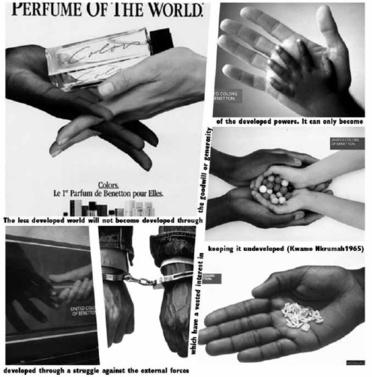
When we consider Benetton's organisational structure we can also understand their advertising and marketing strategy as a clear communication of the company's organisational form and as a consolidation of a neo-liberal multiculturalism that rests on the exploitation of both labour in the Global South as well as migrant labour in European metropolises, which relies on the normalisation of racialised inequalities. Benetton's images should not be simply recognised as operating in a general context, but as working to directly preserve the interests of this newly launched global firm. In the 1980s, Benetton began to develop a system they described as ‘flexibility in manufacturing', which allowed the company to respond quickly to changing fashion trends and demands. The system encouraged a computerised technology that increased exploitative labour relations through systems of subcontracting, creating precarity for textile workers in the Global South as well as for sweatshop workers living in the Global North, many of which are immigrant women (Kim and Chung, 2005: 72; Mitter, 1986; Ramamurthy, 2015: 284). Benetton's images also constructed ideological hegemonies to applaud capitalism as an ideal. The images that Lury (2000) notes as representing diverse nationalisms did not just simply reduce nations to commodifiable and essentialised tropes but held clear ideological significations. Produced during the period of Perestroika, some advertisements presented capitalism (represented as America) as gentle and kind through gendered images of blonde, blue-eyed girls with soft curls, in contrast to the USSR, which was figured as an angry and hard-nosed boy complete with paper aeroplane to suggest the USSR as the aggressor in the arms race (Ramamurthy, 1997). In another instance of ideological signification a young Chinese boy dressed in blue is carefully positioned with Mao's little red book upside down (Channel 4, 1988). As Giroux (1993) argues, these images should be read as containing a violence at their core.
‘Post-Racial’ Racisms
Let us consider some recent advertisements in the USA which address issues of migration and multiculturalism to explore the continued potential for reflecting on the ways in which a company's employment of racialised representations may continue to intersect with their commercial and political interests. The year 2016 saw major political rifts emerge with the election of President Trump and a marked rise in national chauvinism and racisms in both the USA and Europe. Trump's declared desire to build a wall between Mexico and the USA was met with outrage by liberals but gained him support amongst conservatives eager to lay the blame for economic hardship on the most vulnerable.
In this context it is surprising that any company would engage with an issue so fraught with conflict in their advertising. Yet in the USA, Budweiser and 84 Lumber issued Superbowl advertisements that referenced immigration in 2017. Budweiser reflected back on European immigration to America in the nineteenth century, linking such migration to the American dream's idea of success through perseverance. 84 Lumber focused on the arduous migration journey of a Mexican mother and her child to America. The visualisation of Trump's wall at the end of the commercial, which opens up for the two with the tag line ‘The will to succeed is always welcome here', elides migration as a fundamental ingredient of the American dream, reinforced by the child who collects rubbish on the journey to make a dream catcher, a metaphoric nod to the Democrats Dreamers programme which gives children of undocumented migrants the chance to apply for residency status. 84 Lumber's narrative of Hispanic migration elides with the commercial requirements of the US construction industry in which Hispanics make up 30% of blue-collar workers on US construction sites, making the ‘economic exploitation of undocumented workers … a cornerstone of the non-union construction industry's low wage business strategy'. It has led to the high rate of deaths amongst migrant workers who carry out some of the most dangerous tasks while being paid the lowest wages (Center for Construction Research and Training, 2010: 4). While the commercials by Budweiser and 84 Lumber caused controversy and racist responses online, the companies’ assertion of the essential need for migration and the free movement of goods highlights a wider structural requirement for the accumulation of capital in the era of globalisation. Such companies, while espousing a commitment to freedom of movement, rely precisely on migrant workers’ undocumented status, which allows for their intensified exploitation. It is significant that the 84 Lumber advertisement does not contest the Republican political policy of building a wall, but rather visualises an open door for the ‘worthy’ immigrant, maintaining the liberal race paradigm's division of ‘good black'/‘bad black’ and ‘good immigrant'/‘bad immigrant’ (Pieterse, 1992: 203–4).
The failure to challenge the racism of gross exploitation in the production of goods means that within consumption discourses the focus is framed around avoiding offence. Witness H&M's unequivocal apology for the offence they caused through online marketing that placed a black child in a sweatshirt that read ‘coolest monkey in the jungle’ and a white child in one that said ‘survival expert'. It led to the ransacking of H&M stores in South Africa with the ‘gaff’ covered in media worldwide. Some have suggested that such productions are deliberate strategies by companies to employ black outrage to profile their brands (White, 2019). H&M's response to the outrage was to take part in the conference ‘Pathways to anti-racism', where they were pitched as intending to ‘share insights about the interventions that they have employed following their racist hoodie advert'. The neo-liberal construction of racism as a psychological programme of recovery for each individual ignores the racialised and structural inequalities upon which neo-liberal capitalism flourishes.
Anti-racism itself has been appropriated within ‘diversity marketing’ commodity discourses. Without interpreting advertising imagery with reference to the production context of commodities, it is impossible to fully appreciate the absurdity of designs such as Nike's Equality range in 2017. Using sound visualisations of Martin Luther King's ‘I have a dream’ speech, Nike produced graphics for shoes sold during Black History Month. Six months previously, however, Nike ceased to allow the independent NGO Worker Rights Consortium access to factories to check on labour standards in factories globally (Gearhart, 2017). Their footwear continues to be produced in factories where labour rights are undermined, wages are desperately low and health and safety conditions are disregarded. The absurdity of consuming one's way out of racism must be understood through the failure to challenge the exploitation of the Global South (whose populations are primarily people of colour) by the Global North, whose populations are largely white (Willis, 1990). Neo-liberal discourses around race have been further consolidated since 2008 as right-wing ‘post-racial society’ narratives have gained ground, cutting off discussion about structural inequalities, political and social inequity and imperialist wars in favour of personal responsibilities (Edwards & Ramamurthy 2017; Squires, 2014).
Representing Black Labour
I have focused so far on the use of people of colour in advertising by corporations representing ideological support for imperialism's political policies and practices. In this final section I will return to focus on a core issue for advertising as a whole – the mystification of labour relations, to consider the ways in which the image of the non-white body contradicts simplistic arguments about ads as simply hiding labour relations. The non-white body framed as a labouring body through literature and the arts, during both slavery and colonialism, permitted the representation of labour in advertising without acknowledgement of exploitation. The naturalisation of this image enabled the repeated and uncontested use of the image of the black slave and of colonised labour on tropical products throughout the colonial era and beyond and enabled these workers to appear as exotic icons rather than as the visibility of exploitation.
Tea advertising both during the colonial period and beyond provides a particularly strong example of the image of the colonial subject as born to labour, enabling the representation of labour without shattering the fetishised world of the commodity (Ramamurthy, 2003). In tea advertising we can also see the way in which the female labouring subject was often elided with romantic images of the plantation defined as ‘garden', a space that has both been idealised and represented as a space of transgression in western culture. The visualisation of the worker as feminised enabled the reconstruction of the ‘tea garden’ as a domestic space in Lipton's advertising, from the 1920s onwards. The frequent reorganisation of the space of the plantation into a visual manifestation of a heterotopian space of ‘garden'/exotic landscape, along with the traditional invisibilisation of women's domestic work (Daniels, 1987), which enabled a conflation of the worker/planter with the consumer through images of the exotic ‘belle', diminished the visibility of exploitation on the plantation (Ramamurthy, 2012). By evoking an image of domesticity and traditional femininity these images turn the experience of plantation labour into a ghost-like one at the very moment that it is visualised. Although tea advertising retained the image of the female tea picker into the 1980s, the majority of images of plantation labour in the Global South disappeared in commodity advertising during the 1960s, when anti-colonial struggles gained ground.
The association of workers in the Global South as natural labourers however re-emerged on fair-trade advertising when their image could act as an affirmation of the ethical consciousness of the consumer in the Global North. It has been argued that the appearance of workers on fair-trade advertising during the 1990s was an act of de-fetishisation, since fair trade aims to change market relations, to advertise the conditions of production explicitly, in order to make transparent the relations under which commodities are exchanged (Hudson and Hudson, 2003). Yet I would argue these images do not de-fetishise commodities, but act instead to fetishise the form of labour, to transform ‘the unveiled concrete labour itself into a commodity’ (Varul, 2008: 660).
Kalpana Wilson has highlighted the way in which the visualisation of Third World workers in charity advertising has also affirmed the racialised and gendered hierarchies in neo-liberal attitudes to development where women are represented as positive and asserting agency despite the limitations of their lot. Wilson has noted how ‘the use of the concept of “agency” in these texts frequently has the effect of reassuring us that women do in fact exercise choice in situations where structural constraints mean that women are simply “choosing” survival’ (2011: 317; see also Chapter 60, this Handbook). Wilson has commented on the way in which images in Oxfam Unwrapped and fair-trade chocolate advertising represent the smiling subjects, usually women, as empowered by their own labour – as ‘“participating … hardworking, industrious and self-determined” subject(s)', undermining our understanding of their exploitation (Wilson, 2011: 324).
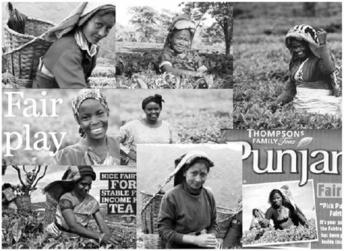
In much fair-trade advertising and packaging the smiling worker assents to our consumption. Affect is crucial in our reception of these images. Workers’ smiles enable an affective bond between producer and consumer (Ramamurthy, 2012). Their smiles affirm their contentment with their conditions. Our pleasure, even hedonism, in consumption can be excused by a feeling that we are morally ‘good’ in our fair-trade choice (Littler, 2009: 30). The Fairtrade Foundation's campaigning images in 2011–12, for example, depicted producers and consumers smiling together. Inequality is here reframed as difference. Both smile as broadly as each other, suggesting through juxtaposition their mutual contentment. Smiling, which has been discussed in literature on race, gender and oppression, is often an important affective action, as Marilyn Frye has highlighted:
It is often a requirement upon oppressed people that we smile and be cheerful. If we comply, we signal our docility and our acquiescence in our situation. We need not, then, be taken note of. We acquiesce in being made invisible, in our occupying no space. We participate in our own erasure. (Frye, 1983: 2-3)
Fair-trade advertising and publicity promoting trade on the basis of fairness requires workers to perform their contentment for our consumption, just as the colonial worker did. This performance of emotional labour, as Rothschild notes:
requires one to induce or suppress feeling in order to sustain the outward countenance that produces the proper state of mind in others. This kind of labour calls for a coordination of mind and feeling, and it sometimes draws on a source of self that we honor as deep and integral to our individuality. (quoted in Chong, 2009: 1)
The necessary performance of this emotional labour asks us to consider: ‘at what price can subjects speak the truth about themselves?’ (Foucault, 1983).
The drive to represent corporations as benevolent has become increasingly sophisticated, with companies suggesting themselves as partners in the moves for social inclusion and social justice, through both ‘fair trade’ being adopted as a purchasing choice by all major corporations, as well as through corporate social responsibility programmes in which corporations carry out acts of charity. Adopting the same smiling faces of workers from the Global South as those found in the images of the Fairtrade Foundation, corporate fair trade has sometimes rearticulated racist tropes in the bid to hide the exploitation of agricultural labour. Cadbury's fair-trade Zingolo advertisement, for example, depicts a cocoa farm in which the beans mysteriously pick themselves while the local population sing and dance in reverence to the produce and, by inference, the Cadbury's corporation. In corporate social responsibility PR, labour is again mystified, while both absent and present.[453] Coke's Happiness is Home project presents the company as fulfilling individual dreams of seeing family by harnessing personal stories of separation caused by the impact of neo-liberal globalisation that are resolved through the company's gestures of goodwill. While representing migrant workers across the world, with some even depicted at work, the exploitation of workers in Coke factories is pushed aside by the company's benevolent act of buying a plane ticket for five Filipino workers to visit their families, white-washing the exploitation faced by migrant workers through the employment and business practices of the very corporations that fail to enable regular family reunification.[454] These viral videos present an example of the way in which promotional culture today does not always erase the meaning of production but modifies and frames it in ways to suggest corporate benevolence.
The Fetishisation and Mystification of Factory Labour
The racialised nature of the above representations can only be fully appreciated when we compare it to the representation of labour (or lack of) more widely in advertising. While colonial advertising depicted African and Asian labour as a natural part of the imperial family and fair-trade advertisements promote the image of the worker – always from the Global South – assenting to their own exploitation, the labour depicted in these images is always agricultural labour, frequently framed in idyllic natural environments. The imperial division of labour, with the colonies perceived as the natural producers of raw material and European metropolises as the centre of industrial production, has meant that industrial labour has been rarely represented or when it has, it is fetishised, sometimes even through the visualisation of peasant/agricultural scenes. In her essay ‘Great history that photographs mislaid', Williamson notes this fetishisation. She analyses a Lancia advertisement in which the car is placed in an Italian vineyard surrounded by happy peasants. Williamson asks: ‘Who made this car? Has it just emerged new and gleaming from the soil, …. How can a car even exist in the feudal relations?’ (Williamson, 1979).
In contemporary advertising, factories and highly mechanised labour environments, in particular, are rarely represented. When they are, they are usually places of fantasy, such as in the McCain Oven Chips ‘Chip perfection’ TV commercial from 2011 or the Coke ‘Happiness factory’ commercial from 2006. These narratives frequently push the worker into the background, fetishising the technological and digital environment and in the process denying the exploitation and alienation experienced by the factory workers. One such recent advertisement is Amazon's 2017 Christmas advertisement ‘Give 60', in which a young, busy, white female consumer buys a gift for a young girl from the Amazon website, while travelling on a bus.[455] The alienation of contemporary western life that leaves us purchasing gifts online and sending gifts to loved ones that we neither touch nor wrap is transformed as an emotional exchange in this advertisement through a video that personifies and in this process fetishises the Amazon box, as it travels through one of the company's automated warehouses (renamed by Amazon as ‘fulfilment centres'). Here, workers in the Global North (including many migrant workers) operate in the background of the warehouse, out of focus or in the shadows, their presence diminished in order to effectively transfer humanity and feeling from people to commodities. The harsh working conditions of the Amazon worker are erased by the smooth-running machines. The automated nature of this factory situates it as representative of work in the Global North. In earlier advertisements a racialised division of labour in Empire Marketing Board images of the 1920s represented white workers as the operators of machines to distinguish them from colonised labourers: the producers of raw material in the British Empire (Ramamurthy, 2003). Here racialisation is implicit through the only individualised Amazon worker, the driver at the end of the narrative, being white. The exploitation of factory labour in the Amazon image is mystified and denied in two ways. Firstly, the labour of workers who have produced the goods and the conditions of their work are erased through the perfect and neat packages that travel with ease on the digitised conveyor belts. Secondly, the workers in the warehouse itself are diminished through the animation of the inanimate boxes to suggest humanity and love as transferred through the purchase of goods between consumers. The exploitation of Amazon workers, many of whom are migrant workers, and their exhaustion and experience of physical pain due to the relatively harsh working conditions are erased in the video (Osbourne, 2016). The boxes’ Amazon smiles literally sing to us and to each other ‘give a little bit of your love to me'. Human emotions and experience are thus transferred from people to goods, centring the commodity and the corporation as both benevolent and the pivot of contemporary human life.
Conclusion
It is clear that advertising not only acts to structure commodities as the centre of our social worlds, but also reproduces supportive ideologies of race, gender and class to service the accumulation of capital. From the late nineteenth century when the first consumer societies developed we have seen the ways in which advertising harnessed racialised ideologies to consolidate corporate interests. These representations not only reflected wider ideas that circulated in society, but can be seen to have acted to consolidate racialised ideas that supported the specific interest of major firms.
It is crucial for a critical analysis of advertising's ideological impact to investigate the material context within which advertising images operate so as to understand the economic and political interests that these images serve. Here, I have identified not only the entanglement between racist ideologies and capitalist development during the period of Empire, but also their continued entanglement in the post-independence and neo-liberal era. I have also identified the way in which the gendered divisions of labour intersect with racialised ideologies to naturalise racial hierarchies and represent the Global South as born to labour, an image that is further consolidated through the frequent representation of women's domestic labour, which has been historically naturalised as outside of the realm of exploitation.
While advertisements fetishise commodities to make them appear ‘mist-enveloped’ and to carry properties that an inanimate object can never have, the analysis above makes clear that the real is not simply ‘hidden by the imaginary’ (Jhally, 1991), but that advertising naturalises forms of exploitation to often represent exploitative social and economic relations as benign. As such the real is not so much entirely hidden as reframed as ‘natural', normalised and legitimated, to deflect from the violence of contemporary global relations that maintain the exploitation of the Global South by the Global North. This is made possible and acceptable through racism. Neo-liberal multiculturalism has created imagery that suggests the possibility of equality at the point of consumption, yet such advertising often essentialises difference and only works through erasing knowledge of the persistent structural inequalities that make such a possibility farcical. In fair-trade advertising the workers of the Global South are even employed to authentically assent and be happy in their exploitation and their position outside of conspicuous consumption.
It is not useful to suggest a reform to advertising, as advertising as a cultural form is tied to the system that we wish to see destroyed. The value of looking critically at advertising images is that they permit us to see the ways in which material interests directly impact on representation. The social, cultural and political meanings advocated in advertisements can never contradict an advertiser's economic interests. In the main, these social and cultural meanings naturalise capitalism as benign. We can see the ways in which commodities are fetishised and take on human characteristics, changing the way we view ourselves and others. We can also trace the way in which racialised practices are central to exploitation under capitalism and these practices impact on regimes of representation. Such racialised regimes of representation intersect with gendered hierarchies. It is also clear that capitalism in its imperialist phase remains adaptable and parasitic, able to absorb and deflect dissent through shifting our focus from structural inequalities to questions of personal difference and transformation. Through the enactment of racialised and gendered hierarchies advertising even naturalises inequality as ‘difference', enabling corporations to be framed as benevolent and benign.
References
Back, Les & Quaade, Vibeke 1993 ‘Dream Utopias, Nightmare Realities: Imaging Race and Culture Within the World of Benetton Advertising', Third Text, 7(22): 65–80.
Barthes, Roland 1972 Mythologies, London, Fontana.
Barthes, Roland 1977 ‘The Rhetoric of the Image' in Image Music Text translated by Stephen Heath, London, Haper Collins.
Blackburn, Robin 1998 The Making of New World Slavery: From the Baroque to the Modern, 1492–1800, London, Verso.
Center for Construction Research and Training 2010 Immigrant Workers in U.S. Construction: Sharing Lessons Learned in Our Unions, Labor Occupational Health Program, UC Berkeley www.cpwr.com/sites/default/files/immigrant_workers_in_construction_cpwr-lohp_report.pdf accessed 2 June 2020.
Chambers, Jason 2008 Madison Avenue and the Color Line, Philadelphia, University of Pennsylvania Press.
Channel 4 1988 How to Survive Lifestyles. https://doi.org/10.2307/800538.
Chong, Patricia 2009 ‘Servitude with a Smile: An Anti Oppression Analysis of Emotional Labour', Global Labour University Working Papers, No 7 Berlin. www.econstor.eu/handle/10419/96387 accessed 2 June 2020.
Daniels Arlene K (1987) ‘Invisible Work', Social Problems, 34(5): 403–15.
Dawson, Michael C. (2016) ‘Hidden in Plain Sight: A Note on Legitimation Crises and the Racial Order', Critical Historical Studies, 3(1): 143–61.
Derrida, Jacques 1978 Writing and Difference, London, Routledge.
Edwards, Lee & Ramamurthy, Anandi 2017 ‘(In)credible India? A Critical Analysis of India's Nation Branding', Communication, Culture and Critique, 10(2): 322–43.
Ewen, Stuart 1976 Captains of Consciousness: Advertising And the Social Roots of the Consumer Culture, New York, McGraw-Hill.
Fanon, Franz 1967 Black Skin White Masks, New York, Grove Press.
Foucault, Michel with G. Raulet 1983 ‘Structuralism and Post Structuralism: An Interview with Michel Foucault', Telos, 55 Spring (83): 195–211.
Frye, Marilyn 1983 ‘Oppression’ in Marilyn Frye ed. The Politics of Reality: Essays in Feminist Theory, Trumansburg, NY, The Crossing Press, pp. 1–16.
Gearhart, Judy 2017 ‘The real March madness: Nike ditches university commitments' Huffington Post www.huffpost.com/entry/the-real-march-madness-nike-ditches-university-commitments_b_58deba30e4b0d804fbbb72b7?guccounter=1 accessed 2 June 2021.
Giroux, H. 1993 'Consuming Social Change: The “United Colors of Benetton”', Cultural Critique, 26: 5–32. doi:10.2307/1354454.
Goldman, Robert 1992 Reading Ads Socially, London, Routledge.
Gottleib, Robert & Joshi, Anupama 2010 Food Justice, Boston, MIT Press.
Hall, Stuart 1980 ‘Encoding/ Decoding’ in Simon Durring ed. The Cultural Studies Reader, 1993, London, Routledge, pp. 507–17.
Hudson, Ian and Hudson, Mark 2003 ‘Removing the Veil? Commodity Fetishism, Fair Trade, and the Environment', Organization & Environment, 16(4): 413, 430.
Hund, Wulf 2013 ‘Advertising White Supremacy: Capitalism, Colonialism and Commodity Racism' in Wulf Hund, Michael Pickering & Anandi Ramamurthy eds Colonial Advertising and Commodity Racism, Hamburg, Lit Verlag, pp. 21–67.
Jhally, Sut 1991 The Codes of Advertising: Fetishism and the Political Economy of Meaning in the Consumer Society, London, Routledge.
Kim, Minjeong & Chung, Angie 2005 ‘Consuming Orientalism: Images of Asian-American Women in Multicultural Advertising', Qualitative Sociology, 28: 67–91.
Leiss, William, Klein, Stephen and Jhally, Sut 1986 Social Communication in Advertising, London, Routledge.
Lever, William Hesketh 1927 Viscount Leverhulme, By His Son, London, George Allen and Unwin Ltd.
Littler, Jo 2009 Radical Consumption: Shopping for Change in Contemporary Culture, Maidenhead, Open University Press.
Lugard, Lord 1965 The Dual Mandate in British Tropical Africa (first published 1922), London, Routledge.
Lury, Celia 2000 ‘The United Colors of Diversity: Essential and Inessential Culture' in Sarah Franklin, Celia Lury and Jackie Stacey eds Global Nature, Global Culture, London, Sage, pp. 146–87.
Malcolm X 1962 ‘Who taught you to hate yourself', speech, 5 May, Los Angeles.
Marchand, Roland 1985 Advertising the American Dream: Making Way for Modernity, 1920–1940, Berkeley, University of California Press.
Marx, Karl 2003 Capital, Volume 1, first published 1867, London, Lawrence and Wishart.
McClintock, Anne 1995 Imperial Leather: Race, Gender, and Sexuality in the Colonial Contest, London, Routledge.
Melamed, Jodi 2006 ‘The Spirit of Neoliberalism: From Radical Liberalism to Neo-liberal Multiculturalism', Social Text, 24(4): 1–24.
Mitter, Swasti 1986 Common Fate, Common Bond: Women in the Global Economy, London, Pluto Press.
Nkrumah, Kwame 1965 Neo-Colonialism, The Last Stage of Imperialism, London, Thomas Nelson & Sons.
Ntobi, Marco 2016 Violent Class Struggles and the Need for Revolutionary Change, Raleigh, Lulu Press.
Osbourne, Hilary 2016, Dec 12 ‘Amazon “accused of intolerable conditions” at Scottish warehouse', The Guardian www.theguardian.com/technology/2016/dec/11/amazon-accused-of-intolerable-conditions-at-scottish-warehouse accessed 2 June 2021.
Pieterse, Jan Nederveen 1992 White on Black: Images of Africa and Blacks in Western Popular Culture, New Haven, Yale University Press.
Pendergrast, Mark 1993 For God, Country and Coca Cola: The Unauthorised History of the World's Most Popular Soft Drink, London, Weidenfeld and Nicholson.
Ramamurthy Anandi 1997 ‘Constructions of Illusion: Photography and Commodity Culture' in Liz Wells ed. Photography: A Critical Introduction, London, Routledge (First edn), pp. 151–98.
Ramamurthy, Anandi 2003 Imperial Persuaders: Images of Africa and Asia in British Advertising, Manchester, Manchester University Press.
Ramamurthy, Anandi 2012 ‘Absences and Silences: The Representation of the Indian Tea Picker in Colonial and Fair Trade Advertising', Visual Culture in Britain, 13(3): 367–81.
Ramamurthy, Anandi and Wilson, Kalpana 2013 ‘Come and Join the Freedom Lovers: Racism, Appropriation and Resistance in Advertising in Racism' in Wulf Hund, Michael Pickering & Anandi Ramamurthy eds Colonial Advertising and Commodity Racism, Hamburg, Lit Verlag, pp. 69–94.
Ramamurthy, Anandi 2015 ‘Spectacles and Illusions: Photography and Commodity Culture' in Liz Wells ed. Photography: A Critical Introduction, London, Routledge (Fifth edn), pp. 231–88.
Richards, Thomas 1990 Commodity Culture in Victorian England, Stanford, Stanford University Press.
Slater, Don (2002) ‘Marketing mass photography' in: Jessica Evans and Stuart Hall eds Visual Culture: the Reader. London, Sage and Open University.
Slater, Don (1983) ‘Marketing Mass Photography’ Photography' in: Jessica Evans and Stuart Hall, (eds.) Visual Culture: Tthe Reader. London: Sage.
Squires, Carol 2014 The Post-Racial Mystique: Media and Race in the Twenty-First Century, New York; London, NYU Press.
Tharoor, Shashi 2017 Inglorious Empire: What the British did to India, London, Hurst.
Varul, Matthias Zick 2008 ‘Consuming the Campesino: Fair Trade Marketing between Recognition and Romantic Commodification', Cultural Studies, 22(5): 654.
White, Nadine 2019 ‘Ethnic diversity in advertising is at an all time high but racially offensive campaigns endure' Huffington Post www.huffingtonpost.co.uk/entry/ethnic-diversity-in-uk-advertising-is-at-all-time-high-but-racially-offensive-campaigns-endure_uk_5caca1bee4b01b34503bb8f9 accessed 2 June 2021.
Williams, Eric Eustace 1945 Capitalism & Slavery, Chapel Hill, University of North Carolina Press.
Williams, Raymond 1980 ‘Advertising, the Magic System’ in Simon Durring ed. The Cultural Studies Reader 1993, London, Routledge, pp. 410–23.
Williamson, Judith 1979 Decoding Advertisements, London, Marion Boyars.
Willis, Susan 1990 ‘I want the Black One', New Formations, 10: 77–97.
Wilson, Kalpana 2011 ‘Race, Gender and Neoliberalism: Changing Visual Representations in Development', Third World Quarterly, 32(2): 315–31.
Žižek, Slavoj 1997 ‘Multiculturalism, or the Cultural Logic of Multinational Capitalism', New Left Review, 225: 28–52.
62. Dependency Theory and Indigenous Politics
Andrew Curley
Introduction
When we think of Marxism in Indian Country, we can't overlook dependency theory. For years, it was the critical framework that told the story of Indigenous incorporation into practices and processes of global capitalism. This scholarship was contemporary and historical. It talked about tribal workers, government officials, and community activists. It described literal tons of coal flowing out for pennies flowing in. It highlighted how colonialism and capitalism moved and reshaped Indigenous places as dependent on (and shaped by) a core economy. This framework accounted for local elites and global forces. It was complex scholarship, with both sweeping historical narrative and charts and graphs. It was also nation-specific, focusing on the particular experiences of the Navajo, the Choctaw, the Pawnee, the Cheyenne, or the Crow – names lost in frameworks that speak of colonization as a story of settlers and Natives.
Today's critical research focuses on settler-colonialism and the settler-colonial state as its object of analysis. It is the colonial state to which we ascribe the project of Native elimination. This is not Indigenous-centered research, as Native scholars are starting to point out (Snelgrove et al., 2014). What is more, it reduces complex interactions into simple dichotomies, binaries with static logics. Ironically, this chapter focuses on dependency theory as a way forward in telling the history of Indigenous peoples – to complement these other critical approaches with more emphasis on Marx's core concepts of political economy.
During fieldwork in the Navajo Nation in 2013, I asked everyday Diné people why they felt the tribe continued to support a coal economy despite decades of environmental risks, bad faith contracts, and increasing concerns over climate change. To the people I spoke with, the structuring dynamics were not hard to figure out. The Navajo Nation had been made dependent on the coal industry and thus subservient to it. People on the ground described it as such. They held their leaders largely responsible, as the quote at the top of the page indicates. Without a plan, without a critique, the forces of capitalism, the Wiindigo economy,[456] come knocking at the door.
Yet, in academic circles, scholarship has long moved beyond what has been called ‘dependency theory'. By 2013, dependency theory was passé. Critics claimed it straightjacketed individual agency, or was deceptively incorporative of central assumptions of modernization theory (Escobar, 1995; Scott, 1995). It was not attuned to Indigenous ontology and implied a developmentalist logic. This chapter argues that, despite its critiques, dependency theory maintains on-the-ground relevance for tribal people in describing and understanding their economies. Dependency theory is Marxist in origin and highlights the unevenness of capitalistic incorporation in space and time during the later expansion of global capitalism (Mezzadra, 2011).
Importantly, dependency theory is a twentieth-century argument, reflecting the state of the world during neocolonialism. It explained the economic integration of places and nations from decolonialization in the 1950s and 1960s until the advent of neoliberalism in the early 1980s. This was an age of development, when the USA and its Western allies actively promoted the recolonization of the Third World with market integration. The theory designed to destroy traditional economies was modernization theory, largely presented in overly simplistic ways by politically powerful economists. Dependency theory flipped modernization theory on its head, arguing that traditional economy had already been destroyed, and largely by colonial practices.
Currently there is a resurgence of Marxist interest in Native communities, but this new scholarship is more activist than analytical in nature. While we find in activist work a real possibility of changing the world, we often lose the opportunity to understand the world's contradictions and complexities in depth. In this chapter, I focus on the use of dependency theory in Native North America, which was meant to expose the hidden and structuring forces of capitalism in Indian Country. This scholarship is a rich blend of theoretical critique and empirical analysis, but is generally neglected. As we will see, the advantage of dependency theory in Native North America is its ability to account for colonialism and political economy.
Since dependency theory fell out of favor among academics in the 1980s, settler-colonialism and settler-colonial theory have largely replaced it as the critical interpretation of Indigenous/colonial relations in North America. Settler-colonial theory inherits critiques of the structuralism shared by dependency theory but adds a few new problems of its own. Indigenous and White scholars using ‘settler-colonialism’ have largely replaced the structural arguments of dependency theory with a focus on land dispossession and the elimination of the Native. Settler-colonialism highlights an underlying unshakeable colonial edifice that is essential to the identities of colonial states. Settler-colonialism is a structure not an event, a structure bent on the elimination of the Native (Wolfe, 2006).
What is lost is the importance of events. For Marx, capitalism wasn't just a structure, it was world-changing force expanded violently through and despite political structures. It was one bloody event after the next, each with its own internal conflict and contradiction. Land dispossession only accounts for some of the historical forces at work. The incorporation of land, people, and places into global capitalism is the larger story. The elimination of the Native was foundational for this project for a time, but the colonial state has moved on. In some unusual cases, Indigenous nations have regained some land from those stolen in the past. Tribal nations have found selective forms of recognition, despite settler cunning (Coulthard, 2014; Simpson, 2014).
In the US state of Arizona, for example, where I carry out my research, the two largest reservations in the country are to be found: the Navajo Nation, at 17.5 million acres, has expanded since its original treaty with the federal government in 1868 (Kelley and Francis, 2019); similarly, the Tohono O'odham Nation, along the US–Mexico border, has only expanded in size along within the imperial nation of the USA while disappearing in Mexico (Gentry et al., 2019). In other words, Indigenous nations are not all the same. They are neither homogenous externally nor uniform internally. The ways in which they are incorporated into capitalism are unique, particular, and serve different kinds of capitalistic purposes. Whereas the settler once sought to push Indigenous peoples off the land, the colonial state now intends to recognize Indigenous land claims in very narrow and often violently transformative ways. The goal is not simply the elimination of the Native, but also the expansion of capitalism.
Dependency theory is not the only thing. But it is a successful Marxist framework with a legacy in Indigenous communities that we can revamp, retool, and repurpose.
A Brief History of Dependency Theory
Dependency theory emerged during the era of decolonization following the end of the Second World War. Independence movements in Africa, Asia, and the Caribbean struggled against the collapsing colonial infrastructures of Great Britain, France, and Portugal. The USA quickly filled the void (Chomsky, 2003). The world polarized into the capitalist First World and the communist Second World. The Third World, newly independent nations in parts of Africa, Asia, and the Pacific, sought a different path (Prashad, 2008). They formed the Non-Aligned Movement and leaned toward mixed economies, repurposing colonial political and physical infrastructure toward the welfare of the nation, sometimes calling these policies socialist.
In Africa, Southeast Asia, the Middle East, and Latin America, the USA backed military dictatorships, undermined democratically elected leaders, and even sponsored targeted assassinations. US foreign policy aligned with violent right-wing groups to challenge Soviet influence (often more imagined than real) and extend the reach of international capitalism – what would become the global division of labor in the age of neoliberalism. This forced many independent leaders to pessimistically reassess global possibilities. Global capitalism, after the Second World War, was the basis for what Ghana's first president Kwame Nkrumah called ‘neocolonialism’ (Nkrumah, 1965).
In neocolonialism, former colonies ostensibly gained political independence, but maintained economic dependence on the former colonizing nations (Rist, 2002: 109–22). Dependency theory developed as a thesis among Latin American economists who worked to explain how their nations struggled to emerge from penury despite continued integration within international capitalism. Accordingly, the more newly independent nations were incorporated into global capitalism, the poorer they became. The lack of development progress, increasing class stratification, and indigence forced many to reassess the promises of capitalism.
For cocoa growers in Ghana or coffee farmers in Tanzania, political independence changed little. Postcolonial economies were built on the same practices of commodity production that defined the colonial period. National elites replaced colonial elites. But the colonial project remained intact. Fanon (2008) understood this colonialism as a psychological and ideological problem among national elites who blindly accepted the racism and rendering of inferiority of the modernization narrative at the costs of the nation's laboring classes. The paternalistic apparatus of the colonial administrator disappeared, but in his stead, the missionaries of markets, agriculture extension officers, coffee buyers, traders, and investors replaced paternalism with artificial opportunism. They filled the heads of elites with promises of modernity.
With his 1966 essay in the Monthly Review, ‘The Development of Underdevelopment', economist Andre Gunder Frank successfully translated ideas circulating in the global South into Anglophone scholarship. He had worked as an economist in Brazil and left after a US-sponsored military coup in 1964. The main thesis of the article, which remains useful today, is that the formal practices of development led to its opposite, underdevelopment. Shortly afterward, a flurry of dependency scholarship was published. Sociologists, economists, and historians gravitated to the allure of a theory that spoke to the way peasant and Indigenous communities throughout the world were impacted by the expansion of global capitalism. In the 1970s, Latin American economist Theotônio dos Santos published ‘The Structure of Dependence’ in the American Economic Review in which he described the relationship between imperialism, colonialism, and economic integration in broad, but useful language (Dos Santos, 1970). It was widely cited and helped to establish the theoretical language and focus of dependency theory, moving beyond questions of market integration to consider what one country's economy does for the benefit of another's. Dos Santos defined dependency as ‘a situation in which the economy of certain countries is conditioned by the development and expansion of another economy to which the former is subjected’ (1970: 231).[457] Economists Fernando Henrique Cardoso and Enzo Faletto wrote Dependency and Development in Latin America, in which they argued that the history of development in Latin America has focused on exports for the benefit of the global North and at the expense of national development (Cardoso and Faletto, 1979).
These approaches had different, sometimes opposite, understandings of how capitalism worked (Apter, 1987). Some writers, like the future neoliberal President of Brazil, Fernando Henrique Cardoso, assumed that development was desired, just implemented poorly and at the expense of Latin American nationalism. This was an elite, settler vantage point. Cardoso and others preserved the project of state-driven development, but wanted it to support local elites and not ‘foreign’ ones. This conservative rendition of dependency theory has echoes in Trump's ‘America first’ and was preceded by Cardoso's conservative politics in later years.
It is ultimately misleading to take ‘dependency theory’ to refer to a unified theoretical framework. Rather, it covers an interlocking series of descriptions and analyses of relations between former colonizers and their territories that borrowed from Keynesian ideas of national economies, development and modernization theory, and Marxist historical materialism.
Dependency theory was part of an international critique of postwar development and the legacies of colonialism (Wilson, Chapter 60, this Handbook). The initial connections that economists made between the ‘metropole’ and its ‘satellites’ were eventually incorporated into world-systems theory.[458] Alongside the rise of peasant studies, dependency theory joined new ways of approaching Marxist scholarship that diverged from the rigidity of official communist doctrine.[459] Marxism responded to the cultural revolution of the 1960s by abandoning its epistemological quest for social laws in favor of historical inquiry, alongside fresh critiques of political economy (Thompson, 1978).
Dependency theory also became part of the New Left's critique of US imperialism and global capitalism. The disproportionate violence inflicted by the USA on Vietnam exposed a violence inherent in the maintenance of the global capitalist world order. The conflict was billed in the USA as an anti-communist crusade. But this narrative convinced fewer and fewer people as the body bags piled up. Dependency theory provided a framework and explanation for the developed world's harsh treatment of the developing world. It helped highlight the colonial origins of the capitalist world order and the violent transformative power of capitalism on the planet. It became a powerful critique of global capitalism at an important period in its history. Emerging from Mexico, Brazil, and Africa in the 1950s, only a few years following the end of European global hegemony, dependency theory started a conversation on the neocolonial character of global capitalism.
Useful Analytical Features of Dependency Theory for the Present
Dependency theory focused on the transfer of wealth between developing nations (satellites) and developed nations (metropoles). It tried to explain the uneven terms of trade between commodity-producing countries in the global South and consumer nations in the global North. For example, when a national economy was organized around cash-crop production, such as cocoa in Ghana, coffee in Tanzania, coal in the Navajo Nation, this encouraged government officials to maintain this industry at all costs. The industry's relative importance for jobs and revenues increased its political power. It was this dynamic that Diné interviewees highlighted when they described the Navajo Nation as dependent on the coal industry. In the course of my research, coal accounted for nearly 25% of the tribal budget – that is, a salient feature of the Navajo economy (Curley, 2018).
In the 1960s, dependency theory's main intervention was to challenge the linear narrative of modernization theory, with its assumption that participation in capitalism eventually improved the social and economic conditions of ‘underdeveloped’ states (Rist, 2002). W. W. Rostow described this process as a literal ‘takeoff', when societies were granted the preconditions of capitalism in order to gain and expand economic momentum exponentially (Rostow, 1990). For Rostow, the destruction of traditional societies was key for the creation of the preconditions for capitalism. This destruction was described in his famous work, The Stages of Economic Growth, passively and euphemistically as outside interventions. But, historically, these were violent acts, including genocide. As a Kennedy advisor, Rostow had political influence and helped shape US foreign policy during the 1960s. Rostow's assumptions were fairly common at the time and reflected decades of development thinking for federal officials working within reservations.
Modernization theory assumed that reservations, just like ‘underdeveloped’ states, were in need of development. Dependency theory argued that attempts to modernize Indigenous communities underdeveloped them. This is where the thesis proved particularly useful for the Navajo Nation. The movement from subsistence to wage-labor resulted in a loss of independence and sense of economic dependency among Diné people and explains why the word itself, ‘dependency', comes up so often among community members when they talk about the coal economy and the Navajo Nation's relationship to it.
Dependency theorists ranged widely in how they understood and characterized the history that led to a community's underdevelopment, whether in terms of the naked exploitation of resources in the interest of global elites or, at best, as holding developing economies back by encouraging just one sector, as in the ‘resource curse’ thesis (Murshed, 2018). As mentioned earlier, two popular books in dependency theory that epitomize this range were Capitalism and Underdevelopment (1967) by Andre Gunder Frank and Dependency and Development in Latin America (1979) by Cardoso and Enzo Faletto. These books advanced very different understandings of the development problem, the former building foundationally on Marx's historical materialism while the latter incorporated key assumptions of modernization theory into its analysis, especially concerning the goal of creating a national economy that served local elites. As dependency gave way to world-systems, like ska and rock-steady to reggae, some key features were lost. The site-specific and comparative aspects of dependency became lost in the grand narrative of world-systems. We had a harder time seeing exactly how the Navajo Nation contributed to the rise of Phoenix and capitalism in the Southwest. The specific commodities were less important, the global system of capitalism took prime interest.
Incorporation is not only a material process, of transferring surplus wealth from one place to the next, it is also a relational process that puts places in structuring arrangements. The dynamics between town and country, rural and urban was an original point in the dependency theory thesis later blurred when capitalism was understood as a transfer of people and wealth over centuries and at a ‘world-scale'. The world-scale, world-economy, and world-systems analysis followed capitalism from its origins in Europe to colonization across the globe. This remains a useful history, but importantly it failed to address racialization as a key feature of global capitalism. In Black Marxism, Cedric Robinson (1983) identified the importance of race and racism in the violent construction of capitalism. Today racial capitalism is an important area of research to understand how capitalism becomes reliant on race (Pulido, 2016; Beller, Chapter 44 and Bhandar, Chapter 13, this Handbook). Indigenous critiques based in settler colonial frameworks point out that colonialism and land dispossession were fundamental to the expansion of capitalism (Coulthard, 2014). Settler-colonialism was thus a better starting point for thinking about the origin of capitalism than the enclosure of the English commons.
However, world-systems approaches emphasized the role of the larger global system in order to explain the emergence of capitalism across the planet. In this context, complex and localized relationships took on tenuous connections to ideas of ‘the global'. Although capitalism assumes a global character, its particular manifestations remain unique configurations of people and places, with diverse motivations, legal-political systems, and traditions of resistance to capital incorporation.
World-systems and dependency theories relied too much on broad categories such as ‘society', ‘economy', ‘development', and ‘underdevelopment'. Ideas such as ‘underdevelopment’ remain hard to empirically demonstrate and theoretically defend. These concepts have the effect of simplifying complex economic problems and providing a misleading directionality to capital movement. Critics eventually argued that dependency theory could not account for the ‘economic successes’ of former colonies, that it tended to overstate the case for underdevelopment, thus missing important new industries like casinos in Indian Country (Wilkins, 1993). Because ‘dependency theory’ extended Marx's critique of ‘so-called primitive accumulation’ to former colonies in Africa and Latin America, the particulars of each colonial experience made it difficult to universalize. In an early critique, Fernando Henrique Cardoso identified some of the over deterministic quality of the Marxian approach to what he called ‘dependency studies', showing that scholars in this field tended to group unique historical conjunctures into typologies (Cardoso, 1977). But he acknowledged that the framework allowed for us to think about these ‘dependent’ relationships in new ways. It spurred ‘the sociological imagination'. ‘Thanks to these [dependency] theories…attention was called to a thematic frame that ceased to see development on the capitalist periphery as a “mere” consequence of accumulation of capital in the center, and began dealing with the historical form that this process acquired in dependent societies’ (1977: 19).
Dependency Theory in Indian Country
Indigenous peoples’ experience within the rise and expansion of capitalism has not been a pleasant one. Tribes have had their lands stolen, lives lost, and futures undermined. It is difficult to summarize the unique integrations of different Indigenous nations into regional and worldwide capitalism. Development around Indigenous communities was premised on the idea that Indigenous peoples were premodern and in need of intervention. Although this racist pretext is less overt today, it remains an operating justification for federal oversight over Indigenous lands. The so-called ‘Marshall Trilogy’ (1823–32) limited Indigenous sovereignty to ‘domestic’ and ‘dependent’ US authority (Wilkins and Lomawaima, 2001; Williams Jr, 2005). The language of assimilation and extinguishment of the nineteenth century was replaced with development and nation-building in the twentieth century, but the structural de jure racialization of Indigenous peoples as subordinate to US authority remains intact.
Under modernization theory, the underdevelopment of Indigenous nations within the USA was understood as a lack of political and economic integration into US capitalism and a product of overly socialistic economic policy (Gilbreath, 1973; Miller, 2012). Dependency theory reverses this presumption. It assumes that tribal social, economic, and legal ‘underdevelopment’ is the consequence of histories of forceful integration into colonial and capitalist structures, not a lack of it. This was an important insight and one that has real consequences for tribal economic and political planning today. Dependency theory is a historical account of how capitalism comes to dominate a people and a place. Dependency theory exposes the forceful variegated displacement and destruction of Indigenous economies in favor of exploitative arrangements. It is an account of economic structuring attentive to the legal and political barriers preventing Indigenous freedoms and self-sufficiency.
Among Indigenous nations in the USA, researchers and scholars have used dependency theory effectively to account for the integration of reservation spaces into US capitalism. Focusing on the uneven terms of trade for resource-exporting tribes like the Navajo Nation, Roxanne Dunbar-Ortiz and Lorraine Ruffing highlighted the movement of surplus value from the periphery (Diné lands) to the core (Peabody coal) (Dunbar-Ortiz, 1979). In a different vein, historian Richard White (1983) wrote an ambitious comparative study on the roots of dependency for the Diné, Choctaw, and Pawnee. He focused on the notion of primitive accumulation and the original undermining of the subsistent economies for Indigenous cultures and nations. More scholarship focused on this question, including world-systems writers like Thomas Hall (1989) and theorists of resistance to settler-colonialism like Glen Coulthard (2014).
Because of the colonial limitations placed on reservation spaces, but with special exception for mineral-lease contracting, many Indigenous nations leaned on the sale of uranium, coal, oil, natural gas, and other ‘natural resources’ for jobs and revenues. This history alone is hard to appreciate in settler-colonial narratives that insinuate possession of land alone is key to the expansion of global capitalism. Using Marx, we understand capitalism is not just an act of blunt dispossession, but one of cunning incorporation. Indigenous nations actively participate in exploitative economies and questions even when nominal control over the land is possible. In this era of neoliberalism, globalization is simply a euphemism for deregulation. Reservations were first part of this experiment, existing in a third space of sovereignty, to use Kevin Bruyneel's framework (Bruyneel, 2007), that sits between periphery and semi-periphery, but never part of the core.
The presence of mineral development on tribal lands rendered landscapes toxic. Coal-mining tribes like the Navajo Nation, Crow, and Northern Cheyenne became places where economic dependency was clearest (Allison, 2015). Native and non-Native scholars used dependency theory to account for the primitive accumulation of Indigenous subsistent economies. They called this form of colonization ‘internal colonization', noting that it was a method by which Indigenous lands were pillaged while under the territorial claims of the USA (Hall and Snipp, 1988; Snipp, 1988; Weiss, 1984).
Much of this critical work was published in the late 1970s into the mid 1980s. Within Diné studies, or scholarship published on the Navajo people, dependency theory was first used in 1979 to describe unequal terms of trade in the tribe's selling of coal (Dunbar-Ortiz, 1979). Richard White linked Diné underdevelopment to the violent undermining of the tribe's traditional economy of sheep and agriculture during a period known as ‘livestock reduction’ in the 1930s (White, 1983). The following year, Lawrence Weiss wrote a Marxist history of Navajo incorporation into capitalism in which he followed in the footsteps of Dunbar-Ortiz and White (1984). This presaged more recent work on ‘wastelanding', which describes the Navajo reservation as a place that colonial interests can exploit and render into wastelands for the benefit of the broader US public (understood in terms of core-periphery dynamics) (Voyles, 2015).
Critiques of capitalist incorporation faded in the late 1980s. Starting then, research in Indian Country focused on environmental contamination and ‘nation-building'. Some scholars, finding the critiques of capitalism too deterministic and failing to meet the immediate needs of tribal governments, worked constructively on policy-related research that could offer pathways for tribes to integrate their economies more successfully into colonialism and capitalism (Cornell and Kalt, 1992). The nation-building literature identified political reforms, such as the establishment of constitutions and independent judiciaries, that tribes could undertake in order to improve economic performances (Cornell and Kalt, 2000; Jorgensen, 2007; Lemont, 2006).
Indigenous critics of colonialism used language like ‘radioactive colonialism’ and ‘the militarization of Indian Country’ to focus on how colonial institutions destroyed the land and made cultural maintenance unsustainable (Gedicks, 1993; LaDuke 1992, 1999). They moved from a focus on political economy toward questions of colonialism, human rights, and environmental sustainability.
In the late 1980s and early 1990s, critics focused on three aspects of dependency theory they felt limited its usefulness: 1) calling reservations underdeveloped perpetuates racist frameworks; 2) dependency could not account for economic success in Indian Country; and 3) dependency denied a focus on human agency in understanding the history of capitalistic incorporation.
Ward Churchill argued against the use of dependency theory when accounting for the incorporation for Native people. His argument was rather simplistic. He said Marxism and Marxists used pejorative concepts and categories that described Indigenous peoples as primitive (Churchill, 1983: 84). Churchill targeted the term ‘underdeveloped’ in particular as a problematic way to understand Indigenous homelands.
In another criticism, Lumbee scholar David Wilkins wrote that dependency theory failed to address the complicated and unique political spaces of reservations that also included stories of economic successes (1993). Finally, labor historian Colleen O'Neill, whose work focuses on the Navajo Nation, argued that dependency theory denies Indigenous people ‘agency'. O'Neill (2005) wrote that the theory overdetermined how Indigenous people entered into capitalist relations.
Its shortcomings notwithstanding, critics of dependency theory focused too much on superficial issues, such as Churchill's critique of the term ‘underdeveloped', which he misread as racist. Underdevelopment is a modernization-theory framing that Gunder Frank used ironically to critique assumptions that the traditional economy and not capitalism are the cause of penury in Indigenous spaces. Gunder Frank ultimately critiques the dual-economy thesis that suggests parts of the economy are formally incorporated into capitalist processes while others are left in ‘traditional’ or informal sectors. Dependency theorists use economic categories like underdevelopment to undermine them, not to argue that these places are underdeveloped and in need of development. On the contrary, their argument is that underdevelopment is a depoliticizing conceit, a fraud by economic historians, to hide the violent and bloody history of Indigenous dispossession. You have to recall the play on words, the development of underdevelopment, to get the fuller meaning of the critique.
The implication of thinking of traditional economies as premodern and unimpacted by capitalism is to invite further capitalist intervention, either to destroy the traditional economy or to ‘formalize’ it through microloans and other initiatives popular in contemporary development circles. Dependency theory articulated the coloniality of economic relationships, where settler communities benefit from the forceful and often purposeful underdevelopment of Indigenous peoples and homelands. Although Churchill and others offered similar kinds of critiques when discussing the history of uranium mining within Indigenous communities, they could not adequately address important features of capitalist development. Missing from the critical narratives of post-Marxist scholarship are explanations for why Indigenous peoples actively participate in industries harmful to people and the environment. Indigenous labor is left in the background of Churchill and LaDuke's idea of radioactive colonialism. Environmental contamination becomes a blunt colonial act that hardly accounts for how this industry actually enters reservation communities in the first place, through the guile of modernization theory, development, and promises of progress.
More often than not, Indigenous leaders agreed to the terms of mining contracts, even if it is later alleged that they did not know what they were doing. Dependency theory helps us understand how mining contracts embedded the reproduction of colonial relations within new forms of colonialism. The power of capital to subvert the independence of postcolonial political institutions was understood as early as 1965 by Kwame Nkrumah in Ghana, the first president of the first independent nation in Africa following decolonization (Amin and McDonagh, 1973; Nkrumah, 1965). This is a point that Dunbar-Ortiz and Ruffing brought to understandings of the coal industry in the Navajo Nation, and which Churchill abandoned in the early 1980s with little justification beyond disagreements with the tone of the terminology.
Marx's notion of primitive accumulation explains both the undermining of subsistence economies and the emergence of wage-laborers for burgeoning industries. For example, Gunder Frank discussed how capitalist expansion into Latin America invented what colonialists there refer to there as ‘the Indian Problem', or the extreme penury of the continent's Indigenous peoples (1967). On the other hand, Colleen O'Neill (2005) provides one of the best analyses of reservation labor but prematurely dismisses dependency theory in the beginning of her book on account of it not dealing with ‘agency’ well enough. To a large extent, I agree with O'Neill's understanding of Indigenous labor, which follows the transformation of Indigenous notions of work and identity into new regimes of wage-labor (Curley, 2019; Hosmer et al., 2004). However, I think there is an ongoing misunderstanding of what dependency theory and other structural theories say about human agency, which was why scholars such as O'Neill avoided the term. Structuralism does not deny a people's ability to make spontaneous choices and move in unpredictable directions and defy expectations. Rather, it puts emphasis on what constrains people's full realization of their agency, namely the conditions of capitalism. It is important to highlight the histories of colonial land thefts, duplicitous deals, and active social engineering designed around fantastical ideas of development inherent in US federal-Indian law. These structuring legal, political, and economic forces constrain Indigenous self-determination and liberation. Dependency theory helps us understand how development and underdevelopment shape power dynamics between Indigenous and settler communities. It forces us to account for how so-called developed and underdeveloped places are connected and essentially related. Dependency theory in particular explains the failed results of capitalism in Indian Country, emphasizing colonial restraints rather than a people's inability to do capitalism well. It helps us to understand the failure of development projects beyond narratives of tribal ‘corruption', economic ‘brain drain', or explanations that point to the failure of weak tribal institutions in need of constitutionalism and independent judiciaries.
Revisiting Dependency Theory in Indian Country
Dependency theory is able to articulate the political and economic linkages between people and places and therefore help us understand how one place prospers at another's expense. This is an original insight of Marx in his historical account of the origins of capitalism in his account of ‘primitive accumulation’ in England and one that dependency theorists, world-systems analysis, and other critical frameworks were able to extend into histories of colonialism and capitalism across the world. Critics rightly point out that Marx and others fail adequately to address racialization as an instrument of colonial-capital dispossession. In Black Marxism, Cedric Robinson (1983) was able to amend Marxist historical analysis to better theorize the roles of slavery, racialization, and colonialism in the expansion of capitalism. Similarly, Glen Coulthard (2014) argues stolen Indigenous land was fundamental for capital accumulation and the rise of the most powerful states in the world economy, such as the USA and the UK.
Today settler-colonialism is the dominant critical framework accounting for US colonialism and Indigenous resistance to it. It argues that Indigenous land dispossession is constitutive of the identity and function of settler-states and that the political superstructure dominating Indigenous nations is one of violent replacement and elimination. This structure is not an event in the distant past, but a continuing structure in effect today. Settler colonialism is used to explain Indigenous incorporation into colonial and imperial states. As Lorenzo Veracini wrote, the settler-colonial present is a specific form of domination (Veracini, 2015). But domination is focused on state repression with occasional mention of the economic forces driving it. It fails to account for alternative colonial arrangements that might find it useful to keep Natives on the land with limited forms of authority, such as the authority to sign mineral leases and (not) regulate their environments.
Scholarship that focuses on the political economy of colonial incorporation of Indigenous lands only refers to settler colonialism in passing, not referencing or needing its specific framework of domination. For example, Winona LaDuke and Deb Cowen write that infrastructure serves as the ‘spine’ of settler colonial possibilities, writing:
We consider the Wiindigo in its invasion of Indigenous territory without consent, in its deepening of our collective dependence on fossil fuel extraction, and in its extension of settler political economy. (LaDuke and Cowen, 2020: 253)
But the Wiindigo does more than talk about replacement of Natives by settlers. It does not limit questions of incorporation to one of blunt dispossession and elimination, but of incorporation, feigned sovereignty, moments of recognition, and reworking of colonial law in favor of one capitalist interest over another. Dependency theory helps us to account for actual economies and how Indigenous peoples are incorporated.
After 50 years, dependency theory remains a useful framework for understanding the colonial incorporation of Indigenous peoples into capitalist economies. The active relationship between settler communities and colonized spaces (such as reservations) remains crucial for understanding social change and underdevelopment among Indigenous peoples and their homelands. It is useful to focus on the particulars of the regional and national incorporation of Indigenous peoples and places into a capitalist economy. Understanding the history of capitalism on a world-scale has been tremendously helpful but misses the unique configurations of regional colonial and capitalist incorporations of Indigenous places which are not always covered by a world-historical explanation.
For example, in the case of the Navajo Nation it is hard to understand the impact of coal on tribal lands and people without knowing the specificity with how coal and coal infrastructure was brought to the Navajo Nation in order to allow for Phoenix (Arizona) to gain access to energy and water (Needham, 2014), leading to economic dependency on this resource. Understanding how the US federal government, regional utilities, and the political elite created the conditions through which the Navajo Nation could act and affirm its role in a regional energy economy is important for knowing how the tribal economy works and sets its priorities. Dependency frameworks always relate Navajo economic choices to direct predatory economies without having analytically to buttress global capitalism.
Nonetheless, considering the history of capitalist incorporation of the Navajo Nation into the expanding empire of the USA helps us to understand how underdevelopment occurred in the reservation and how dependency works within Indian Country. These ideas are useful for understanding and highlighting the history of colonialism and capitalism across the world and among Indigenous communities in particular. Modernization frameworks fail to address the independence of tribes prior to colonization, the Diné people's ability to live on the land sustainably for thousands of years, and to remain prosperous until colonization (Denetdale, 2007; Yazzie, 2018). Colonialists and developmentalists arrogantly assumed Indigenous economies were undeveloped and in need of intervention. It was the intervention that trapped us into colonial-capitalist relationships. Dependency theory puts this ongoing relationship and its predatory characteristics into focus. This helps us to understand contemporary capitalist formations, like the rise and fall of the Navajo coal economy.
Conclusion
Dependency theory continues to operate as a valid critique of the expansion and maintenance of capitalist relations in different sites across the planet. Critics have pointed out that it uses language that can be interpreted as pejorative, such as ‘underdevelopment', that it fails to account for economic successes in Indigenous communities, and that it denies or undermines Indigenous agency – at times ignoring ontological and epistemological assumptions in development and modernization thinking. But as a critical theory, dependency theory is meant to challenge the racist and colonial narratives of modernization theory. We might continue to ask ontological and epistemic questions about what it means to be developed without abandoning the usefulness of being able to highlight how core economies incorporate and render dependent peripheral economies.
Dependency theory articulates how capitalistic pressures regularly work to limit what tribes can do despite Indigenous challenges. We can build on the work on Indigenous scholars who challenge assumptions of modernization and ‘the politics of recognition’ (Coulthard, 2014; Simpson 2014), state-formation (Nadasdy, 2017), settler-colonialism (Wolfe, 2006), and racial capitalism. We can move toward a dependency theory that is spatial, rather than merely economic in focus. For the Navajo Nation, colonial displacement of communities onto reservations, under restrictions of federal-Indian law and domestic dependent relations; the killing of Diné sheep and the restriction of subsistence economies; the development and modernization impetus under the guise of progress while the USA strategically invested in water and energy infrastructure to benefit Phoenix – all of these in combination and over time rendered the Navajo Nation dependent and underdeveloped. Critical scholars and researchers offered these explanations as early as 40 years ago, while Indigenous community members have vocalized this idea for as long if not longer.
For Indigenous peoples, dependency theory offers a renewed understanding of poverty and displacement as a consequence of capitalist incorporation instead of a lack of capitalism – is the alternative explanation. The value of historicizing capitalism is to identify the specific structuring mechanisms that incorporate tribes into regional, national, and global economies in ways that have undermined Indigenous sovereignty and self-determination. Dependency theory brings critical histories of capitalism into understandings of colonialization. It puts at the center of analysis the structuring interrelation between core and peripheral economies. It shows the unique ways and circumstances through which colonialism undermined, destroyed, and transformed Indigenous peoples, places, and practices.
References
Allison, J. R. 2015. Sovereignty for Survival: American Energy Development and Indian Self-Determination. New Haven: Yale University Press.
Amin, S. & F. McDonagh. 1973. Neo-Colonialism in West Africa. London: Penguin Harmondsworth.
Apter, D. E. 1987. Rethinking development: modernization, dependency, and postmodern politics. Beverly Hills, CA: Sage
Bruyneel, K. 2007. The third space of sovereignty the postcolonial politics of U.S.-indigenous relations. University of Minnesota Press. http://proxy.library.cornell.edu/login?url=http://site.ebrary.com/lib/cornell/Top?id=10212628 (last accessed.
Cardoso, F. H. (1977) The consumption of dependency theory in the United States. Latin American Research Review, 12, 7–24.
Cardoso, F. H. & E. Faletto. 1979. Dependency and development in Latin America (Dependencia y desarrollo en América Latina, engl.). Univ of California Press.
Chomsky, N. 2003. Hegemony or Survival?: Hamish Hamilton London.
Churchill, W. 1983. Marxism and Native Americans. Boston: South End Press.
Cornell, S. & J. P. Kalt (2000) Where's the glue? Institutional and cultural foundations of American Indian economic development. The Journal of Socio-Economics, 29, 443–470.
Cornell, S. E. & J. P. Kalt. 1992. What can tribes do? : strategies and institutions in American Indian economic development. Los Angeles, CA: American Indian Studies Center, University of California, Los Angeles.
Coulthard, G. 2014. Red skin, white masks : rejecting the colonial politics of recognition. Minneapolis, MN: University of Minnesota Press.
Curley, A. (2018) T'áá hwó ají t'éego and the Moral Economy of Navajo Coal Workers. Annals of the American Association of Geographers, 109(1), 1–16.
Curley, A. (2019) T'áá hwó ají t'éego and the Moral Economy of Navajo Coal Workers. Annals of the American Association of Geographers, 109, 71–86.
Denetdale, J. 2007. Reclaiming Diné history : the legacies of Navajo Chief Manuelito and Juanita. Tucson: University of Arizona Press.
Dos Santos, T. (1970) The Structure of Dependence. The American economic review, 60, 231–236.
Dunbar-Ortiz, R., ed. 1979. Economic Development in American Indian reservations. Albuquerque: Native American Studies, University of New Mexico.
Escobar, A. 1995. Encountering development: The making and unmaking of development. Princeton: Princeton University Press.
Fanon, F. 2008. Black skin, white masks. Grove press.
Frank, A. G. 1967. Capitalism and underdevelopment in Latin America; historical studies of Chile and Brazil. New York,: Monthly Review Press.
Gedicks, A. 1993. The new resource wars: native and environmental struggles against multinational corporations. Boston: South End Press.
Gentry, B., G. A. Boyce, J. M. Garcia & S. N. Chambers (2019) Indigenous Survival and Settler Colonial Dispossession on the Mexican Frontier: The Case of Cedag˘ı Wahia and Wo'oson O'odham Indigenous Communities. Journal of Latin American geography, 18, 65–93.
Gilbert, D. 2012. Love and struggle: My life in SDS, the weather underground, and beyond. PM Press.
Gilbreath, K. 1973. Red capitalism: an analysis of the Navajo economy. University of Oklahoma Press Norman.
Hall, T. D. 1989. Social change in the Southwest, 1350–1880. University Press of Kansas Lawrence.
Hall, T. D. & M. Snipp (1988) Patterns of Native American Incorporation into State Societies. Public policy impacts on American Indian economic development, 23–38.
Hosmer, B. C., C. M. O'Neill & D. L. Fixico. 2004. Native pathways : American Indian culture and economic development in the twentieth century. Boulder: University Press of Colorado.
Jorgensen, M. 2007. Rebuilding Native nations : strategies for governance and development. Tucson: University of Arizona Press.
Kelley, K. & H. Francis. 2019. A Diné History of Navajoland. University of Arizona Press.
LaDuke, W. (1992) Indigenous Environmental Perspectives: A North American Primer. Akwe: kon Journal, 9, 52–71.
LaDuke, W. 1999. All our relations: Native struggles for land and life. South End Press.
LaDuke, W. & D. Cowen (2020) Beyond Wiindigo Infrastructure. South Atlantic Quarterly, 119, 243–268.
Lemont, E. D. 2006. American Indian constitutional reform and the rebuilding of Native nations. Austin: University of Texas Press.
Mezzadra, S. (2011) The Topicality of Prehistory: A New Reading of Marx's Analysis of “So-called Primitive Accumulation“. Rethinking Marxism, 23, 302–321.
Miller, R. J. 2012. Reservation “capitalism”: Economic Development in Indian Country. ABC-CLIO.
Murshed, S. M. 2018. The resource curse. Newcastle upon Tyne: Agenda Publishing Limited.
Nadasdy, P. 2017. Sovereignty's Entailments: First Nation State Formation in the Yukon. Toronto, ON: University of Toronto Press.
Needham, A. 2014. Power lines : Phoenix and the making of the modern southwest. Princeton, NJ: Princeton University Press.
Nkrumah, K. 1965. Neo-colonialism: The last stage of imperialism. Nelson London.
O'Neill, C. (2005) Working the Navajo Way: Labor and Culture in the Twentieth Century.
Prashad, V. 2008. The darker nations: a people's history of the Third World. The New Press.
Pulido, L. (2016) Geographies of race and ethnicity II Environmental racism, racial capitalism and state-sanctioned violence. Progress in Human Geography, 0309132516646495.
Rist, G. 2002. The history of development: from western origins to global faith. Zed books.
Robinson, C. J. 1983. Black Marxism: The making of the Black radical tradition. Chapel Hill, NC: University of North Carolina Press.
Rostow, W. W. 1990. The stages of economic growth: A non-communist manifesto. Cambridge University Press.
Santos, T. d. (1970) The structure of dependence. The american economic review, 60, 231–236.
Scott, C. V. 1995. Gender and development: rethinking modernization and dependency theory. Lynne Rienner Publishers Inc.
Simpson, A. 2014. Mohawk interruptus: Political life across the borders of settler states. Durham, NC: Duke University Press.
Snelgrove, C., R. K. Dhamoon & J. Corntassel (2014) Unsettling settler colonialism: The discourse and politics of settlers, and solidarity with Indigenous nations. Decolonization: Indigeneity, Education & Society, 3(2): 1–32.
Snipp, C. M. 1988. Public policy impacts on American Indian economic development. Albuquerque: Native American Studies, Institute for Native American Development, University of New Mexico.
Thompson, E. 1978. Poverty of theory. NYU Press.
Veracini, L. 2015. The Settler Colonial Present. London, UNITED KINGDOM: Palgrave Macmillan UK.
Voyles, T. B. 2015. Wastelanding: Legacies of uranium mining in Navajo country. University of Minnesota Press.
Weiss, L. D. 1984. The development of capitalism in the Navajo nation : a political-economic history. Minneapolis: MEP Publications.
White, R. 1983. The roots of dependency : subsistence, environment, and social change among the Choctaws, Pawnees, and Navajos. Lincoln, NE: University of Nebraska Press.
Wilkins, D. & K. T. Lomawaima. 2001. Uneven ground: American Indian sovereignty and federal law. Norman, OK: University of Oklahoma Press.
Wilkins, D. E. (1993) Modernization, colonialism, dependency: How appropriate are these models for providing an explanation of North American Indian ‘underdevelopment'? Ethnic and Racial Studies, 16, 390–419.
Williams Jr, R. A. (2005) Like a Loaded Weapon. The Rehnquist Court, Indian Rights, and the Legal History of Racism in America.
Wolfe, P. (2006) Settler Colonialism and the Elimination of the Native. Journal of Genocide Research, 8, 387–409.
Yazzie, M. K. (2018) Decolonizing Development in Diné Bikeyah: Resource Extraction, Anti-Capitalism, and Relational Futures. Environment and Society, 9, 25–39.
63. The Primitive
Miri Davidson
Introduction
Marx wrote in 1842 that ‘just as each century has its own nature, so it produces its own primitives’ (Marx in Krader, 1974: 203). In doing so, he recognized that any conception of the state of nature, and of the ‘natural men’ that populated it, was little more than a reflection of the social relations dominant at the moment of its production.[460] But if the primitive has always been a mystification of one form or another, it is one that has had a powerful hold over the Marxist imagination. Visions of primitive communism bracket Marx's historical dialectic, representing an egalitarian and liberated form of social life at the origin of human history and also, if in a ‘higher’ form, its end (Marx, 2018b: 102). The figure of the primitive stands not only before and in a certain sense after capitalism, but outside of it: removed both spatially and temporally from the mediations of capitalist modernity, the primitive has captured the Marxist imagination as a romantic exemplar of non-alienated social life and non-appropriative relations with nature. As such, it is a deeply contradictory figure: the primitive ‘lack[s] all that represses us’ in modern society (Augé, 1979: 24), yet for this very reason it circumvents the dialectic meant to take us out of this repression. Opposing term for term the qualities said to characterize the proletariat – rationalism, productivism and genericity – the primitive has represented, for evolutionist strands of Marxism, all those precapitalist vestiges to be cleared away for history proper to begin.
It is in the context of this evolutionist view of world history that the primitive has operated as a figure of differentiation important in the organization of racial capitalism (Robinson, 1983; see Bhandar, Chapter 13, this Handbook). Used to refer simultaneously to peoples on the peripheries of commodity economy and to a prehistory from which all of humanity is seen to derive, the category of the primitive is at the very heart of the evolutionist ideology that arranges different social and cultural formations as stages along a linear developmental trajectory. Historically, those to whom the label ‘primitive’ has been affixed have been exploited and subjugated in a variety of ways depending on the modes of power (Chatterjee, 1982) and production (Banaji, 2011) dominant in the given setting. The history of indigenous and anticolonial thinkers writing in, alongside and against the grain of the Marxist tradition is a history of making sense of and challenging these dynamics (see Curley, Chapter 62 and Mascat, Chapter 52, this Handbook). Some of this work leaves the door open to a certain self-conscious reclamation of the idea of the primitive or primitivity for political and aesthetic purposes; some deconstructs its operation at the phenomenological, psychic and material levels; most seeks to dismantle the category of the primitive altogether while keeping an eye fixed on the role it continues to play, even while the term is no longer used, in a world still mired in the logic of race.
In light of the ubiquity of the critique of the category of the primitive, it is important not to lose sight of the way this category has been reproduced in the history of the encounter between European anthropology and the political left.[461] With this in mind, this chapter focuses on three moments in which the category of ‘primitive societies', delimited here to its appearance in European and mainly French anthropology, has forced a shift in the key schemata and political principles of the Marxist tradition. Each moment brings into view the fragility of the category of the primitive, which threatens to collapse at any moment into a variety of other categories – whether the peasant, precapitalist or domestic community; the indigenous, native or colonized people; or the natural, self-sustaining or subsistence economy (to name only a few possibilities). But each moment also brings into view a certain function that the primitive has played as primitive – that is, as an incredibly malleable social-scientific category with a principal function, much like the figure of the savage, of presenting a ‘living negation or inverted image of civilised Western humanity’ (Toscano, 2019: 9).
First, this chapter examines Marx's own turn to primitive societies and to the question of the Russian commune during the last decade of his life, forcing him to clarify and revise his evolutionary theory of history. Second, it turns to the efforts made by Claude Meillassoux from the early 1960s to reconsider the role played by so-called primitive or ‘self-sustaining’ societies in the neocolonial circuits of world capitalism, which in turn drove the concept of reproductive labour into the foreground. Third, it examines a concurrent movement of what is here termed ‘left-libertarian primitivism', which, through the work of Pierre Clastres, Cornelius Castoriadis and Jean Baudrillard, constituted an intervention into questions of political philosophy: as ‘societies against the state', primitive societies represented a speculative inversion in relation to the problems of transition, mediation and power that preoccupied Marxism after Stalin.
In each of these moments, the primitive gestures to the limits of Marxism: its wild (‘sauvage') exterior, and the political and theoretical possibilities it has been unable to think. Much like the discipline of anthropology, the primitive raises questions about the scope and aims of the Marxist project. Is Marxism to be understood as a critical theory of capitalism or does it have a wider, anti-civilizational remit? The primitive, saturated with racist tropes and exoticist fantasies, has become a ‘pariah figure’ for many decades (Etherington, 2017: xii). But in an era which provides plentiful reasons to doubt the virtues of industrial civilization, it is little surprise to see latent primitivisms begin to bloom again in certain quarters. In this situation, Marxism overlooks its past and continuing encounters with the primitive to its detriment.
Between Evolutionism and Primitive Communism: The Late Marx
In Marx's Pre-Capitalist Economic Formations (1964), that section of the Grundrisse known as the Formen, we encounter not so much concrete primitive society but rather an abstract notion of primitivity expressed in the adjectives ursprüngliche (‘original') and naturwüchsig (‘as grown up in nature'). In this text, primitivity signifies a spontaneous or ‘naïve’ (1964: 69) state of being prior to humans’ separation from nature, in which natural conditions of production ‘constitute, as it were, a prolongation of [man's] body’ (1964: 89), and from which the course of world history plays out as a progressive departure. As a figure for this (non-historical) origin of history, the primitive brings into relief the mediations of history – from private property to the polis – and the forms of alienation to which they correspond.
If in the Formen primitivity constitutes the point of departure for mankind's evolutionary trajectory, this trajectory appears in reverse in Marx's late writings. In his Ethnological Notebooks (1972) as well as various letters written in the years before his death, primitivity appears not simply as a condition to be overcome, but as a kernel of non-alienated social being to be defended and revitalized. Marx's change of heart takes place in the context of debates on Russian revolutionary strategy, which then pivoted on the question of the Russian peasant commune (obshchina). While in 1868 Marx had celebrated the decline of the obshchina – he wrote gladly of ‘all that trash coming now to its end’ – by 1881 he appeared to have radically changed his views (quoted by Shanin, 2018: 15). In a reply to the Menshevik revolutionary Vera Zasulich, who had asked for his views on the obshchina, Marx was unambiguous: ‘The commune is the fulcrum for social regeneration in Russia', he wrote – provided the various forces besieging it were held in check (2018a: 124). This position obliged Marx to clarify for Zasulich the account of primitive accumulation he had provided in the first volume of Capital. There, he had described the process of expropriation of peasants from their land in terms of an ‘historical inevitability'. Here, he emphasized that such inevitability was ‘expressly restricted to the countries of Western Europe’ (2018a: 124). This appeared to be a radical break with his former evolutionism and, above all, with the conviction that each country was to pass through the capitalist mode of production as a condition for socialist development.
Marx's several drafts of the letter to Zasulich (2018b) testify to his struggle over what place to give precapitalist social forms, especially those underpinned by communal property, in relation to socialist strategy. They reveal a close attention to the interdependence of capitalist and precapitalist forces in a fully connected global system, and the differential developmental trajectories this interdependence made possible. ‘Precisely because it is contemporaneous with capitalist production', he wrote, ‘the rural commune may appropriate all its positive achievements without undergoing its frightful vicissitudes’ (2018b: 106). The nonsynchronous character of Russia's development could work to its advantage: nothing prevented the communal elements of the obshchina from coexisting alongside capitalist technological and scientific developments. Anticipating derision from the ‘Russian admirers of capitalism’ who doubted the possibility of such a developmental leap, Marx posed the rejoinder:
Did Russia have to undergo a long Western-style incubation of mechanical industry before it could make use of machinery, steamships, railways, etc.? Let them also explain how they managed to introduce, in the twinkling of an eye, that whole machinery of exchange (banks, credit companies, etc.) which was the work of centuries in the West. (Marx, 2018b: 106)
In the course of Russia's contorted development, stages had long been skipped. From the vantage point of the amalgam of capitalist and non-capitalist forms that comprised contemporary Russia, the peasant commune appeared less as a survival from a vanished past than as a living foundation onto which modern techniques and technologies could be grafted. Marx's evolutionism would then resemble less an immanent organic unfolding than an untimely bricolage, torn by opposing interests. As a number of commentators have noted, these letters throw into doubt the notion that Marx viewed history as universal in the sense of a unilinear procession, on the part of each country or region, through a series of necessary stages (Anderson, 2010; Tomba, 2012; Harootunian, 2015; Shanin, 2018). More likely, Marx conceived the theory of necessary stages at the level of world history as a whole. Universal history refers for Marx, then, to the condition of the already interdependent world system: capitalism, through its universalizing powers, had drawn the diverse trajectories of societies across the world into a single, combined process.
In the last decade of his life, Marx was not only preoccupied with the Russian commune but with forms of communal property and social organization across the world, as evident in his intricate notes on primitive social structures and institutions contained in the Ethnological Notebooks (1972). The bulk of the latter were made up of Marx's citations from Lewis Henry Morgan's Ancient Society, which propounded the American anthropologist's own three-stage theory, running from savagery to barbarism to civilization, each stage determined by the dominant mode of subsistence. Morgan made a strong impression on Marx; he makes his way into the Zasulich drafts, where Marx cites his claim that socialism ‘will be a revival, in a superior form, of an archaic social type', adding that ‘we should not, then, be too frightened by the word “archaic”’ (2018b: 107).
The archaic social type in question was what Morgan had called the gens, a Roman term for the kinship organization sometimes known as the clan, but which Morgan ‘discovered', as Engels put it in his Origin of the Family, Private Property and the State, in its original form among the Indians of North America (Engels, 1972: 71). The gens was the basis for the social order of all peoples in the barbarian stage, which encompassed Native Americans as well as Greeks and Romans. Engels’ Origin is, for the most part, an exposition of its nature. The original gens was matrilineal – members had a common ancestral mother, and had to seek marital partners outside their own gens – but, more importantly for Engels, it was matriarchal. Women held supremacy in matters in and outside of the household; the power of the democratically elected male chiefs was not coercive. Disputes were resolved collectively, land was held in common and wealth did not accumulate. ‘All are equal and free – the women included', Engels wrote (1972: 159).
While Engels describes Origin as a ‘bequest’ to Marx based on his Morgan notebooks, the two departed in certain respects on the subject of evolutionism and primitive communism. Even in the sprawling Ethnological Notebooks, Marx's reading of the gens appears to have remained close to his assessment of the obshchina: both were riven by contradictions. Rana Dunayevskaya, one of the first to grasp the significance of Marx's later writings on ethnography, argues that his dialectical reading of Morgan departs significantly from Engels’ evolutionary reading in Origin. For Marx, she argues, antagonism and duality are present throughout a period of transition, ‘whereas Engels always seems to have antagonisms only at the end, as if class society came in very nearly full blown after the communal form was destroyed and private property was established’ (Dunayevskaya, 2015: 180).
It is true that Engels, whose Origin is written in a somewhat polemical tenor, depicts the gens as undisturbed by hierarchy or any coercive apparatus at all: ‘a wonderful constitution it is, this gentile constitution, in all its childlike simplicity! No soldiers, no gendarmes or police, no nobles, kings, regents, prefects, or judges, no prisons, or lawsuits – and everything takes its orderly course’ (1972: 159). In this respect, Engels’ descriptions of primitive communism follow the formula of negative determination that, as Alberto Toscano has observed (2019), has structured depictions of the primitive since the early modern era. Dunayevskaya argued that for Marx, by contrast, concrete primitive communal forms were always already historical forms, and hence contained within themselves the seeds of social differentiation. While Marx's Ethnological Notebooks had demonstrated his interest in the questions of caste and hierarchy within the primitive commune, discounting these emergent differentiations had left Engels without an explanation for the commune's eventual dissolution. His account of ‘the world-historical defeat of the female sex’ was accordingly, for Dunayevskaya, both grandiose and empty (2015: 184).
Marx was no primitivist. ‘Of course, primitive collective production stemmed from the weakness of the isolated individual', he wrote in one of the drafts to Zasulich, ‘not from socialisation of the means of production’ (2018b: 108). To see a role for primitive communal forms in socialist transformation did not mean envisioning an Arcadian return or positing an abstract reunification of humanity and nature. We should not overlook his emphatic qualification in the statement that communism was to found ‘a higher form of the archaic type of property’ (2018b: 102). Yet Marx's writings on the primitive commune should equally make us doubt that any unproblematic vision of progress underlies his philosophy of history. His detailed investigations into Iroquois federations, the radical democracy of indigenous Australians and the revolutionary potential of the Russian peasantry – ‘primitive communities had incomparably greater vitality than the Semitic, Greek, Roman and a fortiori the modern capitalist societies', he wrote in the Notebooks – instead seem to testify to a deepening disaffection with modernizing narratives (see Rosemont, 1989). At the very least, they make evident Marx's tactical attention to the fruits that non-contemporaneity might yield.
Relations of Reproduction: Claude Meillassoux's Economic Anthropology
For Marx, the primitive represented a problem for theory, forcing him to reassess his most foundational assumptions about the movement of history. Yet his most significant writings on primitive societies – in the Grundrisse, the letters to Zasulich and the Ethnological Notebooks – were not published until after the Second World War. In their absence, Engels’ Origin remained ‘the Marxist bible on primitive societies’ (Descola, 1981: 395). Engels’ portrayal of primitive societies as classless and internally non-contradictory obliged him to explain the transition from the primitive state through unfounded biological evolutionism or mechanical ideas of technological advancement. Engels’ Origin had therefore, without necessarily intending to, placed primitive societies within the sphere of natural history, while human history (‘History’ proper) was reserved for societies which had seen the emergence of class. In the writings of Kautsky and Plekhanov, the mechanistic approach of Engels’ Origin became the dominant paradigm for explaining history as such (Bloch, 1983: 99). This tendency was best illustrated in Plekhanov's writings, in which primitive societies, in Maurice Bloch's words, ‘demonstrate materialism at its simplest’ (1983: 105). Thus, in the decades following Marx's death, the primitive became less a problem for Marxism than a vehicle for the evolutionist orthodoxy.
Despite the extraordinary aesthetic and cultural movements of the interwar years, which initiated a dialectical encounter of primitivism and Marxism,[462] it was not until the mid 1960s that the study of ‘primitive societies', within the framework of social anthropology (or ethnologie in France), would be considered to be of general importance to the Marxist project. This was due in part to the decolonization struggles unfolding across the African continent, which had convinced a generation of militants that the locus of the coming socialist revolution was the Third World. This was especially the case in France: as the anthropologist Emmanuel Terray recounts, ‘I held the obscure conviction that a decisive part of world history would play out there, without a doubt more there than in our societies bogged down in their material and intellectual comfort’ (2007: 4). For this set of anthropologists, ‘primitive societies’ emerged again as an urgent problem for Marxism – something it had to reckon with if it were not to lose its relevance. Could Marxist categories, developed in the analysis of nineteenth-century capitalism, be extended to include those ‘primitive societies’ under neocolonial domination? Was ‘primitive’ history – no longer lodged in the frame of natural history – equally a history of class struggle?
Such questions became the focus for those involved in what was known as economic anthropology, the recognized founder of which was Claude Meillassoux. While Meillassoux criticized the category of the primitive for its indeterminacy, it nevertheless functioned to demarcate the problems specific to his field of study: it was those societies deemed ‘primitive’ that presented a particular problem for economic anthropology, because their economic functioning was quite incommensurate with commodity economies. Meillassoux, himself a former liberal economist, reflected on the state of the field prior to the 1960s: ‘When “primitive” people were not considered as living off myth and religion, they were sparsely granted some sort of backward “primitive capitalism”’ (1981: viii). Even Franz Boas, that acclaimed father of cultural relativism, had been unable to interpret phenomena such as the potlatch outside of the ethnocentric terms of financial speculation and the capitalist ethic (Meillassoux, 1978: 128). What passed for economic anthropology, Meillassoux argued, was merely the universalization of the capitalist category of the economy along an obsolete evolutionary trajectory, which defined primitivity in terms of simplicity: ‘“Primitive economy” is thus represented as a simplified version of a more complex system observed in a modern economy’ (1978: 130).
Where ethnographers did not reduce their subjects’ economic behaviour to a kind of ‘primitive capitalism', Meillassoux argued, it was seen to be governed by an altogether more alien power: that of kinship (1981: vii). Kinship had long been considered to be the ‘key to anthropology', capable of unlocking the secret of primitive social life. Even for certain Marxist anthropologists such as Maurice Godelier, kinship represented ‘both infra- and superstructure, the alpha and omega of all explanation regarding primitive societies’ (Meillassoux, 1981: 49). Engels himself appeared to have thought kinship – as opposed to production – was the determining factor in primitive societies, writing in a letter to Marx that ‘at [the primitive] stage the type of production is less decisive than the degree in which the old blood bonds and the old mutual community of the sexes within the tribe have been dissolved’ (quoted in Meillassoux, 1981: 9). For Meillassoux, Engels’ letter revealed a truncated conception of the mode of production, ‘here reduced to a simple productive activity', where it should instead encompass the ‘relations that bind people together for reproduction of life’ – thus including kinship relations as a vital part of any production process (1981: 10). Anthropology's foundational axiom, the primacy of kinship, then contained a certain truth. But to grasp this, kinship relations needed to be reconceptualized as relations of reproduction. In what Meillassoux called the ‘domestic community’ (in a not entirely successful effort to displace the category of ‘primitive society'), the relations of reproduction were the locus of power and the foundation from which all other social relations were derived. The subordination of women, through strict control over these ‘relations of reproduction', lay at the heart of this social system. Thus, Meillassoux argued, ‘Marx is therefore right to believe that women probably constituted the first exploited class’ (1981: 78).
The functioning of the domestic community was quite foreign to that of societies dominated by commodity exchange. ‘Reproduction is the dominant preoccupation of these societies', Meillassoux wrote. ‘All their institutions are organised to this purpose’ (1981: 38). The surplus generated by production was sufficient to this aim but not more; these were, in other words, ‘subsistence’ economies. As such, ‘within this community only use value emerges', while land was held in common, its access regulated by the community (1981: 3). But if these characteristics made the domestic community a model of equilibrium and seemingly a world unto itself, this did not prevent its capture by the capitalist world system. Indeed, Meillassoux argued that the very persistence of the domestic community was testament to ‘an improved form of primitive accumulation’ operating through what he called over-exploitation (surexploitation) (1981: 110). Periodic migration cycles, a colonial strategy that became widespread in African colonies after the Second World War, allowed the domestic community to be preserved as a means of reproducing the lives of workers – both individually and generationally – in between periods of labour for capitalist firms. Since migration would take place during the dead season, Meillassoux reasoned, the ‘capitalist sector’ only needed to cover the reproduction of labour-power during the period of direct employment (1981: 95). The worker's long-term reproduction – the reproduction of their life through childhood, sickness and old age – was secured by the domestic community.
Meillassoux's studies of over-exploitation through periodic migration can be set in the context of dependency and world systems theories emerging in the same era: like Andre Gunder Frank (1969) and Samir Amin (1974), Meillassoux sought to challenge the notion of a dual economy, ‘according to which two unconnected sectors, one industrial and the other “traditional”, exist side by side in underdeveloped countries', choosing instead to theorize the ways in which their articulation benefitted global capitalism (1981: 98). But Meillassoux departed from Frank and Amin in theorizing what he saw as the distinctively parasitic relationship between the capitalist and domestic economies, ‘one of which preserves the other to pump its substance and, in so doing, destroys it’ (1981: 98). In the long term, periodic migration led to the deterioration of the domestic community. The result was not necessarily full proletarianization. More likely, the deteriorating effects of migration on the domestic community would drive many to the urban centres, where this new would-be proletariat would find itself deprived of the means of social reproduction, which is to say the means of life, altogether.
In these ways, Meillassoux demonstrated that historical materialism was applicable to those societies swept together in the category of ‘primitive', but only on condition of a reciprocal action: the study of these ‘primitive’ societies obliged an internal reconfiguration of certain elements of the classical Marxist schema. This involved a centring of those phenomena deemed to be peripheral to the classical schema – kinship, the family or the relations of reproduction – and, in turn, the decentring of wage labour. For Meillassoux, the secrets of ‘primitive’ social forms were not contained in those of advanced capitalism, an evolutionary epistemology Marx had appeared to propound in his statement in the Grundrisse that ‘the anatomy of the man is key to the anatomy of the ape'. Quite the reverse: studying non-commodity economies in West Africa had revealed to Meillassoux the centrality of that most basic institution that lay at the foundations of capitalism: ‘it is the family which produces, not only the physical worker, but also this social ingredient essential to the functioning of capitalism and which Marx has called “the free labourer”’ (1981: xiii).
Meillassoux's efforts to centre the family in the reproduction of capitalism spoke to an unwitting affinity between Marxist feminism and anthropology, whose major objects of reference – the family on the one hand, and kinship on the other – turned out to be, from certain vantage points, the same thing. Meillassoux's turn to social reproduction coincided with the turn to the same subject in Marxist feminism: Christine Delphy had used the concept of the domestic mode of production in her book The Main Enemy (1977), and the Wages for Housework campaign (Federici, 1975) brought the subject of domestic labour into the foreground. Within these debates, Meillassoux was not without his critics. As Maureen Mackintosh (1977) argued, Meillassoux not only failed to engage with any feminist thought in his Maidens, Meal and Money, he also took the patriarchal structure of the domestic community as less a problem than a given. For Bridget O'Laughlin (1977), his conception of ‘relations of reproduction’ offered only confusion, conflating several meanings of the term reproduction and concealing a deep-seated functionalism. To separate production and reproduction as Meillassoux did ultimately endowed the ‘domestic community’ with a telos of procreation – an idea quite incompatible with historical materialism. Bringing kinship and reproductive labour to the foreground need not mean forgetting that ‘the biological reproduction of people is a contingent outcome of the ways in which the production and reproduction of the means of subsistence are socially organized’ (O'Laughlin, 1977: 7). For O'Laughlin, Mackintosh and several other critics, Meillassoux did not succeed in wrenching those societies deemed ‘primitive’ outside of the ahistorical and clock-like universe in which colonial anthropology had placed them. Nevertheless, in foregrounding the essential mediation of communal forms of property with kinship and family relations, and the corresponding role played by gendered labour under capitalism, Meillassoux's work helped to initiate an important shift in the orientation of Marxist thought.
Societies Against the State: The Left-Libertarian Primitivism of Clastres, Castoriadis and Baudrillard
In the writings of Meillassoux, the figure of the primitive had a primarily analytical value, forcing Marxism to expand and revise its categories to account for the uneven ways in which capitalist accumulation unfolded across the world. A very different kind of primitive emerged around the same time, however, in an opposing subdivision of French anthropology. This ‘political anthropology', whose leading figure was Pierre Clastres, was based not in neocolonial Africa but indigenous Amazonia. The relative isolation of indigenous peoples in the Amazon Basin from the capitalist world system prompted a rather different approach to that of the economic anthropologists: one more interested in the utopian qualities of indigenous social institutions, whose radically anti-modern logics might bring about what Clastres called a ‘Copernican revolution’ in the Eurocentric imaginaries structuring anthropology and political philosophy (1989: 25).
Here, the figure of the primitive had less an analytical than a speculative value: by way of the radical contrast they presented, primitive modes of life had the power to unsettle the givenness of modernity's most fundamental categories. As Marc Augé put it in an acerbic critique of this strand of anthropology: ‘The new savages indeed, if one allows us this expression, are negatively defined. They lack all that represses us: they are without illusions, without power, without complexes and without commerce’ (1979: 24).[463] Clastres’ writings rendered this contrast particularly acute. According to him, primitive societies (he insisted on the usefulness of the category) were not only isolated from the alienating dynamics of modernity; their whole social fabric was structured to prevent their emergence. Specifically, the political functioning of primitive societies was constructed as a ‘veritable defense mechanism’ against any manifestation of political authority (Clastres, 1989: 46, 44). Since political authority represented the germ of the state form, primitive society was for Clastres by definition, in a phrase that was also the title of his first collection of essays, a Society against the State (1989).
Although Clastres’ writings are drawn mostly from his fieldwork with Aché (then known as Guayaki) peoples in Paraguay, they bear the shadow of a seemingly distant problem: the authoritarianism and bureaucratization of the Soviet Union and the stultifying effects of these tendencies on the left in general (see Moyn, 2004). Integrated into the left anti-Soviet milieu from the late 1960s, Clastres shared with political theorists such as Cornelius Castoriadis and Claude Lefort, and anthropologists such as Jacques Lizot and Roger Jaulin, an opposition to the state-centric political projects which appeared to them to dominate the left in the hands of the French Communist Party. For all of these figures, the study of primitive societies represented a path toward a new kind of political theory operating beyond the terms of the state and in the interests of direct democracy and a liberated public sphere, values they considered to have been lost in a vulgarized Marxism. This libertarian primitivism, which had its roots firmly in the left critique of Stalinism but in the case of some of its followers slid progressively toward the right,[464] played an important ground-clearing role in the development of post-Marxism in France – and, in turn, elsewhere – in the decades to come. It was not, for that reason, external to the fundamental problems of Marxism, nor without importance in highlighting their limits.
For Clastres, Marxism had failed to adequately critique the role of the state and the forms of power to which it corresponded. Viewing the state as a simple excrescence of class society, Marxism overlooked the anteriority of political authority in relation to economic exploitation. ‘The first division is not the division into opposed social groups, into the rich and the poor, exploiters and exploited', he claimed. ‘The first division, and that which ultimately founds all the others, is the division between those who command and those who obey. That is to say, the State’ (2012: 16). Clastres’ minimal definition of the State highlighted what he saw as the impenetrable singularity of ‘primitive societies': they had no experience of this most basic, embryonic expression of political authority. Or rather, such societies had intentionally resisted any form of coercion that placed the means of violence in the hands of a certain section of society over the rest. If primitive society was a body that ‘holds tightly all [its] organs', then the mark of the State was that it had let one of its organs escape: the organ of political power. This organ, external to the social body, spoke for it and acted on behalf of it; it ‘knows and says what is in everyone's best interests and puts itself in charge of imposing it’ (Clastres, 2012: 168). Primitive societies were therefore ‘undivided societies’ (Clastres, 1989: 204), because they refused the separation that characterized the kernel of the State form.
Marx (1975) had himself defined the modern state in terms of the separation, or ‘abstraction', of the political sphere from the body of society. Separation was essential to the modern state and would not be overcome, as Hegel thought, through the full unfolding of its Idea in the course of world history, but only by the dissolution of the state form as such. For Marx, both bureaucracy and representative democracy were based on this separation. In the latter, his words come close to those of Clastres: ‘The separation of the political state from civil society takes the form of a separation of the deputies from their electors. Society simply deputes elements of itself to become its political existence’ (Marx, 1975: 193–4). This argument was developed, much later, by Socialisme ou Barbarie (SouB), the heterodox Trotskyist group led by Castoriadis and Lefort, which had been an early critic of Soviet socialism. SouB argued that representative political structures had led to the hollowing out of the political organizations that had led the Soviet transition to socialism. ‘For the first time in history', they argued in their 1949 manifesto statement, ‘the class taking power cannot exert this power through “delegation,” it cannot entrust its power for any lengthy and enduring period of time to its representatives, to its “State,” or to its “Party”’ (Socialisme ou Barbarie, 1949: 26). The proletariat was to act as itself, without mediation – the ‘consciousness’ guiding its action, the authors argued, ‘can only be that of the class as a whole’ (1949: 26). Accordingly, any successful revolution was not only to seek the abolition of private property; it had to go much deeper into the very texture of social relations to bring about ‘the abolition of all fixed and stable distinctions between directors and subordinates [dirigeants et executants], in relation to both production and social life in general’ (1949: 24).
Clastres was not alone in his mobilization of the figure of the primitive against the forms of ‘separation’ that he considered to be central to the reification of the State, and equally of production, on the part of Marxism. By the early 1960s, SouB were publishing a long serial text by Castoriadis (under the pseudonym of Paul Cardan) which repudiated ‘Marxism', as such, on the basis of its ‘socio-centrism’ and looked to primitive societies for a new approach to the relationship between base and superstructure (Cardan, 1971). In his early book The Mirror of Production (1975), Jean Baudrillard also criticized the ‘ethnocentrism’ that lay behind Marxism's reification of production as an autonomous sphere of activity. For Baudrillard, separation went to the heart of Marxism's epistemological crisis: in constructing a critique of political economy, and a dialectical theory of history with production at its centre, it had come to reproduce the very categories it had sought to overcome. Labour should have been a mode of activity to be overcome; instead, it had become the very subject of history. The figurehead of Baudrillard's critique was the primitive, which, in its exteriority to the dialectic, represented the last remaining model for political and theoretical radicalism. Primitive societies, Baudrillard argued, exemplified the principle of ‘non-separation’ (1975: 74): in the ‘primitive’ world it was not possible to separate the economic from the political, or labour from life, since the social totality was governed by the radically anti-productivist logic of ‘symbolic exchange’ (1975: 80).
These theorists, most of whom were former Marxists who had begun to distance themselves from the tradition, tended to offer a false choice between libertarian primitivism and an economistic (or even totalitarian) Marxism. Nevertheless, their critique touched on a key problem of the Marxist theory of history, pivoting on the relationship between means and ends, and contrasting conceptions of the historical dialectic. This was the key theme, as we have seen, of Marx's late writings on the Russian peasant commune; taken together with his ethnographic writings, we can interpret Marx's interest at this stage in his life as revolving around the interpretation of what was to take place between primitive communism and communism in its ‘higher’ form, which is to say, on what constituted the necessary mediation between primitivity and communism.
This problem is as vital for Marxist strategy today as it was in Marx's time. Drawing on the writings of Jacques Camatte, the collective Endnotes (2015) have argued that this problem finds itself at the heart of the failure of the labour movement over the twentieth century. The late Marx's ‘alternative vision', they write:
seems to us to get closer than any other to the heart of the matter, that is, the primary contradiction of the labour movement: to end all domination supposedly required the extension of one form of domination, namely proletarianization, to the ends of the earth, with all the violence this process necessitated. (Endnotes, 2015: 189)
A similar contradiction underlies the question of the state, and of the related contested interpretations of the idea of the dictatorship of the proletariat: at what point are hierarchical, bureaucratic or anti-democratic means subordinate to the ends of ultimate emancipation? The current revival of Clastres’ ideas in the field of ‘anarchist anthropology’ (Graeber, 2004) takes the figure of the primitive to exemplify the need for the construction of forms of life and organization that are non-hierarchical and decentralized, in which means align with ends, and in which the bureaucratizing weight of mediation might be eluded. It remains to be seen, however, whether ‘primitive’ societies can represent in this current, as they did for Marx as well as for many of the anticolonial thinkers mentioned above, a prompt to rethink Marxist dialectics rather than to abolish them, and a means of entering more deeply into the complexities of history rather than a means of escaping them.
Conclusion: Dialectics of the Primitive
‘Since all the advances of the human race continually move it ever further from its primitive state', Rousseau wrote, ‘the more new knowledge we accumulate, the more we deprive ourselves of the means for acquiring the most important knowledge of all. Thus, in a sense, it is by studying man that we have made ourselves incapable of knowing him’ (1999: 14). For Rousseau, the primitive is a figure that eludes modern thought: the harder the apparatus of reason tries to grasp it, the harder it fails. As an essentially modern political tradition, Marxism has found itself similarly perplexed by the figure of the primitive. The primitive holds secrets of a life before alienation, but these secrets cannot but be destroyed by the progressive movement of history which has been Marxism's classical horizon.
For Rousseau, the figure of the primitive also held an important epistemological function: it allowed rationality to question itself. In the same way, this figure has enabled Marxism to question itself, and above all to question its theories of history. In revealing the radical non-homogeneity of history, as Ben Etherington argues, the primitive might be described in terms of what Bloch calls the ‘nonsynchronous remnant’ embedded within the capitalist present (Etherington, 2017: xv). Here the primitive is more than a figure of reaction harking back to an idealized past; it also constitutes the material of the revolt which, in Bloch's words, ‘recalled, sentimentally or romantically, that wholeness and liveliness from which communism draws genuine material against alienation’ (Bloch, 1983: 35). The primitive, as nonsynchronous remnant, is then not only a negatively determined figure and a projection of the Western imagination. It is also grounded in a set of positive – that is, historically concrete – forms of life, sociality and struggle. These forms of life and struggle have been, and continue to be, elaborated in indigenous and anticolonial critiques and reclamations of Marxism, which illustrate the political possibilities inherent to the category of the primitive when it operates in dialectical mode (see footnote 2). By opening onto these bodies of thought, the figure of the primitive can function to ‘deprovincialize Marxism', in Harry Harootunian's phrase (2015), by recovering its universal scope and by bringing those elements that were once peripheral into the centre, not least a grasp of the unevenness and untimeliness of capitalist modernity.
This is not necessarily the case. The category of the primitive, as well as the primitivisms it tends to unfold (or collapse) into, holds risks in its encounter with Marxism. Rather than generating revolutionary visions of untimeliness, the figure of the primitive can act much in the same way as Lévi-Strauss described myth: as ‘a machine for the suppression of time’ (1964: 24). Rather than tearing open the apparently uniform fabric of world history, the primitive can stand for an abstract desire for escape from such history. Primitivism, today as much as ever, often emerges out of a wish to conjure away the capitalist world system by imagining certain societies to persist unaffected by it, sequestered in a space of radical alterity and insulated from world-historical struggle. Underlying this suppression of the historical dimension of the forms of life and social relations associated so inappropriately with the term ‘primitive’ is a desire to shift the terms of the debate from a restricted critique of capitalist political economy to a more general critique of the epistemological and even ontological coordinates of the modern world. In this primitivist universe, the critique of capital begins to look a little too restrictive; one is obliged instead to fashion a critique of civilization.
Yet, as we have seen in discussions of the Anthropocene (e.g. Malm and Hornborg, 2014), shifting the object of critique from capital to that of civilization tends to bring about a dissimulation of class antagonism, leaving in its place the assertion of a natural species trajectory or, worse, an attribution of the crisis to cultural factors. If the political problems with this shift are evident, it is not clear that, under our current apparently ‘civilizational’ crisis, primitivism is set to decline in its aesthetic and political appeal. In the guise of ontological difference or radical alterity, the primitive has begun to re-emerge as a figure of rupture in the logic of modernity, but often at the cost of its sequestering into an ahistorical universe (e.g. Viveiros de Castro, 2014). In much less benign form, the primitive may well also begin to appear more frequently at the other end of the political spectrum, lingering behind variants of ecofascism or dreams of an ethnostate in which fantasies of natural hierarchy might be allowed to flourish (see, e.g. Chatterjee, 2019). In light of these contradictory projects, the primitive must be grasped as the ambiguous and ideologically mobile figure that it is, and unfolded in all its dialectical and communist possibility.
Acknowledgement
Special thanks to Simon Barber.
References
Adorno, T. and M. Horkheimer. (2002). Dialectic of Enlightenment, trans. E. Jephcott. Stanford: Stanford UP.
Amin, S. (1974). Accumulation on a World Scale. New York: Monthly Review Press.
Anderson, K. B. (2010). Marx at the Margins: On Nationalism, Ethnicity, and Non-Western Societies. Chicago: University of Chicago Press.
Augé, M. (1979). ‘Les Sauvages ne sont qu'une idée', in Le Sauvage à la mode, ed. J.-L. Amselle. Paris: Editions le Sycomore, pp. 9–18.
Banaji, J. (2011). Theory as History: Essays on Modes of Production and Exploitation. Chicago: Haymarket.
Barber, S. (2020). ‘Māori Mārx: Some Provisional Materials', Counterfutures 8: 43–71.
Baudrillard, J. (1975). The Mirror of Production, trans. M. Poster. St. Louis: Telos Press.
Bloch, M. (1983). Marxism and Anthropology. Oxford: Clarendon Press.
Cardan, P. (1971). ‘History and Revolution: A Revolutionary Critique of Historical Materialism', Solidarity 38, London.
Césaire, A. (1995). Notebook of a Return to My Native Land, trans. M. Rosello. Northumberland: Bloodaxe Books.
Chatterjee, E. (2019). ‘Green and White Nationalism', LRB Blog, 6 September.
Chatterjee, P. (1982). ‘More on Modes of Power and the Peasantry'. CSSSC Occasional Paper 47. Calcutta: Centre for Studies in Social Sciences.
Clastres, P. (1989). Society Against the State: Essays in Political Anthropology, trans. R. Hurley. New York: Zone Books.
Clastres, P. (2012). Entretien avec l'Anti-mythes. Paris: Sens & Tonka.
Coulthard, G. S. (2014). Red Skin, White Masks: Rejecting the Colonial Politics of Recognition. Minneapolis: University of Minnesota Press.
Delphy, C. (1977). The Main Enemy: A Materialist Analysis of Women's Oppression. London: Women's Research and Resources Centre Publications.
Descola, P. (1981). ‘Towards a Marxist Anthropology: Problems and Perspectives, by Stanley Diamond', Review Essay, American Ethnologist 8(2): 394–395.
Dunayevskaya, R. (2015). Rosa Luxemburg, Women's Liberation and Marx's Philosophy of Revolution. Delhi: Aakar Books.
Endnotes. (2015). ‘A History of Separation', in Endnotes 4: Unity in Separation, pp. 70–193.
Engels, F. (1972). The Origin of the Family, Private Property, and the State. London: Lawrence & Wishart.
Etherington, B. (2017). Literary Primitivism. Stanford: Stanford UP.
Fanon, F. (1986). Black Skin, White Masks, trans. C. L. Markmann. London: Pluto.
Federici, S. (1975). Wages Against Housework. Bristol and London: Falling Wall Press [for] the Power of Women Collective.
Frank, A. G. (1969). Latin America: Underdevelopment or Revolution. New York and London: Monthly Review Press.
Frost, J. (2017). ‘“The Red Hour”: Poetic Violence and the Time of Transformation in Aimé Césaire's Et les chiens se taisaient', The Global South 11(1): 57–81.
Graeber, D. (2004). Fragments of an Anarchist Anthropology. Chicago: University of Chicago Press.
Harootunian, H. (2015). Marx After Marx: History and Time in the Expansion of Capitalism. New York: Columbia UP.
Krader, L. (1974). ‘Introduction', in The Ethnological Notebooks of Karl Marx, ed. and trans. L. Krader. Assen: Van Gorcum.
Lévi-Strauss, C. (1964). Le Cru et le Cuit. Paris: Librairie Pion.
Luxemburg, R. (2003). The Accumulation of Capital, trans. A. Schwarzschild. London: Routledge.
Mackintosh, M. (1977). ‘Reproduction and Patriarchy: A Critique of Claude Meillassoux, “Femmes, Greniers et Capitaux”', Capital & Class 1(2): 119–127.
Malm, A. and A. Hornborg. (2014). ‘The Geology of Mankind? A Critique of the Anthropocene Narrative', The Anthropocene Review 1(1): 62–69.
Mariátegui, J. C. (1971). Seven Essays on Peruvian Reality. Austin: University of Texas Press.
Marx, K. (1842). ‘The Philosophical Manifesto of the Historical School of Law', Supplement to the Rheiniche Zeitung 221, August 9.
Marx, K. (1964). Pre-Capitalist Economic Formations, ed. E. Hobsbawm. London: Lawrence & Wishart.
Marx, K. (1972). The Ethnological Notebooks of Karl Marx, ed. L. Krader. Assen: Van Gorcum.
Marx, K. (1975). Early Writings, trans. R. Livingstone and G. Benton. London: Penguin.
Marx, K. (2018a). ‘The reply to Zasulich (March 1881)', in Late Marx and the Russian Road: Marx and the Peripheries of Capitalism, ed. T. Shanin. London: Verso, pp. 123–126.
Marx, K. (2018b). ‘Drafts of a reply (February/March 1881)', in Late Marx and the Russian Road: Marx and the Peripheries of Capitalism, ed. T. Shanin. London: Verso, pp. 99–122.
Meillassoux, C. (1978). ‘“The Economy” in Agricultural Self-Sustaining Societies: A Preliminary Analysis', in Relations of Production: Marxist Approaches to Economic Anthropology, ed. D. Seddon. London: Frank Cass, pp. 127–158.
Meillassoux, C. (1981). Maidens, Meal and Money: Capitalism and the Domestic Community. Cambridge: Cambridge University Press.
Moyn, S. (2004). ‘Of Savagery and Civil Society: Pierre Clastres and the Transformation of French Political Thought', Modern Intellectual History 1(1): 55–80.
Moyn, S. (2005). ‘Savage and Modern Liberty: Marcel Gauchet and the Origins of New French Thought', European Journal of Political Theory 4(2): 164–187.
O'Laughlin, B. (1977). ‘Production and Reproduction: Meillassoux's Femmes, Greniers et Capitaux', Critique of Anthropology 2(2): 3–32.
Richardson, M. (1996). Refusal of the Shadow: Surrealism and the Caribbean, trans. K. Fijalkowski and M. Richardson. London: Verso.
Robinson, C. J. (1983). Black Marxism: The Making of the Black Radical Tradition. London: Zed.
Rosemont, F. (1989). ‘Karl Marx and the Iroquois', in Arsenal: Surrealist Subversion, Chicago: Black Swan Press, pp. 201–213.
Rosemont, F. and R. Kelley. (2009). Black, Brown and Beige: Surrealist Writings from Africa and the Diaspora. Texas: University of Texas Press.
Rousseau, J.-J. (1999). Discourse on the Origin of Inequality, trans. F. Philip. Oxford: Oxford UP.
Senghor, L. S. (1956). ‘L'esprit de la civilisation ou les lois de la culture négro-africaine', Présence Africaine 8–10: 51–65.
Shanin, T. (2018). ‘Late Marx: Gods and Craftsmen', in Late Marx and the Russian Road: Marx and the Peripheries of Capitalism, ed. T. Shanin. London: Verso, pp. 3–39.
Socialisme ou Barbarie. (1949). ‘Socialisme ou Barbarie', Socialisme ou Barbarie: Organe de Critique et d'Orientation Révolutionnaire 1: 1–46.
Terray, E. (2007). ‘Anthropologie et marxisme: Années 1950–70', L'Afrique, miroir du contemporain, Journée d'études de L'IIAC, Paris, pp. 1–11.
Tomba, M. (2012). Marx's Temporalities. Leiden: Brill.
Toscano, A. (2019). ‘“By Contraries Execute All Things”: Figures of the Savage in European Philosophy', Radical Philosophy 2(4): 9–22.
Viveiros de Castro, E. (2014). Cannibal Metaphysics, trans. P. Skafish. Minneapolis: Univocal.
Wilder, G. (2015). Freedom Time: Negritude, Decolonization, and the Future of the World. Durham: Duke UP.
64. Social Movements
Jeffery R. Webber
The egregious depth of disengagement from the study of capitalism in social movement studies is difficult to fully capture and is rarely appreciated. Leaden investigations into resource mobilization, opportunities, and institutions, on the one side, and impenetrable speculations into culture, meaning, and identity, on the other, are the two most visible camps of social movement scholarship, ostensibly at war with one another, but ever more united in their obfuscation of capitalist social relations. The point of this chapter is to signal the necessity of a change in course, and to highlight ways in which such a rerouting might be engineered through a particular reading of Marxism. It outlines the problem of capitalism for social movement studies, and the particular issue of capitalist totality. It suggests that an expansive, processual, historical, and temporal conception of class struggle needs to be at the centre of any adequate Marxist approach to social movements. Connected to the necessity of an expansive understanding of class struggle, it highlights the dialectical relations between production, reproduction, and social reproduction, and how the latest revivals of Marxist feminism might guide us through the morass.
The Problem of Capitalism
Capitalism re-entered colloquial vocabularies around the world in 2008 with the onset of the worst crisis of the system since the Great Depression. With a three-year time-lag, a new season of revolt began in 2011. The blood of social protest flowed through the capillaries of the Arab world's revolutions for bread, freedom, and social justice – Tunisia, Egypt, Syria, Libya, Bahrain, Yemen – southern Europe's anti-austerity movements of the squares – Greece, Spain, Portugal – the student movements of Chile and Quebec – the Yellow Vest revolts in France, rebellions in new authoritarian enclaves of the semi-periphery – on the streets of Brazil's major cities and in Turkey's Gezi Park in 2013 – and the recovery of struggle in the USA – Occupy, the Wisconsin protests, and, a few years later, Black Lives Matter, migrant rights struggles, the Dakota Pipeline Access protests, and new politicizing layers around the Bernie Sanders campaign and the explosive growth of the Democratic Socialists of America (DSA). The 2010s have witnessed general strikes in Guadeloupe and Martinique, India, Brazil, South Africa, Colombia, Chile, Algeria, Sudan, South Korea, and France, among others. A militant popular feminism has reignited unevenly across the globe through #MeToo and the International Women's Strike. In 2019, the scale of protests internationally reached a new height, with particularly strong rebellions in Sudan, Hong Kong, Puerto Rico, Ecuador, Colombia, and Chile. Finally, 2020 witnessed what may be the biggest movement in US history in the form of a Black-led, multi-racial uprising against racism and police violence. It is too early to be determine what the wider impact of the COVID-19 pandemic will be on international movement dynamics.
The real-world coupling of system crisis and explosive growth in protest has meant that, after an extended hiatus, attention to the dynamics of capitalism has begun, albeit haltingly, to return to mainstream social movement studies.[465] How has social movement theory weathered these developments? It is only a slight exaggeration to say that the central fault lines in social movement studies today continue to be traceable to the post-Marxist moment of the early 1980s. Writing in the middle of that decade, Jean Cohen characterized the major divide as running through a European ‘identity-oriented’ approach, on the one hand, and a US ‘resource mobilization’ or ‘strategy’ framework, on the other.[466] The new social movement (NSM) theorists of the identity camp were responding to the emergence of heterogeneous movements in Europe in the late 1970s and early 1980s – ecology, peace, gender, ethnicity, age, neighbourhood, environment, and sexual diversity – which they believed could not be explained or understood using the categories of Marxian analysis. In ostensibly ‘post-industrial’ European societies, the new movements could not be captured by a focus on the economy or the state. Their domain of contention was, rather, civil society.[467] What is more, from their vantage point, Marxist theory had always been reductionist in two senses: (i) economic, because an economic logic determines social formations and political and ideological processes, such that politics and ideology are epiphenomena of the economic realm; and (ii) in terms of class, given that the identity of social actors is derived primarily from their class position.[468] NSM theorists, by contrast, believed that the heterogeneity of the ‘new’ movements were concerned more with the ‘process of symbolic production and the redefinition of social roles’ than the economy.[469] Culture, meaning, constructed identities, civil society, and newness were the watchwords of choice, set against class, the economy, the state, and ostensibly traditional social actors, like the working class.[470]
If the empirical and theoretical attention to struggles over multiple forms of oppression was to be welcomed, the theoretical pitfalls of this literature were manifold. Only through a deeply ahistorical lens could gender be seen as ‘new’ and class as ‘old'; only through intense myopia could analysts of social movements forget the crisis tendencies of capitalism, its stagnations and financial panics, or the system's necessarily uneven reproduction of inequalities at national, regional, and international scales, and how these structural conditions influence the dynamics of any struggle under its sun. Only through distortion and caricature of the historical record of the last century or so could the embrace of Marxism as an emancipatory theory and praxis by multiple oppressed groups themselves, spanning huge swathes of the planet, be willed into invisibility. The identity school, in short, neglected class, capitalism, political economy, and history.[471]
The resource mobilization (RM) or strategy school focused instead on organizations, interests, resources, opportunities, and strategies, on movements as conflicts over goods in a political market, on the instrumental components of collective action, the simultaneity of struggle at the levels of civil society and the state, and the continuities between the constitutive actors of the so-called new and old social movements.[472] As Gabriel Hetland and Jeff Goodwin point out, there were some in the strategy school, particularly in its early days, who drew on Marxist categories and took the constraining and enabling features of capitalism seriously vis-à-vis movement origin, development, and trajectory.[473] Such attention faded from view, however, as the strategy school shifted its focus with time to what became known as ‘political opportunity structures’ (POS).[474] The major issue with the POS literature is an excessive focus on short-term change in political institutions, regime types, and the like, without sufficient attention to their imbrication in deep, often longer-term economic transformations issued forth from the operations of global capitalism. Economics is excised from politics and institutions. Hetland and Goodwin point out that Charles Tilly and Sidney Tarrow's Contentious Politics, a paradigmatic case of recent developments in the strategy school and perhaps the most influential reference book in the field, ‘makes no mention whatsoever of capitalism, proletarianisation, class conflict, or political economy generally. This is remarkable for a book explicitly designed to provide undergraduate and graduate students with the analytical tools and procedures they will need to understand social movements, revolutions, nationalist movements, transnational struggles, and “contentious politics” generally'.[475] If identity theorists replaced capitalism and class with culture, meaning, and constructed identities, strategy theorists over time abandoned an early interest in capitalism and class in favour of ostensibly autonomous realms of politics, institutions, and opportunities.
What happens to our understanding of popular struggle when we bring capitalism back into the picture? Beverly Silver and Şahan Savaş Karatasli have recently suggested seven initial analytical building blocks that take us some way in answering that question. First, because the commodification of labour is inherent in capitalism, and because human beings grieve and resist their reduction to commodities, labour struggle is a necessary and perpetual feature of capitalism, leading to variegated forms and scales of political contestation depending on the situation.[476] Second, because the historical development of capitalism introduces recurring organizational transformations of production and consumption, working classes are perpetually made, unmade, and remade across the globe. Such creative and destructive processes vis-à-vis the working classes help to produce different forms of class struggle.[477] Third, class struggle, broadly understood, is not reducible to the workplace. Rather, unrest associated with labour occurs in the workplace, the labour market, the community, and in national and international politics.[478] Fourth, because capitalism destroys more livelihoods than it creates over time, class conflict associated with a ‘relative surplus population', which is heterogeneous in make-up but whose membership shares a common condition of partial or total superfluity vis-à-vis capital accumulation, will likely increase in importance as a secular trend.[479] Fifth, capitalism suffers systematically from an inescapable tension between profitability and legitimacy. Attempts to contain a crisis of legitimacy through improvements in the conditions of the working class can only be sustained for brief intervals and for partial segments of the class as a whole without generating a crisis of profitability. This tension influences, and is influenced by, movement formation and struggle.[480] Sixth, there is interpenetration between labour movements and status-based movements because of the ways that the historical development of capitalism has involved the mobilization by capitalists, states, and/or workers themselves of status-based distinctions among the working class – gender, race, ethnicity, and/or citizenship – to foment division or to gain advantage or protection in the marketplace. Pace NSM theory, struggle around status and struggle around class have been and will continue to be irrevocably interconnected.[481] Seventh, and finally, because historical capitalism has been deeply caught up in war-making, and not just profit-making, labour struggle is conditioned by, and in turn conditions, geopolitics and interstate war.[482]
Rather than counter-posing culture, meaning, and constructed identities, or politics, institutions, and structural opportunities, to capitalism and class, these building blocks help us to understand how the real dynamics of the primary subject areas of identity and strategy theories are infused with capitalist and class content, and cannot be properly grasped without attention to these dynamics.
Capitalist Totality
A Marxist approach to social movements has to immediately involve one further issue related to the question of capitalism – totality. And once the question of totality is raised, a method of moving from the abstract to the concrete is required as we seek out tentative answers. One of the weaknesses of social movement studies in recent decades – with the partial exception of recent work in ‘contentious politics’ – has been a fragmentation of subject matter – this or that particular social movement studied in desolate isolation from other movements, opponents, and the wider environment – and a ruthless division of labour and territorial policing of borders across the myriad academic disciplines; for example, the hiving off of labour studies into a separate area of inquiry from social movements, or the separation of the study of revolution from the study of social movement.
The concept of totality can help overcome this fragmentation and enhance our understanding of movements, just as it can inform activists’ strategy and tactics with regard to connecting existing commonalities, and forging new ones, across seemingly disparate local or sectional conflicts. Totality allows us to name the capitalist system as an overarching enemy that helps to determine the parameters of seemingly fragmented contestations over power in capitalist society: ‘struggles over oil and gas, for example, can connect ecological questions with local concerns over health and safety, economic ones over the ownership of natural resources, cultural conflicts over the meaning of place, and, indeed, the politics of policing'.[483] It is an essential part of the task of Marxism, ‘to trace and highlight the interconnections between specific issues and particular repertoires of action, organisation and understanding within movements and the broader social relations of production that – explicitly or implicitly – they confront'.[484]
Totality involves a recovery of interest in, and attention to, the relationship between the whole and its internally related parts.[485] This implies more than the truism that everything is interrelated; it is rather to stress how the conditions of existence of each component part of the whole are a part of – are interior to – the component itself.[486] To be part of a totality is to be a constitutive element in a total situation that is subject to processes of social change. This throws light on the complex of determinations of each particular moment, as distinct from seeing each moment in artificial isolation.[487] The notion of totality allows us to capture the multi-layered complexity of capitalism as a mode of production.
‘Opposition to capitalism must handle multiple manifestations, which are, while interlinked, not all of the same order', Colin Barker has pointed out. ‘Marx himself was explicit about the distinction between different levels of abstraction and concreteness',[488] If, in Capital, we encounter an exploration of the capitalist system at the highest level of abstraction, a monumental effort ‘to identify capitalism's underlying processes, relationships and tendencies of development', such abstraction is only the first critical step. ‘The whole theoretical movement in Marx's presentation', as Barker suggests, ‘involves an expanding spiral, from the “core” of capitalism towards its variegated “surface”. At each step, new “determinations” and complexities are introduced, and Marx's “cartoon characters” [the capitalist, the labourer, the financier, the landowner] both take on additional features, and face new strategic problems'.[489] This holds true for class struggle and social movement. While some basic contours can be charted at a high level of abstraction, ‘much greater historical concreteness is required … to explore how people, as Marx puts it, “fight it out” … “Class issues”, meaning problems arising from capitalism's underlying character, do, certainly confront political actors, but how these actors respond is “mediated” by a host of concrete particulars'.[490]
In the movement from the abstract to the concrete, it is crucial not to conceive the whole as an abstraction separate from particular determinations, which are then subordinated to the whole; instead, it is best to understand particular determinations as ‘self-determining aspects of the whole'; in this sense, we can recover ‘the world of diverse and multiple objects', and, in the words of David McNally:
[r]ecuperate the content of life, the dynamic and contradictory development of universal life forces in and through the complex differentiatedness of actual objects … Particular determinations are then grasped as constitutive of the wholes of which they are parts, and wholes are understood to be empty and lifeless when conceived in abstraction from their parts. As a result, parts are brought back to life and allowed to express their internal relations with other parts in the generation of a totality … It follows that determination has become self-determination, part of the self-development of living organisms, rather than the external determination of lifeless entities.[491]
Rather than thinking of social movements in pristine isolation from one another, or reproducing the empty abstraction of a capitalist whole simply determining beforehand the outcome of labour movement in particular settings, we are spurred to think through ‘a whole field of emerging and political and social struggles', with mutual interaction and overlap, as a whole with many parts moving at different speeds.[492]
In strategic terms, the implications of thinking through totality in relation to social movement leads us to Marx's ‘unity of the diverse', in this case the drawing together of the distinctly oppressed constituent parts of concretely situated working classes into contestational struggle.[493] The multi-layered complexity of capitalist totality and its many determinations is mirrored in the multi-layered complexity of dynamic, situated, concretely universal working-class subjects.
Class Struggle
A multidimensional approach to class is fundamental if we are to begin to understand the class dynamics of innumerable varieties of social movements operative in history and the present; that is to say, if we are to be able to follow through with perhaps the biggest contribution Marxist theory has to offer social movement studies in general. Seeking out the class dynamics of pivotal social movements should not involve bald proclamation of ‘class as a universal category that overrides all its differentiated movements and mediations', but rather an effort:
[t]o decipher the concrete processes of class formation that operate in and through a continually developing and complexly organised set of social relations and differences. We are seeking to decipher the ways in which social struggles that bridge racial, gender, class, urban and rural experiences, produce ‘a complex, multidimensional kind of resistance'.[494]
‘Our passions do not live apart in locked chambers', George Eliot reminds us in Middlemarch, ‘but, dressed in their small wardrobe of notions, bring their provisions to a common table and mess together, feeding out of the common store according to their appetite'.[495]
Not all Marxist approaches to class are equal to the task of deciphering concrete processes of class formation. In Karl Marx's Theory of History: A Defence, G. A. Cohen produced an admirably lucid and enduring version of a static definition of class common to structuralist strands of Marxist thought in the twentieth century. ‘A person's class is established by nothing but his objective place in the network of ownership relations', Cohen argues, ‘however difficult it may be to identify such places neatly. His consciousness, culture, and politics do not enter the definition of his class position'.[496] Cohen's argument around class is one of unusual clarity, but is ultimately mistaken, or at least critically impoverished. As McNally suggests, this kind of formulation amounts to lifeless ‘schematism’ in which ‘dynamic relations of becoming are reified in an effort to generate a static taxonomy that captures nothing of the rich and diverse life-processes of social class'.[497] It is not that ‘such approaches capture nothing real', but that they gravely deplete the Marxian category of class insofar as they are ‘incapable of comprehending class as a complex and dynamic social process whose highest form is self-constitution – the only understanding of class congruent with the mission of the historian (or the serious political activist) to understand its lived reality in historical time'.[498]
Marx's method, rising from the abstract to the concrete, meant that he did not proceed with static definitions such as Cohen's, but rather through the determination of concepts ‘which tend towards the concrete as they are articulated within the totality'.[499] Classes are formed through conflictual horizontal dynamics of competitive capital accumulation between different capitals, through the vertical antagonisms of capital and labour in the domains of accumulation and exploitation, and in and through the multiple scales of local, national, regional, and global processes.[500] Thinking about class in this way necessitates a departure from mere classification. Instead, it involves, as Daniel Bensaïd argues, understanding class as a ‘system of relations structured by struggle, whose complexity is displayed to the full in the political writings (Class Struggles in France, The Eighteenth Brumaire, The Civil War in France), where Marx offers his last word on the subject'.[501] In this sense, class cannot be reduced either to a characteristic of individual units, nor even these individual units added up. ‘It is something else', Bensaïd insists, ‘a relational totality, not a mere sum … Class exists only in a conflictual relationship with other classes'.[502]
Cohen wants to remove culture, politics, and consciousness (subjectivity) from the definition of class position (objectivity).[503] But being and essence, object and subject are intimately intertwined in the historical development of classes as processes. If class is conceived as consisting of dynamic relations, ‘the subjectivity of consciousness cannot arbitrarily emancipate itself from the structure, any more than the objectivity of being can be passively detached from consciousness'.[504] The relationality of classes necessarily escapes any ‘mechanical conception of a necessary transition from the in-itself to the for-itself, from the unconscious to the conscious, from the pre-conscious social to the conscious political, with time acting as a neutral go-between. Class consciousness and unconsciousness are intertwined in a pervasive embrace, and both are consistently mistaken'.[505]
Fundamentally, class can only be conceived either as a location or a social relation.[506] Static structural pictures may be useful as a starting point for the determining logic of class relations, but there is a long way still to travel in order to identify how a class ‘in itself’ becomes a class ‘for itself', as Marx understood the movement between an objective class situation and class consciousness, or from social being to social consciousness. Finding one's way through those dark alleyways requires thinking of class as a social-historical process and relationship.[507]
The centrality of class, for Marx, is rooted in the way that the relations of production and exchange express ‘the very structure of the mode of production articulated with other forms of conflictuality'.[508] In capitalist societies processes of class conflict are built into the ‘modes of conflict, resistance, opposition, and struggle that define the terrain on which popular movements operate'.[509]
Seen in this light, it becomes an impossibility to ‘[grasp] a society sometimes according to class relations, and sometimes according to collective actors engaged in diverse conflicts. In the capitalist mode of production, the class relation constitutes the key that makes it possible to decipher the conflictual dynamic of history'.[510] Antagonisms that are not reducible to, or straightforward expressions of, the capital – labour relation – racism, sexuality, nationality, gender, ecology – are nonetheless hardly running parallel to class in a state of mutual indifference. For example, the possibility of overcoming the ecological crisis of our times is impossible without a successful struggle to abolish capitalist market imperatives.[511]
In concrete historical analysis, as in political praxis, the appropriate Marxist methodology is not to discover the reducibility-to-class of contradictions which are clearly irreducible to class, but to carefully map ‘the mediations and specific articulation of the different contradictions'.[512] The constitution of class is forged in political praxis. The ‘lived reality of the working class', Asad Haider points out:
[c]ontains white people and people of color, people of all genders and sexualities, the employed and the unemployed – a multitude of people irreducible to a single description. A meaningful common interest between them does not somehow exist by default. We cannot reduce any group of people and the multitudes they contain to a single common interest, as though we were reducing a fraction.[513]
Irresolvable ‘at the level of abstraction to which the relations of production generally belong', Bensaïd insists, such a cartography of specific mediations:
[o]perates in the nub of the social formation, in concrete struggles – in a word, in the interplay of displacements and condensations in which the conflict finds its particular political expression. At this level, not only class relations, but also the state, the institutional network, and religious and juridical representations come into play.[514]
To return to Haider: ‘A common interest is constituted by the composition of these multitudes into a group. This is a process of political practice'.[515]
One of the richest twentieth-century practitioners of class analysis in its processual sense was, of course, historian E. P. Thompson. ‘The working class did not rise like the sun at an appointed time', Thompson famously argues, ‘It was present at its own making'.[516] Here he is firmly asserting the importance of human agency in the class struggle, agency that is however bounded by the logic of a set of class situations that each person enters into involuntarily. Understanding class as a relationship in which the common experiences of real people living in real contexts matter, and which takes place in historical time, means that it ‘evades analysis if we attempt to stop it dead at any given moment and anatomise its structure'.[517] Thompson has been criticized for neglecting the objective structure of productive relations in favour of a conception of class which centres on consciousness and subjectivity.[518] However, as David Camfield points out, in Thompson's framework, common experience, human agency, culture, and subjectivity ‘are not free-floating. They have a material foundation'.[519] For Thompson, ‘The class experience is largely determined by the productive relations into which men are born – or enter into involuntarily'.[520]
In Thompson's most direct notes on the problem of method in class analysis, he begins by reclaiming class as a historical category, as against varieties of structuralist idealism and sociological positivism: ‘that is, it is derived from the observation of the social process over time. We know about class because people have repeatedly behaved in class ways'.[521] From such historical observation general theories of class and class formation emerge that can be used as a starting point for the further exploration of these themes in different societies and different historical periods. So far, so good. The danger, too often manifested in theoretical formulation, however, is the substitution of the new models that have been constructed for the necessary return to further historical investigation of living processes. Once a model of class structure exists, ‘it is easy to suppose that class takes place, not as historical process, but inside our heads … models or structures are theorized that are supposed to give us objective determinants of class: for example, as expressions of differential productive relations'.[522]
In rejecting barren schemas of this kind as the last word, Thompson is, at the same time, careful to stress that he should decisively not be understood to mean that ‘such static structural analysis is not both valuable and essential', but that the parameters of this analysis are such that it reveals ‘a determining logic (in the sense of both “setting limits” and “exerting pressures” … and not the historical conclusion or equation – that these productive relations = these class formations'.[523] These are the ‘powerful ordered patterns’ that the capitalist system produces irrespective of local historical particularities, patterns which are ‘neither steely rails nor mere constellations of circumstance', but rather ‘moving limits whose gradients define what is easy and what is difficult at any moment of time'.[524] Serious class analysis requires ‘scrupulous attention’ to ‘objective determinations’ – or class becomes merely a ‘cultural formation’ – but inquiry into objective determination is no simple input from which class and class consciousness can be derived as output.[525] Positivist sociological traditions of class analysis have tended, Thompson suggests, to reduce class to the quantitative allocation of sums of individuals to ‘this or that relation to the means of production', and in so doing have excised time from the inquiry: ‘once again, class as a historical category – the observation of behaviour over time – has been expelled'.[526]
Finally, Thompson insists on an inversion of common sociological practices of class analysis. Contra stucturalist idealism, class struggle is understood as prior to class and class consciousness, such that we cannot begin with static productive relations and then, by way of ‘geometric projection', explain class struggle as the result. Such calculations launch us into a ‘squalid mess', a sordid embrace of ‘endless stupidities of quantitative measurement of classes, or of sophisticated Newtonian Marxism in which classes and class fractions perform their planetary or molecular evolutions'.[527] It is a fundamental error to assume classes exist independently from history and contestation, ‘and that they struggle because they exist, rather than coming into existence out of that struggle'.[528] In Thompson's brilliant summation:
To put it bluntly: classes do not exist as separate entities, look around, find an enemy class, and then start to struggle. On the contrary, people find themselves in a society structured in determined ways (crucially, but not exclusively, in productive relations), they experience exploitation (or the need to maintain power over those whom they exploit), they identify points of antagonistic interest, they commence to struggle around these issues and in the process of struggling they discover themselves as classes, they come to know this discovery as class-consciousness. Class and class-consciousness are always the last, not the first, stage in the real historical process.[529]
Of course, despite his great insight, Thompson's writings were crippled by an inattention to distinct layers and complexities of oppression, not least gender and race.[530] In an unfortunate departure from his well-nigh hysterical commitment to the historicization of the working class, in The Making of the English Working Class, Thompson takes for granted, or naturalizes the domestic division of labour – one crucial part of the sphere of social reproduction – and in so doing side-lines women, by and large, from working-class historical formation.[531] Likewise, Thompson passes over the role of racialized minorities in the making of the ‘English’ working class, expelling them, too, from historical memory.[532] So long as we are attentive to removing the blinkers that blind us to such historical oppressions and theoretical occlusions, however – Anderson's second protocol – we would do well to retain in our class-struggle approach to social movement study, an appropriately modified and expanded version of Thompson, in which his priorities of history, process, temporality, agency, culture, and subjectivity are taken with deadly seriousness, all within the boundaries of a logic of objective determination. Now to shift gears and turn our attention to some of the more potent current debates on manifestations of class struggle in contemporary capitalism and the appropriate emancipatory working-class strategy to assume in response.
Production, Reproduction, and Social Reproduction
Class under capitalism is irreducible to the exploitative relationship of the extraction of surplus value from wage-labour by capital that Marx anatomizes at the highest level of abstraction in Volume One of Capital.[533] In Cinzia Arruzza's apt formulation, ‘to try to explain what capitalist society is only in terms of surplus-value extraction is like trying to explain the anatomy of the human body by explaining only how the heart works'.[534] In Volume Two of Capital, as Bensaïd emphasizes, the introduction of circulation, and productive and unproductive labour, into the analysis broaches a radically more complex set of social relations than the immediate relation of production interrogated in Volume One. Here, in the second volume, through the sphere of circulation, we come to understand that ‘the relation of buying and selling labour-power is no less constitutive of the class relation than the relation of exploitation disclosed in Volume One'.[535] Finally, in Volume Three, reproduction as a whole is introduced as further specificity of the determination of the class relation.[536] ‘The partial determination of classes', outlined in Volumes One and Two, ‘at the level of the extraction of surplus-value in the production process and the sale of labour-power in the circulation process', are in Volume Three, ‘integrated into the overall dynamic of competition, equalization of the profit rate, the functional specialization of capitals, and the distribution of revenue'.[537] The implication is that the classes are determined, in the fullest sense, ‘by the combination of the relation of exploitation in production, the wage relation and the productivity/non-productivity of labour in circulation, and the distribution of revenue as a whole'.[538]
We find ourselves back at totality, ‘a versatile, contradictory totality, continually in movement, with relations of exploitation and alienation that are constantly in a process of transformation'.[539] So far, though, we have only specified with any depth production and reproduction, and not the more specific domain of social reproduction, a longstanding concern of some of the best work in Marxist feminist analysis.[540] That said, two caveats are necessary. Early formulations of social reproduction theory downplayed the importance of race and racism, and the fact that much of the latest work in this current of intellectual production takes race and racism to be foundational to its analysis is no doubt in part a consequence of an engagement with the intellectual and political contributions of Black feminism.[541] This particular intellectual debt of social reproduction theory extends, too, to the best of intersectional theory, even though many social reproduction theorists ultimately identify limitations to the philosophical foundations of intersectionality.[542] A second caveat: social reproduction theory is not the first current of feminism to bring to the fore the theoretical and political centrality of socially reproductive labour in the turnover of capitalist social relations. Here, key precursors were the Italian feminists Silvia Federici and Mariarosa Dalla Costa,[543] even if, once more, much of contemporary social reproduction theory departs from the claim made by the Italian school that socially reproductive labour directly produces value.[544]
Social reproductive labour is the work involved in maintaining and reproducing human life. Under capitalism, most of this labour has been performed, unpaid, by women within the family unit; but portions have also been carried out, to different degrees in different social formations and in different historical periods, by the welfare state or through the market, with variations traceable in part to the strength or weakness of feminist struggle in distinct settings and circumstances.[545] In some definitions, the circuit of social reproduction is not limited to childbirth, child-care, and kin-based maintenance and reproduction of wider human life within the family unit, but also extends outward further to include education, health care, leisure institutions, and care for the elderly.[546]
Incorporating social reproduction seriously involves a widening of our conception of class relations, class struggle, and the working-class subject beyond the workplace. Such a totalizing conception allows for the elucidation of ‘myriad capillaries of social relations extending between workplace, home, schools, hospitals – a wider social whole, sustained and co-produced by human labor in contradictory yet constitutive ways'.[547] One finds, across actually existing societies in the contemporary world, that these social relations are constituted by ‘the chaotic, multi-ethnic, multigendered, differently abled subject that is the global working class'.[548]
Recall that the logic of capitalist accumulation acts as an objective determination across the united spheres of production, reproduction, and social reproduction, in terms of the imposition of constraints, or the setting of limits to behaviour. Recall as well that there is no automaticity in this relation, no mechanistic formula whereby outcomes are predetermined. Rather, capitalism, within the boundaries of its laws of motion, is ‘subject to contingencies, accidents, and conflicts'.[549] With regard to social reproduction, this suggests that the different forms assumed by the labour of social reproduction in different societies and across distinct time periods – the balance of the market, state, and family in its execution – ‘remains a contingent question that depends on specific historical dynamics and feminist struggles'.[550] The fact that struggle partially determines the form of labour of social reproduction in capitalist societies has crucial implications for an expanded Marxist sense of class struggle and the class dynamics of multiple movements. This is because it is also true that ‘the way social reproduction functions within a given social formation has an intrinsic relation to the way that production and reproduction of societies are organized in their totality, and therefore to class relations'.[551] There is an organizing logic to the intersection of these battles and not merely a series of contingent collisions.[552]
A totalizing perspective starts to bring to the foreground the shape of general capital, pitted against labour in general. The trade union battle in the workplace, or even across a series of workplaces – whether it be for higher wages, healthier and safer conditions, or the slowdown of intensity of the labour process – is on its own a partial battle of specific segments of labour against specific capitalists. Capital's power ‘in general’ requires activity beyond the economic. ‘If we take our lead from Marx himself', Tithi Bhattacharya points out:
[t]hen it is utterly unclear why only the economic struggle for wages and benefits at the workplace must be designated as class struggle. Every social and political movement ‘tending’ in the direction of gains for the working class as a whole, or of challenge to the power of capital as a whole, must be considered an aspect of class struggle.[553]
What is more, as Rosa Luxemburg suggests in The Mass Strike, when class struggle reaches a certain mass pitch, the economic and political moments of resistance tend to reinforce and strengthen each other, even as they open up onto bigger, potentially revolutionary questions of the transformation of state and society writ large – the contest of capital in general versus labour in general.[554]
Conclusion
Social movement scholars departed from an interest in capitalism in the 1980s, and that departure continues to cast a long shadow over the present. The cumulative emptying out of intellectual sophistication and political comprehension was coextensive with transfigurations in the global working class and the dawn of neoliberalism. Developments on the ground were incommunicable in the new language of social movement studies. At the heart of the matter, the terrain of international class struggles was radically reconfigured by the roll-out of neoliberal restructuring, with huge setbacks for the global working class.
Mainstream social movement studies have been ill-equipped to respond theoretically to new developments in class struggle since the 2008 crisis of global capitalism and attendant socio-political change mainly because it has lost an interest in capitalism over several decades. Identity-oriented theorists shifted away from class, economy, and state to culture, meaning, civil society, and constructed identities, while conceptualizing these things in the polarized terms of ‘new’ and ‘old'. Strategy theorists, meanwhile, gradually departed from an early interest in capitalism and state formation, shifting to short-term and fragmented studies of supposedly autonomous politics, institutions, and structural opportunities. Bringing capitalism back into our study of social movements reorients our entire outlook and draws otherwise invisible connections between superficially disparate local movements. The logic of capitalist accumulation infuses the dynamics of all these movements and sets limits on their myriad hopes and aspirations.
Attention to capitalist totality can help to transcend a tendency in social movement studies towards a fragmentation of subject matter and the abandonment of totalizing theory. Politically, it is also important in terms of strategic orientation insofar as it can assist in making visible existing commonalities between distinct movements, and the possibilities of forging new commonalities where none presently exists.
Relatedly, the multidimensional, historical, and processual approach to class struggle offered earlier allows for the insertion into social movement studies of the most important theoretical component of Marxism in this domain; that is, the stress on class dynamics in every movement, as distinct from sometimes thinking in class terms, and otherwise not so much, or not at all. The theory of class-struggle advanced has offered a way of tackling the complexly organized, mediated, and articulated social relations of oppression and exploitation under capitalism, and the forms of resistance they engender. Class struggle is not reducible to the point of production, the domain of surplus value extraction from wage-labour by capital. Instead, the terrain of class struggle extends to the complex battlefields of circulation and reproduction, and over the forms of labour of social reproduction, which in concrete and historical capitalism is always gendered and racialized.
Since the onset of austerity following the early years of the latest crisis in global capitalism, successful defensive – much less offensive – actions of the left have been few and far between. The far right is outpacing our side with alarming efficacy. At the same time, there are important processes of renewal and even effervescence taking place. The moment has come, clearly, to reinvent ourselves, while remaining loyal to our subjugated ancestors. ‘Start all over? Certainly. But not from zero. Not from nothing, from a blank page or a clean slate … One always begins in the middle'.[555]
65. Riot
Joshua Clover
Introduction
Riots are a longstanding, well-remarked, and broadly contested activity within the ‘repertoire of collective actions’ (Tilly, 1977: 493) through which groups try to change their circumstances. Understood as responses to market conditions, and particularly as struggles over the price and availability of market goods, they develop with the development of world trade, particularly of staple grains, drawing on precursors including peasant uprisings and slave rebellions. They are arguably the leading form of collective action from the fourteenth to the eighteenth centuries, at least in the regions that will form the capitalist core, on which this chapter focuses. The term is early on associated with debauchery and tumult; the modern sense of collective and disorderly violence is formalized with Great Britain's ‘Riot Act’ (1714). However, the varied and inexact definitions which have become entrenched, oriented mostly by unsanctioned violence and public disorder, have largely served to obscure the historical basis of riots and in turn made an adequate theorization difficult. The early riot's seeming orientation toward market prices, exchange, and consumption (features understood as common to multiple modes of production), rather than toward the particulars of capitalist production, has presented further obstacles to adequate Marxist theorization, which this chapter hopes to rectify.
Debates about the politics of riot have revolved around their causes, intentions, and outcomes. While from a Marxist perspective all history is the history of class struggle, the political question of riot, particularly regarding its relevance to Marxism and vice versa, lies in whether it is a form of struggle pertaining to capitalism's particular class structure. This question includes whether riots effectively advance class politics and, subtending such inquiries, whether they can be grasped as arising from and within capital's material determinations and its stratification of society. Given these considerations, it is apparent that riot cannot escape comparisons with strike, which shifts the terrain of struggle to the workplace and the price of labor, and takes pride of place as the primary form of collective action, albeit unevenly, in the nineteenth century. After this point, and particularly after the 1830s, the historical constancy of riot across the early industrializing nations in turn diminishes without ever vanishing – until it begins to return again in the late twentieth century. These various and connected concerns set the terms for how the political significance of riots might be evaluated by historical materialists.
Herein the riot is understood as the exemplary form within the broader category of ‘circulation struggles’ conditioned by historically given circumstances of capital and class developing across time (Clover, 2016). In the simplest sense these are the forms of struggle available to those who cannot engage in production struggles such as the strike, most directly because they are excluded from immediate access to the wage via unemployment, informalized labor, and so on. Such exclusions have many determinations, but in the contemporary era are understood to derive from capital's increasing productivity in the manufacturing and industrial sectors, following on massive productivity increases in the agricultural sector, with these populations unable to be absorbed in full by the service sector (Gallman and Weiss, 1969; Kendrick, 1961). Because these exclusions are racialized, the riot both appears to be and is a racialized phenomenon; moreover, it regularly takes the form of direct antagonism with the state rather than capital. These have further obscured its political-economic bases and rendered the riot consistently illegible to both bourgeois and Marxist thinkers.
Mainstream and Marxist Criticisms
Bourgeois common sense has generally held that riots are ‘compulsive, rather than self-conscious or self-activating: they are simple responses to economic stimuli'; E. P. Thompson, surveying British historians of early-modern bread riots, describes this as the ‘spasmodic view’ (Thompson, 1971: 78). These irruptions are compulsive, rather than self-conscious or self-activating, lacking ratiocination much less political calculation. Such conceptualizations have proved durable. They are renewed in the positivistic, quantitative science of, e.g., the New England Complex Systems Institute. Their 2011 study, focused on low-wage nations, charts a single correlation wherein the authors ‘identify a specific food price threshold above which protests become likely’ (Lagi et al., 2011: 1). There are more nuanced departures from these underlying suppositions, articulating unbearable rises in commodity prices with broader economic changes, such as the IMF restructuring programs and enforced trade relations that provide the conditions for precarious food regimes. Emphasizing the constructedness of famine and dearth, these accounts nonetheless assume a veritably autonomic mechanism of stimulus and response. The effective definition of riot here is conditional. It is simply what happens once food prices achieve a certain apogee, a version of the approach Thompson dismissed among ‘growth historians’ for ‘obliterating the complexities of motive, behaviour, and function, which, if they noted it in the work of their marxist analogues, would make them protest’ (Thompson, 1971: 78).
Marxist (and more broadly leftist) orthodoxy regarding riots has often followed the bourgeois ideological view, sometimes closely. In the thinnest analyses, they are treated as consumerism run amok, a simple reflection of capitalist ideology. ‘We have been all coerced and seduced to view shopping as the recipe for good life and the principal solution of all life problems – but then a large part of the population has been prevented from using that recipe', wrote the sociologist Zygmunt Bauman about the 2011 riots in the UK. ‘City riots in Britain are best understood as a revolt of frustrated consumers’ (Bauman, 2011). More theoretically ambitious accounts have also tended to replicate the ‘spasmodic’ approach. Compare Slavoj Žižek's verdict on the London riots of 2011: ‘it is difficult to conceive of the UK rioters in Marxist terms, as an instance of the emergence of the revolutionary subject; they fit much better the Hegelian notion of the “rabble”, those outside organised social space, who can express their discontent only through “irrational” outbursts of destructive violence’ (Žižek, 2011). A parallel orthodoxy, identified with a socialist strain of Marxist thought defined by its ‘labor metaphysic’ (Mills, 1960), simply reinscribes riots as labor struggles, a subspecies rather than dialectical other of the strike. Compare the Global Social Protest Research Group, which found in the same array of 2011 events a new ‘Protest of the Stagnant Relative Surplus Population’ which could nonetheless be filed under ‘Global Labor Unrest’ (Karatasli et al., 2015: 192). Both of these are forms of question-begging: organized labor struggles are simply presupposed as primary.
These entangled accounts have become entrenched for numerous reasons. From the bourgeois perspective, the exclusion of riots from the realm of reason, much less political legitimacy, allows maximum criminalization, along with a diminished obligation to address social demands. The position of what one might call ‘left paternalism’ offers greater sympathy while still excluding the riot from political salience, unable to locate it within the dialectical development of capitalism and finding it instead to be isolated spasm, throwback, or aberration. From the socialist perspective, the double conclusion that one's status as a laborer provides the only universal relation under capitalism, and that the ‘point of production’ (a term that often confuses surplus value production and the production of goods) offers the greatest vulnerability for capitalism, has led to the valorization of the productive wage-laborer as the true revolutionary subject and to the habitual affirmation of the labor strike (with accompanying development of the worker's party) as the necessary and sufficient form of collective action.
One notable break with this tradition, communist if not Marxist, is that of Alain Badiou. He registers that the riots of the new millennium, again with particular reference to 2011, possess a logic internal to capitalist modernity, if not to capital itself. They are at once abstractly and concretely historical. He identifies them as an abstract-periodizing fact in the course of its own realization, so that ‘several peoples and situations are telling us in a still indistinct language that this period is over; that there is a rebirth of History. We must then remember the revolutionary Idea, inventing its new form by learning from what is happening’ (Badiou, 2012: 87). The Idea arises from the event of the riot, to which it then provides an organizational force and duration.
In this schema, rather than a linear, progressive history, there is a concrete alternation between periods in which ‘the revolutionary conception of political action has been sufficiently clarified … and on this basis has secured massive, disciplined support', and ‘intervallic periods [when] by contrast, the revolutionary idea of the preceding period … is dormant’ (Badiou, 2012: 38–9). Lacking an ordering idea, these latter periods give rise to the expression of that disorder in the proto-political mode of riot. Badiou sees an ‘uncanny resemblance’ between our recent past and the French Restoration following the final defeat of the Republican spirit, when ‘from the start of the 1830s it was a major period of riots, which were often momentarily or seemingly victorious … These were precisely the riots, sometimes immediate, sometimes more historical, characteristic of an intervallic period’ (Badiou, 2012: 41).
This account provides a useful recognition of riot as historically grounded rather than untimely. It nonetheless repeats the sequestration of the riot from effectively organized political action: these are grasped as distinct rather than continuous phenomena. Moreover, Badiou's account is limited by the impossibility of transposing the specific intervals of French political history onto the globe, or in a more limited sense onto the capitalist core, as well as the more general problem of consigning riots to the autonomy of the political and accompanying evental logic. In this sense such an account is the obverse of the one advanced by the New England Complex Systems Institute, as discussed earlier. If the latter presents the riot as an economically hyper-determined spasm, the former poses the riot as an underdetermined political event.
The Riot Returns
For materialists, all of these conceptions of riot come under increasing pressure toward the close of the twentieth century. Empirical challenges include the waning of various workers’ movements and parties in the early industrializing West; the dramatic decline in large-scale labor actions, particularly within the industrial and manufacturing sectors; and the increase in riots, both as a general tendency and by comparison to strikes.
In this period across the West, riots, sometimes understood as rebellions and uprisings, have been consistently and misleadingly identified as ‘race riots', associated primarily with blackness in the USA, and with non-white immigrants in continental Europe and the UK. This term risks confusion in that it proposes racial difference and conflict as sufficient explanations, while also eliding the long history of ‘white riots’ designed to subordinate non-white communities (from the San Francisco Riot of 1877 against Chinese immigrants through the Chemnitz riots of 2018 and beyond). Entangled with this racialization of the riot has been the manner in which the socialist tradition in particular has understood the strike as intentional, organized, effective, and part of a revolutionary trajectory, while the riot is instead viewed as irrational, unorganized, ineffective, and non- or even counter-revolutionary. This in turn aligns with the longstanding convention of associating reason with subjects of the European Enlightenment, instinct and unreason with non-white subjects. Finally, this traditional understanding has consistently disassociated the tactic of riot from socialist and communist politics and further from immediate relation to labor markets, a series of errors against which, for instance, the ‘Red Summer’ of 1919 provided a decisive verdict.
Consequent to all of this, strike and riot have often been tacitly coded as expressions of class and race respectively, seeming to rehearse at the level of practical activity a now familiar confrontation between socialism's insistence on the primacy of class against ethnic studies/postcolonial analyses that foreground race. These aspects in conjunction have posed a specific analytical danger for Marxists: put most directly, the exclusion of the self-activity of non-white populations from the properly political. This tacit exclusion has come under intense pressure in. e.g., the USA in the years since 2013, as rebellions under the loose heading of ‘Black Lives Matter’ – notably the riots speading from Ferguson, Missourri after the police killing of Michael Brown in 2014 and the George Floyd Uprising in 2020 – have provided the most dramatic and protracted examples of proletarian struggle.
Riot thus poses two fundamental challenges for materialist thought in the twenty-first century and onward. First, the historicity of collective action more broadly within and against capitalism: whether there is a single transcendental form of collective action, or whether leading forms are subject to change in response to changes in the composition of capital and class at a global level. Second, the necessity to further develop understandings of the material determinations that co-constitute race and class.
Defining Riot
The primary difficulty in defining the riot devolves from its profound association with public violence and disorder. Contemporary legal definitions of riot associate it with, e.g., ‘any group of twelve or more people attempting to assert their will immediately through the use of force outside the normal bounds of the law’ (Gilje, 1999: 4). In a more generalized definition, a riot:
[i]nvolves at least one group publicly, and with little or no attempt at concealment, illegally assaulting at least one other group or illegally attacking or invading property … in ways that suggest that authorities have lost control … the attacks on another group or on property to reach a certain threshold of intensity. (Halle and Rafter, 2003: 347)
While developing a nuanced framework, William Sewell, building on Charles Tilly's study of French history, also returns to the orienting fact of violence: ‘Tilly's essential argument can still be explicated most economically by using his typology of competitive, reactive, and proactive violence’ (1990: 529). This focus obscures arguably more significant orienting facts. No doubt many riots involve violence – perhaps the great majority, if one includes property damage in the category, as well as explicit or sub voce threats. It is not altogether clear that such extensions to the notion of violence are either self-evident or reasonable. That property damage equals violence involves a kind of moral affinity for property which is devoid of any truth value.
Moreover, across more than two centuries, strikes have quite often involved violence as well as pitched battles between workers and police, scabs and mercenaries, which at their zenith resemble military engagements (see, for example, the Battle of Blair Mountain, 1921). If one extends the category of violence to threats on property, it is ubiquitous in the strike, even as a kind of defensive counter-violence. Reporting from France in 1968, Angelo Quattrocchi noted that ‘Workers can threaten to smash the machinery, and the threat alone can prevent an armed intervention. Masters of the factory, their condition of dispossession is their very strength. The machines, the Capital, owned by others and by other manipulated, are now in their hands’ (Quattrocchi, 1998: 49). The real situation he describes, the potential for workers to dispose of the gears of production as they see fit, is at the heart of the strike. In the most confusing concatenations, riot appears as something like the violent phalanx of the labor movement. ‘Even in the opening years of the nineteenth century, just as workers refined their strike tactics, coercion was needed to enforce unity and to persuade owners of the legitimacy of the laborers’ demands', writes Paul Gilje. ‘Force was often garnered to meet force, and riots and violence represent the signposts of American labor history from the 1830s to the twentieth century … much of the history of American labor is written in blood as riots’ (Gilje, 1999: 3).
It is clear from this confusion that some other standard is necessary to distinguish between riot and strike. If not violence, what then? Thompson provides the basis for an answer in ‘The Moral Economy of the English Crowd in the Eighteenth Century'. Taking issue with the reductions and depoliticizing force cached within the term ‘bread riot', he produces a more systematic vision of the riot's political economy:
It has been suggested that the term ‘riot’ is a blunt tool of analysis for so many particular grievances and occasions. It is also an imprecise term for describing popular actions. If we are looking for the characteristic form of direct action, we should take, not squabbles outside London bakeries, nor even the great affrays provoked by discontent with the large millers, but the ‘risings of the people’ (most notably in 1740, 1756, 1766, 1795 and 1800) in which colliers, tinners, weavers and hosiery workers were prominent. What is remarkable about these ‘insurrections’ is, first, their discipline, and, second, the fact that they exhibit a pattern of behaviour for whose origin we must look back several hundreds of years: which becomes more, rather than less, sophisticated in the eighteenth century; which repeats itself, seemingly spontaneously, in different parts of the country and after the passage of many quiet years. The central action in this pattern is not the sack of granaries and the pilfering of grain or flour but the action of ‘setting the price'. (Thompson, 1971: 107–8)
Thompson moves from this to a more broadly applicable formulation: ‘Economic class-conflict in nineteenth-century England found its characteristic expression in the matter of wages; in eighteenth-century England the working people were most quickly inflamed to action by rising prices’ (Thompson, 1971: 79). R. H. Tawney had made much the same point while ending with the perspective of the emerging capitalist: ‘The economy of the mediaeval borough was one in which consumption held somewhat the same primacy in the public mind, as the undisputed arbiter of economic effort, as the nineteenth century attached to profits’ (1926: 33). Surveying the volatility in the UK in the early nineteenth century (traditional food riots and risings, Speenhamland relief, machine-breaking, minimum wage struggles), Thompson notes, ‘We are coming to the end of one tradition, and the new tradition has scarcely emerged’ (Thompson, 1971: 128–9).
We can deduce from this a theoretical pairing of price-setting and wage-setting. Posing this against the historical shift from riot to strike, we are now able to produce an adequate definition of the two. In the first instance, riot is the setting of prices for market goods, while strike is the setting of prices for labor power. The purchase of market goods and the sale of labor-power, market dependency and wage dependency, are two bases for reproduction of the household and the individual, and of the local community. Around the turn of the nineteenth century, social reproduction shifts its center of gravity from one location to another, from widespread market dependency following on from destruction of subsistence agriculture to the widespread wage dependency that necessarily follows.
Consumer and laborer however are not two theoretically opposed (much less historically successive) classes, but rather two moments within the reproduction of a single class: the emergent modern proletariat who must make its way within the wage–commodity nexus. If one moment takes precedence over the other, this speaks to the given degree of technical and social development within a society, and the situation of the proletarian therein. In riot, those setting prices in the marketplace may also labor (note Thompson's ‘colliers, tinners, weavers and hosiery workers'), but this is not the immediate fact which has brought them there. This recognition allows a refinement of our definitions.
The strike is the form of collective action which:
-
struggles to set the price of labor-power (or the conditions of labor, which is much the same thing: the amount of misery that can be purchased by the pound);
-
features workers appearing in their role as workers;
-
unfolds in the context of capitalist production, featuring its interruption at the source via the downing of tools, cordoning of the factory floor, etc.
The riot is the form of collective action which:
-
struggles to set the price of market goods (or their availability, which is much the same thing, for the question is similarly one of access);
-
features participants with no necessary kinship but their dispossession;
-
unfolds in the context of consumption and in circulation more broadly.
While this heuristic apparatus is simple but powerful, and suffices well into the twentieth century, it nonetheless poses problems for the present. The characteristic riots of the late twentieth and early twenty-first centuries in the capitalist core, arising alongside the strike's last flourishing, cannot finally be understood adequately within the framework of price-setting, even in Thompson's expanded sense, in the main because of their character as consistently racialized struggles. But neither can they be understood without reference to that framework.
It will prove more historically and theoretically capacious to relocate strike and riot within broader conceptual categories that help constitute the repertoire of collective action, albeit categories requiring further explication: production struggles and circulation struggles, with the strike and riot, respectively, functioning as exemplary but not exhaustive forms. This will allow us to understand riots and their transformations, as historical materialism demands, within the larger trajectory of capital's technical and social development. Since our concern here is with riot, we will focus on circulation struggles, that is, struggles taking place within the context of distribution, exchange, and consumption.
Circulation Struggles and Surplus Population
The identification of riot as an exemplary form within the larger conceptual category of the circulation struggle, rather than as a unique and irrational form of social violence, provides the opportunity to consider it more directly in relation to Marx's theoretical and historical categories. We must first reckon with the idea that the spheres of production and circulation can be treated as if independent from one another, at least for the sake of conceptual clarification, even as we know that they are dialectically conjoined and that to speak of one is always to speak of the other.
Certainly, Marx does not hesitate to treat them as both theoretically and empirically distinct. He is at great pains, for example, to demonstrate that accumulation cannot arise in circulation while profit can (Marx, 1976: 258–69) and, more broadly, that production and circulation are the spheres of valorization and realization respectively, oriented by distinct functions of capital. On the one side, no commodity is ever given to bear price in the process of production, only value; on the other, no commodity in the marketplace is ever exchanged for value, only for price – this alone should be clear enough. That each sphere requires the other, and that they overlap (notably in the purchase of labor-power) does not argue against treating them as distinct. Marx himself marks this conceptual operation in a well-known passage, explaining that ‘The consumption of labor-power is completed, as in the case of every other commodity, outside the market or the sphere of circulation'. Significantly, he turns immediately to describe the two spheres, in addition to being useful abstractions within the complex process of capital's expanded reproduction, as each having their own social existence: ‘Let us, therefore, in company with the owner of money and the owner of labour-power, leave this noisy sphere, where everything takes place on the surface and in view of everyone, and follow them into the hidden abode of production’ (Marx, 1976: 279), a passage that takes us through both the metaphorical and real factory gates.
Given that certain activities and circumstances, both abstract and concrete, might be located meaningfully in production or circulation, one might in turn think of the extent to which capital and proletariat locate their existences in the two spheres at any given historical conjuncture. Critically for our understanding of the riot, valorization and realization do not exist in perfect equilibrium. Indeed, the suggestion that they do, that every valorization is met with realization and every realization spurs further valorization, merely restates Say's Law, which insists that there can be no general glut because of the economy's self-equilibrating nature, a law commonly and concisely rendered as supply creates its own demand. It is this very law that Marx debunked, however, limning in some detail the possibilities and actualities of disequilibrium between production and circulation as the moments M-C and C-M become increasingly independent (Marx, 1992: 681). The history of capital and in particular of capitalist crisis is in some regard the history of progressively greater imbalances between the two spheres, brought back violently into alignment.
Following Giovanni Arrighi's work in The Long Twentieth Century (1996) (which itself follows the course marked out by Fernand Braudel's work on the Mediterranean as well as his The Perspective of the World: Civilization and Capitalism, 15th–18th Century (1992)), we might thus speak of periods of industrial and financial expansion for a given economic power, the latter following consistently on the former as industrial expansion reaches its limits. In the former period, accumulation proceeds apace as production holds sway and circulation serves its needs. In the latter, as industrial and manufacturing profits wane, reinvestment in productive sectors wanes in turn. With this shift, the strategies for profit available to firms shift to the zero-sum sphere of circulation, as non-productive sectors redistribute extant wealth without adding to accumulation. Finance serves here as the exemplary form of capital's recirculation without production, hence the concept of an economy's ‘financialization', though other non-productive enterprises also rise to the fore, such as insurance, real-estate speculation, and in the present, phenomena such as Google, Facebook, and other concerns whose revenue is mainly accrued through advertising.
We might think of this historically regular development as capital's shift into the sphere of circulation. We must insist one last time that this does not imply that the sphere of production no longer operates, nor that the two spheres have become autonomous – simply that capital's center of gravity shifts from one to the other as strategies for profit and opportunities to earn the average return on investment change. This accurately represents sectoral profitability in the early industrializing core for the latter twentieth century. Moved by the anarchic choices of individual firms seeking profit wherever it is to be found, the total capital rebalances itself toward the sphere of circulation.
It is a relatively straightforward matter to note that this historical motion has a companion motion with which it shares a classically dialectical unity. As a greater fraction of capital shifts into circulation, so does a greater fraction of the proletariat. This is true in at least two senses. The first is that more laborers find work for firms which conduct circulation-based work, centered on distribution, exchange, and consumption. This theoretical certainty is also an empirical verity, unless one believes that certain sectors once thought unproductive have become productive, an argument advanced largely by enthusiasts of the technology sector, as well as by the narrower Italian tradition of operaismo/autonomia with its hypothesis about the ‘social factory’ (Tronti, 1992: 137). Be that as it may, the newly hegemonic forms of labor move increasingly away from the ‘point of production’ in the postindustrial core, in part via offshoring of labor to locations with lower labor costs, and more dramatically via automation of manufacturing and industrial production (it is in this sense that ‘postindustrial’ refers not to the end of industrial production but to the waning of industrial employment). Moreover, the period in question is characterized, much as predicted by Marxist theory, by an intensified crisis character within the larger economy which militates against any systematic claim that new sources of accumulation have replaced the losses in the traditionally productive sectors. In this period, recessions (to use the conventional category) are longer, deeper, and most distinctively, feature recoveries that temporarily restore profitability without commensurate restoration of employment. This has led to increased projections of the ‘natural rate of unemployment', increases in ‘structural unemployment', decreased thresholds for achieving so-called ‘full employment', and a return to once-discarded theorizations of ‘secular stagnation’ among bourgeois economists (Bernanke, 2015; Hansen, 1939; Summers, 2014).
All of these formulations endeavor to describe much of what one would expect according to a Marxist account wherein intercapitalist competition compels ever greater productivity and thus, once expansion ends, throws an ever-greater percentage of the population out of sectors that can be effectively automated. If these former cannot be absorbed by other sectors, this assures the development of a:
[s]urplus population, whose misery is in inverse ratio to the amount of torture it has to undergo in the form of labor. The more extensive, finally, the pauperized sections of the working class, and the industrial reserve army, the greater is official pauperism. This is the absolute general law of capitalist accumulation. (Marx, 1976: 798)
Summarizing the argument of the first seven sections of Capital, Marx here provides a thoroughgoing account of the proletariat's tendential drift away from the brief historical respite of the regular wage and back into wagelessness and informal employment, that circumstance often contemporarily designated as ‘precarity’ – a condition that straddles both circulatory labor and unemployment. And so finally we have three transformations of the proletariat in the period in question: an increasing fraction of waged labor conducted for firms that circulate rather than produce commodities; an increasing amount of informal labor, by definition not engaged in commodity valorization; and an increased amount of unemployment plain and simple.
The implications for forms of social contest of these transformations are clear enough. The power of a strike (or other production struggle) is premised on privileged access to a firm's means of production, as possessed by, e.g., factory workers. It is further premised on the tautness of labor markets which limit the replaceability of workers. Finally, deindustrialization and declining profits within productive sectors have led to massive migration into technologically stagnant fields where the absence of productivity gains bars the concomitant labor gains which together formed a double motion during the Long Boom. In a circumstance of stagnant capital where fewer workers possess this privileged access, where workers are more easily replaced both because of an expanded pool of available labor and the desperation of those excluded from the wage, the strike loses some degree of its historical force – a fact borne out by the trajectory of the organized labor movement in the postindustrial core. One would predict that surviving labor actions would themselves shift away from production, toward firms engaged in circulation or toward the public sector.
At the same time, circulation struggles necessarily gain in force. In the simplest sense, it is self-evident to note that unemployed people cannot strike; neither can those engaged in informal labor or ‘petty production'. Should they wish to draw on the repertoire of collective action, they can only choose forms of struggle available to them. These forms will be found where this fraction of the proletariat finds itself, in the sphere of circulation. Circulation struggles inevitably unfold not in the factory but in the available spaces of the market in its broadest sense and in the public square – the two spaces designated by the classical term, agora. Moreover, the increase in firms engaged in distributing and exchanging goods implies that effective struggles against them can be conducted by anyone in the space of circulation. That is to say – to return to the definitions developed earlier – that struggles in the sphere of circulation are certain to involve workers but they need not appear as workers, as one does not require that privileged position to blockade a road, loot a store, or occupy a public square. The form of the circulation struggle is indicative of the fact that the proletariat is not identical with the traditional working class but refers more adequately to all of those without reserves.
The set of developments outlined above provides a theoretical basis for the historical return of the riot and for circulation struggles more broadly, relating this return to the development of capitalism more generally. The increase in the frequency of riot both absolutely and in relation to strike registers a shift in class composition featuring a greater fraction of proletarians outside the formal wage, as well as a change in the concrete labors performed by the working class. This begins to demonstrate the way in which the riot and circulation struggle can and should be understood as forms of class politics – that is, as phenomena inextricable from, and explicable in relation to, recompositions of class and capital. This recognition does not however explain all the salient and self-evident features of the modern riot.
Riot, Race, and Class
The modern riot in the postindustrial core persistently takes the form of racialized conflict featuring participants who are racialized as non-white. This understanding has clear limits. Historically, riots have been racialized since well before the current era, though in previous periods (notably from the mid-nineteenth to the mid-twentieth century) the racialized riot commonly featured the violent subordination of non-white populations by white rioters, and these persist, particularly in association with fascist and neofascist formations (though these riots do occur regularly in relation to the employment market, as in the anti-Asian riots following the Chinese Exclusion Act of 1882 or the aforementioned Red Summer of 1919, to take two cases from the USA). In the contemporary period there remain many and various forms of riot that do not seem oriented by race and much less subsistence, such as the sports riot, the party riot, and so on. Finally, large ‘race riots’ invariably include participants of heterogeneous races and ethnicities and yet the rioting population is often reduced in the public imagination to a single identity.
Nonetheless, the racialized riot has been, since around 1965, a leading form of political contest. These riots are often understood as uprisings or revolts, a useful registration of the dramatic political force which the conventional use of the term ‘riot’ serves to obscure. They are consistently initiated either by an act of violence, often murder, by a state agent or surrogate (generally a police officer) against a non-white person, or by attendant judicial impunity of the violent actor or actors. They often spread well beyond the site of the initiating event, even across national borders (well-known examples include Watts 1965, Newark and Detroit 1967, Attica 1971, Brixton 1981 and 1985, Los Angeles 1992, Paris 2005, Tottenham 2011, Ferguson 2014, and the George Floyd Uprising of 2020).
Much as the seeming visibility of race itself is a self-apparent phenomenon rather than the outcome of complex historical processes, so the racialized riot. Its reduction to a transiently politicized or non-political antagonism between police and racialized populations conceals beneath its surface truth a set of complex historical developments that make riot a possible or even likely outcome of such antagonism. These include the elaborated relationship between race and employment, which includes persistent racist policies within labor unions, exacerbated by ‘last hired, first fired’ policies during downturns, and the necessity for capital of preserving racialized differentials in the value of labor, so as to drive down wages more broadly.
In US cities, it is regularly the case that unemployment for black people is twice that of white people, and higher still for young black males. Similar data apply for immigrant populations in the UK and Western Europe, intensifying in periods of slow or no economic growth – particularly periods of and following ‘crisis'. Surplus populations, this is to say, are inevitably racialized in the West. Absent wage discipline, these populations must be disciplined otherwise, and in this way a racialized surplus population is disciplined directly by the state to the benefit of capital. As Ruth Wilson Gilmore notes: ‘The correspondence between regions suffering deep economic restructuring, high rates of unemployment and underemployment among men, and intensive surveillance of youth by the state's criminal justice apparatus present the relative surplus population as the problem for which prison became the state's solution’ (2007: 113).
We might further note the geographical organization first of these racialized labor forces and then of those excluded from formal labor, a process often identified with urbanization and eventually with ‘white flight’ in the USA and the inverted but fundamentally similar process in the UK and Europe wherein near suburbs function as warehouses for immigrant labor and surplus populations (a pattern which has also begun to appear in the USA, with Ferguson, Missouri, a St. Louis suburb, providing a dramatic example). This spatial ordering allows, among other things, for a greater degree of direct domination in forms of policing populations not subject to wage discipline.
The intersections among racialized policing, low wages, and wagelessness begin to set forth the mutual constitutions of race and class as both theoretical necessities of capitalism (which originally seizes upon preexisting racialized dispossessions and shortly develops its own) and of the lived experience of race, the circumstance summarized in the formulation attributed to Stuart Hall: ‘Race is the modality in which class is lived’ (Hall et al., 1978: 394). The orienting riot of the modern era is a moment of race and class struggle which appears as racial antagonism. Such an inadequate account has been in turn inflected by readings of 1960s militancy formed by an antinomy between left liberalism and ethnic studies, which affirmed a race–class binary and aligned it with the axis of violence. Further, this coincided with the split between the Old and New Left, in which the former willfully aligned the purportedly pacific strike with class and with strategic organization, and the presumptively violent riot with race and with nonstrategic activity. Race, consequently, becomes the spoken or unspoken mediation through which the riot is once again presented as a spasmodic event, lacking properly political significance and excluded from thinkability as a form of class struggle. Thus are the vulgar clichés of early modern historiography transposed into the present as common sense. This has led to the effacement both of the self-activity of racialized communities and to an inability to register the riot as relevant to Marxist or communist inquiry.
Conclusion
In the first instance the riot is a form of class struggle because its form as well as its composition are subject to the determinations of class society and to the degree of capitalist development. The riot is the exemplary form of the broader and more significant category of circulation struggle. The shift from production toward circulation struggles is conditioned by recompositions of capital and proletariat, disclosing the limits to capital's accumulation in particular circumstances of waning manufacture and industry. It is at the same time and in the same motion conditioned by the reapportioning of the labor market away from these sectors; the increase in the surplus population and in the gap between working class and expanded proletariat; and the racialization of these processes across the West fundamental to capital's historically specific imbrication of race and class. The circulation struggle is thus both a site from which to consider transformations of capital, class, and race, and from which to grasp likely forthcoming developments in how struggle will unfold.
References
Arrighi, Giovanni. The Long Twentieth Century: Money, Power, and the Origins of Our Times. London: Verso, 1996.
Bauman, Zygmunt. Interview with Social Europe, 15 August 2011. www.socialeurope.eu/interview-zygmunt-bauman-on-the-uk-riots.
Badiou, Alain. The Rebirth of History: Times of Riots and Uprisings. Translated by Gregory Elliot. London: Verso, 2012.
Bernanke, Ben. ‘Secular stagnation'. Brookings Institution blog, 31 March 2015. www.brookings.edu/blog/ben-bernanke/2015/03/31/why-are-interest-rates-so-low-part-2-secularstagnation/
Braudel, Fernand. The Perspective of the World: Civilization and Capitalism Fifteenth to Eighteenth Century. Vol. 3. Berkeley: University of California Press, 1992.
Clover, Joshua. Riot. Strike. Riot: The New Era of Uprisings. London: Verso, 2016.
Gallman, Robert E. and Thomas J. Weiss. ‘The Service Industries in the Nineteenth Century'. In Production and Productivity in the Service Industries, ed. Victor R. Fuchs, 287–352. New York: Columbia University Press (for NBER), 1969.
Gilje, Paul A. Rioting in America. Bloomington: Indiana University Press, 1999.
Gilmore, Ruth Wilson. Golden Gulag: Prisons, Surplus, Crisis, and Opposition in Globalizing California, Berkeley: University of California Press, 2007.
Green, James. The Devil Is Here in These Hills: West Virginia's Coal Miners and Their Battle for Freedom. New York: Grove Press, 2016.
Hall, Stuart, Charles Critcher, Tony Jefferson, John Clarke, and Brian Roberts. Policing the Crisis: Mugging, the State, and Law and Order, London: Macmillan, 1978.
Halle, David and Kevin Rafter. ‘Riots in New York and Los Angeles: 1935–2002'. In New York and Los Angeles: Politics, Society, and Culture – A Comparative View, ed. David Halle. Chicago: University of Chicago Press, 2003.
Hansen, Alvin. ‘Economic Progress and Declining Population Growth'. The American Economic Review Vol. 29, No. 1 (1939): 1–15.
Karatasli, Sahan Savas, Sefika Kumal, Ben Scully, and Smriti Upadhyay. ‘Class, Crisis, and the 2011 Protest Wave: Cyclical and Secular Trends in Global Labor Unrest'. In Overcoming Global Inequities, eds. Immanuel Wallerstein, Christopher Chase-Dunn, Christian Suter. London: Paradigm Publishers, 2015.
Kendrick, John K. Productivity Trends in the United States. Princeton: Princeton University Press (for NBER), 1961.
Lagi, Marco, Karla Z. Bertrand, and Yaneer Bar-Yam. ‘The Food Crises and Political Instability in North Africa and the Middle East', New England Complex Systems Institute, 10 August 2011.
Marx, Karl. Capital, Volume 1, trans. Ben Fowkes. London: Penguin, 1976.
Marx, Karl. Capital, Volume 3, trans. David Fernbach. London: Penguin, 1992.
Mills, C. Wright. ‘Letter to the New Left', New Left Review, Vol. 5, September-October, (1960):
Quattrocchi, Angelo. ‘What Happened'. In The Beginning of the End: France, May 1968, eds. Angelo Quattrocchi and Tom Nairn. New York: Verso, 1998.
Sewell, William. ‘Collective Violence and Collective Loyalties in France: Why the French Revolution Made a Difference'. Politics and Society Vol. 18 (1990): 527–52.
Shogon, Robert. The Battle of Blair Mountain: The Story Of America's Largest Labor Uprising. New York: Basic Books, 2006.
Summers, Lawrence. ‘US Economic Prospects: Secular Stagnation, Hysteresis, and the Zero Lower Bound'. Business Economics Vol. 49, No. 2 (2014): DOI: 10.1057/be.2014.13.
Tawney, R. H. Religion and the Rise of Capitalism. London: Harcourt Brace, 1926.
Thompson, E. P. ‘The Moral Economy Of The English Crowd In The Eighteenth Century'. Past and Present Vol. 50 (1971): 76–136.
Tilly, Charles. ‘Getting It Together in Burgundy, 1675–1975'. Theory and Society Vol. 4, No. 4 (1977): 479–504.
Tronti, Mario. Operai e Capitale, quoted and trans. Harry Cleaver, ‘The Inversion of Class Perspective in Marxian Theory: From Valorisation to Self-Valorisation'. In Open Marxism, vol. 2, Theory and Practice, eds. Werner Bonefeld, Richard Gunn and Kosmas Psychopedis. London: Pluto, 1992.
Žižek, Slavoj. ‘Shoplifters of the World Unite'. London Review of Books, 19 August 2011. www.lrb.co.uk/2011/08/19/slavoj-zizek/shoplifters-of-the-world-unite
66. Postsecularism and the Critique of Religion
Gregor McLennan
Of Triangles, Turns, and Returns
In From Marxism to Post-Marxism? Goran Therborn (2008: 119) noted that at the dawn of the twenty-first century, Marxism's hallmark ‘triangle’ – comprising historical-materialist social science, dialectical-materialist philosophy, and class-focused socialist politics – lay ‘broken', probably ‘irremediably'. This assessment came prior to the 2008 global financial ‘crash', in relation to which Marx made a rather spectacular come-back as diagnostician of irrational capitalism. Yet such recognition was limited and did not dispel mounting doubts about both class politics and the existence of a specifically Marxist philosophy. Meanwhile, practitioners of historical materialism have backed away from any prescribed sequence of modes of production; from the presumed primacy of class within historical social formations; and from crude versions of base-superstructure causality holding across epochs. With that degree of latitude, religion can no longer be positioned as merely a derivative historical phenomenon. Thus, Marxists have sought to re-examine the question of religion in a more positive spirit than previous attachments to materialism dictated. In a pithy statement of this mood, Michael Löwy (2005) states the need for a decisive break with the simplistic ‘Enlightenment’ equation of materialism with progress/knowledge, and of religion with regression/mystification. If there are important differences between Marxism and religion(s), Löwy avers, there are also commonalities, notably a shared commitment to trans-individual values and a politics of wager or faith in transformative emancipatory change, aspirations that lie beyond the full grasp of empirical and/or rationalist comprehension. The message is that if religions do (sometimes) operate ideologically in conformity with dominant class interests, they can also unmask and help transform oppressive social relations. In this chapter, I develop a four-fold typology of the different ways that Marxism and religion might partially be reconciled, with critical assessment of plausible examples of each category (‘relative autonomy', ‘anti-secularism', ‘religionization', ‘theologism'). The argument closes with a call for renewed attention to questions of Marxism and science.
One key problem facing all the ‘sympathetic’ approaches is that, within the Marxist tradition, its founder appears to be among the least hospitable to religion. David McLellan (1987), probably the best-known commentator on this question, largely consolidated the pre-existing Cold War view: that Marx basically despised religion and provided little evidence for its class-related or economic rationale. One task of what we might call postsecular Marxism has therefore been to lever out of the central texts a more ‘appreciative’ Marx. Religion, as famously announced in his Introduction to the Critique of Hegel's Philosophy of Right, was the opium of the people. But in addition to being dangerous, opium/laudanum in those days was also perceived as a flexible and effective remedy and stimulant, and a spur to creative envisioning. In the same passage Marx declared that the critique of religion was the very premise of all critique, implying that religious commitment/consciousness could play no part in the true path of philosophy (later: science). Yet in the philosophical lineage within which Marx was operating, ‘critique’ never meant simple rejection/negation; it meant being incorporated or ‘sublated’ within higher-level synthetic-dialectical comprehension. Marx's specific proposal was to turn the critique of religion per se into a critique of the social conditions that channelled the human need for collective fulfilment through ‘fantastical’ sacred realms and the agency of supra-human personalities. Such phrasings are now taken to represent a less intense mode of engagement than epistemological or ontological rebuttal. So, right alongside the ‘opium’ and ‘premise’ tropes, Marx accepts religion's substantial expressive and constructive features: as the heart of a heartless world, as protest against social suffering, as the source of moral sense-making and everyday cognition, as a kind of educative project (Marx and Engels, 1957: 41).
A further complicating factor is that Marx's early- to mid-phase theorizing generally took the form of intellectualistic ideology–critique: what Marx made of social phenomena in themselves was largely steered through polemics with thinkers whose abstractions and intellectual personalities he generally found partial, shallow, and self-glorifying. Thus, despite holding atheistic opinions, in The Holy Family and The German Ideology Marx obsessively sought to expose religion's principal critics as being entrapped – hypocritically – within the limited philosophical problematic of (abstract) truth/faith, in effect replicating rather than superseding the structure of consciousness in question. The inordinate length and vehemence of Marx's tirades against the ‘holier than thou’ enterprises of ‘Saint Bruno’ (Bauer) and ‘Saint Max’ (Stirner) tend to count against him today; and in any case those particular opponents yielded insights that cannot be dismissed simply as ‘religious', whether straightforwardly or deviously. Even so, what comes across in Marx's polemics is that the refutation of religion cannot be the principal focus and task. It is then but a short step to the conclusion that far from being its implacable enemy, Marx was rather ambivalent about religion's social role and political potential. Thus: the postsecular Marx?
Of course, there is no strict need for this terminology; the questions and observations are hardly new, after all. Yet despite its ragged conceptual sprawl and indeterminate goals (for different critiques, see McLennan, 2010a and Beckford, 2012), the rubric of a ‘postsecular turn’ remains useful. Prior to the 2000s, when the heat went out of the debates around postmodernism, few explicitly identified modern social theory's latent secularism as arguably its central (and most problematical) presupposition. As postsecular discourse has gained ground, this is now widely recognized, forming difficult terrain on all sides. Moreover, if we take the postsecular as a congeries of revisionist questioning rather than claims about a new societal condition as such, important themes are provocatively woven together in a way that demands fresh reflexive clarity on the part of anyone still wedded to a secular-atheistic understanding of human history or the human condition. Variously, and sometimes cumulatively, postsecularists suggest that the secular and the religious – specifically Christianity – are historically and conceptually intertwined; that religion and science are not philosophically antithetical; that sociological secularization is a variable and reversable process; that the very idea of religion qua propositional belief is a Euro-Christian-secular construction; that the normative distinction between public and private, with religion assigned to the latter, is morally unjust and undemocratic; that the secular age means pluralization of ultimate concerns, not the decline or elimination of religion; that secular social science and its presumed ‘methodological atheism’ are ideological constructs; that religion remains unrivalled – and is nowadays progressive – in motivating personal and social transformation.
Clearly, these claims are not equivalent, neither are they of equal merit. Three basic disconnects should be registered straight away. One is that interrogating secularism does not necessarily amount to a vote for religion. Thus, one manifesto for ‘continental philosophy of religion’ which seeks to be ‘faithful to the postsecular event’ warns against the ‘new imperialism’ of the ‘theological postsecular’ (Smith and Whistler, 2010: 11, 14). It is also tendentious to assume that intellectual secularism – what Charles Taylor (2007) describes broadly as commitment to the ‘immanent frame’ – entails political secularism, in the sense of neutral liberal governmentality. In On the Jewish Question, Marx argued that the image of the democratic state as guarantor of popular sovereignty and religious freedom alike represented a kind of meta-religious projection in secular garb. The executive authority of the state, Marx thought, assumes the status of divinely appointed intermediary, guardian of the spiritual democracy in which virtuous citizen-souls are accorded their God-given freedom – and must offer humble adulation in return. Only fully social emancipation, Marx insisted, not the ‘fair’ extension of political rights, would free Jews and Christians alike from inequality and oppression – and eventually from religion itself.
Third, the presumed prevalence of ‘strict, narrow’ secularism in Western thought; the pervasive slippage in the literature between secularism and atheism; and their supposed conjoint hostility to all expressions of religion, are inter-connected postulates that should be disputed. As the introduction to the recent Oxford Handbook of Secularism makes clear (Zuckerman and Shook, 2017), secularism and secularity are nowadays very pliable ideas.
Relative Autonomy
The Marxist approach to religion has habitually been handled as one principal aspect of the theory of ideology, which for many decades in the twentieth century was taken both by orthodox Marxists and their liberal opponents as a matter of identifying the superstructural forms of ‘false consciousness’ that sustained the material interests of ruling classes. For almost as many decades subsequently, that reductionist conception was displaced in favour of ‘relative autonomy’ of one form or another. According to this, class societies do generate understandings that naturalize existing social hierarchies and screen out alternatives. But those ideologies are not necessarily invented for that purpose by ruling groups; the social structure as such does not directly cause them to arise; and such success as ideology achieves is often only partial and contested. Thus, the fit between socio-economic interests and cultural forms (such as religion) should be conceived as loose, contingent – relatively autonomous, not completely determined by class-structural processes and interests.
Louis Althusser (1971), often referenced in this context, elaborated the general conception of ideology in terms of a ‘religious’ logic of identification, in which subjectivity is constituted in being ‘hailed’ or interpellated by the originary authoritative Subject. Through this mechanism of simultaneous recognition and submission, our part in the rightful imaginary scheme of things is secured. It follows that, rather than being the vehicle of identity/mystification in only class-dominated societies, ideology's psychic structure has an ‘eternal’ status, essential to the functioning of all social orders (including communism). For ex-Marxists like Paul Hirst (1979), this dramatic conclusion only showed the logical incoherence of Althusserian ‘relative autonomy'. Hirst insisted that either a necessary correspondence holds between ideological forms and the economic base/class positions, or there is a necessary non-correspondence – no conceptual third way is viable.
US historian of class and racism Alexander Saxton offers one reappraisal of religion that appears to take up the ‘fully autonomous’ option. The founders of historical materialism, Saxton argues in Religion and the Human Prospect (2006), gave no workable definition of religion and treated it negatively as (dominant) class ideology, at least in capitalist society (because they noted its radical potential in early Christianity and in peasant rebellions). Marx also over-borrowed from Feuerbach's divinized conception of humanity, transferring this Promethean idealization to the figure of the modern proletariat, thus endowing the latter with endemic, far-seeing irreligiosity. Yet this was an empirical and political blunder born of atheistic dogma, Saxton insists. Had Marx and Engels been better historical materialists, they would have realized that religion as a social phenomenon pre-dates the division of labour and class society (and thus ‘ideology’ itself). In evolutionary terms, religion has operated as a collective survival mechanism, countering the terror and dominion of death. And had they been more astute humanists, they would have perceived that religion commands vital emotional resources that materialist explication fails to recognize.
Saxton's critique is not entirely cogent. For example, he does not conclude from his analysis that Marx and Engels were wrong to be ‘nonbelievers and foes of institutionalized religion'; neither does he deny that religion functions ‘ideologically’ in certain circumstances (2006: 150, 160). But this then looks more like the relative autonomy argument. Further, Saxton holds that in our imperilled ecological era religion has become a serious hindrance to collective problem-solving. This is because its ‘definitive trait’ is giving priority to believing over knowing, thus providing ‘ideological armour for a politics of denial’ when it comes to the capitalistic ravaging of the planet (Saxton, 2006: 193). So, religion cannot be of trans-historical survival value after all, as Saxton otherwise implies; neither can it stand outside of epistemological evaluation in relation to science.
Dilemmas like Saxton's are regularly encountered in other variants of what I term ‘expansive secularism’ (McLennan, 2019a), in which the small print tends to undercut the headline propositions. This is exemplified by William Connolly's much-quoted title Why I am not a Secularist (1999). The pattern of thought here is that, while vicariously moved by the positivity of religious motivation and irked by secularist arrogance, the ‘expansives’ nonetheless remain quite firmly attached, in the final analysis, to this worldly, monistic, and time-bound conceptions of human life and society. In Connolly's case, this is summarized as an ‘ironic evangelical atheism', signalling ‘nontheistic gratitude for the … plurivocity of being’ (Connolly, 1999: 159). In another expression (Ledewitz, 2008), an initial religion-envy predominates, such that secular values and practices are felt to need full-scale reanimation by immersion in the sanctifying element of holiness, paradigmatically furnished by religion. Yet the existence of the specific holy entities commanding traditional religious devotion is firmly, if respectfully, denied. In a third instance (Critchley, 2012), key Left ideals – democracy, socialism, equality, justice – are considered viable only if viewed as possessing the same ‘supreme fiction’ status as the driving myths of religion itself. This is because such totalizing ideals make ‘infinite demands’ upon us that can only be pursued on the basis of ungroundable faith – the ‘faith of the faithless'. Yet quite apart from the question of whether such reflexive and busy academics would really respond infinitely to such militant demands, too many things, forces, and forms of ‘belief’ are being indiscriminately run together here. Faith qua hope for a more just and flourishing egalitarian future is patently not the same thing as faith in (for example) the perfect goodness, justice, and mercy of a superhuman being or force in whom we devoutly trust. The respective ontological backdrops are genuinely different, and this cannot but have significantly diverse epistemological, personal, and institutional consequences.
A final illustration of ‘relative autonomy’ strikes a more comparative sociological note. In his rendition of this, Gilbert Achcar (2008) notes that while Marxists have recognized the ‘incitement’ (protest) dimension of religion as well as its ‘expressive’ sense (i.e. expressive of dominant class interests), the emphasis has been on the latter. To get a better balance, Achcar suggests we need recourse to the Weberian idea of ‘elective affinity’ between religious ideas and their social context, albeit with a Marxian twist. Among other things, this emphasis on homology rather than reduction enables Achcar to recognize – as Engels did not, despite giving serious attention to religious ‘protest’ – that it is often precisely the theology that pushes these movements in a progressive utopian direction (just as, of course, the theology can prove reactionary). And neither of these outcomes can be taken as already ‘given’ in the socio-economic circumstances or struggles from which they arise.
Such breadth is salutary, but it requires that our metaphysical proclivities be set aside in the process of observation–analysis, and that they should not significantly affect our evaluations of what, in the politics of religion, is progressive or reactionary. Such ‘rules of method’ are not only difficult to follow, they are not obviously compelling, theoretically. It is very plausible, for example, to depict Marx as steadily losing the urge to dismiss religion in the name of atheism, and indeed moving on to a critique of the critique of religion towards a very different type of analytical focus – ‘the social emergence of different modes of “real abstraction”’ (Toscano, 2010). But Marx wavered little over the years in holding that religion lacked any content of its own, generating only ‘phantoms', ‘sublimates', and ‘witchery'. How could these opinions fail to inform his theoretical apparatus and political instincts? As for Weber, his sociologies of religions are more admirably researched and convincingly developed than is usually conceded by those who consider them riddled with Eurocentric bias. But the challenge that in important respects they are governed by Western secularist assumptions is substantial, just as comparative sociology itself (including its Marxian variants) can reasonably be considered to embody ‘methodological atheism'. The proper response to those challenges, it seems to me, needs to be philosophical and normative as well as explanatory, taking responsibility for, rather than evasively minimizing, whatever underlying assumptions inflect the enquiry and argument.
Anti-Secularism
It is worth underlining the extent to which secularism is felt, even among postsecular thinkers who do not seem especially religious, to require condemnation as well as reappraisal. One set of responses follows Taylor's quasi-Foucauldian suggestions that secularism is a ‘productive’ (and therefore ‘exclusionary') social imaginary, not a neutral reflection of reality or ‘science'; and that secular thought involves a drastic ‘subtraction’ of religion's rich variety of societal and personal resonance. This analysis cannot be assessed here (see McLennan, 2010b, 2019b), except to observe, in tu quoque fashion, that the degree of subtractionism being performed upon secularism in this literature is striking (for example, Calhoun et al., 2011). More relevant for our purposes is that the postcolonial critique of secularism overlaps with and amends the Taylorian intervention, to the effect that it is only in the Western, Christian tradition that a sharp distinction is instituted between religion and secularity, which on closer inspection turns into profound mutuality. Only in that geo-political context, the argument goes, and only when intellectual secularism becomes dominant, does the singular concept of ‘religion’ emerge as definitive, enabling religion to be understood as a matter of propositional belief rather than as material, collective, and cultural practices. The contents of ‘faith’ are then all-too-conveniently judged, negatively, in relation to modern non-religious cultures and rationalist theoretical systems. To that end, in modernist social theory (including Marxism and critical sociology) pre-modern societies (and numerous marginalized lifeworlds today) are schematized and stigmatized in terms of developmental backwardness, characterized by residual supernaturalism and effusive ‘Durkheimian’ ritual. The postcolonial response here is two-fold: that it is spurious to think of the Western understanding as lacking its own forms of metaphysical and political particularity/irrationality, and that its ‘objective’ categorizations rationalize real imperial-colonial violence.
Postcolonial thought and Marxism are far from fully congruent (for different angles on this, see Chibber, 2013 and Kaiwar, 2016). Yet Marxism's contemporary relevance depends significantly on hitting the right notes in this vital theoretical and political context. One way of pursuing this agenda summons up the figure of The Postcolonial Gramsci (Srivastava and Bhattacharya, 2012). As part of this project, Iain Chambers endorses the anti-secular theorizations of major postcolonial scholars Talal Asad and Gil Anidjar. Thus, Chambers argues that it is not religion as such, but specifically non-Western religious identities that are subject to heinous violence at the hands of authoritarian secularism. This is because the latter is Christianity's dependent offspring and active agent; it is through secularism that Christianity itself continues to orchestrate and underpin the ‘unseen order’ of the West, in a crusade to domesticate the world. In that sense, secularism is saturated by specific religious values; it ‘doubles and disseminates’ the singular sense of historical time, worldly progress, and cultural privilege that have long marked out the imperiality of Christianity itself, thus revealing, even now, the ‘ancient rhythms of a theological heartbeat’ (Chambers, 2012: 112, 117).
Gramsci is recruited to this line of argument for his awareness of the internal colonial texture of the Italian South, his grasp of the success of Catholicism in shaping common sense, and his theorization of the relationship between the coercive and educative functions of the state. Yet positioning Gramsci as being against political secularism as such – let alone philosophical secularity – is tenuous. Like Marx, Gramsci saw liberal secular modernity, though hugely flawed, as historically necessary, and in observing the popular appeal and local ways of working of the Catholic church, he was seeking a new model for the hegemonic practices of the Modern Prince, the Communist Party. If a more radiating vision were desperately needed than previous Marxist politics could provide, and if lessons could be learned from Catholicism in that regard, the resulting worldview envisaged by Gramsci was still in no sense substantively religious. In any case, Gramsci also admired the intellectual drive of Protestantism, seeing it as injecting a much needed rationalist consciousness into the complacent ritualistic-collectivist element of the Church. One way or another, Gramsci could be said to have had a fairly positive attitude to the historical potential of the Christian-secular package that Chambers fulminates against.
In more general terms, while postcolonial critiques of secularism (and of Marxism itself) are undeniably testing, no straight or convincing equivalence holds between the postcolonial and the postsecular (Robbins, 2013). When pressed too far, the result is simply a debilitating essentialism. In Chambers’ case, and reflecting the tone of much routinized academic postcolonialism, the sense of structural control and ideological saturation said to be produced by the Christo-secular ‘unseen order’ is so pervasive that the various negative associations that pepper the account congeal into a diabolical unitary amalgam: the West, the North, Occidental reason, Christianity, secularism, capitalism, individualism, racism, Islamophobia, progress, singular time, power, and bio-politics. In distinctly un-Gramscian fashion, the intellectual hegemony of the Christian-secular West comes across as nothing but coercive domination, with no significant nuances allowed – historic or emergent, conceptual or ideological – between and among secularism(s) and Christianities. Ironically, anti-secular Christian theologian John Milbank (2013) portrays the incessant, conspiratorial, under-cover operation of the ‘secular order’ itself in exactly this way. In a further theological echo, the only available subjectivities in Chambers’ scenario appear to be (Western) guilt and (postcolonial) grace, a Manichean divide more conducive to moralism than to politics. If it seems surprising to pull such sophisticated postcolonial scholars under the heading of essentialism – something that their poststructuralist instincts might be assumed to resist – it is hard to view in any other way the supporting statements quoted by Chambers that ‘Christianity is in fact the name, acknowledged or not, of Occidental modernity and globalization’ (Chambers, 2012 104; Anidjar, 2008: 40), and that ‘liberal violence … is the violence of universalizing reason itself’ (Chambers, 2012: 111; Asad, 2003: 59).
A greater degree of ambivalence marks the reflections by Asad et al. (2013) when they pose the question (in which Marx is fully implicated): Is Critique Secular? On the one hand, critique is strenuously problematized, to say the least. A product of the European Enlightenment, critique is held to operate according to constitutive rhetorical ‘conceits’ whereby the ideologies being unmasked are necessarily taken to be irrational and heteronomous, with the critical standpoint doing the unmasking assumed to be governed only by the autonomous virtues of truth and rationality. In thus positioning itself – absurdly, disingenuously – above the socially situated determinations and ideological projects that no system of ideas can escape, Enlightenment critical reason occludes its complicity in the ideological project of Western (Christian) supremacism, the effect of which is the crushing of the religious cultures and social practices of non-Western peoples. As Wendy Brown summarizes in her introduction to the book, the operations of critique thus reflect the ‘religious shape and content of Western public life and its imperial designs’ (Asad et al., 2013: 4).
So far, so forceful – yet once again so essentialist, too. However, in the collective Preface to a later printing, a significantly different impression of this book's purpose is given. The intention, we are told, was merely to ‘challenge the presumption that critique is necessarily secular'. This is not convincing, because originally it looked for all the world as though critique was being set up as nothing but secular-Christian-Western, and all the worse for that. The authors do not explain their change of tack, probably because a rather embarrassing paradox is involved: that their critique of critique shares the same rhetorical form as that of critique itself, deploying the very same ‘conceits'. Thus, the critical standpoint (this time postcolonial insight) is presumed and presented as epistemologically superior and absolute, while the object of critique (now Eurocentric critique itself) is denounced as heteronomous, irrational, ideological. This sets a conundrum for the postcolonial critics because they had argued that it was in large part precisely because critical reason possessed exactly that conceited structure that it was complicit in the coercive project of the West.
This is no logic-chopping matter. If the procedures and concepts of this kind of postcolonial critique depend, in their way, upon ‘secular-modernist’ forms of ideology-critique, then essentialist denunciations of ‘Western reason’ are inadequate, not to mention disingenuous (see Mufti, 2015 for a further engagement with Asad along these lines). Chambers quotes Edward Said as troubled, like Asad and Anidjar, by the continued ‘centrality of religious discourse’ to the West, but Said's concern formed part of his broader judgement that ‘it must be a major part of the humanistic vocation to keep a fully rounded secular perspective’ (2004: 51).
Religionization
The question then arises: has the time come for a more openly religious Marxism? One form taken by this prospect is what we might call ‘compatibilism'. Prominent over the years in various ‘dialogues’ between Marxism and Christianity, and in the thematics of the later Frankfurt School and Walter Benjamin, this option is perhaps most clearly delineated by Austro-Marxist Max Adler. Adler felt that Marxism's distinctive contribution was as historical social science, a purely secular enterprise geared to causal analysis, with causality in human-historical matters understood as streamed in complex ways through human consciousness. Marxism for Adler was essentially a non-reductionist empirical sociology (Adler, in Bottomore and Goode, 1978). As such, it should not be expected to deliver an all-encompassing human vision or to fuel all the fires of subjective life. Developing this neo-Kantian conception, Adler criticized the Hegelian and Feuerbachian elements in Marx's thought as responsible for the fatal over-reach of ‘dialectical materialism’ as a stand-alone philosophy. The alternative was to recognize the limits as well as the necessity of scientific understanding, foregrounding the synthesizing capacity of the human conscience in giving direction to the personality as it shapes up to questions of death, destiny, and perhaps even redemption (Ridolfi, 2011). It was not contrary to Marxism, then, to regard our political and ethical commitments to socialism as motivated by a religious spirit.
Adler's compatibilism did not amount to the kind of cognitive dualism that some philosophers (for example, Scruton, 2014) consider definitive of modern religion. As McLellan noted, Adler's conception of both Marxism and religion was ‘rather thin', the latter being barely distinguishable from – and described by Adler himself as – a sympathetic ‘philosophy of belief’ (McLellan, 1987: 88–89). We might say that Adler was a postsecularist avant la lettre – concerned to give both Marxism and religion their due, yet reluctant to affirm the actuality of God(s), instead construing ultimate meaning as a matter of existential and ethical choice.
In Therborn's (2008) survey of the Left's theological turn, Terry Eagleton was identified as a notable figure, and his style of compatibilism echoes Adler, up to a point. Thus, in Why Marx Was Right (2011) Eagleton re-endorses the validity of Marx's dissection of capitalism and his shredding of its assorted theoretical apologetics. Marx also gave us the tools for grasping why Stalinism was not communism, and for understanding the centrality of class struggle in history, at least in turbulent periods of social transition. At the same time, Eagleton counsels us against looking to Marx for our metaphysics and morals, because Marx was not in the business of producing a Theory of Everything. In particular, he was almost silent on questions of love, death, and the meaning of life, and was not even much interested in the future (so Utopians should look elsewhere). Yes, Marx was an atheist, a (sensuous) materialist, and a secularist of sorts, but he left plenty of room – and no specific instructions – for spiritual flourishing, artistic creativity, and the work of ideas. Marx would not necessarily be embarrassed, it follows, if our deepest thoughts and hopes were still to be sourced from religion.
In other writings, Eagleton moves towards a thicker religionism, not least in his heavy-handed attempt to crush the New Atheists, aka ‘Ditchkins’ (Eagleton, 2009). Culture and the Death of God (Eagleton, 2014) is more considered, sweeping through the paradigms of modern European thought to indicate how the authority of religion, after its ostensible demise, got distributed among secular forms and concepts – Enlightenment reason, philosophical idealism, Romanticism, culture, humanity, art, nature, nationalism, ‘death of God’ atheism, postmodernism. Eagleton's punchline is never far from the surface: these ideas and isms are but ‘viceroys for God', shouldering religion's offices. Put more interestingly, the point is that despite these challenging interventions, an inexplicable ‘striving for the infinite’ persists, sharpening the difficulty faced by all secular perspectives, namely ‘how not to bleach the world of inherent value'. Secularists need not disagree with this, provided Eagleton in turn recognizes that secular systems of thought do have ‘proper business’ of their own and are significant ‘in their own right’ (2014: 44–7, 96, 174). The problem is, however, that no sooner has Eagleton granted that degree of relative autonomy than he snatches it back in a series of newly reductive formulations: that secular thought is nothing but ‘counterfeit theology', a clandestine agent for religion, a God-substitute. Equally beyond debate, it seems, is the assertion that only (Christian) religion can do ‘justice to the symbolic and affective dimensions of social existence’ and only religion can fulfil both emotional commitment and solidarity with the powerless (Eagleton, 2014: 161, 208).
Eagleton's keynote quip is that ‘culture is a secular name for God’ (2014: 77), but he pays no attention to the converse proposition that God might be a religious name for human culture. Similarly, he allots to religion proprietary rights over ‘image, ritual and narrative’ but fails to tackle the obvious rejoinder that religions do not monopolize these resources, something that becomes increasingly apparent as we move ever further away from the social and political lifeworlds whose product was monotheism. When it comes to God's existence, Eagleton accuses rationalists of a category mistake in treating this as an empirical and causal proposition. Thus, instead of either the forgiving paternal Noboddady or productive ‘mega-manufacturer', God should be regarded as a creative artist and the ‘reason there is something rather than nothing’ (Eagleton, 2009: 7–8, 111, 2014: 208). But these contrived witticisms plainly fail to dispel questions about the actuality of the being with superhuman qualities, however we choose to paint them.
For Eagleton, Marxism is not a substitute religion. It only – though indispensably – demonstrates that all human and spiritual life has a material basis and takes political expression. He reminds us that Marx was wise to the follies of hubristic humanism, positivistic scientism, and other naïve secularist shibboleths. Plus, there are affinities between his vision of history and Christian theology itself; if Marx were indeed an unbeliever, his atheism could be said to be both incomplete and inauthentic (Eagleton, 2014: 90, 161). Eagleton's tortuous fideism, then, does not stretch to fully religionizing Marxism itself; neither does it aim completely to ground and dictate the specifically political dimension of socialist ideas.
Can a stronger rationale for ‘religionizing’ Marxism be given, providing a new fusion of subjective intensity and metaphysical reach that might mend the broken triangle? Jolyon Agar's Post-secularism, Realism and Utopia (2013) aspires to this ideal. According to him, Marxism only has itself to blame for becoming irrelevant to people struggling for progressive causes, many of whom find succour and inspiration in religion instead. This is because Marxism has drifted out of the warmstream of transformative vision into the coldstream of secularism and scientism. There may be moments in the tradition when religion is not treated as delusional and irrational, but these are rare. And now there is a choice to be made between, in Agar's jargon, immanent postsecularism and the full embrace of transcendence that is definitive of meta-postsecularism. While the former is held to represent a significant improvement on vulgar secularism, it is the latter that stands as the condition of Left spiritual renewal. To that end, Agar draws out of Hegel, Ernst Bloch, and Roy Bhaskar a conception of deep reality that speaks to the utopian dimension of human self-consciousness. He urges us to see that religion contains many of the ‘most sublime imaginings of utopia’ and that, together, utopianism and religion represent ‘the richest expressions of the search for depth meaning’ (Agar, 2013: 3).
Some sceptical observations can give a further flavour of this line of thought. One question is whether it is appropriate to tailor ontological considerations so closely to normative concerns and pre-critical assumptions. For example, Agar's starting point is that we humans constantly yearn after transcendence, meta-Reality, and meta-utopia. But this (contentious) understanding and terminology are taken as basic premises rather than things to be established. Agar further advises that ‘we should have confidence in our ability as a species to invent qualitatively new forms of humanity', a largely ethical and political injunction, but one that – following Bloch – is supposed to indicate how future-orientation and nature-overturning are among most essential features of Being itself, thus giving Utopianism a head-start, courtesy of the fundamental constitution of reality. This manner of philosophizing is characteristically stipulative and teleological rather than analytical and exploratory. As with aspects of Bhaskar's philosophical realism even before his declared ‘spiritual turn’ in From East to West (2000), the discourse progressively becomes tedious and uninteresting due to the a priori, self-confirming way that the designated levels of being and consciousness are presented as securing whatever level of Necessity seems to be required.
As it happens, Agar finally vacillates when it comes to clinching the specifically religious element of each of his selected thinkers’ perspectives. For example, he commends Bloch's general search for an atheistic Marxist religious ontology, deciding that its most obviously transcendent aspects are too anthropomorphic and indeed over-ontologized from the outset. Thus, Agar endorses Bloch's notion of Penultimate Hope, rendered as the power of ‘human desire and consciousness of a perfected form of existence', but he declines the higher idea with which Bloch himself paired it, Ultimate Hope. This is because Bloch overblew the latter as the primary emergent property of matter itself, such that all things, life-forms and processes ‘move towards the light', drawn up by the magnet that is humanity's Not-Yet. Agar is right to baulk at this kind of hyperbolic over-writing of science, of which there are many instances in Bloch, such as the idea that sub-atomic physics might be seen as ‘the delivery and mediation of the creations slumbering in the womb of nature … the most concrete aspect of concrete utopia’ (Agar, 2013: 199–205). Agar thus backs off from his initial demand for a thoroughly transcendental imperative, because ‘even in the warmer waters there is only scope for immanent utopia at best’ (2013: 201).
Theologism
In the theoretical and moral climate in the last category that I want to propose, ‘theologism’ is distinctly ‘cooler’ in Blochian terms than in ‘religionization'. For example, in their exchange around The Monstrosity of Christ, Slavoj Žižek and John Milbank (2009) show a sense of detached argumentative protocol and mutual respect that neither figure normally offers to others. Some elementary disputation takes place between them about the status of God, Christ, and Saint Paul, followed by an emergent commonality concerning belief in (proper, theologically focused) belief. A certain sense of Christian fundamentalism, they jointly hold, is completely necessary for truly radical anti-capitalist politics, and to keep bleaker fundamentalisms at bay. By comparison, postmodern-postsecular reflexivity is deemed philosophically and politically spineless. Milbank probably wins this debate by default because he is a theologian as conventionally understood, his erudition entirely geared to producing a seamless religious view (‘Radical Orthodoxy') of the meaning of all existence and all history. By contrast, Žižek's Hegelian-Lacanian ontology countenances no ultimate holism. For him, the Real, as embroiled with subjectivity, is intrinsically torn, blocked, doubled, and gapped, the desiring subject forever failing to secure stability of identity or spiritual satisfaction. Any variant or deputy of the impossible Big Other, including God, necessarily slithers out of capture. Nonetheless, Christian theology is instructive and even directive for the sort of faithful, fearless communist militancy that Žižek wants to resuscitate, so his approach to Marxism and religion can be classed as ‘theologism’ rather than ‘religionization'.
The contemporary scholar who best exemplifies theologism is Roland Boer, whose multi-volume series on Marxism and theology is the most systematic undertaken (Boer, 2007–14). Boer presents his project chiefly as a matter of ‘intimate commentary', but this underplays the active theorizing that takes place throughout his coverage of some 30 Marxists and quasi-Marxists. By itself, the typology introduced in the first volume of the series, Criticism of Heaven (2007), represents a significant contribution, Boer distributing his cast of thinkers into biblical allegorism (Bloch, Benjamin), Catholic ‘ecclesiology’ (Althusser, Gramsci, Lefebvre), and the new ‘Protestant turn’ marked by a ‘materialist theology of grace’ (Badiou, Žižek). Adorno also fits this box to an extent, but Boer utilizes Adorno's stance of ‘theological suspicion’ to define and evaluate all the positions under examination.
In the volume devoted to Marx and Engels, Boer (2012) points up the founders’ divergent views and sensibilities. Certainly, Marx was harsh on religion, but he was far more than a merciless debunker. From the early work through to Capital, Marx's thinking was itself shot through with theological influences and inferences, not least his stage-by-stage deployment of Feuerbachian ‘inversion’ (Boer insists that Feuerbach was fully a theologian, even or especially in his absolute humanism). In that vein, Marx consistently inhabits the motif whereby, sequentially, labour, money, property, the commodity, and the value form give structure to modern capitalism through the ‘religious’ mechanism that projects concrete human, social relationships, and activities into fantastical, fetishized, and alienated forms, thereby securing a mesmerizing hold over both subjectivity and politics. Boer argues that it is quite wrong to think of these forms as merely illusory or superstructural – their embeddedness and effects are entirely material and real. Thus, Boer reads Marx as demonstrating that the way capitalism deeply works is, definitively, theological. By the same token, the theoretical exposure of the mechanisms of capital, and our practical emancipation from them, are theological too, being a materialist variant of the critique of idolatry.
Boer reiterates that he is not seeking to show that Marxists are religious at heart, or that Marxism is nothing other than theology in secular guise. Rather, he wants to establish that Marxist thinkers have produced an extensive archive of engagement with theology, genuinely struggling with their own ambivalence towards it – a hallmark, Boer thinks, of theological reflection. To relieve anxiety on this score, Boer makes clear – especially in the final volume of the series, In the Vale of Tears (2014) – his heterodox understanding of Christian theology: that it is radically internally conflicted; that it goes well beyond deliberation on God and the elucidation of divinity; that it does not even require belief in God; that its orientating concepts (faith, love, suffering, charity, redemption) are essentially contestable; and that ‘protest atheism’ must be one of its core components.
Boer's panoply of reversals is intriguing and his commentaries are impressively thorough. However, unless we conclude – surely plausibly – that this way of thinking is not really theological at all, it is theology rather than Marxism that finally emerges as the dominant partner in the relationship. In particular, the (openly acknowledged) Lutheran residue in Boer gives priority to grace – whether specifically God's or somehow materialistically schematized – as the force that arbitrates between fate and agency, something that defies translation into any merely human terms. Boer looks to Alain Badiou's politics and metaphysics for Marxist credentials here, but this only compounds the problem, because Badiou's philosophy of Truth and Event, contrived from a Platonistic understanding of set-theory mathematics, is astringently anti-contextualist. At this rarefied level, historical materialism has little relevance.
A further indication of Boer's overarching idealism is his treatment of both religion and Marxism in terms of myths and mythologies, in effect ‘stories to live by'. Leaning on Bloch, Boer conceptualizes myths as Janus-faced, simultaneously containing both reactionary and emancipatory potentials, thus requiring ‘a decent dose of discernment’ to distinguish the ‘moments of rebellion’ in myth from the ‘moments of repression’ (Boer, 2014: 82–4). In taking us through this, Boer never seriously confronts the problem of how such discernment of myth – deciding what is ‘genuinely’ utopian – could be anything other than a matter of subjective interpretation, even if glossed in strenuous ‘political’ terms. Boer's response to that complaint appears to be that in the final analysis the distinction between truth/reality and imagination/fable is impossible to sustain. In support, he once again pulls in Badiou, this time flagging up the French thinker's failure to demonstrate, except by fiat, how objective Truth as reflected in fidelity to genuine Events differs from misguided adherence to the significance of pseudo-Events. But instead of rooting out Badiou's own thoroughgoing idealism in that regard – on the grounds that Badiou's theorization of Truth in terms of fidelity is misconceived – Boer pushes towards a more consistent subjectivism: in matters of fidelity to Events, truth is very much in the eyes of the beholder, governed by the value structures of the myths by which we are guided, and their scenarios of redemption.
Conclusion: The Matter of Science
Beyond the queries and objections lodged in relation to each of the genres presented, a wider concern can be aired: that right across these options revisiting ‘Marxism and religion', the question of science is insufficiently foregrounded – the form of materialism that is appropriate to science, the status of Marxism's affiliation with science, the right way to pitch the science–religion relationship. No doubt one reason for this neglect is that serious difficulties and deficits have beset previous attempts to articulate a Marxist understanding of ‘scientificity', from Lenin's materialist assault on ‘fideist’ empirio-criticism, through the catechism of Soviet ‘Diamat', to Althusser's anti-empirical conventionalism. Nevertheless, the strands of thought discussed in this chapter seem to eschew any explicit positioning of religion in relation to science. Could it be that today's postsecular Marxists are too captivated by the ‘revival of religion’ to register fully the growing centrality of science itself in the life, thought, and prospects of humanity? Lacking space for detailed elaboration of these points, and in recognition of their complexity, the following assertions must serve as prompts to further necessary debate:
Around the time of The German Ideology, Marx made a decisive move out of the problematic of religion as screened through philosophy, into the empirical study of human social formations and behaviour. Images of the postsecular Marx gloss over this crucial shift of perspective.
Marx and Engels were impressed by scientific studies of religion in their time, and closely followed specialist developments in the scientific standpoint, not least Darwin's insertion of ‘nails in the coffin’ of religion and theology.
Engels’ later writings on science and materialism may have been clumsy and inconsistent, but they were neither crassly positivistic nor metaphysically materialist. Arguably, they were ‘scientific realist’ in character (O'Neill, 1996).
However, we need to be careful here. Critical scientific realism as introduced to deserved applause by Roy Bhaskar (for example, 1979) somewhat exaggerated from the outset the primacy of ontology in specifying both the work of science and the function of philosophy. Bhaskar's later transition from ‘depth’ realism concerning science to hypostatized gnoseological ‘realism about God', the ‘Ultimatum', the ‘cosmic envelope', and so forth, was thus not entirely incongruous (McLennan, 2009).
Whatever the fortunes of Marxism as historical and social science, its impulse to be, epistemically and culturally, on the side of science is sound. This entails a view of philosophy as part of scientific endeavour, not as standing outside or above it. This is not a reassertion of positivism as such, because science, while systematically disciplined by empirical rigour, inevitably exceeds it in various ways.
As a mode of knowing, modern science has been unprecedentedly successful and world-transforming (Gellner, 1992). Even if many individuals find ways of reconciling science and religious faith, both institutionally and cognitively the latter has steadily ceded ground to the former (Gingras, 2017).
Scientific knowledge is imperfect and socially constructed, but it is also distinctively critical, consensual, and self-revising. Religions by contrast – monotheisms at any rate – can never completely erase their conflictual, absolutist rationale (Sloterdijk, 2009).
Secular epistemology cannot expunge the need for metaphysical reflection, thereby leaving open to interesting exploration, for instance, the relationship between scientific realism and ‘speculative realism’ (Harman, 2018). Yet ontology and metaphysics are not more fundamental than epistemology, because foundational conceptions of whatever it is that deeply conditions the empirical and the possible often turn out to be parasitical upon the current state of scientific knowledge. Thus, Žižek's proposed ‘new foundation of dialectical materialism’ startles us with the proposition that the only good materialism today is idealism, ‘matter’ now being understood by physicists as mathematical structures (Žižek, 2014: 5–7). Entirely trading on the authority of contemporary science in this way, Žižek then blithely proceeds to the stale and dubious deduction that contemporary science has merely vindicated Hegel.
Neither science nor philosophical naturalism refute religious beliefs or eliminate the openings for theological construction. But they have no overwhelming need to; the attraction of secularism and non-religion is more to do with the way social processes and cognitive breakthroughs gradually intensify the cognitive dissonance entailed by the metaphysical dualism that underpins religion in the modern context.
While Marxists should fully appreciate the social importance, imaginative resources, and subjective appeal of religion, they should remain unapologetic in upholding the integrative pluralism of the secular scientific outlook.
References
Achcar, G. (2008) ‘Religion and Politics Today from a Marxian Perspective', Socialist Register 44: 55–76.
Agar, J. (2013) Post-secularism, Realism and Utopia: Transcendence and Immanence from Hegel to Bloch. London: Routledge.
Althusser, L. (1971) ‘Ideology and Ideological State Apparatuses', in his Lenin and Philosophy and Other Essays, pp. 85–126. London: New Left Books.
Anidjar, G. (2008) Semites, Race, Religion, Literature. Stanford, CA.: Stanford University Press.
Asad, T. (2003) Formations of the Secular: Christianity, Islam, Modernity. Standford, CA.:Stanford University Press.
Asad, T., Brown, W., Butler, J., and Mahmood, S. (2013) Is Critique Secular? Blasphemy, Injury, and Free Speech. New York: Fordham University Press.
Beckford, J. A. (2012) ‘Public Religions and the Postsecular: Critical Reflections', Journal for the Scientific Study of Religion 51 (1): 1–19.
Bhaskar, R. (1979) The Possibility of Naturalism. Brighton: Harvester Press.
Bhaskar, R. (2000) From East to West: Odyssey of a Soul. London: Routledge.
Boer, R. (2007–14) On Marxism and Theology. 5 vols. Leiden: Brill.
Boer, R. (2007) Criticism of Heaven. Vol. I of On Marxism and Theology. Leiden: Brill.
Boer, R. (2012) Criticism of Earth: On Marx, Engels and Theology. Vol. IV of On Marxism and Theology. Leiden: Brill.
Boer, R. (2014) In the Vale of Tears. Vol. V of On Marxism and Theology. Leiden: Brill.
Bottomore, T. and Goode, P. (eds) (1978) Austro-Marxism. Oxford: Clarendon Press.
Calhoun, C., Juergensmeyer, M., and van Antwerpen, J. (eds) (2011) Rethinking Secularism. Oxford: Oxford University Press.
Chambers, I. (2012) ‘The “Unseen Order”: Religion, Secularism and Hegemony', in Srivastava, N. and Bhattacharya, B. (eds) The Postcolonial Gramscii, pp. 101–118. London: Routledge.
Chibber, V. (2013) Postsecular Theory and the Spectre of Capital. London: Verso.
Connolly, W. (1999) Why I Am Not a Secularist. Minneapolis: University of Minnesota Press.
Critchley, S. (2012) The Faith of the Faithless. London: Verso.
Eagleton, T. (2009) Reason, Faith and Revolution. New Haven: Yale University Press.
Eagleton, T. (2011) Why Marx Was Right. New Haven: Yale University Press.
Eagleton, T. (2014) Culture and the Death of God. New Haven: Yale University Press.
Gellner E (1992) Reason and Culture. Oxford: Blackwell.
Gingras, Y. (2017) Science and Religion: An Impossible Dialogue. Cambridge: Polity Press.
Harman, G. (2018) Speculative Realism. Cambridge: Polity.
Hirst, P. Q. (1979) On Law and Ideology. Basingstoke: Macmillan.
Kaiwar, V. (2016) The Postcolonial Orient. Chicago: Haymarket Books.
Ledewitz, B. (2008) Hallowed Secularism. New York: Palgrave.
Löwy, M. (2005) ‘Opiate of the People?', New Socialist 51: 19–23.
Marx, K. and Engels, F. (1957) On Religion. Moscow: Progress Publishers, 41. The page range for the whole Introduction referred to is 41–58.
McLellan, D. (1987) Marxism and Religion. Houndmills: Macmillan.
McLennan, G. (2009) ‘For Science in the Social Sciences: The End of the Road for Critical Realism?' in Moog, S. and Stones, R. (eds) Nature, Social Relations and Human Needs, pp. 47–64. Houndmills: Palgrave.
McLennan, G. (2010a) ‘The Postsecular Turn', Theory, Culture & Society 27 (4): 3–20.
McLennan, G. (2010b) ‘Uplifting Unbelief', New Blackfriars 91: 627–645.
McLennan, G. (2019a) ‘Postsecular Plasticity: expansive secularism?' in Beaumont, J. (ed.) The Routledge Handbook of Postsecularity. London: Routledge.
McLennan, G. (2019b) ‘The Postsecular Marx', Journal of Classical Sociology 19 (1): 72–86.
Milbank, J. (2013) Beyond Secular Order. Chichester: John Wiley.
Mufti, A. R. (2015) ‘A Response to Talal Asad's “Reflections on Violence, Law and Humanitarianism”', Critical Inquiry 41: 428–434.
O'Neill, J. (1996) ‘Engels without Dogmatism', in Arthur, C. J. (ed.) Engels Today: A Centenary Appreciation, pp. 47–66. Houndmills: Macmillan.
Ridolfi, G. (2011) ‘A Marxist who Speaks about God: Reflections on Max Adler's Religiosity and Jewish Sensitivity', The Journal of Jewish Thought and Philosophy 19 (1): 73–94.
Robbins, B. (2013) ‘Is the Postcolonial Also Postsecular?', Boundary 2 40 (1): 245–262.
Said, E. (2004) Humanism and Democratic Criticism. Houndmills: Palgrave.
Saxton, A. (2006) Religion and the Human Prospect. New York: Monthly Review Press.
Scruton, R. (2014) The Soul of the World. Princeton: Princeton University Press.
Sloterdijk, P. (2009) God's Zeal. Cambridge: Polity Press.
Smith, A. P. and Whistler, D. (2010) ‘Editors’ Introduction: What is Continental Philosophy of Religion Now?' in Smith, A. P. and Whistler, D. (eds) After the Postsecular and the Postmodern, pp. 1–25. Newcastle: Cambridge Scholars Publishing.
Srivastava, N. and Bhattacharya, B. (eds) (2012) The Postcolonial Gramsci. London: Routledge.
Taylor, C. (2007) A Secular Age. Cambridge, MA: Belknap Press.
Therborn, G. (2008) From Marxism to Post-Marxism? London: Verso.
Toscano, A. (2010) ‘Beyond Abstraction: Marx and the Critique of the Critique of Religion', Historical Materialism 18 (1): 3–29.
Žižek, S. (2014) Absolute Recoil: Towards a New Foundation of Dialectical Materialism. London: Verso.
Žižek, S. and Milbank, J. (2009) The Monstrosity of Christ: Paradox or Dialectic? Cambridge, MA: MIT Press.
Zuckerman, P. and Shook, J. R. (eds) (2017) ‘Introduction: The Study of Secularism', in The Oxford Handbook of Secularism, pp. 1–20. Oxford: Oxford University Press.
67. Utopia
Chiara Giorgi
Introduction[556]
The concept of utopia is highly contested and, in many respects, problematic, but it remains indispensable for the prefiguration of an alternative society, for moving beyond a system of power perceived as unjust, oppressive, obscure.[557] Utopia is problematic for its polysemic meaning (as illusion, the impossibility to achieve, a critical tool, a project, a dream), and for its controversial link with (but also distinction from) the concept of ideology (Mannheim, 1953). It is problematic if considered in its connection to constructions of imaginary and indeterminate worlds that are not anchored to reality, material conditions and social subjects, nor to concrete possibilities of transformation. And yet utopia is indispensable in its function of contestation – the ‘weapons of critique’ – in ‘the capacity to break through thickness of reality', and in its ‘fictional power of redescribing life’ (Ricoeur, 1986: 309–10). Moreover, the concept of utopia is indispensable as a possible horizon for real historical processes; it sustains the idea of a movement of history towards a future that is paradigmatically valid to guide present action, together with the very possibility of building an alternative society (Cacciari and Prodi, 2016). In fact, utopias are essential in providing materials for the imagination and design of another world, and of a non-capitalist society in particular. Finally, utopia is indispensable in its allusion to a ‘principle of hope', as Ernst Bloch would define it, capable of projecting the present into the open time of the future, of the possible-future.
In this chapter, moving from the modern form of utopia as inaugurated by Thomas More and Tommaso Campanella, I reconsider the relationship of Marx and Engels with utopian socialism. I then explore the idea of ‘concrete utopia’ in Bloch and some of his contemporaries, leading finally to an analysis of twentieth-century Marxist and radical thinkers – such as Immanuel Wallerstein, Fredric Jameson and Erik Olin Wright – who redefined the issue of utopia by linking it to the possibility of constructing concrete alternatives to capitalism. While some critics have expressed diffidence towards the ineffectiveness of utopian views, and others have pointed out the risk of totalitarian developments from utopian thinking, there is currently a renewed interest in the ideal and political dimensions of utopia.
From Utopian Socialism to Marx and Engels
These perspectives on and challenges to the concept of utopia are already present in the works of Marx and Engels. They devote part of the third chapter of the Manifesto (1848) to a critique of ‘critical-utopian’ socialists, addressing two central aspects of the question.
The first one is the attack on ‘Critical-Utopian Socialism and Communism', and authors such as Fourier, Saint-Simon, Owen (to name just the better-known figures), whose dreams of the future end up deceiving the struggles of the new revolutionary subject: the proletariat. Their ideals ‘spring into existence in the early undeveloped period, […] of the struggle between proletariat and bourgeoisie'. The main weakness of these authors, and of the movements derived from them, lies in the fact that – although they start from a rejection of the bourgeois world – ‘the proletariat, as yet in its infancy, offers to them the spectacle of a class without any historical initiative or any independent political movement'. As Marx and Engels continue: ‘Since the development of class antagonism keeps even pace with the development of industry, the economic situation, as they find it, does not as yet offer to them the material conditions for the emancipation of the proletariat'. The proponents of utopian socialism allow their personal inventive action to usurp historical action together with the historically generated conditions of emancipation. Their socialism is ‘an organisation of society especially contrived by these inventors’ instead of being a result of ‘the gradual, spontaneous class organisation of the proletariat’ (Marx and Engels, 1976: 514–5).[558]
As recently observed, the third chapter of the Manifesto introduces an important break with ideology: it is necessary to ‘break away’ with the discourses inherited from history – including those taking the side of the proletariat – in order to provide a representation of ‘the totality of interests and of the future of the movement of exploited subjects’ (Balibar, 2018a: 172). The crucial step made by Marx and Engels is therefore their speaking ‘the true language of the “real”', of the class struggles that are ignored by other socialist theorists. What is left out in all socialist literatures, including that of the critical-utopian socialists, is the ‘irreconcilable character of the class struggle that is deep-rooted in the regime of capitalist property’ (Balibar, 2018a: 173).[559] Class politics is thus situated on a completely different plane from that of utopia, as is scientific socialism with respect to utopian socialism, which corresponds to an embryonic stage of development of the labour movement. Marx and Engels write that the undeveloped state of the class struggle leads socialists of this kind to consider themselves superior to all class antagonisms and to appeal to society at large, including the ruling class (Marx and Engels, 1976: 515).
The second aspect concerning these authors and ideals that Marx and Engels grasped – reflecting the first impulses towards a general transformation of society of a proletariat that is not yet fully developed and therefore inclined to represent itself in a fantastical way – resides in their propulsive function. As argued by Marx and Engels: ‘They attack every principle of existing society. Hence, they are full of the most valuable materials for the enlightenment of the working class’ (Mar and Engels, 1976: 516). In particular, the practical measures proposed by utopian socialists are part of the broader project of an alternative to capitalism. As recently argued, the very text of the Manifesto is a real ‘palimpsest', which incorporates countless words and phrases from the critical-utopian socialists and communists (Balibar, 2018a: 172).
There might seem to be a sort of political contradiction here, associated with the controversial meaning of the concept of utopia itself: its critical function, its allusion to an alternative project (but also its distinction from ideology), fuels the communist desire for transformation. In other words, there is a sort of split for the proletariat (and the communists) between the consciousness of their history (which is the history of the world, the history of a great civil war at the end of which they will free humanity) and the imaginary of a future whose profile is borrowed from utopian systems and which feeds the communists’ transformative passion (Balibar, 2018a: 175).
The crux of the matter emerges in the final observations reserved for critical-utopian socialists. Marx and Engels argued that the class base of utopian socialist views had to be identified; some utopian socialist positions rested on a bourgeois perspective, hiding the reality of the class struggle, in opposition to the historical development of the proletariat. A crucial step here is the identification of the social subject of transformation, as a necessary component of the communist project, a requirement for ‘the effectiveness of communist politics both in its critical dimension and in that of prefiguring a future free from the domination of capital’ (Hardt and Mezzadra, 2018: 279–80).[560] In this sense, the main purpose of the Manifesto was to identify a subject that was capable of subverting capitalist society and building a new world. Marx and Engels place the proletariat at the centre of revolutionary politics as a real subject. It is the new subject writing the history of the anti-capitalist class struggle in modernity and at the same time delineating the shape of a liberated future. Here lies the (original and enduring) political force of the Manifesto and, at the same time, the break by Marx and Engels from the traditions of utopian socialism. This is a rupture with the modern form of utopia, as a prefiguration of a harmonious order, aimed at neutralizing contradictions and harnessing conflict.
Engels further develops the opposition between utopian socialism and scientific socialism in Anti-Dühring (1878), and in Socialism: Utopian and Scientific (1880). In these works, Engels takes up the arguments in the Manifesto again, addressing the limits of the positions of the founders of socialism, whose ‘crude theories’ coincide with ‘the crude conditions of capitalistic production’ and ‘crude class conditions'. What was envisaged by utopian thought corresponded to a historical period, one that preceded the Industrial Revolution, in which socialist ideals could only have an abstract and arbitrary nature, being an expression of an era in which the development of capitalism and class antagonism was limited. In this context Engels argued that the utopians ‘had to construct the elements of a new society out of their own heads’ (Marx and Engels, 1987: 246, 253).
Despite recognizing the work of three utopians reviewed (Saint-Simon, Fourier, Owen), Engels pointed out the ‘absolutist', anti-historical and eclectic nature of their socialism, to which he opposed scientific socialism. In place of a subjective and moralistic rejection, what is needed is a real understanding of the historical dynamics of the capitalist mode of production, of class antagonism and of the conflicts that may overcome it (Marx and Engels, 1987: 20 ff.).
According to Engels, it was thanks to Marx's two ‘great discoveries, the materialistic conception of history and the revelation of the secret of capitalistic production through surplus-value', that socialism became a science (Marx and Engels, 1987: 27). The modern proletariat was the bearer of the historical mission of universal emancipation, of scientific socialism, rooted in the understanding of historical conditions, in the development of the working class and of its political struggles to overthrow the social order.
The Paris Commune has a major importance in this perspective. In the last revolution Marx saw, the last revolution in the heart of nineteenth-century Europe, the working class had at last discovered the political form under which to work out the economic emancipation of labour. A ‘“possible” communism', Marx argued in The Civil War in France (1871), had been achieved in the Paris Commune: ‘a working class government, the product of the struggle of the producing against the appropriating class'. Here lay the political force of the working class, of the revolutionary subject, aware that for their own emancipation and the realization of a higher form of society there were no ‘ready-made utopias to introduce par décret du peuple'; the working class ‘will have to pass through long struggles, through a series of historic processes, transforming circumstances and men’ (Marx and Engels, 1986: 334–5, emphasis in the original). The working class, Marx wrote peremptorily, has ‘no ideals to realize, but to set free the elements of the new society with which old collapsing bourgeois society itself is pregnant’ (Marx and Engels, 1986: 334–5).
The same question of transition to the new liberated society – a theme with a deep utopian dimension – will be outlined in anti-utopian terms in the Critique of the Gotha Programme, Marx's most explicit discussion of a post-capitalist society, where he envisages the qualitative leap that will take place in the move towards a communist society.
Marxism as Concrete Utopia: Ernst Bloch
After the horrors of the Great War and the hopes of the October Revolution, there was a decisive development in the concept of utopia, at a philosophical level, in the writings of Ernst Bloch. He put utopia at the centre of his thinking combining a Marxist approach with radically new perspectives. The innovative meaning of utopia emerging from Bloch's work lies in its character as ‘concrete utopia', understood as a principle of the struggle that points towards how much still remains to be explored. Bloch's first book, The Spirit of Utopia (1918), written during the First World War and full of Sturm und Drang, as he recognized retrospectively, represents a strong reaction to the positivistic culture of that period and, at the same time, manifests the incredible versatility of the young Bloch.
Here his fierce criticism of capitalism and imperialism, which he held responsible for the war, was also a protest against a world in which human contact with one's deepest and most intimate self was impeded by the anonymous, cold and speculative character of capitalist technology. Bloch, close to the artistic vanguards of his time, expressionism in particular, investigated the complex relationship between interiority and exteriority – with the intention of reconstructing a connection between them. He took his cue from his own experience of a precise historical moment that coincided with the collapse of many previous certainties, a profound spiritual crisis and the urgency of an immersion of the subject into him- or herself. Bloch did this by reviewing particular objects and specific situations and above all by an analysis of the language of music and of philosophical reflection itself. In his attempt to formulate a comprehensive philosophical conception, utopia immediately became the theoretical centre of Bloch's thinking, which aimed to establish it as the philosophical category of the twentieth century. Instead of letting himself be seduced by forms of negativity, Bloch tried to redeem the dissatisfaction for the present in an overall project of cultural, spiritual and philosophical refounding (Rampinini, 2018: 15–17). It is utopia itself that makes this redemption possible, for it is not the designation of a distant place, separate from the present, but the emergence of a tendency that causes the cage of the present to explode, and projects people into the forefront of the process (Cesarale, 2015: 108). Drive towards the future, recovery of lost sense, ‘self-encounter', but, above all, concepts like ‘the darkness of the lived moment’ and the ‘not-yet-conscious knowledge’ constitute the main elements of this first conceptualization of the utopian. Specifically, what keeps these concepts together, Bloch says, is the category of the ‘not-yet', which enters the waking dreams of all of us. Daydreams, very different to night-dreams, refer to the not-yet that nevertheless also has a being: it is a not-yet-being. The not-yet-conscious and the not-yet-become appear in the world as something that is not yet there but is an emerging tendency.
In this sense, the very meaning of a better life – of the realm of freedom and a classless society – though not yet present, can be understood and shows itself as tendency and latency. For Bloch, the utopia of a better life has always been revolutionary. The relationship with Marx and Marxism is embedded within this trajectory. The final part of The Spirit of Utopia (1918) is in fact dedicated to Marx, to the thinker who allows the interiorization of the exterior and the externalization of the interior to be approached in an alternative way to the bourgeois and capitalist world. As Bloch will reiterate later, it is the Marxist mediation between theory and praxis and the Marxian critique of ‘contemplative consciousness’ that allow a different way of looking at the present and future together, as well as making it possible to grasp the inherence of the future to the present. In Marxism, utopia becomes a kind of pre-appearance, unlike in ‘classical’ utopian theories. If the great utopians, from Fourier to Saint-Simon, built imaginary places in a dreamlike image of the near future, Marxism went further, linking its practice to a finally realizable, concrete transformation, criticizing the abstraction of the previous utopianization, while remaining much more loyal to the orientation towards the future of the utopian function. For Bloch, Marxism is not a non-utopia, but the novum of a concrete utopia, of a utopia that set on its feet. This concept is contained in Bloch's masterpiece, The Principle of Hope (1986a) (written between 1938 and 1947). The motif of utopia is also present in Thomas Müntzer as the Theologian of Revolution (1921), a book inspired by the enthusiasm for the October Revolution and for the defeated German revolutions that followed in its wake. In this work, a kind of appendix for The Spirit of Utopia, it is more evident than ever that Bloch's concept of utopia feeds on the hopes and expectations aroused by the October Revolution and by Lenin's strategy, which allowed latent possibilities to emerge in the process of building socialism in a country usually considered far from the conditions of a revolution (Bodei, 1982). Müntzer, in many respects similar to Liebknecht and Lenin himself, illuminates the revolution's most powerful aim. He is a communist chiliast engaged in the struggle against exploitation, against princes and privileges, against theologians compromised with power (Luther himself), and he is, above all, a precursor of what will happen. In this sense the past, in its incomplete and open character, harbours events that are full of the light of the future – the still latent images of communism; utopias (including the Müntzerian one) feed the commitment and the transforming passions of the present and continue to project their potential of unexpressed possibilities towards the future.[561]
The insurrection of 1525 against the German princes held in itself the ‘not-yet', the utopian call for the realization, here and now, of the potential and latencies immanent to the present (Cesarale, 2015: 109). The utopian anticipation of the future is combined with an unprecedented conception of the past itself, and of time in general. The possibility of opening an access to a future hidden away in the unexpressed or repressed potentialities of the past (awaiting redemption) is combined with the retroaction of the present onto the past itself, assuming a profoundly political and practically productive meaning (Bloch, 2009).
No doubt, this is in harmony with Walter Benjamin's thesis On the Concept of History (Benjamin, 2006), especially with regard to the Messianic need and to the possible redemption of the past. A key concept here is that of Eingedenken (recollection, remembrance). This is not a mere memory, but the emergence of the potential that still awaits realization: the sudden irruption of the past into the present, breaking up the continuum of a purely chronological time, paving the way for unforeseen, subversive possibilities of the existent.
‘“Now-time” is the dialectical link between the unaccomplished past and the utopian future', and the ‘history is not only a “science” but also, and perhaps the first of all, “a form of recollection”’ (Traverso, 2016: 223; see also Bloch and Benjamin, 2017). On the other hand, one should recall that the well-known Multiversum metaphor (developed by Bloch to express the concept of a plural temporality (see Morfino, 2013; Morfino and Thomas, 2017)) stands out against the dominant line of historical progress, against the abstract temporality of capital, leaving the possibility ‘to think the division between historical temporalities where nobody can talk for another or claim for oneself to be located on the high point of the tendency'. This leaves as a legacy a conception of the alternative that is situated elsewhere and behind us: in the possibilities not taken up by Western modernity, in the other beginnings that have been opened up by past struggles and that this modernity has foreclosed (Tomba, 2013: 17 ff.).
The Principle of Hope (1986a) represents Bloch's magnum opus, a sort of ‘encyclopaedia of human wishful content’ (Bloch, 1970: 115) intended to renew twentieth-century Marxist thought. This work established a new vision of the world, whose originality consists in wondering whether there is a possibility of a utopia existing in a still unactivated reality (Münster, 1977). Marxist philosophy – extensively discussed in The Principle of Hope and whose ‘warm stream’ Bloch was determined to valorize – is the philosophy of the future for Bloch, ‘the philosophy of the New', the philosophy of conscious hope, of ‘forward dreaming’ (as Bloch puts it, borrowing Lenin's words) (Bloch, 1986a: 6, vol. I). Marxist philosophy is ‘that of the future, therefore also of the future in the past', in that its past contains an unredeemed future, and hence an unconsumed reserve of possibility. It is this quality of being a living theory and practice tied to a novum that permits the unfolding of a transformative action, which at each moment realizes potentialities contained in the past (1986a: 9).
In this sense Marxism, as a theory-practice, is a philosophy and a politics of anticipation, a concrete utopia. ‘True Marxism is, and must be, humanism and humanitarianism enhanced', as it is essentially a struggle against the dehumanization which reaches its acme in capitalism. Marxism is – as Bloch would repeat in his work Changing the World: Marx's Theses on Feuerbach – not contemplation, but a directive for action, and it has produced the theory and practice of a better world not in order to abrogate the present one, as in most of the abstract social utopias, but in order to transform it economically and dialectically (Bloch, 1971: 36). The Blochian analysis of music deserves a special mention here, since music is the utopian art par excellence, in which the utopian nucleus is preserved, that is to say the excess with respect to the historical time and society in which it took shape, waiting to be brought to light, redeemed, realized in the future. The language of music, due to its open, indeterminate and indefinite character, is the one that can best express the Blochian ‘not-yet', the possible becoming. As Bloch had already observed in The Spirit of Utopia, (1918) great musical masterpieces matter due to the newness they announce, which they predict and promise to implement.
According to the difference outlined in The Principle of Hope (1986a), concrete utopias differ from ‘the chimeric, Promethean dreams haunting the imagination of a society historically unable to realize them', from abstract and compensatory utopias, qualifying them as ‘anticipatory hopes inspiring a revolutionary transformation of the present’ (Traverso, 2016: 7). In the Blochian proposal of an articulation of the possible, latent in the present, the concrete utopia is prefiguration, it is the realm of ‘not-yet', ‘which by no means coincides with abstract utopian dreaminess’ (Bloch, 1986a, vol. 1: 146).[562] Bloch opposes a mechanistic vision of Marxism and asserts his view of emancipatory Marxism, dialectical-utopian materialism, ‘real humanism', claiming the importance of the Ideal and the Final Utopia. The latter are realities belonging to Marxism, where there is not only political economy but also the latent tendency towards an ultimate reality that affects the current one (Bloch, 1971: 171).
Criticizing the way Marxism had slipped from utopia to science, he challenged the abstract and illusory notion of utopia that had often prevailed, as well as the empirical notion of science. In doing so, Bloch upholds the values of ‘natural law’ – human rights, personal freedoms and the dignity of the human individual, which were wrongly liquidated by certain forms of Marxism – as a crucial legacy for a humanistic and democratic socialism.[563] A utopian aspect is present in the ‘final goal’ of the struggle (a concept dear to Rosa Luxemburg) – the ‘transformation of the realm of necessity into that of freedom’ – an element that remains present in the memory of the oppressed, as an immanent latency in each strike and battle. In its being not yet visible, not yet manifest, the final goal remains in fact open to different possible contents that animate struggles, a utopian presence capable of concretely influencing reality. Bloch's Marxism, the dialectical-historical science of knowledge of tendency, ‘is the interposed futuristic science of reality plus the objectively real possibility contained within it, and is wholly concerned with the goal of action’ (Bloch, 1971:103). An action oriented towards a transformation of the world, with a crucial role played by hope. The rehabilitation of utopia by Bloch represents a major novelty within Marxism, representing within its ambit an original philosophy emphasizing real humanism, emancipatory goals, the revolutionary potential of past history and the open horizon of the future, in what ultimately amounts to a ‘theology of the revolution'.
Reviving Utopias
Utopia has returned to the forefront in the reflections and analyses of many contemporary Marxist authors, not only as a response to the anti-utopianism of the end of the twentieth century, but especially as a reaction to the ‘cold stream’ of neoliberal economic reason, as an effort to reappropriate a future that is being absorbed and abolished by a pervasive ‘presentism’ (Traverso, 2016: 7–8), as well as a starting point for designing an alternative to capitalism. The latter is increasingly characterized by brutality, exorbitant inequality, omnivorous financialization, de-democratization, and multiple phenomena of destruction, spoliation, expulsion (Sassen, 2014) and global economies of extraction (Mezzadra and Neilson, 2019).
Extractive logic and practices of dispossession, exploitation and expropriation, private appropriation of social value and common wealth are at the base of the current processes of valorization and accumulation of capital, in keeping with what Marx described at the origins of capitalism, but also in new and intensified forms (Harvey, 2005, 2010, 2014; Mezzadra and Neilson, 2013). A fundamental element of the current reorganization of capital is that valorization has seized one domain of life and human agency after the other, and particularly has latched onto the whole sphere of social reproduction. The economic and political rationality of neoliberalism, its technology of government and legitimation strategies (Ong, 2006) have emphasized the ‘natural’ character of the current social order, built on political resignation and the impossibility of change, a view summarized in Margaret Thatcher's acronym: TINA, ‘there is no alternative'.
At the end of the twentieth century, facing the rise of neoliberalism and the new injustices of the global order after the end of the Cold War and the collapse of ‘really existing-socialism', several radical intellectuals addressed the challenge of systemic change in new ways. In the UK, New Left intellectuals offered a rethinking of the future and of political strategies, building on previous works that had recovered neglected utopian socialist traditions against the legacy of Stalinism (Thompson, 1955; Williams, 1958). This is the case of E. P. Thompson's biography of William Morris and of Raymond Williams’ Culture and Society; they both moved from a study of the romantic critique of industrial modernity and utilitarianism, turning it into a new source for socialist ideals. In Towards 2000, Williams – one of the most important scholars of utopian and dystopian literary forms, as well as of their historical and social conditions (Williams, 1977) – built on his work on culture and politics and argued for combining utopian perspectives and politically viable activism (Williams, 1983).
In France, André Gorz moved from a radical left position to a rethinking of key elements of change in the context of the decline of the ‘waged labour society'. Reduced working time, minimum income, greater social activities carried out outside market relationships and widespread participation could all contribute to greater spaces of alternative social arrangements (Gorz, 1983, 1987). In a radically different context, that of Eastern Germany, Rudolph Bahro proposed a radical democratic reform of the socialist state with The Alternative (Bahro, 1978); after emigrating to Western Germany, he developed a ‘red-green’ vision of change (Bahro, 1984).
The global nature of contemporary capitalism, characterized by growing financial activities, the spread of information and communication technologies, and increased trade and investment, was challenged at the turn of the century by the rise of global social movements that developed a common agenda of change under the banner of ‘Another world is possible’ (Arrighi et al., 1989; Anheier et al., 2001; Wallerstein, 2002; Della Porta, 2007; Pianta and Marchetti, 2007). The rejection of neoliberalism and the heritage of Left political cultures was combined in these mobilizations with the utopian and participatory dimension rooted in community struggles and action by indigenous people.[564]
One of the most fruitful approaches for understanding the global dimension of capitalism has been developed by the world system approach, especially in the contributions of Wallerstein (1979) and Arrighi (1994). A later book by Wallerstein directly addresses the question of utopia. Facing the crisis of global order, he argues that ‘utopistics’ is ‘the serious assessment of historical alternatives, the exercise of our judgment as to the substantive rationality of alternative possible historical systems […] Not the face of perfect (and inevitable) future, but the face of an alternative, credibly better, and historically possible (but far from certain) future’ (1998: 1 ff; Gordon, 2016). The relevant point is that the time is ripe for utopistics when there is a ‘transformational TimeSpace', that is, moments of systemic bifurcation, of historical transition, when individual and collective action can have a major impact on the new shape of the world (Wallerstein, 1998: 1). In a similar perspective the alternative scenarios for the evolution of the world system in the twenty-first century are discussed by Arrighi in the Postscript to The Long Twentieth Century (2010). A first possibility is the enforcement of global political and military power by the USA; a second one is the rise of East Asia as the centre of a global market society respecting all cultures of the world; a third scenario is the possibility of global chaos (Arrighi and Silver, 1999).
After the crisis of 2008, the question of an alternative to capitalism has once again become a central concern for critical theories of the present, often being substantiated by more or less well-founded utopian references. The term utopia is used, provocatively in some cases, to refer to post-capitalist scenarios, as well as to capture how contemporary Marxist critical thought, working on several fronts to analyse the current conditions of the crisis, might envisage ways out of it and outline the future of a radical transformational project (Kunkel, 2014). Facing an increasingly destructive form of capitalism and a left-wing politics that has been often unable to ‘think’ of an alternative, ‘real utopias’ have been proposed, concrete steps for change, for new non-capitalist forms of organizing social-economic life. This is the long-term project of Erik Olin Wright, who has investigated the transformations of capitalism and has explored and valorized the existing tension between dreams and practices, transforming this tension into ‘utopian ideals that are grounded in the real potentials of humanity, utopian destinations that have accessible waystations, utopian designs of institutions that can inform our practical tasks of navigating a world of imperfect conditions for social change’ (Wright, 2010: 6). Wright's empirical and theoretical intent has been ‘to try to think of institutions which themselves are capable of dynamic change, of responding to the needs of the people and evolving accordingly, rather than of institutions which are so perfect that they need no further change’ (2010: x). His book Envisioning Real Utopias moves from a critique of existing institutions to the search for emancipatory alternatives, in an effort to contrast widespread cynicism about the human capacity to realize egalitarian and emancipatory values. He first develops a critique of the present in the perspective of an ‘emancipatory social science'. Second, he formulates specific alternatives (key examples include participatory city budgeting, Wikipedia, the Mondragon worker-owned cooperatives, unconditional basic income). Third, he discusses strategies of transformation, stressing the ‘multiple pathways of social empowerment', and the uncertainty about the final outcomes we can reach.
From a different perspective, equally inclined to redevelop the idea of utopia, other Marxist critics have indicated in the concept of utopia the possibility of a space for thought and a philosophical and political laboratory that is historically necessary for envisaging a reality informed by new principles. In particular, Fredric Jameson has investigated the literary, philosophical and historical twists and turns of the utopian form, as well as its historical conditions of possibility. In this perspective, the political dimension of utopia, with its inherent ambivalences and antinomies, has a revived vitality and usefulness. In our times, characterized by empty imaginaries and the colonization of the future, the function of utopia is to help envisage political and empirical possibilities. While practical resistance to the system largely lacks programmes on how to achieve a global transformation, utopia plays a key political function well beyond a simple ideological reaction, asserting the possibility of an alternative. The utopian form (more than its content) ‘is itself a representational meditation on radical difference, radical otherness, and on the systemic nature of the social totality', (Jameson, 2005: xii). Imagining any profound change in society presupposes in fact freeing utopian visions. In this way, utopia is as a form of ‘disruption', breaking the continuity of time and habits and challenging the stereotypes of a future that remains homogeneous with the present. The radical break comes not so much from a representation of how things would be in the future, but rather from forcing us to think about the break itself, starting from a meditation on what it may be impossible to achieve within the bounds of the present.
A key distinction made by Jameson is that between utopian programme and utopian desire. The latter is an opportunity to liberate and socialize energies and underground images of transformation able to affect daily life. In spite of its structural ambiguities, Jameson argues that the notion of ‘anti-anti-Utopianism’ might be proposed as a viable strategy (2005: xvi).[565] Given the importance of imagining possible futures, Jameson devotes extensive attention to the literary texts that have addressed utopian themes. Science Fiction is of major importance here and utopia (as well as dystopia) is seen as a socio-economic sub-genre of Science Fiction, where utopian themes and impulses for action have been widely explored.[566]
Jameson's latest treatment of utopia, An American Utopia: Dual Power and the Universal Army (2016), comes from the need to imagine an alternative future to contemporary capitalism, having an elaborate and ‘positive’ utopian vision at one's disposal that is capable of feeding and contrasting the imaginary of a present with no way out. Going beyond the traditional approaches (revolution or reform), here Jameson critiques political theory and politics itself, arguing for the emergence of dual power where the desire of utopia could find expression. His provocative proposal (an organization of society inspired by the model of universal conscription for virtually the entire adult population) comes from the will to revitalize and use the well-known concept of dual power originated by Lenin and Trotsky. Therefore, the effort is to imagine specific institutions that may help replace the dominance of contemporary capitalism, solving the problem of distribution while challenging the neoliberal credo (and falsehoods) of austerity, together with the inexorable force of market and its hold over our desires. In a time like the present in which ‘the past is gone’ and ‘we can no longer imagine the future', the conceptualization of dual power is therefore a new way to think revolution (Jameson, 2016: 13). This formulation of dual power calls into question some of the most relevant issues regarding the future of the alternative to capitalism, such as the difference between constituent and ‘destituent’ power, the definition of politics,[567] the nature of conflict (that is, of the subjects and issues at stake, and the practices developed) and especially how we understand the transition out of capitalism.
However, the problematic character of the concept of utopia has attracted criticism from those who reject the utopian/dystopian binary. For example, in the context of current dystopian or techno-utopian narratives produced in connection with technological development, emphasis has been placed on a Marxian approach aimed at finding practical technological paths able to face the need for new social relations, new conceptual frameworks, a new interaction with nature and all the associated transformations required to escape from the despotism of capital and the madness of economic reason. Here, the terrain of the alternative is outlined starting from capital's contradictions, from the unity of the multiple and radical struggles in the present and future, from the force of an emancipatory politics – incarnated by a collective political subjectivity – that knows how to liberate immense productive forces from the domination of capital and from imperialist and authoritarian state apparatuses (Harvey, 2018: 126).
Perspectives for an Alternative
In our age of transition, which can be effectively described, following Antonio Gramsci, as an ‘interregnum', reclaiming the future, via an action of prefiguration – the paradoxical ‘concrete utopia’ in Bloch's rendering of Marx – is an urgent task. In Marx, however, there is no utopia; what is there is the ‘imagination’ of an alternative society – the self-government of free producers – who collectively shape the system of production, reproduction and distribution to satisfy one's needs in relation to one's strength and productive capacities. According to Balibar, in contrast to messianic notions of change, in Marx we have ‘the idea of practice, or of liberation as transformation by one's own labours', on the basis of production and his conditions (Balibar, 1995: 99 ff.). Against evolutionary interpretations of Marx's philosophy, we encounter in his writings constant reminders of the unexpected, of the multiplicity of processes and of the potential for revolutionary rupture. It is no coincidence that among the living elements of Marx's thought we discover politics in its most creative dimension. Marx's notion of the alternative is that of the fork in the road, not of a simple point of arrival; the alternative at stake goes well beyond the historic failure of socialist countries in the twentieth century. The force and actuality of Marx resides also in his allusion to an open and non-linear process of transformation.
What in fact Marx does, and therein lies his current relevance, is ‘to think the change of historical institutions on the basis of the relations of force which are immanent in them, in a way that is not merely retrospective, but above all, prospective’ (Balibar, 1995: 120). Moreover, the very image of communism as the ‘real movement which abolishes the present state of things’ enables us to clear the field of evolutionism and to rediscover, in Marx's thought, the immanence of communism in the struggles of the present and in the transformation that these produce in society and its actors. As suggested by Althusser (2016), communism is an objective tendency already inscribed in our society.
In composing his most important work, Capital, Marx was ‘obsessed’ not only with understanding the laws of capitalism, but also with its future tendencies, where it could open itself to revolution, how it could be possible to exit capitalism (see Hudis, 2013). In this sense, in Capital there is not only the political economy of capitalism and its critique, but also the materialist ‘beyond'. Alongside the scientific critique of capitalism, politics and class struggles are equally present. Such coexistence is grounded in Marx's conviction that capital ‘is not a thing but a social relation between persons which is mediated through things’ (Marx, 1990: 932). This formulation lies at the basis of Marx's new materialism and opens the way to an understanding of the ‘production of subjectivity'. The process of valorization of capital also produces and reproduces the social subjects of the capitalist and the wage labourer, in a complex interweaving around the notion of capital as social relation (Mezzadra, 2018).
The term ‘relation’ implies both the ‘conditions of subjection’ and the potential of ‘subversion and transformation’ on the terrain of the valorizations of capital itself, which is ‘the same terrain on which the contradictions and antagonisms that characterize the capitalist mode of production are formed and become visible – as a material basis for the interruption of its historical continuity’ (Mezzadra, 2018: 96–7). In Capital, Marx emphasizes the constant movement of capital, with its contradictory internal logic: the inevitable conflict between the operation of capitalism with its endless search for profits, and the socialization of productive forces it generates. To adopt Luxemburg's formulation, this is a case of a contradictory logic inscribed within capital.
Marx pointed out this conflict between two opposing social tendencies: on the one hand, the progressive force driven by the socializing logic of the development of forces of production, on the other hand, the dynamics of capital accumulation that work to prevent this socialization. This is an antagonism between tendencies and counter-tendencies to socialization. In other words, ‘What we have […] is a growing contradiction between two tendencies: the socialization of production […] and the trend towards the fragmentation of labour-power, towards super-exploitation, and insecurity of the working class’ (Balibar, 1995: 95). The class struggle plays a decisive role in resolving the objective contradiction that is transformed into conflict and vice versa (Balibar, 2018a: 157). Here organized politics has a crucial function, specifically animated by those political subjectivities that are capable of inserting themselves within these contradictions and using them in the struggles they wage.
Building on this internal contradiction of capital, and on the tension we pointed out between utopian visions and concrete struggles, new forms of conflict may emerge. They can invest the materiality of life, the relations of production, reproduction and production of subjectivity with demands for equality, freedom and justice on a planetary scale. The concept of utopia could be reformulated moving from the contradictory internal logic of capital and opening the way to a process of liberation. If considered in these terms, anticipation is not something belonging to the world of dreams. On the contrary, the possibility of transforming our world follows from the potentiality of conflict, the expansion of democracy and the reshaping of social subjects, allowing us to re-imagine the link between freedom and equality in a future that is already present.
References
Althusser, L. (2016) Les Vaches Noires: Interview Imaginaire, Paris, Puf.
Anheier, H., Glasius, M. and Kaldor, M.(eds) (2001) Global Civil Society 2001, Oxford, Oxford University Press.
Arrighi, G. (1994) The Long Twentieth Century: Money, Power, and the Origins of Our Times, London, Verso (2nd edn with an added 15-page Postscript, 2010).
Arrighi, G., Hopkins, T., Wallerstein, I. et al. (1989) Antisystemic Movements, London, Verso.
Arrighi, G. and Silver, B. J. (1999) Chaos and Governance in the Modern World System, Minneapolis, University of Minnesota Press.
Bahro, R. (1978) The Alternative in Eastern Europe, London, Verso.
Bahro, R. (1984) From Red to Green, London, Verso.
Balibar,É. (1995) The Philosophy of Marx, London, Verso.
Balibar, É. (2018a) Il Manifesto oltre il suo tempo, in Marx, K. and Engels, F. (eds), Il Manifesto comunista, C17 Milano, Ponte alle grazie: 143–183.
Balibar, É. (2018b) Con Marx dopo il marxismo: la questione del capitalismo assoluto, in Giorgi, C. Rileggere il Capitale, Roma, Manifestolibri: 9–22.
Beaumont, M. (2005) Utopia Ltd. Ideologies of Social Dreaming in England 1870–1900, Chicago IL, Haymarket Books.
Benjamin, W. (2006) Walter Benjamin. Selected Writings, vol. 4, London, Cambridge MA, Harvard University Press.
Bloch, E. (1970) Die Utopie ist eine philosophische Kategorie unseres Zeitalters, in Marzocchi, V. (ed.) (1984), Marxismo e utopia, Roma, Editori Riuniti.
Bloch, E. (1971) On Karl Marx, New York, Herder and Herder.
Bloch, E. (1986a) The Principle of Hope, Cambridge MA, The MIT Press, vol. 3.
Bloch, E. (1986b) Natural Law and Human Dignity, Cambridge MA, The MIT Press.
Bloch, E. (2000 [1918]) The Spirit of Utopia, Stanford CA, Stanford University Press.
Bloch, E. (2009) Thomas Münzer teologo della rivoluzione, Milano, Feltrinelli.
Bloch, E. and Benjamin, W. (2017) Ricordare il futuro. Scritti sull'Eingedenken (ed. Marchesoni, S.), Milano, Mimesis.
Bodei, R. (1982) Multiversum. Tempo e storia in Ernst Bloch, Napoli, Bibliopolis.
Cacciari, M. and Prodi, P. (2016) Occidente senza utopie, Bologna, il Mulino.
Capdevila, N. (2015) Équivoques et tourments de l'utopie. Un concept en jeu, Paris, Publications de la Sorbonne.
Cazdyn, E. (2007) Anti-anti: Utopia, Globalization, Jameson, in ‘Modern Language Quarterly', 68 (2): 331–334.
Cesarale, G. (2015) Filosofia e marxismo tra Seconda e Terza Internazionale Engels, in Petrucciani, S. (ed.), Storia del marxismo, Roma, Carocci, vol. I: 105–140.
Della Porta, D. (ed.) (2007) Global Justice Movement: Cross-national and Transnational Perspectives, Boulder, Paradigm.
Gordon, A. F. (2016) Some Thoughts on the Utopian, in ‘Anthropology & Materialism', 3: 1–22.
Gorz, A. (1983) Les chemins du paradis. L'agonie du capital, Paris, Galilée.
Gorz, A. (1987) Misères du présent, richesses du possible, Paris, Galilée.
Hardt, M. and Mezzadra, S. (2018) Il soggetto del Manifesto, in Marx, K. and Engels, F. (eds), Il Manifesto comunista, C17 Milano, Ponte alle grazie: 278–294.
Harvey, D. (2005) A Brief History of Neoliberalism, Oxford, Oxford University Press.
Harvey, D. (2010) A Companion to Marx's Capital, London, Verso.
Harvey, D. (2014) Seventeen Contradictions and the End of Capitalism, Oxford, Oxford University Press.
Harvey, D. (2018) Marx, Capital and the Madness of Economic Reason, Oxford, Oxford University Press.
Hudis, P. (2013) Marx's Concept of the Alternative to Capitalism, Chicago IL, Haymarket Books.
Jameson, F. (2005) Archaeologies of the Future: The Desire Called Utopia and other Science Fictions, London, Verso.
Jameson, F. (2009) Valences of the Dialectic, London, Verso.
Jameson, F. (2016) An American Utopia: Dual Power and the Universal Army, London, Verso.
Kunkel, B. (2014) Utopia or Bust: A Guide to the Present Crisis, London, Verso.
Mannheim, K. (1953) Ideology and Utopia, New York, Harcourt, Brace & Co., London, Routledge & Kegan.
Marcuse, H. (1967) Das Ende der Utopie, Berlin, Verlag Peter von Maikowski.
Marx, K. (1990) Capital. A Critique of Political Economy, vol. I, Penguin, London.
Marx, K. and Engels, F. (1976) Collected Works 1845–1848, vol. 6, London, Lawrence and Wishart.
Marx, K. and Engels, F. (1986) Collected Works, 1870–1871, vol. 22, London, Lawrence and Wishart.
Marx, K. and Engels, F. (1987) Collected Works, vol. 25, London, Lawrence and Wishart.
Mezzadra, S. (2018) In the Marxian Workshops: Producing Subjects, London, New York, Rowman & Littlefield International.
Mezzadra, S. and Neilson, B. (2013) Border as Method, or, the Multiplication of Labor, Durham NC, Duke University Press.
Mezzadra, S. and Neilson, B. (2019) The Politics of Operations: Excavating Contemporary Capitalism, Durham NC: Duke University Press.
Morfino, V. (2013) Sul non contemporaneo: Marx, Bloch, Althusser, in ‘Bollettino filosofico', 27: 413–443.
Morfino, V. and Thomas, P. D. (2017) The Government of the Time: Theories of Plural Temporality in the Marxist Tradition, Leiden, Boston MA, Brill.
Münster, A. (1977) Prefazione, in Bloch, E. (ed.), (1984) Marxismo e utopia (ed. Marzocchi, V.), Roma, Editori Riuniti: 31–41.
Ong, A. (2006) Neoliberalism as Exception. Mutations in Citizenship and Sovereignty, Durham NC, Duke University Press.
Petrucciani, S. (2015) Da Marx al marxismo attraverso Engels, in Petrucciani, S. (ed.), Storia del marxismo, Roma, Carocci, vol. I: 11–32.
Pianta, M. and Marchetti, R. (2007) The Global Justice Movements: The Transnational, in Della Porta, D. (ed.), The Global Justice Movement, Boulder CO, Paradigm Publishers: 29–51.
Rampinini, F. (2018) Musica e utopia: Ernst Bloch e la filosofia della musica, Milano, Mimesis.
Ricoeur, P. (1986) Lectures on Ideology and Utopia, New York, Columbia University Press.
Robinson, C. J. (1983) Black Marxism: The Making of the Black Radical Tradition, London, Zed Press.
Robinson, C. J. (2019) An Anthropology of Marxism, Chapel Hill NC, University of North Carolina Press (2nd edn prefaced by A. F. Gordon).
Sassen, S. (2014) Expulsions. Brutality and Complexity in the Global Economy, Cambridge MA, Harvard University Press.
Suvin, D. (1979) Metamorphoses of Science Fiction: On the Poetics and History of a Literary Genre, New Haven CT, Yale University Press.
Thompson, E. P. (1955) William Morris: Romantic to Revolutionary, London, Lawrence and Wishart.
Tomba, M. (2013) Marx's Temporalities, Leiden, Boston MA, Brill.
Toscano, A. (2010) Fanaticism: On the Uses of an Idea, London, New York, Verso.
Traverso, E. (2016) Left-Wing Melancholia. Marxism, History, and Memory, New York, Columbia University Press.
Wallerstein, I. (1979) The Capitalist World-Economy, Cambridge, Cambridge University Press.
Wallerstein, I. (1998) Utopistics Or, Historical Choices of the Twenty-first Century, New York, The New Press.
Wallerstein, I. (2002) New Revolts Against the System, in ‘New Left Review', 18: 29–39
Williams, R. (1958) Culture and Society, 1780–1950, London, Chatto & Windus.
Williams, R. (1977) Marxism and Literature, Oxford, Oxford University Press.
Williams, R. (1983) Towards 2000, London, Chatto & Windus.
Wright, E. O. (2010) Envisioning Real Utopias, London, Verso.
68. Affect
Emma Dowling
In The Eyes of the Skin, Juhani Pallasmaa tells us the ‘atmospheric characteristics of spaces, places and settings are grasped before any conscious observation of details is made’ (2015: 15). Yet when we attend to our surroundings, we usually think foremost of what people, buildings and material infrastructures look like, rather than what they feel like. Even less so do we consider what they enable us to do and be – how they affect the ways that we relate to one another. We do not often reflect on whose lives are made possible or impossible by physical infrastructures, or the sorts of social relationships and convivialities they promote or prevent. Pallasmaa thus invites us to immerse ourselves in architectural space with an ‘epistemology of the senses’ against the ‘dominance of the eye that pushes us into detachment, isolation and exteriority’ (2015: 21).
When we do so, our senses are more than the sum of their parts. Not simply providing us with an aggregate of information, they produce in us affective states, corporeal dispositions and psychic conditions. They induce feelings that propel us to think certain thoughts and engage with the world in certain ways – sometimes reinforcing, sometimes pushing at the parameters of the possible constituted by the feedback loop between the self and the world the body encounters (with all of its senses) as we go about our daily lives. This shifts the focus away from the internal world of the individual subject and what drives it ‘from within’ towards attention to the ways in which bodies are constantly responding to other bodies and objects, even before a conscious thought has been formed or a word spoken. Brian Massumi (2002: 219 f. 17) calls this a ‘processual oscillation’ to describe how we are always enmeshed in affect – in embodied communication – and the resonances this enables.
Since the early 2000s there has been marked by the rise of an interest in affect across the social sciences and humanities. What Patricia Clough and Halley (2007) discuss under an ‘affective turn’ is a movement drawing on a mix of theoretical heritages from across philosophy, psychology and neuroscience. For Gregg and Seigworth (2010: 3) there are two lineages of affect. First, there are theoretical approaches that draw on the affect theory of US psychologist Silvan Tomkins (1962/1963), for whom affects constitute a set of circumscribed bodily sensations akin to emotional responses and hard-wired into human physiology. Second, there is a body of work that looks to the non-Cartesian philosophy of Benedict Spinoza (2001), to Henri Bergson (2007) and to the late-twentieth-century French poststructuralists Gilles Deleuze and Félix Guattari, who, as Gregg and Seigworth summarise, determine affect as an ‘ethology of bodily capacities’ beyond the individual subject and across organic and inorganic life (2010: 5). However, where Spinoza locates affect with human subjects, Deleuze and Guattari have a much more transversal, impersonal conception of autonomous affects. Some approaches, such as that of neuroscientist Antonio Damasio, cut across different lineages – for example, operating with a framework of primary emotions while also drawing on Spinozist philosophy (Damasio, 2003; Leys, 2011). Concepts that traverse different academic disciplines and scientific traditions can often run into problems of translatability. Therefore, we should bear in mind that there is neither one clear theory of affect, nor do all deployments explicitly subscribe to one or another lineage. Indeed, much contemporary thinking is taking place precisely at the aporia, interstices and crossings between these different connotations of affect.
The concept of affect does have explanatory value for understanding societal phenomena and has been taken up in Marxist analyses of contemporary capitalism in at least three ways: first, as a corrective to narrow interpretations of ideology and the governance of subjects as reduced to language and signification; second, in the analysis of contemporary modes of capitalist valorisation – the exploitation of affective labour and the rendering productive of sensations, moods and atmospheres (including through digital technologies); and, third, in the analysis of social movements and the potentials for transforming capitalist social relations and the affective imaginaries and practices these are manifest in. I will discuss each of these points in turn. I begin with a discussion of the concept of affect. I argue that an understanding of affect that serves a Marxist theorisation of the capital relation is one that conceives the affective as a register. Conceived as such, affect does not need to displace existing analytical frameworks. Instead, it functions as an attribute that expands Marxist theory in generative ways.
The Affective Turn
Affect opens up a terrain of sense-making focused on the corporeal modes of communication that organise bodies as movements of social relations. Affect is produced in the ways that bodies engage (with) one another. This is not to be understood simply as the capacity of one isolated, atomised, self-contained individual body. Instead, this is capacity as generated through movement and through the contact, connection and encounter with other bodies. Affect, then, is concerned with the relationality of ‘sense’ and describes physiological shifts or transmissions of energy, mood or intensity before these are verbalised in emotion, thought or speech (Redman, 2009). Apparent here is not only a sense of affect as the ‘inbetweenness’ (Gregg and Seigworth, 2011: 3) between bodies and objects; there is also importance attributed to movement in terms of shifts in energy or intensity, but in terms of something that is in a process and therefore open-ended, expressive of potentials that can augment or diminish our capacities (power) to act on and in the world (Massumi, 2002: 16).
Affects are understood as intensities that – while perhaps malleable and in flux – are nonetheless reified. Affects become entities (albeit co-produced through communication) that can be detected in their effects either by the human body or by technologies, and the latter may be able to register these in ways that escape human perception, or are, at the very least, prior to – or maybe on the cusp of – consciousness. Affect is said to be concerned not with what something is, but how it is – or, more precisely, how it affects and is affected by other things. As Elspeth Probyn suggests, ‘affects make us feel, write, think and act in different ways’ (2011: 14). While for Probyn the human subject is the sensing-feeling-thinking entity, Marie-Luise Angerer goes a step further to suggest that, ‘for the theorists of affect … representation is a focus of criticism, being viewed as a mediator of the world and the subject that always interposes itself, thus obstructing access to reality’ (2015: 107). The suggestion here is that affects do indeed have a life of their own that are in excess of the subjects that seek to interpret them.
Affect theory prioritises an ontological focus on the affects themselves. These are understood to be situated outside the subject, circulating around and through individual bodies and subjects. There are a number of contemporary developments that facilitate such an ontological shift, including neuroscientific and neurobiological engagements with the brain alongside genetic engineering and assistive technologies that manipulate and change the body; or the turn to biological and physical science, from cellular processes to quantum physics. These developments go hand in hand with a questioning of the centrality of the human subject within a continuum of human, animal, organic and inorganic life, something which contemporary ‘new materialisms’ as well as trans/posthumanism turn their attention to (Coole and Frost, 2010). An attention to affect also coincides with the rise of digital technologies, where ‘forms of communication in digital media simply omit the stage of articulation in words, entering into a gradual symbiosis with the physical body’ (Angerer, 2015: 5) with attempts to ‘grasp affects via digital computing and recording techniques’ (Angerer, 2015: 6). What motivates affect theory in the focus on the non-verbal, the gestural, the pre-cognitive and non-conscious dimensions of communication is the question of that which language cannot grasp, what goes on in this realm beyond and aside from the thinking-feeling subject and how it might be theorised and understood.
Critiques of the Affective Turn
However, while an ontological concern with affect yields a productive perspective from which to radically decentre modern constructions of the human, it confronts an epistemological impasse where theory must not only describe but also explain – that is, generate meaning out of that which is observed, felt, calculated or thought. The risk is that the physical body is placed on a continuum with a supposed reality and in its autonomic responses to the external world it continuously encounters and is enmeshed in speaks its own truth – supposedly ‘free’ from the discursive constructions of social meaning and their conflicting interpretations, beyond ideological interpellation or the overdetermined intentionality of the Freudian unconscious. Even Nigel Thrift, who coined the term ‘non-representational theory', has conceded: ‘whilst refusing to grant reflexive consciousness and its pretensions to invariance the privilege of occupying the centre of the stage, dropping the human subject entirely seems to me to be a step too far’ (2007: 13), while Damasio (2003) insists on the continued relevance of our sense of self and – we might add – agency and responsibility in the social and political world.
Psychologist Margaret Wetherell offers a corrective when she states that
very complicated and mostly seamless feedbacks occur between accounts, interpretations, body states, further interpretations, further body states, etc. in recognisable flowing and changing episodes. The phenomenon, the unit of analysis for social and cultural research on affect, is not an inarticulable, momentary, spurious, hard-to-detect, pre-conscious judder. It is affective-discursive practice, or that domain of social practice which bears on and formulates the conduct of activities we conventionally recognise as making psychological and emotional sense, and, in the process, making psychological subjects and emotional events. (2015: 152)
In other words, to reduce the study of the social to affects is unnecessary and in the last instance problematic, because it limits our understanding, as opposed to expanding it. It may be that a methodological focus on affects for the purposes of analysis can be helpful in sharpening our attention and generating novel insights, but it cannot replace the rich and complex theoretical heritage with which we make sense of the social. Set alongside current debates on technological developments, the effects of automation and the rise of so-called ‘post-truth politics’ (Roberts, 2010),[568] an articulation of affects with the reflexive and thinking human subject is paramount, albeit one that rejects the anthropocentrism, sexism and racism that has informed humanism in the past.
The Affective as a Register
Much of the affective turn rests on drawing a stark distinction between affect and emotion, where before the two terms were interchangeable. Where emotions are considered verbalised feelings ensconced in cultural signification, affect is supposed to capture that which precedes or stands aside from such signification. Affect exists before personal interpretation takes place and describes how individuals are affected by their environments as ‘receivers, interpreters of feelings, affects, attentive energy’ (Brennan, 2004: 87). While the boundaries remain fluid, not least if we consider the affectivity of language itself (Hutta, 2015), this distinction between affect and emotion helps to heighten awareness of the different dimensions of embodied sociality. All conceptualisations of affect have in common a commitment to making sense of how we are affected by and affect one another and the environments we move in, and how we come to judge or value a person or an object by the response they elicit in us, as Spinoza urged.[569] Consequently, I propose to think of the affective in terms of a register, because while affect might be considered that which lies between, below, beyond or beside subjects (Protevi, 2009), affects are connected to the bodies and thus the subjectivities involved in both producing and responding to them. The affective register has both an ontology and an epistemology: it is a component part of how we think-feel, how we literally make sense of the social. Affect describes how individuals are affected by their environments and how bodies are perceptors connecting us as social subjects to one another and to the space and time we move through. We produce knowledge about the world(s) we inhabit, through how we are immersed in the materiality of life with our bodies: what we pick up through the different ways that bodies communicate with one another, through language, sight, sound, touch and smell, and how these communications circulate between people, constituting relationships and making and remaking the everyday. In that sense, we are enmeshed in affective environments. These are environments that we read through an ‘affective reconnaissance’ (Dowling, 2012: 3). We are constantly picking up cues with our bodies that certainly influence – even if they do not wholly determine – how we feel. As we experience this influence, we are also responding to it and acting on it. Thus, we act on our environments and the sensations, rhythms and vibrations that circulate through them and compose them. Affect denotes the relationality of sense, sensation and sense-making: how we respond to an encounter or experience in terms of the physiological responses we produce and the physical environment – for example, in the resonances and attachments to objects (Sedgwick, 2003; Ahmed, 2014; Berlant, 2011). Affect relates to how an encounter feels on our skin, the resonances that make us embrace or shy away from someone or something, or from an activity. To be attracted or repelled – to be excited or depressed; to be swept up in something; what catches our attention, how and why; to be compelled to take a particular action or not; to sense moods and levels of energy, the impulses of attention along with trajectories such shifts in attention open up or close down; to be disposed towards something, to anticipate, to respond to bodily murmurs and gestures, postures and stances; the resonance of a tone of voice; facial expressions, charisma, intuition; atmospheres and moods; architectural environments, smells, tastes, feelings – these all denote the affective register. This register may be understood as a (sub)terrain on which bodies record and transmit communications that shape our very being in the world – our excitement, passion, joy and ease; as well as our boredom, aches and pains; our frustrations, fears and anxieties. Not always in conscious ways, but always embodied in circulations productive of moods, atmospheres and sentiments, as well as through the affective dimensions of social relationships: the connections and disconnections, divisions and hierarchies, affections and disaffections, investments and disinvestments, associations and dissociations that are sensed and acted upon. What happens on this register is relevant to the shaping of what it is possible – or indeed impossible – for subjects to imagine, describe and enact when it comes to the social.
Affect and Ideology
Yet, how do we study what we cannot yet – or even ever – put into words? What happens to the political when we are attentive to gestures and sounds, bodies and their movements? How do we grasp cultural moods and atmospheres and make sense of their political significance? An early cue for affect theory came from Marxist cultural and literary theorist Raymond Williams (1977: 132–4), who introduced the term ‘structure of feeling', with which he tried to capture emergent social and cultural changes that are beyond signification and representation (Grossberg, 2011: 318). For Williams, ‘we are talking about characteristic elements of impulse, restraint and tone; specifically, affective elements of consciousness and relationships: not feeling against thought, but thought as felt and feeling as thought: practical consciousness of a present kind, in a living and interrelating continuity’ (1977: 132). Williams was interested in the moment ‘at the very edge of semantic availability (before) specific articulations – new semantic figures – are discovered in material practice’ 1977: 134). Structures of feeling are not reducible to ideology or to formal class relations, but point to changes in class relations that are emerging, hypothetical even. As such, they may not (yet) be clearly articulated.
In the context of contemporary capitalism, Patricia Clough argues, ‘ideological interpellation and subject disciplining can no longer be the centrepiece of an understanding of sociality, even though disciplining and socialising go on. It would seem necessary that we add to an understanding of sociality the modulations of the affective background of a way of life’ (2009: 54). Beyond Foucauldian governmentality, this is framed as a management of populations where affective capacities are modulated as ways of ‘grabbing’ and thus occupying attention in specific ways, instilling particular responses, states of being and ways of life that are self-reproducing in the circulation of affects within a population, notably augmented through the instantaneous reach of digital communications. One can look here to Brian Massumi's (2005: 33) analysis of the politics of securitisation operative through fear in the face of potential terrorist attacks. One can also look to how the Institute for Precarious Consciousness (2014) designates anxiety as neoliberalism's dominant affect. Jeremy Gilbert (2015: 29) proposes the term ‘disaffected consent’ to describe
a profound dissatisfaction with both the consequences and the ideological premises of the neoliberal project; on the other hand, it involves a general acquiescence with that project, a degree of deference to its relative legitimacy in the absence of any convincing alternative, and a belief that it cannot be effectively challenged.
This is similar to Mark Fisher's (2009) notion of ‘capitalist realism', which demonstrates the deeply felt truth of there being no alternative to the status quo.
A difficult relationship between the possibility of empirically detecting affect and the productivity of theorisation about the affective register remains: while depression, anxiety and disaffection might be identifiable in populations, the interpretation of these affects in the ways the authors cited here contextualise them requires more than simple attention to affect. Affects require interpretation. Nonetheless, we live in an age where capitalism is penetrating deeper into our lives. An attention to the affective register is the condition for making sense of such developments. An important realm in which affects are rendered productive today is in the realm of work, where the concept of ‘affective labour’ has been introduced to explain the ways in which this phenomenon occurs.
Affective Labour
Waitresses, nannies, psychotherapists, politicians, campaigners, teachers, customer-service advisors, call-centre workers, managers, retail workers, sex workers, fortune tellers, tour guides, nurses, carers for the elderly, actors, managers, cuddle therapists, social workers – an affective labourer is anyone whose work ‘involves the production and manipulation of affect and requires (virtual or actual) human contact, labour in the bodily mode (whose) products are intangible, (such as) a feeling of ease, well-being, satisfaction, excitement or passion’ (Hardt and Negri, 2000: 292). It is not the labour in itself which is intangible, as ‘it involves our bodies and brains as all labour does’ (Hardt and Negri, 2005: 109), but rather its product. Affective labour, according to the authors who coined the formula, produces ‘social networks, forms of community, biopower [where] the instrumental action of economic production has been united with the communicative action of human relations’ (Hardt and Negri, 2000: 293). In other words, affective labour does not help to sell the product: it is the product. The turn to affect is a response to the transformations of capitalism and work under conditions of Post-Fordism. The notion of ‘affective labour’ (Hardt, 1999; Hardt and Negri, 2000) was elaborated in Marxist analyses informed by Italian Post-Workerism (post-operaismo). Affective labour explains the transformations of the capital–labour relationship under conditions of Post-Fordism and the expansion of forms of service work that demand from workers that they put their communicative skills to work directly in the production of services. As a term for critical political economy, the concept was mobilised to analyse the capitalist valorisation of human affectivity.
Affective labour allows for an understanding of the ways that workers engage their affective capacities vis-à-vis co-workers and the customers with whom they have to interact to produce a particular service, which is at the same time always also an affective experience. Affective labour involves the embodied work – mental, emotional, corporeal, verbal and non-verbal – performed to produce certain moods, feelings or sensations – for example, feelings like enthusiasm, inspiration, motivation or excitement, or the sense of being cared for. It is work through which we (usually) enhance our own and others’ capacities to act. Affective labour does not just produce experiences or environments; it produces relationships and subjectivities: ways of seeing the world, ways of being in the world. Affective labour can also be governmental: managing moods, modes of conduct or flows of people.
The products of affective labour are unlike physical objects, such as washing machines or cars, in that they are not detached from the act of producing them. Think, for example, of the work of marketing and advertising (on- or offline), or of a worker making and receiving calls in a call centre, constantly having to manipulate their voice to convey and produce certain mental states in customers in order to sell them products or address their concerns (Woodcock, 2016). Or think of the work of a waitress in a restaurant or in a bar, who, in order to do her job anticipates and produces her customers’ needs. Or think of the work of a teacher, who has to be able emotionally to read and respond to their students in order to create a classroom environment conducive to learning. The psychotherapist or the nurse has to be able to empathise with their patients; the shop assistant has to make the customer feel ‘satisfied', whatever it may take. Or think of how the conductor on a railway or metro platform has to use their affective capacities to steer the flows of people getting on and off the trains. Some contemporary forms of affective labour may also require the deliberate production of negative affect – for example, in administering sanctions and having to enforce austerity measures on welfare recipients (Friedli and Stearn, 2015). All of this work may well take place along a continuum of psychic alienation – that is, with more or less personal investment in the job – but these workers are required to put their very selves to work to a greater or lesser degree.
Rendering affective labour maximally productive requires that it is abstracted, quantified and measured, controlled, regulated and managed by employers (Dowling, 2007, 2012; Moore and Robinson, 2016). This is achieved through the quantification of the qualitative dimensions of social relationships. In the ‘Nosedive’ episode of the dystopian TV series Black Mirror (2016: season 3, episode 1), scripted by Charlie Brooker, a near-future society is depicted as functioning on the basis of a reputational economy, in which the ratings of social interactions people give to each other via their smartphones – as affable dinner party guests, loyal friends or amenable customers – function as the currency for social inclusion and economic success (e.g. holding down a job or buying a house). While Brooker's social critique uses fiction and hyperbole for the sake of effect, the production of affect is increasingly achieved by introducing metrics that measure affective outcomes within a hierarchy of quality that in turn is, or can be, linked to economic value. The call-centre worker whose successful manipulation of affect translates into sales (Woodcock, 2016); the academic institution whose rankings in student evaluations of teaching determine student numbers and access to funding (Holligan and Shah, 2017); the social worker whose work with teenagers improves their attitudes towards their education or even helps to reduce recidivism (Dowling and Harvie, 2014) – these are all examples of areas in which a metricisation of affect is occurring in the workplace, in which not only are the affective products of work being subjected to the calculative eye of capital in general terms, but this calculative eye is still very much bound up with the maximisation of productivity and cost-efficiency under the pressure of time.[570]
When affective capacities are directly commodified and rendered productive for capital, they promote the deeper penetration of the capitalist logic into the social fabric in a labour process. In terms of the capital–labour relation, this presents new challenges for a Marxist theory of alienation. There is an emotional tug of war that takes effect here. On the one hand, the worker has to put a lot of affect in, really invest to do the job well. On the other, withdrawing affect – that is, not investing too much – becomes a way of coping, a way of developing a strategic, instrumentalised, relationship towards feelings. We try not to get too involved in order to protect ourselves from becoming over-invested and thus hyper-exploited, although sometimes it might seem that there is no longer much of a difference when we come to (over-)identify with our work, such that we feel like we are exploiting ourselves. This is especially the case when the emotional tug of war of this work also relies on an ‘affective remuneration’ (Dowling, 2016): job satisfaction, skills training, enhanced wellbeing in lieu of getting paid, having fun at work. Or, conversely, it might utilise a form of ‘affective blackmail’ (Berg, 2014) that relies on us doing the affective labour of worrying, internalising responsibility and going beyond the call of duty or simply providing services even when pay is low or cuts to wages occur. This phenomenon is particularly prevalent in caring professions, where, as feminists have long noted, the consequences of not caring are hugely detrimental to those who rely on the receipt of care (Precarias a la Deriva, 2011).
Taken together, these affective interpellations underscore the dynamics of ‘dewaging’ (Lorey, 2016: 43) and the increase of ‘shadow work’ (Lambert, 2016) that characterise financialised capitalism. They also sync well with the ‘regressive recovery’ (Green and Lavery, 2015) that is happening in the wake of austerity and crisis, which has seen a rise in the amount of unpaid reproductive labour being performed in households and in communities in countries like the UK (Pearson and Elson, 2015). Furthermore, against the backdrop of increasing precarity and job insecurity, we constantly have to render ourselves employable by enhancing our competitive advantage through skills, knowledge or other assets. We are compelled to do this, Michel Feher (2009) says, to ensure that the value of our labour power does not depreciate.
Precarious forms of work have an affective composition (Read, 2014), but they are also marked by considerable tensions and conflicts among and across class relations that come with heightened competition, precarity and the increasing scarcity of employment. Not least, the service economy organises the affective composition of work that structures the social relations between customer and employee. This rests upon an unequal power relation, mediated by exchange relations, that counterposes the needs and interests of the customer against the needs and interests of the service provider, playing one off against the other, where the (paying) customer has a control function that is outsourced from management. This shapes the service provided and the subjectivities produced. Moreover, the aforementioned efforts to dewage work and externalise the cost of social reproduction facilitate further wealth extraction as a form of dispossession, considering that many individuals and households are forced not only to earn a wage, but to take on debt to cover living costs. This also has significant affective dimensions in the way that indebtedness can reinforce feelings of inadequacy and shame within the context of rising social and economic inequality (Davies et al., 2015).
Feminist Criticisms of the Affective Turn
There are three aspects of the feminist critique of the affective turn that are relevant here. First, Sara Ahmed (2014: 206) has pointed out that there is really nothing new about the importance of affects, emotions and embodiment for understanding the social, and feminist work has from the outset challenged mind–body dualisms and the distinction between reason and passion. By turning to affect, social and cultural theory seems to turn away from such theoretical lineages. Second, we find related concerns voiced by critics of affective labour who take it to task for underplaying of the persistence of gender, race and class in the structuring of work and the expectations placed on workers’ performances. Angela McRobbie (2010) has insisted that any analysis of contemporary forms of work must be attentive to these different affective dimensions – for example, when particular roles are ascribed to men or to women based on their gender; with regard to the distribution of responsibilities and decision-making power; in terms of pay inequalities; or when a woman or gay or transgender person experiences harassment. As McRobbie asks, ‘How do young men and women experience distress differently in their attempts to make an independent living in these new informal fields of work? And how would such affective states be analysed?’ (2010: 65). Third, the turn to affect has been questioned for its sidelining of reproductive labour as a category of analysis. Feminist scholar Silvia Federici has criticised affective labour as regressive. She argues that the concept erases the analytical work feminists did to make women's reproductive and care work visible. Affective labour refers primarily, she argues, to the commodification of the unpaid, invisibilised reproductive labour carried out in the home by women, which is work that reproduces labour power and thus the conditions for capitalist valorisation. The problem is that the ‘collapsing of all distinctions between production and reproduction, waged and unwaged, risks obscuring a fundamental fact about the nature of capitalism …that is, capital accumulation feeds on e systematic devaluation of reproductive work’ (Federici, 2011: 60). Here lies a cause of disagreement between Marxist Feminism and Post-Workerism regarding the nature of work under Post-Fordism. Marxist Feminism, alongside Black and Third World Marxisms, excavated the differential value of labour power, seeing it as going far deeper than the mere demarcation of skill-differentials and hierarchies within the labour process. Feminist interventions demonstrated the interlocking of oppression and exploitation: gender and race/citizenship play a significant role in determining both the value of labour and economically ascribed roles across a spectrum of waged and unwaged work. The claim that under Post-Fordism the commodity form reaches everywhere surrenders some of the very tools required to analyse capitalist social relations. By ignoring the concept of reproductive labour (and its gendered and racialised dimensions) and thus erasing the concomitant analysis of social reproduction, Post-Workerism arguably misrepresents contemporary capitalism and once again renders the continued existence of the sphere of unpaid reproductive labour in the home and elsewhere invisible. For example, in the UK, the Women's Budget Group has shown that in the wake of the Global Financial Crisis of 2008 and the ensuing austerity regime the amount of unpaid reproductive labour carried out by women has increased and women have been picking up the tab for this restructuring (Pearson and Elson, 2015). Such analytical insights are politically extremely relevant and would be impossible without an understanding of the interplay between production, reproduction, gender, race and class.
The debate above is indicative of some of the confusion around the term ‘affective labour’ and its analytical value for taxonomising forms of labour. A closer look at the literature shows that there is a considerable degree of conflation in such taxonomies of labour that span the fields of emotion, affect, relationships and service provision. The distinction between ‘affective’ and ‘emotional’ labour remains unclear, save to indicate the disciplinary home or intellectual corner from where an author hails. However, if we are to enable affective labour to do some analytical work, which I believe it can do, then we have to be more precise in defining it and distinguishing it from other existing concepts.
Re(de)fining Affective Labour
While the Marxist-Feminist analysis of social reproduction must not be displaced by the concept of affective labour, affective labour remains analytically useful for making sense of the ways in which social relations and human capacities are rendered productive for capitalist valorisation. This is especially important as we conduct analyses of the ever-expanding service sector and the effects this has on social relationships. Affective labour must be distinguished from other terms such as ‘emotional labour', defined as ‘the management of feeling to create a publicly observable facial and bodily display; emotional labour is sold for a wage and therefore has exchange value’ (Hochschild, 1983: 7). Hochschild enquires into the labour process of the flight attendant and the ways that her ability to manage her own feelings and those of others is put to work for the corporation – that is, for the purposes of making passengers feel cared for and at ease during their flight, and for the purposes of making a profit. While focusing on the concrete experience of the flight attendant working for Delta Airlines in the early 1980s, this is an analysis that extrapolates from the specificity of the particular experience to all of ‘us who have jobs that require some handling of other people's feelings and our own’ (Hochschild, 1983: 11).
There is a great deal of overlap between emotional and affective labour – its gendered dimensions and performativity, the negotiations over authenticity and the way that the corporation deskills, manipulates and harnesses the relational capacities of the worker. We can, however, distinguish between emotional and affective labour in a way that allows for the concept of affective labour to be deployed analytically such that it adds to rather than replaces – or, worse, displaces – extant feminist analyses. For Hochschild, the defining component of emotional labour is the worker's management of their own or other feelings for the purposes of producing profit. I wish to propose that the lens of affect enables us to describe and analyse the not always verbal, not always conscious, sometimes only sensed and embodied ways in which workers interact with each other and with clients in order to produce intended and unintended effects, while creating and responding to atmospheres, moods and environments. Affective labour broadens the register of analysis and enables us to be attentive to more than the management of feelings. Nonetheless, the question that animates both the concepts of emotional and affective labour is one that asks about the emotional investment we have in the status quo, the work we do, the way we live and the basis for organising for possible change. It is to the question of organisation and change that my contribution now turns.
Affect, Resistance and Organising
If capitalism today operates on the register of the affective, how might this affective register be relevant as a site of struggle for emancipatory social change? While Laurent Berlant has noted that ‘shifts in affective atmosphere are not equivalent to changing the world’ (2011: 116), a number of scholars and activists have been concerned with the affective dimensions of resistance: workplace and neighbourhood organising, as well as social and political protest. From understanding the production and reproduction of public feelings (Cvetkovich, 2007) to the role of affects in social movements (Sitrin, 2012), there is a growing interest in the relationship between affect and political organising. Some authors have suggested that the withdrawal of affect or its redirection away from the demands of capitalist valorisation could be a useful strategy for building resistance (Lordon, 2014; Trott, 2017). However, the problem here is that the withdrawal of affect would also mean the diminution of capacity to act; it would mean precisely a disengagement in the absence of any alternative collectivities. Writing about the counter-globalisation protest against the G8 summit in Heiligendamm, Ben Trott (2007) links the affective experience of collective protest to the broader political effect it may or may not have. He argues that it matters if a protest feels effective, even if in the grand scheme of things a particular protest might not make that much of a difference. The positive affect generated among participants who experience themselves as part of a social movement is something these subjects carry home with them back into their everyday lives, where it takes effect in their actions, or the explicit organising and campaigning that they do. For Stevphen Shukaitis (2009), it is the affective register of resistance that serves to sustain actors and the social movements they comprise, beyond a mere concern with tactical or strategic effectiveness.
Others have considered the politics of affective dispositions and the link between thinking, feeling and action. Combining affect theory with the philosophy of Ernst Bloch, Kathi Weeks (2011: 195) considers the political significance of ‘hopefulness’ as a desire for a future that can be envisioned as different from the present. Such an affective disposition of hopefulness is a possible springboard for pushing back against the clouds of disaffected consent (Gilbert, 2015) of neoliberal ideology, while also resisting ‘left melancholia’ (Brown, 1999) by releasing the handbrake of nostalgia towards potential new futures emerging out of present struggles. Spaces of resistance and processes of organisation in workplaces, in neighbourhoods, in squares become realms of reorganisation of affects and the production of new subjectivities and connections that can enact new possible worlds. Yet, on which values might these new possible worlds be premised? In addition, who will be involved in bringing them about? Can emancipatory change be solely based on the affective and the enhancement of capacities to act? Moreover, is it possible to distinguish on an affective register between emancipatory progressive politics and reactionary right-wing kinds? Here, we come full circle to the question of what affects are and what they can or cannot help us to do. If affect is merely characterised as the ‘excess’ or ‘surplus’ of conscious thinking-feeling, it becomes paramount to reconnect the former with the latter. Social transformation still requires consciousness, reflexivity and critical literacy in order to confront and transform the affective modulations of contemporary capitalism in the struggles against oppression, exploitation and war.
Conclusion: A Marxist Theory of Affect?
In this chapter, I have assessed the political economy of affect and the implications for Marxist theorisation of the capital–labour relation. Focusing on central elements of affect theory as they have influenced and challenged the process of theorising social relations, I critically assessed the ‘affective turn’ that began to shape social, cultural, political and economic theory at the end of the 1990s. The chapter has explained the concept of affect and points to its different theoretical lineages across Spinozist and poststructuralist philosophy, neuroscience and psychology, and the theoretical work being done across these traditions. I have emphasised the impossibility of isolating a single definition of affect, while also seeking to draw together overlapping tenets and proposing the idea of an affective register as a way to bring together the strength of an attention to affect against a reductive reading that privileges affect as an autonomic bodily response, or indeed as detached from social subjects and processes of subjectivation. The chapter then discussed the relationship between affect theory and Marxism with regard to three core aspects: affect and ideology, affective labour and affect and organising – and with that, protest, resistance and change. The chapter has paid particular attention to the ways in which these concepts have been deployed in the analysis of the political economy of Post-Fordism and the nature of contemporary forms of capitalist valorisation and exploitation, ‘immaterial', precarious and unwaged work, as well as Marxist Feminist debates on gender, labour and social reproduction. I have argued that while there is no distinct Marxist theory of affect, the affective register is pertinent for the contemporary Marxist critique of political economy and the analysis of ideology, subjectivation and alienation, along with the ways in which the capitalist valorisation of labour occurs today and the forms of resistance that emerge.
References
Ahmed, S. (2014): The Cultural Politics of Emotion, Edinburgh: Edinburgh University Press, second edn.
Angerer, M. L. (2015): Desire after Affect, London/New York: Rowman and Littlefield.
Berardi, F. (2009): The Soul at Work – From Alienation to Autonomy, Los Angeles CA: Semiotext(e).
Berg, H. (2014): ‘An Honest Day's Wage for a Dishonest Day's Work: (Re) Productivism and Refusal', Women's Studies Quarterly 42(1&2): 161–77.
Bergson, H. (2007 [1896]): Matter and Memory, New York: Cosimo.
Berlant, L. (2011): Cruel Optimism, Durham NC: Duke University Press.
Brennan, T. (2004): The Transmission of Affect, Ithaca NY: Cornell University Press.
Brown, W. (1999): ‘Resisting Left Melancholy', boundary 2 26(3): 19–27.
Clough, P. T. ed., with Halley, J. (2007): The Affective Turn: Theorizing the Social, Durham NC: Duke University Press.
Clough, P. T. (2009): ‘The New Empiricism, Affect and Sociological Method', European Journal of Social Theory 12(1): 43–61.
Coole, D. and Frost, S. (2010): New Materialisms – Ontology, Agency, Politics, Durham NC: Duke University Press.
Cvetkovich, A. (2007): ‘Public Feelings', South Atlantic Quarterly 106(3): 459–68.
Damasio, A. (2003): Looking for Spinoza: Joy, Sorrow and the Feeling Brain, New York: Houghton Mifflin
Davies, W., Montgomerie, J. and Wallin, S. (2015): Financial Melancholia: Mental Health and Indebtedness (Report), London: Political Economy Research Centre, Goldsmiths University of London.
Dowling, E. (2007): ‘The Production of the Dining Experience – Measure, Subjectivity and the Affective Worker', Ephemera (7)1: 117–32.
Dowling. E. (2012): ‘The Waitress – On Affect, Method and (Re) Presentation', Cultural Studies – Critical Methodologies 12(2): 109–17.
Dowling, E. (2016): ‘Valorised but Not Valued? Social Reproduction and Feminist Politics after the Crisis', British Politics 11: 452–68.
Dowling E. and Harvie, D. (2014): ‘Harnessing the Social: State, Crisis and (Big) Society', Sociology 48(5): 869–86.
Federici, S. (2011): ‘On Affective Labour', in Bulut, E. and Peters, M. (eds): Cognitive Capitalism, Education and Digital Labour, New York: Peter Lang Publishers.
Feher, M. (2009): ‘Self-Appreciation or the Aspirations of Human Capital', Public Culture 21(1): 21–41.
Fisher, Mark (2009): Capitalist Realism: Is There No Alternative? Zero Books/John Hunt Publishing.
Friedli, L. and Stearn, R. (2015): ‘Positive Affect as Coercive Strategy: Conditionality, Activation and the Role of Psychology in UK Government Workfare Programmes', Medical Humanities 41: 40–7.
Gilbert, J. (2015): ‘Disaffected Consent: that Post-Democratic Feeling', Soundings: A Journal of Politics and Culture 60: 29–41.
Gregg, M. and Seigworth, G. (2010): The Affect Theory Reader, Durham NC: Duke University Press.
Green, J. and Lavery, S. (2015): ‘The Regressive Recovery: Distribution, Inequality and State Power in Britain's Post-Crisis Political Economy', New Political Economy 20(6): 894–923.
Grossberg, L. (2011): ‘Rediscovering the Virtual in the Actual – Lawrence Grossberg interviewed by Melissa Gregg and Greg Seigworth', in Gregg, M. and Seigworth, G. (eds): The Affect Theory Reader, Durham NC: Duke University Press, 309–88.
Hardt, M. (1999): ‘Affective Labour', Boundary 2 26(2): 89–100.
Hardt, M. and Negri, A. (2000): Empire, Cambridge MA: Harvard University Press.
Hardt, M. and Negri, A. (2005): Multitude – War and Democracy in the Age of Empire, London: Penguin Books.
Hochschild, A. (1983): The Managed Heart: Commercialization of Human Feeling, Berkeley CA: University of California Press.
Holligan, C. and Shah, Q. (2017): ‘Global Capitalism's Trojan Horse: Consumer Power and the National Student Survey in England', Power & Education 9(12): 114–28.
Hutta, J. S. (2015): ‘The Affective Life of Semiotics', Geographica Helvetica 70: 295–309.
Institute for Precarious Consciousness (2014): We Are All Very Anxious, www.weareplanc.org/blog/we-are-all-very-anxious/. (last accessed May 2021).
Lambert, C. (2016): Shadow Work – The Unseen, Unpaid Jobs That Fill Your Day, Berkeley, California: Counterpoint Press.
Leys, R. (2011): ‘The Turn to Affect', Critical Inquiry 37(1): 434–72.
Lordon, F. (2014): Willing Slaves of Capital – Spinoza and Marx on Desire, London: Verso.
Lorey, I. (2016): ‘Precarisation, Indebtedness, Giving Time - Interlacing Lines across Maria Eichorn's 5 weeks, 25 days, 175 hours', Maria Eichorn's 5 weeks, 25 days, 175 hours, London: Chisenhale Gallery, https://chisenhale.org.uk/wp-content/uploads/Maria-Eichhorn_5-weeks-25-days-175-hours_Chisenhale-Gallery_2016.pdf (last accessed May 2021).
Massumi, B. (2002): Autonomy of Affect, Parables for the Virtual: Movement, Affect Sensation, Minneapolis MN: University of Minnesota Press.
Massumi, B. (2005): ‘Fear (The Spectrum Said)', positions 13: 31–48.
McRobbie, A. (2010): ‘Reflections on Feminism and Immaterial labour', New Formations 70: 60–76.
Moore, P. and Robinson, A. (2016): ‘The Quantified Self – What Counts in the Neoliberal Workplace', New Media & Society 18(11): 2774–92.
Pallasmaa, J. (2015 [1996]): The Eyes of the Skin – Architecture and the Senses, London: John Wiley and Sons.
Pearson, R. and Elson, D. (2015): ‘Transcending the Impact of the Financial Crisis in the United Kingdom: Towards Plan F – a Feminist Economic Strategy', Feminist Review 109: 8–30.
Precarias a la Deriva (2011): ‘A Very Careful Strike – Four Hyptheses', The Commoner Journal 11: 33–45.
Probyn, E. (2011): ‘Writing Shame', in Gregg, M. and Seigworth, G. (eds): The Affect Theory Reader, Durham NC: Duke University Press, 71–92.
Protevi, J. (2009): Political Affect: Connecting the Social and the Somatic, Minneapolis MN: University of Minnesota Press.
Read, J. (2014): ‘Of Labour and Human Bondage: Spinoza, Marx and the Willing Slaves of Capitalism', www.lareviewofbooks.org/article/labor-human-bondage-spinoza-marx-willing-slaves-capitalism/ (last accessed May 2021).
Redman, P. (2009): ‘Affect Revisited: Transference – Countertransference and the Unconscious Dimensions of Affective, Felt and Emotional Experience', Subjectivity 26: 51–68.
Roberts, D. (2010): ‘Post-Truth Politics', Grist Online, 1 April, https://grist.org/article/2010-03-30-post-truth-politics/ (last accessed May 2021).
Sedgwick, E. (2003): Touching Feeling: Affect, Pedagogy, Performativity, Durham NC: Duke University Press.
Shukaitis, S. (2009): Imaginal Machines: Autonomy & Self-Organization in the Revolutions of Everyday Life, New York: Autonomedia.
Sitrin, M. (2012): Everyday Revolutions – Horizontality and Autonomy in Argentina, London: Zed Books.
Spinoza, B. B. (2001 [1677]): The Ethics, London: Penguin.
Thrift, N. (2007): Non-Representational Theory – Space, Politics, Affect, London: Routledge.
Tomkins, S. (1962/1963): Affect, Imagery, Consciousness, 2 vols, New York: Springer.
Trott, B. (2007): ‘Notes on Why It Matters that Heiligendamm Felt Like Winning', http://transform.eipcp.net/correspondence/1183458348. (last accessed May 2021).
Trott, Ben (2017): ‘Affective Labour and Alienation: Spinoza's Materialism and the Sad Passions of Post-Fordist Work', Emotion, Space and Society 25: 119–26.
Weeks, K. (2011): The Problem with Work – Feminism, Marxism, Antiwork Politics and Postwork Imaginaries, Durham NC: Duke University Press.
Wetherell, M. (2015): ‘Trends in the Turn to Affect – a Social Psychological Critique', Body & Society 21(2): 139–66.
Williams, R. (1977): Marxism and Literature, Oxford: Oxford University Press.
Woodcock, J. (2016): Working the Phones – Control and Resistance in Call Centres, London: Pluto Press.
69. The Body
Søren Mau
‘Certainly man is of kin to the beasts by his body; and, if he be not of kin to God by his spirit, he is a base and ignoble creature’ (Bacon 1985: 53).[571] This quote from Francis Bacon's Essays (1625) sums up well a widespread attitude towards the body in Western intellectual culture. The body has been made to represent everything we ought to strive to liberate ourselves from: bestiality, nature, labour, pain, lust, mortality and profanity, in contrast to the spirit, which then comes to represent the bond between humans and the divine, civilisation, reason, science, culture, bliss and immortality. Although we should avoid the simplified narrative of this dualism as a uniform and unquestioned presupposition running down the entire Western history of ideas, it is well-documented that there has been a consistent tendency to shroud the body in an atmosphere of mistrust, hostility and disparagement, especially in the last four centuries.[572] This devaluation of the corporeal has always been intimately connected to colonialism, capitalism, sexism and racism by facilitating the forging of ideological bonds within which women, the colonised, people of colour and the poor appear as closely connected to the body and hence to that which has to be contained, tamed and civilised (Bordo, 1993; Fanon, 2008; Federici, 2004; Spelman, 1982).
Since the 1980s there has been a consistent effort among critical scholars in the humanities and social sciences to untie these ideological knots by highlighting and examining the corporeal dimensions of human life. This corporeal turn, as it is often called, was inaugurated by feminist and post-colonial scholars, and it began to pick up steam just as the renaissance of Marxism came to an end in the late 1970s and 1980s. On a theoretical level, the corporeal turn thus came to be dominated by phenomenology, psychoanalysis, new materialism and so-called post-structuralism.[573]
Something close to a consensus about the irrelevance of Marxism quickly emerged in these debates about the body. As Michel Foucault (1980: 58f) put it in an interview in 1975: ‘Marxism considered as a historical reality has had a terrible tendency to occlude the question of the body’ (1980:58f). This statement might be a bit one-sided, but as a claim about the dominant Marxist trends in the first three-quarters of the twentieth century, it is certainly not unfounded. In the same interview, Foucault also mentioned that ‘there are some very interesting things about the body in Marx's writings'; a suggestion which has rarely been given the attention it deserves. Foucault most likely had Marx's analysis of factory discipline in mind, but he was more right than he knew. Although frequently overlooked, the body occupies an absolutely central place in Marx's writings (Fox, 2015; Fracchia, 2005, 2021).
Marx
In 1844, Marx realised that the emphasis among certain Young Hegelians on ‘criticism’ as a vehicle of political change was inadequate. In order to break with this intellectualist view of politics and the human being, Marx reached out for the ‘real, corporeal human being, standing on solid ground, exhaling and inhaling all the forces of nature', which he found in the work of Ludwig Feuerbach (Marx and Engels, 1975a: 336, translation amended). As an antidote to (Young) Hegelian idealism, Marx insists that the human being is ‘a part of nature', which means that it ‘must remain in continuous interchange’ with external nature as its ‘inorganic body'. Despite this, the young Marx of 1844 still takes (self-)consciousness to be the defining feature of the human being: only by virtue of consciousness is this peculiar being a ‘species-being', capable of elevating itself above the animal by relating to itself as a universal being (Marx and Engels, 1975a: 275ff, translation amended). In this respect, Marx is still moving within the boundaries of traditional dualisms of human/animal and mind/body (Bates, 2015; Benton, 1993).
The emphasis on the naturalness and hence also the corporeality of the human being is also found in The Holy Family, where Marx accuses Young Hegelians of separating ‘the soul from the body’ and thereby reproducing the Christian view of the body as something sinful, in contrast to holy nature of the soul (Marx and Engels, 1975b: 150, 177).
In the Paris Manuscripts of 1844, Marx had already replaced Feuerbach's abstract notions of love, will and reason with a Hegelian notion of labour in his attempt to identify the essence of the human being. In the ‘Theses on Feuerbach’ (1845), he radicalises this idea with his claim that we need a materialist appropriation of the idealist emphasis on the subject's active and transformative relationship to its surroundings in order to counter the tendency in materialist thought – including that of Feuerbach – to think of the human being as something purely passive. At the same time, however, Marx also breaks with the idea of labour as the human essence: essence is replaced with the notion of an ‘ensemble of social relations', and labour is replaced with praxis (Marx and Engels, 1976a: 3ff).
In the manuscripts known as The German Ideology (1845–46), Marx and Engels reap the rewards of this fusion of an idealist emphasis on subjectivity and a materialist emphasis on corporeality. Human beings are no longer distinguished from other animals with reference to consciousness, but rather by the fact that they produce, i.e. that their access to means of subsistence requires them to actively transform their surroundings – ‘a step which is conditioned by their corporeal organisation’ (Marx and Engels, 1976a: 31, translation amended). The human being is, in other words, defined by the specific structure of its body, which accordingly becomes ‘the first fact’ of Marx and Engels’ new materialist social theory (Fracchia, 2005; Marx and Engels, 1976a: 31). In an intriguing note in the margin of the manuscript, Marx traces human historicity to the structure of the human body: ‘humans have history because they must produce their life, and indeed must do so in a specific way: this is given by their corporeal organisation’ (Marx and Engels, 1976a: 43). Despite these potentially far-reaching ideas, however, the analysis of the body remains sketchy and underdeveloped in The German Ideology.
As natural, corporeal beings, humans have certain needs which have to be met in order for them to exist. Throughout his entire oeuvre, Marx consistently emphasises that although it makes sense to speak of a certain set of basic, natural needs which have to be met, these needs are always shaped by and fulfilled in and through historically specific social relations (Heller, 2018; Marx, 1993: 278; Marx and Engels, 1977a: 216; Soper, 1981). The ‘production of life’ thus ‘appears as a double relation: on the one hand as a natural, on the other as a social relation’ (Marx and Engels, 1976a: 43).
Inspired by advances in sciences such as physiology, thermodynamics and chemistry, Marx begins to incorporate concepts such as energy, force and – most importantly – metabolism into his materialist social theory in the early 1850s. His theory of the corporeal nature of human subjectivity and historicity is now coupled to an understand of labour as a part of a metabolic flow of energy; a conception which reinforces the emphasis on corporeality and opens up a radical ecological perspective (Foster, 2000: 5; Marx and Engels, 1991b; Rabinbach, 1992; Saito, 2017: 2; Wendling, 2009: 2).[574]
In the Grundrisse (1993), written in 1857–58, Marx continues to develop the notion of metabolism, which he now connects to ‘labour’ (Arbeit), after a period of 12 years (1845–57) in which he reserved that term for the specifically capitalist form of ‘activity’ (Tätigkeit). This allows him to develop an analysis of the ways in which the logic of capital inserts itself in the processes ‘through which the body reproduces its necessary metabolism', thereby fortifying its power on the most fundamental level of social reproduction (Marx, 1993: 640). By inserting itself in this metabolism, capital isolates the proletarian body as a ‘purely subjective existence’ or a ‘naked life', cut off from direct access to its objective conditions (Marx, 1993: 296, 607ff; Marx and Engels, 1976b: 499). In the Grundrisse we also find the first seeds of what will eventually become the celebrated analysis of ‘the so-called primitive accumulation’ in Capital. In this analysis, Marx demonstrates that the emergence of capitalism was premised on a separation between the immediate producers and the means of production, and that in order to establish this separation, ‘bloody means of coercion’ had to be used against the rebellious bodies of the proletarians in spe (Marx, 1993: 736).
The Grundrisse is also a birthplace for an idea which will become central in the analysis of labour and technology in the 1861–3 Manuscript – a 2,500-page long and rather chaotic manuscript, initially intended as the continuation of A Contribution to the Critique of Political Economy (1859) – and the first volume of Capital: the centrality of tools in the human metabolism. In the Grundrisse, Marx begins to refer to tools as organs, i.e. as parts of the human body (Marx, 1993: 693, 706). This idea is expanded and deepened in Marx's technological studies in the 1861–3 Manuscript and in Capital, most likely under the influence of Charles Darwin, whom Marx greatly admired after having read the ‘epoch-making’ On the Origin of Species in 1860 (Foster, 2000: 6; Marx, 1990: 461). Marx appears to have been particularly interested in Darwin's analysis of ‘the history of natural technology, i.e. the formation of the organs of plants and animals, which serve as the instruments of production for sustaining their life’ (Marx, 1990: 493; Marx and Engels, 1991a: 387). Marx realised that the peculiar thing about human beings is that rather than possessing a set of specialised organs which are functionally related to a specific environment, they have a body which enables them to use a wide array of different tools, i.e. they are able to couple and uncouple organs from their bodies, depending on the environment and the specific task at hand. Marx refers to tools as organs because they are a necessary part of the human metabolism: ‘just as the human being requires lungs to breathe with, so it requires something that is the work of human hands in order to consume the forces of nature productively’ (Marx, 1990: 285, 493, 508; Marx and Engels, 1988: 58, 59, 65, 75f, 295). He thus approvingly quotes Benjamin Franklin's definition of the human being as a ‘tool-making animal’ (Marx, 1990: 286; Marx and Engels, 1988: 98). This does not mean that individuals are forced to mediate their relationship to the rest of nature through tools, but rather that someone in the social units which guarantee the reproduction of the individual will have to.
Even though Marx does not make the connection himself, the analysis of tools in the writings from the 1860s could be read as a belated specification of the concept of ‘corporeal organisation’ from The German Ideology. There, Marx and Engels claimed that humans produce their means of subsistence because of the structure of their bodies, but they did not specify what they meant by this. After the introduction of the concept of metabolism and the idea of tools as organs, it becomes possible to see how the specifically human corporeal organisation is defined by the fact that the human body is fitted for the use of tools rather than a specific ecological niche. Human produce their means of subsistence because their metabolism with the rest of nature is necessarily mediated through tools. Humans have no natural habitat, they do not fit in any specific environment – or rather, they fit equally well in all, or at least most, environments. The universality of the human being, which the young Marx interpreted as a result of (self-)consciousness, is thus now understood to grow directly out of human corporeality.
Marx's theory of the tool-mediated metabolism also allows us to revisit the claim from The German Ideology about historicity being the result of the human corporeal organisation. The thing about tools is that although they are a kind of organ, that is, a part of the body, they are also much easier to separate from the rest of the body than organs such as the liver or the skin. Furthermore, although tool-use is a necessary moment of the human metabolism, there is no specific set of tools which every individual must necessarily make use of. In order for humans to live, their metabolism must be organised, but there is no immediately given or natural way of organising it. The human being is biologically underdetermined by virtue of the structure of its body; it is an unfinished being whose organs are produced and circulated in a social environment, where they can also end up as someone else's property and thereby a means of coercion.[575] The structure of the human body thus entails a unique degree of flexibility with regards to the ways in which the social reproduction of human communities can be organised; only because of this is something like different modes of production possible, or, in other words: human historicity is directly rooted in the structure of the human body (Hoffmann, 1982: 96; Malm, 2016: 280; Soper, 1995: 126, 139).
Another topic which also makes its first appearance in the Grundrisse and then becomes central to the 1861–3 Manuscript and Capital is the analysis of the effects of capitalist production on proletarian bodies. Inspired by Andrew Ure's (2006) apologetic celebrations of capitalist industry, Marx identifies yet another Feuerbachian inversion of subject and object in the relationship between workers and machinery: instead of workers using tools or machines as organs, the capitalist factory becomes an ‘automaton consisting of numerous mechanical and intellectual organs, so that the workers themselves are cast merely as its conscious linkages’ (Callard, 1998: 395ff; Marx, 1990: 4, 1993: 692, see also 690; Marx and Engels, 1991a: 497, 1994: 30, 37). In connection with his studies of technology in the 1861–3 Manuscript, Marx then begins to discover how this industrial regime involves the radical remoulding of proletarian bodies in order to calibrate them to the rhythms of capital – an analysis he continues to develop in the first volume of Capital. As competitive pressures force capitalists to constantly revolutionise the production process, workers are compelled to adapt their ‘own movements to the uniform and unceasing motion of an automaton’ (Marx, 1990: 546; Marx and Engels, 1988: 332). The ‘compulsion of the workshop … introduces simultaneity, regularity and proportionality into the mechanism of these different operations, in fact first combines them together in a uniformly operating mechanism’ (Marx and Engels, 1988: 271, see also 259). This corporeal calibration is closely connected to energy forms: by replacing the unreliable and irregular animate power stemming from the muscles of humans and other animals with the unremitting, flexible and submissive power of coal or oil, capital greatly enhances its capacity to ensure the worker's ‘subordination to the system of machinery as a whole’ (Malm, 2016: 310; Marx and Engels, 1988: 269, 342, 1989: 419, 1991a: 488f, see also 491, 497, 1994: 29, 98, 102).
Another place where the corporeal is intensely present in Marx's text is in his powerful, graphic and damning descriptions of the noisy, hot, suffocating, dangerous and claustrophobic realities of the capitalist workplace in Capital. These vivid descriptions bring out very well what Joseph Fracchia (2008) calls ‘the corporeal depths’ of Marx's critique of capitalist immiseration. This dimension of Marx's critique is not limited to the production process, but concerns several other aspects of the proletarian condition, such as the food available to proletarians. A good example is Marx's nauseating description of the ingredients of bread from the cheap bakeries of nineteenth-century London: ‘human perspiration mixed with the discharge of abscesses, cobwebs, dead cockroaches and putrid German yeast, not to mention alum, sand and other agreeable mineral ingredients’ (Marx, 1990: 359, see also 807). The corporeality of capitalist immiseration also emerges very clearly in Chapter 25 in the first volume of Capital, where Marx provides many examples of the dangerous and unhealthy living conditions of the British and Irish proletariat (Marx, 1990: 802ff).
Marxism
While the body is central to Marx's social theory and critique of capitalism, the same cannot be said of the classical Marxism in the era of the Second International. Although Engels (Marx and Engels, 1987: 330, 457), Karl Kautsky (1929, 1989), Georgi Plekhanov (1947: 146ff) and Nikolai Bukharin (1928: 5) deserve credit for recognising what Kautsky calls the ‘ambiguous nature’ of tools, i.e. that they ‘belong to man as his organs and are yet at the same time part of his environment', the conclusions they drew diverged dramatically from those reached by Marx. Whereas Marx's study of the technologically mediated nature of the human metabolism in the early 1860s had led him to abandon the idea that history was driven by an inherent and transhistorical tendency for the productive forces to develop, the first generation of Marxists took the exact opposite path: for Kautsky and Plekhanov – and, although to a lesser degree, Engels – the analysis of tools became the basis for a determinist conception of history according to which ‘the productive forces at man's disposal determine all his social relations’ (Plekhanov, 1971: 115).
Classical Marxists such as Lenin, Antonia Labriola, Rosa Luxemburg, Franz Mehring and Rudolf Hilferding were generally not particularly interested in the body. A minor exception is August Bebel, whose influential Women and Socialism briefly discusses the differences between the male and the female body in order to reject reactionary arguments about the natural inequality of the sexes and affirm that woman ‘should have the freedom of disposing of her own body’ (1910: XIV). A similar emphasis on women's right to their own bodies can be found in Lenin's discussion of abortion and contraception (Vogel, 2014: 123).
The situation is not much different among so-called Western Marxists such as Georg Lukács,[576] Karl Korsch, Antonio Gramsci,[577] Lucio Colletti, Louis Althusser and Guy Debord. There are a number of exceptions to this general picture, however. Corporeality is certainly present in the thought of Freudo-Marxists such as Wilhelm Reich, Erich Fromm and Herbert Marcuse, although this is more the result of the influence of Freud than a specifically Marxist engagement with the body. The psychoanalytical focus on the body as a seat of desire and drive also plays an important role in the thought of Max Horkheimer and Theodor W. Adorno, who identified a ‘love-hate’ relationship to the body running down through the history of Western culture: ‘The body is scorned and rejected as something inferior, enslaved, and at the same time is desired as forbidden, reified, estranged’ (Horkheimer and Adorno, 2002: 193). This ambiguity, which is ultimately grounded in the (class) division of labour, reaches its zenith in the fascist unity of violent annihilation and quasi-religious worshipping of the body; ‘those who extolled the body in Germany, the gymnasts and outdoor sports enthusiasts, always had an intimate affinity to killing, as nature lovers have to hunting’ (Horkheimer and Adorno, 2002: 195. See also Adorno, 2007: 202, 400, 2005: 242; Lee, 2004).
Prior to the corporeal turn of the 1980s, the most consistent effort to make the body a central object of theoretical attention took place in the path-breaking phenomenological analyses of corporeal experience undertaken by Simone de Beauvoir (2015), Frantz Fanon (2008), Maurice Merleau-Ponty (2013) and Jean-Paul Sartre (2003). Although these thinkers can in varying degrees be labelled as Marxists, their analyses of the body remain grounded in a phenomenological framework, and their Marxism had more to do with their political engagements than their theoretical work. For this reason, it would be misleading to talk of a Marxist theory of the body in the work of these thinkers.
Up until the 1970s, it is thus not wrong to say, as Foucault did, that Marxists had a tendency to neglect the body. This silence should be understood in relation to their intellectual context. The eagerness among Western Marxists to break with the Darwinism and positivism of orthodox historical materialism and party-approved Marxism-Leninism tended to result in an absence of interest in the natural preconditions of social forms (Foster, 2000: 231, 244ff). Although their adherence to materialism committed them to reject the classical idealist dualism of mind and body, they did not put the body at the centre of their philosophical theories and critique of capitalism in the way Marx did.
The 1970s was also the period where this situation began to change. The emerging green movement forced Marxists to reconsider the relationship between capital and nature, and thereby also, on a philosophical level, the relationship between the human being and the rest of nature. Feminist movements similarly led to a surge of Marxist analyses of the entanglement of capitalism and the oppression of gendered bodies – an analysis which was expanded to include other corporeal hierarchies based on racialisation, sexuality, nationality, etc. The uptick in struggles at the point of production also led to a new attention to the mechanisms by means of which the body is shaped and disciplined in the capitalist labour process. In other words, Marxists began to examine what we could call the natural body, the exploited body and the hierarchised body.
Natural Bodies
The Western Marxists’ criticism of the Darwinism and positivism of traditional Marxism resulted in a certain reluctance to talk of nature, thereby ‘essentially ceding that entire domain to positivism', as John Bellamy Foster (2000: vii) puts it. Adorno was once again a partial exception with his analysis of the modern quest for the domination of nature as an expression of a profound alienation from nature: ‘Enlightenment is … nature made audible in its estrangement’ (Horkheimer and Adorno, 2002: 31f; Cook, 2014). It is thus not surprising that it was a student of Adorno's, Alfred Schmidt, who was the first to re-examine Marx's analysis of tools and the concept of metabolism on the basis of an explicit critique of Engels's dialectics of nature and Kautsky's Darwinian Marxism. In Schmidt's view, Marx's concept of metabolism ‘introduced a completely new understanding of the human relation to nature’ by stressing the double mediation of nature and society: not only is the natural world socially mediated – a common idea among Western Marxists (Korsch, 1971, 2017: 138ff) – but the social world is equally mediated by nature (Schmidt, 2013: 76, 92). Schmidt also underlined the importance of human tool use, although this remains an underdeveloped aspect of his reading of Marx (Schmidt, 2013: 15, 45f, 101ff).
With the emergence of the green movement it became common to accuse Marxism of being on the wrong side of history. The celebration of industry in Marxism–Leninism and the enthusiasm for technological mastery of nature in traditional Marxism led many to conclude that Marxism – and Marx – rely on a ‘promethean’ and dualist conception of the relationship between humans and nature. These charges have been confronted head on in the pioneering work of Paul Burkett and John Bellamy Foster, who have demonstrated not only that Marx was very attentive to the ecological consequences of capitalism but also that his critique of political economy remains unsurpassed as a theoretical framework for understanding capital's ongoing destruction of the biosphere (Burkett, 2014; Foster, 2000; Foster and Burkett, 2000, 2016). The body is not their primary object of analysis, but their attempt to develop a Marxist Ecology has resulted in a renewed attention to the importance of the body in Marxist theory. Of particular interest here is the emphasis on the concept of metabolism: drawing on an expression used by Marx in his critique of the environmental consequences of capitalist agriculture in the manuscripts for the third book of Capital, Foster and Burkett have developed a theory of the ‘irreparable rift’ in the human metabolism created by capital (Marx, 2017: 798; see also Saito, 2017).
Another important Marxist ecological thinker who has written about the body is Kate Soper, whose philosophically sophisticated defence of a notion of pre-discursive nature against post-structuralist idealism in part relies on a trenchant analysis of the human body (Soper, 1995, 1981, 1986; see also Gunnarsson, 2013; Orzeck, 2007). According to Soper, the Marxist emphasis on historical specificity and social mediation does not require us to relinquish any notion of the natural as something which precedes and sets certain limits for the social. If we want to create the strongest possible theoretical foundations for an ecological and feminist socialism, we should stick to the idea of a natural body and insist on the existence of transhistorical biological needs. At the same time, Soper also stresses that humans are ‘endowed with a biology that has enabled them to escape the “necessity” of nature in a way denied to other creatures: to live in ways that by comparison are extremely underdetermined by nature’ (1995:139).
The perhaps most explicit attempt to ground an ecological critique of capitalism in a Marxist theory of the body can be found in the work of Andreas Malm. In his study of the historical emergence of fossil capitalism as well as in his critique of new materialism, Malm argues that humans have a unique way of regulating their metabolism; because of its socially and technologically mediated nature, the human metabolism can be infused with all sorts of social relations of domination: ‘No other species can be so flexible, so universal, so omnivorous in relation to the rest of nature – but for the very same reason, no other species can have its metabolism organised through such sharp internal divisions’ (Malm, 2016: 280; see also McNally, 2001). Because of their dependency upon tools, ‘humans have a unique propensity to actively order matter so that it solidifies their social relations’ (Malm, 2018: 143). Furthermore, Malm also draws attention to what he calls ‘the peculiar human capacity for energetic division', i.e. the fact that humans are able to connect their organ-tools to external energy sources – a unique capacity which further increases the possibility of humans getting caught up in complex infrastructures of energy and technology imbued with relations of domination (Malm, 2016: 315; see also Scarry, 1985: 250).
Exploited Bodies
Neither traditional nor Western Marxists devoted much attention to the study of how capital carves itself into proletarian bodies within the workplace. In the case of traditional Marxism, this was partly the result of the idea that the capitalist rationalisation of the production process represented the germ of socialism – an attitude epitomised in Lenin's enthusiasm for Taylorism. In this view, it is not the concrete character of the labour process which is the primary problem with capitalism, but rather the social property relations under which production takes place and exploitation that results from these relations (Braverman, 1974: 8ff; Postone, 2003). Gramsci tended to follow Lenin in his positive view on Taylorism, although more cautiously. Adorno demonstrated a certain attentiveness to the inscription of bodies in technological infrastructures, as did Marcuse: ‘The machine process in the technological universe breaks the innermost privacy of freedom and joins sexuality and labor in one unconscious, rhythmic automatism’ (2007: 30; see also Adorno, 2005: 40). However, such criticisms tended to remain on a very general and philosophical level, as part of a broad critique of the alienating world of capitalist modernity.
Harry Braverman's Labor and Monopoly Capital (1974) picked up where Marx left off. Braverman notes that like all ‘forms of life', humans ‘sustain themselves on their natural environment’ (1974: 45). The specificity of the human relationship to the natural environment resides in its lack of coherence, or, as Braverman puts it, its ‘indeterminate’ character. The labour required to sustain the metabolism of this peculiar animal is not regulated by instincts, and it can be separated at several points: the worker can be separated from the tools, the motive force can be separated from the labour, and conception can be separated from execution (1974: 1). Braverman is especially interested in the latter, which he regards as characteristic of the ‘degradation’ of work in the twentieth century. In his analysis of Taylorism he shows how capitalist production relies on the systematic and continuous remoulding of the labouring body: workers are deprived of the knowledge of the production process of which they are a part, and their bodily movements are meticulously studied in order to split up the entire process, rationalise and streamline its part and reassemble it in order to increase productivity. Capitalist production thus ‘dismembers the worker’ (Braverman, 1974: 82, 78). The logic of capital is thereby inserted as the mediator in the gaps of the fractured proletarian body.
Such an analysis has obvious overlaps with Michel Foucault's analysis of the production of ‘docile bodies’ in modern factories, and Foucault himself readily acknowledged his debt to Marx on this point (Foucault, 1991: 163f, 175, 221, 2012; see also Guéry and Deleule, 2014). His influential idea of a ‘micro-physics’ of power and his call to study the corporeal effects of power in turn left its mark on several Marxist discussions of production process (Fracchia, 1998; Harvey, 2000: 6, 2010: 149; Macherey, 2015).
Since Braverman reintroduced the study of corporeal discipline in the capitalist production process and the general ‘corporeal turn’ across the humanities and social sciences, several Marxist scholars have turned their attention to the effects of the logic of capital on proletarian bodies, within as well as outside the workplace. This has resulted in many interesting concrete analyses of topics such as death by starvation in late nineteenth- and early twentieth-century Britain (Rioux, 2019), contemporary garment sweatshops in India (Mezzadri, 2016), slum cities of the global south (Davis, 2017), indigenous female fur coat producers in 1940s Canada (Sangster, 2007) and cosmetic saleswomen in Taiwan (Lan, 2003), just to mention a few examples.
Hierarchised Bodies
The perhaps most damaging blind spot of Marx's critique of political economy is his failure to systematically examine the processes and social relations through which labour power is reproduced, daily as well as generationally. The labour required to reproduce labour power has always been forced upon women, and Marx's blind spot reveals a certain tendency of his to naturalise the gendered nature of reproductive labour. Marx was relatively progressive compared to many other male intellectuals in his time, but the analysis of the situation and oppression of women outside of the factory was, to put it mildly, not his forte. Despite some attempts in traditional Marxism (Zetkin, Bebel, Lenin), a sustained effort to systematically integrate gender oppression into Marxist theory did not emerge until the ‘domestic labour debate’ of the 1970s, which was centred on the question of how to understand women's unwaged housework in a Marxist perspective (Arruzza, 2013; Benston, 2019; Eisenstein, 1979; Sargent, 1981; Vogel, 2014). These early Marxists feminists emphasised how capitalism relies upon reproductive work which takes place outside of workplaces, in the privatised and de-politicised sphere of the home. Because of their economic dependency upon the male wage labourer, women are forced to assume responsibility for the generational as well as daily reproduction of labour power, a task which not only requires bodily work such as pregnancy, lactation, care and so on, but also requires sexual and emotional labour in order to ensure the male breadwinner's ability to return to the workplace every day in order to produce surplus value for the capitalist. What these debates demonstrated is that capitalism relies on a certain distribution of sexed bodies, a regime of corporeal difference in which female bodies are subjected to a distinct form of oppression. The central theoretical role assigned to the body in some of these arguments comes out very clearly in the work of Lise Vogel, for example, whose theory of gender oppression and capitalism relies on an analysis of the relationship between class structure and the fact that only women have the capacity to bear children (Vogel, 2014; see also Brenner and Ramas, 2000).
In addition to this systematic theory and analysis of corporeal hierarchies under capitalism, Marxist feminists have also examined the corporeal aspects of the history of the capitalist mode of production. Of particular importance here is Silvia Federici's influential study of the ways in which a ‘war against women’ was waged in early modern Europe in order to pave the way for capitalism by disciplining and appropriating the female body (Federici, 2004: 14, see also 2018; Mies, 1984: 3).
Many Black feminists have pointed out that there was a tendency in the domestic labour debates of the 1970s to universalise the perspective of the White, Western – and, we might add, heterosexual and cis-gendered – woman, leading to an inability to adequately theoretically accommodate capital's reliance on racism (Davis, 1983; Ferguson, 2019: 103ff; Ferguson and McNally, 2013; Joseph, 1981; Lewis, 2016: 155ff). Such criticisms opened up important new avenues for a Marxist theory of the entanglement of capital and (racialised) bodies.
In recent years, a number of scholars have integrated the insights of earlier Marxist feminism into a broader framework and project under the rubric social reproduction theory (SRT). SRT concerns itself with the social relations which govern all those activities which are not directly incorporated into the circuits of capital, but are nevertheless necessary for the daily as well as generational reproduction of labour power (Arruzza, 2016; Arruzza et al., 2019; Bhattacharya, 2017; Ferguson, 2019; Rioux, 2015). By avoiding the presumption of a specific site of reproductive labour (e.g. the home) and a specific identity of those who perform it (e.g. women), SRT is able to broaden the scope and shed light not just on the oppression of women under capitalism, but also on the connection between capitalism and racism, transphobia, heteronormativity and other forms of oppression.
In the Marxist-Feminist debates of the 1970s and 1980s it was generally assumed that the categories of ‘women’ and ‘people with a uterus’ were identical. In recent years, this lack of critical engagement with concepts of woman and gender in Marxist theory has been remedied by the growing and promising fields of Queer and Trans-inclusive Marxism, which offer new and important perspectives on the corporeal hierarchies reproduced by the capitalist mode of production (Arruzza, 2013; Drucker, 2016; Floyd, 2009, 2016; Gleeson, 2019; Gleeson and O'Rourke, 2021; Lewis, 2016, 2019; Manning, 2015; O'Brien, 2019; Sears, 2017).
Another important research field which has flourished in recent years concerns the relationship between capital and racism. The capitalist mode of production has always relied on racialised hierarchies, which has not only allowed the capitalist class to exploit colonised and enslaved people but also to curb the power of the working class by splitting it along racialised lines. The ‘tendency to divide workers by turning their differences into antagonism and hostility’ is, in the words of Michael Lebowitz, ‘an essential aspect of the logic of capital’ (2006: 39). Taking up the thread of Marx's analysis of racist attitudes towards Irish immigrants among British workers in the nineteenth century, several scholars have demonstrated the usefulness of understanding contemporary forms of racism through the lens of Marx's theory of relative surplus population, according to which the immanent dynamics of capitalism constantly uncouple a part of the proletariat from the circuits of capital (Anderson, 2016: 4; Benanav and Clegg, 2018; Deleixhe, 2019; Endnotes, 2010; Marx, 1990: 25; Marx and Engels, 1985: 88, 120). From such a perspective, scholars have analysed contemporary police violence towards and ‘hypercarceration’ of Black people in the USA (Chen, 2013; Gilmore, 2006; Rehmann, 2015; Wang, 2018) as well as Islamophobic racism in Europe (Farris, 2017). What these and other scholars have demonstrated is that capitalism systematically divides the proletariat by nourishing hierarchies of racialised bodies which expose people of colour to an extra level of exploitation and violence (Bannerji, 1995; Davis, 1983; Hudis, 2018; McCarthy, 2016; Roediger, 2017; Taylor, 2019; Wright, 2015).
Yet another research field where Marxists have pushed the body to the forefront is in disability studies. Marxist critics of ableism have forcefully demonstrated how capitalist relations of production rely on and reproduce an oppressive stratification of bodies on the basis of their conduciveness to the valorisation of value. Marxist contributions to disability studies thus emphasise that ‘ending the systemic oppression of disabled people demands dismantling capitalism’ (Jaffee, 2016: 1; see also Bengtsson, 2017; Gleeson, 1997; Oliver, 1992, 1999; Pass, 2014; Russell, 2001; Russell and Malhotra, 2002).
Conclusion
Summing up, we can conclude that the body was at the very centre of Marx's thought, on more than one level of abstraction. The body plays an important role not only in Marx's general conception of the human being, nature, society and history but also in his critique of the capitalist mode of production. In traditional Marxist terminology, the body plays a central role in historical materialism as well as in the application of historical materialism to the capitalist mode of production. This was initially lost on many of Marx's followers, but in recent decades the body has again become a central concern for Marxist scholars, in several forms, as a re-reading and re-discovery of Marx's analysis, as a continuation and expansion of topics and themes which were underdeveloped in Marx's writings, or as the conscious effort to fill in gaps in Marxist theory.
References
Adorno TW (2005) Minima Moralia: Reflections From Damaged Life. London & New York: Verso.
Adorno TW (2007) Negative Dialectics. New York & London: Continuum.
Anderson KB (2016) Marx at the Margins: On Nationalism, Ethnicity, and Non-Western Societies. 2nd ed. Chicago & London: Chicago University Press.
Arruzza C (2013) Dangerous Liaisons: The Marriages and Divorces of Marxism and Feminism. Pontypool: Merlin Press.
Arruzza C (2016) Functionalist, Determinist, Reductionist: Social Reproduction Feminism and its Critics. Science & Society 80(1): 9–30.
Arruzza C, Bhattacharya T and Fraser N (2019) Feminism for the 99 Percent: A Manifesto. London & New York: Verso.
Bacon F (1985) The Oxford Francis Bacon, Vol. 15: The Essayes or Counsels, Civill and Morall. Oxford: Clarendon Press.
Bannerji H (1995) Thinking Through: Essays on Feminism, Marxism and Anti-Racism. Toronto: Women's Press of Canada.
Bates SR (2015) The Emergent Body: Marxism, Critical Realism and the Corporeal in Contemporary Capitalist Society. Global Society 29(1): 128–147.
Beauvoir S de (2015) The Second Sex. London: Vintage Classics.
Bebel A (1910) Woman and Socialism. New York: Socialist Literature Co.
Becker BW, Goodman DM and Manoussakis JP (eds) (2018) Unconscious Incarnations: Psychoanalytical and Philosophical Perspectives on the Body. London & New York: Routledge.
Benanav A and Clegg J (2018) Crisis and Immiseration: Critical Theory Today. In: Best B, Bonefeld W and O'Kane C (eds) The SAGE Handbook of Frankfurt School Critical Theory. London: Sage, pp. 1629–1648.
Bengtsson S (2017) Out of the Frame: Disability and the Body in the Writings of Karl Marx. Scandinavian Journal of Disability Research 19(2): 151–160.
Benston M (2019) The Political Economy of Women's Liberation. Monthly Review 71(4). Available at: https://monthlyreview.org/2019/09/01/the-political-economy-of-womens-liberation/. Accessed on June 15, 2021.
Benton T (1993) Natural Relations: Ecology, Animal Rights, and Social Justice. London & New York: Verso.
Bhattacharya T (ed.) (2017) Social Reproduction Theory: Remapping Class, Recentering Oppression. London: Pluto Press.
Bordo S (1993) Unbearable Weight: Feminism, Western Culture, and the Body. Berkeley: University of California Press.
Braverman H (1974) Labor and Monopoly Capital: The Degradation of Work in the Twentieth Century. New York: Monthly Review Press.
Brenner J and Ramas M (2000) Rethinking Women's Oppression. In: Women and the Politics of Class. New York: Monthly Review Press, pp. 11–58.
Brook B (1999) Feminist Perspectives on the Body. London: Routledge.
Bukharin N (1928) Historical Materialism: A System of Sociology. New York: International Publishers.
Burkett P (2014) Marx and Nature: A Red and Green Perspective. Chicago: Haymarket Books.
Butler J (2011) Bodies That Matter: On the Discursive Limits of ‘Sex'. New York: Routledge.
Bynum CW (1995) Why All the Fuss about the Body? A Medievalist's Perspective. Critical Inquiry 22(1): 1–33.
Bynum CW (2017) The Resurrection of the Body in Western Christianity, 200–1336. New York: Columbia University Press.
Callard FJ (1998) The Body in Theory. Environment and Planning D: Society and Space 16: 387–400.
Chen C (2013) The Limit Point of Capitalist Equality. In: Endnotes 3: Gender, Class and Other Misfortunes. London & Oakland: Endnotes, pp. 202–223.
Cook D (2014) Adorno on Nature. London & New York: Routledge.
Davis AY (1983) Women, Race & Class. New York: Vintage Books.
Davis M (2017) Planet of Slums. London & New York: Verso.
Deleixhe M (2019) Marx, the Irish Immigrant-Workers, and the English Labour Movement. Historical Materialism 27(2): 222–247.
Drucker P (2016) Warped: Gay Normality and Queer Anti-Capitalism. Chicago: Haymarket.
Ebert TL (1995) Ludic Feminism and After: Postmodernism, Desire, and Labor in Late Capitalism. Ann Arbor: University of Michigan Press.
Eisenstein ZR (ed.) (1979) Capitalist Patriarchy and the Case for Socialist Feminism. New York & London: Monthly Review Press.
Endnotes (2010) Endnotes 2: Misery and the Value Form. London & Oakland: Endnotes.
Fanon F (2008) Black Skin, White Masks. London: Pluto Press.
Farris SR (2017) In the Name of Women's Rights: The Rise of Femonationalism. Durham, NC: Duke University Press.
Federici S (2004) Caliban and the Witch: Women, the Body and Primitive Accumulation. New York: Autonomedia.
Federici S (2018) Witches, Witch-Hunting, and Women. Oakland: PM Press.
Ferguson S (2019) Women and Work: Feminism, Labour, and Social Reproduction. London: Pluto Press.
Ferguson S and McNally D (2013) Capital, Labour-Power, and Gender Relations: Introduction of the Historical Materialism Edition of Marxism and the Oppression of Women. In: Vogel L (2013) Marxism and the Oppression of Women. Chicago: Haymarket.
Floyd K (2006) Lukács and Sexual Humanism. Rethinking Marxism 18(3): 397–403.
Floyd K (2009) The Reification of Desire: Toward a Queer Marxism. Minneapolis: University of Minnesota Press.
Floyd K (2016) Automatic Subjects: Gendered Labour and Abstract Life. Historical Materialism 24(2): 61–86.
Foster JB (2000) Marx's Ecology: Materialism and Nature. New York: Monthly Review Press.
Foster JB and Burkett P (2000) The Dialectic of Organic/Inorganic Relations: Marx and the Hegelian Philosophy of Nature. Organization & Environment 13(4): 403–425.
Foster JB and Burkett P (2016) Marx and the Earth: An Anti-Critique. Leiden & Boston: Brill.
Foucault M (1980) Body/Power. In Gordon C (ed.) Power/Knowledge: Selected Interviews and Other Writings 1972–1977. New York: Vintage Books, pp. 55–62.
Foucault M (1991) Discipline and Punish: The Birth of the Prison. London: Penguin.
Foucault M (1998) The Will to Knowledge: The History of Sexuality 1. London: Penguin.
Foucault M (2012) The Mesh of Power. Viewpoint Magazine (2). Available at: www.viewpointmag.com/2012/09/12/the-mesh-of-power/ (accessed June 15 2021).
Fox JG (2015) Marx, the Body, and Human Nature. London: Palgrave Macmillan.
Fracchia J (1998) Foucault, Marx, and the Material-Historical Horizon. Intellectual History Newsletter 20.
Fracchia J (2005) Beyond the Human-Nature Debate: Human Corporeal Organisation as the First Fact of Historical Materialism. Historical Materialism 13(1): 33–62.
Fracchia J (2008) The Capitalist Labour-Process and the Body in Pain: The Corporeal Depths of Marx's Concept of Immiseration. Historical Materialism 16(4): 35–66.
Fracchia J (2021) Bodies and Artefacts: Historical Materialism as Corporeal Semiotics. Leiden & Boston: Brill.
Freund PES (1982) The Civilized Body: Social Domination, Control, and Health. Philadelphia: Temple University Press.
Garrison DH (ed.) (2014) A Cultural History of the Human Body in Antiquity. London: Bloomsbury.
Gilmore RW (2006) Golden Gulag: Prisons, Surplus, Crisis, and Opposition in Globalizing California. Berkeley: University of California Press.
Gleeson BJ (1997) Disability Studies: A Historical Materialist View. Disability & Society 12(2): 179–202.
Gleeson JJ (2019) An Aviary of Queer Social Reproduction. Hypocrite Reader. Available at: http://hypocritereader.com/94/eggs-queer-social-reproduction. Accessed on June 15, 2021.
Gleeson JJ and O'Rourke E (eds) (2021) Transgender Marxism. London: Pluto Press.
Grosz E (1994) Volatile Bodies: Toward a Corporeal Feminism. Bloomington: Indiana University Press.
Guéry F and Deleule D (2014) The Productive Body. Winchester: Zero Books.
Gunnarsson L (2013) The Naturalistic Turn in Feminist Theory: A Marxist-Realist Contribution. Feminist Theory 14(1): 3–19.
Haraway D (1991) Simians, Cyborgs and Women: The Reinvention of Nature. 2nd ed. London: Free Association Books.
Harvey D (2000) Spaces of Hope. Edinburgh: Edinburgh University Press.
Harvey D (2010) A Companion to Marx's Capital. London & New York: Verso.
Heller A (2018) The Theory of Need in Marx. London & New York: Verso.
Hoffmann P (1982) The Anatomy of Idealism: Passivity and Activity in Kant, Hegel and Marx. The Hague, Boston & London: Martinus Nijhoff Publishers.
Horkheimer M and Adorno TW (2002) Dialectic of Enlightenment: Philosophical Fragments. Stanford: Stanford University Press.
Hudis P (2018) Racism and the Logic of Capital: A Fanonian Reconsideration. Historical Materialism 26(2): 199–220.
Irigaray L (1985) Speculum of the Other Woman. Ithaca: Cornell University Press.
Jaffee L (2016) Marxism and Disability Studies. In: Peters MA (ed.) Encyclopedia of Educational Philosophy and Theory. Singapore: Springer. Accessed on June 15, 2021.
Johnson M (1990) The Body in the Mind: The Bodily Basis Of Meaning, Imagination, And Reason. Chicago: University of Chicago Press.
Joseph G (1981) The Incompatible Menage à Trois: Marxism, Feminism, and Racism. In: Sargent L (ed.) The Unhappy Marriage of Marxism and Feminism: A Debate on Class and Patriarchy. London & Sydney: Pluto Press, pp. 91–108.
Judovitz D (2001) The Culture of the Body: Genealogies of Modernity. Ann Arbor: University of Michigan Press.
Kalof L (ed.) (2014) A Cultural History of the Human Body in the Medieval Age. London: Bloomsbury.
Kautsky K (1929) Nature and Society. Available at: www.marxists.org/archive/kautsky/1929/12/naturesoc.htm. Accessed on June 15, 2021.
Kautsky K (1989) My Book on the Materialist Conception of History. International Journal of Comparative Sociology 30(1): 68–72.
Kirby V (1997) Telling Flesh: The Substance of the Corporeal. New York: Routledge.
Korsch K (1971) Die materialistische Geschichtsauffassung. In: Die materialistische Geschichtsauffassung und andere Schriften. Frankfurt am Main: Europäische Verlagsanstalt, pp. 3–130.
Korsch K (2017) Karl Marx. Chicago: Haymarket Books.
Lan P-C (2003) Working in a Neon Cage: Bodily Labor of Cosmetics Saleswomen in Taiwan. Feminist Studies 29(1): 21–45.
Laqueur T (1992) Making Sex: Body and Gender from the Greeks to Freud. Cambridge, MA: Harvard University Press.
Latour B (2004) How to Talk about the Body? The Normative Dimension of Science Studies. Body & Society 10(2–3): 205–229.
Lebowitz MA (2006) The Politics of Assumption, the Assumption of Politics. Historical Materialism 14(2): 29–47.
Leder D (1990) The Absent Body. Chicago: University of Chicago Press.
Lee LY (2004) Dialectics of the Body: Corporeality in the Philosophy of Theodor Adorno. London & New York: Routledge.
Lewis H (2016) The Politics of Everybody: Feminism, Queer Theory and Marxism at the Intersection. London: Zed Books.
Lewis S (2019) Full Surrogacy Now: Feminism Against Family. London & New York: Verso.
Macherey P (2015) The Productive Subject. Viewpoint Magazine (5). Available at: https://viewpointmag.com/2015/10/31/the-productive-subject/. Accessed on June 15, 2021.
Malm A (2016) Fossil Capital: The Rise of Steam Power and the Roots of Global Warming. London & New York: Verso.
Malm A (2018) The Progress of This Storm: Nature and Society in a Warming World. London: Verso.
Manning F (2015) Closing the Conceptual Gap: A Response to Cinzia Arruzza's ‘Remarks on Gender'. Viewpoint Magazine. Available at: www.viewpointmag.com/2015/05/04/closing-the-conceptual-gap-a-response-to-cinzia-arruzzas-remarks-on-gender/. Accessed on June 15, 2021.
Marcuse H (2007) One-Dimensional Man: Studies in the Ideology of Advanced Industrial Society. London: Routledge.
Marx K (1990) Capital: A Critique of Political Economy. Volume One. Harmondsworth: Penguin.
Marx K (1993) Grundrisse: Foundations of the Critique of Political Economy (Rough Draft). London: Penguin.
Marx K (2017) Economic Manuscript of 1864-1865. Chicago: Haymarket.
Marx K and Engels F (1975a) Collected Works. Volume 3. London: Lawrence & Wishart.
Marx K and Engels F (1975b) Collected Works: Volume 4. London: Lawrence & Wishart.
Marx K and Engels F (1976a) Collected Works. Volume 5. London: Lawrence & Wishart.
Marx K and Engels F (1976b) Collected Works. Volume 6. London: Lawrence & Wishart.
Marx K and Engels F (1977a) Collected Works. Volume 9. London: Lawrence & Wishart.
Marx K and Engels F (1977b) Karl Marx-Friedrich Engels-Gesamtausgabe. IV/10: Werke · Artikel · Entwürfe. Juli 1849 Bis Juni 1851. Berlin: Dietz Verlag.
Marx K and Engels F (1978) Collected Works. Volume 10. London: Lawrence & Wishart.
Marx K and Engels F (1985) Collected Works. Volume 21. London: Lawrence & Wishart.
Marx K and Engels F (1986) Karl Marx-Friedrich Engels-Gesamtausgabe. IV/8: Exzerpte Und Notizen. März Bis Juni 1851. Berlin: Dietz Verlag.
Marx K and Engels F (1987) Collected Works. Volume 25. London: Lawrence & Wishart.
Marx K and Engels F (1988) Collected Works. Volume 29. London: Lawrence & Wishart.
Marx K and Engels F (1988) Collected Works. Volume 30. London: Lawrence & Wishart.
Marx K and Engels F (1989) Collected Works. Volume 32. London: Lawrence & Wishart.
Marx K and Engels F (1991a) Collected Works. Volume 33. London: Lawrence & Wishart.
Marx K and Engels F (1991b) Karl Marx-Friedrich Engels-Gesamtausgabe. IV/9: Exzerpte Und Notizen. Juli Bis September 1851. Berlin: Dietz Verlag.
Marx K and Engels F (1994) Collected Works. Volume 34. London: Lawrence & Wishart.
Mau S (2022) Mute Compulsion: A Marxist Theory of the Economic Power of Capital. London & New York: Verso.
McCarthy MA (2016) Silent Compulsions: Capitalist Markets and Race. Studies in Political Economy 97(2): 1–11.
McNally D (2001) Bodies of Meaning: Studies on Language, Labor, and Liberation. Albany: State University of New York Press.
Merleau-Ponty M (2013) Phenomenology of Perception. Abingdon & New York: Routledge.
Mezzadri A (2016) The Sweatshop Regime: Labouring Bodies, Exploitation, and Garments Made in India. Cambridge: Cambridge University Press.
Mies M (1984) Patriarchy and Accumulation on a World Scale: Women in the International Division of Labour. London: Zed Books.
Montserrat D (ed.) (1998) Changing Bodies, Changing Meanings: Studies on the Human Body in Antiquity. London & New York: Routledge.
Nancy J-L (2008) Corpus. New York: Fordham University Press.
O'Brien M (2019) To Abolish the Family: The Working-Class Family and Gender Liberation in Capitalist Development. Endnotes 5: 86–137.
Oliver M (1992) Changing the Social Relations of Research Production? Disability, Handicap & Society 7(2): 125–138.
Oliver MJ (1999) Capitalism, Disability, and Ideology: A Materialist Critique of the Normalization Principle. In: Flynn RJ and Lemay R (eds) A Quarter-Century of Normalization and Social Role Valorization: Evolution and Impact. Ottawa: University of Ottawa Press, pp. 101–114.
Orzeck R (2007) What Does Not Kill You: Historical Materialism and the Body. Environment and Planning D: Society and Space 25: 496–514.
Pass L (2014) The Productive Citizen: Marx, Cultural Time, and Disability. Stance 7: 51–58.
Pizza G (2012) Second nature: on Gramsci's anthropology. Anthropology and Medicine 19(1): 95–106.
Plekhanov GV (1947) In Defence of Materialism: The Development of the Monist View of History. London: Lawrence & Wishart.
Plekhanov GV (1971) Fundamental Problems of Marxism. New York: International Publishers.
Porter JI (ed.) (2002) Constructions of the Classical Body. Ann Arbor: University of Michigan Press.
Porter R (1991) History of the Body. In: Burke P (ed.) New Perspectives on Historical Writing. Pennsylvania: The Pennsylvania State University Press, pp. 206–232.
Postone M (2003) Time, Labor, and Social Domination: A Reinterpretation of Marx's Critical Theory. Cambridge: Cambridge University Press.
Quinn P (1993) Aquinas's Concept of the Body and Out of Body Situations. Heythrop Journal (34): 387–400.
Rabinbach A (1992) The Human Motor: Energy, Fatigue, and the Origins of Modernity. Berkeley: University of California Press.
Rehmann J (2015) Hypercarceration: A Neoliberal Response to ‘Surplus Population'. Rethinking Marxism 27(2): 303–311.
Rioux S (2015) Embodied Contradictions: Capitalism, Social Reproduction and Body Formation. Women's Studies International Forum 48: 194–202.
Rioux S (2019) A Feast of Tantalus: Corporeal Crisis and Death by Starvation in Britain 1830–1914. Capital & Class 43(4): 525–542.
Robb J and Harris OJT (2013) The Body in History: Europe from the Palaeolithic to the Future. Cambridge: Cambridge University Press.
Roediger DR (2017) Class, Race, and Marxism. London & New York: Verso.
Russell M (2001) Disablement, Oppression, and the Political Economy. Journal of Disability Policy Studies 12(2): 87–95.
Russell M and Malhotra R (2002) Capitalism and Disability. Socialist Register, Issue 38.
Saito K (2017) Karl Marx's Ecosocialism: Capital, Nature, and the Unfinished Critique of Political Economy. New York: Monthly Review Press.
Sangster J (2007) Making a Fur Coat: Women, the Labouring Body, and Working-Class History. International Review of Social History 52(2): 241–270.
Sargent L (ed.) (1981) The Unhappy Marriage of Marxism & Feminism: A Debate on Class and Patriarchy. London & Sydney: Pluto Press.
Sartre J-P (2003) Being and Nothingness: An Essay on Phenomenological Ontology. London: Routledge.
Scarry E (1985) The Body in Pain: The Making and Unmaking of the World. New York & Oxford: Oxford University Press.
Schmidt A (2013) The Concept of Nature in Marx. London & New York: Verso.
Sears A (2017) Body Politics: The Social Reproduction of Sexualities. In: Bhattacharya T (ed.) Social Reproduction Theory: Remapping Class, Recentering Oppression. London: Pluto Press, pp. 171–191.
Sheets-Johnstone M (1990) The Roots Of Thinking. Philadelphia: Temple University Press.
Sheets-Johnstone M (ed.) (2009) The Corporeal Turn: An Interdisciplinary Reader. Exeter & Charlottesville: Imprint Academic.
Shilling C (2012) The Body and Social Theory. 3rd ed. Los Angeles: Sage.
Smith JEH (ed.) (2017) Embodiment: A History. New York: Oxford University Press.
Soper K (1981) On Human Needs: Open and Closed Theories in a Marxist Perspective. Brighton: Harvester Press.
Soper K (1986) Humanism and Anti-Humanism. London: Hutchinson.
Soper K (1995) What Is Nature? Culture, Politics, and the Non-Human. Oxford: Blackwell.
Spelman EV (1982) Woman as Body: Ancient and Contemporary Views. Feminist Studies 8(1): 109–131.
Taylor K-Y (2019) Race for Profit: How Banks and the Real Estate Industry Undermined Black Homeownership. Chapel Hill: University of North Carolina Press.
Turner BS (2008) The Body and Society: Explorations in Social Theory. 3rd ed. Los Angeles: Sage.
Ure, A (2006) The Philosophy of Manufactures: or, An Exposition of the Scientific, Moral and Commercial Economy, London and New York: Routledge.
Vogel L (2014) Marxism and the Oppression of Women: Toward a Unitary Theory. Chicago: Haymarket Books.
Wang J (2018) Carceral Capitalism. South Pasadena: Semiotext(e).
Wendling AE (2009) Karl Marx on Technology and Alienation. London: Palgrave Macmillan.
Wright C (2015) Its Own Peculiar Decor: Capital, Urbanism, and the Crisis of Class Politics in the US. Endnotes Issue 4.
Young IM (1980) Throwing Like a Girl: A Phenomenology of Feminine Body Comportment Motility and Spatiality. Human Studies 3(2): 137–156.
70. Animals
Oxana Timofeeva
What is the relevance of animals for Marxist thought? Or rather, what is the relevance of Marxist thought for animals? What does Marxism have to do with animality?[578] Before approaching these questions, we have to provide a very brief outline of the history of the question of the animal, as it impinges on a wide range of contemporary research and debate. The animal matters both practically and theoretically, and can be approached as a subject, an object, a notion, an image, or a conceptual metaphor.
Animals as subjects, and particularly legal subjects, are the focus of practical philosophy, which reconsiders human attitudes towards other species and puts an emphasis on the struggle for animal rights and liberation. They are objects for natural sciences and sciences of life and environment – ecology, biology, zoology, zoo-psychology, etc. The notion of the animal we have inherited is grounded in a system of (largely Aristotelian) theoretical definitions and is linked to other notions, such as human being, life, body, soul, reason, mimesis, etc. Animal as image relates to other images in the order of symbolic mediations and operates as an element of a metaphoric language used by human beings to talk either to themselves about themselves (where images of animals represent certain characteristics or passions of humans), or about others. In the latter case, when animals (together with aliens, monsters, robots, etc.) are culturally, politically, or ideologically enlisted to represent others, they most often stay on the side of the subaltern and excluded, such as women, children, migrants, slaves, refugees, or the poor.
When an image and a concept conjugate, i.e. when there is a concept or a system of concepts behind the image, we get a conceptual metaphor. This is, among others, the case for Marx, in whose writings figures of animals are linked to the notions of capitalist and non-capitalist (for instance, feudal) oppression, exploitation, and alienation. In Marxian thought, which is itself not particularly focused on animals, this conceptual metaphor marks some strong connecting points between theory and practice. We will come to these points after a general survey of what is understood as theory and what is understood as practice when it comes to the question of the animal.
The practical side of the question comprises various strategies for including non-human animals in the human (and essentially humanist) spheres of the law, rights, subjectivity, politics, language, art, communication, cooperation, cognition, recognition, and culture. This tendency is actualized, first of all, by the animal rights and animal liberation movements launched in the twentieth century. They were inspired by such authors as Peter Singer, who, following Jeremy Bentham and his utilitarian theory, affirmed that animals have interests that must be taken into account in our policies and regulations, and, moreover, that they have to be granted equal rights not because of their intellectual or other human capacities, but because they can actually feel pain (Singer, 1975), or Tom Regan, who considered animals as persons equal to humans (Regan, 1983). Deprived of any rights, animal beings continue to suffer, and humanity must finally take responsibility for that. From this perspective, the question of the animal arises today with real urgency at the borders of ethics and politics, on the one hand, and ecology and economy, on the other.
At the intersection of ecology and economy, what is at stake is the industrial activity of humans on Earth and the way in which it affects the environment (Huber, Chapter 39, this Handbook). Its negative effects are global warming, general pollution, the sweeping extinction of various animal species, and other disturbing and disastrous phenomena. The scale of these processes is so wide that the new term ‘Anthropocene’ was introduced by Eugene F. Stoermer and Paul J. Crutzen (Crutzen & Stoermer 2000) as a name for a new geological period marked by human activity bringing about irreversible transformations to the planet, where the reproduction of one species (homo sapiens) comes at the price of the destruction of countless others.
At the intersection of ethics and politics the main problem is the cruel and exploitative treatment by humans of other living beings, until now legitimized by the bankrupt idea of humans’ superiority over all other species and the absolute value of human life which requires, in order to maintain its supremacy, the massacre of other animals on an industrial scale. The struggle for animal rights, for equality, and a respectful attitude towards non-human creatures sets an important task for social debate. One of its leading motifs is that violence done by humans to other animals is a model for violence done by humans to other humans: such are, to take the most obvious examples, sexual or racist violence, whose victims are often imagined as animals unable to resist.
In this practical sense, ‘animal’ is one of the names of the other, the relation to whom becomes a matter of ethics and politics. Among such others, one finds not only non-human animals but also human ones whose juridical and civilian status is in question. The struggle for animal rights – which often foregrounds data from the natural sciences about the presence of complex forms of communication, intellect, affects, etc. in various animal species – is a necessary and novel step in a broader movement of emancipation concerned with the widening of the sphere of rights. In this regard, it was preceded by such powerful historical shifts in culture and society as decolonization, the abolition of slavery, as well as struggles for the rights of industrial and precarious workers, women, children, migrants, minorities, etc.
None of these movements, however, is yet truly complete, and a striking description of the social pyramid, suggested by Max Horkheimer in the 1930s, thus remains more than relevant today:
A cross section of today's social structure would have to show the following: At the top, the feuding tycoons of the various capitalist power constellations. Below them, the lesser magnates, the large landowners and the entire staff of important co-workers. Below that, and in various layers, the large numbers of professionals, smaller employees, political stooges, the military and the professors, the engineers and heads of office down to the typists; even further down what is left of the independent, small existences, craftsmen, grocers, farmers e tutti quanti, then the proletarian, from the most highly paid, skilled workers down to the unskilled and the permanently unemployed, the poor, the aged and the sick. It is only below these that we encounter the actual foundation of misery on which this structure rises … Below the spaces where the coolies of the earth perish by the millions, the indescribable, unimaginable suffering of the animals, the animal hell in human society, would have to be depicted, the sweat, blood, despair of the animals … The basement of that house is a slaughterhouse, its roof a cathedral, but from the windows of the upper floors, it affords a really beautiful view of the starry heavens. (Horkheimer, 1978: 66–7)
This slaughterhouse system, upon which the pyramid of domination is actually and metaphorically based, has sometimes been compared to the Holocaust. Thus, Emmanuel Levinas, who was a prisoner of war in a Nazi camp in 1940–45, made the following remark about being observed from the outside, by ‘free’ human beings:
But the other men, called free, who had dealings with us or gave us work or orders or even smile – and the children and women who passed by and sometimes raised their eyes – stripped us of our human skin. We were subhuman, a gang of apes. A small inner murmur, the strengths and wretchedness of persecuted people, reminded us of our essence as thinking creatures, but we were no longer part of the world … We were beings entrapped in their species. (Levinas, 1990: 153)
This recalls the famous quotation – wrongly attributed to Theodor Adorno but in fact taken from PETA's campaign Holocaust on Your Plate – ‘Auschwitz begins wherever someone looks at a slaughterhouse and thinks: they're only animals’ (Patterson, 2002: 51). Although Adorno never said that, there is, according to Marco Maurizi, ‘much more that Adorno (along with Horkheimer and Marcuse) could contribute toward a better understanding of our relationship with nature and to animal studies in general’ (2012: 68). Outlining a Marxist dialectical theory of animality building on the tradition of critical theory, Maurizi states that: ‘The Frankfurt School has, in turn, underscored how a materialistic ethic should ground itself in the solidarity between beings who share suffering, pain and death’ (2012: 87–8). It is precisely this solidarity, in Maurizi, that must become the praxis of the human–animal relationship.
Whereas ethics posits, first of all, questions regarding the extent of our responsibility towards other animals, interrogating whether they can suffer, love, feel compassion, think, communicate, etc., and political thought focuses on the limits of violence and the ways to struggle against it, theoretical philosophy questions the limits and conditions of possibility of those human–animal relations that practical philosophy addresses. Philosophical ontology tries to reflect on the very being of the animal and the forms in which subjectivity is constituted; deconstruction interrogates the frameworks and operations that differentiate between the human and the non-human; phenomenology explores animal life-worlds and forms of perception; psychoanalysis inquires after the instincts and drives of human animals; while anthropology closely borders ethology in studying cultural factors and invariants of human beings’ self-determination with regards to others that do or do not resemble them.
‘Nothing in nature is as distinct in itself as is the animal, but as its nature is the speculative Notion, nothing is so difficult to grasp', Hegel remarked in his Philosophy of Nature (1970: 110). The notion of the animal refers back to fundamental philosophical and political issues. Since antiquity, the animal being was subject to theoretical reflection. Philosophy constantly creates distinctions between humans and animals, suggesting rational thought, language, or the awareness of death as criteria for such distinctions. However, it is only now that the post-humanist withdrawal of the question of the animal from philosophical metaphysics ruled by anthropocentric projections is beginning to take place.
We can identify the emergence of a zoo-philosophy, or zoo-ontology (Wolfe, 2003), claiming relative theoretical autonomy, against the background of the process of separation of philosophy, taking place over the nineteenth and twentieth centuries, from Christian metaphysics, i.e. the divorce between the Mediaeval pairing of philosophy and theology. At the turn of the twentieth century philosophy truly encounters the other, who, one might say, replaces the God of traditional metaphysics. The vertical relation of man to God, who guaranteed the truth of being, comes to be supplanted by the horizontal address of another human or non-human being. It is precisely this tectonic shift – from the transcendental Other of metaphysics to immanent others – that demands not only a new ethics and politics but also a new ontology that leads to a radical interrogation of the notion of the animal.
More than a notion, ‘animal’ is indeed a metaphor. A metaphor of what? Of another life that is supposed to be non-human, but is not entirely indifferent to the human, as it creates the limit of the human – be it an internal limit, the one of our corporeal existence, our instinctive life, etc., or an external one, if we are to determine and understand ourselves as a difference in terms of our species being. It is in this movement towards the other that humanity has to encounter itself.
Theoretical aspects of the question of the animal are to be found in the philosophical critique of the metaphysical tradition and its characteristic binary oppositions – animal/human, nature/culture, body/spirit, affects/reason, etc. – that repress one part and elevate the other, as well as its mechanisms of exclusion of the animal from the world of the human, the latter being defined by the authority of reason, logos, language, truth, etc. This critical orientation which aligns with a broader trend of thinking difference emerges in Continental philosophy mainly in the second half of the twentieth century and is influenced both by the poststructuralism of Gilles Deleuze and Félix Guattari, and by Jacques Derrida's deconstruction. While in Deleuze and Guattari ‘animal’ appears as a key term in the conceptualization of becoming (Deleuze and Guattari, 2005), in the last years of his life Derrida seriously delved into the question of animality, deconstructing the very notion of the animal, in its opposition to the human, as a literally stupid (bête) metaphysical abstraction that has a repressive character. For Derrida, not an animal in general, but this particular animal – his own cat looking at him as he goes around naked – is the irreducible other, towards whom we feel both shame and responsibility (Derrida, 2008).
The line of deconstruction of the figure of the animal in the metaphysical tradition takes different paths in the works of Giorgio Agamben, Elisabeth de Fontenay, Donna Haraway, Cary Wolfe, and other authors who have elaborated new philosophical and interdisciplinary approaches to the non-human (Agamben, 2004; de Fontenay, 1998; Haraway, 2008; Wolfe, 2010). Among contemporary authors who address this issue there is a kind of critical consensus according to which in classical European philosophy and metaphysics the figure of the animal is repressed, marginal, or negative in comparison to the human being's self-determination.
It is true that the traditional representation of animality has always been subjected to an anthropocentric paradigm which now faces intense criticism. Philosophical tradition itself is a target of such critique, as it can be reproached for what may look like a theoretical legitimization of the idea of superiority of the human over other living beings. Contemporary authors accuse past thinkers of their neglect of and disrespect towards animals as allegedly deprived of reason, language, freedom, consciousness, or an unconscious, together with other characteristics that are considered to be specifically human. It is from this critical consensus that post-humanism has emerged. Philosophers like Descartes, Kant, Hegel, Heidegger, Lacan, or Levinas are taken to task for their theoretical or practical maltreatment of animals. Marx, too, of course, could be included in this list, as he shared anthropocentric projections and humanist perspectives on animals and nature with other thinkers of his epoch. Not only did he claim that there is an essence of the human opposed to that of other animals, but he also believed in technological progress as the promise of humanity's mastery over nature. He generally conceived of the latter as a positive historical achievement, indeed one inseparable from communism. However, to limit oneself to such a one-sided view of Marx's account on animality would be to neglect the complexity of his position and its relevance to contemporary debates.
The most problematic tendency within recent cultural interventions against the anthropocentric and humanist character of the previous tradition is that animals are mostly presented as non-human others. But through the critical appropriation of a Marxist perspective we can understand that animals are not others; we are animals. Treating animals as others fails to grasp the dialectical character of the human/non-human opposition and the interdependence of its two terms. Without this dialectical vision, the opposition at stake here can bring us back to a kind of philosophical dualism, whose dogmatic tendencies – like turning to one extreme while totally rejecting the other – must be overcome. This is the deadlock of the liberal understanding of the figure of the other – as an autonomous entity, with whom I have nothing in common, and with regards to whom I have to develop this or that communicative strategy. One looks at an other from the point of view of sameness, or a supposedly stable self-identity: I am here, and the other (an animal, an alien, a migrant, a woman, a refugee, a zombie, etc.) is there; I have to deal with them, and if I am hospitable and friendly, I have to provide them with some recognition, support, etc.; this is a matter of policy. However, even if the other is fully respected, loved, and welcomed, it is after all still the other and not me, and my position towards that other that is not quite here where I am, but always somewhere else, thus remaining in a position of power, even if of a very kind and democratic type.
There are, however, at least two intellectual movements that immanently produce a tool to break through this predicament. These movements are Marxism and psychoanalysis, and the tool they give us is a dialectical vision of ourselves as others. Psychoanalysis teaches us that the other (say, the animal) is within, and the unconscious is the effect of our constitutive self-alteration. If the psychoanalytical animal signals repression, the Marxian animal denotes oppression. Marxism destroys the position of power, once we grasp it not as a stable system of doctrinal statements, but as a living, developing structure whose mobility is explained by an inherent and constant passage from theory to practice. Not only does Marx show, in a humanist register, that workers are treated like animals, but he allows us to understand, through identifying with the position of the workers, how animals are treated. This is the key point of a Marxian approach to animality. Where there is a gap between the two, Marx builds a bridge.
Marx was of course preoccupied, both theoretically and practically, with the problems of human society and human history. On the level of practice, he did not really say much about issues concerning animal liberation, his preoccupation being the communist liberation of humanity. On the level of theory, he made a clear distinction between humans and other animals. In the most significant work of his early, humanist period, the Economic and Philosophical Manuscripts of 1844, he defined the human essence as universal production and opposed human beings as essentially free producers to other animals who may also produce things, but do so only in order to immediately satisfy their natural needs:
Admittedly animals also produce. They build themselves nests, dwellings, like the bees, beavers, ants, etc. But an animal only produces what it immediately needs for itself or its young. It produces one-sidedly, whilst man produces universally. It produces only under the dominion of immediate physical need, whilst man produces even when he is free from physical need and only truly produces in freedom therefrom. (Marx and Engels, 2010: 276)
So, human beings produce even when they do not necessarily need to. They produce not simply out of their need, but out of their freedom. By producing without being forced to by whatever necessity or need, they express their essential freedom. Moreover, Marx differentiates between a bird building a nest as instinctual behaviour and a human being building a house as conscious activity:
The animal is immediately one with its life activity. It does not distinguish itself from it. It is its life activity. Man makes his life activity itself the object of his will and of his consciousness. He has conscious life activity. It is not a determination with which he directly merges. Conscious life activity distinguishes man immediately from animal life activity. It is just because of this that he is a species-being. (Marx and Engels, 2010: 276)
The term species-being, Gattungswesen, applied to humankind, was borrowed from Ludwig Feuerbach. Marx related this definition to a universal character of humans’ transformative activity on Earth:
Man is a species-being, not only because in practice and in theory he adopts the species (his own as well as those of other things) as his object, but – and this is only another way of expressing it – also because he treats himself as the actual, living species; because he treats himself as a universal and therefore a free being. (Marx and Engels, 2010: 275)
In contrast to a multiplicity of biological species, a species-being is not clearly determined by its environment, not specialized on something particular, like hunting, or fishing, or digging the earth. Being initially indeterminate, the human being can instead freely choose any of these or other activities and engage in them as part of the process of production. As Marx and Engels famously note in the German Ideology, in communist society, when labour will be liberated, these activities will vary freely not only from one day to another, but even within the same day: we will be able ‘to hunt in the morning, fish in the afternoon, rear cattle in the evening, criticize after dinner, just as I have a mind, without ever becoming hunter, fisherman, herdsman or critic’ (Marx and Engels, 1976a: 47). Note that this prophetic vision of communism presented by Marx in the context of the critique of the traditional and current forms of the distribution of labour does not imply the liberation of animals – all activities mentioned here deal with animals as mere material resources to satisfy human needs. The only exception is the intellectual work of criticizing: hopefully, in the evening liberated communists will criticize what they did to other animals during the day. Marx did not seriously think about that, but we do: only if this potential critique can pass from theory to practice, will real equality be achieved, when no one will be treated as cattle, including cattle themselves.
However, we are not living in a communist society. We do not experience any other reality than a capitalist mode of production, and what Marx criticizes is political economy, where workers are treated exactly like cattle: ‘political economy knows the worker only as a working animal – as a beast reduced to the strictest bodily needs', who, ‘the same as any horse, must get as much as will enable him to work’ (Marx and Engels, 2010: 241). One might say that this reduction of a worker to a horse is a kind of enslavement, but there is a small distinction that makes a huge difference and opens the way for Marx's theory of alienation (Wendling, Chapter 28, this Handbook): the worker does not work for free, as they receive some money as a wage, although this wage can only cover their immediate expenses, i.e. their survival ‘as a horse’ (which is, of course, not so different from slavery). But the point is not the formal question of waged versus unwaged labour. What is crucial is not so much that, in contrast to their dumb comrade working horse, workers do not work for free, but that they work freely. Their labour for someone else's profit is their conscious activity, or, as is said, their free (if constrained) choice. They consciously make themselves working animals in order to survive (as working animals):
It is only because [man] is a species being that he is a conscious being, i.e. that his own life-activity is an object for him. Only because of that is his activity free activity. Estranged labor reverses this relationship, so that it is just because man is a conscious being that he makes his life-activity, his essential being, a mere means to his existence. (Marx and Engels, 2010: 276)
What is alienated, thus, is not only the product of labour, and labour itself, but also and mainly the very freedom that is human essence, now turned into a means of biological survival for the human animal. In order to survive as an animal, i.e. to satisfy my basic natural needs (food, dwelling, etc.), I freely chose to exchange my very essence into working hours and sell it to the owner of the means of production, of which my labour becomes a part, and thus actually turn my freedom into slavery. How does this happen? Here is Marx's explanation of what constitutes the alienation of labour:
First, the fact that labor is external to the worker, i.e., it does not belong to his intrinsic nature; that in his work, therefore, he does not affirm himself but denies himself, does not feel content but unhappy, does not develop freely his physical and mental energy but mortifies his body and ruins his mind. The worker therefore only feels himself outside his work, and in his work feels outside himself. He feels at home when he is not working, and when he is working he does not feel at home. His labor is therefore not voluntary, but coerced; it is forced labor. It is therefore not the satisfaction of a need; it is merely a means to satisfy needs external to it. (Marx and Engels, 2010: 274)
Alienated labour, in which ‘Life itself appears only as a means to life’ (Marx and Engels, 2010: 276), is the mirror stage at which a working human animal identifies with a working non-human animal:
As a result, therefore, man (the worker) only feels himself freely active in his animal functions – eating, drinking, procreating, or at most in his dwelling and in dressing-up, etc.; and in his human functions he no longer feels himself to be anything but an animal. What is animal becomes human and what is human becomes animal. (Marx and Engels, 2010: 275)
In alienated labour, the human being is deprived of their essence, i.e. their free and conscious productive activity. It is transformed into working hours and exchanged for the wages that allow them to maintain their animal life. This process is characterized by Marx as the dehumanization of the human but thinking of it in terms of a mere reduction of human beings to an animal state is not quite accurate. In fact, what remains of the worker when their human essence is taken out of them and put into a product that does not belong to them, is not an animal in the proper sense, but something else. This is in no way a reverse evolution, as though labour, which once transformed a monkey into a human being, now transforms a human being back into a monkey. According to Frank Ruda, who proposes a brilliant analysis of the figure of the worker in Marx, alienated labour makes one less than an animal (2014: 17). Whereas the animal is, as Marx says, identical with its life-activity, the worker's essential life-activity is estranged from them. Their very species-life vanishes, and they thus become a kind of living dead. In the chapter ‘Human Requirements and Division of Labor under the Rule of Private Property’ Marx describes the conditions of the worker's life which, in contrast to the animal condition, are not natural, but denaturalized as well as dehumanized:
This estrangement manifests itself in part in that the sophistication of needs and of the means (of their satisfaction) on the one side produces a bestial barbarization, a complete, crude, abstract simplicity of need, on the other; or rather in that it merely reproduces itself in its opposite. Even the need for fresh air ceases to be a need for the worker. Man returns to a cave dwelling, which is now, however, contaminated with the pestilential breath of civilization, and which he continues to occupy only precariously, it being for him an alien habitation which can be withdrawn from him any day – a place from which, if he does not pay, he can be thrown out any day. For this mortuary he has to pay. A dwelling in the light, which Prometheus in Aeschylus designated as one of the greatest boons, by means of which he made the savage into a human being, ceases to exist for the worker. Light, air, etc. – the simplest animal cleanliness – ceases to be a need for man. Filth, this stagnation and putrefaction of man – the sewage of civilization (speaking quite literally) – comes to be the element of life – for him. Utter, unnatural depravation, putrefied nature, comes to be his life-element. None of his senses exist any longer, and (each has ceased to function) not only in its human fashion, but in an inhuman fashion, so that it does not exist even in an animal fashion … It is not only that man has no human needs – even his animal needs cease to exist. (Marx and Engels, 2010: 308)
After some pages Marx returns to his comparison of the worker's condition to cave dwelling and insists on its unnatural and alienated character. A worker is not at home, but at someone else's house, where he does not really live, but dwells for rent, giving ‘up to it his own blood and sweat':
We have said above that man is regressing to the cave dwelling, etc. – but he is regressing to it in an estranged, malignant form. The savage in his cave – a natural element which freely offers itself for his use and protection – feels himself no more a stranger, or rather feels as much at home as a fish in water. But the cellar dwelling of the poor man is a hostile element, ‘a dwelling which remains an alien power and only gives itself up to him insofar as he gives up to it his own blood and sweat’ – a dwelling which he cannot regard as his own hearth – where he might at last exclaim: ‘Here I am at home’ – but where instead he finds himself in someone else's house, in the house of a stranger who always watches him and throws him out if he does not pay his rent. He is also aware of the contrast in quality between his dwelling and a human dwelling that stands in the other world, in the heaven of wealth. (Marx and Engels, 2010: 314)
The contrast between the worker's unnatural cave dwelling and ‘a human dwelling’ standing ‘in the heaven of wealth', presented by Marx, evokes the image of a pyramid of social inequality depicted by Horkheimer. Here, again, the upper level of the wealthiest hovers above the clouds, whereas the lowest level is beneath the ground. Let us note that until now, this vertical structure remains the same: at the top of their skyscrapers are the owners of capital, whereas the mass of the poorest live and work literally in the basements, in underground sweatshops and windowless factories. It is as if workers already inhabit the graves that they dig for the bourgeoisie (taking the famous metaphor of the proletarian as a grave-digger from the Communist Manifesto (Marx and Engels, 1976b: 496)). What immediately comes to mind here is the figure of an animal that was crucial to Marx – the ‘mole’ of history, a blind tiny creature that burrows the ground with its sharp claws and thus undermines the root system of the present without even being aware of the fact that it will eventually see the light at the end of its tunnel.
Unlike the Marxian worker, however, the burrowing mole lives in its natural element – like the other creatures Marx mentions as feeling at home in their respective elements, a cave man and, of course, a fish in water. It is interesting to note that this is not the only place where Marx turns to the image of a fish. A fish in water is more notably presented in the German Ideology, where Marx criticizes Feuerbach for his ‘misunderstanding of existing reality'. Such misunderstanding derives from the idea that ‘the conditions of existence, the mode of life and activity of an animal or human individual are those in which its “essence” feels itself satisfied'. If someone or something is not satisfied by their conditions of existence, this is, according to this view, an exception and an ‘unhappy chance'. This is Marx's retort:
Thus if millions of proletarians feel by no means contented with their living conditions, if their ‘existence’ does not in the least correspond to their ‘essence', then, according to the passage quoted, this is an unavoidable misfortune, which must be borne quietly. The millions of proletarians and communists, however, think differently and will prove this in time, when they bring their ‘existence’ into harmony with their ‘essence’ in a practical way, by means of a revolution. (Marx and Engels, 1976a: 58)
And this is where a fish suddenly appears, signalling a trademark Marxian passage between theory and praxis, in which a dialectic of the human and the animal is manifest:
The ‘essence’ of the fish is its ‘being', water … The ‘essence’ of the freshwater fish is the water of a river. But the latter ceases to be the ‘essence’ of the fish and is no longer a suitable medium of existence as soon as the river is made to serve industry, as soon as it is polluted by dyes and other waste products and navigated by steamboats, or as soon as its water is diverted into canals where simple drainage can deprive the fish of its medium of existence. (Marx and Engels, 2010: 58–9)
In this passage, as Lawrence Wilde comments, Marx touches upon the problem that ‘the development of modern production methods prevents animals from meeting their essential needs’ (2000: 46). This passage also links Marx to ecological thinking, in that it shows how not only workers, but all animals and the rest of nature fall prey to the capitalist exploitation of the Earth. Recent debates within Marxist environmental criticism have developed this line of inquiry: the greatest damage to the environment associated with the Anthropocene (or, better, Capitalocene) and its negative consequences is brought not by human beings as species but by a particular mode of production that tends to transform all living forms into commodities (Foster and Clark, 2020; Malm, 2018; Moore, 2015). The particular case of fish was carefully examined by sociologists Longo, Clausen, and Clark in their book The Tragedy of Commodity: Oceans, Fisheries, and Aquacultures. From the 1,000-year history of the bluefin tuna fishery in the Mediterranean to the modern Pacific salmon industry, the authors explore how the modern expansion of the seafood market system dramatically destroys ecosystems (Longo et al., 2015). Animal bodies are not only exploited as bodies but manipulated as machines for the production of profit. This is what, analysing aquaculture, Troy Vettese (2020) describes as ‘real subsumption’ – a term used by Marx to designate the way in which capital creates its own conditions of production by designing the very modes of existence and social relations (Saenz de Sicilia, Chapter 33, this Handbook):
Aquaculture illustrates the shift from formal to real subsumption: as populations of many fish species have crashed since the 1990s, there has been a shift to raising fish as livestock. Farmed fish are fed more frequently and richly than they would eat in the wild to fatten them faster. Their size can be further increased through hormonal treatment that can accelerate growth; hormonal treatment can even change a fish's sex, which could be advantageous if there is pronounced dimorphism in a species … The scale of production can be expanded by concentrating fish far beyond what would be possible in the wild, with all of the attendant problems this brings in terms of waste and disease. The latter can be partially mitigated by plentiful resort to antibiotics, while the former can be a burden imposed on others. (Vettese, 2020)
Capitalist aquacultures not only make profits on fishing but really subsume animal organisms according to the needs of growing markets: why not consider this process as one of estrangement of the very essence of fish as living beings? Deprived of its natural element, the Marxian fish draws a connection between animals, proletarians, and communists. It silently denotes the necessity and urgency of a universal revolutionary transformation. And if the fish cannot make a revolution, in Marx, there are people who can. It is a matter of solidarity that can only be universal and that must break the borders between species in order to bring them to their being from that state of nothingness where they still dwell, in the misery wrought by the systemic injustice of the world that Marx invites us to change.
References
Agamben, Giorgio (2004) The Open: Man and Animal, trans. Kevin Attell. Stanford: Stanford University Press.
Crutzen P. J., Stoermer E. F. (2000) Global change newsletter // The Anthropocene. – 2000. – T. 41. – 17-18 p.
Deleuze, Gilles and Félix Guattari (2005) A Thousand Plateaus: Capitalism and Schizophrenia, trans. Brian Massumi. Minneapolis: University of Minnesota Press.
Derrida, Jacques (2008) The Animal That Therefore I Am, trans. David Wills. New York: Fordham University Press.
Fontenay, Élisabeth de (1998) Le silence des bêtes: La philosophie à l'épreuve de l'animalité. Paris: Fayard.
Foster, John Bellamy and Brett Clark (2020) The Robbery of Nature: Capitalism and the Ecological Rift. New York: Monthly Review Press.
Haraway, Donna (2008) When Species Meet. Minneapolis: University of Minnesota Press.
Hegel, G. W. F. (1970) Philosophy of Nature, vol. 3, ed. M. J. Petry. New York: Humanities Press.
Horkheimer, Max (1978) Dawn & Decline: Notes 1926–1931 and 1950–1969. New York: Seabury Press.
Levinas, Emmanuel (1990) Difficult Freedom: Essays on Judaism, trans. Sean Hand. Baltimore: John Hopkins University Press.
Longo, Stefano B., Rebecca Clausen and Brett Clark (2015) The Tragedy of Commodity: Oceans, Fisheries, and Aquacultures. New Brunswick, NJ: Rutgers University Press.
Malm, Andreas (2018) The Progress of This Storm: Nature and Society in a Warming World. London: Verso.
Marx, Karl and Friedrich Engels (1976a) Collected Works. Vol. 5. Marx & Engels 1845–1847. London: Lawrence & Wishart.
Marx, Karl and Friedrich Engels (1976b) Collected Works. Vol. 6. Marx & Engels 1845–1848. New York: International Publishers.
Marx, Karl and Friedrich Engels (2010) Collected Works. Vol. 3. Karl Marx March 1843–August 1844. London: Lawrence & Wishart/Electric Book.
Maurizi, Marco (2012) ‘The Dialectical Animal: Nature and Philosophy of History in Adorno, Horkheimer and Marcuse', Journal for Critical Animal Studies, 10 (1): 67–103.
Moore, Jason W. (2015) Capitalism in the Web of Life: Ecology and Accumulation of Capital. London: Verso.
Patterson, Charles (2002) Eternal Treblinka: Our Treatment of Animals and the Holocaust. New York: Lantern Books.
Regan, Tom (1983) The Case for Animal Rights. Berkeley: University of California Press.
Ruda, Frank (2014) ‘Who Thinks Reductively? Capitalism's Animals’ [‘Kdo misli reduktivno? Kapitalistične živali'], Filosofski Vestnik, 35 (1): 7–30.
Singer, Peter (1975) Animal Liberation: A New Ethics for Our Treatment of Animals. New York: Harper Collins.
Vettese, Troy (2020) ‘A Marxist Theory of Extinction', Salvage, 25 May, available at: https://salvage.zone/articles/a-marxist-theory-of-extinction/
Wilde, Lawrence (2000) ‘“The Creatures, Too, Must Become Free”: Marx and the Animal/Human Distinction', Capital & Class, 72: 37–53.
Wolfe, Cary (ed.) (2003) Zoontologies: The Question of the Animal. Minneapolis: University of Minnesota Press.
Wolfe, Cary (2010) What is Posthumanism? Minneapolis: University of Minnesota Press.
71. Desire
Hannah Proctor
Satisfying Wants
On the opening page of the first section and chapter of Capital, Vol. 1 Karl Marx writes:
A commodity is, in the first place, an object outside us, a thing that by its properties satisfies human wants of some sort or another. The nature of such wants, whether, for instance, they spring from the stomach or from fancy, makes no difference. Neither are we here concerned to know how the object satisfies these wants, whether directly as means of subsistence or indirectly as means of production.[579] (Marx, 1967: 43)
This statement is accompanied by a footnote citing the economist Nicolas Barbon proclaiming that ‘desire implies want, it is the appetite of the mind, and as natural as hunger to the body’ (Marx, 1967: 43).[580] Marx may not have held that desire is natural or ahistorical, as Barbon implies, but in Capital the content and specificity of human desire is not his concern; it ‘makes no difference'. What would it take to include desire in his analysis, to ask where desires ‘spring from', to insist that they do make a difference or to explore how they could become different?
In his Companion to Marx's Capital David Harvey repeatedly uses a trio of words – ‘wants, needs or desires’ – to capture what use-values satisfy in humans (Harvey, 2010: 16, 22, 25, 129, 327). In Das Kapital Marx tends to use the German word Bedürfnis, which the two major English translations generally render as ‘want’ rather than ‘need’ (although Bedürfnis implies both).[581] However, it is less easy to draw neat distinctions between the three words Harvey chooses than it might seem, especially in the context of Marx's arguments, which are so keen to push the complicated and complicating question of human motivations and passions aside. ‘Want’ is more neutral-sounding than ‘desire': it implies a more tepid, less passionate kind of feeling; it is also less natural-sounding than ‘need'. According to Giorgio Agamben, ‘desire’ is ‘tied to imagination, insatiable and boundless’ whereas ‘need', its inverse, is ‘tied to corporeal reality, measurable and theoretically able to be satisfied’ (1993: 26). But Marx perceives that even those wants that appear necessary for survival are also historical and cultural, suggesting that the realms Agamben outlines are not as distinct as he claims. Even seemingly ‘natural wants', Marx says, ‘such as food, clothing, fuel, and housing', change not only according to climate or geographical location but also according to social context: ‘the number and extent of his so-called necessary wants, as also the modes of satisfying them, are themselves the product of historical development’ (1967: 168).[582] The limits of satiability are not fixed or eternal; even the stomach is partly governed by fancy. As Theodor Adorno observes in his ‘Theses on Need’ [‘Thesen über Bedürfnis']: ‘need is a social category’ (2017: 102). Distinguishing biological needs from social ones or outlining needs positively is almost impossible: ‘existing needs are themselves, in their present form, produced by class society’ (Adorno, 2017: 103). With this in mind I will begin by following Harvey in considering want, need and desire together, as intertwined if not interchangeable terms, when considering Marx's discussions of use-value in Capital.
Unlike exchange value, which abstracts from the material properties of objects, use-value is related to the properties of objects themselves but only insofar as people care about those properties. Exchange value extinguishes the qualitative differences between use-values and transforms them into quantities. Iron, corn, diamonds, blacking, silk, gold, wheat, linen, coats, bibles – Marx sometimes implies that the qualitative differences between the use-values he discusses are self-evident or inhere in the things themselves, but ultimately use-value is determined by the relations of people to things. People want, need or desire use-values due to their qualitative properties, but there can be any number of reasons for wanting, needing or desiring something. Some things might have customary uses (to borrow Marx's example, coats are customarily used for keeping warm), but use-value is not identical to most common-sense definitions of utility and is thus far more capacious than this kind of example might superficially suggest. To make the coat a use-value it doesn't matter what someone does with it once they have it or what they want it for in the first place but simply that they want it.
While it might be empirically the case that some yards of linen are not a coat, when Marx declares that ‘coats are not exchanged for coats’ as if this were a self-evident fact, we can see the limits of his occasional practice of casually implying an equation of use-value with the material properties of objects (Marx, 1967: 49). Marx's point is simply that there is no reason for someone to exchange something for the exact same thing, but someone might want to exchange a coat for another coat, not only because there are qualitative, material differences between coats themselves – green coats, blue coats, felt coats, velvet coats, trench coats, pea coats, coats with golden trim, coats with floral linings, etc. – but because people might want a different coat to the one they already have for any number of subjective reasons, ranging from the eminently practical to the frankly peculiar: to keep warm, to look fashionable, to wear as a costume in a play, to add to their collection of antique clothing, because this particular coat that is otherwise identical to the one they already own once belonged to their favourite celebrity or former lover, etc. Later, Marx gives the example of a weaver who chooses to exchange their linen for a bible for purposes of ‘edification’ (Marx, 1967: 107), but this specific example of a use for the bible could be substituted for any other; it makes no difference what the weaver wants, needs or desires the bible for to make the bible a use-value – all that matters is that the weaver wants, needs or desires it. To reiterate: although use-value is subjective rather than objective and is determined by the wants, needs or desires of people, for the purposes of his arguments in Capital Marx is only concerned with whether someone wants, needs or desires to exchange something for something else. ‘Could commodities themselves speak, they would say: Our use-value may be a thing that interests men. It is no part of us as objects’ (Marx, 1967: 87) – in Capital Marx's ventriloquized commodities say more than the people who may be interested in them as use-values. What is the content of that human interest? Use-value is presented by Marx as ‘plain, homely, bodily’ (Marx, 1967: 54). ‘There is nothing mysterious’ about a commodity considered solely in relation to its use, he declares (Marx, 1967: 76). For Marx, value is weird and ethereal whereas use-value is coarse and material: ‘The mystical character of commodities does not … originate in their use-value’ (Marx, 1967: 77). Marx demonstrates that value (socially necessary labour time) lies hidden behind exchange value, but human wants, needs and desires also lie hidden behind use-value. Use-values take varied forms, which are dissolved in exchange value, but the forms of want, need and desire that dictate whether they will be exchanged for other use-values are even more varied.
Money, Marx writes, is a ‘radical leveller’ that ‘does away with all distinctions', yet in Capital the ‘qualitative difference between commodities … extinguished in money’ has a counterpart in his analysis which extinguishes the qualitative differences between wants, needs and desires and effectively excludes them as factors in his analysis of capitalist accumulation (Marx, 1967: 132). Returning to the opening page of Capital, Marx declares that ‘to discover the uses of things is the work of history’ (Marx, 1967: 43). Again he cites Barbon, refuting the economist's statement that things are intrinsically useful by noting that magnets only became useful to people once their polarity was discovered. Yet this example implies that use-values inhere in things rather than being dependent on the historically shifting wants, needs and desires of people who not only discover uses for things but also create them. The question remains, therefore, to what extent wants, needs and desires are shaped or determined by history and, more specifically, by living under capitalism in its different stages or phases. To cite György Lukács's famous extension of Marx's analysis of the commodity form in History and Class Consciousness (1923), under capitalism ‘a relation between people takes on the character of a thing’ (Lukács, 1923). The logic of exchange value extends to social relations so that human subjects confront one another as static, autonomous objects: isolated, compartmentalized, equivalent, thing-like. For Lukács, formal abstraction pervades social life. This implies that people's qualitative desires themselves appear as being as interchangeable as use-values expressed as quantifiable exchange values, an implication pushed further by Adorno, who was more pessimistic than Lukács about the capacity of the proletariat to resist the brutal logic of abstraction.
The status of history here remains ambiguous, however. Is desire something distorted by capitalism that can be excavated or recovered or is it something inseparable from it that can only be sublated or remade? Can desires formed by existing social relations only reproduce those social relations or can they envisage a world beyond them? How would abolishing the commodity form transform desire, meaning both the relations of people to things and the relations between people? If needs were met would desires be obsolete? Adorno implies that this question is impossible to answer: ‘If production were immediately, unconditionally and unrestrictedly reorganised according to the satisfaction of needs – even and especially those produced by capitalism – then the needs themselves would be decisively transformed’ (Adorno, 2017: 103). This chapter is not an attempt to provide an answer to these questions, nor does it attempt to give an exhaustive or definitive account of Marxist understandings of desire. Instead, by beginning by noting desire's effective absence from the pages of Capital I hope to foreground desire's ambiguous and somewhat troubling (or at least troublesome) status within the Marxist tradition, before exploring some scattered examples of attempts to conceptualize desire in more explicit terms than Marx himself articulated.
Desirable Commodities
Descriptions of people's desires do occasionally appear on the pages of Capital, but the desiring people imagined are usually bourgeois and their desires are usually for increased profit and power. Marx speaks of their ‘love of lucre’ and in a section on hoarding describes the ‘passionate desire’ to stockpile money, picturing avaricious capitalists captivated by gold, by value in its ‘glittering incarnation’ (Marx, 1967: 215, 130). The hoarder ‘makes a sacrifice of the lusts of the flesh to his gold fetish’ (Marx, 1967: 133); commodity fetishism begets sexual fetishism and displaces sensuality. Later, he refers to the ‘cupidity of mill-owners’ whose ‘were-wolf's hunger for surplus value’ is like a fiendish companion to the ‘vampire thirst’ of capital for living labour (Marx, 1967: 233, 245). He speaks with pithy disdain of the hypocritical capitalist who may be a sanctimonious ‘model citizen, perhaps a Member of the Society for the Prevention of Cruelty to Animals', but notes by way of a visceral metaphor that the heart which ‘seems to throb’ in the capitalist's breast is not their own but the heart of the worker whose labour power they are intent on exploiting (Marx, 1967: 255). This is a slight twist on a metaphor that appears a few pages earlier: ‘a man's heart is a wonderful thing, especially when carried in the purse’ (Marx, 1967: 219). The capitalist's purse drips with the blood of the worker's still-beating heart. The desires of the worker are subordinated to and circumscribed by those of the capitalist, whose own libidinal energies are channelled through and satisfied by the market. When discussing workers’ consumption in Capital Marx's emphasis is on subsistence, on the capitalist's motivation to pay wages which cover only the bare minimum necessary for the reproduction of labour power (with the usual caveat that the perceived minimum is culturally and historically variable) (Marx, 1967: 536–8). The worker in Capital is generally presented in their role as a seller of their labour power rather than as a buyer of commodities. However, in Grundrisse he acknowledges that although the capitalist may want his own workers to be abstemious, workers employed by others ‘stand towards him as consumers. In spite of all “pious” speeches he therefore searches for means to spur them on to consumption, to give his wares new charms, to inspire them with new needs by constant chatter etc’ (Marx, 1993: 287).
Capital was published in 1867. Soon after, due to shifts in capitalist development and modes of production, more emphasis began to be placed on the relationships between production, consumption and emotional life; new charms and corresponding new desires proliferated. Capitalists began to harness, shape and direct desire in more elaborate, explicit and sophisticated ways than Marx had envisaged. Advertising executives emerged as theoreticians of desire, masters of seduction, obsessed with manufacturing new needs to enable the proliferation of new commodities. America blazed the trail in the development of consumer capitalism, as William R. Leach discusses in Land of Desire: Merchants, Power, and the Rise of a New American Culture:
The United States was the first country in the world to have an economy devoted to mass production, and it was the first to create the mass consumer institutions and the mass consumer enticements that rose up in tandem to market and sell the mass-produced goods. (Leach, 1993: 11–12)
The generation of surplus value and extraction of value was tied to the generation and extraction of surplus desire. Leach traces the enmeshed organizations and institutions involved in this process – from government agencies to corporations, from labour unions to universities – but also highlights the extent to which realizing these new economic models relied on aesthetic, sexual and psychological theories. These theories were historically specific, but they tended to assume desire itself was eternal, something to be tapped into and profited from rather than something to produce or invent.
Kevin Floyd provides a succinct gloss of the history of capital accumulation and the management of crisis in The Reification of Desire: Toward a Queer Marxism (2009). The early twentieth century, Floyd explains, saw an ‘acceleration of demand inducement’ (2009: 51). In the USA, Fordism enabled a coordination of production and consumption, securing the longest boom in the history of capitalism in the country (lasting from the early 1950s to the late 1960s). This precipitated the extension of the commodity relation to ever more spheres of existence, shifting the emphasis from norms of production to norms of consumption, which in turn participated in ‘a normalization of social life operating increasingly at the moment of consumption’ (Floyd, 2009: 51).[583] As the theorist of regulation Howard Braverman, whose arguments Floyd engages with, writes in Labour and Monopoly Capitalism (1974):
So enterprising is capital that even where the effort is made by one or another section of the population to find a way to nature, sport, or art through personal activity and amateur or “underground” innovation, these activities are rapidly incorporated into the market so far as is possible. (Braverman, 1974: 193)
Leach's emphasis is on the technologies and forums developed to market products and the flourishing of new techniques of display (in spaces like the department store which emerged in the late nineteenth century) whereas Floyd and Braverman also discuss the commodification of services and activities that led to the reification of the most intimate spheres of daily life. Work time and leisure time became increasingly experientially distinct at precisely the moment production and consumption were coordinated, the latter as much governed by the exigencies of capitalism as the former. The repetitive, routine, rhythmic qualities of industrial labour found a compensatory counterpart in proliferating, commodified leisure activities, the enforced tedium of the former set in contrast to the fun and frivolity of the latter.
For Floyd, these processes extended to sex and sexuality. He declares that ‘the reification of sexual desire … emerges from within capital's structural volatility’ (2009: 55) and observes that this emergence was contemporaneous with the popularizing of psychoanalysis in America. Adam Curtis presents a crass version of this argument in the 2002 documentary The Century of the Self, which makes much of the fact that Sigmund Freud's nephew Edward Bernays played a major role in the burgeoning the American advertising industry. Floyd is more careful in his positioning of psychoanalysis within the history of capitalism; he insists on historicizing the advertising industry's relation to commodity production, which he then connects to the emergence and popularization of a particular conceptualization of both sexuality and temporality.[584] According to Floyd, psychoanalysis proposed a vision of sexual desire with a temporality distinct from social life while simultaneously proposing that desire determined social life. At a moment when changes in the division of labour were taking place and in which ‘personal life is epistemologically disciplined by exchange value', sexual urges and drives were detached from bodily capacities and ascribed an abstract, reified temporality (Floyd, 2009: 55).
Floyd reads psychoanalysis symptomatically, but in the period he is analysing Herbert Marcuse proposed an unorthodox reading of Freud that he claimed might serve as an antidote to capitalism. In Eros and Civilization (1955) Marcuse argues that Freud was mistaken to claim that the instincts he described were universal and unchangeable rather than specific to a particular, repressive form of social and economic organization. Repression, according to Marcuse, is socially enforced and historical rather than a biological necessity. He proposes that a form of non-repressive sublimation would be possible in a non-repressive society. He reassures his readers that this would not result in a society of ‘sex maniacs’ as it would see the libido not released but transformed, leading to an ‘eroticization of the entire personality’ (Marcuse, 1955: 201). This proposition, however, sounds suspiciously like a de-eroticization of the entire personality. Unlike the communist psychoanalyst Wilhelm Reich, who saw unrestrained orgiastic forms of sexual explosion, exploration and expression as a root to freedom,[585] Marcuse presents them as side effects of repressive societies; wild orgies only erupt when people's libidinal energies are socially constrained and they prove no threat to the constraining society (Marcuse, 1955: 202; 1991: 80–1). In a non-repressive society pleasure would be lasting rather than fleeting, and sexual forms of gratification would therefore become less urgent. Marcuse insists that Freud's vision of humanity is only applicable to capitalism or what he calls, in a book that generally avoids references to Marx or overtly Marxist terminology, the ‘administered life', but he nonetheless still implies that there is some kind of ideal, essential, whole humanity that preceded this and could be recaptured; repression is historical, but the instincts remain eternal yet retain none of the inherent destructiveness Freud ascribes to them.
In Eros and Civilization mass media replaces the family as the primary site through which ideological messages are transmitted and reproduced, but in One-Dimensional Man (first published in 1964) consumerism becomes more central to Marcuse's vision of the administered society. He lampoons the insidious role played by products in ‘indoctrinating’ people into an acceptance of the status quo (Marcuse, 1991: 14). For Marcuse, liberation ‘depends on the consciousness of servitude', but the path to this consciousness is blocked by the internalization of false desires and the creation of illusory new needs, which ‘have become the individual's own’ (1991: 9). People feel superficially satisfied by things that are repressing them: ‘liberty can be made into a powerful instrument of domination’ (1991: 9). Marcuse wants to claim that it is possible to separate true needs from false ones but also recognizes that attempting to do so leads to an impasse: ‘how can the people who have been the object of effective and productive domination by themselves create the conditions of freedom?’ (Marcuse, 1991: 9). Nonetheless he does seem to locate some kind of truth in a romanticized vision of a past, pre-technological world in which he claims libidinal satisfaction was not sought only in sex. In this un-alienated time, he says, bread was kneaded by human hands rather than made in a factory. Not only does Marcuse seem to see industrialization as more pernicious than capitalism, but he also fails to consider the kind of gender relations he is implicitly affirming by claiming the past might be any less oppressive than the present – who is baking the bread in Marcuse's imagined pre-industrial society? Unusually, given the overt and explicit gendering of consumption and the explicit techniques developed to position women as consumers from the late nineteenth century onwards, gender does not figure prominently in Marcuse's depiction of the ‘administered society'; everyone's a dupe.[586] A more dialectical account would acknowledge the positive aspects of the technological developments unleashed by capitalism and explore the potential role they might play in the reconfiguration of gender roles, sexualities and desires under a different mode of production. After all, there is no going back.
Sex Appeal of the Inorganic
‘The modern advertisement shows … to what extent the attractions of the woman and those of the commodity can be merged', Walter Benjamin remarks in a fragment of The Arcades Project, his posthumously published fragmentary collection of materials pertaining to ‘Paris, Capital of the 19th Century', which he worked on between 1927 and 1940, and which charts an emerging consumer culture (Benjamin, 1999: 345). Sexuality, he says, is mobilized by capitalism. Women in The Arcades Project are not simply depicted as consumers of commodities or as those whose idealized and sexualized images are deployed to make commodities more attractive to buyers: Benjamin perceives that the commodity form is far more pervasive. Desire is produced and shaped by capitalism; it is not some pre-existing natural reservoir. Under capitalism woman and commodity merge because social relations are governed by the commodity form. Women become like commodities, resembling the similarly attired mannequins staring blankly out of the city's show windows (Benjamin, 1999: 78); static and object-like, often deathly, their sexual allure is enhanced by make-up and glittering accoutrements. Commodity fetishism participates in encouraging forms of sexual fetishism which fixate on inanimate objects and inorganic materials; fashion is aligned with death. Benjamin cites fashions for precious jewels, dresses like gold mines, crystal hats and glass shoes. He quotes a male poet that seeks to bind a woman to him with braids of rubies and ropes of pearls, and claims a poem by Charles Baudelaire describing a woman made of ‘precious minerals’ provides an image of the fetish, which he elsewhere defines as the ‘sex appeal of the inorganic’ (Benjamin, 1999: 327).[587] For Benjamin, ‘Under the dominion of the commodity fetish, the sex appeal of the woman is more or less tinged with the appeal of the commodity’ (1999: 345). The sparkling and dazzling objects that line the arcades and litter the pages of The Arcades Projects may seem distinctively attractive, but for Benjamin these coruscating things are all equally dead, exchangeable and thus indistinguishable: ‘Diamond / steel and gold dissolve into one light’ (Benjamin, 1999: 327). As commodities, products of abstract labour, the qualitative differences between things dissolve.
Sex sells; sex is also sold. Benjamin's discussions of the gendering and sexualization of commodities is bound up with his obsession with the figure of the Parisian prostitute, who is central to his arguments in The Arcades Project. According to Esther Leslie, the prostitute for Benjamin is not an exceptional figure but an exemplary one, the analysis of whom sheds light on capitalist social relations generally, and specifically on the entanglement of capitalism and desire: ‘as dialectical image the prostitute synthesizes the exploitative labour of sales and marketing and the commodity as exchange-value, in that she is salesgirl and commodity, “seller and sold”, in one’ (Leslie, 2006: 106).[588] Benjamin aligns the prostitute, who hides her identity and daubs herself in mask-like make-up, with a mass-produced object. This likeness, he says, finds a correlate at a later historical moment in music hall revues, in vogue at the time he was writing, in which identically clad women performed geometrically precise synchronized dance routines, a phenomenon that had already been analysed by Benjamin's friend Siegfried Kracauer in ‘The Mass Ornament’ (1927) (Benjamin, 1999: 346; Kracauer, 1995). According to Benjamin, ‘Love for the prostitute is the apotheosis of empathy with the commodity’ (Benjamin, 1999: 375, 511), echoing a phrase he uses in a later ‘Convolute’ of The Arcades Project: ‘Empathy with the commodity is fundamentally empathy with exchange value itself’ (Benjamin, 1999: 448).
Leslie is keen to defend Benjamin against liberal feminist critics who have read his discussions of the twinkling arcades as paeans to consumerism and his discussions of the figure of the prostitute as denigrations of women. His analysis, she stresses, is intended as an indictment of the commodity form and of the exploitative economic system under which the Parisian prostitute (and everyone else) lives. Often, however, Benjamin's discussions of the prostitute slip into metaphor, as when he cites Baudelaire's consideration of the ‘prostitution of the commodity's soul’ (Benjamin, 2006: 32).[589] Indeed, Benjamin explicitly states that the ‘prostitute does not sell her labour power’ (Benjamin, 1999: 348). He seems to view her less as an archetypal worker than as a literal embodiment of Marx's personified, mystical commodity. The intoxicating lure of the commodity is replicated in the prostitute, who is similarly conceptualized as a thing with a soul. But the sex worker is a worker and not a commodity. Benjamin gestures towards a contradiction in his analysis when he imagines a time when workers might confront their own labour power as a commodity, but the masculine pronouns here suggest that he does not have the figure of the prostitute in mind:
The more conscious he becomes of his mode of existence, the mode imposed on him by the system of production, the more he proletarianizes himself, the more he will be gripped by the chilly breath of the commodity economy, and the less he will feel like empathizing with commodities. (Benjamin, 2006: 33)
He attempts to imagine a time when solidarity between people might overthrow empathy with things, but until such a time as the working class can seize power it will, he says, seek an uneasy enjoyment of existing society ‘derived from a presentiment of its own determination as a class’ (Benjamin, 2006: 34). Unlike Marcuse, Benjamin is not derisive of workers’ desires for commodities, perceiving that they are not based in delusion but function as an attempt to make life more bearable in the present moment, in the meantime, until grander desires can be fulfilled in the future (when people can be liberated from exploitative work and enjoy fun activities and sparkling things). The prostitute returns at the end of this paragraph, where Benjamin suggests that workers in the contradictory position of passing time until a revolutionary opportunity arises while being aware of the horrors of their current social existence find ‘charm even in damaged and decaying goods', which reflect the decaying qualities of bourgeois, capitalist society, citing a Baudelaire poem about a courtesan whose heart is described as being ‘“bruised like a peach”’ (Benjamin, 2006: 34). Here the proletariat is put in the position of the client/john and the prostitute in the position of the commodity, but this sets up a false distinction between these two subjects who both sell their labour power, whose bruised hearts both beat in the wallet of the person to whom their labour power is sold (to return to Marx's metaphor).
The expansion of sexual commerce is part of the economic shifts and expansion of consumption Floyd traces in The Reification of Desire. Maya Andrea Gonzalez and Cassandra Troyan reflect on a contemporary iteration of sex work in their analysis of ‘The Girlfriend Experience', which involves rich, often married men seeking a ‘ready-made companion’ in exchange for gifts and money (Gonzalez and Troyan, 2016).[590] Unlike Benjamin, who ambiguously treats the Parisian prostitute as an object of exchange rather than a seller of her labour power, they position the ‘sugar baby’ as a worker who offers ‘a standpoint on the contemporary predicament of abject subjects’ (Gonzalez and Troyan, 2016). In ‘The Girlfriend Experience’ the services being sold are intimacy or authenticity in addition to sex, a counterfeit version of a genuine romance: ‘The imperative to enjoy authentic sexual enjoyment is to desire authenticity more than sex itself’ (Gonzalez and Troyan, 2016). Gonzalez and Troyan emphasize that the disavowal of the relationship's basis in exchange is key to the encounter, which must convincingly simulate an authentic bond between sugar daddy and sugar baby. The sugar baby only succeeds in her role through the creation of a ‘fantasy of reciprocity’ in which her waged status goes unacknowledged, producing what they call ‘disavowed intimacy’ (premised on disavowed payment): ‘Commodifying experience requires an imaginary re-enactment of mutual freedom at the site of asymmetrical power and drudgery’ (Gonzalez and Troyan, 2016).
For Marx commodity fetishism is premised on the disavowal of production, and the disavowal of exchange in this encounter has a similar function for Gonzalez and Troyan: the commodity is labour power but its status as a commodity must be disavowed at the same time it is performed (rather than subsequently). The disavowal of exchange thus allows for the labour being performed to seem spontaneous and voluntary: ‘Work that appears in the form of pure enjoyment suggests that payment is supplementary or indifferent to desire, when in fact it is the cause’ (Gonzalez and Troyan, 2016). This is a slightly different process to what Benjamin refers to as the ‘dialectical function of money in prostitution’ which ‘buys pleasure and, at the same time, becomes the expression of shame’ (Benjamin, 1999: 492). Gonzalez and Troyan argue that the fact the relationship is premised on exchange is a source of shame or at least an impediment to pleasure for the client, whereas for Benjamin, through the logic of abstraction, money functions to distance the customer from the guilt he attaches to the purchase: ‘The shame-reddened wound on the body of society secretes money and closes up. It forms a metallic scab’ (Benjamin, 1999: 492). Gonzalez and Troyan's analysis goes further by suggesting that under existing social relations a metallic scab is preferable to a bloody one, that the heart of the waged girlfriend may be more impervious to bruising, or more capable of inflicting bruises on the body of society, than that of the unwaged one:
When love and care are exploited under the conditions of erasure, to continue to labour is to continue to struggle … To assert payment for that which is assumed to be free is to say that her body belongs to no one but herself – or to nobody but herself and the body of struggle. (Gonzalez and Troyan, 2016)
Rather than a metaphor for the ‘commodity's soul’ (Benjamin, 2006: 32), the sugar baby comes to occupy the same ‘space for passing time’ as the revolutionary workers described by Benjamin: damaged enjoyment pending revolution (Benjamin, 2006: 34).
Drawing on ethnographic fieldwork conducted with male clients of (predominantly but not exclusively female) commercial sex workers in San Francisco's Bay Area in the late 1990s, Elizabeth Bernstein found that ‘for many sexual clients, the market is experienced as enhancing and facilitating desired forms of non-domestic sexual activity’ (Bernstein, 2001: 389). Bernstein lauds the role of sex work in ‘disembedding … the (male) individual from the sex-romance nexus of the privatized nuclear family’ (Bernstein, 2001: 399). She is dismissive of the ‘platitudinous view that sexuality has been “commodified” – and by implication diminished – like everything else in late capitalism’ (Bernstein, 2001: 398). Bernstein's criticism seems to imply that those who protest to the commodity form would therefore validate a return to some supposedly more natural or genuine form of romantic encounter and hence uphold oppressive, normative family values and sexual mores. However, Gonzalez and Troyan analyse the labour involved in ‘The Girlfriend Experience’ to shed light not only on other forms of sex work but also on other forms of service work[591] and, crucially, on the kinds of unwaged, affective labour demanded by unremunerated romantic relationships (particularly heterosexual ones). They depict the gestures performed and emotions expressed in the realm of work as existing in a kind of feedback loop with those outside it. Indeed, the boundaries separating these realms from one another are increasingly porous and ill defined, a porosity they argue, Bernstein's notion of ‘bounded intimacy’ fails to apprehend. The counterfeit authenticity and feigned intimacy demanded by the particular form of waged work they are analysing does not stand in contrast to some pure, unmediated or genuine form of human interaction outside of it but highlights the impossibility of any such relations within the existing state of things. Similarly, for Leslie the revolutionary dimension of Benjamin's discussions of ‘women in crisis’ in The Arcades Project is that they expose the artificiality of hegemonic gender relations, including the notions that sex should be reproductive, families should be nuclear and women should be confined to the private sphere:
In detailing modern women's affinity for the anatural and the commodied, Benjamin is not caught up in a romantic nostalgia for a lost naturalness. His aim is to validate, out of the wreckage, the explicit shift of women into the realm of history and culture, recognizing the enormity of its social and political implications. It is the revolutionary chance for salvation. Benjamin is not a moralist, providing positive images, but a purveyor of a negativity with an explosive charge. (Leslie, 2006: 102)
The female figures he discusses participate in the ‘detonation of nature': victims of the brutal exploitations of capitalist modernity but also the potential future beneficiaries and agents of a technologized communist future in which their roles would not be prescribed by biological notions (which were themselves cultural and historical all along). Like gender, desire is not natural or eternal. In contrast to Marcuse, who insists that lovemaking in a meadow is preferable to lovemaking in a car whose ‘mechanized environment’ serves to block libidinal flows, Benjamin (like Leslie, and Gonzalez and Troyan) refuses to validate a supposedly natural, lost realm (Marcuse, 1991: 77). Technologies and forms of sexual encounter beyond some mawkish ideal of ‘genuine’ romance are not the problem: capitalism is. Indeed, meadows are not external to capitalism; their enclosure and transformation into private property was key to its development, as Marx makes clear in Chapter 27 of Capital. Artificial, historically produced and thus transformable, desire is not something to be recovered or dug up from beneath the debris of capitalist modernity but something to be reached by passing through and beyond capitalism in a process of dialectical sublation. In contrast to these communist theorists who discern a revolutionary ‘explosive charge’ in the figures rendered abject by capitalism, Bernstein's dismissal of Marxist analyses of sex work has more in common with theorists who have sought to see desire as immanent to capitalism.
Libidinal Investments
Writing in the early 1970s, in the aftermath of May 1968 and on the cusp of a new crisis of capitalism, Anti-Oedipus: Capitalism and Schizophrenia (1972), by Gilles Deleuze and Félix Guattari, rejected not only the traditional psychoanalytic Oedipal triad (mummy–daddy–me) but also pushed against orthodox Marxism, working within and against both traditions. Desire is central to their analysis, which understands people as ‘desiring machines’ (machines désirantes), interconnected, porous and entangled machinic organisms or organic machines – not one id but many. Society and the desiring machines inhabiting and constituting it are animated by flows of libidinal desire. Deleuze and Guattari castigate the Oedipal triangle of traditional psychoanalysis for being too reductive, for repressing the wild pluralities of desire, which can be understood as sexual only insofar as ‘sexuality is everywhere’ (Deleuze and Guattari, 2011: 322). Marcuse's ideal non-repressive society would see a dispersal of libido whereas Deleuze and Guattari insist libido is already dispersed; they claim the erotic reality of capitalism is repressed rather than libido itself. Moreover, their vision of libidinal diffusion retains an intensity, dynamism and explosivity that Marcuse argues would be diminished if it were spread across a non-repressed society. For Marcuse, sexuality everywhere would mean less actual sex, whereas Deleuze and Guattari seem to say actual sex is already everywhere but not recognized as such. Again and again they insist that they are not being figurative:
The truth is that sexuality is everywhere: the way a bureaucrat fondles his records, a judge administers justice, a businessman causes money to circulate; the way the bourgeoisie fucks the proletariat; and so on. And there is no need to resort to metaphors, any more than for the libido to go by way of metamorphoses. (Deleuze and Guattari, 2011: 322)
Marx described a hoarder substituting sexual pleasure with the pleasure of stockpiling money, whereas in Anti-Oedipus there are no such substitutions because the stockpiling of money is a sexual pleasure. They are at pains to point out that it is not enough to observe that capital flows and is interrupted like libido or that the unconscious produces desire like a factory: a ‘simple parallelism’ should not be drawn between ‘capitalist social production and desiring-production, or between the flows of money-capital and the shit-flows of desire', as this implies that desiring machines are external to capitalism whereas ‘desiring machines are in social machines and nowhere else’ (Deleuze and Guattari, 2011: 332). Though many Marxists reacted with sneering hostility to Anti-Oedipus, Deleuze and Guattari insisted that their proposals were revolutionary.[592] The text provides a foundational definition of what would become known as ‘accelerationism', proposing that speeding up existing processes of capitalist accumulation was preferable to a withdrawal from them.
In Libidinal Economy (1974) Jean-François Lyotard pushes aspects of Deleuze and Guattari's arguments further and, in the process, seems to dispense with their proclaimed left-wing political allegiances altogether. He later described it as his ‘evil book’ (Noys, 2014: 12). In a section entitled ‘The Desire Named Marx’ he proclaims that ‘desire underlies capitalism’ (Lyotard, 2004: 104); capitalism pulsates with libidinal intensities and is propelled by affective flows. He decries non-alienation as a fantasy, mistakenly located in a past or future pictured as whole and unmutilated (a critique that could certainly be levelled at Marcuse). He reads Capital as though it were structured by Marx's own conflicting desires, caught between wholeness and mutilation, remarking that Marx was unable to finish it, that its resolution (read: orgasm) was constantly postponed. In an infamous passage for which he was denounced by many on the left he proposes that industrial workers, far from having no other choice than to work, took masochistic enjoyment in becoming ‘slave to the machine, fucker fucked by it, eight hours, twelve hours, a day, year after year’ (Lyotard, 2004: 109). Lyotard evidently anticipated and even seems to relish the idea of the opprobrium these lines would provoke – ‘hang on tight and spit on me’ – evincing his own masochistic enjoyment in indulging in this grotesque image of the gratifications of exploitative and exhausting labour of a kind he never had to perform:
they enjoyed it, enjoyed the mad destruction of the organic body which was indeed imposed on them, they enjoyed the decomposition of their personal identity, the identity that the peasant tradition had constructed for them, enjoyed the dissolution of their families and villages, and enjoyed the new monstrous anonymity of the suburbs and the pubs in the morning and evening. (Lyotard, 2004: 109–10)
Unlike in Marcuse, consumerism is not presented as having the mollifying function of making production more bearable, and unlike in Benjamin it is not seen as a temporary and necessarily partial pleasure en route to revolution. For Lyotard, the enjoyment found in capitalist society is not presented as false or distorted; even its most seemingly unpleasant aspects (work as well as leisure) can be a source of perverse jouissance. In Malign Velocities, a critique of accelerationism, Benjamin Noys discusses the unfolding of arguments and counter-arguments across Anti-Oedipus, Libidinal Economy and Jean Baudriallard's Symbolic Exchange or Death (1976), concluding that:
The result is that each intensifies a politics of radical immanence, of immersion in capital to the point where any way to distinguish a radical strategy from the strategy of capital seems to disappear completely. (Noys, 2014: 13)
Revelling in, surrendering to and pushing to heighten or intensify the libidinal exigencies of capital is proposed as a mode of overthrowing it, but the arguments prove unconvincing and the human costs such a process would entail – which would presumably be less acutely felt by white male university professors in France than by other people – are not acknowledged.
In Profit and Pleasure: Sexual Identities in Late Capitalism (2000) Rosemary Hennessy criticizes the ways in which Anti-Oedipus has been lauded by many contemporary queer theorists as a ‘monumental explanation of the materiality of desire under capitalism'.[593] The appeal of their work for theorists of sexuality, she claims, lays in its proposition that desire is disruptive and untethered from prescriptive (i.e. heteronormative or cisnormative) relations between sexual subjects and sexual objects. But according to Hennessy, what such analyses miss is that desire for Deleuze and Guattari is a kind of transhistorical substance: ‘desire is historically invariant matter’ (2000: 70). Here a proximity to Freudian psychoanalysis and Marcuse's preference for lovemaking in meadows over cars is apparent: Deleuze and Guattari may dispense with the Oedipus complex but they maintain that human existence has a primal substrate.[594] Hennessy argues that this approach ‘glorifies desire’ and obscures the extent to which the desiring subject is formed by history, specifically by different phases of capitalist development:
Deleuze and Guattari acknowledge that capitalism liberates the flows of desire from the clutches of an oedipalizing culture, but it does so under social conditions that continually reterritorialize the desires it unleashes in order to accrue surplus value. As they see it, desire is revolutionary and capable of demolishing social social form. But unfortunately and predictably, the alternative it aims for is not social justice but the ‘body without organs’ – the undifferentiated subject of self-enjoyment. (Hennessy, 2000: 71)
Desire has a privileged status in their account as that which drives history, and the desiring subject takes the place of the proletariat as the primary agent of historical change, but the historical constitution of desire itself is strangely external to these processes. Although Deleuze and Guattari constantly invoke capitalism, Hennessy argues that their account detaches desire from historical and material production, ‘the structures of exploitation on which capitalist production depends have completely disappeared’ (2000: 71). For Hennessy, the challenge is to recognize that desire does not precede the social or economic, and thus cannot be disentangled or considered in isolation from its historical articulation. Indeed, dehistoricizing desire can participate in naturalizing existing social relations, even if Deleuze and Guattari want to claim the opposite. She goes so far as to observe an ‘ideological affiliation’ between queer theorists who celebrate Anti-Oedipus with ‘naturalized notions of identity and difference emanating from Madison Avenue and Wall Street’ (Hennessy, 2000: 68). That desire cannot be separated from capitalism and class relations does not, however, lead Hennessy to affirm a position closer to Lyotard's or to dismiss ‘desire and pleasure as bourgeois inventions irrelevant to material analysis', as many Marxists have done historically (Hennessy, 2000: 69). Instead, analysing the historical specificity of desire and its constitutive relation to capitalism might form part of a historical struggle to transform the oppressive world in which people live and want and love and need.
The Desire for Liberation
Wendy Brown contends that ‘Marxism proved unable to address critical issues of need, desire, and identity formation in late modernity’ (2001: 19). She describes the fracturing of social movements, rise of apathy and a proliferation of micro-causes post-1989 as being related to ‘the loss of a clear object of political desire’ (2001: 29). What would that obscure object be?
A few pages into Chapter 7, ‘The Labour-Process and the Process of Producing Surplus-Value', Marx admits that his discussion has thus far reduced labour to its ‘simple elementary factors’ and hence treated it in a transhistorical sense (as the metabolic relationship between humanity and nature), with no consideration of the different conditions under which labour processes may be performed or the experiences of the people performing or directing them:
As the taste of Porridge does not tell you who grew the oats, no more does this simple process tell you of itself what are the social conditions under which it is taking place, whether under the slave-owner's brutal lash, or the anxious eye of the capitalist, whether Cincinnatus carries it on in tilling his modest farm or a savage in killing wild animals with stones. (Marx, 1967: 179)
He does, however, go on to discuss labour processes within a capitalist mode of production specifically, and he subsequently discusses the social conditions under which labour processes take place. The ‘Working Day’ chapter, in particular, attends in detail to the experiences and sufferings of factory workers in Britain. The same cannot be said for his discussion of needs, wants and desires in relation to use-values; Marx is interested in who grew the oats rather than in who eats them or why they might want, need or desire to do so. Yet his discussions of labour do pertain to desire. Workers sell their labour power as a commodity, but the suffering Marx details points negatively to a desire not to be compelled to do so. For Lukács, the proletariat becomes aware that it is selling its labour power as a commodity and through this consciousness can challenge ‘the fetish character of every commodity’ (Lukács, 1923). Capital is primarily concerned with labour performed under the ‘anxious eye of the capitalist', but I want to conclude with a consideration of labour performed ‘under the slave-owner's brutal lash'.
In his discussion of the fetish character of commodities, Marx imagines a commodity who speaks, but he is only capable of imagining this speaking commodity ‘subjunctively’ (Moten, 2003: 8). Indeed, the supposed impossibility of the commodity's speech is central to his argument regarding the value that inheres – hidden and necessarily silent – in it. But as Fred Moten points out, commodities do speak: ‘Marx's counterfactual … is broken by a commodity and by the trace of a subjectivity structure born in objection that he neither realizes nor anticipates’ (2003:13). The enslaved person is a commodity who not only speaks but shrieks and screams: ‘The history of blackness is testament to the fact that objects can and do resist’ (Moten, 2003: 1). As C. L. R. James writes in The Black Jacobins, slaves may have been traded as commodities but they remained ‘quite invincibly human beings', a fact ‘which explains the unusual spectacle of property-owners apparently careless of preserving their property’ (1989: 11–12). Human beings resist. Moten suggests that the commodity's ‘secret’ was never fully kept. He reads Frederick Douglass’ descriptions of his enslaved Aunt Hester's screams of resistance to her master's brutal beatings as a theory of value; the speaking commodity phonically interrupts the abstracting logics of exchange. Douglass and Marx were contemporaries and Moten reads Narrative of the Life of Frederick Douglass (1845) alongside Marx's 1844 Manuscripts, proposing that Aunt Hester's scream anticipates and enacts Marx's theoretical descriptions of communism as a ‘discovery procedure':
Just as CLR James could assert – by way of a kind of magic that seems impossible but whose reality is something to which every worker might surreptitiously attest – that socialism is already in place on the shop floor, so can one assert, by way of Aunt Hester and the theoretical catalysis she enacts, that communism-in-(the resistance to) slavery is the discovery procedure for communism out of slavery's outside. (Moten, 2003: 252)[595]
The screaming commodity registers the non-identity between desire and exchange value (even if she remains a use-value in the eyes of the brutal slave-owner). Brown implies that the supposedly lost object of political desire is some kind of distant hermetic society located in an abstract future, positively, if vaguely defined, whereas I have attempted to foreground theories that assert that the future can only be sought negatively, ‘in the degraded present’ (Moten, 2003: 8).
References
Theodor Adorno, ‘Theses on Need', trans. by Martin Shuster and Iain Macdonald, Adorno Studies, 1, 1 (2017), 102–4
Giorgio Agamben, ‘Infancy and History: An Essay on the Destruction of Experience', Infancy and History: The Destruction of Experience (London: Verso, 1993)
Michel Aglietta, A Theory of Capitalist Regulation: The US Experience (London: Verso, 2015)
Walter Benjamin, The Arcades Project, trans. and ed. by Rolf Tiedemann (Cambridge, MA: Belknap Press, 1999)
Walter Benjamin, ‘The Paris of the Second Empire in Baudelaire', Selected Writings, vol. 4, 1938–1940, trans. by Edmund Jephcott and others, ed. by Howard Eiland and Michael W. Jennings (Cambridge, MA: Belknap Press, 2006)
Elizabeth Bernstein, ‘The Meaning of the Purchase: Desire, Demand, and the Commerce of Sex', Ethnography, 2, 3 (2001), 389–420
Howard Braverman, Labour and Monopoly Capitalism: The Degradation of Work in the Twentieth Century (London: Monthly Review Press, 1974)
Wendy Brown, Politics Out of History (Princeton, NJ: Princeton University Press, 2001)
Susan Buck-Morss, ‘The Flaneur, the Sandwichman and the Whore: The Politics of Loitering', New German Critique, 39 (1986), 99–140
Gilles Deleuze and Félix Guattari, Anti-Oedipus: Capitalism and Schizophrenia, trans. by Robert Hurley, Mark Seem and Helen R. Lane (London: Continuum, 2011)
Kevin Floyd, The Reification of Desire: Toward a Queer Marxism (Minneapolis, MN: University of Minnesota Press, 2009)
Ellen Gruber Garvey, The Adman in the Parlor: Magazines and the Gendering of Consumer Culture, 1880s to 1910s (Oxford: Oxford University Press, 1996)
Maya Andrea Gonzalez and Cassandra Troyan, ‘Heart of a Heartless World', Blind Field Journal, May (2016), https://blindfieldjournal.com/2016/05/26/3-of-a-heartless-world/ (Accessed 7 August 2020)
David Harvey, A Companion to Marx's Capital (London: Verso, 2010)
Rosemary Hennessy, Profit and Pleasure: Sexual Identities in Late Capitalism (London: Routledge, 2000)
Dagmar Herzog, ‘Desire's Politics: Félix Guattari and the Renewal of the Psychoanalytic Left', Psychoanalysis and History, 18, 1 (2016), 7–37
Arlie Hochschild, The Managed Heart: Commercialization of Human Feeling (Berkeley, CA: University of California Press, 1983)
C. L. R. James, The Black Jacobins: Toussaint L'Ouverture and the San Domingo Revolution (New York, NY: Vintage Books, 1989)
C. L. R. James and Grace E. Lee, Facing Reality: The New Society Where to Look for It and How to Bring It Closer (Detroit, MI: Bewick Editions, 1974)
Siegfried Kracauer, The Mass Ornament: Weimar Essays, trans by Thomas Y. Levin (Cambridge, MA: Harvard University Press, 1995)
William R. Leach, Land of Desire: Merchants, Power, and the Rise of a New American Culture (New York, NY: Vintage Books, 1993)
Esther Leslie, ‘Ruin and Rubble in the Arcades', Walter Benjamin and the Arcades Project, ed. by Beatrice Hanssen (London: Continuum, 2006), 87–112
György Lukács, History and Class Consciousness (1923), www.marxists.org/archive/lukacs/works/history/hcc05.htm (Accessed on 15/06/2021)
Jean-François Lyotard, Libidinal Economy, trans. by Iain Hamilton Grant (London: Continuum, 2004)
Herbert Marcuse, Eros and Civilization (Boston, MA: Beacon Books, 1955)
Herbert Marcuse, One-Dimensional Man (London: Routledge, 1991)
L. R. Martin, ‘“All the Work We Do as Women”: Feminist Manifestos on Prostitution and the State, 1977', LIES: A Journal of Materialist Feminism, 1 (2012), 217–34
Karl Marx, Capital, vol. 1: A Critical Analysis of Commodity Production, trans. by Samuel Moore and Edward Aveling, ed. by Frederick Engels (London: Lawrence and Wishart, 1967, 2003)
Karl Marx, Capital, vol. 1, trans. by Ben Fowkes (London: Penguin, 1990)
Karl Marx, Grundrisse, trans. by Martin Nicolaus (London: Penguin, 1993)
Fred Moten, In the Break: The Aesthetics of the Black Radical Tradition (Minneapolis, MN: University of Minnesota Press, 2003)
Benjamin Noys, Malign Velocities: Accelerationism and Capitalism (Winchester: Zero Books, 2014)
Richard Ohmann, Selling Culture: Magazines, Markets and Class at the Turn of the Century (London: Verso, 1996)
Hannah Proctor, ‘Synthetic Dreams: Gender, Modernity and Art Silk Stockings', Mute, July (2015), www.metamute.org/editorial/articles/synthetic-dreams-gender-modernity-and-art-silk-stockings (Accessed on 15/06/21)
Wilhelm Reich, Sex-Pol: Essays, 1929–1934 (London: Verso, 2014)
Gayle Rubin, ‘The Traffic in Women: Notes on the Political Economy of Sex', Deviations (Durham, NC: Duke University Press, 2011), 33–65
Beryl Schlossman, ‘The Night of the Poet: Baudelaire, Benjamin, and the Woman in the Street', MLN, 119, 5 (2004), 1013–32
Amia Srinivasan, ‘Does Anyone Have the Right to Sex?', London Review of Books, 40, 2, 22 March (2018), www.lrb.co.uk/the-paper/v40/n06/amia-srinivasan/does-anyone-have-the-right-to-sex (Accessed on 15/06/21)
Tiquun, Preliminary Materials for a History of the Young Girl, trans. by Ariana Reines (Los Angeles, CA: Semiotext(e), 2012)
72. Filming Capital
Pietro Bianchi
There is a famous sequence at the beginning of Grapes of Wrath, John Ford's 1940s film based on John Steinbeck's novel, in which we see Tom Joad who, having been released from prison, returns to his family farm in Sallisaw, Oklahoma and finds it empty, destroyed, and abandoned. The land had been confiscated by the banks and his family had moved to California to look for work. But how could someone take over the land where the Joads had lived and worked for more than 50 years? How could it happen? Muley – a man who had camped in the ruins of the abandoned Joad house and refused to flee to California – reveals who is responsible for what occurred to Tom's family. In a three-minute flashback, Ford not only shows, through the words of Muley, a detailed representation of land repossession in Oklahoma during the Great Depression, but also implicitly raises one of the most enigmatic and complex questions of capitalist modernity: how does capitalism manifest itself? What is its face when it appears in our lives with a traumatic event (such as a house eviction)? What is its image?
The flashback takes us back to the day when an agent of the landowners who rented out the fields where Muley used to work comes to deliver an eviction notice to the tenant farmers. The man explains how the sharecropping system is no longer profitable: the company is no longer getting a sufficient return on its investment, now that a man alone with his tractor is able to farm a dozen or more fields that size. It is more convenient to just pay him a salary and take the whole harvest. Muley complains that it is already difficult for them to live off what they earn right now: the children are hungry and dressed in rags. But the man cuts him short and tells him that he's not the one responsible for any of this; he's only carrying out orders on behalf of the company. ‘So, whose fault is it?’ a worker asks. ‘You know who owns the lands. It's the Shawnee Land and Cattle Company', replies the man. ‘And who are they?’ replies the farmer. ‘Nobody. It's a company'. Then the farmer, starting to get impatient, asks who they should talk to, perhaps with a rifle. But in a kind of infinite regress, responsibilities recede ever farther: shouldn't there be a president of that company? But they're told it is not even him who would be to blame, because the bank told him what to do. And even in the bank, decisions are made by a manager, who is ‘half-crazy trying to keep up with his orders'. ‘Then, who do we shoot?’ one of the farmers asks, now absolutely furious; to which the man finally replies: ‘Brother, I don't know. If I did, I'd tell you. I just don't know who's to blame'.
This is the question that haunts the farmers: who's to blame for their despair and injustice? The banks? The man who brings the eviction notice? Or even their neighborhood friend, who is just as desperate as they are, and drives the tractor that is going to destroy their house for three dollars a day? Which of them is the true face of capitalism and responsible for their condition? What is the cause and reason for this process that seems so abstract and opaque? Who is to blame? Today, this question continues to represent a political quandary of great significance, especially in an era when value-chains and the capitalist production network have become so stratified and complex that decision-making centers seem to have become invisible.[596] If everyone, from the small entrepreneur to the CEO of multinational financial groups, are mere emissaries (or Träger, as Marx said) of capital, executing orders drafted elsewhere – just like the businessman from Grapes of Wrath – who is responsible for these orders? Where is the agency located? The question, even for a political agenda that wants to transform capitalism, remains today the same as the one that haunted the workers of the Dust Bowl: who do we shoot? Who should we point the gun at?
‘…So That the Humble Worker or Peasant Could Understand Marx's Capital'
This problem forces us to reflect on the nature of the image of capitalism and of its modes of sensory appearance: how is it possible to see the capitalist mode of production in the midst of the confused and opaque multiplicity of reality? How does capitalism manifest itself in experience given that, as the example of Grapes of Wrath shows, most of the time we only see its effects but not its hidden causes? Or – as someone might legitimately ask – does capitalism exist in the first place, given that in our experience it is nowhere to be found?
The question guided Sergei Eisenstein when between 1927 and 1928 he started to work on a project for a film on Karl Marx's Das Kapital: a project based on the idea that it was effectively possible to create images that would render capitalism visible. These were years when Eisenstein was at the peak of his fame, just after the most important commission of his life: a cinematic celebration of the 10th anniversary of the Bolshevik revolution with October. The latter turned out to be one of the most expensive blockbusters in the history of Soviet cinema: whereas an average Soviet production cost 30,000–40,000 rubles, for October more than 800,000 rubles were spent.[597] It might have been because of this ecstatic sense of grandeur[598] and provisional trust that the Soviet state gave him during those years (which rapidly changed during the 30s) that he thought that such an ambitious and challenging endeavor would have been possible.
As we can see from the scattered and not always coherent information left in his notebooks and diaries (filled with cut-and-paste images and collages, as has now been documented by Elena Vogman (2019)), Eisenstein wanted to construct a didactic project aimed at explaining not so much the conceptual passages of Das Kapital but Marx's dialectical method (‘to teach the worker to think dialectically. To show the method of dialectics’ (Eisenstein, 1976: 10)). A couple of years later Eisenstein would synthetize his approach during a talk at the Sorbonne in Paris:
My new conception of the film is based on the idea that the intellectual and emotional processes which so far have been conceived of as existing independently of each other – art versus science – and forming an antithesis heretofore never united, can be brought together to form a synthesis on the basis of cinedialectic, a process that only the cinema can achieve. A spectator can be made to feel-and-think what he sees on the screen. The scientific formula can be given the emotional quality of a poem. And whether my ideas on this matter are right or wrong, I am at present working in this direction. I will attempt to film Capital so that the humble worker or peasant can understand it. (Brody, 1930)[599]
So, what would this project concretely look like and how would it possibly make an illiterate worker understand with images the conceptual intricacies of Karl Marx's Das Kapital, which usually requires years of sophisticated intellectual training? The examples imagined by Eisenstein were numerous, eclectic, and ingenious. Take the challenge of visualizing the problem of the relationship between workers and the mechanization of production – between the ‘textile machines and machine-wreckers’ or luddites, as Eisenstein put it, i.e., the question of the unemployment derived from technological changes in production. Eisenstein proposed to show an ‘electric streetcar in Shanghai and thousands of coolies thereby deprived of bread, lying down on the tracks – to die’ (Eisenstein, 1976: 8). To represent financial capital, his plan was not to show the stock exchange or the typical images that we associate with finance, but rather ‘thousands of “tiny details”’ like in the novel L'argent by Émile Zola: a concierge who works as a ‘broker’ on the side and lends money to all residents of the building (1976: 7). But it seems that Eisenstein's approach was closer to Marx when he emphasized the contradictions and antagonisms that coexist within a commodity (almost alluding to a potential reflection on the commodity form); it is reminiscent of the example of ‘silk stockings’ where ‘the fight for the centimeter of silk stocking’ placed one against the other artists and moralists, silk manufacturers and textile masters for long skirts, ending with ‘Indian women forced to incubate the silk cocoon by carrying them in their armpits'.[600] Or, regarding a scene for which Eisenstein seemed to have in mind a concrete shooting plan, he writes:
Throughout the entire picture the wife cooks soup for her returning husband. NB Could be two themes intercut for association: the soup-cooking wife and the home-returning husband. Completely idiotic (all right in the first stages of a working hypothesis): in the third part (for instance), association moves from the pepper with which she seasons food. Pepper, Cayenne, Devil's Island. Dreyfus. French chauvinism. Figaro in Krupp's hand. War. Ships sunk in the port. (Obviously not in such quantity!!) nb Good in its non-banality – transition: pepper-Dreyfus-Figaro. It would be good to cover the sunken English ships (according to Kushner, 103 days abroad) with the lid of a saucepan. It could even be not pepper – but kerosene for a stove and transition into oil. (Eisenstein, 1976: 17)
The soup that the wife prepares for her returning husband would serve as the symbol of the minimal relief that calms down a need for social uprising – ‘the “house-wifely virtues” of a German worker's wife constitute the greatest evil, the strongest obstacle to a revolutionary uprising’ (1976: 16), as Eisenstein wrote. From that image, a whole series of connections emerged: the worker puts the pepper in the soup, but where does the pepper come from? From ‘Cayenne’ in the ‘French Guyana'; and it was precisely in Guyana, in the ‘Devil's Island’ just outside Cayenne, where ‘Dreyfus’ was sent to a forced-labor camp after being convicted in 1894 for the famous affaire during which ‘French chauvinism’ rose to the surface, promoted by ‘Figaro'. But who funded Figaro? Krupp, the famous steel conglomerate which didn't just support the newspaper but was also one of the biggest armament industrialists in the world; the latter leads to the ‘sunken English ships’ that ‘it would be good to cover […] with the lid of a saucepan', exactly as if they were pepper grains in a pan…
In this crazy scene, an object is analyzed and interrogated, revealing a complex network of unexpected associations: from a simple bowl of soup an entire system of relations is exposed and at the end it is almost as if the ‘sunken English ships’ were really inside of the saucepan, given that effectively it was because of them that pepper was on that table in the first place (at least according to Eisenstein's eclectic logic). Adopting this method, which at first may seem unorthodox, Eisenstein seemed to be aware that the Marxian process of ‘opening up’ the social implications implied in a commodity is similar to an infinite regression: from the concrete immediacy of an apparently simple object standing in front of our eyes in Capital we are brought to discover its invisible social mediations. From the immediacy of the perception of its objecthood (‘a commodity appears at first sight an extremely obvious, trivial thing’ (Marx, 1976: 163)) we are led to find out its ‘sensuous extrasensory properties’ (1976: 163),[601] i.e., its non-immediate properties. Even today, even the most trivial technological product depends on a complex network of logistical systems of transportation, raw material extraction, semi-finished products, and manufacturing plants, as well as engineers, software developers, and system administrators (but also janitors, delivery men, cafeteria cooks, etc.) that are nowhere to be found if we just look at the product. If we open up what is ‘inside’ a commodity, we find an entire world of social spheres that are completely invisible to its immediate appearance, but at the same time essential to it. The social ‘cause’ that brought that particular commodity in front of us is absolutely opaque.
Alexander Kluge's 2008 News from Ideological Antiquity – a nine-hour essay-film that reflects back on Eisenstein's project of filming Capital – contains a short film-within-a-film that exemplifies this logic of ‘opening up’ the immediacy of an object in order to reveal its hidden social mediations. Realized by Tom Tykwer, it is titled The Inside of Things and almost literally reenacts Eisenstein's method of infinite regress to analyze the commodity form. In this short feature, we see a woman running in front of a building; after a few seconds, the frame suddenly freezes and for about 10 minutes a voice-over isolates one by one the different elements that compose the shot: an intercom, the lock on the door, the house number, the woman's leather shoes, her purse, and so on. All these objects are analyzed in detail, from a historical and technological point of view: where were they made, in which historical period were they invented, when did they start to be produced, where are they fabricated, etc.? The objects that compose that particular frame – but we could say: almost any object that inhabits our world – are none other than commodities. In other words, they imply a world market, a certain organization of production, and all those causal nexuses that are the base of the world capitalist economy. Every object that composes this image (but we could say, every image) is ‘opened up’ to its multiple implications. What is interesting here is the sudden feeling of distance that separates the world as an ‘immense accumulation of commodities', on the one hand, and the immediate and spontaneous impression we experience with our own eyes, on the other. ‘Opening up’ a commodity means showing the route it traveled before it was sold, the workers who produced it, the people who conceived and designed it, the money invested in order to produce it, the bankers and stock market that enabled the investment, etc. The social conditions that made possible the perceivability of that image are erased and excluded from perception.
In order to transition ‘from a bowl of soup to the British vessels sunk by England’ (Eisenstein, 1976: 15), Eisenstein referred to a section of Joyce's Ulysses: namely the chapter called ‘Ithaca', which is constructed in the form of a rigidly organized scholastic catechism of 309 questions and answers (‘questions are asked and answers given’ (1976: 7)). The continuous back and forth, which goes on for the entire chapter, gives the impression of a never-ending scientific search that at every step goes deeper and deeper into a topic, fully investigating all its possible ramifications, as random and loosely associated as they might be. Every question leads to another and then another, and so on. As Fredric Jameson perceptively claimed, Eisenstein had in mind:
something like a Marxian version of Freudian free association – the chain of hidden links that leads us from the surface of everyday life and experience to the very sources of production itself. As in Freud, this is a vertical plunge downward into the ontological abyss, what he called ‘the navel of the dream'; it interrupts the banal horizontal narrative and stages an associative cluster charged with affect. (Jameson, 2009: 113)
Even though Eisenstein seems to have had a didactic preoccupation – how to translate dialectic in simple visual formulas – what is implicit in his notes is an awareness of the epistemological problem that the commodity form poses. In capitalism, perception is turned upside down: what appears as immediate and objective is in fact the result of a complex mediation of social practices that are invisible. Such an insight is particularly interesting coming from someone who works specifically on the manipulation of images. It is as if the absence upon which the capitalist image is predicated on cannot appear in the imaginary (the Lacanian term for our spontaneous-ideological perception) but has to be unpacked and searched for beyond it: deconstructing the immediate appearance, and reconstruing the chain of hidden links that leads to production. While Marx searched for this dimension of invisibility (which, we will see, is called ‘value') in the ‘hidden abode of production', Eisenstein attempted to make it palpable or perceivable through the means of montage, which is not merely the juxtaposition of a series of images, but according to him something much more theoretical.
A Figurative Understanding of Capital
In his Memoirs, in what is certainly a fictional ex-post invention of childhood memories, Eisenstein recalls what marked his premature affinity toward cinema and figurative arts: ‘the incomparable compositions’ of Degas; a close-up in a short story by Edgar Allan Poe; a white lilac swaying above his cot just after his birth. And among them he lists the novels of Pushkin as well, which for the first time gave him the awareness of a profound figurative link between literature and painting. It is from a figurative interpretation of Pushkin's writing that Eisenstein saw how literature was capable of expressing an image even better than visual art:
[I]n Pushkin we find a description of an actual event or phenomenon done with such absolute strictness and precision that it is almost possible to recreate in its entirety the visual image that struck him so concretely. And I do mean ‘struck', which applies to the dynamic of a literary description, whereas an immobile canvas inevitably fails. Hence it was only with the advent of cinema that the moving picture of Pushkin's constructions could begin to be sensed so acutely. (Eisenstein, 1995: 464)
Pushkin has such an intense sensibility for visual representation that according to Eisenstein it was possible to ‘arrange a passage by Pushkin for editing as a sequence of shots … because each step shows how the poet saw and logically showed this or that event’ (Eisenstein, 1995: 464). Cinema would thus be able to extract images that were already present in the words of Pushkin and bring them to the surface. We can see here one of the many passages in his theoretical work where Eisenstein's understanding of the image has nothing to do with a representation or reduplication of something existing in reality: an image is not a blueprint of a portion of reality but an expression of something virtually present even though not perceivable in the register of spontaneous experience. Images can only surface through the mediation of montage, given that only montage is able to create in the mind of the viewer what exists but is not immediately perceivable as such in a single point of view. That is why the ‘immobile canvas’ can only deal with the immediately visible: an indefinite reproduction of ‘what is there'. In order to go beyond the imaginary, it is essential to go beyond the visibility of ‘what is there’ and to rely on a clash between what Eisenstein already in 1923, when he was still a theater director, calls attractions:
An attraction (in our diagnosis of theatre) is any aggressive moment in theatre, i.e., any element of it that subjects the audience to emotional or psychological influence, verified by experience and mathematically calculated to produce specific emotional shocks in the spectator in their proper order within the whole. These shocks provide the only opportunity of perceiving the ideological aspect of what is being shown, the final ideological conclusion. (Eisenstein, 1988: 34)
The image is therefore a direct stimulus and shock produced in the mind of the spectator: far from being the copy of something, it is created instead from sensible visual attractions in order to emerge as a bodily evidence in the experience of the viewer. The image is not something that can produce a signification merely by being put into a sequence (as if, borrowing from linguistic terminology, we could consider the image a word, and the montage of several of them a sentence): the image is a corporeal shock; a resultant force emerging from the clash of different visual attractions. It is the production of a conflict and not the static foundational element upon which a sequence can be constructed. To clarify this point in 1929, in his essay ‘Beyond the Shot', Eisenstein compares montage to Japanese hieroglyphs, where in one graphic sign two elements coexist:
The combination of two hieroglyphs of the simplest series is regarded not as their sum total but as their product, i.e., as a value of another dimension, another degree: each taken separately corresponds to an object but their combination corresponds to a concept. The combination of two ‘representable’ objects achieves the representation of something that cannot be graphically represented. (Eisenstein, 1988: 139)
We should not be deceived by the term ‘product’ – what Eisenstein means is that the relation between the two hieroglyphs is not of the order of accumulation, but of difference. A montage of attractions is a clash between two elements: or, in other words, what is left when the two constituting elements (we should not call them images) are arranged in a relation of opposition. There is a clear resonance here with what just a handful of years before Saussure was developing in the field of linguistics: like language, which is a system based on pure differences without positive terms, also the visual articulation of frames is based on a purely negative relation. There is in Eisenstein an awareness that something productive and constructive can effectively emerge from an act of pure negativity: an image emerges in a gesture of withdrawal from ‘what is there'; a subtraction from the positivity of the imaginary, which according to Lacan is the realm of positivity par excellence. Against an understanding of the visual field based on presence and empirical perception, Eisenstein seems here to go in a completely different direction, where images are constituted as a shock in the mind of the viewer resulting from a suspension of the imaginary. That is why Eisensteinian theoretical reflection will always be characterized by the oscillation between a conflictual dialectic predicated on a radical idea of negativity and an organicist translation of this ‘conflict of attractions’ into a bodily synthesis (which, starting from Eisenstein's Mexican years, will progressively assume the connotation of a synthesis of primordial archetypes). As brilliantly articulated by Luka Arsenjuk:
[t]he Eisensteinian dialectic of montage is … characterized not merely by a historically original recognition of the disintegrative force of nonrelation and negativity (Eisenstein's insistence on the primacy of the cut and conflict), the corrosive and critical power montage carries into the domain of form, but also by the constant attempts to invent the countertendency of a new type of form invoked by the disintegrative tendency of montage. Eisenstein is as much a filmmaker of montage as he is a thinker of new ways to be done with montage, as much an experimenter with the potentially endless disintegration of form as he is an inventor of new ends for montage's corrosive force. (Arsenjuk, 2018: 174)
The years of the project on Capital, which are also the years of one of his most theoretical films, The General Line, are the years when Eisenstein had faith in the possibility of reconciling these two sides: an understanding of the visual as purely subtractive and based on negativity, and a faith in the creation of a new regime of vision emerging positively from the conflicts of montage. It is as if at the peak of negativity (when an image would be nothing other than a pure subtraction between two different constituent elements), something positively synthetic could emerge. The film on Capital, in its utopia of bringing together the height of negativity (i.e., abstract thought) with the sensibility of visual images, was exemplary of this theoretical audaciousness. Despite the project being set aside (after The General Line, Eisenstein and his two collaborators Aleksandrov and Tissè started a trip around the world in order to study sound cinema), Eisenstein's insights on the nature of capital's appearance – understood as sensible (because manifest in experience) but also extrasensory (because of its social mediations continuously disappearing) – surprisingly demonstrate their timeliness. We cannot quite imagine what Eisenstein's Capital would have looked like, but it seems that the most unrealistic and eccentric idea of his notebooks – i.e., a possible reconciliation between art and science, between sensation and abstraction – will paradoxically be the core of what the post-Adornian theorists of the value-form will develop from the late 1960s onwards. What is ‘value’ if not an abstraction that exists only in a sensory form outside of any subjective representation? What are the perverted [verrückte] forms[602] of capitalist reality theorized by Hans-Georg Backhaus if not the deceiving erasure of social mediation enacted by the imaginary?
The Opaque Image of Capitalism
Alberto Toscano and Jeff Kinkle recently came back to reflect on capitalism's peculiar regime of appearance and visual representation. If Eisenstein is right and the commodity form, beyond the fetishism of immediacy, could be grasped in montage only through the negative differences of its social mediations (financial capital, productive capital, merchant capital, etc.) – or, if we want to put it in more appropriate and less Eisensteinian terms, if the only possible image of a commodity is a non-relation between all its social instances, and therefore a paradoxical ‘non-imaginary image'[603] – the question of the appearance of capitalism becomes rather problematic. Capitalism is based on a fundamental unbalance: there is a dissymmetry between the antagonism pertaining to the different moments of the production process, where surplus-value is extracted through the activity of labor-power, and the system of equivalences of the sphere of the market, where commodities are already fully constituted and exchanged with money. The movement from production to circulation is a movement of self-erasure of value's and capital's genetic formation: it is in fact a cancelation of labor exploitation and ultimately of class struggle. The commodity form contains, but at the same time also dissimulates, all these mediations. That is why in Eisenstein the question regarding how to look at capitalism very soon becomes a question regarding how to look at a commodity: ‘opening up’ its hidden social mediations, as in the sequence of the worker's soup. If Marx's Das Kapital aimed at unpacking all the different stages of the process of accumulation, a cinematographic reflection on capitalism cannot but begin with the immediacy of commodities in front of our eyes. How is it possible to see them as embodiments of value and products of exploitation, and not as self-sufficient objects? Or to put it another way: how is it possible to see commodities for how they do not appear from a non-imaginary point of view? Or even better, how is it possible to see appearance itself?
Primarily, we can say that there could be two different strategies. First, the unpacking of a commodity as a single instance of the process of accumulation – where does it come from? how it has been made? etc., as Tom Tykwer's short feature shows very well. Second, the widening of our perspective on the world market, considering the global implications of capitalism in the most wide-ranging way possible and analyzing the relations between different branches of capital – for example, how the contemporary manufacturing sector in East Asia is connected with the raw materials industry in South America, and how in order to understand capitalist relations of production it is crucial to keep these two phenomena (along with many others) together (see Mezzadra and Neilson, 2019). Toscano and Kinkle (2015) cleverly open their book with a reference to a short film that could constitute an allegory of the two approaches: Charles and Ray Eames’ Powers of Ten (1968 and then 1977[604]) is based on the idea of representing the universe first expanding out from the Earth until the entire universe is encompassed, and then turning inward until a single atom and its quarks are observed. The film begins with a view of a man and woman having a picnic in a park in Chicago. The camera then slowly zooms out to a view 10 meters across and continues at a rate of a power of 10 every 10 seconds: first at 100 meters (102 m), then 1 kilometer (103 m) (where we see the entirety of Chicago), until arriving at 1024 m where we can see the size of the entire observable universe. Then the camera goes back to the picnic and zooms in to the man's hand, to views of negative powers of 10: 10−1 m (10 centimeters), 10−2 m… until we see the quarks in a proton of a carbon atom at 10−16 m. Which point of view should we adopt? How should we look at capitalist relations: from the point of view of the inside of a single commodity or from a God's eye-view of the entire world of global capital?
Marx has already envisioned how in order to grasp the capitalist specificity of the process of accumulation (and its profound, structural instability) it was necessary to keep these two scales of analysis together; Das Kapital in fact opens with a description of the appearance of a single commodity and then arrives at the end of Volume 3 to incorporate total social capital, the world market, and the banking and financial system. The relation between the two levels though is not based on the idea that the general is a mere sum of particulars, but that each of them can be found inside of the other: the particular is inside the general because, for instance, world-market instabilities reflect the instability and the duality that harbors at the core of every commodity; but the inverse is also true, because a commodity is like a monad containing the universality of global capital – for example, the rate of profit of a single commodity and of a particular branch of industrial capital is determined by the different allocations of investment of the total social capital in different branches of production, which makes the determination of the price of a single commodity directly dependent on every other commodity.[605] Diagnosing a tendency in contemporary aesthetics to rely on a God's eye-view to envision the complexity of capitalist relations, Toscano and Kinkle detect a general reluctance to assume the radicality of the concept of capital: which is not a ‘thing’ composed of a myriad of parts whose place has to be meticulously reconstructed, but a social relation whose dynamism is directly consequential to its structural dissymmetry and antagonism. Capital's ability to valorize and increase its magnitude is a consequence of its inner antagonism and contradiction, and the impossibility of reducing it to an object is precisely what makes its image so difficult to grasp, and its appearance so deceiving.
While it might seem that in the age of Google Earth and Big Data the reconstruction of the nexuses and relations that define the global economy would be more easily representable, still this passion for a verticalized view from above is not without problems. As Hito Steyerl has claimed: ‘the view from above is a perfect metonymy for a more general verticalization of class relations in the context of an intensified class war from above’ (Steyerl, 2012: 26); the idea of relying on drone-like technologies to map the complexity of the social sphere risks overlooking the structurally antagonistic nature of capital's relation. In other terms, if the problem of the opacity of capital were only due to the multiplicity and complexity of its various actors, an improvement in data recording made possible by AI and Big Data technologies would be sufficient to produce a faithful image of it. The increase in the use of drones and satellite images in contemporary visual arts and cinema demonstrates how the view from above is increasingly becoming the privileged ideological way figuratively to imagine social relations. Still, at the very peak of this alleged transparency it becomes all the more evident how the social crack at the core of capitalist accumulation is nowhere to be found in such images. That is because the visual model of the view from above still relies on the register of the imaginary: it can only detect ‘what is there'. But what if the secret of capitalist self-valorization does not belong to the sphere of the imaginary?
Articulating this problem, Toscano and Kinkle construct their argument on the mode of appearance of contemporary capitalism around the Jamesonian concept of ‘cognitive mapping’ (Jameson, 1988: 347–60).[606] Developed at the intersection between Althusser's notion of ideology and the urbanist Kevin Lynch's concept of ‘the image of the city', ‘cognitive mapping’ is a term through which Fredric Jameson articulates the particular relationship that subjects entertain with capitalist relations, which determine their position while remaining deeply opaque to them. There is therefore a separation between the way in which social relationships are organized and the way in which they are subjectivized (or imagined, or better ‘imaginarized') by the actors involved. Through ‘cognitive mapping’ a subject tries, albeit always uncertainly and provisionally, figuratively to imagine a relationship between their own particular situatedness and global capitalist relations (or what Jameson usually calls, in Lukacsian way, a ‘totality'). Jameson made clear though that ‘cognitive mapping will be a matter of form', and not so much a question of rendering fully intelligible the entirety of capital's social relations, as if they were an object waiting to be reconstituted and represented. The problem would be rather to determine what is the impossibility around which this form will constitute itself. What prevents the totality of social relations from becoming fully visible, even when we have at our disposal satellites, drones, and data-driven platforms? What is missing in the imaginary picture of capitalism? Why, even when capital seemed to have reached the peak of its transparency, does it still remain elusive and opaque?
Excursus: The Problem of the Localization of Value
To answer this question, we have to abandon the perspective of the God's eye-view and the illusion that the totality of capitalist relations is an imaginary object ready to be appropriated and visually grasped, and turn our analysis instead to that particular element that crooks (but also makes possible) the process of accumulation and whose localization is always problematic. (Surplus-)value, or abstract labor,[607] is the name of that element, and its process of constitution in capital's self-valorization is what will help us to determine the impossibility around which the imaginary appearance of capitalism is formed.
For instance, the value of a capitalistically produced commodity can be looked at from two different and incompatible points of view: profit and surplus-value (see Heinrich, 2012: 143–4). When the factors of production – means of production and labor-power – are assembled in the production process, their different roles are not immediately apparent and they seem to be directly comparable. According to the capitalist, they are on the same level: it was he who bought the machinery and the labor-power (i.e., he ‘buys’ the labor expenditure of the worker) on the market, and what results from their encounter, if everything goes well and commodities are sold, is an increase in respect to what he spent. For the capitalist there is no difference between the contributions of the two types of capital, constant capital and variable capital: both are essential to the production, and therefore the surplus generated must come from both. If the quantity of money that a capitalist receives when a commodity is sold on the market is more than what he previously spent when he bought the factors of production, that ‘more’ is called profit. The problem is that this argument, according to Marx, mystifies the essential contribution of living labor:
In surplus-value, the relationship between capital and labor is laid bare. In the relationship between capital and profit, i.e., between capital and surplus-value as it appears on the one hand as an excess over the cost price of commodity realized in the circulation process and on the other hand as an excess determined more precisely by its relationship to the total capital, capital appears as a relationship to itself, a relationship in which it is distinguished, as an original sum of value, from another new value that it posits. It is in consciousness that capital generates this new value in the course of its movement through the production and circulation processes. But how this happens is now mystified, and seems to derive from hidden qualities that are inherent in capital itself. (Marx, 1991: 144)
The mystification is double. First, there is the illusion that both factors of production can equally contribute to the creation of a ‘surplus', while in fact the entire value of constant capital is transferred to the value of the newly produced commodity, so that the surplus must have been generated somewhere else (i.e., from the living labor of labor-power). Second, there is the presumption that the wage would be a fair compensation for the living labor extracted in the production process. But there is effectively no compensation for having used the creativity and human potentiality of the workers for the self-valorization of capital.[608] So, would it just be a matter of deconstructing the illusion and reaffirming how things effectively are?
The answer is no. The perspectival illusion that makes the capitalist look at this process from the point of view of profit, while the labor-power (when organized in a struggle) develops the point of view of the extraction of surplus-value, cannot be sorted out in terms of rights and wrongs. Marx's argument is not that the perspective of the working class is right and that of the capitalist is wrong: each of them is right according to its own logic. Their two points of view are both correct, but they are absolutely incommensurable. The antagonism does not pertain to different points of view that look simultaneously but differently at the same object: the antagonism pertains to the object itself. Borrowing a Lacanian concept, we can say that the antagonism is in the Real of the gaze, not in the eye of the beholder. Surplus-value is not a substantial object that a positivistic science, such as political economy, can faithfully represent in an unquestionable manner: surplus-value is nothing but the unbalance of the entire structure of accumulation. There is no ultimate economic objective reality that can support and legitimate the claims of the working class (or of the capitalists). Surplus-value names the ultimate insurmountability of class struggle and social antagonism. There is no final objectivity: the Althusserian ‘last instance’ is nothing but the Real of the unsurpassable antagonism upon which the structure is based. That is why Marx did not develop a theory of political economy, but a critique of the categories of political economy,[609] knowing that a Marxian, revolutionary science could only be a non-positivistic science that posits class struggle as a foundation of capitalist totality.
It was thanks to the research within the Neue Marx-Lektüre (Helmut Reichelt (2008), Michael Heinrich (2012), Hans-Georg Backhaus (2016), which I will amend here with the interpretation of their work given by Riccardo Bellofiore (2018a)) that this problem of localization of value and abstract labor has been articulated in a systematic way. First, they criticized a substantialist approach to value, according to which value would be fully constituted in the sphere of production in a single commodity and then only represented, measured, and transformed into money in the sphere of circulation. Such a position would still be indebted to a positivistic understanding of accumulation that would reduce it to a secret to be unveiled in the realm of production. On the contrary, Reichelt, Heinrich, and Backhaus elaborated a processual and dynamic understanding of value, where what is crucial is not so much the quantity of units of labor-time that are transformed in prices in the circulation, but the social form that they acquire in the process of valorization. Value is like a phantasm that takes possession of different bodies in the cycle of accumulation: it can take the form of a commodity as much as the form of money. Its status is that of a ‘purely fantastic objectivity': even though Marx also uses the term ‘spectral’ or ‘ghostly', to give the idea of a peculiar form of objectivity that is not empirical but rather phantasmatic.[610] No different from a sensuous extrasensory commodity, value is objectively phantasmatic.
Already at the ‘beginning’ (if such a thing were effectively thinkable) of the process of valorization, commodities are internally split between a concrete labor that created them, and a ghostly ‘abstract’ labor that eventually, under certain conditions, will morph into value. We have to understand abstract labor here as only half-constituted: at the stage of the commodity-before-it-is-sold, its abstractness is only a wager on something that may eventually emerge from the body of the commodity in the event of a successful exchange with money in the sphere of circulation.
The transformation of abstract-labor-in-potential into abstract-labor-as-money is crucial: contrary to a planned economy where society organizes the production from the beginning of the cycle, capitalism is the first societal organization where labor is organized privately. This means that private entrepreneurs can freely decide what to produce, how to produce it, and in what quantity, without knowing whether society will effectively need their products. The fact that a particular labor expenditure will be recognized as ‘useful’ by society, meeting the needs and the purchasing power of someone, remains uncertain until an exchange with money is effectively made. In the event of an economic crisis, for example, we see that this moment of socialization fails, with detrimental consequences. That is why capitalism is a society where social validation of labor occurs only through the market: valorization is not only the phenomenon through which money ‘magically’ emerged from the body of a commodity (the abstract is generated from the concrete); it is also the moment of recognition of the ‘mediated sociality’ of a particular private expenditure of labor (the concrete is recognized après-coup as abstract).
The spectral presence of value is therefore already present at the beginning of the production process: when a capitalist goes to the market to buy machinery and labor-power in order to organize production in the hope of its eventual profitability, he acts on the basis of the future metamorphoses of commodities into money (and therefore plans all his actions with such an outcome in mind). No matter if he is aware of it or not, what guides his actions is value-in-potential. The ‘sensuous extrasensory properties’ that Marx believed were ‘fetishistically’ projected into commodities are not a deceit (schein) that have to be deconstructed; they are the organizational principle underlying the capitalist world. As Hans-Georg Backhaus said, ‘when we speak of the commodity […] we are also obliged to think about the absurd condition according to which a supersensible quality inheres in sensuous things, so that, it is reasonable to talk about an economic dimension like the natural dimensions of distance, weight, temperature, etc.’ (Backhaus, 2016: 343–404). The problem is that when we look at the commodities, those supersensible qualities are nowhere to be found: which leads to the paradox that, despite how value orchestrates almost everything of our world, if we look at the objects surrounding us, there seems to be no trace of it.
The Appearance of Cinema
Capitalism seems to be based on a profound contradiction: founded on a structural dissymmetry at the level of production – where the potentiality of historical transformation of the labor-power is hijacked by the capitalists in order to increase the magnitude of their capital – it appears in the realm of circulation as governed by a system of equivalences. As in the case of the incommensurability of profit and surplus-value, capital seems, according to the logic of the profit, to be governed by a self-propelled act of self-valorization, and at the same time, if considered from the point of view of surplus-value, to be parasitically dependent on the living labor of the working class. These two points of view are simultaneously right and incompatible. That is because the antagonism lies in the object itself: it is not a matter of adopting an objective God's eye-view perspective, according to which, it would be possible to grant the capitalist and the labor-power their fair share of surplus. At the core of capitalist reality there is the Real of social antagonism. That is why value is a spectral entity that, while governing the entirety of the process of accumulation, is empirically nowhere to be found. That is why, even if we search for the secret of a commodity in the multiple social mediations that made it possible, we will be unable to go beyond a logic of the anecdote (the de-anecdotalization pursued by Eisenstein is impossible if we remain at the level of a single commodity).
It was Isaak Illich Rubin (1973) in the 1920s who underlined how this process of mystification and fetishistic inversion was not a cultural superstructure inessential to represent the functioning of the capitalist mode of production, but a crucial pillar to understand Marx's theory of value. The fact that the extraction of surplus-value is transposed into an objective state of things is not part of a deceit, but is a necessary condition of manifestation of the capitalist exploitation. In Lacanian terms, the fetishism of commodity – i.e., the translation of the relations of domination, from being personal and visible, to being objective (sachlich) and naturalized – is the process of imaginarization of the capitalist relations. The way through which capitalism appears is the way through which its system of exploitation founded on a social antagonism necessarily manifests itself in the realm of sensibility: that is the way through which capitalism is transposed into an image.
The question that we should ask is therefore not how cinema could represent the antagonism of the capitalist mode of production or how could it discover the enigma of the formation of value beyond the commodity form, but how it could reflect on the necessity of this transfiguration into the imaginary: cinema as a way to think appearance itself; as a science of appearance. So, to go back to the problem that was haunting Muley, it will not be so much a matter of asking ourselves who do we shoot, who is to blame, or what is a faithful image of capitalism, but why we were already part of that image in the first place; why, so to speak, capitalism was already shooting (at) us.
References
Arsenjuk, Luka 2018, Movement, Action, Image, Montage: Sergei Eisenstein and the Cinema in Crisis, Minneapolis: University of Minnesota Press.
Backhaus, Hans-Georg 2016, Ricerche sulla critica marxiana dell'economia. Materiali per la ricostruzione della teoria del valore, edited by Riccardo Bellofiore and Tommaso Redolfi Riva, Milano: Mimesis.
Bellofiore, Riccardo 2018a, ‘The Adventures of Vergesellschaftung', Consecutio Rerum, 3:5, pp. 503–540.
Bellofiore, Riccardo 2018b, ‘The Multiple Meanings of Marx's Value Theory', Monthly Review, 69:11, pp. 31–48.
Bellofiore, Riccardo 2020, Smith, Ricardo, Marx, Sraffa. Il lavoro nella riflessione economico-politica, Torino: Rosenberg & Sellier.
Bellofiore, Riccardo; Redolfi Riva, Tommaso 2018, ‘Hans-Georg Backhaus: The Critique of Premonetary Theories of Value and the Perverted Forms of Economic Reality', in Best, Beverley; Bonefeld, Werner; O'Kane, Chris (eds), The SAGE Handbook of Frankfurt School Critical Theory, London: Sage, pp. 386–402.
Bianchi, Pietro 2010, ‘The Discourse and the Capitalist. Lacan, Marx, and the Question of the Surplus', Filozofski Vestnik, 31:2, pp. 123–137.
Bianchi, Pietro 2017, Jacques Lacan and Cinema. Imaginary, Gaze, Formalisation, London: Routledge.
Brody, Samuel 1930, ‘Paris Hears Eisenstein'. Close Up, 6:4.
Eisenstein, Sergei 1976, ‘Notes for a Film of Capital', trans. Maciej Sliwowski, Jay Leyda and Annette Michelson. October, 2, pp. 3–26.
Eisenstein, Sergei 1988, Selected Works: Writings 1, 1922–1934, trans. Richard Taylor, London: BFI.
Eisenstein, Sergei 1995, Beyond the Stars: The Memoirs of Sergei Eisenstein, trans. William Powell, London: BFI.
Heinrich, Michael 2012, An Introduction to the Three Volumes of Karl Marx's Capital, trans. Alexander Locascio, New York: Monthly Review Press.
Jameson, Fredric 1988, ‘Cognitive Mapping', in Nelson, Cary; Grossberg, Lawrence (eds), Marxism and the Interpretation of Culture, London: Macmillan, pp. 347–360.
Jameson, Fredric 2009, ‘Marx and Montage', New Left Review, 58, pp. 109–117.
Kluge, Alexander; Negt, Oskar 2014, History and Obstinacy, trans. Richard Langston with Cyrus Shahan, Martin Brady, Helen Hughes, and Joel Golb New York: Zone Books.
Marx, Karl 1976, Capital. A Critique of Political Economy. Volume 1, trans. Ben Fowkes, New York: Penguin Books.
Marx, Karl 1991, Capital. A Critique of Political Economy. Volume 3, trans. David Fernbach, New York: Penguin Books.
Mezzadra, Sandro; Neilson, Brett 2019, The Politics of Operations: Excavating Contemporary Capitalism, Durham: Duke University Press.
Redolfi Riva, Tommaso 2018, ‘A partire dal sottotitolo del Capitale: Critica e metodo della critica dell'economia politica', Consecutio Rerum, 3:5, pp. 91–108.
Reichelt, Helmut 2008, Neue Marx-Lektüre. Zur Kritik sozialwissenschaftlicher Logik, Hamburg: VSA Verlag.
Rubin, Isaak Illich 1973, Essays on Marx's Theory of Value, trans. Milos Samardzija and Fredy Perlman, Montreal-New York: Black Rose Books.
Steyerl, Hito 2012, The Wretched of the Screen, Berlin: Sternberg.
Tomšič, Samo 2013, The Capitalist Unconscious, London: Verso.
Toscano, Alberto; Kinkle, Jeff 2015, Cartographies of the Absolute, London: Zero Books.
Vogman, Elena 2019, Dance of Values: Sergei Eisenstein's Capital Project, Zurich: Diaphanes.
Wegner, Phillip 2014, Periodizing Jameson. Dialectic, the University and the Desire for Narrative, Evanston: Northwestern University Press.
73. Horror Film
Johanna Isaacson and Annie McClanahan
The Horrors of Capital and Capital
The first examples of ‘Marxist horror’ are in Marx's own oeuvre, from the ‘specter haunting Europe’ to the blood-sucking capitalists of Capital Vol. 1. It was not uncommon to find capitalists represented as vampires in nineteenth-century popular culture; Marx himself enjoyed reading and telling scary stories (Gelder, 2004; Shapiro, 2008; Dienst, 2011). Nonetheless, Marx's gothic references seem more than mere rhetorical flourish: Mark Neocleous describes Capital as a ‘political economy of the dead', emphasizing especially Marx's language of ‘living’ and ‘dead’ labor (2003).
If, as David McNally argues in Monsters of the Market, Marx's gothic rhetoric appears most obviously in his treatment of labor, then it is not surprising to find that Marxist critics tend to read the horror film as an allegory for the relation between productive labor and capital (2011). Although Marx typically uses the figure of the vampire to describe the relationship between capital and the proletariat, contemporary critics interested in horror and labor conditions have tended to focus instead on the zombie. Camille Fojas’ Zombies, Migrants, and Queers treats zombie narratives as representations of ‘capitalism's dead labor’ (2017); Evan Calder Williams describes the zombie as a figure for the experience of being an endlessly working body (2011); Annalee Newitz argues that the zombie film attests to the ways that ‘because [we] spend so much time working, [we] often feel dead ourselves’ (2006). John Lutz explores the way zombie films treat ‘the sharpening contradictions between capital and labor’ (2010) while McNally laments that the ‘idea of the zombie as a living-dead laborer’ has been replaced by images of the zombie as ‘ghoulish consumer’ (2011).
McNally's declension narrative also suggests the extent to which critics worry over the horror genre's ideological conservativism. Because horror tends, they suggest, to hide its real political content behind a scrim of surreal fantasy, it is often a means to obtain ideological consent under cover of social catharsis. Thus scholars describe the genre's efforts to ‘restore the rational, normative order’ (Pinedo, 2016), to ‘bring things back to a more stable and constructive state’ (King, 1981), to ‘alleviate’ political and economic anxieties (Kawin, 2004), or to perform a kind of ‘social policing’ (Fojas, 2017).
The criticism cited above tends, in short, to make three interlocked claims. First, that the primary source of economic horror is the relationship between capital and labor – the productive process wherein, as Marx so evocatively describes it, we enter the ‘hidden abode’ where living labor works on dead labor. Second, that the primary way for representing this relationship is via an allegorical coding, turning manifest content into latent fantasy. And, finally, that because horror thus depends on the narrative energies of ideology, it tends to confirm it, letting loose a cathartic representation of antagonism only to re-contain that chaos by killing off the monster.
In this essay, by contrast, we follow a tradition in Marxist criticism that attends to race and gender as well as to class, focusing on the ways the ascriptive techniques of racialization and patriarchy enable exploitation within capitalism. In so doing, we excavate a critical history wherein horror film registers the exploitation of reproductive as well as productive labor, the power of the police and of settler colonialism as well as the power of capital, the violence of gender subordination and racialization as well as of labor exploitation, the fate of surplus populations as well as the industrially employed. Scholars like Gaston Gordillo, for instance, take up the zombie's relation to the figure of the slave as a way to register capitalism's treatment of the raced body as bare life (2012). Mark Stevens, similarly, uses the lurid gore of ‘splatter’ horror to reveal the inherent racialization of the decision Sherryl Vint, in her writing on the zombie, describes as ‘who to “make live” or “let die”’ (Stevens, 2017; Vint, 2013). Meanwhile, a tradition of feminist psychoanalytic horror criticism – much of it inspired by Julia Kristeva's Powers of Horror – has turned a keen political eye on horror's treatment of gender: the work of Barbara Creed and Joan Copjec, for instance, takes up the uncanny horror of the feminine as (in Kristeva's terms) ‘a dark revolt of being’ (Kristeva, 1982). More explicitly materialist feminist work like Carol J. Clover's (1992) Men, Women, and Chainsaws, in turn, seeks to disrupt conventional accounts of the sadistic male gaze by suggesting instead that male viewers identify with horror's ‘final girl’ in order to deny their complicity in the exploitation of her working-class assailants. Scholars like Robin Wood, likewise, argue that horror negotiates ‘patriarchal capitalism’ by variously preserving and critiquing the treatment of non-normative sexual (or political) desire as a monstrous ‘Other’ (1979).
This essay seeks to extend and advance this tradition of Marxist horror film criticism concerned with racialization and gender violence by locating within contemporary horror film itself a set of adjacent concerns. The present historical conjuncture, we argue, is indeed haunted by what Chris Harman terms ‘zombie capitalism’ (2009). Yet, for us, this zombie refers not simply to the ‘zombie’ quality of living labor, but also to something more systemic: what Joshua Clover identifies as the zombie quality of a capitalism for which crisis is now a permanent ‘unnatural natural state’ (2011). This zombie capitalism-in-crisis, we contend, lurches most visibly and most destructively not through the ‘hidden abode of production’ but rather across the sphere of reproduction: the sites in which workers reproduce themselves and their labor; the circulation networks through which commodities move and come to rest; the communities wherein housing, health care, food, and education are bought with wages or debt or not at all; the institutions through which bodies are educated, policed, imprisoned. Asad Haider and Salar Mohandesi describe social reproduction with crystalline urgency:
[M]any of today's lines of political contestation are thus being drawn squarely through the terrain of social reproduction – soaring rents, crumbling buildings, underfunded schools, high food prices, crippling debt, police violence, and insufficient access to basic social services like water, transportation, and health care. …On the terrain of social reproduction it becomes abundantly clear that unemployment precedes employment, the informal economy precedes the formal, and proletarian does not mean wage worker. (2015)
Whether it appears as the spaces where buildings crumble, cops shoot, and unemployment lines form; or as the temporal marking of sluggish GDP, the annual raising of student tuition, and the year-after-year decline in inflation-adjusted wages, the ‘terrain of reproduction’ is today more visible, more exposed, and often more fractious than the ‘hidden abode'.
We argue that contemporary horror film is likewise preoccupied with this ‘terrain of reproduction'. Rather than concerning itself exclusively with the fact that ‘we spend so much time working', it considers what kind of work we are doing and who is doing it. Rather than using images of land and property to mount a conservative defense of pre-capitalist modes of accumulation, it contends with the link between the past of primitive accumulation and the present of dispossessive accumulation. Rather than assuming that an interest in consumption is apolitical, it yokes the consumption of basic necessities to the processes of social reproduction rendered vulnerable and volatile by debt and falling wages. Rather than invoking a ‘living-dead laborer’ coded as a male industrial worker, it attends to the processes of gender differentiation that shape contemporary work whether it is waged or unwaged, productive or ‘unproductive', and while also registering the processes of racialization that slice across the spaces of social reproduction.
This essay will take up a few of these processes as they appear in a range of recent horror narratives. That the films we discuss here are largely, though not exclusively, from the USA is partially a symptom of our particular scholarly expertise and location, and partially a symptom of the persistent (though stalling) domination of Hollywood over the film industry. Yet it might also be read in historical terms: it was American political-economic power that dominated what Giovanni Arrighi famously termed the ‘Long Twentieth Century’ and thus it is also in the USA that the decline of this hegemony – as well as the morbidity of ‘zombie capitalism’ more broadly – has been most strikingly, shockingly felt (1994). In twenty-first-century horror film, we contend, the economic and political content is not as clearly or neatly ‘coded’ as classic accounts of horror's allegory would have it. Often, the economic content isn't coded at all: instead, it appears as manifest political content or ambient historical context. In this sense, we depart from the psychoanalytic tradition of feminist horror criticism, insofar as we are interested less in identification and abjection as processes that construct psychic subjects, and more in material dynamics like dispossession, domination, and exploitation understood as categories of political economy. Put most simply, in our analysis the repressed returns from a historical rather than an individual past. Moreover, we suggest, these texts actively resist the psychically and ideologically ameliorative work of allegory. They do so in part by way of their specific concern with figures of women – not just as passive victims but also as villains, demons, witches; not just as excluded, abjected, monstrous others but as those others’ vengeance.
We do not mean to suggest some immediate or natural relationship between the sphere of reproduction and actual biological reproduction. We take the sphere of reproduction to refer to the renewal and sustenance of labor power itself, including not just childbirth and childrearing but also the entire economy of domestic life, from real estate to health care to education – and to the ways this so-called ‘private’ sphere is increasingly and inevitably permeated by capital. We are concerned too with the reproduction of the capital–labor relation itself, a reproduction that takes place in the processes that make wage labor necessary (from historical primitive accumulation to contemporary expropriation); in forms of violence and power beyond wage labor and exploitation (racialization, mass incarceration, and the maintenance and control of surplus populations); and in transformations in workforce composition and organization (precaritization, automation, feminization, and unemployment). None of this is essentially or biologically linked to women or to biological reproduction, and yet we do wish to suggest that the figure of the woman in these films – whether as revenging crone or murderous girl – seems to signify, in compelling and overdetermined ways, this sphere of reproduction broadly understood. And because the women in these films refuse to be vanquished or to die, the films themselves cannot prevent the revolutionary energies they stir up from contaminating the social imagination.
The Horrors of Primitive Accumulation and Racial Capitalism
The fourth chapter of Silvia Federici's masterful Caliban and the Witch begins with a horror story: ‘for more than two centuries, in several European countries', she writes, ‘hundreds of thousands of women were tried, tortured, burned alive or hanged, accused of having … murdered scores of children, sucked their blood, made potions with their flesh, caused the death of their neighbors, destroyed cattle and crops, raised storms, and performed many other abominations’ (2004). This invention of the witch, she famously (and controversially) argues, coincided with the need to control workers’ reproduction; with the privatization and enclosure of land; and with the new division of labor enabled by colonialism and the slave trade – in short, with the emergence of a nascent capitalist mode of production.
While Federici does not embrace the genre elements of this horrific history, Robert Eggers’ 2016 The Witch does so with gusto. Subtitled ‘A New England Folktale', the film opens in 1630, a few decades before Cotton Mather's 1692 witch trials. A family is cast out of their Puritan enclave for religious apostasy: as they depart, we catch a glimpse of Native Americans, and may think we're in for a classic horror narrative about the frightening Other. Yet it quickly becomes clear that the danger here is internal rather than external. The very landscape in which the family must survive seems hostile, as the harvest molds and rots. But the threat also comes from within the family. After the baby disappears while being cared for by her sister Thomasin, the family turns against the teenaged girl, accusing her of witchcraft and sexual deviance: ‘Did ye make some unholy bond with that goat?’ her father rages. Associated with the loss of the infant child and the failure of the harvest but also with sexual and reproductive maturation, the pubescent Thomasin is both a threat to and necessary for the colonial project Richard Slotkin terms ‘regeneration by violence’ (1973). Her sexuality must be mastered if a nascent system of capitalism is to control the female body as the source of other laboring bodies; to control male time, attention, and discipline; and to control the right of property and inheritance. Reaching a pitch of hysterical accusation, the family casts Thomasin out of the house, turning her into the ‘rebel body’ Federici argues the witch hunt seeks to destroy. Yet because she is thus saved from the violent fate that awaits her family, Thomasin gets her revenge, joining a coven of orgasmically powerful female witches and thus becoming the very thing she was accused of being: a rebellious body among other rebel bodies.
Whereas The Witch powerfully illuminates the way control over women's productive and reproductive bodies enabled primitive accumulation, hybrid Western-horrors like J. T. Petty's 2008 The Burrowers, Alex Turner's 2004 Dead Birds, and S. Craig Zahler's 2015 Bone Tomahawk recount the ways white supremacy and nativism justified colonial dispossession at the origin of capitalism. These films give the moment of settler colonialism a hallucinatory cast, marking the origin of the colonial project in expropriative violence. In Bone Tomahawk and The Burrowers, the monsters inhabit an otherness that is both knowable (they are the victims of colonial genocide), and unknowable (they are nocturnal monsters who drug and eat their victims). A similar dynamic is at work in Dead Birds, in which Confederate deserters find themselves the victims of monsters, as the violence of settler colonialism and slavery returns to betray its origins. The theme of cannibalism in Bone Tomahawk and The Burrowers (and in other recent cannibal-themed films like Jorge Michel Grau's We Are What We Are (2010) and Julia Ducournau's Raw (2016)) suggests not only the enduring anxieties among imperial subjects about the rebellion of the colonized but also the insurrectionist energies incompletely repressed by colonial regimes of power.
But what makes films like The Witch and Dead Birds uniquely contemporary – what allows a narrative about the seventeenth century to be read in terms of a twenty-first-century crisis of reproduction? Here we draw on David Harvey's immensely influential concept of ‘accumulation by dispossession', which Harvey describes as a perduring means for seizing accumulated wealth, a process which involves ‘the continuation and proliferation’ of violent practices once associated solely with the rise of capitalism (2007). Harvey's notion of accumulation by dispossession reveals the resonances between the historical process of land expropriation, enclosure, and control over reproduction described by Federici and contemporary practices ranging from the commodification of land and the development of extractive economies to segregation, red lining, gentrification, and other racialized forms of property accumulation. In these films’ emphasis on land expropriation, for instance, we might see a terrain shared with more explicitly contemporary narratives of extractive capitalism such as Christophe Gans’ Silent Hill (2006) and Patricia Rozema's Into the Forest (2015), both of which treat toxic masculinity and rape in relation to toxic capitalist accumulation through environmental pillage.[611]
In non-US films such as Andrés Muschietti's Mama (2013), ongoing expropriative accumulation is also explicitly yoked to the contemporary financial crisis.[612] Driven insane by the 2008 financial crash, a stockbroker kills his estranged wife and then kidnaps his own daughters. Before he can shoot them, however, he is killed by the witch/ghost Mama, who raises the two girls. When Mama accompanies the girls back to civilization, she becomes a symbol both of the ‘outside’ of capitalist accumulation and of the feminine excess that must be tamed by patriarchal ‘civilization'. Mama thus represents the transgressive fantastic, what Rosemary Jackson calls ‘the unsaid and the unseen of culture: that which has been silenced, made invisible, covered over’ (1981). The film also develops a feminist critique of primitive accumulation in the figure of the girls’ guardian, Annabel, a hip young feminist who seeks to uncover the historical wrongs that cause Mama to haunt the earth. As in other contemporary witch films, including James Wan's The Conjuring (2013) and Anna Biller's The Love Witch (2016), these wrongs are a historical palimpsest, evoking multiple sites of accumulation by dispossession and a historically disparate set of violent colonial encounters. Mama thus represents the persecution of witches as, in Federici's terms, ‘a universal process in every phase of capitalist development’ (2004).
Finally, we find in contemporary horror films an urgent desire to address what contemporary scholars, following Cedric Robinson's seminal work in Black Marxism, have termed ‘racial capitalism’ (Robinson, 1983). Jodi Melamed argues that the ‘transparently violent means’ of primitive accumulation reappear in the present of racial capitalism via the logics of ‘loss, disposability, and the unequal differentiation of human value’ (2015). Anna Rose Holmer's 2015 The Fits takes up precisely this mode of uneven human development, treating gender and race as part of what Nancy Fraser calls ‘an ongoing but disavowed moment of expropriation’ (2016). When a dance troupe of African-American girls from a deindustrialized, segregated, and economically depressed part of Cincinnati mysteriously succumbs to a ‘dancing disease’ that throws them into uncontrollable paroxysms, this possession suggests the inextricability of gendered embodiment and racialized space. It also draws our attention to the way the experiences and bodies of some subjects are stolen or starved so that abundance can be maintained elsewhere. In a plot that suggests that such bodily dispossession – allegorized as bodily possession – is as inevitable as sexual maturation, the protagonist's fear of adulthood functions as both a refusal of standardized femininity and as a rejection of the uncertain future faced by black women in a post-industrial city where neither the Fordist assurances of jobs and family, nor the post-Fordist fantasy projections of a post-work/post-sexist/post-racist world, are available.[613]
David Robert Mitchell's It Follows (2014) and Jordan Peele's Get Out (2017), likewise, take up dispossessive practices like racialized housing segregation in the context of deindustrialization. It Follows, set in Detroit, plays with and within the dispossessed landscape of the post-industrial city. The remorseless, relentless monster – ‘It’ – is an expanding cycle of sexual contagion.[614] Yet the image of contagion ultimately represents not literal disease but rather what Harvey has described as the Ponzi character of urban asset markets (2012). The staging of initiatory sexual experience in parallel with a ‘fall’ into the futureless world of segregated, abandoned urban space equates fiscal violence – a racialized ‘spatial fix', to use Harvey's term – with forms of gendered violence – the use of women's bodies as a kind of ‘sexual fix'. The ‘It’ of the film's title is thus the speculative accumulation that plunders the ‘subprime cities’ of a capitalism in crisis.
Horror has long captured the repressed racist fears of those who have abandoned these subprime cities in waves of ‘white flight', and Peele's Get Out brilliantly manipulates these well-worn horror tropes to expose white fear as white violence. Imagining a world in which white suburbanites use their apparent innocence and liberal good-will to lure and attack black victims, Get Out frames the motive behind the vampiric violence of the white villains as expropriative desire for black reproductive labor. As an incubator for white immortality, the black body in Get Out is revered as a sign of strength and commodified attractiveness: thus the vampiric theft and enclosure of black bodies and black labor is revealed to continue into the present, from a regime of slavery to an economy of commodified spectacle and exploited affective labor. In its insistence that at the heart of suburban horror is a thinly disguised fear of racial diversification – a fear which has historical roots in the Jim Crow era and mid-century redlining but which resonates in a present of ‘reverse redlining’ – Get Out also raises a set of problems particularly germane to our next section.[615]
The Horrors of Real Estate and Speculation
Beginning in the mid 1990s, the costs of housing, health care, child care, and education began to rise precipitously. As a result, US households were forced into debt as a kind of substitute wage. The most important form of debt in this period was the mortgage, which stabilized the reproduction of working- and middle-class households, making them dependent not only on credit but also on real estate equity. Low federal interest rates encouraged banks to lend to consumers they had previously excluded from formal credit: so-called ‘subprime’ mortgages soared, leading to an era of discrimination by inclusion. Meanwhile, structured financing devices like collateralized mortgage obligations (CMOs) created a secondary marketplace for selling all this risky debt. When markets collapsed in the fall of 2008, those hardest hit were neither the banks nor their investors, but debtors themselves. The crisis was particularly devastating for borrowers of color, creating what Karen McCormack and Iyar Mazar term ‘radical risk': risk spread unevenly across classes, races, genders, and categories of citizenship (2015). In short, the forms of speculative risk created in and exploited by the securitized credit market were transferred as material precarity to borrowers and renters.
As Maya Gonzalez has argued, all crises of accumulation are reproductive crises since they threaten the capacity of the worker to reproduce herself. Yet, as she also notes, the housing crisis ‘is a crisis of reproduction in a new sense … because the life of the worker and her reproduction have been increasingly permeated by capital’ (2010). If we want to attend to what is most horrifying and violent about the present, we must thus look not only to the violence capitalism wreaks on the working body but also to the violence it does to our ability to feed and house and care for ourselves; to the particular force with which its ‘permeation’ of daily life affects those already vulnerable; and to the effect of economic forms outside the wage and the workplace. In this section, we thus take up the genre of the ‘post-housing-crisis’ horror film.[616] The relationship between real estate and horror film has a long history – for instance, the intense popularity of the haunted house film in the late 1970s and early 1980s (The Amityville Horror (1979), The Shining (1980), The Hearse (1980), Poltergeist (1982)) can be attributed to the stagflation that followed the Nixon and Volcker Shocks. Renewed interest in the genre after the crisis of 2008, we contend, suggests a return to the genre as a means to explore contemporary economic concerns.
Contemporary real estate is clearly linked to the forms of violent land expropriation described above: as Alyosha Goldstein puts it, there is a correlation ‘between profit derived from financial transactions and profit from territorial seizure’ (2014). Not surprisingly, this correlation also appears in two of the most complex and compelling post-housing-crisis horror films, Darren Lyn Brousman's Mother's Day (2010) and Pang Ho-cheung's Dream Home (Wai dor lei ah yut ho, 2010). Dream Home concerns a seemingly meek young woman named Cheng Li-Sheung who is attempting to purchase an expensive luxury flat; one night she goes on a killing spree and brutally murders 11 people in one building. Dream Home's vertiginous visual aesthetic, its disorienting narrative structure, and its abrupt tonal shifts register the sense of irrationality that attends life in a real estate bubble, where the price of a tiny apartment might be raised 50% over mere hours. Indeed, Sheung's violence itself is a form of market rationality, since it turns out that she killed those 11 people in order to bring down the price of an apartment in the building: in Dream Home, as in Mama, the apotheosis of speculation is violence. In Brousman's Mother's Day, likewise, a family of bank robbers, the Koffin brothers, try to escape a heist gone bad by hiding at their mother's house, only to discover that she lost the family home to foreclosure: they then torture the current residents (the Sohapis) and try to take the home back. A remake of a 1980 ‘hillbilly horror’ film of the same name, Mother's Day makes clear that the Sohapis are complicit in the Koffins’ dispossession, having benefited, as so many investors did, from the wave of evictions that happened after the real estate crisis. The film thus makes the same connection between wealth and territorial land-grabs that the earlier genre Carol Clover aptly terms ‘urbanoia’ suggested – except that now, because of the new spatial logics of accumulation, the sites of dispossession are closer to home (1992).
Yet something else haunts these films too. Both Dream Home and Mother's Day make reference to the ‘stigmatized property': property whose value is affected by past events that took place there. Haunted real estate ‘built on Indian burial ground’ features in classic films like Pet Sematary (1989), Amityville Horror, The Shining, and Poltergeist II (1986) but these more recent references suggest that longer histories of land theft also underwrite modern forms of financial land speculation. In Dream Home, for instance, we learn that Sheung's family was forced out of their apartment by property developers. Sheung thus terrorizes the residents of the luxury high-rise not just so that she can get an apartment there, but also to avenge her family's displacement.
Whereas Dream Home and Mother's Day take up the longer histories of real estate as land expropriation, Sam Raimi's Drag Me to Hell (2009) and Adam Robitel's The Taking of Deborah Logan (2014) turn their gaze towards domestic space and everyday vulnerability. Both films concern the precarious economic circumstances faced by a household managed by an older woman. Drag Me to Hell plays out a complex narrative of credit and revenge: when an older woman, Sylvia Ganush, is denied an extension on her mortgage by an ambitious young loan manager named Christine, Mrs Ganush curses her with possession by a demon called the lamia, as the film yokes the economic act of paying-back to violent acts of payback. Robitel's The Taking of Deborah Logan is also about the problem of housing vulnerability, and especially its effect on the elderly, the ill, and women. The framing context for Robitel's ‘found footage horror’ is that a team of graduate-student researchers are making a documentary about Alzheimer's and decide to film the daily life of Deborah, an elderly woman suffering from the disease. Deborah was persuaded to participate in the film by her daughter, Sarah, because the film-makers are promising them help with medical payments. ‘If you want to keep the house, Mom, you need to sacrifice', Sarah pleads. This framing of the problem the Logans face is almost documentary in its accuracy – according to a 2008 report, following the collapse of the housing market many senior citizens needed to go to assisted-living facilities but could not sell their houses to pay for the care (Healy, 2008).
Deploying the horror genre's unique capacity to, as Tzvetan Todorov (1975) put it, ‘take a figurative sense literally', Deborah Logan conflates possession as ownership with demonic possession, as Deborah is possessed by the ghost of Henry DesJardins, a child-murdering pediatrician. If, returning to Gonzalez, the very habitus of daily life has been ‘increasingly permeated by capital', little wonder this permeation would be figured as a kind of demonic parasitism. Deborah Logan is attuned to the gendered division of labor as well as to the uncanniness of ownership. In an early flashback sequence we are told that when Deborah's husband died young, leaving her with no means of financial support, she ‘leveraged her house as collateral and went on to start a highly successful switchboard answering service'. The film crew later finds Deborah sitting at the switchboard in a trance state, connecting and reconnecting the line assigned to DesJardins, once one of her clients. This means that Deborah's financial precarity and her demonic possession have the same origin point: in a technology of uncanny social connection. ‘I was the nexus of this town. Doctors, lawyers, town hall, everybody', Deborah tells the camera, conflating her identity and her body with the machine with which she labors in ways that recall the link classic Marxist scholarship on the horror film has drawn between the vital body of living labor and the dead labor uncannily embodied by the machine. Yet it is important that the machine here is not an assembly line and the labor isn't ‘productive': instead, this is a particular kind of technology (communicative) and a particular kind of labor (connective) historically associated with women. Deborah Logan, in other words, concerns not just the link between capital, domestic space, and the vulnerable bodies precariously housed therein, but also the ways in which feminized work – the subject of the next section – might produce its own unique kind of horror.
The Horrors of Feminization and Automation
In ‘Feminism, Capitalism, and the Cunning of History', Nancy Fraser recounts the uncanny trajectory whereby Seventies feminism is resurrected into living death under neoliberalism (2009). Second-wave feminism's utopian critique of the nuclear family and the family wage, she argues, began as a powerful critique of global capitalism as such. However, with the dismantling of leftist movements and the expansion of emotional, flexible, feminized labor, feminist critique slowly and murkily transforms from a utopian dream to that dream's uncanny doppelgänger: a robot Stepford Wife which resembles the original but slavishly serves capitalist patriarchy. Although personal assistants, nannies, and sex workers are by no means new professions, the ‘feminization of labor’ means that these jobs’ qualitative features, especially their precariousness and low pay, now characterize almost all work in the service sector. Women's ascent in this world of work is attributed not to their strength but to their perceived vulnerability, since willingness to adapt to flexibilized, casualized labor is coupled with the demand for affective performance. Such work is becoming the norm for work as such: 80% of the labor force works in ‘service’ professions and 96% of US net employment gains since 2000 have come from this sector (Smith, 2017). The ‘relentless’ trend of service-sector precarity is as hair-raising as any horror film: the fastest growth in the service sector has been in the lowest-paying jobs with the worst working conditions, with wages dropping between 15 and 20% from 1984 to 2010 (Benanav, 2015).
In canny response to a historical epoch in which the feminization of labor thus means not liberation and fulfillment but only vulnerability and precarity, Jennifer Kent's (2014) The Babadook bypasses what Gonzalez describes as the moral hierarchy often overlaid onto the ‘productive'/‘unproductive’ distinction (2013).[617] Instead, Kent's feminist horror registers the everyday horrors of feminized labor. The central character is Amelia, a widowed mother and employee in a nursing home who, crushed by loss, deprivation, and endless work, succumbs to possession by an expressionist storybook monster called ‘the Babadook’ that threatens to destroy her hyper-dependent son. The first time we see Amelia at work, she is responding to an angry patient: Amelia's gentle patience in her waged job thus mirrors her unwaged care of her son. In contrast to the image of the Babadook, a cartoonish pastiche of Expressionist horror ghouls, we see here an unnamed horror, a kind of foggy half-life or atmosphere of diffused affective care that drowns Amelia's personality by making constant demands on her affect, body, and time. The Babadook thus demonstrates how conventional (and conventionally gendered) horror tropes about the laboring body might expand to account for a new economic moment dominated by new kinds of labor. By staging possession as a refusal of both waged and unwaged reproductive labor, The Babadook imagines Amelia's demonic monstrosity as a mad ‘care strike’ against feminization as such: Amelia's possession offers a release not just from the work she does but from the required affective states – ‘vulnerability', ‘simultaneity', ‘post-sexuality', ‘unsettledness', ‘affective exhaustion’ – that go along with that form of work (Berlant, 2011).
The Babadook's depiction of a vicious cycle of repetition between waged and unwaged work reappears in other recent films in which women are driven to excess and monstrosity by isolated entrapment in their homes: Babak Anvari's 2016 Under the Shadow, Lucky McKee's 2002 May, Nicolas Pesce's 2016 The Eyes of My Mother, and Mike Flanagan's 2016 Hush. But The Babadook is also unique among these films for its representation of the failure of the feminist struggle for autonomy through formal employment and for its depiction of the more subtle forms of enslavement that characterize late-capitalist ‘feminized’ labor. Released from the strictures of the nuclear family, Amelia is ‘freed’ into a more diffused form of paternalism, in which the state makes itself known when she does something wrong (as when social workers show up at her house when her son doesn't go to school) but offers no intimate care or shelter. In this context, the nuclear family becomes a perverse site of nostalgia. As in Stanley Kubrick's The Shining (1980), the protagonist's possession is unmasked ‘as the ideological project to return to the hard certainties of a more visible and rigid class structure’ (Jameson, 1990). By exposing this monstrous, regressive nostalgia, The Babadook resists the idealization of both motherhood and waged reproductive labor as forms of unmediated intimacy: if there is a catharsis in this film, it is not in eradicating the monster but in making it visible.
The Babadook – along with other films that connect maternity to violence, including Brousman's Mother's Day as well as Julien Maury and Alexandre Bustillo's 2007 Inside (À l'intérieur), a French body-horror film in which a would-be mother rips open her rival's womb – not only represents the refusal of motherhood, it also illustrates the expansion of reproductive work as such. Jen and Sylvia Soska's 2012 American Mary extends this critique into the well-worn ‘rape revenge’ horror narrative. American Mary recontextualizes the theme of sexual violence in relation to a reproductive crisis – the high cost of education and the burden of debt, and the parallel trajectories of sex work and prison – and, like The Fits, figures the attempted cooptation of insurgent energies against this austerity. American Mary is the story of a talented but broke medical student who is diligently studying to become a surgeon. When she is drugged and raped at a party by a bullying teacher, she quits school and goes into the sketchy profession of illegal body modification full time, kidnapping and using her rapist as a living corpse on which to practice her techniques. Drawing on classical horror tropes in which surgical anatomy – the stitches that hold Frankenstein's monster's limbs together – serves as a sign of expropriative class violence, the film emphasizes Mary's refusal to be similarly anatomized by male institutions, hands, and gazes. As Mary dies, her last act is to stitch up her own wound, a moment that marks her autonomy. Mary's death on her own terms rebukes a totalizing regime of debt, imprisonment, and sexual violence. Instead of allowing her ‘revenge’ and ‘empowerment’ to be recuperated – as if Mary could gain power only by entrepreneurial success or by perpetuating the violence she initially sought to abolish – American Mary imagines a kind of absolute negation that denaturalizes and de-idealizes the sphere of feminized work.
The myth of empowerment through employment is also tied to contemporary fantasies in which technology provides the solution to any residual ‘glitches’ in the near-perfect system of automated capitalism. Automation is today a much greater threat to labor markets in OECD nations than outsourcing: according to a recent study, while a quarter of all US jobs today are at risk of being lost to foreign competition, half are at risk of being lost to automation. The most at-risk professions are those in the lower-income bracket, and thus the authors conclude that automation poses a significant threat to basic household reproduction (Devarah et al., 2017). Of course, the material fact of this threat has been met by ideological disavowals of the most obvious kind: much as capitalism's originary violence required a theory of developmental convergence as its alibi, automation has produced its own philosophy of history. A range of discourses of techno-optimism, as well as more philosophical theories of ‘accelerationism', have imagined a frictionless, sped-up capitalism that (as Benjamin Noys puts it) will ‘rupture the limit of capital itself’ and thus herald a new end of history in which all flaws in the system are no more than residual glitches to be resolved with more innovation (2014). Yet, as Jason Smith observes, automation has also coincided with an ongoing crisis of accumulation that makes it unlikely that technology will create the kind of radical shift in labor markets predicted by both techno-optimists and techno-pessimists alike: instead, he notes the continued rise of precarious, low-paid, feminized service work, work which at present seems incapable of being profitably replaced by technology and which thus more closely resembles older, ‘technologically stagnant’ kinds of labor (2017).
Levan Gabriadze's 2014 Unfriended provides a stark refusal of techno-optimist fantasy by imagining the ‘perfect’ social network unraveled by a murderous – and feminized – counterforce.[618] Laura Barnes, a teen bullied into suicide, returns to cyberspace to haunt the ‘friends’ responsible for her mortal humiliation. The critique of cyber-bullying expands to encompass a critique of technological utopianism: by literalizing the idea that friendship is coterminous with acts of (technological) exchange, the film offers a stark critique of the social alienation that results when humans are more separated than ever even as commodity circulation provides the shadow appearance of community. Laura sabotages the group's efforts to kill viruses in the network, to shut down applications, or to generally allow the internet to function. And yet the group continues to repress the fact that they are not free users in the ready-made democracy of the internet but rather, as Nick Dyer-Witheford puts it, ‘positions on the vampire food chain’ (2015). Even as they are stalked and killed by Unfriended's cyber-ghost, the film's protagonists cling to the idea that she/it is a glitch that can be thwarted by collective cyber-literacy, and thus to the delusion of technological optimism as the solution to intractable crises.
Unfriended's ghost in the machine is a young girl seeking revenge against those who violently and humiliatingly exposed her body – in this sense, her vengeance both points to social fears of female embodiment and to the crisis of gender itself in a moment of crisis capitalism that (as Gonzalez, Jules Joanne Gleeson, and others have argued) calls for nothing less than gender abolition (Gonzalez, 2011; Gleeson, 2017). The substitution of female embodiment, in all its apparently revolting excess, with a disembodied, androgynous avatar also argues against another myth of techno-triumphal accelerationism: that we have now entered an era of post-feminism in which technical development has evened the playing field and women (and people of color) only need to ‘lean in'. Instead, we see the expansion of a feminized underclass from the sphere of unwaged domestic reproduction into the sphere of unwaged, revenue-generating social-media activity. By both networking and murdering a group of teenaged ‘friends', the film's blankly monstrous feminized force simultaneously represents revolt from affective labor and exposes the repression of this feminized class position.
In recent horror, we see the ways that the gendered tropes of the horror film – bodily excess, monstrous mothers, rape, and mechanization – have developed to encompass contemporary logics of feminization. Contemporary horror, which we would suggest is particularly well equipped to evade moral, sentimental, and nostalgic ideological modes, thus seems to have a privileged relationship to Marxist-feminist criticality, allowing the experiential terrain of current social forms to be both mapped and estranged.[619] Film reviews in the liberal press generally rate films for their ability to support accepted visions of the world, with the assumption that there is no alternative. In these liberal models of assessment, naturalistic acting and expression of accepted emotional types define a film of quality. The inbuilt violence, ‘trashiness', dream-logic, and stark irrealism of the horror genre puts pressure on this mode of evaluation and instead forces both the films and their viewers to grapple with recurrent forms of dispossession, new forms of class composition, and emerging forms and sites of struggle. Drawing on the unique capacity of genre narrative to register historical change by transforming its own conventions, contemporary horror has reoriented its formal and thematic concerns to account for changes in the contemporary political and economic terrain itself. No longer content to rest easy in a set of increasingly moribund and inadequate critiques of capitalism's violence to the productive, white, male, laboring body – critiques which, we have suggested, mistake both the nature and the vitality of contemporary capitalism – contemporary horror instead attunes us to the particular kinds of violence and the particular forms of crisis becoming newly visible in the present. In what Madeline Lane-McKinley calls its ‘negative prefiguration’ (2015), this most negative of genres shows its utopian potential, suggesting that if we refuse to be comfortable in the world as it is, we can begin to shape the world as it should be.
References
Arrighi, G. (1994). The Long Twentieth Century: Money, Power, and the Origins of Our Times. London: Verso.
Benanav, A. (2015). ‘Precarity Rising'. Viewpoint [online] June 15, 2015. Available at: www.viewpointmag.com/2015/06/15/precarity-rising/. [Accessed Aug. 22, 2017]
Berlant, L. (2011). Cruel Optimism. Durham: Duke University Press, p. 197.
Clover, C. (1992). Men, Women, and Chainsaws: Gender in the Modern Horror Film. Princeton: Princeton University Press.
Clover, J. (2011). ‘Swans and Zombies: Neoliberalism's Permanent Contradiction'. The Nation [online] Apr. 25, 2011. Available at: www.thenation.com/article/swans-and-zombies-neoliberalisms-permanent-contradiction/. [Accessed Aug. 22, 2017]
Copjec, J. (1991). ‘Vampires, Breast-Feeding, and Anxiety'. October. 58, pp. 24–43.
Devarah, S., Hicks, M., Faulk, D., and Wornell, E. (2017). ‘How Vulnerable Are American Communities to Automation, Trade, and Urbanization?' Ball State CBER [online] June 19, 2017. Available at: http://projects.cberdata.org/123/how-vulnerable-are-american-communities-to-automation-trade-urbanization. [Accessed Aug. 22, 2017]
Dienst, R. (2011). Bonds of Debt: Borrowing Against the Common Good. London: Verso.
Dyer-Witheford, N. (2015). Cyber-Proletariat: Global Labour in the Digital Vortex. Chicago: University of Chicago Press, p. 9.
Federici, S. (2004). Caliban and the Witch: Women, the Body, and Primitive Accumulation. New York: Autonomedia, p. 16.
Fojas, C. (2017). Zombies, Migrants, and Queers: Race and Crisis Capitalism in Pop Culture. Chicago: University of Illinois Press, pp. 64–70.
Fraser, N. (2009). ‘Feminism, Capitalism, and the Cunning of History'. New Left Review. 56, pp. 97–117.
Fraser, N. (2016). ‘Expropriation and Exploitation in Racialized Capitalism: A Reply to Michael Dawson'. Critical Historical Studies. 3 (1), pp. 163–178, p. 166.
Gelder, K. (1994). Reading the Vampire. London: Routledge.
Gleeson, J. (2017). ‘The Call for Gender Abolition: From Materialist Lesbian to Gay Communism'. Blind Field [online] July 31, 2017. Available at: https://blindfieldjournal.com/2017/07/31/the-call-for-gender-abolition-from-materialist-lesbianism-to-gay-communism/. [Accessed Aug. 22, 2017]
Goldstein, A. (2014). ‘Finance and Foreclosure in the Colonial Present'. Radical History Review. 2014 (118), pp. 42–63.
Gonzalez, M. (2010) ‘Notes on the New Housing Question'. Endnotes 2 [online] Apr., 2010. Available at: https://endnotes.org.uk/issues/2/en/endnotes-notes-on-the-new-housing-question. [Accessed Aug. 22, 2017]
Gonzales, M. (2011). ‘Communisation and the Abolition of Gender'. In: B Noys, ed., Communisation and its Discontents: Contestation, Critique, and Contemporary Struggles. New York: Minor Compositions/Autonomedia, pp. 219–236.
Gonzalez, M. (2013). ‘The Gendered Circuit: Reading the Arcane of Reproduction'. Viewpoint Magazine [online] Sept. 28, 2013. Available at: www.viewpointmag.com/2013/09/28/the-gendered-circuit-reading-the-arcane-of-reproduction/. [Accessed Aug. 22, 2017]
Gordillo, G. (2012). ‘World Revolution Z'. libcom.org [online] Dec. 6, 2012. Available at https://libcom.org/library/world-revolution-z-gast%C3%B3n-gordillo. [Accessed Aug. 22, 2017]
Harman, C. (2009). Zombie Capitalism: Global Crisis and the Relevance of Marx. Chicago: Haymarket Books.
Harvey, D. (2007). A Brief History of Neoliberalism. Oxford: Oxford University Press, p. 159.
Harvey, D. (2012). ‘The Urban Roots of Financial Crisis'. In: M. B. Aalbers, ed., Subprime Cities: The Political Economy of Mortgage Markets. Malden: Wiley-Blackwell, pp. xiii–xx, p. xvii.
Haider, A. and Mohandesi, S. (2015). ‘Making a Living'. Viewpoint Magazine [online] Oct. 28, 2015. Available at: www.viewpointmag.com/2015/10/28/making-a-living/. [Accessed Aug. 22, 2017]
Healy, J. (2008). ‘Unable to Sell Homes, Elderly Move into Assisted Living'. New York Times [online] Nov. 21, 2008. Available at: www.nytimes.com/2008/11/22/us/22home.html?mcubz=1. [Accessed Aug. 22, 2017]
Jackson, R. (1981). Fantasy: The Literature of Subversion. London: Routledge, p. 4.
Jameson, F. (1990). Signatures of the Visible. New York: Routledge.
Kawin, B. (2004). ‘The Mummy's Pool'. In: B. Grant and C. Sharrett, eds, Planks of Reason: Essays on the Horror Film, 2nd edn. Lanham: Scarecrow Press, pp. 3–19, p. 7.
King, S. (1981). Danse Macabre. New York: Berkley Books, p. 12.
Kristeva, J. (1982). Powers of Horror: An Essay on Abjection. Trans. Leon Roudiez. New York: Columbia University Press, p. 1.
Lane-McKinley, M. (2015). ‘Imagining the End of Capitalism in “Post-Occupy” Dystopian Films: Part 1'. Blind Field [online] Aug. 2015. Available at: www.viewpointmag.com/2013/09/28/the-gendered-circuit-reading-the-arcane-of-reproduction/. [Accessed Aug. 22, 2017]
Lutz, J. (2010). ‘Zombies of the World Unite: Class Struggle and Alienation in Land of the Dead'. In: T. Fahy, ed., The Philosophy of Horror, 1st edn. Lexington: University of Kentucky Press, pp. 121–136, p. 121.
McCormack, K and Mazar, I. (2015). ‘Understanding Foreclosure Risk: The Role of Nativity and Gender'. Critical Sociology. 4 (1), pp. 115–132.
McNally, D. (2011). Monsters of the Market: Zombies, Vampires, and Global Capitalism. Boston: Brill, p. 213.
Melamed, J. (2015). ‘Racial Capitalism'. Critical Ethnic Studies. 1 (1), pp. 76–85, p. 77.
Neocleous, M. (2003). ‘The Political Economy of the Dead: Marx's Vampires'. History of Political Thought. XXIV (4), pp. 668–684.
Newitz, A. (2006). Pretend We're Dead: Capitalist Monsters in Pop Culture. Durham: Duke University Press, p. 2.
Noys, B. (2014). Malign Velocities: Accelerationism and Capitalism. Hants: Zero Books, p. i.
Pinedo, I. (2016). Recreational Terror: Women and the Pleasures of Horror Film Viewing. Albany: SUNY Press, p. 23.
Robinson, C. (1983). Black Marxism: The Making of the Black Radical Tradition. Chapel Hill: University of North Carolina Press.
Shapiro, S. (2008). ‘Transvaal, Transylvanian: Dracula's World System and Gothic Periodicity'. Gothic Studies. 10 (1), pp. 29–47.
Slotkin, R. (1973). Regeneration Through Violence: The Mythology of the American Frontier, 1600–1860. Norman: University of Oklahoma Press.
Smith, J. (2017). ‘Nowhere to Go: Automation, Then and Now'. Brooklyn Rail [online] Mar. 1, 2017. Available at: http://brooklynrail.org/2017/03/field-notes/Nowhere-to-Go. [Accessed Aug. 22, 2017]
Stevens, M. (2017). Splatter Capital. London: Repeater.
Todorov, T. (1975). The Fantastic: A Structural Approach to a Literary Genre. Cornell: Cornell University Press, pp. 76–77.
Vint, S (2013). ‘Abject Posthumanism: Neoliberalism, Biopolitics, and Zombies'. In S. J. Lauro, ed., Zombie Theory. Minneapolis: University of Minnesota Press, p. 173.
Williams, E. C. (2011). Combined and Uneven Apocalypse: Luciferian Marxism. Hants, UK: Zero Books.
Wood, Robin (1979). ‘Introduction'. In A. Britton, R. Lippe, T. Williams, R. Wood, eds, American Nightmare: Essays on the Horror Film. Toronto: Festival of Festivals, pp. 7–28.
74. Three Debates in Marxist Feminism[620]
Cinzia Arruzza
Introduction
Marxism's interest in the question of women's oppression dates back to Marx and Engels’ writings, and its tempestuous relationship with feminism has marked its entire history. Initial attempts to address the relation between women's emancipation, class struggle and the overcoming of capitalism, as well as the effects of capitalist social relations on the conditions of women's lives, in particular women workers, can be traced back to a number of works by Marx (1976: 592–3, 620–1, 2004: 103; Marx and Engels, 1996: 16–17), August Bebel's classic work (1910), the political-organizational writings of Clara Zetkin (2015) and Alessandra Kollontai's work (1980). However, with the notable exception of Engels (1972), these initial Marxist reflections on gender oppression were characterized neither by an attempt to provide a theoretical explanation of the connection between relations of production and sexual hierarchy, nor a distinctly Marxist interpretation of the specific position occupied by women in capitalist society. These early texts were not dissimilar to critiques articulated by a number of utopian socialists or anarchists (Goldman, 1970; Fourier, 1996): they were largely descriptive, and focused their critiques of women's oppression on questions of rights, work and sexual freedom – generally conceptualized as a liberation from the hypocrisy of the bourgeois model of the nuclear family. On a practical, political-organizational level, some of the experiences in the wake of the Second and Third International stand out as decisively advanced.[621] However, on a theoretical level, it was only with second-wave feminism and the beginning of a reassessment of Marx's Capital that an original and specifically Marxist feminism began.
The strain of Marxist feminism that developed in the global North from the beginning of the 1960s was, from the start, a creative interrogation of Marx's critique of political economy. This lineage of Marxist feminism was not an attempt to provide a philologically accurate interpretation of Marx on the oppression of women, nor an apologetic attempt to reveal Marx's concealed feminism: its aim was, rather, to decipher the complex relation between gender oppression and capitalism and between feminism and class struggle by using and renewing Marxist categories.[622] In the global North, Marxist feminism flourished, intensely but briefly: after the publication of a series of pamphlets and essays, both theoretical and political, between the mid Sixties and the beginning of the Eighties, it lost its vitality and lingered in the shadows. The beginning of the twenty-first century, however, has seen a rebirth of interest in the Marxist critique of political economy, along with its potential value in shedding light not only on the nature and mechanisms of gender oppression, but also on the historical dynamics involved in the formation of crystallized sexual identities and the intersection of racial and gender oppression. Additionally, this renewed interest has fostered a rediscovery and reevaluation of the theoretical reflections of preceding decades: a significant example is the 2014 republication of Lise Vogel's long-forgotten work, Marxism and the Oppression of Women. Appearing originally in 1983, its republication has revived the debate over a so-called Unitary Theory (Vogel, 2014).
Contrary to the somewhat caricatured presentations of Marxist feminism common in the interim between its initial flourishing and its present revival (see, for example, Jackson, 1999), a more careful analysis shows it to be made up of varied and complex debates and theories.
In this chapter I wish to focus on three main debates, each of which contains a number of divergent positions and lines of inquiry. The thematic distinction among these debates that I put forward in this chapter, however, must be taken with a grain of salt, for the issues under investigation and the various approaches to them have often overlapped and entailed each other historically and theoretically, which complicates any hard and fast lines we attempt to draw between them. The first debate involves a reconsideration and development of the Marxist critique of political economy from the point of view of the oppression of women and the role of gender in the production and reproduction of capital. The main threads of this debate have concerned the question of domestic labor, the structural relation between capitalism and patriarchy, and social reproduction (which is connected to debates over domestic labor, but addresses the latter within a broader social context). The second debate centers on the historical, structural and experiential relation between gender, class and race. Finally, and most recently, the third debate emerged from the innovations of queer theory within feminist theory. Authors involved in this conversation have been particularly concerned with the formation of sexual identities within capitalism starting from the end of the nineteenth century, and with the commodification of LGBTQ+ identities.
The Gender of Capital
The Debate over Domestic Labor
The question of domestic labor was one of the first to be addressed by Marxist feminists in the Sixties, in particular in Canada, France, Italy, the USA and the UK. Setting aside differences in their respective national political contexts and analytical frameworks, their overall intention was two-fold. On the one hand, they sought to expand the concept of labor by taking into account the indispensable role of women's reproductive labor, which was rendered invisible as a result of the separation between family and productive spheres and the consequent privatization of reproductive labor. This was meant to challenge the exclusive priority and focus that Marxist analysis placed upon the sphere of wage labor, particularly factory work. On the other hand, and as a consequence of this, Marxist feminists insisted on a broader concept of class and class struggle, which would give full recognition to the centrality of women's struggles. Despite this shared goal, however, the strategies and theories feminists adopted in order to pursue these issues often diverged.[623]
A reading and reinterpretation of Marx's Capital played a decisive role in these debates, which shared several common assumptions. The first shared concern was the historical obfuscation and devaluation of domestic labor. According to theorists of domestic labor, this coincided with the end of agrarian society and consequent separation of the household and the point of production, industrialization and the affirmation of the hegemonic (but not exclusive) model of the heterosexual nuclear family – all of which contributed to the privatization of a large portion of reproductive labor within the domestic sphere. Second, theorists sought to vindicate the fundamental role played by reproductive labor, in all of its forms, in the creation of conditions essential for the production of surplus value, and for the reproduction of capitalist society. Finally, they generally agreed that the privatization of reproductive labor entails considerable advantages for capitalism in terms of costs, forcing women to freely provide a significant part of the labor necessary for the reproduction of labor power.[624]
The question of the productive or unproductive nature of domestic labor, particularly concerning its function vis a vis the reproduction of labor power, was a central and important area of contestation. Authors like Maria Rosa Dalla Costa, Selma James, Leopoldina Fortunati and Alisa del Re[625] pushed beyond the affirmation of the centrality of domestic labor in the reproduction of the conditions of exploitation, arguing instead that it directly produces surplus value.[626] This thesis was particularly successful among Italian Workerist feminists and represented one of the central tenets of the international campaign Wages for Housework.[627] Ascertaining a serious lack in Marx's treatment of labor power as articulated in Capital vol. I was the starting point of this analysis: insofar as Marx maintained that the value of labor power consisted simply in the value of the commodities necessary for its reproduction, he did not account for the reproductive labor performed for free by women within the home. According to Dalla Costa, the exploitative labor contract between the capitalist and the worker (the ‘head of household') is equally binding to the other members of the worker's family. At once a labor contract and a ‘sexual contract', the wage gives men free access to the bodies of women and their children. By virtue of this contract, what she calls ‘unwaged slavery’ (the work of housewives and of women who perform domestic labor in general) serves to reproduce the so-called ‘wage slavery’ of workers. Women must thus be understood as an integral part of the working class, even when they are not directly employed. They suffer capitalist exploitation like their husbands, sons and fathers, because they produce surplus value by producing the commodity labor power and, therefore, produce part of the value crystallized in it. A decade later Fortunati further articulated this thesis (Fortunati, 1981) by introducing a series of new categories intended to echo Marxist categories: ‘necessary domestic labor time', ‘necessary domestic labor', ‘domestic surplus labor time’ and ‘domestic surplus value'. She similarly proposed to calculate the rate of the exploitation of domestic labor on the basis of the relation between domestic surplus value and necessary domestic labor.
Other feminists considered the notion that domestic labor directly produces surplus value to be analytically erroneous. They contested Workerist feminism, claiming that domestic labor creates the necessary conditions for the production and the extortion of surplus value, but that it therefore contributes only indirectly to it. Marx's categories of value and surplus value express a specific social relation that implies abstract labor, and therefore the socially necessary labor time mediated by the exchange of equivalents on the market. These conditions are absent in the case of unwaged domestic labor (Holmstrom, 1981; Trott, 2012). From this point of view, according to opponents of Workerist feminism, it was necessary to make an analytic distinction between that which creates the conditions for the production and the extraction of surplus value, and that which directly creates surplus value.
This distinction has been recently challenged by post-Workerist feminism, but on the basis of an analysis only partially analogous to the Workerist feminism of the Seventies. In a recent feminist re-elaboration of the work of Hardt and Negri on cognitive capitalism (2001, 2004, 2009), Kathi Weeks criticizes the old debate over domestic labor as excessively narrow and exclusively focused on unpaid reproductive labor performed within the household (Weeks, 2007). At the same time, Weeks notes that it was the Workerists’ heterodox position regarding the productive character of domestic labor that opened the possibility of rethinking the scope of capitalist production and the division between productive and reproductive spheres. Weeks’ argument, in effect, is that the specific character of post-Fordist labor and production has created a radical crisis that draws into question the distinctions between what is internal and external to the domestic sphere and the circuits of valorization, as well as the distinction between production and reproduction (Weeks, 2007).
Lastly, others have underlined that within the new horizon of cognitive capitalism and the profound transformation of production and labor it implies, affective labor (understood as labor performed in various cognitive and subjective forms and in disparate social spheres) not only produces surplus value, but is the most advanced point of its extraction (Hardt, 1999; Morini and Fumagalli, 2009; Dowling, Chapter 68, this Handbook).
One, Two or Three Systems
Lise Vogel has drawn attention to some ‘ambiguous formulations’ in Engels’ Origin of the Family, Private Property and the State, which provide some basis for the dualistic approach of subsequent socialist feminism (Vogel, 2014). Similarly, in her work on Marx's writings on gender and family, Heather Brown (2013) emphasizes that, contrary to Marx, Engels develops a determinist and unilinear interpretative approach to women's oppression. Citing critiques raised against Engels’ determinism by a number of feminist authors, Brown implicitly suggests that confusion among feminists over the position of Marx versus that of Engels has contributed to the difficult relation between feminism and Marxism (Brown, 2013). Vogel's and Brown's assessments, while grasping the roots of dualistic thinking in Engels’ ambiguous formulations, risk neglecting the productive influence that Engels’ historicization of gender oppression and its origin has had within Marxist feminism. While it is true that Engels’ ambiguous formulations have provided some ground for dualistic thinking, Engels’ intuition in The Origin of the Family has often formed the basis of the Marxist feminist critique of de-historicized and essentializing approaches to the question of patriarchy understood as an autonomous system of masculine dominance over women. It is thus worthwhile to take a quick look at Engels’ thesis, before further considering how Marxist feminists have critiqued dual systems theory.
The heart of Engels’ thesis is to pose a connection between the birth of class society and individual private property on the one hand and the historical affirmation of male dominance on the other. He links the changes in the social conditions of women and their historical ‘defeat’ to two general processes: the progressive affirmation of individual private property – as opposed to the collective property of the gens – and the passage from group marriage to couple marriage. However, the scarcity of material available to Engels and the pioneer status of anthropological research at the time resulted in a number of factual errors throughout his work. Moreover, he operated under a confusion between the matrilineal and the matriarchal, maintaining that the overthrow of matriarchy and matrilineal lineage was caused by men's desire to ensure their own biological children's inheritance. This necessarily entailed control over the reproductive capacity of women and the rupture of the bond between a woman and her own gens (Engels, 1972).
Despite the factual errors made by Engels and his excessive emphasis on the technological components of the transition from one mode of social organization to another, the idea that patriarchy is not a transcendental characteristic of human social relations had fruitful consequences for Marxist feminism. This intuition was successively developed in anthropological and historical research that questioned radical feminism's presupposition of the universality and a-historicity of women's oppression (Federici, 2004; Leacock, 2008; Coontz and Henderson, 2016). These studies generally share a set of tenets. First, the idea that the oppression of women has not always existed, but that its origin is connected to specific processes of social transformation. Second, that these processes of social transformation concern the production, appropriation and distribution of resources and form the context for the emergence of increasingly rigid and hierarchical social stratifications and divisions of labor within communities. These elements, therefore, play a determinant role in women's oppression, which is not to be seen as a mere consequence of biology or psychology.
These insights have also played a role within the debate over the so-called dual systems theory, which emerged at the end of the Seventies and in the early Eighties, largely among Anglo-American Marxist feminists, following the 1979 publication of Heidi Hartmann's (1981) essay The Unhappy Marriage of Marxism and Feminism. The article was the object of a number of different critiques from Marxist feminists as well as radical feminists, which were collected in a book of essays edited by Lydia Sargent (1981).
In her essay, Hartmann proposes a systematization of Dual Systems Theory, or the theory of two systems: patriarchy and capitalism. The essay begins with a consideration of the failed marriage between Marxism and feminism. Hartmann underlines how Marxism had lost the opportunity to make profound revisions offered by the new wave of feminism, and had instead maintained that gender oppression was an oppression of secondary importance, subordinate to class exploitation. Engels’ insight, in The Origin of the Family, was that the production and reproduction of immediate life were determining factors of history and consisted of two aspects: the production of the means of existence and the production of human beings themselves. However, neither Engels nor subsequent Marxist theorists further elaborated upon this insight. This contributed to the continued ‘sex-blindness’ of Marxist categories, which in turn led to the undervaluation of women's oppression in Marxist thought, as well as its incapacity to comprehend the complexity of capitalism. According to Hartmann, capitalism creates hierarchies within the work force, but its ‘laws of motion’ are indifferent to sex and race and are thus unable to determine who will be destined to occupy the varying positions within this hierarchy. The question of which social category inside the working class will occupy a subordinate position in the work force is of no concern to these laws of motion. For this reason, the concept of class alone does not have sufficient explanatory power, but should be integrated with the concepts of gender, race, nationality and religion. For Hartmann, it is not the logic of accumulation that permits capitalism to place women in an inferior rank in the internal dynamics of the labor force, but rather that of another system, which, while imbricated with capitalism, enjoys an autonomous life of its own: the patriarchal system. The subordination of women created by this system, the origins of which are pre-capitalist, is used by capitalism for its own ends. Hartmann's definition of patriarchy was attentive to its historicity and transformations. This aligns her work with a series of reflections concerning ‘patriarchal capitalism’ (Eisenstein, 1979; Mies, 1986) and ‘capitalist patriarchy', which thematized, according to different methods and with different results, the relation, interpenetration and reciprocal determination between the two systems.
In Theorizing Patriarchy, Sylvia Walby proposes to reformulate dual systems theory by adding race as a third system, and puts forward a conceptualization of patriarchy as a variable system of structural social relations, made of six structures that influence each other, but nonetheless retain their own autonomy. These structures, which can be public as well as private, are the patriarchal mode of production, the patriarchal relations involved in wage or paid work, patriarchal relations in the state, masculine violence, the patriarchal relations of sexuality and the patriarchal relations in cultural institutions (Walby, 1990).
Iris Marion Young's response to Hartmann in the anthology is based on the observation that the historical existence of a form of oppression or social organization before capitalism is not a sufficient basis to prove its persistence within capitalist societies as a structure or a system governed by an independent logic. Young notes, for example, that even if class division and exploitation are antecedent to capitalism and therefore not invented by capitalism, this obviously does not imply that they represent an autonomous structure that changes historically according to the mode of production but still remains autonomous from the mode of production (Young, 1981).[628] The argument underlying the anti-dualist critique is not that the patriarchy has never existed as a system with an autonomous logic and its own functional mechanisms. It is rather to say that the economic and social bases that were the foundation of the reproduction of the patriarchal system have been swept away by the spread of a capitalist mode of production that, replacing the preceding agrarian society, has coopted, absorbed and profoundly modified the relations of domination between genders.
As both Young (1981) and Vogel (2014) note, Dual Systems Theory ultimately re-entrenched the impasse it was attempting to resolve by allowing traditional Marxism to continue to construct its analysis of capitalism and its relations of production, as well as the process of social transformation, with ‘sex-blind’ categories, while leaving to feminism the task of analyzing the patriarchal system. Against this dualist approach, both Vogel and Young prefer to maintain a unitary analysis. However, it is mainly Vogel's book that lays out a so-called Unitary Theory through an original reading of Marx's Capital vol. I. And, contrary to Young, she identifies the key explanatory factor of her unitary framework as the social reproduction of labor power and of the working class, rather than the gendered division of labor within the formal labor market. Vogel is very careful to emphasize that her suggestion of a unitary theory does not explain all the aspects of women's domination within capitalism: she contends, rather, that this theory offers a clearer explanation of the logic governing the social horizons within which the diverse manifestations of gender oppression take place. Vogel's book recovers, with the exception of the argument for the productive character of domestic labor, many of the intuitions already elaborated by Workerist feminism in the Seventies. Nevertheless, what characterizes and sets Vogel's work apart is the systematic character of her research on the one hand, and its level of analytical abstraction on the other. Indeed, Vogel's project can be considered one of the first attempts to amend systematically Capital vol. I at the same level of logical abstraction as Marx by introducing the largely missing component of the structural articulation between biological reproduction, the generational reproduction of labor power and the reproduction of capitalism. It is this articulation, in Vogel's opinion, that determines the perpetuation and at the same time the constant modification of the relations of domination between genders.
Vogel's call to move toward a unitary theory has been taken up in recent years by a growing number of authors occupied with the question of the structural relation between gender oppression and capitalism. Bakker and Gill, for example, have recently confronted the question of rethinking the concept of a capitalist totality, insisting on the necessity of conceiving of capitalism as a unity of different and contradictory levels, which should not be understood as reified structures. This would allow one to conceptualize, at the same time, the social relations of production and their processes of mediation and transformation through human activity, and the intervention of subjectivity, characterized by determinations of class, gender, race and sexuality (Bakker and Gill, 2003a; see also Ferguson, 1999; Arruzza, 2014).
Social Reproduction
The notion of social reproduction, articulated by various Marxist feminists[629] between the Seventies and the Eighties, was meant to offer a non-reductionist description of the relation between gender oppression and capitalism, while avoiding both dualistic explanations and economistic interpretations of the functional mechanisms of capitalist society. In fact, although the concept of social reproduction has been successively adopted by feminist theorists belonging to various currents of thought, within Marxist feminism it was most thoroughly developed in connection with a unitary understanding of the relation between capitalism and gender oppression. The notion of social reproduction emphasizes the fact that mode of production and class structure determine the horizon within which the processes of reproduction and the sustenance of human life take place. The key presupposition, therefore, is that the way social reproduction is organized in a given social formation maintains an intrinsic relationship with the way the production and reproduction of society in its totality are organized, and therefore with class relations. The intent of social reproduction theory is to conceptualize these relations not merely as accidental and contingent intersections, but rather as moments of a unity governed by a specific logic. At the same time, however, analysis of social reproduction also aims to challenge a reified notion of commodity production understood as a structure independent from the everyday reproduction of life: on the contrary, its goal is to stress the fundamental character of human practice of the sphere of production, and its organic relation to the rest of human activity (Ferguson, 1999, 2019). In the definition put forth by Johanna Brenner and Barbara Laslett (1991), social reproduction indicates the entirety of activities, behaviors, emotions and relations that are directly implicated in the maintenance of life on a daily and intergenerational basis: from preparing meals, educating children, caring for the ill and the elderly, all the way to the question of housework and sexuality. The type of labor required by social reproduction can be mental, affective and physical, and the modality of its organization and distribution is variable.[630] Additionally, this labor is not always performed in the same way: which part of this labor is offered on the market, provided by the welfare state or occurs within the family is a contingent matter that depends on specific historical dynamics.[631]
Since it includes a wider range of social practices and types of labor, the utilization of the interpretive grid offered by the concept of social reproduction has allowed Marxist feminism to significantly expand its scope with respect to the earlier domestic labor debate. With an understanding of social reproduction, Marxist feminists can also more adequately analyze the relation between life within the household on the one hand and the commodification and sexualization of the division of labor and the policies of the welfare state on the other. In sum, the concept of social reproduction has opened a new avenue for analyses of phenomena such as the relation between the commodification of care labor and the racial division of labor (for example, through repressive immigration policies which lower the cost of migrant labor and force migrants into semi-servile working conditions).
Gender, Race, Class
The term ‘intersectionality’ has seen a number of different and notable articulations since the late Eighties within feminist theory interested in the interrelations between gender and race.[632] Since its inception, intersectional feminist authors have often utilized this framework to criticize radical and essentialist white feminism, accusing the latter of merely articulating an abstraction – ‘Woman’ understood as a universal, or as a mythologized ‘Other’ – which does not take into consideration the hierarchies and different experiences determined by the racialization of groups of women.
Political and historical writings on the interconnection between different forms of oppression, and between these and class exploitation, were published and widely circulated well before Crenshaw coined the term ‘intersectionality’ in her seminal work (Crenshaw, 1989). These writings were the outcome of the specific organizational and political experiences of the Black left. While much of subsequent intersectional literature would develop without maintaining a significant dialogue with Marxism, some of the foundational writings of Black feminism emerged directly in the wake of the Marxist left, or maintained a derivative relationship with Marxism. The origins of this relationship can be traced back to the Twenties and Thirties, decades in which the Workers Party of America decided to make the question of race one of the main issues of the party (McDuffie, 2011). This period produced political articles like Grace Campbell's on the mass incarceration of African-American women, and Bell Lamb and Maude White's work on the condition of African-American women workers. Two decades later, in 1949, Claudia Jones, an activist in the American Communist Party, wrote an article considered to be a precursor of intersectional analysis: ‘An End to the Neglect of the Problems of the Negro Woman!’ In this essay Jones emphasizes that African-American working women occupy the lowest position within the social hierarchy. This is the result of both class exploitation – heightened by African-American women's placement in the division of labor – and the multiple forms of oppression to which they are subjected as women and as African-Americans (Jones, 1995). The question of simultaneous forms of oppression was approached by Jones not only from the point of view of the analysis of the objective conditions of Black women, but also from the point of view of the subjective role they played within anti-racist and class struggles at the time. Overall, the article denounced the negligence displayed by both unions and anti-racist organizations with respect to the centrality and radicality of this role. In effect, one can find in Jones’ writing two central themes that would be developed decades later by Black feminists: on the one hand, the idea of the simultaneity, and non-separability, of multiple forms of oppression and of class exploitation, which determine not only the conditions of life, but also specific identities or forms of subjectivity (Brewer, 1999), and, on the other hand, the denunciation of the blindness to the particularity of the position of African-American women displayed on the part of the organizations and movements to which these women brought fundamental contributions (see also Bohrer, Chapter 57, this Handbook).
The same critique was leveled against the New Left and the new feminist movement in a text that would become a reference point for American Black feminism: the ‘Combahee River Collective Statement’ (1982). This text, initially published in 1977 by a collective of Black feminist and lesbian activists, takes up a series of reflections articulated some years prior by Angela Davis (1972), among others. It stresses the specificity of Black feminism with regard to the rest of feminism, the civil rights movement and Black nationalism, and the workers’ movement of that time, to which many activists of the collective originally belonged (Brewer, 2003). The Statement briefly but explicitly addresses the relation with Marxism, and reaffirms the necessity for a re-elaboration of the Marxist critique of political economy that could be applied to the specific economic condition of Black women.
In general, however, the specific theorization of the structural relation between gender and racial oppression and capitalist accumulation largely absent from the texts of Black Marxist feminism from the Twenties until the late Seventies. Angela Davis’ splendid volume Women, Race and Class (1981) represents the most famous text within the Marxist current of Black feminism. Here she offers an illuminating historical discussion of the simultaneity of the three oppressions, the continuity between slavery, segregation and mass imprisonment, and the development of US feminism and its inability to include the specificity represented by Black women.[633] However, even this text does not explicitly theorize the question of the relation between capitalist oppression, racial segregation and gender oppression. A few brief moments of such analysis can be found in Selma James’ attempt to expand discussions of the role of domestic labor in the reproduction of labor power and capital to include the specificity of the domestic labor performed by Black women (James, 2012). Many writings have also focused on the redefinition of class in relation to the conditions and specific role of a racialized and gendered labor force; however, these works are generally more empirical-descriptive than theoretical. Instead, the general tendency within Black feminism, whether Marxist or not, has been to emphasize theoretical concerns related to identity and subjectivation. Consequently it has taken a different path than the majority of Marxist feminism. Himani Bannerji identifies this divergence as bound up with Marxist feminism's incapacity actually to integrate the question of the racial division of labor and of racism: according to Bannerji, Marxist feminism was excessively influenced by Althusserian structuralism, and thus lost sight of the subjective dimension of the revolutionary project (Bannerji, 1995).[634]
Only recently, a group of authors have started rethinking social reproduction theory in a way that theoretically and epistemologically integrates the role played by the racial division of labor, and its symbolic and political consequences. This re-elaboration includes both empirical work on the different yet interconnected phenomena of migratory processes, neoliberal globalization, the growth of privatization and the commodification of social reproduction work (Gawel and Arruzza, 2020), as well as an attempt to rethink the Marxist method that breaks with the structuralism that has dominated most Marxist feminism (Ferguson, 2008, 2016; Camfield, 2014; for a defense of Marxist feminism's structuralist approach: Gimenez, 1997). These authors reject the analytic separation between class formations and historical forms of consciousness, social organization and subjectivity – or, to use outdated terminology, between base and superstructure (Bannerji, 1995). They also propose a revaluation of the concept of praxis in Marx's early work – particularly the Theses on Feuerbach and the 1844 Manuscripts, read through Gramsci and the concept of experience articulated by E. P. Thompson in his work on the formation of the English working class (Thompson, 1963; Bakker and Gill, 2003a).
Sexuality and Capitalism
Recent years have also seen an increased interest in returning to Marx or addressing the role played by capitalist dynamics in the formation of gender and sexual identities (Duggan, 2002; Cruz-Malavé and Manalansan 2002; Eng et al., 2005). This is evident, for example, in a series of publications that have brought forth both an anti-heteronormative critique of capitalism, and a critique of mainstream gay and lesbian politics focused on the vindication of formal rights within the limits of neoliberalism. While they agree in their critique of the neoliberalization of sexual identities, these authors differ in their assessment of queer theory's role in this critical project and – consequently – in how they conceive of the research program that Marxist thinkers of sexuality should develop moving forward. While some have defended the usefulness of queer theory (Lewis, 2015) and the queer critique of heteronormativity and gay normality (Sears, 2005; Floyd, 2009; Camfield, 2014; Drucker, 2011; 2015, and Chapter 54, this Handbook), and in doing so have put forward the possibility of developing a ‘Queer Marxism', others have taken a critical stance toward queer theory, insisting on the necessity of a return to Freud and Lacan via a Marxist interpretation (Penney, 2013).
One of the most original lines of theoretical research in the field of Marxist-influenced queer theory concerns the relation between capitalist accumulation and the historical formation of sexual identities. These theories have yielded somewhat divergent interpretations, depending on where they stand in relation to established Marxist thought: some work with the Althusserian concept of overdetermination, while others employ – with significant modifications – the Lukáscian notion of reification. Still others have begun to develop a theory of the construction and regulation of sexual identities within the framework of social reproduction theory. In what follows I focus on this latter – more theoretical – line of inquiry, not only because it represents the most groundbreaking Marxist work in terms of the analysis of sexuality, but also because this line has the closest connection with the Marxist feminist theoretical debates analyzed so far in this chapter. As with these Marxist feminist debates, these theoretical works are grounded in a creative and anti-dogmatic use and re-elaboration of Marx's critique of political economy.
In Profit and Pleasure, Rosemary Hennessy (2000) proposes an articulated approach to the relationship between relations of production and sexuality, which definitively liquidates the base-superstructure model. Against this traditional schema, Hennessy invokes, on the one hand, a conception of capitalism as an organization of human relations, or relations between ‘living individuals', and, on the other, the notion of ‘experience’ elaborated by E. P. Thompson. With this renewed account of social relations and lived experience as well as a critical use of Althusser's concept of overdetermination (Hennessy, 2000), Hennessy analyzes the construction of and relationship between sexual and gender identities in light of the diffusion of commodity production in Europe and the USA at the end of the nineteenth century. Hennessy's argument is that the emergence of reified homosexual and heterosexual identity categories, along with the centrality of sexual preference in the definition of these identities, is the result of the ways in which capitalism and its diffusion of mass consumption dissolves systems of family relations and traditional social ties. This approach is characterized by her attempt to reveal how the creation of sexual identities within the larger process of reproduction in US society is historically determined by the dynamics internal to a certain form of capitalist accumulation. In the historically specific, non-reductionistic and non-functionalist manner with which she attempts to reveal the structural relation between capitalism and the formation of sexual identity, Hennessy's theoretization shares lines of thought with both Marxist feminist unitary theory and social reproduction theory.
Although they differ in method, Kevin Floyd's (2009) The Reification of Desire articulates a thesis similar to Hennessy's. Floyd's analysis focuses above all on the construction of masculinity in the USA during the Fordist regime of accumulation. In his view, the performative character of masculinity during Fordism was the product of a series of types and models of consumption prescribed within a leisure time rigidly regulated by the commodity form (Floyd, 2009). Like Hennessy, Floyd emphasizes the necessity of returning, in a Marxist manner, to an epistemological approach and method of social critique that can better allow radical theory to trace causal connections and explain the processes under investigation rather than merely describing them. And, likewise, Floyd identifies in the dynamics proper to a historically specific form of capitalist accumulation the cause and context for the emergence of specific kinds of sexual identity. However, their theoretical approaches diverge in that Floyd makes recourse to two central, albeit critically modified, concepts of Lukács’ History of Class Consciousness – ‘totality’ and ‘reification’ (Floyd, 2009) – as well as recuperating aspects of Marcuse's argument for an eroticized reading of the Lukácsian concept of reification (Marcuse, 1975; Floyd, 2009).
The thesis of a direct and structural connection between specific regimes of accumulation and regimes of sexual regulation has proved fruitful within the recent emergence of Queer Marxism: it has been further taken up, for example, by Peter Drucker in his important work on sexual identities and neoliberalism. Rather than focus on the emergence of gay sexual identities specifically under Fordism, like Hennessy and Floyd, Drucker articulates the differences and shifts in terms of sexuality among the various regimes of accumulation – classical imperialism, Fordism and neoliberalism (Drucker, 2015).
More recently, Alan Sears has developed a theoretical outline for a social reproduction theory of sexuality (Sears, 2016, 2017), while also addressing Hennessy's, Floyd's and Drucker's insights about the relation between regimes of accumulation and sexuality. Sears’ application of social reproduction theory to the sphere of sexuality reinterprets sexuality as part of life-making work and, therefore, as subject to pressures and constraints that must be interpreted in view of the relation between social reproduction and production for profit. In this light, Sears reinterprets the categories of heteronormativity and homonormativity as disciplinary forms regulating sexuality, which are sustained and necessitated by the subordination of social reproduction to production for profit. Sears mobilizes Marx's notion of double freedom in Capital, vol. I to criticize an understanding of the proliferation and increasing visibility of sexual identities as simply an indicator of increased positive individual freedom. As Marx notes in Capital, under capitalism workers are endowed with a paradoxical double freedom: that is, freedom to dispose of their own bodies, but also a negative ‘freedom’ from the means necessary for the realization of their labor power (i.e., dispossession). Being constantly dispossessed of their means of production, they are both free from the bonds that tied them to the land to freely sell their labor power, but they are also compelled to sell it in order to survive. Sears proposes to extend this insight to the sphere of sexuality, in order to understand the double character of neoliberal sexual freedom. While people – like the ‘free’ workers of Marx's Capital – formally own their own bodies, this freedom of bodily self-determination is necessarily bound up with forms of compulsion, which are structurally connected to the relations of exploitation and oppression characteristic of capitalism.
Conclusion
This short discussion of three main debates within Marxist feminism is certainly insufficient to account for a current of thought that, albeit with some fundamental lacunae and accidental detours, has given life to original and fruitful reflections. It is doubtless true that Marxist feminism has often failed to integrate the question of race within its analyses, as well as to articulate a sufficient theory of political subjectivation. If we are to diagnose the cause of these setbacks, it is possible to identify two main factors. The first is that, with a few notable exceptions, the Marxist tradition has failed to integrate on both political-organizational and theoretical levels the centrality of gender oppression in its various articulations, and this can also be extended to questions of racialization and heteronormativity. In particular, most Marxist theory has not included gender or other oppressions as key elements of a more comprehensive critique of capitalist social relations. In the case of gender, this means that the task of developing an adequate theory of the relation between gender oppression and capitalism, on both a descriptive and a theoretical level, has been met almost entirely by a small number of feminist and queer authors and specialized theorists. The second factor, conversely, is that the question of capitalism and the relation between gender and class has been largely obscured within the development of feminist and queer theory for at least two decades. The variety and complexity of the approaches and reflections briefly synthesized in this essay, however, show how the Marxist feminist re-elaboration of the critique of political economy presents ideas and lines of research of notable potential, which lie waiting to be developed further and more fully.
References
Arruzza, C. 2014. ‘Remarks on Gender'. Viewpoint Magazine, September 2. Retrievable at www.viewpointmag.com/2014/09/02/remarks-on-gender/
Bakker, I. and S. Gill 2003a. ‘Ontology, Method and Hypotheses'. In Power, Production and Social Reproduction, edited by I. Bakker and S. Gill, pp. 17–41. Houndsmills, Basingstoke and New York: Palgrave Macmillan.
Bakker, I. and S. Gill. eds. 2003b. Power, Production and Social Reproduction. Houndsmills, Basingstoke and New York: Palgrave Macmillan.
Bannerji, H. 1995. Thinking Through: Essays on Feminism, Marxism and Anti-Racism. Toronto: Women's Press.
Bebel, A. 1910. Woman and Socialism. New York: Socialist Literature Co.
Benston, M. 1997 (first edn 1969). ‘The Political Economy of Women's Liberation'. In Materialist Feminism. A Reader in Class, Difference and Women's Lives, edited by R. Hennessy and C. Ingraham, pp. 17–23. New York and London: Routledge.
Bezanson, K. and M. Luxton. eds. 2006. Social Reproduction: Feminist Political Economy Challenges Neoliberalism. Montreal and Kingston: McGill-Queen's University Press.
Bhattacharya, T. ed. 2017. Social Reproduction Theory. Remapping Class, Recentering Gender. London: Pluto Press.
Bohrer, A. 2018. ‘Intersectionality and Marxism: A Critical Historiography'. Historical Materialism, 26, 2, pp. 46–74.
Bohrer, A. 2020. Marxism and Intersectionality. Race, Gender, Class and Sexuality under Contemporary Capitalism. New York: Columbia University Perss
Brenner, J. 2000. ‘Intersections, Locations, and Capitalist Class Relations: Intersectionality from a Marxist Perspective'. In Women and the Politics of Class, pp. 293–324. New York: Monthly Review Press.
Brenner J. and B. Laslett 1991. ‘Gender, Social Reproduction, and Women's Self-Organization: Considering the US Welfare State'. Gender & Society, 5, 3, pp. 311–333.
Brewer, R. 1999. ‘Theorizing Race, Class and Gender: The New Scholarship of Black Feminist Intellectuals and Black Women's Labor'. Race, Gender & Class, 6, 2, pp. 29–47.
Brewer, R. 2003. ‘Black Radical Theory and Practice: Gender, Race, and Class'. Socialism and Democracy, 17, 1, pp. 109–122.
Brown, H. A. 2013. Marx on Gender and the Family. A Critical Study. Chicago: Haymarket Books.
Camfield, D. 2014. ‘Theoretical Foundations of an Anti-Racist Queer Feminist Historical Materialism'. Critical Sociology, 42, 2, pp. 1–18.
Chisté, L., A. Del Re, and E. Forti 1979. Oltre il lavoro domestico: il lavoro delle donne tra produzione e riproduzione. Milan: Feltrinelli.
Cirillo, L. 2001. Lettera alle romane. Milan: Il dito e la luna.
Cirillo, L. 2003. La luna severa maestra. Il contributo del femminismo ai movimenti sociali e alla costruzione dell'alternativa. Milan: Il dito e la luna.
Combahee River Collective 1982. ‘Combahee River Collective Statement'. In All the Women Are White, All the Blacks Are Men, But Some of Us Are Brave. Black Women's Studies, edited by G. Hull, P. Bell Scott, B. Smith, pp. 13–22. Westbury (NY): Feminist Press Books.
Coontz, S. and P. Henderson. eds. 2016. Women's Work, Men's Property. The Origins of Gender and Class. London and New York: Verso.
Crenshaw, K. 1989. ‘Demarginalizing the Intersection of Race and Sex: A Black Feminist Critique of Antidiscrimination Doctrine, Feminist Theory and Antiracist Politics'. University of Chicago Legal Forum, 1, pp. 139–167.
Cruz-Malavé, A. and M. F. Manalansan. eds. 2002. Queer Globalizations: Citizenship and the Afterlife of Colonialism. New York: New York University Press.
Dalla Costa, M. R. and S. James 1972. The Power of Women and the Subversion of the Community. London: Falling Wall Press.
Davis, A. 1972. ‘Reflections on the Black Woman's Role in the Community of Slaves'. The Massachusetts Review 13, 1/2, pp. 81–100.
Davis, A. 1981. Women, Race and Class. New York: Random House.
Del Re, A. 2008. ‘Produzione/riproduzione'. In Lessico marxiano, pp. 137–153. Rome: manifestolibri.
Delphy, C. 2016. Close to Home. A Materialist Analysis of Women's Oppression. London and New York: Verso.
Drucker, P. 2011. ‘The Fracturing of LGBT Identities under Neoliberal Capitalism'. Historical Materialism, 19, 4, pp. 3–32.
Drucker P. 2015. Warped. Gay Normality and Queer Anti-Capitalism. Chicago: Haymarket Books.
Duggan, L. 2002. ‘The New Homonormativity: The Sexual Politics of Neoliberalism'. In Materializing Democracy, edited by R. Castronovo and D. D. Nelson, pp. 175–194. Durham (NC): Duke University Press.
Eisenstein, Z. ed. 1979. Capitalist Patriarchy and the Case for Socialist Feminism. New York and London: Monthly Review Press.
Eng, D. L., J. Halberstam, and J. E. Muñoz. eds. 2005. What's Queer about Queer Studies Now? Social Text 84–85.
Engels, F. 1972. The Origin of the Family, Private Property, and the State. New York: Pathfinder.
Federici, S. 2004. Caliban and the Witch. Women, the Body and Primitive Accumulation. Brooklyn: Autonomedia.
Federici, S. 2012. Revolution at Point Zero. Housework, Reproduction, and Feminist Struggle. New York: PM Press.
Ferguson, S. 1999. ‘Building on the Strengths of the Socialist Feminist Tradition'. Critical Sociology, 25, 1, pp. 1–15.
Ferguson, S. 2008. ‘Canadian Contributions to Social Reproduction Feminism, Race and Embodied Labor'. Race, Gender & Class, 15, 1–2, pp. 42–57.
Ferguson, S. 2016. ‘Intersectionality and Social-Reproduction Feminisms. Toward an Integrative Ontology'. Historical Materialism, 24, 2, pp. 38–60.
Ferguson, S. 2019. Women and Work. Feminism, Labour and Social Reproduction. London: Pluto Press.
Floyd, K. 2009. The Reification of Desire. Toward a Queer Marxism. Minneapolis (MN): University of Minnesota Press.
Fortunati, L. 1981. L'arcano della riproduzione sociale. Venezia: Marsilio.
Fourier, C. 1996. The Theory of the Four Movements. Cambridge: Cambridge University Press.
Fox, B. ed. 1980. Hidden in the Household: Women's Domestic Labour Under Capitalism. Toronto: The Women's Press.
Fraser, N. 1996. Justice Interruptus. Critical Reflections on the ‘Postsocialist’ Condition. New York: Routledge.
Fraser, N. 2017. ‘Crisis of Care? On the Social-Reproductive Contradictions of Contemporary Capitalism'. In Social Reproduction Theory. Remapping Class, Recentering Gender, edited by T. Bhattacharya, pp. 21–36. London: Pluto Press.
Gawel, K. and Arruzza, C. eds. 2020. ‘The Politics of Social Reproduction'. CLCWeb: Comparative Literature and Culture, 22, 2,.
Gilmore, R. W. 2007. Golden Gulag: Prisons, Surplus, Crisis, and Opposition in Globalizing California. Berkeley (CA): University of California Press.
Gimenez, M. 1997. ‘The Oppression of Women. A Structuralist Marxist View'. In Materialist Feminism. A Reader in Class, Difference and Women's Lives, edited by R. Hennessy and C. Ingraham, pp. 71–82. New York and London: Routledge.
Goldman, E. 1970. The Traffic in Women and Other Essays On Feminism. New York: Times Change Press.
Hamilton, R. and M. Barrett. eds. 1987. The Politics of Diversity: Feminism, Marxism and Nationalism. Montreal: Book Centre Inc.
Hardt, M. 1999. ‘Affective Labor'. Boundary 2, 26, pp. 89–100.
Hardt, M. and A. Negri 2001. Empire. Cambridge (MA): Harvard University Press.
Hardt, M. and A. Negri 2004. Multitude. War and Democracy in the Age of the Empire. New York: Penguin Books.
Hardt, M. and A. Negri 2009. Commonwealth. Cambridge (MA): Belknap Press.
Hartmann, H. 1981. ‘The Unhappy Marriage of Marxism and Feminism: Towards a More Progressive Union'. In Women and Revolution: A Discussion of the Unhappy Marriage of Marxism and Feminism, edited by L. Sargent, pp. 1–42. Cambridge (MA): South End Press.
Hennessy, R. 2000. Profit and Pleasure. Sexual Identities in Late Capitalism. New York and London: Routledge.
Holmstrom, N. 1981. ‘“Women's Work”, the Family and Capitalism'. Science & Society, 45, 2, pp. 121–186.
Jackson, S. 1999. ‘Marxism and Feminism'. In Marxism and Social Science, edited by A. Gamble, D. Marsh, T. Tant, pp. 11–34. Urbana and Chicago: University of Illinois Press.
Jaffe, A. 2020. Social Reproduction Theory and the Socialist Horizon. Work, Power and Political Strategy. London: Pluto Press.
James, S. 2012. Sex, Race and Class. The Perspective of Winning: A Selection of Writings 1952–2011. Oakland (CA): PM Press.
Jones, C. 1995. ‘An End to the Neglect of the Problems of the Negro Woman!' In Words of Fire: An Anthology of African-American Feminism, edited by B. Guy-Sheftsall, pp. 108–123. New York: The New Press.
Katz, C. 2004. Growing Up Global: Economic Restructuring and Children's Everyday Lives. Minneapolis (MN): University of Minnesota Press.
Kollontai, A. 1980. Selected Writings. New York: W. W. Norton & Company.
Leacock, E. Burke. 2008. Myths of Male Dominance. Chicago: Haymarket Books.
Lewis, H. 2015. The Politics of Everybody. Feminism, Queer Theory and Marxism at the Intersection. Chicago: Zed Books.
Marcuse, H. 1975. Eros and Civilization. A Philosophical Inquiry into Freud. Boston: Beacon Press.
Marx, K. 1976. Capital, Vol. I. New York: Penguin Books.
Marx, K. 2004. The Economic and Philosophic Manuscripts of 1844. In Marx's Concept of Man, edited by E. Fromm. New York: Continuum.
Marx, K. and F. Engels 1996. Manifesto of the Communist Party. In Marx: Later Political Writings, edited by T. Carver, pp. 1–30. New York: Cambridge University Press.
McDuffie, E. S. 2011. Sojourning for Freedom. Black Women, American Communism, and the Making of the Black Left Feminism. London and Durham (NC): Duke University Press.
McNally, D. 2017. ‘Intersections and Dialectics: Critical Reconstruction in Social Reproduction Theory'. In Social Reproduction Theory. Remapping Class, Recentering Gender, edited by T. Bhattacharya, pp. 94–111. London: Pluto Press.
Mies, M. 1986. Patriarchy and Accumulation on a World Scale. Women in the International Division of Labour. London: Zed Books.
Miles, A. R. and G. Finn 1982. Feminism in Canada: From Pressure to Politics. Montréal: Black Rose Books.
Molyneux, M. 1979. ‘Beyond the Domestic Labour Debate'. New Left Review, 116, pp. 3–27.
Morini, C. and A. Fumagalli 2009. ‘La vita messa al lavoro: verso una teoria del valore vita. Il caso del valore affetto'. Sociologia del lavoro, 115, pp. 94–116.
Penney, J. 2013. After Queer Theory: The Limits of Sexual Politics. London: Pluto Press.
Picchio, A. 1992. Social Reproduction. The Political Economy of the Labour Market. Cambridge: Cambridge University Press.
Sargent, L. 1981. Women and Revolution: A Discussion of the Unhappy Marriage of Marxism and Feminism. Cambridge (MA): South End Press.
Sears, A. 2005. ‘Queer Anticapitalism: What's Left of Lesbian and Gay Liberation?'. Science & Society, 69, 1, pp. 92–112.
Sears, A. 2016. ‘Situating Sexuality in Social Reproduction'. Historical Materialism, 24, 2, pp. 138–163.
Sears, A. 2017. ‘Body Politics. The Social Reproduction of Sexualities'. In Social Reproduction Theory. Remapping Class, Recentering Gender, edited by T. Bhattacharya, pp. 171–191. London: Pluto Press.
Thompson, E. P. 1963. The Making of the English Working Class. London: Victor Gollancz Ltd.
Trott, B. 2012. Organising the Multitude: Class Composition in Globalised Post-Fordism, doctoral thesis, unpublished, Freie Universität Berlin.
Vogel, L. 2008. ‘Historical-Critical Dictionary of Marxism: Domestic-Labour Debate'. Historical Materialism: Research in Critical Marxist Theory, 16, 2, pp. 237–243.
Vogel, L. 2014. Marxism and the Oppression of Women. Toward a Unitary Theory. Chicago: Haymarket Books.
Walby, S. 1990. Theorizing Patriarchy. Cambridge: Basil Blackwell.
Weeks, K. 2007. ‘Life Within and Against Work: Affective Labor, Feminist Critique, and Post-Fordist Politics'. Ephemera: Theory and Politics in Organization, 7, 1, pp. 233–249.
Weeks, K. 2010. The Problem with Work: Feminism, Marxism, Antiwork Politics and Postwork Imaginaries. Durham (NC) and London: Duke University Press.
Young, I. 1981. ‘Beyond the Unhappy Marriage: A Critique of the Dual Systems Theory'. In Women and Revolution: A Discussion of the Unhappy Marriage of Marxism and Feminism, edited by L. Sargent, pp. 43–69. Cambridge (MA): South End Press.
Zetkin, C. 2015. Selected Writings. Chicago: Haymarket Books.
75. Triple Exploitation, Social Reproduction, and the Agrarian Question in Japan
Wendy Matsumura
Introduction
In Communal Luxury, Kristin Ross traces the attempts of the Communards to think beyond the parameters of ‘the social formation that the bourgeois devotes itself to keeping apart’ (2015: 5). In so doing, she creates a genealogy of the Paris Commune that enables the collective visions that became articulable only in the midst of their struggles to enter ‘vividly into the figurability of the present’ (2015: 2). By centering what she calls the communal imagination that ‘operated on the preferred scale of the local autonomist unit within an internationalist horizon', Ross recounts not only the way their denunciation of bourgeois notions of ‘who can and cannot afford the luxury of playing with words or images’ (2015: 5) traveled beyond Paris, she argues that this imagination, ‘communal luxury', reshaped the way that Marx, Kroptokin, and Morris understood the relationship between theory and praxis. In her call to engage the problem of representation as a problem of revolutionary struggle, Ross invokes the work of Walter Benjamin, who in ‘Theses on the Philosophy of History', clarified the task of historical materialism as a resolutely anti-historicist one that recognizes that ‘there is no document of civilization which is not at the same time a document of barbarism’ (2007: 256). In that text, Benjamin implored historical materialists to not be complicit in reproducing narratives of ‘civilization’ by engaging with its relics uncritically, which, for him, was inextricably linked to the project of attending to the rich contradictions that imbue the now. He warned that replicating modes of narrativization that reinforce the empty homogenous time of progress would make Marxist historians no better than their bourgeois counterparts. Ross answers this call through her engagement with the writings of the Communards and links their collectively articulated visions of communal luxury to similar struggles being waged in her moment.
Historians of modern Japan have also tackled the problem of historical representation as a means through which to critique the present. Harry Harootunian (2000) analyzed anti-historicist philosophical interventions by thinkers like Tosaka Jun in the 1930s as a means through which to critique the intellectual foundations of area studies projects including those in the field of modern Japanese history. In Overcome by Modernity, he argued that the spatio-temporal logic of capital – the conjuncture that enabled him to think about the 1930s and 2000s as linked – created problems of representation and comparability in ways that made modernism and fascism two sides of the same coin. He demonstrated how interwar thinkers confronting crisis could not articulate a collective vision that could imagine otherwise because of their inability to think beyond the ideology of the modern. His criticism of their inability to see contingency in the ever-same and subsumption in the eternal nation-form was directed just as much against his own contemporaries as it was toward folklorists, sociologists, and philosophers who wrote in the interwar period in Japan.
In The Sublime Perversion of Capital, Gavin Walker (2016) also engages in a critique of the present. While discussing thinkers who became trapped by the contradictory desires of Marxian approaches to history – to clarify the relationship between the development of productive forces and relations of production and to illuminate a history of class struggle – Walker locates the root of this problem in what he calls a ‘defective moment’ in capital's logic, whose overcoming relied upon a ‘historicist retelling of its own process of realization’ (2016: 22). In so doing, he clarifies the relationship between historicism as capital's self-representation and its fundamental impossibility to produce the fount of surplus value, labor power, on its own. Capital overcomes this through representational modes that conceal or deflect the instability that plagues every moment of completion. He, like Harootunian, places Marxist economist Uno Kōzō alongside thinkers like Althusser and Benjamin, each of whom clarified and problematized the link between the reproduction of capitalist social relations and modes of representation that concealed the continuous work that was required to make capitalist relations appear natural. Yutaka Nagahara (2000), Ken Kawashima (2009), and others have also taken seriously Uno's identification of the ‘impossibility of the commodification of labor power’ as capital's fundamental contradiction and have emphasized the importance of beginning from an understanding of the incomplete nature of capital's penetration of any given relation in order to understand the violence that is required to produce its self-representation as eternal and without limits.
Uno grappled with the problem of representation and, therefore, of critique, from the position of thinkers who accepted the premise that the societies they were analyzing did not perfectly fit the classical model of England, their assumed object of Marx's critique of political economy. He did not skirt the question of unevenness (including but not limited to imperialism) and, in fact, placed it at the center of his analysis of Japanese capitalism, which he understood as having been forced into a truncated process of becoming due to Japan's position in the world. In this respect, his work can be placed alongside critiques of Eurocentric historical models of transformation masquerading as Universal History that subaltern studies scholars (and their critics) put forth, as well as with more recent theorizations of racial capitalism that have reinvigorated studies of the relationship between capitalism and slavery that were articulated by scholars like Eric Williams in the 1940s. Like these scholars who pushed back against historicist understandings of the past that misrecognized unevennesses as backwardness, Uno understood the damage that narratives, that deemed some peoples and societies protagonists of revolutionary struggles but not others, could inflict on those who were left out of the frame.
One of the clearest explications of Uno's theory of history that attempted to expand the parameters of anti-capitalist struggle beyond the labor–capital relation is Crisis Theory (Kyōkōron), which he first presented as a lecture at the University of Tokyo's Faculty of Economics in 1951 and published in book form in 1953 (Uno, 1972). There, he presents an analysis of capitalist crisis that exemplifies his tripartite critique of political economy: principle theory of capitalism (genriron), stage theory (dankairon), and analysis of the current conjuncture (genjō bunseki) (Lange, 2014; Walker and Kawashima, 2018). While he devotes quite a bit of energy to explicating capital's so-called business cycles by moving between scales of analysis and emphasizes that the logic of capital is linked to, but by no means conflatable with, the unfolding of class struggles, Uno's consideration of crisis leads him to invent a new language through which the entirety of social reproduction might be understood, and through which the tension between theory and praxis might be clarified. His insistence that movements from one part of the cycle to the next (boom–excessive prosperity–recession–crisis is the classical form he works with) are not predetermined and that social relations within each moment are imbued with conflicts that stem from the fundamental contradiction of capitalism – that labor power is the one commodity that capital absolutely needs but cannot produce on its own – provides his readers with an understanding of crisis that links business cycles, not only to struggles over the wage, but to struggles over social reproduction that are waged daily in the home, in the fields, in schools, hospitals, or over access to the commons (Uno, 1972: 86). His observation that capital, by necessity, constantly comes up against, overcomes, and conceals its limits – often through the mobilization of state violence – provides labor historians and historians of agrarian struggle committed to writing a history of the present with an analytic that can accommodate a multi-scalar and multi-temporal critique.[635]
Read this way, we can understand Uno's critique of political economy as committed to a consciously non-economistic understanding of crisis that predates the rich contributions of theorists like Stuart Hall (1988), who also articulated a theory of crisis that was predicated on the belief that the reproduction of capitalist relations was nothing if not a social process. As Ruth Wilson Gilmore (2007: 54) explains in ‘Questions of Theory', which he coauthored with Bill Schwarz, Hall defined crisis in the following manner: ‘Crises occur when the social formation can no longer be reproduced on the basis of the pre-existing system of social relations'. Gilmore demonstrates in Golden Gulag that the simple definition presented above reflects a complex understanding of capitalism that is dialogic, multi-faceted, and constantly confronting its limits. She argues that, in the text, ‘to reproduce’ signifies a broad array of political, economic, cultural, and biological capacities that a society uses to renew itself daily, seasonally, generationally (Gilmore, 2007: 54). Marxist feminist interventions by scholars like Lise Vogel (1983) and Tithi Bhattacharya (2017) have proposed a method through which to ask the question: who exactly bears the burdens of absorbing these preconditions of reproduction?
Uno's link to the question of the production of unevenness in social reproduction can be found in his consideration of wages. He explains that, while capital would like to drive the wage down as far as possible by encroaching into the reproductive sphere, it also needed a market for its commodities: ‘[t]he worker's wage cannot decline to the point that life materials necessary for the reproduction of labor power cannot be guaranteed’ (Uno, 1972: 143). The key word here is necessary. He elaborates: ‘In reality, the limits placed on the reproduction of labor power are historically and socially determined. Fluctuations take place within limits that are proscribed by a set class relationship’ (1972: 143). This is not simply a matter of the confrontation between capitalists and workers. Instead, he argues via Marx that it is ‘nothing more than the relation between the unpaid and paid labor of the same working population’ (1972: 145). For Uno, the lever that kept this ever-present tension in favor of capital was the so-called surplus population, a concept that he gave full consideration to in his writings on the agrarian question that were penned as labor flows within the Japanese empire were accelerating.[636]
Uno's works, which operate at a variety of scales, allow us to address the problem of historicism as a problem of capital's self-representation as eternal. Crisis Theory guides those of us who are interested in critiquing the relationship between exploitation, sexual oppression, and racism as necessary for capital's ability to overcome its limits, all the while preserving the veneer of a limitless relation. For my own work, it has given me valuable analytical tools through which to engage in a non-historicist analysis of the collective visions that people residing in the Japanese empire articulated in the course of their struggles against new forms of exploitation and expropriation as capital sought to reorganize social relations in order to overcome crisis. Unfortunately, in his writings on the post-World War I agrarian question, Uno did not apply the same level of scrutiny that he devoted to labor power in his writings on crisis to the unit of the small farm household (shōnō nōka). I argue that, if he had demystified this category, which the Ministry of Agriculture and Commerce had decided after World War I would be the material and ideological exemplar of the nation, the way that he and his interlocutors in the interwar debates on Japanese capitalism understood the revolutionary potentials of struggles in the agrarian sector would have been markedly different. That is, if Uno had taken his theorizations of crisis seriously in his analysis of the current conjecture, he would have seen that ongoing social reproduction struggles that exceeded the Japan Farmer's Union (JFU) demands for rent reductions and tenancy rights were just as important in exposing the contradictions of capital as the latter, which he lamented did not go far enough in attacking the foundations of the landlord–tenant relation. As the latter half of this chapter will demonstrate, Uno did not have to look far for examples of the kind of critique that would have exposed the centrality of extra-economic compulsion to reproducing social relations in the metropolitan countryside. People racialized as ‘buraku women’ in the heart of what was considered the spiritual center of the emperor-nation, the Ise region of Mie prefecture, took central roles in exposing the mystifying function that the category ‘small farm household’ played in naturalizing both capital and the nation in the Japanese empire as it greatly expanded its territorial scope after World War I.
Uno Kōzō on Japan's Agrarian Question (Nōgyō Mondai)
Uno's work on the agrarian question treated the Japanese countryside as the repository of the ‘surplus population’ that could serve as a lever for containing crisis. In so doing, he intervened in a debate that was being fought within Japanese Marxism in the early 1930s over whether small-scale agricultural production that was dominant in mainland Japan, even as the state became an imperialist power, played a necessary role in capital's ability to overcome its limits or if this form only remained intact because of a political compromise that capital had made with the last vestiges of the feudal regime. Uno dismissed the terms of this debate altogether. He pointed out that nowhere in Marxian theory did it say that non-capitalist relations of production had to disappear for a society to be capitalist. Rather, just two requirements had to be fulfilled. First, ‘free labor’ had to be created through the systematic dismantling of feudal land-ownership relations. Second, capital had to be given the room that it needed to overcome its inherent limits. These requirements had been fulfilled in the last quarter of the nineteenth century. He explained that Japan's case appeared to diverge from the English model of capitalist development because of historical specificities that were important, but not fundamentally distinct. Because the accumulation process was dominated from the outset by the joint-stock company form in the era of finance capital, no clear-cut, centralized policy had been needed in agriculture. This meant that ‘our country's agriculture was not promoted with clear development objectives in mind, and in many cases, emergency or temporary measures were implemented’ (Uno, 1974a: 335). As a consequence, the peasantry continued to engage in self-sufficient petty agricultural production even after they had been given the legal freedom to move and to seek work elsewhere. Those who remained in the countryside toiling under dire conditions had to rely upon hard work and cooperation rather than any kind of coherent agricultural policy formulated by the state. Uno was critical of this condition: ‘In our country, which has a lot of agriculture that uses labor-intensive methods, to leave the problem of labor organization to the encouragement of cooperative work (kyōdō sagyō) and the ideology of hard work must be evaluated as a fundamental deficiency of agricultural control’ (1974a: 338).
The main problem with the passive and makeshift policies that the state implemented in agriculture because it was happy to treat the countryside as a repository of the industrial reserve army was that when class differentiation, the dissolution of former social relations, the fall in prices of agricultural commodities, and other outcomes of capital's penetration into the countryside and extension into the colonies did accelerate, the state had neither the incentive nor the political will to respond with aggressive developmentalist policies or, alternatively, with comprehensive remedies for the impoverished peasantry. Uno called the social relations that resulted from these conditions feudality, not as a system but as ‘thought, sentiment and custom'. This had a double meaning vis a vis feudalism as a system: on the one hand, the resources and relations that had existed in earlier times that were crucial to the reproduction of village communities like the commons were contracted or dismantled; on the other hand, legal restrictions against movement, against changing occupations, and other measures that had been in place to systematically impede the development of the worker with nothing but their labor power to sell were no longer present.
Uno argued that this specific manifestation of feudality in Japan's countryside ensured that small producers would be forced into an eternal competition for access to more land, which they would use, not to pursue capitalist profit, but to exhaust every last bit of household labor available (Uno, 1974b: 162). This phenomenon had resulted by World War I in a growing percentage of farm households becoming part-owner cultivators (jikosakunō) who borrowed and owned land (or aspired to own land) in order to fully expend the labor time of their members (Uno, 1974c: 443). He explained, ‘in most cases, part-owner cultivators borrow land not in order to engage in capitalist enterprise, but merely in order to supplement the lands that they already own’ (1974c: 443). Their primary aspiration was to acquire more land, convert themselves into parasitic landlords, and enjoy an easy life of collecting rents (Tama, 1994). The latter tendency became pronounced after their position vis a vis large landowners qua moneylenders weakened during the World War I boom and worsened during the postwar agricultural crisis (Young, 2013).[637]
For Uno and other Marxist theorists writing at the time of great transformation in the Japanese empire, the predominance of these part owner-cultivators in metropolitan agrarian villages constituted a stubborn obstacle to the emergence of revolutionary thought and action. Their drive to survive as owner-cultivators even though they had been freed from early modern restrictions against movement made it difficult for Uno and the prewar left to envision the unfolding of the material preconditions for the organic emergence of a revolutionary consciousness.[638] Uno believed that a true resolution of the agrarian question required a transformation of subjectivities – that they rid themselves of their petit-bourgeois aspirations.[639] The strata that exemplified the feudality of Japan's agrarian villages, the part-owner cultivator, could only become the protagonists of revolutionary transformation through their acquisition of a capitalist logic in which they too became capitalist farmers or if they shed their petty-bourgeois mentality and joined the ranks of tenant farmers. That is, as long as they remained part owner-cultivating small peasants, they would continue to kill themselves to survive, paying exorbitant rents to landlords and competing with each other for the smallest scraps of land to utilize all of their family labor. The structural conditions and extra-economic compulsions that produced the pure owner-cultivator as an aspirational figure was, in Uno's estimation, an outcome of the structural relationship between industry and agriculture in the metropole.
Suiheisha Women's Articulation of Triple Exploitation
By arguing that part-owner cultivators could technically go either way but had conservative tendencies, Uno revealed the limits of his own analysis.[640] His conviction that part owner-cultivators were wedded to their class positionalities was an aporia in his otherwise nuanced and globally situated analysis. His pessimistic assessment of the political possibilities in the countryside was tied to his inability to link the struggles over social reproduction that he outlined in Crisis Theory to his writings on Japan's agrarian question. As we will see next, this shortcoming was linked to his acceptance of the farm household as a stable unit of analysis rather than a mechanism that enabled capital to overcome and efface its own limits.
If Uno had extended his analysis into the very constitution of the farm household, not as a manifestation of an already existing feudality whose meaning transformed as a result of the subsumption of the Japanese countryside to capital but as a unit that the state actively reconfigured in order to deal with crisis – a point that women's groups in the labor, peasant, anti-colonial, and Suiheisha-affiliated movements were making in their journals at precisely this moment – he would have recognized two inter-related phenomena: first, this reconfiguration established clear boundaries between familial and non-familial members and a gendered division of labor within the family that defined some forms of labor like housework non-productive and other forms like agriculture productive for their income-bearing properties. Second, the state's reconfiguration of the farm household in the manner described above was tied to its attempt to complete its enclosure of the commons, a process that it had begun in the late 1890s but had not been able to finish due to strong resistance on the part of local communities (Federici, 2004; Mies, 1999).[641] The renewed push for the completion of the enclosures was pursued under the misleading banner of the ‘unification of village-owned lands’ and was designed to place all common-use rights under the management of the administrative village and to encourage the transfer of all ‘non-essential’ state-owned lands into the hands of people in the village who could demonstrate ‘proper lineage’ and ability to manage land responsibly (Fujita, 2014). The Ministry of Agriculture and Commerce's renewed commitment to enclosure provided communities that held rights to the commons with a new opportunity to clarify who belonged and who did not. This process relied upon and intensified gendered and racialized assumptions about who could constitute a proper farm household. Marxist theoreticians including Uno writing about the agrarian question did not treat the state's intensified push to complete the enclosure of the commons and the attendant conflict over membership in the community as integral to an analysis of the agrarian question.[642] As we will see next, aspirations for communal luxury articulated by those who were written out of the community, while not appreciated by Uno and his interlocutors who shaped Marxist critiques of Japanese capitalism during the 1920s and 1930s, exemplified the kind of imaginary that Ross’ Communards proposed 50 years prior.
One group that recognized the threat that state-led reconfigurations of the farm household unit and its project to unify the commons posed to their ability to define the terms of their liberation were the Suiheisha (Levelers), a national body formed in 1922 in order to fight against racialized status-based discrimination against the ‘burakumin'.[643] More specifically, a group of people who called themselves ‘buraku women’ articulated their specific concerns in the Women's Column (Fujinran) of the Suiheisha's organ paper, the Suihei Shimbun, in the early 1920s. The women who contributed to the column insisted that the entire set of legal codes, accumulation strategies, belief systems, and relations that constituted the grammar of Japanese society had to become the enemy against which the Suiheisha devoted its energies. Their writings reveal their awareness of the gendered and racialized differences that were produced, then naturalized or effaced in order to come up with abstract categories like worker that then became the subject of revolutionary struggle. Even ‘woman’ did not escape their scrutiny.
An article that appeared in the Women's Column titled ‘To My Buraku Sisters’ (‘Buraku no Shimai e') on July 20, 1924 introduces a story to drive home the point that the problem is not only discrimination but the fact that the alleviation of the burdens of ‘ordinary women’ and their ability to conform to feminine ideals is directly tied to the exploitation and denigration of ‘buraku women':
Among my acquaintances there is a bourgeois wife. She has said that though she has been troubled every year over difficulties with a maid, recently she was able to find a good one and is very happy about it. After listening carefully, I realized that she was the daughter of a ‘tokushumin'[644] where her husband had previously been stationed as a local bureaucrat. They were so poor that they were not able to afford to raise their daughter and wanted to send her into service in order to have her learn the customs of the farm household, sewing, and manners, but in that region, there were no places that she could go because she was the daughter of a tokushumin. Due to these circumstances, her parents had decided to part with their precious only daughter and had sent her into service far away. They told her daughter to keep silent and asked her husband to keep her hometown a secret. (Anonymous, 1924)[645]
Contrary to her parents’ hopes that this would be an educational experience for their daughter, her employer saw her purely as a housekeeper. Because they were ashamed of having a housekeeper from a ‘buraku’ family, they took great pains to conceal her existence. She was isolated and placed in an extremely vulnerable position within the household. The piece highlights the process through which the attainment of feminine ideals by Japanese women was realized through the hidden labor of poor women from ‘buraku’ communities whose ability to attain those ideals was always and necessarily circumscribed by their place outside of it.
The power of this and other articles that appeared in the Women's Column of the Suihei Shimbun (and reprinted in local organ papers like Mie's Aikoku Shimbun) was their insistence that the triple exploitation that formed the foundations of their critique of Japanese society was not resolvable by simply tacking ‘patriarchy’ or ‘capitalism’ or ‘racism’ as distinct forms of oppression. Rather, the women who wrote these articles explained that their effects took on a specific configuration vis a vis those marked as ‘buraku’ women as distinct from the class- and gender-based oppressions of normatively defined Japanese women. Tackling the specificity of their triple exploitation, the authors argued, was central to any liberatory project and could not be contested by a purely distributive struggle over the burdens of social reproduction or by an exclusive focus on discriminatory attitudes and utterances.[646] In short, those who contributed to the Women's Column during the first half of the 1920s called for the destruction of the entire set of legal codes, accumulation strategies, belief systems, production relations, and intimate spaces that constituted the grammar of Japanese society (Spillers, 2003).[647] While the Women's Column disappeared from the pages of the Suihei Shimbun after 1924, the mode of critique of their writers, which emphasized the need to fight against bourgeois notions of femininity and idealized notions of the Japanese family that were proposed through a negation of their familial forms and social relationships, left an indelible mark on the Suiheisha as their members fought alongside members of the JFU and the labor organization the Sōdōmei (Kurokawa, 2016; Suzuki, 1987).
The Formation of the Alliance of the Unemployed in Mie Prefecture
Mie prefecture is known as a place where the Suiheisha and JFU worked well together, in large part due to the leadership of Ueda Otoichi, who was also the head of the rickshaw-pullers’ association in a neighborhood of Matsusaka city called Hino, which was well known as the prefecture's center of Suiheisha activism. Due to his leadership, as well as the historical specificities of Mie's political economy, the prefecture is seen as a rare example of JFU/Suiheisha cooperation to fight for the interests of ‘buraku’ communities in rural areas. One of the organizations that he was instrumental in forming was the prefectural branch of the Alliance of the Unemployed (Shitsugyōsha Dōmei, hereafter Alliance) in the summer of 1930 (Oyama, 1977). The category of the unemployed here expressed the interconnectedness of city and country and the inability to delink class exploitation from discrimination. The demands that it, as well as its local branches, made treated social reproduction struggles as central to their liberation as agricultural workers of ‘buraku’ communities around the same time that Japanese Marxists debated the agrarian question. Their activism, which was driven in large part by the concerns that women raised, highlights the limits of analyses like Uno's that took the unit of the farm household as a stable category from which the agrarian question was theorized and protagonists of revolutionary struggle in the countryside identified.
Following the establishment of a prefectural branch in Matsusaka, local branches formed in areas with substantial ‘buraku’ populations. Its rapid spread reveals that, for many, challenges they faced in their everyday lives were most urgent and consequential, and were informed by the understanding of triple oppression articulated by women in the Suihei Shimbun's Women's Column several years prior. The category of the unemployed that formed the basis of their solidarity expressed their understanding of the interconnectedness of city and country and the impossibility of delinking class exploitation from anti-‘buraku’ discrimination, the oppression of women, and the plight of impoverished farmers. Their demands were thus wide-ranging and did not align perfectly with the struggles organized by the Sōdōmei, the JFU, their women's divisions, or the Suiheisha, which did not always link discrimination to class exploitation (Oyama, 1977).
The pamphlets and other publications issued by the Alliance reveal that there was close communication and coordination between groups, in a similar mode to Ross’ descriptions of the Communards, which focused on local autonomy but maintained an internationalist perspective. At times, they worked with local branches of farmers’ unions to fight against landlords’ efforts to revoke their tenancy rights; to articulate collective demands for access to public works projects; to form consumers’ associations to combat high food prices and low wages outside of the formal market; to raise emergency funds to support people whose family members were arrested for participating in tenant disputes; and so on.[648] They named their enemies, learned from the victories of other branches, and imparted information through the handwritten publications that they shared with each other as they attended each other's meetings and convened study groups.[649] They also supported the struggles that communities waged in response to their expulsion from the commons throughout the 1920s and 1930s.
When we take activities of the Alliance seriously, we see that the very units of owner-cultivator, part owner-cultivator, and tenant farmer that Uno and the other participants in the debate on Japanese capitalism took for granted as the starting point of analysis were conceptually possible only by discounting the problem of discrimination against ‘buraku’ communities that made their extra-class alliances necessary in the first place. They repeatedly engaged in critiques of the prevailing attitude of officials who believed that people from ‘buraku’ communities were fundamentally inferior, unfit to constitute a proper family, and therefore ineligible for state supports that were indispensable for small peasant households to reproduce themselves daily and generationally. A comprehensive critique of this view can be read in an encounter between village head Suzuki and members of Toyota's ‘buraku’ community that is narrated in the organ paper of the Alliance, the Shitsugyōsha Toso Nyūsu no. 2. The occasion of this meeting was Suzuki's visit to Toyota in response to demands that its Alliance branch made for economic relief. The paper described the negotiations that members of the alliance had with Suzuki over access to unemployment relief in the form of rice rations (Mieken Kōseikai, 1974: 424). Their anger boiled over after Suzuki took just a cursory stroll around the neighborhood before reassuring them that things were not as dire as they thought. After all, he proclaimed, the community had a rope-weaving machine and was comprised of able-bodied people who were capable of working if they wished. This dismissal of their concerns incensed the youth and women's divisions of the Alliance, particularly since he reached his conclusions without ever setting foot inside of their homes. The women's division demanded that he conduct a thorough investigation before making determinations about relief.
What did their insistence that Suzuki enter their homes and examine their kitchens before making evaluations regarding their quality of life signal? Was this a test to see if he could overcome the stereotypical views that mainstream papers and state-sanctioned experts of the so-called ‘buraku’ problem continued to print about the supposed filth of their living conditions?[650] Alternatively, were they convinced that a full understanding of their impoverishment was impossible without recognizing the intensity of the work that they performed inside of their homes as a result of being excluded from village-based communal resources and opportunities for waged work that were open to non-‘buraku’ farm households across land-ownership classifications? The former is certainly plausible given the long history of prejudicial narratives cloaked in social-scientific rigor and historical nuance, but we should not discount the possibility that the latter also fueled their collective ire, given that the recessionary conditions in agriculture and the contraction of the commons had especially devastating effects upon ‘buraku’ women in farm households who engaged disproportionately in housework, performed home work for piece-rates whenever they had time to spare, who earned extra income by foraging in communally held mountains for leaves and twigs, and who were often sent to work outside of the village in exchange for cash advances that were paid to the head of the household or to earn remittances that the farm household desperately needed to make ends meet.
A report from the branch of the Alliance in Isedera, a village south of Toyota, reveals that the gendered impacts of the recession were well known: ‘Isedera has very little in the way of arable fields and paddy land… From day to night, mothers make Ise omote [straw sandals] and cook gruel. The more Ise omote they produce, the heavier their debts become’ (Mieken Kōseikai, 1974: 424). This condition, in which women of ‘buraku’ farm households were required to engage in endless hours of handicraft and housework despite the fact that the economic viability of this work was not guaranteed to them as direct producers, was common to other ‘buraku’ communities in the prefecture that formed local branches of the Alliance.
The specific demand that the women's division within the Toyota alliance made to Suzuki to set foot inside their homes was not an effort to be recognized as capable of, or in favor of, domestication. Rather, their demands were a version of the Suiheisha Women's Column's insistence that the triple nature of their oppression be the starting point for collective action. This demand was recorded by the prefecture's higher thought police as proof of their lack of assimilatory desires and rejection of existing gender norms. This made them a threat to society:
It should be noted that the buraku women's class consciousness is high. They do not have good feelings toward men who are not engaged in these class-based movement and there is a tendency to expel them. These women are at the helm of the Mie branch of the Japan MOPR (district 1) where they provide relief to the people who sacrifice themselves to the revolutionary movement and to their families. (Mieken Kōseikai, 1974: 588)
The higher police's concern about the sway that ordinary ‘buraku’ women held in their communities in disseminating gender ideals that pushed men toward activism against the state and capital violently expressed itself in a roundup that the Mie branch orchestrated on March 13, 1933. This counter-revolutionary measure was intended to dull the impact of the years of work that women put into creating new spaces and social relations that could withstand at times, and eventually break down, the metaphysical violence that haunted their lives by virtue of their status as ‘buraku women'. This status was inextricably linked to, but could not be conflated with, the land-ownership relation of their farm household.
Conclusion
A brief examination of Suiheisha-affiliated struggles by a branch of the Alliance of the Unemployed that took place in Mie's agrarian villages reveals that Marxist debates on Japanese capitalism, which did not lend a critical eye toward the category ‘small farm household’ could not incorporate the wide variety of anti-capitalist struggles that erupted during the 1920s and 1930s into its theorization of the current conjuncture. This is because their focus on determining which peasant form could be brought to the side of revolutionary action made them incapable of recognizing how the very constitution of the farm household materially and ideologically necessitated an abstraction of the category itself. In much the same way that the white, male, factory worker was conjured in dreams of a proletarian revolution as its protagonist in Euro-American contexts, the small farm household became a potential subject of revolutionary action in interwar Japan despite the fact that its constitution and reproduction required the production of gendered and racialized differences – something that ‘buraku women’ who wrote in the Suihei Shimbun and local activists who formed branches of the Alliance understood, wrote about, and fought against. The dismissal of these types of struggles as either precursor or ancillary to the real struggle waged by appropriately revolutionary actors reveals a shared aporia on the part of Marxist theoreticians writing about the agrarian question to the abstraction that enabled the small farm household to emerge as a unit of analysis in the first place. The erasure of their collectively articulated visions of society that threatened the state so much that it responded with swift censure and imprisonment of Alliance organizers is reinforced by acts of writing these collective struggles over social reproduction that ‘buraku’ men and women waged in the interwar period out of histories of revolutionary struggle in Japan. In so doing, they could not dismantle the myth that fundamental change from below in the metropolitan countryside was impossible, nor could they expose the fragility of the nation conception, sustained by a constantly recalibrated Japanese grammar, that required violence to keep intact.
References
Anonymous. (1924) ‘ Buraku no Shimai e', Suihei Shimbun (Fujinran), July 20.
Benjamin, W. (2007) Theses on the Philosophy of History. In Illuminations: Essays and Reflections. Translated by Harry Zohn. New York: Schocken, pp. 253–264
Bhattacharya, T. (2017) Social Reproduction Theory: Remapping Class, Recentering Oppression. London: Pluto Press.
Federici, S. (2004) The Caliban and the Witch: Women, the Body and Primitive Accumulation. New York: Autonomedia.
Fujita, Y. (2014) Meijiki no Mieken Iga Chiiki ni Okeru Buraku Yūrinya Riyō to Buraku Yūrinya Tōitsu Jigyō ni Tsuite. Aichi Daigaku Sōgō Kyōdo Kenkyūjo Kiyō 59, pp. 63–86.
Gilmore, R. (2007) Golden Gulag: Prisons, Surplus, Crisis, and Opposition in Globalizing California. Berkeley: University of California Press.
Hall, S. with B. Schwartz. (1988) State and Society. In The Hard Road to Renewal. New York: Verso, pp. 95–122. Harootunian, H. D. (2000) Overcome by Modernity: History, Culture, and Community in Interwar Japan. Princeton, NJ: Princeton University Press.
Kawashima, K. (2009) The Proletarian Gamble. Durham, NC: Duke University Press.
Kurokawa, M. (2016) Tsukurareta ‘Jinshu', Buraku Sabetsu to Racism. Tokyo: Yushisha.
Lange, E. (2014) Failed Abstraction – The Problem of Uno Kōzō's Reading of Marx's Theory of the Value Form. Historical Materialism 22(1), pp. 3–33.
Mieken Kōseikai (1974) Mieken Buraku Shiryōshu (kindai hen). Tokyo: Sanichi Shobō.
Mies, M. (1999) Patriarchy and Accumulation on a Global Scale: Women in the International Division of Labor. London: Zed Books.
Nagahara, Y. (2000) Monsieur le Capital and Madame la Terre Do Their Ghost-Dance: Globalization and the Nation-State. South Atlantic Quarterly 99 (4), pp. 929–961.
Oyama, S. (1977) Mieken Suiheisha Rōnō Undōshi. Tokyo: Sanichi Shobō.
Ross, K. (2015) Communal Luxury: The Political Imaginary of the Paris Commune. New York: Verso.
Spillers, H. (2003) Mama's Baby, Papa's Maybe: An American Grammar Book. In Black, White, and in Color: Essays on American Literature and Culture. Chicago: University of Chicago Press, pp. 203–229.
Suzuki, Y. (1987) Suiheisen o Mezasu Onnatachi: Fujin Suihen Undōshi. Tokyo: Domesu Shuppan.
Tama, S. (1994) Uno Kōzō no Nihon Nōgyōron. Hirosaki Daigaku Nōgakubu Gakujutsu Hōkoku, lviii, pp. 74–96.
Uno, K. (1972) Kyōkōron. Tokyo: Iwanami Shoten.
Uno, K. (1974a) Shokuyo Jyukyu to Kongo no Mondai. In Uno Kōzō Chosakushū. vol. 8. Tokyo: Iwanami Shoten, pp. 325–347.
Uno, K. (1974b) Nihon Shihonshugi no Tokushu Kōzō to Nogyō Mondai. In Uno Kōzō Chosakushū. vol. 8. Tokyo: Iwanami Shoten, pp. 152–163.
Uno, K. (1974c) Nōchi Seido Kaikaku wa Ikani Okonawareruka. In Uno Kōzō Chosakushū. Bekkan. Tokyo: Iwanami Shoten, pp. 423–435.
Uno, K. (1974d) Nōgyō no Kōsei. In Uno Kōzō Chosakushū. Bekkan. Tokyo: Iwanami Shoten, 563–488.
Vogel, L. (1983) Marxism and the Oppression of Women: Toward a Unitary Theory. New York: Rutgers University Press.
Walker, G. (2016) The Sublime Perversion of Capital: Marxist Theory and the Politics of History in Modern Japan. Durham, NC: Duke University Press.
Walker, G. and Kawashima, K. (2018) Surplus Alongside Excess: Uno Kōzō, Imperialism, and the Theory of Crisis. Viewpoint Magazine. February 1. Available at: www.viewpointmag.com/2018/02/01/surplus-alongside-excess-uno-kozo-imperialism-theory-crisis/
Young, L. (2013) Beyond the Metropolis: Second Cities and Modern Life in Interwar Japan. Berkeley, CA: University of California Press.
76. Prostitution and Sex Work
Katie Cruz and Kate Hardy
Introduction
‘Prostitution’ and ‘sex work’ have come in and out of view within Marxist and Marxian thought over the last two centuries. Marx and Engels’ views are well-known: Marx saw prostitution only as ‘a particular expression of the universal prostitution of the worker’ (Marx, 1932 [1959]: 98) and both understood prostitution and marriage to be just two specific forms (public and private) of the same gendered system upon which capitalism relied. As such, the two authors agreed, both the family and prostitution would wither away in the transition to communism.
In this chapter, we focus on three periods of significant social and economic upheaval in the twentieth and twenty-first centuries that produced theoretical and political perspectives on prostitution and sex work, bringing together, for the first time, an overview of key Marxist feminist thought on this topic. We have selected texts by socialist or Marxist feminists, and thinkers whose thought has clearly been influenced by Marxism. These bodies of thought are historicised by focusing on the early twentieth century, the late 1970s through to the mid 1980s, and contemporary debates. In the first part, we focus on early-twentieth-century writers Alexandra Kollontai and Emma Goldman. We then chart two ‘strands’ of feminism that theorised prostitution and pornography in relation to women's un/paid (sexual) work during the Women's Liberation Movement. Finally, we focus on contemporary Marxist feminist theories that have emerged against the backdrop of Right-leaning governments in recent years. We have identified a number of shared beliefs that have been shaped by the conditions and moments from which they emerged. First, Marxist feminists historicise prostitution and sex work as a product of the social relations of capitalism as it interacts with other social relations and processes, including gender, ‘race', sexuality, and the state and law. Second, they emphasise sex workers’ agency as workers and as political actors, who act individually and collectively in conditions of constraint. Third, they understand the state and the law as a site of class struggle.
Early-Twentieth-Century Thought: Alexandra Kollontai and Emma Goldman
In the early part of the twentieth century, women who were revolutionary Marxists developed some of the first conceptualisations of prostitution. Drawing from Marx and Engels, anarchist Emma Goldman and Alexandra Kollontai (a member of the early Bolshevik Soviet government) began a process of de-exceptionalising prostitution, conceptualising it as a social issue that connects to wage labour, marriage, and bourgeois sexuality.
Departing from nineteenth-century Victorian orthodoxy, both Goldman (1910) and Kollontai (1921) saw prostitution as a ‘social’ issue rather than a pathological behaviour. They pointed to the inferior economic position of women and their dependence on the male wage, marriage, and the family, and the fact that prostitutes were drawn from the working-and servant classes. Likewise, Goldman (1910) and Kollontai (1921) saw women's material dependence on men as key to the production of prostitution and marriage in capitalism. Goldman saw the difference between marriage and prostitution as ‘merely a question of degree whether she sells herself to one man, in or out of marriage, or to many men’ (1910: 230). Citing progressive intellectual Havelock Ellis, Goldman argued that the wife, compared with the prostitute, is the ‘true scab', since ‘she is paid less, gives much more in return for labour and care, and is absolutely bound to her master’ (1910: 241).
Goldman (1910) and Kollontai (1921) compared prostitution to other types of work, including service jobs, recognising that the ‘industrial system’ (Goldman, 1910) and ‘low paid work’ (Kollontai, 1921) forced women into prostitution. Capitalist exploitation, Goldman argued, drives women to prostitution to avoid working ‘for a few shillings a week in a scullery, eighteen hours a day’ (1910: 230). Moreover, Goldman criticised the hypocrisy of condemning systems of labour exploitation in prostitution (‘pimping’ within the ‘cadet system') while leaving aside those which operated in the respectable or formal capitalist economy, asking: ‘Why is the cadet system more criminal, or a greater menace to society, than the owners of department stores and factories, who grow fat on the sweat of their victims? (1910: 248)'
Goldman and Kollontai pointed to the hypocrisy of bourgeois sexual mores. This related both to the sanctioning of sexual economic exchange in marriage and its condemnation through prostitution, and also to differing sexual standards between men and women. As Goldman infamously put it, ‘to the moralist, prostitution does not consist so much in the fact that the woman sells her body, but that she sells it out of wedlock’ (1910: 238). Kollontai concurred with such a critique and went further, arguing that authentic human sexual relationships were undermined whenever ‘material bargaining between the sexes is involved, only when worldly calculations are a substitute for mutual attraction’ (1921 [1977]: 271). She continued, ‘where passion and attraction begin, prostitution ends. Under communism, prostitution and the contemporary family will disappear. Healthy, joyful and free relationships between the sexes will develop’ (1921 [1977]: 271).
Neither Kollontai (1921) nor Goldman (1910) were positive about the role that prostitution played in society, noting that it was as an ‘evil’ in capitalist society and in the context of the transition to communism in socialist Russia. Prostitution had a deleterious impact on equality between the sexes, sapping life out of both sexes and reducing women to the position of an object (Goldman, 1910). Moreover, Kollontai refers to the ‘violence’ inherent in prostitution, stating that ‘prostitution is terrible because it is an act of violence by the woman upon herself in the name of material gain’ (1921 [1977]: 275). Since marriage, the ‘inevitable shadow’ of prostitution, was also based on the material dependence of women on men, Kollontai (1921 [1977]: 275) saw the abolition of the system of prostitution/marriage as bound up together, the withering away of which formed the basis of her vision of liberated sexuality in future communist society.
In the context of the transition to socialism in Russia, where prostitution persisted due to housing conditions, loneliness, and low wages for women, Kollontai (1921) was critical of prostitution for three reasons. First, it undermined comradeship and solidarity and the class character of the new society. Second, it had a negative impact on the sexual health of the population through the spread of venereal disease. Third and importantly for later debates relating to value theory, Kollontai conceptualised prostitution as ‘unproductive labour’ (1921 [1977]: 266). Placing prostitution alongside ‘speculators, traders and hoarders who live off unearned income’ (1921 [1977]: 266), she theorised prostitution as a similar form of ‘labour desertion’ which diverted energy away from the ‘work collective’ (a group of workers working together in any one workplace) and the project of building communism. The ‘unproductive labour’ of the prostitute was theorised as ‘a person whose energy is not used for the collective; a person who lives off others, by taking from the rations of others'
We know that we can only overcome chaos and improve industry if we harness the efforts and energies of the workers and if we organise the available labour power of both men and women in the most rational way. Down with the unproductive labour of housework and child-minding! Make way for work that is organised and productive and serves the work collective! (Kollontai, 1921 [1977]: 266)
It is unclear how Kollontai would envisage the organisation of child-minding or childcare, which is necessary in any society. She reinforces this position, however, by condemning not only the prostitute, but also ‘the legal wife who stays at home, she does no useful work for the society’ (1921 [1977]: 267). If prostitution is unproductive, it detracts from the struggle for communism and poses a threat to solidarity amongst workers. In making these arguments, Kollontai's thought hinted to debates about the nature of value within prostitution that were to follow amongst the Italian autonomist feminists. This cohort of feminists, as we will see in the next part, theorised all un/paid sexual labour as productive.
Both writers were pessimistic about the potential for law to positively address the harms they identify in prostitution and in this way prefigured arguments for decriminalisation. Goldman (1910: 249) (as might be imagined for a self-identified anarchist) referred to the ‘utter futility of legislative methods’ in addressing prostitution and both recognised that ‘in bourgeois capitalist society all attempts at fighting prostitution were a useless waste of energy’ due to private property and women's dependence on men. Goldman (1910) pointed to the role of legislation against prostitution as placing women ‘absolutely at the mercy of every policeman and miserable detective on the beat’ and the implications of the criminal suppression of indoor prostitution and police persecution in leading to increased control by third parties of prostitutes’ labour.
In the transition to socialism and the Soviets’ attempts to eradicate prostitution, Kollontai similarly rejected criminal and repressive measures to combat the ‘evil'. Arguing that, while material bargaining between the sexes should be abolished (from both marriage and prostitution or any other form), a law against this would be unworkable and would involve sending both the prostitute and the housewife to forced labour camps. Kollontai further raised the issues of using criminal law to curtail the purchase of sex, but posed the important question: ‘How is a client to be defined? Is he someone who buys a woman's favours? In that case the husbands of many legal wives will be guilty’ (1921 [1977]: 272). In relation to third parties, the Interdepartmental Commission which considered which measures should be taken against prostitution opted to draw up legislative proposals to prosecute any third-party involvement in prostitution, i.e. those who ‘in any way make a business out of prostitution'.
The question of the nature of prostitutes’ labour and whether it created value, the relationship between sexual liberation and prostitution, and the classed pool of labour from which prostitutes were drawn were all themes that were developed, extended, and contested as they resurfaced in the Women's Movement in the 1970s–1980s.
Prostitution and Pornography: The Women's Movement, 1970s–1980s
‘Second-wave’ Italian autonomist and British and US socialist feminism in the late 1970s, through the early to mid 1980s, was marked by debates about capitalism from a feminist standpoint (Dalla Costa and James, 1975; Federici, 1975, 2004, 2020; McIntosh, 1978; Willis, 1979; Walkowitz, 1980a, 1980b, 2016, 2017; McLeod, 1982; James, 1983; Federici and Fortunati, 1984; Mies, 1986; Segal, 1987, 1989, 1993; Dalla Costa, 1988; Fortunati, 1995). One way feminists did this was by placing women's unwaged reproductive work in the home in conversation with Marxist political economy. What has come to be known as the ‘Domestic Labour Debates’ focused on the relationship between unpaid work done by women in the home (mainly domestic labour or housework) and its relationship to capitalism. Feminists did this by expanding the category of work or labour and insisting unwaged reproductive work made productive work possible and was part and parcel of the capitalist mode of production (Weeks, 2011: 24). The focus on unwaged household work included cooking, cleaning, and child-rearing, and did not tend to expand to unwaged sex in the home, let alone waged or paid sex. In contrast, two ‘strands’ of feminist theory from the Women's Movement were integrating sex within a broader analysis of the unpaid sphere of the home and the paid sphere of the market: Italian autonomist feminism and British and US socialist feminism.
First, we discuss how both strands of feminism understood sex as part of the ‘socially reproductive’ work that has been performed by women in class-structured societies, in the home, on the street, and in the brothel. Italian autonomist feminists unpacked the history of women's unpaid work, including sexual work, and its connection to their paid labour. To this British and US socialist feminism added rich, historical, and empirical accounts of women's paid sexual labour from the Victorian period into the 1970s and 1980s.
Second, we outline how, when it came to paid sexual labour, autonomist feminism and socialist feminism agreed that the legal regulation of prostitution was the ideological repression and disciplining of female sexuality in line with the productive and reproductive needs of capitalism, and was part of the emergent public health concern with the dangerous and deviant sexual and social lives of the ‘unrespectable poor'. While both strands of feminism viewed un/paid sexual labourers as workers, and advocated for decriminalisation, they did not engage in an extensive discussion about employment and labour rights. Rather, recognition and payment of women's un/paid (sexual) work was discussed via the ‘Wages for Housework’ campaign.
Third, we end this part with the important debate between socialist feminists and radical feminists about sexuality and its relationship to pornography. Socialist feminists rejected radical feminists’ core belief that sexism and sexual practices could be explained by a trans-historical desire for male sexual domination of women, instead insisting that sex and sexuality should be understood in relation to women's un/paid work within capitalist societies, and dialectically, as both oppressive and pleasurable. While work, gender, and sexuality were key themes during this period, the role of ‘race’ in mediating un/paid sexual work was not as consistently theorised. Feminists discussed in this part were, however, involved in anti-racist writing and activism during the Women's Movement and beyond.
The Social Factory and Sexual Work
In Italy, during the 1970s, autonomist feminists began to challenge Marxist orthodoxy that the home was merely a site of the production and consumption of use values. The Italian autonomist school (or Operaismo) had been inspired by Mario Tronti's (1966) ‘Copernican Revolution', in which he turned traditional Marxist theory on its head by subordinating capital-centric analyses to working-class struggle and privileging labour as the agent of social change. Autonomists extended the category of the working class to include unwaged workers and labour located outside the formal workplace. The concept of the ‘social factory’ captures the idea that ‘the whole of society lives as a function of the factory’ and that the factory (or, capitalist relations of exploitation) had extended its domination to the whole of society (Tronti, 1966). In The Power of Women and the Subversion of the Community Dalla Costa and James (1975) used the ‘social factory’ to refer to the unpaid socially reproductive work – within and beyond the household, stretching to ‘the community’ – that is the foundation of the reproduction of capitalism.
Dalla Costa and James, along with Mies (1986) and Federici (1975), all included women's unpaid sexual work within their definition of unpaid socially reproductive work. Italian autonomist feminists were unorthodox because they viewed socially reproductive labour – including unpaid sexual work – as integral to the capitalist mode of production. Women's unpaid labour was seen as the foundation of surplus-value production, but the exploitative and alienating nature of this work was mystified as a ‘labour of love’ (Dalla Costa and James, 1975; Federici, 1975; Dalla Costa, 1988). It was, however, only Leopoldina Fortunati (1995) that attempted to apply Marx's labour theory of value to housework, including unpaid sexual work, arguing that they were directly productive of value itself. Federici hoped that calling unpaid sexual work essential labour and work would demystify and deromanticise it, ‘so that eventually we might rediscover what is love and create what will be our sexuality which we have never known’ (1975: 20).
Capitalism's dependence on women's unpaid work, including their sexual work, was historicised by Federici and Fortunati (1984) and Federici (2004) in Caliban and the Witch: Women, the Body, and Primitive Accumulation. Drawing on and extending Marx's theory of primitive accumulation, Federici argued that it was a bloody struggle over control of the means of production and reproduction. Women workers, like men, were divorced from the land and forced to rely on wage labour to survive, but women were also divorced from their previous labours, ways of living, and forms of knowledge and forced into the home to raise and nourish a family of current and future workers.
After this, the creeping ideological devaluation of unpaid work done by women in the home from the sixteenth century onwards in Europe affected their standing as workers compelled to sell their labour on the market. In the sixteenth and seventeenth centuries, proletarian women continued to enter the workplace en masse, but they were restricted to paid work coded as ‘women's work', such as domestic work and wet nursing, which was paid at a lower rate. The outcome for women was ‘a condition of chronic poverty, economic dependence, and invisibility as workers’ (Federici, 2004: 75). Federici (2004: 77, 94) argued that against this backdrop of women's social and economic degradation and increased ‘double’ dependence on men and employers, there was a ‘massification of prostitution’ across Europe.
Federici focused on how paid and unpaid sexual work were reconfigured over the course of the nineteenth century as the needs of capital changed. In the early nineteenth century, women entered factories alongside men, albeit at a lower wage, and continued to participate in prostitution. In the second half of the century ‘the capitalist class … crafted a new reproduction strategy', reorganising both work and the family in order to produce a new form of healthier, stronger workforce. This new strategy involved
increasing the male wage, returning proletarian women to the home and, at the same time, increasing the intensity of factory work, which the better-reproduced waged worker would now be capable to perform. (Federici, 2020: 90)
The gender division of labour that had been maturing since the sixteenth century deepened and ossified, generalising the bourgeois Victorian family and the norm of the full-time housewife to working-class women. Women were encouraged to live a life of familial devotion, sexual virtue, maternal love, and self-sacrifice. Federici argued that it is against this backdrop that the late-nineteenth-century organisation of paid sexual work must be understood. Both work and sexual pleasure were ideologically domesticated for women, making paid sexual work – a combination of money and sex outside the home – a double threat. But bourgeois family ideals did not neatly match onto the material reality for women, as Kollontai and Goldman had also pointed out. Economic dependence on men, invisibility as workers, and the devaluation of their labour meant that prostitution continued to be a readily available and relatively well-paid way for women to earn an income.
It should by now be clear that autonomist feminists viewed prostitution – paid sexual work – as work and investigated its connection to unpaid sexual work in the home. This perspective had a huge impact on the English Collective of Prostitutes (ECP) (established 1975) and their first spokesperson Selma James. In ‘Hookers in the House of Lords’ James argued that ‘women who work for the sex industry are workers. They have those jobs for the same reasons that other workers have their jobs: to earn a living’ (1983: 111). Women engage in prostitution, James wrote, because it affords ‘higher wages than women are supposed to have, for work they are meant to do for free’ (1983: 112).
Since their inception, the ECP has protested the policing of prostitution. In 1982, the ECP occupied a church in Kings Cross, London, in protest against the growing ‘police illegality and racism’ against sex workers, many of whom were Black. Women in prostitution, James (1983) wrote, are criminalised for being poor and for trying to earn a wage to look after themselves and their families. Federici (2004, 2020) had earlier traced the criminalisation of, and severe punishment of, women working in prostitution from the sixteenth to the nineteenth centuries. During much of the 1980s the ECP ran the ‘Campaign Against Kerb Crawling Legislation', which they lost, and in 1985 a kerb-crawling offence was introduced as part of the Sexual Offences Act. The ECP consistently demanded decriminalisation of the laws that criminalised worker and client solicitation for sex and keeping a brothel, so that women could work together without third-party involvement.
Autonomist feminists and socialist feminists agreed that un/paid (sexual) labour was work. But there was less consensus about a campaign that, at least at one level, sought compensation for that work. Wages for Housework was a demand for wages for unpaid (sexual) labour, understood as the precondition for all other productive activity in capitalist societies. Feminists sought payment for this work not as recognition of its dignity and value, but as the first step towards rejecting it (Dalla Costa and James, 1975; Federici, 1975). Whether this demand was a concrete policy proposal or a political perspective and slogan for the movement is an open question (Weeks, 2011). The important point, however, is that the ECP and James campaigned for Wages for Housework alongside ‘Black Women for Wages for Housework', and saw it as an important way, alongside the provision of nurseries, housing, and education, to further women's control over their sexual labour, whether paid or unpaid.
Prostitution as Sexual Labour and Survival
Autonomist feminists had in common with socialist feminists a focus on the history of women's un/paid sexual labour, and were similarly influenced by the housework debates. These debates led Judith Walkowitz ‘to contextualize sex work along the continuum of intimate, emotional labor and sexual and reproductive work performed by women in the household’ (2017: 184). Walkowitz agreed with Italian autonomist feminists that this ‘labor became stigmatized as low status bodily performance when commodified outside the home'. Socialist feminism sets itself apart from the autonomist tradition (with the exception of Federici's work), however, by virtue of its rich historical and empirical excavation of paid sexual labour. Walkowitz's social history of prostitution in Victorian England depicted prostitutes
as important historical actors, as women who made their own history, albeit under very restrictive conditions. They were not rootless social outcasts but poor working women trying to survive in towns that offered them few employment opportunities and that were hostile to young women living alone. (Walkowitz, 1980b: 9)
Prostitution was ‘an alternative to proletarianization’ and Walkowitz emphasised the structural influences that shaped women's entry into prostitution as working-class women, poor, from unskilled families, or orphans ‘operating within the narrow constraints imposed on them by a class-stratified and patriarchal society’ (1980b: 31). Women were not free from male domination and violence any more than they were free from the necessity to earn a wage and the effect of sexual and moral norms about proper female conduct. Despite this, Walkowitz warned against reductive interpretations of prostitution as ‘an arena of male supremacy, where women were bartered and sold as commodities’ (1980b: 31), and emphasised how women controlled the trade, set prices, and individually and collectively defended each other (see also Stansell, 1987).
Socialist feminists considered how the state and legal system structured and defined paid sexual labour. Walkowitz's (1980a) meticulous research into the Contagious Diseases Acts (CDAs) documented that policing of ‘common prostitutes’ embodied a sexual and familial ideology that limited female sexuality to procreation and at the same time sanctioned male ‘vice'. Walkowitz gave additional substance to Federici's (2004, 2020) argument that nineteenth-century prostitution legislation related to an emergent state and industrial concern with the reproduction of a healthier, more disciplined workforce. As Walkowitz put it, the CDAs were part of increasing bourgeois, medico-legal interventions into the health of working-class women and men and ‘became openly linked to a tradition of repressive social legislation that tried to enforce a social discipline on the unrespectable poor’ (1980b: 78).
Mid-Victorian feminists’ disgust at male vice spearheaded a campaign for the repeal of the CDAs. The CDAs, feminists argued, embodied a sexual double standard and treated women in prostitution unfairly. When the CDAs were successfully repealed in 1886, feminists turned their attention to the ‘traffic in women’ and child prostitution (of which there was scant evidence). Walkowitz argued that middle-class feminists were genuinely appalled at the double standard, but they were also deeply ambivalent about working-class women's use of their sexuality in prostitution. In their campaign against the traffic in women, feminists made alliances with reactionary and religious groups, and portrayed young women in prostitution ‘as sexually innocent and passive victims of individual evil men’ (1980a: 127). In doing so, they were ‘able to assuage middle-class guilt without implicating members of their own class in the sexual oppression of working-class women and girls’ (1980a: 127). In failing to see that working-class women were not sexually passive, but were actively negotiating the use of their sexuality in a context of paltry alternatives, Victorian feminists avoided looking at the degradation and exploitation of the working class, nor did they interrogate their desire for working-class women to conform to their own, classed normative view of childhood and proper female sexual conduct.
Socialist-feminist studies of prostitution in late 1970s and 1980s Tory Britain observed strikingly similar dynamics in the lives of working women. Eileen McLeod's (1982) action research project involved interviews with working women and their male clients, facilitated by her activism with the campaign Programme for Reform of the Law on Soliciting (PROS). PROS was made up of women working in prostitution alongside radical legal and social welfare professionals. The women she interviewed in her 1982 study saw prostitution as a job and sold sex because of unemployment, because it paid far better than other low- or unskilled jobs, and because it fitted around the family and childcare commitments. They sold sex to men they described as ‘ordinary'. Men, sometimes but not always violent or abusive, bought sex because they could in a male-dominated society and because it allowed them a ‘welcoming break from the conventional sex role of the dominant male’ (McLeod, 1982: 69). Echoing the theorists of the early part of the century, McLeod (1982) therefore insisted that prostitution be viewed socially and was critical of the biological and essentialist ‘ideology of male sexual need’ (see also McIntosh, 1978).
In the late 1970s and early 1980s, PROS, like the ECP, campaigned for the reform of laws relating to prostitution. PROS objected to the sanctions and language used in the Sexual Offences Act 1959, which included imprisonment for soliciting and loitering as a ‘common prostitute'. Referring to the social and economic conditions documented in her own empirical research, McLeod argued that prostitution will not ‘fade away until they change’ and that the historical record indicated ‘that at most prostitution can be driven underground and that the determination of its scale is beyond the reach of the law’ (1982: 272). McLeod was an early academic advocate for decriminalisation, which, she argued, would make space for the organisation of women in prostitution as workers.
There was, then, in the 1980s already a shared consensus amongst autonomist and socialist feminists that un/paid sexual labour was work, that women in prostitution were active agents choosing the best way to earn an income in conditions not of their own choosing, and that prostitution needed to be fully decriminalised and women working in prostitution included as part of the working class. This perspective was, however, not fully shared by their radical feminist sisters.
Prostitution and Pornography: Sexual Domination, Sexual Pleasure
Radical feminists were at the forefront of theorising and challenging prostitution and pornography in the 1970s and 1980s. Carole Pateman and Catharine MacKinnon both engaged with and modified Marxism and class analysis in order to understand women's oppression. For both MacKinnon and Pateman, the sale of sex was the reproduction of male sexual domination at both the level of individual women and women as a class, enabling unfettered access to, and unilateral use of, women's bodies (Pateman, 1988; MacKinnon, 1989). MacKinnon (1989, 1993) viewed the sale of sex as ‘forced sex’ and commodification of the mind, body, and person of the woman without temporal limit, thus making it sexual slavery. For Pateman (1988), the exchange is a contract, but it is a contract that is necessarily embedded in, and reproduced, male sexual domination. Pateman (1988) recognised that all workers must commodify their labour power under capitalism, but singled out prostitution on the basis that clients demand access to particular bodies and robots cannot replace prostitutes. These nuances aside, MacKinnon and Pateman agreed that prostitution and pornography reproduced the (male) master/(female) slave relation at the interpersonal and symbolic level. As such, women cannot engage in a struggle over the terms of the sale of sex with men, and prostitution and pornography are harmful practices to women as a whole.
In the 1970s and 1980s radical feminists and their socialist-feminist sisters debated the regulation of pornography and shared a number of concerns and political practices. All viewed prostitution and pornography as shaped by misogyny and sexism that pervades ‘public’ and ‘private’ spheres of life, all agreed that women enter prostitution and pornography in a context of poor or less desirable alternatives, and all rejected the sexual double standard and its legitimation through the regulation of prostitution and pornography. This political perspective was achieved through the common method of consciousness raising. There were also disagreements about female sexuality, commercial sex, and the role of the state and law.
In MacKinnon's words, pornography ‘is a form of forced sex … which [with prostitution] institutionalizes the sexuality of male supremacy’ (1989: 197). Socialist feminists agreed that representations of male sexual domination are often deeply reactionary, and could not be isolated from the broader ideological context of patriarchal and racial capitalism. At the same time, socialist feminists argued that domination–submission did not exhaust the representation of sex and sexuality in pornography; representation (fantasy) and reality (in-person sexual relations) do not neatly match up. Socialist feminists insisted, then, that there was a tenuous link between pornography consumption and male sexual violence. Sexuality was a site of both danger and pleasure and socialist feminists drew attention to how women's relationship to their own sexuality, and to men, had changed over time. They understood women who performed in pornography much like they viewed women in prostitution, as economically exploited workers who negotiated the use of their sexuality at work (Willis, 1979; Walkowitz, 1980b, 2016; Segal, 1987, 1989, 1993).
Socialist feminists, however, rejected radical feminists’ attempt to use US civil-rights law as the necessary means for challenging pornography. Dworkin and MacKinnon (1988) argued that the criminal law was insufficient to deal with the harms of pornography, and so crafted a law that would treat it as a practice of sex discrimination that should not be protected by the First Amendment. Socialist feminists disagreed for at least three reasons. First, this legal strategy would miss their target (male violence). Sexism and misogyny pervade society and all institutions and cannot be restricted to overt sexual practices like pornography and prostitution. Second, it would reinforce the binary between ‘good’ women who do not work in, consume, or feel harmed by pornography, and ‘bad’ women who do. Third, the socialist feminists pointed to the history of exemptions from First Amendment protection on the basis of obscenity. What is obscene cannot be covered as free speech and, as Willis (1979) pointed out, what is obscene in law has been what is ‘sexually dissident'. Socialist feminists therefore worried that what would be constructed as ‘sex discrimination’ and not protected as free speech would be women's and non-heteronormative forms of sexual expression.
In summary, Marxist and socialist feminists insisted on historicising paid sexual labour. It can be a job, a contractual exchange, and is connected to other types of female paid labour, and women's unpaid (sexual) labour in the home. They viewed women's participation in prostitution and pornography dialectically, as a choice because it afforded better working conditions, and a constraint because of the structural necessity to earn a wage, the devaluation of women's labour and resulting low wages, and their economic dependence on men. Similarly, they viewed women's sexuality dialectically, as a choice to negotiate its use to access some measure of economic and sexual independence, and a constraint because of the structural devaluation of women's sexual labour and the double sexual standards to which women were subjected. As such, autonomist and socialist feminists believed that these contradictions needed to be discussed and debated, and that it would take radical change to material and cultural conditions and ideologies across both ‘private’ and ‘public’ spheres of life before women would rethink their participation in prostitution and pornography.
Marxist feminists were doing some important work in the intervening years, but the terrain of the debate had shifted, at least in the British and US academy. As we discuss below, during the 1990s and early 2000s, the dominant framing of debates in feminist theory about prostitution and sex work was an increasingly divided and binary debate between radical feminism (structure) versus sex-positivist or liberal feminism (agency).
Sex Work Is Work: Contemporary Debates
In 1987 Carol Leigh coined the term ‘sex work’ to emphasise that sexual labour is something that people ‘do', rather than a fundamental status or feature of their identity. ‘Sex work’ subsequently became the accepted term for referring to the work of ‘prostitution’ and other forms of sexual labour amongst sex-positive feminists, liberal feminists, and Marxist feminists alike. Sex-positive feminists, like Leigh, viewed the repression of sex workers as a result of sexual deviancy from moral sexual codes, but also argued that sex work could be potentially liberating and a space to explore workers’ own sexuality (Rubin, 1984; Guillaumin, 1995; Pheterson, 1996). Accounts emphasising choice, consent, and autonomy amongst sex workers in selling sexual services were, in the 1990s and early 2000s, the dominant discourse alongside radical feminism (Barry, 1995; Jeffreys, 2008).
Contemporaneously with these debates, Julia O'Connell Davidson's Marxist analysis of prostitution insisted (somewhat unfashionably) that it was labour power that is sold in the prostitution contract. In other words, she argued against the liberal fiction of ‘property in the person’ and for the Marxist position that ‘since property in the persona cannot be separated from the person, thewage labour contract actually involves a transfer of powers of command over the person’ (2002: 85). For O'Connell Davidson (1998, 2002), then, what is exchanged in the prostitution contract is cash for the client's power over the prostitute in order to meet his (socially constructed) desires. However, both the employment contract and the prostitution contract require the sale of embodied labour power and for the seller to surrender aspects of their will.
This contribution has frequently been co-opted (and misunderstood) by radical feminists as proof that prostitution involves a unique transfer of power to the client, or disregarded in favour of a liberal conceptualisation of sex work as the sale of detachable sexual services. O'Connell Davidson is more sympathetic to Pateman's argument (above) that all labour power is exploited and alienated under capitalism, but disagreed that prostitution is worse than other forms of wage labour because it is the specific body of the sex workers to which access is granted. O'Connell Davidson (1998, 2002) argued, contra Pateman, that all labour power is embodied, particularly types of work where the service is the product, making prostitution no exception. As we discuss below, O'Connell Davidson credited Pateman with the novel insight that the prostitution contract is gendered, and has explored how both gender and ‘race’ structure and are produced in the exchange for the sex workers’ embodied labour power. O'Connell Davidson's Marxist, gendered, and racialised critique of the prostitution contract, and her insistence on taking prostitution seriously as a form of labour, has set the tone for much of the recent Marxist feminist research discussed in this part. Overall, contemporary research and activism has been marked by attempts, on the one hand, to de-exceptionalise sex work, and on the other, to centre sex work within more traditional disciplinary debates and topics, namely employment relations, labour law, and unionisation (O'Connell Davidson, 1998; Hardy, 2010, 2013; Cruz, 2013, 2018, 2020; Hardy and Sanders, 2015; Berg, 2016; Barbagallo and Cruz, forthcoming).
De-Exceptionalising Sex Work
Marxist feminist research has continued to de-exceptionalise sex work and locates it firmly within work and employment studies (Hardy, 2010, 2013; Hardy and Sanders, 2015) and labour law (Cruz, 2013, 2018, 2020). By way of her nuanced critique of Pateman, O'Connell Davidson (1998, 2014) posited that prostitution has much continuity with other forms of embodied and emotional labour, and paved the way for a wealth of work on the labour processes of sex work. Hardy (2013), extending previous contributions made by Judith Walkowitz (1980a, 1980b) and inspired by Carol Wolkowitz (2006), has troubled the idea that sex work is simply an expression of a more universal position of the worker by theorising the particular (aesthetic, emotional, affective) embodiment in sex work.
The economic exploitation and alienation that occurs in the sexual labour process has also been an important theme. First, Hardy and Cruz (2018) point out that sex work often takes place outside of standard employment relations, usually as independent and informal work (see also O'Connell Davidson, 1998; Cruz, 2013; Cruz et al., 2019). There are, however, conditions in which relations of dependence and economic exploitation do exist, such as brothel-based prostitution (Cruz, 2018), strip clubs (Barbagallo and Cruz, forthcoming), and the production of porn by workers for a production company. Berg argues that in such conditions, ‘workers are savvy about making porn work’ for the production company, but that ‘when they succeed at this it is in spite of management's efforts to extract as much as they can for as little as possible’ (2016: 162).
Second, research has focused on how workers seek greater control and reduce their exploitation by third parties. For example, porn workers ‘describe their pursuit of alternative income streams as a way to command greater control – and ownership – over scenes and other products’ (Berg, 2016: 182). Historical and contemporary research indicates that sex workers prefer the autonomy and freedom of working alone than for a third party. Whereas a third party offers protection at a large financial cost, working alone offers freedom but often at a cost to workers’ safety (Cruz et al., 2019). Third, authors have sought to develop their understanding of economic exploitation and relations of dependency within sex work, across a wide range of sex work settings, from lap dancing clubs in the UK (Cruz et al., 2016; Barbagallo and Cruz, forthcoming) and pornography in the USA (Berg, 2016) to tourism settings, including Jamaica (Cruz et al., 2019).
Fourth, O'Connell Davidson argues that the product sold in prostitution cannot be separated from the personality and emotions of the worker. Drawing on Hochschild and others, she insists that this does not distinguish prostitution from other forms of emotional, post-industrial service jobs, such as airline hostesses, domestic workers, and nursery workers. However, the fact that the product being sold in these forms of work is wrapped up with the personality and emotions of the worker comes at a human cost. All workers are, under capitalism, alienated from their ‘true’ self, the product they make, and from society, but sex work and other forms of emotional, service-based work are particularly alienating because what is produced involves more of the self than, for example, the production of goods in a factory (Hochschild, 1983; O'Connell Davidson, 2002, 2014; Cruz, 2020; see Holmstrom, 2014 for the Marxist feminist view that sex work is more alienating than other forms of emotional service-based work).
In addition to this expanded focus on paid sex as a form of employment, contemporary feminists continue to research the paid and unpaid socially reproductive labour of sex workers. Reminiscent of the autonomist feminist focus on un/paid sexual work, they locate the paid work of ‘sex work’ on a continuum of paid to unpaid socially reproductive work. For example, Hardy (2016) has documented how Argentinian sex workers’ paid and unpaid reproductive labour (in sex work, the home, and within their own movements) provides subsidies to both the state and capital (see also O'Connell Davidson, 1998; Merteuil, 2015).
Un/Freedom, ‘Trafficking', and the Law
‘Race’ has increasingly been recognised as structuring the sale of sexual labour power (O'Connell Davidson, 1998, 2014, 2015; Hardy, 2016; Cruz, 2018, 2020; Cruz et al., 2019). Berg (2014a: 163) has pointed out how race and gender structure access to, and rewards in, porn work. O'Connell Davidson (2014) has explored how clients and third parties in sex work want particularly gendered and racialised bodies, but is careful to point out that this does not distinguish sex work from other labour markets. As Cruz (2018: 65) has pointed out, all labour power, including sexual labour power, is gendered, racialised, and shaped by the law. For example, then, racial ‘othering’ operates through UK immigration law and popular media discourses to help secure migrant sex workers’ precarious position vis a vis clients and bosses (Cruz, 2018). Indeed, the racialisation of sex work is a theme that has been picked up and developed more significantly in the contemporary period, often through the lens of migration and sex tourism, including female sex tourism (O'Connell Davidson, 1996; Sanchez-Taylor, 2006; Cruz et al., 2019).
In the early 2000s, a renewed interest in the ‘traffic in women', now called ‘sex trafficking', became the dominant societal framing of sex work, migration, and consent. This was reflected in policy and legislative changes in countries as disparate as the Republic of Ireland, Argentina, Jamaica, the USA, Sweden, and the UK, who all sought, in varying ways, to further criminalise the purchase of sex, from women choosing to sell sex (the Swedish Model) through to women forced or ‘trafficked’ into sexual exploitation (e.g. the UK). This occurred, in part, as a result of the institutionalisation of liberal and radical feminism. Much like their Victorian feminist sisters, the anxieties of liberal and radical middle-class feminists have been projected onto the figure of the ‘trafficking victim’ as the exemplar of patriarchal subjugation. This has exceptionalised all sex workers as victims of individual ‘bad men’ rather than active agents contesting exploitative and oppressive social and legal relations, including immigration law. Liberal and radical feminists have framed UK anti-trafficking laws as protective of ‘sexually exploited’ women and as ‘worker protective'. However, Cruz (2018, 2020) has argued that UK anti-trafficking laws intersect with immigration law to increase the ‘labour unfreedom’ of sex workers, particularly migrants.
Marxist feminists have turned their attention to the assumptions about consent, freedom, and slavery contained in contemporary feminist panic about trafficking for sexual exploitation in order to provide more nuanced accounts of the sale of sexual labour power under capitalism. Once again, this is a critique of both the radical feminist insistence that prostitution is sexual slavery and trafficking, and the liberal feminist position that distinguishes trafficking from ‘freely chosen’ sex work. Drawing from Marxist feminist literature that rejects the force/choice binary (O'Connell Davidson, 2009, 2010, 2015; Strauss, 2012), Cruz places the most extreme forms of labour exploitation in the sex industry (such as confinement and physical and sexual violence) on a continuum of ‘unfreedom'
At one end, ‘freedom’ signifies the relative ability to control one's labour in favourable working and living conditions… At the opposite end, unfreedom signifies the inability to control one's labour in favourable working and living conditions. (Cruz, 2018: 67)
This analysis suggests that ‘unfree labour practices are not limited to the most extreme forms’ (Cruz, 2018: 66) and that all sex workers are living and working in differing degrees of unfreedom. Freedom in this approach, then, must be understood in the context of capitalist social relations in which workers are never fully in control of our labour – our ‘living sensuous activity’ (Marx and Engels, 1968). Importantly, this Marxist feminist approach insists that the continuum of labour unfreedom is ‘constituted by, and constitutive of, broader macro forces and relations’ (Cruz, 2018: 72), namely the structural compulsion to exploit and alienate gendered and racialised labour power in order to turn a profit.
In order to increase the relative freedom of sex workers under capitalism, contemporary Marxist feminist writers have rejected legal approaches to trafficking because these tend to increase the social and legal vulnerability of (migrant) sex workers, including to criminalisation and even deportation (O'Connell Davidson, 2015; Cruz, 2018). More broadly, and in line with the rejection of criminal law as a method for addressing prostitution by Goldman, Kollontai, and Women's Liberation thinkers, there is now a firm consensus that decriminalisation is the most appropriate legal framework for prostitution. Furthermore, there is an emerging consensus that the ‘disavowal of sex work as a form of legitimate work’ (Hardy and Cruz, 2018: 4) leaves sex workers outside of the protection of labour law, and has consequences for the ability of sex workers to collectively defend their interests and claim resources from the state (Hardy, 2010, 2016; Cruz, 2013, 2018, 2020; Barbagallo and Cruz, forthcoming).
While support for decriminalisation is also the position of liberal feminists, what has been notable within Marxist feminist work is an insistence that is a necessary but insufficient condition for improving sex workers’ lives, and must therefore be accompanied by ‘the extension of labour law protections’ (Cruz, 2020: 192). Sex workers themselves have added to these demands the redistribution of resources via the state (Hardy, 2016). Cruz (2013) has continued the conversation about Wages for Housework and discussed whether a basic income could function as a useful political demand and concrete policy proposal for the sex workers’ rights movement. Importantly, these authors have, like the feminists discussed earlier, located sex work within a broader critique of the organisation of our labour power under capitalist social relations (Berg, 2014b; O'Connell Davidson, 2014; Weeks, 2011; Cruz, 2020).
Workers, Organisers, and Political Actors
In order to achieve decriminalisation and social justice, it is necessary that sex workers are understood as workers and active political agents. As early as 1845, Marx and Engels (1975) had attested to the prostitute being able to ‘vindicate her rights and put up a fight'. In contrast to Kollontai – who saw no place for sex workers as comrades in struggle or in the transition to communism – autonomist, socialist, and Marxist feminists have insisted that sex workers are part of the working class and historical actors exercising agency and resistance within constraints (Walkowitz, 1980b, 2016; Hardy, 2010; Hardy and Cruz, 2018).
A key focus of Marxist feminists has been the political and class consciousness amongst sex workers across the world (Hardy, 2010; Hardy and Rivers-Moore, 2018; Cruz et al., 2019; Barbagallo and Cruz, forthcoming). This included the radical resistance by sex workers embodying a working-class identity from Argentina in 1922, where sex workers chased soldiers out from their brothel who were crushing a workers’ rebellion (Hardy, 2010), to the turn of twentieth-century France, when a group of young women arrested for prostitution and vagrancy were transferred from jail to jail in an attempt to crush their collective harmonising of The Internationale. Goldman Kollontai referred somewhat approvingly to the self-organisation of prostitutes in the Middle Ages, who organised strikes through their guild ‘as a medium of improving their condition and keeping a standard price’ (1917 [1969]:184). What is novel, however, are more formal attempts to institutionalise sex workers’ struggle into unions, which Hardy (2010) has noted as a ‘third wave’ of sex worker organising. The growth of sex worker unionisation and institutionalisation in the UK, India, Guatemala, and Colombia is testament to the radical potential of sex workers as political agents and working-class organisers (Ghosh, 2004; Hardy and Rivers-Moore, 2018; Barbagallo and Cruz, forthcoming).
In parallel to its demarginalisation within traditional (and masculinised) academic disciplines such as industrial relations and law, sex workers have also found a more hospitable home within more mainstream feminist activism. Walkowitz argued that ‘prostitution remained an issue very low on the agenda of women's liberation’ (2016: 190) during the 1970s. In contrast, today, prostitution and sex work are high up the feminist agenda, alongside issues such as gender identity and trans rights. Young feminists increasingly have a material understanding of inequality and gender, and thus recognise the commonality of interests and the necessity of a unitary struggle with their sex worker sisters. While remaining somewhat contested, Marxist-inspired feminists of today have (Olufemi, 2020) pushed sex workers’ rights high up the feminist agenda, advocating for working with and supporting sex workers to improve conditions in their sector. The diversification, destigmatisation, and expansion of the sex industry has led to an emerging degree of acceptance. It is also possible that the material conditions of austerity and mainstreaming of ‘gig work’ have helped people recognise why people do sex work. The reasons are remarkably constant and simple: we must work to survive within gendered and racialised capitalism and prostitution and sex work is often the best choice from a bad bunch of options.
Conclusion
Reading Marxist feminist accounts of prostitution and sex work across the three epochs has revealed a number of core themes. First is an insistence on historicising prostitution and sex work as a product of the social relations of capitalism as it interacts with other social relations and processes, including gender, ‘race', sexuality, and the state and law. From the early twentieth century onwards, authors have emphasised that women's engagement in prostitution, and other forms of sex work, needs to be understood in the context of their un/paid sexual labour as it is organised under capitalism. Theorists from the Women's Liberation Movement in the 1970s and contemporary Marxist feminists insist that prostitution and sex work cannot be explained by a universal and unchanging male demand for female sexual domination. Sexuality is relevant to the exchange but, as socialist feminists in the 1970s were at pains to point out in the context of pornography, it does not essentially involve, nor depict, sexual domination. Sexuality must, they argued, be approached as it interacts with capitalism, and as a site of both danger and pleasure. The interaction between ‘race’ and capitalism has received increasing attention within contemporary work, often through the lens of ‘trafficking', migration, and sex tourism. Future lines of inquiry for Marxist feminist research and activism include the relationship between disability and sex work.
Second, they emphasise sex workers’ agency as workers and as political actors, who act individually and collectively in conditions of constraint. Diverging from Kollontai's early pessimism, Marxist feminists from the 1970s onwards have positioned sex workers as social actors with agency as workers and political capacity. Marxist feminists of the Women's Liberation Movement emphasised the dialectics of constraint and choice in shaping women's decisions about selling their labour power in the sex industry. Contemporary theorists have placed more emphasis on sex workers’ role as social and political actors, collectively transforming their own working conditions, participating in attempts to transform the social relations of capitalism, and engaging with unions, the state, and the law.
Third, these feminists have viewed the state and the law as a site of class struggle. Marxist feminists have been unanimous in their support for decriminalisation, which is now attached to the demand for labour rights and more specific social and economic reforms are being discussed, including basic income and the redistribution of wealth. Accessing labour and social welfare protections is necessary because it will improve sex workers’ lives and labour conditions in the here and now. Marxist feminists are at the forefront of exploring the possibilities of labour law for sex workers, while also paying attention to its limitations. Marxist feminists and activists recognise that true freedom entails moving beyond labour–capital relations, where labour includes all of the un/paid (sexual) labour necessary for capital accumulation. If class struggle is, as we believe, the motor of history, the inclusion of sex workers as part of working-class struggle for freedom is essential. Like AMMAR, the sex workers’ union of Argentina, we dream
[t]hat one day there are no more women that exercise this work for necessity. However, as we are not owners of the truth we leave open the discussion as to whether, in the future that we dream of, there will be women that all the same want to do this work. (Hardy, 2010)
References
Barbagallo, C. and Cruz, K. Forthcoming. ‘Dancers Win at Work: Unionisation and Nowak v Chandler Bars Ltd' Studies in Political Economy.
Barry, K. 1995. The prostitution of sexuality. New York and London, New York University Press.
Berg, H. 2014a. ‘Working for Love, Loving for Work: Discourses of Labor in Feminist Sex-Work Activism' Feminist Studies (40)3: 693–721.
Berg, H. 2014b. ‘An Honest Day's Wage for a Dishonest Day's Work: (Re)Productivism and Refusal' Women's Studies Quarterly 42(1–2): 161–177.
Berg, H. 2016. ‘A Scene Is Just a Marketing Tool: Alternative Income Streams in Porn's Gig Economy' Porn Studies 3(2): 160–174.
Cruz, K. 2013. ‘Unmanageable Work, (Un)liveable Lives: The UK Sex Industry, Labour Rights and the Welfare State' Social & Legal Studies 22(4): 465–488.
Cruz, K. 2018. ‘Beyond Liberalism: Marxist Feminism, Migrant Sex Work, and Labour Unfreedom' Feminist Legal Studies 26: 65–92.
Cruz, K. 2020. ‘The Work of Sex Work: Prostitution, Unfreedom and Criminality at Work' in Bogg, A., Collins, J., Freedland, M. and Herring, J. (eds) Criminality at work. Oxford, Oxford University Press,192–209.
Cruz, K., Hardy, K., and Sanders, T. 2016. ‘False Self-Employment, Autonomy and Regulating for Decent Work: Improving Working Conditions in the UK Stripping Industry' British Journal of Industrial Relations 55(2): 274–294.
Cruz, K, Davidson, J. O. and Taylor, J. S. 2019. ‘Tourism and Sexual Violence and Exploitation in Jamaica: Contesting the “Trafficking and Modern Slavery” Frame' Journal of the British Academy 7(1): 189–214.
Dalla Costa, M. 1988. ‘Domestic Labour and the Feminist Movement in Italy since the 1970s' International Sociology 3(1): 23–34.
Dalla Costa, M. and James, S. 1975. The power of women and the subversion of the community. Bristol, Falling Wall Press.
Dworkin, A. and MacKinnon, C. A. 1988. Pornography and civil rights: a new day for women's equality. Minneapolis. Accessed at: www.feministes-radicales.org/wp-content/uploads/2012/05/Catharine-A.-MacKinnon-Andrea-Dworkin-Pornography-and-Civil-Rights-A-New-Day-for-Women%E2%80%99s-Equality-1988.pdf
Engels, F. 1972. The Origin of the Family, Private Property and the State [1884] London, Penguin.
Federici, S. 1975. ‘Sexuality as Work'. Reprinted in: Federici, S. 2012. Revolution at point zero: housework, reproduction, and feminist struggle. Oakland, PM Press.
Federici, S. 2004. Caliban and the Witch: Women, the body, and primitive accumulation. New York, Autonomedia.
Federici, S. 2020. Beyond the periphery of the skin: rethinking, remaking, and reclaiming the body in contemporary capitalism. Oakland, PM Press.
Federici, S and Fortunati, L. 1984. Il Grande Calibano: Storia del corpo sociale ribelle nella prima fase del capitale. Milan: Franco Angeli.
Fortunati, L. 1995. The arcane of reproduction: housework, prostitution, labor and capital. Translated by H. Creek. New York, Autonomedia.
Ghosh, S. 2004. ‘The Shadow Lines of Citizenship: Prostitutes’ Struggle over Workers’ Rights' Identity, Culture and Politics 5(1&2): 105–123.
Goldman, E. 1917 [1969]. ‘The Traffic in Women' in Anarchism and other essays. New York, Dover Publications. 177–194.
Guillaumin, C. 1995. Racism, sexism, power, and ideology. New York, Routledge.
Hardy, K. 2010. ‘(Sex) Working Class Subjects: Integrating Sex Workers in the Argentine Labour Movement' International Labour and Working Class History 77(1): 89–108.
Hardy, K. 2013. ‘Work Equal to Any Other, But Not the Same as Any Other: Theorising Labour Process in Sex Work' in Walkowitz, C, Sanders, T, Cohen, R. and Hardy, K. (eds.), Body/sex/work: intimate, embodied and sexualised labour. Critical perspectives on work and employment series. Basingstoke, Palgrave Macmillan, pp. 43–58.
Hardy, K. 2016. ‘Uneven Divestment of the State: Social Reproduction and Sex Work in Neo-developmentalist Argentina' Globalizations 13(6): 876–889.
Hardy, K. and Sanders, T. 2015. ‘The Political Economy of “Lap Dancing”: Contested Careers and Women's Work in the Stripping Industry' Work, Employment and Society 29(1): 119–136.
Hardy, K. and Cruz, K. 2018. ‘Affective Organising: Organising Self-employed Sex Workers in Argentina' American Behavioural Scientist 63(2): 119–128.
Hardy, K. and Rivers-Moore, M. 2018. ‘Compañeras de la calle: Sex Worker Organising in Latin America' Moving the Social: Journal of Social History and the History of Social Movements 59: 97–114.
Hochschild, A. 1983. The Managed Heart: the commercialisation of feeling. University of California Press, Berkeley.
Holmstrom, N. 2014. ‘Sex, Work and Capitalism' Logos Journal http://logosjournal.com/2014/holmstrom/. Accessed 18 August 2020.
James, S. 1975. ‘Sex, Race, Class'. Reprinted in: James, S. 2012. Sex, race and class, the perspective of winning: a selection of writings 1952–2011. Oakland, PM Press.
James, S. 1983. ‘Hookers in the House of Lords'. Reprinted in: James, S. 2012. Sex, race and class, the perspective of winning: a selection of writings 1952–2011. Oakland, PM Press.
Jeffreys, S. 2008. The idea of prostitution. Melbourne, Spiniflex.
Kollontai, A. 1921 [1977] ‘Prostitution and ways of fighting it’ Speech by Alexandra Kollontai to the third all-Russian conference of heads of the Regional Women's Departments. Reprinted in: Selected Writings of Alexandra Kollontai. London, Allison and Busby.
Leigh, C. 1987. ‘Telling a Woman Driving at Night' in Delacoste, F. and Alexander, P. (eds) Sex work: writings by women in the industry. San Francisco, Cleis Press.
MacKinnon, C. A. 1989. Toward a feminist theory of the state. Cambridge (Massachusetts), Harvard University Press.
MacKinnon, C. A. 1993. ‘Prostitution and Civil Rights' Journal of Gender and Law 13. Available at: https://repository.law.umich.edu/mjgl/vol1/iss1/2
Marx, K. 1932 [1959]. Economic & Philosophic Manuscripts of 1844. Moscow, Progress Publishers.
Marx, K. and Engels, F. 1968. ‘The German Ideology'. Accessed at: https://www.marxists.org/archive/marx/works/1845/german-ideology/. Accessed 16 August 2020.
Marx, K. and Engels, F. 1975. ‘The Holy Family' in Karl Marx and Frederick Engels, Collected Works. Moscow, Progress Publishers.
McIntosh, M. 1978. ‘Who Needs Prostitutes? The Ideology of Male Sexual Need' in Smart, C. and Smart, B. (eds) Women, sexuality and control. London, Routledge and Kegan Paul.
McLeod, E. 1982. Women working: prostitution now. London, Croom Helm.
Merteuil, M. 2015. ‘Sex Work Against Work' Viewpoint Magazine. Available at: www.viewpointmag.com/2015/10/31/sex-work-against-work/. Accessed 10 August 2020.
Mies, M. 1986. Patriarchy and accumulation on a world scale. London, Zed Books.
O'Connell Davidson, J. 1996. ‘Sex Tourism in Cuba' Race and Class 38(1): 39–48.
O'Connell Davidson, J. 1998. Prostitution, power and freedom. Cambridge, Polity Press.
O'Connell Davidson, J. 2002. ‘The Rights and Wrongs of Prostitution' Hypatia 17(2): 84–98.
O'Connell Davidson, J. 2009. ‘A Question of Consent? Sexual Slavery and Sex Work in the UK'. Working Paper, Identity, Citizenship and Migration Centre, University of Nottingham, Nottingham.
O'Connell Davidson, J. 2010. ‘New Slavery, Old Binaries: Human Trafficking and the Borders of “Freedom”' Global Networks 10(2): 244–261.
O'Connell Davidson, J. 2014. ‘Let's Go Outside: Bodies, Prostitutes, Slaves and Worker Citizens' Citizenship Studies 18(5): 516–532.
O'Connell Davidson, J. 2015. Modern slavery: the margins of freedom. Basingstoke, Palgrave Macmillan.
Olufemi, L. 2020. Feminism interrupted: disrupting power. London, Pluto Press.
Pateman, C. 1988. The prostitution contract. Cambridge, Polity Press.
Pheterson, G. 1996. The prostitution prism. Amsterdam, Amsterdam University Press.
Rubin, G. 1984. ‘Thinking Sex: Notes for a Radical Theory of the Politics of Sexuality' in Vance, C. S. (ed.) Pleasure and danger: exploring female sexuality. Boston, Routledge and Kegan Paul: 267–319.
Sanchez Taylor, J. 2006. ‘Female Sex Tourism: A Contradiction in Terms?' Feminist Review 83(1): 42–59.
Segal, L. 1987. Is the future female?: troubled thoughts on contemporary feminism. London, Virago.
Segal, L. 1989. ‘Slow Change or No Change?: Feminism, Socialism and the Problem of Men' Feminist Review 31(1): 5–21.
Segal, L. 1993. ‘False Promises: Anti-Pornography Feminism' Socialist Register 29: 92–105.
Stansell, C. 1987. City of women: sex and class in New York, 1789–1860. Urbana, University of Illinois Press.
Strauss, K. 2012. ‘Coerced, Forced and Unfree Labour: Geographies of Exploitation in Contemporary Labour Markets' Geography Compass 6(3): 137–148.
Tronti, M. 1966. Workers and capital. Reprinted in English 2019. London and New York, Verso Books.
Walkowitz, J. R. 1980a. ‘The Politics of Prostitution' Signs 6(1): 123–135.
Walkowitz, J. R. 1980b. Prostitution and Victorian society. Cambridge, Cambridge University Press.
Walkowitz, J. R. 2016. ‘The Politics of Prostitution and Sexual Labour' History Workshop Journal 82: 188–198.
Walkowitz, J. R. 2017. ‘Response' Journal of Women's History 29(4): 181–195.
Weeks, K. 2011. The problem with work: feminism, Marxism, antiwork politics, and postwork imaginaries. Durham, Duke University Press.
Willis, E. 1979. ‘Feminism, Moralism, and Pornography'. Reprinted in: Snitow, A. B., Stansell, C. and Thompson, S. 1983. Powers of desire: the politics of sexuality. New York, Monthly Review Press.
Wolkowitz, C. 2006. Bodies at work. London, Sage.
77. Work
Jamie Woodcock
Introduction
Work is the activity that most of us will spend the majority of our time doing. It shapes how we interact with the world and each other, and structures our relationship to resources, money, and capital. Work is a particularly important concept for Marxists, as ‘every form of society has been based … on the antagonism of oppressing and oppressed classes', and the ‘condition for capital is wage-labour’ (Marx and Engels, 2016 [1848]: 19). Work therefore provides the antagonism upon which capitalism develops. In the process, work formed a ‘class of labourers, who live only so long as they find work, and who find work only so long as their labour increases capital’ (Marx and Engels, 2016 [1848]: 14). Before moving on to discuss the different ways in which Marxists have analysed work, it is an important reminder that ‘the first premise of all human existence and, therefore, of all history, [is that humans] must be in a position to live in order to be able to “make history”’ (Marx and Engels, 1970 [1845]: 48). The basic needs of people, along with the not-so-basic, must be met before anything else is possible. Therefore, Marx and Engels continued to argue that ‘the first historical act is thus the production of the means to satisfy these needs, the production of material life itself'. No matter how complex society becomes or how unassailable capitalism may appear, the meeting of these needs ‘today, as thousands of years ago, must daily and hourly be fulfilled merely in order to sustain human life'.
Work is clearly important for understanding the contradiction between labour and capital that drives and shapes the economy, society, and politics. However, work itself is not a static phenomenon, changing with the ‘constant revolutionising of production, uninterrupted disturbance of all social conditions, everlasting uncertainty and agitation’ that capitalism creates (Marx and Engels, 2016 [1848]: 11). Therefore, research on work is not a finished topic and is an area that Marxist theory needs to continue to focus on, drawing out both continuity and change, tracing the historical development, along with possible future directions. This is not simply for the sake of knowledge, but because workers hold the potential to be agents of revolutionary change, tying the question of knowledge creation here with organisation.
In this chapter, the topic of work will be taken up in relation to Marxist thought. The first part will examine the conceptual difference between labour and work, explaining why this chapter focuses on work and what is meant by this emphasis. The next part moves to discuss the labour process at work, introducing labour process theory and conflict at work, tracing this back to the fundamental problem of management: the indeterminacy of labour. The chapter then summarises the changes in contemporary work, indicating key areas in which new theory is being developed, including in relation to new kinds of labour. The chapter then moves to introduce the approach of workers’ inquiry to research and organisation at work, particularly drawing attention to the concept of class composition. The final part of the chapter discusses alternatives to work, focusing on anti-work politics. This conclusion ties the theorisations of these chapters to the revolutionary project of Marxism: an alternative society without work.
Labour and Work
Before getting into the discussion of work, it is first necessary to make a distinction between labour and work, two similar terms that nevertheless hold an important difference. In German, both work and labour can be translated into arbeit, while in English the two terms are different. The etymological roots of the terms in English are for work, ‘wyrcan’ meaning creating and ‘wircan', to affect something, whereas for labour, it is ‘laborem’ meaning ‘toil, hardship, and pain'. However, language is subject to change, so unlike Fuchs’ (2016: 29) definition that builds on these roots, this chapter takes a different approach. For Marx, labour ‘is, in the first place, a process in which both man and Nature participate, and in which man of his own accord starts, regulates, and controls the material re-actions between himself and Nature’ (1990 [1867]: 283).
The definition of labour taken here is of that process of interaction between humans and their environment, which takes many different forms. The analysis of labour is a starting point for understanding how society is made and constantly remade. It is also important to highlight the dialectical character of this relationship, that ‘by thus acting on the external world and changing it', people ‘at the same time change’ their ‘own nature’ (Marx, 1990 [1867]: 283). This interaction with nature (in the broadest sense) is captured by the term ‘labour process’ when labour:
[e]ffects an alteration, designed from the commencement, in the material worked upon. The process disappears in the product, the latter is a use-value, Nature's material adapted by a change of form to the wants of man. Labour has incorporated itself with its subject: the former is materialised, the latter transformed. (Marx, 1990 [1867]: 287)
When this is combined with social relationships involving other people, this cumulative experience and practice allows intensive specialisation. The tools and technologies involved are an important part of this process, as rarely do people directly interact with nature in an unmediated way. Moving from the basic practices of collecting food and building shelter, through which an imagined Robinson Crusoe-type figure could meet their basic needs on their own, today it is possible to find people with such specialised knowledge like designing and flying of planes, yet despite these lofty heights, would be entirely stranded if left on their own.
This capacity of labour, the ability to change nature in order to produce use-values, is the foundation upon which capitalism is based. As Hannah Arendt has argued, ‘labor is the activity which corresponds to the biological process of the human body … the human condition of labor is life itself’ (1998:7). Whereas, ‘work is the activity which corresponds to the unnaturalness of human existence'. Today work is required to meet the basic needs of everyone in society, along with creating a vast range of commodities. No matter how complex the operation of the plane, the pilot, engineers, technicians, cabin crew, air traffic control staff, and so on all require food, clothing, and shelter to undertake their tasks. The key to understanding this is the process by which capitalists purchase labour power (the capacity of people to labour) and transform it into work. Rather than people having the freedom to choose how to labour, which tools to use, or what to make, capitalism is based upon the private ownership of the means of production, the tools and machinery put to work with human labour. As Marx (1990 [1867]: 272) jokingly remarks, workers are ‘free in a double sense’ under capitalism: free in the sense that they can choose who to sell their labour power to, but also freed from any other way to meet their needs than by selling their labour. It is in this transaction – between the worker selling labour power and the capitalist purchasing it – that labour is transformed into work.
At first glance, the sale and purchase of labour power appears as a straightforward transaction, like exchanging money for a commodity – buying a cup of coffee for a set price, for example. However, unlike buying other commodities, the purchase of labour power entails buying a potential. As Marx (1990 [1867]: 291) explains, there are two important features of this process. First, the worker (the seller of labour power) ‘works under the control of the capitalist to whom his labour belongs; the capitalist taking good care that the work is done in a proper manner'. Second, that the results of the labour process: ‘the product’ is ‘the property of the capitalist and not that of the labourer, its immediate producer'. In the transaction, the capitalist (the purchaser of the labour power) has bought a commodity, along with the right to use it for the period of time paid for. As Marx explains: ‘by the purchase of labour-power, the capitalist incorporates labour, as a living agent of fermentation, into the lifeless constituents of the product’ (1990 [1867]: 291). The purchase of labour power, and then the directing of it, transforms labour into work. Work, rather than retaining its etymological roots, becomes a negative term, imbued with the understanding of exploitation. For example, work is the activity dreaded at the end of the weekend, knowing that labour power has been purchased by someone else, whereas labour captures the other activities that people engage in – both while at work and more generally. This is also why work is central to understanding of class (Toscano and Woodcock, 2015).
Labour Process Theory
Marx's insight about the labour process provides an important starting point for exploring and critiquing work under capitalism. The labour process itself involves three aspects: first, the ‘purposeful activity, that is the work itself’ that is being completed; second, ‘the subject of that work’ and the materials being worked upon; and third, ‘the instruments involved', from the basic tools to the most advanced technologies (Marx, 1990 [1867]: 284). Focusing on these different aspects provides a way to analyse work, moving from that simple transaction between the worker and capitalist, metaphorically following the worker ‘into the hidden abode of production', as it is here that Marx argues ‘the secret of profit-making must at last be laid bare’ (1990 [1867]: 280). The important point to note here is that unlike other commodities, what is being purchased with labour power is a potential, something that can only be realised once it is put to work in the process of production. Therefore, once a capitalist has bought labour power, the problem of extracting the maximum use from it begins. As Richard Edwards has argued, this means that in the workplace:
[c]onflict exists because the interests of worker and those of employers collide … control is rendered problematic because unlike the other commodities involved in production, labor power is always embodied in people, who have their own interests and needs and who retain their power to resist being treated like a commodity. (Edwards, 1979: 12)
This feature of work, the difference between the potential of labour power and what capitalists are actually able to extract from labour, has been termed the ‘indeterminacy’ of the labour process (Edwards, 1979: 15). This indeterminacy is the root of the fundamental problem of management at work, something which remains an intractable problem for capital today.
The questions that this poses for work have been extensively researched in labour process theory. Arguably, the most important book in this area is Harry Braverman's (1999) Labor and Monopoly Capitalism. The book traces the development of management initiatives and how they have shaped work. This focus on work is positioned as an updating and refreshing of Marxist theory that considers the transformations of mass production:
The extraordinary fact is that Marxists have added little to his body of work in this respect. Neither the changes in productive processes throughout this century of capitalism and monopoly capitalism, nor the changes in the occupational structure of the working population have been subjected to any comprehensive Marxist analysis since Marx's death. (Braverman, 1999: 7)
As Littler (1982) has argued, ‘Braverman's major contribution was to smash through the academic barriers and offer the potential for the birth of a new, integrated approach to the study and history of work'. The book involves a thoroughgoing critique of management, particularly that of Taylor's (1967) ‘scientific theory of management'. Taylor, as Braverman (1999: 63) explains, took ‘the step, extraordinary for anyone of his class, of starting a craft apprenticeship in a firm whose owners were social acquaintances of his parents'. He spent time working on the machine lathes and other machinery, taking on the task he saw for management ‘of gathering together all of the traditional knowledge which in the past has been possessed by the workmen and then of classifying, tabulating, and reducing this knowledge to rules, laws, and formulae’ (Taylor, 1967: 36). The intention behind this was to understand what Taylor believed to be a continuing feature of work, what he called ‘soldiering', the deliberate slowing down of work, or the problem of the indeterminacy of labour power. Thus, the scientific theory of management was an attempt to overcome this in the workplace.
Taylorism – the school of management thought that Taylor gave rise to – is often typified in the image of the white-coated technician, ready with a stopwatch to precisely time workers. In Braverman's critique, he argues that behind this image ‘lies a theory which is nothing less than the explicit verbalization of the capitalist mode of production’ (1999: 60). The core components of this can be broken down into three parts: first, ‘the gathering and development of knowledge of the labour process', something that Taylor attempted by working on the factory floor at first, but could also come from supervisors and technicians; second, ‘the concentration of this knowledge as the exclusive province of management'; and third, the ‘use of this monopoly over knowledge to control each step of the labor process and its mode of execution’ (Braverman, 1999: 82). After going through this process of knowledge theft, mental labour is separated from manual labour and ‘is then itself subdivided rigorously according to the same rule'. The purpose of this division is ‘to cheapen the worker by decreasing his training and enlarging his output’ (Braverman, 1999: 79, 81). Thus, Braverman's key argument is that there is a tendency for work under capitalism to become degraded. This degrading, analogous to Marx's notion of alienation, is a continuous process led by management. However, the role of resistance and workers’ struggles are mainly absent from the book.
Following on from this, labour process theory focuses on control at work. This entails examining how effective management of the labour process is attempted through three component parts that form the ‘system of control', or ‘the social relations of production within the firm'. The first is ‘direction', setting out how tasks will be completed by workers; the second is ‘evaluation', assessing how workers are conducting tasks and supervising their performance; and the third is ‘discipline', devising methods to ‘elicit cooperation and enforce compliance with the capitalist's direction of the labour process’ (Edwards, 1979: 18). These theoretical developments stem mainly from the analysis of manufacturing and assembly line work. For Thompson, ‘complications arise when attempts are made to specify how control is acquired and maintained’ (1989:123). He cites Friedman's definition of control, that the term could be used in ‘an absolute sense, to identify those “in control”, and in a relative sense, to signify the degree of power people have to direct work’ (1977:45). This dynamic understanding of workplace struggle became a hallmark of labour process analysis, captured in Goodrich's (1975) concept of the ‘frontier of control’ in the workplace, for example. This focus on control shaped the formation of industrial relations as an academic field of study (Hyman, 1975), insisting on a conflict model of relationships at work.
The Changing Nature of Work
The labour process theory perspective has been broadened out in various ways to consider how management operates. For example, Burawoy (1979) puts forward an argument about the importance of ‘consent’ and how it is ‘manufactured’ at work, and noted that in the process ‘we were active accomplices in our own exploitation’ (Burawoy, 1985: 10). However, the most significant area of debate has been on resistance and of technology at work. Returning to Marx's threefold understanding of the labour process, the ‘instruments', or technologies, are important to consider in the analysis of work. Technology is applied to the labour process in order to achieve two objectives for capital: in the longer run, technology increases what Marx called ‘relative surplus value', or the reduction in labour-time needed to produce the equivalent of the wage. In the short run, it also allows capital to increase ‘absolute surplus value', or the lengthening of productive time (Marx, 1990 [1867]: 643).
This understanding of technology at work is useful, particularly for understanding how technological change is used to increase profits for capital, but it also misses another aspect. Marx signals this, when he suggests that ‘it would be possible to write a whole history of the inventions made since 1830 for the sole purpose of providing capital with weapons against working-class revolt’ (1990 [1867]: 563). Braverman points out the ways in which efficiency is programmed into technology, as from the moment ‘the process takes shape in the minds of engineers, the labor configuration to operate it takes shape simultaneously in the minds of its designers, and in part shapes the design itself’ (1999: 137). However, Burawoy argues that in Braverman's work it is not only a question of increasing surplus value, but there is also ‘another view, based on the Babbage principle, according to which control is inseparable from the pursuit of efficiency’ (1985: 47). Therefore, technology also offers another way to address the problem of the indeterminacy of labour power: ‘machinery offers to management the opportunity to do by wholly mechanical means that which it had previously attempted to do by organizational and disciplinary means’ (Braverman, 1999: 134).
These questions have been taken up in detail through the example of call centres, leading to some important debates. In particular, the existence of technologies of surveillance and control – for example, recording all phone calls and timing activities to the second – sparked a debate between labour process theorists and analysis inspired by Foucault (1991). For example, Fernie and Metcalf (1997: 3) have argued that these methods represent an ‘electronic panopticon', drawing on Foucault's (1991) discussion of the architectural model of the surveillance prison. The debate centred on the role of control and resistance, which from the labour process theory side involved an argument that ‘the factory and the office are neither prison nor asylum, their social architectures never those of the total institution’ (McKinlay and Taylor, 1998: 175). Moreover, at the time, Taylor and Bain argued that the Foucauldian approach could ‘disavow the possibilities for collective organisation and resistance’ (1999: 103). However, since the 1990s, the kinds of technologies tested and developed in call centres have become much more widespread in workplaces more generally, with electronic monitoring and control now relatively commonplace. In this new light, it is possible to synthesise the strengths of both sides of these older debates (Woodcock, 2017).
The dynamic nature of capitalism leads to a constantly changing nature of work. The older debates give a sense of a continuing conversation on how work is organised, and this continues today. However, there is a risk of becoming caught between debates that ‘nothing has really changed’ – simply asserting that Marxism still understands work – and that ‘everything has changed’ – and that Marxism can no longer comprehend the new realities of work. In part this kind of debate has been encouraged by the defensiveness of some Marxists going through a period of academic hostility from postmodern theorists (cf. Anderson, 1998), and various calls that the working class no longer exists, or is no longer important (Gorz, 1987). Echoes of this can still be found in contemporary debates about precarity – the rise of insecure employment – and the proposed creation of a ‘precariat’ (Standing, 2011) and the critiques that claim precariousness is not a widespread issue (Doogan, 2009).
A more sober Marxist analysis does need to come to terms with changes in work and the workplace. The contemporary landscape of work has undoubtedly changed (Woodcock, 2018c), much like in the previous waves a transformation that capitalism has wrought. The shifting global labour arbitrage – the way in which labour is divided and distributed across the world – is perhaps the most important to examine today. The key dynamics that this has introduced are deindustrialisation in the global north, with an increase in manufacturing in the global south, with logistics operations on a transnational basis becoming more important for capital. This change in work is drawing new layers of people into workplaces, for example huge numbers of people moving from the countryside in China and into factories. It is also creating new forms of work in countries that are deindustrialising. Attempts to understand this have introduced a range of competing and overlapping terms, including ‘immaterial labour’ (Lazzarato, 1996), ‘emotional labour’ (Hochschild, 2012), ‘affective labour’ (Hardt and Negri, 2000), ‘free labour’ (Terranova, 2004), and ‘cognitive labour’ (Boutang, 2011). Similarly, the rise of digital work platforms and the gig economy is reshaping precarious work (Graham and Woodcock, 2018). There is significant crossover between many of these, but for the purposes of understanding the dynamics of contemporary work – much of which has been subjected to digitalisation – digital technology is having an increasing effect on work. This may involve new methods of surveillance or practices of ‘gamification’ in the workplace (Woodcock and Johnson, 2018).
The challenge here is identifying exactly what is meant by digital labour in work. The confusion in part stems from the nature of digitalisation. The ubiquitous rise of computers has a twofold impact on labour: first, new labour processes are created that depend mainly on the use of computers, while the second involves the application or integration of computers to pre-existing labour processes in new ways. It would be very difficult to identify a form of work (although there are examples of labour processes that do not directly involve computers) that has not been influenced by digitalisation. Despite the use of new technology, workers find ways to resist and organise. New forms of resistance emerge on the call centre floor (Woodcock, 2017), with precarious workers teaching and cleaning universities (Woodcock, 2014a, 2018a), and in the technology (Woodcock, 2018b) and videogames industry (Woodcock, 2016). A key reason for this is that the labour process remains a point of contestation. New technology may aid management in the attempt to control workers, but the contradiction between labour and capital remains unresolved. Whether this is workers finding ways to refuse work on the call centre floor or digital works developing new tools for organising, work still remains a site of conflict.
Workers’ Inquiry
These previous debates provide a theoretical grounding for understanding the changes in work, but the actual voices of workers can be somewhat absent from the analysis. While work may seem to be an important focus for Marxists, given Marx's interest in workers, it has received comparatively less attention than one might expect, as noted earlier by Braverman. One explanation for this is the emphasis in Marx's (1990 [1867]) Capital. It takes until Chapter 10 – the chapter on the working day – for Marx, as David Harvey writes, to ‘finally, after 344 pages … get to the idea of class struggle’ (2010: 137). In this chapter, Marx (1990 [1867]: 397) draws on evidence from factory inspectors to details of the exploitation of factory workers and the process by which the working day is extended. However, despite this illuminating chapter, Capital is mainly about capital, rather than investigating work. If a Marxist analysis proceeds from readings of Capital, it is necessary to note what Lebowitz (2009: 314) has called the ‘silences of Capital’ about workers. This is not to critique Capital, but rather that the development of subsequent theory – particularly about work – needs to take this into account. In a sense, Marx (1880) himself signalled one direction to this in his proposed workers’ inquiry. This large questionnaire was intended to be circulated to workers, so they could participate in a process of constructing knowledge about their conditions – and hopefully into communication with Marx too. Unfortunately, there is no record of whether this had any success. However, this idea from Marx that these kinds of surveys could be used by those who ‘must wish for an exact and positive knowledge of the conditions in which the working class – the class to whom the future belongs – works and moves’ (1880: 379), provides an important starting point for a radical and critical analysis of work (Woodcock, 2014b). As Haider and Mohandesi (2013) have argued, Marx's proposed survey ‘established a fundamental epistemological challenge', but did not clarify the ‘relationship between the workers’ knowledge of their exploitation, and the scientific analysis of the “laws of motion” of capitalist society’ found in Capital.
The first group to take up this kind of new investigation of work was the Johnson-Forest Tendency in the USA. The group engaged in a project of refreshing Marx's analysis in relation to mass production in the USA. This ‘grew out of studies and contacts with factory workers’ that ‘was the hallmark of the political tendency’ (Cleaver, 1979: 62). This perspective can be seen clearly in The American Worker, a pamphlet co-written between two members of the group, one of whom worked in a car factory. It is introduced as ‘a social document describing in essence the real existence of the hundreds of millions who constitute the basis of our society'. In rich detail, it provides an account of work from the perspective of the worker, followed up with critical analysis. The pamphlet, like the further inquiries, Indignant Heart (Denby, 1989) and A Women's Place (Brant and Santori, 1953), were intended as political interventions. The methodological approach they articulated was an attempt to follow in the footsteps of Marx by focusing on ‘the actual life of workers’ while ‘never’ losing ‘sight of the revolution which would transform labor into human activity’ (Stone, 1947: 32). In practice, this meant using the ‘full fountain pen’ approach, in which ‘members of the group interview workers and then allowing these workers to edit their comments for publication’ (Worcester, 1995: 125). Similar attempts to understand work were undertaken by Socialisme ou Barbarie, following the reprinting of The American Worker in the first issue of the journal (Romano, 1949). This included attempts at inquiries in factories (Carrier, 1949; Vivier, 1952) and an insurance company (Mothé, 1954).
This approach of studying work with workers themselves was then taken up by the Italian Operaismo, or Workerists. The most famous example is the inquiry at the FIAT car factory in Turin, which was an investigation into worker subjectivity. It was not limited to developing an understanding of work, but rather took up Marx's challenge of the workers’ inquiry, seeking to use it as an organising tool. In this sense, it is possible to consider two kinds of inquiry: ‘from above', using more traditional methods and starting from outside, or ‘from below', involving a co-research process that breaks down the division between subject and researcher (Rieser, 2001: 4). The impetus for this kind of project is to try to make sense of what happens to the worker, selling their labour power in order to survive. Through the experience of work, workers are changed, and ‘have to put their head together … as a class’ in response to the demands of capital. This entails what Tronti (1966: 202) argues is ‘a political leap', and ‘it is the leap that the passage through production provokes in what we can call the composition of the working class or even the composition of the class of workers’ (quoted in Haider and Mohandesi, 2013). Workers’ inquiry is therefore not limited to an academic method, but became a central part of a political project – to understand work, and through that capitalism, in order to change it.
Class composition, a concept signalled in Tronti's quote, provides a powerful framework for analysing work. It takes a perspective of, as Tronti argues, starting ‘from the beginning – and the beginning is working-class struggle’ (1971: 89). This strongly emphasises the role of struggle, understood through the two part understanding of class composition. The first aspect is the technical composition, which involves the ‘analysis of the labour process, of the technology, not in sociological terms but rather as sanctions of the relations of force between classes’ (Matheron, 1999). This can be approached in a similar way to the labour process theory analysis discussed before, albeit imbued with a partisan understanding of struggle at work, something which should be expected when taking a Marxist starting point. It therefore involves focusing on the workplace and interrogating the details of work, how it is organised, and the use of different management techniques. As Matheron (1999) points out, if trying to ‘understand what “class struggle” means: there has never been more Marxist “evidence”'. The second aspect is the political composition, as Cleaver has indicated, while capital seeks to ‘incorporate the working class within itself as simply labour power', the ‘working class affirms itself as an independent class-for-itself only through struggles which rupture capital's self reproduction’ (Cleaver, 1979: 66). Thus, the political aspect is constituted as workers are ‘continually immersed in the process of political recomposition’ (Matheron, 1999), with different forms and relations of struggles that emerge. The two are related and connected in various ways, but the latter is not determined directly by the former. This two part concept provides a framework for inquiring into work, drawing attention to the actual activities of workers in, and beyond, the workplaces as a site of struggle. Examples of contemporary projects situated within this framework can be found with Notes from Below[651] and Viewpoint Magazine.[652]
Alternatives to Work
To return to the definition discussed at the beginning of the chapter, it would not make sense to talk of an anti-labour politics (otherwise how would our needs be met?), yet an anti-work politics is something that could resonate with people ‘doubly free’ to work under conditions they cannot choose. However, as Weeks notes, there is a ‘sometimes explicit, sometimes tacit pro-work (2011: 152)’ position that can be found in some traditions of Marxist thought. In particular, Taylor situates this within what he calls ‘Soviet-style Marxism’ that ‘foreclosed any critique of work’ (2014: 7). The other Marxist traditions discussed in this chapter, for example those involved in workers’ inquiry, involved projects ‘within and against an intellectual and institutional context in which Marxism was effectively redefined as a theory of distribution’ (Taylor, 2014: 7), distortions that came from Stalinism, and so-called state socialism. An example of this different perspective can be found in Paul Lafargue's (1883) The Right to Be Lazy, in which he argues:
[t]he proletariat, the great class embracing all the producers of civilized nations, the class which in freeing itself will free humanity from servile toil and will make of the human animal a free being, – the proletariat, betraying its instincts, despising its historic mission, has let itself be perverted by the dogma of work. Rude and terrible has been its punishment. All its individual and social woes are born of its passion for work. (Lafargue, 1883)
The possibilities of non-work, of others pursuing other activities of labour (or even leisure!) has, as Taylor argues, a ‘precedent in Karl Marx's own writing’ (2014: 1), particularly in Grundrisse (Marx, 1993 [1939]). The refusal of work, discussed by Marx in the context of freed slaves in the Caribbean, shows an alternative perspective and a critique of work.
This anti-work politics is closely tied to Marx's original project: the revolutionary overthrow of capitalism and the building of communism. The refusal of work forms a crucial component of how that alternative can be conceived, with radical democracy running throughout society, particularly centred on work. If capitalism rests on the basis of exploitation at work, now complicated over global supply chains and highly specialised tasks, then work remains a key battleground. Marxists should therefore be concerned with how work is conducted, organised, and struggled against. However, as Marx and Engels previous argued, ‘the Communists everywhere support every revolutionary movement against the existing social and political order of things’ (2016 [1848]: 39). The formal workplace is not the only place in which exploitation is organised today, neither is it the only institution through which power is exerted. Unpaid work, particularly relating to social reproduction, is another key site of struggle – as are a range of other struggles against oppression, both within work and more broadly. However, as this chapter is focused on work, it necessarily emphasises the importance of struggles at work. This chapter should, of course, be read alongside the others in this volume that cover these areas. The corrective to a lack of focus on work in Marxist thought is not giving it primacy over all others.
What this chapter has aimed to do is provide ideas and conceptual tools to critically analyse work, along with stressing a partisan approach and tying this to struggles for change. Research can play an important role here, particularly if tied into an organisational project through the workers’ inquiry approach. A critical Marxist tradition can be refreshed and updated through the ‘examination of workers’ actual struggles: their content, how they have developed, and where they are headed’ (Cleaver, 1979: 58). This begins with the micro-practices of resistance found in all workplaces, from arguments over the length of breaks to finding ways to avoid aspects of work, and up to open struggles in the form of strikes, demonstrations, and the seizure of workplaces. The key here is searching for ways to connect this resistance and struggles to new forms of organisation, something that the conceptual framework of class composition can support. Through these struggles an embryo of an alternative is formed, as we are reminded by Marx (1875) is that ‘the emancipation of the working class must be the act of the workers themselves.’ This is the basis of an alternative future:
In a higher phase of communist society, after the enslaving subordination of the individual to the division of labor, and therewith also the antithesis between mental and physical labor, has vanished; after labor has become not only a means of life but life's prime want; after the productive forces have also increased with the all-around development of the individual, and all the springs of co-operative wealth flow more abundantly – only then can the narrow horizon of bourgeois right be crossed in its entirety and society inscribe on its banners: From each according to his ability, to each according to his needs! (Marx, 1875)
References
Anderson, P. (1998) The Origins of Postmodernity, London: Verso.
Arendt, H. (1998) The Human Condition, Chicago: University of Chicago Press.
Boutang, Y. M. (2011) Cognitive Capitalism, Cambridge: Polity Press.
Brant, M. and Santori, E. (1953) A Women's Place, Los Angeles: New Writers.
Braverman, H. (1999) Labor and Monopoly Capitalism: The Degradation of Work in the Twentieth Century, London: Monthly Review.
Burawoy, M. (1979) Manufacturing Consent, Chicago: University of Chicago Press.
Burawoy, M. (1985) The Politics of Production, London: Verso.
Carrier, A. (1949) ‘Le Cartel Des Syndicats Autonomes', Socialisme Ou Barbarie 1: 62–77.
Cleaver, H. (1979) Reading Capital Politically, Brighton: Harvester Press.
Denby, C. (1989) Indignant Heart: A Black Worker's Journal, Detroit: Wayne State University Press.
Doogan, K. (2009) New Capitalism? The Transformation of Work, Cambridge: Polity Press.
Edwards, R. (1979) Contested Terrain: The Transformation of the Workplace in the Twentieth Century, New York: Basic Books.
Fernie, S. and Metcalf, D. (1997) (Not) Hanging on the Telephone: Payment Systems in the New Sweatshops, Centre for Economic Performance: London School of Economics.
Foucault, M. (1991) Discipline and Punish: The Birth of the Prison, London: Penguin.
Friedman, A. L. (1977) Industry and Labour: Class Struggle at Work and Monopoly Capitalism, London: Macmillan.
Fuchs, C. (2016) Reading Marx in the Information Age: A Media and Communication Studies Perspective on Capital, volume 1, Abingdon: Routledge.
Goodrich, C. L. (1975) The Frontier of Control: A Study in British Workshop Politics, London: Pluto Press.
Gorz, A. (1987) Farewell to the Working Class: An Essay on Post-Industrial Socialism, London: Pluto.
Graham, M. and Woodcock, J. (2018) ‘Towards a Fairer Platform Economy: Introducing the Fairwork Foundation', Alternate Routes 29: 242–253.
Haider, A. and Mohandesi, S. (2013) ‘Workers’ Inquiry: A Genealogy', Viewpoint Magazine, vol. 3, available at: http://viewpointmag.com/2013/09/27/workers-inquiry-a-genealogy/
Hardt, M. and Negri, A. (2000) Empire, Cambridge, MA: Harvard University Press.
Harvey, D. (2010) A Companion to Marx's Capital, London: Verso.
Hochschild, A. R. (2012) The Managed Heart: Commercialization of Human Feeling, Berkeley: University of California Press.
Hyman, R. (1975) Industrial Relations: A Marxist Introduction, Basingstoke: Macmillan.
Lafargue, P. (1883) The Right To Be Lazy, Charles Kerr and Co. Co-operative, available at: www.marxists.org/archive/lafargue/1883/lazy/
Lazzarato, M. (1996) ‘Immaterial Labor', in Radical Thought in Italy: A Potential Politic, ed. P. Virno and M. Hardt, Minneapolis: University of Minnesota Press, pp. 133–150.
Lebowitz, M. (2009) Following Marx: Method, Critique and Crisis, Boston: Brill.
Littler, C. R. (1982) The Development of the Labour Process in Capitalist Societies, London: Heinemann.
Marx, K. (1875) ‘Part 1', Critique of the Gotha Programme, available at: www.marxists.org/archive/marx/works/1875/gotha/ch01.htm.
Marx, K. (1880) A Workers’ Inquiry, available at: www.marxists.org/archive/marx/works/1880/04/20.htm.
Marx, K. (1990 [1867]) Capital: Critique of Political Economy vol. 1, London: Penguin.
Marx, K. (1993 [1939]) Grundrisse: Foundations of the Critique of Political Economy, London: Penguin.
Marx, K. and Engels, F. (1970 [1845]) The German Ideology: Introduction to a Critique of Political Economy, London: Lawrence & Wishart.
Marx, K. and Engels, F. (2016 [1848]) The Communist Manifesto, Sweden: Chiron Academic Press.
Matheron, F. (1999) ‘Operaismo', Generation Online, available at: www.generation-online.org/t/toperaismo.htm.
McKinlay, M. and Taylor, P. (1998) ‘Foucault and the Politics of Production', in Management and Organization Theory, ed. A. McKinlay and L. Starkey, London: Sage.
Mothé, D. (1954) ‘Le problème de l'unité syndicale', Socialisme Ou Barbarie 14: 27–37.
Rieser, V. (2001) The Political, Cultural Development and Main Reference Points, available at: www.generation-online.org/t/vittorio.htm.
Romano, P. (1949) ‘L'Ouvrier Américain', Socialisme Ou Barbarie 1:
Standing, G. (2011) The Precariat: The New Dangerous Class, London: Bloomsbury.
Stone, R. (1947) ‘Part 2: The Reconstruction of Society', in The American Worker, available at: www.prole.info/texts/americanworker2.html.
Taylor, C. (2014) ‘The Refusal of Work: From the Postemancipation Caribbean to Post-Fordist Empire', Small Axe: A Caribbean Journal of Criticism 18(2): 1–17.
Taylor, F. (1967) The Principles of Scientific Management, New York: Norton.
Taylor, P. and Bain, P. (1999) ‘“An Assembly Line in the Head”: Work and Employee Relations in the Call Centre', Industrial Relations Journal 30(2): 101–117.
Terranova, T. (2004) Network Culture: Politics for the Information Age, London: Pluto Press.
Thompson, P. (1989) The Nature of Work: An Introduction to Debates on the Labour Process, London: Macmillan.
Toscano, A. and Woodcock, J. (2015) ‘Spectres of Marxism: A Comment on Mike Savage's market model of class difference', The Sociological Review 63: 512–523.
Tronti, M. (1966) ‘The Strategy of Refusal', Operai e capitale, Turin: Einaudi, available at: http://libcom.org/library/strategy-refusal-mario-tronti.
Tronti, M. (1971) Operai e capitale, 2nd edn, Turin: Einaudi.
Vivier, G. (1952) ‘La Vie En Usine', Socialisme Ou Barbarie 11.
Weeks, K. (2011) The Problem with Work, Durham, NC: Duke University Press.
Woodcock, J. (2014a) ‘Precarious Work in London: New Forms of Organisation and the City', City: Analysis of Urban Trends, Culture, Theory, Policy, Action 18(6): 776–788.
Woodcock, J. (2014b) ‘The Workers’ Inquiry from Trotskyism to Operaismo: A Political Methodology for Investigating the Workplace', Ephemera 14(3): 493–513.
Woodcock, J. (2016) ‘The Work of Play: Marx and the Video Games Industry in the United Kingdom', Journal of Gaming and Virtual Worlds 8(2): 131–143.
Woodcock, J. (2017) Working the Phones: Control and Resistance in Call Centres, London: Pluto.
Woodcock, J. (2018a) ‘Digital Labour in the University: Understanding the Transformations of Academic Work in the UK', tripleC 16(1): 129–142.
Woodcock J. (2018b) ‘Digital Labour and Workers’ Organisation', in Global Perspectives on Workers’ and Labour Organizations. Work, Organization, and Employment, ed. M. Atzeni and I. Ness, Singapore: Springer.
Woodcock, J. (2018c) ‘Changes in Employment: Role of the State and its Reconfiguration in the Liberalization of Employment Policies', in Inclusion and Exclusion in Europe: Migration, Work and Employment Perspectives, ed. O. Fedyuk and P. Stewart, London: ECPR Press.
Woodcock, J. and Johnson, M. R. (2018) ‘Gamification: What It Is, and How to Fight It', The Sociological Review 66(3): 542–558.
Worcester, K. (1995) C. L. R. James: A Political Biography, Albany: State University of New York Press.
78. Domestic Labour and the Production of Labour-Power[653]
Rohini Hensman
Introduction
At the heart of the class struggle under capitalism is the fact that, for capital, labour-power (the capacity to labour) is merely an element of production and source of profit, whereas, for workers, it is inseparable from themselves as living human beings. Struggles over wages, the duration and conditions of wage-work and control over it have been recognised by Marxists as important aspects of class struggle, yet the relations and conditions under which labour-power is produced have received far less attention, except from Marxist feminists and feminist Marxists. Given the centrality of labour-power to capitalism – since as the only commodity that can produce surplus value over and above its own value, and therefore profit, it is the sine qua non of accumulation – it is somewhat surprising that Marx nowhere describes its production. Engels recognised the existence of domestic labour and the gendered relations within it, but did not take the analysis further. The domestic labour debate of the 1970s was an attempt to fill this gap, but left many of the crucial issues unresolved.
Marx and Engels on Domestic Labour
Marx comes closest to describing the production of labour-power in the chapter on ‘The Sale and Purchase of Labour-power’ in Capital Volume 1:
Given the existence of the individual, the production of labour-power consists in his reproduction of himself or his maintenance. For his maintenance he requires a certain quantity of the means of subsistence. Therefore the labour-time necessary for the production of labour-power is the same as that necessary for the production of those means of subsistence… If the owner of labour-power works today, tomorrow he must again be able to repeat the same process in the same conditions as regards health and strength. His means of subsistence must therefore be sufficient to maintain him in his normal state as a working individual… The owner of labour-power is mortal. If then his appearance in the market is to be continuous, and the continuous transformation of money into capital assumes this, the seller of labour-power must perpetuate himself ‘in the way that every living individual perpetuates himself, by procreation'… Hence the sum of means of subsistence necessary for the production of labour-power must include the means necessary for the worker's replacements, i.e. his children… The costs of education vary according to the degree of complexity of the labour-power required. These expenses (exceedingly small in the case of ordinary labour-power) form a part of the total value spent in producing it. The value of labour-power can be resolved into the value of a definite quantity of the means of subsistence. (Marx, 1976: 274–6)
Marx gives examples of means of subsistence like food and fuel, which need to be replaced daily, while others like clothes and furniture can be purchased at longer intervals. But that is all. Unlike his detailed descriptions of the production of other commodities, here there is no description of a labour process or mention of instruments of production (such as a stove, pots and pans, broom, bucket and mop). Just raw materials – means of subsistence – and the finished product: labour-power. He assumes that all that is required to convert those means of subsistence into labour-power is a process of individual consumption. Yet the worker would not be maintained in his or her ‘normal state as a working individual', nor be replaced when he or she died, unless somebody carried the raw materials and instruments of production home from the market or shops, cooked the food and washed up after the meal; dusted, swept, mopped floors and washed clothes; fed the baby, changed it, gave it a bath and so on and so forth.
The home is therefore a site of individual consumption but also of production;[654] both are necessary for the production of labour-power. In fact, Marx's confusion of production with individual consumption leads to bizarre contradictions. For example, he writes of domestic labour that:
[t]he largest part of society, that is to say the working class, must incidentally perform this kind of labour for itself; but it is only able to perform it when it has laboured ‘productively'. It can only cook meat for itself when it has produced a wage with which to pay for the meat. (Marx, 1963: 161)
If we generalise this proposition to all commodities, it would state that, until a commodity has been sold, it cannot be produced. But commodities are usually sold only after they have been produced, and this is especially true of labour-power, which cannot be sold for the first time until many hundreds of hours of labour-time have been spent on its production, as Marx recognises elsewhere: ‘Its exchange value, like that of every other commodity, is determined before it goes into circulation, since it is sold as a capacity, a power, and a specific amount of labour-time was required to produce this capacity, this power’ (1976: 1066, emphasis added).
Under capitalism, according to Marx, labour is either productive – in the sense that it directly produces surplus value – or unproductive, in the sense that it is exchanged with capitalists’ revenue or workers’ wages, and does not produce surplus value (Marx, 1976: 1038–9). According to this definition, domestic labour is unproductive. However, when analysing luxury production, Marx implicitly makes a distinction between socially useful reproductive labour producing means of production and labour-power, which re-enter capitalist production, and unreproductive labour, producing products which do not re-enter production (Marx, 1976: 1045–6). Seen from this standpoint, domestic labour is socially useful reproductive labour. (Marx is here referring to social, not biological, reproduction, although biological reproduction, without which there would be no new workers to replace those who die, is a necessary element of social reproduction.)
Engels not only recognised the existence of domestic work and the gender division of labour within it, but even observed that the reversal of gender roles during the industrial revolution, and the distress caused by it, occurred ‘because the sexes have been placed in a false position from the beginning’ (1975: 439). He did not carry the analysis further, however.
The Debate of the 1970s
The intensive debate around domestic labour (i.e. housework and childcare) that erupted in the 1970s developed the analysis considerably. Let us look at the issues taken up which throw light on the production of labour-power. Most participants in the debate agreed that domestic labour is socially useful – i.e. it is useful not just to other members of the family, but to society as a whole – and that it transfers the (exchange)-value of the commodities bought with the wage to the end product, labour-power. But does it also create value?
According to Margaret Coulson, Branka Magas and Hilary Wainwright (1975), domestic labour does not create value because only wage-labour produces (exchange)-value, but this would mean that the labour of millions of petty commodity producers (farmers, artisans, etc.) produces no value, and would contradict the whole starting-point of Marx's analysis of capital, namely the determination of the value of the commodity by all the labour-time socially necessary for its production (Marx, 1976: 129, 294). For Margaret Benston (1969), Jean Gardiner, Susan Himmelweit and Maureen Mackintosh (1975), Susan Himmelweit and Simon Mohun (1977) and Lise Vogel (2013: 23), ‘domestic labour in capitalist societies does not take the social form of value-producing labour'. Vogel argues convincingly that unwaged domestic labour is necessary for the production of labour-power (2013: 149, 158–9), yet following Paul Smith (1978: 211) reiterates that ‘as concrete, useful labour, [it] simply transfers the value of the commodities purchased with the wage to the labour-power borne by the worker’ (2013: 164); in other words, it is not abstract value-producing labour, despite the fact that the labour-power which it has contributed to producing is then sold as a commodity to capitalists.
The assumption here is that, unlike every other commodity, the value of labour-power is determined not by the labour-time socially necessary for its production but by the value of the commodities that enter into its production. If this were true, it would follow that the labour-power of the worker who gets her washing done at a laundry has a higher value than that of another worker doing the same job at the same workplace for the same wage who does her own washing at home; and that the labour-power of a worker who hires a housekeeper to wash, clean, cook and do the washing-up has a much higher value than the labour-power of a worker doing the same job at the same workplace for the same wage, whose wife performs all these tasks. Marx often makes this mistake (Hensman, 1977), but he corrects himself when he asserts that ‘the value of each commodity is determined by… the labour-time socially necessary to produce it…’ (1976: 293) and ‘[t]he value of labour-power is determined, as in the case of every other commodity, by the labour-time necessary for the production, and consequently also the reproduction, of this specific article’ (1976: 274).
Not everything that is done in the home contributes to the production of labour-power: the assumption that it does leads to the opposite error. But to the extent that domestic labour is a necessary part of the production process of labour-power, a commodity sold on the (labour) market, it must produce part of the value of labour-power, and this is reproductive labour in the sense that it makes an essential contribution to social reproduction. Thus the labour-power of the worker who hires a housekeeper to perform domestic tasks and that of the worker whose wife performs the same tasks have the same value; in effect, the wages of both men are sufficient to pay for another person to do all this work, and it makes no difference whether this person is a housekeeper whom he pays or a wife whom he supports (Seccombe, 1973: 10).
Once we acknowledge that domestic labour contributes to the value of labour-power, the neat division of the working day in the workplace into necessary labour, which reproduces labour-power, and surplus labour, which is appropriated by the capitalist, collapses. The equation becomes even more complex if the generational reproduction of labour-power and the contribution of state education and healthcare are brought into the picture. The rate of surplus value would then have to be calculated taking into account all the necessary labour (in the workplace as well as the home) done by members of the household that is the unit of production of labour-power, and all the payments made by the capitalist, not only by way of wages, but also in contributions to services such as state education and healthcare.
Founding members of the Wages for Housework campaign Mariarosa Dalla Costa and Selma James (1972), Silvia Federici (1975) and Leopoldina Fortunati (1981/1995) argue that domestic labour produces not only value but also surplus value. Does it? A housewife is not paid wages, but her labour is paid for out of her husband's wage, so his employer pays her indirectly. If the amount paid for her labour is the same as or more than what her husband would have to pay to buy the services she performs on the market, then she is not contributing to surplus value. (However, if her husband keeps for himself part of the amount paid by the employer for her labour, he would be exploiting her.) If the amount paid for her labour by her husband's employer is less than the value of the services she performs, that means the employer is keeping part of what he would otherwise have had to pay out as wages, and her labour is therefore contributing indirectly to his surplus value.
Therefore, although domestic labour does not directly produce surplus value, it is true that when its duration is extended unduly, it allows extra surplus value to be appropriated by subsidising the production of labour-power. The Bolivian women's leader and miner's wife Domitila Barrios de Chungara made a precise calculation of this, comparing the work performed in the home with the cost of the same services bought on the market:
One day I got the idea of making a chart. We put as an example the price of washing clothes per dozen pieces and we figured out how many dozens of items we washed per month. Then the cook's wage, the babysitter's, the servant's… Adding it all up, the wage needed to pay us for what we do in the home… was much higher than what the men earned in the mine for a month. (Barrios de Chungara with Viezzer, 1978: 35)
Thus, if a miner's wife died and the man was compelled to buy on the market the services that she had performed, his wage would not have been sufficient, showing that it was less than the value of labour-power. The women's surplus labour allowed the mine owner to appropriate more surplus value than he would otherwise have been able to; more generally, discounting the value produced by domestic labour helps capitalists to reduce the price of labour-power below its value. But it is impossible to see this effect so long as the production of labour-power (and its value) is seen solely as the activity of waged workers. Only if it is seen as the collective product of the unit of production of labour-power – the working-class household – is it possible to calculate the real rate of surplus value.
The worker sells his or her labour-power for a specified period of time, just as the rent for a flat is for a specified period of time. If a tenant can rent one flat for two weeks with a certain amount of money, but can rent another flat for three weeks with the same amount of money, the latter rent is only two-thirds of the former. Similarly, if one capitalist pays a certain wage for an eight-hour working day while another pays the same wage for a 12-hour working day, the latter wage is only two-thirds of the former. If working hours are extended beyond a certain point, the price of labour-power falls below its value even if the wage is kept constant (Marx, 1976: 343). This calculation cannot be accurate unless all the hours worked by all the members of the family in order to produce labour-power are taken into account.
Labour-power is not a purely physiological entity. ‘In contrast… with the case of other commodities, the determination of the value of labour-power contains a historical and moral element’ (Marx, 1976: 275). Wages must enable the working class to live at an acceptable standard of living. Ensuring that the price of labour-power does not fall below its value, and setting this value at an acceptable level, are both products of working-class struggle. The ‘historical and moral’ element would differ from one society to another, but it seems reasonable to set the minimum value at a level where income covers basic requirements of food, water, clothing, shelter, healthcare and education; where the minimum age for employment complies with the International Labour Organization norm of 15 years; and where adults get at least 11 or 12 hours per working day for sleep and recreation, plus paid weekly days off, annual leave and holidays.
Multiple Wage-Earners
What happens when there are two or more wage-earners in the family? We can examine this by looking at a family consisting of a man, a woman and their three children: a girl and boy who are school-going and a toddler. In situation A, the man is able to support his wife and children with his wage. The woman does the housework and cares for the toddler; she is at home when the other children come home from school, and can spend time with them even while she does other chores. In situation B, wages are lower, and the man and woman both need to engage in wage-labour in order to make ends meet. The woman may become a homeworker, or the toddler may be left with grandparents while she is out at work, in which case the grandparents’ labour too would contribute to the value of the family's labour-power. The woman would have to do domestic labour as well as wage-labour, so her working hours would be extended, and if wages go down further, they would be extended even more: Amrita Chhachhi (2005: 247–9) showed that in response to a cut in real wages between 1994–95 and 1999–2000, the total time expended on wage-labour and domestic labour by women workers in Delhi increased from 13–14 hours to 16–17 hours a day, as they spent more time shopping around for the cheapest goods, queuing up at the ration shop and cleaning inferior rice. The family's standard of living may not have fallen, but the price of their labour-power had fallen, because they now had to work more hours collectively in order to reproduce it.
In situation C, the girl is taken out of school to do the housework and care for the toddler while her parents are out at work. In this case, not only has the price of labour-power fallen due to the longer hours worked collectively in order to reproduce it, but the standard of living has fallen too, because the girl is not getting an education. Finally, in situation D, the boy may be taken out of school and sent out to work to supplement the family income: yet another fall in the standard of living and in the price of labour-power, which is by now well below its value. At each of these stages, the capitalist class as a whole extracts more surplus value out of this household, embodied in the additional surplus value extracted by the employers of the man, the woman and the boy, and the reduction in payments for the education of the two older children.
Situation D was the predominant one when Marx was analysing capital in the nineteenth century: ‘everywhere, except in the metallurgical industries, young persons (under 18), women and children form by far the most preponderant element in the factory personnel’ (1976: 577); even a steel and iron works ‘employs 500 boys under 18, and of these about a third, or 170, are under the age of 13’ (1976: 371). Left to itself, capital's ‘werewolf-like hunger for surplus value’ (1976: 353) pushed wages down so low that all members of the family, excluding only the smallest children, worked long hours in wage-labour simply in order to survive. If at any time it needed to retrench workers, it dismissed men rather than women and children. The state, acting in the interests of capital, used legislation to force reluctant workers to labour long hours; it was only when capitalists extended these hours to such an extent that it ‘produces the premature exhaustion and death of this labour-power itself’ (Marx, 1976: 376) – in other words, when the supply of labour-power for capital was threatened – that the state stepped in again to limit working hours and ensure that labour-power was not ‘maintained and developed only in a crippled state'; in such a situation, the price of labour-power is below its value, since ‘the value of every commodity is determined by the labour-time required to provide it in its normal quality’ (Marx, 1976: 277, emphasis added).
In the twenty-first century, studies in the USA and OECD countries show that the majority of families with minor children are dual-earner ones, and the employment of married women is increasing (OECD, 2011: 38; Pew Research Center, 2015). The employment of mothers is not necessarily a consequence of falling real wages: many women, especially once their children go to school, prefer going out to work rather than staying at home and being dependent on a partner's wage. However, in most cases a second wage is needed to maintain the standard of living, and neoliberalism has increased the total number of hours that have to be worked in order to reproduce labour-power by extending working hours, slashing social security and welfare benefits and raising the retirement age.
In Third World countries, with informalisation and neoliberalism attacking the living standards even of the small section of the working class which had earlier won decent wages, the crisis in the reproduction of labour-power is dire. Child labour is rampant, and hundreds of millions of migrants, both within and between countries, split families apart. Men may migrate, leaving their families behind; although their remittances contribute to the production of labour-power, their wives and other relatives must contribute not just domestic labour but also, often, agricultural labour. Women who migrate to work in other parts of the country or abroad are often verbally, physically and sexually abused; such cases are reported occasionally, but most are unreported, and serious crimes go unpunished. Women migrant workers in foreign countries are especially vulnerable because they may not speak the language of the country where they work or know anyone to whom they can turn for help, may be illegal immigrants or on visas that allow them to work only for a specified employer, and may have had their passports confiscated by employers (Heyzer et al., 1992; Young, 2000; Ehrenreich and Hochschild, 2003). Finally, there are cases where both parents migrate, leaving children with grandparents or other carers. The impact of parental migration on children is mixed. Remittances, especially from fathers working abroad, help to feed and educate children. However, the migration of mothers or both parents may have adverse effects on the children's education, health and emotional well-being; it may expose children, especially girls, to physical or sexual abuse by fathers or other male relatives, or neglect by fathers or grandparents, with some cases of girls dropping out of school to take up the domestic labour formerly performed by their mothers (Jayasuriya and Opeskin, 2015: 608–16).
Unaccompanied migrant children, who are fleeing an abusive home or violent conflict or have been recruited by an ‘employment agency’ which may in fact be engaged in trafficking, are at greatest risk of ending up as industrial, domestic or sex workers in slave-like and extremely abusive conditions (Van de Glind and Kou, 2013). Children are less likely to face abuse when they migrate for work along with their parents, but may then be subjected to long working hours and hazardous working conditions. We can identify a situation E, where the girl who was staying at home to do the housework and look after the toddler is now additionally engaged in wage-labour. This can result in horrific accidents, like the case where a 10-year-old brick-kiln worker ran to catch her little sister, who had stepped onto the weak plastic lid of the furnace; both girls fell in and were burnt alive (Banerjee, 2016). Living in shacks or tents that barely protect them from the elements, without running water, sanitation, electricity, or access to healthcare, these families are exposed to serious health risks. For some working children this is forced labour, for others their contribution to the survival of their family is a labour of love, and for many it is a combination of the two, but in all cases it is performed at a heavy cost to themselves.
In India at the beginning of the twenty-first century, malnutrition and ill health among informal workers resulted in a maternal mortality rate of 540 per 100,000 live births. Maternal malnutrition resulted in 30% of infants with ‘low birth weight', creating health risks that would last the rest of their lives. The infant mortality rate was 67 and under-five mortality rate 93; 47% of under-five-year-olds were severely or moderately malnourished, resulting in a large number of children dying or becoming disabled as a result of contracting preventable and curable diseases (UNICEF, 2004: tables 1, 2, 5 and 8; Pelletier et al., 1995; Krishnakumar, 2004). In other words, exceedingly low wages, long working hours and unhealthy working conditions resulted in the production of labour-power in a crippled state.
The Working-Class Family
Most contributors to the domestic labour debate explained women's full-time domestic labour in working-class families by its usefulness to capital: Dalla Costa and James (1972), Federici (1975) and Fortunati (1981/1995) argued that it produces surplus value; Veronica Beechey (1977, 1978) that housewives constitute a reserve army of cheap labour; and Zillah Eisenstein (1978) that capitalism needs patriarchy in order to operate efficiently. Yet if capital needs women's full-time domestic labour, why would it undermine the working-class family so grievously during the industrial revolution? Why is it that in the twenty-first century, with technology vastly reducing the demand for labour-power while globalisation and migration guarantee a plentiful supply of it, neoliberal attacks on the working-class family are so rampant? Jane Humphries argues that ‘the endurance of the family reflects a struggle by the working class for popular ways of meeting the needs of non-labouring comrades within a capitalist environment’ (1977: 250). It was workers who, through their struggles for a family wage, abolition of child labour and restriction of working hours, won back time and space for the family, including fictive kin.
So was the reconstitution of the working-class family a victory or defeat for women in particular? For the working class as a whole? The answer to these questions, unsatisfactory though it may seem, is ‘both'. It is indisputable that ‘the retreat of certain family members from the labour force, in conjunction with an organized attempt to secure a “family wage”’ (Humphries, 1977: 252), resulted in a very welcome rise in the standard of living. Men might have taken the lead in this struggle, and one of their objectives might have been to eliminate competition for jobs from women; but some women workers too were happy to escape from heavy labour and have more time to spend on home-making, like the woman miner who was glad she had left her job because she did not have to come home exhausted from a day's wage-labour before doing domestic work (Pinchbeck, 1930: 269). While children often want to help with domestic work, and both girls and boys should be encouraged to do so, the withdrawal of children from the labour market is an unmixed blessing, not only securing for them adequate time for rest, play and education, but also democratising the family and increasing the bargaining power of adult male and female workers (Hensman, 2011: 194–201). Humphries (1977: 254–6) also points to cases where family ties can promote class solidarity and class struggles. These are gains.
Yet the development of the male bread-winner/family-wage norm was also a defeat for working-class women, and thus for the working class as a whole. Women had entered the capitalist labour market as cheap labour due to patriarchy in the pre-capitalist family, and being pushed out of employment by male-dominated unions and classified as dependants or supplementary wage-earners reinforced this position. For large numbers of women-headed households, the acute shortage of decently paid employment for women means there is no alternative to poverty. Moreover, even when husband and wife are earning, there is no basis for the assumption that his wage pays for basic subsistence while hers is supplementary: indeed, in such situations, as Diane Elson (1995: 183–4) and Sepali Kottegoda (2004: 137–55) point out, women's wages are usually spent entirely in ensuring family survival, while a variable portion of men's wages is spent on alcohol, tobacco, gambling and other activities. So there is a negative element in the way that the demand for a ‘family wage’ has been posed, fought for and won, as Michele Barrett and Mary MacIntosh (1980) and Heidi Hartmann (1981: 20–1) argue: it is oppressive to women, and also disadvantageous to their dependants if they have any (Barrett, 1980: 26–7).
Capitalism and ‘Patriarchy'
Ann Ferguson and Nancy Folbre (1981: 321–3) explain that the patriarchal family prevailed in pre-capitalist agricultural societies, where having a large number of children was an asset, child mortality was high and women breast-fed each child for a year or more; given that they would spend up to 20 years of their lives child-bearing and breast-feeding, it was more efficient for them to do other household tasks as well. But these relations are revolutionised by capitalism. Even in many Third World countries, family-planning programmes have reduced the birth rate; child mortality, while still high, is being reduced; and a combination of these two developments means that women need not spend more than two or three years of their lives child-bearing and breast-feeding. In this context, as Barrett (1980: 16) points out, ‘patriarchy’ comes to mean something different, namely male domination rather than relations of production.[655] Once working-class struggles have won space and time for family life and used it to re-establish male-dominated families, capital makes use of this division, as it makes use of other divisions in the working class, to designate some workers (in this case women) as cheap labour, and to undermine solidarity.
Interviews with pharmaceutical women workers in Bombay in the 1980s revealed a complex dialectic between capital and labour over the constitution of the working-class family. Single young women were recruited in large numbers to work on the packing lines from the 1940s onward. They played an active role in the employees’ unions in these factories, fighting alongside male workers to win struggles against the marriage bar and for equal pay, maternity benefits and workplace childcare. Management retaliated by automating their work, introducing round-the-clock shift-working and replacing women with men when they retired. It appears that capitalists prefer to employ women when their labour-power is cheaper than men's, but prefer men once women win rights that make their labour-power more expensive: a pursuit of profit that is typical of capitalist exploitation. On the other hand, many women workers found that after marriage they had difficulty participating actively in the union due to domestic labour commitments, objections from husbands and prejudice from men in the workplace: typical forms of male domination. Most women wanted both their jobs and family life, including protection from night work, as well as shorter working hours and equality (Hensman, 2011: 214–17, 233–4).
Feminist Marxists who argue that the oppression of women in capitalist society is rooted in capitalism alone are known as ‘unitary’ theorists. In a systematic analysis of this kind, Vogel argues that socialist feminists must answer the questions, ‘What is the root of women's oppression? How can its cross-class and transhistorical character be understood theoretically?’ (2013: 7). Yet her suggestion that it is women's ‘differential role in the reproduction of labour-power that lies at the root of their oppression in class-society’ (2013: 150) applies only to the labouring classes, and her proposal that the struggle for equal rights can bring together women from different classes and sectors applies only to capitalist society (2013: 174–6). She never explains how cross-class and transhistorical forms of oppression like violence against women, including sexual assault and femicide, can be rooted in capitalism.
On the other side, Marxist feminists who believe that women's oppression under capitalism stems from both capitalist relations of production and gender relations, which they call ‘patriarchal', have been characterised as ‘dual-systems’ theorists, although in principle their framework can be extended to include other systems of institutionalised oppression like race and caste. Batya Weinbaum (1978: 43, 29–30) attributed Marx's failure to identify and analyse domestic labour as a process of production to his ‘patriarchal position', and argued that working-class women would benefit, along with other women, from a ‘feminist revolution’ against domestic violence and sexual assault and for equal rights and control over their fertility and sexuality; however, they would find themselves fighting alongside working-class men and against more wealthy women in the struggle for higher wages, better working conditions, shorter hours and welfare benefits that require higher taxes to be levied on the rich. This class division was highlighted by the Buenos Aires Housewives’ Movement, according to which ‘a housewife isn't a wealthy woman who doesn't work inside or outside the house, but only orders another woman to do it', and the Chilean working-class Movement of Women Pobladoras, which resented middle-class feminists who ‘pay their domestic employees a miserable wage while they're having their chats about equality’ (Fisher, 1993: 148, 197).
Perhaps the position of working-class women is best captured by the notion of ‘intersectionality’ between different relations of oppression, first developed by African-American feminists, which would suggest that the oppression of working-class women is distinct from that of both working-class men and upper- or middle-class women.[656] The production of labour-power entails both class and gender oppression. How can these be addressed?
Mechanisation, Commercialisation, State Contributions and Socialisation
Moving towards a resolution of this issue requires us to take a closer look at the work performed in the home. It can be divided into work which results in a product that is distinct from a person (like cooking a meal or washing clothes), and work whose product is inseparable from a person (like childcare).
The first kind of production can be mechanised by using labour-saving devices, or taken over by capitalism, thus reducing the workload in the home. (Cleaning is a special case. There is not much scope for mass-production techniques here; it is labour-intensive work even with modern appliances. However, it can be taken over by capitalism, as shown by the rise of cleaning firms.) These processes have probably gone as far as they can go in developed countries and possibly even too far, substituting not only ready-made for home-baked bread and frozen vegetables for fresh ones, but also fast foods of doubtful nutritional value for more nutritious cooked meals. The same cannot be said for developing countries. In India, refrigerators are common among better-paid employees and washing machines somewhat less common, but neither are an option for millions of proletarian households in rural areas and urban shanty-towns which have no regular power supply. Many women spend hours each day collecting water. They sometimes also collect fuel for cooking on primitive stoves, the smoke from which causes respiratory problems in the ill-ventilated shacks they inhabit. Lack of sanitation further undermines the reproduction of labour-power by causing widespread illness and death from gastrointestinal diseases.
This is an area where working-class struggles should force the state to provide such families with housing, electricity, potable running water, sanitation and modern stoves, which would enormously reduce the time and effort spent on domestic labour as well as avoidable sickness and death. As for reducing domestic labour by buying on-the-market products formerly made in the home, in many Third World countries the abject poverty of most working-class families prevents them from doing so; but the fact that even in these countries such products are accessible to unionised workers in the formal sector demonstrates the possibility of reducing domestic labour by fighting for higher wages. Campaigns for increased taxation of the rich and corporations in order to provide more resources for the reproduction of labour-power, and against military spending and wars of aggression which slash these resources and destroy the human beings who embody labour-power, are also important.
The demand that the value produced by domestic labour be recognised – for example, in statistics such as GDP, settlements on divorce and allocating pensions to women – is an important one, helping to make this vast amount of labour visible. Counting the time spent in domestic labour as part of the working day would make it clear that women workers in particular have an inordinately long working day. Shortening wage-labour hours to allow for domestic labour would simultaneously improve productivity and expand employment.
The second kind of domestic labour is caring work, where mechanisation is not an option: caring is by its nature labour-intensive. Although the majority of people needing care are children (since everyone begins life as a child), there are also adults who need it. Help with childcare and care of sick, disabled and old people is essential if the burden of domestic labour is to be reduced; sick people need specialised treatment, children need an education and people with disabilities need support. Provision of these services by the state should make it possible for workers performing them to have decent employment conditions without making the services unaffordable for working-class households.
Radical attempts to socialise housework after the Russian and Chinese revolutions were welcomed by women; in fact, in China, women themselves took the initiative in organising community kitchens, laundries, crèches, cleaning services and repair workshops, thus socialising many of the tasks performed in the home and reducing domestic labour. However, in the Soviet Union, attempts to replace individual homes with communal buildings were unsuccessful because their inhabitants carved out of them spaces for individual families. A more cautious approach in China left families with individual homes (Broyelle, 1977: 46–55).
A solution to the problem of childcare proposed by Lilina Zinoviev shortly after the Russian revolution was state-run child-rearing:
‘Our task now is to oblige the mother to give her children to us – to the Soviet State.’ The idea was taken up in Kollontai's formulation: ‘Children are the State's concern'. She added: ‘The social obligation of motherhood consists primarily in producing a healthy and fit-for-life child… Her second obligation is to feed the baby at her own breast'. (Broyelle, 1977: 71)
In a similar vein, Simone de Beauvoir suggested that ‘it would… be desirable for the child to be left to his parents infinitely less than at present, and for his studies and his diversions to be carried on… under the direction of adults whose bonds with him would be impersonal and pure’ (1997: 539), and Shulamith Firestone (1970) argued that women's liberation requires the application of modern technology to the production of children in order to free women from child-bearing and breast-feeding. In the view of Bolshevik theorists, who shared the capitalist devaluation of the skills involved in domestic labour, ‘the problems posed by children appeared almost identical to those of housework. Their solutions therefore were roughly the same’ (Goldman, 1993: 11–12).
However, the application of mass-production techniques to childcare, unlike their application to cooking and laundering, had drawbacks. Sheila Rowbotham (1974: 168) reports that small children left in full-time nurseries in Russia were found to be more backward than those looked after at home. Another problem, where day-and-night nurseries were tried out in Russia and China, was that women themselves wanted more contact with their children (Rowbotham, 1974: 196; Dunayevskaya, 2019: 73–4). These observations suggest that although psychiatrists like John Bowlby (1965) have been criticised for promoting the model of a nuclear family with a rigid gender division of labour, this does not invalidate the evidence they present that the intellectual, emotional and social development of children suffers unless they receive sustained attention from caregivers who love them. A loving family – defined as a relatively small unit, not necessarily based on biological relations or heterosexual marriage – may have a necessary place in the production of human beings. This does not mean that childcare cannot be socialised at all. However, good-quality socialised care requires a high ratio of caregivers to children being cared for, which makes it expensive. Eli Zaretsky (1982) suggests this is why under capitalism it is not provided without a struggle by both feminists and the labour movement.
The Persistence of the Gender Division of Labour
The fact that caring and nurturing continue to be undervalued and seen as ‘women's work’ despite decades of feminism and centuries of the labour movement needs to be explained. One strand of the explanation is constituted by attempts within working-class movements to eliminate competition between women and men by reinforcing relationships of domination over women by men. Although Marx did not advocate such domination, he helped to create the basis for it by ignoring the socially necessary caring work traditionally done by women.
The other strand is what Linda Gordon describes as ‘a great intellectual and cultural ambivalence within feminism', in that it ‘represented both the highest development of liberal individualism and also a critique of liberal individualism’ (1982: 45). The bourgeois ideology of individualism is often confused with the development of individuality, but individualism is as destructive of the full development of individuality as authoritarianism and patriarchy, which crush individuality in a more obvious way. Individuality can develop in a child only if (s)he is surrounded by the loving attention of other human beings; children completely deprived of this – wolf children, for example – fail to develop their human potentialities, while the development of children who are deprived of adequate interaction of this type is severely retarded. Yet providing unstinted love and attention inevitably puts the giver at a disadvantage in a competitive market, and would therefore be ruled out in a purely market-driven economy.
This contradiction within bourgeois ideology – the fact that taken to its logical conclusion it threatens bourgeois society with extinction, and therefore the reproduction of competitive individualism depends on its opposite: the reproduction of self-sacrificing women – is what leads to the right-wing insistence on the family as a separate realm from which the logic of capital is excluded (Thorne, 1982: 19). Carol Gilligan (1993: 164–5) describes how the division is ensured by socialising boys into an ethic of justice based on individual rights, and girls into an ethic of care based on providing for the needs of others, and this happens in working-class as well as bourgeois families. Feminists correctly insist on claiming equal rights for women as individuals, but even among Marxist feminists this is often at the cost of devaluing caring and nurturing; what is necessary, rather, is to see an ethic of rights and justice as complementary to an ethic of compassion and care, and to socialise girls as well as boys using both moral ideologies (Gilligan, 1993). After all, from the standpoint of socialist principles, freely performed caring conforms to Marx's ideal of work that is simultaneously an expression of oneself and directly for the satisfaction of another's need (Marx, 1975: 277–8); therefore, recognising its importance is crucial to the struggle against bourgeois ideology.
The gender division of labour stunts both those involved in round-the-clock caring work, who never get a chance to exercise other skills and abilities, and those who do not engage in it at all, who never develop what Sara Ruddick (1982) characterises as the skills and intelligence required for this work; what is needed, therefore, is an understanding within the labour movement of the value of caring work and the skills and intelligence required for it, and an acknowledgement that these need to be fostered in all human beings. The practical outcome would be movement towards an equal sharing of nurturing between men and women, and a struggle for conditions which would make that possible.
Conclusion
What, then, can be done to solve the problems for the working-class struggle posed by domestic labour under capitalism? Socialist feminists like Gardiner et al. (1975) have suggested that the working-class family helps to subordinate the working class to capital, and this is indeed true if it is male-dominated. Therefore, eliminating violent and authoritarian relationships between men and women, adults and children in working-class families is essential if they are to become part of the struggle against capitalism. Without this, the labour movement will continue to be subordinated to capital, since, as Domitila Barrios de Chungara puts it:
the first battle to be won is to let the woman, the man, the children participate in the struggle of the working class, so that the home can become a stronghold that the enemy can't overcome. Because if you have the enemy inside your own house, then it's just one more weapon that our common enemy can use toward a dangerous end. (Barrios de Chungara with Viezzer,1978: 36)
The struggle for women to control their fertility and sexuality dictates a need for healthcare that ensures safe pregnancy and childbirth, as well as access to safe and effective contraception and medical termination of unwanted pregnancies, which would enable women to have babies only if they want them; this would also help to ensure that children are loved and wanted.
The struggle against the gender division of labour is crucial. The only biological basis for it is the fact that women are capable of child-bearing and breast-feeding whereas men are not. As for other aspects of the gender division of labour, there is no evidence that they have any biological basis, since all the tasks can be performed by either men or women, and competence depends not on gender but on inclination and acquired skills.
Socialising some caring work helps to reduce the huge burden now carried mainly by women within the family, but does not by itself eliminate the gender division of labour, since it is quite possible that carers in the socialised facilities are mainly women, nurturing which continues to be done in the home is done by women, and women continue to be treated as cheap labour. A study of employed men's participation in housework and childcare between 1965 and 2003 in 20 countries found an average increase of six hours per week over this period, yet globally women continued to perform 2 to 10 times more caregiving and domestic work than men (Levtov et al., 2015: 17–18).
Changing this situation would require challenging the gender division of labour practically and ideologically. Practical measures would include eliminating the gender division of labour in employment; equal pay and protection from night work for both women and men, as Sheila Lewenhak (1977: 287) proposes; the equal sharing of domestic labour between men and women, and leave provisions that allow for this; provision of spaces for collective childcare, and crèches and nurseries for children whose parents need help with childcare; sheltered accommodation or home care for adults who need it; shorter working hours; and regular part-time jobs with pro-rata benefits – if possible with flexible working hours to suit the needs of employees – for both men and women who have caring responsibilities (cf. Molyneux, 1979: 27). It would also require demanding that a much larger proportion of social labour-time be allocated to this work, which in a capitalist society means state funding, and a reversal of neoliberal assaults on working-class living standards. State support for community kitchens serving cheap, nutritious and tasty food, especially in Third World countries, would help to alleviate widespread malnutrition while also reducing the burden of domestic labour.
However, the ideological struggle in a sense has priority, because without winning that, the practical struggle will not be won. This would entail combating the liberal individualist devaluation of caring and nurturing, and affirming that such work should be shared by women and men. Hartmann points out that women have an advantage in this struggle, to the extent that they recognise ‘both human needs for nurturance, sharing and growth, and the potential for meeting those needs in a non-hierarchical, nonpatriarchal society’ (1981: 33), but it can only be won by the working class as a whole.
Given the centrality of labour-power to the accumulation of capital, struggles to transform the production of labour-power as a commodity into the production of physically and psychologically healthy, anti-authoritarian, egalitarian, loving, caring human beings is an absolutely vital part of the class struggle against capitalism. Myriads of such struggles are taking place around the world, and researching, documenting and analysing them so that others can learn from their successes and failures would be an extremely useful contribution to the debate on domestic labour as well as to the struggles themselves.
References
Banerjee, Falguni (2016) ‘Sisters fall into brick kiln, burnt alive', The Times of India, 15 February.
Barrett, Michele (1980) Women's Oppression Today – Problems in Marxist Feminist Analysis. London: Verso.
Barrett, Michele and Mary McIntosh (1980) ‘The “Family Wage”: Some Problems for Socialists and Feminists', Capital and Class, 11: 51–72.
Barrios De Chungara, Domitila, with Moema Viezzer (1978) Let Me Speak: Testimony of Domitila, A Woman of the Bolivian Mines. New York: Monthly Review Press.
Beechey, Veronica (1977) ‘Some Notes on Female Wage Labour in the Capitalist Mode of Production', Capital and Class, 3: 45–66.
Beechey, Veronica (1978) ‘Women and Production: A Critical Analysis of Some Sociological Theories of Women's Work', in Annette Kuhn and AnnMarie Wolpe (eds) ‘Feminism and Materialism: Women and Modes of Production London: Routledge & Kegan Paul, pp.155–197.
Benston, Margaret (1969) ‘The Political Economy of Women's Liberation', Monthly Review, 24, 4: 13–27.
Bowlby, John (1965) Child Care and the Growth of Love. Harmondsworth: Penguin Books.
Broyelle, Claudie (1977) Women's Liberation in China. Sussex: Harvester Press.
Chhachhi, Amrita (2005) Eroding Citizenship: Gender and Labour in Contemporary India. Universiteit van Amsterdam: Academisch Proefschrift.
Combahee River Collective (1983) ‘The Combahee River Collective Statement' in Barbara Smith (ed.) Home Girls: A Black Feminist Anthology. New York: Kitchen Table – Women of Color Press, pp.264–74.
Coulson, Margaret, Branka Magas and Hilary Wainwright (1975) ‘The Housewife and Her Labour Under Capitalism – A Critique', New Left Review, 89: 59–71.
Crenshaw, Kimberlé (1989) ‘Demarginalizing the Intersection of Race and Sex: A Black Feminist Critique of Antidiscrimination Doctrine, Feminist Theory and Antiracist Politics', University of Chicago Legal Forum, Issue 1, pp.139–167.
Dalla Costa, Mariarosa and Selma James (1972) The Power of Women and the Subversion of the Community. Bristol: Falling Wall Press.
Davis, Angela Y. (1983) Women, Race and Class. New York: Vintage Books.
de Beauvoir, Simone (1997) The Second Sex (tr. H. M. Parshley). London: Random House.
Dunayevskaya, Raya (2019) ‘On the Family, Love Relationships and the New Society', (excerpts from a radio interview by Katherine Davenport on 8 March 1984). News and Letters, March-April issue. https://newsandletters.org/writings-raya-dunayevskaya-womens-liberation-experimentation-revolution-permanence/ accessed on 22 July 2021.
Ehrenreich, Barbara and Arlie Russel Hochschild (eds) (2003) Global Woman: Nannies, Maids and Sex Workers in the New Economy. London: Granta Books.
Eisenstein, Zillah R. (1978) ‘Developing a Theory of Capitalist Patriarchy and Socialist Feminism', in Zillah R. Eisenstein (ed.) Capitalist Patriarchy and the Case for Socialist Feminism. New York and London: Monthly Review Press, pp.5–55.
Elson, Diane (1995) ‘Male Bias in Macro-economics: The Case of Structural Adjustment', in Diane Elson (ed.) Male Bias in the Development Process. Manchester: Manchester University Press, pp.164–190.
Engels, Frederick (1975) ‘The Condition of the Working-Class in England', in Karl Marx and Frederick Engels (eds), Collected Works Volume 4, 1844–45. Moscow: Progress Publishers.
Federici, Silvia (1975) Wages Against Housework. Bristol: Power of Women Collective and Falling Wall Press.
Ferguson, Ann and Nancy Folbre (1981) ‘The Unhappy Marriage of Patriarchy and Capitalism', in Lydia Sargent (ed.) Women and Revolution – A Discussion of the Unhappy Marriage of Marxism and Feminism. London: Pluto Press, pp.313–338.
Firestone, Shulamith (1970) The Dialectic of Sex: The Case for Feminist Revolution. New York: Bantam Books.
Fisher, Jo (1993) Out of the Shadows: Women, Resistance and Politics in South America. London: Latin American Bureau.
Fortunati, Leopoldina (1981/1995) The Arcane of Reproduction: Housework, Prostitution, Labor and Capital. tr. Hilary Creek. New York: Autonomedia.
Gardiner, Jean, Susan Himmelweit and Maureen Mackintosh (1975) ‘Women's Domestic Labour', Bulletin of the Conference of Socialist Economists, 4: 1–11.
Gilligan, Carol, 1993 (1982) In a Different Voice: Psychological Theory and Women's Development. Cambridge, Massachusetts and London: Harvard University Press.
Goldman, Wendy Z. (1993) Women, the State and Revolution: Soviet Family Policy and Social Life, 1917–1936. Cambridge: Cambridge University Press.
Gordon, Linda (1982) ‘Why Nineteenth-Century Feminists Did Not Support “Birth Control” and Twentieth-Century Feminists Do: Feminism, Reproduction, and the Family', in Barrie Thorne with Marilyn Yalom (eds) Rethinking the Family – Some Feminist Questions. New York and London: Longman, pp.40–52.
Hartmann, Heidi (1981) ‘The Unhappy Marriage of Marxism and Feminism: Towards a More Progressive Union', in Lydia Sargent (ed.) Women and Revolution – A Discussion of the Unhappy Marriage of Marxism and Feminism. London: Pluto Press, pp.1–41.
Hensman, Rohini (1977) ‘Wage-Labour: The Production and Sale of the Commodity Labour-Power', Bulletin of the Communist Platform 1 October, www.historicalmaterialism.org/blog/wage-labour-production-and-sale-commodity-labour-power-1977 accessed on 22 July 2021.
Hensman, Rohini (2011) Workers, Unions, and Global Capitalism: Lessons from India. New York: Columbia University Press, and New Delhi: Tulika Books.
Heyzer, Noeleen, Geertje Lycklama à Nijeholt and Nedra Weerakoon (eds) (1992) The Trade in Domestic Workers: Causes, Mechanisms and Consequences of International Migration. Kuala Lumpur: Asian and Pacific Development Centre, and London: Zed Books.
Himmelweit, Susan and Simon Mohun (1977) ‘Domestic Labour and Capitalism', Cambridge Journal of Economics, 1: 15–31.
Humphries, Jane (1977) ‘Class Struggle and the Persistence of the Working-Class Family', Cambridge Journal of Economics, 1: 241–258.
Jayasuriya, Rasika and Brian Opeskin (2015) ‘The Migration of Women Domestic Workers from Sri Lanka: Protecting the Rights of Children Left Behind', Cornell International Law Journal, 48: 579–638.
Kottegoda, Sepali (2004) Negotiating Household Politics – Women's Strategies in Urban Sri Lanka. Colombo: Social Scientists’ Association.
Krishnakumar, Asha (2004) ‘Unsafe Motherhood', Frontline, 21, 16. https://frontline.thehindu.com/the-nation/public-health/article30223940.ece accessed on 22 July 2021.
Levtov, Ruti, Nikki Van Der Gaag, Margaret Greene, Michael Kaufman and Gary Barker (2015) State of the World's Fathers, Washington DC: Promundo, Rutgers, Save the Children, Sonke Gender Justice, and MenEngage Alliance. https://promundoglobal.org/resources/state-of-the-worlds-fathers-2015/ accessed on 22 July 2021.
Lewenhak, Sheila (1977) Women and Trade Unions. London: Ernest Benn Ltd.
Marx, Karl (1852) The Eighteenth Brumaire of Louis Bonaparte. www.marxists.org/archive/marx/works/download/pdf/18th-Brumaire.pdf accessed on 22 July 2021.
Marx, Karl (1963) Theories of Surplus Value, Part I. Moscow: Progress Publishers.
Marx, Karl (1975) ‘Excerpts from James Mill's Elements of Political Economy,' (tr. Rodney Livingstone) in Early Writings. Harmondsworth: Penguin Books, pp.250–278.
Marx, Karl (1976) Capital Volume 1 (tr. Ben Fowkes). Harmondsworth: Penguin Books.
Molyneux, Maxine (1979) ‘Beyond the Domestic Labour Debate', New Left Review, 116: 3–27.
OECD (2011) Doing Better for Families, Chapter 1, www.oecd.org/els/soc/47701118.pdf accessed on 22 July 2021.
Pelletier, D. L., E. A. Frongillo Jr, D. G. Schroeder and J. P. Habicht (1995) ‘The Effects of Malnutrition on Child Mortality in Developing Countries', Bulletin of the World Health Organization, 73, 4: 443–448.
Pew Research Center (2015) ‘The Rise in Dual Income Households', 18 June. www.pewresearch.org/ft_dual-income-households-1960-2012-2/ accessed on 22 July 2021.
Pinchbeck, Ivy (1930) Women Workers and the Industrial Revolution 1750–1850. London: Routledge.
Rowbotham, Sheila (1974) Women, Resistance and Revolution. Harmondsworth: Penguin Books.
Ruddick, Sara (1982) ‘Maternal Thinking', in Barrie Thorne with Marilyn Yalom (eds) Rethinking the Family – Some Feminist Questions. New York and London: Longman, pp.76–94.
Seccombe, Wally (1973) ‘The Housewife and Her Labour under Capitalism', New Left Review, 83: 3–24.
Smith, Paul (1978) ‘Domestic Labour and Marx's Theory of Value', in Annette Kuhn and Anne-Marie Wolpe (eds) Feminism and Materialism: Women and Modes of Production, London: Routledge and Kegan Paul, pp.198–219.
Thorne, Barrie (1982) ‘Feminist Rethinking of the Family: An Overview', in Barrie Thorne with Marilyn Yalom (eds) Rethinking the Family – Some Feminist Questions. New York and London: Longman, pp.1–24.
UNICEF (2004) The State of the World's Children. https://www.unicef.org/reports/state-worlds-children-2004 accessed on 22 July 2021.
Van de Glind, Hans and Anne Kou (2013) ‘Migrant Children in Child Labour: A Vulnerable Group in Need of Attention', in International Organization for Migration (ed.) Children on the Move. pp.27–43.
Vogel, Lise (2013) Marxism and the Oppression of Women: Toward a Unitary Theory. Chicago: Haymarket Books (first published in 1983 in USA by Rutgers University Press).
Weinbaum, Batya (1978) The Curious Courtship of Women's Liberation and Socialism. Boston: South End Press.
Young, Brigitte (2000) ‘The “Mistress” and the “Maid” in the Globalized Economy', in Leo Panitch and Colin Leys (eds) Working Classes Global Realities: Socialist Register 2001. London: The Merlin Press, pp.315–327.
Zaretsky, Eli (1982) ‘The Place of the Family in the Origins of the Welfare State', in Barrie Thorne with Marilyn Yalom (eds) Rethinking the Family – Some Feminist Questions. New York and London: Longman, pp.188–224.
79. Logistics
Charmaine Chua
The world's fastest-growing retail companies barely produce commodities. Instead, what they sell is efficiency and ease: the convenience of one-stop online purchasing, express product delivery, the prediction of purchasing patterns and consumer wants, and the ability to choose from a seemingly endless inventory of low-priced products. The rise of e-commerce markets, led by transnational companies such as Amazon and Walmart, have so reshaped the growth of consumer culture that 2017 was witness to the shuttering of over 8,600 retail stores, the worst year on record.[657] The impacts of online retailing not only attest to a shift in the way commodities are physically distributed and produced through global supply chains, but also reflect a reconfiguration toward a logic of accumulation centered on accelerating the circuit of commodity capital. Today, logistics is essential to the global expansion of markets, shaping and mediating the ways in which we consume, produce, and circulate daily means of life, from clothes and technology to the food we eat. How have global supply chains come to exercise such power over our daily lives?
In its more capacious connotations, logistics broadly refers to the ubiquitous and banal forms of calculation and organization that structure daily decision-making. Beginning in the 1960s, however, capitalist imperatives to speed and expand the capacity for goods to circulate, and for capital to reproduce itself across the global supply chain, elicited a fundamental transformation in the structure of capitalist production and circulation. Logistics rose to prominence in business management as a method that revolutionized the calculation of profit and the business of goods transportation. This transformation has been termed ‘the logistics revolution’ (Bonacich and Wilson, 2008), a period spanning the 1960s and 1970s that applied the newly developed business science of logistics management to the total circuit of production and consumption.
Critical scholars have recently begun to pay attention to these developments, seeking to understand how logistical systems function to coordinate, capture, and control the vicissitudes of daily life (Bernes, 2013; Chua et al., 2018; Cowen, 2014; Danyluk, 2017; Rossiter, 2016; Toscano, 2014). Pulling logistics out of business schools, such work has sought to understand logistics beyond the technicalities of supply chain management, contextualizing it as ‘a set of practices that makes worlds’ (Neilson and Rossiter, 2014: 5). This chapter builds on a growing body of literature on logistics with an emphasis on the structural conditions that gave rise to its growth, particularly its role in the expanded reproduction of capital. By reading the rise of logistics alongside Marx's treatment of the sphere of circulation in Capital Volume II (Marx, 1978), we shall examine how the circulation of commodities from their point of production to realization sells a ‘change in location’ that enfolds systems of distribution into the production process itself. By directly integrating systems of production, transportation, and consumption through cybernetic systems of data management, logistics enmeshes transport infrastructure, ecological systems, commercial and military goods, and labor within an extensive system of tracking and tracing, enfolding enlarging circles of territory and society into the extractive machine of supply chain capitalism. Along the way, the organization of capital accumulation through logistical systems has required a corresponding political shift, pushing states to expand the space for capital's operation both territorially and technologically. In the process, the rise of logistics has expanded its logics of distributive efficiency into spaces and modes of everyday life, organizing the subjectification, dispossession, and exploitation of poor and working people in terms of their relationship to economies of supply.
As we shall see, then, logistics not only refers to the material practice of supply chain management but also to the expansion of logics of distributive efficiency into expanding realms of social life. This chapter approaches logistics as both a material practice and as a heuristic. If we understand the function of logistics to be a process of transformation that seeks to lubricate, flatten, connect, and smooth out the irregularities of capitalist operations across space and time, then a critical Marxian reading seeks to uncover the effects of such fantasies of control. It also interrogates how systems of movement are both produced by capital's imperative to circulate, and in turn work to reproduce, promote, and protect the neoliberal conditions for goods to move without the friction caused by rebellion, uprising, and resistance.
The Roots of Logistics
Logistics began its life as a science of calculation. In ancient Greece, logistikē referred to processes of calculation, the applied field of counting that dealt with sensible objects, distinct from the theoretical number theory of arithmētikē (Klein, 1968). ‘Logistics’ did not refer to the management of supply chains until the nineteenth century, when it was applied to the challenges of organizing troop movement and battle supply during the Napoleonic Wars (Cowen, 2014; De Landa, 1991; Jomini, 2009). The Napoleonic Wars presented military strategies with a qualitatively and quantitatively different problem: they pulled millions of soldiers onto roads, so that along with mass numbers of soldiers came the problem of their subsistence, munitions supplies, and transportation. Identifying this problem, military strategist Antoine-Henri Jomini identified logistique as the work of deploying troops, provisions, and facilities – ‘men and material’ – to the front lines. Jomini proposed that practical organization should be elevated from the banal mechanics of movement and ‘a science of detail', to a foundational military strategy: a ‘general science, forming one of the most essential parts of war’ (2009 [1961]: 230). What won wars was not ‘great strategic genius', but plain hard work and cold calculation (Van Creveld, 2004: 1) involving quantitative assessments of how long and how far wars could be fought without exhausting the supply.[658] The rise of industrial warfare generated a renewed concern with ensuring a constant flow of fuel in order to lubricate the machinery of war, resulting in the formation of the Office of Naval Research, the Marine Corps, and other state entities charged with forecasting bulk fuel requirements for the battlefield (De Landa, 1991; Van Creveld, 2004).
This legacy has stretched into the contemporary operations of war. The scale and scope of growth in military logistics contracting is evident in the fact that the majority of individuals employed by the US occupation in Iraq and Afghanistan are not soldiers, but workers for US corporations like Kellogg, Brown & Root that provide logistical support services for the military, from food service to military base and equipment maintenance, and supply chain management.[659] In this sense, as Paul Virilio argued, by stretching supply routes to the maximum, ‘war is no longer in its execution, but in its preparation’ (Virilio and Lotringer, 2008: 104). Indeed, this history precedes the era of industrial warfare: as David Graeber (2011) has shown, the need to feed standing armies of 50,000 men over 5,000 years ago led to the development of the promissory note and, in turn, the credit system and long-distance trade central to the development of our current logistical systems. The Royal British Navy grew in hand with maritime commerce to support imperial trade, while a network of intercontinental commodity chains grew out of the Atlantic slave trade and became a precursor to later forms of large-scale industrial capitalism (Blackburn, 1997; Harney and Moten, 2013). Logistics has long been central to the circulation of colonial rule.
The logistical underpinnings of warfare underscore entanglements between its business, military, and imperial histories (Cowen, 2014). The Vietnam War, in fact, was a triumph for supply chain logistics. The shipping container, a civilian innovation, proved the most efficient solution to the problem of distributing war material from Oakland to Cam Ranh Bay, a region largely inaccessible to US troops. This logistical success not only demonstrated the container's unitized efficiency but also showed that by stocking outbound containers returning to the USA with goods from East Asia, high-capacity containerization could be utilized to reduce costs and create profitability. In a parallel development, the Ford executive-turned-Secretary of Defense Robert McNamara founded the Logistics Management Institute in 1961, consolidating logistics functions and employing them in the escalation of the Vietnam War. The Institute has since expanded its scope into acquisition, financial management, and infrastructure management in sectors ranging from military defense to healthcare. Infrastructures of distribution and logistical calculation expanded not in tandem with military imperialism, but because of it.
The Rise of Business Logistics
Buoyed by its success in the military realm, logistics found its footing in business management practices in the 1960s and 1970s. According to supply chain management textbooks of the era, creative innovations in the business world prompted a turn to logistics. Up until the 1950s, Taylorist methods of management applied to factory floors had led to considerable gains in manufacturing productivity, but transportation and warehousing practices remained undeveloped: the cost of distribution represented between 10 and 30% of total costs. La Londe et al. suggest that by the end of World War II, distribution was ‘one of the last remaining frontiers for significant cost savings’ (1970: 45). Firms in the USA began to experiment with rescaling and disaggregating components of the production process, raising total profits by quickening the turnover time for goods to be produced and purchased. In US boardrooms, companies examined the complex cost interrelations among various business activities in order to optimize them as a unified system (Allen, 1997; Bonacich and Wilson, 2008; Smykay et al., 1961).
Prior to these developments, the term commonly employed was ‘physical distribution management', managing outbound goods movement after production was complete. In the 1960s, however, the concept of ‘integrated business logistics’ began to gain popularity, encompassing the entire supply chain from raw materials through finished goods. An early definition cast logistics as:
A total approach to the management of all activities involved in physically acquiring, moving and storing raw materials, in-process inventory, and finished goods inventory from the point of origin to the point of use or consumption. (La Londe et al., 1970: 44)
The concept of integrated logistics broadened executive responsibility for the movement of materials from ‘end-to-end'. The idea that coordinating movement across the entire supply chain could significantly reduce costs proved alluring. This ‘systems perspective’ (Cowen, 2014: 35) prompted firms to regard logistics as a strategic function, on par with finance, production, and marketing.
Logistics not only reshaped the corporation but also the spatiality of capital's operations. Rather than producer-driven chains acting as the primary economic agents who establish backward linkages with component suppliers and forward linkages into distribution and retailing (Gereffi, 1996), logistical models involved ‘finding the right combination of inventory, length of production run, level of customer service, and so forth to maximize the profit of the firm as an entity: that is, a systems approach’ (Allen, 1997: 110). Whereas in Taylorist-Fordist configurations, space is primarily understood in static endowments of stocks and resources, in logistical assessments, production and consumption are not territorially confined. What matters is how efficiently supply chains are configured to link low costs, innovation, and the speed of the sale together (Veltz, 1997: 79). Absolute distances between mines, factories, and marketplaces are less relevant in a ‘total cost analysis', which accounts for the actual cost of distribution across components, from raw materials to the final product, rather than transportation costs alone (Cowen, 2014: 35). This approach enabled rapid comparisons of changing freight rates, as well as allowing firms to model route choices, facility locations, and order quantities.
In this way, business logistics sought to systematize the supply chain. Functions previously handled by separate departments and often separate companies – from purchasing and manufacturing to transportation and warehousing – were gradually merged under the frame of integrated logistics, which shouldered responsibility for entire systems of production and distribution (Cowen, 2010). In a field-defining critical assessment of this business history, Deborah Cowen argues that these newly configured rationalities of the distributive system marked a shift from ‘cost minimization after production’ to profit maximization as ‘value added across circulatory systems’ (2014: 24), thereby according logistics a central role in the restructuring of capital accumulation.
Logistical experiments gave rise to ‘precision management’ models which utilize algorithmic and inventory calculations to optimize operations, eliminate actions deemed wasteful, and ensure efficient resource utilization. One critical doctrine in this model is just-in-time (JIT) management. Pioneered by Japanese automakers, logisticians grafted JIT methods onto other supply chains. JIT models aim to deliver components exactly when they are required: manufacturers no longer ‘push’ products onto retailers or consumers, but retailers ‘pull’ production to warehouses, cutting back on inventory and replenishing supply constantly. JIT is positioned in contrast to a just-in-case model, where companies create buffers and hold large stock inventories, leading to shelves filled with standing stock. In contrast, JIT uses ‘lean’ methods that meet demands at short notice, integrating information on fluctuations in inventory capacities and markets with cybernetic data banks, increasing the scope over which JIT operates (Dyer-Witheford, 2015: 53). Such management techniques seek to reduce interfaces between operations and keep processes flowing, so that circulation continues in a seamless motion.
Logistics has thus served to intensify processes of monitoring and surveillance, from the scrutiny of point-of-sales data and inventory to worker routines (Kanngieser, 2013; Neilson and Rossiter, 2010), weather and traffic patterns, and many other variables in a quest to find the ‘cheapest and fastest path to making and distribution products’ (Leonard in Birtchnell et al., 2015: 4). Firms that have adopted these new technologies and methods of logistics management have gained an edge over their competitors, prompting an explosion of these practices throughout the world economy. Across the USA as a whole, for example, transportation and logistics costs fell from about 16% of GDP in 1980 to less than 8% in 2009 (Larkin in Danyluk, 2017: 8).
Historical Conditions for the Rise of Logistics
What business textbooks do not tell us is that shifts in corporate strategy were also informed by structural changes in the dynamics of capital accumulation as a whole, as well as by state and worker action. To account for these factors, we examine the historical conjunctures and structural mechanisms by which logistics offered a response to the profitability crises associated with overproduction that began in the 1960s in the Global North.
In the 1960s, traditional mass manufacturing sectors in the advanced industrialized countries declined due to a combination of factors that included intensified international competition, accelerated technological change, and market saturation (Brenner, 2004: 164). To optimize costs, capital turned to newer industrial sectors grounded in flexible production systems, as large firms mobilized three intertwined strategies to enhance efficiency, sustain value accumulation, and increase their market share. Structurally speaking, one explanation for logistics’ rise is that supply chain innovations were a necessary response to a tendency toward overproduction inherent to the logic of capital.[660]
Robert Brenner's The Economics of Global Turbulence (2006) provides such a theory. Brenner argues that the arc of accumulation reached its climax in the 1960s with a crisis of overproduction in the industrialized North. As competition from other industrialized countries compelled US firms to increase productivity, big corporations replaced labor with more efficient machines and managerial labor processes. This tendency for the rate of profit to fall is inherent to commodity capital: competition impels producers to adopt advanced technologies that increase labor productivity and drive down prices. However, as low prices place producers under the pressure to adopt more new technology, the cycle becomes iterative. The increased ratio of machines (dead labor) to living labor eventually becomes a problem as investments become tied to fixed capital contained in machinery. According to Brenner, in the 1970s this resulted in ‘the long downturn', an extended period of declining profitability which led to ‘over-capacity and over-production [that] were perpetuated and exacerbated throughout the advanced capitalist world', initiating systemic turbulence from which the global economy had to find ways to recover (Brenner, 2006: 38).
As the ‘mixed blessing’ of fixed capital led to the slow decline of US manufacturing strength, hope for profit could no longer be located in the production process. Firms in the Global North began to experiment with shifting their investments toward the speedier realization of value. The foremost among these shifts took the form of finance, which sought to accelerate and increase the realization of value by accumulating profit through claims on future value. But the credit system also played an essential role in moving production to underdeveloped countries in the Global South. This allowed them to capture returns on the average profit rate in three ways. They: a) subcontracted, i.e. expanded social divisions of labor at the inter-firm level by subcontracting productive functions to other supplier networks (Brenner, 2004; Tsing, 2009); b) offshored, i.e. internationalized and outsourced the supply chain by pushing low-cost production facilities to places where labor costs were cheapest; and c) consolidated command and control of supply chains at major headquarters, enabled by tracking technologies, flexible organization, and the dispersal of distribution, financial, and service functions across local networks (Amin and Thrift, 1994; Harvey, 1990: 188–97; Sassen, 1993).
The Role of the State
While Brenner's account highlights inter-capitalist competition as the source of the profitability crisis, this version of the story tends to attribute the development of logistics to inexorable and innate processes of capitalist development, making advances effected by state and worker action less visible. In fact, state and worker action are central in the story of logistics’ rise.[661] Accounts by David Harvey (2007) and Henri Lefebvre (2009 [1980]) allow us to chart such a path. For Harvey, state action changed the global economic landscape that fostered the conditions for the logistics revolution. US intervention in the Global South, coupled with structural adjustment programs imposed by multilateral institutions based in the Global North, bred a coercive structure that pushed developmentalist states toward neoliberal strategies that fostered climates for foreign direct investment and free trade agreements. Under this model, states sought to remove barriers to the free mobility of capital, opened markets to global exchange, and coordinated structures for international agreements without which the rise of the logistics industry would not have been possible.[662]
Logistics’ rise is owed not only to structural changes in the logic of capital but also to state action that responded to capital's demands for place-specific regulatory, institutional, and infrastructural arrangements that could enlarge capital's space of operation (Colas, 2017; Easterling, 2016). As competitiveness among regions, cities, and nations becomes increasingly dependent on their ability to facilitate circulation, states compete by creating zones of exclusion that facilitate export-and import processing without the heavy burdens of surveillance and taxation. From export-processing zones to free-port areas and logistics corridors (Grappi, 2018), such spaces of ‘extrastatecraft’ (Easterling, 2016) seek to enhance market competition while limiting state intervention. States seek a balance between the deregulation of labor laws and re-regulation of national transport industries, generating spaces of exception that allow supply chains to flourish and expand.
States thus play a key role in pursuing top-down political strategies of standardization and fragmentation, integrating policy frameworks, and creating institutionalized frameworks that facilitate flexible accumulation regimes (Grappi, 2018; Harvey, 2007: 67). For example, as Neilson et al. (2018) recently examine, China's Belt and Road Initiative is a massive state-led project to establish new trade routes from China to Europe and beyond, involving the buildup of extensive networks of satellites, warehouses, ports, railroads, and highways across transnational territory. In a domestic context, Walmart's meteoric expansion in the USA relied on land-use and zoning laws that favored big box stores on the basis of the sales tax revenues they generated for states and municipalities (Lichtenstein, 2009: 207).
The logistical character of state management of space is usefully illuminated by Henri Lefebvre's (2009 [1980]) concept of the ‘state mode of production'. The state mode of production emerges as states produce institutional realignments for the construction and reproduction of the political, economic, and territorial conditions for capital accumulation over the twentieth century. Since capital accumulation must be defined in space, states seek to mobilize space as a productive force through spatial planning and the construction of financial and legal mechanisms for facilitating accumulation. Lefebvre argues that ‘only the state is capable of taking charge of the management of space “on a grand scale”', because only the state ‘has at its disposal the appropriate resources, techniques, and “conceptual” capacity’ to take charge of growth in this way (2009 [1980]: 90). The concept of the state mode of production reveals how the state and capital both work to create temporal and spatial equivalences across the world market, homogenizing diverse spaces to service the needs of logistical accumulation.
As this homogenization happens, however, states are also differentiated through their ability to reproduce the relations of production by optimizing logistics and transport outputs.
One example of this tendency is the World Bank's Logistics Performance Index, a benchmarking tool created in 2007 to assess states’ capacities to facilitate trade, whose measures – from logistics competence to infrastructure and timeliness – privilege efficiency and deregulation. Underdeveloped nations and urban spaces compete to prioritize commercial capital flows over people, often sacrificing the welfare of its people in the process. State efforts to develop logistics efficiencies undergird a culture of consumerism in the Global North, instrumental in fostering consent to the existing social order. In the Global South, logistical development projects facilitate the growth of consumptive practices that tend to support regimes quiescent to US-led global capitalism, while fueling the production and circulation of cheap consumer goods – and the exploitation of labor essential to keeping them cheap – essential to the reproduction of capital. As Deborah Cowen argues, the rise of logistics facilitates a shift of the state's role in classical liberalism ‘tethered to the security of national and individual property’ toward a neoliberal state that shapes markets in accordance with universalizing principles of competition (2014: 61). The rise of logistics was not just a process of business innovation, but was fundamentally assisted by political strategies that positioned national and subnational economic spaces within global circuits of accumulation.
The Role of Labor
Logistics’ role in structuring the post-1960s neoliberal order has also been consequential for global shifts in the power of labor. The hypermobility of productive capital, aided by containerization and cheapening transportation costs, created downward pressure on labor's bargaining power by creating a single labor market in which all workers are pitted against each other in an international ‘race to the bottom'. This thesis posits that as states pursued deregulation, they failed to protect the wages and working conditions of their citizens, while multinational corporations seeking the highest returns settled in locations with a cheaper, less organized, and reserve army of labor to contract into the wage relation. Meanwhile, neoliberal governments also mounted an assault on the organized working class in the Global North (McNally, 2010). From the UK to the USA, postwar gains by organized labor were reversed by the Thatcher and Reagan governments, resulting in restructured labor contracts, the suppression of labor struggles, and the reduction of union power. By enabling capital's hypermobility, logistics helped create a system ‘necessarily hostile to all forms of social solidarity that put restraints on capital accumulation’ (Harvey, 2007: 73).[663]
As optimization models prompted firms to subcontract and disaggregate their production and transportation systems, logistics helped to create new systems of ‘flexible production’ which eroded the stability of working classes, replacing them with networks of temporary labor. Arguments about the precaritizing effect of the flexibilization of labor are well known, but seldom emphasized is the crucial role that logistics systems played in the structural disaggregation of the industrialized working class, particularly in cheapening the costs of transportation that allowed industrial capital to move to low-wage areas. As Markus Hesse explains, ‘to a certain extent, it was the system of material circulation that allowed for the transition from use-value to exchange value, which made the large-scale capitalization of commodities possible’ (2016: 31).
The postwar profit squeeze that Brenner suggests is an inexorable fact of inter-capitalist competition might thus alternatively be read, as Giovanni Arrighi suggests, as a response ‘to the effective resistance of workers against attempts to make them bear the costs of that competition; and to the difficulties which capitalists encountered in outflanking that resistance’ (2003: 32; see also Silver, 2003: 125–31). Similarly, Timothy Mitchell (2013) argued that the greatest victories of the modern labor movement centered around narrow chokepoints at which coal miners could constrict the flow of the high-energy coal on which states depended, and whose points of leverage were subsequently dissipated in the shift from coal to oil during the postwar period. We might thus read the rise of global supply chains and the logistics industry as a dialectical counter-movement by capital to labor's mid-century advances. The tremendous growth of big box stores, online retailers, and Amazon did not happen simply because of business innovations and technological optimization. They were also the consequences of conservative political victories that generated the terrain on which logistics companies would flourish, including the disintegration of labor law, the undermining of working-class power, and the growth of a free trade regime that became extremely beneficial to the fast flow of retail commodities across global space.
Logistics as the Temporalization and Spatialization of the Supply Chain
Viewed in this light, corporations’ attempts to reshape supply chains into ‘lean', ‘agile', and ‘flexible’ networks made logistics a powerful tool for reproducing capitalist power relations through the reorganization of spatio-temporal circuits of the supply chain. While logistics is celebrated in business literatures as a form of technological progress, in the remainder of this chapter we explore the contradictions and tensions involved in pursuing efficiency-enhancing logistics systems. Rather than seeing logistics as a merely technical object, examining the political implications of its growth helps us understand how it has organized the social relations of production and distribution. This chapter cannot comprehensively review the political and social implications of logistics’ growth. Instead, we focus on two aspects of its role in the reproduction of capital: first, the politicization of temporalities of exchange that discipline working bodies, and second, the spatial and material expansion of infrastructures of uneven development through which logistics systems expand.
The speed-up of the supply chain is not new: Taylorist-Fordist mass production organized the production process around the temporal logics of productivity and efficiency to intensify the workday and increase relative surplus value. The logistics revolution, however, globalized temporal precision by organizing supply chain systems around ‘an obsessive concern with reducing the time in which goods are tied up unproductively either in inventory or waiting around for further processing’ (Schoenberger, 2000: 324). As firms seek to competitively accelerate the rate and mass of commodity circulation, workers along the supply chain are subjected to the temporal demands of productivity and efficiency through algorithmic processing. For example, firms employ tracking and monitoring software to trace movements in real-time, not only on boxes and containers but also on working bodies (Kanngieser, 2013). Warehouse pickers are assessed for their on-job performance through ‘flow rates’ and speed, where labor time is treated as a resource i.e. ‘measured and manipulated in the interest of organizational efficiency and effectiveness’ (Bluedorn and Denhard in Hepworth, 2014: 1131). Amazon warehouse pickers, for example, are set targets of 9 seconds per item and 300 items per hour, driving workers to such exhaustion that ambulances have been called to aid workers collapsing from exhaustion (Selby, 2017). As Kate Hepworth has argued, logistics has replaced the ‘clock time of industrial production’ with ‘real-time performance measurements’ (2014: 1130), substituting uniform units of labor time with rates – the number of tasks completed in a set period.
Whereas E. P. Thompson (1967) famously linked the strict imposition of the linear temporal measure to industrial discipline, logistical discipline substitutes linearity with flexibility. Flexibility adds another temporal dimension to productivity and efficiency by adjudicating labor productivity through the measurement of performance rates, lean production, and optimization. In addition to labor processes that increase relative surplus value by intensifying work rhythms, flexibility ‘[removes] the normatively regulated temporal boundary, replacing it with individually negotiated agreements between individual workers and employers’ (Everingham, 2002: 346). What is cast as ‘adaptability’ in corporate discourses allows logisticians to control the supply of temporary labor, altering work shifts in response to demand. This results in employers’ increasing demand for flexibility, lowered wages and benefit costs, and efforts to shift risks onto third parties (Abraham and Taylor, 1993; Theodore and Peck, 2002). As Beth Gutelius (2015: 56) has shown, flexible accumulation has deeply impacted logistics industries, where temp employment has increased particularly in the ‘flyover states’ and logistical hubs of the US Midwest, and in manufacturing and warehousing industries.
Demands for flexible labor also blur the temporal boundaries between personal and family life, creating populations of logistics workers who remain on call without guaranteed shifts, are given only 24 hours’ notice before they have to show up to work, and are ‘benched’ while waiting to re-enter the logistics workforce (Gutelius, 2015; Hepworth, 2014; Mezzadra and Neilson, 2013). In this sense, flexibility changes the relationship between temporal measure and work, moving from a linear model of industrial discipline to ‘asynchronous, fragmented, and elongated experiences of time’ (Mezzadra and Neilson, 2013: 158). Labor discipline occurs both through temporal speed-up (assessing workers on performance rates) and withdrawal (subjecting workers to unpredictable schedules and long periods of waiting for their next shift). By sustaining and expanding accumulation through temporal precision and flexible management, firms displace risk onto workers: workers absorb the frictions and risks associated with JIT supply chains by bearing the costs of the fragmentation of their temporal boundaries of work.
Thus, logistical processes seek to control the temporality of accumulation, but simultaneously fragment and slow the availability of stable work, while intensifying demands for efficiency from those who are unstably working. This impetus reflects a process by which, as Postone has argued: ‘Time expenditure is transformed from a result of activity into a normative measure for activity’ – a process by which time governs human activity and becomes ‘intrinsic to the process of alienated social constitution’ (1996: 214). Large logistics corporations such as Amazon and Walmart exploit the evisceration of labor law, keeping not only their direct employees but their logistics systems non-union (see Lichtenstein, 2009). Along the way, logistical modes of management become not simply a tool for organizing the movement of goods alone, but also a biopolitical technology of control through which the state–capital nexus orders and surveys populations, subjecting lives and livelihoods to increasing forms of logistical domination. Logistical systems in this way reproduce relations of production and distribution through the calculative politicization of rhythms and tempos of exchange.
Spatial Expansion and the Supply Chain
The temporal flexibility underlying logistical systems would not be possible without a radical reshaping of the spatial relations of production and consumption. The intensification of exploitation through attempts to make logistical labor more generative of value exists dialectically alongside its ‘extensification’ – the spatial expansion of relations of exploitation. Because forms and degrees of exploitation are always the result of the state of class struggle against exploitation, as resistance to labor intensification becomes greater, spatial extensification becomes important for sustaining value accumulation. Indeed, Marx stresses that ‘the tendency to create the world market is directly given in the concept of capital itself', where spatial expansion is inherent to the accumulation of capital since ‘every limit appears as a barrier to be overcome’ (1973: 408).
To understand this relation between intensification and extensification, it is helpful to look at Marx's (1978) writings on the concept of circulation in Capital Volume II. There, Marx suggests that although capitalism's crises are inextricably linked to the production process, maintaining or accelerating the circulation of capital is equally important for ensuring conditions for accumulation. While Marx centers his analysis on the process of commodity production in Volume I, he also argues in the Grundrisse that capital can only be understood as a ‘unity of production and realization’ (1973: 407). In Volume II, then, Marx accounts for the centrality of processes of realization to the accumulation of capital, and shows how commodities must first circulate and their value be realized on the market before the amount of social labor expended in their production can be properly recognized.[664] Logistics systems are thus a crucial component of ensuring the health of the total social circuit of capital, since the physical conditions of circulation play a central role in ensuring the continued reproduction of capitalist relations.
Marx emphasizes the need for the total social circuit of capital to be in continuous movement. If a commodity is not sold on the market, it cannot realize the value of the labor embodied in it. Obstacles that slow or halt the circulation and consumption of commodities therefore pose a threat to capitalism's stability. Marx argues that since, ‘for the whole period of its journey to the market, capital is confined to the state of commodity capital', it cannot transition to the money form and into productive capital. To speed up this process, capitalists strive to reduce turnover times (Marx, 1978: 327). As transportation technologies improve, they not only enable geographical expansion but also the expansion of the mass of commodities produced, leading to the expansion of megaships, truckyards, and computer systems to handle large masses of commodities being transported ashore at any time. Material infrastructure must be located strategically in a way that facilitates an accelerating economy – the position of ports in relation to distribution nodes like highways and railways, or the distance from warehouses to delivery sites, thus become crucial aspects of accelerating the circuit of total social capital.
In this way, expanding the circulation of capital requires developing quicker and cheaper means of transportation on a large scale to overcome spatial distance, while the credit system provides the promissory note for the ‘annihilation of space by time'. Here, transportation is not simply secondary, but is enfolded into the production process itself. Since the ability to reproduce the total social capital requires that capital expand its ability to reproduce itself – the ‘reproduction of the means of production’ – logistical systems develop conditions for the further accumulation of capital. For Marx, this means that transportation is not subsidiary to production:
The transport industry forms on the one hand an independent branch of production, and hence a particular sphere for the investment of productive capital. On the other hand it is distinguished by its appearance as the continuation of a production process within the circulation process and for the circulation process. (Marx, 1978: 228–9)
By emphasizing that the transport industry plays a role in continuing the production process, Marx situates the mode of circulation in two senses: as the turnover of money and realization of capital (1973: 186). In selling a change in location – moving commodities’ ‘actual course in space’ (Marx, 1978: 229) – transportation processes actually produce surplus value, since ‘the product is really finished only when it is on the market'. Thus, ‘economically considered, the spatial condition, the bringing of the product to market, belongs to the production process itself’ (Marx, 1973: 533–4). Transportation processes are not simply important because they reduce the faux frais of production, i.e. the incidental overhead costs which detract from total surplus value (Bernes, 2013). Since a change in location closes the circuit of capital through the sale of the commodity, it plays a crucial role in capital's ability to reinvest surplus value into the production process, beginning the cycle of accumulation over again.
Thus, while economic geographers and sociologists such as Edna Bonacich and Jake Wilson (2008) and Thomas Reifer (2004) have largely conflated logistics with the role of transportation, it should be noted that logistics systems organize the means of transportation and communication as productive forces in the expansion of logistical management over entire transnational networks of supply chains. Logistics systems do not just reduce or cheapen the costs of transportation; they seek to alter the spatial and managerial ordering of production, distribution, and consumption within the total circuit of commercial capital. In this way, logistics should be understood as a distinctive realm of movement (both material and financial) that expands the capacity of capital to reproduce itself.
Conclusion
Logistics has become an organizing logic and practice for expanding the domination of capital over the world market. However, it is important to stress at the close of this chapter that the image of seamless global circulation that logistics aspires to is largely just that: aspirational. Logistics seeks to be a system of omnipotent control and a governing strategy, but in practice, it is also constituted by a coordinated yet dispersed set of regulations, calculative arrangements, and technical procedures. The explosion of logistical infrastructures has also created an overstretched and brittle supply chain whose vulnerabilities regularly surface. While logistics is responsible for intensifying exploitation and various other social and environmental consequences associated with the reproduction of capitalist relations, it has also consolidated supply chains as entities that connect seemingly disparate industrial and commercial workforces more than before. In fact, some scholars have asked whether the rise of logistics has increased the economically based structural power of workers through the strategic occupation of bottlenecks, nodes, and long supply chains (Bonacich and Wilson, 2008; Clover, 2016; Silver, 2003). Although some claim that the logistics revolution has weakened unions, increased contingency, and lowered labor standards, it has also created vulnerabilities within the global capitalist system that can be used as a basis for organizing the logistics sector and wider communities to build resistance against the circulation of capital. Kim Moody (2017: 59–70) argues for instance that logistics is in fact at the forefront of labor struggles, since industries continue to be reliant on ‘the ties that bind’ the production of goods and services, making it possible that the concentration of workers in key ‘nodes’ and linkages create clusters that renew the potential for mass labor struggles.[665]
Writing of the strategic importance of logistics workers, Bonacich and Wilson argue that ‘the global transportation and warehousing sector is absolutely vital to the success of global capitalism as we know it’ (2008: 249). Because JIT systems depend on uninterrupted commodity flows across long distances, logistics workers have the potential power to coordinate nationally and internationally, broadening their conception of logistics labor beyond individual docks and warehouses to encompass clerical, warehouse, trucking, rail, and longshore work across transnational supply chains. Likewise, Nick Dyer-Witheford (2013) has argued that it was not always inevitable that computer systems and big-data optimization schemes privileged capitalist strategies of accumulation. Instead, tracing a line from Soviet and Chilean cybernetics to current labor-time algorithms, he explores the possibility of shaping logistical systems toward decentralized participatory planning that could provide mass-scale capacities for communist resource allocation.
In this way, we may also see logistics as a critical site for seizing distribution systems, in line with those who see logistical nodes as potential sites for building non-capitalist futures (Bernes, 2013; Degenerate Communism, 2014; The Invisible Committee, 2009; Toscano, 2014). Such thinkers posit that antagonism has shifted from the withdrawal of labor power at sites of production to disruptive blockades, sabotage, and other disruptive action at points within the circulatory system. The Invisible Committee, for example, suggests that exploiting the vulnerabilities of technical systems can build emancipatory struggle by ‘reappropriating and reinventing the ways of interrupting [capitalist] networks’ (2009: 77). More recently, Jasper Bernes (2013), Joshua Clover (2016), and Alberto Toscano (2014) also debate the possibility that logistical systems – and the sphere of circulation more generally – provide opportunities for reconfiguring contemporary capital accumulation by reappropriating the means of production and circulation to communist ends.
Logistics’ aspiration to omnipotence remains, at least for now, only a ‘corporate fantasy’ of a self-imaged ‘ordering of chaos’ (Cowen, 2014: 203). Despite its gargantuan architecture and powerful imperial reach, the world of logistics is constantly undermined by its own contingencies and contradictions: precisely because of its aspirations toward omnipotence, logistics is itself a deeply vulnerable entity, ultimately an ‘ideology (and fantasy)’ of ‘full visibility as integral flexibility’ (Toscano, 2014). It is the deep anxiety over protecting its fragility that has promoted the grand experiments with regulating trade flows. In this sense, a Marxist approach to logistics requires that we both take stock of the growing power of contemporary logistics systems while pushing back on the dominant view of logistical regimes as perfectly efficient and rational innovations. Rather, in facilitating new forms of connectivity and interdependency among places, insinuating itself into everyday lives, and forcibly seizing land and enforcing border imperialisms, logistics has exacerbated antagonisms not only between capital and workers directly associated with logistical chains, but all those targeted by or caught in its arc of accumulation. To refuse the image of logistics as a fully successful hegemonic force demands that we pay attention to ongoing refusals to accept the conditions of its violence.
References
Abraham, K. and Taylor, S., 1993. ‘Firms’ Use of Outside Contractors: Theory and Evidence' (Working Paper No. 4468). National Bureau of Economic Research. www.nber.org/papers/w4468.
Allen, W. B., 1997. ‘The Logistics Revolution and Transportation'. The ANNALS of the American Academy of Political and Social Science 553(1), 106–116.
Amin, A. and Thrift, N., eds., 1994. Globalization, Institutions and Regional Development in Europe. New York: Oxford University Press.
Arrighi, G., 2003. ‘The Social and Political Economy of Global Turbulence'. New Left Review 20, March-April, 5–71.
Bernes, J., 2013. ‘Logistics, Counterlogistics and the Communist Project'. Endnotes 3, 172–201.
Birtchnell, T., Savitzky, S., and Urry, J., 2015. Cargomobilities: Moving Materials in a Global Age. London: Routledge.
Blackburn, R., 1997. The Making of New World Slavery: From the Baroque to the Modern, 1492-1800. London: Verso Books.
Bonacich, E. and Wilson, J., 2008. Getting the Goods: Ports, Labor, and the Logistics Revolution. Ithaca, NY: Cornell University Press.
Brenner, N., 2004. New State Spaces: Urban Governance and the Rescaling of Statehood. Oxford: Oxford University Press.
Brenner, R., 2006. The Economics of Global Turbulence. London, New York: Verso.
Chua, C., Danyluk, M., Cowen, D., and Khalili, L., 2018. ‘Introduction: Turbulent Circulation: Building a Critical Engagement with Logistics'. Environment and Planning D: Society and Space 36(4), 617–629.
Clausewitz, C., 1989 [1976]. On War. New Jersey: Princeton University Press.
Clover, J., 2016. Riot. Strike. Riot: The New Era of Uprisings. London: Verso.
Colas, A., 2017. ‘Infrastructures of the Global Economy: The Shipping Container as a Political Artefact'. In ed. D. McCarthy, Technology and World Politics: An Introduction. London: Routledge.
Cowen, D., 2014. The Deadly Life of Logistics: Mapping Violence in Global Trade. Minneapolis: University of Minnesota Press.
Cowen, D., 2010. ‘A Geography of Logistics: Market Authority and the Security of Supply Chains.' Annals of the Association of American Geographers 100(3), 600–620.
Danyluk, M., 2017. ‘Capital's Logistical Fix: Accumulation, Globalization, and the Survival of Capitalism'. Environment and Planning D: Society and Space 36(4), 630–647.
Degenerate Communism., 2014. ‘Chokepoints: Mapping an Anticapitalist Counter-Logistics in California'. http://degeneratecommunism.org/2014/07/19/choke-points-mapping-an-anticapitalist-counter-logistics-in-california/.
De Landa, M., 1991. War in the Age of Intelligent Machines. New York: Zone Books.
Dyer-Witheford, N., 2013. ‘Red Plenty Platforms'. Culture Machine 14, 1–27
Dyer-Witheford, N., 2015. Cyber-Proletariat: Global Labour in the Digital Vortex. London: Pluto Press.
Easterling, K., 2016. Extrastatecraft: The Power of Infrastructure Space. Reprint edn. London, New York: Verso.
Everingham, C., 2002. ‘Engendering Time: Gender Equity and Discourses of Workplace Flexibility'. Time & Society 11(2–3), 335–351.
Fox-Hodess, K., 2018. ‘Seizing the Chokepoints' (with Jake Alimahomed-Wilson and Kim Moody). Jacobin Magazine, www.jacobinmag.com/2018/10/choke-points-logistics-industry-organizing-unions.
Fox-Hodess, K., 2020. ‘Labor Internationalism “From Below”: Lessons from the International Dockworkers Council's European Working Group'. Work, Employment and Society 34(1), 91–108.
Gereffi, G., 1996. ‘Global Commodity Chains: New Forms of Coordination and Control Among Nations and Firms in International Industries'. Competition & Change 1(4), 427–439.
Graeber, D., 2011. Debt: The First 5,000 Years. Brooklyn: Melville House.
Grappi, G. 2018. In Ed. Neilson, B., Rossiter, N., and Samaddar, R. Logistical Asia: The Labour of Making a World Region. London: Palgrave Macmillan, pp. 175–198.
Gutelius, B., 2015. ‘Disarticulating Distribution: Labor Segmentation and Subcontracting in Global Logistics'. Geoforum 60: 53–61.
Harney, S. and Moten, F. 2013. The Undercommons: Fugitive Planning and Black Study. New York, NY: Minor Compositions.
Harvey, D., 1990. The Condition of Postmodernity: An Enquiry into the Origins of Cultural Change. Oxford: Blackwell Press.
Harvey, D., 2001. Spaces of Capital: Towards a Critical Geography. Edinburgh: Edinburgh University Press.
Harvey, D., 2007. A Brief History of Neoliberalism. Oxford: Oxford University Press.
Hepworth, K., 2014. ‘Enacting Logistical Geographies'. Environment and Planning D: Society and Space 32(6), 1120–1134.
Hesse, M., 2016. The City as a Terminal: The Urban Context of Logistics and Freight Transport. 1st edn. London: Routledge.
Jomini, Baron de., 2009 [1961]. The Art of War: A New Edition with Appendices and Maps, trans. G. H. Mendell. Westport: Greenwood Press.
Kanngieser, A., 2013. ‘Tracking and Tracing: Geographies of Logistical Governance and Labouring Bodies'. Environment and Planning D: Society and Space 31(4), 594–610.
Klein, J., 1968 [1934–6]. Greek Mathematical Thought and the Origin of Algebra, trans. E. Brann. Cambridge, MA: MIT Press.
LaLonde, B., Grabner, J. and Robeson, J., 1970. ‘Integrated Distribution Management: A Management Perspective'. The International Journal of Physical Distribution 1(1), 44.
Lefebvre, H., 2009 [1980]. ‘Space and Mode of Production'. In ed. N. Brenner and S. Elden, trans. G. Moore, N. Brenner and S. Elden, State, Space, World: Selected Essays. Minneapolis: University of Minnesota Press, pp. 210–222.
Levinson, M., 2006. The Box: How the Shipping Container Made the World Smaller and the World Economy Bigger. Princeton, NJ: Princeton University Press.
Lichtenstein, N., 2009. The Retail Revolution: How Wal-Mart Created a Brave New World of Business. New York: Metropolitan Books.
Marx, K., 1973. Grundrisse: Foundations of the Critique of Political Economy, trans. M. Nicolaus. London: Penguin.
Marx, K., 1977. Capital, vol. 1, trans. B. Fowkes. London: Penguin.
Marx, K., 1978. Capital, vol. 2, trans. D. Fernbach. London: Penguin.
McNally, D., 2010. Global Slump: The Economics and Politics of Crisis and Resistance. Oakland, CA: PM Press.
Mezzadra, S. and Neilson, B., 2013. ‘Extraction, Logistics, Finance: Global Crisis and the Politics of Operations'. Radical Philosophy 178, 8–18.
Mitchell, T., 2013. Carbon Democracy: Political Power in the Age of Oil. London: Verso.
Moody, K., 2017. On New Terrain: How Capital is Reshaping the Battleground of Class War. London: Haymarket Books.
Moore, A., 2015. ‘US Military Logistics Outsourcing and the Everywhere of War'. Territory, Politics, Governance 5(1), 5–27.
Neilson, B. and Rossiter, N., 2010. ‘Still Waiting, Still Moving: On Labour, Logistics and Maritime Industries'. In ed. D. Bissell and G. Fuller, Stillness in a Mobile World, London and New York: Routledge, pp. 51–68.
Neilson, B. and Rossiter, N., eds., 2014. Logistical Worlds: Infrastructure, Software, Labour, no. 1. http://logisticalworlds.org/publications.
Neilson, B., Rossiter, N., and Samaddar, R., 2018. Logistical Asia: The Labour of Making a World Region. London: Palgrave Macmillan.
Postone, M., 1996. Time, Labor and Social Domination. Cambridge: Cambridge University Press.
Reifer, T., 2004. ‘Labor, Race, and Empire: Transport Workers and Transnational Empires of Trade, Production, and Finance'. In ed. G. G. Gonzalez, R. A. Fernandez, V. Price et al., Labor Versus Empire: Race, Gender, and Migration. New York: Routledge, pp. 17–35.
Rossiter, N., 2016. Software, Infrastructure, Labor: A Media Theory of Logistical Nightmares. New York: Routledge.
Sassen, S., 1993. Cities in a World Economy. London: Sage.
Schoenberger, E., 2000. ‘The Management of Time and Space'. In ed. G. L. Clark, M. S. Gertler, and M. P. Feldman, The Oxford Handbook of Economic Geography. Oxford: Oxford University Press, pp. 317–332.
Selby, A., 2017. ‘Timed Toilet Breaks, Impossible Targets and Workers Falling Asleep on Feet: Brutal Life Working in Amazon Warehouse'. Mirror, www.mirror.co.uk/news/uk-news/timed-toilet-breaks-impossible-targets-11587888?_ga=2.1272307.316941816.1549925743-1038617997.1549925743.
Silver, B. J., 2003. Forces of Labor: Workers’ Movements and Globalization Since 1870. Cambridge: Cambridge University Press.
Smykay, E. W., Bowersox, D. J., and Mossman, F. H., 1961. Physical Distribution Management: Logistics Problems of the Firm. New York: Macmillan.
Smykay, E. and LaLonde, B. J., 1968. Physical Distribution Management. London: Macmillan.
Snyder, D., 2018. ‘Commercial Capital: Walmart, Amazon, and the Infrastructure of Consumption'. Annual Meeting of the American Political Science Association.
The Invisible Committee, 2009. The Coming Insurrection. https://tarnac9.files.wordpress.com/2009/04/thecominsur_booklet.pdf.
Theodore, N. and Peck, J., 2002. ‘The Temporary Staffing Industry: Growth Imperatives and Limits to Contingency'. Economic Geography 78(4), 463–493.
Thompson, E. P., 1967. ‘Time, Work-discipline, and Industrial Capitalism'. Past & Present 38, 56–97.
Toscano, A., 2014. ‘Lineaments of the Logistical State'. Viewpoint Magazine 4, October.
Tsing, A., 2009. ‘Supply Chains and the Human Condition'. Rethinking Marxism 21(2), 148–176.
Van Creveld, M., 2004. Supplying War: Logistics from Wallenstein to Patton. 2nd edn. Cambridge: Cambridge University Press.
Veltz, P., 1997. ‘The Dynamics of Production Systems, Territories and Cities'. In ed. F. Moulaert and A. J. Scott, Cities, Enterprises and Society on the Eve of the 21st Century. London: Pinter, pp. 78–96.
Virilio, P. and Lotringer, S., 2008. Pure War, trans. M. Polizzotti and B. O'Keeffe. Los Angeles: Semiotext.
80. Labour Struggles in Logistics
Jeremy Anderson
Introduction[666]
Logistics has become increasingly important to the production and realisation of value in contemporary capitalism (as argued by Chua, Chapter 79, this Handbook). Capitalism's logistics’ turn has led a range of figures – including academic observers writing in the Marxist and critical theory traditions, leaders of the established trade union movement, and radical activist groups – to argue that organising logistics workers is a strategic priority for the Left. This belief is premised on several factors: the growing number of logistics workers; the amplified disruptive potential of logistics workers due to the increasingly critical role of circulation; and the immobile geography of certain logistical infrastructures, making some logistics workers relatively immune to the threat of capital mobility.
The prospect of heightened structural power (the ability to disrupt production) most excites progressive commentators on logistics workers. For the purposes of this chapter, logistics is defined as both the practices involved in moving goods and the management systems for organising this movement. The logistics turn has resulted in both more complex supply chains and lean management, meaning that many supply chains are doubly vulnerable to industrial action. As a result of greater global trade, supply chains now spread across much greater physical distances and have many more logistics links in the chain.
This chapter argues that assumptions that the logistics turn will automatically convert into structural power are misplaced. Even the question of ‘have logistics workers become more powerful?’ is difficult to answer in a coherent or univocal way because there are major differences between occupations, as well as across countries and regions. However, there is little evidence that the increased importance of logistics to capital accumulation has resulted in greater power for logistics workers themselves. Very few logistics workers have substantially improved their terms and conditions, although there have been modest gains for collective bargaining coverage in some areas. Meanwhile, multiple processes have concurrently eroded working conditions and constrained the ability of logistics workers to organise; the growth of non-standard work, including gig work, zero-hours contracts, informal work (Newsome et al., 2017); the employment of a reserve army of labour that is often racialised and designed to foment race divisions (Alimahomed-Wilson and Ness, 2018b); and the implementation of algorithmic management techniques that has led to digitally enhanced despotism in the workplace (Kanngieser, 2013; Tassinari and Maccarrone, 2020; Woodcock, 2020).[667]
The central argument of this chapter is that understanding the power of logistics workers requires a nuanced framework that combines analysis of logistical economic structures and the multiple power resources that workers need to mobilise. Structural power can be brought into being but must be co-constituted with other forms of power, notably associational, symbolic, and institutional power. This requires detailed understanding of industry structures (and relations between capitals), as well as developing worker organising strategies that can ultimately supersede them, by moving beyond the corporate form to organise on a broader class basis.
The remainder of this chapter builds this argument over four sections. First, I interrogate theories of logistics workers’ power through a discussion of the power resources approach, which has become the dominant analytical framework in global labour studies. Although not an explicitly Marxist framework, I argue that the power resources framework has key Marxist elements. Moreover, its broad scope reflects the overdetermined nature of workers’ power. Second, I discuss the development of the logistics sector, including patterns of corporate organisation and profit extraction as these have an important bearing on the ability of workers to organise and build power. Third, I analyse the organising strategy of the International Transport Workers’ Federation (ITF) as a case study of efforts to build power in the sector. I show that the ITF has sought to mobilise logistics workers’ structural power organising campaigns in multinational corporations (MNCs), and that concerns over the subordinate role of logistics employers led the ITF to move up the supply chain to target lead firms. Building on Marxist perspectives on trade unions, I argue that mirroring the corporate form too closely is a trap for trade unions and that broader strategies are needed. Fourth, I outline a broader class strategy for logistics workers organising, which involves mobilising on a greater numeric scale, and activating different forms of power, notably market-wide power and the relational power of place. Last-mile delivery drivers and warehouse workers stand out as two expanding sectors with major organising potential.[668]
Understanding Logistics Workers’ Power
Disruptive potential is the most common starting point for discussions about the power of logistics workers. By disruptive potential I mean the impact that work stoppages by logistics workers have on their immediate workplace, the supply chains linked to them, and the wider economy.
John Womack (2005) and Erik Olin Wright (2000), two writers in the Marxist tradition, both offer versions of disruptive potential. Womack argues that every occupation has different strategic positions, understood in terms of the amount of other work in the labour process that is dependent on that particular group of workers. In a port, for example, if crane drivers strike when a ship is in port, straddle carriers have no containers to shift, port truckers have no loads to pick up, and ships cannot sail until they unload their cargoes. The extent of the disruption will depend on a range of factors, such as the length of the strike, constraints on replacing striking workers, and the ability of employers to use capacity elsewhere in the system (such as other ports). At the other extreme, if cleaners went on strike then the port may be able to continue functioning at least in the short term (strategic position is specific to certain workplaces, other workplaces such as hospitals cannot continue functioning if cleaners stopped working).
Wright's (2000) notion of structural power is similar to strategic position. Whereas Womack sees strategic position, and therefore economic location, as the fundamental determination of workers’ and trade union power, Wright argues the basis of workers’ power is multidimensional and contingent on context. Wright contrasts structural power with associational power, i.e. ‘the various forms of power that result from the formation of the collective organisation of workers’ (2000: 962), which can develop either in the workplace, sectoral, or political spheres. Associational power can be observed when workers are able to mobilise power through collective action and is particularly evident where workers do not appear to have high levels of structural power (although the two are not mutually exclusive). For example, various histories of worker mobilisation in the twentieth century point to the Fordist system of large factories as a crucial nexus for fostering worker collective action, thereby highlighting the importance of associational power implicitly or explicitly. Mike Davis’ (1986) study of worker organisation in the US steel and automotive industries during the 1930s tells the story of how a labour regime that was designed to explicitly weaken the power of craft labour through deskilling, ultimately resulted in a wave of labour radicalism and mass collective action. This period in US labour history has echoes throughout the subsequent history of capitalist industrialisation, including South Africa during the 1970s (Cole, 2018), Brazil and Korea during the 1980s and 1990s (Anner, 2011; Moody, 2001), and China in the 1990s and 2000s (Lee, 2007).
Associational power, however, is relevant beyond traditional conceptions of (largely) male manufacturing workers. Rina Agarwala's (2013) study of bidi cigarette rollers in India, an entirely female, informal workforce, shows the concept's wider relevance. As informal workers who work from home, bidi cigarette rollers have limited potential to take effective strike action. Instead, actions such as sit-ins at town squares while continuing their cigarette rolling work bring their work into the public space, and make highly visible demands on the state for welfare entitlements.
Debates over the relationship between structural power and associational power coalesced in debates about the power resources approach (PRA) (Schmalz et al., 2018; Silver, 2003), arguably now the dominant framework in global labour studies (McCallum and Brookes, 2017). Although drawing on the work of Marxist scholars such as Erik Olin Wright and Beverly Silver, the PRA is not explicitly Marxist. The PRA disaggregates social and political relations into three categories: associational power, institutional power, and societal power (Schmalz et al., 2018). Institutional power derives from the institutional structures that are created by worker struggles, either directly or indirectly, which form the basis for workers’ power even in the absence of other forms of power being mobilised. Institutional power can range from rights enshrined in law, to agreements between workers and capital (that may or may not be backed up by legal frameworks). For example, the ITF has a unique system of international collective bargaining for seafarers, which has evolved over a period of more than 70 years, and which has continued to endure despite widespread attacks on the institutional power of maritime workers more generally (Johnsson, 1996; Lillie, 2006).
Societal power has multiple components. It includes symbolic power, which has been used to explain campaigns around garment sweatshops in export processing zones, where generating moral outrage among the general public as opposed to worker mobilisation is the primary tactic (Ross, 2004). It also includes coalitional or relational power to describe the power of alliances. For example, in recent decades in the West, a key campaign tactic for low-wage workers has been living wage campaigns that draw extensively on support from faith groups (Jamoul and Wills, 2008; Luce, 2004).
The power resources framework has both continuities and discontinuities with Marxist approaches and debates. The concept of structural power has an explicit Marxist lineage and addresses the classic Marxist concern with how workers can resist capital at the point of production (Davis, 1986). However, even within Marxist debates, attempts to argue that occupations or industries make workers more militant and/or revolutionary runs into conceptual and political difficulties. As numerous contemporary and historical studies have shown, worker militancy and unrest can break out among any group of workers regardless of gender, race, formal work status, occupational group, or proximity or distance from the supposed commanding heights of the capitalist order or imperialist system (Cowie, 2001; Featherstone, 2008; Hyman, 2005; Khalili, 2020; Lee, 2007; Schwartz, 2019; Silver, 2003). The point here is not to merely widen the parameters of contingency. Rather, following Althusser, structural power and other ‘power resources’ can also be understood as structuring forces that are overdetermined in specific conjunctures.
However, there is a tension between Marxist approaches and the PRA over what power is and what it is for. In the form proposed by Schmalz et al. (2018), the PRA is both an analytical framework that explains the power that workers have and a manual for how to build trade union power. It explicitly adopts a Weberian concept of power as ‘power to', as in, power to win better terms and conditions through collective agreements. Although the PRA shares with Marxism the goal of being both an analytical framework and a theory of praxis, historically the unproblematic promotion of trade union power would have led to tensions with the Marxist approach. Marxist debates on trade unions during the 1960s and 1970s, a time of significant labour unrest in the West and parts of the Global South, tended to focus on the fundamental limitations of trade unions for building workers’ power and socialism (Eidlin, 2020). These arguments ranged from macro-level arguments about how the imbrication of trade unions in the structures and processes of capitalism makes them incapable of generating meaningful resistance to it (Anderson, 1967), to meso-level arguments and the innate conservatism of trade union bureaucracy and its role in moderating worker struggles (Hyman, 1975), to the Italian debates around workerism (Wright, 2002). Following four decades of systematic attacks on trade unions, however, Marxist debates have shifted to viewing rebuilding the labour movement as a necessary task (Cohen, 2006; Gindin, 2013; Kelly, 1998; McAlevey, 2015). Consequently, both Marxist and left-liberal writers use the PRA framework to understand the potential for rebuilding workers’ power, although Marxist writers may emphasise structural and associational power more strongly than institutional power. Meanwhile, questions over what this power is for have been deferred.
The Logistics Turn
In her chapter in this volume (Chua (Chapter 79, this Handbook), charts the development of logistics and its increasing importance to the production and realisation of value, building on and reflecting broader interest in this theme (Alimahomed-Wilson and Ness, 2018a; Bonacich and Wilson, 2008; Campling and Cólas, 2021; Coe, 2014; Cowen, 2014; Fox-Hoddess, 2017; Gutelius, 2015; Hepworth, 2014; Neilson, 2012; Newsome, 2015). The impact of these changes has had contradictory impacts on workers, suggesting both greater structural power for logistics workers while simultaneously eroding working conditions.
Developments in logistics have led to more intense monitoring of both production and labour processes. Point of sale inventory systems, such as those developed by Walmart in the 1980s, enabled more accurate production orders and estimates for stock levels, thereby reducing storage needs. This led to ever greater monitoring of supply chains, including the location of goods at each stage of the supply chain, in order to maximise stability over product supply. The logistics turn, therefore, precipitated the trend towards greater micro-management, centralised monitoring, and disciplining of economic life now associated with platform and surveillance capitalism (Neilson, 2012).
The logistics turn has had a major role in generating surplus value for capital in general; the equalisation of logistics practices has significantly diminished the scope for individual firms to gain an advantage over one another. (Campling, 2021; Campling and Cólas, 2021). For individual companies, it is no longer a major advantage to have a highly sophisticated logistics system; it is a requirement. Crucially, built into these practices is a labour regime where wages are relatively low, and there are systematic efforts by capital to simultaneously micro-manage workers and erode their power resources.
Logistics Companies and Logistics Workers
Logistics is an abstract concept that can refer to a range of practices, including supply chain management, planning physical infrastructure such as ports and road networks, third party operations such as freight forwarding, warehousing and goods finishing, as well as long established transport tasks such as shipping and road transport. There are some important differences across these sectors that have impacts on workers’ power. Some are asset heavy: operating a shipping line, or particularly a global ports company, requires a significant investment in fixed capital assets. Some of these tasks are asset light: freight forwarders, sometimes called travel agents for freight, may have few fixed resources other than office space and computer databases.
Another important difference stems from the patterns of corporate organisation and profitability. Some segments of the logistics sector are largely done in-house. This particularly applies to the supply chain management function of MNCs. Dominant lead firms in most sectors have well-resourced supply chain management departments, whether it is a consumer goods giant such as Unilever, mining conglomerate BHP Billiton (for bulk shipping chartering), or an aircraft manufacturer like Airbus. They do not outsource such management to specialised firms, at least not totally or permanently (Hamilton, 2013; Sheffi, 2012). The extent of their involvement, however, is primarily asset light. They do not generally own their own ships, ports, or trucking fleets. Historically vertically integrated sectors such as mining and oil increasingly outsource logistics functions. The important point here is that when it comes to logistics practices, the lead firm in terms of the locus of decision-making is rarely a Logistics Service Provider (LSP).
Confusingly, not all firms active in logistics are called logistics firms. Neither, due to long standing occupational identities, would all workers involved in logistics practices consider themselves logistics workers. But according to the definition adopted in this chapter, a logistics firm could refer to any of the following: shipping lines, warehouse providers, freight forwarders, courier and package delivery firms, supply chain management specialists, trucking firms, or airline freighters. The logistics sector, however, has distinctive segments.
Multi-modal LSPs occupy the largely asset light end of the industry. This segment is dominated by three MNCs: UPS, Fedex, and Deutsche Post-DHL, who globally had 377,000, 380,000, and 540,000 employees respectively as of 2020 (not including out sourced workers) (GSCi, 2020). These firms all operate similar services: air express, contract logistics, trucking, freight forwarding, and supply chain management, but not asset heavy maritime operations. Maritime firms, for their part, have not made significant inroads into land and air logistics. The logistics operations of Amazon, however, is likely to soon rival them.
The market in which LSPs compete is highly competitive (outside of air express), a dynamic which has put pressure on labour costs. This sector has low barriers to entry and is highly fragmented. DHL is the biggest player in the European trucking market but has less than 1.3% market share, while the top 10 players have less than 10% market share between them (GSCi, 2020). This is typical of the situation across all of warehousing, trucking, and last-mile delivery. Importantly, it means that LSPs have a comparatively weak position compared to their customers, the lead firms in sectors such as retail and consumer goods, manufacturing, and extraction. Although LSPs have persistently sought to gain greater control in the bargaining relationship by seeking to become indispensable providers of supply chain management, lead firms have jealously guarded this strategic function of their logistics practices (Gutelius, 2015; Hamilton, 2013; Sheffi, 2012).
Container ports, in contrast, have more concentrated ownership. Throughout the 1990s, container ports went through a period of considerable expansion and consolidation (Notteboom and Rodrigue, 2012). Four firms emerged that controlled nearly half of global container volumes: Hutchison Port Holdings, controlled by Hong Kong billionaire Li Ka Shing; DP World, majority owned by the Emirate of Dubai; APM Terminals, a subsidiary of AP Moeller-Maersk, the Danish maritime conglomerate; and PSA, owned by the government of Singapore (Drewry, 2020). Since the start of the twenty-first century the ‘Big 4’ have consolidated their market leading role, at least for non-Chinese ports.
Shipping lines never went through the same wave of consolidation as container ports. The largest, Maersk Line, has never had more than 10% global market share. The other main sectors of shipping, such as dry bulk and tankers, were never consolidated either. Fragmentation would prove very costly for the industry after the 2008 financial crash. In an environment where demand fell and capacity continued to increase (as ships ordered during the boom years continued to arrive), freight rates routinely fell below the cost of capital (Bologna, 2016). According to one estimate, the fragmentation of the industry resulted in lost income of $100 billion for container shipping in the first two decades of the twenty-first century (Whelan, 2020). Industry fragmentation, and the apparent inability of executives to address it, has led to the phenomenon of ‘zombie carriers’ that are persistently unprofitable (Bologna, 2016) Only in the past few years has the industry moved towards consolidation (HSN, 2018).
The patchwork of logistics operations described here suggests both are differentiated relations between capitals and also different levels of structural power for different groups of logistics workers. The Big 4 container port operators are distinctive within the logistics landscape for their high profitability. This has not uniformly translated into higher wages for dock workers, however. In fact many have faced attacks on their working conditions. Container port profits differ significantly from port to port, depending on competitive dynamics in the surrounding hinterland. Container ports are ultimately dependent on shipping lines, who themselves have been under major cost pressure. And for different reasons, both shipping lines and LSPs have been operating in highly competitive markets, which has placed major pressure on labour costs. Although the logistics turn means that logistics workers now create increasing quantities of value across the supply chain, in most cases a relatively small proportion of this value is being realised as profit by logistics employers. Nonetheless, the structural power of logistics workers merits further investigation.
Logistics Workers’ Organising
If the logistics turn has resulted in greater structural power for logistics workers, we would expect to see it manifested in the ITF, either through the local and/or national-level strategies of ITF affiliates, or through the ITF's global campaigns. Representing 20 million transport workers in over 150 countries, the ITF is by far the largest organisation of logistics workers (the next largest is the International Dock Workers Council, which claims a membership of 100,000 dock workers). The ITF has 700 affiliated trade unions that use a wide variety of organising and campaigning methods, and whose diverse ideologies span a broad political spectrum. The ITF is, therefore, a laboratory for understanding the structural power of logistics workers and the broader composition of workers’ power in the current moment.
Responding to the logistics turn by mobilising structural power has been an important part of ITF policy for at least two decades. Attacks on ITF unions during the 1990s, such as high-profile lockouts of dockers unions in the UK in 1997 and in Australia in 1998 demonstrated that the historical strength of transport unions was under threat (ITF, 1998). The UPS strike in 1997, which started in the USA and spread to Europe, indicated the potential for a new wave of international solidarity in growing multinational LSPs. The ITF's 1998 Congress called for a shift towards more proactive campaigning (ITF, 1998), while the 2002 Congress called for specific strategies for unions to mobilise structural power in logistics (ITF, 2002).
In addition to the lure of structural power, organising in logistics had another advantage – the relative immobility of logistics capital. The early 2000s was a time when globalisation was a dominant discourse, and concerns about the tendency of capital mobility to undermine both workers’ power and transnational solidarity were at a high point (e.g. Johns, 1998; Munck, 2002; Waterman and Wills, 2001). Logistics, however, was less affected by capital mobility than other sectors. It is important not to overstate this argument too much as this immobility is contingent on other factors. In the case of ports in Europe's ‘Northern Range', ship calls can be substituted between a number of English Channel and North Sea ports from France to Germany, but only if capacity is available. Nonetheless, spatial tensions that have historically hindered trade union solidarity in producer MNCs (Olle and Schoeller, 1977) are noticeably less present in logistics MNCs.
By the late 2000s, the ITF's strategy had coalesced around two sectoral campaigns focusing on container ports and LSPs. These campaigns had similar aims and outcomes. Both campaigns focused on organising for union recognition, particularly in the Global South countries where these companies had expanded into non-union spaces. A number of union recognition victories took place, sometimes as the result of bitter disputes. In most cases the ITF established improved dialogue[669] with global management. Sometimes this has become more formalised, such as in the case of the Global Framework Agreement agreed with DHL in 2016, but for most companies has taken the form of irregular meetings between unions and management either to resolve disputes or to negotiate policies. There has been co-operation on some issues such as a major international study of dockers’ health and safety (Walters and Wadsworth, 2020). I have written about some of the key moments of these campaigns elsewhere (Anderson, 2013, 2015). Overall, however, the gains for logistics workers as a result of these campaigns have been incremental rather than transformational. Overall union density in the target companies has improved only slightly. Despite important gains in some areas, there have been no overall improvements in working standards.
What does such slow progress say about the power of logistics workers? Does it mean that theoretical assumptions about the structural power of logistics workers is misplaced?
The DHL Turkey dispute provides important insights into these questions. From 2012 to 2014, the union Tümtis, an ITF affiliate in Turkey, waged a campaign for union recognition at DHL Express. DHL responded aggressively, firing at least 32 union members which the ITF alleged was illegal in Turkish law and contravened DHL's commitments to international labour standards (Logan, 2013). Tümtis continued to fight for union recognition. Fired members maintained picket lines outside of DHL's main hub in Istanbul. Tümtis also took legal action against DHL for unfair dismissal. The ITF, along with its sister federation, UNI Global Union, responded with an international solidarity campaign. The ITF held several global action days, in which union members in DHL operations across the world either raised the Turkey dispute with management or demonstrated outside of DHL locations and German embassies (the German government was DHL's largest shareholder). There were regular visits to the picket line from unions around the world. In Germany, the union in DHL's home country raised the issue on both the works council and at company board level. The global union federations (GUFs) also targeted DHL's corporate relationships, putting pressure on shareholders and customers over union rights issues. And finally, the GUFs filed a complaint against DHL under the OECD Guidelines on Multinational Enterprises. This complaint was accepted by the German government, requiring the company to attend mediation with the unions. As a result of such widespread top down and bottom up pressure, and evidence that the union had over 50% membership, Tümtis members won union recognition in April 2014, resulting in a first union contract for 2,000 workers, and pay rises of 32 to 46% (ITF, 2014).
The DHL Turkey dispute illustrates an important dynamic regarding the difficulties of mobilising structural power in the current moment. As union activists were fired early on, it was not possible to take strike action. Although activists did maintain a picket line, this effectively involved mobilising associational not structural power. Internationally, too, these unions mobilised relational power, symbolic power, and institutional power, but they did not exercise structural power through international strike action. This is partly a result of legal restrictions. In most countries it is now illegal for unions to take sympathy strikes in support of unions in other workplaces, nationally or internationally. Unions can autonomously decide to take lawful industrial action around their own issues at the same time but this is rare. The only recent example on a large scale in the logistics sector is the UPS strike in 1997 (Banks and Russo, 1999), although strikes are now emerging in Amazon. Outside of logistics, the transnational strikes in Ryanair during the summer of 2018 are arguably the largest-scale transnational strike in any sector, in terms of the proportion of business impacted (Anderson, 2018). Until we see something comparable in logistics firms like DHL, port operators, or even Amazon, the structural power of logistics workers will be untested.
McAlevey (2015) argues that multi-faceted campaigns will always fall short because they prioritise sophisticated campaign tactics at the expense of worker mobilisation (or associational power aggressively mobilised). In her comparison of dock workers’ unions in Chile and Colombia, Fox-Hoddess (2017) argues that ITF affiliated unions in Colombia were predisposed to rely on leverage applied by their ITF allies, as opposed to taking a ‘class struggle’ (defined as exercising power at the point of production through strike action). The problem with these perspectives is that they ignore cases like DHL Turkey, where worker militancy is a major factor, but it alone proves insufficient to win basic trade union rights in the face of deep-seated corporate intransigence at the national and international levels. As broader scholarship on logistics workers shows, the DHL Turkey dispute is actually relatively rare in that at least the workers won their goal of a collective agreement. For example, the collection ‘Choke Points’ (Alimahomed-Wilson and Ness, 2018a) has numerous case studies on logistics workers internationally, and documents episodic outbreaks of logistics workers’ militancy in different countries, but has no examples of these struggles translating into even modest institutional gains such as collective agreements.
Another explanation for the difficulties faced by logistics workers is the subordinate role of logistics capital in supply chains. As mentioned earlier, lead firms at the apex of global commodity chains retain considerable power over logistics functions, and are also insulated from worker pressure through layers of subcontracting (Hamilton, 2013; Newsome et al., 2017). One possibility is that even large MNCs like DHL have little power to accede to worker demands due to the discipline of market conditions. It also suggests that trade unions should target lead firms rather than logistics employers in order to win their goals.
The European trucking industry provides an acute example of this dynamic. Market leader DHL has less than 1.3% market share (GSCi, 2020). Low barriers to entry have resulted in a hyper competitive market, and downward pressure on drivers’ terms and conditions has been enabled by the lack of government enforcement to ensure drivers from Eastern Europe receive proper pay and conditions. This has resulted in much lower take-home pay and tough working conditions, with many drivers living in their trucks for months at a time (ITF-VNB-IUF, 2020).
Since the start of the 2010s, road transport unions have experimented with an organising model that links drivers and unions from both Western and Eastern Europe. The fragmentation of the industry, however, is a major obstacle. In an attempt to overcome this, unions have targeted lead firms from auto manufacturing to retail, holding them ultimately responsibility for trucking labour market conditions. A media exposé on trucking conditions in Ikea in 2017 was one example of this strategy (Conway, 2017), while negotiations with other firms deemed to have a more progressive approach are ongoing. Progress with this strategy so far has also been incremental at best. Even if strong agreements can be reached with lead firms – which have hitherto proved very difficult to achieve – there will still be vast numbers of other employers to organise until the strategy can achieve critical mass. Arguably this strategy has had much greater success when national legislation has placed specific responsibilities on lead firms for their supply chains, such as in Australia and South Korea (KPTU, 2019; Quinlan and Wright, 2008). Legislative opportunities, however, remain limited. And in the sphere of international law, current efforts to enshrine mandatory human rights due diligence principles in a new ILO convention on supply chains are facing intense employer opposition.
The growth of e-commerce firms like Amazon provides a new twist to the story. To some extent Amazon follows the classic path of ‘platform capitalism’ (Srnicek, 2016), in that it has disrupted the retail market by building control over data. Amazon is also distinct from platform firms in that it has become more directly involved in managing and delivering ‘traditional’ services such as logistics. As with Walmart before it, logistics has been a key part of Amazon's rise. Amazon's spend on logistics has steadily increased as a percentage of its overall costs since 2000 (Richter, 2020) and has increasingly brought more of its logistics operations in-house. This vertical integration means that many Amazon warehouse workers are employed by the lead firm, whereas other platform firms take strenuous efforts to avoid formal employment relationships with their workforces (Kenney and Zysman, 2019).
The digital despotism of working conditions in Amazon warehouses has arguably brought workers from all links in the logistics chain into mainstream media narratives for the first time. Less well known is that Amazon warehouses have been subject to repeated international strike action in recent years, with regular strikes in Germany, Italy, France, Spain, and industrial action also beginning to take hold in the USA (Boewe and Schulten, 2019). These strikes are impressive in terms of their scale, and are one of the most concerted examples of logistics workers mobilising their structural power in recent times. As yet, however, they have not managed to shift company behaviour significantly.
The apparently low impact of strikes by Amazon workers may say more about the limitations of organising in MNCs in the short term than it does about the structural power of logistics workers. At the time of writing, the Covid-19 pandemic has made Amazon the world's most valuable company in terms of stock market capitalisation, meaning management is likely to receive significant support from shareholders. Globally, it has no significant competitor in online retail, and management may feel little pressure to change its long-term anti-union stance. In this context, we need deeper and broader struggles than ‘class struggle at the point of production', particularly when those struggles are contained within the MNC.
Beyond MNCs: Organising Strategies for Last-Mile Delivery and Warehousing
A common thread in the challenges discussed in this chapter so far is the relationship of trade union organising to the corporate form. In his classic analysis of trade unions, Perry Anderson (1967) argues that a major limitation of trade unionism is that it passively reflects capitalist structures. Carolyn Vogler (1985) argues that campaigns in MNCs are an example of ‘corporate sectional internationalism', which puts corporate and occupational boundaries on solidarity. In what follows I reflect on the growing importance of last-mile delivery and warehouse workers, and the possibilities for organising strategies that go beyond the corporate form.
Last-mile delivery refers to the final stage of delivery, generally to a retail customer or small business, and involving smaller packages. Last-mile drivers have a surprisingly marginal place in discussions around the power of logistics workers. The growth of online retail, and hence home delivery services, has been an important trend in the twenty-first century (Moore and Newsome, 2018), which at the time of writing is being accelerated by the Covid-19 pandemic. Although there is speculation about future automation, autonomous vehicles on a mass scale do not look viable in the next ten years due to technological, legal, and political constraints (ITF, 2020). A factor in the growth of last-mile delivery is a greater emphasis on fast delivery, such as next-day or same-day delivery services.
Growing demand for last-mile delivery places greater pressure on labour costs (Moore and Newsome, 2018). Many of these efforts have focused on increasing the absolute surplus value (the total amount of labour extracted), rather than relative surplus value (productivity of labour). Wage costs have been reduced through bogus self-employment, unpaid overtime, and inadequate health and safety provisions, including lack of access to toilets and unhealthy shift patterns. Drivers are also subject to the digital despotism of algorithmic management, with their working day micro-managed to the level of traffic routes and parcel drop off times. The market is relatively fragmented. In addition to major LSPs, a large number of small firms are active, particularly in the Global South where informal work is also a major factor.
There are several reasons why the challenges faced by last-mile drivers can be transformed into organising strengths. Tapping into these opportunities will require moving beyond an employer-based organising model to more ambitious strategies.
First, the digital despotism faced by last-mile drivers means that they have many grievances in common. Furthermore, they are always online, creating opportunities for digital organising. Recent campaigns illustrate these opportunities. In the Fight for 15 campaign, which mobilised workers in thousands of small fast food restaurants, web advertising provided a new way to identify activists who would then meet to plan strikes (Liacas, 2016). In the ITF's Ryanair campaign, closed Facebook groups run by cabin crew were an important way to create debate among a workforce spread across 86 European cities, and was credited as a key reason for the simultaneous strikes in the summer of 2018 (Anderson, 2018).
Second, there are many opportunities for last-mile drivers to come into contact with unionised workers. When last-mile drivers pick up their parcels from warehouses and depots, they will come into contact with unionised worksites. Workers at these sites can become important organisers for last-mile drivers, building on a long tradition of union organisation migrating along the supply chain at the point of worker contact (Olney, 2018). For example, when the ITF's Flags of Convenience campaign began in the 1950s, dock workers played a major role supporting unorganised seafarers arriving in their ports (Johnsson, 1996).
Furthermore, the last-mile delivery sector already has a substantial degree of union organisation. Although there are many new firms operating in the sector, there are also many established, long unionised firms. As noted earlier, the expansion of delivery services has put labour costs and particularly union contracts under pressure both directly and indirectly (Moore and Newsome, 2018). To maintain existing terms and conditions, let alone improve standards, it is a priority for unionised workers to organise workers in the wider sector. The existing unionised workforce is also a possible experimentation ground for digital organising models for last-mile drivers.
Third, last-mile drivers are localised within particular spaces. Although they are moving around all day, it is typically only within one city or region. As such, they have much in common with place based platform workers who have made some organising gains in recent years (Johnston, 2020; Tassinari and Maccarrone, 2020; Woodcock, 2020). In addition to digital connections, there are opportunities not only to build face-to-face contact but also to make local alliances. Some of the most successful campaigns for organising low-wage workers in recent years, notably living wage campaigns, have come from the relational power of alliances in local spaces (Holgate, 2015; Wills, 2008). The pandemic has highlighted the important work that last-mile drivers do for other groups in society, taking great risks to keep supplies of essential goods moving during the various lockdowns.
Fourth, legal barriers can lead to creative thinking about organising models. Many last-mile drivers do not have formal employment status. Bogus self-employment, more common in the Global North, creates a legal barrier between workers and employment rights, including collective bargaining in many countries. Informal work, more common in the Global South, is a more complicated matter and often has a more indirect link to the supply chain. For example, in Uganda, boda boda motorcycle drivers are a major part of the delivery network, but the precise nature of their links to more formal parts of the supply chain is blurred by intermediaries (Spooner and Whelligan, 2017).
Informal workers in a range of sectors have shown it is possible to organise for improved conditions in the absence of favourable legal frameworks. For example, auto-rickshaw associations in India focus on issues relating to the structure of their work, such as welfare services, fuel taxes, and police harassment. Elsewhere, informal workers focus on welfare services, education services, and other forms of decommodification (Agarwala, 2013). There are many issues that can be organised around even in the absence of a formal employer.
Many of the assumed barriers to organising last-mile drivers can be overcome. The common thread of this argument is the need to think beyond corporate structures such as MNCs and to find ways to mobilise last-mile drivers in larger numbers. A similar logic applies to warehouse workers. At first glance, MNC-focused organising models may seem appropriate for warehouse workers, particularly given recent gains by workers in Amazon.
Warehousing, however, is a varied and complex sector that extends far beyond retail and also requires a more ambitious organising strategy. Warehousing's importance has been reaffirmed by both the logistics turn and the more recent growth of e-commerce. A wide body of evidence shows that this growing importance has placed downward pressure on workers’ terms and conditions, with extensive moves towards precarious labour in many countries. In Global North countries such as the USA and Italy, the employment of migrant labour is widespread, as are management strategies to divide workers by race (Kaoosji, 2018; Newsome, 2015).
A 2016 organising project at DHL warehouses in India offers some insight into the challenges of organising warehouse workers through an MNC campaign model. The ITF and UNI had recently agreed a global framework agreement with DHL, and the ITF saw the agreement as a major opportunity to expand union organisation in the Indian warehousing sector where union membership was low. A research exercise identified a long list of 480 warehouse locations. A team of 22 researchers then visited all of these sites, discreetly collecting information such as workforce size, shift patterns, and key customers by talking to street vendors and workers on breaks. This was the largest field mapping exercise the ITF had ever undertaken.
Four sites were finally identified as organising priorities based on factors such as worker numbers, site accessibility, political conditions at state level, leverage potential of key customers, and organising capacity of local unions. Ultimately, organising capacity would prove decisive. The geography of where there were ‘good’ organising targets and where unions had either the willingness or capacity to organise simply did not overlap, and none of the organising initiatives succeeded. The failure of the warehouse organising project is partly a cautionary tale of top down targeting. India had been a flashpoint for the ITF's DHL campaign with multiple worker grievances, but all of the focus had been in the smaller Express division (made up of workers in smaller sorting centres and drivers). The attempt to expand the campaign into DHL's broader warehousing operations in India made sense in the ITF London headquarters, but not, on this occasion, for unions in India.
An alternative strategy is to organise warehouse workers on the basis of place rather than employer. Recently some Marxist writers have been attracted to a ‘choke point’ theory of warehouse worker organising, arguing logistics capital is reliant on a relatively small number of key, geographically immobile hubs, such as those located on scarce land near ports, airports, rail hubs, or key road junctions, and/or with fixed investment in specialised infrastructure, including major LSP hubs. Implicitly, these authors argue that workers could mobilise significant structural power if they organised in such ‘choke points’ (Allen, 2015; Moody, 2019). The problem with this strategy is that like the DHL India case mentioned above, it involves employer led targeting. For example Allen (2015) identifies FedEx's non-union air hub in Memphis as a key organising priority. Picking targets in terms of what is strategic for capital alone has a high rate of failure.
Defining place based strategies can be a difficult exercise. Analysing a range of strikes by warehouse workers in Italy, Benvegnù and Cuppini (2018) argue that the Po Valley area of Northern Italy can be considered as an ‘extended choke point'. However, the diverse locations of the examples they use, which range across the Milan and Turin hinterlands, means this cannot be considered a chokepoint in any meaningful geographical sense.
One of the most nuanced examples of place based organising approaches can be found in California's Inland Empire (Allen, 2010; Kaoosji, 2018; Moody, 2019). The Inland Empire organising effort actually first emerged as part of an MNC campaign, specifically an attempt to build a warehouse dimension of the Walmart campaign (De Lara et al., 2016). The campaign quickly realised that Walmart's involvement in the sector was so fragmented that a traditional worksite based approach would not be effective. Instead, the campaign developed a workers’ centre (organising workers on the basis of place rather than employer), and mobilised symbolic power through political actions. After the Walmart campaign was scaled down, the effort continued through a combination of welfare services as well as innovative industrial action such as health and safety strikes. As a result, warehouse worker organising has maintained a dynamic presence in the Inland Empire, although not a large-scale one (Kaoosji, 2018). The Inland Empire example highlights the importance of a long-term approach. Labour organisers may be initially attracted to key warehouse clusters because of the potential for structural power. But building and sustaining worker organisation in these clusters requires long-term, multi-faceted organising, and alliance building in place. It is likely, however, that only such long-term efforts will build the necessary scale to mobilise structural power.
Conclusion
This chapter interrogates the assumption that capitalism's logistics turn has resulted in more structural power for logistics workers,
I initially addressed this question by reflecting on the organising strategy of the ITF, a large and diverse global union federation representing logistics workers. If logistics workers have become more structurally powerful, we would expect to see this manifested among ITF unions. Based on the ITF's attempts to organise in major MNCs, specifically container port operators and multi-modal LSPs, the evidence is limited at best. There have been a number of union recognition victories in particular places, and more institutional power in the form of a global framework agreement and more regular dialogue with the global management of several MNCs, but overall the gains have been incremental.
Few of these gains are a result of workers exercising their structural power directly. Instead, gains have been made due to the ability of workers to maintain collective organisation in hostile environments (associational power), the ability of unions across MNCs to apply other forms of pressure (associational power), and the ability to target wider relationships in the corporate ecosystem (institutional and symbolic power). Although mobilising these different sources of power has been impactful, arguably it has not had the transformational impacts the strategy set out to achieve.
Before we dismiss the importance of logistics workers’ structural power, we need to recognise the efforts that have been made to constrain it. Recent decades have witnessed restrictions on the right to strike. Attempts to bust powerful unions in the logistics sector both politically and technologically, extensive subcontracting, and building redundancy into logistics systems are all examples of how the state and capital fear the structural power of logistics workers, while simultaneously depressing labour costs (Alimahomed-Wilson and Ness, 2018b). These attempts to suppress structural power gives us a strong indication that it exists.
In the final section of this chapter I argued that in order to mobilise structural power, we need to move beyond organising strategies based on the corporate form and develop organising methods that will involve mobilising much larger numbers of workers. Last-mile delivery and warehouse workers are examples of occupational groups who arguably could exercise structural power if they were able to mobilise in sufficient numbers over a long period of time. Workers in both of these sectors are critical for the ongoing functioning of logistics systems and emerging e-commerce sector in particular. This raises two related questions. First, if structural power can only be exercised in conjunction with other power resources, and particularly associational power, does it exist in any meaningful way? And second, if in the final analysis workers’ power comes from mobilising in large numbers, to what extent do we even need to understand political economic structures and workers’ place within it, as opposed to organising simply for large-scale mobilisations in whichever way possible?
The arguments about last-mile and warehouse workers in the final section of this chapter suggest there needs to be a nuanced formulation that takes into consideration both political economic and associational factors. I argue that it is possible for last-mile drivers to organise, but the way to do this would need to be sensitive to the specific conditions of their industry, the way their work is structured, and the pressures they face. Likewise when it comes to warehouse workers, the key is to understand the meeting point between economic structures, such as warehousing complexes, and the possibilities for building long-term alliances in particular places, and specifically the ability to build alliances on a big enough scale. As discussed earlier in the chapter, targeting lead firms at the apex of supply chains is unlikely to be successful without significant mobilisation. But if such large-scale organisation can be achieved, then it will be most effective if directed at the most economically powerful fractions of capital (such as lead firms). It is here that corporate targeting and place-or community based organising, two strategic approaches that are somewhat at odds, need to co-develop.
The structural power of logistics workers, therefore, is best understood as contingent. There is no shortcut to it, neither is it easily turned off and on. Rather, it is likely to be brought into being through processes that layer multiple forms of workers’ power. We need strategies that can connect workers around broad occupational issues, and place greater emphasis on building relationships and solidarity in particular places. If logistics workers are able to mobilise these different forms of power, including the associational power that comes with mass mobilisation, then it is possible to imagine their transformational potential.
References
Agarwala, Rina. 2013. Informal Labor, Formal Politics, and Dignified Discontent in India. Cambridge Studies in Contentious Politics. Cambridge: Cambridge University Press.
Alimahomed-Wilson, Jake, and Immanuel Ness, eds. 2018a. Choke Points: Logistics Workers Disrupting the Global Supply Chain. London: Pluto Press.
Alimahomed-Wilson, Jake, and Immanuel Ness, eds. 2018b. ‘Introduction: Forging Workers’ Resistance Across the Global Supply Chain'. In Choke Points: Logistics Workers Disrupting the Global Supply Chain, edited by Jake Alimahomed-Wilson and Immanuel Ness, 1–16. London: Pluto Press.
Allen, Joe. 2015. ‘Organizing the Choke Points'. Jacobin 11 (3).
Allen, Nicholas. 2010. ‘Exploring the Inland Empire: Life, Work, and Injustice in Southern California's Retail Fortress'. New Labor Forum 19: 36–43.
Anderson, Jeremy. 2013. ‘Intersecting Arcs of Mobilisation: The Transnational Trajectories of Egyptian Dockers’ Unions'. European Urban and Regional Studies 20 (1): 128–133.
Anderson, Jeremy. 2015. ‘Towards Resonant Places: Reflections on the Organizing Strategy of the International Transport Workers’ Federation'. Space and Polity 19 (1): 47–61.
Anderson, Jeremy. 2018. ‘Nous n'avons plus peur: La mobilisation inattendue des travailleurses de Ryanair'. Mouvements: Des idêes des luttes 3 (95): 126–133.
Anderson, Perry. 1967. ‘The Limits and Possibilities of Trade Union Action'. In The Incompatibles: Trade Unions Militancy and the Consensu, edited by R. Blackburn and A. Cockburn, 263–280. London: Penguin.
Anner, M. 2011. Solidarity Transformed: Labor Responses to Globalization and Crisis in Latin America. Ithaca: ILR Press.
Banks, A., and J. Russo. 1999. ‘The Development of International Campaign-Based Network Structures: A Cast Study of IBT and ITF World Council of UPS Union'. Comparative Labor Law & Policy Journal 20 (4): 543–568.
Benvegnù, Carlotta, and Niccolò Cuppini. 2018. ‘Struggles and Grassroots Organizing in an Extended Choke Point'. In Choke Points: Logistics Workers Disrupting the Global Supply Chain, edited by Jake Alimahomed-Wilson and Immanuel Ness, 239–242. London: Pluto Press.
Boewe, Jörn, and Johannes Schulten. 2019. The Long Struggle of Amazon Workers. Rosa-Luxemburg-Stiftung (Brussels). www.rosalux.eu/en/article/1558.2nd-edition-the-long-struggle-of-the-amazon-employees.html.
Bologna, Sergio. 2016. ‘The Perfect Storm of Logistics'. The Bullet, 3 October. https://socialistproject.ca/2016/10/b1310/.
Bonacich, Edna, and Jake B. Wilson. 2008. Getting the Goods: Ports, Labor, and the Logistics Revolution. Ithaca, NY: Cornell University Press.
Campling, Liam. 2021. ‘The Corporation and Resource Geography'. In The Routledge Handbook of Critical Resource Geography, edited by M. Himley, E. Havice and G. Valdivia. London: Routledge.
Campling, Liam, and Alejandro Cólas. 2021. Capitalism and the Sea: The Maritime Factor in the Making of the Modern World. London and New York: Verso.
Coe, Neil. 2014. ‘Missing Links: Logistics, Governance and Upgrading in a Shifting Global Economy'. Review of International Political Economy 21 (1): 224–256.
Cohen, S. 2006. Ramparts of Resistance: Why Workers Lost Their Power and How to Get it Back. London: Pluto Press.
Cole, Peter. 2018. ‘Durban Dockers, Labor Internationalism, and Pan-Africanism'. In Choke Points: Logistics Workers Disrupting the Global Supply Chain, edited by Jake Alimahomed-Wilson and Immanuel Ness, 50–64. London: Pluto Press.
Conway, Zoe. 2017. ‘Ikea Drivers Living in Trucks for Months'. BBC.com. www.bbc.co.uk/news/business-39196056.
Cowen, Deborah. 2014. The Deadly Life of Logistics: Mapping Violence in Global Trade. Minneapolis: University of Minnesota Press.
Cowie, Jefferson. 2001. Capital Moves: RCA's Seventy Year Quest for Cheap Labor. New York: The New Press.
Davis, Mike. 1986. Prisoners of the American Dream: Politics and Economy in the History of the US Working Class. London: Verso.
De Lara, Juan D., Ellen R. Reese, and Jason Struna. 2016. ‘Organizing Temporary, Subcontracted, and Immigrant Workers: Lessons from Change to Win's Warehouse Workers United Campaign'. Labor Studies Journal 41 (4): 309–332.
Drewry. 2020. Global Container Terminal Operators Annual Review and Forecast 2020/21. London: Drewry.
Eidlin, Barry. 2020. ‘Why Unions are Good: But Not Good Enough‘. Jacobin. www.jacobinmag.com/2020/01/marxism-trade-unions-socialism-revolutionary-organizing.
Featherstone, David18480 2008. Resistance, Space and Political Identities: The Making of Counter-Global Networks. Oxford: Wiley.
Fox-Hodess, Katy. 2017. ‘(Re-)Locating the Local and National in the Global: Multi-Scalar Political Alignment in Transnational European Dockworker Union Campaigns'. British Journal of Industrial Relations 55 (3): 626–647.
Gindin, Sam. 2013. ‘Rethinking Unions, Registering Socialism'. In Socialist Register, edited by Leo Panitch, Greg Albo and Vivek Chibber, 26–51. London: Merlin Press.
GSCi. 2020. ‘Global Supply Chain Intelligence'. Transport Intelligence. www.gscintell.com/Dashboard.
Gutelius, Beth. 2015. ‘Disarticulating Distribution: Labor Segmentation and Subcontracting in Global Logistics'. Geoforum 60: 53–61.
Hamilton, Paula. 2013. ‘Lubricating Globalisation: Transnational Corporations, Labour, and the Logistics Revolution'. PhD Thesis, Geography, Queen Mary, University of London.
Hepworth, Kate. 2014. ‘Enacting Logistical Geographies'. Environment and Planning D: Society and Space 32 (6): 1120–1134.
Holgate, Jane. 2015. ‘An International Study of Trade Union Involvement in Community Organizing: Same Model, Different Outcomes'. British Journal of Industrial Relations 53 (3): 460–483.
HSN. 2018. ‘Market Consolidation in Container Shipping: What Next'. Hellenic Shipping News, 6 October. www.hellenicshippingnews.com/market-consolidation-in-container-shipping-what-next/
Hyman, Richard. 1975. Industrial Relations: A Marxist Introduction. London: Palgrave Macmillan.
Hyman, Richard. 2005. ‘Shifting Dynamics in International Trade Unionism: Agitation, Organisation, Bureaucracy, Diplomacy'. Labor History 46 (2): 137–154.
ITF. 1998. Mobilising Solidarity: Congress Theme Document. London: International Transport Workers’ Federation.
ITF. 2002. Globalising Solidarity: Congress Theme Document. London: International Transport Workers’ Federation.
ITF. 2014. ‘Global Campaign Helps Turkish Workers to Victory'. www.itfglobal.org/en/news/global-campaign-helps-turkish-workers-victory.
ITF. 2020. ‘New Technology on the Road'. International Transport Workers’ Federation. www.itfglobal.org/en/focus/automation/new-technology-on-the-road.
ITF-VNB-IUF. 2020. ‘Pandemic of Exploitation in European Trucking. International Transport Workers’ Federation‘. www.itfglobal.org/en/reports-publications/pandemic-exploitation-in-european-trucking-vnb-itf-iuf-report.
Jamoul, Lina, and Jane Wills. 2008. ‘Faith in Politics'. Urban Studies 45 (10): 2035–2056.
Johns, Rebecca A. 1998. ‘Bridging the Gap between Class and Space: U.S. Worker Solidarity with Guatemala'. Economic Geography 74 (3): 252–271.
Johnsson, Lennart. 1996. Funny Flags: The ITF's Campaign Past, Present, and Future. Falköring, Sweden: SEKO.
Johnston, Hannah. 2020. ‘Labour Geographies of the Platform Economy: Understanding Collective Organizing Strategies in the Context of Digitally Mediated Work'. International Labour Review 159 (1): 25–45.
Kanngieser, Anja. 2013. ‘Tracking and Tracing: Geographies of Logistical Governance and Labouring Bodies'. Environment and Planning D: Society and Space 31 (4): 594–610.
Kaoosji, Sheheryar. 2018. ‘Lessons Learned from Eight Years of Experimental Organizing in Southern California's Logistics Sector'. In Choke Points: Logistics Workers Disrupting the Global Supply Chain, edited by Jake Alimahomed-Wilson and Immanuel Ness, 214–229. London: Pluto Press.
Kelly, John. 1998. Rethinking Industrial Relations: Mobilization, Collectivism, and Long Waves. London: Routledge.
Kenney, Martin, and John Zysman. 2019. ‘Work and Value Creation in the Platform Economy'. In Work and Labor in the Digital Age, edited by Steve P. Vallas and Anne Kovalainen, 13–41. Bingley: Emerald Publishing Limited.
Khalili, Laleh. 2020. Sinews of War and Trade. London: Verso.
KPTU. 2019. ‘KPTU Welcomes the Establishment of Safe Rates'. www.kptu.net/english/detail.aspx?&idx=27008&bid=KPTU_PDSENG.
Lee, Ching Kwan. 2007. Against the Law: Labor Protests in China's Rustbelt and Sunbelt. Berkeley: University of California Press.
Liacas, Tom. 2016. ‘Fight for $15: Directed-Network Campaigning in Action'. MobLab. https://mobilisationlab.org/stories/fight-for-15-directed-network-campaigning-in-action/
Lillie, Nathan. 2006. A Global Union for Global Workers. New York: Routledge.
Logan, John. 2013. Aggressive and Unlawful Revisited: DHL's Anti-Unionism In Turkey. International Transport Workers’ Federation. www.itfglobal.org/ja/node/5795.
Luce, Stephanie. 2004. Fighting for a Living Wage. Ithaca: ILR Press.
McAlevey, Jane. 2015. ‘The Crisis of New Labor and Alinsky's Legacy: Revisiting the Role of the Organic Grassroots Leaders in Building Powerful Organizations and Movements'. Politics & Society 43 (3): 415–441.
McCallum, J. K., and Marissa Brookes. 2017. ‘The New Global Labour Studies: A Critical Review'. Global Labour Journal 8 (3): 201–218.
Moody, Kim. 2001. Workers in a Lean World: Unions in the International Economy. London: Verso.
Moody, Kim. 2019. ‘Labour and the Contradictory Logic of Logistics'. Work Organisation, Labour & Globalisation 13 (1): 79–95.
Moore, Sian, and Kirsty Newsome. 2018. ‘Paying for Free Delivery: Dependent Self-Employment as a Measure of Precarity in Parcel Delivery'. Work, Employment and Society 32 (3): 475–492.
Munck, Ronaldo. 2002. Globalisation and Labour: The New ‘Great Transformation'. London: Zed Books.
Neilson, Brett. 2012. ‘Five Theses on Understanding Logistics as Power'. Distinktion: Journal of Social Theory 13 (3): 322–339.
Newsome, Kirsty. 2015. ‘Value in Motion: Labour and Logistics in the Contemporary Political Economy'. In Putting Labour in its Place: Labour Process Analysis in Global Value Chains, edited by Kirsty Newsome, Philip Taylor, Jennifer Bair and Al Rainnie, 29–44. Basingstoke: Macmillan.
Newsome, Kirsty, Sian Moore, and C. Ross. 2017. ‘Supply Chain Capitalism': Exploring Job Quality for Delivery Workers in the UK'. In Job Quality in an Era of Flexibility: Experiences in a European Context, edited by T. Isidorsson and J. Kubisa, 81–98. London: Routledge.
Notteboom, Theo, and Jean-Paul Rodrigue. 2012. ‘The Corporate Geography of Global Container Terminal Operators'. Maritime Policy & Management 39 (3): 249–279.
Olle, Werner and Wolfgang Schoeller. 1977. ‘World Market Competition and Restrictions upon International Trade Union Policies'. Capital and Class 2 (2): 56–75.
Olney, Peter. 2018. ‘Beyond the Waterfront: Maintaining and Expanding Worker Power in the Maritime Supply Chain'. In Choke Points: Logistics Workers Disrupting the Global Supply Chain, edited by Jake Alimahomed-Wilson and Immanuel Ness, 243–258. London: Pluto Press.
Quinlan, Mike, and Laurence Wright. 2008. ‘Remuneration and Safety in the Australian Heavy Vehicle Industry: A Review Undertaken for the National Transport Commission'. National Transport Committee (Melbourne). https://eprints.mdx.ac.uk/7206/.
Richter, Felix 2020. ‘Amazon's Escalating Logistics Costs‘. Statista. www.statista.com/chart/17207/amazon-shipping-and-fulfillment-costs/.
Ross, Andrew. 2004. Low Pay, High Profile: The Global Push for Fair Labor. New York: The New Press.
Schmalz, Stefan, Carmen Ludwig and Eddie Webster. 2018. ‘The Power Resources Approach: Developments and Challenges'. Global Labour Journal 9 (2): 113–134.
Schwartz, Laura. 2019. ‘The Domestic Workers’ Union of Great Britain and Ireland'. In Feminism and the Servant Problem: Class and Domestic Labour in the Women's Suffrage Movement, edited by Laura Schwartz, 147–182. Cambridge: Cambridge University Press.
Sheffi, Yossi. 2012. Logistics Clusters: Delivery Value and Driving Growth. Cambridge, MA: MIT Press.
Silver, Beverly J. 2003. Forces of Labor: Workers’ Movements and Globalization Since 1870. Cambridge: Cambridge University Press.
Spooner, Dave, and Jess Whelligan. 2017. ‘The Power of Informal Workers: An ITF Education Booklet‘. International Transport Workers’ Federation. www.itfglobal.org/en/reports-publications/power-informal-transport-workers.
Srnicek, Nick. 2016. Platform Capitalism. London: Polity.
Tassinari, Arianna, and Vincenzo Maccarrone. 2020. ‘Riders on the Storm: Workplace Solidarity among Gig Economy Couriers in Italy and the UK'. Work, Employment and Society 34 (1): 35–54.
Vogler, Carolyn. 1985. The Nation State: the Neglected Dimension of Class. Aldershot: Gower.
Walters, David, and Emma Wadsworth. 2020. ‘Arrangements for Workers’ Safety and Health in Container Terminals: Corporate Core Values and Concrete Practice'. Economic and Industrial Democracy: 0143831X19893767. https://doi.org/10.1177/0143831X19893767.
Waterman, Peter, and Jane Wills. 2001. ‘Space, Place and the New Labour Internationalisms: Beyond the Fragments?' Antipode 33 (3): 305–311.
Whelan, Sam. 2020. ‘Consolidation the Saving Grace for Container Lines in a “New Competitive Landscape”'. The Loadstar, 6 May. https://theloadstar.com/consolidation-the-saving-grace-for-container-lines-in-a-new-competitive-landscape/.
Wills, Jane. 2008. ‘Making Class Politics Possible: Organizing Contract Cleaners in London'. International Journal of Urban and Regional Research 32 (2): 305–323.
Womack, John. 2005. ‘Doing Labor History: Feelings, Work, Material Power'. The Journal of the Historical Society 5: 255–296.
Woodcock, Jamie. 2020. ‘The Algorithmic Panopticon at Deliveroo: Measurement, Precarity, and the Illusion of Control'. Ephemera: Theory & Politics in Organization 20 (3): 67–95.
Wright, Erik Olin. 2000. ‘Working-Class Power, Capitalist-Class Interests, and Class Compromise'. American Journal of Sociology 105 (4): 957-1002.
Wright, Steve. 2002. Storming Heaven: Class Composition and Struggle in Italian Autonomist Marxism. London: Pluto Press.
81. Welfare
Tine Haubner
Introduction: Welfare from a Marxist Perspective
From a Marxist perspective, the welfare state can be defined ‘as the use of state power to modify the reproduction of labour power and to maintain the non-working population in capitalist societies’ (Gough, 1979: 45). This means that welfare, on the one hand, aims at reproducing labour power (which is necessary for capital accumulation) and, on the other hand, seeks to maintain non-working groups like children, the elderly, the unemployed or sick (which is necessary for social integration and reproduction). Government social policy therefore mainly deals with the social effects of capital accumulation (Jessop, 1986: 6f.). From a Marxist point of view, as long as children are the future work force, the unemployed are the ‘reserve army of labour’ (Marx, 1887: 442ff.) and the boundaries between working and non-working groups are fluid; none of the elements can be separated from each other. Thus, in addition to the market and the family as institutions of social reproduction[670] based on wage labour and unpaid domestic work, the welfare state intervenes politically in social reproduction in at least three ways (Gough, 1979: 45). First, taxation and the social security systems provide consumption opportunities and benefits for food or housing. Second, the welfare state subsidizes services and goods. And finally, ‘the state directly provides use-values in the form of services’ such as health services or childcare and education (Gough, 1979: 46). Placing the welfare state in relation to the structure and contradictions of capitalist accumulation is a common feature of Marxist approaches towards welfare. From this perspective, the welfare state necessarily emerges from the material contradictions of capitalist society and operates through and within its contradictions. According to Marx, capital accumulation is a ‘moving contradiction’ (Marx, 1973: 625), which permanently creates class and economic conflicts, and cannot survive on its own. It rather depends on social structures that compensate the social effects of its contradictions. That does not necessarily mean that the historical development of Western capitalist states into differing welfare regimes can merely be deduced from the logic and contradictions of capital accumulation. Instead, capitalist accumulation and welfare must be considered as co-constitutive against the background of specific national-historical paths of welfare development.
Welfare is always related to capital accumulation because social expenditures depend upon social income and wage-based taxes. Conversely, welfare itself has effects on capital accumulation by redistributing economic surplus. Not coincidentally, Western welfare states, their differences notwithstanding, developed together with industrial capitalism and ‘the formation of national states and their transformation into mass democracies after the French Revolution’ (Flora and Heidenheimer, 1981: 22) in the late nineteenth century. With the industrial division of labour, namely the separation of producers and the means of production in so-called ‘primitive accumulation’ (Marx, 1887: 507ff.), new requirements for social reproduction appeared. In capitalist societies, where social reproduction is no longer predominantly organized by extensive subsistence farming and the family but instead organized through the market, wage-dependent people need wage-replacement benefits, i.e., social security in times of unemployment, crisis and general life risks (such as care dependency). On the other side, capital needs exploitable labour power without bearing heavy reproduction costs. As we learn from Marx, capital does not care about the requirements of social reproduction beyond production costs. Thus, by providing social security beyond the market and disciplining the work force with the help of social policy measures, welfare states both enable as well as limit capital accumulation. Welfare has therefore been considered a ‘Trojan horse’ that can potentially shift barriers between capitalism and socialism (Esping-Andersen, 1990: 11), or at least it is a battle ground pervaded by class conflicts and structural contradictions. But what kinds of contradictions are meant here? Systems-oriented Marxist approaches towards welfare list many (Offe even listed 17; see Offe, 2005: 149). The following four contradictions are particularly characteristic. First, welfare states are usually both capitalist and democratic and need to protect and redistribute property. Second, welfare moves between the demands for exploitable labour power and its needs of reproduction. Thus, welfare both commodifies and decommodifies, both provides social protection and disciplines the population (Esping-Andersen, 1990).[671] Third, welfare states are tax states. By means of the redistribution of tax money, they aim at providing social security to guarantee loyalty, but they also need to avoid over-indebtedness. Lastly, capitalist welfare states are situated in the conflict between international competitiveness and the national population's needs for social security. But before we consider Marxist approaches concerning welfare, let us have a look at Marx's own work.
Marx's Legacy
Initially, Marx planned a book about the state within his critique of political economy, but unfortunately he failed to do so in his lifetime. But that is not the only reason why Marx did not focus on welfare that much. Although he commented on social policy (like the factory question and Ten Hours Bill), he lived in a time of only nascent welfare policies and never witnessed the so-called ‘Golden Age’ of expanding welfare states after the Second World War across the West. Nevertheless, there have been broad Marxist discussions about the state, especially since the 1970s (see Gerstenberger, Chapter 19, this Handbook). What we can learn from Marx about welfare, we have to deduce from his theory of the state.
In a nutshell, Marx and Engels’ perspective on the state is materialist. They understand the state as the specific political form of all capitalist societies that emerges together with private property, the division of labour and the class struggle between bourgeoisie and proletariat. In the Critique of Hegel's Philosophy of Right (1970a) as well as in The German Ideology (1968), the state and private property are consequently analysed together. With private property, individuals are emancipated from the social community, competition endangers social integration and the national state appears as a special power beyond civil society. By protecting private property with the help of the monopoly on the use of force, contracts and jurisdiction, the state appears as the institutionalized and legally formalized power of property – beyond competing private interests. It thus prevents a social order based on the struggle of merely subjective arbitrariness (Marx, 1970a: 84ff.). But as a condensed form of capitalist bourgeois society, in which the ruling capitalist class represents its interests, the state is also a class state (Marx, 1968: 31ff.) and usually consists of the most powerful economic ruling class that uses state power to oppress and exploit the underclass (Engels, 2010: 92f.).
Additionally, Marx critically stresses the limits of state and welfare. One central feature of Marxist state criticism is therefore the rejection of the belief that the state can be realized as an independent and neutral institution. In his Critique of the Gotha Program, Marx attacks the German social democratic party according to which the state is autonomous and needs to be conquered as a free state by the working class (1970b: 19f.). In Marx's view, to think of the (welfare) state as a neutral institution that only needs to be occupied by the right people is a ‘fiction’ or ‘illusion'. In his writings on the struggle for the normal working day, he makes it clear that the successful battle for the Ten Hours Bill is a concession rather than an achievement for the working class (Marx, 1887: 184ff.). Instead, legislation in the long run never aims at cutting the freedom of capital at all. Since government is intimidated by the bourgeoisie (organized within ruling parties), it is capital, law and class struggle that ultimately mark the limits of welfare policy. Therefore, success – like a reduction in working hours – is always the result of long, highly contested class struggles and strategic political alliances that often resemble pyrrhic victories for the lower classes and do not aim at changing the whole capitalist game at all (Marx, 1887: 186, 194).
The argument above reveals at least two different Marxist perspectives on welfare. Welfare and social policy do not derive from parliamentarianism and political ideas, as Marx says (1887: 187), but emerge from class struggle and economic requirements.[672] Thus, we can differentiate between a more economic-functionalist and a more class-action-based perspective on welfare. These views are not analytically separated but intertwined within Marx's analysis. The first perspective shows that since capital accumulation is contradictory, welfare somehow works both against and in favour of capital accumulation. By lowering working hours and protecting workers from overexploitation, welfare acts against capital's interest of maximally exploiting labour power. On the other side, it thereby prevents capital from exhausting its own resources. The other perspective shows that welfare is a battlefield of conflicting class interests that are fought out by parties, social legislation and parliament decisions. One major issue that separates different Marxist approaches to the welfare state is thus the question of whether welfare is a contingent, open-ended battlefield or if its limits are always marked by the structural requirements of capital accumulation.
Different Marxist Approaches Towards Welfare
While Marxist debates about the state have been quite lively, especially during the 1970s, welfare seems to be a topic of less importance. Only a comparatively small number of Marxist contributions specifically address welfare. One reason for this lack of interest is that welfare within Marxist debates has often been understood ‘as a form of ideological mystification’ (Gough, 1979: vii).[673] While Keynesians and social democrats – as the political advocates of the welfare state – consider welfare to be an achievement of the working class, Marxists distance themselves from such perceptions and stress instead the limits of welfare and its repressive function in freezing social conflicts. Differing Marxist approaches regard welfare as a) a vicarious agent of capital accumulation and structurally necessary institution of capitalist societies, b) a structurally self-contradictory subsystem of capitalist society or c) an historically changing battlefield of class struggle in dynamic conditions of social reproduction. In that sense, Marxist perspectives also differ on whether it is the case that the welfare state necessarily emerges from the economic structure of capitalist societies, or that the welfare state develops on the basis of structural ambivalences between capital accumulation and democratic requirements, or, finally, that the welfare state is a product of inherent class power but also (in the case of Marxist-Feminist approaches) gender relations. We can roughly distinguish between five different Marxist approaches towards welfare. First, form-analytic approaches that explain welfare through the needs of capital accumulation and thereby stress the functional limits of welfare. Second, approaches that stress the repressive and disciplinary purposes of social policy. Third, ‘late-capitalist’ approaches that emphasize the inner institutional logic of welfare. Fourth, Western-Marxist class and regulation theoretical approaches that stress historically varying class actions and power relations within the state. And finally, Marxist-Feminist perspectives that point to the meaning of unpaid care work for capital accumulation and welfare services.
Against the ‘Illusion of State Socialism': Form-Analytic Perspectives on Welfare
Why the welfare state emerges as a specific political form of late-capitalist societies and why citizens think of it as neutral or even ‘social’ were central questions of the Marxist ‘state-derivation’ debates during the 1970s (Gerstenberger, 2007). These debates were initiated in 1970 by German Marxists Wolfgang Müller and Christel Neusüß (Müller and Neusüß, 1971). In their essay ‘The Illusion of State Socialism and the Contradiction between Wage Labor and Capital', they criticize the ‘revisionist’ assumption that the so-called welfare state can be somehow autonomous or independent from capitalist contradictions. This ‘illusionary’ view is based on the common (false) beliefs that a) the distribution of social surplus by the state is independent from capitalist production and b) that welfare truly aims at the well-being of citizens. Instead of this ‘illusion of state socialism', Müller and Neusüß consider the state to be a result of capitalist societies and the contradictions of capital accumulation. Although the welfare state is not identical to capital accumulation and emerges as a separate entity, it is not an independent subject but rather an object of capitalist accumulation.
To sum up, following the form-analytical perspective, Marxist state theory understands the (welfare) state and its ambivalences as necessarily emerging from the contradictions of capital accumulation and it considers existing capitalist society and its limitations as the material foundation of the state. By distributing the social surplus in favour of social equality, the state is not politically independent from capital's interests but highly dependent on economic growth; the state is thus not forcing its political will onto capital. Profits need to be made for wages to be paid – and that in turn means the creation of surplus through exploitation. A minimum level of social equality, stability and security is furthermore understood as a necessary appeasement in order to bolster capital accumulation without any concern for serious economic redistribution. It follows that the welfare state is neither a suitable terrain nor a loyal companion for working-class struggles against exploitation and oppression.
This critique thus counters the ‘revisionist’ political view on welfare with an economic perspective that emphasizes the underlying tensions between politics and economy (Müller and Neusüß, 1971: 13). These tensions refer to the different aforementioned Marxist perspectives on the state. On the one side, this approach interprets Marx's analysis of capitalist societies as derived from the category of the commodity. The capital relation thereby appears as ‘nature’ and the maximum extension of the working day as the ‘natural drive of capital’ (Müller and Neusüß, 1971: 47). From that standpoint, social policy which, following Marshall, aims at reducing or even eliminating class inequality (Marshall, 1981) – nearly like a natural law — emerges necessarily from capitalist production and its deliberate extensive exploitation of the work force. Because capitalism thereby undermines its own conditions, social policy protects the work force from overexploitation in favour of ongoing capital accumulation. It also follows that the organization of the working class is paradoxically necessary for the survival of capitalism. Nevertheless, Müller and Neusüß do not treat social legislation as a merely functionalist attachment to capital accumulation but as a result of long class struggles and a process of diverse conflicts (Müller and Neusüß, 1971: 54). From this perspective, the state necessarily emerges from the contradictions of capital accumulation as a representative of the whole capitalist class but without being identical to that process of accumulation. Finally, in this tension between an economic-functionalist and a class-action account of welfare lies a central Marxist idea of welfare, namely, that it is contradictory:
In other words it is not the Marxist analysis of the welfare state that is contradictory, but the welfare state itself. The welfare state exhibits positive and negative features within a contradictory unity. […] It simultaneously embodies tendencies to enhance social welfare, to develop the powers of individuals, to exert social control over the blind play of market forces; and tendencies to repress and control people, to adapt them to the requirements of the capitalist economy. (Gough, 1979: 11f.)
Another structural ambiguity of welfare considered by Marxist state theory, although not in its form-analytic guise, concerns the repressive and educational police function of the welfare state. From this perspective, the welfare state is not a self-sufficient saviour from social misery but instead a set of rules, relations and institutions that also aims at repressing and discriminating against the poor. In contrast to functionalist approaches towards welfare, this perspective understands social policy measures as instruments of social distinction between a reputable working class and the undesirable poor (Gerstenberger, 1981). Thus, welfare more accurately means fighting against the poor instead of fighting against poverty; welfare on this account disciplines the working population through the dissuasive effects of humiliating poor relief (see also Piven and Cloward, 1971; Wagner, 1982). This tension between support and discipline was clearly expressed by the London Edinburgh Weekend Return Group in 1980:
The ways in which we interact with the state are contradictory – they leave many people confused. We seem to need things from the state, such as child care, houses, medical treatment. But what we are given is often shoddy or penny-pinching, and besides, it comes to us in a way that seems to limit our freedom, reduce the control we have over our lives. (The London Edinburgh Weekend Return Group, 1980: 8)
Welfare in ‘Late Capitalism'
During the 1970s, several authors characterized the historical phase of capitalist development after the Second World War with the term ‘late capitalism'. Accordingly, what marked the end of nineteenth-century liberal competitive capitalism was corporate concentration, the emergence of multi-national corporations, strong trade unions and an interventionist expanding welfare state which increasingly compensated for market failures. As a result, the state replaced market mechanisms more often while creating and improving the conditions for the appropriation of surplus capital. The late-capitalism welfare approach, represented by Jürgen Habermas (1973) and Claus Offe, for example, argues that capitalism is essentially self-contradictory and self-destructive. It differs in at least three points from the form-analytic approach presented above. First, the integration of system-theoretic elements marks a theoretical particularity compared to other approaches of that time. Instead of class struggle as a traditional Marxist starting point of analysis, Offe starts by contradicting functional logics of social subsystems (like economy or democracy). Second and third, he stresses exactly what Müller and Neusüß condemned as a ‘state illusion', namely the autonomy of the state and its democratic, legitimizing function. Thus, the welfare state functionally provides conditions not only for capital accumulation but also for democratic legitimacy. From this tension between economic accumulation and political legitimization, there emerges a fundamental ambiguity of the capitalist state. Because capital is considered less and less capable of mediating social integration, the state increasingly protects ‘structural elements’ that exist beyond accumulation (like housewives or unemployed people) and thereby more often fills the gap of social integration with the help of different compensating mechanisms so as to stabilize the system (Offe, 2006: 63). At the same time, the welfare state depends upon the will of the electorate and needs to satisfy democratic requirements, avoiding the impression of being the mere agent of the capitalist ruling class. Thus, the welfare state – torn between these two functions – is a self-reliant, independent institution that permanently switches between contradictory requirements. Of course, this analysis reflects the situation of the welfare state during the ‘Golden Age’ of post-war prosperity and the Fordist class compromise. Since the crisis of that era and the transition of welfare to post-Fordism or neoliberalism, things look quite different.
From Fordist to Post-Fordist Welfare State
Western Marxist class and regulation theoretical approaches towards welfare focus specifically on class struggle, social power relations and the connection between economic, political and ideological shifts within capitalist development. They thus address changes in the historically specific mode of production as well as the influence of social movements on welfare state policies. Because these approaches focus on historical changes, social action and ruptures (instead of basic structural features or system-logics), they were able to contribute in particular to the question of historical changes of welfare and national disparities between welfare states. According to Jessop, who considers himself a ‘plain or nondogmatic Marxist’ (2016: 97f.), the welfare state is an element of capitalist societies equally situated within the economic and political system as a ‘system of social reproduction’ (1986: 5). His focus differs from the two already mentioned perspectives insofar as he asks how the circulation of capital and the modern state together form the terrains of social action and class struggle. His approach is mainly influenced by the French Regulation School and Western Marxists like Gramsci and Poulantzas (for Western Marxism see Anderson, 1987). Following Jessop, the shared interest of these approaches lies in the interaction between structures, strategies and attempts of different social powers to unify strategically hegemonic forms of state and capital in their own interest (Jessop, 1986: 5). To understand the relations between different economic and political stages of capitalist development, he uses, on the one hand, the (more economic) regulation theoretical analysis of capitalist regimes of accumulation and modes of regulation (see Lipietz, 1992: 311), and, on the other hand, the (more political) analysis of Gramsci and Poulantzas, which addresses different political rules and systems within capitalist societies.
Following Jessop, social reproduction marks the starting point of the analysis of welfare. Thus, the battleground of these contingent class and power struggles is the historically changing system of varying national welfare regimes with their changing strategies and conflicts between different social powers around the conditions of social reproduction. While the welfare state emerged in the late nineteenth century, its benefits, institutions, social insurances and services as well as the public usage of the term ‘welfare state’ really came into full bloom during the post-1945 period (Flora and Heidenheimer, 1981: 19f.). This in turn was accompanied by Fordism, broadly speaking, a model of capital accumulation based upon mass production, the polarization of skills, high productivity growth and mass consumption. Thus, Fordism, or more precisely, the Fordist class compromise, marks the economic and social foundation of the expanding welfare state after the Second World War. This class compromise includes full employment, increasing minimum family wages due to increasing productivity and strong collective bargaining, the development of the welfare state as a protective mechanism for wages, mass consumption and the rising importance of the state for creating conditions for capital accumulation as well as the reproduction of labour power by means of Keynesian policy (Jessop, 1986: 13; Lipietz, 1992: 312). During the ‘Golden Age’ of the 1950s to the mid 1970s, this class compromise reduced poverty and led to growing tax incomes and developing welfare services. In turn, the crisis of Fordism was accompanied by a crisis of the Keynesian welfare state.
According to one of the founders of the regulation school, Marxist theoreticians were not prepared for post-Fordist transformations (Lipietz, 1992: 309).[674] The overaccumulation crisis of Fordism manifested in economic limits, world political upheavals and a growing resistance to Taylorized mass production by the end of the post-war boom. Fordist mass production failed to satisfy new flexibility requirements which were caused by changing consumer behaviour, globalized competition, the growing importance of financial capital and a more flexible labour organization. Further causes include rising wages and welfare standards along with declining productivity growth, rising inflation, increasing unemployment and public debt as well as economic crises (namely the two oil crises of 1973 and 1979) and finally workers’ resistance to dull working conditions, putting pressure on falling profits. Continuously rising mass unemployment due to economic crises – from 1979 to 1993, unemployment rates in the EU doubled (Deppe, 2001: 24) – signalled the historic end of full employment and also marked the political defeats of trade unions and social democratic parties. As response, social democratic parties in several European countries adapted to a neoliberal agenda by the end of the 1980s. The price of full employment, namely public debt, high inflation and strict trade and monetary controls, was considered too high. Also, European integration and measures to reduce public and national debts according to the Maastricht Treaty favoured the turn away from a politics of social justice and redistribution. Subsequently, this brought about a ‘Schumpeterian competition state’ (Jessop, 2003: 95ff.) and structural change of welfare. To take the pressure off of profits and to block the resistance of organized labour, new modes of labour organization and production were developed (like job enrichment or flexible working time organization). Accordingly, the Fordist crisis had put a ‘scissor-effect’ upon public finance and created a fiscal crisis of the welfare state (Jessop, 1986: 18) that in turn ‘placed a question mark over the legitimacy of state-social policies’ (Lipietz, 1992: 314). Wage-based tax incomes and corporate contributions to state incomes were reduced. At the same time, expenditures increased due to rising unemployment and declining family wages. The welfare state seemed to be a victim of its own former expansion and inherent growth dynamic since expanding social services created new pressure groups, new services and extended social administration. From a class-theoretical perspective, the ‘welfare explosion’ (Piven and Cloward, 1971: 184) shifted class power relations in favour of organized labour. Hence, Jessop suggests that the crisis of the Keynesian welfare state provided an historic opportunity for capital to forcibly renew accumulation and social reproduction by shifting class power relations in its own favour. Accordingly, the old welfare state was considered inflexible, ossified, outdated and no longer affordable.
A New Era of Segmentation and Exclusion
Due to neoliberal attacks on welfare and the ‘scissor-effect’ since the 1980s and 1990s, social policy has been increasingly subordinated to economic policy and the costs of social reproduction have been lowered with the help of a newly structured welfare state (Jessop, 2003: 152). According to the neoliberal agenda of many European conservative and liberal governments, since the victory of Margaret Thatcher in 1979 in the UK, the main task of politicians has been seen as enhancing efficiency and making labour markets and social policy more flexible (Deppe, 2001: 23). These goals were achieved through increased job insecurity for the sake of a supply-oriented labour market policy and reductions in welfare benefits and job protections, as well as privatization of social security and services. The work-oriented reforms of the 1990s ‘have become the common sense of the age’ (Peck, 2001: 342). These include so-called ‘workfare’ programmes that bind social welfare policy and flexible labour markets together in order to enforce work by increasing the pressure to accept even badly paid jobs.[675] Turning away from Keynesian welfare policies meant the state's withdrawal from economic interventions for the sake of social security and equality along with the simultaneous deregulation and flexibilization of industrial relations, labour markets and social policy. This in turn meant accepting increasing insecurity, inequality, unemployment and fiscal burdens on social funds as well as social exclusion. The results included the expansion of low-wage sectors, precariousness, reduced social benefits and more pressure on the work force – especially for socially vulnerable groups like migrants who were hit particularly hard during the welfare transformation and the ‘second phase’ of international migration (Castles and Miller, 1993). While the post-1945 economic boom in Western Europe, North America and Australia was largely pushed forward by migrant workers who had initially been recruited from less-developed countries and the European periphery as a cheap guest work force for low-grade positions, the recruitment stopped in the wake of the 1973 oil crisis: ‘The result was a second phase in international migration, starting in the mid-1970s and gaining momentum in the late 1980s and early 1990s’ (Castles and Miller, 1993: 65). During the following recession, migrant guest workers were the most severely affected by the effects of the post-Fordist restructuring of the labour process and world economy, which led to massive unemployment and deindustrialization.
Besides a worldwide increase in refugee movements due to political suppression or religious persecution since the mid 1970s, the demand for low-skilled work rose again in the course of globalization since the mid 1990s, particularly in the realm of an expanding service sector and growth in part-time and informal work. Since then, a new international and highly racialized regime of working poor and ‘differentiation of labour forces on the basis of gender, age and ethnicity’ (Castles and Miller, 1993: 77) has arisen with precarious, irregular and circular migration, the expansion of low-paid service jobs and restrictive migration policies in many European countries. Although the social rights of former guest workers have expanded during the last decades in Western Europe, since then the social rights of some groups have also contracted due to economic transformations, welfare restructuring and restrictive immigration policies. Migrants’ rights thus appear as a stratified system wherein different groups of migrants are endowed with different rights due to residence and labour market status. These differing status positions result from contradictory welfare efforts that aim at creating internal markets, recruiting highly qualified workers and restraining poverty migration at the same time (Mohr, 2005).
Immigration policies, labour market policies and social welfare policies together form national migration regimes; by opening or limiting access to labour markets, social benefits and services, these regimes play key roles in the social protection and integration as well as exclusion of migrants (Papadopoulos, 2012: 38). In the wake of the financial crisis, lean welfare states and global refugee movements, one can observe increased exclusion and discrimination of especially poor migrant groups by restrictive migration, labour market and welfare policies. This engenders a socially vulnerable minority status for migrants, which, in turn, acts as a key resource for a highly segmented labour market and welfare regime. Thus, exclusion and segmentation, ‘the differentiation of populations on the basis of ethnicity, origins, and legal status– which we call “racialized ethnicity”’ (Schierup and Castles, 2017: 254), is a central enabling force of neoliberal welfare transformation. Hierarchies are created amongst social groups, with especially vulnerable and exploitable labour forces, such as poverty migrants for example, employed in badly paid service jobs (i.e., cleaning business, care work, logistics) to lower labour and social provision by maintaining a low level of social reproduction. But this in turn causes an international ongoing crisis of social reproduction that again places an enormous burden on welfare policies. In the midst of this crisis, political coping strategies are deployed which aim at exploiting socially vulnerable groups and communities to do badly paid or even unpaid care work in favour of a lean welfare state. In the following, it will turn out that capitalism, as Marxist-Feminist Silvia Federici says, not only promotes an ongoing crisis of social reproduction but rather requires it to limit the costs of labour (Federici, 2012: 67).
‘Gendering the Welfare State', the Crisis of Social Reproduction and Community Capitalism
Feminist approaches to welfare have been strongly influenced by Marxist-Feminist contributions. In the context of the ‘domestic labour debate’ during the 1970s and 1980s, Marxist-Feminists discussed the intersection of capitalism and women's oppression and emphasized the importance of mostly unpaid care work within capitalist societies (Dalla Costa and James, 1972; Molyneux, 1979). By doing so, they worked out a critical political economy of unpaid care work, which has become one of the most innovative developments in Marxist theory. According to that debate and the findings of the ensuing sociology of care (Fine, 2005), care work has a very special political economy. It ‘encompasses feeding people, looking after the sick, infants, or elderly workers, keeping warm, feeling safe, maintaining a sustainable environment, or satisfying emotional needs. In short, it comprises all the work that sustains the material and immaterial conditions on which livelihoods depend […]’ (Brown et al., 2012: 78). Because care work can be rationalized only to a limited extent and remains both labour intensive and time intensive, it remains less profitable than the industrial production of goods. It has thus been ‘naturalized into nonexistence’ (Bhattacharya, 2017: 2) and traditionally been assigned to those most vulnerable groups of the population that, due to their gender, race, age or class background, perform it badly paid or even unpaid. In the aftermath of these debates, feminist approaches have ‘gendered’ the welfare state, thereby stressing the interaction of social policy, gender relations and the importance of the family as one leg of the ‘welfare triangle’ (Daly, 2000: 5). Care thus functions as a key concept that systematically binds welfare and gender relations together and can be used as a touchstone for evaluating differing national welfare regimes and standards with consideration to women's living conditions (Daly and Lewis, 1999). From this perspective, the welfare state appears not only as a beneficiary of gratis social services done by housewives, but as an institution that itself strongly shapes gender roles and relations (Daly and Rake, 2003: 36). Hence, taking feminist insights into account, the welfare state also contributes to a patriarchal division of labour and organizes social life as a series of gendered stages and vice versa: ‘The traditional division of labor between men as earners and women as carers produces a gender differentiation of social rights and benefit levels’ (Sainsbury, 1996: 35).
In the last three decades, social reproduction and the welfare state have undergone significant modifications. First, the world of work has changed with rising women's participation in the labour market along with increasing precariousness and the erosion of family wages. Second, the welfare state itself has undergone significant restructuring and actively withdrawn from former levels of social security. Third, individual and family life forms have changed too. Instead of a breadwinner model, we observe increasing expansion of an adult-worker model and single households. Finally, due to demographic changes, the number of care-dependent people and demands for home care have risen tremendously. Finally, increased labour flexibility, demographic changes, the retrenchment of the welfare state, rising employment of former housewives and, last but not least, the remaining unequal division of domestic labour in private households all leave enormous gaps in care. Altogether, this leads to a crisis of social reproduction with increasing burn-out rates, insufficient compatibilization of career and child-raising and supply gaps. The central social and political question can now be stated like this: who will fill the growing gaps left by working mums and a lean state? One political answer is something we can call ‘Community Capitalism'.[676] It marks the continuation of the capitalist mode of social reproduction by new means: care responsibilities are redistributed to social communities beyond family ties at the expense of socially vulnerable, mostly female groups in favour of reducing costs. Community Capitalism is both a kind of continuity and a new step within neoliberal care policy. Under dazzling terms like ‘caring'- or ‘compassionate communities', it tries to obligate civil society and social communities to do more informal care work instead of expanding benefits or developing better conditions for professional and well-paid care workers. One example of this ongoing exploitation of caring communities is the elder care crisis in Germany and the way it is managed by social policy.
Conclusion: A Conservative Care Regime in Trouble
According to feminist approaches, welfare states differ based on whether they strengthen or weaken the care function of the family (Appelt, 2014: 106). In this sense, Germany's welfare state has been classified as ‘conservative’ (Esping-Andersen, 1990), ‘typified by a lack of day care and family services, the exclusion of non-working wives from social insurance schemes, and the principle of subsidiarity which limits state interference to’ when the family's capacity to service its members is exhausted’ (Sainsbury, 1996: 37). Hence, Germany's welfare state strengthens the caring function of the family by delegating much of its welfare production to private households and the unpaid care work of mostly female relatives. Additionally, this welfare state is mainly characterized by social insurances that Ewald (1989) once considered the real core of modern societies and that are centred on employment. The level of entitlements for social benefits depends on contributions that in turn derive from employment. In regard to gender relations, this earnings-related benefits system conservatively maintains status preservation of insured persons – and thus the preservation of gender inequalities.
In Germany, gender, welfare and care arrangements have undergone fundamental structural changes since the so-called ‘growth-security alliance’ (Offe, 1983) came to an end in the early 1970s. Germany's welfare state turned into a ‘social investment state’ within the context of a crisis of employment and public benefits; this took place after the reunification of the two German states in 1989, and was mainly due to changing conditions of social reproduction brought about by an ageing population, changing family and household structures, an expanding service sector, rising employment rates of women, declining wages and the erosion of the breadwinner model. Flexibility becomes the new universal value in terms of working conditions, prices and even flexible citizens (Lessenich, 2008: 74). This is shown by the mobilization of a marginalized labour supply, the rising integration of women in often badly paid part-time jobs, workfare programmes, higher retirement ages and a social policy that prioritizes individual self-responsibility of citizens instead of expanding public services. Thus, in the heart of the ‘enabling’ welfare state now stands the transition from state provision to self-care, from public to individual risk management (Lessenich, 2008: 82).
This whole development also has effects on Germany's elder care regime, which has always delegated the bulk of its elder care obligations onto private households, families, wives and daughters. This arrangement is now being challenged not only because more and more women are employed, but also because of neoliberal measures of restructuring and a crisis of social reproduction. Due to shrinking family wages, rising labour market participation of women, remaining patriarchal household division of labour, lack of professional care workers and the decreasing capacities of relatives to provide care, Germany's conservative care regime comes under increasing pressure while care supply gaps grow larger. To maintain cost reduction in times of growing demands for elder care, a double movement of privatization takes place. On the one side, Germany's welfare state delegates the bulk of elder care to private households because long-term care insurance (introduced in 1995) only covers a proportion of the costs and leaves the further costs to private households and social benefits. Half of all care work is thus still performed unpaid, mostly by female relatives. On the other side, long-term care insurance has also opened the care market to private providers and has thus initiated a process of economic privatization. Together with rising demands for job mobility, flexibility and insufficient public services, this double privatization has put a lot of pressure on households, especially women who try hard to combine employment and elder care obligations. The crisis can be seen in many ways: caring relatives are disproportionally affected by depression and medicine dependency, there are periodical elder care scandals, nurses are striking and there is an increasing exploitation of migrant care workers in private households.
Since social reproduction is changing and getting harder, the central pillars of Germany's care regime – families, wives and working mums – are breaking down. Social policy now tries hard to close care gaps by following its tradition as a conservative care regime – but in a new way. Because the caring capacities of female relatives and families are declining, the welfare state now aims to mobilize care work beyond family boundaries. For this purpose, the state sets up cash for care programmes; strengthens support for the elderly with the help of monetized volunteer work; legalizes domestic work done by eastern European migrants within the eastward enlargement of the EU; and sets up workfare programmes for long-term unemployed and low-skilled workers to care for the elderly, underpaid. One consequence of this new division of care are highly gendered and racialized ‘global care chains’ (Hochschild, 2001) where female migrant domestic workers from poor countries fill care gaps on expanding shadow markets with slave-like working conditions. As shown in the case of migrant workers, neoliberal welfare states use social vulnerability based on gender, race and global inequality as a resource to fill the gaps and cut costs within times of care crisis. Hence, the exploited cornerstone of a lean welfare state consists in a ‘care reserve army’ of mostly female and socially vulnerable groups like relatives, volunteers, migrant domestic workers, neighbours, friends, refugees, retired persons or unemployed people (Haubner, 2020). Against the backdrop of the state withdrawal from public care and an increasing demand for cheap care, the importance of unpaid or badly paid care rises. Research has found that the decline of public care services correlates internationally with the expansion of grey markets for informal, precarious, badly paid or even slave-like unpaid care work (Anderson, 2000). Insofar as care remains the hidden condition of capital accumulation and welfare, the changes, crises and new demands of care work will decide the future of welfare policies. Along with the contradictions of welfare named at the beginning, another central contradiction of welfare currently appears: Community Capitalism as a new step of social reproduction depends on the ‘lifeblood’ (Dowling and Harvie, 2014: 882) and exploitation of unpaid or underpaid care work done by vulnerable social communities. At the same time, neoliberal welfare policies, as can be seen especially in times of austerity, aim at lowering the costs of social reproduction, thereby downgrading social security and aggravating impositions for making a living. The limits and struggles of ‘caring communities’ – which can already be observed within the context of worsening social-distribution conflicts around the globe – will thus become a key question not only for the future of welfare but for capitalist societies in general. These limits, struggles and contradictions can best be understood and explored with the help of (Feminist-Marxist) social reproduction theory (Bhattacharya, 2017).
References
American Assembly and Columbia University (1997). Community Capitalism. Rediscovering the Markets of America's Urban neighborhoods. Harriman/New York: Arden House.
Anderson, B. (2000). Doing the Dirty Work? The Global Politics of Domestic Labour. London/New York: Zed Books.
Anderson, P. (1987). Considerations on Western Marxism. London: Verso.
Appelt, E. (2014). Sorgearbeit und soziale Ungleichheit im Wohlfahrtsstaat, in: Aulenbacher, B. and Dammayr, M. (eds): Für sich und andere sorgen. Krise und Zukunft von Care in der modernen Gesellschaft. Weinheim/Basel: Beltz/Juventa, pp. 103–115.
Bhattacharya, T. (ed.) (2017). Social Reproduction Theory. Remapping Class, Recentering Oppression. London: Pluto Press.
Brown, G., Dowling, E., Harvie, D. and Milburn, K. (2012). Careless Talk: Social Reproduction and the Fault-lines of Crisis in the UK, in: Social Justice, 39(1), pp. 78–98.
Castles, S. and Miller, M. J. (1993). The Age of Migration. International Population Movements in the Modern World. New York: The Guilford Press.
Dalla Costa, M. and James, S. (1972). The Power of Women and the Subversion of the community. London: Falling Wall Press.
Daly, M. and Rake, K. (2003). Gender and the Welfare State. Care, Work and Welfare in Europe and the USA. Cambridge: Polity Press.
Daly, M. (2000). The Gender Division of Welfare. The Impact of the British and German Welfare States. Cambridge: Cambridge University Press.
Daly, M. and Lewis, J. (1999). Conceptualising Social Care in the Context of Welfare State Restructuring, in: Lewis, Jane (ed.): Gender, Social Care and Welfare State Restructuring in Europe. Aldershot: Ashgate, pp. 1–24.
Deppe, F. (2001). Vom Keynesianischen Wohlfahrtstaat zum neoliberalen Wettbewerbsregime, in: Appelt, E. and Weiss, A. (eds): Globalisierung und der Angriff auf die europäischen Wohlfahrtsstaaten. Hamburg/Berlin: Argument, pp. 21–45.
Dowling E. and Harvie, D. (2014). Harnessing the Social: State, Crisis and (Big) Society, in: Sociology, 48(5), pp. 869–886.
Dyk, S. v./Haubner, T. (2021). Community Kapitalismus. Hamburg: Hamburger Edition.
Dyk, S. v. (2018). Post-wage Politics and the Rise of Community Capitalism, in: Work, Employment and Society, 32(3), pp. 528–545.
Engels, F. (2010). Origin of the Family, Private Property, and the State, in: Marx/Engels Selected Works, Volume Three. Marx/Engels Internet Archive (marxists.org) 1993, 1999, 2000. www.marxists.org/archive/marx/works/download/pdf/origin_family.pdf
Esping-Andersen, G. (1990). The Three Worlds of Welfare Capitalism. Cambridge: Polity Press.
Ewald, F. (1989). Die Versicherungs-Gesellschaft, in: Kritische Justiz, 22(4), pp. 385–393.
Federici, S. (2012). Aufstand aus der Küche. Reproduktionsarbeit im globalen Kapitalismus und die unvollendete feministische Revolution. Münster: Edition Assemblage.
Fine, M. (2005). Individualization, Risk and the Body: Sociology and Care, in: Journal of Sociology, 41(3), pp. 247–266.
Flora, P. and Heidenheimer, A. (1981). The Historical Core and Changing Boundaries of the Welfare State, in: Flora, P. and Heidenheimer, A. (eds): The Development of Welfare States in Europe and America. New Brunswick/London: Transaction Publishers, pp. 17–33.
Gerstenberger, H. (2007). Fixierung und Entgrenzung. Theoretische Annäherungen an die politische Form des Kapitalismus, in: PROKLA, 147, 37(2), pp. 173–197.
Gerstenberger, H. (1981). Von der Armenpflege zur Sozialpolitik. Oder: Plädoyer für eine materialistische Fragestellung, in: Leviathan, 9(1), pp. 39–61.
Gough, I. (1979). The Political Economy of the Welfare State. London/Basingstoke: The Macmillan Press.
Habermas, J. (1973). Legitimationsprobleme im Spätkapitalismus. Frankfurt a.M.: Suhrkamp.
Haubner, Tine (2020). The Exploitation of Caring Communities: The Elder Care Crisis in Germany, in: Global Labour Journal, 11(2), S. 89–102.
Hochschild, A. (2001). Global Care Chains and Emotional Surplus Value, in: Giddens, A. and Hutton, W. (eds): On The Edge. Living with Global Capitalism. London: Vintage, pp. 130–146.
Jessop, Bob (2016). The State. Past, Present, Future. Polity Press.
Jessop, B. (2003). The Future of the Capitalist State. Cambridge: Polity Press.
Jessop, B. (1986). Der Wohlfahrtsstaat im Übergang vom Fordismus zum Postfordismus, in: PROKLA, 65, 16(4), pp. 4–33.
Kaufmann, F.-X. (2003). Sicherheit: Das Leitbild beherrschbarer Komplexität, in: Lessenich, S. (ed.): Wohlfahrtsstaatliche Grundbegriffe. Historische und aktuelle Diskurse. Frankfurt a.M.: Campus, pp. 73–104.
Lessenich, S. (2008). Die Neuerfindung des Sozialen. Der Sozialstaat im flexiblen Kapitalismus. Bielefeld: transcript.
Lipietz, A. (1992). The Regulation Approach and Capitalist Crises: An Alternative Compromise for the 1990s, in: Dunford, M. and Kafkalas, G. (eds): Cities and Regions in the New Europe: The Global–Local Interplay and Spatial Development Strategies. London: Belhaven, pp. 309–334.
Marshall, T. H. (1981). Citizenship and Social Class. London: Pluto Press.
Marx, K. (1973). Grundrisse. Foundations of the Critique of Political Economy. London/New York: Penguin Books/New Left Review.
Marx, K. (1970a). Critique of Hegel's Philosophy of Right. Oxford: Oxford University Press.
Marx, K. (1970b). Critique of the Gotha Programme. Moscow: Progress Publishers.
Marx, K. (1968). The German Ideology. Moscow: Progress Publishers.
Marx, K. (1887). Capital. A Critique of Political Economy. Vol. 1. The Process of Production of Capital. Moscow: Progress Publishers.
Mohr, K. (2005). Stratifizierte Rechte und soziale Exklusion von Migranten im Wohlfahrtsstaats, in: Zeitschrift für Soziologie, 34(5), pp. 383–398.
Molyneux, M. (1979). Beyond the Domestic Labour Debate, in: New Left Review, 1(116), pp. 3–27.
Müller, Wolfgang and Neusüß, Christel (1971). Die Sozialstaatsillusion und der Widerspruch von Lohnarbeit und Kapital, in: Probleme des Klassenkampfes. Sonderheft 1. Westberlin/Erlangen, pp. 7–70.
Offe, C. (2006). Strukturprobleme des kapitalistischen Staates. Aufsätze zur Politischen Soziologie. Frankfurt a.M./New York: Campus.
Offe, C. (2005). The European Model of ‘Social’ Capitalism. Can It Survive European Integration? in: Miller, M. (ed.): Worlds of Capitalism, Routledge, pp. 146–178
Offe, C. (1983). Competitive Party Democracy and the Keynesian Welfare State: Factors of Stability and Disintegration, in: Policy Sciences, 15(3), pp. 225–246.
Papadopoulos, T. (2012). Immigration and the Variety of Migrant Integration Regimes in the European Union, in: Carmel, E., Cerami, A. and Papadopoulos, T. (eds): Migration and Welfare in the New Europe. Social Protection and the Challenges of Integration. Bristol: Policy Press, pp. 23–47.
Peck, J. (2001). Workfare States. New York/London: Guilford Press.
Piven, F. F. and Cloward, R. A. (1971). Regulating the Poor. The Functions of Public Welfare. New York: Pantheon Books.
Sainsbury, D. (1996). Gender, Equality and Welfare States. Cambridge: Cambridge University Press.
Schierup, C.-U. and Castles, S. (2017). Migration, Minorities and Welfare States, in: Pierson, C., Castles, F. G. and Naumann, I. K. (eds): The Welfare State Reader. Third edn. Cambridge: Polity.
The London Edinburgh Weekend Return Group (1980). In and Against the State. London: Pluto Press.
Wagner, Wolf (1982). Die nützliche Armut. Eine Einführung in Sozialpolitik. Berlin: Rotbuch Verlag.
82. The Urban
Ståle Holgersen
Capital relates to cities in all kinds of ways.[677] Cities can both represent capitalism in its most virtuous state, or be the site of its rapid degeneration. As sites for massive volumes of capital accumulation as well as centres of concentrated poverty and hotspots of resistance, it should come as no surprise that Marxist studies of urban processes have come in various forms. But what unites them is that they exist within a tension between the ‘urban’ and the political economy at large.
In this respect, there are two positions that are equally misleading. One ignores the particularities of the urban and materiality of the city, while the other exaggerates its importance. From the first position, the city is annihilated by the wider capitalist economy; in the second the city lights blind us from seeing capitalism altogether. More aligned with the first position, we arguably find Friedrich Engels, who – according to Merrifield – looked at the city and ‘saw little apart from capitalist modernization’ (2002: 65). Closer to the latter we arguably find Henri Lefebvre, where ‘the urban’ – according to Smith – became ‘the motive force of historical change’ (2003: xvi).
Tensions between spatial forms and social relations, between the spheres of the urban and the wider economy, have followed urban Marxism for decades, and will follow us through the paper. I second Sharon Zukin, who argues that cities appear to be ‘one of those social creations that tease the limits of autonomy’ (2006: 105), both reflecting underlying social structures as well as shaping them in various ways. Grasping the exact connections and relations between ‘the urban’ and the wider economy is a difficult, if not impossible, task. The city should rather be regarded as a vantage point from which to capture some ‘salient features in the social processes operating in society as a whole’ (Harvey, 1973: 16).[678]
One obvious starting point for this chapter is to see what Marx and Engels had to say. But their work on the urban was fairly weak and scattered, although it tended to point towards the importance of the subject. In The Communist Manifesto, Marx and Engels argued that the ‘bourgeoisie has subjected the country to the rule of the towns', ‘created enormous cities’ and ‘increased the urban population as compared with the rural’ (2004: 8–9). In The German Ideology, Marx and Engels argue that the greatest division of material and mental labour ‘is the separation of town and country'. They further elaborate how the existence of towns implies the ‘necessity of administration, policies, taxes, etc., in short of … politics in general’ (1974: 68–9). And in volume one of Capital we read: ‘One might well say that the whole economic history of society is summed up in the movement of this antithesis [i.e. the separation of town and country]. However, for the moment we shall not go into this’ (Marx, 1976: 472). Although this had huge implications, for example for enclosure, metabolic rifts and the division of labour, Marx's moment for going further into the urban question never really came.[679]
Friedrich Engels wrote more directly on the urban, particularly in his relatively descriptive analysis of urban poverty in The Condition of the Working Class in England, published in 1845 (Engels, 2013), and the more analytical discussions on housing taken up in The Housing Question almost 30 years later (Engels, 1942). The Housing Question in particular contains arguments and passages – as will be seen below – that have inspired later Marxists enormously.
After the publication of The Housing Question in 1872, almost one century would pass until Marxist theory really picked up urban questions again.[680] When Marxist scholars got involved in urban thinking from the 1960s onwards, the conventional thinking around the urban was defined by measures of size, density and transport that were largely descriptive and relied more on empirical generalisations than theory per se (Smith, 2003). This was mixed with positivist approaches to urban planning and policy of the time, wherein planners aimed for neutral objectives in the effort to maximise the benefits the city could bring to everyone (Harvey, 1973; Holt-Jensen, 1999).
Positivists could map poverty and segregation, but they could not explain the underlying causes of poverty, and certainly not point towards any meaningful actions to fight poverty.[681] The Marxist approach was very different. But as it was insufficient to simply elaborate on what Marx had said, Marxists needed to employ and further develop an entire Marxian toolkit and start thinking critically.
The French philosopher and sociologist Henri Lefebvre is often seen as the pioneer in the world of urban Marxism, even though he was followed not much later by David Harvey and Manuel Castells in the early 1970s. Then, within a few years, the 1970s Marxist (-inspired) urban scholars appeared, within sociology (e.g. Chris Pickvance, Michael Harloe), human geography (e.g. Doreen Massey, Neil Smith), urban planning (e.g. Allen J. Scott and Shoukry T. Roweis), urban history (e.g. Richard Foglesong) and political science (e.g. Ira Katznelson).
By now cities had become landscapes of power. Where Marx aimed at revealing the fetishism of the commodity, arguing that it was not only a thing but also process and social relation, urban scholars wanted to reveal spatial fetishism and encourage us to stop mistaking social relations for spatial ones. Marxists began investigating how social relations, (class) conflicts and contradictions constituted both the built environment and urban phenomena more generally. Beyond the buildings, castles and slums, the offices and factories, there were processes and people that produced spaces. Lefebvre sought to demystify and trace the inner dynamics of social space, and explicitly urged Marxists to ‘analyse not things in space but space itself, with a view to uncovering the social relationships embedded in it’ (1991: 89). His call was heard.
Analysing Single Aspects of the City, Within General Marxian Frameworks
The most common way of ‘urbanising’ Marx is, arguably, to take a relatively confined (‘urban') area of research and work with it within a broader Marxian theoretical apparatus. In this section, I will reconstruct some of these discourses and investigate how they cannot avoid tensions between urban processes and those within the wider economy.
Planning and Urban Policy
In the Grundrisse (1973) Marx mentions that every form of production creates its own legal relations and form of government. We can add to this: its own ways of organising and planning space. If we look at contemporary discussions within the major journals of planning theory, Marxism is, with a few exceptions, pretty non-existent. The exceptions, like Tom Angotti, Michael Edwards and Libby Porter, as well as Samuel Stein, Linda Fox-Rogers, Berna Grist and Enda Murphy, neither constitute a trend nor a tendency – at least not yet!
This was different in the late 1970s and early 1980s. The main task for Marxists takes on planning at the time was to scrutinise, criticise and reveal power relations. Marxists challenged an understanding of planning as either a purely descriptive or purely normative activity, and also confronted the idea of planning as simply a tool for everyday policy-making (Scott and Roweis, 1977). According to Roweis: ‘[P]lanners tend to vacillate between utopianism and technical pragmatism. The former robs their practice of its potential effectiveness and their theory of its practical significance. The latter reduces practice to an aimless management of day-to-day bottlenecks and theory to a technical instrumentality of shortsighted “problem-solving”’ (1981: 159). This was written almost 40 years ago, but the exact same things could be argued today.
Among the Marxists concerned with spatial planning, there were different approaches. Lamarche related urban planning to the circulation of capital, and property development in particular (1976), Castells focused on (collective) consumption, but also (1977[1972]) on planning's relations to ideology and politics, Harvey (1973) showed how the built environment was used by capital as a means of production (cf. Foglesong, 1986: ch. 1). Dear and Scott (1981), Scott and Roweis (1977) and Cockburn (1977) related urban planning under capitalism to the problem of ‘collective control’ and the local state, and Stone (1975) and Marcuse (1980) discussed planning and urban policy in relation to housing (see also Dear and Scott, 1981; Foglesong, 1986; Harvey, 1985; Pickvance, 1976).
The Marxists cited above were criticised by liberal authors like Susan and Norman Fainstein (1979) and Peter Hall (1988), for not presenting alternatives and for creating a too-large distance between planning theory and practice.[682] I think this critique actually has some validity (although the exact same critique can be directed towards non-Marxist planning theory). The Marxian discussions on planning lacked ideas for how urban planning and policy could be mobilised in a socialist strategy. This is more than ever an unfulfilled task (Holgersen, 2020).
Housing and Gentrification
Housing is arguably the area of research where urban Marxists can draw most explicitly on its founders, particularly on Engels’ polemic towards Proudhon in the 1870s. This brings us directly to one of the key questions in this chapter: can housing and the urban be grasped independently of larger processes of capitalism (Proudhon) or not (Engels)? This discussion lives on, and is also articulated as Marxists versus Weberians (see Smith, 1996 versus Saunders, 1979). Engels was rather pessimistic about struggles over housing, as housing shortage was considered ‘one of the numerous, smaller, secondary evils which results from the present-day capitalist mode of production’ (1942: 22, emphasis in original). For Engels, the solution to housing problems was found not in the housing struggle, but in no less than the ‘abolition of the capitalist mode of production and the appropriation of all the means of life and labour by the working class itself’ (1942: 77).
Engels (1942) argued something crucial in The Housing Question:
In reality the bourgeoisie has only one method of solving the housing question after its fashion – that is to say, of solving it in a such a way that the solution continually reproduces the question anew. This method is called “Haussmann”. (1942: 74)
And three pages later:
The breeding places of disease, the infamous holes and cellars in which the capitalist mode of production confines our workers night after night are not abolished; they are merely shifted elsewhere. (1942: 77, emphasis in original)
These two quotes have had a huge impact on housing studies in general, and on studies of gentrification in particular. One prominent process in cities all around the globe over the last decades has been that large investments in former working-class and poor areas have brought about changes that give the place a new and ‘upgraded’ class character. These processes of gentrification directly concern Engels’ quote, as politicians have ‘solved’ problems of poverty in these particular places through forcing the poor and workers to go elsewhere.
Debates about gentrification over the past years have been divided between two camps, where one is considered more Marxist, and the other more liberal or ‘Weberian'. The key author on the Marxian side has been Neil Smith. His main emphasis was the role and logic of capital accumulation, where capitalists can spot and mobilise differences between actual and potential rents (i.e. a rent gap). This approach is frequently called a supply-side explanation to gentrification, and is often contrasted with what is called demand-side explanation, where the focus is on ‘young gentrifiers’ and hipsters, and differences in taste and culture between groups defined as ‘working class’ and ‘middle class'.[683] Such a demand-side explanation is often related to a Weberian approach, and often builds upon clear distinctions between the economic and the political (and legal) spheres, which are considered ‘autonomous rather than relatively autonomous’ (Harloe, 1977: 8).
Where more Marxist-oriented researchers have argued that gentrification is a class project, where displacement of people is crucial (see also Peter Marcuse, Tom Slater), more liberal authors stress the potential benefits that gentrification can bring to ‘the city’ (David Ley). And terminology becomes a political battle: are we talking about ‘displacement’ or ‘replacement’ (see Slater, 2009 versus Hamnett, 2003)? Such differences depend very much on how one conceptualises class.
Class and the City
Engels warns against seeing the landlord–tenant relation as an equivalent to worker and capitalist, as the landlord–tenant relation is a ‘quite ordinary commodity transaction between two citizens’ (1942: 25). According to Engels, tenants can be cheated in this transaction, but we do not find the same form of exploitation in housing as in the workplace. But this does not mean that housing or cities don't have class characters. Cynthia Cockburn argued that it ‘is sometimes forgotten that the respective positions of landlord and tenant, the observance of electoral democracy, the individual's client-relationship to the state are just as much capitalist relations as those between employer and employed’ (1977: 368). One could add relations between debtor and creditor, and class struggles over ownership of streets, buildings and public spaces, or other public goods, etc. For radical human geographers it is crucial that pre-existing classes are not simply added on in spatial analysis: class relations and class struggle not only take place in space, but class struggle uses and produces spaces: class and capital accumulation is spatial (see e.g. Harvey, 1999, Smith, 2008). And just as production and reproduction of class is intertwined with politics in all kinds of ways, we can also see that urban policies always have their class character.[684]
There are different ways of analytically systematising ‘class in the city', and through making different abstractions and levels of generalisations we can better understand the concept. For example, Harvey (1985) discusses (factions of capitalist) classes in relation to the built environment; Edwards (1995) divides up class functions in urban development; Katznelson (1992) articulates four ‘layers’ in the city;[685] and Bridge (1995), when investigating the relation between class and residence, combines three levels of abstraction – mode of production, social formation and conjuncture – with three ‘critical moments of the realization of class relations'.[686]
Class has also been discussed in a variety of ways in relation to different subjects, like the segregation and dual cities (Peter Marcuse), the local state (Cynthia Cockburn), gentrification (Neil Smith, Eric Clark, Tom Slater and Elvin Wyly), housing (Michael Stone), real-estate developments (Francois Lamarche, Michael Edwards), economic geography (Richard Walker, Doreen Massey), landscapes (Don Mitchell), social exclusion (Jamie Gough), urban policies (Ståle Holgersen), planning (Richard Foglesong, Allen J. Scott, Michael Dear), gentrification (Gary Bridge) and even architecture (Bill Risebero).
Class struggles within every one of these fields are related to, but not totally determined by, other fields, including, of course, class conflicts at workplaces. Even though they are significant political struggles in their own right, from a Marxist perspective it is crucial to remember that there are some particularities at play in the labour process in workplaces that we do not find elsewhere. This is the particular form of exploitation that produces surplus value, and thus growth, which is not present anywhere else.[687]
That humankind reproduces itself is crucial to capital, but also to us as human beings, obviously. In the city, questions concerning the family, community institutions, physical and social infrastructure and cultural activities immediately come to mind. One does not need a PhD in gender studies to see how gendered the references have been in this chapter so far, and critical feminists have criticised much of ‘urban Marxism’ for the lack in interest in gender issues (see e.g. Katz, 2006; Massey, 1991).
Although more work is obviously needed in this respect, much research has also been done at the intersection of Marxism/socialism and feminism: both in terms of gentrification (Rose, 1984), the geography of fear (Listerborn, 2002), spatial economic restructuring (Massey, 1995) and the (urban) geography of work (Mackenzie, 1999; McDowell, 2009), in relation to housing and racism (Molina, 1997), as well as examining the relationship between production and reproduction (Rose, 1993).[688]
According to Suzanne Mackenzie, neither changes in women's roles nor feminist analysis are phenomena that can simply be added on existing frameworks as another empirical case study: ‘These changes and this analysis required a fundamental questioning of the basic concepts and methods of disciplines, and the development of new concepts and methods’ (1999: 418). Therefore, we are also already in the section of this chapter where we investigate how the foundational apparatus of Marxism also can be altered.
Bringing the City into the General Apparatus of Marxism
Urban Marxism is not only about placing the city/urban within a Marxist framework; there are also analyses where urban questions interact with and even alter the very Marxian theoretical apparatus.[689] This also broadens the scope for what a Marxist analysis can be altogether. Lefebvre (1976) argued that capitalism couldn't survive without constantly producing new spaces. But as it is often unclear how this actually happens, both Castells and Harvey have worked to concretise this thesis.
Castells’ focus was on the city as the ‘spatial specificity of the processes of reproduction of labor-power and the processes of reproduction of the means of production’ (1977: 443). In The Urban Question, the city is understood as a site of collective consumption: goods and services necessary for the working class, as living labour, to reproduce itself, and thus necessary for production. It is affordable housing, transit systems, (public) schools and hospitals, sewage and garbage facilities, playgrounds and parks, even clear air. It is a sophisticated and revisited version of Engels’ analysis (Merrifield, 2002: 120).
This analysis perhaps made more sense in the Keynesian–Fordist post-war urban economy (The Urban Question was published in 1972), and less so some decades later when all kinds of services and activities had been privatised. Today we must also see how urban aspects – like housing, the built environment, privatisation of public space, etc. – play a part in capital accumulation and are also sites for class struggle. That is where Harvey wants to take us.
Where Castells was inspired by Althusserian Marxism, Harvey went directly to Marx. In Grundrisse Marx describes how capital, through its physically fixed and immovable parts, like ‘houses, railway etc.’ needs to establish its ‘residence on the land itself, and the seemingly solid presuppositions given by nature, themselves [appear], in landed property, as merely posited by industry’ (1973: 740). Harvey builds on this when arguing that capital ‘must represent itself in the form of a physical landscape created in its own image, as use-values created through human labour and embedded in the land to facilitate the further accumulation of capital’ (1985: 43). And as capitalism is a revolutionary mode of production – constantly changing and developing due to compound growth, competition, crisis and class conflicts – things that were once fixed parts that facilitated capital accumulation can easily become barriers at a later point in time. Capital perpetually produces landscapes in its own image, requisite to its own needs, only to undermine, disrupt and destroy this very landscape at a later point in time. What were at one point the symbols of the future become ‘the crowning glory of past capitalist development’ (Harvey, 1985: 43).
The built form becomes a crucial and constitutive aspect of capital accumulation in the sense that we simply cannot think about capitalism without it. The next step is then to conceptualise relations between investments in, for example, real estate versus investments in industrial production. Harvey (1999) attempts to grasp this by building on Lefebvre's (2003) terminology: distinguishing between the primary circuit of capital (capital circulating in manufacturing and industrial production), and the secondary circuit of capital (in finance, housing, real estate, consumption fund formation and the built environment).[690] One reading of Lefebvre is that he took this analysis ‘too far', and claimed that the secondary circuit was going to replace the primary as the most important for historical development. Such a claim would obviously be a fallacy, and remind us to be nuanced and careful when handling the distinctions between the urban and rest of the economy.
Historically, ‘switching’ capital and investments between the two circuits has been difficult for some minor and medium-size businesses that operate in one or the other, which has opened up roles of finance and fund managers (Christophers, 2011). Such ‘switching’ has vast implications, not least when capital tries to avoid – but also, unintentionally, creates – crises.
Crisis
The fact that the 2008 crisis was triggered by the US housing sector surely made many urban scholars enthusiastic: finally the world can see how important housing is! There is a danger in losing the crucial sensitivity between capital accumulation and built environment when simply surfing on this momentum.
Cities are also affected by crisis management. Urban Marxists have pointed out, since 2010, that austerity also has an urban character, as cities are ‘disproportionately reliant on public services', and hence are the preferred political targets of austerity programs – basically, cities are ‘where austerity bites’ (Peck, 2012: 629).
Concerning crisis theory, most urban Marxists ascribe to Marx's thesis on overproduction (Holgersen, 2015). It is hard to say exactly why this is so, but two points are worth pointing out. One is how influential Harvey – who has defended this theory, although emphasised overaccumulation rather than overproduction – has been from the 1970s onwards. The other is how the theory of overaccumulation has direct implications for the built environment. In overproduction/overaccumulation, crises are constituted by the contradictory unity between production and realisation. When capital cannot find profitable investment opportunities in the ‘primary’ circuit of capital, it goes into the ‘secondary’ in attempts to be realised. This contributes to massive investments in the built environment, and thus all kinds of bubbles and crises in finance, real estate and housing.[691]
The other major theory that Marxists have used to explain the 2008 crisis is the law of the tendency of the rate of profit to fall. This theory does not have similar immediate implications for urbanisation (although the rising organic composition of capital obviously also has its geography). But it is crucial to remember that lacking such immediate urban connections does not make it less significant per se.
Cities also play into attempts to solve crises in a different way. The built environment is normally crucial for Keynesian-inspired countercyclical investment. We discussed above how politicians, planners and capital can ‘solve’ urban problems by shifting them elsewhere. Harvey has implemented this logic on a higher level of generalisation, and discusses how capitalism also can ‘solve’ its crises by shifting them elsewhere. Through the concept of ‘spatial fix’ we see how economic problems at large can be ‘solved’ though tearing down old urban landscapes and spatial structures and creating new ones. The moving of industry to countries with lower wages and crushing of labour unions became crucial parts of solving the 1970s crisis: but so was the establishment of the post-Fordist/post-industrial/entrepreneurial/neoliberal city (dear child has many names). But, inspired by Engels and following Harvey, this did not solve any crisis permanently, but merely shifted contradiction and problems around in time and space. Neoliberal urban landscapes from the 1980s onwards contributed to economic growth through speculation, bubbles, making the working class poorer and increasing housing prices – all factors that in various ways and degrees contributed to the 2008 crisis.
Taking Concepts from Marx into New Places
Another way urban theorists have ‘used’ Marx is by drawing inspiration from single aspects of Marxism's foundation, and then theorising further out from there than (I predict) Marx and Engels would have ever dreamed of.
One such discourse comprises Marxists’ understandings of ‘urban culture': since modern cities are so densely packed with symbols, signs and (in)visible representations, there is no wonder Marxists like Walter Benjamin, Raymond Williams, Guy Debord and Marshall Berman have conducted wider analysis of culture under capitalism.
One concept that is obviously inspired by Marx's abstract labour is Lefebvre's notion of abstract space: where abstract labour denies true concrete labour and thus fully developed individuality, abstract space denies concrete qualitative and differential space. Lefebvre also – rudely but excellently – used the concepts of use-value and exchange-value in an innovative way. For Marx, these are two phenomenal forms of a commodity, but for Lefebvre they are also two different ways of relating to space. This particular distinction becomes useful in revealing class conflicts in the city: while some people have a use-value relation to space where the city is used for joy and reproduction, others have an exchange-value relation to space, where the city is used as a means to accumulate capital (Lefebvre, 1975, 2003, see also Smith, 1991).
Those that definitely took concepts from Marx (and Marxists) to new places were the situationists. By drawing heavily on Marx's theories in general, and alienation and fetishism in particular, Guy Debord saw the urban and the city as parts of a capitalist-bureaucratic spectacle, and his concept of falling rate of use-value, for example, is certainly a reference to Marx, but surely not a theory from Marx (Debord, 2002). In a keynote lecture on 19 June 2017 Don Mitchell asked nonetheless if this could be an interesting approach to start thinking about why our cities and everyday lives are constantly being filled up with ever more useless things.[692]
Holgersen and Baeten (2017) take Marx into urban policy. Inspired by Marx's introduction to Grundrisse, they make a distinction between production of the city and distribution in the city. In contrast to the much discussed sphere of distribution – social programmes, redistribution, welfare policies, etc. – the production of the city – major urban investments, the main focus for urban policy, etc. have during neoliberalism remained more taken for granted and less discussed. The lack of alternatives on the production side shows how strong the hegemony has been. But, and again drawing upon Marx's introduction to Grundrisse, the real distribution of power is found within the sphere of production.
One discourse that has become popular in contemporary critical urban theory is planetary urbanism. This draws more upon Lefebvre than Marx, and especially Lefebvre's hypothesis that starts The Urban Revolution: society has been completely urbanized (2003: 1). According to well-read Marxists like Andy Merrifield, Neil Brenner and Christian Schmid, the old distinctions between global North and South, inner city and suburb, city and countryside, are ‘redundant, chaotic conceptions, requiring an upgrade and a rethink’ (Merrifield, 2014: x). The ‘urban’ conquers the whole globe: ‘from transoceanic shipping lanes, transcontinental highway and railway networks, and worldwide communications infrastructures to alpine and coastal tourist enclaves, “nature” parks, offshore financial centres, agro-industrial catchment zones and erstwhile “natural” spaces such as the world's oceans, deserts, jungles, mountain ranges, tundra, and atmosphere', have all become ‘integral parts of the worldwide urban fabric’ (Brenner and Schmid, 2011: 12).
The concept has also been met by critique (see Mitchell, 2014; Walker, 2015).[693] It is worth adding that how one understands ‘planetary urbanism’ depends heavily upon how one defines urbanism. But I will also add that regardless of how one defines the concept, it does necessarily bring a spatial connotation with it, which can be problematic if the aim is to describe processes that could be better discussed in terms of capital accumulation, labour and capital, growth, infrastructure and so on. I argued earlier in the text that one aim of Marxist studies of cities/urban is to reveal spatial fetishism. It is therefore worth asking whether the concept of planetary urbanism is not adding another layer of spatial fetishism. Does the concept blur rather than reveal various social relations?
I also claimed above that urban processes and cities are social creations that tease the limits of autonomy. We have seen how urban Marxists have been operating in the unclear territory between a Marxian framework of capital accumulation and the physical built forms of cities – with Lefebvre going far in one direction, Castells far in the other. The concept of planetary urbanism, as also its critiques display, definitely highlights the need for geographical and sociological sensitivity when discussing issues of urbanisation, the built environment, class and capital accumulation, nature and materialism.
Cities as Places for Resistance, Activism and Class Conflicts
I argued in the introduction that almost a century passed after the publication of The Housing Question in 1872 before Marxists – with exceptions – picked up urban questions again. This regards Marxist theory. In practice, on the other hand, urban issues have been part of resistance to capitalism and to socialist struggles.
Struggles over work and labour are often considered the core of socialist tactics. But in reality this is far more complex. That housing has always been an important part of class conflicts was again seen after the tragic Grenfell Tower fire in London, 2017. The vast implications housing might have for politics and class struggle, far beyond the four walls of a dwelling, came to the surface. The coexisting phenomena of homelessness and empty buildings are also a particular capitalist phenomenon. Globally there are currently 330 million households – comprising more than one billion people – who are unable to find a decent and affordable home (Madden and Marcuse, 2016). This is not only a political struggle in itself; it also helps us reveal contradictions in capitalism.[694]
Struggles at workplaces do of course remain crucial for socialist strategy. But the history of resistance to capitalism and socialist struggle can absolutely not be written without also including things like housing and various forms of rent strikes (from New York to Buenos Aires already a century ago), urban rebellions (like Paris 1848 and 1871), squatting (in both the global South and global North), demands for building and planning for the working class (from Red Vienna to post-World War II Sweden), struggles for autonomous spaces (from labour union hall to anarchist-inspired squatting), ghetto uprisings (like in the USA, 1960s) and other kinds of riots (not least related to foodstuffs), and alternative ways of organising social reproduction, as well as more recent Right to the City movements. Such myriads of activities and actions have been organised in various ways, from more spontaneous to more well organised, by various actors – from autonomous neighbourhood groups to socialist parties and labour unions and social and urban movements (Cattaneo and Martínez, 2014; Davis, 2018; Harloe, 1995; Harvey, 1983; Madden and Marcuse, 2016; Mayer et al., 2016; Merrifield, 2002).
While the obvious conclusion to draw from reading volume one of Capital is that class conflicts take place at the workplace, the obvious conclusion to draw from observing social struggles since the publication of Capital is that they also take place outside of workplaces.
Also in this fourth and final ‘take’ on urban Marxism we see similar tensions that have followed us through the chapter: between making too much or too little of a particular perspective. Again, Lefebvre was arguably making too much out of it. In some of his writing, ‘urban struggle’ and not class struggle became the motor of history. We find a similar approach in the tradition of Communialism, a theory/alternative developed by Murray Bookchin, where the basic idea is that the anti-capitalist alternative should be based on independent communities, organised in federations (there are obvious connections to utopian socialism of the nineteenth century, but also anarchism). There is a danger in urban studies of over-emphasising the role of local struggles and not least symbolic places for resistance. Claims are often made in urban theory that ‘every revolution has its Agora', which is normally true. It should come as no surprise that events like Occupy, 15-M Movement, Syntagma-square and Gezi-park around 2011–2013 were very much highlighted in the literature (see e.g. Merrifield, 2014). There is a danger here that crucial aspects might be ignored, from politics and class struggles on national and international scales, to vital relations to countryside and alliance with farmers.
Conclusion
Marxists have much to learn from engaging more with ‘urban’ questions. Resistance against capitalism and oppression, and struggle for socialism and freedom, can never be reduced to work place conflicts or purely abstract analysis of capitalism. Likewise, many urban scholars do definitely have a lot to learn from Marxists’ analysis. In both theory and practice we need to grasp relations between struggles in the sphere of production (labour process) and the urban (housing, resisting gentrification, right to spaces, etc.). Not least today, with increasing segregation (fuelled by racism) and social polarisation, and as capital in many countries continues to be poured into the built environment and housing bubbles.
The spheres of work and ‘community’ are related, both through capital accumulation and through our daily lives. We therefore have no choice but to also unite them in socialist struggles. It is not sufficient to have worker-owned companies if the spheres of reproduction and consumption are organised around capitalist principles, and vice versa. In other words: socialism in one sphere alone is not possible.
Acknowledgement
I would sincerely like to thank Kanishka Goonewardena, Miguel Martínez, Don Mitchell and Ismael Yrigoy for their feedback and comments on early versions of the paper.
References
Benjamin, W (1999) The Arcades Project. Cambridge: Harvard University Press.
Brenner, N and Christian, S (2011) Planetary urbanisation. In: Urban Constellations, Matthew Gandy (ed.). Berlin: JOVIS Verlag GmbHs, pp. 10–13.
Bridge, G (1995) The space for class? On class analysis in the study of gentrification. Transactions of the Institute of British Geographers 20(2): 236–247.
Castells, M (1977) The Urban Question. A Marxist Approach. London: Edward Arnold.
Cattaneo, C and Miguel A M (eds) (2014) The Squatters’ Movement in Europe: Commons and Autonomy as Alternatives to Capitalism. Pluto Press.
Christophers, B (2011) Revisiting the urbanization of capital. Annals of the Association of American Geographers 101(6): 1347–1364.
Cockburn C (1977) The local state: Management of cities and people. Race and Class 18(4): 363–376.
Davis, M (2018) Old Gods, New Enigmas: Marx's Lost Theory. London: Verso Books.
Dear M and Scott A (eds) (1981) Urbanization and Urban Planning in Capitalist Society. London: Methuen.
Debord, G (2002) Skådespelssamhället. Göteborg: Daidalos.
Edwards, M (1995) Agents and functions in urban development: Frameworks for analysis. Cartas Urbanas 4: 26–39.
Engels, F (1942 [1872]) The Housing Question (Marxist-Leninist Library. vol. 7.). London: Martin Lawrence Limited.
Engels, F (2013) The Condition of the Working Class in England. Mansfield, CT: Martino Publishing.
Fainstein NI and Fainstein S (1979) New debates in urban planning. The impact of Marxist theory within the United States. International Journal of Urban and Regional Research 3(1–4): 381–403.
Foglesong R (1986) Planning the Capitalist City. The Colonial Era to the 1920s. Princeton, NJ: Princeton Legacy Library.
Hall P (1988) Cities of Tomorrow: An Intellectual History of Urban Planning and Design in the Twentieth Century. Oxford: Blackwell Publishers.
Hamnett, C (2003) Gentrification and the middle-class remaking of inner London, 1961–2001. Urban Studies 40: 2401–2426.
Harloe, M (1977) Introduction. In Michael Harloe (ed.) Captive Cities. Studies in the Political Economy of Cities and Regions London: John Wiley and Sons, pp.1–48.
Harloe, M (1995) The People's Home?: Social Rented Housing in Europe and America. Oxford: Blackwell.
Harvey, D (1973) Social Justice and the City. London: Edward Arnold.
Harvey, D (1983) Urbanization. In: A Dictionary of Marxist Thought, Tom Bottomore (ed.). Oxford: Blackwell, pp. 503–504.
Harvey, D (1985) The Urbanization of Capital. Oxford: Basil Blackwell.
Harvey, D (1999 [1982]) The Limits to Capital. London: Verso.
Holgersen, S (2015) Economic crisis, (creative) destruction and the current urban condition. Antipode 47(3): 689–707.
Holgersen S (2020) On spatial planning and Marxism: Looking back, going forward. Antipode 52(3): 800–824.
Holgersen S and Baeten G (2017) Beyond a liberal critique of ‘trickle down': Class and urban planning in the city of Malmö. International Journal of Urban and Regional Research 40(6): 1075–1250.
Holt-Jensen, A (1999) Geography. History & Concepts. London: Sage.
Katz, C (2006) Messing with ‘the project'. In Noel Castree and Derek Gregory (eds) David Harvey, A Critical Reader, Noel Castree and Derek Gregory (eds). Malden, MA: Blackwell, pp. 234–246.
Katznelson, I (1992) Marxism and the City. Oxford: Clarendon Press.
Lamarche F (1976) Property development and the economic foundations of the urban question. In C G Pickvance (ed.) Urban Sociology: Critical Essays (pp 85–118). London: Tavistock
Lefebvre, H (1975) Det bymæssige rums produktionsproces, Arkitekturteoretisk kompendierække, 4 (Århus: Aalborg Universitet).
Lefebvre H (1976) The Survival of Capitalism: Reproduction of the Relations of Production. London: Allison and Busby.
Lefebvre H (1991) The Production of Space. Oxford: Basil Blackwell.
Lefebvre H (2003 [1970]) The Urban Revolution. Minneapolis: University of Minnesota Press.
Listerborn, C (2002) Understanding the geography or women's fear: Toward a reconceptualization or fear and space. In Subjectivities, Knowledges, and Feminist Geographies: The Subjects and Ethics of Social Research. New York: Rowan and Littlefield, pp. 34–43.
Mackenzie, S (1999) Restructuring the relations of work and life: Women as environmental actors, feminism as geographic analysis. Gender, Place & Culture 6(4): 417–430.
Madden, D and Peter M (2016) In Defense of Housing: The Politics of Crisis. London: Verso Books.
Marcuse, P (1980) Housing in early city planning. Journal of Urban History 6(2): 153–176.
Marx, K (1973) Grundrisse. New York: Vintage.
Marx, K (1976) Capital Volume I. London: Penguin Books Ltd.
Marx, K (1981) Capital, Volum III. London: Penguin Books Ltd.
Marx, K and Friedrich E (1974) The German ideology. Part One. Edited and with introduction by C. J Arthur. London: Lawrence & Wishart.
Marx, K and Friedrich E (2004) The Communist Manifesto. London. Penguin.
Massey, D (1991) Flexible sexism. Environment and Planning D: Society and Space 9(1): 31–57.
Massey, D (1995) Spatial Divisions of Labor: Social Structures and the Geography of Production. London: Macmillan.
Mayer, M, Catharina T and Håkan T (eds) (2016) Urban Uprisings: Challenging Neoliberal Urbanism in Europe. Basingstoke: Palgrave.
McDowell, L (2009) Working Bodies: Interactive Service Employment and Workplace Identities. Oxford: Wiley-Blackwell.
Merrifield, A (2002) Metromarxism: A Marxist Tale of the City. New York: Routledge.
Merrifield, A (2014) The New Urban Question. London: Pluto Press.
Mitchell, D (2014). Reviewing Andy Merrifield's The Politics of the Encounter: Urban theory and protest under planetary urbanism. Dialogues in Human Geography 4(2): 235–238.
Molina, I (1997) Stadens rasifiering: Etnisk boendesegregation i folkhemmet. Doctoral dissertation, Uppsala University.
Peck J (2012) Austerity urbanism. City 16(6): 626–655.
Pickvance, CG (ed.) (1976) Urban Sociology. Critical Essays. London: Tavistock Publications.
Risebero, B (1992) Fantastic Form: Architecture and Planning Today. London: Herbert Press.
Rose, D (1984) Rethinking gentrification: Beyond the uneven development of Marxist urban theory. Environment and Planning D: Society and Space 2(1): 47–74.
Rose, G (1993) Feminism and Geography: The Limits of Geographical Knowledge. Cambridge: Polity Press.
Roweis, S T (1981) Urban planning in early and late capitalist societies: Outline of a theoretical approach. In M J Dear and A J Scott (eds) Urbanization and Urban Planning in Capitalist Society (pp 159–177). London: Methuen
Saunders, P (1979) Urban Politics. A Sociological Interpretation. Middlesex: Penguin.
Sayer, A (2015) Why We Can't Afford the Rich. Bristol: Policy Press.
Scott, AJ and Roweis, ST (1977) Urban planning in theory and practice: A reappraisal. Environment and Planning A 9(10): 1097–1119.
Slater, T (2009) Missing Marcuse: On gentrification and displacement. City 13(2–3): 292–311.
Smith, N (1991) Uneven Development – Nature, Capital and the Production of Space. Oxford: Basil Blackwell.
Smith, N (1996) The New Urban Frontier: Gentrification and the Revanchist City. New York: Routledge.
Smith, N (2003) Foreword. In H. Lefebvre (ed.) The Urban Revolution, Lefebvre, H. Minneapolis: University of Minnesota Press, pp vii–xxiii.
Smith, N (2008) Uneven Development: Nature, Capital, and the Production of Space. London: University of Georgia Press.
Stone, M (1975) The housing crisis, mortgage lending, and class struggle. Antipode 7(2): 22–37.
Walker, R (2015) Building a better theory of the urban: A response to ‘Towards a new epistemology of the urban?' City 19(2–3): 183–191.
Wood, E M (1981) The separation of the economic and political in capitalism. New Left Review 1(127): 66–95.
Zukin, S (2006) David Harvey on cities. In Noel Castree and Derek Gregory (eds) David Harvey. A critical reader. Malden, MA: Blackwell, pp. 102–120.
83. Cognitive Capitalism
David Harvie and Ben Trott
Carlo Vercellone defines ‘the hypothesis of cognitive capitalism’ as having developed out of ‘a critique of the political economy of the new liberal theories of the knowledge-based economy’ (2007: 14). His is certainly not the only – nor the definitive – account of cognitive capitalism, but his breakdown of its two composite terms provides a helpful point of departure. The ‘enduring element’ here, of course, is ‘capitalism'; ‘in particular, the driving role of profit and the wage relation or, more precisely, the different forms of dependent labour on which the extraction of surplus labour is founded’ (Vercellone, 2007: 14). The ‘cognitive’ component, to which we will shortly return, describes ‘the new nature of the conflictual relation of capital and labour, and of the forms of property on which the accumulation of capital rests’ today (Vercellone, 2007: 14). The notion was developed to provide an alternative, more fully sufficient account of the transition beyond the era of Fordist accumulation.
In what follows we first situate this notion of cognitive capitalism (primarily associated with the Italian Marxian tradition of operaismo) within these accounts of transition. Second, we address operaismo's attention, from the early 1990s – prior to its theorisation of cognitive capitalism itself – to the role played by knowledge, communication, and information in post-Fordism. Thereafter we examine the ways in which accounts of cognitive capitalism have been caught up with those around shifts in the global political economy, including the increased blurring of work- and non-work time, the rise of globalisation, precarious working and living conditions, financialisation, and a putting to work of language, ideas, and affects amid the emergence of new, ‘immaterial’ forms of labour. Then we attend to perhaps the fullest presentation of the cognitive capitalism hypothesis, namely that found in the work of Yann Moulier Boutang, followed by the setting out of how the forms of immaterial labour and ‘mass intellectuality’ – so often emphasised in accounts of cognitive capitalism – have also been understood as involving a ‘biopolitics’ that mobilises and shapes bodies, including through what has been called ‘pharmacopornographic’ production and control. The penultimate section turns to (the primarily feminist analyses of) the relationship between cognitive labour and processes of ‘feminisation’ in post-Fordism, before we then conclude by setting out some of the key critiques that have been made of the cognitive capitalism hypothesis.
After Fordism
In The Condition of Postmodernity, David Harvey (1990: 141–2) dates the origins of Fordism's crisis to the mid-1960s, later deepening with the global revolts of 1968 and in the years that immediately followed. His was one of many works published in the early 1990s that sought to make sense of the political-economic, social, cultural, and subjective transformations that had taken place in the interceding decades. Harvey himself described a shift from the rigidities of Fordism/Keynesianism towards an era of ‘flexible accumulation'. Flexibility was now said to characterise the ‘labor processes, labor markets, products, and patterns of consumption’ amid the rise of new means for financial service provision, new productive sectors, and an intensification of innovation (Harvey, 1990: 147).
What has been called the ‘post-Fordist debate’ focused on ‘the putative transition’ from one (post-WWII) period of capitalist development to another ‘based on very different economic, societal and political norms’ (Amin, 1994: 3). Ash Amin (1994) surveys its three key theoretical positions in his introduction to Post-Fordism: A Reader. First, the regulation approach, which originally stressed the ‘generalized crisis of the institutional forms that had come to guide the post-war economy', seeing the stagnation of the mid-1970s as ‘much more than a cyclical lull’ (Amin, 1994: 7). Regulation scholars sought to explain what they saw as the coherence and stability of various phases of capitalist development as partly defined by a particular regime of accumulation and mode of regulation, with the crisis of Fordism defined by the breakdown of both (Amin, 1994: 8). The second major theoretical position was that of the neo-Schumpeterians. This approach shares a great deal with regulationism, albeit placing greater emphasis on the role of ‘technology and technological standards’ in setting in motion and sustaining what they call – with reference to the work of Nikolai Kondratiev – long waves or cycles of stable economic development (Amin, 1994: 11).
The third major position, flexible specialisation, sees ‘two industrial paradigms’ as having existed since the 1800s: mass production, on the one hand, and flexible specialisation, on the other. Neither is seen as having been able to exhibit a definitive ‘technological superiority’ or ‘inevitable dominance’ in terms of economic efficiency (Amin, 1994: 14). Nevertheless, adherents of the tradition such as Michael Piore and Charles Sabel tend to see the early twentieth century as having been marked by the dominance of mass production over specialised (and somewhat more flexible) craft production. The period following the crisis of the early 1970s instead is seen as marked by, ‘an open choice … between mass production and flexible specialization', with the latter offering the greater opportunities for prosperity (Amin, 1994: 15). John Holloway argues the ‘flexibility’ of flexible specialisation ‘means essentially the removal of barriers to management's right to tell the workers what to do, where to do it and at what speed. The workers should no longer insist on job demarcations: they must be “flexible” enough to move from one job to another’ (1987: 150).
At around the same time as these debates were playing out, a number of theorists developed accounts of the ‘post-industrial’ nature of post-Fordism and the emergence of what they called an ‘information age’ or ‘society'. In The End of Work, Jeremy Rifkin argued we had entered ‘a third great industrial revolution'. Services, manufacturing, and agriculture all promised ‘an economy of near automated production by the mid-decades of the twenty-first century’ (2004 [1996]: xlv). New technologies, and particularly information and telecommunication technologies, would thus either ‘free us for a life of increasing leisure or result in massive unemployment and a potential global depression’ (2004 [1996]: xlviii). Meanwhile, the sociologist Manuel Castells (2000 [1996]) was describing the emergence of a New Economy, since the mid-1970s, that was informational (dependent on the efficient generation, processing, and application of ‘knowledge-based information'), global (in terms of ‘the core activities of production, consumption, and circulation'), and networked (with productivity and competition now generated through ‘a global network of interaction between business networks') (Castells, 2000: 77). It was the ‘information technology revolution', then, that was providing ‘the indisputable, material basis’ for this emergent new era (Castells, 2000: 77).
Saskia Sassen (1996: 14) has been among those to critique the dominant narratives of both the ‘information economy’ and globalisation itself (key aspects of her critique could no doubt also be applied to some, although perhaps not all, of the notions of cognitive capitalism discussed later in this chapter). She argued that they have tended to neutralise ‘place and distance', emphasising ‘hypermobility’ and global communication networks as well as privileging the capacity for ‘global transmission’ and ‘information outputs', while overlooking both ‘the material infrastructure that makes [this] transmission possible’ and ‘the workers producing those outputs’ (Sassen, 1996: 15–16). As such, these narratives have often addressed ‘the upper circuits of capital, not the lower ones’ and ‘the hypermobility of capital rather than place-bound capital’ – including the physical infrastructural facilities concentrated within strategic nodes like Tokyo, New York, and London (Sassen, 1996: 16). She stressed, in contrast, the role of these ‘global cities’ as ‘strategic sites for the valorization of leading components of capital and for the coordination of economic processes’ (Sassen, 1996: 14).
A further distinctive contribution to these debates – and the focus of this chapter – came from the primarily Italian Marxian tradition of operaismo or ‘workerism’ (with Vercellone and many of the other theorists discussed here sometimes described as ‘post-workerists').[695] In his introduction to Christian Marazzi's book, Capital and Language, discussed later, Michael Hardt describes the contribution of ‘post-workerists’ like Marazzi as including the perspective that ‘workers’ struggles precede and prefigure the successive restructurings of capital, and those restructurings provide new possibilities for worker power’ (2008: 8), a restatement of Mario Tronti's famous ‘Copernican inversion’ of Marxism.
Knowledge, Language, and Production
In his critical engagement with Vercellone (2007) and other scholars of ‘cognitive capitalism', George Caffentzis (2013: 100) identifies the first uses of the term around 2000–1, in a series of conference papers, articles, and books. These drew heavily, however, on post-workerists’ earlier attention to questions of knowledge, communication, and information – and the degree to which they marked a new period of capitalist accumulation – that dates back at least to the early 1990s. Marazzi was one of the first within the tradition to address these issues in a 1994 book, later translated into English as Capital and Affects (2011 [1994]). His claim was that language and linguistic ability were becoming more central to capital accumulation than physical work.
Like many others, Marazzi saw post-Fordism and the age of globalisation as marked by both lean production, with labour costs cut in private and public sectors alike, and a radical rise in outsourcing. These shifts have partly been understood by post-workerists (e.g. Marazzi, 2010: 31) – and by many others (e.g. Boltanski and Chiapello, 2005 [1999]: 218 and Silver, 2003: 42) – as a result of attempts to reduce the power of workers’ movements, following the mass uprisings of the 1960s and 1970s. Major corporations were reorganised with new technologies introduced to accommodate ‘just-in-time’ production processes that allowed for quicker responses to changes in customer demand (Marazzi, 2011: 19). This enabled ‘low-cost inputs and flexibility from the lower rungs of the supply network’ but also created new possibilities for worker power, including by ‘[increasing] the vulnerability of capital to disruptions in the flow of production’ (Silver, 2003: 42). First developed by Toyota in Japan, these processes were introduced in the West amid the 1974–5 recession and the period of neoliberal economic reform that took place the following decade (Marazzi, 2011: 25). The result was to bring ‘communication, or the flow of information, directly into the production process’ (Marazzi, 2011: 20). If communication and production were ‘juxtaposed’ in Fordism, they ‘overlap’ in ‘the new mode of production’ (Marazzi, 2011: 20). In Fordism, productivity gains derived from economies of scale, where unit price falls with output, but the post-Fordist factory is ‘minimalist', geared towards ‘the elimination of redundancy with respect to the demand’ (Marazzi, 2011: 21). As such, Marazzi argues that ‘communication’ has become ‘the grease that insures the smooth running of the entire production process, from the sale and distribution to the production stage’ (2011: 21). The technologies used in the ‘“speaking”, “communicating” production process’ function as what he calls ‘linguistic machines', focused on facilitating and accelerating data circulation (Marazzi, 2011: 23).
As ‘communication has entered into production', Marazzi argues it has created a crisis in the political forms inherited from Fordism, with the figure of ‘the entrepreneur’ emerging as ‘a politician, a subject of governance’ in a manner that blurs the distinction ‘between economic and political spheres typical of representative democracies’ (Marazzi, 2011: 41). ‘Everyone tends to represent solely him or herself’ (Marazzi, 2011: 41). This is a phenomenon, moreover, that has occurred amid the demise of various ‘representative mediations', from political parties and trade unions to social, class, and other forms of group identification (Marazzi, 2011: 41). In the process, post-Fordism has become marked by a ‘passage from security to precariousness’ (Marazzi, 2011: 44).[696]
Alongside this passage towards precariousness, another phenomenon Marazzi stresses is central to communicative, post-Fordist production is ‘the increasing “servility” of productive labor', which applies to both ‘industrial and service employment’ (2011: 44). Indeed, in ‘post-Fordist societies', it is ‘impossible to distinguish’ between the two types of labour, precisely because of the ‘neo-servile work relations’ that each entail. The trend towards such neo-servility is driven by transformations in the wage form: salaries, for instance, have been replaced by incomes that are individualised through ‘a vast array of merit-based remunerations', rather than ‘collective contractual agreement’ (Marazzi, 2011: 47–9).
Marazzi argues that ‘devotion and obedience’ among workers is crucial when ‘contingency reigns’ and ‘the marketing of goods is in charge', imposing ‘quantity and quality in real time (just-in-time)’ (2011: 45). The labour market today, then, is ‘the place of the absence of universal rights’ (Marazzi, 2011: 45). And the role of ‘linguistic-communicative mediation’ has itself been central to the production of this servility (Marazzi, 2011: 53). It has involved, for instance, an appeal to the universal human capacity to communicate, leading paradoxically to ‘increasingly personalized, privatized and therefore servile hierarchies in the working environment’ (Marazzi, 2011: 53). And there has been a simultaneous requirement for co-operation on the one hand – nobody can communicate alone! – yet, on the other, an effort to re-divide, or to ‘create hierarchies, segment and privatize the public – because common to all – resource of communicative action’ (Marazzi, 2011: 53).
Language, Communication, and Finance
In his later work, Capital and Language, Marazzi (2008 [2002]) extends the argument and analysis set out in Capital and Affect. He argues that, in the New Economy of post-Fordism, where ‘labor … is increasingly cognitive’ (2008: 50), communication and language are ‘structurally and contemporaneously present’ in, first, the sphere ‘of the distribution of goods and services’ and, second, in the realm of finance (2008: 14). As such, ‘changes in the world of work and modifications in the financial markets must be seen as two sides of the same coin’ (Marazzi, 2008: 14). He situates his arguments and observations in relation to those of other scholars, such as Luc Boltanksi and Ève Chiapello. In their The New Spirit of Capitalism, Boltanski and Chiapello (2005 [1999]) famously argued that, from the 1970s onwards, capital demonstrated a capacity to ‘recuperate’ (or incorporate) into a reinvigorated capitalism many of the artistic, counter-cultural, and left-wing critiques of the 1960s. For Marazzi, post-Fordism was able to emerge ‘out of the metabolizing of the social and cultural critique’ of Fordism precisely because it involved putting ‘language, communicative-relational action’ (2008: 41) to work. And one of the results was an expansion in the time of work. Quite unlike Rifkin's (2004) end-of-work hypothesis, then – where working time is reduced through technology-driven productivity gains – Marazzi (2008: 41–2) argues that post-Fordism has added new ‘blocks of social time’ to ‘work time': ‘relational-communication time, time for reflection, learning time', and so on. In other words, the rise of ‘reflective, cognitive, and communicative work', which ‘led to an increase in the time dedicated to work', was itself part of the New Economy's efforts to ‘overcome the resistance and the protest against Fordist-Taylorist work’ by granting workers greater ‘autonomy and responsibility’ (Marazzi, 2008: 140–1).
Marazzi's distinctive account of ‘the global and financial dimension of post-Fordism’ involves conceding that, as others have pointed out, in some ways: ‘globalization is nothing particularly new’ (2008: 57). There is an echo here with the likes of Paul Hirst and Graeme Thompson who, in their influential book, Globalization in Question, argued that, ‘in some respects, the current international economy is less open and integrated than the regime that prevailed from 1870 to 1914’ (1999: 2).[697] Marazzi insists, however, that processes like ‘the financialization of household economies’ (2008: 58), where savings are diverted to global security markets in the hope of receiving greater returns, is nevertheless unprecedented. Financialisation is said to be ‘centered on the concept of liquidity’ (Marazzi, 2008: 62). This is what allows for the securities that savings have been invested in to be ‘rapidly exchangeable’ and ‘negotiable’ (Marazzi, 2008: 24). And this exchangeability and negotiability requires a ‘reference value’ capable of indicating their price (Marazzi, 2008: 24). And it is here that Marazzi identifies one of the key ways communication is fundamental to financialisation. He quotes the French economist André Orléan as writing: ‘the financial market organizes the confrontation between the personal opinions of investors in such a way as to produce a collective judgement that has the status of a reference value’ (Orléan, quoted in Marazzi, 2008: 24). Communication plays a role in financial markets in the sense, furthermore, that ‘speculative behaviour is rational because markets are self-referential’ (Marazzi, 2008: 26). Investors respond less on the basis of ‘information’ and rather on the basis of what they ‘believe will be the reaction of the other investors in the face of that information’ (Marazzi, 2008: 26). An investor may not themselves be convinced by, say, warnings from the Chairman of the Federal Reserve about the dangers of inflation, but they will need to respond to how they believe others will react (Marazzi, 2008: 25). Financialisation requires ‘mass communication', then, because it ‘depends on mimetic rationality, a kind of herd behaviour based on the information deficit of individual investors’ (Marazzi, 2008: 21).
What is novel here is not the understanding of financial investors’ behaviour. After all, in his General Theory of Employment, Interest, and Money, John Maynard Keynes (1997 [1936]: 156) famously likened the financial markets to a game in which the contestants have to predict what ‘average opinion’ is. The novelty is instead found in the sweeping reach of financial markets and the financialisation of household economies, mentioned earlier. Just as the economist Yann Moulier Boutang (2011 [2007]: 48) describes financialisation as an expression of the ‘remodelling’ and ‘reformatting, of material [industrial] production’ taking place in cognitive capitalism, this process can also be described as a financialisation of social reproduction, or what Randy Martin (2002) called a ‘financialization of daily life', such that an apparently ever-larger proportion of human activities are drawn into the ‘logic of finance’ and subjected to financial discipline.
Immaterial Labour and Mass Intellectuality
Around the same time as Marazzi was addressing the role of communication, cognition, and language in production, others associated with operaismo, like Maurizio Lazzarato (1996), began theorising what they called immaterial labour. This was said to be caught up with a ‘post-Taylorist’ mode of production, and with ‘processes of social communication’ that themselves involved ‘the production of subjectivity', particularly in industries like ‘advertising, fashion, marketing, television, cybernetics, and so forth’ (Lazzarato, 1996: 143). For Lazzarato, there are two components to the concept of immaterial labour. It refers, first, to the informational content of commodities, so that the skills required of the workforce in the tertiary and industrial sectors are those of ‘cybernetics and computer control', as well as ‘communication’ – both horizontal and vertical (Lazzarato, 1996: 133). Second, the concept refers to commodities’ cultural content. Immaterial labour, in other words, involves ‘a series of activities that are not normally recognised as “work”’ (Lazzarato, 1996: 133). It includes, for instance, those activities entailed in ‘defining and fixing cultural and artistic standards, fashions, tastes, consumer norms and, more strategically, public opinion’ (Lazzarato, 1996: 133). Moulier Boutang (2011: 32) draws on this crucial aspect of immaterial labour in particular when describing the political-economic transformations that are occurring amid the emergence of cognitive capitalism (although it should be noted that Lazzarato (2013) has himself been quite critical of some aspects of the cognitive capitalism hypothesis). While these sorts of labouring practices have long existed, they are no longer ‘the privileged domain of the bourgeoisie and its children’ (Lazzarato, 1996: 133–4). Since the 1970s, Lazzarato argues, manual labour itself has increasingly come to entail intellectual procedures, so that the distinctions between manual and mental, material, and immaterial labour have blurred.
Paolo Virno has similarly insisted that, as ‘a depository of cognitive and communicative skills', all post-Fordist labour-power is intellectual. He describes such labour-power as the ‘intellectuality of the masses', or the form that is today taken by ‘the general intellect’ (Virno, 2004: 107–8). This latter term has been central to operaist accounts of immaterial, cognitive, and intellectual labour. It is borrowed from a passage in Marx's Grundrisse (1973: 706), where it is used just once to point to the way that ‘general social knowledge’ could become ‘a direct force of production'. Fixed capital, Marx argued – machines, railways, electricity telegraphs, and so on – can express ‘the power of knowledge, objectified’ (1973: 706). For Virno (2004: 108), the general intellect in fact represents that which ‘cannot be objectified within the system of machines', namely living labour.[698] This is said to increasingly take the form of ‘linguistic services', so that Jürgen Habermas's well-known distinction between labour and interaction, or between instrumental and communicative action, no longer holds (Virno, 2004: 106–7). The labour process (where waged labour is set to work in order to produce surplus-value) itself involves interaction. And communicative action – and ‘the dialogical world’ – has become instrumental, ‘seated at the very heart of capitalistic production’ (Virno, 2004: 107).
For Lazzarato (1996: 137), immaterial forms of labour are ‘immediately collective’ and constituted in networks, while operating outside the confines of the factory and ‘at a territorial level'. The associated production cycle is often invisible, capable of coming into operation when required and then dissolving ‘into the networks and flows that make possible the reproduction and enrichments of its productive capacities’ as soon as the task has been completed (Lazzarato, 1996: 137). As a result, leisure and work time become indistinguishable, and ‘life becomes inseparable from work’ (Lazzarato, 1996: 138).
Cognitive Capitalism
The concept of cognitive capitalism features explicitly in the work of numerous operaist theorists, some of whom we have encountered earlier. Examples include Fumagalli (2010: 61), Marazzi (2010: 59), Negri (2008 [2003]: 64), and Vercellone (2007: 14). Others, like Berardi (2009: 105) in The Soul At Work allude to the concept with talk of a cognitariat, cognitive work, and cognitive labour, but do not use the term cognitive capitalism itself. These analyses, along with those of mass intellectuality, immaterial labour, and biopolitical production (addressed later), also resonate in important ways with others developed outside the post-workerist tradition. For instance, in her crucial 1985 text, A Cyborg Manifesto – translated and published by the post-workerist journal Futur Antérieur in 1992 – Donna Haraway discussed the reconfiguration of ‘social relations tied to science and technology’ amid the move from what she described as ‘an organic, industrial society to a polymorphous, information system’ (2016 [1985]: 28). Her goal was partly to rethink socialist feminism in light of women's ‘integration/exploitation into a world system of production/reproduction and communication’ which she called ‘the informatics of domination’ (Haraway, 2016 [1985]: 33). This was a process that, she emphasised, entailed ‘a massive intensification of insecurity and impoverishment, with common failure of subsistence networks for the most vulnerable’ (Haraway, 2016 [1985]: 49–50).
Perhaps the most extended explicit presentation of the cognitive capitalism hypothesis currently available in the anglophone world is that of Moulier Boutang in his book Cognitive Capitalism (2011 [2007]). For Moulier Boutang, cognitive capitalism is ‘a mode of accumulation in which the object of accumulation consists mainly of knowledge, which becomes the basic source of value, as well as the principal location of the process of valorisation’ (2011 [2007]: 57). He distinguishes his own account from a number of other analyses of capitalism's recent transformations, each of which is seen as falling short in different ways. He argues, for instance, that theories of the knowledge-based economy tend to understand ‘knowledge production’ as a discrete sector, rather than a phenomenon that is transforming the economy as a whole, ‘[destroying] the very “manufacturing” notion of single driving sectors'. Indeed, the transformations he identifies are said to extend beyond ‘the economy', perceived as ‘just one instance of society', and to be occurring throughout ‘capitalism as a whole’ (Moulier Boutang, 2011: 39).
Analyses of the information society are said to often reduce knowledge to information. Cognitive capitalism does not just valorise information, which had already occurred in the age of ‘mass industrial capitalism', rather, it puts to work ‘intelligence and innovation’ (Moulier Boutang, 2011: 41). Accounts of technological capitalism might recognise the role of innovation, in that they explain growth through the emergence of highly productive sectors enabled by new information technologies, as in the neo-Schumpeterian approach discussed earlier. But for Moulier Boutang (2011: 42), these analyses tend to be too deterministic, failing to recognise the central role of ‘the social uses’ played by technology and reducing knowledge ‘to an automatic accompaniment of technology'.
Industrial capitalism is said to have been typified by bodily work carried out by manual labourers processing raw materials within large factories, breaking substantially with an earlier merchant capitalism (Moulier Boutang, 2011: 47–8). And today, a new, third – cognitive – capitalism is said to be emerging at the global level. Here Moulier Boutang's argument resonates with Hardt and Negri's as well as Paul B. Preciado's descriptions of the qualitative hegemony of biopolitical or pharmacopornographic production (addressed later). Cognitive capitalism ‘re-arranges’ and ‘reorganises’ ‘material industrial production', rather than eliminating it. And ‘financialisation is the expression of this remodelling, of this reformatting, of material production’ (Moulier Boutang, 2011: 48).
Moulier Boutang argues that any adequate definition of cognitive capitalism needs to define its system of accumulation, its mode of production, and the specific type of exploitation it entails. Its system of accumulation is said to be based on forms of what he calls ‘immaterial investment', with the generation of profits largely deriving from a capacity to capture ‘gains arising from knowledge and innovation’ (Moulier Boutang, 2011: 56–7). Where knowledge functions as a ‘basic source of value’ and as ‘the principal location of the process of valorisation', questions of positioning within networks, alliances, and property rights are said to be rendered ‘major institutional and organisational factors'. Energy and labour are still expended in processes of ‘mechanical transformation', of course. But the centrality of industrial systems of accumulation recedes amid ‘a cooperation of brains in the production of the living by means of living, via the new information technologies’ (Moulier Boutang, 2011: 57).
Cognitive capitalism's mode of production – which entails ‘the production of material goods, services, signs and symbols’ – is rooted, then, in ‘the cooperative labour of human brains joined together in networks by means of computers’ (Moulier Boutang, 2011: 57). As such education, research, technological development, communication systems, information flow, and innovation have all become crucial. And social and property rights have been redefined, and new institutional rules developed, particularly in relation to the capture of ‘positive externalities', and especially those that are knowledge-based.[699] One result, Moulier Boutang argues, is that ‘human capital and the quality of the population have now become crucial factors in defining the new wealth of nations’ (2011: 58).
Within cognitive capitalism's ‘specific form of exploitation', surplus-value – the production of value over and above the costs of reproducing the workforce – is said to entail splitting living labour in two (Moulier Boutang, 2011: 92–3). One part of this living labour is consumed by capital. It becomes accumulated capital or dead labour crystallised in, for instance, machinery. Yet there is another part of living labour that is not ‘destroyed as an intermediate consumption’ and it ‘continues to exist as a means of production throughout the cycle’ (Moulier Boutang, 2011: 93). This second part is certainly ‘consumed as bodily energy', then, ‘but it also develops as a means of production of living as living labour. It builds itself as a skill, as a know-how resistant to its reduction to pure human capital that can be objectified’ (Moulier Boutang, 2011: 93). Cognitive capitalism produces, then, what Moulier Boutang calls, ‘living labour by means of living labour’ and ‘knowledge by means of knowledge’ so that what is produced is not just accumulated capital as dead labour but also ‘the living capital of the enterprise’ (2011: 93).
The production of surplus-value in merchant and industrial capitalism required the consumption of living labour-power. It was purchased and set in motion, with a distinction drawn, in Marx's (1990 [1867]: 340–1) formulation, between the ‘necessary labour’ entailed in producing the quantity of value required to replenish the labour-power that had been consumed, and the ‘surplus labour’ that produced value over and above this sum. As such, Moulier Boutang explains, while necessary labour is transformed into ‘a wage dedicated to the reconstitution of the biological and cultural potential of the workforce', surplus labour is transformed into ‘profits that could be accounted for in the next cycle, as new machines’ (2011: 94). Cognitive capitalism, in contrast, resists ‘this perfect objectification (reification or alienation) of invention power in the work process or in the product’ (Moulier Boutang, 2011: 94). This is not to say, however, that cognitive capitalism does not entail exploitation. It does! Indeed, by increasing working hours and reducing wages, on the one hand, and by investing in technologies that increase the productivity of labour, on the other, it is said to combine the extraction of both absolute as well as relative surplus-value (Moulier Boutang, 2011: 95, 206).[700]
Biopolitical Production
Much like Lazzarato's account, Michael Hardt and Antonio Negri's theorisation of immaterial labour also identifies a blurring of life and labour. Nowhere is this clearer than in their development of the notion of immaterial labour as a form of biopolitical production (which explicitly draws on the post-workerist analyses of mass intellectuality, the general intellect, and cognitive capitalism, e.g. Hardt and Negri, 2001: 28–30, 422, 2004: 107–8, 2017: 28, while, at the same time, attempting to move beyond certain perceived limits).
The term ‘biopolitics’ derives from Michel Foucault's (1979 [1976]: 143) discussion of ‘biopower', which he describes, in volume one of History of Sexuality, as taking charge of life more than it threatens death. For Foucault, this situation emerged in the nineteenth century, as two poles of power – distinct yet not antithetical – began to operate in concert. The first ‘centered on the body as a machine', increasing both its utility and docility, while the second ‘focused on the species body, the body imbued with the mechanics of life and serving as the basis of the biological process', supervising the health of the population, its birth and mortality rates, and so on (Foucault, 1979 [1976]: 139). Foucault uses the terms biopower and biopolitics relatively interchangeably. The former names the mechanism by which power comes to focus on the production and management of life, and the latter describes the actual enacting of relationships within which the former exists. For Hardt and Negri, however, the distinction is substantial. ‘Biopower', on the one hand, ‘stands above society, transcendent, as a sovereign authority and imposes its order’ (Hardt and Negri, 2004: 94). While ‘biopolitical production is', on the other, ‘immanent to society and creates social relationships and forms through collaborative labor’ (Hardt and Negri, 2004: 94–5).
Hardt and Negri (2001: 23–4) emphasise the distinction Gilles Deleuze (1995) drew in his own discussion of Foucault's work, between disciplinary and control societies. The former are said to have emerged with the ‘first phase of capitalist accumulation (in Europe and elsewhere)', structuring ‘the parameters and limits of thought and practice, sanctioning and prescribing normal and/or deviant behaviors’ (Hardt and Negri, 2001: 23). The latter developed ‘at the far edge of modernity and opens toward the postmodern', with increasingly ‘democratic’ forms of command becoming ‘ever more immanent to the social field, distributed throughout the brains and bodies of the citizens’ (Hardt and Negri, 2001: 23). It is in control societies, then, that production becomes biopolitical. ‘Life is made to work for production and production is made to work for life’ (Hardt and Negri, 2001: 32). For Hardt and Negri, immaterial labour is labour ‘of the head and heart', deploying both cognition and affect in the process of producing ‘images, information, knowledge, affects, codes, and social relationships’ (2009: 132). In the sense that this labour also generates and shapes social relationships, minds, bodies, and needs (Hardt and Negri, 2001: 32), the object of production becomes, in many ways, the subject itself (Hardt and Negri, 2009: 133).
In Testo Junkie, Paul B. Preciado (2013: 36, 40) engages directly with post-workerist theories of cognitive capitalism and biopolitical production, picking up in particular on part of Hardt and Negri's argument, namely that Marx's recognition of the importance of industrial labour in the nineteenth and twentieth centuries had not been due to its quantitative dominance (in fact, it was less significant in this regard) but rather a qualitative hegemony. In other words, it was important because it demonstrated a capacity to transform agricultural and other forms of production – as well as society itself – in its own image. For Hardt and Negri (2004: 107), immaterial labour occupies the position today that industrial labour did in Marx's day. Preciado's argument is that the ‘new age of political world economy’ is in fact better understood through the lens of pharmacopornagraphic production and control; it is what represents ‘the model of all other forms of production', infiltrating and dominating ‘the entire flow of capital, from agrarian biotechnology to high-tech industries of communication’ (2013: 40).
The pharmacopornographic regime is defined as ‘postindustrial, global, and mediatic', and names ‘the processes of biomolecular (pharmaco) and semiotic-technical (pornographnic) government of sexual subjectivity’ (Preciado, 2013: 33–4). ‘Technoscience’ is said to have transformed a series of ‘concepts’ – from the psyche and libido, over femininity and masculinity, through to hetero-, homo-, inter-, and trans-sexuality – into ‘tangible realities’ which manifest themselves in ‘commercial chemical substances and molecules, biotype bodies, and fungible technological goods managed by multinationals’ (Preciado, 2013: 34). The pharmaceutical industry is said to represent one of the key ‘load-bearing’ branches of ‘post-Fordist capitalism', along with ‘the industry of war’ and ‘the pornographic industry’ – with the latter described as ‘the great mainspring of our cyber economy’ (Preciado, 2013: 37–9).[701] Here, ‘amateur portals', rather than sites owned by multinationals like Playboy, are said to be ‘the truly emerging market', offering a profit maximisation model for the cybernetic market ‘comparable only to financial speculation: minimum investment, direct sales of the product in real time in a unique fashion, the production of instant satisfaction for the customer’ (Preciado, 2013: 38–9). Preciado writes: ‘If the financial analysts who direct Google, eBay, or Facebook are attentively following the fluctuations of the cyberporn market, it's because the sex industry furnishes an economic model of the cybernetic market as a whole’ (2013: 39).
Cognitive Labour and Feminisation
Some of the authors whose work has already been mentioned – Haraway (2016: 38–41), for instance – have described, amid their accounts of post-industrial transformations in labour and life, processes of labour's ‘feminisation'. The term often refers, first, to an increase in the number and proportion of women within the waged workforce. In her critical engagement with operaist accounts of post-Fordist production, Angela McRobbie points towards an expansion in opportunities and in the aspirations of young women, ‘from the late 1970s onwards', largely due to ‘the impact of feminism and the sexual revolution providing birth control'. As such, she argues, ‘we can begin to see a close correlation between women's increasing independence and the growth of post-Fordist production processes’ (McRobbie, 2010: 67). Second, feminisation frequently describes the ways ‘qualities that have traditionally been associated with “women's work”, such as affective, emotional, and relationship tasks, are becoming increasingly central in all sectors of labor, albeit in different forms in different parts of the world’ (Hardt and Negri, 2009: 133). And third, a growing number of jobs are acquiring ‘characteristics associated with women's historical pattern of labour force participation’ (Standing, 1999: 583). For instance, in her study of major financial centres, as agglomerations of telecommunication and information technology industries, Sassen notes that while more women than men are employed in ‘part-time, temporary, and seasonal jobs', ‘all the evidence points to a significant increase of such jobs among men over the last decade’ (2001: 289). Any moves towards greater equality appear to take the form, in other words, of a levelling down (Standing, 1999: 583). Indeed, Sassen argues that even high-earning ‘professional and managerial employees’ based in ‘new specialized services and financial firms’ – the labour aristocracy of cognitive capitalism if ever there was one – are ‘more vulnerable to dismissal’ with ‘fewer claims on their employers than was the case with their equivalents in the large commercial banks and insurance houses’ (2001: 289).
Several scholars of feminised post-Fordist labour have also stressed the blurring of distinctions between ‘production’ and ‘reproduction’ today, so that ‘when we say “work” in cognitive capitalism we mean less and less a precise and circumscribed part of life’ (Morini, 2007: 44).[702] The implication of the realm of reproduction in the production of surplus-value, either directly or in directly, has of course long been emphasised by many feminists (e.g. Malos, 1980). And Haraway (2016: 39) described the integration of ‘factory, home, and market’ on a new scale in her Cyborg Manifesto. She identified in particular the emergence of a ‘homework economy’ – involving ‘a restructuring of work that broadly has the characteristics formerly ascribed to female jobs, jobs literally done by women’ – as a ‘world capitalist organizational structure’ (Haraway, 2016: 39). While technology was not causing this phenomenon, it was what was making it possible. Communication technologies enabled, for instance, the control of labour at a time in which it was becoming increasingly decentralised and dispersed, and in a way that eventually allowed for the decimation of ‘relatively privileged, mostly white, men's unionized jobs’ (Haraway, 2016: 39).
There is a recognition here, then, of the differentiated processes and degrees of feminisation (including as a form of precaritisation). She observes for instance that, while new technologies had led to the loss of ‘the family (male) wage’ by those (few) who had ever known it (Haraway, 2016: 39), black women in the USA had of course ‘long known’ both the experience of black men's structural underemployment, ‘as well as their own highly vulnerable position in the wage economy’ (Haraway, 2016: 41). Meanwhile, she observed: ‘as robotics and related technologies put men out of work in “developed” countries and exacerbate failure to generate male jobs in Third World “development”, and as the automated office becomes the rule even in labor-surplus countries, the feminization of work continues’ (Haraway, 2016: 41).
Preciado critiques the notions of work's ‘feminisation', and the idea of ‘the “becoming-woman of work”', as this appears in the writings of Marazzi, Lazzarato, and Negri, insisting that there is nothing ‘more “feminine”’ in post-Fordist work than there was in the industrial era (Preciado, 2013: 288–9). He points out that women have worked as slaves in cotton fields, packed sardines on assembly lines, toiled in the textile industry, and in the manufacture of ‘smart cards’ (Preciado, 2013: 289). (In her own discussion of cognitive capitalism, Morini similarly insists, ‘women have always worked’ (2007: 55). The conflation of ‘sure, stable, and permanent’ with ‘industrial and male’ and ‘flexible, changeable, mobile, and precarious’ with ‘postindustrial and female’ reveals, for Preciado, a ‘presupposed heterocentricity’ and an unsustainable ‘metaphysics of sexual difference’ (2013: 289). In fact, the criteria that are commonly seen as characterising the feminisation of work – ‘such as flexibility, total availability, high level adaptability, vulnerability, talent for improvisation’ – are said to be better understood as those of sex work (Preciado, 2013: 295). In other words, post-Fordism is increasingly characterised by ‘lack of security, sale of corporeal and affective services at a low price, social devaluation of the body that performs the work, exclusion from the right to residency’ (Preciado, 2013: 295–6). These features were of course ‘always there, but their character is becoming more structural and explicit’ (Preciado, 2013: 296).
Critiques of the Cognitive Capitalism Hypothesis
A range of criticisms has been made of the cognitive capitalism hypothesis. Hardt and Negri, for instance, suggest that many theories of mass intellectuality, immaterial labour, and the general intellect that have emerged out of Italian workerism tend to examine ‘the new labouring practices in biopolitical society only in their intellectual and incorporeal aspects', neglecting ‘the productivity of bodies and the value of affect’ (2001: 30). And just as corporeal components are present in the (waged) realm of intellectual production – as anybody who has spent long hours in front of a computer screen, in a laboratory, or working as an interpreter will tell you – unwaged reproductive and care work also comingle immaterial, affective, and cognitive elements with their material component. Cleaning up a toilet-untrained child, for instance, is of course material, but the ability to anticipate such a child's bowel movements – thus minimising the unsavoury work – requires developed communicative and cognitive skills. To the extent that capital has always been dependent on reproductive labour, labour and capitalism have always been at least partly cognitive.
McRobbie argues that operaismo's accounts of post-Fordist production, including its discussions of immaterial labour and cognitive capitalism, have failed ‘to foreground gender, or indeed to knit gender and ethnicity into prevailing concerns with class and class struggle’ (2010: 60). She suggests that, while recognising the lack of a clear dividing line ‘between working life and everyday life including leisure', there remains an implicit emphasis on ‘the workplace’ as the site for ‘a new radical politics’ (McRobbie, 2010: 74). ‘They do not disavow the political importance of everyday life and other social institutions, but the movement of their analysis follows a line from the workplace outwards to the “social factory”', a term that itself suggests, for McRobbie, ‘a hierarchy and a pre-eminent place for wage labour and class politics’ (2010: 75).
In Postcapitalism: A Guide to Our Future, Paul Mason argues the theorists of cognitive capitalism are too ready to present it as ‘a fully functioning system’ – newer and more coherent than is in fact the case. ‘This is a technique common in European speculative thought: to invent a category and apply it to everything, thus reclassifying all existing things as sub-categories of your new idea. It saves you the trouble of analysing complex and contradictory realities’ (Mason, 2015: 140). The importance of ‘the rise of old-style industrial production’ in Brazil, Russia, India, or China is underestimated, for instance (Mason, 2015: 141). We could say something similar about ‘repeasantisation', a process – described by Walden Bello in The Food Wars – whereby ‘entrepreneurial farmers abandon capitalist farming and increasing numbers of urbanites take up small-scale agriculture’ (2009: 148). Yet while the claims made by the theorists of cognitive capitalism are indeed bold in their tone and content, such contradictions and counter-tendencies are often acknowledged. Moulier Boutang, for instance, concedes that the make-up of cognitive labour is ‘varied', repeating in some ways ‘the old cleavages’ between, say, ‘the poor, the lumpenproletariat, the proletarians and the working class’ (2011: 98).
Caffentzis has also pointed towards a number of problems with the notion of cognitive capitalism ‘and its cognates', such as ‘informational capitalism’ and ‘the knowledge economy’ (2013: 95). First, he argues the terminology used by institutions such as the OECD and the World Bank to define knowledge-based industries involves ‘extraordinary fuzziness’ (Caffentzis, 2013: 100). ‘Are non-knowledge-based industries ignorance-based?’ he asks (Caffentzis, 2013: 100). And he finds a similar ‘lack of reflection on the meaning of “knowledge”’ in the work of Vercellone (2007) and others (Caffentzis, 2013: 108). Just as contemporary ‘immaterial’ labour involves a corporeal component, then, the labour of both craft workers and the Fordist mass worker was never purely material. As Gerald Hanlon (2015) shows, appropriating to capital the knowledge of the craft worker was the political project of Friedrich Taylor and the other pioneers of ‘scientific management'.[703] Indeed, we can only explain the effectiveness of the ‘work-to-rule’ as a tactic of struggle in the Fordist era if we recognise the cognitive and communicative element of ‘mass work'.
Second, and citing the example of derivatives dealers, Caffentzis argues that it is misleading to describe many of the forms of labour-power set to work in ‘Intellectual Property-Intensive Industries (IPIIs)’ as ‘knowledge work’ or ‘living knowledge’ (2013: 111). This is an issue Berardi also recognises. He argues that, in ‘becoming an economic necessity', the ‘labor of communication’ – which he defines as central to ‘cognitive labor’ – ‘loses its character of gratuitous, pleasurable and erotic contact’ (Berardi, 2009: 86–7). He makes a distinction within ‘mental labor’ between those involved in the (quantitatively dominant) kind of repetitive work experienced in much the same way as industrial labour, and what he calls ‘properly cognitive labor, where intellectual energies are engaged in a constant creative deterritorialization’ (Berardi, 2009: 87).
Third, various theorists of cognitive capitalism and immaterial labour have stressed that, where knowledge production is at stake, ‘the traditional opposition between labour and non-labour loses any foundation’ (Vercellone, 2007: 30). As Hardt and Negri explain: ‘an idea or an image comes to you not only in the office but also in the shower or in your dreams’ (2004: 111–12). Moreover, both within firms and in society in general, cognitive capitalism involves ‘the mobilisation and the co-operation of collective knowledges’ in the form of the general intellect (Vercellone, 2007: 33). As such, while labour is said to remain the source of value and the creation of wealth, ‘it can no longer be measured on the basis of labour time directly dedicated to production’ (Vercellone, 2007: 30).[704] Caffentzis suggests, however, that the value produced by labour continues to be determined by the labour-time expended in production in the sense that ‘clock-time production’ has always had a ‘tangential’ relation to commodity value, which is determined by the average ‘socially necessary labour-time’ (Caffentzis, 2013: 112). In other words, ‘the labour-time required to produce any use-value under the conditions of production normal for a given society and with the average degree of skill and intensity of labor prevalent in that society’ (Marx, cited in Caffentzis, 2013: 112).
Moreover, he points out that the process of producing immaterial goods and their transformation into intellectual property ‘is a process in time that can be (and is) measured', with those working within IPIIs ‘routinely given task-specific contracts with temporal deadlines’ (Caffentzis, 2013: 111). And while theorists of cognitive capitalism and immaterial labour have often stressed the post-Taylorist nature of contemporary production (e.g. Lazzarato, 1996: 138; Moulier Boutang, 2011: 52), a growing body of literature emphasises the prevalence of (neo-)Taylorist forms of management – from the surveillance, standardisation, and quantification of academic labour in the UK's higher education sector (De Angelis and Harvie, 2009), to the ‘highly alienated, fragmented, individualised and algorithmically standardised work of micro-tasking’ that makes up what Moriz Altenried (2016: 40) calls ‘the new digital Taylorism'.[705]
Cognitive capitalism is, then, an enormously suggestive concept that seems to capture some important characteristics that distinguish the capitalism of the past few decades from earlier forms. But – as with many suggestive concepts – it needs to be treated with care, lest it obscures and elides as much as it illuminates.
References
Altenried, Moritz. 2016. ‘Die Geburt der künstlich künstlichen Intelligenz', Luxemburg: Gesellschaftsanalyse und Linke Praxis, Vol. 3, pp.44–51.
Amin, Ash (ed.). 1994. Post-Fordism: A Reader, Oxford, Blackwell.
Bello, Walden. 2009. The Food Wars, London, Verso.
Berardi, Franco ‘Bifo'. 2009. The Soul at Work: From Alienation to Autonomy (translation, Francesca Cadel and Giuseppina Mecchia), Los Angeles, Semiotext(e).
Boltanski, Luc and Chiapello, Ève. 2005 [1999]. The New Spirit of Capitalism (translation, Gregory Elliott), London, Verso.
Bourdieu, Pierre 1998 [1997]. ‘Job Insecurity Is Everywhere Now', in: Against the Tyranny of the Market (translation, Richard Nice), New York, The New Press, pp.81–87.
Butler, Judith. 2015. Notes Towards a Performative Theory of Assembly, Cambridge, MA, Harvard University Press.
Caffentzis, George. 2013. ‘A Critique of “Cognitive Capitalism”' in: Caffentzis, George (ed.) In Letters of Blood and Fire: Work, Machines, and the Crises of Capitalism, Oakland, PM Press, pp.95–123.
Castells, Manuel. 2000 [1996]. The Rise of the Network Society (Second Edn), Oxford, Blackwell.
De Angelis, Massimo and Harvie, David. 2008. ‘Globalization? No Question! Foreign Direct Investment and Labor Commanded', Review of Radical Political Economics, Vol. 40, No. 4, pp.429–444.
De Angelis, Massimo and Harvie, David. 2009. ‘“Cognitive Capitalism” and the Rat Race: How Capital Measures Immaterial Labour in British Universities', Historical Materialism, Vol. 17, No. 3, pp.3–30.
Deleuze, Gilles. 1995. ‘Postscript on Control Societies', in: Negotiations: 1972–1990 (translation Martin Joughin), New York, Columbia University Press, pp.177–182.
Federici, Silvia. 2011. ‘On Affective Labor', in: Bulut, Ergin and Peters, Michael A. (eds) Cognitive Capitalism, Education and Digital Labor, New York, Peter Lang Publishing, pp.57–73.
Floyd, Kevin. 2009. The Reification of Desire: Toward a Queer Marxism, Minneapolis, University of Minnesota Press.
Foucault, Michel. 1979 [1976]. The Will to Knowledge: The History of Sexuality, Volume 1 (translation, Robert Hurley), London, Penguin.
Fumagalli, Andrea. 2010. ‘The Global Economic Crisis and Socioeconomic Governance', in: Fumagalli, Andrea and Mezzadra, Sandro (eds) Crisis in the Global Economy: Financial Markets, Social Struggles, and New Political Scenarios, Los Angeles, Semiotext(e), pp.61–83.
Hanlon, Gerald. 2015. The Dark Side of Management: A Secret History of Management Theory, London, Routledge.
Haraway, Donna. 2016 [1985]. ‘A Cyborg Manifesto: Science, Technology, and Socialist-Feminism in the Late Twentieth Century', in: Haraway, Donna (ed.) Manifestly Haraway, Minneapolis, University of Minnesota Press, pp.3–90.
Hardt, Michael. 2008. ‘Introduction: Language at Work', in: Capital and Language: From the New Economy to the War Economy (translation, Gregory Conti), Los Angeles, Semiotext(e), pp.7–11.
Hardt, Michael and Negri, Antonio. 2001. Empire, Cambridge, MA, Harvard University Press.
Hardt, Michael and Negri, Antonio. 2004. Multitude: War and Democracy in an Age of Empire, New York, Penguin.
Hardt, Michael and Negri, Antonio. 2009. Commonwealth, Cambridge, MA, Harvard University Press.
Hardt, Michael and Negri, Antonio. 2017. Assembly, New York, Oxford University Press.
Harvey, David. 1990. The Condition of Postmodernity: A Enquiry into the Origins of Cultural Change. Cambridge MA and Oxford UK, Blackwell.
Hirst, Paul and Thompson, Graeme. 1999. Globalization in Question (Second Edn), Cambridge, Polity Press.
Holloway, John. 1987. ‘The Red Rose of Nissan', Capital & Class, Vol. 11, No. 2, pp.142–164.
Keynes, John Maynard. 1997 [1936]. The General Theory of Employment, Interest, and Money, Prometheus Books, New York, pp.147–164.
Lazzarato, Maurizio. 1996. ‘Immaterial Labor' (translation, Paul Colilli and Ed Emory) in: Hardt, Michael and Virno, Paolo (eds) Radical Thought in Italy: A Potential Politics, Minneapolis, Minnesota University Press, pp.133–147.
Lazzarato, Maurizio. 2013. ‘Does Cognitive Capitalism Exist?' in: Neidich, Warren (ed.) The Psychopathologies of Cognitive Capitalism: Part Two, Berlin, Archive Books, pp.93–112.
Malos, Ellen (Ed.). 1980. The Politics of Housework, London, Allison & Busby.
Marazzi, Christian. 2008 [2002]. Capital and Language: From the New Economy to the War Economy (translation, Gregori Conti), Los Angeles, Semiotext(e).
Marazzi, Christian. 2010. The Violence of Financial Capitalism (translation, Kristina Lebdeva), Los Angeles, Semiotext(e).
Marazzi, Christian. 2011 [1994]. Capital and Affects: The Politics of the Language Economy (translation, Giuseppina Mecchia), Los Angeles, Semiotext(e).
Martin, Randy. 2002. Financialization of Daily Life, Philadelphia: Temple University Press.
Marx, Karl. 1973. Grundrisse: Foundations of the Critique of Political Economy (Rough Draft) (translation, Martin Nicolaus), London, Penguin.
Marx, Karl. 1990 [1867]. Capital: A Critique of Political Economy, Volume One (translation, Ben Fowkes), London, Penguin.
Mason, Paul. 2015. PostCapitalism: A Guide to Our Future, London, Penguin.
McRobbie, Angela. 2010. ‘Reflections on Feminism, Immaterial Labour and the Post-Fordist Regime', New Formations, Vol. 70, pp.60–76.
Morini, Christina. 2007. ‘The Feminization of Labour in Cognitive Capitalism', Feminist Review, Vol. 87, pp.40–59.
Moulier Boutang, Yann. 2011 [2007]. Cognitive Capitalism (translation, Ed Emery), Cambridge, Polity.
Munck, Ronaldo. 2013. ‘The Precariat: A View from the South', Third World Quarterly, Vol. 34, No. 5, pp.747–762.
Negri, Antonio. 2008 [2003]. ‘Lesson 2: On Social Ontology', in: Reflections on Empire (translation, Ed Emery), Cambridge, Polity Press, pp.60–78.
Preciado, Paul B. 2013. Testo Junkie: Sex, Drugs, and Biopolitics in the Pharmacopornographic Era, New York, The Feminist Press.
Rifkin, Jeremy. 2004 [1996]. The End of Work: The Decline of the Global Labor Force and the Dawn of the Post-Market Era, New York, Penguin.
Sassen, Saskia. 1996. ‘Toward a Feminist Analytics of the Global Economy', Indiana Journal of Global Legal Studies, Vol. 4, No. 1, pp.7–41.
Sassen, Saskia. 2001. The Global City: New York, London, Tokyo (Second Edn), Princeton, Princeton University Press.
Silver, Beverly J. 2003. Forces of Labor: Workers’ Movements and Globalization Since 1870, Cambridge, Cambridge University Press.
Standing, Guy. 1999. ‘Global Feminization Through Flexible Labor: A Theme Revisited', World Development, Vol. 27, No. 3, pp.583–602.
Standing, Guy. 2011. The Precariat: The New Dangerous Class, London, Bloomsbury.
Vercellone, Carlo. 2007. ‘From Formal Subsumption to General Intellect: Elements for a Marxist Reading of the Thesis of Cognitive Capitalism' (translation, Peter Thomas), Historical Materialism, Vol. 15, No. 1, pp.13–36.
Virno, Paolo. 2004. A Grammar of the Multitude: For an Analysis of Contemporary Forms of Life (translation, Isabella Bertoletti et al.), Los Angeles, Semiotext(e).
84. Bio-Cognitive Capitalism
Andrea Fumagalli
Why Bio-Cognitive Capitalism?
The aim of this chapter is twofold. On the one hand, it is an attempt to systematize a series of reflections and concepts elaborated by a number of studies in the 2010s. The chapter engages with scholars from different disciplines, but all identify, despite their internal differences, with a method of analysis rooted in Italian workerist thought of the 1960s. It discusses an issue that has provoked much debate in the last few years, especially in the field of what is called ‘Autonomous Marxism', that is to say, the analysis of the salient characteristics of the current state of capitalism.[706]
In the last 30 years, the process of capitalist accumulation and valorization has assumed different names: the most common of these, post-Fordism, is also the oldest. The term post-Fordism became popular during the 1990s, especially through the French école de la regulation.[707] The term ‘post-Fordism’ refers to the period from the 1975 crisis to the early 1990s crisis, during which the process of accumulation and valorization were no longer based on the centrality of Fordist material production: the vertically integrated large factory. At the same time, we do not yet possess an alternative paradigm in this period. Unsurprisingly, in the prefix ‘post-’ we express what is no longer there, without underlining what actually appears in the present. The post-Fordist stage is in fact characterized by the complementary presence of more and other productive models: from the Japanese Toyotist model of ‘just in time’ production derived from Taylorism[708] to the industrial district model of small enterprises[709] and the development of hierarchical productive lines that tend to become international.[710] Among these models, it is still impossible to identify a hegemonic paradigm.
After the first Gulf War (1991), innovations in the fields of transportation, language and information communication technology (ICT) began to gather around a new single paradigm of accumulation and valorization. The new capitalist configuration tended to identify knowledge and space (geographic and virtual) as commodities in the new foundation for dynamic accumulation. Consequently, two new dynamic economies of scale were formed, which were the basis for growth in productivity (or the source of surplus value): learning economies and network economies. The former is connected to the process of knowledge creation and distribution (based on new systems of communication and information technologies); the latter derive from the organizational modalities of each district (territorial networks or system areas), which are no longer used for production and distribution only, but increasingly as a vehicle of diffusion (and control) of knowledge and technological progress. We name this new paradigm of accumulation cognitive capitalism.[711]
The term capitalism designates the permanence, though metamorphic, of the fundamental variables of the capitalistic system: the leading role of profit, and the wage system in particular, or more precisely, the different forms of employed labour from which surplus value is extracted. The attribute ‘cognitive’ evidences the new nature of labour, the sources of valorization and property structure on which the process of accumulation is founded and the contradictions that this mutation generates.[712]
The centrality of learning and network economies, typical of cognitive capitalism, was brought into question at the beginning of the new millennium, following the bursting of the internet economy bubble and its speculations in March 2000. The new cognitive paradigm alone was unable to protect the socio-economic system from the structural instability that characterized it. Since capitalism requires that new liquidity constantly be directed into the financial markets, the ability of financial markets to generate ‘value’ is tied to the development of ‘conventions’ (speculative bubbles). These conventions can often create somewhat homogeneous expectations, thereby pushing the main financial operators to support certain types of financial activities.[713] The internet economy bubble of the 1990s was followed in the 2000s by the great attraction to developments in Asian markets (China entered the WTO in December 2001) and real-estate markets. Independently of the dominant convention, contemporary capitalism is always in search of new social and vital circles to absorb and commodify, involving more and more the bare vital faculties of human beings. It is for this reason that in the last few years we have been hearing about bioeconomy and biocapitalism.[714]
At this point, the reader should clearly understand that the lemma bio-cognitive capitalism is nothing more than the contraction of cognitive capitalism and bio-economy: bio-cognitive capitalism is thus the term that defines contemporary capitalism, as far as overall western countries are concerned. It is important to underline that here, the term ‘life’ refers to the ancient Greek concept of bios and not of zoé. More in particular, ζωή (zoé) means the principle, the essence of life that belongs in common, indiscriminately, to the universality of all living beings and which has the opposite concept of non-life (different from ‘death'); βίος (bíos), instead, indicates the conditions of possibility, the ways in which our life takes place.
It is this second meaning, bios, which interests us. Not life from a biological perspective but life from a social point of view, as an expression of human relationships. In this context, the works of Foucault are particularly relevant.[715] With the advent of capitalism, in the nineteenth century, there is an important change: the passage from the ‘sovereign’ power that acted from above, with the sword, exercising the right ‘to kill or let live’ his subjects, to a power that instead wants to organize, order, direct the population and therefore manage life, not death! Paradoxically, death does not come out of the landscape at all, but is exploited as an instrument to obtain ‘more’ life.
In the emergence of a bio-political practice, a new way of understanding the concept of population is created: as a compact body governed by specific and precise laws. These laws should therefore be studied, analysed and known in order to bend them towards our own interests as rulers and for the maintenance of the body itself, through certain devices such as demography and statistics, or with the classification into certain organisms such as an army and/or a school. Foucault's analysis proceeds by identifying the important and indissoluble link between bio-politics and capitalism: the new techniques of power act, especially at the level of economic processes, to concurrently allow growth and docility, or the governability of the population.
Starting from this analysis, the evolution of capitalism from Fordism to bio-cognitive capitalism fits well with the passage from materialistic production to intangible services, which are more and more involved in the management of social relations, bodies, subjectivities, that is, life, today at the foundation of capitalistic accumulation. In other words, we can say that the accumulation of capital today is primarily defined by the accumulation of the human conceived of as capital.
The Main Characteristics of Bio-Cognitive Capitalism
Financial markets are the pulsating heart; knowledge is the brain; relational activities and social re/production are the nervous system. Bio-cognitive capitalism is a single body, inside of which the ‘real’ sphere cannot be separated from the ‘financial'; neither can the productive sphere be separated from the unproductive, work-time from life-time or production from reproduction and consumption. We can state that in bio-cognitive capitalism, financial markets directly affect the process of accumulation and valorization. In a broader sense, financialization marks the definitive passage from commodity money to sign money.[716] With the complete dematerialization of money (after the Bretton Woods crash of 1971, marking the end of the convertibility of the dollar to gold), financial markets defined the social and hierarchic conventions which were able to secure short-term monetary value. At the same time, they left open the relations of debit and credit, provided sufficient trust was generated in the operators. From this viewpoint, financial markets lubricated the process of accumulation. In the capitalistic system, in fact, there is no accumulation without debt. It is not a case that, from the 1990s onwards, financial markets have more and more played the role of financing investment activity by firms: the liquidity drawn by financial markets rewards the restructuring of production aimed at exploiting knowledge and the control of spaces external to the enterprise.
Secondly, in the presence of surplus value, financial markets have the same role in the current economic system that the Keynesian multiplier (activated by deficit spending) had in industrial-Fordist capitalism. However, unlike the classic Keynesian multiplier, the new financial multiplier leads to a distorted distribution of revenues. For such a multiplier to be operative,[717] the financial basis (that is, the extension of financial markets) must be constantly growing, and the capital gain must be, on average, higher than the median salary loss. The polarization of revenues increases the risk of debt insolvency, which is the very basis of the growth of the financial foundation, and reduces the median salary. Thirdly, financial markets, by channelling an ever growing portion of work revenues (such as severance indemnity and social security, as well as earnings that, through the social state, turn into institutions for public health and education), in this way substitute the public welfare state. From this point of view, financial markets represent the privatization of the reproductive sphere of life (social re/production).[718] Finally, financial markets are the place where capitalistic valorization takes place today, that is, the place where the exploitation of social cooperation and of the general intellect are measured via the dynamics of stock market values. As a consequence, profit transforms into rent[719] and financial markets become the place where labour value is determined and transformed into finance value. The latter is nothing other than the subjective expression of the expectation of future profits articulated by financial markets, which in this way secure a rent.[720] Financial markets thus exercise bio-power.[721]
The competitiveness of a company is largely dependent not on internal economies but on external ones; that is to say: on the ability to capture productive surpluses that come from the cognitive resources of a territory. Capital, then, benefits freely from the collective knowledge of society as if it were a ‘gift of nature'. From this point of view, the becoming-rent of profit takes the form of a privatization of what is commonwealth, gaining revenues from the creation of an artificial scarcity of resources. It is the commonwealth that links together, in a single logic, the rent coming from real-estate speculation and financial rent – which, since the beginning of the 1980s, played a major role in fiscal crises and the dismantling of welfare state institutions, as a result of the privatization of currency and public debt. The (partial) becoming-rent of profit[722] derives, then, from the attempt at privatizing knowledge and life (bios). This is achieved through politics promoting the reinforcement of intellectual property rights so that the cost of numerous commodities is kept artificially high, although their reproduction costs are extremely low or even close to zero.
However, it should be remembered that in bio-cognitive capitalism we are also in the presence of elements of ‘real subsumption’ of labour to capital resulting from the intensification of labour and production, thanks to the introduction of linguistic and communication technologies, able to involve directly and indirectly the lives of individuals.[723]
Productive activity is increasingly based on immaterial elements, that is to say, on intangible ‘raw materials’ which are very hard to measure and quantify, and which come directly from the utilization of the relational, sentimental and cerebral faculties of human beings. The process of valorization loses, in this way, the measuring unit usually connected to material production. This measure used to be somewhat defined according to the necessary amount of labour needed for the production of commodities, measurable on the basis of the tangibility of production and the time necessary for production. With the advent of bio-cognitive capitalism, valorization tends to graft itself onto different forms of labour, which go beyond the official work-time and coincide more and more with the whole life-time. Today, the value of labour at the basis of bio-cognitive accumulation is also the value of knowledge, of affects, social re/production and relationships; it is the value of the imaginary and the symbolic.
The activity of production is carried out with different organizational modes, which are characterized by a network structure, thanks to the development of technologies for communication and transportation. What follows is a disruption of the traditional and unilateral hierarchic form typical of the factory. This is substituted by hierarchic structures activated on the territory along sub-supply production chains and characterized by relations of cooperation and/or control. In bio-cognitive capitalism, the division of labour itself takes on cognitive characteristics, and therefore is based on the differential access and use of different forms of knowledge.
Knowledge can be divided into four levels: information, codified knowledge, tacit knowledge and culture (or systemic knowledge), characterized by unilateral relations of dependence. Information is the basic level of knowledge that is more and more incorporated into the machine element. Codified knowledge is a specialized knowledge (know how) that derives from tacit knowledge but that is transmitted through standardized procedures, with machines as intermediary, as a consequence of which its bearer can be substituted at any moment, having no contractual power. Tacit knowledge can derive from personal learning processes or from specific investments in R&D (thanks to intellectual property rights); furthermore, at least until codified, it can only be transmitted through a human being, thus possibly generating forms of enclosures. Those who possess tacit knowledge, which is relevant for the productive process, therefore have a high contractual power and define the hierarchical structure of labour and production. However, tacit knowledge, if relevant, is destined to transform into codified knowledge, sooner or later, and thus loses value. Lastly, culture is the set of knowledge that allows us to use the intellectual function, that is to say, the ability to think and act critically and creatively, not immediately subsumed to the logic of bio-cognitive valorization.
As a consequence, culture is a threat to the reproducibility of the socio-economic system, and it also constitutes a surplus that exceeds control.
In bio-cognitive capitalism, the condition of the labour force goes hand in hand with mobility and the predominance of individual contracting (precariousness). This derives from the fact that nomadic individuals are put to work, and the primacy of private rights over workers’ rights brings about a transformation of the contribution of individuals, especially if characterized by cognitive, relational and affective activities, into contractual individualism. Labour relations based on precarious conditions, that is to say, the temporal limit and spatial mobility of labour, are the basic paradigm in which the relationship between capital and labour takes place. Precariousness then becomes a structural, existential and generalized condition.[724]
An essential character of bio-cognitive capitalism is the dematerialization of fixed capital, and the transfer of its productive and organizational functions to the living body of labour-power. This process lies at the origin of one of the paradoxes of new capitalism: the contradiction between the rise in importance of cognitive work as a lever for the production of wealth and, at the same time, the devaluation of that work as far as salary and the profession are concerned. This paradox is inherent in Marazzi's definition of ‘the anthropogenetic character of contemporary capitalistic production', underlined in one of his essays.[725] In bio-cognitive capitalism, the living being contains within itself the functions of both fixed and variable capital, that is, of both the material and machinery forms of labour belonging to the past and of the living labour of the present: bios.
In bio-cognitive capitalism, the separation between abstract labour and concrete labour is not as clear as it was in industrial-Fordist capitalism. In bio-cognitive capitalism, life itself is valorized. The theory of labour value becomes the theory of life value.[726] This is accomplished through the valorization of the differences that each individual brings. These are those differences, in their individuality, that are able to empower the relational activities (the differences enrich) which underlie the social cooperation that produces general intellect. Beyond the differences of race, gender, nationality or other socio-economic characteristics, are the differences themselves, regardless of the anthropological characteristics that define them, to be valorized. The division of labour is characterized by new elements linked to the different access to knowledge – in other words, of a ‘cognitive division of labour'. In fact, the spatial and biological differences, primarily gender, geography and race in the first place, are used more as immediate discipline tools of the social body. But the emerging trend goes towards the constitution of a human subjectivity characterized by adversarial conflict between creativity in doing and brain control: a sort of bionic being, able to handle the anthropogenetic production process, a world where it is denied individuality but exalted for its individualism. The bio-cognitive capitalism is bio-economic production, is bio-economy.
The traditional binary dichotomies inherited from industrial-Fordist capitalism are no longer applicable. We are witnessing the overcoming of the separation between life-time and labour-time.[727] As soon as labour activities use the vital faculties of individuals, it becomes impossible to define a temporal barrier between labour- and non-labour-time. Even if this distinction can nominally continue to exist on a formal-juridical level, the difference between life and labour no longer exists in reality, and this is also due to the new language and communication technologies. Life appears mostly (but not totally) subsumed to labour.[728] We are also witnessing the overcoming of the separation between workplace and life-space. The multiple forms of bio-labour are in fact nomadic labour, where mobility is a primary requisite. This phenomenon leads to the definition of non-places of work, as opposed to classic forms of domestication.
We are also witnessing the overcoming of the separation between production and reproduction. This is the first consequence of life becoming labour. When we talk about life, we do not only mean it as directly finalized to productive activity, but also to the social reproduction[729] of life itself – a clear example of which is the almost exclusively female caretaking work. Having said this, we can state that the erasure of this distinction implies the partial overcoming of the specific gender difference. In conclusion, we are witnessing the overcoming of the separation between production, circulation and consumption. In bio-cognitive capitalism, the act of consumption is, at the same time, a participation of public opinion, an act of communication and self-marketing.
In bio-cognitive capitalism, value creation is based primarily on the process of expropriation of the general intellect for private accumulation. The general intellect is the outcome of basic social cooperation: it allows the passage from tacit knowledge to codified knowledge as social knowledge. This passage is regulated by the evolution of the juridical forms of intellectual property rights. Such property is thereby added to that of the means of production, giving private property the control of the process of generation (intellectual property) and diffusion of knowledge (ownership of the means of production). Since the exploitation of the general intellect implies the valorization of the very existence of individuals, the process of value creation is no longer limited to the workday, but extends to include the entirety of an individual's existence. This means that the measure of exploitation is not really the time of the workday generating surplus labour, but rather that part of the life span that is necessary to generate tacit knowledge – and hence social knowledge – which will be then expropriated through the process of accumulation.
The effective and direct forms with which the expropriation of the general intellect creates value can be different. Among these, the valorization of commodities through the branding process is particularly significant.[730] The value of commodities increases together with the increase in their symbolic meaning and their ability to create an imaginary which is shared by consumers. Even in this case, surplus value originates from totally immaterial elements created by behavioural conventions and by shared relational activities, just as happens in financial markets. If private ownership of the means of production implies partly stealing the workday and allowing for the generation of surplus work, private intellectual property is then the theft of social knowledge understood as commonwealth. In bio-cognitive capitalism, the creation of value happens through the expropriation of the commonwealth.[731]
In bio-cognitive capitalism, basic income is the remuneration for human activity, that human and productive activity which is not certified as labour by industrial relations and juridical status. The idea of basic income is centred on the concept of ‘compensation’ or ‘remuneration’ and not on that of ‘assistance’ (subsidies, transfer payments, etc.). It is a primary income.[732] The logic that justifies its existence is then completely opposed to the current interpretation, that is, a tool to guarantee a continuity of revenue in a temporary, conditional way.[733] In the present context of bio-cognitive capitalism, wealth is divided between those whose life becomes value (all residents regardless of citizenship, etc.), all those (much fewer) who create value from the private appropriation of common goods (exploitation of intellectual property rights, of the territory, of financial flux, etc.), and those who profit from or work in productive and service activities. As a consequence, basic income is by definition unconditional and perpetual (for the duration of one's life). In other words, basic income is nothing other, today, than the equivalent of a salary in Fordist times. It is a primary income,[734] that is the result of the income distribution and not tool of income redistribution, inside a social security framework.
In bio-cognitive capitalism, the most adequate structure of welfare is the commonfare, or welfare of the common.[735] The welfare of the common is based on two main pillars. On the one hand, the guarantee of a continuity of unconditional revenue, disregarding working conditions, professional, social or citizenship status. This is complementary to any other form of direct revenue, as compensation for the productive social cooperation that forms the basis of value creation, currently expropriated for private rent and profit. On the other, access to material and immaterial common goods that allow full participation in social life by way of the free fruition of common natural/environmental goods (water, air, environment) and immaterial common goods (knowledge, mobility, socialization, currency, primary social services).
Which Kind of Subsumption in Bio-Cognitive Capitalism?
The crisis of the Fordist paradigm can be read as the crisis of the real subsumption (Saenz de Sicilia, Chapter 33, this Handbook) based on material production. In the last decades, as previously argued, we have seen a shift from the production of money by means of commodities: (M-C-M') to the production of money by means of knowledge and relational activities/social reproduction [C(k)]: [M-C(k)-M'], with structural effects on the mode of production and on the valorization process. Thus, we are now in a new phase of subsumption of labour to capital, where at the same time formal subsumption and real subsumption tend to merge and feed off one another. This new situation, almost from a theoretical point of view, needs to be emphasized.
In bio-cognitive capitalism we can still talk of formal subsumption of labour to capital when labour activity refers to abilities and to relational learning processes that the individual worker holds on the basis of their life experiences. These skills are partially completed in a period prior to the time of their use for the production of exchange value. The learning and the relationship, initially, arise as use value and, like tools and manual skills of the artisans of the first pre-Tayloristic stage of capitalist, are then ‘salarized', obtorto collo[736] and formally subsumed in the production of exchange value. The presence, today, of formal subsumption is also verified by the structural lengthening of the working day. Formal subsumption in bio-cognitive capitalism, therefore, has the effect of broadening the basis of accumulation, including training, care, breeding, consumption, social, cultural, artistic and leisure activities. The concept of human productive activities changes, eroding the distinctions between directly productive work (labour), artistic and cultural work (opus) and leisure activities (otium and play) which all tend to converge into labour, a directly and indirectly productive (of surplus value) activity.[737]
At the same time, in bio-cognitive capitalism, the real subsumption is modified with respect to Taylorism but we believe that it still operates. Now, real subsumption has to do with the dead/living labour ratio, as a consequence of the transition from repetitive, mechanical technologies to linguistic, relational ones. Static technologies, at the basis of the growth of productivity and of intensity in labour performance (size scale economies) switch to dynamic technologies able to exploit learning and network economies, by simultaneously combining manual tasks and brain-relational activities. The result has been the rise of new, more flexible forms of labour, in which design and manufacturing stages are no longer perfectly separable but are more and more interdependent and complementary. Even the separation between manufacturing and service production becomes more difficult to grasp. They become inseparable within the production industry. As far as material production is concerned, the introduction of new computerized systems of production, such as computer aided design (CAD), computer aided manufacturing (CAM) and computer aided engineering (CAE), necessitate professional skills and knowledge that make the relationship between human and machine increasingly inseparable. Now it is the living labour that may potentially dominate the dead labour of the machine, but inside the new structure of labour organization and social governance. As far as immaterial production is concerned, the hybridization between human and machine is even stronger, affecting the new industries on the technological frontier, whose names are, not by chance, characterized by the prefix bio- (bio-tech, bio-robotics, bio-genetics and so on). The result is that on the production side of services (financialization, R&D, communication, brand, marketing), we are witnessing a predominance of the downstream valorization of material production, today especially in Western countries and, in the future, probably also in China and India.
When life is put to work, the labour-time is not measured in standard measurement units (hours, days). The workday has no limits, except for natural ones. We are in the presence of formal subsumption and of the absolute surplus value extraction. When life is put to work because the brain becomes a machine, or ‘fixed and variable capital at the same time', the intensification of labour performance reaches its maximum: we are in the presence of real subsumption and of relative surplus value extraction.
In conclusion, in bio-cognitive capitalism, real subsumption and formal subsumption are two sides of the same coin and feed off one another. Together, they create a new form of subsumption we can call life subsumption. We prefer this term to that of subsumption of general intellect, as proposed by Carlo Vercellone,[738] since we do not refer only to the sphere of knowledge and education but also to the sphere of human relations, broadly speaking.
Thus, life subsumption is a mixture of expropriation and exploitation and the share of both depends on the type of labour activity. Since we are speaking of life subsumption, and life is not uniquely standardized in terms of abstraction (as is the case for the concept of abstract labour), inevitably we must consider the different means by which life subsumption occurs. There are mainly four means: dispossession,[739] extraction,[740] finance subsumption[741] and imprinting.[742] The first two in fact mainly refer to the idea of formal subsumption, albeit in different ways. The third, as defined by Riccardo Bellofiore,[743] has to do mainly with real subsumption, while the fourth implies a discussion beyond the concept of subsumption.[744] We consider the concept of life subsumption a good starting point and incubator to develop further analysis.
Some Critical Points
In their book of 2014,[745] Melinda Cooper and Catherine Waldby discuss the term ‘bioeconomics', by referring to its definition according to the neo-workerist approach, explicitly quoting the concept of cognitive biocapitalism as proposed by Fumagalli in 2011.[746] Their critique deals with the absence of ‘the analysis of material mechanisms which affect the human bodies in the labour process of post-Fordism'.[747] The neo-workerist approach, in particular:
[i]ndicates an aporia. It fails to pose the most salient question – what exactly was ‘life itself’ under Fordist conditions of (re)production? What, in other words, were its gendered and racialized divisions of labor? And in what sense does the actual production of bioeconomic value in the knowledge-intensive life science sector reflect or interact with these wider shifts in how the scene of reproduction is organized? In which way is this all related to the production of knowledge in advanced capitalism? (p. 6)[748]
Actually, it is difficult to see this aporia, if we take into account that the concept of life considered here derives from bios (and not from zoé), as clarified at the start of the chapter. It follows then that the concept of bio-economics is interested in a range of human activity broader than simple biological existence. Of course, as Cooper and Waldby showed in a magistral way, the enlargement of the base for capitalistic accumulation has increasingly affected the same human bodies and its internal organs. The commodification of life and bodies seems to have no limits.
As recognized by the authors, this trend had already started in the late-Fordist era, where crisis increased the changing role played by both social and individual reproduction. The first one started to be analysed by the feminist movements in the late 1960s and early 1970s, the latter by the first innovative procedures in the manipulation of internal organs (transplants and new surgical techniques, from the new ones able to enlarge the possibilities of procreation to the genome decryption).
However, the relevance of social reproduction as a key factor in the process of valorization of capital started in the 1990s with the feminization of labour, especially of cognitive labour[749] and was strengthened by the growth not only of care labour but also of all those activities whose core is represented by the ‘body and brain maintenance'.[750] Education, health and welfare systems are today some of the sectors with greater added value inside a new configuration of accumulation that is more and more based on the expropriation of the social and reproductive ‘commonwealth'.[751] We referred to this perspective when we introduced the notion of bio-cognitive capitalism as a new mode of production. This is a controversial point compared to other Marxist analyses. Is there real discontinuity between the Fordist process of accumulation and the contemporary one?
The radical changes undergone by capitalism on a global scale have fuelled the theoretical discussion around the new phenomena of globalization and the different organizational patterns of production. Despite these changes, the origins of exploitation always lie in the ‘capital labour’ relationship. This assessment is at the basis of the neo-workerist approach too and is confirmed by the analysis developed in earlier paragraphs. Nevertheless, some Marxist scholars[752] criticize the hypothesis of cognitive capitalism (and therefore of bio-cognitive capitalism) because of the abandonment of the labour-value theory. If the labour-value theory continues to be valid, the capitalistic system of production in its structural core is not subject to changes. What does change is the way in which the capital labour ratio is organized at the supra-structural level, but the social and economic laws that govern it remain unchanged. As Jacob Rigi writes:
The hegemonic role of information in contemporary capitalism (Castells 2010/1996; Hardt and Negri 2000) has misled Negri and his associates to declare that the law of value does not govern contemporary ‘post-modern capitalism'. This claim is fundamentally wrong; the laws of value and surplus value remain the basic foundations of contemporary capitalism.[753]
Two points need to be made. The first deals with the fact that neo-workerist thought is anything but homogeneous and cohesive. Nevertheless, it is possible to find a common root among the different analyses. This is reflected in the current debate between the various analyses of the concept of subsumption (to the point of fearing the futility of this concept in the current capitalist phase). It is therefore a symptom of superficiality (or worse, prejudice), especially in the critical area, to flatten the whole of neo-workerist thought to a single elaboration. An elaboration, which refers to the positions of some of its most famous exponents, which, precisely because of their calibre and for the teachings and suggestions they were able to give, represent, not by chance, different points of view. In particular, after the success of the books by Antonio Negri and Michael Hardt, the liveliest critics have equated the neo-workerist thought with that of Antonio Negri, so much so as to affirm that:
The post-workerist theses represent in fact the spearhead of the project of co-optation of the so-called cognitive work in the neo-bourgeois social block.[754]
Beyond similar statements, it is necessary to reiterate a simple but banal fact: precisely because the capital-labour conflict is expressed today in many forms and expresses different subjectivities, within the neo-workerist galaxy its interpretation is equally manifold and in any case always aimed at the transformation of the present state of things.
The second point derives from an apparent misunderstanding which hides a relevant theoretical problem. In the neo-workerist approach, what is critically discussed is not the affirmation that human labour is the source of exchange value and therefore of surplus value, but rather the method of its measure. In its abstract formulation, the labour theory of value remains valid. On the contrary, with the advent of cognitive and bio-cognitive capitalism, the subjective theory of value utility, formulated by the neoclassical approach of Karl Menger and Stanley Jevons in 1871 and anticipated by Jeremy Bentham – which states that value and prices depend on the scarcity or abundance of a commodity – loses its meaning. The main reason lies in the fact that the main inputs of production – knowledge, relationships, virtual space, life itself – are not subject to scarcity, neither are they rival goods; in fact, the more they are spilled, the more they spread and become abundant. This point is confirmed by Michael Hardt, when he affirms:
But let me say some obvious things first. Our thesis on the crisis of the law of value is of course not a way to question that labour is today a source of value. The proposition at the beginning of the first volume of Capital is that the exchange value of every commodity is determined in some sense by the quantity of abstract labour that produces them. So the quantity of labour time that goes into making the commodity determines its exchange value. What is being questioned by this thesis on the crisis is not that labour is what produces value, it is rather that capital's ability to quantify and measure labour's contribution is in crisis. This is what I understand from this heterodox stream from the 1970s, including Negri, that the thesis on crisis that they posed was the thesis on the crisis of measure.[755]
This misunderstanding, in any case, hides a different interpretation of Marxist thought and presents a corollary. The above-mentioned rigid Marxist interpretation holds that if there is a crisis in the measure of labour, then the labour theory of value itself is invalidated. This controversy reminds us of the controversy about the transformation of values in prices. If this question could not be solved, the whole Marxian theory of labour value was invalidated. After the Sraffian critique, most Marxists believed they had to abandon the Marxian formulation of labour-value theory as a concrete tool to give a unit of measure to the degree of exploitation.[756] The corollary is that only the economic subjects, whose exploitation can be measured, represent the productive labour and the antagonist core to capitalism. The critical assessment is the following:[757]
Starting from the cognitive thesis that labour is no longer the basis of the processes of valorisation of capital, since capitalist exploitation pervades all social existence (working or not), the new workerist approach identifies the new revolutionary subject in mass intellectuality, the only subject really antagonistic to the system. For neo-workerism, as well as for the theorists of cognitive capital, the post-Fordist era marks the end of the centrality of factory labour in the production of surplus value, with the consequence that on the social level the working class can no longer be considered a force antagonist to capital. From the mass worker of the Fordist era we move on to the post-Fordist mass intellectuality, all in the sign of the continuity of the mystifying and reformist action of the neo-workerist thinkers. For this approach, in the age of the globalization of capitalism the working class has completely disappeared, giving way to a sort of social magma called widespread intellectuality.[758]
This critique deals with the ascertainment of a big misunderstanding in the neo-workerist analysis between two levels of capitalist domination. It is one thing to affirm that in the current phase capitalism is so dominant that it controls all social life; it is another thing to affirm that by virtue of this domination, economic exploitation also takes place outside of production. Two concepts are identified which, although both are an expression of the capitalist mode of production, are extremely different from one another:
The economic analysis of capital slips on the terrain of the ideological superstructure, thus losing the necessary scientific rigor.[759]
The neo-workerist approach considers this critique as false and depending on a dogmatic analysis of Marxian thought, especially if we refer to the method of Marx, which recognizes that every social and economic analysis is always an analysis in progress and therefore dynamic. It is the result of a dialectical process in constant metamorphosis. The historicist approach tells us that the understanding of a social dynamic can only be valid within a well-defined and outlined historical and/or spatial context. There are no intrinsic laws in political economy. The ambition to formulate a social analysis (and consequently the identification of the processes of its transformation) which tends to remain unchanged over time, through the definition of basic concepts and social aggregates defined in an ‘anti-historical’ way, is not part of Marxian tradition.
Another point of discussion regards the degree of global generality of the bio-cognitive capitalism thesis. Can we affirm that bio-cognitive capitalism today affects the whole globe? In the 2010s, the globalization trend reached its peak. From the point of view of capitalistic valorization, we can witness a homogeneity in the dynamics of corporate profit and financial rents all over the world, in the USA, Europe and China. On the contrary, labour conditions have become fragmented. We can say that, today, a unique and homogeneous technical composition of labour, one that is able to provide a dominant social composition of labour as a key factor for the development of class struggle, does not exist. This labour variety does not mean that the capitalistic valorization is at the same time diversified. Even emerging capitalist countries (like the BRICS) now play a role significant enough to be able to redefine the geo-politic assets at the world level inside the same framework of accumulation, increasingly based on learning and network economies. What is different is the degree of penetration of intangible production and the share of cognitive workers. It depends on a new type of international division of labour, strictly related to the cognitive division of labour at the international level. The managerial organizations of big corporations are in fact based on a rhizomatic model, characterized by different subcontractor nodes in a flexible way, where economic power lies in intellectual property rights and in the control of financial flows.
Life subsumption and the new forms of exploitation, on the one side, and precarization and individualization of labour activity, on the other, are accompanied by structural change in the system of remunerations. Are we going beyond the wage society? Of course not! But wages are no longer the unique type of remuneration inside the labour-capital ratio.
Within monetary remuneration, wage as a direct and stable remuneration of labour performance is increasingly accompanied (and sometimes replaced) by non-salary forms of monetary remuneration paid to hetero-directed and self-employed workers.[760]
Further, what is interesting to note is that some other methods of non-monetary remuneration are spreading. The role played by imaginaries within the learning and networking processes in intangible productions favours the diffusion of symbolic remuneration linked to what we can define as the ‘political economy of the promise'.[761]
This variety of remuneration system is the consequence of the diffusion of precarity and of the pre-eminence of individual bargaining on the collective one, in other words of the social dumping resulting from the imposition of neoliberal policies.
In this context, the proposal of basic income can help to reverse this situation. This point is the object of a large debate within the Marxist analysis. According to Giulio Palermo:
On the theoretical level, basic income, in its ideal version, is defended in particular by Keynesian school economists. According to them, this tool supports aggregate demand, growth and employment. The most radical, those that wink to Marx, add that it also favors emancipation from wage labor … I argue instead that basic income can not only achieve these goals but actually end up going in the opposite direction: aggravating the crisis, developing liberalism and accelerating the processes of job precarisation and the commodification of society.[762]
The political conclusion reached by Giulio Palermo is not very different from that of Riccardo Bellofiore and Joseph Halevi in an article from 11 July 2006 printed in the ‘communist’ newspaper Il Manifesto:[763]
The road to hell is paved with good intentions: the BI [Basic Income] is the shore of social-liberal policies of aggression to labour conditions, dividing it.
Although almost 15 years have passed, the common accusation directed at basic income by a certain type of Marxist thought (what we can call, for simplicity, ‘scientific') is that of being ancillary to neoliberalism. The reason lies in the fact that basic income is considered as part of the social security system within the redistribution of income. Therefore, it has nothing to do with the exploitation of labour. At most, it can help to lessen this exploitation and, in this way, help to mitigate the potential for class conflict. Moreover, if it is provided in the presence of strong conditions (with regard to individual behaviour and consumption) and forms of employment compulsion, it becomes a powerful tool for social control. This is understandable. But, if we take into consideration the new process of accumulation and valorization we presented at the start of the chapter, in bio-cognitive capitalism, basic income must be considered as a ‘primary income’ which directly affects income distribution.[764]
From this point of view, basic income is already a system of remuneration and, therefore, by definition, must be unconditional. That means that it cannot be considered a tool of social control but of self-determination, with people able to exercise the right to choose work (including the refusal of work). From this point of view, basic income, unlike all the social neo-liberal versions empowering the capitalistic mode of accumulation, can become incompatible with the present social structure and, therefore, a potential instrument of conflict.
85. Intellectual Property
Paul Rekret and Krystian Szadkowski
Introduction
Conventional justifications of Intellectual Property (IP) are either grounded on the premise that knowledge is simply a natural element of the process of production or on a liberal presumption that the individual subject is authorised to exercise his or her rights over the general stock of human knowledge if only he or she contributes to its improvement. This chapter will show that a Marxist approach offers a far more fecund range of conceptual resources for conceiving IP through a global lens while also demonstrating the lacunae in perspectives that treat IP either as a mere object or as an individual entitlement. In what follows, we trace the genealogy of IP as a social relationship in the origins of capitalism. We look especially to the separation of mental and material production as well as the way in which IP permits capital's control and subsumption of a multiplicity of labour processes. Accordingly, we present IP here as a form of artificially produced scarcity through the appropriation of a ‘general intellect’ or, in other words, as the individualisation of historically and collectively produced knowledge.
The presentation of these claims is organised into four sections. First, we offer an outline of philosophical justifications for IP. In the process of doing so, we highlight the weaknesses of the modern bourgeois sources usually used to justify rights in IP. Second, we provide an overview of Marxian and contemporary Marxist approaches to the role of IP. We look in particular at how IP contributes to the ongoing process of accumulation by dispossession, strengthens the division of labour, and helps to form and realise knowledge commodities, as well as how it becomes a basis for extracting rents in the information industry. Third, we give some indication of the historical development of the IP regime, from fifteenth-century Venice to the WTO's recent Trade-Related Intellectual Property (TRIP) agreements. Finally, we situate some contemporary sites of struggle over IP, from the commodification of indigenous forms of knowledge to issues around academic patenting, the capitalist academic publishing industry and its domination of academic labour. A Marxist approach to IP presents the scholar with a novel, and indeed global, grasp of what is at stake in this increasingly prevalent form of private property and, as such, informs struggle against both capitalist appropriation of, and expanding control over, the exercise of life itself.
Philosophical Justifications of Intellectual Property
Typically, philosophical justifications for IP rights are premised on the attempt to legitimise property as a ‘right’ enjoyable and transferable by a sovereign individual while extending this beyond mere physical possession, privilege, and ownership to intangible entities such as ideas and inventions. There are some grounds for claiming that Renaissance ideas of individual creativity that circulated around the same time as the earliest patent statutes were emerging in fifteenth-century Venice both informed and reflected the earliest notions of IP in the modern era (Rose,1993). It is nonetheless fair to say that properly philosophical justifications for the right to IP emerge through the modern European philosophical concept of the ‘idea’ as the outcome of the mutual constitution of reason and experience (Papaioannou, n.d.).
It is worth noting that some Marxist philosophers have located the conditions for this modern epistemological position in the historical divisions to which capital submits intellectual and manual labour. For instance, Alfred Sohn-Rethel (1978) has posited that the notion of an individuated autonomous intellect is inseparable from the capitalist's desire to assume direct control over the process of production in the form of knowledge entirely independent from manual labour. As Caffentzis (1989, 2008) notes, while René Descartes is usually cited as inaugurating the conception of a consciousness independent of thought and world (including by Sohn-Rethel), insofar as he extends consciousness into the legal and political sphere, and thus relates property and identity, John Locke is more important to historical conceptions of private property as well as contemporary justifications for IP rights (Rekret, 2016: 231–3). It is by looking to Locke's work that an assessment of philosophical defences of IP justly begins.
Locke poses the subject's moral right to the appropriation of that with which they mix their labour; in this sense, he posits the act of enclosure as a moral obligation insofar as it ‘improves’ the Earth ‘for the benefit of life’ (1993: 253). Conversely, Locke deems that land left idle and so without ‘improvement’ is mere ‘waste’ (1993: 282). Extending Locke's conception of the right to the products of one's labour to the realm of ideas and inventions is in keeping with this logic insofar as the defence of IP rights tends to rest on the claim that the individual's ‘improvement’ of the common stock of humanity through the invention of some process or idea justifies their right to its disposal. Such a claim is frequently drawn upon where IP is defended on the grounds that without the right to individually profit from the products of their intellectual labour, there would be no incentive to engage in that labour in the first place, hence no ‘improvement'.
Lockean arguments also underlie justifications of the alienation of the products of intellectual labour through processes such as waged knowledge work, wherein capitalists take ownership of their employees’ inventions (Waldby and Mitchell, 2006; Boyle, 2008). While Locke posed a ‘spoilage’ limitation upon the appropriation of the commons, whereby one had to leave ‘enough and as good for others', he also argued that the institution of money – a commodity one could trade but which did not spoil – overcame this limit to appropriation (1993: 274). This implies a moral ‘freedom’ to sell one's intellectual labour and its products for a wage.
A less common justification, especially in the Anglo-American legal tradition that tends to dominate contemporary global IP regimes, is grounded in a Hegelian view of property as tied to the existence of a free individual and their recognition by others (May, 2010). Insofar as individual or intellectual creations can be regarded as inherent to an individual's personality, that individual is argued to have a moral right to their IP. In other words, property ownership functions as an expression of the individual's will and thus distinguishes and protects the individual from the intrusion of others, while also preserving them from absorption by the state. On this view, property is ‘the first embodiment of freedom’ insofar as it gives the individual a basis to participate in moral and social life (Hegel, 1952: 45). The Hegelian view is often opposed to Lockean justifications on the grounds that property is not founded upon a ‘natural’ law nor necessarily conditional upon the individual's labour in this instance, but instead grants an unconditional moral right to property on the basis of possession itself. Nevertheless, insofar as both the Lockean and the Hegelian views ground property in ideas upon a metaphysical individualism and view knowledge as the product of the individual, they are not fundamentally opposed (May, 2010: 21).
A third set of arguments defends IP on utilitarian or more broadly, consequentialist, grounds (cf. Landes and Posner, 2004). Here IP is viewed as crucial to the efficient development of useful knowledge beneficial to the greater good. Such claims are often rooted in the Lockean notion of ‘improvement’ insofar as they are premised upon the idea that individuals will innovate if they are materially rewarded (May, 2010: 32). These arguments are often ad hoc in nature, viewing markets in IP as the most ‘efficient’ means of allocating intellectual or knowledge resources. But where IP in particular is concerned, such arguments are circular: a market in artificially scarce knowledge goods must first be created for that market to function as an efficient means for distributing those very goods (May, 2010: 56; Johnson Andrews, 2019).
Bourgeois critics of IP rarely question the basic metaphysical frameworks that underlie the concept of parcelling ideas, knowledge, and information into separable and transferable objects analogous to material property. As Johnson Andrews (2019) argues, well known critics of IP such as Lawrence Lessig (2004) or Rosemary Coombe (1998) may question the extent to which expanding terms for patents truly benefits the greater good, but they do not necessarily challenge the notion of knowledge as an inherently valuable ‘resource’ produced by individual mental labour; more broadly, they often fail to question the logic of private property itself. Similarly, recent debates over the control of individual data produced in the use of internet platforms tend to be couched in the narrow terms of privacy and individual rights, while debates over indigenous knowledge are often reduced to questions of individual versus collective IP. These debates are narrow insofar as they fail to challenge the exclusive control of ideas and inventions as such, or the abstraction of ideas from collective sensuous practices that IP presumes. More widely, non-Marxist critics of IP all too often take the economic value of information or knowledge as intrinsic to that knowledge itself (Schiller, 2007). A Marxist assessment, on the contrary, rejects these premises in order to conceive IP as a historically specific social relation involving the emergence of institutions predicated upon the enclosure of collectively produced knowledge and information.
Marx on Intellectual Property
Even though Marx often refers to the role of knowledge and science in capitalist production, he never systematically addresses the issue of IP nor bestows it with any formal theorisation. This is not surprising given the much more prominent role property in knowledge plays for contemporary capitalism, as compared to the nineteenth century. Indeed, Marx views the sector of knowledge or ‘immaterial’ production as marginal to the production of surplus value (Marx, 1963–71). At best, in place of a fully formed account, he formulates scattered observations on IP's growing importance to capitalism (Heinrich, 2013). We can nevertheless derive at least two central elements from his work that can constitute a point of departure for understanding the role of IP in contemporary capitalist production.
First, the emphasis Marx places on the role of science and knowledge in the expansion of capitalist production is of great importance. This is famously described in the so-called ‘Fragment on Machines’ in the Grundrisse. There, Marx (1973: 699) explains how science and knowledge begin to function as ‘productive forces’ in their own right and, in turn, begin to act as destabilising factors for capitalism. As Marx has it, with the rise of machinery in large scale industry, ‘the entire production process appears as not subsumed under the direct skilfulness of the worker, but rather as the technological application of science’ and this further entails that direct labour ‘is reduced to a mere moment of this process’ (Marx, 1973: 701). On this view, the more that capital sets into motion technologically intensive processes, the more the production process as a whole rests on science and its advancement (Marx, 1973: 704–5). As this trend proceeds through the development of industrial capitalism, the scale of human knowledge objectified in fixed capital grows accordingly. Marx coined the phrase ‘the general intellect’ to describe this process, arguing that ‘the development of fixed capital indicates to what degree general social knowledge has become a direct force of production, and to what degree, hence, the conditions of the process of social life itself have come under the control of the general intellect and been transformed in accordance with it’ (1973: 706). It's been argued that this account of the ‘general intellect’ neglects the way in which general social knowledge ‘manifests itself as living labor'. That is, by reducing ‘general social knowledge’ to the category of fixed capital, Marx's account in the Grundrisse neglects its presence in wider social, cognitive, and affective relations (Virno, 2007). Marx's notion of the ‘general intellect’ has nonetheless informed an expansive research programme into more recent transformations of labour and production. In this context, IP can be understood as a tool through which the ongoing acquisition of living knowledge is congealed and objectified in the dead knowledge of capitalist machinery.
The second of Marx's major contributions to our understanding of IP rests with his account of the ways in which capital acquires new knowledge, inventions, or scientific discoveries. According to Marx, capital is not an inventive force in itself and is only capable of appropriating knowledge, ideas, and inventions. In this sense, capital treats knowledge just as it treats nature: as a ‘free gift’ (Marx, 1992a). Inventions and ideas from the past, as well as those developed in the present, are appropriated and turned into intellectual private property in order to stimulate capital's further self-valorisation. Marx explains this dynamic in Capital Volume III when he describes the process of invention by what he calls ‘universal labour': ‘universal labour is all scientific work, all discovery and invention. It is brought about partly by the cooperation of men now living, but partly also by building on earlier work’ (1992b: 199). This implies that where it encloses knowledge and ideas and thus makes access to them an exclusive right, capital merely parasitically feeds upon the achievements of universal labour. It bears emphasising that this parasitic relation rests upon a contradiction where private appropriations congealed in the form of IP are grounded upon the collective intellectual labour of past and present generations (Harvey, 2014). Parenthetically, this is a claim that extends to Research and Development sectors as well, insofar as innovation and the general pool of knowledge is inextricable from the public university system (Mazzucato, 2013; Larivière et al., 2015.
Where scientific endeavour ceases to function as an open and ready resource for capital and ‘becomes a business’ in its own right (Marx, 1973: 704), this has sometimes come to be known as the development of a sector of ‘immaterial production'. Even in this case, however, as Marx points out, capital must cope with the persistent problem of its own non-creativity. Writing from the perspective of the nineteenth century, Marx already saw that, in terms of the self-valorisation of capital, investment in innovation is a pointless endeavour since it initially brings low, if any, returns given that the process required to arrive at new and applicable knowledge or know-how is slow, financially burdensome, and risky. For these reasons, capital tends to situate itself as external to the process of invention; it prefers to arrive at the very end of the innovation process when the invention can be acquired and its (collective) producer simply dispossessed (Marx, 1992b: 199). Moreover, Marx also noted that, given that the costs of reproducing knowledge are low, if not non-existent, this entails the need on the part of capital to artificially introduce scarcity into the sphere of ‘immaterial production', if the value of the mental labour of innovation is to be realised. As he explained in Theories of Surplus Value, ‘the product of mental labour – science – always stands far below its value, because the labour-time needed to reproduce it has no relation at all to the labour-time required for its original production’ (Marx, 1963–71: 353). It is in this sense that there is a contradiction inherent in capital's relation to inventions: capital wishes to pay nothing for knowledge inputs yet charges high fees for outputs (Jessop, 2007: 127). Accordingly, capital must ceaseslessly seek to preserve and advance the protection of IP rights in order to secure the generation of value through monopoly rents (Vercellone, 2007).
In addition to these explicit assessments, Bob Jessop (n.d.) convincingly speculates that Marx's analytic offers tools to construct a more complete account of the role of IP through the nexus of production/circulation/distribution through which Marx understands the operations of capital. That is to say, in the sphere of circulation IP gives form to intellectual commodities once they enter the market; within the sphere of distribution, IP secures a share of surplus value for rentier capital; and finally, in the sphere of production, it offers a foundation for the extraction of relative surplus value and provides a competitive advantage for individual capitalists.
Marxist Assessments of IP
Beyond Marx's own insights, contemporary scholarship has drawn on Marx's analyses and categories to understand the importance of IP for processes of capital accumulation in the present. In this regard, there are at least four key ways by which Marxist theory understands IP. First, ‘accumulation by dispossession’ is often viewed as a primary source through which capital acquires resources, and this applies to IP as well. In coining this term, David Harvey had in mind the process of enclosure whereby capital ‘releases a set of assets (including labour power) at very low (and in some instances zero) cost’ (2003: 144). This occurs because capital always requires a non-capitalist outside, a constant source of ‘free’ or cheap assets that can prolong its accumulation. Where no such assets are available, capital must produce them by instituting artificial scarcity (Harvey, 2003: 143). It is on these terms that, drawing on the notion of what in Capital Volume I Marx calls ‘primitive accumulation', Marxist scholarship has understood the dispossession and conversion into private property of traditional forms of knowledge and practices (Harvey, 2003; Prudham, 2007; Zeller, 2008; Peekhaus, 2011). The expansion, enforcement, and stabilisation of IP regimes within the sphere of knowledge production is thus understood in terms of a continously renewed cycle of accumulation by dispossession (Tyfield, 2008). Furthermore, to view IP in these terms is to understand it as constituting the separation of direct knowledge producers from their products, thereby granting sole control over knowledge produced to capital, and in turn, securing the extraction of rents (Zeller, 2008: 87).
Second, Marxist scholarship has emphasised the role of IP in constituting divisions of labour (Braverman, 1974). Where the general intellect is objectified into systems of machines, the worker is transformed into their mere appendage and thus reduced to the role of supervisor of their automated motions. This is executed through the dissemination throughout industrial production in the early twentieth century of what are known as ‘Taylorist’ principles, or the so-called ‘scientific management’ of labour processes. Especially in the form of patents, IP contributed to this tendency to capital's ‘real subsumption’ of labour by supporting the dissociation of the labour process from workers’ skills through the codification of labour practices and the attendant division of the labour process into units dissociated from skilled labour. This amounted to control over the labour process executed through the separation of its conception from its execution, a separation materialised in industrial machinery itself (Braverman, 1974; Pagano, 2014). It bears pointing out that in recent decades this alienating separation of conception from execution, of mental from manual labour, has been partly displaced where creative sectors of production have granted labour higher levels of independence, and where the brutality of labour-process fragmentation seems less visible. In this regard, some Marxists have, though not without reservations, welcomed the rise of a knowledge-based capitalist economy. This stems from the belief that an emerging figure of immaterial labour would transcend the industrial division of mental and manual labour or might at least grant greater autonomy to labour (Hardt and Negri, 1994; Lazzarato, 1996). Nonetheless, it is by now apparent that a parallel process of deskilling, fragmentation, and control grounded upon the imposition of IP rights is coming to rule the knowledge-based economy. This is especially the case as algorithms have begun to shape and regulate human cognition and communication, and become increasingly central to profitable zones of capitalist production (Pasquale, 2015; Pasquinelli, 2015).
Third, a Marxist analysis permits a view of IP as a juridical form that regulates or mediates the realisation of the value of knowledge commodities (Starosta, 2012). Here, it is important to understand that, like land, labour, or money, knowledge can be treated in terms of what Karl Polanyi (2001) called a ‘fictitious commodity', that is, it can be disembedded from the broader social relations from which it emerges and thus become naturalised as a thing (Jessop, 2007). For knowledge to appear as a commodity it has to be codified and detached from the collective processes of creative labour whence it arises. This is a process increasingly prevalent in the current epoch. For while in earlier periods knowledge could escape market mechanisms, insofar as it was not usually directly produced for sale, as the knowledge-based economy becomes a more important sector of contemporary capitalism, knowledge products are increasingly priced and sold. In the process, knowledge is increasingly assessed and valued in terms of economic rather than epistemic criteria (Jessop, 2007). In this context, we can draw on Rodrigo Alves Teixeira and Tomas Nielson Rotta's (2012) account of an ongoing ‘autonomisation’ of capital, whereby the latter seeks to free itself from its dependence upon labour for the production of value. Where the value of information commodities has no relation to their use-value, and as the value of information tends towards zero, the price of knowledge or information can be considered to take the form of rent (Rigi, 2014).
This brings us finally to analyses that understand IP through Marxist theories of rent. From this perspective, IP enforces the extraction of value from knowledge production for a title holder located outside the sphere of production. While Marx never produced a general theory of rent, relegating the issue instead to occasional reflections, a number of authors have drawn on Marx's work to understand the role of IP in the context of knowledge or information rent (Zeller, 2008; Teixeira and Rotta, 2012). We follow Jakob Rigi (2014) in dividing Marxist theories of information rent between those that conceive it, on the one hand, in accordance with Marxian value theory (Perelman, 2002; Zeller, 2008; Rigi, 2014) and, on the other, mainly post-workerist Marxists who understand IP rent as the core form of value extraction for what they view as the present mode of ‘cognitive capitalism’ (Hardt and Negri, 2009; Vercellone, 2010).
For theorists of cognitive capitalism, contemporary value production has entered a new stage in which value is increasingly produced not only through labour congealed in material objects but through life itself – in the form of immaterial goods such as knowledge, emotions, affects, and social relations. As this socially diffused, so-called ‘biopolitical’ labour is increasingly self-organising and autonomous from capital, the latter relies more and more upon IP in order to capture value through rent, rather than through the organisation of labour's direct exploitation.
While theorists of cognitive capitalism depart quite acutely from Marx in claiming that the law of value ceases to be operative where value production is no longer restricted to the time and place of work, Marxist analyses of IP as a form of rent generally draw on Marx's own understanding of landed property. Just as Marx wrote that ‘landed property presupposes that certain persons enjoy the monopoly of disposing of particular portions of the globe as exclusive spheres of their private will to the exclusion of all others’ (1992b: 740), so IP gives its owner a monopoly over fragments of human knowledge, ideas, or inventions. Remaining with the analogy of landed property, we can derive four types of rent from Marx's discussions in Capital, Volume III: absolute rent, monopoly rent, differential rent I, and differential rent II. Absolute and monopoly rents are based on mechanisms that inhibit any other capital from flowing into a given sector enclosed by property title (Zeller, 2008). Accordingly, not only do they allow title holders to set prices for services or commodities above their value, by excluding others from access to intellectual productions or innovations, they can prevent profits from equalising in a given sector. Differential rents I and II refer to different levels of productivity of land due to either differences in material conditions, in the first case, or different levels of capital investment, in the second. Accordingly, they are rarely used by Marxist theorists as lenses through which to look at the issues raised by IP. While Zeller (2008) understands IP or information rents through the frame of Marx's notion of absolute rent, Rigi holds that while IP can generate differential rent, ‘absolute information rent is unlikely to exist’ (2014: 923). This is because, in Marx's terms, absolute rent is a comparative category that refers to the level of productivity of a given piece of land (or in this case, knowledge). In contrast with monopoly rent which is generated by the singular properties of commodities produced through the use of land (or knowledge), absolute rent is paid out for sole use of land (or again, knowledge). As a consequence, Rigi (2014) suggests that insofar as the most widespread forms of IP – trademarks, copyrights, and patents – generate monopoly rent, the latter can be viewed as the most common form of information rent in the current structure of the knowledge-based economy.
For all of their variations, these theories of rent – together with the preceding conceptions of accumulation by dispossession, the division of labour, and fictitious commodities – all share a view of IP as a social relation. That is to say, they reject the dominant view of IP as a natural object or outcome of production, viewing it instead as a historical mode of expropriating commonly or publicly held knowledge and practices to transform them to individuated and exclusive commodities. This reflects a process whose history is as old as that of capitalism itself.
Historical Developments of Intellectual Property
While a comprehensive Marxist history of IP has yet to be written, we can nonetheless offer a brief overview of the development and expansion of IP rights. This should help to indicate how IP rights have been situated within broader developments in capital accumulation, and especially within the capitalist tendency to separate the ‘conception and execution’ of (and the direct incorporation of) science and technology into the labour process (Braverman, 1974). This further implies a process of the commodification of knowledge through patents, trademarks, or copyrights; processes by which knowledge is codified, separated from manual labour, and disentangled from material products in order to acquire independent form in machines, expert systems, immaterial products, and services, or to be made to circulate through markets (Jessop, n.d.).
While the production of knowledge historically occurred outside the market, the subsumption of knowledge production by capital begins in the mercantile period, in fifteenth-century Venice (May and Sell, 2006; Drahos, n.d.). In particular, a 1474 Venetian decree made patents subject to a generalised law rather than processes of individual petition and grant. This can be considered the first IP law since grants were no longer based on the relation of the petitioners to authority but upon the applicant's conformity with formal criteria. The Venetian decree is significant in particular insofar as it reflects a shift in the control of knowledge from guilds to individual rights holders and thus, reflected the early emergence of an abstract conception of knowledge as transferable property (MacLeod, 2002).
When Britain passed the Statute of Monopolies in 1624 and the Statute of Anne on copyright in 1710, these were the first systematic legal methods to offer patent and copyright protection, respectively (Sherman and Bently, 1999). They provided clear benchmarks for the assessment of applications, established the first fixed terms for the concession of patents, and shifted the authority for the granting of patents away from the Royal court to the judiciary. However, throughout the seventeenth and eighteenth centuries, IP was mainly defined by the use of patents as a means of increasing state power. And yet, as they were in practice often generated as a privilege rather than as an individual right, IP laws did not extend in this period beyond the territory of the sovereign granting them (Sherman and Bently, 1999). Where states adopted IP legislation, this was viewed as a legitimate means of encouraging the migration of useful inventions to their territory (May and Sell, 2006).
Up to the nineteenth century, the IP landscape comprised a widening assortment of national laws and approaches to regulation, but it nevertheless implied the increasingly widespread view of property in knowledge as self-evident (MacLeod, 2002; Sell, 2003). Yet as economies industrialised, throughout the 1800s policies of IP isolationism gradually gave way to liberal policies promoting greater bilateral relations (Drahos, n.d.). This was primarily as a response to the problem of free-riding; unsurprisingly, it was industrially advanced Britain which, having most to lose from free-riding, inaugurated a strategy of IP reciprocity. Bilateralism, grounded upon the principle of reciprocal adjustment between states and discrimination between citizens and non-residents, came to prevail (Drahos, n.d.). A gradual shift from bilateralism to the international organisation of IP was marked by the landmark conventions in Paris 1883 and Berne 1886. These not only entailed the formation of unions for the protection of industrial property, and literary and artistic works, but also the creation of permanent bureaus that would eventually morph into the World Intellectual Property Organization (WIPO) in 1967. This burgeoning late nineteenth-century international IP regime would be grounded in principles of non-discrimination and the right of priority to the first applicant (Sherman and Bently, 1999; May and Sell, 2006). By this period, the idea of property in knowledge became increasingly accepted among governments, policymakers, and capital more broadly, even if national standards differed significantly as states maintained sovereign discretion over standards (Drahos, n.d.).
In the early twentieth-century epoch of monopoly capital, patents were increasingly used to control markets for purely commercial reasons as liberal world order increasingly gave way to economic nationalism. A truly global period of multilateral legislation only began to emerge after 1945, especially with the founding of the Bretton Woods institutions. In this epoch IP rights were increasingly viewed as reflective of ideals of freedom, democracy, and competition, while cartels and corporate mergers that had dominated the era of monopoly capital were mainly displaced by a model of corporate governance reflective of the highly centralised and oligopolistic US auto industry (May and Sell, 2006). The post-war international IP regime was challenged by post-colonial states, as evidenced by wider access to copyrighted materials established in the 1967 Stockholm Protocol and 1971 Universal Copyright Convention; in the same period, Brazil and India passed laws to exclude pharmaceuticals from patenting (Duttfield and Suthersanen, 2008).
A profitability crisis in the 1970s, increasingly viewed in the USA as resulting in part from a widening knowledge deficit (especially in light of rising competition from Japan and Germany), set off a period of increasing valorisation of knowledge-intensive and design-intensive commodities (Zeller, 2008; Jessop and Sum, 2013). Through a series of legal and policy decisions in the USA, beginning in the late 1970s, the rights of patent, trademark, and copyright holders were both expanded and prioritised. In this context, IP increasingly came to mean more than the privatisation of scientific and technological knowledge, representing an attempt to accrue surplus profits through the extraction of monopoly rents (Smith, 2010). Crucially, a 1980 US Supreme Court ruling made monopoly claims on life-forms possible while new US legislation (the so-called ‘Bay-Dole’ Act) created a context where publicly funded research could be easily captured by private enterprise (Helmreich, 2009; Mirowski, 2011). In short, US capital came increasingly to champion opportunities for extracting monopoly rents as a response to declining revenues and accordingly spearheaded a push for an expanding definition of patentable matter.
In the 1980s the USA also began exporting its IP regime globally. Initially, this was done through a bilateral IP enforcement strategy by including IP issues in trade processes and supporting IP enforcement with sanctions. The 1986 Uruguay Round of GATT Treaty negotiations was an important turning point in the globalisation of the US neoliberal IP regime. A lobby formed of 12 major US corporations, known as the Intellectual Property Committee, effectively drafted what would later become the WTO's TRIP agreement at the close of the Uruguay Round in 1994 (Sell, 2003).
It is widely accepted that the terms of the TRIP agreement were pushed through using bilateral pressure and the threat of sanctions by the USA, European states, and Japan, especially upon states in the global South whose economies would suffer under TRIP (Sell, 2003). Subscription to TRIP was not only made a condition of WTO membership, it extended monopoly privileges of rights-holders and expanded state obligations to defend IP rights. TRIP is also unique as an agreement insofar as it demands states take up positive legislative action to establish IP protections; insofar as it is linked to WTO dispute mechanisms, TRIP also links IP to broader issues of international trade. It is no exaggeration to say that TRIP reflects a contemporary global IP regime that entrenches a global division of mental and manual labour and of knowledge and information. This is most clearly shown by the fact OECD countries hold 97% of the world's patents and 80% of research and development and scientific publications (Jessop, 2007; Zeller, 2008).
Intellectual Property as a Site of Struggle
It has been suggested that the global IP regime embodied in TRIP amounts to a contemporary movement of enclosure (Perelman, 2002; Boyle, 2008). Not unlike the historic appropriation of lands that were traditionally held in common, contemporary IP rights parcel the knowledge commons into separable and transferable objects that subsequently fall under exclusive control. One crucial terrain for this process involves the enclosure of information and knowledge of biological and natural processes, insofar as these are deemed the non-obvious and useful inventions of intellectual labour.
For instance, the 1992 Convention on Biological Diversity (CBD) pledges signatories to share the ‘benefits of biodiversity'. Insofar as this commitment to the natural commons is grounded in the logic of a Lockean labour theory of property, in practice it has meant that raw genetic and other biological resources are left free for appropriation through patents won by a commercialised life science industry. Where the biological is conceived as common, this merely leaves it free for appropriation through intellectual labour which ostensibly ‘invents’ it through patenting (Parry, 2004; Brand and Görg, 2008; Helmreich, 2009). The same logics of appropriation of knowledge and information from the bio-commons are evident in the Human Genome Project (HGP). This was a state-sponsored commercial enterprise created to protect US and UK pharmaceutical companies from licensing costs in the event that the human genome would be patented. Not unlike the CBD, the HGP ostensibly protects the bio-commons but in fact entails a model where publicly generated knowledge underpinned by state expenditure and posited as common, becomes the object of IP appropriations for pharmaceutical industry extraction of monopoly rent on therapies and treatments derived from the HGP (Halbert, 2005).
Pointing to the appropriation of indigenous or peasant knowledges and practices, some scholars have suggested understanding the contemporary IP regime as a new iteration of colonialism where traditional knowledge of living processes is mainly extracted from the global South to the North through the application of patents (Shiva, 1997). Global struggles over knowledge and information can also be understood in terms of new forms of the global division of labour. For instance, growing numbers of people in rapidly de-industrialising cities, excluded from access to healthcare or labour markets, act as subjects in clinical pharmaceutical research in exchange for wages or healthcare (Rajan, 2006; Cooper and Waldby, 2014). Analogous global divisions of mental and material labour are also present in knowledge production in information and computing sectors where the intellectual labour of engineers and programmers is inseparable from manufacturing, extraction, and recycling industries primarily located in the global South (Dyer-Witherford, 2015).
Among the numerous sites of contestation over IP, higher education systems are particularly significant strategic sites for capital's appropriation of public knowledge. This can be understood in terms of two processes. First, as they are transformed into the engines of national knowledge economies, universities are expected to conform to the needs of the national economy. Moreover, expected to adopt an entrepreneurial ethos themselves, universities increasingly engage in market activities including the production of patents, the regulation of copyright policies to secure revenue flows from the products of intellectual labour, and the marketing and trademarking of themselves as brands (Slaughter and Rhoades, 2004, 2009). Second, internal systems of academic prestige distribution are instrumentalised by the academic publishing industry to stimulate the appropriation of public knowledge on a mass scale (Perelman, 2002; De Angelis and Harvie, 2009; Peekhaus, 2012; Szadkowski, 2016). Despite this two-fold expansion of the university as an engine of IP production, the results are highly contested. While the number of university-declared patents has sky-rocketed since the early 1980s, only an extremely small number of universities have accrued ‘blockbuster’ patents that deliver substantial profits (Owen-Smith, 2003). Moreover, not only do most higher education institutions lack the infrastructure to protect patents, those located in the global periphery endure local industrial conditions less favourable to IP protection (Ramos-Vielba and Fernandez-Esquinas, 2012; Rooksby and Pusser, 2014). In effect, the overall trend is for the transformation of the higher education sector into a publicly subsidised research stream for capital while being exposed to ongoing cycles of enclosures or disciplined into entrepreneurial behaviour.
The parasitic relationship cultivated by capital in relation to the knowledge commons and mediated by IP is particularly evident in the academic publishing industry. Estimated to be worth $10 billion annually, research shows that publishers add relatively little value to the publishing process (Beverungen et al., 2012: 931; Fuchs and Sandoval, 2013). Moreover, an ongoing series of mergers and acquisitions means that the academic publishing market amounts to an oligopoly where the five largest firms control over half of all published articles in some areas of scholarship (Larivière et al., 2015). Accordingly, publishers are not only engaged in processes of dispossession and enclosure of knowledge, they extract monopoly rents by selling knowledge not easily reproduced as knowledge commodities, primarily in the form of journal articles (Peekhaus, 2012). Knowledge grows progressively more exclusive and highly regulated through an increasingly powerful IP regime that regulates access.
There has been significant resistance to the enclosure and commodification of academic labour, especially in the form of campaigns for open science and the promotion of ‘creative commons’ for academic work. However, the publishing industry has responded by gradually moving towards a capitalist model of ‘open access’ in science where new lines of profit not premised on knowledge enclosure become increasingly prevalent – such as ‘pay-to-publish’ or ‘article processing charges’ for publication. It has been argued that such cases reveal capital abandoning private property but not its command over knowledge (Szadkowski, 2016: 80–5).
Looking beyond the university, IP is broadly instrumentalised to fuel growth for capital devoid of its own sources of invention. However, the extension of IP rights can also produce irrationalities for capital. Evidence suggests that the use of patents can hinder economic growth, while few patents produce value (Mazzoleni and Nelson, 1998; Belloc and Pagano, 2012; Demirel and Mazzucato, 2012; Mazzucato, 2013; Pagano, 2014). This is not surprising given that patents are often used strategically to reinforce monopolies, i.e. to restrict the distribution and development of technical and scientific knowledge, rather than as sources of value in themselves (Zeller, 2008).
Effectively from the beginnings of its extensive and intensive expansion, capitalist activity has been accompanied by IP. It bears emphasising, however, that this process has not always been smooth or devoid of friction. Dispossession is resisted by indigenous populations defending common resources or by scientists preserving resources for knowledge production. Numerous initiatives seeking to maintain open access to knowledge, from cooperative universities and open repositories to the promotion of ‘creative commons’ licences and open-code knowledge infrastructure, continue to emerge, though it bears noting these are often underpinned by liberal premises and are prone to co-optation by capital. Ultimately, where capitalist notions of private property are applied to easily reproducible and transferable intangible objects, these are doomed to fail. Perhaps nothing ultimately undermines the arbitrary brutality of modern conceptions of property more than the enclosure of human knowledge, ideas, and practices.
References
Belloc, Filippo and Ugo Pagano. 2012. Knowledge Enclosures, Forced Specializations and Investment Crisis. The European Journal of Comparative Economics 9: 445–483.
Beverungen, Armin, Steffen Böhm, and Christopher Land. 2012. The Poverty of Journal Publishing. Organization 19(6): 929–938.
Boyle, James. 2008. The Public Domain: Enclosing the Knowledge Commons. New Haven: Yale University Press.
Brand, Ulrich and Christoph Görg. 2008. Post-Fordist Governance of Nature: The Internationalisation of the State and the Case of Genetic Resources. Review of International Political Economy 15(4): 567–589.
Braverman, Harry. 1974. Labor and Monopoly Capital: The Degradation of Work in the Twentieth Century. New York: Monthly Review Press.
Caffentzis, C. George. 1989. Clipped Coins, Abused Words, and Civil Government. New York: Autonomedia.
Caffentzis, C. George. 2008. John Locke: The Philosopher of Primitive Accumulation. Bristol: Bristol Radical History Group.
Coombe, Rosemary. 1998. The Cultural Life of Intellectual Properties: Authorship, Appropriation and the Law. Durham, NC: Duke University Press.
Cooper, Melinda and Catherine Waldby. 2014. Clinical Labour: Tissue Donors and Research Subjects in the Global Bioeconomy. Durham, NC: Duke University Press.
De Angelis, Massimo and David Harvie. 2009. ‘Cognitive Capitalism’ and the Rat-Race: How Capital Measures Immaterial Labour in British Universities. Historical Materialism 17(3): 3–30.
Demirel, Pelin and Mariana Mazzucato. 2012. Innovation and Firm Growth: Is R&D Worth It? Industry and Innovation 19: 45–62.
Drahos, Peter. n.d. The Universality of Intellectual Property Rights: Origins and Development. World Intellectual Property Organisation. www.wipo.int/edocs/mdocs/tk/en/wipo_unhchr_ip_pnl_98/wipo_unhchr_ip_pnl_98_1.pdf (Accessed 14/7/2017).
Duttfield, Graham and Uma Suthersanen. 2008. Global Intellectual Property Law, Cheltenham: Edward Elgar.
Dyer-Witherford, Nick. 2015. Cyber-Proletariat: Global Labour in the Digital Vortex. London: Pluto Press.
Fuchs, Christian and Marisol Sandoval. 2013. The Diamond Model of Open Access Publishing: Why Policy Makers, Scholars, Universities, Libraries, Labour Unions and the Publishing World Need to Take Non-Commercial, Non-Profit Open Access Serious. tripleC 13(2): 428–443.
Halbert, Donna J. 2005. Resisting Intellectual Property Rights. Abingdon: Routledge.
Hardt, Michael and Antonio Negri. 1994. The Labour of Dionysus: A Critique of the State Form. Minneapolis: Minnesota University Press.
Hardt, Michael and Antonio Negri. 2009. Commonwealth. Harvard: Belknap Press.
Harvey, David. 2003. New Imperialism. Oxford: Oxford University Press.
Harvey, David. 2014. Seventeen Contradictions and the End of Capitalism. Oxford: Oxford University Press.
Hegel, G. W. F. 1952. Philosophy of Right. Trans. T. M. Knox. Oxford: Oxford University Press.
Heinrich, Michael. 2013. The ‘Fragment on Machines': A Marxian Misconception in the Grundrisse and its Overcoming in Capital. In ed. Ricardo Bellofiore, Guido Starosta, Peter D. Thomas, Marx's Laboratory. Critical Interpretations of the Grundrisse. Leiden: Brill: pp. 197-212.
Helmreich, Stefan. 2009. Alien Ocean: Anthropological Voyages in Microbial Seas. Los Angeles: University of California Press.
Jessop, Bob. 2007. Knowledge as a Fictitious Commodity: Insights and Limits of a Polanyian Perspective. In ed. Ayşe Bu˘gra and Kaan A˘gartan, Reading Karl Polanyi for the 21st Century: Market Economy as Political Project. London: Palgrave Macmillan.
Jessop, Bob. n.d. Intellectual Property Rights. DIME Working Papers in Intellectual Property. www.dime-eu.org/files/active/0/Jessop1.pdf (Accessed 14/7/2017).
Jessop, Bob and Ngai-Ling Sum. 2013. Towards a Cultural Political Economy: Putting Culture in its Place in Political Economy. Cheltenham: Edward Elgar.
Johnson Andrews, Sean. 2019. The Cultural Production of Intellectual Property Rights: Law, Labor and the Persistence of Primitive Accumulation. Philadelphia: Temple University Press.
Landes, William M. and Richard A. Posner. 2004. The Political Economy of Intellectual Property Law. Washington DC: American Enterprise Institute Press.
Larivière, Vincent, Stefanie Haustein and Philippe Mongeon. 2015. The Oligopoly of Academic Publishers in the Digital Era. PLoS ONE 10(6): e0127502.
Lazzarato, Maurizio. 1996. Immaterial Labor. In ed. Michael Hardt and Paolo Virno, Radical Thought in Italy: A Potential Politics. Minneapolis: Minnesota University Press.
Lessig, Lawrence. 2004. Free Culture: How Big Media Uses Technology and the Law to Lock Down Culture and Control Creativity.
Locke, John. 1993. Locke: Political Writings. ed. David Wooton. Chicago: Hackett.
Macleod, Christine. 2002. Inventing the Industrial Revolution: The English Patent System, 1660–1800. Cambridge: Cambridge University Press.
Marx, Karl. 1963–71. Theories of Surplus Value. 3 Parts. Moscow: Progress Publishers.
Marx, Karl. 1973. Grundrisse. Trans. Martin Nicolaus. New York: Vintage.
Marx, Karl. 1992a. Capital: Critique of Political Economy Volume 1. Trans. Ben Fowkes. London: Penguin Classics.
Marx, Karl. 1992b. Capital: Critique of Political Economy Volume 3. Trans. Ben Fowkes. London: Penguin Classics.
May, Christopher. 2010. A Global Political Economy of Intellectual Property Rights, 2nd Edn. London: Routledge.
May, Christopher and Susan K. Sell. 2006. Intellectual Property Rights: A Critical History. Boulder: Lynne Reiner.
Mazzoleni, Roberto and Richard R. Nelson. 1998. The Benefits and Costs of Strong Patent Protection: A Contribution to the Current Debate. Research Policy 27: 273–284.
Mazzucato, Mariana. 2013. The Entrepreneurial State: Debunking Public vs. Private Sector Myths. London: Anthem Press.
Mirowski, Philip. 2011. Science-Mart: Privatizing American Science. Cambridge, MA: Harvard University Press.
Owen-Smith, Jason. 2003. From Separate Systems to a Hybrid Order: Accumulative Advantage across Public and Private Science at Research One Universities. Research Policy 32: 1081–1104.
Pagano, Ugo. 2014. The Crisis of Intellectual Monopoly Capitalism. Cambridge Journal of Economics 38: 1409–1429.
Papaioannou, Theodoros. n.d. Can Intellectual Property Rights be Morally Justified? The Case of Human Gene Patents, DIME Working Papers on Intellectual Property Rights, no.8. www.bbk.ac.uk/innovation/publications/dime/docs/WP08-IPR.pdf (Accessed 14/7/21).
Parry, Bronwyn. 2004. Trading the Genome: Investigating the Commodification of Bio-Information. New York: Columbia University Press.
Pasquale, Frank. 2015. The Black Box Society: The Secret Algorithms That Control Money and Information. Harvard: Harvard University Press.
Pasquinelli, Matteo. 2015. Italian Operaismo and the Information Machine. Theory, Culture & Society 32(3): 49–68.
Peekhaus, Wilhelm. 2011. Primitive Accumulation and Enclosure of the Commons: Genetically Engineered Seeds and Canadian Jurisprudence. Science & Society 75: 529–554.
Peekhaus, Wilhelm. 2012. The Enclosure and Alienation of Academic Publishing: Lessons for the Professoriate. tripleC 10(2): 577–599.
Perelman, Michael. 2002. Steal This Idea: Intellectual Property Rights and the Corporate Confiscation of Creativity. London: Palgrave.
Polanyi, Karl. 2001. The Great Transformation: The Political and Economic Origins of Our Time. Boston: Beacon Press.
Prudham, Scott. 2007. The Fictions of Autonomous Invention: Accumulation by Dispossession, Commodification and Life Patents in Canada. Antipode 39: 406–429
Rajan, Kaushik Sunder. 2006. Biocapital: The Constitution of Post-Genomic Life. Durham, NC: Duke University Press.
Ramos-Vielba, Irene and Manuel Fernandez-Esquinas. 2012. Beneath the Tip of the Iceberg: Exploring the Multiple Forms of University–Industry Linkages. Higher Education 64: 237–265.
Rekret, Paul. 2016. A Critique of New Materialism: Ethics and Ontology. Subjectivity 9(3): 225–245.
Rigi, Jakob. 2014. Foundations of a Marxist Theory of the Political Economy of Information: Trade Secrets and Intellectual Property, and the Production of Relative Surplus Value and the Extraction of Rent-Tribute. tripleC 12(2): 909–936.
Rooksby, Jacob H. and Brian Pusser. 2014. Learning to Litigate. University Patents in the Knowledge Economy. In ed. Brendan Cantwell, Ilka Kauppinen, Academic Capitalism in the Age of Globalization. Baltimore: Johns Hopkins University Press.
Rose, Mark. 1993. Authors and Owners: The Invention of Copyright. Cambridge: Harvard University Press.
Schiller, Dan. 2007. How to Think About Information. Urbana: University of Illinois Press.
Sell, Susan. 2003. Public Power, Private Law: The Globalization of Intellectual Property Rights. Cambridge: Cambridge University Press.
Sherman, Brad and Lionel Bently. 1999. The Making of Modern Intellectual Property Law: The British Experience, 1760–1911. Cambridge: Cambridge University Press.
Shiva, Vandana K. 1997. Bio-Piracy: The Plunder of Nature and Knowledge. Cambridge, Mass: South End Press.
Slaughter, Sheila and Garry Rhoades. 2004. Academic Capitalism and the New Economy: Markets, State, and Higher Education. Baltimore: Johns Hopkins University Press.
Slaughter, Sheila and Garry Rhoades. 2009. The Social Construction of Copyright Ethics and Values. Science and Engineering Ethics 16: 263–293.
Smith, Tony. 2010. Technological Dynamism and the Normative Justification of Global Capitalism. In ed. Robert Albritton, Bob Jessop, Richard Westra, Political Economy and Global Capitalism: The 21st Century, Present and Future. London: Anthem Press.
Sohn-Rethel, Alfred. 1978. Intellectual and Manual Labor: A Critique of Epistemology. London: MacMillan Press.
Starosta, Guido. 2012. Cognitive Commodities and the Value-Form. Science & Society 76(3): 365–392.
Szadkowski, Krystian. 2016. Socially Necessary Impact/Time: Notes on The Acceleration of Academic Labor, Metrics and The Transnational Association of Capitals. Teorie Vědy/ Theory of Science 38(1): 53–85.
Teixeira, Rodrigo Alves and Tomas Nielsen Rotta. 2012. Valueless Knowledge-Commodities and Financialization: Productive and Financial Dimensions of Capital Autonomization. Review of Radical Political Economics 44(4): 448–467.
Tyfield, David. 2008. Enabling TRIPs: The Pharma-Biotech-University Patent Coalition. Review of International Political Economy 15(1): 535–566.
Vercellone, Carlo. 2007. From Formal Subsumption to General Intellect: Elements for a Marxist Reading of the Thesis of Cognitive Capitalism. Historical Materialism 15: 13–36.
Vercellone, Carlo. 2010. The Crisis of the Law of Value and the Becoming-Rent of Profit. In ed. Andrea Fumagalli, Sandro Mezzadra, Crisis in the Global Economy: Financial Markets, Social Struggles and New Political Scenarios. Trans. Jason Francis Mc Gimsey. Los Angeles: Semiotext(e).
Virno, Paolo. 2007. General Intellect. Historical Materialism 15: 3–8.
Waldby, Catherine and Timothy Mitchell. 2006. Tissue Economies: Blood, Organs and Cell Lines in Late Capitalism. Durham, NC: Duke University Press.
Zeller, Christian. 2008. From the Gene to the Globe: Extracting Rents Based on Intellectual Property Monopolies. Review of International Political Economy 15(1): 86–115.
86. Deportation
Nicholas De Genova
Deportation, as a mechanism for the expulsion of migrants, is not a topic addressed directly in Marx's writings. This is due principally to the relative novelty during the late nineteenth century, in the years immediately prior to Marx's death, of deportation as a legal ‘remedy’ or punishment for specific categories of migrants designated as ‘unwanted', ‘unwelcome', or ‘undesirable'. This is not to suggest, of course, that there was not already a history of mass expulsions and coercive population transfers of various kinds. Indeed, deportation must be meaningfully situated in relation to the ‘transportation’ of convicts and the full genealogy of diverse forms of expulsion (Walters, 2002/2010). Nevertheless, as a specific juridically inscribed and ordinarily individualized mode of immigration enforcement, deportation was largely unknown during Marx's lifetime.
Consequently, there is very little indeed within Marx's corpus that lends itself directly to a Marxian theory of deportation. Rather than deportation, migrant mobility during Marx's lifetime was overwhelmingly subject to active processes of importation. In the mass exodus of the Irish fleeing the potato famine of 1846, for instance, Marx notably recognized what he characterized as ‘a systematic process’ that not only entailed ‘a new way of spiriting a poor people thousands of miles away from the scene of its misery', but also served, in effect, as ‘one of the most lucrative branches of [Ireland's] export trade’ – exporting the labor-power of its surplus population while also mobilizing the migrants themselves as a source of remittances that not only subsidized those left behind but further fueled migration by financing the travel costs of subsequent generations of migrants (1867/1976: 862). From the opposite vantage point of the USA, Marx discerned with respect to Irish labor migration a concomitant ‘importation of paupers’ (1867/1976: 939). Migration, in short, was inseparable from various forms of labor recruitment, and thus profoundly entangled with the global mobility of labor (De Genova, 2018). Immigration law – as a means for the orchestration, regimentation, and subordination of migrant labor – only emerged later, as a statist reaction formation responding to the primacy and relative autonomy of human mobility and as a mechanism for the legal mediation of the global capital–labor relation (cf. De Genova, 2016a).
Indeed, until the latter decades of the nineteenth century, migration had been largely unregulated and state borders were relatively open for the transnational mobility of labor. In the USA, for instance, provisions for the deportation of ‘undesirable’ migrants were only enacted as a means of enforcing the explicitly racist Page Act of 1875, specifically targeting Chinese migrants, whereupon the denial of admission at a US port of entry would trigger a deportation. Then, with the subsequent Chinese Exclusion Act of 1882, the purview of deportation was broadened to serve as a penalty for the lack of a certificate of legal residence (Ancheta, 1998; Chang, 1999; Hing, 1993; Kim, 1994; McKeown, 2008; Salyer, 1995; Saxton, 1971; cf. Calavita, 1984). Immigration law itself was virtually non-existent until precisely this era, which introduced a panoply of racial, religious, moral, criminological, public health, and political exclusions, prominently distinguished by the sorts of overtly racist laws, enacted across the Americas and beyond, which specifically sought to bar the migration of Chinese labor (McKeown, 2008).
In time, with a multiplication of the categories of migrant non-citizens who were rendered subject to deportation, and hence classed as deportable, there eventually emerged and was consolidated the figure of the migrant that could be more generically branded as ‘illegal’ (Calavita, 1984; De Genova, 2004, 2005: 213–50; Nevins, 2002; Ngai, 2004), or even ‘criminal’ (Dowling and Inda, 2013; Griffiths, 2015; Hasselberg, 2016; Kanstroom, 2012; Peutz, 2006/2010; Stumpf, 2006). Susceptibility to deportation becomes a defining if not definitive material and practical mechanism for enforcing the profound and ever deepening consequentiality of migrant ‘illegality'; an indefinite and usually prolonged sociopolitical condition of deportability becomes the pragmatic, actionable form of migrant illegalization (De Genova, 2002, 2010a, 2014). It is precisely in such ways that the social and legal fiction of migrant ‘illegality’ achieves its density as a real abstraction, ‘purely social in character, arising in the spatio-temporal sphere of human interrelations’ (Sohn-Rethel, 1978: 20), an abstraction that is ‘not … a mere mask, fantasy, or diversion, but … a force operative in the world’ (Toscano, 2008: 274). Thus, whereas migrant ‘illegality’ is a prominent example of the state's deployment of the law as a tactic that serves to mediate the capital–labor relation and, more generally, to regiment social life, by producing juridical categories that are lived as unequal sociopolitical conditions of tremendous consequence (De Genova, 2016a), deportation marks the conjuncture of that particular branded ‘foreign'-ness (De Genova, 2018) with its lived susceptibility to the material and practical recriminations of the law. Likewise, inasmuch as all non-citizens (‘legal’ and ‘illegal’ alike) eventually become more or less subject to deportation, given one or another conditionality or triggering contingency (Goldring and Landolt, 2013), the possibility or prospect of deportation comes to be a premier and rather enduring material and practical expression of the very distinction (and profound inequality) between citizen and non-citizen (Anderson et al., 2013).
If sovereignty has come, to a significant extent, to be predicated upon a state's right to police its borders and control who may cross them, then the expulsion of those found to be in violation of such restrictions would appear to have arisen as an almost inexorable consequence (Kanstroom, 2007). Deportation, consequently, emerges as a technology of state power that refines and amplifies the capacity of borders to operate as means for the production of spatialized difference (De Genova, 2016a). Conversely, we should also therefore recognize that the institutionalization of deportation itself (and ensuing expansion of its purview) may be taken as one rather palpable sign of a critical historical threshold – the consolidation of what Nandita Sharma (2018) designates to be the veritable nationalization of state power (see also Mongia, 1999).
It is instructive, however, that deportation was first enacted not against all non-citizens, and therefore not primarily as a way to enact a partition between citizenship and non-citizenship, but rather as a technique for the exclusion of a particular, expressly racialized, and racially denigrated category of transnational human mobility. In a sense, the primacy of the racial obsession (Chinese exclusion) preceded and importantly prefigured what were still relatively inchoate notions of national identity and even citizenship. The service that deportation thereby did for hardening and clarifying the boundaries of nation-state space and citizenship is evident, but perhaps becomes much starker only in retrospect. What today appears to us as a kind of ‘deportation creep’ (Walters, 2018), whereby the purview of the deportation power continuously broadens to encompass ever more categories of migrants and other non-citizens and eventually comes to contaminate the presumptive security of citizenship itself, can thus be seen to have started much earlier – indeed, from the very outset. Beginning with a rather specific and circumscribed target among the full spectrum of non-citizen ‘foreigners', deportation has advanced inexorably to encompass them all – to the point that now, on an effectively global scale, there is virtually no non-citizen (including the ostensibly ‘legal’ ‘permanent resident') who is not potentially deportable, given the right combination of circumstances and triggering contingencies. Little surprise, then, that deportation increasingly sweeps up in its purview those putatively ‘suspect’ categories of citizens, again predictably prioritizing those who are racially affiliated with ‘foreignness’ (Stevens, 2011; cf. Kanstroom, 2012). As Sharma (2018) persuasively contends, the unprecedented introduction of border and immigration controls, prominently including deportation, evident across the globe beginning in the latter part of the nineteenth century, was the premier form for enacting a nationalization of state sovereignty. Indeed, sovereignty itself has come to be ubiquitously associated with a state's power to control its borders and determine who, or what categories of people, may cross them, under what conditions, and with which stipulations. Borders may therefore be understood to be means of production, crucial for the sociopolitical (statist) production of spatial difference as well as the spatialization of the difference between distinct categories of people produced as the state's presumptive ‘insiders’ and ‘outsiders’ (De Genova, 2016a; cf. 2010a). Nonetheless, Daniel Kanstroom emphasizes that the mounting use of deportation law as a form of ‘extended border control’ also came to serve the ends of ‘post-entry social control’ (2007: 92).
If today we have come to customarily understand the susceptibility to deportation as a principal and defining distinction that separates citizenship and non-citizenship, we need nonetheless to remain vigilant against ever imagining that citizenship can be assumed to be somehow equated with any presumable ‘safety’ from various forms of coercive expulsion. After all, the other conventional association with the term ‘deportation’ – especially in many European contexts – is Nazism's herding of Jews and other ‘enemies’ into prison labor camps, which of course were eventually converted into death camps. So it seems to be perilous to become complacent about the idea that deportation could ever be exclusively reserved only for non-citizens. If nothing else, the meticulously legalistic proclivities of the Nazis demonstrate precisely that citizens can always be stripped of their legal personhood and subjected to any and every atrocity otherwise more routinely reserved for non-citizens. That is to say, rather than naively taking complacent recourse to the liberal proposition that ‘no human being is “illegal”', a more sober assessment of the historical record would suggest that, subordinated by state power, ultimately, we are all (at least potentially) ‘illegal'.
Indeed, over recent years and still today, we have witnessed reactionary statist campaigns against the spectral threat of ‘migration’ even in contexts where those who are made to stand in as the ‘foreign’ object of nativist contempt and suspicion are not in fact migrants or refugees at all. In particular, there has been an escalation of nativist convulsions against ‘illegal immigrants’ targeting native-born (racialized ‘minority') fellow citizens. In the eastern borderlands of the Democratic Republic of the Congo, native-born Congolese citizens who are the descendants of Hutu and Tutsi people resident for generations on the Congolese side of the border have been derisively labeled ‘Rwandans’ and targeted for expulsion. Similarly, in the Dominican Republic, the native-born descendants of migrant workers who were recruited generations earlier from neighboring Haiti have been recast as ‘Haitians', legally stripped of their birthright citizenship, and rendered stateless, denigrated as ‘illegal immigrants’ in the only land where they have ever lived. Meanwhile, in Myanmar (Burma), Rohingya Muslim native-born citizens have similarly been legally stripped of their citizenship, castigated as ‘illegal immigrants’ from Bangladesh, and subjected to vicious pogroms, confined in virtual concentration camps, massacred, and driven across the border in the hundreds of thousands. In this instance, the susceptibility to deportation of alleged ‘illegal immigrants’ serves merely as an alibi for the genocidal alternating current of extermination and mass expulsion. Indeed, these examples are but a few of the more extraordinary among a proliferation on a global scale of new formations of nativism directed not merely at migrant ‘foreigners’ but rather toward minoritized fellow citizens who may be re-purposed as virtual or de facto ‘foreigners’ – indeed, often as outright ‘enemies’ – within the space of the nation-state (De Genova and Roy, 2020).
What emerges then in a still more stark way is the pivotal role of deportation in producing the conditions of possibility for sustaining the casual and callous disposability not only of migrant labor per se, but also the outright and abject disposability of human life. Whole categories of people are simply treated as superfluous and, although their illegalized (hence, ‘cheap’ and tractable) labor is plainly in great demand and truly desirable among many employers, their (racialized) bodies, their persons, their lives, and the wider communities in which they participate are branded as ‘undesirable’ and rendered virtual ‘waste', human ‘garbage’ to be simply disposed of (De Genova, 2017a, 2017b). It is in this sense, perhaps, that deportation has assumed a paradigmatic quality in our era of neoliberal global capitalism (De Genova, 2010a; Peutz and De Genova, 2010).
Despite the extraordinary examples of outright mass murder and mass expulsion, however, these ubiquitous processes of subjecting migrants to the threat of deportation are far more commonly (and far more productively) implicated in their precaritization, and thus the subordination of their labor. There is a deep consonance between ‘national’ and racialized identities as manifestations of the naturalization of social and political inequalities that correspond to the (bordered) spatial differentiation and division of the planet according to a proliferation of distinct fields of force, working out the variously localized and historically specific compromises of the politics of the otherwise global capital–labor relation. This indeed is where a universalistic and ostensibly homogenizing ‘economic’ regime premised upon labor-in-the-abstract sustains and requires the ‘political’ production (and naturalization) of difference – racial, ‘cultural', ‘national', and so forth – as a basis for ever proliferating and exquisitely refined hierarchies of distinction and division in the material, practical, lived, and indeed embodied experience of living labor, as labor-for-capital (De Genova, 2018; cf. 2012, 2016b).
Hence, we must begin from an appreciation of immigration law and border enforcement as means of labor subordination (De Genova, 2002, 2013, 2016a). Relations of domination and subordination in the labor process itself are a precondition for capital accumulation. As Marx explains, because human beings realize our purposes in the materials of nature consciously, our work requires that we ‘subordinate [our] will’ to such tasks: ‘a purposeful will is required for the entire duration of the work. This means close attention’ (1867/1976: 284). Thus, labor subordination – and also the ensuing (political) problem of social domination, more broadly – is inextricable from the subordination routinely enacted through the everyday organization of work within the capitalist labor process, in which superintendence and management assume what Marx characterized as an inherently ‘despotic’ form (1867/1976: 44–50; cf. De Genova, 2006, 2010b). Yet, if domination and subordination are pervasive, indeed routine, these relations are precisely political in the most elementary sense: they are relations of unequal power, constituted in and of struggle. ‘The establishment of a normal working day', Marx memorably notes, ‘is … the product of a protracted and more or less concealed civil war’ (1867/1976: 412). In Marx's account, centuries of outright and extravagant violence devoted to the subordination of labor to capital – for which the state-form is instrumental, and through which it ultimately becomes rigidified and institutionalized – eventually secure what comes to appear as merely ‘the silent compulsion of economic relations', and thus produce ‘a working class which by education, tradition, and habit’ has been conditioned to perceive ‘the requirements of [the capitalist] mode of production as self-evident natural laws'. Only thereafter may the sorts of ‘direct extra-economic force', which distinguish the repressive apparatuses of state coercion, come to be reserved for ‘exceptional cases’ (1867/1976: 899; cf. 915–16).
The dialectics of labor and capital are conventionally conceived in narrowly ‘national’ terms, but they correspond in fact to a larger dialectics between global capital (crudely identified with the ‘economic') and the diverse spatial – and indeed, corporeal – particularizations of the social relations of struggle (which may thus be properly called the ‘political') (Holloway, 1994). The effectively global regime of capital accumulation produces a systemic separation between the ‘economic’ and the ‘political', whereby ‘economic’ relations (above all, wage-labor) appear in general to be strictly voluntary, contractual, impersonal, and free of direct coercion, and the means of organized violence and repression (the ‘political') are supposed to be the exclusive purview of the state, reserved as a resource for the similarly impersonal Rule of Law. This separation entails a constitutive contradiction between a veritable world economy, predicated upon the universal abstraction of labor, and a global order of territorially defined (putatively ‘national') states through which the expressly political relations of labor subordination and social order are orchestrated, regimented, and enforced, and in a manner that is rigorously differentiated by the borders of sovereignty and citizenship and the nationalized boundaries of identity.
Deportation, much like the border itself, is a productive power: it does not only punish illegalized migrants by evicting them from the space of one or another state, but also generates the very condition of possibility for the disposability and precarity of all those who are compelled to live under the horizon of possible arrest, detention, and deportation while yet remaining at large, un-deported, as labor branded as ‘illegal’ (De Genova, 2002; cf. 2018). In place of the palpable sociopolitical relation of migrant labor to the state (a relation that is precisely mediated by state borders and the law), border policing and immigration law enforcement deliver the appearance of a categorical non-relation of the ‘national’ state and illegalized ‘foreign’ labor (De Genova, 2010a). Migrant border-crossers’ ostensible ‘illegality’ thus requires the public, fetishized, and spectacular verification that appears to be revealed through deportations, raids, and other enforcement tactics. Indeed, if there were suddenly no more border patrols or inspections, no border policing or passport controls whatsoever, there would still be migrant ‘illegality’ as long as the law, its real point of production, were to remain unchanged. We can only be made to believe in that ‘illegality', however, to take it seriously, once it appears as a thing-in-itself – reified as the supposed effect of the deliberate acts of a spectacular mass of sundry violators of the law transgressing a border. Therefore, we can begin to recognize that migrant ‘illegality’ emerges as the effect of one or another particular state's mediation of what is truly a global social relation of labor and capital, an antagonistic relation of conflict in the process of being fixed as a relation of subordination. The primary means for such mediation are the law and its enforcement. And among the various forms of immigration enforcement, deportation is exemplary. Nonetheless, while a spectacle of exclusion (whether through border patrols or deportation) is essential to this political process, subordination is always inherently a matter of inclusion and incorporation (De Genova, 2013).
The ‘illegal’ migrant is conscripted for the raw productive power and creative capacity of her human life, as living labor. This sheer productive and generative capacity of human life (the power to transform itself, as well as its always-already social configuration, by transforming its objective/external circumstances), this raw life-force, is immediately apprehensible as a constituent and constitutive power – (living) labor – which must be assiduously subordinated to the everyday mandates of capital accumulation, commodifiable, in Marx's telling formulation, as labor-power. Thus, it is precisely in the ‘illegal’ migrant's deportability that we may encounter anew the centrality and constitutive role of labor, actively recruited yet rendered eminently disposable (De Genova, 2010a). The exquisitely refined legal vulnerability of illegalized migrant labor – above all, materialized in its deportability – plainly serves to radically enhance the preconditions for its routinized subordination within the inherently despotic regime of the workplace. Here, then, we may recognize that it is precisely the Marxist theoretical arsenal that has been indispensable in advancing contemporary understandings of deportation. Likewise, it is deportation that provides a vital conceptual key for elaborating new Marxian insights, more generally, into migration and borders as legal and political questions of ever increasingly urgent global concern.
While the putative ‘illegality’ of migrants has become the single most prominent ‘problem’ for immigration and asylum law and policy on a global scale during recent decades, this does not mean that it is the sort of problem that is meant to be remedied. Instead, what I have called the legal production of migrant ‘illegality’ (De Genova, 2002, 2004, 2005) is constantly provided the ostensible justification to continue apace, ever revising and refining the terms and conditions of further migrant illegalization. Hence, we witness the entrenchment and fortification of what is effectively a global deportation regime (De Genova and Peutz, 2010) as well as an accompanying expansion of migrant detention (Flynn and Flynn, 2017; cf. De Genova, 2017c). Deportation and other immigration enforcement practices confirm that migrant illegalization is never finished, once and for all time; rather than faits accomplis, the diverse and historically specific productions of migrant ‘illegality’ must continue to be re-produced through everyday struggles between migrant labor and capital as well as the ongoing state practices of (re-)bordering. Notably, these border-making and border-enforcing activities have been increasingly and pervasively relocated to sites within the ‘interior’ of migrant-receiving states, such that illegalized migrants are made, in effect, to carry borders on their very bodies (Khosravi, 2010: 97–120) as border enforcement comes to permeate the full spectrum of everyday life activities and spaces. Thus, as ‘problems’ for the government of transnational human mobility and migration ‘management', these processes of illegalization remain the open-ended sites for migrant struggles and unforeseen disputes over immigration and refugee politics.
Nevertheless, ‘the silent compulsion of economic relations [that] sets the seal on the domination of the capitalist over the worker', and allows for ‘direct extra-economic force’ to become ‘exceptional’ (Marx, 1867/1976: 899), ordinarily remains true even for those illegalized migrant workers subject to immigration raids and deportations. Although the spectacle of immigration enforcement is a persistent and pernicious reminder of the extraordinary vulnerabilities that suffuse the migrant predicament, raids and deportations are relatively exceptional instances of direct coercive intervention by state power into the everyday relations between capital and migrant labor. Even amidst heightened immigration policing or aggravated deportation campaigns, such exceptional extra-economic punitive and repressive measures on the part of the state merely intensify, to greater or lesser extents, what is otherwise a protracted and mundane condition of ‘unauthorized’ residence and illegalized labor. In other words, even within the relatively exceptional predicament of migrant workers’ ‘illegal’ status – which after all becomes a formative part of the ‘education, tradition, and habit’ inculcated into such workers – these more coercive (and plainly political) dimensions of their particular condition as migrant labor generally achieve a commonsensical banality as merely ‘economic’ ‘facts of life', with the machinations of state power and the compulsions of the law rendered effectively routine by the normalization of each migrant's ‘illegality’ as a kind of ‘private’ transgression and her deportability as something akin to an individualized disability.
While there should be no doubt that deportation is a profoundly punitive iniquity, and furthermore that deportation's bureaucratic euphemization as an ostensibly ‘administrative’ or merely ‘procedural’ consequence of some presumptive act of migrant transgression in fact represents an increasingly ubiquitous contemporary manifestation of what Hannah Arendt famously called ‘the banality of evil’ (1963/2006; cf. De Genova, 2014), the power of deportation is not purely ‘necropolitical’ but rather must be understood to be productive and disciplinary (De Genova, 2015, 2017a, 2017b). While deportation has this punitive and at times even potentially deadly character, it is precisely deportability – the susceptibility to deportation – that plays a distinctly disciplinary role in the production of the conditions of possibility for migrant labor-power to serve as a highly desirable commodity of choice for employers.
We must recognize the remarkable systematicity with which deportation ever increasingly supplies capital with the ever renewable resource of routinely disposable labor in the exquisite form of illegalized (hence, deportable) migrant labor. Even in the face of escalating deportations (in the USA and across the world), it is usually still the case that only a minority are actually deported while the great majority of those who are susceptible to deportation remain in a protracted condition of vulnerability to this profoundly punitive repercussion of the law. Importantly, this means that deportation, perhaps more than anything else, does a crucial work of subordination on the ‘inside’ of the space of the state. And then, on the ‘other’ side of the border, ‘outside’ the space of the deporting state – as the growing ethnographic literature on the aftermaths of deportation have shown (Khosravi, 2017) – there is life after deportation even if the deporting state imagines deportation to be a kind of closure, a seemingly conclusive act of dumping ‘undesirable’ migrants onto the ordinarily poor countries to which they are juridically affiliated by their (sometimes only apparent) citizenship (De Genova, 2017b). Furthermore, life after deportation often involves the re-mobilization of the deported migrants, the re-initiation of their migratory projects, often against all odds and under circumstances that may look more than ever like the flight of refugees from conditions in which life is truly inviable (Coutin, 2010; cf. Khosravi, 2017; Slack, 2019). But this reminds us that even under the worst of circumstances and within the very asphyxiating constraints of various regimes for governing human mobility, there are persistent manifestations of autonomy, which I have called the autonomy of deportation (De Genova, 2017a, 2017b; cf. De Genova et al., 2018).
If, as I have argued, the illegalization of migrant labor must be apprehensible as a form of labor subordination, whereby the policing of state borders and the enforcement of immigration law serve to politically and legally mediate a global relation between capital and labor, then deportation is plainly one of the premier tactics for the pursuit of capital's (and the state's) interests in that global relation of struggle. The direct deployment of deportation itself, however, is neither the most commonplace nor the most productive manifestation of that enforcement of the interests of capital in the subordination of labor. After all, capital is permanently and irreversibly dependent upon labor, particularly upon the vital powers and creative capacities of living labor as the source of value. Consequently, capital's principal stake in the subordination of labor is not in labor's exclusion or expulsion but rather in its effective subjection and subjugation within the labor process.
The agonistic and artificial division between ‘native’ (or citizen) labor and ‘migrant’ (or more precisely, non-citizen) labor is a perfect fabrication sustainable only with recourse to the tactics and technologies of borders for producing and upholding partitions between (nation-)state territories and their corresponding populations. These sociopolitical and juridical productions of the difference between ‘national’ (or ‘native') labor and ‘foreign’ labor, of course, are politically useful and can be manipulated and exploited to foster antagonisms among working people, as well as to target and persecute specific categories of non-citizens. In this respect, deportation can likewise be mobilized as a weapon against particular groups for one or another political purpose. Yet deportation is ordinarily an individualized punishment directed at non-citizen individuals for specific reasons concerning their immigration status or some other violation of the law. Of course, while deportation has indeed been increasingly deployed against alleged migrant ‘criminals’ (including those who may have been previously ‘legal’ migrants but have been rendered subject to deportation by some other violation of the law), the susceptibility to deportation is pervasive for virtually all those migrants branded as ‘unauthorized’ and ‘illegal'. Thus, far more than outright deportations, it is deportability that is ubiquitous. If the deportation power is one of the premier forms of the enforcement of capital's interests in the global subordination of labor, the productivity of that power resides above all in the capacity of that power to discipline migrant labor by relegating it indefinitely to a sociopolitical condition distinguished by deportation as its defining horizon.
Yet labor subordination is an ever unfinished business, because the capital–labor relation is intrinsically a relation of struggle, and therefore an irreconcilably antagonistic one.
The subordination of illegalized and deportable migrant labor, in particular, is inseparable from the primacy and sheer ‘disobedience’ of autonomous border-crossing itself, as well as the outright insubordination of migrant struggles. Recall the mass migrant protest mobilizations in the USA in 2006, when migrants, their children, and their allies marched in the millions in cities and towns all across the country to defeat what would have been the most punitive immigration law in US history. ‘¡Aquí estamos, y no nos vamos! Y si nos sacan, nos regresamos!’ [Here we are, and we're not leaving! And if you throw us out, we'll come right back!]'. So rang out the resounding affirmation of (Latino) migrant presence in the USA. What was plainly at stake in this chant was precisely the question of migrant ‘illegality’ and undocumented migrants’ susceptibility to deportation. By implication, the millions of migrant protesters proclaimed, in effect: ‘We're here, we're “illegal”, catch us if you can!’ In this spirit, migrants matched their affirmations of presence with the assurance that even if they were to be deported, they could never in fact be truly expelled and their presence could never be truly eradicated: they would come right back. I have written previously about the ubiquity and emotive power of the ¡Aquí Estamos! chant in the context of the 2006 migrant protest mobilizations, in terms of what I consider to be a defiant politics of incorrigibility (De Genova, 2010c). The migrant protesters proclaimed, in effect: not only are we here, but also: we have no proper place within your normative or legal order, and there is nothing you can do about it – you can never get rid of us. This sensibility conveys both an implicit recognition of the legal production of migrant ‘illegality’ (the fact that the US immigration regime itself generates the conditions of possibility for ever more migrant ‘illegality'), as well as the more elementary dependency of a large cross-section of capitalist employers on the labor of illegalized migrants as a workforce of choice. Anticipating another slogan of the ensuing struggles over US immigration politics, associated mainly with the struggles of the undocumented but US-raised sons and daughters of migrants who brought them to the USA as small children (so-called DREAMers),[765] Latino migrants during the 2006 marches (in their millions) were boldly announcing that they were Undocumented, Unafraid, and Unapologetic – deportable, but insurgent nonetheless.
Thus, while the deportation power is a pernicious tool in the arsenal of contemporary statecraft, it is crucial to not allow for it to become yet another inducement for elegiac lamentations of the presumed ‘powerlessness’ and victimization of migrant labor or operatic denunciations of the ruthlessness of the state that become unwitting paeans to its sovereign power. Migrant labor – and especially illegalized migrant labor, so commonly inured to its multifarious sociopolitical disabilities – retains the intrinsically incorrigible subjectivity of all labor, and remains an always potentially disobedient, intractable, and insurgent force.
* * * * *
Critical research into deportation has begun to constitute a distinctive area of inquiry within the wider field of migration studies. What ought to be apparent already is that the actual event of deportation, as a punitive act of administrative state power that ordinarily subjects people to grievous trauma and injustice, is commonly shielded from much judicial scrutiny or procedural oversight, and consequently is rather difficult (and often virtually impossible) to witness and observe. While there may be exceptions, this is an area of the exercise of state power that tends to be remarkably insulated from public view and largely enshrouded in secrecy. William Walters incisively identifies ‘the spatial, legal, bureaucratic, and material work of secretisation, the work of making deportation secret’ as a central but largely unexamined theme to which critical research must be addressed in order to interrogate the relations of bodies, space, and power at work in this elusive sociopolitical process (2020: 27). ‘We should take seriously the way secrecy is made and unmade', Walters continues, ‘the fact it can take multiple forms, that it is not self-explanatory, and that there is a complexity to the politics of secrecy’ (2020: 30). The deliberate seclusion and segmentation of deportation from the purview of the public (including not only academic researchers but also investigative journalists and, perhaps most importantly, anti-deportation activists) nonetheless renders such enactments of state power, in and of themselves, to be inherently evasive of critical study.
Deportation is not reducible to the ostensible event of deportation alone, however. As may be inferred from the foregoing argument about deportability, and as ought to be already evident, deportation is better understood to encompass a variegated continuum of circumstances and contingencies that may or may not necessarily culminate in an actual deportation, but which impose deportation as the defining horizon for a more diffuse sociopolitical condition of susceptibility to deportation. This makes an interrogation of deportation indispensable for the critical study of migration, more generally. Even putatively ‘legal’ migrants are not immune to the menace of deportability inasmuch as deportation has increasingly become the ultimate supplemental punishment reserved expressly for non-citizens who are convicted for other ‘criminal’ offenses (Griffiths, 2015; Hasselberg, 2016; Peutz, 2006/2010). Likewise, sometimes long prior to the actual event of deportation, for those who have been issued an order of deportation, the legal battles of appealing and contesting a prospective deportation similarly provide a considerably more expansive context for investigating what precisely is entailed in deportation as a juridical procedure for the expulsion of those migrants who somehow manage to have occasion to plead their cases (Hasselberg, 2016). Furthermore, as a growing body of research has amply demonstrated, neither is the actual event of deportation a conclusive end to any given migratory project, and the study of migrants’ post-deportation experiences and perspectives – above all, their not-uncommon renewed efforts to migrate again – has afforded scholarship with an abundance of new opportunities for researching deportation (Álvarez Velasco, 2019, n.d.; Bhartia, 2010; Brotherton and Barrios, 2011; Coutin, 2010; Kanstroom, 2012; Khosravi, 2017; Lecadet, 2013, 2017; Peutz, 2006/2010; Slack, 2019; Zilberg, 2004, 2007, 2011). Of course, neither is it the case that deportation ever ceases to produce enduring ramifications in the families, communities, and places from which deportees have been expelled, where their abrupt dislocation and absences continue to be palpable (Dreby, 2012, 2013; Drotbohm, 2015; Golash-Boza, 2013, 2015; Golash-Boza and Hondagneu-Sotelo, 2013; Hasselberg, 2016). Anti-deportation campaigns, moreover, have emerged as a crucial site of struggle redefining the politics of immigration as well as citizenship (Nyers, 2003/2010; 2019). Indeed, deportation regimes create a complex web of spatial and temporal interconnections across the planet through which migration and deportation increasingly entail a succession of serial multi-directional mobilities and repercussions (Álvarez Velasco, 2019, 2020, n.d.; Drotbohm, 2011; Khosravi, 2016; Lecadet, 2013, 2017). We therefore must transpose the critical perspective associated with the concept of the autonomy of migration into an appreciation of what I have designated to be the autonomy of deportation (De Genova, 2017a, 2017b): the incorrigible subjective force that animates migration is not abruptly extinguished when confronted by the state's deportation power, but rather persists and sometimes defies deportation as the most coercive form of forced mobility, and subverts even the most oppressive constraints on human mobility.
At the very outset of his intellectual itinerary, Marx famously discerned in the incipient proletariat ‘a class with radical chains’ – a class bereft of property, with no standing in civil society, no historical entitlements, and no particular claims, which embodied not a one-sided and self-interested antithesis to modern conditions but rather a complete antithesis to the very premises of capitalism and the modern state. Thus, here was a class that was not an estate with a positive station within the social order, but rather one that was constituted only negatively, as an abject and ‘foreign’ but inextricable presence, inherently corrosive and always potentially subversive. This class alone revealed ‘a universal character’ and thus could invoke ‘only a human title’ (1844/1975: 186; emphases in original). Its very existence as a class was both a symptom and a harbinger of ‘the dissolution of the existing world order', and therefore its own abolition would be its existential vocation (1844/1975: 187; emphasis in original). Many years later, Marx identified ‘the basis of the whole process’ of the formation of the capitalist class to be those ‘epoch-making’ historical moments ‘when great masses of men [and women] are suddenly and forcibly torn from their means of subsistence, and hurled onto the labor-market as free, unprotected, and rightless proletarians’ (1867/1976: 876). Free. Unprotected. Rightless.
Radical chains were forged, therefore, of a treacherous sort of freedom. The freedom of movement is inseparable in practice from the movement of ‘free’ people, the mobility of free labor, which is, within the global regime of capital accumulation, a freedom that is distinctly circumscribed. This is the freedom to dispose of one's own labor-power as a commodity, as if one were the owner of a commodity like any other. At the same time, this is also the peculiar freedom of being unencumbered by any other means of production with which that elemental capacity for productive labor might be set in motion (1867/1976: 272–4). Vogelfrei – literally, free as a bird, expelled from any proper human community, entirely exposed and legally unprotected (1867/1976: 896n.). Deportation reminds us that the radical chains forged of a freedom without rights or protections may serve not simply to confine and fetter us in place, but also to drag us mercilessly to the ends of the earth, and back again. It is in this respect that migration and migrant labor may be taken to be paradigmatic of the more global condition of labor as such, and deportation is one of the premier forms for its subordination and disciplining. And yet the freedom of movement remains the freedom of life itself, not merely the mundane necessity to make a living but the freedom to truly live. Deportation, as a more or less juridical, more or less arbitrary, exercise of state power, is therefore an exquisitely concentrated abnegation of that freedom, one more usurpation by the state of the power of human life itself. The freedom of movement, as an inherently unpredictable and definitively open-ended precondition for human self-determination, can only ever be a perpetual and troublesome affront to the self-anointed sovereignty of state power. Deportation, then, must be apprehensible as a site of unresolved struggle.
References
Álvarez Velasco, Soledad 2019 ‘Trespassing the Visible: The Production of Ecuador as a Global Space of Transit for Irregularized Migrants Moving Towards the Mexico–U.S. Corridor'. Unpublished Ph.D. dissertation. Department of Geography, Kings College London.
Álvarez Velasco, Soledad 2020 ‘From Ecuador to Elsewhere: The (Re)Configuration of a Transit Country'. Migration and Society 3: 34–49.
Álvarez Velasco, Soledad n.d. ‘Between Ecuador and the US – Deportees in Transit: Historical and Ethnographic Approaches to Migrant Disobedience and its Spatial Impacts'. Forthcoming in Antipode.
Ancheta, Angelo N. 1998 Race, Rights, and the Asian American Experience. New Brunswick, NJ: Rutgers University Press.
Anderson, Bridget, Matthew Gibney, and Emanuela Paoletti (eds) 2013 The Social, Political and Historical Contours of Deportation. New York & London: Springer.
Arendt, Hannah 1963/2006 Eichmann in Jerusalem: A Report on the Banality of Evil. New York: Penguin.
Bhartia, Aashti 2010 ‘Fictions of Law: The Trial of Sulaiman Oladokun, or Reading Kafka in an Immigration Court'. Pp. 329–50 in Nicholas De Genova and Nathalie Peutz (eds), The Deportation Regime: Sovereignty, Space, and the Freedom of Movement. Durham, NC: Duke University Press.
Brotherton, David and Luis Barrios 2011 Banished to the Homeland: Dominican Deportees and Their Stories of Exile. Columbia University Press: New York.
Calavita, Kitty 1984 U.S. Immigration Law and the Control of Labor: 1820–1924. New York: Harcourt Brace Jovanovich.
Chang, Robert S. 1999 Disoriented: Asian Americans, Law, and the Nation-State. New York: New York University Press.
Coutin, Susan Bibler 2010 ‘Exiled by Law: Deportation and the Inviability of Life'. Pp. 351–70 in Nicholas De Genova and Nathalie Peutz (eds), The Deportation Regime: Sovereignty, Space, and the Freedom of Movement. Durham, NC: Duke University Press.
De Genova, Nicholas 2002 ‘Migrant Illegality and Deportability in Everyday Life'. Annual Review of Anthropology 31: 419–47.
De Genova, Nicholas 2004 ‘The Legal Production of Mexican/Migrant “Illegality”'. Latino Studies 2(1): 160–85.
De Genova, Nicholas 2005 Working the Boundaries: Race, Space, and ‘Illegality’ in Mexican Chicago. Durham, NC: Duke University Press.
De Genova, Nicholas 2006 ‘The Everyday Civil War: Migrant Working Men, Within and Against Capital'. Ethnography 7(2): 179–203.
De Genova, Nicholas 2010a ‘The Deportation Regime: Sovereignty, Space, and the Freedom of Movement'. Theoretical Overview (pp. 33–65) in Nicholas De Genova and Nathalie Peutz (eds), The Deportation Regime: Sovereignty, Space, and the Freedom of Movement. Durham, NC: Duke University Press.
De Genova, Nicholas 2010b ‘The Management of “Quality”: Class Decomposition and Racial Formation in a Chicago Factory'. Dialectical Anthropology 34(2): 249–72.
De Genova, Nicholas 2010c ‘The Queer Politics of Migration: Reflections on “Illegality” and Incorrigibility'. Studies in Social Justice 4(2): 101–26.
De Genova, Nicholas 2012 Bare Life, Labor-Power, Mobility, and Global Space: Toward a Marxian Anthropology?' CR: The New Centennial Review 12(3): 129–52.
De Genova, Nicholas 2013 ‘Spectacles of Migrant “Illegality”: The Scene of Exclusion, the Obscene of Inclusion'. Ethnic and Racial Studies 36(7): 1180–98.
De Genova, Nicholas 2014 ‘Deportation'. In Bridget Anderson and Michael Keith (eds), Migration: A COMPAS Anthology. Centre on Migration, Policy and Society (COMPAS), Oxford: Oxford University Press; available at: http://compasanthology.co.uk/deportation-2/.
De Genova, Nicholas 2015 ‘Extremities and Regularities: Regulatory Regimes and the Spectacle of Immigration Enforcement'. Pp. 3–14 in Yolande Jansen, Robin Celikates, and Joost de Bloois (eds), The Irregularization of Migration in Contemporary Europe: Detention, Deportation, Drowning. London: Rowman & Littlefield.
De Genova, Nicholas 2016a ‘The “Crisis” of the European Border Regime: Towards a Marxist Theory of Borders'. International Socialism 150: 33–56; available at: http://isj.org.uk/the-crisis-of-the-european-border-regime-towards-a-marxist-theory-of-borders/.
De Genova, Nicholas 2016b ‘Toward a Marxian Anthropology? Bare, Abstract, Mobile, Global'. Dialectical Anthropology 40(2): 125–41.
De Genova, Nicholas 2017a ‘The Autonomy of Deportation'. lo Squaderno 44: 9–12; available at: www.losquaderno.professionaldreamers.net/wp-content/uploads/2017/05/losquaderno44.pdf.
De Genova, Nicholas 2017b ‘Deportation: The Last Word?’ Afterword (pp. 253–66) in Shahram Khosravi (ed.), After Deportation: Ethnographic Perspectives. Basingstoke: Palgrave Macmillan.
De Genova, Nicholas 2017c ‘The Economy of Detainability: Theorizing Migrant Detention'. Pp. 160–70 in Michael J. Flynn and Matthew B. Flynn (eds), Challenging Immigration Detention – Academics, Activists, Policy-makers. Cheltenham: Edward Elgar.
De Genova, Nicholas 2018 ‘Migration and the Mobility of Labor'. In Matt Vidal, Tony Smith, Tomás Rotta, and Paul Prew (eds), The Oxford Handbook of Karl Marx. New York and London: Oxford University Press. Published online (December 2018). DOI: 10.1093/oxfordhb/9780190695545.013.25
De Genova, Nicholas, Glenda Garelli, and Martina Tazzioli 2018 ‘Autonomy of Asylum? The Autonomy of Migration Undoing the Refugee Crisis Script'. SAQ: South Atlantic Quarterly 117(2): 239–66.
De Genova, Nicholas and Nathalie Peutz, eds. 2010 The Deportation Regime: Sovereignty, Space, and the Freedom of Movement. Durham, NC: Duke University Press.
De Genova, Nicholas and Ananya Roy 2020 ‘Practices of Illegalization'. Antipode: A Radical Journal of Geography 52(2): 352–64.
Dowling, Julie A. and Jonathan Xavier Inda, eds. 2013 Governing Immigration Through Crime: A Reader. Stanford, CA: Stanford University Press.
Dreby, Joanna 2012 ‘The Burden of Deportation on Children in Mexican Immigrant Families'. Journal of Marriage and Family 74(4): 829–45.
Dreby, Joanna 2013 ‘The Modern Deportation Regime and Mexican Families'. Pp. 181–202 in Cecilia Menjívar and Daniel Kanstroom (eds), Constructing Immigrant ‘Illegality': Critiques, Experiences, and Responses. Cambridge: Cambridge University Press.
Drotbohm, Heike 2011 ‘On the Durability and the Decomposition of Citizenship: The Social Logics of Forced Return Migration in Cape Verde'. Citizenship Studies 15(3–4): 381–96.
Drotbohm, Heike 2015 ‘The Reversal of Migratory Family Lives: A Cape Verdean Perspective on Gender and Sociality Pre- and Post-Deportation'. Journal of Ethnic and Migration Studies 41(4): 653–70.
Flynn, Michael J. and Matthew B. Flynn, eds. 2017 Challenging Immigration Detention – Academics, Activists, Policy-makers. Cheltenham: Edward Elgar.
Golash-Boza, Tanya 2013 ‘Forced Transnationalism: Transnational Coping Strategies and Gendered Stigma among Jamaican Deportees'. Global Networks 14(1): 63–79.
Golash-Boza, Tanya 2015 Deported: Immigrant Policing, Disposable Labor, and Global Capitalism. New York University Press: New York.
Golash-Boza, Tanya and Pierrette Hondagneu-Sotelo 2013 ‘Latino Immigrant Men and the Deportation Crisis: A Gendered Racial Removal Program'. Latino Studies 2013(11): 271–92.
Goldring, Luin and Patricia Landolt 2013 ‘The Conditionality of Legal Status and Rights: Conceptualizing Precarious Non-Citizenship in Canada'. Pp. 3–30 in Luin Goldring and Patricia Landolt (eds), Producing and Negotiating Non-citizenship: Precarious Legal Status in Canada. Toronto: University of Toronto Press.
Griffiths, Melanie B. 2015 ‘The Convergence of the Criminal and the Foreigner in the Production of Citizenship'. Pp. 72–88 in Bridget Anderson and Vanessa Hughes (eds), Citizenship and Its Others. Basingstoke: Palgrave Macmillan.
Hasselberg, Ines 2016 Enduring Uncertainty: Deportation, Punishment and Everyday Life. Oxford: Berghahn Books.
Hing, Bill Ong 1993 Making and Remaking Asian America Through Immigration Policy, 1850–1990. Stanford, CA: Stanford University Press.
Holloway, John 1994 ‘Global Capital and the National State'. Capital and Class 52: 23–49.
Kanstroom, Daniel 2007 Deportation Nation: Outsiders in American History. Cambridge, MA: Harvard University Press.
Kanstroom, Daniel 2012 Aftermath: Deportation Law and the New American Diaspora. New York & Oxford: Oxford University Press.
Khosravi, Shahram 2010 ‘Illegal’ Traveller: An Auto-Ethnography of Borders. Basingstoke: Palgrave Macmillan.
Khosravi, Shahram 2016 ‘Deportation as a Way of Life for Young Afghan Men'. Pp. 169–81 in Rich Furman, Douglas Epps, and Greg Lamphear (eds), Detaining the Immigrant Other: Global and Transnational Issues. Oxford: Oxford University Press.
Khosravi, Shahram, ed. 2017 After Deportation: Ethnographic Perspectives. Basingstoke: Palgrave Macmillan.
Kim, Hyung-chan 1994 A Legal History of Asian Americans, 1790–1990. Westport, CN: Greenwood Press.
Lecadet, Clara 2013 ‘From Migrant Destitution to Self-Organization into Transitory National Communities: The Revival of Citizenship in Post-Deportation Experience in Mali'. Pp. 143–58 in Bridget Anderson, Matthew Gibney, and Emanuela Paoletti (eds), The Social, Political and Historical Contours of Deportation. New York & London: Springer.
Lecadet, Clara 2017 ‘Europe Confronted by Its Expelled Migrants: The Politics of Expelled Migrants Associations in Africa'. Pp. 141–164 in Nicholas De Genova (ed.), The Borders of ‘Europe': Autonomy of Migration, Tactics of Bordering. Durham, NC: Duke University Press.
Marx, Karl 1844/1975 ‘Introduction to A Contribution to the Critique of Hegel's Philosophy of Right'. Pp. 175–87 in Karl Marx–Friedrich Engels Collected Works, Volume 3. London: Lawrence and Wishart/Progress Publishers.
Marx, Karl 1867/1976 Capital: A Critique of Political Economy, Volume One. Translated by Ben Fowkes. New York: Penguin Books.
McKeown, Adam M. 2008 Melancholy Order: Asian Migration and the Globalization of Borders. New York: Columbia University Press.
Mongia, Radhika Viyas 1999 ‘Race, Nationality, Mobility: A History of the Passport'. Public Culture 11(3): 527–56.
Nevins, Joseph 2002 Operation Gatekeeper: The Rise of the ‘Illegal Alien’ and the Making of the U.S.–Mexico Boundary. New York: Routledge.
Ngai, Mae 2004 Impossible Subjects: Illegal Aliens and the Making of Modern America. Princeton, NJ: Princeton University Press.
Nyers, Peter 2003/2010 ‘Abject Cosmopolitanism: The Politics of Protection in the Anti-Deportation Movement'. Third World Quarterly 24(6): 1069–93. Reprinted (pp. 413–41) in Nicholas De Genova and Nathalie Peutz (eds), The Deportation Regime: Sovereignty, Space, and the Freedom of Movement. Durham, NC: Duke University Press (2010).
Nyers, Peter 2019 Irregular Citizenship, Immigration, and Deportation. London: Routledge.
Peutz, Nathalie 2006/2010 ‘Embarking on an Anthropology of Removal'. Current Anthropology 47(2) (2006): 217–41. Revised version reprinted as ‘Criminal Alien Deportees in Somaliland: An Ethnography of Removal'. Pp. 271–411 in Nicholas De Genova and Nathalie Peutz (eds), The Deportation Regime: Sovereignty, Space, and the Freedom of Movement. Durham, NC: Duke University Press (2010).
Peutz, Nathalie and Nicholas De Genova 2010 ‘Introduction'. Pp. 1–29 in Nicholas De Genova and Nathalie Peutz (eds), The Deportation Regime: Sovereignty, Space, and the Freedom of Movement. Durham, NC: Duke University Press.
Salyer, Lucy E. 1995 Laws Harsh as Tigers: Chinese Immigrants and the Shaping of Modern Immigration Law. Chapel Hill, NC: University of North Carolina Press.
Saxton, Alexander 1971 The Indispensable Enemy: Labor and the Anti-Chinese Movement in California. Berkeley, CA: University of California Press.
Sharma, Nadita 2018 Home Rule: The Postcolonial New World Order and the Separation of ‘Natives’ and ‘Migrants'. Durham, NC: Duke University Press (in press).
Slack, Jeremy 2019 Deported to Death: How Drug Violence is Changing Migration on the US-Mexico Border. Berkeley, CA: University of California Press.
Sohn-Rethel, Alfred 1978 Intellectual and Manual Labour: A Critique of Epistemology. London: The Macmillan Press.
Stevens, Jacqueline 2011 ‘U.S. Government Unlawfully Detaining and Deporting U.S. Citizens as Aliens'. Virginia Journal of Social Policy & the Law 18(3): 606–720.
Stumpf, Juliet P. 2006 ‘The Crimmigration Crisis: Immigrants, Crime, and Sovereign Power'. American University Law Review 56: 367–419.
Toscano, Alberto 2008 ‘The Open Secret of Real Abstraction'. Rethinking Marxism 20(2): 273–87.
Walters, William 2002/2010 ‘Deportation, Expulsion and the International Police of Aliens'. Citizenship Studies 6(3) (2002): 265–92. Reprinted (pp. 69–100) in Nicholas De Genova and Nathalie Peutz (eds), The Deportation Regime: Sovereignty, Space, and the Freedom of Movement. Durham, NC: Duke University Press (2010).
Walters, William 2018 ‘Expulsion, Power, Mobilisation'. Radical Philosophy 2(3): 33–7.
Walters, William 2020 ‘Secrecy and Migration'. PARSE: Platform for Artistic Research Sweden 10: 23–32; available at: http://parsejournal.com/article/secrecy-and-migration/
Zilberg, Elana 2004 ‘Fools Banished from the Kingdom: Remapping Geographies of Gang Violence between the Americas (Los Angeles and San Salvador)'. American Quarterly 56(3): 759–79.
Zilberg, Elana 2007 ‘Gangster in Guerrilla Face: A Transnational Mirror of Production between the USA and El Salvador'. Anthropological Theory 7(1): 37–57.
Zilberg, Elana 2011 Space of Detention: The Making of a Transnational Gang Crisis between Los Angeles and San Salvador. Durham, NC: Duke University Press.
87. Borders
Sandro Mezzadra and Brett Neilson
Borders, Boundaries, and Globalization
Since the inception of the discussion of globalization in the early 1990s, critical studies have exhibited a growing interest in borders. It is no exaggeration to say that the question of borders has shadowed claims for greater global integration and interconnection. Primarily borders have been understood as a negative enabler of these processes – the limit to be overcome, to recall a memorable phrase from Marx's Grundrisse (1973: 408). In this conception, borders were primarily national territorial borders, and thus predictions or hopes for a ‘borderless world', elaborated in popular business manuals such as those authored by Kenichi Ohmae (1990, 1995), were accompanied by debates about a decline of the nation-state (see, for instance, Miyoshi, 1993). While this perspective, which takes the nation-state as the privileged object of global processes, has never fully disappeared, it has been relativized by approaches that emphasize the role of the city (Sassen, 1991), the transnational corporation (Barnet and Cavanagh, 1994), or the environment (Foster, 2002). The question of the nation-state's persistence has been eclipsed by the need to trace its transformations, adaptations, and diversification of forms. At the same time, there is wide recognition that globalization has occasioned open borders for capital and goods but the multiplication of barriers for the movement of human bodies. This realization has prompted since the early 1990s a rigorous theoretical engagement with the topic of the border in the work of Étienne Balibar, who has played a pioneering role in placing it at the center of critical studies (see, for instance, Balibar, 1992). It has led a number of commentators (see, for instance, Dalby, 1998) to apply the term ‘global apartheid’ to the geographies of globalization. The use of the term apartheid implies not simply a normative condemnation of the inequalities created and enforced by the differing mobilities of populations. It also registers the operation of borders beyond state demarcations and highlights the need to rethink politics and obligations across boundaries in ways that take seriously ‘the social and economic consequences of the current global division of labour’ (140). It is particularly with regard to this latter endeavor that a reflection on the role of borders in Marxist thought remains a vital and urgent task.
Although migration control has only recently (since the late nineteenth century) become a prominent function of geopolitical borders, myriad boundaries and lines of demarcation (e.g. the one between the countryside and the city or the one between colonies and metropolis) have been deployed to manage the mobility of labor since the inception of modern capitalism. As Nicholas De Genova (2016) argues, this link between borders and the global mobility of labor accounts for the prominence of borders in any ‘radical working class politics’ and related theory and practice of ‘socialist internationalism'. Even more fundamentally, mobility and movement are key features of Marx's definition of labor (see De Genova, 2010). ‘Real', ‘living’ labor, Marx writes in his unpublished ‘Results of the Immediate Process of Production', stresses the fact that the worker's ‘expenditure of his life's energy, the realization of productive faculties’ is ‘his movement and not the capitalist's’ (Marx, 1976: 982). The very concept of labor power is predicated upon a kind of ontological primacy of ‘motion’ and ‘unrest’ (1976: 296), which finds its expression in Marx's emphasis on the potential character of labor power (see Virno, 1999: 121; Macherey, 2014: 164–5). The latter is indeed famously defined as ‘the aggregate of those mental and physical capabilities existing in the physical form, the living personality, of a human being, capabilities which he sets in motion whenever he produces a use-value of any kind’ (Marx, 1976: 270, emphasis added). It is not surprising therefore that, as Marx himself demonstrated in his analysis of ‘so-called primitive accumulation’ in Capital, volume 1, mobility as well as its government and ‘taming’ become essential fields of struggle where the very production of labor power as a commodity is at stake. In his underground but continuous conversation with Marx, Michel Foucault grasped this point in Discipline and Punish (1995) and above all in The Punitive Society. Lectures at the Collège de France, 1972–1973 (2015). Yann Moulier Boutang (1998) also provided a challenging reconsideration of some aspects of Marx's thought precisely from this angle. Considering the relevance of borders and boundaries in the management of labor mobility, they are destined to remain a crucial topic for any Marxist investigation of borders.
Borders and boundaries, we have just written. Independently of the differences of meaning between these two terms, whose definition floats according to disciplines and scholars (see Houtum, 2005), we have used this phrase to signal the need to pay attention to what we have described in an earlier book as a process of ‘heterogenization’ of borders that runs parallel to their ‘multiplication’ (see Mezzadra and Neilson, 2013). Speaking of heterogenization implies a reference to profound transformations of the very institution of the border that are currently underway. These transformations, which correspond to what Saskia Sassen in her sociological account of globalization has termed ‘the actual and heuristic disaggregation of “the border”’ (2007: 214), point to a kind of unpacking of the multiple (legal, cultural, linguistic, social, and economic) components of the concept and institution of the border. While the geopolitical line of separation between nation-states has held together for some time these components in modernity, acting as a kind of magnetic line, they are now more often than in the past traced far away from the literal border. They also play multifarious roles in the shaping of forms of domination and exploitation. This is the reason why a careful investigation of and a conceptual reflection upon other bordering devices must supplement the prevalent attention to geopolitical borders in critical border studies.
Bordering Devices in Marx's Analysis of So-Called Primitive Accumulation
An investigation of what we may call the semantic field of the border in Marx's work makes it possible to grasp both the heterogeneity of bordering devices and the crucial roles they played at the origin of modern capitalism. We can point in this respect to three broad areas that figure prominently in Marx's analysis of ‘so-called primitive accumulation', with the proviso that this analysis is not merely relevant from a historical point of view but rather singles out a set of problems that are doomed to recursively haunt the development of capitalism writ large (see Mezzadra, 2018, appendix). A first bordering device is ‘enclosure'. Marx mentions this device in the section of Capital, volume 1 on ‘so-called primitive accumulation', where he discusses how the ‘enclosure’ of ‘common property’ is a key moment in the ‘expropriation of the agricultural population'. Marx focuses specifically on the role of law within this process, a topic he had already investigated in the early 1840s in his articles dedicated to the ‘Debates on Theft of Wood’ in the Rheinische Zeitung (see Linebaugh, 1976). The ‘forcible usurpation’ of the commons, vital for the reproduction of life of huge multitudes of rural poor, already begins at the end of the fifteenth century, he writes in Capital. But while it was long ‘carried on by means of individual violence', he ironically notes that ‘the advance made by the eighteenth century shows itself in this, that the law itself becomes the instrument by which the people's land is stolen’ (Marx, 1976: 885). Enclosures (literal and metaphorical) have never ceased since then to be performed in order to circumscribe (to border) the space of private property. It is important to keep in mind this link between the semantic field of the border, law, and private property, which reformulates under the completely different conditions of modern capitalism a problematic well known to ancient Roman jurists. Such a link sheds light on the intrinsic violence of private property and on its structural implication in the production of poverty (which is one of the basic concerns in Marx's analysis of ‘so-called primitive accumulation').
At the same time, Marx's attention to the role of law in the violent establishment of private property paves the way for an analysis of the structural homology between the legal institution of private property and the state-form, which was for instance at the center of Evgeni Pashukanis’ critique of law (2001, see also Amendola, 2017). The relevance of heterogeneous although connected borders for the origin of both private property and the modern territorial state reinforces this homology. This is a second area of investigation on borders that one can carve out of Marx's analysis of ‘so-called primitive accumulation'. While Marx does not explicitly mention territorial borders in his analysis, it is well known that in these pages he emphasizes the role of the modern state in prompting the emergence of capitalism. This is already clear from his concern with law in the analysis of enclosures. Even beyond that, he writes in these sections of Capital some of his most famous and discussed lines on the state. Summing up his analysis of primitive accumulation, he maintains that all its ‘different moments’ as well as their systematical combination – from colonization to the modern tax system, from enclosures to national debt – depend upon ‘the power of the state, the concentrated and organized violence of society, to hasten, as in a hothouse, the process of transformation of the feudal mode of production into the capitalist mode, and to shorten the transition’ (Marx, 1976: 915–16). That the process of concentration and organization of the ‘violence of society’ onto the power of the state is predicated upon processes of bordering that make society itself a bounded space was definitely something Marx was aware of. This can be deduced from other passages of his work, for instance where he writes regarding the ‘state's compulsion’ that gives paper money its ‘objective validity’ that it ‘can only be of any effect within the internal sphere of circulation which is circumscribed by the boundaries of a given community’ (1976: 226).
The articulation between the bordering devices that give rise to private property of the land and the tracing of boundaries upon which the existence of the modern territorial state is predicated emerges therefore as an important topic from Marx's analysis of primitive accumulation. And while it is important to stress that the ‘boundaries of a given community’ would play a key role in the bordering (and steady nationalization) of markets, and first of all of the labor market, it is also crucial to point to the activity of the state in the regulation, ‘taming', and repression of the mobility of labor. This is the main question Marx (1976: 896) deals with in his analysis of the ‘bloody legislation against vagabondage’ that was enforced throughout Western Europe since the end of the fifteenth century. The criminalization of the poor (of the ‘fathers of the present working class', Marx writes, and we should definitely add ‘and the mothers’ considering the crucial relevance of the ‘degradation of women’ in the whole process; Federici, 2004) was a crucial step in the enforcement of ‘the bloody discipline that turned them into wage laborers’ (1976: 905). This analysis continues to resonate in the present and to inspire critical scholars as well as activists engaged with migration. However, it is important to emphasize that such ‘bloody’ policies against the poor depended on the consolidation of territorial boundaries, on the establishment of bounded spaces (the ‘workhouse'), and on new colonial and imperial geographies of indentured and forced labor as well as of convict transport.
These geographies point to the third question we want to extrapolate from Marx's analysis of ‘so-called primitive accumulation’ regarding the semantic field of the border. His emphasis on the role of slave trade, conquest, and colonialism at the origin of modern capitalism is well known and has been often praised by anti-colonial and anti-racist thinkers (see for instance Du Bois, 1992: 56–7). This emphasis is consistent with one of Marx's main theoretical points, which means with his awareness of the global coordinates of modern capitalism since its inception. Moreover, in his critique of political economy the ‘world market’ is something more than a mere geographic description of the scope of capitalist valorization and accumulation. It is a full-fledged concept, which again facilitates and at the same time invites an analysis in terms of borders. As Gavin Walker notes, Marx's mention of Africa as a ‘warren’ (‘a bounded, fenced, captured territory') in his analysis of primitive accumulation foreshadows ‘the formation of “area” or “civilization” as a political technology of control’ (2011: 390). This means that a process of bordering merges geographic and cognitive borders that coincidentally produce Europe (and later the ‘West') and its multiple others. The notions of ‘area’ or ‘civilization’ were doomed to play important roles in the organization of the ‘world market', a process within which the economic and territorial division of the world would enter shifting combinations while remaining at the center of Marxist theories of imperialism. A way to reframe those debates is to focus on the relations, frictions, and tensions between what we call the expanding frontiers of capital and political borders – which means primarily, in the modern age, the borders of states. Although, it is important to add that in the colonial world borders were traced in ways that were significantly different from the linear geometrical model that became prevalent in Europe (see Mezzadra and Neilson, 2013, chapter 3; Benton, 2010).
The World Market and the ‘International’ Division of Labor
Writing with Friedrich Engels in The Communist Manifesto, Marx famously declares that ‘the bourgeoisie has through the exploitation of the world market given a cosmopolitan character to production and consumption in every country’ (2002: 223). Yet, even as we recognize the force of the concept of the world market, which is to say both its concrete nature and abstract character, there is a need to account for how its workings cross another Marxist concept that is particularly important for understanding the role of borders and processes of bordering: the international division of labor. In The Poverty of Philosophy, Marx had already argued that the deployment ‘of machinery and of steam’ had allowed industry to become ‘detached from the national soil’ and dependent ‘only on the markets of the world, on international exchanges, and on an international division of labor’ (Marx, 2008: 152). It is certainly important to account for the ongoing effects of primitive accumulation and the many histories of labor that encompass slavery and indenture. However, the concept of the international division of labor finds its genealogy in classical works of political economy such as William Petty's Political Arithmetick (1690), Adam Smith's Wealth of Nations (1776), and David Ricardo's On the Principles of Political Economy and Taxation (1821). These works did not employ the adjective ‘international’ to describe the way in which labor was divided, largely because they were written in a period that preceded the internationalization of the world, but they displayed an awareness of the relation between what Marx called the world market and the emergence of capitalist social formations within bounded territories. The division of the world into discrete labor markets delineated primarily by national borders, but also by the rural/urban and colony/metropolis divides mentioned above, was a complex and incomplete process. Nevertheless, its coincidence with the forging of the figure of the ‘free’ laborer (free to sell his/her labor power as a commodity) was important to the political and legal constitution of what we can call the industrial and national moment of capital. In the hands of Marx, the concept of the international division of labor (and its attendant separation of the working class into nationally bounded sections) provided not only a perspective on the world scale of capitalist production but also a means of envisioning and encouraging its political subversion through proletarian internationalism.
We agree with Nicholas de Genova (2016) when he writes that the Stalinist proposal to ‘build socialism in one country’ was ‘a radical betrayal of Marxism’ and that an ‘internationalist perspective’ is fundamental to ‘any Marxian reflection on questions of migration and borders'. Yet in considering the processes of constitution of the labor market, it is important to account both for the assumptions that underlie the scientific and normative aspects of Marx's analysis of the accumulation of capital, as compared to ‘so-called primitive accumulation', and for the real shifts in the arrangement of labor markets and their borders that have accompanied the most recent wave of globalization. These are connected matters, but, for analytical purposes, we can separate them.
In the chapter of Capital, volume 1 entitled ‘The Transformation of Surplus Value into Capital', Marx explains his expanded model for the reproduction of capital. Here, he elaborates a set of conditions by which the capitalist is materially compelled to accumulate surplus product on a progressively extending scale, working in a kind of spiral as opposed to a linear sequence. Although Marx systematically recognizes the historical precedence of the world market over the national in his writings, he is forced at this moment to assume a closed-model economy to explain why the surplus product must be used productively rather than exchanged for another product that is consumed unproductively. He writes in a note: ‘In order to examine the object of our investigation in its integrity, free from disturbing subsidiary circumstances, we must treat the whole world of trade as one nation, and assume that capitalist production is established everywhere and has taken possession of every branch of industry’ (Marx, 1976: 727). This is clearly an exercise in idealization and abstraction done to provide algebraic or arithmetic proofs of his main arguments. To this extent it is equivalent to other assumptions made by Marx, such as the temporary simplification he makes in Capital, volume 1 about prices being directly proportional to labor values. In the Grundrisse, he writes of the necessity of making ‘fixed suppositions’ that ‘become fluid in the further course of development’ in order to offer an analysis that does not end up ‘confounding everything’ (1973: 817). In the case of the assumption about the world market ‘as one nation', he seeks to develop an argument about capital's reproduction in the abstract before attaching it to a system of nation-states. Nonetheless, it betrays a moment in which the closure or bordering of an economy rests paradoxically upon the assertion of a borderless world.
Not accidentally does Rosa Luxemburg quote this note from Capital, volume 1 in the chapter of The Accumulation of Capital (2003) entitled ‘Expanded Reproduction: Contradictions'. Luxemburg aims to exhibit the limits of a model that assumes the presence of only capitalists and workers. She also seeks to show how capital needs to prey on its ‘outsides', by which she means on non-capitalist environments, in order to pursue its logic of endless accumulation. A more flexible approach extends beyond Luxemburg's understanding of capital's ‘outsides’ in territorial terms – a vision that led her to see imperialism as the final stage of capitalism. Thinking in this way gives us an understanding not only of the necessary intertwining of primitive accumulation with the normal accumulation of capital, even in its industrial and national moment, but also an interpretive grid through which to analyze the extractive workings of contemporary capitalism (Sassen, 2014; Mezzadra and Neilson, 2015, 2019). With respect to issues of migration and borders, this approach means highlighting the mobility of labor as constitutive for the formation of national labor markets. It is always important to emphasize that an analysis that works from that other peculiar commodity – money – must accompany and counterpoint any approach to labor as a privileged category for understanding the role of borders in the world market. However, the peculiar position of labor as both antagonist of capital and its object of exploitation allows an approach that grapples at once with capital's necessarily expansive logic and its relation with its ‘outsides'. In this regard, the inseparability of the commodity of labor power from the human body of its ‘bearer’ is a crucial factor. The political and legal constitution of labor markets, whatever their borders, is today increasingly involved with the regulation and control of the movement of human bodies across borders (see Bauder, 2006). Such control is increasingly technologically sophisticated, even as it involves both atmospheric and direct violence that can never be separated from the operations of racism and sexism.
The inseparability of labor power from the human body means that the bordering processes that produce and control the mobility of labor forces work the boundaries established by gender and race in ways not subordinate to relations of social class. In other words, gender and race mark the modalities through which ‘bearers’ of labor power access its potency in primary and structural ways. To note how the border influences the production and reproduction of gender and race is not merely to register the prevalence of certain kinds of embodied subjects in the business of migration and border crossing. Certainly, the phenomenon dubbed ‘the feminization of migration’ must be part of any sustained analysis of human mobility nowadays. Likewise, the racialized nature of contemporary border and migration regimes requires constant reaffirmation in the face of analytical approaches that downplay or sidestep it. However, a mere accounting of bodies does not necessarily illustrate how political economies of gender and race interact with techniques, technologies, and geographies of bordering in the world today. To do this, it is necessary to turn to analyses of ‘racial capitalism’ (Robinson, 2000) and the global restructuring of reproductive work (Federici, 2012) that register how the most recent developments in global capitalism cannot be adequately tracked and analyzed if their raced and gendered dimensions are left aside. The troubling of the division between productive and reproductive labor evident in the movement trajectories and working lives of female migrant care workers, for instance, illustrates a phenomenon far more widespread than the experiences of these particular subjects. Many commentators (e.g. Hardt, 1999) take such a reconfiguration of the relationship between productive and reproductive labor as characteristic of a wider set of transformations surrounding the role of service work and affective labor in the current mode of production. Similarly, an understanding of what Angela Davis (2017) calls ‘the co-constitutive relationship of racism and capitalism’ sheds light on the continuities and discontinuities between colonial modes of extraction and the extractivist practices that mark contemporary capitalism, whether they take literal forms (as in mining and monocultural farming) or assume a more ethereal shape (as in finance) (Mezzadra and Neilson, 2017). These various convergences and divergences come to a head in the encounters with violence experienced by raced and gendered subjects at the border.
In Border As Method (Mezzadra and Neilson, 2013), we have argued that this violence is just as much associated with processes of differential inclusion as it is with the politics of exclusion. Although the workings of borders are rarely watertight or impenetrable to border-crossing subjects, their capacity to filter and select bodies in motion is no less important to the constitution of labor markets as their capacity to exclude. The fantasy of a just-in-time and to-the-point migration- and border-control program, which would efficiently correlate cross-border migratory movements with statistically measured national labor market needs, is an irresistible one for many governments today. But the notion that the border acts merely as a valve that regulates the mobility of labor power is complicated by the fact that labor power always comes with bodies, and this opens the politics of border control to intervening factors – particularly social and cultural factors – that interfere with the vision of the border as a calibrated filtering device. Migration also, in an important sense, introduces an unbalancing aspect to the idea of a bounded labor market that tends to a state of equilibrium. This means that migratory movements and the labor power they mobilize can become a kind of turbulent excess to attempts to contain, channel, or integrate them. In analyzing this excess, it is important to emphasize how migration and borders not only constitute labor markets but also produce subjectivity. In this way, they create subjects whose mobility itself often assumes the dimensions of struggle or ‘movements’ (in the social sense) with direct consequences for the operations of capital and the world market even if it is not consciously experienced or conceived as such.
This excess and disequilibrium also rebounds upon the international division of labor, which many studies over the past decades (see, for instance, Fröbel et al., 1980; Harvey, 1989; Mies, 1998 and Silver, 2003) have understood to be becoming more complicated. In writing of a multiplication of labor (Mezzadra and Neilson, 2013: 87–93), we have sought to relate the proliferation of borders in the world today – their existence beyond national borders, in programs of externalized detention, for instance, in urban spaces, or economic zones – to tumultuous changes in the world of labor. These changes not only involve the spatial diversification of labor across, between, and within borders but also its intensification – its stretching beyond the borders of the working day as discussed by Marx into the time of life itself – and heterogenization – its expansion beyond the legal norm of the ‘free’ wage laborer into new and old forms of precarity and coercion.
Bordering Labor
In many parts of the world, migrants are at the forefront of these processes of intensification and heterogenization of labor. The work by Yann Moulier Boutang (1998) mentioned above demonstrates from a historical point of view that the constitution of the ‘free’ wage laborer has been counterpointed by myriad forms of ‘harnessing’ of labor mobility and by multiple special statuses assigned to (‘forced’ or ‘voluntary') migrants. Modern slavery, indentured labor, ‘coolies', and ‘black birds’ are part and parcel of the history of migration under capitalism and are particularly relevant from this point of view. However, it is also important to emphasize that ‘free’ migrants have been and continue to be subject to (often legally codified) special conditions as far as authorization to live and work in the ‘host country’ is concerned. While this inscribes specific borders onto the labor market and frequently paves the way for processes of ethnic segmentation or urban enclaving, these borders also cut across the very composition of living labor, of the working class writ large. They often combine with other lines of division (revolving around race and gender) and provide capital and the state with powerful tools to command living labor, both at the point of production and in society.
The history of the labor movement is plagued by episodes in which unions and even parties have provided support to these strategies, pitting the defense of ‘national labor’ against any internationalist concern and ultimately against the interests of working-class politics. The long history of unions’ discrimination against African-American migrants from the South, after Emancipation in the USA, is just one peculiar instance of this tendency. American Federation of Labor President Samuel Gompers also gave voice to similar union hostility against international migrants from Southern and Eastern Europe, who he infamously defined (picking up a phrase by Francis A. Walker) as ‘beaten men from beaten races, representing the worst failures in the struggle for existence’ (see Roediger, 2002: 158). At the same time, some of the most extraordinary and inspiring struggles of the revolutionary labor movement have been fought around the national, linguistic, and ethnic borders dividing the working class – as again the history of the USA demonstrates with the proletarian epic of the Industrial Workers of the World (see, for instance, Bock et al., 1976). We could provide other examples, from history and the present as well as from different locations in the world. Yet it is perhaps more important to repeat that the struggle around and against borders cutting across the composition of living labor is a crucial test for the reinvention of proletarian internationalism. While in the 1970s speaking of the ‘multinational worker in Europe’ (Serafini, 1974) was the result of a careful investigation of the transformation of the composition of the working class due to postcolonial and ‘guest workers’ recruitment schemes in the wake of World War 2, the situation has become much more complex today – in Europe as elsewhere. The problems of internationalism, which are also to be understood as problems of political translation, manifest themselves at the scale of any single large city, whose space is continuously reframed by the multiplication and increasing unpredictability of migratory routes as well as by their sedimentation in heterogeneous social and cultural practices.
Producing and Reproducing Labor Power
To conceptualize further the impact of migration on the composition of living labor, it may be useful to hark back to a classical sociological study by Michael Burawoy (1976) of the functions and reproduction of migrant labor, framed as a comparative investigation of Southern Africa and the USA. Burawoy challenges the limits of the perspective of the individual migrant prevailing in studies of labor migration (both regarding ‘push’ and ‘pull’ factors behind mobility and the ‘adaptation’ of the newly arrived migrant). He shifts focus to ‘clarify the functioning of a system of migrant labor either in its broader social, political, and economic contexts or where the flow of labor is regulated to a greater or lesser extent to suit dominant political and economic interests’ (Burawoy, 1976: 1051). ‘External coercive institutions and their mode of organization’ become crucial topics of investigation for such an approach, which sets out to study the ways in which such institutions enable and perform the reproduction of labor forces within a given economy. Burawoy importantly distinguishes two aspects of such a reproduction, the maintenance and the renewal of the labor force. He adds that ‘under capitalism the distinction between these two elements … is normally concealed’ since ‘the same institutions simultaneously perform both renewal and maintenance functions’ (1976: 1051–2). What distinguishes migrant labor, Burawoy writes, is precisely the fact that its organization ‘not only makes the distinction apparent but is even defined by the separation of the processes of maintenance from those of renewal’ (1976: 1052). They take place in geographically separate locations and are managed by different institutions.
We find Burawoy's distinction between ‘maintenance’ and ‘renewal of the labor force’ as well as his analysis on the externalization of crucial aspects of its reproduction through the recruitment of migrant labor particularly interesting from a Marxist point of view. What he signals is the relevance of migration – and at the same time of borders – within what we can term the production and reproduction of the commodity of ‘labor power’ (a relevance that, we want to repeat, was already foreshadowed by Marx in his analysis of ‘enclosures’ and the related ‘bloody legislation against vagabondage'). Burawoy's insistence on the renewal of the labor force points moreover to a further crucial point – that is, to the fact that the working class can never be considered as an already constituted subject. The process of its constitution is always open, and this has momentous implications for a working-class politics that can never be limited to the ‘point of production'. In the ages of large-scale industry, mass production, and Fordism, the attempt was made in many parts of the world to treat migrant workers as a kind of supplement to the stock of labor power present within the bounded space of the national labor market, according to the somehow predictable needs of industrial capital. Today the situation is much more complex. In the current age of flexible production and precarious employment, there has been a proliferation of point systems and sector-based, temporary, and circular migration schemes, as well as an increase in related governmental fantasies of a just-in-time and to-the-point migration. This proliferation and increase correspond to an attempt to tame for the purposes of the valorization of capital – and according to the neoliberal notion of ‘human capital’ – the ungovernable moments of turbulence, autonomy, and excess that continue to shape migratory movements at the global scale. This leads to a further multiplication of internal borders, while in many parts of the world external borders become increasingly fortified against unauthorized crossing – with consequences that are lethal for tens of thousands of men and women each year.
Geographies of Migration and Imperialism
An often noted characteristic of contemporary global migration is the fact that its geographies have become increasingly ‘messy’ and unpredictable, exceeding by far the established ‘migration systems’ investigated for a long time by migration scholars. Terrestrial and maritime borderzones constructed as sites of ‘migration crises’ have accordingly multiplied. Besides well-known and notorious ‘hotspots’ like the ‘external frontiers’ of the EU, the borderlands between Mexico and the USA, or the elusive and shifting borders circumscribing Australia's territory from the Pacific zone, others have gained public attention over the last years. Consider, for instance, the choppy waters of Southeast Asian oceans, the border between Bangladesh and India, or Lake Malawi and the Indian Ocean for African migrants en route toward South Africa. We understand this multiplication of migratory routes as an important symptom of the spatial disruptions and reshuffling of the geographies of development connected to capitalist globalization and as one of the driving forces behind these processes. A Marxist theory of borders should pay crucial attention to these dynamics, which place under duress not only geopolitical borders but also ‘metageographical’ lines of demarcation (Lewis and Wigen, 1997) such as the ones implied by such influential notions as ‘center', ‘periphery', and ‘semi-periphery', developed by world system theorists, as well as by tricontinentalist schemes of analysis, and by the great divide between the ‘global North’ and ‘global South'. This is also the place where questions of imperialism must be investigated, and we want to do that on the basis of our interpretation of the Marxian notion of the ‘world market’ as well as of the analytical framework constructed around the relations between the expanding frontiers of capital and territorial borders.
We have already touched briefly on Rosa Luxemburg's understanding of imperialism as driven by capital's need to prospect and draw upon its ‘outsides’ to continue its expanding spiral of accumulation. Luxemburg's interpretation of capital's colonization of its ‘outsides’ requiring the literal colonization of territory needs to be questioned and extended to allow analysis of how capital operates on multiple frontiers – one thinks for instance of the plunder involved in resource or data mining, just to name two realms of extraction that are currently hotly debated (see Mezzadra and Neilson, 2017). Within its own conceptual limits, Luxemburg's approach faces the problem of too tightly correlating the expansion of capital's frontiers with its ‘endeavor to establish domination’ over non-capitalist ‘countries and societies’ (Luxemburg, 2003: 346). Because she understands imperialism as ‘the political expression of the accumulation of capital in its competitive struggle for what remains still open of the non-capitalist environment’ (2003: 426), she tends to confuse or superimpose the frontiers of capital and territorial borders. Yet a Marxist theory of the border needs to maintain a tension between these two. Despite the many differences between Luxemburg and Vladimir Lenin on questions of revolutionary organization, his approach to imperialism can helpfully supplement hers in this regard. In Imperialism: The Highest Stage of Capitalism, Lenin contrasts the ‘actual division’ of the world, which is established ‘in proportion to capital', with the manner in which ‘capital exporting countries have divided the world among themselves in the figurative sense of the term’ (Lenin, 1975: 79) – that is, territorially. He goes on to distinguish ‘the economic division of the world’ from ‘the territorial division of the world', associating the former with ‘relations between capitalist combines’ and the latter with ‘the struggle for colonies’ (1975: 89). As is well known, Lenin's analysis of capital's expanding frontiers was linked to his emphasis on the growing prevalence of finance and monopoly capitalism, and this meant his understanding of territorial expansion encompassed not just the annexation of agrarian or non-capitalist areas but also expansion into areas where capitalist industry was already established. Ultimately, however, a Marxist theory of imperialism must also face the possibility that such areas may not be easily distinguishable from each other, which is to say, using another set of terms from Marx's lexicon, that the operations of the ‘formal’ and ‘real subsumption’ of labor under capital may be complexly articulated.
Recent theoretical debates on imperialism and the expansion of capitalism have highlighted the distinction between formal and real subsumption. The former describes a situation where non-capitalist productive processes are appropriated by capital and synchronized with the dynamics of valorization from an external position. The latter, by contrast, is characterized by the direct intervention of capital in the organization of labor, say through mechanization or by other means of increasing workers’ productive cooperation. For Harry Harootunian, in Marx After Marx (2015), formal subsumption is the key to understanding the unevenness and necessary incompleteness of capitalist development under imperialism. Highlighting capital's ‘capacity to situate practices from earlier modes alongside newer ones', Harootunian suggests that real subsumption is ‘a proto-ideal type, which envisions the possible realization and completion of the commodity relation in an as yet unrealized future, in a last instance that never comes’ (2015: 68). Only an analysis that privileges formal subsumption, he argues, can capture ‘the temporal interruption, unevenness, fracturing, and heterogeneity’ that characterize capitalist development under imperialism. Yet, as Peter Osborne (2017) argues, Harootunian's analysis tends to play down both the historical multiplicity of cultural practices that interrupt and interact with capital's operations in Euro-American societies and the concrete ways in which the powers of abstraction inherent in such operations have actively transformed the history of non-European societies. Furthermore, it obscures the way in which different forms of subsumption of labor, social cooperation, and life combine and work across a multiplicity of levels, sectors, and global spaces to synchronize how operations of capital target their ‘outsides’ in heterogeneous ways.
By paying attention to how the frontiers of capital work off, override, and reinforce territorial borders, it becomes possible to derive a theory of imperialism that is sensitive to how capital embodies and organizes political power as well as to the capacity of sovereign political institutions to emerge as capitalist actors. Such an approach needs to account for more than imperialism in its ‘highest stage’ of nineteenth-century political and territorial annexation. It must also extend to myriad earlier forms of colonialism that combined political and commercial imperatives – for instance, under the banner of the chartered company (Stern, 2011) or in complex relation to practices of buccaneering, exploration, mapping, and settlement that extended European territorial dominion in patchwork and often makeshift ways (Benton, 2010). Likewise, it must account for contemporary arrangements of empire in which states can no longer fully control the aggregate operations of capital or ensure the reproduction of labor (Mezzadra and Neilson, 2014). Such an approach means recognizing how territorial relations are increasingly disarticulated from authority and rights (Sassen, 2006), crossed by value-generating chains of logistical connection (Cowen, 2014), and governed through patterns of ‘mixed constitution’ (Hardt and Negri, 2000) that articulate power across different levels and institutions of military force, monetary control, and cultural and biopolitical hegemony. With regard to this latter arrangement of power, the border, once understood in a way that extends and proliferates beyond the territorial edge of the nation-state, becomes a key theme. Harsha Walia's concept of ‘border imperialism', for instance, links a critique of state building within global empire to contemporary geographies of dispossession and the processes of criminalization, racialization, and precarization by which migrants are violently excluded from and differentially included in state spaces. The border, in this account, is not merely an administrative line established by imperial powers to guard and mark the extent of territory but the central institution and device through which contemporary forms of imperialism are embodied, imposed, and perpetuated. ‘Undoing border imperialism', Walia contends, ‘would mean a freer society for everyone since borders are the nexus of most systems of oppression’ (Walia, 2013: 5).
Freedom of Movement
As the above discussion makes clear, the question of the border weaves its way through many problems and predicaments that are crucial for contemporary debates in Marxism and beyond. These issues clearly extend beyond the politics of migration to cover a range of related topics, including the changing dynamics of capitalist globalization, transformations in the structure of the ‘world market’ and the international division of labor, the shifting roles and forms of the state, the appearance of new geographies of development and production, mutations in the expression of political power, and the changing contours of citizenship, class, and political belonging. Yet drawing these issues back to the subjective experience and position of the migrant remains an important political and analytical move. This is not only because these different themes and problems crystallize around migrant experiences and border struggles that test the barriers between the inside and outside, exclusion and incorporation. It is also because such experiences and struggles, which may or may not involve announced activism and political organization, remake subjectivity in ways that provide contested grounds for building a politics of the common. It is important to remember that borders always have two sides – that they not only divide but also connect. Borders are thus a crucial object of interrogation and contestation in any politics that seeks to highlight the problem of sharing and division to construct the common and remake communism beyond – but not in ignorance of – the historically tragic record of actually existing ‘communist’ regimes.
It is important to remember that such a communist politics necessarily involves an internationalist perspective that challenges the constitution of private property. But placing emphasis on migration and border struggles also means never forgetting the barriers of life and death that many men and women on the move in the world today test on a daily basis. Staying close to the perspective of migrants and the production of subjectivity it entails means being aware of the myriad boundaries that separate critical intellectual work from the labors of migration – notwithstanding alliances and convergences that can and do occur. In the end, the border is not ‘our’ method – a device or object to be pondered or drawn into Marxist theory in order to kick it on or retrofit it for the twenty-first century. The call for freedom of movement has long been a refrain of border struggles, even if expressed implicitly, through practices of mobility rather than through overtly political acts of claim making. It is important to reaffirm this principle, even if – as Charles Heller, Lorenzo Pezzani, and Maurice Stierl (2019) have recently argued – it exhibits a series of antinomies, not least among them that it has advocates among neoliberal enthusiasts of ‘free’ market forces. Fighting for freedom of movement thus only makes sense if linked to politics that contest not only territorial borders but also the multiple frontiers and forces of capital that migrants encounter both in their paths of movement and points of origin and arrival, however provisional these may be. Following the above authors, it is also necessary to understand border struggles as pertaining to multiple social boundaries and inequalities, as well as to legal systems or rights mechanisms that might provide strategic and tactical levers with which migrants and solidarity groups can apply pressure to governments and other political entities that participate in the business of border control. If such a politics of freedom of movement can be asserted it may provide a path to translate and draw into diverse unity many discrete border struggles unfolding in the world today. Such a prospect bears positively on the Marxist prerogative to insist on the historical necessity of struggles in which there is nothing to lose but chains.
References
Amendola, G. (2017) The abolition of law or law of the common(s)? Pashukanis and the Revolution. South Atlantic Quarterly. 116(4), 707–725.
Balibar, E. (1992) Les frontières de la démocratie. Paris, La Découverte.
Barnet, R.J. & Cavanagh, J. (1994) Global Dreams: Imperial Corporation and the New World Order. New York, Simon and Schuster.
Bauder, H. (2006) Labor Movement: How Migration Regulates Labor Markets. New York, Oxford University Press.
Benton, L. (2010) A Search for Sovereignty. Law and Geographies in European Empires, 1400–1900. Cambridge, Cambridge University Press.
Bock, P.C. & Ramirez, B. (1976) La formazione dell'operaio massa negli USA 1898/1922. Milano, Feltrinelli.
Burawoy, M. (1976) The functions and reproduction of migrant labor: Comparative materials from Southern Africa and the United States. American Journal of Sociology. 81(5), 1050–1087.
Cowen, D. (2014) The Deadly Life of Logistics: Mapping Violence in Global Trade. Minneapolis, University of Minnesota Press.
Dalby, S. (1998) Globalisation or global apartheid? Boundaries and knowledge in postmodern times. Geopolitics. 3(1), 132–150.
Davis, A.Y. (2017) Angela Davis: An interview on the futures of Black radicalism. Verso Books. Available from: www.versobooks.com/blogs/3421-angela-davis-an-interview-on-the-futures-of-black-radicalism [Accessed 4th September 2018].
De Genova, N. (2010) The deportation regime. Sovereignty, space, and the freedom of movement. In: De Genova, N. & Peutz, N. (eds) The deportation regime: Sovereignty, space, and the freedom of movement. Durham, NC: Duke University Press, pp. 33–65.
De Genova, N. (2016) The crisis of the European border regime: Towards a Marxist theory of borders. International Socialism. 150. Available from: http://isj.org.uk/the-crisis-of-the-european-border-regime-towards-a-marxist-theory-of-borders/ [Accessed 25th April 2017].
Du Bois, W.E.B. (1992) [1946] The World and Africa. An enlarged edition, with new writings on Africa by W.E.B. Du Bois, 1955–1961. New York, International Publishers.
Federici, S. (2004) Caliban and the Witch. Women, the Body, and Primitive Accumulation. Brooklyn, NY, Autonomedia.
Federici, S. (2012) Revolution at Point Zero: Housework, Reproduction, and Feminist Struggle. Oakland, CA: PM Press.
Foster, J.B. (2002) Ecology against Capitalism. New York, Monthly Review Press.
Foucault, M. (1995) Discipline and Punish. The Birth of the Prison. Sheridan, A. (trans.) New York, Vintage Books.
Foucault, M. (2015) The Punitive Society. Lectures at the Collège de France, 1972–1973. Davidson, A. (ed.) London, Palgrave Macmillan.
Fröbel, F., Heinrichs, J. & Kreye, O. (1980) The New International Division of Labor. Cambridge, Cambridge University Press.
Hardt, M. (1999) Affective labor. boundary 2. 26(2), 89–100.
Hardt, M. & Negri, A. (2000) Empire. Cambridge, MA, Harvard University Press.
Harootunian, H. (2015) Marx after Marx: History and Time in the Expansion of Capitalism. New York, Columbia University Press.
Harvey, D. (1989) The Condition of Postmodernity. Oxford, Blackwell.
Heller, C., L. Pezzani, & M. Stierl, (2019) Toward a Politics of Freedom of Movement. In Open Borders. In Defense of Free Movement, edited by R. Jones, 51–76. Athens: University of Georgia Press.
Houtum, H. van. (2005) The geopolitics of borders and boundaries. Geopolitics. 10, 672–679.
Lenin, V.I. (1975) [1916] Imperialism: The Highest Stage of Capitalism: A Popular Outline. Peking, Foreign Language Press.
Lewis, M.W. & Wigen, K.E. (1997) The Myth of Continents: A Critique of Metageography. Berkeley, CA, University of California Press.
Linebaugh, P. (1976) Karl Marx, the theft of wood, and working class composition. Crime and Social Justice. 6, 5–16.
Luxemburg, R. (2003) [1913] The Accumulation of Capital. Schwarzschild, A. (trans.) New York, Routledge.
Macherey, P. (2014) Le sujet des normes. Paris, Éditions Amsterdam.
Marx, K. (1973) Grundrisse: Foundations of the Critique of Political Economy. Nicolaus, M. (trans.) Harmondsworth, Penguin.
Marx, K. (1976) Capital, vol.1. Fowkes, B. (trans.) Harmondsworth, Penguin.
Marx, K. (2008) The Poverty of Philosophy. Quelch, H. (trans.) New York, Cosimo.
Marx, K. & Engels, F. (2002) The Communist Manifesto. Stedman Jones, G. (ed.) London, Penguin.
Mezzadra, S. (2018) In the Marxian Workshops. Producing Subjects. Lanci, Y. (trans.) London – New York, Rowman & Littlefield.
Mezzadra, S. & Neilson, B. (2013) Border as Method, or, the Multiplication of Labor. Durham, Duke University Press.
Mezzadra, S. & Neilson, B. (2014) The state of capitalist globalization. Viewpoint Magazine. Available from: www.viewpointmag.com/2014/09/04/the-state-of-capitalist-globalization/ [Accessed 4th September 2018].
Mezzadra, S. & Neilson, B. (2015) Operations of capital. South Atlantic Quarterly. 114(1), 1–9.
Mezzadra, S. & Neilson, B. (2017) On the multiple frontiers of extraction: Excavating contemporary capitalism. Cultural Studies. 31(2–3), 185–204.
Mezzadra, S. & Neilson, B, (2019) The Politics of Operations. Excavating Contemporary Capitalism. Durham, NC, Duke University Press.
Mies, M. (1998) Patriarchy and Accumulation on a World Scale: Women in the International Division of Labour. London, Zed Books.
Miyoshi, M. (1993) A borderless world? From colonialism to transnationalism and the decline of the nation-state. Critical Inquiry. 19(4), 726–751.
Moulier Boutang, Y. (1998) De l'esclavage au salariat. Économie historique du salariat bridé. Paris, Puf.
Ohmae, K. (1990) The Borderless World: Power and Strategy in the Global Marketplace. New York, Harper Collins.
Ohmae, K. (1995) The End of the Nation-State: The Rise of Regional Economies. New York, Harper Collins.
Osborne, P. (2017) Marx after Marx after Marx after Marx. Radical Philosophy. 200, 47–51.
Pashukanis, E.B. (2001) The General Theory of Law and Marxism. Enhorn, B. (trans.) New Brunswick, Transaction Books.
Petty, W. (1690) Political Arithmetick. London, Robert Clavel and Hen. Mortlock.
Ricardo, D. (1821) [1817] On the Principles of Political Economy and Taxation. London, John Murray.
Robinson, C. (2000) Black Marxism: The Making of the Black Radical Tradition. Chapel Hill, NC: University of North Carolina Press.
Roediger, D.R. (2002) Colored White. Transcending the Colonial Past. Berkeley, CA, University of California Press.
Sassen, S. (1991) The Global City: New York, London, Tokyo. Princeton, NJ, Princeton University Press.
Sassen, S. (2006) Territory, Authority, Rights: From Medieval to Global Assemblages. Princeton, NJ, Princeton University Press.
Sassen, S. (2007) A Sociology of Globalization. New York, W.W. Norton & Company.
Sassen, S. (2014) Expulsions: Brutality and Complexity in the Global Economy. Cambridge, MA, Harvard University Press.
Serafini, S. (ed.) (1974) L'operaio multinazionale in Europa. Milano, Feltrinelli.
Silver, B. (2003) Forces of Labor: Workers’ Movements and Globalization since 1870. New York, Cambridge University Press.
Smith, A. (1976) [1776] An Inquiry into the Nature and Causes of the Wealth of Nations. Oxford, Clarendon Press.
Stern, P. (2011) The Company-State. Corporate Sovereignty & the Early Modern Foundations of the British Empire in India. Oxford, Oxford University Press.
Virno, P. (1999) Il ricordo del presente. Torino, Bollati Boringhieri.
Walia, H. (2013) Undoing Border Imperialism. Oakland, CA, AK Press.
Walker, G. (2011) Primitive accumulation and the formation of difference. On Marx and Schmitt. Rethinking Marxism. 23(3), 384–404.
Index
Note: Page numbers followed by “n” indicate endnote in the text.
A
Aaronovitz, Stanley, 1034
absolute surplus value, 35, 495, 499, 1415, 1475
abstract human labor, 94, 571, 617, 901, 907
abstraction, 759–760
race, informatics and violence, 1099–1103
abstract labor, 90–94, 103, 156, 464, 492, 493, 495, 497, 565, 569, 570, 574, 601, 602, 984, 1039, 1331, 1332, 1357, 1511
Academic Freedom in Africa, 1038
“academic starvation,” 1040
accumulation by dispossession, 69, 218, 437, 438, 662, 663, 671, 672, 1342, 1563, 1566
Achcar, Gilbert, 1221
Acker, Joan, 1024
Adorno, Theodor W., 41, 93, 166–168, 461, 513, 623, 753, 791, 839, 930, 982, 1181, 1275
advertising and race, 1128–1147
advertising spectacles, 1132–1133
Black labor, representing, 1141–1145
critical advertising scholarship and, 1129–1132
fetishisation and mystification, factory labor, 1144–1145
imperial rule, selling, 1133–1136
naturalisation of capitalist relations, 1132–1133
neo-liberal multiculturalism, selling, 1136–1140
‘post-racial’ racisms, 1140–1141
affect, 1251–1265
and ideology, 1256–1257
Marxist theory of, 1264
resistance and organising, 1263–1264
theory, 1252, 1254, 1256, 1263, 1264
affective labor, 757, 758, 1252, 1257–1264, 1350, 1358, 1600
re(de)fining, 1262–1263
affective register, 1255–1257, 1263, 1264
affective turn, 1253–1254
critiques of, 1254–1255
feminist criticisms of, 1260–1262
as register, 1255–1256
Agar, Jolyon, 1227
Agarwala, Rina, 1466
agrarian question, Japan, 1373–1387
Uno Kōzō, 1377–1379
agricultural production, 31, 688, 696, 1378
agricultural workers, 45, 301, 1137, 1382
agriculture, 15, 683–697, 1377–1380
Capital, metabolic rift critique, 689–693
ecological crisis, 693–694
economic crisis, 693–694
and industry, 684–685
Marx and, 685–687
natural limit and production of nature, 694–695
problem of natural limits, political economy, 687–689
Ahmad, Aijaz, 966
Ahmed, Sara, 1260
Alcoff, Linda Martín, 1060
Alderson, David, 1002, 1008
Alexander, M. Jacqui, 743
Alexander-Floyd, Nikol, 1050
Ali, Syed Mustafa, 1101–1102
Alidou, Ousseina, 1029
alienated labor, 534–538, 540, 950, 1094, 1295
alienation, 312, 313, 351, 460, 527–541, 548, 550, 568, 570
concept of, 527, 528, 530, 533–535, 537, 539, 547, 567, 568
Entäusserung to Entfremdung, 533–535
four moments in 1844 Manuscripts, 535–538
labor and freedom, 538–541
Marx's 1844 Manuscripts, 533–535
origins of concept, 527–530
in political economy, 527–530
practical, 547
praxis, 543, 547–549
in social contract theory, 527–530
theological origins, 530–533
twentieth-century debates, 538–541
Allen, Joe, 1478
Altenried, Moriz, 1535
Althusser, Louis, 205, 207, 227n3, 321, 323, 383, 423, 460, 498, 586–589, 732, 809, 830, 930–935, 1003, 1219, 1246
Alves, Rodrigo, 1565
American capitalism, 791, 1080
Amin, Ash, 1520
Amin, Samir, 961, 1122
Analytical Marxism, 165
Anderson, Benedict, 9, 845, 853
Anderson, Kevin, 962, 1061
Anderson, Perry, 9, 195, 257, 461, 519, 1474
Andrews, Johnson, 1561
animals, animality, 1287–1298
Angerer, Marie-Luise, 1253
Anglo-Boer War, 402
Anglophone Marxist literary criticism, 811–815
financialization, 811–812
location of, 815–816
subject(s) of capital, 812–814
world literature and ecology, 814–815
animal rights, 1287–1289
animals, 120–122, 126, 1287–1298
legal subjects, 1287
Anti-secularism, 1222
Anthropocene, 711, 814, 866, 1180, 1288, 1297
anthropology, 729–744
game of good politics, 734–737
identity and class, 739–742
matter of perspective, 731–734
property, perspective, 737–743
sciences of social change, 730–731
anti-imperialism, 430–432, 440, 443–445, 467
anti-racism, 734, 800, 801, 1141
architecture, 519, 520, 766–782
architecture today, industries, 778–781
general remarks, 766–771
ideology and postmodernism critique, USA, 774–776
Manfredo Tafuri and Venice School, 771–774
new Marxist architectural history and theory, 776–778
Arendt, Hannah, 127, 1412
Aristotle, 543
Arnold, Horace Lucian, 909
Aronowitz, Stanley, 1034
Arrighi, Giovanni, 438, 115n6, 517, 1023, 1243
Arruzza, Cinzia, 61, 289, 1004, 1194
art, 747–761
commodity/value, 753–755
economic subjects/labor, 755–757
impossible history, fragments, 749–753
materiality/abstraction/concreteness, 759–760
social reproduction, 757–759
Arthur, Christopher, 155, 531
Arvatov, Boris, 756
Asad, Talal, 1224
Ascher, Ivan, 1098
Ashcraft, Howard, 779
Asiatic mode of production, 32
associational power, 1465–1467, 1472, 1479, 1480
Aufhauser, R. K., 902
Äusserlichkeit, 529
Austromarxism, 370–371
automatic factory, 137–138, 140–142
automatic machinery, 138, 139, 712–714
automation, 135–151, 950, 951, 1349
‘absolute law’ of, 141–144
capital composition and crisis, 144–146
capitalist and communist uses, machinery, 138–141
crisis tendency, 147–149
incomplete subordination of labor to capital, 146–147
Marx and automatic factory, 137–138
resistance to, 146–147
twenty-first century, 135–137
unproductive labor, 147–149
Autonomy, 315, 321
B
Babeuf, Gracchus, 331
Babu, Abdulrahman Mohamed, 1111, 1120
Backhaus, Hans-Georg, 93, 96, 183, 464, 495, 1332
backwards countries, 402, 435, 436, 443
Bacon, Francis, 1268
Badiou, Alain, 388, 825
Baeten, Guy, 1512
Bailey, Alison, 1049
Bailey, Samuel, 86
Bain, Peter, 1416
Bakhtin, Mikhail M., 738, 788–789
Bakker, Isabella, 59
Balibar, Étienne, 194, 197, 206, 315, 317, 372, 467, 551, 670
Banaji, Jairus, 26, 20n19
‘the banality of evil,’ 1584
Bandung, 865
Bannerji, Himani, 59, 197
Banfi, Rodolfo, 93
banking system, 106, 108, 109, 178
Barker, Colin, 359, 872, 1188
Barthes, Roland, 1130
Barrett, Michèle, 58, 281, 1433
Bateson, Gregory, 1091
Baucom, Ian, 197
Baudrillard, Jean, 1178, 1313
Bauer, Bruno, 351
Bauer, Otto, 479
Baumol, William, 174
Beauvoir, Simone de, 269, 270, 800, 1274, 1436
Beckett, Katherine, 220
Beechey, Veronica, 1432
Beiguelman, Paula, 252, 259
Bello, Walden, 1534
Bellofiore, Riccardo, 178, 1332
Benjamin, Ruha, 1102
Benjamin, Walter, 573, 756, 792, 953
Bennholdt-Thomsen, Veronika, 678
Bensaïd, Daniel, 1191
Benston, Margaret, 50–51, 1368n5, 1428
Bentham, Jeremy, 861
Benton, Ted, 686, 688, 697
Benvegnù, Carlotta, 1478
Berg, Heather, 1402, 1403
Bergad, Laird, 15
Bergson, Henri, 1252
Berlant, Laurent, 1263
Bernes, Jasper, 852, 1458
The Beveridge Report, 203
Bhabha, Homi, 968
Bhambra, Gurminder, 1038
Bhandar, Brenna, 198, 205, 1090
Bhaskar, Roy, 1227
Bhattacharya, Tithi, 201
Bhavnani, Kum-Kum, 288
Biller, Anna, 1342
bills of exchange, 5, 13, 14, 106
bio-cognitive capitalism, 1539–1557
critical points, 1548–1553
main characteristics of, 1541–1546
subsumption in, 1547–1548
biological reproduction, 1003, 1176, 1340, 1361, 1426
biopolitics, 747, 1097, 1520, 1529, 1541
Black, Clementina, 299
Black Belt thesis, 1077, 1080
Blackburn, Robin, 258, 522, 1122
Black community, 244, 1024, 1025, 1137
Black feminism, 242–246
Black Lives Matter, 1105–1106, 1185
Black Marxism, 1067–1082
Black Belt thesis, 1075–1076
Black Marxists, 1073–1075
metaphysics and materialism, 1072–1073
race and nation, 1078–1080
racial capitalism, 1069–1070
racialism and discontents, 1071–1072
self-determination, meaning, 1080–1081
shadow of plantation, 1077–1078
Black radical tradition, 239, 240, 242, 243, 246, 1068–1069, 1071–1075
Bloch, Ernst, 502, 554, 585, 739, 1238–1242, 1263
Bloch, Maurice, 42n2, 1173
Boas, Franz, 732
bodies, 93, 95, 216, 391, 392, 400, 663, 1086, 1253, 1255, 1268–1281
exploited bodies, 1276–1278
hierarchised bodies, 1278–1280
Marx, 1269–1273
Marxism, 1273–1275
natural bodies, 1275–1276
Boer, Roland, 1229
Boher, Ashley, 201
Böhm-Bawerk, Eugen von, 452
Bolaño, Roberto, 832
Bolsheviks, 300
Boltanski, Luc, 588, 1524
Bonacich, Edna, 1458
bonds, 107
Bonefeld, Werner, 470
borders, 374, 1578–1579, 1581, 1582, 1593–1608
bordering devices, Marx's analysis, 1595–1597
bordering labor, 1601–1602
boundaries and globalization, 1593–1595
freedom of movement, 1606–1608
migration and imperialism, geographies, 1604–1606
primitive accumulation, 1595–1597
world market and ‘International’ Division of Labor, 1597–1601
Bortkiewicz, Ladislaus, 88, 173
Bortolotti, Arrigo, 555n2
Bottomore, Tom, 507
Bourdieu, Pierre, 739, 580, 1535
bourgeois capitalist states, 349–351, 357
bourgeois economy, 86, 452–454
bourgeois ideology, 731, 789, 981, 1437, 1438
bourgeois production, 156, 315, 393
bourgeois revolutions, 328, 334–337, 339–343, 353, 357, 970
bourgeois society, 140, 158, 160, 183, 194, 333, 342, 348, 419, 578, 580
Bousquet, Marc, 1035
Bowers, George, 1346
Boyd, William, 692
Boyer, Robert, 72
Brandon, Pepijn, 248
Braudel, Fernand, 4, 10, 12, 14, 510
Braunmühl, Claudia von, 359
Braverman, Harry, 91, 903, 1022, 1279, 1305, 1414, 1416
Brenner, Johanna, 200, 282, 1004
Brenner, Neil, 512
Brenner, Robert, 9, 10, 20n8, 350, 1449
Brewer, Rose M., 1024
Bridge, Gary, 1508
British Black Panther movement, 1122
British capitalism, 9, 19, 250, 251
‘The British Rule in India', 962
Brooker, Charlie, 1259
Brousman, Darren Lyn, 1345
Brown, Heather, 271, 272
Brown, Nathan, 951
Brown, Wendy, 744n4
Bryan, Dick, 114
Brynjolfsson, Eric, 150n2
Bubbio, Paolo Diego, 531
building information modelling (BIM), 779, 780
Bukharin, Nikolai, 865, 1273
buraku communities, 1381–1384
Burawoy, Michael, 1023, 1415, 1416, 1602, 1603
Bürger, Peter, 753
Burkett, Paul, 686
Butler, Judith, 283, 1005, 1535n2, 1058
C
Cabnal, Lorena, 680
Cabral, Amilcar, 1120–1121
Caffentzis, George, 1029, 1522, 1534, 1535, 1559
Calabi, Lorenzo, 93
Camatte, Jacques, 851, 1179
Cammack, Paul, 201, 202
Camp, Jordan T., 223
Campbell, Kirsten, 981
Campbell, Martha, 103, 161
Camfield, David, 1192
Cantú, Lionel, Jr., 1003
capital, 6, 73, 108, 109, 139, 140, 144, 145, 160, 162, 201, 389, 493, 496, 563, 1247, 1456, 1563, 1599, 1605
accumulation, 69, 149, 202, 438, 663, 693, 696, 864, 950, 951, 953, 1451, 1456, 1485, 1486, 1488–1490, 1510, 1513
concentration, 74, 434, 684
figurative understanding of, 1325–1327
filming, 1320–1335
localization of value, 1330–1333
capitalism, 71, 197, 233, 248–263, 279, 289, 350, 469, 720, 1070, 1156, 1161, 1186, 1187, 1312, 1328, 1360
abolition of, 411, 412, 420, 787
development of, 249, 250, 258, 335, 338, 359, 360, 691, 693, 1117, 1118
expansion of, 501, 863, 864, 975, 1152, 1156, 1157, 1161, 1605
first explorations, 249–251
and gender, 288–290
history of, 8, 10, 71, 259, 263, 276, 869, 870, 1077, 1086, 1305
opaque image of, 1328–1330
reproduction of, 46, 359, 442, 465, 467, 757, 1175, 1361, 1394
Trente Glorieuses, 251–255
capitalism and gay identity, 1000
capitalist accumulation, 45, 47, 48, 54, 55, 213, 214, 634, 635, 890, 891, 1364–1366, 1486
capitalist class, 171, 178, 297, 455, 456, 465, 635, 637, 640, 703, 709, 716, 720
capitalist creation, 252
capitalist crisis, 387–389, 394, 401–404, 634, 693, 1209
capitalist development, 72, 340, 436, 437, 633–638, 684, 1491, 1492, 1520, 1605
capitalist domination, 15, 422, 618, 620, 625, 629, 649, 946, 947, 951, 1099
capitalist economies, 41, 103–105, 216, 225, 467, 470, 983, 985, 1162
capitalist expansion, 502, 866, 966, 970, 1095, 1160
capitalist exploitation, 46, 171, 288, 390, 420, 467, 559, 674, 795, 883, 947
capitalist globalization, 1604, 1607
capitalist incorporation, 1159, 1162–1164
capitalist labour process, 178, 180, 1275
capitalist mode of production (CMP), 68–69, 71, 75, 79, 469
capitalist modernity, 296, 494, 530, 828, 970, 1167, 1180, 1204, 1277, 1311, 1320
capitalist organization, 74, 75, 138
capitalist patriarchy, 1049, 1347, 1360
capitalist power, 434, 436, 622–626
capitalist production, 46, 185, 393–395, 491, 494, 495, 571, 626, 649, 650, 673, 691, 692, 899, 1277, 1561
capitalist profits, 62, 178, 225, 457, 688, 1378
capitalist relations, 35, 57, 59, 61, 206, 280, 622, 634–636, 1328–1330, 1456, 1457
capitalist science, 907, 912, 948
capitalist societies, 159, 160, 289, 355, 459, 460, 466, 563, 570, 627, 1434, 1486, 1488, 1489, 1492
capitalist states, 349–360, 465, 466, 469
plurality, 358–360
capitalist subsumption, 616–618
capitalist system, 49, 56, 63, 103, 105, 638, 640, 647, 705, 1014, 1018, 1188, 1192
capitalist totality, 59, 60, 195, 451, 463, 465, 471, 1184, 1187, 1189, 1196
capitalist valorisation, 178, 902, 903, 1252, 1258, 1261–1264
capitalist value, 47, 49, 55, 623
capital–labor relation, 77–79
capital owners, 72, 75, 108, 111, 356, 358, 1296
capital-relation, 183, 206, 397–399, 401, 404, 424, 426, 513, 713, 1252, 1375, 1407, 1490
capital systems, 646, 650, 651, 653
capital valorization, 77, 78, 82, 177, 218, 390, 504, 1603
Carastathis, Anna, 1048
carcereal institutions, 213
Cardoso, Fernando Henrique, 252, 253, 1156
Carby, Hazel, 200, 288
care work, 51, 60, 1024, 1261, 1495, 1496, 1498, 1499, 1533
Carver, Terrell, 274
Cassel, Gustav, 86
Castells, Manuel, 1521
Castoriadis, Cornelius, 1176–1179
Castree, Noel, 694
Castro, Antonio Barrossa, 253–255, 257
Chakrabarty, Dipesh, 970
Chandler, Alfred D., 908, 910
Chase-Dunn, Christopher, 1023
Chatterjee, Piya, 1041, 1042
Chelwa, Grieve, 1113
Chesnais, François, 110, 111
Chhachhi, Amrita, 1429
Chiapello, Ève, 588
Chibber, Vivek, 722, 960, 972–976
Chinese Cultural Revolution, 320
Chisté, Lucia, 1368n5
Christophers, Brett, 1516n14, 1516n15
cinema, 1333–1334
Ciplet, David, 718
Cipolla, Carlo, 712
circulation struggles, 1202, 1208, 1211, 1212, 1214
cities, 510–514, 518, 522, 667, 769, 770, 905, 1382, 1503, 1505, 1507–1510, 1512, 1513
civil society, 311–313, 332, 333, 351, 353, 586, 587, 880, 881, 1185, 1186
Clapperton, Jane, 299
Clark, Brett, 695, 715, 1297
Clark, T. J., 760n4
Clarke, Simon, 130
class, 191–208, 234, 285, 743, 1052, 1054, 1055, 1190–1193, 1508
analysis, 193, 195, 202, 719, 722, 1022, 1024–1026, 1192, 1193
antagonisms, 168, 339, 424, 462, 464, 582, 625, 909, 1235–1237
articulations, 234–238
capital's institutions and, 202–203
character, 352, 354, 932, 1107, 1109, 1110, 1391, 1507, 1508
composition, 233, 319, 421, 655, 823, 1212, 1350, 1411, 1419, 1421
conflicts, 352, 359, 360, 1186, 1187, 1191, 1508, 1510, 1512–1514
consciousness, 298, 299, 459, 485, 486, 731, 733, 734, 788, 929, 931, 1016, 1022, 1023, 1193
contradictions, 397–399, 401, 440, 582, 1022, 1079
domination, 30, 238, 314, 349, 559, 883, 893, 933, 947, 948
dynamics, 1189, 1195, 1197
exploitation, 30, 60, 182, 289, 1022, 1025, 1359, 1363, 1382
formations, 281, 303, 304, 580, 721, 887, 1036, 1037, 1189, 1190, 1192
gender and heterosexuality, 199–202
historical explanation and, 194–196
identity and, 206
living class, 203–205
Marx on, 192–194
oppression, 236, 741, 1024, 1053, 1054
politics, 235, 721, 800, 844, 1202, 1212, 1216, 1236, 1533
power, 114, 214, 215, 1059, 1489
race, and difference, 196–199
relations, 199, 202, 203, 206, 234, 237, 797, 798, 1059, 1060, 1191, 1194, 1195, 1507, 1508
societies, 273–274, 276, 279, 280, 580–582, 585, 587, 880, 883, 884, 1219, 1220
structure, 215, 335, 421, 721, 1022, 1023, 1192, 1278, 1348, 1362
struggle, 178, 182, 466, 708, 723, 888, 1020, 1022, 1184, 1187, 1193, 1195–1197, 1214, 1236, 1488, 1492, 1508, 1514
classical Marxism, 451, 454–456, 458–461, 468–470, 797, 801
classical political economy, 85, 86, 91, 93, 94, 157, 161, 168, 248, 601, 605
class interests, 31, 207, 278, 315, 342, 576, 581, 884, 1015, 1081, 1488
classism, 735, 741, 1049, 1059
classless society, 315, 420, 454, 582, 653, 660, 1239
Clastres, Pierre, 1177
Clausen, Rebecca, 695, 1297
climate change, 705, 708, 711–724
class and, 719–723
climate capitalism, 715–718
climate politics, 717, 721–723
fossil capitalism, rise, 712–715
global political economy and, 718–719
neoliberalism and, 715–718
Clough, Patricia, 1252, 1256
Clover, Joshua, 827, 1339, 1458
Cockburn, Cynthia, 1506
cognitive capitalism, 75, 77, 79, 81, 82, 655, 656, 1519–1536, 1540, 1565
after Fordism, 1520–1522
biopolitical production and, 1529–1531
capital–labor relation and, 77–79
cognitive labor and feminisation, 1531–1533
immaterial labor and mass intellectuality, 1525–1526
knowledge, language, and production, 1522–1523
language, communication, and finance, 1524–1525
rent over profit, hegemony and, 79–82
cognitive labor, 653, 655–660, 1520, 1527, 1531, 1534
Cohen, Gerald Allan, 132n15, 1190
Cold War, 442
Colletti Lucio, 93, 569
Collins, Patricia Hill, 1004, 1049, 1051
‘color-line,’ 1105
Colpani, Gianmaria, 1005
‘Combahee River Collective Statement,’ 200, 1364
Comité, 840, 849–851, 853
commercial capital, 3–6, 17, 19, 105, 106, 111, 395, 401
commercial capitalism, 8–11, 14, 19, 250, 251, 253
commodification, 56, 60, 511, 624, 625, 798, 802, 944, 1094–1097, 1362, 1364, 1567, 1571
of labor power, 391, 393, 395, 399, 400, 403, 515
commodity, 89, 91–96, 103, 162, 175, 391, 392, 562, 563, 572, 991, 1308, 1328, 1333, 1427
capital, 3–5, 1444, 1449, 1456
culture, 1129, 1131, 1132
economy, 393, 566, 598, 675, 1168, 1173, 1309
exchange, 90, 104, 420, 593, 596–600, 602, 603, 876, 881, 885, 886, 889, 1016
fetishism, 559–561, 565, 566, 568, 569, 572–574, 942, 943, 1303(see also fetishism)
production, 56, 63, 88, 91, 103, 173, 174, 184, 516, 562–564, 692, 709, 755, 1362, 1366, 1543
relations, 623, 1132, 1133, 1305, 1605
society, 90, 562, 563, 596
commodity-form, 161, 163, 166, 391, 392, 483, 561, 595, 597, 598, 752, 754, 1087, 1089, 1090, 1094, 1307, 1308, 1311, 1322, 1324, 1325, 1328
theory, 886, 892–894
Common as a Political Principle (CaPP), 654, 656–659
Common as Mode of Production (CaMOP), 654–659
common goods, 644, 646–650, 658, 1546
commons, 71, 643–660
and common, singular, 654–659
outside of commodity, 648–651
political recomposition and social revolution, 651–654
common sense, 378, 379, 381, 382, 570, 584, 585, 716, 789, 1494
commons systems, 643, 647, 650, 651
commonwealth, 323, 636, 643–646, 648, 652, 654, 1242, 1542, 1546, 1549
communication, 839–855
communicative action, 127, 1258, 1523, 1526
communicative forms, 839–841, 843, 844, 849–851, 853, 855
communism, 409–426
abolitionism and, 424–426
after 1968, 421–424
before Marx, 412–415
Marx's communism, 415–421
communist movement, 321, 323, 443, 881, 884, 927
Communist Party USA (CPUSA), 1075
communist politics, 322, 409, 523, 1205, 1236, 1607
communist society, 140, 372, 405, 692, 881, 1238, 1293, 1294, 1391, 1421
Comninel, George, 540
competitive market, 103, 143, 649, 904, 905, 912–915, 1470, 1473
complicit masculinity, 284
computational racial capitalism, 1085–1088
concrete labor, 92, 94, 95, 128, 199, 569, 570, 572, 580, 774, 1511
consciousness, 121, 122, 126, 127, 130, 158, 163, 453, 485, 545, 548, 577–580, 587, 932, 1069, 1190, 1269
Contagious Diseases Acts, 1397
contemporary art, 752, 756, 757, 759
contemporary capitalism, 1018, 1022, 1243, 1245, 1252, 1256, 1261, 1264, 1540, 1541, 1550, 1599, 1600
contemporary society, 423, 566, 693, 906, 973
contemporary work, 755, 1339, 1406, 1411, 1417
Coolidge, Clark, 812
‘Copernican revolution,’ 1176
corporate capitalism, 1020, 1035–1037
corporeality, 122, 126, 497, 1269, 1270, 1273, 1274
Coser, Lewis A., 301
Costa, Emília Viotti da, 252
Coulson, Margaret, 288, 1426
Cowen, Deborah, 524, 1452
craft labor, 6, 909, 910, 1465
craft workers, 907–909, 912, 1534
creative class, 913, 951
Crenshaw, Kimberlé, 1004, 1440n4
criminology and Marxism, 214
crisis, 387–405, 438, 517, 1375, 1376, 1379, 1510
borders and war, 403–404
crisis-as-transition, 401–405
exchange process and law of value, 391–397
industrial reserve army and, 398–399
interest-bearing capital and, 404–405
political economy's unconscious and, 393–394
production of difference and, 399–401
state apparatuses and, 399–401
theory, belief, and dialectics, 387–391
theory of excess capital, surplus populations, 388–389
theory of imperialism and, 401–405
vicious cycle of accumulation, 395–397
wealth and poverty, 397–401
critical epistemology, 989–993
critical theory, 166–168, 243, 486, 507, 567, 581, 586, 791, 946
critique of religion, 1216–1232
and science, 1230–1231
religionization, 1225–1228
theologism, 1228–1230
Croce, Benedetto, 554
Cruickshank, Albert A., 863
Cruz, Katie A., 1402–1404
cultural/culture, 785–803
Antonio Gramsci, 789–791
base and superstructure, 786
class, race and gender, 798–801
and crisis of Marxism, 787–788
cultural criticism, 790, 792, 798, 799, 801, 802, 1002
cultural revolution, 281, 319, 321, 1154
cultural studies, 226, 235, 576, 793, 794, 796–798
cultural theory, 507, 785, 788, 794, 800, 802, 1260
forms, 233, 789, 811, 831, 1073, 1128, 1146, 1219
logic, 776, 802, 964, 1085
production, 235, 242, 796, 809
Soviet theorists of, 788–789
structuralism and, 793–795
Utopian alternatives, 792–793
Work and, 755, 756, 993, 994, 1547
Cuppini, Niccolò, 1478
Currid-Halkett, Elizabeth, 724n3
D
Dalla Costa, Mariarosa, 466, 634, 1194, 1368n5, 1394, 1428, 1432
Damasio, Antonio, 1252, 1254
Dardot, Pierre, 656–657
Darwin, Charles, 732
Das, Arvind Narayan, 1122
David, Eduard, 685
Davidoff, Leonore, 303, 304
Davidson, Neil, 328
Davies, K. G., 14, 811
Davis, Angela Y., 58, 219, 233, 243–244, 1122, 1364, 1600
Davis, Mike, 518, 520, 1122, 1465, 1516n18
dead labor, 426, 497, 540, 602, 1337, 1338, 1346, 1449, 1528, 1529, 1548
Debord, Guy, 568
Dean, Jodi, 840, 841, 844
De Angelis, Massimo, 98n5, 637, 1032, 1535n3
Dear, Michael, 1508, 1510
de Assis, Machado, 810
De'Ath, Amy, 828
de Brosses, Charles, 560
de Brunhoff, Suzanne, 93, 103, 161
Decolonizing, 1108
De Genova, Nicholas, 1594, 1598
De l'État, 513, 514, 523
Deleuze, Gilles, 69, 70, 72, 79, 80, 1252, 1312, 1314
Della Volpe, Galvano, 164–165, 417, 418, 420, 486, 749
Delphy, Christine, 276–277, 1175, 1368n4
Demirović, Alex, 356
dependency theory, 255, 436, 467, 1150–1164
analytical features, 1155–1157
brief history of, 1152–1155
in Indian Country, 1157–1163
deportation, 1576–1589
power and, 1578, 1584–1586
depression, 395–397, 401, 402, 516, 1257, 1498
Derrida, Jacques, 400, 777, 792, 936, 953, 959, 1132, 1293
desire, 1300–1317
desirable commodities, 1303–1307
for liberation, 1315–1316
libidinal investments, 1312–1315
satisfying wants, 1300–1303
sex appeal of inorganic, 1307–1312
de Vroey, Michel, 172
Dézamy, Théodore, 414
dialectical method, 453, 459, 481–483, 603, 926, 927
dialectics, 154, 155, 277, 388, 474–488, 772, 926, 931, 1581
after death of Engels, 485–488
Fichte and Schelling, 475–476
Hegel, 476–478
Kant's rehabilitation of, 474–475
Marx and Science of Logic, 481–482
system in Marx and Engels, 482–485
young Marx and, 479–481
Diamanti, Jeff, 709
Diamat, 1230
difference, 399–401
digital culture, 1094–1097
digitality, 1084–1103
direct production process, 75, 537, 954
Dirlik, Arif, 966
Dmitriev, Vladimir Karpovich, 173
Dobb, Maurice, 6, 250
domestic labor, 55, 301, 302, 304, 466, 678, 1095, 1355–1358, 1361, 1364, 1424–1440
capitalism and ‘patriarchy,'1433–1435
debate, 52, 55, 200, 1278, 1279, 1393, 1424, 1432, 1495
debate of 1970s, 1426–1429
Marx and Engels on, 1425–1426
mechanisation, commercialisation, state contributions and socialisation, 1435–1437
multiple wage-earners, 1429–1432
persistence of gender division, 1437–1438
working-class families, 1432–1433
domestic servants, 58, 146, 150, 297–300, 302–304, 338
domestic work, 54, 277, 302, 304, 757, 1142, 1395, 1426, 1432, 1439, 1485
domestic workers, 56, 60, 244, 299, 302, 303, 305, 721, 1402, 1498, 1499
dominant classes, 314, 320, 352, 354, 356, 441, 596, 888, 932, 1107, 1111
Donham, Wallace Brett, 913
Douglas, Mary, 744n3
Douglass, Frederick, 1316
Draper, Hal, 193
dual power, 319, 324, 410, 1245
dual sex/gender systems analysis, 55, 172, 276–278, 289, 291
dual systems theory, 1359–1360
Du Bois, W. E. B., 250, 1019, 1024, 1074, 1086, 1105
Duggan, Lisa, 1008
Duménil, Gérard, 111, 174, 176, 738, 744n3
Dumézil, Georges, 368
Dunayevskaya, Raya, 488, 1172
Dunbar-Ortiz, Roxanne, 1159
Durand, Cédric, 113, 115n8
Durkheim, Émile, 573
Dussel, Enrique, 628
Dyer-Witheford, Nick, 1349
E
Eagleton, Terry, 1225, 1226
Ebert, Teresa, 1001
Echeverría, Bolívar, 627
ecological crisis, 468, 554, 559, 690, 693–696, 811, 1191
economic crisis, 136, 299, 465, 634, 653, 693, 708, 811, 1111, 1112, 1493
economic development, 255, 343, 435, 499, 865, 882, 983
economic exploitation, 292, 436, 1054, 1140, 1177, 1402, 1551
economic power, 30, 32, 216, 358, 1552
economic production, 201, 274, 498, 1258
economic relations, 26, 28, 30, 37, 38, 41, 161, 236, 274, 282, 316, 469, 619, 621, 635, 1030, 1054, 1160, 1581, 1583
economic science, 86, 87, 571
economic system, 9, 52, 87, 255, 289, 417, 565, 566, 714, 1086, 1088
economic theory, 86, 98, 103, 177, 182, 317, 463, 564, 568, 773, 1264
economic value, 56, 226, 244, 1085, 1259, 1561
Edwards, Michael, 1508
Edwards, Richard, 1413
Eggers, Robert, 1341
Ehrenreich, Barbara, 724n3
Ehrenreich, John, 724n3
Eisenstein, Sergei, 1322
Eisenstein, Zillah, 1432
El Lissitzky, 781n8
Elson, Diane, 90, 93
emotional labor, 733, 1143, 1144, 1262, 1278, 1401, 1417
empowerment, 646, 1348, 1349
end of philosophy, 920–937
Lefebvre and Althusser, 930–935
in Marx, 922–927
energy and value, 700–709, 722, 723, 1090, 1253, 1270, 1391
energetics re-birth in Marxism, 707–709
energy transformations in Marx and Engels, 701–705
relation between, 707–709
thermodynamics and Marxism, 700–701
Engels, Friedrich, 199, 273–274, 348, 349, 359, 361n1, 454, 563, 578, 730, 800, 876, 926, 1171, 1229, 1237, 1420, 1503–1504, 1506, 1597
Anti-Dühring, 926, 1237
The Condition of the Working Class in England in 1844, 518
Dialectics of Nature, 484, 926
The Housing Question, 517–519, 1506
Ludwig Feuerbach and the End of Classical German Philosophy, 924
The Origin of the Family, Private Property and the State, 273, 731, 800, 1171
Socialism: Utopian and Scientific, 1237
enlightenment, 155, 336, 623, 828, 944, 946, 964, 971, 1072, 1129, 1207, 1218, 1226, 1228, 1238, 1277
Entäusserung, 527, 534
Entfremdung, 534
epochs, as mode of production, 28
equal rights, 420, 881, 882, 892, 1434, 1438
Esch, Elizabeth, 196
Escobar, Arturo, 1108
Escoffier, Jeffrey, 1001
essentialism, 401, 468, 469, 799, 1061, 1223, 1224
Eurocentrism, 445, 815, 868, 872, 960–963, 966, 969, 1116
European civilization, 690, 692, 1069–1072
Eurocommunism, 322, 410, 889–890
Evans, David, 1001
exchange process, 147, 391, 392, 598, 599, 601, 604
exchange relations, 29, 41, 598, 602, 625, 1260
exchange-value, 81, 89, 94, 95, 391, 392, 492, 493, 567, 623, 649, 741, 754, 953, 954, 991, 1087, 1089–1091, 1093, 1094, 1301–1303, 1306, 1308, 1547, 1550, 1551
expanded reproduction, 513, 609, 624, 670, 1118, 1119, 1209, 1445, 1599
exploitation of labor, 145, 1328, 1338, 1452
triple exploitation, 200, 1056, 1063n1, 1379–1381
extractivism, 662–680
expanded extractivism, 666–668
feminist reading of, 678–680
and finance, 668–672
lands of debt and consumption, 672–678
literal extractivism, 665–666
Ewen, Stuart, 1129–1130
F
factory work, 271, 272, 903, 1356, 1395
Fair-trade, 1142–1144, 1146
Faletto, Enzo, 1156
false consciousness, 537, 567, 576–582, 586, 731, 733, 743, 789
family life, 273, 1433, 1434, 1454
Fanon, Frantz, 866, 1274
Farris, Sara R., 60, 202
Federici, Silvia, 199, 204, 466, 509, 671, 672, 678, 1029, 1041, 1194, 1394–1397, 1428, 1432, 1536n8
Feher, Michel, 1260
Felli, Romain, 717, 719
femininity, 269, 271, 275, 282–286, 1381, 1530
feminisation, 292, 1520, 1531–1533
feminism, 55, 200, 201, 273, 274, 276, 277, 799, 800, 1346, 1354, 1359, 1364, 1393, 1437
feminist Marxists, 278, 1052, 1424, 1434, 1499
feminist theory, 288, 891, 1356, 1362, 1393, 1400
Fenichel, Otto, 995n4
Ferguson, Ann, 1433
Ferguson, Roderick, 1005
Ferguson, Sue, 64n1, 202, 1062–1063
Fernandes, Florestan, 252
Fernie, Sue, 1416
fetishisation, 567, 573, 1144, 1145
fetishism, 93, 97, 559–574, 580, 942
in Marxism, 564–572
Marx on, 560–564
problematical elaborations of, 572–574
feudalism, 35–37
feudal relations, 30, 36, 252, 1145
Feuerbach, Ludwig, 123, 132n6, 532, 547, 1269
Fichte, Johann Gottlieb, 475–476
fictitious capital, 107–111, 113, 114, 986
Fields, Barbara J., 207
‘Figures of Descent,’ 9
finance, 102–115
banks and, 105–107
capital, 16, 78, 109–111, 114, 401, 402, 404, 433, 434, 457, 670, 1078, 1092, 1322, 1328, 1493
empirical research and controversies, 110–111
and extractivism, 668–672
fictitious capital, 107–110
financialisation vs. rate of profit, 111–114
stagnation and crisis, 111–114
financial crisis, 112, 517, 758, 771, 776, 790, 811, 812, 1495
financialisation, 111–114, 198, 207, 827, 1519, 1524, 1525, 1528
financial markets, 110, 112–114, 358, 1524, 1525, 1540–1542, 1546
financial system, 105–108, 110, 112–114, 811, 1098, 1329
Firestone, Shulamith, 277, 1436
First World War, 564
Fisher, Mark, 790, 1257
fixed capital, 76, 78, 136, 139, 144, 397, 402, 403, 914, 943, 948, 1450, 1562
‘Flexible Sexism,’ 507
Florida, Richard, 724n3
Floyd, Kevin, 283, 813, 1002, 1004, 1007–1009, 1305, 1536n9
Fojas, C., 1337
Folbre, Nancy, 1433
Foley, Duncan K., 174, 176
Fontaine, Claire, 758
forced labor, 60, 217, 664, 1077, 1078, 1295, 1431, 1597
Ford, Martin, 150n2
Fordism, profit over rent and hegemony, 77
formal subsumption, 421, 500, 537, 619–621, 668, 692, 1547, 1548, 1605
Fortunati, Leopoldina, 64, 1368n5, 1394, 1416, 1428, 1432
fossil capital, 709, 715, 719
fossil capitalism, 712–715
Foster, John Bellamy, 249, 468, 686, 695, 708–709, 720, 1275
Foucault, Michel, 214, 982, 1097–1098, 1269, 1529, 1594
Fox-Hodess, Katy, 1472
Fracchia, Joseph, 121, 122, 1273
Fraginal, Manuel Moreno, 251
Franco, Maria Sylvia de Carvalho, 252
Franco-Prussian War, 439
Frank, Andre Gunder, 1023, 1156, 1160
Fraser, Nancy, 201, 677, 1346
freedom
twentieth-century debates, 538–541
French Revolution, 330–331, 335, 341–343, 350, 412, 413, 538, 540
Freud, Sigmund, 982–986
Friedman, Andrew L., 1415
Fuchs, Christian, 1411
Fumagalli, Andrea, 1527
G
Gabriadze, Levan, 1349
Ganush, Sylvia, 1345
Gardiner, Jean, 1426
Garegnani, Pierangelo, 174
Garland, David, 223
Gathii, James Thuo, 1112
Gebrial, Dalia, 1038
Gedalof, Irene, 1059–1060
Gehl, Robert W., 842
gender, 268–293, 799, 1024, 1049, 1052, 1054
capital/capitalism, 271–273, 288–290, 1356–1362
and class society, 273–274
as consumption, 282–284
division, 48, 279, 504, 731, 757, 1395, 1426, 1438, 1439
dual sex/gender systems analysis, 276–278
gender subjectivity, materiality, 280–286
identity, 281, 283, 288, 1366, 1405
as ideology, 280–282
in Marx and early Marxists, 269–273
oppression, 289, 290, 292, 1278, 1354, 1355, 1358, 1359, 1361, 1362, 1364, 1367, 1368
race and class, 286–288, 1362–1365
relations, 269, 270, 272–276, 279, 280, 282, 284, 286, 1496, 1497
relations of production, 274–276
roles, 270, 273, 281, 283, 1307, 1426
sexual division of labor analysis, 278–280
transgender Marxism, 290–291
gendered bodies, 283, 800, 1106, 1275
gender subjectivity
as classed moral formation, 285–286
as ideology, 280
materiality, 280–286
Genovese, Eugene D., 252
Gentile, Giovanni, 554
geopolitics, 262, 360, 1187
German Social-Democracy, 318
Gerstenberger, Heide, 361n5
‘ghoulish consumer,’ 1338
Giddens, Anthony, 1025
Gilbert, Jeremy, 1257
Gilligan, Carol, 1438
Gilmore, Ruth Wilson, 62, 197, 222, 426, 508, 734, 1094, 1122, 1215, 1378
Gilroy, Paul, 1074
Giménez, Martha E., 1024, 1059
Gines, Catheryne 1052
Ginzburg, Moisei, 781n8
Giroux, Henri, 1140
Giuliani, Alfonso, 654
Glenn, Evelyn Nakano, 1025
Glick, Elissa, 1002, 1007
global capital, 59, 368, 664, 813, 1104, 1110, 1329, 1577, 1580, 1581
global capitalism, 1150–1156, 1158, 1163, 1196, 1197
global economy, 636–640
global inequality, 303
globalization, 633–641
global political economy, 718–719
‘A Global Sense of Place,’ 507
global South, 1104–1105
embracing the state in, 1109–1110
global working class, 628, 827, 1075, 1195, 1196
Goldman, Emma, 1390–1392
Goldman, Robert, 1130
Goldstein, Alyosha, 1344
Gonzalez, Maya, 1344, 1347
good governance discourses, 1110–1117
Goodrich, Carter L., 1417
Goodwin, Peter, 193
Gordon, Avery F., 239
Gordon, Linda, 1437
Gore, Al, 716
Gorz, André, 79, 81
Gottfried, Heidi, 1024
Gough, Jamie, 1000
Gouldner, Alvin, 1020
Graeber, David, 324, 412, 737, 738, 743, 1181, 1446
Gramsci, Antonio, 205, 234, 275, 500, 582, 585, 732, 737, 739, 742–743, 750, 789–791, 865
Grant, Judith, 270
Grapes of Wrath, 1320, 1321
Graziani, Augusto, 177–178
Gregg, Melissa, 1252
Grossman, Henryk, 5, 159
Gruffydd Jones, Branwen, 1121
Grunwick strike, 200
Guattari, Félix, 69, 72, 1252, 1312, 1314
Gudynas, Eduardo, 665
Guha, Ranajit, 970
Gunn, Richard, 207n1
Gutelius, Beth, 1456
H
Habermas, Jürgen, 41, 127, 1491
Haider, Asad, 1339, 1418
Haitian Revolution, 1121
Hall, Gary, 846
Hall, Stuart, 232, 234–238, 243, 1119, 1073, 1132
Hampton, Paul Stephen, 714, 719
Hancock, Ange-Marie, 1049, 1053, 1058
Hanlon, Gerald, 1534
Haraway, Donna J., 268, 269, 270, 1527, 1531, 1532
Harding, Sandra, 9555
Hardt, Michael, 71, 80, 358, 640, 796, 1032, 1522, 1530, 1533–1534
Hardy, Kate, 1401–1403, 1405
Harman, Chris, 1339
Harootunian, Harry, 1180, 1374, 1605
Harris, Cheryl, 198
Harrison, Graham, 1115
Harriss-White, Barbara, 20n9
Hart, Gillian, 208n11
Hartley, Daniel, 716, 836n9
Hartmann, Heidi, 278, 1024, 1359, 1433, 1440
Hartsock, Nancy, 47
Harvey, David, 115n2, 356, 360, 515, 517, 633, 672, 695, 697, 790, 866, 1035, 1418, 1450, 1506, 1508, 1510, 1520, 1563
Harvie, David, 1032, 1535n3
Haug, Frigga, 274, 279
Hayden, Dolores, 519
Hayek, Friedrich August von, 1090
Haywood, Harry, 1075–1081
Hegel, Georg Wilhelm Friedrich, 32, 119, 476–478, 527, 529, 611–613, 927, 933, 1290
Hegelian dialectics, 155, 477, 480–483, 485–487, 614, 731
Hegelian philosophy, 369, 453, 459, 824, 825, 922–924, 927
Heinrich, Michael, 98n6, 1332
Hennessy, Rosemary, 282, 867, 870, 1002–1004, 1006–1008, 1314
Henry, Michel, 554
Hepworth, Kate, 1454
Herzen, Alexander, 331
Herzog, Dagmar, 1005
Hesse, Markus, 1452
Hibbert, George, 14
Hilferding, Rudolf, 110
Himmelweit, Susan, 1426, 1427
Hirsch, Joachim, 359
historical capitalism, 259, 260, 262, 517, 1187, 1197
historical development, 118, 119, 127, 130, 454, 455, 459–463, 466, 925, 1072, 1073
historical materialism
as analysis, 279, 742, 792, 802
as approach, 40, 59, 801, 1118
as method 55, 159, 162, 273, 280, 284
historical modes, 28, 40, 158, 274, 1566
historical processes, 351, 554, 597, 612–614, 635, 932, 1057, 1074, 1113
historical reality, 88, 545, 810, 1120, 1269
historical sociology, 864, 871, 872, 1014, 1016
historical specificity, 199, 237, 349, 351, 356, 560, 574, 625, 723, 1377, 1382
historical time, 495, 497, 498, 500, 502, 503, 1190, 1192, 1223, 1241
historical totality, 456, 469, 614, 1070
historical transition, 216, 712, 1243
historicity, 368, 733, 811, 972, 1205, 1270, 1272, 1360
historiography, 4, 9, 10, 35, 239, 261, 366, 499, 770, 792
Hobsbawm, Eric, 24, 862
Hobson, John A., 432–433
Ho-cheung, Pang, 1347
Holloway, John, 359, 743
Holman, Christopher, 128, 132n12
Holmer, Anna Rose, 1343
Holmstrom, Nancy, 1359, 1370n5, 1404
homonormativity, 1008–1010
hooks, bell, 1055–1056
Horkheimer, Max, 41, 93, 166–168, 461, 513, 791, 1181, 1289
horror film, 1337–1351
feminization and automation, 1346–1350
primitive accumulation and racial capitalism, 1340–1344
real estate and speculation, 1344–1346
human bodies, 949, 952, 953, 1270–1272, 1276, 1549, 1593, 1599, 1600
human capital, 953, 1097, 1098, 1528, 1603
derivative condition and, 1097–1099
human labor, 89, 91, 118, 121, 122, 124, 127, 128, 493, 494, 685, 766, 941, 943, 1089, 1093, 1099, 1195
human labor-power, 46, 89, 94, 143
human life, 119, 125, 128, 491, 492, 551, 628, 1195, 1580, 1582, 1588
human powers, 481, 561, 713, 943, 944
human societies, 42, 102, 118, 344, 455, 548, 578, 731, 733, 1289, 1292
human subjectivity, 118, 120–122, 126, 129–131, 982, 1270, 1545
Humphries, Jane, 1432
Hymer, Stephen, 914
I
Ianni, Octávio, 252
idealism, 120, 155–157, 164, 459, 476, 478, 484, 546–547, 1230
identity politics, 730, 800, 1014, 1050, 1051, 1056–1058, 1119
identity and class, 201
ideology-critique, 576–590, 790, 1224
critical-structural theory of ideology, 586–589
Gramsci and, 582–585
theory of hegemony, 582–585
ideology-theory, 576–590
critical-structural theory of ideology, 586–589
theory of hegemony, 582–585
Ignatieff, Michael, 214
immaterial labor, 123, 755–757, 1520, 1525–1527, 1529, 1530, 1533–1535
immigration law, 1577
Immler, Hans, 687
imperialism, 403, 430–445, 1104–1122
dependency, 435–437
existing theories, limits, 438–439
imperialist policy, 431, 434, 435, 440–442, 445
Hobson and, 432–433
Lenin and, 434–435
Marx and, 431–432
new theories of, 437–438
indigenous politics, 1150–1164
industrial capital, 3–8, 105, 106, 110, 111, 395, 401, 402, 404, 723
industrial capitalism, 3, 6, 7, 69, 70, 73, 74, 76, 77, 196, 250, 252, 1528, 1529
industrial labor, 1144, 1305, 1530, 1534
industrial production, 207, 516, 517, 688, 692, 720, 908, 1144, 1210, 1454, 1510
industrial revolution, 6, 143, 250, 256, 260, 712, 714, 792, 795, 1426, 1432
industrial workers, 298, 913, 1018, 1313, 1602
informatics, 1094, 1096, 1098, 1099, 1101, 1102, 1527
information
as real abstraction, 1088–1091
and social difference, 1091–1094
Iñigo Carrera, Juan, 122, 125, 126
Inman, Mary, 49–50, 55
institutional power, 285, 848, 1464, 1466, 1467, 1472, 1478
intellectual labor, 598, 774, 781, 914, 1526, 1560, 1569, 1570
intellectual property, 1535, 1545, 1558–1571
historical developments of, 1566–1569
Marxist assessments of, 1563–1566
Marx on, 1561–1563
philosophical justifications of, 1559–1561
rights, 72, 207, 655, 914, 954, 1543–1546, 1552
as site of struggle, 1569–1571
interest-bearing capital, 4, 73, 105, 107–109, 111, 401, 402, 404
international development, 1104–1122
race and racism in, 1105–1107
international division of labor, 436, 667, 734, 756, 1039, 1552, 1598, 1601, 1607
international institutions, 356, 357, 863, 1039
internationalism, 384, 444, 445, 863, 867, 965, 1602
international law, 358, 360, 861, 868–870, 887, 891–894
International Relations (IR), 441, 858–872, 1109, 1110
Marxists and, 863–871
racist and imperialist genealogy, 859–863
international theory, 859, 865
interpellation, 196, 205, 281, 287, 400, 461, 466, 588, 589
intersectionality, 201, 735, 1004, 1047–1063
causation and, 1060–1061
class, classism, and capitalism, 1059–1060
history and Marxism, 1052–1056
identity politics, 1056–1058
Marxist engagements with, 1056–1062
postmodernism, 1058
reformist/liberalism, 1058–1059
solidarity, separatism, and sectarianism, 1061–1062
theorists, 1050, 1051, 1053, 1056–1059, 1061
theory, 292, 1056, 1062
J
Jackson, Rosemary, 1342
Jaffe, Aaron 48
James, C. L. R., 250, 1074
James, Selma, 466, 799, 1368n5, 1394, 1395, 1428, 1432
Jameson, Frederic, 205, 524, 782n15, 802, 815, 830, 832, 834, 1245
Jani, Pranav, 962
Jankovic, Ivan, 218
Jay, Martin, 461
Jefferson, Thomas, 528
Jessop, Bob, 355, 441, 461
Jhally, Sut, 1131
Johnson, Bob, 712
Jomini, Antoine-Henri, 1446
Jomini, Baron de, 1446
Jones, Claudia, 50, 1052, 1075, 1080, 1104
Joseph, Miranda, 1004
K
Kannankulam, John, 359
Kanstroom, Daniel, 1579
Kant, Immanuel, 474–475, 609–610
Karatasli, Sahan, Savas, 1186
Katznelson, Ira, 1508, 1516n18
Kautsky, Karl, 193, 865, 1273
Kawashima, Ken, 1374
Kelley, Robin D. G., 1082
Kenner, Hugh, 828
Kent, Jennifer, 1347
Keucheyan, Razmig, 868
Keynes, John Maynard, 1525
Khalili, Laleh, 524
Kinsman, Gary, 1007
Kipfer, Stefan, 523
Kipnis, Laura, 1009
Kirchheimer, Otto, 214
Klein, Naomi, 715, 716
Kluge, Alexander, 1324
Knafo, Samuel, 361n4
knowledge, 78, 81, 164, 477, 545–547, 549, 552, 900, 907, 1414, 1543, 1561, 1562, 1565–1567, 1569, 1571
commons, 72, 81, 950, 1569, 1571
production, 78–80, 474, 1527, 1534, 1564, 1565, 1567, 1570, 1571
knowledge-based economy (KBE), 72, 75–78, 82, 950, 953, 1519, 1527, 1564–1566
Knox, Robert, 529
Kollontai, Alexandra, 1390–1392
Kollontai, Goldman, 1405
Kopp, Anatole, 520, 781n6
Korsch, Karl, 459, 532, 555, 566, 920, 927, 928, 945, 1274
Koskenniemi, Martti, 892
Kottegoda, Sepali, 1433
Koyré, Alexandre, 990
Kubalkova, Vendulka, 863
Kubrick, Stanley, 1348
L
La Berge, Leigh Claire, 812
Labica, Georges, 554, 555n2
labor, 118–132
analysis, 279, 779, 1271, 1411
conscious life-activity, 119–124
controversies over Marx's perspective, 127–131
costs, 908, 1469, 1470, 1475, 1476, 1479, 1522
division of, 30, 31, 137–139, 141, 219, 271, 279–281, 283, 520, 521, 580, 767, 901, 902, 909, 910, 947, 1022, 1295, 1362, 1363, 1421
exploitation of, 26, 33–35, 40, 71, 182, 254, 620, 627, 629
force, 148, 218, 225, 226, 260, 287, 337, 492, 503, 516, 671, 673, 678, 691, 779, 910, 911, 1432, 1495, 1544, 1603
humanity's ‘species-being,’ 119–124
human productive subjectivity, 124–127
immanent social character, 124–127
markets, 143, 145, 179, 219, 225, 298, 302, 367, 371, 376, 672, 731, 900, 1211, 1214, 1349, 1494–1496, 1596, 1598, 1600–1602
Marx's discovery of labor, 119–124
metaphysic, 1020
movements, 298, 304, 747, 788, 877, 890, 1026, 1179, 1187, 1189, 1206, 1437, 1438, 1602
organization, 216, 947, 1378, 1381, 1605
processes, 6, 7, 26, 124, 136–141, 144–146, 150, 617–621, 626, 713, 903, 948, 1022, 1023, 1025, 1315, 1413, 1415, 1417, 1564
process theory, 1411, 1413–1415
productivity, 136, 137, 139, 142, 143, 145, 146, 149, 150, 494, 1449
relation, 1340, 1577, 1580, 1585
relations, 35, 76, 233, 254, 317, 721, 906, 1141, 1142, 1259, 1264
rights, 864, 1141, 1393, 1406
‘social being’ and consciousness, 124–127
theory of value, 90, 102, 161, 172–174, 183, 463, 464, 566, 686, 687, 962, 1550, 1551
twentieth-century debates, 538–541
unfreedom, 1403, 1404
unions, 1304, 1511, 1514
values, 172, 177, 193, 1542, 1544, 1551
work and, 1411–1413
laborers, 138, 139, 142, 145, 350, 352, 494, 496–498, 1203, 1206, 1207, 1210
labor-power, 46–48, 53, 87, 138, 143, 171, 176, 179, 180, 183, 184, 389, 394, 395, 397, 400, 403, 505, 617, 635, 670, 702, 703, 708, 900, 909, 1207–1209, 1278, 1304, 1309, 1328, 1331, 1333, 1334, 1356, 1357, 1361, 1367, 1374–1377, 1401, 1412, 1413, 1424–1432, 1434, 1435, 1440, 1576, 1582, 1588, 1594, 1601, 1603
producing/production of, 1424–1440
reproducing/reproduction of, 48, 53, 54, 281, 523, 712, 714, 1304, 1485, 1493, 1602–1604
labor-time, 76, 81, 103, 105, 161, 174, 175, 177, 184, 494, 495, 499, 504, 594, 601, 814, 1092, 1093, 1378, 1415, 1425–1427, 1430, 1454, 1535, 1545, 1548, 1551, 1563
LaCapra, Dominick, 1031
Laclau, Ernesto, 255
La droit à la ville, 511
Lafargue, Paul, 1420
LaLonde, B., 1447
Laloux, Frederic, 646
Lamarche F, 1506
Lane-McKinley, Madeline, 1350
Lapavitsas, Costas, 113, 115n2, 202, 207
Latin American Marxists on subsumption, 627
Latin American slavery critiques, 252
Lariviere, 1562
late capitalism, 218, 282, 283, 454, 458, 462, 507, 511, 776, 1310, 1314, 1491
Laval, C., 656, 657
law, 876–895
bourgeoisie, world outlook, 876–877
bourgeois law, 881–883
and class relations, 879–880
European Marxism, ‘BritCrit’ and revival of Pashukanis, 889–890
history, 887–889
as ideology, 880, 887–889
Marx and Engels, 878–881
Marxism and anti-oppression, 890–891
Marxism and legal thought, 877–878
Marxist legal theory, 891–894
official and unofficial, Marxism, 886–887
Pashukanis and, 884–886
Russian Revolution and, 883–884
socialist legality, 886
and structure of capitalism, 880–881
law of value, 81, 98, 110, 166, 391, 494, 624, 754, 1095, 1550, 1551
Lazzarato, Maurizio, 796, 1526
Leacock, Eleanor, 275
Lebowitz, Michael, 1279, 1418
Lecklider, Aaron, 1005
Lefebvre, Georges, 1509
Lefebvre, Henri, 460, 509–511, 513–517, 520, 523, 781n2, 793, 930–935, 1450–1451, 1504, 1510, 1512
legal theory, 888, 889, 891, 893, 895
Lenin, Vladimir Ilyich, 318, 379, 402, 434–435, 501, 685, 723, 933, 1605
Lenz, Ilse, 275
Leslie, Larry, 1031
levels of abstraction, 159, 235, 236, 755, 860, 1188, 1191, 1280, 1508
Levinas, Emmanuel, 1289
Lévy, Dominique, 111
Lewenhak, Sheila, 1441
Lewis, Holly, 1004, 1005, 1008, 1009
Lewis, William., 539
Liebig, Justus, 689
life subsumption, 1548, 1552
Lindner, Kolja, 961
Linebaugh, Peter, 198, 204, 644
Linhares, Maria Yedda, 256
Lipietz, A., 174
Li-Sheung, Cheng, 1345
literal extractivism, 665–666
literary criticism, 807–818
contemporary Marxist approaches, literature, 809–810
Marxist, pathways, 811–815
Littler, Craig R., 1416
Littler, Jo, 1143
Liu, Petras, 1002
living labor, 494, 497, 667, 670, 673, 678, 1331, 1334, 1339, 1580, 1582, 1584, 1602
Lloyd, David, 242
Locke, John, 528
logic of capital, 196, 201, 206, 690, 691, 987, 992, 1270, 1277, 1449, 1450
logistics, 1444–1460, 1463, 1467–1469, 1471, 1474
business, rise, 1447–1449
companies and workers, 1468–1470
historical conditions, rise, 1449–1450
labor struggles in, 1463–1480
organising strategies, delivery and warehousing, 1474–1478
revolution, 1445, 1450, 1454, 1457
role of labor, 1452–1453
role of state, 1450–1452
roots of, 1446–1447
spatial expansion and supply chain, 1455–1457
temporalization and spatialization, supply chain, 1453–1455
workers, 1458, 1463–1465, 1467–1474, 1478–1480
workers organising, 1470–1474
workers’ power, 1465–1467
Longo, Stephano B., 695, 1297
Lorde, Audre, 1055, 1062
Löwy, Michael, 193, 554, 810, 1216
Lugones, Maria, 1061, 1107
Lukács, Georg, 158, 162–163, 328, 459, 527, 554, 565, 788–789, 944, 1016, 1303
lumpen proletariat, 192–194, 399, 401, 404, 677, 1536
Luporini, Cesare, 93
Lury, Celia, 1138, 1139
Luther, Martin, 530
Lutz, John, 1338
Luxemburg, Rosa, 72, 193, 457, 513, 672–675, 750, 864, 883, 1599, 1605
Lynch, Kevin, 830
Lyons silk industry, 12–13
Lyotard, Jean-François, 1313–1315
M
Macherey, Pierre, 555
MacKinnon, Catharine A., 1398, 1399
Mackintosh, Maureen, 1175, 1426
MacNair, Mike, 1000
Macpherson, C.B., 738
Madden, David, 518
Magas, Branka, 1426
Maira, Sunaina, 1042
Malm, Andreas, 151n4, 695, 697, 708, 712–715
Mamdani, Mahmood, 1113
management, 899–916
cooperation and work, 900–902
craft worker, 907–909
legitimate knowledge, 913–915
monopoly capitalism and, 913–915
social relations of the factory, 902–907
standardisation and dependency, 902–909
standardisation and difference, 915–916
theory, 906, 913
Manji, Firoze, 1112
Manning, F. T. C., 289, 290
manual labour, 400, 403, 594, 598, 599, 909, 912, 913, 1559, 1564, 1567, 1569
Marable, Manning, 1024
Marazzi, Christian, 79, 1522–1524, 1527, 1536n7
Marchand, Roland, 1129
Marcuse, Herbert, 487, 793, 1000, 1248n7, 1306, 1506
Marcuse, Peter, 518–519
Marglin, Stephen A., 74
Margoulis, Daniel S., 362n23
Marois, Thomas, 115n8
Martin, Randy, 1097, 1525
Marx, Karl, 3, 19n2, 73, 82, 83n3, 102, 196, 248, 262, 273, 296, 314, 348, 351, 424, 431, 538, 540, 570, 578, 594, 624, 649, 692, 713, 718, 730, 767, 774, 878, 901, 990n20, 1013, 1014, 1017, 1169, 1172, 1177, 1229, 1237, 1321, 1322, 1411, 1413, 1415, 1418, 1420, 1421, 1455, 1488, 1504, 1515n3, 1516n14, 1566, 1593
Capital (Das Kapital), 88, 145, 296, 962, 1320–1335
The Civil War in France, 1237
Class Struggles in France, 318, 538
A Contribution to the Critique of Hegel's Philosophy of Right, 154, 922
A Contribution to the Critique of Political Economy, 153, 594, 924, 927, 1271
Critique of the Gotha Programme, 319, 419–420, 881–882, 1240, 1489
Economic and Philosophical Manuscripts (also 1844 Manuscripts or Paris Manuscripts) 120, 124, 417, 533–538, 540, 570, 922
Ethnological Notebooks, 1171, 117
‘Fragment on Machines,’ 1561
Grundrisse, 159–160, 296, 495, 730, 927, 962, 1270, 1505, 1526, 1593
London Notebooks, 962
‘On the Jewish Question', 332, 351, 880, 882, 1220
The Poverty of Philosophy, 156, 480, 492
Pre-Capitalist Economic Formations, 730, 1169
Preface to the Contribution to the Critique of Political Economy, 119
Preface to the Critique of Political Economy, 32
Preface to The German Ideology, 880
Results of the Direct Production Process, 537
Theses on Feuerbach, 544–546, 578, 1269
Marx, Karl and Engels, Friedrich
The Communist Manifesto, 316, 512, 538, 640, 684, 730, 848, 962, 1015, 1504
The German Ideology, 120, 121, 124, 333, 480, 512, 521, 578, 835, 869, 879, 1270, 1504
The Holy Family, 333, 479, 550
Marxist feminism, 243, 275, 278, 1175, 1184, 1355, 1358, 1359, 1362, 1364, 1367
debate over domestic labor, 1356–1358
one, two, or three systems, 1358–1361
sexuality and capitalism, 1365–1367
social reproduction, 1361–1362
three debates, 1354–1368
Marxist scholarship, 233, 241, 815, 859, 861, 863, 867, 973, 975, 1154, 1564
Marxist theory, 301, 302, 383, 384, 431, 629, 729, 730, 787, 788, 794, 795, 869, 1062, 1279
Marx's communism, 415–421
beyond equality and value, 418–421
communist freedom, 417–418
communist individualism, 417–418
critique and overcoming, other communisms, 415–417
Marx's theory, 87–90, 92–93, 96, 98, 165, 171–173, 175, 463–464, 468, 564–566, 569, 570, 603, 605
Mason, Paul, 1533
Massad, Joseph, 1002
Massey, Doreen, 507, 523, 524
‘The Mass Ornament,’ 1308
mass production, 18, 73, 75, 254, 301, 908, 914, 1414, 1418, 1520, 1521
Massumi, Brian, 1252, 1257
material force, 291, 550, 583, 923, 1015, 1087
materialism, 156, 157, 479, 484, 485, 546–548, 759, 1072, 1216, 1230, 1231
materialist feminism, 277
material production, 119, 551, 552, 720, 1314, 1528, 1543, 1547, 1548, 1558
material reality, 484, 545, 811, 1395
material reproduction, 119, 122, 127, 419
Matheron, François, 1419
Matlon, Jordanna, 284
Mattelart, Armand, 841
Maurizi, Marco, 1290
May, Vivian, 1050, 1059
Mazar, Iyar, 1346
Mazzini, Giuseppe, 331
Mbembe, Achille, 664, 1113
McAlevey, Jane, 1472
McClanahan, Annie, 812
McClintock, Anne, 1133
McCormack, Karen, 1346
McDuffie, Eric S., 1052–1053, 1365
McIntosh, Mary, 1433
McLellan, David, 1217
McLennan, Gregor, 42n4
McLeod, Eileen, 1397, 1398
McNally, David, 131n4, 132n10, 869, 1337, 1338
McRobbie, Angela, 1261, 1531, 1533
Meek, Ronald L., 73, 88
Mehring, Franz, 8, 750, 1275
Meillassoux, Claude, 1168, 1172–1176
Melamed, Jodi, 1343
mental labour, 271, 521, 579, 580, 1414, 1504, 1563
mercantile capital, 7–9, 11, 17
mercantilism, 7
merchant capital, 8, 17, 18, 26, 253, 258, 514, 686, 1328
merchant capitalism, 3–20, 1355, 1357, 1359, 1361, 1363
broad taxonomy of, 12–13
later Marxists, 8–10
Marx on, 4–8
money markets, 13–14
plantations, 14–15
produce trades, 15–16
reinstating, 10–16
terminology, 11
wider perspectives, 16–19
merchant capitalists, 4
Merleau-Ponty, Maurice, 458, 474, 1274
Merrifield, Andy, 1505, 1511, 1514, 1516, 1517n3
Mészáros, István, 539
Metcalf, David, 1418
metabolic rift, 468
methods, 153–168
analysis without phenomenology, 165–166
analytical Marxism, 165–166
bourgeois horizon and, 156–157
commodity money and transformation problem, 87, 161–162
conceptual horizons, assessing, 155–156
critical social epistemology, 157–159
critique of political economy, 160–162
Grundrisse, six key points, 159–160
immanent critique, 157–159
inseparability of form and content, 154–155
Marxist Orthodoxy, 162–163
neue Marx Lektüre, 166–168
against a priori, 164–165
reflections, Marx, 154–155
social forms, complexity, 160
traditional and critical theory, 166–168
value and form of expression, 161
#MeToo, 1187
Mezzadra, Sandro, 68, 82n1, 213, 373, 663, 667–668, 670–672, 675, 868, 971–972, 976, 1151, 1238, 1244, 1249, 1330, 1336n1, 1456–1457
Mezzadri, Alessandra, 20n9
Mian, Atif, 112
middle class, 4, 58, 205, 1020, 1021, 1024, 1036, 1037, 1507
Miele, Chris, 781n3
Mie prefecture, 1382–1384
Mies, Maria, 200, 508, 634, 678, 1394
Miéville, China, 360, 892
migrant labor, 1362, 1577, 1580, 1582–1584, 1586, 1588, 1602, 1603
migrant detention, 213
migrant domestic workers, 303
migrant workers, 303, 1060, 1140, 1144, 1145, 1494, 1499, 1579, 1583, 1603
Milbank, John, 1223, 1228
Miliband, Ralph, 354, 465
Milios, John, 445n1, 469
Mills, Charles Wright, 1019, 1020, 1101
Mintz, Sidney, 259, 260
Mirowski, Philip, 85
Mitchell, Contra, 281
Mitchell, David Robert, 1345
Mitchell, Don, 1512
Mitchell, Eve, 1056–1058
Mitchell, Gregory, 1003, 1006
Mitchell, Juliet, 270, 280–281, 981, 1057
Mitchell, Timothy, 701, 708, 709, 1453
mobility of labor, 1594, 1596, 1599, 1601
mode of production, 24–42, 256, 258, 275, 454, 456, 495, 500, 652, 659
feudalism and tributary, 35–37
lineage to slavery, 30–35
Marx and, 27–30
problems, conceptual and practical, 25–27
value and uses, 37–40
modern capitalism, 239, 251, 253, 297, 565, 961, 1077, 1594–1597
modernism, 10, 519, 520, 768, 827, 832, 1374
modernization theory, 1151, 1154–1157, 1160, 1163
modern societies, 104, 119, 155, 531, 560, 615, 623, 880, 1167, 1497
Mohandesi, Salar, 1339, 1418
Mohanty, Chandra Talpade, 65n18, 734
Mohun, Simon, 112, 1427
Mokyr, Joel, 256
Molyneux, Maxine, 275
money, 102–115
capital, 4–5, 106–109, 111, 112, 162, 178
in capitalist economy, 104–105
empirical research and controversies, 110–111
fictitious capital, 107–110
financialisation vs. rate of profit, 111–114
markets, 4
means of exchange, 104
means of payment, 104
measure of value, 104
securitisation, 106
stagnation and crisis, 111–114
store of value, 104
world money, 104
money-lending capital, 404
monopoly capital, 353, 401, 1277, 1568
monopoly capitalism, 355, 914, 1305, 1414, 1605
Monte-Mór, Roberto Luís, 512
Montgomery, David, 907, 909, 911, 913, 916n2
Moody, Kim, 1458
Moore, Adam, 1459n3
Moore, Jason W., 469, 693, 695, 709, 719
Moretti, Franco, 831–832
Morgan, Lewis Henry, 273, 730, 731, 1171
Morini, Cristina, 1532
Morishima, Michio, 173
Morris, William, 343, 750, 756
Morton, Donald, 1001
Moseley, Fred, 161, 162, 177
Moten, Fred, 242, 1316
Mother's Day, 1345
Mouffe, Chantal, 378
Moulier Boutang, Yann., 1525–1529, 1534, 1535n4, 1594, 1601
multiculturalism, 1059, 1136, 1138, 1140, 1146
multi-national corporations (MNCs), 1464, 1468, 1469, 1474–1479
Munck, Ronaldo, 1535n2
Muñoz, José Esteban, 813, 1002, 1009
Munro, Kirstin, 470
Müntzer, Thomas, 343
N
Nagahara, Yutaka, 1374
Nairn, Tom, 195, 368, 382, 383
Napoleoni, Claudio, 93, 174
National Association for the Advancement of Colored People (NAACP), 1076
nationalism, 366–385
nation after globalization, 377–381
nation-form, capital and nation, 372–377
national question, 366–385
origins and debates, 368–372
nation-states, 367, 373–375, 377, 378, 439, 440, 443–445, 860, 861, 1031, 1593
naturalization, 45, 128, 677, 679, 1050, 1580
natural limits, 619, 683, 684, 686–688, 694, 695
natural powers, 120, 528, 687, 690, 691
natural resources, 174, 653, 657, 665, 671, 677, 679, 686, 693, 706, 708
natural sciences, 545, 593, 598, 926, 929, 942, 944, 946, 948, 1034, 1092, 1287, 1289
Navarro, Mina., 680
Nealon, Christopher, 828
Nealon, Jeffrey, 851
negative totality, 452, 461–465, 468, 470
Negri, Antonio, 71, 80, 358, 640, 796, 1032, 1527, 1530, 1533, 1534
Negritude, 1120
Neilson, Brett, 671, 1451
Neocleous, Mark, 1337
neoliberalism, 715–718
neo-workerist, 68
Nesbit, Molly, 752
Neue Marx-Lektüre, 1332
Newfield, Christopher, 1035–1037
New History of Capitalism, 261–262
New York Daily Tribune, 962
Ngu~gı~ wa Thiong'o, 1120
Niedecker, Lorine, 832
Nikiforuk, Andrew, 712
Nişancio˘glu, Kerem, 1038
Noble, David, 202
Noble, Safya Umoya, 1102
Noonan, Murray, 445n1
Novais, Fernando, 252
O
Object-bondage, 535
objectification, 156, 171, 314, 416, 417, 481, 534, 548, 570, 574, 690
objective activity, 544, 547, 551, 553
O'Brien, Bronterre, 331
O'Coill, Carl, 1112
O'Connell Davidson, Julia, 1401, 1403
O'Connor, James, 468, 693, 708, 715
Ohmae, Kenichi, 1593
Ohmann, Richard, 1317
Oksala, Johanna, 289
Olaloku-Teriba, Annie, 1122
O'Laughlin, Bridget, 1175
Ollman, Bertell, 192, 193, 539
Omi Michael, 1025
O'Neill, Colleen, 1159, 1161
operaismo, 321, 624, 769, 1212, 1260, 1396, 1421, 1521, 1524, 1527, 1535
oppressed classes, 167, 277, 412, 1410
Osborne, Peter, 497, 1605
Osten, Marion von, 760
Ostrom, Elinor, 644, 645
Ousseina, Alidou, 1029
ownership, 107
P
Pallasmaa, Juhani, 1253
Palme-Dutt, Rajani, 1117
Pankhurst, Sylvia, 299
Parenti, Christian, 719
Paris Commune, 1237
Parks, Bradley C., 718
Parry, Benita, 976n1
Pashukanis, Evegeny B., 352, 884–886, 1596
Patel, Raj, 469
Pateman, Carole, 203, 1398, 1399
Patnaik, Utsa, 1122
Patterson, Louise Thompson 1052
Pavarini, Massimo, 214
Pavon Cuellar, David, 995
Pedrosa, Mario, 750
Peele, Jordan, 1345
Pelman, Fredy, 568
Perrow, Charles, 904
Petty, William, 1598
permanent revolution, 340
Picciotto, Sol, 359
Pigou, Arthur, 716
Plekhanov, Georgi, 732, 750, 1273
poetics, 823–836
as literary theory, 829–833
as modality of political organisation, 833–835
as poetry, 824–829
Polanyi, Karl, 915, 1565
political actors, 863, 1189, 1390, 1405, 1406
political economy, 393–394
alienation in, 527–530
critique of, 119, 153, 180, 316, 317, 451–453, 455, 464, 465, 482, 483, 625, 626
queer studies, 1006–1008
urban space and, 516–517
political organization, 318, 360, 381, 383, 824, 833–835, 860, 868, 1178, 1607
political power, 314–316, 358, 456, 1002, 1155, 1177, 1606, 1607
political practice, 316–322, 324, 325, 329, 366, 367, 372
political relations, 37, 38, 349, 410, 515, 660, 964, 1466, 1581
political revolution, 313, 330, 332, 519, 647, 648, 651, 652, 924
political theory, 787, 799, 801, 1002, 1177, 1245
politicization, 313, 320, 539, 669, 670, 1453
politics, 311–325
Pollard, Sidney, 902
Pollin, Robert, 723
Pomeranz, Kenneth, 261
Poni, Carlo, 5, 10, 12, 13, 18
pornography, 1392–1400
postcolonialism, 863, 964, 965, 972, 973
postcolonial studies, 959–976
capitalism and universalism, spectres, 969–972
critique, 1116
cultural logic, 964–966
culture, West and rest, fetishes, 966–967
Marx, Marxism and Eurocentrism, 960–964
stretching Marxism, 972–976
text and context, materialist critique, 967–969
postdevelopment approaches, reworking, 1108–1109
Postone, Moishe, 128, 129, 158, 168, 464, 495, 569, 605
postsecularism, 1216–1232
anti-secularism, 1222–1225
relative autonomy, 1219–1222
triangles, turns and returns, 1216–1219
Post-racial racism, 1140
Poulantzas, Nicos, 354, 355, 385n6, 440, 888
Poulantzas-Miliband debate, 465
poverty, 398
power relations, 76, 79, 201, 323, 354, 712, 786, 799, 843, 860, 892
practical alienation, 547–549
praxis, 543–556
idealism, 546–547
materialism, 546–547
philosophies of, 552–555
practical alienation, 547–549
practice, production and labour, 551–552
practice and revolutionary practice, 549–551
sensuous activity, 546–547
social self-estrangement, 547–549
Theses on Feuerbach, editorial history, 544–546
Preciado, Paul B., 1530–1532
primitive, 1167–1181
in Clastres, Castoriadis and Baudrillard, 1176–1179
dialectics of, 1179–1181
economic anthropology, 1172–1176
evolutionism and primitive communism, 1169–1172
left-libertarian primitivism, 1176–1179
relations of reproduction, 1172–1176
societies against state, 1176–1179
primitive accumulation, 633–641
rethinking, 633–636
social reproduction and, 636–640
primitive societies, 274, 1168, 1169, 1172–1179
Probyn, Elspeth, 1253
process of accumulation, 3, 390, 397, 673, 1328, 1329, 1334, 1539, 1540, 1542, 1546
production process, 72, 73, 75, 76, 91, 149, 395, 619, 693, 908, 1277, 1331, 1456, 1457, 1562
productive activities, 80, 119, 124, 128, 129, 148, 149, 562, 1543, 1545, 1546
productive capital, 70, 105, 106, 108, 114, 705, 1328, 1452, 1456
productive forces, 130, 275, 349, 393, 394, 456, 458, 459, 462, 686, 943, 946, 953, 955, 1273
productive labour, 51, 57, 296, 466, 467, 757, 984, 1551
productivity, 82, 143, 144, 148, 493, 495, 637, 691, 693, 901–903, 1453, 1454, 1566
proletarian revolution, 328, 329, 334, 336, 342, 371, 372, 1076, 1385
prostitution (see sex work)
Proudhon, Pierre-Joseph, 156, 316, 410, 425, 480, 655, 658, 767, 1508
psychoanalysis, 980–996
capitalist vicissitude, 986–989
critical epistemology, 989–993
cultural work, 993–994
fragile alliance of Marxism, 980–982
structuralist Freudo-Marxism, 989–993
unconscious worker, 982–986
Puchner, Martin, 848
punishment, 212–227
late capitalism, 218–221
neo-Marxist criminology, 214, 218–221
penal discipline, USA, 221–224
political economies, 214–218, 224–227
racialized social structure, 221–224
putting-out system, 6, 7, 9, 11, 18, 80, 903
Pynchon, Thomas, 811
Q
Qayum, Seemin, 302
queer studies, 998–1010
gender, 1003–1005
political economy and totality, 1006–1008
precursors, 999–1001
queer Marxism, 1001–1003
racism and imperialism, 1005–1006
reification and homonormativity, 1008–1010
queer theory, 201, 813, 1001, 1002, 1004, 1005, 1008, 1010, 1356, 1365, 1368
R
Rabble, 1205
race/racism, 232–246, 1104–1122
articulations, 234–238
Black feminism, 242–246
Black radical challenge, 238–242
decolonial approaches, 1107–1117
freedom and Blues, 242–246
and gender, 286–288
good governance discourses, 1110–1117
in international development, 1105–1107
racial capitalism, 238–242
racial capitalism, 238–242, 1084–1103, 1117–1120, 1069, 1117
digitality and racial capitalism 1084–1103
Black radical tradition, 1068–1069
British Black Panther movement, 1119–1120
class struggle, 1119–1120
computational, 1085–1088
defining, 1069–1070
imperialism and race, 1120–1122
primitive accumulation, 1117–1118
unfree labour, 1118–1119
as world computer, 1084–1085
racialised moral panics, 226
radical chains, 1588
Rafferty, Michael, 114
Raimi, Sam, 1347
Ramas, Maria, 200, 282
Rancière, Jacques, 93, 834
Rankine, Claudia, 828
Rao, Rahul, 866
Ray, Raka, 302
Readings, Bill, 1030
real abstraction, 593–606
critical engagements, 601–605
against exchange fetish, 601–603
information as, 1088–1091
intellectual and manual labour, 599–601
materialist impetus, 595–599
praxis at origin of thought, 599–601
Sohn-Rethel and, 593, 595–599
theoretical formation, 595–601
real estate, 516, 517, 537, 524, 1340, 1344, 1345, 1510, 1511
real subsumption, 75, 76, 537, 538, 540, 619–623, 953, 1297, 1547, 1548, 1605
‘recognises this difference when it is a question of the interests of the forest owners,’ 878
Rediker, Marcus, 198, 204
Reich, Wilhelm, 995n4
Reichelt, Helmut, 93, 464, 603–605
reification, 1008–1010
relative autonomy, 1219–1221
religion, 548, 551, 561, 580, 584, 589, 1042, 1216–1222, 1225–1227, 1229, 1231
religionization, religionism, 1225–1228
Renner, Karl, 883
rent, 68–83
becoming-rent of profit, Marx, 74–76
historical and theoretical considerations, 71–72
industrial to cognitive capitalism, 77–82
profit vs., 72–74
theoretical elements, 72–74
reproductive labour, 49, 52, 244, 466, 755, 758, 1194, 1260, 1261, 1278, 1279, 1402, 1403
reproductive work, 59, 635, 636, 679, 759, 1261, 1278, 1348, 1394, 1396, 1403
revolution, 328–344
bourgeoisie and proletariat, 334–340
Marx and Engels rediscover, 331–334
permanent revolution, 340–343
pre-Marxist conceptions of, 329–331
working class in, 340–343
revolutionary class consciousness, 344
revolutionary politics, 318–320, 325, 412, 795, 828, 935, 1085, 1236
Revue Marxiste, 930
Rhodes, Cecil, 402
Ricardo, David, 71, 1598
Ricoeur, Paul, 833, 836n2
Rifkin, Jeremy, 1521
Rigi, Jakob, 1550, 1565–1566
riot, 1201–1214
circulation struggles and surplus population, 1208–1212
defining, 1205–1208
mainstream and Marxist criticisms, 1202–1204
race and class, 1212–1214
Robbins, Bruce, 972
Roberts, John, 755–756, 760n3
Roberts, J. Timmons, 718
Roberts, Michael, 111–112
Roberts, William Clare, 418, 540
Robinson, Cedric J., 238–242, 508, 1068, 1087, 1117, 1156
Robinson, William I., 356, 358
Robitel, Adam, 1345
Rodney, Walter, 1105, 1117, 1122
Roediger, David, 196
Roland, Henry, 909
Rolph-Trouillot, Michel, 260
Romero, Mary, 1025
Rosdolsky, Roman, 495, 568
Rosenberg, Harold, 750
Rosenberg, Jordy, 292
Rosenberg, Justin, 359
Ross, Kristin, 512, 513, 810, 1373
Rostovzteff, Michael I., 34
Rostow, Walt Whitman, 1155
Rotta, Tomas Nielsen, 1565
Rousseau, Jean-Jacques, 528, 1179–1180
Rowbotham, Sheila, 799, 1439
Roweis, Shoukry T., 1507–1508
Rowthorn, Bob, 184
Roy, M. N., 443
Rubin, Gayle, 200, 277
Rubin, Isaak Illich, 565, 1334
Ruda, Frank, 1295
Ruddick, Sara, 1438
ruling class, 31, 32, 36, 37, 53, 315, 320, 337, 339, 354, 399, 465, 889
Rusche, Georg, 214, 215, 218, 225
Ryan, Brent, 709
S
Said, Edward, 961
Salleh, Ariel, 721
Samuelson, Paul, 173
Sánchez Vázquez, Adolfo, 554
San Juan Jr., Epifanio, 966
Sargent, Lydia, 1359
Sartre, Jean-Paul, 1274
Sassen, Saskia, 677, 1521, 1531, 1595
Saussure, Ferdinand de, 793
Saxton, Alexander, 1220
Sayers, Sean, 121, 123, 131n3, 527, 529
Schapiro, Meyer, 750
Schelling, Friedrich, 475–476
Schmalz, Stefan, 1467
Schmid, Christian, 512
Schmidt, Alfred, 464, 468
Schmitt, Carl, 876
Scholz, Roswitha, 466
Schwarz, Roberto, 252, 831
Scott, Allen John, 1506
Sears, Alan, 1007
Second World War, 435, 442
Secularism, 1219
Segato, Rita, 672
Seigworth, Greg, 1252
self-determination, 371, 380, 443, 444, 886, 1075, 1076, 1080, 1081, 1290, 1291
Seton, Francis, 173
Settler-colonialism, 1150–1152, 1158, 1161–1162
Sewell, William H. Jr., 257, 497, 1206
sexuality, consumption, 282–284
sex, 1308
sex work, 1389–1407
de-exceptionalising sex work, 1401–1403
early-twentieth-century thought, 1390–1392
and pornography, 1392–1400
sexual domination and sexual pleasure, 1398–1400
as sexual labour and survival, 1396–1398
sex workers, 1257, 1308, 1395, 1400–1407
social factory and, 1394–1396
un/freedom, ‘trafficking,’ and law, 1403–1405
Women's Movement, 1970s–1980s, 1392–1400
work, contemporary debates, 1400–1401
workers, organisers and political actors, 1405–1406
Shaikh, Anwar, 172, 173
shares, 107
Sharma, Nandita, 1578
Sharma, Shalini, 1109
Shenton, Robert W., 10, 16, 20n14
Shilliam, Robbie, 203
The Shining, 1344, 1348
Shiva, Vandana, 693
Shonkwiler, Alison, 812
Shukaitis, Stevphen, 1263
Sieferle, Rolf Peter, 713, 714
Siegelaub, Seth, 841
Silver, Beverly J., 1023, 1186
Sivanandan, Ambalavaner, 1119
Skeggs, Beverley, 203, 285, 739, 842
Skempton, Simon., 537
Slater, Don, 1131
Slaughter, Sheila, 1031
slave mode of production, 32, 33
slavery, 32–34, 217, 248–267, 286, 1078
explorations, 261–263
first explorations, 249–251
freedom and, 255–261
Slotkin, Richard, 1341
Smith, Adam, 14, 900, 1503, 1598
The Wealth of Nations, 1598
Smith, Barbara, 1061
Smith, Chris, 202
Smith, Jason, 1349
Smith, Neil, 517, 605, 694, 1515n7
Smith, Paul, 1427
Smith, Simon David, 20n12
social classes, 106, 334, 339, 341, 343, 538, 540, 561, 564, 1013, 1014
social contract theory, alienation, 527–530
social development, 333, 421, 501, 502, 1015, 1207, 1208, 1437
social difference, 1091–1094
socialist feminists, 49, 50, 55, 60, 61, 268, 269, 276–278, 301, 1393, 1396, 1399, 1400
socialist revolutions, 329, 334, 337, 379, 512, 517, 1054, 1173
social labour, 45, 126, 127, 129, 180, 570, 643, 655, 984, 988
social movements, 1184–1200
capitalism and, 1184–1187
capitalist totality, 1187–1189
class struggle, 1189–1193
production, reproduction, and social reproduction, 1194–1196
social relations/relationships, 97, 98, 562, 564, 566, 569, 571, 740, 884, 885, 1256, 1259, 1262, 1530
of production, 27, 29, 30, 35, 38, 39, 82, 125–127, 130
social reproduction, 46, 48, 54, 59, 60, 62, 63, 201, 207, 633–641, 647, 757–759, 1195, 1339, 1361, 1362, 1373–1387, 1486, 1495
in global economy, 636–640
restructuring of, 636–640
theory, 48, 201, 1004, 1005, 1063, 1194, 1362, 1364–1367
social reproduction (SR) feminism, 45–65
domestic labour debate, 51–52
feminist strategies, 60–62
life-making to world-making, 63
Marx and, 46–49
paid and unpaid work, 50–51
question of value, 55–57
race and racism, analysing, 57–60
SRT and climate crisis, 63
unitary theory, 52–55
wages for housework, 51–52
social reproductive labour, 48, 51, 53, 54, 56, 57, 60, 1195
social revolution, 140, 329–334, 337, 338, 644, 647, 651, 652
social self-estrangement, 547–549
social systems, 375, 643, 644, 646–654
societies of control, 70, 80
sociology and Marxism
critical turn to Marx, 1021–1026
first 100 years, 1014–1021
in USA, 1013–1026
Sohn-Rethel, Alfred, 593, 594, 596–599, 902, 914, 1559, 1089, 1090, 1091–1092
Sombart, Werner, 249
Soper, Kate, 1276
Sotiropoulos, Dimitris P., 114, 115n8, 445n1
space, 507–524
country, city and communism, 520–521
culture and hegemony, 522–523
everyday life and state, 513–514
history of, 514–515
itineraries, 509
Lefebvre's lessons, 509–510
level of social totality, 510–511
political economy and, 516–517
production, 510, 511, 514, 516, 517, 523, 524
and radical political traditions, 508–509
and revolution, 519–520
spatial turn, 507–508
state and capital, 515–516
urban revolution, 511–513
whither, 523–524
space–time, 503–505
spectacles of suffering, 216
Spillers, Hortense, 1088
Spinoza, Baruch, 1252
Stalin, Joseph, 132n15, 371, 388, 685, 944
Stallybrass, Peter, 738–739
Standing, Guy, 1535n2
Stanek, Łukasz, 520
Stark, Johanna, 362n21
state, 348–362
bourgeois and non-bourgeois capitalist states, 357–358
capitalism and capitalist state forms, stages, 355–356
functions and politics, 353–354
historical specificity, capitalist states, 349–350
power, 399, 403, 438, 440, 441, 456, 457, 1485, 1578, 1579, 1583, 1586–1589
separation and alienation, conundrum, 350–353
state-like institutions vs., 356–357
Steedman, Carolyn, 304
Steedman, Ian, 173
Stein, Lorenz von, 415
Steinberg, Ted, 717
Stevanović, Tijana, 781n9
Stone, Katherine, 910
Stone, Michael E., 1506
Striphas, Ted, 844
strike, 1208
structural power, 1464–1467, 1470–1472, 1474, 1478, 1479
subject
process of subjectivation, 1264
subsumption, 609–629
capitalist, 616–618
conceptual background, 610–614
critique of political economy, 625–628
dynamic of, 623–626
formal subsumption, 619
forms of, 618–619
Hegel, 611–614
historical reception and debates, 622–625
hybrid subsumption, 621–622
Kant, 610–611
in Marx's writings, 615–622
materialism and critique of philosophy, 615–616
periodisation and ‘total’ subsumption, 622–625
real subsumption, 619–621
Sufi, Amir, 112
Suiheisha, 1379–1381
Sunder Rajan, Kaushik, 672
surplus labour, 37, 46, 90, 172, 174, 177, 183, 184, 282, 1519, 1529
surplus-value, 52, 70, 73, 76, 79, 87, 105, 108, 147, 148, 172, 176, 177, 182, 184, 185, 296, 397, 564, 673, 676, 701–704, 982, 986, 987, 1331, 1332, 1334, 1357, 1426, 1428, 1430
extraction of, 113, 197, 335, 714, 720, 1194, 1197, 1331, 1334, 1357
production of, 52, 70, 140, 196, 199, 503, 515, 671, 672, 1551, 1561
surplus population, 389, 401, 1208
Suvin, Darko, 1248n11
Sweezy, Paul, 88, 173
T
Tafuri, Manfredo, 771–774
Tamanoi, Yoshiro, 696
Tandeter, Enrique, 664
Tapia, Luís, 665
Tarrow, Sidney, 1186
Tassinari, Arianna, 1480n2
Tawney, R. H., 11
Taylor, Charles, 1218, 1414, 1420
Taylor, Frederick Winslow, 909, 912
Taylor, Phil, 1416
technological developments, 107, 495, 771, 948, 1245, 1254, 1307, 1528
technoscience, 940–955
biovalue from nature and labor, 953–954
capitalist relations, productive forces, 946–949
critical Marxism post–1960s, 946–949
dereification, Marx's method, 941–943
forces of production, relations, 943
innovation for emancipatory agendas, 950–954
scientistic versus critical Marxism, 944–946
social abstraction, Marx's method, 941–942
technology intensifying and superseding capitalism, 950–953
Teixeira, Rodrigo Alves, 1565
Teschke, Benno, 359, 361n4, 870
theory of value, 85–89, 93, 94, 96, 173, 174, 178, 464, 566
Therborn, Goran, 1216, 1225
Theuret, Patrick, 424
Third World Women's Alliance (TWWA), 1053
Third World Marxism, 1117–1118
Thoburn, Nicholas., 193, 194
Thomas, Peter D., 353
Thompson, Edward P., 195, 257, 301, 498, 539, 732, 888, 1003, 1454
The Making of the English Working Class, 301
Thompson, P., 1415
Thrift, Nigel, 1254
Thurston, Nick, 840
time, 491–505
historical times, pluralizing, 498–503
labor productivity and time compression, 494–498
space–time, 503–505
value of time, 491–494
Tilly, Charles, 1186
Tinkcom, Matthew, 1002, 1007
Todorov, Tzvetan, 1346
Tognetti, Sergio, 12
Tombazos, Stavros, 496
Tomich, Dale W., 260, 262
Tomkins, Silvan, 1252
Toscano, Alberto, 198, 1090, 1171, 1248, 1458
totality, 451–471
Althusserian Marxism, 460–461
classical Marxist totality, 454–458
crisis of, 463–468
domestic labor and gender subjugation, 466–467
imperialism and racial subjugation, 467
Marx and, 452–454
Marxist critical theory, 461–463
Marxist state theory, 464–466
Marx's theory of value, 463–464
nature and ecology, 468
queer studies, 1006–1008
return to, 468–470
theories of moments, 463–468
Western Hegelian-Marxism, 458–460
trade union consciousness, 344
traditional Marxism, 168, 173, 279, 452, 570, 1019, 1275, 1276, 1278, 1360
transformation problem, 87, 161, 162, 171–186, 464
and exploitation, 172–174, 183–185
‘living labor’ alternative, 177–183
new interpretation(s), 174–177
value and labor, 171–172
transgender Marxism, 290–291
Travis, Trish, 844
Tricontinental conference, 865
triple exploitation, 1373–1387
women's articulation of, 1379–1381
Tronti, Mario, 1394, 1419
Trott, Ben, 1263
Trotsky, Lev Davidovich (Leon), 319, 443, 485, 508, 517, 555, 750, 751, 970, 1245
Tugan-Baranowsky, Mikhail I., 173
Tutek, Hrvoje, 833
Tyler, Imogen, 204
Tykwer, Tom, 1326, 1330
U
unallocated purchasing power (UPP), 176
underdevelopment, 436, 832, 962, 1023, 1153, 1156, 1157, 1159, 1160, 1162, 1163
unitary theory, 52–55, 1355
United States, 110, 221, 425, 691, 1020, 1033, 1042, 1076, 1079, 1121, 1205
Universalism
Universal history, 1170
university, 1029–1043
histories of difference, 1037–1042
primacy of economic, 1030–1037
Uno, Kōzō, 402, 404, 500, 1377–1379
the urban, 1503–1516
city into Marxism, 1509–1511
class and city, 1507–1509
concepts from Marx, 1511–1513
housing and gentrification, 1506–1507
planning and urban policy, 1505–1506
resistance, activism and class conflicts, cities as places, 1513–1514
single aspects of city, general Marxian frameworks, 1505–1509
urban space, political economy, 516–517
Ure, Andrew, 137, 151n3, 1272
utopia, 1234–1248
concrete utopia, Marxism, 1238–1242
Marx and Engels, Utopian socialism, 1235–1238
perspectives for alternative, 1246–1247
reviving, 1242–1246
V
Valocchi, Steve, 1001
value, 85–89, 92–96, 103, 161, 165, 176, 177, 463, 464, 492, 603, 1427
extraction, 205, 207, 670, 671, 676, 679, 1088, 1094, 1096, 1102, 1565
production, 48, 57, 80, 200, 207, 664, 687, 1093, 1528, 1565
value-form, 92–94, 316, 453, 483, 601, 626, 753, 1095, 1096
value (subject of), 206
value theory, 85–99
of labour (Elson, Diane), 90
abstract labor, social substance, 90–91
magnitude, 92
Marx's (and not Marxist) theory, 89
transformation problem and, 87–88
value-form, money and fetish character, commodity, 92–98
variable capital, 87, 162, 171, 172, 175, 184, 395, 673, 703, 1544, 1548
Veraza, Jorge, 627
Vercellone, Carlo, 654, 951, 1519, 1522, 1527
Vergès, Françoise, 287
Verlagssystem, 12
Vettese, Troy, 1297
Virno, Paolo, 1526
Vitalis, Robert, 859
Vogel, Lise, 48, 52–55, 200, 466, 1004, 1427, 1434
Vogler, Carolyn, 1474
Vogman, Elena, 1322
Voloshinov, Valentin N., 788–789
W
wage, 18, 47, 51, 55–58, 61, 62, 70, 74, 78, 87, 105; see also individual entries
housework and the domestic labour, 51–52
wage-labor, 165, 217, 226, 393–395, 405, 566, 1016, 1078, 1094, 1161, 1194, 1197, 1340, 1356, 1426, 1429–1431, 1489, 1553
wage workers, 87, 89, 90, 158, 171, 172, 183, 184, 715, 1339
Wainwright, Hilary, 1426
Walker, Gavin, 1374, 1597
Walkowitz, J. R., 1396, 1397, 1402, 1405
Wallerstein, Immanuel, 350, 467, 865, 1023, 1243
Wan, James, 1342
Waquant, Loic, 219
Weber, Max, 912, 1022
Weeks, Kathi, 1263, 1420
Weinbaum, Batya, 1434
welfare, 1485–1500
conservative care regime, 1497–1499
different Marxist approaches, 1488–1489
Fordist to post-Fordist state, 1492–1494
form-analytic perspectives on, 1489–1491
gendering state, 1495–1497
illusion of state socialism, 1489–1491
in ‘late capitalism,’ 1491
Marxist perspective, 1485–1487
Marx's legacy, 1487–1488
Racist history, 203
segmentation and exclusion, 1494–1495
social reproduction and community capitalism, crisis, 1495–1497
welfare state, 219, 220, 301, 302, 1362, 1485, 1486, 1488–1493, 1496, 1497
Wells, Ida B., 1053
Weltliteratur, 831
Wengraf, L., 1114
Werlhof, Claudia von, 634, 678
West, Cornel, 1074
Western, B., 220, 223
Western Hegelian-Marxism, 458–460
Western Marxism, 202, 458, 461, 566, 749, 866, 1492
Westra, Richard, 362n15
Wetherell, Margaret, 1254
Weydeymeyer, Joseph, 192
Wages for Housework campaign, 55, 56, 302
White, Allon, 738, 739
Wickham, Chris, 42n7
Wiener, Norbert, 1089, 1100
Wilentz, Sean, 906
Wilkins, David, 1159
Williams, Eric C., 14, 250, 252–253, 1117, 1122, 1337
Capitalism and Slavery, 14
Williams, Raymond, 382, 522, 785, 841, 1128, 1256
Williamson, Harold F., 909
Willis, Ellen., 1400
Wilson, Judith, 1130, 1458
Wilson, Kalpana, 1105, 1142–1143
Wilson, William Julius, 218
Winant, Howard, 1025
Wolf, Sherry, 1003, 1007, 1009
Wolff, R. D., 185n4
Wolkowitz, Carol, 1402
Wolpe, Harold, 198
Womack, John, 1465
women, 49, 244, 270–272, 277, 279, 286, 1024, 1261, 1278, 1357, 1393, 1395, 1396, 1398, 1399, 1433, 1434, 1439
liberation, 50, 51, 276, 1404, 1405, 1436
oppression, 48, 49, 51–55, 57, 58, 277, 278, 281, 282, 1359, 1434
oppression of, 52, 54, 286, 1024, 1025, 1053, 1054, 1278, 1279, 1355, 1359
work, 49, 280, 300, 758, 1395, 1437, 1531
Wood, Ellen Meiksins, 196, 350, 359, 1068
Woodcock, Jamie, 1480n2
work, 1410–1421
alternatives to, 1420–1421
changing nature of, 1415–1417
labor and, 1411–1413
workers’ inquiry, 1417–1420
workers, 178, 179, 538, 619, 620, 722, 901, 912, 1211, 1294, 1295, 1304, 1402, 1418, 1419, 1427, 1465, 1466, 1477, 1479
workforce, 33, 35, 150, 225, 279, 283, 904–906, 911, 1525, 1528, 1529
working-class, 183, 203, 205, 206, 297, 301, 338–340, 344, 640, 709, 715, 721–723, 741, 1187, 1237, 1419
struggles, 796, 1394, 1407, 1419, 1429, 1433, 1435, 1438, 1490
women, 48, 49, 200, 204, 205, 285, 287, 292, 1395, 1397, 1433–1435
workplaces, 61, 62, 321, 1187, 1195, 1196, 1263, 1278, 1416, 1417, 1421, 1427, 1465, 1508, 1514
World Bank, 202, 636, 638, 1038–1041, 1111, 1112, 1115, 1116
world economy, 15, 255, 259, 812, 949, 1006, 1023, 1161, 1449, 1494
world history, 240, 249, 1068, 1071, 1075, 1168–1170, 1173, 1177, 1180
world literature, 814–815, 831
world market, 356, 358, 359, 497, 498, 1071, 1073, 1328, 1329, 1455, 1457, 1597–1599, 1601
world order, 550, 862, 871, 891, 892, 1588
world-system, 467, 508, 810, 815, 830–833, 1026, 1088, 1156
Wright, Erik Olin, 1026, 1244, 1465
Wrigley, E.A., 713
Wynn, A., 20n18
Y
York, Richard, 715
Young, Iris Marion, 278, 1004
Young, Robert, J.C., 973
Yuill, Simon, 842
Yuval-Davis, Nira, 1049
Z
Zaretsky, Eli, 1437
Zasulich, Vera, 1170, 1172
Zavaleta Mercado, René, 665
Zeller, Christian., 1566
Žižek, Slavoj, 801, 802, 995n6, 1228
‘zombie capitalism,’ 1339
zoo-philosophy, 1290
Zukin, Sharon, 1503
[1] Marx to Carlo Cafiero (29 July 1879), in Karl Marx and Frederick Engels, Collected Works, Volume 45 (London: Lawrence & Wishart, 1991), 366.
[2] A. Neuberg, Armed Insurrection, trans. Quintin Hoare (London: New Left Books, 1970).
[3] Emile Burns, Handbook of Marxism (London: Victor Gollancz Ltd, 1935).
[4] Antonio Gramsci, Selections from the Prison Notebooks of Antonio Gramsci, ed. and trans. Quintin Hoare and Geoffrey Nowell Smith (London: Lawrence and Wishart, 1971), 419–72.
[5] Marta Harnecker, Los conceptos elementales del materialismo histórico, pref. Louis Althusser (Madrid: Siglo XXI, 1975).
[6] See Régis Debray's suggestion that socialism (and a fortiori Marxism as one of its sub-species) should be mediologically periodised in terms of (the last 150 years of) a ‘graphosphere’ lasting from 1448 to circa 1968. Régis Debray, ‘Socialism: A Life-Cycle', New Left Review 46 (2007): 5–28.
[7] Bertolt Brecht, Bertolt Brecht's Me-Ti: Book of Interventions in the Flow of Things, ed. and trans. Antony Tatlow (London: Bloomsbury Methuen Drama, 2016), 136–7.
[8] Antonio Negri, ‘Marxismo', in Enciclopedia Feltrinelli – Scienze Politiche 1 (Stato e Società), ed. A. Negri (Milan: Feltrinelli, 1970), 218.
[9] Henri Lefebvre, Une pensée devenue monde… Faut-il abandonner Marx? (Paris: Fayard, 1980), 11.
[10] Adryan Corcione, ‘Who Is Karl Marx: Meet the Anti-Capitalist Scholar', Teen Vogue, 10 May 2018, www.teenvogue.com/story/who-is-karl-marx
[11] We borrow this distinction between stretching and reworking from Brenna Bhandar and Rafeef Ziadah's introduction to their collection of dialogues, Revolutionary Feminisms: Conversations on Collective Action and Radical Thought (London: Verso, 2020), 13–14.
[12] Interview with Angela Y. Davis, in Bhandar and Ziadah (eds), Revolutionary Feminisms, 205.
[13] Ibid.
[14] Lefebvre, Une pensée devenue monde…, 16.
[15] David Roediger, ‘Introduction: Thinking through Race and Class in Hard Times', Class, Race, and Marxism (London: Verso, 2019), 9, 7.
[16] Stuart Hall, ‘For a Marxism without Guarantees', Australian Left Review 1(84) (1983): 38–9.
[17] Ernst Bloch, A Philosophy of the Future, trans. John Cumming (New York: Herder and Herder, 1970).
[18] Louis Althusser, ‘Marx and History', in History and Imperialism: Writings, 1963–1986, ed. and trans. G. M. Goshgarian (London: Polity, 2020), 144.
[19] Ibid., 146.
[20] Chapters 16 to 20.
[21] Marx (1981: 446–7): ‘As for the manner and form in which commercial capital operates when it dominates production directly, a striking example is given not only by colonial trade in general (the so-called colonial system), but quite particularly by the operations of the former Dutch East India Company'. The expression ‘colonial trade’ referred chiefly to the plantation-based Atlantic trades.
[22] Some of Marx's historical judgements in Chapter 20 will have to be discussed elsewhere. The view that ‘where commercial capital predominates, obsolete conditions obtain’ (Marx, 1981: 444) is hard to reconcile with the very substantial development (cultural, intellectual and economic) of leading commercial centres like Venice, Florence and Amsterdam.
[23] Cf. Rubin (1979: 25–6): ‘the age of merchant capital was also the age of absolute monarchy … It was during the age of merchant capitalism that a close alliance was formed between the state and the commercial bourgeoisie, an alliance which found expression in mercantilist policy'.
[24] See Braudel (1973), first published in 1949, with a second, revised, edition in 1964, and Mousnier (1967), Mauro (1966) and Carrière (1973).
[25] Anderson (1987: 57); see also 59 (‘dominance of finance over industry') and 76 (‘a world capital of finance without true finance capital').
[26] Brenner (1993: 713, 715): ‘England's unique capitalist aristocracy'.
[27] Brenner (1993: 713): ‘a dynamic maturing entrepreneurial merchant class', but nowhere called a class of merchant capitalists.
[28] Among the former (apart from the works cited in note 5), see Ho (1954); Dias (1963); Poni (1976); Kriedte (1983); Ingham (1984); Ormrod (1985); Shenton (1986); Chapman (1992); Fieldhouse (1994); Mueller (1997); Noordegraaf (1997); Tognetti (2002); and, most recently, Marler (2013). There are good contemporary accounts of the way commercial firms operate in Harriss-White (2008) and Mezzadri (2017). The much larger group of those (historians or others) who use ‘merchant capitalism’ or related terms more or less in passing includes E. P. Thompson, J.-P. Sartre, A. G. Frank, J. Polišensky, John Brewer, and John Darwin, among many others.
[29] Carlo Poni's most Marxist work belongs to the seventies: Poni (1972, 1976).
[30] These were contracts with the king of Spain involving short-term loans collateralized by government bonds.
[31] Smith (2006: 183) notes: ‘Then suddenly, between 1773 and 1787, more than 27,000 acres were added to the family's West Indian land portfolio'.
[32] In O Capitalismo monárquico Nunes Dias refers repeatedly to commercial capitalism.
[33] Shenton (1986: 97): ‘Concentration and centralization were the only means of commercial survival'.
[34] Concentration of capital: Zahedieh (2010: 8, 58, plantation imports into London); Morgan (1993: 189, Bristol sugar merchants); Devine (1975: 4, 74, Glasgow tobacco merchants); Braund (1975: 41, Burma rice trade); Angeli (1982: 97ff., Milan silk industry).
[35] A crucial strategy of the German non-ferrous metal traders, see the cases discussed in Becker (2002).
[36] For the chronological span suggested by Marx, see Marx (1976: 445).
[37] ‘The putting-out system was developed precisely in the export sector and where the specialization of labour was highly advanced, as in Leiden, a high technical level was achieved': Noordegraaf (1997: 175). Wynn (2008) is a fascinating account of how a modern firm like OCM could organize its carpet business almost entirely on a domestic industry basis.
[38] Those struggles, the competition between commercial capitals and other topics in this chapter are discussed at greater length in Banaji (2020).
[39] All with different perspectives and conclusions.
[40] On Indian ‘feudalism'. One result is evident in the (critical) statement made by the Marxist anthropologist Maurice Bloch that ‘we should all retain the right to construct as many or as few modes of production as we like for the purposes at hand': Bloch (1980: 129).
[41] Marx elaborated these basic types in Pre-Capitalist Economic Formations (Marx, 1964: 67–120), although he discussed them elsewhere as well, often adding or changing details as his views evolved. See in particular Eric Hobsbawm's extremely useful ‘Introduction’ (Marx, 1964: 9–65).
[42] The evolution of ‘dialectical materialist’ historical interpretation is usefully surveyed and discussed in McLennan (1981).
[43] For the main characteristics of the ancient mode, and other alternative post- ‘primitive communal’ inflections on this evolution, see Marx (1964: 71ff., 92ff.), and the comments of Wood (1981).
[44] Banaji has produced by far the most cogent and effective recent analysis of the ways in which slavery and capitalism can be associated.
[45] The ‘peasant mode’ is theorised as a separate mode from the primitive/lineage mode by Wickham (2005: 536–40).
[46] Parts of this account are drawn from Ferguson (2020).
[47] And it is only when labour power has been sold to a capitalist that it transforms into a quantifiable, abstract determinant of capitalist value.
[48] His discussion, however, highlights how the commodity form of labour power also produces resistance and workers’ struggle to create and preserve life against the forces of capital – an aspect of Capital that is often overlooked.
[49] Bhattacharya qualifies that social reproductive work ‘may’ be separated from work that produces value because it is not always so; life-making may also occur in for-profit enterprises (private daycares or hospitals, for example) and it may also be spatially integrated with productive work (as it is for people working from home or in labour camps).
[50] The full quote reads: ‘the money-owner … strides out in front as a capitalist; the possessor of labour-power follows as his worker. The one smirks self-importantly and is intent on business; the other is timid and holds back, like someone who has brought his own hide to market and now has nothing else to expect but – a tanning’ (Marx, 1977: 280).
[51] For example, the USA leads the chart with 3,800 kilo calories of average daily dietary intake, while people in Eritrea have available only 1,590 kilo calories for their daily meals. Colonial legacies set an upper limit on what the acceptable ‘standard’ for food consumption can be, thus pushing African nations to the very bottom of this global chart. A similar story of striking national difference unfolds in educational attainments and life expectancy. Consequently, processes of regeneration of labour power in Eritrea or Haiti are nested in a very different set of expectations than in the USA or the UK.
[52] In a later publication Inman retreats from this analysis, seeking to illustrate women's common, cross-class, oppression.
[53] There is no evidence Benston, who was Canadian, had read Inman, but the ideas about domestic labour she advances in this article had been debated and discussed among Canadian socialist feminists throughout the 1960s.
[54] SRT or the Marxian school begins to cohere as a loose but definable ‘camp’ in the 2000s, when Marxist feminists revisit Lise Vogel's analysis and critique of the Domestic Labour Debate in her 2013 [1983] book, Marxism and the Oppression of Women: Toward a Unitary Theory.
[55] Capital does directly control that social reproductive labour it has commodified (teachers in for-profit colleges or line chefs working in the hospitality industry, for example). But the bulk of social reproductive labour is not commodified.
[56] WfH campaign feminists critically engaged with the Autonomist tradition within Marxism. Developed in Italy in the 1960s, Autonomists coined the term ‘social factory’ to capture the idea that society as a whole – not just the economic system – is directly constituted by capitalist relations of production. See Wright (2002).
[57] Critics of the WfH campaign argued that the focus on the wage was too narrow, reformist, or potentially damaging for women, and that it would turn the state into housewives’ employers, granting it the right to regulate women's lives more closely while releasing governments (and capitalists) from the responsibility to provide essential social services in the community. See Toupin (2018). For an excellent discussion of the WfH revolutionary campaign demands, see Weeks (2011).
[58] The reason has to do with the fact that, for Marx, the determination of value is bound up with the socially average labour time it takes to produce the product, something that is only evident because production occurs in the context of a mass, capitalist (and thus competitive) market.
[59] The exception to this rule is paid social reproductive labour whose product is sold on a competitive open market, such as workers in private day-care centres or restaurant waiters and bartenders. Here social reproductive labour does generate capitalist value.
[60] Fortunati (1996) agrees that reproductive labour, which she stresses includes both housework and sex work, produces use value, not exchange value. But, she argues, meals, clean clothes, sexual pleasure, and so on transform into exchange values because the ultimate product, labour power, is itself a commodity. Labour power, however, is not only, or necessarily, a commodity. Rather, it is a potential that inheres in human life, which can be commodified (that is, sold to a capitalist in return for a wage), but which can also be realized in non-waged, life-making activities.
[61] See, for example, the Social Reproduction Dossier published in Radical Philosophy 2(4), spring 2019, www.radicalphilosophy.com/issues/204.
[62] See Taylor (2017) for the CRC Statement and interviews with its authors, Dimita Frazier, Barbara Smith and Beverly Smith.
[63] Mohanty (2003), meanwhile, objected to the universalization of White Western women's experiences implied in these accounts of social reproduction.
[64] Often understood as early theorists of intersectionality feminism, Davis and Jones both anticipate Vogel's unitary analysis, arguing for the integral relation of race, class and gender within a capitalist framework. See McNally (2010) and Ferguson (2020: 78–81, 109–10).
[65] See also Bakker and Gill (2019). This is the introductory essay to a Special Issue on Social Reproduction edited by Bakker and Gill that includes multiple essays deepening their initial contribution in Power, Production and Social Reproduction (2003).
[66] See, for example, Maroney and Luxton (1987), Mitchell and Oakley (1986) and Armstrong and Armstrong (1978).
[67] For examples of recent work that showcases the breadth of discussions, see Dimitrakaki et al. (2016), and Bakker and Gill (2019).
[68] See Arruzza (2015), Floyd (2009) and Hennessey (2000). See also Jaffe (2020: 111–120).
[69] See also the forum, ‘Beyond Binaries and Boundaries in “Social Reproduction”', introduction by Andrucki et al. (2020).
[70] On the notion of the becoming-rent of profit with respect to the new forms of exploitation, see Vercellone (2008a) and Negri and Vercellone (2008). With respect to (a) the interpretation of the crisis and (b) the democracy of the Common, see Vercellone (2008b), Fumagalli and Mezzadra (2010), Hardt and Negri (2010) and Lebert and Vercellone (2011).
[71] On the nexus between cooperation and the capitalist organization of production, see chapter 13 in part 4 of Marx's (1982: 439–54) first book of Capital; on the work of supervision and its relationship with the distinction between profit of enterprise and interest (rent), see chapter 23 in part 5 of Marx's (1993a, 493–514) third book of Capital.
[72] Elsewhere Marx (1993a: 503–504) specifies the division between these two figures by asserting that ‘interest-bearing capital … does not have wage-labour as its opposite, but rather functioning capital; it is the capitalist actually functioning in the reproduction process whom the lending capitalist directly confronts, and not the wage labourer who is expropriated from the means of production precisely on the basis of capitalist production … In the reproduction process, the functioning capitalist represent capital against the wage-labourers as the property of others and the money capitalist participates in the exploitation of labor as represented by the functioning capitalist'.
[73] The influence of Hodgskin's ideas on the development of the General Intellect hypothesis has been terrific.
[74] Contraction between the term ‘management’ and the French ‘imaginaire'. Also labelled management par (by) illusion.
[75] Remarkably, a recurring motto in French neo-managerial practices is ‘Débrouillez-vous!', that is, ‘Manage yourself!'
[76] See, for example, Marx (1861–3: 351–2).
[77] A critique of ‘simultaneist Marxism’ (Freeman and Carchedi, 1995: xxi) comes from the temporal single system interpretation (TSSI). Such an approach refuses the dual (value-price) system of determination and, against the simultaneous determination of input and output, introduces the temporal dimension in the study of the process of production and realisation. See also Kliman (2007).
[78] See Marx (1873: 134). A deep discussion of the question can be found in Murray (2000). In the last years, the debate on Marx's concept of abstract labour has seen a new youthfulness: see Kicillof and Starosta (2007, 2011), Bonefeld (2010, 2011) and Carchedi (2011).
[79] See Marx (1873: 132; 1867b: 407; 1868: 514).
[80] De Angelis proposes a reading of abstract labour starting from the imposed nature of the labour process: the worker is forced to the execution of an activity whose organisation lies outside the realm of his ‘sensuousness'. The labour is abstracted both from ‘pain, suffering, human brutalisation, boredom, stupidity, etc, that work may imply’ (De Angelis, 1995: 110) and from ‘the forms of organised production’ (De Angelis, 1995: 111). If such an interpretation has the merit of pointing out power relations in capitalistic labour processes, on the one side it introduces a concept of abstract labour as de-concretised labour (a specific form of concrete labour), and on the other, stressing the imposed nature of labour, abstract labour becomes a transhistorical category that can be applied wherever we find forced labour.
[81] A deep critique of the idea of the possible measurement of value accounting labour hours expended is put forth by Michael Heinrich. Since abstract labour is a social substance for Heinrich, there is no possible measurement other than the process of socialisation itself (Heinrich, 2014: 219). Roberto Fineschi distinguishes the concept of measure from the concept of measurement: while commodity has an immanent measure in socially necessary labour time, the measurement of socially necessary labour time can be established only in the exchange with money, the measurer. Wanting to determine the magnitude of value measuring concrete labour expended confuses the immanent measure with the process of measurement (Fineschi, 2001: 81–3). The act of measurement presupposes the socialisation – therefore the relation of the single commodity with the other commodities. A different position comes from Bellofiore's reconstruction of Marx's theory of value. Building on the second and third peculiarities of the equivalent form, Bellofiore stresses the quantitative aspect of the universal equivalent in Marx's presentation. Since the value production is presented in gold, as a product of labour, the concrete labour that is embodied in gold as a use-value is the only private labour that counts as immediately social labour, mirroring the abstract labour contained in the other commodities as their value content (Bellofiore, 1989, 2004).
[82] For comments on this chapter and on allied work, thanks to Pete Green and Demet Dinler.
[83] There are lucid accounts of Marx's complex argument about money and value in Capital Vol. 1 in Itoh and Lapavitsas (1999) and Harvey (2010). Note however some differences of emphasis. The two former authors do not believe that Marx has convincingly established a money-abstract labour-time connection. Harvey argues that he has. For two rigorous accounts of the logic Marx uses in his analysis of money, see Campbell (1997) and Murray's brilliant (1990) book. However, neither of these writers say much about Marx's linkage of money with labour-time. See also Moseley (2005). How far Marx's theory of exploitation requires that money reflects labour-time remains a controversial question.
[84] Thus modern money is a hybrid form interlinking state currency and private bank credit (Lapavitsas, 2013, 2017). There is a continuing debate between the chartalist school who sees the role of the state as fundamental, and those who stress, as Marx did, the roots of modern money in private capitalist transactions. See Shaikh (2016: 667–723) for a lucid discussion of Marx's monetary theory in relation to other theoretical currents both mainstream and alternative.
[85] Industrial here refers to the production of services as well as goods.
[86] The large effect of turnover time on the rate of profit is analysed at length in Marx (1992: 233–424).
[87] Arrighi (1994) builds on these insights into the role of international credit in his fascinating account of successive cycles in the development of capitalism, those led by Genoa, Venice, Holland, the UK and the USA.
[88] Marx even finds a place in the text of Capital to record the names and voices of exploited children. William Wood, for example, 9 years old, who starts work at 6 am in a pottery kiln – ‘I work till 9 o'clock at night six days in the week'. Or J. Murray, 12 years of age, who says: ‘I turn jigger and run moulds. I come at 6 am. Sometimes I come at 4 am. I worked all night last night, till 6 o'clock this morning. l have not been in bed since the night before last’ (1976: 354).
[89] Notable examples include Durand (2017), Sotiropoulos et al. (2015), and Marois (2012) in his outstanding study of emerging finance capital in Mexico and Turkey.
[90] For similar arguments, see Carchedi (2011), Callinicos (2014), and Freeman (2016). See also Harvey (2016) for a robust challenge to what he condemns as the monocausality of the falling rate of profit position – and the reply by Roberts in the same book.
[91] On the causes of the Eurozone crisis, strong evidence to support financialisation rather than falling profits is presented by contributors to two outstanding books edited by Lapavitsas in 2012.
[92] This is explicit in the US National Accounts, in which the particular tables which are the major source for the US rate of profit calculation cover only profits domestically generated. The concealment of corporate profits via transfer through tax havens is examined in an important book by Zucman (2013).
[93] See, for example, Desai (2013), Guttmann (2016), Harvey (2003), Norfield (2016), Panitch and Gindin (2012), and Panitch and Konings (2008). See also the value chain analysis in Smith (2016), though this book has been criticised because it portrays exploitation as operating between rich and poor nations, rather than classes.
[94] But see the critique of Lapavitsas’ analysis in Fine (2010).
[95] In this chapter, and following Marx's usage in his later writings, I will use the term ‘labour’ (Arbeit) as denoting human productive activity in general, that is, as broadly as possible as ‘formative activity’ upon nature (Sayers, 2007). The terminology was different in the early writings such as the 1844 Paris Manuscripts or the German Ideology (Arthur, 1986: 12–19). In these latter texts, the term ‘labour’ was sometimes equated with alienated productive activity under the rule of capital, whereas ‘self-activity’ or ‘practical human activity’ tended to denote the conscious transformation of nature by human beings. This is the reason why it is possible to find various passages in the early writings in which Marx states that human emancipation and the supersession of alienation entail the ‘abolition of labour’ (e.g. Marx and Engels, 1976 [1845]: 87).
[96] On the Hegelian lineage of this perspective on the determinations of the natural life-process, as well as on the ‘organic/inorganic nature’ distinction, see Foster and Burkett (2000).
[97] As Sayers (2007) also notes, this broad view of labour as form-giving activity upon nature can be traced back to Hegel (cf. 1977 [1807]: 118; 1991 [1821]: 56, 196–7). This is not to deny that other species are capable of ‘objectification’ (albeit mostly instinctually rather than intentionally), in the sense of ‘transforming what is naturally given into worlds made in the image of their own needs and capacities’ (Fracchia, 2005: 44); a phenomenon of which Marx was perfectly aware (Marx, 1976a [1867]: 283, 1992a [1844]: 329). However, not only is the transformative power of non-human animals very limited and one-sided (Fracchia, 2017), but its human forms entail not just a quantitative difference (i.e. one of degree) but a qualitative self-differentiation of the natural life-process beyond its merely ‘animalistic’ modes of existence (and this includes whatever incipient ‘mental’ powers for ‘reasoning’ could be found among non-human animals).
[98] In effect, as McNally suggests (2001: 79), with the advent of post-modernism as the dominant form of self-proclaimed radical social thought, any reference to natural determinations in human life is usually seen as an old-fashioned ‘modernist prejudice'. On the other hand, the question gets even more compounded by the ideological use of evolutionary theory made by ‘sociobiology', which naturalizes existing forms of domination by locating their source in our genes (McNally, 2001: 79). However, the post-modern reaction that stresses the ‘cultural production of the body’ could be said to be its mirror image, substituting a ‘sociological/cultural’ reductionism for a biological one. In other words, the mere reversal of the terms of the relationship between nature and society does not do away with the inevitable externality of their connection thus conceived. Instead, the challenge for a critical materialist standpoint is to overcome the dualism in the relationship between nature and society, which means recognizing their ‘unity-in-difference'.
[99] See on this McNallyś stylized but well-informed account of the evolution of human thought and language, which shows that crucial in this process has been the ‘use of intermediary objects (such as tools) to affect the environment to determined ends’ (2001: 93).
[100] An insightful and pioneering discussion of this point can be found in Colletti's Marxism and Hegel (1973 [1969]), who also traces the intellectual lineage of Marx's discussion of the human being as a species-being further back than Feuerbach's (2008 [1841]) The Essence of Christianity (Colletti, 1973 [1969]: 234–43). Of particular significance is Colletti's discussion of the qualitative specificity of human beings as natural living subjects vis-à-vis other natural life-forms, which gives them the character of a genus, vis-à-vis the rest of the animal species (Colletti, 1973 [1969]: 244–6). For this reason, as the translator of Marxism and Hegel rightly notes, ‘generic-being’ is actually a more adequate English rendition of the German Gattungswesen (Colletti, 1973 [1969]: 233, fn. 76).
[101] For a contrary reading, see Wendling (2009: 62–6, 83–8, 96–7), who submits that Marx changed his views (albeit with ambiguity), from an initial ‘vitalist’ perspective in which labour was seen as the self-actualization and form-giving objectification of human subjectivity in the natural world, to an ‘energeticist paradigm’ adopted from the thermodynamic science of the scientific materialists.
[102] Thus, social relations of production are not for Marx simply ‘economic’ but encompass the unity of the human life-process in all of its moments (Marx, 1977 [1847]: 212).
[103] That is the gist of Marxś oft-quoted letter to Kugelmann (Marx, 2010 [1868]: 68).
[104] Again, as McNally (2001: 100–3) reports, contemporary scientific evidence from evolutionary theory validates Marx and Engels’ insights on the qualitative specificity of the social character of tool-making (or ‘co-operative heterotechnic toolmaking’ as this author puts it) as a distinctively human phenomenon, on the one hand, and on its intrinsic material connection with the emergence of consciousness and language, on the other.
[105] In this sense, Marx's whole discussion of the fetish-like character of the commodity could be seen as the simplest expression of the historically specific mode of existence of the immanent unity between productive forces of human labour, social being and forms of consciousness in the capitalist mode of production (Starosta, 2017). That is why Marx can claim both that value is the thing-like form of existence of social relations between people (Marx, 1976a [1867]: 166) and that the reduction of the ‘material thing to the abstraction, value … is a primordial and hence unconsciously instinctive operation of their brain’ (Marx, 1976b [1867]: 36).
[106] For an early Marxist reply to Arendt, see Suchting (1962). A more recent methodologically minded Marxist assessment of the weaknesses of Arendt's threefold distinction can be found in Holman (2011). For a Marxist critique of Habermas along the lines suggested above, see Reichelt (2000), Elbe (2017) and Sayers (2007: 446). Postone (1996: 231) also develops an insightful Marxist critique of Habermas, albeit based on his idiosyncratic rejection of the generic constitutive role of labour in the development of human subjectivity.
[107] This terminological conflation between ‘labour’ and ‘abstract labour’ is also key to the German Wertkritik's ‘Manifesto against Labour’ (Krisis Group, 1999).
[108] For instance, he ambiguously and interchangeably posits labour or the product of labour as performing the function of social mediation (Postone, 1996: 150).
[109] The standard source for this codification is Stalin's Dialectical and Historical Materialism (2013 [1938]). However, a more recent and methodologically more sophisticated and cogent statement of the orthodox ‘traditional historical materialism’ can be found in Cohen (2001 [1978]).
[110] As Clarke notes, this notion of production is characteristic of Althusser's early work as well.
[111] For a substantiation of this general methodological argument through a detailed exposition of the developmental dynamics of the historically specific contradictory unity between materiality and social form of capitalist production (i.e. the real subsumption of labour to capital), which also underlies the immanent ground of modern forms of subjectivity (both capital-reproducing and capital-transcending), see Starosta (2016).
[112] Black workers in the core manufacturing industries were particularly affected by the automation wave beginning in the mid-1950s. See in particular Boggs (1963).
[113] Two prominent ‘popular’ accounts addressing recent advances in automation and their potential economic and social effects are Brynjolfsson and McAfee (2014) and Ford (2015).
[114] Ure was writing at a key historical transition, one marked by a struggle undertaken by the industrialist class against a fading, landowning, aristocratic elite, on the one hand (the Corn Laws of 1832), and an emerging, still-maturing industrial working class, on the other.
[115] The transition from water- to steam-powered factories in England is discussed at great length in Andreas Malm (2016).
[116] On the relationship between mechanization of labor processes and ‘deskilling', see Braverman (1974).
[117] On the notion of the capitalist ‘use’ or ‘application’ of machinery, see Panzieri (1980: 44–58). My approach to the question of automation here owes much to Panzieri's groundbreaking essay.
[118] The 10-hour workday, a central demand of the labor movement, was only implemented in 1847, and only for women and children between 13–18.
[119] For criticism of mainstream economics’ theorization of the ‘service’ sector from a Marxist perspective, see Walker (1985) and Tregenna (2018).
[120] Marx claims that reason's recognizing itself in all things reduces everything to logical categories. Does it?
[121] I use ‘phenomenology’ in a broad sense, not specifically Hegelian or Husserlian, to mean experience-based inquiry into when the distinguishable is separable.
[122] On the method of inquiry see Ollman (2003).
[123] Grossman begins: ‘until today no one has proposed any ideas at all, let alone any clear ideas, about Marx's method of investigation'.
[124] See Smith (1990), Arthur (2002), and Reuten (2018).
[125] See Murray (2016): chapters 4 and 8.
[126] See Arthur (2002): chapter 2.
[127] The new readings are also indebted to the reception of I. I. Rubin's (1972) work and to the Conference of Socialist Economists (Elson, 1979).
[128] For decades of challenge and support, I thank the other members of the International Symposium on Marxian Theory, Moishe Postone, and Jeanne Schuler.
[129] Scholars who support this approach nowadays describe it as a Single system labour theory of value or, more precisely, as the Price of the net product-unallocated purchasing power labour theory of value. See Duménil and Foley (2008: 8).
[130] Cf. Passarella (2009).
[131] We use the expression ‘money as a commodity’ for Marx's theory of money to distinguish it from the ‘commodity money’ typical of Ricardo's theory of money.
[132] Similar conclusions were reached by Wolff et al. (1982), who however knew that they were converging with Sraffian determination of prices. According to the Temporal Single System Interpretation advanced in Freeman and Carchedi (1996), the labour theory of value should instead be framed in temporal terms, rejecting the simultaneous method within a general equilibrium context.
[133] It should be ‘surplus value’ and not ‘surplus labour': it is either a typo or a slip. In the quote, ‘labour values’ must be interpreted as what we call simple prices. What Messori calls ‘surplus’ reflects what usually (and in this work) is defined as ‘net product'. Unfortunately, the book by Messori is not translated into English.
[134] The article is translated into English in a special issue edited by Riccardo Bellofiore for the International Journal of Political Economy (cf. Graziani [1983] 1997).
[135] We have here a proper ‘macro-monetary’ interpretation of Marx. It not only (like Messori's) converges with key aspects of the NI, at the same time overcoming its deficiencies. It is also alternative to Fred Moseley's perspective which, seen from this viewpoint, is neither ‘macro’ nor ‘monetary'.
[136] Bellofiore now prefers to define this reconstruction of Marxian theory as a ‘macro-monetary theory of capitalist production', grounded in a ‘value theory of labour'.
[137] Paradoxically, here Marx may be less radical than the monetary heretics. It may well not be the case that capitalists’ choices respect the expected subsistence real wage. Nonetheless, Marx works with this kind of ‘neutral’ hyphothesis to stress how, in a capitalist mode of production, valorisation as the systematic extraction of surplus value occurs not because of ‘injustice’ or (moral) ‘unfairness'.
[138] The translation has been modified. In this Penguin Classics edition we are using, the error is particularly important: where we have underlined the English translation by Ben Fowkes gives ‘means of production'. The original German for the phrase in question is: ‘Es ist nicht der Arbeiter, der Lebensmittel und Produktionsmittel kauft, sondern die Lebensmittel kaufen den Arbeiter, um ihn den Produktionsmitteln einzuverleiben’ (quoted from the MEGA2, II/4.1: 78, 16–18, the italics are ours). The Lawrence and Wishart translation is correct: ‘It is not a case of the worker buying means of subsistence and means of production, but of the means of subsistence buying the worker, in order to incorporate him into the means of production’ (MECW, volume 34: 411, our underlining). We find the same idea, expressing a macro-monetary ‘circuitist’ perspective, also in Capital I: 713: ‘The illusion created by the money-form vanishes immediately if, instead of taking a single capitalist and a single worker, we take the whole capitalist class and the whole working class. The capitalist class is constantly giving to the working class drafts, in the form of money, on a portion of the product produced by the latter and appropriated by the former. The workers give these drafts back just as constantly to the capitalists, and thereby withdraw from the latter their allotted share of their own product. The transaction is veiled by the commodity-form of the product and the money-form of the commodity. Variable capital is therefore only a particular historical form of appearance of the fund for providing the means of subsistence, or the labour fund, which the worker requires for his own maintenance and reproduction, and which in all systems of social production, he must himself produce and reproduce’ (Marx's italics, our underlining).
[139] For simplicity's sake, we assume here that surplus goods reduce to profit goods, i.e., to the commodities appropriated in real terms by the capitalist class. This assumption must be relaxed when the analysis goes beyond a two-class society.
[140] For debates that draw attention to the difference between Marxist class analysis and sociological stratification, see Skeggs (2015), Toscano and Woodcock (2015) and Gunn (1987).
[141] www.marxists.org/archive/marx/works/1852/letters/52_03_05-ab.htm#n1. Accessed 09.12.2018.
[142] See Dialectical Marxism: The Writings of Bertell Ollman: www.nyu.edu/projects/ollman/docs/class.php. Accessed 09.12.2018. See also: Ollman, B. (1968).
[143] Marx, The Eighteenth Brumaire of Louis Bonaparte: www.marxists.org/archive/marx/works/1852/18th-brumaire/ch01.htm. Accessed 09.12.2018.
[144] Jappe notes that the phrase appears in Capital, vol. 1, in chapter 4, ‘The General Formula for Capital', but is not translated properly in most English translations.
[145] Anderson and Thompson embodied the confidence of the typical British Oxbridge public schoolboy, which they were. They were certain, erudite and commanding. For a working-class girl from a northern comprehensive they were both compelling and chilling.
[146] See the extensive debates in New Left Review, History Workshop Journal and Social History, Thompson's (1978b) attack on Althusser in The Poverty of Theory and Perry Anderson's Arguments within English Marxism (Anderson, 1980). See also McNally (1993), Meiksins-Wood (1995) and Cohen (1980).
[147] I am not entering the debates on the role of the middle class: see Therborn (2012, 2020) and Wright (1985).
[148] See https://advancethestruggle.files.wordpress.com/2009/06/how_does_race_relate_to_class-2.pdf and www.versobooks.com/blogs/3321-does-david-roediger-disagree-with-ellen-meiksins-wood. Accessed 09.12.2018.
[149] The Liverpool ship merchant slave owners, including the Mayor of Liverpool, claimed insurance for a payout to regain their losses.
[150] Gillian Hart (2007) notes how Wolpe and Hall's use of articulation was very different to the deeply impoverished version of articulation offered by Laclau and Mouffe.
[151] See also special editions on social reproduction: Historical Materialism 2016, vol. 28 issue 2; Radical Philosophy 2019, issue 204 Spring; Viewpoint Magazine 2015, issue 5.
[152] https://combaheerivercollective.weebly.com/history.html. Accessed 09.12.2018.
[153] For instance, the ILO estimates 188 million people in 2019 are unemployed/precarious: www.ilo.org/wcmsp5/groups/public/—dgreports/—dcomm/—publ/documents/publication/wcms_734455.pdf.
[154] In this historical/theoretical/political moment, at the beginning of the research in the early 1980s, I identified the women as white to racialise and de-normalise the race relations they inhabited: see Hazel Carby (1982) and CCCS (1982), who called on researchers to name their locations/articulations. This is very different from the current reactionary and racist (Bhambra, 2017) uses of ‘white working class’ to make white working-class people appear as if somehow indigenous, or ‘left behind', without recourse to the history of colonialism by which they are located (Shilliam, 2018, 2020).
[155] There have been historical moments when white working-class men have been made symbolically heroic, promoted as authentic, but these are short periods in the long history of degradation, fear and hate.
[156] This is not to suggest any nostalgia for some mythical ‘golden age’ of penal progressivism. In fact, despite its mainstream status in some northern regions of the USA during the 1950s and 1960s, the rehabilitative ethos was not nearly as prevalent within the country's more overtly racist Southern correctional systems – as documented, for example, by Mona Lynch in her study of the evolution of Arizona's corrections (Lynch, 2009); neither did the ‘rehabilitative prison’ necessarily constitute a less punitive alternative to the contemporary warehousing prison (see also Cohen, 1985).
[157] More recent works have further enriched the materialist historiography of punishment by adopting a race and class lens that emphasizes the deeply racialized nature of capitalist development – including both dynamics of capitalist accumulation based on wage labor and processes of racialized dispossession through enslavement (Baptist, 2014) – as well as of the capitalist state's penal practices and institutions (see Adamson, 1983; Childs, 2015; Haley, 2016; Hirsch, 1992; Lichtenstein, 1996; Mancini, 1996).
[158] Despite this unnuanced definition, the fact that the complex connections between a society's socioeconomic structure and its punitive institutions could not be reduced to a deterministic relationship was clear to Georg Rusche, who already in his seminal 1933 article titled ‘Labor Market and Penal Sanction', which laid the foundation for the larger work he would later coauthor with Otto Kirchheimer, wrote that ‘the dependency of crime and crime control on economic and historical conditions does not … provide a total explanation’ (Rusche, 2014 [1933]: 254). Rather, the economic field simply contributes – although in a position of preeminence over other social forces – to define the historically determined configurations of specific punitive systems. This note of caution echoes the argument made by Marx and Engels themselves in some of their writings: ‘Political, juridical, philosophical, religious, artistic, etc. development is based on economic development. But all these react upon one another and also upon the economic basis. It is not that the economic situation is cause, solely active, while everything else is only passive effect. There is, rather, interaction on the basis of economic necessity, which ultimately always asserts itself’ (Marx and Engels, 1969: 502). Borrowing from Althusser (1967), we could also argue that capitalist relations of production operate as determinants of specific historical articulations of punishment, but only ‘in the last instance'.
[159] The concept, first used by Mike Davis in a 1995 article in The Nation titled ‘Hell Factories in the Field: A Prison-Industrial Complex’ (Davis, 1995), and later popularized across activist circles through the writings of Angela Y. Davis and others, paraphrases the term ‘military industrial complex', originally coined by former US president Dwight Eisenhower in the farewell address he delivered to the nation on 17 December 1961.
[160] For a scathing rebuke, see Sivanandan (1990).
[161] Related to this discussion, albeit not immediately on the concept of gender, see Nancy Holmstrom (1984).
[162] For a discussion of US based Marxist feminist dual-system analysis and its limits see Joan W. Scott (1986).
[163] Emphasis added.
[164] In 2017, 70.7% of women aged 16 to 64 were in paid employment, compared to 79.5% of men, the highest female employment rate since records began in 1971 when the figure was at 52.8%, Office for National Statistics, ‘Statistical Bulletin: UK Labour Market’ (December 2017), www.ons.gov.uk.
[165] In 2017–18, the national living wage was £9.50, rising to £10.85 in London, www.livingwage.org.uk [accessed 11 June 2021]
[166] In 1890 Friedrich Engels stated (in a letter to Joseph Bloch) that neither Marx nor he himself had ever conceived of the economy as being the only determinant for all the components of the superstructure because this would transform their proposition of the economy being ‘the ultimately determining element in history’ into ‘a meaningless, abstract, senseless phrase'. See: Marxists.org 1999
[167] The citation is taken from ‘The Origin of the Family, Private Property and the State’ which was published in 1884. In ‘Anti-Dühring’ (Engels, 2020 [1878]) Engels had not yet understood the state as being necessary for stabilizing class societies but thought it started as an organization for the tasks necessary for all of society to then be transformed (by functions becoming hereditary) into an organization which dominated society.
[168] See e.g. Michael Mann's history of ‘The Sources of Social Powers’ (1986 and 1993). Though Mann agrees that ‘modern states’ require specific theoretical evaluation, he proposes a concept of powers the elements of which can be traced throughout much of the history of mankind (see especially Vol. I: chapter 2 and 37). This, notwithstanding his critique of Marxist state theory, though reducing much of it to economic reductionism, is worth taking into consideration (see especially Vol. II: chapter 3).
[169] Samuel Knafo and Benno Teschke (2017: passim) propose to better historicize Political Marxism by separating it from the idea of a structural logic of capitalism which neglects the historical relevance of concrete social struggles.
[170] This critique – spelled out in Gerstenberger (2017) – also refers to the assumption that there is no extra-economic violence present in capitalist forms of accumulation.
[171] See also Ollman (1971: chapter 30).
[172] When Marx stated that in capitalist economies commodities appear as ‘natural’ facts which exist independently of the social labor from which they resulted, he referred himself to the belief in ‘fetishes’ which are present in natural religions (1974 [1887]: 86–7). The use of the term implies that the belief produces a fact, which is then considered to exist independently from the conditions of its constitution. The term ‘state-fetishism’ refers to the belief that the state not only has an existence which is independent of social forces, but is also decisive for the development of society. Eugen Paschukanis has coined the term Rechtsfetischismus [fetishism of law], thereby indicating that law in bourgeois societies is supposed to create an image of equality (1970 [1929]: 96). While in the 1970s, Marxists not only discussed the meaning of the fetishized form of commodities, money and capital but also of the state, the concept of ‘state-fetishism’ or the fetishization of the state more and more disappeared from theoretical debates in the following decades. However, John Holloway and Joachim Hirsch persevere in its usage. The concept of alienation is related but not identical to the concept of ‘fetishization', because the latter not only stresses the conversion of a product of society into its subject but also points to the fact that this process is more or less determined by dominant social theories.
[173] In terming the society–state distinction ‘a fetishized social construct’ Bob Jessop criticizes the assumption of separate spheres (2016: 79) but does not thereby make use of the Marxist concept of state-fetish.
[174] For example, that owners of different commodities concur in their interest to have law safeguard their property, does not satisfactorily explain the state. Not only in pre-capitalist time but also in the era of globalization, private actors have produced non-state law regulating commodity exchange. Lex mercatoria (the ‘law’ of merchants which in early modern times consisted of customs of dealing among merchants that were not sanctioned by political powers) is still present in decisions of the International Chamber of Commerce and in the fact that the creation of private arbitration courts is being included in Free Trade Agreements.
[175] On the different approaches which have been followed in this debate as well as on their respective shortcomings, see Holloway and Picciotto (1978) as well as Clarke (1991: chapter 1).
[176] Thomas argues decidedly against the reading of Gramsci's state theory by Perry Anderson, which, at a certain time, had become widely adopted (see especially Anderson, 1976). Drawing on his experience of translating the ‘prison notebooks', Joseph A. Buttigieg stated that given the conditions of Gramsci's production of theory, there will never be anything like a ‘correct’ or ‘true’ interpretation of the ‘prison notebooks’ (2011: 302). W. F. Haug remarked that Gramsci's critique of objectivism was not coupled with the critique of political economy (2011: 213–214).
[177] The ‘Amsterdam School’ or ‘Amsterdam Project', which focused on transnational capital and class fractions (albeit not empirically), can be seen as one of the offshoots of this concept of hegemony (Jessop and Overbeek, 2019).
[178] In his clear-sighted overview of ‘the State Debate’ Simon Clarke pointed out that the early discussions in the ‘Conference of Socialist Economists’ reproduced this debate (1991: 23).
[179] See for example, Jessop (1985: passim); Hirsch (2005: 21–30); Demirović (2007: passim, esp. part II); Reitter (2011: chapter 14).
[180] Richard Westra has produced what should probably be considered the most sophisticated example of this method of periodizing capitalism (2019).
[181] This makes it unavoidable to conceive of capitalist states in the global South as being formally inadequate to capitalism (Jessop, 2009: 79), a conclusion with which I disagree (Gerstenberger, 2009: 103–136).
[182] Discussion of ‘Post-neo-liberalism’ started in the context of left-wing governments which came to power in Latin America in the 2000s. This debate of political strategies provoked discussions about the theoretical value of the concept (Brand and Sekler, 2009).
[183] The respective political strategy is called scaling. It was made possible by the processes of spacial-temporal reorganization of capitalist societies which have come to be termed globalization (Wissen et al., 2008: 8).
[184] See also Hirsch and Kannankulam (2011).
[185] For example, in the course of the peace deliberations after World War I.
[186] Johanna Stark provided a thorough discussion of the relevance of this development of law markets (2019: especially 152–155).
[187] Tobias ten Brink insightfully outlines the various theoretical approaches (2008: 98–102).
[188] These endeavors are documented in the reader ‘Extraterritoriality of Law’ by Margolies et al. (2019) as well as in Pal (2021).
[189] This also holds true for Lenin. Since he considered Engels’ theory of the state as the non plus ultra of materialist theory, he could only conceive of war as being conducted in the interests of capitalists.
[190] This analysis withstands criticism, in spite of the fact that Teschke overemphasized the impact of international markets on the development of social forms of production in the states where capitalism was first to become dominant.
[191] This is explained in Barker (1997: 38).
[192] It is impossible in this short space to even cite adequately a general cross-section of texts dealing with the national question, because the literature within Marxism is vast. For a general overview, see among many other texts, Blaut (1987); Chopra (1984); Davidson (2016); Haupt et al. (1997); Löwy (1976); and Petrus (1971); see also the debate between Neil Davidson and John Foster (Davidson, 2002; Foster, 2004).
[193] ‘Nationalism, Internationalism and the Polish Question', Letter of Engels to Kautsky, 7 February 1882, originally published in Marx and Engels (1933), and with a short introductory statement by Karl Kautsky (Kautsky, 1935: 66–72).
[194] Ibid. My emphasis.
[195] Ibid.
[196] I expand on this in Walker (2013).
[197] Although I cannot take it up here for reasons of space, this question should also be developed in relation to the work of Nicos Poulantzas, in particular his final work (Poulantzas, 1978). See the exceptionally important set of reflections in Balibar (2010), in particular his discussion of the specific form of the nation-state (2010: 185–188).
[198] See the passionate and powerful essay by Eric Martin (2017), an exceptional text that should be widely read not only on the specificity of Québec, but on the national question in general.
[199] For useful overviews of the major theories of imperialism, see Mommsen (1980), Brewer (1990), Milios and Sotiropoulos (2009), and Noonan (2017).
[200] For a criticism of dependency theory that bends the stick too far the other way, see Warren (1980).
[201] I would like to thank the anonymous readers for their detailed comments and the editors for their support and patience. Any errors or foreshortened understandings of totality in what follows stem from the author's partial grasp of the whole.
[202] The contributions to this debate are collected in the Communist Research Cluster's reader, European Socialism and Communism, available at https://communistresearchcluster.wordpress.com/readers/. Last accessed 21 June 2021.
[203] ‘Structuralism’ is a loose term, which has become the standard way of referring to the predominant interpretation of Althusser's most influential interpretation of Marx. I use it to provide an overview of this influential interpretation.
[204] For a global overview of these value debates, see Hoff (2016).
[205] For an overview, see Barrow (1993).
[206] For an overview and translations of the contributions to the debate, see Holloway and Picciotto (1978).
[207] For an overview of the world-market debate, see ten Brink and Nachtwey (2008). Unfortunately, the contributions to this debate by Christel Neusüss, Klaus Busch and Claudia von Braunmühl have not been translated.
[208] These contributions to the CSE debate are collected in Clarke (1991a). The contributions to the recomposition debate are in Bonefeld and Holloway (1991).
[209] Angela Davis’ important work, which combines ‘classical’ commitments with the legacy of critical theory, especially Marcuse, is a notable exception.
[210] Fraser's notion of totality draws on and overlaps with the notion of totality developed by social reproduction theory (Ferguson et al., Chapter 3, this Handbook).
[211] Both texts appeared for the first time in 1924, edited by the Marx-Engels Institute in Moscow. A first version of all writings grouped under the title of GI was published in Marx-Engels-Gesamtausgabe [MEGA1], I/5, Moscow, Marx-Engels-Lenin Institute, 1932 (cf. Candioti, 2014a; Carver, 2010; Carver and Blank, 2014a, 2014b).
[212] For a detailed comparison of the differences between Marx's and Engels’ versions of the theses I mainly rely on the works of Bortolotti (1976), Labica (1987) and Macherey (2008).
[213] It must be recalled that there is also another key Marxian work, written only a few months earlier, but which also came to light only later: the so-called Economic and Philosophical Manuscripts of 1844, which appeared in two simultaneous editions during the same year as GI (Marx, 1932a [1844], 1932b).
[214] The original version reads ‘sensuous human activity’ (sinnlich menschliche Tätigkeit) (Marx, 1975d [1845]: 3, cf. 1978b [1845]: 5).
[215] The texts added in brackets which appear in the quotes, in this case certain terms from the original text in German, are by the author – MC.
[216] The importance of a passage in Capital which refers precisely to sensuous knowledge as a real relation that does not immediately appear as such, but rather as pure objectivity, and that can neither be reduced to pure subjectivity, is often overlooked: ‘the light from an object is perceived by us not as the subjective excitation of our optic nerve, but as the objective form of something outside the eye itself. But, in the act of seeing, there is at all events, an actual passage of light from one thing to another, from the external object to the eye. There is a physical relation between physical things’ (Marx, 1996 [1867]: 83).
[217] Towards the end of 1842, Marx wrote to Arnold Ruge: ‘I requested further that religion should be criticised in the framework of criticism of political conditions rather than that political conditions should be criticised in the framework of religion … for religion in itself is without content, it owes its being not to heaven but to the earth, and with the abolition of distorted reality, of which it is the theory, it will collapse of itself’ (Marx and Engels, 1975a: 394–5).
[218] Balibar wrote: ‘If these remarks are accurate, it means that Marx's materialism has nothing to do with a reference to matter – and this will remain the case for a very long time, until Engels undertakes to reunite Marxism with the natural sciences of the second half of the nineteenth century. For the moment, however, we are dealing with a strange “materialism without matter”. Why, then, is this term used?’ (2007 [1993]: 23). We should remember that for both Feuerbach and Marx ‘materialism’ is not the postulation of ‘matter’ as a metaphysical principle, but the assertion that the sensible reality has a material subsistence insofar as it is not a mere product of human knowledge, as idealism pretends. For this reason, we cannot agree with the characterization of the Marxian ‘materialism of practice’ as ‘the most accomplished form of the idealist tradition, the form which enables us to understand more than any other the lasting vitality of idealism right up to the present’ (Balibar, 2007 [1993]: 27).
[219] This is the same idea that would appear, 20 years later, in the whole first chapter of Capital and not only in its famous final section on commodity fetishism (Marx, 1996 [1867]: 45–93).
[220] The last of the TF affirms almost the same thing but in language more brilliant than it is clear, a characteristic of these notes: ‘The philosophers have only interpreted the world in various ways; the point is to change it’ (Marx, 1975d [1845]: 5). Engels’ famous version adds the connector aber (‘but', ‘however', etc.), giving rise to anti-intellectual, pragmatic or practicist readings (Marx, 1975c [1888]: 8, cf. 1978a [1888]: 535).
[221] For example, Marx and Engels Collected Works (MECW) 3: 175; MECW 5: 27 et sqq., 420; MECW 35: 19; MECW 50: 164.
[222] Marx would later, in Theories of Surplus Value, employ the category of ‘superstructure of ideological strata’ (Marx, 1969–71 [1]: 287).
[223] According to Balibar, Marx's theory of fetishism, by rethinking the constitution of social objectivity, also ‘virtually revolutionized the concept of “subject”’ (Balibar, 2017: 65): ‘the givenness of the objects of experience is immediately combined with the norm of behavior they call forth’ (2017: 66), the fetishistic objectivity ‘constitute[s] subjects which are part of objectivity itself or which are […] given in experience […] alongside commodities, and in a relation to them’ (2017: 67).
[224] As Fredric Jameson observed, Marx's theory of ideology is not ‘one of false consciousness, but rather one of structural limitation and ideological closure’ (1981: 52).
[225] This does, however, not yet apply to the early Horkheimer until the end of the 1930s (cf. Abromeit, 2011 and Rehmann, 2016).
[226] Cf. my debate with Thomas’ interpretation in Rehmann (2014).
[227] Gramsci (1975: Q 4, §15, 436–7; Q 10.II, §41.XII, 1319; Q 11, §64, 1492; Q 13, §18, 1595–6).
[228] Gramsci (1975: Q 10.II, §41.i, 1292; Q 10.II, §2, 1242; Q 10.II, §31, 1269).
[229] Cf. Gramsci (1971: 328, 348; Gramsci, 1975: Q 10.II, §48; Q 11, §56; Q 16, §21; Q 12, §12, 1378).
[230] Cf. Gramsci (1975: Q 15, §22, 1780).
[231] It is interesting to observe the trajectory of other Althusserian scholars. Whereas, for example, the early Balibar juxtaposed ‘two completely different strands in the Marxist tradition’ (epitomized by Lenin vs Lukács), whereby the ideology-critical theory of fetishism is ‘not materialistic', but still humanistic and ideological (1974: 206, 220f.), he later proceeded to a complementary reading of the theory of ideology as a theory of the State and the theory of fetishism as a theory of the market and its ‘subjects’ (2017: 77f.). Michel Pêcheux developed a concept of transformation of the subject-form by ‘disidentification’ that tried to break out of the ‘eternity’ of the Althusserian ‘ideology in general’ without explicitly challenging it (cf. Rehmann, 2013: 180–5).
[232] Cf. Rehmann (2013: 147–78, 285–6).
[233] Althusser (1979: 232; 2001: 109, 116).
[234] According to the PIT, Althusser's concept of ‘ideology in general’ is caught in a problematic psychoanalytic opposition between a ‘needy individual’ and a necessarily ‘repressive society’ – a dichotomy, in which the formation of self-determined capacities to act cannot be conceptualized (PIT, 1979: 121 et sqq.; cf. Rehmann, 2013: 165–73).
[235] See PIT (2007: 108). According to Engels, ‘Gemeinwesen’ (literally: ‘common-being') ‘is a good old German word that can very well do service for the French “Commune”’ (Letter to Bebel, 18 and 28 March, 1875, in MECW 45: 64). As Hardt and Negri point out, the common is not only the common wealth of nature, for example, air, water, fruits of the soil, but also the results of social production (Hardt and Negri, 2009: viii).
[236] For an analysis of ‘disciplinary neoliberalism', cf. Bakker and Gill (2003: 60, 65, 116 et sqq.).
[237] The neo-Kantian Georg Simmel's use of ‘reale Abstraktion’ in The Philosophy of Money (Simmel, 1900) found its way into the work of Helmut Reichelt (Reichelt, 2007, 2013), whose contribution will be discussed at the end.
[238] Although Sohn-Rethel has previously been discussed in Smith (1984) and Postone (1993), only more recently has his theory gained momentum in the anglophone world. See Osborne (2004), Toscano (2008, 2014), Toscano and Bhandar (2015), Loftus (2015), and Rekret and Choat (2016).
[239] For reasons of space, the use of real abstraction in sociology (Laclau, 2000) or theories of space (Smith, 1984; Lefebvre, 1991; Charnock, 2014; Wilson, 2014; Loftus, 2015), or other reflections not directly engaging Sohn-Rethel (e.g. Finelli, 2007; Bonefeld, 2014; Lotz, 2014) must be disregarded. For the same reason, we must leave the international debate, e.g. in France and Italy, unconsidered. As for Italy, prefaces to Intellectual and Manual Labour written by Pier Aldo Rovatti and Antonio Negri appeared in March and June 1977 respectively, in the far-left journal Lotta Continua. They are, however, absent from the Italian edition, published by Feltrinelli in the same year. The texts do not substantively address the theory of real abstraction.
[240] Another, more elaborate work, also written in 1936, ‘Sociological Theory of Cognition', also known as the ‘Lucerne exposé', was only published in 1985 (Sohn-Rethel, 1985). Its main arguments are represented in the letter to Adorno.
[241] As we can already see here, Sohn-Rethel ignores the form determination of different historical relations of production and confounds them into an ahistorical notion of ‘labour as such'.
[242] See also Sohn-Rethel (1970: 43).
[243] See also Sohn-Rethel (1978: 3). The existing English edition of Sohn-Rethel's Intellectual and Manual Labour is less a translation than a summary, allowing for much inexactness and argumentative gaps, often falsifying the original intent. The Sohn-Rethel translation fund wants to change this dismal state of affairs with a new translation of his main works: www.toledotranslationfund.org/alfred_sohn_rethel (last consulted 10 June 2021).
[244] See Sohn-Rethel (1990: 7): ‘the concept of abstract social labour … is a fetish concept bequeathed by the Hegelian heritage … [it] occupies exactly the place which should be occupied by real abstraction generated by the act of exchange'. See also Sohn-Rethel (1970: 57, 59, 69, 189).
[245] In Intellectual and Manual Labour, Sohn-Rethel does not further elaborate on the specificities of this process. See Money: The Cash Coin of the A Priori, in Sohn-Rethel (1990).
[246] As Marx writes, ‘the whole system of bourgeois production is presupposed so that exchange value can appear as the simple point of departure on the surface’ (Marx, 1953: 907). See also Marx and Engels (1987 (MECW 29): 455).
[247] See footnote 9.
[248] Kocyba (n.d.).
[249] See also Engster (2014: 546).
[250] As Engster, Reichardt, Jappe, and others point out, Sohn-Rethel also misconceives Marx's determination of the capitalist commodity form at the beginning of Capital as a ‘pre-capitalist’ one of ‘simple commodity production’ in the Engelsian vein (Engster, 2014: 557; Reichardt, 2008: 261; Jappe, 2013: 11).
[251] Emphasis added.
[252] ‘“Value” is not the basis for equality, but to the contrary, the postulate inherent in the exchange relation … is prior to the concept of value’ (Sohn-Rethel, 1970: 57).
[253] The quotes are from Marx (1976: 135), and Marx and Engels (1975 (MECW 3): 433), quoted in Marx (1976: 168).
[254] This also becomes apparent in the fact that Sohn-Rethel's ‘postulate-theorem’ is ‘completely unable to explain the magnitude of value’ (Reichardt, 2008: 254). Indeed, value would depend on purely subjective evaluation as in marginalist theories of price. See also Jappe (2013: 10).
[255] It should be mentioned that Dieter Wolf's critique has formed the template for Elbe's and also Reichardt's responses to the Neue Marx-Lektüre (Wolf, 2004). Our presentation will limit itself to Elbe.
[256] The English translation of ‘objektive Gedankenform’ being ‘forms of thought which are socially valid, and therefore, objective'.
[257] Emphasis added.
[258] Marx writes that ‘one man is king only because other men stand in the relation of subjects to him. They, on the other hand, imagine that they are subjects because he is king’ (Marx, 1976: 14).
[259] This nuance had been lost, according to Reichelt, in Simmel's neo-Kantian understanding of real abstraction in which ‘validity’ and ‘being’ are separated (Reichelt, 2007: 48).
[260] Emphasis added.
[261] See Elbe (2008). In the German context, this trajectory can be observed, among others, in Robert Kurz and Anselm Jappe (Wertkritik, Krisis) and the ISF (Initiative Sozialistisches Forum, Joachim Bischoff and Uli Krug). In the international context, it is even more widespread and can be located in Althusserian interpretations, e.g. in Jacques Rancière's early work. For Elbe's critique of Rancière, see Elbe (2008: 198).
[262] See, e.g. Toscano (2008).
[263] The ‘new enclosure’ is the concept developed in the homonymous issue of Midnight Notes, published in 1990, to describe the new forms of privatization and expropriation activated by the globalization process.
[264] I refer here to the argument, developed by Hardt and Negri (2000) in several works that in the present phase of capitalist development, presumably characterized by the tendential dominance of immaterial labor, capitalists withdraw from the organization of the labor process so that workers achieve a higher degree of autonomy and control over the conditions of their work. This theory follows Marx in accentuating the progressive character of capitalist development, seen as the (forced) actualization of the objective expressed by workers’ struggles, which capitalism, against its own interest, must incorporate to re-activate the accumulation process. For a critique of this theory and the concept of cognitive capitalism, see Caffentzis and Federici (2009) and Federici (2011).
[265] The Fordist deal required, for instance, parallel/equivalent increases between wages and productivity – a requirement that the industrial workers’ struggles of the 1960s and early 1970s subverted.
[266] The reference here is to the story of the prostitute Fantine in Victor Hugo's Les Misérables who sells her hair to support her child. Today many young women do the same in India, where there are also villages in which many young people have only one kidney, having sold the other to obtain some money.
[267] This is how health advocates and social theorists describe the increasing harassment of low-income, mostly black women when they are pregnant. As state after state adopts legislation that gives personhood rights to the fetus, the rights of the mother vanish, and she can be arrested for a variety of forms of behavior possibly harmful to the fetus. Some women have been arrested for being in a car accident, others for refusing a caesarean birth, other because blood tests indicated the use of substances possibly harmful to the fetus, including legally approved painkillers.
[268] This is the term Randy Martin has used to describe this process. See Martin (2002) and also Federici (2014).
[269] As reported by Maurizio Lazzarato, in Germany life expectancy for low-income earners dropped from 77.5 years in 2001 to 75.6 in 2011, while in what was East Germany it has dropped from 77.9 to 74.1. Lazzarato comments that, at this pace, with 20 more years of cuts and ‘efforts to “save” Social Security', the retirement age will finally coincide with the death age (Lazzarato, 2012: 177). In the USA, too, the ‘poor’ are living shorter lives. According to the August issue of the journal Health Affairs, from 1990 to 2008 there was an actual decline in life expectancy among blacks and among white women and men who did not complete high school. The study found that white men with more than 16 years of education live 14 years longer than black men with less than 12 years of education, and the disparities are widening. In 1990 the most educated men and women lived 13.4 years and 7.7 years longer respectively than the least educated. The most shocking finding of this study is the speed at which this gap has widened. For example, ‘In 1990 the gap in life expectancy between the most and least educated white females was 1.9 years; now it's 10.4 years’ (Griswold, 2012).
[270] Translated into English a year later and published by New Mexico University Press, it won the Eugene Memorial Prize for the best book on Latin American history from the US Latin American History Conference.
[271] ‘The mottled is the ch´ixi, stained, indeterminate, contradictory –, notion that the child must have heard in qhichwa among the ch'ijjchis of the mine’ (Rivera Cusicanqui, 2018).
[272] It is ‘rediscovery’ because there were actually various discussions on the issue of ecological crisis in the tradition of classical Marxism (e.g. Commoner, 1971; Marcuse, 1972; Mészáros, 1995). They were simply and unjustifiably marginalized by many Marxists (see Foster and Burkett, 2016: 2).
[273] Immler is simply wrong. It is not Marx but capital that treats human labor as the single source of value and creates various ecological problems.
[274] However, as Yoshiro Tamanoi (1978: 118) points out, Smith's view on the spatial separation of town and country is problematic despite this priority of food production in agriculture. Smith wrote: ‘The town, in which there neither is nor can be any reproduction of substances, may very properly be said to gain its whole wealth and subsistence from the country'. Smith continued to argue that the ‘gains of both are mutual and reciprocal’ (Smith, 1982: 376). According to Tamanoi (1978: 122), Smith's assessment of the coexistence and mutual dependence of town and country arises due to his neglect of the process of ‘primitive accumulation’ in England. Although Smith consciously treated the sphere of non-market and non-value as the material foundation of a nation's wealth prior to the industrial production of value, he was not able to understand how the extension of the capitalist industrialization transforms the relationship between town and country into the antagonistic and hierarchical subordination of the latter by the former.
[275] However, neither Ricardo nor Malthus was able to offer a way for the transcendence of this antagonism. Especially, Ricardo's solution of importing cheap corn and raw materials for the sake of England's higher rate of profit expanded the domination of the town over the country on a global scale as ‘ecological imperialism’ (Clark and Foster, 2009; Saito, 2017a: 206).
[276] This does not mean Benton supports Malthusianism. In the same article, Benton (1989: 77) tries to examine the possibility of the third way beyond naturalism and social constructivism.
[277] The development of modern technology is guided by the logic of valorization, so that the development of productive forces is organized as ‘productive forces of capital'. The direction of technological development is also severely influenced by economic relations. This does not mean that it is necessary to reject all the technological developments under capitalism nor to give up further development of productive forces. Rather, it means: first it is necessary to distinguish the true development of productive forces and mere robbery; second, the true development of productive forces requires a thorough reflection upon the negative aspects of modern technologies.
[278] In Grundrisse Marx famously wrote that ‘every limit [Grenze] appears a barrier [Schranke] to overcome’ (Marx, 1973: 408).
[279] In a similar way, Malm (2016) also applies formal and real subsumption to elaborate on the difference between water power and steam power.
[280] Harvey (2011: 94) adds: ‘Because capital has successfully done this in the past does not necessarily mean, of course, that it is destined to do so in perpetuity'. But taken together with his previous remark against Foster, it is questionable how much he really believes this.
[281] This is distinct from those conceptualisations advanced by Jason Read (2003) and certain autonomist Marxists which focus more on the subsumption of subjectivity.
[282] I understand that Morales's turn towards extractivism has since shaken the pro-climate environmental nature of his politics. See Andreucci (2018).
[283] This class of knowledge workers has recently captured much attention. Perhaps most problematically, Richard Florida (2014) theorises the ‘creative class’ as the engine of urban growth and dynamism (and, of course, gentrification). Thomas Frank (2016) has recently argued the Democratic party in the USA has become tethered to the ‘professional class’ of wealthy liberals at the expense of its working-class base. Elizabeth Currid-Halkett (2017) claims an elite ‘aspirational class’ – focused on expensive education and environmentally conscious consumption – has walled itself off from the poor and working classes. None of these accounts is sufficiently grounded in Marxist class theory, which is why I return to Ehrenreich and Ehrenreich's (1979) classic theorisation of the ‘professional–managerial class'.
[284] The German Ideology (1978 [1932]) and Pre-Capitalist Economic Formations (1964 [1858]) also discussed pre-capitalist societies, but only Engels’ Origin was published at the time.
[285] The passages where Marx clearly separates ‘base’ and ‘superstructure’ (Marx 1972 [1859], 1978 [1852]) quickly become tacit truths within Marxist debate; see also Williams (1977: 61–77).
[286] Dumont (1970) studies the Hindu caste system; this phenomenon may also apply within the logic of ‘pollution’ among many pre-colonial peoples, which, as Mary Douglas (1966) illustrates, has as much to do with mixing (abstract) categories as physical contamination.
[287] Brown (1995) comments in a footnote (60, fn. 11) that politicized identities come to include poverty and class-based violence, which is the point I develop.
[288] Many of the debates we might encounter have a professional aspect: artists, critics, art historians, and philosophers respond to the pressures and traditions of their own fields, and, although these can be mutually informing, at a deeper level they often proceed with mutual incomprehension.
[289] The Manifesto was signed by Rivera and Breton alone. It is now accepted that Trotsky wrote the bulk of it, with input from Breton and Rivera put his name to it.
[290] The Social History of Art is sometimes also called the ‘new art history’ (especially in the USA), but can also be sharply distinguished from it (UK). For fuller accounts see, Hemingway, 2006: 175–95; Roberts, 1994: 1–36; Orton and Pollock, 1996: i–xxii; Bird et al., 1996: xi–xiv, 3–5; and Day, 2010.
[291] T. J. Clark's The Painting of Modern Life (1985) was the central point of crystallisation for a much wider discussion.
[292] In addition to Sholette and Ressler's It's the Political Economy, Stupid, other exhibitions include: Commerce (Paris, 1994); Capital and Gender (Skopje, 2000); ECONOMY (Edinburgh and Glasgow, 2013). Oliver Ressler's video installations feature interviews with heterodox economists, and Maria Eichhorn's detailed studies of financial transactions have been given prominence in biennials, along with significant global art events such as Documenta.
[293] The word ‘form’ can sometimes do a lot of work, generating parallels between art-form and value-form. On the problems of analogies and homologies, see Raymond Williams, 1989b; Jameson, 1992; Day, 2011.
[294] Foucault is currently the most cited authority in the Anglo-American humanities. Much of the work done under his aegis, is however, eclectic and the author-function ‘Foucault’ serves mainly to legitimise unsystematic thinking.
[295] For a different account of the temporality of the avant-garde, see Roberts, 2015.
[296] Hardt and Negri, 2008 [1991], 2009, 2014, 2019; Negri, 2008. See also Wikström, 2012 for a pointed critique of the take-up of the ‘immaterial labour’ concept in contemporary art and curating discourse.
[297] Bifo, 2009; Holmes, 2002. It should further be noted that, while these arguments often invoke Boltanski and Chiapello ([1999] 2005), their point is usually misconstrued. See for instance, Holmes, 2008, p. 19. His account includes difference and otherness, the rhizome, proliferation of subjectivities, which are put to work in the ‘semiotic economy'. For better or worse, this has nothing to do with Boltanski and Chiapello. What they had in mind was not affective labour, but alienation and the division between mental and manual labour; this is Marcuse and not Lazzarato. The managerial response to the artistic critique involving greater autonomy and less hierarchy has to be inverted to justify the idea that precarious art labour is at the heart of late capitalism.
[298] Virno, 2010a and 2010b. It should be noted that Virno's concept of the ‘multitude’ owes more to anthropology and linguistics than to the vitalist philosophical precepts drawn on by Hardt and Negri, and thus his conception carries a more equivocal tone, while equally indebted to the notion of intrinsic (if socially inflected) human capacities for performativity and co-operation – as is, of course, intermittently the case also in Marx's work. For a direct application of ‘multitude’ to a sociology of artistic labour, see Gielen, 2009 and Gielen and de Bruyne, 2009.
[299] The translation is ‘strike worker’ but it is clear this is imagined as a kind of Stakhanovite sans wage-work. In the same volume, another writer asserts: ‘communication, personalized services, social relationships, lifestyle, subjectivity – today establishes the conditions for the generation of wealth’ Marion von Osten (2011: 41).
[300] The ‘creative industries’ accounted for one in seventeen of all UK jobs, 5.8 per cent, in 2015, which is significant, but far from determinant, www.gov.uk/government/uploads/system/uploads/attachment_data/file/534305/Focus_on_Employment_revised_040716.pdf (viewed 20.8.2021). Ursula Huws and Kim Moody have undertaken important and detailed studies of the changes (Huws, 2014; Moody, 2017, 2018).
[301] Beech develops these debates in Art and Labour (2020).
[302] Dimitrakaki, 2018: ‘To the extent then that contemporary feminism in art redeploys second-wave concepts, political judgment on these concepts’ contextual potential – but also, crucially, their limits – must be constantly renewed.'
[303] See also Arruzza, 2013, Bhattacharya, 2017, and Ferguson and McNally, 2013.
[304] Having said that, the examination of the labour conditions of the field was always a minority current within Institutional Critique, and has been chiefly practiced by feminist artists such as Andrea Fraser – (Services) whose frame of reference however is strictly Bourdieuan, with psychoanalytic elements.
[305] With specific exceptions – see Angela Dimitrakaki (2013) and Angela Dimitrakaki and Kirsten Lloyd (2015). Siona Wilson (2015), Julia Bryan-Wilson and Helen Molesworth (2003) are among the few other art historians who research the labour politics of art from a feminist perspective, though in distinction from Dimitrakaki, they do not consistently employ a Marxist-feminist optic.
[306] An interesting addendum to this debate can be found in a recent interview with Benjamin Noys, who distinguishes cinematic representations of the ‘working-class’ (a sociological category) from representations of the ‘proletariat’ (a position of nothingness within the system). See Benjamin Noys and Ramin Alaei (2016). This line of thought can be traced back to Brecht's commentary on the limitations of representation – such as photographs of factories – to capture the rule of capitalist abstraction that organises the social conditions with respect to which such documentation would attempt to ‘raise awareness'. Allan Sekula's writing has a great deal to contribute on this point as well. See Benjamin, ‘A Small History of Photography', 1979 [1931]; Sekula, 1984.
[307] The passage reads as follows: ‘A spider conducts operations that resemble those of a weaver, and a bee puts to shame many an architect in the construction of her cells. But what distinguishes the worst architect from the best of bees is this, that the architect raises his structure in imagination before he erects it in reality’ (Marx, 1990 [1867]: 284).
[308] As for secondary sources that have examined Marx's and Engels’ understanding of the urban and social production of space, particularly notable is the pioneering Lefebvre (2016 [1972]).
[309] For an overview of Morris’ main theoretical texts on architecture, consider Miele (1996).
[310] My account of these texts is indebted to the work of Joan Ockman. See Ockman (2003).
[311] Contropiano, Materiali Marxisti was founded in 1968 by literary critic Alberto Asor Rosa and the philosophers Massimo Cacciari and Antonio Negri. It continued publication until 1971. While not an architectural magazine, it included a number of contributions commenting on important moments in the historical avant-garde and Italy's pressing urban problems.
[312] It should be recalled that a contingent of foreign architects, including former Bauhaus director Hannes Meyer, went to work in the USSR in the early 1930s. Amongst the publications on Soviet architecture released in the post-war period, it is important to refer, in this context, to Kopp (1970 [1967]). As we mentioned, Kopp was one of the founders of Espaces et Sociétés. A few years before, Vieri Quilici, a colleague and collaborator of Manfredo Tafuri, published two books on Soviet architecture (Quilici, 1965, 1969). The books have never been translated into English, but they predated research on the same topic published years later in the Anglophone context.
[313] All translations from Italian texts are my own.
[314] A charting of primary and secondary literature on the Soviet architectural avant-garde is beyond the realm of this essay, but amongst the main primary sources translated into English it is important to mention El Lissitzky (1970 [1930]) and Ginzburg (1982 [1924]). To my knowledge, many important texts from this current are still unavailable to an English readership.
[315] An introduction to Sergio Ferro and translations of some of his texts can be found in Lloyd Thomas et al., 2016. Even within the ‘European’ context, architectural history remains skewed towards dominant centres, largely neglecting, for instance, the place of architecture during Yugoslavian self-management. Regarding the transformation of architectural practice in post-war New Belgrade consider the still unpublished PhD by Stevanović (2015), ‘After the Blueprint: Questions Around the Unfinished in New Belgrade'.
[316] As in the case of philosopher Massimo Cacciari, who joined the department in 1970.
[317] The books are Tafuri (1971b) and Tafuri et al. (1973).
[318] See Corna, 2016 for an examination of the theme of the plan in Tafuri's 1970s writings, and a map of the conceptual link with Raniero Panzieri's Frankfurt School-inflected critique of planning.
[319] The text appeared in the fourth issue of the workerist journal Quaderni Rossi. On workerist readings of the ‘Fragment on Machines’ see Bellofiore and Tomba (2013).
[320] Art historian Gail Day addresses the reception of Tafuri's work in the American academic context. In her view, Jameson's analysis failed to grasp the link between Tafuri's arguments and the specific political milieu out of which they emerged. Day's meticulous contextual reading reverses Jameson's thesis, and unveils how Tafuri's apparent intransigence was instead an attempt to keep the bar of political ambition high in the face of the weakening of political struggles. See Day (2012).
[321] Jameson's defence of mediation as opposed to homology is illustrated in great detail in Jameson (1981).
[322] It must be specified that for Jameson ‘the production of functioning and living ideologies … is not possible’ in the historical situation in which we live. For this reason, he privileges the Lacanian tripartite system – composed of imaginary, real and symbolic – over the Althusserian dichotomy between ideology and science, and he assigns a function comparable to the Lacanian Symbolic to cognitive mapping. See Jameson (1984: 91).
[323] See, for example, Deamer and Bernstein, 2010; Aitchison, 2014; and Deamer, 2015.
[324] A brief description of the research group can be found on the official website http://thecityasaproject.org/about/ (accessed 4 May 2018).
[325] The research group has released two publications: Aureli et al., 2010 and Aureli, 2013.
[326] The members of Gizmo regularly republish articles and draft research on www.gizmoweb.it (accessed 3 May 2018).
[327] The visit was organized by Nick Beech, together with Linda Clarke and Christine Wall.
[328] Medina, S., ‘Meet the Architecture Lobby', https://www.metropolismag.com/architecture/meet-architecture-lobby-working-change-way-profession-structured/ (accessed 11 September 2016).
[329] I would like to thank Ericka Beckman, Maria Elisa Cevasco, Joshua Clover, Sharae Deckard, Jeff Diamanti, Johanna Isaacson, Leigh Claire La Berge, Sean O'Brien, Oded Nir, Shama Rangwala, Imre Szeman, and Myka Tucker-Abramson, who each offered superb recommendations for my reading list. Thomas Laughlin remarked on a late draft, for which I am most grateful. Any misalignments are the result of my synthesis, and those who offered guidance are not to blame for such missteps. Also, I'm grateful for Annie McClanahan's superb social media thread of contemporary Marxist articles, which was very helpful. Without the annual Marxist Literary Group's Institute on Culture and Society and the MIL-ICS listserv, I would not have been able to complete this chapter. I offer special thanks to Svenja Bromberg, Beverley Skeggs, Sara R. Farris, and Alberto Toscano and to the anonymous reader for their input on and support of this chapter.
[330] For an overview of the post-critical position, see Felski (2015). For a trenchant and concise critique of the post-critical position, see Robbins (2017).
[331] I am indebted to an anonymous reader for this insight.
[332] Lesjak's article draws productively on a reading of Eve Kosofsky Sedgwick's germinal chapter ‘Paranoid Reading and Reparative Reading’ (2002).
[333] Worth noting from this period are also Jameson's 1972 book The Prison-House of Language, which engages structuralism and the Russian formalists, and his 1974 Marxism and Form, which covers early-twentieth-century Marxist thinkers Theodor W. Adorno, Walter Benjamin, Herbert Marcuse, Ernst Bloch, Georg Lukács, and Jean-Paul Sartre. Taking a different approach, Terry Eagleton's 1976 Marxism and Literary Criticism takes a pedagogical approach to the relationship of Marxism and literature; it proceeds to explain the complex and indirect relationship between a critique of capital and the established world of letters. For a similar, recent approach see Foley (2019). For a discussion of the work of literary criticism that draws on Williams’ oeuvre as a central example, see Mulhern's (2018) review of Joseph North's 2017 Literary Criticism: A Concise Political History; North's (2019) response to Mulhern; and Seaton's (2019) response to North – all in New Left Review. Finally, cultural materialist Raymond Williams provides another vantage on the relation in question in his 1977 Marxism and Literary Criticism, which supports his 1976 Keywords, and develops a sociology of literature that some argue breaks from his commanding 1958 Culture and Society. For a specific take on Williams, see Stasi (2021), and for a discussion of Eagleton, Jameson, and Williams, see Hartley (2016) and Chapter 45, this Handbook.
[334] Along with Althusser, philosopher Étienne Balibar, sociologist Roger Establet, and philosopher Jacques Rancière, Macherey was part of the group that produced Reading Capital in the late 1960s, which argues, among many things, that knowledge must be understood in terms of production (Althusser and Balibar, 2009: 24).
[335] Critical work on Jameson has become its own small industry. For a few starting points, see Burnham (1995), Cevasco (2012), Irr and Buchanan (2005), Tally (2014), and Wegner (2014).
[336] For further work on Latin, Central, and South American, and Caribbean literature, see Bosteels (2011), Durão (2018), Niblett (2017), Oloff (2019), and Taylor (2014).
[337] For a further writing about the primacy of the object, see López (2011).
[338] The formulation that posits the aesthetic as a social symbolic act originates in the work of anthropologist Claude Lévi-Strauss on ‘The Structural Study of Myth’ (1955), and it can be found again in the work of philosopher Louis Althusser on ideology, wherein he claims that ‘Ideology represents the imaginary relationship of individuals to their real conditions of existence’ (Althusser, 2001: 153). Fredric Jameson takes these formulations as foundational for The Political Unconscious (1981).
[339] See also the reading of David Foster Wallace's The Pale King advanced by Godden and Szalay (2014).
[340] For an alternative approach to financialization through the programs of the World Bank, see Benjamin (2007). For an approach to global financialization at the turn of the twentieth century, see, for instance, Beckman (2012).
[341] For instance, the emergence of Marxist feminism out of Lotta Femminista's break with the Italian workerist movement of the 1970s, or the Combahee River Collective in Boston, also in the 1970s, have come to have a profound impact both on Marxist criticism writ large and on the study of the social reproduction of class, race, and gender in Marxist-feminist literary analysis. For recent criticism that builds on these critiques, see De'Ath (2016), Osborne (2016), and Rushton (2017).
[342] Though I did not know Muñoz, I did know Kevin Floyd. Both thinkers passed well before their time, and we are all at such a detriment for it.
[343] For further work at the intersections of queer theory and Marxism, see Holcomb (2007), Crosby et al. (2012), Liu (2015), and Rosenberg and Rusert (2014).
[344] Please note, I by no means mean to conflate questions of subjectivity across realms of experience, yet the nature of this chapter means producing a particularly proleptic schematization of the field of Marxist literary criticism.
[345] For work on C. L. R. James, see Kaisary (2014) and Makalani (2018).
[346] Approaching a similar problematic from a different angle, literary scholar Anthony Dawahare (2007) triangulates the development of African American literary culture with questions of statehood and the rise of the black communist movement in the USA in the early twentieth century.
[347] For work on the complex and indirect relationship between the legacies of slavery and settler-colonialism in the Americas in particular, see Baker (2016), Chen and Endnotes (2013), Day (2016), De'Ath (2015), and Lye (2008).
[348] For further approaches to Marxist criticism with a focus on black struggles, see Hull (2017), Mills (2017), and Tucker-Abramson (2018).
[349] Much literary criticism from the standpoint of world ecologies was inspired by Jason Moore's 2015 Capitalism in the Web of Life. For examples of specific petrocultural criticism, see Riddle (2018) and Wilson et al. (2017). On resource aesthetics, see Bellamy et al. (2016).
[350] On Said, see Brennan (2013), McCarthy (2013), Parry (2013), and Spencer and Abu-Manneh (2019). On Spivak, see Damrosch and Spivak (2011). On Benita Parry, see Deckard and Varma (2018).
[351] Much Marxist scholarship has been inspired by the work of Aimé Césaire, Frantz Fanon, Édouard Glissant, Hortense Spillers, Richard Wright, and Sylvia Wynter.
[352] On the question of world literature more broadly, WReC enthusiastically write about the work of Franco Moretti. However compelling and insightful his work is, I am choosing here to pass it over in recognition of the sexual assault allegations brought against Moretti by a former graduate student in 2017 that date to 1984. I leave it up to readers to decide how to engage with Moretti's work.
[353] WReC add: ‘We can readily see the “postcolonialist” origins of the discussion of “global literature” in Frederick Buell's early, but representative, study National Culture and the New Global System (1994). Similarly, we can see the “comparativist” origins of the discussion of “world literature” in Emily Apter's equally emblematic work The Translation Zone: A New Comparative Literature (2006)’ (WReC, 2015: 5). For an expansion on the concept of neoliberalism and world literature, see Deckard and Shapiro (2019). For a framing of comparative literary analysis within capital's pervasive capacity to render discrete entities exchangeable, see Ma (2017).
[354] For the definitive critique of Jameson's ‘Third-World Literature', see Ahmad (1987). For subsequent articles that engage this debate, see Buchanan (2002, 2003), Lazarus (2004, 2011), Majumder (2017), McGonegal (2005), and Szeman (2001). Cf. the discussions of Ireland's colonial struggles in Eagleton et al. (1990).
[355] See Campbell (2016), Laughlin (2018), Paye (2018), and Westall (2017).
[356] On the publishing industry and waste, see Bellamy (2021). On Amazon, see McGurl (2016). On corporate publishers, see Sinykin (2017).
[357] I am grateful to the anonymous peer reviewer and Mark Steven for their helpful comments on earlier versions of this essay. All remaining errors are my own.
[358] The (non-Marxist) precedent for this move is Paul Ricoeur's Time and Narrative (1984).
[359] On the ideological contradictions of romantic anti-capitalism, see Löwy and Sayre (2001) and Williams (1958).
[360] On the poetics of Capital, see Sutherland (2008, 2019), Kornbluh (2014) and Hartley (2021).
[361] On Rimbaud and the Paris Commune, see Ross (1988).
[362] On the relationship between modernism and communism, see Nickels (2012) and Steven (2017).
[363] I cannot do justice here to the full range of Russian Futurist poetic experimentation (not least in key figures such as Khlebnikov). For an overview of Russian Futurist poetics in its geopolitical context, see Lawton (2004) and Ram (2012).
[364] On temporality, tragedy and revolution in the poetry of Aleksandr Blok and Trotsky's Literature and Revolution, see Toscano (2017).
[365] I elaborate on this theory of literary production in Hartley (2017).
[366] For a detailed account of Marxist literary scholars’ use of world-systems analysis, see Eatough (2015a, 2015b).
[367] For a Marxist critique of digital humanities, see Allington et al. (2016).
[368] It should also be noted that Rancière is here intervening in a quite specific tradition of French Marxist literary thought, one which (like Sartre in What is Literature? (2001)) has tended to see the drift towards stylistic absolutism in post-1848 modernist writing as a symptom of bourgeois bad faith – a symbolic denial of the bourgeoisie's withdrawal into class particularity after the pre-1848 ‘universalist’ phase of bourgeois ascendancy. Rancière is thus implicitly revisiting these debates and re-evaluating them: where Sartre identified symptoms of bourgeois withdrawal and political betrayal, Rancière discovers the literary instantiation of democracy.
[369] The discipline of International Relations is referred to as ‘IR', whereas the expression ‘international relations’ refers to the ensemble of social relations that cross the boundaries of sovereign or otherwise independent entities.
[370] For previous comprehensive analyses of IR and Marxism, see Hobson (2000); Teschke (2008); Anievas (2010); Linklater (2013); see Pal (2017) for a foundational-level entry point to the debates.
[371] For a discussion of imperialism in this Handbook, see chapter 23 by Salar Mohandesi.
[372] For Marxist critiques of realism and neorealism in IR see Rosenberg (1994), Bieler and Morton (2018) and Sakellaropoulos and Sotiris (2015).
[373] Here is not the place to rehearse debates about the transition to capitalism. For a recent summary, see Rutar (2018). The point here is to emphasise the point at which capitalism becomes a fully global phenomenon, rather than the thorny issue of how and when it started to expand, whether in one setting (e.g. fifteenth- to seventeenth-century England) or simultaneously in multiple settings (e.g. throughout the early modern period).
[374] As Barker (1978/2019) argues, it is not possible to fully develop a Marxist theory of the state – and I would add of international relations – without integrating the methods and concepts of all of Marx's works, since the early Marx remains particularly problematic in terms of his conception of the state, as discussed further below. Thus, the early more political and historical Marx needs to be thought alongside the later author of Capital, more focused on the inner mechanisms and social relations of capitalism.
[375] Debates on imperialism continue to shape IR and political theory. Sakellaropoulos and Sotiris (2015: 86–7), for example, argue that certain Marxist theories of imperialism (Harvey, Luxemburg, Gowan, Callinicos) have adopted the false territorial premises of a realist conception of international relations and propose instead a Leninist approach.
[376] See chapters in this Handbook by Heide Gerstenberger (Chapter 19) and Robert Knox (Chapter 48).
[377] For some of the debates between Political Marxism, U&CD, and WST scholars, see the Symposium on How the West Came to Rule in Historical Materialism, 26(3), 2018.
[378] An important omission in this account of management is slavery. Slavery and the plantation were essential to the development of capitalism (Baptist, 2014) and to management itself (Cooke, 2003; Roediger and Esch, 2012). Plantations deployed a proto-Taylorism and revolutionised production processes through punishment. This gave rise to massive productivity gains in the early nineteenth century which were directed at producing perhaps the world's most important commodity at the time, cotton – the commodity necessary for the first mass industry – textiles. Indeed, slavery was also at the heart of early finance capitalism and connected the slave to New York, Boston, Liverpool, and London.
[379] Later, families used these care connections to avoid work e.g. in the Amoskeay Mills large families earned enough to support each other and this was one reason why absenteeism ran at 25 per cent (Montgomery, 1987: 139).
[380] Although it shares some similarities with the ‘putting-out’ system in that by ‘putting out', employers dispersed raw materials to people's homes and then collected the finished product. This is an important difference because it does not create the factory. The Inside Contract also shared similarities with the ‘Foreman's Empire’ (see Edwards, 1979; Nelson, 1995).
[381] Montgomery (1987: 41, ft99) acknowledges the influence of Stone's essay but suggests that she ‘seriously overestimates both the pace and the extent of the steel industry's adoption of a job hierarchy based on “scientific management” principles'. Nevertheless, what Stone does highlight is the emergence of many of the management tactics and organizational strategies which dominated much of the twentieth century.
[382] Althusser imported both terms into the Marxist idiom from contemporaneous non-Marxist theories. The problematic was taken from Jacques Monod and the epistemological break was taken from Gaston Bachelard.
[383] The philosophical questions to which this end of philosophy was a response were prefigured as far back as Marx's 1841 dissertation thesis, The Difference between the Democritean and Epicurean Philosophy of Nature. For a full account of Marx's broader trajectory toward this point, see Kouvelakis (2018: 238–332).
[384] Lucio Colletti shows that, beginning in his Critique, Marx specifies not only that Hegel's philosophy was ‘upside-down’ by making mind primary, but that abstractions had taken root within the concrete reality that Hegel's philosophy attempted to reflect (Marx, 1975: 32–3). Marx's notion of ‘real abstraction’ has gained attention in recent years (Lange, Chapter 32, this Handbook).
[385] This quote comes from Rheinische Zeitung No. 191, July 10, 1842, Supplement.
[386] This quote comes from* Critique of Hegel's Philosophy of Right.
[387] This is also translated as ‘Philosophers have hitherto only interpreted the world in various ways; the point is to change it'.
[388] For a detailed account, see Carver and Blank (2014).
[389] This quote is taken from ‘Preface to* A Contribution to the Critique of Political Economy'.
[390] This quote is taken from ‘The Old Preface to Anti-Dühring: On Dialectics'.
[391] Chris Arthur has followed up these late attestations and has attempted to reconstruct Marx's dialectical method in Capital via Hegel (Arthur, 2002). Bertell Ollman and Tony Smith use Marx's famous 1858 letter to Engels as the departure point for their collection of recent writings on dialectics in Marx (Ollman and Smith, 2008).
[392] This quote is taken from ‘Marx to Engels in Manchester 16 January 1858'.
[393] Korsch uses Engels’ description of the way Feuerbach treated Hegel to condemn his contemporaries in their dealing with philosophy (Korsch, 2013: 31).
[394] In his 1930 ‘The Present State of the Problem of “Marxism and Philosophy – An Anti-Critique” Korsch draws the distinction between the philosophical unity that had formed across the theoretical representatives of the Marxist Social Democratic Camp (Kautsky and Bernstein found philosophical concordance beyond their seemingly opposed political perspectives) and Russian or Bolshevik Marxism (the theoretical offshoot of Plakhanovian Marxism consecrated by Lenin in Materialism and Empirio-Criticism) and the ‘works of Lukács, myself and other “Western” Communists which formed an antagonistic philosophical tendency within the Communist International itself’ (Korsch, 1925: 119).
[395] From ‘Preface (1922)': ‘The author of these pages … believes that today it is of practical importance to return in this respect to the traditions of Marx-interpretation founded by Engels (who regarded the “German workers’ movement” as the “heir to classical German philosophy”)’ (Lukács, 1990: xlv).
[396] ‘Philosophy, which once seemed obsolete, lives on because the moment to realize it was missed. The summary judgment that it had merely interpreted the world, that resignation in the face of reality had crippled it in itself, becomes a defeatism of reason after the attempt to change the world miscarried’ (Adorno, 1973: 3).
[397] The ‘Otto List’ was a list of forbidden books drawn up by the Nazi Party in 1940 following their occupation of France. The list included 934 titles by 706 authors, and included works by Jewish writers, Communist writers and anti-German books. Certain publishing houses, including Gallimard and Fayard, were hit very hard by these repressive measures (Blakesley, 2019).
[398] Citation in Lefebvre taken from Gurvitch's Le concept des classes sociales de Marx à nos jours (1954).
[399] Greek philosopher Kostas Axelos was central in introducing the work of both Lukács and Korsch to the French canon. The first French translation of HaCC appeared in 1960. It was prefaced and translated by Axelos in the Arguments series, a publishing spin-off of the journal of the same name, with which Lefebvre was closely associated (Lukács, 1960). Korsch's Marxism and Philosophy was published for the first time in France a year before For Marx. The text was also part of the Arguments series and prefaced by Axelos (Korsch, 1964).
[400] A propos, Benita Parry remarks how Perry Anderson ‘inadvertently provided some insights into the metropolitan disregard of Third-World Marxisms’ within the ‘circumscribed horizons of European Marxism […] by failing to recognize that anticolonialist insurrections, which at the very moments he examines were expanding exponentially, had indeed joined Marxist theory with revolutionary practice – a blindspot more remarkable in a British Marxist scholar than the myopia of metropolitan theorists in environments where signs of overseas empire were not as ubiquitous’ (Parry, 2004: 276).
[401] The other significant date of founding for the postcolonial field is the publication in 1988 of Selected Subaltern Studies, a collection of writings from Subaltern Studies, co-edited by Ranajit Guha and Gayatri C. Spivak with a foreword by Edward W. Said.
[402] The most recent account of the historical (mis)alliances between psychoanalysis and Marxism can be found in Pavon Cuellar (2017). Freud's critique of Marxism appears in the final chapter of his New Introductory Lectures on Psychoanalysis (Freud, 2001, vol. 22: 176–82). See also Dolar (2008: 15–29).
[403] The English translation of the German Trieb contains this mistake, thus sustaining the impression that Freud's doctrine of the drive was naturalistic and biologistic. Freud himself often recurred to biological metaphors in order to provide a ‘scientific grounding’ of his notion. Still, he never abandoned the idea that the drive stands for the border phenomenon between the physiological and the psychological.
[404] For Freud, repression contains an internal redoubling, which distinguishes it from simple oppression: ‘it is a mistake to emphasise only the repulsion, which operates from the direction of the conscious upon what is to be repressed; quite as important is the attraction exercised by what was originally repressed upon everything with which it can establish a connection’ (Freud, 2001, vol. 14: 79). While oppression prohibits satisfaction, repression constitutes it through postponement, displacement or mediation. Lacan brought this nuance to the point, when he translated repression as ‘renunciation of enjoyment’ (Lacan, 2006c: 17–19, 109–10), which aims at obtaining surplus-enjoyment. Hence, for Lacan this renunciation grounds what he calls ‘capitalist morality'.
[405] The controversial notion of the death-drive stands for the ultimate expression of the conservative character of drives. It is worth recalling that the phenomenon, which led Freud to assume its existence, was compulsive repetition. The early Freudo-Marxists rejected this assumption. See, for instance Reich (1932: 303–51) and Fenichel (1985: 361–71). For the most updated theoretical account of the death-drive, see Zupančič (2017: 94–106).
[406] Marcuse's idea of repressive desublimation comes close to Lacan's reduction of the super-ego to the imperative of enjoyment (Lacan, 2006a: 648–9; 1999: 3).
[407] A systematic account of Lacan's relation to Marx can be found in the work of Slavoj Žižek (1989: 11–53; 2017: 149–223), as well as in my own attempt (Tomšič, 2015). For a broader Lacanian take on the link between enjoyment and capitalism, see also McGowan (2016).
[408] In this regard, Freud's famous essay ‘Group Psychology and Analysis of the Ego’ (1921) remains representative of his critical examination of the link between libidinal economy and social power. The text served as the main source for the Frankfurt School's analysis of fascism. See, for instance, Adorno (2003: 408–33). For a sharp commentary of the relation between the individual and the group in Freud, see Copjec (2014).
[409] This is where Lacan's thesis that surplus-value and surplus-enjoyment are homological, or that in capitalism enjoyment obtains its socioeconomic expression in surplus-value, finally comes in: ‘Mehrwert is Marxlust, Marx's surplus enjoyment … surplus value is the cause of desire, of which an economy made its principle: that of extensive, hence insatiable production of lack of enjoyment’ (Lacan, 2001: 435).
[410] According to Lacan, the category of social symptom was invented by Marx, who recognised in this position the proletariat (Lacan, 2006a: 194).
[411] ‘Man has, as it were, become a kind of prosthetic God. When he puts on all his auxiliary organs he is truly magnificent; but those organs have not grown on to him and they still give him much trouble at times’ (Freud, 2001, vol. 21: 91–2).
[412] To anticipate later developments, in order to conceptualise this problematic parasitism Marx introduces the notion of the drive, which brings his developments close to Freud's critical examination of the intricacies of pleasure.
[413] Freud uses the term Lustgewinn, which literally means pleasure-profit. On this background Lacan could propose the translation plus-de-jouir (surplus-enjoyment) and draw the homology with surplus-value.
[414] The following developments relate notably to the Book X of Nicomachean Ethics (Aristotle, 1995: 1852–67).
[415] Maßlos, literally measureless, hence the scandal it represents for Aristotle's doctrine of right measure.
[416] The expressions ‘closed world’ and ‘infinite universe’ are adopted from Koyré (1957). See also Johnston (2017: 270–346).
[417] From the viewpoint of Marx's discussion of the role of national debt and of the credit system in the historical genesis of capitalism one could also say that the miser's drive of enrichment has been transformed into the capitalist's drive of indebting, Verschuldungstrieb. Economic debt is what horrifies the miser; he is anything but a gambler or a speculator. For the notion of debt-drive, see Schuster (2016).
[418] ‘If we now turn from the biological side to the observation of psychic life, then the “drive” appears to us as a limit-notion between the psychic and the somatic, as psychic representative of stimuli coming from within the body and reaching the soul, as measure of demand for work [Maß der Arbeitsanforderung], which is imposed on the psychic due to its connection with the bodily’ (Freud, 2001, vol. 14: 122, translation modified). The formula ‘connection of the psychic with the bodily’ directly addresses the parasitism of the infinite on the finite. The virtual infinity that Freud detected in the human subject follows from the gap between the bodily and the mental (the symbolic). In Marx the same gap is placed between use-value and exchange-value of commodities.
[419] See Lacan (2006b). Lacan's main points of interest are structural instabilities and logical contradictions, as well as the disfunctioning of discursive mechanisms.
[420] Modern natural sciences, however, do not match with the ‘scissional’ feature: they are not subjected to splits, revisions and antagonisms in the same way as psychoanalysis or historical materialism.
[421] Marx (1990: 143), incidentally, spoke of the ‘language of commodities'. For a most sharp recent account of this problematic, see Khatib (2017: 49–72).
[422] This understanding of the unconscious could be traced all the way back to Descartes (Lewis, 1950).
[423] Most post-Freudians understood this ambiguous phrase in the sense that psychoanalysis should strengthen the ego.
[424] For an extensive discussion of the political weight of the clinical conflict between resistance and working-through, see Comay (2015: 237–66) and Hamacher (2002: 180–96).
[425] See Freud (2001, vol. 23: 216–53), where these clinical problems are most directly addressed, as well as the critical account by Kofman (1983).
[426] In the end Lacan's thesis on homology of surplus-enjoyment and surplus-value implies that production of enjoyment is precisely a concrete manifestation of systemic resistance on the level of the subject.
[427] For an emancipatory framing of psychoanalysis, see Šumič (2016: 28–42).
[428] https://bit.ly/3kGUNfc. Accessed June 8 2019
[429] Readings (1999: 23) tells the story of how ‘the Office of Research and University Graduate Studies at Indiana University at Bloomington explains that in its summer Faculty Fellowship Program “Excellence of the proposed scholarship is the major criterion employed in the evaluation procedure”'.
[430] For a recent discussion of the relationship between African universities and the Western model of the university, see Mahmood Mamdani's ‘The African University’ (Mamdani, 2018).
[431] The descriptor ‘mathematical’ comes from Deborah King's analysis of intersectionality. She writes: ‘most applications of the concepts of triple jeopardy have been overly simplistic in assuming that the relationships among the various discriminations are merely additive. These relationships are interpreted as equivalent to the mathematical equation, racism plus sexism plus classism equals triple jeopardy. In this instance, each discrimination has a single, direct, and independent effect on status, wherein the relative contribution of each is readily apparent’ (King, 1988).
[432] It is interesting to note that these kinds of arguments were precisely those made by many mainstream Marxists against the development of Marxist feminism.
[433] However, it is important to note that Crenshaw ‘consider[s] intersectionality a provisional concept linking contemporary politics to postmodern theory', even though what exactly Crenshaw means by ‘postmodern theory’ and the exact nature of this linkage remains unexplored in her article (1991: 1244n9).
[434] Sharon Smith, “A Marxist Case for Intersectionality,” Socialist Worker, August 1, 2017, https://socialistworker.org/2017/08/01/a-marxist-case-for-intersectionality.
[435] While Smith does not explicitly call race, gender, or sexuality epiphenomenal on class exploitation, in a flowery turn of phrase, she suggests that racism, homophobia, and sexism can disappear ‘in a matter of days’ when workers join together in a strike, suggesting that she conceives of fighting class exploitation sufficient to tackle gender-, race-, and sexuality-based oppressions, something that, as we saw above, was clearly rejected by intersectionality theorists.
[436] See Robinson's (2007) Forgeries of Memory and Meaning for a supplement to the theory of racialism – in the sense that Robinson appears to add a subsidiary development of an already comprehensively developed theory, but at the same time arrives at an unresolved question which is logically anterior to that theory, and thus unsettles the totality.
[437] However, in The Anthropology of Marxism, Robinson universalizes a certain spirit, which he associates with socialism but not Marxism: ‘Both in the West and the world beyond, the socialist impulse will survive Marxism's conceits just as earlier it persevered the repressions of the Church and secular authorities. The warrant for such an assertion, I have argued, is located in history and the persistence of the human spirit’ (2001: 157).
[438] Robinson argues in The Anthropology of Marxism that Marxism is little more than a variant of a materialism running from Ionian philosophy to eighteenth-century political economy (2001: 24–31); he also vehemently de-emphasizes Hegel's idealism (2001: 86–101). As a result, the discontinuities within Marx's thought become hard to see, just as much as Marx's complicated relation with his predecessors. Robinson's affinity with pre-Marxist European thought is elaborated explicitly in this book.
[439] Gilroy's overall framework for studying the work of black radical intellectuals can be usefully compared to Robinson's, as Robin D. G. Kelley does in his preface to Black Marxism (Kelley, 2000: xviii–xx).
[440] The standard argument is reproduced in Black Marxism (Robinson, 2000: 208–28).
[441] The classic work on this topic, Robin D. G. Kelley's Hammer and Hoe, productively applied Robinson's perspective to a specific and delimited field of historical research, as he recounts in the preface to the 25th anniversary edition (Kelley, 2015: xii–xiii). See also Kelley (1994).
[442] I do not have the space here to consider later formulations of the Black Belt thesis, notably that of Nelson Peery, an original contribution that deserves study; see Peery (1975).
[443] See Robinson's characterization of Richard Wright's roots in the ‘Black peasantry of the American South', which Haywood shared; and his description of the class origins of black Marxists, which cannot be applied to Haywood (Robinson, 2000: 288–9). Interestingly, Haywood's personal encounters with Wright, documented in the latter's work, are often cited as evidence of the dogmatism and sectarianism of the CPUSA. The obvious reference here is the character called ‘Buddy Nealson’ in Black Boy, though Native Son also contains a general criticism of the Party.
[444] See also Haywood (1948: 16–20).
[445] These points were powerfully made by the League of Revolutionary Black Workers, who were deeply influenced by Haywood; see Georgakas and Surkin (1998).
[446] On Garveyism's mass character and its political influence, see Rolinson (2007) and Kelley (1994; 2002).
[447] See also Haywood (1948: 197–204).
[448] See Haywood (1975, 1978: 628–44).
[449] Although her work is increasingly recognized as highly influential in this body of work, Silvia Rivera Cusicanqui in fact rejects the ‘decolonial’ label.
[450] A similar analysis of accumulation in Bihar, India was developed by A. N. Das (1992).
[451] This was recently expertly satirized in a viral twitter thread on the 2020 US elections by Kenyan commentator Patrick Gathara.
[452] This extensive literature includes Williams (1944); Palme Dutt ([1940]1970); Patnaik (1972, 2017); Rodney (1972); Amin (1977); Blackburn (1998); Davis (2001). Although it encompasses a range of theoretical positions and indeed debates, it has nearly all been elaborated within the broad framework of Marxist political economy.
[453] See Cadbury's Zingolo commercial featuring Tinny: https://youtu.be/WkOE_bYhF10 accessed 2 June 2021
[454] See Coca Cola ‘Where Will Happiness Strike Next – The OFW Project': www.dailymotion.com/video/xmpllu accessed 2 June 2021
[455] See Amazon 2017 Christmas commercial: www.thesun.co.uk/video/tvandshowbiz/parcels-sing-roger-hodgsons-give-a-little-bit-in-the-2017-amazon-christmas-advert-give/ accessed 2 June 2021
[456] ‘For the Ojibwe, history and legends are passed down orally. There are the stories of Wiindigo, a giant monster, a cannibal, who killed and ate our people. Colonization was our Wiindigo'. Bezhigobinesikwe Elaine Fleming, ‘Nanaboozhoo and the Wiindigo’ (2017), quoted in LaDuke and Cowen (2020: 243).
[457] In a 1977 review and critique of dependency theory, Fernando Henrique Cardoso – a proponent of the theory – credited Gunder Frank and others with popularizing it in North America, but this strand of critique existed in intellectual circles within Latin America many years before 1960 (Cardoso, 1977).
[458] It is instructive to read Gunder Frank's account on the development of dependency theory as an intellectual project in response to conventional economics and critiques to these coming from Latin America. What is clear is that there is not a straight lineage from one writer to the next on the development of this scholarship, but it emerged as a conversation in which each iteration offered new points. There was a ‘reformist’ approach to dependency theory and a more ‘radical’ take according to this account. Radical, in this account, gestured toward what would become ‘world-systems theory'. See: http://rrojasdatabank.info/agfrank/underdev.html. Last accessed 5/20/17.
[459] David Gilbert shows how the New Left dealt with the ideological and theoretical baggage of the Old Left during the height of the US anti-war movement in the 1960s. He recalls one of the early influences for him and other student organizers for understanding the nature of US imperialism was Frank's essay in Monthly Review on the underdevelopment of development (Gilbert, 2012).
[460] The sentence is from Marx's article ‘The Philosophical Manifesto of the Historical School of Law'. An alternative translation replaces ‘primitives’ with ‘natural men': ‘just as every century has its own peculiar nature, so too it gives birth to its own peculiar natural men'. See Marx (1842).
[461] This necessarily neglects a whole range of other moments in which the primitive, or closely parallel categories, has played an important role in Marxist thought. We can cite the philosophical and aesthetic uses to which it is put in the work of Adorno and Horkheimer (2002); its political-economic use in relationship to the notion of ‘natural economy’ in Luxemburg's theory of imperialism (Luxemburg, 2003); and its historiographic reference in the field of peasant studies and the Subaltern School (e.g. Chatterjee, 1982); in addition to its multifarious appearances in the writings of anticolonial thinkers working within or at the limits of the Marxist tradition (e.g. Senghor, 1956; Fanon, 1986; Césaire, 1995) and Marxist theorists of indigenous politics and settler colonialism (e.g. Mariátegui, 1971; Coulthard, 2014; Barber, 2020).
[462] The Caribbean Surrealist Group; the Négritude movement; the Collège de Sociologie and related diasporic aesthetic movements all held artistic and literary primitivism in tension with an anticolonial sensibility (Richardson, 1996; Rosemont and Kelley, 2009; Wilder, 2015; Etherington, 2017; Frost, 2017).
[463] The term ‘new savages’ used across the collection in which Augé's article appears, entitled Le Sauvage à la mode (‘the fashionable savage'), was a play on the ‘new philosophers', with which the political anthropology of Clastres, Robert Jaulin and Jacques Lizot was associated by these critics.
[464] Among those associates of Clastres who turned, after his death in 1977, toward liberalism included Marcel Gauchet. See Moyn (2005).
[465] Donatella Della Porta, Social Movements in Times of Austerity: Bringing Capitalism Back Into Protest Analysis (Cambridge: Polity, 2015).
[466] Jean Cohen, ‘Strategy or Identity: New Theoretical Paradigms and Contemporary Social Movements', Social Research, 52.4 (1985), pp. 663–716 (p. 663).
[467] Alberto Melucci, ‘The New Social Movements: A Theoretical Approach', Social Science Information, 19.2 (1980), 199–226, https://doi.org/10.1177/053901848001900201; Claus Offe, ‘New Social Movements: Challenging the Boundaries of Institutional Politics', Social Research, 52.4 (1985), 817–68.
[468] Eduardo Canel, ‘New Social-Movement Theory and Resource-Mobilisation Theory: The Need for Integration', in Community Power and Grassroots Democracy: The Transformation of Social Life, eds Michael Kaufman and Haroldo Dilla Alfonso (London: Zed, 1997), p. 190.
[469] Canel, ‘New Social-Movement Theory and Resource-Mobilisation Theory', p.190.
[470] Canel, ‘New Social-Movement Theory and Resource-Mobilisation Theory', p.189. For a critique of the historical ‘novelty’ of New Social Movements, see Craig Calhoun, ‘“New Social Movements” of the Early Nineteenth Century', Social Science History, 17.3 (1993), 385–427, https://doi.org/10.2307/1171431.
[471] Jeffery R. Webber, Red October: Left-Indigenous Struggles in Modern Bolivia (Chicago: Haymarket Books, 2012), pp. 3–11.
[472] Cohen, ‘Strategy or Identity', p.674; J. Craig Jenkins, ‘Resource Mobilization Theory and the Study of Social Movements', Annual Review of Sociology, 9 (1983), 527–53; Doug McAdam, John D. McCarthy, and Mayer N. Zald, ‘Social Movements', in Handbook of Sociology, ed. Neil Smelser (New York: Sage Publications, 1988).
[473] Gabriel Hetland and Jeff Goodwin, ‘The Strange Disappearance of Capitalism from Social Movement Studies', in Marxism and Social Movements, Historical Materialism Book Series (Leiden: Brill Academic Publishers, 2013), pp. 83–102 (p. 84).
[474] Doug McAdam, John D. McCarthy and Mayer N. Zald, Comparative Perspectives on Social Movements: Political Opportunities, Mobilizing Structures, and Cultural Framings (Cambridge: Cambridge University Press, 1996); Sidney G. Tarrow, Power in Movement: Social Movements and Contentious Politics, 3rd edn (Cambridge: Cambridge University Press, 2011).
[475] Hetland and Goodwin, ‘The Strange Disappearance of Capitalism from Social Movement Studies', pp.89–90.
[476] Beverly J. Silver and Şahan Savaş Karatasli, ‘Historical Dynamics of Capitalism and Labor Movements', in The Oxford Handbook of Social Movements, ed. Donatella Della Porta and Mario Diani (Oxford: Oxford University Press, 2015), 10.1093/oxfordhb/9780199678402.013.14 www.oxfordhandbooks.com/view/10.1093/oxfordhb/9780199678402.001.0001/oxfordhb-9780199678402-e-14 [accessed 21 August 2017].
[477] Silver and Karatasli, ‘Historical Dynamics of Capitalism and Labor Movements'.
[478] Silver and Karatasli, ‘Historical Dynamics of Capitalism and Labor Movements'.
[479] Silver and Karatasli, ‘Historical Dynamics of Capitalism and Labor Movements'.
[480] Silver and Karatasli, ‘Historical Dynamics of Capitalism and Labor Movements'.
[481] Silver and Karatasli, ‘Historical Dynamics of Capitalism and Labor Movements'.
[482] Silver and Karatasli, ‘Historical Dynamics of Capitalism and Labor Movements'.
[483] Colin Barker, Laurence Cox, John Krinsky, and Alf Gunvald Nilsen, ‘Marxism and Social Movements: An Introduction', in Marxism and Social Movements, eds Colin Barker, Laurence Cox, John Krinsky, and Alf Gunvald Nilsen, Historical Materialism Book Series (Leiden: Brill Academic Publishers, 2013), pp. 1–37 (p. 15).
[484] Barker et al., ‘Marxism and Social Movements: An Introduction', p. 13.
[485] Georg Lukács, History and Class Consciousness: Studies in Marxist Dialectics, trans. Rodney Livingstone (Cambridge, MA: The MIT Press, 1972).
[486] Bertell Ollman, Alienation: Marx's Conception of Man in a Capitalist Society, 2nd edn (Cambridge: Cambridge University Press, 1977), pp. 26–39.
[487] Neil Davidson, ‘The Necessity of Multiple Nation-States for Capital', Rethinking Marxism, 24.1 (2012), 26–46 (p. 28), https://doi.org/10.1080/08935696.2012.635024.
[488] Colin Barker, ‘Class Struggle and Social Movements', in Marxism and Social Movements, Historical Materialism Book Series (Leiden: Brill Academic Publishers, 2013), pp. 41–61 (p. 46).
[489] Barker, ‘Class Struggle and Social Movements', p. 46.
[490] Barker, ‘Class Struggle and Social Movements', p. 46.
[491] David McNally, ‘The Dialectics of Unity and Difference in the Constitution of Wage-Labour: On Internal Relations and Working-Class Formation', Capital & Class, 39.1 (2015), 131–46 (p. 136), https://doi.org/10.1177/0309816814564819.
[492] Barker, ‘Class Struggle and Social Movements', p. 50.
[493] McNally, ‘The Dialectics of Unity and Difference in the Constitution of Wage-Labour', p. 142.
[494] David McNally, ‘“Unity of the Diverse”: Working-Class Formations and Popular Uprisings from Cochabamba to Cairo', in Marxism and Social Movements, eds Colin Barker et al., Historical Materialism Book Series (Leiden: Brill Academic Publishers, 2013), pp. 401–23 (p. 412).
[495] George Eliot, Middlemarch (Hertfordshire: Wordsworth Editions Limited, 1994), p. 155.
[496] G. A. Cohen, Karl Marx's Theory of History: A Defence (Oxford: Oxford University Press, 1978), p. 73.
[497] McNally, ‘The Dialectics of Unity and Difference in the Constitution of Wage-Labour', pp. 139–40.
[498] McNally, ‘The Dialectics of Unity and Difference in the Constitution of Wage-Labour', p. 141.
[499] Daniel Bensaïd, Marx for Our Times: Adventures and Misadventures of a Critique, trans. Gregory Elliott (London and New York: Verso, 2009), p. 97.
[500] Liam Campling, Satoshi Miyamura, Jonathan Pattenden, and Benjamin Selwyn, ‘Class Dynamics of Development: A Methodological Note', Third World Quarterly, 37.10 (2016), 1745–67 (p. 1748), https://doi.org/10.1080/01436597.2016.1200440.
[501] Bensaïd, Marx for Our Times, pp. 98–9.
[502] Bensaïd, Marx for Our Times, p. 100.
[503] For a recent attempt to continue in the broad analytical Marxist tradition of Cohen, and owing significantly to the class theory of Erik Olin Wright, see the recent work of Vivek Chibber. Chibber defends what he calls ‘a materialist class analysis', consisting of ‘a theory in which class is defined by agents’ objective location within a social structure, which in turn generate a set of interests that govern those agents’ social action'. For Chibber, his materialist analysis does not deny ‘that class does operate through culture, but it does so in a way that preserves the autonomous influence of economic structure'. Vivek Chibber, ‘Rescuing Class from the Cultural Turn', Catalyst, 1.1 (2017), 27–55 (pp. 29–30). Distinct from the approach advanced in the present intervention, Chibber's analysis boils down to a two-stage methodology of class, which begins with the autonomous structure and moves to the separate moment of class formation, wherein contingent ‘culture-generating actions', witnessed in some historical periods and places, but not in others, may help to overcome problems of vulnerability, interest aggregation, and free riding. Thus overcome, there is a possibility of workers assuming solidaristic collective resistance to their plight under the conflictual class relations inherent to capitalist structure, rather than the equally plausible, in fact even more probable, outcome of individual accommodation.
[504] Bensaïd, Marx for Our Times, p. 114.
[505] Bensaïd, Marx for Our Times, pp. 114–15.
[506] Ellen M. Wood, Democracy against Capitalism: Renewing Historical Materialism, 1st edn (Cambridge: Cambridge University Press, 1995), p. 76.
[507] David Camfield, ‘Re-Orienting Class Analysis: Working Classes as Historical Formations', Science & Society, 68.4 (2004), 421–46 (p. 436), https://doi.org/10.1521/siso.68.4.421.52058.
[508] Bensaïd, Marx for Our Times, p. 142.
[509] McNally, ‘“Unity of the Diverse”: Working-Class Formations and Popular Uprisings from Cochabamba to Cairo', p. 422.
[510] Bensaïd, Marx for Our Times, p. 142.
[511] Michael Löwy, Ecosocialism: A Radical Alternative to Capitalist Catastrophe (Chicago, IL: Haymarket Books, 2015).
[512] Bensaïd, Marx for Our Times, p. 143.
[513] Asad Haider, Mistaken Identity: Race and Class in the Age of Trump (London: Verso, 2018), p. 50.
[514] Bensaïd, Marx for Our Times, p. 143.
[515] Haider, Mistaken Identity, p. 50.
[516] E. P. Thompson, The Making of the English Working Class (New York: Vintage, 1966), p. 9.
[517] Thompson,* The Making of the English Working Class, p. 9.
[518] Perry Anderson, Arguments Within English Marxism, 2nd edn (London: Verso, 1980).
[519] Camfield, ‘Re-Orienting Class Analysis', p. 434.
[520] Thompson,* The Making of the English Working Class, p. 9.
[521] E. P. Thompson, ‘Eighteenth-Century English Society: Class Struggle without Class?', Social History, 3.2 (1978), 133–65 (p. 147), https://doi.org/10.2307/4284798.
[522] Thompson, ‘Eighteenth-Century English Society', p. 147.
[523] Thompson, ‘Eighteenth-Century English Society', p. 147.
[524] Anwar Shaikh, Capitalism: Competition, Conflict, Crises (Oxford: Oxford University Press, 2016), p. 5.
[525] Thompson, ‘Eighteenth-Century English Society', p. 150.
[526] Thompson, ‘Eighteenth-Century English Society', p. 147.
[527] Thompson, ‘Eighteenth-Century English Society', p. 149.
[528] Thompson, ‘Eighteenth-Century English Society', p. 149.
[529] Thompson, ‘Eighteenth-Century English Society', p. 149.
[530] McNally, ‘“Unity of the Diverse”: Working-Class Formations and Popular Uprisings from Cochabamba to Cairo', p. 411.
[531] Asad Haider and Salar Mohandesi, ‘Making a Living', Viewpoint Magazine, 2015, www.viewpointmag.com/2015/10/28/making-a-living/#rf15-5214 [accessed 1 September 2017]. See also Anna Clark, The Struggle for the Breeches: Gender and the Making of the British Working Class, reprint edn (Berkeley: University of California Press, 1997); Joan Wallach Scott, Gender and the Politics of History, 2nd edn (New York: Columbia University Press, 2000), pp. 68–90; Louise A. Tilly and Joan W. Scott, Women, Work & Family, reprint edn (New York: Routledge, 1989).
[532] Satnam Virdee, Racism, Class and the Racialized Outsider (Basingstoke: Palgrave Macmillan, 2014).
[533] Karl Marx, Capital: Volume 1: A Critique of Political Economy, trans. Ben Fowkes (London and New York: Penguin Classics, 1992).
[534] Cinzia Arruzza, ‘Remarks on Gender', Viewpoint Magazine, 2014, www.viewpointmag.com/2014/09/02/remarks-on-gender/ [accessed 23 August 2017].
[535] Bensaïd, Marx for Our Times, pp. 106–7. See Karl Marx, Capital: Volume 2: A Critique of Political Economy, trans. David Fernbach (London: Penguin Classics, 1993).
[536] Karl Marx, Capital: Volume 3: A Critique of Political Economy, trans. David Fernbach (New York: Penguin Classics, 1993).
[537] Bensaïd, Marx for Our Times, p. 108.
[538] Bensaïd, Marx for Our Times, pp. 107–8.
[539] Arruzza, ‘Remarks on Gender'.
[540] Isabella Bakker and Stephen Gill, ‘Ontology, Method and Hypotheses', in Power, Production and Social Reproduction (Basingstoke: Palgrave Macmillan, 2003), pp. 17–41; Barbara Laslett and Johanna Brenner, ‘Gender and Social Reproduction: Historical Perspectives', Annual Review of Sociology, 15 (1989), 381–404; Johanna Brenner and Barbara Laslett, ‘Gender, Social Reproduction, and Women's Self-Organization: Considering the U.S. Welfare State', Gender and Society, 5.3 (1991), 311–33; Silvia Federici, Caliban and the Witch: Women, the Body and Primitive Accumulation (New York: Autonomedia, 2004); Silvia Federici, Revolution at Point Zero: Housework, Reproduction, and Feminist Struggle (Oakland, CA, Brooklyn, NY, and London: PM Press, 2012); Sue Ferguson, ‘Building on the Strengths of the Socialist Feminist Tradition', Critical Sociology, 25.1 (1999), 1–15, https://doi.org/10.1177/08969205990250010201; Lise Vogel, Marxism and the Oppression of Women: Toward a Unitary Theory, reprint edn (Chicago, IL: Haymarket Books, 2014).
[541] Angela Davis, Women, Race, Class (New York: Ballantine Books Inc., 2011); Patricia Hill Collins, Black Feminist Thought: Knowledge, Consciousness, and the Politics of Empowerment, 1st edn (New York: Routledge, 2008); Keeanga-Yamahtta Taylor, How We Get Free Black Feminism and the Combahee River Collective (Chicago, IL: Haymarket Books, 2017).
[542] David McNally, ‘Intersections and Dialectics: Critical Reconstructions in Social Reproduction Theory', in Social Reproduction Theory: Remapping Class, Recentering Oppression, ed. Tithi Bhattacharya (London: Pluto, 2017), pp. 94–111.
[543] Mariarosa Dalla Costa and Selma James, The Power of Women and the Subversion of the Community, 3rd edn (Bristol: Falling Wall Press, 1975); Federici, Revolution at Point Zero; Salar Mohandesi and Emma Teitelman, ‘Without Reserves', in Social Reproduction Theory: Remapping Class, Recentering Oppression, ed. Tithi Bhattacharya (London: Pluto, 2017), p. 37.
[544] Tithi Bhattacharya, ‘Introduction: Mapping Social Reproduction Theory', in Social Reproduction Theory: Remapping Class, Recentering Oppression, ed. Tithi Bhattacharya (London: Pluto, 2017), pp. 1–20.
[545] Cinzia Arruzza, ‘Functionalist, Determinist, Reductionist: Social Reproduction Feminism and Its Critics', Science & Society, 80.1 (2015), 9–30 (p. 11), https://doi.org/10.1521/siso.2016.80.1.9.
[546] Tithi Bhattacharya, ‘How Not To Skip Class: Social Reproduction of Labor and the Global Working Class', Viewpoint Magazine, 2015, www.viewpointmag.com/2015/10/31/how-not-to-skip-class-social-reproduction-of-labor-and-the-global-working-class/ [accessed 23 August 2017].
[547] Bhattacharya, ‘How Not To Skip Class'.
[548] Bhattacharya, ‘How Not To Skip Class'.
[549] Arruzza, ‘Remarks on Gender'.
[550] Arruzza, ‘Remarks on Gender'.
[551] Arruzza, ‘Remarks on Gender'.
[552] Arruzza, ‘Remarks on Gender'.
[553] Bhattacharya, ‘How Not To Skip Class'.
[554] Rosa Luxemburg, ‘The Mass Strike', in The Essential Rosa Luxemburg: Reform or Revolution and The Mass Strike, ed. Helen Scott (Chicago, IL: Haymarket Books, 2008), pp. 105–81.
[555] Daniel Bensaïd, An Impatient Life: A Memoir, Reprint edn (Verso, 2015), p. 200. </biblio>
[556] I thank Gabriella Bonacchi for her contribution to an earlier draft of this chapter, Alberto Toscano for his suggestions and Mike Harakis for the English translation of parts of the text.
[557] See Capdevila (2015) and his definition of utopia as a ‘concept in play’ (Un concept en jeu).
[558] Some authors have distanced themselves from Marx's critique of utopian socialism, seen as reflecting the paradigm of Western civilization, and have reconsidered the non-Marxist tradition. In particular, see the link with the black radical tradition proposed by Cedric J. Robinson (1983, 2019).
[559] My translation.
[560] My translation.
[561] The view of Bloch is challenged by Lukacs who considers him as the main representative of the utopian strand of communism, depicted – as argued by Toscano – as ‘the historical counterpart of a Christian dualism that left the City of Man unscathed, deporting human wishes to the City of God’ (2010: 82). In fact for Lukacs, Bloch ‘is unable, as was Müntzer, to extricate himself from a theology that impotently juxtaposes a transcendent humanization to a dehumanized world, the utopian to the concrete'.
[562] In this sense, in the seventies Bloch would distance himself from the ‘too idealistic’ concept of utopia of Marcuse (1967).
[563] In this regard, it should be remembered that in Principle of Hope Bloch includes natural law in political utopias, subsequently developing the implications of this choice (see Bloch, 1986b).
[564] Typical of this combination was the revolt of the Zapatistas in Chiapas, Mexico, that started in 1994.
[565] On this see Cazdyn (2007). In Jameson (2009) the function of utopian allegory is discussed further, using the example of Wal-Mart and its monopoly power on production and consumption models.
[566] On the connection between fiction and utopia see Beaumont (2005) on nineteenth-century utopian literature and in particular the work by Suvin (1979) on Science Fiction.
[567] For more details, see the considerations by Alberto Toscano in the book containing Jameson's essay and responses to it, edited by Slavoj Žižek (Jameson, 2016: 211–41).
[568] The term ‘post-truth politics’ gained much ground after the events of 2016, notably the UK referendum on Brexit and the election of President Donald Trump in the USA. The term refers to a situation in which the emotional quality of politics – whether public debates or assertions by political actors seeking to influence an electorate – matters more than any relationship to truth or rational deliberation.
[569] ‘For the excellence of ideas, and the actual power of thinking are measure by the excellence of the object’ (Spinoza, 2001: 32).
[570] Hardt and Negri (and other Post-Operaist thinkers) suggested that the relative importance of new forms of (immaterial and) affective labour for capital means that this workforce has considerable power in the struggle against capital. This power stems from the fact that, in contrast to previous industrial workers, (immaterial) and affective workers ‘own’ their means of production – their cognition, their intellect, their emotions, their creativity. These developments have not in any way eradicated existing power differentials and stratifications within class composition and the gendered and racialised international division of labour (Hardt, 1999: 98). However, under Post-Fordism, according to their argument, capital no longer organises labour but simply ‘captures’ – in the sense of siphoning off – the surplus value produced by immaterial labourers. This means that the conditions for liberation from the capital relation are ‘internal to labour’ and reside with these workers and in the forms of community and collectivity that are being established. The yoke of capital can be cast off once workers realise the parasitic nature of its rule. Moreover, as contemporary capitalism operates directly on the level of subjectivity, the classical Marxist theory of alienation has to be abandoned for one that doesn't so much hark back to an original essentialised state of unalienated existence as look to the possible new (progressive) subjectivities emerging out of the present (Berardi, 2009: 44ff.; Weeks, 2011: 205–8). I argue that the power of capital to subsume affective labour and not only harness it but also organise it in specific ways is much stronger than was accounted for in early Post-Operaist theorisations.
[571] I would like to thank the editors and the two anonymous reviewers for their generous and helpful criticisms and suggestions. The research published in this chapter has been supported by a postdoctoral grant from the Independent Research Fund Denmark (grant 9055-00086B).
[572] The literature on this is enormous. For a selection, see Bordo, 1993; Bynum, 1995, 2017; Federici, 2004; Garrison, 2014; Judovitz, 2001; Kalof, 2014; Laqueur, 1992; Montserrat, 1998; Porter, 1991, 2002; Quinn, 1993; Robb and Harris, 2013; Smith, 2017.
[573] See, for example, Becker et al., 2018; Bordo, 1993; Brook, 1999; Butler, 2011; Ebert, 1995; Foucault, 1991, 1998; Freund, 1982; Grosz, 1994; Haraway, 1991; Irigaray, 1985; Johnson, 1990; Kirby, 1997; Laqueur, 1992; Latour, 2004; Leder, 1990; Nancy, 2008; Scarry, 1985; Sheets-Johnstone, 1990, 2009; Shilling, 2012; Spelman, 1982; Turner, 2008; Young, 1980.
[574] Marx first used the concept of metabolism in 1851, in a short text called ‘Reflections’ (Saito, 2017: 70f). Note that in the Collected Works, Stoffwechsel is sometimes translated as ‘material exchange'. See Marx and Engels (1977b: 508f, 1978: 590, 1986: 233).
[575] For an analysis of the relationship between the human corporeal organisation and capitalist forms of domination, see Mau, 2022.
[576] See Floyd, 2006.
[577] However, see Pizza, 2012.
[578] This chapter was produced in the framework of a grant from the Russian Science Foundation, Project No 20-68-46044: ‘Imaginary Anthropocene: Environmental Knowledge Production and Transfers in Siberia in the XXth-XXIst Centuries'.
[579] In the Ben Fowkes translation ‘wants’ is translated as ‘needs’ and ‘fancy’ is translated as ‘the imagination', which perhaps better captures the double character of the commodity, that is both material and supersensible (Marx, 1990: 1).
[580] In German Barbon uses the word Verlangen.
[581] Marx does not tend to use the words Begehren (desire) or Wunsch (wish).
[582] Gayle Rubin similarly describes Marx's understanding of need as combining biological, geographical and cultural factors: ‘beer is necessary for the reproduction of the English working class, and wine necessary for the French’ (Rubin, 2011: 37).
[583] Floyd also draws on Aglietta (2015).
[584] Floyd discusses Bernays on page 49.
[585] See, in particular, Reich's early writings, completed before his emigration to the USA and contained in the collection Sex-Pol: Essays, 1929–1934 (2014).
[586] Floyd draws on Richard Ohmann's Selling Culture: Magazines, Markets and Class at the Turn of the Century (1996) in which Ohmann observes that although commodities were marketed to people of both genders and that ideals of attractiveness were pedalled to men, ‘then as now, the erotic was primarily a feminine category’ (1996; 202). There is a vast scholarly literature on the gendering of consumption. See, for example, Gruber Garvey (1996). The gendered implications of Marcuse's arguments are not very explicit whereas many Marxist critiques of capitalism have been combined with a disdain for mass culture and consumerism, which has often, in practice, involved directing explicit disdain at women. I discuss this phenomenon, with an emphasis on the misogyny displayed by many male writers on the left in the interwar years, in Proctor (2015). This is not only a historical phenomenon, however – for a recent example of the tendency, see Tiquun (2012).
[587] See also Benjamin (1999: 8, 19). An earlier draft referred to the ‘sex appeal of the commodity’ (1999: 864).
[588] According to Leslie, Benjamin chooses the prostitute and the mannequin ‘as model figures, emissaries of a whole system of exploitation, reification, alienation. Like the flâneur, and yet more socialized, more representative, these women stand in for every person in commodity-producing society’ (Leslie, 2006: 101). There is a large feminist literature on the figure of the sex worker in The Arcades Project: see, for example, Buck-Morss (1986) and Schlossman (2004).
[589] In this essay he talks about an ‘empathy with inorganic things’ (Benjamin, 2006: 32).
[590] I focus on this article alone here, but its arguments are broadly in the Marxist-feminist tradition associated with Wages for Housework (and groups like Wages Due Lesbians and the English Collective of Prostitutes), who campaigned against the criminalization of prostitution (Martin, 2012).
[591] Here they draw on Arlie Hochschild's analysis of the emotional labour demanded of flight attendants (and other service workers) (Hochschild, 1983).
[592] For a useful overview of the reception of Anti-Oedipus, see Herzog (2016).
[593] Her primary example here is Elizabeth Grosz, but she also mentions Guy Hocquenghem.
[594] Hennessy's claims bear comparison with the argument advanced by Amia Srinivasan in her 2018 essay ‘Does Anyone Have the Right to Sex?'. Srinivasan confronts the implicit assumption, commonplace in contemporary feminist accounts of sex, that desire is external to or prior to the social, identifying a ‘convergence, however unintentional, between sex positivity and liberalism in their shared reluctance to interrogate the formation of our desires'. She asks whether we should really just accept ‘as a given’ that desire exists outside of history, concluding that although the conscious redirection of personal desire might seem impossible, ‘the very idea of fixed sexual preference is political, not metaphysical’ (Srinivasan, 2018).
[595] Moten does not cite James here but I assume this is a reference to the arguments made in James and Lee (1974, originally published in 1958).
[596] Among the many possible accounts of the complexity of the different contemporary operations of capital see Mezzadra and Neilson (2019).
[597] Interview with Oksana Bulgakova from Alexander Kluge's News from Ideological Antiquity.
[598] Eisenstein during those weeks was ‘nearly blind, overworked, and living on stimulants in order to finish the film on time, Vogman (2019: 21).
[599] The quote is taken from Samuel Brody's enthusiastic account of Sergei Eisenstein's lecture titled ‘Principles of the New Russian Cinema', which was delivered at the Paris Sorbonne University on 17 February 1930.
[600] Eisenstein's diaries from 7 April 1928 (Russian State Archive of Literature and Arts, 1923-2-1107: 26, 27) quoted in Vogman (2019: 238); Eisenstein (1976: 10, 17, 25).
[601] As noted in Heinrich (2012: 72), this would be the right translation and not ‘transcends sensuousness’ as is translated in the Penguin edition of Volume 1 (Marx, 1976: 163).
[602] We refer here in particular to Riccardo Bellofiore and Tommaso Redolfi Riva's interpretation of Hans-Georg Backhaus (Bellofiore and Redolfi Riva, 2018).
[603] We do not have the opportunity here to develop further this point, but a non-imaginary image is what Lacan refers to as the manifestation of the object (a) in the realm of visuality, or gaze. See Bianchi (2017).
[604] www.youtube.com/watch?v=Ww4gYNrOkkg (last access: 30 April 2020).
[605] ‘If different branches offer different rates of profit, then capitalists will try to pull their capital out of branches with low rates of profit and invest their capital in branches with higher rates of profit. If the movement of capital between branches is possible (and not, for example, impeded by legal restrictions), then more and more capital will flow into branches with high rates of profit and out of branches with lower rates of profit. This leads to the amount of available commodities increasing in branches with high rates of profit and decreasing in branches with low rates of profit. Due to the competition between capitalists, the increasing supply in the branches with initially high rates of profit will on the one hand lead to decreasing sales prices and ultimately declining profit rates, whereas, on the other hand, the declining supply in the branches with initially low rates of profit leads to a rise in prices and ultimately increasing rates of profit. The different rates of profit equalize into an average or general rate of profit’ (Heinrich, 2012: 146–7).
[606] For an exhaustive overview of the emergence of the concept of ‘cognitive mapping’ in Fredric Jameson see Chapter 3 of Wegner (2014).
[607] We rely here on a processual and dynamic understanding of the constitution of abstract labor in the process accumulation as developed by Bellofiore (2018b.)
[608] As beautifully affirmed in the opening paragraph of Alexander Kluge and Oskar Negt's History and Obstinacy: ‘“Labor” is the human ability to change matter purposefully. […] It not only consists of commodity production, but also engenders social relations and develops community. It possesses OBSTINACY. Its product is HISTORY’ (Kluge and Negt, 2014: 73). What capitalism takes from the workers is not only a quantity of wealth, but also (and maybe even more) the purpose of one's own activities in the world and the form of the labor activity: what do we do with our labor – its qualitative dimension – how do we want to use it, to what end? For a discussion of the notion of purpose in Marx see Bianchi (2010).
[609] Cf. Redolfi Riva (2018), but the same point has been developed often by Bellofiore as well (lately in Bellofiore, 2020: 143).
[610] Here the resonances between Marx and Lacan become more evident: for a similar analysis, even though developed on different themes, see Tomšič (2013).
[611] For more on extractive capitalism and horror, see Bellamy, B. (2015). ‘A Fugue State: Brief Remarks on Into the Forest'. Blind Field [online] Dec. 1, 2015. Available at: https://blindfieldjournal.com/2015/12/01/a-fugue-state-brief-remarks-on-into-the-forest/. [Accessed Aug. 22, 2017] and Jackson, C. (2008). ‘Blood for Oil: Crude Metonymies and Tobe Hooper's Texas Chainsaw Massacre'. Gothic Studies 10(1): 48–60.
[612] For more on international cinema, the auteur, and contemporary capitalism, see Sánchez Prado, I. (2014). Screening Neoliberalism: Transforming Mexican Cinema 1988–2012. Nashville: Vanderbilt University Press.
[613] For more on urban horror and capitalist crisis, see Toscano, A. and Kinkle, J. (2014). Cartographies of the Absolute. Hants: Zero Books.
[614] See Isaacson, J. (2015). ‘“It Follows”: Contemporary Horror and the Feminization of Labor'. Blind Field [online] Oct. 27, 2015. Available at: https://blindfieldjournal.com/2015/10/27/it-follows-contemporary-horror-and-the-feminization-of-labor/. [Accessed Aug. 22, 2017]
[615] For an extended version of this argument see Briefel, A. and Ngai, S. “‘How Much Did You Pay for This Place?” Fear, Entitlement, and Urban Space in Bernard Rose's Candyman'. Camera Obscura. 13 (1), pp. 69–91.
[616] See also McClanahan, A. (2016). Dead Pledges: Debt, Crisis, and 21st Century Culture. Palo Alto: Stanford University Press.
[617] For an extended reading of The Babadook and care labor, see Isaacson, J. (2015). ‘Managed Monsters: The Babadook as Care Strike'. Blind Field [online] Dec. 29, 2015. Available at: https://blindfieldjournal.com/2015/12/29/managed-monsters-the-babadook-as-care-strike/. [Accessed Aug. 22, 2017]
[618] See also Isaacson, J. (2016). ‘Unfriended Unpacks Cybersociality'. Blind Field [online] Feb. 16, 2016. Available at https://blindfieldjournal.com/2016/02/16/unfriended-unpacks-cyber-sociality/. [Accessed Aug. 22, 2017]
[619] See also Fisher, M. (2015). The Weird and the Eerie. London: Repeater Books.
[620] This is a revised and updated version of an article that originally appeared in Italian as ‘Il genere del capitale. Introduzione al femminismo marxista', in Storia del marxismo. Vol 3: Economia, politica, cultura: Marx oggi, ed. by Stefano Petrucciani (Carocci, 2015). Translation into English by Juniper Alcorn.
[621] For example, the Soviet Family Code, approved in 1918, guaranteed the recognition of the rights of children born outside of marriage. It abolished both the institution of marital power and the joint ownership of conjugal property, and established consensual divorce, while also providing economic and legal protections for women in the case of divorce. Following another decree in 1920, Soviet Russia was the first country in Europe to legalize abortion, in addition to guaranteeing access to safe and free abortion in public hospitals. These rights and guarantees were progressively eroded during the Stalinist era.
[622] The first detailed analysis of the related questions of women's oppression, the family and sexual morality has been published only recently by Heather Brown (2013). An intelligent analysis of Marx and Engels’ writing on these questions can also be found in the first chapter of Vogel (2014).
[623] One of these strategies, suggested by Christine Delphy, would become the focus of a new current of materialist feminism. While inspired by different aspects of Marxism, materialist feminism is nonetheless radically distinct, arguing for the consideration of domestic labor as productive labor that is subjected to economic exploitation within a patriarchal mode of production, which it conceptualizes as independent of capitalism (Delphy, 2016). Delphy's theoretical proposal is ultimately based on an idiosyncratic interpretation of the distinction between use value and value, which did not take into account either the distinction – crucial for Marx – between production of commodities and production tout court, or his understanding of value as a specific social relation.
[624] This can be seen in the following texts, among others: Benston (1969/1997); Dalla Costa and James, (1972); Chisté et al. (1979); Fortunati (1981); Holmstrom (1981). For an overview and critical discussion of this debate see also: Molyneux (1979); Vogel (2008) and Weeks (2010: 118–23).
[625] Del Re has reaffirmed the same position, that domestic labor indirectly produces surplus labor, in a more recent text: Del Re (2008).
[626] The original version of Dalla Costa and James’ text, which would be widely distributed and exercised notable influence within the debate on domestic labor, articulated this thesis in a somewhat ambiguous manner, maintaining in vague terms that domestic labor is essential to the extortion of surplus value (a thesis which, expressed in these simple terms, was shared by most within the domestic labor debate) (Dalla Costa and James, 1972). In a note to the third edition of 1975, however, this ambiguity was definitively resolved: ‘Some English readers have remarked that this definition of labor could be more precise. What we intended was precisely that domestic labor, as labor, is productive in a Marxist sense, that it is productive of surplus value’ (1975: 53, n. 12).
[627] The campaign developed starting in 1972, and was particularly established in Italy, Germany, Switzerland, the UK, Canada and the USA.
[628] Young has criticized Nancy Fraser as putting forward a dualist argument. In her work on justice, Nancy Fraser proposes a ‘bifocal’ approach, capable of identifying the relative autonomy of two distinct dimensions, which Fraser calls redistribution and recognition, the first pertaining to the economic sphere, with the second relating to social status. According to Fraser, these two dimensions, although relatively independent, are tightly interlaced and both contribute to the reproduction of capitalist society (Fraser, 1996).
[629] See for example: Chisté et al. (1979); Fox (1980); Fortunati (1981); Miles and Finn (1982); Hamilton and Barrett (1987).
[630] Silvia Federici has recently insisted on the relevance of the physicality of reproductive labor, as opposed to Hardt and Negri's privileging of immaterial labor (Federici, 2012).
[631] For studies based on the concept of social reproduction, see: Picchio (1992); Bakker and Gill (2003b); Katz (2004); Bezanson and Luxton (2006); Bhattacharya (2017); Jaffe (2020). See also Fraser (2017) for an account of the contradiction between social reproduction and production for profits as a contradiction of capitalism.
[632] For a Marxist feminist critique of the theoretical limitations of intersectionality theory, see Ferguson (2016) and McNally (2017); for a Marxist feminist defense of intersectionality theory, and for a positive engagement with it see Brenner (2000); Bohrer 2018, 2020).
[633] The question of the continuity of slavery, Jim Crow, capitalist interests and the effect of the incarceration boom on people of color in the USA is the object of an important study by Ruth Wilson Gilmore (Gilmore, 2007).
[634] An exception in Italy is Lidia Cirillo's work on feminist subjectivation (Cirillo, 2001, 2003).
[635] This observation is not directly taken up disciplinarily – as historians of agrarian struggle and labor historians have worked in separate realms from economic historians.
[636] By situating the so-called surplus population within Crisis Theory, Uno provides us with an opening to ask who exactly constitutes the industrial reserve army, even though he does not explore the question in depth here nor in his works on the agrarian question.
[637] The wartime boom transformed the countryside. Some large landowners engaged in speculative activity and were able to use their freed-up capital to transform themselves into moneylenders to their village communities. This in turn led to higher levels of indebtedness amongst small farming households who had to borrow in order to make improvements or, in the case of tenant farmers, to pay the rising costs of food.
[638] Uno argues that this attitude manifests itself in the tenant disputes. He writes, ‘so-called tenant disputes do not have an external, confrontational relationship founded on the separation of ownership and management’ (Uno, 1974d: 458).
[639] Of course, he believed that a transformation of subjectivity required a material transformation of relations between agriculture and industry and a shift from the policies of agricultural self-sufficiency through the creation of an autarkic regional economy (kōiki keizai) that capitalist countries including Japan pursued since the 1930s.
[640] Uno's writings reveal his assumption of an unchanging essence that each category possessed since the state's enactment of private property relations in 1873 provided the formal prerequisites for the development of Japanese capitalism. Relying largely on a national census that was conducted in 1930, he examined the proportion of the working population engaged in agriculture (47.7%); the scale of ownership of arable lands (49.6 % own less than 5 tan of land, only 0.1% own over 50 chō, and 92.5% own 3 chō or less. Of families that own arable land, the average scale of ownership is 1 chō 2 tan); the average area of borrowed lands of farming families that also owned part of the land they cultivated; the proximity of rented lands to each other (the smaller the scale of tenancy, the more scattered the land was); the degree of self-sufficiency amongst small peasantry; levels of engagement in subsidiary industries; and so on. By analyzing the data provided by this census and additional studies from 1938 and 1941, Uno sought to clarify the key characteristics of Japanese farming households under monopoly capital.
[641] Silvia Federici and Maria Mies provided the earliest systematic analyses of the relationship between so-called primitive accumulation, violence against women, and colonization.
[642] This is tied to a common assumption that ‘primitive accumulation’ was completed by the land tax reforms of 1873 even though scholars acknowledge that the enclosure of the commons remained unfinished business until the 1930s.
[643] See Kurokawa (2016) for why ‘buraku’ discrimination is understood through the framework of racism rather than caste-ism.
[644] This was another common way to refer to ‘burakumin’ at the time.
[645] Suzuki Yūko conjectures that the author of this text was Yamakawa Kikue, a prominent socialist feminist who would not have been considered a ‘buraku woman'.
[646] Like Angela Davis, they saw this to be not merely ‘inter-sectional’ in the way it is commonly understood, but cumulative in a manner where the sum exceeds its parts.
[647] I use the grammar of Japanese society in reference to Hortense Spillers’ text ‘Mama's Baby, Papa's Maybe: An American Grammar Book'. It is thus an effort to take seriously her naming of the symbolic order that operates through the family and expresses social realities and metaphors for value that are ‘so thoroughly interwoven in their literal and figurative emphases’ within that society. She argues that the patriarchal family of the dominant symbolic order is pledged to maintain the superiority of race and notes that this complicated relationship between patriarchy and racism makes it extremely difficult to engage in a gender analysis because the category of woman is always already racialized.
[648] We see landlords’ names quite frequently in these pamphlets. For example, see ‘Toyota son Tōsō Nyūsu (Niwanoshō branch)', March 1931. ‘Mie Zennō’ folder, 1931 at ōhara Shakai Mondai Kenkyūjo, Hitotsubashi University.
[649] We see, for example, that Sata's Shitsugyōsha dōmei succeeded in obtaining 800 yen worth of construction work by mobilizing at the village assembly meeting in early 1930, and that in Matsusaka Nichōme, Higashi Kishie, and Nishi Kishie, a consumers’ association (shōhi kumiai) was organized so that members could purchase miso, soy sauce, sugar, and sake from direct producers at approximately half the retail price. They note that they hope to open a storefront in Matsusaka in cooperation with other local branches to make things as accessible as possible for their consumers. These communications are found in the folders titled ‘Mie Zennō’ that are currently held at Hōsei University's ōhara Shakai Mondai Kenkyūjo, though some of them have been transcribed and republished in the Mie Kenshi (shiryōhen, kindai), Tsu: Mieken, 1987 as well as the Mieken Kōseikai, Mieken Buraku Shiryōshu (kindai hen), Tokyo: Sanichi Shobō, 1974.
[650] See, for example, a work written by Tanaka Ichirō and reprinted in the Shiho Shiryō 4 of February 1933 titled ‘Mie Kannai ni Okeru Suiheisha no Kenkyū'. This is an extensive report on the conditions of ‘buraku’ communities in the prefecture beginning with population growth figures, wealth and hygiene conditions, occupational roles, descriptions of character mediated by history, and concrete living conditions, all of which ended with the conclusion that, whatever the past, they unfortunately continue to be wretched and cursed people who, despite being granted their freedom from ‘outcaste’ designation in 1871, will continue for some time to suffer the depths of despair. There are two sections of the text that are especially relevant to the argument I am advancing here. First, they are barred from entry into the kind of domesticity – the normative Japanese family – that was in the process of creation at exactly this moment elsewhere. Relatedly, the notion that the further beyond the surface one goes – that is, beyond the storefronts of butchers, leather workers, and sellers of specialty goods that might be visible to people who walk around their neighborhoods – through the alleyways and into their living spaces, we find conditions that are unfit for human life. Rather, they live in dwellings that are barely fit for barn animals and livestock. There, they work in the intense heat, often naked, covered in fine scraps of straw that are left over from their sandal-making process, and only slurp gruel as their meager forms of sustenance. The implication here is that they do not live in homes, and there are no kitchens worth even observing. These wretched conditions and behaviors would be bad enough if they were self-contained in those alleys, but unfortunately, they go off to other regions like Nagoya to become prostitutes, polluting these spaces and male bodies in the process. This is what the alliance members were facing when they demanded that Suzuki enter their kitchens. Reprinted in Mie Kenshi (shiryōhen, kindai), 532.
[651] Notes from Below is available online at www.notesfrombelow.org/
[652] Viewpoint Magazine is available online at www.viewpointmag.com/
[653] This is an analysis of domestic labour and the production of labour-power, and of the workers in which it is embodied, under capitalism. It does not include domestic labour in other classes or other modes of production, nor does it aim to explain the oppression of women.
[654] One way of demonstrating this would be to ask: is it possible for someone else to substitute for a person in this activity or not? If someone else eats all my meals for me, I would die of starvation, whereas if someone else cooks all my meals for me, I would not. Thus, in general, if it is possible to substitute one person for another in some activity, it is a process of production, while, if that is not possible, it is a process of individual consumption.
[655] The closest Marx comes to describing patriarchal production relations is when he characterises the ‘mode of production’ of ‘small-holding peasants’ in France, isolated from one another as well as from the rest of society, as akin to the way in which ‘potatoes in a sack form a sack of potatoes’ (Marx, 1852: 62). Obviously ‘patriarchy’ in the working-class family means something radically different.
[656] Kimberlé Crenshaw (1989) was the first to coin the term ‘intersectionality', but the notion of the intersection of multiple, simultaneous oppressions had already been articulated by the Combahee River Collective (1983) and Angela Davis (1983).
[657] There are, however, distinct differences between Amazon and Walmart's business models. Amazon's online retail growth has surpassed that of Walmart's traditional retail model. Logistical systems are put to work in the latter by delivering Walmart products directly to their stores for retail purchase, while Amazon's e-commerce model is built on warehouse storage and just-in-time home delivery. Although Walmart's revenue is still five times larger than Amazon's, growth has been stagnant in recent years at 2.8% between 2013 and 2015, while Amazon's revenue grew 20% in the same period.
[658] In contrast, Carl Von Clausewitz does not see logistics as central to warfare. In a familiar formulation, Clausewitz argues that war is a ‘continuation of political intercourse, carried on with other means’ (1976: 87) and, as such, provisioning is only a secondary matter. In certain situations, however, logistics becomes critical: if a state of equilibrium sets in, ‘subsistence is likely to become a principal concern. In that case, the quarter-master-general becomes the supreme commander'. For Clausewitz then, ‘the conduct of war consists of organizing the wagon trains', and is a qualitatively different form of warfare, overseen and managed by logistical operations, but largely an anomaly in the conduct of war policy. It is worth considering how this famous definition of war has shifted under the perpetual war of our times. See also Paul Virilio and Sylvere Lotringer (2008).
[659] As Adam Moore (2015) has shown, military logistics contracting is not new, but has increased greatly in scale. In World War II, the ratio of contractors to military personnel was about 1:7; in the first Gulf War it was 1:60 (Fontaine and Nagl in Moore, 2015: 9); in wars in Iraq and Afghanistan the number of contractors has been either equal to or greater than the number of uniformed personnel (Schwartz in Moore, 2015: 9).
[660] For one such explanation, see Danyluk (2017).
[661] I am grateful to the anonymous external reviewer for their suggestion to add a section focusing on state and worker interventions.
[662] See Harvey (2007), especially chapters 3 and 4.
[663] For an important re-evaluation of the ‘race to the bottom’ thesis, see Beverly Silver (2003: chapters 1 and 2) and Katy Fox-Hodess (2020).
[664] It is important to note that logistics is not a sphere of industry that corresponds only to the realization of capital. The sphere of circulation is not separate from the social character of labor in the sphere of production. We know from Capital Volume I that production is impossible without labor that is fundamentally social: labor not as individual activity but as a social class of mass numbers cooperating in the production of commodities. However, because production under the capitalist mode is based on the private appropriation of wealth, labor is not immediately recognized as social, since the exchange of wages takes place as a private contractual relationship between worker and owner. In this sense, the social character of the labor relation can only be realized in the sale of the commodity: only after entering the sphere of circulation and realizing the value of the commodity does the capitalist gain their profit, thereby appropriating a portion of the total surplus value created by workers in their employ. Thus the social character of private labor cannot be immediately established until capital completes the circuit in which the labor expended in production is realized in the sale.
[665] For an important critique of Moody's argument, see Katy Fox-Hodess (2018).
[666] Writing in a personal capacity. I would like to thank the editors and also Liam Campling for comments on drafts of this chapter, while the errors remain mine.
[667] A growing literature analyses algorithmic management, its impact on the labour process and possibilities for worker resistance. Although some logistics workers are heavily imbricated in processes of algorithmic management, the impacts of algorithmic management are not a major focus for this article. As Tassinari and Maccarrone (2020) and Woodcock (2020) demonstrate, algorithmic management is effectively an extension of long standing attempts to control and micro-manage workers in the labour process. It does not, however, fundamentally alter labour's capacity to resist.
[668] The arguments in this chapter are primarily drawn from my experience working at the International Transport Workers’ Federation, where I've worked since 2008 on various global organising campaigns in logistics. Working for the ITF demands an effort to take a global view, a daunting task given that many different national and regional dynamics do not easily fit into consistent global narratives. This chapter, therefore, is intended to provide a contribution to understandings of logistics workers, but is not the final word.
[669] Dialogue has different meanings in trade union discussions. ‘Social dialogue’ is a key concept in industrial relations discussions in the European Union and International Labour Organisation (ILO). It involves calling for either dialogue between the ‘social partners’ i.e. employers and trade, or ‘tripartite dialogue’ (employers, unions, governments). From a Marxist perspective, social dialogue entrenches the subordinate position of workers as it takes place in the context of uneven power relations. A second meaning arises when workers mobilise structural and associational power to bring employers to the negotiating table. This chapter refers to the second meaning of dialogue.
[670] ‘Overall, social reproduction refers to all the labor processes that go into re-creating life. In capital's terms, social reproduction designates the replenishment of labor in the abstract. Consequently, the term's definition has a dual character pertaining to the reproduction of labor power and the reproduction of life’ (Brown et al., 2012: 78).
[671] ‘Stripping society of the institutional layers that guaranteed social reproduction outside the labor contract meant that people were commodified. In turn, the introduction of modern social rights implies a loosening of the pure commodity status. De-commodification occurs when a service is rendered as a matter of right, and when a person can maintain a livelihood without reliance on the market’ (Esping-Andersen, 1990: 21f.).
[672] Franz Xaver Kaufmann and other authors have shown that this assumption doesn't hold true in this strict sense. Welfare and social policy are instead highly influenced by competing political parties and normative political ideas such as ‘social security’ or ‘equality’ (Ewald, 1989; Flora and Heidenheimer, 1981: 25; Kaufmann, 2003).
[673] ‘The concept of the welfare state as a humane response to need has performed an invaluable ideological function in the control and discipline of working-class populations, for in the name of “welfare” much can be achieved which would be impossible by more direct methods of repression’ (Gough, 1979: vii).
[674] ‘Too often, they [the Marxists; T. H.] had considered their object (capitalist economies) to be characterised by a set of eternal laws and behavioural rules. […] The history of capitalism is much more complex. Capitalist socio-economic relations underwent greater changes in the years from 1848 to the present than any socialist of that earlier era would have ever thought possible’ (Lipietz, 1992: 309).
[675] ‘[…] workfare strategies are becoming normalized as a means of enforcing labor-market participation in a climate dominated by underemployment, low pay, work insecurity, and low-grade service employment’ (Peck, 2001: 342).
[676] The term ‘Community Capitalism', although originally used by the American Assembly (1997), has been sociologically coined as a new care paradigm in discussions with Silke van Dyk and Emma Dowling at the Friedrich-Schiller-University in Jena (see also Dyk, 2018; Dyk/Haubner 2021).
[677] I will not in this chapter discuss various definitions of ‘city’ and ‘urban'. For simplicity, I treat the former as the built form, and the latter as a process. Neither do I discuss racism/colonialism, nor consciousness, urban culture or ‘the everyday’ of urban life. I also only superficially discuss questions of gender. This does not mean that these topics are not absolutely crucial aspects for understanding cities and urban processes more broadly.
[678] See also Ellen Meiksins Wood's claim that we should not perpetuate ‘the rigid conceptual separation of the “economic” and the “political” which has served bourgeois ideology so well ever since the classical economists discovered the “economy” in the abstract and began emptying capitalism of its social and political content’ (1981: 66, emphasis in original).
[679] Marx (1981: 1025) also notes in passing that the composition of class structures is more complex in towns than in the countryside. Merrifield argues that Marx welcomed ‘capitalist urbanization as a Faustian force – creative yet destructive, civilizing yet barbaric, alive yet unstable’ (2002: 177).
[680] There are obviously exceptions to the rule, one being Walter Benjamin: a Marxist with highly creative and stimulating things to say about cities, urbanism and Paris in particular. But with a very different take on Marxist analysis of capitalism than those we see from the 1960s and onwards (Benjamin, 1999).
[681] Katznelson argued that ‘it was a striking reversal […] had it not been for the recent contributions of Marxist urbanists, the field of urban studies would have had little definition or theoretical trust’ (1992: 31).
[682] Although not many Marxists elaborated on the potential opportunities that planning could provide, it was only Lefebvre – as far as I know – that was firmly against planning.
[683] Although Smith (1996) argued both sides were important.
[684] Consider class in relation to these questions: for/with which class do we plan, build and develop the cities? In which areas do we locate new buildings when densifying? Where and into what do we invest public money? etc.
[685] These are i) within the structures of capitalist development, ii) the organisation of social existence; or, how ‘actual people live', iii) how people represent their lived experiences and constitute a normative guide to action, and iv) that of collective action.
[686] These are i) between speculator-developers and inner-urban residents, ii) petit-bourgeois entrepreneurial and rentier activity within the social formation, and iii) – and exceptionally – between middle-class and working-class residents.
[687] ‘No matter how much the landlord may overreach the tenant it is still only a transfer of already existing, previously produced value, and the total sum of values possessed by the landlord and the tenant together remains the same after as it was before’ (Engels, 1942: 24).
[688] I think that one reason why interactions between feminism and Marxism are often filled with tensions is due to a common fallacy, where both camps see ‘value-production’ as a virtue. While some not-so-feminist Marxists might end up ignoring the sphere of reproduction because it does not produce value (in a Marxian sense), some not-so-Marxist feminists might argue, for example, that housework is highly important and therefore produces value (and thus also mixing Marxian and other understandings of value). Where the former is out of touch with how social change actually happens, the latter pulls the theoretical apparatus of Marx to pieces. The way forward is to first reject that ‘productive labour’ is a virtue, and second to stop believing that resistance and especially establishing alternatives is merely about capital–labour relations at the workplace. In fact, socialism is a project that transcends capitalism, and must thus go beyond the law of value. Labour theory of value is crucial when analysing and understanding capitalism; less useful when establishing actual alternatives.
[689] There are some important discourses I cannot outline further here. But it's worth mentioning the crucial studies of industrial location and global geographies (Massey, 1995), studies of urban uneven development (Smith, 1991) and questions on rent (Harvey, 1999; see Sayer, 2015).
[690] The term ‘circuit’ is used here somewhat differently from both the way Marx (1978) uses it, as well as other works of Harvey – where we can disaggregate overall circulation into ‘circuit of money', ‘circuit of productive capital’ and ‘circuit of commodity capital'. I agree with Christophers (2011: 1361) that this might bring about complications.
[691] Christophers (2011) shows that there was ‘capital switching’ to the property sector in the UK prior to the 2008 crisis, which supports Harvey's thesis. But, as Christophers also acknowledges, this does not necessarily mean this is due to overaccumulation (as outlined by Harvey). It could also be due to other underlying tendencies, or combinations of these.
[692] Don Mitchell, keynote lecture at Nordic Geographers Meeting, 18–21 June 2017, Stockholm, Sweden.
[693] Walker argues that Brenner and Schmid failed to advance the cause of urban studies very far ‘through a combination of over-attention to first principles in social theory, reiteration of familiar themes in urban research, and neglect of important historical and geographical knowledge about cities’ (2015: 183).
[694] I will not go into urban (planning) in the so-called existing socialist cities in this paper. But it is worth remembering that socialist revolutions have normally happened in the relatively less-urbanised societies. Ira Katznelson (1992: 30) has even argued there was an ‘anti-urban tinge’ in the Second and Third International, but Davis (2018) argued that the Second International did have ‘urban’ discussions. According to Neil Smith, the post-war Stalinism of the communist parties was ‘openly hostile to the proposal of an identifiable urban regime, arguing instead that the urban represented a superstructural appurtenance rooted in the basal social and economic forces and relations of production’ (2003: x).
[695] Various distinctions have been drawn between ‘workerism’ and ‘post-workerism', although for the purposes of this chapter they will be treated as synonymous.
[696] Others have made similar claims about a passage to greater precariousness. Examples include Pierre Bourdieu (1998 [1997]), Guy Standing (2011), and Judith Butler (2015). Ronaldo Munck has argued that, from a global perspective, Fordism and the welfare state have been the exception, rather than precariousness; and that the current global increase in precarity should be understood ‘as part of the broader process of dispossession and the generation of new “surplus populations”’ (2013: 757).
[697] De Angelis and Harvie (2008) argue that Hirst and Thompson's thesis is only sustainable when international financial flows (trade and investment) are denominated in US dollars. When measured in terms of command over labour (taking account of exchange rates and wage rates) it becomes clear that countries of the global South are more fully integrated into capital's circuits of accumulation than Hirst and Thompson allow.
[698] This argument is echoed in Moulier Boutang's (2011: 54) own discussion of cognitive capitalism.
[699] ‘Positive externalities’ include, for instance, knowledge gained by workers from formal education as well as informal encounters and exchanges, and from which a firm benefits at no (direct) cost.
[700] On absolute and relative surplus-value, see Marx (1990: 643–54).
[701] Marazzi (2008: 145–57) also discusses the relationship between war and the New Economy.
[702] In her critical engagement with theories of affective and immaterial labour, Silvia Federici has argued that failing to distinguish between production and reproduction, waged and unwaged work, risks obscuring the degree to which capital accumulation is fed by ‘an immense amount of unpaid labor’ and ‘the systematic devaluation of reproductive work’ (2011: 71).
[703] Kevin Floyd describes Taylorism as having ‘expropriated what had been fully corporeal knowledges from the labouring body’ (2009: 100).
[704] Hardt and Negri (2004: 144–51) as well as Virno (2004: 100) have argued something similar.
[705] Our translation.
[706] In the last paragraph, we'll take into account the most relevant critics to this kind of approach.
[707] As M. Turchetto reminds us: ‘The origin of the notion of post-fordism does not lie neither in orthodox Marxism or in Workerism. These two currents of thought imported the term and its correspondent definition from France, adapting them to their conceptual apparatus. The copyright of postfordism belongs in fact to the French école de la regulation'. See M. Turchetto, ‘Fordismo e post fordismo. Qualche dubbio su un'analisi un po’ troppo consolidata', in A.V. Oltre il fordismo: Continuità e trasformazioni nel capitalism contemporaneo, Unicopli, Milano, 1999. One of the first authors to use the term ‘post-Fordism’ was the English geographer A. Amin in his Post-Fordism: A Reader, Blackwell, Oxford, 1994. Within the French école de la regulation, see B. Jessop, The Regulation Approach: Governance and Post-Fordism, Economy and Society, Blackwell, Oxford, 1995; A. Lipietz, ‘The Post-Fordist World: Labour Relations, International Hierarchy and Global Ecology', Review of International Political Economy 4 (1), 1997, pp. 1–41; R. Boyer and J.-P. Durand, L'apres-fordisme, Syros, Paris, 1998. As far as the Italian debate is concerned, the first text to use the term post-Fordism is S. Bologna and A. Fumagalli (eds.), Il lavoro autonomo di seconda generazione: Scenari del postfordismo in Italia, Feltrinelli, Milan, 1997. See also E. Rullani and L. Romano, Il Postfordismo: Idee per il capitalismo prossimo venturo, Etas Libri, Milan, 1998 and the already quoted critical text by M. Turchetto.
[708] See, among others, T. Ohno, Toyota Production System: Beyond Large-Scale Production, Productivity, New York, 1995; B. Coriat, Penser à l'invers, Bourgois, Paris, 1991.
[709] See M. Priore and C. Sabel, The Second Industrial Divide: Possibilities for Prosperity, Basic Book, New York, 1984; S. Brusco, Piccole imprese e distretti industriali, Rosenberg, Turin, 1989; G. Becattini, Distretti industriali e sviluppo locale, Bollati Boringhieri, Turin, 2000. For a critical analysis, see M. Lazzarato, Y. Moulier-Boutang, A. Negri, and G. Santilli, Des enterprises pas comme les autres, Publisud, Paris, 1993.
[710] See C. Palloix, L'economia mondiale e le multinazionali, 2 vols., Jaca Book, Milan, 1979 and 1982; G. Bertin, Multinationales et propriété industrielle: Le Controle de la tecnologiemondiale, PUF, Paris, 1985.
[711] This term originated in France in the early 2000s from the research of the Laboratoire Isys-Matisse, Maison des Sciences Economiques, Université de Paris I, La Sorbonne, under the direction of B. Paulré, and it is diffused by the journal Multitudes with very heterogeneous texts by A. Corsani, M. Lazzarato, Y. Moulier-Boutang, T. Negri, E. Rullani, C. Vercellone and others. On this topic, see also B. Paulré, ‘De la New Economy au capitalisme cognitif', Multitudes 2, 2000, pp. 25–42; C. Azais, A. Corsani and P. Dieuaide (eds), Vers un capitalisme cognitive, l'Harmattan, Paris, 2001; Y. Moulier-Boutang, L'etat del capitalismo cognitive, Ombre Corte, Verona, 2002; C. Vercellone (ed.), Sommes-nous sortis du capitalisme industriel? La Dispute, Paris, 2003; A. Corsani, P. Dieuaide, M. Lazzarato, J. M. Monnier, Y. Moulier-Boutang, B. Paulre and C. Vercellone, Le Capitalisme cognitif comme sortie de la crise du capitalisme industriel: Un programme de recherche, 2004. For other analysis, see C. Vercellone, (ed.), Capitalismo cognitivo, Manifestolibri, Rome, 2006; A. Fumagalli, Bioeconomia e capitalismo cognitive: Verso un nuovo paradigma di accumulazione, Carocci, Rome, 2007; Y. Moulier-Boutang, Cognitive Capitalism, Polity Press, Cambridge, 2012. See also the monographic issue A. Fumagalli and C. Vercellone (eds), ‘Le Capitalisme cognitive: Apports et perspectives', European Journal of Economic and Social Systems 20(1), 2007, with contributions by A. Arvidsson, L. Cassi, A. Corsani, P. Dieuaide, S. Lucarelli, J. M. Monier and B. Paulré.
[712] See D. Lebert and C. Vercellone, ‘Il ruolo della conoscenza nella dinamica di lungo periodo del capitalismo: l'ipotesi del capitalismo cognitivo’ in C. Vercellone (ed.), Capitalismo cognitivo, Manifestolibri, Rome, 2006; Carlo Vercellone. ‘From Formal Subsumption to General Intellect: Elements for a Marxist Reading of the Thesis of Cognitive Capitalism', Historical Materialism 15 (1), 2007, pp. 13–36.
[713] See A. Orléan, Del'euphorie à la panique: Penser la crise financière, Rue d'Ulm, Paris, 2009.
[714] The terms bioeconomy and biocapitalism are very recent and were introduced in the Italian debate. The concept of bioeconomy was introduced by A. Fumagalli in 2004; see ‘Conoscenza e bioeconomia', Filosofia e Questioni Pubbliche IX (1), 2004, pp. 141–161 and ‘Bioeconomics, Labour Flexibility and Cognitive Work: Why Not Basic Income?’ in G. Standing (ed.), Promoting Income Security as a Right: Europe and North America, Anthem, London, 2005, pp. 337–350; A. Fumagalli, Bioeconomia e capitalismo cognitivo, Carocci, Rome, 2007. For an interesting analysis of the concept of bioeconomy, see also F. Chicchi, ‘Bioeconomia: ambienti e forme della mercificazione del vivente', in A. Amendola, L. Bazzicaluppo, F. Chicchi, and A. Tucci Quodlibet (eds.), Biopolitica, bioeconomia e processi di soggettivazione, Macerata, 2008, pp. 143–158 and L. Bazzicaluppo, Il governo delle vite: Biopolitica ed economia, Laterza, Rome–Bari, 2006. The term biocapitalism was instead coined by V. Codeluppi, Il biocapitalismo: Verso lo sfruttamento integrale di corpi, cervelli ed emozioni, Bollati Boringhieri, Turin, 2008. See also C. Morini, ‘The Feminization of Labour in Cognitive Capitalism', Feminist Review 87 (1), 2007, pp 40–59.
[715] See M. Foucault, *The Birth of Biopolitics: Lectures at the Collège de France, 1978–19*79, Palgrave Macmillan, Basingstoke, 2008.
[716] For an in-depth analysis of this passage, see M. Amato and L. Fantacci, The End of Finance, Polity Press, London, 2011, chapters V and VI, pp. 65–90.
[717] About this point, see A. Fumagalli, S. and Lucarelli, ‘A Macroeconomic Policy in Cognitive Capitalism Paradigm', in P. Gnos, L. F. Rochon (eds), Credit, Money and Macroeconomic Policy: A Post-Keynesian Approach, Elgar Publishing, London, 2011, pp. 313–334.
[718] On the concept of social re/production, see Mary O’ Brien, The Politics of Reproduction, Routledge & Kegan Paul, London, 1981. For a more recent interpretation, see C. Morini, ‘Riproduzione sociale', in C. Morini and P. Vignola (eds), Piccola Enciclopedia Precaria, Agenzia X, Milan, 2015, pp. 116–122. For a different perspective, see M. Cooper and C. Waldby, Clinical Labor: Tissue Donors and Research Subjects in the Global Bioeconomy, Duke University Press, Durham, NC, 2014.
[719] See Dughera and Vercellone, Chapter 4, this Handbook.
[720] For a deeper analysis, see C. Vercellone, ‘The Crisis of the Law of Value and the Becoming-Rent of Profit: Notes on the Systemic Crisis of Cognitive Capitalism', in A. Fumagalli and S. Mezzadra (eds), Crisis in the Global Economy: Financial Markets, Social Struggles, and New Political Scenarios, Semiotext(e), MIT Press, Boston, 2010, pp. 85–118.
[721] See S. Lucarelli, ‘Financialization as Biopower', in A. Fumagalli and S. Mezzadra (eds), Crisis in the Global Economy: Financial Markets, Social Struggles, and New Political Scenarios, Semiotext(e), MIT Press, Boston, 2010, pp. 119–138.
[722] See C. Vercellone, ‘The Crisis of the Law of Value and the Becoming-Rent of Profit: Notes on the Systemic Crisis of Cognitive Capitalism', in A. Fumagalli and S. Mezzadra (eds), Crisis in the Global Economy: Financial Markets, Social Struggles, and New Political Scenarios, Semiotext(e), MIT Press, Boston, 2010, pp. 85–118; Dughera and Vercellone, Chapter 4, this Handbook,
[723] See A. Fumagalli, ‘The Concept of Subsumption of Labour to Capital: Towards the Life Subsumption in Bio-cognitive Capitalism', in E. Fisher and C. Fuchs (eds), Reconsidering Value and Labor in the Digital Age, Palgrave Macmillan, Basingstoke, 2015, pp. 224–245.
[724] See G. Standing, The Precariat: The New Dangerous Class, Bloomsbury Academic, London, 2011. See also A. Fumagalli, ‘Cognitive Biocapitalism, the Precarity Trap, and Basic Income: Post-Crisis Perspectives', in Agustín, O. G. and C. Ydesen (eds), Post-Crisis Perspectives: The Common and its Powers, Peter Lang, New York, 2013, pp. 57–82.
[725] See C. Marazzi, ‘Capitalismo digitale e modello antropogenetico del lavoro. L'ammortamento del corpo-macchina', in J. L. Laville, C. Marazzi, M. La Rosa and F. Chicchi (eds), Reinventare il lavoro, Sapere, 2000, 2005, pp. 107–126. Here is the complete quotation that defines the concept of the anthropogenetic model of production: ‘A model of production of man through man, in which the possibility of cumulative and endogenous growth is due, above all, to the development of the education sector (investment in human capital), the health sector (demographic evolution, biotechnologies) and the cultural sector (innovation, communication, creativity)’ (p. 109).
[726] See A. Fumagalli and C. Morini, ‘Life Put to Work: Towards a Theory of Life-Value', Ephemera 10, 2011, pp. 234–252.
[727] We use here the term ‘labour’ and not ‘work’ since work activity (deriving from the Latin meaning opus) is more and more transforming itself in labour.
[728] A. Fumagalli, ‘The Concept of Subsumption of Labour to Capital: Towards the Life Subsumption in Bio-cognitive Capitalism', in E. Fisher and C. Fuchs (eds), Reconsidering Value and Labor in the Digital Age, Palgrave Macmillan, Basingstoke, 2015, pp. 224–245.
[729] M. Amato and L. Fantacci, The End of Finance, Polity Press, London, 2011, chapters V and VI, pp. 65–90.
[730] See A. Arvidsson, Brands: Meaning and Value in Media Culture, Routledge, London-New York, 2006.
[731] On this topic, see M. Hardt and T. Negri, Empire, Harvard University Press, Cambridge, MA, 2000; M. Hardt and T. Negri, Commonwealth, Harvard University Press, Cambridge, MA, 2011; and, more recently, C. Vercellone, ‘Managing the Commons in the Knowledge Economy', European Project D-Cent, Project no. 610349, 2015, http://dcentproject.eu/wp-content/uploads/2015/05/D3.2-final.pdf.
[732] J. M. Monnier and C. Vercellone, ‘The Foundations and Funding of Basic Social Income as Primary Income: A Methodological Approach', Basic Income Studies 9 (2), 2014, pp. 59–77.
[733] Such as, the French Rsa (Revenu de Solidarité Active) and analogous apparatuses, which simply function as social shock absorbers and promote the return to work.
[734] J. M. Monnier and C. Vercellone, ‘The Foundations and Funding of Basic Social Income as Primary Income', Basic Income Studies 9 (2), 2014, pp. 59–77.
[735] Carlo Vercellone, ‘Towards a Welfare of Common', in Ekonomski pregled 65 (2), Svibanj, 2014, http://hrcak.srce.hr/index.php?show=clanak&id_clanak_jezik=179605; A. Fumagalli and S. Lucarelli, ‘Finance, Austerity and Commonfare', Theory, Culture and Society 32 (7/8), 2015, pp. 51–65; A. Fumagalli, ‘Commonwealth, Commonfare and the Money of the Common: The Challenge to Fight Life Subsumption', in M. Bak Jorgensen and O. Garcìa Agustìn (eds), Politics of Dissent, Peter Lange, Frankfurt, 2015, pp. 157–179.
[736] ‘In the absence of other means of access to money and/or to non-marketable appropriation of the means of subsistence', see C. Vercellone, ‘From Formal Subsumption to General Intellect: Elements for a Marxist Reading of the Thesis of Cognitive Capitalism', Historical Materialism 15, 2007, pp. 13–36.
[737] For more details, see A. Fumagalli, Lavoro male comune, B. Mondadori, Milan, 2013, French translation: La vie mise au travail: Nouvelles forms du capitalism cognitif, Eterothopie, Paris, 2015.
[738] See C. Vercellone, ‘From Formal Subsumption to General Intellect: Elements for a Marxist Reading of the Thesis of Cognitive Capitalism', Historical Materialism 15, 2007, p. 26.
[739] D. Harvey, ‘The New Imperialism: The Accumulation by Dispossession', Socialist Register 40, 2004.
[740] See C. Vercellone, ‘The Becoming Rent of Profit? The New Articulation of Wage, Rent and Profit’ Knowledge Cultures 1 (2), 2013, pp. 194–207; C. S. Mezzadra and B. Neilson, Border as Method, or, the Multiplication of Labor, Duke University Press, Durham, NC, 2013; Gago, S. Mezzadra, ‘Para unacrítica de las operacionesextractivas del capital: Patrón de acumulación y luchas sociales en el tiempo de la financiarización', Nueva sociedad 255, 2015, pp. 38–52.
[741] See R. Bellofiore, ‘Magdoff-Sweezy, Minsky and the Real Subsumption of Labour to Finance', in D. Tavasci and J. Toporowski (eds), Minsky, Crisis and Development, Palgrave Macmillan, Basingstoke, 2010, pp. 77–89.
[742] F. Chicchi, E. Leonardi and S. Lucarelli, Logiche dello sfruttamento: Oltre la dissoluzione del rapporto salariale, Ombre Corte, Verona, 2016.
[743] C. Vercellone, ‘From Formal Subsumption to General Intellect: Elements for a Marxist Reading of the Thesis of Cognitive Capitalism', Historical Materialism 15, 2007, pp. 13–36.
[744] For a critical discussion of these forms of subsumption, see A. Fumagalli, Economia Politica del Comune, Derive Approdi, Rome, 2017, especially chapter 3.
[745] M. Cooper and C. Waldby, Clinical Labor: Tissue Donors and Research Subjects in the Global Bioeconomy, Duke University Press, Durham, NC, 2014.
[746] A. Fumagalli, ‘Twenty Theses on Contemporary Capitalism (Cognitive Biocapitalism)', Angelaki 16, 2011, pp. 7–17.
[747] M. Cooper and C. Waldby, Clinical Labor: Tissue Donors and Research Subjects in the Global Bioeconomy, Duke University Press, Durham, NC, 2014, p. 31 (Italian edition).
[748] M. Cooper, C. Waldby, Clinical labor. Tissue Donors and Research Subjects in the Global Bioeconomy, Duke University Press, 2014, p. 6 (italian edition).
[749] C. Morini, ‘The Feminization of Labor in Cognitive Capitalism', Feminist Review 87, 2007, pp. 40–59.
[750] C. Morini, ‘Social Reproduction as a Paradigm of the Common: Reproduction Antagonism, Production Crisis', in O. Augustin and C. Ydesen (eds), Post-Crisis Perspectives, Peter Lang, Frankfurt-am-Main, 2013, pp. 83–98; T. Bhattacharya (ed.), Social Reproduction Theory: Remapping Class, Recentering Oppression, Pluto Press, London, 2017.
[751] C. Morini, ‘Social Reproduction'; C. Vercellone, ‘From the Crisis to the “Welfare of the Common” as a New Mode of Production', Theory, Culture and Society 32 (7/8), 2015, pp. 85–99.
[752] See M. Turchetto and R. Bellofiore in Italy, G. Dumenil and D. Levy in France, A. Shaikh in the USA, A. A. Borón, A. Jappe and R. Kurz, Les habits neufs de l'Empire: Remarques sur Negri, Hardt, Rufin, Editions Léo Scheer, Lignes, 2003; Jakob Rigi, ‘The Demise of the Marxian Law of Value? A Critique of Michael Hardt and Antonio Negri', in C. Fuchs and E. Fisher, Reconsidering Value.
[753] Jakob Rigi, ‘The Demise of the Marxian Law of Value? A Critique of Michael Hardt and Antonio Negri', in C. Fuchs and E. Fisher, Reconsidering Value, p. 210.
[754] C. Formenti, La variante populista, DeriveApprodi, 2016, p. 256.
[755] See M. Hardt, ‘The Post-Operaist Approach: Answers to Jan Sowa, “Three Questions on Autonomy and Labour Theory of Value”', Praktyka Teoretyczna 2 (16), 2015, pp. 168–169, www.researchgate.net/publication/304241468_The_Post-operaist_Approach_to_the_Formal_and_Real_Subsumption_of_Labor_Under_Capital_Seminar_with_Michael_Hardt.
[756] See I. Steedman, ‘Marx after Sraffa', in which the author argues against the labour theory of value. Steedman has been criticized for alleged misunderstandings of Karl Marx.
[757] See L. Procopio, ‘Il capitalismo cognitivo e il neo riformism', Gli Internazionalisti: www.leftcom.org/it/articles/1999-12-01/il-capitalismo-cognitivo-e-il-neo-riformismo.
[758] Ibid.
[759] L. Procopio, “Il capitalismo cognitivo e il neoriformismo”, Gli Internazionalisti: www.leftcom.org.
[760] Sergio Bologna, The Rise of the European Self-Employed Workforce, Mimesis International, Milan, 2018.
[761] Marco Bascetta (ed.), Economia politica della promessa, Manifestolibri, Rome, 2015, with inquiries by Giuseppe Allegri, Marco Bascetta, Giuseppe Bronzini, Roberto Ciccarelli, Andrea Colombo, Valeria Graziano and Cristina Morini.
[762] Giulio Palermo, ‘Reddito di cittadinanza: una critica marxista', www.Lavocedellelotte.it/it/2018/07/08/reddito-di-cittadinanza-una-critica-marxista/.
[763] R. Bellofiore and J. Halevi, ‘Reddito garantito tra illusione e diversivo': http://contropiano.org/documenti/2014/06/12/reddito-di-cittadinanza-forget-it-2-062551. The website ‘Contropiano’ reports the debate on basic income in Il Manifesto, summer of 2006, but without publishing all the article in favour of basic income. A strange method to report a debate!
[764] J. M. Monnier and C. Vercellone, ‘The Foundations and Funding of Basic Social Income as Primary Income', Basic Income Studies 9 (2), 2014, pp. 59–77. </biblio>
[765] The ‘DREAMer’ moniker is derived from the abortive legislative bill, the Development, Relief and Education for Alien Minors Act, first introduced in the US Senate in 2001 (intentionally so named in order to be popularized as the DREAM Act). The original version of the bill was first introduced in the US House of Representatives earlier in 2001 with another title: the Immigrant Children's Educational Advancement and Dropout Prevention Act.