The Various Players in Kaczynski’s Life Story
2025
People connected to the criminal case
People who can offer great analyses of Ted’s ideas & life story
Paternal Grandmother Helena Alchimowicz
Maternal Grandmother Mary Dombek (Grandmother)
Paternal Aunt Josephine Manney
Paternal Uncle Stanley Kaczynski
Paternal Aunt Madeline Kaczynski
Paternal Cousin Kathleen L. Withers
Paternal Great-Uncle Felix Kaczynski Sr.
Linda Dybas & The Dybas Family
Lincoln residents Ted corresponded with from prison
The Bombing Victims & Survivors
Janet Reno – U.S. Attorney General
Earth First! Journal — Theresa Kintz, etc.
Live Wild or Die Zine — Jack Wild, etc.
Green Anarchist Magazine — Steve Booth, Richard Hering, etc.
Garland Ellis Burrell Jr. – U.S. District Judge
El Boletin / The Bulletin / Naturaleza Indomita
‘Anonymous with Caution’ / Anónimos con Cautela / Collapse Editions / Ediciones Colapso
Collaborators on his book ‘Anti-Tech Revolution’
‘a person whose name will not be mentioned here’
‘a person who prefers not to be named’
‘dug up several pieces of information for me’
Anti-Tech Groups, Projects & Personalities
Pierce Skinner / Garden Zine / Yoursforwildnature
Jason Polak / Aleph Zero-Categorical
Leslie Nieman and Keith Hrieben
In Short
Ted’s Family
David Kaczynski, Ted’s younger and only brother. Together with Linda he reached out to the FBI through a lawyer after a long period of carefully comparing Ted’s letters to the Unabomber manifesto, and hiring a comparative linguist. He has worked as a teacher, a social worker, a death penalty abolitionist and a director of a buddhist monastery.
Linda Patrick, Ted’s sister-in-law. She was the first person to suspect Ted was the Unabomber and encouraged David to take seriously the idea. She worked as a philosophy professor for many decades and is a committed Buddhist.
Wanda Kaczynski, Ted’s mother. Full name; Wanda Teresa Kaczynski (ńee; Dombek). She lived to the old age of 94, passing away in 2011. She wrote many letters to Ted, Ted read many of the letters, leaving notes on them for archivists, however he never wrote back. Ted also had long periods of choosing not to write to his brother and parents when he lived in his cabin, attempting to live a more solitary life.
Ted Kaczynski Senior, Ted’s father. Full name; Theodore Richard Kaczynski. He committed suicide in 1990 after suffering with terminal lung cancer. His death was around 5 years prior to Linda first suspecting Ted of being the Unabomber, thus sparing him from having to come to terms with this fact about his son.
People who knew Ted
Jamie Gehring, who was Ted’s neighbour as a kid. She wrote the book Madman in the Woods which contains a lot of interviews and research.
Julie Herrada, who organized the archiving of Ted’s writings at Michigan Uni., and who wrote the article Letters to the Unabomber.
Dale Eickelman, who was potentially the closest Ted ever came to having a deep friendship with someone that wasn’t his brother. See The Unabomber & Quiet Neighbors.
Becky Garland, who “[t]he first time she talked to Ted she teased him about having a mud streak up his back from riding his bike because it had no fender. Ted smiled and had a twinkle in his eye, and that started their half ass friendship.” Later “he came in and asked her if she was married.... within a month or so, he returned to the store and asked her if he could have some time to talk with her about something. She agreed, he eventually returned to town and they sat on her porch and had half an hour conversation. He handed her something between a letter and a resume that explained himself in his eyes. She skimmed it quickly. It talked about his schooling, his family, and his trouble fitting in, and asked specific questions about how to present himself so that he could find a companion.”
Sherri Wood, the librarian in Lincoln.
Daniel Wood, the Lincoln librarian’s kid that Ted would help out with math.
Dick and Eileen Lundberg who gave Ted lifts into Helena and carried on writing to him in prison.
Hokan & Jeanne Edwardson, David Kaczynski’s friends. “During the years Dave lived in Great Falls, Hokan saw Ted between seven and ten times. As always, Dave and Hokan discussed philosophy and literature, and Ted participated in these conversations when he was around.”
Albert & Virginia Niccolucci, David Kaczynski’s friends who wrote the book Timeless Tales which discusses their encounters with Ted.
Emmanuele Jonathan Pilia, who corresponded with Ted and created a book compilation of Ted’s writings translated into Italian. He was interviewed here.
Aram, who translated Ted’s books into Korean and had drama with Ted’s publisher Alex Uziel over Alex going back on his word to allow the book to be published. See A Letter from Ted Kaczynski to Aram.
Ultimo Reducto, long time correspondent of Ted’s, and encouraged him to shift on his ideas slightly. See A text dump on Ultimo Reducto
John H. Richardson, who wrote “Luigi: The Making and the Meaning” and Children of Ted. See Ted Kaczynski’s Letter Correspondence With John H. Richardson
John Zerzan, who is the biggest primitivist author out there. He became close friends with Ted after his arrest. See Ted Kaczynski’s Letter Correspondence with John Zerzan
Kevin Tucker, who is the second biggest primitivist author. He also corresponded with Ted for a long time, though he ended up thinking Ted was manipulative and “trying to groom [him] to lead his revolution.” See Ted Kaczynski’s Letter Correspondence With Kevin Tucker
Lydia Eccles, potentially had one of the lengthiest correspondences with Ted, checking out at 15 folders worth of letters archived at the U of Michigan. See Ted Kaczynski’s Correspondence with Lydia Eccles
Susan Gale, main contributor on Ted’s last book and Ted attempted to make her his copyright heir. See Prefaces to the book ‘Anti-Tech Revolution’.
Julie Ault, second main contributor on Ted’s last book. See Ted Kaczynski’s Letter Correspondence With Julie Ault.
Alex Uziel, Ted’s publisher and co-leader of an anti-tech group that advocates for a revolution. See A text dump on qpooqpoo.
Danh Vo, who bought Ted’s journals at auction, see The rare Unabomber documents being kept hidden by a few zealots and rich people.
People connected to the criminal case
Gary Wright, who was injured by a bomb hidden in a piece of wood in the parking lot of a computer store in Salt Lake City, Utah. He later became a close friend of David Kaczynski’s and campaigned with him against the death penalty.
Molly Flynn, the agent who first recognized the significance of a 23 page essay that David Kaczynski sent in to the FBI.
James R. Fitzgerald, who wrote a linguistic comparison which was crucial in getting a search warrant for Ted’s cabin. Fitzgerald served as a consulting producer in the Discovery Channel’s 2017 miniseries Manhunt: Unabomber. He also donated many of his UNABOM taskforce files to California University which were then digitized on this website. See: The UNABOM Taskforce Documents & Their Typed Up Copies.
Quin Denvir, the lead defense attorney in Ted’s criminal trial.
Judy Clarke, appointed co-counsel for Theodore Kaczynski in July 1996.
Sally Johnson, the government psychiatrist who determined that Kaczynski was competent to stand trial, but also diagnosed him as a paranoid schizophrenic.
Jim Stewart, potentially the first journalist to receive “the phonetic spelling of Ted Kaczynski’s name”, the location of his “remote cabin near Lincoln, Montana, and the fact that it was under surveillance by the FBI.”
Donald Wayne Foster, who was brought into the legal case of Theodore Kaczynski to compare the Unabomber Manifesto with other examples of Kaczynski’s writing. Originally approached by defense attorneys hoping that he might rebut an FBI analysis and the identification of the writing by Kaczynski’s brother, Foster ultimately concluded that the evidence of authorship was even stronger than the FBI was claiming. See The Fictions of Ted Kaczynski.
People who can offer great analyses of Ted’s ideas & life story
Theo Slade, author of The Ultimate Ted Kaczynski Research Document. See also: Theo Slade’s Bibliography.
Sean Fleming, author of the upcoming book “Anti-Tech Revolution: How the Unabomber Turned Science Against Technology” & The Unabomber and the origins of anti-tech radicalism.
Bron Taylor, for his essay Religion, violence and radical environmentalism which discusses the nature spiritualities that flow through the environmentalist movement that make violence less likely to occur than in other political movements.
Tony Stone, who wrote and directed the film Ted K. See Sharlto Copley and Tony Stone Talk About Ted K.
Eric Benson, who hosted the podcast Project Unabom and who became friends with David Kaczynski.
Lindsey Graham, who hosted the podcast American Scandal.
Leah Sottile and Georgia Catt, who hosted the podcast Burn Wild.
Maxim Loskutoff, who wrote The Unabomber, Me and the Poisoned Myth of the American West, and is a well published novelist from Montana.
Mark Dery, who wrote The Pyrotechnic Insanitarium, which has a chapter on Ted and fringe cultures. Ranging in subject from “cloned sheep to the Disneyfication and Nike-Swooshing of America, from Jim Carrey’s talking asshole act to the Unabomber’s murderous ecotopianism, these essays deliver on Dery’s promise to refract ‘the megatrends and microshifts of American culture late in the twentieth century through the prism of a mass fad, a subcultural craze, a pop archetype, a work of art, a TV show, a corporate enterprise, a technological breakthrough, or the night-vision world-view of a mad bomber, a millennial cult, a conspiratorial underground.’”
Eileen Pollack, who wrote From the Unabomber to the Incels; Angry Young Men on Campus, which discusses how “Alone in his room, [Ted] was driven crazy by the sounds of the couple next door making love. Finally—and this is what broke my heart—Kaczynski decided to convince a psychiatrist to allow him to undergo the surgery and chemical treatments he thought would transform him into a woman, not because he was transgender, but because, as a woman, he might wrap his arms around himself and be held by someone female.”
Mark Kingwell, for his book Dreams of Millennium which touches on Ted and some of the millenarian ideas that motivated him.
Peter Staudenmaier, for his book Ecology Contested which argues that Ted’s political philosophy has its historical roots on the right-wing.
Andrew van der Vaart, who’s a Psychiatrist and Physician-Scientist that runs the youtube channel @AndPsych. He would have an interesting Jungian analysis of what motivated Ted and why people are fascinated by him: “ignoring that rustling in the bushes that turns out to be a Saber toothed tiger, you can’t afford to do that even once, whereas missing out on a potential new source of food in your environment not a huge deal”.
Michael Sperber, who wrote a great chapter on The Unabomber, the Underground Man, and Asperger Syndrome.
William Gillis, who wrote Did The Science Wars Take Place? and has written about how “Primitivism is rife with this kind of irreductionist handwaving that dreams up big monsters from loose associations and gives them agency as magical forces acting on the macroscale, shaping every particular. Following an approach that Ellul openly termed ‘monism’, primitivism refuses to pick these spooks apart, to recognize any conflict between or latitude in the configuration of their constituent dynamics.”
Ole Martin Moen, who wrote The Unabomber’s Ethics which neatly reveals and refutes the hidden premise within many primtivists foundational arguments. That faulty premise being; the evaluative asymmetry whereby anything that happens in wild habitat is automatically less bad than anything that happens in an industrialized society.
Ben Thomas, who made the video The Philosophy of the Unabomber, the best short analysis of Ted’s philosophy.
Scott Corey, who wrote Lessons for an Anti-Terror Community. Scott attended Ted’s court trial in 1996, wrote news stories, and was active on the alt.fan.unabomber chat board back then.
Mark Rilling, who wrote the article The Mystery of the Vanished Citations which discusses how Ted likely chose one of his targets due to the person overselling the potential and value of global behavioural modification.
Patrick L. Schmidt, who wrote the book Harvard’s Quixotic Pursuit of a New Science which covers the Harvard psych experiments. See the podcast episode; Harvard Is Once Again The Center of Psychedelics.
Rebecca Lemov, who wrote the book “The Instability of Truth: Brainwashing, Mind Control, and Hyperpersuasion” which covers in part the history of Harvard psych experiments. See Running Amok in Labyrinthine Systems: The Cyber-Behaviorist Origins of Soft Torture.
Tanya Luhrmann, for her ability to discuss Ted’s schizophrenia diagnoses. She’s a well published author and she wrote a cool literary essay called Voice Lessons on how an intense schedule of youth sports can shape the inner voice kids carry with them long after the practices and competitions end. An interesting analysis could similarly be made about kids who are encouraged to train at math for long hours.
Robert Wright, for his ability to discuss environmental mismatch theory, and the first line of his Time Magazine article, “[t]here’s a little bit of the Unabomber in most of us. We may not share his approach to airing a grievance, but the grievance itself feels familiar.” See 20th Century Blues; The Evolution of Despair.
Edward Tenner, for his book Why Things Bite Back; Technology and the Revenge of Unintended Consequences. “The open question,” he writes, “raised during the upheavals of the 1970s and then forgotten during the boom of the 1980s, is whether cultural change can lead to new preferences that will in turn relieve humanity’s pressure on the earth’s resources.”
——— In Depth ———
Ted Kaczynski
Full Name: Thedore John Kaczynski.
Former U.C. Berkeley professor. Ted is a true crime curiosity for the three people he’d never met who he coldly killed with his mail bombs, plus the manifesto he got newspapers to publish and his hermit life close to the wilderness.
Born: May 22, 1942, in Chicago. While still an infant, Kaczynski had a severe allergic reaction to medication. He was hospitalized in isolation for several days and allowed infrequent visits from his parents, during which they couldn’t hold or hug their child. The once-happy baby reportedly was never the same.
Childhood: Grew up in Evergreen Park, a suburb of Chicago, where his mother helped fire her oldest son’s intellectual drive. The pair would sit on the front stoop and read Scientific American together.
When he was about 12, Kaczynski dropped off a caged animal at neighbor Dorothy O’Connell’s home for her to watch while his family camped. He carried with him a copy of “Romping Through Mathematics from Addition to Calculus.”
Friends and neighbors have said the boy’s genius was apparent but his social skills severely lacking: “I would see him coming in the alley. He’d always walk by without saying hello. Just nothing,” said Dr. LeRoy Weinberg, a former Kaczynski neighbor. “Ted is a brilliant boy, but he was most unsociable ... This kid didn’t play. No, no. He was an old man before his time.”
But classmates said Kaczynski did horse around, albeit with chemicals, not toys: “We would go to the hardware store, use household products and make these things you might call bombs,” junior high classmate Dale Eickelman told the Daily Southtown, an Illinois newspaper, in 1996. “Once we created an explosion in a metal garbage can.”
While other young people listened to rock ‘n’ roll, Ted preferred classical music by Vivaldi and Bach that “had mathematical perfection and symmetry,” his brother, David, said in a January 1997 interview. “I can’t ever recall him singing songs or listening to lyrics.”
Education: Skipped two grades, graduating from high school in 1958 at the age of 16; earned bachelor’s from Harvard University in 1962. Earned master’s and Ph.D. in mathematics from the University of Michigan at Ann Arbor.
Professors have recalled Kaczynski as a brilliant graduate student able to solve complicated equations that stumped other math experts. Socially, he was a loner.
Career: Hired as an assistant professor of mathematics at the University of California, Berkeley, on a two-year contract that started in the fall of 1967. Resigned without explanation in 1969.
“He said he was going to give up mathematics and wasn’t sure what he was going to do,” John W. Addison, then department chair, wrote in 1970 to Kaczynski’s dissertation adviser at the University of Michigan. “He was very calm and relaxed about it on the outside. We tried to persuade him to reconsider, but our presentation had no apparent effect.”
Addison called Kaczynski “almost pathologically shy,” a man who had made no close friends in the department.
Calvin Moore, vice chairman of the department in 1968, said that given Kaczynski’s “impressive” thesis and record of publications, “he could have advanced up the ranks and been a senior member of the faculty today.”
In a financial affidavit filed June 25, 1996, Kaczynski reported that he was unemployed, having last worked in 1979, when he earned $760 per month.
Published: Papers with such daunting titles as “Boundary Functions and Sets of Curvilinear Convergence for Continuous Functions” in prestigious math journals.
Life in Montana: With his brother, David, bought land in Lincoln, Mont., in 1971. Lived in a 10-by-12-foot ramshackle cabin he’d built himself with no electricity or running water. Mostly unemployed, surviving on a few hundred dollars a year, chopped wood for heat, hunted deer, food from his garden and cans of Spam and tuna. Rode a bike for transportation, sometimes dressed in overalls and a straw hat; in the winter used chains on his bicycle tires for traction or hitched a ride with a mail truck.
Teresa Brown, a sales clerk at Garland’s Town & Country store in the heart of Lincoln, described him as being “polite, shy, very nice.”
“Someone you’d never suspect, I guess, she said. “He was always alone.... I didn’t think he had any friends. I don’t even think he had a job, just a little lonely hermit up there.”
Occasionally, he would visit with Carol Blowars, a real estate broker who lived a quarter-mile away, and bring gifts to her and her husband, George. “He talked about his garden,” Blowars said. “He brought all kinds of things, carrots and spinach.”
“He was very highly educated, way beyond a level of anything I would read,” said Linda Bordeleau, a librarian’s assistant. “He read literary works. A lot of the books he wanted had to be ordered because they were extremely intellectual works. He would bring back his books and I would ask him: You can read and understand this stuff? I couldn’t.”
Communications: Instructed family members to draw a red line under the stamp if a letter contained urgent information. Such a letter came in 1990, after his father’s suicide. Kaczynski reportedly was upset because he felt the note didn’t warrant the urgent symbol. After his brother’s marriage in July 1990, Kaczynski wrote his brother a venomous letter stating, in capital letters, that he never wanted to see or hear from David or any other member of the Kaczynski family again. He has refused any contact with his mother or brother since his arrest.
Unrequited romance: Smitten with Ellen Tarmichael, a supervisor at a foam-rubber plant in Addison, Ill., where he worked while living with his family briefly in 1978. The two saw each other a few times socially before Tarmichael, who has since said there was no romance between the two, told Kaczynski that she no longer wanted to see him. Kaczynski made rude comments about Tarmichael at work and wrote rude limericks, which he hung around the plant until his supervisor — his brother, David — fired him. Kaczynski worked another job before moving back to Montana in 1979.
Residence: Curiously, since 1982, listed in Harvard’s alumni directory as Afghanistan. Now confined to a Sacramento County jail cell with a toilet, sink, running water and electric lights — comforts not found in his Montana cabin.
Recognition: Named on of the 25 Most Intriguing People of 1996 by People magazine.
Family: His terminally ill father, also named Theodore, committed suicide in 1990. His mother, Wanda, now lives in New York. Both were warm and nurturing “talkers,” who while their sons were growing up spoke often of the value of education and of the need to do what is right. “They weren’t rigid disciplinarians and by and large I don’t think they needed to be,” David Kaczynski has said. “Neither of their children ever created problems in the community or problems in school.”
Pleaded guilty: Jan. 22, 1998, in exchange for life in prison with no chance for parole; will be formally sentenced May 15, 1998.
On the plea bargain: “We feel it is the appropriate, just and civilized resolution to this tragedy, in light of Ted’s diagnosed mental illness,” his brother, David Kaczynski, said.
Related items:
-
Suspect led hermit’s life in Montana (April 4, 1996)
-
Rural acquaintances say Kaczynski attracted little notice (April 5, 1996)
-
Many in Chicago suburb not surprised by arrest (April 5, 1996)
-
Unabomber profile strikingly close to Kaczynski (April 7, 1996)
-
Role in capture haunts Kaczynski’s brother (Jan. 19, 1997)
1950s
Family
Immediate
David Kaczynski
The defendant’s younger brother who turned him in.
Cracking the case: The Unabomber’s manifesto struck a chord with David, who found the ideas and language similar to those expressed by his brother, Theodore, in conversations, letters and other writings. In early 1996, David took a train from New York to Chicago to help his mother clean out her house and pack for a move to New York. In a desk drawer, he found documents that added to his fears that his brother might be the Unabomber. He sought the help of an attorney friend from Washington, D.C., and eventually agreed to meet with FBI agents.
Impressions: “Everyone involved in this case is also eternally indebted to the heroic actions of David Kaczynski,” lead prosecutor Robert Cleary after Ted Kaczynski’s plea.
Born: Oct. 3, 1949, seven years after Ted, in Chicago.
Childhood: While his older brother was quiet and withdrawn, friends and neighbors from the Evergreen Park, Ill., neighborhood where the Kaczynskis grew up have described David as bright, outgoing and “happy-go-lucky.”
Still, the boys played friendly but competitive games of Monopoly and chess, David has recalled, and performed duets, with Ted on the trombone and his little brother on the trumpet. They loved word games, and Ted punned incessantly.
One of his earliest memories of Ted was when David was a toddler and his brother fashioned a special knob on the family’s screen door that the younger boy could reach.
Education: Earned an English degree from Columbia University.
Career: Assistant director for a program that provides shelter to youths in Schenectady, N.Y.
Kaczynski took some time off to deal with his feelings about what had happened, assist lawyers in the case, respond to an avalanche of letters he’d received from supporters and write letters to family members of the Unabomber’s victims.
An unwitting accomplice: Over the years, sometimes bought airline tickets for his brother. Two of those trips were to cities where the Unabomber struck.
A common thread: For four winters during the 1980s, lived in an earthen dwelling, covered by corrugated metal on an isolated plot of Texas land, while building a one-room cabin to escape his job in New York. Once the two-room cabin with limited electricity was completed, became a place where he worked on books and short stories, writing them in longhand.
“David wasn’t out here hiding away to plan revenge on the technophiles,” the Rev. Mel La Follette, an Episcopal priest who befriended David, told the San Jose Mercury News in 1996. “We’re people who like to sit in a rose garden instead of in front of a TV, people who like to have as many pets and animals as we like, people who like to look out and see mountains instead of high-rises. This is a place of people doing what they want to do.”
Beliefs: A Buddhist, fiercly committed environmentalist and strict vegetarian who doesn’t even eat eggs or dairy products.
Thoughts:
— On his involvement in his brother’s arrest:
“I know that my life has changed forever. It’s never going to be the same. And I know that I am going to be processing what has happened to me for the rest of my life.”
— On the possibility that he and his wife unwittingly may have helped fund some of the bombings:
“There is no question that my feeling of sorrow has been intensified by the thought that we may have assisted Ted, provided him with the means to do some of these things. That is an awful thought.”
— On the impact on his mother, Wanda:
“She is a very strong woman, an amazingly balanced woman considering the grief and trauma that she has been through. But she is very concerned about Ted. She wonders what Ted is feeling, what he may be suffering, particularly considering the isolation that he seems to have insisted upon.”
— On his relationship with Ted:
“There were times when he would invite me into his world, take me up to his room and show me the books that he was reading, or invite me to go for a walk, and it was as if I had been given a rare privilege that other people did not have.”
— On coming to the decision to turn Ted in to authorities:
“It’s agony when you love someone, when you want what’s best for them, you want to protect them, and yet you are afraid that they may be hurting other people. Certainly my interest from the beginning was to protect life.”
— On reading the Unabomber manifesto:
“I read it twice in two days, and another time before the week was over, and I felt a growing sense of dismay.”
Married: To Linda Patrik in a Buddhist ceremony in the couple’s back yard in Schenectady, N.Y., on July 14, 1990. The marriage angered Ted, who wrote his brother a venomous letter stating, in capital letters, that he never wanted to see or hear from David or any other member of the Kaczynski family again.
Honored: Sept. 23, 1997, in Albany, N.Y., for his courage in turning in his brother to the FBI. While accepting the award, David promised that if Ted were convicted and he received the government’s $1 million reward, he would give the money to Unabom survivors and victims’ families.
Further reading:
-
Kaczynski’s family began own probe (April 9, 1996)
-
Role in capture haunts Kaczynski’s brother (Jan. 19, 1997)
-
Victim kin may get Unabomber reward (Sept. 24, 1997)
Linda Patrick
Ted’s sister-in-law. She was the first person to suspect Ted was the Unabomber and encouraged David to take seriously the idea. She worked as a philosophy professor for many decades and is a committed Buddhist.
Further reading:
Wanda Kaczynski
Ted’s mother. Full name; Wanda Teresa Kaczynski (ńee; Dombek). She lived to the old age of 94, passing away in 2011. She wrote many letters to Ted, Ted read many of the letters, leaving notes on them for archivists, however he never wrote back. Ted also had long periods of choosing not to write to his brother and parents when he lived in his cabin, attempting to live a more solitary life.
Further reading:
Ted Kaczynski Senior
Theodore Richard Kaczynski, also known as “Ted Sr.”, “Turk” and “Theodore R.”, was the father of Theodore John Kaczynski, better known as the Unabomber.
Married at 27 to Wanda Teresa Kaczynski (ńee; Dombek) he supported his family as a meat processor and kiełbasa maker at Kaczynski & Sons Polish Sausage Factory. Despite his blue-collar profession, Kaczynski was a man of significant intellect and mechanical aptitude, known both as a gregarious outdoorsman and a proponent of rigorous academic achievement.
Ted Senior invented a type of synthetic casing from formaldehyde (which he failed to get a patent for while living in Chicago) and a foam cutter out of hot wire which kept the foam from getting tacky.
However, this drive for success and prosperity had created a profound rift; particularly with his eldest son. In numerous callous correspondences written later in life by the younger Kaczynski, he blamed his father’s influence for his inability to adequately socialize.
The father and son were ideologically opposed — The elder Kaczynski’s liberal political views were a source of deep disdain for his son, who rejected his father’s mainstream political leanings in favor of a radical, anti-technological worldview.
Ted Senior was a staunch pragmatist who, in his 20s, became an atheist after realizing there was no good evidence for God. He believed in truth coming to light through rationality, rather than a sense of wishful thinking.
In 1990 he was diagnosed with lung cancer, likely due to a life of smoking. He began to grow bitter and morose, and his body was riddled with late stage metastatic lung cancer. At 78 years old, he decided to put an end to the affairs which had plagued him. He shot himself in his home located in Lombard while his younger son, David and wife, Wanda were out of the room. Ted Senior’s death was around 5 years prior to Linda first suspecting Ted of being the Unabomber, thus sparing him of from having to come to terms with this fact about his son.
Quoting Ted’s investigators:
Theodore Richard Kaczynski (Ted Sr.) was the prettiest boy in the Kaczynski family. He was very curious about things and got along well with Josephine.
When he was 18 or 19, he stole a gun from Shane Brothers, the clothier where he worked, and rode a freight train to Pittsburgh. He used the gun to kill rabbits for food. Ted Sr., like Josephine, missed Pittsburgh and the country. After he arrived in Pittsburgh, he went to the Szafranskis (the neighbors with whom Josephine lived in the last 4 months of high school). They called Jacob who sent money for Ted Sr. to return to Chicago. In total, he was away for 3 weeks. After he arrived in Chicago, Josephine convinced Shane Brothers to give Ted Sr. his job back.[1]
Further reading:
The Extended Family Tree
Paternal Grandparents
Jakub Kaczyński (Grandfather, born in Poland 1866–1943)
Helen Kaczynski (nee: Alchimowicz) (Grandmother, born in Poland 1886–1976)
-
Josephine H Manney (nee: Kaczynski) (aunt, born NY 1906 — 2001)
-
Married to Charles Manney (uncle TS)
-
Robert Kaye (cousin, born IL 1934)
-
Married and adopted two kids
-
-
-
-
Theodore (died as a baby)
-
Aleksander J Kaczynski (uncle, born PA 1908–1936)
-
Harriet (Jadwiga?) L Kaczynski (aunt, born PA 1910–1929)
-
Stanley C Kaczynski (uncle, born PA 1919–1975)
-
Married to Madeline Louise Kaczynski (nee: Major) (aunt, 1918–2009)
-
Kathleen Kaczynski Withers (nee: Kaczynski) (cousin, born 1940s)
-
-
-
Theodore R Kaczynski Sr. (father, born PA 1912–1990)
-
Married to Wanda T Dombek
-
Theodore John Kaczynski (other names: Ted/Unabomber, 1942-2023)
-
David Richard Kaczynski (1949, Chicago, IL)
-
Married Linda Patrick in 1990, she passed away in 2026
-
-
-
Paternal Great-Uncle
Felix Kaczynski Sr. (Jakub’s Brother)
-
Married to Sophia
-
Felix Kaczynski Jr. (first cousin once removed)
-
Maternal Grandparents
Jan Dabek / Dombek (Grandfather, born in Poland, died 1954)
Mary Dombek (nee: Soklonska) (Grandmother, born in Poland)
-
Freda T Tuominen (nee: Dombek) (Aunt)
-
Married to William Tuominen (uncle, 1918–1990)
-
Cousin Kim
-
Cousin Nora
-
-
-
Fred Dombek (Uncle)
-
Married to Lois Dombek (nee: Rosencrans) (Aunt)
-
Fred Dombek Jr. (cousin)
-
Wanda Hockaday (nee: Dombek) (cousin, born 1941)
-
Edward (cousin, born 1943)
-
Steve (cousin, died 1960s)
-
-
-
Benny Dombek (Uncle)
-
Wanda Dombek (mother, born OH 1917–2011)
-
Married to Theodore Richard Kaczynski
-
Theodore John Kaczynski (other names: Ted/Unabomber, 1942-2023)
-
David Richard Kaczynski (1949, Chicago, IL)
-
Married Linda Patrick in 1990, she passed away in 2026
-
-
-
Paternal Grandmother Helena Alchimowicz
Quoting Ted’s investigators:
Ludwika Alchimowicz immigrated to the United States from Poland around 1900, two years before her daughter, Helena Alchimowicz (Ted Jr.’s paternal grandmother). Before Ludwika immigrated, three of her children and her first husband died. All three children died of scarlet fever within the same month. Ludwika’s husband, a law enforcement official, died of double pneumonia.
In New York City, Ludwika Alchimowicz met Julian Sokolik and they married. They lived in the lower east side of Manhattan.
Josephine has very warm memories of her grandfather, Julian. He was a doting grandfather who bought her toys in the open air markets of the lower east side.
Years later, after Helena’s son, Stanley Kaczynski (Ted Jr.’s paternal uncle) was born, Helena’s parents moved from the lower east side to Pittsburgh to live with Helena and her husband Jacob Kaczynski. Money was tight for the family so Jacob got Julian a job as a clothing presser. Nine months later Julian died of pneumonia. Ludwika lived on and moved with the family to Chicago where she spent the rest of her life.
In 1902, Helena Alchimowicz immigrated to the United States through Ellis Island at the age of 16. She was born in the Mazowsze area (a political subdivision similar to county) of Poland, close to Warsaw, in November, 1886 (approx, year). After the death of her father and three siblings, her mother, Ludwika Alchimowicz, came to the United States leaving Helena alone in Poland. During the next two years, Helena apprenticed with a dress maker in Warsaw. Unfortunately, instead of learning how to sew, she was merely a messenger for the dressmaker.
Jacob Kaczynski was born in November, 1866 (approx, year) He attended art school in St. Petersburg, Russia, where he studied gilding. He worked on the art work in the cathedrals of Europe. He spoke Russian, Polish and German, although he hated Russian and German. He never learned to speak English. He was a very patriotic American. He wanted there to be no doubt that his children were American so he listed his childrens’ names on his naturalization papers even though they were born in the United States and their citizenship was never in dispute. He became a naturalized citizen in 1922.
Jacob may have immigrated to Massachusetts, where he worked for a cigar factory. After living in Massachusetts, Jacob moved to New York City and worked as a gilder on books and picture frames. In New York, he was a member of the Polish National Alliance and of the Polish Singing Society. Through his membership in the Polish National Alliance, he met Julian Sokolik who, in turn, introduced him to Helena Alchimowicz. A romance ensued and Jacob and Helena married.
In 1906, Helena gave birth to Josephine while living at 15th Street and the Bowery in New York City. In 1909, Jacob lost his job and the family moved to Pittsburgh, PA, where he had a job with Wonderly Brothers gilding picture frames, books and other items. In Pittsburgh, Helena gave birth to her second child, Alex Kaczynski. After Alex, she gave birth to Theodore Kaczynski who died at 3 months from water on the brain. After the birth of Harriet, the fourth Kaczynski child, Helena sent Josephine to New York City to live with Ludwika on the lower east side of Manhattan. Helena needed the time to recover and to care for the newborn. In 1914, Helena gave birth to Theodore Richard Kaczynski, whom Josephine named in memory of her dead brother. A few years later, Stanley was born. Ludwika came to Pittsburgh for the births of all of her grandchildren.
Helena was sickly when her children were young. She had asthma and after Harriet’s death began to experience heart murmurs. Josephine, the eldest daughter, took on many of the responsibilities of the household from a very young age, including shopping, and cleaning, though she was caught many times not attending to her duties. Helena was hospitalized twice, and was not expected to survive these hospitalization. During one of those hospitalizations, she ordered Josephine and Harriet to sew themselves black dresses to wear to her funeral. They all said their final goodbyes and Helena went to the hospital. Helena survived these episodes, but this chain of events ultimately led to Josephine’s nervous breakdown in which she experienced vivid hallucinations of a burning house. To this day she has to fight those images.
Helena was a very intelligent woman who taught herself English from reading the comic strips. She had a near photographic memory, reciting sections of Madame Bovary 20 years after reading the novel. In her later years, Helena spoke with only a slight Polish accent.
In Pittsburgh, the Kaczynski’s lived in the Polish Hills, an ethnic Polish neighborhood, until around 1916. In the Polish Hills, they had no electricity and no indoor plumbing. They also lived in Poe(Sp?) Alley and on Stanton Street. Later, they moved to 5150 or 5120 Duncan on 51st Street and Duncan in Laurenceville (Sp?) near Highland Park, PA. They spent 11 years across from the Allegheny cemetery (this may have been the time they lived in the suburbs). Around 1920, they bought a house and moved to Knoxville, PA, a suburb of Pittsburgh. Here they had electricity and indoor plumbing. The kids could not stay out of the bathroom.
Helena did not work outside the home until they moved to Knoxville, PA. Then she worked for a laundry across the street. This job lasted only for a short while. Later, in Chicago, she worked for Felix Kaczynski. After her husband’s death, she worked for the Navy.
In the late 1920s, Jacob’s job at Wonderly Brothers was coming to an end. He had some difficulties because he never learned to speak English, and another man, who could speak English, was hired. As a result, Wonderly Brothers demoted Jacob. He inquired about work with Felix Kaczynski, who owned a sausage factory in Chicago, and moved there during Josephine’s last year in high school (around 1924). Three months later, Helena sold their house and followed with the children, except for Josephine who completed her education at Knoxville Union high school and followed four months later (3 months for school and 1 month after school). During this time, Josephine lived with the Szafranskis , friends of the family who first gave Josephine art lessons. The Szafranski’s son, Erik, played violin with the NBC orchestra.
The Kaczynski family lived in the Town of Lake also known as the Back of the Yards. The Kaczynski’s lived on 51st street off of Troop (sp?) street, 8 blocks from the entrance to the yards located on 43rd Street. Later, they bought a house at 1251 W 51st Street. Some days the smell of the yards was unbearable and made Josephine sick. The Kaczynski family had a happy life in PA, but Chicago brought tougher times.
These were lean depression years for the Kaczynskis. Jacob’s employment at the sausage factory meant that they always had plenty (sometimes too much) sausage. Helena worked in the yards for a time, a fact that Josephine finds very embarrassing. Josephine also worked at Triangle Electric Company and contributed her income to the house.
The Kaczynskis attended St. John of God church. The neighborhood was completely Polish during this time. Polish General Halel (sp ?) and Mr. Powdereski (sp?) came to St. John of God. Jacob Kaczynski was treasurer of the Chicago chapter of the Polish National Alliance. The Kaczynskis entertained often and enjoyed a high standing in the community; due, in part, to the high Warsaw Polish they spoke and to Jacob’s high level within the Polish National Alliance.
Helena excommunicated Josephine from the family because of her marriage to Mr. Manney, an African American. This excommunication lasted for about 10 years. As a result, Josephine did not know about her grandmother’s death, and Stanley’s and Ted Sr.’s marriages. Mother and daughter mended fences at the command of Jacob, from his hospital bed, where he lay dying of cancer.
In his later years, Jacob suffered some sort of dementia. At one point, he ran away from home wearing only his undergarments. Ted Sr. was sent to retrieve him, but Jacob refused to return home, saying that if he went home he would die and that he did not want to die until he was 81. He wanted desperately to outlive his father who died at 79. He could not be coaxed home and was arrested by the police. Helena was extremely humiliated to have to retrieve him from the police station. Soon after, Jacob died at the age of 79, failing to surpass his father.
Josephine Manney is a spry, alert woman. She keeps busy with a plethora of activities. She is enrolled in two classes: an improvisational acting class and a biography class which evolved into a chat group about the students’ lives and their desires for the future (and future lives). She is an artist in watercolors and drawing, and teaches a drawing class at Lawrence House. She signs her paintings “Zuita” (pronounced ‘chjeweeta’) which translates from Polish to “Jo.” She also enjoys reading novels and painting greeting cards for people. She attends mass regularly. She has worked as an extra in several movies including: Men Do Leave and Only the Lonely. She eventually stopped signing up for these parts as they often kept her working all night.
Josephine Kaczynski Manney was born in 1906 at 15th Street and the Bowery in New York City. At the age of 3, she and her parents moved to Pittsburgh, PA. When Harriet Kaczynski was born, Helena sent Josephine to New York City for one year to live with her maternal grandparents. She enjoyed this immensely, especially the attention of her doting grandfather who spoiled her by buying her toys from the open air markets of the lower east side of New York. She did not want to return to Pittsburgh after her year in New York.
Jacob taught her to read and write Polish by editing her letters to Ludwika and Julian. She also corresponded with her father’s relatives in Poland, Rudolph and Zenia. The letters the Kaczynskis received from Poland during the war contained hidden messages under the stamps.
Her most horrid memory of childhood is the nervous breakdown she suffered after her mother made her sew herself a black funeral dress.
Her most pleasant memories were the singing of the family. Jacob and Helena sang duets while Alex played violin and Harriet accompanied on the piano. Her elementary school graduation was another warm memory in which her mother sewed her a pink satin dress and bought her a new watch.
When the Kaczynskis bought their house in PA, and moved to the suburbs, they entered the world of nonethnic whites and there were times when it was difficult to be Polish. Josephine felt the prejudice of her high school Latin teacher. She was the only bilingual student in her high school. When Josephine looked for summer employment in Pittsburgh, a potential employer told her she should change her name and deny that she is Catholic to help her get employment. It was out of these experiences that she decided she was not prejudiced. Jacob Kaczynski was also racially tolerant. When the family was living in Pittsburgh, Josephine was riding the bus with her father when she saw a black man across the aisle from her. After she made a derogatory remark, her father scolded her, telling her never to do that again.
Josephine graduated Valedictorian from Knoxville Union High School (now an elementary school). Then she joined her family in Chicago.
When Josephine was around 22, her sister Harriet died. Josephine was very close to Harriet and remembers this time as horrible. She was extremely depressed for 3 months, crying at the drop of a hat. Her co-workers at Triangle Electric ridiculed her for not containing the sorrow she felt for her dead sister.
Josephine stopped mourning her sister after a series of dreams in which Harriet spoke to her. In the first dream, she saw Harriet in heaven except heaven looked like an upscale neighborhood of Chicago and Harriet was dressed up and going out for the evening. In the next dream, Harriet told Josephine not to worry about her. In the last dream, Harriet was riding in a transit bus heading west in the South side of Chicago. This ended her depression.
Josephine worked for Bernan and Hamlet, a prestigious architecture firm in Chicago for many years, including the time during Ted Jr.’s adolescence. Her direct boss was Mr. Berman, a bigshot architect in Chicago. His father designed the Million Dollar Mile, the Chicago Exposition and some of the buildings downtown.
She also worked at the Lakeview Bank on Ashland and Belmont in Chicago.
Helena moved in with Josephine after Jacob’s death and lived with her until her death in ~1976. Ted Sr. would only come see Helena in the afternoon when he was free from work. He never came to see his mother with Wanda.
Harriet died January 25, 1929, at the age of 18 or 20. That January, she had just had her tooth pulled and wanted to go out to a dance. Her mother was very concerned as it was extremely cold outside and Harriet had been born with a weak heart, for which she took pills from a very young age. Helena finally relented and allowed Harriet to go to the dance. Subsequently, Harriet contracted double pneumonia and died. The death was attributed to her weak heart.
The family kept her body in the house for 4 days while mourners came to see the body. They had to replace the carpet after the death because of all the mourners tracking mud and snow into the house.
Harriet had many boyfriends, six of whom carried the coffin at her funeral.
Ludwika and Julian Sokolik lived at 268 1st Avenue in New York City before moving in with the Kaczynskis in Pittsburgh, Pennsylvania.
When Josephine was six years old and the Kaczynski family was living in Pittsburgh, her mother, Helena, became ill and was taken to the hospital (possibly St. Margarets). Josephine Kaczynski and her brother, Albert, were also taken to the hospital to visit their mother. Upon arrival at the hospital they saw that Helena was in a hospital bed with a white curtain drawn around it. This signified that she would not have long to live. Josephine’s father, Jacob, was crying and told his children to say goodbye to their mother.
After sitting with her mother, Josephine returned home. That night she experienced her first hallucinations, the beginning of what she refers to as her nervous breakdown. She saw the walls of her room explode in flames as her house burned down around her. Later that week, Josephine spent the night at a neighbor’s house to allow her father to remain with Helena in the hospital. Her hallucinations continued as she saw the walls of the neighbor’s house move around her. Within three weeks her mother returned from the hospital, but remained under the care of a physician and bed ridden. Josephine’s burning house hallucination continued and the doctor gave her a bitter liquid medicine that eased her symptoms. The hallucinations went away but Josephine continued to suffer from fear and anxiety attacks. After the family moved to Chicago, Josephine told her sister, Harriet, that she needed to curl up with her when she had anxiety attacks. Recently, Josephine wakes up in the middle of the night with anxiety attacks about dying.
Helena Kaczynski was a very strict mother. She hit her children with her hand or Jacob’s razor strap on the legs and bare buttocks. One Christmas Eve in Pittsburgh, Josephine ran out into the cold Pennsylvania night to avoid being beaten, but after several hours she returned home and her mother beat her with the razor strap. Often, the kids protected each other from beatings by not revealing who had committed the punishable deed. Helena, frustrated, hit them all across the legs with the razor strap. This hurt less than being beaten on the buttocks.
Helena was a very reserved person who would not discuss her health or her feelings with her children. One example is that Josephine does not know the two illnesses that nearly took her mother’s life when Josephine was 6 years old and again when she was around ten years old. Josephine attributes her mother’s reserved nature to the isolation she experienced when her mother, Ludwika Sokolik, left her alone in Warsaw, Poland.
Neither Jacob nor Helena talked to their children about why certain things happened and how the children felt about these events. When her brother, Ted Sr., ran away from home, her parents did not talk with him about why he decided to run away.
Charles Manney was born around Memphis, Tennessee and went to college in Virginia. He was a Southern Baptist. Josephine and Charles married in March, 1934 in a Baptist church. Later, they became Christian Scientists.
Ted Jr. was quiet, within himself and always thinking or dreaming. He was hard to approach. When he was in high school and came to visit Josephine, he would not tell her what he was doing in school because he said she would not understand. David would initiate conversation with her and was more responsive in conversation. When Ted visited, he just sat on her couch and hardly moved.
Josephine gave birth to Robert Kaye prior to her marriage (1934). He was born in Chicago at St. Francis orphanage around 1930. St. Francis no longer exists.
Josephine’s mother, Helena, told her to leave the house when she was 6 months pregnant. She asked Robert’s father for some money and rented a room at the Washington Hotel in the north side of Chicago for the last three months of her pregnancy. Her parents visited her almost every Sunday for dinner.
For the first year after Robert’s birth, Josephine kept him at a farm for children in the northwest of Chicago where she visited him once a week. After she discovered he had rickets she returned him to St. Francis and paid them $100 to put him up for adoption. At the age of four, St. Francis contacted Jospehine’s mother, Helena, and told her they could not place Robert. Helena adopted him and called him her son. Josephine never again referred to him as her son because she felt this would undermine her mother. Instead, she referred to Robert as a brother. It upset Robert when he learned that Josephine was his biological mother. Helena adopted Robert in 1934, the same year Josephine married Charles Manney and was excommunicated by the family. As a result, Josephine was not in contact with her son, Robert, for many years. She saw Robert only occasionally when her mother would not know.
When Robert turned 17, he joined the Air Force serving in the Phillippines and other bases around the globe. He married a woman in Massachusetts and adopted two children.
Josephine has suffered periods of anxiety and depression throughout her entire life. When she was six years old, Josephine’s mother, Helen, left Josephine with one of the Kaczynskis’ neighbors, Mrs. Grimes. Mrs. Grimes had a sixteen-year-old daughter named Evelyn. Josephine was laying in Evelyn’s bed, looking at the wall, when she suddenly saw the wall begin to move. Josephine screamed and Mrs. Grimes came into the room to see what was wrong. For the rest of the summer, Josephine felt continuously fearful and nervous.
These feelings of fear and nervousness continued throughout Josephine’s childhood and adolescence. Each episode started with Josephine feeling nervous and anxious. After a period of nervousness, Josephine always felt a deep depression. These episodes happened frequently. When Josephine was young, she thought a lot about life and death. Thinking about either life or death usually triggered an episode of nervousness and depression.
Josephine also panicked when she thought about eternity. Eternity was a concept that Josephine did not have the ability to grasp or understand. She feared both eternity and an end to the world at the same time. Sometimes Josephine had episodes of nervousness and depression for no apparent reason at all. Josephine was confused by her feelings and they made her want to scream. Often Josephine did find herself screaming.
Josephine often had feelings that she was slipping away from reality. She frequently had hallucinations that walls and pictures were moving. Josephine felt like she was slipping into a world of her own. When Josephine started to feel this way, she usually asked someone to touch her. The touch of another person was usually enough to bring Josephine back to reality. When Josephine and her sister, Harriet, were growing up, they shared the same bed. At night, Josephine asked Harriet to touch her on the arm. Once Harriet asked Josephine why she was always asking Harriet to touch her. Josephine told Harriet that she needed to be brought back to reality. Harriet agreed to help Josephine and every night when Josephine asked, she touched Josephine on the arm.
When Josephine was young, it was not common for people to visit psychiatrists or counselors. Josephine went to the town doctor and told him about her episodes and that she was afraid of eternity and the end of the world. The doctor gave Josephine a liquid medication to help her depression. Josephine has fought episodes of depression her entire life.
In high school, Josephine was known for her psychological instability. Under Josephine’s name in the yearbook there was a poem: Fair Josephine is often seen/ In attitude dramatic/ It is not quaint that she can paint/ For genius is erratic. Josephine hated being called erratic. Josephine felt that being erratic meant that she was changeable, eccentric, irregular and random. Josephine did not want to be any of these things.
One of Josephine’s most severe periods of depression followed Harriet’s death. Harriet died when Josephine was about 23 years old. Josephine and Harriet were extremely close sisters. Whenever the two sisters were apart, they wrote letters to each other every day.
When Josephine’s brother Alexander died, Josephine was already married to Charles Manney. Josephine was no longer communicating with her family. Josephine’s brother, Stanley, informed Josephine that Alexander had died. Josephine did not have a chance to say goodbye to Alexander. Alexander was sick for a period of ten years before he finally died at the age of 29. When Alexander first became sick, he was admitted to the psych ward of Cook County Hospital. Josephine’s family was embarrassed that Alexander was in the psych ward so they told all of their friends that the hospital was full and the psych ward was the only place that had room for Alexander. However, Alexander did suffer mentally. He gradually became very distraught and often said that he wished he had died along with Harriet.
Josephine, Harriet, and Alexander all had very different personalities. Josephine was the child who always got in trouble with their parents. Alexander was the child who was quiet, pleasant, and talented at the violin. Harriet was the child who was most outgoing and popular. As a teenager, Harriet had many boyfriends, while Josephine had relatively few. Alexander never dated any girls at all.
Josephine’s brothers, Stanley and Ted Sr., were both substantially younger than Josephine. As a child, Josephine did not have as much contact with them as she did with Harriet and Alexander. Stanley was a moody, serious type. However, as an adult, Josephine was closer to Stanley and his family than any of her other siblings.
Ted Sr. always lacked ambition. He never took the initiative to do anything with his life. Ted Sr. simply took whatever job was offered to him. He spent most of his life working for his cousin’s sausage company, Felix Kaczynski & Sons, because it was the easiest thing for him to do.
Josephine’s mother, Helen, always said that she hated the name Josephine. Josephine was named after her aunt, Jacob’s sister, who died of small pox at the age of thirteen. Alexander was named after Alexander the Great because they share a birthday, February 27. Harriet was named Harriet Louise after her maternal grandmother, Ludwika. Ted Sr. was named Theodore after Josephine’s first brother Theodore, who died.
When Josephine was four years old, her mother, Helen, sent Josephine to live with her grandparents in New York. Helen had just given birth and was unable to care for Josephine, Alexander, and Harriet at the same time.
In New York, Josephine and her grandparents lived near many Jewish families. Josephine loved living with her grandparents. With her grandparents, Josephine received more love and attention than she received in her parents’ home. Josephine did not miss her mother or father at all. After one year, Helen said that she wanted Josephine back. Josephine did not want to return home and asked if she could stay. Her mother said no. Josephine tried to hide in her grandmother’s closet, but her grandparents soon found her.
Josephine’s mother, Helen, was a very stem and silent woman. She kept to herself and rarely shared her feelings with anyone in her family. Helen lived to see four of her children — Theodore, Harriet, Alexander, and Stanley — die. When Theodore, the baby, died, Josephine’s family kept a picture of him in a baby basket for years. Josephine was upset by this shrine, because she felt that her family was not healing from their loss. When Ted Sr. was born, Josephine suggested that her parents name him Theodore, hoping that everyone would finally forget about the dead baby.
Helen took Stanley’s death the hardest. At Stanley’s funeral, Helen became hysterical. Helen threw herself onto Stanley’s coffin and eventually had to be pried away. Helen died the next year.
Due to Josephine’s episodes of depression, she was a difficult child to raise. Josephine had a streak of independence that angered Helen. Helen was an extremely stubborn and controlling mother. There were times that Helen was so angry at Josephine that she refused to talk to Josephine for a week. Josephine and Helen were living in the same house and Helen simply ignored Josephine completely. At times, Josephine did misbehave, but Helen’s anger was often not justified.
Josephine remembers one incident that occurred when she was twenty years old. Although she was a grown woman, Josephine was still living with her parents in Chicago. Josephine had a job and she gave all of the money she earned, except for her vacation pay, to her parents. Josephine was allowed to keep her vacation pay to spend how she pleased. Helen picked out all of Josephine’s clothing, much of which Josephine did not particularly like. Josephine decided to use her vacation pay to buy a fashionable brown velvet suit. Josephine did not tell her mother she was going to buy the suit. Josephine expected her mother to be both surprised and pleased. Instead, when Helen saw the suit that Josephine had bought, she became incredibly angry. Helen was furious that Josephine had bought a dress without her approval. Helen did not speak to Josephine for two weeks.
Josephine’s lack of education regarding sex was one reason Josephine had difficulties forming proper relationships with men. When Josephine was 23 or 24 years old she began dating a man named William Martin, who worked with Josephine at Triangle Electric Company. Josephine and William worked together for one 1/2 years. William was 20 years older than Josephine. He was married and he had two children. William often offered to drive Josephine home from work. William paid special attention to Josephine and gradually they began to have an affair. Although William was married, he came to Josephine’s house and met Josephine’s parents and friends. Everyone told Josephine that what she was doing was okay because Josephine was not the one cheating on her spouse. But when Josephine discovered she was pregnant, everything changed.
Josephine’s mother, Helen, was furious and upset. Josephine and Helen both sat in the living room and cried. Josephine knew that William was not going to leave his wife and she did not want to involve him with her pregnancy in any way. Helen felt differently. Helen called William’s wife and told her that Josephine was pregnant with William’s child. Josephine quit her job in shame.
Josephine still lived at home with her parents, but as soon as her pregnancy started to show, Helen and Jacob decided that Josephine was an embarrassment to the family and sent her to live in an apartment by herself on Washington Boulevard. Helen and Jacob came to visit Josephine once a week. Helen and Jacob did not want their neighbors to know that their daughter was going to have an illegitimate baby.
Four weeks before her baby was due, Josephine went to live in an orphanage. Josephine told all of the other girls in the orphanage she was married. Josephine told the girls that she had to come to the orphanage because her husband was out of town. Josephine pretended that her last name was Kaye. She named her new baby Robert Kaye (Bobby). The people who ran the orphanage were the only ones who knew the truth about Josephine’s situation.
Even after Josephine had been forced to give William’s illegitimate son up for adoption, William tried to resume his affair with Josephine. Josephine said no.
Josephine thought frequently about her son Bobby and often regretted giving him up for adoption. Josephine felt as though she had been expected to give away Bobby in order to save her family embarrassment. After Josephine married Charles Manney, she tried to have more children unsuccessfully.
During her marriage to Charles, Josephine learned that Bobby was living with Helen and Jacob. Josephine was upset and hurt for several reasons. Josephine had been told by the orphanage that Bobby was going to be adopted. Josephine wanted Bobby to live with a happy family, with parents who wanted him and loved him, rather than with her own parents, who resented Bobby and were embarrassed by him. If no family wanted to adopt Bobby, Josephine wanted to care for Bobby herself. Josephine was now a married woman who wanted a child. However, the orphanage called Josephine’s parents instead of Josephine, and Helen and Jacob decided to take Bobby as their own. Since Josephine’s parents were not speaking to her, they did not bother to inform Josephine that they were now caring for her son. It was Ted Sr. who finally called Josephine to tell her where Bobby was living. Josephine desperately wanted to meet Bobby, so Ted Sr. arranged for them to meet at his house.[2]
Maternal Uncle Ben
Quoting Ted in an autobiographical essay he wrote for the Harvard psych experiments:
The only relative outside of the immediate family whom I’ve known at all well is my Uncle Ben. He’s sort of a screwball and I always enjoyed his company when I was younger because he would enter so actively into my play and was always so hilarious. But the last couple of years I haven’t cared for him so much any more. I don’t know whether It’s because he’s become more of a screwball or because I’ve just outgrown him, so to speak.[3]
Quoting Ted in a letter to his brother:
In another book I read that a number of normal people, as part of an experiment, signed themselves into public and private mental institutions all over the U.S. They later had some difficulty in getting released and eventually were all released as “schizophrenics in remission”!! This is ridiculous, because according to that book on schizophrenia there is a series of clear-cut, objective tests that reliably determine whether a person has the chemical abnormality that leads to schizophrenia. Probably most nut-house personnel (like uncle Benny) just work in a nut-house cause they can’t get a better position, so are generally low quality; furthermore, many or most have probably been trained in the psychoanalytic tradition and don’t know anything about biochemistry or genetics, hence refuse to admit that psychoanalysis is useless for their patients, who doubtless are mostly schizos and manic-depressives, since this would amount to admitting that they themselves are not competent to fill their positions.
Maternal Aunt Freda
Freda Tuominen, maiden name: Dombek.
Quoting Ted:
I sent my drawing to Aunt Freda. You weren’t sure whether I should send it to Hoken and Jean, and I feel sorry for Aunt Freda cause she’s had a hard life, and she was always nice to me when I was a small child. If she doesn’t find the drawing cheering, at least it ought to give her an erotic kick. And I know she’s no prude and will not object to a dirty picture. I mean, you know, those old folk like any mark of consideration—even one that is a little unconventional.[4]
Quoting Beau Freidlander:
Since it is perfectly clear that the information about is central to your thesis, and it also clear that your aunt is against the publication of this fact and has evidence that it is not true. In addition, your aunt is not willing to allow information that sets the record straight to be published. Her feeling is that it would upset greatly if she were to know that your brother thought she was schizophrenic, end of story.[5]
Cousin Nora
Daughter of Freda Tuominen. Died aged 55.
Quoting a letter from Ted to his Parents in late 1979:
... As for Nora, there’s another crime attributable to modern medicine. Someone who is that badly mangled should be dead — they are better off that way ...
... don’t send me a string of letters keeping me informed about Nora’s condition. The thing is sordid, and I would prefer not to be reminded of it …[6]
Quoting a letter from Ted to his brother in June 1986:
All this makes one wonder whether Joe’s mother or our cousin Nora, have had proper treatment. As you know, I take a dim view of miracle drugs and all that technological [ILLEGIBLE]. I would respect someone who made an intelligent decision not to use that stuff — I might well make such a decision [ILLEGIBLE] such a case — but it is disgusting that people who may be in severe suffering are victimized by crackpot psychoanalysts and people who “put crystals on their body” and shit like that. Though that book doesn’t seem to be available, you might think whether you can find some way of calling to Joel’s father’s attention these facts about schizos — if you think that may be Joel’s problem.[7]
Cousin Kim
Daughter of Freda Tuominen.
Quoting Ted discussing his mother’s letter to him in July 1991:
... She claims I wrote my cousin Kim an “insulting” letter.
This too is absurd. Kim twice wrote to me inviting me to correspond. I knew Kim very little, had had very little contact with her, but from what I did know of her I thought she was shallow, unthinking, and uninteresting. I ignored her first invitation to correspondence. To her second invitation I responded as follows. To start with, I pointed out that she and I had very little common past experience to talk about; so, as a subject for correspondence, I proposed an intellectual problem … I then invited my cousin to comment on Ortega y Gasset’s thesis. I concluded with some very restrained comments on the militant feminists.[8]
Quoting Ted in a letter of reply he sent to Kim from prison:
Well, your mother has informed me of your sister’s death. I’m sorry to hear of it and I offer my condolences. …[9]
Maternal Grandmother Mary Dombek (Grandmother)
Quoting Ted:
I have no doubt that the alcoholism and abuse portrayed by this autobiography were quite real. This is confirmed by a letter from my mother’s sister [...] Also, on several occasions many years ago I heard my mother’s brother, Benny Dombek, speak of their mother’s alcoholism and abusiveness.[10]
Quoting two news stories:
Mrs. Josefa Huatz a Hungarian, filed a charge of assault and battery in Squire Donahue’s court Monday morning against Mary Dombek, another Hungarian. The two women are alleged to have engaged in a fight at their home in Putnam Saturday evening, and as the Huatz woman got the worst of the argument she filed charges against the other woman.[11]
Pleas of not guilty predominated at Monday morning’s session of police court and as a result a number of cases were set for hearing later in the week. There were a few pleas of guilty entered and fines imposed but in most of these cases they were for drunkenness.
Among those who pleaded guilty was John Dombek. a Hungarian who stated that he struck his wife because she would not stop drinking. The wife said that it was John who had been doing the drinking and Judge Waters fined him $50 and costs, which will “hold him for a while.”
Another to plead guilty was William Hopkins, charged with intoxication and disturbing the peace by yelling, cursing and swearing. He was fined $5 and costs on each charge and warned as to his conduct in the future as there is another charge. filed by his wife, hanging over him and in the event he becomes drunk again and abuses her he will be- prosecuted on that one.
A one-legged drunk who was arrested on Dec. 1, and who had an attack of tremors has so far recovered as to be arraigned and he was ordered to leave town. He said he was going to Newark on the first train.
Fred Tignor and William Keller, both charged with the theft, of some brass from the B. & O. shops were arraigned and their pleas entered. Tignor stated that, he was not guilty and his case was set for Wednesday Keller acknowledges that he took the brass and that all Tignor had to do with the transaction was to carry it to a junk dealer and that he was paid for that. He will.be sentenced later, the matter going over until the hearing of Tignor.
Raymond Waters and Thad McOwen are charged under the names of “John Doe” and “Richard Roe with assault on Elly Absamonitz, on Doc 6. They entered pleas of not guilty and their cases were set for Thursday morning.
Four Hungarians, arrested on charges of Indulging in a “free-for-all” fight In Putnam Sunday all denied the allegations and they will be given hearings on Friday. It is said that it was “some fight” and judging from the personal appearance of some of the defendants it was.[12]
Maternal Aunt Lois Dombek
Lynnwood, WA
January 30, 1997
Lois Dombek is Fred Dombek Sr.’s widow. Fred Dombek Sr. was Wanda Kaczynski’s eldest sibling. Fred Sr. died in 1988 of a grand mal seizure. He died in a retirement home where she and Fred Dombek Sr. resided. Their son Fred Jr. helped them find it in Lynnwood, WA.
Lois met Fred Dombek in 1936, when she was 17 years old. He was 27 years old. He was a solicitor with an Illinois newspaper. In the course of his work, he and three other men stayed at the hotel her parents owned in Ottawa, Illinois. Although Lois liked all the men, she liked Fred the best because he seemed the most mature and reliable of the four. Fred and his co-workers left, but Fred came back to see her. She was dating another young man at the time, but she chose Fred. They married soon after she turned 18 on August 29, 1936, in Ottawa, IL.
Fred did not like to speak of his childhood or his family often, but when he did, he told her horrific stories of abuse. Fred’s mother, Mary Dombek, drank all the time and beat her children. Her husband, John, worked long hours in the steel mills near Zanesville, OH, where the family lived. Fred rarely saw him. While he was gone, Mary brought other men home and had sex with them openly while the children were home. Even when John was home, he too drank excessively. Fred hated his life. He tried to run away from home when he was 10 years old and Wanda was 6 years old believing life on the streets had to be less painful and dangerous than living at home. Unfortunately, the police found him and returned him to John and Mary. Fred waited two years, until he was 12 years old, before again trying to run away. This time he was successful. He did not return to his parent’s house until he was 22 years old, 10 years after he ran away.
At first, he went to the local golf course. He learned where to hide and how to make money so as to avoid the police. He caddied and shined shoes and did odd jobs around the golf course. Eventually, he started jumping box cars, traveling from state to state in search of work. Fred downplayed the perils of riding the box cars as a 12 year old, but occasionally he told Lois that he could not trust anyone, even if they offered help, for fear they might take advantage of him.
For many years, he worked on the railroad lines. He also worked building a tunnel in Washington. At one point, he passed through California. He remained a hobo, riding the box cars until he decided it was time to go back to his parent’s house. Mary was still living when he returned home. Mary died approximately one year before Lois met and married Fred.
Fred and Lois stayed in Ottawa after marrying and Fred began working as a machinist. Occasionally, Fred brother’s, Ben, and Fred’s sisters, Wanda and Freda, visited them. They came more often soon after Lois and Fred married which Lois attributes to Fred’s family being curious about their new sister-in-law.
Wanda is one year older than Lois. Lois first met Wanda soon after she married. Wanda was 19 years old. Lois liked Wanda and thought she treated Freda and Ben as if they were her children. Lois liked Freda more than Wanda. Whereas Wanda acted like a parent even though she was only 19 years old, Freda acted her age. She laughed and joked with Lois and treated her like a friend.
Wanda and Fred never got along. Their conversations often disintegrated into accusatory arguments. Wanda resented Fred for leaving her, Freda and Ben. Wanda believed he should have stayed and helped his brothers and sisters instead of, as Wanda saw it, abandoning them. Fred, on the other hand, could not take living with Mary anymore and felt that he had to leave. He resented Wanda for making him feel guilty about what happened to them as if he should have been there to stop it.
Fred Jr., Lois and Fred’s first child, was born on December 15, 1937, in Ottawa, IL, 15 months after they were married. Their second child, Wanda, was born nearly four years later, on March 12, 1941. Despite Fred’s troubled relationship with Wanda, he named his daughter after her. Lois and Fred moved to west Chicago after Wanda’s birth where Lois gave birth to two more children, Steve and Ed.
Even though Lois and Fred lived in the Chicago area, they rarely visited Fred’s family and vice versa. Since neither family owned a car, the difficulties associated with traveling by public transportation with small children prevented either family from making regular trips. Lois and Fred never went to Wanda’s home although they did visit Freda, Ben and John Dombek. Wanda and Ted, however, came to visit Lois and Fred occasionally. Lois remembers one visit in particular when Ted was approximately 3 years old.
It was during this visit that Lois realized that Ted Sr. and Wanda treated Ted like he were a little man even though he was only 3 years old. They talked to him as if he was an adult. For instance, they asked Ted sternly if he had to relieve his bladder as opposed to using language a child might understand. Ted sheepishly replied that he did.
Lois recalls thinking that children in school must have harassed and humiliated Ted because he did not speak and behave like other children.
Lois and Fred moved their family to California in 1950. Fred chose California thinking, based on his prior visit there, he could easily find work. They moved to a trailer park in El Puente, near Los Angeles while Fred Sr. looked for a job. Fred had just found work as a machinist and moved the family to a small home in Baldwin Park, CA, when John Dombek, his father, arrived.
Wanda had been caring for John in Chicago, but once Fred was semi-settled in California, Wanda sent their father to him. She told Fred she could not care for him anymore. His arrival shocked Fred and Lois and they scrambled to accommodate him in their small, unfinished house. They transformed the dining room into a bedroom for Wanda and moved a bunk bed into a small alcove for Ed and John. Fred Jr. and Steve slept in the second bedroom.
Fred Sr. and Lois struggled to support John and their four children on Fred’s salary. Lois did not have a job. John did nothing. He either sat around inside the house or he sat outside in a lawn chair on the lawn. He could speak a little English, but he refused to speak English unless he had no choice. John and Lois rarely spoke to each other. Lois did not speak Polish. John and Fred Sr., however, chatted away in Polish in the evenings. Neither Fred Jr., Wanda, Steve nor Ed spoke Polish so they too did not speak with their grandfather.
Lois felt sorry for John. He always looked sad and he had no friends. Lois hoped he might befriend their next door neighbor, an elderly man who harvested the fruit off his fruit trees, but John never made the effort to speak to him in English. John never left the house unless he traveled with the family on family outings. Although John was always at home, Lois did not leave the children alone with him.
John had been living with the family for close to a year when he tried to commit suicide. Lois believes it was his way of getting back at her for leaving him alone. She told John she was going to a neighbor’s house and would return in 20 minutes to be home when the children returned from school. After she left, John went to the alcove and slit his wrists. Fred Jr. found him and Lois came home soon after to find Fred Jr. trying to clean up the mess. She asked one of the neighbors to watch Wanda, Steve and Ed while she and Fred Jr. called an ambulance and cleaned up the room.
Fred Sr. was furious at his father for trying to commit suicide in front of his family. Lois, on the other hand, was petrified. She refused to leave the house for fear of what John might do to himself. She started to feel as if she was losing her mind. She believed she was about to have a nervous breakdown.
Fred Sr. sent John back to Chicago. Fred Sr. and Lois never knew when or how John died.
The family moved to Azusa after John left. Fred Sr. opened a printing shop called Dombeks, in El Monte. Lois worked for Aerojet doing clerical work. They stayed in Azusa for 17 years until the early 1970’s, when Fred Sr. had a massive stroke, which, the doctors told Lois, Fred was lucky to have survived. Unfortunately, one leg suffered irreparable blood vessel damage and had to be amputated.
As a printer, Fred had spent most of his day standing. Thus, when he suffered the stroke and subsequent amputation, he could no longer work. Fred Sr. and Lois closed down Dombek’s and moved in with Ed. They moved to the Ozarks, New York and ultimately settled in Seneca, IL., in the early 1980’s after Fred’s second leg was amputated due to lack of circulation. Some of Lois’s relatives resided in Seneca.
Fred Dombek
Lynnwood, WA
January 29 & 30, 1997
Fred Dombek Jr. is the eldest child of Fred Dombek Sr. and Lois Rosencrans Dombek. He was born on December 15, 1937, in Ottawa, Illinois. His mother was born and raised in Ottawa, Illinois. He has two surviving siblings. His only sister, Wanda Dombek Hockaday, was born on March 12, 1941, also in Ottawa, Illinois. His brother Edward was born on 8/24/43 in Chicago. Fred’s other brother, Steve, died in an accident in Washington sometime in the 1960s. Like Edward, Steve was born in Chicago.
When Fred was young and still living in Illinois, he recalls Wanda and her family visiting on a few occasions. They did not visit often as neither family owned a car and Fred Sr.’s family lived on the west side of Chicago, on Congress St., north of Van Burén St.
Fred Jr.’s family moved to California in 1950, when he was approximately 12 years old. Fred Sr. did not have a job, so the family lived in a trailer park in El Monte, near Los Angeles while he looked for work. As soon as Fred found work as a machinist, a few months after arriving in California, they moved to a small house in Baldwin Park, near Covina. They lived there for a few years before permanently settling in Azusa. Fred Sr. and Lois lived in Azusa until they left California in the 1970’s. When the family moved to Azusa, Fred Sr. opened up a printing shop called Dombek’s in Irwindale, CA. This was in approximately 1955.
Fred Jr.’s family never had much money. Fred Jr. ultimately dropped out of Covina High School to work so that he could help support his parents and buy himself a car. He bought a car for $10.00, fixed it up and cruised around with his friends. Fred Jr. lived at home and worked until 1966, when he was 22 years old. He then tried to enlist in the Navy believing he should do so before he was drafted. Unfortunately, he had burst an ear drum scuba diving which rendered him ineligible for the Navy. He walked out of the office not knowing what to do next and saw a Coast Guard office across the hall. Curious, he walked in to find out more about the Coast Guard and found himself enrolling.
Early in his Coast Guard career, while stationed in the San Francisco area, Fred Jr. met his wife Jackie. Jackie lived in the same apartment building with her two sons. They married soon after meeting in 1968.
Fred Jr. relocated his family many times while working in the Coast Guard. They lived in Hawaii, New York, San Diego and San Francisco. The Coast Guard frequently stationed Fred to overseas posts thus requiring him to be absent from his home for long stretches of time. He was usually gone six months to a year. Fred Jr. stayed with the Coast Guard for 22 years.
Fred Sr., Fred Jr.’s father, died in July, 1988, in Washington of a cerebral vascular accident caused by arteosilerole vascular disease. At his death, Fred Sr. was a double leg amputee. A severe stroke Fred Sr. suffered in the early 1970s irreparably damaged the arterial circulation in one of his legs, forcing doctors to amputate. The stroke also resulted in damage to the blood vessels in Fred’s second leg, but not as severely. Over the years, however, Fred’s immobility prevented proper circulation in Fred’s second leg and he lost that leg in the early 1980’s.
Fred Sr. ran Dombek’s printing store for over 8–12 years until his legs began to bother him. He and Lois closed the shop and moved in with their son, Edward, who was living in Denver. Fred suffered his stroke in Denver.
Edward’s job required him to move frequently. Fred Sr. and Lois went with Edward and his family to Missouri, near the Ozark mountains, and upstate New York. The loss of Fred Sr.’s second leg, however, made traveling impossible so Fred and Lois moved to Seneca, IL, where some of Lois’s relatives lived.
Fred Jr. visited Fred Sr. and Lois in approximately 1985. He found his parents struggling. Fred Sr was incapacitated and Lois was suffering under the burden of being Fred Sr.’s sole caretaker. She nursed him, fed him and did all of the household chores. The cold winters exacerbated her difficulties, making trips to the stores impossible at times. Seeing his parents’ difficulties, Fred Jr. decided to move his parents to Washington where he could ensure that his mother received help caring for his father. He returned to Washington, called the Department of Housing and found a retirement home near his house in Lynnwood, WA. Fred Sr. died there.
Fred Sr.’s inability to move made him grouchy, crotchety and difficult to live with. Now that Fred Sr. is dead, Fred Jr. believes his mother is happier than she has been for a long time.
Fred Jr. liked his father, but he never talked about politics with him. Fred Sr. was a dyed-in-the-wool democrat whereas Fred Jr. is a staunch republican. During the Nixon Administration, Fred Jr. received a position at the Western White House as a Coast Guard Senior Enlisted Man. Fred Sr. hated Nixon, but he and Lois came to visit Fred Jr. Upon his arrival, Fred Sr. became convinced that people recorded his telephone conversations. Paranoid that his phone was bugged, he unscrewed it. Sure enough, he found something in the phone that convinced him that his phone was indeed tapped. Fred Jr. laughs about the incident now. He does not know whether the phone was really bugged, but if it was, he believes that Fred’s open and vocal condemnation of the Nixon Administration while he was staying at the Western White House caused it.
Fred’s sister, Wanda, was also born in Ottawa, Illinois, in 1941. She is 56 years old and her married name is Wanda Dombek Hockaday.
Ed Dombek is Fred Jr.’s only living brother. He lives in Boise, ID. Before moving to Boise, Ed stayed with Fred Jr. He was going through a divorce and was having monetary problems related to that.
Fred Jr. remembers his grandfather John Dombek. Fred Sr. had just moved the family to a house in Baldwin Park, CA, when John came to live with the family in the early 1950’s. Fred Jr. was approximately 14 years old at the time. Although Fred Jr. liked his grandfather, he did not know him very well. John was difficult to understand because he rarely spoke English. He spoke only Polish. He did not talk to Fred Jr. or Fred Jr.’s siblings although they were living in a small house.
He shared a bunk bed, sleeping on the lower bunk, in a tiny alcove. Ed or Steve slept on the top. One day, when John had been living with the family for close to a year, he tried to commit suicide by slitting his wrists. Fred Jr. discovered him when he arrived home from school. He was fourteen years old and the only person home at the time. His mother was next door at a neighbor’s house and his brothers and sister were still at school. He walked back to his bedroom, which he shared with his brother, and found his grandfather, bleeding all over the bunk beds in the alcove. John was awake, but he did not say anything, nor did he write a note. Not really knowing what to do, Fred Jr. began to clean up the blood. His mother came home almost immediately and they called an ambulance. The ambulance took John to a hospital.
Fred Jr.’s first reaction on seeing his grandfather was fear. It scared him to see all the blood all over John and the beds. The next day, however, Fred Jr.’s fear turned to anger at his grandfather for forcing Fred Jr. to witness his suicide attempt. He did not want to have any more contact with his grandfather. Fred Sr. was also extremely angry. He wanted his father out of his house. Fred Jr. believes his father called Wanda, Ted’s mother, and told her that he was sending their father back to Illinois to her care. Wanda did not want their father back, but Fred Sr. sent him back to Illinois anyway and never again spoke to Wanda or any of his other siblings. Fred Jr. does not know what his father said to Wanda or vice versa, but he does know that whatever was said regarding his grandfather caused a permanent rift between his father and the rest of his family. Fred never saw or heard of his grandfather after he left.
Lois is Fred Jr.’s mother, Fred Sr.’s widow. She still lives in the retirement home she and her husband moved into when they relocated to Washington. She is 78 years old, in good health and actively involved in projects at the retirement home.
Paternal Aunt Josephine Manney
Quoting Ted’s investigators:
Ted Jr. was quiet, within himself and always thinking or dreaming. He was hard to approach. When he was in high school and came to visit Josephine, he would not tell her what he was doing in school because he said she would not understand. David would initiate conversation with her and was more responsive in conversation. When Ted visited, he just sat on her couch and hardly moved.[13]
Paternal Uncle Alex Kaczynski
Quoting Ted’s investigators:
Alex (or Al) was a very talented violinist, performing concerts from the age of 9. When he was around 19 years old he began to experience pains in his abdomen. He walked with a drag in his left leg. The family physician, Dr. Dubosky, referred him to a specialist from England who determined that he was suffering with MS. Eventually, the MS affected his speech and hands. He was hospitalized in the psychiatric unit of the hospital. He died at the age of 29 from MS.[14]
Paternal Uncle Stanley Kaczynski
Quoting Ted’s investigators:
Josephine’s brothers, Stanley and Ted Sr., were both substantially younger than Josephine. As a child, Josephine did not have as much contact with them as she did with Harriet and Alexander. Stanley was a moody, serious type. However, as an adult, Josephine was closer to Stanley and his family than any of her other siblings.[15]
Paternal Aunt Madeline Kaczynski
Quoting Ted’s investigators:
Madeline was married to Ted’s deceased uncle Stanley Kaczynski.
When Ted was growing up, she lived with her family on the north side of Chicago and rarely saw Ted’s family. The few times she did come to Ted’s house, Ted ran upstairs to his room, shut the door behind him and didn’t come out until after she left. Madeline recalls that Wanda kept Ted very sheltered from everyone, even his own (extended) family.[16]
Paternal Cousin Kathleen L. Withers
Ted’s cousin, born in the 1940s. Daughter of Stanley & Madeline Kaczynski.
Listed in Envelope X, but missing from the original draft of the book that Context Books typed up. Envelope X is described as including “a list giving the real names of people whom I have identified in this book by first names, initials, or abbreviations.” But perhaps they’re referred to in earlier handwritten drafts or some other notes contained within the ‘Refutation Documents’ category of documents housed at the University of Michigan.
Paternal Great-Uncle Felix Kaczynski Sr.
Quoting Ted’s investigators:[17]
Although their families lived only one mile away from each other, Felix Jr. and Ted Jr. rarely saw each other. Ted Sr. and Wanda were very secretive about their family. They had odd quirks. They were very private people and did not enjoy socializing with Felix Sr. and his family more than once or twice a year. Felix Sr. and Sophia saw Ted Sr.’s brother, Stanley, and his wife, Madeline, more often. Stanley’s family lived on School Street in Chicago....
Felix Jr. did not know that Ted Sr. had died until about six or seven months after the fact. He sent Ted Sr. and Wanda a Christmas card the year that Ted Sr. died. A few weeks later he received a letter from Wanda thanking him for his card. Felix Jr. thought it was odd that Ted Sr. did not sign the card so he called to see how Ted Sr. was doing. Wanda explained that he had died earlier in the year from cancer. Felix Jr. thought it was terribly strange that she did not bother to contact his family members. It wasn’t until he read one of the articles after Ted Jr.’s arrest that he found out that Ted Sr. had committed suicide. Wanda was like a rock, nothing seemed to affect her.
The last time Felix Jr. saw Ted Sr. was at Felix Jr.’s niece’s wedding in 1982. There was something different about the way he looked then. He just did not seem like himself. His clothes were unkempt and he was unshaven. He didn’t look like he had been taking good care of himself at all. Ted Sr. seemed very unhappy about the way Ted Jr. was living up in Montana.
Ted’s Childhood
Childhood Friends
Dale Eickelman
Quoting Ted:
Eickelman, now a professor at Dartmouth College, told my investigators that “Teddie did not have other friends [than Dale Eickelman] during the time that Dale knew Teddie from 5th grade until Teddie’s sophomore year [of college].” ... Professor Eickelman correctly states that I visited his home during the summer following my freshman year at Harvard.[18]
So, Ted’s longest childhood friend became a distinguished professor of anthropology, a field of study that Ted read zealously from the age of 11. Ted found in our hunter-gatherer past an ideal which if had been allowed to continue, to his mind, would have prevented the existence of a life full of humiliating experiences. Experiences, such as alleged bullying by other kids and his parents which he felt he was conditioned into not responding violently to:
Unquestionably there is no doubt that the reason I dropped out of the technological system is because I had read about other ways of life, in particular that of primitive peoples. When I was about eleven I remember going to the little local library in Evergreen Park, Illinois. They had a series of books published by the Smithsonian Institute that addressed various areas of science. Among other things, I read about anthropology in a book on human prehistory. I found it fascinating. After reading a few more books on the subject of Neanderthal man and so forth, I had this itch to read more. I started asking myself why and I came to the realization that what I really wanted was not to read another book, but that I just wanted to live that way....
In living close to nature, one discovers that happiness does not consist in maximizing pleasure. It consists in tranquility. Once you have enjoyed tranquility long enough, you acquire actually an aversion to the thought of any very strong pleasure—excessive pleasure would disrupt your tranquility.
Finally, one learns that boredom is a disease of civilization. It seems to me that what boredom mostly is is that people have to keep themselves entertained or occupied, because if they aren’t, then certain anxieties, frustrations, discontents, and so forth, start coming to the surface, and it makes them uncomfortable. Boredom is almost nonexistent once you’ve become adapted to life in the woods. If you don’t have any work that needs to be done, you can sit for hours at a time just doing nothing, just listening to the birds or the wind or the silence, watching the shadows move as the sun travels, or simply looking at familiar objects. And you don’t get bored. You’re just at peace.[19]
Along with this, social ineptitude and sexual frustration played a large part in pushing Ted over the edge into desiring to start killing people. So Dale being the first person he experimented with sexually, and the person who played a recurring role in his sexual fantasies is I think worth deciphering.
Content warning for the graphic recounting of his childhood sexual development:
When we first moved to Evergreen Park, there was a boy ... who lived nearby. A couple of times this kid persuaded me to go out in the prairie and strip with him ... in the end I did strip, and found it sexually exciting, as he did. Apparently this kind of stripping was a common practice among the boys around there ... There was a kid named Dale ... I suppose we were about 13 when this kid first persuaded me to strip with him. At first I wasn’t interested, but by and by I got excited and went along. This kind of thing was repeated several times. At that age I was already suffering from acute sexual starvation, ...
... Anyhow, I never did get a girlfriend — or even one date — at Harvard. Consequently, I suffered considerably from acute sexual starvation. I found by experience that I could not study well in Widener library, because my thoughts were too much distracted by the sight of female behinds swaying up and down the aisle. All-male Lamont Library was a refuge for me; but even there on many days my ability to study was severely impaired by a tendency for my thoughts to wander off into day dreams about girls.
I was never attracted by the idea of going to a prostitute. I felt there would be no point in having intercourse unless the woman wanted it too. But even if I had wanted a prostitute, I would have had no idea how to find one ...
... At home in my room, when I got sexually excited, I would either fantasy a variety of oral and anal sexual perversions with either a male or female partner or an animal, or I would fantasy normal intercourse. In imagining normal intercourse, I might put myself either in the male role or in the female role. In imagining myself in the male role, I usually imagined myself as having a greater or lesser amount of affection for the girl. (But still my desires toward girls were mostly just physical ...
... I might imagine myself living a stone-age life all alone in some far wilderness; then I find a beautiful girl off in the woods, injured or in some other danger or difficulty; I rescue her, nurse her back to health, and make her my mate. Fantasies of myself as female had a completely different character. Usually I imagined myself as a sexually hot but unloving female, using her sexual power to seduce males. In many cases I imagined my sex partner as being Dale Eikelman (seep. 50 of these notes), and except when provisionally submitting to him intercourse, I imagined myself as dominating him physically ... in fantasies of myself as a female, the emphasis was always on myself as a girl — the man in the fantasy only served to provide a prick. I have never been sexually attracted to men ...
... By my third year at Michigan, though I still could hardly keep my eyes off good-looking girls, I had closed my heart against them. Since I felt sure I would never have any kind of sexual relationship with any of them, it was less painful, frustrating, and humiliating to simply close off all hope and hate all good-looking women ...
... finally I got disgusted with the whole thing, and angry, and said to myself, “What am I doing here working up a sweat trying to phone some stupid broad. It’s an indignity. To hell with it. I don’t need any damn women.” This incident was a major step in making me completely hopeless about ever getting a girlfriend. I tended to close my heart against women. (Against people generally, for that matter ...
During my U. of Michigan period I no longer felt ashamed of my perverted sexual fantasies in the same way that I did at the age of, say 15. That is, I still felt more or less revulsion after orgasm associated with a perverted fantasy; and I felt thoroughly and strongly disgusted after orgasm whenever I had spent a long period playing with perversions, especially when I feared I might be damaging my health through prolonged accelerated heartbeat and prolonged erection, or when I wasted, on perversion, time that I should have spent on some task. But, on the other hand, when I looked back on my sexual fantasies and activities from a little distance of time, I no longer felt any particular shame about them. Though of course I was very careful to keep these activities concealed, since I knew how other people would react to them ...
... As for sex, at Berkeley, I rarely practiced perversions or had prolonged sex-fantasies, because I would usually masturbate promptly whenever I got excited, so that sex didn’t get much grip on me.
My sex fantasies were either of having normal intercourse with a woman, or of being a woman myself and having intercourse that way.[20]
So, five years into studies at Michigan, and concerned about being drafted to Vietnam where he feared he might in a fit of rage shoot some bullying sergeant, the stresses of a life he’d felt pressured into, and was incapable of socially adapting to, all bubbled over:
Alone in his room, he was driven crazy by the sounds of the couple next door making love. Finally—and this is what broke my heart—Kaczynski decided to convince a psychiatrist to allow him to undergo the surgery and chemical treatments he thought would transform him into a woman, not because he was transgender, but because, as a woman, he might wrap his arms around himself and be held by someone female.
Kaczynski kept his appointment with the psychiatrist, only to realize he was going mad. Furious at a society that had pushed him to excel in academics at the cost of his ability to find love and connection to other human beings, he vowed to stop being such a good boy and learn to kill. Only later did he come up with an ideology that justified his murderous rage, lashing out at science and industrialization for destroying our environment, pressuring us to conform, depriving us of our privacy, and robbing us of our humanity.[21]
Finally, Dale has written all kinds of great analysis of the social dynamics of people growing up within socially conservative Islamic cultures. So, as well travelled and knowledgeable a person he is, he’d be the perfect person to draw insights back to the hometown he and Ted grew up in.
Here are some of the early adverse experiences Ted faced, quoting Ted:
... Until I was, say, 5 or 6 years old, I think my father was warm and affectionate toward me ... However, as I grew older, my father began to refrain from physical expressions of affection toward me, and a certain element of coldness sometimes appeared in his behavior ... One day, when I might have been about 6 years old, my mother, father, and I were all set to go out somewhere. I was in a joyful mood. I ran up to my father and announced that I wanted to kiss him. He said, ‘You’re like a little girl, always wanting to kiss.’ I immediately turned cold and drew back resentfully. My father immediately regretted what he had done and said, ‘Oh, that’s alright. You can kiss if you want to.’ But there was no warmth in his voice. Of course, I didn’t kiss him then. I recall after that there was a period of a few years when I had a marked aversion to kissing.... the reader should be careful not to get an exaggerated idea of the coldness that my father occasionally exhibited — generally speaking I felt I had a good relationship with my parents that didn’t show any serious deterioration until I was about 11 years old ... Ever since very early childhood I was attracted to the woods and to the idea of being physically independent of society. My father was fond of the woods and I have memories, going back very early, of pleasant excursions with him ...
... As far back as I can remember, my view of girls and women always included a substantial element of contempt ... it was a contempt for femininity as a general concept. represented weakness ... Having observed that women were more passive and physically weaker, my liking for power and aggression would naturally incline me toward contempt for the feminine ...
Be that as it may, I did skip 6th grade. It seems fairly obvious that it was this event which eventually led to my becoming practically a social cripple and deprived me of sex, love, and (perhaps) marriage ...
On the other hand, it is possible that the consequences of this event hardened me. It is also possible that, if I had never skipped 6th grade, I’d never have broken away from society and taken to the woods; in which case I think I would ultimately have felt my life to be empty and unsatisfactory, no matter how much love and marriage I might have.
But now we are slipping into the realm of conjecture. Who can tell what course my life would have taken? ...
... once I was in 7th grade, I quickly slid to the bottom of the pecking-order ... jealousy was probably roused by the fact that I was supposed to be vastly smarter than them; and my shyness in a new situation may have been interpreted as coldness or a superior air ... By the time I left high school, I was definitely regarded as a freak by a large segment of the student body. I was subject to very little physical abuse ...
... Soon after entering 7th grade I became thoroughly cowed (as I said, I was at the bottom of the pecking-order), and I stayed that way all through high school. I was usually afraid to defend myself when insulted or abused, unless the offenders were (like me) in the lower part of the pecking-order .., instead of becoming aggressive, I simply ignored the insults as best I could ...
... This was a purely social problem — it had nothing to do with any lack of physical courage. It was some psychological mechanism connected with dominance — relationships ... I am rather lightly built ay, and being with kids first one year older and later 2 years older than me pm:: me at a great disadvantage in muscle ...
... After finishing 10th grade, I was put into 12th grade, thus finishing high school in 3 years ... I felt less hostility toward me among the 12th-graders (but I still had plenty of opportunity to receive hostility from the 11th-graders).
However, many of the 12th graders were condescending toward me, and this was at least as bad as the hostility of my earlier classmates.... Not daring to fight back, and not wishing to show weakness, my only choice in the face of hostility was to be cold and stoical ... The cold impression was often accentuated by shyness, and I suspect that my apparent cold aloofness may have alienated some kids who might otherwise have been friendly ...
... In my early teens I conducted my search for power by experimenting with home-made explosives surreptitiously, without my parents’ permission ... couple of incidents in school.... On one occasion in Chemistry lab I finished my experiment early, and then set to thinking about explosives....
I suspect that I had quite a reputation in high school. In fact, there is reason to suspect that in some quarters of the student body, knowing me even conferred a kind of left-banded prestige — the kind of prestige that one might get from being personally acquainted with the Devil. with a mad genius, as I was supposed to be.) ...[22]
Now here is some of Dale’s writing relevant to how different cultures dealt with young people having difficult early experiences:
Reason grows in a person with his ability to perceive the social order and to discipline himself to act effectively within it. Proper social comportment within this framework is symbolized by the concept of theshsham, or hshumiya. These terms approximate the English concept of propriety (which is the translation I give to the terms when used in the abstract), although they are also used in contexts where the English terms deference, respect, circumspection, and occasionally embarrassment would be fitting.
The locus of propriety is not so much the inner moral consciousness of a person as his public comportment with respect to those with whom he has regular face-to-face relations. A person is said to lack propriety when he is caught outside the image which he is expected to project of himself before “significant others.” Maintenance of “proper” comportment reflects one’s possession of reason.
Like reason, propriety is a quality which persons acquire as they mature. It is inculcated by parents, especially the father, and to a certain extent by other relatives and outsiders. This is achieved both by suggestion and, on occasion, by the use of physical force. As a son acquires reason, he is expected increasingly to show deference toward his father in the household and in public.
Before boys are taken to the mosque and initiated in the fast, fathers as well as mothers play with their sons and show affection and tenderness (Jianana) toward them. As a boy matures, only the women of the household, especially his mother, continue manifestly to display affection toward him. Mothers and sons develop strong, expressed ties of affection: widowed or divorced mothers frequently live with their sons and look to them for moral and economic support. It is believed that if a father were to continue to be affectionate with his son as he matured, the son “would become soft like a woman, allowing others to dominate him [st‘amaru]. Thus the father increasingly assumes a greater formality with his son and becomes hard [qaseh] with him.
As a boy matures, he increasingly strives to avoid situations in which his father or other persons can exercise domination over him. This often entails tacit public avoidance of the father, even when the son continues to live in the same household. This avoidance continues after a son becomes economically autonomous and establishes his own household. It does not indicate active hostility so much as a desire to avoid situations in which the son, himself the head of a household, is placed in a position in which his own “word” must be circumscribed. On the marriage of a son, the father avoids those aspects of the celebration which would bring him into direct contact with his son. He generally sits with his friends in a separate room, away from the female dancers (shikha-s’) and musicians usually called in for the celebration. Direct contact between father and son on such an occasion is thought to be highly improper.
Propriety is similarly related to subordination and restraint outside of the household. Among examples of impropriety are acts of adultery, homosexuality, or other illicit sexual exploits, at least if they become publicly known; fighting in the street; being caught in the act of stealing; and various forms of deceit and exploitation. These are considered less as “immoral” than as “improper” acts. It is their public knowledge which is the subject of greatest concern, since, as one Boujadi said, only God knows the true motivation of a person’s actions.[23]
As suggested thus far in this chapter, ideologies of sexuality involve complex dimensions, including notions of domination, authority, intimacy, friendship, economic hegemony, and other essential definitions of, and practical control over, self and social honor.
Nonetheless, or possibly because sexuality in the Middle East as elsewhere is such a crucial component of notions of self, it is difficult to elaborate a more comprehensive discussion of the issue because of the lack of a solid base on which to build. So little reliable discussion has taken place to date in the scholarly literature on the Middle East that Burton’s “Terminal Essay” to his translation of 1001 Nights—an encyclopedic inventory of hearsay and what he considered to be the sexual wonders and extravagances of the “Sotadic Zone” (a region which for him stretched from Tokyo to Tangier, his “Orient”)—is astonishingly referred to even today as authoritative in some general books on the region. Most discussions of sexual conduct make cursory references to male and female homosexuality and other forms of sex, as when Snouck Hurgronje wrote of nineteenth-century Mecca that there were many men “who gave themselves up, to the vice called after Lot” and their female counterparts as well. The “Orient” writ large was used as a screen against which Western images of its supposed excesses could be projected. Pilgrimages such as that made by Andre Gide in 1893 to Algeria in search of the “golden fleece” of moral and sexual liberation only served to reinforce the Western notion of the “Orient” as different and exotic, in sexuality as in other spheres.
Such images persist in the travel literature of the present, as when Gavin Maxwell suggests that the marsh Arabs of southern Iraq “are not very selective in their direction of sexual outlet; all is, so to speak, grist to their mill.” With sexuality treated superficially as the exotic, it is not surprising that even nineteenth-century ethnographers such as Snouck Hurgronje noted that Middle Easterners, especially educated ones, spoke with circumspection concerning sexual attitudes and beliefs. As ethnography, isolated comments such as those I have cited above only underscore how little is known of sexuality in theory or conduct.
A sketch of what a comprehensive study of sexuality should be and an indication at least of the documentary sources on which it could be built is provided by the Tunisian sociologist, Abdelwahab Bouhdiba. His La Sexualitken Islam (Sexuality in Islam) analyzes attitudes toward sexuality in the medieval Islamic world and in the contemporary period both through texts and (by reference to a few relevant colonial and contemporary studies of Tunisia alone) sociological accounts. He insists that although the Islamic community considers itself rightly as a unity, Islam is fundamentally “plastic” in its essence, so that nothing of the ambiguities of existence or of life are “sacrificed,” including the serious and playful, collective and individual components of sexuality. For Bouhdiba, one can speak of a Malay Islam, an Arab Islam, and Iranian Islam, a Tunisian Islam, and other Islams, each of which suggests essential comportments and attitudes which cannot be reduced to “folklore.” His text is resplendent with suggestions of how the sexual dimension of identity has been elaborated in the context of various expressions of Islamic belief and practice and a multiplicity of social structures.[24]
Larry Schaeffer
I made some friends at school, including Dale Johnson, Bob Carlson, Barbara Brabanac, Dale Eickelman, and Larry Schaeffer. Larry Schaeffer was the best of these.... Larry Schaeffer was a patrol–boy, and I used to stand on his corner with him during the lunch hour ...[25]
Russell Mosny
Quoting Ted:
I hung around with Russell Mosny quite a bit, but I never liked him much. We tended to be thrown together because we were in many of the same classes and were both “brains” who were treated with contempt by the “tough” kids. Both Mosny and George Duba seemed to become cool toward me during my last year or so of high school ...[26]
Linda Dybas & The Dybas Family
Quoting Ted:
In some cases it is difficult to disentangle the effect of “remembering later years” from that of “media planting.” Thus, Linda Dybas, the daughter of one of my father’s best friends, told investigators: “Ted Jr. was a very shy and quiet boy. He was introverted and only involved himself in things he could do alone.” Here and throughout her interview, Linda Dybas exaggerates my shyness and introversion to the point of caricature. Most likely this is the result of media planting. Yet “remembering later years” would seem to be involved too, since Linda Dybas appears to have forgotten completely the earlier years when I was not particularly shy or introverted and we were lively playmates. I wrote the following in 1979:[27]
“I might have been about 9 years old when the following incident occurred. My family was visiting the Dybas family. The Dybas‘s had a little girl named Linda, about my own age. At that time she was very pretty. I was horsing around with her, and by and by I got to tickling her. I put my arms around her from behind and tickled her under the ribs. I tickled and tickled, and she squirmed and laughed. I pressed my body up against hers, and experienced a very pleasant, warm, affectionate sensation, distinctly sexual. Unfortunately, my mother caught on to the fact that our play was beginning to take on a sexual character. She got embarrassed and told me to stop tickling Linda. Linda said, ‘No, don’t make him stop! I like it!’ but, alas, my mother insisted, and I had to quit.”[28]
Adam Krokos
Quoting Ted:
From age one to three I developed a close friendship with Adam Krokos, a boy about eight months older than I was. The attachment left a long–lasting impression on both of us. He was the son of the couple who occupied the first floor of the house of which my parents and I had the second story; when we moved to another house I was separated from him.[29]
Quoting Ted’s investigators:
Krokos recalled that he and Ted knew each other from the time they were quite young until around the age of nine. Ted and his family then moved away from Marshfield, to Evergreen Park. Krokos thought he visited Ted once or twice and even thought too that Ted had returned to Marshfield to visit him. On those visits, Krokos thought that his parents had dropped him off at the Kaczynskis in Evergreen Park, and that he had eaten dinner with the family, then waited for his father to pick him up. Krokos thought that Ted had also been dropped off at the Krokos’ house and spent the day, ate dinner and then was picked up by his parents. The last time Krokos saw Ted, he thought, was when Krokos was around 11. Ted is younger by a bit than Krokos although Krokos did not know by how much.
Wanda was the force behind the Kaczynski move out of the neighborhood to Evergreen Park and even back then pushed Ted. Krokos recalled that Wanda wanted to move to a place like Evergreen Park rather than another kind of suburb like Cicero, because she believed Ted needed an accelerated school program. Even back then, Wanda talked about Ted’s need to progress. Wanda said that Evergreen Park had special schools with accelerated programs. At the time, to Krokos, Evergreen Park seemed far away, not real. Today, to Krokos, Evergreen Park is simply a suburban community two and a half miles from South Harding.
Krokos did not attend Sherman Elementary, but rather attended the local catholic school. Still, Ted and Krokos bonded and became fast friends with easy access to one another. Krokos described Ted as quiet and friendly and nice, and someone who was so smart even then that he left not only Krokos but other neighbor kids in the dust. Krokos mused that while he could make a toy, Ted could make a toy that moved, that worked, that actually did something other than just exist.
Krokos thought of Ted over the years off and on, always fondly, and was shocked when he realized Ted had been arrested.
Barbara Podejma
Quoting Ted:
In the new house we again occupied the second story, and with the little girl downstairs, Barbara Podejma, I formed another strong attachment, though it was not as strong as my attachment to Adam.[30]
Jackie
Quoting Ted:
Jackie was the four–year–old boy referred to on p. 1 of Ted’s 1979 Autobiography:[31]
After we moved to our second home on Marshfield, I remember playing outside with another little boy who bragged about being 4 years old, telling me that I was “only three”. I knew that I was not as old as 4, nor as young as 2, which logically forced me to [unreadable] the idea that I was “only three”, but under the circumstances I was not willing to admit to myself or anybody else that I was “only three”. Later I asked my mother about this and she explained ...[32]
Parent’s Friends
Ralph Meister
Ted Kaczynski’s father’s close friend. And Ted wrote to him from prison.
Walter Teszewski
Quoting Ted:
My mother imitated him in this respect, and from then on until I was about 21 years old, both my parents would apply to me such epithets as “sick”, “immature”, “emotionally disturbed,” “creep,” “mind of a two–year–old,” or “another Walter Teszewski.” (Walter Teszewski was a man we knew who ended up in a mental institution.) [...]
But contrary to what the FBI says my brother told them, I was compared to Walter Teszewski only twice, and in at least one of those cases it was my mother who made the comparison.[33]
Quoting The Mirror newspaper:
In the shack, agents discovered bus-ticket stubs to Sacramento — scene of the last Unabomber attack — electrical wiring of the sort used in his devices and some anti-science literature.
They also discovered evidence of aliases he used — Walter Teszewski II and Ted Dombek among them.[34]
Classmates
Jo-Ann De Young
Quoting Ted’s investigators:
The only person Jo-Ann saw Ted with was Dale Eickelman. They regularly ate lunch together. She believes they sat alone, not completely separated from the rest of the students, but not a part of a group of people either. Ted always sat with his back to the window. She does not know why. Dale is the only friend Ted seemed to have. Ted never attended social parties outside of school. She never saw him at football games or other school functions. One of Ted’s neighbor’s, Elaine Martz, had huge parties to which she invited most of the school. Jo-Ann never saw Ted there. Ted stuck to himself.
Ted was, however, very helpful in chemistry. When Jo-Ann and her lab partner, had trouble with an experiment, Ted turned around and assisted them. He told them what he was doing while he did it and then went back to his own work once the experiment seemed to be working. Ted also helped Jo-Ann out in another class. One day, she belatedly realized that she had to complete a book report. She said out loud that there was no way she could complete the report because she had to work everyday after school from 3:30 p.m. to 11:30 p.m. Ted responded, A Long Day’s Journey into Night. Jo-Ann, not knowing Ted was referring to an Eugene O’Neill book, thought Ted was commenting on her working schedule. In response, she said something like, yes, it is a long day. Ted then told her that A Long Day’s Journey into Night was the name of a book she could read. The next day, A Long Day’s Journey into Night was on Jo-Ann’s desk. She believes Ted left it there for her. She read it and turned in a timely book report.[35]
George Duba
Quoting Ted:
I was close to George Duba only during one school year. … Several former students at Evergreen Park Community High School who were interviewed by investigators confirmed that academically–oriented kids were harassed and insulted.... George Duba’s reports of bitter personal experiences should probably be given weight as showing the existence of harassment, even though there is no way of knowing whether the reports are accurate in detail.[36]
Quoting Ted’s investigators:
Another thing that made Ted stand out to George was his sense of humor. It was highly juvenile and immature, even for high school. He found a great deal of humor in childish pranks and would laugh out loud at watching someone getting their shoelaces tied together. Ted’s sense of humor really stands out in George’s mind. Ted once played a strange prank on Bob Pettis. Bob had a car and lived close to Ted, so he gave Ted a ride to school one day. When they pulled into the parking lot at the school, Ted, without warning, reached over, grabbed Bob’s keys out of the ignition and took off running. Bob chased Ted all the way out of the parking lot and half way across the football field, where he had to tackle Ted in order to retrieve his keys. This is a typical example of the pranks Ted played in high school.[37]
Donna Dillon Bergerson
Quoting Ted’s investigators:
Donna graduated from Evergreen Park High School in 1958. She helped organize the Class of ‘58’s 25th high school reunion. Donna went to the University of Illinois and received a masters in history from Purdue. She now teaches history at a local junior college....
Ted was noticeably younger than his classmates. He was socially immature. He was very quiet and very intelligent. Ted was awkward both physically and socially. He seemed unable to interact with his classmates on a social level. Ted never went out on dates. It was considered socially unacceptable to date someone like Ted.
In high school, life revolved around going to sock hops and football games. Ted never attended school social functions. Ted did belong to the band, but the band was not very good. All the students at Evergreen Park High School joined some type of club. The band was an activity for the misfits and the nerds.
Everyone knew that Ted was bright since he had been promoted twice in school, but when Ted became a National Merit Finalist his senior year, everyone realized how incredibly bright he really was. There were only five National Merit Finalists from Evergreen Park that year. Donna thinks that it is strange that people did not make a bigger deal out of Ted going to Harvard. At the end of the year, the school published a newspaper that said what all the seniors would be doing the following year. The 1958 newspaper had nothing in it about Ted.[38]
Jack Jerozal
Quoting Ted’s investigators:
Jack was a high school classmate of Ted’s. … Ted’s interest in explosives was nothing unusual when he and Ted were kids. He knew a thousand kids who played with fireworks and explosives. Those interests were just a part of growing up in those times.
Jack has heard the story about the chemistry lab. It’s strange that this story is associated with Ted because he has no memory of Ted ever getting in trouble. Explosions in the school’s chemistry lab were common. Even Jack’s father blew up the chemistry lab during his high school days. Over the course of Jack’s four years in high school, he recalls at least seven or eight different explosions in the lab.
Jack still refers to Ted as Teddy, the name he used for Ted in his school. It seemed appropriate in those years because Ted was younger and smaller than his classmates. Jack also thought Ted seemed very thin and frail, as if he was not capable of defending himself.
As soon as Jack met Ted, he noticed Ted’s severe shyness. He was extremely introverted, quiet and very much to himself. His interest was his education, and he socialized only with a small group of other very smart kids. He never associated with anyone else in the school besides this group.
Jack spoke to Ted occasionally, but he never saw Ted open a conversation with him or with anyone else. Jack thought Ted was a nice, likable young man, and he tried to get Ted to come out of his shell. Several times he tried to engage Ted in conversations, but each time, he had to pull the words out of Ted by asking him question after question. Ted tried to avoid these conversations and usually answered with as few words as possible. He never elaborated when answering. Ted’s end of a conversation was usually “Hi” and “Goodbye” without any words in between. Ted didn’t let anyone get close to him.
Jack never knew anyone who didn’t like Ted. However, most of the kids in the school never paid any attention to Ted at all. Since he was quiet and never bothered or hurt anyone, people just ignored Ted.
Jack had a class with Ted his sophomore year, and he thinks they probably had homeroom together too, since their last names begin with ‘J’ and ‘K.’ Even if they hadn’t been in the same classes, Jack would have known who Ted was, since the school was so small, and Ted had the reputation of being its smartest student.
It was simply a known fact that Ted was brilliant. He was in all the advanced classes and he always carried books around with him.
During Ted and Jack’s high school years, school spirit was high, and many, if not most, of the students went to school to have fun and to enjoy social and athletic activities like dances, dating, sock hops, sports games and pep rallies. Almost all the other students attended these events, but Ted never attended any. In fact, the only time he came close to participating in anything social or athletic was in gym class where all students had to participate in sports. In these cases, guys like Ted were always the last chosen to a team.
Ted never dated girls in high school. There was no way he would have raised the courage to ask a girl out, and even if he had, none of the girls would have gone with him. Since Ted was seen as a bookworm, he was not the kind of kid that girls wanted to associate with, much less date. In fact, outside the small group of other very smart kids, almost no one in the school would have anything to do with Ted.
Jack has always been an outgoing person who likes people and tries to get to know everyone. But since he was an athlete and Ted was a serious student, Jack and Ted lived in separate worlds in the high school, and he never got to know Ted well. Jack always felt that Ted was nice, polite kid, but as an athlete who attended school primarily for its social and sporting activities, he had nothing in common with Ted. The athletes and the smart kids did not have anything in common, so they did not socialize with one another.
Still, Jack liked Ted and invited him to a bonfire that his group had one night. Ted told Jack he had something else to do, but Jack could see that Ted was making up an excuse. It was clear that Ted felt he did not fit in with Jack’s group and his self esteem was too low to for him to try to fit in or relate to others.
After that, Jack continued to like Ted, but knew that there was no point in trying to get to know him better. Ted was too shy to socialize with anyone besides the other smart kids in the school. Ted was a nice, polite kid, but he didn’t have anything to offer Jack and Jack didn’t have anything to offer Ted. Ted did what he wanted, Jack’s group did what they wanted, and they didn’t bother or associate with each other. In Jack’s world, Ted was non-existent.
As far as Jack was concerned, all the kids in the smart group were the same. Most of the students in the school felt the same and never paid any attention to Ted or the other smart kids. Ted was easy to ignore since he never bothered anyone, never caused any trouble, and didn’t draw attention to himself.[39]
Dale Johnson
[...]
Bob Carlson
[...]
Barbara Brabanac
[...]
Larry Schaeffer
[...]
Bob Pettis
Quoting Ted:
Apart from those already mentioned, a list of my friends from seventh grade through high school would include Bob Pettis, Tom Knudson, Jerry Ulrich, and George Duba.[40]
Tom Knudson
Quoting Ted:
Apart from those already mentioned, a list of my friends from seventh grade through high school would include Bob Pettis, Tom Knudson, Jerry Ulrich, and George Duba.[41]
Jerry Ulrich
Quoting Ted:
Apart from those already mentioned, a list of my friends from seventh grade through high school would include Bob Pettis, Tom Knudson, Jerry Ulrich, and George Duba.[42]
Mike Indovina
Quoting Ted’s investigators:
Mike remembers Ted from Evergreen Park High School. They were not friends but they had the same chemistry class and said hi when they saw each other outside of class. Mr. McCaleb, the chemistry teacher, was not very good and Mike did not learn much chemistry. Mike was a close friend of Keith Hreben, the student who caused the chemistry incident. Mike sat near the windows in chemistry class and contrary to what was reported in the newspaper, none of the windows broke.[43]
Carpenter Street
Mary Kay (Foley) Bavolek
Quoting Ted’s investigators:
Mary Kay is the daughter of George and Loretta Foley. The Foley family rented the upstairs apartment from the Kaczynski family at 5234 South Carpenter Street. Mary Kay is one year older than Ted Jr.
Mary Kay remembers the South Carpenter Street neighborhood and the house where she lived extremely well. The neighborhood was very family oriented and there were always kids playing in the street. Mary Kay played marbles, soft ball, and hide-and-seek with all the kids in the neighborhood.
Mary Kay only saw Wanda about once a month when Mary Kay went downstairs to drop off the rent check. Wanda opened the back door to accept the check, but never said anything to Mary Kay and never invited Mary Kay into the Kaczynski home. Mary Kay did not think that Wanda was very friendly. All of the other mothers in the neighborhood had kids running in and out of their homes. All of the other mothers invited Mary Kay over to eat and to play. Mary Kay was never invited into the Kaczynski home. Mary Kay thought that maybe Ted Sr. and Wanda were a very ethnic Polish Family who did not speak much English. All of the other families in the neighborhood socialized with each other. The Kaczynskis never socialized. They were a very closed and private family.
In all the years that Mary Kay lived above the Kaczynskis she did not know that Ted Sr. and Wanda had any children, much less a boy her own age. She does not remember ever seeing Ted Jr. She is sure that Ted Jr. did not play outside with the other kids on the block because she clearly remembers the Burkes, the Landers, the McGoverns, and Johnny Krolak, but has no recollection of Ted Jr. Mary Kay was shocked to learn that there was a kid her age living in the apartment below her all those years whom she had never seen or met.[44]
Johnny Krolak
[...]
Bobby Thomas
[...]
Freddy Dorfert
[...]
Jimmy Burke
[...]
Larry Landers
[...]
Frank Howell
[...]
Terry La Chance
[...]
Rosario
(an Italian kid whose last name I do not remember)
Peter Malotte
Darlene Curley
Quoting Ted:
Also in fifth grade, I carried on an intense flirtation with a beautiful female classmate named Darlene Curley. Because she teased me and provoked me, I loved her and hated her at the same time. She gradually began to conquer me, however, and love undoubtedly would have won out in the end if circumstances hadn’t separated us. What happened was that upon completing fifth grade I was placed directly in seventh, and after that I rarely saw Darlene.[45]
Byron Oswald
Harvard Years
Larry Heinen
Quoting Ted’s investigators:
Larry remembers who Ted was at Harvard, although he can not remember ever having a conversation with Ted. In Ted’s autobiography, Ted describes Larry as one of his best friends. Even though Larry and Ted both majored in mathematics, Larry does not think that he had any classes with Ted. They may not have had classes together because Larry was one year behind Ted, but it is possible that Larry simply does not remember who was in his classes. Despite his major, Larry did not particularly like math and preferred to study English. In addition to the courses required for his major, Larry took mostly literature classes and earned a minor in English. During his freshman year, Larry bought a complete set of all Joseph Conrad’s books, which he still owns. In college, Larry was a devoted Conrad fan. He and Ted may have discussed Conrad, but Larry does not remember specifically.[46]
Roy Wright
Unabomber; In His Own Words:
ROY: He was a bit on the shy side, but definitely not antisocial. Once he got to know you — not once you got to know him — once he got to know you, he could talk and talk. And we were talking about things that weren’t trivial, they weren’t bullshit, they were just, they were about what was right and wrong. And Ted was concerned, and was more savvy than I was, about corporate and, and governmental impact on the environment and on… and on us. And some of the ideas that he articulated later, I distinctly have memories of talking about.
KACZYNSKI: You can’t live as a free person as a member of a large-scale system. There is another way to live and you don’t have to live the way we do in this system. I’ve been anti-technology ever since 1962. My last year at Harvard was the year when I definitely decided I was against technology.
It was at this time that Ted Kaczynski began to show increasing signs of withdrawal.
ROY: One roommate said that, uh, if they went down to the dining hall and… saw him there and sat down with him, he’d just-they never saw anybody finish his food faster and without saying a word, would just leave. You know, so I felt hurt at first that, that he had just sort of ignored or, or obliterated our friendship, but I wasn’t alone. I mean, he was… he was not just shy, now he was really antisocial.[47]
Wayne Person
Quoting Ted:
Wayne Person, Pat McIntosh, John Masters, and Keith Martin formed a close–knit clique within the suite. To all outward appearances they were thoroughly well–adjusted. They wore neatly–kept suits and ties, their rooms were always tidy, they observed all of the expected social amenities, their attitudes, opinions, speech, and behavior were so conventional that I found them completely uninteresting. Yet three of the four gave my investigators a glimpse of their psychological problems....
Wayne Person “was shy and socially backward when he went to Harvard and feared that he would never fully come out of his shell.... He had a strong desire to lead a normal life. Wayne Person was an astronomy major. He originally intended to pursue astronomy on the graduate level but his fears drove him away from that goal. He saw that many of the astronomy graduate students at Harvard were not well–adjusted and he felt he would move further away from a normal life if he pursued astrophysics.[48]
Pat McIntosh
Quoting Ted:
Pat McIntosh, according to the investigators’ report, did a great deal of whining throughout his interview about how hard it was to survive academically and psychologically at Harvard. For example: “[Pat] found life at Harvard to be extremely difficult... Patrick [had] his own adolescent insecurities... Patrick was too insecure and wrapped up in his own problems ... The faculty or administration at Harvard was ... unconcerned with students’ emotional and psychological problems. Patrick did not know any students who actually sought and received emotional help ... At times, Patrick wanted help surviving himself, but he had no idea where to go. John Finley, the house master ... didn’t want to recognize the serious difficulties that many of the students were having.”
McIntosh evidently assumes that I was having problems similar to his own: “One day during Patrick’s second year at Harvard ... he saw a student being taken out on a stretcher. The student had slit his wrists after receiving a C on an exam ... Patrick ... thought of Ted and worried that maybe Ted might end up like this kid.”[49]
John Masters
Quoting Ted:
John Masters told the investigators that he “was two years old when the United States dropped the atomic bomb on Nagasaki and Hiroshima. After that he used to dream about the atomic bomb; these dreams sparked John’s desire of becoming a nuclear physicist but after he barely earned a C in his freshman physics class at Harvard, he decided that he was not cut out for a career in the hard sciences... During John’s first semester of his sophomore year at Harvard, his family began to fall apart. He became very depressed for several months and started receiving therapy at the student health services”.
When John Masters first moved into Eliot N–43 he mentioned having been in “the hospital.” I asked him what he had been in the hospital for, and he answered, “just nervousness.” Like McIntosh, Masters made false statements about me and exaggerated my solitariness. According to the investigators’ report of his interview, “House Master Finley ... did not intervene on John’s behalf when John needed counseling. The same was probably true for Ted. Ted’s solitary nature failed to draw Master Finley’s attention because diversity or unusual behavior was accepted at Harvard. John believes that today Ted’s solitary behavior would warrant some type of intervention; at the time, his behavior did not even raise an eyebrow.... John’s solitary lifestyle meant that he did not make more than five friends while at Harvard.”[50]
Keith Martin
Quoting Ted:
Wayne Person, Pat McIntosh, John Masters, and Keith Martin formed a close–knit clique within the suite.[51]
Quoting Ted’s investigator’s notes after talking with Keith:
Ted was noticeably smaller and younger than the other students. He was always extremely quiet. Keith rarely heard Ted speak, and when he did, it was only in response to a question that Ted had directly been asked. There may have been times when Ted was unresponsive to questions. Ted was sometimes spaced out. He seemed completely absorbed with his intellectual life. He was always lost in a book or a thought....
Harvard men mainly dated students from Radcliffe, known as “Cliffies”, and Wellesley. Women from Wellesley were considered more desirable, but they mainly dated the wealthy students, many of whom had cars and were able to afford to go out. The Cliffies attended the same classes as Harvard students, but they were not allowed in the Harvard library or the Harvard dinning halls. Patrick McIntosh was the only one of Ted and Keith’s roommates who had a steady girlfriend. Most of the other men in the suite, with the exception of Ted, dated sporadically. Ted never dated and no women ever came to Eliot House to visit him. Keith can not imagine Ted being able to function on a date.
At Harvard there were many different social groups. There were, of course, the rich kids and the poor kids, but there were also groups that crossed class lines. For example, the athletes tended be friends with each other. There were also political groups. In the dinning hall there was a group of Republicans who all ate together and a group of Democrats who all ate together. There were even groups of nerds, who were intensely interested in math and science. Ted was too weird and eccentric to fit in with any of these groups, even the nerds. No friend ever came to visit Ted in his suite.
Harvard was a large, impersonal place. If a student was having trouble emotionally, no one, including the administration, noticed or cared. No one at Harvard offered students help or encouraged students to seek help. Students were responsible for themselves, and if they had a problem, they had to solve it on their own. Harvard was a rough experience for anyone, but for Ted, who was only 16 years old, it was extremely difficult.
Gerald Burns
After Kaczynskis arrest, Burns wrote to the anarchist journal Fifth Estate that Kaczynski “was as normal as I am now: it was [just] harder on him because he was much younger than his classmates.”
Henry Murray
- Studies of stressful interpersonal disputations
Kenneth Keniston
Quoting Ted:
During my sophomore year I was talked into becoming a participant (against my better judgment) in a psychological study directed by the late Professor Henry A. Murray.... Anyway, all I know at the moment about the psychologists’ conclusions is that I was included in an “ideologically alienated” group that was discussed by Kenneth Keniston in his book The Uncommitted.... according to Keniston, members of his alienated group reported a “strong sense of cosmic outcastness ...[and] self–estrangement. “[327] I have never had or reported any such feelings.[52]
John H. Finley
Quoting Ted:
So much for my freshman year. During my three subsequent years at Harvard I lived at Eliot House. In connection with my applications for renewal of my scholarship, John Finley, Master of the house, wrote two brief evaluations, one at the end of my sophomore year and the other at the end of my junior year:
“Beyond achieving his fairly good record of an A, two B’s and a C at midyears (the first and last respectively in Math. 20 and Physics 12c), Kaczynski’s chief activity is to have grown a wispish beard and to practice the trumpet. [Sic; it was a trombone, not a trumpet.] He is fairly good at it, and the mournful strains float down from the rooms above our house where he lives. He is pretty lonely, I fear, despite efforts of roommates, to whom I have spoken of him. [I was not aware of any “efforts” on the part of my roommates.] One may see him occasionally in the corner of the Dining Hall sitting with his back to the room. He is a year younger than many of his classmates [sic; actually two years] and may yet show the talent that might justify such isolation. Meanwhile, he remains pretty sad. Perhaps his life is brighter to him than it seems to others—I devoutly hope so.
“June 7, 1960 John H. Finley.”
“His midyear performance of three A’s and a B (the A’s in Mathematics and Quine’s Logic) begin to justify the curious act of imagination that got him here. For some reason one no longer hears this year the strains of his trumphet [sic] from our top floor, and the wispish beard has vanished. He is still pretty lonely but less friendless than he was a year ago. He turned nineteen only at the end of May and has had to overcome both youth and simple upbringing. His excellent and mounting marks argue high inner strength; he should begin to find himself fully in Graduate School. All very gallant, touching, and memorable.
“June 6, 1961 John H. Finley.”[53]
Romantic Interests
Ellen Arl
Quoting Ted:
At the age of 19 to 20 I had a girlfriend; the only one I ever had, I regret to say. Her name was Ellen Arl. She was an Evergreen Park resident, not someone I met in college. I went out with her a number of times during the summer following my junior year at Harvard. I saw her once the following summer; that meeting went badly and she broke off the relationship. [...]
Ellen Arl (see Chapter 6) once told me that “everyone” was jealous of me, presumably referring to the people whom we both knew, including George Duba and Russell Mosny, both of whom seemed to become cool toward me at about the time I moved a year ahead of them in school.[54]
On one occasion I held hands with her. Finally, on the last date before I went back to Harvard, realizing that this would be the last chance I would have for months, I had sufficient nerve to ask her for a kiss. She agreed of course, so I just put my arm d her shoulders and pressed my mouth against hers. She ground lips into mine, so to speak, by turning her head back and forth in a kind of circular motion. At that time, I hadn’t realized that that is how a sexual kiss is ordinarily performed. I had seen it done that way in the movies, of course, but I had assumed that that was only a Hollywood affectation, a show that they put on, just like the fancy clothes and other romantic ostentation. I wondered whether Ellen had borrowed the idea of kissing that way from the movies. I would have felt foolish doing anything in imitation of things I had seen in the movies.
Anyway, I enjoyed that kiss very much. It was the first good sexual experience I had ever had (unless you want to count the time I tickled Linda Dybas when I was 9 or 10).
Masturbation, sex fantasies, sexual perversions (whether private or with Dale Eikelman) — all these were frustrating and unsatisfying experiences.
The limited pleasure that I got out of them was not enough to compensate for the frustration resulting from the fact that I was not getting what I wanted. But kissing girls is different. The pleasure and satisfaction I get from it is more than enough to compensate for the fact that I wish I were getting a lot more than just kisses. Alas, there have been only 4 occasions in my life when I have had the opportunity for such enjoyment — twice with Ellen Arl (but there were many individual kisses on the second occasion), and twice with Ellen Tarmichael ...[55]
Debbie Hechst
Quoting Ted:
Today I called that girl and asked her to have supper with me. She seemed rather cool about it. She seemed rather cool about it. She said she had to train this afternoon [ie. train for skating] and that she was often too tired to do anything after training. She said I should call back at 4 o’clock and she would let me know then. I called at 4 o’clock and she didn’t answer. Presumably she was avoiding the call. She was so cordial when I spoke with her on the street that I had not the slightest doubt that she liked me. And yet …?[56]
Sandi Boughton
Quoting Ted:
Dear Miss Boughton: I am going to lay before you a rather unusual proposition. For most of the last 3 years I have lived alone in a cabin in the hills not far from Lincoln. Because civilization is crowding in on me too much around here, it is my ambition to find a place in Alaska or northern Canada far enough back in the woods to be safe from civilization for some years at least. If and when I can get such a place, I would like to have a...ah...squaw to accompany me there. My proposition is that we should become sufficiently well acquainted so that you can intelligently consider the question whether you would like to go north with me as my wife.[57]
Ellen Tarmichael
Unknown dating agency woman
Quoting from Ted’s Journal in 1978:
… I called the lady and took her out too lunch. She was unattractive and her interests and attitudes were too far from mine. … I think she was quite nervous (perhaps she had rarely or never had dates in recent years — she might have been around 30 years old.) Mostly she did not show any nervousness — but just twice, through some tremor of voice and hand, I thought I had a glimpse of a strong (but mostly well-controlled) nervousness in her. (I was experiencing that kind of nervousness myself.) After I brought her home from lunch she invited me to come in. Her invitation was rather cold — she said with aa shrug, “You can come in if you like, I don’t care.” But it seemed obvious that the coldness was the result of her fear of having her feelings hurt by a refusal — she knew she was unattractive. Though I didn’t want to, I accepted the invitation merely to avoid hurting her feelings. I sat with her in her home for a couple of hours, and there I concluded she was not as unattractive as she’d seemed at first. She was certainly intelligent. There was some overlap between her interests and attitudes, and mine.[58]
Carolyn Goren
Quoting Ted’s investigator notes:
When asked by the interviewing Agent if she recalled anything unusual regarding KACZYNSKI, GOREN stated, “He asked me out to dinner”. GOREN stated that this invitation came in the form of a letter, and she chose to ignore it and did not go out with him. GOREN stated that she recalls receiving a letter from TED’S brother, DAVID, regarding his concern that TED might need to see a psychiatrist, but GOREN stated that she did not refer TED to a psychiatrist, and does not recall the reason for this.[59]
Further reading:
Becky Garland
Quoting Ted’s investigators:
“The first time she talked to Ted she teased him about having a mud streak up his back from riding his bike because it had no fender. Ted smiled and had a twinkle in his eye, and that started their half ass friendship.” Later “he came in and asked her if she was married.... within a month or so, he returned to the store and asked her if he could have some time to talk with her about something. She agreed, he eventually returned to town and they sat on her porch and had half an hour conversation. He handed her something between a letter and a resume that explained himself in his eyes. She skimmed it quickly. It talked about his schooling, his family, and his trouble fitting in, and asked specific questions about how to present himself so that he could find a companion.”[60]
Montana Years
Lincoln residents Ted corresponded with from prison
Sherri Wood
Sherri Wood was the librarian where Ted lived in Lincoln, Montana.
Here’s a letter she sent Ted on February 2nd, 1998:
“[O]ne day a reporter came in [to the library] from the Sacramento Bee and asked for an interview and we told him no. Then he asked us for just some general information about you and the arrest, and the town, just for background information. He said that it would be off the record. I said ok, and went to file books as we talked. After a while I heard Mary ask him why he was writing if this was all off record and then he said he had changed his mind and decided to put it on record. We both immediately shut up and then asked him to leave, after we told him what a rat we thought he was. He did then go on to print an article and made it sound like I gave him an interview voluntarily.... I do not trust the press ....”[61]
Dick and Eileen Lundberg
There are 2 folders worth of prison correspondence between Ted and the Lundbergs archived at the U of Michigan.
Quoting the Los Angeles Times:
Sometimes Ted would go to Helena. He went with Dick Lundberg, a mail carrier who has been serving Lincoln since 1965. Lundberg drove what townspeople call the Lincoln stage. At least once a year, Ted rode with him to Helena to buy a large load of groceries. “He’d buy, oh, canned goods, dry foods and stuff like that,” Lundberg says. “Sometimes big boxes of dry milk. Staples....
“I’d drive him in one day and back the next,” Lundberg says. “He’d always stay at the Park Hotel.” It was downtown, on a street called Last Chance Gulch. Ted stayed there 31 times in the 15 years between 1980 and 1995. He always rented the cheapest room available, which started at $9 a night in the early years and crept up in $1 increments until it cost $14 last year. Nearly half the time, he rented Room 119, with no bath, no phone and no TV. It was right off the lobby.
It was clean but more than a little depressing. Its most recent decor was a napless brown carpet tinged with orange, a dark brown bureau under a mirror, a small, scarred brown desk that did not match, a lamp with a fake parchment shade, an orange chair and a red vinyl chair with chrome arms. A small pastel picture of Indians on horses hung over the desk, and a dim autumn landscape hung over the bed, which had a cream bedspread decorated with orange and gold flowers. Against a wall was a small white sink. Under the window stood a radiator. It was painted silver.
“When he first started coming here in 1980, I had a little uneasiness,” says Jack McCabe, the owner. “Was he going to run right down to the bar and get drunk and then pick up a girl and try to sneak her up here? I don’t tolerate that. After a couple of times, I forgot about him. He was always quiet and polite. Didn’t smoke or drink, didn’t do anything. Wouldn’t even talk.
“He always wore the same type of clothing, Levi jacket, Levi pants, all dark. His bag was dark colored, too. It wasn’t very big, about the size you could put a basketball in. He would always check out by 11 a.m.”
Sometimes Ted did not ride back to Lincoln with Lundberg. When that happened, Lundberg assumed he had come home with someone else.
The Park Hotel, however, was within walking distance of a regional bus station. Cheap transportation was available to Butte, Missoula and Bozeman. From there, buses went to cities throughout the West and the rest of the nation.
In Butte, Tom Gilbert, a ticket agent for Greyhound, says another agent and at least two drivers recall seeing Ted getting on buses.[62]
Ted’s Neighbours
Butch Gehring
Quoting Ted’s investigators:
Butch gave Ted a job stripping posts, but Ted could not keep up and quit after a few days. He was very slow and would not take instructions from Linda Menard or Wendy, both of whom worked much faster than Ted. Ted stripped one pole to their five. Even though it was a warm day, Ted wore his green padded jacket; he must have been burning up in it.[63]
Jamie Gehring
Quoting Ted’s investigators:
Years ago, Ted gave Jamie painted rocks. Ted had a knack for kids and liked them.[64]
Further reading:
-
Madman in the Woods by Jamie Gehring
-
I Grew Up Next To The Unabomber. I Felt Such Anger Toward Him — So Why Am I Grieving His Death? by Jamie Gehring
Glen Williams
Owned a cabin not far from Ted’s.
Chris Waits
Lee Mason
Quoting Ted’s investigators:
Approximately 4–5 years ago, Lee was sighting his rifle in and shooting across his yard at a target. Ted suddenly appeared, and politely asked Lee if he would stop shooting long enough so he (Ted) could walk up the road to get to his house. Lee said he was somewhat embarrassed because he didn’t know Ted was out walking, and it was unsafe for Ted to continue home until Lee stopped shooting.[65]
July 17 [1975]: At last — I have had ample meat yesterday and today. I shot that rockchuck that had taken up residence in my outcrop, because I figured Williams or Mason would be likely to shoot it anyway (and leave it to rot), and I have been hard up for meat. It was pretty fat, and meaty.
For yesterday’s supper I had a stew of [UNINTELLIBLE] a miscellany of herbs, and ground rock chuck meat, then 5 1/2 cups of wild strawberries, the last part of them sweetened with 1 spoon of sugar. Today for supper [...]
The strawberry crop is particularly abundant this year. While I was picking them today I saw some people coming along picking them — I think guests of those Mason cocksuckers. I don’t know whether they had yet seen me or not, but they weren’t looking my way, so I stole away quietly to another part of the field where they wouldn’t see me. The picking was not nearly as good at the new place. Then later, 2 peckers rode by on a trailbike on Humbug contour road, not far away.[66]
Summer ‘77, I also went down at dawn and smashed my neighbor Lee Mason’s mailbox with my axe in such a way that it looked as if some vehicle might have hit it.[67]
Other Locals
Daniel Woods
The Lincoln librarian’s kid that Ted would help out with math.
Danny Woods and Sherry Woods, his mother, adopted Ted as their friend. Danny and Ted identified with each other because both are smart, quiet people. Danny is a very sensitive, quiet, brainy kid who was ridiculed by his peers much in the same way Ted was ridiculed by the town folks for being different. Danny was very upset when Ted was arrested. Danny came into the church and wanted to speak to the pastor after Ted was arrested. Linda asked the pastor how Danny was and the pastor said he was not doing well. She found Danny and put her arm around him and he cried. …[68]
Danny Wood, a thirteen-year-old, sat dejectedly on the bridge spanning Big River on the way from Lincoln (right at the stoplight) along Stemple Pass Road. He swung his feet over the water, watching the torpid gray waters and thinking of a school bully who’d mocked him for making good grades. In the distance he saw the Hermit kicking up a cloud of dust on his old bike. He saw Danny, the son of his close friend Sherri Wood. Sherri was the town librarian and the Hermit often spent long hours in the one- story library down and across from Carol Blowars’s realty office. The ragged man pulled to a stop and asked what was wrong. Danny affectionately called him “Uncle,” though the rest of the town mostly called him the Hermit on the Hill. Wood told the Recluse his story.
In his past, the Hermit had been the target of jeers and taunts for his intelligence. He recalled with a grimace and a twitch of his beard his own days in high school. Some boys had crammed him into his own locker for a “giggle and a grin” one day. Thus for once the Hermit could relate and, not only that, could give advice.
“Don’t worry about the other boy,” he counseled. “You have a loving dad, a good mom, and a good home life. Remember, you’re a really smart boy, and right now the kids will be jealous of you. So hang in there, because you are really smart and you don’t want to waste that.”[69]
Wanda Láveme
Quoting Ted’s investigators:
Wanda appeared on the Jenni Jones Show with Beverly Coleman. She used to work at the Blackfoot Market. Wand said that Ted would put groceries in his backpack before he got to the checkout to see what would fit. She was worried that Ted was stealing but her friend Diane said, “Oh, no. He always does that. It’s okay.”
One time Ted gave her two pennies so he wouldn’t get any change back. She didn’t know that he was a math professor and didn’t know why he put the pennies there. So she gave him 3 pennies back. He corrected her, saying that he gave her 2 pennies so he wouldn’t get pennies back. She joked with him about it when he came in again. She remembers that Ted bought batteries.[70]
Dr. Lynden Heitz
Ted Kaczynski’s dentist who practiced part of the time in Lincoln, Montana.
Renee Campbell
A dental assistant to Dr. Lynden Heitz, Ted Kaczynski’s dentist who practiced part of the time in Lincoln, Montana.
1978
Ted’s Brother’s Friends
Hokan Edwardson
Quoting Ted’s investigators:
During the years Dave lived in Great Falls, Hokan saw Ted between seven and ten times. As always, Dave and Hokan discussed philosophy and literature, and Ted participated in these conversations when he was around. It was during these discussions that Hokan began to see how impaired Ted was.
Hokan liked the philosophies of Hegel and Kant, but Ted preferred a more scientific, materialist approach to philosophy. Hokan brought up Hegel’s concept of history as a growth of spirit, but Ted was unable to hear him out. Ted refused to talk about a vague, ethereal concept like spirit. He responded that there is no such thing as spirit. There is only truth and reality, and they are made of atoms, and if you look at them from a different point of view, they are still made of the same atoms. Unable to see beyond empirical terms, Ted insisted on discussing only things that you could see and touch. His perspective was purely scientific, and he wanted to eliminate the humanistic side from any philosophical discussion.
Ted became visibly upset whenever Hokan or Dave raised a point that acknowledged any kind of non-material reality. He became agitated, paced, got up, and even walked out, but he never presented an argument against the non-material points that bothered him.[71]
Jeanne Edwardson
“[Jeanne met Ted] one night when she and Hokan Edwardson were back at the Kaczynskis’ house for another colloquy [sic]. When he was introduced to her, Ted made a disparaging comment about her and about women in general. She was completely shocked, but the nature of Ted’s comment made her feel that there was no point in trying to get to know Ted. Later, when the group began the colloquy Ted participated at first, but Jeanne recalls that he soon disagreed with something in the discussion. He then became nervous and fidgety and kept getting up, walking out and coming back to the conversation.”[72]
Dan Edwardson
Quoting a letter from David to Ted in 1984:
“I’ve been feeling kind of depressed the last couple of weeks since learning that Jeanne’s brother Dan committed suicide. As he lived with Hokan Edwardson and Jeanne, and didn’t have a regular job, I spent quite a bit of time with him during my two visits in Rockport. We ... often talked about philosophy. …
“[I]t was hard getting through to Dan. On the other hand, he seemed to have a message he was trying to get across, and which he didn’t feel that I, Hokan Edwardson, or anyone had yet appreciated adequately. So he must have felt a similar frustration with us, in answer to which, according to Hokan Edwardson, he seemed to be withdrawing from everyone more and more during the last couple of years. Hokan Edwardson seemed to think that Dan’s suicide was a ‘rational act’—i.e. that it was a consequence of his ideas. The arresting thing for would–be intellectuals, such as Hokan Edwardson and me, assuming this were true, is the facility and resolution with which Dan’s ‘idea’ translated itself into an act. Hokan Edwardson ... is even worse than me, living a bourgeois [sic] lifestyle in almost all respects except his reading.”
“... When I spoke to Hokan Edwardson on the phone, he still sounded unusually distraught. If Dan had intended at all to make a permanent, life–long impression on Hokan Edwardson—to break through the barrier of mere philosophizing at last—then I think he might have succeeded. The rest of the family prefers—I suppose for obvious reasons—to interpret Dan’s later years and his suicide as symptoms of a mental disease....[Dan’s death] reminded me of the sometimes dismal gulfs which isolate human beings from one another. It reminded me just a tad of myself, having ideas and affections, but often feeling at a loss for the proper means to share them. More acutely, I felt somewhat guilty, as if I were being called to account for my unresponsiveness to similar claims made on me by others.”[73]
Albert Niccolucci
Quoting Albert:
Sometime before his arrival, Dave told me his brother Ted was coming to Great Falls. Dave went to pick him up at the Greyhound Bus Depot since Ted did not own a car. I remember Dave being eager for his brother to arrive; they had not seen each other for some time. I do not remember if Ted was coming straight from Berkeley where he had just left his teaching position or if he was on an extended trip sometime later. I was looking forward to meeting Ted because he was Dave’s brother and intellectually accomplished....
Dave sat between us. Whatever we discussed, we found something personal to express to each other finding common ground and disagreeing with constraint and reflection when we did not. In some ways Dave took a moderator role since he knew both of us. Dave and Ted obviously knew each other quite well and could either anticipate what the other was going to say or could elaborate to explain the other’s point of view. When Ted and I disagreed, Ted would look to Dave. Dave did not interfere but let any disagreements stand on their own between Ted and myself. This seemed to build a relation of respect between us two. …
Ted seemed an anomaly; I had been expecting a modern liberal from Berkeley. I was naive, perhaps a romantic living on the fumes of the free speech movement of the 1960’s with its Berkeley origins. Ted was contrary to my expectations. Ted said he was not interested either in adding or taking away from modern society and its structure of social relations; rather he wanted to withdraw to live a mainly remote life. Activism was not his aim. Ted’s quitting Berkeley intrigued me, especially since he was a professor.[74]
Dale Edwards
Quoting Ted:
My brother used to hold literary “colloquia,” as he called them. He and a few friends would all read some piece of literature that one of them had selected, then they would get together and discuss it. The participants varied, but the most usual ones were my brother, my parents, Dale Edwards, Hokan Edwardson and Jeanne Edwardson. I attended one and only one of these colloquia. This was shortly after I arrived at my parents’ home in Lombard, Illinois in 1978.[75]
Misc.
Win Pettingell
Quoting Ted:
when I visited my parents in 1978, my father described his employer, Win Pettingell, to me as a pathologically compulsive talker. Later I got to know Win Pettingell myself, and I found that he was rather talkative, but by no means abnormally so.[76]
Tim Bennett
Quoting Ted’s investigators:
Tim was a student of Dave’s when Dave taught English at Lisbon High School from 1974–1976. Dave taught Tim’s sophomore English class. Tim knew Dave before he had Dave as a teacher. Tim’s mother, Juanita Bennett, worked for Ted Sr. when he managed the Cushion Pak plant from 1966 — 1968. Juanita and her husband, Wayne, lived down the street from Ted Sr. and Wanda. Ted Sr. was always very nice to Tim and his brothers and sisters when they were young. He and Wanda once took Tim and his siblings to a museum in Des Moines. Tim first met Dave when Dave visited his parents....
Tim knew that Dave had an older brother, Ted. Tim never met Ted, but Dave talked about him. Dave was very proud of Ted and aspired to be like him. He wanted to purchase land in the wilderness, in part, because that was what Ted had done. Dave felt inferior to Ted. Dave recently told Tim’s son, Jay, that he cried when he had to bring his parents his grades as a youngster because they compared him to Ted and routinely found him lacking.[77]
1978–1995
The Bombing Victims & Survivors
Diogenes J. Angelakos
The U.C. Berkeley professor survived an attack by the Unabomber but later died of prostate cancer.
Injured: In blast on July 2, 1982, at the University of California, Berkeley.
Synopsis: Angelakos, an electrical engineering professor, was injured when he grabbed a booby-trapped package left in a coffee room in Cory Hall. The blast mangled his right hand, but he avoided more serious injury when a gasoline can attached to the pipe bomb failed to explode. Following extensive surgery, he learned to write again, but powder burns served as a reminder of the bombing.
Disaster strikes twice: Also present at the May 15, 1985, blast at Berkeley. He tied a makeshift tourniquet around the arm of bombing victim John Hauser moments after the explosion.
On the Unabomber: “I would like to ask the guy ... if he believes in making changes for the good, why would he be hurting people? That’s the only thing I’d like to know,” Angelakos said after Kaczynski’s 1996 arrest.
Born: Chicago, 1919.
Died: In his Berkeley home on June 7, 1997, at the age of 77 after battling prostate cancer for more than six years.
Education: Received degrees from the University of Notre Dame and Harvard.
Career: Worked briefly at Notre Dame before he went to Berkeley in 1951, becoming director of the Electronics Research Laboratory in 1964. He retired as director in 1984, but continued to work with the lab until three weeks before his death.
Awards: Received the school’s highest award, the Berkeley Citation.
Accomplishments: Considered a pioneer in the field of microwaves, antennas and electromagnetic waves, as well as an advocate for students.
Impressions: “He was very much a people person, encouraging faculty and students to interact with one another,” Andrew Neureuther, whom Angelakos enticed to Berkeley as an electronic engineering professor in 1966, told The Associated Press after his death.
Family: His wife, Helen, died of cancer in 1982, and his son, Demetri, of sickle cell anemia and thalassemia in 1979. He is survived by a daughter, Erica Angelakos of Seattle.
Buckley Crist Jr.
The Northwestern University professor became the Unabomber’s first target when he received a package bomb in 1978.
Targeted: On May 26, 1978, at Northwestern University, Evanston, Ill.
Synopsis: A woman walking through a parking lot at the University of Illinois Chicago Circle campus found a package lying on the pavement. The parcel, which had $10 in uncanceled stamps pasted on it, was addressed to E.J. Smith, an electrical engineering professor at Rensselaer Polytechnic Institute in Troy, N.Y. The return address was that of Crist, a materials engineering professor at Northwestern’s Technological Institute.
The package was returned to Crist, who could not recall sending it. Neither did his secretary, so Crist called campus security. Northwestern police officer Terry Marker opened the parcel, which exploded and injured him slightly. Neither Crist nor Smith knew why they might be targeted.
Education: Earned bachelor’s from Williams College and Ph.D. from Duke University.
Present job: Professor of materials science and engineering and chemical engineering at Northwestern.
Reflections: “If you’ve been involved in something like this, you really want to know why,” Crist told the Chicago Tribune after Kaczynski’s 1996 arrest.
Dr. Charles Epstein
The world-renowned geneticist was injured when he opened a bomb mailed to his Bay Area
Injured: In blast on June 22, 1993, in Tiburon.
Synopsis: Epstein, a world-renowned geneticist at the University of California, San Francisco, was injured when he opened a bomb in a padded brown envelope mailed to his home. He lost several fingers on his right hand, and suffered a broken arm and severe abdominal injuries. The blast blew out the windows of the house. The injuries required five hours of surgery. The return address on the package was that of James Hill, chairman of the chemistry department at California State University, Sacramento.
Early theory: Not sure initially if the blast was the work of the Unabomber, FBI investigators also questioned whether the bombings of Epstein and Yale professor David Gelernter could be the work of someone influenced by the hit movie, “Jurassic Park,” which portrayed in a negative light two genetics researchers, one from Yale and the other from San Francisco. The film characters helped develop a theme park featuring extinct dinosaurs brought to life through gene-cloning procedures.
Impressions: “Everyone seems to indicate Dr. Epstein is a fine, upstanding gentleman, well-regarded and well-liked not only by his neighbors but by his associates and employees at the hospital at the university,” John Covert, acting head of the FBI’s San Francisco office, said shortly after the bombing.
Career: Professor of pediatrics and chief of the division of medical genetics at the University of California, San Francisco.
Accomplishments: Editor of the American Journal of Human Genetics; located a gene that may contribute to Down’s syndrome; has won many awards for his research.
On the Unabomber: “For the longest time I couldn’t feel anything for him,” Epstein said after Kaczynski’s plea bargain. “I don’t feel anger per se. I looked at him in court, and I came to the decision this is a profoundly evil person. He is really the essence of evil.”
“The bottom line is,” he said, “he’s a coward. He himself, who was willing to sentence other people to death, was afraid to die himself. He wasn’t willing to die for his ideas. He was willing for me to die for them.”
On the Unabomber manifesto: Epstein wrote in a guest editorial for Genetic Engineering News that the Unabomber’s sentiments were not out of line with much that has been said or written by “less disturbed minds.” He added that if all of the criticisms about genetics and its potential applications were at the level of the Unabomber’s manifesto and similar types of writing, “I would be concerned but would not be deeply troubled.”
Related items:
-
Two blasts end six years of silence (July 4, 1993)
-
Two survivors piece lives back together (Nov. 9, 1997)
-
Doctor maimed by bomb calls Kaczynski coward (Jan. 24, 1998)
Patrick C. Fischer
The Vanderbilt University professor may have crossed paths with Theodore Kaczynski at Harvard in the 1960s.
Targeted: On May 5, 1982, at Vanderbilt University in Nashville, Tenn.
Synopsis: Fischer, head of the computer science department at Vanderbilt, was giving a series of lectures in Puerto Rico when his secretary, Janet Smith, opened a parcel addressed to the professor.
The package, a wooden box containing a pipe bomb, bore a return address from an engineering professor at Brigham Young University in Provo, Utah. It was sent to Pennsylvania State University, where Fischer had taught prior to moving to Nashville, and forwarded to Vanderbilt. Smith suffered cuts to her chest, arms and hands.
Present job: Professor of computer science at Vanderbilt.
Education: Earned bachelor’s in mathematics at University of Michigan in 1957; master’s in actuarial science, University of Michigan, 1958; Ph.D. in mathematics, Massachusetts Institute of Technology, 1962.
Career: Held positions at Harvard, Cornell, the University of Waterloo and Penn State before becoming a Vanderbilt professor in 1980; also served as computer science chair at Vanderbilt for 15 years.
Experience: Founder of the ACM Special Interest Group for Algorithms and Computability Theory; also served on the Association for Computing Machinery; holds positions on the editorial boards of the Journal of Computer and System Sciences, and Computer Languages.
Research: In theoretical computer science until 1972 and primarily in database theory since then.
Kaczynski connection: Both men studied mathematics in Cambridge, Mass., in the early 1960s. Fischer, then a graduate student at MIT, took a course at Harvard in 1962, the same year Kaczynski got his math degree from the university.
“It’s conceivable that we took a course together but I don’t know for sure,” Fischer told the Chicago Tribune after Kaczynski’s 1996 arrest. “We could have overlapped as students. I don’t remember the name or the face.”
David Gelernter
The Yale University computer scientist was targeted twice by the Unabomber: once with a bomb; two years later with a taunting letter.
Injured: In blast on June 24, 1993, at Yale University in New Haven, Conn.
Synopsis: A bomb injured Gelernter, a computer scientist, when he opened a package mailed to his office. The return address was that of Mary Jane Lee, a computer science professor at California State University, Sacramento. Gelernter suffered serious wounds to the abdomen and chest, and lost part of his right hand, vision in his left eye and the hearing in one ear.
Education: Earned bachelor’s at Yale in 1976; received Ph.D. from The State University of New York at Stony Brook in 1982.
Career: Joined staff at Yale in 1982; now a professor of computer science.
Research interests: Parallel programming, software ensembles and artificial intelligence.
Achievements: Best known for developing, along with Yale’s Nicholas Carriero, a computer programming language called “Linda”; received a Presidential Young Investigator Award in 1986.
Author: Of “Mirror Worlds” and “1939: The Lost World of the Fair,” a look at the 1939 World’s Fair and the passionate feelings it still evokes in those who were there; the autobiographical “Drawing Life: Surviving the Unabomber” was recently released. Also co-wrote several textbooks.
On the Unabomber: “I couldn’t care less what the man’s views on technology are or what message he intended to deliver; the message I got was that in any society, no matter how rich, just and free, you can rely on there being a certain number of evil cowards. I thank him for passing it along, but I knew that anyway.” — a reflection by Gelernter in Time magazine after Kaczynski’s arrest.
Other thoughts: “The bright side, so to speak, of grave injury, discomfort and nearness to death is that you emerge with a clear fix on what the heart treasures. Mostly I didn’t learn anything new but had the satisfaction of having my hunches confirmed. I emerged knowing that, as I had always suspected, the time I spend with my wife and boys is all that matters in the end.” — also from Time magazine, April 15, 1996.
Follow-up: In 1995, the Unabomber mailed a letter to Gelernter mocking him as a “techno-nerd” and jeering him for opening the explosive package two years before. The letter, mailed from Oakland on the same date as three other letters and a package bomb that killed timber lobbyist Gilbert B. Murray, criticized Gelernter for writing in his 1991 book, “Mirror Worlds,” that the advance of computerization was “inevitable.”
On Kaczynski: “I don’t think the guy is deranged,” he said during an interview on the “Today” show. “I haven’t seen a shred of evidence to suggest that he isn’t telling the truth when he tells us he’s absolutely sane, cogent, that he’s proud of being a cowardly terrorist killer.”
On the outcome: “We have a death penalty in this country to use in the case of vicious, terrorist killers,” he said. “I think if we don’t have it in us to use the death penalty in these cases, it’s a tragedy for the American people.”
Related items:
-
Two blasts end six years of silence (July 4, 1993)
-
Unabomber letter taunts professor hurt in ’93 blast (April 27, 1995)
-
Survivor wants death penalty if ‘Hut Man’ guilty (Sept. 20, 1997)
-
Two survivors piece lives back together (Nov. 9, 1997)
John G. Harris
The force of a 1979 blast at Northwestern University blew the eyeglasses from the graduate researcher’s face.
Injured: In blast on May 9, 1979, at Northwestern University in Evanston, Ill.
Synopsis: A disguised explosive device left in a common area in the university’s Technological Institute slightly injured Harris when he attempted to open the cigar box and it exploded. The graduate researcher suffered cuts on his arms and burns around his eyes.
The force of the blast blew his eyeglasses off his face and singed his eyebrows and lashes. Harris and several other graduate students had been researching ground motion of strong earthquakes at the time.
Reflections: “From my perspective, it was a random event, nothing different than being hit by a car,” Harris told the Evanston Review in 1996. “I think the big impact has been all the interest from the press.”
Born: Toronto, Ontario, Canada.
Education: Earned bachelor’s in electrical engineering at McGill University in Montreal, Quebec, Canada; master’s in applied physics from Stanford University; and Ph.D. in mathematics from Northwestern University in 1979.
Present job: Professor of theoretical and applied mathematics at the University of Illinois at Urbana-Champaign.
John E. Hauser
The U.C. Berkeley engineering student lost his dream of becoming an astronaut when he opened a bomb left in a campus computer lab.
Injured: In blast on May 15, 1985, at the University of California, Berkeley.
Synopsis: Hauser, an Air Force pilot, engineering student and aspiring astronaut, was severely injured when a bomb left in a computer room in Cory Hall exploded. He lost partial vision in his left eye and four fingers from his right hand, and major nerves in his forearm were severed. The force of the blast pitched his Air Force Academy ring into a wall so hard its lettering left a legible impression.
Professor Diogenes Angelakos, a previous victim of the Unabomber, happened to be across the hall at the time of the bombing. Angelakos made a tourniquet for Hauser’s arm out of a colleague’s tie.
Before the blast, Hauser had not been to the computer lab in weeks. He noticed a three-ring binder attached to a small box by a rubber band sitting on a table. He checked the items for identification to make sure a friend had not left them behind, an act which set off the bomb.
An element of luck: “I was standing at the table and there was a chair between me and the bomb. I think that caught a lot of the blast. It could easily have killed me, given the force of the explosion,” Hauser said months after the bombing.
Education: Earned bachelor’s at the U.S. Air Force Academy, master’s and Ph.D. at UC Berkeley.
Present job: Engineering professor at the University of Colorado at Boulder.
On capital punishment: “I don’t have a functional right hand any longer,” Hauser said after learning that the death penalty would be sought for Kaczynski. “I have constant pain. But what good would it do to seek revenge or to be bitter? If someone said I had to make a decision today, I would come in against the death penalty, but I believe in the system, in which we consider all the facts before we come to some kind of decision.”
On Kaczynski’s plea bargain: “It could have been a very long and drawn-out ordeal. And I think the result might not have been so different with a jury of citizens,” Hauser said.
Related items:
-
Serial bomber’s bloody trail has few clues (Dec. 25, 1985)
James V. McConnell
The University of Michigan psychology professor was targeted by the Unabomber in 1985.
Targeted: On Nov. 15, 1985, in Ann Arbor, Mich.
Synopsis: A bomb disguised as a manuscript sent to the home of McConnell, a psychology professor at the University of Michigan, Ann Arbor, exploded when his research assistant, Nicklaus Suino, opened it. The parcel spewed lead fishing sinkers causing shrapnel wounds and powder burns on Suino’s chest and arms. McConnell, who was about eight feet from the blast, suffered hearing loss.
Born: Oct. 26, 1925, in Okmulgee, Okla.
Died: April 9, 1990, of a heart attack.
Education: Earned bachelor’s in psychology from Louisiana State University in 1947; served in U.S. Naval Reserve 1944–46; received master’s and Ph.D. in psychology from the University of Texas at Austin.
Early work: Worked as a disc jockey and waiter while attending LSU.
Professional career: Started work in the psychology department at University of Michigan, Ann Arbor, in 1956; promoted to full professor in 1963; retired two years before his death.
Honors: Awarded the Distinguished Teaching Award by the American Psychological Foundation in 1976.
Reflections: “I would like to spend half an hour with him in a dark alley,” Suino said of the bomber in 1995.
“To me, what this man is doing is every bit as abhorrent as the bombing in Oklahoma City,” he added. “There is simply no justification for taking lives based on your personal views.”
Possible connection: Unabomber suspect Ted Kaczynski attended graduate school at the University of Michigan.
Follow-up: Suino sued Kaczynski in August 1996 seeking at least $10,000 in damages for burns, hearing loss and emotional anguish resulting from the bombing.
Thomas J. Mosser
The New Jersey ad executive was killed because his public relations firm had represented a company responsible for an oil spill.
Killed: In blast on Dec. 10, 1994, in North Caldwell, N.J. He was 50.
Synopsis: A package bomb mailed to the home of Mosser, a New York City advertising executive, exploded when he opened it in the kitchen of his suburban New Jersey home. The package carried a San Francisco postmark and return address and was similar in size to two videocassettes stacked together.
The blast, at about 11 a.m., nearly decapitated Mosser, dressed at the time in his bathrobe, and carved a two-foot-wide crater in the kitchen counter. He had planned to take his wife and children Christmas tree shopping that day.
Motive: Letter written later by the Unabomber claimed Mosser was a target because he had worked for a public relations firm which had represented Exxon. In 1989, an Exxon tanker spilled oil in Alaska’s Prince William Sound.
Early work: Mosser was a former journalist and had served in the U.S. Navy during the Vietnam War.
Career: Worked 25 years for Burson-Marsteller, a public relations firm; promoted to general manager and executive vice president of Young & Rubicam, one of the world’s largest advertising firms, shortly before his death.
Impressions: “If you were a friend of Tom’s, you were a friend for life,” close friend and colleague James Dowling told Time magazine shortly after Mosser’s death.
Family: Mosser’s wife, Susan, and daughters Kim, then 13, and Kelly, then 15 months, were home at the time of the explosion but were not injured. He also had another daughter and a son.
On Kaczynski’s plea bargain: “Nothing will bring closure. Nothing will end the pain,” Susan Mosser said in an interview with the The (Newark, N.J.) Star-Ledger.
Related items:
-
Serial bomber killed ad exec (Dec. 12, 1994)
Gilbert B. Murray
The Sacramento timber lobbyist was killed when he opened a package addressed to his predecessor.
Killed: In blast on April 24, 1995, in Sacramento. He was 47.
Synopsis: A bomb mailed to the lobbying offices of the private California Forestry Association exploded when it was opened by Murray, the association’s president. The package was addressed to Bill Dennison, the predecessor who retired in April 1994 after having handpicked Murray as his replacement.
The office receptionist typically opens the mail but gave the package to Murray because it was too difficult for her to unwrap. The force of the explosion was so great that it pushed the nails partly out of the walls in other offices located in the same building.
A pregnant assistant who had brought Murray the scissors used to open the package had just left his office and was heading down to the hallway to her own office when the explosion occurred. The return address was Closet Dimensions, a custom furniture company in Oakland. The explosion occurred just five days after the Oklahoma City bombing.
Education: Forestry degree from the University of California, Berkeley.
Career: Survived two tours in Vietnam. Worked for Collins Pine Co. in Chester, Calif., as a summer student before landing a full-time job there as a professional forester. In 1982, he was named chief forester of the company. Left in 1987 to join the California Forestry Association staff as vice president for private timber. He became president in 1994.
Impressions: “He was a soft-spoken cordial person, always looking for common ground on issues,” Mark Pawlicki, a business associate, said of Murray shortly after his death.
“My father was the greatest man I ever met,” Murray’s son, Wilson, said at his father’s funeral. “He loved my mom, my brother and me more than life itself. He was always there for us. We always came first ... I can only hope I can be half the man he was.”
Tributes: Friends and colleagues from the timber industry placed a sandstone boulder with a bronze plaque at the edge of a meadow near Chester. Murray’s sister, Barbara, staged a 10-day fast after her brother’s death to help her contain her rage. Veteran postal inspector Tony Muljat, a long-time member of the Unabom task force, chose April 24, 1996 — the one-year anniversary of Murray’s slaying — as his retirement as a tribute to the slain timber lobbyist.
Family: Lived in Roseville with his wife, Connie; and sons Wil and Gilbert, who were 18 and 16 when their father died.
Follow-up: Just hours before the one-year anniversary of Murray’s death, his widow and son, Wil, filed a wrongful-death lawsuit against Theodore Kaczynski. The suit included unnamed and an unspecified number of other defendants listed only as “Does.” The Murrays filed the suit themselves without a lawyer.
On Kaczynski’s plea bargain: “While his killer’s life continues, my husband and the father of my sons is gone forever,” Murray’s widow, Connie, said.
Related items:
-
Unabomber kills again, timber lobbyist slain in capital (April 25, 1995)
-
Victim called caring, kind (April 25, 1995)
-
Quirk in routine brought bomb, lobbyist together (April 25, 1995)
-
400 bid farewell to bomb victim (April 29, 1995)
-
Unabom victim’s wife opens window on loss Nov. 8, 1997)
-
Gilbert Murray touched many in life, death (Nov. 9, 1997)
-
‘I don’t think justice can ever be served’ (Jan. 25, 1998)
Hugh Campbell Scrutton
The Sacramento merchant had traveled the world but died just outside his computer rental store.
Killed: In blast on Dec. 11, 1985, in Sacramento. He was 38.
Synopsis: Scrutton left his computer rental store at Century Plaza shopping center for lunch at about noon, when he stopped to pick up what he apparently thought to be litter. The bomb exploded, sending shrapnel as far as 150 feet. Scrutton took the full force of the blast in his chest. Metal shrapnel penetrated his heart and tore off his right hand.
Born: Sept. 13, 1947, in Sacramento.
Education: Graduated from the University of California, Davis. Traveled through Nigeria, Kenya, Uganda, Pakistan and India.
Career: Owner of RenTech Computer Rentals in Sacramento.
Impressions: Old UC Davis roommate and friend John Lawyer described Scrutton in 1996 as someone who lived for new experiences. An inheritance allowed him to travel and devote time to crafting pottery. And given more time, he also would have been a successful businessman, he said.
“What I’ve thought a thousand times is Hugh was a guy who traveled all over the world,” Lawyer reflected. “And he gets killed in his own back yard.”
Possible connection: May have studied math at U.C. Berkeley while Unabomber suspect Ted Kaczynski taught there, though Scrutton did not attend Kacynski’s classes.
Capital punishment: “I’ve been waiting for this,” said Bessie Dudley, Scrutton’s mother, after the announcement that the death penalty would be sought for Theodore Kaczynski. “He took my son from me. The sad part is that he didn’t even know him. He didn’t know any of these people, and he didn’t think about them at all.”
A change of heart: “As long as he will be put in prison and never get out, what’s the difference? I’m very accepting of what happened because you can’t change it ... So why be angry?” Bessie Dudley said in an interview with KCRA news after Kaczynski’s plea bargain.
Related items:
-
Mystery blast kills capital merchant (Dec. 12, 1985)
-
Sacramento case linked to 10 others (Dec. 20, 1985)
-
Friend wonders ‘Why Hugh?’ (April 6, 1996)
-
Hugh Scrutton led life full of joy, adventure (Nov. 9, 1997)
Percy A. Wood
The president of United Airlines was injured when he opened a bomb that was mailed to his home disguised as a book.
Injured: In blast on June 10, 1980, in Lake Forest, Ill.
Synopsis: Wood, president of United Airlines, suffered injuries to his hands, face and thighs when he opened a bomb disguised as a book. The package, postmarked Chicago, was mailed to his home. Weeks before, he had received a letter telling him that he would be receiving a book that all business executives should read. The book: “Ice Brothers,” by Sloan Wilson.
Wood spent several weeks in a hospital and underwent plastic surgery to regain the use of his hand.
Career: Joined United in 1941; named president of the airline in 1978, taking over the post from Richard J. Ferris, who was named chairman of the board. Retired in 1983 and moved to Florida.
Reflections: “I’ve thought about it a lot, but I still don’t know why it happened,” Wood told the Chicago Tribune after Kaczynski’s arrest in 1996. “I’ve never heard the guy’s name. I never saw him before.”
Possible connection: Wood was on the Bay Area Pollution Control Advisory Board when Unabomber suspect Ted Kaczynski taught at U.C. Berkeley.
Family: Wood’s wife was vacationing in California at the time of the blast. The couple’s children were grown and no longer living at home.
Related items:
-
Package bomb injures United Airlines chief (June 11, 1980)
-
Letter, package bomb had same address, police say (June 12, 1980)
Gary Wright
A blast that slightly injured the computer repairman also provided investigators with their first description of the Unabomber.
Injured: In blast on Feb. 20, 1987, at CAAM’s Inc., Salt Lake City.
Synopsis: A bomb inside a couple of nail-studded boards in a canvas bag and disguised as a road hazard exploded in the parking lot of a computer sales and service company, maiming Wright, the store’s co-owner.
The blast yielded the first major break in the Unabom case. A secretary who had been looking out a window at the parking lot told investigators that she had seen a slight man wearing sunglasses and a hooded sweatshirt place the bag on the ground moments before the explosion.
The Investigation
Janet Reno – U.S. Attorney General
The U.S. attorney general made the call to pursue the death penalty against Kaczynski.
Born: July 21, 1938, in Miami.
Education: A debating champion at Coral Gables High School in Dade County, Fla. Studied chemistry at Cornell University in Ithaca, N.Y. Earned her law degree at Harvard in 1963 as one of 16 women in a class of more than 500 students.
Early career: At Cornell, earned room and board as a waitress and dorm supervisor.
Professional career: Won five elections by large margins for state attorney in Dade County; during her 15 years as Miami’s chief prosecutor, managed a law office of some 900 people and an annual budget of $30 million. Her office prosecuted cases involving homicide, child abuse, rape and other violent crimes, drug trafficking and white-collar crimes. Her office won 80 capital punishment convictions for first-degree murderers under her tenure.
Nominated: For U.S. attorney general by President Clinton on Feb. 11, 1993. Sworn in on March 12, 1993, ending an embarassing search by Clinton, who looked first to corporate attorney Zoe Baird and federal Judge Kimba Wood; both were tripped up because they had employed undocumented immigrants.
Milestones: The first woman attorney general of the United States. Had a more extensive criminal law background than any attorney general in the previous two decades. Decided to pursue the death penalty against Kaczynski.
Impressions: The 6-foot, 2-inch Reno has been described as “a tough, tough lady ... an adversary of steel.”
Family: Unmarried, no children. Has three younger siblings. Her father, Henry Reno, came to the United States from Denmark; he was a police reporter for the Miami HeraId who died in 1967. Her mother, Jane Wood Reno, became an investigative reporter for the Miami News after her husband’s death; she died in 1992.
Related items:
-
Miami prosecutor picked for attorney general (Feb. 12, 1993)
-
Attorney general choice wins Senate panel’s unanimous OK (March 11, 1993)
-
Prosecutors urge Reno to seek death for Kaczynski (May 15, 1997)
-
Reno will pursue Kaczynski death (May 16, 1997)
1990s
Political Theorists
John Zerzan
Website: John Zerzan.net
Contact: Jzprimitivo@gmail.com
Zerzan: “The concept of justice should not be overlooked in considering the Unabomber phenomenon. In fact, except for his targets, when have the many little Eichmanns who are preparing the Brave New World ever been called to account?... Is it unethical to try to stop those whose contributions are bringing an unprecedented assault on life?”
“They ain’t innocent. Which isn’t to say that I’m totally at ease with blowing them into pieces. Part of me is. And part of me isn’t.”
“I think the targets were relatively more appropriate as he went along, as they became more lethal, on that level anyway, I think you could argue that that’s the case.”
“I ended the speech with the suggestion that there might be a parallel between Kaczynski and John Brown. Brown made an anti-slavery attack on the federal arsenal at Harpers Ferry, West Virginia in 1859. Like Kaczynski, Brown was considered deranged, but he was tried and hung. Not long afterward he became a kind of American saint of the abolitionist movement. I offered the hope, if not the prediction, that T.K. might at some point also be considered in a more positive light for his resistance to industrial civilization.”
“Bonanno, it should be added, has been prosecuted repeatedly and imprisoned in Italy for his courageous resistance over the years.” Bonanno was imprisoned for armed robbery and promotes the strategy of kneecapping journalists.
Kevin Tucker
Derrick Jenson
Earth First! Journal — Theresa Kintz, etc.
3 folders worth of letters archived at the U of Michigan.
Do or Die Magazine
1 folder worth of letters archived at the U of Michigan.
Live Wild or Die Zine — Jack Wild, etc.
1 folder worth of letters archived at the U of Michigan.
Green Anarchist Magazine — Steve Booth, Richard Hering, etc.
1 folder worth of letters archived at the U of Michigan.
Authors & Publishers
Beau Friedlander
4 folders worth of letters archived at the U of Michigan.
Tried to publish Ted’s book Truth Versus Lies, he might even still have the ready to print book file saved, plus his correspondence and open to coming to a deal with Ted’s copyright heir Susan Gale to publish. Beau tweets about how Ted predicted a “call for unity among the far right. He said it was the unavoidable outcome of technology used in aid of ideology and hyper-socialization.”
Michael Mello
4 folders worth of letters archived at the U of Michigan.
Alston Chase
3 folders worth of letters archived at the U of Michigan.
Gary Greenberg
2 folders worth of letters archived at the U of Michigan.
A mental health professional that Ted wrote to sometimes 3 times a week over two years. Ted offered him an interview after reading a forward he wrote to Michael Mello’s book on his court case, questioning the schizophrenia diagnosis. And Gary wrote an essay recently on Ted’s legacy called Unabomber Dreams for The Point Magazine.
Archivists
Julie Herrada
Website: Joseph A. Labadie Collection
Contact: jherrada@umich.edu
In February 1997, nearly a year after he was arrested, I wrote Kaczynski’s attorney, Judy Clarke. It is always a little tricky writing to potential donors. Without knowing exactly what existed and what was available, I asked for everything, including manuscripts, journals, correspondence, photographs, and legal papers. Four months passed and one day I was surprised by a phone call from Clarke, stating, “Mr. Kaczynski is very interested.” Clarke had shown a copy of my letter to Kaczynski. He said he would like more information about our library. It was apparent that, even though he earned his Ph.D. in mathematics from the University of Michigan (and won the Sumner-Myers Award in 1967 for outstanding graduate thesis), he had never heard of the Labadie Collection, which is not unusual, especially for someone not studying in the social sciences.
Main Trial
The Judge
Garland Ellis Burrell Jr. – U.S. District Judge
The federal judge is considered fair and without ego but lacking in criminal trial experience. The Unabomber trial was his first capital case.
Role: Presiding judge, U.S. vs. Kaczynski.
Born: July 4, 1947, in south central Los Angeles.
Early career: Started work at age 10, cleaning out back yards. Later jobs included stints as a newspaper carrier, janitor, brick tender and Chicken Delight deliveryman. Also worked off and on for a number of years as a cashier at the Mayfair market in Inglewood, eventually becoming the store’s assistant manager.
Education: Spent a semester at East Los Angeles Junior College before entering the U.S. Marine Corps. After his discharge, attended the University of Nevada, Reno, before transferring to California State University, Los Angeles, where he received a sociology degree in June 1972.
Early inspiration: “The Autobiography of Malcolm X.” After reading the angry account of the black-nationalist leader’s life, Burrell, a former high school high-hurdles champion, shifted his focus from athletics to academics.
Graduate studies: Has two graduate degrees — one in social work from Washington University in St. Louis, the other from California Western School of Law in San Diego. Passed the California Bar exam in the fall of 1976.
Professional career: Worked as a researcher, then a prosecutor in the Sacramento District Attorney’s Office; spent nine months in private practice; was a senior deputy Sacramento city attorney; headed the civil division of the U.S. Attorney’s Office in Sacramento.
On the bench: Confirmed in 1992 by the U.S. Senate as a federal judge in the Sacramento-based Eastern District of California, which stretches from Bakersfield to the Oregon state line. His lifetime appointment, made in 1991 by then-President George Bush, came at the recommendation of Gov. Pete Wilson, then a U.S. senator. He is the first African American federal judge in the 34-county district.
Dislikes: Surprises in the courtroom. “He is very open with attorneys, and he has a short fuse if you don’t give it back in kind,” criminal defense lawyer Robert Holley has said of Burrell.
Viewed as: Fair, deliberate and without ego. The biggest marks against him appear to be that he is slow and has little criminal trial exposure.
Milestones: Theodore Kaczynski’s trial was Burrell’s first capital case and the first death-penalty case in the Eastern District’s history. Burrell got the assignment after at least two other Sacramento federal judges recused themselves.
Notable cases: In 1992, declined to rule on whether or not accused mass murderer Charles Ng should be confined to a steel cage during court recesses, saying a 1971 U.S. Supreme Court ruling precluded his intervention. Later that year, ruled against Gov. Wilson’s use of IOUs to pay state workers during the 1992 budget stalemate; later settled the case. Postponed the sentencing of Jason Judd, an Orangevale man who pleaded guilty to hate crimes against two African American families, because the prosecutor had not convinced Burrell of Judd’s leadership in the campaign of bigotry; held an evidentiary hearing and later gave Judd a maximum 21-month sentence.
Family: Married Karen Kerchner in June 1972. The couple has a daughter and three sons. Burrell has described his marriage as “the best decision I’ve made.”
Related items:
-
From ghetto to U.S. judge (March 17, 1992)
-
Unabomber judge called fair, exact (June 23, 1996)
Defence Team
Quin Denvir
The federal public defender has secured reversal of three guilty verdicts in death penalty cases.
Role: Lead defense attorney, U.S. vs. Kaczynski.
Born: In 1940 on Chicago’s South Side, an Irish-Catholic kid whose father was a personal injury attorney and a Mayor Richard Daly precinct captain.
Education: Graduated from University of Notre Dame; spent four years in U.S. Navy. Earned master’s in economics at American University. Graduated with honors from University of Chicago School of Law.
Early career: Worked at Covington & Burling, a highly regarded law firm in Washington, D.C., until 1971, when he joined California Rural Legal Assistance, a publicly financed agency that represents the poor in civil matters. “I had worked for big, corporate clients and felt there were a lot of people who couldn’t afford me,” he later said of the decision. Spent a year as a public defender in Monterey County; worked as California state public defender from 1978 to 1984 and then in private practice until 1996.
Present job: Took over the Sacramento defender’s office in June 1996. His four-year appointment, made by the San Francisco-based Ninth U.S. Circuit Court of Appeals, put him in charge of a law office of more than 20 attorneys and some 30 support personnel, as well as an annual budget of $5.5 million.
Notable cases: Represented former state schools chief William Honig in the appeal of his conviction of awarding state contracts to programs run by his wife. Defended Michelle “Batgirl” Cummiskey, a young prostitute convicted of the brutal slaying of a Sacramento man; she faced the death penalty but received a 26-year sentence.
Capital expertise: In August 1997, helped halt the scheduled execution of Thomas Thompson only minutes after the convicted rapist-murderer said his final goodbyes to his family; has argued before the California Supreme Court more than 25 times, securing reversal of three guilty verdicts in death penalty cases.
On Kaczynski’s plea bargain: “This case has reached the only just resolution,” Denvir and co-counsel Judy Clarke said.
Impressions: “I consider him to be one of the best lawyers, most ethical lawyers I ever worked with,” Cruz Reynoso, a former justice of the California Supreme Court, said of Denvir in 1996. “A real craftsman, a person of great sense of justice.”
Apparel: Often wears polos, jeans and running shoes in the courthouse; a suit and his trademark boots in the courtroom. The boots are “good for kicking ass,” he’s joked.
Sidenote: An avid hiker and biker.
Family: Married to Ann Gallagher more than 30 years. The couple has a son and daughter. His two brothers also became lawyers; one now teaches law at the University of San Francisco and the other is a judge in Colorado.
Related items:
-
‘One of the best’ to head defense team (June 16, 1996)
Judy Clarke
The defense attorney helped convince a South Carolina jury in 1995 that Susan Smith didn’t deserve to die for killing her two young sons.
Role: Defense attorney, U.S. vs. Kaczynski.
Born: 1953.
Grew up: In Asheville, N.C., where she dreamt of becoming Perry Mason or the chief justice of the Supreme Court.
Education: Received bachelor’s in psychology from Furman University in Greenville, S.C., in 1974; awarded law degree in 1977 from the University of South Carolina Law Center. Member of the faculty of the National Criminal Defense College in Macon, Ga.; has sat on its Board of Regents since 1985.
Professional career: Started out as a trial attorney for Federal Defenders of San Diego Inc., later becoming its executive director. Joined private law firm in 1991; left a year later to start a new federal defender program in Spokane, Wash. Also a widely published author of legal articles and co-author of the Federal Sentencing Manual, the benchmark treatise on the federal sentencing guidelines system.
Notable cases: Helped convince jurors that Susan Smith didn’t deserve to die for killing her two young sons in South Carolina in 1995. Clarke donated her nearly $83,000 fee from the case to South Carolina’s Post Conviction Defender Organization, an agency that defends the poor against criminal charges. Her co-counsel, David Bruck, has called her “a one-woman Dream Team.”
Present job: Executive director of Federal Defenders of Eastern Washington and Idaho.
The Unabomber case: Appointed co-counsel for Theodore Kaczynski in July 1996.
On Kaczynski’s plea bargain: “This case has reached the only just resolution,” Clarke and co-counsel Quin Denvir said.
Milestones: First public defender and second woman elected president of the National Association of Criminal Defense Lawyers for 1996–97.
Impressions: “She is the patron saint of defense lawyers,” former NACDL head Gerald Goldstein told The Recorder, an affiliate of Court TV, in 1996. “(Her specialty) is impossible tasks that require untold amounts of labor and imagination. There is not anybody I’d rather have at my back in my courtroom.”
From Clarke’s statement on separate trials for Oklahoma City bombing suspects Timothy McVeigh and Terry Nichols: “At a time when Congress and the presidential contenders appear willing to do or say anything to seem ‘tough on crime,’ Judge Matsch’s ruling should be commended by all Americans who believe in the United States Constitution. The Constitution says both of these men are innocent until proven guilty, and each of them is to be judged separately and fairly. That way all, including the victims and survivors of the bombing, can be more certain of the ultimate outcome.”
Married: More than 20 years to Speedy Rice, an attorney and teacher at Gonzaga University in Spokane. The couple has a giant schnauzer, Abe, named after the late Abe Fortas, a former U.S. Supreme Court justice who, as a trial attorney, won a 1963 high court decision guaranteeing legal counsel to poor people.
Related items:
-
Susan Smith’s lawyer may join Kaczynski defense team (July 16, 1996)
Kevin Clymo
The criminal defense attorney was appointed to handle the issue of Kaczynski’s competency.
Role: Appointed to handle the issue of Kaczynski’s competence to stand trial.
Born: In San Francisco in 1948.
Education: Earned psychology degree from Stanford University; graduated from Sacramento’s McGeorge School of Law in 1979.
Career: Clymo, who served in Vietnam, headed to law school after he grew bored with his job as a truck driver. After graduation, he became an assistant public defender for Sacramento County. He left that office in 1990 and has been in private practice since.
Notable cases: Clymo represented Dorothea Puente, an ex-convict who ran a downtown Sacramento boardinghouse where seven corpses were unearthed in November 1988. Puente was found guilty of murdering three of the buried tenants and sentenced to life without parole.
Clymo also defended Angela Dawn Shannon, who was found guilty of mailing a letter to a Wisconsin doctor threatening to “hunt you down like any other wild beast and kill you” if he did not stop performing abortions. Shannon, the daughter of ultra-radical Rachelle “Shelley” Shannon, was sentenced to almost four years in prison.
The Unabomber case: Judge Garland Burrell Jr. summoned Clymo to mediate a dispute between Kaczynski and his attorneys over their plans to use a mental defect defense. He then appointed Clymo to help present the defendant’s position in the discussion of his competency to stand trial.
On Kaczynski’s plea bargain: “All’s well that ends well. I’m glad it’s over,” Kevin Clymo said.
Impressions: “He (has) an easy, unpretentious, down-to-earth manner, and a loose-jointed way of moving which led his foes in the (district attorney’s) office to unkindly dub him ‘the man made entirely of spare body parts,’” Carla Norton wrote in “Disturbed Ground,” her book on the Puente case.
Related items:
-
New attorney for Kaczynski a trial veteran (Jan. 9, 1998)
Defence Investigators
Betsy Anderson
Worked for Ted’s first lawyer, Michael J. Donahge at Federal Defenders of Montana. P.O. Box 250, Helena MT 5924–0250. Later helped out as an investigator.
Scharlette Holdman
Dr. Scharlette Holdman (December 11, 1946 – July 12, 2017) was an American death penalty abolitionist, anthropologist, and civil rights activist. She earned the nickname “The Angel of Death Row” due to her work collaborating with attorneys representing death row inmates during the appeals process and defendants facing capital murder charges, especially in Florida in the 1980s. She also earned the nickname “The Mistress of Delay” for the impact her advocacy had on delaying the execution of death row inmates’ sentences. Holdman called herself a “death penalty mitigation specialist” and also coined the term “mitigation specialist” to refer to people to whom defense attorneys would refer to gather information on a capital defendant’s past.
While Holdman was not an attorney herself, she counseled and guided attorneys, providing strategies for those attorneys to prevent their clients from receiving death sentences. Holdman’s strategies involved mentoring attorneys on how to provide juries with holistic views of capital defendants’ backgrounds. Holdman’s work was considered highly influential to the American Bar Association’s guidelines on defending capital defendants; Robert Dunham, former executive director of the Death Penalty Information Center, called Holdman’s work the “model for life-history investigations” and stated that it set the “standard” that the American Bar Association continues to follow in death penalty cases. Holdman’s efforts have been credited for the decline in the imposition of death sentences in the United States in the 2010s. One defense attorney who worked with Holdman stated, “Scharlette’s influence is so broad that anybody who is doing mitigation is informed by her, even if they’ve never heard of her. All roads lead back to her.”
Holdman was involved in numerous high-profile death penalty cases, including Unabomber Ted Kaczynski; surviving Boston Marathon bomber Dzhokhar Tsarnaev; Centennial Olympic Park bomber Eric Rudolph; Jared Lee Loughner, a mass murderer and attempted assassin of Gabby Giffords; and Khalid Sheikh Mohammed, a member of Al-Qaeda who helped orchestrate the September 11 attacks. In 1995, journalist and author David Von Drehle profiled Holdman and her work in his overview and critique of Florida’s death penalty in the 1980s, Among the Lowest of the Dead: The Culture of Capital Punishment.
Early life, personal life, and education
Holdman was born in Memphis, Tennessee, on December 11, 1946, to Neil Holdman and Maggie Mae Wardlow. Holdman and one of her sisters described their parents as racist towards black people, although Holdman did not adopt the same prejudices; in an interview with the Miami Herald, she stated that her parents disapproved of her civil rights and anti-death penalty work and that she was estranged from them. Holdman grew up in Memphis and graduated from high school in 1964. Afterwards, she earned her Bachelor of Arts in anthropology at the University of Memphis, her Master of Arts in the same field at the University of Oregon, and her Doctor of Philosophy, again in anthropology, at the University of Hawaiʻi.
In the 1960s, Holdman became involved in the civil rights movement, working to help register black people to vote in the South. One of Holdman’s first occupations was with a group opposing the United States’ involvement in the Vietnam War. Throughout the 1970s, while she lived in Hawaii, she ran several American Civil Liberties Union chapters, primarily advocating for the rights of the physically handicapped, the decriminalization of sex work, prison abolition, abortion rights, and ratification of the Equal Rights Amendment. She also worked as an ACLU director in New Orleans and worked to close several jails, although she did not enjoy that work. She ultimately moved to Miami, Florida, in 1977, where she briefly worked as the ACLU executive director of Florida before resigning and relocating to Tallahassee, Florida.
Holdman was married at least once, to James Shotwell Lindzey, although they divorced in 1974. Holdman later stated that she found marriage stifling. They had at least two children.
Anti-death penalty advocacy in Florida
Holdman focused on advocating against the death penalty after the Gregg v. Georgia decision by the U.S. Supreme Court in 1976 paved the way for use of the death penalty to resume in the United States. The Gregg decision required courts to consider “compassionate or mitigating factors stemming from the diverse frailties of humankind,” so Holdman decided to recruit and mentor capital defense attorneys in presenting mitigating factors about capital defendants’ backgrounds to juries and appellate courts, including information regarding inmates’ family histories, mental capacity, motives, and medical history. Holdman used her anthropology background to aid in conducting multigenerational studies on defendants’ and death row inmates’ backgrounds and families. Robert Dunham, who was the executive director of the Death Penalty Information Center, explained the impact of Holdman’s work by stating, “Juries want to kill monsters. They have a very hard time giving the go-ahead to kill somebody they see as a vulnerable human being.”
Around 1978, Holdman started and headed the Tallahassee-based Florida Clearinghouse on Criminal Justice, an organization that recruited volunteer attorneys to work on capital defendants’ cases and death row inmates’ appeals. The Florida Clearinghouse had an annual budget under $25,000, and Holdman’s salary was $600 a month; during her time at the clearinghouse, she lived a frugal lifestyle. Holdman typically recruited lawyers and sent them to Craig Barnard, the chief assistant public defender of West Palm Beach, Florida, for training and education on how to craft an effective appeal. Holdman’s clearinghouse focused foremost on death row inmates who were at imminent risk of execution. Prior to the existence of the clearinghouse, death row inmates in Florida were guaranteed the right to a public defender while filing just their first appeal to the Supreme Court of Florida, after which the inmate, who was often indigent and not educated in the law, was no longer guaranteed legal representation to deal with the rest of their possible appeals. On June 19, 1986, Holdman won the American Judicature Society’s Special Merit Citation for her work with Florida’s death row inmates.
The Florida Clearinghouse on Criminal Justice struggled to find an adequate number of attorneys to represent every capital defendant and death row inmate in need of legal representation, and it also struggled with limited funds. As a result, in 1985, the Office of Capital Collateral Representative (CCR), a centralized government-funded organization, was founded by The Florida Bar. CCR, which, in its first year, received five times more funding than the clearinghouse had, ultimately replaced Holdman’s clearinghouse in providing attorneys to capital defendants and death row inmates, although Holdman also worked with CCR as their chief investigator.
After Florida
Following her work with the CCR, Holdman relocated to San Francisco, California, where she continued working in anti-death penalty advocacy at one of the California appellate projects. Her later work focused less on helping death row inmates through the appellate process, and more on helping with pretrial investigations.
After helping to prevent Ted Kaczynski from being sentenced to death and helping him to obtain a sentence of life imprisonment without parole, Kaczynski gifted her his infamous shack in Montana, where he had planned many of his crimes. The U.S. government refused to allow Holdman to keep the shack.
Holdman’s final client was Khalid Sheikh Mohammed, one of the main participants in the September 11 terror attacks on the United States. Around that time, she studied Islam and ultimately converted “in solidarity with people who have been unjustly scrutinized and persecuted by the government.”
Holdman later moved to New Orleans, Louisiana, where she worked at the Center for Capital Assistance in training lawyers and investigators to conduct pretrial investigations on inmates’ backgrounds and develop evidence to secure life sentences for capital murder defendants.
Later life and death
Holdman spent her final years in New Orleans. She died of gallbladder cancer in her New Orleans home on July 12, 2017, at the age of 70. Because of her work in Mohammed’s case, and because of her conversion to Islam, she received a Muslim burial.
Gary Sowards
Jackie Tully
Charlie Pizarro
Susan Garvey
Nancy Pemberton
Defence Psychiatrists
Sally Johnson
The government psychiatrist determined that Kaczynski was competent to stand trial.
Role: Determined that Kaczynski was paranoid schizophrenic but competent to stand trial.
Born: In 1954.
Resides: In Raleigh, N.C.
Education: Undergraduate degree from Pennsylvania State University in University Park; medical degree from Jefferson Medical College in Philadelphia in 1976. Johnson earned her degrees in five years through an accelerated program. She spent her internship and residency at Duke University.
Career: Johnson is associate warden and chief psychiatrist at the Federal Correctional Institution in Butner, N.C. She began work as a staff psychiatrist at the facility in 1979 to repay a public health scholarship. Now, she supervises medical services for about 1,000 inmates, conducts assessments and oversees a training program. Johnson also teaches courses in psychiatry and law at Duke University.
Notable cases: At the age of 29, Johnson headed a team that evaluated John Hinckley Jr., who attempted to assassinate former President Ronald Reagan in 1981. She testified that while he had personality disorders, Hinckley was in control of his behavior and competent to stand trial.
In 1989, Johnson was tapped to examine former televangelist Jim Bakker, facing fraud and conspiracy charges, after his attorneys questioned his mental state. She found no evidence that he was psychotic, but labeled him “passive-aggressive,” easily manipulated and somewhat vain.
Johnson also examined New York mob boss Vincent “The Chin” Gigante, whose defense lawyers said he was delusional and suffered from Alzheimer’s disease. Prosecutors said Gigante, facing murder-conspiracy and racketeering charges, was faking mental illness. Johnson and other psychiatric experts concluded that he may have suffered from dementia, but also could have faked signs of mental illness.
The outcomes: Hinckley was found not guilty by reason of insanity and committed to a mental hospital. Bakker and Gigante were convicted.
Sidenote: Hinckley, interviewed 57 times by Johnson, wrote her a poem, “A Poem for My Favorite Pregnant Psychiatrist.”
Impressions: “Sally Johnson is known for being very thorough in her evaluations, and very fair in the conclusions she draws,” said John Monahan, a psychologist and law professor at the University of Virginia in Charlottesville who has crossed professional paths with the psychiatrist. “She is known for calling the shots as she sees them.”
“The Bureau of Prisons sort of trots her out when they want a certain result,” said Jack Martin, an Atlanta criminal defense lawyer who represented a murder defendant last year whom Johnson found competent but suffering from a personality disorder. “... Her future is with, and depends on, the bureau.”
Family: Married with two children.
Related items:
-
Fair or biased? Views vary on Kaczynski psychiatrist (Jan. 15, 1998)
-
High-profile cases thrust psychiatrist into the limelight (Jan. 14, 1998)
-
Psychiatrist playing mental chess with Kaczynski (Jan. 13, 1998)
Dr. Julie Kriegler
In his section 2255 motion, Kaczynski stated that his consent to the filing of the 12.2(b) notice was “reluctant”; that he consented “under pressure from the defense team”; and that his agreement was conditioned on assurance by counsel that the defense team “would make no use of ‘disease’ or ‘defect,’ but only of the ‘condition’ aspect of the Rule,” and that the purpose of the notice was to allow psychologist Julie Kriegler, “who did not seem to think that [Kaczynski] suffered from serious mental illness,” to testify at his trial. There is no reason to doubt these facts and we are required, under the applicable rules, to assume that they are true.
Prosecutors
Robert J. Cleary
The federal prosecutor came on the Unabomber case after 1994 slaying of Thomas Mosser.
Role: Lead prosecutor, U.S. vs. Kaczynski.
Born: 1956.
Resides: In Manhattan.
Education: Earned degrees from the College of William and Mary in Virginia and from Fordham University Law School in New York in 1980. Returned to Fordham in 1991 as an adjunct professor, teaching a semester-long seminar to second- and third-year law students selected to serve as interns with federal and New York state prosecutors.
Career: Worked as a private attorney until winning a job with the tax division of the Justice Department in Washington, D.C., in 1984. Two and a half years later joined the U.S. Attorney’s Office for the Southern District of Manhattan, which has jurisdiction over Wall Street. Rose to head of the major crimes unit, and prosecuted some of the most complex fraud and embezzlement cases of the last decade.
Present job: Tapped in 1994 as first assistant U.S. attorney — second-in-command — for the Northern District of New Jersey, a job he still holds while on special assignment for the Unabomber case.
Notable cases: In 1989 successfully prosecuted a New York attorney and his colleague for a complex $1.6 billion tax-fraud scheme.
The Unabomber case: Two months after joining the New Jersey U.S. Attorney’s Office led the investigation into the murder of Thomas Mosser, an ad executive killed by a package bomb sent to his North Caldwell, N.J., home from the Unabomber.
Impressions: “He is meticulous, extremely calm under pressure and decent,” Daniel Richman, a law professor at Fordham who once worked with Cleary, said of him in 1996. “ ... He’s just so unflappable — he really conveys a sense of integrity.”
Sidenote: Has run the New York City Marathon and climbed Mount Kilimanjaro.
Married: To Marguerite Abbruzzese, a federal prosecutor in New York. The couple has no children. Cleary’s father was a New York City policeman.
Related items:
-
Top Unabom prosecutor called ‘unflappable’ (June 25, 1996)
R. Steven Lapham
The Unabomber case has thrust the Sacramento federal prosecutor into the national spotlight.
Role: Prosecutor, U.S. vs. Kaczynski.
Born: In San Bernardino, Calif., in 1953.
Education: Attended University of California, Los Angeles, and graduated from Hastings College of the Law in 1979.
Professional career: Worked as a civil litigator in San Francisco for four years before joining the U.S. Attorney’s Office in Sacramento in 1984; spent first three years there defending claims against the government, then shifted to the criminal division.
Notable cases: Prosecuted cases including an $80 million investor fraud scheme involving offshore banks, a conspiracy to fool wineries by mislabeling grapes, and the 1992 trial of Katherine Pappadopoulos, who was accused of conspiring with her husband, Constantine, to burn down their 10,000-square-foot home while they vacationed in Greece. She was convicted of arson and conspiracy charges. Her husband is a fugitive.
The Unabomber case: Assigned to the Unabom task force — run jointly by the FBI, U.S. Postal Service and Bureau of Alcohol, Tobacco and Firearms — in April 1993.
On the Kaczynski trial: “This is a big case nationally, but no different from any case we have to try,” Lapham said. “Our job is to put the evidence together and present it to a jury.”
Impressions: “He projects an image of confidence,” veteran Sacramento defense lawyer Clyde Blackmon has said of Lapham. “He’s not flashy, but he’s straightforward and competent.”
Sidenote: Enjoys skiing, mountain and road biking, reading, cooking and appreciating wine.
Family: Married; has a daughter.
Related items:
-
Local prosecutor in national spotlight (April 13, 1996)
Stephen Freccero
The San Francisco federal prosecutor has been on the Unabomber case since 1993.
Role: Prosecutor, U.S. vs. Kaczynski.
Born: In Baltimore in 1959.
Education: Majored in religion at Wesleyan University; earned law degree from the Boalt Hall School of Law at the University of California, Berkeley.
Career: Worked for Morrison & Foerster, a San Francisco legal firm, for a year before joining the U.S. attorney’s office there in 1989. Took a year off in 1992 to study Italian law in Florence as a Fulbright scholar.
The Unabomber case: Began handling legal issues for the San Francisco-based Unabom task force — run jointly by the FBI, U.S. Postal Service and Bureau of Alcohol, Tobacco and Firearms — in 1993.
On the job: “You live and breathe your cases — you have to,” Freccero told the San Francisco Chronicle in 1996. “My beeper has gone off in every conceivable place. We have canceled vacations.”
Impressions: San Francisco public defender Barry Portman told the Chronicle in 1996 that Freccero is someone “you would want to be in a foxhole with. What he will disdain is notoriety. What he will enjoy is the challenge. I think he is really a superstar.”
Sidenote: Holds a first-degree black belt in judo.
Family: Married with a family. His father is a Dante scholar and on the faculty at Stanford University and New York University; mother worked for a number of years as the registrar and planning administrator at Smith College. Has three sisters.
Retrial Lawyers
Richard Bonnie
4 folders worth of letters archived at the U of Michigan.
2005
Director
Lutz Dammbeck
2 folders worth of letters archived at the Uni. of Michigan.
2008–2010
Book Publishers
Patrick Barriot
5 folders worth of letters archived at the U of Michigan.
A good example of this is the following: In the publication of the edition of The Road to Revolution by the Swiss publishing house Xenia (actually the first edition of what in later editions by other publishing houses would be Technological Slavery), Kaczynski was in fact deceived by Patrick Barriot, a Marxist-Leninist who kept his real ideological stance hidden from Kaczynski until after the book was published, and wrote a crazy epilogue for this book connecting Kaczynski with some communist terrorist groups, rejecting Darwinism, defending leftist ideas, etc.
And this case, though remarkable because of its effects, is not actually an exception but almost the rule. Among all the people Kaczynski put in contact with me, many of them turned out to be undesirable or unreliable people. And a person very close to him, once said to me the same: many of the people that contacted her via Kaczynski were leftists and kooks.
Feral House
Quoting Feral House:
We published his book, Technological Slavery in 2010. He hated that, in what we think very funny choice, made it an e-book too. Ted was furious. Here’s a snip of a letter he sent. Read more in the upcoming Apocalypse Omnibus: The Adam Parfrey Reader (March 2024.)[78]
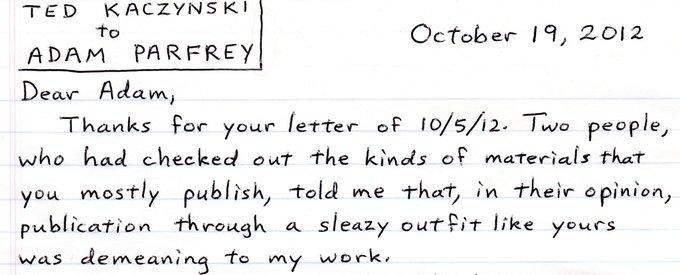
2011
Auction Collectors
Danh Vo & Julie Ault
Ted K’s journals were bought at auction by a pretentious artist who gets paid a ton to display collections of ‘spectacle’.
Julie Ault visited Benning in the mountains in 2005, where he offered her a recent reproduction of Kaczynski’s code. In 2011, she and Danh Vo were able to procure the actual code system made by Kaczynski for Benning so that he could study and decipher it, in return for making a copy of the code for each of them.[79]
So, after being bought at auction, the journals were being shared between this small group of artists.
And it’s obvious Julie corresponded regularly with Ted because Ted wrote a glowing acknowledgment to her in his latest book Anti-Tech Revolution:
After Susan, the most important person in this project has been Dr. Julie Ault. Julie has read drafts of the various chapters and has called my attention to many weak points in the exposition. I’ve tried to correct these, though I haven’t been able to correct all of them to my (or, I assume, her) satisfaction. In addition, Julie has provided valuable advice on manuscript preparation. But most important of all has been the encouragement I’ve taken from the fact of having an intellectual heavyweight like Julie Ault on my side.[80]
So, it’s highly likely that the journals are also shared between a small group of self-described ‘anti-tech revolutionaries’ like Ted K’s publishers Fitch and Madison.
James Benning
Quoting an interview with Benning:
You had mentioned that you got access to Kaczynski’s journals when a friend of yours bought all of them in the auctions a few years ago. What was reading them like?
Yes, I met Danh Vo through Julie Ault, they both came down to Buenos Aires to see a number of my films that were at the festival there. He’s also visited me in the mountains a few times and when he heard that Julie and I wanted Kaczynski’s journals, he came up with the money and bid on them with a real commitment. At the same time he bought Kaczynski’s typewriter, and gave the journals to Julie. He said to me he was very interested in what I would make from them.[81]
At a London art gallery Danh Vo and Julie Ault put on an exhibition which included a framed single sheet of paper with Ted’s codes on it, copied down by the filmmaker James Benning:[82]

Quoting an interview with Benning:
Have there been any reactions from Kaczynski, his brother, or any of the Unabomber’s victims to the film? Are you concerned about “fallout” from having made this film — personal repercussions or unintended effects?
At first, I’d only heard from Kaczynski indirectly. He at first wished me a place in hell, but later withdraw that opinion. Since then he directly wished me a happy birthday, and as he put it, whenever that may be.[83]
Anti-Tech Radicals
El Boletin / The Bulletin / Naturaleza Indomita
Website: Naturaleza Indómita
Contact: elboletin@hotmail.es
Quoting Ted:
... it is only since 2011 that I’ve had people who have been willing and able to spend substantial amounts of time and effort in doing research for me ...
Ultimo Reducto
6 folders worth of letters archived at the U of Michigan.
Website: Último-Reducto
Email: ultimo.reducto@hotmail.com
-
With Friends Like These... Ultimo Reducto vs. The Friends of Ludd
Isumatag
“Editorial dedicated to the publication of texts critical of the techno-industrial society.”
Contact: asociacion438@yahoo.es
Website: Isumatag Editions
‘Anonymous with Caution’ / Anónimos con Cautela / Collapse Editions / Ediciones Colapso
Facebook: Ediciones Colapso
Blog: Ediciones Colapso
Contact: anonimoscon.cautela@hotmail.com
Location: Mexico
ITS / Regresión Magazine
Xale
Camilo Gajardo Escalona
Nikolaos Karvounakis
Abe Cabrera
The Wildist Society
John Jacobi
2016
Collaborators on his book ‘Anti-Tech Revolution’
Quoting Ted:
My thanks are owing above all to Susan Gale. Susan has played the key role in this project and has been indispensable. She has been my star researcher, producing more results and solving more problems, by far, than anyone else; she has ably coordinated the work of other researchers and has done most of the typing.
After Susan, the most important person in this project has been Dr. Julie Ault. Julie has read drafts of the various chapters and has called my attention to many weak points in the exposition. I’ve tried to correct these, though I haven’t been able to correct all of them to my (or, I assume, her) satisfaction. In addition, Julie has provided valuable advice on manuscript preparation.’ But most important of all has been the encouragement I’ve taken from the fact of having an intellectual heavyweight like Julie Ault on my side.
Several people other than Susan have made important research contributions through steady work over a period of time: Brandon Manwell, Deborah___, G.G. Gómez, Valeriev E___, and one other person whose name will not be mentioned here. Patrick S and another person, who prefers not to be named, have provided critically important financial support and have been helpful in other ways as well.
The foregoing are the people who have made major contributions to the project, but I owe thanks also to nine other people whose contributions have been of lesser magnitude: Blake Janssen, Jon H____, and Philip R____ each dug up several pieces of information for me; Lydia Eccles, Dr. David Skrbina, Isumatag (pseudonym), and Ultimo Reducto (pseudonym) have called my attention to information or sent me copies of articles that I’ve found useful; Lydia has also performed other services, and an assistant of Dr. Skrbina’s typed early drafts of Chapter Three and Appendix Three. On the legal front, I owe thanks to two attorneys for their pro-bono assistance: Nancy J. Flint, who took care of copyright registration, and Edward T. Ramey, whose intervention removed a bureaucratic obstacle to the preparation of this book.
Main Collaborators
Susan Gale
Quoting Ted:
My thanks are owing above all to Susan Gale. Susan has played the key role in this project and has been indispensable. She has been my star researcher, producing more results and solving more problems, by far, than anyone else; she has ably coordinated the work of other researchers and has done most of the typing.
Contact: sgale17@yahoo.com
Ted Kaczynski wrote Susan into his will as ‘copyright heir’, but Julie Herrada and David Skrbina both think who owns Ted’s intellectual property is still up in the air. And this legal essay seems to confirm that ambiguity: The Unabomber Strikes Again
Quoting Alex Uziel:
... the copyright is vigorously enforced by his copyright heir and foreign rights agent (CC’d here) ...
... Ms. Susan Gale, Wild Freedom Publishing, LLC
Ms. Flavia Campbell, Esq., Dickinson Wright PLLC
Quoting Julie Herrada:
The intellectual rights are not yet settled as far as I know. It is my understanding the Kaczynski had a will but I do not yet know the details.
Quoting David Skrbina:
If somebody wanted to go through and had permission, the other problem is permission to use these things and to reproduce them in book form, I don’t know exactly what the rules are going to be going forward on those. It depends on who owns the copyrights to all the stuff and it’s not really clear to me who does at this point.
Julie Ault
Quoting Ted:
After Susan, the most important person in this project has been Dr. Julie Ault. Julie has read drafts of the various chapters and has called my attention to many weak points in the exposition. I’ve tried to correct these, though I haven’t been able to correct all of them to my (or, I assume, her) satisfaction. In addition, Julie has provided valuable advice on manuscript preparation.’ But most important of all has been the encouragement I’ve taken from the fact of having an intellectual heavyweight like Julie Ault on my side.[84]
Quoting an art event pamphlet:
Julie Ault visited Benning in the mountains in 2005, where he offered her a recent reproduction of Kaczynski’s code. In 2011, she and Danh Vo were able to procure the actual code system made by Kaczynski for Benning so that he could study and decipher it, in return for making a copy of the code for each of them.[85]
Quoting from a James Bennning Interview:
You had mentioned that you got access to Kaczynski’s journals when a friend of yours bought all of them in the auctions a few years ago. What was reading them like?
Yes, I met Danh Vo through Julie Ault, they both came down to Buenos Aires to see a number of my films that were at the festival there. He’s also visited me in the mountains a few times and when he heard that Julie and I wanted Kaczynski’s journals, he came up with the money and bid on them with a real commitment. At the same time he bought Kaczynski’s typewriter, and gave the journals to Julie. He said to me he was very interested in what I would make from them.[86]
Quoting James Benning:
On New Year’s Day 2011, Julie and I crafted a letter together. Julie had learned about my Two Cabins project and thought it was pertinent to contact Theodore John Kaczynski. Near the end of January we received a response.[87]
Quoting Ted: in 2011:
January 18, 2011
Dear Ms. Ault,
Thank you for your interesting letter dated January 1, 2011. My focus is almost exclusively on a practical problem (to put it succinctly), how to get rid of the technoindustrial system before it gets rid of us. I can’t find much time to spend on such issues as the value of solitude, privacy, or wilderness, except to the extent that these issues are relevant to the practical problem. (They are relevant to a point; teaching people the value of solitude or of wilderness, for example, helps to alienate them from the values of the technoindustrial system...)
...As for Thoreau, he’s okay, but I’ve never had any particular admiration for him. You’ll find much better nature writing (in my opinion) in Joseph Wood Krutch, The Desert Year (top-notch!). I can also recommend highly a book by Tom Neale, Alone on My Island (the title is not a figure of speech). Of great interest is Alexander Selkirk, who was the inspiration for Defoe’s Robinson Crusoe. An account of Selkirk’s adventures was published back in the 18th century, and it exists in a modern (like, mid-twentieth century) reprint. You’ll also find some eloquent passages about wilderness and solitude in Calvin Rutstrum, Paradise Below Zero and in Horace Kephart’s Book of Camping and Woodcraft. Kephart’s Our Southern Highlanders is of considerable interest too...[88]
Quoting Ted: in 2016:
For a long time I’ve wondered why my friendship and our “dialogue” (as she calls it) have seemed important to Julie Ault. But when I received a letter from Triple Canopy inviting me to write something in her praise, I noticed a reference in the “prompt” to Julie’s “efforts to engage in dialogue with an ever growing constellation of artists, writers, scholars, activists ...,” and I had a flash of insight: Julie is a collector, impelled by the same mania that drives collectors of stamps, coins, autographs, butterflies or Chinese porcelains—except that instead of collecting physical objects Julie collects friends with whom to have dialogues. And I’m an item in her collection![89]
A short profile on Julie on the Macarthur Fellows Program website:
Artist and Curator | Class of 2018
Redefining the role of the artwork and the artist by melding artistic, curatorial, archival, editorial, and activist practices into a new form of cultural production[90]

Title: Artist and Curator
Location: New York, New York
Age: 60 at time of award
Area of Focus: Curation, Collecting, and Conservation
Julie Ault received a B.A. (1995) from Hunter College of the City University of New York and a Ph.D. (2011) from the Malmö Art Academy of Lund University. She was a co-founder of the art collective Group Material (active between 1979 and 1996), and her work as an artist and curator has been exhibited at the São Paulo and Whitney Biennials and at such venues as Artists Space, the Weatherspoon Art Museum, and the Secession, Vienna, among others. She has been a visiting lecturer at the University of California at Los Angeles, Portland State University, the Rhode Island School of Design, the Cooper Union, and the California College of the Arts. Her additional publications include Show and Tell: A Chronicle of Group Material (2010), Two Cabins by James Benning (2011), and In Part: Writings by Julie Ault (2017).[91]
Research Contributors
“made important research contributions through steady work over a period of time”
Brandon Manwell
The FBI Investigation of Forest Anon:
Quoting a ‘United Neo-Luddist Front’ member:
I denounce any violence. I recently watched Forest Anon’s video about the FBI. Forest Anon had his home town searched and family questioned. This will not happen to me. He has said things that aren’t nearly as bad as I have done, although my past remarks were ironic if not, edgy. I do not wish for my aging grandfather to wonder whether his grandson is a domestic terrorist. This is for my family.
I also may resign in the future. I am looking for potential successors. Specifically one that hasn’t already asked already.
Forest Anon’s YouTube & Instagram
Deborah___
[...]
G.G. Gómez,
[...]
Valeriev E___
[...]
‘a person whose name will not be mentioned here’
Potentially Alex Uziel(?). President of the publishing company set up to solely publish Ted K’s books.
Website #1: Fitch & Madison
Website #2: Debunking the Ted Kaczynski “MK Ultra” myth
Contact: info@fitchmadison.com
Financial Supporters
“provided critically important financial support and have been helpful in other ways as well.”
Patrick SS
[...]
‘a person who prefers not to be named’
[...]
Smaller Contributors
“nine other people whose contributions have been of lesser magnitude”
‘dug up several pieces of information for me’
[...]
Blake Janssen
[...]
Jon H____
[...]
Philip R____
[...]
‘called my attention to info’
Quoting Ted:
called my attention to information or sent me copies of articles that I’ve found useful
Lydia has also performed other services, and an assistant of Dr. Skrbina’s typed early drafts of Chapter Three and Appendix Three.
Lydia Eccles
Potentially one of the lengthiest correspondences, checking out at 15 folders worth of letters archived at the U of Michigan.
Boston artist Lydia Eccles ran a “Unabomber for President” campaign in 1996 with support from the anarchist collective CrimethInc.
At a party in Boston on September 19th, 1995, Lydia Eccles read the so-called Unabomber Manifesto: Industrial Society and Its Future. Impressed by the text in her hands, freshly published by two of the main newspapers of the country and written by Ted Kaczynski (the most searched US-terrorist of history), Lydia Eccles wonders: what would happen in the upcoming elections if people would vote for a fugitive? The materialization of this question will start shortly after by initiating a political campaign for the Unabomber in the 1996 presidential elections via write-in votes—votes cast by writing in the name of a candidate not appearing in the ballot. Shaped as a political action committee, influenced by ideas of the Situationist International or Jacques Ellul, and in collaboration with different communities around the USA, the campaign would end up having 8 headquarters, a website—which at that time was extremely rare,—and large coverage in the press. With the slogan “if elected, he will not serve”, the Unabomber Presidential Campaign was a form of inhabiting and occupying the pre-existing structure of the American electoral system while offering US-citizens the possibility of voting against that very same system.
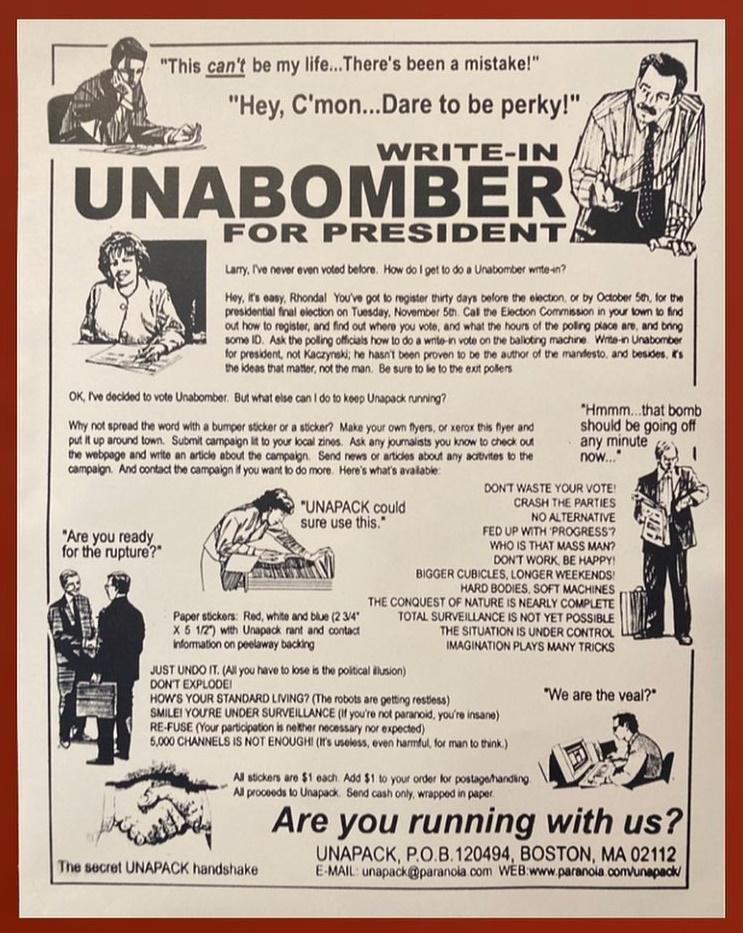
Dr. David Skrbina
Website: <www.davidskrbina.com>
11 folders worth of letters archived at the U of Michigan.
Skrbina is an academic who has spent decades trying to start up an area of propaganda, sorry, philosophy that argues against all modern technology. He discusses Ted in his classes trying to get his students on board with creating a revolution that will bring us to David’s personal LARPland of medieval technology.
He tried to get elected with the Green Party once, utterly failed. You will see him praising Ted as a “revolutionary of our times” in Ted’s books, or defending him whenever there is a TV series about Ted. There is no love lost between Ted K fans however, as his book “The Metaphysics of Technology” has been criticized by Ultimo Reducto, another Ted K fan:
The author tries to downplay the human sacrifices that some of these ancient civilizations carried out, saying that the supposed psychological effects on the people of modern societies (basically rendering them insensitive or less compassionate), allegedly caused by the fictional violence in movies, videogames and television, would be much worse than the very real thousands of deaths (and the subsequent terror) caused by human massive sacrifices in those ancient civilizations. And he isn’t even fazed!
In the same book Skrbina calls for a ban on all guns saying the solution to guns is not “more guns, but less guns”. Ted himself is not opposed to guns and states any attempt to ban small scale technology is impractical at best.
‘On the legal front’
I owe thanks to two attorneys for their pro-bono assistance.
Nancy J. Flint
“[T]ook care of copyright registration”
Edward T. Ramey
“intervention removed a bureaucratic obstacle to the preparation of this book.”
Other Correspondents
John H. Richardson
Wrote “Luigi: The Making and the Meaning” and Children of Ted. See Ted Kaczynski’s Letter Correspondence With John H. Richardson
Two years ago, I started trading letters with Kaczynski. His responses are relentlessly methodical and laced with footnotes, but he seems to have a droll side, too. “Thank you for your undated letter postmarked 6/11/18, but you wrote the address so sloppily that I’m surprised the letter reached me …”
2021
Greg Johnson
Quoting Greg:
I’d like to take partial credit, at least for people asking him about Eco fascism because, well, it was part of my agenda for corresponding with him. I knew it would be inevitable.
Present
Anti-Tech Groups, Projects & Personalities
Wilderness Front
Website: <www.wildernessfront.com>
They try to create a pipeline drawing people over from being tech-critical to rabid anti-tech revolutionaries.
In their public messaging they pretend they don’t support Ted’s actions, but their co-leader stated in a reddit comment that he is happy about Ted’s murders:
“The people he killed were criminal promoters of the technological system and it’s a shame there might not be a hell for them to go to.”[92]
There are also reddit posts of him simply showing off old editions of Ted’s books he was never able to sell:[93]
Further reading:
Active Members
qpooqpoo:
-
Alexander Uziel
-
President of Fitch & Madison, and Wild Freedom Publishing (dissolved?)
-
Co-leader of WF
Skvolor:
-
Aka. Squalor, foxannemary
-
Co-leader of WF
Elmo:
-
Aka. AlexanderTheWake
-
Neopagan Wodenist
-
Moderator of ‘Neo-Luddite Hub’ discord
Svet:
-
Translated ISAIF to bulgarian
-
Neopagan Tengriist
Chess
-
Admin of ‘Neo-Luddite Hub’ discord
Genesis
-
Moderator of ‘Beyond Reform’ discord
Anti-Tech Resistance
Accused of having a member who committed a mass stabbing.
Anti-Tech Collective
Website: www.antitechcollective.com
Contact: antitechcollective@protonmail.com
Members: David Skrbina, Jorge Clúni, Griffin Kiegiel & Darrel.
This is pretty much what it says on the tin. It’s a bunch of zealots that aim to further Ted’s cause and go after anyone who dares spout heresy against Saint Uncle Ted. They have a YouTube channel where they upload interviews and public discussions which they announce on their website.
In a recent spat with a Ted Kaczynski archive, the anti-tech collective said they expected the site would soon be taken down by Fitch & Madison (the publisher of Teds books, and made of ‘anti-tech revolutionaries’). This was due to claims of copyright, but also because it is made up of “pro-tech leftists” and likely because the site uploads material (some of which are his journals) that does not show Ted in the best way.
Resistance Protocols
Small group of 5–10 people.
Yuukimaru, Ashkenyan, ReadISAIF Aka. Jonathan B. Gymwell, Sara, Looshroom, Civz Bane, Campona’s Ghost.
Fitch & Madison
President of the publishing company set up to solely publish Ted K’s books.
Website #1: www.fitchmadison.com
Website #2: www.mediadisinfo.com/2021/03/ted-kaczynski-mk-ultra-myth.html>
Contact: info@fitchmadison.com
Alex Uziel:
... the copyright is vigorously enforced by his copyright heir and foreign rights agent (CC’d here) ...
... Ms. Susan Gale, Wild Freedom Publishing, LLC
Ms. Flavia Campbell, Esq., Dickinson Wright PLLC
Ultimo Reducto
6 folders worth of letters archived at the U of Michigan.
Website: Último-Reducto
Email: ultimo.reducto@hotmail.com
-
With Friends Like These... Ultimo Reducto vs. The Friends of Ludd
Isumatag
“Editorial dedicated to the publication of texts critical of the techno-industrial society.”
Contact: asociacion438@yahoo.es
Website: Isumatag Editions
Karaçam
Various Discords
Wild Nature Society
Link: <www.disboard.org/server/1383277295497642054>
Tags: nature, kaczynski, 141, anti-tech, ted-k
This server is the place for discussion of technological progress, its impact on humanity and natural world.
The modern world as we know it, is keep progressing with alarming rate.
The impetuous of hyper technological progress is not without consequences.
There is so much to talk about, discussion is needed.
We welcome anyone who feel that the modern world is going in the wrong direction.
Anti-Tech Asians
Link: <www.disboard.org/server/1342131609985351743>
Tags: asia, environmentalism, animism, kaczynski, anti-tech
This server has been created as a place to talk and discuss Anti-Tech, ecology, and environmental issues. Most of all, we welcome Asians. This is a place where people of all backgrounds and interests can come together to share knowledge and exchange opinions. We ask all participants to be as kind and respectful as possible to each other. We want to build a warm and welcoming community on this server while maintaining a high level of professionalism. We look forward to sharing knowledge and having positive and meaningful conversations together.
Neo Luddite Hub
Tags: environment, kaczynski, anti-tech, self-sufficiency, luddite
Neo Luddite Hub is a community for discussing Luddism, anti tech ideology, Kaczynskism, and natural living.
Beyond Reform
Tags: news, right-wing, kaczynski, anti-tech, luddite
This is a space for those disillusioned with the modern world and for those who believe serious change is necessary. Our focus is on the dehumanizing and destabilizing effects of industrialism and technological progress, but we welcome those from a wide range of anti-modern worldviews.
Primitive Luddism
Tags: nature, off-grid, kaczynski, 141, anti-tech
Primitive Luddism is a branch of luddism, with the belief that humans shouldn’t only abandon modern lifestyle, but also seek a primitive, hunter-gatherer one.
Pierce Skinner / Garden Zine / Yoursforwildnature
Website: <www.archive.org/details/@gardentjk>
Contact: antitechquarterly@proton.me
Pierce ran the zine series ‘Garden’, then went to jail for child sexual abuse related crimes. He is now denounced by his former collaborators. However, he is still promoted by Mongoose Distro & Uncivilized Distro.
He raised $960 on the pretence that the cops were persecuting him solely for his political beliefs, failing to mention that he had child sexual abuse material on his devices.
Άγρια Χώρα
Website: <www.agriachora.blogspot.com/>
Jason Polak / Aleph Zero-Categorical
Website: <web.archive.org/web/20251122093811/https://blog.jpolak.org>
The Techno-Skeptic
Website: <www.thetechnoskeptic.com>
The Convivial Society
Website: <www.theconvivialsociety.substack.com>
Chad A Haag
Chad moved to live in India where he considers getting food poisoning from spoiled goat meat to be far superior to living in America (this actually happened).
He has a YouTube channel where he larps on about Evola, Ted, Varg and other such individuals and considers them the greatest philosophers of modern times (This includes Jaques Ellul so he’s not entirely wrong). He’s pretty much your typical pagan third positionist.
If this wasn’t enough, he has written a series of self-published books. In one book he literally discusses anime in a socio-political context. Despite claiming he doesn’t use the internet or the TV much.
In his Kaczynski book (which he boasted was the first proper look at Ted) he compares destroying the “system” to Luke Skywalker blowing up the Death Star.
“But the System does not allow even the minutest expression of genuine freedom, because genuine freedom would disrupt the essence of the System by calling into question its technological infrastructure. The metaphor of the Death Star is therefore doubly fitting, since Luke Skywalker had to penetrate the surface level and descend deep into the belly of the beast in order to destroy what was quite literally a giant technological monstrosity which threatened the survival of entire planets and species of natural beings.”
Jeremy Grolman
Website: <www.forwildnature.org/author/ted-kaczynski>
Contact: jgrolman@gmail.com
Used to help John Jacobi run the Wild Will Coalition.
Normandie
Website: <https://esotericfishermansociety.com/>
An amusing anecdote about Ted K’s circle of super-fans is that one of these guys, Normandie, recorded a 6 hour audiobook of ‘Anti-Tech Revolution’ and then got rewarded with a DMCA, with no further explanation.
He later embraced white nationalist ideology and claimed that his earlier fitness struggles were caused by his vegan diet—without acknowledging that years of battling a drug addiction might have had anything to do with it.
Authors
Sean Fleming
Author of the upcoming book Anti-Tech: The Ideas and Influence of the Unabomber & The Unabomber and the origins of anti-tech radicalism.
Mauro Lubrano
Author of Stop the Machines: The Rise of Anti-Technology Extremism.
Misc.
Unknown
The names Corson, Grabar and Janice Folsom Scriba were listed in Envelope X, but are missing from the original draft of this book Truth versus Lies that Context Books typed up. Envelope X is described as including “a list giving the real names of people whom I have identified in this book by first names, initials, or abbreviations.” However, perhaps they’re referred to in earlier handwritten drafts or some other notes contained within the ‘Refutation Documents’ category of documents housed at the University of Michigan.
Unsorted
Terry Lundgren
[...]
The three Tripton boys.
[...]
Mr. Howard
[...]
Fred Hapgood and Bob Crosman
[...]
Rich Williams
[...]
Leslie Nieman and Keith Hrieben
(or Hreben, Ted was unclear on the spelling).
Gwendolya Halm
[...]
Leon Kenneth Nerpel
[...]
Neil Dunlop
[...]
Denis Dubois
[...]
Jay Ce. and Linda E.
[...]
J___ P___
[...]
Michael J. Donahge
Ted’s first lawyer, Michael J. Donahge at Federal Defenders of Montana. P.O. Box 250, Helena MT 5924–0250.
Linda Keene Vanvechten
[...]
Charles Porter
[...]
Robert M. Rippey
[...]
James Oberton
[...]
Prof. X.Y.
[...]
Norma Jean Vanderlaan
[...]
the Vanderlaans
[...]
Dolores Williams
[...]
Ken Biel
[...]
Ed Weber
[...]
David and Shirley Hockbecker
[...]
Jack McInerny
[...]
Wayne Tripton
[...]
Al Nc.
[...]
Bill Berta, Jr.
Sarasota, Florida
April 28, 1997
Bill lived next door to the Kaczynski family in Evergreen Park from 1955 to 1958. He graduated from Evergreen Park High in 1958, the same year Ted graduated. Bill owns an iron work shop in Sarasota where he makes fire irons and other decorative iron work. He lives in Sarasota, Florida with his wife and two kids.
Although Ted and Bill graduated from Evergreen Park High School in the same year, they were only in the same class for one year. Bill remembers when a teacher, whose name he does not recollect, first introduced Ted to his new classmates. In the introduction, the teacher explained that Ted had skipped a grade and was going to go to Harvard on a scholarship. Bill thinks this exemplifies the type of treatment that isolated Ted from his peers. He was treated as a protégée and a golden boy either to be admired or scorned but either way isolated and always alone.
Bill, on the other hand, was not in the same classes as Ted. Bill was in the vocational track at Evergreen Park High. They were not on the same wave length. Bill was into his car and did not socialize with Ted at all.
In 1958, Bill graduated from Evergreen Park High School and joined the Army. While in the Army, Bill worked for the quartermaster in Germany. He was in Berlin during the Berlin Crisis. After serving in the Army for four years, Bill returned to Chicago and considered attending a university. While over at the Kaczynski home, he asked Ted for advice about applying to college. Bill also asked Ted if he should apply to Harvard. Ted suggested that Bill apply to a university and see what happens. As for Harvard, Ted explained that it was very difficult to gain admission but that Bill should apply anyways and see what happens. Through this interaction, Ted impressed Bill as a very earnest and kind person. This conversation occurred around 1962 and it was the last time Bill saw Ted.
Bill was flabbergasted when he read in the paper that Ted was arrested and charged with the Unabomber crimes. Bill admires Ted for his academic abilities and intelligence and thinks he is a nice person.
Ted was interested in astrophysics and was always watching the stars. There was a lot of pressure on young men to pursue careers in the sciences. Boys idolized Einstein and science was a popular pursuit.
Even though Ted suffered from isolation while at Evergreen Park High, he was happier than when he returned from Harvard. After graduating from Harvard, Ted’s youthful spirit had dissipated and he seemed even more isolated and alone.
Don Bickel
Lincoln, MT
June 13, 1996
Don moved to Lincoln in 1982, after his aunt and uncle, Gene and Lester Bickel, moved there. He saw Ted in passing, going in and out of the store or the post office, or on his bicycle, a few times a year. The first time he ever heard of Ted was when he first moved to Lincoln. He had a conversation with his aunt and uncle about strange old guys who live out in the hills around Lincoln. He assumed Ted was a miner or a war veteran. He said that he never really noticed Ted because in Lincoln people pretty much keep to themselves and there are other guys who live out in the hills by themselves. He said that Ted never bothered anybody, was polite, and never caused any trouble with the law.
“He was just a part of Lincoln. Every little town has guys like that.” Last October, Don ran into Ted leaving the post office. He said “hi” and Ted nodded and held the door open for him. Don never said more than hi to Ted. He said that Ted always looked about the same; “unkempt,” clothes unwashed, “scraggly”, “goofy”, “can’t really define his character, maybe sober.” Don said that he never saw Ted laugh or smile.
He was very surprised when Ted was arrested and when he saw his picture in the paper, dressed “normally” and with a haircut. Don said that he almost didn’t recognize him. He thought Ted was older than was reported in the news. Don said it is not surprising that you wouldn’t know that much about someone in Lincoln, “Lincoln is like that.” He said Ted was neither an asset or deficit to the community. Ted was a hermit, private and quiet. Don assumed Ted was a loner because he didn’t know him to have a wife and kids. He never thought bad about Ted, only that Ted was “a little strange.” He only saw Ted riding his bicycle on Stemple Pass, from the blinking light in Lincoln toward Ted’s cabin. He would see Ted riding his bicycle, or walking to town, in the middle of winter. He never saw Ted try to hitch a ride, but some people may have given Ted rides when it was very cold out.
About 10 years ago, Don lived out at the Blowers’ place, very near Ted’s cabin, with his wife, daughter and son. Don remembers telling his daughter once to be careful around Ted, because Ted lived by himself, but now he thinks that his fears were unfounded.
Kenneth Biel
Frankfort, Illinois
October 5, 1996
Kenneth Biel graduated from Evergreen Park High School in 1959. He attended Hope College in Michigan and is now a dentist.
Kenneth went to Central Junior High School, but he does not remember meeting Ted until he was at Evergreen Park High School. Kenneth had biology and gym with Ted. Ted only attended about half of the classes. The rest of the time Ted had special tutoring because he was so far ahead of the rest of the students. One time Ted came into class and Kelly Douglas expressed her surprise that Ted decided to join the class that day. The class laughed and Ted shrugged off the comment.
In gym class, Ted was always a little different from the other students. Something about Ted was a little strange. Ted’s gym uniform was never quite right; Either Ted’s socks didn’t match or he forgot his gym shoes. When the kids chose teams in gym, Ted was always one of the last ones picked. None of the kids wanted to be on Ted’s team, because it seemed like Ted didn’t want to play sports. Ted sometimes tried to get out of gym and sat on the bleachers reading a book during the class period.
Ted never fit in with the rest of the students at Evergreen Park High School. Unlike any of the other students, Ted carried a big brown brief case and wore a pocket protector. Ted always walked around school with his trombone case, which identified him as a member of the band. The band at Evergreen Park High School was not very good and being in the band was an activity that popular kids shunned.
Ted was noticeably small and immature. Ted was never aggressive or angry. When kids teased him, Ted never fought back. Kenneth recalls that Ted was once stuffed into a locker. Many students, even those in the advanced classes, assumed that Ted was so smart that they didn’t try to compete with him academically. Ted seemed to get along well with his teachers.
The class of 1959 knew Ted better than the class of 1958, because Ted was not pushed ahead until his senior year of high school. Ted didn’t have any close friends. Kenneth did see Ted hanging around with some of the other smart students.
The chemistry explosion was exaggerated by the media. At the time the incident occurred, it was not a big deal.
Carol Blowers
Lincoln, Montana
June 14, 1996
Carol and George own Dallas Land Company, located off Highway 200, near the Lincoln Inn in Lincoln. They are Ted’s neighbors who live below Butch and Wendy. Their home is a modern and comfortable log cabin.
Carol hunts frequently and is not a liberal. She has several game heads and skins on her walls.
Carol attended business college and was born and raised in Missoula. She met her husband, who is originally from Pennsylvania, when she sold him the house they now live in around 1986 — 87. They married in 1988 and moved to their present home. Their home is within voice distance of the Gerhing’s.
Ted was a nice neighbor, quiet and polite, and never looked as dirty as he did on TV. She never noticed a smell or bad hygiene on Ted. When she saw Ted after he was arrested, he looked like he had a hard winter. She felt badly that she didn’t offer him meat through the winter but she assumed he could get his own meat. They saw elk prints and bear prints around Ted’s cabin. They never saw him with a gun and she never saw him in the woods. Everyone up that way hunts and if game is plentiful, you’d have enough meat. It was clear when she saw him that the winter had taken its toll on him, and she repeated that she would have helped him out had she known he was in bad straits.
Ted brought vegetables from his garden to her over the years: carrots, lettuce, beets. Ted left them at her doorstep or carried them to her office in town. She thought it was nice of him and she enjoyed them. She learned he used his own waste to fertilize the garden when she had a meeting with him at her office to discuss the value of his land in the fall of 1995. She asked him for the details of his cabin’s structure, including plumbing, and learned that he used the toilet in a bucket that he carried directly to the garden. From that time on she didn’t eat the vegetables, even though she appreciated them. She thought more than once about eating the carrots he brought her after she hadn’t scrubbed all the mud off. She did not harbor ill will towards him.
She thought he was in good physical shape and was surprised to see how he looked on tv. She and her husband ride bikes (hers is an 18 speed) and she knows how hard it would be for Ted to ride his single speed. She and her husband go walking a lot and passed Ted’s cabin frequently. If Ted was outside he always waved and exchanged greetings. He was afraid of dogs, and once stood in fright with his hands extended over his head when her dog bounded up on him. Seeing that Ted was afraid of dogs, she began to carry a piece of twine to use as a leash when they approached Ted’s cabin to keep her dogs from bothering him. Ted never complained about her dogs to her.
In the fall of 1995, he came to her office without an appointment and asked her how much his land was worth. He said he was desperate for money and that he couldn’t stay up there unless he got some money. The meeting lasted 30 minutes and was the longest conversation she ever had with him. It was the first time she knew he had no electricity or plumbing. Her market analysis gave the land and cabin a $20 — 25 thousand dollar value, which amazed him. Ted did not discuss whether he planned securing a loan or selling the property.
Ted asked her if she knew of any jobs and she suggested he ask Sherri to increase his hours at the library. She knew Ted was at the library frequently and thought he had a paying job there. Ted explained that he had no phone or car and could not handle flexible hours because there was no way for Sherri to contact him.
She never felt any fear from being around Ted. Ted was quiet and kept to himself. She feels a lot of compassion for him. She tried to bring him out by going very slowly with him and was pleased that he trusted her enough to talk with her.
Ted parked his bike at her office, the Dallas Land Co., 4 to 5 times a year when he left town. He parked his bike in the hallway or in the lean to outside. Sometimes they saw his bike parked in the lean to for a few days. Sometimes, he stuck his head in the office door and asked permission. Sometimes they saw him retrieve the bike, and sometimes they didn’t. A lot of people in Lincoln leave town.
Linda Bordeleau
Lincoln, MT
June 18, 1996
Linda lives in Lincoln with her husband, a truck driver. She works at the 7 Up Ranch during rush times like Easter and Mothers’ Day.
Linda first met Ted when she worked part time at the Lincoln public library from June to December, 1985. Ted would come into the library sporadically, but always during the day. Some weeks he would come in twice a week and then she would not see him again for weeks. Ted would stay at the library for anywhere from 20 minutes to one hour. He was always quiet, but very polite. She remarked that he had a dry sense of humor, at times smiling after a joke, but never laughing. When they would talk he would always look directly at her. They would share light conversation, discussing the weather. Ted would come into the library and head to the back where the “hard books” were kept. When he would check out books she would say, “you can understand these things?” He answered, “yes.” She replied, “I like reading the trashy books myself.” Once she teased him that he would not be able to ride up Stemple Pass Road without chains on his bike. He replied, “Oh yes I will.”
Four years ago this June or July, she saw Ted while she was driving down Stemple Pass Road. His bike had broken down in front of the gas tanks near the Gehring Ranch. She offered him a ride to town and he said that he was going to walk. She yelled, “get in the car Ted I’m driving you to town.” They went to the hardware store where he bought parts for his bike. She then drove Ted back to his bike and offered him the use of her tools that were in her car. He declined the offer saying, “I have tools.”
Two years ago, She saw him coming out of the bank in Lincoln. She asked how he was doing and he replied, “oh, pretty good.” She told him she was going in to get a loan for her property taxes to which he replied, “they get you coming and going.”
She last saw him riding his bike just before Thanksgiving 1995. He looked as thin as she had ever seen him.
She resented people calling him a hermit. She thought this was derogatory name for Ted. He was not a hermit but a nice fellow who was not talkative. The other men who live in the mountains were not looked down upon like Ted was because they were more outgoing. Nobody would talk to him when he came to town. She always thought of him as that nice, lonely guy. She identified with him because when she was a child she was quiet. He evoked very protective feelings from her. She felt like taking him under her wing and telling him everything was ok. She said Ted seemed like a boy in a man’s body.
Before she knew him well, she would see him on the street and say hello to him. He would answer, “oh, hi.” It seemed to her that Ted did not want to be bothered. Although he was shy he was more receptive towards her after they had been introduced by Sherry Woods at the library.
He generally looked unkempt. He had a little body odor, but his hair and beard were always combed. When he came to the library he was always “put together” as opposed to how he appeared when he was arrested.
When she first met Ted, he looked heavier with a fuller face. She noticed that his weight fluctuated gaining and losing 10 to 15 pounds over the years she knew him. She thought this might be due to the winter clothing he was wearing which makes one look heavier.
Danny Woods and Sherry Woods, his mother, adopted Ted as their friend. Danny and Ted identified with each other because both are smart, quiet people. Danny is a very sensitive, quiet, brainy kid who was ridiculed by his peers much in the same way Ted was ridiculed by the town folks for being different. Danny was very upset when Ted was arrested. Danny came into the church and wanted to speak to the pastor after Ted was arrested. Linda asked the pastor how Danny was and the pastor said he was not doing well. She found Danny and put her arm around him and he cried.
Phillip Bradley
To: TK File
From: Paul Kaplan
Re: Impressions of interview with Phillip Bradley
Date: 12/31/97
Phillip Bradley
2700 Ewing Avenue, South
Minneapolis, MN. 55416
(612) 927–4638
On December 30, 1997, I interviewed Mr. Bradley at his office near Minneapolis. What follows are my impressions of the interview.
Mr. Bradley lives with his wife in Minneapolis and works as the Vice President of Marketing for Kwik-File, LLC, a furniture company. They have two grown daughters.
Mr. Bradley grew up in the Boston area and attended a prep school in New England. His father attended Harvard and that was why Mr. Bradley went himself. While he was a student at Harvard, Mr. Bradley was mostly interested in girls and the sports car club. He didn’t worry too much about classwork, although he enjoyed his classes. He had a wonderful groups of friends, most of whom were fellow ‘preppies,’ and thoroughly enjoyed the social aspect of being at college. The student body, compared to most colleges, seemed quite diverse to Mr. Bradley. There were people from the west, the south, the midwest, and people from public schools and families that were not wealthy. He lived in Dunster House.
Mr. Bradley remembers that the professors at Harvard were fantastic. He took an excellent course from Henry Kissinger and thought that Kissinger was a brilliant professor. Still, despite being generally polite and clearly brilliant, Harvard professors were not very approachable. If a student wanted individual attention from a professor, he would definitely have to make the first move.
Mr. Bradley does not remember exactly how he came to be a participant in the Murray Study, but he thinks it was in response to an advertisement he saw posted up offering money to participate in a psychological experiment. He thinks he got $1.50 per session, or per hour. There was no other incentive to participate beyond the monetary compensation. Mr. Bradley was curious about psychology but knew almost nothing about it. Mr. Bradley feels that the 1950’s were a totally different world, and that he was a pretty shallow person back then. Participating in the Murray Study was an interesting departure from the regular life at Harvard.
Henry Murray was a brilliant, fabulous man. He was one of the most charismatic people Mr. Bradley has ever met. He was the sort person who makes an immediate impression of integrity and excellence. Mr. Bradley feels he’s only met a half dozen people of this caliber in his life. Kenneth Keniston also seemed very bright and charismatic. Mr. Bradley doesn’t remember much about the other researchers. He did not take Klyde Klukholn’s Social Relations 4 class.
The researchers told Mr. Bradley that the objective of the study was to see how emotion affected people’s memory. Further, he understood that it was supposed to provide a database that researchers could use for various purposes. Mr. Bradley’s group was one of several Henry Murray convened over the years. In addition to the written exams and the TATs, he was asked to record his dreams, and was taught techniques to help him do this.
Mr. Bradley clearly remembers an exercise where he had to defend his philosophy against a very smart lawyer. He had electrodes attached to his body during this exercise. During the discussion, Mr. Bradley remembers feeling that his own arguments were terribly inadequate and that his adversary was very good. It was clear to Mr. Bradley that the adversary’s argument had substance—it was more than just an instigation. The session was filmed by some researchers, and Mr. Bradley remembers having to pause for what seemed like a very long time while technicians changed the film reels. Mr. Bradley feels that he was very naive at this time. The philosophy discussion made him angry because he felt inadequate. Still, Mr. Bradley realized the argument was a part of the study and not a real threat.
Mr. Bradley remembers another occasion when he had to put his bare foot in a bucket of cold water while a man who claimed to be an assistant in the study made lewd jokes to him. The man, who Mr. Bradley was told later was a researcher, was doing a ‘nudge-nudge-wink-wink’ sort of thing while Mr. Bradley kept his bare foot in the bucket of cold water. He was also strapped with wires during this session. This session made Mr. Bradley uncomfortable, but it was clear the researchers were trying to make him uncomfortable. He thinks it was the only slightly underhanded thing the researchers ever did. After the foot-in-the-bucket exercise, the researchers apologized to Mr. Bradley for any discomfort and told him they had to do it for the study. He doesn’t remember if he had to answer questions while his foot was in the bucket, or what this exercise seemed to be about.
Mr. Bradley feels the Murray Study was conducted with complete integrity. Everything about it was entirely ethical. His sense is that the initial screening—the autobiography and other measures they did in the beginning—were sufficient to weed out anybody who might be mentally unstable. Mr. Bradley feels that the researchers would have screened out anyone unstable because it would ruin their data.
Once he was in the Murray Study group, Mr. Bradley was contacted by other researchers doing psychological studies. He made quite a living participating in a variety of research studies.
All the Murray Study sessions were held at the Annex on Francis street.
Mr. Bradley does not remember any of the other participants, although he has a vague memory of Ted, or at least of remembering his name when he heard about Ted’s arrest.
During the last year of the study, Mr. Bradley was told about a dinner being held for the participants in the Murray Study to be held at Henry Murray’s house. Mr. Bradley remembers attending a very pleasant dinner in a beautiful banquet hall at presided over by Henry Murray. One of the other students at the dinner was from a very prominent family—perhaps the Roosevelts-and was extremely charismatic and friendly.
Mr. Bradley vaguely remembers being contacted by someone writing a biography or paper about Murray, but he never talked to the person.
Mr. Bradley has a vague memory of being hypnotized or engaging in deep relaxation as a part of the Murray Study, although he does not remember anything specific. He specifically remembers being hypnotized in a different study at Harvard.
Mr. Bradley is certain that no one associated with the study observed him outside of the sessions at the Annex, and he is certain that no one ever gave him drugs or offered him drugs.
After graduating college, Mr. Bradley began to practice transcendental meditation and corresponded once with Henry Murray about it.
Addendum:
After our meeting, Mr. Bradley contacted me in Sacramento and indicated that the name of student from the prominent family was Jonathon Roosevelt, who lived in Cambridge.
Jean Budding
Evergreen Park, Illinois
June 30, 1997
Jean Budding was the school nurse at Evergreen Park High from 1955 until she retired in 1982. Ms. Budding taught nursing classes at the Little Hospital of Mary in Evergreen Park when Dr. Bathos, the superintendent of Evergreen Park High, offered her the position of school nurse. Ms. Budding asked Dr. Bathos what exactly it was that a school nurse did, but he did not seem to know. After doing some research she found that she was interested in the job and decided to accept his offer.
In addition to taking care of the student’s and teacher’s aches and pains, Ms. Budding made house calls. She was pleased that she had the time to be involved in the community. Ms. Budding checked up on students when they were ill and spoke with parents if their child was having a discipline problem. As school nurse, Ms. Budding also administered hearing and vision tests. Before the school became too big, Ms. Budding worked in the administration office and taught health classes as well. Ms. Budding kept a 4 x 6 index card with each of the student’s names and when they were in to see her. Ms. Budding treated the students with respect and in return they confided in her. She felt she had a special rapport with many of the students.
Ted was an incredibly bright student, probably the brightest student who ever graduated from Evergreen Park High. Although Ms. Budding did not have direct contact with Ted she heard the other teachers talking about Ted in the lunch room. Calvin McCaleb, the chemistry teacher, constantly talked of Ted. Mr. McCaleb said all he had to do was to give Ted a problem and let him go with it. Ted was a quiet student who kept to himself most of the time. He was involved in the chess club and played in the band. Ted associated with other highly academic students.
About half way through Ted’s freshman year the teachers and Ted’s parents decided that Ted should graduate in three years. Ted was such a challenge for teachers to deal with because he was beyond the teaching of the classes. The teachers held many formal and informal meetings discussing how to keep Ted busy. Ted was the first student at Evergreen Park High to graduate in just three years. Ms. Budding feels that graduating from high school at such a young age does severe social damage. It was important for Ted, or anyone for that matter, to be around people his own age especially at such a crucial time of development. Ms. Budding feels there were better ways of dealing with a bright student like Ted.
High school can be a very rough atmosphere for someone who doesn’t quite fit in. The jocks in the school were extremely cruel to the meeker kids, constantly teasing and hurting them. Ms. Budding heard that there were many problems in the locker room after P.E. class. The jocks used to hit the nerds with wet towels. Tommy Knudson once went to Ms. Budding’s office after being hit by some of the jocks with wet towels. Ms. Budding does not recall a specific incident where Ted was hit but she is sure it must have happened to him.
Evergreen Park High had some wonderful teachers teaching at the school. Among them were, the counselor, Lois Skillen, Ardith Inman, and Calvin McCaleb. The school quickly developed a great reputation for its education and people started to move into the area just so their kids could attend the school. During the late 50’s and early 60’s inner city Chicago schools had a dropout rate of 40% whereas Evergreen Park High only had a 2% dropout rate.
An influx of people into Evergreen Park was also the result of “white flight” that was occurring in Chicago during the 1950’s. After VWVII blacks from the south started moving to Chicago in search of work. Real estate agencies began using scare tactics to get families to sell their homes and move to suburban areas. Ms. Budding is saddened by the racism that has surrounded Evergreen Park over the years.
Once a black teacher from another school came to take a tour of the school with Ms. Budding. During the tour, students made rude racist comments to her like, “who let this monkey in?” Ms. Budding was very embarrassed and apologized for the students’ behavior. Over the years the school brought speakers in to talk to the students about racism but it never seemed to do much good. Jessie Owens has spoken at the school. Racism is still quite alive in Evergreen Park although Ms. Budding feels it is much better than it used to be.
Over the years Evergreen Park High instituted many programs to help students with learning and behavioral problems but it wasn’t always that way. During the 1950’s, students with learning disabilities were separated from the other students at the school. They were put into three or four classrooms with one teacher in each of them for the entire day. The Oasis program was one of the first programs instituted for kids who had serious behavior problems or learning disabilities. Evergreen Park High did everything it could to keep students in school.
Great things had been expected from Ted and Ms. Budding was not at all surprised when she heard that Ted had been accepted to Harvard. Ted was so bright it seemed only natural that he attend an Ivy League school. Harvard must have been a very difficult place for Ted to adjust to because he was so young and could not have been emotionally prepared to deal with the rich socialites who made up the majority of Harvard’s campus. The atmosphere at Harvard must have severely hurt Ted.
After Ted graduated from Evergreen Park some of the teachers kept track of what he did over the years. Ms. Budding does not recall who she heard it from, but she knew when Ted was working on his Ph.D. in Michigan and when he was teaching at Berkeley. Ms. Budding was very surprised when she heard that Ted was teaching at Berkeley. She envisioned Berkeley as a crazy place full of young radicals. This did not seem at all like Ted’s speed. Ted was a quiet, conservative boy who could not have possibly fit in among such radicals.
Ms. Budding has done mission work for the Methodist church ever since she retired from Evergreen Park High in 1982. She has lived in Niger and Alaska and is now on her way to Redburgh, Kentucky, to continue her work. She finds her work very fulfilling and is looking forward to returning in September.
Meyer and Ethel Burakoff
Chicago, Illinois
November 2, 1996
Ted Sr. was among Meyer’s oldest friends. The two were canoeing buddies and used to spend two to three days at a time together on the river. The Kaczynskis were highly moral people who were generally concerned about others. Ted Sr. always had a fascination with nature. It was especially interesting to go hiking in the woods with Ted Sr. because of his vast knowledge of nature. Ted Sr. was quite intellectual and philosophical. He had peasant roots.
Meyer and his family immigrated from the Russian Ukraine. He lived in the Pale as did all Jews at that time. His father did all sorts of odd jobs that peasant immigrants did during those times.
The Burakoffs had minimal contact with Ted Jr. He was reclusive. Once the Kaczynskis came to visit the Burakoffs while they were living in Michigan. They did not see each other often and so when they did it was quite special. Ethel had gone through many preparations to make the Kaczynskis stay an enjoyable one. On Saturday the two families had gone to the beach. They had planned to do the same on Sunday until Wanda told Ethel they would be leaving that day because of Ted Jr. Wanda did not give more details. The Burakoffs were surprised and disappointed by their sudden departure.
The Burakoffs visited the Kaczynskis while they were living in Lombard. Ted Jr. was present during one of their visits. Ethel recalls Wanda telling Ted Jr. to come and say hello to the Burakoffs. Ted Jr. came out of his room and greeted the Burakoffs with a quick hello and then retreated back to his room.
Ted Sr. and Wanda never spoke of Ted Jr.’s behavior and the Burakoffs never asked. They did not ask about Ted Jr. out of respect to Ted Sr. and Wanda.
Ted Sr. was influenced by his two children living an isolated life and decided he wanted to try and see if he could do it. He went into the woods and spent a week by himself. After a week he concluded that he was a social person who needed to be around people.
Wanda’s concern for Ted Jr. was that he receive the best education possible. When Ted Jr. was small Wanda sat him on her lap and read intellectual materials to her son instead of fairy tales.
After the Burakoffs said their goodbyes to Wanda before she moved to New York, Ethel thought to herself she forgot to ask about Ted Jr. This was not uncommon because they all seemed to avoid the subject of Ted Jr.
Ted Sr. was the first generation born in the U.S. in his family. He was poor, intellectual and liberally moral. He had a wonderful sense of humor. Their group of friends liked to picnic, listen to music, and most of all converse.
At one time the Burakoffs lived on the south side of Chicago. While Dr. Meister was earning his Ph.D. at the University of Chicago he stayed at the Burakoffs during the week and went home to his wife Stella on the weekends.
Ted Sr. made the best smoked Polish sausage in the country. The Burakoffs feel that it was a great shame that Ted Sr. never received a college education. Wanda did obtain a college degree and though the Burakoffs thought Wanda was bright, they believed it should have been Ted Sr. who went to college.
Hank Dabs was another friend of Meyers. He was a naturalist who liked to collect bugs, explore nature, and play the french horn. Hank’s wife was a concert pianist who had been a child prodigy. She was very good humored. Another friend, Roy Dubash, obtained his doctorate in mathematics from the University of Chicago. He now is a professor.
Meyer recalls the group of friends having many political discussions. They were all concerned with people in general. For some time the group belonged to a record club. Wanda is a very nice and concerned person. She is moral. The whole group focused on education and informing themselves on the world. This deep focus may have stemmed from the fact that they were immigrants. Whenever the families obtained a little bit of money they used it to further the education of their children.
Ted Sr. was disappointed when Dave decided to live in a hole in Texas. Ted Jr. broke away from the family but kept a relationship with Dave.
The Burakoffs were not surprised when Ted Sr. committed suicide. They understood that he did not want to depend on the other family members to take care of him. Meyer actually gave Ted Sr. the rifle Ted Sr. used many years earlier. Meyer applauds Ted Sr.’s decision and said he would do the same under the circumstances.
Ted Jr. was in many ways an adolescent even in his adult years. They were quite surprised that Ted Jr. was for the Vietnam War; they opposed the war.
Peter Manning Burkholder, Ph.D.
Ellensburg, Washington
April 19, 1997
Dr. Burkholder grew up in Omaha, Nebraska. Harvard offered him a scholarship and he accepted. Yale College also offered him a scholarship but he chose Harvard because he felt it was a better school. His freshman year he was housed in 8 Prescott house. Dr. Burkholder came from a low income family and 8 Prescott had the cheapest rooms. He enjoyed the house because he had his own room and was right across from the freshman dining hall. All the rooms in 8 Prescott house were single rooms. 8 Prescott house was removed from Harvard yard where the rest of the freshman class lived. This did not bother Dr. Burkholder.
Francis E. X. Murphy was the dorm proctor at 8 Prescott House. He was a dignified man who was studying English. He did not have much contact with the students at the house so he must have been quite busy with his own work. Dr. Burkholder believes Francis was about ten years older than he was.
Dr. Burkholder had friends but was typically too busy to socialize. Dr Burkholder was a quiet and reserved man who was mainly interested in his studies. He studied philosophy at Harvard.
Dr. Burkholder feels that one of the reasons Harvard offered him a scholarship was because he played the violin. He believes that Harvard was hoping that he might play in the orchestra. Dr. Burkholder never did play in the orchestra; he did not have time. Dr. Burkholder recalls that Ted played his trombone at the same time every afternoon for precisely one hour. It was like clock work and Dr. Burkholder did not enjoy it much but never complained. He does not recall anyone complaining about Ted’s trombone. Many nights the men at 8 Prescott held late night discussions. They talked about anything they were interested in but mainly about philosophy. These discussions were usually held in Gerald Burns’ room. Dr. Burkholder does not recall Ted ever participating in any of these discussions.
Dr. Burkholder does not have a clear picture of Ted and finds it difficult to think of him as a moving human being. It was as if Ted wasn’t really there. He finds this quite strange as he has no difficulty picturing the other men in the house. He knew all of the men on his floor except Ted.
Dr. Burkholder’s hobby during college was learning more about his family history. In his spare time, he took trips to Boston to learn more about his ancestors. He found out that he was a descendant of Richard Williams.
Dr. Burkholder worked in the kitchen of Elliot house his first year at Harvard. He worked with many high school students. He enjoyed his work in the kitchen and enjoyed the conversations with his co-workers. He had many friends who lived at Elliot house and did not find it as pretentious as most. He lived in Lowell house for the last three years at Harvard. Lowell house was quite big with over 400 students. During his last three years at Harvard he worked at the library. He absolutely loved being surrounded by all the books. Harvard’s greatest asset was its library.
Dr. Burkholder does not recall that there were any counseling services available at Harvard. He is sure there must have been something available but wasn’t aware of any. During the entrance physical examination he recalls being asked some psychological questions and assumed that is how they assessed if you needed help or not.
Harvard made it easy for a student to take time off if the pressure was becoming too great. The practice was encouraged and you were not penalized for taking time off. Most of the students who did take time off came back and graduated. Dr. Burkholder could not recall knowing anyone who actually did this. It seemed like an odd thing to do. Harvard men were supposed to be able to handle the pressures. If you could not handle it then maybe you did not belong there in the first place.
Dr. Burkholder did not feel any competitiveness between students. He believes the one student from his class who has contributed the most to human knowledge was Saul Kripke. Saul was also from Omaha, Nebraska and their parents knew each other. Dr. Burkholder did not meet Saul until Harvard. He recalls having a conversation with him about mathematics. Saul stated that he just come up with a great new theory but did not want to talk about it because it had not yet been published. Dr. Burkholder found Saul’s attitude strange. He felt that Saul was afraid that he might steal his theory.
After Harvard Dr. Burkholder went to Tulane University in New Orleans, Louisiana. He was awarded a fellowship from the National Defense Act which paid for everything at Tulane. He earned his doctorate in philosophy in three years.
Dr. Burkholder is chair of the department of philosophy at Central Washington University. He has been teaching at this university for the past thirty-two years.
Dr. Burkholder was very surprised to hear that Ted was accused of being the Unabomber. He immediately recognized him but had not thought of him since his freshman year.
Gerald Patrick Burns
Portland, Oregon
April 18, 1997
Gerald was born in 1940 in Detroit, Michigan, to a Polish father and a Butch mother. His parents were working-class immigrants who have always been very encouraging to Gerald. They introduced Gerald to the world of art. Gerald, at a young age, became interested in poetry and writing. He considers himself an exceptional writer. At age 18, Gerald received a scholarship from Harvard.
Gerald went to Harvard a week before school started to get a feel for where he was about to spend his next four years. Harvard was extremely intimidating and lonely. Gerald was housed at 8 Prescott his freshman year because it was low-income housing. 8 Prescott House was the place Harvard housed students who did not quite fit in with the rest of Harvard’s student body. All the students on the floor came from low-income families and various ethnic backgrounds. It did not take long to figure out that they were among Harvard’s most undesirables. The house was even set away from Harvard Yard where the rest of the freshman class lived. Gerald found this quite unsettling. It was as if Harvard had formally declassed the students of 8 Prescott House.
Ted lived in the room across the hall from Gerald’s. Gerald only has a hazy memory of Ted. Until recently, he had forgotten that there was even a room across the hall. Ted was that invisible. He recalls that he spoke to Ted on at least one occasion but never at any length. Ted appeared to be sweet natured and very quiet. Gerald was never in Ted’s room nor was Ted in Gerald’s. He often saw Ted in the dining hall sitting by himself. Gerald has since wished that he had reached out to Ted.
Francis E. X. Murphy, the dorm proctor at 8 Prescott House in 1958, was an extremely feminine man. Gerald had never met a man that feminine before. Francis was about ten years older the Gerald and was probably working on his dissertation in English. He studied Wallace Stevens and occasionally popped his head into Gerald’s room and asked him what he thought of elm trees. Gerald thought that Francis was a little strange and tended to avoid him simply because he was the dorm proctor.
Gerald entered Harvard an emotionally wounded and very vulnerable young man. Harvard was not a school equipped to deal with students who had problems. Gerald feels that his vulnerability was similar to Ted’s. Gerald did have one advantage over Ted in that he was social. He quickly made friends among the other undesirables at Harvard which helped him get through the experience. There was nothing he could do to prepare himself for the harsh atmosphere that surrounded Harvard. Gerald feels that he could not have defended himself from Harvard any better than he did.
Harvard was an enormous responsibility to live up to. Grades were sent directly to your parents and Gerald did not want to disappoint the ones who had worked so hard to help him get where he was. Gerald also felt pressure to live up to his Harvard degree. Harvard was a hostile environment to students with problems. Gerald never felt free to discuss academic problems with anyone. You simply did not have problems at Harvard. When you were not doing well in a class, the instructor called you in and simply told you to work harder. There was no room for problems among Harvard men.
Gerald worked during his four years at Harvard on the Dorm Crew. Gerald did not mind cleaning bathrooms. To this day, Gerald prides himself on how quick he can clean a bathroom. At times, it was difficult to clean the rooms that were so much nicer than his, but he tried not to fixate on it.
Gerald was aware that there were counseling services available at the Health center but only because a friend of his had utilized them. His friend went to the counseling center seeking psychological help and returned with a prescription for a version of Valium. It was a joke among students that Harvard did nothing but hand out drugs for students with psychological problems. They did not take the time to assess the problem truly. Gerald despised the field of psychology for many years. At that time, psychologists seemed to think they were terribly important. Harvard constantly did experimental testing and asked for student participants. It was known that the test administrators never disclosed what the study was truly for. Students were compensated for their participation with money, so many students were lured into these studies. Gerald participated in one study for the money. He does not recall the Murray study or Kenneth Kenniston.
Gerald had a great affection for mathematics students. Mathematics students were typically the brightest and the poorest of the class. At the time, he attended Harvard, mathematics students were as respected as pre-law students. The mathematics students and the philosophy students were the stars of their class because it was the poor students who made up their audience.
After his freshman year, Gerald lived in Adams House. He chose Adams because it had the best food on campus. Gerald recalls Eliot House as being very off-putting for someone like him. Eliot House was not just snobbish. It went out of its way to be pretentious. The men of Eliot House were known to have more expensive jackets than any other house. The men who lived there were very aware of their money and made a point to show it off. They were quite aware of how much their jackets cost. Gerald feels it is very unfortunate that Ted was placed there. He cannot imagine how Ted could possibly have fit in at Eliot House when he did not even fit in at Prescott House. The men of Eliot House typically resembled a young George Bush. T. S. Eliot actually stayed there when he visited Harvard.
After Gerald graduated from Harvard with a degree in Philosophy, he went to Ireland and studied at Trinity. He earned his Masters in Philosophy and returned to the United States to teach at Southern Methodist University. During this time, he met his first wife with whom he fell madly in love. She wanted to live in New York, so Gerald got a job teaching at New York University. Eventually, he left NYU and began teaching at a small community college back East, where he received tenure. He taught until 1974 when he suffered a nervous breakdown due to the demise of his marriage.
After Gerald began feeling better, he went to Texas where his friend, David Fowler, was teaching at a prep school. He got a job in Dallas working for a computer firm. He worked in the Quality Control Department and enjoyed the work, although it was very hard. He met his second wife, Clio, in Texas. The two moved around constantly from city to city and job to job. Eventually, his second marriage also failed.
Three years ago, Gerald wound up in Portland. He says it resembles England closer than any other city he has been in. He has taught off and on in Oregon, but nothing has ever been long term. He taught a couple of extension courses at Portland Community College where he met the second great love of his life. She was a student of his and they dated for a couple of months. When she called the relationship off, Gerald was left once again in complete anguish. He did not get out of bed for months and consequently, was unable to work.
Now Gerald continues to try and find seminars that will pay him for speaking about writing. Occasionally, he does. He works the noon shift at Arby’s and struggles daily with poverty. Many times, he goes without food. Friends occasionally help him out by sending him money. He is very grateful for this. He does not make enough money to cover his rent, but he luckily has a landlord who is very kind and lets him slide. He has published a few books of poems as well as a few prose books. Gerald says that most people do not want to publish his poetry because his lines are too long.
Gerald constantly wonders what happened to him. He occupies a tiny room in a house shared by many. He sleeps on a couch and is surrounded by just a few possessions. He says that everything he owns he uses. He cannot handle distractions. He has a small radio in the corner which plays classical music on occasion. Typically, he prefers silence. He lives this way to survive. He calls this his suicide alternative.
Betty Butler
Lincoln, MT
June 18, 1996
The Butlers have lived on Stemple Pass Road for the past 10 years. They remember noticing Ted for the past 3 years. They would see Ted about 2 times a month on his bicycle riding up Stemple Pass Road toward Helena. Larry first heard of Ted from his neighbor who told him that Ted was an “old crazy guy who lived in the mountains.” Betty said that Ted looked like, “a sad old man. I felt sorry for him and wondered if he had enough food. He was a sad little guy and he never had much in his backpack.” They called Ted “the hermit.” Last Thanksgiving they thought about inviting Ted and another “old bachelor” over for dinner, but they decided not to because “there was something about Ted that told you that he wanted to keep his distance.”
Larry described Ted as “very different and unfriendly.” He said that his dog didn’t like Ted and usually his dog likes everybody. But Larry and Betty never felt uncomfortable around Ted and they would offer him rides when they saw him riding his bicycle or walking up Stemple Pass from town, but he never accepted their offer. Larry had seen Ted a few times at garage sales and once offered him a few of his old coats, because “he looked like he needed them.” Ted said “no thanks.” Ted once told him that he lived on less than a dollar a day. Sometimes Ted would say hi and stop to talk and other times he wouldn’t say anything at all. He used to think that Ted was a Korean War veteran and was removed because he had experienced trauma: “like he had gone into a village and seen a bunch of children being killed. I felt like I shouldn’t ask him any questions about his past.” Larry once was using a nail gun to work on his barn when Ted stopped and started asking him questions. Ted was startled by the noise and curious about how the gun worked because he had never seen one before. Larry dropped out of high school. Larry and Betty heard a story about Ted yelling at some people on snow mobiles who rode near his cabin.
Steve Carter
Frankfort, Illinois
October 5, 1996
Steve graduated from Evergreen Park High School in 1958. He played the clarinet in the band with Ted. Steve attended the University of Illinois and became an engineer. He now manages a group of engineers and has a son, Steve Carter Jr., who is a Cook County public defender.
Steve was a peripheral member of all the different social groups in high school. At Evergreen Park High there were the jocks who played sports, the hard guys who picked fights and the smart kids who studied all the time. Steve used to ride motorcycles and go up to 87th Street to fight with black kids from Chicago. However, he also knew the smart kids because he played in the school band and was in many of the college preparatory classes.
Evergreen Park was a working class community. Most students’ parents did not go to college and for many parents, sending their children to college became the ultimate, and only, goal. Parents made sure their children were in college preparatory classes. Lois Skillen, the school counselor, really pushed the students to go to the best college they could get into. Steve remembers taking the SATs as a monumental event in high school because it was when all the students found out who was really smart and who wasn’t.
Steve remembers Ted in a very general way. Ted was not the kind of guy you remember. Ted looked and acted like a little kid. He was quiet and shy, but not antisocial. He knew the answer when he was called on in class, but he never volunteered it. Ted was not the smartest student at Evergreen Park High School, but he seemed to create an intellectual image for himself. There were many students who were better at math and science than Ted.
Steve was in Ted’s chemistry class and does not remember any type of explosion ever happening. The Chicago Tribune called Steve to ask him about Ted, but Steve did not have anything sensational to tell the reporter so he was not quoted. Steve was happy and willing to talk with me. Steve thinks that Ted is obviously disturbed.
John Cey, M.D.
Helena, MT
November 23, 1997,
Dr. Cey works in the emergency room at St. Peter’s Hospital in Helena, Montana. Dr. Cey treated Ted for a laceration on his foot on June 5, 1993 and again on June 15, 1993.
Ted came in with a laceration on his foot that was quite deep and required stitches. When Dr. Cey injected Ted’s foot with lidocaine Ted did not flinch. Ted never once moved his foot or leg while Dr. Cey was stitching him up.
Ted was an unusually quiet man who never asked any questions. Dr. Cey found this strange as there is typically more of an exchange between the patient and the doctors. Patients tend to be more curious about what the doctor is doing. Dr. Cey recalls that Ted had a big, bushy beard but was unable to recall anything else about his appearance.
John Chesta
Chicago, Illinois
October 6, 1996
John Chesta was one of Ted’s high school classmates. John lives in Chicago with his wife and two children. He is a pharmacist. John was another member of the Briefcase Boys. Within the group, John, Roger Podewell, Russell Mosney, and Patrick Morris were the closest friends. George Duba and Bob Pettis were also in the group. The Briefcase Boys were the top of their class. They were extremely interested in science and math and were highly motivated to achieve in their high school academic careers. Ted shared these goals and interests.
At the same time, the Briefcase Boys also tried to be normal teenage students. They attended dances and pep rallies. They went riding around in cars. They had parties. During their later years of high school, they also dated girls from a Catholic School in Evergreen Park. Though Ted was frequently invited to join the group in social activities outside of school, he almost never did. On the one or two occasions that he did go out driving with the group, Ted appeared very awkward and out of place. He seemed very immature at these times, and looking back on it, his behavior reminds John of a Charlie Chaplin character frantically running around in circles. Ted had a childish sense of humor that often seemed inappropriate.
Ted did, however, seem to fit right in with the group during lunchtime or classroom conversations in school. On these occasions, they discussed their hobbies, science, math, chemistry, or school work. The Briefcase Boys ate lunch together every day. Ted joined them sometimes. When he didn’t join them, he must have eaten alone. The Briefcase Boys were the only group in the school who accepted Ted.
Though Ted spent time with the group in school, he never did come into the group. He was a classmate, but not a close friend. Ted socialized with the Briefcase Boys only in school, and since he didn’t socialize at all with any of the other kids in school, the Briefcase Boys knew him better than anyone else in the school. But his association with the group was only in school, and John considers him a high school classmate rather than a friend. Neither John nor Ted ever went to each other’s houses. Since high school, John has seen all the other Briefcase Boys a number of times, but he has not seen Ted even once.
The Briefcase Boys were interested in science-related hobbies, which were not unusual at the time. Parents, teachers, and society in general strongly encouraged youngsters like the Briefcase Boys to pursue careers in science during these Cold War years. All of the Briefcase Boys performed chemistry experiments, built model rockets, and also dabbled in explosives. They never developed an extensive knowledge of explosives, however. Any novice firecracker maker could have outdone them. John recalls that a neighbor of his blew off his arm with fireworks.
Ted shared all of these interests with the Briefcase Boys, but never engaged in any of these activities with the group. He conducted his own experiments alone and then told the group about them at school.
When he was in high school, John did not notice that the more popular group was mocking him by calling him and his friends the Briefcase Boys, but he did realize that words like egghead were intended as insults. John has in his mind an image of Ted becoming very flustered by such teasing. In this image, Ted is flailing his arms around and tossing his books up in the air in reaction to an insult like egghead.
John remembers an explosion coming from the chemistry lab. He does not recall any specifics about it, however. He thinks there was some smoke and that the teacher might have evacuated the room. John recalls that the gym teacher once arranged a fight between Russell Mosney and another student. Though he was at his after school job when the fight took place, he heard a great deal about it.
John is still in contact with Ellen Arl. Ellen, in fact, is the one who introduced him to his current wife. He last spoke to her about a month ago. Ellen and John were neighbors since early childhood. She was his first girlfriend and he introduced Ellen to the other Briefcase Boys, who frequently went out with each other’s girlfriends. Ellen did go out with Ted a few times, and recalls that he was awkward and very strange.
Mrs. Christensen
Lincoln, Montana
June 18, 1996
Mrs. and Mr. Christensen have lived in Lincoln for the past 4 years. She used to see Ted on the road to town or at the library. She had no impression of him other than he was very quiet. Once she saw him on the road riding his bike, she waved to him and he waved back, lost his balance and nearly fell off his bike. After that, she decided she would not wave to him again.
Bruce Coen, M.D.
Helena, Montana
November 21, 1997
Dr. Coen saw Ted on two occasions, once in 1984 and again in 1991. Records confirm this. Ted walked in off the street and made his appointment. Ted looked like a homeless man. Ted was reserved but very polite. When Ted was first seen in 1984, he requested a glaucoma test specifically and nothing else. Ted said that his grandmother had glaucoma and he was very concerned about it. To ask specifically for a glaucoma test is very strange. Typically, patients are given a general exam which includes the glaucoma test.
On Ted’s second visit to the Vision Center he had a complete eye exam. Dr. Coen gave Ted a prescription for glasses but did not make glasses for him. Dr. Coen’s encounters with Ted were quite brief, and he did not recall him until he pulled his chart after a request from the Federal Defenders. Ted was a man of little words, so there was very little conversation between the two men. Dr. Coen knew that Ted lived outside of Lincoln in a secluded area.
Beverly Coleman
Lincoln, MT
June 19, 1996
Beverly has lived in Lincoln for her whole life (52 years) and her family lived in Lincoln long before that. Her father wrote the book on Lincoln’s history that Ted was supposedly interested in. She worked as volunteer at the library starting in the late 80’s, but stopped about 3 or 4 years ago. At the library, they would save the newspapers (Missoula, Great Falls, Helena) for Ted. Ted always brought back the books he checked out in good condition, although she says that Sherri Woods says that he brought them back dirty.
She described Ted as “gentle, quiet, soft-spoken, pleasant, nice.” “He was not a radical wild person.” “He was not well groomed, but not like when he was arrested either. He looked like he had been camping.” Ted did not have a bad odor. When the weather was bad you wouldn’t see Ted for a long time. Ted was the kind of person that you didn’t notice you hadn’t seen him for awhile until you saw him again. Ted’s conversations were “short and to the point. Some days Ted had something to say and some days he didn’t.” Ted always waved to her. The thing about him that caused more talk than anything was the fact that he rode his bicycle 12 months a year.” She remembers that Ted had a streak up his back from the mud.
She did not know Ted’s last name. She only knew him as Ted (from his library card) or as “bicycle Ted” because you always saw Ted on his bike. She assumed Ted was a Vietnam Vet who wanted to get away from it all. She knew Ted had an education because of what he read. The stuff he read was off the wall or out of print. Beverly went on the Jenny Jones Show and met one of Ted’s college roommates (she can’t remember his name) who told her that all Harvard graduates read stuff like that. On the Jenny Jones Show, she also met one of the victims (she can’t remember his name) who had his fingers blown off by a bomb. He had no animosity, no grudges and no ill feelings.
Joyce Berta Collis
Sarasota, Florida
April 26, 1997
Joyce attended Evergreen Park High School with Ted Kaczynski and graduated in 1959, one year after Ted graduated. She also lived next door to the Kaczynskis on Lawndale Avenue from 1955 until 1960.
Joyce’s mother, Ann Berta, was good friends with Wanda and Ted Kaczynski Sr. The Bertas sometimes had the Kaczynskis over for dinner, though neither family was extremely social. The Kaczynskis and Bertas remained friends after the Bertas left Evergreen Park and moved to Sarasota, Florida. Wanda and Ted Sr. visited Ann and Bill Berta Sr. in Florida. The last contact between the Bertas and the Kaczynskis was a Christmas card the Kaczynskis sent around 1990, before Ted Sr. killed himself. After that Christmas card they lost contact and did not know Ted Sr. had died until after Ted Jr. was arrested. They learned of Ted Sr.’s suicide from the newspaper. Ann Berta wants to write Wanda a card telling her that she is in Ann’s prayers.
Although Joyce was classmates with Ted Jr., she was primarily friends with Wanda. On occasion, Joyce and her mother went to the Kaczynski home to have tea and cookies with Wanda. Joyce was impressed by the books that filled the Kaczynski home although they were not her types of books. Once Wanda took Ann and Joyce up to Ted’s room to show them one of his projects. Joyce does not remember exactly what the project was but she does remember that Wanda was particularly proud of his work. When they saw his room, Joyce was shocked at how messy it was. Clothing and books were all over the floor.
Bill Berta Sr. worked as an executive for Griffiths Laboratories, a spice company in Chicago. He moved his family from Joliet, Illinois to Evergreen Park in order to be closer to his job. During the summers, Joyce also worked at Griffiths laboratories. One summer, Bill Sr. got Ted a job with Griffiths Laboratories.
When Joyce lived next door to the Kaczynskis, she often noticed that the light was on in Ted’s room past midnight. One time, she remembers hearing Wanda yelling up to Ted asking him to turn his light off and go to sleep. He yelled something very unflattering back to Wanda. Joyce does not remember exactly what the comment was. She also remembers Wanda and Ted Sr. forcing Ted to go into the backyard and play catch with David and Ted Sr. Ted just wanted to stay in his room and his parents had to force him out of the house.
Ted always seemed depressed and withdrawn. Often, Ann Berta gave Ted a ride to high school. He rarely talked during the rides and if he did talk it was never more than a few words. When they arrived at school he sometimes said thank you. Other times, he just left the car without saying a word.
It seemed as if Ted did not have any real friends. Sometimes a friend came over after school, but it was probably to work on a project and not to socialize with Ted. Wanda was always supportive of Ted’s academic achievements, but she was not too happy about his social shortcomings. In later years, she was always respectful of his choice to move to Montana though she described it as a sabbatical during which he was working on a manuscript.
Joyce recalls that once during high school Ted had made an explosion in the Kaczynski’s basement. Ted had come home earlier than the rest of the family and was messing around with his chemistry set in the basement. Ted Sr. was very upset with Ted and said that Ted was driving him crazy.
Joyce does not remember Ted ever dating or attending school dances. He always seemed sullen and withdrawn. He participated in several clubs such as the German club and the Band but that was all. Joyce, on the other hand, was very social. She believes that it must have been difficult not to have many friends but she also thinks that Evergreen Park High was a friendly place. Wanda and Ann used to joke that Wanda wished Ted was more social and Ann wished Joyce was more academically inclined.
Ted was different from other students from Evergreen Park High. He dressed Ivy League, wearing khakis and a dress shirt instead of jeans and a tee shirt, like the other students. He had short, conservative hair instead of a duck’s tail or a flat top like other students.
Ted graduated high school in Joyce’s junior year at Evergreen Park High School. Joyce does not remember anyone talking about him after he left.
Wanda was also an intellectual but she was friendly, unlike Ted. Joyce realizes that this could be a defense mechanism he used to cover up his own insecurity and unhappiness.
Joyce grew up as a Presbyterian. She does not remember learning that the Kaczynskis were atheists until reading it in the press after Ted’s arrest.
Aaron Daniel
Lincoln, Montana
June, 1996
Aaron works for Rick Knight, one of Ted’s neighbors. He works for the telephone company.
Aaron explained that Ted was not like the Sauerkraut men. They drank a lot while Ted was a nice person who kept to himself. Aaron, who is probably in his 30’s now, knew of Ted from when he was in high school in Lincoln. They used to call Ted a hermit but it wasn’t unusual for people to live like he lived. Once the Sauerkraut men came into town, a couple of years ago, people pretty much lost interest in Ted. Shawna (who grew up in Great Falls) was Aaron’s girlfriend/wife.
Loren De Young
San Jose, California
April 30, 1997
Loren De Young went to high school with Ted. He competed with Ted at Evergreen Park High School for the first trombone chair in the school band. He is Jim De Young’s son. Jo-Ann Vincent De Young also attended Evergreen High School and graduated with Loren and Ted. Both Loren and Jo-Ann remember Ted.
Loren was born in 1940. He graduated from Evergreen High School in 1958. Loren and Ted sat next to each other in band. They were not friends. Ted and Loren never socialized outside of band.
Loren and Ted began playing together in the band when Loren was a junior and Ted was a sophomore. Mr. O’Berto, the band teacher and a trombonist, encouraged Loren to switch to the trombone. He did. Loren liked playing in the band, but he did not take it very seriously. Mr. O’Berto noticed this. He routinely talked to Loren about putting more time and effort into his trombone playing. Loren feels Mr. O’Berto did this because although Ted was an exact player, he lacked creativity. Mr. O’Berto, as a trombone enthusiast, wanted someone, like Loren, to play with more emotion than Ted did. Ted was a very mechanical trombone player who did not exhibit any flair in his playing. He was unimpassioned. Loren believes that Ted did not care whether he was chosen as the first chair because he seemed so unenthusiastic. Ted was never mean towards Loren even though they competed.
Loren does not recall any conversations he had with Ted. Loren believes that if they spoke, they only spoke of band related issues. Ted seemed to be one dimensional in that all he did, as far as Loren knew, was read books.
Ted was socially awkward and inept. Loren’s perception is not based on any specific events that he can recall, but rather on the general impression Ted made. Ted did not appear to have any friends. Loren never saw him talking to other students or hanging around with a group of people. Loren never saw Ted out on weekends, socializing with other high school students. He never saw Ted at a party. Although Loren’s father and mother, Jim De Young and Láveme Schoer, were friends with Ted Sr. and Wanda, they never socialized together as a family.
Jim DeYoung
Paradise, California
April 22, 1997
Jim DeYoung was Ted Sr.‘s friend. He and his first wife, Láveme DeYoung Schoer, lived in Evergreen park when the Kaczynskis did. Jim and Laverne’s two children, Loren and Janice, went to school with Teddy. Loren graduated with Ted and Janice was a few years younger. Loren competed with Teddy for the first trombone seat in the high school band. Jim is 83 years old. He is a retired teacher who lives with his second wife, Lou.
Jim and Láveme moved to Evergreen Park in 1940 soon after their eldest child, Loren was born. Evergreen Park at that time was an agricultural community surrounded on three sides by metropolitan Chicago. Jim worked as a carpenter consultant for a construction company. Jim first met Ted Sr. in approximately 1954. They both joined Citizens for Education, an Evergreen park community organization that monitored the local schools and the school board. In response to a concern that the school board was composed of people more interested in the three Evergreen Park parochial schools than the public school, Jim and Ted Sr., along with some other members, formed a small caucus within Citizens for Education in order to interview and choose candidates for the school board. Jim and Ted Sr. were interested in promoting school board candidates who represented the interests of the public schools.
Jim liked and respected Ted Sr. Ted Sr.‘s commitment to civic matters particularly impressed Jim. Ted Sr. was concerned about education and worked hard to ensure that qualified, community minded people were elected to the school board. Ted Sr., however, never wanted to be on the school board. Ted Sr. told Jim that he had such a hot temper, he worried about losing it during a meeting. Jim did not know what Ted Sr. was talking about because he had never seen Ted Sr. lose his tempter. To Jim, Ted Sr. seemed affable and gregarious.
Jim recalls how easily Ted Sr. mingled with university professors whom the caucus consulted about education or interviewed for the school board. Ted Sr. engaged in intellectual discourse with them even though he had never graduated from college. Jim believes the professors respected Ted Sr. and his opinions.
Jim ran for the school board at Ted Sr.‘s suggestion. He was elected and served for one year. He did not like it. Looking back, he believes he should have been more aggressive and vocal about expenditures he thought were useless.
Jim first learned that Teddy was Ted Sr.‘s son through his son, Loren. Soon after Jim met Ted Sr., Loren came home from school grumbling about another trombone player who was competing with Loren for the first chair. Loren told Jim that the other trombone player’s name was Teddy Kaczynski. The next time Jim saw Ted Sr., he asked him if he had a son who played trombone. Ted Sr. said yes and they laughed about their sons competing.
Throughout high school, Loren and Teddy competed for the first chair. Jim recalls Loren receiving the honor more often than Teddy. Loren told Jim that Teddy lacked creativity and flair in his performances. Loren described Teddy as a mechanical player. Ted Sr. and Jim supported their son’s band experiences. They helped raise money for the band by joining the band boosters.
Ted Sr. occasionally spoke about Teddy. He told Jim that he wanted Teddy to join Little League. Ted Sr. was concerned that Teddy was not well-rounded and did not seem to have many friends. He hoped Little League might encourage Teddy to develop friendships. Teddy did not join, however, so Ted Sr. encouraged Dave to join. Dave did. Jim believes Ted Sr. thought Dave was a normal boy and Teddy was strange. Teddy puzzled Ted Sr. and Ted Sr. seemed perplexed about how to relate to Teddy. Ted Sr. told Jim that Teddy’s bedroom, the attic, was off limits to everyone.
Although Jim was better friends with Ted Sr., he knew and liked Wanda. She joined the parent’s education committee, a precursor of the PTA. In those days, the parent’s education committee presented an opportunity for parents to discuss their children’s academic problems. Wanda sheepishly said at one meeting that she had nothing to complain about because her son, Teddy, was doing very well academically.
Jim knew that Teddy had a reputation as being intellectually gifted. Although Ted Sr. never bragged about his son, he sometimes mentioned that Teddy was an academic success. When Harvard accepted Teddy, Ted Sr. barely commented on the news. To Jim, Ted Sr.‘s ambivalence towards Teddy’s accomplishments symbolized the lack of a relationship between the two. Jim mostly learned of Ted’s success through Lois Skillen.
Ms. Skillen was also very interested in Teddy. She thought he was very smart and gifted. One day, in passing, Jim mentioned to Lois that Teddy was strange. He told her she might want to take a closer look at Teddy because he did not mix well with the other students. Ms. Skillen replied that Teddy was gifted.
Since retiring, Jim has become an active member of the Prime Timers. The Primer Timers is an organization for people 50 years old or older who desire to keep learning. Jim regularly attends classes in Chico with fellow Prime Timers. His wife, Lou, is also an active member.
The last time Jim saw Ted Sr. was at O’Hare airport in approximately 1972. Jim, who was returning to the Midwest for a reunion, had a long layover at O’Hare Airport. Ted Sr. was living in Lombard at the time. Jim called him and suggested they meet at the airport. Ted Sr. agreed and they met. They caught up on each other’s lives and reminisced about old times in Evergreen Park.
When Jim heard the circumstances under which Ted Sr. committed suicide, it struck him that Ted Sr. was being pragmatic by killing himself. Jim thought it was consistent with Ted Sr.‘s straight forward approach to a problem. Jim did not attend the funeral.
When Jim heard that Teddy was arrested, he became very depressed. He found it difficult to cope with the idea that Ted Sr.‘s son could commit the acts he is accused of committing. He recalls Ted Sr. as being such a civically minded individual that he is at a loss to understand Teddy’s alleged actions. He is very sad for Wanda and David.
Peter L. Duren, Ph.D.
Ann Arbor, Michigan
April 16, 1997
Professor Duren grew up in New Orleans, Louisiana. He attended a private college preparatory high school and then went on to study math at Harvard. He graduated from Harvard in 1956 and earned his Ph.D. in math from M.l.T. in 1960. Professor Duren worked in the math department at Stanford for two years. In 1962 he came to teach at the University of Michigan where in his first semester he had Ted as a student in Real Analysis. He is married.
Professor Duren remembers Ted clearly, not only because Ted was in the first class Professor Duren taught at the University of Michigan, but because Ted was an annoying student to teach. Ted was one of the best students in the math department. Professor Duren learned that Ted was getting articles published in math journals. Ted did not boast about having published in math journals. One of Professor Duren’s other students, Joel Shapiro, told Professor Duren recently that none of the graduate students knew Ted had published his work. Most other students boasted about their accomplishments to their peers.
When it came to math, Ted insisted that everything had to be meticulous and precise. In class Ted was constantly forcing Professor Duren to clarify insignificant points. Ted often stayed after class asking Professor Duren to work out various parts of a math problem to a ridiculous degree. Often when mathematicians are solving a complex problem, smaller problems are generated. Usually it is not necessary to solve these smaller problems in order to solve the larger, more important problem. In fact, many mathematicians purposefully don’t solve the smaller problems that arise so that the person trying to understand the crux of a problem is not distracted. The smaller unanswered problems also leave something to the readers’ imagination.
Ted was obsessed with figuring out every problem to every possible end. He refused to leave any aspect of any problem unsolved. Ted often kept Professor Duren after class asking him to work out insignificant details that had been left unanswered during class. Ted often succeeded in making an interesting problem boring by being overly thorough and leaving nothing for the reader to think about. Professor Duren, who was admittedly a bit insecure in his first semester of teaching at Michigan, found Ted to be a pain.
Professor Duren taught Ted for two terms. The first term Ted took Real Analysis from Professor Duren and the second semester he took Final Analysis. There were about 25 students on the Real Analysis course and 15 students in the Final Analysis course. During class, Ted asked thoughtful questions, but he tended to work entirely on his own. The first term Ted rarely did the homework that Professor Duren assigned and the second term Ted did not do any homework at all. Professor Duren still has his grade book from those courses, and although Ted scored among the highest in the class on the midterms and finals, he did none of the course work. It was very unusual for a doctoral student not to do any of their homework. Ted’s behavior was not that of a normal student. He stood out as particularly bright, and he received an ‘A’ in the course, but Ted worked completely independently from the class and the instructor.
Unlike other students, Ted usually wore a jacket and tie. He was very quiet and very serious. He had a shuffling walk. Professor Duren cannot picture Ted ever laughing.
Ted’s second year at the University of Michigan, he took a course in complex analysis with Professor George Piranian. Professor Piranian liked to throw out unsolved math problems for his students to think about and grapple with. Unknown to professor Piranian, Ted began to work on a couple of the problems. Eventually, Ted went to Professor Piranian with the solution to two of the problems. Professor Piranian was astounded. Not only were the poblems extremely difficult, but Professor Piranian did not know Ted was even working on them, much less asking him for guidance. After Ted impressed Professor Piranian to such a degree, Professor Duren began wondering if Ted was not in fact a better mathematician than he had previously thought.
During Ted’s third year at the University of Michigan he became Allen Shields’ student, meaning that Allen Shields was going to be Ted’s thesis advisor. Professor Shields was one of the best teachers in the department. Ted took a course from Professor Shields in which Professor Shields gave a problem that the students were supposed to use in the course. Apparently, Ted saw the solution to this problem in a new light and began to do some independent work on the subject. Ted went to Professor Shields and presented him with 100 pages of work and asked if the work was a basis for a good thesis. This was an extremely unusual way for a student to find a thesis advisor. Usually a student presents his ideas to a professor for approval before the student completes 100 pages of work on a problem. Ted did not want any faculty help or interference. He wanted absolute independence.
Professor Duren heard more about Ted from Professor Shields, who was impressed by Ted’s abilities. Professor Duren read a confidential report on Ted’s thesis proposal to the math department written by Professor Shields explaining how Ted became his student. Professor Shields read Ted’s 100 pages and agreed to be Ted’s advisor.
Ted was as isolated socially as he was scholastically. Ted did not socialize with the other students or professors in the math department. The math department frequently had parties. It was very easy for students to make friends in the math department, but Ted did not seem to have any. Ted did not often attend social gatherings. He liked to hole up on his own and do his work. Ted was very shy and he avoided having to talk with people about anything other than math.
There was also a math club that met every Tuesday night. Usually someone gave a talk and then people took turns improvising on math for 3 minutes. The math club was popular among the graduate students. This seemed like an activity that Ted might enjoy, but Professor Duren does not remember Ted ever attending.
Professor Duren and Ted potentially had things to talk about besides math. They both attended Harvard and probably had some of the same professors. In addition, Professor Duren loved the outdoors and often went hiking and camping with his wife. Professor Duren never knew that Ted had any interests besides math because math seemed to be the sole focus of Ted’s life. Professor Duren wanted to talk with Ted about other things, but Ted was obsessed with math. When Ted came to Professor Duren’s office, he only wanted to discuss math.
After Ted had done a substantial amount of work on his thesis, Ted discovered that the problem he was working on had already been solved. A student named J. Stone, who was working under a mathematician named Carl DeLeeuw at Stanford had already developed the same results as Ted. [Several years later, Carl DeLeeuw was killed by a mentally ill student who hit him over the head with a hammer.] Most students who put a tremendous amount of time into their thesis projects are devastated when something like this happens. Professor Shields called Stanford and discovered that J. Stone’s results were not going to be published. Professor Shields obtained permission to publish Ted’s thesis anyway. However, Ted had high standards for himself and he decided to drop the entire project.
Professor Shields was also a man of principle. He fought during World War II in Germany and was vocal in his opposition to the war effort in Vietnam. Professor Shields saw nothing wrong with Ted publishing his thesis although some of the work had been done previously by another individual.
Since Ted now did not have a thesis, he fell back on some of the earlier work he had done with Professor Piranian. Unfortunately the problems that Ted and Professor Piranian were working on were very basic questions that did not lead anywhere. Boundary functions is back water mathematics. It is not a good thesis project because it is such a narrow field. Professor Shields suggested a new problem for Ted that was in the center of an important field of mathematics, but Ted stuck with boundary functions. Ted’s thesis was independent and original. However, the main reason Ted was awarded the best thesis prize in 1967 was because the math department knew Ted had great promise. Professor Shields hoped that Ted would broaden out and work on more significant problems once at Berkeley.
Professor Shields was very upset when he learned that Ted had quit his teaching position. Professor Shields considered Ted to be his best student, and he wanted Ted to continue with mathematics. Unlike most of Professor Shield’s students, Ted did not maintain any contact with Professor Shields or Professor Duren after he left the University of Michigan. Ted did not tell Professor Shields that he was quitting Berkeley or why. Apparently Ted did not do any significant work during the two years he was at Berkeley, and probably would not have received tenure even if he had stayed. If Ted had lived his life differently, he could have had an excellent career as a research mathematician.
Although there were mathematicians, like Professor Shields, who were concerned with how math and science were being used, there was not much tension in the math department between the applied and the pure mathematicians. Ted was the ultimate pure mathematician. He could have moved into a more applied area of math, which would have been better for his career, but Ted seemed only interested in pure math. Ted may have liked pure math because it is verifiable. Unlike other areas of science, pure math cannot be challenged. There is a certain assured quality in pure math that is not found elsewhere.
After Ted’s arrest, Professor Duren looked through Ted’s records in the math department. Although Ted did prove to be an excellent mathematician, looking back on Ted’s application to the University of Michigan, Professor Duren is surprised that he was accepted at all. Ted’s grades from Harvard were spotty and the faculty did not seem to know Ted very well. Ted’s faculty advisor, Andy Gleasen, wrote a letter of recommendation for Ted, but he had never taught Ted in a course and he did not seem to know much about Ted as a person. The only reason Ted was accepted the University of Michigan was because one of his recommenders, John Thompson, who taught Ted algebra, recognized Ted’s independent and creative ability.
Ted also seems to have slipped through the University of Michigan without anyone really remembering him. Al Taylor and Maxwell Reade were both on Ted’s thesis committee and neither of them remembers Ted at all. Professor Reade usually takes great interest in the students and remembers many of them, but not Ted. Ted’s social discomfort made him invisible to most people. He slipped through the program at the University of Michigan and earned his degree, without most people even noticing him.
Professor Duren was also on Ted’s thesis committee. At first Professor Shields tried to get Professor Piranian to be on Ted’s committee, since Ted had worked with Professor Piranian and Ted’s thesis was in Professor Piranian’s area of expertise. Professor Piranian said that he was too busy, so Professor Shields asked professor Duren to be on Ted’s committee instead.
Ted gave Professor Duren large amounts of his work to review. Ted then showed up the next day and asked Professor Duren for his comments. Professor Duren had a lot of other work and could not stop to help Ted exactly when Ted wanted him to. When Professor Duren had not reviewed Ted’s work in the timely fashion that Ted expected, Ted was obviously upset. Ted was impatient with Professor Duren for not reading his thesis instantly, and he made a sharp comment that he hoped Professor Duren would read it soon.
Professor Duren cannot remember Ted’s thesis defense, when Ted presented his paper to his thesis committee. Traditionally the thesis defense is more of a ceremony than an exam. By the time a student reaches the stage of defending his or her thesis, all of the problems have been worked out and answered and there is no doubt he or she will receive his or her Ph. D. The student usually gives a 45 minute presentation to the committee as well as friends, family, and anyone else who wishes to attend. The defense is meant to be an enjoyable rather than a grilling experience.
Usually students give bound copies of their theses to the professors on their committees. Ted never gave Professor Duren a bound copy of his thesis. In fact, Ted never even gave his advisor, Allen Shields, a bound copy of his thesis, which was not very respectful or kind. The professors put a lot of work into helping a student and it is nice for them to have something in return. Professor Duren’s office has an entire shelf of bound theses. Professor Duren kept a copy of Ted’s hand written thesis for himself, but he threw it out only a few weeks before Ted’s arrest.
Professor Duren attended Harvard from 1952 to 1956. Professor Duren had attended a college preparatory high school, but even so, he found Harvard to be very difficult academically. Professor Duren was valedictorian of his high school class and adjusting to Harvard, where so many of the students were bright and talented, was hard. During the time that Professor Duren attended Harvard, there were not many students from public high schools. For Professor Duren, Harvard was survivable because he found a group of close friends who provided support. In his second year at Harvard, professor Duren lived with all of his friends in Adams House. After their first year, most students chose who they wanted to live with the next year.
At Harvard, Professor Duren majored in math, but his friends were from all different academic areas. An intensely intellectual atmosphere existed at Harvard and the students often had interesting discussions on a variety of subjects. The students at the University of Michigan also had interesting discussions, but they were not on the same intellectual level as the discussions at Harvard. Professor Duren is still close to his Harvard friends and is married to a Radcliff student named Gay.
The last time that Professor Duren ever saw Ted was at the annual meeting of the American Math Society in San Francisco in 1968. Ted did not give a talk which was strange since professionally it was the right thing to do. Professor Duren saw Ted standing near the escalator. He went over to talk to Ted, and they had a very stiff, very brief conversation. The conversation consisted of Professor Duren asking questions that Ted did not feel like answering. Ted did not seem comfortable or happy.
After 1968, Professor Duren and the University of Michigan math department had no contact with Ted. Ted was one of the best students that Professor Duren ever taught, and Allen Shields regarded Ted as his best student. For a student to stop contact completely with his or her advisor was unusual. Professor Shields would have loved to keep in contact with Ted, and was hurt when Ted left Berkeley without even telling him. Professor Shields found out that Ted had quit from Tom Sarason, another professor at Berkeley.
Linda Dybas
Galesburg, Illinois
November 16, 1996
Linda is a professor of biology at Knox College in Galesburg, Illinois. She has been a professor at Knox for the past nineteen years and is now the biology department chair. Her husband is a professor at a college in Indiana some three hundred miles away. The couple has an eight year old daughter named Emma. Linda and her husband are currently in the process of refurbishing an historic house close to the college in Galesburg. Knox College is the site of one of the famous Lincoln-Douglas debates.
Linda’s father, Hank, and Ted Sr. were very close friends. Hank grew up in Back of the Yards close to Ted Sr. The two were in boy scouts together. Even after both men were married and had families of their own they remained quite close. The Dybas family lived in Homewood, a southern suburb of Chicago.
Linda’s father, Hank, was a curator at the Field Museum. He died of cancer in 1981. Her mother, Milada, was a concert pianist. She taught piano lessons in her home.
Linda played the cello and Ted Jr. played the trombone. She and Ted Jr. played duets when they were teenagers.
Ted Jr. was always an exceptionally bright kid. Wanda always put Ted Jr.’s intelligence on display. Linda recalls one incident when Wanda told Ted Jr. to share with everyone what he had just learned about dinosaurs. Upon request, Ted Jr. recited the scientific names for all the dinosaurs. Ted Jr. was only about five years old at the time. Linda recalls that Ted Jr. was not arrogant about his intelligence and showed off only at his mother’s insistence. Ted Jr. was a very shy and quiet boy. He was introverted and only involved himself in things that he could do alone.
Ted Sr. always had a great interest in the outdoors. Hank and Ted Sr., whom Linda refers to as Turk, went on canoe trips together. They spent days on the river canoeing and camping. The two men also shared an interest in music and loved attending the opera. Both Hank and Ted Sr. surrounded themselves with an intellectual group of friends. Ted Sr. was a very gentle and kind man. Wanda had more of an edge to her personality. She was extremely invested in her children’s education. She did not have much of a life outside of raising her children.
The Kaczynski house was full of books. Most of the books were about science.
Ted Jr. had a brain like a sponge. Linda got the sense that Ted Sr. and Wanda constantly fed Ted Jr. as much information as they possibly could. They took advantage of the wonderful culture in Chicago and always took Ted Jr. to the art institute and to the museum.
Stella Meister and Ted Jr. were very close through the years. They used to play recorder duets together. Ted Jr. composed music for Stella. Stella was a strange woman who was extremely artistic. She and Ted Jr. really connected.
For some time Ted Sr. worked at the Kaczynski sausage factory. Linda’s grandfather was a professional violinist who also worked in the Stockyards and owned a little cigar shop in Back of the Yards. During the Depression everyone seemed to have more than one job. Linda’s father Hank worked in the Stockyards before he went back to school.
Linda’s last contact with Ted Jr. was when they were around sixteen years old. She and Ted Jr. were having a conversation when Linda noticed how strange he had become. He seemed incredibly uncomfortable while he was talking to her. While he spoke, he began systematically pulling hairs out of his leg. He pulled the hair out in a pattern straight up his leg. Linda knew this was not normal behavior. She told her mother about how strange Ted Jr. had become and how she did not think he had any friends. She knew that he must of been teased quite a bit in high school because he was such a nerd.
Ted Sr and Wanda were very tolerant when it came to Ted Jr. and his behavior. They tried to understand what he was doing and never said anything bad about him. Ted Jr. was so principled in his thinking that there wasn’t anything about society that he was able to tolerate.
Somewhere along the line, Ted lost his checks and balances. Because of his intelligence, Ted Jr. was out of synch with his peer group. It is extremely hard for kids with that level of genius to connect with their peer groups. When someone is constantly rewarded for one thing, that person tends to focus on just that one thing. Ted Jr. just focused on academics.
Milada Dybas
Homewood, Illinois
November 17, 1996
Hank (Milada’s husband) and Ted Sr. were best friends as children and as adults, Milada and Hank were close friends with Wanda and Ted Sr. The two families socialized a few times a year along with the Burakoffs and the Miesters. The four couples had common interests: classical music, theater, books, and politics. They generally agreed on most political issues, but argued over the quality of certain musical compositions. Ted Sr. and Hank both liked the outdoors and went on canoeing trips with each other. Wanda drove the two of them up to Michigan and returned a week later to pick them up.
When they were children, Ted Sr. and Hank were in the boy scouts together. Hank and Ted Sr. were much closer friends than Milady and Wanda. Milada and Wanda were never very close. After their husband’s deaths, Wanda and Milada drifted apart.
Everyone in their group of friends-the Kaczynskis, the Dybases, the Miesters, and the Burakoffs—was educated, except Wanda. Ted Sr. was not formally educated but he was extremely smart and well read. Hank said that Ted Sr. was the best educated man who never went to college. The others all had some formal education. Wanda felt inferior and was always trying to learn as much as she could to catch up with her friends. Wanda was an avid learner and pursued education for her entire life. She felt that she had to prove herself, because she came from an ignorant Polish family. Poles were discriminated against and looked down upon. They were at the bottom of the totem pole—like blacks are today. A Pollack was the worst thing you could be, and Wanda came from a family that was among the most looked down upon in the Polish community. Wanda was constantly trying to dig herself out of this humiliating position.
As a result of Wanda’s upbringing and her efforts to prove her intelligence to her friends, Wanda became hell-bent that her children—at least Ted Jr.—learn everything on the face of the earth. Wanda wanted Ted Jr. to absorb everything. She read to him from Scientific America and made him memorize facts. Wanda wanted Ted Jr. to be constantly learning and to know more than his peers. Wanda often showed off Ted Jr.’s intelligence to her friends.
Milada chose to educate her own children through exposure. She took them to the museum and the theater. She did not make Linda memorize facts. Linda became an educated person because she had educated parents and grew up in an intellectual household.
Milada calls Ted Sr., “Turk,” and Ted Jr., “Teddy John.” As a child, Ted Jr. loved music. Ted Jr. composed songs for the recorder and played duets on his trombone with Linda who played the cello. Once when Ted Jr. and Linda were teenagers they tortured their parents for five hours with their duets. Ted Jr. was shy and avoided talking with adults. He was polite, but he rarely talked directly to Milada. Ted Jr. was closer to Ralph Miester’s wife Stella. Ted Jr. used to write musical compositions for Stella.
Ted Jr. never fit in with his own age group. He was much smarter than other children his age. As Ted Jr. grew older he became stranger. He just wasn’t like other kids. Linda was also extremely smart and her teachers wanted to double promote Linda in school. Milada said no even though Linda complained that she was bored with kids her own age. Linda was small for her age and Milada felt that Linda might have a difficult time relating with kids who were two years older.
Ted Jr. grew up in a climate of fear. People were concerned about war and the development of nuclear weapons powerful enough to destroy the world. Young people, particularly children, were scared there would be no world to live in. When they socialized, the Dybases and the Kaczynskis discussed the possibility of nuclear war along with other issues of the time. They talked about environmental issues, particularly the problem of population growth. Both couples worried that the world’s population was growing too rapidly. They feared that soon there would be too many people for the earth’s limited resources to support. Ted Sr. and Hank thought that the government should tax families who had more than two children. If each family had only two children, like Ted Sr. and Hank’s families, parents replaced themselves, but avoided increasing the population as a whole.
The Dybases and the Kaczynskis were also concerned over the development of technology. Automation was just beginning and people were losing their jobs to machines that were more efficient and cost-effective than men. People worried that technology was going to cause massive lay-offs. Ted Sr. worked as a laborer and laborers were rapidly being replaced by machines and robots. Four hundred men could be fired because one machine could do all of their jobs for much less cost to the company.
During the McCarthy era, the Dybases, the Kaczynskis and their friends feared they were going to be accused of being communists. It was a nutty time. Milada and Hank did not belong to the communist party, but Hank was spotted and labeled, because he was friends with Roy Dubush, who was a communist. Hank and Roy had to defend themselves. Roy was a childhood friend of Hank and Ted Sr.’s. Roy eventually became a mathematics professor in Washington state. He now lives near Wigby Island in Washington. Milada was not a member of the communist party, but she was politically active. At the University of Chicago she participated in many rallies and marches. As a mother, she strolled around the neighborhood campaigning for FDR and gathering signatures in support of social security.
Wanda and Ted Sr. were incredibly proud of Ted Jr. and his intelligence. Wanda and Milada sometimes exchanged information about their children. When Ted Jr. was about 16, Wanda and Ted Sr. told Milada that Ted Jr. was very upset over the research being done on atom bombs. Ted Jr. was distraught over the idea that mathematicians and physicists were building nuclear weapons. Ted Jr. was worried and scared that scientists were using their knowledge to destroy the world.
When Ted Jr. first moved to Montana, Ted Sr. and Wanda praised his decision. They thought it was wonderful that Ted Jr. didn’t want any material possessions. Perhaps they were hiding their underlying concern for Ted Jr. David tried to emulate Ted Jr. by going to Texas. David admired Ted Jr. very much.
Felix Kaczynski and Sons made the best Polish sausage in Chicago. It was marvelous. Milada was always disappointed if Wanda served anything other than sausage when they came to visit. Ted Sr. said that the secret to making good sausage was to trim the fat and use the best meat you could find. Ted Sr. called himself the sausage excruciater. He had a great sense of humor. Ted Sr. didn’t have time to go to college, because he was too busy making sausage.
Hank died a very slow and painful death from bone cancer. Hank suffered for almost 15 years and Ted Sr. stood by him until the very end. Ted Sr. witnessed Hank’s pain and when he was diagnosed with cancer himself, Ted Sr. did not want to experience what Hank had. Ted Sr. was a brave man to kill himself and Wanda is a brave woman to withstand his death. Ted Sr. was a very good husband and father. Milada thought it peculiar that Ted Jr. did not come to his father’s wake.
Hank grew up in Back of the Yards. Back of the Yards was made up of immigrants who worked in the stock yards. Chicago was the hog butcher capítol of the world. Before he went back to school, Hank had a job salting and icing the freight cars. His skin was rubbed so raw each day that he was losing large areas of it on his hands and legs. Milada made Hank quit his job, married him, and put him through school with money she earned as a concert pianist. Hank’s mother hated Milada because she felt that Milada had stolen her son. Like many Polish mothers, Hank’s mother felt that her son should be working in the Yards to support her.
Milada’s own mother worked at the Mary McDowell settlement house, where Ted Sr. and Wanda met. The settlement house did a variety of things to help the Back of the Yards community. They had a nursery and held classes to teach women to sew. Milada’s mother taught English to immigrants and helped them obtain citizenship. As a little girl, Milada often played the piano at the settlement house. Once when she was six, she played for the president of Czechoslovakia. The Mary McDowell settlement house became a cultural community center for the Back of Yards neighborhood.
Ted Jr. is a very sensitive and intelligent person. Ted Jr.’s intelligence allowed him to become aware of the social structures and problems that are destroying the earth, and his sensitivity toward those problems made Ted Jr. lose his mind. Ted Jr. could not take technology and society anymore. Society was making Ted Jr. crazy. Ted Jr. tried to escape, but he could not. Milada’s heart bleeds for Ted Jr. Ted Jr. went emotionally berserk. There must be a quirk in the way Ted Jr.’s brain works. Ted Jr. did not mean to take peoples lives, he only meant to destroy the awful things those people stood for-the things that Ted Jr. believed were destroying the earth and invading his life.
Terri Fitzgerald
Lincoln, Montana
June 17, 1996
Terri has lived in Lincoln for about 20 years. She never talked to Ted but saw him in town all the time. He was almost always riding his bike (even in the winter) but was on foot occasionally as well. She thinks she saw him several times a month but less often during the winter. She remembers seeing Ted the first time shortly after she moved to Lincoln. He always looked scraggly, like a mountain man. People called him “the hermit up on the hill”. When she saw him in the grocery store she would try to avoid him because he smelled bad (like old clothes or someone who has been outdoors without a shower for a long time). There was nothing noticeable about him otherwise and she never paid attention to him. He always wore old clothes and an old coat in the winter. He looked the same throughout the years. She never saw him hitching a ride but people would pick him up occasionally when they saw him walking. He didn’t try to make conversation with her and didn’t seem to talk to other people either.
Bill Foley
Chicago, IL
October 14, 1996
Bill lived upstairs from the Kaczynskis at 5234 South Carpenter Street.
The Foleys rented their apartment from the Kaczynskis. George Foley worked in the Stock Yards. The area around South Carpenter Street was a blue collar community. It was a very tight neighborhood and all the kids were very close. They all played softball together in the street. Bill does not remember Ted playing.
Sherman Elementary School was not a very good school. Children only went to Sherman if their parents could not afford to send them to Catholic school. Bill went to Catholic school. The community was mostly Polish and Irish and 99% of the families went to one of the three Catholic churches in the area. Activities for children, such as Little League and basketball was sponsored by the churches.
Teresa Garland
Lincoln, Montana
June 15, 1996
Teresa is co-owner of Garlands.
Her sister Becky came running in and told her right after Ted brought the letter, and they laughed about it. When you saw Ted, you thought, “ there was Ted”, and when you didn’t see him, you never thought of him in a gazillion years.
She tried hard to make Ted talk with her whenever he came to the store, but he just asked for what he wanted, paid for it, and left. She was not afraid to leave him in the store.
The only thing that was offensive was his smell; it was musky and dirty. All the clerks waited on him quickly if there might be someone else in the store. He was intolerable to the rest of the world. He came in the summer time. He never missed going to the library when in town. In the summer time, he came one time a week or once a month; it’s hard to say.
He sometimes paid with a check. He carried his check book in a bean bag buried in his backpack. His pen was nice. He took everything out meticulously. He bought necessities, like needles and thread. She does not sell soap or personal hygiene items.
She had eye contact with him. She once discussed current events with Ted. She was surprised he got into conversation and used complete sentences. She could tell Ted was well educated. She assumed he had a trust fund of some kind and was an old hippie who chose to fall off the face of the earth. Lincoln has a patch of Viet Nam vets who need to get their heads out of the bottle. Residents in Lincoln are used to seeing strange people in town, like the vets. Teresa can’t imagine Ted going near a bar.
He gave her seeds for his Wild Carrots, Big Yellow, 1992. He gave Teresa the seeds in 94.
Some say all the dogs wanted to bite him because of his smell.
Christina Gehring
Lincoln, Montana
June, 1996
Chris is Butch’s sister and lives on the ranch. According to her, Ted bought his property in 1971 from her father. Ted’s brother David was on the deed with Ted, so Chris knew that Ted had a brother. Chris used to come to Lincoln only in the summers but in 1979 she moved to Lincoln for good. Until 1979, she lived with her mother in Helena.
Chris said she saw Ted around, either on his bike or on foot (before he had his bike). She gave him a ride once because it was raining very hard. She said that he wouldn’t take a ride unless the weather was bad and that they did not talk all that much. Chris said that she rode horses by his cabin and that Ted would sometimes stand outside and wave. Other times he would scurry away from her so as to not be seen.
Clifford (Butch) Gehring
Lincoln, MT
June 14, 1996
Butch is Ted’s closest neighbor on the south side of the road and key FBI link that preceded Ted’s arrest.
Butch’s dad sold Ted land in 70 or 71, but Butch never met Ted until Butch moved up to Stemple’s Pass in the early 80’s.
Butch said Ted was not a molester although he had worried a couple of times about leaving his wife alone on the mountain years ago. Once he met Ted he was no longer worried. Butch and his wfie described Ted as unkempt, smelly, and dirty. Butch said Ted was eccentric and an introvert. He admired Ted’s physical condition, his strong legs, and his stamina. Ted was polite.
Ted used to go into town rarely, but in the last couple of years it was more frequent. Butch kept good track of Ted’s activities because he watched for his tracks in the snow. Butch and his wife occasionally stopped and asked Ted if he wanted a ride. He always had a backpack with him. Once when it rained, the couple saw Ted riding to town on his old bike. Ted wore a plastic rain hat made from an inverted grocery bag rolled up around the edges that made him look like an Arab, according to Wendy. He also had his back pack on. Ted did not have a chain guard so he always had one pants leg rolled up. He made quite a sight, and as they pulled up in their car next to Ted, Wendy wanted to say, “Nice hat, Ted.”
Ted became angry when he saw Butch and Lloyd spraying for knap weed (flowering thistle plant that takes over ground cover) up off the logging road. Ted said that it caused cancer, that he ate roots and berries and that he did not want them spraying around there. Ted was riled up. It was the only time he ever saw Ted angry.
One time Ted heard the daughter of Glen Williams and some of her friends in Glen’s and the Miller’s cabins down below his place, tearing them up and vandalizing. The youngsters were drinking, smoking marijuana, and shooting a gun. Ted came down to Butch’s cabin and used Butch’s phone to call Glen. Glen came out immediately.
Ted once asked Butch not to bum brush piles, but to leave them for Ted to use as firewood. Ted said that if they burned the piles, he’d have to leave because he wouldn’t be able to breathe. Ted promised to clean up after he used the bmsh piles. Butch and Wendy agreed that Ted had done a dam good job cleaning up the debris after he used as much as he could for firewood.
They never guessed that Ted was educated. Their 16 year old is having problems with math and they would have asked Ted to help had they known.
Butch gave Ted a job stripping posts, but Ted could not keep up and quit after a few days. He was very slow and would not take instructions from Linda Menard or Wendy, both of whom worked much faster than Ted. Ted stripped one pole to their five. Even though it was a warm day,Ted wore his green padded jacket; he must have been burning up in it.
Years ago, Ted gave Jamie painted rocks. Ted had a knack for kids and liked them.
Ted was a good neighbor and was never a problem.
Susie Gehring
Lincoln, MT
June 1996
Susie is Butch’s sister and lives on the ranch. She knew that Ted bought his property in 1971. She knew that Ted had a brother because once a book which came from David and was addressed to Ted accidentally ended up in her mailbox. Susie gave it back to the post office (or John Lundberg, who does the mail route) to have it sent to Ted.
Ted kept to himself. She would ride by his cabin on her horse and he just waved to her.
Jim Grabs
Tinley Park, IL
October 5, 1996
Jim graduated from Evergreen Park High School in 1959.
Jim was in Ted’s chemistry class at Evergreen Park High School. He was not a friend of Ted’s. They were acquaintances. Ted signed Jim’s yearbook in 10th grade. George Duba was Jim’s lab partner in chemistry. Jim does remember an incident in chemistry, but it was much smaller than the media made it out to be.
Ted was by himself a lot of the time, but he was not a loner. Jim sometimes saw Ted with the other smart kids. Many students called Ted the Brain. People talked about how intelligent Ted was and Jim had heard that Ted was trying to graduate high school in three years. Jim was impressed his senior year when he found out that Ted had in fact graduated early.
The majority of the families in Evergreen Park were working class. Jim was not pushed to go to college. Ted had more direction than most of the other students. School was easy for Ted.
Ted was different from everyone else at Evergreen Park High School. Most of the other students dated, but Ted did not. Most of the other students went to the prom and other social functions, but Ted did not. Ted was also in the band, and the band at Evergreen Park High School was made up of the kids that didn’t fit in. The kids in the band were considered nerds and geeks.
Ted was considered a geek by the other students. Ted looked different. He was smaller than the other students and he carried a brief case.
Ted was always polite. When Jim asked Ted a question or greeted Ted in the halls, Ted would respond. Ted did not initiate conversation. The only conversations that Jim ever had with Ted were about the subject matter of their classes.
Anna Haire
Helena, MT
June 19, 1996
Anna Haire has been the manager of the used book store that Ted frequented for 15 years. Ted came into the store 6 or 7 times in the last year. She can’t recall whether he ever came in for two days in a row. The store keeps cards for frequent or regular customers which are marked off each time there is a purchase or a trade in. She doesn’t think that she ever bought books from Ted. Ted was considered a regular but not a frequent customer. There was no interaction between her and Ted when he was in the store. They never had a conversation and she didn’t get the feeling that Ted wanted to engage in conversation but she remembers him being polite. She thinks that he bought books on sociology and political science and never bought novels or fiction.
He did not smell bad and she noticed no changes in him over the years. He wore old clothes, not really dirty, and a grey windbreaker and khaki old trousers. He did not ever look as wild and unkempt as he did in the media pictures. She said that Ted in no way stood out.
Matthew Hansen
Oak Lawn, Illinois
December 7, 1996
Matt Hansen was the principal of Central Junior High School from 1949 until 1957. After leaving Central, he went to work at schools with more troubled students. He first worked at Blue Island High School and then at Calamut High School. Eventfully the violence in the schools got to be too much for him and he retired in 1971. He has been retired for 26 years. He lives alone, his wife having passed away a number of years ago.
Mr. Hansen taught some science and mathematics classes, but he does not remember Ted. Nor does he remember Ted as a student whom he saw in his administrative capacity.
Mr. Hansen, however, only remembers the rambunctious students, the troublemakers. He did not see the good students, ones who abided by the rules, did their work and came to school. He did not have time to get to know the bright, eager students because he was so busy punishing the bad ones.
Students primarily got in trouble for being tardy and truant. On some occasions, Mr. Hansen had to hold students back because they skipped too many days of school. Sometimes, students got in trouble for beating on other students and for being bullies. The bullies harassed and stole things from the quiet, meek students. They threatened to beat up meek students if they did not give them their lunch money. They also broke into students lockers and stole their coats and other personal items.
When Mr. Hansen was principal, Central School did not have any programs for intellectually gifted students. They were placed in the same classes as the rest of the students. Mr. Hansen tried to provide more individualized teaching for gifted students by placing them with a teacher who he believed could inspire the children. For instance, he often assigned gifted students to Ms. Audia’s classroom. He did not give the teachers a curriculum for the gifted students. Rather, he left it up to the teachers to provide stimulating work.
Although accelerating a student — skipping the student a grade — was done more in those days precisely because there were no programs for the gifted students, Mr. Hansen was against the practice. He believes that students suffered by being placed in an entirely different social group they were too young to understand. Mr. Hansen believed that the school had a duty to educate the students socially. If the school accelerated a student, the school did a disservice to the student in failing to accommodate the child’s social needs.
He remembers many disagreements with Ms. Frye regarding students she wanted to accelerate and he did not. Ms. Frye was the curriculum director. She walked around from class to class observing students and teachers. When she saw a particularly bright student, she pushed to have him or her advanced. A child could skip a grade if the committee, of which both Ms. Frye and Mr. Hansen were members, decided it was appropriate for the student. If the child skipped a grade, there was no program to monitor the child’s progress. Nor was Ms. Frye responsible for checking up on the students or evaluating the student’s behavior.
Lynden Heitz, D.D.S.
Missoula, MT 59803
November 22, 1997
Dr. Heitz is a dentist who travels to Lincoln once a week from Missoula to offer his services. Ted first came to Dr. Heitz’s office in 1984. Ted was missing a front tooth so Dr. Heitz made a removable tooth for him. Ted was an extremely quiet person, so quiet that Ted appeared odd. Ted was a kooky man. He was obviously a hermit who made a conscious effort to avoid society. Dr. Heitz was unable to pinpoint what specifically gave him this feeling; it was just a general feeling he got from him. Dr. Heitz knew that Ted lived outside of town but had no idea where. Ted looked like he spent a lot of time outdoors. Dr. Heitz pictured Ted living in a log cabin surrounding himself with books.
Dr. Heitz saw Ted around three to five times over the years. During one visit Dr. Heitz noticed that Ted was not wearing his front tooth. When Dr. Heitz asked him why he was not wearing the tooth, Ted responded that he only wore it when he traveled.
Ted must not have had much money because his mother usually paid his dental bills.
Ted always rode his bike into town, even in the winter months. Dr. Heitz did not have many conversations with Ted as Ted did not talk much.
Sandra (Boughton)
Hill Williston, North Dakota
April 14, 1997
Sandra Hill was a co-worker of Ted’s at the Kibby Korner Truck Stop.
Sandra is 42 years old. She has worked for the past 10 years at the Williams County Social Service Office in Willison, North Dakota, as an Eligibility Worker, determining how much money the county can provide to poor people who need money in emergency situations. She moved to North Dakota from Billings, Montana, 13 years ago to study drafting and interior design. She has been married three times and has a 16 year old daughter named Heidi with her second husband, Michael Young. Sandra’s first two husbands, Ronald Kerouac and Michael Young physically abused her and her third husband, Stacey Hill, is an alcoholic. Sandra and Stacey divorced last fall. Sandra currently lives on a ranch about 10 miles out of town with her new boyfriend, a truck driver named Dave Smithberg.
Sandra Hill worked with Ted for approximately two weeks at the Kibby Korner Truck Stop in Raynesford, Montana, during the summer of 1974. Sandra was 19 years old and a student at the University of Montana in Missoula. She had not yet married and she used her birth name, Boughton. Sandra grew up in Raynesford, Montana.
That summer Sandra worked at Kibby Korner Truck Stop pumping gas and working on trucks. Sandra was skinny and she had a short butch-style haircut. She was a tomboy and frequently people came into Kibby Korner and asked her if she was Joe Visocan’s (the owner of Kibby Korner) son. Joe Visocan always hired one girl during the summer, because he thought that a girl’s presence made the boys he hired work harder. In the 1970’s, Kibby Korner was a booming business. Sandra worked at Kibby Korner for the entire summer in 1974. She lived with her parents, Harry and Vivian Boughton, in their home about 7 miles away from the truck stop.
Ted was very strange and he expressed opinions with which Sandra disagreed. Ted always wore a mechanic’s uniform, whereas all of the other employees wore jeans and t-shirts. The mechanic’s uniform Ted wore was not supplied by Joe Visocan or Kibby Korner Truck Stop. Ted had short hair and was always clean shaven. Ted never laughed or joked around like most of the other employees did. Sandra never even saw Ted smile. Ted was very serious. He always stood very erect, like he was a soldier, and when Ted walked he held the upper half of his body very straight. Ted usually looked extremely tense.
Raynesford was a small town and Sandra had limited experience in the world. Ted was in his early thirties, 11 years older than Sandra, when Sandra met him. To Sandra, Ted seemed like an old man. All of the other workers were teenage country kids like Sandra. Ted sometimes made little mumbling comments about things under his breath. Sandra cannot remember specifically what Ted said.
Ted slept in the bunk house behind Kibby Korner. He did not have a car and on his days off, he rode his bicycle along the highway. Sandra did not know where Ted was from, or anything about his past.
One day Sandra and Ted were standing outside when an airplane flew overhead. Ted pointed at the plane and remarked that it was the worst thing ever invented, because it polluted the air and made people move too fast. Sandra knew about the environmental movement so she did not find this comment too strange. However, Ted’s comment did annoy her. Sandra felt that there needed to be a balance between the environment and human needs. When Sandra expressed her feelings, Ted seemed to stick with his opinion rigidly. Ted did not listen to Sandra’s ideas. He was completely inflexible. Sandra does not remember any other specific conversations she had with Ted. She only remembers that contact with Ted usually left her feeling annoyed.
At the end of the summer, Sandra left Kibby Korner to return to Missoula and resume her studies at the University of Montana. Sandra did not know when or why Ted stopped working. About a month and half after school started, Sandra received a letter from Ted. Sandra had no idea that Ted had any interest in her and she was surprised to receive mail from him. The return address on the letter was Ted’s address on Stemple Pass in Lincoln. In the letter Ted asked Sandra if she wanted to move to Northern Canada with Ted to live in the wilderness and be his squaw. Ted wrote that because of the environment, he wanted to get as far away from civilization as possible. Ted thought that Sandra would make a suitable companion for him. He said that marriage was optional. Sandra was not in any way scared or insulted by the letter. When Ted asked Sandra to be his squaw, Sandra assumed that Ted was asking Sandra to be his partner or spouse. Sandra did think that Ted’s letter was very strange. Ted had never indicated any interest in Sandra in the past, and because she was so boyish looking, Sandra was surprised that Ted showed interest in her now. Sandra also found Ted’s approach both amusing and disturbing. Ted’s letter had no romantic aspect to it at all. Ted seemed to think that Sandra was a suitable mate because she was physically fit and liked the outdoors. Ted’s letter was polite and civil, but completely emotionless. The letter was more of a business proposition than a love letter. Sandra did not respond.
A few weeks later, Sandra received a second letter from Ted. The second letter was somewhat of a resume. Ted described his physical attributes and told Sandra about his academic degrees. Ted wrote to Sandra that he might not appear flashy, but he was actually quite physically fit. Ted wrote that he had gone to Harvard and been a successful mathematician. Sandra, having grown up on a ranch, was not impressed that Ted had gone to Harvard and did not think his education was all that impressive or important. She remembers thinking, so what, stupid city boy? Once again Ted’s approach seemed completely scientific and rational. Sandra did not feel that Ted had put any emotion into what he was writing. Sandra did not respond to Ted’s second letter. Sandra thought about writing Ted, but she felt that Ted might misunderstand anything she wrote back to him. Sandra did not know what to say to Ted. Ted did not seem to understand normal social interactions, and Sandra worried that if she wrote Ted saying that she was not interested in him, Ted would think that the simple fact that Sandra had written to him, meant that she was leading him on. Sandra thought that if she ignored Ted, he should understand she was not interested in his proposal.
A few weeks later, Sandra received a third letter from Ted. In the third letter, Ted seemed hurt that Sandra had not responded to his first two letters. Sandra was not frightened by the third letter, but she did think it was very strange and she became concerned. Sandra was so concerned about the third letter that she went to her dorm mother at the university, an older woman who has since died, and showed her Ted’s letters. The dorm mother felt extremely sorry for Ted. She told Sandra that Ted obviously cared deeply for her, and that Sandra must respond to his letters. Sandra sat down and wrote Ted a response. She told Ted that she had not responded to his proposal because she liked civilization and wanted to remain living in society. Sandra knows that she wrote Ted a letter, but she cannot say for certain that she ever mailed the letter.
Sandra read Ted’s letters out loud to many of the women in her dorm, although she cannot remember specifically who. They all thought that the letters were weird and odd. In one of the letters, Ted wrote that perhaps Sandra was laughing about him with all of her friends. When Sandra read this passage she was laughing about Ted with her friends, and sadly, Ted’s recognition of this fact, only made them laugh harder.
Ted’s letters worried Sandra, but Sandra never felt in danger. She was upset because she thought that Ted had found her address in her employment records at Kibby Korner. She did not think it was right for Ted to look at her employment records, but nonetheless, she never felt afraid or threatened by Ted. In fact, if Ted were to walk into Sandra’s office today, she would not be afraid of him. Ted was not a threatening person. He always seemed harmless.
A few years ago Sandra was going through some of her old books and papers from college. She found Ted’s letters in the front of one of her old history books and threw them out.
Sandra now feels a great deal of sympathy for Ted. Through her job in social services, Sandra has met many people who have various psychological, emotional, and financial problems. Sandra has read that Ted suffered a lot of rejection at Harvard, and she thinks that Ted must have had a very difficult time adjusting to such an elite school since he was so young and he came from a working class family. Sandra’s family is one of only two families in Raynesford that are not Catholic, so Sandra knows how difficult it is to feel isolated. Sandra thinks that Ted’s extreme intelligence, coupled with his inability to socialize normally, drove him crazy. Several people have suggested to Sandra that perhaps her rejection of Ted pushed him over the edge. Sandra does not know what effect she might have had on Ted’s behavior.
Wanda Hockaday
Hauppatuag, NY May 7 & 8, 1997
Wanda Lois Dombek Hockaday is the second child and only daughter of Fred Dombek and Lois Rosencrans. Wanda H.’s older brother is Fred Dombek Jr. Only one of Wanda H.’s younger brothers, Ed, is still alive. Steve, her other brother, died in 1968, at the age of 17. He was run over by a car at 3:00 a.m. while walking back to the navy base at Oso, WA. He was stationed there.
Wanda H. was born in Chicago, Illinois, on March 12, 1941. She remembers they lived near Congress Street. The neighborhood was primarily Italian Catholic. Most of the children attended private Catholic schools located in the neighborhood. Wanda H. and her brothers attended public school located far from their neighborhood. The majority of Wanda H.’s classmates were black.
Wanda H. remembers talking about going on a boat trip with Ted Sr. and Wanda. She stayed over at Ted Sr. and Wanda’s house once. Wanda put a heavy feather comforter on top of Wanda H. Wanda H. thought this was strange and she told her mother, Lois, that her aunt Wanda had put a mattress on her.
Fred worked in the tool and dye industry. At one point when Wanda H. was fairly young, Fred worked two full time jobs. She suspects he worked over 40 hours in each job because she hardly saw him at all. Fred worked so hard that he developed a double ulcer. The whole family had to move temporarily to Colorado, where members of Lois’s family lived, so Fred could convalesce. After Fred had recovered the family returned to the Chicago area. She hiked in the forest preserve with her father and her brothers.
Wanda H.’s family moved to California so her father could find work when she was approximately 8 years old, around 1950. Fred Jr. was 12 years old , Ed was 5 years old and Steve was 3 years old. The family drove. When they arrived in California, they moved into a trailer park in El Monte. Once Fred found work, they moved to a small house on the border between Covina and Baldwin Park. That is when John Dombek, Fred’s father and her grandfather, moved in with the family. John did not speak English and only spoke Polish. He sat on the front lawn, in a lawn chair not saying anything. Occasionally he asked Wanda H. for some “soupa,” which meant soup. The only person he spoke to was Fred, who also spoke Polish. Fred never translated for the family.
John tried to commit suicide when he lived with Wanda H. and her family. She was approximately 9 years old. John slit his wrists in the afternoon, around the time Wanda H. and her brothers were coming home from school. Fred Jr. discovered him. By the time Wanda H. got home, John had already been taken to the hospital. Fred Sr. immediately put John on a plane for Chicago after he was released from the hospital. She never saw John or heard about him again.
After John left, in approximately 1952, Fred uprooted the family again to move to Ohio for a job in the tool and dye industry. They did not stay long in Ohio before returning to California when Wanda H. was approximately 10 years old.
Fred cut off all contact with his family after John tried to commit suicide. Fred never said anything bad about his brothers and sisters in front of her, but he did not speak about his family. This was normal for Fred. Fred did not communicate his feelings. He was a quiet man who did not speak about his emotions. He was around the house so infrequently, it was like he was not even there. He worked so much, both in Chicago and in California, that he was not involved in his children’s lives. Fred drank beer.
Fred was the disciplinarian. When Wanda H. was young, he used to spank her hard with a belt. Lois saw the bad things Wanda H. and her brother had done, but it was Fred’s role to hit the kids. Wanda H. spanked her children, but she never took a belt to them. She thinks that is wrong. She realizes that it was common for parents to discipline their children with a belt, but she thinks it was wrong for her father to have done that. If any of Wanda H.’s children beat their children with a belt, Wanda H. would be extremely angry and upset.
Fred never talked about his past when Wanda was young. As she got older, he started telling his family more about his background. His mother beat her children. She also drank and ran around with men even though she was married. Fred left home at 14 years old so that there would be one less mouth to feed. He roamed the country, taking odd jobs when ever he could talk his way into one. He worked in the tool and dye industry. He also got jobs as a sheepherder and a fireman on a train.
Fred was a democrat, but he was not politically active. He voted democrat because working men were democrats and rich people were republicans. Wanda H. is a registered democrat, but she does not follow party lines. Fred was not religious. He never went to church. He never forced the children to go to church. Wanda H. and her brothers were not raised Catholic. They were raised without religion. Fred and Lois told the children to choose their own religion. Wanda is not religious.
Wanda H.’s family settled in Azusa when they returned to California in the mid-1950’s. Fred continued to work in the tool and dye industry and Lois began working. Wanda H. became like a second mother to her brothers, Ed and Steve. She was responsible for looking after them when they came home from school.
Wanda H. liked living in California more than Chicago. The weather was better and people were more friendly. There was also less fear of nuclear war in Southern California than in Chicago. In Chicago, Wanda H. had to dive under her desk at school when an alarm went off signaling a mock air raid. There were no such drills in California. Wanda H. never saw a fallout shelter in California.
Wanda H. graduated from Azusa High School as did her brothers Ed and Steve. Fred Jr. went to Covina High School. He dropped out around his junior year. He worked for two years before returning to night school to get his GED. When Wanda H. was in high school, in approximately 1958, Fred opened up his own print shop, called “Dombek’s.” It was located in Irwindale, CA. Fred printed up business cards, placards, letterhead and pamphlets. He worked mostly alone. Occasionally, Lois assisted him.
Wanda H. married in 1959, when she was 18 years old and still in high school. Her husband, Bob Greer, was 6 years older than Wanda H. She had her first daughter, Nanette, almost immediately. Her second daughter, Rhonda, came a year later and her third daughter, Shelley, a year after that. Bob was an alcoholic. He barely worked and was often out of the house for long periods. When he was home, he lay on the couch and called to his daughters to bring him a beer. He was emotionally abusive and mean.
Wanda H. was pregnant with her fourth child, when Steve was killed. Navy personnel called Lois and told her that Steve had been run over by a car in a hit and run accident. The family was devastated. Wanda H. was so distraught, she miscarried. Lois went into a deep depression. She might never have recovered had Wanda H. not started hemorrhaging after a botched D & C. Wanda H. did not know she was hemorrhaging. She came home from the hospital and felt weak, but did not think anything of it. One day later, she passed out while taking a shower. Her daughters called Fred and Lois and they rushed her to the hospital. She lost a great deal of blood. The crisis brought Lois out of her deep depression by making her realize she had other children.
Wanda H. and Bob were extremely poor. They lived hand to mouth and moved constantly because Bob kept skipping out on the rent. Wanda H. occasionally worked at her father, Fred’s, print shop, Dombek’s, so that her girls could eat. Fred and Lois were unable to help Wanda H. because they did not have enough money themselves.
Wanda H. became depressed. She developed hives and cried at the drop of a hat. She did not know what to do. Around that time, Helen Reddy’s song “I am Woman,” became popular as did another song, “One Day at a Time.” Wanda H. began singing “One Day at a Time” to herself over and over, everyday. Eventually the hives disappeared and she stopped crying. She credits the songs for helping her persevere. Wanda H. does not dwell on the past or think about it at all which is why she has so few memories of her youth. She lives only for today and the future. She lives her life one day at a time with no regrets about past events.
Wanda H. was thirty years old when she learned to drive and got her license. It liberated her. She found work and began supporting herself and her daughters without Bob’s help. She left him in approximately 1978. She was 37 years old. Wanda H. married Stacy in 1982. They just celebrated their 15th wedding anniversary.
After Wanda H. and Stacey married, Wanda H. continued to work at Baxter Industries. In the course of nine years, she worked her way up from machine operator to assistant purchaser of parts. She quit when Stacey was transferred to Upland, IL. Stacey was an operations manager for Baxter. He was sent to various plants around the country to help the manufacturing plants reorganize. While Stacey was working in Upland, Wanda H. got her real estate license in California. She visited Stacey for two weeks of every month. Wanda H. tried selling houses for awhile, but she did not like it so she quit. She has not worked since approximately 1988. Stacey was sent to work at a plant in Mexicali, Mexico, after finishing the job in Upland. He and Wanda H. lived in El Centro, near the border.
From Mexicali, Stacey went to work in Riverside, CA. Wanda H. and he bought a house in Moreno Valley, thinking that they would be in Riverside for awhile. Unfortunately, Baxter refused to promote Stacey any further because he did not have a masters degree in management. Stacey quit and took a job in Sunnyvale. That job quickly fell through, but he was able to find another job with Trim Industries. Wanda H. and Stacey lived in Beaver Creek, in the hills near Santa Cruz. Wanda H. loved living there. Both she and Stacey love hiking and camping. Their house in Beaver Creek was surrounded by trees and wilderness. Wanda H. and Stacey were there for a few years before Stacey’s company folded. They moved down to southern California and lived with Wanda H.’s daughter, Rhonda, until Stacey found the job he currently has as a plant manager for a medical manufacturing company.
Wanda H. and Stacey have just found a house they want to buy in Long Island. The house is large enough to accommodate Wanda H.’s youngest daughter, Shelley, and her three children should they decide to move east. Shelley is divorced and can not afford to live in a nice neighborhood in Los Angeles. Her two youngest children are small and she does not want to raise them in a crime ridden environment.
Wanda H.’s second daughter, Rhonda, has two children. Wanda H.’s eldest grandchild, Annette, Rhonda’s daughter, is going to graduate from high school this spring. Wanda H.’s eldest daughter, Nannette, has never married.
Stacey’s brother is manic-depressive. A few years ago, he began shooting a gun wildly in the air in the midst of an episode. Stacey had to face the fact that his brother was radically different than Stacey even though they both grew up in the same environment. Stacey’s experiences with his brother helped Wanda H. see that Ted may be ill in a way that has very little to do with who she is.
Keith Hreben
Mokena, Illinois
January 14, 1996
Keith graduated from Evergreen Park High in 1959. Keith barely remembers anything about Ted. Keith associated with the more popular crowd at Evergreen Park High and did not take much notice of Ted.
All the students at Evergreen Park were aware that Ted was brilliant. Ted had been double promoted and was in all the accelerated classes. Ted was an egghead who must have associated with other eggheads. The eggheads must have been teased quite a bit in high school but Keith cannot remember what exactly was done to them.
Keith was in Ted’s chemistry class in 1957. One day in chemistry lab class, Keith put a mixture of ingredients together which caused a small explosion. Someone in the class must have told him which ingredients made this explosion but he cannot remember who it was. The explosion was small, no windows were blown out, and no one was hurt. Keith does not remember much more of the incident except that it was not a big deal like the media stories made it out to be.
Harriet Hungate
Oakland, California
June 4, 1997
Harriet Hungate was a graduate student of Ted’s at U.C. Berkeley. Harriet received a masters in mathematics from U.C. Berkeley in 1969. Harriet received her bachelor of arts degree from U.C. Berkeley and then began a Ph.D. in philosophy. She dropped out of the Ph.D. program after two years. She went to work in the computer science field and eventually ended up teaching classes for IBM. She enjoyed teaching, so she decided to go back to school and earn a masters. She decided to get a masters in math because it was the only subject that interested her. In order to be enrolled in the graduate program at U.C. Berkeley, however, Harriet had to complete a masters in science. It took her four quarters of undergraduate math before she was accepted into the masters program.
The study of mathematical principles can be broken down into two main fields: applied math and pure math. Applied math refers to the study of mathematical principles that are concretely related to technological and economic development. Pure math refers to the study of abstract mathematical principles that generally do not have any practical application. Harriet received a masters in pure math which was unusual. A student who studied applied math needed only a masters to apply for and receive good high paying industrial and technological jobs. A masters in pure math, on the other hand, was considered useless. Harriet’s fellow students did not understand why she wanted to teach high school when she could get a Ph.D. and teach in a university or college.
Harriet took Ted’s Topology Spaces, 202B, in 1969. Ted was a rigid teacher who taught by the books. He came into class and immediately started writing on the chalk board. He rarely made eye contact with the students. He did not make jokes or reveal anything personal about himself nor did he invite students to share personal details. Ted was remote and distant from the students. Ted was not mean or intimidating; he was just reserved and disengaged. Harriet never saw him speak to a student before or after class. She never saw him speak to another professor.
Ted dressed conservatively. He wore a suit and tie. Harriet only saw him wear one, light colored suit. He wore it every time he taught. There were two camps of math professors at U.C. Berkeley at that time. There were professors who had long hair, dressed casually and were very politically active in protests and then there were the professors who wore more traditional clothes and who were not politically active. Ted belonged to the latter camp.
Ted’s class was the only class Harriet had difficulty with in her entire graduate career. She could not understand the basic principles. No matter how many times she went over the theorems and proofs in her notebook, she could not grasp the concepts. She went to see Ted privately. Harriet introduced herself to Ted and told him a little bit about herself. Ted seemed ill-at-ease and anxious to get the conversation over with. Harriet then explained that she was having a difficult time comprehending the material and she hoped he might be able to give her a new angle on the material. She made an emotional appeal for Ted to re-frame the material so that she could get over her mental block. Ted responded as if he did not understand a word she said. He asked her in a dry, unemotional tone if she had any questions. His response was completely inappropriate and nonsensical, but not in a rude or dismissive way. He just seemed to have completely missed what Harriet had said. It was as if Ted knew he needed to respond, but he had no idea what she had said or how to respond to it. He did not react like a normal human being would to Harriet’s plea for help.
Harriet was not expecting Ted’s response. It shocked her. She managed to think of a few specific questions for Ted which he answered and then she left. Harriet wondered how someone like Ted, who clearly could not relate to people, could be a teacher. Someone in Ted’s profession should not have acted like Ted did. Harriet’s experience with Ted was the most bizarre experience she ever had with a professor. She sought help from other professors who were like Ted in that they dressed conservatively and taught in a rigid, distant style. Unlike Ted, however, these professors acted appropriately even if they were not incredibly helpful. Ted was different from anyone Harriet encountered in graduate school. Ted was a shell of a human being.
Harriet’s talk with Ted was the only time she ever talked to him. She received a C- in his class which she thinks was generously given.
Harriet was one of very few women getting a graduate math degree. She was the only woman in Ted’s class. She did not like the male bonding atmosphere of the math department. The male students were chummy with each other and may even have been close to professors. She was not. She never went to a professor’s house for a meal. She does not know whether other students did. She did not socialize much with the other students, most of whom, were male. She does not know what the math students did for fun. She was married at the time so she kept mostly to herself.
Paul Jenkins
Evergreen Park, Illinois
June 28, 1997
Mr. Jenkins taught algebra and biology at Evergreen Park High School from 1955 until he retired in 1985.
Mr. Jenkins was on his way back from a vacation with his wife Marilyn when he heard the news that Ted had been arrested. As soon as Mr. Jenkins heard Ted’s name he thought of a young, bright math student he once taught. When the reporter on the news cast stated that Ted was from Evergreen Park, Mr. Jenkins realized it had to be the same person. He couldn’t believe it. Mr. Jenkins does not remember many students from that long ago but Ted stood out in his mind. Ted was a brilliant math student, one whom Mr. Jenkins could not forget.
Ted was in Mr. Jenkins’ algebra class his freshman year. The class was mainly comprised of sophomore students because it was considered an accelerated class for freshman. During the first week of class Mr. Jenkins noticed how much sharper Ted was than the rest of the students. It was clear that Ted needed more than the class could offer. Not knowing what to do, Mr. Jenkins went to the counseling department to ask for advice. Ms. Skillen, the head of the counseling department, suggested that they contact Ted’s parents.
Mr. Jenkins proposed the idea of accelerating Ted a year but Wanda was strongly opposed to it. Wanda explained how Ted had already been accelerated once and she felt Ted was not ready socially to be advanced another year. Mr. Jenkins decided to have Ted help the other students in the class with the work so he would not be too bored. Mr. Jenkins also thought this could help Ted interact with the other students.
Ted was what kids at that time called an egghead or a nerd but Mr. Jenkins felt that Ted was not a typical nerd. Ted did not back down when he was teased by other students. When a bully began to tease Ted about being too smart, Ted replied, “So what?” Because Ted talked back bullies quickly lost interest in teasing Ted and sought out meeker kids to prey on. Ted was outspoken in algebra class and critical of students who couldn’t figure out the math problems. Mr. Jenkins had to settle Ted down at times by saying, “Now, now Teddy that’s enough.”
Ted had a cosmopolitan air about him that most students lacked. It was obvious that Ted had a wider background than most people his age. Ted’s vocabulary was quite extensive and he had an advanced knowledge of many subjects such as politics. Ted was a teacher’s dream and Mr. Jenkins liked him very much.
For some time, Mr. Jenkins was an assistant coach in basketball, baseball and track. Ted didn’t participate in any of these sports.
In 1957, Mr. Jenkins stopped teaching and began working in administration at Evergreen Park High. He worked in the area of attendance and discipline. Mr. Jenkins did not have much contact with Ted after Ted’s freshman year. Ted never had any discipline problems. Mr. Jenkins was a close friend of the chemistry teacher, Calvin McCaleb. Mr. Jenkins recalls that there was some sort of incident in the chemistry classroom but cannot remember any names associated with the incident.
Lois Skillen was a tremendous counselor who proved to be an invaluable asset to the high school. She gained a reputation for challenging students and helping them get into the best possible colleges. She quickly became overloaded with students as all the parents wanted her to be their child’s counselor. Mr. Jenkins has a great deal of respect for her.
By the time David entered high school Mr. Jenkins was the assistant superintendent at Evergreen Park High. He no longer had time to teach classes or coach any of the sports. Mr. Jenkins knew Linda Patrik while she was in high school because he and her family attended the same church. Linda was a wonderful person who was quite intelligent. Linda’s father and Mr. Jenkins are the closest of friends. When David and Linda were married, Mr. Jenkins did not make the connection between David and Ted. Mr. Jenkins saw David and Linda when they came out for the Patrik’s 50th wedding anniversary last year. David and Linda are both very nice and intelligent people.
Mr. Jenkins vaguely remembers David coming back to teach at Evergreen Park High’s Oasis Program. The Oasis program was created for kids with serious behavioral problems. The classes were for students who couldn’t make it in regular classes. There were not many students in this program, typically around 2–10 kids a year.
Ted Sr. and Wanda were very active in the PTA. Ted Sr. and Wanda were fine people who were concerned with education.
Mr. Jenkins grew up in a small town in Central Illinois. He attended a parochial high school and at one point thought he might become a minister. The pastor in the town advised him that he could do more good if he taught in a public school rather than a parochial school. Mr. Jenkins decided that the pastor was right and accepted the scholarship he received from Eastern Illinois University. After graduating from college, Mr. Jenkins was drafted into the military and fought in the Korean War.
In 1955, Mr. Jenkins moved to Evergreen Park and began teaching at the new high school. Evergreen Park was a budding community at that time. There were 400 students at Evergreen Park High in 1955. The number of students quickly grew to 1800. Currently, Evergreen Park is a very Catholic community with population of 27,000 all living within four square miles.
Mr. Jenkins and his wife are currently trying to sell their home in Evergreen Park so they can move to Prescott, Arizona.
John Jenner
Oak Lawn, IL 60453
October 6, 1996
John graduated from Evergreen Park High School in 1959.
John attended a parochial high school until he transferred to Evergreen Park High for his junior and senior year. At that time Evergreen Park was a small school where everyone knew each other. John remembers high school as the best years of his life. He was on the football and basketball team. Sports were a crucial part of high school. After the basketball games the school held sock hops. Everyone attended these dances. John recalls seeing the kids Ted used to associate with at these dances but not Ted. Ted never participated in events such as school dances.
Ted was an extremely shy person who was unable to open up to anyone. He was an exceptionally smart student who never participated in anything that wasn’t scholastic. Ted never attended any of the dances or school games. Ted was a good-looking boy who dressed quite neat. He was extremely thin and you could even see his shoulder bones sticking out through his shirt. He had longish hair which was not the style at the time.
After classes Ted walked close to the wall through the hallway to avoid contact with any of the other students who filled the hallways between classes. Ted walked briskly with his briefcase at his side, never making eye contact with anyone.
John recalls one incident where Ted was stuffed into a locker by a classmate who left Ted in the locker while he went to class. Ted remained stuffed in the locker until finally a janitor heard him banging on the door and let him out. He was easily shoved into the locker because of his small size.
The fire department was called in after an explosion in the chemistry class. John was not in the class but remembers the explosion. There was not much damage done. As for repercussions, John does not recall what happened to the kids involved. He does remember, however, Ted being a part of it somehow.
Ted never initiated conversations with anyone. One of John’s friends always used to try to get Ted to talk but never succeeded. He used to tell Ted to just talk.
John is employed as a meat manager at Dominix, a grocery store chain. He has worked there ever since he graduated from high school. He was offered a football scholarship to Florida State but had to turn it down. At the time his father was quite ill and unable to work so John was responsible for financially supporting his family. He is now married and has put his two sons through college. His wife works as a secretary at a psychiatric and drug abuse treatment center.
Michael Johnson
Evergreen Park, IL
September 5, 1996
Michael Johnson is a rotund 44-year-old who has spent his entire career in the Chicago education system.
Johnson, who calls Evergreen Park high a good school with good kids whose idea of doing bad things extends to chewing gum in the halls, flatly declared that the experiment of skipping kids ahead grades was a huge failure. The experiment was a notable failure during the era that Ted Kaczynski was promoted. Johnson added that the experiment was most especially a disaster with boys and indicated he could document the fact that many of the boys who had been skipped ahead during Ted’s era ended up as outcasts. Boys, he added, are typically smaller physically and thus have even greater problems being pushed ahead. Less-bright kids become resentful of those boys who are advanced ahead, causing the smart and accelerated kids to be even more acutely ostracized from their peer groups. More important, Johnson added, girls do not go out with boys who are younger. Thus, these boys have been set up for failure, and fail they do. The act of pushing youngsters ahead is almost never done anymore as a result of these past experiments. In fact, the state of Illinois now requires kids to be older before they can be promoted ahead a year.
At the time Ted Kaczynski started high school in Evergreen Park (fall, 1955), the high school was almost brand new. 1954 was the first official year of the school, but because the building was not completed, 178 high school freshmen attended classes in the basement rooms of the Immanuel United Church of Christ.
Evergreen Park is three and a half square miles, divided into four quadrants. Each quadrant has a K-6 while Central Junior High is 7–8. Each quadrant has its own catholic school, K-8. At the time Ted was in elementary and junior high school, Central served as an elementary school in his quadrant. [NOTE: Ted attended Sherman Elementary School until the family moved to Evergreen Park. Then, Ted started at Central in the fifth grade.] Consequently, Ted’s high school class at Evergreen Park high school had not moved through their local school system together. Many had gone to different elementary schools or to catholic elementary and junior high schools. Johnson’s point was that Ted Kaczynski, because he was advanced two grades and because he did not move through a school system with one group of kids, was more of an outsider than the average boy.
The make-up of the school has always been about 97 per cent white, with more Irish Catholics and Italian Catholics. Poles were always part of the mix but never the majority. Evergreen Park is bordered on the east by Beverly, a town filled with Frank Lloyd Wright homes and rich, Jewish lawyers. It is bordered on the north by Lawndale, a town with a Hispanic and white middle class population, with gangs just a little farther north. It is bordered on the south by Mt. Greenwood, a Chicago town populated with many policemen and firemen. Evergreen Park, Johnson emphasized, is a village, not a town. The difference between a village and a town is how you want to be viewed by people.
The Plaza, in Evergreen Park, is one of the first five shopping centers in the United States (located at 95th and Western). Six of their franchise stores are the highest grossing in the country. Johnson pointed out that if one goes to the shopping mall during the day the mall population is 97 per cent white, but if one goes to the mall in the evening, one might find 100 white people and 15,000 blacks.
Alyssa Jones
Lincoln, Montana
June 14, 1996
Alyssa is the teenage step-daughter of Lee Mason. She has lived in Lincoln for her whole life and has seen Ted on and off through the years. She said that sometimes she would see Ted once a month and sometimes once a year. She always saw Ted on his bicycle, even in the winter. She said that people called Ted “the Hermit” and that Ted was “dirty” and “smelly”. She said that Ted smelled like body odor. Alyssa said that when she would see Ted she would usually say “hi” and he would say “hi” back and then “scurry off.” “He wasn’t scary. He just never talked.”
James G. Kamitses, Ph.D.
Wellesley, Massachusetts
May 1, 1997
Dr. Kamitses was a student in Ted’s math 113B class during the winter quarter in 1968 at UC Berkeley. Dr. Kamitses was very impressed with Ted’s mathematical ability. The course was in upper level algebra and Ted made the material very challenging. The class met three days a week and consisted of approximately 15 to 20 students who were mostly math majors. The students were generally interested in the material Ted was teaching.
Dr. Kamitses found the homework problems Ted assigned fascinating. In fact, Dr. Kamitses was so pleased with Ted’s assignments, he copied over and saved his entire course notebook. Dr. Kamitses never did this for any of his other undergraduate or graduate math courses.
Dr. Kamitses felt like he connected with Ted intellectually, but not personally. Ted had zero personality. Ted appeared to be completely obsessed with math. Dr. Kamitses never heard Ted talk about any other subject. Ted dressed in a conservative, eastern, Ivy League style. He wore slacks and a jacket, and was clean shaven. Dr. Kamitses had long hair and a scraggly beard and, like many other people in Berkeley during the sixties, he wore old clothing and cut-off jeans. Ted did not fit in.
Ted seemed uncomfortable around people. He had a wooden lecture style and faced the board during his entire lecture, rarely making eye contact with any of his students. The students did not ask questions during class.
Ted was quiet and reserved. He never expressed any political opinions, which was unusual in Berkeley’s charged political climate.
Ted had office hours where the students could meet with him personally. Dr. Kamitses was doing very well in the course so he never went to Ted’s office hours. Dr. Kamitses put a lot of work into Ted’s class and he ended up receiving an ‘A.’ Dr. Kamitses thought highly of Ted as a mathematician and wanted to impress Ted with his own mathematical abilities. Dr. Kamitses was one of the best students in the class. The only way Dr. Kamitses felt that he could connect to Ted was through his performance in class.
Every spring there was a national math competition and each university traditionally entered approximately two dozen of their brightest students. After the competition, the results were published. In 1969, Dr. Kamitses participated in the competition as one of UC Berkeley’s students. One of the problems on the exam was one of the same problems Ted had assigned in his math 113B class half a year earlier. The problems on the national math exam were usually challenging, but this problem was extremely difficult and unusual. No one else taking the exam got the problem correct. Given the originality of the problem, Dr. Kamitses thinks that Ted may have submitted the problem for use on the exam.
Since Ted’s class was difficult there were students who struggled. Some of the students may have grumbled about the work load, but since much of the teaching at UC Berkeley was so poor, Ted’s teaching did not cause too many complaints.
Ted was a pure mathematician. Pure math is basically an intellectual exercise. It serves no real purpose beyond entertaining the mathematician. In Berkeley during the late sixties, pure math was viewed as an unproductive way to spend one’s time. People felt that considering the bloodshed in Vietnam, academics should not waste their time playing mathematical games.
Dr. Kamitses grew up in the San Francisco Bay Area. He earned both his undergraduate and graduate degrees in math at UC Berkeley. He moved to Massachusetts because he wanted his children to experience seasons. Dr. Kamitses now works in the high-tech computer industry.
Dr. Kamitses believes that Ted most likely had a complete mental breakdown and is insane. Ted had great talent which was unfortunately wasted.
Kevin R. Kaye
South Hadley, MA
October 22–23, 1996
Kevin Kaye and his sister are the adopted children of Robert and Gloria Kaye. Kevin has not seen his sister since he was fifteen.
Kevin Kaye is a recovering alcoholic. In April, 1996, he was released from prison where he served 6 months for assaulting a police officer. He is currently employed with the Steel Workers’ Union.
His father, Robert Kaye, worked on the railroad in Chicago before joining the Air Force at the age of 17 and retired from the Air Force around 1970, after 23 years of service. After retiring from the Air Force, he worked in the South Hadley area until he died around 1974–6.
Robert Kaye was a strict parent who commanded respect from his son. He performed military inspections on Kevin Kaye’s room. The inspections included such military hallmarks as bouncing a quarter off the bed and a white glove inspection.
Robert Kaye was tall and lanky while he was in the Air Force. Towards the end of his life, Robert Kaye was out of shape. He was an alcoholic as was his wife, Gloria Kaye. Kevin Kaye remembers that as an eight year old, he sat between a drunk Robert Kaye and Robert’s drinking buddy as Robert drove at speeds in excess of ninety miles per hour. Gloria’s alcoholism worsened after her husband’s death. From Robert’s death until Gloria’s commitment to the nursing home, she was a functioning alcoholic who maintained her employment as a secretary. After Robert Kaye’s death, she never remarried or dated again.
In 1993, Kevin first noticed his mother was experiencing problems with her memory. He returned home for lunch and saw her car parked in the driveway. As he entered his house he saw her sitting in the living room dressed in her night clothes. He asked her why she was not at work and she replied that she did not know she had a job. Soon after, he put her in a nursing home. It is too painful for Kevin to see his mother so he no longer visits her at the nursing home.
After his father, Robert Kaye, died, Kevin’s sister began to experience trouble in school and with the family. When she was 16 or 17 years old, she ran away from home. Later, she and her boyfriend robbed Gloria Kaye’s house. Kevin has not seen his sister since she and her boyfriend robbed his mother.
Robert Kaye’s death was also hard on Kevin. He had to take on the responsibilities of the man of the house while still very young. Kevin Kaye worked as a building contractor and wholesale car dealer after high school. He developed a subdivision in Needham, Massachusetts. After he sent his mother to the nursing home three years ago, he began drinking heavily and his life started to fall apart. He was unable to maintain his development work and backed out of his partnership with a lawyer named Bobby. His life continued to fall apart until after his arrest for assaulting an officer in 1995. While in jail he dried out and does not drink anymore.
Rick Knight
Lincoln, Montana
June 18, 1996
Rick and his wife Peggy live on Stemple Pass Road, just beyond the turn off to Ted’s house. Rick is employed by the phone company. He and his wife have lived in their current home for 14 years, but have had virtually no contact with Ted. They have seen him along the road, either walking or riding his bike, but have never offered a ride to him. Rick said when they first moved into their home, Butch Gehring told him about Ted, and said he was all right, but just wanted to be left alone. Rick said he and his wife thought that was fine, and so didn’t pursue any sort of contact with him over the years. They thought he was a good neighbor, and respected his wish to be alone. Twice over the years that Rick could recall, Ted stopped at their house, once to ask what day it was, and another to ask what time it was. Rick said he apparently wanted to catch the mail route driver into town, and was trying to coordinate his trip. In relation to his employment, Rick had some contact with Ted. The phone company keeps phone books for all the communities in Montana, and many people, Ted included, come in and used the books. Rick would often see him looking up numbers and then going to the pay phone right outside the building to make calls. There was nothing about Ted’s appearance that drew Rick’s attention to him. Rick also said much has been made in the news about a letter Ted wrote to the phone company years ago about having difficulty using a pay phone. According to Rick, what really happened was Ted wrote a letter to the Commission on Consumer Affairs about the phones in Lincoln, and the letter eventually made its way to Rick’s desk. He said the phones in Lincoln are unusual, and somewhat difficult to operate if you are not familiar with them. (You don’t put money into the phone until someone answers. If you put money in before someone answers, and you get either a busy signal or no answer, the money will not be returned.) The next time Rick saw Ted in the phone company using the phone books, he went up to him and talked about the letter he wrote. Rick said Ted was polite and appeared appreciative of Rick’s comments on the unusual phone system. Rick doesn’t believe anyone really knew Ted.
Ruth Knudson
Marshalltown, IA
June 13 and 19, 1997
Ruth Knudson was Ted’s Evergreen High School sophomore English teacher in 1957. It was Ruth’s first year teaching at Evergreen High School. She had just moved to Evergreen Park from Crestón, Iowa, with her four children. Her husband, John, stayed in Iowa to pursue his political career.
Ruth remembers Ted. He sat alone in the southwest corner of the classroom. No one sat near him. Ted was very quiet. He never raised his hand to volunteer an answer or ask a question. He did not talk to the other students. Ted entered the classroom alone and exited alone. He did not voluntarily talk to Ruth. Ted was shy and socially awkward.
Ruth was a bad teacher her first year at Evergreen Park. Although she had been teaching in Crestón, she had never taught the Chicago curriculum followed at Evergreen Park. She struggled her first year trying to grasp the material and it showed in her teaching. Ruth did not respect her teaching and she believes neither did Ted. Ted did not say anything critical nor was he rude, but he seemed bored and uninterested.
Ruth’s son Stephen graduated with Ted in 1958. Her son Tom was better friends with Ted. Tom graduated in 1960. Tom and Ted became friends because they both played the trombone. When Tom met Ted in 1957, Ted was a better player than Tom. Ruth wanted to help Tom make friends so she hired Ted to teach Tom. They practiced in Ruth’s basement and at Ted’s house. They became friends.
Ruth became friends with Wanda through Ted and Tom’s friendship. Ruth began chatting with Wanda when she came to pick Tom up after his lesson. Ruth and Wanda continued to be friends after Ted went to Harvard. Wanda told Ruth a little bit about her background and Ted Sr.’s. Ruth recalls that Ted Sr.’s father made picture frames for the Austrian aristocracy. One night, Wanda and Ruth sat up almost all night while Wanda told Ruth about her childhood in Ohio. She told Ruth how mean people were to her and her family simply because she was Polish. Wanda told Ruth about the Ku Klux Klan trying to run Wanda’s family out of town by placing a burning cross on their front lawn.
Ruth respected Ted Sr. One time, Ted Sr. invited her sons to a reception at the Field Museum. Ted Sr. also took her daughter on a day trip to a local park to look for fossils and interesting rocks. Ruth felt Ted Sr. took her children under his wing since her husband, John, was still in Iowa.
Wanda and Ted Sr. were very proud of Ted’s accomplishments. They did not brag about Ted’s brilliance, but they did occasionally mention what Ted had done. Wanda seemed proud that Ted had been able to afford to buy his own house after only working three years. Wanda told Ruth that Ted lived alone in Montana, but she did not tell Ruth anything more.
Ruth kept in touch with Wanda after Wanda and Ted Sr. left Evergreen Park. She and Wanda exchanged cards and occasional telephone calls. Wanda cut off communication with Ruth when Ted Sr. committed suicide. Wanda wrote Ruth a letter explaining that there were too many tragedies in her life and she could not continue to maintain contact. Ruth did not know what else Wanda was referring to other than Ted’s suicide.
Ruth left Evergreen Park in 1970. She moved back to Iowa. Her children were grown by then. Her eldest son Stephen became a doctor.
Evergreen Park was an extremely racist environment. If an African American came into the neighborhood, he or she was almost always driven out of town. There were informal groups of Evergreen Park men and boys who drove around the community at night to ensure that no African Americans came into the town limits.
Roger Kocian
Worth, IL
October 8, 1996
Roger is a high school classmate of Ted’s. Roger graduated from Evergreen Park High School in 1959. He is now a mechanical engineer. He can remember Ted in both the 10th and 11th grade.
Ted was extremely quiet in class. Ted dressed very plain and simple. He is not someone who sticks in your mind, because Ted was the type to avoid drawing attention to himself. There was something about Ted that made him seem very different from all the other students.
Ted had his own group of friends — Russell Mosney, Roger Podewell, George Duba. Ted never went to any Evergreen Park High School social functions. Ted never went to a football game or a dance. Every other student, even Ted’s friends — the other smart kids — attended school events.
Roger was in many of the advanced college preparatory classes at Evergreen Park High School with Ted. Although Roger rarely talked with Ted, Roger liked him. Sometimes Roger asked Ted for help with a math problem. Ted always helped Roger and helped other students if they asked him to as well. Ted never once initiated a conversation with Roger. Ted was always nice if Roger asked him a question, but Ted never talked with Roger freely. The only conversation Ted and Roger had was about math.
Roger was not aware that Ted was going to graduate Evergreen Park High School a year early. He did not know that Ted was leaving for college. He did not know Ted was going to Harvard. Roger graduated the year after Ted and attended the University of Illinois.
After Ted’s first year at Harvard, Roger heard a rumor that Ted had a nervous breakdown and threw all of his books out of his dorm room window. Roger cannot remember who told him this story, but it was the last time he thought about Ted until he heard about the arrest.
Mike Korman
Lincoln, Montana
June, 1996
Mike works for the phone company.
He remembers that Ted filed a complaint against the phone company 8 or 9 years ago, which is how he knew Ted’s name. Ted had put a quarter in the machine when he was only supposed to put in a dime, jammed the machine and filed a complaint. The only problem was that he wasn’t reading the directions. According to Mike, everyone called Ted “Ted the Hermit.” He thinks he saw Ted 50 or 100 times around town. Mike has lived in Lincoln most of his life. He noticed that Ted would sometimes have his hair slicked back. It looked like he greased it to keep it in place. Some days he would dress nicer than on others.
Diane Krier
Lincoln, MT
June 14, 1996
Diane has lived in Lincoln for 20 years and used to work at the D & D until 4 years ago. Now she works in the school kitchen. She talked to Ted whenever he came in to the store, about twice a month but not every month. He would buy the generic food brand (black and white label) and would buy things that were on sale when she pointed them out to him. He wanted to buy whatever was the cheapest. He bought stuff like canned foods, mainly tuna, flour, crisco and paper. He never bought any meat. He smelled bad, like tuna or like someone who has been on a fishing boat, and she would try to serve him quickly so that he wouldn’t stink up the store. He packed the groceries in his backpack and later in a basket and never took a shopping bag. Once he quietly unpacked groceries that had been bagged for him in a corner and returned the bag. He never made a fuss about anything.
Diane knew his name from the checks he wrote and wondered whether people called him Theodore or Ted. He never introduced himself to her or asked her name. He always brought a list and shopped only for things on the list. He rode his bike into town even in the winter. Once she saw him ride his bike in a snowstorm. She tried to engage him in conversation and to get him to joke around but he never followed her lead. He always responded though and was always polite. Ted kept to himself and was quiet. His demeanor never really varied as far as she could tell and she admits that it was hard to tell. He seemed content and happy rather than sad or depressed. She did not notice any great weight fluctuations and said that his face looked drawn. His hair was always bushy but sometimes it was more unkempt than at other times. She thinks that he must have cut it himself. She can remember one time when his beard was really long and others when it was shorter, but never as short as it has been in recent media pictures. He usually wore the same clothes each time he came in. He didn’t always smell equally bad.
After seeing him once or twice, she asked other people what his story was since he struck her as kind of odd. At the store they would refer to him as “the guy on the bike who lives up in the cabin.” She remembers talking to Teresa Garland about Ted. Teresa mentioned the fact that he smelled to her and told her about the letter that Ted had written to Becky.
Diane remembers being surprised to hear that he graduated from Harvard and didn’t really believe it although she thought he was educated. Diane thought of Ted as harmless and nice but not exactly talkative and easy going.
Her husband has never talked to him but saw his cabin when he was snow shoeing with a friend. They saw smoke coming out of the chimney and noticed that there were no tracks whatsoever in the snow which meant that nobody had left or come to the cabin for a long time. They considered knocking and checking to see if everything was ok but then thought that someone who has gone so far out of his way to be alone must not want to be disturbed.
Clay & Ramona
Logue Lincoln, MT
June 18, 1996
The Logues have lived on Stemple Pass for the last 11 years. Clay used to give rides to Ted up Stemple Pass. However, Clay has Alzheimer’s Disease and the last thing he can remember is being a Marine in WW II. Ramona said that they would see Ted about once a month in both the summer and the winter, sometimes Ted was on his bicycle and sometimes on foot. They gave Ted rides from town back to the turn-off to Ted’s cabin off of Stemple Pass. They never gave Ted rides to town. Ted never asked for a ride, but did not refuse when they offered. She said that Ted was clean and well kept: “I have a very good nose and I never noticed any smell.” She said that they would only talk about the weather and the roads. Ted’s clothing was not as old as it looked when they arrested him. Ted usually wore jeans and a jacket and had a backpack. She did not notice any change in Ted over time. Ramona thinks that a lot of people in town are saying that they knew Ted when they didn’t. The Logues live in the house that Ramona’s uncle, Kenneth Lee, built and lived in with Irene Preston. Her sister, Dolores Williams, and her sister’s husband, Glenn Williams, first told her about Ted. Dolores said that Ted was an artist and Glenn said that Ted was a writer. Ramona said that Glenn and Ted had once gone hunting for elk many years back.
Sandy La Pore
Frankfort, IL
October 6, 1996
Sandy graduated from Evergreen Park High School in 1959. She now sells real estate in the Evergreen Park area.
Ted was different from all the other students at Evergreen Park High School. Ted was extremely small and thin. Ted dressed in slacks and most of the boys wore jeans. Ted carried his books in a brief case and most of the boys did not carry books around at all. Ted had bushy, unbrushed hair and he was always in a hurry. Ted always walked through the halls very fast and avoided talking to anyone on his way.
Ted was friends with Russell Mosney and Roger Podewell, but most of the time, Ted was alone. Ted was not as social as the other students. He never attended school dances or sports events. Ted was considered a geek by his peers. Sandy’s female friends laughed at the thought of Ted asking one of them on a date.
Many of Ted’s classmates at Evergreen Park High School made fun of Ted. They called him a nerd and the brain. They were very cruel to Ted. Any effort Ted made toward friendship was pointless. He was too different and strange to fit in with the other students. If any other student had gone off to Harvard after only three years at Evergreen Park High School, the administration, teachers and parents would have made a big deal out of it. But when Ted left for Harvard, nobody even noticed. Since Ted was so smart, people expected him to go to a school like Harvard.
Sandy strongly believes in the death penalty, but she does not want Ted to be executed. Ted was so intelligent and had so much to contribute to society, something obviously must have gone wrong with him. Ted should not be put to death because he can still contribute to the world.
[1] Reports Compiled by Investigators for Ted Kaczynski’s Legal Team
[2] Reports Compiled by Investigators for Ted Kaczynski’s Legal Team
[3] Ted Kaczynski’s 1959 Autobiography
[4] Truth versus Lies (Volunteers Update)
[5] Context Books Correspondence
[6] A Review and Compilation of the Writings of Ted Kaczynski
[7] Ted Kaczynski’s Correspondence with his Brother David — From Ted to Dave — June 2, 1986 (T-39)
[8] A Review and Compilation of the Writings of Ted Kaczynski
[9] A letter from one of the Yahoo Letter Compilations.
[11] Foreign Women in Fist Fight
[12] <www.archive.org/details/img-6859_202609>
[13] Reports Compiled by Investigators for Ted Kaczynski’s Legal Team
[14] Reports Compiled by Investigators for Ted Kaczynski’s Legal Team
[15] Reports Compiled by Investigators for Ted Kaczynski’s Legal Team
[16] Reports Compiled by Investigators for Ted Kaczynski’s Legal Team
[17] Reports Compiled by Investigators for Ted Kaczynski’s Legal Team
[19] Theresa Kintzs’ Interview with Ted Kaczynski
[20] Ted Kaczynski’s 1979 Autobiography
[21] From the Unabomber to the Incels: Angry Young Men on Campus
[22] Ted Kaczynski’s 1979 Autobiography
[23] Moroccan Islam; Tradition and Society in a Pilgrimage Center
[24] The Middle East: An Anthropological Approach
[26] Truth versus Lies (Volunteers Update)
[27] Truth versus Lies (Volunteers Update)
[28] Ted Kaczynski’s 1979 Autobiography
[29] Truth versus Lies (Volunteers Update)
[30] Truth versus Lies (Volunteers Update)
[31] Truth versus Lies (Volunteers Update)
[32] Ted Kaczynski’s 1979 Autobiography
[33] Truth versus Lies (Volunteers Update)
[35] Reports Compiled by Investigators for Ted Kaczynski’s Legal Team
[36] Truth versus Lies (Volunteers Update)
[37] Reports Compiled by Investigators for Ted Kaczynski’s Legal Team
[38] Reports Compiled by Investigators for Ted Kaczynski’s Legal Team
[39] Reports Compiled by Investigators for Ted Kaczynski’s Legal Team
[40] Truth versus Lies (Volunteers Update)
[41] Truth versus Lies (Volunteers Update)
[42] Truth versus Lies (Volunteers Update)
[43] Reports Compiled by Investigators for Ted Kaczynski’s Legal Team
[44] Reports Compiled by Investigators for Ted Kaczynski’s Legal Team
[45] Truth versus Lies (Volunteers Update)
[46] Reports Compiled by Investigators for Ted Kaczynski’s Legal Team
[47] Unabomber; In His Own Words
[48] Truth versus Lies (Volunteers Update)
[49] Truth versus Lies (Volunteers Update)
[50] Truth versus Lies (Volunteers Update)
[51] Truth versus Lies (Volunteers Update)
[52] Truth versus Lies (Volunteers Update)
[53] Truth versus Lies (Volunteers Update)
[54] Truth versus Lies (Volunteers Update)
[55] Ted Kaczynski’s 1979 Autobiography
[56] Ted Kaczynski’s Oakland California Journal
[57] Ted Kaczynski’s Salt Lake City Journal (1972)
[58] Ted Kaczynski’s 1978–79 Journal
[59] FBI Interview of Ted Kaczynski’s Heart Doctor
[60] Reports Compiled by Investigators for Ted Kaczynski’s Legal Team
[61] Truth versus Lies (Volunteers Update)
[62] Adrift in Solitude, Kaczynski Traveled a Lonely Journey
[63] Reports Compiled by Investigators for Ted Kaczynski’s Legal Team
[64] Reports Compiled by Investigators for Ted Kaczynski’s Legal Team
[65] Reports Compiled by Investigators for Ted Kaczynski’s Legal Team
[66] Ted Kaczynski’s 1974–75 Journal
[67] Ted Kaczynski’s Journal of Early Crimes
[68] Reports Compiled by Investigators for Ted Kaczynski’s Legal Team
[69] Unabomber: A Desire to Kill
[70] Reports Compiled by Investigators for Ted Kaczynski’s Legal Team
[71] Reports Compiled by Investigators for Ted Kaczynski’s Legal Team
[75] Truth versus Lies (Volunteers Update)
[76] Truth versus Lies (Volunteers Update)
[77] Reports Compiled by Investigators for Ted Kaczynski’s Legal Team
[80] Anti-Tech Revolution: Why and How by Ted Kaczynski.
[81] Sympathy for the Unabomber by Allan MacInnis
[83] Sympathy for the Unabomber by Allan MacInnis
[86] Sympathy for the Unabomber by Allan MacInnis
[90] Macarthur Fellows Program
[91] Ibid.
Address correspondence to: ishkah (at) protonmail (dot) com.